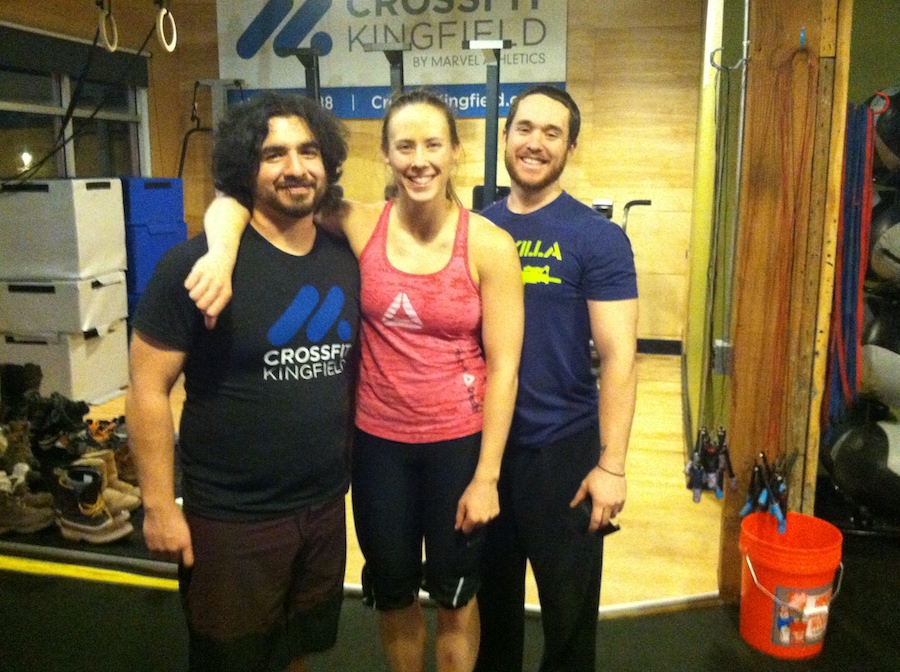
Audrey Weber’s CrossFit Kingfield team hard at work. “The energy of the group pulls you along,” she says. (Courtesy photo)
Today’s weekly workout is brought to you by Audrey Weber, a Minneapolis-based former elite nordic racer. In her first year of dental school, the 27 year old has less time for ski-specific training and instead shifted her focus to the gym, where she’s found success with the CrossFit method. While this high-intensity, strength training regimen isn’t for everyone, Weber offers a closer look at what it’s all about.
***
Graduate school might be the first time where ‘real life’ has seriously impeded my ability to get outside and exercise as much as I would like to. I went back to school and that was really the end of my motivation to get out and ski in any but the most-tolerable conditions. Rollerskiing and running were out of the question. Between all the free pizza they serve at Lunch and Learns, and my shortage of time and energy, I might as well have resigned myself to the couch and an early grave.
Thankfully, in the nine months before starting school, I had become immersed in this new sport that seems to be really catching on. The sport is CrossFit, maybe you have heard of it. Currently, I am 13 months into my own personal case study called, “How Fit Can an Ex-Cross Country Ski Racer Stay on Four Hours of Training Per Week?” Some preliminary results are in, and the findings are quite interesting.
A quick rundown on CrossFit, save the cultish doctrine. There is a lot to like about CrossFit as a competitive athlete. CrossFit strives to address the “ten general physical skills required of optimal physical competence.” It basically focuses on making you the most-prepared well-rounded athlete possible. Now, of course, that is a arbitrary definition, which some would argue fails to emphasize endurance and glycogen storage capacity, but so far, my experience is that it is actually a highly-efficient and enjoyable way to get yourself physically and mental prepared for many of life’s challenges.
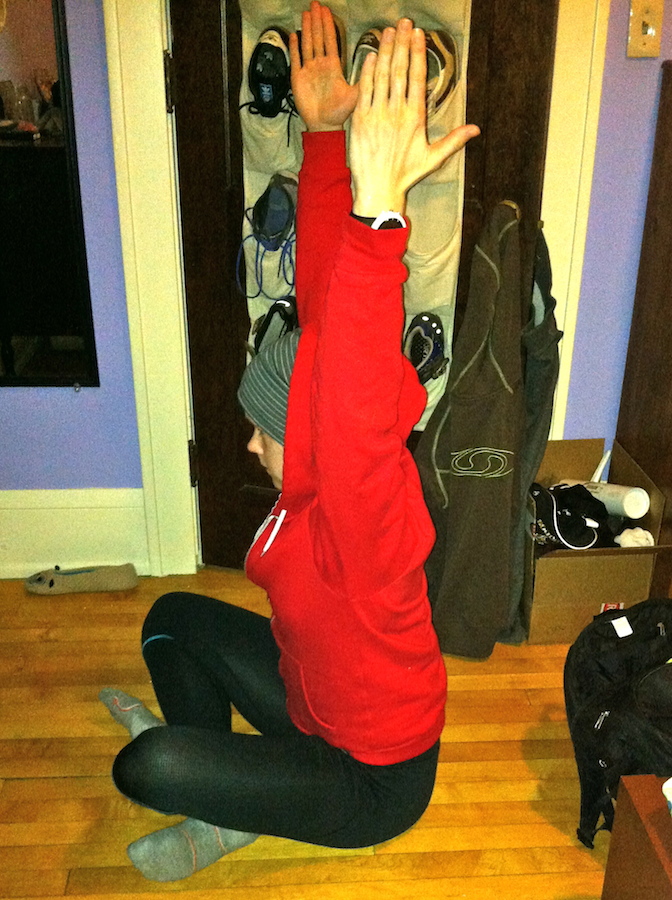
The Skier-ness Test: I wish I had a before picture of myself, because I’ve come a long way on this. You can see my right arm (that is my bad shoulder) still sneaks in front of the left.
CrossFit is not ski training, so why should a skier be interested in something that is expressly not skiing? Here is a quick test: sit on the floor with your legs crossed. Sit up straight and tall and extend your arms straight over head. Have someone take a picture from the lateral view to see if you are actually sitting straight up and down. If you have trouble achieving this position without severely straining yourself, congratulations, that means you are a true skier!
And that is why you might need CrossFit. The repetitive motions of cross country skiing will steadily erode your body’s ability to work in a full range of motion, which typically means tight shoulders, tight hips, and tight psoas muscles. And when mobility is limited, bad things start to happen.
CrossFit’s emphasis on proper body mechanics and mobility may be even more important that the strength and fitness gains that come with the training. One of the reasons, in my opinion, that Jessie Diggins has been such a successful athlete, is because she has the intrinsic quality of being extremely flexible and bendy. I have seen the girl do dynamic leg swings, she is built like Gumby. And that is a sign of long, healthy muscles that can work at maximum efficiency.
So unless you are born with the gift of great flexibility, you have to put a concentrated effort on a daily basis to gaining that mobility. And let’s be honest, who among us is as faithful to our foam roller as we should be? It is hard to do without expert guidance and a structured, motivational environment. Simple human psychology. CrossFit provides that guidance (a coach) and environment (the gym community).
Disclaimer: CrossFit alone does not constitute ski training. Obviously, if you want to ski a race of any duration, you need to add volume with distance training. You also need ski-specific technique training. In an ideal world, you would have the time and means to incorporate CrossFit two to four times per week, while also getting distance, over-distance, and steady state workouts in.
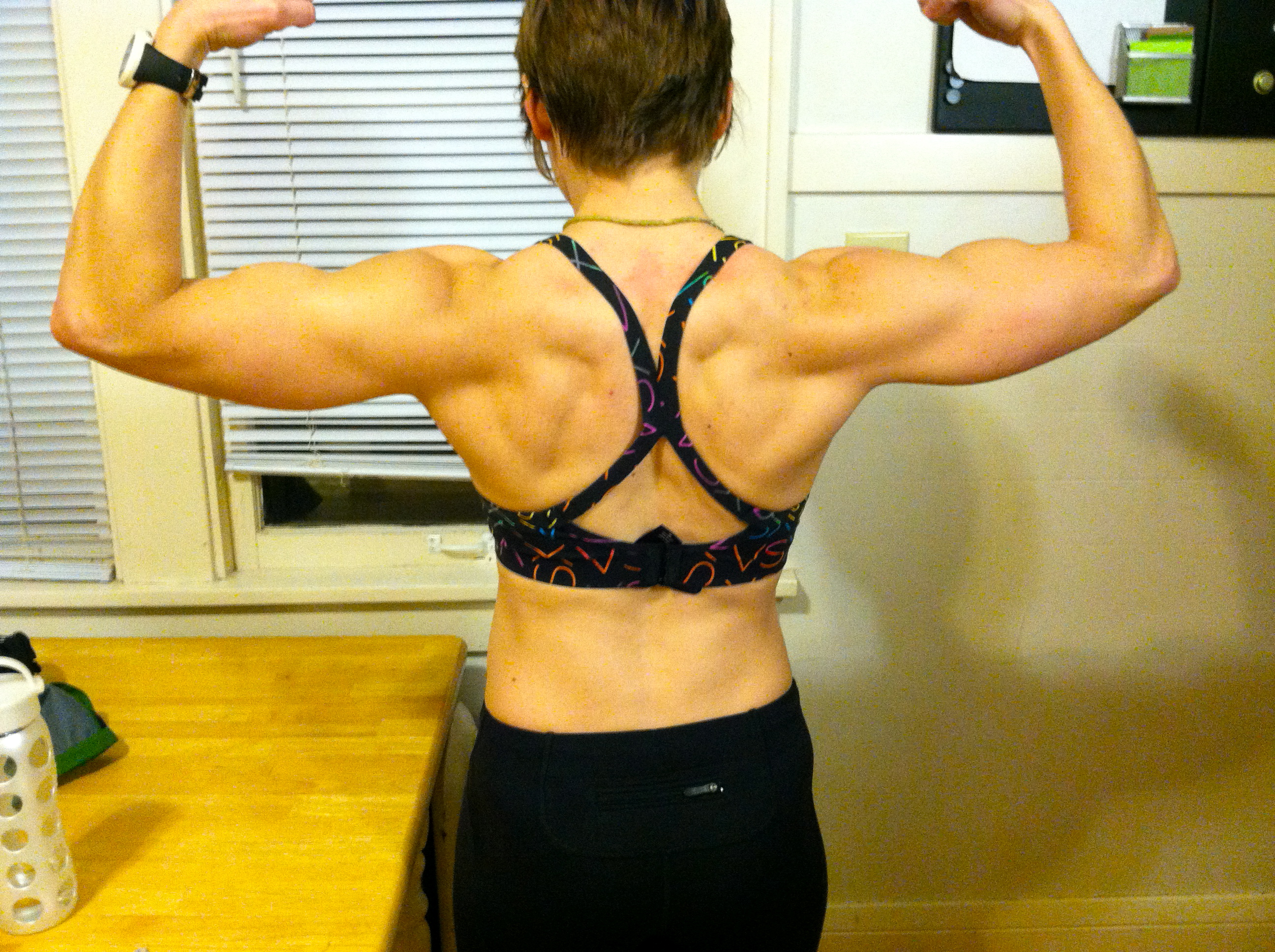
” Don’t mind if I draw the comparison.” See below photo of Marit Bjørgen. (Photo: Audrey Weber)
Marit Bjørgen
The Workout: 7:30-8:30 PM Friday, January 18th at CrossFit Kingfield in South Minneapolis
The coaches: Danny Yeager, Amanda Sullivan, and Tony “The Librarian” Christopherson
The Team: range of individuals, men and women, ages 24 to 55, elite to recreational athletes
The Warm Up(20 minutes): At my gym (or “box” as the lingo goes), CrossFit Kingfield in south Minneapolis, the workout starts with some combination of active warm up and dynamic stretching. Some days it is a classic track warm up with running drills done across the gym floor. Today’s warm up was a partner activity that involved three quick couplets of exercises completed at “medium” intensity (whatever . . . my team still won).
One round of 15 hand release push ups while the other performs a prying goblet squat and then switch.
The next part of the warm up is specific to the day’s workout. The Ballistic Squat Warm Up is a series of squat drills performed with light weight to build technique, range of motion, and speed coming out of the bottom of a squat. One would typically start with just the weight of the barbell (we have some as light at 25 lbs) and then work up over several weeks to what feels like a moderate load that you can still move quickly (in the video I am performing a shortened version of the drill using 95 lbs). The whole thing can be done in under a minute like this:
One full depth squat held at the bottom with weight in the heels, chest up, lumbar spine in a neutral position, and knees out. This position is held 5-10 seconds.
Next is three full depth squats performed in quick succession and at high speed
Third comes three squats with a pause at parallel (higher than full depth) and then a bounce out of the bottom all the way up to the top.
Finally, is a squat to parallel, pause, bounce out of the bottom back to parallel (repeated three times) and then bounce all the way to the top.
CrossFit Kingfield coaches (left to right): Tony Christopherson, Amanda Sullivan (co-owner) and Danny Yeager (head coach and co owner). (Photo: Audrey Weber)
The strength workout (20 minutes): The next portion of the workout is also variable. Sometimes it is a max lift and other times it is working with one of the Olympic lifts (clean & jerk or snatch). This day was our second-to-last day in a three-week squat cycle. During this cycle we high-bar back squatted multiple days per week at increasingly high percentages of our one-rep max. Coach Danny says,
“The idea of this training is to stimulate the nervous system response in which our bodies adapt to squatting heavy weight on a regular basis. Once that three-week cycle is complete, it is important to deload for one week, and then begin a standard 8-12 week linear regression cycle, which will allow our bodies to make the correct adaptation and convert the gains made during the 3-week cycle into real top-end strength.”
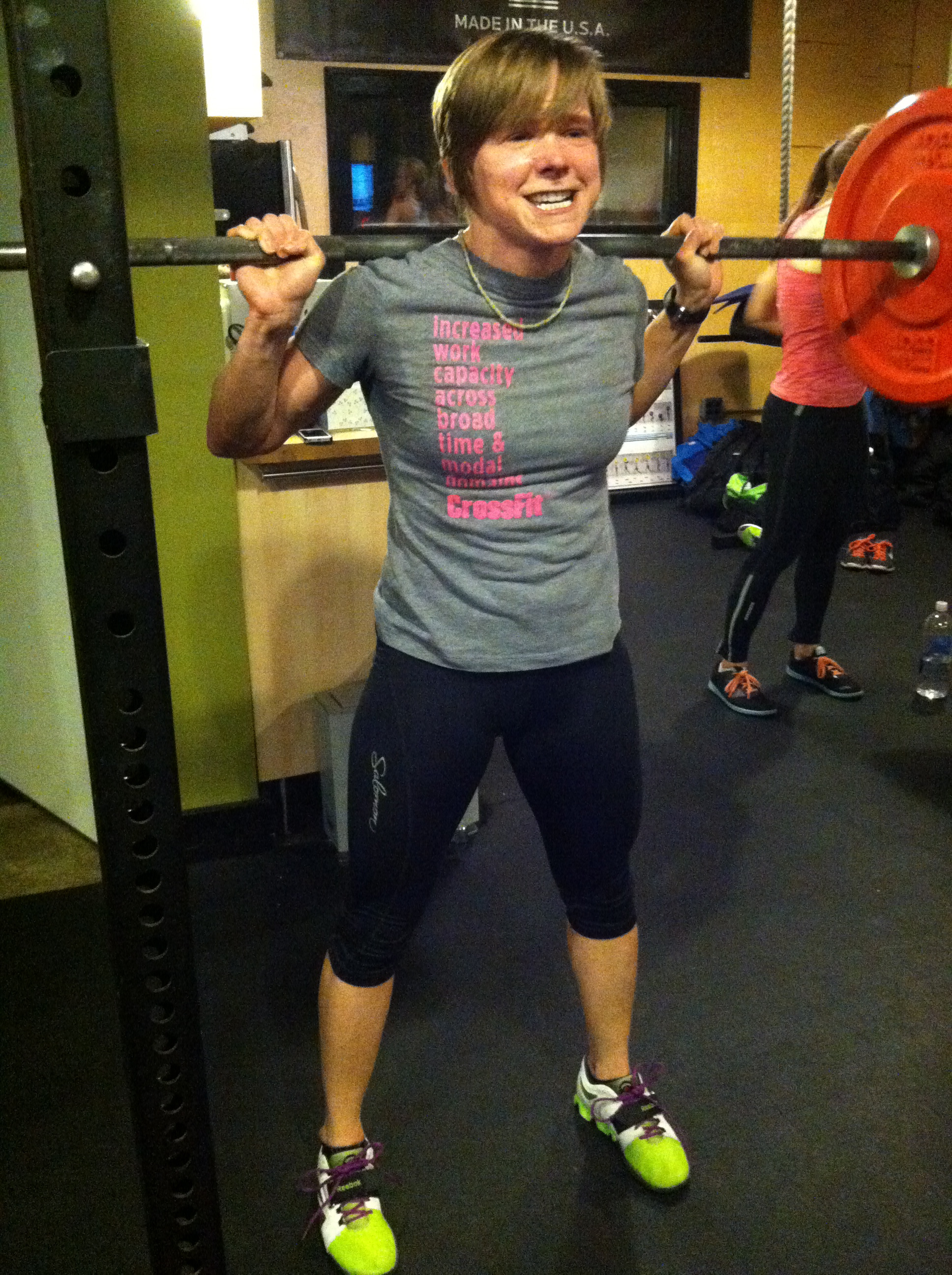
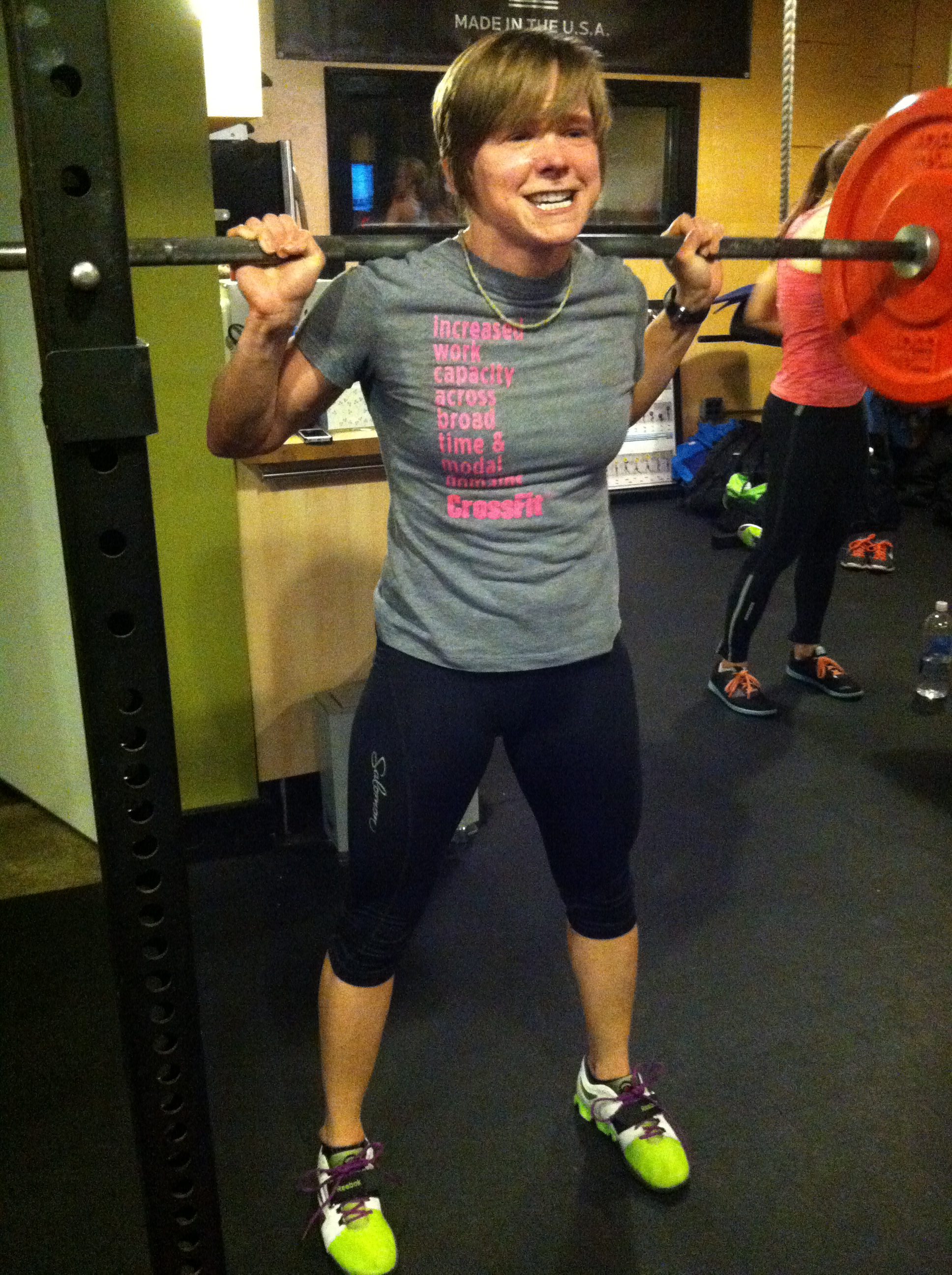
High bar back squat: 8 sets of 4 at 80% of athlete’s 1-rep max -or- as heavy as possible without compromising form, speed, or safety. (example for me: 0.8 x 255lbs = 225lbs, which I dropped down to a manageable but tough 185lbs)
This being the end of the cycle, weights got pretty heavy for people, so there were three coaches on hand to supervise and spot the 12 athletes. Remarkably, within the same space, these 12 people squatted 12 different weights that ranged from 75 lbs to 265 lbs. Pretty wild.
Squatting is not supposed to be pretty. (Photo: Audrey Weber)
The biggest concern I had for doing this type of training is that I would have to start purchasing the dreaded “size medium” scrubs for school, and I was terrified of the idea of “getting too big.” I am happy to report, however, that after one year of heavy training, I have made huge gains in strength, while I weigh no more than I did when I was ski racing, and my size 4 jeans feel only minimally snugger.
The Workout of the Day (WOD) (15 minutes, 40 seconds): Huge variety of formats and rep schemes for this portion of the workout. Duration can range from as short as 5 minutes as long as 25 minutes.
Every minute, on the minute (EMOM) for 8 rounds or 15 minutes and 40 seconds
– Even minute: 15/30 (women/men) hand release push ups, or as many as you can do in 40 seconds
– Odd minute: 50 double unders (no scaling) (or as many as you can do in 40 seconds)
The last 20 seconds of every minute is for transition.
The genius of this workout is just how torturous such a simple-sounding combination of push ups and jumping rope becomes after you do it nearly continuously for 15 minutes. The number of push ups is designed so you are blowing your arms out for at least 35 seconds of the first minute, and then mustering all your hand coordination and forearm strength to rotate a jump rope at at least 150 RPM in the second minute (that is the speed you need to get 100 rotations or 50 double under’s in 40 seconds).
It wasn’t until the VERY last round that I finally did all 50 double unders in the allotted time. The fatigue has an amazing way of building such that you can push yourself continuously and ride the upper limit of your work capacity for an extended time. You find little ways to recover within the movements and are forced to achieve a high level of efficiency in order to do so. Sounds kind of like ski racing.
The cool down (20 minutes): The post-workout usually consists of lying on the floor for a few minutes, drinking some water, and then smashing or stretching. It is a nice social time to catch up and maybe help a sister out with some myofacial gunk in a hard-to-reach place.
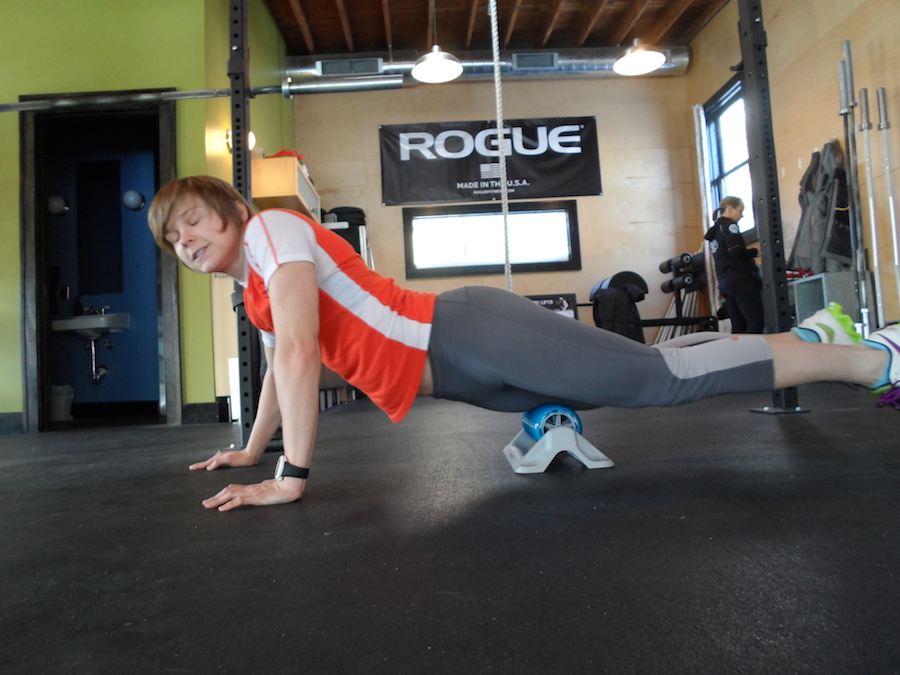
Audrey Weber rolling it out on the Battlestar. “That’s the pain face.” (Courtesy photo)
Skiers, its time to graduate from the foam roller to the Battlestar (see photo at right).
Heading home to refuel and continue to rehydrate is next priority, of course.
And if the workout is completed in the evening, and you hope to get a good night’s sleep, I would recommend spending 10-15 minutes draining the legs with some legs-up-the-wall.
I believe that skiers in general have a lot to learn about mobility work and basic athletic movement, both of which are highly developed and emphasized within the CrossFit framework. CrossFit is great for staying in shape for people with limited time to train, as well as for providing a structured and motivational atmosphere.
***
About the author: Audrey Weber is a former racer and is currently in her first year at the University of Minnesota School of Dentistry.
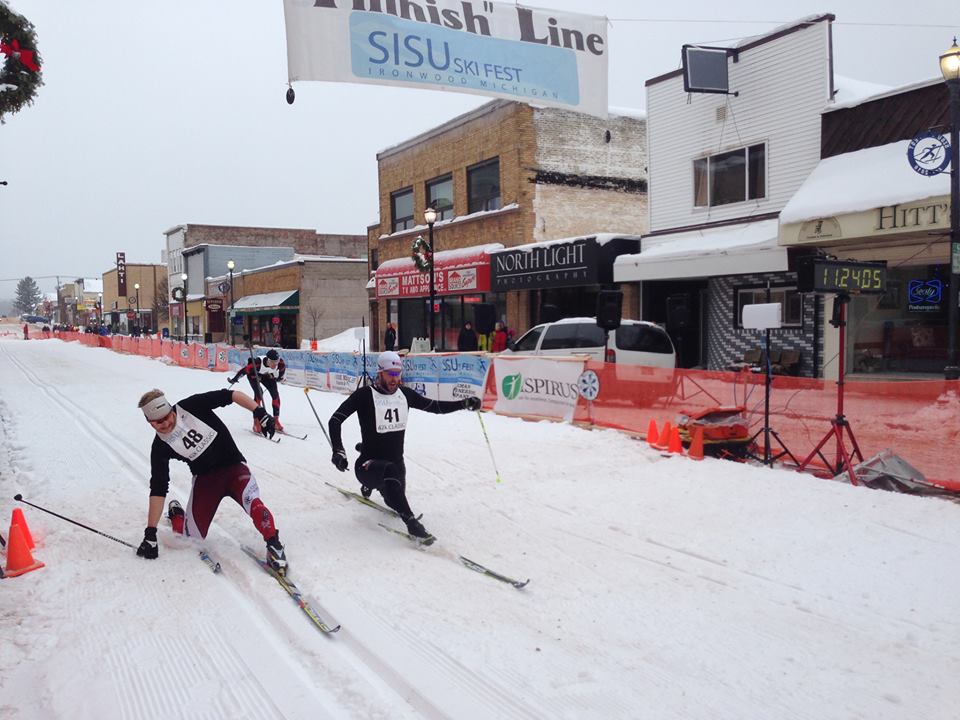
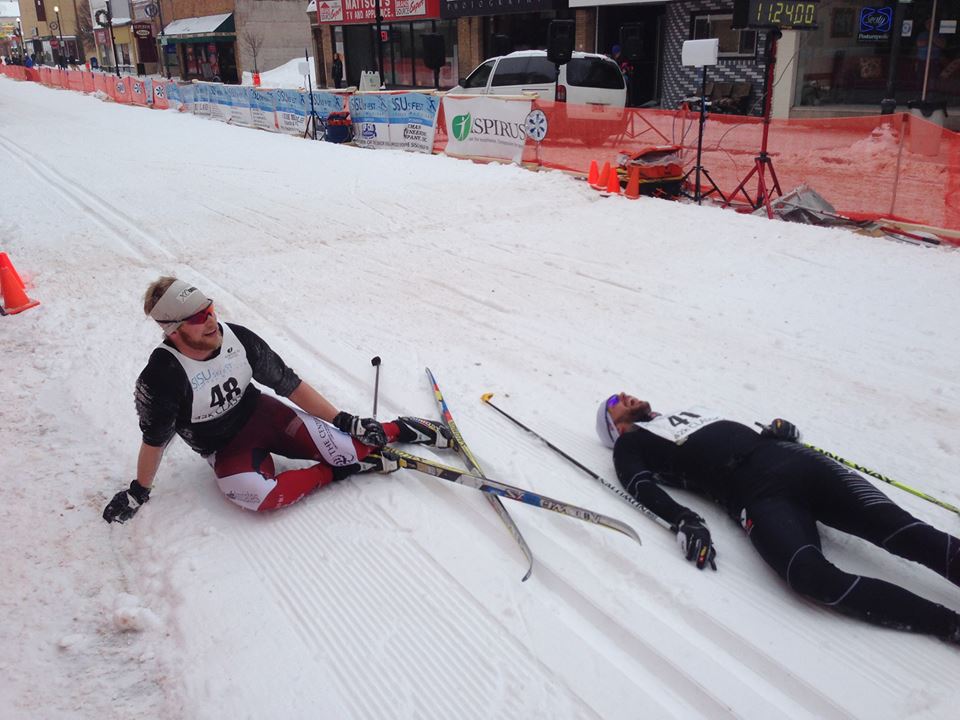
Former CXC teammates Santi Ocariz (l) and Doug DeBold racing to a photo finish at the 42 k classic SISU Marathon on Jan. 11 in Ironwood, Mich. DeBold took the win, using a pole Ocariz lent him a minute before the start. (Courtesy photo)
Santi Ocariz’s mind could’ve been preoccupied with a million things a minute and a half before the start of the 42-kilometer SISU Marathon on Jan. 11 in Ironwood, Mich. But the 27-year-old Wisconsin native could only think about his former teammate Doug DeBold, who’d likely give him the best run in the classic race.
Just before the start, DeBold, of Wayzata, Minn., realized his pole strap was broken. Ocariz ran to his car and found him a replacement. Anyone who knows Ocariz or remembers his gesture from the 2012 American Birkebeiner wouldn’t have been surprised. Skiing with the leaders with less than 10 kilometers to go, Ocariz gave his pole to Matt Liebsch, another one of his former teammates at Central Cross Country (CXC), after Liebsch initially refused the offer when he broke his. Liebsch ultimately accepted at 44 k and went on to place second.
“I mean, what’s the difference if I’m eighth or fourteenth?” Ocariz said after finishing 11th. “He had the chance to win. He’s a good friend of mine.”
Two years later and just over month before the 2014 Birkie on Feb. 22, Ocariz told The Daily Globe the SISU Marathon was “all friendly competition.” He and DeBold had grown up racing one another as juniors and in college before spending a summer as teammates on CXC.
“I had no idea how the race would play out,” wrote Ocariz, who’s living in Moorhead, Minn, pursuing an accelerated nursing degree and is the father of a 10 month old, in an email to FasterSkier.
DeBold led from the start and took off around 14 or 15 k, he explained.
“I took it out nice and slow and waited for a while to start reeling him in,” Ocariz wrote. “I didn’t want to bonk or lock up in cramps, as I haven’t gotten much of any training in this year. On average I have only been able to get out skiing once a week, and this race was my longest ski of the year by about an hour and a half.”
Doug DeBold (r) and Santi Ocariz after placing first and second, respectively, in the 42 k classic SISU Marathon on Jan. 11 in Ironwood, Minn. (Courtesy photo)
With about 11 k remaining, Ocariz and Chris Pappathopoulos caught DeBold, and Ocariz passed him. The three raced together toward the finish, where Ocariz led into the final straightaway.
“Doug pulled up alongside of me as all three of us sprinted for the finish,” Ocariz explained. “Doug and I lunged for the line, and he got me by one or two hundredths of a second.”
On the results, the two were listed with the same time of 2:24.06, but DeBold took the victory in the photo finish. Pappathopoulos was third, one-hundredth of a second behind.
“I had no idea who won,” DeBold told the local Globe.
“I kept thinking I’ve gotta go harder, but I couldn’t,” Ocariz told the Globe. “My legs and even my arms were cramping up … It was a pretty good suffer-fest.”
As for whether this was a tune-up for the Birkie, Ocariz explained it depends on whether he can swing it with school.
“I have very little free time, even on the weekends,” Ocariz wrote. “If I can get away, I’ll be suffering through the Seeley Hills Classic and the Classic Birkie.”
Skillicorn Breaks Away for First SISU Win
In the women’s 42 k classic, Kelly Skillicorn of Winona, Minn., broke away on the final lap around 15 k to win in 2:43.55. Another former CXC skier, Audrey Weber placed second, 16 minutes later.
“The pace went out easy and everyone settled into a long line fairly quickly,” Weber wrote in an email. “I got in the track and I think Skillicorn was marking me, so she tucked in behind me. My main goal was to maintain a pace within myself and not get taken out by any flailing master blasters, which is always a risk for women at the front of the pack in mixed gender mass start races.”
After her first SISU victory, Skillicorn told the Globe that she didn’t feel good at the start after waking up at 5 a.m. and driving north from her cabin in Hayward, Wis., nearly 90 miles away. But she started to feel better with 15 k to go.
With two men in front of her, she said she kept her distance while keeping them in her sights.
“I wasn’t sure how close anyone was behind me because I never look back,” Skillicorn said. “I stayed with the guys. The last 5k I really pushed it. I never want to slow down when I’m racing.”
“My main goal was to maintain a pace within myself and not get taken out by any flailing master blasters.” — Audrey Weber, second woman in 2014 SISU Marathon
And when Skillicorn decided to go, Weber couldn’t respond.
“I guess that’s what not training does for you,” wrote Weber, 27, who was born four days before Ocariz on Sept. 23 . “My training this fall consisted of mostly CrossFit and maybe 3, 45-minute runs. I’ve been on skis a total of 6 times this winter. It’s all I have time for being in my first year of dental school. So I pretty much had one pace I could ski and I did all I could to hang on. I probably kept her in sight for another 5k, but by the time the second lap started I was in no man’s land.”
Skiing for second, Weber focused on “not stopping and mostly just hoping I didn’t get passed,” she wrote. “I pretty much had no expectations for this race other than finishing. I didn’t have any idea what my body would be up for having not tested my ski fitness in quite a long time. When you have fitness, you can rely on your strengths in a race, but when you’re out of shape you don’t really have any strengths to fall back on, so you just really hurt for a long time.”
In the end, she was grateful for fast skis and “decent technique” to fall back on. Next month, she plans to race the Birkie classic marathon.
In her second time at the SISU Marathon, Weber described the people of Ironwood as “amazing and incredibly hospitable! … I have found both times that the town really rolls out the red carpet for racers.”
While waiting for her boyfriend to finish his first ski race, the 42 k skate, she sat in a “plush recliner” by the front window of a furniture story on Main Street. “I made friends with the store manager, he offered me hot coffee and told me stories about people from Ironwood,” she wrote. “I know I didn’t really deserve it, but I felt like a World Cup race leader for a little while. It was very special.”
In the race’s fifth year, registration was at a high around 600. Race director Jonathon Rulseh told the Globe that they caught a break with temperatures in the 20s after they neared 45 degrees below zero just days before. He also pointed to the nearly 250 volunteers behind SISU’s events — with the 42 k marathons, 21 k Heikki Lunta half marathon, Taste N Tour, 3 k & 5 k Junior SISU and the 2K Lapset Loppett; and three snowshoe races.
“They’re the glue that holds the SISU together and makes it run,” he said. “They’re critical to its success.”
The Ski and Tea women's group gets ready to head out from 00 trailhead in Seeley, Wis., on Feb. 22 for a pre-Birkie clinic.
That last ski of the season might not have set well this year.
You weren’t exactly ready. Some places enjoyed sufficient snow dumpings this winter, but on the whole, it just wasn’t enough. It ended too soon.
Certain parts of the country aren’t quite in summer mode yet. Snow has been known to make April appearances, and some ski towns recently saw a late-season blast of the white stuff.
But in Hayward, Wis., home of the American Birkebeiner and center of Midwest nordic skiing, temperatures were forecast to hit the 60s this week. That’s spring, and essentially, the end of the ski season.
Tell that to the women with Ski and Tea, a nearly 300-person club that gets females together year round to practice cross-country. While it’s dryland training in the summer, they typically meet weekly every month except March (that’s post-Birkie time following the ski marathon in late February. Many spent their Fridays off helping a local charity, Weekend Meals for Kids).
Ski and Tea in the Summer:
April theme: Reboot, Rebuild, Renew
Example workout:Long, slow distance of running or walking with 15-20 second pickups every 2 minutes followed by stretching.
Post-workout:Tea at Mooselips Java Joint in Seeley.
Outlook: “Our weekly workouts for the coming dry-land months will be progressive,” according to Cook. “(They) will include hill workouts with poles, strength, agility, and balance, personal time trials, and interval training. We have several workout sites throughout the year which include the Birkie Trail Northend, 00 Warming Hut, Mosquito Brook and the Fish Hatchery. We will also use the Camba Mukwa Single Track. We ask all our members to buy Birkie Trail passes and we support the Birkie Trail Maintenance at the Ski and Tea 27K Classic Friends of the Trail Marker.”
The program, which includes clinics led by Central Cross Country (CXC) members, started four years ago with about 12 women. Founders Linda Cook and Juli Lynch knew several former skiers that wanted to get back into the sport and arranged a recreational get-together. They saw two more women at the trailhead and invited them along as well.
This past winter, a two-hour “Ski and Tea with the Pros” clinic attracted more than 30 women three days before the 39th American Birkebeiner. Cook, who placed second in her 70-79 age group in the 23-kilometer Kortelopet, said two international skiers attended the seminar, which was broken up into classic and freestyle technique lessons with four elite coaches.
Two of the group’s original supporters, Audrey Weber and Maria Stuber, offered expertise as former CXC members. Both born in the Midwest, Weber skis for Go! Training, and Stuber joined the Craftsbury Green Racing Project in Vermont. She returned to Wisconsin for the Birkie and “Ski and Tea” event, bringing Craftsbury teammate Hannah Dreissigacker with her. CXC’s Carolyn Ocariz also helped fill in for teammate Caitlin Gregg, who was sick, and proceeds from the clinic went toward their training expenses.
The four leaders gave broad tips while answering specific questions, focusing on one technical aspect at a time. Participants could chose to skate or classic and watch themselves on video if they wanted. Post-workout goodies, such as hot cocoa, cookies and tea, wrapped up the afternoon social at the 00 Warming Hut in Seeley, Wis.
Today, Cook said Ski and Tea has about 60 active members with 290 newsletter members living as far as India and Alaska. After moving to the area 16 years ago, she felt there was a need for the group considering the number of interested women.
Ski and Tea co-founder Linda Cook (c) with two of the group's youngest members, Keely and Kiera Jackson.
Looking around the jam-packed cabin with skiers of all ages, some in their early teens, Cook talked about how Ski and Tea had grown. In 2009, it became part of CXC and its insurance coverage. Participants have to sign a waver, and for $40 dollars, get a year’s worth of instruction and ski companionship.
“Someone described it as the modern-day quilting bee,” Cook said with a laugh. “Sweat is the best kind of therapy.”
Outside the 00 trailhead halfway on the Birkie trail, nearly 40 women stood in ski boots swinging their arms and hopping from one leg to the other during the elite coaches’ warmup. Then, they skied off into the woods for a few pointers, which were worth internalizing and practicing for the season ahead.
I took some notes, and this is what I came back with:
Ocariz on skate technique:
Carolyn Ocariz (l), formerly of CXC, demonstrates skate technique during a Ski and Tea clinic in Seeley, Wis., on Feb. 22.
– Focus on the glide and holding it a little longer
– Butt forward
– Poles shoulder-width apart, not too narrow (think of standing like a boxy football player with broad shoulders)
Dreissigacker on classic technique:
– Double pole as long as possible
– Switch to striding when timing feels off, “when you feel like you’re bogging down” but “double poling is definitely faster.”
Hannah Dreissigacker (Craftsbury Green Racing Project) talks to some Ski and Tea members during a pre-Birkie clinic on Feb. 22 in Seeley, Wis.
Weber on classic skiing/hills:
– Double pole on the uphills should involve lots of crunching
– Think “high and quick” on the double pole as the hill gets steeper
– When descending in the track, lean into the curve with both feet equally weighted
– Rest poles parallel on hip creases, hold grips in front of face to keep poles from sticking straight up
– “Don’t abort the track because that’s when bad things happen”
Audrey Weber (Go! Training/Atomic) demonstrates the downhill tuck during a Ski and Tea clinic on Feb. 22 in Seeley, Wis.
While most of the spotlight was focused on Lake Placid this weekend, about 60 skiers from around the country toed the line in Duluth, MN for the first ever North Shore Rollerski Marathon on September 17. Topping the podium for the 26.2 mile point-to-point tour of Lake Superior’s north shore were Duluth native Andre Watt (Rossignol), who won a close race against Central Cross Country’s (CXC) Brian Gregg, and Jennie Bender (CXC), who beat runner-up Audrey Weber by less than a second.
Watt completed the course in 1:18:46, with Gregg only a second behind. Watt said ski speed played a huge role in how the race went—there was no restriction on wheel speed on an extremely flat course.
“I had slightly faster skis today, and [ski speed] allowed the third place finisher to stay with us for quite a ways,” said Watt, who is on Rossignol’s marathon team and assistant coaches at The College of St. Scholastica.
The route started in Two Harbors and ended on Lemon Drop Hill in downtown Duluth. The final kilometers included a stretch of concrete on I-35, which was closed off to traffic for the duration of the race along with the rest of the course. Racers made a sharp downhill 180-degree turn on the highway roundabout ramp to come into the finish, the only place Watt says they had to check their speed.
The wheels that he and Gregg used were faster than they were used to training on. “We were using urethane wheels with really fast bearings,” said Gregg. “We were all pretty nervous being on skis that quick…we practiced on them the night before. But when we were actually racing, it didn’t feel that fast.”
Twenty-six miles in 1:18 works out to an average speed of about 20 miles per hour. Fast skis weren’t the only factor at play, however. The flat, exposed course made drafting a significant part of race strategy as well.
As a result of the high race speeds, both the men’s and women’s race came down to a sprint at the finish. “Andre worked most of the race, skiing faster. I was happy to hold on until the sprit at the end,” said Gregg.
On the women’s side, Bender said she and Weber made a decision to share drafting duties, and switched the lead every mile. While sharing the burden of breaking the wind helped both skiers save energy, it also made it hard for either of them to pull away, and their race also came down to who could cover the final meters fastest.
“Audrey is a good sprinter, so I knew I’d have to fight for it,” said Bender. She just edged Weber at the line; both clocked in on the results at 1:32:26.
All in all, the top finishers enjoyed the new race, and look forward to being able to wear the founders bibs in future years.
The marathon was more than just a brand new rollerski event, however. A field of 60 may seem small, but racers were part of a major race atmosphere. Skiers shared the pavement with over 2,000 inline skaters competing in the 16th annual North Shore Inline Marathon, the largest event of its kind in the U.S. The winner of the inline race, Yann Guyader of Canada, averaged 23 miles per hour to finish in 1:06:33, almost six minutes ahead of second place.
Rollerski competitors started a half hour behind the last wave of skaters, and with souped up wheels and greased bearings, caught up to some of the later open waves and weaved around racers who had never seen rollerskis before.
“We had a lot of people at the finish asking us about [our rollerskis],” said Watt. “I think it’s great for overall awareness.”
Bender agreed, and proposed that open rollerski races like this one be actively used to promote and fundraise for Nordic skiing in the US. “This is a great way, instead of just trying to fundraise, to promote Nordic skiing in this country; to get people to recognize what we do, and to promote the sport,” she said.
According to Watt, the plan is to hold the race again in the future. CXC Director Yuriy Gusev proposed the idea for this year’s rollerski race to the inline race director, who will apply feedback from this weekend’s inaugural run to plans for next year.
Vetle Thyli (NOR) starting the final alongside teammate Martin Andersen.
Last year, the Birkie Elite Sprints, held on Main Street in Hayward, Wisconsin, two days before the Birkie, were a mostly American affair. Morten Pedersen of Norway won the men’s race, but most of the other top finishers were natives – including Audrey Weber, then skiing for CXC, who won the women’s heats.
This year, things changed.
Rogers leading Andrey Tyuterev of Russia.
The men’s final on Tuesday came down to a battle between Norwegian teammates Vetle Thyli and Martin Andersen. Before the gun went off, the two trash-talked over the PA system: Andersen said that although he had never beaten Thyli in practice, “this would be the first time.”
In the end, it didn’t turn out that way. Thyli had a lead going into the 180-degree turns around a pair of cones – one for each skier – and only lengthened his lead coming into the finishing stretch. He was able to celebrate well before the finish line, victory – and a $500 check – ensured.
Colin Rogers (Sun Valley) was the top American, besting Sylvan Ellefson (Vail) in a race for third place. Along the way, both faced a number of impressive comptitors. Rogers topped teammate Mikey Sinnott as well as Andrey Tyterev of Russia before losing to Thyli in the semifinals, while Ellefson had to beat out top Wisconsin high school skier Dylan McGarthwaite and the always formidable Chris Cook (Steinbock Racing).
In the semifinals, Ellefson took a tumble about a quarter of the way through the race. By the time he was back on his feet, Andersen had rounded the cone and was on his way back to the start/finish. As a joke, Ellefson skied toward him and the two played a game of chicken, much to the amusement of the crowds lining Main Street.
Naryshkina outsprinting Bender.
In the women’s final, Natalja Naryshkina of Russia defeated CXC’s Jennie Bender by a slim margin to take home the check.
It was Bender’s first time at the Elite Sprints – and, she said, her first time racing on a city street or around a traffic cone.
“I didn’t worry too much about the first part of the race,” she told FasterSkier. “As long as I was close going around the cone, that was good enough. It was really fun with the Russians and other European racers here, because you really don’t know anything about the person you’re racing against – you’re just kind of like, ‘well, let’s do this!’”
And do it she did, besting Sun Valley’s Nicole DeYong and Ursina Badilatti of Switzerland en route to the final.
“I felt like Batman flying down the street,” she said.
In the B-Final, Badilatti beat out Weber, last year’s champion who is now racing for Go! Training.
The women’s field was small, with just ten starters, but talented: it included 2010 Olympian Caitlin Compton (CXC), 2010 top-10 Birkie finisher Evelyn Dong (XC Oregon), and Morgan Smyth of APU, who recently collected two podium finishes at U.S. Nationals. All three lost their quarterfinal heats.
The men’s race had a much larger field – 22 – with racers from APU, CXC, Craftsbury, Vail, Sun Valley, VTXC, Steinbock Racing, and two European countries competing.
All of the athletes who sprinted down Main Street today will do so again on Saturday – albeit at a slower pace – at the end of the 2011 American Birkebeiner.
Sinnott at the end of his heat against teammate Rogers.Smyth and Badilatti exiting the traffic cones halfway through their quarterfinal heat.
Ellefson and McGarthwaite starting out a heat as Scott Wilson shoots the gun.Sinnott and Schulz duking it out on Main Street.Ellefson after he won a toe slide with Chris Cook, which sent him into the snow in the finish chute.
Juergen Uhl (South Burlington, VT) and Audrey Weber (St. Louis Park, MN) may have graduated from college last spring, but they haven’t left their racing days behind. The UVM and Dartmouth ’09s captured the 54K Birkie Classic titles in February this year and will make their way to Maine to race at Spring Series this week. FasterSkier caught up with Juergen and Audrey on winning the Birkie Classic and life after EISA racing.
Juergen Uhl. Photo: Darlene Prois.
Juergen Uhl
Since graduating from UVM last spring, we’ve seen you racing in a Craftsbury uniform — what has your transition to post-collegiate racing been like? How has your experience as a racer at UVM helped shape your focus and shift to racing professionally?
The transition to post-collegiate racing has been very smooth. I graduated in May 2009 and decided to continue at UVM as a graduate student in Engineering. This lead to a rather small change in lifestyle. I was going to be in Burlington and take classes. And I wanted to continue racing!
I worked as a volunteer student coach with the UVM team, assist the team at practices and at some carnivals and Eastern Cup races, as well as get some training in.
It was the perfect setup for me as I would be training with a very good group of guys without traveling far. Furthermore it was awesome to be supported by the Craftsbury Nordic Ski Club and their newly initiated Green Racing Project. This helped me to receive the necessary race support and a second opportunity to train with a different group of highly competitive skiers. Overall I felt like I was offered the optimum base for another good season.
Coming into the 2009-2010 season, what were your goals for the year? You’ve historically been a strong classic skier, highlighted this year by your win at Craftsbury in February, and of course your win at NCAAs last season — what races were you focusing on for the season?
I had a limited amount of goals for the season 2009-2010 because I knew that I would not be very flexible while being a TA and taking classes at UVM. Therefore one of my main goals was to stay in shape and keep the momentum for the season 2010-2011. I will gain a lot of flexibility during the next academic year – I should mostly be able to plan my work at school myself. This is of great importance to me as I am hoping to qualify for the World University games next year. My main focus for this season was to compete in a couple of bigger marathon events. I had heard a lot about the American Birkebeiner and besides my desire to check out the scene around the Birkie I was also eager to race in it. The Craftsbury marathon was on top of my list because it is hosted by my home club and it is one of the biggest marathons in the East. Furthermore I had decided to compete in smaller races in the East – but besides the two marathons I did not have a set race schedule.
Explain how your win at the Classic Birkie unfolded: Did you lead the field the whole way or did you exchange the lead with other racers? What kind of skis did you use? How were the conditions? How did your skis hold up throughout the race? Were there any critical points in your race that you felt contributed most to your win?
The plan to go to the Birkie arose through Peter Hale. He helped me out with Madshus skis for this season and invited me to stay at a house in Hayward. A lot of people talked very positive about their experience of racing the Birkie, so I was really excited to compete. And it sure was a good time!
I waxed my race skis the day before the race with the help of Leif Zimmermann – there was not going to be any time before the start of my wave to test wax or try my skis which made me a bit skeptical whether my skis would work especially in the beginning of the race. I had only skied the last few kilometers of the 54k course previous to the race day. So, I was worried that it could be too hard to stay with the lead pack in case my skis were not going to work from the start. But they did! I was relieved.
My body also felt great which made it fun to just cruise for the first few kilometers. After about 10k I accidentally ended up in the lead of the pack; I increased the pace by a notch, mainly because I felt good and it didn’t seem like it could hurt me. I noticed that some of the racers seemed to have trouble to keep up or didn’t feel like going harder at this early stage of the race. I thought to myself that the race was still very long and I decided to hold back. But I definitely felt more confident after this minor surge and I knew that I was going to have a good race.
At about 23k I went back into the lead; this time I was trying to break away from the group. I pushed the pace up and over a 1k hill and I managed to put a gap between me and the rest of the field. The next 20k I skied hard. The rolling course at the Birkie is perfect for classic skiing. It was a lot of fun to be able to use the full range of classic techniques to be the most efficient at every part of the course.
After 43k I started to get a bit tired – I had tried to be conservative with the two gels that I had carried with me but it just was not enough. I had also lost my drink bottle at about 3k of the race which may have added to this lack of energy. Luckily a friend and ex-teammate from UVM Anders Osthus who was competing in the same race and a couple of other coaches had supplied me with drinks so that I ended up being strong enough to fight up the two longer uphills that were left before the finish.
I reached the lake and therefore the 51k mark of the race. It felt awesome to ski across the lake knowing that I was getting closer and closer to the win and the post race activities. At 1k to go I looked over my shoulders and I knew I was going to be able to bring it home. Sweet! The finishing stretch in Hayward was very exciting; the nice weather had attracted a lot of people that provided all racers with an amazing atmosphere when making their way to the finish.
What’s next for your race season? Any exciting spring plans? Will you return next year to contest the Birkie?
I will conclude this season with the Supertour Finals up in Maine. I heard from a lot of skiers that they will make their way to Presque Isle, so it should be great time. An exciting trip that I will be going on this spring is to visit the Niagara Falls. I have heard various opinions as to how much people liked or disliked their trip there – but the Niagara Falls are very well known around the world and I am looking forward to check them out. It will be awesome! I had such a good time at the Birkie this year that I would love to go back to Hayward/Cable, Wisconsin. It may depend on how much support I will be offered at that point.
Thanks for catching up with us Juergen! Good luck at Spring Series!
Audrey Weber. Photo: Darlene Prois.
Audrey Weber
You graduated from Dartmouth in 2009. What made you decide to pursue skiing professionally after graduation? How has your experience at Dartmouth shaped your experience as a racer?
I always knew I wanted to ski professionally, but just had to get my academic obligations out of the way first. I love putting myself 100% into the things I pursue, and being done with college, I wanted to take the opportunity to put all my effort and focus into skiing and see what I could achieve. My experience at Dartmouth taught me how to lead a very busy and demanding life, all while maintaining my sanity and not losing the joy in the things I do. I now find myself very well prepared to manage my responsibilities in a professional manner on and off skis. Also, skiing on such an extremely stacked team, such as Dartmouth’s women’s cross country team, has taught me to really just ski for myself and to achieve things for myself, and not worry about other people and their results compared to yours.
What has your year been like on the CXC team? Where do you spend most of your time training? How often to you train with other CXC athletes? What has been the biggest change to your training and racing experience since joining a professional team?
My year on the CXC team has been fantastic! I have gotten to travel all over the country, train with a great group, and really learned a lot about myself through the experience. Adjusting to the new lifestyle has posed its difficulties, but in the end I find that it all suits me very well. It is really hard to say where I spend “most” of my time. If I look over my schedule for the past 9 months I have spent 13 weeks “at home” in Minneapolis, 7 weeks in Hayward, 5 weeks in Utah where my boyfriend lives, and the other 3.5 months traveling to other locations for training, racing, and recreation. I’ve become rather accoustomed to living out a suitcase. Between May and November I train with the team at camps two weeks of every month. Then starting in West Yellowstone I am training with the team when we are together for races. The biggest change for me since “going pro” is what to do with myself all of the time when I’m not training. Recovery is a top priority, so I have lots of down time, but I also spend time working on fundraising, as well as other team responsibilities such as blogging and clinics. It is a little odd for me to have such an unstructured schedule for the first time in my life. Many days I have nothing I must to do at a specific time, so I really have to be motivated to get things done on my own.
Coming into the 2009-2010 season, what were your goals for the year? What races were you focusing on for the season?
My goals for this year were mostly training-related. I wanted to make a smooth adjustment to my new training regimen and to be very careful about not overdoing things with all the extra time I now had to put into training. I also was focused on successfully rehabing my shoulder, which I had surgery on in late April 2009. I wasn’t able to start using it again until September so I wanted to fully regain strength and range of motion by the end of the season. My main focus was the SuperTour sprints, especially the classic. I didn’t get to sprint as much as I wanted in college, and sprints are the area in which I feel I have the most potential.
You’ve had some strong results in sprint races, including your 13th place finish at US Nationals this year. What was it like to get a win in a high profile distance race? Have you raced a 50K before?
I was very happy with my sprint at nationals, but winning the Birkie was way cooler. I am really proud to able to represent the Birkie and all the great things it stands for in this reguard. I really did not expect as much of a reception as I got. Coming down Main Street the crowd was deafening and then as soon as I crossed the line I was whisked away by an escort to a holding room while we waited for the podium presentation and the press conference. It was pretty exciting. I did one 50k before this, the Great Glenn to Bretton Woods “ski adventure” in New Hampshire. I really enjoyed that race and it got me thinking that I could do pretty well in other classic marathons.
Explain how your win at the Classic Birkie unfolded: Did you lead the women’s field the whole way or did you exchange the lead with other racers? How were the conditions? How did your skis hold up throughout the race? Were there any critical points in your race that you felt contributed most to your win?
I skied in a small pack of ladies including Kerrie Fabius of Thunder Bay and Hillary Patzer. We switched off the lead for the first 20k or so, and then Hillary and I pulled away. I was leading Hillary at 36k (15k to go) when I got my second-to-last feed. I was feeling strong, so I started pushing the pace to see what Hillary had left. I pulled away and increased my effort throughout the remainder of the race. I raced on a pair of original production Salomon skis with a low camber, soft flex, and Finn Sisu fine grind. The skis were great the entire race: I strode every hill except the very top of Bitch Hill. I was running up on people’s tails on the down hills and striding past them on the climbs. The conditions were amazing. A hard white track all the way from Telemark to Hayward. The track was fast, which made the downhills really fun! I think the critical part of my race was that I fed a lot early on while staying relaxed and patient. This allowed me to have the energy to start pushing where I did and break away.
What’s next for your race season?
My next and final races for the season will be at Spring Series in Fort Kent, Maine. There is a classic sprint there, so I’m pretty excited.
Thanks Audrey – congrats on your Birkie win and good luck in Maine!
Hayward, Wisconsin – Italian skier Fabio Santus broke the 50K Birkie Skate presented by Becker Law course record with a time of 1:56:58.6 in the 37th annual American Birkebeiner held Saturday, February 27th. Rebecca Dussault the returning champion defended her title by winning the Women’s Skate division with a time of 2:18:18.1.
Santus of Milano, Italy, skied his first Birkie saying, “I am very, very happy. It was a great track with very good people.”
Tad Elliot, Durango, Colorado, skied to a second-place finish in 1:57:06.7 followed by Christopher Cook, Rhinelander, Wisconsin, with a third-place time of 1:58:41.
First time Birkie skiers Tazlina Mannix and Brooke Gosling battled for their positions with Mannix of Anchorage, Alaska, capturing the second place finish with a time of 2:18:49.2 and Gosling of Canmore, Alberta, Canada, taking third with a time of 2:18:57.
In its third year the Birkie Classic presented by Subaru showed course records for both the men’s and women’s races. The 54K Classic Champion is Juergen Uhl of South Burlington, Vermont, with a time of 2:28:39.4. Audrey Weber of St. Louis Park, Minnesota, captured the women’s title in a time of 2:51:34.
The second place time in the men’s classic of 2:32:30.7 was skied by Jesse Smith of Traverse City, Michigan. In third place was Shawn Miller, Duluth, Minnesota finishing in 2:33:16.3.
Repeating her second place finish from 2009, Hilary Patzer, St. Paul, Minnesota, finished in 2:53:07.4, while Kerrie Fabius, Thunder Bay, Ontario, Canada skiing in her first Birkie finished in 2:53:31.3.
Ned Zuelsdorff, Executive Director of the American Birkebeiner Ski Foundation, said skiers from 19 foreign nations, including Andora, Estonia and Russia, and 47 U.S states, including Hawaii, North Carolina and Alaska, had great conditions for the 37th anniversary event.
Honorary Starter, Wisconsin Governor James Doyle, welcomed the largest field of skiers ever in the American Birkebeiner’s 37-year history. He sent over 8,055 skiers on their way beginning at 8:00 a.m.
Temps hovered just below 0 degrees at the start, then climbed as 21 waves of skiers left the starting gates.
The American Birkebeiner is modeled after the Norwegian Birkebeiner Rennet, which in turn was inspired by the historic rescue of the infant who would become a celebrated king, Haakon Haakonsson IV. The race symbolically re-creates the flight of the prince, carried on skis by warriors called birkebeiners for their protective birch bark leggings.
Brothers David and Grant Nelson assumed the roles Torstein and Skervald, the Birkebeiner warriors who rescued the infant Prince Haakon (Hō-ken). The brothers made their own wooden skis for the event. Grant, a dentist in Duluth, Minnesota, has skied 15 Birkies. David, a circuit designer for satellite components lives in Medicine Lake, Minnesota, has skied 16 Birkies.
David’s wife Josie portrayed Inga the mother of Prince Haakon. Josie, worked as a physical therapist until becoming a stay at home mom after the birth of Karl; she has skied 11 Birkies and one Kortelopet. Karl served as Prince Haakon in the re-encactment.
The brothers dressed in full Birkebeiner regalia including helmets, shields and their wooden skis while carrying 13-month-old Karl Nelson to the finish line to the clang of cowbells from the thousands of spectators who lined Hayward’s Main Street. Karl’s mother, Josie skied the full 54 kilometers dressed in a traditional Norwegian dress and cloak, on wooden skis.
“The historic re-enactment, fast race course and the largest field ever made the Birkie’s 37th anniversary one for the books,” Zuelsdorff said. “We couldn’t be more pleased.”