Tag: Aurelie Dabudyk

  • Americans Dominate the Field, Podiums at Winter Games NZ (Updated)

    Americans Dominate the Field, Podiums at Winter Games NZ (Updated)

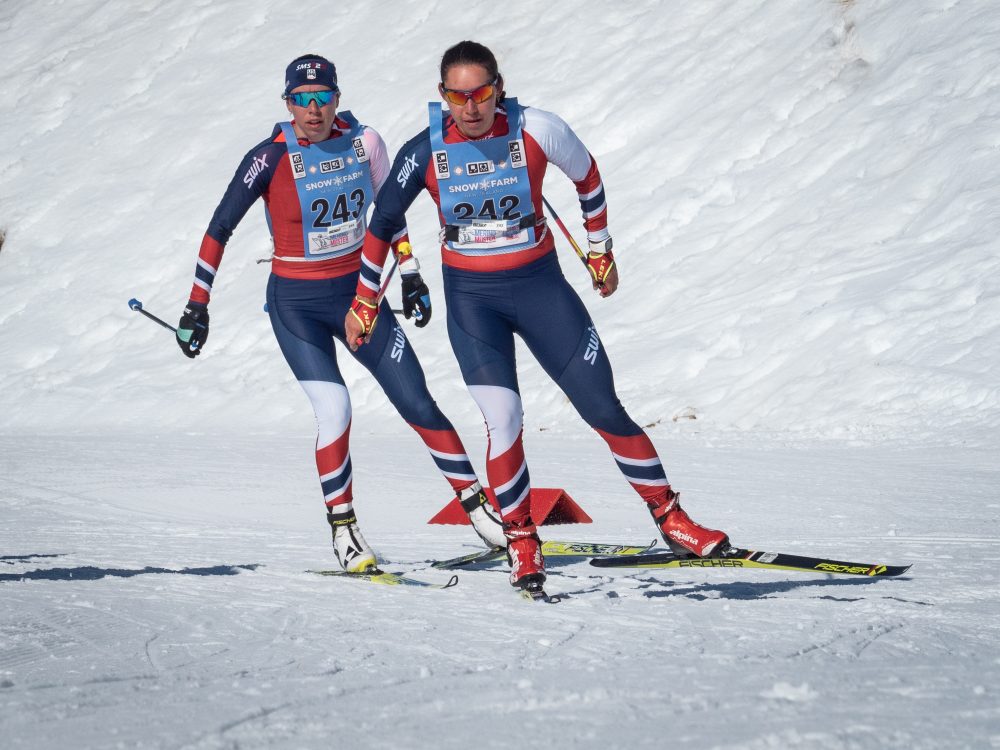
    Julia Kern leads Katharine Ogden, her fellow Stratton Mountain School (SMS) and U.S. Ski Team development team member, during the Snow Farm’s 21 k Snow Rake at the 2018 Merino Muster in Wanaka, New Zealand. (Photo: Garrick Cameron)

    Note: This article has been updated to include comments from Simi Hamilton of the U.S. Ski Team (USST) and Stratton Mountain School (SMS) T2 Team, and Kevin Bolger of the USST and Sun Valley Ski Education Foundation.

    ***

    It’s that time of year again where several members of the U.S. Ski Team, along with top-level skiers from the Craftsbury Green Racing Project (CGRP) and Stratton Mountain School (SMS) T2 Team are training at the Snow Farm above the town of Wanaka, New Zealand.

    The on-snow volume camp, which featured multiple days of racing, started Aug. 20 and continues through Sept. 10, and includes U.S. Ski Team (USST) athletes Jessie Diggins, Ida Sargent, Sophie Caldwell, Katharine Ogden, Julia Kern, Simi Hamilton, Kevin Bolger, and Paddy Caldwell, and coaches Matt Whitcomb, Jason Cork and Gus Kaeding.

    According to Sophie Caldwell, conditions have been “amazing” for the duration of camp so far. “New Zealand had a great snow year and we’ve been lucky to have sunny days almost every day,” she wrote in an email to FasterSkier.

    Japan’s Tomoka Satou (446) leads American Jessie Diggins (428) and others up a climb during the Merino Muster 42 k skate race on Sept. 1 at the Snow Farm in Wanaka, New Zealand. (Photo: Garrick Cameron)

    Diggins called it the annual trip one of her “all-time favorite camps because the living at the Snow Farm is great, the food is outstanding, and you can step out the door right onto the 65+ km of trails!” she wrote in an email.

    “I love having the chance to work on my on-snow technique for three solid weeks because that’s when I get to really see progress and make some changes in my striding,” Diggins wrote.

    Apart from logging kilometers on snow and soaking up the vitamin D, the team has also spent time trail running in Wanaka.

    “The highlight [of the camp] will probably be a crust cruise we go on in the next few days, but since we haven’t done that yet, some highlights so far are an awesome distance run down in Wanaka, and pretty much every day of bluebird skiing we’ve had up here!” Caldwell wrote.

    The camp also coincided with the Merino Muster, a 42 k freestyle marathon that is part of the Worldloppet series, and the Winter Games NZ, which doubled as the Australia/New Zealand Cup FIS races and included three days of nordic racing this year at the Snow Farm: a 5/10 k freestyle individual start, a freestyle sprint, and a 10/15 k classic mass start..

    Defending their 2017 Merino Muster titles last Saturday, Sept. 1, were two SMST2 and USST members, Diggins and Hamilton.

    Diggins finished a minute and 21 seconds faster than the second-place woman, Aurelie Dabudyk of France, while Hamilton edged Craftsbury skier Adam Martin by 3 seconds for the overall win.

    “The day of the Merino Muster was gorgeous and sunny, with fast conditions,” Diggins wrote. “I loved getting the chance to race a long race, and starting with the men as one big field is really exciting! I hope to get to race the 42km race every year. Huge thanks to the volunteers and organizers for making it such a fun day.”

    Crossing the finish line in 1:52:34 hours, Diggins placed sixth overall. Dabudyk was eighth overall and Alayna Sonnesyn (SMST2) was the third woman, 11th overall, 5:30 behind Diggins.

    Meanwhile, Hamilton finished in 1:39:46, beating his time of 1:40:33 from last year’s race. Martin followed 3 seconds later, while Kyle Bratrud (SMST2) finished 24 seconds after from Hamilton in third, followed by Tomoka Satou of Japan in fourth (+45.0).

    “The Merino Muster is always an awesome race,” Hamilton wrote in an email. “It actually lends itself to the type of intensity we are still mostly focused on in August/late September because the terrain and snow conditions usually make for a really good chance to get in about 1.5 hours of level 3 effort followed by a few minutes of really hard skiing in the last km before the finish. It’s a very rolling course and if you ski it in a pack with people switching leads it’s basically impossible to go much harder than level 3.”


    Also on Saturday, Americans also took the top spots in the 21 k Snow Rake. Ben Saxton (SMST2) ran away with the overall win by more than 12 minutes in 47:48, while Paralympic sit skier Dan Cnossen placed second (+1:12:13) nine seconds ahead of Petr Sykora of the Czech Republic in third (+1:12:22).

    Ogden was the fastest woman and second overall with a time of 50:29. Her SMS and USST teammate Kern finished 56 seconds later as the second woman, and Elizabeth Martin of the University of New Hampshire (UNH) followed in third, 7 minutes and 30 seconds behind Ogden.

    buy allopurinol online, buy motrin online, buy ibuprofen online

    With about 300 participants between three different races at the Merino Muster, Hamilton described the atmosphere as “super fun and light.”

    “But the grooming always rocks and it’s just a really fun course to ski,” he added. “I think that in this day and age of social media being so huge and cross-country skiing gaining more attention in the US and world-wide, we’ll start to see more and more people showing up for the marathon. I feel like in the last few years alone their has been noticeably more attention and attendance each year. The quality of skiing is a small part of the race atmosphere here… New Zealand’s south island is one of the most beautiful parts of the world and the culture is so welcoming and comfortable.”

    Many of the American skiers in New Zealand also competed in the Winter Games NZ races this week.

    “The New Zealand Winter Games are also a huge opportunity to get back into racing mode and test out all the technique work we’ve been putting in so far!” Diggins wrote. “And if you know me, you know how much I adore 5km individual skate races, and we no longer get to do those on the World Cup. So I’m so grateful to the Snow Farm and race organizers for keeping such a fun and hard, fast race alive! I forgot how much it can hurt to go so hard for 5km, but it was fun to really get that lung burn back for the first time since last winter.”

    Three days after her marathon win, Diggins won the 5 k skate at the Snow Farm in 15:02.6. The U.S. swept the top five with Sophie Caldwell finishing 10.5 seconds back in second place, Caitlin Patterson (CGRP) in third (+16.7), Sargent (USST/CGRP) in fourth (+1:02.6), and Kelsey Phinney (SMST2) in fifth (+1:16.6) out of eight women.

    Kyle Bratrud (SMST2) gets a feed from U.S. Ski Team coach Jason Cork during the 2018 Merino Muster 42 k skate race at the Snow Farm in Wanaka, New Zealand. He finished third behind two other Americans. (Photo: Garrick Cameron)

    In the men’s 10 k skate on Tuesday, Bratrud took the win in 27:48.1, 21 seconds clear of Kaichi Naruse of Japan in second, while Craftsbury’s Ben Lustgarten and Martin (CGRP) followed in fourth (+23.0) and fifth (+44.0), respectively. Eight men competed.

    Wednesday featured 1.1 k skate sprints, which saw Sophie Caldwell take the win in a field of 10 women, ahead of Sargent in second and Phinney in third.

    “The sprint was a short and tactical race that was awesome practice for what’s to come this winter,” Caldwell wrote. “It was really fun toeing the line with my USST and SMS training partners. On one hand, that final could have been any day of summer training, but it also could be a World Cup heat! It’s pretty cool to be pushed by so many strong training partners and friends and we were psyched to throw on a bib and put in a race effort.”

    In the men’s final, Bolger landed the top spot on the podium, ahead of Saxton in second and Satou in third. Eleven men competed in the sprint.

    “I really enjoy these early session races it gives us as races a chance to get in the mindset and practice real race strategy,” Bolger wrote in an email. “I wanted to go out there test myself, I approached every round like a final and attacked from the start getting out in front and leading into the finish, and was very happy to end the day on top, especially after a long camp down here with the US crew.

    “… Coming down here and having a good result in the sprint is of course a huge confidence booster heading into the September/ October training months, but there is still a ton of preparation to be done,” he added.

    On the final day of Winter Games NZ racing, Diggins continued her undefeated streak (after skipping the sprint), winning the 10 k classic mass start, while Patterson placed second and Sargent placed third. Saxton picked up his second win of the week, while Martin took second and Lustgarten third.

    Complete results will be posted once they’re available.

    “We have been incredibly lucky with weather and conditions this year,” Hamilton noted. “Usually, when you’re here at the Snow Farm for 3 weeks in the winter, you’re bound to get an extended period of really nasty weather and wind. But this year we’ve basically had sunshine and cold night time temps every single day, making for amazing skiing for pretty much 3 weeks straight. There is about 40-50 km of trails to ski when everything is groomed, so it’s essentially impossible to get bored. The highlight of our camp every year is a big crust ski up to and around Mt. Pisa. We are planning on getting out tomorrow [Friday, Sept. 7] because the crust hasn’t been great yet while we’ve been here, but conditions for tomorrow look promising. But even when we can’t get out for a huge adventure like that, it’s just one of the best and most fun places in the world to train.”

    Results:

    Sept. 1: 42 k Merino Muster /21 k Snow Rake

    Overall results

    Winter Games NZ

    Sept. 4: 5/10 k skate: Women| Men

    Sept. 5: Skate sprint: Women|Men

    Sept. 6: 10/15 k classic mass start: Women | Men

    https://www.instagram.com/p/BnU4ZSVgG56/?utm_source=ig_web_button_share_sheet

    https://www.instagram.com/p/BnXhCe2lq5m/?utm_source=ig_web_button_share_sheet/

  • Caitlin Gregg on Her Record-Setting Fifth Birkie Title: ‘I’m trying to set the bar pretty high’

    Caitlin Gregg on Her Record-Setting Fifth Birkie Title: ‘I’m trying to set the bar pretty high’

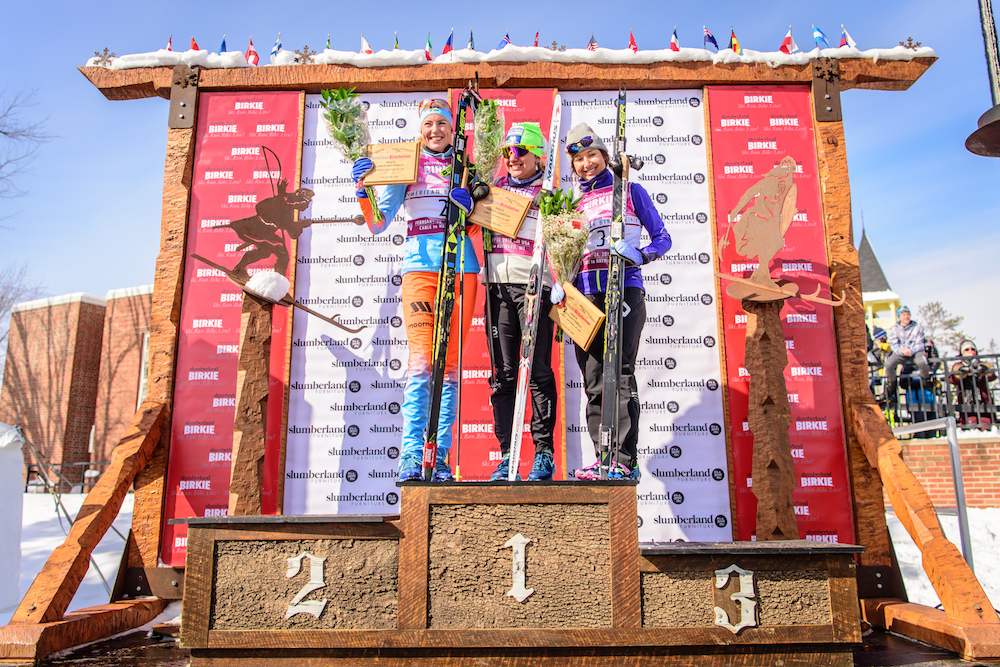
    The elite women’s skate podium at the 2018 American Birkebeiner on Saturday in Hayward, Wisconsin, with Caitlin Gregg (c) in first, Sweden’s Maria Gräfnings (l) in second and Chelsea Holmes (r) in third. (Photo: American Birkebeiner Ski Foundation 2018)

    Caitlin Gregg has raced the American Birkebeiner enough times — and won it more than anyone else — that she’s got the course down pat. Powerline, Big Bertha, High Point, Heckler’s, OO, Gravel Pit, Mosquito Brook, B*tch Hill, Hatchery, the lake, the bridge, the Main Street finish.

    But the conditions and the competition, that’s something that changes from year to year. The elite racers were among the first to start the 50-kilometer American Birkebeiner (“Birkie”) skate races on Saturday, giving them the edge in terms of firmer conditions over nearly 13,000 other racers behind them, but it was still not the fastest Birkie on record after six inches of new snow had fallen the day before.

    But away they went, jetting out of the Birkie’s new start line and embarking on the 50 k point-to-point course from Cable to Hayward, Wisconsin. The elite women’s skate race started at 8:30 a.m. followed by the elite men 20 minutes later.

    While the women remained in a large pack for the first 15 k or so, according to Gregg, they were down to six around 20 k.

    “I think this is one of the strongest fields that I’ve ever seen at the American Birkebeiner for the women,” Gregg recalled in a post-race press conference. “A lot of really fast ladies, a lot of depth, and so it was a pretty high-paced race the whole time. There were definitely five of us in that top six group taking leads and doing pulls, and we definitely worked together to kind of separate ourselves from the field behind us.”

    Three of those racers fell of the pace, which left Gregg, Sweden’s Maria Gräfnings, and Chelsea Holmes contending for the win. Gregg, 37, races for the Central Cross Country (CXC) Team, Loppet Nordic Racing and Team Gregg. Gräfnings, 32, is a former University of Utah skier, and Holmes, 31, races for Alaska Pacific University (APU).

    Just over 2 kilometers before the finish, as the three were skiing across Lake Hayward, the elite men’s race leaders caught them. Typically, the top elite women finish before the men.

    “I could hear another snowmobile, and I knew what that meant, and I kind of looked around at the women and I said, ‘Oh, the men are coming,’ ” Gregg reflected. “… When they caught us, it was actually kind of a surprise because a couple went by, and then they just kept coming.”

    The lead pack of men was still close to 30 strong at that point, just 2 k before the finish.

    “It was the weirdest thing I’ve even experienced in a race, where you just have this consistent line of guys coming and it was actually, really great,” Gregg continued. “Because the women, we raced our own race, we jumped in towards the back of that pack, but we stayed in our own pack.

    “At one point, I suggested maybe we should move over for the men,” she added. “I like these ladies; they were like, ‘NO. They can go around us. They can figure it out. We’re doing our own thing.’ So I thought that was pretty cool.”

    Gräfnings had been leading when the men caught them.

    “And then I thought ‘Now I can go with them,’ but, no, they were going really fast,” Gräfnings said at the press conference. “So, then I was leading the pack, the women’s, and I guess I was getting really tired when I was doing that…”

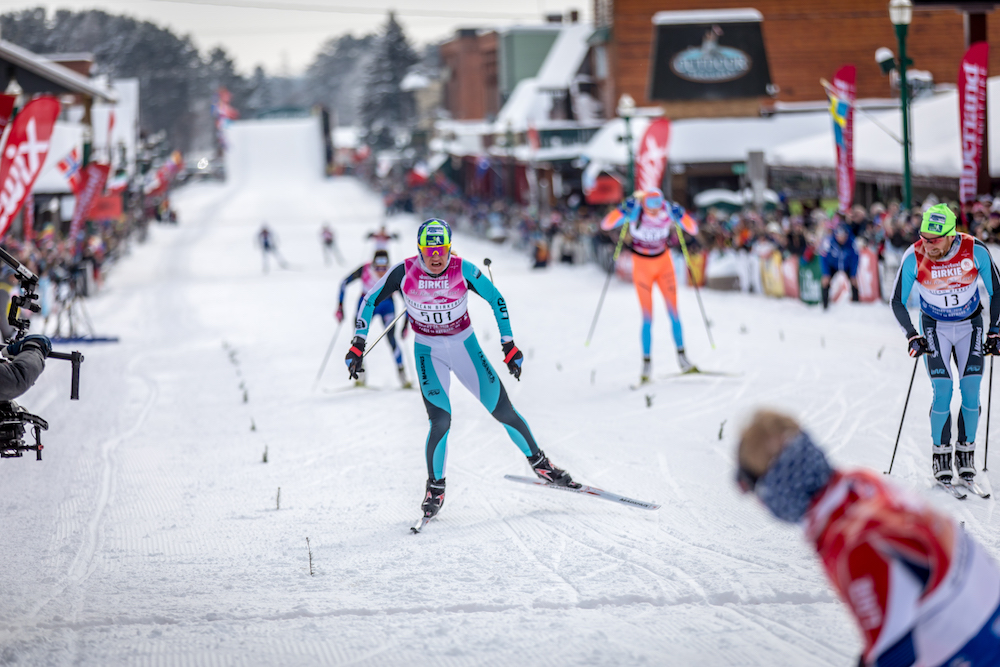
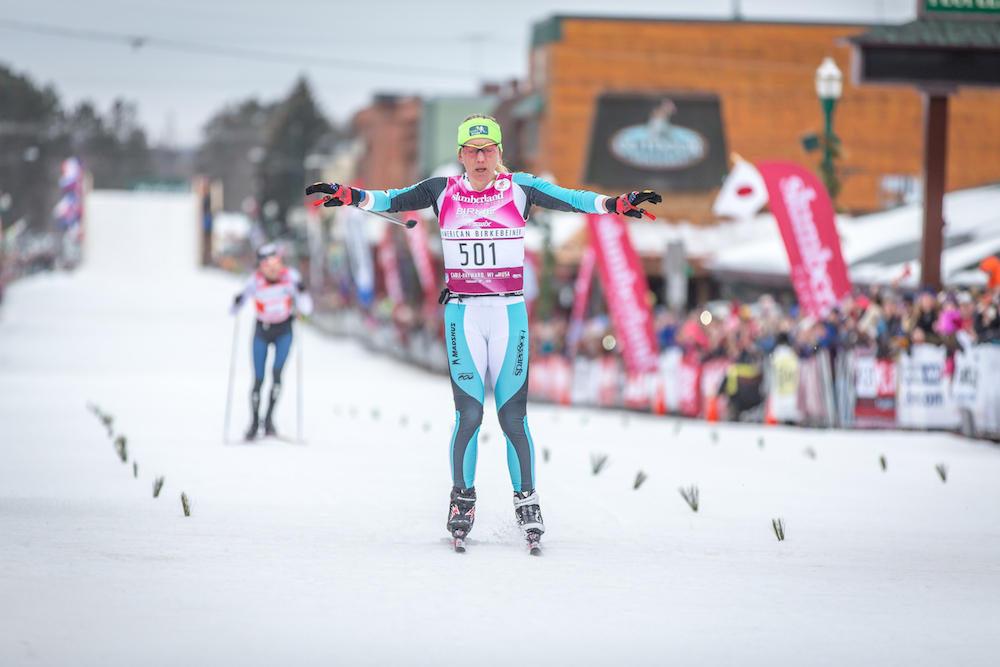
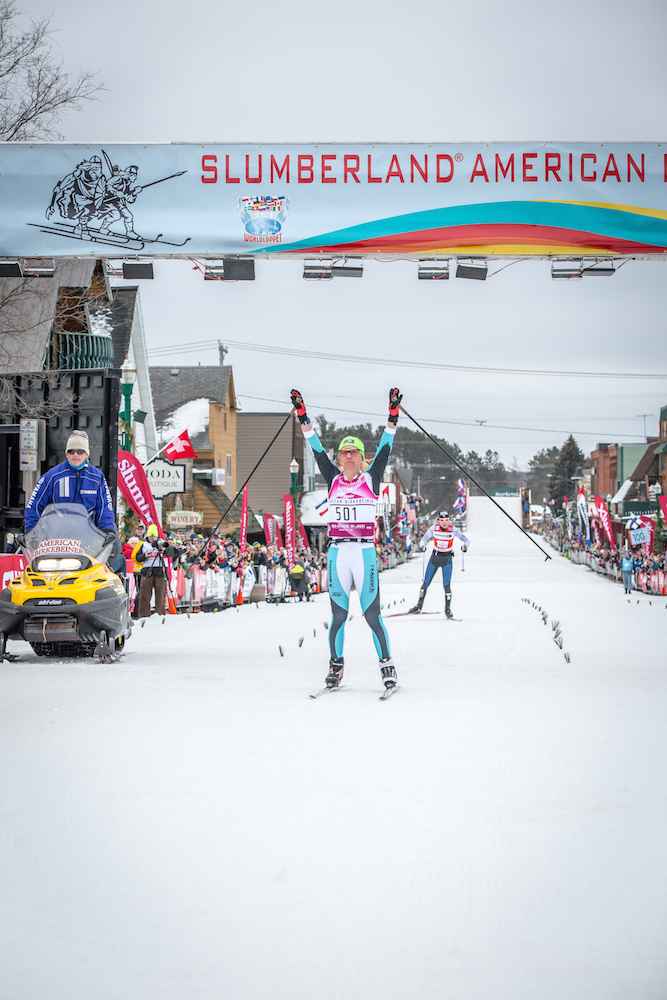
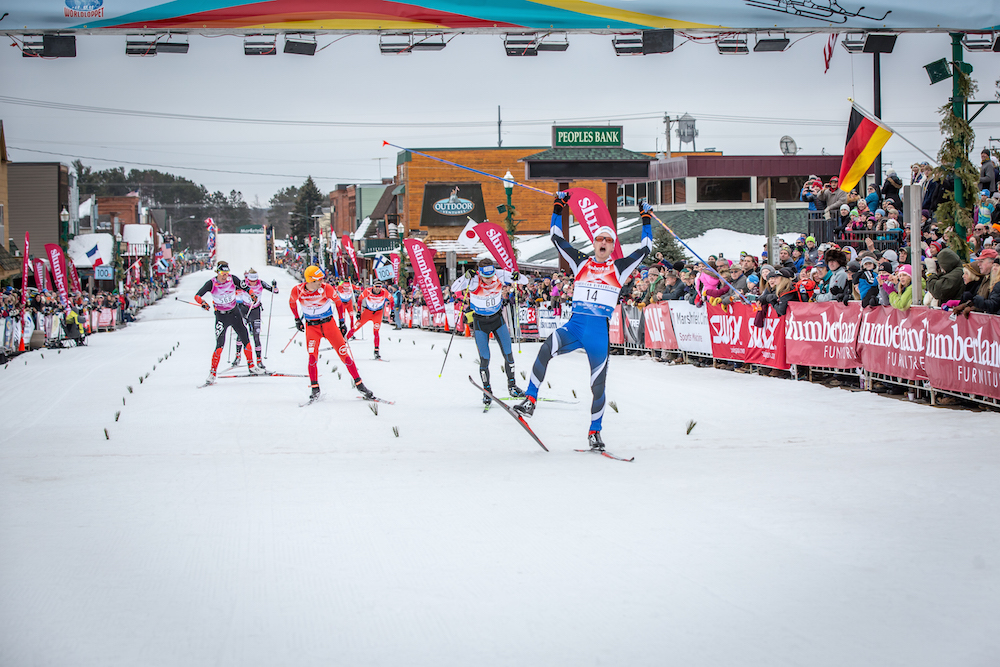
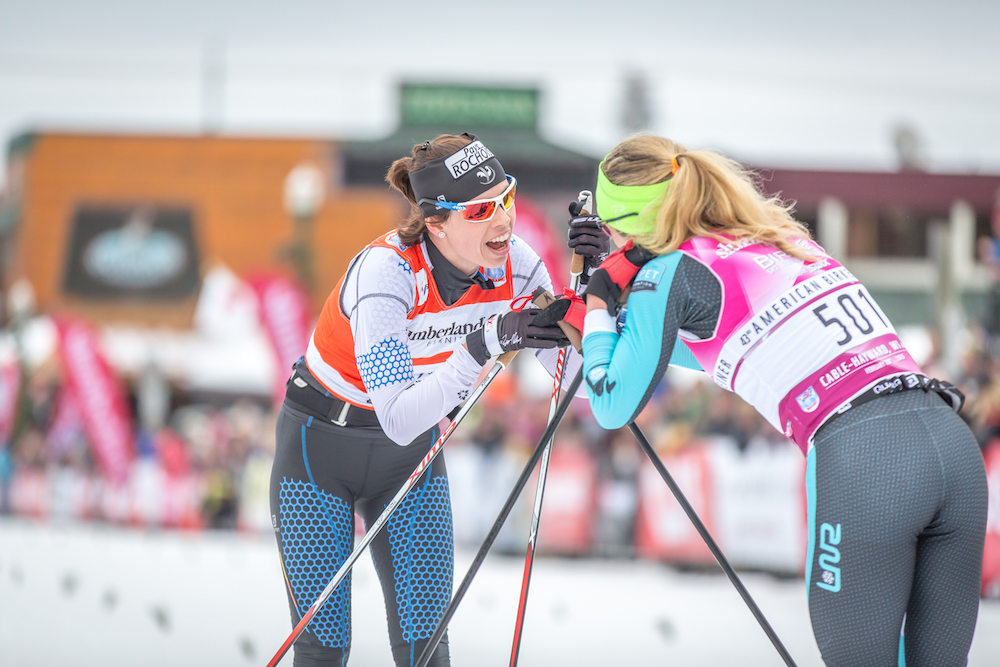
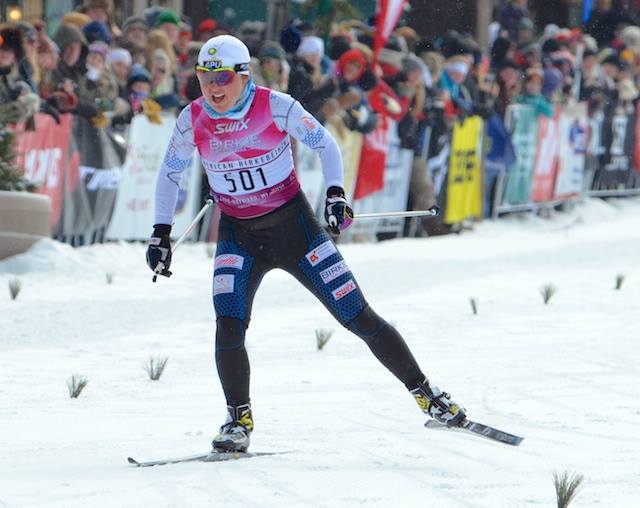
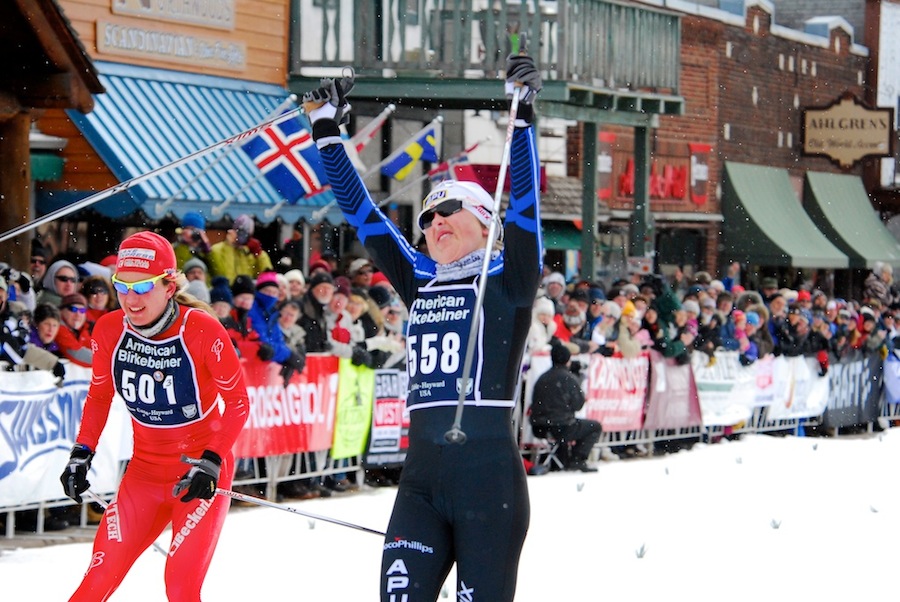
    Caitlin Gregg (501) winning her fifth American Birkebeiner on Saturday in Hayward, Wisconsin, while skiing alongside her husband Brian Gregg (13), who placed 22nd in the elite men’s skate race. (Photo: American Birkebeiner Ski Foundation 2018)

    Gregg took the lead just before the Birkie’s International Bridge and went on to hold off Gräfnings and Holmes for the win in 2:23:30.3 hours. Gräfnings finished second, 2.5 seconds back, while Holmes placed third (+3.8).

    “I was like, ‘No, I can’t give up this. I have to really try to sprint then,’ ” Gräfnings recalled. “I’m glad I could get the second place.”

    Gregg won the last American Birkebeiner contested in 2016 (last year’s race was canceled due to low snow) in 2:22:44. With Saturday’s win, she has most Birkie wins of any racer, male or female, with five victories (2011, 2013, 2014, 2016, and 2018).

    “I’m trying to set the bar pretty high for the next person to come along and break that [record], so it feels amazing to win my fifth,” said Gregg, who lives in Minneapolis, Minnesota. “The conditions were absolutely perfect today. The course was just in amazing shape and just beautiful out there, and this is definitely one of my favorite races, that’s why I keep coming back. Everything about it, between the organization and the volunteers makes this a special event for so many people, but, for myself, especially. So yeah, I was really happy year to be able to race again and feel good and really fight for the win.”

    Gräfnings said was pleased with her own race and glad to return to the U.S.

    “I was studying in the University of Utah and now I’m back in America and it’s so fun to meet a lot of friends and it’s really special for me,” she said.

    Holmes had previously raced the Birkie in 2014 and placed fifth, 3:45 minutes behind Gregg. She struggled with the cold and suffered in that race, she explained at the press conference.

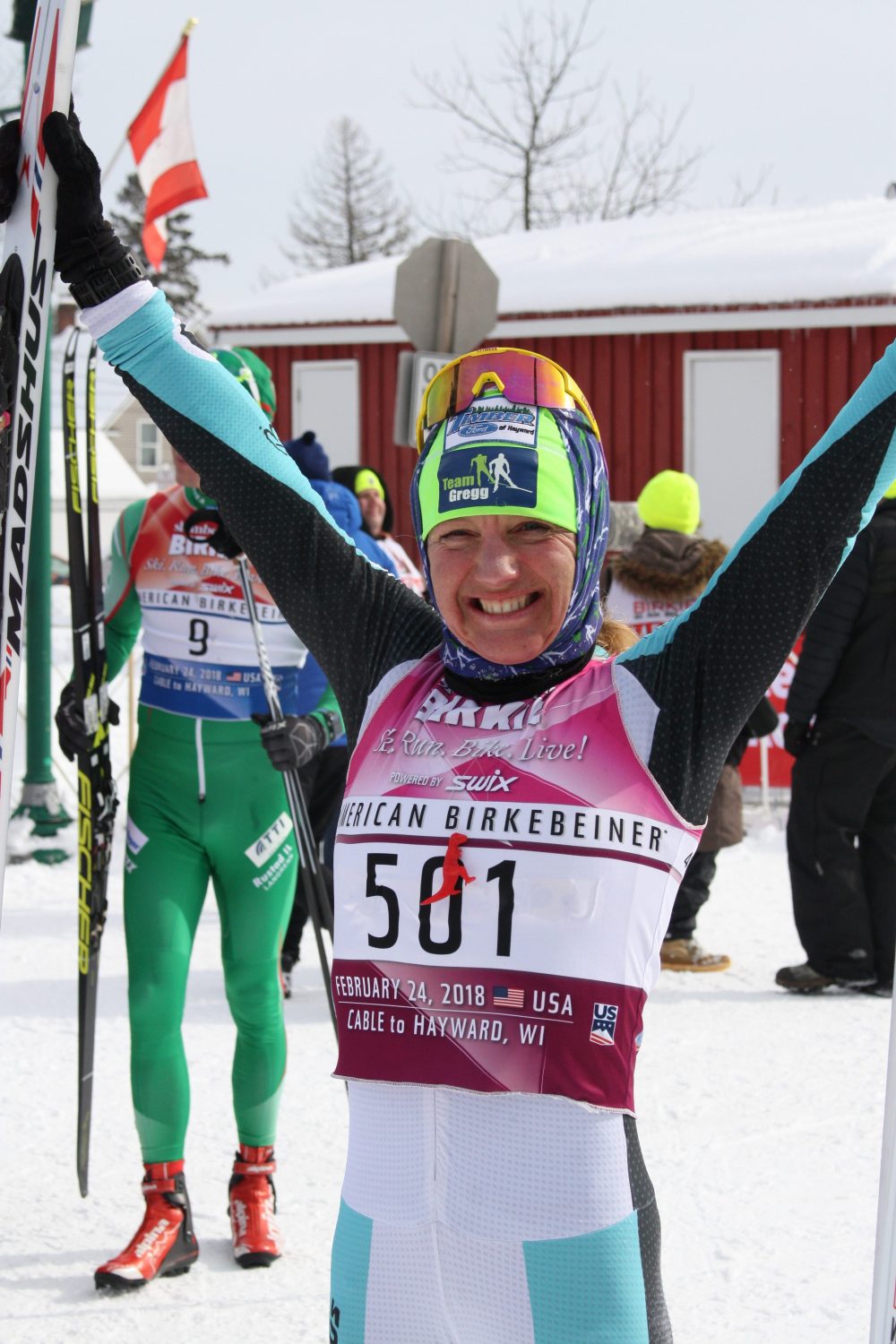
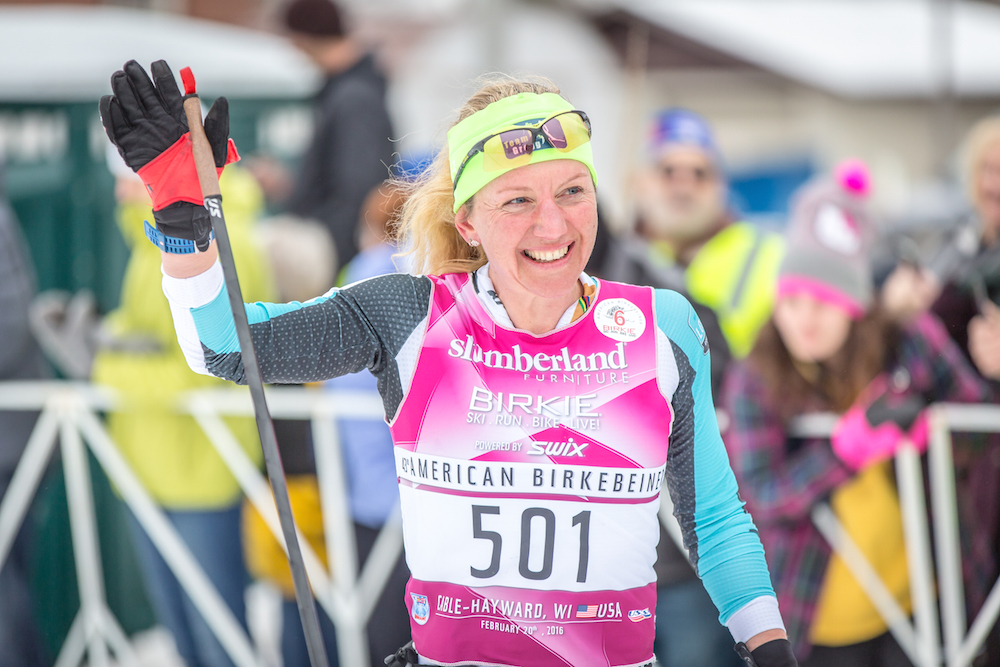
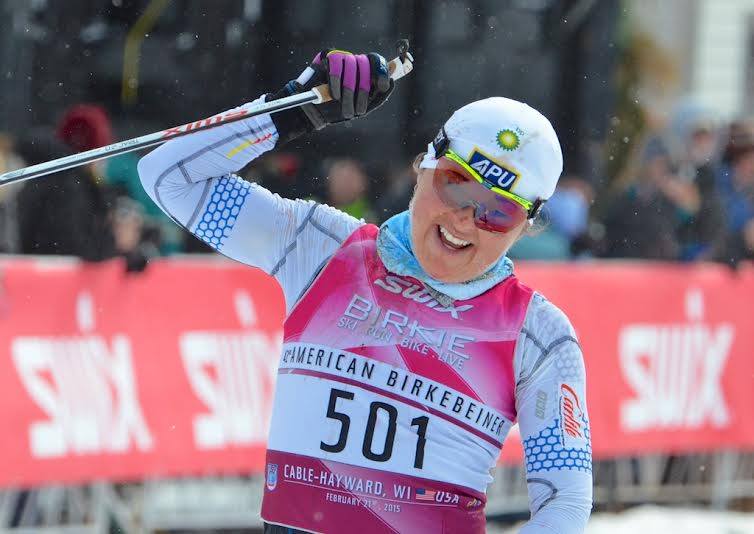
    Caitlin Gregg celebrates her fifth American Birkebeiner win on Saturday after winning the women’s 50 k skate race by 2.5 seconds over Sweden’s Maria Gräfnings in second place. (Photo: RJ Ochmann)

    “I was very worried today about surviving with enough feeds and being warm enough,” Holmes said. “In the beginning, it’s a strange feeling because it always feels a little bit slow, like a very different race pace than even a 30 k that you do at other times, and especially with less climbing, which, I miss the hills a little bit … so that’s a little bit hard for me sometimes to sit in. But I think we shared the lead fairly well.

    “It was … good for me always to remember to relax and be patient because even when you have 25 k, you’re only halfway there,” Holmes continued. “So it’s a unique experience, the 50 k, because sometimes it feels like you’re not working that much, and I felt quite good. And then when I got five meters from the finish line, my legs just, I basically walked across the line. So, clearly I was very tired, but that’s how it goes.”

    France’s Aurelie Dabudyk was the fourth woman across the line, 28.7 seconds behind Gregg, Anja Gruber of Bozeman, Montana, placed fifth (+2:44.6), and Erika Flowers of the Stratton Mountain School (SMS) T2 Team finished sixth (+3:30.1). Also in the top 10 were Liz Guiney of the Craftsbury Green Racing Project (CGRP) in seventh (+5:33.8), Hallie Grossman (CGRP) in eighth (+8:03), Hannah Bettendorf of Duluth, Minnesota, in ninth (+8:19.2), and masters skier Laura McCabe of Winthrop, Washington, in 10th (+8:20.6).

    The Birkie is the fifth of seven races on the 2018 FIS Worldloppet Cup calendar. Dabudyk now leads the overall standings by just 10 points over Gräfnings in second. In her first Worldloppet race of the year, Gregg ranks seventh.

    In the men’s overall standings, France occupies the top four with Gerard Agnellet in first, just 1 point ahead of Ivan Perrillat Boiteux in second, and 120 points clear of Loic Guigonnet in  third. Adrien Mougel ranks fourth, another 2 points behind, and Norway’s Anders Gløersen breaks up the French sweep in fifth, 3 points behind Mougel.

    Norris Makes the Move, Gløersen Takes the Win

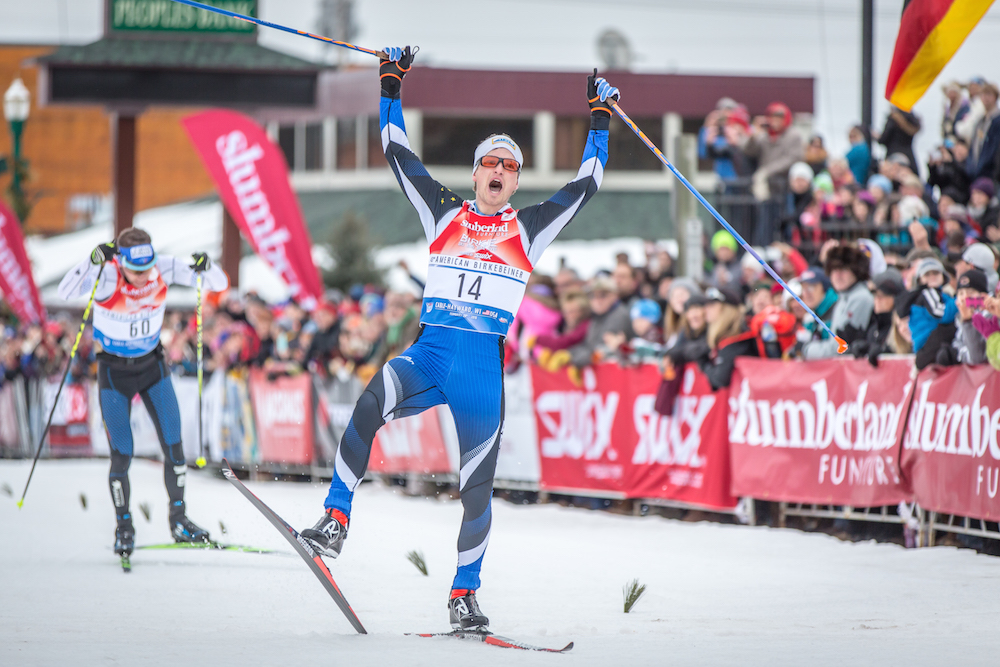
    Norway’s Anders Gløersen winning the American Birkebeiner elite men’s 50 k skate race on Saturday in Hayward, Wisconsin. (Photo: American Birkebeiner Ski Foundation 2018)

    Gløersen won the Birkie elite men’s skate race on Saturday in 2:02.29.6, just 1.9 seconds ahead of Perrillat Boiteux in second and 3.4 seconds ahead of American Kyle Bratrud (CXC Team) in third.

    After as many as 30 men stayed together up until the last 2 kilometers, the men’s pack began to string out after coming off the lake. According to Bratrud, it was David Norris who made the defining move at that point in the race. Norris had launched a similar attack two years ago, just before the bridge, to win the 2016 Birkie.

    “He started to string it out a bit and six or seven of us started to pull away from a line of about 30 of us,” Bratrud recalled at the press conference. “That’s kind of what led us to the break and ultimately to the sprint.”

    The top-10 men were within eight seconds of first, with Mougel finishing fourth (+4.4), Norris losing his lead and ending up fifth (+5.1), France’s Bastien Poirrier placing sixth (+5.5), and Agnellet following in seventh (+5.7). France had six in the top 11 with Guigonnet in eighth (+6.6) and Benoit Chauvet in 11th (+13.3). Americans Ben Lustgarten (CGRP) finished ninth (+7.0) and Jack Hegman of the Sun Valley Ski Education Foundation (SVSEF) placed 10th (+7.2).

    “It was a great race,” Gløersen, 31, said at the press conference. “Perfect conditions and nice weather. And it was a difficult to know how to do because I don’t know so many of the American skiers here, and I know the French guys … I had to watch out for them. So I just tried to stay in front of the big group to be ready if someone made an attack. It seemed like it was difficult to get away, and I was just glad when it was one kilometer left.”

    After Norris’s attack, Gløersen made a point to follow him.

    “I got the perfect position on the bridge here, just was number two and then had the perfect position going into the final 300 meters,” he said.

    Asked about passing the women late in the race, he said it didn’t affect the men’s race too much.

    “If it’s snowing, then it could make a difference because then you have the women making way, and when you pass them it’s going to be slower,” Gløersen said. “But today was quite good conditions so it was just fun to see when they catch them and to see who was in the group, but other than that, it doesn’t affect us much.”

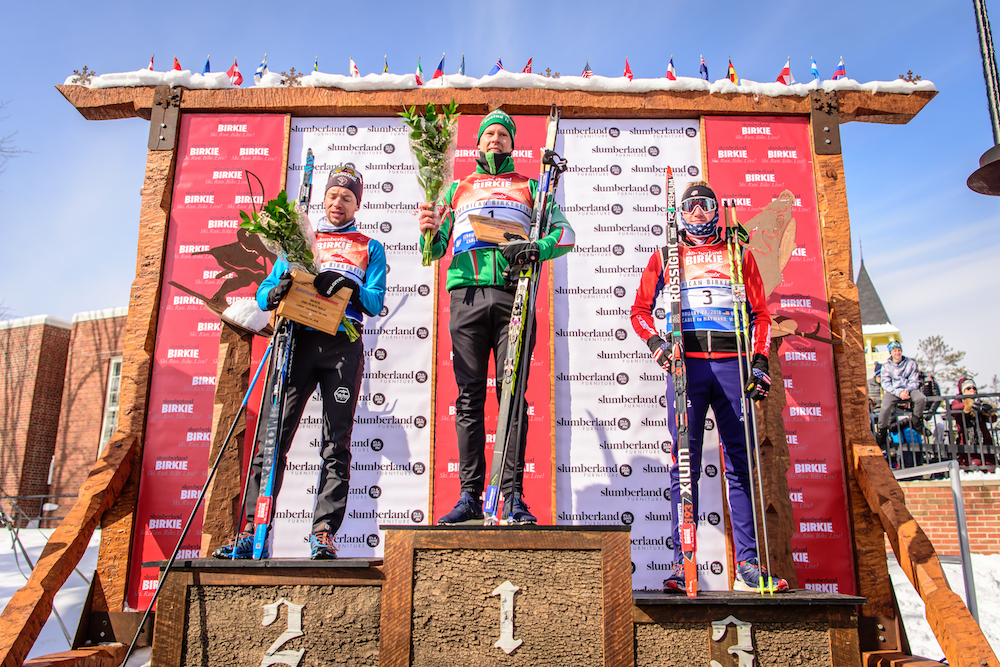
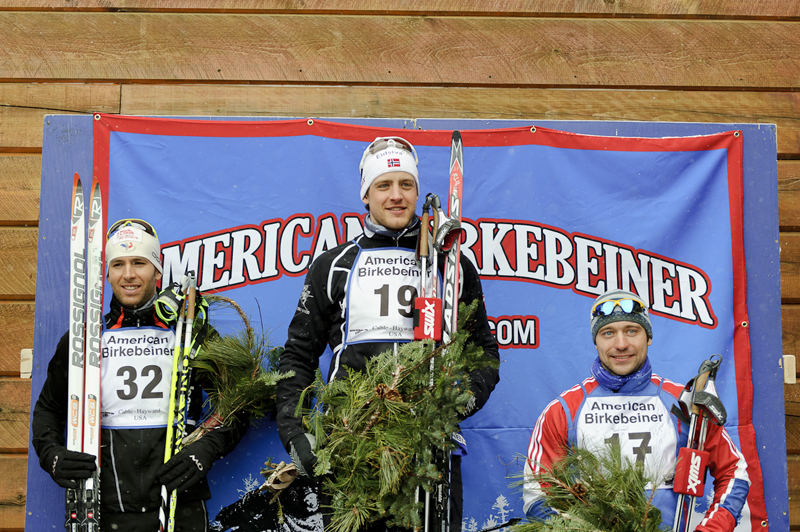
    The elite men’s skate podium at the 2018 American Birkebeiner in Hayward, Wisconsin, with Norway’s Anders Gløersen (c) in first, France’s Ivan Perrillat Boiteux (l) in second and American Kyle Bratrud (r) in third. (Photo: American Birkebeiner Ski Foundation 2018)

    While both Gløersen and Perrillat Boiteux are marathon regulars, this was the first American Birkebeiner for both of them.

    “The Birkie was a great race, well organized, and I loved it,” Perrillat Boiteux, 32, said through a translator at the press conference.

    Bratrud, 25, was born in Eden Prairie, Minnesota, and attended Northern Michigan University, yet this was his first Birkie. According to the FIS database, it was also his first marathon. Asked about skiing in such a large group for most of the 50 k race, he said it was a new experience, but it was likely because the field was so competitive.

    “There’s a ton of strong guys there and no one really wanted to pull the other person to a victory,” Bratrud said. “So it was a lot of kind of cat and mouse and looking at each other and people made moves, but with so many strong skiers, it was hard for anyone to get away.”

    In the 55 k Birkie Classic, Minnesota native Ben Saxton (SMST2) edged Cole Morgan (SVSEF) by 1.5 seconds at the finish for the win in 2:47:35.9. Mathias Rolid of Marquette, Michigan, followed in third (+6.1).

    Wisconsin native Felicia Gesior (CXC Team) won the women’s classic race by more than 10 minutes in 3:08:07.3. Brandy Stewart of Bozeman placed second (+10:54.8) and Josie Nelson of Medicine Lake, Minnesota, reached the podium in third (+11:20.9).

    $$$

    While the Birkie’s 50 k skate race is part of the FIS Worldloppet Cup and reserves most of its prize money for first- through sixth-place finishers in both the elite men’s and women’s skate races (with $7,500 dollars for each winner), the 55 k Birkie Classic awards $1,000 to its men’s and women’s winners.

    This year, there were also two $500 sprint bonuses in the Birkie skate race, which were awarded to the first male and female competitors to reach the intermediate sprint checkpoints. According to Gregg, the first “prime” was about 2 1/2 or 3 kilometers into the race, and the second came just before 20 k.

    “I was curious how aggressive the women would be to go for those [sprint] primes and they were very aggressive, very fun,” Gregg said. “I think the first prime kind of set the tone and kind of strung things out a little bit.”

    Results (top 25): Birkie skate | Birkie classic

    Full results

  • A Tale of Two Races: Gregg and Norris Emerge as 2016 Birkie Champs

    A Tale of Two Races: Gregg and Norris Emerge as 2016 Birkie Champs

    Caitlin Gregg (Team Gregg/U.S. Ski Team) soaks up her record-setting fourth win at the 2016 American Birkebeiner in Hayward, Wis. (Photo: James Netz/American Birkebeiner Ski Foundation©2016)
    Caitlin Gregg (Team Gregg/U.S. Ski Team) soaks up her record-setting fourth win at the 2016 American Birkebeiner in Hayward, Wis. (Photo: James Netz/American Birkebeiner Ski Foundation©2016)

    Caitlin Gregg said she had a hard time falling asleep Friday night, the eve of the 43rd annual American Birkebeiner. Understandable: she was going for a record-breaking fourth win in the 52-kilometer Birkie freestyle race, but moreover, she was going to have to do it in potential rain, slush or even ice, depending on how temperatures and precipitation shook out.

    Race organizers didn’t groom the Birkie trail from Cable to Hayward, Wis., until Friday night.

    “I was so impressed with the grooming. They did an amazing job,” she said in an interview with USSA’s Tom Kelly the next day, shortly after winning her fourth Birkie title to become the winningest skier in American Birkebeiner history. “It was the perfect mix of hard-packed with just a little bit of just soft snow on top, so that gave you a little purchase where you needed it. It would maybe change a little bit and become firmer in some areas or a little softer in others, but considering what they were delivered it was phenomenal.”

    The 2016 Birkie on a gray, windy morning with temperatures in the upper 30’s was a tale of two races. It always is, with the elite women starting 20 minutes before the elite men, but on Saturday, Gregg and France’s Aurélie Dabudyk — the Worldloppet Cup leader — dropped the field around 42 k and Gregg held off Dabudyk by five seconds across the line. Just behind them, the men’s race remained tight over the slushy Lake Hayward and into the final stretches of Main Street, with David Norris of Alaska Pacific University winning by 1 second and fewer than 7 seconds separating the top five.

    It was the first time two Americans had topped the podium in the elite men’s and women’s skate races since Holly Brooks and Tad Elliott won the Birkie in 2012.

    “I did the Birkie this year for the first time because it fit my calendar really well and it is one of those American races you have to do!” Norris, a Fairbanks native, explained in a post-race email. “I knew their were a lot of experienced Euros and top Americans in the field today so I knew winning would be tough, but that was still the goal at the starting line.”

    David Norris of Alaska Pacific University celebrates his first victory in his first time at the American Birkebeiner 52 k freestyle race on Saturday in Hayward, Wis. (Photo: James Netz/American Birkebeiner Ski Foundation©2016)
    David Norris of Alaska Pacific University celebrates his first victory in his first time at the American Birkebeiner 52 k freestyle race on Saturday in Hayward, Wis. (Photo: James Netz/American Birkebeiner Ski Foundation©2016)

    Of the top seven men, Norris was the only American. He outlasted France’s Ivan Perrillat Boiteux, of team Houte-Savoie, by a second at the line, winning in 2:05:35.4, and another Frenchman Benoit Chauvet (GEL intérim Rossignol) by 1.3 seconds.

    “Winning the Birkie is like no other win,” Norris wrote. “The spectators are so supportive and the other Americans in the race were so happy for me even though their own races didn’t go as planned. Maybe the happiest moment of the day was seeing how happy my result made my friends and supporters.”

    “I was very excited to win again,” Gregg wrote in an email Saturday night. “Every Birkie Victory has been a huge part of the financial equation for Brian and I in our racing careers.”

    (Her husband and Team Gregg teammate, Brian Gregg, was the fourth American man and 13th overall, 1:01.9 minutes behind Norris. For the win, Caitlin received $7,500 dollars for winning plus $2,500 for being the top American, as did Norris, for $10,000 apiece.)

    “I am so grateful to the thousands of friends and family who were cheering me on, the endless work of the organizers and volunteers, the fantastic skis by Caldwell Sport and their wax techs and the incredible support of our Team Gregg’s sponsors,” Gregg wrote. “I said it before but this race seems to be the most important of my entire career year after year (Including the Olympics and the World Championships) because I can share the experience with so many important people in my life. Skiing with 10,000 of your friends on the same trail on the same day is pretty tough to beat!”

    ‘I had a lot more to give’

    According to Gregg, the pace of the women’s race started “very slow” by her standards, and “the foreign ladies did a lot of work out there today with 5 or 6 of us taking turns in the lead,” she wrote.

    Gregg shared the workload with the likes of Dabudyk and her Houte-Savoie teammate, Italy’s Elisa Brocard and another Italian, Antonella Confortola (Forestale), who finished second to Brooks in last year’s Birkie. New to the Birkie, Klara Moravcova of the Czech Republic and Switzerland’s Rahel Imoberdorf came into the race ranked third and fourth in the overall Worldloppet standings, behind Dabudyk and Brocard.

    Caitlin Gregg after winning her fourth Birkie, making her the winningest racer in American Birkebeiner history on Saturday in Hayward, Wis. (Photo: James Netz/American Birkebeiner Ski Foundation©2016)
    Caitlin Gregg after winning her fourth Birkie, making her the winningest racer in American Birkebeiner history on Saturday in Hayward, Wis. (Photo: James Netz/American Birkebeiner Ski Foundation©2016)

    While word spread among spectators that Gregg may have broken a pole early in the race, Gregg dispelled it.

    “The broken pole was actually a rumor,” she wrote. “I never broke a pole out there (thankfully). All of my equipment was perfect…”

    About 38 k into the skate race, at a checkpoint called Mosquito Brook, Gregg decided it was time to turn it up a notch.

    “I looked at my heart rate monitor periodically throughout the race and saw that I was sitting around 150-160 bpm which is level 2 for me. I have been doing a lot of harder training lately and knew I had a lot more to give,” she explained. “After spending the first 40K trying to ski as easy as possible (besides a few attacks) I decided to put the hammer down just after Mosquito Brook. There wasn’t a definitive plan at the start of the race because every race is different in terms of conditions and competitors but I could tell the other ladies were tiring on the uphills so I went for it on the longest one I knew.”

    When she looked back around 42 k, she could see Dabudyk was the only one who had stayed with her.

    “She pulled up behind me but I could tell she was spent,” Gregg wrote. “I hammered again and she was able to hang with me but wasn’t looking very comfortable.”

    Gregg led most of the way from Mosquito Brook to the finish — about 14 kilometers — explaining that she tried to pull over at times to led Dabudyk take some of the workload up front. But her pace wasn’t cutting it for Gregg, who recalled that it was too slow and she was concerned the chase pack would catch back up to them.

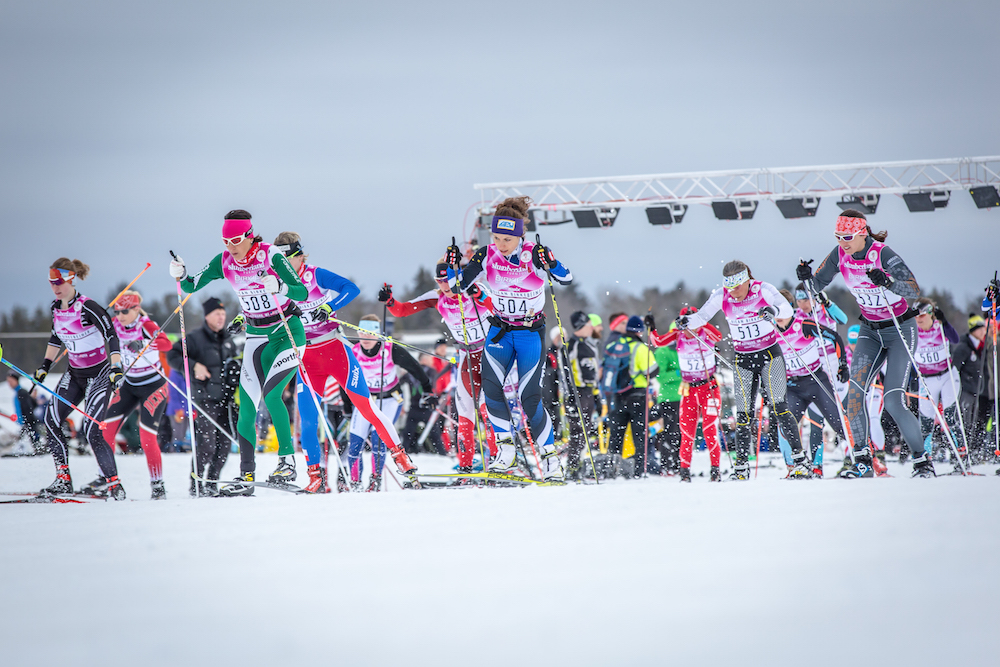
    Italy's Antonella Confortola (508) and American Rosie Frankowski (504), a Minneapolis native who trains with Alaska Pacific University in Anchorage, racing with the pack out of the start of the elite women's wave at the 2016 American Birkebeiner. Frankowski went on to place ninth. (Photo: James Netz/American Birkebeiner Ski Foundation©2016)
    Italy’s Antonella Confortola (508, in green) and American Rosie Frankowski (504, in blue), a Minneapolis native who trains with Alaska Pacific University in Anchorage, racing with the pack out of the start of the elite women’s wave at the 2016 American Birkebeiner. Confortola went on to place sixth and Frankowski finished ninth. (Photo: James Netz/American Birkebeiner Ski Foundation©2016)

    In the final kilometers of the race, across Lake Hayward, Gregg planned her finish.

    “All I was focusing on was not tripping up and falling,” she wrote. “There was a headwind so I couldn’t pull away there but I could tell I was feeling a lot fresher than Aurelie. I wanted to be first over the bridge to have a clear shot into the finish lanes and it worked.”

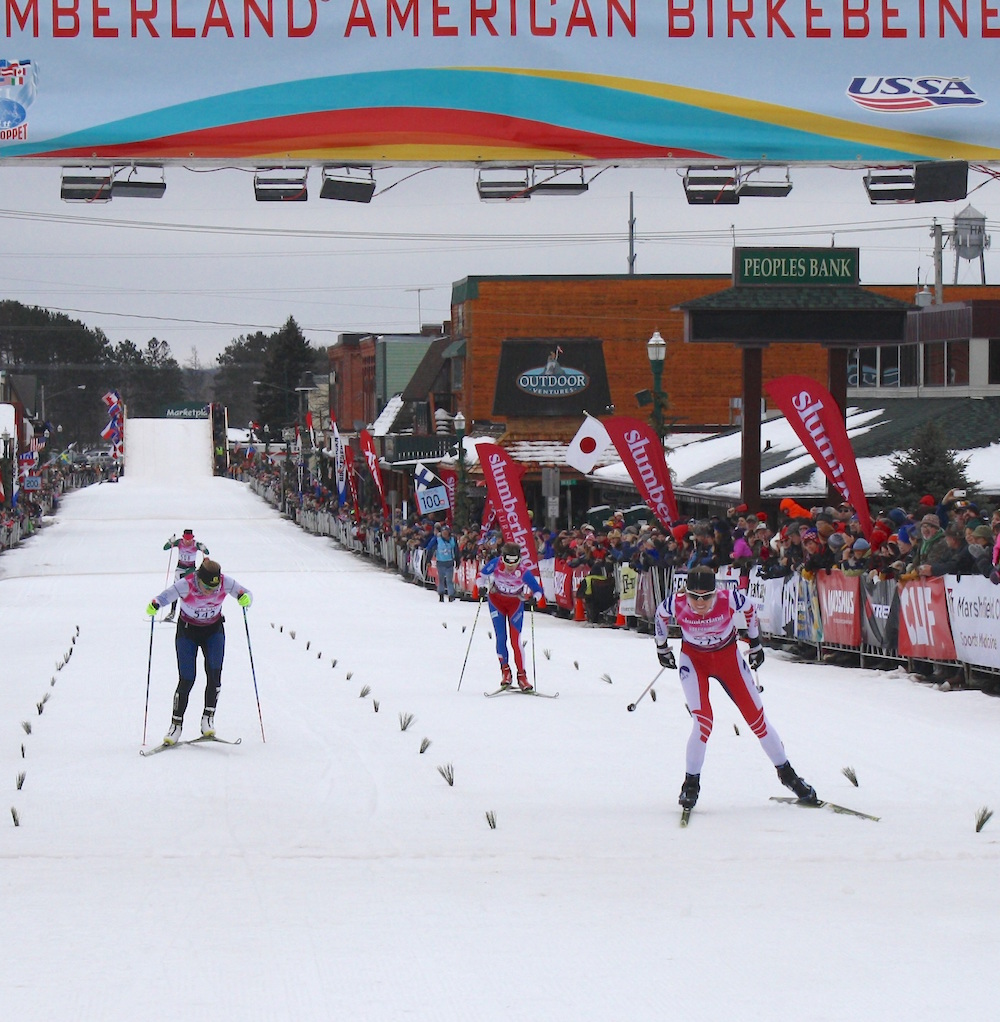
    Still leading Dabudyk into the final straightaway on the snow-covered Main Street, Gregg stayed ahead. Dabudyk moved to the left about halfway down the stretch to size up a move, but she didn’t have it. Gregg won in 2:22:44.5 by 5.1 seconds over Dabudyk.

    “I felt great in the final 400 meters and was able to get the gap I needed,” Gregg wrote.

    “My finish was very, very hard because Caitlin was very high speed…” Dabudyk said through a translator at the press conference. “Trying to pass at the finish, Caitlin was too fast.”

    With the silver, Dabudyk retained her lead in the FIS Worldloppet Cup.

    “For sure, the Worldloppet Cup is my big goal of the season,” Dabudyk said.

    Erika Flowers of the SMST2 Team (r) racing to third in the 2016 American Birkebeiner in Hayward, Wis., ahead of Italy's Elisa Brocard (l) and Klára Moravcová of the Czech Republic in fourth and fifth, respectively. (Photo: Worldloppet)
    Erika Flowers of the SMST2 Team (r) racing to third in the 2016 American Birkebeiner in Hayward, Wis., ahead of Italy’s Elisa Brocard (l) and Klára Moravcová of the Czech Republic in fourth and fifth, respectively. (Photo: Worldloppet)

    Nearly two minutes later, Erika Flowers of the Stratton Mountain School (SMS) T2 Team held off Brocard and Moravcova by 1.4 and 3.1 seconds, respectively, for third place, 1:51.1 behind Gregg.

    “I felt really good coming into the last 5km of the race and skiing onto the lake with Elisa, Clara and Antonella,” Flowers wrote in an email. “I knew I needed to push over the bridge and I felt confident in my finishing speed. I came over the bridge in 5th and knew I could catch at least one person but I was thrilled to ski into 3rd!”

    In her first Birkie, Flowers, of Bozeman, Mont., explained she “had no idea what to expect …especially since I had never raced against many of the European skiers in the elite field,” she wrote. “However I have been feeling stronger every week this winter and I love skate distance racing so I figured that on a good day, I had a shot at the podium.”

    The last time she did a marathon was seven years ago at the 50 k freestyle Rangeley Lakes Loppet in Maine. She explained that was more of a tour than a race, and she couldn’t remember how she did.

    “Besides that, the longest race I have ever done is the 30km at Spring Series each year. I was sick in Sun Valley and didn’t race last year but I finished 9th in the classic 30km in Anchorage two years ago,” Flowers explained.

    Caitlin Gregg (Team Gregg/U.S. Ski Team) celebrating her unprecedented fourth Birkie win on Saturday at the 2016 American Birkebeiner in Hayward, Wis. (Photo: James Netz/American Birkebeiner Ski Foundation©2016)
    Caitlin Gregg (Team Gregg/U.S. Ski Team) celebrating her unprecedented fourth Birkie win on Saturday at the 2016 American Birkebeiner in Hayward, Wis. (Photo: James Netz/American Birkebeiner Ski Foundation©2016)

    She’ll wrap up her season with OPA Cup races in Europe in a few weeks.

    “I really wanted to be racing the Canadian World Cups this year but an unfortunately timed elbow break in the fall challenged both my race shape and confidence in the early season,” she wrote. “I would have loved to be getting these kind of results a few months ago but I am proud of the work I have done since then and excited to keep on the up and up! I am also psyched to watch all of the Americans racing in Canada! I think we could see some awesome results from both World Cup veterans and newbies and can’t wait to cheer!!!”

    A U.S. Ski Team member, Gregg earned a discretionary spot at the season-ending World Cups at the Ski Tour Canada from March 1-12.

    “Both Brian and I are headed to Canada in a week to compete in the World Cups and we are very excited!” she wrote. “I will spend everyday this week working with the local Loppet Nordic Racing juniors helping them prepare for the Junior Nationals back here at Telemark. After Canada, Brian and I will go to Vermont and spend some time in the Mad River Valley (where I learned to XC Ski) visiting with the local community, skiing with local schools and Bill Koch kids and training with GMVS. Then it’s off to Craftsbury for Super Tour Finals.”

    About 10 seconds behind Flowers, Confortola placed sixth (2:00.7 minutes after Gregg). Imoberdorf was seventh (+2:55.8), Switzerland’s Nicole Donzallaz finished eighth (+2:56.8), Minneapolis native Rosie Frankowski of APU placed ninth (+3:09.5), and CXC’s Alice Flanders took 10th (+5:55.1).

    Notably, FasterSkier’s Kaitlyn Patterson, of Traverse City, Mich., placed 18th in the elite women’s field.

    ‘Nobody wanted to lead’

    For Norris, it was as simple as resolving to catch a rogue racer with about 7 k to go. Chauvet, a regular podium contender at the Birkie, had surged off the front, leaving about 20 men in the lead pack chasing behind him.

    “I decided to go for him,” Norris wrote. “When I caught him he shut down the effort immediately and I had to decide whether or not to take the reins. We ended up slowing up the pace coming into the lake and it became a pack of seven guys. I think six Frenchmen and myself.”

    There, racers met soft and slushy conditions for the first time on an otherwise fast course.

    “We had to double pole through a small ankle deep section of water, but overall the groomers made the course fast and firm for us!” Norris noted. “We slowed up coming into the lake and throughout the majority of the lake crossing. There was the typical headwind on the lake that I had heard about. It seemed nobody wanted to lead on the lake.”

    David Norris (APU) celebrates his victory at the 2016 American Birkebeiner, holding off France's Ivan Perrillat Boiteux, Benoit Chauvet and Adrien Mougel in second, third and fourth, respectively. (Photo: James Netz/American Birkebeiner Ski Foundation©2016)
    David Norris (APU) celebrates his victory at the 2016 American Birkebeiner, holding off France’s Ivan Perrillat Boiteux, Benoit Chauvet and Adrien Mougel in second, third and fourth, respectively. (Photo: James Netz/American Birkebeiner Ski Foundation©2016)

    But he wanted to be in the lead coming off of it. With experience from the elite sprints two days earlier, Norris knew the 400-meter stretch up and over the International Ski Bridge and down into Main Street to the finish was a short one — not much ground was going to be made up there.

    “I pushed it coming off the lake and tried to come off the bridge as fast as possible,” he wrote. “Main Street was the loudest thing I have ever heard and I honestly had no idea If skiers where coming up on me cause I couldn’t hear a thing. I got the dream legs sensation where the pain goes numb and I was just going max effort until I hit the line. I don’t think I celebrated until I was on the line and knew I couldn’t lose it!”

    Not only did Norris beat Perrillat Boiteux in second and Chauvet in third, he also outlasted a third Frenchman Adrien Mougel (GEL intérim Rossignol) in fourth (+4.7), Switzerland’s Candide Pralong (GEL intérim Rossignol) in fifth (+6.6), France’s Mathias Wibault in sixth (+8.7), and Italy’s 2014 Birkie champion Sergio Bonaldi (Team Salomon Italia) in seventh (+12.9).

    The second American, Kris Freeman (Team Freebird) placed eighth (+33.7). Ivan Babikov of the Canadian World Cup Team was ninth (+349), and one of the initial challengers, Tad Elliott (Ski & Snowboard Club Vail) placed 10th (+38.9).

    “Tad made the first real move with 15 or 10km to go and that was the first real push,” Norris recalled. “I think that made people second-guess themselves for the first time. During this effort I realized I was feeling strong and had skid the early portion of the course well and had saved energy for the finish.”

    “Chauvet is really experienced and a really nice guy,” Norris added of the Frenchman who changed the race for good. “He did some early work to make our pack just a leading group of maybe 20 guys.”

    Asked if the move was too early, Chauvet responded at the press conference, “I’m not sure it was too early. I think I was in very good shape in climbs, but the last 7 kilometers it’s difficult when you are alone when there is a group behind you because people try to catch you.

    “I thought I was able to win today and I’m a bit disappointed, but I’m rather happy to make the podium,” he added. “And I will try to win again last year.”

    With his second-place finish, Perrillat Boiteux moved into first in the Worldloppet Cup.

    “I’m very happy to get the red bib,” he said at the press conference through a translator (Chauvet). “The goal this season is to win the FIS Worldloppet Cup, but the race in two weeks [the Bieg Piastow] is classic and classic is not my main technique so I will try to do the best there and try to keep the red bib to the last race.”

    Asked if Norris would continue on the Worldloppet circuit after earning 100 points as the winner (putting him 10th in the overall standings) he replied, “No.” Next year? Probably not, he said with a laugh.

    Three races remain in the Worldloppet Cup series, including the Bieg Piastow in Poland, Engadin Skimarathon in Switzerland, and UgraSki marathon in Russia.

    Norris planned to end his season with the Tour of Anchorage and Spring Series in Vermont.

    “I had a slower start to the season with frustrating results at Nationals, which made qualifying for [the Ski Tour] Canada tough,” he wrote. “At the moment my plans are to return to Anchorage and attend the Tour of Anchorage ski race. The final set of races for me in four weeks will be spring series. I feel like my fitness is improving the longer the season goes so I am hoping to stay healthy and try to finish out the season with a strong result in the 15km and 50km in Vermont.”

    Classic Birkie

    In the 55 k classic Birkie, Welly Ramsey (Maine Winter Sports Center) won the men’s race in 2:48:59.9, and former Michigan Tech skier, 23-year-old Deedra Irwin of Wisconsin claimed the women’s title in 3:11:58.8. Both won the elite sprints on Thursday and went on to win the classic marathon by more than 12 minutes.

    Ramsey, 25, skied to the Birkie classic title by 12:07.2 minutes over Nick Power of CXC. Third went to Canada’s Murray Carter (+12:09.2).

    “I just wanted to be on the front and stay out of the fray, but then I turned around and no one else was there so I had a nice 50 k ski by myself,” Ramsey told FasterSkier afterwards. “This is my first Birkie. It feels pretty good. You can call it beginner’s luck.”

    Meanwhile in the women’s race, Irwin won by 12:46.7 over Isabel Caldwell (U.S. Ski Team standout Sophie Caldwell’s younger sister) of Peru, Vt. Another 10 minutes back, Josie Nelson of Medicine Lake, Minn., placed third (+22:49.4).

    Results

    Worldloppet rankings: women | men

    — Gabby Naranja and Jeremy Blazar contributed reporting

    France’s Aurélie Dabudyk (l) and Caitlin Gregg at the finish. Gregg beat her by 5.1 seconds for the 2016 American Birkebeiner title. (Photo: James Netz/American Birkebeiner Ski Foundation©2016)
    France’s Aurélie Dabudyk (l) and Caitlin Gregg at the finish. Gregg beat her by 5.1 seconds for the 2016 American Birkebeiner title. (Photo: James Netz/American Birkebeiner Ski Foundation©2016)
  • Newell Gives Distance Double Poling a Shot, Second in Dolomitenlauf Classic

    Newell Gives Distance Double Poling a Shot, Second in Dolomitenlauf Classic

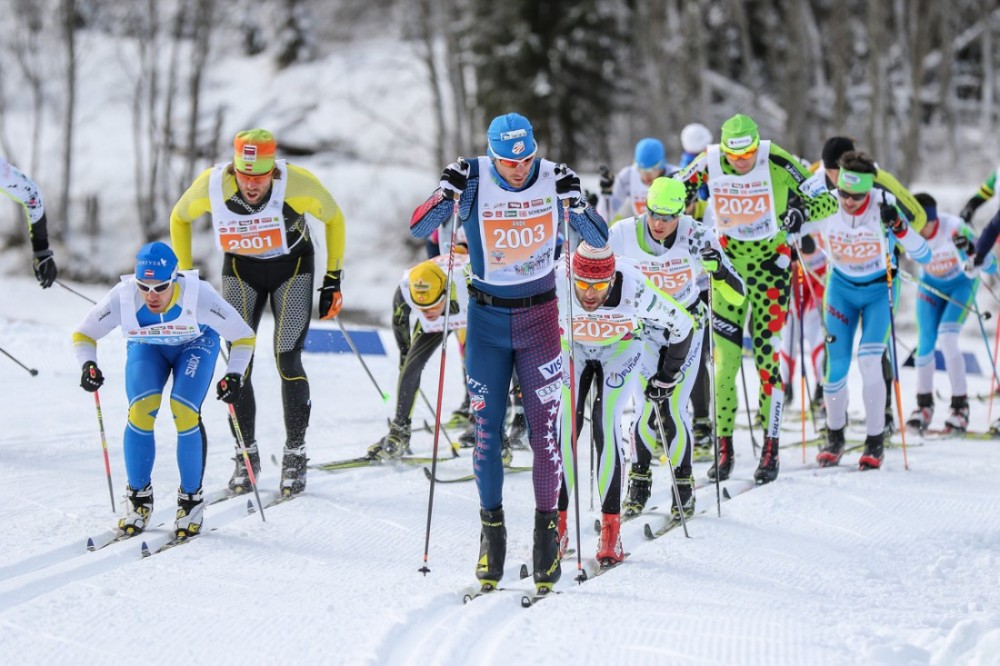
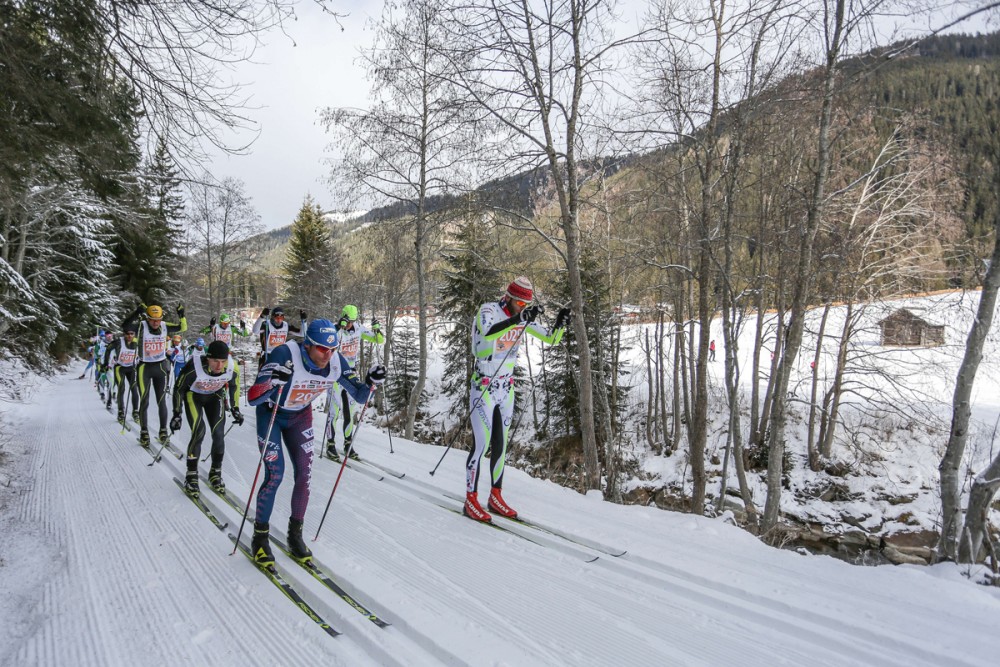
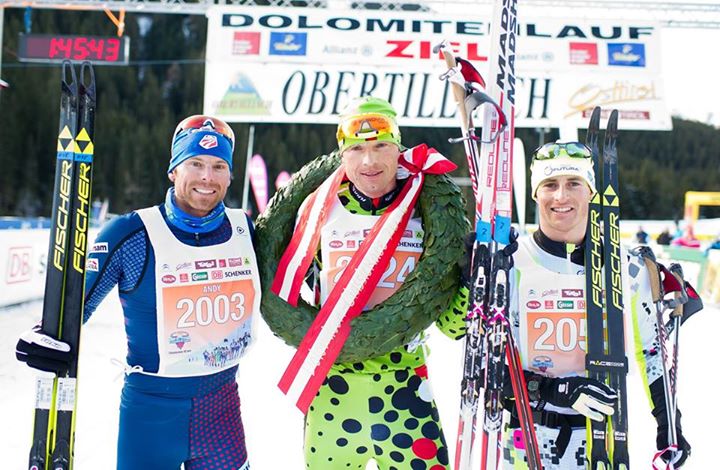
    American Andy Newell in bib No. 2003 in the lead pack during the Dolomitenlauf 42 k classic race  FIS Marathon Cup on Saturday in Lienz, Austria.  (Photo: Fischer/NordicFocus)
    American Andy Newell in bib No. 2003 in the lead pack during the Dolomitenlauf 42 k classic race at the FIS Marathon Cup on Saturday in Lienz, Austria. (Photo: Fischer/NordicFocus)

    Two and half months makes for along time on the road, especially when it only marks the halfway point. For U.S. Ski Team members like Andy Newell, who has been competing and traveling in Europe for the past 10 weeks, sometimes it’s important to spend time racing outside of the World Cup.

    “There are so many great races in Europe you can do if you get out of the World Cup bubble a little bit,” Newell said Saturday on the phone.

    The 32-year-old American, best known for his classic sprinting, opted out of this weekend’s World Cup races in Nove Mesto, Czech Republic, and instead competed in Austria, starting with the Dolomiten city sprint in Lienz on Friday night and Saturday’s Dolomitenlauf 42-kilometer classic marathon in Obertilliach.

    “That’s one of my goals this year and in the future – to get away from some of the World Cup weekends that maybe aren’t my strength, like [Saturday’s] 15 k skate on the World Cup, that’s definitely not a great event for me. I’m much better at a double-pole race,” Newell explained.

    American Andy Newell (l) and Austria's Stefan Sutter in front during the Dolomitenlauf 42 k classic race on Saturday in Lienz, Austria. (Photo: Fischer/NordicFocus)
    American Andy Newell (l) and Austria’s Stefan Sutter in front during the Dolomitenlauf 42 k classic race on Saturday in Lienz, Austria. (Photo: Fischer/NordicFocus)

    Testing the waters in his first international double-pole marathon, Newell finished second overall in the 42 k classic, just 5.7 seconds out of first and 0.3 seconds ahead of third. The overall win went to Stanislav Rezac of the Czech Republic in a time of 1:42.19, while Italy’s Mauro Brigadoi rounded out the top three.

    “The top-10 guys were on no wax,” Newell said. “I knew it would be a good race for me, but more importantly good preparation for the next month of racing.

    “I have some big classic sprints [in] Drammen and Stockholm,” he added. “To get in a long distance double-pole race can actually be good double-pole training for some of those sprints.”

    U.S. Ski Team Head Coach Chris Grover wrote in an email that having Newell get two starts (the sprint and marathon) in Lienz, rather than a possible one in Nove Mesto, made more sense for Newell’s long-term training plan.

    “It would have been good to have Andy here for a possible classic relay leg, but the Dolomitenlauf weekend offered him two confirmed starts (including a sprint) so it was a better fit,” Grover wrote.

    Using the 42 k event as ‘race practice’, Newell entered Saturday’s competition open to anything.

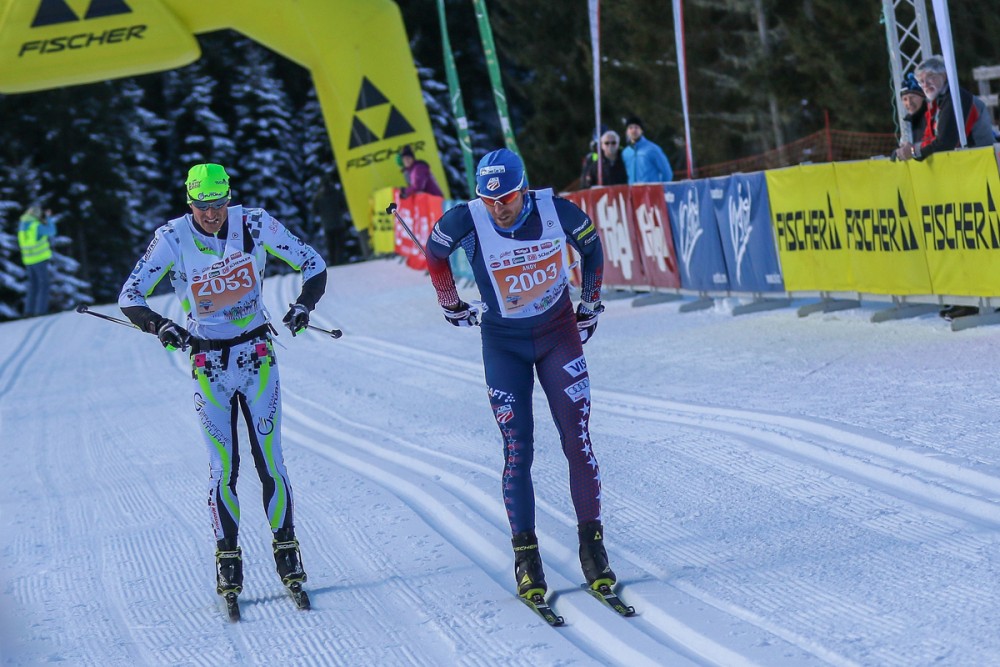
    American Andy Newell (l) outsprints Italy's Mauro Brigadoi, for second place in the Dolomitenlauf, 42 k classic race on Saturday in Lienz, Austria. (Photo: Fischer/NordicFocus)
    American Andy Newell (l) outsprints Italy’s Mauro Brigadoi for second place in the Dolomitenlauf 42 k classic race on Saturday in Lienz, Austria. (Photo: Fischer/NordicFocus)

    “I tried to go in with big confidence and an open mind, knowing that if I had a good day I could have a shot at winning the race or maybe even being on the podium,” Newell said. “I ended up doing a fair amount of leading actually and it came down to a group of 15 of us. Then it was a group of 10. By the last lap, it was maybe a group of five of us.” 

    With five skiers in the running for the top-three podium spots, Newell made a move with 4 k to go.

    “I put my head down and put in a surge but I wasn’t able to get rid of the two guys that were behind me,” he said.

    The top five men — Rezac, Newell, Brigadoi, and two Austrian skiers Martin Sutter and Stefan Sutter –made their way to the final kilometer, where the marathon turned into a marathon sprint.

    “The Czech guy that won is a really strong double poler and great marathon skier. He had put his move down with maybe a half k to go and we were kind of strung out, a few meters in between all of us,” Newell said. “He had maybe ten meters before we even got to the stadium and it was a really drawn out sprint finish.”

    While Newell captured second, three-tenths of a second ahead of the Italian, Brigadoi ousted the two Austrians for third.

    Left to right: Second place finisher Andy Newell (USA), along with race winner Stanislav Rezac (CZE), and third place Mauro Brigadoi (ITA) after the Dolomitenlauf 42 k classic FIS Marathon Cup on Saturday in Lienz, Austria. (Photo: EXPA/Gruber/Worldloppet Facebook)
    Left to right: Second-place finisher Andy Newell (USA), along with race winner Stanislav Rezac (CZE), and third place Mauro Brigadoi (ITA) after the Dolomitenlauf 42 k classic FIS Marathon Cup on Saturday in Lienz, Austria. (Photo: EXPA/Gruber/Worldloppet Facebook)

    While the sprint finish was perhaps more familiar territory for Newell, the American believes the race left him with a unique racing experience.

    “I haven’t done too many of these types of marathons. On a race like [Saturday] you’re lapping people, so you have to weave in and out of slower folks … then there’s a helicopter and a snowmobile with a video camera like three feet away from you the entire time, which takes getting used to,” he said. “It was pretty fun and different.”

    With a second-place podium finish and competitive spirit, who knows, the U.S. sprint specialist may make the transition to full-time marathoner yet.

    “In the future I would like to make it to some more of the [Visma Ski] Classic races and the really big European marathons,” Newell said. “There’s some great competition and some good points and prize money. That was the goal for coming here, get a fun city sprint in Lienz, but to also race the 42 k classic.”

    “Next time I want one of those wreath things!” Newell posted on Instagram after Saturday’s race. “Great experience and hard 42 k of double poling today. Happy with 2nd place in the Dolomitenlauf.”

    Results

    ***

    Though the Dolomitenlauf is a part of the Worldloppet Marathon series, the 42 k classic event is not the designated Worldloppet race. Instead, many of the big-name marathoners suited up for Sunday’s 42 k freestyle competition held in Osttirol’s Drau Valley, Austria.

    Racers began the 42 k event — changed on Jan. 5 from 60 k to 42 k — in Lienz and followed a course through various towns and villages located in the valley. Competitors finished back in the city of Lienz.

    On the men’s side this year, all three podium spots were commandeered by the French.

    French skier Bastien Poirrier won the men’s skate race in 1:32.42.3. Not far behind, French teammates Ivan Boiteux Perillat and Loic Guigonnet duked it out for second.

    Boiteux Perillat ultimately beat Guigonnet to the line, a mere 0.2 seconds behind Poirrier. Guigonnet crossed the line in third, 0.5 seconds out of first.

    For the women, France once again came out on top. French skier Aurelie Dabudyk raced to first in 1:41.32.3. French teammate Elisa Brocard finished 1:14.1 seconds back in second. Italy’s Antonella Confortola broke the French podium streak, crossing the line in third, 1:16.3 seconds behind Dabudyk.

    Results: Men | Women

  • Brooks Narrowly Misses Overall FIS Marathon Cup Victory, 10th in Ugra

    Brooks Narrowly Misses Overall FIS Marathon Cup Victory, 10th in Ugra

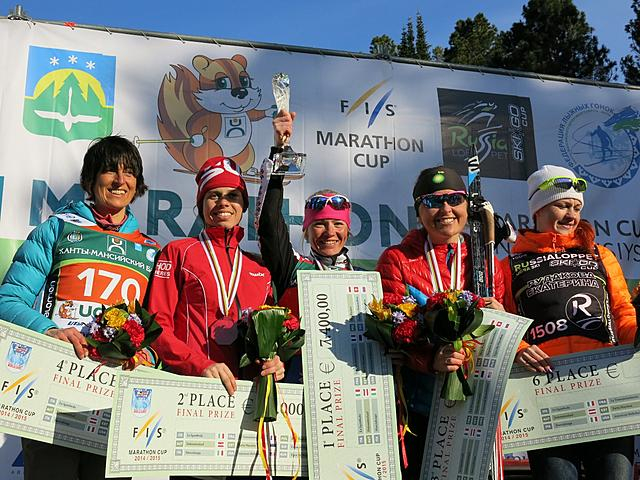
    Holly Brooks (2nd from the right) was third in the 2015 FIS Marathon Cup, after finishing 10th in the final event, the 50 k freestyle race Ugra Ski Marathon in Siberia, Russia, on Saturday. Tatjana Mannima of Estonia (center) won the overall Marathon Cup, and Aurelie Dabudyk of France was second (2nd from the left). Photo: FIS/Worldloppet
    Holly Brooks (2nd from the right) was third in the 2015 FIS Marathon Cup, after finishing 10th in the final event, the 50 k freestyle race Ugra Ski Marathon in Siberia, Russia, on Saturday. Tatjana Mannima of Estonia (center) won the overall Marathon Cup, and Aurelie Dabudyk of France was second (2nd from the left). Antonella Confortola of tally (left) was fourth overall, and Ekaterina Rudikova of Russia (right) was sixth overall. Photo: FIS/Worldloppet

    With her 10th-place finish in the Ugra Ski Marathon in Siberia, Russia, on Saturday, American Holly Brooks was third overall in the 2015 FIS Marathon Cup, only 15 points short of first overall.

    “Today I fell a bit short of a season-long goal but hey, that’s part of the sport,” APU’s Brooks said in a comment on her Facebook page, explaining that she was just missing the power in the tough spring conditions in the freestyle race this weekend. Originally slated as a 50 k, the course was shortened to 30 k due to warm conditions.

    “It was tough skiing out there: deep, dirty slush and a relentless ‘tropical’ headwind,” she wrote. “When I tried to apply the gas, it was like trying to drive a car on an empty tank. Today I felt as if I was a corpse on skis, as it turns out that 500k of racing and four months of ‘living on the road’ away from home was a bit too much for a strong finish.”

    Brooks had been leading the overall FIS Marathon Cup going into the Ugra, but only had a narrow 4-point lead to Tatjana Mannima of Estonia, and a 51-point lead to Aurelie Dabudyk of France. The 26 points netted from her 10th-place finish were not enough to hang onto the lead. Mannima won the series with 496 points after placing fifth, while Dabudyk rode a strong second-place finish in the race to pass Brooks in the rankings as well. Dabudyk finished with 484 points and Brooks was third with 481 points overall.

    Mannima also won the series in 2012-2013. Brooks’ third place is the top North American result in the overall FIS Marathon Cup to date. Now she is looking forward to come home to Alaska.

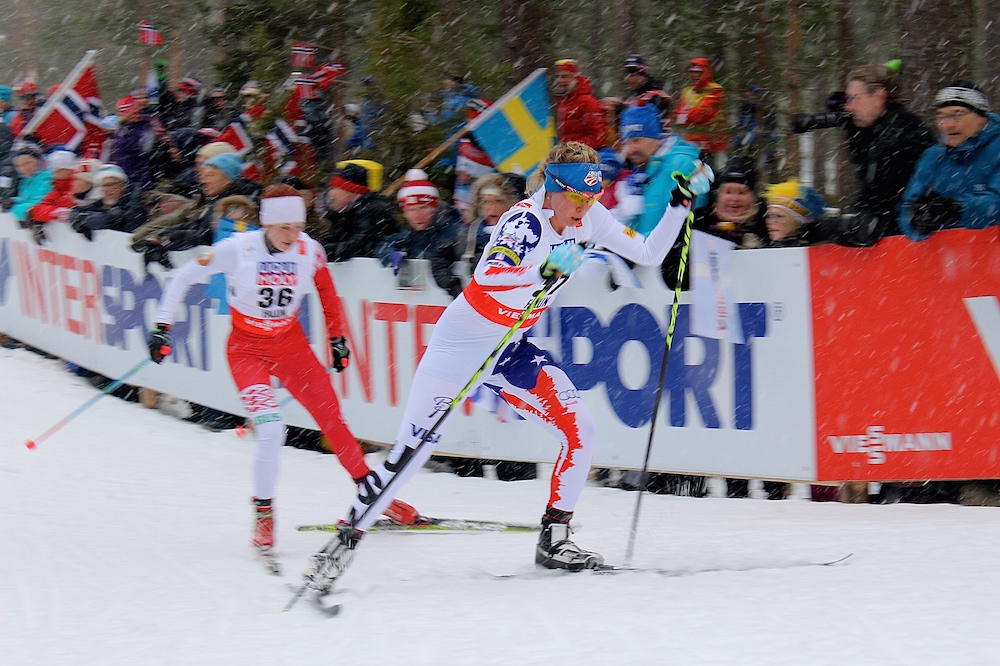
    Jessie Diggins (U.S. Ski team) leads Ekaterina Rudakova of Belarus, whom Diggins passed, up "little" Mördarbacken early in the women's 10 k freestyle individual start at 2015 World Championships in Falun, Sweden. Diggins went on to take silver for the best-ever U.S. women's distance result at an international championships; Rudakova placed 39th.
    Jessie Diggins (U.S. Ski team) leads Ekaterina Rudakova of Belarus, whom Diggins passed, up “little” Mördarbacken early in the women’s 10 k freestyle individual start at 2015 World Championships in Falun, Sweden. Diggins went on to take silver for the best-ever U.S. women’s distance result at an international championships; Rudakova placed 39th.

    It was defending Ugra champion Ekaterina Rudikova of Belarus who took home the race win by almost a minute, clocking in at 1:19:46.4, while Dabudyk of France finished in 1:20:42.9; Antonella Confortola Wyatt was third. Brooks crossed the line in 1:27:38.9.

    Her win was not without controversy. Women do not have their own starting waves in FIS Marathon Cup races, but are not allowed to work with men to set the pace or block for them. Some alleged that Rudakova did just that.

    “I was accused of having pacemakers at the race and it made me mad and gave extra power,” she told FIS. “I wanted to prove [to] everyone that I can win. It really gave me good motivation throughout the whole race. The course shortening did not affect me, I had lot of power in me and could have gone on. Next year I maybe try to win the overall FIS Marathon Cup.”

    And that wasn’t the only drama.

    The Russian website skisport.ru reported that the race was poorly organized and that this in fact may have affected the results:

    “According to eyewitnesses, the competition took place on a low organizational level. Due to weather conditions, the organizers had to change the route of the race, which failed to prepare properly. The start was delayed, but the most important thing – none of the participants had been warned before the start that the distance was reduced, and instead of accelerating loops and three laps of 15 km, the finish was after three laps of 7.5 km. Many participants… did not expect so much rapid completion of the marathon, and expected another 20 km struggle. Some, like Anton Gafarov, went out for another lap from which they had to return.“

    Gafarov, a World Cup podium finisher, and the racer who at the Sochi Olympics became U.S.-media famous after receiving a ski from Canadian coach Justin Wadsworth after breaking one in the sprint semifinals, finished 27th.

    The Ugra was also the smallest of the WorldLoppet marathons, with only 400 competitors completing the race.

    The men’s race came down to a sprint finish. Swiss World Cup skier Toni Livers won the race in 1:13:39.0, 0.4 seconds ahead of Aliaksey Ivanov of Russia. Evgeniy Belov of the Russian national team was third, finishing in 1:13:51.1.

    “The race course was difficult and hard as the snow was very soft,” Livers told FIS. “I saw that some of the athletes had some difficulties. There was a small group for a while and then me and another skier were able to make a gap. We worked well together all along and there were only 2 of us in the end. I was able to cross the finish line in front. It was really great!”

    Petr Novak of the Czech Republic had a comfortable lead in the overall Marathon Cup prior to the event, and was able to hold on to that lead even with a seventh place finish. Benoit Chauvet of France was fifth in the Ugra, but beating Novak by two spots in the final race was not enough to snag the overall title. Novak still won by 50 points total, collecting a total of 442 points. Chauvet was second overall with 392 points, and Livers was third with 268 points.

    Ugra Ski Marathon Results: men / women

    FIS Marathon Cup final standings: men / women

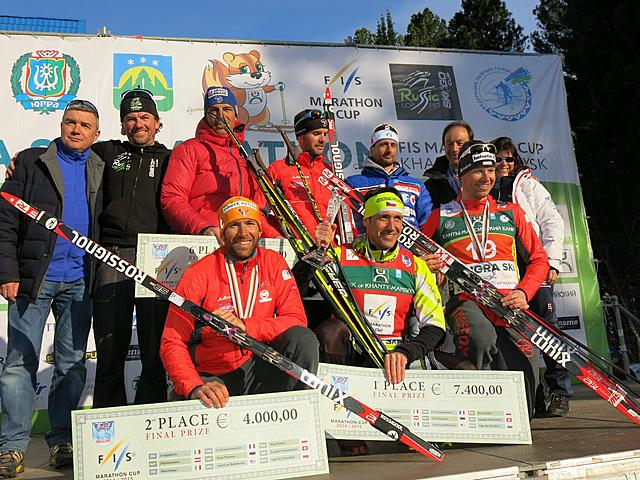
    Petr Novak of the Czech Republic won the 2015 FIS Marathon Cup, with Benoit Chauvet of France in second place, Toni Livers of Switzerland in third. Photo: FIS/Worldloppet
    Petr Novak of the Czech Republic won the 2015 FIS Marathon Cup, with Benoit Chauvet of France in second place, Toni Livers of Switzerland in third. Photo: FIS/Worldloppet
  • Brooks Wins Second Birkie; Bonaldi Takes Men’s Race in Dramatic Finish

    Brooks Wins Second Birkie; Bonaldi Takes Men’s Race in Dramatic Finish

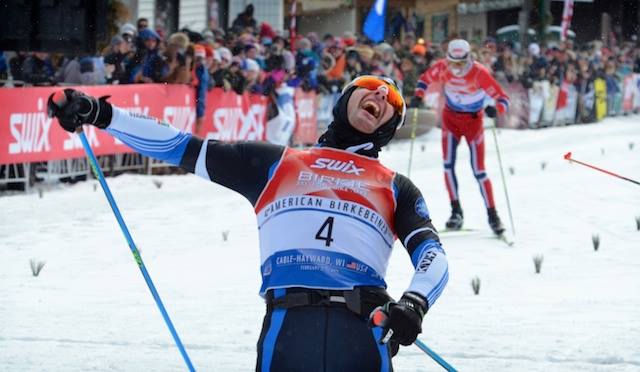
    Segio Bonaldi celebrates after winning in a sprint finish at the 2015 American Berkebeiner. It is Bonaldi's second Birkie title. (Photo: American Birkebeiner Ski Foundation)
    Italy’s Segio Bonaldi celebrates after winning in a sprint finish at the 2015 American Berkebeiner in Hayward, Wis. It was Bonaldi’s second Birkie title. (Photo: American Birkebeiner Ski Foundation)

    The 2015 American Birkebeiner in Hayward, Wis., was spared the most frigid weather gripping the Eastern U.S., as temperatures hovered around 15 degrees Fahrenheit when Saturday’s 51-kilometer freestyle elite race began. And despite three to four inches of new snow, even the sun made an appearance during the race.

    In was in these conditions that American Holly Brooks, of Alaska Pacific University in Anchorage, Alaska, won her second Birkie, claiming victory in a time of 2:34:33.

    Holly Brooks racing to her second Birkie victory on Saturday in Hayward, Wis., which she won by nearly 30 seconds to reclaim the FIS Marathon Cup overall lead. (Photo: Darlene Prois/ABSF)
    Holly Brooks racing to her second Birkie victory on Saturday in Hayward, Wis., which she won by nearly 30 seconds to reclaim the FIS Marathon Cup overall lead. (Photo: Darlene Prois/ABSF)

    However, she first had to ward off Aurelie Dabudyk of France, who stuck with Brooks until she began her final push on the flats of Lake Hayward, a few kilometers from the finish.

    Brooks came into the race second overall in the FIS Marathon Cup, but reclaimed the lead after Saturday’s win.

    The 32 year old told FasterSkier that the top four women were together for most of the race. At “B*itch Hill” – a steep climb about 40 k into the race – she said she heard a second snow machine behind her.

    “I looked over my shoulder and there was the sea of men who had caught us,” she explained. “I knew it was a now-or-never moment.”

    As the leading men passed the first four women, Brooks decided to make her move. She tagged onto the group of men and managed to break from the group.

    However, she was surprised to find Dabudyk was able to hang behind her.

    “I did not want to leave it to the finish sprint and therefore pushed as hard as I could on Lake Hayward. I did not dare to look back before the finish line to be sure not to lose any seconds,” she explained to the press. “I didn’t want to be ‘that skier’ who looked back and lost the sprint because you miss a crucial pole plant or something.”

    As usual, she said Main Street in Hayward was incredibly loud and festive.

    “It would have been fun to grab a flag and celebrate a bit but ensuring the win and reclaiming the red bib was more important!” she said. “I am really happy that I could win the Birkie again today!”

    Holly Brooks celebrates after winning her second American Berkebeiner on Saturday in Hayward, Wis. The win put her back in the lead of the overall FIS Marathon Cup. (Photo: American Birkebeiner Ski Foundation)
    Holly Brooks celebrates after winning her second American Berkebeiner on Saturday in Hayward, Wis. The win put her back in the lead of the overall FIS Marathon Cup. (Photo: American Birkebeiner Ski Foundation)

    Dabudyk went on to finish second, 28.1 seconds behind Brooks. Tatiana Mannima of Estonia was nearly two minutes back in third (+1:59.9), barely holding off German Anja Gruber, who placed fourth (+2:02.1).

    Mannima has won the last two FIS Marathon Cup races, while Gruber is coming off three podium finishes earlier this month in SuperTour races in Craftsbury, Vt.

    Dabudyk said to the press that she wanted to stay with Brooks until the finish, though down the stretch Brooks had too much power for her.

    “But I am really happy with my second place,” she added.

    Mannima said that she pushed hard from the start to see which skiers could hold onto her speed. She was able to stay in the lead group until Brooks and Dabudyk finally took off with 10 k to go.

    “At Lake Hayward, I was trying to stay behind Gruber, as it was pretty windy on the lake. I hoped to pass her before the finish line, which I did,” she explained, adding that she is happy to just be on the podium.

    American Caitlin Patterson (Craftsbury Green Racing Project) ended up fifth (+9:31), after winning the SuperTour 20 k classic mass start in Craftsbury late last month.

    Bonaldi wins second Birkie in exciting fashion 

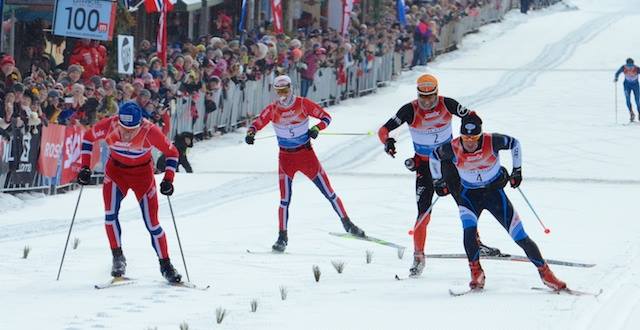
    Italy's Segio Bonaldi (r) outlasts three Frenchmen en route to his second American Birkebeiner victory on Saturday in the 42nd annual Birkie in Hayward, Wis. (Photo: Darlene Prois/ABSF)
    Italy’s Segio Bonaldi (r) outlasts three Frenchmen en route to his second American Birkebeiner victory on Saturday in the 42nd annual Birkie in Hayward, Wis. (Photo: Darlene Prois/ABSF)

    The men’s race offered a more dramatic finish, as Italian Segio Bonaldi outsprinted three Frenchmen to win by less than a second.

    Bonaldi, Birkie winner in 2013, finished in 2:12:21.1. He passed France’s Christopher Perrillat-Collomb in the final 100 meters to win by just 0.5 seconds. Benoit Chauvet and Mathias Wibault were also in the lead group, and Chauvet finished in third (+1.7) while Wibault faded to fourth (+5.0).

    Chauvet told the press that he tried to break out of the lead group of 20 at the first climb, but no one was willing to break with him. However, the racers slowly began to spread apart at about the 35 k point, and Chauvet was able to work with Perrillat-Collomb.

    “At this point all were thinking about winning the race,” he said.

    Chauvet explained that his tactics failed him, however, and that Bonaldi was smarter and stayed behind the others until the final stretch. Chauvet said he probably made his final sprint too early, as he tried to be first coming off the new bridge that drops the skiers into downtown Hayward and the final straightaway to the finish.

    “I did not feel so well until 15 k before the finish,” Bonaldi said. “My skis were also not very good so I tried to stay behind and to wait for the finish sprint. I kept energy for that.”

    The 36 year old added that he really wanted to win this year, especially after finishing third last year, but was not sure he would have a clear shot at victory until 100 meters before the finish line.

    “I am very happy!” he said.

    “I am little bit disappointed to be third as I wanted to win. I have to come back for the victory next year,” Chauvet said.

    The top American, Lex Treinen (APU), finished nearly 20 seconds after Wibault in fifth and was 24.5 seconds from the win. Last year, he placed 10th in the Birkie. American Brian Gregg (Team Gregg/Madshus) finished in eighth (+1:51.4).

    FIS Marathon Cup leader Petr Novak of the Czech Republic came through in 11th (+5:51.4).

    “I had the worst skis of my life. I lost so much on the downhills. It was a mental fight for me all the way through and right until the end!” Novak said in a statement to the press. Despite his rough day, he still retains the lead in the overall FIS Marathon Cup standings.

    American Matt Liebsch (XC United/Team Strong Heart), 2009 Birkie winner, finished 10th (+3:10.8), while 2012 Birkie winner Tad Elliott (Ski & Snowboard Club Vail Elite) took 16th (+10:29.5).

    Naryshkina, Mork take classic titles

    Men's 55 k classic Birkie winner Ole Christian Mork (c) is with second-place finisher Torin Koos (l) and Thomas Seidel (r), who placed third. (Photo: ABSF)
    Men’s 55 k classic Birkie winner Ole Christian Mork (c) is with second-place finisher Torin Koos (l) and Thomas Seidel (r), who placed third. (Photo: ABSF/Facebook)

    In the 55 k classic race, Natalia Naryshkina of Russia and the CXC Team took the women’s win in 3:19:20.2, while Norway’s Ole Christian Mork won the men’s race in 2:54:22.1.

    Naryshkina beat runner-up Josie Nelson of Medicine Lake, Minn., by 3:44.9, and Kelly Sillicorn of Winona, Minn., by 3:50.9. Isabel Caldwell, younger sister of U.S. Ski Team member Sophie Caldwell, placed fourth (+6:14.8).

    Mork, of Oslo, outlasted four-time U.S. Olympian Torin Koos by 8.8 seconds and Thomas Seidel, of Salt Lake City, in third by 14.7 seconds.

    Complete results

    51 k skate results: Men | Women

    55 k classic results: Women | Men

  • 2015 American Birkebeiner Preview: Bridges, Brooks and More

    2015 American Birkebeiner Preview: Bridges, Brooks and More

    Holly Brooks winning the 2012 American Birkebeiner, four-tenths of a second ahead of Caitlin Gregg (l), for her first Birkie title. (Photo: Darlene Prois/American Birkebeiner) http://fasterskier.com/article/brooks-outsprints-gregg-for-birkie-victory/
    Holly Brooks winning the 2012 American Birkebeiner, four-tenths of a second ahead of Caitlin Gregg (l), for her first Birkie title. (Photo: Darlene Prois/ABSF)

    Each year, leading up to the third week in February upward of 11,000 people get sick. It isn’t a sickness that would cause a widespread panic, but rather one thousands of Midwesterners actually looked forward to each year, and it’s called Birkie fever.

    The 42nd running of the American Birkebeiner takes place Saturday, starting in Cable, Wis., and ending some 30 miles (or 50-plus kilometers) south in Hayward, Wis. The race filled up in November, with all 10,500 allotted entries accounted for before the first of the year. In total, 10,517 skiers from 18 countries were registered for the three Saturday races, almost 7,000 of them are entered in the 51 k skate race. That’s a big change from 1973, the first time the Birkie was held. Back then, there were 34 men and one woman as race participants.

    The race course has gone through several changes since 1973, from the direction skiers raced to the length of the race. This year’s race has a few changes that will add a some interesting twists. For one, the race is longer. The classic race is now 55 k and the skate race now 51 k. The extra distance was due to a relocation of the final aid station and the extension of the finish line, pushing it farther down Main Street.

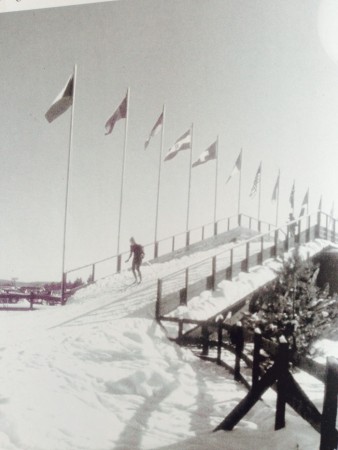
    The International Bridge was a fixture in the Birkie before. - Photo: American Birkebeiner Foundation
    The International Bridge was a fixture in the Birkie before. (Photo: ABSF)

    The biggest change that has garnered some of the most attention is the new bridge the American Birkebeiner Ski Foundation (ABSF) finished assembling on Wednesday over Highway 63, a kilometer from the finish.

    The International Bridge adds no length to the race, but it does add a 17-vertical-foot hill before the finish. Previously, once skiers were five kilometers from the finish, it was a flat ski to Main Street. The new manmade hill adds a 10-percent climb to legs that already have some 50 kilometers of climbs in them.

    This isn’t the first time the International Bridge has been a fixture on the Birke course. In the late ’70s and early ’80s when the race finished at the Telemark Resort in Cable, the bridge was the last hill skiers needed to climb before they finished. The temporary bridge is 100-feet long and spans 30 feet over the highway.

    The bridge was needed to eliminate the traffic congestion problems the race brought during the weekend. Funding for the ramp and other changes is a part of phase one of the ABSF’s multiple-year fundraising program.

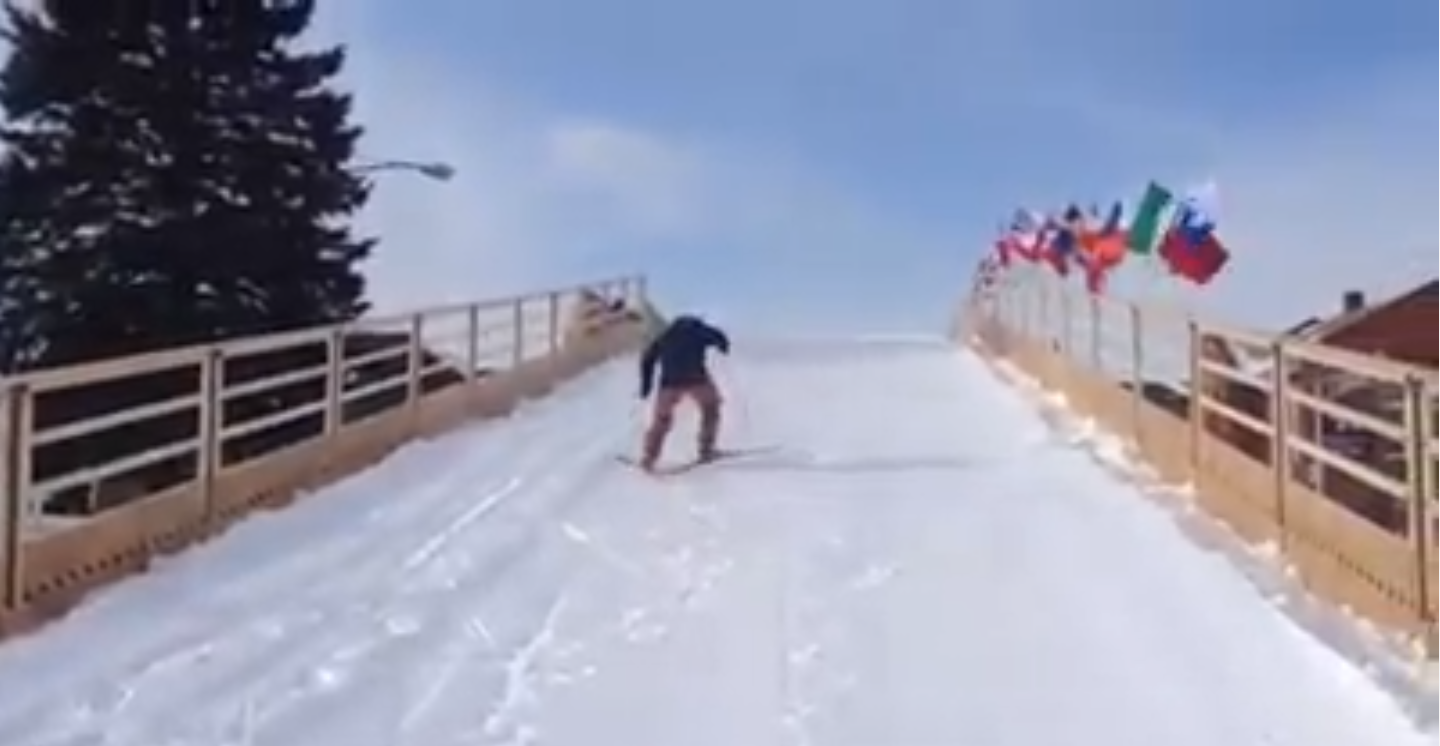
    The new International Bridge before the finish of the American Birkebeiner in Hayward, Wis. (Photo: American Birkebeiner Ski Foundation Facebook)
    Testing the new International Bridge near the finish of the American Birkebeiner in Hayward, Wis. (Photo: American Birkebeiner Ski Foundation Facebook video)

    Birkie Draws FIS Marathon Cup Contenders 

    The past two years, the Birkie has been a part of the FIS Marathon Cup, a season-long international competition that crowns a winner with the highest points after a series of races of 42 k or farther. This means it attracts some of the world’s best long-distance racers and this year’s women’s field is a reflection of that. In the elite wave, the top four women in the FIS Marathon Cup are entered: Tatjana Mannima of Estonia, American Holly Brooks, Aurelie Dabudyk of France, and Antonella Confortola of Italy. Confortola finished second in last year’s Birkie.

    Brooks was leading the FIS Marathon Cup, but skipped last week’s stop at the Tartu Marathon in Estonia to head to Hayward to prepare for the Birkie.

    “I’m really excited for this year’s Birkie,” Brooks wrote in an online message this week. “It’s been a couple of years since I’ve been here and it’s great to be back — both at the Birkie and on ‘home soil!’

    “I’ve been bouncing from country to country racing marathons and I decided last fall that I would spend two weeks here in Hayward,” she explained. “I have great friends that I’m staying with and it feels fabulous to be in a house [rather than a hotel].”

    The new podium awaits for the winner of this years race - Photo: American Birkebeiner Foundation
    The new podium awaits for the winner of this year’s race. (Photo: ABSF)

    Coming into the race, Brooks ranks second in the overall FIS Marathon Cup standings, just seven points behind Mannima. Brooks won the Birkie in 2012 and knows the course well.

    “I‘ve seen the whole thing start to finish… both at distance pace and race pace. That’s more than I can say for some of the courses I’ve raced this winter!” Brooks wrote. “Not sure how much of a true advantage it gives me but it puts my mind at ease a bit. I know where people including myself have made moves.”

    Two year ago at the Birkie, Mannima lost a photo finish and placed second to three-time Birkie champion Caitlin Gregg, who is currently in Sweden representing the U.S. at the FIS Nordic World Ski Championships in Falun. American Caitlin Patterson (Craftsbury Green Racing Project) finished third in 2013 and seventh last year, and could prove to be a threat in this year’s elite race.

    In an email on Wednesday, Patterson wrote that she was looking forward to skiing part of the Birkie trail on Thursday, refreshing her memory “of some of its notable features, and seeing the new bridge and finish line if possible.

    “My preparations have been going well — mostly I’ve been focused on recovering after recent Craftsbury Supertours, building up my energy, and actually keeping my training skis pretty short and easy,” she explained. “At this point in the season I have to trust the endurance and fitness I’ve built up during the past year, and mostly just stay sharp and excited for the race, which I most certainly am!”

    In terms of her goals and expectations for Saturday’s race, Patterson felt anything was possible.

    “The past two years of racing the Birkie have taught me that it’s a race in which you have to test your limits but where you never quite know what will happen, where you must always be thinking quickly and ready to react throughout all 50+k,” she wrote. “I believe that I’m in very good shape, so my goals are to trust my fitness, ski with confidence and enjoyment of the sport… and to make it onto the podium!”

    “I’ve seen the whole thing start to finish … I know where people including myself have made moves.” — Holly Brooks on her Birkie advantage

    The men’s field is also competitive. Most of the FIS Marathon leaders didn’t race last weekend’s Tartu Marathon to fly to the U.S. to prepare for the Birkie. Overall FIS Marathon Cup leader Petr Novak of the Czech Republic is racing along with France’s Benoît Chauvet, who sits in second place, only 85 points behind Novak. Second-and-third place finishers from last year’s Birkie, Simone Paredi and Sergio Bonaldi of Italy, are also listed to start. Bonaldi won the Birkie in 2013.

    SSCV's Tad Elliott (119) and Craftsbury's Andrew Dougherty (131) Men's 30 k classic mass start at U.S. Cross Country Championships in Houghton, Mich. (Photo: Christopher Schmidt)
    Tad Elliott (119) racing in the men’s 30 k classic mass start at U.S. Cross Country Championships in January in Houghton, Mich. (Photo: Christopher Schmidt)

    For the U.S., Birkie winners Tad Elliott (Ski & Snowboard Club Vail Elite) and Matt Liebsch (XC United/Team Strong Heart) will be racing, along with 2014 U.S. Olympian Brian Gregg. Elliott won in 2012 and Liebsch took first in 2009.

    This trio has had a pretty intense history in the Birkie. When Elliott won in 2012, Liebsch placed second and Gregg took third. The difference between first and third was only 14.8 seconds.

    In a phone interview, Liebsch mentioned how team tactics played a part in previous Birkies, but that would not be the case this year.

    “In the past, you would have these teams come over with five or six guys and it would essentially be like a cycle race,” Liebsch said. “The fast sprinters would just sit in the back while his teammates did all the work up front setting the pace and sending guys off the front to disrupt the flow of the race. This year is a little different because there aren’t the multiple-person teams.”

    Liebsch added that the style of racing here is different than at European marathons.

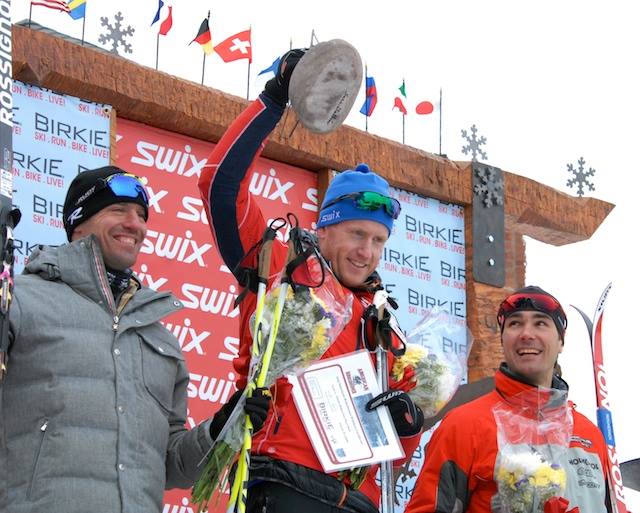
    The 2011 American Birkebeiner men's podium (from left to right): with France's Benoit Chauvet in second, Norway's Tore Martin Gundersen in first and Russia's Andrey Tyuterev in third. (Photo: Andy Caniff/Swix Sport USA)
    The 2011 American Birkebeiner men’s podium (from left to right): with France’s Benoit Chauvet in second, Norway’s Tore Martin Gundersen in first and Russia’s Andrey Tyuterev in third. (Photo: Andy Caniff/Swix Sport USA)

    “In Europe, the pace is extremely fast due to the fact that teams have ten or eleven guys,” he said. “Here in the United States, the pace is slower and many of the Europeans don’t like that pace so they would send guys off the front if the pace got to slow.

    “Most of the European guys are here to get FIS points to improve their standings for the overall FIS Marathon Cup title,” he added.

    Chauvet is currently second in the overall FIS Marathon Cup and has the biggest team entered in the Birkie with four total teammates, while the overall leader, Novak will race solo.

    “The strategy for most of the European guys will be to stay up front, in the top eight, get points and then head back to Europe,” Liebsch said. “This could really help out the fast American guys like Tad, Brian, me and Lex [Treinen] because the pace won’t be crazy fast like most European races can be.”

    In an email, Treinen predicted that U.S. guys would have a good showing: “Matt looks like he’s in good shape and he and [Brian] Gregg would love to take home a Midwest victory here,” he wrote. ” … I have been training specifically for the Birkebeiner for at least two weeks and I even did some intervals recently, so I feel like I am in better shape than ever before.”

    Elliott has spent some time in the Midwest and won last month’s Seeley Classic race that was held on the Birkie course.

    “I am excited to race the Birkie,” Elliott wrote in an email. “It will be three years since I last raced here! I am looking forward to a great event. I have had some health issues again sneak in this last month, but I have a few tricks up my sleeve. My twin brother is also my wax tech coming with me from Colorado. Hoping [he] can keep me in the race this year!”

    The biggest factor going in the weekend is the weather. There was a concern of a lack of snow but over the last few weeks the area has gotten enough snow to make the course set up nicely for the race. The wind and cold temperatures are an immediate concern. On Tuesday, organizers canceled Thursday’s elite sprints because of the predicted well-below-zero temperatures at the scheduled start time. Early predictions show Saturday morning’s temperatures to be around 4-degrees Fahrenheit.

    The Birkie can been viewed live on Saturday, starting at 8 a.m. Central time, via the race organizer’s live stream (http://new.livestream.com/xcountrylive/birkie). Follow athletes via the Birkie’s live athlete tracker and check FasterSkier for a post-race recap.

    Elite start lists: Women | Men