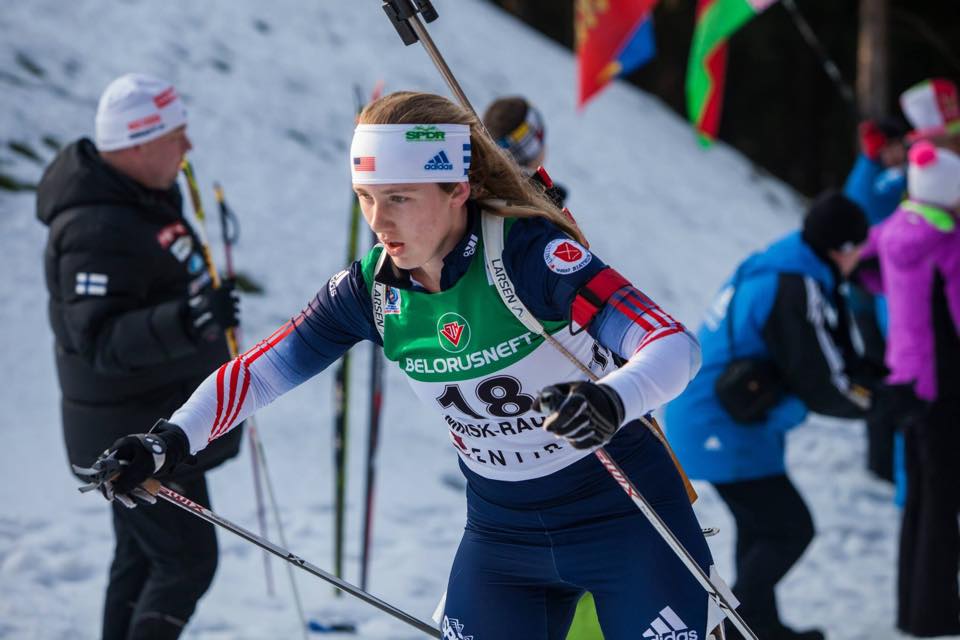
Chloe Levins racing at the 2015 IBU World Youth Championships in Minsk, Belarus. (Photo: Chloe Levins)
Editor’s Note: The ‘From The Pack’ features profiles about talented-and-intriguing junior and collegiate racers in the U.S. and beyond. While nordic sports are certainly not the largest, there are still thousands of great stories that most of us are not familiar with. We will be picking athletes out of this pack to write about; nominations for outstanding or interesting nordic skiers can be sent to info@fasterskier.com with the subject line: “From The Pack.” We are looking for unique stories, not necessarily the fastest skiers. Nominations should include a brief explanation of why we should profile the athlete.
***
With an 18th-place finish in the 6 k sprint during the 2015 IBU World Youth Championships in Minsk, Belarus, Chloe Levins demonstrated she is a name to look out for in the years to come.
Levins has been skiing her entire life. Since her family moved to Rutland, Vt. when she was two months old, they have been heavily involved in the local cross country commuity. Her parents, Mary Ann Levins and Jim Levins, are a constant presence at Mountain Top Resort where her father is also a Toko Tech Team representative. Her mother, meanwhile, is the chair of the New England Bill Koch League and a race coordinator and volunteer at Mountain Top. In 2009 she received the John Caldwell award, New England Nordic Ski Association’s (NENSA) highest annual honor, for her commitment to skiing development in New England. Two of her older siblings, who Levins credits for inspiring her to get involved in competition, ski raced until they graduated from college and still get on the trails whenever they get the chance. It’s safe to say, Levins skiing roots run deep.
Biathlon, however, is a relatively new venture for Levins. “I started the summer after my eighth grade year. Max Cobb recommended to my mom to send me to a three day introduction camp in Craftsbury. So I went there and Algis Shalna, my coach now, saw something and invited me to the next camp in Lake Placid for a week. I’ve been training with him ever since,” Levins said in a phone interview.
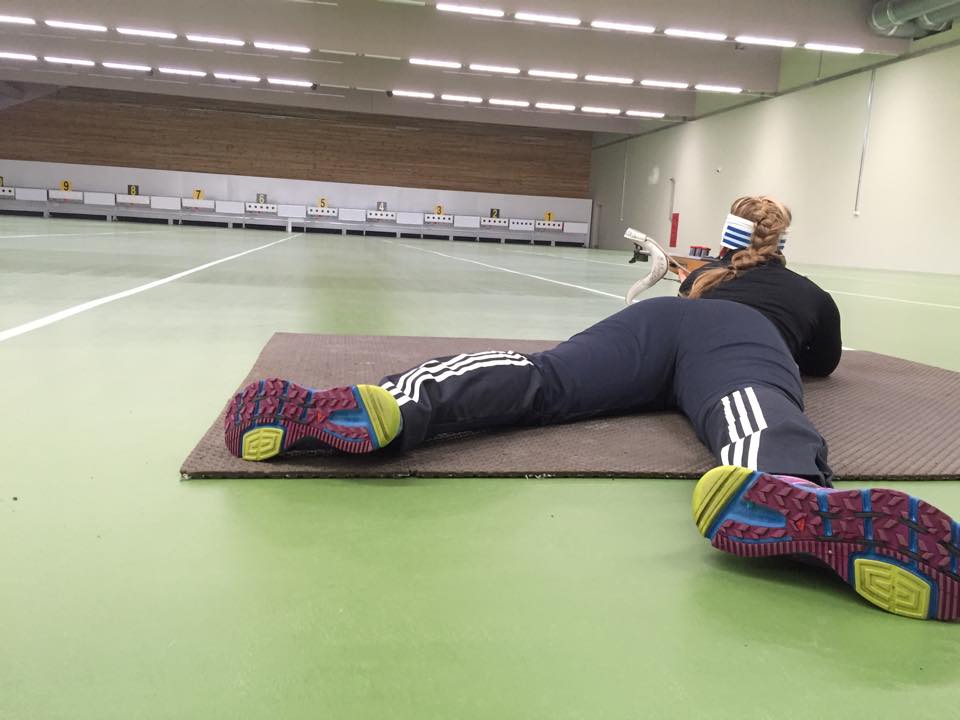
Chloe Levins practices at the shooting range in Minsk, Belarus during the 2014/2015 season (Photo: Chloe Levins)
She has been passionate about the sport ever since. “The mental aspect of the sport really intrigues me,” Levins explained. “I think that the combination of aerobic skiing and precision shooting is very unique and is not something that you find in any other sport…It’s really exciting. You’re never out of the game. You can be a minute back and still have a chance to win because the last stage is so nerve racking. Its unreal.”
This past winter, her passion for biathlon gave the Rutland skier some impressive results. Levins has always been a great skier – in the 2013/2014 season, a highlight result was a second place finish in the U16 girls 5k mass start at Junior Nationals. But the winter of 2014/2015 is when she really made her presence known in biathlon. She won the U.S. Biathlon Association’s trials race series to qualify for the IBU World Youth Championships in Minsk, Belarus. There, she achieved an impressive 18th place finish.
But what led to such drastic improvement?
“Millions of things contributed… Something that really stands out in my head is… I think it was from my mom. She said, ‘doing your best in this moment puts you in the best place for the next moment’ and that is what was in my head for the entire season. I lived by that,” Levins said of her 2014/2015 season.
The Rutland native also explained that she focused on improving her shooting in the past year. “I put in a lot of time dry firing with the rifle… I just kept my eye on the process as best I could [and] tried to stay positive, which was difficult at times because biathlon is such an unpredictable sport. It’s a short way from heaven to hell in this sport so keeping it in perspective is important and I think I did that really well this past season,” Levins explained.
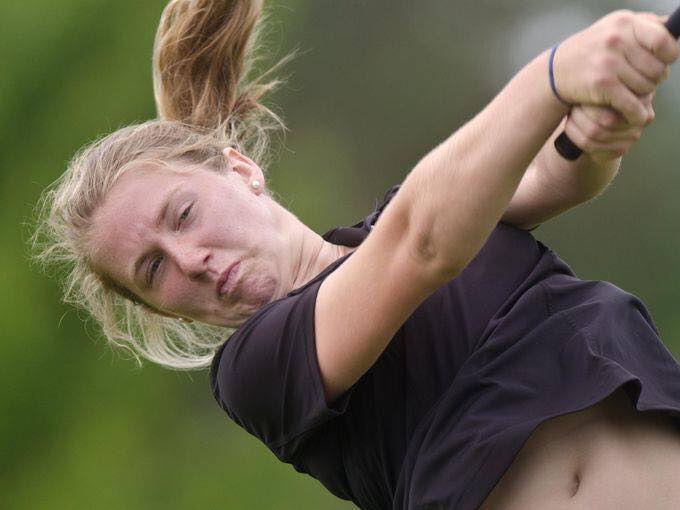
Chloe Levins competes in the 2015 Vermont State Championships in her second passion: Golf. She won the event and placed fourth in the New England Championships. (Photo: Chloe Levins)
Another contributing factor to Levins improvement is her interest in another sport in which she excels: golf. This spring she was Vermont’s state champion and narrowly missed the podium at New England Championships with a strong fourth place. Levins gives some credit to golf for both her focus and interest in biathlon. “I see a connection with biathlon and golf mentally so I am able to apply some of the knowledge I have gotten from playing golf my entire life to biathlon and I think that’s helped me and also increased my interest in the sport,” she said.
“Golf is a game of integrity, patience, and mental toughness, all aspects of sport that can continue to be developed at the highest level and are essential to executing quality training. I believe that the game of golf is a great cross training exercise for the improvement of mental strength in general,” Levins added.
The improvement, passion, and results leave Levins with a tough decision. An incoming senior at Rutland High School, she will have to choose between college and full-time training in the coming year. “There are some juniors in biathlon that have chosen not to go to college and train since [biathlon is] not a collegiate sport,” Levins said. “But there are also some current professional biathletes that chose to go to college, race for college, and get faster at skiing, then pick up with their shooting after college. So its been done both ways and I think the best way for me to do it is to go to college right after high school.”
Even if she does attend college, Levins plans to stay involved with biathlon, “I definitely want to try and keep training for biathlon because I don’t think I could ever step away from it for four years,” the Rutland native added.
For now, however, Levins is focused on this year. She is currently in Lake Placid for a junior development camp where she is an assistant coach and a young mentor for aspiring biathletes between the ages of 11 and 15. Immediately after that Levins will stick around Lake Placid for a national team camp, where she will ski and shoot with the professionals. “I’m looking forward to upping my game and learning from them on the range. Its going to be not so much physical, I think its going to be mostly shooting camp,” Levins said.
She plans to attend a few more camps throughout the summer and will be a regular at the Jericho, Vt. biathlon range in the fall. If all goes well for the 17-year-old, she hopes to improve on an already successful junior career.
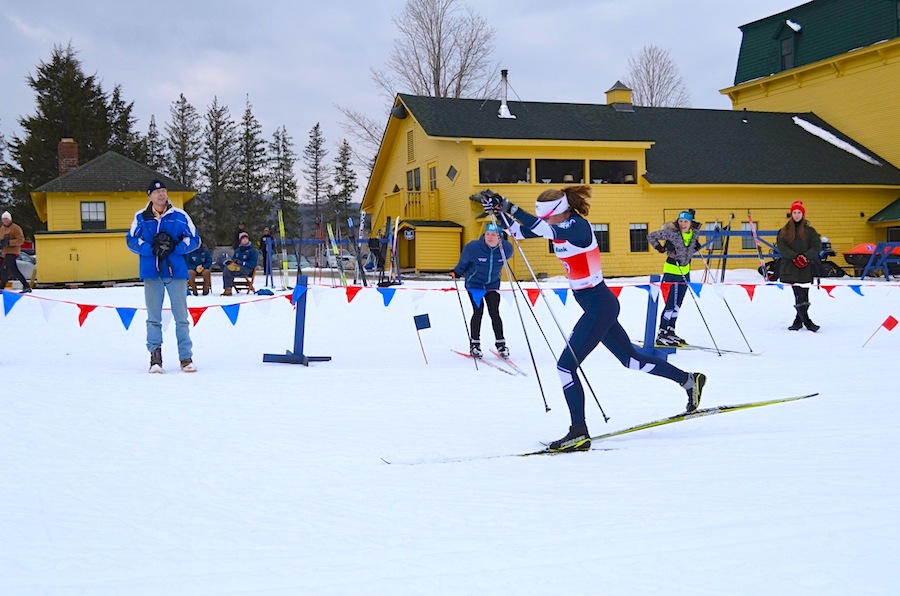
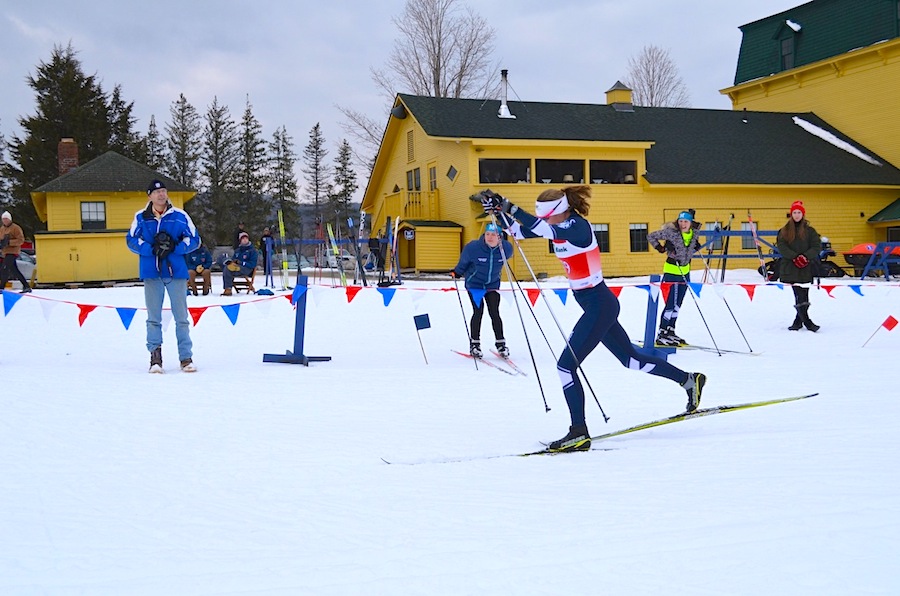
Racers in action at Middlebury Carnival in mid-February at Rikert Nordic Center in Ripton, Vt. (Photo: Stella Holt)
RIPTON, Vt. – Nestled in the Green Mountain National Forest 12 miles up the hill from Middlebury, Vt., the Carroll and Jane Rikert Ski Touring Center lies behind an array of cheery colored yellow buildings that comprise Middlebury College’s Bread Loaf campus.
A moderately sized sign directs nordic-skiing seekers inward, off Route 125 and toward a large barn – also yellow. Around the corner, one can find a recently remodeled rental shop and warming space with couches, cubbies and a woodstove.
Outside, a large field is the gateway to some 50 kilometers of cross-country trails.
With winding tracks through dense forests, Rikert’s a place people have grown attached to over decades. They love it for its character – humble, quaint – something recreational skiers might seek but doesn’t make a whole lot of an impression on racers.
That’s where the challenge arose.
In 2001, Rikert last hosted the NCAA Skiing Championships on its tried-and-tested trails. A community treasure, the traditional 7.5 k course wasn’t exactly suited to mass starts and some people weren’t thrilled with how the event played out there. Trails were too narrow and not hard enough, they complained.
When Andrew Gardner became Middlebury’s nordic head coach in 2006, those same problems still existed.
“We always had sort of issues around our mass start,” he recalled. “Somebody would get pushed into a stream. … It would be crazy narrow. People would be butting up against each other, and it was tricky.”
It was also part of the reason why Rikert didn’t get awarded NCAAs two years ago. Middlebury submitted a bid for 2011 championships, but they went to the University of Vermont at Trapp Family Lodge in Stowe.
“There were concerns about the trails and whether we were in a place to hold those races,” Gardner said. “When we didn’t get the 2011 championships, it went back to what was the story? Why didn’t we get this? Cross-country infrastructure was a big part of it.”
Rikert needed a facelift – something efficient and tasteful without ruining its integrity. The general manager of Middlebury’s Snow Bowl alpine area and Rikert as its nordic counterpart, Peter Mackey got the ball rolling, reaching out to Middlebury alum John Morton, a former Olympic biathlete, coach and chief of course at the 2002 Salt Lake City Olympics at Soldier Hollow.
A trail designer for his own company, Morton Trails, with more than 20 years of experience, Morton returned to the place he spent four years training at in college. Exploring Rikert’s trails on foot, the 1968 NCAA runner-up remembered the two Middlebury Carnivals he won there. Like so many of its loyal customers, he had ties to the area. At the same time, he knew it needed to change to keep up with the times.
In 2010, when Rikert was awarded the 2013 NCAA Championships, the college hired Mike Hussey as a full-time, year-round director. Previously a sales manager for the Massachusetts-based HKD snowmaking manufacturer, Hussey came onto the scene with a wealth of ideas. Seeing through the trail reconfiguration Middlebury was already working on was one of them.
First things first, Rikert needed a homologated system to meet the International Ski Federation’s requirements for width and climb level. Nobody wanted to make Rikert a highway, but the trails had to be widened and retooled to ascend tougher terrain.
Homologation
One of the initial challenges was making a 5-kilometer course that achieved these standards without putting the average skier into panic mode.
“We went back and fourth with how much A-climb was needed,” Hussey explained, referring to the largest required incline that must have a grade between 9 and 18 percent.
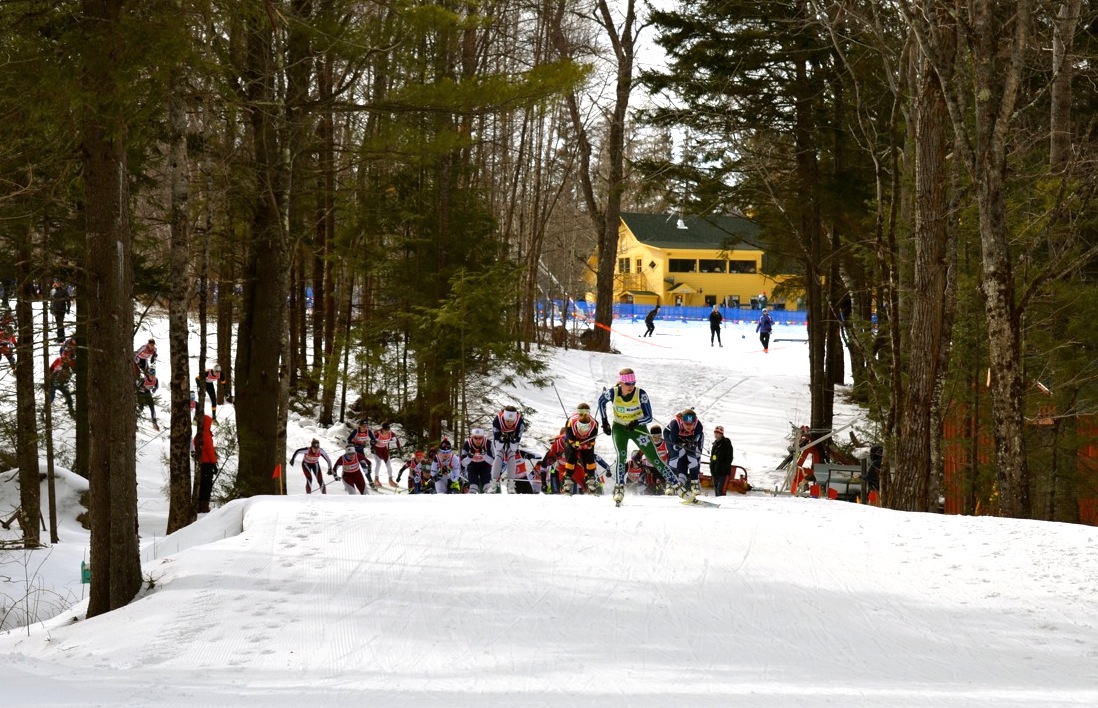
The women’s freestyle mass start at the Middlebury Carnival from Feb. 15-16 heads out on the new Tormondsen Family Race Course at Rikert Nordic Center in Ripton, Vt. (Photo: Stella Holt)
“Andrew was pushing for more, John Morton was pushing for less, I was somewhere in between,” he said. “Realistically, the course gets used as a homologated race course about one percent of the year. The rest of the year, the general public is using it to ski on.”
Hussey wanted something that would work for both users, a hill that would be significant for a college racer but also something everyday skiers could ascend, taking a few breaks or a cutoff trail along the way.
“I think we really came up with a pretty darn good solution to the whole thing,” Hussey said.
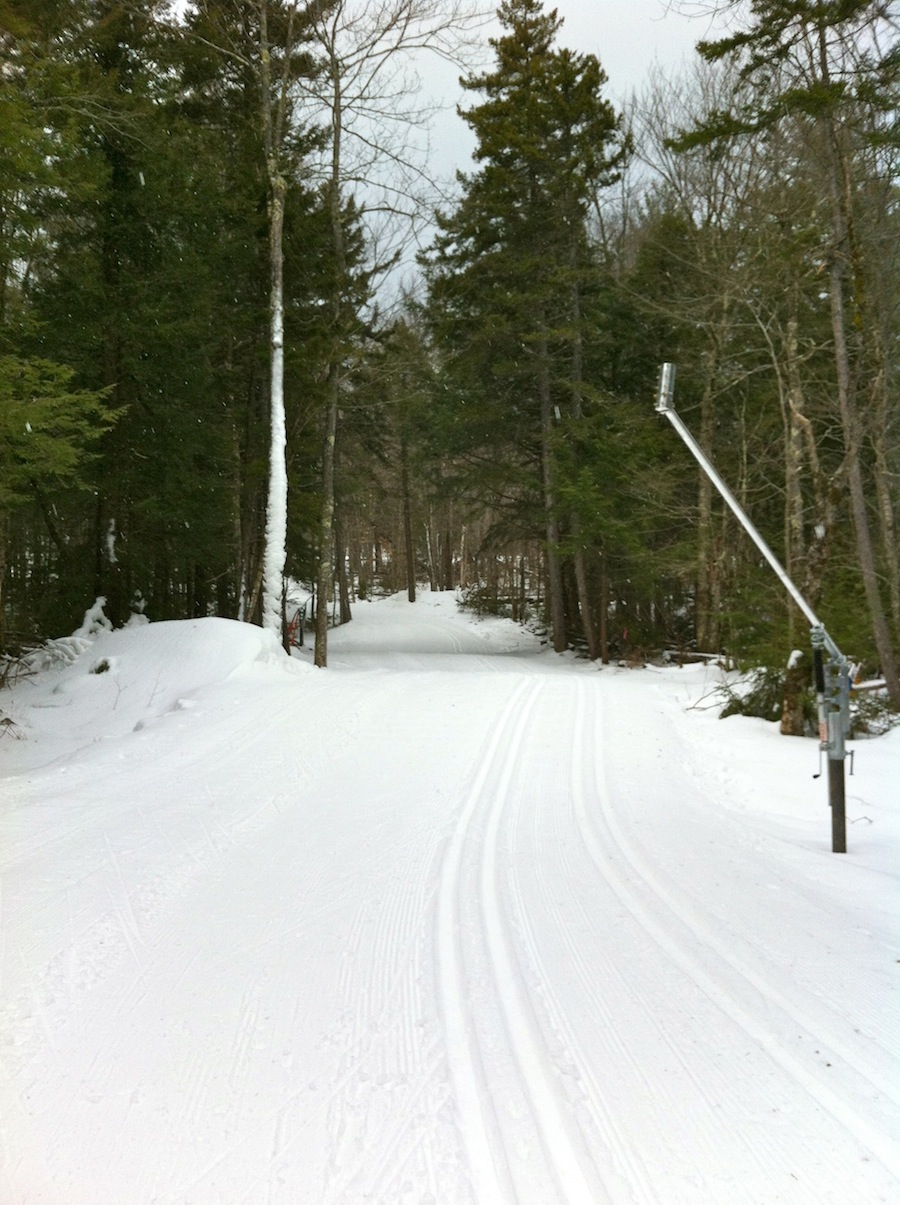
That was the running theme to the entire project, from breaking ground in the fall of 2011 on what is now the homologated Tormondsen Family Race Course (click for map), with banked turns and what Hussey called a “screaming-fast downhill.” Finalized in early February, it also involved installing an integrated snowmaking system around the entire 5 k loop.
“[Hussey] understood a few things; he understood the homologation and how that was basically changing the playing field,” said David Lindahl, a principal at Morton Trails who contributed to the upgrades.
The process of changing a trail system is hardly ever easy, he explained. Venues have history and nostalgic ties. He and Morton started by asking Hussey what was possible, through permitting in the Green Mountains to property constraints, etc.
“It’s a big puzzle,” Lindahl said. “Sort of the base line is: how do we create a really good 5 k course? Then, what else can you do from that? Well you can make 2 ½ k courses. So we’re always kind of thinking of different options, but from that core, let’s make sure there’s a really good 5 k, because that’s a standard that you need to have.”
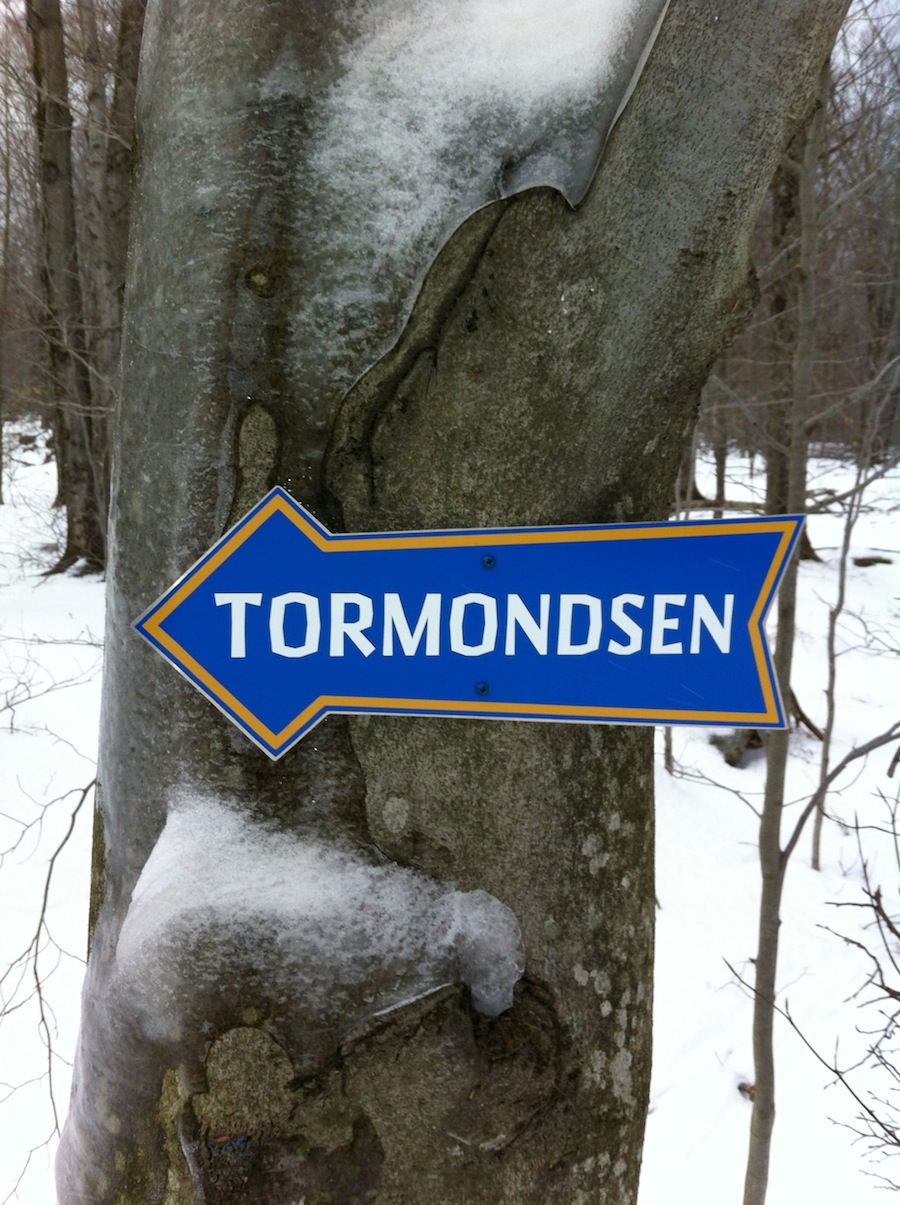
New signage on the 5 k Tormondsen Family Race Course at Rikert Nordic Center in Ripton, Vt.
By the time last winter rolled around, the 5 k course was complete with two 2 ½ k loops connecting in the field where the start, finish and spectators would be. After first seeking a D-homologation to hold freestyle mass starts, Morton and Lindahl came up with an E-homologation option as well for hosting skiathlons (half-classic, half-freestyle pursuits). According to Hussey, they’re one of two nordic areas in the country that are certified to hold such races (Soldier Hollow is the other one).
“Turns out if you do it right and you put all the pieces together and you put two 2 ½ k’s together then you have an E-category,” Lindahl said. “One of the courses only has to be at a C-level and the other one has to be a D-level. Typically, what we’ve done is the D-level for both of them. Those courses worked out well; they were independent [and] both came back into the stadium area.”
That made having a ski race with an equipment exchange, or transition, possible. It also draws crowds.
“A big piece of what we do is spectator interest,” Lindahl said. “How can we create something that is going to bring people back to the start finish area so that friends and spectators will be as involved as the coaches and athletes are?”
Based in Thetford, Vt., Morton Trails is the company that designed 15 k of trails at Colby College’s Quarry Road Trails in Waterville, Maine. Morton and Lindahl are behind the new 7.5 k course at Trapps, the expansion of an existing trail at the Jackson Ski Touring Center in New Hampshire and ongoing projects with Vermont’s Jay Peak and the Sugarloaf Outdoor Center in Carabasset Valley, Maine, to name a few.
“The Middlebury site is blessed with a wonderful big field, ideal for all types of start/finish configurations, and great for spectators,” Morton wrote in an email. “A challenge was getting from that field out to the required hills and back within 2.5 kilometers to give the spectators a second view of the athletes midway through the loop. The second 2.5 k loop also had to access the required climbs and return to the stadium within in the 5 k distance target.”
Ideally, the two loops would be close enough to share the proposed snowmaking piping system, an idea Hussey brought to the table.
“Another objective was to make use of as much of the existing trail network as possible, and thus minimize the need for new trail construction,” Morton explained. “Finally, there was a desire to have the racing trail independent from some of the other popular trails at Rikert so that during event days, recreational skiers are still able to enjoy loops not closed for racing.”
The end result: Rikert is one of two places in the country that are FIS certified for skiathlons, which could bolster its potential for international races down the road, Hussey said.
“We’ve put at least a million and a half bucks into this place in the last three years, which is akin in the nordic industry to Jay Peak putting 300 million into the alpine area,” he said.
“That is a huge investment … and yes, it’s a great event center, we’ve got homologated race trail, we’ve got snowmaking on that, but over and above that I’m very passionate about the fact that our region, what some people term the Addison [County] Alps, you’ve got Blueberry Hill 10 k by trail, you’ve got Rikert, we’ve got the Snow Bowl, we’ve got an amazing array of inns and hotels and restaurants and theater and art and hockey games at night. There’s all these things to do for folks to come in from out of town and enjoy the area.
“That to me is another piece of it that goes beyond NCAAs and national championships,” he added. “I’d love to hold a World Cup here. There are a lot of parts to make that happen. That’s the kind of facility that I believe we have.”
Snowmaking
As Gardner put it, three big changes at Rikert in the last few years have raised it to a new level. “Getting Mike hired so there was a full-time, year-round director, getting the trail built, and having snowmaking,” he said.
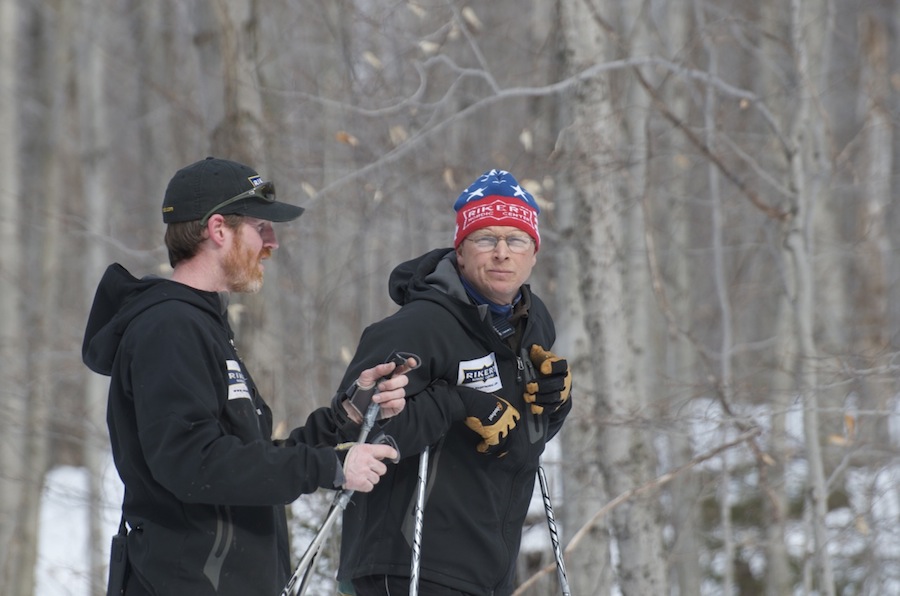
Rikert Nordic Center Director Mike Hussey (r) overseeing the Middlebury Carnival in mid-February. (Photo: Stella Holt)
Without Hussey, the snowmaking aspect – which cost upwards of $850,000 dollars – might not have been possible, Gardner said. Because of the confidence John Tormondsen, a Middlebury alum and first-team All-American nordic skier now on the college’s board of trustees, had in Hussey, he and his family donated a significant amount toward the total cost. Now in its initial months of operation, Rikert has the most snowmaking coverage of any nordic center in the Northeast.
“It’s the largest system of its type in North America, the most-extensive piping system,” Hussey said.
“I think Middlebury had the vision that we want to really put ourselves on the map,” Lindahl said. “The snowmaking thing, we weren’t the ones that suggested that, but obviously they went for it.”
Most importantly for college teams, it promised snow for NCAAs, which start Thursday with nordic races and continue through Saturday. Three weekends ago at the Middlebury Carnival, Rikert held its first collegiate races on the course. Although its been completed for more than a year, natural snow wasn’t abundant enough to cover it last year. The installation of the snowmaking system with 20 snow guns began late last fall, and water-withdrawal permits weren’t in place until early February.
As a result, Hussey and his crew have been pumping out the manmade stuff as much as possible in the last month. At 250 gallons per minute, they can potentially cover the 5 k loop in 200 hours. But they’re only allowed 90 gallons of inflow based on state regulations, which Hussey said was “very understandable” given their proximity to protected lands.
A look at the trails and new snowmaking system in mid-February at Middlebury College’s Rikert Nordic Center in Ripton, Vt.
“Our holding pond is not that large and we get maybe 16 hours of operating time [from that],” Hussey said. “After that, it takes a day or more to recharge. So when we get windows of opportunity to make snow, it’s sort of herky-jerky because we can run for 16 hours, then we stop, and then we gotta start up again. So it’s not a consistent flow and efficient use of the good hours. Phase two of the operation is to add a larger holding pond if we can.
“It’s been a little spotty early on as part of that permitting piece was challenging,” he added. “I think we’re through it now and all systems go.”
As for the NCAA outlook, Hussey wrote in an email that “projected temperatures are to be in the mid to high 30’s during the day and below freezing at night. We will be able to do a good job with the grooming under those circumstances.”
Asked what they learned from the Carnival races, he wrote, “We learned (confirmed) that this is a technical course and requires strategy as well as stamina. There are hard climbs and fast twisting downhills, all of which makes for good racing.”
“The course itself has definitely changed and the trail quality has improved a lot, especially the grooming quality,” said Hilary Rich, a senior on Middlebury’s nordic team. “Mike puts a lot of effort into [grooming] and it definitely shows.”
“It’ll suit the people who like to grind it out; there’s not much rest,” junior Austin Cobb said. “It feels less like the middle of the woods now. It seems like it’s a legitimate place to ski … It’s the real deal.”