From the FasterSkier archive — posts syndicated from athletes’ and coaches’ own blogs between 2004 and 2012, kept online as published. Current coverage is at fasterskier.com.
This article was made possible through the generous support of our voluntary subscribers who have helped put our Nat Herz on the ground at the Olympics. If you value coverage like this, please support FasterSkier with a voluntary subscription.
Maddie Hooker of Australia races in Saturday’s skiathlon at the Olympics in Tesero, Italy. (Davide Barbieri/NordicFocus)
TESERO, ITALY — There’s having your Olympic debut. Then there’s having your Olympic debut in an event that you’ve literally never raced in before.
That was the story Saturday for Maddie Hooker, a 21-year-old Australian for whom Saturday’s Olympic skiathlon race was the first time she’d ever competed in the event.
Hooker is not a skiing novice: She competes on the U.S. East Coast collegiate circuit for Colby College in Maine. But the skiathlon — which combines cross-country’s two techniques, with a swap of skis and poles in the middle of the race while the clock is still running — is rarely contested outside of international championships, given its logistical complexity and requirements of multiple sets of gear.
“What other sport would you actually turn up for the Olympics not actually having done the event?” Jake Hooker, Maddie’s father, said in an interview at the cross-country skiing venue just before his daughter hit the trails. But, he added: “Why not start at the Olympics?”
Maddie Hooker made it three-fourths of the way through the 20-kilometer race before she was lapped and pulled by the organizers — but she was still buoyant afterwards.
She said the experience of being thrown into the deep end is “the beauty of being Australian” — a country that doesn’t exactly have a storied cultural tradition of cross-country skiing.
Nonetheless, the nation has periodically produced competitive athletes on skiing’s international circuit, and even some who have grown up in urban areas: Rosie Fordham, who grew up in Sydney and now attends the University of Alaska Fairbanks, placed 13th in a top-level World Cup race earlier this year.
Hooker, who’s from Melbourne, learned to ski on trips to the United States, attended a skiing-focused high school in Vermont called Stratton Mountain School, and now goes to Colby College in Maine.
Maddie Hooker competes in a race on the U.S. East Coast. (Daryn Slover)
She said she was not expecting to qualify for the Olympics this year but had strong early-season results and ended up rounding out Australia’s women’s team as the fourth member.
For the skiathlon, her biggest challenge might have been procuring a pair of event-specific boots — a sort of hybrid of the more supportive boots with an ankle cuff used for cross-country’s skating technique, and the lower profile version used for classical striding. They’re scarce, and the family’s contact at Fischer Sports, Hooker’s ski company, didn’t have any, said Jake Hooker.
Maddie Hooker’s parents Jake Hooker and Antoinette Walshe helped her find a pair of the rare boots used by cross-country skiers in skiathlon events. (Nathaniel Herz/FasterSkier)
After “hours on the internet trying to find a pair of boots,” he said, “eventually we found a pair.”
Then, in the days before the race, Hooker spent time practicing the ski exchange — the part of the event where athletes make a pit stop as the clock runs to exchange their classic skis and classic poles for skating equipment.
“I find getting the pole straps off the hardest. But I kind of picked it up, just followed my teammates,” she said.
The event itself, she said, was fun. While some athletes are stronger in one technique over the other, Hooker said she doesn’t have a preference.
“I think it kind of suits me quite well doing both,” she said. “And at the end of the classic I was definitely very happy to change over to skate.”
She’ll race three more events, Hooker said, before the Olympics are over.
Help Support Our Olympic Coverage!
FasterSkier has our own Nat Herz on the ground at the Olympics, which is a significant financial lift for us. If you value the thoughtful work and access FasterSkier provides at championships like this one, please consider becoming a Voluntary Subscriber. Your support directly fuels our work to cover the people, places, and moments that make our sport special.
Maddie Hooker (AUS) and Nadezhda Stepashkina (KAZ), (l-r) during the freestyle leg of the Olympic Women’s 20 k Skiathlon Tesero (ITA). (Photo: Vanzetta/NordicFocus)
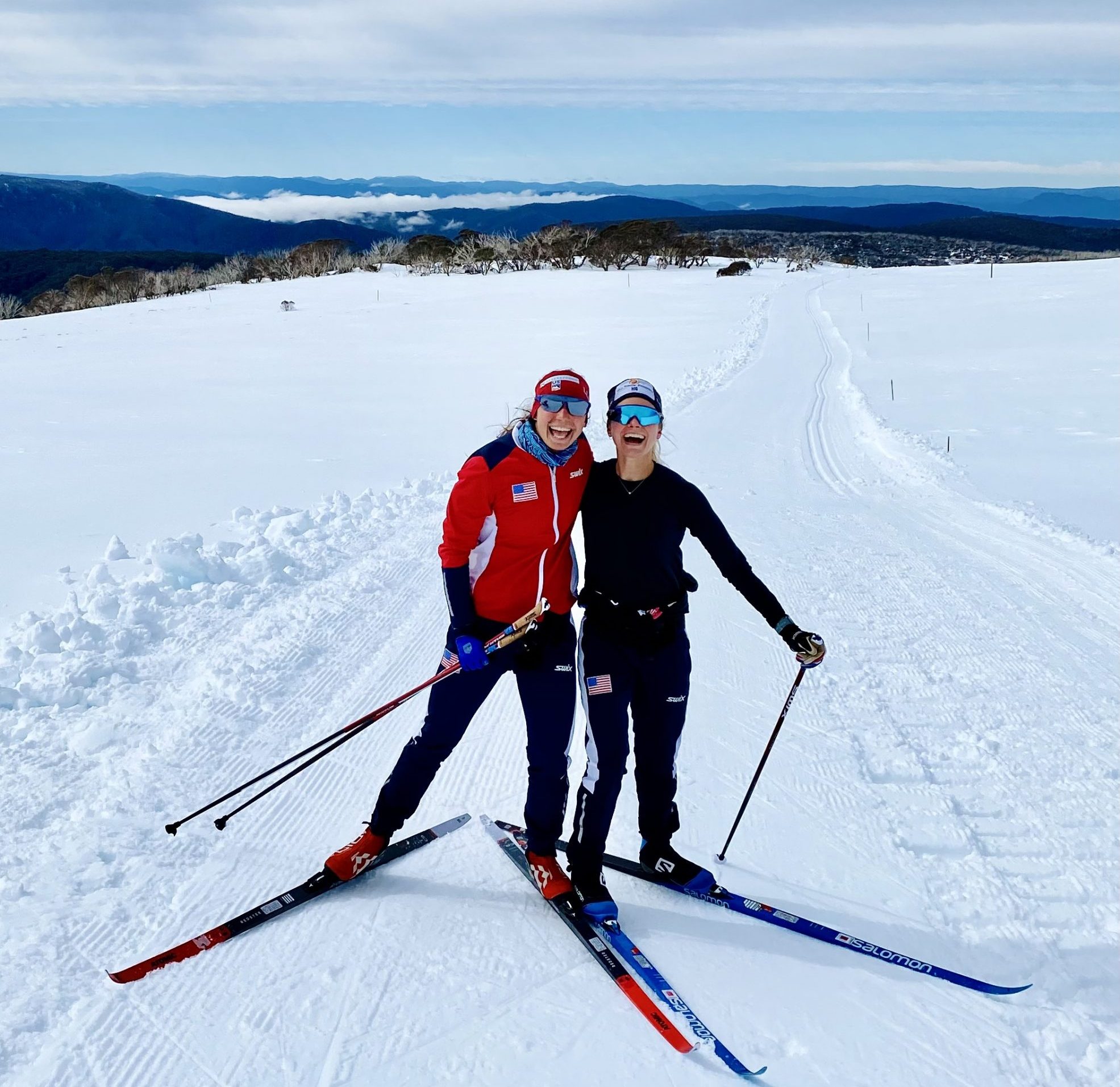
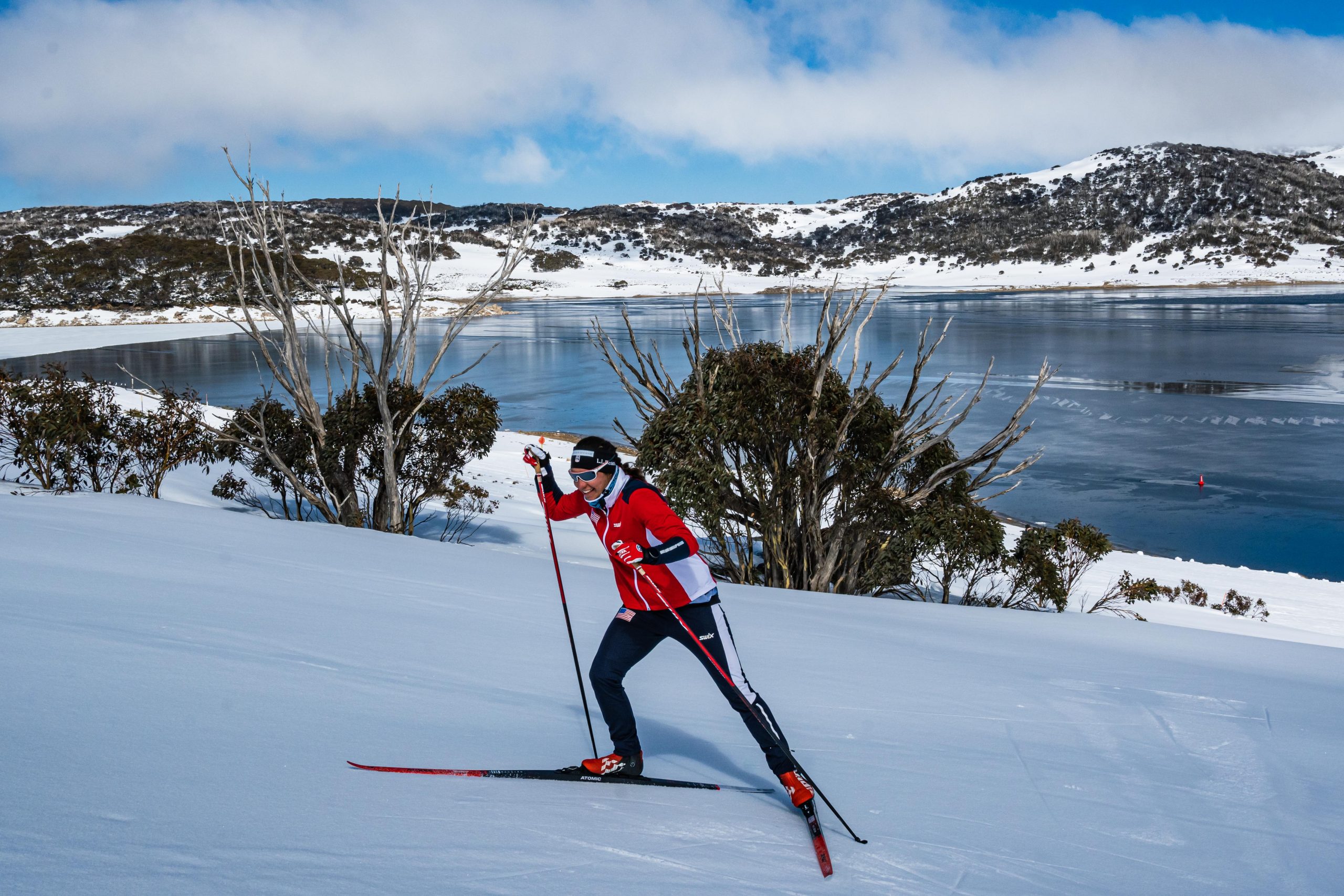
You might imagine traveling from the U.S. to Australia as being an arduous marathon of flights- and it is- but as Jessie Diggins points out, it turns out to be about the same length of journey time as the U.S. Ski Team makes annually when heading to Ruka, Finland for the first World Cup of the season. “So in my head, I was ready for it to be like this crazy long, super hard travel,” said Diggins, “And then I was like, well, actually, this isn’t any harder than what we do every single fall. So I really thought it wasn’t that bad. I mean, yes, it’s a super long flight, but overall, it’s only three flights.”
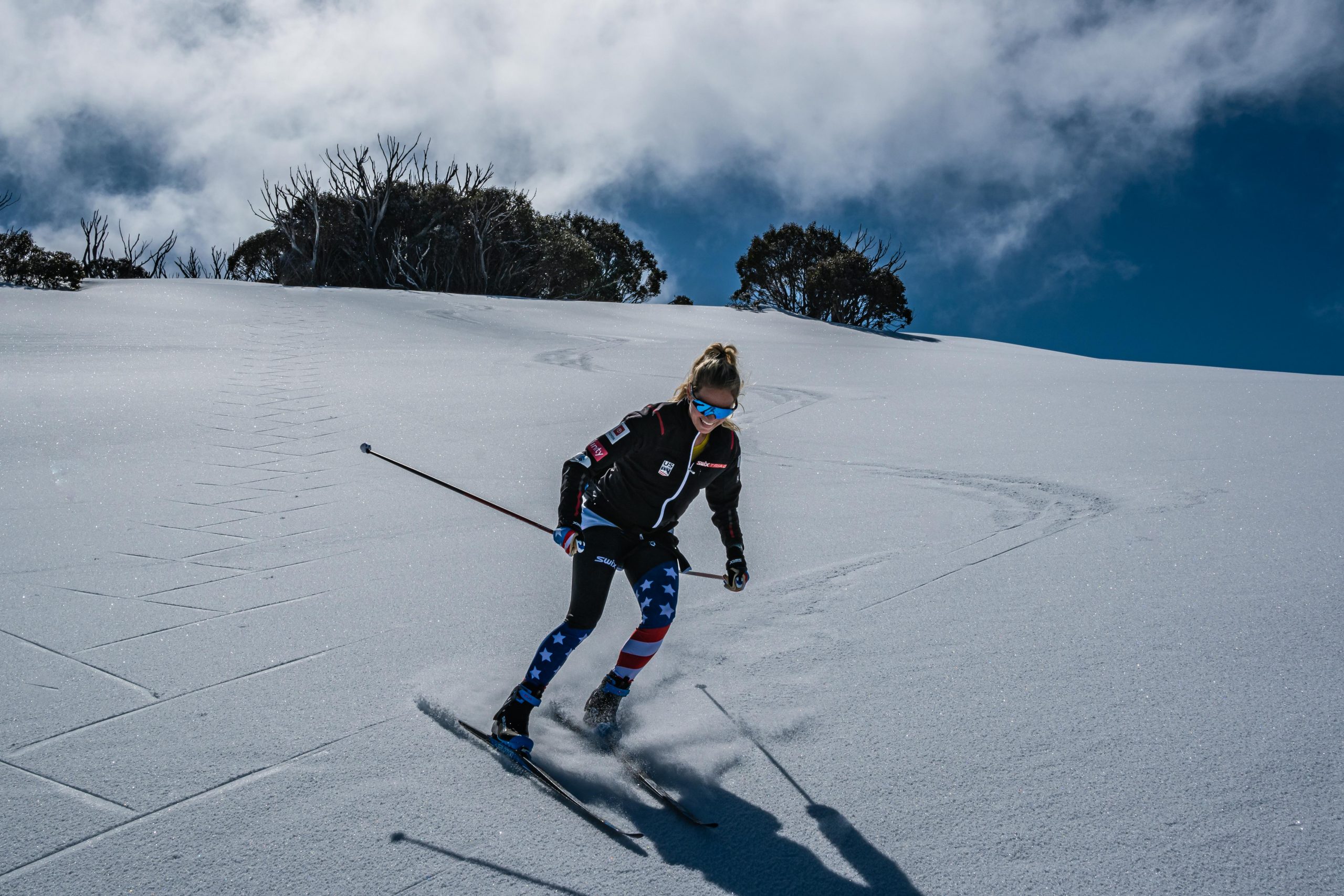
Diggins, along with teammate Julia Kern, and coach Jason Cork, made the trip “down under” for three weeks of snow skiing at the Falls Creek cross-country center. This August, the U.S. Ski Team has been operating with a bit of a divide-and-conquer strategy, as coaches Matt Whitcomb, Greta Anderson and Kristen Bourne took six athletes to Scandinavia, Kern and Diggins found skiing elsewhere. As Whitcomb explained, “We weren’t able to fit it into the budget to have a bunch of people go down to New Zealand or Australia,” thus the separate trips.
Julia Kern and Jessie Diggins at the Falls Creek trail system in Australia (photo: Julia Kern)
Historically, the U.S. Ski Team has spent time on snow at the Snow Farm, in New Zealand, staying at a lodge just feet from the ski trails. But, as Diggins explained, the lodge shut down during COVID and has yet to reopen. “[That] makes it less desirable because it was going to be a long drive up,” Diggins said, “So we thought, we’ve never tried Australia and we’ve heard Falls Creek has amazing skiing… so we thought this would be a good year to try something new and I’m really glad we did. It’s really cool because it’s hard to get the feel for a place unless you get to actually go to a camp there. So this has been really neat.”
In Australia, the crew is staying in the town of Bogong, about a 30 minute drive from the Falls Creek trails. “I want to say a huge thank you to the Australian National Team and Finn (described as the Chris Grover of Australia), between him and Cork, they found us a really nice cabin situation,” said Diggins.
Evening near Bogong, located in north east Victoria, Australia, where Kern, Diggins and Cork are staying (photo: Julia Kern)
With something like 300 turns on the road between Bogong and Falls Creek, Diggins and Kern have been using the Birkebeiner Ski Club clubhouse to hang out in, between two-a-day ski sessions. “[They’ve] been super kind and gracious letting us hang out in the clubhouse,” said Diggins, “So we have a warm place to just chill for a couple hours.”
For both Diggins and Kern, this is their first time visiting Australia and the Falls Creek trail system. “There’s a lot of corners, and I think they say about 60 k of skiing or so,” said Kern, “There’s a lot of terrain out there and in general, pretty gradual and rolling. There are some big loops- there’s like a 12 or 14 k loop that we skied this morning, then there’s some more steeper hills near the beginning. So we’ve been able to find terrain for just about everything.”
Julia Kern at Falls Creek in Australia (photo: Julia Kern)
The travlers have also experienced the full gamut of weather conditions. “We’ve had every bit of weather from sunshine to snow, to sleet, to wind gusts, and everything in between,” said Kern. “We’ve really gotten to experience about every condition to train in and do some intervals.”
Diggins added to that, saying, “I think it’s really nice because you don’t want to get used to just one condition right? Like if you’re coming down to get some time on snow, it’s really nice to be able to touch on every different kind, so I think that’s really, really valuable.”
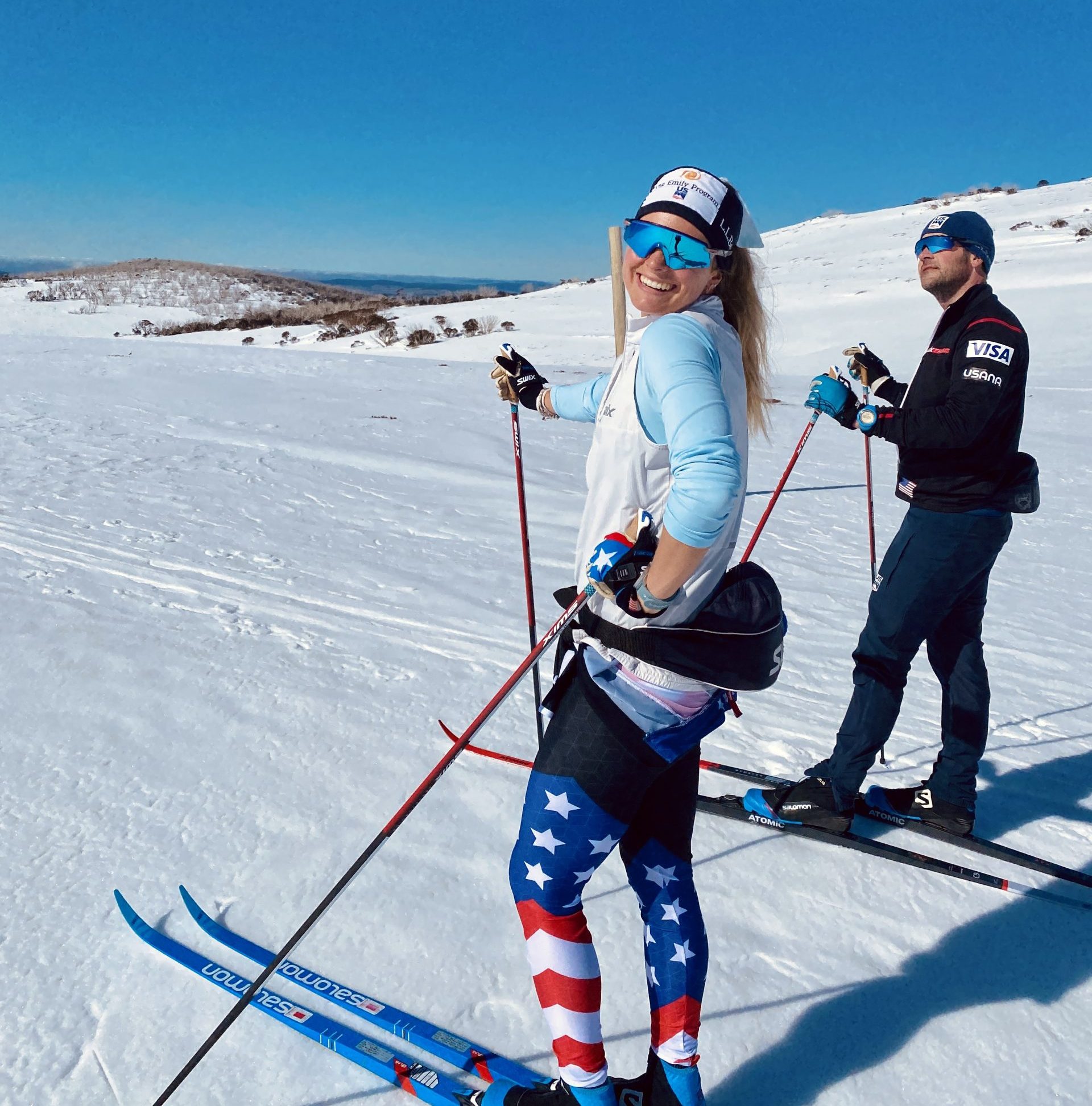
Jessie Diggins and coach Jason Cork out on a sunny day (photo: Julia Kern)
Besides the general goal of spending time on-snow, both athletes had a specific focus for the camp. For Kern, it was an emphasis on classic skiing. “Roller skiing is great training,” she said, “But it’s not the equivalent of trying to kick a ski in a variety of conditions, and we’ve actually got a lot of zeros conditions here, so it’s been a really great time to practice skiing in zeros conditions.”
Additionally, Kern has been testing skis and getting a feel for them, having switched to Atomic this season. “So it’s been testing skis, classic skiing, and then just speed work and intervals,” she said. “Skiing is not the same as roller skiing, you can do all that but having the feel for snow and variable terrain and punchy or firm conditions, for me, I think it’s easier to commit to going all out in a speed when you know you can just fall on snow instead of pavement, so we’re working on that.”
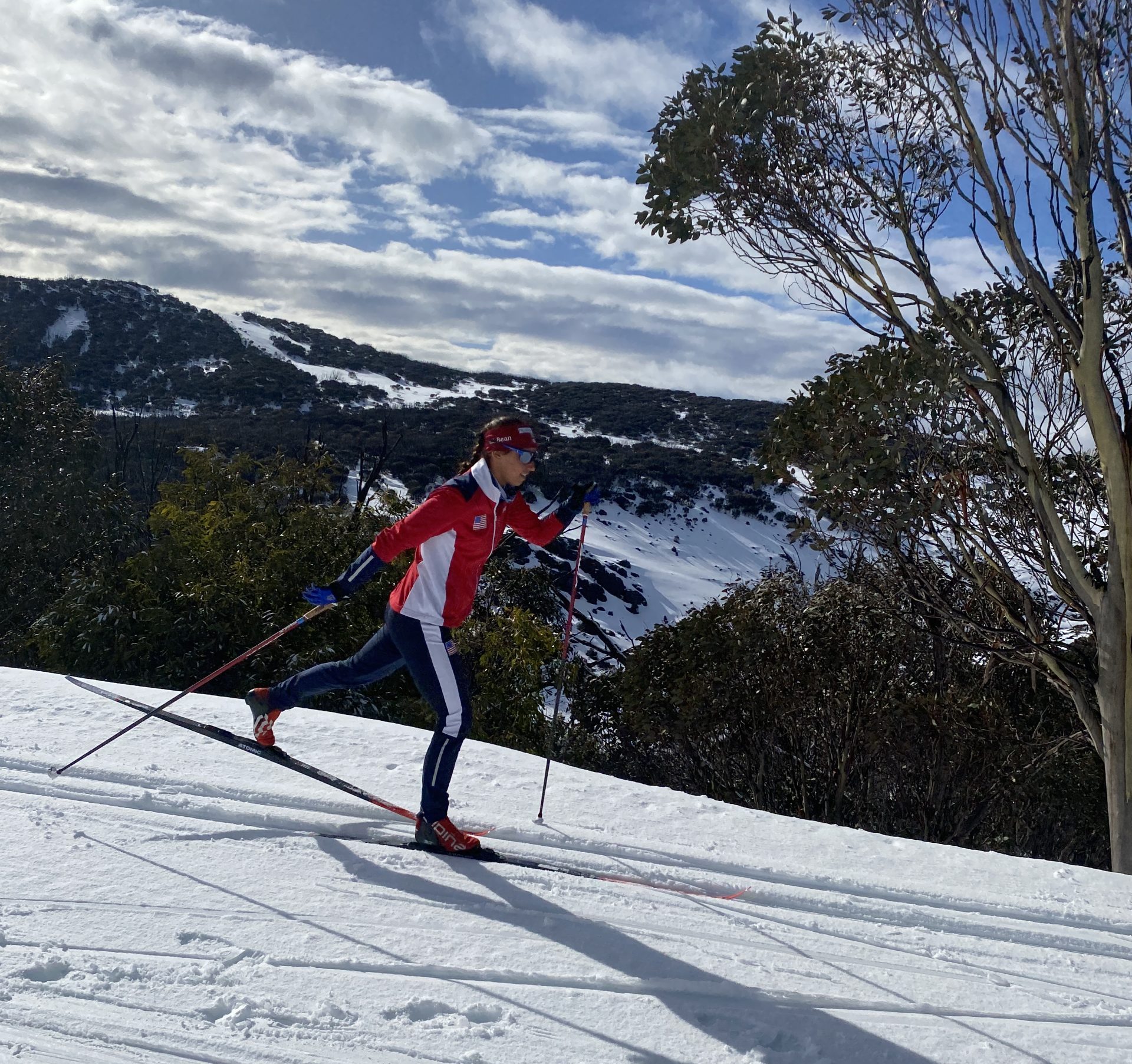
Striding and gliding, Julia Kern works on her classic skiing (photo: Julia Kern)
Diggins chimed in, saying, “As someone who has fallen on her face roller skiing, for me, it’s really nice to be able to, like today we’re practicing sprint finish lunges, and on roller skis you really just can’t do that.”
Diggins has been prioritizing practicing the things that don’t work as well on roller skis, like start speeds, lunges and herringbone. “When you’re here for three weeks, you feel like, if I have a bad day, or I’m tired, I can afford to just be really smart and relaxed about it and still know that I’m going to get all the time I need to make these changes on snow,” she said.
The first week was spent getting used to being on snow again, then in the second week the athletes can move on to making some changes and in the third week, “[We] try to make them stick,” said Diggins.
Working on speed in lower stakes conditions, where a fall hopefully won’t result in road-rash (photo: Julia Kern)
An added bonus to the trip came in the form of the Kangaroo Hoppet Worldloppet race on August 27th. “It’s really cool to finally get to do another Worldloppet on a different continent that we otherwise don’t get to ski in very much,” said Diggins, “I also think it’s really a chance to practice fueling for long races because we don’t get an opportunity to do long races very often, and now we’re going to have a few more on the World Cup circuit.”
After a two-year COVID hiatus, Saturday’s race was the 30th edition of the Kangaroo Hoppet. Diggins took gold, ahead of Kern, and Australian skier, Casey Wright finished third. It turned out to be a double victory for the U.S., as Peter Wolter of Sun Valley topped the men’s podium. Campbell Wright (NZ) took second place and Lars Young Vik (AUS) came in third.
Following the conclusion of their three week camp, Diggins and Kern will be heading in separate directions. Kern plans to stay an extra week in the country, renting a campervan and exploring Australia. “I want to see a little bit, and traveling forces me to make sure I recover and don’t jump right into training right away,” she explained. After that trip, she will head back to Vermont for two weeks before traveling to Utah for the U.S. Ski Team Park City Camp in October.
Diggins will head straight back to Stratton for a few weeks before flying to San Francisco for the Salomon Women Trail Half-Marathon at the end of September. “And then I come back, and then I go to Las Vegas with Toyota for a show, and then I go right from there to Park City Camp,” she explained, “So it’s a lot of travel this fall, but for some cool events that I’m excited about.”
Jessie Diggins enjoying some off-trail skiing (photo: Julia Kern)
Summarizing their experience in Australia thus far, both Diggins and Kern emphasized how welcoming the community has been. “People are just friendly to a default,” said Kern.
“Everyone has been so welcoming and super kind and helpful,” said Diggins, “It’s such a nice ski community here, it seems like everyone’s really close knit and looks out for each other and there’s all these kids out skiing, and it just seems like a really cool thing they’ve got going on here.”
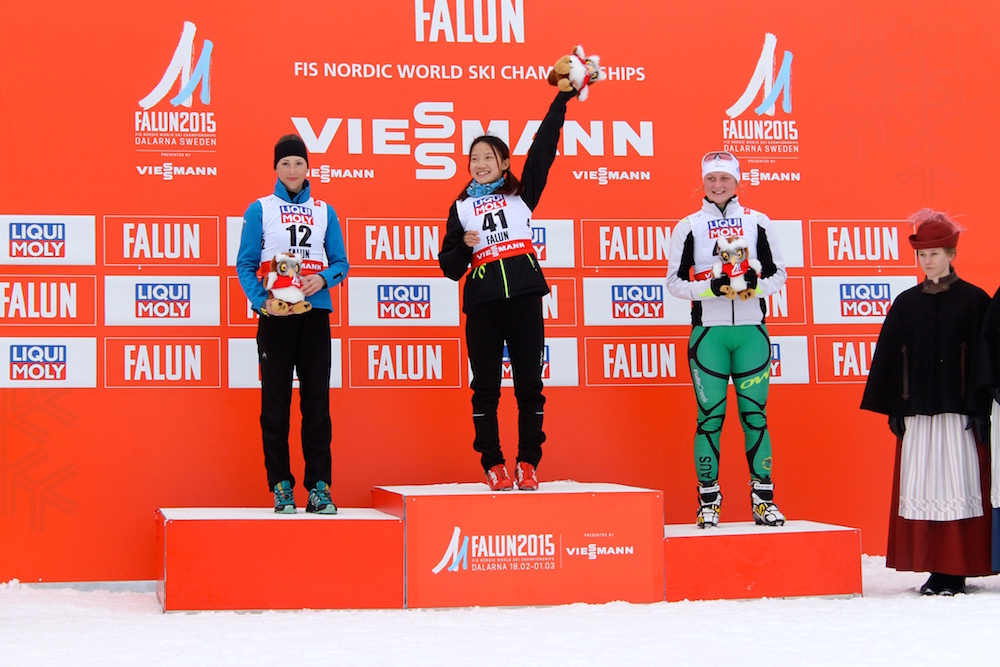
Seventeen-year-old Chi Chunxue (c) celebrates her qualifying win on Wednesday in the women’s 10 k freestyle, which advanced her along with the top 10 to the remaining distance races at 2015 FIS Nordic World Ski Championships in Falun, Sweden. Bosnia and Herzegovina’s Tanja Karisk (l) placed second (+49.3) and Australia’s Casey Wright was third (+1:07.5).
By Colin Abbott
FasterSkier’s coverage of the 2015 FIS Nordic World Ski Championships in Falun, Sweden, is brought to you by the generous support of L.L. Bean, now featuring a complete line of Kikkan Randall training wear.
FALUN, Sweden — The buzz is building at the 2015 FIS Nordic World Ski Championships with the completion of the first races in Falun. Wednesday saw the individual-start distance qualification races take place with 45 women and 69 men and women skiing 5 kilometers and 10 k, respectively.
These initial races did not crown world champions, but they have another purpose that is just as important to the athletes racing. These races offer the opportunity for skiers that have not in the past year made the minimum International Ski Federation (FIS) point standard for men (90 points) and women (120 points). The top-10 men and women in these races qualify for the remaining distance races at World Championships (the skiathlon, individual start and mass start).
Athletes selected with these races are part of a nations quota of starts. Most countries with a regular presence on the World Cup have athletes with low FIS points and select teams long before the start of the World Championships. This leads to lesser-known ski nations concentrating on these races as an opportunity for athletes to qualify and participate in World Championships.
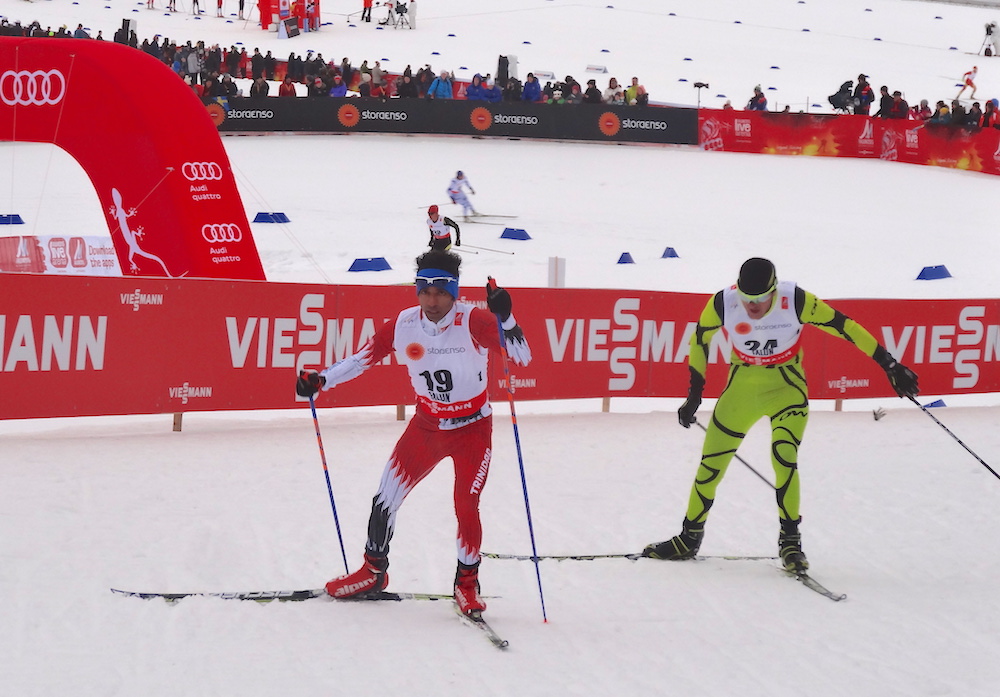
Mark Rajak (19) racing for Trinidad and Tobago in Wednesday’s 10 k freestyle individual start qualification race on the first day of 2015 World Championships in Falun, Sweden.
After the races on Wednesday, FasterSkier caught up with skiers hailing from countries where many citizens will never see snow. Trinidad and Tobago, Iran, Australia, and Brazil offered us a glimpse into the role of skiing in their nations.
The Australian ski program has grown into a World Championships team that includes 11 athletes and six support staff. Central to their success as a nation is a development program termed the “Victorian squad” — an inclusive, tiered learn-to-ski program focused on teaching children how to ski and supporting athletes who want to race. Those young racers have athletes such as Callum Watson and PK Kovacs to look up to now which, according to 22-year-old skier Mark Pollock, is key to motivating and developing high-performance skiers.
At a certain point, the lack of snow makes it difficult to progress as an athlete in Australia. Their best skiers are seeking out options to continue skiing in other places. Last summer, Pollock trained with the Bridger Ski Foundation in Bozeman, Mont., while his teammate Jessica Yeaton trained with Alaska Pacific University in Anchorage, Alaska. These training initiatives taken by Australian athletes have allowed them to improve their depth and competitiveness internationally, with Yeaton qualifying for the nation’s full-fledged World Championships team outright.
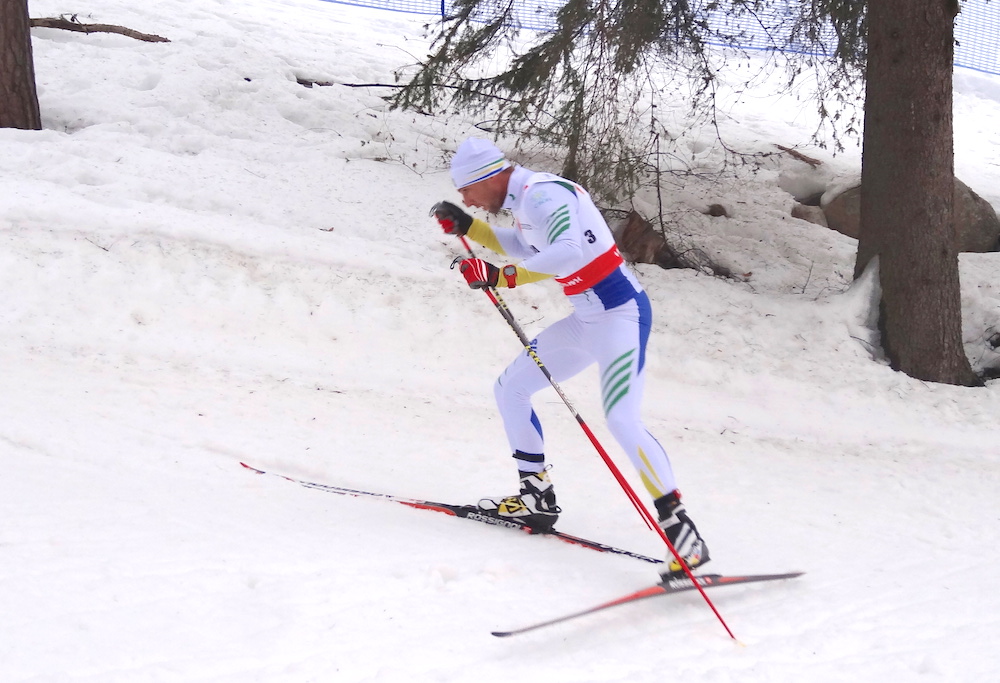
Fabrizio Bourguignon racing for Brazil in Wednesday’s 10 k freestyle individual start qualification race on the first day of 2015 World Championships in Falun, Sweden.
Brazil was represented by three national team members on Wednesday: one woman, Mirlene Picin, and two men. Leandro Lutz, 33, and Fabrizio Bourguignon, 38, have both been skiing for a number of years. Like Yeaton and Pollock, Lutz decided that in order to optimize his training, an on-snow location was necessary for part of the year. Lutz chose to spend the first half of this winter in Denver, Colo., to train on snow in order to prep for three months of racing in Europe. And like Australia, Brazil is experiencing a growth in the popularity in skiing. According to Lutz, there are seven Brazilian junior racers currently in Europe — three racing the IBU Youth/Junior World Championships in Belarus and the remainder racing FIS junior races in Scandinavia.
Racing the sprint on Thursday is another Brazilian, Leandro Rubella. Two years ago, Rubella started a social project in Sao Paulo to help children from impoverished families escape violence and poverty and establish the skills needed to live a good life. This project took the unlikely form of a learn-to-rollerski program. A key message of this initiative is that “anything is possible.” The hope is that a citizen from a country with no snow can make it to the Nordic World Championships, a child born into poor circumstances will see that it is possible to overcome the most difficult challenges.
The birth of a similar program may soon occur in another tropical country, Trinidad and Tobago. Mark Rajack, 33, toed the start line Wednesday afternoon in Falun to compete for the Caribbean island nation in his first international race. Even though Rajack, who has lived in Ottawa, Ontario, since a young age, has only been skiing for two years, he sees the potential for skiing to bring positive changes to his native country.
Rajack sees benefits similar to those envisioned by Rubella in Brazil. In addition to teaching important life skills, Rajack sees a rollerski program as a way to teach citizens a skill that would allow immigrants from Trinidad and Tobago to easily integrate with societies in the Northern Hemisphere, should they choose to leave their country. This vision originated with the positive experience Rajack has had with the ski community in Ottawa.
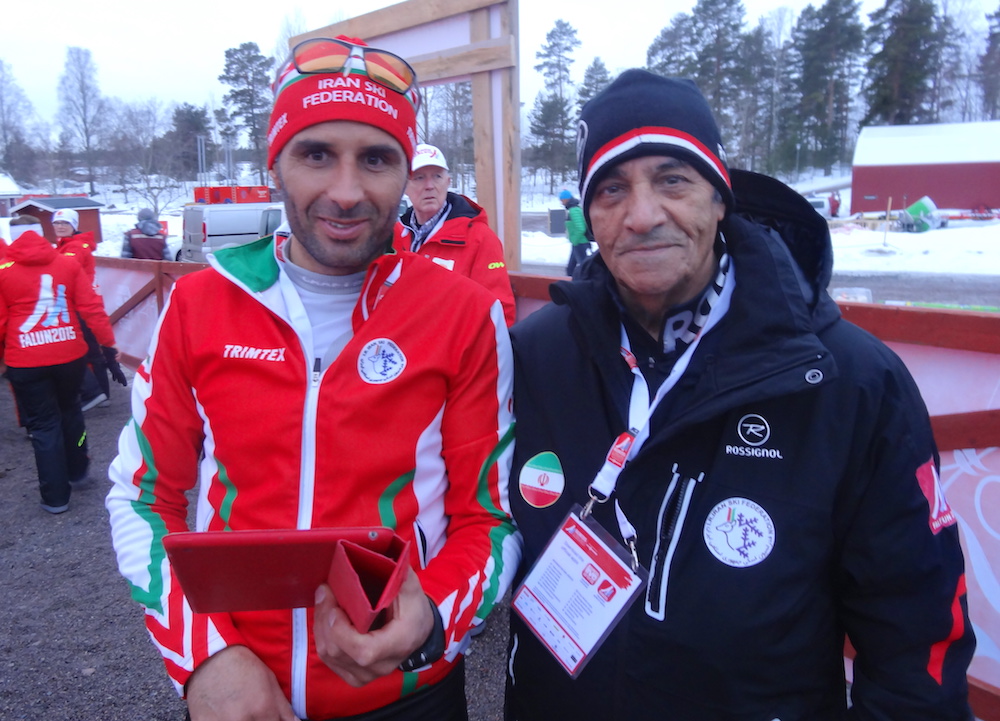
Seyed Sattar Seyd of Iran (l) with his coach after the men’s 10 k freestyle individual start qualification race on the first day of 2015 World Championships in Falun, Sweden. He placed eighth to qualify for the remaining distance races at the championships.
Seyed Sattar Seyd posted one of the best Iranian cross-country skiing results ever on Wednesday after finishing eighth in the men’s qualifying race. Seyed, 27, is an experienced racer, having competed in both the 2010 and 2014 Winter Olympics.
Iran now has a FIS-homologated race site at Knoor, approximately 60 k outside its capital of Tehran. Much of the training done by Iranian athletes happens within the borders of Iran and it appears that the current government will assist in keeping it that way. The addition of a biathlon range is planned for the Knoor facility in the near future and the Iranian contingent here in Falun sees a bright future for the sport.
Below are the top-10 competitors that qualified for the remaining distance races at 2015 World Championships. Those who did not qualify have the opportunity to race Thursday’s 1.4-kilometer classic sprint qualifier.
OFFICIAL RESULTS
Women’s 5 k freestyle
1. CHI Chunxue 1998 CHN 13:33.8
2. KARISIK Tanja 1991 BIH +49.3
3. WRIGHT Casey 1994 AUS +1:07.5
4. TRNKA Anna 1994 AUS +1:07.8
5. MUIZHNIECE Anda 1991 LAT +1:09.7
6. PASHKOVSKA Inga 1992 LAT +1:37.3
7. PAPP Ildiko 1982 HUN +1:39.1
8. KIROSKA Rosana 1991 MKD +1:44.9
9. KLAUZA Laima 1969 LAT +1:47.0
10. GALSTYAN Katya 1993 ARM +1:49.2
About the Author: Colin Abbott hails from the Yukon Territory where he learned to ski and race from a young age. Years later his life mostly revolves around skiing. At the moment, Colin is racing for the Yukon Elite Squad and the Carleton Ravens university team. He sits on the board of directors for Cross Country Canada and is involved in the education and womens committees there. He has also started writing ski-related articles for XCOttawa and FasterSkier and for the next week is supporting the Trinidad and Tobago team at FIS Nordic World Ski Championships.
Randy Gibbs with Liz Stephen, whose skis he waxed at 2013 Spring Series. (Courtesy photo)
A serviceman for the U.S. Ski Team for eight years, Randy Gibbs recently called it quits. With a new baby in the house – his family’s first child – the World Cup lifestyle didn’t seem like a good fit.
“I have a new daughter who is 20 months old now, and it was just going to be too much traveling to be gone 100 days over the winter when she’s just a year and a half old,” he explained in a phone interview. “I couldn’t. It’s hard enough to go just for two days. It was a good decision. It’s been great to be around her as much as possible.”
But he was, in a way, still itching for the international racing trips, as well as for coaching – which he had done for 14 years in Minneapolis before joining the U.S. Ski Team staff. So when Australian Head Coach Finn Marsland asked him about leading one of his team’s trips this season, Gibbs was intrigued.
That’s how he ended up in Strbske Pleso, Slovakia, last week, coaching the Australian team at World University Games.
“It worked out perfect for me, because it was just a two-week trip and it was awesome,” Gibbs said. “It was really fun to be a coach again, too.”
The trip was a success for Australia, with Jessica Yeaton and Phil Bellingham both finishing eighth in the individual sprints, best-ever results for their country.
“Philip just missed the final by, like, a binding length,” Gibbs lamented. “He just missed the lucky loser. He could have had it I think. It was really close. He was really bummed he didn’t have just a little bit left to push and get in there.”
Callum Watson, who is recovering after a horrific ski crash that left him with a punctured lung, also notched two top-30’s.
Overall, Gibbs found the Australians fun and easy to work with – and said that the transition from acquaintance to coach at a major international event was “seamless”.
“It was really easy because all the athletes are really accommodating and were really interested to hear my ideas about things,” he explained. “We just bounced ideas off each other – I didn’t want to come in there and change everything they had been planning all season. They all pretty much already had a plan. But each day, coming up with a strategy for the next day and going through everything from the captains meetings, and things like pointing out strategic places to make moves on the course.”
Gibbs and Marsland are hoping to continue the partnership. Bellingham and Watson may attend Spring Series in Sun Valley, Idaho, where Gibbs will be waxing for the Sun Valley team and U.S. Ski Team member Liz Stephen (“Burke doesn’t have much of a team anymore,” Gibbs said of her club affiliation), but will add the Aussies to his roster.
He’s also looking at making up to three trips with the team next season, and working towards 2017 World Championships in Lahti, Finland, as well as the 2018 Olympics.
“It depends on how everything goes with their budget and their team,” he said. “It’s perfect for me because I can work a little bit, and still make a difference and still have a great time and help them out. But I don’t have to commit to a whole 100-plus night season.”
And as for the World University Games itself, Gibbs – who spent years attending World Junior and U23 Championships as well as traveling the World Cup – was impressed with the event.
“There was some really good competition,” he said. “Especially in the men’s. It was like a Russian army out there – some pretty high-end dudes. And the courses were extremely hard there. They were harder than 99% of the World Cup venues, for sure. Steep, pretty long climbs, and not really any rest. Some good high-speed corners and downhills.”
He explained that the event is one of only a few series that FIS explicitly sanctions and sends representatives to. The others are senior, junior, and U23 World Championships, the Olympics, and the World Cup. And some racers who have competed at those other events were also at World University Games – like Russia’s Andrey Larkov and Anton Gafarov, Kazakhstan’s Anastasiya Slonova, Poland’s Maciej Starega, and much of the Japanese team.
“It was really well-run,” he said. “Even the opening ceremony was really hard core! There were thousands of people who drove up the mountain to watch, too.”
He’s now wondering why it isn’t on the schedule for top U.S. racers. (The University of Wyoming has been sending its team for the last several years, but there is no trials-based selection as for World Juniors and U23s).
“I’ve been asking too, especially now [that I’ve seen it],” he said. “I’ve told those guys that we have to start doing that. It would be a great thing for the athletes who are just below making the World Junior and U23 teams.”
When he’s not working for the Australians, Gibbs is spending his time on two other projects. The first is a non-profit, Jenny’s Light, founded in the memory of his sister to combat post-partum depression. Gibbs serves as the Executive Director.
“I’ve been able to do more this winter than previously, which is good too,” he said. “It’s going well and it’s not coming to a grinding halt every winter like it had been.”
The second is Mantra Wax, a ski wax company which he launched with his U.S. Ski Team coworker Oleg Ragilo in 2013. Business is good, Gibbs said, but with a limited budget one of his main investments is time.
“It’s basically just word of mouth sales,” he said. “A lot of World Cup teams have bought a bunch of product, more than I thought this season. A bunch of teams at World University Games got some. And a lot of junior nationals teams already have some. Those coaches I’ve known for 20-some years and they are really psyched to try it out. I’ve gotten a lot of good feedback.”
He hopes to see Mantra Wax make a splash at the upcoming World Championships in Falun, Sweden.
“I’ve got a guy in Sweden who has been testing on the World Championships courses in Falun for the last month, and he will continue to do so and send me test results, and then I send those to all the World Cup coaches,” he said. “I’m trying to get people fired up about knowing what’s going to work there.”
Callum Watson (left) racing in New Zealand in 2012. After a crash which resulted in a punctured lung, Watson has been forced to try to raise funds to pay for his medical expenses. You can donate at www.gofundme.com/djob50. (Photo: Ausxc.com)
Australian cross country skier Callum Watson was looking towards a bright future: after competing in his first Olympic Games in Sochi, Russia, this winter, he and teammate Phil Bellingham decided to take the plunge and join a team in Falun, Sweden, to try to take their skiing to the next level.
“We accepted the offer to join Dala Sports Academy where we began working with our new Coach Mattias Nilsson,” Watson wrote in an email to FasterSkier. “During the European Spring I made some amazingly rewarding progress in many areas resulting in some results that showed a lot of promise. Finally I had the confidence that I was on the path to achieving my goal of a top 30 on World Cup which I am regularly told I have the potential to reach.”
He returned to Australia to compete in his country’s national championships, as well as make some money teaching skiing to fund his own career. But there, disaster struck: in the semifinals of the championship sprint, Watson collided with Swiss racer Simon Hammer and what happened next is practically unheard of in the cross country world. Hammer’s ski slipped in between Watson’s ribs and punctured his lung, which immediately collapsed.
“It was almost like slow-motion as I saw the ski go straight into the top of my chest,” Watson wrote. “I knew that I had been hit hard, however as I tried to get up, I felt burst of air gurgling from where the ski had hit. I immediately knew what that meant but couldn’t quite believe it. As I began to cough, more air could be heard passing through my chest and suddenly I went into panic with an overwhelming inability to breathe.”
Watson explained that he had clipped skis with another competitor and fell in front of Hammer, who had no choice but to ski into him. Still, the outcome was pretty shocking: as skiers we take it for granted that while we might get cut or bruised, cross country skis — lighter and duller than their alpine counterparts – don’t have the capacity to cause major internal damage.
“Snow conditions were good and no-one was at fault, it was just a race incident that resulted a collision and freak accident,” Australian national team coach Finn Marsland said.
While Watson said that at the time it felt like the ski patrol took an “agonizingly long time” to arrive, they actually responded very quickly considering his location. There also happened to be a trauma doctor among the spectators, and Watson’s brother Ewan and another helper tried to keep him calm, which he said probably “prevented me from passing out.” But Watson was still in critical condition. He was sledded down to Falls Creek Medical Center before being stabilized and sent on a helicopter to Melbourne, where trauma specialists could get to work.
“I’m not sure what the chances are, but unluckily the ski had managed to penetrate between my ribs, punctured through the chest cavity and into my right lung causing it to quickly collapse,” Watson wrote. “With a strong dose of various drugs an emergency chest tube was put in place to stabilise me. The drugs put me in a different world but I was still conscious for the whole procedure and was one of the toughest things I have ever been through.”
Unfortunately, that was nothing compared to what still lay ahead.
The original chest tube worked by using suction to create negative pressure in the lung and hold it in place during healing. But after four days, the seal began to leak. As the lung collapsed again, Watson was in excruciating pain. He described the prep work for replacing the tube as the most excruciating thing he had ever experienced: “by far the most traumatic experience of my life and was far worse than the original accident.”
After several days, it became clear that despite the second tube being bigger, it also had not allowed the lung to seal and begin to heal itself. So Watson headed in for surgery. He now feels like he’s back on track.
“I didn’t know how much pain I would be dealing with when I woke up, however I was very happy to find it was minimal compared with the previous ordeal!” he wrote. “The ski created a hole which was around 1cm long and 2cm deep into the lung. I sit here now in the same hospital bed 12 days after the accident and now I am waiting for the 3rd chest tube to complete its work by draining the remaining fluid and air from my chest. The prediction is that I will have the tube out either on Thursday afternoon or Friday and should be out of the hospital by Saturday or Sunday if all goes well.”
While Watson was reportedly in low spirits in the week following the crash, he’s feeling better now. A well-liked World Cup athlete, his sunny approach to life was apparent in his explanations of how he’s dealing with his situation.
“The small length of this suction tube [confines] me to the inside of this small area in my ward,” he wrote. “I have a tube stuck in my chest, it hurts to breath whilst moving and standing up is a painful challenge. I can feel myself wasting away and therefore should feeling like the most depressed and lost soul around, but somehow I find myself always smiling thinking positively about the future and even laughing! …There I have to say that my family, [girlfriend] Teresa and coach Mattias have been amazing through this period and that along with so many visits and kind messages from fellow athletes and friends have been what has gotten me through this horrible experience.”
Encouragement from his coach has played a big role, too.
“My coach believes even with the recovery time required from such an injury, I will be able to ski much faster than I ever have and should keep my eyes positively focused towards my original goals set for this World Cup Season and World Championships in Falun,” Watson wrote. “I have the determination to get myself back to racing at the level I was before the accident and am confident in my coach’s positive approach in what I am capable of.”
But besides the months of recovery time he’ll be forced to take, Watson faces an additional huge challenge: money. He has to pay for the helicopter flight, which he says puts himself in an “impossible financial situation.” In addition, his income was coming from coaching, which he won’t be able to do while he’s in recovery. That cuts off any incoming funds he might have generated.
Watson, his family, and Marsland have worked to set up a fundraising page to help pay the costs of the medical rescue and allow the racer to get back to his career: racing. The goal is to raise $20,000. The GoFundMe page, called “Help Rebuild Callum Watson”, can be found here.
2013 Kangaroo Hoppet at Falls Creek – Leading Women – Chisa Obayashi, JPN (in purple) & Marina Chernousova, RUS (in red)
Press Release, June 20, 2014
Temperatures are dropping and the ski fields in Australia and New Zealand will soon be opening. In Australia cross country skiing club races begin at the start of July, with all FIS competitions in AUS and NZL taking place in August. Any elite international racers planning to compete in FIS races in the southern hemisphere should note that FIS registration for the 2014/2015 season is now due. Athletes wishing to be on the 1st FIS points list for the season and to have their points count for southern hemisphere races should ensure that their FIS registration is processed by their National Ski Federation and sent to FIS before June 30.
The schedule for the FIS Australia – New Zealand Continental Cup is as follows:
August 2 – Perisher, AUS – Sprint Classic
August 3 – Perisher, AUS – 5/10km Freestyle
August 7 – Snow Farm, NZL – Sprint Freestyle
August 9 – Snow Farm, NZL – 5/10km Freestyle
August 10 – Snow Farm, NZL – 10/15km C Mass Start
August 16 – Falls Creek, AUS – Sprint Freestyle
August 17 – Falls Creek, AUS – 10/15km Classic
August 23 – Falls Creek, AUS – Kangaroo Hoppet 42km Freestyle (Worldloppet)
International athletes seeking additional information on racing in Australia should contact Finn Marsland, Ski & Snowboard Australia High Performance Manager, via email on: finn.marsland@gmail.com
The Mountain Adventure Centre in New South Wales, Australia, is looking for a cross-country ski coach/instructor from late June through August.
Responsibilities:
To provide cross county instruction/coaching to clients from middle school age (14 years plus) to adults. Clients would range from members of cross country state squad and development teams to adults on first time ‘touring’ lessons. As well as instructing the candidate would interact with parents to provide feedback and promote/develop the instruction business. The candidate would be involved in on-snow product demonstrations aimed to retail sales of cross country equipment.
Personal attributes:
The candidate would need to present a well groomed and professional image and be capable of working un-supervised on-snow in a responsible and mature manner. Excellent interpersonal skills are important as interaction with parents and clients before and after lessons is essential to relationship and business building. Maturity and capability to recognise and work proactively to address client issues is vital. An overall a desire to work hard and contribute to a strong team and business is expected, and while this would not be a holiday there would be time prior to and after the busy periods for personal skiing/adventures.
Experience and qualifications:
A formal qualification as an instructor/coach is highly valued and will contribute to the work opportunities, particularly at state team/squad level. The candidate would certainly need to be relatively experienced and confident to manage groups of varying sizes and provide excellent skill development, technique critique and training plans for a wide variety of students.
Work hours and locations:
The amount of instruction will depend on bookings, however it is anticipated that this would be a full time instruction/coaching position. By arrangement, if there are substantial periods without instruction, work in the retail/rental shop may be available.
Pay and benefits:
Pay will be dependent on the relevant qualifications and experience of the candidate. Accommodation, transport and airfares are open to inclusion in the arrangement. We are a fair and flexible employer and aim to meet the mutual reasonable expectations of both parties. The position is casual and while some level of minimum work hours can be negotiated, there is no guarantee of full time on-snow work. Work visas are required for Australia and ideally the candidate would obtain a working holiday visa which is available to under 30 year olds. Other visas may be available but this would be strongly dependent on formal qualifications.
Timing and locations:
The busy work period would commence late June and finish late August 2013, depending on demand from client and snow conditions. On-snow work will be carried out on the nordic trails at Perisher Valley, Snowy Mountains, Australia. Shop/rental store is located 30 mins by road at the foot of the mountain in the township of Jindabyne. There is potential for this to develop into an ongoing seasonal position.
Applications:
Applications should be made as soon as possible and should include a work and experience summary, reference from recent employers and some images of the candidate showing their professional presentation. Clarifications and enquires by email or phone are encouraged.
Contacts:
John Weir, Owner, Mountain Adventure Centre. Email: shop@tmac.com.au, phone: +61 2 6456 2922.
Australian Esther Bottomley (second from left) at the Canmore NorAm freestyle sprint on Dec. 2 in Canmore, Alberta. Bottomley qualified for the heats in 12th and went on to place ninth. (Courtesy photo)
The idea struck Esther Bottomley in early October. If she wanted to break into the top 30 on the World Cup this season, why not start practicing at one of the venues she’ll compete at?
The 29-year-old Australian National Ski Team member called up Perianne Jones, who was training with the Canadian national team in Park City, Utah. Jones spoke to her friend Amanda Ammar, who races for the Canmore Nordic Ski Club in Alberta and had an extra room back home. A couple weeks later, Bottomley was on snow training in Canmore, living at altitude and soaking up her surroundings.
A month into her visit, Bottomley, who’s been on the Australian national team for the better part of a decade, talked to FasterSkier about what she’s been up to in Canmore and why she decided to train there in the first place. One of two women on her team and the only one competing in Canada this season, Bottomley opted to skip the early World Cup races in Europe to prepare for the Québec and Canmore sprints Dec. 8 and 15, respectively.
Esther Bottomley (AUS) in the Canmore NorAm 10 k classic on Dec. 2, where she finished 17th. (Courtesy photo)
FasterSkier: Why Canmore?
Esther Bottomley: They’ve got the World Cups over in Canada so that’s sort of why I was going to come here, but mostly it was to try and get a big group of girls that are at a really high level and be able to train with them. So far I’ve trained with three different training groups [the Canadian NST, Alberta World Cup Academy and Rocky Mountain Racers], and it’s been great, like, really good skiers and very motivated.
FS: How have you made it work with your training plan?
EB: I have my own plan and when I can get information from other teams in advance it’s really good, which they’ve sometimes been able to do. My coach can accommodate some of their intensity sessions so I’ve been trying to do as many sessions as I can with other people but also stick to some of my own things as well.
FS: How much time had you previously spent in Canada?
EB: I’ve been for the World Cups before and a wedding [teammate Chris Darlington married former Canadian skier Brooke Gosling last winter], but I’ve never spent more than like a week here. It’s the first time I’ve been able to do a bit more exploring, which has been fun.
(Note: Bottomley achieved her career-best World Cup result of 35th in a 2005 freestyle sprint in Vernon, British Columbia.)
FS: What are your goals for this season?
EB: This year, I guess the goal is to try to get into the top 30 in the sprints, focus on the sprints, and try and sort of cut back travel. I’d like to try and stay in one spot for a while, which has been really good here. I can train here the whole time then go to Quebec and back again. I’ll be in Europe for the rest of the season until March.
FS: Why the change in travel?
EB: I’d kind of like to be able to, if I can, sit in one spot for a little while and just cut back the amount of hours. I didn’t go to the early World Cups in Europe just so I could cut down the jet-lag time and the hours becausewe already have to do that big flight from Australia to get anywhere.
FS: How has your training been?
EB: Pretty good. … We did a sprint simulation on the World Cup track so that’s fantastic. You get to come here and they’ve opened up the sprint course like the last weekend so we can now get on it and see what we have to do to ski faster on it. I think that’s the really big advantage to be able to come somewhere and just be able to ski the course and know the course before you race it.
FS: What’s the sprint course in Canmore like?
EB: Canmore is a bit of a hill climb. It’ll be a hundred percent different I think than Québec, which is meant to be a long flat course to here, which is really just a big climb in the middle and flat into it and flat out of it and that’s it. It’s a tough course.
FS: What do you know about the Québec course?
EB: It’ll be interesting. I think it’s quite a long course for the women so it’ll be interesting to see how that goes. The NorAms will give us an idea of how things are going and then right straight into it.
(In a follow-up after Bottomley placed ninth in the Canmore NorAm freestyle sprint and 17th in the 10 k classic Dec. 1-2):
FS: How did the Canmore NorAm go?
EB: Last weekend was good fun but didn’t quite go as well as I was hoping for the races. Looking forward to going to Québec and racing on Saturday to see if I can ski a bit faster there.
FS: What kind of sprint course do you prefer?
EB: I kind of like in between [hilly and flat], sort of just an undulating where you can climb hard and recover a bit in between, but we’ll see. I’ve been training I think well during [the offseason]. It’s always hard to know at the start of the season. Hopefully I’m a little bit fitter and hills are all right.
Ben Sim jumping in Lake Placid earlier this month. Photo courtesy of Finn Marsland.
One year ago, Australian nordic combined didn’t even exist as a sport. But over the last few months, the country’s program has been gathering steam not just Down Under, but in both hemispheres.
Ben Sim, the cross-country skier attempting to make the crossover to nordic combined, has been making consistent progress on ski jumps in Lake Placid and Park City. And in Australia, officials at two ski resorts responded “favorably” to a visit from an American coach last month, to investigate potential sites for construction of the country’s own jumps.
In August, FasterSkier reported that the Australians, led by National Cross-Country Ski Team Coach Finn Marsland, were moving forward with an ambitious plan to bring nordic combined to the country.
With $40,000 in grant money from the International Ski Federation (FIS) and the International Olympic Committee (IOC)—and further funding at the margins from Ski Australia, the national governing body—the Australians are taking a two-pronged approach to the sport. While Sim is planning on spending the next four years learning to jump, and making a run at a berth in the 2014 Olympics in Sochi in nordic combined, Marsland is spearheading the construction of jumps and recruitment of youngsters back home.
Earlier this fall, Greg Poirier, a coach with the American nordic combined team, landed in Melbourne for a whirlwind visit. In the space of two days, Poirier met with officials from a pair of Australian ski resorts to pitch the idea of building of some small jumps, and he also gave a presentation on nordic combined to the Australian Institute of Sport (AIS).
According to Marsland, both resorts—Perisher Valley and Falls Creek—responded “quite favorably.”
“Greg was a great ambassador for the sport, and he was received very well,” Marsland said in an interview.
As far as actual earthmoving, the project’s goals are modest—at least initially. For the next Australian winter—that’s summer for northern hemisphere-dwellers—Poirier was pushing for the resorts to build a series of small jumps sculpted from snow, in sizes ranging from five to as large as 30 meters.
“We went in with the premise that we’re going to do really, really, low-impact—no construction. Anything we do, we’ll make with snow, or manmade snow,” Poirier said.
The plan is to set up the jumps for a few weeks at a time, giving kids an opportunity to test them out—perhaps with a coach present to run clinics and identify anyone with potential. Agreements haven’t been signed, and the details are still to be hammered out, but Marsland said that he was “optimistic” that there would be jumping in Australia next winter. The next step is still unclear, but Marsland is investigating the potential for building more
Ben Sim winning a race in Australia
permanent facilities.
Meanwhile, Sim departed from Utah last week after completing his second stateside training stint, which included time in Park City and Lake Placid with the U.S. Nordic Combined Team. He’ll return to Park City in December, and he plans to spend most of the winter there, jumping three to four times a week. His cross-country career is taking a backseat to nordic combined—while Sim will still race at World Championships in Oslo, his competition schedule for the rest of the winter is limited.
Sim still has a long way to go before he is flying from the 90- and 120-meter jumps used in elite nordic combined competitions. But in an interview, he said that he was pleased with the progress he was making on the 40-meter hill in Park City and, especially, on the 48-meter in Lake Placid, where the thicker air closer to sea level let him experience more of a soaring sensation.
“I felt like it was a little more productive to jump in Lake Placid, because I could fly a little bit further,” he said.
After his second camp, Sim was starting to get a better grasp of the fundamentals of technique, which he said entails the disconcerting sensation of leaning forward and committing to each jump.
“It’s almost diving forward,” Sim said. “It took a couple of days to have the balls to do it—it’s definitely a new feeling.”
When Sim returns to Park City for the winter, he’ll move to a 60-meter hill there, and his goal by the end of January, he said, is to work up to the 90-meter. It’s a much faster progression than typical path taken by developing ski jumpers, but Sim said that he has to continue advancing in order to stay on track to make it to Sochi.
Sim plans to debut on the nordic combined Continental Cup circuit in the winter of 2011-2012, with the potential for a stop at the last World Cup of the season.
Another reason that Sim will have to stick to a tight schedule is financial: The grants from FIS and the IOC expire next year, and Marsland said that he hopes obtain further funding stemming from publicity garnered by Sim’s pursuits—including, potentially, support from the AIS, and Australia’s Olympic Winter Institute. But for that money to come through, Marsland said that Sim will have to do more than just finish—he’ll have to excel.
“[It’s] unlikely that funding will come to just establish sports for participation. It’s all about elite international results,” Marsland said. “Ben’s performances have got that double incentive of attracting funds to him[self] to be able to keep going, and also to be able to get the sport going as well.”
If there’s pressure, though, Sim doesn’t seem to be wilting under it. He said he has been enjoying his time in Park City and Lake Placid training with the Americans—one of the first times he’s had the opportunity to travel with athletes his own age.
The feelings appear to be mutual. Sim just acquired a hand-me-down jumping suit—and his first pair of jumping skis—courtesy of Olympic gold medalist Billy Demong.
“It’s nice to have other athletes to work with,” Sim said. “They enjoy skiing with me, and I enjoy skiing with them.”
Skiers from 23 nations are gathering at Falls Creek in south eastern Australia for this weekend’s Kangaroo Hoppet, the opening event of the 2010 / 2011 Worldloppet season. After a slow start to the ski season in July, good snowfalls over the last two weeks have ensured excellent snow conditions for the event.
Australian Ben Sim is favourite for the podium and hoping to make this his fifth Hoppet win after taking the National 10 k and 15 k championships at Falls Creek last weekend. The biggest obstacles in his way looks like being two fellow Vancouver winter Olympians – Garrott Kuzzy from the U.S., who placed second in last weekend’s 15 k only several days after arriving in the country, and Valerio Leccardi from Switzerland. Other skiers with podium chances include Swiss Frederic Grandjean and Australians Callum Watson, Alex Almoukov and Chris Darlington.
In the women’s field, Slovakian Anastasia Kuzmina, a gold and silver medalist in biathlon at Vancouver, and Swiss Lena Pichard lead the international list, up against a local field lead by current Australian 5 k and 10 k champion Aimee Watson and last year’s Hoppet runner-up Esther Bottomley. Other skiers who could be in contention for a podium place include Swedish ski orienteer Johanna Edin and American Sarah Konrad.
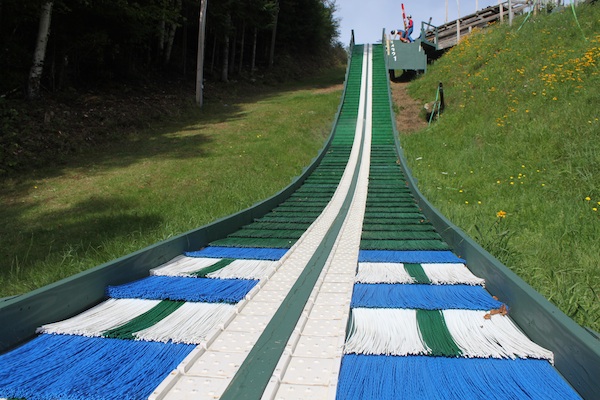
An 18-meter ski jump in Lake Placid. A new project in Australia could result in the construction of similar-sized hills in that country.
A few days before competing in the Engadin Marathon in Switzerland last March, Ben Sim stood atop a snow-covered hill in Germany. Sim, an Australian, was about to find out whether he could make the jump from cross-country skiing to nordic combined.
Literally.
Observing were Finn Marsland, the coach of the Australian cross-country ski team, and Fabian Mauz, a German coach who had assisted some Australian athletes at the Junior World Championships in the Black Forest in January.
Sim, an Olympian in cross-country, had never launched himself off a ski jump before. But he and Marsland had prevailed upon Mauz—who was also a nordic combined coach and former competitor—to loan Sim some equipment and let him try it out.
The conditions weren’t ideal. The small jump had been built by Mauz himself, and there was no grooming—the men had packed down the tracks with their boots the previous day.
Sim wasn’t intimidated at all, though. He strapped on his pair of borrowed skis, slid down the in-run, and flew through the air. Then he climbed back up to the top for another round, and kept at it for half a day.
Sim was enjoying himself, and it didn’t take long for him to get used to the equipment. By the end of their session, Mauz was impressed.
“Fabian was actually quite surprised how quickly he picked it up,” Marsland said. “He gave Ben a lot of really good feedback.”
From there, Marsland sprang into motion, and that single session in the Black Forest has now snowballed into an ambitious attempt to launch an Australian program in nordic combined—the sport that pairs cross-country skiing and ski jumping.
Around the same time Sim was taking flight in Germany, Marsland had contacted Greg Poirier, an American nordic combined national team coach, to get some information about athlete development. When he returned home, Marsland successfully applied for funding for an initiative to establish the sport in Australia, which has already paid for Sim to travel to Utah for a jumping camp, and could lead to his participation in nordic combined at the 2014 Olympics in Sochi. There’s more: Marsland’s ambitions may also result in the construction of a series of small ski jumps in Australia, where none currently exist.
Uli Wehling, the nordic combined race director for the International Ski Federation (FIS), said that a project like Marsland’s had never been attempted.
“In [the] case that we start from more or less zero to build up the discipline—I think it’s the first time,” he said. But, he added: “We welcome all new nations to take part in nordic combined.”
A Two-Pronged Plan
Ski jumping in Australia dates back at least to the 1930s—a 1932 article in the Australian Quarterly cites the incorporation, two years earlier, of the Australian Ski-Jumping Club. Several hills were constructed in the southern part of the country, but according to Sim and Marsland, none remain today.
Hal Nerdal, a Norwegian immigrant, is the only Australian ever to compete in the Olympics in either ski jumping or nordic combined—he finished dead last of 31 athletes in the nordic combined competition at the 1960 Squaw Valley Games.
Sim could be the next. While on a good day he can be competitive at the upper levels of cross-country skiing, Sim said that his two top-50 finishes in the sport in Vancouver most likely fell short of what was necessary to obtain future funding from the Australian government.
In fact, before the Olympics, a strength coach had suggested to Sim that at 5’10” and just shy of 150 pounds, his slighter build was more suited to nordic combined than to cross-country skiing. Sim laughed off the comment at the time, but after the Games, he and Marsland discovered that there was money available from FIS and the International Olympic Committee (IOC), to introduce countries to new Olympic sports. Facing the prospect of having to self-fund the next few years of his cross-country career—and after the promising day of jumping in Germany—nordic combined began looking like a more attractive option. Especially when Marsland, back in Australia, was able to quickly obtain a roughly $9,500 grant from FIS.
“When you have to work full-time to do your sport, to work to earn money so I can travel, it makes it a lot harder,” Sim said. “Doing nordic combined—it lets me just do another year of full-time training.”
The FIS grant, as well as additional money forthcoming from the IOC, will be used to pay for a two-pronged attempt to establish nordic combined in the Australia. First, Sim will spend at least a year learning to jump, with the hopes of reaching the World Cup nordic combined circuit by 2012-2013 and the Sochi Games in 2014.
Second, with the help of Poirier, Marsland is hoping to find a suitable location in Australia for the construction of some novice ski jumps, which will be used to introduce a pool of younger athletes to the sport.
“It’s the bigger project of trying to see whether we can put in a bit of a development plan,” Marsland said. “It would be fantastic if we could have jumps here in Australia to get development happening at a junior level. For any sort of long-term security of the sport, that’s the only way to go.”
An Uphill Battle for Sim
After obtaining the grant from FIS, Marsland worked with staff and coaches at the U.S. Ski and Snowboard Association to schedule a two-week jumping camp for Sim in Park City, Utah, in July.
Poirier connected Sim with Alan Alborn, a former Olympic ski jumper who now coaches Park City’s club program. Alborn had Sim start from scratch, beginning with trips down the landing hill of a 10-meter jump to get used to the summer sliding surface. By the time Sim returned to Australia a few weeks ago, he had worked all the way up to the venue’s 40-meter hill.
“He’s doing quite well, as far as the progression that we normally see,” Alborn said, adding that Sim had been very receptive to coaching.
Ben Sim at a World Cup race
To become a proficient jumper at age 25, Sim still has his work cut out for him. According to Poirier, nordic combined skiers typically start jumping before they turn 10 years old.
However, a similar path has been blazed at least once before, by American Matt Dayton. Dayton didn’t take up jumping until he was 18, then qualified for the 2002 Olympic Games seven years later and helped the U.S. team to a fourth-place finish in the relay.
According to current U.S. Nordic Combined Team Head Coach Dave Jarrett, Dayton was never among the top jumpers on the World Cup circuit. But like Sim, Dayton was a strong cross-country skier, and he relied on that fitness to propel him to three top-ten finishes over the course of his career.
“Had he been able to get his jumping a little bit closer, he would have been even better,” Jarrett said.
According to Poirier, Sim possesses the same qualities that made Dayton successful—drive and self-motivation.
“Ben Sim falls in that same ballpark,” Poirier said.
Sim is now back in Australia for the Southern Hemisphere’s winter season, but he will return to the U.S. for another two- to three-week camp at the end of September—possibly accompanied by a junior teammate, Jackson Bursill.
On that trip, Alborn said, Sim will likely move up to Park City’s 60-meter hill, where he’ll have to hunker down and spend a lot of time working on technique and accumulating repetitions.
Sim acknowledged that he still has some work to do to get comfortable. During his next camp, he said that he’ll be focused on staying “a bit more relaxed in the air.”
“I feel like I’m pretty tense,” he said.
Sim will take one more trip home in late October to spend time with his fiancée, then fly back to Utah again, where he plans on spending most of the winter, “just jumping every day, as much as I can.”
He’ll continue to train for cross-country skiing, but Sim will limit his racing to the U.S. domestic circuit, save for the World Ski Championships in Norway at the end of the season.
“Realistically, if I want to have any chance for trying to qualify for World Cup competitions or Olympics in four years, I think I need to learn how to jump pretty quickly,” Sim said.
Sim’s goal is to jump from the 90-meter hill—generally the smallest size used for elite competitions—by the end of the winter, which is “pretty realistic,” according to Alborn.
But Alborn added that graduating to larger jumps is not simply a matter of courage. Technique and fundamentals are crucial, and launching from the big hills can sometimes act as an impediment to learning by sending athletes flying at higher speeds.
“It inhibits them from learning the really basic skills for ski jumping,” Alborn said. “We like to teach the more fundamental ideas first, so they really groove that in.”
If his timeline goes according to plan, and if he demonstrates sufficient potential for the sport, Sim hopes to be able to obtain funding for future seasons of nordic combined training from Australia’s ski federation. But if he hasn’t been able to brave the 90-meter hill by next summer, the project will conclude.
“Fingers crossed it works,” Sim said. “I’m just keen to see how it goes, really.”
One thing that does not seem to be in doubt is Sim’s ability to cross-country ski with the best of the nordic combined athletes. According to Jarrett, Sim participated in a handful of workouts with the American team during his July jumping camp, and he “certainly held his own.”
“It’d be good for us to have another fast guy around,” Jarrett said.
The “Crazy Idea”
While Sim travels to the U.S. for his second camp in September, Poirier, the American coach, is planning his own trip to Australia.
For three or four days, Poirier will visit ski resorts in the towns of Falls Creek and Perisher Valley. Funded by the grant money, he’ll be scouting a suitable site for a series of small ski jumps designed to introduce juniors to the sport.
Initially, Poirier said, the jumps would be sculpted from snow, at a relatively minimal cost.
“It’s a matter of [a ski] area’s willingness to dedicate some snowmaking time and some Cat time,” he said. “Hopefully, they’ll be psyched for this kind of crazy idea.”
If the jumps go over well, more extensive work would be required to make them suitable for competitions. But for now, Poirier said, “I don’t think we need perfect jumps.”
“We just need a slope and a jump to get kids excited about trying jumping and nordic combined,” Poirier said. If they’re successful, he added, “then hopefully they’ll put some financial resources into the long run.”
Marsland said that he hopes Sim’s nordic combined exploits will inspire younger athletes to take up the sport. “That will certainly help bring a little more attention to nordic sports in general, and that’s definitely part of our thinking,” he said. “I think we should be able to get a bit of publicity…out of the media here in Australia.”
However, he cautioned, it’s still too early to tell whether Sim will be able to bring his jumping to a level that will get him results.
“That’s what Ben’s goal is at the moment—to make it to a competitive level,” Marsland said. “We’ll find out over the next year if he has what it takes, or if he doesn’t.”
While many in the Northern Hemisphere are at the beach, the racing season in the Southern Hemisphere is about to get going. Both the Alpine and Cross-Country FIS Continental Cups will launch their competition seasons on 6th-8th August 2010.
The South American Cup in Alpine Skiing will be starting in Cerro Castor, Ushuaia (ARG) with a set of technical events, whilst the Australia/New Zealand Cup in Cross-Country Skiing will kick off at Snow Farm in New Zealand. The Alpine SAC will then continue with giant slalom races in Chapelco (ARG) on 21st-22nd August, while the ANC in Cross-Country will move to Australia for additional races in Falls Creek and Perisher Valley. Chile with Valle Nevado, La Parva, El Colorado and Antillanca will be hosting the additional SAC Alpine competitions between 25th August and 17th September.
The Australia/New Zealand Cup in Alpine Skiing, another one of the five Alpine Inter-Continental Cup programs, will be getting underway in the middle of August in Mt. Hotham (AUS). Mt Hotham will also host the start of the Snowboard ANC season in Down Under on 7th-8th August whilst the Freestyle ANC season will kick off at Perisher on 20th-21st August 2010.
For all upcoming competitions in the Southern Hemisphere, the athletes can count on good conditions with record cold weather in some regions. Clearly the time to enjoy snow sports in the Southern Hemisphere!
Engadin Ski Marathon, Switzerland, March 14
Ben Sim finished up his season with an impressive 11th place in the Engadin Ski Marathon in Switzerland. The Engadin is the world’s biggest freestyle ski marathon, with over 11000 starters racing the 42km course. Sim was only 16 seconds behind the winner, Olympic gold medalist and home favourite Dario Cologna, and was with the leaders almost all the way to the finish.
Vasaloppet, Sweden, March 7
Paul Murray’s mistake in the Vasaloppet, apart from not really training much in January/February, was to go with the lead pack for the first part of the race. In the top 150 up to the second drink station at Mangsbodarna and within a couple of minutes of the leaders (after nearly an hour and a quarter), Murray’s elbows gave out at around the 35km mark, and though it was downhill from there for him unfortunately the track wasn’t. Murray ended up in 740th place in the 90km race, having stopped at every drink station in the second half of the race to refuel enough to keep the body going.
Sapporo Ski Marathon, Japan, February 14
In the middle of February Belinda Phillips became the first Australian to win a Worldloppet event outside of Australia, the Sapporo Ski Marathon in Japan. Phillips romped it in, winning the 50km Freestyle event by four and a half minutes ahead of the second woman. The last Australian on the podium in the main distance of a Worldloppet event outside of Australia was Ben Derrick in second place in the Keskinada in Canada in 2000.
Ben Sim set history for his country at the opening races of this World Cup season when he took 30th place in the Beitostollen 15km skate, becoming the first Australian cross country skier to earn distance points in a World Cup.
Sim grew up in Cooma, Australia, and started skiing with his parents at age 10. Just six years later he was already traveling overseas to compete in FIS and OPA cup races. 2003 was his breakthrough year, as Sim qualified to represent his country in World Championships at Val di Fiemme. At Age 18, Sim was one of the youngest in the 15km race in which he took 66th place.
In 2004, Sim took 2nd in his country’s world loppet marathon, the Kangaroo Hoppet, and since then he has earned another 2nd place and won the race 4 times, proving himself to be one of the top skiers in Australia. In the Val Venosta U23 Championships in 2008, Sim placed 19th and 25th in the distance races, also proving he could race with the best of his peers on the international circuit. Now 24 years old, Sim has already been on the Australian national ski team for 7 years, but has yet to race in an Olympic Games. Currently he is the top-ranked Australian on the team, and his sight is set on Vancouver.
You are from Cooma and grew up skiing in the Perisher Valley, is that right?
Yep, that’s pretty much correct. I grew up in Cooma, more of an agriculture town, but have now moved to Jindabyne which is around 40 minutes up the road from Cooma but very close to Perisher. No snow in Jindy so it’s a 20 minute drive to the mountain to Perisher where there are alpine and cross country tracks.
Ben Sim
How much snow does that area get?
It normally starts mid-June and snows anywhere from 1 metre to 2.5 metres. It’ll last until early October up high but this year was easily until November.
You must be very passionate about the sport of cross country skiing. With a reportedly big engine (I read an article about how, when you were 17, you stayed on a treadmill test at the Australian Institute of Sport for far longer than any other elite endurance athlete) you have had the opportunity to take up serious careers in other, less technical, endurance sports such as running or cycling. And I can’t imagine that nordic skiing very popular in Australia . What is it about skiing that made you stick with it and want to excel?
I’m not sure if passionate about skiing is the right word. I like skiing and it’s close to home but I don’t live for it. Sometimes I feel athletes get too much into their sport and when they have a bad day its like world war 3. I treat it as my job even though it’s not a big money maker. I prefer it that way. A lot of skiers are good at skiing but not great in fitness so they do well because of technique, mine is about half way in technique and fitness. I think it’s easier for me to do well in skiing as I’m not a great runner and when it comes down to cycling I’m not keen to take drugs.
Do you compete in any other sports when you are not ski racing?
Skiing is the only sport I do at an elite level but I’ll go in a few running races and love surfing and cycling in the warmer months.
What IS the nordic scene in Australia? Are there many teams and is there any infrastructure of support for skiers wishing to achieve international success?
It’s completely different in Australia compared to the US. We don’t have teams sponsored by a company. We have state teams and considering there are only two states with snow that’s about as big as it gets. Athletes like me are part of ski lodges that help out a bit financially but we don’t race or travel together. If you make it on the national team then you have the choice to come over to Europe and compete on OPA or World Cups. Support is a little different as well once you get to Europe. There can be up to 10 athletes with 1 guy doing waxing, testing, coaching, organizing, attending captains meetings, driving the team bus and part-time model (ok he doesn’t do that) for everybody; that guy is Finn Marsland and no one really knows how he does it, but I think he has an identical twin to help out.
How are you supported, do you have major sponsors?
This year is incredible for me as I received a Scholarship from the Vancouver Olympic Committee. This has given me enough support to travel and also pay for a wax service man. I have also received a lot of money from local businesses, and especially from ex-Mogul skier, Olympian, and friend Manuela Berchtold who gives athletes scholarships from fund-raising and also gives money to winter athletes who are striving for the highest.
How and when did you first meet your coach, Nick Almoukov?
Nick was the head coach of the Paralympic Russian Team for the Albertville and Lillehammer Olympics but then applied to other countries for work. The Australian Paralympic Committee gave him a 3 month visa, but once he got here they didn’t have any money to pay him. He stayed anyway and started training a few juniors with no english or money or even a home. Somehow he liked it enough to bring his family back, and from there on the Almoukovs have welcomed me into their home.
I don’t know many athletes who have had the same coach for so much of their athletic career – what is it that makes you two work well together, and what are Almoukov’s main strengths as a coach?
I suppose so, I’ve never really thought about it. Nick was my first coach and has been there before when it gets serious. Nick and his wife Irena are like a mum and dad to me with their two sons Kostya and Alex who are like brothers. I have lived with them for long periods of time in Australia and Russia. We fight like a father and son would, but then leave it at home when we go out for racing or training. His best strength is probably not pushing me too hard. I’m the sort of person who will do whatever he says – doesn’t matter if I feel good or bad – so he looks at that all the time.
Ben Sim and fiancé Sami Kennedy
Where do you now live and train?
I now live with my fiancé in Jindabyne, a pretty fun town that goes from 3,000 people in the summer to 20,000 in the winter. If I had the dream life I’d spend my time on the northern beaches in Sydney but that comes with a nice price. I spent the last winter 08/09 in Anchorage, Alaska living with Kikkan and Jeff Ellis. They let me live there for ages and everyone knows how much fun Kikkan and Jeff are. Eric Flora welcomed me into the APU team so I trained and raced with them everyday which is exactly what I needed. Nick always told me “if you want to go faster, start training with athletes who are faster”, so I did.
Since your winter is during our summer, do you end up spending a good deal of your year in the winter season? How is your year divided, as far as training and racing goes?
Its the most common question for us Aussie’s, “How do you spend your life in winter?” It’s a little different to go back to Australian winter than most European places. I normally get home in April where it can be 30 C and then by September it gets hot again, so we don’t really miss out on Summer. With training I think we do the same as anyone else. During that time of year you would normally do 2 hard sessions a week anyway, so we use the weekend races for that. I actually get a bit bored training without races so it’s perfect for me.
You started racing FIS races in Europe when you were 16 years old – what races had you done prior to give you an indication that you were competitive on an international level?
I had only done Australian races, but with the Senior Men. A lot of people said I was doing the wrong thing by skiing in “Open” classes but I think it helped me to ski faster at an earlier age. It can be a bit of a downer when you come to Europe and feel you may finish well but get pumped. It happened at my first WC in Nova Mesto. I was last on the results but it didn’t worry me too much as I knew I could do better because I’d already competed against older competitors.
You’ve had an amazing number of starts on the international race circuit – how have you dealt with the travel and racing in order to stay fresh and sharp?
I can assure you I don’t feel fresh all the time. Sometimes in the season I have an awesome race and then the next day I suck. For sure travelling isn’t much fun for 5 months straight without going home (I’m not sure if any other team does that, maybe the Japanese). It would keep me fresher if I could go home during the season but I just deal with it. Over the years things have changed. When I was a young kid nothing really worried me but now that I’m in a relationship it’s harder. Luckily Sami (Ben’s fiance) is a winter athlete as well, going for a spot on the Olympic team for skier cross, so we get to see each other a few times over here and that helps. She keeps me in line so I don’t get too side tracked of what I’m meant to be doing.
Ben Sim wins '09 Australian marathon, Kangaroo Hoppet (photo: Chris Hocking)
If your wins in the Hoppet are any indication, it would seem your strength lies in marathon racing – why have you not competed in more long-distance races?
The great thing about having a World Loppet in Australia is that the Euro’s come over a day before the event and are tired and are at altitude, so that helps the winning streak. Tables turn though when I’m starting a 50km WC. Everyone is good and can win so I’m not great at the longer races. I am entering the Engadine Marathon in Switzerland this season so we’ll see how that goes.
What are your strengths as a skier and what are your weaknesses?
My main strength is 15 km individual events, especially in freestyle. I like it when I can go my own pace. In the past I haven’t had a good track record when it comes down to a sprint finish, but that doesn’t mean I’m not working on it. All I have to do is cut off Northug’s legs and I’ll be fine.
You’ve had a lot of national success and had some solid races in the OPA cup and World Juniors/U23’s, but never closed in on the top seed at a World Cup before your historic 30th in Beitostolen. What led up to this fantastic race – could you tell you were in good form heading into the race weekend? Does this give you confidence that you can continue to ski in the top of a World Cup field?
Yea pretty much since April I have felt good. Training had been the same as normal before any event but I’d also just got new skis from Salomon and they are much faster, so that helped. I did the race in Beitostolen the week before and ended up 36th and was happy with that. I even thought “if go a bit faster next weekend I could be top 30” but then I saw I was ranked 74th for the WC race and then thought “ok dreams are nice but get real, this is WC” so when I saw the result I was pumped and thought “yep it’s not impossible, I can do it again”.
When will the Olympic selection be announced – are you officially part of the team yet?
Our Olympic team is announced on the 20th of December after the 30 km at the Rogla WC. Australia has 3 places to send athletes – 1 male, 1 female and 1 of either sex – so our selection is whoever gets the best result in Olympic style events. It’s a nice feeling knowing that if you want to qualify now for the Australian team you have to get top 30.
Enjoying a winter run
You are a fan of hip-hop, especially Kanye West. Is there an Australian rapper/rap group that you think should get more international credit? Do you have any favorite songs/lyrics you want to share with us?
It’s a bit embarrassing but yea I like hip hop and dirty electro music. For some reason a good beat just gets me going. I don’t listen much to the words, I just like how it sounds. I’m going to get killed for this, but I don’t really like Australian Hip-Hop. Our accents don’t sound very good compared to Kanye, 50 or T.I.
Do you eat Veggie-mite?
Vegemite is my biggest food, probably eat it more than pasta….
not really, you have to know how to eat it right. You can’t spread it on bread like you would with peanut butter. It has to be nice and smooth and is better on toast with melted butter.
The NZ Winter Games opened today with the 15km Classic for men and the 10km Classic for women. Devon Kershaw led a Canadian sweep of the podium in the men’s 15-kilometer race. The leader of the men’s team clocked a time of 37 minutes 51.82 seconds. Ivan Babikov was second at 37:56.36, while Alex Harvey rounded out the men’s podium in third at 38:23.02.
Harvey, Kershaw and Babikov – the 15km classic podium
“It was a hard day with fresh snow last night and grooming in advance of the start of the race,” said Dave Wood, team leader, National Ski Team. “The team has trained extremely hard since arriving here in New Zealand and I’m pleased to see they still put up solid efforts and shows we are on track.”
Ben Sim (AUS) come out cranking taking 4th place behind the three race favorites, all of whom have been on a World Cup podium. Sim was 58 seconds behind Kershaw, scoring career best FIS points of 35, and 19 seconds ahead of 5th placed Stefan Kuhn (CAN). Australia – New Zealand Continental Cup leader Thomas Diezig of Switzerland wasn’t feeling well and did not start.
New Zealand cross country skier Ben Koons moved closer to qualifying for the Winter Olympic team today finishing eighteenth amongst a highly competitive international field. The result awards him sufficient FIS points to continue his campaign for the Olympic team. Koons, who recently graduated from Dartmouth College, was the first New Zealand male to race in a World Cup event in 2005.
Sara Renner (CAN) also proved her summer training is on track by winning the women’s race with a time of 29:49.37. Renner was joined on the women’s podium by teammate Brittany Webster, who finished second in 29:49.37. Chisa Obayashi, of Japan, prevented the Canadian sweep in the women’s 10-kilometer race by finishing third (30:16.46).
Webster, Renner and Obayashi – the 10km classic podium
Aimee Watson (AUS) paced the squad from down under, taking 7th place in the 10km, 3:40 behind the winner Renner. There was a bit of chaos at the start due to some absent starters and Aimee missed her start, however the jury decided to use her actual race time because of the confusion. KT Calder of New Zealand the ANC leader also was absent due to a recent cold.
Aimee Watson (AUS) in the 10km classic
New snow falling overnight made for an interesting morning for the wax technicians.
Canada’s Drew Goldsack had the perfect start to his comeback season by winning gold in the men’s skate-ski sprint on Monday in New Zealand.
The Red Deer, Alta. native, who celebrated his 28th birthday yesterday, has been sidelined more than a year with an ankle injury. The 2006 Olympian, and another of Canada’s deep contingent of sprint skiers, fought his way through the head-to-head heats en route to the top step of the podium.
“It was a great day down under for me,” said Goldsack. “This isn’t only my first week back racing, but it is the first time on snow. To start it off with a win is excellence, but I have a long, hard battle ahead of me to completely recover from the surgery and reach my goal of qualifying for the Olympics. Today’s race was a sign that I’m on track.”
Goldsack was joined on the men’s podium by 20-year-old Julien Nury (CAN) and Gaudenz Flury (SUI).
Men's sprint podium – Flury, Goldsack and Nury
Meanwhile, Canada’s Perianne Jones stomped some authority in the women’s skate-ski sprint. The 24-year-old, of Almonte, Ont., set the pace winning the qualification round and each of one of her heats to claim the gold medal and second straight golden sweep for Canadian athletes in New Zealand.
The Canadian women swept the podium with Calgary’s Shayla Swanson in second spot, followed by Brittany Webster, of Caledon, Ont., in third.
The women's sprint podium – Webster, Jones and Swanson
In the IPC races James Millar (AUS) had a great day, posting the fasting qualifying time in the standing category and then winning the A-final ahead of competitors from Canada and Japan. James was 4th in the 15km Classic yesterday. The other Aussie IPC cross country skier, Dominic Moneypenny also made it onto the podium today, finishing third in the sit-ski sprint final, and was 4th yesterday in the 10km event.
Canada’s Para-Nordic athletes were also in action on Monday. Lou Gibson, of Langley, B.C., finished second in the men’s sit-ski sprint, while Mark Arendz, of Springton, P.E.I., was second in the men’s standing category, and Jody Barber, of Smithers, B.C., was third in the women’s standing. Tyler Mosher, of Whistler, B.C., was second in the men’s classic sprint.
The Australian Cross Country Skiing Championships and FIS Australia – New Zealand Cup (ANC) moved to Perisher Valley last weekend for races on August 15-16. While Australian Ben Sim put up a tough fight in Saturday’s race Thomas Diezig from Switzerland was the dominant male athlete, winning both the 10km Freestyle and 15km Classic events. In the women’s events Katherine Calder from New Zealand cleaned up in the 5km Freestyle and 10km Classic and has now joined Diezig in the lead in the overall ANC cup standings.
Racing conditions were remarkably good for the freestyle events on Saturday, however strong winds and rain on Sunday were challenge for officials and competitors.
Starting in interval start format Sim and Diezig were very close throughout the 10km race, with the lead changing at different parts of the course. Sim was one second up in time splits up the last hill but couldn’t hang on to the finish and Diezig won by under three seconds. Third place went to Tomio Kanamaru from Japan. Second Australian and first junior was Sim’s NSW Institute of Sport team-mate Alex Almoukov in 6th place overall.
On Sunday Diezig was in a class of his own, winning by one minute forty-seven seconds ahead of Kanamaru. Third place went to Paul Murray, Australia’s best sprinter, who recorded his best distance race for some years. Unfortunately for Sim he finished back in 7th place, making it a tough challenge from here to overtake Diezig in the overall standings.
It was a New Zealand double in the 5km Freestyle with Calder winning ahead of current team-mate Andrea Fancy, with former team-mate Esther Bottomley from Australia taking third place. Now based in Switzerland for much of the year, Calder switched nation from Australia to New Zealand in 2008. Calder backed up to win the 10km Classic the next day, this time ahead of Australia’s highest ranked distance skier Aimee Watson and 2006 Winter Olympian Clare-Louise Brumley. Bottomley skipped the race after waking up with a sore throat, leaving Calder now 120 points clear on the ANC leaderboard.
Next weekend cross country ski racing action continues with the New Zealand Winter Games, which features competition in eight different Winter Olympic sports. The Australia – New Zealand Cup series concludes on August 29 with the Kangaroo Hoppet, Australia’s international ski marathon at Falls Creek.
Men ANC Standings after 5 Competitions: Place FIS Code Name Nation Points
1 1327251 Thomas Diezig SUI 440
2 3040011 Ben Sim AUS 321
3 3510067 Valerio Leccardi SUI 245
4 3040028 Mark Van Der Ploeg AUS 216
5 1276520 Tomio Kanamaru JPN 208
Women ANC Standings after 5 Competitions: Place FIS Code Name Nation Points
1 3415003 Katherine Calder NZE 460
2 1365178 Esther Bottomley AUS 340
3 3045009 Aimee Watson AUS 285
4 3045056 Lucy Glanville AUS 202
5 3045041 d’Arcy Baxter AUS 200
Australian 5/10km Freestyle Championship, Saturday August 15
Open Women 5km Freestyle
1 14:50.9 Katherine Calder NEW ZEALAND
2 15:41.3 Andrea Fancy NEW ZEALAND
3 15:55.3 Esther Bottomley AUSTRALIA
4 16:14.5 Clare-Louise Brumley AUSTRALIA
5 16:24.9 Aimee Watson AUSTRALIA
Open Men 10km Freestyle
1 26:57.6 Thomas Diezig SWITZERLAND
2 27:00.1 Ben Sim AUSTRALIA
3 28:13.8 Tomio Kanamaru JAPAN
4 28:45.2 Wataru Omori JAPAN
5 28:40.4 Valerio Leccardi SWITZERLAND
Australian 10/15km Classic Championship, Sunday August 16
Open Women 10km Classic
1 36:47.6 Katherine Calder NEW ZEALAND
2 38:23.6 Aimee Watson AUSTRALIA
3 39:32.1 Clare-Louise Brumley AUSTRALIA
4 39:46.4 Andrea Fancy NEW ZEALAND
5 42:16.3 Belinda Phillips AUSTRALIA
Open Men 15km Classic
1 47:11.2 Thomas Diezig SWITZERLAND
2 48:58.5 Tomio Kanamaru JAPAN
3 49:19.4 Paul Murray AUSTRALIA
4 49:31.1 Wataru Omori JAPAN
5 49:50.9 Chris Darlington AUSTRALIA
Full results and report will be available at www.hoppet.com.au/xc in the next few days.
This is the first of National Team Email Reports during the 2009 Australian winter. The intention is to provide a summary of team activities and competitions during the season, and in particular to report on progress in the Australia – New Zealand Continental Cup Series. This and other news will also be available on the Australian Cross Country Skiing Website. A new addition to these reports is the attached ‘Comic Report #1″, which includes more images than this email report. Please feel free to forward to other interested readers and to send in feedback or any suggestions about how the reports can be improved.
– Finn Marsland, National Team Coach
Coming Events
Australian Sprint and 15/30km Championship, Falls Creek, August 8-9
This coming weekend Falls Creek is host to the Australian Sprint Championship and Australian 15-30km Championship. The Sprint event on Saturday August 8 has Open and Junior categories, while the Women’s 15km Freestyle and Men’s 30km Freestyle on Sunday August 9 has Open and Masters categories. The Falls Creek Junior Cup will also be held on Sunday, and while it is not a championship event it is a junior selection race. The Open class events also count towards the FIS Australian – New Zealand Cup, and international skiers have already arrived to provide extra competition for the Australian Team.
Paul Murray has just returned from New Zealand where he was training with the US Sprint Team, and will be gunning to add one more Australian Sprint title to his belt before his planned retirement in 2010. Murray will have tough international competition, including Valerio Leccardi of Switzerland who narrowly missed the finals of the 2009 World Championship Sprint by 0.01 of a second. Other Australian men sprinting fast this season include Mark van der Ploeg, Ben Sim and Nick Grimmer. In the women’s field reigning Australian Champion Esther Bottomley will likely have her biggest challenge from former team-mate KT Calder who is now skiing for New Zealand.
In the women’s 15km Freestyle Calder will likely be strong, with the main Australian contenders Bottomley, Aimee Watson from NSW and recent Australian Pursuit Champion Clare-Louise Brumley from Victoria. Watson has struggled with some minor injuries this last month however skied solidly in her first distance race at Perisher last weekend. The men’s 30km Freestyle is very hard to pick. 2008 Australian 30km Champion Ben Sim is in good shape, though ranked only 4th for the event after Thomas Diezig from Switzerland and Japanese skiers Tomio Kanamaru and Wataru Omori. NSW Juniors Alex Almoukov and Callum Watson have been skiing well this winter, with Victorian contenders led by Andrew Mock the recent winner of the Hotham to Dinner Plain 12km Freestyle.
The FIS Australia – New Zealand Cup (ANC) is the only Continental Cup for cross country skiing in the southern hemisphere. There are 10 events in the series; seven in Australian and three in New Zealand, with nine of these giving points towards the overall series. The winner of the series receives all their expenses paid at World Cup events at the end of the year. Last year Ben Sim and Esther Bottomley won the ANC, but this year the international competition will be tougher. Strong skiers from Japan and Switzerland are contesting many of the men’s events, while former Australian KT Calder now skiing for New Zealand will be the one to watch out for in the women’s events. After the first round of events last weekend Bottomley and Mark van der Ploeg will be wearing the yellow leader bibs at Falls Creek this weekend.
After this weekend the ANC moves to Perisher Valley and then to New Zealand on consecutive weekends, before returning to Falls Creek for the final event the Kangaroo Hoppet on August 29.
Full standings and schedule of the ANC on the Australian Cross Country Skiing Website
Recent Events
Australian Pursuit Championship and Other Sprint Events, Perisher Valley, July 23-25
On July 23 Ben Sim from NSW and Clare-Louise Brumley from Victoria became the inaugural Australian Pursuit Champions. The Pursuit was added to the Australian Championship schedule after the calendar review that was conducted in 2008. With the Pursuit event now a staple of the major championship events worldwide it was decided that our athletes should be able to gain more experience in this event format at home. Sim had a close battle with NSW junior Callum Watson on the classic leg of the men’s 15km Pursuit then made a clear break just after the equipment change. For Brumley it was her 10th Australian title and her first since she competed for Australia at the 2006 Winter Olympics in Torino.
Mark van der Ploeg and Esther Bottomley won the individual time trials and the respective A-finals of the ACT Sprint Championship on July 24. This was the first event of the 2009 FIS Australia – New Zealand Cup. Van der Ploeg won the Classic Sprint A-final ahead of Ben Sim and Thomas Diezig from Switzerland, while Bottomley won ahead of KT Calder from New Zealand and Aimee Watson from NSW.
In the Australian Team Sprint Championship on July 25 the NSW duo of Ben Sim and Alex Almoukov were too strong for Victorians Nick Grimmer and Mark van der Ploeg in the men’s final. In the women’s team sprint final Esther Bottomley and Lescinska Fackerell teamed up to win for Victoria ahead of NSW juniors d’Arcy Baxter and Lucy Glanville.
Snow conditions in Australia and New Zealand are extremely good at the moment. Following early snow falls in June, the major Cross-Country Skiing resorts in the two countries have been grooming tracks regularly for over a month now. There is a base of over half a meter of snow in both countries. In Australia club competitions have been held the last two weekends at Falls Creek and at Perisher Valley, while at the Snow Farm in New Zealand, there have been winter triathlon events.
Esther Bottomley racing at Falls Creek
The Australian Cross-Country Team just finished two weeks of training camps at the National Team Training Center at Falls Creek; the first week with nearly the entire junior and open teams and the second week with just the World Cup Team and prospective athletes aiming for Vancouver 2010. Australia’s goals for next season are to have athletes finish in the top 30 in Vancouver, including in the finals of the Classic Sprint event.
On 25th-26th July the Australia – New Zealand Cup (ANC) begins at Perisher Valley in Australia, with subsequent events at Falls Creek and at the Snow Farm. In addition to athletes from Australia and New Zealand, entries have been accepted from Switzerland, Japan and Korea, and also from India and Venezuela. The toughest competition of the season will come at the New Zealand Winter Games competitions at the Snow Farm from 23rd-25th August, where the entire Canadian World Cup team is entered, including World Cup podium finishers Devon Kershaw and Alex Harvey, and 2006 Olympic champion Chandra Crawford.
The ANC finishes with the Kangaroo Hoppet at Falls Creek on 29th August, the opening event of the 2009-2010 Worldloppet series. Details of all events throughout the Southern hemisphere winter can be followed at www.hoppet.com.au/xc