Tag: Austria

  • Courtney Dauwalter Visits Seefeld & Seiser Alm With Lumi

    Courtney Dauwalter Visits Seefeld & Seiser Alm With Lumi

    Among the world’s top ultra-marathon runners is Courtney Dauwalter. Her accolades read as a list of the world’s most challenging trail running events, followed by “win” in pretty much every one of them. Known in the running world simply as “Courtney,” she is an incredibly talented athlete, but more importantly, Courtney is an incredibly thoughtful and inspiring person. 

    In high school, Courtney and I were teammates on the cross-country ski team and both of us stood on top of the podium at the 2002 Minnesota State High School Ski Championships (if anyone has any photos in their archives, please let me know – this was long before digital cameras and smartphones were ubiquitous). After skiing in college for the University of Denver, Courtney spent several years teaching, before a passion for trail running eventually pulled her away from teaching and into a trail running career. We stay in touch and try to meet up when it works out. 

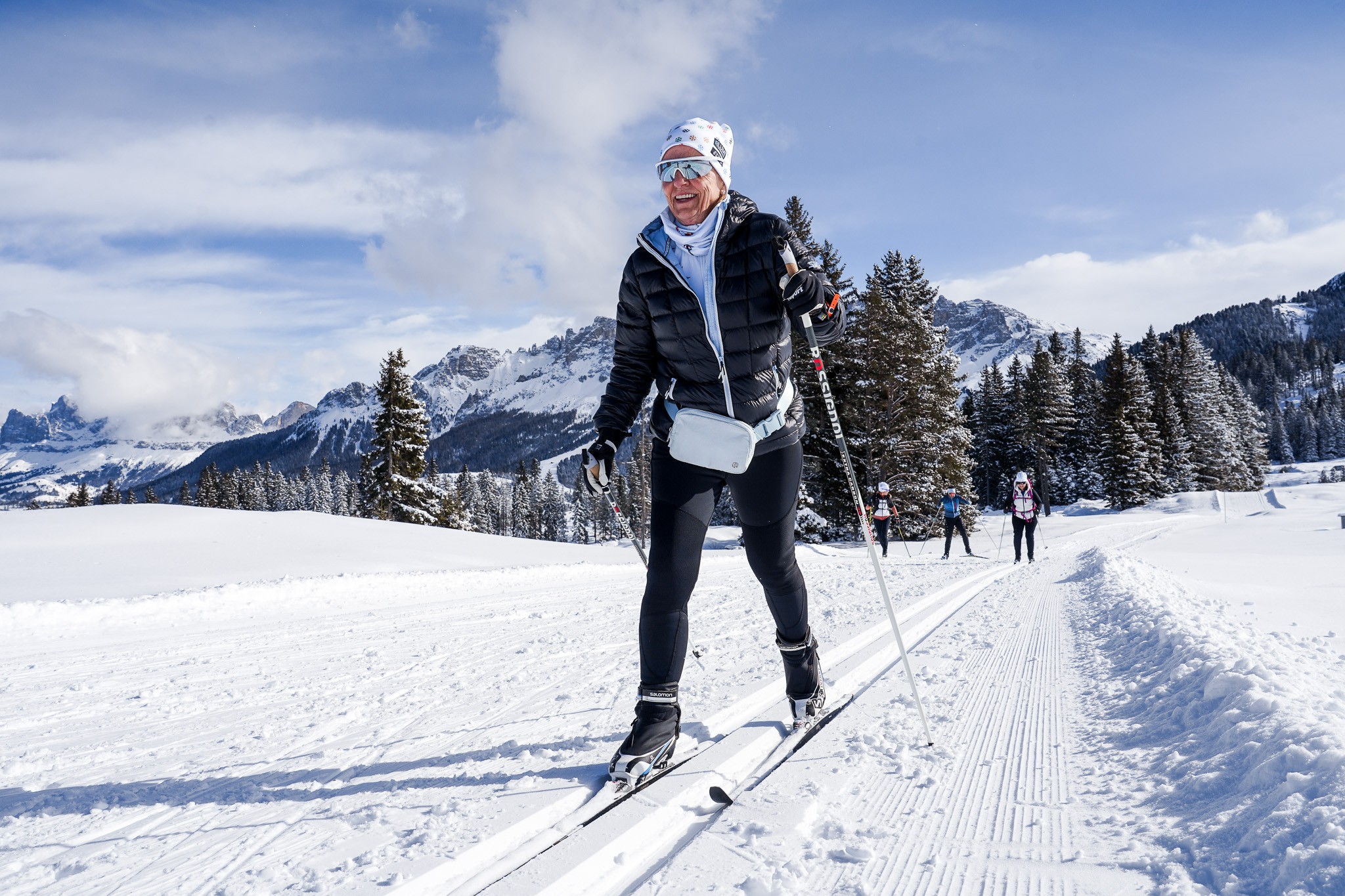
    Courtney Dauwalter explores the Seiser Alm trails with Garrott Kuzzy from Lumi Experiences
    Courtney Dauwalter explores the Seiser Alm trails with Garrott Kuzzy from Lumi Experiences (Photo: Moritz Klee)

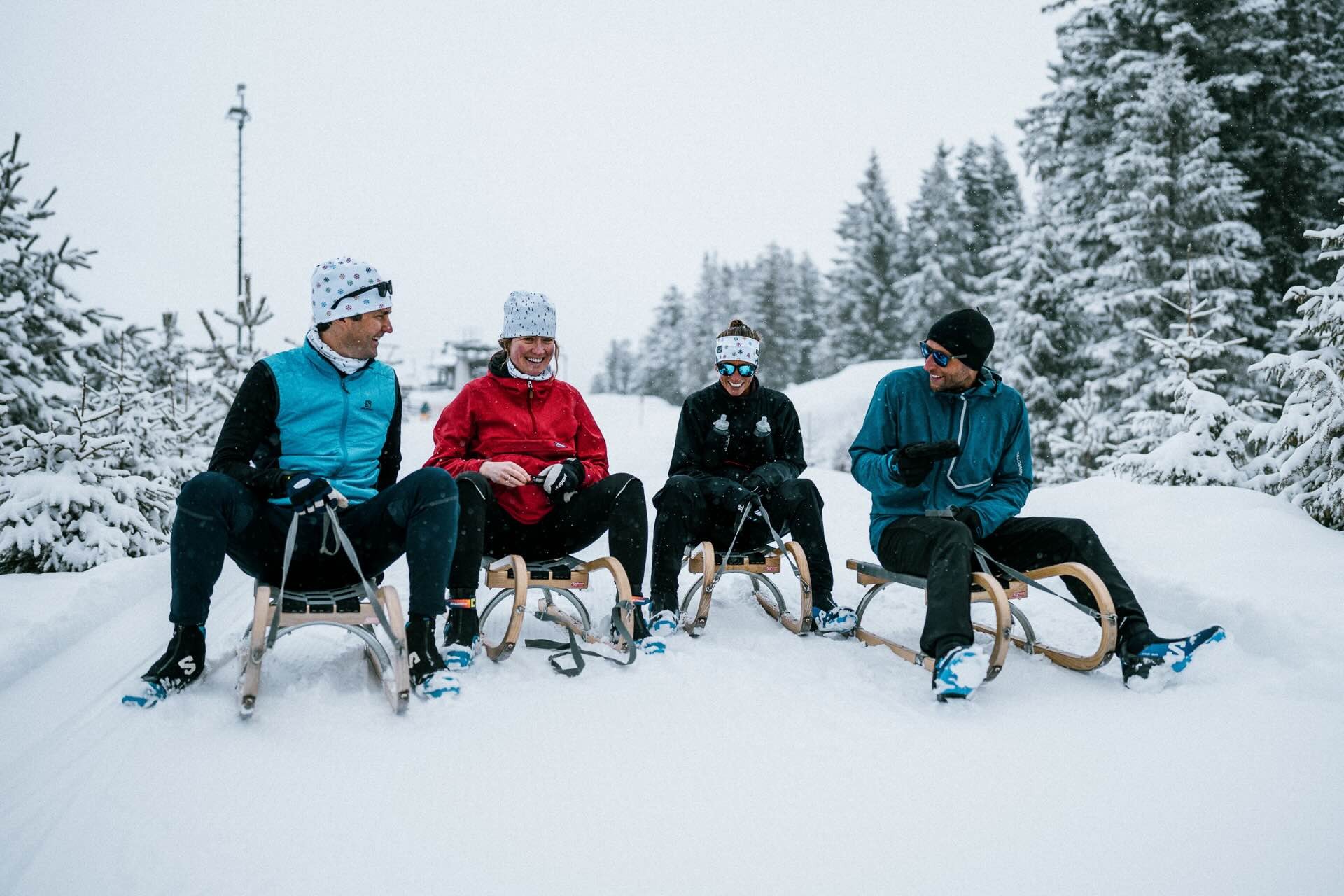
    Last fall, Courtney reached out to share that she was invited to run as a torchbearer in Italy in January 2026 and perhaps even do a little skiing afterwards: “Hey Garrott! Kev and I were just looking at the Lumi website and saw the Seefeld & Seiser Alm trip. We’d love to ski it this winter!” Fast forward a few months and we were catching up over a hot chocolate in a hut in Leutasch, Austria, getting ready to go sledding down one of my favorite trails before skiing our way back to their hotel in Seefeld. We had a blast skiing in Seefeld, Austria and Seiser Alm, Italy, where we got fresh corduroy tracks after a big snowfall and sampled cheese at one of my favorite farms in the Dolomites. It wasn’t until we were there that Courtney realized she’d been to the region before on a long trail run and pointed to the mountain she traversed during a summer trail running event a few years ago.

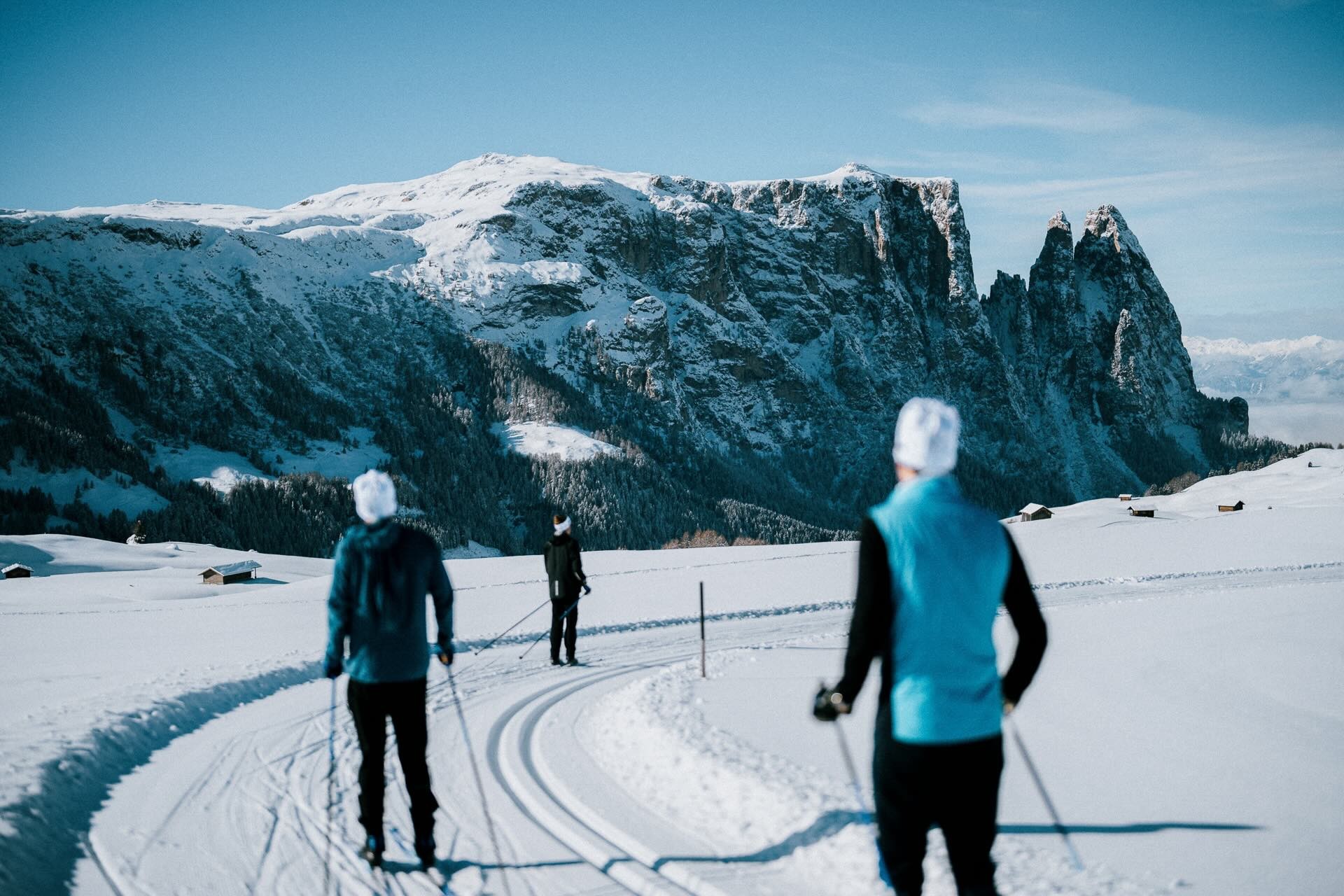
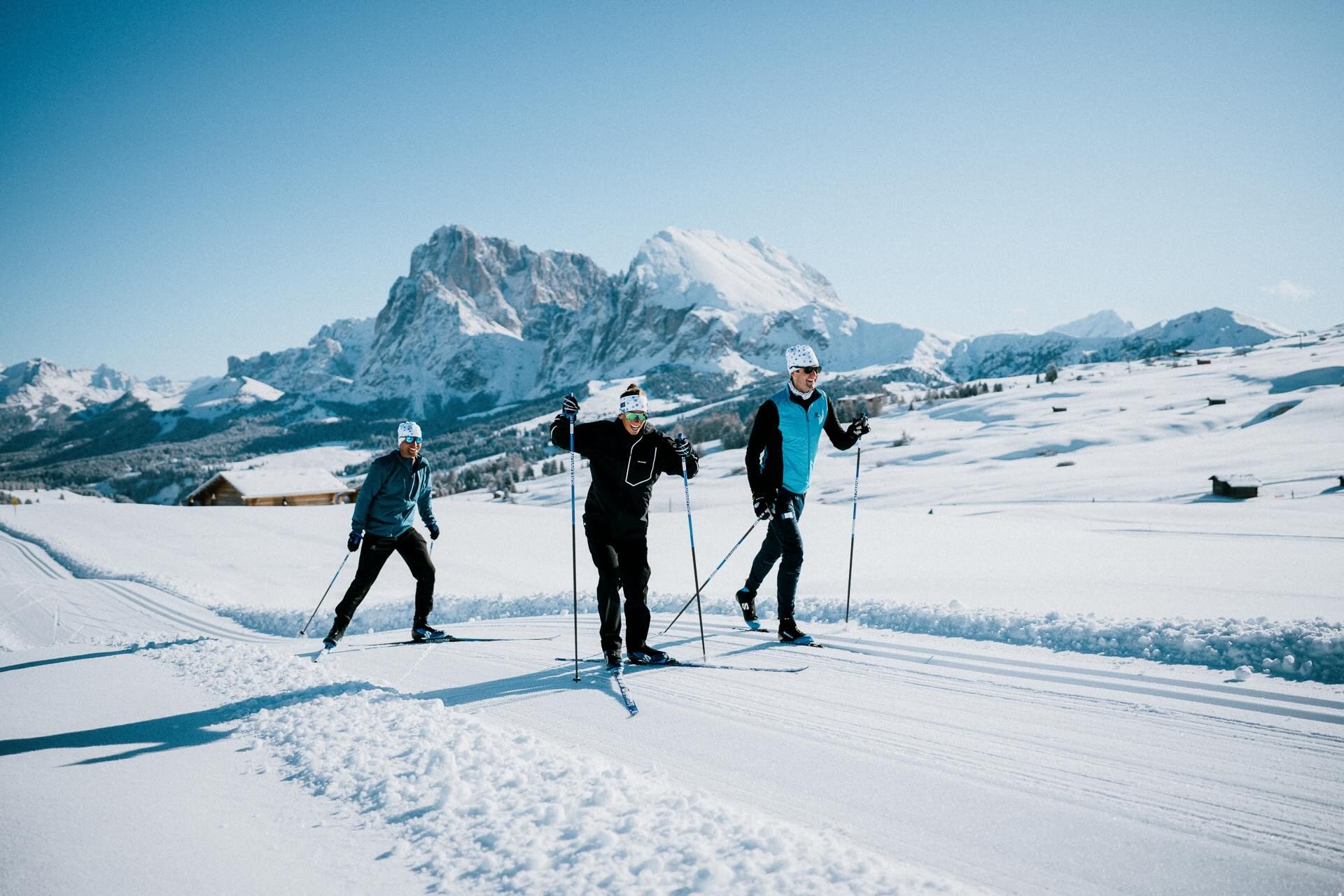
    The iconic Schlern formation rises above Seiser Alm's trails in Italy
    The iconic Schlern formation rises above Seiser Alm’s trails in Italy (Photo: Moritz Klee)

    A Legend on Foot

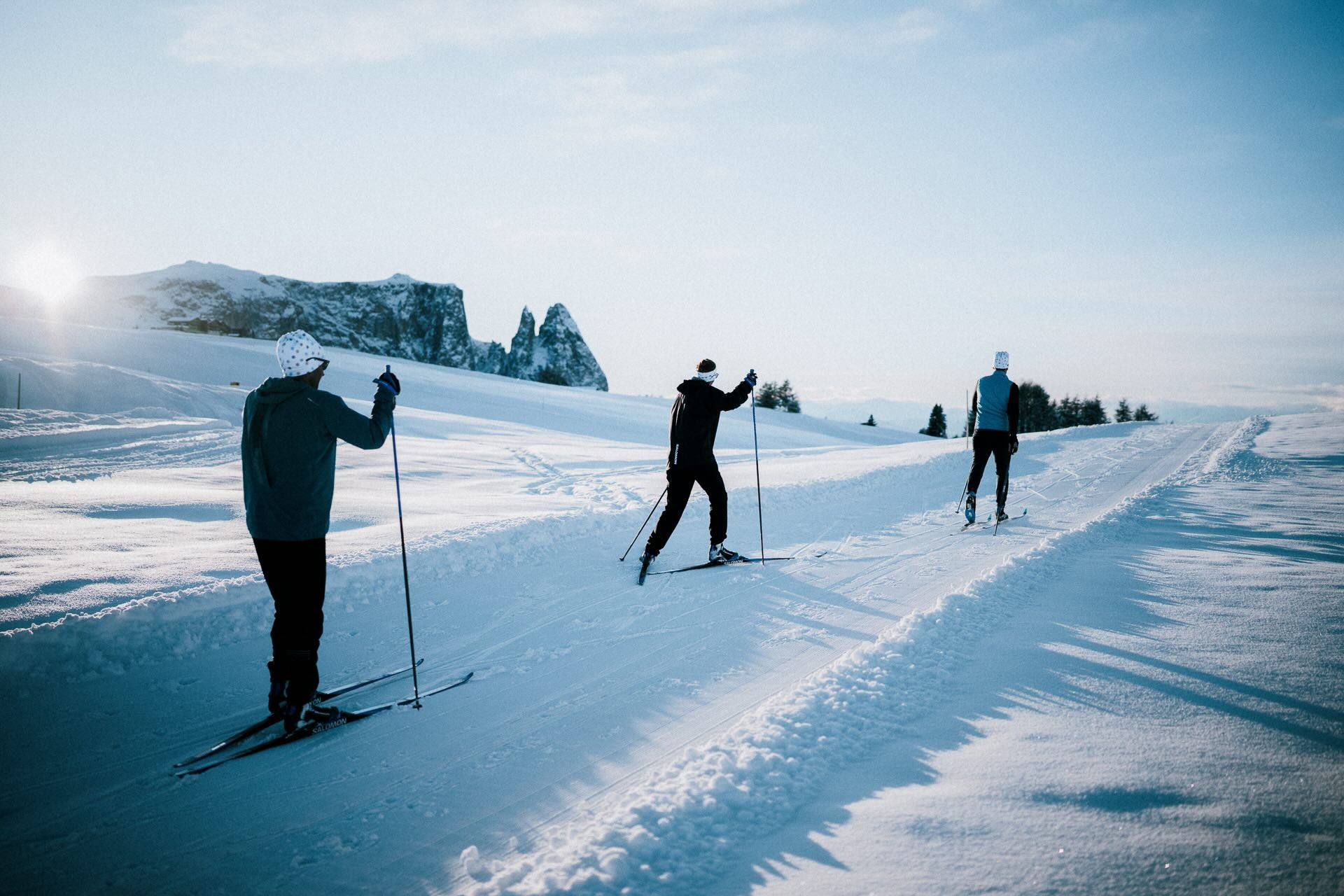
    Enjoying an evening ski on Seiser Alm
    Enjoying an evening ski on Seiser Alm (Photo: Moritz Klee)

    Widely recognized as one of the world’s top trail ultrarunners, Courtney’s trademark baggy shorts, easygoing attitude and mental resilience have made her a fan favorite and an inspiration for a generation of athletes of all ages who are bucking the definition of what makes a traditional trail runner. She has shattered records worldwide and amassed repeated victories at ultrarunning’s premier events, highlighted by an unprecedented sweep of the “Triple Crown” in 2023, winning the Western States 100, UTMB (Ultra-Trail du Mont-Blanc) and Hardrock 100 all in a single calendar year.

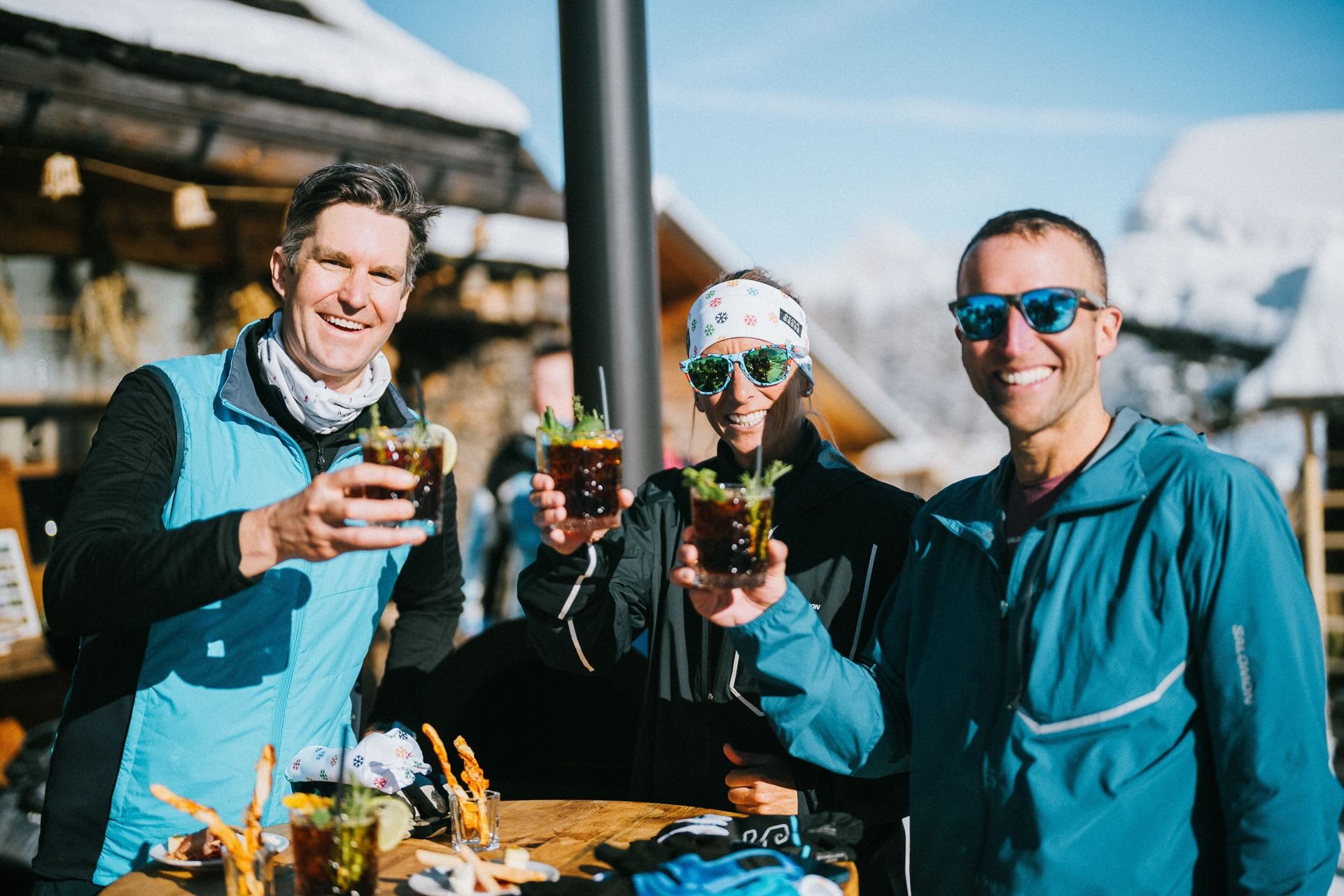
    Salut! to a day on Seiser Alm's trails in Italy with Lumi Experiences
    Salut! to a day on Seiser Alm’s trails in Italy with Lumi Experiences (Photo: Moritz Klee)

    Courtney continues to set the bar high this season, winning the women’s Ultra Trail Chianti Castles 120K in Tuscany this past March and placing 10th overall. In May, she tackled the grueling Cocodona 250, redeeming her previous year’s DNF by pushing through the Arizona heat to take 2nd among women and 6th overall. She followed that in July by capturing her fourth straight women’s title at the Hardrock 100, crossing the line 5th overall in 26:03:10 to set the fastest female clockwise time in the race’s history. Was it her week of skiing in Seefeld & Seiser Alm this winter that made the difference? Well, probably not, but skiing is definitely great cross-training for trail running.

    Still Stellar on Skis

    Snow-capped peaks make for an incredible backdrop for skiing at Seefeld, Austria and Seiser Alm, Italy
    Snow-capped peaks make for an incredible backdrop for skiing at Seefeld, Austria and Seiser Alm, Italy (Photo: Moritz Klee)

    Courtney still excels at skiing, a testament to the importance of cross training and staying fit no matter the season – not to mention the years of working on her stride early in her athletic career. Her husband Kevin is relatively new to cross country skiing, but still loved the alternative to running, exploring the trails and perfecting his ski skills.

    Alpine sledding with Courtney Dauwalter and Lumi Experiences
    Alpine sledding with Courtney Dauwalter and Lumi Experiences (Photo: Moritz Klee)

    One of the highlights of our week together was rodeling, aka alpine sledding. We had a memorable ride down the hill through forests blanketed with snow before our ski back to Seefeld. There are plenty of ski trails and activity options suitable for everyone in Seefeld & Seiser Alm, from ultra-distance champions to beginners.

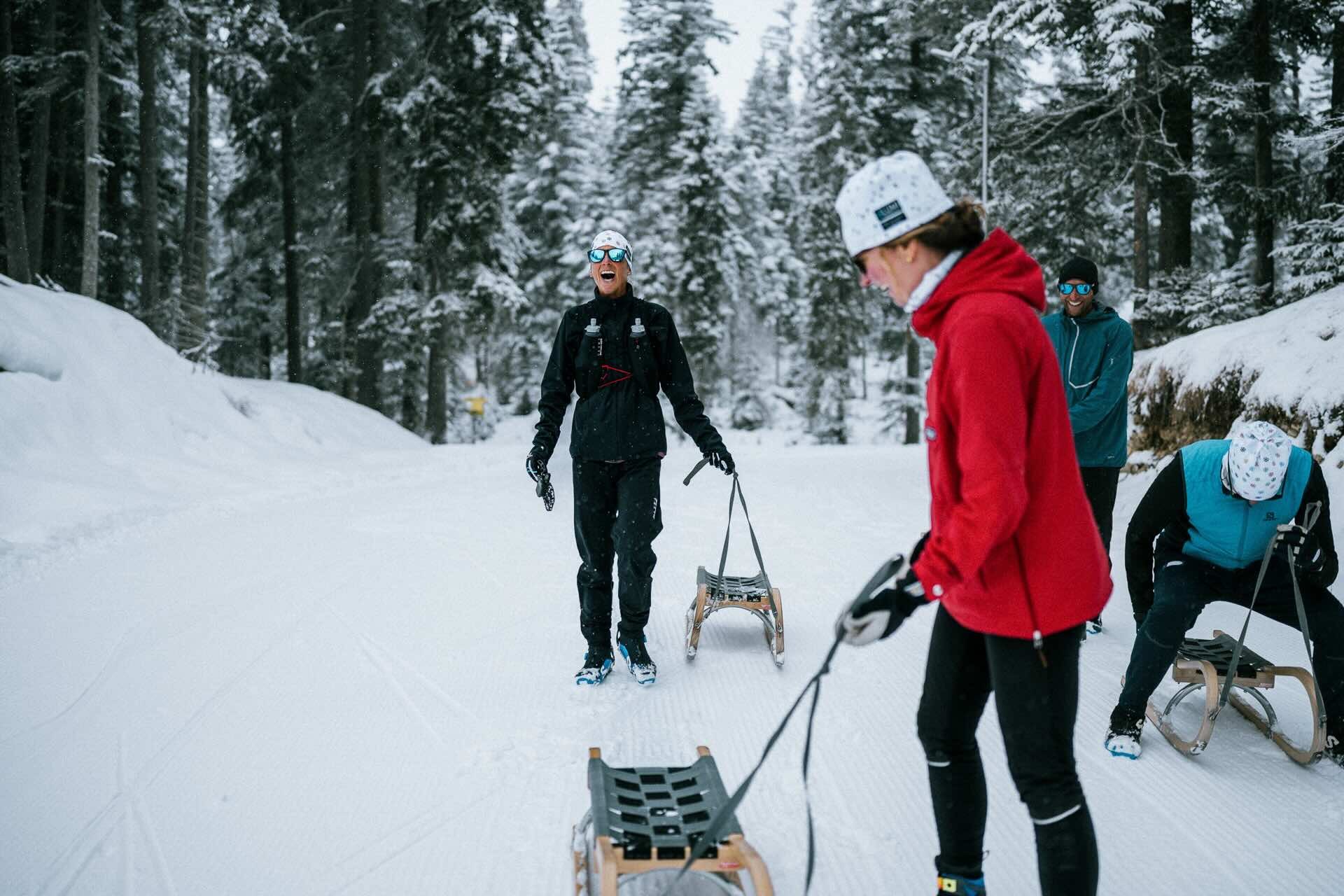
    Ready for rodeling with new and old friends in Leutasch, Austria
    Ready for rodeling with new and old friends in Leutasch, Austria (Photo: Moritz Klee)

    Ski in Austria and Italy Next Winter

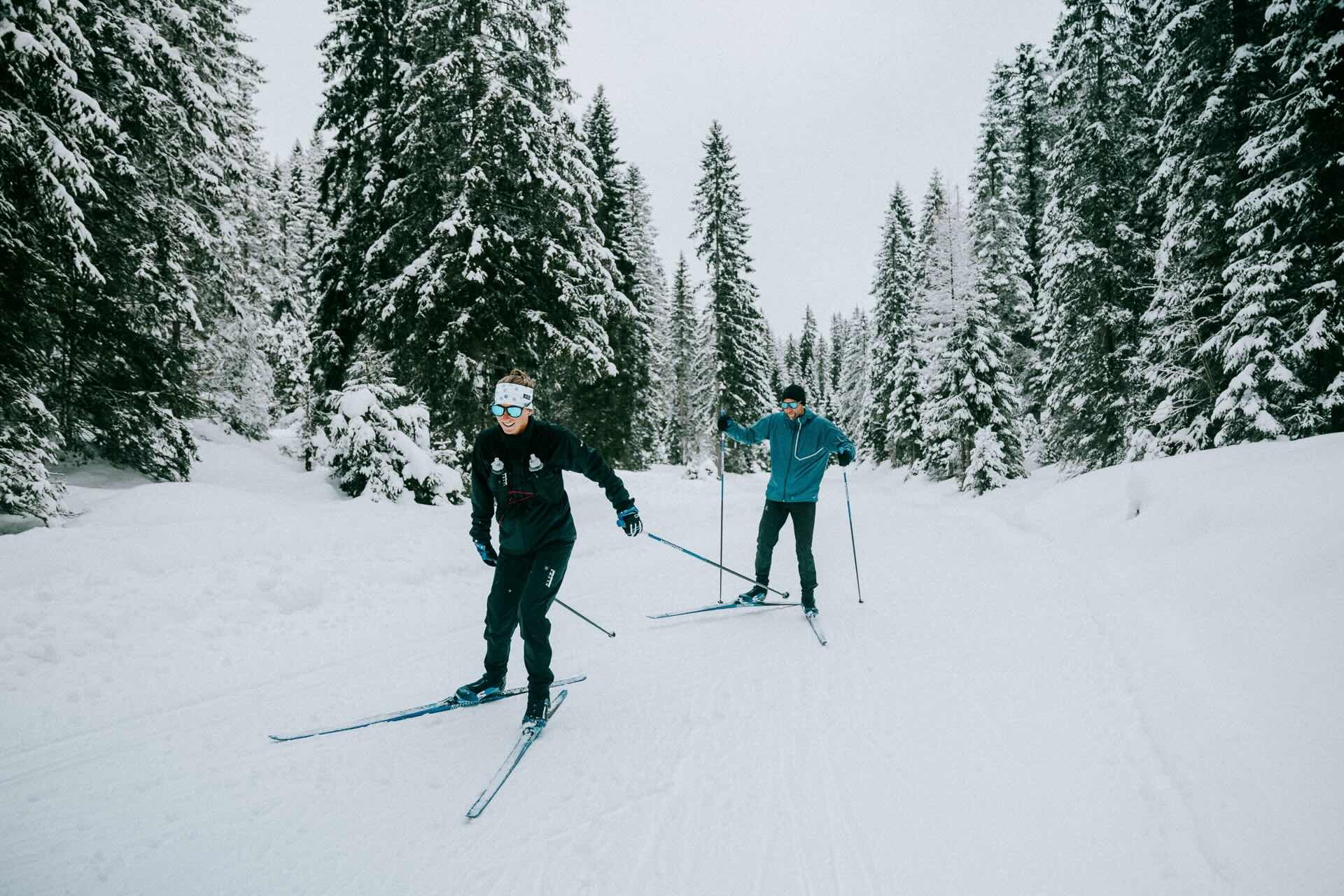
    Fresh snowfall made for excellent conditions on Seefeld's trails
    Fresh snowfall made for excellent conditions on Seefeld’s trails (Photo: Moritz Klee)

    Would you like to explore Austria and Italy’s best cross-country ski trails next winter? Let Lumi Experiences handle all of the hotel, transportation, and scheduling logistics so you can enjoy the trails to the fullest with your travel companions, with the help of Lumi’s local, expert trip leaders. Relax in comfortable trailside accommodations and discover regional cuisine unique to both countries. Not an ultrarunner like Courtney? Both Seefeld & Seiser Alm feature trails for all levels of skiers, even novices. There is limited space available on Lumi’s Seefeld & Seiser Alm trips next January, with two departure dates available. Reach out to reservations@lumiexperiences.com today for a detailed daily itinerary or to sign up.

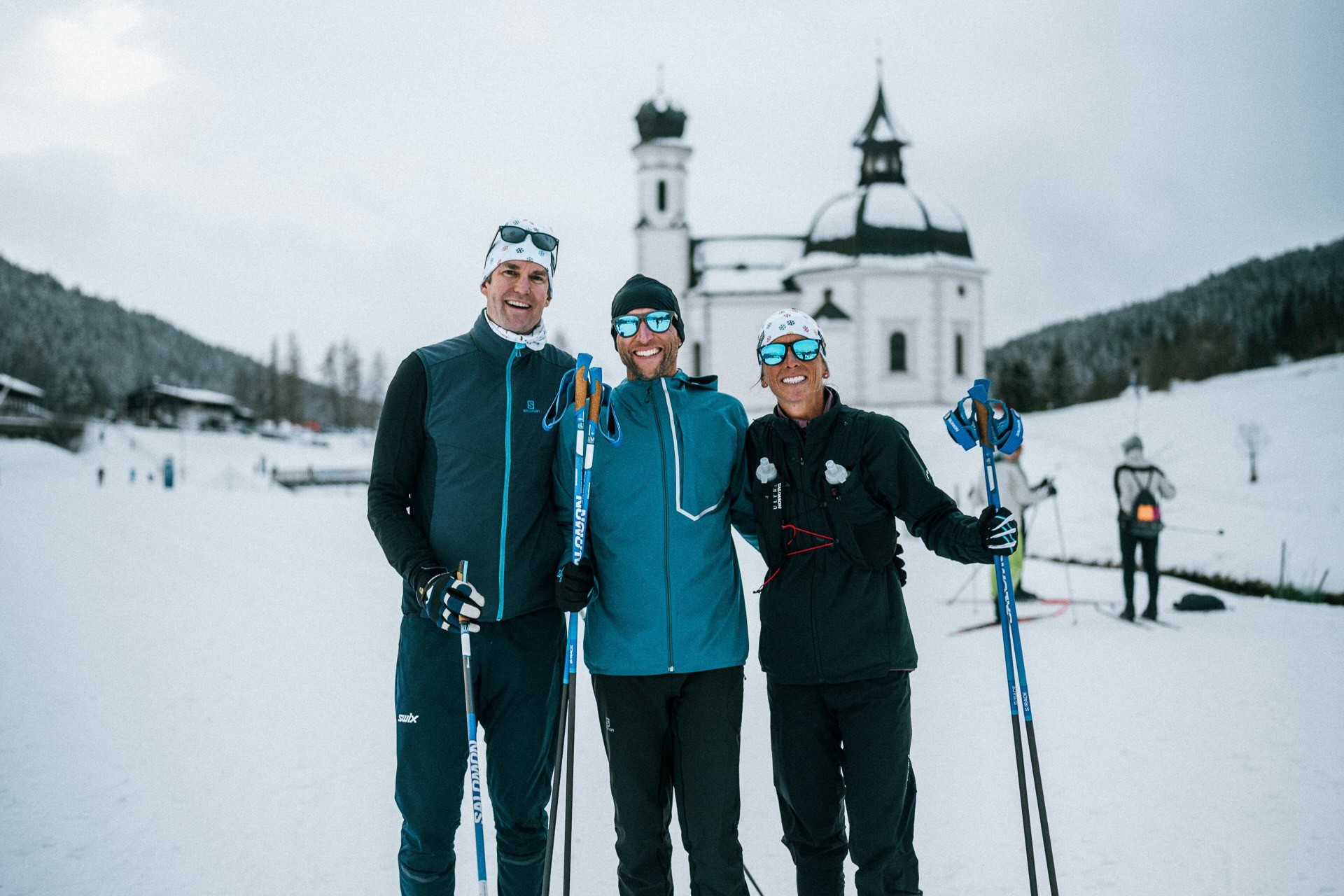
    Garrott, Kevin and Courtney in front of Seefeld's Seekirchl church
    Garrott, Kevin and Courtney in front of Seefeld’s Seekirchl church (Photo: Moritz Klee)

    See you on the trail,

    Garrott Kuzzy
    garrott@lumiexperiences.com
    Founder & Olympian, Lumi Experiences

    About Lumi Experiences

    As the world’s premier cross-country ski travel company, Lumi Experiences offers boutique trips that introduce travelers to winter cultures where Nordic skiing is a part of everyday life — from Sweden to Slovenia. It’s a ski vacation like no other.

    Media contact: Nathan Miller – Marketing & Guest Communications Manager – nathan@lumiexperiences.com

  • Limited Spots Left: 2019 Nordic Ski World Championships Trip

    (Press release)

    Lumi Experiences and the National Nordic Foundation (NNF) are partnering for the second consecutive year to offer a once-in-a-lifetime trip to the 2019 Nordic Ski World Championships in Seefeld, Austria. Last winter, guests on the trip cheered on Sophie Caldwell and Jessie Diggins on their way to the top of the podium at the Seefeld World Cup races, along with other memorable experiences like skiing on some of Seefeld’s 200 km of trails. The trip raised over $10,000 in support of the NNF, supporting grass-roots skiing in the United States.

    2019 World Championships Trip

    Dates: Monday, February 25 – Monday, March 4, 2019

    HURRY! We can only accept bookings on this trip until October 15, 2018. 

    Only 6 more spots available.

    The trip includes tickets in the A-Grandstand to all events, including the 10 & 15km classic races, 4 x 5 km & 4 x 10 km relays and 30 km & 50 km marathon events. These tickets can no longer be purchased anywhere else.

    The trip is led by Olympian’s Holly Brooks and Garrott Kuzzy. Holly is a two-time Olympian and played a huge role in bringing US skiing to the highest levels; one of the pivotal personalities in the book “World Class.” Innsbruck has been Garrott’s home for the past two years. He has picked out his favorite activities of the region to showcase on this trip.

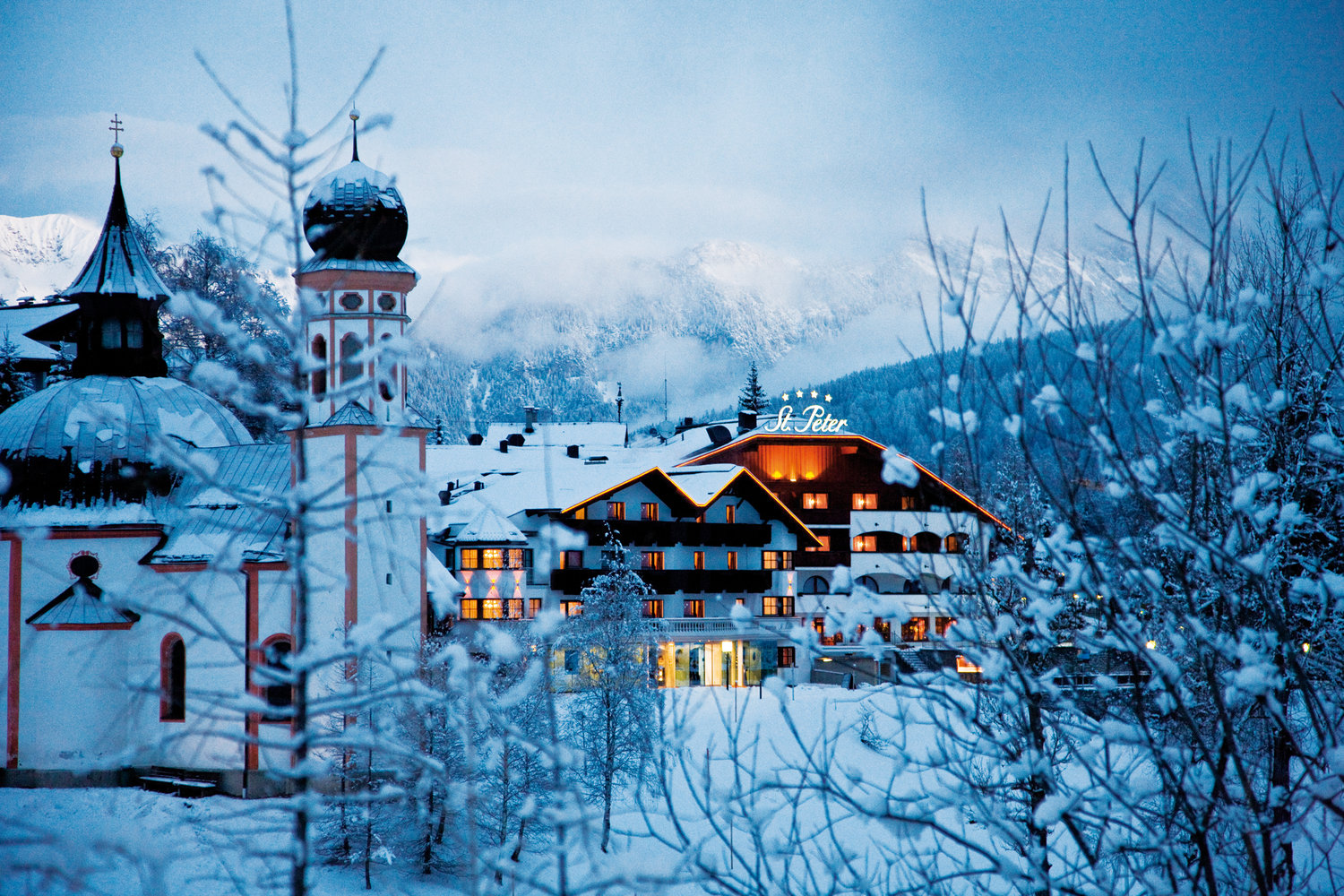
    After exploring the trails and cheering on your favorite athletes, relax in the sauna, pool and spa at Hotel St Peter, located directly at the trailhead in Seefeld and raise a glass to Team USA.

    Visit www.lumiexperiences.com or email info@lumiexperiences.com for detailed information.
  • Opening Acts in PyeongChang: USST Press Conference and Catching Up with Sargent

    (From left to right) U.S. Ski Team members and 2018 Olympians Rosie Brennan, Kikkan Randall, Sadie Bjornsen, Jessie Diggins, Erik Bjornsen, and Ida Sargent posing after their intro press conference on 2-7-18. (Photo: Flyingpointroad.com)
    FasterSkier would like to thank Fischer Sport USAMadshus USAConcept2Boulder Nordic Sport and Swix Sport US for their generous support, which made this coverage possible.

    ***

    PYEONGCHANG, South Korea — Sitting one-by-one across the stage dressed in what appeared to be the brightest of bright white tops, Kikkan Randall, Jessie Diggins, Rosie Brennan, Ida Sargent, and the Bjornsens (both Erik and Sadie) held court for the attending media Wednesday afternoon at PyeongChang’s mountain cluster media center. All athletes are members of the U.S. Ski Team (USST) and 2018 Olympians.  

    Randall, the seasoned vet, fielded a spectrum of questions centered around her role as the foundational piece of the U.S. women’s cross-country-ski juggernaut. It’s the Anchorage-based skier’s fifth Olympic Games.

    Back in 2002, when Nina Kemppel competed in her last of four Games for the U.S. cross-country ski team, Randall, as part of the same 2002 Salt Lake squad, was beginning her own five-Olympiad odyssey. Sixteen years later, Randall could reflect on being, at times, a lonely success story on the women’s side, to the present, when on the most recent World Cup weekend in Seefeld, Austria, two U.S. women scored wins: Sophie Caldwell in the freestyle sprint, Diggins in the 10 k mass start skate.

    Jessie Diggins and the media swarm during her intro press conference at the 2018 PyeongChang Olympic Games. (Photo: Flyingpointroad)

    As much as the press was there to see a champ like Randall, they also were captured by Diggins’s spunk and verve. Erik Bjornsen took it all in after stating in his intro that this was his first press conference. He proceeded to take out his smartphone and unabashedly capture a few panning video shots of the scrum of reporters there to learn more about the U.S. cross-country team poised to make history in South Korea.

    For those who follow the sport and in particular the U.S. women, much was said about the “team” and their devotion to it. But each athlete also spoke of their personal goals and ambitions.

    After the main press conference, when athletes took one-on-one questions, FasterSkier had an opportunity to check in with Brennan, Erik Bjornsen and Sargent.

    2018 is Brennan’s first Olympics, yet she arrives with a broad scope of World Cup experience to draw from. She scored two top-20’s in successive World Cup 10 k freestyle races in Davos, Switzerland and Toblach, Italy. She nailed a 15th place in the Tour de Ski’s opening skate sprint. It was a solid Period 1 on the World Cup for Brennan.

    Much has been written about the U.S. women’s collective prospects in the 4 x 5 k relay. That team, which could include more names than the four-member team is alloted, is still not set in stone.

    Asked if she would be approaching her first race opportunities as a demonstration to the coaches of her overall fitness, Brennan was anything but coy.

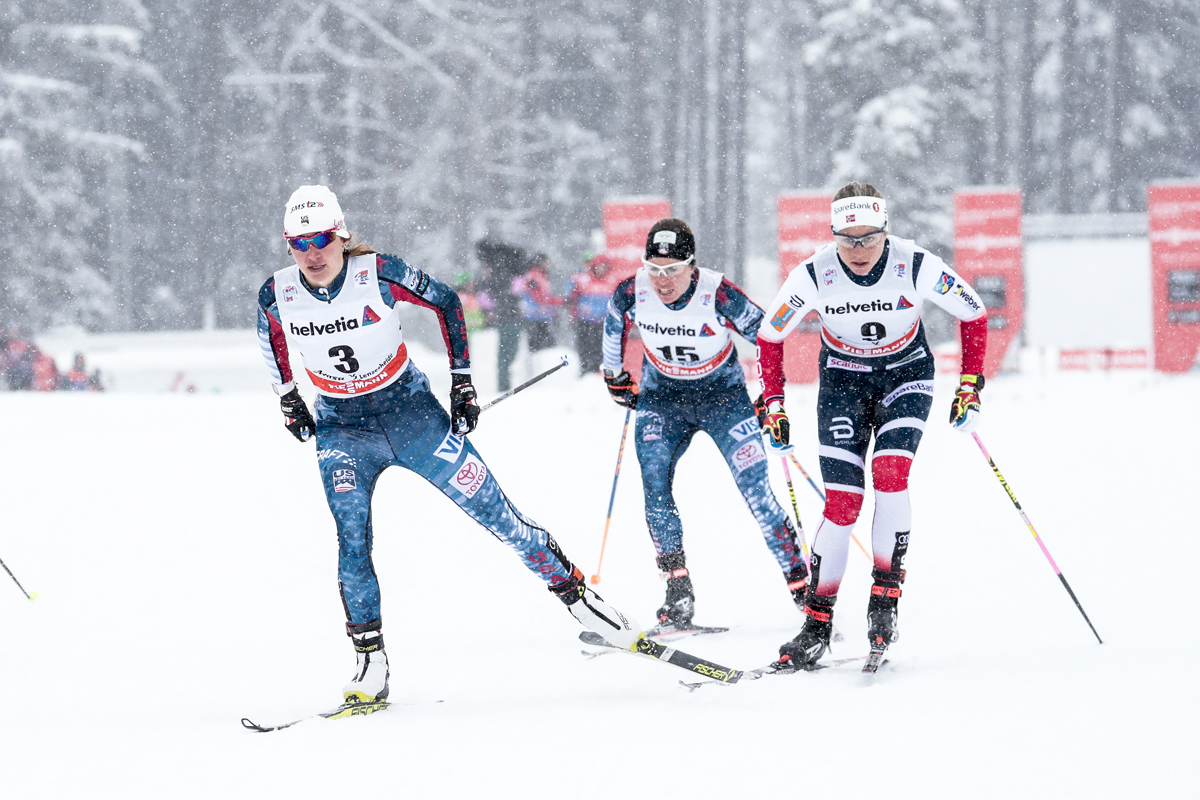
    Sophie Caldwell (3) leading her U.S. teammate Rosie Brennan (15) and Norway’s Astrid Uhrenholdt Jacobsen in the quarterfinal of the women’s freestyle sprint at Stage 1 of the 2018 Tour de Ski in Lenzerheide, Switzerland. (Photo: Fischer/NordicFocus)

    “I have been struggling the last few weeks since the TdS with my own racing,” the 29-year-old Brennan said. “And so at this point I am just hoping to had enough time to turn my form around and to race better myself. I obviously don’t want to be part of a relay team that I’m going to let down. So I want to be in my best shape before I even think about that. That is one of my goals and I hope I’ve had some time to turn my shape around. But I think at this point, I am looking for every opportunity to race that I can get to show that I have turned this around and that I am ready and then will start looking at that relay spot.”

    Most recently, Brennan struggled in Seefeld’s 10 k skate mass start, finishing 53rd. Brennan also after completed the Tour de Ski (TdS), which concluded Jan. 7. Understanding that maintain high level fitness on the World Cup is a challenge few master, Brennan said the TdS had sapped her energy.

    “Just a little more fatigue than I expected from the Tour despite the fact that we only had six and half races,” Brennan acknowledged. “There were a lot of weather events so everything was a little more energy intensive and a little hectic. I came in with a lot more training than I have in the past, I trained a little harder during Period 1 in hope to be sharp for the Olympics, and I think I didn’t respect that as much as should have and was a little tired afterwards. And also fighting a little illness and things like that. I am feeling a lot better now and I hope a little rest is all I needed.”

    For Erik Bjornsen, who is experiencing his second Olympics after racing three individual events and the 4 x 10 k relay in Sochi, these Games could become a stepping stone. In Seefeld, Bjornsen placed ninth in the 15 k mass start skate. If Bjornsen’s positive energy in the press conference was any indication, he might be trending into rarefied air on the men’s side.

    “I think I could have some good performances,” Bjornsen, 26, said. “I don’t have the pressure that everybody else does, but I do have have the potential to put in some really solid results.”

    (Left to right) USST members and 2018 Olympians Ida Sargent, Erik Bjornsen and Kikkan Randall during thier intro press conference on Wednesday at the PyeongChang Games. (Photo: Flyingpointroad)

    Last year at the Nordic World Championships in Lahti, Finland, he and teammate Simi Hamilton placed fifth in the team sprint. In PyeongChang, the course remains championship-tough, but athletes are more exposed to the elements as the tracks were built on a hilly golf course.

    “Of course, I’m really excited for the team sprint,” Bjornsen said. “And these courses, I’ve been out there once, it is a little early to say. It seems good. It is a golf course, but there are some big climbs, which I like. I like hard-work sections but there are also some flatter sections, which suits a big guy like myself. And then having wind, I was joking before, it should be good for the guys that are chasing.”

    Then let’s talk about tough and gritty. Topping the list would be Sargent. If you missed this, here’s the short version. Back on Jan. 27, prior to her start in Seefeld’s skate sprint qualifier, Sargent fell and broke her thumb.

    “It was a complete clean break,” Sargent, 30, stated. “Every pole plant was very painful. But actually, I felt like my brain was a bigger a detriment because it happened 15 minutes at most before the start and I knew that something was wrong. I was thinking the whole time, ‘This is bad, this is bad.’ I could feel the pain and was thinking that something very serious was going on.”

    On her literal whirlwind of treatment, Sargent flew to Vail, Colorado, for surgery on her thumb at The Steadman Clinic.

    “I had a plate inserted and seven screws securing this plate,” Sargent explained during a follow-up phone interview on Thursday. “So good hardware in there, and an amazing surgeon. My surgeon was very confident; he has done this before, and he knew that the plate was extremely secure so that he wasn’t at all concerned about it moving or not me not having  the stability. I think he ended up using a slightly larger plate just to make sure it was plenty secure.”

    The next morning, post-surgery, Sargent was cleared for active recovery to increase her mobility and bring down the swelling.

    “Two days later I was skiing, doing some one pole and some two pole,” Sargent added. It was incredible to me that they can take a clean break and fully stabilize it.”

    Sargent was clear when asked if there’s anything she cannot do.

    “Nope,” she said. “The only restriction is just personally managing the pain when I ski. The bone is not fused together yet, that eventually will happen. I also obviously have the trauma of having screws put into the bone and there is the swelling, but that has been going down. I have been working with Zuzanna Rodgers here in Korea. We have working on some exercises and some massage to reduce the swelling.”

    Ida Sargent (5) leads her semifinal heat and teammates Jessie Diggins (4) and Sophie Caldwell (9) around a corner at this season’s Davos World Cup. (Photo: Reese Brown / U.S. Ski & Snowboard)

    It is cold here in PyeongChang. It’s a dry cold, but when temps are slow to budge from the single digits and eventually warm to the low teens, cold is cold. Most people with surgical procedures requiring the insertion of metal plates claim cold temps can complicate their sensations. Here in Korea, that seems not to be a problem for Sargent.

    “I was talking with someone yesterday who has a plate in their hand as well, and they feel the cold,” Sargent said “I don’t think I feel it because I still have a fair amount of swelling on top of the plate at the moment. So I think that that is providing some increased insulation. That is the bonus of that maybe. I haven’t felt the cold from it.”

    Sargent stated she was scheduled to race next Tuesday’s classic sprint.

    “As long as I am feeling like my thumb is good to go and I feel confident in my ability to ski well with it, I’ll be racing that,” Sargent explained. “The sprint is on Tuesday, so I still have five days or something at this point That is the plan right now and putting the full focus on being recovered and ready for that day.”

    The 2018 PyeongChang Olympics begin Saturday with the women’s 15 k skiathlon.

  • Thursday Rundown: Swirbul 3rd in Junior Worlds Skiathlon; U.S. NoCo Relay 7th (Updated)

    Thursday Rundown: Swirbul 3rd in Junior Worlds Skiathlon; U.S. NoCo Relay 7th (Updated)

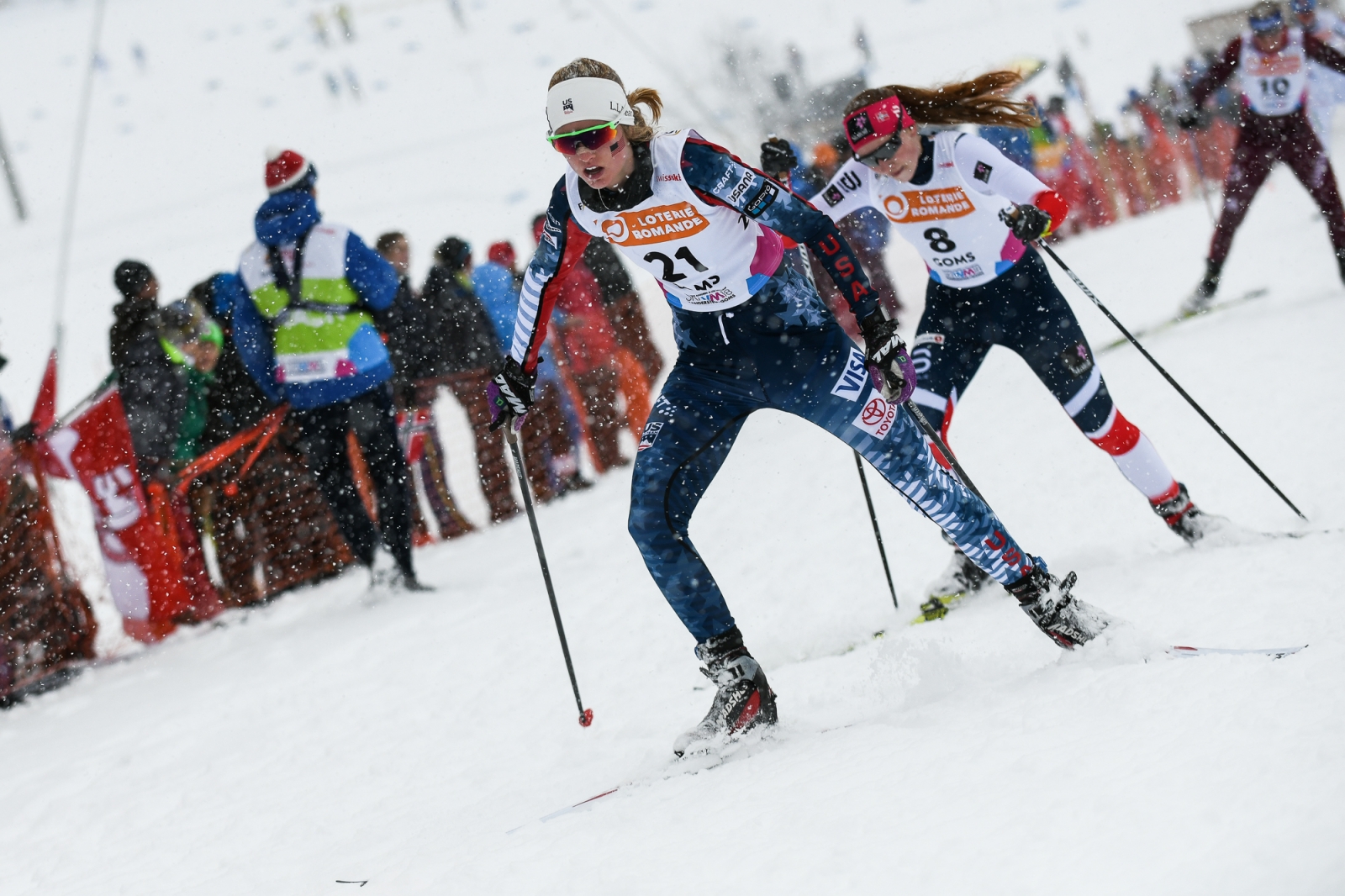
    American Hailey Swirbul (University of Alaska Anchorage) leads Norway’s Lone Johansen up a climb during the second half of the women’s 10 k skiathlon on Thursday at 2018 Junior World Championships in Goms, Switzerland. (Photo: JWSC2018.ch)

    (This article has been updated to include comments from Americans Hailey Swirbul and Gus Schumacher.)

    Junior World Championships (Goms, Switzerland): 10/20 k skiathlons

    Hailey Swirbul is 2-for-2 when it comes to podiums at this year’s Junior World Championships; in her second-straight race this week in Goms, the 19-year-old American earned a medal in a distance race. On Thursday, it was bronze in the women’s 10-kilometer skiathlon.

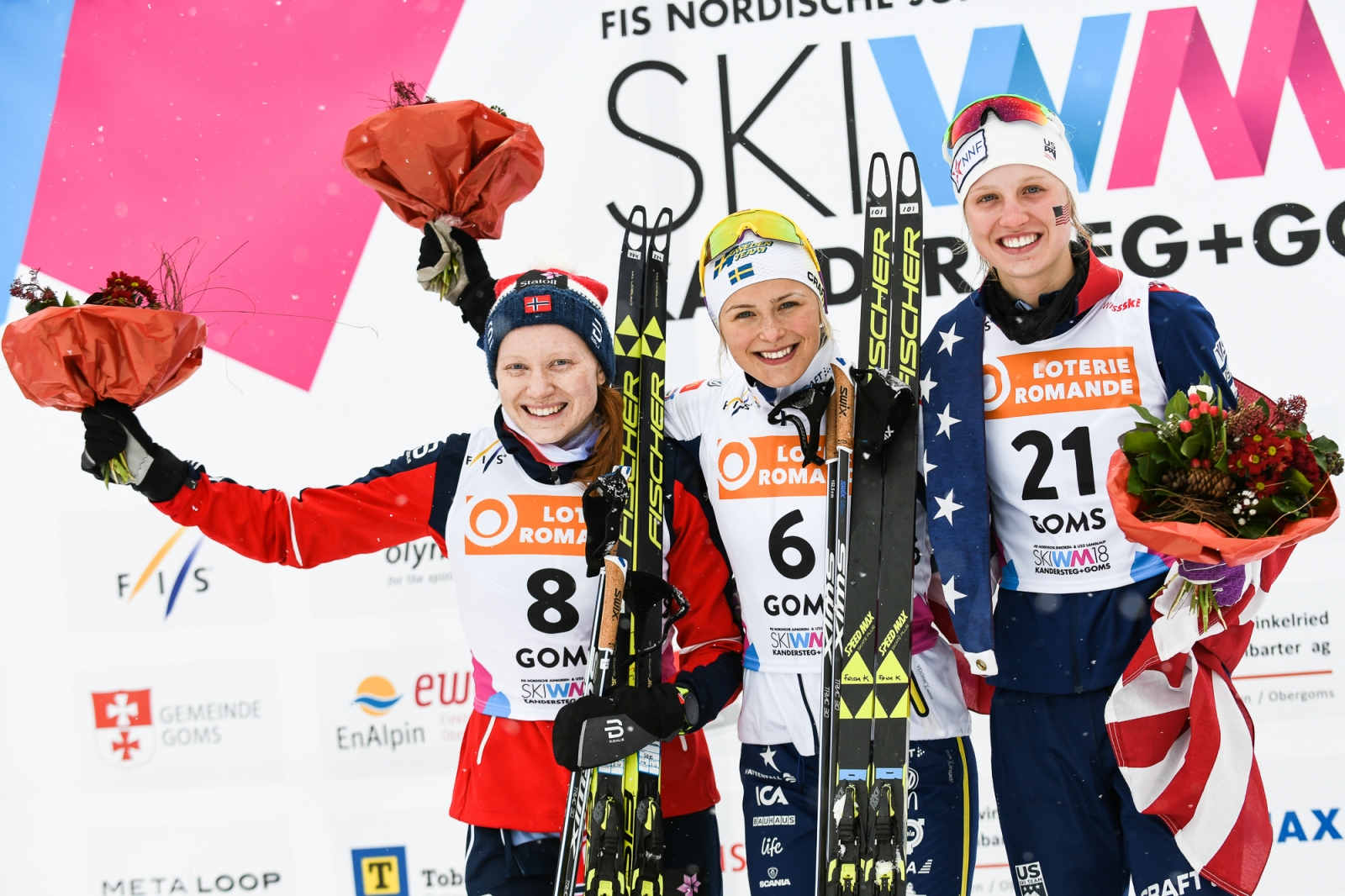
    The women’s 10 k skiathlon podium at 2018 Junior World Championships in Goms, Switzerland, with Sweden’s Frida Karlsson (c) in first, Norway’s Lone Johansen (l) in second, and American Hailey Swirbul (r) in third. (Photo: JWSC2018.ch)

    Swirbul, a sophomore at the University of Alaska Anchorage, closed the gap to the leaders over the final 5 k skate portion of Thursday’s race, doing so in tough, slow conditions with heavy snowfall. She ended up third in a sprint finish with Norway’s Lone Johansen, who took second by 0.7 seconds, as the two finished 35.5 seconds and 36.2 seconds behind the winner, Sweden’s Frida Karlsson, respectively.

    Karlsson won it in 32:55.7 minutes. She had been second at the transition from classic to skate halfway through the race, just behind France’s Laura Chamiot-Maitral in first. Four women came through the exchange together within 2.6 seconds of first, while Swirbul was about 15 seconds back in eighth.

    “Coming into the exchange I was right where I wanted to be,” Swirbul wrote in an email to FasterSkier. “I knew that some of the girls ahead of me would not be able to sustain their pace the entire skate leg. It was important for me to remember that and not try to close the gap too quickly with the Norwegian I was skiing with.”

    While Karlsson broke away over the final 5 k, Swirbul helped lead the chase, moving into second and 31 seconds back on a long, steep climb at 6.7 k.

    “I won’t lie, the skate leg was tough! I think everyone was suffering out there in the fresh snow,” Swirbul wrote. “I tried to conserve energy on the gradual downhill before the big climb to use on the hill.”

    On the last lap, she worked to distance herself from fourth place.

    “I knew that the fourth place skier was closing in on us the last lap,” she wrote. “Going up the final hill, I had to make a move to secure a podium spot and give what I had to ski away form the fourth place girl over the second to last big climb. The last few hundred meters were so intense! I didn’t have anything left to sprint it out for second place. Gotta work on that!”

    Two days ago, Swirbul placed second in the 5 k classic for her first individual medal and the best-ever finish for the U.S. at Junior Worlds.

    “This means so much,” she told race organizers after taking third in Thursday’s skiathlon. “I’m so happy to represent the United States here and show how we can improve in the future and what we have in our country.”

    In her email to FasterSkier, Swirbul explained that she entered Thursday’s race confident yet calm.

    “After my silver medal I believed in myself more than before,” she wrote. “However, I managed to stay calm and not put high expectations on myself for the skiathlon which allowed me to race my best. I was hoping to ski smart and relaxed and not be afraid to make it hurt! In a mass start that is really all I can control.”

    For much of the first leg, about 4 k, she skied with what she described as “a huge pack of girls, which was kind of stressful for me.”

    “It’s harder for me to match the stride of someone almost a foot smaller than I am in a classic track, so once the group broke up I was able to find my rhythm,” Swirbul wrote. “The snow storm made the tracks super slow where they weren’t skied in, so it was a waste of energy to try to pass people outside of the skied in track. I made that mistake a few times and ended up not passing anyone, just wasting energy plowing through powder.”

    But her skis felt fast in both the classic and skate legs, she noted. “The wax techs have been killing it!”

    With one race left, the women’s 4 x 3.3-kilometer relay on Sunday, Swirbul wrote that she was eyeing another podium.

    “I think it is fair to think that our relay team has a good shot at the podium. That would be the cherry on top :)”

    Karlsson told organizers that she was focused solely on the gold on Thursday.

    “It was very fun today and my body felt very good, then I was just going for the gold today,” Karlsson said. In her first Junior Worlds, she had previously placed third in the skate sprint earlier in the week.

    “It means a lot,” Karlsson, 18, added. “This is a very good sign that I’m doing the right thing. I have one more year left as a junior so I’m looking forward to next year’s Junior World Championships as well.”

    Also for the U.S., Kathleen O’Connell (Montana State University) placed 20th (+2:18.2), Molly Gellert was 40th (+3:59.4) and Sofia Shomento was 58th (+6:25.7).

    Canada’s Natalie Hynes (University of Alaska Anchorage) placed 24th (+2:40.0), Hannah Mehain was 37th (+3:54.9), Alexandra Racine 51st(+5:16.1), and Catherine Reed-Metayer 62nd (+7:17.7).

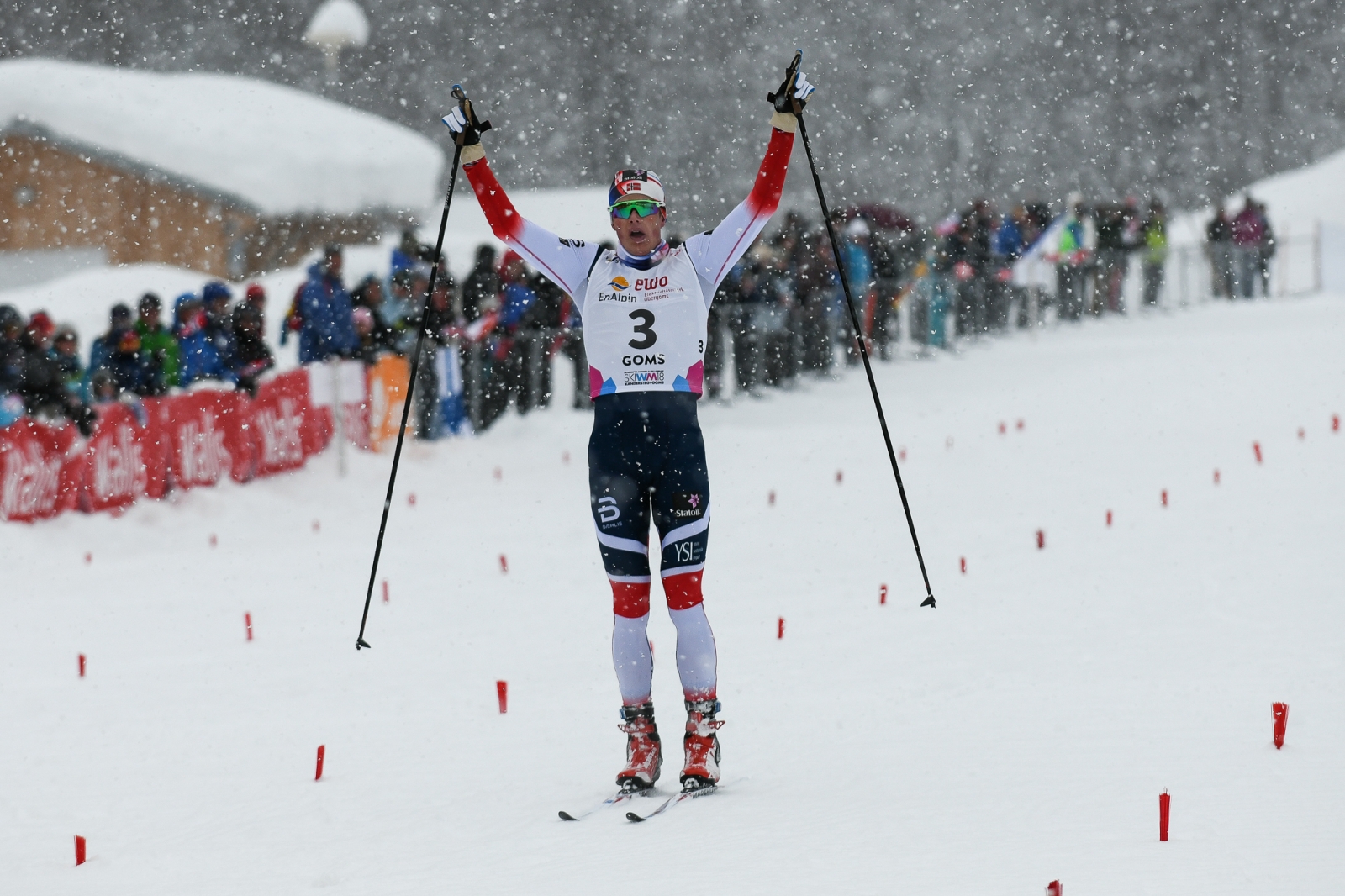
    Norway’s Harald Østberg Amundsen winning the men’s 20 k skiathlon at 2018 Junior World Championships in Goms, Switzerland. (Photo: JWSC2018.ch)

    In the junior men’s 20 k skiathlon that followed, Harald Østberg Amundsen pulled out a 34.7-second victory over fellow Norwegian Jon Rolf Skamo Hope, who won the 10 k classic two days ago. Norway swept the podium with Jørgen Lippert in third, 1:00.1 minutes back, two days after Lippert placed third in the 10 k individual start.

    The win was Amundsen’s first individual gold after he was on Norway’s winning 4 x 5 k relay at last year’s Junior Worlds in Utah, where he placed third in the 10 k skiathlon. On Tuesday, he was fourth in the 10 k classic.

    “Unbelievable,” he said during a post-race arena interview. “I tried to keep calm on the classic part, and on the skate part just tried to keep the speed up. … I tried to go fast on the beginning and end of the uphills, and a bit controlled in the middle. I think the final was great, unbelievable.”

    American Gus Schumacher (Alaska Winter Stars) raced to 15th (+2:43.6) besting his two previous top 20’s this week (19th in the freestyle sprint and 17th in the 10 k classic) at his first Junior Worlds. He skied much of the race with Ben Ogden (Stratton Mountain School), who finished 18th (+2:51.2) for his second-straight top 20 (after placing seventh in the 10 k).

    “My classic skis were great today,” Schumacher wrote in an email. “The techs nailed it and I had really solid kick and good glide. I was able to run up the steepest hills and kick the buildup off right at the top and glide right with everyone. During that first 10k I think I did a good job staying relaxed and now letting myself push too hard up the big climbs. The pace in the pack wasn’t bad, definitely a little rushed at the beginning but I was able to settle in well.

    “On my second half I was still just focused on not pushing too hard and staying relaxed, while also keeping the pace fast and carrying speed through the corners,” he continued. “Generally I felt pretty good, but my body was just getting tired and I was hanging in there.”

    While he dropped Ogden over the last kilometer, Schumacher wasn’t able to shake Italy’s Luca Del Fabbro, who finished half a second ahead of him in 15th.

    “I pushed really hard up the last hill into first [ahead of Del Fabbro] but was a little weak over the top and he pulled up alongside me and crossed in front of me on the corner then almost fell,” Schumacher recalled. “Pulled up alongside on the flat, but had to get back on the inside and just couldn’t get past.

    “Overall I’m pretty happy, I think I paced well and I generally executed well,” he concluded. “I think it wasn’t my best possible, but it was definitely a well-executed race.”

    Also for the U.S., Hunter Wonders (Alaska Pacific University) placed 26th (+3:56.0), and Karl Schulz finished 60th (+8:30.3).

    Félix Longpré led Canada in 28th (+4:07.0), Etienne Hebert followed in 30th (+4:33.3), Antoine Cyr was 32nd (+4:45.4), and Reed Godfrey 54th (+7:18.4).

    Results: Women | Men

    ***

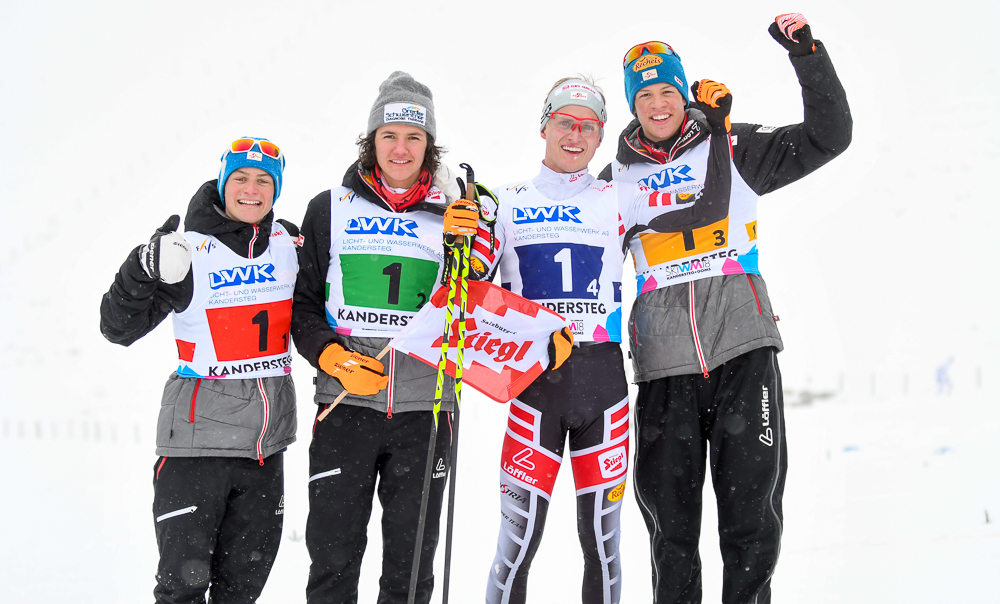
    The Austrian team (from left to right: Johannes Lamparter, Florian Dagn, Dominik Terzer, and Mika Vermeulen) celebrates its win in the normal hill/4 x 5 k team event on Thursday at 2018 Nordic Combined Junior World Championships in Kandersteg, Germany. (Photo: JWSC2018.ch)

    Nordic Combined Junior World Championships  (Kandersteg, Switzerland): Normal hill/4 x 5 k Team Event

    In the nordic combined team event at Junior World Championships on Thursday, Austria stole the show, jumping to first then finishing the 4 x 5 k relay first by nearly 48 seconds over Germany in second.

    On the 106-meter normal hill in Kandersteg, Austria’s Johannes Lamparter, Mika Vermeulen, Florian Dagn, and Dominik Terzer combined for the best jumping score of the day, 11.8 points ahead of Norway (Simen Kvarstad, Andreas Skoglund, Jens Lurås Oftebro, and Einar Lurås Oftebro) in second. Germany jumped to third with Constantin Schnurr, Julian Schmid, Tim Kopp, and Luis Lehnert another 26 points back.

    That put Norway 16 seconds back for the start of the 4 x 5 k relay, and Germany 50 seconds out of first in third.

    The four Americans in the event, Tucker Hoefler, Jared Shumate, Stephen Schumann, and Ben Loomis, jumped to 11th out of 13 teams, and started the relay 2:46 minutes back.

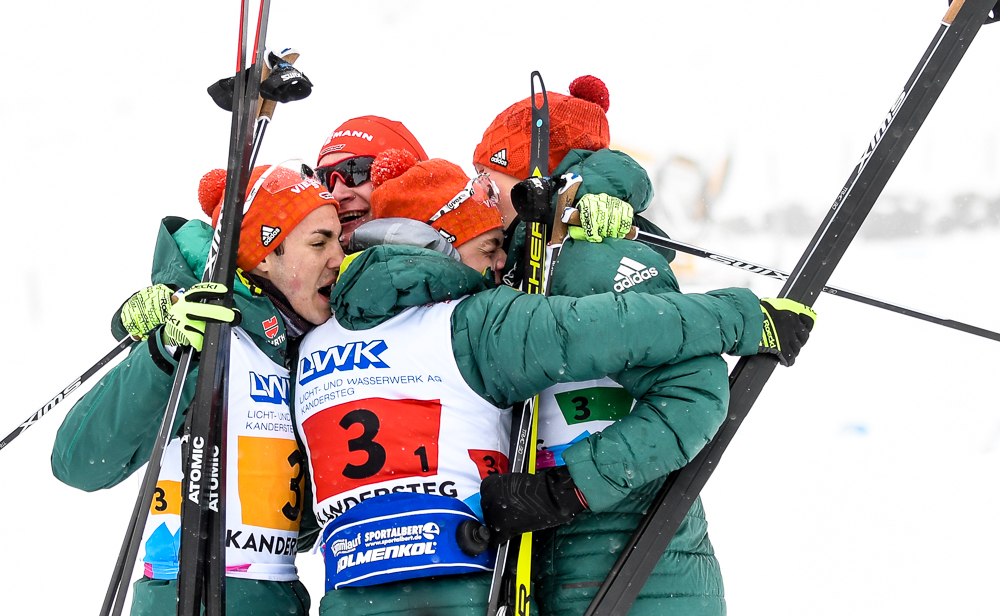
    Germany celebrates its silver medal in the normal hill/4 x 5 k team event on Thursday at 2018 Nordic Combined Junior World Championships in Kandersteg, Germany. (Photo: JWSC2018.ch)

    Austria went on to hold its lead throughout the race, crossing the finish line first in 56:33.0 for the gold. Norway held onto second first Jens Oftebro’s first leg, then slipped to second behind Germany on the second leg. Ultimately, Germany claimed second, 47.8 seconds back, and Norway was third (+1:53.2).

    The field remained largely strung out, as the Czech Republic finished fourth (+2:39.7) after starting fourth, France placed fifth (+3:07.7), up from eighth at the start, and Finland finished sixth (+3:27.6), after starting ninth.

    The U.S. men improved to seventh (+3:36.4) thanks to a strong first leg from Loomis, who put them in seventh with the fourth-fastest first-leg time. Schumann then skied the fastest second leg and picked off two more places to tag in fifth at the second exchange. Hoefler slipped to seventh on the third leg, and Shumate held them there with the third-fastest anchor leg.

    Nordic combined has one more event at Junior Worlds: the individual normal hill/5 k on Saturday.

    Results: JumpingFinal

  • Packing Ski-Speed Punch, Fletcher Brothers Aim to Lock Up PyeongChang

    Packing Ski-Speed Punch, Fletcher Brothers Aim to Lock Up PyeongChang

    Bryan Fletcher (USA Nordic) jumping at the Nordic Combined World Cup last Sunday, Dec. 17, in Ramsau, Austria. After jumping to 45th in the provisional round on Friday (Sunday’s competition round was cancelled midway through), he skied the third-fastest time in Sunday’s 10 k to finish 14th overall. (Photo: Romina Eggert/USA Nordic Facebook)

    On Dec. 30, the nordic-combined community will gather in Park City for the U.S. Olympic Team Trials, a one-and-done event which will dole out an Olympic berth for the race winner. As they have for much of their professional-sport careers, brothers Bryan and Tyler Fletcher are eying the same prize.

    Bryan Fletcher was ranked 34th on the World Cup last season. His best individual results during the 2016/2017 World Cup calendar were an 11th and 18th place.

    This past weekend in Ramsau, Austria, Bryan, the older of the Fletcher brothers, came through with a seventh place on Saturday, Dec. 16, for his best individual result in nearly two years.

    “The opportunity was there,” Bryan, 31, said on the phone from Utah this week. He explained that the jumping hill in Ramsau is smaller than the hill used for the opening weekend in Ruka, Finland.

    “Ramsau is one of those hills where everybody tends to jump a little bit closer. That was the first thing that was really helpful there,” he said. “The second thing was definitely that I jumped on a little bit higher level than the previous weekends. … I was able to put together a little bit better jumps and on a more consistent basis. As a result I was able to put myself in the fight in the race.”

    Bryan jumped to 28th, yet scored 110.5 points, while the best jumper, Taihei Kato of Japan, scored 125.9 points — not a massive gap when considering the Fletchers’ skiing speed. That 15.4-point differential put Bryan 1:02 minutes behind Kato at the start of the 10 k Gundersen. When in position after a solid jump, both of the Fletchers can close out a top 20 or a top 10 in the ski.

    But moving through a field of World Cup skiers — Bryan moved up 21 spots in Saturday’s race — is part-art and part-sufferfest.

    Bryan Fletcher (USA Nordic) notched seventh in the Nordic Combined World Cup this weekend in Ramsau, Austria, for his best result since January 2016. (Photo: USA Nordic/Facebook)

    “More these days, the old-school laws of track don’t really apply for us,” Bryan said about passing skiers during the ski portion. “Especially in nordic combined where every place is so crucial and those points are so valuable people don’t want to move over. They know if they move over for you that opens a hole for potentially five to 10 skiers that are in that train to get by.”

    Ramsau’s course remains a link to the past with skinny trails placing a premium on high-risk, high-reward aggressive skiing. Moving to the front when a gap opens or sitting in and sucking a draft can make or break a result.

    “That opportunity pays itself off in the end, that is exactly what happened to me,” Bryan said of his high-octane skiing and thread-the-needle gap finding. “There were several times coming over the top of a hill where I really could have taken the opportunity to tuck into the group and get some rest, but I knew I was going to be log-jammed later down on the course. I would take the risk and get to the front of the group and that would get me a clean opportunity to get up the next hill or through the choke point unscathed. There were definitely times where I was going up the hill and it was two skiers wide and I was stuck and sitting behind everybody and you just have to wait for a hole to open up and just be patient and take that rest as it comes. Of course, when it opens you just have to go and don’t look back and move on up.”

    Germany’s Eric Frenzel started the 10 k race in third and took the win in 24:17.8, while Bryan finished 32.6 seconds back in seventh after skiing the second-fastest time of the day.

    On Sunday, another German, Fabian Rießle, stood on top of the podium after jumping to ninth and rising to first in the 10 k, finishing in 26:12.5. The weather conditions were unsettled for Sunday’s jump competition, yet both Fletcher brothers posted solid results on the hill before the competition round was halted and ultimately cancelled. As a result, competition results did not count, and jumps from Friday’s provisional round were used instead to determine time back for the ski.

    Bryan began the ski 1:30 minute back with the 45th-ranked provisional jump, while Taylor bagan the ski 2:53 minutes back after jumping to 58th, just ahead of teammate Adam Loomis in 59th.

    Taylor Fletcher (USA Nordic) jumping at the Dec. 17 World Cup in Ramsau, Austria. After ranking 58th in the provisional jump on Friday, he picked off 24 places to finish 34th in the 10 k on Sunday. (Photo: Romina Eggert/USA Nordic Facebook)

    Fast skiing by the Fletchers was once again on display on Sunday. Bryan raced up to 14th (+43.7) with the third-fastest time of the day while Taylor improved a whopping 24 positions to finish 34th (+2:01.6) with the second-fastest time of the day. Loomis moved up seven places to place 52nd (+4:38.6) out of 55 finishers.

    “Those major ski efforts begin in May, with the intensity over the summer — that all gets you to a place where you are able to sustain efforts like that,” Taylor Fletcher said on the phone. “I love pushing myself. Every year when we do a VO2max I am excited about it. Because I want to go until I absolutely cannot go. It is the same with racing. Our races should be slightly faster than our threshold-plus intervals that we do. We have done a good job with that. And this past weekend it was snowing and I love racing when it is dumping snow. You have to be a strong skier for sure.”

    When the jumping round was cancelled on Sunday, Taylor had to refocus as the jump that wouldn’t count for his ski seeding would have positioned him for a top-20 strike. Instead, his preliminary jump from Friday put him at the back of the field.

    “My position drastically changed over the course of the 30 minutes that they decided to cancel the competition round,” Taylor Fletcher explained. “I wanted to try to get points no matter what. I went as hard as I possibly could for the entire race. There was not a spot where I could really settle and say I could have made up 20 seconds there and finished in the points. It’s hard to go through the field like that. When you are racing from 58th to try to get into the top 30, you are passing 28 guys, and Ramsau is a very narrow course … maybe if I could get around them quicker, then maybe they would have blown up earlier and fallen back even more. It takes a little bit of strategy and a lot of nerve and a lot of commitment to be able to push through and catch those guys and pass them and drop them.”

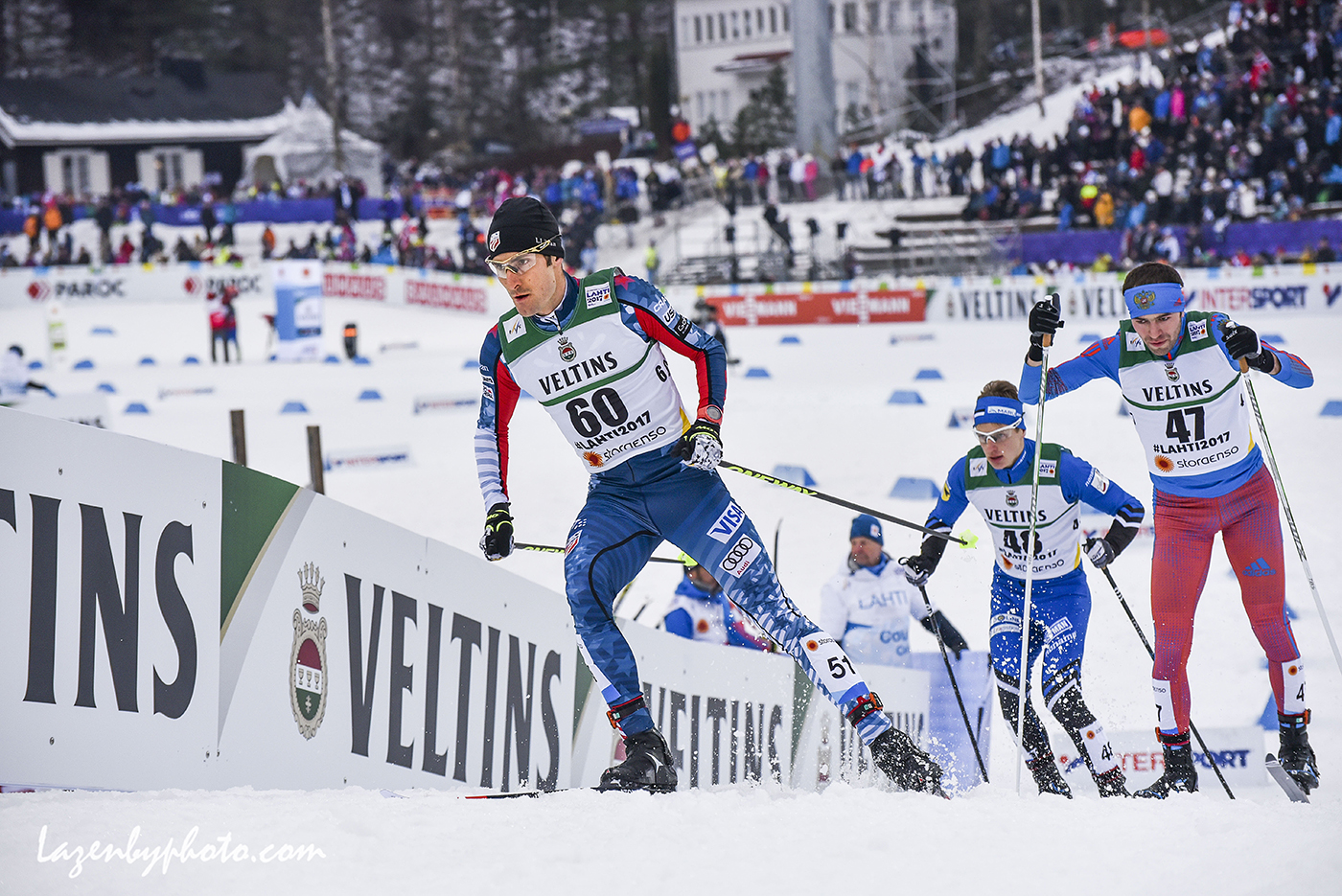
    American Taylor Fletcher (60) racing to 36th last March after starting 51st in the individual large hill/10 k Gundersen race at 2017 World Championships in Lahti, Finland. (Photo: John Lazenby/Lazenbyphoto.com)

    Let’s put this out there as it’s no mystery to any fan of the sport or any World Cup nordic-combined athlete: having a Fletcher chasing from behind can be a gamble if you don’t gun it. As the Olympic trials approach both Bryan and Taylor know their ski shape is good.

    However, when asked to summarize his World Cup Period 1, Taylor was straight to the point.

    “Pretty bad to be honest,” Taylor said. “Looking back after the summer and all the work, I was confident I could get off to a decent start in points and fight for points. I wasn’t worried about qualifications or anything but I was definitely bummed when I found myself struggling pretty badly with the jumping. But that being said, it was only one aspect. I mean everything else was good. Cross-country is obviously solid. My strength and power and speed in terms of the jumping is there, it’s just more mental — the mental approach I was taking to the jumping. I was trying to be almost be too perfect and trying to really get these good jumps in and really focus so much on certain aspects of the jump, I was forgetting about the whole bigger picture in a sense.”

    In the short term, Taylor is focused on winning the lone competition at Olympic trials on Dec. 30 and improving his results in the new year.

    “My goal right now is to win on the 30th, win the Olympic trials here and that way I can completely forget about a qualification spot and I can go out there and focus on my training and focus on the individual competitions,” Taylor said. “And then move forward and focus on the next step as we get towards the Olympics. Honestly, I think I am all right. … And hopefully the team can also step up and we can guarantee that we have four spots on the Olympic team so we can have a team event, hope for sure that we have four so we can represent the U.S. at the Olympics.”

    Bryan, along with the entire who’s who in U.S. NoCo, will be honing for the shoe-in Olympic spot on the 30th. According to USA Nordic’s selection document, after the lone spot is secured at the trials, any remaining spots can be nominated using discretion with the potential for Olympic success as the guiding principle. In total, the U.S. is allotted a maximum of four spots for the PyeongChang Games. If discretion does not fill the quota, then the first step on the selection hierarchy are top-10 results from the World Cup between Nov. 15, 2017 and Jan. 22, 2018.

    Currently, only Bryan meets that standard thanks to his seventh place in Ramsau.

    “I think I have made the objective criteria to go, but nothing is set in stone until the qualification ends or Olympic trials are won,” Bryan said. “That will be the first guaranteed spot on the team; Olympic trials. There are a lot of eyeballs on that. A lot of guys on the team are going to be vying for that spot.”

    Ramsau results: Day 1 | Day 2

  • Guided Trip to Seefeld for 2018 World Cup, Proceeds to Benefit NNF

    (Press release)

    The NNF and Lumi Experiences are partnering to offer a trip to the 2018 cross-country and nordic combined World Cup competitions in Seefeld, Austria. On this 11-day trip, designed by Olympian Garrott Kuzzy, we will ski in the Alps, cheer on our favorite athletes at the World Cup competitions and relax in three- and four-star hotels. Travelers will also have the opportunity to participate in the Dolomitenlauf Worldloppet!

    Olympian and past US Ski Team athlete Garrott Kuzzy has over five years of experience developing skiing, biking, and hiking tours throughout Europe. He currently lives in Innsbruck, Austria and has developed this trip in his new backyard. As a former US Ski Team athlete, Kuzzy is partnering with the NNF to benefit developing US athletes. Proceeds from the trip go to funding NNF programming.

    Scheduled for January 19 – 29, 2018, the trip is limited to 16 guests and priced at $3,900 per person (not including airfare) if reserved before March 31. For more information and to sign up, go to: www.lumiexperiences.com.

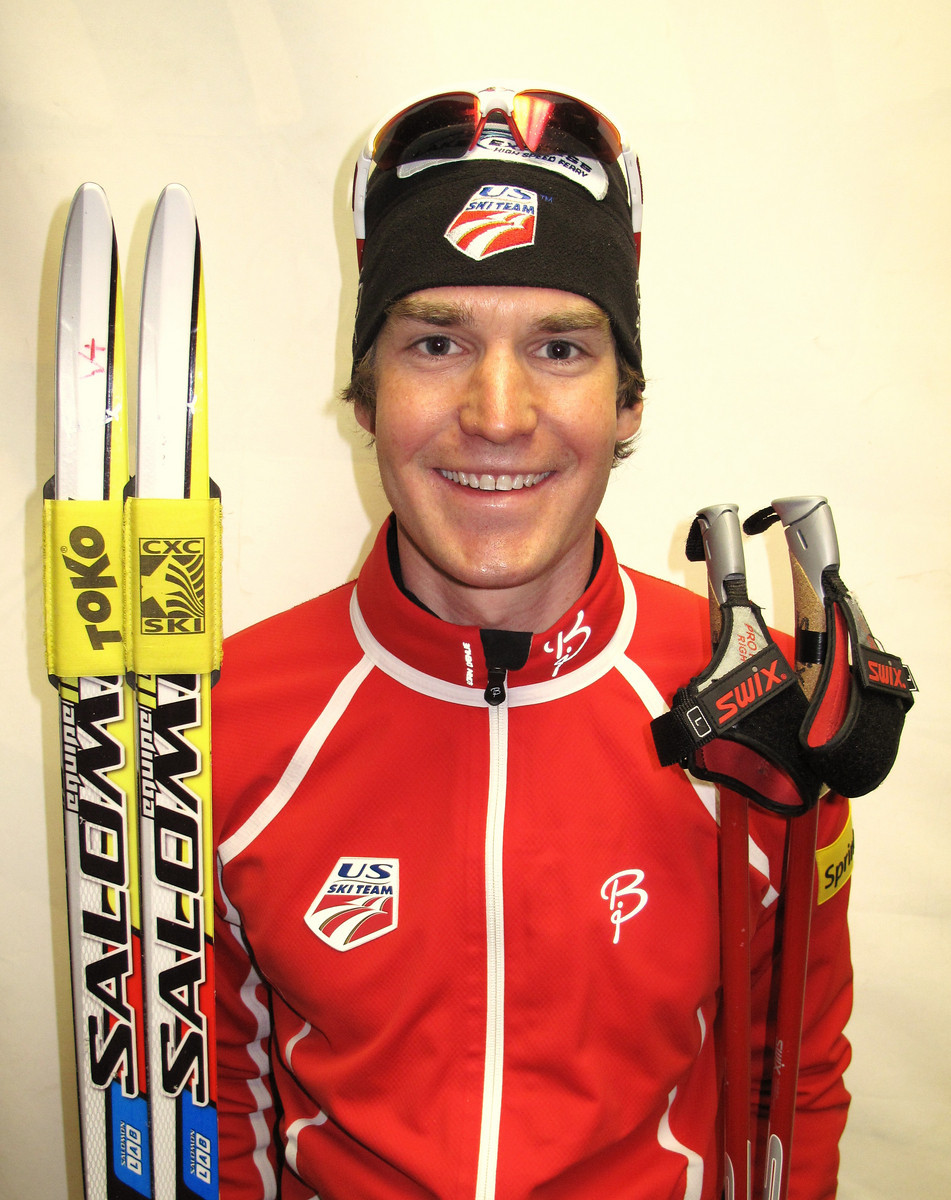
    Garrott Kuzzy, 2010 U.S. Ski Team Member (Photo, U.S Ski Team)

  • Germany’s Doll Takes First Win, a World Champs Gold; Seven North American Men Into Pursuit

    Germany’s Doll Takes First Win, a World Champs Gold; Seven North American Men Into Pursuit

    Benedikt Doll of Germany has never won a World Cup — but he did take World Championships gold on Saturday in the men’s 10 k sprint in Hochfilzen, Austria. “In the end, there was the fight with Johannes [Bø]… I thought Johannes will make it. It was crazy in the end that it was me on the top,” he said at a press conference. (Photo: Glen Crawford)
    HOCHFILZEN, Austria—On a day when the wind seemed like only a flutter, it could still throw the World Championships biathlon field into disarray.

    Take Martin Fourcade, the best biathlete in the world this year. He missed two shots out of ten: one in prone, and one in standing.

    “When I crossed the finish line, I expected to be top ten,” the Frenchman said in a press conference. “Then when I saw the race I expected for top five.”

    He ended up third – a pleasant surprise.

    Ten men shot clean, and four of them landed in the top six. Benedikt Doll of Germany claimed his first top-level win – at World Championships, no less, and by just 0.7 seconds over Norway’s Johannes Thingnes Bø. Both shot clean and were late starters; the race came down to whether or not Bø could keep a 9.3-second lead over Doll on the final 3.3 kilometers. He couldn’t.

    The men’s 10 k sprint podium at 2017 IBU World Championships, with German winner Benedikt Doll (c), Norway’s Johannes Thingnes Bø (l) in second, and France’s Martin Fourcade (r) in third. (Photo: Glen Crawford)

    “It’s not so fun to go out of standing as the leader and lose seconds and be number two at the finish,” Bø said. “Especially when it’s that close… I did a quite good race and I was really fighting on the last loop. The last two kilometers I was really fighting deep. My head wanted to win today, but my legs couldn’t follow the head. That’s why I was in second place.”

    Doll, meanwhile, had seen Fourcade (bib 4) finish before he even started. Knowing that he had two penalties in hand, Doll saw his chance.

    “I know that if I can make a perfect race, I can win,” he said. “The whole season I had always problems with my shooting. So I had really good feeling at the zeroing, especially standing shooting, I felt really sure… After the fourth shot in standing, there comes something in my mind that says, if you make a clean shooting you maybe will get to be World Champion. I hit the last target. I think that was one of the best moments today.”

    Fourth place went to a clean-shooting Lowell Bailey of the United States, who had focused on process over results, and along the way snagged the second-best finish ever by a U.S. biathlete at the Championships.

    “This year I have really tried to step back from worrying about where I end up on the result list and focus on the quality of what I’m doing, both in shooting and skiing,” he said. “Today I went out and really tried to execute the technique that I wanted to execute. And also on the range, to do what I have been training on the range all year to do. Some days it doesn’t work, and today it worked.”

    The top finish for the home team went to Julian Eberhard, who placed seventh (+35.5) despite two penalties.

    Three in the Points for Canada

    Much like Fourcade, Canada’s top finisher Scott Gow had two penalties and was relieved that much of the rest of the field struggled as well. He landed 25th, +1:22.4, for the second-best World Championships finish of his career.

    “I was definitely disappointed,” Gow said of the missed shots. “But I knew that if I wanted to be in the pursuit or have a good result I had to go extra hard. So that was my motivation… It’s a solid result, to be honest. I’m really lucky that everyone else also missed today. Martin is winning [right now] with two misses. So I’m in the same ballpark as the top part of the field, which is good. Because otherwise I’d probably be close to the [top-60 pursuit qualification] bubble.”

    Gow attributed the misses to nerves, saying it was “all me” and not the tricky wind.

    “I was just too much inside my own head for the first shot — I just pulled it,” he explained. “Then the rest of the five were fine. Then I had the opposite in standing, where the first four were great, and I just tensed up and missed the last one… My sprint racing has been quite strong, especially in the first trimester where I cleaned every sprint. I was trying not to think about that and just do what I did in those races, but at an event like this the pressure is extra high.”

    Canada’s Christian Gow racing to 32nd in the men’s 10 k sprint at 2017 IBU World Championships on Saturday in Hochfilzen, Austria. (Photo: Glen Crawford)

    His brother, Christian Gow, did clean all ten targets and landed 32nd (+1:30.6).

    “I shot clean, obviously a big advantage,” the younger Gow said. “It looks like the field isn’t shooting so well, so that’s important. Skiing wasn’t exactly where I’d like it to be. I felt like I pushed really hard and left it all out there, but I’m not sure why.”

    All in all, he said, he was satisfied with the race: “I just went out and did what I could, and I’m happy to be here and happy to have done that.”

    Team veteran Brendan Green will join the brothers in the pursuit after finishing 38th (+1:36.4) with one penalty. Green was disappointed with his skiing as well.

    “The skiing, it just hasn’t been there this season,” he said. “I tried my best. I gave it my all. But for sure I was hoping for more.”

    Macx Davies, who finished 79th (+2:53.4) with two penalties, agreed: “It has been hard finding my legs this season.”

    For the Canadian team, it will be back to the drawing board to try to regain speed before next season’s Olympics in PyeongChang, South Korea.

    “It’s hard,” Green admitted. “I have been trying to take it trimester by trimester. At this point of the season I’m just trying to ride out the season and do the best that I can. Once we’re back home, we are definitely going to sit down and evaluate and see where things might have gone wrong.”

    U.S. Team Solid Behind Bailey’s Fourth Place

    While Bailey’s flower-ceremony appearance highlighted the U.S. results, all four starters made the top 40. That’s easily under the top-60 cutoff to appear in Sunday’s pursuit.

    Leif Nordgren placed 26th (+1:24.3) with one missed shot. After injuring his toe in an accident in November and missing almost the entire first period of World Cup racing, as well as part of the second, Nordgren said the result was just fine.

    “The one miss I had was a really bad one, so I’m kind of pissed about that,” he said. “I tried to take my time and make sure that all the shots were quality. Nine of them were, one of them was not. [On skis] I actually felt good. It has been kind of an interesting year for me with the whole toe thing, so I don’t have that many races yet… I’m not unhappy with where I am right now. What happened happened and I can’t really change it now. I can just do my best.”

    Sean Doherty had also missed more than half the World Cup season to date, thanks to mononucleosis. He missed two shots in prone and finished 39th (+1:37.7).

    Right behind him was Tim Burke, who missed two shots in standing to finish 40th (+1:38.6).

    “I just got out of rhythm trying to get that second shot,” he said.

    Like some of the Canadians, Burke has been working to find his ski speed. It didn’t show up today, at least not the way he wanted it to.

    “I have no idea,” he admitted about his skiing. “I’ve been feeling good training, I’ve just felt really flat so far racing this, pretty much this entire year. I don’t know what’s going on… I had to take a break after the first few days of the [pre-Championships] training camp because I felt so bad. Not sick, I felt totally healthy, just really really flat. So I really only had about a week preparation. I was hopeful – I had a few sessions where I felt like, oh, maybe it’s coming back. But I haven’t felt that yet in a race.”

    For seven of the eight North Americans, though the pursuit will be a chance to see if head-to-head racing can bring the fire. 15th and 55th place in the sprint were separated by one minute; the opportunity to move up in the field is huge.

    And if anything was proven in the sprint, it’s that shooting well could mean a lot.

    “Even on a day like today where it seems like it’s pretty calm, the shooting is really challenging,” Burke said. “Especially in prone. So I’m hopeful that I can get something going tomorrow. Just being around other people, being able to ski with other fast guys — maybe that can help me find the rhythm a little better.”

    Results

    Norway’s Johannes Thingnes Bø (l, on ground) after finishing second in the men’s 10 k sprint at 2017 IBU World Championships in Hochfilzen, Austria. (Photo: Glen Crawford)

  • Kazakhstan Team Raided in Doping Investigation at Biathlon Championships

    Kazakhstan Team Raided in Doping Investigation at Biathlon Championships

    Kazakhstan's Galina Vishnevskaya on her way to winning the pursuit at 2014 IBU Junior World Championships. Vishnevskaya is not a member of the senior national team which is being investigated for doping. (Photo: Katrina Howe)
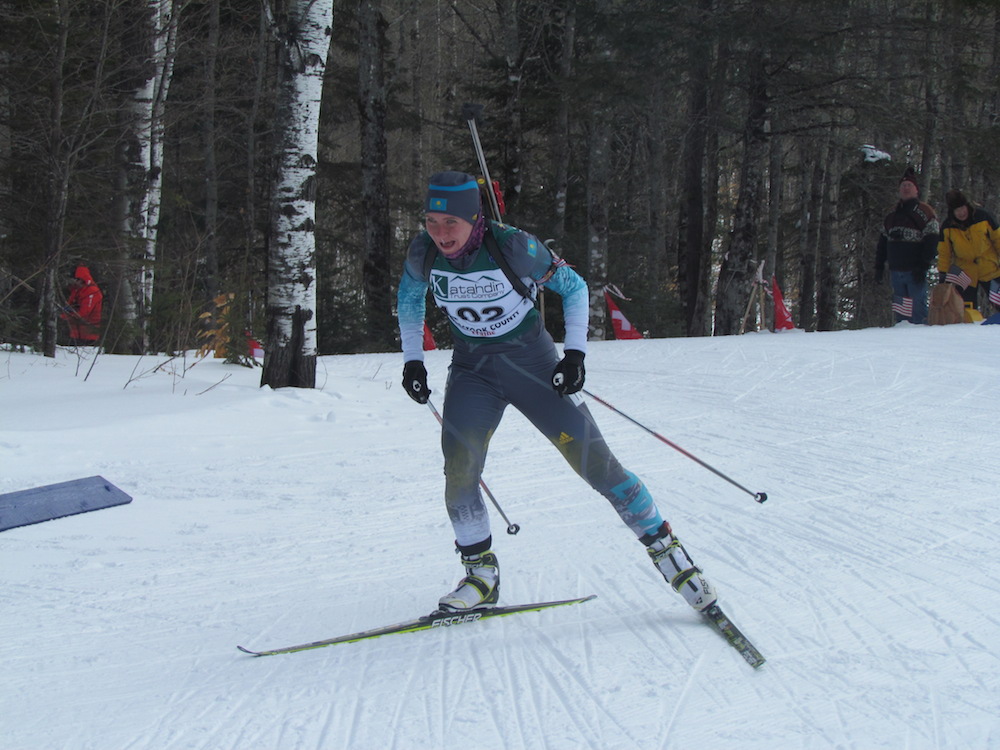
    Kazakhstan’s Galina Vishnevskaya on her way to winning the pursuit at 2014 IBU Junior World Championships in Presque Isle, Maine. Vishnevskaya is not a member of the senior national team which is being investigated for doping. (Photo: Katrina Howe)

    Austrian police raided the lodgings of Kazakhstan’s national biathlon team outside of Hochfilzen, Austria, on Thursday morning. The Kazakh team is there to compete at World Championships, where they finished 11th in the opening competition, a mixed relay, later in the day.

    “Numerous medical devices and medications were seized,” the Criminal Intelligence Service of Austria wrote in a statement translated by the International Biathlon Union. “The investigations are still underway.”

    Apparently, a month ago someone spotted a minivan of people tossing a cardboard box in the trash at a gas station in another part of Austria. Team accreditations in the box linked it to the Kazakh squad, and the other items were alarming: according to the Associated Press, it contained needles, materials for infusions, and ampules of medicine, along with written notes indicating that doping was taking place.

    “We are not worried,” Manas Ussenov, the Secretary General of the Kazakh Biathlon Association, said according to the BBC. “They found in the room of our doctor some medicine. But according to our doctor, we have all the documentation for these medicines.”

    On Thursday, 30 police personnel descended on the hotel in Hochfilzen and collected medicine, equipment, and cell phones from the Kazakh team. After the mixed relay all the team members were given anti-doping tests.

    Austria has strict criminal laws about doping, which is part of what spurred the police investigation.

    “We fully trust the investigations by the authorities,” International Biathlon Union Secretary General Nicole Resch told the AP. “Until now, we don’t know if banned substances or banned methods are involved. Only then we can take measures.”

    The team is not suspended at the moment.

  • Four-Year Ban For Wurm, Who Admits Doping; Used Cobalt to Boost Performance

    Four-Year Ban For Wurm, Who Admits Doping; Used Cobalt to Boost Performance

    Austrian skier Harald Wurm was a crowd favorite at the December, 2012, World Cups in Canada, where he finished a sprint heat despite breaking a binding off his ski.
    Austrian skier Harald Wurm was a crowd favorite at the December, 2012, World Cups in Canada, where he finished a sprint heat despite breaking a binding off his ski.

    Austrian skier Harald Wurm has finally received his sentence from Austrian anti-doping officials, after being under investigation since September and receiving a provisional suspension before the 2015-2016 race season began.

    At the end of his hearing this week, Wurm was suspended from competition for four years. According to the Austrian newspaper Salzburger Nachrichten, Wurm confessed to doping.

    “I have used banned substances for myself,” he said.

    Wurm is a former Under-23 World Champion and competed in two Olympics. Now 31 years old, he also admitted that this would be the end of his career.

    Other careers are also in the balance. With Wurm’s teammate and reported best friend Johannes Dürr testing positive for EPO at the 2014 Olympics, Austrian coaches struggled to maintain their credibility over doping issues. Gerald Heigl, the head coach of the cross-country ski team, temporarily stepped down when the Wurm investigation started, but was then reinstated.

    Worm’s four-year suspension was for two violations: first for using cobalt, a substance which is banned when taken as an infusion or injection of over 50 ml over a six-hour period; second, for blood manipulation.

    Cobalt boosts blood’s oxygen-carrying capacity by stimulating erythropoietin gene expression through a pathway called the hypoxia induction factor (HIF), according to the World Anti-Doping Agency, which is funding a project to further examine the method’s effects on performance. Cobalt was specifically added to the WADA Prohibited List as of January 2015, while other substances with similar effects, like xenon and Argon, were added in September 2014.

    Cobalt can be injected or taken orally. A 2005 article in the British Journal of Sports Medicine noted that oral doses of 30 mg/kg of body weight could increase the production of red blood cells. Overuse of cobalt can lead to kidney and heart problems, as well as changes in thyroid function. It has a half-life of less than an hour in the body.

    “It has been known that cobalt increases erythropoiesis in experimental animals,” Dr. Wolfgang Jelkmann of the University of Lübeck, Germany, and Dr. Carsten Lundby of the University of Zürich, Switzerland, wrote in a 2011 paper in Blood Journal. “Cobalt is a very potent inducer of Epo transcription. Indeed, the international Epo unit (IU) was originally defined as the dose eliciting the same erythropoiesis stimulating response in rats as 5 μmol of cobaltous chloride.”

    The initial police investigation in September had found a hemoglobin meter, used to monitor blood parameters. The distribution of performance-enhancing substances is illegal in Austria. Wurm settled the criminal charges by paying a fine of 2,000 Euros, the Associated Press reported.

  • Germany’s Back: Women Sweep Podium in Hochfilzen Biathlon Sprint

    Germany’s Back: Women Sweep Podium in Hochfilzen Biathlon Sprint

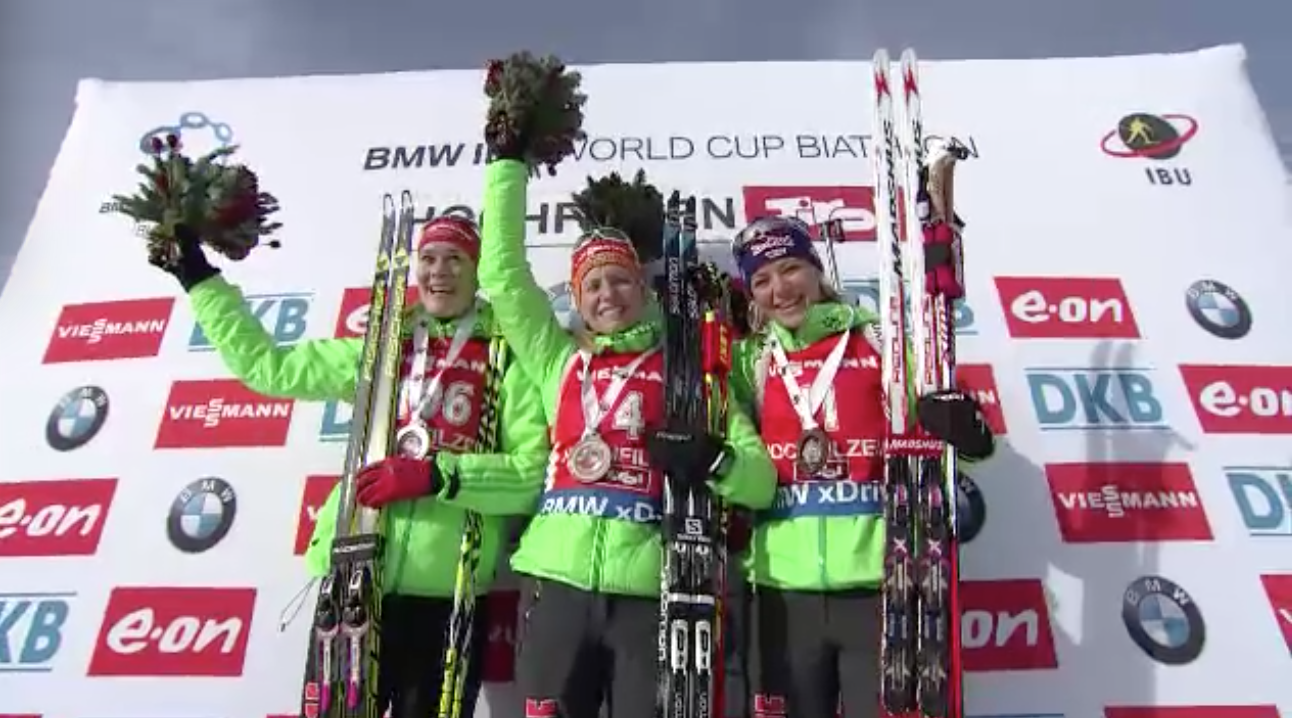
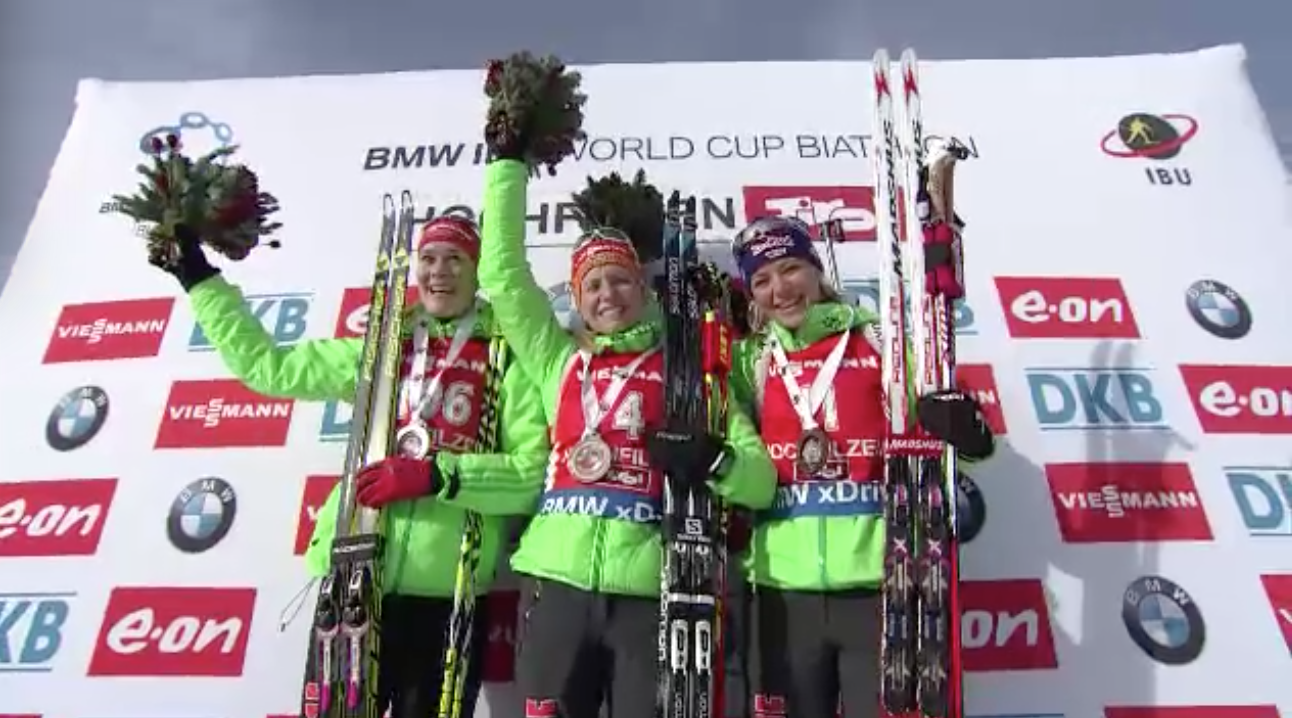
    Franziska Hildebrand (center) claimed the first win of her career, while teammates Maren Hammerschmidt (left) and Miriam Gössner were thrilled to join her on the sprint podium in Hochfilzen. It was the first German podium sweep in four years.
    Franziska Hildebrand (center) claimed the first win of her career, while teammates Maren Hammerschmidt (left) and Miriam Gössner were thrilled to join her on the sprint podium in Hochfilzen. It was the first German podium sweep in four years.

    The relay hasn’t even happened yet, but after one day of racing in Hochfilzen, Austria, it’s clear which women’s team is on top of the biathlon world: at the moment it’s Germany, which pulled off a remarkable podium sweep in the women’s 7.5 k sprint.

    It’s hard to say which member of that sweep was happier. Was it Franziska Hildebrand, who has led the team on many occasions but collected her first World Cup win today with clean shooting and a 15-second cushion to second place?

    “I went on the first loop and thought ‘oh somehow my legs are heavy’,” Hildebrand told Germany’s ARD television crew. “I didn’t even feel that springy. When I heard on the first split time that it was alright, I thought ‘okay, it might feel bad, but somehow it seems to work well’. And then on the last lap I felt good again, my legs could still give something, and then I was overjoyed when I was leading in the finish.”

    Hildebrand was one of the very first starters, in bib four. In the finish she raised her arms after catching her breath, sensing that she had done very well, but still was not sure what her performance would be worth with so many athletes still left to even start the race.

    So when the win was secured and Hildebrand stepped onto the podium, she was beaming.

    But second-place Maren Hammerschmidt seemed just as happy.

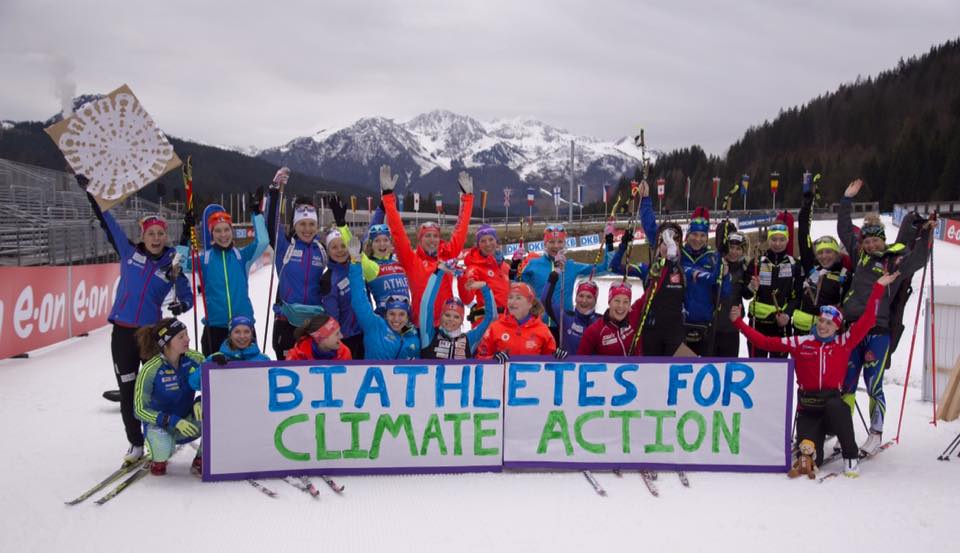
    With green grass on the shooting range infield and on the side of the trail, biathletes organized by Hannah Dreissigacker and her U.S. teammates called for action at the Paris climate change conference: they hope they won't continue to see less and less snow every winter. (Photo: Manzoni, NordicFocus/ US Biathlon Women Facebook).
    With green grass on the shooting range infield and on the side of the trail, biathletes organized by Hannah Dreissigacker and her U.S. teammates called for action at the Paris climate change conference: they hope they won’t continue to see less and less snow every winter. (Photo: Manzoni, NordicFocus/ US Biathlon Women Facebook).

    The second-to-last starter of the day, Hammerschmidt shot a clean race. Her coaches yelled split times as, all alone, she pushed hard up the final climbs and through a ski tunnel into the stadium, then crossed the line in second place.

    Unlike Hildebrand, she didn’t need to wait to see if anyone else would dethrone her. This was real. With an incredulous look on her face she checked the video screen, before finally raising her fists to the fans, with many giving her a standing ovation.

    Hammerschmidt has done less than a dozen World Cup race in her entire career, but the 26-year-old started the season off right with a third-place finish in the single mixed relay in Östersund, and has been building from there.

    “Today everything fit together,” she told ARD.

    And her family was even there to watch her get her first podium

    “It’s an unusual situation (for me) with so many spectators,” she said. “My family is here, I talked to my father before the race so that we will meet up. Maybe this will now take a bit longer. I am just happy that so many people came (to cheer), I have never run in front of such an audience, this is just cool.”

    And the third gleeful member of the podium? Miriam Gössner. Even younger, Gössner was a shooting star early in her career, competing in the cross-country relay at the 2010 Olympics where Germany won silver.

    After winning three biathlon World Cups in 2013, Gössner seemed poised to replicate that success in biathlon at the 2014 Games. But a training accident led to a serious back injury and she could barely compete at all in 2014. She missed the Games and had a rough 2015 season as well.

    Susan Dunklee of the U.S. biathlon team snuck into the pursuit with a 53rd place finish, making up for four penalties with fast skiing on the tracks. (Photo: US Biathlon / NordicFocus)
    Susan Dunklee of the U.S. biathlon team snuck into the pursuit with a 53rd place finish, making up for four penalties with fast skiing on the tracks. (Photo: US Biathlon / NordicFocus)

    After qualifying again for the first German national team this fall, her comeback now got rewarded with her best World Cup result since the 2013 season. Today, Gössner – a huge star and something of a celebrity personality – was back. She missed just one shot and skied the fourth-fastest course time to claim a spot on the podium.

    “There were highs and lows, it was not easy, but in the end the fighting was well worth it,” she told ARD of her time with injuries.

    Typically a dominant skier who sometimes struggles on the range, Gössner focused on her shooting on Friday.

    “Definitely, it was important to me to get through the shooting alright,” she told ARD. “I skied a tactical race not really going all-out at first in order to still have some power on the last round, and I think that worked out for me. This is an easy track, so you really have to shoot well.”

    Germany has long been strong in women’s biathlon, but this was the team’s first podium sweep since February 2011.

    “We have a great atmosphere in the team,” Hammerschmidt told ARD.
    It’s just wicked cool.”

    Anais Bescond of France placed fourth, +23.4, and newcomer Lucie Charvatova of the Czech Republic fifth +24.6. And Germany’s Laura Dahlmeier finished sixth, giving the team even another finish to celebrate.

    It was a remarkable breakthrough for the young Czech.

    “Of course I’m really happy because I’m not so good a shooter,” the 22-year-old – who has competed in even fewer World Cups than Hammerschmidt – told Biathlonworld in a video interview. “I’m surprised…. I did cross-country skiing. I started biathlon two years ago. It’s a short time to do so well. I’m really happy.”

    But few could focus on anything other than Germany.

    “I don’t train directly with those girls but sweeping the World Cup podium is obviously no easy feat so – wow, respect!” Megan Tandy, a Canadian who is based in Germany, wrote in an email.

    Tandy’s team wasn’t as happy with their handiwork. Tandy herself finished 56th with two penalties (+1:52) – inside the cutoff for the pursuit, but not what she had been looking for.

    “It was all around mediocre, nothing was literally a disaster but I am not too happy either,” she wrote. “I was pretty mad at myself for missing my first standing shot today – it doesn’t happen very often, but I pulled the trigger before I was ready. I was not seeing the target when I accidentally let the shot go. I am glad that I was able to stay relaxed and be super controlled for the next 4 shots though – I really needed to hit those!”

    Teammate Rosanna Crawford wrote that “Ski speed just doesn’t seem to be there for me right now,” but she also crashed and lost time, leaving her in 39th (+1:24) place despite having just a single penalty.

    The race course was only a thin band of snow meandering through an otherwise completely green Pillersee valley. The manmade snow had frozen hard overnight, giving corners an icy base with loose corn snow on top. It wasn’t a good combination – and with a steep dropoff from the snow down to the grass below, skiers were wary of mistakes.

    “The corners were pretty sketchy on two downhills!” Crawford wrote. “I did fall on my last loop. I was coming down the shorter downhill with a Swedish girl and she snow ploughed, so then I went into a skid and hit an ice patch and fell on my bum. With the loss of speed into the uphill and just how your legs feel after a crash I think I probably lost 20-25 seconds. Which is too bad. I would have been much happier with todays race had I avoided falling!!”

    Julia Ransom finished 54th with one penalty and will join Crawford and Tandy in the pursuit, while Emma Lunder missed five shots and ended up 101st.

    The Americans were also left wanting more. Susan Dunklee was the lone team member to qualify for Saturday’s pursuit, slotting in just ahead of Ransom in 53rd with four missed shots.

    Annelies Cook narrowly missed the top-60 cutoff, finishing 65th (+2:04) with two penalties, while Clare Egan finished 83rd (+2:36) and Hannah Dreissigacker 99th (+3:38).

    The women are hoping for better snow conditions and fewer crashes in the future: led by Dreissigacker and her team members, athletes from several countries had taken a stand in training and posed for a photo with a placard reading “Biathletes For Climate Action” to urge a resolution at an ongoing summit in Paris.

    Two weeks ago several of the world’s best cross-country athletes had staged a similar call for action in Kuusamo, Finland.

    Results

  • Former U23 Champion Wurm Under Investigation for Blood Doping by Austrian Police

    Former U23 Champion Wurm Under Investigation for Blood Doping by Austrian Police

    Harald Wurm of Austria finished 15th in the skate sprint World Cup in Canmore in 2008 (pictured here), and eighth in the same event in 2012. (Photo: Patrick Sinnott)
    Harald Wurm of Austria finished 15th in the skate sprint World Cup in Canmore in 2008 (pictured here), and eighth in the same event in 2012. (Photo: Patrick Sinnott)

    Austrian cross-country skier Harald Wurm is the target of a criminal investigation about doping, according to Austrian news sources.

    Wurm, a 31-year-old who was the U23 World Champion in the sprint back in 2006, represented Austria in the 2006 and 2014 Olympics. He has four individual World Cup top-10’s to his name, most recently in the pre-Olympic World Cup in Sochi in 2013.

    Wurm has not commented on the situation. As of Monday the Austrian Ski Federation (ÖSV) had been aware of the scandal, but not officially informed by authorities. It appears that the investigation is headed by police, not the national anti-doping agency (NADA).

    “NADA has been informed about the case and is in close cooperation with the investigating authorities,” spokesman David Müller told the media, according to Der Standard, a prominent independent newspaper based in Vienna.

    In Austria, distributing performance-enhancing drugs is an illegal activity subject to anti-fraud laws. That’s why the police seem to be leading the investigation in this case.

    Prosecutors have not publicly commented on the case. The fact that an investigation is ongoing was leaked by an anonymous letter to the Tiroler Tageszeitung newspaper.

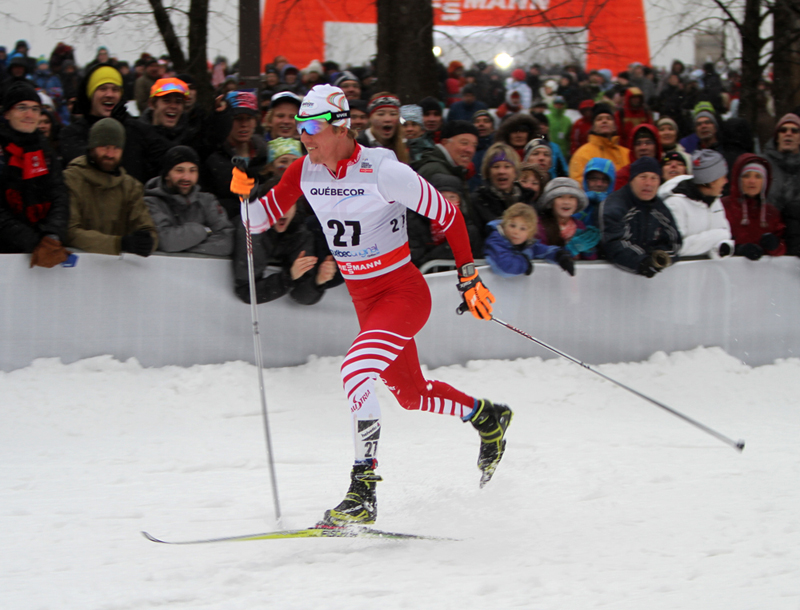
    A crash in the quarterfinals of the sprint in Quebec City in 2012 ripped Wurm's binding off his ski. He finished the lap regardless, earning him claps from the crown.
    A crash in the quarterfinals of the World Cup sprint in Quebec City in 2012 ripped Wurm’s binding off his ski. He finished the lap regardless, earning him cheers from the crowd.

    ÖSV Sport Director Hans Pum told Oberösterreichische Nachrichten that there had been searches of Wurm’s house, and that Wurm had taken a lawyer.

    “It is in our interest that everything is cleared up,” he said. “If it turns out that is there been something, then it is the same as in the past, and we will crack down.”

    For his part, Markus Gandler, the director for cross-country skiing of the ÖSV, told Oberösterreichische Nachrichten that he was “waiting for results”.

    Oberösterreichische Nachrichten reported that a hemoglobin meter had been found, but wrote that this was not evidence of doping. If more materials are found, however, Wurm may be in trouble. The World Anti-Doping Agency code prohibits possession of blood transfusions or any other method to increase the oxygen carrying capacity of blood.

    International Ski Federation (FIS) rules, meanwhile, clearly prohibit possession of any “prohibited method”, according to its 2015 anti-doping code.

    Furthermore, FIS can implement no-start prohibitions if athletes’ blood tests show unusual profiles, according to repeated data collected as part of the Athlete Biological Passport program. Thus the implication of finding a hemoglobin meter is that an athlete may be checking to see whether their hemoglobin levels rise to a level that would suggest doping, or trying to make sure that doesn’t happen.

    Nevertheless, no further reports have emerged showing that Wurm posesses other banned materials, nor has he apparently had a positive doping test. ÖSV officials have said that Wurm is insisting that he can easily clear the allegations.

    Ugly History

    Austrian skiing had been beginning to emerge from the shadow of a huge doping scandal at the 2006 Olympics. There – where Wurm competed – materials for blood transfusions were also found in a raid on athletes’ living quarters; Wurm’s teammates Johannes Eder, Martin Tauber, Juergen Pinter, and Roland Diethart were banned for life by the International Olympic Committee (IOC).

    “If you consider that there were syringes and blood bags lying on the bedside tables in the apartment and blood-soaked handkerchiefs . . . that the haemoglobin metre had been used 59 times in 10 days and you have huge differences between the levels being measured, and that these differences arose just before and just after tests in competitions, you can draw your own conclusions. Multiple athletes were infusing blood from multiple sources.”

    -Thomas Bach, then the chairman of the IOC Disciplinary Committee and now the IOC President, speaking to media at the time.

    Devices for measuring hemoglobin levels were part of those materials. It’s worth noting that the Austrian skiers were tested at the 2006 Olympics, but never found positive for any prohibited substance. Instead, they had been using blood transfusions to increase how much oxygen their blood could carry. And they had been using the hemoglobin meters to make sure that their levels did not exceed those stipulated in FIS’s no-start rules.

    Thus, the fact that Wurm possessed the same type of tool to measure hemoglobin brings up unpleasant memories for Austrian skiing.

    Though nearly 10 years have passed since Torino, doping has not completely receded after the four skiers, plus two biathletes and 14 officials, received bans.

    Johannes Dürr finished the 2014 Tour de Ski in third place, and placed eighth in the Olympic 30 k before being caught using EPO. (Photo: Fischer/Nordic Focus)
    Johannes Dürr finished the 2014 Tour de Ski in third place, and placed eighth in the Olympic 30 k before being caught using EPO. (Photo: Fischer/Nordic Focus)

    At the 2014 Olympics, again one of Wurm’s teammates was caught: Johannes Dürr, who admitted to using recombinant erythropoetin (EPO), a blood-doping drug, for months before the Games and said he had passed 14 blood tests.

    Dürr said that he had obtained EPO himself. And in July, Austrian prosecutors dropped their case against Dürr, concluding that he had not distributed EPO to other athletes. While his ban from sport remains, he thus avoided criminal charges.

    The latest scandal could have big consequences: after the Dürr case, the head of the ÖSV, Peter Schröcksnadel, threatened several times to eliminate the entire cross-country ski program, since it does not seem capable of keeping itself clean.

    Gandler has also thought about retiring. If Wurm is found guilty of doping, even without help from coaches, team doctors, or others within the national team or federation, it would be tough for Gandler to maintain credibility as the head of the program.

    Finally, Wurm was sponsored by Seefeld 2017, the Austrian venue hosting FIS World Championships in two years time. Austrian snow sports is certainly hoping that any association with a doping athlete will not tarnish their event.

    At the moment the Austrian Ski Federation has not suspended Wurm, even provisionally, because evidence of doping has not yet been confirmed and they wish to allow him due process.

    However, cross-country head coach Gerald Heigl said that Wurm has dropped preparations for the season with the national team, and will attempt to “clear up” the situation in the next few days.

    Gandler, Heigl, and biathlon coach Alfred Eder (who has coached the national team before moving to Belarus for the 2014-2015 season, but has returned to Austria to coach his son, Olympic relay medalist Simon Eder) were all among the 14 officials banned by the Austrian Olympic committee after Torino. But they were reinstated in 2009.

    Dürr, too, looks like he is hoping for redemption: Oberösterreichische Nachrichten reports that according to rumors, he is thinking about legally challenging his lifetime ban and/or competing without the support of the national federation.

  • Dürr Had Used EPO Since June, Passed 14 Anti-Doping Tests; IOC Decision Still Pending

    Dürr Had Used EPO Since June, Passed 14 Anti-Doping Tests; IOC Decision Still Pending

    Johannes Duerr (second from right) during the Tour de Ski's 35 k pursuit from Cortina to Toblach, Italy, in December. Duerr has since been kicked out of the Olympics for doping.
    One of these men is a doper: Johannes Dürr (second from right) during the Tour de Ski’s 35 k pursuit from Cortina to Toblach, Italy, in December. The Austrian has since been kicked out of the Olympics for using EPO. Photo: Fischer/NordicFocus.

    On Sunday morning, a new start list was released for the Olympic men’s 50 k. It was exactly the same as the list that had been published the night before, with one glaring exception: a name had been removed and a line added at the bottom of the document.

    “removed DUERR Johannes (AUT) from Start List as implementation of IOC decision from 22 FEB 2014,” the officials had written in small font.

    The Austrian Olympic Committee issued a press release stating that Dürr (names are Anglicized by results systems) had tested positive for the blood-doping drug recombinant erythropoietin (EPO) and had been banned from the Olympics, effective immediately.

    In the press release, the head of Austria’s Olympic team, Karl Stoss, expressed shock.

    On his way out of Sochi, Dürr was caught by the press in the airport, and apologized while telling the Associated Press that it was the “worst thing I’ve done in my life.”

    In the last few days, more details have emerged about the case, although the International Olympic Committee is still yet to release its report.

    As initially reported, Dürr had flown back to Austria after the Olympic 30 k skiathlon, where he placed eighth, to train for the 50 k, which wouldn’t happen for almost two weeks. It was there in Obertilliach that the test was administered on February 16.

    The news was delivered to the Austrian Olympic Committee on February 21, at which point Dürr had returned to Sochi. According to the Tiroler Tagezeitung newspaper, Dürr  was called into a meeting. He faced the sports director of the Austrian Ski Federation, Hans Pum; the head doctor of the Austrian Olympic Committee, Wolfgang Schobersgerger; and an official from the cross-country division, Markus Gandler.

    “At first he did not confess,” Gandler told the newspaper. “For a quarter of an hour he denied it.”

    Gandler later lamented to the Austrian Kurier newspaper that he had believed completely that Dürr was clean; with tears in his eyes, he said, “I would have adopted him.”

    But Dürr eventually admitted using EPO, which allowed Stoss to say in his press release the next morning that the athlete had done so and would be dealt with accordingly.

    Dürr’s website once contained a section about clean sport, decrying the scandal at the 2006 Torino Olympics which enveloped Austrian endurance sports. His entire website has now been deleted.

    Since returning home, Dürr has made more statements in interviews and the press. After admitting to the Austrian Olympic Committee that he had used EPO mid-Olympics, the skier went one step farther to Der Spiegel, a German weekly. He said he began using EPO in June 2013. Since then, Dürr has had his best results ever, finishing the Tour de Ski in third place and having the fastest pursuit times in both the 9 k and 35 k pursuits.

    He told Der Spiegel that he had passed 14 doping tests so far that season, even when he took a double dose. He explained that he began taking half doses around the Olympics because he knew testing would be ramped up.

    “I’m stupid, but not that stupid,” he said.

    Dürr, who has a wife and a young child, said that even though he knew it was wrong, he felt that he could not make a living ski racing except if he took extraordinary measures.

    “I had a good season behind me, but I also knew that with my current income, I could never bring a good life to my family,” he told Der Spiegel. “I have always known that it is the wrong thing… [now] I have no plan. Economically I am facing ruin.”

    Dürr, who is 26 years old, re-stated in another interview that his family situation was what drove him to try EPO.

    “I was overwhelmed with my life at that time,” he told the Frankfurter Allgemeine newspaper. “My little boy was just screaming and not sleeping at all.”

    Still, doping did not make him feel better. He told the paper that every time he took the drug, he felt “like a junkie.” He has repeatedly said that he is glad the saga is over, and that he deeply regrets all the people who he has disappointed.

    “That was the worst,” he said on a “Sports Week” television program. “Leaving the public hoodwinked was difficult, but to lie to your wife, parents, brothers and sisters, that was the worst.”

    It’s still unclear exactly how Dürr administered his program. He told the Austrian Olympic Committee that his coaches and teammates were not involved, which came as a relief after the systematic doping scandal of 2006.

    “The athlete himself confessed that he is the only one who did that and he takes all the responsibility on himself,” Stoss had said on the first day of the scandal.

    But others are questioning if it is really possible that team officials had no idea that Dürr was doping. He has said told the far-right Austrian newspaper Krone that he “knew the wrong people.” But are the “wrong people” Austrian?

    Dürr later claimed to the Kurier newspaper that he had obtained both the drugs and the doping schedule from someone in a former Yugoslavian republic.

    The news is having a huge effect on Austrian sports. Peter Schröcksnadel, president of the Austrian Ski Federation, is considering whether to cut cross country skiing out of the federation and make it stand on its own, since the athletes are sullying the name of Austrian snow sports, according to the Neue Zürcher Zeitung.

    Dürr is at risk of having violated not only the athlete code of conduct, but also more substantial laws, such as the ones prohibiting sports fraud. The Federal Criminal Police will reportedly investigate the case once the sports federations have finished.

  • Quality time in Craftsbury

    For the last two weeks or so, I’ve been holding down the fort here in Craftsbury as my teammates travel and race all over God’s white acre. In the short span between January 19th and February 2nd, the CGRP has been represented at races in Italy, Germany, Estonia, Austria, Slovakia, the Czech Republic, Russia, Norway, and the western United States…AND at the Craftsbury Marathon, of course. While the adventure of travel is unbeatable, I’m happy to be staying close to home this winter. This is my first season of full-time training and racing, and that alone is plenty of excitement for me. Plus, I need all the help from Pepa I can get!

    image_2

    Holding down the fort at 739 Town Highway 19. That's 9 empty bedrooms, if anyone is counting.

    So, am I losing it? (REDRUM). Well, not exactly. Though in the absence of no-dust Dylan and everything-in-its-place Pat, I have seized the opportunity to overtake the entire living room and have subsequently started to lose track of my own stuff. The only saving grace is that other, less well-organized teammates are also missing and so there is no one else’s crap with which to confuse my own. Clutter aside, as the single resident of the house, my newfound sense of propriety has inspired me to higher levels of responsibility: I regularly keep the stove alit. I bring in the mail every day. I have even felt the tinglings of an urge to clean the whole place, though they are as of yet unfruitful.

    image

    office/living room/music room/breakfast nook/napping couch/game room/fire place

    Luckily, most of my time ‘alone’ here has not been spent in true solitude. For the first week, Nils Koons, our training partner and friend from the Rossignol team, kept me company in the house. Together, we forgot to get groceries every single day until we were eating questionably bygone raisin bran with unquestionably bygone yogurt for breakfast. (Raisin bran with yogurt is not good, even when both are decidedly un-rancid.) My friends Maura and Kenny drove up from Boston for a well-timed visit during the sunny and snowy weekend of January 21-22, during which we skied, shot biathlon rifles, and enlisted Lucas Schultz  to jump their completely dead car. (”Not to worry, I know someone who will be over here in 3 minutes to rescue us.”) Another well-timed visitor was my friend Dan from Burlington, who came to Craftsbury last Saturday night to celebrate my marathon win (and winnings). You may not believe this, but Parker Pie (local favorite pizza/bar establishment) was HOPPIN’… it was like a club scene in there! Not wanting to disturb Lucas a second time, I enlisted Brian Gluck when we needed to pull Dan’s car out of the ditch. (”Not to worry, I know someone who will be over here in 3 minutes to rescue us.”) Last but not least, our surrogate pet grouse, Mo (separate blog entry to follow), has been unwavering in his quest for human social interaction, in what seems to be an adamant rejection of the behaviors one would typically expect from his species.

    mo

    During the week I have been at least somewhat diligent about getting work done around here, ranging from helping out in the Hosmer Point camp office (who knew that a person could get sore from doing a bulk mailing?) to visiting Greensboro Elementary to give a presentation about skiing and getting outdoors. I have also entertained the possibility of doing the compost for Brian, which delights him almost as much as when I actually do it.

    office

    Getting in some office hours. Rhetorical question: Is it possible to get any work done if Pepa is sitting across from you?

    Training has been going really well, now that I can show up 10 minutes late and have only Pepa yell at me instead of the whole team. And, we have SNOW! I’ve done some good quality interval workouts with our junior extraordinaires, Hannah and Lauren, as well our visiting South American contingent, Federico (Argentina) and Leandro (Brazil). Communcation between the Brazilian and the Bulgarian is something to behold and is one of my favorite parts of our daily workouts. And, no surprise here– hitting the gym: even less sweet when you’re alone.

    gym

    Lonliness is an empty gym.

    I have succomb to accute, late-onset, residual hunger from the 50km. For some reason, this did not set in until Tuesday, after racing on Saturday. But it has continued full-force even into the wee hours of this morning (Friday), when I was forced out of bed at 4:30am by hunger pangs for a snack of fruit leather. The kitchen staff have been invariabely understanding of my issue, and generous in their provision of leftovers. Success: being greeted at the back door of the kitchen by a staff member who preempted by maple sausage prowl and had set some aside for me.

    food steal

    The staff shelf, God be praised.

    The best part about staying home in Craftsbury? Getting to spend a lot of quality time with this person:

    image_1

  • Kocher Improves to 23rd in Biathlon Pursuit; Dunklee, Studebaker 43rd and 44th for U.S.

    Kocher Improves to 23rd in Biathlon Pursuit; Dunklee, Studebaker 43rd and 44th for U.S.

    Susan Dunklee (USA) competing in the sprint in Hochfilzen, Austria on Friday. Photo: US Biathlon / nordicfocus.com.

    Is it possible that Magdalena Neuner has checked out of biathlon?

    The German biathlete – who recently announced that she would retire at the end of the season at the young age of 24, and held a huge press conference to discuss her decision – slipped from first to third in Saturday’s World Cup pursuit. True, she had two penalties, but so did winner Darya Domracheva of Belarus. And true, she only lost by three seconds, but the Neuner of old would have outsprinted her competitors.

    Neuner, however, explained her performance in a different way. She has said that she is focusing on World Championships, which will be held in Ruhpolding in March.

    “The power was not there today, but as I have previously said, I am not quite in top form yet,” Neuner said in a press conference today. “However, I am headed in that direction and in a good place now. My running was good today, I finished third and being so close to Darya is not so bad.”

    She has a point. It was the fifth World Cup win for the Belorussian, and the second this season. Domracheva had the fastest ski time of the day.

    “The other girls are very strong and that made last loop very hard for me,” she said in the press conference. “Most importantly, sometimes the power of your mind is as important as the power in your body. That is what carried me to the finish.”

    Olga Zaitseva of Russia moved from third up to second, just 0.3 seconds behind Domracheva.

    Zina Kocher of Canada, who has had a strong start to the 2012 season, started the pursuit with bib 33. After missing a shot in each prone stage, she cleaned in standing and skied up to 23rd place.

    “I’m really happy with my shooting today,” Kocher told FasterSkier. “Shooting well is really crucial to moving up in a pursuit. And cleaning standing and skipping the penalty lap is such a great feeling!”

    Only one woman, Anna Bogaliy-Titovets of Russia, cleaned all four stages and six women had a single penalty, meaning that Kocher’s shooting was among the best in the field. But despite the lack of clean sheets, the Canadian said that conditions were perfect.

    “Pursuits are a difficult mental game, because you are around so many athletes skiing, and so many are shooting all at once that it is easy to be caught up in the excitement,” Kocher said to explain the stats.

    “First you want to keep up and pass others around you and ski fast, but if you have gone too hard, you may find shooting incredibly difficult with a high heart rate and high lactate, and be distracted by someone shooting faster or cleaner than you…. It is very important to stay in control.”

    Kocher did just that, and continued to produce vastly improved results over last season. She is currently ranked 24th in the overall World Cup.

    “What is most important is that today gave me a lot of confidence and a reminder that, oh yah, I do know how to flip the targets to white when it matters most,” she said.

    Kocher was the only Canadian who qualified for the pursuit, but tomorrow the Canucks will field a full relay team with Kocher, Rosanna Crawford, Megan Imrie, and Megan Heinicke.

    Two Americans competed in the pursuit, and despite wildly different start numbers, Susan Dunklee (bib 37) and Sara Studebaker (bib 58) finished just under five seconds apart in 43rd and 44th places.

    Dunklee had a rough time on the shooting range, missing three shots in each of the prone stages. By the time she had finished two loops, she had dropped to 54th.

    “In prone I never found my rhythm or my focus,” Dunklee wrote in an e-mail. “I wasted a lot of time on the mat and had slow shooting times compared to normal. I’ve had plenty of races in the past where I’ve gotten off to a rough start in the range but pulled it together for a strong finish, and I was confident I could turn things around in standing today.”

    She did – after collecting a single penalty in her first standing stage and cleaning the second, Dunklee was able to move up to 43rd.

    She also had some added motivation at the end of the race.

    “Coming out of the penalty loops after the second lap, I saw the race leaders coming into the range for their third shooting and I realized I was battling just to finish the race,” Dunklee said. “I really don’t like the idea of getting pulled from a race.”

    Rather than getting lapped and consequently pulled from the race, Dunklee turned on the afterburners. It also helped that she caught up to Studebaker, who had passed her during the first loop.

    “We connected at the start of the last lap and worked together to past three women together before the finish,” Dunklee wrote.

    Just like last weekend in Sweden, Studebaker was able to improve in the pursuit after a frustrating sprint. She felt like she was missing the form that brought her top-20 finishes and a 34th-place overall ranking.

    “The race today was a definite step in the right direction for me,” Studebaker told FasterSkier. “Today the skiing was much better; having so many people so close together made it easy to catch rides with other skiers, which certainly helped. I know there’s still another level for me to reach, though, so being patient in making that happen is my focus for now.”

    The American women are looking forward to tomorrow’s relay, where Dunklee and Studebaker will be joined by Laura Spector and Tracy Barnes. Barnes was originally nominated to the IBU Cup team for this period of racing, but with sister Lanny, who was named to the World Cup squad, falling ill, Tracy was pulled up for the relay.

    “The relay tomorrow will be fun,” Studebaker said. “We didn’t have the chance to do many last year, so we’re all really excited to get a relay start so early. I think if we all have a solid day on the range we can have a good result, but either way it will just be fun to do a race as a team!”

    Full results

  • After Climbing to Fifth in World Cup Pursuit, Bailey Slips to 17th On Back Of Late Shooting Errors

    After Climbing to Fifth in World Cup Pursuit, Bailey Slips to 17th On Back Of Late Shooting Errors

    Lowell Bailey (USA) racing in Friday's sprint in Hochfilzen, Austria. Photo: US Biathlon / nordicfocus.com.

    “Today was one of the best biathlon races of my career,” Lowell Bailey told FasterSkier after Saturday’s World Cup pursuit in Hochfilzen, Austria. “…Except for the fourth shooting.”

    The American biathlete started the day ranked 14th, 52 seconds behind leader Carl Johan Bergman of Sweden. Through three stages, Bailey shot clean and skied his way up into fifth place.

    “This is really only the second time in my career that I have been in this position in the pursuit, so I have to be happy with that,” Bailey said.

    The first time was last weekend at the World Cup openers in Ostersund, Sweden. There, Bailey placed fifth in the sprint, so he started the pursuit closer to the front. Today’s effort was in some ways even more impressive since he had a larger deficit to make up before reaching the top five.

    Either way, though, Bailey’s chances for podium were dashed when he missed two shots in the final standing stage.

    “I wish I could get those two misses back!” Bailey wrote.

    Bailey following Daniel Mesotitsch (6th place) of Austria in the pursuit. Photo: US Biathlon / nordicfocus.com.

    Bailey had the 18th-fastest course time of the day, and spent time skiing around champions like Michael Greis of Germany, Bjorn Ferry of Sweden, and Emil Hegle Svendsen of Norway, who outsprinted teammate Tarjei Bø for the win. Bailey also passed Bergman, who dropped down as low as 12th place after struggling in prone before rebounding, passing Bailey, and winding up fourth, roughly ten seconds off the podium.

    “I felt good on course and solid in the first three shooting stages,” Bailey told FasterSkier. “Overall, I am happy with the race and excited for the first relay tomorrow.”

    While Bailey couldn’t capitalize on his good position midway through the race, the fact that he got there at all is just one more positive in a young season that has been filled with career-best results. In Ostersund, Bailey racked up finishes of ninth in the individual, fifth in the sprint, and 13th in the pursuit. In Hochfilzen, he has notched two more top-twenties.

    Before this year, Bailey had only finished in the top ten once.

    He was able to point to a few specific things that had influenced his performance.

    “First, I was able to make a few major changes in my ski technique and I think that has helped me a lot in the way I approach a race tactically,” Bailey explained. “Secondly, I was able to stay healthier this year, especially during the fall and the World Cup prep training blocks. [For] the past few years it seems that I’ve been plagued by some kind of ailment just before the start of every season.”

    But additionally, Bailey thought that his recent success had a lot to do with the fact that he’s stuck with a good program, been patient, and waited for good results. He thought that U.S. biathlon on the whole was on its way up.

    “I feel very fortunate to have worked with the teammates, staff, and trainers that have been a part of my training over the last five years,” Bailey said. “I have been on a lot of different nordic sports teams over my career and I can confidently say that this is the most professional and dynamic group of people I’ve ever been a part of.

    “It makes all the difference to work with a team rather than for a team.”

    Two other Americans raced in the pursuit, which only takes the top 60 finishers from the sprint. Jay Hakkinen maintained his bib number, 45; he gained several spots early in the race, but encountered shooting problems in the last two stages and fell back to 45th.

    Tim Burke fell from 42nd to 46th on the back of six penalties. Burke and Hakkinen had the 35th and 39th-fastest course times of the day.

    * * *

    While Bailey has been celebrating his spate of top-ten and top-twenty results, another North American has had a strong start to the season as well. Brendan Green of Canada placed 14th in the sprint in Ostersund before falling to 32nd in the pursuit. In Hochfilzen, he started the pursuit with bib 34.

    After cleaning both prone stages, Green had moved up to 21st, and seemed to be on track for the fifth top-twenty finish of his career.

    He then missed one and two shots in the standing stages and fell back to 33rd – still in the World Cup points, but frustrating given the possibilities at the start of the race.

    “Although I picked up some misses late in the race during the standing bouts, I had a strong ski,” Green, who had the 19th-fastest course time, wrote in an e-mail.

    He explained that while he had hoped to replicated his sprint result from last weekend, his body threw a wrench in the works partway through the week.

    “After the last race in Sweden my back flared up quite badly – related to a disk herniation that happened while training in late July,” Green said. “Early on in the week I was considering flying home, but our support staff worked extra hard to get me back on my feet and things improved a lot over the last few days.

    “It’s been a really a roller coaster week for me.”

    The sprint was particularly difficult for Green – he did not feel comfortable on his skis – but he managed to shoot clean and keep himself in the game for the pursuit. Luckily, he said, today he felt much better.

    “I was actually able to enjoy the race, as opposed to yesterday which physically was a struggle from the get go,” a relieved Green explained. “Given the circumstances I am satisfied I was able to maintain my position today, and I am hoping I can keep things rolling in the right direction.”

    No other Canadians competed in the pursuit.

    Full results

    Jay Hakkinen racing the sprint. Photo: US Biathlon / nordicfocus.com.

  • Stephen Keeps Ball Rolling for U.S. Women; Hoffman Third in Seefeld

    Seven hundred kilometers away from Dusseldorf, Germany, where the U.S. women tore up this weekend’s sprint competition, the team’s female distance skier, Liz Stephen, made waves in Austria.

    Stephen won the FIS women’s 5 k freestyle race in Seefeld on Sunday, just hours before teammates Kikkan Randall and Sadie Bjornsen skated to second place in the World Cup team sprint.

    While Randall and Bjornsen made U.S. Ski Team history with the first team-sprint podium appearance, Stephen matched a personal best, winning an FIS-sanctioned 5 k for the second time in her career. The last time she did so was in Hanover, N.H., in 2008.

    Stephen cruised the victory in Seefeld in 12:58:9, finishing 18 seconds ahead of runner-up Olga Mikhailova of Russia. Michiko Kashiwabara of Japan was third (+19.2).

    Stephen was the lone North American in the women’s race. Her teammate on the men’s side, Noah Hoffman, placed third in the 10 k freestyle and described the course as “fairly flat with some short, steep hills” on the 2.5 k loop.

    Aliaksei Ivanou (BLR) won the men’s race in 24:17.5, and Thomas Grader (AUT) was second (+8.1). Hoffman followed, 10.7 seconds out of first, and Austria’s Manuel Hirner was fourth (+15.9).

    “Every race I’ve done this year has been a little better than the last,” Hoffman wrote in an email. “Today I had a little trouble producing speed on my own. I got a little lucky when Masaya Kimura from Japan (who finished seventh) started as I came through my first lap. He was skiing really well and I was able to follow him all the way to the finish.”

    Fifth after the first loop, Hoffman moved into third by 5 k and was second at the 7.5-k mark. He credited the work of U.S. coach Bryan Fish, who was the American’s only wax tech for the day.

    “Mostly I was looking to execute well and continue improving on my previous result,” Hoffman wrote. “I didn’t know who was racing, except for my teammates, but European FIS races are always competitive.”

    Americans Kris Freeman placed fifth (+19.5), Tad Elliott was 11th (+30.2), and Anthony Ryerson finished 88th (+4:42.6) of 126 in his second FIS race after debuting in Seefeld’s 10 k classic on Saturday (where he was 65th).

    In an email, Elliott wrote that he hoped to make the top three with teammates Hoffman and Freeman, but was satisfied regardless. He finished about 11 seconds behind Freeman.

    “My goal was to get the workout in and have a good hard race,” Elliott wrote. “Kris is a great guy to see how you are doing off of. He is the best distance skier in the last 20 years. He had (an) off day but I am still happy.”

    At the end of the day, all the Americans except Ryerson, who was training in Austria, drove 2 ½ hours back to their hotel in Davos, Switzerland. According to Hoffman, they would be there with the rest of the U.S. team for the next nine days.

    “It would have been fun to be in Dusseldorf this weekend, but it was great to travel with the smaller group,” he wrote. “It was fun to watch the World Cup and cheer those guys on from afar!”

    Elliott wrote that watching the Dusseldorf sprints on T.V. was better than being on the course in some ways.

    “We have phones so it was just nice to talk to them and hear how happy the girls were,” he wrote. “Just amazing. Smiling as I am writing this.”

    Topher Sabot contributed reporting. 

    5 k women’s results. 

    10 k men’s results.

  • NoCo: Taylor Fletcher Podiums at COC, Secures Extra WC Spot

    Park City, UTAH – “It was definitely a hard day on the jumping hill with tail winds and soft conditions,” Taylor Fletcher said, admitting that this was not his best jump ever.

    But once on the course, Fletcher was in control.

    “I’ve skied well on this course before and I knew I could do it again,” Fletcher said, explaining that going balls to the wall was not an option. He had to ski smart. “It was almost 50 degrees so we were skiing in about a foot of slush, It was very important to go out at a very moderate tempo and not too hard, If you were to go too hard you would certainly blow up in the second lap out of five laps,” Fletcher said.

    “I didn’t pull too hard to start with, just followed them. Then I started picking off people, and by the third lap I was in fifth place. I followed the Norwegian guy who was in second place pretty well, but when we came up to the finish I just couldn’t outsprint him, and I had to settle for third place,” Fletcher said.

    Geoffrey Lafarge of France won, clocking in at 26:52.9, with Joergen Graabak (NOR) in second place (27:23.9) and Taylor Fletcher in third (27:30.4).

    Looking back, Fletcher thinks he could have placed higher had he made his move earlier.  “Maybe I could have stayed ahead of the French skier and dropped the Norwegian,” he theorized.

    Regardless, Fletcher is satisfied with the day and considers it mission accomplished.

    “It was a big confidence booster. This helped secure another World Cup spot for us, and that was the goal of the competition today,” Fletcher said. By shutting the top Austrian and German racers out of the podium, Fletcher secured an extra spot for the next two rounds of the World Cup.

    While Taylor Fletcher landed a podium finish, US Nordic Combined Head Coach Dave Jarrett said there were plenty of highlights for the US team Sunday. He is particularly happy to see Brett Camerota both jump and ski well.

    “Brett Camerota won the jumping and had a good race until the last lap when the pack containing the eventual podium winners caught him. Fortunately, Taylor Fletcher was in that pack,” Jarrett said, noting that Camerota managed to stay in the top ten overall.

    Additionally, Jarrett was happy to see the developing skiers deliver solid races.

    “Brett Denney had a good race and moved up to 23rd, while Nick Hendrickson was a bit tired today and didn’t have it for the race,” Jarrett said, adding that Hendrickson did a good race Saturday when he was 15th.

    “The young guys had a great period. Cliff Field scored points in three out four completions. Erik Lynch scored his first points in Steamboat and Michael Ward scored his first points today,” Jarrett said.

    Fletcher and the rest of the US team left for Austria on December 13. They will arrive on the 14th, then do an easy day on at the venue, hammer out some intervals on Wednesday, take Thursday off to prepare for the official training Friday, and then let it rip for the races starting Saturday. The group defending the Stars and Stripes for the World Cup in Ramsau, Austria, consists of Todd Lodwick, Eric Camerota, Nick Hendrickson, Bryan Fletcher and Taylor Fletcher.

    Complete results from Sunday.

    FIS Cup standings.

  • Austria Cracks Down on Dopers with threat of 10 years in prison

    Austria Cracks Down on Dopers with threat of 10 years in prison

    doping needles

    Austria will set a precedent in the new year when proposed changes to their Criminal Code will make the use of performance enhancing drugs during competition a criminal offense,  allowing for penalties of up to 10 years in prison.

    The proposals, introduced by Sports Minister Norbert Darabos and Minister of Justice Claudia Bandion-Ortner,  would not only prosecute athletes who have been cought doping, but also the personell involved in the athlete’s deception, such as coaches , trainers, and doctors.

    After the Austrian Parliament ratifies these changes, which is expected to happen after a meeting on Tuesday, the new laws will go into effect on January 1, 2010.

    Former Austrian Coach Walter Mayer was first caught in a doping scandal at the 2002 Salt Lake City Olympics and again in the 2006 Torino Olympics. (photo: martial Trezzini)
    Former Austrian Coach Walter Mayer was first caught in a doping scandal at the 2002 Salt Lake City Olympics and again in the 2006 Torino Olympics. (photo: martial Trezzini)

    These new laws come in the wake of doping scandals involving several high-profile Austrian athletes.  During the 2006 Torino Olympics there was a large scandal involving four nordic athletes (Martin Tauber, Juergen Pinter, Johannes Eder and Roland Diethart) and two biathletes ( Wolfgang Perner and Wolfgang Rottmann) along with former Austrian team doctor Walter Mayer, who had appeared at the games despite being banned.  Various doping paraphernalia was found in the athletes rooms in a raid.  This incident led to an investigation and disciplinary panel by the International Olympic Committee (IOC), which scrutinized the practices of Austrian sports officials and  resulted in a 1 million dollar fine to the Austrian Olympic committee, furthering the nation’s embarrassment.  

     More recently, cyclist Berhard Kohl  quit the sport after he was caught using erythropoietin (EPO) continuous erythropoitin receptor activator (CERA) during the 2008 Tour de France. 

    According to the proposals, a serious fraud is a fraud that does more than minimal damage, and would be punishable with up to 3 years in prison, extending up to 10 years if the fraud exceeds more than 50,000 EUR in damage (about $75,000 in U.S.).  Darabos says that the offenses would be treated case by case.  He admits that while he doesn’t like the image of an athlete in handcuffs, he feels that the nation owes these harsh penalties to make competition fair to those athletes who are staying clean.