From the FasterSkier archive — posts syndicated from athletes’ and coaches’ own blogs between 2004 and 2012, kept online as published. Current coverage is at fasterskier.com.
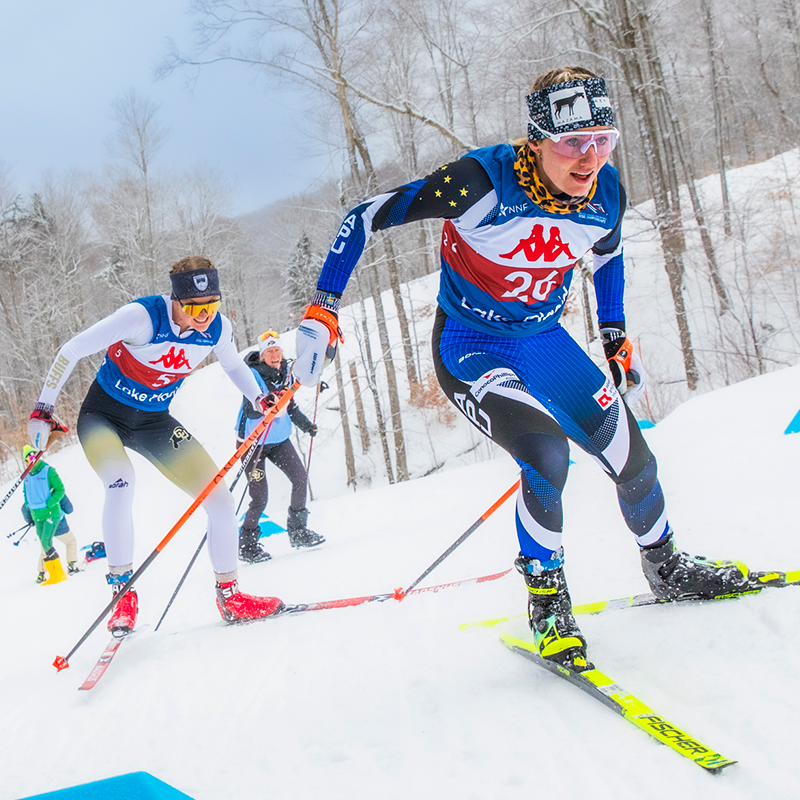
Sofia Pedersen (UU) and Samantha Smith (SVSEF) lead the first quarterfinal out onto the course at the start of the heats. (Photo: Nancie Battaglia)
On the morning of the women’s classic sprint at the U.S. National Cross-Country Ski Championships, the quiet around Mt. Van Hoevenberg felt deliberate.
Not calm — no one was calm by Friday — but restrained. The week had already taken its toll. Distance races had piled fatigue into legs and minds alike, and no one arrived at the sprint believing freshness would be part of the equation. What remained, instead, was clarity: the understanding that in an Olympic winter, the most important racing of the day would happen before the heats ever began.
“It definitely started the day tired,” Ava Thurston said. “But I was trying to just remind myself that everyone was feeling that way. Most people had raced two, if not three, of the races, and we’re all coming in in a similar place.”
That recognition — that fatigue was universal — became the baseline. The differentiator would be execution.
For the women with Olympic aspirations, the classic sprint qualifier was no formality or warm-up. It was the argument itself. The U.S. selection process, quietly but decisively, has elevated qualification speed to the top of the sprint hierarchy. Heats matter, but only if you earn the right to be in them. On Friday in Lake Placid, no one confused the order of importance.
Sofia Pedersen (UU) and Samantha Smith (SVSEF) get the action started in the quarterfinals. (Photo: Nancie Battaglia)
Carrying the Week
By the time the women clipped in for qualification, the week was already present in their legs.
After Thursday’s 20-kilometer race, Sammantha Smith felt that accumulation acutely — and honestly. “After the 20 k, I was definitely feeling the fatigue and accumulation of all the racing throughout the week,” she said. “I know I’m more of a sprinter, but obviously, I was still hoping to perform well in the 20k, so I was not thrilled with the race.”
Rather than letting that disappointment linger, Smith pivoted quickly. “I tried to quickly put it behind me and get ready for some classic sprinting,” she said. “My goal for the day was to focus on skiing a clean qualifier and ski to my strengths.”
Hailey Swirbul arrived at the start line with similar fatigue — and a similar refusal to let it define the day. “Today, I definitely felt a little tired this morning warming up compared to the other races after a hard 20 k effort,” she said. “But so was everybody else dealing with that same.”
For Swirbul, there was anticipation as well. “I was really excited to get to finish this week off with a classic race,” she said. “I just love classic skiing. I think it’s such an art, and I really appreciate the finesse that is needed to be able to make skis kick well.”
Thurston framed the day with a different emphasis — joy rather than pressure. “It had been a great week so far,” she said, “so I was excited to get to go fast and run up that big hill.”
Different approaches, same reality: the sprint would reveal who could still make good decisions under fatigue.
Samantha Smith (SVSEF) commanded the Classic Sprint day from start to finish just like she had done in the Freestyle Sprint. (Photo: Nancie Battaglia)
Qualification: Where the Day Was Decided
When the women dropped into the qualifier, the course made its judgment quickly and without theatrics.
Smith’s run stood apart immediately. She won the qualification by more than six seconds — not by forcing the issue, but by skiing exactly the race she had planned. “It was my first classic sprint of the year, so I didn’t really have too many expectations,” she said. “But I was hoping for a strong result.”
What made the result significant wasn’t just the margin — it was the trajectory behind it. “Up until last season, I think there was a noticeable gap between my skate and classic sprinting,” Smith explained. “But the last few years I’ve really prioritized working on getting my classic sprint to a place I’m happy with.”
That work showed. In an Olympic winter, qualification speed isn’t just about advancing — it’s about relevance. Smith’s time didn’t merely put her safely through; it reframed the sprint conversation.
Behind her, two performances raised equally important questions.
Swirbul and Thurston — both known primarily for their distance strength — delivered qualification runs that demanded attention. In a format that strips away drafting, tactics, and protection, they showed they belonged in the sprint conversation on pure speed.
“I didn’t set out to make a statement this week,” Swirbul said. “I just wanted to show up and try to race my best and see where that landed me.”
For selectors, where it landed mattered.
Quarterfinal 4 trying to find their space and line around the U-turn on the sprint course in Lake Placid. (Photo: Nancie Battaglia)
A Day That Wouldn’t Sit Still
As the day progressed, conditions refused to settle. Snow softened. Moisture crept in. Wind shifted. Ski choices that worked in the morning became liabilities by afternoon.
“The waxing team today was absolute heroes,” Swirbul said. “They were out until the wee hours of the morning, waxing late last night and woke up for a super early morning today for a classic day with really gnarly conditions.”
Adaptability became a skill equal to speed. “I raced on totally different skis from the qualifier to the heats,” Swirbul said. “And even in the heats, I had a couple of changes to my kick in between the rounds because our conditions were continuing to change.”
Smith faced the same puzzle. “In my quarter and semi-final I was actually icing up a bit and too grabby on kick as the snow got wetter,” she said. “My coaches ended up stripping a lot of the kick to bring back some of the glide for the final.”
The goal, she explained, was precision rather than excess. “The main thing was to try to have just enough kick to get up the hills but not so much that it was draggy for the double pole or downhills.”
Thurston made a strategic choice early — prioritizing glide over grip. “I ended up going with the pair that had a little more glide for the downhill finish,” she said, “just because I wanted to be able to hang with people rather than having that extra kick on the hill.”
Three athletes, three solutions, same underlying demand: bend, don’t break.
Lauren Jortberg (CNEPH)leads semi-final 1 out of the starting stretch. (Photo: Nancie Battaglia)
Heats: Confirmation, Not Reinvention
By the time the heats began, the hierarchy established in qualification largely held — and that, too, carried meaning.
Smith moved through the rounds with patience and control, never forcing a moment unnecessarily. Swirbul sharpened as the day progressed, her adjustments paying dividends. Thurston continued to ski within herself, staying connected and opportunistic.
For Thurston, the day reinforced something larger than a single result. “What it kind of said to me was that I can be really consistent,” she said, “and I’m also a strong all-around skier.”
That consistency — across multiple races, formats, and conditions — is currency in an Olympic year.
The women’s final gets started on the last day of racing at the 2026 US National Cross-Country Ski Championships at Mt Van Hoevenberg. (Photo: Nancie Battaglia)
The Final: Execution, Not Emotion
The women’s final unfolded cleanly and decisively.
Smith took control early, extending her advantage where momentum mattered most. The ski changes made before the final were immediately evident. She crossed the line as U.S. National Champion in the classic sprint, completing a sweep of the week’s sprint events.
Behind her, Swirbul claimed second, a reward for adaptability and composure. Thurston rounded out the podium, another affirmation of her ability to race fast across disciplines.
For Smith, the result was about more than placement. “I hope people see that I love to race,” she said. “I love to compete and push myself, and I always leave everything I have out on the course.”
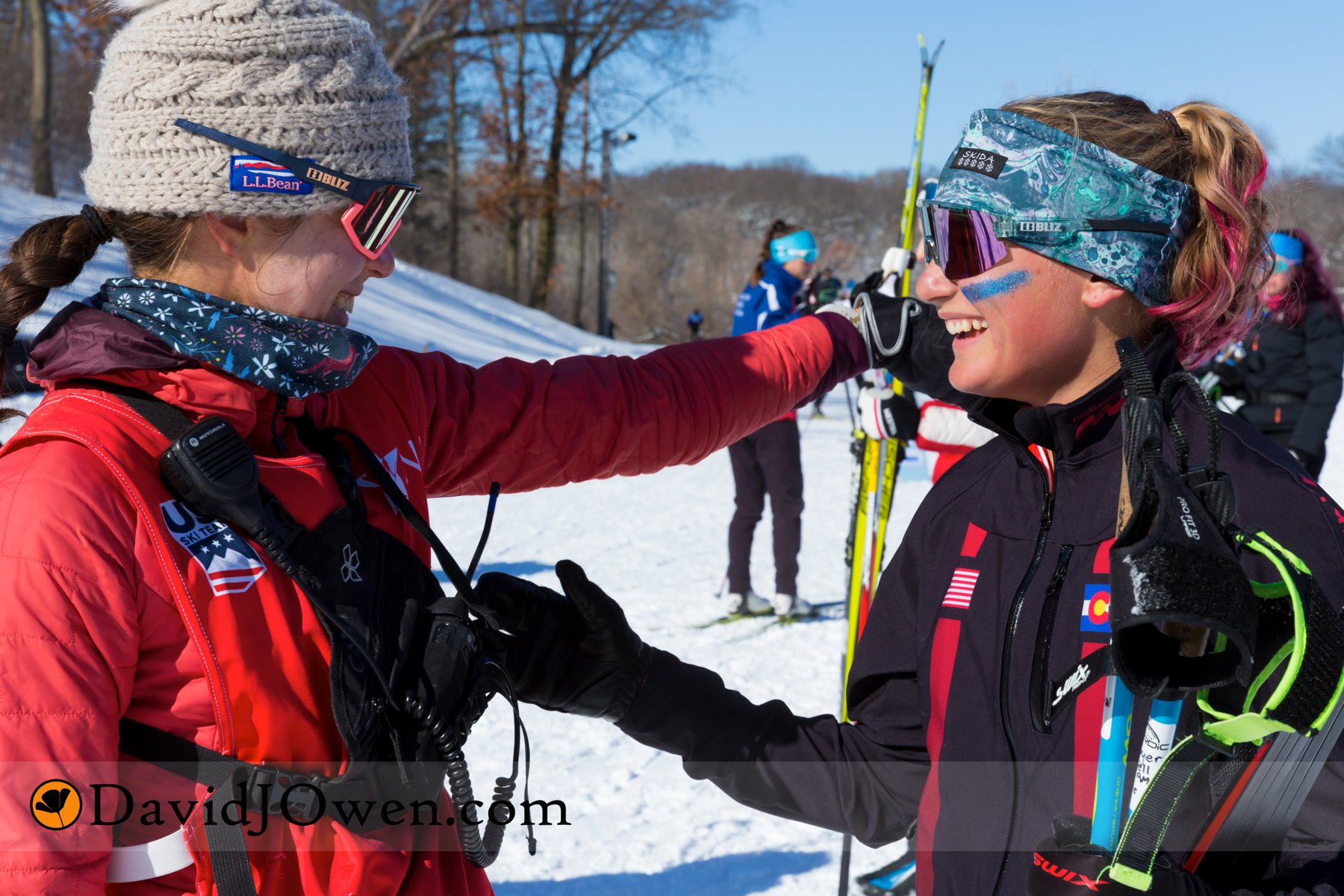
Everyone was deserving of a helping hand up after a full week of racing at the US National Cross-Country Ski Championships at Mt Van Hoevenberg. (Photo: Nancie Battaglia)
What the Race Clarified
Nationals does not select Olympic teams outright, but it argues persuasively — and the women’s classic sprint in Lake Placid made its case clearly.
Smith’s qualification speed, combined with her technical development in the classic sprint, strengthened her position at precisely the right moment. Swirbul’s performance underscored versatility and poise under changing conditions. Thurston’s podium reinforced consistency and all-around strength.
“I’m really happy with how this week went,” Swirbul said. “And looking forward to figuring out where the rest of the season goes.”
Thurston echoed that momentum. “This week was so, so awesome,” she said. “I’m excited to keep racing.”
The arguments weren’t loud. They didn’t need to be. On a tired Friday at Mt. Van Hoevenberg, they were made the way Olympic cases often are — quietly, cleanly, and against the clock.
Feature stories like this one take time, access, and care to produce. If you value thoughtful storytelling and independent ski journalism, please consider becoming a Voluntary Subscriber. Your support directly fuels the work we do to cover the people, places, and moments that make our sport special.
The women’s Classic Sprint podium, including Samantha Smith (SVSEF) in first, Hailey Swirbul (APU) in third, and Ava Thurston (Dartmouth) in third at the US National Cross-Country Ski Championships at Mt Van Hoevenberg. (Photo: Nancie Battaglia)
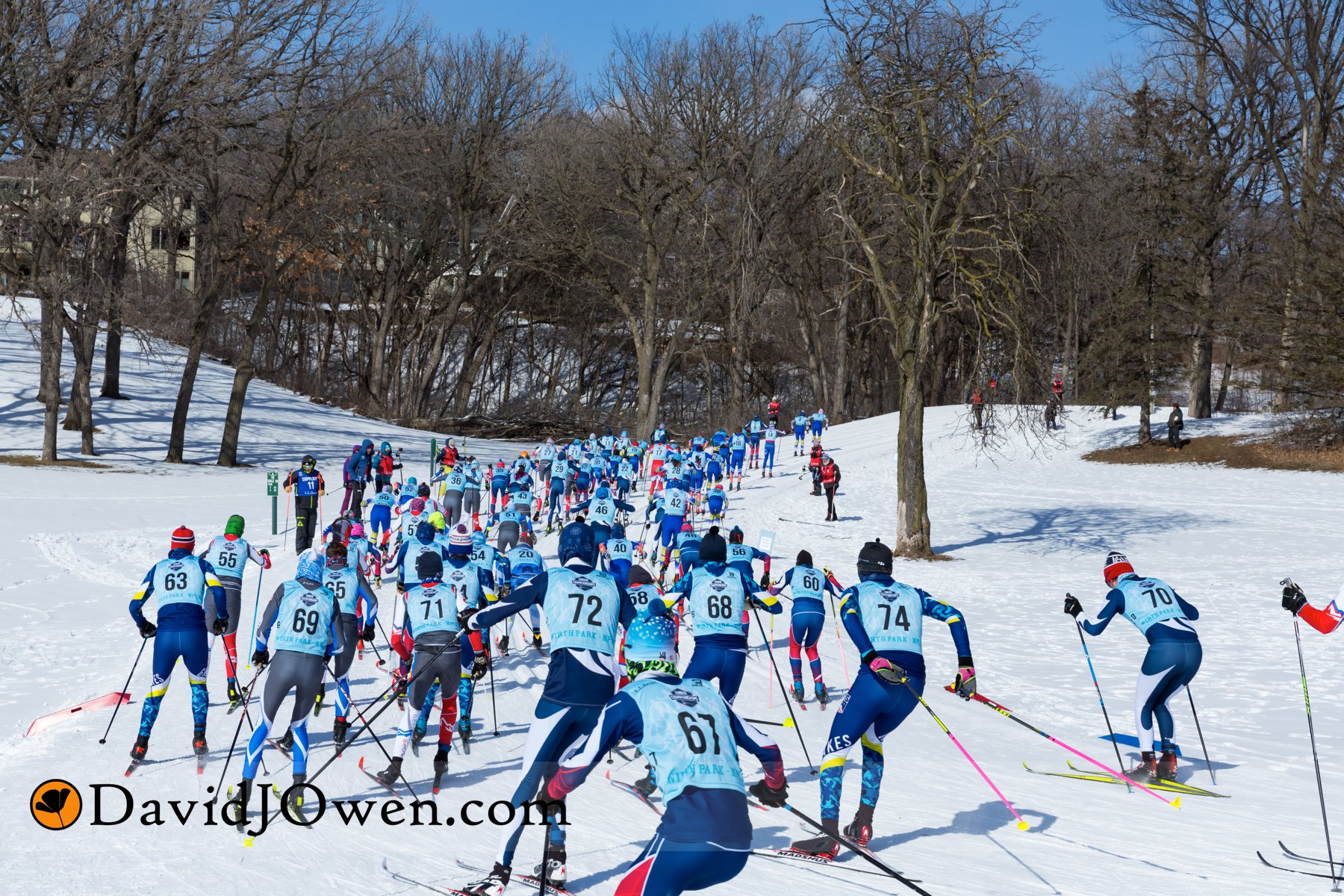
Traffic was thick at the beginning of the US National Cross-Country Ski Championship Women’s 20 k Freestyle Mass Start in Lake Placid, NY. (Photo: Nancie Battaglia)
There is a particular moment in a long mass start when the race quietly declares what it will be. It does not arrive with a surge, a crash, or even a decisive move. It arrives when the pack thins just enough that the edges of the course begin to matter—when skis no longer overlap cleanly, when passing requires intention, and when each athlete realizes—often simultaneously—that this is no longer a collective undertaking.
At Mt. Van Hoevenberg, that moment came early.
The women’s 20-kilometer freestyle mass start at the 2026 U.S. National Cross-Country Ski Championships unfolded under conditions that rewarded clarity and punished hesitation. The course was wide in places, narrow in consequence. Fresh snow lined the edges, slower and heavier than the main track, turning every attempt to move forward into a calculation of cost. The pace at the front was honest from the gun—fast enough to string the field out, fast enough to strip away the illusion that patience alone would bring opportunity.
In an Olympic winter, Nationals rarely exist in isolation. They are arguments as much as races, each result carrying the quiet weight of future conversations. But on this morning, before selection scenarios and season arcs could intrude, the race itself demanded attention. Four laps. Twenty kilometers. A course that climbs insistently and asks athletes to be precise even when tired.
What followed was not one story, but several—layered, intersecting, and revealing.
Colorado’s Tilde Bångman did much of the work at the front of the Women’s 20 k Freestyle Mass Start in Lake Placid, NY. (Photo: Nancie Battaglia)
The Fast Start That Changed Everything
From near the front, the race immediately took on the shape many expected. Kendall Kramer, eager to avoid the kind of chaos that can derail a mass start before it has truly begun, made her intentions clear.
“I wanted to go out fast because I didn’t want any funny business—colliding or breaking equipment,” Kramer said later. “I was super looking forward to being in the front of a mass start after being caught in the back on World Cups.”
For Kramer, the early pace felt familiar rather than reckless. World Cups, she noted, often begin faster than domestic races, and the instinct to establish position early has become second nature. The speed was assertive but manageable. She felt fit, capable, present.
Behind her, the effect was immediate. The field stretched, then fractured, then reorganized into smaller, more intentional units. For athletes starting deeper in the field, this stringing-out created both opportunity and pressure.
Novie McCabe, starting from bib 26, felt the opening kilometers open rather than close.
“My plan for the start was just to stay relaxed and try to work my way up,” she said. “It honestly ended up being easier than expected because the front girls took it out so fast. It was very strung out, and there was lots of room to move around.”
Within minutes, McCabe had navigated cleanly into the front group. What followed was less about advancing and more about survival.
“I got to the front pack about three minutes into the race,” she said. “So I spent most of it there just trying to hang on for as long as I could—and ended up having it in me to hang till the end.”
That phrase—hang on—would recur in different forms throughout the day, taking on slightly different meanings depending on where each skier found herself in the race.
Ava Thurston (#8 – Dartmouth) couldn’t quite hang on to the lead group of three, but eventually skied with Hailey Swirbul (#67 – APU) and Haley Brewster (#46 – UVM) before finishing fourth overall and third-place American. (Photo: Nancie Battaglia)
When the Front Pulls Away
Not everyone who tested the front pace could stay there.
Late in the first lap, Ava Thurston made her own attempt to bridge. She came close enough to feel the rhythm of the leaders, close enough to understand the cost.
“I tried to get back onto the front group, and I got pretty close,” Thurston said. “But I realized that I wasn’t going to be able to match their pace.”
The realization came with consequences. For a brief stretch, she found herself skiing alone—a dangerous place in a mass start, especially early, when gaps can grow quietly and decisively.
“That was where I did have a little bit of that panic,” she admitted.
The panic did not last. Company arrived in the form of Hailey Swirbul and Haley Brewster, and with it, perspective.
“Once I was skiing with them, I was kind of just thinking, ‘This is a good group. I can stay with these guys,’” Thurston said.
From there, her race became less about chasing what was ahead and more about managing what was happening around her. She tucked in, matched surges, and responded quickly to small separations before they became something larger.
“There were a couple of times where I would fall off the pack just a little bit,” she said. “Each time, I worked hard to get right back on before letting it be a big gap. I was really stoked on that.”
On a course like Van Hoevenberg—four laps of sustained uphill skating—those moments add up. Fitness is exposed repeatedly, not all at once. For Thurston, the race offered reassurance.
“This was the first race longer than 10k I’d done this year, and the first mass start that wasn’t a sprint,” she said. “It was a really good indicator that my fitness is there. It’s hard to fake anything on this course.”
She would finish fourth, clearly separated from the podium trio but equally clear of the deeper chase—an honest result in a demanding field.
With higher FIS points from not racing the past two seasons, Hailey Swirbul (#67 – APU) needed to ski through a lot of traffic during the early kilometers, but eventually found herself in the chase pack. (Photo: Nancie Battaglia)
Racing From the Back Without Racing Small
While the front and mid-pack sorted themselves, Hailey Swirbul was running an entirely different race.
Starting from bib 67, she entered the day knowing she would need to be deliberate.
“I didn’t even realize I would be seated so far back until the start list came out,” she said. “Obviously, I would be, because my FIS points aren’t low at this point—but it was an experience.”
The challenge was not simply moving forward. It was how to do so without paying too steep a price.
“The edges of the course had fresh snow on them,” Swirbul explained. “It was much slower, and a much higher energy expenditure to get around people that way.”
Instead of forcing passes, she waited. Instead of locking into the pace of whatever group surrounded her at a given moment, she kept her attention forward.
“I almost approached the first couple laps like an individual start,” she said. “It’s really easy to lock into the group you’re around and forget about the people ahead of you.”
Women’s racing, she noted, often begins with a fast, destabilizing surge—a period where the goal is simply to hang on long enough for things to settle.
“That’s exactly what happened today,” she said. “The leaders go fast, string it out, and then the real race starts again.”
For Swirbul, the balance was constant: advancing through traffic while respecting the race’s length.
“A 20k is a long race,” she said. “You can’t really pay for it.”
Though she never bridged to the front trio, Swirbul finished fifth—solidly clear of the next wave behind her—and left the course satisfied with her execution and proud of the broader team effort.
“Our coach absolutely crushed it with skis and feeds,” she said. “It was a good day to be APU.”
Novie McCabe (APU) maintained contact on the uphills and used the downhills to close the small gaps to Tilde Bångman (CU) at the front of the race. (Photo: Nancie Battaglia)
The Margins at the Front
At the sharp end, the race narrowed to a familiar dynamic: strength, speed, and patience under pressure.
As the kilometers mounted, Tilde Bångman began to apply pressure on the climbs, testing the group’s elasticity. By mid-race, the front had distilled to three: Bångman, McCabe, and Kramer. The chase group behind them was no longer within striking distance, and the podium places would be decided among those three alone.
McCabe felt the pressure immediately.
“In the last few kilometers, Tilde was skiing super strong and still really pushing the pace,” she said. “She would gap me a little bit on some of the hills.”
Each gap mattered. Each closure required confidence—in skis, in timing, and in restraint.
“I had some super good skis, so I was able to glide back up to her,” McCabe said.
The plan crystallized: stay attached through the final hill, try once to make a move, and if that failed, save everything for the finish.
“I tried to get a gap on the last hill, which didn’t quite work,” she said. “So I tried one last time at the finish.”
It was enough.
McCabe crossed the line first, securing the national title after a race built not on constant aggression, but on measured commitment. The emotion that surfaced surprised even her.
“I think when I crossed the line, I mostly just felt super happy to be back racing and feeling like myself,” she said.
The win mattered. So did what it represented.
“Going into this week, I wasn’t sure it was the best idea for me to race frequently this season,” she said. “Now I have a lot more confidence that I can race—and maybe more importantly, recover from racing.”
In an Olympic year, that distinction is not trivial.
The lead pack and eventual overall podium with Kendall Kramer (APU), Tilde Bångman (CU), and Novie McCabe (APU) (l – r). (Photo: Nancie Battaglia)
Kramer’s Race: Control Without Regret
For Kendall Kramer, the separation late in the race came not through fitness, but friction.
“My skis slowed down as they went,” she said. “They started to feel sticky—like I skied through too much Gatorade or something.”
The effect was most pronounced on the downhills, where speed should have come freely.
“The girls had to push my poles to speed me up to keep together,” she said. “Eventually, they could just gap on all the downhills.”
Once the gap formed, Kramer shifted her focus from contesting the win to finishing the race well.
“I’m happy to maintain my place and feel good,” she said. “I can’t complain.”
What she wanted from the race, she explained, was not chaos or last-minute risk, but sustained pressure in a small group.
“I wanted a small pack where we could test at every little bit,” she said, “as opposed to leaving it to a sprint or taking risks at a time like this.”
She finished third, completing the podium, and left Lake Placid without repeating her national title—but with confirmation that mattered just as much.
“I felt fit and totally capable today,” she said. “I didn’t feel bad feelings.”
Novie McCabe (APU) managed to put a small gap on teammate Kendall Kramer to get away with Tilde Bångman (CU) and eventually ski to the national title in the finish stretch. (Photo: Nancie Battaglia)
What the Race Revealed
By the time the women completed their fourth lap, the story of the day was no longer about who surged when, but about how each athlete managed the same course differently—and honestly.
McCabe raced with restraint until she no longer needed to. Kramer raced with intent and accepted the margins. Thurston learned, adjusted, and confirmed her distance fitness. Swirbul navigated from deep in the field with patience and clarity.
None of those narratives exists in isolation. Together, they form a portrait of a championship race that did what the best distance races always do: expose truth without exaggeration.
At U.S. Nationals, the women did not simply ski 20 kilometers. They negotiated space, managed doubt, trusted preparation, and tested belief.
In an Olympic winter, those are not side effects.
They are the point.
The national podium for the US National Cross-Country Ski Championship Women’s 20 k Freestyle Mass Start with Novie McCabe (APU) first, Kendall Kramer (APU) second, and Ava Thurston (Dartmouth) third. (Photo: Nancie Battaglia)
Feature stories like this one take time, access, and care to produce. If you value thoughtful storytelling and independent ski journalism, please consider becoming a Voluntary Subscriber. Your support directly fuels the work we do to cover the people, places, and moments that make our sport special.
The overall podium for the US National Cross-Country Ski Championship Women’s 20 k Freestyle Mass Start with Novie McCabe (APU) first, Tilde Bångman (CU) second, and Kendall Kramer (APU) third. (Photo: Nancie Battaglia)
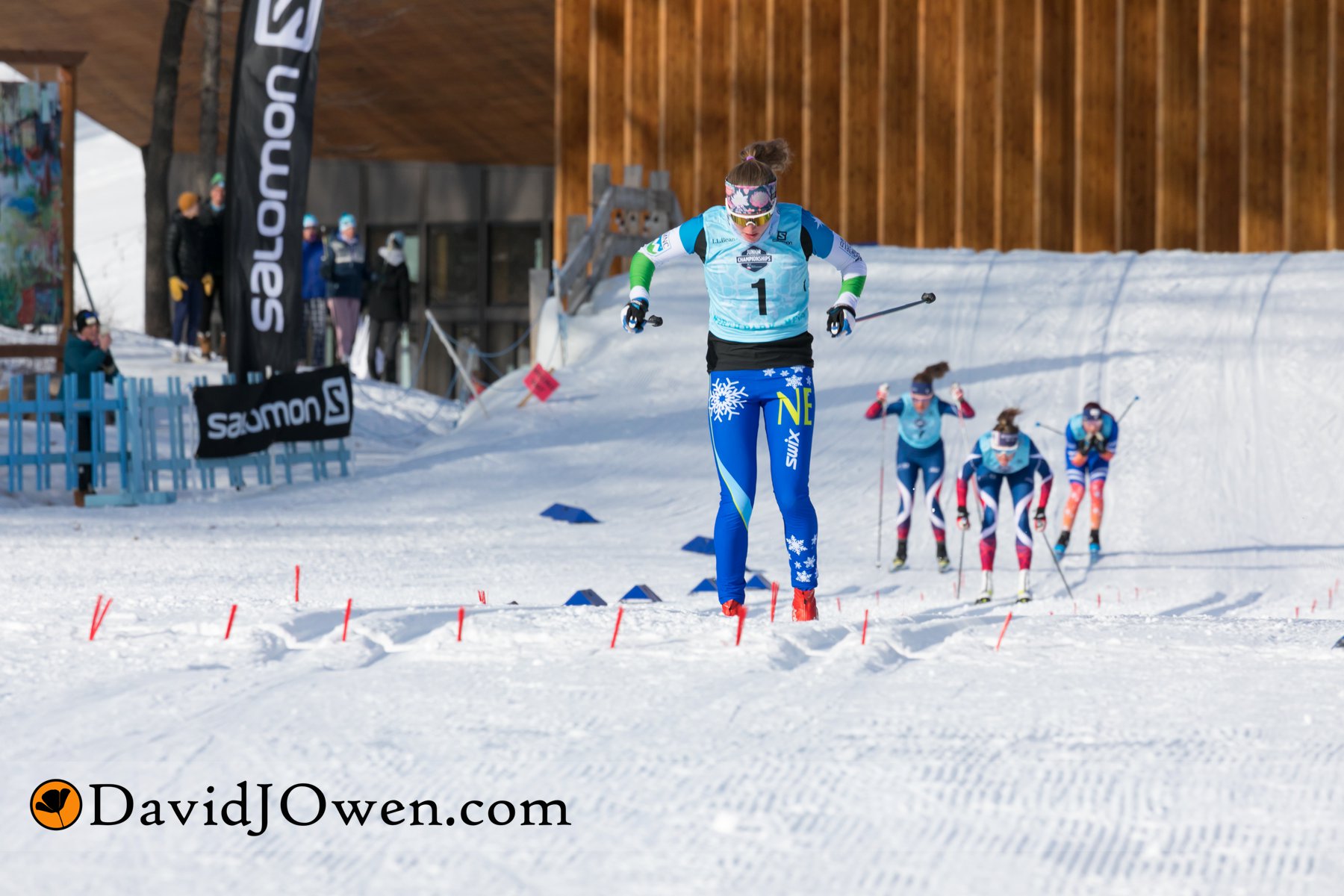
Samantha Smith (#1 – SVSEF) was the fastest qualifier and advanced through all her rounds in first on her way to the national championship at the US National Cross-Country Ski Championships Freestyle Sprint. (Photo: Nancie Battaglia)
There is a particular kind of pressure that lives in a sprint qualification. It isn’t loud. It doesn’t announce itself with theatrics. It sits in the quiet places: the moment you realize the warm-up loop is over and you’re headed back toward the start; the thin stretch of time when your poles feel too long and your gloves feel too tight and the only thing you can hear is the scrape of skis and the soft, practiced urgency of coaches repeating the same cues they’ve repeated for years.
In the heats, there is cover. There is a draft. There is a corner to hide behind, a decision to delay, a shoulder to lean into, a mistake you can sometimes survive. Qualification has none of that. Qualification is a solitary negotiation with speed, oxygen, and the course itself. And in an Olympic winter, it also becomes something else: a sorting mechanism. A gate. A reminder that at the Games, you don’t get to be “good in the heats” if you don’t first earn your way into them.
At the 2026 U.S. National Cross-Country Ski Championships in Lake Placid, Tuesday’s freestyle sprint at Mt. Van Hoevenberg offered that truth clearly. On the women’s side, Samantha Smith (Sun Valley SEF) was the fastest qualifier. On the men’s side, Zanden McMullen (APU Nordic Ski Center) topped the morning results.
By the end of the afternoon, the national titles belonged to Smith — who converted qualifier speed into clean, controlled racing through every round — and Mons Melbye (University of Utah), who did something deceptively difficult: he kept winning as the format stopped forgiving mistakes.
Dartmouth College’s Ava Thurston was impressive all day on her way to third overall. (Photo: Nancie Battaglia)
Qualification as the Real Story — and the Olympic-Year Subtext
The sprint format always tempts us to focus on finish-line photos, final turns, and last lunges. But if you’re trying to understand what this race meant in the broader context of the week — and in the longer context of an Olympic winter — you start with the qualifier.
Smith’s win in qualification wasn’t just fast; it was decisive in a way that matters in a discipline where tenths often separate confidence from chaos. She led Alayna Sonnesyn (Team Birkie) by nearly two seconds, with Lauren Jortberg (CNEPH) third and Ava Thurston (Dartmouth) fourth.
On the men’s side, the top end was deep and tightly packed. McMullen led Owen Young (University of Vermont) by just over a second, with Michael Earnhart (APU Nordic Ski Center) essentially on Young’s shoulder. Melbye qualified fourth, with Cole Flowers (University of Alaska Fairbanks) and Max Kluck (University of Utah) close behind.
This matters because international sprinting — the kind that happens at the Olympics — is not a format where you can count on “finding your way through the rounds” if you start your day in the wrong place. Qualification is where your sprint begins or ends.
The subtext, however, differs by gender. On the men’s side, the Olympic pathway through domestic sprinting appears closed this winter. On the women’s side, the picture has felt more open, with multiple domestic spots likely in play and sprint specialists carrying meaningful leverage. The sprint, then, does not “mean” the same thing for every athlete — but it still demands the same thing from all of them.
Eventual winner, Samantha Smith (#1 – SVSEF) controls the start of the women’s final at the US National Cross-Country Ski Championships Freestyle Sprint. (Photo: Nancie Battaglia)
Women: Samantha Smith’s Control, Sonnesyn’s Speed, and a Final that Rewarded Discipline
Smith won the qualifier. Then she won her quarterfinal. Then she won her semifinal. Then she won the final.
Behind her in the final were Sonnesyn in second and Thurston in third, followed by Nina Schamberger (University of Colorado), Jortberg, and Katherine Weaver (Alberta World Cup Academy).
Sonnesyn’s day began where the pressure was heaviest.
“I am really proud of my sprint qualifier,” Sonnesyn said. “There was a lot of pressure on it, and I was feeling that, so I really leaned into the energy of those around me. I left everything I had out there on that course. Not perfect, but really good.”
In the final, she was clear-eyed about what limited her chances to fight for the win.
“I always need to keep working on my starts,” she said. “It’s really hard for me to get going that fast, and I ended up getting a bit boxed during the final because I didn’t have a great start. That being said, I think that final hill and the super fast downhill at the end worked in my favor.”
Alayna Sonnesyn (#2 – Team Birkie) pushes over the top of the sprint course’s main climb. (Photo: Nancie Battaglia)
Smith described a day defined by managing nerves and executing details.
“I was quite nervous going into today’s race,” Smith said. “I was putting a lot of pressure on myself to perform well, so I tried to channel the nerves into adrenaline. I focused on skiing smoothly, working the transitions, and finding the most efficient line out there.”
The final climb played directly to her strengths.
“The final hill was definitely my favorite part of the course,” she said. “I really love to hop skate, and the gradient of that hill is perfect for it. On this course, transitions are critical, so I tried to be really disciplined about skiing hard over the tops and pushing into the downhills.”
Thurston, who qualified fourth and finished third overall, described a sprint day built around process rather than pressure.
“My approach to nerves was to focus on having fun and getting to the start line ready and excited to race,” she said. “Having my whole team here helped a lot. Chatting and joking with teammates and competitors really eases my nerves.”
She found her biggest opportunities during the heats.
“During the heats, I gained the most time on the final big hill,” Thurston said. “The wide trail made it an ideal place to pass. I’m still working on my double pole at the start, so that’s an area where I think there’s more speed to unlock.”
Lauren Jortberg (CNEPH) leads her semifinal at the US National Cross-Country Ski Championships Freestyle Sprint. (Photo: Nancie Battaglia)
Jortberg’s fifth-place finish, after qualifying third, served as a reminder of sprinting’s second demand: doing the work repeatedly under imperfect conditions.
Jortberg said the qualifier remained her primary focus, especially in an Olympic winter where advancing matters as much as how fast you ski.
“Sprint qualification is something I’ve been working on a ton,” she said. “That’s the most important part of the day, especially when it comes to World Cup skiing — just moving on. I was happy with my qualifier. It wasn’t my best skiing, but it was solid.”
She said lingering fatigue from the previous classic race played a role, particularly after spending much of that race running due to skis that wouldn’t kick.
“I definitely felt like I was carrying some fatigue from the classic,” Jortberg said. “So I’d say the qualifier was okay, but not my best work. I know I can ski better than that.”
Jortberg said the Van Hoevenberg sprint course suits her strengths, but emphasized that the margins — especially on the downhills — leave no room for lapses.
“I really like this course. It plays to a lot of my strengths — strong V2, a long climb, and hop skating,” she said. “But you have to be diligent everywhere, especially on the downhills. You can’t be lazy for even half a second.”
In the semifinals, she said the tight schedule and downhill dynamics ultimately limited her ability to move forward.
“My semifinal was only about eight minutes before the final,” Jortberg said. “I couldn’t really clear the lactic acid, and I didn’t have much time. I got passed on the downhill and then couldn’t really move in the final.”
Despite the broader Olympic context, Jortberg said she is deliberately keeping her focus narrow.
“I try not to stress about spreadsheets or criteria,” she said. “I just want to race, have fun, and ski the best way I know how. That’s really all you can do.”
Smith added one more note at the end of the day, confirming she plans to continue racing later in the week.
“As of now, yes, I am planning to race the 20-kilometer on Thursday.”
Eventual winner, Mons Melbye (#4 – UU) in his quarterfinal at the US National Cross-Country Ski Championships Freestyle Sprint. (Photo: Nancie Battaglia)
Men: Melbye’s Title, Jayne’s Podium, and Endestad’s Deep Run from 16th
On the men’s side, the qualifier winner did not win the title.
McMullen was fastest in the morning, but the championship ultimately went to Melbye, who qualified fourth and then won his quarterfinal, semifinal, and final.
Behind Melbye, Sasha Masson (CNEPH) finished second, Zachary Jayne (University of Utah) third, and Ari Endestad (Alaska Pacific University Nordic Ski Center) fourth. Michael Earnhart finished fifth, with Owen Young sixth.
The University of Utah was central to the men’s story throughout the day, with Melbye winning the title and Jayne joining him on the podium.
Zach Jayne (UU) during qualification. (Photo: Nancie Battaglia)
Jayne described a qualifier that didn’t match his expectations — and a deliberate reset once the rounds began.
“Coming off a skate qualifier win in Alaska, I was disappointed after my qualifying performance,” Jayne said. “I thought I was capable of much more. Knowing that, I went into the heats with a better plan focused on composure and power. I was more relaxed and less nervous once I committed to that.”
His view of sprint racing was blunt.
“The rounds were incredibly close, but it only matters where people are at the finish — nowhere else,” he said.
Young (University of Vermont), who finished sixth overall, described a day shaped largely by the pressure of the qualifier and the need to earn his way into the rounds.
“Heading into the race today, my internal goals were a bit of a mixed bag,” Young said. “The main focus was result-based, but I really approached the day thinking about the qualifier. I’ve only raced one sprint this season, and the result was pretty mediocre, so I was pretty dead set on just trying to qualify.”
Once through the qualifier, Young said his focus narrowed to managing the rounds one at a time.
“After the qualifier, I tried to just take each heat one at a time and give it my best shot to move on,” he said. “I don’t really try to preserve energy in the qualifier — I usually give it everything I’ve got. That might not be the smartest choice for later in the day, but the confidence boost from a fast qualifier can really help mentally in the heats.”
Miachael Earnhart (APU) on his way to posting the third fastest qualification time. (Photo: Nancie Battaglia)
Endestad’s fourth-place finish told a different story: one of survival, adaptation, and opportunity.
He qualified 16th in what he described as one of the tightest sprint qualifiers he had ever seen at Nationals, then raced his way through the rounds into the final.
“Ideally, I would’ve liked to qualify a little higher,” Endestad said. “But with how close it was, I felt lucky just to be in the heats at all.”
The physical cost of the day was obvious.
“This course is so hard,” he said. “I threw up after the qualifier and had to fight to stay composed through the quarter and semi. There were only about 12 minutes between the semi and the final, so it was about breathing, keeping it down, and making good decisions.”
Tactically, he was clear about where he needed to attack.
“It might have looked like patience early, but honestly, I was barely hanging on from the start,” Endestad said. “The goal was to be in position for the main hill, because that’s where I felt I could really put the hammer down.”
Ari Endestad (APU) leads teammate Michael Earnhart (APU) during the heats of the Freestyle Sprint at the US National Cross-Country Ski Championships. (Photo: Nancie Battaglia)
Michael Earnhart said his goals at U.S. Nationals were shaped as much by the SuperTour standings as by the result of any single race.
“One of my goals coming into Nationals was to try to take back the SuperTour lead heading into Period 3,” Earnhart said. “Today helped me with points against Hunter Wonders, but not against Zach Jayne. It’s still very close, and both of them are really good athletes.”
He admitted he arrived with higher expectations after last season’s skate sprint performances.
“After last year, I really wanted to try to win today,” he said. “So I was a little disappointed to come in fifth. But with how close the qualifier was and how strong the competition is getting in the U.S., I’m not overly disappointed. It’s a reasonable result.”
Earnhart said experience helped him stay composed through the rounds.
“I’ve done a lot of heats on the SuperTour, so I feel confident in this field,” he said. “I try to ski to my strengths, stay relaxed, and ski with the confidence that I deserve to win the heat. Normally, that gets me through, but sprinting is unpredictable.”
He added that Van Hoevenberg offered rare opportunities to move in a skate sprint.
“The main sprint hill is wide enough to move, and jump skating is my strongest technique,” Earnhart said. “When the qualifier is six seconds from first to 30th, it’s fine margins. Sometimes you need a little luck — but you also have to make your own.”
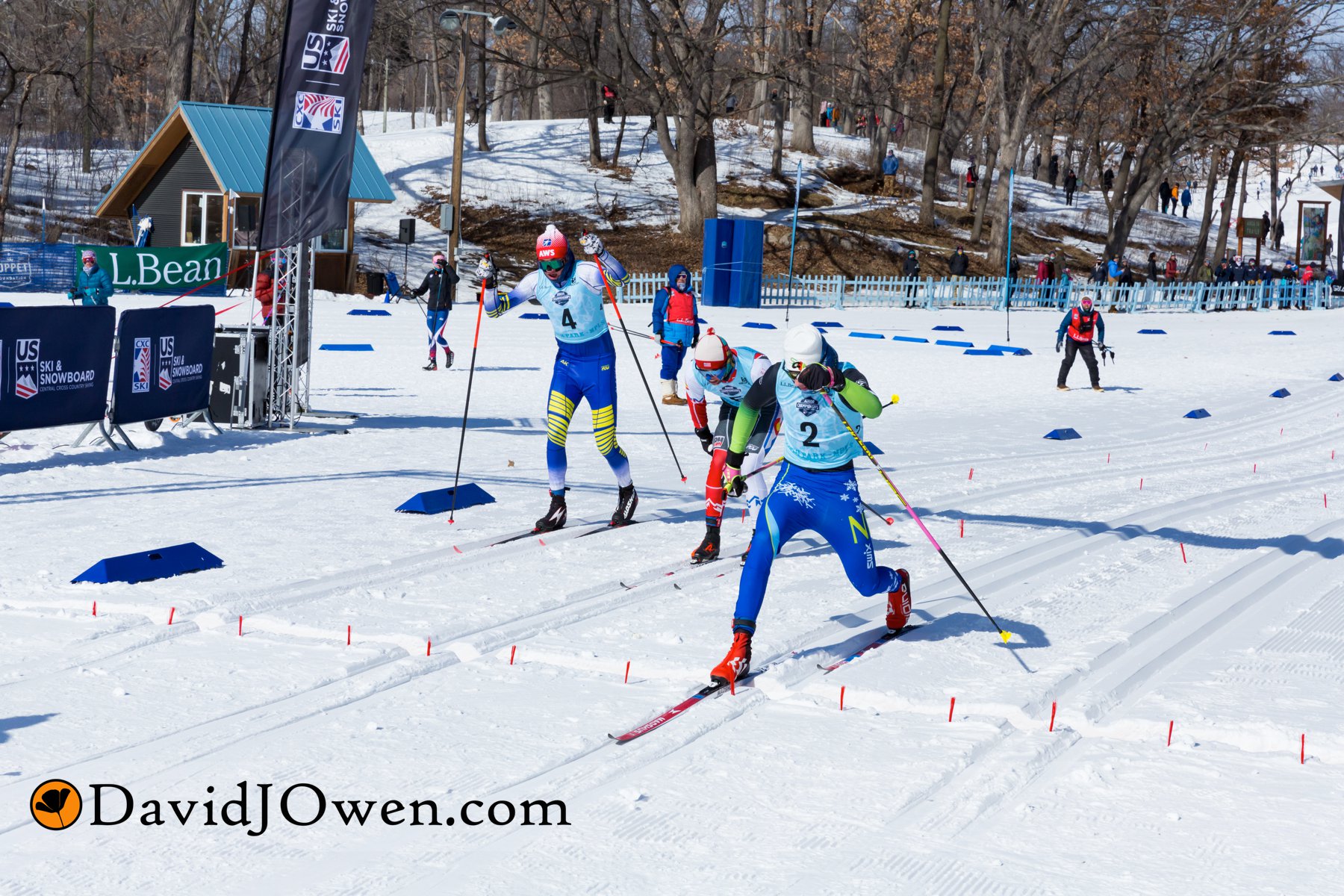
Mons Melbye (#4 – UU), Sasha Masson (#11 – CNEPH), and Zach Jayne (#12 – UU) on their way to first, second, and third places, respectively, with Ari Endestad (APU) trailing in fourth place during the men’s Final at the US National Cross-Country Ski Championships Freestyle Sprint. (Photo: Nancie Battaglia)
What It Means — and What It Doesn’t
It’s tempting in an Olympic year to treat every Nationals result like a verdict. But Nationals is not the Olympics, and a domestic sprint is not a World Cup sprint field.
What it can be is a stress test.
For the women, the sprint reinforced that athletes who can combine elite qualifier speed with repeatable execution are building strong cases. Smith won both the qualifier and the final. Sonnesyn backed up top-end speed with a runner-up finish while clearly identifying where she can improve.
For the men, the sprint may not be about Olympic selection, but it was revealing and also adds to the season-long narrative. Melbye showed an ability to win under repeated pressure. Jayne demonstrated resilience after a disappointing qualifier. Endestad showed how quickly sprinting can reward those who survive long enough to find their moment.
Young’s comments also underscored the tradeoffs athletes are navigating as the week continues.
“I don’t have a definite answer, looking forward to the rest of Nationals,” he said. “I’d like to throw down top results in the 20k and the classic sprint, but I need to talk with my coach and assess the best plan to give me the best shot at scoring enough points. That could mean skipping the 20k and focusing on the sprint, or maybe doing both — it’s tricky with no rest day and the body starting to feel the last couple days of racing.”
Katey Houser (MSU) leads Ruby Serrouya (DU) and Marit Flora (UAA) in their quarterfinal at the US National Cross-Country Ski Championships Freestyle Sprint. (Photo: Nancie Battaglia)
A Closing Note from Lake Placid
By late afternoon, the sprint course felt smaller than it had in the morning. Not only because it changed slightly for the juniors, but because sprint days compress experience. The same hill feels steeper the fourth time. The same turn feels tighter. The same finishing straight feels shorter.
That is the quiet lesson of a National sprint in an Olympic winter. It doesn’t allow vagueness. It demands specificity. It asks for one fast lap — and then asks you to do it again, and again, and again, under less forgiving conditions.
Samantha Smith and Mons Melbye won because they answered those questions most consistently.
For everyone else, Lake Placid delivered the same message sprinting always does: if you want to be part of the story later, you still have to earn your way into the next round now.
Feature stories like this one take time, access, and care to produce. If you value thoughtful storytelling and independent ski journalism, please consider becoming a Voluntary Subscriber. Your support directly fuels the work we do to cover the people, places, and moments that make our sport special.
Mons Melbye (#4 – UU), Sasha Masson (#11 – CNEPH), and Zach Jayne (#12 – UU) on their way to first, second, and third places, respectively, with Owen Young (UVM – far left), Ari Endestad (#16 – APU), and Michael Earnhart (#3 – APU) trailing to start the men’s final at the US National Cross-Country Ski Championships. (Photo: Nancie Battaglia)
The US National Championships got started yesterday with the 10 k Classic Individual Start in Lake Placid, NY. Hunter Wonders (#369 – APU) took top honors in the men’s race. (Photo: Nancie Battaglia)
On a January afternoon in Lake Placid, Mt. Van Hoevenberg did what it has always done best: it asked skiers to be honest.
The 10-kilometer classic individual start is not a format that rewards theater. It doesn’t care how good you looked in warm-up, how confident you sounded the night before, or how convincing your season-long narrative might be. It rewards pacing that’s brave but not reckless, technique that doesn’t unravel under strain, and the ability to keep making good decisions when your legs are trying to renegotiate the terms of the day.
This year, the U.S. National Cross-Country Ski Championships opened with that race—two laps on the 5-kilometer loop—and the timing was no accident. In an Olympic winter, Nationals is never just Nationals. It’s an argument. It’s a week where results don’t merely “count,” they accumulate, and the accumulation becomes the story that follows athletes into selection meetings, petitions, and—if all goes right—onto a plane headed for Italy.
Will Koch (SVSEF) on his way to 8th place on the day. (Photo: Nancie Battaglia)
The Course: Where You Can’t Afford to “Blow Up”
The Van Hoevenberg course is famous for being “fair,” but fairness in skiing is rarely gentle. The climbs arrive in layered sequences—sections where you can press, sections where you can survive, sections where you can lose seconds simply by being a fraction late to a gear change. There are places to win time, and places where you simply try not to hemorrhage it.
Hunter Wonders described the central problem precisely after the finish:
“It has some big hills. And I really think that in this course you can’t afford to blow up. If you blow up, you’re just going to bleed so much time.”
That idea—bleeding time—was the hidden refrain of the day. Not because athletes were exploding spectacularly, but because this loop punishes any lapse in restraint. It is a course that rewards a mind that stays intact.
Corbin Carpenter (UAA) on his way to 10th place in the 10 k Classic at US Nationals. (Photo: Nancie Battaglia)
Men’s Race: Seconds as a Selection Language
At the front of the men’s race, the margins compressed into something almost absurd: a national title decided in a space so small it could be measured in one imperfect corner, one extra step of herringbone, one pole that slips just slightly at the wrong moment.
Hunter Wonders won the men’s 10 k Classic National Championship. Behind him, the podium fight came down to an almost unnerving closeness. The story wasn’t simply that the race was fast; it was that it was tight—tight enough to turn pacing into the defining skill.
Wonders’ post-race reflection didn’t sound like someone who had “controlled” the race so much as someone who had managed it correctly, which is often the same thing in interval start racing:
“Yeah. So going through it never really felt like it was my day. I knew it was going to be a competitive one, and I knew that it would just come to good skis, good feelings in the body, good pacing, and I’m just really happy that I was able to pull it off.”
He returned to pacing again, emphasizing that his strategy wasn’t about heroics, but about avoiding the one mistake that the Van Hoevenberg loop will magnify:
“I think pacing was the biggest challenge for me today… So I was trying to take it out hot to where I could be competitive but not blow myself up.”
What made Wonders’ win especially convincing was how he described staying committed to his plan and then finishing with intent when the splits told him the race was available:
“I never really changed my race plan mid-race. But I did get some good splits, especially near the end, so I just tried to finish as hard as I could.”
And then, because it’s 2026 and everyone knows what this week represents, he said the part that matters most:
“And then, of course, U.S. Nationals does carry some heavy weight in an Olympic year. And I’ve been thinking about this race since the races in Anchorage ended, so I’m just really happy to have it behind me.”
He wasn’t pretending the pressure isn’t real:
“I definitely felt the pressure, and I’m going to continue to feel the pressure throughout the rest of this Nationals. But I think I have good momentum going, and I have good confidence. I know that I’m in shape, and everything else just kind of hopefully falls into place over the next week.”
The finish-line truth of the men’s race is that it created a kind of selection tension that will hang over the rest of the week: the top contenders weren’t separated by a narrative gap. They were separated by seconds.
Luke Jager, who finished second, captured what that tightness means on this course and in this moment:
“Yeah, crazy how close the times were! The course is cool because there are so many different gears in the climb that people can all have different focus spots and still end up so close together at the finish line. It is really cool, fair racing like that.”
That line—different focus spots, same finish—explains why the top of the results can look like a near-tie without being random. You can ski this course well in different ways. But you still have to ski it well.
Jager also spoke directly to the Olympic subtext without overplaying it:
“I’m not naive enough to say that the Olympics aren’t on all of our minds, but I’m also really having fun just trying to do my best and working to solve the puzzle of how to perform on any given day. Italy would be sweet, but I’m super thankful for this opportunity to even be feeling that pressure at all. It’s been fun to have such a big challenge.”
And then the warning embedded in the closeness:
“The close times just show me that you can’t take anything for granted, and each race could be someone else’s day. Fun to have to try and be as dialed and prepared as you can every day when the stakes are high.”
In other words, this wasn’t a day that “settled” anything. It made the next races more consequential.
Hailey Swirbul (APU) on her way to a national title in the 10 k Classic at US Nationals in Lake Placid. (Photo: Nancie Battaglia)
Women’s Race: Swirbul’s Return, and a Course That Doesn’t Flatter Anyone
If the men’s race was defined by a razor-thin margin, the women’s race had a different feel: not less intense, but shaped by a performance at the front that felt like a statement. And the words that followed from the winner did not sound like someone who had stumbled into a good day; they sounded like someone who had been building toward a day like this for a long time.
Hailey Swirbul framed her win as the visible outcome of a longer experiment:
“Winning this race felt like finally getting to watch the outcome of a long experiment unfold! I’ve wanted to approach this season from a place of curiosity to see if I can get fitness and strength back after a 2.5-year hiatus. It has felt so rewarding to get stronger and remember how it feels to race and go hard again.”
She described the way racing itself can re-teach an athlete what “hard” feels like:
“Each race or hard interval session reminds me what it feels like a little bit more.”
And then she said what almost everyone in the finish area seemed to be thinking, whether they admitted it or not:
“This course is legit. I didn’t hear the words ‘I felt good out there!’ come out of a single person’s mouth! It was a battle of self against hill.”
That sentence carries the whole day inside it: not a battle against other people, exactly, but against the course’s capacity to strip away pretense.
Hailey Swirbul (APU) charges up one of the many climbs on that Lake Placid course behind Virginia Cobb (#120 – DAR) and Marit Flora (#76 – UAA). (Photo: Nancie Battaglia)
Swirbul’s race plan—at least as she described it—was deeply personal in its logic. Not a copy of someone else’s pacing, not a response to what she imagined others were doing, but an attempt to ski in a way that matched her strengths:
“I tried to ski true to myself. I wanted to use momentum and my own body weight the most effectively I could to get around that course as fast as I could- regardless of how the pacing looked for others.”
And because it’s an Olympic year, she made the subtext explicit:
“I have my eyes on an Olympic Team spot, and I’m going to continue to fight for it until the team is officially named. I’m not thinking beyond this week of racing here at Nationals. One step at a time, staying present…”
Then the line that reminds you why athletes keep doing this:
“…and enjoying getting to live this life and see so many people from old racing days— it’s a good life.”
Novie McCabe’s post-race comments carried a tone that felt especially relevant to this week: gratitude, yes—but also a clear-eyed description of how fragile a season can feel, and how an athlete can build stability by focusing on what can be controlled.
“It meant a lot to be starting today for sure! I think that being a bit unsure of whether I’d be starting these races made me feel pretty grateful for the opportunity to go out there and give it my best today.”
She described the emotional mix honestly:
“There were, of course, lots of doubts and some nerves going in as well, but I really tried to just enjoy the skiing and made that my main goal going into it.”
And she emphasized that conditions and course feel matter—not as excuses, but as context:
“The conditions were insanely nice today, which helped, and this course is one of my favorites!”
On pacing, McCabe described a strategy rooted in self-knowledge:
“Honestly, I kinda just went out as hard as I could within reason, and tried to relax and hold onto it. I know the splits don’t really make it look that way, haha, but I am not the fastest starter, so it is usually best for me to go out at what feels like a pretty hard pace.”
Then she explained the architecture of her day: not results goals, but process goals. She made a point that’s easy to dismiss until you remember what an Olympic week does to people:
“Being focused on process goals going into a race really helps me develop a framework for success.”
She listed those goals with specificity—how she wanted to feel, what she wanted to focus on, what she wanted her mind to do when discomfort arrived:
“…going out hard but comfortable and trying to hold it, skiing well (not skiing hard), be the focus of the day, keeping up the positive self-talk, and finding the good and noticing what is going well throughout the race.”
And on Olympic pressure, she offered a perspective that will sound familiar to anyone who has ever had a season disrupted by health or inconsistency:
“I think it has honestly helped me out in terms of handling self-imposed Olympic qualification pressure to not have had the best lead up and be pretty unsure of what I would be doing as far as racing goes this year…”
She described her focus as narrower—day by day—because it has to be:
“…it has taken some of my focus off of results… It has just kind of led to an approach where I take it day by day, and don’t really think much further into the future than that.”
That isn’t resignation. It’s an operating system. And it’s one that often works, especially on a course where you can lose time in the exact moment you start racing the future instead of the hill in front of you.
Rosie Fordham (UAF) leaving it all on the course on her way to 7th place overall. (Photo: Nancie Battaglia)
Samantha Smith: A Double Life and a Very Real Result
Samantha Smith’s presence near the top of the women’s results came with a storyline that’s unusual even in American ski racing: balancing elite cross-country skiing with Division I soccer at Stanford, and arriving at the heart of ski season off a long NCAA tournament run.
She spoke about the short transition plainly:
“Yes, that’s correct, that our soccer team’s long run into the NCAA tournament has made for a much shorter transition to the season. I’ve only been on snow for a few weeks, so I know my ski fitness is improving every day.”
She described the emotional carryover of playing for a national title—how it can become fuel rather than a distraction:
“Playing in the National Championship was an amazing experience—we were so close to winning it all. It was a tough way to end such a great season. I’m taking that fire from our final game and pouring it into my skiing.”
And she framed her path as something she’s embracing, not defending:
“I know my path is different from others, but I’m doing what I love, and I think there’s a lot to be said for staying true to that. I’m trying to take everything step by step, live in the moment, and focus on what I can control!”
On the scrutiny that comes with missing ski events earlier in the season, she emphasized the lessons she’s drawn from doing two sports seriously:
“…for me, I feel like there’s actually a lot I can pull from the two sports and use it to my advantage.”
She described last year as a “trial year” and explained how she’s adjusted:
“I needed that test phase to figure out what works and what doesn’t work. I made some adjustments this year in training, switching things up a bit, and I feel like that’s helped me a lot going into this season.”
She credited Braden Becker for helping with training and coaching through the fall:
“I owe a huge thank you to Braden Becker, a retired skier, who’s now a grad student at Stanford. He helped me a lot with training this fall, and it honestly made a world of difference…”
And then she returned to the mental challenge of this week—high stakes, lots of uncontrollables—and the philosophy that keeps an athlete from spiraling:
“…I’m just trying to focus on what I can control—my attitude and effort.”
Finally, she addressed the question of what a distance result might “say” about her:
“I was happy with today’s result… I think today’s race was a good indication of my trajectory for the rest of the week and the rest of the season.”
And she framed versatility—distance and sprint—as part of the argument she wants to make this winter:
“…hopefully showcase some of my versatility in different distances and disciplines, which I think can be important for big competitions like the Olympics.”
Alayna Sonnesyn (Team Birkie) on her way to 10th place overall. (Photo: Nancie Battaglia)
Why This Week Matters So Much
For the men, the arithmetic of Olympic selection is already partly written—and partly unresolved. At present, the United States is allotted seven men’s quota spots for the Olympic team, with the possibility that an eighth could roll down following this weekend’s World Cup races in Oberhof, Germany. That uncertainty is where much of the tension at U.S. Nationals resides.
It is also where most of the speculation comes from—so take it for what it is, informed but unofficial. The six American men who recently raced the Tour de Ski appear, by any reasonable reading of the criteria, to be on solid ground. Each currently ranks in the top 45 on the FIS World Cup sprint and distance overall lists, the threshold set by the US Ski Team that meets the objective requirements for Olympic selection.
Within that group of six, there is also ample sprint depth to cover the four available starts in the individual classic sprint and to form a competitive two-man sprint relay. As a result, Tuesday’s Freestyle Sprint at Nationals is likely to carry less weight for those athletes racing in Lake Placid with dreams of making the Olympic roster. Instead, the races most likely to function as closing arguments—particularly if an additional quota spot materializes—were Sunday’s 10 k Classic and Thursday’s 20 k Freestyle Mass Start. For at least one man, and potentially two, those performances may determine whether this week in Lake Placid becomes a footnote or a turning point.
On the women’s side, the picture is far less settled—and far more fluid. The United States has eight Olympic quota spots available, but only a portion of them is considered secure. Jessie Diggins—if it were ever in doubt—has already satisfied the objective criteria by finishing in the top eight in World Cup races that are part of the Olympic schedule. Julia Kern and Rosie Brennan also appear well-positioned, based on their respective rankings on the sprint and distance overall lists.
That still leaves as many as five remaining spots to be determined, drawing from a complicated blend of results across Period One on the World Cup, the SuperTour events in Alaska, and, critically, U.S. Nationals this week in Lake Placid. For those athletes, Nationals is not simply a domestic championship. It is an audition, a data point, and—in some cases—the clearest remaining path onto the Olympic team.
John Steel Hagenbuch (DAR) on his way to 5th place overall on the day. (Photo: Phillip Belena/EISA)
Grover: “There’s Going to be Space”… and then the Paperwork
US Cross-Country Ski Team Director Chris Grover offered perhaps the clearest explanation for why the opening races at Nationals feel unusually charged—not because they deliver final answers, but because they create space. Space in which athletes can move themselves from the margins of the conversation toward its center.
The story, as Grover framed it, is not simply who wins. It is what a result permits: what doors it opens, what arguments it strengthens, and how it positions an athlete within the broader, inevitably imperfect machinery of Olympic selection.
As Grover put it in an interview with FasterSkier, U.S. Nationals does exactly that—it creates room:
“…it’s going to be a great story because there’s space. There’s going to be space on both the men’s squad and the women’s squad, by the looks of it, for athletes to qualify from Nationals, to have great U.S. Nationals and come over, especially on the women’s side…”
That space, however, is not filled automatically. In an Olympic year, it is accompanied by paperwork, petitions, and deliberation—an acknowledgment that performance, while central, is rarely the entire story.
Grover outlined the petition process that follows Nationals, a step that often receives less public attention but carries significant weight:
“…all athletes who want to be considered for discretionary selection… We’ll put in an application. Or a petition rather, where they will kind of write out what their case is, why they should be considered…”
Those petitions, Grover explained, are then evaluated by a selection committee—six people tasked with translating results, trends, and context into final decisions:
“…we have the six-person selection committee that will pick the team. So as a committee, we’ll read everybody’s application, and then we, as a committee, will decide whether we want to elevate somebody using Coach’s discretion to be selected.”
Even the arithmetic of quota spots, Grover noted, is subject to forces beyond any one athlete’s control. On the men’s side, the possibility of an additional spot remains unresolved:
“…it’s after Oberhof… qualification for nations also closes on January 18… and at that point a spot [might be] available…”
Which is to say: timing matters. So does patience.
Taken together, Grover’s explanation underscores a truth that every athlete racing this week understands intuitively. Lake Placid does not merely crown national champions. It produces evidence—sometimes decisive, sometimes ambiguous—for a selection process that will soon harden from theory into reality. And once it does, the margins that feel abstract today will become permanent.
Ava Thurston (#45 – DAR) on her way to 6th place overall on the day. (Photo: Phillip Belena/EISA)
What Sunday Actually Did
The first day of Nationals did not select the Olympic team. It did something subtler and, in some ways, more powerful: it established the tone of the week.
On the men’s side, it proved that the domestic field is not going to give anyone breathing room. Wonders’ win was decisive in the only way that matters in interval start racing: he was fastest when everyone had to ski alone. But the closeness behind him reinforced Jager’s point—each race could be someone else’s day. In a week like this, that’s not a platitude. It’s a forecast.
On the women’s side, Swirbul’s victory felt like a day where preparation and belief finally aligned. But even she framed the week properly: one step at a time, staying present, not thinking beyond Lake Placid. McCabe and Smith offered two different versions of the same survival skill: build a framework, focus on process, control what you can, and let results become the output rather than the obsession.
If there was a single emotional throughline, it was this: the athletes weren’t pretending the Olympics weren’t there. They were trying, in different ways, to keep that fact from hijacking the work.
A Conclusion in the Shape of an Interval Start
There’s a particular quiet that follows an interval start classic race—not silence, exactly, but the hush of athletes doing their internal accounting. A national championship can feel like a celebration. In an Olympic year, it can also feel like a deposit: something placed into the larger selection ledger, something that will matter later, in rooms the athletes won’t be in, in conversations they can’t control.
What makes Lake Placid different—what makes Mt. Van Hoevenberg feel so permanent—is that it refuses to dramatize any of this. It simply asks the same thing of everyone: ski two laps honestly, manage the climbs, keep your head when your legs get loud, and finish without bargaining.
Wonders said he felt the pressure—and expects to keep feeling it. Jager said the closeness means nothing can be taken for granted. Swirbul described a long experiment that finally yielded its outcome. McCabe described building success from process, not prediction. Smith described a life lived between two sports, and a focus narrowed to attitude and effort.
Taken together, those aren’t just post-race quotes. They’re the first chapter of the week.
And in an Olympic winter, first chapters matter—because the next race arrives quickly, and the story keeps writing itself, one start at a time.
Love stories like this? Help keep them coming.
Feature stories like this one take time, access, and care to produce. If you value thoughtful storytelling and independent ski journalism, please consider becoming a Voluntary Subscriber. Your support directly fuels the work we do to cover the people, places, and moments that make our sport special.
This article was made possible through the generous support of our voluntary subscribers. If you would like to see more articles like this one, please support FasterSkier with a voluntary subscription.
The sun came out on Saturday at Dartmouth’s Oak Hill Ski Center in Hanover, New Hampshire. The best collegiate skiers in the country gathered in Hanover, New Hampshire, for a week of racing at the NCAA Championships. The final races of the week were the nordic distance races, 20km freestyle for both the men and women. University of Utah’s Joe Davies skied away with the national title on Saturday, much like how his team gapped the competition.
Though Utah’s nordic and alpine teams combined points ultimately created an unclosable gap, the championships started off close. In the first nordic races, the 7.5km men’s and women’s classic race, it was the host school Dartmouth who had the top racers.
Dartmouth College’s John Steel Hagenbuch skied to a 15 second victory on his home trails in the 7.5 k Classic at the NCAA Championship on Thursday. (Photo: Tobias Albrigtsen)
In the men’s 7.5km classic race, Dartmouth’s John Steel Hagenbuch won by 16 seconds over UVM’s Finn Sweet. It was his second NCAA title, having won the 7.5km skate competition in 2024. Steel Hagenbuch’s teammates Luke Allen and Cooper Camp finished 4th and 9th, respectively. They combined for 93 points, besting Utah by nine points. Rounding out the podium was Utah’s Joe Davies, who just days before the competition was in Trondheim, Norway, racing in the World Championships skiathlon. Competing under the Great Britain flag, he finished 24th, 1:31.8 behind Johannes Klaebo.
Utah earned their first individual win of the 2025 NCAA championships when Erica Laven won the 7.5km women’s classic race. Annie McCulgan of UVM finished second and Dartmouth placed three in the top eight. Jasmine Drolet, Ava Thurston and Nina Seeman finished third, fourth and eighth, respectively. The Dartmouth women tallied 88 points for a slim two-point edge over Utah.
Utah’s Erica Laven took home the women’s 7.5 k Classic individual title by 11 seconds on Thursday. (Photo: Tobias Albrigtsen)
As the competitions continued at the Dartmouth Skiway, Utah’s men’s and women’s alpine teams both scored the most points in the Giant Slalom. They opened up a sizable lead that would be incredibly difficult for the trailing Dartmouth and University of Colordao to close.
After Davies took control of the men’s 20km freestyle on Sunday, that lead became impossible to catch.
Utah’s Joe Davies took command of the Men’s 20 k Freestyle, skiing to a 1:10 victory and leading Utah to the NCAA Championship. (Photo: Tobias Albrigtsen)
Oak Hill has undergone major renovations in the past few years, and the newly homologated races loops were on full display during the championships. The configuration is such that fans can see racers in multiple spots, so as the laps ticked away during the 20km, fans watched as Davies pulled farther and farther away from Steel Hagenbuch, ultimately winning by over a minute. It’s his second NCAA title. His first was in 2023 at the 10km skate in Lake Placid, when he was a sophomore racing for UAF. That year, Steel Hagenbuch finished second.
Having Davies and Steel Hagenbuch leave the championship with one win each is fitting. They’ve dominated their respective sides of the country and met at NCAA’s to jockey for podium positions over the last couple of years – all while benefitting from the relatively new mentality that allows collegiate skiers to compete in both college races and on the World Cup, instead of having to choose between domestic and international competition.
For Steel Hagenbuch, it’s extra sweet to have gotten a win at home. Though he grew up in Idaho, he comes from a family of Dartmouth athletes and has added greatly to that legacy.
After the men finished, the competition was still close for who would finish runner-up in the team competition: Dartmouth had a 14-point lead over Colorado.
Erica Laven (UU – left) and Kendall Kramer (UAF – right) distanced themselves from the rest of the field during the NCAA Championship Women’s 20 k Freestyle. (Photo: Tobias Albrigtsen)
It didn’t take long for Kendall Kramer of UAF and Erica Laven of Utah to create a gap over Colorado’s Tilde Baangman and Denver’s Lea Wenaas. Behind them was a dense chase pack. But once Kramer decided to go, she was gone. She skied in total control, her crisp tempo unchanging over Oak Hill’s rigorous climbs. She finished 35 seconds ahead of Laven, taking a bow as she came across the line. This has been an impressive year for Kramer in the 20km: In February, she won the 20km at U.S. Nationals in Anchorage.
Eventually, Kendall Kramer (UAF – right) decided it was time to make a move on Erica Laven (UU – left), skiing to a 35-second victory for the individual Women’s 20 k Freestyle NCAA Championship. (Photo: Tobias Albrigtsen)
After all had finished, the points were tallied. Colorado, who won the NCAA team title in 2024, had two women in the top 10 in the 20km to Dartmouth’s one. They scored 20 more points than Dartmouth in the women’s race to overtake them and finish in second for the week-long team competition.
The NCAA Championships are dominated by the Western schools – Utah has now won six of the last seven championships. So to see Dartmouth finish runner-up on their home turf, in a star senior’s year, on that sugary, spring East coast snow, would’ve felt like a fitting end to this story. But even though it’s not the result they wanted, it takes nothing away from what was accomplished at Oak Hill, and the successful championships they hosted there.
“The transformation of Oak Hill is a game-changer for us,” Dartmouth head coach Cami Thopmson told FasterSkier via email. To have good training on reliable snow less than 2 miles from campus makes a huge difference. We knew how the course would ski, where it would be particularly challenging, what line to take, and what places would be best to make a move on the field. Our athletes used that knowledge to their advantage.”
There was lots of great energy at Oak Hill for the final day of the 2025 NCAA Championship. (Photo: Tobias Albrigtsen)
“We are really proud of the team, it is tough to manage the expectations and all the extra energy that goes into racing at home, especially with final exams looming. The seniors have had this week to look forward to since they showed up on campus four years ago. I think it far exceeded their expectations,” Thompson told FasterSkier via email.
“We had a very solid finish in the end, but it is hard to go from leading at one point to 3rd with only a 5-point gap. That is sport though and we know that every one of our athletes raced their hearts out.”
The U18 Girls field works its way past the Loppet Foundation Adventure Center at Theodore Wirth Park in Minneapolis during Junior Nationals on March 11th, 2022. (Photo: David J Owen Photography)
To trace the thread of the past, present, and future of American cross-country skiing, all you have to do is look at a golf course in Minneapolis that touches 3 of those 10,000 lakes in Minnesota; Theodore Wirth Park.
Over the past week, America’s most-skied loop played host to the US Ski and Snowboard Junior Championships (formerly Junior Nationals, or “JNs”), bringing the top under-20 year old skiers from across the nation together for the first time since 2020s JNs in Truckee, CA were forced to cancel mid-competition in the panicked early days of the COVID pandemic.
Two years later, the performances by the nation’s top junior skiers seemed to be nothing less than a brighter future put into motion. A week of skiing which saw athletes from Maine to Alaska, and anywhere in-between with enough snow, push each other, and the future of US skiing, forward.
Wirth Park Finally Gets to Host the Show
Last week marked just the second time that JNs was held at Wirth Park since its inception fifty-seven years ago.
The first was just eleven years ago in 2011, when an air of real possibility had just started to take hold in US skiing. Names like Kikkan Randall and Andy Newell were forging a path with their results on the World Cup. The Loppet Foundation, a decade into growing the sport in America’s most Nordic-centric city, was drawing up plans to turn Wirth Park, and Minneapolis, into an American Oslo. Competitors and spectators came to the 2011 Junior Olympics (as JNs was then known) with the idea that what they would see was a first glimpse into the future of skiing, in the US and beyond.
Some of what they saw was in part gimmick. The sprint race, for example, was held at night on purpose despite Wirth’s lighting being pretty much a few old trail lamps augmented with a couple of generators and some hip string lighting.
Some of what they saw though, was the real deal. Including the Female OJ (U20) skier from just down the road in Afton who won every race she could that week; Jessie Diggins.
In the intervening decade between then and now, Diggins went on to change the sport forever in the US, and actively reflected it back on the prime venue in her home state. She led the campaign lobbying the FIS to put a World Cup at Wirth on the calendar, and that vision for the future was set to be realized in March 2020.
The new homologated sprint course at Wirth had the FIS starting gates in the snow, bleachers set-up, and starting double-pole tracks set when it was canceled due to the COVID-19 pandemic on March 12th, 2020. The Loppet Foundation closed its new glass-fronted chalet a week later.
Wirth Park and Minneapolis were pushed back into looking forward to the future once again.
Two years later, the starting gates were repainted with the US Ski and Snowboard logo, the sprint course was ready, the start tracks set once again, Diggins was sending her best wishes, and Wirth Park would finally get to see its future vision for skiing come into the present.
Just how far Wirth, JNs, and skiing in the US had come, was on full display. Whereas JNs just a few years ago was only possible to follow from afar if you were willing to carefully read results sheets, the 2022 edition came with a full four camera set-up and commentary team provided by Engage Livestream Broadcasting. You could now watch nearly every corner of the Theodore Wirth Park course from anywhere, and according to Loppet Foundation, nearly 83,000 viewers did.
The Wirth course has evolved quickly in the past few years to adapt to the age of climate change, homologation, and well…live broadcasts. The traditional 5 k course at Wirth, which sent skiers out from the maples and oaks onto the windblown golf course, was eschewed to race either a 2.5 k or 3.3 k lap (depending on the distance) that concentrated the park’s unique, urban, time-tested terrain. Over the crest of the downhill that u-turned into the A-climb, skiers would view the Minneapolis skyline. On the new sprint course, they stormed up the tow rope line of a tubing hill. The middle-section made use of the out-runs for the now-demolished ski jumps, where skiing in America got its start with the Norwegians who founded Minneapolis in the 1800s.
The Minneapolis skyline visible in the distance from the finish area at Theodore Wirth Park on a cold, sunny March day during Junior Nationals last week. (Photo: David J Owen Photography)
Of course, none of this pomp and circumstance was on the minds of the skiers who looked at Wirth park’s course with one question on their mind: how do I ski it faster than anyone in the country?
A Week of Racing: the Junior Nationals Program
Over the week-long course of JNs, about four-hundred junior skiers sought an answer to that in a four-race program. They started with an individual start freestyle 10/5 k, then an individual classic sprint, then a 15/10/5 k classic mass start, and finally a 4 x 3.3 k mixed team relay. Each race was held as a separate event, meaning four distinct opportunities for athletes to win the title of junior national title. Each event also contributed to the cumulatively scored Alaska Cup – the top regional team in the country , the Junior National Club Team Classification – the top junior club, and the Roger Weston Trophy – the top high school team. Skiers competed against others in their age classes: U16s, U18s, and U20s.
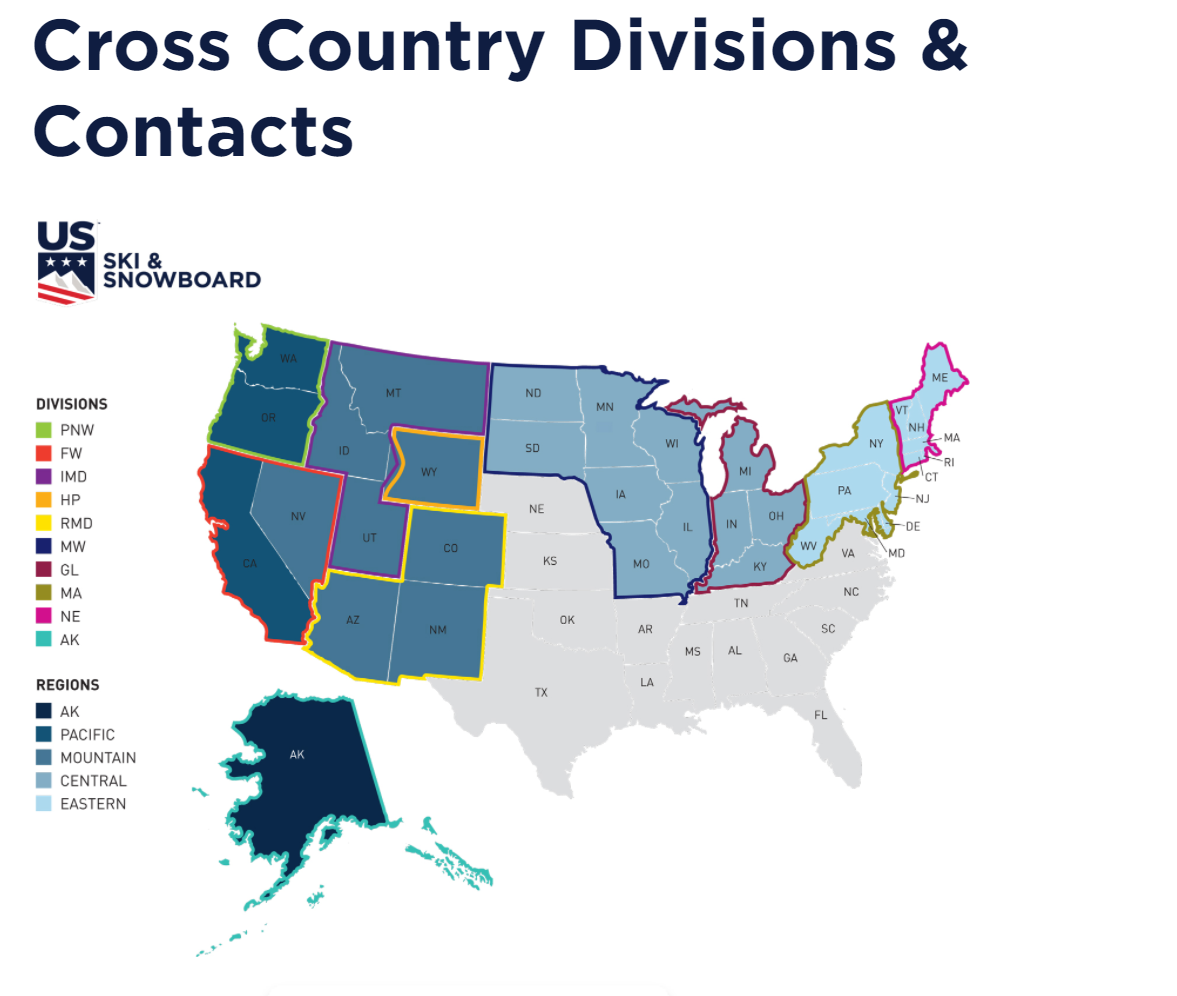
In keeping with tradition, skiers competed for their regional teams, which proves to be an ever-evolving and wonky geographical distinction at JNs. Clubs leave and move divisions, and especially when high schoolers turn to college skiers in the U20s, skiers who may be from one division might ski for another (i.e. a skier from Alaska going to school in New England might qualify for the New England U20 team). Generally the map below shows the regional break-up of teams*:
Geographical make-up of each division that competed at Junior Nationals in 2022. *Note: Wisconsin started competing with Great Lakes in 2020, and did so this year as well. (Photo: US Ski & Snowboard)
The sheer amount of racing that occurs over the week of JNs is overwhelming in a way that’s inspirational – speaking to the depth and excitement that US skiing can expect in years to come. However, there were names and performances to highlight, and so here we look briefly at each race.
Monday: Individual Start 10k/5k Freestyle
After a weekend of course preview in which the skiers of America were greeted with the local Midwestern custom of a too early March rain, the JNs program began on a sunny Monday where the temperature stayed in the mid-high 20s (Fahrenheit). The snow left from the snowstorm a week before (another Midwestern custom, the Birkie-week foot of snow) combined with the man-made base to produce fast conditions.
The week kicked off at 9:00:15 with Minneapolis’ own Greta Hansen (Midwest, Minneapolis Ski Club) starting in bib 1 in the female U18 5 k race. The female U20, U18, and U16 fields were combined in the 5 k, before being separated by class in the results.
Combining the fields yielded the first intriguing result of the week, when U18 racer Ava Thurston (New England, Mansfield Nordic Club) finished the race in 1st nearly a minute (14:18.9) ahead of 2nd place (and first place U20) Nina Seemann (+55.6 seconds). Thurston had a similar advantage over 2nd place U18 (and 3rd overall) Maggie Warner (+56.1) (Midwest, NordicWerks). In a field of the best skiers from across the country, Thurston also proved to be one-half of the extraordinary feat of being joined by a teammate on the podium. Hattie Barker, also from Mansfield (New England), was the 3rd U18 (+57.3 sec).
Thurston, who was named to the U18 Nordic Nations Cup US team (the event, set to be held outside of Trondheim, Norway was canceled at the end of January due to COVID-19), had begun a banner week.
In the U20 girls, meanwhile, Seemann topped the field ahead of 2nd place Aurora Cramer (Intermountain, Sun Valley) (+3.9 sec). The Dartmouth freshman came to US Junior Championships after having competed for the US at World Junior Championships just a few weeks ago. The U20 podium was rounded out by New England’s (Gunstock Nordic) Catherine Stow (+25.9 sec).
In the U16 girls race, host club Loppet Nordic Racing (LNR) got its first national champion on its home turf. Sydney Drevlow (Midwest) finished the 5 k in a time of 15:36.8 for 1st place, and was joined on the podium by her teammate Inga Wing (Midwest, LNR) in 3rd (+13.7 sec). In between them was Pacific Northwest’s Neve Gerard (Mt. Bachelor) in 2nd (+11.6 sec).
The U20/U18 Boys 10 k field would see similar results to their female counterparts, with top athletes having come fresh-off of qualification for the Nordic Nations trip or Junior World Championships.
Like the girls field, there was one boy who stood out immediately with his result in the skate race. Alaska Pacific University’s (APU) Michael Earnhart (Alaska) continued a breakout year that’s seen him post strong results at Junior World’s, Senior Nationals, and on the SuperTour alike, winning a junior national championship in a time of 22:02.5. He was followed in the overall by the U18 National Champion Adrik Kraftson (Midwest, LNR) (+13.1 sec), and U18 2nd place Jack Lange (New England, SMS) (+16.2). Wes Campbell (Intermountain, Park City) rounded out the U18 podium (3rd) in 4th overall (+23.5). All three U18s were set to be teammates on the Nordic Nations trip that was canceled in January, but would make-up for the chance to get familiar with each other there by seeing plenty of each other on the race course the rest of the week.
Midwestern skier Adrik Kraftson (LNR) lies on the Wirth Park snow in exhaustion after a race a JNs. Kraftson had a week of impressive results, including a 2nd in the U18 Boys 10 k Freestyle and the fastest leg in the U18 Team Relay. (Photo: David J Owen Photography)
The U20 podium was rounded out by Alaska’s Alexander Maurer (Alaska Winter Stars) (+35.0) in 2nd and University of Vermont (UVM) freshman Aidan Burt (UVM) (+37.8) in third.
The U16 boys would see a tight 5 k race. Green Mountain Valley School’s (GMVS) Tabor Greenberg (New England) delivered a big win for New England in a time of 13:37.4. He edged out Alaska’s Murphy Kimball (AWS), who was 2nd (+4.1). New England did place another on the podium though, with Stratton Mountain School’s (SMS) Micah Bruner in 3rd (+11.5).
The first day allowed skiers that had come off of the World circuit to re-establish themselves at the forefront of US skiing, and saw young promising skiers have their first “big” results on a national stage. A familiar picture for the Alaska Cup also began to take shape, with New England, Midwest, Alaska, and Intermountain all prominent at the top of the results.
Wednesday: Classic Sprint
The Minnesota sun was still high above Wirth Park, but by Wednesday skiers and coaches realized they had come to visit the land of the wind chill factor. Highs were in the single-digits with the wind blowing across the hills of Wirth.
While the new sprint course kept mostly in the park’s trees to mitigate the wind, the cold, transformed snow on a Classic day surely sent a couple of wax techs to parts of their boxes they don’t visit very often (base klister, anyone?). Then again, with the best skiers in the country come the best wax techs too.
Still, the Wirth sprint course that had been designed for the World Cup required those techs to be on their A-game. After turning out of the marsh bottom the start-area sits in, skiers were greeted by the wide, four-lane, long climb that begins all Wirth courses, before a series of rolling hills sent them straight up the steep, rope tow lift line A-climb. Then, the course twisted and turned before popping over a bridge that led to the finishing straight.
In terms of tactics, the climb-heavy course would allow only the strongest of skiers a little maneuvering. If you could stay below full-bore on the first climb, then you could throw in a commanding push over the top of the A-climb. The final half-kilometer had enough mitigating turns and bumps that would wipe out an attempt to draft into the finishing line, and so there wasn’t much reason to hold back before then.
One skier who did have the capacity to use the tactic of waiting for the A-climb proved to be Michael Earnhart. In the Boys U20s final, Earnhart tucked into a pack that contained the whole field: Jack Young (New England, Colby College), Peter Hinds (Alaska, APU), Aidan Burt (New England, APU), Jack Christner (New England, Middlebury College), And Anders Weiss (Rocky Mountain, Aspen Valley Ski and Snowboard). On the A-climb, he moved out of the track and attacked, coming over the top in first. The U20 field yielded a strong response, and when they came over the top of the bridge, the gaps at the top of the climb had remained the same. Earnhart was followed by Colby freshman Jack Young who came in like a Mule (shameless bad pun) in 2nd (+0.2). Rounding out the podium was Hinds (Alaska, APU) in 3rd (+1.6 sec)
Jack Young (New England, Colby College) outsprints Peter Hinds (Alaska, APU) for second place in the U20 Classic Sprint Final behind winner Michael Earnhart (Alaska, APU). Along with the Classic Sprint, Earnhart also won both the Individual 10 k Freestyle and Classic Mass Start 15 k at JNs. (Photo: David J Owen Photography)
In the Girls U20s final Nina Seemann (New England) was able to establish a gap from the gun and hold it. She claimed her 2nd win in as many races -5.9 sec ahead of the College of St. Scholastica’s Mia Case, who raced for her home division Great Lakes (Case is from Minoqua, WI). In 3rd place, by a ski, was Northern Michigan University Freshman Lauren McCollor (+0.1).
The boys U18 final saw Finegan Bailey (New England, SMS) establish a two-man break alongside Trey Jones (Rocky Mountain, Steamboat Springs), before Bailey pulled ahead in the final stretch. Bailey won, with Jones 2nd (+0.4), and Adrik Kraftson (Midwest, LNR) taking his second podium of the week in 3rd (+5.6).
In her second breakaway win of the week, Ava Thurston (New England, Mansfield) commanded the field to win by -5.8 sec over Jackson Hole’s Kate Brigham (Intermountain). Molly Moening (Midwest, Minneapolis Ski Club), another Nordic Nations team qualifier, rounded out the podium in 3rd place (+7.9 sec).
Finegan Bailey (New England, SMS) celebrates after winning the U18 Boys Classic Sprint ahead of Trey Jones (Rocky Mountain, Steamboat Springs). Midwestern skiers Adrik Kraftson (LNR) and Benon Brattebo (LNR) sprint for 3rd in the background. (Photo: David J Owen Photography)
When the U16 boys raced their final, the runner-up from Monday Murphy Kimball (Alaska, AWS) was willing to animate the race as it hit the first hill. When they got to the A-climb, the only one in the field who could match his climbing was Midwest’s Miles Miner (Minneapolis Ski Club). The pairing raced to the finish, with Kimball opening a gap to take first and Miner in 2nd (+1.9 sec). In the ensuing sprint for third place, one of the layered nuances that makes JNs a great national gathering for the ski community played out. Winning the sprint for 3rd was New England’s Ellis Slover (+8.6 sec), who hails from Quarry Road Nordic Ski Club in Waterville, Maine. The small detail of the home club can seem small, but for a club that’s only a decade old tucked into a town in Central Maine, having a junior on a national podium takes every bit of the ski community working towards one goal, and represents a joyous breakthrough. “QRSC for the win” commented Slover’s teammate Beckett Cote on his result (who is also the author’s cousin). Indeed.
The U16 girls race saw Sun Valley’s Cora Faye Scott (Intermountain) establish a lead late in the race over a pack of three. In the sprint for the final two podium spots Maeve Ingelfinger (Intermountain, GNT) (+2.5) got 2nd and Lucy Perkins (Rocky Mountain, Ski and Snowboard Club Vail) finished third (+2.6).
The day of sprint racing saw racers who had already had top results earlier in the week show their dynamism as skiers, and those who may go on to specialize in the discipline have affirming results. The regional mix still leaned heavy towards New England, Alaska, and the Midwest, and half-way through the week, it seemed those three would be racing for the title in the Alaska Cup.
Murphy Kimball (Alaska, AWS) lifts his poles as he celebrates a national title in the U16 Boys Classic Sprint. 2nd place Miles Miner (Midwest, Minneapolis Ski Club) sprints in the background. (Photo: David J Owen)
Friday:15 k/10 k/5 k Classic Mass Start
By Friday, the air had gotten colder (highs in the single-digits) and the wind had gotten blowier (the windchill well below zero). Even worse, skiers would leave the wooded-protection of the sprint course to face the wind head-on for a u-turn hill out in the open on the golf courses fairway. It was a mass start though, so at least they’d have each other.
The closest race on the day came from the U16 Boys field, which raced 2 laps of a 2.5 k loop for their 5 k. A pack of 4 skiers came together on the second lap, which included Landon Wyatt (Intermountain, BSF), Tabor Greenberg (New England, GMVS), Benjamin Barbier (Rocky Mountain, Steamboat Springs), and Elias Soule (Alaska, AWS). Wyatt was able to make a move in the last kilometer to give him a small advantage over the field, and came away with the national championship (14:38.2). In another sprint for 2 podium places with 3 skiers, Tabor Greenberg (New England) was able to take 2nd (+1.3), and Benjamin Barbier (Rocky Mountain) 3rd (+2.0).
The U16 Girls field yielded just as impressive performances. Sydney Drevlow came back for a second convincing distance race win on the week, claiming another national championship twenty seconds ahead of the field (16:25:0). Following her was Rose Horning (Rocky Mountain, Ski and Snowboard Club Vail) in 2nd (+29.1), and the runner-up in the sprint Maeve Ingelfinger (Intermountain, GNT) in third (+33.6).
Sydney Drevlow (Midwest, LNR) finishes her second U16 national title of at year’s JNs in the Classic Mass Start 5 k. Drevlow also turned in a commanding win in the Individual Start 5 k earlier in the week. (Photo: David J Owen Photography)
Despite the change in distance, the top of the U18 Boys field still came down to a battle between the top sprinters Finegan Bailey (New England, SMS) and Trey Jones (Rocky Mountain, Steamboat Springs). At the end of 3 laps of a 3.3 k (10 k total) Bailey and Jones were locked in a sprint again. Bailey again got the edge, winning a second national championship on the week (23:57.3). Jones finished second (+0.12). Then, Wes Campbell (Intermountain, Park City) came in to pick up a second podium on the week in 3rd (+9.1).
In the U18 girls 10 k, Ava Thurston could make the gaps she had over the field something you could see with your own eyes on account of the mass start. She came in -26.6 seconds (27:41.5) ahead of 2nd place Nina Schamberger (Rocky Mountain, Summit Nordic Ski Club). Schamberger’s podium capped an impressive season for the 16 year old who made her Junior World Championship debut a few weeks ago. Molly Moening (Midwest, Minneapolis Ski Club) was 3rd for the second consecutive race (+39.1).
With her 3rd win in the JNs program, Thurston inched towards the rare distinction of winning every race at a JNs. In fact, it had only been done once before at Theodore Wirth Park. With one race to go, her path had only been walked by one skier before her – Jessie Diggins. Not bad company.
Ava Thurston (New England, Mansfield) and Nina Schamberger (Rocky Mountain, Summit Nordic Ski Club) after finishing 1st and 2nd in the U18 10 k Classic Mass Start. (Photo: David J Owen Photography)
She was walking that path, though, with two skiers alongside her. In the U20 Girls, Nina Seemann (New England, Dartmouth) came away with her third win on the week (28:50.8). Meanwhile, in the U20 Boys, Michael Earnhart (Alaska, APU) also won a third in his 15 k (40:54.8). Earnhart had a close one, with Alexander Maurer (Alaska, AWS) in 2nd (+1.8) and Aidan Burt (New England, UVM) (+1.8) in 3rd, while Peter Hinds (Alaska, APU) just missed out in 4th (+1.9). Catherine Stow finished 2nd behind Seemann (+18.5), and Aurora Cramer (Intermountain, Sun Valley) finished in 3rd (+28.0).
After three days of individual racing, JNs would turn towards resolving the issue of which region had the competitive edge in the US in 2022. The Alaska Cup, still a close contest between New England, Midwest, Alaska, Intermountain, and Rocky Mountain would be resolved the next day when individual results gave way to regional pride in the team relay.
Landon Wyatt (Intermountain, BSF) leads the U16 Boys field into the final sprint during the 5 k Classic Mass Start. Wyatt would win the race, with skiers (l-r) Elias Soule (Alaska, AWS), Benjamin Barbier (Rocky Mountain, Steamboat Springs), and Tabor Greenberg (New England, GMVS) sprinting for 2nd-4th place.Tabor Greenberg (New England, GMVS) wins 2nd place, with Benjamin Barbier 3rd (Rocky Mountain, Steamboat Springs), and Elias Soule (Alaska, AWS) 4th. Greenberg claimed victory earlier in the week in U16 5 k Individual Freestyle Race. (Photo: David J Owen Photography)
Saturday: Mixed 4 x 3.3 k Team Relays
The team relays were the one part of the program at JNs that changed between 2020 and 2022. The distance of each leg – the same; the number of skiers on a team – the same; but the gender makeup of those skiers – different. In keeping with the World Cup, the teams would feature two boys and two girls. The two boys would scramble the 3.3 k course in legs 1 and 2, while the girls would anchor in legs 3 and 4. One race apiece for the U16s, U18s, and U20s.
There was plenty of variety among how coaches approached putting together their teams, and they presented different results accordingly. There did, however, prove to be one constant across the three age classes. New England would finish in first.
It began with the U16s. New England-1 skier Tabor Greenberg (GMVS) scrambled to come in alongside the Alaska-1 skier Murphy Kimball (AWS) and hand-off in first and second, respectively, together (6:57.8). The duo’s leg was the fastest the race would see. Through the second lap, New England-1 skier Quinn McDermott (Berkshire Nordic) had kept them in front (14:09.9). Elias Soule (AWS) kept Alaska-1 in 2nd, and a strong leg from Rocky Mountain-1 skier Henry Magill (Steamboat Springs) brought them into 3rd. When the girls began to race, Beth McIntosh (Frost Mountain) built on the New England-1 lead, Rose Horning (Vail) went into the final exchange having put Rocky Mountain-1 in 2nd. Inga Wing (LNR) and Adeline Loewen (Plain Valley), meanwhile had put Midwest-1 and Pacific Northwest-1 into 3rd and 4th when Loewen skied up to Wing and came into the final exchange with her. Anchor Sydney Drevlow (LNR) was able to continue the charge for Midwest-1, and with the fastest women’s split (8:25) she moved into 2nd place. In the end, she couldn’t quite catch Annelies Hanna (Ford Sayre), who finished the win for New England-1 (31:37.7). Drevlow brought home 2nd for the Midwest-1 team (+11.2), and Pacific Northwest-1 had ridden their late surge to a 3rd behind the skiing of Neve Gerard (+12.9).
The U18s saw similar close racing throughout the race. Adrik Kraftson (LNR) scrambled with the fastest leg (6:37.5) to put Midwest-1 in first. But Intermountain-1 with Wes Campbell (Park City), New England-1 with Finegan Bailey (SMS) , and Midwest-2 with Cooper Camp (LNR) were all within five seconds. When Jack Lange (SMS) handed off to the 3rd leg though, he had skied New England-1 into first place (13:35), followed by Midwest-1 with David Isom (Minneapolis Ski Club), and Midwest-2 with Jonathon Clarke (LNR) (+4.6). Hattie Barker (Mansfield) built on New England-1’s lead to hand off to the anchor Ava Thurston (Mansfield) in first place (21:42.3). Behind, the skiing of Maggie Warner (NordicWerks) had maintained Midwest-1’s 2nd place (+13.1), and Abigail Haas (FXC) had moved Alaska-1 into 3rd (+24.1) alongside Midwest-2 with Jordan Parent (NordicWerks) in 4th (+24.2). Thurston anchored with the fastest girls leg (7:51.1) to win it for New England-1, and give New England the 2nd win of the day. Midwest-1 skied to second with Molly Moening (Minneapolis Ski Club) anchoring, and Meredith Schwartz (AWS) was able to hold off a challenge from Greta Hansen (Minneapolis Ski Club) to see Alaska-1 finish in 3rd ahead of Midwest-2 in 4th. With that 4th though, the Midwest pulled off the impressive feat of having two teams in the top 5, speaking to the region’s depth.
When the U20s started then, New England was looking for the sweep. Their bid would start with Colby’s Jack Young, who finished his leg with New England-1 in 3rd (+12.1) behind Intermountain-1 with Elijah Weenig (Jackson Hole) in 2nd (+5.6) and Alaska-1 with Michael Earnhart in 1st (6:38.2). At the 2nd exchange, Alexander Maurer (AWS) had held 1st place for Alaska-1 (13:26.6), while Aidan Burt (UVM) had moved New England-1 into 2nd (+5.8), and Intermountain-1 had held 3rd with Max Kluck (BSF) (+9.5). Then, Catherine Stow (Gunstock) put in the fastest women’s leg of the race (7:58.3) to put New England-1 into 1st (21:41.0) with a gap coming out of the final exchange. Marit Flora (APU) kept Alaska-1 in 2nd (+23.2), and Lucienne Ludwig (Sun Valley) had Intermountain-1 in 3rd (+1:00.0). Nina Seemann (Dartmouth) kept New England-1’s gap, and finished her fourth and final win of JNs with a sweep for New England on the day (30:00.7). Katey Houser (Alaska Nordic Racing) finished a 2nd place relay for Alaska-1 (+29.6), and Aurora Cramer (Sun Valley) kept Intermountain-1 in 3rd (+1:13.7).
Nina Seemann comes across the line in first place for the 4th time in 4 races at JNs last week. The Dartmouth Freshman swept the U20 Girls races while cementing New England’s Alaska Cup win at Wirth Park. (Photo: David J Owen Photography)
Team Results: Alaska Cup Settled
By the time the Team Relays finished, there wasn’t a coach or spectator in Wirth Park that needed to pull up the Alaska Cup standings to do the math on who had won. New England, after a week of strong individual and team skiing, came away with the distinction of the top region for junior skiing in the country. It was a title that they’ve become used to winning. Going back to 2014, the only thing that could stop team New England from winning the Alaska Cup was the global pandemic of the past two years (*Alaska was in first at 2020 JNs when it was cancelled mid-week, it should be noted). And it doesn’t appear anything will change as we emerge from that era.
Behind New England, the Midwest finished 2nd by less than 300 points, which was a sure sign that the development places like Theodore Wirth Park have been invested in to spur is on track. Intermountain had a strong showing coming in 3rd place, while Alaska and Rocky Mountain were also competitive in 4th and 5th, respectively.
In the Junior Nationals Club Classification, Loppet Nordic Racing maintained its streak as the top junior racing club in America. Service High School in Anchorage, Alaska won the Roger Weston Trophy for the top high school in the country.
Skiers from all over the country round the first corner of the Theodore Wirth Park course in the U16 Boys 5 k Classic last week in Minneapolis. (Photo: David J Owen Photography)
Lessons from a Week at Wirth
In winning all four races at a JNs held in Wirth Park, Ava Thurston (U18) and Nina Seemann (U20) just one other skier with that distinction; Jessie Diggins. No matter where their promising careers in skiing go (and all signs on that are far), they’ve accomplished a feat that shows a unique capacity for focus, grit, and determination appropriate to the skier they followed in the feat.
Ava Thurston (New England, Mansfield) sprints to 1 of her 4 victories at JNs last week. Alongside fellow Vermonter Nina Seemann, Thurston replicated a feat that three time Olympic medalist Jessie Diggins completed a decade earlier by sweeping her category at JNs. (Photo: David J Owen Photography)
And then again, that’s really what bringing back Junior Nationals to Minneapolis – to Theodore Wirth Park – was all about. Letting the work and dedication that’s gone into American skiing be shown by the juniors who do it best.
As Loppet Foundation Executive Director Claire Wilson said in remarks to FasterSkier “The week was the highlight of the winter – and the Loppet is proud to support the development of the sport and finally give the community a great Junior Nationals!”
Each racer that crossed the start line at Wirth did so powered by all that has been put into the ski community over the course of their young lives. The brand-new chalet that played background to a new course at Wirth was a constant reminder that people coming together to grow something they love has the power to produce big things. If you paid attention to the skiing in the foreground though, that power wasn’t broken down into pieces. In each look of determination while skiing down the trail, each smile on a face when that trail had been skied, was the reflection of a coach, parent, or teammate that shared the joy of ski racing with a young person, and who in turn let it run wild.
It’s that simple. All that we leave Minneapolis with is again an air of possibility, for where the nation-wide community of Nordic skiing will set its sights on next – a future that by the looks of last week is as inspiring as anything that’s come before it.
Rocky Mountain coach Molly Susla (Crested Butte) and athlete Sawyer Ezzell (Crested Butte) share a smile in Minneapolis during JNs last week. (Photo: David J Owen Photography)
David J. Owen is a Minneapolis-based photographer who’s work showcases the best of skiing in the Midwest. Check all of his 2022 Junior Nationals galleries here. Visit his website to see his full suite of work in skiing and beyond.
SuperTour racing continued on Friday in Craftsbury, Vermont, as part of the Henchey Memorial Carnival, which also included Eastern Cup and collegiate racing. The three-day event is presented by the Craftsbury Outdoor Center, NENSA, U.S. Ski & Snowboard, and the University of Vermont (UVM), the EISA carnival host school.
Racers were faced with snowy conditions for the opening 1.4-kilometer freestyle sprint as a winter storm made its way across the Northeast. Friday morning’s grooming report mentioned 6 inches of fresh snow, as more continued to fall throughout the morning.
On the women’s side, last weekend’s 10k freestyle winner, Alayna Sonnesyn (SMS T2), won the qualifier in 3:58.27, ahead of BSF Pro Team’s Lauren Jortberg in second and APU’s Rosie Frankowski in third. Perhaps a nod to the wintery conditions, these top three finishers were separated by over six seconds.
Sonnesyn advanced from the first heat of the quarterfinals into the semis, where she finished third in the first heat behind Katharine Ogden (SMS T2) and Ava Thurston (Mansfield Nordic Club), who crossed the line together, roughly 0.4 seconds ahead of Sonnesyn. As the second semi, which was won by Jortberg, was roughly four seconds faster on average, Sonnesyn did not earn a lucky loser spot in the final. Instead, Jortberg advanced with Anna Bizyukova of UVM, Frankowski, and Craftsbury’s own Margie Freed.
Despite the trend seen in the qualifier, the final featured tight racing, with the top five athletes finishing within two seconds of one another. Just 0.6 seconds separated second from fifth.
A scene from the women’s final of the 1.4k freestyle sprint in Craftsbury. (Photo: Instagram @nensa_nordic)
Coming out on top was Ogden, who won the final in 3:59.08. After racing on the World Cup from the opening races in Ruka through the midway point of the Tour de Ski, Ogden has gone three-for-three in SuperTour sprints since returning stateside, winning classic sprints in Soldier Hollow and Lake Placid before checking off a skate win today.
Just behind, Jortberg took second place (+1.30) with U18 athlete Thurston closing in third (+1.78). Bizyukova was next to the line in fourth (+1.86), with Frankowski less than a meter behind in fifth (+1.91). Freed rounded out the women’s final in sixth (+4.51).
“I think that the biggest thing to note about today was that it was blizzarding!” wrote Ogden in a post-race email. “The heavy falling snow made the heat racing very tactical and rewarded being very quick off of the line. There was one lane on the course that was packed down by traffic and the other areas were pretty soft!”
Ogden was just 11 points behind Caitlin Patterson on the Olympic qualification distance list, based on the athletes’ best two distance races on the SuperTour or at the U.S. Cross Country Championships, during which Ogden competed in only one race – the 10k individual start classic where she was second to Patterson. The following weekend in Sun Valley, she was second in one distance race and fourth in the other, behind three Olympians and ahead of Patterson in each. As the races at U.S. Nationals were scored at a higher point value, Patterson took the final Olympic spot, leaving Ogden on the wrong side of the cusp.
Nevertheless, Ogden has found silver linings in the additional time back east.
“It was a blast to be able to race with the EISA. I miss skiing for Dartmouth (Ogden graduated in 2021), so it was fun getting to ski with some of my old teammates and some new Dartmouth skiers. It was also pretty great to ski in lots of natural snow, we rarely get a snowstorm this big anymore and it was undeniably very fun.”
The women’s podium after the opening freestyle sprint race which kicked off a weekend of SuperTour, Eastern Cup, and EISA racing. (Photo: APU Nordic Ski Center / Instagram)
As Thurston is, remarkably, still in high school, Bizyukova was the top collegiate racer to earn today’s EISA sprint title. The second and third placed collegiate racers both hailed from Dartmouth College, with Callie Young finishing fifth in the first semifinal and 10th overall, and Jasmine Drolet taking sixth in the second semi for 11th overall.
The men of the Sun Valley Ski Education Foundation (SVSEF) Gold Team swept the top-three spots in the men’s qualifier, with Karl Schulz leading the way in 3:23.48. Peter Holmes was 0.33 behind in second, with Johnny Hagenbuch in third (+1.21).
Schulz carried momentum from the qualifier win into the first quarterfinal, which he won by half a second, but his day ended soon after in the semifinal. Racing in a fast first heat that contained two eventual podium winners and found both lucky losers, Schulz was fifth in the heat, +1.72 behind winner Matias Øvrum of UVM. Sam Wood (SVSEF) was second in the heat, ahead of last weekend’s sprint winner Zak Ketterson (Team Birkie) and Gregory Burt (UVM).
In the second semi, which was nearly three seconds slower, Canada’s Étienne Hébert (CNEPH) edged out Holmes by 0.1 seconds to go 1-2 and advance to the final round.
Zak Ketterson leads up the final climb in the men’s freestyle sprint final in Craftsbury. (Photo courtesy Zak Ketterson)
The top two spots in the final were decided by a close finish between Ketterson and Øvrum, with Ketterson crossing 0.28 ahead in a time of 3:22.57 to earn his third SuperTour sprint title of the season. Øvrum was second, though he was named the collegiate race winner for UVM, with Hébert crossing the line a few meters behind on his own in third (+2.17).
“I’ve always really liked racing at Craftsbury,” Ketterson wrote to FasterSkier after the race. “It’s an awesome place and this year Team Birkie has been lucky enough to stay right at the Outdoor Center. The race course is right out our back door!”
Ketterson also provided insights to the final round for those following from afar.
“The final was really close! I gave it everything I had at the top of the last hill but I definitely started to get tired and bogged down a bit into the finish. Matias skied a smart race and gave me a really good challenge in the last few meters but luckily I was able to fend him off. It was a tricky day with super soft fresh snow and I’m happy I was able to execute.”
Zak Ketterson races a snowy freestyle sprint qualifier in Craftsbury. (Photo courtesy Zak Ketterson)
Wood was fourth in the men’s final (+6.9), with Burt fifth (+7.17), and Holmes sixth (+10.82).
The men’s freestyle sprint podium after the opening day of SuperTour racing in Craftsbury. (Photo: Instagram @nensa_nordic)
As mentioned, Øvrum was the top collegiate racer, with Burt second, going one–two for UVM. Third place among college athletes was Allan Luke of Dartmouth, who finished sixth in the first semifinal and 12th overall.
Craftsbury’s Day 1 coverage of the the 2022 Henchey Memorial Carnival: SuperTour, NENSA Eastern Cup and UVM EISA carnival.
Linden Nideck of CSU navigating the agility features. (Photo: Peter Minde)
The NENSA rollerski series ramped up this past weekend outside Lake Placid, New York. As part of the drive to draw more skiers to the rollerski series, Saturday included a two race format known as a doubleday event: event 1 consisted of a 3-kilometer skate prologue followed by a 1.5-k cross-country cross (XCX) featuring several agility segments. Athletes earned a reward for performances in each event. Both events were individual start and their aggregate times were used to form a pursuit start for the first wave of the Climb to the Castle (C2C) on Sunday.
For those who raced both events on Saturday, the C2C was a pursuit style event – with the overall leaders from the first two races heading out first.
Saturday’s Doubleday
Both races were located at the Olympic Jumping Complex while between races, NENSA’s Justin Beckwith and NYSEF’s Shane McDowell assembled the undulating ramps that constituted the agility segments for the sprint prologue. At each agility segment, if an athlete couldn’t ski the obstacle, there was a safe alternate route that penalized skiers- not unlike a penalty loop in biathlon.
It was cloudy all day; the uppermost section of the loop was damp from overnight rain.
Individual results for each respective race can be found here:
Saturday’s overall results dictated the pursuit start times for Sunday’s C2C. For the senior women, Zoe Williams (ENRG/Nakkertok/Carleton College) was atop Saturday’s combined standings. Nina Armstrong (NYSEF) was second, and Jessica Roach (Team Hardwood) third. For the men, Luke Brown (Bridger Biathlon), Zane Fields (US Biathlon), and Erikson Moore (Fondeurs Laurentides) were first through third respectively heading into Sunday’s event.
Kyle Bratrud on his way to the 2019 Climb to the Castle win. (Photo: of Kel Rose)
Climb to the Castle
Sunny skies greeted racers on Sunday as did blustery winds. Although it was dry, the weather was noticeably cooler than the 80 degrees racers endured at least year’s C2C. An hour before the start, it was 55 degrees at the toll gate, with the wind blowing steadily between 16 and 26 miles per hour.
Kyle Bratrud (SMS T2) and Williams won Sunday’s Climb to the Castle (C2C) rollerski race in Wilmington, New York. It was the first win here for both skiers. The race ascended the Whiteface Mountain toll road for five miles at an average grade of eight percent. At 4867 feet, Whiteface is the fifth highest peak in the Adirondack Mountains.
Bratrud, who did not contest either race on Saturday, broke Robert Duncan Douglas’ long-standing men’s record by 1.1 seconds, finishing in 34:55.5 minutes. Jake Brown, of US Biathlon and Craftsbury Green Racing Project (CGRP) placed second at 36:25.8. Luke Brown raced to third in 37:30.1.
For the women, Williams finished in 48:54.6 after placing third last year. Kathy Maddock, age 54, of Wilton, NH., was second overall in 51:12.0, followed by a junior skier from Mansfield Nordic, Ava Thurston, in 51:20.1.
Skiers who competed in Saturday’s doubleday races went out first, starting in a pursuit format based on their aggregate times. Doubleday finishers started at 8 AM sharp and were all on course by 8:05. Open athletes started in a mass start wave at 8:06, with masters following two minutes behind.
Bratrud told FasterSkier he’d raced C2C once before in 2015. Since he did not race the sprints the day before, he started at 8:06, gradually reeling in the pursuit starters.
“It’s been a while since I’ve been up here but I really like this climb,” Bratrud said. “It’s always a really sweet atmosphere and it was a pretty solid effort. We started in a group of maybe five or six. I was at the front and set a decent pace. It didn’t seem like anyone wanted to come around me so I just kind of slowly ramped it up without destroying myself and it worked out.
“We had done the App Gap roller ski race a little earlier in the year,” Bratrud continued. “There, I tried to send it as fast as I could off the line, and ultimately I blew myself up. Here, I wanted to be a little more controlled and I knew it was a long race. I wanted to ski a nice controlled V2 the whole way.”
While both races are purely uphill, each has a distinct set of challenges. The App Gap challenge features a transition from skate to classic and climbs about 1,500 vertical feet over the 7.5-kilometer course, while the C2C climbs 2,300 feet in one unbroken grind.
“I think [C2C] is definitely harder,” Bratrud said when asked about comparing the two. “There are steep pitches on the App Gap but there are also some flat parts. There really isn’t anywhere to hide on this climb once you start going up, which is basically right at the start. And then you get the wind.”
2019 Climb to the Castle men’s podium. From left to right: In second Jake Brown, first Kyle Bratrud, and third Luke Brown. (Photo: Kel Rose)
Like Bratrud, Jake Brown started in the wave following the doubleday athletes. “It went pretty well,” he said of his race. “I was able to hang on to Kyle for a couple of miles and then it was a little too much. I was hoping that I wouldn’t have to lead so I could tuck in a little bit, which I was able to do. Otherwise, I didn’t have much of a plan. Something like this is so physically demanding, you can’t really have a plan until you get out there and understand how your shape matches the challenge.”
Luke Brown felt that the doubleday was good preparation for the C2C. “I think the efforts [in the doubleday] opened up my legs, kind of a pre-race,” he said. “I felt pretty strong, it’s a super fun road to ski up. Pretty nice weather at the bottom, and windy at the top. Zane Fields started six seconds behind me and caught up to me. We worked together for a little bit and then I pulled away from him, probably about halfway up the mountain. Then I just tried to go hard.”
With the best women’s aggregate time from the doubleday, Williams was the rabbit out of the start. Shilo Rousseau of Ontario’s Barrie XC, a junior skier, was the second woman starter as she followed 32 seconds after Williams.
2019 Climb to the Castle junior women’s podium. From left to right: in second Rose Clayton, first Ava Thurston, and third Shilo Rousseau. (Photo: Kel Rose)
“The pursuit start meant that I skied a lot of it alone, which was different from previous years,” Williams said. “I was happy that I kept the pace going up the hill, kept trying to keep the tempo up. So it was good. My legs were for sure tired after yesterday, and I felt that probably a kilometer in. I thought that it would be my legs holding me back instead of my cardio. But I still felt like I was able to put a good effort in.”
Maddock said she benefited from working amongst a group of fast skiers.
“I was part of a train of men and hung with them until it was just the guy leading and me,” wrote Katherine Maddock, head coach of Dublin (NH) XC. “It was super helpful having him to ski with. On the flat(ish) section maybe a mile or less from the top, we could see a group of skiers in front of us. He turned around and said to me, ‘Let’s go fishing. And then he just started picking people off. It was great. Ultimately he made a move around a skier and I couldn’t match the effort so I was on my own in the wind tunnel, but I survived, which was no small feat with that headwind!”
Lucy Hochschartner (St. Lawrence University) has raced C2C multiple times. “It was really fun! I’ve done this race a lot of times and it’s always really hard,” she said. “But it was great to have nice weather and lots of good people to race against. I didn’t do so great [in the doubleday] so I got to move up a little bit. And not dying at the very end was fun. The wind definitely made for a slow finish.”
Nina Armstrong during the first day of racing at the three race mini-tour. (Photo: Peter Minde)
Nina Armstrong (NYSEF) had the weekend’s races written into her training plan. “I haven’t done [C2C] in quite a few years,” she said. “It was fun. My plan was to work into it and hopefully not die before the finish line. It was really fun having people all around you.”
Sheila Kealey, the head coach at uOttawa Nordiq was excited to place a bib on after coaching skiers at the Doubleday.
“The race was a good effort,” she wrote in an email. “Starting in the mass start I had some people to ski with about half of the time, and I was catching some athletes from the pursuit start waves ahead – so it was a quite different experience than other years with a women’s only start. My plan from the start was to try to ski with people — it was a reasonable effort. No problems switching from coach-mode Saturday to race mode Sunday!”
Before the racing on Saturday, FS interviewed Jessica Roach and Robbie Raikou from Team Hardwood in Ontario.
“The past three years, Team Hardwood has made it a point to come [to Lake Placid] for about a week in August to take advantage of what Lake Placid has to offer for skiing and for training,” Raikou said. Roach described her race plan: “I come from an alpine skiing background, so hopefully, I get to use that on the hills and the corners to my advantage. We’ve never done this course at speed before, so it should be interesting. Just going to survive it and have fun.”
Finn Dodgson, another visiting skier, noted this was his second year in the doubleday. “Today went all right. I was sick at the beginning of this week so I’ve been getting over the last bit of the illness and getting back to racing feelings,” he said. “Last year, I definitely noticed that I felt a lot better in the second race. I was warmed up and knew the course better, so this time around, I tried to get a better warmup in and get some good laps, just to see how it is and remember all the corners. The obstacles weren’t as daunting as I thought. They went well and I was able to do all of them.”
Four skiers from Montreal’s Fondeurs Laurentides had their first doubleday this year. Speaking of the race loop, Aiden Raynor said, “It’s got some twists and bends to it, that’s for sure. Quite extreme but super fun.”
His teammate Erikson Moore added, “[The course] was great. It works almost every technical ability a skier could have, and it has a good mix of flats to climbs.”
“The second race with the ramps [agility features] was really fun and, sketchy downhill, but it was worth it,” said Mathis Desbaumes.
The Doubleday / C2C weekend suits Shilo Rousseau. She was C2C’s third-place junior female finisher and second place on aggregate time in the doubleday. After the doubleday, she said, “It went really good this year! I noticed some big improvements [in fitness] from last year and felt a lot stronger. Last year, I noticed going from the bottom all the way to the top in the second loop I felt a lot more tired. This year I was able to be strong the whole way.”