From the FasterSkier archive — posts syndicated from athletes’ and coaches’ own blogs between 2004 and 2012, kept online as published. Current coverage is at fasterskier.com.
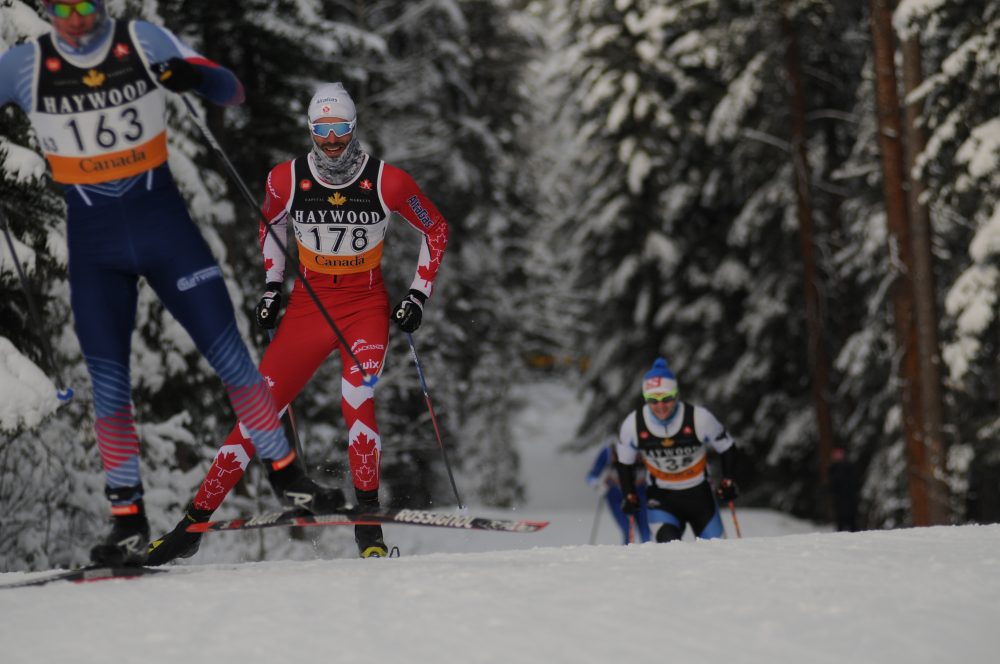
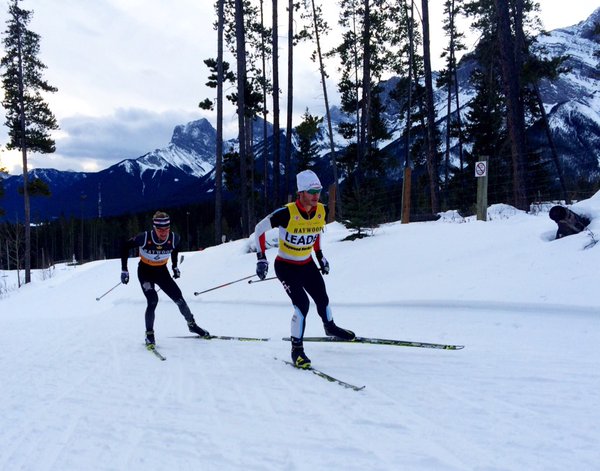
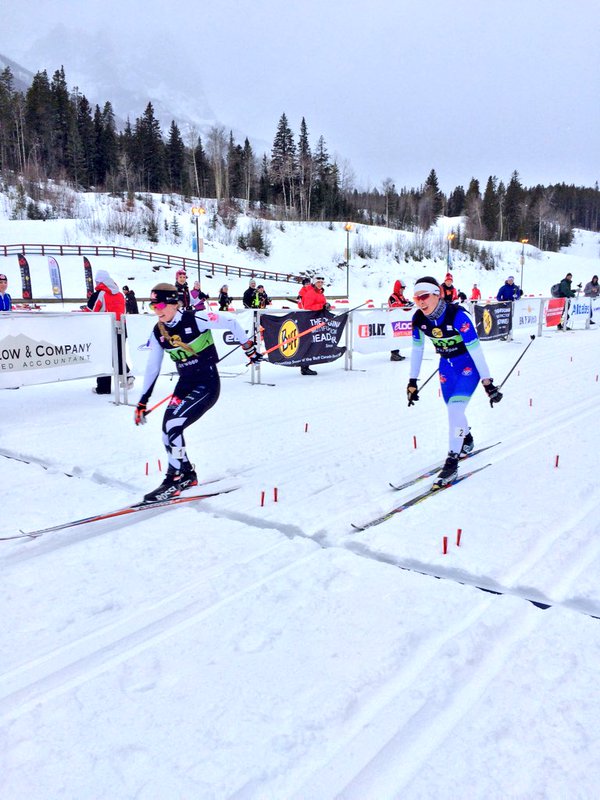
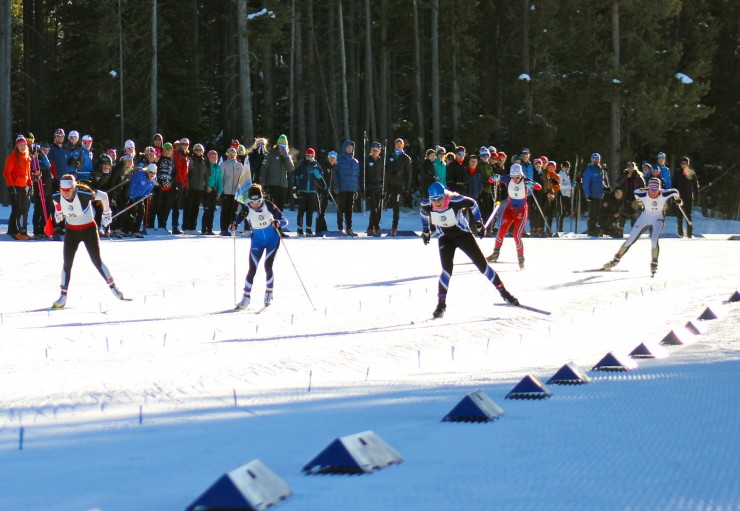
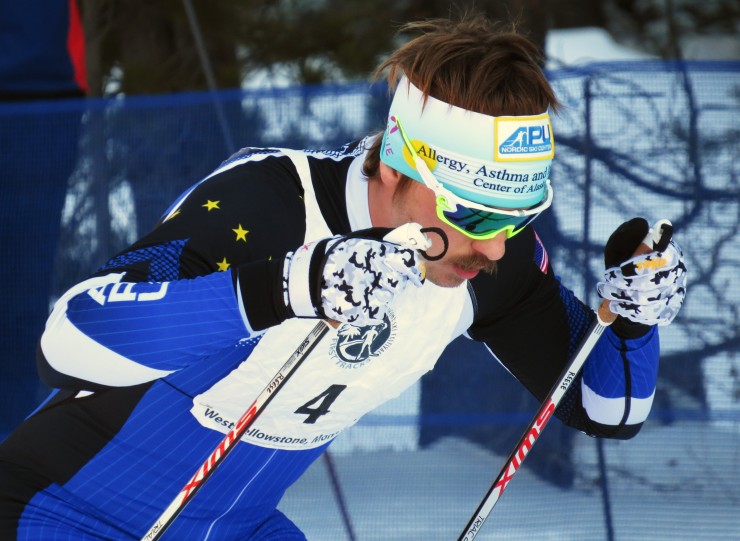
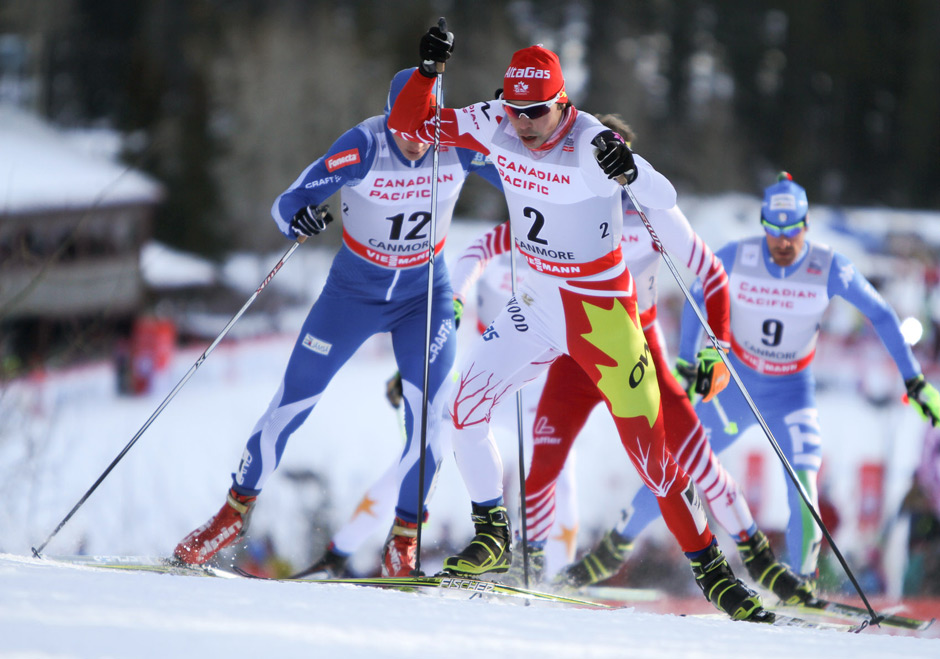
Canadian World Cup Team member Len Valjas (178) chases American Rogan Brown of the Sun Valley Ski Education Foundation (163) during the Frozen Thunder 10-kilometer freestyle on Friday in Canmore, Alberta. (Photo: Doug Stephen)
Frozen Thunder lived up to its name on Friday, with temperatures hovering below the legal race limit prior to the start of the second competition series of the week: the women’s 7.5- and men’s 10-kilometer freestyle individual starts.
An hour delay was enough time to see temperatures rise to -10 degrees Celsius (14 Fahrenheit), and many skiers bundled in Buffs in prep for the five to six laps of racing. Overcast skies were a celestial reminder of the nearly 18 centimeters of snowfall that Canmore, Alberta, had seen over the past three days, Mother Nature’s own personal pass at the center’s snow-farmed track.
Thirty-six athletes entered the women’s skating event, many of whom raced Wednesday’s classic sprint, including the sprint-final winner, Maya MacIsaac-Jones (Canadian U25 Team/Rocky Mountain Racers), American Chelsea Holmes of Alaska Pacific University (APU), Dahria Beatty of the Canadian World Cup Team and Alberta World Cup Academy (AIAWCA), Frédérique Vézina of the Pierre Harvey National Training Centre (CNEPH), and Annika Hicks (AIAWCA).
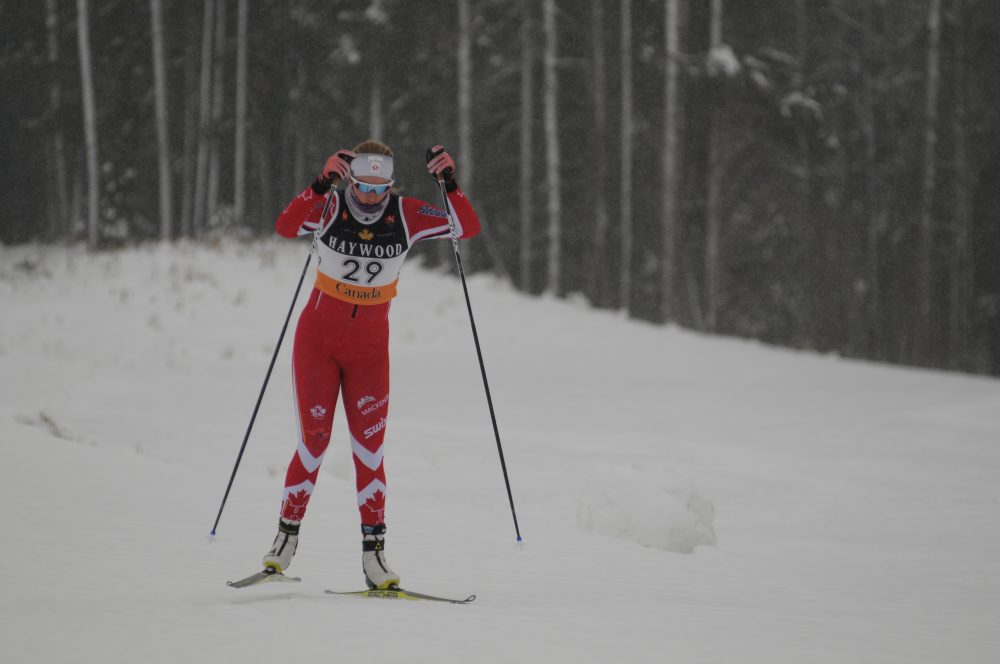
Covering the women’s five-lap race in a time of 21:26.6 minutes was Holmes for first place.
With her husband working and living in Banff, Alberta — a 20-minute drive from Canmore — competing in the Frozen Thunder races for Holmes was not just about getting some races in before the start of the season, but also spending time with her husband before flying to Europe.
“I have Period 1 starts this year, which I’m super excited about, but it’s definitely a bit of time of the road,” Holmes said on the phone after the race. She earned those November/December World Cup starts as the overall leader of the U.S. SuperTour circuit last season.
“I just figured this time of year and I needed to spend some time with Luke and not be traveling too much, which was a hard decision to make,” she continued. “Part of me really wanted to go back to Alaska for a while, but to be a little bit more mellow and to be here was super important to me.”
Holmes, 30, plans to head to Finland on Nov. 15, where she will meet with the U.S. Ski Team and prep for the World Cup opener in Kuusamo. Frozen Thunder presented an opportunity to race against fellow North Americans before competing abroad.
“You push yourself so much harder than you do in intervals,” she said of her decision to race both Wednesday’s sprint and Friday’s distance event. “Even like a time trial by yourself. It changes it when you put a bib on.”
Dahria Beatty, who was promoted to Canada’s World Cup B-team this sprint, racing to second in the women’s 7.5-kilometer freestyle on Friday at Frozen Thunder in Canmore, Alberta. (Photo: Doug Stephen)
Emerging as the top Canadian was Beatty in second place, 34.4 seconds back from Holmes’s winning time. Though Holmes started before her and Beatty received splits off her time, Holmes created a time gap on her competitors with more than two-thirds of racing remaining.
“Chelsea was strong today, she started really fast and had given herself a big lead after the first two laps,” Beatty wrote in an email. “My goal for the distance race today was to push hard from the start and focus on using as much one skate [V2] as possible and having smooth transitions. I was happy with how I skied today and I am excited to build on how I felt today over in Europe.”
With Beatty’s next stop being Gällivare, Sweden, for a weekend of International Ski Federation (FIS) races, both the Frozen Thunder sprint — in which she only raced the qualifier — and distance race served as tools to remind Beatty of her race-pace mentality on snow.
“Frozen Thunder races are always a great way to get into the race mindset at home before heading over to Europe,” she wrote. “For Wednesday’s sprint race I made the decision with my coach beforehand to only do the qualifier. Having returned from Park City only one week before I didn’t want to stress my systems too much too soon. The qualifier went well for me. I made few small mistakes that often come with the first race of the season but I was able to give a solid effort that I was happy with.”
She won Wednesday’s qualifier by 8.56 seconds over Holmes, the second-fastest female qualifier.
Rounding out the podium in the women’s distance race was Canadian World Cup Team member Emily Nishikawa in third (+53.0). Hicks, who was second in Wednesday’s sprint final, placed fourth (+1:38.8) and junior India McIsaac (Canadian Junior National Team/Rocky Mountain Racers) claimed fifth (+1:50.0) overall.
Russell Kennedy of the Canmore-based Team R.A.D. racing to third in the men’s 10-kilometer freestyle on Friday at Frozen Thunder in Canmore, Alberta. (Photo: Doug Stephen)
In the men’s 10 k that followed, 68 skiers started the six-lap race, many of whom were also repeats from Wednesday’s sprint, including Canadian World Cup Team member Len Valjas, Dominique Moncion-Groulx (AIAWCA), Andy Shields (Lappe Nordic), Russell Kennedy (Team R.A.D.), Bob Thompson of the Thunder Bay National Team Development Centre (NTDC), and Julien Locke (U25 Team/Black Jack), who won Wednesday’s qualifier to earn start rights with Canada’s Period 1 World Cup team.
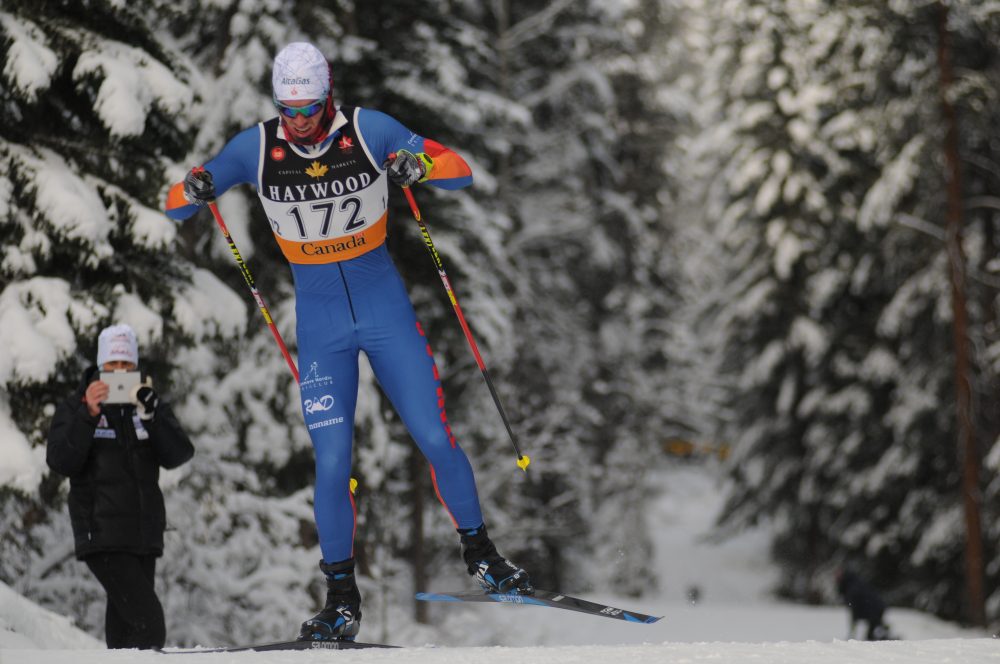
Doubling up on his wins for the week (he also won Wednesday’s sprint final), Valjas raced to first in the men’s distance race, covering the course in a time of 22:13.2. Valjas, who plans to depart for Gällivare, Sweden, on Nov. 11, explained that Frozen Thunder was the perfect last stop before heading to Europe.
“I chose to compete in the Frozen Thunder races because it’s a great stress-free chance to ski hard and shake some of the rust off from summer training,” Valjas wrote in an email. “It always takes a few good hard efforts for me to feel good again. I was very happy with both of my races.
“My goals for the early season are to try and race as many distance and sprint races as I can. I find racing is the best training I can do,” he continued. “Even as a sprint specialist, I have had my best seasons when I have entered all the distance races early in the season. Even if they don’t go well, the training I get from them pays off later.”
Taking second place, 6.2 seconds off Valjas’s time was American Rogan Brown of the Sun Valley Ski Education Foundation. Kennedy took the final podium spot in third (+11.4), Shields placed fourth (+18.1), Canadian World Cup Team member, Knute Johnsgaard finished fifth (+24.9).
“I was hoping for a podium in today’s race and just some sprint practice/ good intensity in the sprint,” Kennedy wrote in an email. “I started maybe a little on the hard side but I was right in the mix the whole race and really just lost the lead the last two laps. It would have been nice to have a ride but I was pretty much solo the whole race. That was good practice for me since I had to just pace myself and push hard the whole time. My fitness feels right on where I would like it to be and now I just have to find a couple extra gears before I leave!”
Tom Stephen (Foothills Nordic) racing to third in the junior men’s category and 21st overall in the 10 k freestyle on Friday at Frozen Thunder in Canmore, Alberta. (Photo: Doug Stephen)
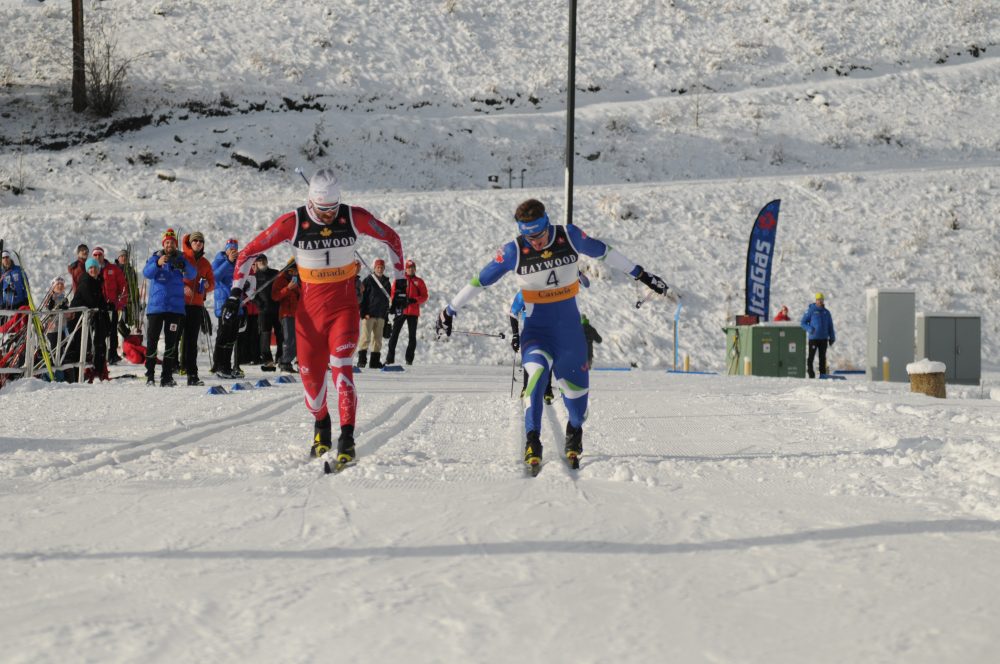
Canadian World Cup Team member Len Valjas (1) and Bob Thompson (NTDC Thunder Bay) lunge to the line during Wednesday’s Frozen Thunder classic sprint at the Canmore Nordic Centre in Canmore, Alberta. (Photo: Doug Stephen)
Clouds heavy with building snow and a winter-storm warning already in effect cast a second anticipatory shadow over a jittery group of racers gathered on Wednesday for the first Frozen Thunder race of the season at the Canmore Nordic Centre in Canmore, Alberta.
At stake for some of the top Canadians participating in the day’s classic sprint was the opportunity to secure the final spot on the men’s World Cup team for the first period of World Cup racing starting later this month. Nearly 12 centimeters of snow had fallen the night before on the two-lap race track, and for many stepping out onto the freshly groomed trails, months upon months of training prep was in the barn.
“That World Cup spot. That has been a goal for pretty well the whole year,” said Bob Thompson, who trains with the Thunder Bay National Team Development Centre (NTDC), on the phone after Wednesday’s races.
Thompson, 26, was not the only one hoping to book a plane ticket for World Cup Period 1, which starts Nov. 24 in Kuusamo, Finland, and continues through December. Sixty-six skiers started Wednesday’s men’s sprint qualifier and anyone in the hunt for that World Cup spot would have to outperform them all, excluding the Americans and Canadian World Cup Team member, Len Valjas, who was prequalified for the World Cup.
Even with the competition’s added edge, many racers went about business as usual on race day and in the days leading up to the event, Thompson explained.
“It’s been fairly carefree the week we’ve been here,” said Thompson, who arrived in Canmore with his NTDC teammates on Oct. 23. “The morning [of the sprint] I wouldn’t say things were a bleak atmosphere or super serious, it was just kind of everyone was doing their thing.”
Thompson went about his warmup the way he normally would on race day. In retrospect, he saw his plan as well-executed and his warmup as strong, despite breaking a pole during his intensity segment. For him, the qualifier went “really well,” he said.
Julien Locke (Canadian U25 Team/Black Jack) after winning the men’s classic sprint qualifier at Frozen Thunder in Canmore on Wednesday and securing the final spot on the Canadian men’s team for World Cup Period 1. (Photo: Cross Country Canada)
But Julien Locke, of the Canadian U25 Team and Black Jack Ski Team, was the fastest man in the open men’s qualifier and thus earned that coveted World Cup spot. Locke, 24, posted the top time of 3:37.81 minutes, nearly a second ahead of Valjas in second (+0.97) and 3.57 seconds ahead of the third qualifier, Dominique Moncion-Groulx of the Alberta World Cup Academy (AIAWCA). Thompson qualified fourth, 4.15 seconds off of Locke’s winning time.
“I didn’t have regrets or second thoughts on how I raced,” Thompson said. “Julien had a great race, props to him. I’ll just have to come back next time.”
Locke could not be reached at press time, but he spoke with Cross Country Canada (CCC) in a video posted on Twitter after the race.
“I’m really excited to have won the race this morning and qualified for Period 1 World Cup, but the Olympics is the big goal this year,” Locke said. “It’s super important to go get results on the World Cup, and I’m excited to have a chance to do that.”
According to CCC High Performance Director Thomas Holland, Locke and the rest of the World Cup Team (excluding Alex Harvey and Cendrine Browne) will head to Gällivare, Sweden, on Nov. 10, where they’ll compete in a weekend of International Ski Federation (FIS) races from Nov. 17-19. Meanwhile, Harvey and Browne, who train out of the Pierre Harvey National Training Centre (CNEPH) with coach Louis Bouchard in Quebec, will train in Davos, Switzerland, in advance of the World Cup opener in Finland.
But let’s get back to Frozen Thunder. With the qualifier behind them and the heats slated to take place in a zero-elimination King’s Court format, many racers approached the rest of Wednesday adamant on getting in some solid race efforts.
“The King’s Court format that we use in the heats was a great showcase for athlete development whereby every athlete entered in the race gets to race all 3 heats,” Holland explained in an email. “The format sees men and woman and para-skiers in some of the same heats – super fun event for all the athletes.”
In the first heat, Thompson, Locke, Valjas, and Moncion-Groulx went head to head, yet with the heats starting one minute apart on the two-lap track, there was a constant influx of skiers and some overlap.
“I think comments were made that we were dogging it a little bit,” Thompson said of that initial round. “There were other heats that we were basically skiing in the first lap with that were going faster than us … they were running pretty quick through the starts.”
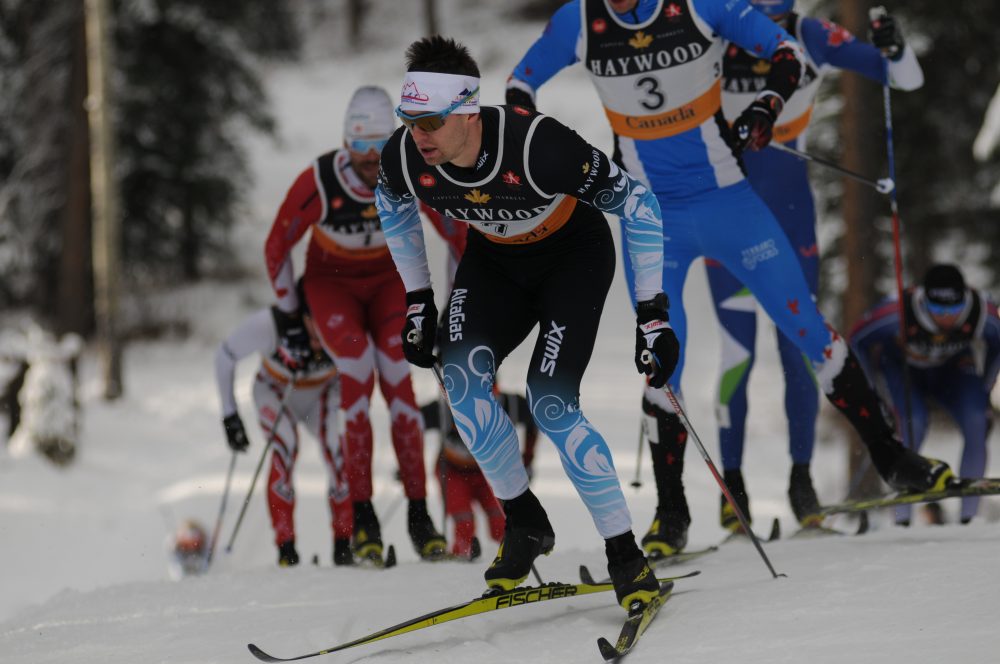
Dominique Moncion-Groulx (Alberta World Cup Academy) leads Julien Locke (3), of Canada’s U25 Team and Black Jack, and Len Valjas (l), of the Canadian World Cup Team, during a Frozen Thunder classic sprint heat on Wednesday at the Canmore Nordic Centre in Canmore, Alberta. (Photo: Doug Stephen)
In the second heat, Locke and Valjas paired up with Knute Johnsgaard (Canadian World Cup Team/AIAWCA) and American Cole Morgan, of the Sun Valley Ski Education Foundation (SVSEF). Thompson and Moncion-Groulx faced another American SVSEF skier, Kevin Bolger, as well as NTDC Thunder Bay’s Andy Shields. Four men advanced to the senior men’s final: Bolger, Thompson, Locke and Valjas.
In the final, Thompson recalled creating what he saw as “a bit of a gap” between himself and Valjas, yet Valjas, a seasoned World Cup sprinter, caught him in the lunge to the line for first. Overall on the day, Valjas placed first, Thompson second, Locke third, and Bolger fourth.
With the King’s Court format, female racers competed in the same same qualifier as the men, with Dahria Beatty (U25 Team/AIAWCA) emerging as the fastest female qualifier in 4:20.66. Her time was 8.56 seconds clear the second woman, American Chelsea Holmes, of Alaska Pacific University (APU), and 10.03 seconds ahead of Katie Weaver (Hollyburn Ski Club) in third. The third-placed Canadian woman in the qualifier, Annika Hicks (AIAWCA) clocked in fourth (+13.25).
In the heats, the women continued to race with the men. In the all-women final, Maya MacIsaac-Jones (U25 Team/Rocky Mountain Racers) took the win, Hicks placed second, Holmes third, and Frédérique Vézina (CNEPH) fourth.
Frozen Thunder racing continues Friday with men’s 10 k and women’s 7.5 k distance races, starting at 9 a.m. Mountain time. In a press release, CCC anticipated a turnout of 115 participants.
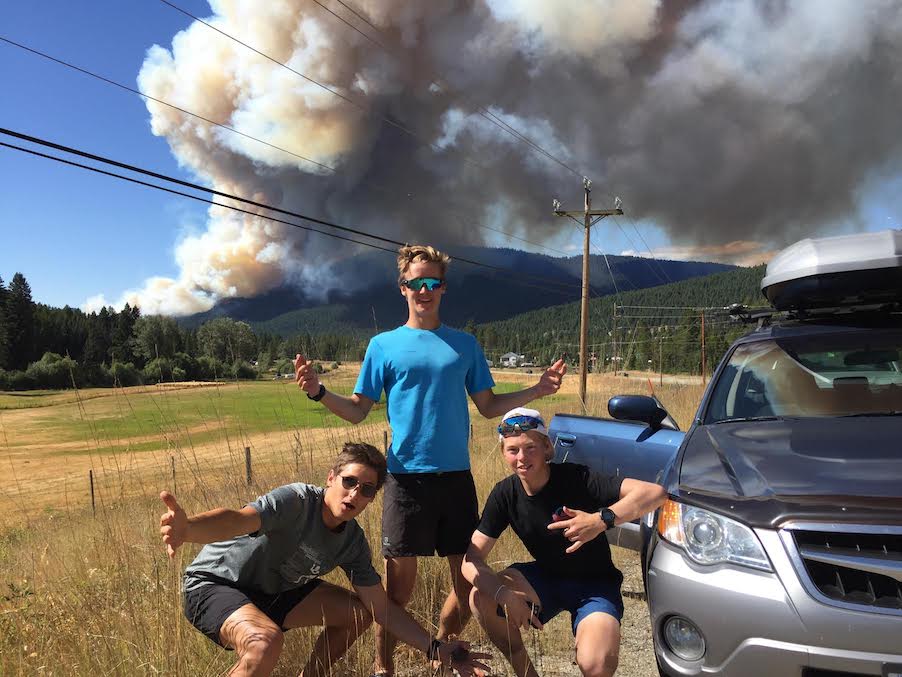
Canadians Fran Vukonic, Tallon Noble and Ian Williams after completing a trail run on Sept. 5 at Big White in Kelowna, B.C.,with the backdrop of the newest Kelowna fire on an otherwise bluebird day. (Photo: Gareth Williams)
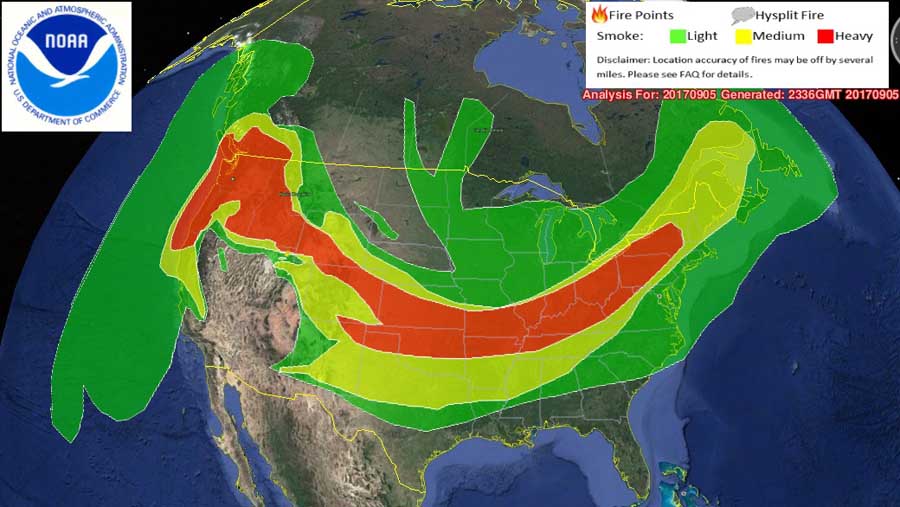
Beyond the hundredth meridian, a traditional geographic line demarcating where the West begins, it’s been a hot and dry summer. Wildfires have raged from Washington to California, the Intermountain West, and in western Canada. The conditions remain ripe for extreme fire danger. Even if a wildfire didn’t burn near you, odds are the smoke found its way there.
Across the board and across the U.S., it’s been an off-the-charts summer. While many Americans have been consumed with hurricane coverage and concerns over the last several weeks, fires have scorched more than a million acres in Washington and Oregon alone this year, according to Quartz Media. That’s up from 513,226 total acres in 2016, but in 2015 and 2014, more than a million acres were affected.
NOAA wildfire smoke and the correlating Air Quality Index for Sept. 5, 2017. (Photo: NOAA)
Along with the devastated landscapes and loss, the wildfires’ byproducts of smoke and ash have made for smoggy, poor air quality. We’re talking about seriously hazy days when visibility often wasn’t more than a mile or two.
Training outside in less-than-ideal quality air can compromise an athlete. To better understand when it’s OK to go out or stay in, many skiers and coaches became intimate with the scientific benchmarks for air quality.
“I sort of have this rule where if I can see the glaciers on the mountain, I would rollerski but not do intervals,” Dakota Blackhorse-von Jess, who’s based out of the Bend Endurance Academy in Oregon, said on the phone last Friday. “My personal limit for being outdoors is that 75 AQI limit. That’s the unhealthy or moderate zone.”
Here’s a quick primer. The U.S. Environmental Protection Agency (EPA) has developed an user-friendly Air Quality Index (AQI). The index is color coded and provides a numerical value indicative of a region’s air quality. An AQI of 75 means the air has a PM2.5 concentration of 23.5 microgramsper cubic meter. Going further, PM2.5 refers to the size of particulate matter in the air. In this case, the 2.5 corresponds to particulate matter 2.5 microns or less in width. That’s small enough to penetrate deep into the lungs, even the bloodstream.
U.S. Environmental Protection Agency Air Quality Index (Photo: EPA/AIRNOW.gov)
That 75 Blackhorse-von Jess limit falls midway into the moderate zone on the AQI.
“The higher end of moderate,” Blackhorse-von Jess clarified. “You see what the station says and then you walk outside and determine if it is going to work. Honestly, at this point, it’s been five weeks. I’ve done so much training indoors, that now it’s more of a mental break than a training deficiency.”
In places like Bend, Ore., where Blackhorse-von Jess calls home, some athletes have ignored the warnings.
“I saw guys out there riding today, I see them every time when I am looking for breaks in the smoke,” Blackhorse-von Jess explained. “I cannot believe that people are out there. I think people living in the smoke have accepted a lower standard and are going about their daily lives and actually, their daily activities in the smoke have come to accept the shittiness of the feeling they are experiencing. And for the professional athlete, it is something that you cannot afford, I don’t believe.”
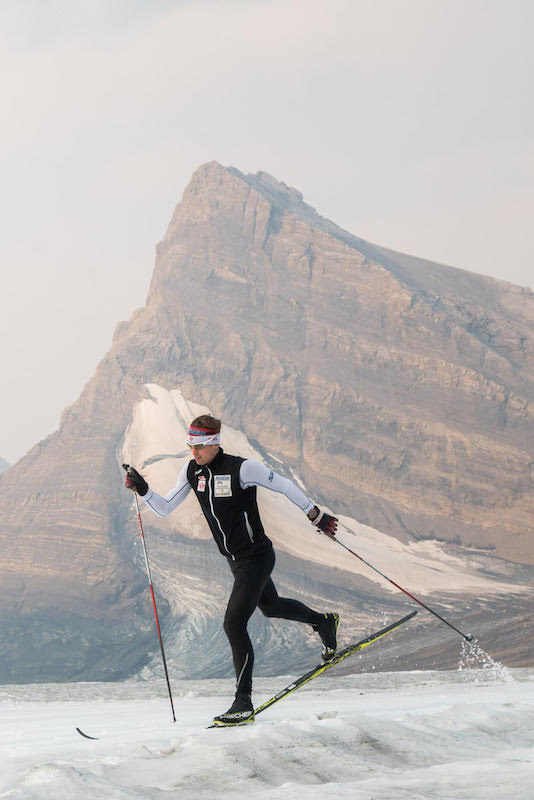
Julien Locke (Canadian U25 Team) training at a hazy Haig Glacier camp in August. (Photo: Anthony Killick)
While several fires continue to burn, the smoke cleared in Bend on Sept. 9. During much of August and into the beginning of September, Blackhorse-von Jess relied on a SkiErg, running treadmill and a stationary bike for much of his over-distance training.
He is not alone.
“Actually today, it was still dark when I woke up, but when the sun came up there was actually blue sky,” U.S. Ski Team member Liz Stephen said Friday from her home in Park City, Utah. “Where other days, you weren’t even sure the sun was up. It was really nasty.”
Like other elite skiers across the West, Stephen had made use of indoor training opportunities. The day before Stephen spoke to FasterSkier, she logged four hours on a ski treadmill at U.S. Ski and Snowboard’s Center of Excellence (COE) in Park City.
The AQI is also careful to note what are called “sensitive groups”. That can mean older adults, children, or people with lung or heart issues. Those populations must take precautions when high exertion exercise and poor air quality mix. Being responsible for junior athletes places a premium on being cautious.
For Leslie Hall, director of the Methow Valley Nordic Team in Washington state, dealing with smoke and subsequent air quality issues have been an on-and-off again affair.
“We had a bad two week period at the beginning of August and it was leading into our annual Methow PNSA [Pacific Northwest Ski Association] Camp … so we had to make the call to move the camp,” Hall wrote in an email. “We ended up going to Oakridge, Ore., for the camp and had a great camp there with 32 kids but a fire started nearby there while we were there so we had one moderately smoky day and it has since gotten much worse there.”
Like her athletic and coaching counterparts, Hall keeps an eye on air-quality websites to determine if a practice is indoors our out. But kids are kids.
“It is quite hard to keep the kids motivated and they do not enjoy the gym workouts,” Hall noted. “But during the early smoke time, we knew we were going to go somewhere else to train fairly soon so we kept that in mind. This past week was good because there are a variety of kids running and different coaches which help. Also, intensity workouts on the exercise machines help the time go by quicker. There is plenty of complaining and calls to move East, but I think all the kids realize that we are very fortunate in general and it is hard to complain when the hurricanes are decimating the south and we just have bad air for a week or so.”
Reports from Canada mirrored the smoke-filled experience of skiers in the Western part of the U.S.
Air Quality Health Index 5 in Vernon. BC (Photo: Gerry Furseth)Air Quality Health Index 1, Vernon, BC (Photo: Gerry Furseth)
Gareth Williams, a member of Canada’s national U25 Team and a native of Kelowna, B.C., wrote in an email that the smoke was a near-constant companion this summer.
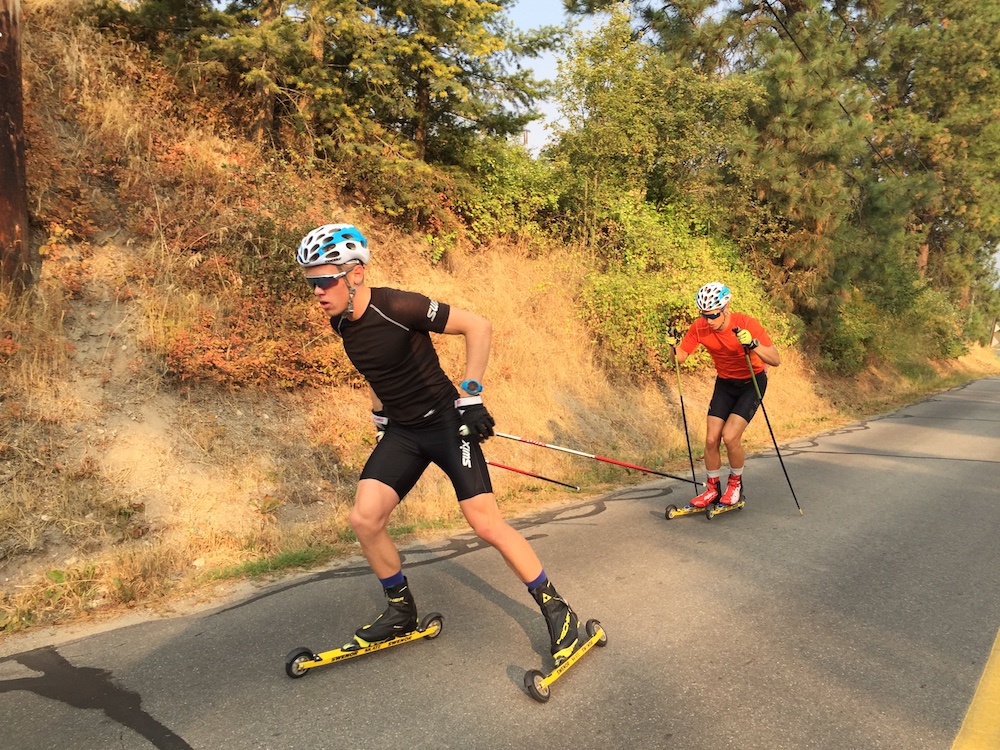
Gareth Williams (Canadian U25 Team) leads Fran Vukonic during an orange-tinted rollerski in Kelowna, B.C. (Courtesy photo)
“Summer has been great for me, I spent much of it on the Haig [glacier near Canmore, Alberta] in July,” Williams explained. “I’ve been in Kelowna the whole month of August and the smoke has yet to subside, it has actually gotten much worse recently. In past years the smoke has been bad, but I have never seen it like this. … I think the smoke isn’t as bad as some people have suggested, for me it’s not the greatest worry. I will be happy once it is gone though, getting a little tired of the orange lighting and not being able to see the sun!”
Michael Somppi, who trains with the Alberta World Cup Academy (AWCA) in Canmore, altered his plans depending on conditions.
“Personally, I haven’t found the breathing to be too bad,” Somppi wrote. “That said, I am avoiding doing any hard intensity efforts on smoky days. Today was the first day (in Kelowna) I was forced to alter my training plans, as I had planned to do a rollerski time trial, and instead opted to do zone 3 because of the smoke. Even breathing semi hard felt sketchy with how bad the air quality is at the moment.”
Another member of Canada’s U25 Team, Julien Locke has literally trained above the smoke on occasion.
“I’ve been lucky in that the smoke hasn’t been too thick during most of the important training blocks so far,” Locke wrote. “I was at the Haig Glacier 4 times this summer and while we had some hazy days, for the most part, 2400m elevation was high enough to have clear skies.”
Canada’s Dahria Beatty (8) chasing Norway’s Thea Krokan Murud (3) in the fifth quarterfinal of the women’s classic sprint on Tuesday at U23 World Championships at Soldier Hollow in Midway, Utah. Beatty finished 12th on the day while Murud went on to place second in the final. (Photo: FlyingPointRoad.com)
A year ago, Canada’s Dahria Beatty had eight World Cup starts to her name. Not too shabby considering she was 21, but now another year older, the Whitehorse, Yukon, native has more than doubled that amount with a grand total of 21 World Cup starts — one of which included her 15th-place breakthrough at the Ski Tour Canada classic sprint in Canmore, Alberta.
Beatty lives and trains in Canmore as a member of both the Alberta World Cup Academy (AWCA) and Canadian National U25 Team. She led the NorAm (Continental Cup) standings at the end of last season, reiterating her position as one of Canada’s top talents. Just under a month ago, she won the freestyle sprint prologue at U.S. nationals at Soldier Hollow in Midway, Utah.
Then on Tuesday, on the same 1.3-kilometer sprint course at Soldier Hollow, Beatty notched a career-best individual result at her second U23 World Championships, placing 12th in the classic sprint. She started the day by qualifying in eighth, 3.85 seconds back from the fastest qualifier, Sweden’s Anna Dyvik, who rounded the course in 3:39.4 minutes.
“My qualifier was pretty solid. I skied well, I made one small tactical mistake on the last climb but the rest of the race went smoothly,” Beatty reflected in an email. “This is a really taxing course and by the finish shoot my legs were pretty exhausted … it was a fight to get across that line. I was happy to qualify 8th and to post another consistent qualifier. Overall my qualifying speed has improved this year which I am very happy with.”
She was one of three Canadian women to qualify in the top 30, with Jenn Jackson (Lappe Nordic/Team Hardwood) posting the 22nd-ranked time (+12.99) and Katherine Stewart-Jones (NTDC Thunder Bay/NST U25 Team) qualifying in 28th (+16.61).
Maya MacIsaac-Jones, Beatty’s teammate on the AWCA and national U25 Team, missed advancing to the heats in 32nd (+20.68), 3.7 seconds out of 30th.
American Kelsey Phinney (6) racing alongside Norway’s Lotta Udnes Weng (5) during their quarterfinal of the women’s classic sprint on Tuesday at U23 World Championships at Soldier Hollow in Midway, Utah. (Photo: FlyingPointRoad.com)
All four of the U.S. women qualified, with Kelsey Phinney (Sun Valley Ski Education Foundation) leading them in sixth (+2.77), followed by Nichole Bathe (University of Alaska-Fairbanks) in 14th (+8.8), Jesse Knori (University of Colorado-Boulder) in 19th (+12.07), and Corey Stock (Bridger Ski Foundation) in 26th (+15.11).
Out of those seven North Americans, Beatty was the lone woman to advance to the semifinals, which had been her “base” goal to start the day. She finished third in her quarterfinal (the fifth and final quarterfinal) and advanced as a lucky loser with a fast-enough time.
“My quarterfinal was going well, but I had a stumble cresting the last hill and l lost contact with the top 2 women,” Beatty reflected in an email. “My heat was really fast and I was able to recover from the stumble and move onto the semis as lucky loser. When I finished I had a feeling it was a fast heat but you always have to wait and see.”
Norway’s Thea Krokan Murud won her quarterfinal in 3:35.2, which would hold up as the fastest time of the day until the final. Germany’s Pia Fink took second in that heat (+1.25) and Beatty was third (+2.45), ahead of Russia’s Yana Kirpichenko in fourth (+7.13) and Stewart-Jones in fifth (+12.63).
Without much time to recover before the second semifinal, Beatty explained that she was still pretty tired by the start of it. She ended up sixth in that semifinal, 8.04 seconds behind Murud, who won it in 3:37.42.
“Overall it was great to be in the semi finals and I learned a lot about tactics and where my weaknesses lie,” Beatty wrote. “I just didn’t have enough in the tank today to contend for the final but I am happy to have race my first international semi final and am looking forward to the 10k skate Thursday.”
With a previous U23 best result of 20th in the 2015 classic sprint in Almaty, Kazakhstan (and 15th in the 5 k classic at 2014 Junior Worlds the year before), 12th was Beatty’s best ever at a world championship.
“Racing well on the World Cup had definitely helped my confidence in myself and race knowledge. I feel I am right in the mix with these top women and on the perfect day I could be on that podium,” she wrote. “Going into today I had set base goal (I would be happy with the day if I achieved this) at making the semi finals. My target goal was making the final and my dream goal was being on the podium. My goals will stay pretty similar for the distance races. There are two more races and we’re at altitude so you never know what can happen.”
Jesse Knori (University of Colorado-Boulder) leading Estonia’s Anette Veerpalu during their quarterfinal of the women’s classic sprint at U23 World Championships at Soldier Hollow in Midway, Utah. Knori finished third in that heat (while Veerpalu was sixth). While she didn’t advance to the semifinals, Knori was the top U.S. woman in 15th on the day. (Photo: FlyingPointRoad.com)
While Beatty reached the semifinals, the two other Canadians and four Americans were eliminated in the quarterfinals. Knori led three U.S. women in the top 20 overall, placing 15th on the day after finishing third in her heat, 7.18 seconds behind Norway’s Tiril Udnes Weng (who won that heat by 1.07 seconds over another Norwegian Lovise Heimdal).
Canada’s Jackson raced in that same quarterfinal and finished fifth (+8.72), behind Italy’s Caterina Ganz in fourth (+7.56), for 21st overall.
Both fourth in their quarterfinals, Phinney ended up 16th and Bathe 18th overall. Phinney finished 3.81 seconds behind Weng’s twin sister, Lotta Udnes Weng, in first. Bathe finished 7.14 seconds behind the winner of her quarterfinal, Germany’s Sofie Krehl.
American Corey Stock (Bridger Ski Foundation) leads Australia’s Casey Wright (University of Alaska Anchorage) in the third quarterfinal of the women’s classic sprint at U23 World Championships at Soldier Hollow in Midway, Utah. They finished fifth and sixth, respectively, in that heat. (Photo: FlyingPointRoad.com).
Stock ended up 22nd after finishing fifth in Phinney’s quarterfinal, 10.08 seconds behind Lotta Weng. Also in that quarterfinal, Australia’s Casey Wright, of the University of Alaska Anchorage Ski Team, finished sixth (+12.37). Wright qualified in 25th and ultimately placed 29th overall.
Canada’s third woman, Stewart-Jones placed 24th after finishing fifth in the same quarterfinal as Beatty.
In the first quarterfinal, the Czech Republic’s Petra Hyncicova (Knori’s teammate at the University of Colorado-Boulder) finished fourth, 4.33 seconds behind Sweden’s Maja Dahlqvist in first. Hyncicova qualified in 21st and ended up 20th overall.
Sweden’s 22-year-old Anna Dyvik celebrates her win in the U23 World Championships women’s classic sprint on Tuesday, nearly 3 1/2 seconds clear of second place. (Photo: FlyingPointRoad.com)
Dahlqvist and Murud won the first and second semifinals, respectively, then took a back seat to Dyvik — the qualifying winner who finished second in both her quarterfinal and semi — in the final. Dyvik took control early and avoided a crash near the back to win the final in 3:32.40, the fastest time of the day. She won by more than three seconds for her first U23 Worlds medal, after earning gold in the relay and bronze in the skiathlon at 2014 Junior Worlds.
Behind her, Murud claimed silver (+3.42), edging Dahlqvist, the second Swede on the podium in third (+3.76).
Norway’s Heimdal took fourth (+6.03), while Krehl and Lotta Weng, who fell, finished fifth (+33.34) and sixth (+1:13.17), respectively.
Junior Worlds racing continues on Wednesday with the 5/10 k freestyle individual starts.
The women’s classic sprint podium on Tuesday at U23 World Championships at Soldier Hollow in Midway, Utah, with Sweden’s Anna Dyvik (c) in first, Norway’s Thea Krokan Murud (l) in second, and Sweden’s Maja Dahlqvist (r) in third. (Photo: FlyingPointRoad.com)
Maya MacIsaac-Jones (l), of the Alberta World Cup Academy and Canadian National U25 Team, with her younger sister Anna (r) at their home trails in Athabasca, Alberta, in late December. (Courtesy photo)
In an effort to showcase the North Americans competing at this week’s International Ski Federation (FIS) 2017 USANA Nordic Junior World Championships and U23 Cross Country World Championships at Soldier Hollow in Midway, Utah, we asked those qualifying athletes several questions about themselves — actually, we had them fill in the blanks. Here we have 21-year-old Maya MacIsaac-Jones, of the Alberta World Cup Academy, Rocky Mountain Racers and the Canadian U25 Team, who’s representing Canada at her first U23 World Championships after competing at Junior Worlds last year. On Tuesday, the U23 championships begin with classic sprints.
***
“My full name is Maya Anna-Christina MacIsaac-Jones, but you can call me Maya. I was born in Westlock, Alberta, raised in Athabasca, Alberta, and one thing you should know about my hometown is the ski trails are great and the people are even better!
Maya MacIsaac-Jones (AWCA/Canadian U25 Team) during a NorAm freestyle race in December in Rossland, B.C.
I started cross-country skiing when I was four, thanks to my parents. I currently train in Canmore with Alberta World Cup Academy / Rocky Mountain Racers.
If I’m not skiing, you might find me reading. If I had to pick a favorite book, it would be ‘Harry Potter and the Deathly Hallows’.
One of the things I’m most excited about for U23/Junior Worlds at Soldier Hollow is watching my teammates kill it out there! One race I’m especially targeting there is the classic sprint.
The best advice anyone ever gave me about skiing or racing was to listen to my body and trust my own judgment. One of the best race memories I have is winning the team sprint at Nationals 2015 with Andrea Dupont.
If I could meet one World Cup skier, it would be Kikkan Randall.
If I don’t end up being a professional skier, I would love to be a professional fiddle player, but considering I can’t play the fiddle, that probably won’t happen.
I’m missing zero days of school to be here; I take online school through Athabasca University, so I don’t have to miss any school to ski race!
Canada’s Dahria Beatty (29) racing to third in her quarterfinal for a career-best 15th overall at the 2016 Ski Tour Canada classic sprint in Canmore, Alberta, on March 8, 2016, one day after her birthday. (Photo: Fischer/NordicFocus)
Welcome to “17 Questions for 2017”, where we are catching up with American and Canadian national-team members before the beginning of the winter season.
***
The day after her 22nd birthday last March, Dahria Beatty made the case that she could be Cross Country Canada’s next star. Not only did she score her first World Cup top 30, but she nabbed a career-best 15th in a World Cup stage at home (her training base) in Canmore, Alberta.
Beatty, of the Alberta World Cup Academy and national U25 Team, was the only Canadian woman to qualify for the heats in the classic sprint that day, and she ended up third in her quarterfinal heat.
Now after an offseason of remedying some back troubles and building strength, Beatty says she looks like a different person when she’s double poling, and not just because she cut off her hair.
1. Biggest change in your life in the last five or so months since the ski season ended?
I cut off 9 inches of my hair, it’s really speeding me up
2. Biggest change in your training?
I started doing pilates and made adjustments to my technique with our technique coach Kathy.
3. Major areas of improvement you’ve seen so far?
I look like a different person when I’m double poling now!
4. Whom you’ve been working closest with this offseason (coaches or training partners)?
Scott Perras (front) with Devon Kershaw on his heels in the 2014 Frozen Thunder distance race at the Canmore Nordic Centre. Perras retired from biathlon this spring and will coach the Alberta World Cup Academy. (Photo: Noel Rogers/Bow Valley Photography)
Scott Perras’s first biathlon World Cup result back in 2007 might have seemed tough at the time: in Kontiolahti, Finland, he finished 104th in the 20 k individual.
But nine seasons later, he has made five trips to World Championships, become an Olympian and hit the top 10 on the World Cup. He was a key part of a Canadian relay team which reached the World Cup flower ceremony in 2014, finishing sixth, and then finished a best-ever seventh at the Olympics a few weeks later.
After all of that, the 32 year old from Saskatechewan is hanging up his rifle.
“I didn’t realize how long my career was until I quit,” Perras said with a laugh in a recent phone interview. “For me, the high point was being part of the team for so long, and having really great teammates along the way. From Robin Clegg and J.P. Le Guellec at my first World Cup, to guys like Macx Davies and Christian Gow in Rupholding [this year] — just a lot of having fun, tom-foolery. Putting off being an adult for as long as I could.”
Perras can now no longer say he’s putting off being an adult. He got married this summer, helped his wife set up her business, and is now moving into a full-time, non-athlete job himself: Perras will be the new high-performance coach for the Alberta World Cup Academy (AWCA) cross-country ski team.
It’s a transition away from biathlon, and yet one day last week found him in a familiar place with the men and women he had called teammates until just a few weeks earlier.
“Yesterday I was at Sunshine Meadows with the biathlon team because they have technique camp,” Perras explained last Wednesday. “They bring in Mats Larson from Sweden, and I wanted to get some refreshers for that for my team going forward.”
The next day, he was back in Canmore leading a workout for AWCA’s under-21 men’s team.
“There has always been an invisible barrier maybe between cross-country and biathlon and I hope to maybe bridge it a bit, and help everybody work together a little bit easier,” Perras explained. “I also have good relationships with all the top biathletes and biathlon coaches and am also developing them in cross-country. I can go to anyone and ask for help anytime I need it.”
“There has always been an invisible barrier maybe between cross-country and biathlon and I hope to maybe bridge it a bit.” — Scott Perras
The 2015/2016 season didn’t go as Perras had hoped, and he found himself off the World Cup team. In between racing at the second-tier IBU Cup, he also jumped into some ski races, including finishing second in a NorAm 20 k and 12th in the American Birkebeiner 51 k, the biggest international ski race in North America.
So besides drawing on his former team staff and teammates when he needs to learn about coaching, he is hoping to bring the biathlon and cross-country communities closer together more generally. In Canmore, the national teams as well as local teams often train on the same trails anyway.
“I’ve noticed everyone has a really clear picture in their mind of what they want to do, what they want to achieve, and how they are going to achieve it,” Perras said. “Sometimes as coaches we end up being more tied to that plan than to being flexible and seeing the advantages of maybe being more inclusive.”
Perras wasn’t certain that he would retire after this season, and he also wasn’t certain that he wanted to go into coaching. But it was one of two possible futures he saw for himself, and when AWCA opened up an assistant coaching position it was a good fit.
He saw AWCA providing a good transition for him from racing to coaching: while he’s on the ground leading workouts, head coach Chris Jeffries is the main brain behind the operation. The team has its training plans and physiological goals worked out already.
“It’s great knowing that all of the really big picture things, we have people with a lot of experience writing that,” he said. “That stuff definitely interests me, but it’s nice learning about it and applying all at the same time with the insurance of having these well educated well experienced people behind us.”
Spending more time on the IBU Cup this season, Perras also got to know some of the younger biathlon athletes. He observed what made them tick, and also the ways in which they weren’t so different from veteran athletes like himself. It’s an experience he’ll take into his new coaching job.
“I knew some of them well, because like I said we are all on the range every day, but getting to know them better and seeing their levels of dedication, seeing the enthusiasm they have- it was nice,” he said. “It is really important as a coach to keep an eye on what is an important or a big result for someone.”
For him, those results weren’t coming anymore.
“When you are in your thirties the goal is to be there when things happen, and if you are not then it’s time to move on,” he said. “That is just how it is. It is a high performance sport and I wasn’t competing at my best. I think I could have raced another year and had a better year than last year, but at the same time like I said my life was going in some really good directions and in other ways and I kind took those opportunities.”
Looking back, Perras is nothing if not thankful that he was able to train and compete full time for nearly ten years. That, he said, was living the dream.
“When I first moved up to Canmore, I was at home in Regina and I was talking to my mom,” he reminisced. “We were talking about the lottery. And she said ‘What would you do if you won the lottery?’
“I said ‘Oh, I’d train for biathlon. I’d train for biathlon and not work.’ So to me, for the last seven years or however long I was carded, I kind of got to live like I won the lottery. That’s pretty sweet. And it’s over now. I spent all my winnings. That is pretty special to me for sure.”
The 2015/2016 aggregate NorAm leaders Andy Shields (l) and Dahria Beatty are FasterSkier’s Continental Skiers of the Year for Canada. (Photos: Fischer/NordicFocus and W. James MacLean)
The 2015/2016 awards continue, chosen by the FasterSkier staff based on performances from last season. While not scientific, these points of recognition are intended to reflect a broader sense of the season in review.
Andy Shields, Thunder Bay National Development Centre
One point. That was the difference between the men’s overall NorAm winner and the runner-up of Canada’s Continental Cup circuit this season, and emerging skier Andy Shields came out on top.
The 25-year-old Thunder Bay National Development Centre member — who broke through at the World Cup level with the 30th-fastest time in the men’s 15 k freestyle pursuit at the Ski Tour Canada (STC) in Quebec City — made his international World Cup debut this season. In all, he tallied eight World Cup starts in 2016 (including six stages of the Tour), but it’s what he did on the NorAm that makes him our choice for Continental Cup Skier of the Year.
“It was a pretty good race,” Shields told FasterSkier after the Quebec City pursuit, his second World Cup distance race, in which he placed 65th with the 30th-best time. “The wave start I was in was pretty quick, so I was able to get in the front group with them, and they pulled me along to a really good time on the day. Pretty happy that I’m able to manage that pace.”
Shields started 2015/2016 modestly, with an 11th-place finish in the freestyle sprint at the U.S. SuperTour opener in West Yellowstone, Mont., followed by a 37th place in the 15 k skate the next day.
In the first NorAm of the season in Canmore, Alberta, Shields reached the podium in the classic sprint, placing third behind his NDC teammate Bob Thompson and Patrick Stewart-Jones, of the Alberta World Cup Academy (AWCA), respectively. From there, Shields continued to gain momentum, winning the skate sprint at the next NorAm in Sovereign Lake, B.C., and placing fourth in the 15 k skate race before leaving for nearly a month of World Cup racing in Europe.
Upon returning to Canada in late January, Shields didn’t waste any time jetting to first and second in two NorAm distance races in Mont Sainte-Anne, Quebec. He went on to win the 20 k classic mass start at Eastern Canadian Championships, and at Western Championships, he finished in the top six in all four races: placing second in the 20 k classic mass start and third in the classic sprint. After that, Shields packed his bags for the STC, raced six World Cups in nine days, then finished his season at Canadian Ski Nationals in Whitehorse, Yukon. There, he missed the podium in four individual races, but reached the skate sprint final and placed sixth.
Between the men’s NorAm distance and sprint races this past season, Shields was the most consistent — besting Kevin Sandau (AWCA) by the slimmest of margins (1 point) in the men’s overall. Shields was fourth in the overall sprint standings, behind Julien Locke (Black Jack), Bob Thompson (NDC Thunder Bay), and Patrick Stewart-Jones (AWCA), respectively.
Dahria Beatty, Alberta World Cup Academy/Canadian U23 Development Team
The winner of the both the women’s NorAm overall and sprint series, Dahria Beatty dominated from start to finish last season, winning both a distance skate race and classic sprint at the Canmore NorAm opener, then winning four more NorAms before taking part in the STC.
During her first-ever World Cup tour, in which she notched 15th in the Canmore classic sprint, Beatty turned 22. The national U23 development team skier went on to win two out of three individual races she competed in at nationals in her hometown of Whitehorse (winning the 10 k skate and skate sprint, and placing second in the 5 k classic).
For her 15th place — her first individual World Cup top 30 — FasterSkier dubbed her Breakthrough Skier of the Year. For her performances at home in Canada on the NorAm circuit, finishing in the top eight of every race she competed in this season, Beatty is Continental Skier of the Year.
“My ideal goal for this season would be able to crack the top 30 on the World Cup,” Beatty said in December before leaving for Canada’s U25 B-Tour trip in Europe. “That’s a big goal…”
Honorable mentions
Kevin Sandau, Alberta World Cup Academy
Kevin Sandau (AWCA) in the NorAm leader’s bib leads Bob Thompson (r) during the men’s NorAm 15 k freestyle individual start at Sovereign Lake, B.C. Sandau went on to win by 37 seconds over Knute Johnsgaard (not shown). (Photo: XTS Photography)
Kevin Sandau’s only 27, but it feels like he’s been at the forefront of Canadian cross-country skiing for a long time. After debating whether he would compete in 2015/2016, Sandau started the winter on a tear, winning back-to-back Canmore distance races in December and remaining undefeated in NorAm distance races until Easterns in early February (where NDC Thunder Bay’s Michael Somppi dethroned him in the 15 k skate).
After that, Sandau never reached the top of the podium again, but he came close in second in the 10 k skate at Westerns (behind Russell Kennedy of Canmore Nordic). At the end of the season, he finished second in the NorAm overall with 724 points, one short of Shields.
On March 26, after placing fifth in his final race of the season (the 50 k classic mass start at nationals), Sandau announced his retirement on Facebook.
“Today marks the end of my racing career. The memories are countless and the experiences beyond amazing. I can’t think of a better way to have spent the past 10+ years,” he wrote. “Thanks so much to all the volunteers, coaches, teammates, skiers, parents, fans and role models for the journey. I’m looking forward to the next chapter and hope it’s as good as the last. KevOut.”
Sandau previously stated that his season-long goal was to qualify and focus on the STC. He did so, placing 43rd overall in the Tour. In his career, he raced 29 World Cups, starting with his first in 2008 in Canmore.
Besides skiing, Sandau brought humor to his ski racing and shared it on social media.
In a prank April Fools’ article on FasterSkier, Sandau played along with the idea that he would be Canada’s next head coach.
“I feel like my practical experience on the domestic circuit and top-50ish on the World Cup is what really sets me apart from the rest,” he jested. “You learn a lot of racing in the back of a World Cup, it’s like the best seat in the house, and you can watch firsthand the whole race as it unfolds, at least for a little bit.”
Cendrine Browne, Pierre-Harvey National Training Centre/U23 Development Team
Cendrine Browne at the Ski Tour Canada in Quebec City. (Photo: John Lazenby/Lazenbyphoto.com)Second to Beatty by 160 points in the NorAm overall, Cendrine Browne, a 22-year-old member of the Pierre-Harvey Training Centre (CNEPH) in Quebec and national development team, was one of Beatty’s biggest rivals on the circuit.
After placing second to her in the first sprint of the season in Canmore, Browne joined Beatty on the European B-tour trip. She returned to her home trails at MSA to win both the 5 k classic and 10 k freestyle pursuit — but Beatty didn’t race.
“I chose to race because I would have done intensity anyways,” Browne wrote in an email afterward. “The Noram points are also interesting if I win.”
Browne beat Beatty outright in the 10 k freestyle at Easterns, then bested the women’s field by nearly 53 seconds in the 15 k classic mass start at Westerns (ahead of Annika Hicks of Canmore Nordic and Katherine Stewart-Jones of NDC Thunder Bay and the national development team, respectively).
Browne finished the eight-stage STC in 40th overall and placed second to Emily Nishikawa in the season-ending 30 k classic mass start at nationals.
Position Opening: High Performance Coach – Alberta World Cup Academy
The Alberta World Cup Academy (AWCA) has a current opening for a High Performance Coach for the 2016/17 training year.
As a designated NTDC, the Academy is part of Cross Country Canada’s national network of training centres and has the status of an “A+B” centre. This full-time position will be part of the team assisting athletes achieve their full racing potential, ranging from junior and U23 level athletes to those athletes ready for selection to the NST and WC team.
The AWCA has an 8-year track record of helping athletes obtaining placement on the NST and the WC, WSC and OWG teams. The recent completion of a very successful Ski Tour Canada showcased numerous AWCA athletes performing on the world stage. The Academy is committed to continuing to be the place where our athletes get the very best so that they can be the very best.
Located in Canmore, Alberta, the High Performance Coach is expected to:
Have a level of experience and expertise commensurate with the level of athlete training at the AWCA;
Preference will be given to coaches who have a Level 4 designation, but applications from coaches with a Level 3 designation will also be considered;
Superior expertise in all relevant technical aspects of our sport (race support, YTP development, wax/ski knowledge, etc.);
A track record of proven success as a High Performance Coach;
Alberta Class 4 driver’s license (or ability to obtain such in first month on the job).
Expected start date is April 15, 2016.
All interested applicants are requested to send their resume to:
Norbert Meier, President, Alberta World Cup Society
Race winner Kevin Sandau (AWCA) in the leader’s bib ahead of Bob Thompson (NDC Thunder Bay) during the men’s NorAm 15 k freestyle individual start on Sunday in Vernon, British Columbia. (Photo: XTS Photography)
VERNON, British Columbia — Kevin Sandau of the Alberta World Cup Academy (AWCA) has no time for quitters, including himself. Despite not being renominated to the Canadian National Senior Team this spring, Sandau’s decision to carry on with his career as a professional nordic ski racer proved to be worthwhile as he won his third-consecutive distance race of the NorAm season (in as many races) on Sunday, the men’s 15-kilometer individual start freestyle race at the Sovereign Lake Nordic Centre.
“Going up the climbs, I felt super smooth with my V1 skate,” Sandau, 27, said during an in-person interview after winning Sunday’s race by 37.3 seconds in 39:05.9. “I made sure to push the flats using a strong V2 to keep the speed up. … It was one of those days where I just felt invincible.”
Though doubt shrouded Sandau’s ambition for the sport earlier this year, his latest performances appear to cast all queries aside.
After two weekends of NorAm races, the Canadian will head into the New Year with three distance titles already under his belt, which puts him in a position to potentially earn future World Cup starts as the NorAm (Continental Cup) leader.
“Third distance win in a row, I think that is a good way to end the 2015 year,” he said.
Part of Sandau’s first-place performance on Sunday stemmed from not just his in-race focus, but his pre-race routine and weekend training, he said.
Kevin Sandau and his mom after the men’s NorAm 15 k freestyle individual start on Sunday in Vernon, British Columbia. (Photo: Gerry Furseth)
“My warmup this morning felt bombproof,” Sandau said. “I also took [Saturday] off, didn’t do the sprint race, and did volume instead. … It [was] interesting to see how the body reacted to that.”
While Sandau sat out the sprint, his AWCA teammate and second-place finisher for the men’s 15 k, Knute Johnsgaard, of the national U23+ Development Team, competed both days, and reached the podium in second in both races.
“I thought I skied a good race and I am pretty happy with second,” Johnsgaard, 23, said. “But I’m still chasing that win.”
Johnsgaard’s podium on Sunday came from course knowledge and tact.
“I’ve skied this course so many times,” he said. “You’re able to push pretty hard on the uphills because there is quite a few tucking sections where you can recover after the climbs.”
While course experience was on Johnsgaard’s side, he left the Sovereign NorAm wanting a different kind of experience.
“I have a very large stack of silver medals now, and I’d like to get gold soon,” he said.
Just over 41 seconds behind Sandau, Russell Kennedy (Canmore) in third also craved the top spot on the podium.
“Everyone wants to win from the start, but I’m hoping to get better and better as the season goes on,” Kennedy said. “I feel like I’ve got a good stepping stone, and I’m going to try to keep building off of that.”
Kennedy spent most of his race getting splits for second behind Sandau, but and initially finished second 41.2 seconds after him. A later starter, Johnsgaard bumped Kennedy to third by 3.9 seconds.
On the women’s side, Dahria Beatty (AWCA/U23 Development Team) won the women’s freestyle distance race at Sovereign Lake for the second year in a row.
“I love this course,” the 21-year-old Beatty said after winning in 30:30.2, more than 32 seconds ahead of runner-up Jaqueline Mourao, originally from Brazil who trains with the Pierre Harvey Training Centre (CNEPH) in Quebec.
“I’ve been racing on this course since I was 15; I raced here with the Yukon [team when] I was a junior,” Beatty added.
With her course knowledge and Sunday’s snowfall during the race, she powered into the first climb.
Dahria Beatty (AWCA) in the leader’s bib during a snowy women’s NorAm 10 k freestyle individual start on Sunday in Vernon, British Columbia. (Photo: XTS Photography)
“A lot of people take the first climb conservatively because they are worried about blowing up,” Beatty said. “So I skied as hard as I could and as smooth as possible. I think that’s the key to this course, especially when it is snowing.”
On the podium for the second-straight day, Andrea Dupont, (Rocky Mountain Racers) finished third, 1:02.7 after Beatty.
“Today was okay,” Dupont, 25, said. “It was a bit of a slog because it really started dumping snow when the girls got on course.”
A sprint specialist, Dupont found pacing helped her to another top finish.
“I wanted to not go out too hard, because I’m definitely a sprinter and I characteristically go out too hard and can’t hold it,” she said. “[Sunday] I went out easy and tried to hold it … and I think I’m on track.”
Another sprint favorite, Beatty came into Sunday on the hunt for a win after missing out on Saturday’s A-final.
“I was a little disappointed with not making the A-final yesterday,” she said. “I wanted to come hard today and I knew that I could do well.”
After charging up the first climb, Beatty continued to get positive splits and raced to a 32.2-second win over Mourao.
“I kept getting splits saying I was 25 seconds up on second,” said Beatty, “When you get splits like that, it makes you ski faster because of the confidence boost,” she added.
A three-time Brazilian Olympian, Mourao also felt a confidence boost after her race.
“I’ve never thought about podiums,” said the 40 year old, who’s also competed in biathlon. “And now, with the right preparation, the right skis, the opportunity I’m having, I can dream more.”
Also an adept mountain biker, Mourao believed her time spent on the bike helped her during her time spent climbing on Sunday’s course.
“I’m a mountain biker and I like climbing so the course was perfect for me,” she said.
The last weekend of racing until the New Year (and the next NorAm Jan. 14-17 in Thunder Bay, Ontario) for many of the Canadians, most feel the Sovereign Lake NorAm races were a solid close to 2015.
“This is my last race of 2015,” said Beatty. “I won’t be racing until I head to Europe after Christmas [as the Continental Cup leader] and it’s nice to finish on a positive note.”
Kevin Sandau in the NorAm leader’s bib sets the pace from the front of the pack in the men’s 16.5 k freestyle mass start on the second day of the NorAm opener in Canmore, Alberta. His Alberta World Cup Academy teammate, Knute Johnsgaard, chases him down. (Photo: Alberta World Cup Academy/Twitter)
You’ve seen it on the World Cup, and now it’s happening at the domestic level: double poling a classic distance race, as seen at Canada’s NorAm opener in Canmore, Alberta.
The top men went without kick wax for the 10-kilometer classic interval start on Saturday, Dec. 5, double poling around a 2.5 k biathlon loop.
Kevin Sandau of the Alberta World Cup Academy powered to the win in 24:42.9 minutes, edging his AWCA teammate Knute Johnsgaard (National U23+ Development Team) by 2.9 seconds. Ian Murray (Capital Region Training Group) skied the fastest last lap to edge Brian McKeever of Canada’s Para Nordic Ski Team by 3.5 seconds for third, 9.5 seconds back from Sandau.
In an email, Sandau, 27, explained that double poling was essentially a no-brainer on the Canmore Nordic Centre’s biathlon trails — flatter than the usual race course with shorter climbs.
“Off the start I knew I needed to be aggressive as it was going to be a fast race,” he wrote. “Just gunned it off the start and trusted my body could clear the lactate from my arms on the downhills. Felt pretty solid throughout so wasn’t a bad plan.”
Johnsgaard explained he would have preferred striding over double pole, so considering that, he was happy with second place.
“Of course I would have liked to be 3 seconds faster! I was being extra careful not to do any skate or step turns, perhaps too careful,” Johnsgaard wrote in an email. “I just tried to pace things right and find the fastest part of the track. I was outside the track almost the whole race.”
For Murray, third stood as his NorAm career best.
“At the age of 37 I guess you could say I am coming into my groove,” Murray wrote. “I was 22nd on the first lap which was a bit slower than I hoped to start. Kevin Sandau passed me when I was on my second lap and that kicked me into gear. I have been focusing on ski marathon racing the last couple of years so I’m still figuring out the pacing for the 10 and 15km races.”
McKeever explained that he tried to build into the race, but was missing a few gears. “[I] was overly cautious about not skating, and consequently was not aggressive enough,” he wrote in an email.
In his first time double poling a distance race, Colin Abbott (Yukon Ski Team) in seventh (behind CNEPH’s Alex Dumas in sixth) observed that the pacing is different.
“You don’t max out aerobically as easily so the concern for pacing is trying not to burn your arms too soon in the race,” Abbott wrote. “I went out maybe a bit faster than was ideal, and definitely slowed on the last lap but don’t think the end result would have changed much if I started slower.”
NDC Thunder Bay athletes (in green) took second, third and fourth in the women’s NorAm 5 k classic interval start, behind Sophie Carrier-Laforte (c) of the Pierre Harvey National Training Centre in first. Katharine Stewart-Jones (second from l) placed second, Alannah Maclean (second from r) with third, and Jenn Jackson (l) was fourth. Rocky Mountain Racers’ Andrea Dupont (r) placed sixth. (Photo: NDC Thunder Bay/Twitter)
In the women’s 5 k classic race, Sophie Carrier-Laforte of the Pierre Harvey National Training Centre (CNEPH) won the two-lap race in 14:31.5, followed by U23 Development Team member Katherine Stewart-Jones (NDC Thunder Bay), 10.3 seconds back.
Thunder Bay had two on the podium with Alannah Maclean in third, 17.9 seconds behind Carrier-Laforte, and another athlete in fourth: Jenn Jackson (+30.8)
“I was aiming for a podium this week but didn’t expect to get it today,” Stewart-Jones wrote in an email. “It’s a very short race so I planned on going out really hard and just try to hold on to the same pace. On the first lap, I focused on skiing efficiently and then just went as hard as I possibly could on the second [lap].”
She added that her double-pole work this summer appears to have paid off.
While Stewart-Jones’s first lap ranked fourth and second lap was second-fastest among the women, Carrier-Laforte skied the fastest last lap. Andrea Dupont (Rocky Mountain Racers) was fastest on Lap 1, but faded on Lap 2 to place fifth (+36.0). Maclean posted the second-fastest opening lap.
Kevin Sandau (c) and his Alberta World Cup Academy teammates Knute Johnsgaard (l) and Patrick Stewart-Jones (r) placed first, second and fourth, respectively in the men’s NorAm 16.5 k freestyle mass start on Dec. 6 in Canmore, Alberta. (Photo: Alberta World Cup Academy/Twitter)
On Sunday, Dec. 6, Sandau repeated with a win in the second race of the season: the men’s 16.5 k freestyle mass start. The races were once again held on Canmore’s biathlon trails, this time on a 3.3 k loop.
Sandau won it in 38:59.9, again ahead of Johnsgaard, who finished 36.6 seconds back in second. About a minute and 3 seconds behind Sandau, McKeever placed third, four-tenths of a second ahead of fourth-place finisher Patrick Stewart-Jones (AWCA).
For Sandau, the race and the victory were even better than the day before.
“The 15km skate played out a lot more to my strengths and really let me test out my fitness,” he wrote. “I knew before the start I just wanted to go full throttle right from the gun. It was a mass start, and there was a crazy westerly wind, so I knew this race was going to be easier to bunch up and make it harder to break away.”
He strategized his pace changes for the bottom of the five-lap course, where there were two “decent climbs,” he explained. His fourth time around, he broke away from Johnsgaard and skied the rest of the race alone.
“I knew once I could break away from anyone, I could really start to put some time in because they had to fight the wind just as much as I did at that point on,” Sandau wrote.
Johnsgaard anticipated that Sandau would be the man to beat, “so the two of us started hard right out of the gate to try and lose the field as soon as possible,” Johnsgaard wrote.
They broke away around 5 k, and while Sandau’s pace felt fast, Johnsgaard explained holding on until the last 3.3 k lap.
“By that time I was hurting pretty bad and lost a lot of time on my last lap,” he wrote. “I thought everyone would catch back up to me but luckily we had opened up a big enough gap earlier on.”
McKeever noted the superior shape of Sandau and Johnsgaard compared to him and the rest of the field. “It went as well as it could have,” McKeever wrote. “I played the tactics right and made the most of the day.”
Dahria Beatty of the U23 Development Team and AWCA charged hard on the last lap of the women’s 10 k freestyle mass start to win by 8.8 seconds in in 27:07.5. Frédérique Vézina placed second and her CNEPH teammate Cendrine Browne (NST U23 Development Team) took the final podium step in third, 13.7 seconds behind Beatty. Another CNEPH skier Jaqueline Mourao, originally from Brazil, was 1.4 seconds off the podium in fourth. Mourao turns 40 later this month.
“It’s always amazing to be able to win a race!” 21-year-old Beatty wrote in an email after her second senior NorAm victory. “I ended up leading most of the race. My original plan had been to sit back for the first lap in the pack and then if I felt strong push the long climb that was on both the second and third lap.”
As she approached the climb on the second of three laps, she explained she tried to keep the pace high to “string out the pack.”
“On the final lap on the same long climb I had a ski lengths gap coming off the downhill so I took advantage of that small gap and just skied as hard as I could without looking back,” Beatty wrote. “I didn’t let off at all until the final 500 meters when I finally checked to confirm the gap my coaches had been telling me I had.”
Vézina wrote that, while she made a race plan and executed it well, mass starts are a toss up.
“You can expect some things but at the end you can really make intelligent decisions once you are in the race,” Vézina wrote. “I’m happy with the way I managed my race.”
Despite a broken pole at the beginning of the race and losing contact with the leaders, Browne was pleased to see where she stacked up at the start of the season.
“You always ask yourself if you are in shape or not compared to the other skiers,” Browne wrote. “The tactics didn’t play out as planned … I was planning on leading with Dahria but it didn’t really work out because I had to make my way back to the front.”
Sunday’s 10/16.5 k freestyle mass start results:Men | Women
Women’s Canmore NorAm classic sprint winner Dahria Beatty (AWCA/NST U23 Development Team) after her A-final victory. (Photo: CCC/Twitter)
On Tuesday, the final day of NorAm racing in Canmore, Beatty went on to win the women’s 1.5 k classic sprint final by 2.51 seconds over Browne. Earlier in the day, Browne topped the qualifier in 4:36.2, and Beatty was 6.8 seconds off the pace to qualify in fifth.
Browne and Beatty both won their quarterfinals before facing off in the semifinal, where Browne took first by 1.62 seconds over Beatty in second. In the final, Beatty explained that for the first time in a race, she screamed in elation as she crossed the finish. It was her first senior sprint victory.
“Going into this race I wanted to ski in the top two in all heats to avoid being stuck at the back of an accordion-effect after the herringbone climb. In all my heats I was able to do that,” she wrote. “Everyone’s skis were icing after this climb so it was easy to lose time kicking it off at the top. For the final I asked my coach to put a less sticky wax on so I would ice less and I think that made a big difference. I was still able to make it up the hills but more importantly I was able to crest the hill super aggressively on both laps, thus carrying more speed into the downhill.”
With two big climbs separated by two downhills, Beatty explained that it made sense to push hard each time up. That made pacing simple; she simply wanted to be in front.
“When I came down the last hill in the lead I went into sprint mode and didn’t look back,” she wrote. “I had to look at the results afterwards to realize how far behind the others were.
Another great thing about today was the rain waited until the women’s race was over, bonus.”
Dahria Beatty (l) and Jenn Jackson after Tuesday’s NorAm classic sprint in Canmore, Alberta. Beatty won the race for her second-straight victory of the weekend, and Jackson placed third behind Cendrine Browne (not shown). (Photo: CCC/Twitter)
Browne was pleased to win a sprint qualifier for the first time in her career and did so by four seconds over Jenn Jackson. Later in the final, she edged Jackson by 0.25 seconds for second place. Jackson was third, ahead of Andrea Dupont in fourth, Vézina in fifth, and Marie Corriveau (CNEPH/National Junior Team) in sixth.
For Browne, 22, it was her second podium in a senior sprint.
“In the semi final, my plan was to climb the last hill faster then Dahria so I would have more speed than her in the downhill. I had the same plan in the A final but it didn’t work out as well,” she explained. “I had a pretty high level of energy today but I still tried to manage it in the quarter final and in the semi final. … My skis were great. I had great kick and my skis were fast, and that helped me a lot.”
Bob Thompson (Thunder Bay NDC) made the top 30 to qualify for the heats in the 1.5 k men’s sprint, but was more than 17 seconds off the pace in 20th. Johnsgaard set the time to beat in the qualifier in 3:51.05.
In the quarterfinals, Thompson placed second to Julien Locke (Black Jack), but came back to beat Locke in the semifinal by 0.15 seconds. Thompson went on to win the men’s final by 1.24 seconds over Patrick Stewart-Jones.
Cendrine Browne (CNEPH) edges Jenn Jackson (NDC Thunder Bay) for second in the women’s NorAm classic sprint final. (Photo: CCC/Twitter)
“Definitely great to finish the day and the weekend with a win, seems I’m becoming notorious for coming off a poor qualifier and then figuring things out in the heats,” Thompson wrote in an email.
After the quarterfinal, he switched from grip skis to zeros/rub skis, he wrote, “and they made a huge difference.
“I definitely let my skis do a bit of work so I tried to keep the first lap in control and just keep a solid position in second or third and then just make sure to stay close over the top into the downhill to get the draft,” he added. “Tough day to try and lead into the downhill and finish.”
“Bob was really strong in the finish today and I have to accept that,” Stewart-Jones wrote. “The final was a little bizarre because the pace started out fast, but then on the top of the climb on the second lap it slowed right down because it was so narrow and no one could get by the leader. The pack bunched right up and from there on it was pretty much a 6 way drag race to the finish.”
Andy Shields (NDC Thunder Bay) placed third, 1.35 behind Thompson. Sandau was fourth, Locke fifth and Johnsgaard sixth.
“The classic sprint was a big turnaround from how I was skiing on the weekend,” Shields wrote. “Distance skiing so far this year has felt terrible. Luckily my sprinting pep is still strong. I went on wax for the quarter and it was unbelievably fast.”
With wet snow and rain before his semifinal, Shields switched to zeros, “which had crazy grip but lacked a bit in glide,” he wrote. “The techs were able to tune my zeros for the final. … Happy with now having NorAm podiums in both skate and classic sprinting, as well as podiums in both skate and classic distance.”
WEST YELLOWSTONE, Mont. — The Yellowstone Ski Festival in West Yellowstone, Mont. came to a close last Saturday, Nov. 28, but the action from the first SuperTour races of the season lives on in the following highlight photos.
Jennie Bender (Bridger Ski Foundation) gets ready to gun it during the women’s SuperTour 1.3 k sprint qualifier on Nov. 27 in West Yellowstone, Mont. Bender went on to win the qualifier in 2:59.3, and eventually the final as well in 2:50.51. (Photo: Ian Harvey/Toko)
Hannah Halvorsen (Sugar Bowl Academy) racing to third during qualifying for the women’s SuperTour 1.3 k freestyle sprint in November 2015 in West Yellowstone, Mont. Halvorsen went on to edge out AWCA’s Dahria Beatty for second place overall, 4.31 seconds behind race winner, Jennie Bender.
Canada’s Dahria Beatty (Alberta World Cup Academy/U23 National Development Team) leads (from r to l) Annie Hart (SMST2), Annie Pokorny (SMST2) and Deedra Irwin (SVSEF) during their quarterfinal in the women’s SuperTour 1.3 k freestyle sprint in West Yellowstone, Mont. Beatty went on to place third in the final, 5.06 seconds back from race winner Bender (not shown).
Jennie Bender (BSF) dominated the women’s SuperTour 1.3 k freestyle sprint straight from the qualifier through to the final in West Yellowstone, Mont. She’s shown winning the final here.
(From l to r) Canada’s Dahria Beatty (Alberta World Cup Academy/U23 National Development Team) and Chelsea Holmes (APU) battle it out with Hannah Halvorsen (Sugar Bowl Academy) for the podium behind Jennie Bender (not shown) in the women’s final on Nov. 27 in West Yellowstone, Mont. Halvorsen went on to place second, 4.31 seconds after Bender. Beatty took third, (+4.56), University of Colorado-Boulder’s Petra Hyncincova (back left) took fifth (+6.6) and MSU’s Cambria McDermott came in sixth (+6.65).
Reese Hanneman (APU) waits in anticipation to start the men’s SuperTour 1.3 k freestyle sprint on Nov. 27 in West Yellowstone, Mont. (Photo: Ian Harvey/Toko)
Dakota Blackhorse-von Jess (Bend Endurance Academy) during qualifying at the men’s SuperTour 1.3 k freestyle sprint on Nov. 27 in West Yellowstone, Mont. Blackhorse-von Jess advanced all the way to the final where he placed third, 1.89 seconds back from race winner, Logan Hanneman (APU). (Photo: Ian Harvey/Toko).
APU’s Logan Hanneman (r) wins the men’s SuperTour 1.3 k freestyle sprint final over older brother Reese Hanneman (APU) by 0.53 seconds on Nov. 27 in West Yellowstone, Mont. (Photo: Ian Harvey/Toko)
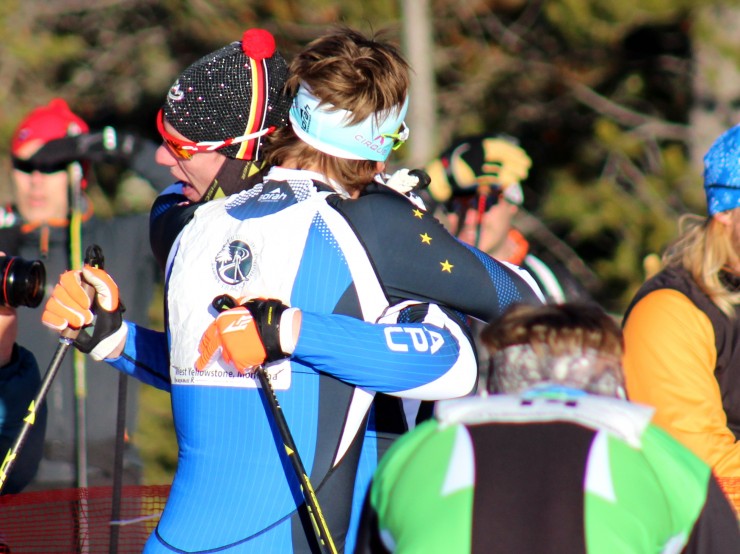
The Hanneman brothers Reese (l) and Logan hug after taking the top two spots on the podium in the men’s SuperTour 1.3 k freestyle sprint final on Nov. 27 in West Yellowstone Mont. Logan won and Reese placed second, 0.53 seconds behind his younger brother.
Mads Strøm of the University of Colorado-Boulder (r) leads Brian Gregg (Team Gregg/Madshus) during the men’s SuperTour 15 k freestyle race in West Yellowstone, Mont.
Brian Gregg after winning the men’s SuperTour 15 k freestyle individual start race on Nov. 28 in West Yellowstone, Mont.
Matt Liebsch (Gear West/Salomon) finished second overall in the men’s SuperTour 15 k freestyle race on Nov. 28 in West Yellowstone, Mont. He was 5.5 seconds behind his training partner and friend, Brian Gregg (not shown).
Scott Patterson leads APU teammate Tyler Kornfield during the men’s SuperTour 15 k freestyle on Nov. 28 in West Yellowstone, Mont. Patterson finished third overall, 13.3 seconds back from race winner Brian Gregg (not shown). (Photo: Ian Harvey/Toko)
Scott Patterson (APU) leads Oscar Friedman (Dartmouth) and others during the men’s SuperTour 15 k freestyle race on Nov. 28 in West Yellowston, Mont. Patterson went on to take third overall; Friedman was 13th.
Canadians Kevin Sandau (Alberta World Cup Academy) (l) and Knute Johnsgaard (Whitehorse/AWCA) race to fifth and sixth, respectively during the men’s SuperTour 15 k freestyle race on Nov. 28 in West Yellowstone, Mont. Tad Elliott (Ski and Snowboard Vail) placed 15th overall.
Ben Lustgarten (SVSEF) (r) races to seventh in the men’s SuperTour 15 k freestyle on Nov. 28 in West Yellowstone, Mont. Lex Treinen (APU) went on to place 10th overall.
Rogan Brown (SVSEF) starting his second lap of the men’s SuperTour 15 k freestyle on Nov. 28 in West Yellowstone, where he went on to place eighth overall. (Photo: Ian Harvey/Toko)
Matt Gelso (SVSEF) leads Eric Packer (APU) and Nick Hendrickson (University of Utah) during the men’s SuperTour 15 k freestyle race on Nov. 28 in West Yellowstone, Mont. Gelso went on to finish ninth.
Katharine Ogden during her first lap of the 10 k course during the women’s SuperTour 10 k freestyle race on Saturday in West Yellowstone, Mont. Ogden carried her momentum through to the finish and placed first overall.
Chelsea Holmes (APU) (r) races to a second place finish in the women’s SuperTour 10 k freestyle individual start on Saturday in West Yellowstone, Mont. Sloan Storey (l) chases her down to place 10th overall.
Emilie Cedervaern (University of New Mexico) during the first lap of the women’s SuperTour 10 k freestyle race in West Yellowstone, Mont. Cedervaern finished third, 35.6 seconds back from winner Katharine Ogden (not shown).
Jennie Bender (BSF) races to fourth in the women’s SuperTour 15 k freestyle race on Nov. 28, a day after winning the women’s SuperTour 1.3 k freestyle sprint in West Yellowstone, Mont. (Photo: Ian Harvey/Toko)
(From r to l) University of Utah skiers Veronika Mayerhofer, Sloan Storey and Josefin Nilsson get a team train going, while Annika Landis (SVSEF) and Katharine Ogden (SMST2/USST) set their sights on the pack. Ogden went on to win the individual start, Mayerhofer placed fifth (+45.2) and was Storey 10th (+1.01).
Caitlin Patterson (CGRP) racing to sixth in the women’s SuperTour 10 k freestyle race on Nov. 28 in West Yellowstone, Mont. (Photo: Ian Harvey/Toko)
Rosie Frankowski (APU) leads Annie Hart (SMST2) during the second lap of the women’s SuperTour 10 k freestyle race on Nov. 28 in West Yellowstone, Mont. Frankowski placed seventh, and Hart was 14th. (Photo: Ian Harvey/Toko)
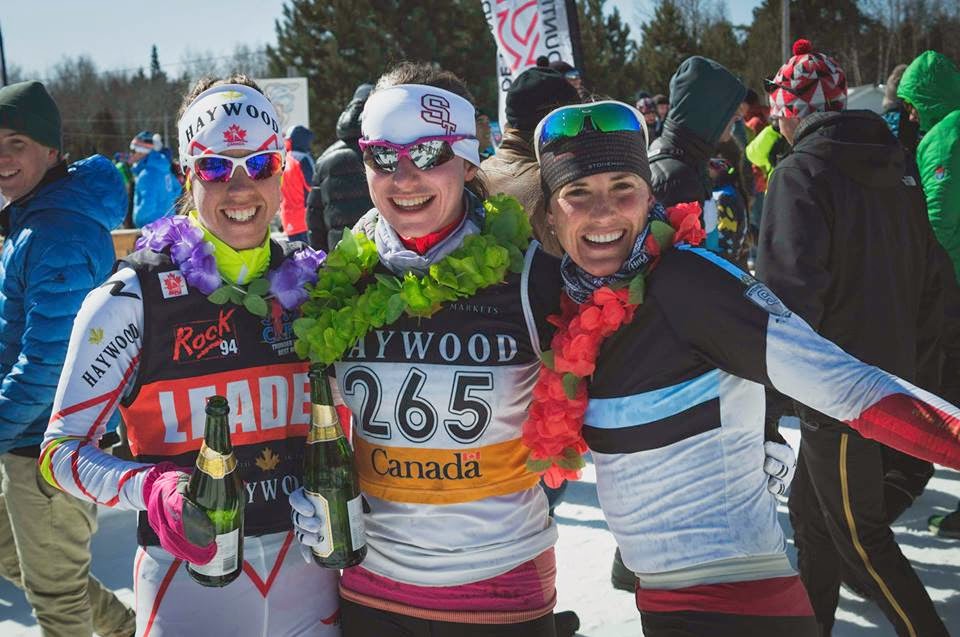
Alysson Marshall (c) with two other “retirees,” Perianne Jones (l) and Brittany Webster (r) at their last race at 2015 Canadian nationals in March. (Photo: Russell Kennedy/alyssonmarshall.blogspot.com)
After six years of skiing at the highest level — in more than 40 World Cup races, two U23 World Championships and Junior World Championships— Alysson Marshall announced on her blog this spring that she’s retiring from professional racing.
The recently engaged, 27-year-old athlete from Salmon Arm, British Columbia, decided to start a new chapter in her life, with plans to start medical school in the next few years with a focus on biology.
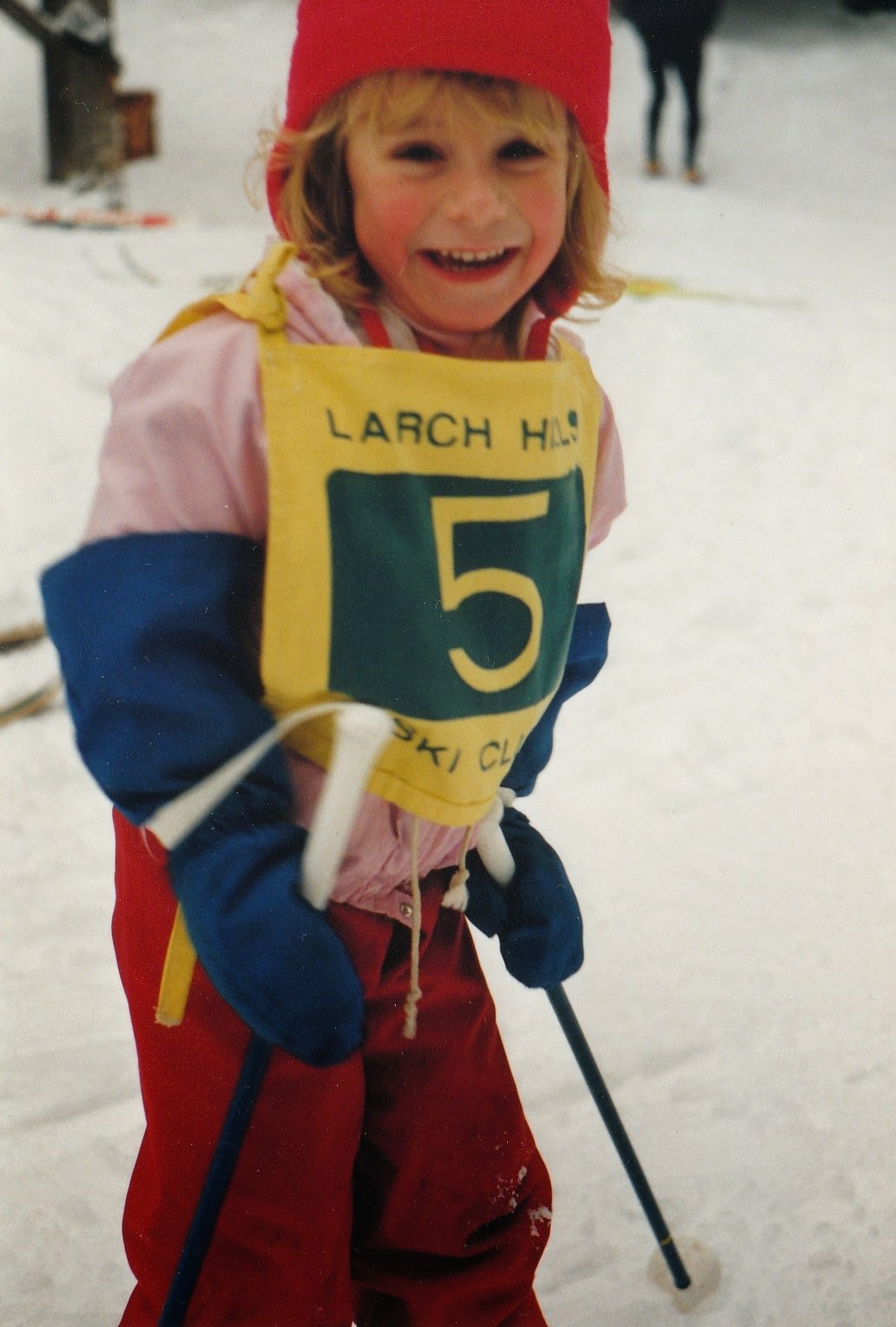
Alysson Marshall got started with the Larch Hills Ski Club. “I did my first loppet at age 4 (6km) and apparently loved it!” she wrote of this photo her blog. (Photo: alyssonmarshall.blogspot.com)
She first took up cross-country skiing on single-track trails at Larch Hills, playing in the powder before making major strides in the sport. Her move to Sovereign Lake in Vernon, B.C., and subsequently the BC Ski Team marked her more serious introduction to racing. In 2008, when the Alberta World Cup Academy was established, Marshall was one of the first to join and she remained on the national-training-centre team until the end of her career.
She was selected to the Canadian national team in 2009, after the disqualification of a Russian athlete for doping elevated her to a 12th-place result in the classic sprint at the 2009 U23 World Championships in Praz de Lys Sommand, France. She took her spot on the Senior Development Team, traveling in Europe and competing at nearly a dozen different World Cup venues over the next two years.
Health issues during the 2012/2013 season derailed her preparation for the following Olympic year. After missing the cut for the 2014 Winter Olympics in Russia, she approached her final training year and race season differently, taking two months off from skiing in the spring of 2014. While December marked a positive start and encouraging results, Marshall struggled with fatigue and saw her performances slip later last winter.
“While letting go of a dream is never easy I have come to terms with it,” Marshall wrote in mid-April. “The last few years of racing have been tough for me and although I’ve had glimpses of success, I am not consistent and there have been more tough races then good ones. I have struggled with my health and feel like I can no longer handle the level and quality of training necessary to achieve my athletic goals. I have truly learned so much from my time in the sport. The people, experiences and personal strength I have gained is invaluable and I feel like it has made me a better person.”
In an in-person interview in June at Sovereign Lake and follow-up phone interview with FasterSkier, Marshall reflected on her ski career and shared her thoughts on retiring from racing and what’s next for her.
FasterSkier: What was your favorite ski-related moment?
Alysson Marshall: [Laughs] It’s a hard question to answer, but I think I’m going to go with the World Cup [classic] sprint in downtown Stockholm [in 2012], where I got my first World Cup points in front of the Royal Palace! I loved the city and it was my best result so far. [She placed 28th.]
FS: When and how did you make the decision to retire?
AM: I think I knew mid-winter. I wanted to give myself another year after the [2014] Olympics to try to come back and see if I could get myself feeling good again. By mid-winter, I realized that that wasn’t really happening. I definitely wasn’t where I needed to be to succeed internationally, so that made the decision. I was happy to complete the season with races in Europe and end it with Nationals.
FS: You mentioned not feeling well two seasons ago — were you struggling with illness or fatigue or something else? How did you manage to recover from it?
AM: I started having thyroid related health issues in the 2012/2013 season and I feel like I never fully bounced back from that. We put our bodies under a lot of stress and I think I hit a point where my body rebelled and my thyroid was my weakest link. I may have been able to come back from that if I had given myself enough rest after that season but the next season was an Olympic year and though we adapted my training I still pushed my limits and I wasn’t able to fully recover and race at my best.
AM: It was fun! My fiancé [Chris Hamilton] was there so being with him was nice. Thunder Bay is such a great ski community. It was a great place to have my last nationals.
FS: You’ve had a pretty long career, starting as a club skier and moving up. How was the experience of working your way up to the World Cup level?
AM: It took a while for sure [laughs]. I wasn’t someone who came out immediately and was doing really well internationally. It took some time to get more confidence. I think we missed opportunities probably when I was a U23. We weren’t given as many opportunities then as we would have been today. It’s a point where I could of made a bigger jump, but with my fair amount of international experience afterwards, it was definitely a good run.
FS: How did you get from being a skier with Larch Hills to being someone who got to go to U23 World Championships?
AM: One step at a time I guess. I chose Sovereign Lake, then BC Ski team, climbing up the ladder one step at a time and kept focusing on the next big thing, whether it was nationals, world juniors or the World Cup. There was always something to go after.
Alysson Marshall (r) racing in a World Cup sprint heat in 2012 in Stockholm, Sweden.
FS:You spent some time at various levels of the national team. How was that experience and how do you think it differed from other cohorts?
AM: I was never really part of a stand-alone national team because my cohort was always embedded into the training centre. In 2012, we had the most camps with the national team. That probably wasn’t the best setup because it’s hard being part of two different programs and switching back and forth from different coaching philosophies. The national team was there for support, but not so much for day-to-day training. It was more the [Alberta World Cup] Academy filling that role.
FS: The Alberta World Cup Academy looks like it changed a lot since last year, with people leaving, new coaches. Can you tell us anything about that?
AM: I think it’s good to have a younger team. I’m not really a fan of the way it’s been the last few years … with the B-team training outside of the academy framework. … In terms of the other older athletes, that’s more a problem with the broader Canadian skiing situation going on right on. It’s very expensive for international opportunities, and I think people are debating whether it makes sense to continue racing when the focus is completely on the next generation of younger skiers. That’s why you see so many older athletes leaving.
FS: The opportunities in Europe have changed a lot during your career, from not many to a lot, to more-again-but-you-have-to-pay. Which era do you think was working the best?
AM: Honestly, we haven’t had any success transferring anyone on the World Cup, other than last year. But really, in the entire time I’ve been racing, it has been the same group of people on the World Cup, and we haven’t transitioned many others. We haven’t figured out the correct way of doing it, so it’s kind of a hard spot we’re in right now.
FS: There was a time when senior racing really only existed on a self-funded basis. Do you see any way to get from here to a system where people can progress?
AM: It’s hard to pinpoint what the exact problem is. I think we just need to get a strong group of people that are supported and given the time to develop, instead of always having that big crunch where you have to perform at this event this year, otherwise you’re going to loose your funding or your spot on the team. Honestly, it’s more a support culture that we need, where we really believe in our athletes and we provide the framework to let people succeed.
FS: How difficult was funding your skiing career?
AM: Not easy, that’s for sure [laughs]! My parents helped me out a lot. I had a few good sponsors, with Buff Canada being my best corporate sponsor. They’ve been amazing to me, but it still wasn’t an easy thing to do! It’s hard having to rely on the family to help pay the trips. It’s not a cheap sport, that’s for sure.
FS:If you’re looking at the younger people just getting going to late teenagers, are you going to tell them to dive in and see what they can do, or start looking at the financials?
AM: That’s a hard one! I’m a big believer in doing school while skiing and making that more possible and feasible. I think that’s a good way of doing it because then, you have a few more years to see if you really want to commit and you can actually get some education when you’re done, before fully committing to the expenses of the ski world. It’s not a very encouraging environment for a 18 year old looking to become a skier. It’s a little daunting looking at the potential costs for a ski career!
FS: You headed up the Canadian Excellence Fund last season: how and why did you get involved, and how effective was it?
AM: As the NST athlete representative, I was frustrated with the expense that was being put on development athletes. It was at the point where I felt like I couldn’t justifiably advise a promising high school student to pursue skiing as the cost is so high for so long. I started the fund hoping to get community support for the development level. The fund had a late start and due to some charitable donation rules, it ended in December so we had a small window for last season. Hopefully the new marketing director for CCC will support it for next season as I think it has the potential to make a ski career more attainable for young athletes and help maintain a healthier base of strong skiers in Canada.
FS: During your ski career, how much time were you able to dedicate to school? How do you feel about how the education component is set up within the training centres?
AM: I was lucky in that I had a good setup in Vernon with their club team after high school so that when I moved to Canmore I had already completed two years of my degree at Okanagan College. I picked up some courses in Calgary in the early years on AWCA but the 1-and-a-1/4 hour commute each way made it really difficult. I am grateful that I was able to do as much as I did early on. It was always positive for me to have another focus in addition to skiing. The Eastern training centres have been doing a good job encouraging academics and I hope that all the training centres continue to move towards facilitating school, especially for younger athletes.
Marshall (second from l) with her support crew: her parents and fiance, Chris Hamilton (l). (Photo: alyssonmarshall.blogspot.com)
FS:Who were some of the people who had the biggest impact on your career?
AM: My parents and family, obviously! I’ve had many good coaches, from my club coach to Doug Egan in Vernon, and all the Academy coaches have been really great as well. They all had a big impact, playing a different role in my career. There’s not one that was more important than the other.
FS: What are you going to do next?
AM: I’m [taking the] MCAT [Medical College Admission Test] exam in June. I’m going back to school in Thunder Bay in September to keep working on my undergrad [in biology], and then I’ll try getting in medical school in the next two years.
FS: What sort of medicine are you interested in?
AM: Family medicine. I really like the idea of a relationship with people over their lives, rather than a specialist who doesn’t necessarily have as much follow-through with patients.
AM: I’m planning to stay involved … I wouldn’t say I’d be coaching necessarily, but I definitely want to stay involved in the clubs, maybe at the provincial level programs. Growing up, I really appreciated having national-team athletes at training camps. That made a big impact on me, so I want to try getting more involved with the next generation, especially when B.C. got some really strong results at nationals, and there are strong athletes coming up. It’s nice to actually know them instead of just seeing their names on the results list.
Double pole rehabilitation should be an essential part of any early season training. (Photo: Pavlina Sudrich)
This week’s Wednesday Workout comes from Pavlina Sudrich. Originally from the Yukon, Sudrich drove the development program at Nakkertok and was the Head Coach of Cross Country Ontario from 2011-2014. In addition, she ran Canadian B Tours in Europe for the past two years. In the spring of 2015 the Alberta World Cup Academy announced that Sudrich would join club to work alongside coach Chris Jeffries.
***
June is great time to start digging into certain technique limitations. Here at the Alberta World Cup Academy (AWCA) we are beginning the season with a focus on double pole rehabilitation. It’s a great place to start as the double pole movement transfers across pretty much every technique, and can be done while athletes are still coming into fitness.
Step 1:
Easy double pole with some sections of resistance. Adding a gradual uphill to an easier double pole loop will allow you to see the athlete’s technique while they are relaxed, and while under a manageable load.
Step 2:
Pick out what you’d like to change about an athlete’s technique, then try and find out what the underlying , or root cause of the issue is.
For example:
In this image below we see three athletes all in a relatively similar position.
Athlete #1 is sitting down while double poling. (Photo: Pavlina Sudrich)
Athlete #1 is the one we’re going to pick on because he’s a nice guy, and because he demonstrates two common issues in double pole.
First and perhaps most obviously he is sitting back. You can almost imagine the chair he is about to sit on.
Second, he’s rocking a pretty hard swayback. This happens so often in double pole technique that I have officially named it ‘the Beyonce’. Please refer to the image below for further pop culture clarification.
The only time you don’t want to be like Beyonce. (Photo: Pavlina Sudrich)
Step 3:
Fix the Issue.
The root cause of this symptom can vary for each athlete. In Athlete #1’s case- the squat sit combined with a swayback which tells me is hip tilt needs adjusting. We also need him to find a power powerful position at the point when the poles hit the pavement so his form doesn’t ‘break’ into a swayback.
Queues:
Yell ‘TUCK YOUR TAIL BETWEEN YOUR LEGS’. If your athlete has half an imagination this will work – if not a series of ‘cat and cow’ movements will work.
Once the hip finds a good forward tilt position we can start on pushing the movement from a low squat to a more forward position. Check out the example below.
(Photo: Pavlina Sudrich)
What worked for athlete #1 was to essentially ‘relax the calf’. He was keeping his ankles locked, forcing flexion to come from the knee and hip joints which immediately throw one’s weight back. By focusing on relaxing the calf he was able to get the ankle joint moving, keeping his weight more forward. You will see this is working when the angle of the shin matches the angle of the back. In this image you will see we’re not there yet – but getting closer.
Athlete #1 was keeping his ankles locked which in turn forced flexion to come from his knees and hips. By ‘relaxing the calf’ he was able to get a better angle. (Photo: Pavlina Sudrich)
Finally, there need to be a more dynamic position from the trunk (i.e. no more swayback-Beyonce business). The queue to tuck the tail under will have worked on this a bit, but there is more an athlete can do. For this workout we introduced a physio ball. Have the athlete lie face down on it and imagine their arms like a parachute out in front. This isolates a good position from which to initiate the pole plant.
(Photo: Pavlina Sudrich)
It can also help to queue the athlete to ‘set’ or ‘brace’ themselves at the top of the movement so as not to break like a robin’s egg upon impact with the unforgiving pavement. In this last image you will see the fellow in the red shirt coming up nice and tall, his core lat’s ‘set’ ready for impact (just maybe don’t hike those rhomboids as high).
Great. Now that you have conquered double pole go have a double espresso and a nap. You deserve it.
Brittany Webster in the Oct. 26 XTerra Off-Road World Championships in Maui, Hawaii. (Photo: Mike Cavaliere)
When Brittany Webster’s name appeared atop a list of results this past weekend, it wasn’t for Canmore’s Frozen Thunder. Instead, Webster replaced snow with sand and finished as the first amateur female in the 2014 XTerra Off-Road World Championships on the north shores of Maui, Hawaii Oct. 26.
Webster always had an interest in triathlons, as she loved both cycling and running. While she doesn’t particularly enjoy swimming, the additional challenge attracted the 26-year-old.
Turned onto the XTerra racing series by a friend, Webster jumped into the Canmore XTerra triathlon on Aug. 8, where she earned a starting position at the World Championships after she claimed the top female spot. Once qualified, it was an easy decision to attend the Championships.
Webster is no stranger to success in skiing. She’s seen four top-tens at the World Junior and U-23 Championships, numerous podiums at Canadian Nationals, and a trip to Sochi for the 2014 Olympics earlier this year.
Given her results on skis, her off-snow success was not surprising.
In an email, Webster wrote that adjusting to the warm and wet conditions of Hawaii was challenging for someone who is accustomed to the dry and cool climate of the Canadian Rockies.
“My first interval workout was on the track and I lied (sic) down in the sprinkler system on the baseball field afterwards just praying I would cool off. It was an important experience because it made me realize how much I needed to drink if I wanted to last three hours in the heat,” she wrote.
Come race day, Webster and roughly 700 other competitors faced a rough ocean as they began the first stage of the competition — a 1.5 k swim. The warm Hawaii waters were not as welcoming as one might expect. According to Webster, she and her fellow competitors faced swells of five to six feet.
“The waves were some of the biggest XTerra had ever seen and there were guys running out of the water back to the start… a few dropped out for sure. Swimming is not my forte, but embracing challenge is. I pretended I was surfing and that kept me smiling instead of panicking,” she wrote.
Once she exited the tumultuous waters, Webster was faced with a 32 k bike on the slopes of the West Maui Mountains.
2014 Olympian Brittany Webster (second from r) with her Canadian teammates before the Closing Ceremony in Sochi, Russia: (from l to r) Heidi Widmer, Perianne Jones, Amanda Ammar, and Emily Nishikawa (Photo: Emily Nishikawa)
According to 2014 Olympian, the mountain bike was challenging due to the vertical terrain and slick trail. While Webster managed to maintain control throughout the majority of the 32 k course, on the final turn she flew off her bike. The result was a tweaked knee.
Webster shook-off the fall and continued to the 10 k running portion of the race, but her pace was slowed and the pain in her knee inhibited her speed on many of the course’s uphills.
“I bailed on the last corner of the bike and tweaked my knee pretty good, so I actually had to walk all of the uphills on the run until the halfway point when the pain began to subside,” she wrote.
Despite the injury, Webster finished as the top female amateur competitor. Furthermore, with a time of 3:17:36 she placed 160th overall and would have been 18th in the professional female category. Her time of 47:45 in the 10 k run was the tenth fastest women’s time on the day.
As for the tweaked knee, Webster explained that in the end it wasn’t a serious injury.
“Nothing ice, massage and a hair cut at the Paul Mitchell tent couldn’t fix,” she wrote.
Webster wrote that preparing for the World Championship triathlon was an excellent cross-training opportunity because it allowed her to diversify her training program. She explained that her body doesn’t respond to the same rollerski and strength exercises that it used to, and that adding swimming and biking into her repertoire has increased her fitness levels.
Brittany Webster (105) leads Emily Nishikawa (101) in the women’s 15 k skiathlon at Canadian Olympic Team Trials on Jan. 12 in Canmore, Alberta. Webster took second after winner Amanda Ammar (102). (Photo: Angus Cockney)
“A different response stimulus can go a long way and I quickly found myself, after recovering from much calve (sic) and shoulder soreness, that I was getting fitter and it was translating right back into skiing,” she wrote.
Last winter Webster and fellow Canadian Amanada Ammar petitioned Cross Country Canada to earn a spot on the 2014 Canadian Olympic Team. The two were not initially included on the team roster but after FIS allotted more starting positions to Canada, Webster and Ammar were named to the team and competed in Sochi.
Webster, who took time off from skiing in 2012 and returned in 2013, will compete with the Alberta World Cup Academy (AWCA) after skiing for Team Mito last year. She is no stranger to AWCA, however, having trained with the club before her stint with Team Mito.
Webster explained that she is excited to return to the AWCA in the upcoming season.
“I have really missed being on a team and being able to support teammates of mine. I’ve also missed working alongside Chris, Mike and Stef. Those guys are so awesome, and the opportunity to work with them and the amazing people that are on the Academy made me want to commit to the AWCA,” she wrote.
There’s also another difference in Webster’s life going into the winter season. Adding to the slew of engagements and weddings in the ski community, she and AWCA race director Mike Cavaliere are engaged. Their wedding is set for next September at the Boundary Ranch.
“We are both animal lovers and have backgrounds with horses, love the ranch life, so it seemed fitting to have it there!” she wrote.
Zeke Williams (l) races through the ladder during a track workout with Alberta World Cup Academy teammate Yannick Lapierre in Canmore, Alberta. (Photo: Stefan Kuhn)
This week’s workout comes to you from Ezekiel “Zeke” Williams, FasterSkier’s newest intern and an athlete at the Alberta World Cup Academy in Canmore, Alberta. This time last season, Williams said he really enjoyed doing what his team called, for lack of a better name, the Agility Sprint Track Workout.
***
Canmore Alberta may be known for its skiers rather than its track stars but it still has a short 300-metre stone-dust track. And this is where the Alberta World Cup Academy men’s team was to be found, more often than not, on Thursday mornings in May and June 2013. As the athletes warmed up the coaches set up a pair of agility ladders on one of the track’s straight-aways and hurdles on the other. Finally, the coaches would draw ‘finish lines’ at about 10-seconds worth of sprinting past the end of the obstacles.
After warming up we would partner up and do laps of the track. We would focus on speed through the agility ladders and hurdles and then sprint out of them. Then we’d slow back down to an easy jogging pace until we hit the next feature.
The Workout: Agility Sprint Track Workout
Total time: 1 1/2 hours
Need: A track, running shoes
Warm up: 30-minute jog
10 track laps: 20 x 10-15 second sprints with about 1 minute easy jogging between each. Whole thing takes just over 20 minutes
Cool down: 40 minute jog
I like this workout for two reasons. First, it’s a lot of fun to do! Getting to race through the ladders and the hurdles against a teammate makes it a sweet competition.
Heart-rate data from Zeke Williams’ workout: track laps are between about 18 and 38 minutes.
Second, the workout gives a bunch of training benefits. At first glance it looks like a speed workout, but heart rate ends up at lactate threshold for most of the time because of the shortness of the sprints and the minute of easy jogging between them. Check out my heart-rate log during a similar workout here.
Also, the agility component of the workout improves coordination at speed, which is nice to stay in touch with for when we get back into rollerski sprinting.
Combine the agility work and lactate threshold building into the short 1:30 hour workout time and it makes for a solid early training-season session.
***
About the Author: A Canadian cross-country ski racer with the Alberta World Cup Academy, Zeke spends most of his time in Canmore, Alberta, but calls Cantley, Quebec, his home. He thinks that you can learn a lot about a person from their goals — his is to ski really fast on the Winter Olympic race course in 2018. Check out his blog: ezekielwilliams.ca
CAMP 2: 2-Day Program (Classic Technique) Dec. 19-20 $350 REGISTER
CAMP 3: 2-Day Program (Skate Technique) Dec. 21-22 $350 REGISTER
Optimize your technique and learn from the best at the Canmore Masters XC Ski Camp. This Masters Camp is for all levels and ages of skiers – catering to novice, intermediate and advanced cross-country skiers. International calibre coaches from The Alberta World Cup Academy are hosting three Masters XC Ski Camps at the Canmore Nordic Centre – December 19-22, 2013. Coaching ratio is eight skiers per coach. Ski Camp fees include 4.5 hours per day of coaching, including video analysis, wax clinic and trail passes.
Alberta World Cup Academy skier Patrick Stewart-Jones (second from r) leads teammate Phil Widmer in some quick sprints during an August dryland camp in Whitefish, Mont. (Photo: AWCA)
Note:This is the fourth and final preview giving an inside look at Canada’s national training centres. We asked coaches to tell us what’s new, whom to look out for and their outlook for the season. Teams were presented in no particular order.
Team: Alberta World Cup Academy (AWCA)
Coaches: Mike Cavaliere (program director/men’s coach), Chris Jeffries (women’s coach), Stefan Kuhn (assistant coach)
Athletes: Jess Cockney, Chris Hamilton, Russell Kennedy, Graeme Killick, Yannick Lapierre, Alex Mahoney, Kevin Sandau, Michael Somppi, Patrick Stewart-Jones, Sebastien Townsend, Phil Widmer, Ezekiel Williams; Dahria Beatty, Annika Hicks, Marlis Kromm, Alysson Marshall, Emily Nishikawa, Rebecca Reid, Heidi Widmer.
With 19 athletes (12 men and seven women), the AWCA is down one from last year, but still boasts quantity and quality with eight skiers on the National Senior Development Team (Cockney, Killick, Sandau, Somppi, Phil Widmer, Heidi Widmer, Marshall, and Nishikawa).
Who’s new: Two former Callaghan Valley Training Centre athletes – Lapierre and Townsend – both originally from Quebec. Mahoney hails from Lethbridge in southern Alberta, but has been living in Canmore for the last three years, formerly training with Rocky Mountain Racers. Williams comes from Nakkertok and the Gatineau, Quebec, area.
Who’s missing: Kate Brennan retired and is now working as a manager at the Paintbox Lodge in Canmore, owned by Sara Renner and Thomas Grandi. According to Jeffries, Brennan “was plagued by many health problems in her final years, from which she seems to be recovering from very well,” he wrote in an email. “She was engaged to former ski racer Phil Wood this summer.”
Janelle Greer moved back to Whitehorse, Yukon, and was considering attending nursing school next fall, Jeffries wrote. Suzanne Stevenson is studying at Montana State University, and Jeffries didn’t think she was ski racing, and Brittany Evans is also pursuing undergraduate studies at the University of British Columbia.
Former men’s team leader, Graham Nishikawa – still on the Senior Development Team – has been training with Canada’s Para-Nordic program in the leadup to the 2014 Olympics. Brent McMurtry retired and is studying at the University of Victoria. Matt Wylie also retired and is attending the University of Calgary.
An AWCA coach for a month and a half last season, Mike Vieira took a new job this spring as Cross Country Canada’s manager of coaching development.
“We all resumed our roles from last year and have not missed a beat,” Jeffries explained. “[Former AWCA skier and national-team member] Drew Goldsack was contracted for a week this summer to coach the women during a training camp here in Canmore, which gave the girls a fresh perspective and allowed me time to coach the girls of the Alberta Ski Team.”
The team also brought on an intern, Lars Hanel, a former racer studying to become a coach in Germany. According to Jeffries, he arrived in October and will assist the Academy through the 2013/2014 season.
Top results last season:
Jesse Cockney of the Alberta World Cup Academy and Senior Development Team (2) leads Finland’s Anssi Pentsinen (12) and the rest of his quarterfinal in last year’s World Cup 1.3 k skate sprint in Canmore, Alberta. Cockney won the heat and went on to place ninth overall for a personal best in his fifth World Cup start.
Cockney, 24, had a breakout season starting at the Canmore NorAm, where he placed second in the 15-kilometer classic to earn his way to the Quebec and Canmore World Cups last December. In Canmore, Cockney wowed local supporters and international competitors with the second-fastest qualifying time in the World Cup skate sprint, and went on to place ninth overall.
He notched several other podiums throughout the NorAm season, made the top 50 in the Lahti World Cup skate sprint (in 50th), and placed fourth in the classic sprint at Canadian Nationals in Whistler, B.C.
Phil Widmer, who turned 30 last month, and Emily Nishikawa, 24, both earned trips to World Championships in Val di Fiemme, Italy, where Widmer placed 49th in the classic sprint. Earlier in the season, Widmer finished 15th in the Canmore World Cup skate sprint, racked up several NorAm victories, and placed third in the classic sprint at nationals.
At 23, Nishikawa pulled off 57th in both the classic sprint and 10 k skate at World Championships, despite an unusually rapid heartbeat that turned out to be benign. At the Canmore World Cup in December, she placed 34th in the 15 k skiathlon and 48th in both the 10 k classic mass start and freestyle sprint. She ended the season in 46th at World Cup Finals in Falun, Sweden.
After placing 34th in the Canmore World Cup sprint, Heidi Widmer also qualified for U23 World Championships in Liberec, Czech Republic, where she notched 28th in the 10 k skate (and subsequently made the senior devo team in the spring). The 22 year old medaled twice at nationals, placing third in the 5 k and 30 k skate races in Whistler.
Coach’s comments:
According to Jeffries, all went as planned throughout the summer and fall, with athletes hitting personal best in field tests and showing “good fitness” on the rollerski-treadmill incremental tests.
Sebastien Townsend (AWCA) prepares for a rollerski-treadmill test at the Bill Warren Training Centre in Canmore, Alberta. (Photo: AWCA)
The women’s team held seven training camps from May through November, most of which took place around Alberta and British Columbia, but also included trips to Whitefish, Mont., and Whitehorse. The men ventured to similar places, with a total of six camps, including one at home on Frozen Thunder.
Even in an Olympic year, the team’s goals are generally the same.
“As always, we want to qualify athletes for international trips (WJC, U23s, Olympics, World Cup, Scando Cup) and ultimately graduate athletes to national teams (World Cup, SDT),” Jeffries wrote. “One of our big goals as a team is to have athletes positioned on the NorAm to win the FIS regional spots, allowing them to race World Cups. If you ask our athletes what they need to make performance gains internationally, their number one answer is World Cup starts. The FIS regional spot is the most predictable way to earn those starts in a year.”
Looking at the men’s team, Jeffries stated their athletes are “healthy and performing at a very high level.”
“The group is a little more diverse than in previous years, which has likely contributed to a very healthy team environment,” he added. “We have 6 U23 athletes who are all chasing after the older boys, getting stronger in the process. The non-U23 men are very focused as they work towards being in shape for the Olympic trials in January.”
The reigning FIS regional leader, Cockney gets to start this season in Europe with Canada’s World Cup Team.
On the women’s side, Jeffries explained they’ve had a drop in numbers last year: from 12 to seven.
“As a result, the group is very focused this year and more mature,” he wrote. “Dahria is our only junior, but her drive to be successful internationally puts her more in the category of team veteran as she pushes the other girls and keeps them on their toes.”
While the group’s general fitness is “very high,” Jeffries stated their women have suffered more injuries than usual. Hicks has been on an adjusted program waiting for compartment-syndrome surgery on her lower legs this fall. “She raced through a lot of pain last winter and we had her diagnosed this spring,” he explained.
In early September, Heidi Widmer crashed rollerskiing and ended up with her third concussion. She took a few weeks off and was back in action later this fall. “Heidi brought in a great level of fitness from last winter that she has continued to build on this summer, so we are confident it won’t take her long to get ready for the start of race season and the U23/Olympic trials in January,” Jeffries wrote.
“As a coaching team, we are all very competitive people, so we are always looking internally on how we can become better. Our overall philosophy though is pretty simple and helps us maintain perspective. We ultimately try to keep things simple, looking at finding ways to do hard training with high quality, which we generally just refer to as “regular training.” The attitudes and commitment of the athletes is what I think allows us to try and raise the bar each year. We have a great group of athletes with a lot of talent who work extremely hard, which allows us to have success annually.”
Heidi Widmer (l) and Andrea Dupont after colliding at a NorAm sprint last January in Thunder Bay, Ontario. Widmer suffered a mild concussion, but qualified for the U23 World Championships as a discretionary pick and was fully recovered in five days. (Photo: John Sims)
Heidi Widmer is no stranger to head injuries. One of the newest members of Canada’s Senior Development Team, the 22 year old suffered her first as a teenager in the fall of 2009. The culprit? Rollerskiing – downhill, to be specific.
Part of the Alberta World Cup Academy in Canmore, Widmer crashed during a classic rollerski, and the next thing she remembers is the hospital. Four years later, the cause of the accident is still a mystery to her, as she has amnesia surrounding the event, but the effect was a head injury serious enough to send her to the Calgary hospital as a precautionary measure.
“That crash took me by surprise,” Widmer said on the phone last week. “I didn’t really plan on that happening. So that was my one really bad concussion and since then I’ve had to be more cautious with my head. I haven’t had any problems recovering from that. I made a full recovery. I didn’t have any spinal or internal bleeding; I was super lucky with that.”
Heidi Widmer looks out at the 3,100-metre Mount Lougheed during a summer hike up Wind Ridge near Canmore, Alberta. (Courtesy photo)
Fast-forward to Sept. 7, 2013, Widmer found herself in an eerily similar situation.
“This past fall I was classic rollerskiing again and fell on a downhill pitch,” she said. “I slipped on some mud at the bottom; I was going down with a teammate. [There was] a nasty little grime layer at the bottom of the hill that neither of us saw. And that took us both out … I superman-ed into a ditch.”
Fortunately, she didn’t hit her head and there were no major acute injuries. However, Widmer noticed a pressure in her head that didn’t feel right, so she cut her workout short to get some rest. After taking another day off, she started back into training and felt great, winning a skate sprint time trial with the women’s national team that week.
Shortly after, her symptoms returned along with a bad headache. After consulting with doctors, Widmer agreed to take several weeks off, then gradually return to full-intensity training.
“[The pressure] is not extreme and it’s not like I’m in blinding pain, but it’s enough for [the doctors] to want to take the right precautions,” Widmer explained.
Despite these mild symptoms, she resumed full-time training and is more excited than ever to be back.
“I’m super lucky in so many ways that it’s not a serious head injury,” she said. “There’s no internal bleeding, I’m functioning, I’m fine, but I just have to be able to take care of this and come out of it with some lessons learned for sure.”
Widmer had another concussion last winter, when she crashed in a skate sprint during the selection races for U23 World Championships. She had to take five days off to recover, and as a result, missed one of the qualifying races. She still made the team as a discretionary selection and said she recovered completely after five days.
“I haven’t reached the point of the doctors being like ‘one more and you may never be able to ski again’ type extreme,” she explained. “I know that every time it does happen, it adds up in my brain, but I don’t have a specific medical answer for that.
“Being afraid to fall is probably more dangerous than accepting the risk,” she added. “Falling happens to be part of skiing and after all we’re talking about cross country skiing. I’m not an alpine skier pushing 130 km/hour and crashing with my face on ice!”
In addition to maintaining a healthy perspective on her concussions, Widmer has also started doing a fair amount of physio work to maintain and improve her balance — something that took a hit from her first concussion. The trauma caused her damage in her inner ear, which governs balance. She’s working on restoring that balance via physio exercises, while also getting back into shape for race season.
“I think that the rest of this fall is something that will play to my advantage,” Widmer said. “It’s something that I’ve come to view as an advantage for me, because the fall that I had [my previous head injury], [taking time off] paid off in my season. I ended up having one of my best seasons. I think it says a lot to be able to absorb the summer of training and come into the fall with a new perspective and motivation to train. It’s really reignited in me my motivation. Sometimes in the fall it’s super common for people to get super run down with the changing seasons and the ski racing season approaching. So I’m looking at it in as positive a light as possible.”
As for whether she’s feeling the positive effects of her time off yet, Widmer said she’s a little behind with her fitness, but is confident she’ll get back up to speed soon.
“I’ve already seen huge gains in the last week of returning back to intensity,” she said. “The summer [training] is absorbed, and more than anything, I’ve learned to be more patient over the past month.”
Widmer’s first races for the season are the Alberta Cup races the first weekend of December. “I’m ready to get after the winter,” she said.
***
About the Author:
Katie Bono is a Canadian contributor at FasterSkier. Hailing from Minnesota, she raced for Dartmouth College and Sun Valley before turning her energies to climbing (and becoming the fastest known woman to ascend Mt. Rainier in Washington). Now based in Canmore, Alberta, she is an athlete ambassador for Millet and works as a mountain guide in Alaska, Washington and South America.
AWCA skiers get ready for a skate prologue test, which doubled as a lactate clearance workout, this fall in Canmore, Alberta. (Courtesy photo)
This Wednesday Workout it brought to you by Stefan Kuhn, 2010 Canadian Olympian and assistant men’s coach at the Alberta World Cup Academy in Canmore, Alberta. The workout: lactate clearance, which he has his athletes do in the fall three to four times before the race season. The goal: measure each individual’s ability to clear lactate, their mental toughness, physical fitness and overall speed.
AWCA skiers after a recent hill-climb running workout near Canmore, Alberta. (Photo: Stefan Kuhn/AWCA)
“This is a fun workout and it’s super simple to do, but it really makes you have to dig deep, which is why I like to do it around this time of year,” Kuhn explains in an email. “The shape of the athletes is at high level and you can really go for a hard effort to build some lactate and try to survive through the workout the best you can.”
But don’t go crazy. Kuhn warns his athletes that they need to be mindful how hard they’re pushing from the start of the workout so that they make it to the finish.
“It’s a speed-focused intensity with an understanding you have to repeat it many times over,” he notes. “I know I loved it when I was an athlete.”
So what’s the point of so much pain? It helps you deal with lactic-acid buildup, that burning sensation one might feel in their legs or arms that causes them to slow down.
“As cross country is a lactate-tolerable sport, it is important to learn to try to flush it best you can and to race with it in your system,” Kuhn explains.
An extended and diligent warmup and cool-down are key. So let’s get to it:
The Workout: Lactate Clearance
Warmup: 30-45 minutes
15 intervals of 30 seconds on, 30 seconds off
15-minute break: easy running or skiing, keep the body moving
(Repeat first set) 15 x 30 seconds on, 30 seconds off
Lactate readings (if available. Wear a heart-rate monitor during workout if not): Kuhn measures his athletes’ lactate levels at the end of the workout because there isn’t enough time in between.
“I look at lactate clearance and you also get to see a lot by watching the athlete,” he explains. “If they have speed at the end or are they dying hard. I also watch the heart rates, which is a great way to monitor how they are doing. Do they get close to their max, and how much does it drop on the rest parts of the interval?”