From the FasterSkier archive — posts syndicated from athletes’ and coaches’ own blogs between 2004 and 2012, kept online as published. Current coverage is at fasterskier.com.
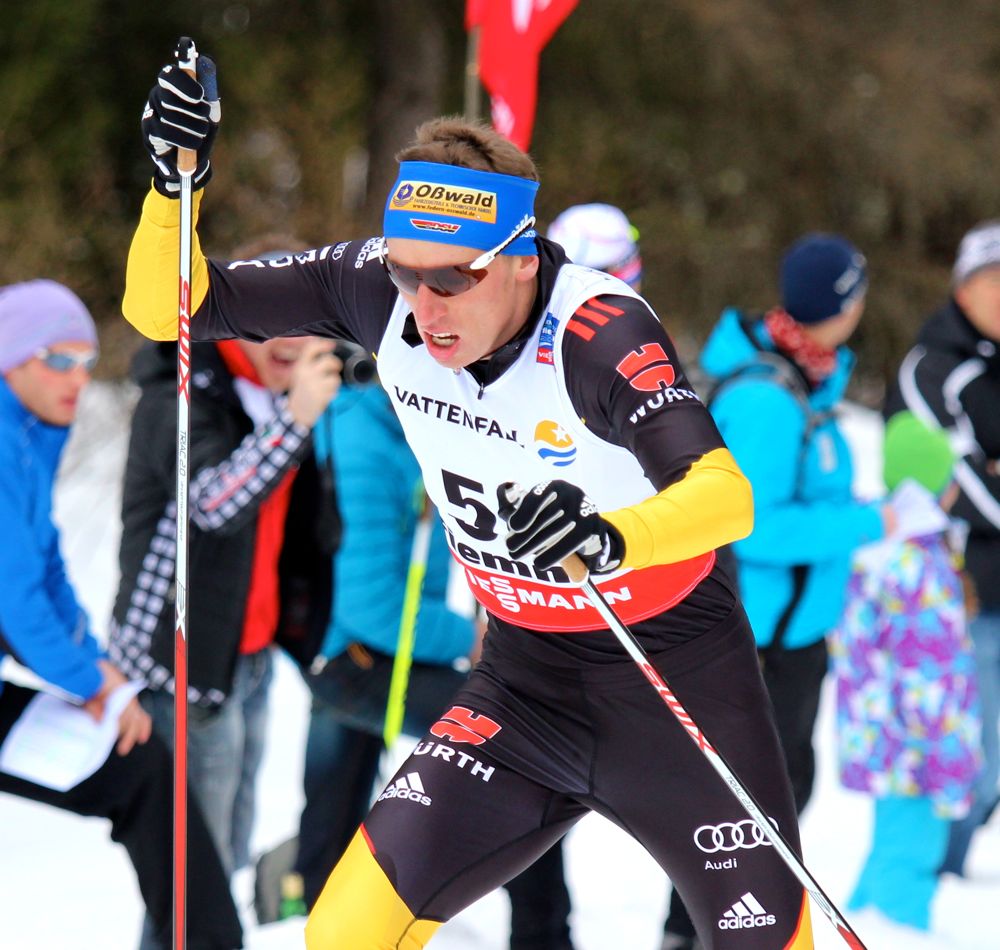
Germany’s Tim Tscharnke racing at 2013 World Championships in Val di Fiemme, Italy. His best result there was 14th in the 15 k freestyle, which stood as his best individual result in three World Championships appearances. In his eight seasons on the World Cup circuit, he reached the podium four times, two of which were individual victories.
At the conclusion of last season in late March, German cross-country national team member Tim Tscharnke still wanted to keep going for one more Olympic highlight year. He was eager to redeem himself after a disappointing 2016/2017 season — by his standards — in which he started only eight World Cup races. His best result of last winter came at the Tour de Ski in Val Mustair, Switzerland, where he placed 24th in the 10-kilometer classic mass start. Due to a respiratory illness, he was not selected for Germany’s 2017 World Championships team, also missed the national championships and finished the season on the European Continental Cup.
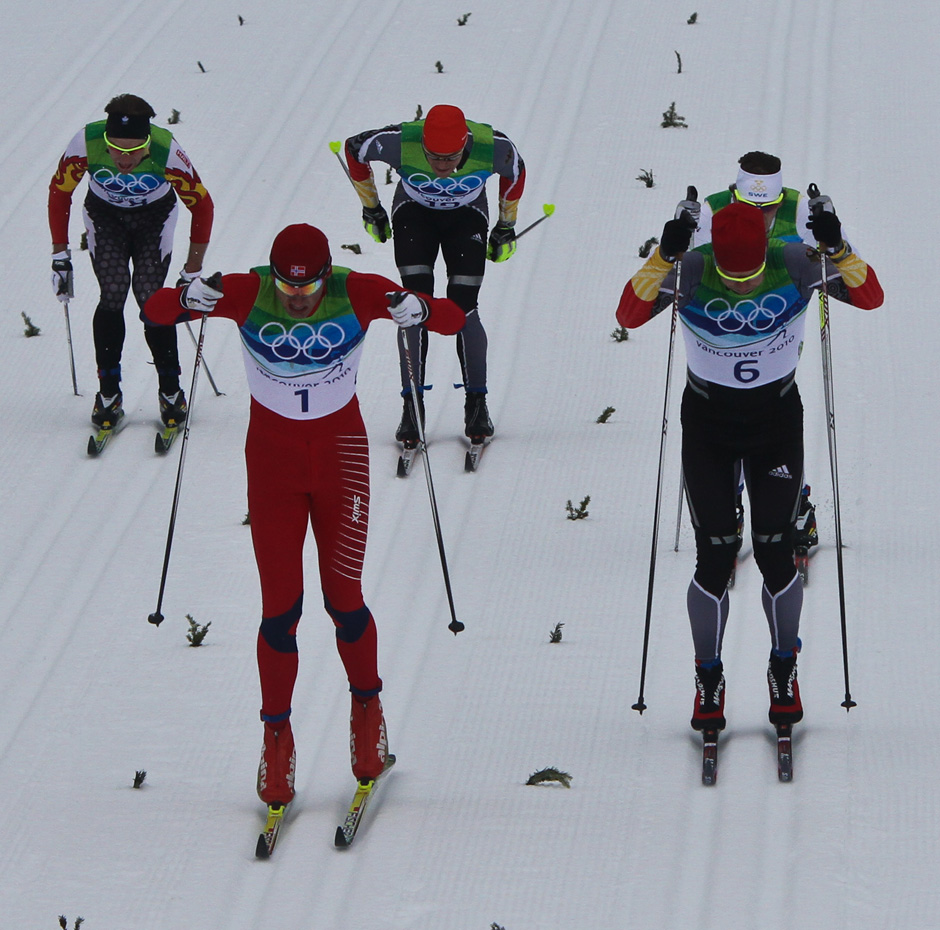
Tim Tscharnke (l) celebrating with his teammate Axel Teichmann after finishing second in the men’s team sprint at the 2010 Vancouver Olympics for a silver medal. (Screenshot: Olympicvancouver2010 YouTube video)
His health problems lingered through the spring. Unable to train as intensively as he wanted to, 27-year-old Tscharnke reconsidered his future in the sport and ultimately announced his retirement on Facebook late last month.
“The last three years of my career were riddled with many mediocre months, punctuated by health problems and athletic setbacks,” Tscharnke wrote, according to a direct translation. “For this reason I will end my athletic career.
“I consider it impossible to once again get back to the top of the world. Yet that has always been my standard: to compete against the best and fight for top results,” he continued. “However I had to realize that respectively my body no longer can absorb the training volume and methods from the good years, and therefore it is impossible for me to compete against the strong international competition on an equal level. Especially my back and my feet, which time and again had to be treated between training camps in order to even ensure a basic level of training, in combination with results I could not deliver, have let the motivation sink into a deep hole over and over again.”
He explained that he did not just want to make the team for PyeongChang 2018 as a “tourist”:
“The attempt for the next season to secure a ticket as an Olympic tourist on the very last fumes and then just ski around there without any chance at positioning in the front… no, that is not up for debate,” he wrote. “It would not be justified to miss my family for another year and potentially damage the body even more. Nevertheless I look back on a good time. A time during which it was possible for me to achieve some great successes, which I am proud of!”
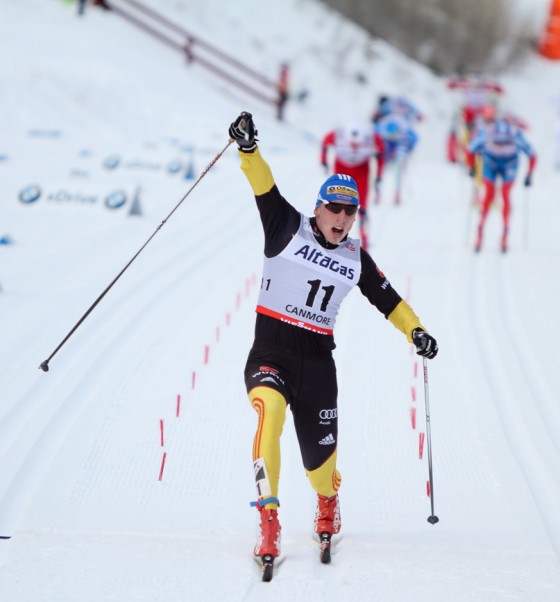
Back in 2012, Germany’s Tim Tscharnke celebrated his 23rd birthday with a World Cup win in the 15 k classic mass start in Canmore, Alberta. It was his second-career World Cup victory.
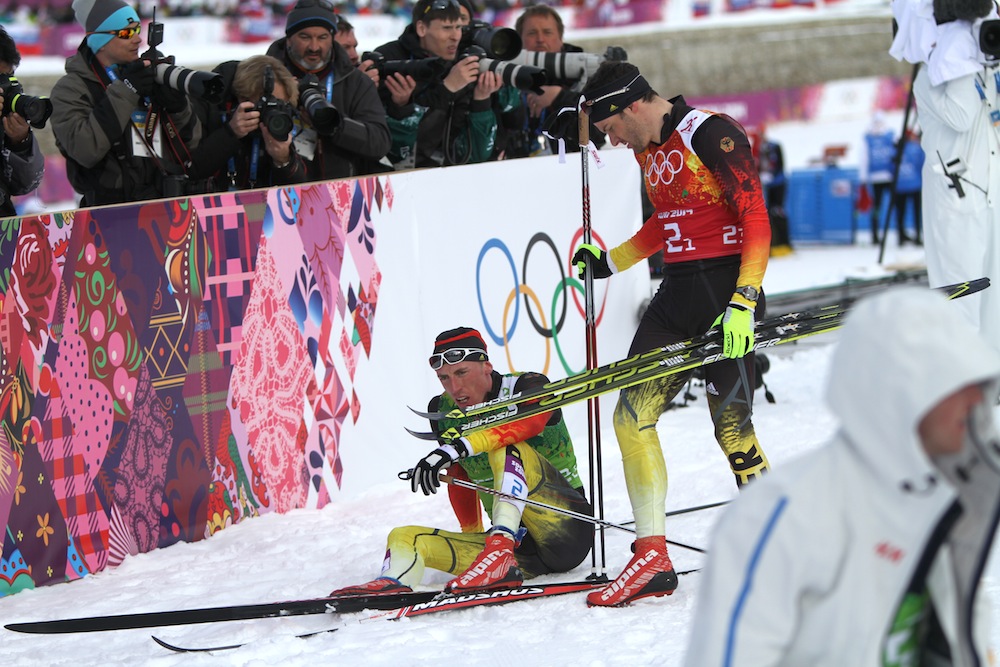
At the 2014 Olympics in Sochi, Russia, Tscharnke and teammate Hannes Dotzler nearly took another medal in the team sprint, winning their semifinal and leading a three-person group in the final, before Tscharnke tangled with Finland’s Sami Jauhojärvi coming down into the finishing stretch and crashed. Tscharnke took a long time to stand up and ultimately finished seventh for Germany.
After that, Tscharnke got back on track to become the last German skier to-date to win a World Cup race: the 15-kilometer classic mass start stage of the 2015 Tour de Ski in Val di Fiemme, Italy. His other World Cup win was in the same format (15 k classic mass start) in 2012 in Canmore, Alberta.
“I want to thank everyone who accompanied me on my way, during my active time: my family, my friends, my faithful sponsors, and last but not least of course also my fans and supporters, who were excited for me and cheered for me during the last years,” Tscharnke concluded in his Facebook post. “I say, Thank You and wish you all the best for the future!”
Tscharnke has not revealed what he plans to do next. In the last few months, he has teamed up with an advisor to the German national team to offer weekend rollerskiing courses. Tscharnke is employed as an officer with the German border patrol.
The German nordic sports experience at the 2014 Olympics could perhaps be summed up on the last day of competition.
In the men’s 50 k, Germany entered four men. The finishers were led by Thomas Bing, about to turn 24 years old, in 36th place.
Next came Axel Teichmann, more than ten years Bing’s senior. Then two biathletes – Arnd Peiffer and Erik Lesser, in their 50 k debuts on the world stage and within a minute of Teichmann’s time.
Four years earlier, Teichmann had captured silver for Germany in the same event, but on that day in February he labored to 39th place, more than four minutes behind the winning Russian skier. While Germany still had a few of their stars from days past on their roster, they were mostly stars no more.
Peiffer and Lesser had teamed up for a silver medal in the biathlon relay the day before, but they surely were not on fire in the 50 k (understandably). While they treated the race as a fun way to end their Games – and some other biathletes and nordic combined skiers probably would have jumped at the chance to do the same thing – their participation brought up an uncomfortable question: can Germany find nobody else?
To say that Sochi was a disappointment for Germany would be an understatement. While expectations were somewhat tempered by their team’s performance so far that year, it was hard not to remember Vancouver. There, biathlete Magdalena Neuner won two golds and a silver, Simone Hauswald shared the podium with her when she earned bronze in the mass start, and the relay also took bronze.
Germany’s Tim Tscharnke (l) after the finish of the 2014 Olympic team sprint with teammate Hannes Dotzler. The two finished seventh after Tscharnke fell a few hundred meters before the finish as a result of a tangle with Finnish anchor Sami Jauhojärvi. Finland took gold and Germany placed seventh.
In cross country, Nystad and Evi Sachenbacher-Stehle had teamed up for gold in the Vancouver team sprint, Teichmann and Tim Tscharnke took silver in the men’s event, the German women were second in the relay, and the men won two individual silver medals.
For a little perspective: in 2014, Germany came away with three medals, total, in cross country and biathlon combined.
Where to start with the embarrassments? Was it Sachenbacher-Stehle testing positive for a banned stimulant? Or was it Tscharnke falling down in the final stretch of the team sprint and, instead of getting up and likely earning bronze, lying in a heap whimpering about how he missed out on gold?
In a Deutscher Olympischer SportBund report obtained by FasterSkier, the country’s Olympic committee assesses the success of each sport at the 2014 Olympics, and looks for actionable plans to move forward and upward. The document runs more that 230 pages and not only focuses on each sport individually, but also on funding partners, medical and logistical support, and what other countries are doing to succeed. It’s an impressive analysis of a huge and complex system.
A Cross Country Team Too Old and Too Young
“Denise Herrmann and Josef Wenzl improved in the world rankings in the 2013/2014 season and even at times led the Sprint Cup,” the report noted of young German skiers. “But the pre-Olympic season was marked by a disappointing World Cup, and the coaching change in 2012 didn’t bring the expected turnaround.”
Herrman was one of the great hopes for Germany – a medal in the skate sprint seemed very possible for the 25-year-old (and if that doesn’t sound “young”, the report notes that the average age of a medalist was 28 for women and 29 for men). But like other favorites including Marit Bjørgen and Kikkan Randall, she didn’t make the final.
That was symbolic of the single medal and three top-8 finishes by German skiers, their worst performance at an Olympic Games since 1998.
While performances by the team’s young stars showed that maybe they weren’t ready for literally the biggest stage in the sports world, the squad was also filled with older athletes. The single medal came in the women’s relay, where 36-year-old Nystad was helped earn bronze and the team came into the sprint finish with the leaders.
Kerttu Niskanen of Finland leading Claudia Nystad of Germany in the Olympic relay. Nystad completed her comeback from retirement with a bronze medal.
The report noted that Nystad was the oldest medalist in cross-country skiing. But they didn’t say what the rest of the team’s aging veterans accomplished: because Teichmann didn’t contribute much, nor did 36-year-old Tobias Angerer. None of the women who competed in the 15 k skiathlon were under the age of 30.
Nordic sports are particularly difficult to analyze, the report noted, with different techniques and physiological demands of uphill and flat sections, aggression needed on downhills, transitions essential on rolling terrain, and equipment and ski service becoming increasingly important.
But the best athletes, the report explained, are in general among the best at each of these different aspects, and having a weakness in one area can’t necessarily be compensated for by excellence in another area due to the high level of competition in the field.
What do they recommend to get German skiing back on track? For once thing, they focus on a “long-term development structure” and suggest that the objectives and tasks be reworked after observing other country’s strategies for developing cross country skiers.
Another recommendation is that while providing for an athlete’s development, not to treat them as machines: “An essential prerequisite of all participating institutions is to in close cooperation control the sport, but also the personal development of the athletes and to focus on the achievement of future excellence in high-performance.”
Finally, the committee noted that the ski association’s current strategy of setting up different training groups seems to be effective, but that it should look towards biathlon and nordic combined for how to systemize development at the junior level.
If there’s more talent coming up, there may finally be starts for them. Teichmann, Angerer, and Katrin Zeller retired. Nystad is back in action and had a strong race in Beitostolen, Norway, this weekend.
What Happened to Biathlon?
Erik Lesser of Germany en route to a silver medal in Sochi.
Biathlon was an unmitigated disaster for Germany at the Sochi Olympics. On the second page of the biathlon section of the report, the committee addresses an ugly truth: the medal rankings. Germany collected two medals, one silver and one bronze, which landed them in fourth place (although there were several ties; five teams were better, two the same). The Czech Republic surged past them with five medals.
“Besides the established nations of Germany, France, Russia, and Norway, increasingly athletes from Austria,the Czech Republic, Slovenia, and Canada are gaining podiums and placing among the world leaders,” the report noted.
Echoing a sentiment expressed by many of the sport’s observers, the committee crunched some numbers and showed that biathlon is, in fact, getting increasingly competitive: the same level of performance that might have won a medal in the past just doesn’t cut it anymore.
“In order to achieve podium finishes, the men at maximum about 1.2 percent behind in skiing, and hit targets at a rate of of about 98 percent. The previously assumed requirement to be 1.5 percent back and a 95 percent hit rate are therefore obsolete now… in the women’s field, a hit rate of 96 percent and maximum ski speeds less than 2.0 percent back are needed to reach medal placings… the best individual performances in the opening contest, the sprint, were… clearly behind the world leaders in both skiing and hit rate as well as in the shooting times. Because they were immediately dependent on the sprint results, the prospects were thus low for the subsequent pursuit.”
Forget medals – it didn’t get any better for Germany when considering top-8 performances: in other words, they weren’t even close to winning more medals. The team had only three top-eight finishes (discounting those from Evi Sachenbacher-Stehle after her doping ban). Norway and the Czech Republic led the way with 11, while France had 10. Germany’s three tied it with the United States, Canada, and Slovakia.
The women’s team, the report noted, was highly variable. After the Vancouver Games, three stars retired (Kati Wilhelm, Martina Beck, and Simone Hauswald), while Magdalena Neuner called it quits after the 2012 World Championships in Ruhpolding, Germany.
“[The team] ultimately consisted of two juniors (Franziska Preuss, Laura Dahlmeier); a very experienced senior athlete (Andrea Henkel); an experienced, former cross-country skier – with considerable training effort for the stabilization of the shooting performance (Evi Sachenbacher-Stehle); and an athlete who in comparison to previous years increased her experience but at events as big as Sochi still has far to go (Franziska Hildebrand). The challenging tracks in Sochi required a high level of competition experience with regard to the race schedule. Their could succeed in competition only on the basis of a high level of physical and mental performance. These parameters within the existing team structure are pronounced insufficient for an Olympic Winter Games.”
Magdalena Neuner, a three-time World Cup champion, double Olympic gold medalist, and winner of 17 World Championships medals, has been critical of the DSV’s biathlon program. Photo: NordicFocus/Fischer.
Since the Olympics, Neuner has publicly criticized the Deutscher Skiverband (DSV, the governing body for snow sports) and accused them of being behind the times and resistant to change.
“Times have changed, and the level of the World Cup has increased,” she told Der Spiegel. “[They] didn’t want to think differently… the team needs someone who has a bit more sensitivity for the young girls. The World Cup is a tough business. And because they are currently not as successful, it is even harder. Now they need a coach who is fully behind them.”
In a separate conversation with Sport1, Neuner said that far too much pressure had been put on the likes of Dahlmeier and Preuss, who just two years before had been competing at the Youth Olympic Games.
Her leadoff leg of the women’s relay was tough to watch – she fell, and also had her rifle sight clogged with snow. Perhaps additionally discombobulated by Sachenbacher-Stehle’s doping result, Preuss tagged off three minutes behind the leader and in tears. She was 19 years old, and has since made it clear that she never wants to revisit the memory.
“It’s always difficult in the first World Cup season, and especially at the Olympics for young athletes: the pressure is greater than they had ever imagined,” Neuner told Sport1. “You think you’re now relaxed on the World Cup, but it is different than before. The public attention is so high and the pressure as well.”
She also said that the trainers did not sufficiently individualize training plans, and as a result many of the athletes were often exhausted and sick. Neuner trained more or less independently of the national team during her most successful years.
Neuner has since been in contact with the DSV, and they have reportedly offered her a position to advise them.
Henkel – who has medals from three Olympics and teamed up on relays with the strongest German biathletes ever, from Uschi Disl to Neuner – has since retired, married longtime boyfriend Tim Burke, and is planning a life in the U.S. German media is calling the very young German women’s team perhaps the most challenging squad since the reunification of East and West Germany.
“You shouldn’t compare these girls to what was before, but give them some time to develop and not have a lot of worry,” the told news.de.
What About Everyone Else?
How does Germany apply the same logic to other countries? The report also contains information on each of Germany’s main rivals: France, Canada, Norway, Russia, and the United States. A few interesting assessments:
France, it notes, won 15 medals – but all came in ski and snow sports, a “problem” noted by the head of the French effort and which will be targeted for expansion in coming years. How does France fund their efforts? Among other things, through the military, customs, and border patrol, which provides athletes with salaries. 60 percent of the medals won came from athletes in these programs, and only in jumping was the success unrelated.
“There is a positive trend in the spending from 2010 to 2013, for the key role of competitive sports the Institute for French High-Performance Sports [INSEP] used 63 percent of its total expenditures, or about 21 million euros. The budget for research projects amounted in 2012 to about 18 percent or 5.8 million euros and in 2013, about 12 percent or 3.9 million euros. Research and development activities to support the development of competitive sports staffed 18 employees of the Research Department of the INSEP.”
In assessing Canada, the report mentioned the governments Athlete Assistance Program (AAP) and discusses Own the Podium (OTP) at length. It concludes:
“Given increasingly costly global funding for sports and declining sponsorship in Canada, it needs to be clarified whether Canada can afford wider sports funding at present. The summer sports have obtained more financial due to the larger number of sports, despite fewer medals. After Sochi there is again, as before in 2013, debate about the questions: is it important for the summer sports to be equally successful as the winter ones? Is success in some sports more important than others? Does Canada have to be equally successful in Olympic and Paralympic Games?”
And how does the U.S. succeed? Germany marvels at the U.S. Olympic Committee’s very different funding strategy:
“With the relaunch of the USOC site ‘Team USA,’ the creators succeeded with the new website and numerous promotions to make an increasingly patriotic, emotionally-tinged connection between the American ‘consumers’ and Team USA. According to the 2012 Annual Report of the USOC, 130 million Americans are ‘fans’ of the Olympic Movement and at the end of 2012, USOC social media sites had more than 3.5 million followers. Team USA is 34 business partners, sponsors and suppliers – including Coca Cola, Dow Chemical, Samsung, VISA and Nike. The message [is that] that all Americans are part of the team behind the team USA and that without the willingness to provide financial support for the athletes a successful performance in the international arena is not possible…”
Can German nordic sports get their mojo back this season? We’ll have a hint at an answer this weekend: the FIS Cross Country World Cup kicks off in Kuusamo, Finland, and on Sunday the first IBU Biathlon World Cup will be held in Östersund, Sweden.
Germany's Axel Teichmann after winning the second stage of the Tour de Ski, the 15 k classic pursuit, on Friday.
OBERHOF, Germany — After several years of playing a dour second fiddle to Petter Northug (NOR), Axel Teichmann (GER) struck a different chord on Friday, besting the Norwegian at his own game with a strong attack on the last climb to win the second stage of the 2012 Tour de Ski.
On snowy afternoon at the ski stadium in Oberhof, the race was rife with waxing challenges—temperatures holding at right around freezing, a mixture of wet new snow, which continued to fall sporadically throughout the morning, and a granular base that was mixed up with the fresh stuff in places.
From the beginning of the race, it was clear that nobody had perfect skis, whether they were on hairies or kick wax.
Petter Northug (NOR) skis to a second-place finish in the second stage of the Tour de Ski on Friday. Photo by Rob Whitney.
Northug led out of the start based on his performance in Thursday’s prologue, and maintained a 20 meter gap on Dario Cologna (SUI) and Maurice Manificat (FRA).
But any hopes of a sustained break off the front came to an end two-and-a-half kilometers into the 15 k race, when Cologna and Manificat caught Northug and the rest of the field quickly swallowed the trio.
At that point, it would not have been inappropriate to hit the café for a cup of coffee and some schnitzel. The event had become a de facto mass start for the top skiers, and there was no chance of a true breakaway.
The favorites all maintained solid position through the next three laps, the pace fluctuating, stragglers falling away, and later starters catching on.
At the end of the fourth of five laps, a sudden roar was heard from the stadium crowd—three skiers for the host nation had worked themselves right to the front before the final climb up to the stadium.
Axel Teichmann, Jens Filbrich, and Tobias Angerer—the “big three” of German cross-country skiing—along with Lukas Bauer (CZE), Dario Cologna (SUI) and Alexander Legkov (RUS), led the race up into the stadium.
The German team has been under fire from the national press for the last two months. Early results had been poor, and media and fans alike questioned a restructuring of the country’s national squad.
According to the German Press Officer Stefan Schwarzbach, Teichmann, Filbrich and Angerer, all long-time World Cup veterans, had lobbied for the formation of a senior training group, splitting off from the younger members of the team.
The three men did not feel they were on the program they needed as they prepared for the 2014 Olympics in Sochi, Russia—the probable “finish line” for the career’s of the leaders of the “golden generation” of German skiing.
Lukas Bauer (CZE) and Jens Filbrich (GER) ahead of a pack in the 15 k classic pursuit on the second stage of the Tour de Ski in Oberhof, Germany. They finished seventh and 10th, respectively.
Despite a history of strong results, Schwarzbach said that the skiers felt they would be competing for 20th place come 2014 if they did not make some changes.
They turned to Frank Ullrich, a legend in German biathlon as the coach of champions Sven Fischer and Rico Gross, and an Olympic and World Championship gold medalist in his own right. Ullrich, an expert on altitude training, was named supervisor of the new training group.
With this story as a backdrop, Teichmann, Angerer and Filbrich maintained position at the front of the pack.
The race wound down the final descents and headed up the last series of climbs to the stadium. Teichmann moved to the front on the steepest section, creating a small gap on Bauer. Still leading after a final short descent, he charged over the last rise.
After leading early, Northug was content to sit further back in the pack. He did not look relaxed on the large clilmbs as the race progressed, straining to stay up. But there was little doubt he would be there at the end.
As Teichmann came up over the top, one question hung over the raucous stadium: Would Northug once again get the best of Teichmann in the final 100 meters?
The rivalry began at the 2009 World Championships, when Northug personally defeated Teichmann in both the relay and then again at the 2010 Olympics in the 50 k. The German team was very strong over those two years, and it seemed that Northug was always sprinting away from one Deutsch skier or another.
A look at the results shows this drama is somewhat overblown, but just as an urban legend takes root, the myth of Northug as Teichmann-slayer remains strong.
After the race, Teichmann said he had worked hard on his double pole over the last year, and was confident in his ability. But there is none better than Northug in the finish stretch, and closing 10 meters over 200 is not insurmountable.
We will never know if the race would have been a classic showdown between two of skiing’s greats, and who would have taken the upper hand. That’s because coming into the stadium, Dario Cologna (SUI) performed what Bauer termed “a great mistake.”
Looking down on the men's 15 k classic pursuit in the Tour de Ski in Oberhof, Germany. Photo by Rob Whitney.
The defending Tour champion went down, taking out Finn Matti Heikinen, who then crashed into Bauer.
Northug was able to avoid the tangle, side-stepping the pile, but he came almost to a complete stop. Cologna was back on his feet in moments and he and Northug set out after Teichmann.
But the race for first was over. Teichmann looked over his shoulder, seeing plenty of open snow. He crossed the line cradling his arms, and appeared to be rocking a baby to sleep.
Just behind, Cologna couldn’t keep pace and had to settle for third, giving Northug second place.
The crowd went wild, teenage girls screaming as if at a rock concert. The cheers were for a local hero—Teichmann is native to the German state of Thüringia, and lived in Oberhof itself for over a decade.
After the race Teichmann said the victory was “really important” for German skiing, given the recent criticism and new training system.
“Today we showed that we are back,” he said, simply.
He added that he expected to see Northug and to battle the Norwegian, but instead found time to celebrate.
His motions over the line were not a Northug style performance—Teichmann recently found out that he and his wife are expecting a second child, due in June.
Filbrich and Angerer were held up in the crash and ended up in no position to fight for the podium, ultimately finishing 10th and 12th.
Despite the mishap, Teichmann describe the day as “a really good race for the German team. Without the fall of Dario, there may have been two more in the top six.”
Bauer was philosophical about the crash that cost him a chance for a top-three of his own.
“I was thinking about the podium, but you never know until you cross the finish line,” the two-time Tour winner told FasterSkier.
Bauer attacked several times in the last lap, but was unable to break away, frustrated by a skier always on his heels, making climbing “very difficult.”
He ended up seventh, edged out by another elder statesmen of the sport, Italian Giorgio DiCenta.
DiCenta and Bauer posted the second- and third-fastest times on the day, bested only by Eldar Roenning, who was also one place ahead of the pair in the final rankings.
Roenning skied all the way up to fifth from a starting position of 57th, crossing the line just behind Alexander Legkov (RUS), who spent most of the last two laps toward the front of the pack.
Such performances are impressive in their own right, but the day clearly belonged to Teichmann and the German team.
Biathlon may be more popular, but given the throngs of schoolchildren swarming German Head Coach and Olympian Jochan Behle looking for his autograph, cross-country success is truly appreciated here.
From the outside, Teichmann appears reserved, to say the least. He rarely cracks a smile, and even in victory is starkly serious.
But according to Schwarzbach, he is very emotional, just “not on the outside.”
Apparently Teichmann “cried like a baby” after one memorable victory, and is one of the most popular men in cross-country skiing.
“If you walk with him through the wax cabins, you feel respect from every side,” Schwarzbach said, adding that Teichmman is “probably the best team player I have worked with in 12 years.”
The Tour now moves to Obertsdorf, Germany, a four-hour drive away. Teams travel tonight, and racing continues with a classic sprint tomorrow.
Teichmann said he is “not going to Obertsdorf to win the sprint.” He is looking ahead to the skiathlon on Sunday, and would be happy to make the quarterfinals tomorrow.
We’re just going to come right out and say it; the German team sucked last season – a lot. The Germans secured just one individual World Cup medal last season, and that came from Nicole Fessel, who secured a silver in the 10 k freestyle handicap start during the mini-tour in Kuusamo, Finland.
The highest ranked German male in the Crystal Globe chase? Jens Filbrich was 26th, and now that ‘Fibser’, as he is affectionately known, is 33 and now entering his 12th World Cup season, don’t expect much more. Perennial German powerhouses Tobias Angerer and Axel Teichmann had abysmal years, finishing 41st and 49th respectively.
Axel Teichmann racing in Otepaa, Estonia last winter.
A lot of that can be attributed to the German abandonment en masse of the Tour de Ski due to illness, as Zeller was the only one of eight women to make it, and Filbrich and Reichelt were the only two of the 12 men who started to see the finish line.
Fine, so the Germans got really sick during the Tour. But a closer look reveals that the Germans weren’t exactly lighting the trails on fire pre- or post-Tour either.
Angerer failed to crack the top 20 before the Tour de Ski, and managed one top 10 all season, not including World Championships. His only win came in the 15 classic at his own National Championships!
We can only imagine that joining Angerer in Head Coach Jochen Behle’s doghouse is the goatee’d wonder Axel Teichmann. He had his worst points total in ten seasons on the World Cup, finishing in the top five just once before the bronze medal in the relay at World Championships, and ending his season after Oslo.
So if the Germans were that bad, how did they finish sixth? It was scoring World Cup points by committee for the red, yellow, and black suits, as 13 men and seven women chipped in.
Tim Tscharnke and Tom Reichelt are the only two German men who met or exceeded expectations last season. Somewhat frustratingly, Tscharnke turned himself from a pure sprint specialist into a middling all-around skier – probably good for his long-term prospects, but doing nothing for the Germans in the sprint arena right now, where they are desperately lacking a heavyweight male presence.
What You Need To Know for This Season
German men are in a hard place – the old guard is under-performing, and the young guns are still just a touch too young.
At 34 and 32 years of age respectively, it’s not that Angerer and Teichmann are done, and there is no way they can be as bad as last season, but they are just no longer in the elite on the World Cup, and Germany is in deep trouble because of it.
There is also a split in the team, as Filbrich, Angerer and Teichmann have created their own self-directed training group. All three have signed on to ski until 2014, which if they ski like they did last season, is not necessarily good thing.
Lucia Anger on her way to winning the World Junior Championship classic sprint in Otepaa, Estonia
If you’re a German woman, you’re also in the hot seat. While Katrin Zeller and Nicole Fessel were both pleasant surprises, the depth dropped off precipitously in 2010-2011.
Sachenbacher-Stehle is on the downswing of her career, as is Stefanie Boehler, and neither should be expected to produce much – although after a summer of off-road rollerskiing, maybe Sachenbacher-Stehle will be a powerhouse.
But the exciting young talent is coming, but it might still be a few years away. Specifically Hanna Kolb and Lucia Anger (the 2011 Otepaa World Junior Sprint Champion) are exciting young talent, but the sprint specialists are both are just 20 years old and lacking experience – they have just 11 World Cup starts between them.
The Germans are jealous of their Scandinavian competitors and their waxing trucks, and hope to pick one up for the 2011-2012 season.
Speaking of vehicles, the Germans may have the best sponsorship deal on the circuit, as Audi has apparently delivered over 100 vehicles to the team for the season.
The Germans also should be careful – in a recent interview Jurg Capol expressed his dissatisfaction with the atmosphere during the Oberhof Tour de Ski stop, and seeing as their southern neighbors the Swiss have designs on Tour de Ski stages and finished just 200 points behind the Germans in the Nation’s Cup…
Markus Weeger (GER) on his way to gold in the men's 20 k pursuit, 2011 World Junior Championships
Who You Should Watch
Markus Weeger seems to be well on his way to stardom, winning the 20 k pursuit and finishing second in the 10 k freestyle at World Junior Championships in Otepaa, as well as being a crucial part of the fourth place finishing relay team.
And he must know it – he’s already put together a slick website.
The 2010/2011 Veissmann Tour de Ski is nothing if not draining. Consisting of eight events in ten days in two countries, the fifth edition begins December 31st and runs until January 9th.
The Tour begins with a freestyle prologue in Oberhof, Germany, on December 31st, followed by a classic pursuit start on January 1st. The Tour then moves to Oberstorf, Germany, for a sprint on January 2nd, and a pursuit on the 3rd.
After a two day break, the Tour resumes in Toblach, Italy, for a sprint on January 5th and a point-to-point pursuit start from Cortina to Toblach on the 6th.
The Tour de Ski wraps up in Val di Fiemme, Italy, as the Italians host a 10/15 k on January 8th, and then the final climb up Alpe Cermis on the 9th.
The Favorites
In the fifth edition of the event, all three top male finishers from last season are expected to contend. Lukas Bauer (CZE), Petter Northug Jr. (NOR) and Dario Cologna (SUI) are all registered, and while two have started the season quickly, the third – Northug – has only four World Cup starts to the season, having fallen ill just before the opener.
The Czech Republic's Lukas Bauer racing at the 2010 Olympic Games.
Bauer has come out swinging – the aging Czech distance specialist sits in seventh in the overall rankings, and has already collected two podium finishes, including a stage win in Kuusamo, Finland. He has finished in the top 30 in every distance race he has started (his one sprint wasn’t great, as he finished 104th, a full ten seconds away from qualifying).
Given his hot start, the fact that he is the defending and two-time Tour de Ski champion (2007/2008 and 2009/2010), Bauer is undeniably the favorite. While his utter lack of sprint skill is disconcerting, he has shown in the past that it is irrelevant, as in the two sprints on the Tour last year, he finished 54th and 60th. But Bauer recognizes that sprinting is still important – he has put extra time into improving his speed over the summer, and should be aiming to limit the damage during the two sprint stages.
After Bauer, Switzerland’s Dario Cologna is a must-watch. In his short four year World Cup career, Cologna has already won the World Cup overall, the Tour de Ski (2008/2009), and currently sits in second in the overall standings, a mere 22 points from the lead.
Cologna is dangerous because he is a true all-around skier, and more importantly, is extremely consistent. The last time Cologna finished outside of the top 30 on the World Cup was over a year ago, on December 12, 2009, in Davos. He has already stood on the World Cup podium three times this season, including a second place finish in the Kuusamo mini-tour, and a third place in the freestyle sprint in his hometown of Davos.
Despite finishing runner-up to Bauer in last years’ Tour, winning the 2009/2010 Crystal Globe, and being the most recognizable cross country ski name on the planet, Petter Northug has to be considered a bit of a dark horse. The dynamic Norwegian is just bouncing back from illness, and his absence from the early World Cup has put him in a large hole in the overall standings, as he sits in 18th.
Dario Cologna celebrating a victory at the Olympics
While Bauer is the distance workhorse, and Cologna is the all-around consistent performer, Northug is the sparkplug. Love him or hate him, the Norwegian is without a doubt one of the most talented and entertaining skiers on the circuit.
The question will be his health, and whether he has returned to his world-beating form. Over the last two World Cup weekends, Northug has done well, but not outstanding. The real concern should be with his famed sprint speed – his failure to win a sprint finish in the 30 k freestyle at the La Clusaz World Cup combined with his 28th place sprint in Davos the weekend before shows that his sprint is not where it has been in the past.
Northug may need a few extra races to get back to where he needs to be, as it is inconceivable that a skier of his talent will be held down for long. Expect him to speed up over the course of the Tour, and a podium finish is completely realistic.
The Chasers
While most of the buzz is about the top three finishers from last year, both the Russians and the Swedes also have strong contingents hitting the start line.
The Russians have nine men starting, headlined by Alexander Legkov and Maxim Vylegzhanin. Legkov currently sits atop the World Cup overall, and much like Bauer he is a sub-par sprinter, but an excellent stage racer.
Winner of the Kuusamo mini-tour and runner-up in 2006/2007 Tour de Ski, Legkov has the potential to gut out a victory, as he has the tools to distance ski as well as almost anyone, and won’t lose much time in the sprints. The only area for concern is his Tour de Ski record in the past three years, as he has finished 20th, 33rd and failed to complete the event since his second place in 2006/2007.
Legkov and Bauer.
Maxim Vylegzhanin is ranked third in the overall behind Cologna and Legkov, and as one would expect, has had great start to the season. He has finished in the top 15 six times, including fifth in the Kuusamo mini-tour, and besting Northug in the 30 k freestyle in La Clusaz, which certainly bodes well. He has a decent record on the Tour (21, 15, DNF), but just can’t seem to make the breakthrough to finish in the top 10.
The only surprise for the Russians is that 20 year old phenom Petr Sedov, who is currently 8th overall, will not be starting.
The Swedes are bringing seven men to the party, and could easily capture at the very least a couple of stage victories.
Emil Joensson is the current world cup sprint leader, and is currently fifth in the overall. He is practically a lock to make the podium in both sprints, and he can ski a mean 10 or 15 k, especially classic. Unfortunately for Joensson, as the Tour goes on, his distance racing will be sorely tested, and he simply lacks the ability to compete in the longer events, so it is unlikely he will be able to contend for a podium spot in the final races.
However, his team mate Marcus Hellner, who is fourth overall in the World Cup ranking has a much better shot. Often billed as Northug’s biggest rival, but not quite at the same level, Hellner started out the season strong with a home town win in Gallivaere, Sweden, but has been inconsistent since then, finishing fourth in Kuusamo, 33rd in the 15 k classic in Davos, seventh in the sprint, and finally 29th in the 30 k freestyle in La Clusaz.
In the 2009/2010 Tour de Ski, Hellner was saddled with the wooden medal despite having a very strong final climb. To stay in contention for the podium, Hellner will have to avoid the inconsistent distance days, and if he is close going into Alpe Cermis, his strong skate climbing means he can pick up a few spots.
Other strong Swedes include Daniel Rickardsson, a very good all around skier who will be in a position to crack the top 10, Johan Olsson, who hasn’t raced a World Cup since finishing 7th overall in Kuusamo, and the tough-as-nails Anders Soedergren.
Sweden’s Scandinavian counterparts, Finland, lack a real shot at the Tour overall. Sami Jauhojaervi is their best hope, as he is ranked 19th overall, and has had success on the Tour previously, but his horrendously inconsistent skiing (think two top 10’s, and three races 50’s or higher) will prevent him from being a true challenger. Matti Heikkinen gets the nod as well, but like Jauhojaervi lacks the staying power required for the lengthy event.
While the event is on home turf for both the Germans and the Italians, neither country has a skier competitive enough at the moment to challenge the top group.
Seven Italians are pegged to start, including Giorgio di Centa, and on-form sprinters Fulvio Scola and Renato Pasini.
Meanwhile, the Germans have only two men currently in the top 40 in the overall World Cup standings, but 13 men will start. Surprisingly Jens Filbrich and Tim Tscharnke are the two highest ranked German skiers, while stalwarts Axel Teichmann and Tobias Angerer are 46th and 58th respectively, and both will have to demonstrate a lot better form than they have thus far on the World Cup.
North American Contenders
This edition of the Tour will see five North American men fighting for position – and all five men bring their own unique set of skills to the event.
American’s Andy Newell and Kris Freeman will both take to the start line, and will hope to continue the good early-season World Cup results with top results, regardless of stage. Freeman has jumped out to the best start of his World Cup career, and sits in 13th place Overall, as a result of collecting points in each of his World Cup starts thus far.
Newell has had a decent start as he sits in 31st in overall on the back of his strong sprinting, in which he has earned points in all three of the sprints thus far on the circuit.
Newell
Both men have been typecast as specialists – Newell in sprinting, and Freeman in distance racing. However, both skiers have been working hard on diversifying their skiing, and have a bet running over who will score World Cup points first – Freeman in a sprint, or Newell in a distance race.
The biggest question mark surrounding Newell is whether he will be able to distance race well enough to stay in contention.
“I’m pretty excited to have a bunch of opportunities to do some distance races,” he said, “because I know I’m in good shape and I can distance race really fast — I just haven’t had the chance to show it.”
Newell knows he has strengths and weakness in distance racing; “I know I’m a good mass start skier for sure,” he said.
“I can ski well in packs but at the same time it’s like any time in a mass start race – you run the risk of blowing up,” he said, “It can be sometimes easier for sprinters like myself [to blow up] as you can build up so much lactic acid.”
Both Freeman and Newell are relatively new to the Tour de Ski. Freeman has never competed in the event before, and Newell he completed three races last year before bowing out, and he felt that he has not gotten “a true Tour experience.”
Regardless, Newell is going in confident; “I feel like I can be good at back to back to back races,” he said, “I think I’ve trained enough over the year that’s something I’ve gotten a lot better at.”
Like many other racers on the Tour, Newell is targeting consistency, and is thinking about having good races each stage, rather than focusing on finishing as his end goal.
While both Americans are working on their weaker race types, the best bet for top performances are their bread and butter events – the skate sprint for Newell, and something 15 k or longer for Freeman. It is difficult to imagine either skier truly contending for a place on the overall podium, but top 30 finish is a completely reasonable expectation.
“Hopefully I’ll be able to hang in there for some distance races and score some distance races,” said Newell, “I’m going to need to score some bonus seconds in sprints [to have a chance in the overall standing].”
The Canadian contingent showcases an all-around skier just coming into his prime, a young gun with loads of potential, and one of the best climbers on the circuit. Devon Kershaw, Alex Harvey and Ivan Babikov are all world class talent who had excellent results on the Tour de Ski last season, and look to build on that success. In charge of the three skiers is Head Coach Justin Wadsworth – a rookie on the Tour de Ski.
“I think I’m pretty well organized,” said Wadsworth in an interview with FasterSkier, “and that’s key for keeping the nerves down.”
While he has never been involved with the Tour before, Wadsworth is confident – he has been to all the World Cup venues before, and the three skiers he is in charge of will be well served. The Canadians have a large staff of five wax technicians as well as a massage therapist, the legendary ‘Wolfman’.
Wadsworth is confident in his athletes ability to make the most of the Tour, and emphasized that Kershaw and Harvey have a shot in every stage, while Babikov will be able to take advantage of the difficulty of the last three stages, as he will be getting fitter every race.
Kershaw
After one of the hottest starts of his career, in which he has consistently skied in the top 30 while hitting a few top 10 finishes, Kershaw is hitting his stride as an all-around skier.
While he appears to be in form, and he is happy with how things went, Kershaw is still cautious about the event.
“The Tour de Ski is completely different [from the rest of the World Cup season],” said Kershaw in a recent interview with FasterSkier, “a whole lot of things have to go right.”
For Kershaw, having one or two really good days would make for a successful Tour, but his real ambition for the Tour de Ski is unrelated to results.
“To be honest, the only big goal is to stay healthy,” he said, “Over the different Tours, we’ve had a lot of illness on the team, and I’ve been lucky to avoid it for the most part.”
If he stays healthy, Kershaw has proven that he can race well in the Tour format. Last year he finished 16th in the event, benefitting from good sprinting, as well as six top 30 finishes.
While he has traditionally had strong results in Tour de Ski sprints, including a podium, this year Kershaw isn’t so focused on the sprint.
“The sprints are long days, and I don’t know how important they are in the overall,” he said. “[Lukas] Bauer won the Tour last year without ever qualifying for a sprint
Unfortunately for Kershaw, his favorite and best event, the 10 k classic, has been eliminated from the Tour this year. As a result, he’s keeping his eye out for the 20 k pursuit in Oberhof, Germany in Stage 4.
“The Tour really starts at the Pursuit in Oberstorf,” said Kershaw, “That’s the first place you’re really going to see some fireworks. Whether or not I’m looking forward to that, I have to be on my toes.”
Kershaw said he may have pushed his training a little bit too hard during the last week, and as a result is feeling a little flatter than he would like, but with some dedicated rest, is hoping to be back in top shape come December 31.
While Kershaw is still hoping to regain a little bit of energy, Alex Harvey is feeling well rested and ready to go, according to a recent interview with FasterSkier.
Harvey is still relatively new to the Tour – this will be his second time tackling the event. And he learned a lot from last year, and highlighted two major things that he is hoping to improve on – staying calm, and proper feeding.
The point-to-point race is something he is much more comfortable with the second time around. Last year Harvey described himself as “really nervous” prior to the start, as there was no opportunity to ski the course beforehand and he had a large gap he desperately wanted to close to the leaders. As a result, Harvey ended up with a severe diaphragm spasm, throwing off his rhythm. This time around, Harvey is a lot more comfortable, as he knows the course, and is aware that he needs to stay relaxed.
Second, he recognized the increased importance of feeding on an event like the Tour de Ski. In the long classic race last year, Harvey was skiing strong at the front of the chase group when he bonked hard with one kilometer to go.
“I didn’t feed enough during the day,” said Harvey, “you need to make sure your energy levels are always high, and it’s really hard to recover when you bonk that hard.”
If there was one area Harvey really targeted for improvement this year, it was his sprinting.
“On the sprinting side I was disappointed last year,” he said, “This year I wanted to make sure I can sprint well.” Last season Harvey managed to qualify just twice for a World Cup sprint. This season he has started just one, but finished ninth.
Harvey has been confident with his shape all fall, and his strong start on the World Cup has increased his confidence. “I knew I would be more consistent this year, and I know I usually improve as the season goes on,” he said.
And consistency is what Harvey is targeting for the Tour. While he has picked a few stages as key – the 20 k Pursuit in Oberstorf, the 36 k point-to-point, and the second last stage – he is confident in his shape regardless of the stage.
“If I have a good day, any of the stages I can do well,” he said.
As for the Final Climb, the 22 year old isn’t intimidated – he’s actually a little bit excited about it.
“It’s not complicated,” he said, “you have to ski well technically, but it’s all about the climbing. It’s just how your body is doing, even the skis only matter for the first part.”
While Harvey may not consider the Final Climb very complicated, that may be in part to being in close proximity with the man who is quite possibly the best at the event – team mate Ivan Babikov.
The first few stages don’t suit Babikov, as he has struggled in prologues and sprinting, but as the days get longer and the Tour gets tougher, Babikov, who is widely regarded as one of the toughest athletes on the circuit, will shine. His specialty is the last stage – in 2009 he won the quad-busting climb outright, and in 2010 he finished fourth. If Babikov can stay close during the opening stages, his climbing skill means he may threaten for a podium spot.
Both Canadians and Americans have spent the Christmas break in Davos, Switzerland, taking advantage of the high quality training location, and getting in large amounts of skiing and some good recovery as well.
The group has gone alpine skiing, and taken advantage of the many excellent coffee shops in the Swiss town, but the teams are now in Oberstorf preparing for the first stage – a 3.75 k prologue.
Tim Tscharnke rising to German sprinting domination. The 21 year-old kid with no previous World Cup points cruised onto the circuit and took home over 100 World Cup points, looking incredibly comfortable doing so. The kid was a consistent sprinter, and turned more than a few heads when he tagged off to Axel Teichmann with a 20 meter lead on the Norwegians in the last leg of the Team Sprint. And if Teichmann had a little bit more hustle, the two could have taken home a gold medal.
As for the women, one pleasant surprise was biathlete Miriam Goessner, who came fifth in the prologue on the Tour de Ski, and managed to ski both biathlon and cross country races. She was part of the German silver medal relay team. However, she has one small flaw. She can only skate ski. Literally. She started zero classic races on the World Cup.
What You Should Know For This Season
After 15 straight seasons of scoring points for the Germans on the World Cup, Rene Sommerfeldt has packed it in. His female teammate Claudia Nystad has opted to end her career as well, and the loss of such legends will be felt.
Germany is a legitimate heavyweight on the World Cup season after season, and the loss of two world class skiers will hurt. Look to others to pick up the slack, and not just previous standouts Axel Teichmann and Tobias Angerer, both of whom are still stellar skiers, especially Angerer. While he seems to have slipped a little since winning back to back Crystal Globes in ’06 and ’07, the 33 year-old can still punch out top results, coming home from the Olympics with a silver medal from the Pursuit, and finishing fourth in the 50 k. You can never count out Angerer – in addition to his ability to ski strong distance either classic or skate, last year he collected a silver medal in a sprint on the World Cup as well.
While the rivalry between Axel Teichmann and Petter Northug has pretty much ended on the course due to Northug consistently knocking the stuffing out of Teichmann, the German is still stoking the fires. However, he still won’t be beating Petter Northug in a sprint finish, and he will still be rocking a killer goatee. The FasterSkier staff is also considering starting an Alex Teichmann look-alike contest – it’s just that epic.
As Teichmann is just awful on the anchor leg of the relay, there was talk of Tscharnke being his replacement in order to combat the Northug-effect, and with the retirement of the Sommerfeldt, that seems likely.
Stefanie Boehler is back for another kick at the can after a tough 2010 season, which saw her record her worst point total in five years. On the plus side, according to her FIS profile she lists her occupation as ‘Sports Soldier’, which is pretty cool.
Boehler's FIS profile picture
Katrin Zeller, who is now second on the German female depth chart, is probably the quietest, most consistent skier on the World Cup. In virtually all of her World Cup starts (some 20-odd) she finished in the 15th to 30th range, which is incredible. If she can manage to ratchet up her speed a few notches, Germany will have a legitimate overall threat.
Who You Should Watch
Miriam Goessner is the best bet. The Germans desperately need another young woman to step up, and while the 20 year-old may lack experience, her success at the World Cup level cannot be discounted. The retirement of Nystad and the aging of Sachenbacher-Stehle is a sign that the guard is changing in Germany. While Goessner can only step up in skate, if she does it well enough, it won’t matter. Ole Einar Bjoerndalen and Lars Berger, anyone?
Also, Josef Wenzl is worth a look, but only at the Dusseldorf, Germany, city sprints. The guy has made a career out of racing well in one place. In four trips to the city on the Rhine, he has finished 1st, 2nd, 5th and 40th. While the 40th placing was last season, this year he kicked off his season with a 6th place in Munio, Finland sprint. So as long as he avoids the yearly shenanigans, he could do well.
This is the first of a two-part profile on Swede Martin Rosvall, who recently completed hi post-graduate degree at the University of Washington. Rosvall finished 15th in the 2010 Vasaloppet, challenging some of the world’s top skiers.
Most of his competitors train full time; Martin Rosvall, 32, works full time. In March, Rosvall was 15th overall at the Vasaloppet, after having led the podium finishers large portions of the way from Sälen to Mora. No small feat for an amateur.
Rosvall became quite a celebrity among the Seattle-area skiers and beyond while doing his post-graduate research at the University of Washington from 2006 to 2008. Rosvall won just about every local race, was 9th at the 2008 US Nationals 50K in Fairbanks and delivered a long list of solid Nor-Am results, as well as placing 2nd in the 2009 Ski2Sea Nordic leg in Bellingham. This year he was 4th at Ski2Sea, beat by Ivan Babikov, Brian Gregg and Eric Bjoernsen, but edging out Olympians including Torin Koos. That following a season where he had skied alongside World Cup skiers such as Axel Teichmann, Jörgen Brink, Jerry Ahrlin and Mathias Fredriksson in several FIS events.
World Cup talent
Rosvall, a native of Umeå in northern Sweden and a member of Lycksele IF ski club, grew up training and competing with former Olympian Per Elofsson, as well as World Cup racers Björn Lind and Björn Ferry. While nobody could challenge Elofsson, Rosvall outskied Ferry and Lind on several occasions during his last junior season, and the success changed his perspective on racing.
“After chasing the podium for so many years, beating Björn Ferry and Björn Lind gave me a chance to feel what it was like to win. But it wasn’t what I thought it would be. It didn’t feel any different than before. That’s when I realized I love skiing for the sake of skiing. It’s not about winning. So for an underchallenged high school student, choosing a university degree over a World Cup career was not hard. And it’s a decision I have never regretted.”
The benefits of a career
Now Rosvall works full-time as an assistant professor in physics at the University of Umeå and finds that ski racing and a professional career are not mutually exclusive.
“I’m always the underdog. A pro should beat an amateur, so whenever I beat a pro, it’s a victory in itself,” Rosvall says, noting that having a career adds another dimension to his life.
“I notice that the moods of my full-time pro skier friends entirely depend on their performance. When they ski well, they’re happy. If they’re not having success, they’re grumpy. If I have a bad day on the trails or a bad race, I can always come back to my career and my research, and vice versa,” he says.
Furthermore, Rosvall thinks his lifestyle lets him get the most out of his training hours.
“Every workout is fun and feels like a luxury. If I were to increase my annual hours by 30 percent from 600 hours to just below 800 hours, I’d have a 50 percent chance of becoming 2 percent fasters. I’d also have a 50 percent chance of training too hard and becoming 10 percent slower,” Rosvall says.
Martin Rosvall at the 2010 Ski2Sea in Bellingham, Wash. Photo: Debbie Kolp
Less is more
So how does a full-time worker with time constraints, extensive work travel, conferences and hotel life in non-skiable places keep up with World Cup racers? The answer is simple, according to Rosvall: Less is more. Less hours means feeling fresher more often.
“I trained less this year than before. Every skier knows when to take a day off, but they don’t. This year I did. The result is that I start every intensity workout feeling fresh, and I recover better. I get the most out of every workout. I logged fewer hours overall, but better hours. I didn’t do any more intensity than before, just better quality,” Rosvall explains. And the strategy paid off.
“The only bonk I had was teaching a class. I ran out of things to say, my brain ran out of glycogen and class ended early. I tried to teach for five more minutes, but I realized that I couldn’t even understand what I was trying to say myself,” Rosvall recalls.
Then what separates the World Cup racers from a 15th place Vasaloppet finisher? Mostly, speed and sprint capacity.
“I couldn’t do well on Olympic courses compared to the pro skiers. There are no short cuts. 50 percent more training hours in the log makes you on average 2 percent faster. That equation doesn’t work with a full-time job,” Rosvall explains. “They’re sprinters and can burn lots of fuel in a short time. I get too much lactate sooner than they do. But in long races, it’s all endurance. In a flatter, 90K race, they don’t have that much of an advantage from being good at 15K courses with lots of hills.”
Changing the recipe
“Having a different strategy was certainly part of the success this year, but also I was stronger than I have been before,” Rosvall says. The secret to more strength? None. Rosvall simply started doing strength workouts on a regular basis.
“This was my first year in the gym,” Rosvall says with a laugh. He completed one or two max strength workouts in the gym each week, focusing on a few key exercises.
“I went in before work and did an hour of few reps and high weights. I focus on my weak parts, which is hamstrings and core,” Rosvall says. Dynamic/ explosive lunges with a weighted bar, chin-ups, dips and hamstring kick-back on a machine was the mainstay of the diet, in addition to a healthy dose of core drills.
Rosvall also changed the way he did intervals.
“No more pushing beyond threshold. I did mostly nine to ten minute intervals at race pace, or right below my lactate threshold,” Rosvall says, noting that he believes max effort intervals tend to increase recovery time while adding little to the capacity for marathon racing.
Additionally, Rosvall is convinced that countless hours running through wetlands with poles pay off.
“For a strength workout, there is nothing that really compares. It’s a full body workout, both strength and cardio, and all with very little impact on the joints compared to running even on trails,” he says, adding that running in sand might deliver similar benefits.
More than one basket
Rosvall didn’t put all his eggs in the Vasaloppet basket. He built up to the race by doing a number of other high-profile events, including the 42K Dolomitenlauf (skate) in the Alps, followed by the 70K Marcialonga (classic) in Italy the week after, and a handful of Swedish FIS-sanctioned races. Of the Swedish races, the 45K classic Åsanespelen stands out. Rosvall skied neck a neck with Jörgen Brink, Jerry Ahrlin and Mathias Fredriksson – Swedish World Cup and full-time racers that he would encounter again at the Vasa in March. Rosvall was 4th overall in Åsane.
“Åsanespelen was a great opportunity to ski with the best. I realized that I really could ski with them. I was right there for 30K, when we hit a long uphill. That’s where you recognized that they are World Cup skiers and I’m not. World Cup skiers start out fast on the hills and they continue at the same pace, even when you can’t see them anymore,” Rosvall explains.
Martin Rosvall at the summit of Cutthroat trail as it crosses the Pacific Crest Trail. Photo: Kent Murdoch
Petter Northug (r) racing at the 2010 Olympics in Whistler.
Petter Northug Jr. is excited to welcome World Cup greats onto his home turf in Troendelag on June 25 through 26. The event, the Tour de Troendelag, consists of three races: a roller ski city criterium on June 25 in Trondheim, then a summer ski race on the Kirkebyfjellet mountain on the morning of June 26 and concludes with a roller ski pursuit race in the afternoon.
“I’m excited to welcome Pietro Piller Cottrer (ITA), Anders Soedergren (SWE), Jaak Mae (EST) and other top World Cup racers to my stomping grounds. It will be fun to race against those guys in a slightly different setting,” Northug says to www.langrenn.com.
Northug, the defending champion from last year’s Tour de Troendelag, will arrive at the race venue straight from a national team training camp and is prepared to fight. Northug will face a Piller Cottrer who is eager to make up for the painful loss to Northug at the Holmenkollen 50K this winter, and a Soedergren who is reported to be in killer shape these days. But Northug doesn’t think he’ll be at a disadvantage.
“I’ll do my first workout that Friday with the national team in Sandane, then the Stjoerdal race as my second. I don’t fear racing after a flight,” says Northug.
Former Olympic gold medalist, world champion and Norwegian national team member Frode Estil is among the event organizers. He is working hard to get both Alexander Legkov (RUS) and Axel Teichmann (GER) to compete next week, and is confident at least one of them will show. He regrets to report that Dario Cologna (SUI) won’t be coming, although it looked promising for a while. Among the local favorites are international stars including Eldar Roenning and Johan Kjoelstad, as well as Team Troendelag’s next generation of elite skiers.
“This is one of the few arenas where juniors and the up-and-coming elite skiers can race with the best in the world. And the feedback is that they find it incredibly motivating,” says Estil, explaining that recruitment is one of the main goals of the Tour de Troendelag.
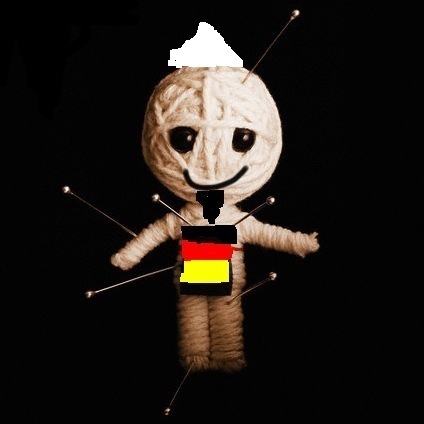
The voodoo doll that Petter Northug (NOR) was using as a stand-in for Axel Teichmann (GER)
Axel Teichmann always thought that the stabbing pains in his legs at the end of races were a normal consequence of exerting himself. But revelations have emerged from Norway that he has actually been hamstrung by Haitian voodoo, practiced by none other than Teichmann’s chief rival, Petter Northug.
The news of the witchcraft came out when reporters from Norway’s Dagbladet found Northug in the team’s locker room before one of the races at the World Cup Finals in Sweden. The room was dark, lit only by candles, but Northug was still wearing his Casco headwear and chanting in a strange language.
“It was bizarre,” said Trond Sandli, one of the reporters who stumbled on Northug. “He had a broken One Way pole in one hand, and was using it to bludgeon this Barbie doll wrapped in a German flag. You could tell exactly what was going on the minute you walked in there—the doll was the spitting image of Axel, down to that stupid goatee.”
Sandli also said that he saw Martin Johnsrud Sundby, one of Northug’s teammates, off in a corner doing a strange dance.
This is not the first time that champion cross-country skiers have been observed practicing odd superstitions. In the 1970s, American Bill Koch used to levitate before big races, and more recently, David Chamberlain would pound an entire two-liter bottle of Moxie before domestic events.
The repercussions of Northug’s antics are as yet unclear. He says he was merely acting at the behest of his team’s seven sports psychologists, who told him that the voodoo was the best way to intefere with Teichmann’s Teutonic powers.
Teichmann says that he intends to file an official complaint to the International Ski Federation (FIS), but FIS Race Director Jurg Capol was still hung over from the season-ending celebrations in Sweden and was unavailable for comment.
Whistler, British Columbia – With five k to go before the finish of the men’s 50 k classic Sunday morning, the front of the pack looked remarkably similar to the way it did five k from the start.
Dario Cologna (SUI), Petter Northug, (NOR), Alexander Legkov (RUS)—all the heavy hitters were there.
It wasn’t until 400 meters to go that things really started heating up, when Germany’s Axel Teichmann threw down a hard attack, stringing out the field over the last climb. But as Teichmann knows well, there’s one thing you can always count on at the end of a mass start race: Petter Northug.
With his trademark sprint and flawless double pole, Northug brought Teichmann back in the stadium, then edged him by a meter for his first-ever individual Olympic gold. The victory capped a tactically sound race and an impressive Games for the Norwegian, who will travel back home with four medals: two golds, a silver, and a bronze.
Northug had made the Olympic 50 k a goal from the beginning of the season, adjusting his technique and training to help him excel at the distance. He said after the race that his plan was to go into it relaxed, and stay out of trouble until the end.
“I just tried to stay calm in the field and wait for my goal. I knew that with three kilometers left I had to stay in the lead group. So that was my tactic. I didn’t want to make a move [earlier]. I wanted to sprint.”
Over the first few five k laps, Northug did just that. The pace looked relatively placid, with only the occasional straggler being shed from the back of the pack.
Norway controlling the pack early.
Yesterday’s rain had frozen into the snow overnight, making for a dicey, icey trail surface. Those involved in crashes included Jean Marc Gaillard (FRA), Lukas Bauer (CZE), and Andrus Veerpalu (EST). All escaped relatively unscathed, though the sliding around fast corners scraped some of the klister off athletes’ skis.
Both James Southam (USA) and Kris Freeman (USA) remained with the leaders through 15 k. But by the end of his next five k lap, Freeman knew he wasn’t having a good day, and decided to shut things down, opting instead to try to stay fresh for his upcoming trip to Europe for the spring World Cups.
“My coaches said if I was out of it early, they wanted me to stop. I think they have the rest of my season in mind and they don’t want me to hurt myself.”
Southam hung tough all the way through 35 k, until an ill-timed ski change left him off the back of the leaders. He still held on for 28th—his best-ever international finish—ahead of Canadians Ivan Babikov and Alex Harvey, who were popped at 27 and 30 k, respectively.
“It was comfortable up in that front group, and I was feeling good,” said Southam. But after the last ski change I just couldn’t fight my way back to the group.”
While Southam’s result was a solid one, the Canadians had much higher expectations for the day. After top-ten finishes throughout the Games, both
Gray and Kershaw mixing it up.
Harvey and Babikov had hoped to be contending for medals on Sunday—not battling each other for 32nd and 33rd as their teammates Devon Kershaw and George Grey mixed it up the front.
Until the last two laps, the only real action at the front came when Norway’s Martin Johnsrud Sundby attacked coming through the stadium at 20 k. Seeing many of the favorites, like Baur and Cologna, stop to change their skis, Sundby said that he had hoped to string things out and make them work to catch up. But nobody went with him, and he was swallowed up after a lap.
“I had a strategy there,” Sundby told FasterSkier. “But it didn’t work. I saw both Lukas Bauer and Dario Cologna change skis and my thought was to move up the speed so they would have a hard time catching up…and use a lot of energy. But nobody else wanted to go with me so the strategy flunked.”
After Sundby’s gambit, it was another 45 minutes before someone was willing to risk another move, at 40 k. This time, it was Alexander Legkov, the lanky Russian who had been stymied in his bid for a medal in the pursuit, finishing 4th, 1.2 seconds off the podium.
For a full lap, he hammered at the front with some strong striding and snappy kick-double pole. While he forced the rest to work to keep him under wraps, Legkov never managed to take more than a couple of seconds from the leaders. With Bauer doing the bulk of the chasing, the Russian was back in the fold by the 45 k mark. And though Legkov didn’t figure into the finale, he may have taken the punch from Bauer’s legs.
“I was together with the leading pack in the last uphill, but they were stronger,” said a philosophical Bauer. “It is not a medal, but I am quite satisfied. I was not bad, but they were better.”
Through the stadium at 45 k, the front group was all together, 15 skiers strong. Nobody opted to change their skis—the race was too close and the pace too high to risk it.
Bronze medalist Johan Olsson at the front.
Over the final lap, the lead bounced back and forth: Vincent Vittoz (FRA), Northug, Cologna, Andrus Veerpalu (EST) all took turns. But the pace wasn’t high.
Teichmann had been hurt by some slow skis in the middle of the race, and by the time he left the exchange with a better pair at 40 k, he was thirty seconds from the front. With nothing to do but chase, he sliced a few seconds off the leaders at every time check, finally getting contact with just two k to go.
“I had to close a gap of 15-20 seconds to the leading group in the last 10 kilometers and I finally made it at the last 3km,” said Teichmann. “Then I had to make my way through this group.”
Legkov and Bauer.
Focused on closing the gap, Teichmann said that he hadn’t thought through his tactics for the finish. And given that this was only his 4th50 k, he didn’t anticipate being in the mix. (His expectations for the day were so low, he said, that he didn’t even bring a change of clothes for the flower ceremony for the top three.)
But since the final climb suits his long, strong legs, the “German Diesel” figured he’d give it a go. Chugging over the top into the descent towards the stadium, he had a few meters on Northug and the rest.
“I tried on the last uphill with everything I could,” Teichmann explained. “I tried to take the advantage of my strong legs.”
Northug had been at the front for most of the last lap, following his race plan and showing that he can handle sticking his nose in the wind on occasion.
He wasn’t quite on Teichmann’s tails over the top of the hill, but he was close enough that everyone in the stadium knew he still had a good shot.
Taking a more aggressive inside line through the downhill corner, he used his strong double pole to close in on Teichmann, drawing even just before the curve into the homestretch. Slowly but surely, he inched past Teichmann, taking the victory by a few feet and blowing a kiss to the crowd before crumpling to the ground.
It wasn’t the same kind of domination he displayed when he crushed Martin Koukal (CZE) and Emmanuel Jonnier (FRA) for silver in the relay, but it was enough.
Northug celebrates his victory while Angerer and Kershaw lunge for the line.
Cologna was a few meters behind Northug going around that last curve into the homestretch, and saw his hopes for a third medal slip through his fingers when he got a little too far back on his skis and crashed.
Johan Olsson (SWE) was the beneficiary, shooting past Cologna to claim the bronze. He said that last corner was tricky—hard-packed and icy.
“I knew I had a good chance for the bronze medal [after Cologna’s fall], but of course I just kept looking to the right to see if anyone was matching me. But I have a pretty good final sprint, so in the final 20 meters I felt pretty secure.”
Just feet behind Olsson came Devon Kershaw, who lost out on a photo finish with Germany’s Tobias Angerer to end up fifth. It was a career best for the Canadian in an individual event at the Olympics, but to judge by the look on his face afterwards, being so close to a medal after such a long race was more bitter than sweet.
“I’m extremely proud of the race I had,” Kershaw said immediately after the finish.
“When I lunged I didn’t know what place it was for, and then I looked at the board. Of course this is the best 50k of my life. But at the same time it is really difficult to place 5th – in any sport, to race that long and only be 1.5 seconds back.”
Kershaw’s performance capped a record setting Olympics for the Canadian men’s cross-country team. Today he matched Ivan Babikov’s performance in the pursuit for the best individual Olympic finish ever by a male Canadian cross-country skier.
“Deep down we though we could medal and we were so close on many occasions,” Kershaw added.
Angerer was also hoping for better than 4th. “In the end it was a little bit unlucky…It is the worst place of the 50km. My goal was to win a medal today, and I didn’t do it, so I am a little bit disappointed.”
At the end of the day, it was an ecstatic Northug on top, grinning like a little boy and gracious in victory as teammates and opponents alike congratulated him.
Petter Northug and Oystein Pettersen celebrate the gold medal
Whistler, British Columbia – He had to wait, but Petter Northug finally got to show off his dominating sprint finish against his perennial whipping boy Axel Teichmann. Northug and teammate Oystein Pettersen won the first gold by the Norwegian men’s cross-country ski team since 2002 in the team sprint competition at Whistler Olympic Park.
The high-pressure system that has brought unusually sunny weather to Whistler held out for one more day. Firm tracks in the morning for the semifinals gave way to softer corn snow as the day progressed and temperatures climbed into the 40s.
The semifinals featured a number of crashes, the most notable setting the Swedish team back, resulting in the major upset of the first round. Switzerland, led by the great Dario Cologna also failed to advance when Elgius Tambornino suffered a collapse of epic proportions.
All the other favorites successfully advanced to the finals, as well as both the United States and Canada.
If you think individual sprinting is exciting, try packing ten teams into the same 1.6km loop and have each athlete race the course three times – the interval championships of the world.
Even on the challenging Whistler course, it is always difficult to break away from the pack – especially in the strong and deep men’s field. After a quick double pole start, the race dropped to a relatively mellow pace.
Newell takes the tag from Koos and heads on course past Pettersen
“It is pretty relaxed on the first hill and then everyone hammers the second hill,” US anchor skier Andy Newell said. “That is the kind of the way this course skis. Everyone is trying to save their energy on the first hill and the second hill is so important to maintain a position.”
The teams continuously jockeyed for position, trying to stay out of trouble and set up for clean tags. The Canadian duo of Devon Kershaw and Alex Harvey were right in the mix, generally holding a good spot toward the front of the pack. Torin Koos, skiing the scramble leg for the US was also strong, especially on his second lap where he skied up to 4th place for the tag.
Considering the number of mishaps in the semifinals, the medal round was relatively clean, the only issue coming at the expense of the French team. Vincent Vittoz, out for blood after bad skis in the skate portion of the pursuit kept him from challenging for a medal, came in after his 2nd lap, leading the race. But teammate Cyril Miranda went down, relegating the team to the back of the pack. Vittoz continued to ski his brains out, posting the fastest time on his last lap – but the damage was irrevocably done.
Halfway through the race, France was the only team to lose contact, and the race was still wide open. Several team appeared to be hanging-on at the back – the Finns, Czechs and Italians, but they were just one major attack away from a medal.
So as expected it all came down to the final laps for each leg. The only question was who would it be? The favored Norwegians? The extremely strong Russians? Or the hometown Canadians?
At first it looked like the Canadians might do it. Devon Kershaw moved to the front midway through the loop as the crowd roared its approval. But halfway up the final large climb, it was German Tim Tscharnke throwing down a Northug-like move. His high tempo, powerful V1 quickly gapped the field as he charged up and over the crest of the hill. He remained strong into the stadium and around the hairpin to the tag zone.
Tscharnke making his move on the stadium video board
The 20-year-old Olympic rookie had given Axel Teichmann several seconds to work with, and put the team in position for the gold.
“My job was to work for Axel and to bring him a good position.”
Kershaw came through next, and the Canadian men’s cross-country team was just one and a half kilometers from their first Olympic medal ever.
But Teichmann and Alex Harvey, both strong skiers, had their work cut out for them. The chasers featured Alexey Petukhov (RUS), who along with partner Nikolay Morilov, had won both the World Cup team sprints this year, Alxey Poltaranin (KAZ), 5th in the individual sprint several days ago, and of course, Petter Northug, arguably the greatest finisher in the history of the sport.
A year ago at World Championships, Northug won three golds, two of them at the direct expense of Teichmann. The young Norwegian superstar blew the German off the trail in both the relay and the team sprint in the final 200 meters. Petukhov made the first move to bridge up, but it was hardly a surprise when he turned on the jets on the last climb, and rapidly closed the gap on the stoic Teicmann.
“Northug let me go ahead to chase the German, and then all of a sudden he was right behind me,” Pethukhov said. “When I did see him, I thought to stay with him.”
Devon Kershaw gunning for a medal
Impressively Petukhov hung on, and the two men dropped into the stadium just behind the German. Northug wasted no time, extending high on his powerful V2 and taking the lead into the final corner. At this point the only question was whether Teichmann could hold on for second.
As Northug powered across the line, no time for finish stretch celebrations, Petukhov stepped out from behind Teichmann for the final 20 meters. But the veteran German held on at the last, winning his first Olympic medal.
“Tim [Tscharnke] did a great job,” Teichamnn said of his young teammate. “He chased some guys and gave us some seconds. I got the opportunity…on the last lap, and I did everything I could. But Petter was too strong.”
Northug was greeted by a jubilant Pettersen, who until yesterday was not even scheduled to race this event. Coming off a disappointing classic sprint where he crashed in the finals, Pettersen was initially passed over in favor of World Cup sprint leader Ola Vigen Hattestad. But Hattestad came down mildly ill, and gave Pettersen his start spot, feeling that the Norwegian, affectionately known as “the Sausage,” would have a better shot of leading the team to victory.
“After the individual sprint I understood I would not make the team. Hattestad trained yesterday, but he did not feel that good…if he is not sick he could do as good a job as I did. But he felt that I could do a better job, so he gave the spot to me. I am very thankful, and Hattestad has shown he is a very good teammate.”
Harvey and Poltaranin had been unable to stick with Northug and Petukhov, staging their own battle for 4th. Harvey out-lunged the Kazakh in a photo finish, once again setting a new Olympic best for the Canadian men’s team.
“We knew today was a good shot for a medal, but it is so hard,” Harvey said in the finish area. “Those guys are all really fast sprinters, and I know I have endurance, but I didn’t have enough speed to match what those guys were putting on the track.”
And matching up head-to-head with Northug was too much for the 21-year-old too handle. “Northug went around me on the first climb to catch the German team. He is really fast!” Harvey continued. “I was going as fast as I could, and I was recovering well between each round. But I just didn’t have the speed that the top-3 had.”
Waiting for the tag
The US, in the mix for most of the race, faded on the last two laps. Koos getting the tag toward the back moved up on the first climb, but ran out of gas in the last 500 meters. Newell was in no position to make up ground at that point, and the team finished 9th out of 10 teams.
“We both hung in there right up until the last lap…we gave it our best shot,” said Newell.
Tscharnke became the youngest cross-country Olympic medalist ever. With just ten World Cup starts to his credit, he didn’t even make the Olympic team until his 9th in the diluted Rybinsk sprint exactly one month ago.
When asked how he felt the grinning Tscharnke could only reply “Very good!”
Teichmann did not crack a smile at the post-race press conference, and responded with anger to a question asking if he felt like he won silver or lost the gold. “What a stupid question,” he said. “For us, we have won the silver.” When asked about Northug breathing down his neck, he replied “I try to focus on my race and my technique, so I didn’t focus on him. You always have to keep your mind on your strength and do the best to the finish line.”
Northug passes Teichmann in the stadium with Petukhov in third
Despite his affect, he did make it clear he was very pleased with the day. “It’s amazing to win my first Olympic medal. For me it is a dream come true.”
The impressive move by Tscharnke was not a surprise to German men’s coach Cuno Schreyl, who also defended the decision to run the veteran in the anchor position. “Tscharnke is the youngest. Teichmann has more experience and so for us it is a better team to place him last.”
But he did admit that in the future we will likely see Tscharnke closing for the Germans, eliciting memories of the 1994 relay when Norway opted for experience over youth to anchor the team in the 4x10km relay, only to see Bjorn Daehlie lose the final sprint to Silvio Fauner. From then on, Daehlie skied 3rd and the young Thomas Alsgaard 4th.
“Tschanrke is very strong,” Schreyl concluded. “I hope he skis in the fourth position in the relay, but I don’t know. We’ll see.”
Despite the German youth’s strength, Norwegian coach Age Skinstad was not concerned that the gold was out of reach. In reply to the question asking if he had any doubt in Northug’s ability to close, he answered a simple “No.”
Northug’s partner, Pettersen, was not as confident as his coach.
“I know Peter is a good skier, but Axel is a good skier, and Petukhov has shown he is a good sprinter,” he said. “So I was maybe a little disappointed by own performance that I couldn’t give Petter a better position. But I gave it my best, and Petter was strong.”
Alex Harvey leads Petter Northug out of the stadium for the last lap
Northug did not rise to the bait, as several media members tried to get him to say something controversial. He was clearly relaxed and happy, and seemed to enjoy not giving the press what they wanted.
“After the pursuit, the motivation for this race was very high,” the usually brash Northug said. “I knew with Oystein that we would have a great team. When you race for Norway you hope to fight for a medal. To make it is just amazing – for me the biggest goal at the Olympics – to reach a gold medal.”
Morilov was extremely gracious as the bronze medalist, saying “It’s a beautiful day, beautiful sun, beautiful snow, and we are happy in our hearts. We would like to compliment our fine competitors.”
Added his teammate Petukhov, “It is not a trifle to win an Olympic medal…It is something I will remember for a lifetime.”
Canmore, Alberta – Italian Pietro Piller Cottrer wouldn’t mind moving his family to Canmore. “I just need to teach them English and we can come,” he said following his 2nd place finish in today’s 15km individual start freestyle. According to Piller Cottrer, Canmore is very similar to his home in the Italian Dolomites. “I have always raced very well here, and have now finished 1st, 2nd, 3rd and 5th in Canmore.”
Piller Cottrer joined teammate Giorgio DiCenta on the podium. DiCenta won his first ever World Cup race after nearly 200 starts. “I now feel like a complete athlete,” DiCenta told the media, explaining that he has now won at the Olympics, World Championships, and now the World Cup.
The men’s race was extremely close with Piller Cottrer leading at every time check in the first 10km. “After watching the women’s race, Giorgio and I decided to start slowly. We just finished two hard weeks of training in Italy, and didn’t know what to expect.”
But the Italians had very fast skis, and both men were posting very fast times.
Giorgio DiCenta (ITA) lunges across the line, taking the victory in the men's 15km (Photo: Win Goodbody)
Despite the fact that the Canmore course is known as one of the toughest on the World Cup, the top finishers, with one exception, were all at the top of the standings early in the race, perhaps an indication that most skiers started conservatively.
Favorites Dario Cologna (SUI), Marcus Hellner (SWE), Johan Olsson (SWE) and Sergei Shiriaev (RUS), along with the Italians, were clustered within ten seconds of the lead over the first 5 kilometers. But as the race progressed, each time check showed another skier unable to keep pace.
Shiriaev was the first to go, fading slowly at first, and then completely falling apart. In the second 5km loop, he lost 20 seconds to the leaders, before dropping a full minute over the last 5k, slipping to 26th overall. While his fade was the most impressive, he was not alone in failing to match the Italian duo.
Piller Cottrer managed to extend his lead to 7.4 seconds over DiCenta at the 10km mark, but his teammate began to slowly reel him in. As the minutes passed the stadium announcer became more and more excited. Over the next 2k, DiCenta not only erased the gap, he pulled ahead by two seconds. Piller Cottrer stopped the bleeding and was still just over one second back with 2.3 kilometers to go. Piller Cottrer, starting at bib 68 finished first, remaining in the finish corral, good naturedly accepting the teasing of the announcer. “Pietro is nervous now!” famed World Cup announcer Kjell Erik Kristiansen shouted over the PA, while Piller Cottrer grinned and shook his head.
Pietro Piller Cottrer (ITA) (Photo: Win Goodbody)
DiCenta, in bib 72 was soon spotted on the final long gradual approach. As he charged to the line, it became clear he would have enough to claim the victory. He slid across the line 5.1 seconds faster than his teammate. The two men embraced as they were swarmed by jubilant coaches and service staff.
Said Piller Cottrer after the race “I am very pleased with my result, and am very happy for Giorgio. I know how much he wanted this first victory.”
The Italians were not worried that they were peaking too early. “We were not expecting to be in very good shape right now – our goal was the top-10 – this was a surprise” said Piller Cottrer, adding “someone had to win…”
The Race for Third
Dario Cologna (SUI) speeding to 3rd (Photo: Phil Bowen)
The top two spots may have been decided, and only a handful of skiers on the course, but the race was not over. Toni Livers (SUI) had been hanging in the top-5 all race. He held the lead until Piller Cottrer came in and was sitting in 3rd with only teammate Cologna still a threat on course. As with the race for the win, it wasn’t clear until the final 100 meters what would happen. Cologna used a strong last lap, and a consistent race, to squeeze ahead of Livers by just 3.1 seconds, his best result ever in the 15km freestyle.
“It is a good sign for me to be on the podium in this race,” he said. “It shows I am in very good form.” Like the Italians his plan was to start slowly, but again, like the Italians, he had fast skis and fast splits from the start.
Livers just missed out on his 2nd career World Cup podium and posted his best result since winning this same event in Davos in 2007. All four of his 4 top-10 World Cup finishes have been in the 15km skate.
His position was not as secure as expected. While the crowd anxiously awaited Cologna, Axel Teichmann (GER) hammered across the line, stunning Kjell Erik in the announcers booth as he moved into 4th. After Cologna bumped Livers, Teichmann was still solidly in the top-5.
And why is this so impressive for an athlete who is a regular at the top of the results sheet?
Teichmann had fallen off the radar as a potential factor in the race by the halfway mark. He always starts very slowly, and following that pattern was in 26th nearly 30 seconds back at 5km. But over the course of the next loop he did not move up much – at 10km he was 17th, 41 seconds down on Piller Cottrer. With 2.3 kilometers to go, he was still a full 20 seconds behind Livers in 10th. When all was said and done, he stood gasping at the finish, just 7.4 seconds out of 4th.
The German head coach Jochan Behle was very pleased with Teichmann’s race. “It is 10 days before the Olympics, and this was his 1st race since the Tour de Ski, so it was important to have these races here and get in the rhythm.” He added that the result was fine, but not the goal for the day.
Behle also noted that Teichmann prefers gradual terrain to the steep climbs of Canmore. The Whistler Olympic courses are well suited to his strengths.
Italy – Four in the Top-13
Italy had the best day of any nation, placing four in the top-13, no doubt due in part to the the “rockets” (in the words of Piller Cottrer) that the service staff prepared for the skiers.
Thomas Moriggl finished 9th and Valerio Checchi 13th. Chechhi reaped the benefits of Piller Cottrer’s strong performance, catching a ride for 3.5km after being caught by his teammate.
Babikov 10th, Freeman 20th
Ivan Babikov (CAN) led the North American with a solid 10th place finish. Babikov, an excellent climber, favors the challenges of the brutal Canmore course. His teammate, Devon Kershaw, predicted a podium finish for him today. It wasn’t to be but he still turned in one of his best results so far this season.
Matt Leibsch (USA) with a strong race (Photo: Phil Bowen)
“My legs felt a little bit heavy today, but I am exactly where I want to be one week away from the Olympics,” said Babikov. “We have been doing a lot of training so I am a little tired, but we will be ready for the Games and I’m looking forward to it.”
Kris Freeman led the US in 20th place. The 15km is by far his strongest race, and will be his best chance for a medal at the Olympics.
USST Coah Matt Whitcomb was not overly concerned with Freeman’s performance. “Kris didn’t have anything when he tried to put the hammer down today. But the good news is that he didn’t die on the last lap. He skied a consistent race.”
Freeman was disappointed in his race, but short of a podium, little will please the fiercely competitive American star. He finished the day 1:09 behind winner Piller Cottrer.
George Grey also had a solid race. Grey has been rounding into form in recent weeks, and took 17th today. A good result, and likely good for a top-30 in a full World Cup field – the A-team Norwegians and French were both absent.
Matt Liebsch finished just inside the points, taking 29th, good for 34.22 FIS points – easily his best performance, and an important result for his future.
Junior Cracks the top-10
Petr Sedov, the Russian force of nature who won 20km pursuit at World Juniors, showed he is a legitimate threat on the World Cup, placing an impressive 8th in his pre-Olympic warm-up. Sedov, who has excellent technique according to US coach Matt Whitcomb, skied a smart race, starting conservatively and accelerating in the 2nd loop. Just 19, he will compete for Russia in Vancouver.
Another Beautiful Day
The weather was perfect, with sunny skies and temperatures rising into the 30’s. Given the success of the Italians and Swiss service teams, there was clearly room to gain an advantage with the wax, but overall it was not challenging in that respect.
Racing continues tomorrow with a classic sprint. Check back later for a complete preview as well as additional reports on today’s races.