Woods brings wealth of collegiate Nordic team competition, coaching and leadership to SVSEF
SUN VALLEY, Idaho – June 19, 2022 – Effective August 1, 2022, Becky Woods will step into the role of Cross Country Program Director at Sun Valley Ski Education Foundation (SVSEF). Woods comes to SVSEF from Bates College in Lewiston, ME, where she served as the Head Men’s and Women’s Nordic Ski Coach alongside additional leadership roles from 1994 to 2022.
“We are thrilled to welcome Becky Woods to the team at SVSEF and to embrace her exceptional leadership and coaching experience at the helm of our Cross Country programs,” said Scott McGrew, SVSEF’s Executive Director. “Her proven ability to guide athletes in the pursuit of excellence both on the trails and in the community, along with her deep appreciation of the Nordic culture and the passion behind the sport, will make Becky a tremendous asset for our cross country teams and for our greater ski community in the Wood River Valley.”
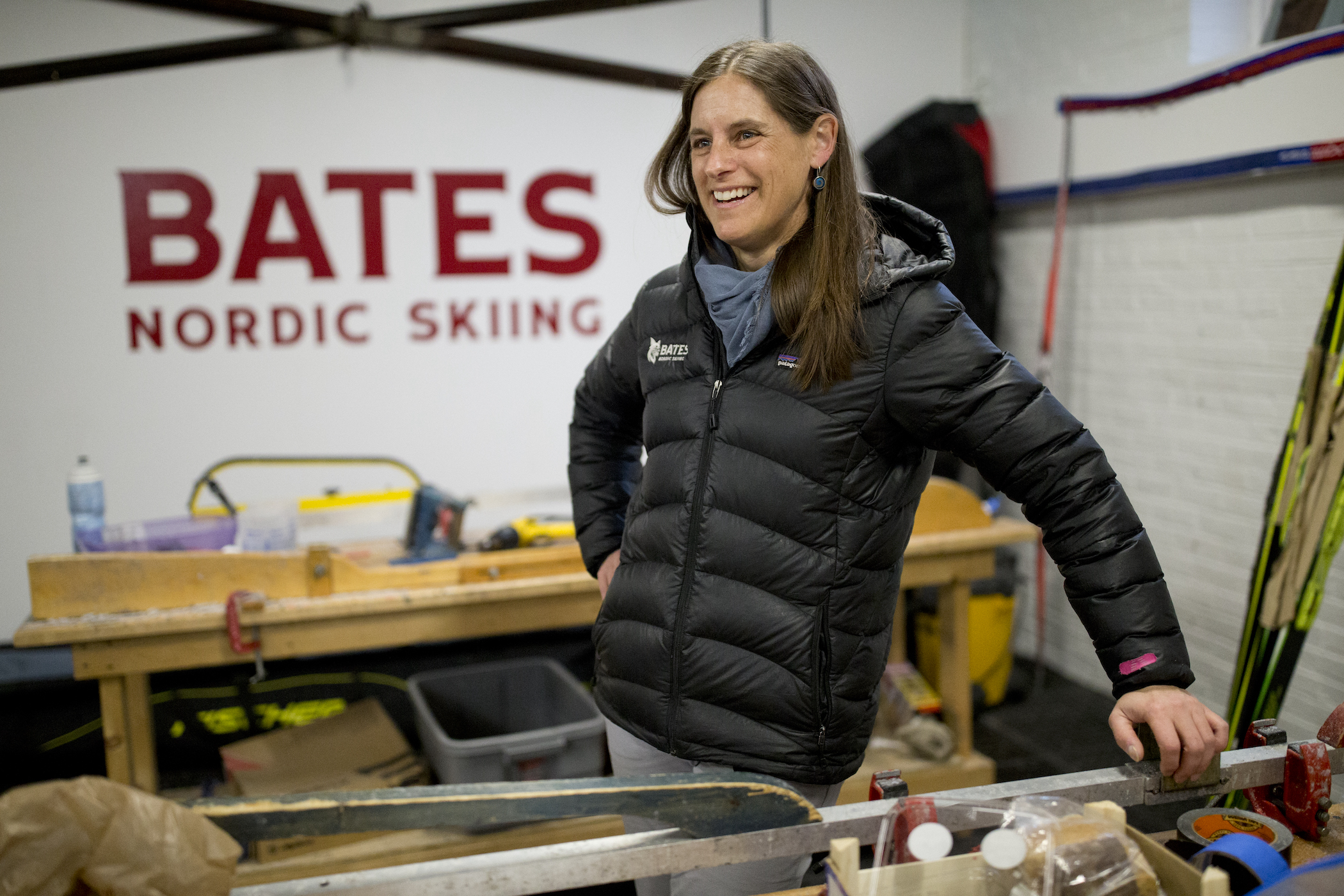
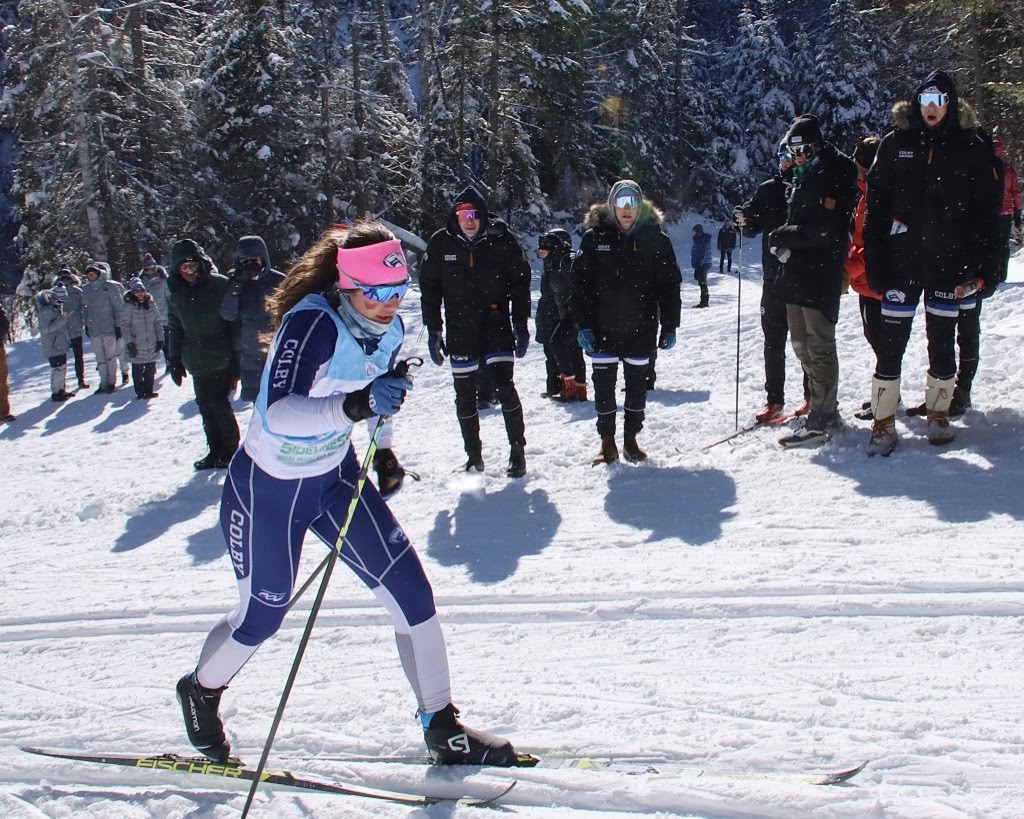
After 28 years as head coach at Bates College in Lewiston, ME, SVSEF welcomes Becky Woods as the new Cross-Country Program Director. (Photo credit: Phyllis Graber Jensen/Bates College)
Woods’ leadership as a collegiate coach, mentor, administrator, and teacher offer a unique skillset and balance to the Cross Country Program Director position at SVSEF. In her role as Head Men’s and Women’s Nordic Ski Coach at Bates College, Woods was responsible for leading and managing all aspects of a successful Division I Nordic Ski Program, while bringing staff, athletes, and volunteers along to carry out a clear mission as a top priority. She attributes much of her success in her career to fostering a culture of trust, respect, and support, and understands the importance of imparting a true love of skiing and a respect for the process it takes to be successful.
“I am humbled to have the opportunity to lead this great group of SVSEF coaches and athletes,” said Becky Woods, incoming SVSEF Cross Country Program Director. “It is evident there is expertise, talent, and support within the organization—and a true sense of community. Having spent time in the Wood River Valley, I am honored and excited to become a member of the team and help SVSEF Cross Country continue to grow and excel as a ski community.”
In Woods’ role as SVSEF Cross Country Program Director, she’ll provide program-wide leadership and day-to-day management while supporting the overall vision and mission of the organization. She’ll be instrumental in the successful recruitment, training, and retaining of a world-class coaching staff and the ongoing development of an athletic program that supports each participant in achieving their personal and athletic potential.
Founded in 1972, the SVSEF Cross Country Program has consistently been recognized as one of the best in the country; most recently as the 2021 USSA Cross Country Club of the Year, and in 2022, the Junior Girls brought home their third consecutive National Championship team title. From the youngest Devo kids to elite athletes at the Comp Team, Post-Grad and professional level, our program is 250 athletes strong and steeped in Nordic traditions driven by a strong sense of family, community, competition, and camaraderie.
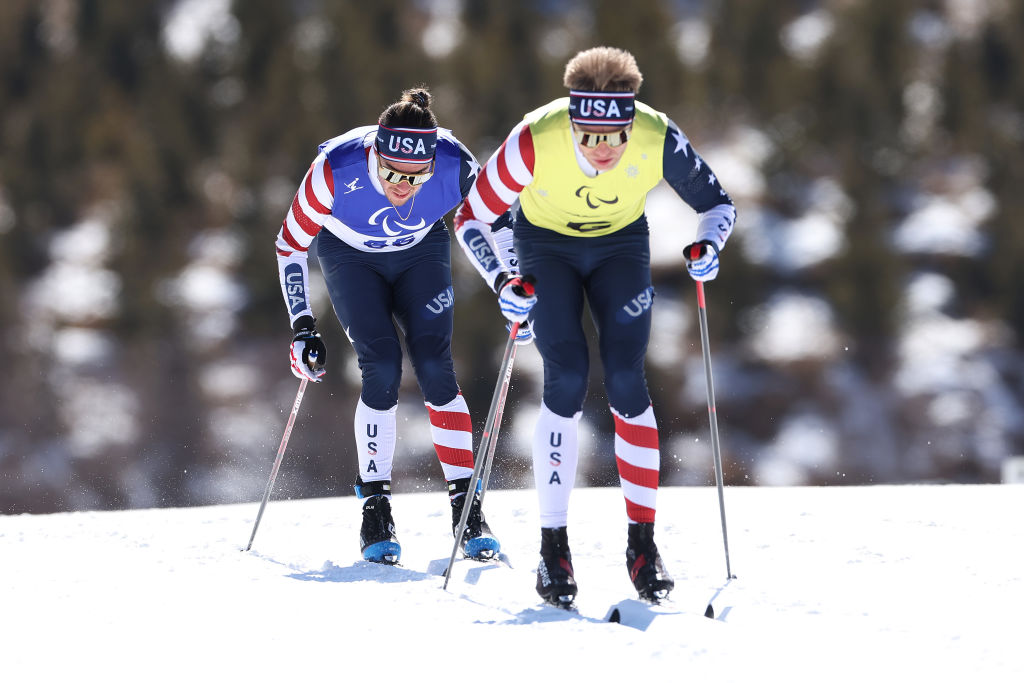
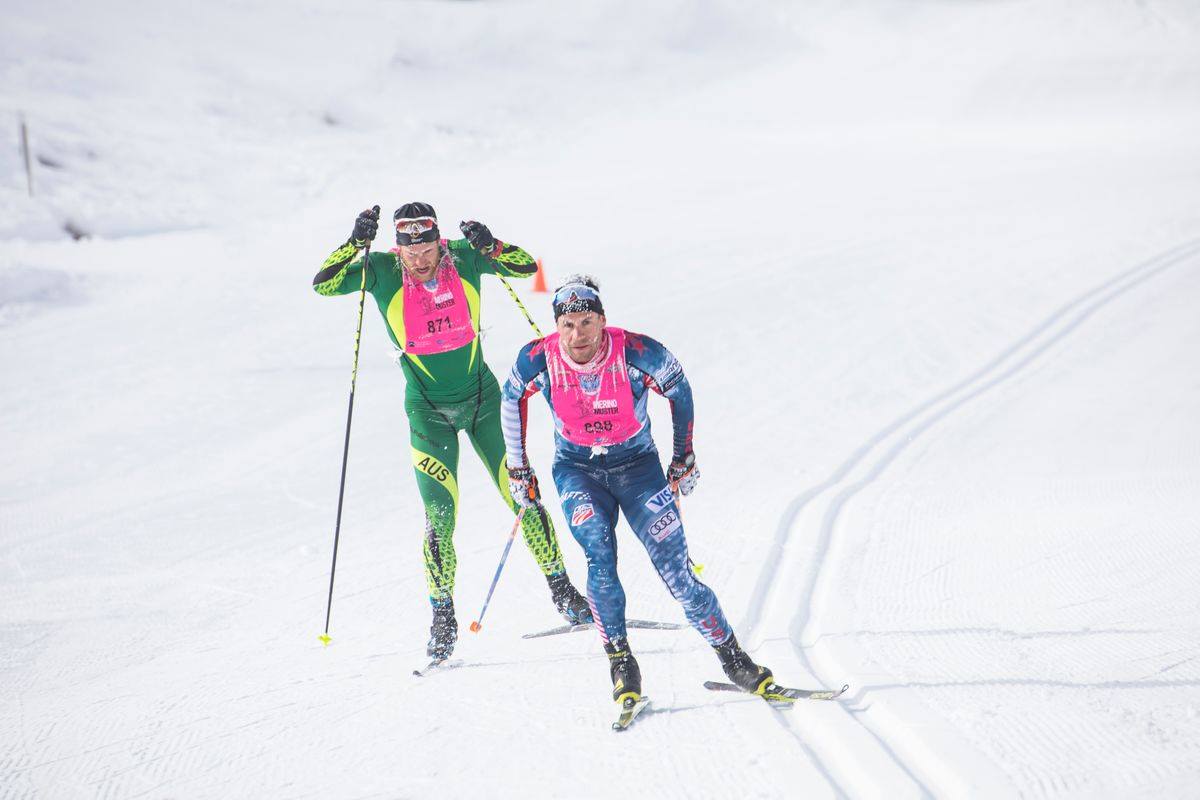
Sam Wood helps guide Jake Adicoff to silver in the 20 k classic during the 2022 Beijing Paralympic Winter Games. (Photo: Mark Reis / Team USA)
During the 2021/22 season, three members of the XC Gold Team competed in the Beijing Olympics and Paralympics, and two additional SVSEF alumni were named to the U.S. Cross Country Ski Team. For the upcoming 2022/23 season, five athletes from the SVSEF Cross Country Program have been named to the U.S. Cross Country and Para Nordic Ski Teams.
For more information about the SVSEF Cross Country Programs, please visit svsef.org.
About Sun Valley Ski Education Foundation
Since its inception in 1966, the Sun Valley Ski Education Foundation has been a longstanding pillar in the community, providing snowsport programs and offering academic assistance to support student-athletes in reaching their highest potential. SVSEF offers an array of programs for athletes ages five and up, from learn-to-ski and ride through FIS and other national and international-level competition. The organization offers financial assistance to families, so that anyone who wishes to may participate. For more information, please visit svsef.org.
As the largest NCAA circuit in the nation prepares for a return to a full schedule, anticipation, anxiety, and lessons from a pandemic year abound in New England.
Carnival, as a noun, has perhaps had its moment. We’ve been building towards ennui, not excitement, for nearly two years now. Maybe it’s time to dispel the anticipation, let the moment fade, and let “Carnival” go along with it.
But then again, calling a collegiate race circuit a “carnival” has always been a bit old-timey. One of those New England-isms – like calling your town park a “common.” My alma mater Colby College hasn’t had a winter carnival, festival, ball, or snow sculpture on its grounds in years. Those memories are confined to dusty old photographs hung in student unions throughout New England — all distractions from another time. Nonetheless, in January eleven New England schools will gather at Colby to start the NCAA collegiate racing season, and it will be all jubilation, camaraderie, and competition. There will be the return of the possibility to mark time by the traces of human emotion that linger on in memories, rather than case counts and travel restrictions.
All-too-well then, that Colby will still call it a Carnival.
The Eastern Intercollegiate Skiing Association (EISA) Carnival circuit is set to return to a full calendar on January 14th-15th, 2022 after a season that saw heavy modifications in response to the COVID-19 pandemic. With it comes lessons learned, appreciation, and excitement from both athletes and coaches across New England.
The 2021 Carnival Circuit
The EISA last year could, at its best, be described as disjointed. Each team was subject to individual state COVID-19 policies — in a region with a lot of states — on top of their own institutional policies. Vermont teams couldn’t travel outside their state for competition due to state restrictions. Colby couldn’t travel out of Maine per school policy. Many of Harvard and Bowdoin’s skiers weren’t on campus at all for the fall or spring semester. Some skiers were being tested daily, others twice a week. The means and ends were shifting constantly.
Athletes responded in different ways. Some pressed on with their education and their athletic career. Some re-evaluated and decided that enjoyment in skiing could be found elsewhere. Others chose to compete in their home regions towards skiing goals separate from the NCAA ranks.
For one, Foss Kerker, who is serving as Colby College’s team captain this year and will graduate in January, the missed season was serendipitous. A shoulder injury left him unable to race what was set to be his senior year, and so he decided to focus on recovering, training, and looking forward to this season. After taking the semester off, he returns this year feeling renewed, saying in an interview with FasterSkier that “On the whole, I am more grateful for skiing and ski racing. Not being able to ski or race last winter has made me refreshed and just excited to get out and race in the fun and competitive environment of the EISA, whatever the results might be.”
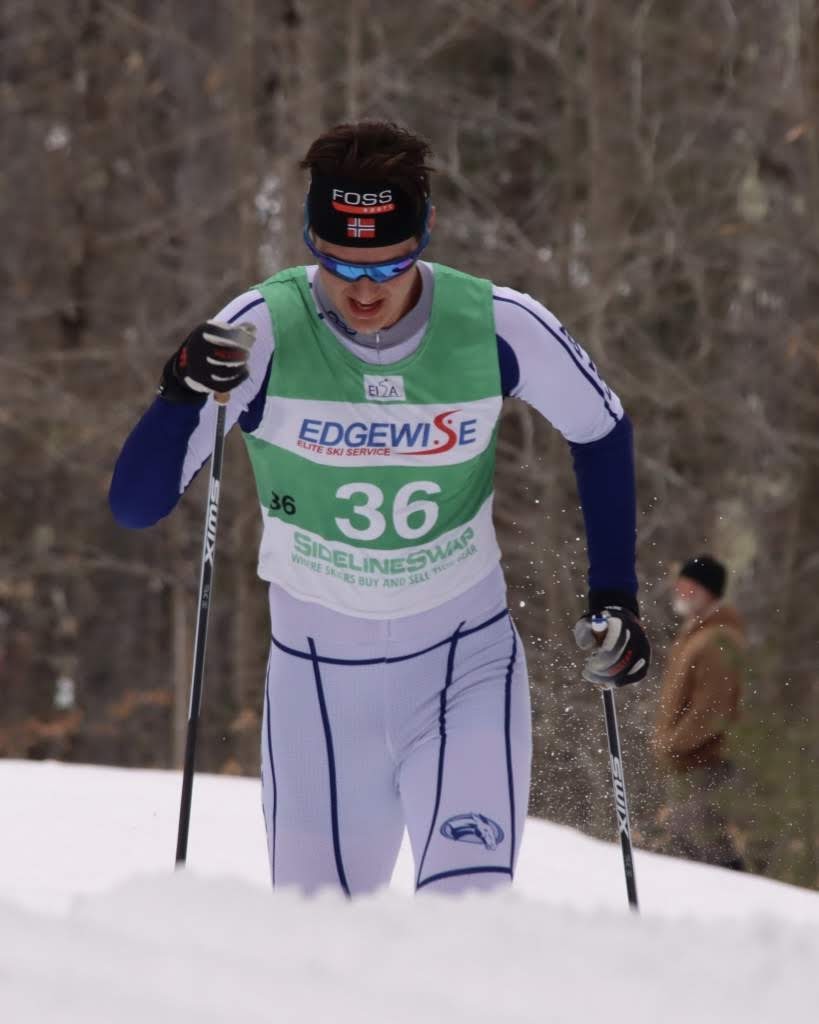
Foss Kerker attacks a climb at the last Colby Carnival, held at Quarry Road in Waterville, ME in Jan. 2020. (Photo: Gary Solow)
Gratitude for Skiing and Ski Racing
Kerker extends this newfound sense of gratitude to how he is helping prepare the Colby team to race. It has been an anecdote to the quick and rapid changes precipitated by the pandemic in skiing, in the world, and in life. As Kerker reflected:
“[Coach] Tracey has talked a lot about this recently – not knowing what is going to happen with schedules, conditions, or travel was something that was really hard to deal with before. That has sort of become the default now and being able to go with the flow and continue to perform is something that is only going to help us in the long run.”
Colby head coach Tracey Cote also touched on how the return of the traditional run-up to the EISA carnival season has helped her team build off of the flexibility that was required in training last season, saying in a response to the author via text that “I’m really excited about my team as we’re off to great start with our Canada training camp and the first Eastern Cups on our home course at Quarry Road.”
As other coaches look back at their own takeaways from last year, the lessons all point back to a re-centering of their roles around the joy of skiing.
Becky Woods, head coach at Bates College in Lewiston, ME, said her team now has a sense of how “important [it is] to embrace opportunities when they are put in front of you, and we see this season as a great big opportunity to come together, race fast and have fun on skis!” While Molly Peters, head coach at St. Michael’s College in Burlington, VT stated that “we appreciate every day we can practice and every opportunity we can race!”
Peters also added that this re-found joy has seeped into her team’s race preparations. “The team spent a lot of time backcountry skiing and having fun on skis last year. We will definitely keep these fun days this winter to take a step back and remember what it’s all about. Fun!”
In a way then, the year off from the carnival circuit looks only to have added to its carnival spirit. With that sense of joy, the EISA looks ready to maintain its traditions and do as its skiers have always done, make the sport fresh and exciting.
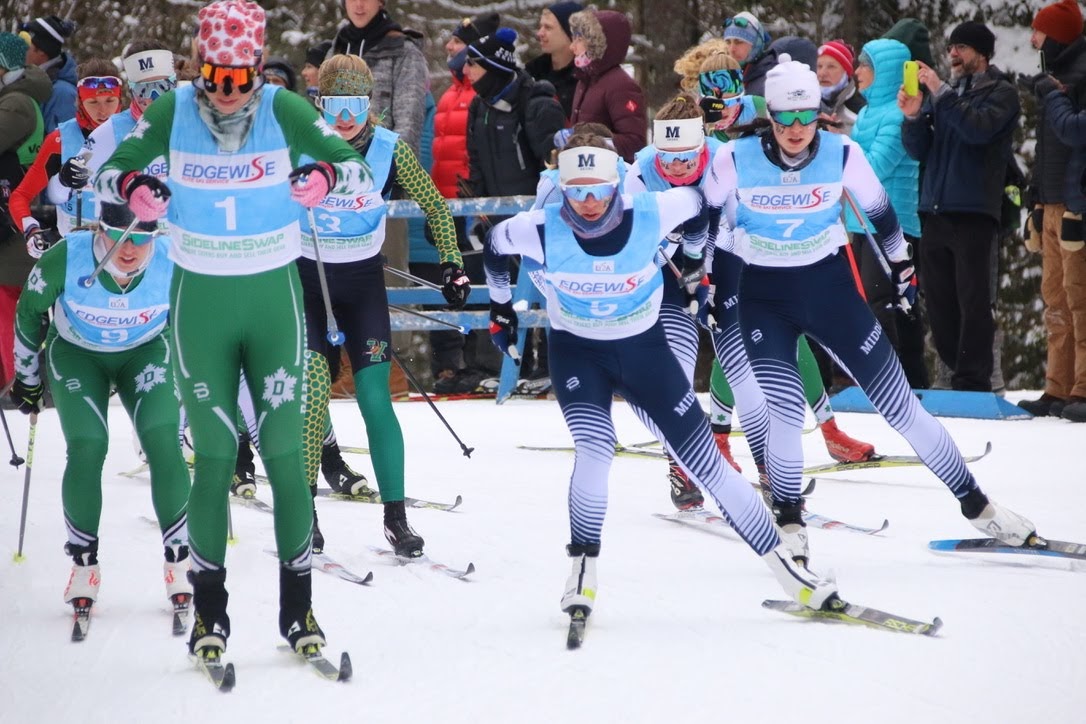
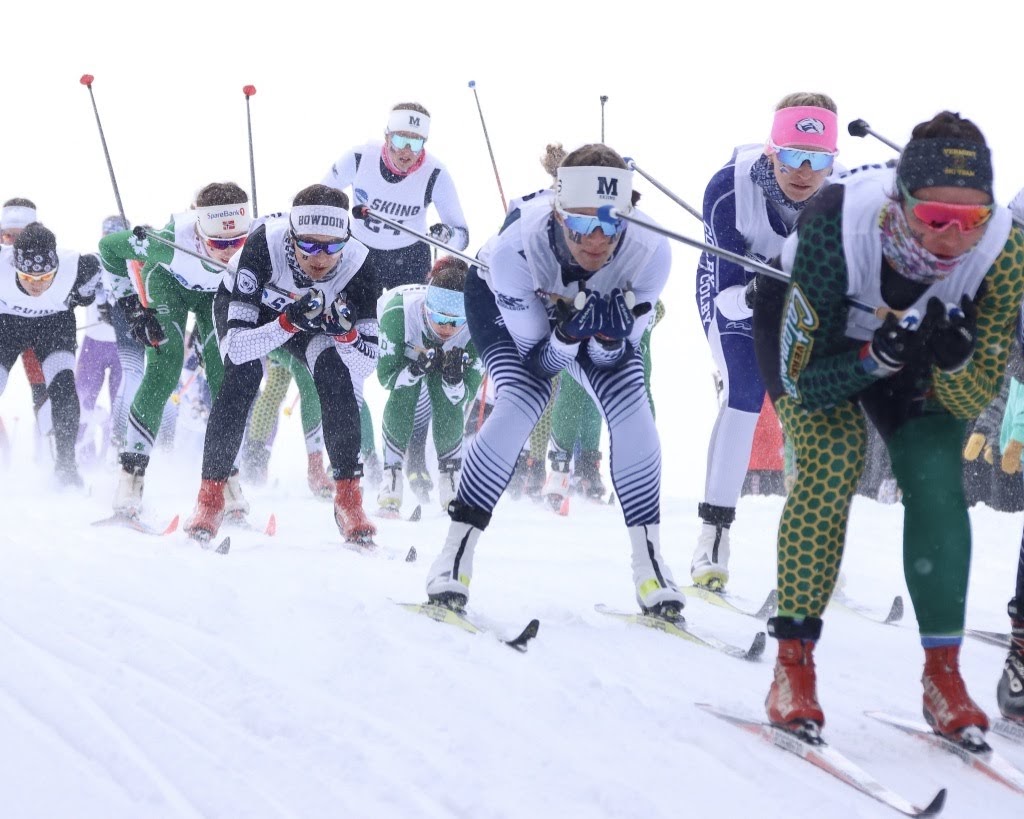
The women’s field, headed by (from L to R) Katharine Ogden (DAR), Margie Freed (UVM), Annika Landis (MID), and Alexandra Lawson (MID), heads out on course at the last Harvard Carnival, held in Craftsbury, Vermont in February 2020. (Photo: Gary Solow)
A New Field with New Faces
That strong spirit though, is accompanied by a sense of anxiety. This is, after all, a different group of skiers than the one that finished the last full EISA carnival at Middlebury in February of 2020.
As Williams College Assistant Coach Annika Martell responded to the question, “How do you think the carnival circuit will look differently this year than it did before the pandemic?”:
“Besides half the field being new to the eastern racing circuit?!? There will be a lot of new faces for sure!”
She has a point.
Martell is uniquely positioned in the EISA. She finished the last full Carnival in 2020 as an athlete with Colby, and now will start the first full Carnival in 2022 as a coach with Williams.
Annika Martell, Colby alumnus and current Williams Assistant Coach, racing at the Williams Carnival, held in Lake Placid, New York in 2020. (Photo: Gary Solow)
Two classes of graduates since the pandemic began, along with athletes like Kerker who have remained on the circuit longer than the traditional four years, mean a shakeup in who is on the circuit, and how familiar they are with one another.
Martell thinks that while this doesn’t change the way that athletes have prepared themselves for the season – the training hours are still high, the periodization the same – but it does change how an athlete might evaluate their performances.
“I’m excited because all sense of expectations have been dismantled with two new class years and a year of not being able to really race each other,” Martell said.
That lack of preconceived order in the field – which individuals and which teams fall where – provides opportunity, but also a unique variable. As Bates coach Becky Woods stated, “[This] brings some challenges as we’ll really have to evaluate performances from a new perspective. Relying on past results is not a method we can really use this year because so many had to take time away from racing.”
That leaves the forecasted results nearer to an unknown than they have been in past seasons. Without continuity comes a chance for individuals to reach with tenacity, grit, and discipline for top placings, without the hesitation that might come from lining up next to more experience collegiate racers whose resume’s have been followed. This combination promises to introduce new characters into the mix of the top collegiate ranks.
Still Not “Normal”
Of course, amidst overcoming many of the obstacles the pandemic has presented looms the reality that we haven’t yet overcome it. The EISA returns not because COVID is gone, but because the organization has been able to put into place substantial measures to control the spread of the virus while engaging in competition.
Martell reflected on this, pointing out that some of the energies that add vibrance to the Carnival circuit will still have to be subdued.
“Prior to the pandemic, I think there was a lot of organic inter-team bonding,” Martell explained. “Athletes had their home, region and team friends that all got to socialize in a unique way that other sports don’t experience. But out of an abundance of caution and in order to keep everyone safe and healthy, there may be slightly less mask-less mingling than previous years.”
That will leave a Carnival with its core intact, but with less of the frills that tend to animate the EISA from week-to-week.
The energies will still be there in some form. There will still be the warmth of seeing friends from far-and-wide all together in the New England woods, the glimpse at the future of US skiing that the top-end of the Carnival circuit consistently provides year-after-year, and of course, the good ol’ fashioned collegial competition whose atmosphere can be best described as, well, collegial.
They may come attached to signs of the time though. Masks to keep each other safe, shouts from slightly further off the v-boards along the sides of the trail, and Carni Crushes (an annual Valentine’s Day tradition whose details will be left fuzzy here) that this year will no doubt include a couple of really bad puns regarding something about social distancing.
Scenes from the sidelines at Bates Carnival in 2020, with Bill Kerker making sure no one lets hunger get in the way of the festivities. (Photo: Gary Solow)
All of those involved, especially those that have spent the most time on the EISA carnival circuit — the coaches — are adjusting to this world in a way that will keep the timeless camaraderie of the circuit alive. As Becky Woods says, “Health and safety first. Always. We certainly focused on that in the past but it has taken on a new level of urgency.”
The best summary though, of what has carried the Carnival Circuit through the pandemic and into its return this year may come from the coach on the EISA Circuit who’s had to transition and grow along with it. Martell ended her reflections by saying that she “[feels] well-equipped to empathize and connect to athletes and what they have been dealing with over the last few years.”
And what we’ve all been dealing with. It’s a poignant message that anticipates the jubilee — the Carnival — that ski racing brings.
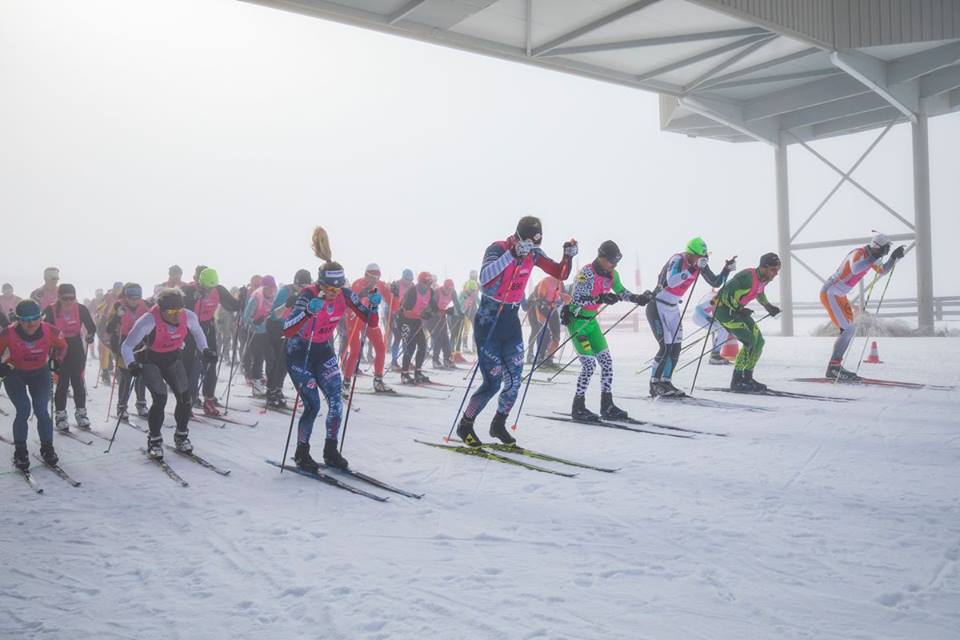
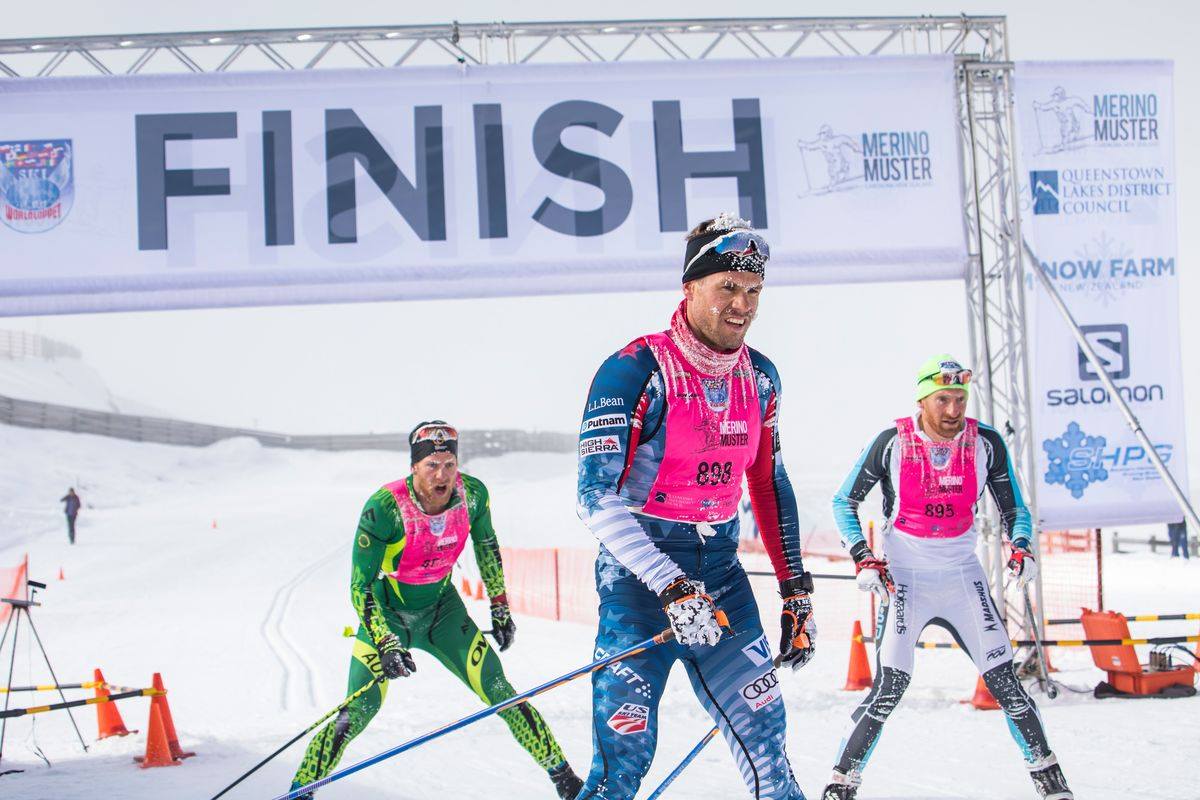
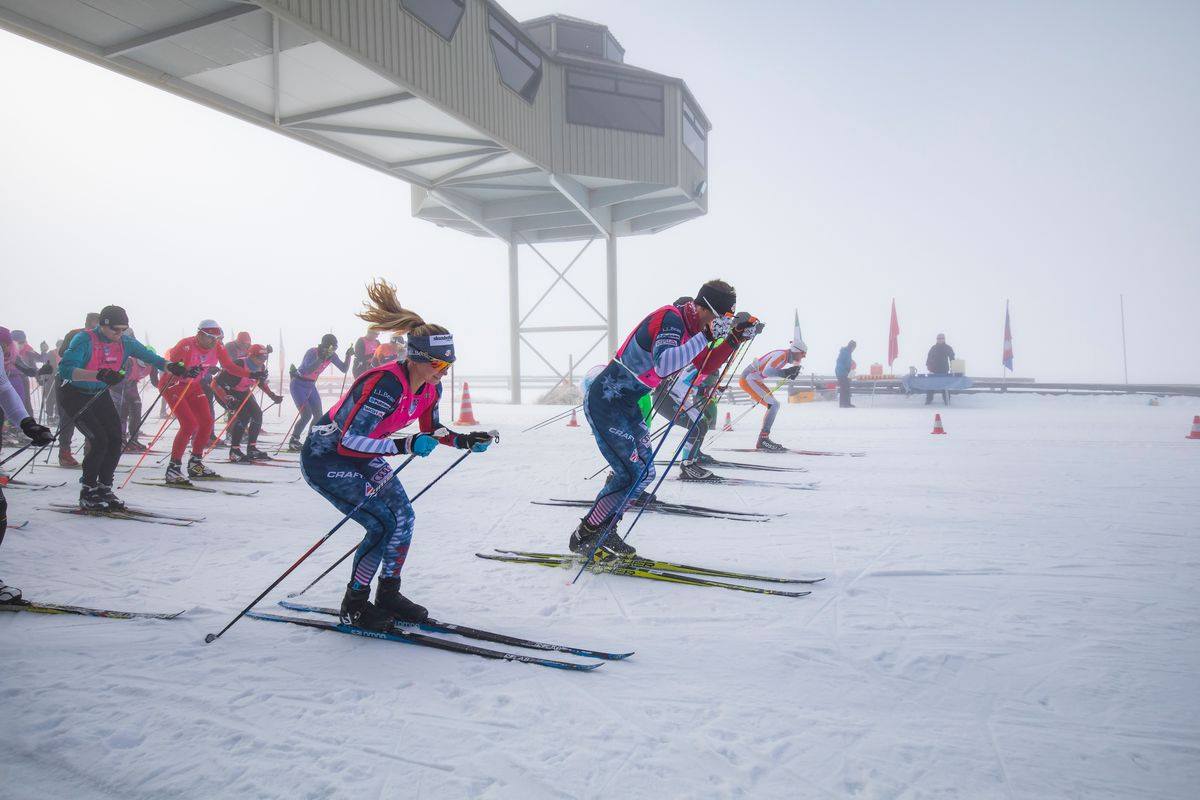
The start of the 2017 Merino Muster 42-kilometer on Sept. 2 at the Snow Farm near Wanaka, New Zealand, with Americans Jessie Diggins and Simi Hamilton (in blue) up front. (Photo: Winter Games NZ Facebook/Neil Kerr)
Visibility was thin and temperatures were below freezing last Saturday at the Snow Farm. Opaque white clouds of fog swept over the landscape near Wanaka, New Zealand, showcasing a skyline that seemed to play on the country’s largest historical farm industry: sheep. If bluebird skies and sun had greeted competitors in previous years, racers in the 2017 Merino Muster experienced temperatures around -5 degree Celsius (23 Fahrenheit) and a four-meter radius of visible track, then fog, for most of the 42-kilometer marathon.
Simi Hamilton (U.S. Ski Team) leads Phillip Bellingham during the 42 k Merino Muster on Sept. 2 at the Snow Farm in Wanaka, New Zealand. Hamilton ultimately won and Bellingham placed third, 2 seconds back. (Photo: Winter Games NZ Facebook/Neil Kerr)
The flutter of his own pole grips passing in his peripherals might have been the only company U.S. Ski Team (USST) A-team member Simi Hamilton saw during the race, had it not been for American Brian Gregg and Australian Phillip Bellingham.
The two contenders followed Hamilton from the start, and within the first few kilometers, all three had broken away from the rest of the 80+ men’s field to form a lead group. Together, the two Americans and Australian forged through the next 40 k, taking turns leading through the day’s scrim that hid the panoramic views of the Pisa mountain range that surround the Snow Farm.
“It was incredibly foggy all morning,” Hamilton wrote in an email. “I think we would have all gotten a little lonely out there if we had been skiing on our own.”
The trio kept each other company for the entirety of the race, but by the final two kilometers, Hamilton had staked his spot in the front. As Hamilton headed into the finishing stretch, both Bellingham and Gregg pushed to keep up with his pace. He ultimately held off Gregg by a second and Bellingham by 2 seconds to take the win with a finishing time of 1 hour, 40 minutes and 33 seconds.
“My energy felt good both years, but last year I had trouble accessing my sprint/[Level 4] gear in the final 2 kilometers of the race,” Hamilton wrote. “This year, I felt more comfortable skiing level 3 and I found that it was much easier to access my sprint gear at the very end.”
The victory is Hamilton’s first in the Merino Muster, which has been running for 23 years, the last three of which its been part of the Worldloppet marathon series. He first raced the marathon last season and finished second to his then-teammate Noah Hoffman (who won in 1:45:08 by 23 seconds over Hamilton). Upon returning, Hamilton had some specific objectives.
“The primary goal (both last year and this year) is to get in a really solid level 3 workout, with a hard effort at the very end,” Hamilton wrote. “It’s great terrain to be able to do that on because it’s all very rolling and you can maintain a really consistent effort the whole time without burying yourself too deep. And I think it’s always important to put on a race bib this time of year from time to time in order to start getting back into the race routine before the season really starts.”
Simi Hamilton (c) of the U.S. Ski Team after taking the win in the 2017 Merino Muster marathon on Sept. 2 at the Snow Farm in New Zealand. He held off fellow American Brian Gregg (r) by one second and Australia’s Phillip Bellingham by 2 seconds.(Photo: Winter Games NZ Facebook/Neil Kerr)
Gregg’s second-place result came at his first Merino Muster, an event he was able to enter since he was in New Zealand for a training camp with his wife and Team Gregg teammate, Caitlin Gregg. The two arrived in New Zealand on Aug. 22 and planned to train there until the second week of September.
“Our dates ended up aligning with the USST camp dates as well and it has been a lot of fun joining them for workouts,” Brian wrote. “At the start of the second week down here athletes from Craftsbury, Stratton and Sun Valley arrived so we have had a large US representation. My brother and sister in law also made the trip down to race the Muster and help support our training. They both work remotely for their companies and it has been a blast to have them here with us.”
While he indicated that his summer training had been going well, the race itself was an invaluable opportunity for Gregg to tackle technique. Following Hamilton for an extended hard effort was one of his primary aims, not to mention testing his sprint speed against one of the U.S.’s top sprinters.
“One of my specific goals for this race was to ski with Simi,” Gregg wrote. “I think he is one of the better technical skiers in the world especially in V2 and following his smooth rhythm has been helpful for my own technique. Technical adaptations on snow has been my biggest goal of the camp and the race offered a focused 1 hour and 40 minutes of that.
“Swapping leads with Simi allowed me the opportunity to make technical adjustments through mimicry and then I could take the lead and make the technique more my own,” Gregg continued. “Although my goal was also to win the race I can hardly complain about being able to match the finishing sprint of a World Cup Winner.”
Bellingham, an Australian national team member, rounded out the men’s marathon podium in third, just two seconds out of first. A week prior to the Merino Muster, Bellingham competed in the 2017 Kangaroo Hoppet in Falls Creek, Victoria, where he placed second to American Miles Havlick.
Diggins 1st Woman, 4th Overall
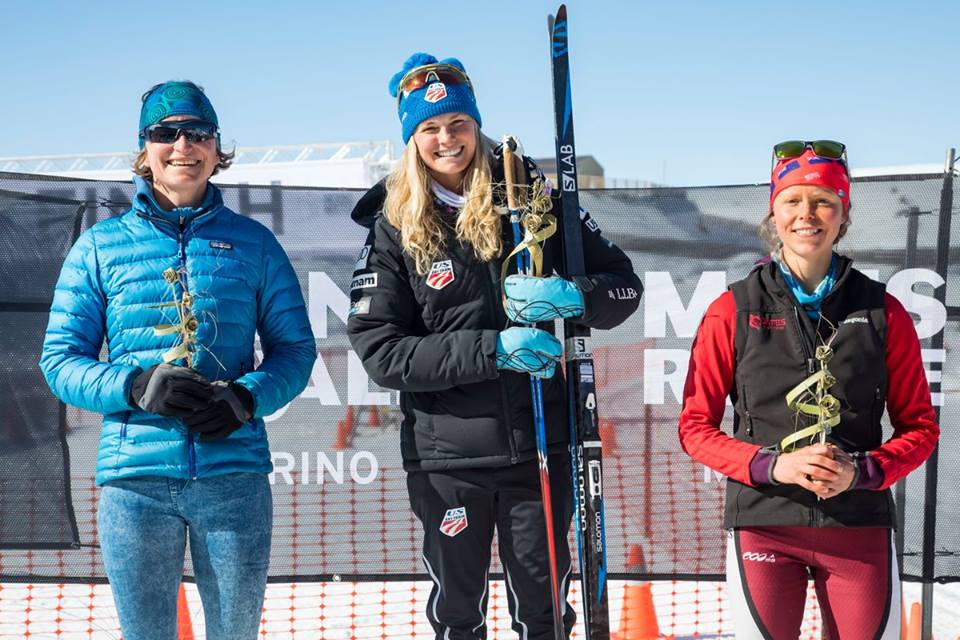
In the women’s 42 k race, which started with the men, USST A-team member Jessie Diggins took the win with a time of 1:51:42 for fourth place overall. Diggins explained that while she was able to ski with the front group of men for the first few kilometers, she eventually settled into a pace that was more her own.
The all-American women’s podium at the 2017 Merino Muster on Sept. 2 at New Zealand’s Snow Farm, with Jessie Diggins (c) of the U.S. Ski Team in first, Hannah Dreissigacker (l), formerly of US Biathlon, in second, and Britta Clark (r) in third. (Photo: Winter Games NZ Facebook/Neil Kerr)
“We all started together but after 3-4km I knew I couldn’t hang with the lead guys the whole race, so I dropped back a bit,” Diggins wrote in an email. “I didn’t have to ski alone though, which was really nice!”
For much of the race, Diggins skied with Estonian Joosep Tammeme, a change from last season when she paired with her USST teammate Liz Stephen for most of the marathon.
“Last year was super fun because I got to ski with Liz the entire race,” Diggins wrote. “This year I had a really nice Estonian man to partner with but nobody can replace Liz Stephen!”
Thirty-one seconds behind Diggins, Tammeme, the fourth male, finished fifth.
With the Merino Muster behind her, Diggins will look to finish off the remainder of the USST’s three-week training block in New Zealand.
The start of the 2017 Merino Muster 42-kilometer on Sept. 2 at the Snow Farm near Wanaka, New Zealand, with Americans Jessie Diggins and Simi Hamilton (in blue) up front. (Photo: Winter Games NZ Facebook/Neil Kerr)
“The Merino was a fun way to get a long intensity session in during the week and ski hard while also enjoying the feeling of racing again!” Diggins wrote. “Huge, huge thanks to the entire crew here at the Snow Farm. They always treat us so well and make sure the trails are groomed perfectly for great training. This is my favorite camp so I’m really grateful to them for making space for us down under!”
The second woman after Diggins, 10 minutes and 17 seconds back, was retired American biathlete Hannah Dreissigacker, who has been working at the Snow Farm over the past few months. Dreissigacker, 30, explained that the race was her first since her retirement in the spring of 2016, and though she had remained relatively active leading up to it, gunning for the win wasn’t a goal.
“I’ve been doing a variety of work in the office as well as coaching and instructing and I’ve been trying to get out and ski whenever I can,” she wrote in an email. “But I definitely went into the race with low expectations.”
The Vermont native, instead saw the race — which ended up being her longest workout of the Southern Hemisphere’s winter — as more of an opportunity to do something she loved: skiing.
“The race split up immediately for me — I knew better than to try to stay with Jessie at all,” Dreissigacker wrote. “I skied with an older Russian skier, and then by myself, keeping the pace comfortable and I was very happy to feel good the whole time! There was some low-visibility off the start but the trails were in great condition and it was a fun first race as a ‘master blaster’.”
Rounding out the women’s podium in third (+17:24) was American and 2016 Bates College graduate Britta Clark.
In the 21 k “Snow Rake”, USST A-team member Sophie Caldwell took the overall win in a time of 51:21. Just one second behind her was Caitlin Gregg in second place, while the third woman was U.S. Paralympics Nordic Head Coach Eileen Carey (+5:48). The first man in third overall (+4:44) was U16 skier Campbell Wright, of New Zealand.
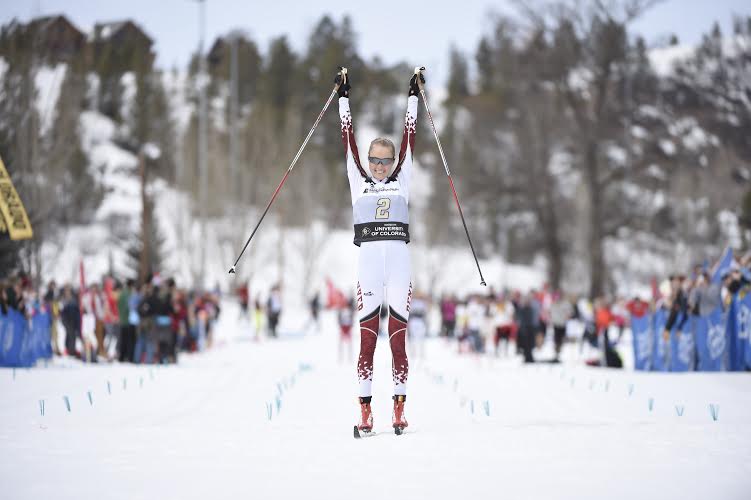
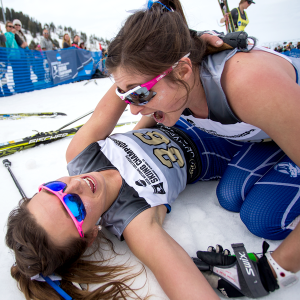
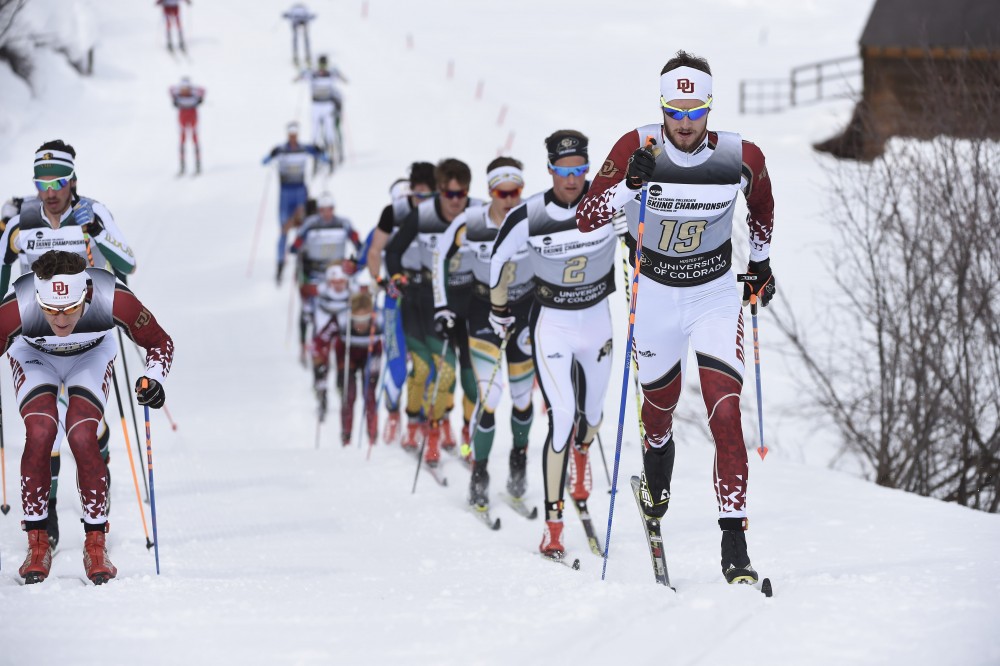
Linn Eriksen of the University of Denver celebrates her win in the women’s 15 k classic mass start at the 2016 NCAA Skiing Championships in Steamboat Springs, Colo. (Photo: Jamie Schwaberow/NCAA Photos)
In March, FasterSkier recently published an article (Part I) on college ski racing in the U.S. and what a change to National Collegiate Athletic Association (NCAA) Championships might require in regards to adding a sprint race. In the second part of the series, we explore why men’s and women’s race distances are different at the collegiate and World Cup level and whether this constitutes a need for change.
***
Men | Women. Women | Men. Scanning the athletics webpage for an American institution of higher education that boasts a varsity sports team becomes a sail down the Casiquiare canal, with gender bifurcation an obligatory outcome.
Resting under the canopy of NCAA sports, however, nordic skiing presents itself as somewhat of an anomaly. Shared race days. Shared coaches. Shared course site. Shared team. At the surface level, gender in collegiate nordic skiing is almost arbitrary.
Olivia Amber (r) of Colby College and teammate Amy Bianco celebrate their top-20 finishes in the women’s 15 k classic mass start at the 2016 NCAA Skiing Championships in Steamboat Springs, Colo. (Photo: Colby.edu)
Yet, closer inspection reveals one particular area in collegiate cross country skiing where the genders differ: Race distance. In most individual nordic events at the college level, the course length of women’s and men’s races are not the same. The trend is a 5-kilometer deficit for women’s race events in comparison to men’s events.
For Molly Peters, the head nordic coach at Saint Michael’s College and former NCAA All-American in nordic skiing for Middlebury College, this is a problem.
“We’re sending a message to all the young women who have a goal to ski in college,” Peters said in a phone interview. “I just can’t imagine that they feel like their equal as people or athletes when they look and they see, ‘Oh, look every single race I’m going to be skiing 5-kilometers less.’ How are men every going to look at women equally and how are women ever going to look at themselves as being equal if you’re always skiing 5-kilometers less?”
With that in mind, Peters promised herself to reshape the sport.
“It had to be my mission in life to get it changed,” Peters said. “I feel like my best bet to get it changed is to change the NCAA Championships because everyone bases all their racing off of what the NCAA does. Every EISA [Eastern Intercollegiate Ski Association] Carnival is basically not equal because they follow whatever the NCAA does. It all trickles down.”
The Trickle Effect: One Theory on Why Race Distances Differ
A single change can create countless more. When Title IX was passed in 1972, a change was instituted in the treatment of both genders by federally funded college institutions. Within the realm of campus athletics, the alteration brought about numerous others, including an increase in the number of women participating in college sports, the scope of sports available to women and men (in certain instances, harmfully so), and perceptions of women who choose to ‘play.’
Recent Middlebury College returnee, Annie Pokorny, points out that this sort of ‘trickle down’ change should not be looked at lightly.
“When women entered sport, some rules were tweaked to account for physiological differences, but also to support the idea that athletics could be harmful to women, (particularly their reproductive systems,” Pokorny wrote in an email.
Pokorny is completing her undergraduate senior thesis on feminist philosophy and the philosophy of sport. While she admits she is not an expert, her studies and experience in nordic skiing quantify her knowledge on the subject.
Pokorny explained that myths surrounding the female body and exercise in the 20th century, caused men “to adjust sport to make it safer and more “womanly”), which turned into a conceptual connection between women and the need to protect them.”
“That conception turned into tradition, one that still thrives today in the form of shortened distances for female endurance athletes,” Pokorny added.
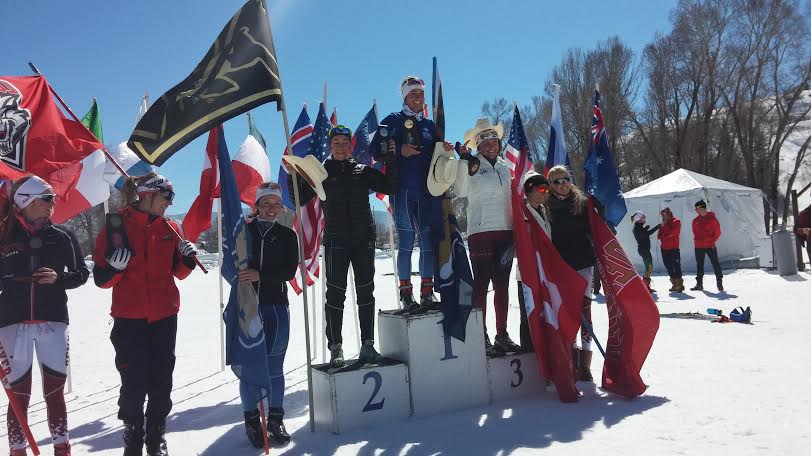
The top 10 in the women’s 5 k freestyle race at the 2016 NCAA Skiing Championships in Steamboat Springs, Colo. (Photo: Matt Johnson/MSU)
For Pokorny and Peters, these types of traditions were made to be broken.
“The best things that have ever happened are from people changing tradition,” Peters said. “My purpose is to get the NCAA Championships changed to be the same distance for men and women because that will trickle down to the smaller races.”
But implementing change in the NCAA Championship event and NCAA skiing is no easy task.
“NCAA skiing is comprised of a wide variety of institutions: Division I, II and III; private and public; and large and small,” Dave Stewart, head nordic coach at the University of Denver, wrote in an email. “Any choices about race format, distances, etc. must take into consideration the perspectives of this diverse group and, ideally, the decisions should be made with the goal of broadening participation at the NCAA level and increasing competition.”
If Stewart is right, the question becomes: Would making race distances equal between men and women broaden participation and increase competition?
A Second Theory & the Distance Debate: Should Men Race Shorter or Women Race Farther?
When it comes to long distance endurance events, some research argues women fare better than men.
“Women can race just as long as men,” Montana State University (MSU) incoming senior Anika Miller said on the phone. “If [the NCAA] wanted us to do a 50 k in college, sure we could do it, but it wouldn’t make any sense athletically.”
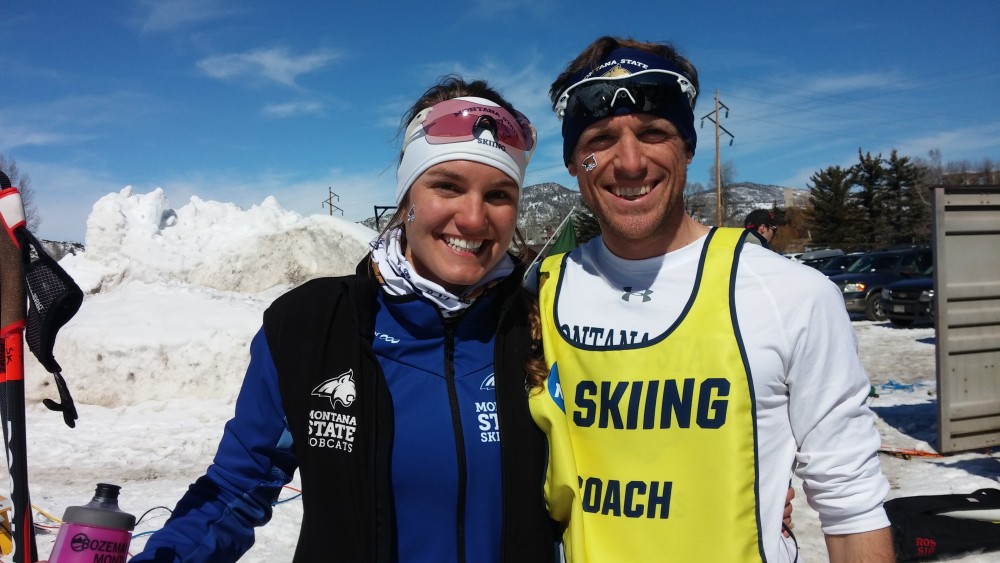
Montana State University’s Anika Miller (l) with head coach Matt Johnson after Miller took won the women’s 5 k freestyle at the 2016 NCAA Skiing Championships in Steamboat Springs, Colo. (Courtesy photo)
Miller — a native of McCall, Idaho, and this year’s NCAA champion in the 5 k freestyle — doesn’t doubt the ability of women to race the same distance as men.
What she questions is whether it’s necessary for women to do so.
“It’s kind of a hard conversation to have as a female athlete because you don’t want to say that women are inferior,” Miller said. “My opinion on it is that the race distances are good as they are as far as women doing a shorter distance than the men. Because time wise … for the 15 k versus the 20 k at least, sometimes the guys only race it five minutes different than the women, which isn’t really that large of a margin, [meaning] effort wise, it’s more equal.”
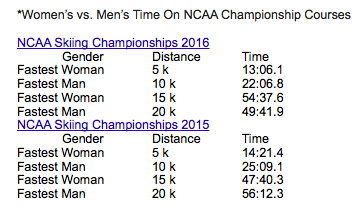
The point Miller makes is that women and men are currently racing equal. Equal amounts of time on course, at least in the 15 k and 20 k events (*see men’s and women’s course times).
Oscar Friedman, coming off his senior season at Dartmouth where he was a captain of the men’s nordic team, also argued that close to equal amounts of time on course is more important than equal course distances between men and women.
“The point of having those different race distances was to make the men’s and women’s races equally competitive,” Friedman said on the phone. “That being said, if women are internalizing it, then that’s a bigger issue. If there’s a push from within the sport, women should be the ones deciding the race distances.”
The push from women within the sport varies, but much revolves around whether women race longer or men race shorter distances. Kelsey Phinney, coming of her senior season and also a captain at Middlebury, admitted that originally the idea of equal distances didn’t appeal to her because she assumed women would be required to race farther.
“I think the misconception has been that equal distances meant that women had to race longer,” Phinney on the phone. “But it doesn’t mean that women have to go 10 k and 20 k it could mean that men go 5 k and 15 k. Or that the races range from sprints to 30 k.”
Rachel Hampton, an incoming senior at Harvard University, advocated that while women are capable of racing men’s distances, men would benefit from racing shorter lengths.
“There’s a feminist side of me that wants to say that girls can do anything boys can do and there’s no theological reason why we shouldn’t be able to race the same distance as them,” Hampton said on the phone.
“I will say I sometimes feel bad for the guys because it seems like they only race long races. I think if we added sprinting and a few 5 k races for the guys and did a wider range of distances, that would be better for them. And I think if the men were on that plan, the women could then get on the same distance plan.”
However, when men competing in college were asked if they would be willing to race the same length as women, responses were often shaped by race distances at other levels of nordic competition.
“Shortening the men’s distances would be a huge disservice because as I see it, the goal of NCAA skiing is to make American skiers as competitive as possible on the World Cup,” Friedman said. “I would be completely against shortening the men’s races. But if women want to make the call and race longer, they should fully be able to do that.”
For a few women, however, simply adjusting the women’s race lengths to match those of the men sends a certain message: Women have to be like men to be equal.
“I think the message it sends depends a lot on whether you shorten the distance of men or you increase the distance that women have to race,” Bates College ’16 grad and skier Britta Clark said on the phone. “Trying to increase the distance that we race in the name of equality, but at the same time really just saying that equality is women doing what men do, I don’t think it’s necessarily speaking to the issue.”
Clark’s point is supported by Dartmouth College Women’s Head Nordic coach and Director of Skiing Cami Thompson-Graves, also a member of the NCAA Men’s and Women’s Skiing Rules Committee, chair of the USSA Cross Country Committee, and most recently, a member of the International Ski Federation(FIS) Ladies’ Cross Country Committee.
“I don’t feel the need for women to do men’s distances,” Thompson-Graves said on the phone. “Why don’t we just do women’s distances? Why can’t we just be different … I’m a big believer in being proud to be a woman, and not a little man.”
Harvard’s Rachel Hampton leads a Dartmouth skier during the 2016 Colby Carnival. Hampton went on to compete at the NCAA Skiing Championships in Steamboat Springs, Colo. (Photo: FlyingPointRoad.com/Harvard Facebook)
Increasing women’s distances strikes some as a forfeiture of female identity for one that is male. Which is one reason Peters more strongly advocates for decreasing men’s distances to be the same length as women’s.
“In skiing, I think the men should come down,” Peters said. “The 20 k is really irrelevant, even at the international level. I see nothing wrong with the 5 k, I think men should do 5 k. Five k is super exciting and can be a great race. I think it should be 5 k, 10 k, 15 k, and then add in the relays and sprints.”
However, a men’s 5 k race doesn’t appear on numerous nordic race calendars — national or international — either.
“I don’t think at the national or international level men race 5 k so maybe that’s a distance skill set that would only be applicable to college skiing in the U.S.,” Raleigh Goessling, coming of his senior season at the University of New Hampshire, said on the phone. “If the race distances were changed, I feel like the distances that are contested at other levels of the sport and other formats should also play into it.”
The Window Between U.S. College Racing and the World Cup
At the international level, women and men rarely race the same distance. FIS course lengths — like the NCAA — are designed around the gender of the athletes competing.
FIS Cross-Country Committee Chair and Norwegian Olympian Vegard Ulvang indicated that similar to college racing in the U.S., FIS race distances have been different for decades. One potential reason for these differences aligns with Porkorny’s findings. According to Ulvang, how female athletes were viewed in endurance sports when they started ski racing influenced the original length of women’s race courses.
“The history behind the differences comes from the time where the nations believed that women were weaker — [with the] first female race in 1952,” Ulvang wrote in an email to FasterSkier. “Today we of course know better. Female athletes are better prepared for longer distances than men, so principally the distances should be equal.”
Principality does not always equal response. Ulvang indicated that even if the race distances should principally be equal, one major driving force for the committee to keep women’s race distances shorter than men’s rests on the race experience for spectators.
“The argument has been that the time gap between the 20 best women is bigger than that of the men,” Ulvang wrote. “Longer distances would create a ‘worse TV product’ — with one racer skiing alone [during the race].”
T.V. time does not strike Peters as an excuse for NCAA Championships and U.S. college cross-country ski schedules to follow the same format as the World Cup.
The men’s 20 k classic mass start at the 2016 NCAA Skiing Championships in Steamboat Springs, Colo. (Photo: Jamie Schwaberow/NCAA)
“A lot of people will say well, look at what they do at the Olympics, and look at what they do at the World Cup — it’s vastly different,” Peters said. “The women do so much less. But that doesn’t make it right. That’s a reason why NCAA follows it and EISA follows it, but that doesn’t make it right.”
Stewart, who has helped the Denver Pioneers achieve five NCAA Championship titles, supports the idea that NCAA skiing in the U.S. could act as a catalyst for change.
“As long as FIS schedules longer races for men than for women in international championships, there will be some resistance to equal distances at other levels, but I see no reason why the NCAA should not be a trendsetter and work to turn the tide on this,” Stewart wrote in an email.
He supports equal distances in cross-country skiing, seeing it as a statement that should be sport-wide, not just within NCAA nordic skiing.
“Equal distances for men and women should be implemented in our sport, both at the NCAA and international levels,” Stewart wrote. “We have had equal distances in the sports of swimming and track and field at the international and collegiate levels for many years. Equal distances would reinforce gender equity and would send the right message about our sport.”
Yet, when it comes to World Cup race lengths versus those contested at the NCAA, some argue the Championship event is already sending a message to other levels of cross country competition.
“I actually think that NCAA’s, where the women race 15 k and the men race 20 k, is much more equal than on the World Cup when the women race 15 k and the men race 30 k,” Rosie Brennan, Dartmouth grad and current U.S. Ski Team (USST) member, said on the phone.
Brennan is not opposed to a more balanced race length distribution between men and women. Her concern with changing race distances at the World Cup and NCAA collegiate level is ensuring that the racers’ performance and perspective are taken into account.
“I think it would be nice if they tried to make the [race distances] a little closer,” Brennan said. “I also think the reason the distances were different in the first place was the idea that the time the race takes should be fairly equivalent, so the effort is the same. If the time differences [between men and women] are getting to be much greater, to the point that the races are no longer requiring the same amount of effort, then I think it’s worth proposing some sort of a change and [is] something to re-visit over time.”
Brennan’s suggestion to visit the race experience for athletes doesn’t go unsupported. Men’s and women’s race distance differences have been discussed at the collegiate and World Cup level. But the actual number of times the topic has been statistically ‘re-visited’ remains a bit blurry.
Regarding conversations within the college circuit, Peters indicates that implementing changes to men’s and women’s race distances has been thrown around for some time.
“Patty Ross, who coaches at Middlebury, she’s been fighting it for 25 to 30 years and she’s had no success,” Peters said.
Ross could not be reached for comment.
Within the FIS Cross Country Committee, Ulvang indicated that the turn of the millennium was when most conversations regarding the different course lengths at the World Cup level of racing began.
“[The] question has been discussed in the FIS committee a few times the last 15 years,” Ulvang wrote.
Beyond that, four-time Olympian, USST member, Fast and Female USA President, FIS athlete rep, and now a new mother Kikkan Randall revealed that World Cup athletes have also had at least one opportunity to make their opinion about equal distances known.
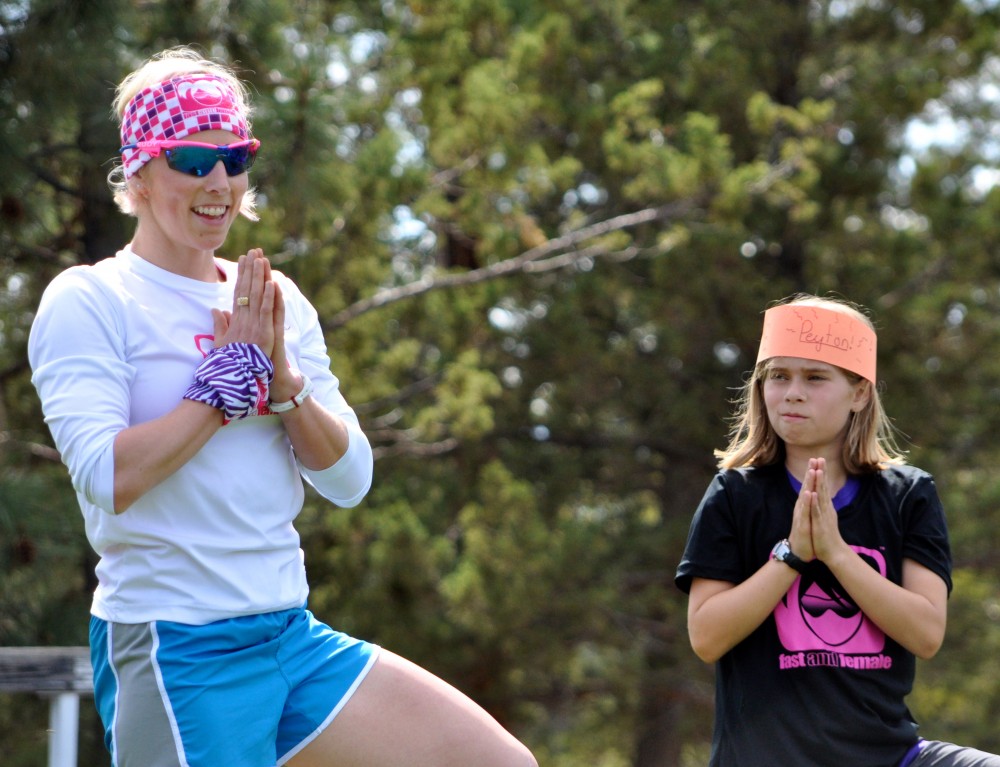
Fast and Female USA President Kikkan Randall leading a Fast and Female session two years ago in Bend, Ore. (Photo: Matt Whitcomb)
“It’s an interesting topic that actually comes up quite often on the World Cup,” Randall said. “As the athlete rep to FIS, I do a survey at the end of each season and couple years ago, as part of the survey, I sent out that question [of equal distances].”
The responses Randall received found most women on the World Cup circuit — at least a few years ago — did not want to race the same distances as men.
“The majority of women actually said that they were not interested in racing the same distances as the men,” she said. “I’m considering putting that same question on the survey again this year because the comment was brought up a couple times this spring.”
And how might women racing on the World Cup respond to shortening men’s distances to make the lengths equal? The question has not been posed, but Randall may incorporate it into her next athlete poll.
“That would be another interesting take on the same question,” Randall said. “This year on the World Cup I feel like the distances were reduced a little bit with so many tour [multi-stage] events, so again it’d be an interesting time to poll the athletes and see how they feel.”
Conclusion: Connecting Part I and Part II
As long as there is snow around, colleges with nordic programs in the U.S. will continue to attract a cohort of cross-country skiers looking to compete, while simultaneously continuing their education. For many, choosing college over a club team is not the end of a cross-country skier’s long term career. It is also the potential beginning.
“The way our country is, you’re always going to have athletes choosing to go to college after high school no matter what path they’re on,” Brennan said. “So I think the more that that can be facilitated, the better it is. I mean there are a lot of good club programs that offer alternatives for people who choose that, but I think the NCAA can provide a route as well.”
Some individuals also see the NCAA as an opportunity for Americans to attend college in the U.S. and potentially compete against athletes from other countries.
“As a venue for athletes to develop into international level skiers, [the NCAA circuit] is a great place because there are really high-level skiers from all over the world in the small microcosm of NCAA skiing,” Chad Salmela, outgoing nordic coach of the College of St. Scholastica, said on the phone.
With an assured influx of athletes choosing skiing and school — and the opportunity for some to race international athletes at ‘home’ — many don’t deny the difficulty of disconnecting U.S. collegiate racing and higher levels of nordic competition.
“From a purely objective standpoint, I would say that a junior athlete who chooses to skip college (at least until they are completely done with their racing career, whenever that may be) and pursue ski racing full-time starting at age 18, is much better set up to ski faster on the World Cup level later in their career,” current USST member and former Middlebury skier Simi Hamilton wrote in an email.
“However, because of the small numbers of junior skiers we have in our country (relative to all the other skiing powerhouse nations), college is a great way to keep kids engaged and in touch with racing during a period of their lives when they may have decided they want to do something completely different,” he added.
Yet, if NCAA racing is to preserve itself as one potential path for athletes looking to make professional steps in the sport, college and World Cup racers alike agree that conversations about change — be those for adding sprinting or making race distances equal between men and women — need to continue.
“I think incorporating sprints at the NCAA is definitely worth talking about and pushing forward because that’s at least one-third of the races we do [on the World Cup], if not more,” Brennan said. “I think trying to stay current is a valuable thing.”
Ida Sargent, a Dartmouth grad and current USST member, agreed that sprinting deserves spotlight attention in present-day skiing.
“I can obviously only speak for the women’s distances but I liked how there was a short and a longer distance race,” Sargent wrote in an email regarding NCAA race distances. “I think a more important change would be adding in more sprint races. We race a sprint almost every weekend on the World Cup and when I was in college we would have one a year at the most.”
With one more year of college racing left at MSU, Miller also pushed adding more sprint races to the college race circuit to foster cross country skiers’ development.
“I think it’s unfortunate that we don’t have sprinting,” she said. “Because that’s such a great development tool.”
Though Miller and Sargent are at odds with Pokorny’s press for equal distances, all three do seem to agree that changing customs can create better opportunities and a better outlook for cross-country skiers.
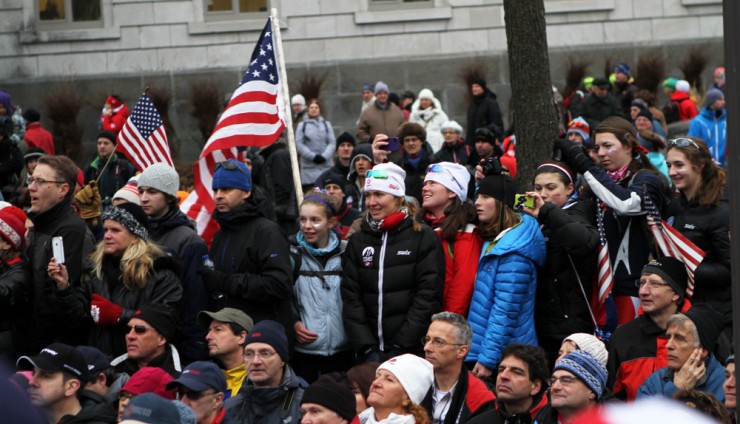
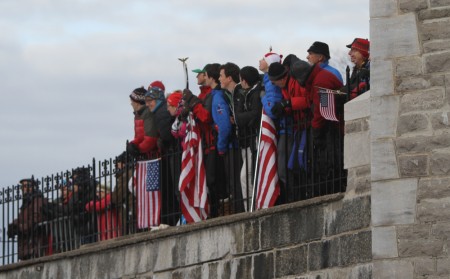
American fans watching Friday’s World Cup team sprint in Quebec City.
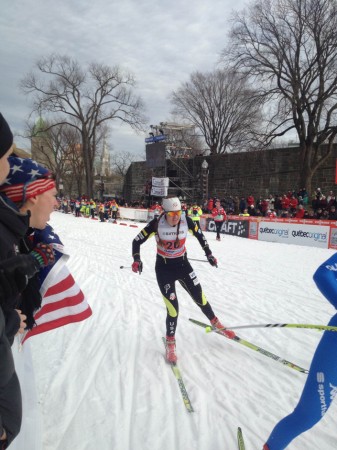
QUEBEC CITY – They piled into vans for five-hour drives from New England colleges, toting flags and banners. Others flew in from Alaska and the Midwest, to cheer their friends and family. And some simply walked over from their government offices to watch Alex Harvey, the Quebec native whose skiing exploits have been plastered across the pages of local newspapers.
“Of course, it’s not hockey, but people know his name and what he’s accomplished in the past few years,” said Pierre-Luc Pelland, 28. “We’ve just come to see how it looks.”
“It” was North America’s first cross-country skiing World Cup race in nearly three years. And Pelland, on lunch break from his job at Quebec’s higher education ministry, wanted to check out the spectacle unfolding Friday in front of the provincial parliament.
Joining him on the sidelines were hundreds of others, from the casual to fanatic. At the top of one hill were the parents and brother of American sprint star Kikkan Randall; at the bottom of another was the local retiree who says he’s been mountain biking with Harvey’s dad.
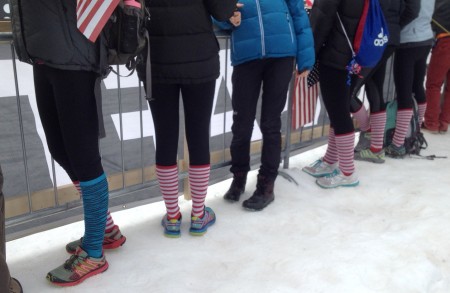
The Stratton socks.
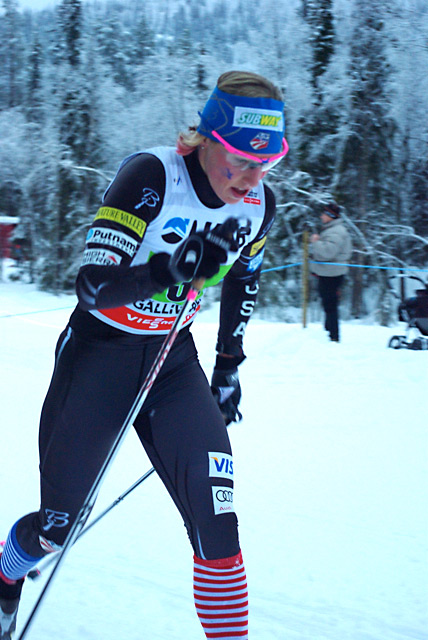
And then there was the pack of girls from Vermont’s Stratton Mountain School, sporting face paint and knee-high striped socks in solidarity with the style pioneered by the American women’s team, sprinting back and forth between vantage points.
“We were so excited,” said Brooke Mooney, a high school junior and skier at Stratton who bought herself and her teammates eight pairs of the socks from a New Hampshire K-Mart. “We spent hours this morning preparing—glitter, ribbons, everything.”
All the fans combined to make the Quebec City sideline feel like something between a winter festival, a football game, and a high school reunion.
“It was like being at a carnival on steroids today,” said Liz Kantack, who coaches at Stratton. “You see everyone you ever raced with, and their parents.”
The spectators in Quebec could be divided into several constituencies. First, there were the rabid fans, like Ken Schoville, 62, who recently retired from 31 years of ski coaching in northern Wisconsin.
On a trip that he dubbed “my fantasy tour,” Schoville had driven from Wisconsin to Calgary with his wife, where they ditched their car and caught a flight to Quebec. After watching the races here, the pair will fly back to Calgary, then drive to next week’s World Cup in Canmore.
“I’m just thrilled,” Schoville said. “Quebec is such a cool venue and place.”
Other particularly avid groups were the contingents from several colleges, including Dartmouth, Bates,
American fans with a unique spot for spectating.
and Middlebury. Wilson Dippo, Bates’s assistant cross-country ski coach, had driven seven of his athletes to Quebec from Central Maine, and was expecting a roughly a dozen more to arrive in time for Saturday’s races.
“It’s a four-and-a-half, five-hour drive, so there’s no excuse not to be up here,” Dippo said. “There was no way I was going to let us not come.”
Then there were local, casual fans like Louis Cliche, 67, a retired litigation lawyer who said that he’s done “a bit of mountain biking” with Alex Harvey’s father, Pierre.
Cliche, a recreational cross-country skier, had read about the races in the newspaper, and made a point of coming out to support Harvey, and his teammate Devon Kershaw.
“If you like cross-country skiing and you’ve got a World Cup in your backyard, it’s a must,” Cliche said. “Especially since Harvey and Kirchner, or whatever his name is, are doing quite well.”
Bates College assistant coach Wilson Dippo cheers on American Becca Rorabaugh.
And of course, there were the parents, like Deborah Randall, 58, who had flown in from Anchorage to watch her daughter Kikkan Randall compete.
Typically, because of the time difference between Alaska and Europe, Deborah Randall said she has to watch World Cup races “at one or two in the morning,” on an Internet stream.
On Friday, she got to see her daughter compete from a few feet away—and without having to fly across an ocean to get to races in Europe.
“Being here is unbelievable,” Deborah Randall said. “I’m just so excited to be a part of it.”
For Schoville, the Wisconsinite on his fantasy tour, Quebec’s festive atmosphere was something he said he’d like to see transported across the border.
“This is the time,” he said, referencing the nascent efforts by Midwesterners to bring a World Cup to the U.S.
“Mitt Romney’s not doing anything right now,” Schoville said. “He did pretty well in Salt Lake—maybe we could get him on board.”
Disclosures: The writer attended college with Dippo, and Kantack has written for FasterSkier.