Tag: Becca Rorabaugh

  • “It’s a Good Time to be an American Ski Racer”: A Look Inside the OPA Cup Finals Trip to Sappada, ITA

    “It’s a Good Time to be an American Ski Racer”: A Look Inside the OPA Cup Finals Trip to Sappada, ITA

    While World Cup Finals were underway in mid-March in Falun, Sweden, a second contingent of top American skiers was lining up roughly 2,000 kilometers south to race in the OPA Cup Finals in Sappada, Italy. Located along the northern edge of Italy near the Austrian border, the small town is nestled among the spectacular, jagged massifs of the Italian Dolomites, roughly an hour’s drive east of Toblach, which typically hosts the final stages of the Tour de Ski. The team spent the week prior to competition training in Toblach, which features similarly spectacular views, along with the benefits of the delicious food and drink one might expect when traveling in Italy. 

    For those unfamiliar with the OPA Cup, it is an international race series featuring predominantly European athletes racing just below the World Cup level. The US Ski & Snowboard development program typically facilitates a trip to OPA Cup Finals to provide athletes who may not have earned World Cup starts the opportunity to experience high level competition overseas. Qualification is based on national rankings, beginning with those racing on the World Cup, and proceeding through the top domestic racers, depending on declines. Often, there is overlap between the teams for the FIS Junior/U23 World Ski Championship teams and the OPA Cup teams, which may conveniently allow some athletes to prolong their stay in Europe and attend both events. 

    “Generally the trip is geared toward athletes that are a bit older, who either have had World Cup starts or on track for that,” explained US Ski Team Development Team coach Greta Anderson.
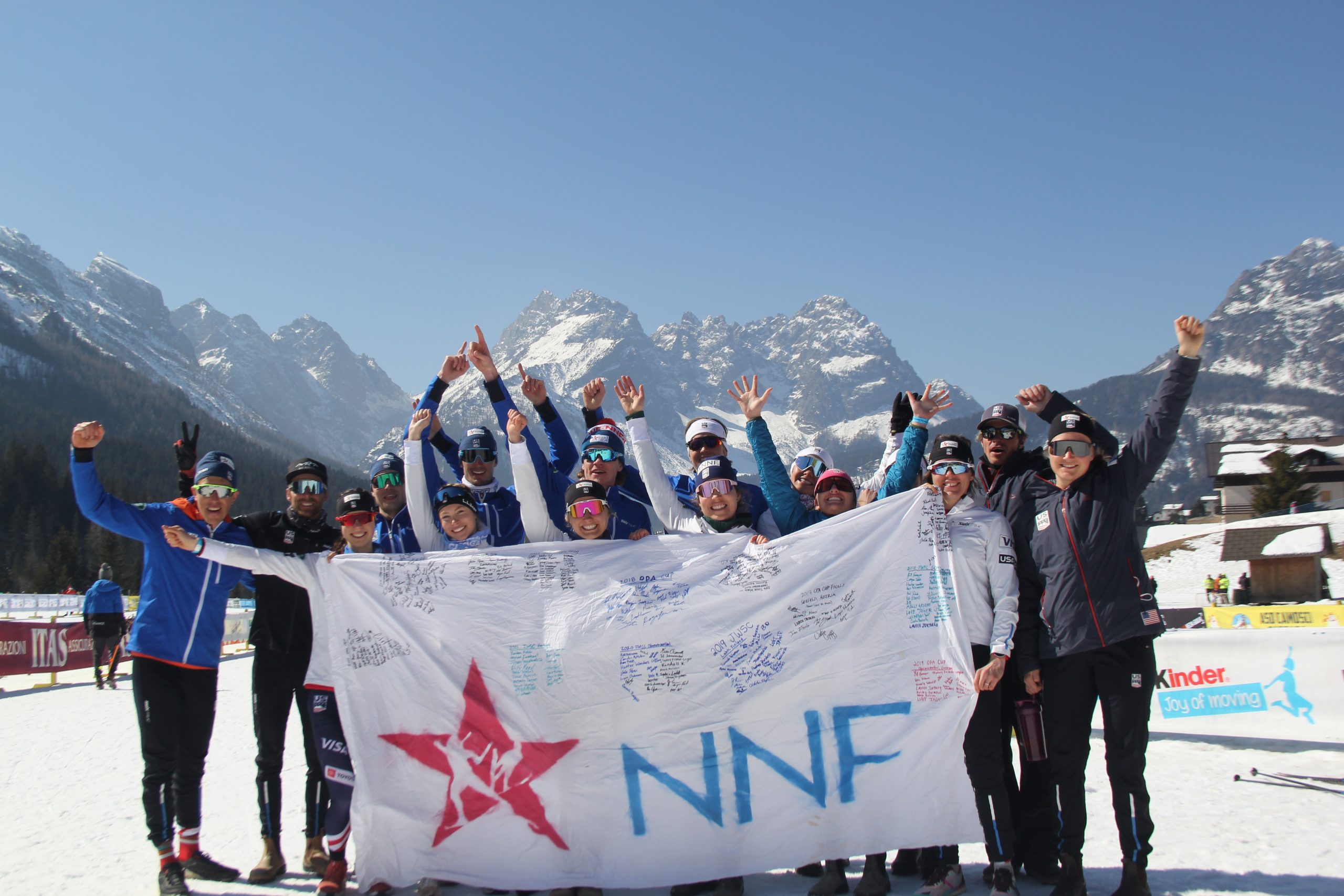
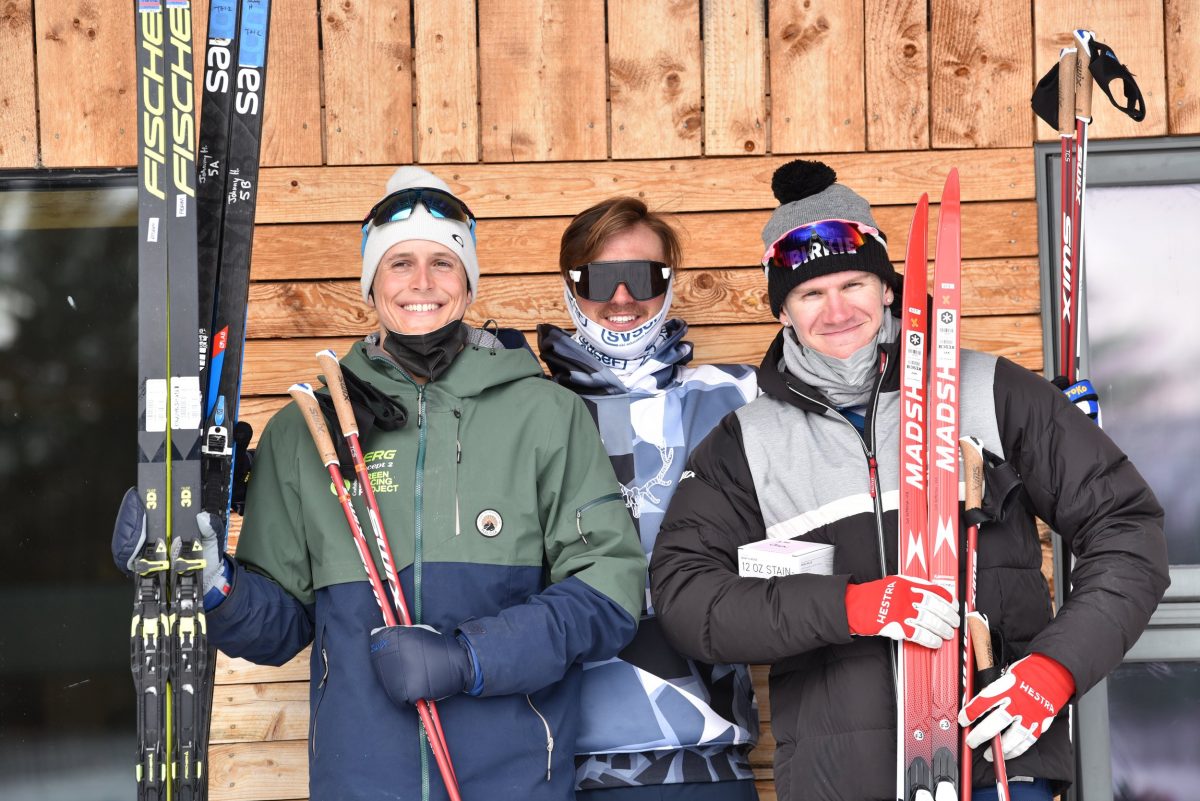
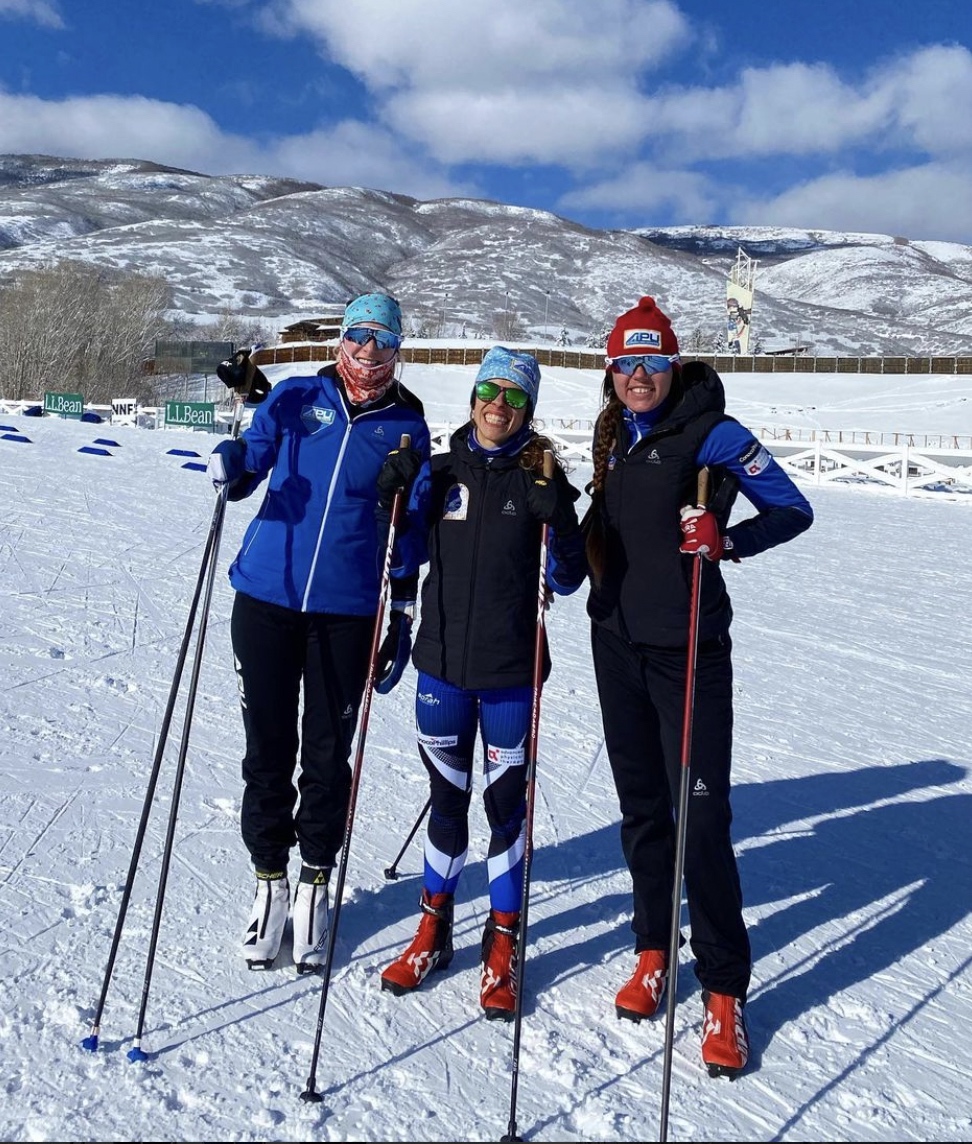
    The American OPA Cup Finals team celebrates fast races and bluebird days in Sappada, Italy. (Photo: Bryan Fish/NNF)

    Identifying it on its list of “Pillar Projects”, the National Nordic Foundation (NNF) helps subsidize the cost of the trip for the qualified athletes. The trip can accommodate up to 16 skiers, who are generally kept to an approximately even male to female ratio through the qualification criteria. This year, due to conflicting schedules and a number of declines, thirteen athletes attended, with nine women and four men. 

    In alphabetical order, the senior men included: Braden Becker (CGRP), Logan Diekmann (BSF Pro), Finn O’Connell (BSF Pro), Karl Schultz (SVSEF). Senior women included: Mariah Bredal (BSF Pro), Margie Freed (CGRP), Alex Lawson (CGRP), Hannah Rudd (BSF Pro), Becca Rorabaugh (APU), Lina Sutro (SMS T2), and Alayna Sonnesyn (SMS T2). 

    This year, two U20 athletes headed from World Juniors in Lygna, NOR to Italy along with D-Team coaches Anderson and Bryan Fish: Kate Oldham (Aspen Valley Ski Club) and Annie McColgan (UVM). 

    “It’s pretty cool that we have more racers that are racing professionally or post collegiately than, I think, ever in the US, and they have more clubs and places to choose from,” said Anderson. “There were several athletes that, especially because racing was shut down on the East Coast last year and I happened to be in Alaska and wasn’t wasn’t traveling very much before I took this job, it was kind of the first time I’ve gotten to work with them, or the first time I’ve gotten to work with them in three or four years. So it was really cool to get to know Alayna Sonnesyn a little better and Lina Sutro a little better, and Margie Freed and Alex Lawson, who I’ve seen race many times, but it was the first time I’ve gotten to really work with them and get to know them. The same with Braden Becker and Karl Schultz… So it was a pleasure on the trip to get to work with some new athletes that have come through different development systems and are excited about and ready to make that next step. And this racing circuit is a really good opportunity for that.”

    Anderson took the lead with organizing the trip and supporting athletes, working alongside US Ski & Snowboard Cross Country Sport Development Manager and long-time OPA Finals trip lead coach Bryan Fish. The wax support staff included BSF Pro Team head coach Andy Newell, former APU athlete and current staff member Peter Kling, and Jackson Hole comp team coach Jon Filardo. 

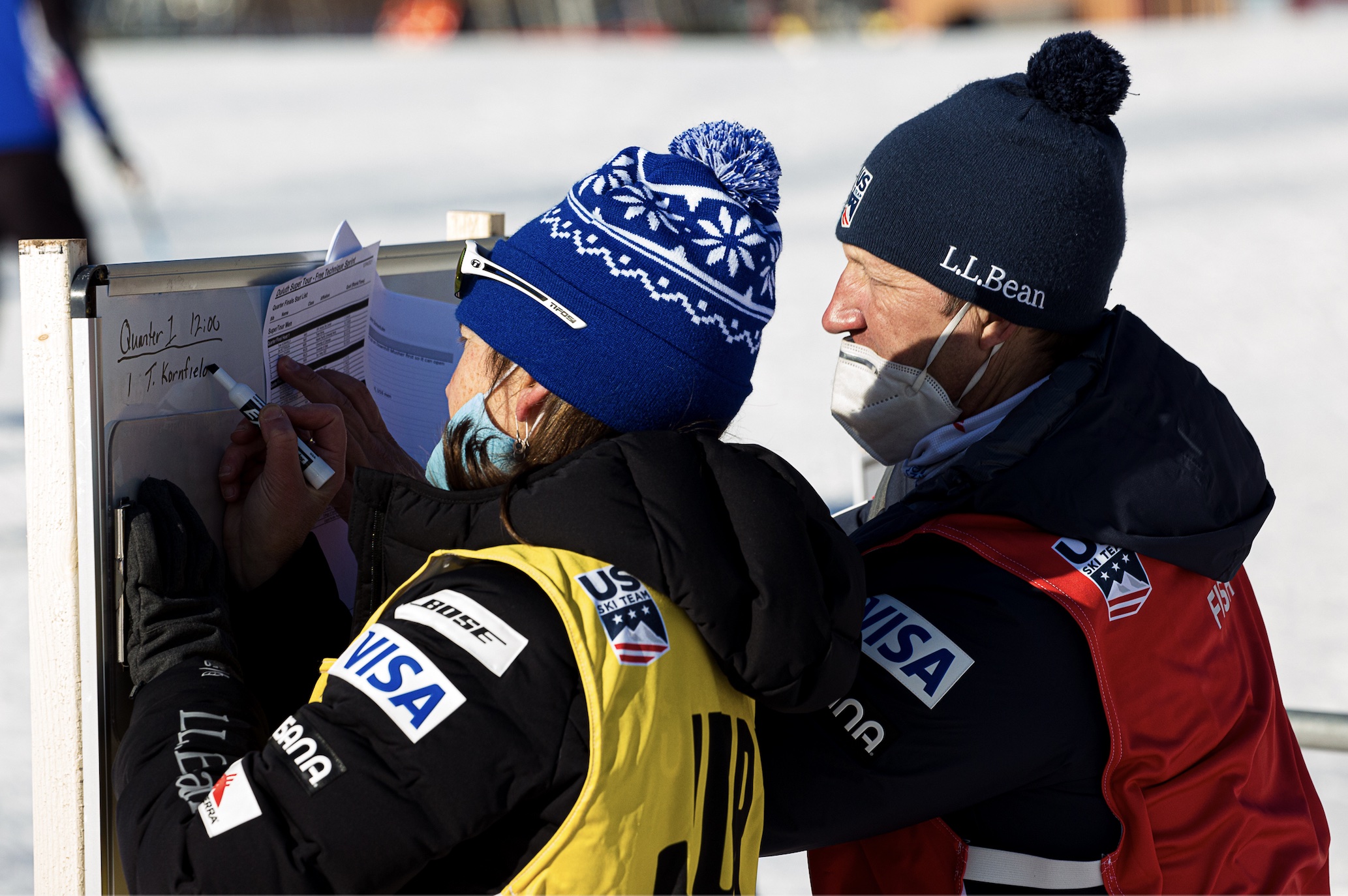
    US Ski & Snowboard Cross Country D-Team head coach Greta Anderson supports athletes during the Sun Valley SuperTour races in January. (Photo: Tobias Albrigtsen / @untraceableg)

    Anderson identified the OPA Finals trip as a key development opportunity for a number of reasons: though perhaps lower pressure than World Cup, it’s a professional race circuit with small but competitively dense fields, athletes race aggressively and tactically in a style younger athletes who have not yet raced at this level may not have experienced, and it offers the opportunity for an athlete to dial in some of the small but significant factors details that support success adapting to a new and different environment following long international travel.

    “Bryan’s been doing [the OPA Cup Finals] trip for a long time,” Anderson said. “So Peter Kling, who was on a coaching staff, and Becca Rorabaugh, they were like, ‘I’m pretty sure that we were on Bryan’s first ever OPA Cup trip.’ And it used to be that we started at the bottom of the results sheet and started looking upward for names. And right now we’re starting at the top and we don’t have to look very far down.”

    In two days of racing, the US had seven top-10 finishes, with another set of athletes finishing well-within the top-20. Highlighting the US team was SMS T2’s Sonnesyn, who took third in the 10 k classic on Saturday the 12th, and won the 10 k skate the following day. 
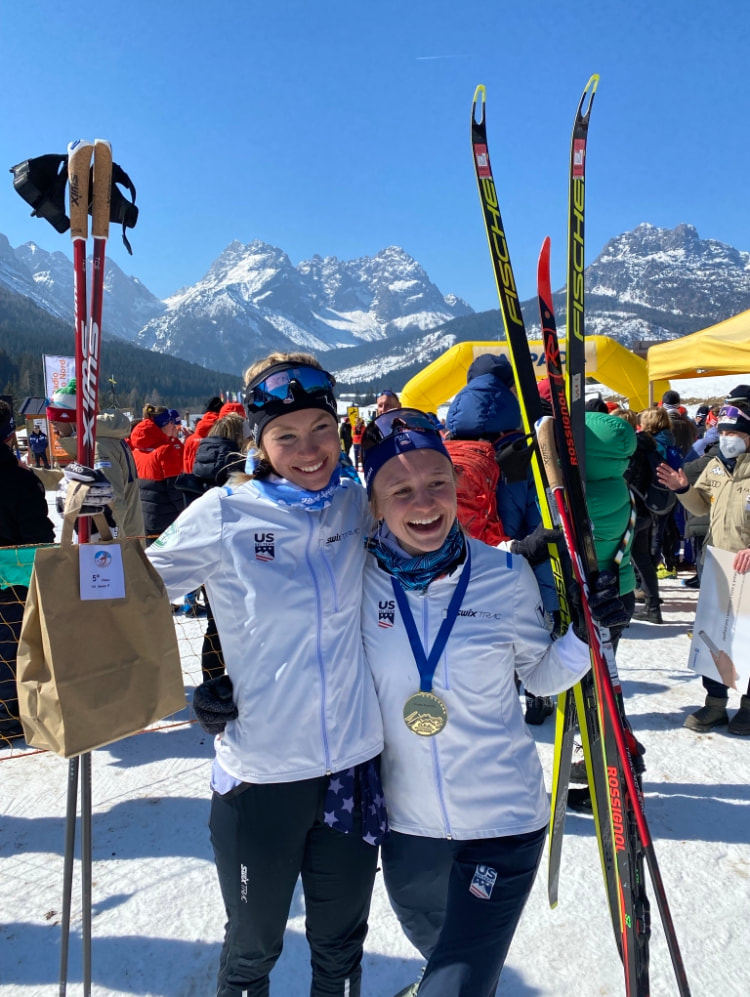
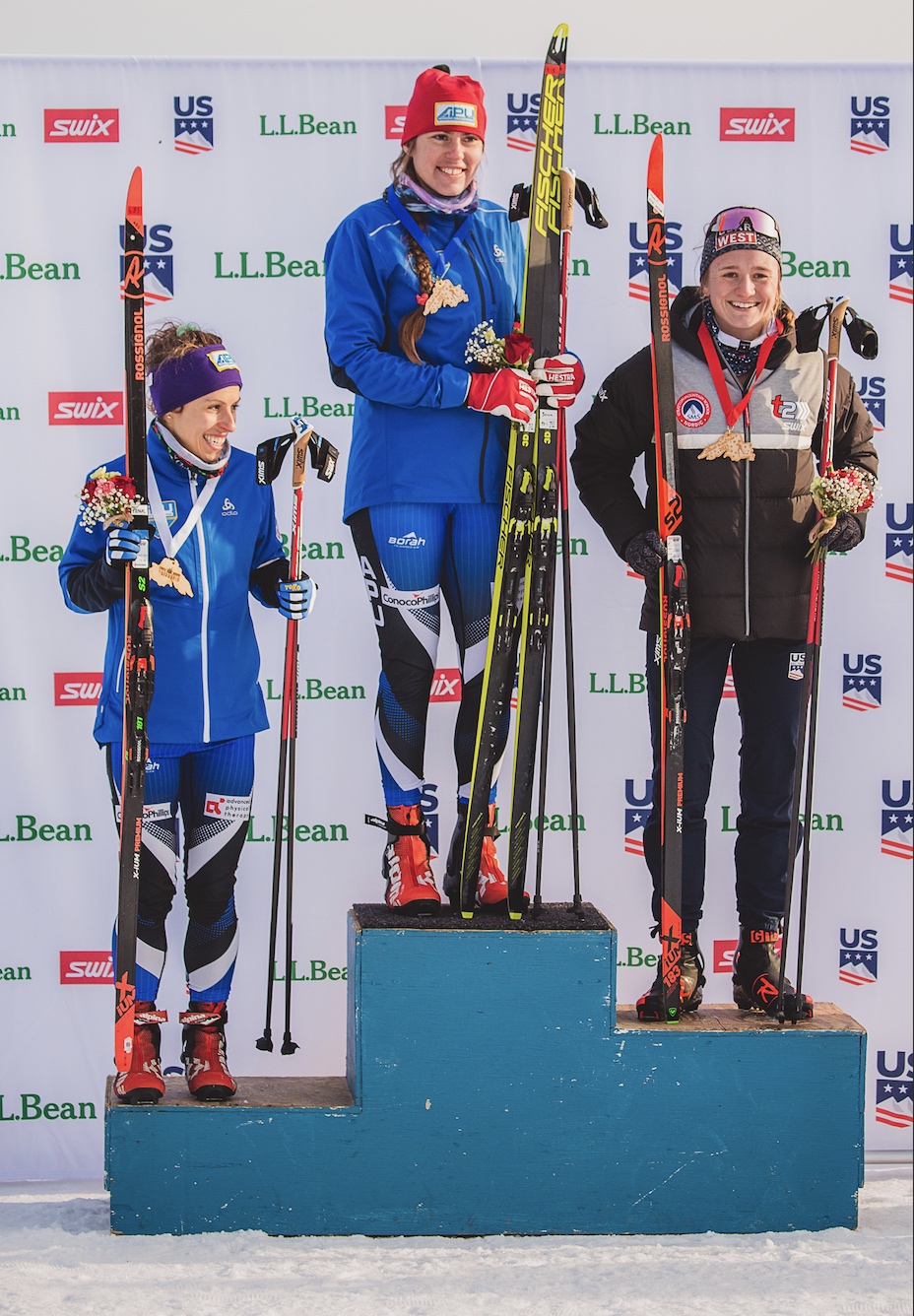
    Alayna Sonnesyn (SMS T2) takes the win in the 10 k skate at Opa Cup Finals in Sappada, ITA, with Mariah Bredal (BSF Pro) finishing just behind in fifth. (Photo courtesy of Alayna Sonnesyn)

    “It’s pretty special,” Anderson said of the performances in Sappada. “It’s awesome to get to see that. For Alayna to start a race and say like, ‘What’s my plan to try to win this?’ It’s not just, ‘Hey, we’re here to participate and learn,’ but ‘Hey, we’re here to participate and learn but also we’re going to try to win.’ And I think, with that comes — not only from staff but from racers — this level of professionalism. Okay, we’re going to select skis. We’re going to make sure we’re organized and in a good place. Where can we be? Where can we do feeds? How can we set you up to have the success you need to have? 

    “It just feels like a really good time to be an American ski racer.”

    After winning two of the first five SuperTour races this season, and finishing on the podium in each of the others, Sonnesyn was offered starts at the Tour de Ski, where she hoped she could achieve strong enough international results to qualify for the Olympic Team. But these goals did not come to fruition; Sonnesyn struggled to find the same race sensations while on the World Cup and tap into the fitness she knew was still there, which was reflected in results below her expectations. She shared her disappointment openly on her blog and social media, providing a relatable and important example to her followers that the pro-skier journey is not immune to bumps in the road. 

    “My experience on the World Cup this year – it was quite demoralizing, to be honest,” said Sonnesyn in a call from the airport as she was on her way to SuperTour Finals in Whistler. “And then, after the Tour de Ski, I got COVID. And it just really put a damper on the whole winter for me. And I started questioning like, ‘Okay, am I fit? And I like, can I race? Well, like, what have I been training for? This is really bad timing with COVID, too.’ So I was just pretty down. But then I was able to have really great SuperTour races, back in January and February, and then to be able to race internationally again in Italy. It wasn’t a World Cup, but it was still very high level of racing. So to have it go so well kind of reaffirmed to me that I belong on the international stage. And I definitely needed that, a little bit, just to give myself more confidence moving forward and motivation as well. So I’m really excited about the races and how they went and what I did to prepare for them and kind of my mental attitude around them, too.”
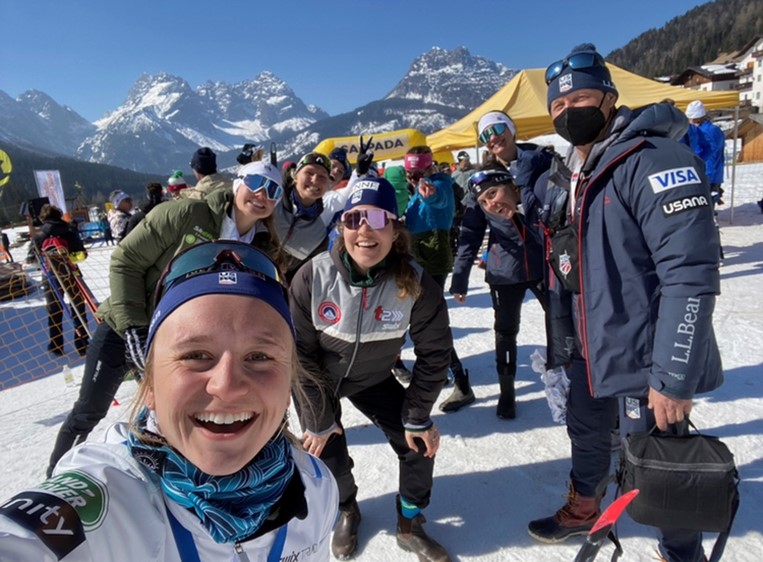
    A selfie in Sappada: the American team prepares for race day at Opa Cup Finals. (Photo: Alayna Sonnesyn)

    As she reflected on the trip and her experiences racing internationally over the last few seasons, Sonnesyn echoed Anderson’s sentiments about the progression of the American team at the event.

    “Compared to my first OPA Cup trip, which was in 2018, I think there were maybe two or three top 10 performances. And they were exciting, but for the most part, it was kind of like, ‘We’re just here to get the experience. We’re not really sure what we’re doing.’ And I think that the way the US is developing right now, the way that new courses are being built in Cable or Duluth, or wherever it is – they are preparing us better for racing internationally. And I think that was shown in the results that we had in Sappada. And it was just so exciting during that 10 k skate on Sunday to cross the finish line in first, and then turn around and see a ton of my other US teammates come in right behind me. That’s not something that was happening four years ago. So I think we are really developing and that is a huge thanks to so many different people and so many reasons, but it’s exciting to see.”

    Sonnesyn also spoke to the importance these international opportunities have provided her specifically, speaking from the perspective of what she dubbed a “bubble athlete” who has oscillated between World Cup and domestic racing over the last four seasons. She got her first World Cup starts in Quebec in March, 2019, and has been offered starts beginning in Period 2 each season since. Though this is a key stepping stone in the process toward consistent World Cup racing, she expressed that bubble athletes can have a challenging time planning seasons in advance and need to be prepared to adapt quickly to more frequent overseas travel.

    “I think that every single experience that an athlete has going and racing internationally, and traveling, and competing at that higher level, it all adds up to be super beneficial and a great learning experience. For example, I have gotten really great at overcoming jet lag, which the first couple of international trips I went on, I had no idea how to handle. I tried my best to do what I could, but it’s hard. And also to know what little things you want from home, like after being in Europe for four or five weeks, what do you really want from the US? 

    “And then also, how do you work in a new environment? A lot of times, if you’re going over to the World Cup, sometimes you’re provided a wax tech or sometimes not, or you have to bring your own, but you have to be willing to work with whoever you get.” 

    Sonnesyn explained that on the Sappada trip, she had worked with each of the techs before, but on her first trip in 2018, it was her first experience working with those wax staff members. Given the importance of ski choice and wax, working together effectively is imperative to an athlete’s success, but it requires dialogue and practice. 

    “Being ready to communicate effectively with the staff, what do you need? How do you want your skis prepared? What do you need from a hotel? All those things seem like such small little details, but they really add up with the more experiences you have.”
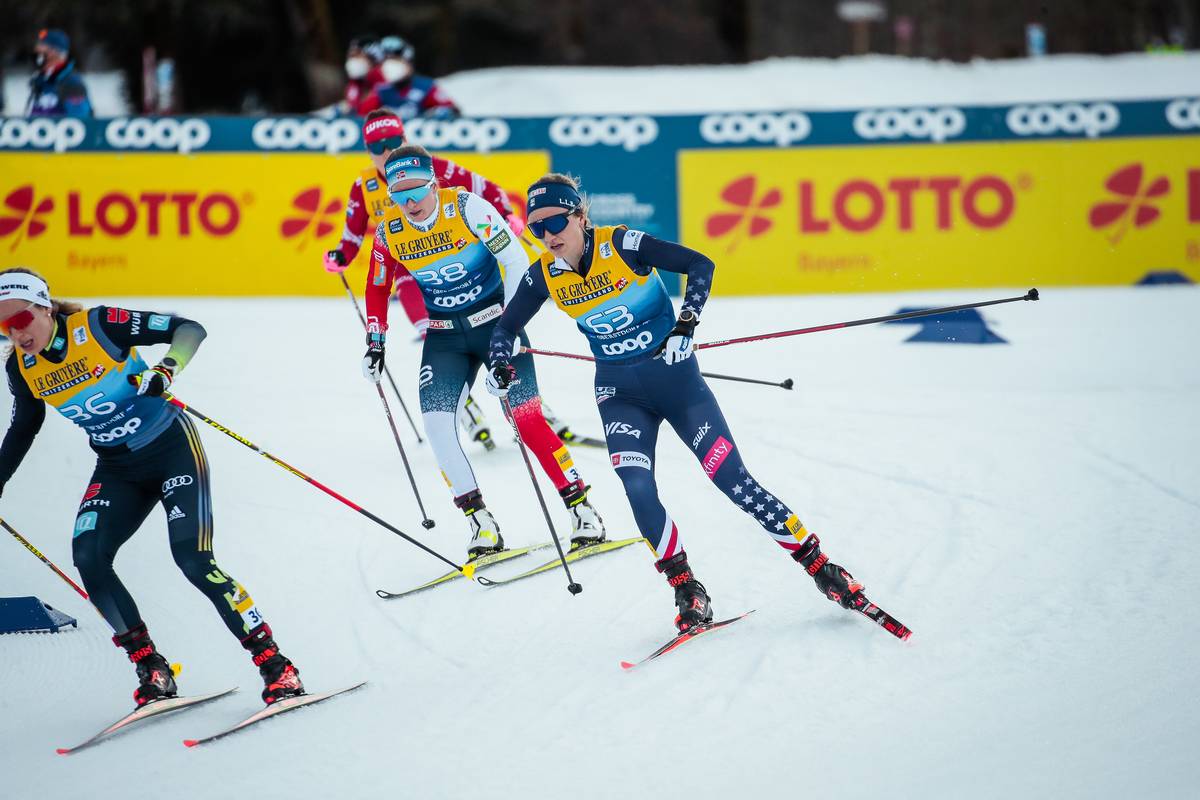
    Alayna Sonnesyn races in Oberstdorf, Germany during the 2021/22 Tour de Ski. (Photo: NordicFocus)

    She also spoke to the differences in the style of racing between the US and her international experiences, and how a trip like Sappada better athletes for what they might encounter should they be offered a World Cup start down the line. 

    “When it comes to racing: the courses in Europe are very challenging and very technical. Downhills, uphills, flats – whatever it is, there’s a lot of it, and you have to be ready to go for it. And then the competitors are fierce. They know how to be aggressive in a race, and you have to know how to hold your own. So it just helps to have that experience to understand how you approach the race. How aggressive are you going to be? How are you going to pace the race? How are you going to handle others around you?”

    With the highest levels of competition for our sport happening across the pond, it is easy to understand why opportunities like the OPA Cup trip provide an essential bridge for developing athletes. But it is not simply the facilitation of this trip that has led to marked improvement for the American team.

    “I think we’re open to change right now,” Anderson said as she reflected on her key takeaways from the experience in Italy and her first season coaching the D-Team. “I think the US, in a year with COVID, and lots of challenges logistically and politically in the world, we handle those changes better than almost any other country does. And I think that’s really shown here.” 

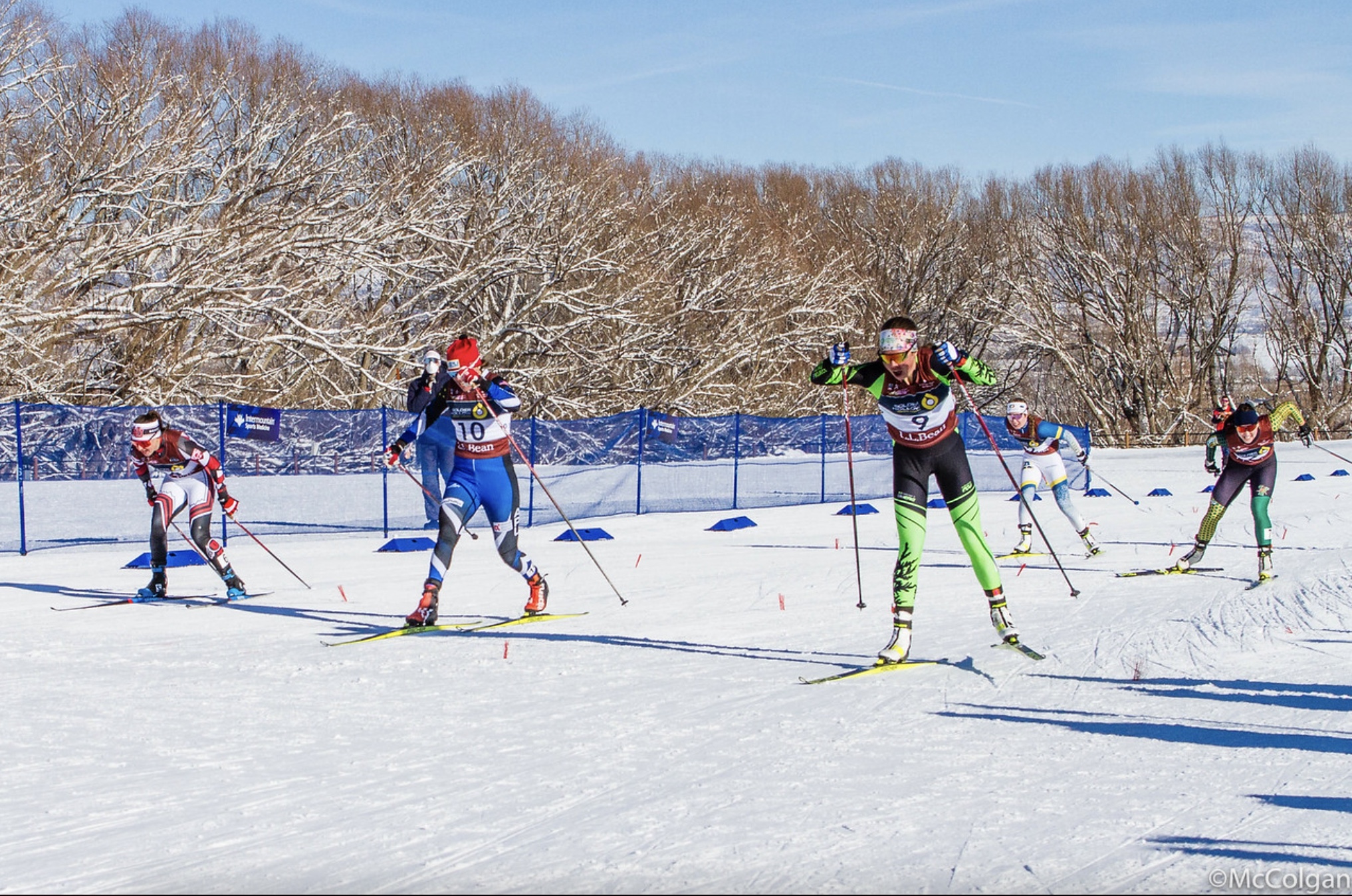
    Alex Lawson skates to 7th in the 10 k skate during OPA Cup Finals in Sappada, ITA. (Photo: Bryan Fish / NNF)

    While the OPA Cup crew was putting together a very solid day in the 10/15 k skate, the team of Rosie Brennan, Zak Ketterson, Scott Patterson, and Jessie Diggins had taken the win in the thrilling 4 x 5 k mixed relay in Falun. As the team in Sappada mingled near the finish to support the final racers as they skied through, Anderson said that a Swiss national team coach walked over and showed them the World Cup result on the phone. 

    Layered on top of the broader success at the OPA Cup Finals, Anderson expressed that this opened her athletes’ eyes to what might be possible for them in the years to come also. In particular, the Falun results of Zak Ketterson, a newcomer to the World Cup who ended his debut season with a 15th place finish in the 15 k skate and a mixed relay win.

    “[The guys racing at OPA Cup] are like, ‘Oh, man, I beat Zak sometimes’, or ‘I’m right with him’, ‘I trained with him in college.’ The level of confidence that brings… ‘Maybe maybe I can do that too.’”

    Moreover, Anderson expressed that this relay gold medal speaks to the equity of skiing in the US. “That we have good female athletes, and we have good male athletes, and we have a good balance of the two, and teams that are mutually supportive of each other,” she said. “Not every country has that.” 

    Boiling down the experience and her feelings as the season wraps up, Anderson concluded, “I have nothing but good things to say about our athletes right now. I’m really impressed with them. They handle the change better than anyone, and I think as a staff and from an organizational perspective, we’re trying to keep up, remove barriers, make sure they’re supported. And we’re open to trying new things, and it seems that we’re excelling in places where we’re willing to experiment and get our feet wet.”

    Kate Oldham (AVSC) races the 10k classic during Opa Cup Finals in Sappada, ITA. (Photo: Bryan Fish / NNF)

    Providing additional insights from the perspective of an OPA Cup Finals first-timer, FasterSkier also heard from U20 athlete Kate Oldham, who trains with the Aspen Valley Ski & Snowboard Club (AVSC) and competes for Middlebury College. Oldham took 11th place in both the 10 k classic and skate in the junior women’s category. 

    “Sappada was incredible,” Oldham wrote. “In congruence with the pre-camp in Toblach, the OPA Cup trip was unforgettable… My favorite ski to-date was on a long ski over the pass from Cortina to Toblach, stopping midway for trail side pastries and cappuccinos! Being with a group of older athletes was a valuable change from the World Junior trip because each team member brought new energy and experience to the group. Between that and the gelato shop next door to our hotel, the trip couldn’t have gotten much better!  

    “One of the things I think are most valuable about training and racing camps is the exposure to coaches and athletes outside one’s home team. For years I have been seeking out opportunities to attend regional and national camps that would bring new perspectives, training groups, and social dynamics to push me and help me adapt my own training method while making friends from schools and clubs all over the country. This winter I was lucky enough to have both my club coach and a group of skilled and passionate wax technicians/trip leaders selected from all around the US to lead the trips to Junior World Championships and OPA Cup finals. I know that over the six years I’ve been skiing competitively I have developed the competence to independently navigate high-level skiing events, but having techs to guide me through the process at the international level was extremely helpful, particularly when one of them I had worked closely with for those six years of training and racing.

    “With new coaches come new perspectives. Another set of eyes, a different experience, or a new phrase can be all it takes for the pieces of new advice to click into place. Or maybe a coach has a different perspective on the bigger picture of skiing that resonates with you unlike the philosophy you previously knew… which of the infinitely wide range of mindsets in ski racing works best for you? Which one reminds you why you love ski racing? Which one helps you stay motivated through the hardest parts of the season when the last thing you want to do is get out the door for training? Which one eases the heartbreak of coming so close to a goal but falling short despite your hardest effort? Without a doubt, cross country skiing is a delicate balance of internal and external factors, but having great teammates and coaches like the ones I got to know and work with in Europe this winter is certainly a key ingredient to the recipe for success in the lifelong pursuit of excellence on the race course and off.” 

    Full Results for OPA Cup Finals

  • Fresh Snow and World Class Grooming Set the Stage for a Weekend SuperTour Distance Pursuit in Craftsbury

    Fresh Snow and World Class Grooming Set the Stage for a Weekend SuperTour Distance Pursuit in Craftsbury

    In the wake of a winter storm, athletes found ideal race conditions for a weekend of distance racing at the Craftsbury Outdoor Center, which hosted the Henchey Memorial Carnival. (Photo: NENSA Facebook Page)

    By Ian Tovell and Rachel Bachman Perkins

    Find FasterSkier’s coverage of Friday’s freestyle sprints here

    Saturday: 10 k Interval Start Classic

    After another 4+ inches of snow fell throughout the day on Friday, NENSA described the conditions for today’s 10-kilometer interval start race as a “banner day for classic skiing” on the two-lap course at the Craftsbury Outdoor Center. The weekend of racing, titled the Henchey Memorial Carnival, included athletes of all levels, was described as “a celebration of the type of ski racing that [the late Bill Henchey] loved.” All three stages scored points toward the U.S. SuperTour Standings, while Friday and Saturday encompassed the UVM Carnival, and Saturday and Sunday’s distance races were part of NENSA’s Eastern Cup race series that allows developing athletes to qualify for Junior Nationals.

    Results from the 10 k classic stage on Saturday established the start order and deficit for Sunday’s 7.5/10 k freestyle pursuit. The women took to the course first on Saturday at 9:45, with the men following at noon.

    As the women lapped through the 5 k checkpoint, a familiar name topped the standings. Friday’s sprint winner Katharine Ogden (SMS T2) came through the halfway point in a time of 15:23.5. Rosie Frankowski (APU) was in second, 5.3 seconds back, while Alayna Sonnesyn (SMS T2) came through in third (+9.4). Second alternate for the Canadian Olympic Team, Jasmine Drolet (DAR) came through in fourth (+14.9), with Becca Rorabaugh (APU) right behind in fifth (+15.0).  Ava Thurston (Mansfield Nordic Club) was 8th (+36.2), as the first U18 skier through the 5k mark.

    Over the second lap, Ogden held onto her lead, claiming her second victory of the weekend in a time of 30:59.8. Though she has won all three SuperTour sprint races she has entered, this is Ogden’s first domestic distance win of the season. She was second to Caitlin Patterson (CGRP) in the 10 k classic in the U.S. Cross Country Championships in early January, then took second to Rosie Brennan in the same event the following weekend in Sun Valley.  

    The race today was a lot of fun,” Ogden wrote to FasterSkier after the race. “It was a gorgeous Vermont day. Sunny, new snow, perfect grooming. Basically, a wonderful time. I love racing in Craftsbury with so many people I love. I also had some awesome skis, which is always a blast. It was especially fun to have my mom and dad and sister there! In terms of pacing and tactics, this course really has a lot of constant output, so I was mostly just focusing on skiing well and smoothly, and taking advantage of swapping between doublepole and striding to get little bits of recovery where I could. I got to ski with a little pack of EISA people (past and present) at the very end, which was fun.”

    SMS T2 went one-two, as Sonneysn was able to catch and overtake Frankowski, placing second (+26.6) and third (+26.8), respectively. Yet another Sonnesyn-Frankowski matchup… 

    The women’s 10 k classic podium after the second day of SuperTour racing in Craftsbury, VT. (Photo: Craftsbury Outdoor Center/John Lazenby)

    Rorabaugh crossed in fourth (+29.3), with Drolet rounding out the top-five (+34.4). Thurston was able to stay in the top-10 placing ninth (+2:18.5). 

    As the first collegiate racer, Drolet (DAR) topped the EISA podium with a time of 31:34.2. Yesterday’s collegiate sprint winner, Anna Bizyukova (UVM) was second (+36.1) and tied for seventh overall (+1:09.5). Erin Bianco (CBC) placed third (+58.3) and took the final spot in the top-10 overall (+1:31.7).

    In the men’s race, it was between two athletes through the 5 k mark; Adam Martin (CGRP) went through with a time of 13:18.6 with Zak Ketterson (Team Birkie) only 2.1 seconds behind. Johnny Hagenbuch (SVSEF) was third (+9.3) at the half, with teammate Peter Holmes (SVSEF) in fifth (+15.0).  Sitting in fourth was Finn O’Connell (BSF Pro), but his split did not register as he crossed the checkpoint.

    Adam Martin races the 10 k interval start classic during the Henchey Memorial Carnival in Craftsbury, VT. (Photo: Craftsbury Outdoor Center/John Lazenby)

    Martin was able to hold on for the win, closing the race with the fastest second lap split. Taking the win at home, he stopped the clock at 26:56.9. Martin took second in last weekend’s 10 k mass start free in Lake Placid, and won the 15 k classic at both the U.S. Cross Country Championships in Soldier Hollow, and the second SuperTour race weekend in Cable, WI.

    Yesterday’s sprint winner Ketterson held solidly onto his position, finishing in second (+12.4), while Hagenbuch came through in third (+24.4). 

    I’m really psyched to win today,” Martin wrote in a post-race email. “Interval start classic races are my favorite, so racing today at Craftsbury was close to my ideal race. A big snow storm came through Thursday night into Friday, so today’s near perfect conditions are a testament to our incredible grooming crew. I started toward the end of the A-seed directly in front of Zak Ketterson. I believe Zak put some time on me in the first 3 or 4 k, but I was able to claw that back by the lap mark and narrowly increase my lead by the finish. It deserves mention in all races, but at home when I know many of the volunteers, I especially want to thank everyone who came out to help put the races on, and as always our incredibly hard working wax techs.”

    The men’s 10 k classic podium after the second day of SuperTour racing in Craftsbury, VT. (Photo: Craftsbury Outdoor Center/John Lazenby)

    O’Connell finished fourth (+29.5) in the men’s overall, with Karl Schulz of Sun Valley next to round out the top-five (+38.1). It was a strong day for the Craftsbury Green Racing Project and the Sun Valley Gold Team, as both placed three skiers in the top-10.  

    In the collegiate race, Finn Sweet of UVM took first in a time of 28:08.5 beating two fellow Vermonters. Peter Wolter (MID) was not far behind, coming in second (+1.7). Fellow UVM skier, Gregory Burt finished third (+3.7). These athletes were 11th, 12th, and 14th in the overall standings, respectively. 

    10 k Classic Results:

    Women | Men

    Sunday: 7.5/10 k Freestyle Pursuit

    The final day of racing in the Henchey Memorial Carnival featured a pursuit start for the 7.5/10-kilometer freestyle races, with start order and time back from the first starter determined by the previous stage’s results. Switching the order of the previous day, the men took to the course first, with Adam Martin (CGRP) heading out 12 seconds ahead of Zak Ketterson (Team Birkie). Johnny Hagenbuch (SVSEF) left the gate 24 seconds back, with Finn O’Connell (BSF Pro) next (+29.0), and Karl Schulz (SVSEF) starting fifth (+38.0).

    With live timing giving splits solely based on time of day, overall position was tough to track from afar. As racers lapped through the 5 k checkpoint, Schulz had skied the fastest first lap, coming through midway in a time of 12:29.4. Goble Reid of BSF Pro came through with the second fastest time (+9.5), just ahead of teammate O’Connell (+10.3). Reid had started 13th, 1:18 back from Martin. Sam Wood (+12.9) of Sun Valley came through with the fourth-fastest time after starting 12th overall, 1:14 back. “Retired” long-time Craftsbury Green Racing Project team member Ben Lustgarten rounded out the top-five fastest splits at the midway point (+ 13.6).  Both Martin (+37.8) and Ketterson (+25.4) were outside the top-10.  

    As mentioned, lap splits only tell part of the story. As the overall winner of the pursuit is whoever crosses the line first, moves and countermoves at the front of the field tell the true story of the day. Wearing a target on his back, Martin was quickly chased down by yesterday’s podium athletes, Ketterson and Hagenbuch. Lapping through the stadium, all three athletes raced together, heading out what would be a tactical second half. In the hunt were O’Connell and Schulz, both of whom were also within reach of the podium.

    In the final kilometer, Hagenbuch began to lead the charge toward the finish, creating a small gap to Ketterson and Martin who were evenly matched as the leaders headed into the finish lanes. Hagenbuch held his advantage through the finish to stop the clock in a time of 26:02.0, which would also be the third fastest time of day.

    Johnny Hagenbuch (SVSEF) pulls away for the win in the men’s 10 k freestyle pursuit, while Adam Martin (CGRP) and Zak Ketterson (Team Birkie) fight for second and third. (Photo: Craftsbury Outdoor Center/John Lazenby)

    Dead even through the finish, Martin and Ketterson both crossed 1.2 seconds behind Hagenbuch, with second place going to Martin and third to Ketterson. O’Connell was next to the line for fourth (+3.3), with Schulz skiing the fastest time of day to take fifth (+13.0).

    “It was a really fun weekend of racing in Craftsbury!” Hagenbuch wrote in a post-race email. “This was the first time I’ve competed here since I was a junior in high school in 2019, and happily the courses are much less intimidating now than they were then… The conditions for the classic race were just about as perfect as it gets; we may have raced on Blue Extra kickwax.”

    Hagenbuch also provided a detailed look inside the men’s race, adding his own approach to the day, recognizing his time deficit and strengths. 

    “Being only 24 seconds back from Adam Martin at the start of the pursuit, I was pretty confident that I could at least catch him. I started with some intent, and I was able to reel in Zak Ketterson and Adam as Finn O’Connell and Karl Schulz reeled me in. The level of exertion dropped a lot once I caught the leaders, and I just tried to ski as smoothly as I could for the remainder of the first lap and the first half of the second five-kilometer lap. I picked up the pace at the start of the long climb from the low-point of the course – the one that includes ‘Screaming Mimi’ – and tried to hold high power through the climb. I established a decent gap – something that I didn’t necessarily expect – but had to keep pushing to hold off the chase group. Fortunately, I was able to maintain the lead and relax a little bit into the finish.”

    The men’s podium after the 10-kilometer freestyle pursuit in Craftsbury, VT. (Photo: Craftsbury Outdoor Center/John Lazenby)

    This is Hagenbuch’s third consecutive 10 k freestyle win of the season; he also stood atop the podium after racing on his home trails in Sun Valley, then again following the 10 k free in Lake Placid two weeks later. Putting together a solid weekend in Craftsbury, the 20-year-old was also third in the sprint qualifier on Friday, which he described as “one of his bests”. A member of the 2022 Junior World Championships team, and a soon-to-be Dartmouth College student, Hagenbuch concluded with insight into what lies ahead for him over the next few months.

    “I’ll stay in Craftsbury this week, and then I’ll go directly to the pre-camp for World Juniors/U23s in Norway, which will actually be my first time to the country. Post-World Juniors, I’d like to remain in Europe for whatever competitions are offered to me. I would then go directly to SuperTour Finals in Whistler. From Canada, I would leave on March 28th to miss the first day of school and start classes on Tuesday in Hanover. It will be a whirlwind, but I’m really looking forward to it!”
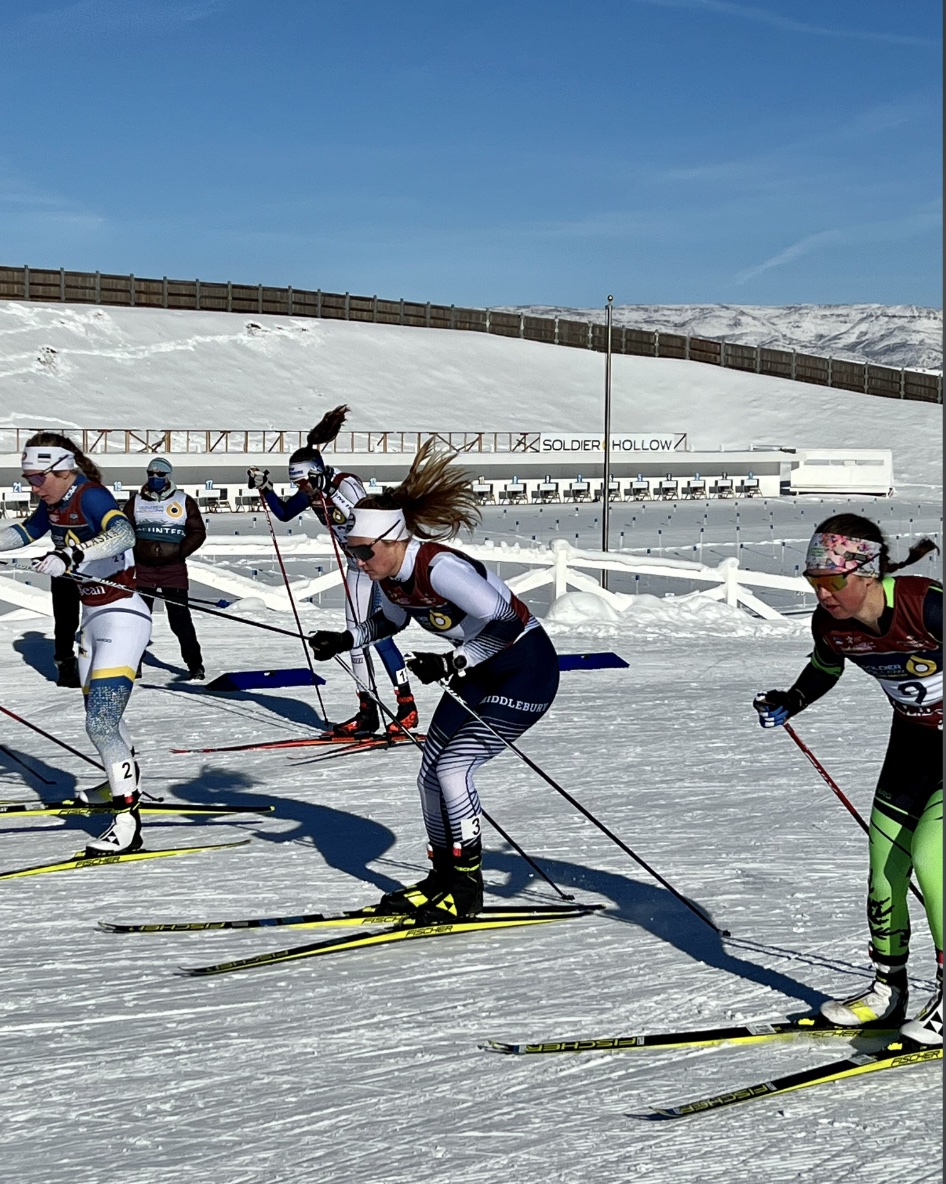
    As only Friday and Saturday’s events were part of the UVM carnival, collegiate race numbers dwindled on Sunday. The top EISA skier for the second day in a row was Finn Sweet (UVM) with a winning time of 27:44.6. Going one-two for UVM, teammate Bjørn Westervelt was the second collegiate skier across the line (+3:04.4), while Bowdoin’s Carson Williams finished third (+3:59).

    Katharine Ogden leads the women’s 7.5 k freestyle pursuit in Craftsbury. (Photo: Craftsbury Outdoor Center/John Lazenby)

    In the women’s 7.5 k pursuit, Katherine Ogden (SMS T2) was first on course with a sizable gap to the next racer. Her teammate, Alayna Sonnesyn, and APU’s Rosie Frankowski of APU Nordic headed out at 26 and 27 seconds back, respectively. Becca Rorabaugh of APU was next out of the start gate at 30 seconds back, with Alexandra Lawson of Craftsbury beginning 42 seconds back as the fifth starter. 

    Working to close the gap to Ogden during the first lap, Frankowski skied the fastest split through the 3.75k checkpoint with a time of 9:27.0 with Sonnesyn skiing the second fastest split  (+1.9). Their work proved effective, as they caught the leader and lapped through the stadium as a group.

    Rorabaugh had the third fastest 3.75 k split at the half (+14.7), while Lina Sutro (SMS T2) of SMS T2 skied the fourth fastest (+16.7) and Lawson the fifth (+15.9).

    In Craftsbury’s Day 3 recap video (embedded below),  produced by Mountain X Media, Frankowski described the second lap as “cat and mouse” as each of the athletes took advantage of her individual strengths to push different sections of the course. Eventually, Ogden began to fall off the pace, while Sonnesyn and Frankowski stayed tight through the final kilometer. 

    Rosie Frankowski (APU) leads Alayna Sonnesyn (SMS T2) and Becca Rorabaugh (APU) up a climb during the women’s 7.5 k freestyle pursuit in Craftsbury. (Photo: Craftsbury Outdoor Center/John Lazenby)

    In the end, Sonnesyn found the advantage, heading into the finish lanes with a gap over the other two women to take the win in 19:40.5. Frankowski crossed 3.5 seconds back for second place, with Ogden taking third after a 23.5 second gap. Rorabaugh was fourth (+31.3), with Lawson fifth (+57.5). U18 standout Ava Thurston (Mansfield Nordic Club) skied her way from 9th to 6th (+1:31.8).

    “I felt really good today and am excited about that!” Sonnesyn wrote to FasterSkier after the race. “It’s been a lot of racing the last 10 days and I was feeling the fatigue start to accumulate, but I’m also feeling confident in my distance skate skiing right now, so I was pretty excited to work hard out there.”

    Over those ten days of racing, Sonnesyn has raced in five events and only missed the podium once in Friday’s freestyle sprint. She also won the 10 k mass start freestyle last weekend in Lake Placid.

    “It was really fun to do a pursuit race today! We don’t typically do pursuits in the U.S. and the last few years I’ve only competed in World Cup pursuits where I started in the wave, so it was a unique and exciting day. I knew Rosie, Becca and I would want to work pretty hard in the beginning to chase down Katharine and that’s exactly what we did (although we never outwardly spoke about this plan with each other). We charged pretty hard from the start and once we became a full pack we started playing a little more cat and mouse on the second lap. We were all trying to conserve energy for the final few kilometers while also keeping up the pace, which made for some tactical racing. 

    “The last 1.5k are pretty much all uphill. From the bottom Rosie started charging again and I hung on. Prior to reaching the super steep pitch on Screaming Mimi, I put in a surge so I could take the most direct route around the corner. From there, I put my head down and gave it everything I had left up the last bit of the climb and into the finish.”

    The women’s podium after the 7.5 k freestyle pursuit in Craftsbury, VT. (Photo: Craftsbury Outdoor Center/John Lazenby)

    A graduate of UVM and now a member of the Stratton Mountain School T2 team, Sonnesyn has perhaps spent more of her competitive ski career based in the Northeast than near her childhood home in Plymouth, MN. 

    “The Midwest will always be my home but Vermont has become my second home the past eight years. It was pretty incredible hearing so many people cheering my name this weekend and definitely kept me charging up those hills. Really fun to be around such a great ski community and feel the love for the sport. Makes me appreciate this sport and all of the people in it!”

    Wrapping up with her next steps, the two-time American Birkebeiner champion (2019 and 2021) has her eyes set on the Midwest’s marquee event. 

    “I’m currently en route back to the Midwest to spend a few weeks at home training for the Birkie. I’m excited to be back and the fever is definitely setting in!”

    In the collegiate standings, UVM’s Annie McColgan took the win as the Catamounts topped both the men’s and women’s EISA podiums. McColgan’s time of 22:57.0 put her in 14th overall in the women’s standings. The second collegiate athlete was Emma Strack of St. Lawrence University (+2:20.9), with teammate Charlotte Browne in third (+6:15.5). 

    *****

    As Period III draws to a close, the SuperTour race calendar breaks for the remainder of the 2022 Olympic Winter Games. The next race event will be the 50 k American Birkie, kicking off on February 26 in Hayward, WI.

    7.5 / 10 k Freestyle Pursuit Results

    Men | Women

  • Race Rundown: Lake Placid SuperTour Continues with 10k Mass Start Free

    Race Rundown: Lake Placid SuperTour Continues with 10k Mass Start Free

    Here’s a quick results recap from today’s SuperTour 10-kilometer mass start freestyle race in Lake Placid, NY. Stay tuned tomorrow for detailed coverage including comments from athletes. 

    Racing continued at Mt. Van Hoevenberg this morning in what Weather.com called “bitterly cold” conditions. Near-zero temperatures and skate skiing can be a challenging combination for a distance race on a World Cup–level course, but racers nonetheless put together strong performances on the three-lap 10-kilometer course.  

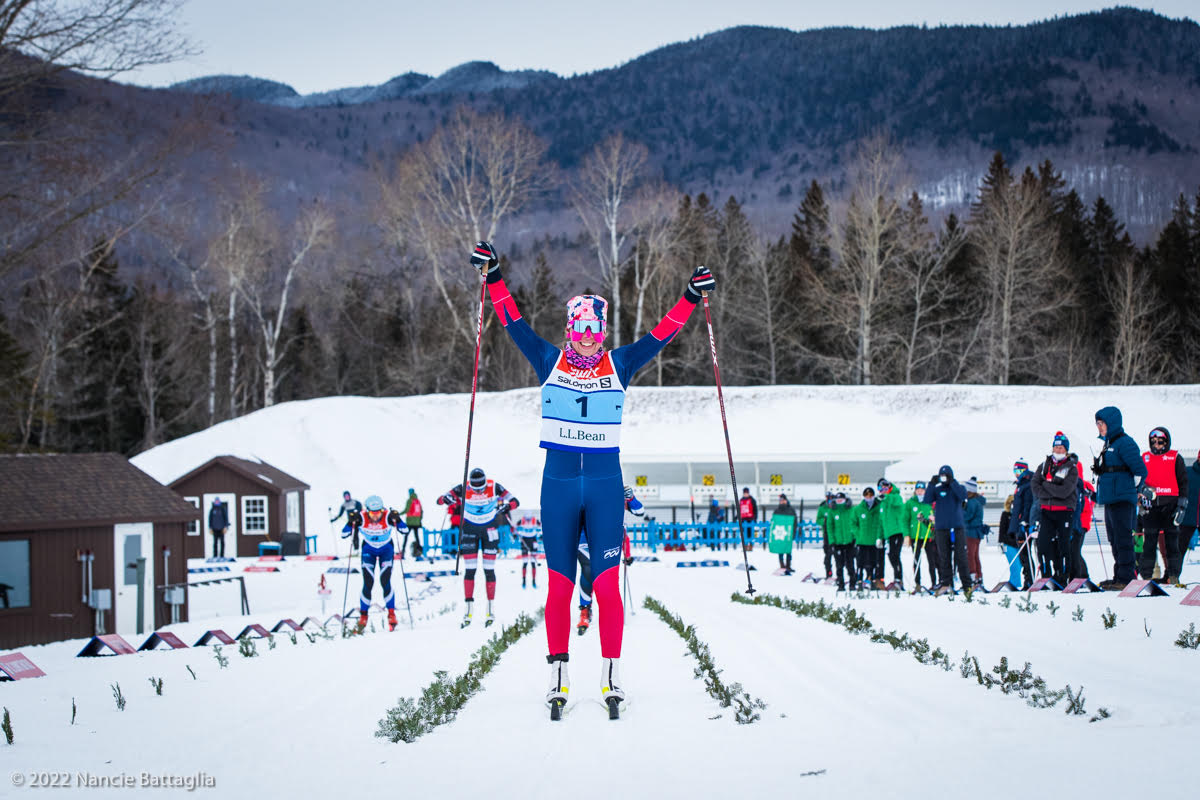
    Skiing on her own, Alayna Sonnesyn (SMS T2) closes a gap to leader Rosie Frankowski (APU) to win the women’s 10k skate in Lake Placid. (Photo: © 2022 Nancie Battaglia)

    In the women’s race, Rosie Frankowski (APU) set the pace with a fast start, leading through the 9k checkpoint. Having steadily reeled her in, Alayna Sonnesyn (SMS T2) caught Frankowski in the final kilometer, pushing ahead in the final meters to take the win in 28:57.1. Frankowski crossed the line in second (+3.7), with APU Teammate Becca Rorabaugh leading a chase pack to the finish to cross third (+36.6).

    The men raced second today, with BSF Pro Team’s Finn O’Connell leading a sizable group through 6.6k. From there, SVSEF Gold Team member Johnny Hagenbuch turned up the pace, creating a gap over the final lap to finish unopposed in 24:35.3. Duking it out to the final stretch, Adam Martin (CGRP) took second (+11.6), roughly two seconds ahead of Peter Wolter (SVSEF) in third (+13.8). 

    Johnny Hagenbuch (SVSEF) leads the men’s 10k mass start skate in Lake Placid. (Photo: © 2022 Nancie Battaglia)

    Results:

    Men | Women

  • Ketterson and Ogden Take Classic Sprint Win on New Tracks at Mt Van Hoevenberg

    Ketterson and Ogden Take Classic Sprint Win on New Tracks at Mt Van Hoevenberg

    By Rachel Bachman Perkins and Ben Theyerl

    After a brief break, the SuperTour picked up in Lake Placid this weekend, with a fluoro-free Period III kicking off with a 1.5-kilometer classic sprint. The frigid forecast called for overnight lows of -5 Fahrenheit, with a wind chill as low as -23F. Highs during the day were only predicted to climb into the low single digits. Qualifiers were scheduled for 10/10:45 am, with quarterfinals for the open men beginning at noon – hopefully, enough time for a few degrees of warmth to reach the trails. 
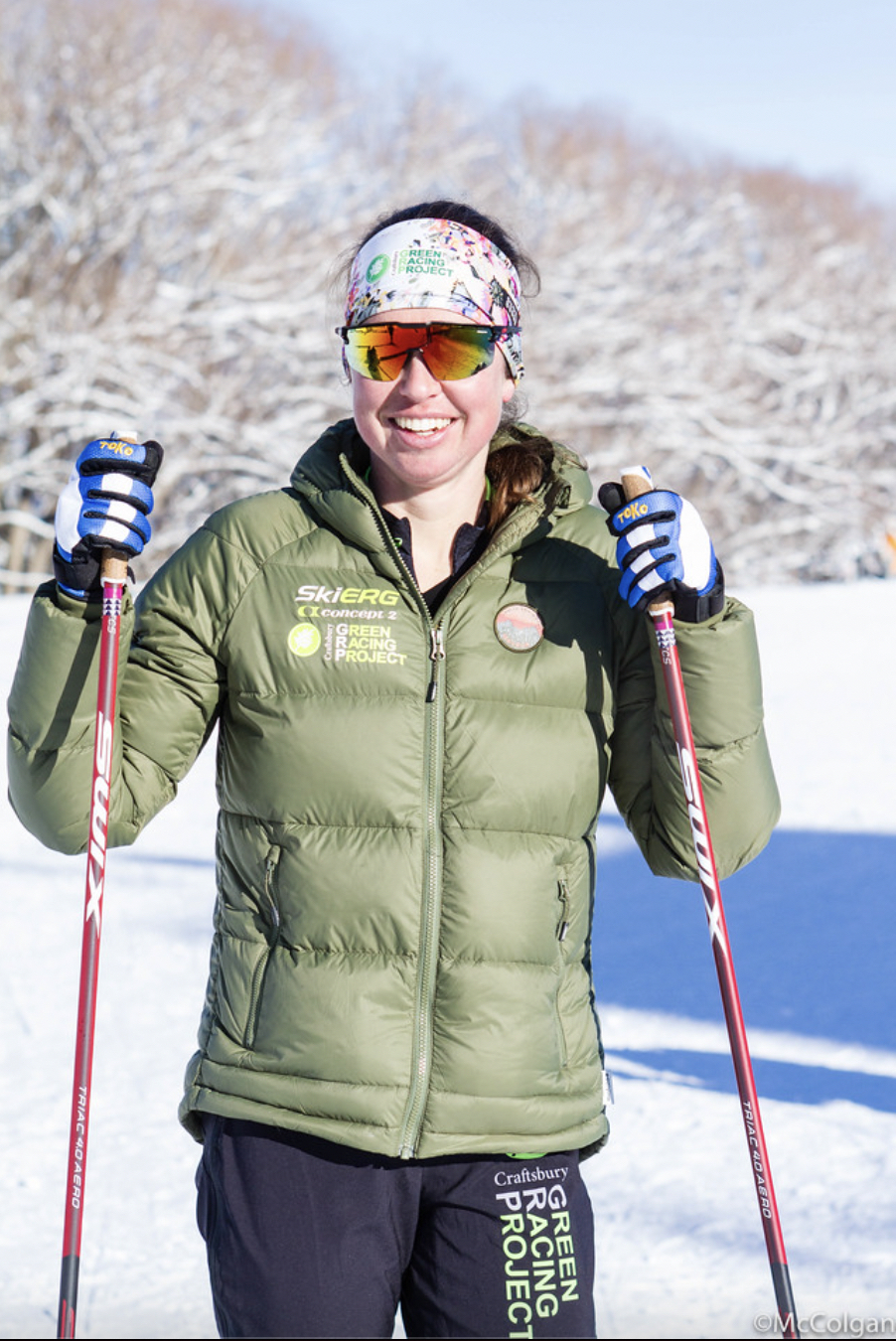
    The weekend competitions would be hosted on Mt. Van Hoevenberg’s new World Cup trails, which are paved for rollerski use in the summer, and played host to NENSA’s “Keys to the Castle” sprint event in September. For those familiar with the venue, the new courses are tucked into the north-facing hillside, just south of the 1980 Olympic stadium and biathlon range. The new serpentine loop intersects with the final Ks of the classic “Ladies 5” outer loop, but overall remains closer to the stadium to allow access to the recently improved snowmaking system. 

    Jessie Diggins (SMS T2/USST) pushes over the climb during the final round of the Keys to the Castle sprint. (Photo: Matt Whitcomb)

    With a large reservoir and advanced technology, this new World Cup loop can be made winter competition ready within four days, though Van Hoevenberg’s nearly 50k of open trail might suggest that coverage is not currently an issue.

    There was praise for the course from many athletes, including those that have seen both Lake Placid, and everywhere in the world beyond Lake Placid. 

    “It raced much more like a world cup course!” said Alayna Sonnesyn (SMS), in an email to FasterSkier. Katharine Ogden (SMS) too, said of the course, “it was WAY more fun than the old one…[which] was pretty flat.”

    The course designers at Lake Placid seem to have carefully been taking notes on what makes sprint racing exciting over the course of its evolution as a discipline in the sport. An historic venue for American skiing, these developments may be a long-time coming for Mt. Van Hoevenberg, but it’s clear that they were executed with mastery so VanHo can continue to expand upon its legacy in the decades to come. 

    This course featured a long, final uphill climb to test a skier’s mettle, then a short, technical downhill into the finish to test their tactical brains. And in between; transitions, transitions, and more transitions.

    Becca Rorabaugh (APU) said of this : “The final climb always turned into a drag race, and I liked the pitch because it favored a bit of a stride over an all-out run. Skiers still had to be alert through the downhill and finish, though; positions often changed in the stadium.”

    The weekend, hosted by the Olympic Regional Development Authority (ORDA) in Lake Placid, also served as the second NENSA Eastern Cup weekend. Thus, senior athletes from American elite clubs lined up alongside regional junior racers, eastern collegiate racers, and Canadian athletes who traveled from Quebec, Ontario, and beyond. 382 athletes, 176 women and 206 men, on the start lists for the qualifier, and separate heats were run for the U18/U20 and U16 categories. 

    Without livestream, FasterSkier has relied on live timing and athlete interviews to shed light on how the sprint races unfolded. 


    Men’s 1.5-kilometer Classic Sprint

    After returning from a stint in Europe where he raced the Tour de Ski, Team Birkie’s Zak Ketterson set the mark in the men’s qualifier, stopping the clock at 3:04.79. Sun Valley’s Peter Holmes skied the next fastest time in qualification (+0.72), while Étienne Hébert was just behind in third (+1.41). Hébert hails from Quebec and currently trains at the Centre National d’Entraînement Pierre-Harvey (CNEPH), based at Mont Ste Anne.

    Each of these men moved smoothly through the rounds, with Ketterson getting edged out by Bill Harmeyer (SMS T2) in the first semi, and Homes and Hébert going 1-2 in the second. Racing in the second semi saw a tighter spread and faster times, bringing Julien Locke (Black Jack Ski Club) and Logan Diekmann (BSF Pro) who had finished a close third and fourth, respectively, along to the final as lucky losers. 

    Zak Ketterson (Team Birkie) leads his heat during the 1.5-kilometer classic sprint in Lake Placid. (Photo: © 2022 Nancie Battaglia)

    The final featured a tight finish among the top four men, with Ketterson off the front to finish in 3:04.71, earning his second consecutive classic sprint victory. Ketterson had dominated the classic sprint in Cable, WI, and stood at the top of the SuperTour leaderboard, thereby earning start spots for the Tour de Ski. The timing of the Tour caused him to miss the subsequent classic sprint in Soldier Hollow, UT. 

    During the Tour, his first World Cup starts, Ketterson was less than a second shy of qualifying for the classic sprint heats in Oberstdorf, Germany, and had been roughly five second out of the Top-30 the day prior in a 15k skate. He was the only American on the men’s team to finish the Tour. After the Tour, Ketterson made a quick turnaround to attend the weekend of distance racing in Sun Valley, Idaho, where his results (15th in the 15k classic and 34th in the 10k free) were far below what might be expected from him. 

    Zak Ketterson races the freestyle sprint qualifier in Lenzerheide, SUI, the first event of the 2021/22 Tour de Ski. (Photo: NordicFocus)

    In a post-race email to FasterSkier, Ketterson shared how he felt about the Tour and what the recovery process has been like for him. 

    The Tour de Ski was a fantastic learning experience with lots of ups and downs. I am pretty happy with my performance on the Tour given it was my first time on the World Cup, but I definitely think I will be faster next time around now that I have had the experience. Post Tour I was incredibly empty, both physically and mentally. To have to change gears pretty much immediately after the last stage of the Tour and head straight to Sun Valley for some super competitive SuperTour races at high altitude was definitely a recipe for disaster on my body. I felt like I was just going through the motions and my body wanted nothing to do with those races.

    “​​These last few weeks at home in Minneapolis provided me with some long-overdue recovery. My hunch after some really lackluster racing in Sun Valley was that there was no need to overthink anything and that the issue was probably just that I was tired. I took time at home to mentally and physically reset and started to feel a lot more like myself as the Placid races approached. Today, it all came together and I felt a lot more race-ready.”

    Ketterson also commented on the improvements that have been made at the Mt Van Hoevenberg venue, explaining how it supports the growth and elevation of domestic skiing.

    “I am blown away with the venue at Mt. Van Hoevenberg! The venue truly feels like it’s ready for World Cups, or even another Olympics. It’s really inspiring to see big investments into nordic skiing venues in the United States, and I can’t stress enough how big it is for us athletes. I can’t wait to come back to Lake Placid sometime later to really experience this place because I think it’s so awesome here.”

    Behind Ketterson, just 0.26 seconds separated second through fourth in the men’s final. Holmes won the boot slide to snag second (+0.72), while Harmeyer took the final podium spot in third (+0.92). Hébert was just 0.06 seconds shy of the podium, ending the day in fourth (+0.98).

    The men’s final of the 1.5-kilometer classic sprint, the first event of the weekend of SuperTour racing hosted by Mt. Van Hoevenberg in Lake Placid. (Photo: © 2022 Nancie Battaglia)

    Harmeyer provided insights into his approach to the day, along with insights into the moves that contributed to the excitement at the finish line.

    I felt really good in the heats today,” he wrote via email. “The course was certainly difficult and tactical. Placement in the group was really important and that was especially apparent in the final. We had a group of four dudes going over the top of the final climb into the long descent before the finish. It was an absolute scramble trying to get into the tracks on that final downhill. At one point, I had my left ski in the right part of the track and Étienne had his right ski in the left side of the track. Not easy to squeeze two guys going 30+ mph into a single track but somehow, I came out ahead which was just enough to lunge at the finish for third.”

    During Period I, Harmeyer took third in the classic sprint final in Cable, and was just off the podium in fourth the weekend prior after the freestyle sprint in Duluth, MN. After qualifying in fifth, a crash in the quarterfinal left him 24th in the freestyle sprint in Soldier Hollow during the U.S. Cross Country Championships. A few days later, he was 51st in the 15k classic. In the Soldier Hollow SuperTour classic sprint, Harmeyer qualified in fourth, and just missed the final to end his day in eighth. 

    Reflecting on the season as a whole, Harmeyer wrote, “I had a really good start to the season with some strong races in the Midwest. But overall, things have been frustrating. I’ve been struggling with some cold weather triggered exercise induced asthma that got really bad after the first supertours in the Midwest. I continued to struggle with it through a disappointing Senior nationals and decided to take a bit of time off to reset, recover and do some testing. I’m hopeful the worst is behind me and that I’ve got some good protocols lined up to prevent anything from happening in the future. My primary goal for the remainder of the season is to win the Stowe Derby, specifically the derby meister.”
    Wrapping up with a comment on the venue, Harmeyer added, “The new courses at Lake Placid are sweet! The sprint course is incredibly tactical but also rewards tough, explosive skiing. I had an absolute blast out there in the heats. The distance courses are hard but I’m excited to be doing a mass start on those for this Sunday. Overall, Van Ho has done a great job with course management and their snowmaking to put together some killer courses.”

    After a gap, Diekmann crossed the line in fifth (+5.81), while Locke rounded out the men’s final in sixth (+9.11). 

    The men’s SuperTour classic sprint podium on a frigid day of racing at Mt Van Hoevenberg near Lake Placid, NY. (Photo: © 2022 Nancie Battaglia)


    Women’s 1.5-kilometer Classic Sprint

    The women’s field began right where it left off in SuperTour classic sprints, with the winner of the last race at Soldier Hollow, Katharine Ogden, (SMS) finishing the qualifier in first place (3:40.49). She was followed by Lauren Jortberg (BSF Pro Team) in second (+2.2), and Ava Thurston (Mansfield Nordic Club) in third (+6.1). The qualifier indicated, again, the overall strength of the field that has characterized this year’s SuperTour, with the heat qualifiers all within 30-seconds of each other (26.0 seconds to be exact).

    That field remained tight in the quarterfinals as well. All five quarterfinals saw winning times within a mere five seconds of one other, with Katharine Ogden turning in the fastest time of the round at 3:42.77, and Alayna Sonnesyn winning her heat in 3:46.12. 
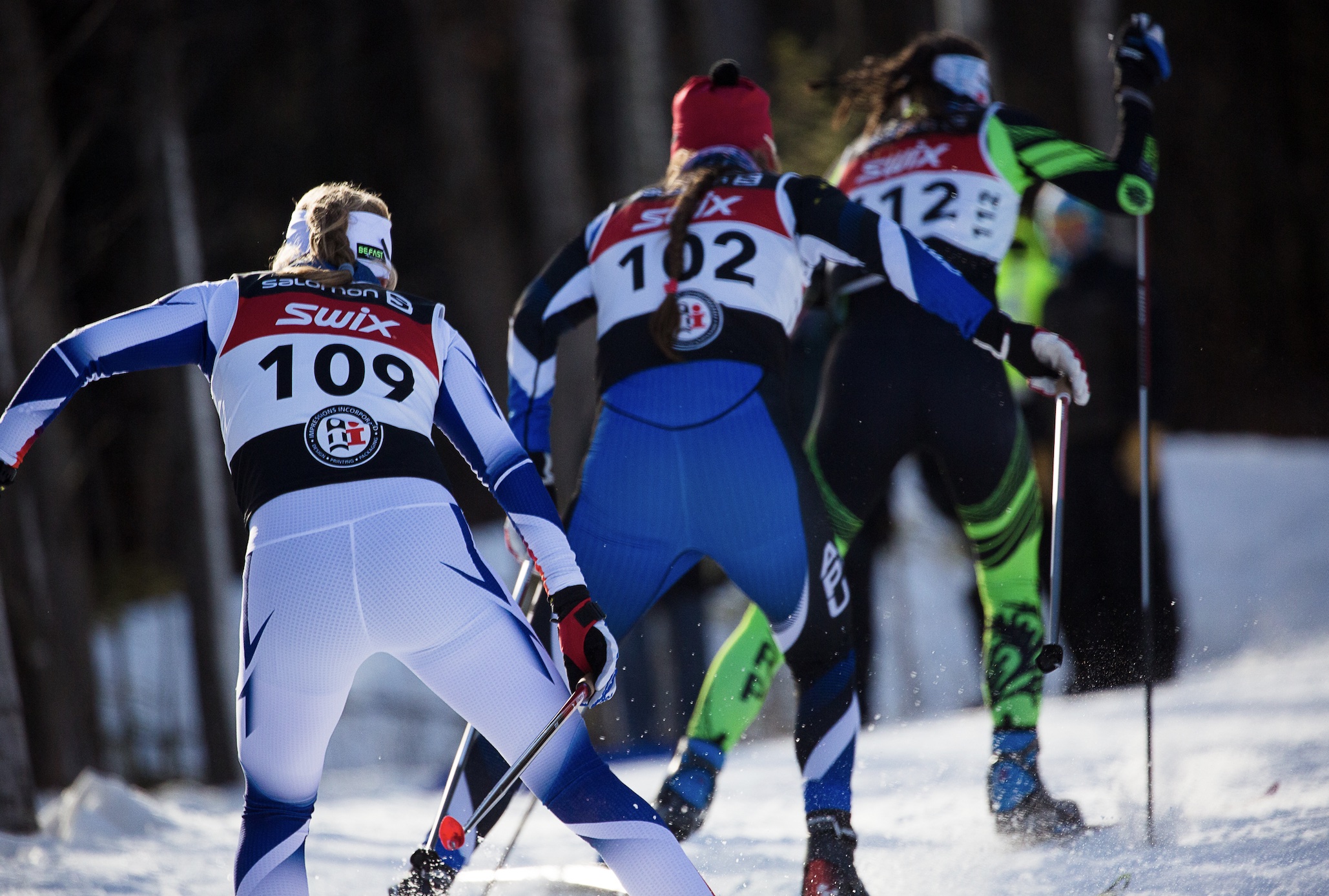
    Katharine Ogden (bib 1) races her way through the classic sprint heats during the SuperTour race weekend in Lake Placid. (Photo: © 2022 Nancie Battaglia)

    Ogden commented to FasterSkier that she “didn’t really have any strategy in particular. I find that it is better for me to make strategy in the moment during sprint heats because you never know what’s going to happen out there… I just tried to conserve as much energy as possible in the quarter and semi.” It would pay off later on.

    Meanwhile, also progressing to the semifinals was the APU one-two punch of Rosie Frankowski and Becca Rorabaugh out of quarterfinal 2. Despite being primarily known as a distance racer, Frankowski, came into today leading the SuperTour sprint classification and “set a blistering pace,” according to teammate Rorabaugh. With it, she pulled the duo into the semifinals together.
    After all the quarterfinals were through, the semifinals were set with a who’s-who at the top of the SuperTour sprint standings, rounded out by Canadian Katie Weaver (Hollyburn XC Ski Club) and Minnesotan Margie Freed (Craftsbury).

    The first semifinal featured a battle between two SMS T2 teammates, Katharine Ogden and Alayna Sonnesyn, and two APU teammates, Rosie Frankowski and Becca Rorabaugh. Frankowski again set the pace for the heat, with teammate Rorabaugh commenting that “[Rosie] is so strong on the uphills that she pulls the whole heat to a faster time.” Frankowski, however, couldn’t quite outlast Ogden and Sonnesyn, who used the downhill after the final climb to launch into the first two positions. Ogden won the heat in a time of 3:39.23, with Sonnesyn and Frankowski in second and third, respectively, by less than a second. Rorabaugh finished fourth, but along with Frankowski won the lucky loser spots into the finals – setting up another round of the SMS-APU duel.
    In the other semifinal, a close battle throughout yielded a win for Lauren Jortberg (3:45.15)  and a second place for Erika Flowers (+0.90). The result sent another teammate pairing into the finals, with both skiers coming from Bridger Ski Foundation (BSF).

    The women’s classic sprint final takes to the tracks in Mt. Van Hoevenberg. (Photo: © 2022 Nancie Battaglia)

    At Lake Placid – a place that has over the past century proved to be able to gather the entire world around skiing – it was perhaps appropriate that the women’s final would bring together three teams from across the American continent. Two from Vermont (SMS), two from Montana, two from Alaska (APU), and away they went!

    Katharine Ogden commented that the field didn’t waste any time: “It was pretty hard from the gun, as per usual.” 

    Rorabaugh, meanwhile, made a change in strategy, deciding to follow her teammate Frankowski more closely in the early part of the race. “I was trying to stay closer to the front of the pack since I had let a large gap form in the semifinal that I couldn’t make up,” she explained.

    That adjustment was one that helped create a pack that was tight throughout the race, and that was a bit harder to find a position in.

    Sonnesyn commented that this led to her having to adjust. “I had great energy but got tangled up a few times on the second hill, so I really had to ski from behind in the second half of the race,” she wrote. “Luckily, I had great skis and remained calm and was able to push through the final stretch.”

    In that final stretch, on the final hill, a “drag race,” as Rorabaugh described it, ensued. It was instigated by Ogden, who saw the final climb as the place to make her move, and made it. She came over the top in first place.

    “[I] got lucky,” she told FasterSkier. “Pat [O’Brien, SMS T2 head coach] had provided me with some really fast skis that allowed my move to stick going back down the hill.”

    Perhaps it wasn’t all luck though. Ogden came across the finish line in first place (3:40.13) after winning the qualifier, her quarterfinal, and her semifinal. It was an all-around dominant performance for one of the U.S. brightest stars in the classic sprint.

    Katharine Ogden wins the women’s 1.5-kilometer classic sprint in Lake Placid, NY. (Photo: © 2022 Nancie Battaglia)

    Meanwhile, Becca Rorabaugh had powered through the transition into the final downhill and came up with the reward of second place (+3.40), She was followed by Alayna Sonnesyn, who remained cool, calm, and collected as she skied her way through the pack to third place (+4.29).

    The final was rounded out by fourth place Rosie Frankowski (+4.74), fifth place Lauren Jortberg (+5.63) and sixth place Erika Flowers (+17.77).

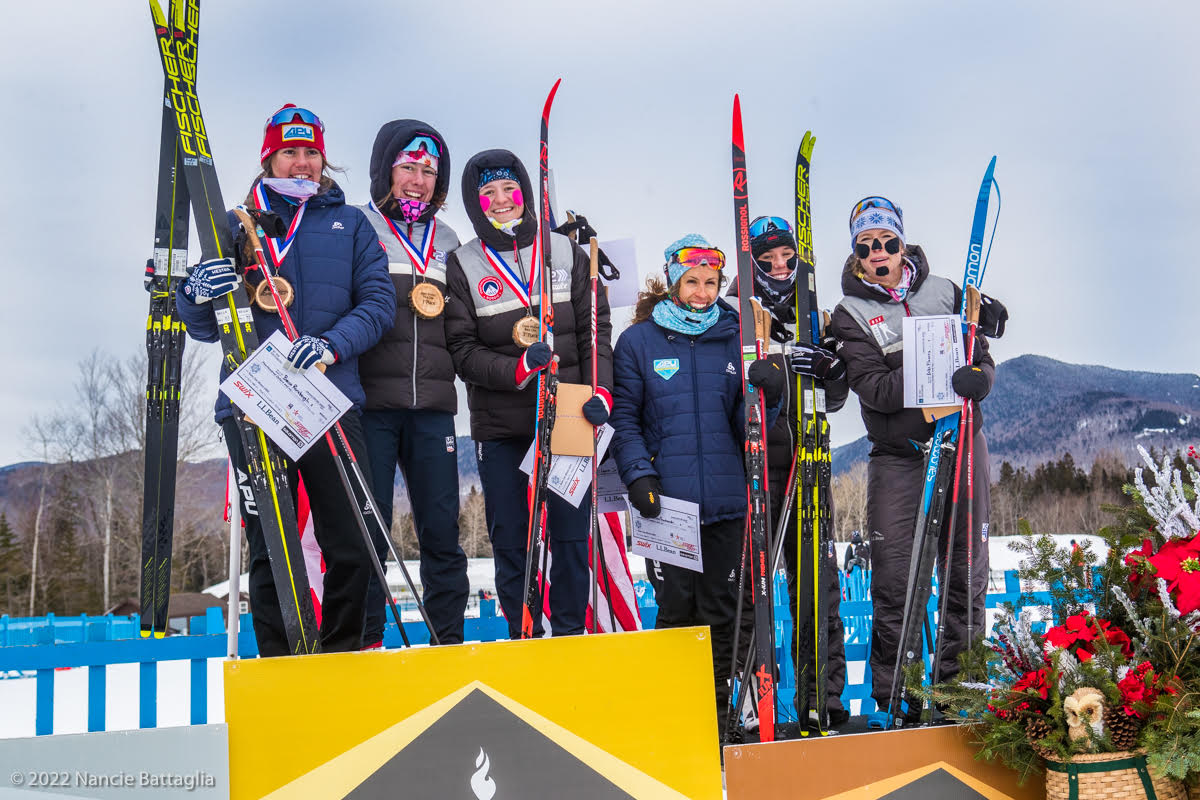
    The women’s classic sprint podium on day one of SuperTour racing in Lake Placid, NY. (Photo: © 2022 Nancie Battaglia)

    The result was reached at the end of an exciting day that encapsulated the beauty of ski racing – with excitement and energy perfectly juxtaposed against the extreme absence of that energy in the air. Preparing for cold temperatures that are forecasted again for the 10k freestyle mass start tomorrow, the top finishers today all expressed that the temps are part of the appeal in the northeast this weekend.

    From Rorabaugh, “I don’t mind cold temperatures – I grew up in Fairbanks, Alaska!”

    From Sonnesyn, “I like to think the Midwesterner in me prepared well!” 

    And from Ogden, the perfect Vermont tip: “As Sverre [Caldwell] told us last night, tricky race conditions can work to your advantage if you prepare better than anyone else. Wise man :)”


    Results

    Qualification: Men | Women

    Sprint Brackets


  • Race Rundown: Ketterson and Ogden Win SuperTour Classic Sprint in Lake Placid

    Race Rundown: Ketterson and Ogden Win SuperTour Classic Sprint in Lake Placid

    Here’s a quick results recap from today’s SuperTour classic sprint in Lake Placid, NY. Stay tuned tomorrow for detailed coverage including comments from athletes. 

    Period III of SuperTour racing kicked off in Lake Placid this morning with a frigid classic sprint. Recent improvements at Mt Hoevenberg included a new 5-kilometer World Cup and 1.5k sprint course, where athletes faced off today.

    On the men’s race, Zak Ketterson (Team Birkie) skied the fastest time in the men’s qualifier, stopping the clock at 3:04.79. Sun Valley’s Peter Holmes skied the next fastest time in qualification (+0.72), while Étienne Hébert (CNEPH) was just behind in third (+1.41).

    The men’s SuperTour classic sprint podium on a frigid day of racing at Mt Van Hoevenberg near Lake Placid, NY. (Photo: © 2022 Nancie Battaglia)

    In a tightly spread final, Ketterson found the advantage to take the win in 3:04.71. The second and third podium spots were decided by a boot slide, which included the fourth place skier who just missed the mark. These men were Holmes (+0.72) in second, with Bill Harmeyer (SMS T2) in third (+0.92), and Hébert in fourth (+0.98). Logan Diekman (BSF Pro) skied to fifth in the men’s final, with (+5.81), with Julien Locke (Black Jack Ski Club) in sixth (+9.11).

    Following her dominant performance in the most recent SuperTour classic sprint, Katharine Ogden (USST/SMS T2) swept the women’s race. Ogden was the top qualifier in 3:40.49, with Lauren Jortberg in second (+2.13) and U18 racer Ava Thurston (Mansfield Nordic Club) in third (+6.04). 

    Ogden won her way through the rounds, taking the first quarterfinal and semi by narrow margins before smashing the final round to win by over three seconds in 3:40.13. Becca Rorabaugh (APU) was second in the women’s final (+3.40), with Alayna Sonnesyn (SMS T2) in third (+4.29), just ahead of Rosie Frankowski (APU) in fourth (+4.74). Jortberg was fifth in the final (+5.63), with BSF teammate Erika Flowers in sixth (+17.77).

    The women’s classic sprint podium on day one of SuperTour racing in Lake Placid, NY. (Photo: © 2022 Nancie Battaglia)

    Results

    Qualification: Men | Women

    Sprint Brackets

  • JC Schoonmaker and Caitlin Patterson Take Skate Sprint National Championships

    JC Schoonmaker and Caitlin Patterson Take Skate Sprint National Championships

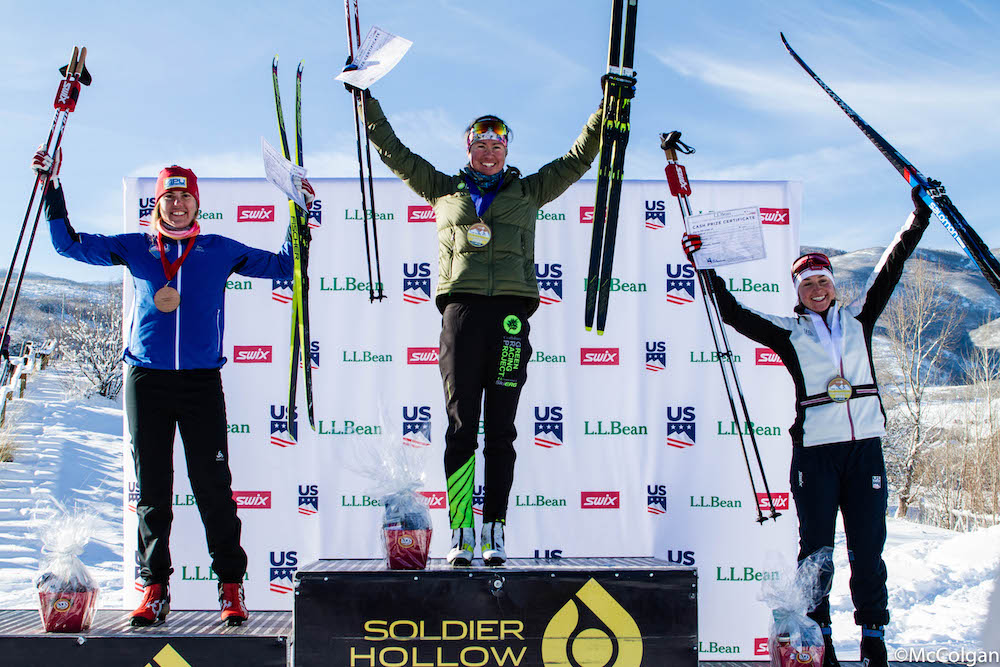
    From left, Becca Rorabaugh (APU), Caitlin Patterson (CGRP), and Sydney Palmer-Leger (Utah) on the podium, 2022 U.S. Nationals. (photo: John McColgan)

    By Gavin Kentch and Rachel Bachman Perkins

    The 2022 U.S. Cross Country Championships began in Soldier Hollow, outside of Salt Lake City, Utah, on Sunday with skate sprints. JC Schoonmaker, recently returned from Europe, took his first national championship with relative ease for the men, while Caitlin Patterson, who was the first American in all four races at 2018 U.S. Nationals, returned to her Olympic-year winning ways by taking the victory for the women. Will Koch and Rosie Frankowski won the qualifiers, the race that matters for potential domestic Olympic qualification.

    Men’s Race: JC Schoonmaker Wins First National Title with Tactics and Speed

    JC Schoonmaker was born in August 2000. Eighteen months later, American skier and ski journalist Cory Smith, writing on a nascent website called FasterSkier.com, observed that race tactics were important on the sprint course being used for the 2002 Winter Olympics in Salt Lake City, and that it was generally disadvantageous to be leading into the final downhill as athletes approached the sweeping lefthand turn into the finishing stretch. He discussed Kateřina Neumannová’s quarterfinal heat as an example of the potential dangers of leading throughout, if that name gives you a sense for how long ago we’re talking about.

    Twenty years later, in the opening race of 2022 U.S. Cross Country Championships, the names had changed but not the physics, as time and again it became apparent that athletes’ positioning on the final downhill was the single most important aspect of the course. Multiple heats saw athletes come back from fifth or even sixth to move up through the field and advance, and the one male athlete who tried to lead his heat from the gun paid for it in the end.

    Schoonmaker, the U.S. Ski Team athlete who skis domestically for University of Alaska Anchorage, understood these tactics to perfection, using the experience gained from racing into 14th in the current World Cup sprint standings (despite missing two sprints in the Tour de Ski) to position himself exactly where he wanted to be throughout the afternoon. The result was his first national title, on a sunny, high-pressure, perfect day at Soldier Hollow.

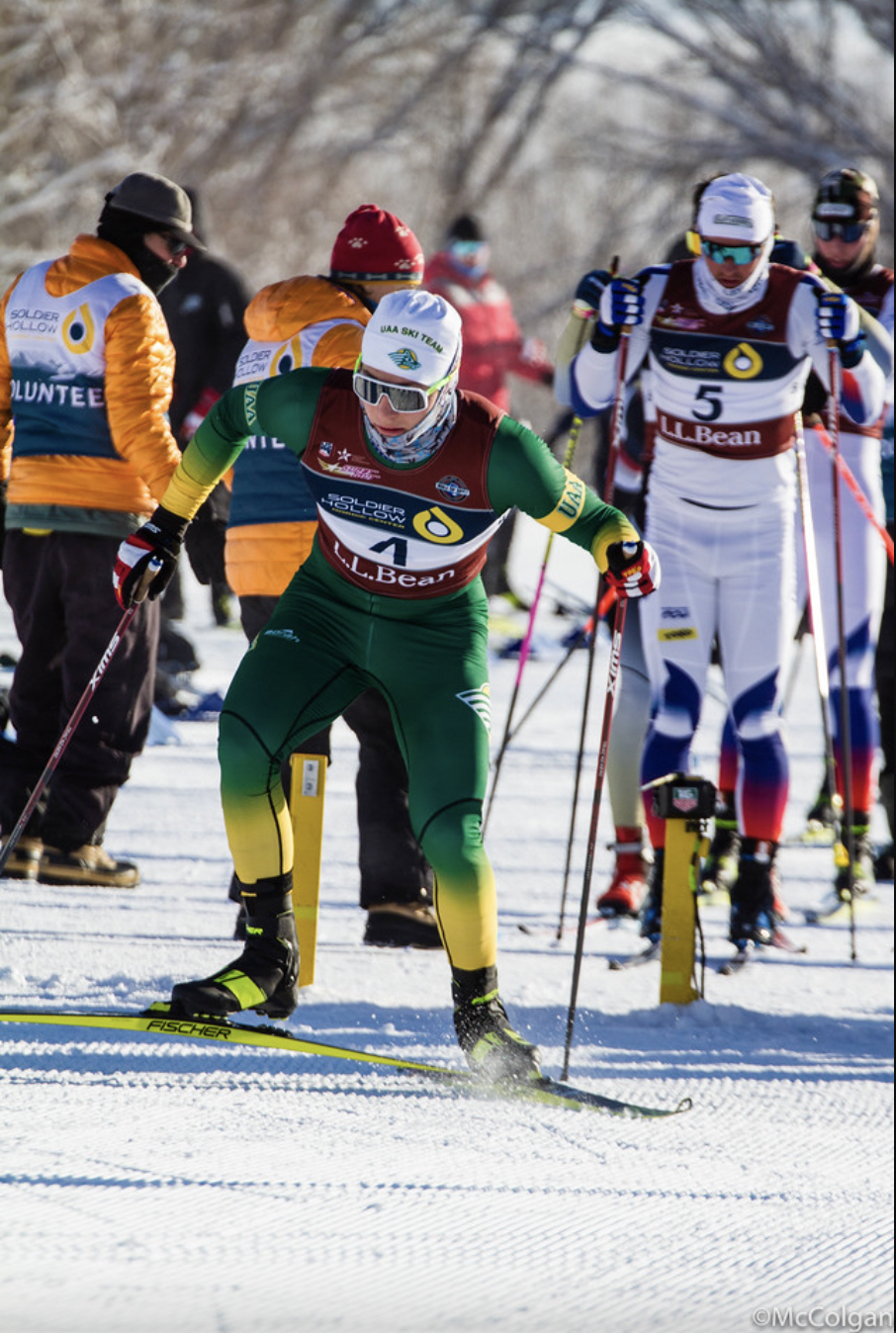
    JC Schoonmaker heads out in the qualifier. (Photo: John McColgan)

    We’re not going to survey every heat from Sunday’s races, on the first of four days of competition at Soldier Hollow, but it’s worth looking at the fastest qualifiers, and the day’s first quarterfinal, to set a tone for what followed.

    In the qualifier, 19-year-old University of Colorado skier Will Koch may have turned some heads when he notched the day’s fastest time, 3:07.88. Schoonmaker had the day’s second-best mark, 0.47 seconds back, with Bridger Ski Foundation athlete Logan Diekmann third by over a second more. 

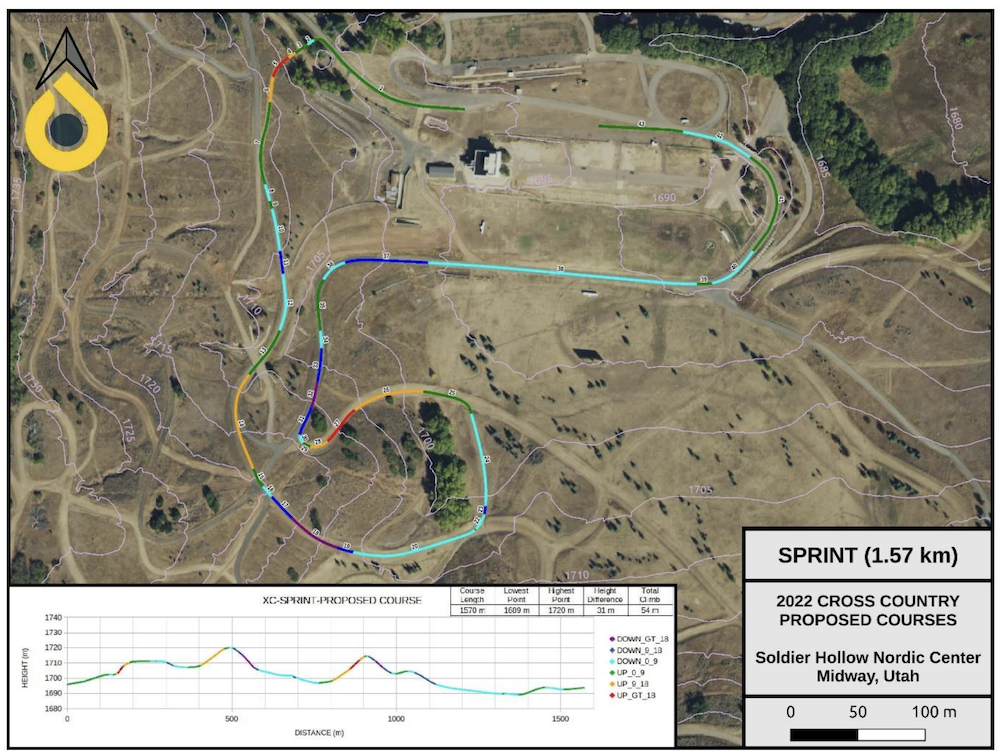
    In the day’s first quarterfinal, Koch picked up where he had left off in the qualifier, blasting off the line to set a hot pace right from the start. He was probably the only athlete all day to V2 the entire first hill leading out of the stadium. He led up the first hill, down the first downhill, up the second and main climb on the course, and into the start of the final sweeping downhill into the stadium and the finishing lanes (see course map and profile below).

    Course map and elevation profile for 2022 U.S. Nationals sprint course. (photo: screenshot from race website)

    But then, for the first time on the day but not the last, the athlete who led into this descent was swallowed up by the rest of the field by the time they reached the final lefthand curve. Koch was caught up, gamely contested the group sprint that ensued, but barely ran out of gas after pushing hard for the entire heat.

    Koch would finish fifth in a five-man heat – despite skiing faster than he had in qualifying. For his troubles, he towed the entire heat to the day’s fastest times by far, and both lucky loser spots; fifth in this heat would have won any other quarterfinal, semifinal, or final on the day. By nearly 5 seconds.

    While the top qualifier was knocked out in the first quarterfinal, the effort is not to be diminished. Indeed, Koch chose a tactic, committed to it fully, executed it well, and came within 0.05 seconds of claiming fourth in his quarterfinal to advance as a lucky loser. With that in mind, this heat set the tone for the day, as a field of observant professional athletes noticed that there was maybe not a lot to gain by leading out the heat, and a lot to lose.

    As Smith wrote of these dynamics on this course 20 years ago, “The ideal situation is to spend the first three-quarters of the race in the back, avoiding mayhem and drafting. Then move up to second coming into the final turn, and use the turn to shoot out and around the leader to win the sprint. But obviously that is easier said than done when everyone else is trying to do the same thing.”

    In lieu of a play-by-play of the next six quarterfinal and semifinal heats on Sunday, let’s just survey some winning times: 3:06.09 (QF1, Koch’s heat); 3:15.31 (QF2); 3:13.97 (QF3); 3:16.83 (QF4); 3:10.99 (QF5); 3:13.16 (SF1); 3:20.04 (SF2). There’s a theme there: While the heat 1 lucky losers may see Koch’s reward for pushing the pace, no one else in the men’s field chose his approach. Racing was slower-paced, but it was hard to fault the results, at least for the athletes who advanced.

    (The discrepancy is perhaps even greater than that, as local observers noted that the course got progressively faster throughout the day, as it warmed up from below-zero F temperatures the night before. On quiet moments in the livestream, the difference between notably squeaky snow (for the qualifiers) and not-squeaky snow (for the heats) was apparent.)

    The other, related issue was falls at the bottom of the long runout, as trailing athletes accordioned back up to the leaders, and four, five, or even six men all sought to move from a narrow tuck to a wide V2 at the same time on the same stretch of trail. Through what consistently looked like incidental contact rather than malicious contact punishable by a yellow card or other formal sanction, Ian Torchia, Bill Harmeyer, Christopher Kalev, and Brian Bushey all hit the deck in their quarterfinals. The same thing happened in the semis, too, with Karl Schulz falling in the first semifinal and John Schwinghamer in the second. Again, it certainly appeared that it was not intentional, just the results of athletes all commencing a V2 at the same time at high speed.

    After one fast heat and six slower heats, six men lined up for the final: JC Schoonmaker (UAA/USST), Noel Keeffe (University of Utah/USST), Logan Diekmann (BSF), Johnny Hagenbuch (SVSEF/USST), Magnus Bøe (University of Colorado), and Andreas Kirkeng (University of Denver).

    Their average age was slightly less than 22; they had probably not read Smith’s coverage of the 2002 Olympic sprint when it was first published. But they had all successfully raced two heats on this course already, and they seemed disinclined to change what had got them there.

    All of which is to say that Schoonmaker’s winning time for the final, 3:21.05, was the slowest of any men’s heat that day. (Indeed, this time would have placed him fourth in the first junior boys semifinal.) Diekmann led the pack out of the stadium in the final, closely tailed by the rest of the field. The men skied fairly leisurely up the first uphill, down the first downhill, and up the second uphill.

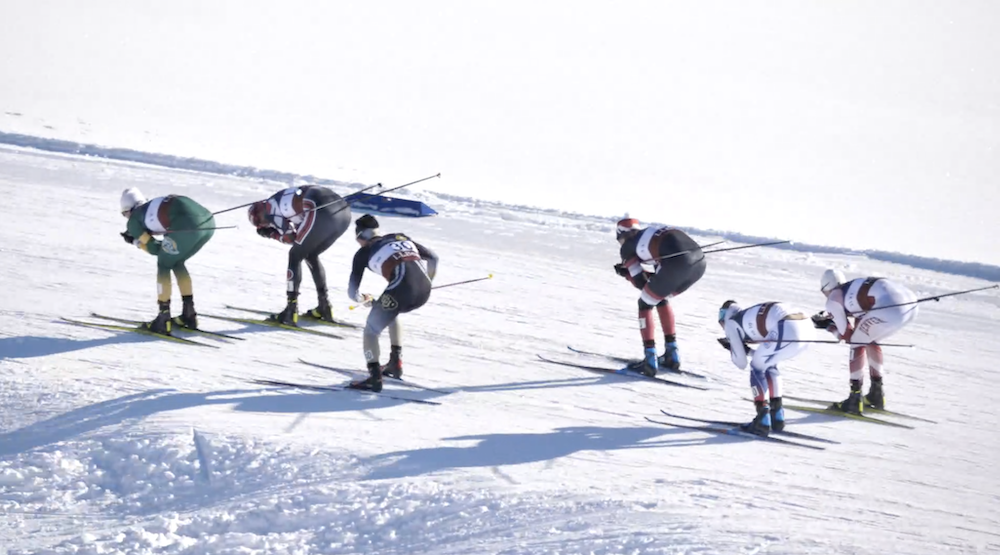
    Finally, coming into the final downhill, Bøe moved, and Schoonmaker followed. The field started racing in earnest at this point, but there was still not much separation between six athletes traveling at high speeds: Here’s the men’s field, nearly three minutes into the final, about to come up out of their tucks, navigate the final lefthand turn, and sprint into the finish:

    JC Schoonmaker (far left) leads the final in the men’s skate sprint at 2022 U.S. Nationals. (photo: screenshot from livestream)

    That’s Schoonmaker in the lead, Keeffe just off his right shoulder in second, Bøe (bib no. 30) in third, then Diekmann, Hagenbuch, and Kirkeng trailing slightly behind in fourth through sixth, respectively, from left to right. And, spoiler alert, these were not their final finishing positions; there was more movement yet to come.

    While the camera work, free live broadcast, and Adam Verrier’s announcing were consistently superb, the limitations of the available camera angles meant that a portion of the final lefthand curve was obscured from view for a few seconds. (That curve can be seen in the video in the second half of this Instagram post from BSF.)

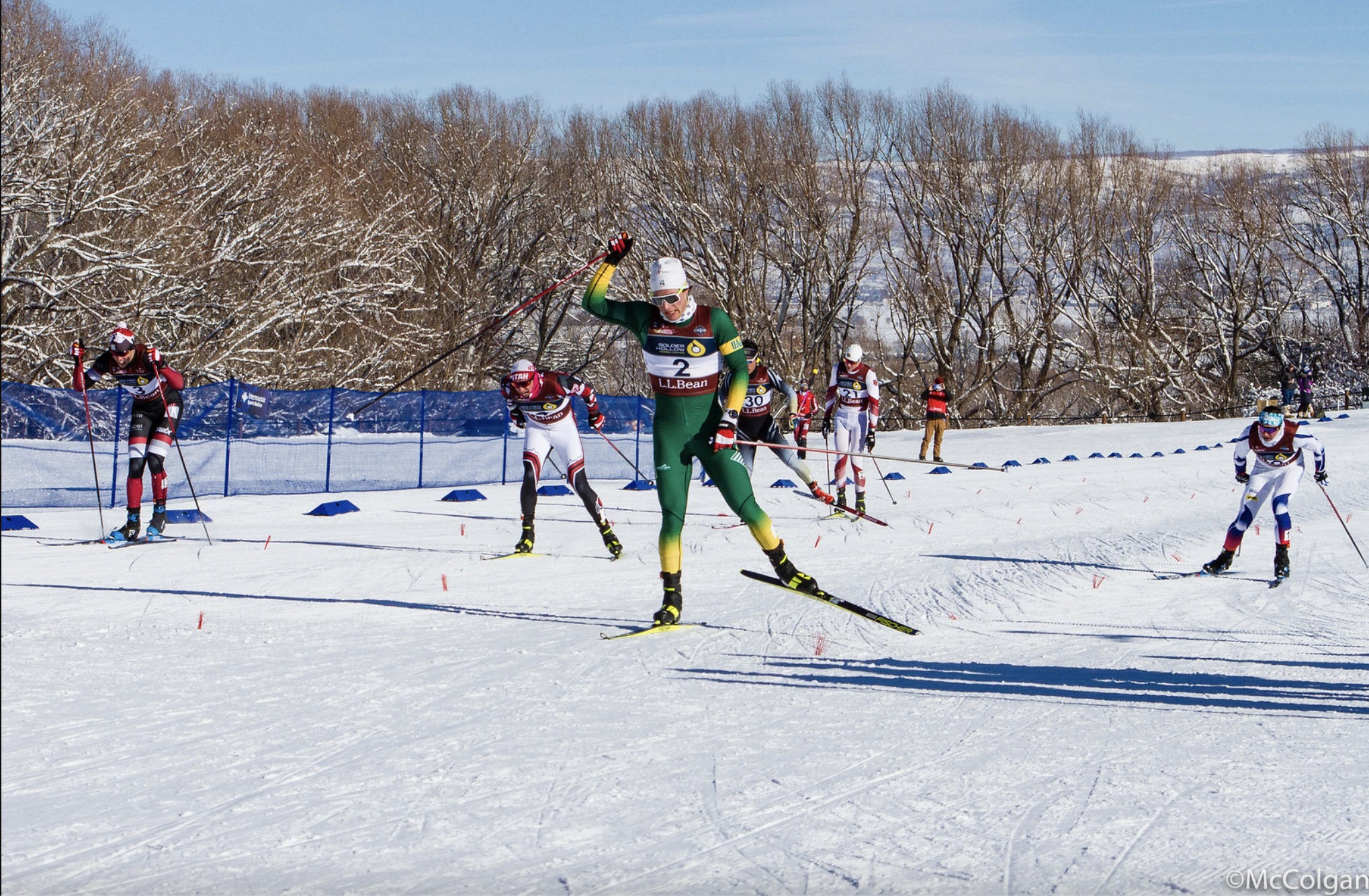
    By the time the athletes came into view once more, Schoonmaker had positioned himself precisely where he wanted to be, on the inside of the curve, carrying a lead of multiple meters. His gap was small but consistent through the finish, which he approached with sufficient time and space to stand up and celebrate across the line.

    JC Schoonmaker celebrates across the line as he wins the men’s skate sprint at 2022 U.S. Nationals. (Photo: John McColgan)

    Schoonmaker’s winning time was 3:21.05. Behind him, Diekmann (+0.83) outlunged Keeffe (+.91) for second by less than a ski. Hagenbuch was another 0.20 seconds back in fourth (+1.11) , followed by the two collegiate skiers, Bøe and Kirkeng, in fifth (+2.14) and sixth (+3.47).

    “I’m feeling really good after a nice relaxing Christmas at home [in Tahoe City, CA],” Schoonmaker wrote to FasterSkier after the race. “It was great to have a mental break from racing and we got absolutely dumped on with snow so that was really fun too.”

    Schoonmaker also spoke to his feelings in the sprint, after a successful, but potentially draining stint in Europe, where he skied into the semifinals three times, finishing as high as 7th in Ruka, Finland.

    “Today I felt pretty good and felt like I was getting better throughout the day after a little break from racing. It’s a weird course with the last downhill being so tactical but I was happy with my positioning and how I skied it. I won’t race the 30k just to make sure I’m not overdoing it but I’m really looking forward to the 15k classic, almost more than the sprints since I haven’t been doing much distance racing. I’m also just super excited to be back racing in the US and seeing a ton of friends out there!”

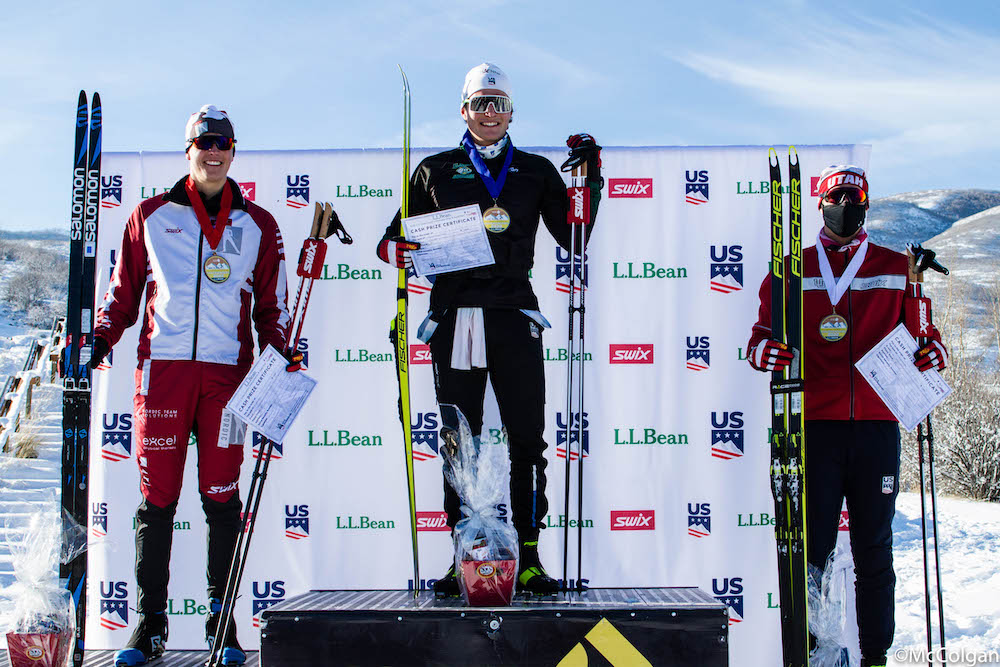
    From left, Logan Diekmann (BSF), JC Schoonmaker (UAA/USST), and Noel Keeffe (Utah/USST) on the skate sprint podium, 2022 U.S. Nationals. (Photo: John McColgan)

    It was Schoonmaker’s first national championship. His trajectory to the top of American sprinting has been quick, and recent; he finished 13th in the skate sprint at 2020 U.S. Nationals, and 14th in the classic sprint at 2019 U.S. Nationals. The last time he raced a national championship at Soldier Hollow, in 2017, he was 165th, albeit also age 16.

    Women’s Race: Caitlin Patterson Times Her Move to Take the Victory

    The tactical theme held fast through the women’s heats. Athletes stayed relaxed through the first two climbs of the course, using the sweeping downhill in the middle to establish position heading into a final shorter climb. Pushing over the top and into the downhill, athletes benefited from tucking into the slipstream of the leader rather than being first in the glideout, conserving energy for the final explosive push over the bridge and up through the finish lanes to the line. 

    Perhaps the only skier breaking from this narrative was APU’s Rosie Frankowski. Though she was third in both Period 1 SuperTour sprint races this season, Frankowski has historically been better known for her distance chops. Perhaps recognizing she’d need a fast heat to ensure lucky loser opportunities, Frankowski took the first heat of the quarterfinal out hot, dropping the field on the opening climb only to be reeled back in on the subsequent descent. As the women left the critical descent and began to skate out of the subsequent glideout, Frankowski was within a group of four women. 

    Powering into the final stretch, it was Frankowski matched by her teammate Becca Rorabaugh leading the way to the line, with Sun Valley’s Samantha Smith and Northern Michigan’s Katarina Hyncicova close behind. Rorabaugh took the heat in 3:43.67 with Frankowski in second. Though she qualified automatically, Frankowski’s fast start achieved the objective; it was the fastest heat of the quarters, allowing both Smith and Hyncicova to advance to the semis. 

    A trio of APU women on site at US Nationals. From left to right, Annie Gonzales, Rosie Frankowski, and Becca Rorabaugh. (Photo: Instagram @frankowitz)

    In the semis, Frankowski repeated her approach, again pushing the pace early to establish a fast heat. Sydney Palmer-Leger (Univ. of Utah/USST) looked comfortable and content with her position as she trailed Frankowski into the sweeping downhill. Rorabaugh and Anna Bizyukova (UVM) also caught the leaders in the glideout, with Bizyukova sliding around the outside to head over the bridge alongside Palmer-Leger, setting the stage for a tight four-way spread at the finish with Frankowski and Rorabaugh on their tails. 

    Finishing with what would be by far the fastest times of the day, Palmer-Leger took the win in 3:38.61, edging out Bizyukova by 0.14 seconds. Half a ski length behind, Frankowski crossed in third (+0.31), with Rorabaugh fourth (+0.46). Roughly seven seconds back, Hannah Rudd (BSF) was fifth in the semi, finishing just ahead of Hyncicova.

    The start of the second women’s semifinal. (Photo: Julie Oldham)

    In the second semi, SMS T2 athlete Lina Sutro set a more conservative pace, leading Middlebury athlete Kate Oldham through the first two climbs. Sun Valley’s Samantha Smith made some aggressive hop-skate pushes to take the lead on climbs, but she was caught and passed on each of the subsequent descents. Sutro and Oldham charged hard over the top of the final climb, pushing into the downhill, but a strong move around the curve by Mariel Pulles (UAF) shot her to the front from fourth, while Caitlin Patterson also accelerated into the lead group. 

    Coming into the final stretch, it was Pulles with a narrow advantage over Patterson, with Sutro and Oldham holding on for a fast time, but no longer within reach of automatic qualification. Pulles crossed the line in 3:45.15, well behind the previous heat’s benchmark, indicating that only she and Patterson, who crossed +0.10 behind, would advance to the final.

    Sutro crossed the line just ahead of Oldham for third (+0.28), followed by Oldham in fourth (+0.74). Lucinda Anderson (UNH) and Smith rounded out the second semi in fifth (+1.04) and sixth (+2.72), respectively. 

    In the final, a broken pole early on put Pulles at a significant disadvantage, though she held contact with the leaders. Frankowski again pulled ahead from the start, looking to be at the front, and set a pace that would not leave her opponents fresh for a fast and tactical final push.

    After maintaining her position at the front through the meat of the course, Frankowski was once again swallowed up in the glideout as Patterson, Palmer-Leger, Rorabaugh, and Bizyukoga each caught and passed her. Frankowski wobbled as she found her position, looking as if some unintentional bumping of skis had taken place at the spot where we saw many crashes in the men’s quarterfinals and semifinals. 

    Patterson led over the bridge with Rorabaugh on her tails and Palmer-Leger in a competitive position alongside. Creating a small gap ahead of the three women in pursuit in the final straightaway, Patterson, Rorabaugh, and Palmer-Leger skied three abreast, seemingly evenly matched in the closing meters. Palmer-Leger skied with the highest tempo, but Patterson’s smooth and powerful technique carried her through the finish with the advantage, stopping the clock at 3:42.60, with Rorabaugh half a ski length behind in second (+0.24), and Palmer-Leger spaced evenly behind in third (+0.57).

    Caitlin Patterson (far right), Becca Rorabaugh (center), and Sydney Palmer-Leger (far left) race to the line in the women’s sprint final at 2022 US Nationals. (Photo: John McColgan)

    Bizyukova won the second-wave sprint to take fourth (+1.57), with Pulles, still racing with a dysfunctional pole, next over the line in fifth (+2.28), with Frankowski finally losing steam to finish sixth (+2.52).

    Patterson was realistic after the race when she assessed her chances, while also revealing it was no secret that the final downhill was the crux of the course.

    “The sprint today was really fun,” she wrote to FasterSkier late Sunday. “I went into it in no way expecting to win, but believed that it was within the realm of possibilities. The key would be to see how the final downhill played out in the heats and and try to play it well myself.”

    Patterson added, “I do love downhills, but this Soldier Hollow sprint course perplexes me somewhat because it feels hard to control what’s going to happen in the race, with the way the draft might play out in those final hundred meters. I didn’t feel particularly in control during my heats, but I took advantage of whatever I could work with for positioning and made it work to move on through the quarterfinal and semifinal.  I felt better in the heats than during the qualifier, but in much of the heat race I felt that the packs moved around and stayed tight together in a way that I had to tap into surges here and there rather than a consistent effort throughout the whole course. There were a lot of really tight finishes today – my own and others – and I think there were a ton of super strong skiers out there who probably got edged out by the tiniest of margins, but so goes sprint racing.”

    Caitlin Patterson won the opening freestyle sprint of the 2022 US National Championships in Soldier Hollow. (Photo: John McColgan)

    Turning to the final, Patterson recounted, “I was forced out wide to the right at the base of the final climb, and had to tuck in behind some people skiing up that steep hill. It wasn’t necessarily my plan to enter the downhill in 5th, but then when I pushed super hard over the top of the hill, I caught several drafts and executed good passes. When I found myself taking the lead going into the final corner, I pushed to the finish with everything I had even as I started to get a bit wobbly, and fortunately managed to hold off Becca and Sydney!”

    The 30-something Patterson added, “Becca and I would like to note that no one should count us Master’s racers out of the game!”

    Patterson noted that she is pleased to achieve sprint success domestically, but is seeking more international opportunities in distance races.

    “Period 1 racing on the World Cup was ok for me, but not great, it felt like a bit of a slow start to wake up the distance race speed. Undoubtedly the whole World Cup field is extremely competitive right now, and the other US women are super strong which is awesome to see, but I want to get up there myself into contention! Without scoring any World Cup points in P1, it wasn’t really an option to stay and race the Tour this year, so I came back to the US to regroup and focus on Nationals racing. I believe that with strong Nationals distance race performances I may be able to earn more upcoming international racing starts, so that is my focus looking ahead.”

    Juniors

    A full field of juniors raced as well, going through a complete set of heats and finals after the senior athletes. Kendall Kramer (University of Alaska Fairbanks/USST) took the junior girls final over fellow Alaskan Marit Flora (APU), with Erica Laven (Täby IS Skidor) in third. Laven is from Sweden; Lauren McCollor (Northern Michigan University), fourth overall, rounded out the domestic national championship podium as the third American.

    In the junior boys final, Finegan Bailey (SMS) took the win, with Trey Jones (Steamboat Springs Winter Sports Club) in second. Aidan Burt (University of Vermont) was third.

    More about the course

    The Soldier Hollow sprint course has historical relevance looking back to the 2002 Olympics, as discussed above. It also has prospective relevance, to the 2022 Olympics that start in Beijing in roughly a month.

    Notably, and speaking of this year’s Olympics, it is “only … qualification round finish placing” that is considered for the USSS 2022 Championship Selection List, i.e., Koch and Frankowski each received a full 45 points (30 points for first plus 15 points for the national championship bonus) for winning the qualifier, regardless of their final overall placing.

    While it remains an open question how many domestic athletes will be selected to this year’s Olympic team off of these races, it would be hard to find a better course to use as a basis for comparison. As Rosie Brennan noted in explaining her decision to come back home during the Tour de Ski and experience an extended period of living and skiing at altitude, the two trail systems were even designed by the same person.

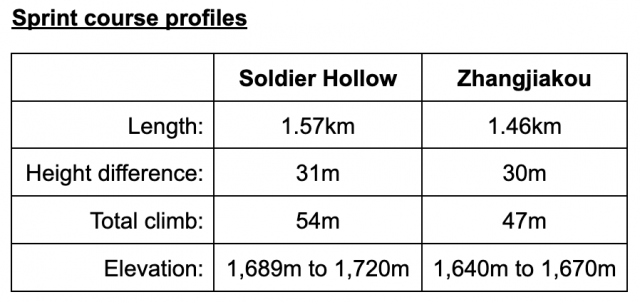
    In addition to their more holistic similarities, their statistics are very comparable as well, particularly the overall elevation but also the more specific details of the course profiles:

    Course information for 2022 U.S. Nationals and 2022 Olympics sprint courses. (FasterSkier table by Gavin Kentch)

    If an athlete is indeed picked for the Olympic team based off of their performance in this week’s sprint races, it seems fair to say that they will have achieved success on the type of course they can expect to find in Zhangjiakou.

    Results: men | women | junior girls | junior boys | men’s qualification | women’s qualification

    Livestream replay

  • SuperTour Racing Kicks Off in Duluth

    SuperTour Racing Kicks Off in Duluth

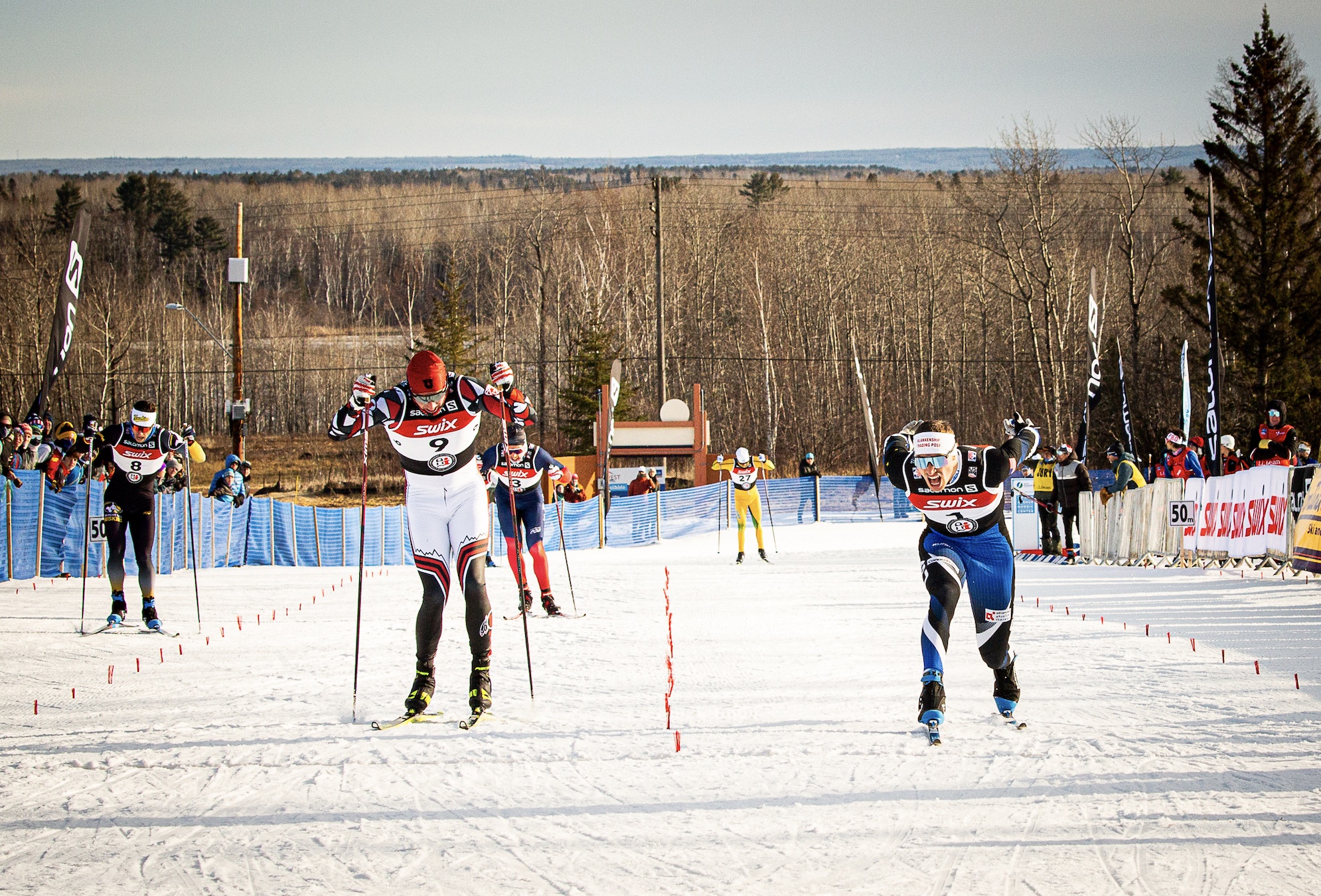
    Fast racing on the manmade tracks during the men’s sprint heats in Duluth, MN. (Photo: Hansi Johnson)

    By Gavin Kentch and Rachel Bachman Perkins

    The SuperTour returned this weekend with races in Duluth, Minnesota, held on the new snowmaking courses at Grand Avenue Nordic Center. The weekend included all levels of racing, with green juniors lining up to race alongside the veterans racing on the SuperTour, and a strong sense of community and cross-country ski energy across the board. Skiers like to ski; athletes were glad to be back.

    Alaska Pacific University Nordic Ski Center (APU) athletes had a strong showing for the weekend, winning three out of four races. Rosie Frankowski (APU) and Alayna Sonnesyn (SMS T2) each made the podium twice. FasterSkier unofficially calculates the current SuperTour leaders as APU skiers Rosie Frankowski for the women, with 51 points after two races, and Tyler Kornfield for the men, with 42 points. The overall SuperTour leaders at the end of next weekend’s racing in Cable should receive start rights on the World Cup for Period 2, the Tour de Ski. Official USSS standings, here, have recently been updated, and accord with FasterSkier’s math.

    Saturday: Freestyle sprint

    Alayna Sonnesyn started out the qualifier in style, destroying the field to set the day’s fastest time for the two-lap, 1.3-kilometer course by a staggering ten-plus seconds. Several heats later, she was joined in the women’s final by a largely chalk field: Becca Rorabaugh (APU), Rosie Frankowski (APU), Julia Richter (University of Utah), and Sarah Goble (Sun Valley), who had the day’s second, third, fourth, and ninth fastest qualifying times, respectively. Katerina Hyncicova (NMU), who had been 23rd in qualifying, was the main outlier here.

    Becca Rorabaugh (Bib 102) races through the heats to win the opening SuperTour sprint in Duluth. (Photo: Hansi Johnson)

    Roughly three minutes later, the two women who had consistently been the top athletes in the field all day, Sonnesyn and Rorabaugh, found themselves at the top of the long descent for the second and last time in the women’s final. Sonnesyn led going into the descent, but Rorabaugh skied this segment aggressively to slingshot around Sonnesyn and was able to significantly out-glide her by the bottom of the hill. Sonnesyn made up some ground as the two of them made the lefthand turn into the stadium and the uphill finish, but Rorabaugh was never seriously threatened on her way to the line.

    Rorabaugh took the win in 3:11.49, with Sonnesyn 0.47 seconds back.

    Roughly four seconds later, the compact powerhouse Frankowski, traditionally identified as more of a distance skier, led Richter to the line by nearly 1.5 seconds to take third. Goble in fifth and Hyncicova in sixth made up the rest of the final.

    The podium of the women’s freestyle sprint in Duluth. Becca Rorabaugh (APU) took the win ahead of Alayna Sonnesyn (SMS T2) and Rosie Frankowski (APU). (Photo: Hansi Johnson)

    It was Rorabaugh’s first SuperTour win since the skate sprint at Wirth Park in February 2020. It was Frankowski’s first SuperTour podium since she was first and second at West Yellowstone in a sprint and distance race in December 2018.

    “The sprint went really well for me,” Rorabaugh wrote in a post-race email. “It was exciting to get to race at a Super Tour again!  I love icy conditions, I love speed, and I love head to head racing, so it was pretty ideal for me. It’s also good to know that I’m sharpening up; these results show that I can hammer when I need to which is a good sign for the season.”

    Reflecting on racing at the national level after a year away, Rorabaugh continued, “It feels really good to be back and to get to race against some of the people that I haven’t seen since early 2020. It seemed like Alaska was quite separate during last season, like maybe people forgot we were up there, so it’s fun to remind everyone that we’re a force to be reckoned with.”

    Few athletes were familiar with the new course in Duluth. Rorabaugh also reflected on the course and the event as a whole.

    “The sprint course in Duluth is fun and it suits me incredibly well. Some might say it’s lacking a long, steep climb, but I think most would agree that the downhill and the finish stretch are exciting and fun. The finish stretch is pitched up enough that you have to have a good sprint. You can’t just carry speed all the way to the line, which keeps things spicy at the end.

    “The energy in Duluth has also been great, everyone has been very welcoming and combining the Super Tour with junior races means it’s a huge event. I always enjoy getting to see the younger skiers giving it their all, and the organized chaos of big races is exciting!”

    Bryan Fish, U.S. Ski & Snowboard Sport XC Development Manager, reads the men’s heat list as it’s transferred onto a white board. (Photo: Hansi Johnson)

    The men’s race featured more of the same: most top qualifiers making it through to the final, and an APU skier moving up from second to outglide a competitor on the final downhill into the finish. For the men, it was the first, second, third, eight, ninth, and outlier 27th-place qualifiers in the final: Tyler Kornfield (APU), Logan Diekmann (BSF), Bill Harmeyer (SMS), Adam Witkowski (Michigan Tech), Noel Keeffe (University of Utah/USST), and Kjetil Bånerud (NMU), respectively.

    Two-plus minutes later, it was Keeffe leading Kornfield into the top of the final downhill. 15 seconds later, it was Kornfield leading Keeffe into the finish lanes, as APU’s skis were once again superior. Kornfield kept his lead through the stadium to take the win in 2:47.44, narrowly ahead of Keeffe (+0.23).

    Tyler Kornfield (APU), right, wins the men’s freestyle sprint in a bootslide ahead of Noel Keefe (Univ. of Utah) at the opening SuperTour weekend in Duluth, MN. (Photo: Hansi Johnson)

    A few seconds later, Witkowski (+2.90) outdistanced Harmeyer (+3.36) for the final podium spot. Diekmann and Bånerud followed several seconds later.

    “It feels great to get to racing again,” Kornfield wrote after the race. “Last season, I was able to race two sprint qualifiers, but I failed to qualify for the heats in both. I love racing head to head and it was difficult at times to find inspiration. Fortunately, I have a great team at APU along with Gus and JC being in Alaska, we have been able to do a few time trials to prepare for the season. That allowed me to come to the races feeling calm and prepared. Though I never know exactly how I will perform early in the season, I have been cautiously optimistic about how my body has been performing in training. I hope that I can continue the trend into next week and onto the rest of the season. My mantra for the season is to make every race count and I think I did that in the sprint.”

    Earlier that day, Kornfield’s longtime partner and fellow APUNSC athlete, Rosie Brennan, had made the podium in Lillehammer in a World Cup race. USST coach Matt Whitcomb congratulated the APU program on its successful day, alongside a heartwarming photo of the World Cup crew watching the CXC Live feed of the SuperTour races in a conference room at the Scandic Lillehammer.

    “It is also easy to be inspired to race well when Rosie finishes on the podium of the World Cup,” Kornfield continued in his comments on the sprint day. “I often need to be careful because it is hard to fall back asleep after checking her results at three in the morning, but this morning, it was worth it.”

    Kornfield also spoke to the course and event in Duluth, praising its challenges and how they might prepare athlete to race at the World Cup level.

    “The course in Duluth was great! I think it was a perfect combination of long enough working sections that were wide enough to maneuver, as well as technical/icy turns that would cost someone who might lose focus either leading into, during, or coming out of the turns. If we have more courses like this one, I believe we can keep pushing the momentum of domestic racing that will prepare us for racing in Europe. It was also great to see so many people out watching. That can be rare sometimes on the SuperTour, but there is an obvious sense of excitement and passion in Duluth that will hopefully turn into a regular SuperTour venue!”

    Saturday Sprint Results: Qualifiers (all) | Women’s final | Men’s final | All heat results

    Multimedia: sprint course preview video from Bill Harmeyer | livestream replay from CXC

    Fast racing on the tracks in Duluth as the SuperTour returns. (Photo: Hansi Johnson)

    Sunday: Freestyle distance

    While athletes raced on a white ribbon with bare ground exposed on either side during the sprint, what one might call a “wintery mix” arrived in Duluth on Sunday morning. Over four inches of fresh snow fell overnight, which turned into wet icy flakes as the races began. APU coach and tech Galen Johnston shared photos of graupel-encrusted skis, which left us wondering what skiers might have looked like at the finish.

    In the individual start freestyle events, senior men raced five laps of a roughly 2.2-kilometer course while senior women raced three laps.

    Team Birkie’s Zak Ketterson eked out a win on the men’s side in a time of 26:33.4, beating Northern Michigan University (NMU) athlete Kjetil Bånerud by 3.4 seconds. Bånerud had started three bibs ahead and held the fastest splits until Ketterson came through. Craftsbury Green Racing Project (CGRP) athlete Adam Martin skied the third-fastest men’s time (+8.6) to round out the podium.

    “10 kilometers is a tricky distance because while it seems short compared to our normal 15k distance, it’s definitely still long enough to require some good pacing,” wrote Ketterson after the race. “I was fortunate to receive a lot of splits from my coaches, as well as my old NMU coaches and others.”

    Zak Ketterson on course during the opening SuperTour races in Duluth, MN. (Photo: Hansi Johnson)

    Originally from Bloomington, MN, on the south side of Minneapolis, Ketterson is an NMU alumnus. While other athletes on the podium, like Frankowski and Sonnesyn, are also originally from the Midwest, Ketterson has spent his entire ski career in the region, and he felt the community support during the race.

    “It was a really great atmosphere at the Grand Ave Nordic center. I really like Duluth and have very fond memories from when I raced there last year with NMU at some NCAA qualifier races. My favorite part of racing in the Midwest is that there are so many friends that cheer for me. It really feels like a ‘home’ race.”

    Commenting on the season ahead, Ketterson shared, “My goals for this season are to just take it one race at a time, trying to do my best in every opportunity I get. We will see where that gets me! For now, I’m just happy to be a part of such an amazing team (Team Birkie) and to be racing again.”

    Zak Ketterson pushes uphill during the 10k skate, with Team Birkie “legend”, Brian Gregg (Bib 250), matching pace behind. (Photo: Hansi Johnson)
    On the women’s side, with her second podium of the season, APU’s Rosie Frankowski edged out Alex Lawson (CGRP) by just 0.9 seconds. Lawson started behind Frankowski and had been sitting in third, powering through her final lap to create a nail-biter over the final kilometer. During this final lap, Lawson overtook Alayna Sonnesyn (SMS T2), who finished third (+6.1).
    The women’s top-6 after the 10k distance race in Duluth. Rosie Frankowski (APU) topped the podium, ahead of Alex Lawson (CGRP) and Alayna Sonnesyn (SMS T2). (Photo: Hansi Johnson)

    Frankowski shared the following reflections on her weekend in Duluth via email:

    “Before heading down to Duluth, I was pretty nervous about this weekend and tried to have realistic expectations since these races were a short, relatively flat sprint and 5k—both events that I honestly don’t typically perform that well in. However, I have been focusing on speed work, downhills and carrying speed a lot this summer behind my speedy APU teammates so yesterday’s results on a very fast course was a great surprise that boosted my confidence for today’s 5k. Today out on the course was a whirlwind. We actually raced 3 laps of a bit over 2 kilometer lap so I lucked out that it was a bit longer and the snowfall from the night before and during the race made it slower than yesterday. The course held up surprisingly well and was really not that choppy or soft except the one V-1 hill.

    “I went out as hard as I could since honestly my 5k race pace often accidentally is my 10k pace and I knew that I needed to be snappy. I did slow down throughout the laps, but I honestly think most of that slowdown was on the downhill section which was where I questioned whether I should free skate, tuck, V-2, etc. I was very early in the seeded group so I didn’t really have the chance to rely on splits back or watching my competitors to determine what seemed to work best. All in all, I am super excited to walk away with the win and I am hoping this weekend of racing gives me more confidence about my short race skiing abilities, and I have to give a hats off to our APU wax techs and all of the volunteers from Duluth that made this weekend possible.”

    Rosie Frankowski skis through wet falling snow to win the women’s 10k at the opening SuperTour weekend in Duluth, MN. (Photo: Hansi Johnson)

    On returning to racing with a widespread field of high-level athletes, Frankowski echoed her teammate Rorabaugh’s sentiments on feeling isolated as she stayed put in Anchorage. Her words embody the many challenges we have all faced in the calculus of travel and risk-assessment during the pandemic.

    “It’s nice to be back racing on a national level circuit. Last season was really challenging since us Alaskans didn’t have much opportunity to race people from out of state (due to avoiding unnecessary air travel). We had a crazy strong early season circuit with Sadie Bjornsen, Jess Yeaton and Becca all in our races, but it felt like we were just not connected with the rest of the country. I personally really struggled with turning down Period 1 World Cup starts after a teammate contracted COVID and the financial implications that COVID created with race uncertainty. Then in January, I contracted COVID and it felt like it ended my opportunities to gain World Cup starts.

    “I am just thankful that this year we have more certainty about what races will happen and what the road to opportunity looks like. I also feel that as I have gotten older, I have realized that while good results are fun and exciting, the true value in racing a circuit is the relationships you create with your competitors, other coaches, officials, etc. Returning to the Supertour and Duluth (as Minnesota is my home state), I found so much joy in chatting with my fellow racers, longtime club coaches, friends from NMU [Frankowski is also an alumna], Southwest High School and LNR, and just being part of a community that wants to spend their weekend working hard out in the cold. I’m hoping that no matter where my results fall this season, and whether I make the lofty goals I’ve laid out, I can appreciate the people and connections as the true value of ski racing.”

    With a win in the distance and third place in the sprint, APU’s Rosie Frankowski leads the SuperTour point rankings. (Photo: Hansi Johnson)

    Sunday Distance Results: Women | Men

    Multimedia: livestream replay from CXC

  • Elite Team Preview: APU

    Elite Team Preview: APU

    The APU Elite Team gathers for morning practice on the Hillside trails, Anchorage, Nov. 12, 2021. (photo: courtesy APUNSC)

    Team name and location: Alaska Pacific University Nordic Ski Center (APU, or APUNSC); Anchorage, Alaska

    Coaches: Erik Flora (head coach/director), Jack Novak (assistant coach)

    Current roster: Penny Smyth, APUNSC Marketing & Communications, writes:

    “Women’s Team: Rosie Brennan (USSS A Team), Hailey Swirbul (USSS A Team), Hannah Halvorsen (USSS D Team), Rosie Frankowski (World Cup Alternate), Becca Rorabaugh, Anna Darnell, Annie Gonzales, Marit Flora, Lily Pannkuk, Zoe Noble

    “Men’s Team: Logan Hanneman (USSS B Team), Scott Patterson (USSS B Team), David Norris (World Cup Start), Hunter Wonders (USSS D Team), Zanden McMullen (USSS D Team), Luke Jager (USSS D Team), Tyler Kornfield, Michael Earnhart, Thomas O’Harra, Forrest Mahlen, Garrett Butts, Ari Endestad, Karl Danielson, Bjorn Halvorsen, Chip Schoff”

    A total of nine APU athletes will be starting Period 1 World Cup races this season, though as we approach the Ruka opener later this week Smyth advises, “Scott [Patterson] won’t be joining the team until Lillehammer,” the season’s second race weekend, “due to hand injury.”

    Who’s new or who’s moved on: Smyth writes, “Sadie Maubet Bjornsen, a two-time Olympian and World Cup skier, retired after last year. We have some new skiers that have grown up through the APU Nordic program join the Elite Team, including Marit Flora and Lily Pannkuk. New to the men’s team is Bjorn Halvorsen, younger brother of Hannah Halvorsen!”

    Who’s still on this team, or otherwise involved in American skiing, from when we did this in 2012: Rosie Brennan, Becca Rorabaugh, Forrest Mahlen (athletes); Jack Novak (APU assistant coach); Greta Anderson (USST D-Team coach); Dylan Watts (Mt. Bachelor Ski Education Foundation head nordic coach); Kikkan Randall (Nordic Skiing Association of Anchorage Executive Director)

    Hailey Swirbul (left, third overall) and Rosie Brennan (first, wearing the yellow bib as World Cup overall leader) after the women’s 10 k skate in Davos, December 20202. (photo: Modica/NordicFocus)

    Top results last season: Brennan was fourth in both the overall World Cup and distance standings, and for one magical weekend in December was the best skier in the world, winning back-to-back races in Davos. She became the second American woman ever to wear the yellow bib, after Maubet Bjornsen, and kept it for roughly a month. It was a well-deserved coming-out party for the longtime APU athlete (note that she was also on this team nine years ago) currently in her third separate stint on the U.S. Ski Team, after most recently being cut in 2018 after she raced poorly in PyeongChang while unknowingly suffering from mono.

    Behind her, Swirbul finished the season ranked 23rd overall in the World Cup (21st for distance) and 4th in the U23 standings, picking up her first World Cup podium along the way, which she shared with Brennan. Maubet Bjornsen stayed home in Anchorage for the first half of the season, placed 10th in her first World Cup race in a year after returning to Europe, then at World Championships came within a combined 3.17 seconds of coming home from Oberstdorf with two medals.

    Swirbul, Maubet Bjornsen, and Brennan formed the first three-fourths of the American women’s relay team at World Champs, which came 0.8 seconds away from medaling. Norris recovered from Covid to post some of his best results yet, including 16th and 17th at World Champs, and Patterson had his best season in years, highlighted by a 10th in the World Champs 50 km; the two of them formed half of the American men’s relay team in Oberstdorf. (The team sent seven athletes total to World Championships.) Jager was a tantalizing 0.09 seconds out of the heats in his World Cup debut. Hanneman made three World Cup heats and finished the year ranked 29th in the Sprint Cup standings. Halvorsen returned from a year of grueling rehab from a car accident to finish 23rd in her first race back in two seasons – which was not an OPA Cup or a local citizens race but rather the World Cup sprint in Dresden.

    Hunter Wonders races at Government Peak Recreation Area, Palmer, Alaska, Nov. 14, 2021, in the season-opening Race to the Outhouse #1. David Norris is behind him. (photo: Eric Strabel for APUNSC)

    Domestically, Jager, Wonders, and Maubet Bjornsen won the December Anchorage JOQ races that were the unofficial U.S. Nationals west (also on a podium in these races: McMullen, Mahlen, and Frankowski), and Frankowski and Kornfield picked up a combined four podium finishes at the American Birkebeiner, including Frankowski’s win in the classic race.

    Smyth adds, “Locally, races happened for the rest of the elite team, where we had numerous podium sweeps and a Tour of Anchorage podium sweep in the women’s 50K with Rosie Frankowski (1) Becca Rorabaugh (2) and Anna Darnell (3) and then in the men’s 50K Tyler Kornfield (1) and Thomas O’Harra (2).”

    APU head coach Erik Flora, Independence Mine, October 2021. (photo: courtesy APUNSC)

    Coach’s comments: “The APU Elite team is more than 25 skiers strong. We had a great summer of training with a majority of the U.S. Ski and Snowboard D-Team joining us. U.S. Ski and Snowboard coaches joined the Elite team in July for training sessions, which was positive for the team! This brought some young energy to the daily grind along with a fun group to work with. October brought early snow in Hatcher Pass to finally get on skis for training with early November snow in town to follow. We feel ready for the race season to happen and are excited to see what the races bring moving into an Olympic year!”

    Hailey Swirbul (second from right, pink elbow sleeves) tags off to Sadie Maubet Bjornsen (far right) after the opening leg in the women’s 4 x 5 km relay at FIS nordic world ski championships, Oberstdorf, March 2021. (photo: Modica/NordicFocus)

    Related coverage: Rosie Brennan profile; Sadie Maubet Bjornsen retirement piece; Erik Flora profile from 2017; Ben Lustgarten op-ed on David Norris’s non-selection to the U.S. Ski Team

    Previously in this series: BSF | SMS | Team Birkie | Sun Valley

    Disclaimer: I live in Anchorage, and have trained with the APUNSC Masters program for eight seasons and counting. On the one hand, the Masters group has been an important part of my personal and athletic life for many years now; on the other hand, on a day-to-day basis the Masters team has basically nothing to do and no overlap with the APU Elite Team, and is not coached by Elite Team coach Erik Flora. I don’t receive free gear from APU, or anything in that vein, in exchange for writing about the APU Elite Team.

  • Maubet Bjornsen, Jager Take Wins in Snowy Classic Sprint in Anchorage FIS Races

    Maubet Bjornsen, Jager Take Wins in Snowy Classic Sprint in Anchorage FIS Races

    In this file photo, Luke Jager races at Kincaid Park earlier this month in a custom APU/University of Utah combo suit. (photo: Eric Packer)

    ANCHORAGE — Sadie Maubet Bjornsen, Luke Jager, and Hunter Wonders won FIS races at Kincaid Park over the weekend against strong fields, in what would typically be statewide races used for Junior Nationals qualification but were this year held as a mostly Anchorage-based weekend after a state sponsoring body declined to host. This race writeup covers Saturday’s classic sprint qualifier, which along with Sunday’s freestyle distance races were the first FIS races held on this continent this season. A separate article, later this month, will examine some of the logistical and public health issues involved in hosting high-level ski races during a pandemic.

    Classic sprint qualifier

    Senior Nationals in Houghton, Michigan, were cancelled this year, but Saturday’s conditions ensured that Alaska skiers nonetheless got something approximating the full Houghton experience: It was 15° F when the races started, with winds gusting above 25mph, probably more in the exposed Kincaid stadium. It snowed at least 8” in Anchorage on Sunday.

    Junior skier Natalie Hood (APU) skis through a snowy Kincaid stadium in the NSAA Solstice Races classic sprint qualifier, Anchorage, Alaska, December 19, 2020. (photo: Julie Hood, who was in the stadium for her job as a medical volunteer)

    Women and men both raced the same course that was used for the women’s sprint races at 2018 Senior Nationals. In 2018, APU skier Becca Rorabaugh clocked a 3:42.71 to set the top American time for classic sprint qualification. On Saturday, over the same course, Rorabaugh was over a minute slower; she afterwards wrote on Instagram, self-effacingly but not inaccurately, that it looked like she was skiing a 5 k. Her APU teammate Rosie Frankowski on Saturday was 54 seconds off the pace that she had set in those championships. It was a slow day out there.

    Women’s race

    The conditions may have slowed down Sadie Maubet Bjornsen (USST/APU) – Saturday’s race was likely the slowest sprint qualifier of her career as a senior athlete – but they had much less of an effect on her than on anyone else in the field. Wearing a massive face shield that covered half her head, plowing through fresh snow that accumulated in the tracks ahead of her as the first starter in the women’s field, single-use Tyvek bib flapping in the wind, Maubet Bjornsen stopped the clock in 4:17.88 after her first trip around the new Kincaid sprint course in race conditions. She posted the day’s fastest time by nearly 30 seconds.

    Maubet Bjornsen exulted in racing in such conditions. “I have to be honest, a lot of the racing we do in Europe, it’s on manmade snow,” Maubet Bjornsen told a local television station after the race. “So I’ve had so much fun racing in Alaska this last month on real snow, real snowstorms, the real cross-country skiing.”

    She expressed similar sentiments to FasterSkier. Addressing both her race and her decision to stay home for the start of this season, Maubet Bjornsen wrote, “It was super fun to spend some time racing at home, and incorporate the racing in with life. I still feel super happy with the plan I have made for myself this winter! I have gotten to spend more time than ever with my husband, I have gotten to chase another dream beside skiing (CPA studies), I will get to spend the holidays with my family, and I think I’m more fit than ever. For sure I feel happier than ever, so I know I made the right choice. My goals are in February/March – and I feel mentally and physically on track for that!”

    In this file photo, Rosie Frankowski (front) and Sadie Maubet Bjornsen race at Kincaid Park earlier this month. (photo: Eric Packer)

    Taking second place on the day was Maubet Bjornsen’s APU teammate Rosie Frankowski (+24.40), who is not traditionally known as a sprinter but who nonetheless made the classic sprint final on a blustery day in Houghton at 2020 Senior Nationals. (Frankowski’s qualification time on that 1.5-kilometer course was six seconds faster than her time on Saturday, implying that Anchorage saw even slower conditions.) Mariel Pulles (+24.94), who skis domestically for University of Alaska Fairbanks and internationally for Estonia, rounded out the podium. Pulles was the only non-APU skier to claim a podium spot all weekend.

    “I was pleasantly surprised to see myself in 2nd in the sprint qualifier behind Sadie,” Frankowski wrote to FasterSkier, “although we are talking a looooonnnngggg way behind so I am not thinking of switching to focusing on sprinting or anything crazy like that haha!”

    Frankowski, who like Laura Ingalls Wilder grew up in the Midwest, added, “The most eventful part of Saturday’s race was how snowy and windy it was. It truly was like racing in a blizzard on the prairie of the Great Plains where you need a rope to find your barn!”

    The rest of the top ten was: Becca Rorabaugh (APU, +30.22) in fourth; Kendall Kramer (UAF, +31.97) in fifth; Garviey Tobin (APU, +41.77) in sixth; Tuva Granoeien (UAA, +43.86) in seventh; Marit Flora (APU, +44.02) in eighth; Meredith Schwartz (Alaska Winter Stars, or AWS, +46.18), a U18 athlete, in ninth; and Alison Arians (AWS, +47.31), an M5 athlete and Schwartz’s mother, in tenth.

    Everyone after Tobin, in a strong U18+ field, finished the 1.5-km sprint qualifier in over 5 minutes. It was a slow day out there.

    The top three U18 girls were Marit Flora (APU), Meredith Schwartz (AWS), and Quincy Donley (AWS).

    The top three U16 girls, who skied a 1.2-kilometer course, were Sammy Legate, Heidi Schumacher, and Madeleine Reckmeyer. All three athletes ski for Alaska Winter Stars.

    In this file photo, Becca Rorabaugh races at Kincaid Park earlier this month. (photo: Lex Treinen)

    Men’s race

    On the men’s side, Luke Jager, as the first starter of the day, had a similar experience to his APU teammate Maubet Bjornsen: Plow through fresh snow; ski more slowly than he was accustomed to; nonetheless take the win.

    At 2018 Nationals, Jager, at the time 17 years old, covered the full 1.6-kilometer classic sprint course in 3:37.61 in qualification, placing 29th to become one of three juniors to sneak into the heats. On Saturday, Jager, now 20, covered a shorter course in 3:42.81. And won.

    The race “was pretty good!” Jager wrote to FasterSkier on Saturday. “Definitely felt like I was missing a couple of gears out there still and was nervous about having to go first in the falling snow but happy I was able to execute the best I could despite that and that it worked out.”

    Regarding his racing and training plans in this atypical year, Jager noted, “Definitely have been training quite a bit more in the past couple months than usual to try and put myself in a good place for hopefully U23s/any other opportunities I get past that. It’s been kind of hard balancing being in the best shape I can be for the few ‘qualifying’ races we have while also trying to build some fatigue and a good base to have success in February and after that. But I think I’m doing a pretty good job balancing base building and race tuning and today was a nice confidence builder that I am in a good place that is hopefully just gonna get a lot better as the season goes on.”

    Jager added profuse thanks for the host club, Nordic Skiing Association of Anchorage, and the volunteers who stood outside in the notoriously windy Kincaid stadium for hours on a blustery day: “Very thankful that we live in a place that prioritizes skiing and being outside and have such dedicated volunteers that care enough to make races happen when it is really not easy at all.”

    In this file photo, Zanden McMullen races at Kincaid Park earlier this month. (photo: Eric Packer)

    The top of the men’s field was much tighter than the women’s field; the presence of a multi-time World Cup podium finisher has a way of skewing the curve. Jager was “only” 3.22 seconds ahead of his APU teammate Zanden McMullen (who won last weekend’s citizens race 10 k skate over largely the same field), and 5.83 seconds ahead of his APU teammate Hunter Wonders.

    The rest of the top ten was: Thomas O’Harra (APU, +6.74) in fourth; Michael Earnhart (APU, +10.12) in fifth; Sam Hendry (University of Utah, +10.31) in sixth; Forrest Mahlen (APU, +11.94) in seventh; Kai Meyers (APU, +12.03) in eighth; Joel Power (AWS, +13.84) in ninth; and Mike Ophoff (UAF, +14.43) in tenth.

    The top three U18 boys were Aaron Power (AWS), Aaron Maves (AWS), and Porter Blei (Alaska Nordic Racing, or ANR).

    The top three U16 boys over a 1.2-km course, again all from Alaska Winter Stars, were Elias Soule, Owen Young, and Paul Hlasny.

    In this file photo, Thomas O’Harra races at Kincaid Park earlier this month. (photo: Eric Packer)

    This year’s sprint race was a qualifier only, no heats, for obvious, Covid-related reasons: Athletes starting at 30-second intervals should remain a reasonable distance apart over a single trip around a 1.5-kilometer sprint course, assuming a sensible seeding system. (Saturday’s race was seeded off a combination of FIS and USSS points for those athletes who had them, with the fastest athletes starting first (“reverse seeding”). Comparing bib numbers and finish places on the results sheet suggests that some athletes near the back of each field overtook each other on the course, but not too many.) By contrast, there is no easy way to keep athletes separate during head-to-head racing in sprint heats; heats therefore did not occur.

    While the change was instituted for public health reasons, it had the salutary side effect of avoiding the traditional winter-solstice-in-Anchorage experience of starting the first qualifier shortly after sunrise, and running the last heat under the lights some time after sunset.

    For readers of a certain age, the qual-only event hearkened back to the skate sprint at 2017 U.S. Nationals (when the schedule of an elementary school located at the Soldier Hollow venue prevented use of the trails for a full sprint day), or even to the short-lived SuperTour qualifier-only era, ca. 2009–2012. Presumably, the no-heats format will be present this season, but not into the future as, hopefully, health concerns subside; whoever authored this fine rant on JohnnyKlister can rest easy.

    Results: Classic sprint qualifier

  • A Summer Without Snow: Athletes and Coaches on a Year with No Summer Skiing

    A Summer Without Snow: Athletes and Coaches on a Year with No Summer Skiing

    DIY Dachstein: September tracks on a snowfield in the Chugach mountains, Sept. 27, 2020. (photo: Gavin Kentch)

    The koan that skiers are made in the summer has been around for longer than this website. The related truism, that summer snow time is necessary to effectively compete as a high-level skier come winter, also has a venerable history. 

    For example, here’s Luke Bodensteiner, writing in Endless Winter about why he had journeyed to a place where “the weather sucks all year long” to ski on the Sognefjellet snowfields in August 1993: “We all come to this spot simply to be able to ski a race faster than everyone else.” Or Billy Demong, discussing summer training on Eagle Glacier nearly 20 years ago: “In the late 90s and early 2000s, we were all working super hard, but we hadn’t quite broken through. I was on Eagle Glacier in 2002 because as a team we were committed to be the best.” Or Andy Newell, who first skied on Eagle the same year: “As the overall level on the World Cup continues to rise, summer training camps have become even more important. To be competitive at the very top level, you simply must get on snow at least once a summer.”

    Bottom line, as Reese Hanneman wrote in an essay for a Boulder Nordic Sport catalog a few years ago, “All the best skiers in the world are on snow in the summer. Do you really want to try to be the best skier who wasn’t on snow?”

    All well and good, but what happens when a global pandemic interrupts access to estival snow, for many athletes for the first time in a decade? More rollerskiing, of course, is the predictable and relatively simple answer. But bigger picture, it’s also a chance to introduce a new stimulus to long-established training patterns, and to replace travel and camps with increased consistency training out of a home base. Judging from conversations with three veteran athletes and two longtime coaches, high-level American skiers seem to be cautiously optimistic about how well this summer’s training will prepare them for the 2020/2021 World Cup season that starts in Ruka late next month.

    (Disclaimer: It should go without saying that the global health toll of the coronavirus pandemic, and resultant inequality, are bigger problems than the inability of professional athletes to train on snow in the summer in the manner to which they are accustomed. Because this is a ski news website, the rest of this article focuses on the latter, but that is not intended to deny the existence and importance of the former.)

    Background: In a normal year…

    Here’s another saying you may have heard recently: These are uncertain times. In a normal summer, the Alaskan skiers would be on snow through at least mid-May, then all national-team skiers would meet in Bend for a two-week on-snow camp in the second half of May. Skiers with Alaska Pacific University Nordic Training Center, or APU, would then spend one week a month in each of June, July, and August skiing on Eagle Glacier, a short helicopter flight above Girdwood, Alaska.

    Some national-team skiers – typically heavy on Stratton Mountain School and Craftsbury athletes, less so APU – would then spend two to three weeks in New Zealand in late August and early September, nearly all of it on snow at the Snow Farm. Groomed skiing returns to Independence Mine, about 75 minutes outside of Anchorage, in mid-October (probably), and to Frozen Thunder, in Canmore, about a week later (quite reliably). Arriving in Europe a few weeks ahead of the season’s first World Cup races typically affords athletes more on-snow time before first putting on a bib.

    Summer skiing at Independence Mine, above Palmer, Alaska, May 30, 2020. (photo: Gavin Kentch)

    This year, Independence Mine was skiable through the end of May, but everything else has been off the table. No Bend Camp; no Eagle Glacier; certainly no international travel to New Zealand, let alone to Canada for Frozen Thunder or Forêt Montmorency. It’s hard to survey the entire country, but this reporter’s cumulative four-plus hours of skiing since June 1, on snowfields in southcentral Alaska, may be among the highest on-snow summer nordic training loads in the nation, depending on how much time APU athlete Ari Endestad put in during a late-June (!) crust skiing trip in the Alaska Range. Until snow starts to accumulate at Independence Mine – the Mat-Su Ski Club’s historical first date of grooming there has recently been a tantalizingly close October 15 – American skiers’ collective summer snow drought looks likely to continue.

    What all this means

    So is this a problem when it comes to on-snow performance in the upcoming race season? Not really, according to multiple athletes and coaches.

    “You can accomplish 95 percent of your technique goals, perhaps,” on rollerskis, U.S. Cross Country Team Program Director Chris Grover said in a late-May interview with Cross Country Skier magazine (22:54 mark of podcast), speaking at a time when summer training options were still unknown. “And so we’re in a good place; even if we never touch snow this summer, we’ll be ready to race when we get to next winter.”

    “We’ve had many instances over the years with athletes who have missed on-snow opportunities in the preparation period, and gone on to have breakthrough winters,” echoed USST Head Coach Matt Whitcomb in a recent email to FasterSkier. “The dryland training is the cake, and the snow is the frosting. Americans will be frosting our cakes this fall when the snow flies, and this should lead to top performances during key mid-season international championships. I’m not one who attaches irreplaceable value to prep period on-snow training.”

    2018 U.S. Ski Team camp at the Snow Farm in New Zealand. (Photo: Matt Whitcomb)

    “The assessment period, that’s still ahead of us; that’s the race season,” echoed longtime APU Head Coach Erik Flora in a recent phone interview. “But … at least the athletes I work with, they’re in a good position right now heading into the winter.”

    “Of course, we will have to see when the races hit,” APU and USST athlete Rosie Brennan wrote to FasterSkier, “but I feel very optimistic that the summer has had a positive impact on my training.”

    “I’m hoping that some other training strategies – workouts that I normally won’t do because of the glacier, and a different strength routine – will have actually given me an advantage,” emailed APU skier Becca Rorabaugh to FasterSkier. “This is a good year to try new things and shake it up!”

    (Against all this enthusiasm, Whitcomb did provide a more nuanced look at some potential disadvantages, while acknowledging a former athlete’s gentle chiding about his perennial optimism: “Since Holly Brooks once asked me to not always be so positive,” Whitcomb added, “I will start by saying that Norway will have an advantage in the early season. Many of them have found some snow. But Norwegians are often competing for start spots and racing very fast in period one, which allows us a window to catch up when their performance flattens. It all balances out. Beyond that, this is a global pandemic, and every team has been affected. Americans don’t have to do things better than we ever have, but just as good as we can. That will be good enough for this season. I’m confident in our preparation, and believe we’ll deliver great results to our fans.”)

    What’s happened instead

    “There is naturally more roller skiing” this summer than in prior years, Whitcomb noted, “since during an on-snow camp we will do little to no roller skiing. The sessions on roller skis versus on snow are similar.”

    This is sensible enough. But everyone contacted for this article also discussed the broader implications of this year’s changes, be it for the overall training stimulus, travel schedule, training schedule, or all of the above.

    Pepa Miloucheva skates behind CGRP biathlete Casey Smith while at a training camp at La Forêt Montmorency in Quebec in early November 2015. (Photo: Caitlin Patterson)

    Here’s Rorabaugh, for example, who as a longtime APU athlete has logged three glacier camps each year from 2007 through 2019, making for an impressive 39 cumulative weeks of summer glacier time. (Flora says that athletes typically log 20–30 hours of ski time in a week at Eagle Glacier. Taking the midpoint of this range, 25 hours, yields a healthy 975 total hours of summer snow time over the past 13 years.)

    “2020 has been structured similarly to a normal summer of training,” Rorabaugh wrote. “The only difference is that where we would usually have a high volume week on-snow, we have done one in town. My overall training volume may have decreased slightly, since it’s hard to get quite as carried away with dryland training, but it’s also been more consistent week-to-week. We might be doing slightly more running than in the past, but the balance between rollerskiing and running is very similar. My joints and feet are actually the healthiest they’ve been in years though, probably because I’m not able to pound them into the ground with the expectation of a low-impact glacier camp for reprieve. Staying in town is forcing me to be a more responsible athlete, and I think my body appreciates it. Actually the biggest challenge for me this summer has been adapting to at-home strength training. Not having access to a weight room has definitely tested my creativity and self-motivation.”

    Or here’s Scott Patterson, like Brennan also an APU and national team athlete, in an email to FasterSkier: “The big changes to my training have mostly been the consistency of time in Alaska and a few alterations for indoor training. We haven’t had any USST camps or APU glacier camps so there have been a lot of weeks just plugging away in Anchorage. It was nice that the snow held on fairly late so it’s only recently that the desire to get sliding on snow has really caught up to me. Not having camps definitely changes things and has its downsides, but I am also really appreciating having fewer obligations and travel days through the summer.”

    Ida Sargent, Sophie Caldwell, Sadie Bjornsen, and Rosie Brennan enjoying freshly groomed snow on Eagle Glacier in summer 2011. Photo courtesy of Sophie Caldwell.

    And here’s Brennan, another veteran athlete with a long history of summer snow time: “It’s definitely been a bit of an experiment this year, but I have really chosen to look at the potential benefits. For one, as an older athlete it gets harder to introduce new stresses that create the adaptation needed to keep improving. This summer has certainly provided me a different set of stressors that I have had to adapt to. Travel also takes away training days and always comes with some sort of a need to adjust to the new training environment, so without travel, my training has been just so consistent.”

    What about technique work?

    As Grover said, “You can accomplish 95 percent of your technique goals” on rollerskis.

    Others were a little less sanguine. As Patterson noted, “Those weeks of glacier time in the middle of the summer are a great opportunity to preserve the on snow feel even when in town rollerskiing. It’s easy to forget that skis don’t kick like ratchets, pole plants are much softer than pavement, and asphalt never turns to deep slush. I usually try to use the glacier weeks as high volume periods with fairly intense focus on the technical aspects of actually skiing. In town, it has definitely taken some adapting to not have the focus week or the on snow technique.”

    And Rorabaugh, a Fairbanks native, sounded similar themes. (Relevant: Even in an era of climate change, Fairbanks, Alaska, reliably provides hard-wax skiing for at least four and probably five months a year, from early November through late March. Fairbanks skiers once started a spring marathon on the Chena River, in downtown Fairbanks, at temperatures of –12° F. On March 25.)

    Audrey Kentch, 5, skiing in wet-snow conditions in Alaska, June 2020. (photo: Gavin Kentch)

    As Rorabaugh wrote, “Summer on-snow training is a good time to work on technique and try new things, and to adapt to dramatically new ways of skiing. It’s also a vital opportunity to practice skiing in slushy conditions – something that an Alaskan skier might be unprepared for. At my first JNs in Lake Placid I remember being utterly shocked that people skied on sloppy trails, and having no idea how to do it! Thankfully I’ve had a lot of practice on Eagle Glacier since then.”

    Looking ahead to the start of the season, Rorabaugh noted, “I don’t think I’ll change my approach when I get on-snow this fall because it’s a different time of year. Early season snow is a good time to transfer dryland fitness to skiing, but it’s not as much of a technical laboratory. It’s more about technical honing than totally revamping.”

    No matter what the summer looks like, the first few times back on snow are necessarily different than rollerskis, and can potentially require some degree of transition. As Whitcomb observed, “It takes a few days for everyone; the skate skis feel long and awkward, and the greater hip area muscles get sore from slipping on classic skis. Our first few on-snow workouts in Finland each season call for short, easy training, and after that we’re good to go. I also think it is harder for juniors than for seniors, but neither case is a big deal.”

    A more nuanced aspect of this issue involves the optimal application of summer snow time for working on ski technique. Flora is a firm believer in his seriatim method, which involves one week on snow at roughly one-month intervals from June through August.

    The June camp is “usually the introduction of new ideas,” Flora told FasterSkier. “And the nice part about being on snow is that it’s real-time, real snow. So it applies 100 percent; you’re not adjusting for a rollerski kick, or, you know, road-style terrain; you’re on snow, and it’s World Cup-style terrain. And so, usually, June, we use to introduce ideas, and then July is kind of, refine and play with those, and then usually by August, you can see those changes kind of setting in. And so that’s a pattern that we’ve used for over a decade. And it’s an effective pattern.”

    World Cup terrain: The groomed ski trails on Eagle Glacier gleam in this view from the training center on a late-July evening in summer 2019. (photo: Gavin Kentch)

    When attempting to translate this pattern to an exclusively dryland paradigm, Flora explained, he found himself emphasizing more of a “steady amount of technique work in the summer” this year.

    Has it worked? With the significant caveat that the race season has yet to begin, Flora is cautiously optimistic: “As far as which one is more effective? Hard to say; I think they both work. One thing right now seems to be we have a number of athletes that have made jumps this summer, you know, similar to in years past. But again, we’ll see as the on-snow time comes.”

    Flora is similarly confident about an athlete’s ability to ski well in early-season races this year, even if they have transitioned from rollerski kick to hard-wax skiing at Independence Mine, only to be thrust into, say, a messy artificial snow, above-freezing, klister slopfest race in World Cup Period One. Flora expresses his hope that APU’s “style of coaching and education” has let the athletes “create an adaptable kind of platform to work from. And so when … they show up and it’s icy or soupy, or whichever it may be, that they’re ready just to jump on their skis and adjust.”

    Finally, Flora also cites his athletes’ accumulative lifetime on-snow experience: “The athletes that I’ve worked with for a while, I’m confident that they’re ready to kind of jump into any kind of conditions, that those athletes also have thousands and thousands of kilometers behind them, of glacier soup, and spring-like conditions. … I think for my main group [of athletes], everyone is comfortable kind of moving forward. I don’t know that one summer has a huge impact into that. … I guess I’ll know more about that in a few months.”


    Towards a philosophical understanding of summer snow

    Flora’s observation about lifetime glacial kilometers skied raises a final point: What, perhaps in a more fundamental sense, does summer skiing mean? The final paragraphs of this piece on FasterSkier attempt to limn an answer, and Chelsea Little’s lovely, lyrical essay on summer skiing at Italy’s Passo dello Stelvio does much the same. But what do coaches and athletes have to say about it?

    For Flora, summer skiing is, as discussed, an opportunity to install and ingrain technique changes relatively early, “so by the time they’re in the racing season it’s an automation or a natural movement, as opposed to trying to race and then also think about new movements.”

    But it’s also a chance to, well, ski a whole lot. This may seem obvious, if not downright unremarkable for professional skiers who ski all winter long, but for Flora it stands in contrast to, perhaps counterintuitively, the relatively reduced amount of actual skiing that occurs during the World Cup season, which brings with it travel days and recovery days and multiple venues with limited snow on small loops.

    https://www.instagram.com/p/CC2PpdbpXKD/

    As Flora notes, “What’s really interesting about those numbers is that if you go up to a glacier camp, and you ski, say you ski 20, 25, 30 hours that week. And you take that across roughly 15 k an hour, or you can even just look at the pure hours. Most of the athletes in the wintertime are training anywhere from, you know, 30 to probably upwards of 60 hours a month, at most, during the race season. And so the amount of time you get at a camp – if you’re having 30 hours in a week of training up there, take two camps and you have over a month of skiing already. And so the time up there is different than the race season too, because a lot of times when you’re traveling and racing, you’re skiing once a day, jogging in the afternoon, where on Eagle, you’re skiing twice a day. And so that time has a huge impact on kind of turning the body into a ski body.”

    All athletes and coaches also noted that summer skiing is some sort of change – a new physical stimulus, to be sure, but also just a change. Whitcomb spoke of the danger of “monotony,” and of the need to avoid not just an outright overuse injury, but also the “physical plateau” that can result from consistent use of one training mode. Brennan unconsciously mirrored Whitcomb almost verbatim, writing, “As for an overall approach, I have tried to remain very consistent all summer so no one activity gets into a level in which I’m risking overuse.” And Flora, similarly, said that he began the summer by telling his team, “the opportunity ahead of us is just the change in stimulus.”

    It’s hard to discuss these changes, in this year, without trafficking in tropes, but here are a few more to end things: Every disruption is a chance for improvement. It’s not a challenge, it’s an opportunity. The only thing constant is change.

    In all seriousness, though, in a sport where the increased sharing of information has led to high-level training looking relatively homogenous around the world, the unparalleled summer of 2020 provides a chance to see what winter results look like when traditional summer training is disrupted. As Flora said, he’s confident now, but we’ll all know more soon.

  • Art, Speed, and Becca Rorabaugh

    Art, Speed, and Becca Rorabaugh

    It goes without saying or writing, but I’m writing it anyway with a nod to a certain beloved Bay Area band: What a long strange trip it’s been —  (at only six months).  

    Becca Rorabaugh of the APU Elite Team. (Photo: beccarorabaugh.com)

    Becca Rorabaugh (31), based in Anchorage and training with the APU Elite Team, has a creative tool set to assist with the grind we all find ourselves in. And she’s handled this trip with grace. Although art is associated with the right side of the brain, as a top-level cross-country skier, Rorabaugh harnesses the totality of the cerebral matrix. Symmetry in principle, however, does not categorically mean the balance persists in practice during trying times. 

    “I have been thinking about how art and the coronavirus have interacted this summer for me,” Rorabaugh said. “I think a good part of it has been that in the studio I feel like I can control everything. But even then, in my art, the unexpected things happen. And at first, it’s easy to be disappointed in work that does not match my intended outcome. But often you come back and look at it later and you see the value in it either as a learning experience or as something different. You actually can see that maybe there is a new direction there.”

    With an undefined season likely coming this winter, Rorabaugh explained that her creative process, where outcomes are often unplanned, has helped her cope. 

    “I am trying to apply this line of thought to this coming ski season which might be valuable because I feel like it is going to look a little strange,” she added. “And when you are training it is nice to imagine the venue you are trying to aim for and be really focused in that way. It can be kind of tough when you don’t have that kind of direct progression. But, I feel like experiences in art like that, the unexpected things, will hopefully help me see value in it, in a different kind of ski racing season.”

    Rorabaugh painting along Birch Creek near Central Alaska. (Photo: courtesy photo)

    Growing up in Fairbanks, Rorabaugh has skied and pursued art since she was a child. She took AP art classes in high school and has been designing ski race t-shirts for Fairbank’s town race series since she was 12.  

    Rorabaugh attends Dartmouth College where its quarter system allows for time away for the ski-focused student-athlete. She has only a single quarter left for her degree. However, there is a requirement that she spend her senior spring quarter on campus. As both a studio art and environmental studies major, she says she is in fact looking forward to that final on-campus residency. She’ll be part of a senior art showcase. Additionally, she has a set of grandparents living close to the school. Rorabaugh explained she opted for a studio art major since she plans on eventually attending architecture school, and at Dartmouth studio art is often the pathway to that career. 

    “So it has been a great excuse to do a lot of studio art courses,” said Rorabaugh.

    For a time, as skiing became all-consuming, she deviated from her fine artwork. “I would say for a little while I lost track of my art while trying to be a mono-dimensional focused cross-country skier. But then I would say about 2016, and I have to say that Instagram probably helped with this, I started noticing the aesthetic qualities of the places we were training. And we were doing a lot more mountain running that summer. It was a real sunny summer in Anchorage, which is rare, and it was all beautiful mountain runs. I feel like social media makes you hunt for images subconsciously. I was spending more time noticing these aesthetically pleasing images and actually thinking I should paint this —  this is valuable.”

    Rorabaugh helps offset some of the cost of her training and race travel by selling art. In the past few years she has created Pandanas, essentially custom buffs featuring her art. 

    “The Pandanas are another kind of challenge because trying to come up with colors and patterns that work well wrinkled up and come together with a big image can be a puzzle,” Rorabaugh said. 

    Rorabaugh’s Pandanas

    This spring and summer, with the funkiness of Covid-time which allowed for more time at home, she has begun completing a series of pieces related to a Bureau of Land Management (BLM) residency project. In the fall of 2018, Rorabaugh was one of several creatives to be chosen for a BLM float down Birch Creek near the remote town of Central Alaska. During the float, she sketched, painted watercolors, and journaled about the experience. In return, when Rorabaugh is finished with her art inspired by the trip, the BLM will feature a selected art piece which will be on loan for a year. The BLM can, as Rorabaugh explained, reproduce the art and use the likeness in perpetuity.

    That week-long trip in 2018 was planned as a recovery week. Yet the sedentary trip was a bit much. “It was a little bit surprising to me that I got antsy probably about halfway through,” said Rorabaugh. “I consider myself a less ansty skier, but it came out for sure. More so now since I have done it for so long – physical endorphins have become kind of addiction I guess. I definitely think that against my better judgment and perception of myself, I get cranky if I do not do a workout. I don’t think there is any way to avoid that after training for this long. Despite my best efforts.”

    Part of Rorabaugh’s BLM project: Birch-Creek-Watercolor


    A notebook size watercolor from Rorabaugh’s BLM project: Birch-Creek-Watercolor

    During a time when she and her APU teammates have modified large group training protocols, there is still the training grind. A process that becomes quotidian in the best of times. Art, Rorabaugh said, complements her training life as she finds a vision for her work.    

    “I like to think I can pursue realistic oil painting at the same time as graphic design and doing more abstract work for my senior seminar project at school,” she said. “I don’t think I have settled on a specific direction yet. The process of making art and the process of training are somewhat similar for me. It is a self-motivated and sometimes frustrating effort and I get really absorbed in what I’m doing and become focused in on it. Time slows down. It is a similar kind of process for both. I see a lot of parallels in how you go about it. Although for me, when I am doing artwork at home, it is more self-guided, I don’t have a training plan. I do think if I am focused too hard on ski training I lose touch a little bit with my creative side. I have to kind of decide to wake it up and use it again.”

  • A PT in Norway: By Ned Dowling

    Ned Dowling working on Sadie Maubet Bjornsen. (Photo: Ned Dowling collection)

    “Get whatever you want. I’m buying.”

    “It’s ok. I’ve got a card with me.”

    “No. You’re over here working for us. The least I could do is buy you a coffee and a bun.”

    Conversation over. Jessie Diggins bought my cinnamon bun and cappuccino. The same Jessie Diggins who won Gold at the last winter Olympics and is a regular on World Cup podiums just refused to let me buy my own snack at the café stop while skiing in Sjusjøen, Norway. If I didn’t already feel accepted, I did then.

    The email from U.S. Ski and Snowboard had arrived two months earlier. The Physical Therapist who was scheduled to work with the U.S. Cross Country Ski Team during races in March was unable to travel. Would I be able to cover for her? My jaw dropped. My pulse quickened. I’d just been asked to travel with the U.S. Ski Team to Norway—the Mecca, the Motherland. 

    I didn’t sleep a wink that night.

    This was not my first gig as a PT working with elite athletes. I’d had a stint as a part-time soigneur with a U.S. based, pro cycling team. In French, soigneur means “helper.” In every other language, it means “worst job in sports.” The hours are long, the tasks are menial, and the actual “physio” role is often limited to recovery massages (aka Rubs). I found myself exhausted, unappreciated, and wondering why I’d left my “easy” PT job in the clinic to work twice as long for half the pay. Like most experiences that become teachable moments and help us grow in life, my time as a soigneur was the sort of arduous misery that, once survived, opened doors to better things. While grateful, I was still more than a little burned.

    The burned feeling was felt even more by my wife. I’m pretty sure she could still smell the smoke when I asked her how she felt about a redo in Norway for two weeks. During my time with the cycling team, while I was off babysitting professional athletes, she was single-momming it with our toddler son. And she was not happy about it. Proving how wonderful she really is, my permission slip to Norway was signed. The other signature required was from my boss at work. That proved to be easier than imagined as my manager in the PT clinic at the University of Utah’s Orthopaedic Center gave me her full support. Permission granted, passport renewed, and official team logo wear issued, I was ready for Norway. 

    But I still wasn’t sure if this was going to be heaven or hell.

    I was used to communication from the cycling team management being brief, procrastinated, and severely limited to an “as needed” basis. Don’t call me, I’ll call you … maybe, sometimes a couple of days before you deploy. So I was quite surprised when I started getting timely and detailed emails from the ski team coaches, which included sentences like “Looking forward to working with you Ned!” and “Thanks again for joining us.” Maybe these folks are going to be different. Maybe they know how to feed themselves and do their own laundry. Maybe I won’t be working 14 hours a day with my face coated in a mixture of sweat, sports drink powder, and massage lotion. Maybe I’ll be appreciated. 

    After 21 hours of travel and 21 minutes of sleep, my train pulled into Lillehammer, site of the 1994 Winter Olympics. I had arrived! And I was greeted trackside by Matt Whitcomb and Jason Cork, two of the ski seam coaches. I did not have to send a text and wait for a ride. I did not have to catch a bus to some hotel I couldn’t pronounce. I was riding shotgun while Jason was wedged in the back of the van, imprisoned by duffel bags and pole cases. Severely jet-lagged, I tried to make sense of my surreal surroundings as Matt briefed me while we ascended the winding road to the cross-country heaven that is Sjusjøen.  

    The plan for the next two weeks looked something like this: The first week was to be a “training camp” for four of the top skiers. Then we would head to Drammen for the famous city sprint. After that would be the even more famous World Cups at Holmenkollen—the Super Bowl of cross country ski racing, typically attracting over 50,000 fans.

     As all plans are subject to change, so did this one. Multiple times. But one thing stayed consistent—everyone’s positive attitude. 

    That first week turned out to be more about recovery than training. The athletes in Sjusjøen were coming off of Ski Tour 2020, a new addition to the World Cup calendar with six races in nine days and no shortage of travel in between. Exhausted was an understatement. I felt like a jet-lagged zombie, but I met the cast of Night of the Living Dead when Simi Hamilton, Sadie Maubet Bjornsen, Jessie Diggins, and David Norris arrived at the cabin. We were surrounded by a few hundred kilometers of perfectly groomed ski tracks literally right outside of our door and not a single one of them wanted to ski. At least for a day. While I did my best to resuscitate their muscles and joints with daily manual therapy treatments, they slowly returned to the land of the living. 

    The silver lining for me was they all skied slowly enough that I could keep up. The days began to take on structure for me: wake up at a normal time (versus the jet-lagged pattern of undersleeping one night then oversleeping the next), eat, ski, eat, treat athletes, eat, sleep. Their days resembled mine except for being on the other side of the treatment table. Remarkably to me, the athletes and coaches took turns grocery shopping, cooking meals, and doing dishes. Everyone even did their own laundry! I was so used to working in the world of cyclists where “self-sufficient” wasn’t even in their dictionary. (We used to have a duffel bag labeled “DA” that was taken to the start of every bike race. It was full of extra jerseys, bib-shorts, and socks for the inevitable rider who forgot something. “DA” stood for Dumb Ass.) But these skiers were elite athletes, winners of medals, the best in America, and yet they could take care of themselves. 

    Despite the fatigue, a respiratory infection that was eventually passed to all of the athletes, a couple of days with sideways blowing snow, barley flour (“that’s all the grocery had!”) that left the baked goods flat as matzo, and the increasing presence of coronavirus in the news, the team just seemed to roll with the punches, make lemonade, and keep on keepin’ on.

    Just before we left Sjusjøen for Drammen, it was announced that, due to a lack of snow, the race would be moved to Konnerud. The race in Drammen is one of the coolest venues on the calendar with skiers sprinting up and down the main street through the old city center and around the Bragernes Church. Instead, it was moved to a small ski venue that had not hosted a World Cup caliber race since 2011. That 2011 race, it turns out, was the first World Cup start for both Jessie and Sadie. Now, veterans of the race circuit, they were excited for the venue change out of nostalgia, and the media loved the silver lining story.

    With the next day came the news that the weekend of races in Holmenkollen, the biggest party in Norway, would be closed to spectators due to fears over the spread of the coronavirus. While utterly disappointing, this made sense on two levels. For one, most of the 50,000 fans arrive packed like sardines in the trains from Oslo. Secondly, as pointed out by one of the health ministers, drunk people tend to make poor hygiene decisions. And the fans lining the Holmenkollen course are known to party.

    The next round of bad news came when Sadie, one of the top skiers and a front pack contender, did not start due to the bug that had made its way around the Sjusjøen cabin. (David would end up dropping from his race from the same cold). Saturday morning at the often raucous Holmenkollen began with an eerie quiet in the ski stadium and a little less chaos in the wax truck since only three women were starting the 30 k classic. 

    The race, at least on the front end, turned out to be one of the more exciting in recent years with the strongly favored Norwegian, Therese Johaug, getting caught and passed in the last kilometer by a young Swede, Frida Karlsson. 

    There was more bad news on the back end of the race as the American women struggled to keep pace  — like your local marathon hero trying to toe the line with Eliud Kipchoge. They fought hard for a grueling 90 minutes and finished at the bottom of the standings in what would turn out to be the last race of the season. But there was a remarkably bright spot in that foggy, ghost town of a ski stadium as I watched Kaitlynn Miller wait for Becca Rorabaugh. Exhausted and disappointed, they hugged and walked together past the podium presentation that was already starting. Seeing that display of kindness and friendship, my mood was immediately uplifted. I was proud to walk with these women, heads held high, past vacant looks from the media and other skiers. The results don’t always matter as much as the comradery of the team. 

    On Sunday, the men raced 50 k. At least those who finished. It was cold, wet, foggy, windy,  and – we’ll mention again — cold and wet. For over two hours the men slogged around an increasingly slow and sloppy track. David abandoned due to illness and anticipation of upcoming races that would eventually be canceled (had he known that he was in his last race of the season, he would have surely soldiered on). Ian Torchia dropped out after throwing up his breakfast and every ounce of liquid he tried to take in at the feed zones. Ben Lustgarten and Adam Martin persevered and crossed the finish line; both later suggested it was one of the more miserable races of their lives. 

    Ben Lustgarten (front) during the Oslo 50 k classic. (Photo: NordicFocus)

    At the team meeting that night, there might have been feelings of disappointment but no one showed it. As Matt spoke to the team, he emphasized that he was proud, not embarrassed, by the performances that weekend. There is no shame in showing up and trying your best, even if your best leaves you at the bottom of the results sheet. There’s much more to it than the results sheet. Gratitude and appreciation were reiterated with not a mention of anger or blame. 

    A rising tide lifts all boats is an idiom often used to describe a setting where one person’s success or positive attitude inspires others to push the limits of their own performance. Sadly there were no podium celebrations during my two-week stint, but that did not deter me from doing whatever I could to help, whether fetching coffee for wax techs (an errand that used to irritate the hell out of me when I was a soigneur) or tactfully (I hope) ushering Jessie away from admiring fans when she was needed elsewhere.

    And I was especially motivated to put my energy into the well-being of the athletes, simple as my role was: to methodically push on a joint here and a muscle there in hopes of giving the athletes the physical and psychological confidence to charge into battle with their skinny skis, carbon fiber poles, and Lycra armor. I’d like to think that I channeled my years of Physical Therapy practice and experience into their muscles, joints, and fascia to make them more resilient in the fight, whether that was 2 ½ minutes at full gas in a sprint or 2 ½ hours in the 50 k pain cave. My simple role was to help them perform at their best. 

    What I know I accomplished during these two weeks in Norway was an education in the meaning of team spirit. They cheered each other’s victories and consoled each other in defeat. They cooked each other meals and volunteered to do the dishes. They said thank you after every PT session. I would call my time with the U.S. Cross Country Ski Team a once in a lifetime experience, except that I want to go back next year.

  • Silver Linings to an Abbreviated World Cup Season

    On March 13th, the rapidly evolving situation with COVID-19 caused the World Cup to come to an abrupt halt. Quebec, Minneapolis, and Canmore: all cancelled. SuperTour finals: also cancelled.

    For some U.S. athletes including Gus Schumacher and Katie Feldman, this meant missing their first ever World Cup starts. For others, like Andy Newell, it meant missing his last. Jessie Diggins was in sixth place in the overall standings, less than 300 points out of third with one of the women in front of her, Ingvild Flugstad Østberg, injured and unable to compete

    Yes, in the grand scheme of a global pandemic, ski racing is insignificant, but human emotion is natural, and disappointment and frustration in the lost opportunity is to be expected. 

    In the spirit of spreading a little levity and positivity to contrast the uncertainty of the times, FasterSkier reached out to a subset of the coaches and crew who would have raced in the North American tour to find out what their “silver lining” to the early end of the season has been. 

    Here are the responses they’ve shared over the last week. 

    Jessie Diggins (MN)

    “Getting time with my dogs and my family that I otherwise wouldn’t have had!”

    Jessie Diggins enjoys quality time with her parents newest addition, Lucy. (Courtesy photo)

    Gus Schumacher (AK)

    “My silver lining has been coming back to Alaska in its ideal state. So sunny and snowy and cold still, all making for amazing cross country and alpine skiing. Doing these outside activities help me keep my distance from people. I still get bummed when I think about how I’d be racing in Minneapolis right now but I’ve been distracted by doing fun things and seeing friends at home.”

    Matt Whitcomb (VT)

    “I’m feeling healthy, but put myself in quarantine immediately after returning from Quebec City, since I’d like to see my parents this spring. (Apparently there was a staff member from another team in QC with the virus.) Today is my 4th day in lock-down. I love it. Yesterday I skied 50k from my cabin door on a pair of Rossignols I hadn’t waxed in 15 years. They were great on the crust. 

    “I took a long break at 47k, and then limped it in to finish reading ‘Confederacy of Dunces.’ I fell asleep after one page. My only vehicle—at the moment—is a motorcycle, and with newly fallen snow, and only one potato and 75 ProBars remaining, I walked 4 miles into town to get groceries. I’m melting snow in a big pot for drinking water. So, the silver lining is that we all are forced to take the rest we need. The downside is that [my girlfriend] Steffi is stuck in Germany.”

    A cozy scene from inside Matt Whitcomb’s Vermont cabin. (Courtesy Photo)

    Simi Hamilton (VT)

    “Sophie and I, along with a few other southern Vermont locals, have been taking advantage of these crazy times and great spring weather to explore our back yard here in Peru. Since the announcement of the World Cup cancellations we’ve gone on a couple pretty epic forest adventures on some really good crust. Even though you can’t cover quite as much ground as in the west when the crust is good, it’s pretty cool to be able to explore the woods and connect a lot of dots on the map that you can’t do in the summer in your running shoes. 

    “Although Bill Koch has explored probably every square inch of the thousands of acres behind where he lives and where the Caldwells live, it still feels like you’re skiing through land where no one else has ever been before when you’re out there. There are frozen lakes and beaver ponds you can ski across, glades you can make turns in, and countless thickets of buckthorn and hemlock to scrape your way through. 

    “Yesterday our crew consisted of Sophie, Sverre, and me, as well as John, Ben, and Katherine Ogden (who live 10 minutes down the road). We’re for sure taking all the recommended precautions with proximity and exposure to others, but it’s just been great to share conversations, laughs, and adventures with good friends during these challenging times.” 

    Erika Flowers (MT)

    “While I would have loved to be racing and traveling right now, being home has meant more backyard adventures with my sister, Natalie and husband, Andy. There’s a mountain about 20 minutes from our house called Little Ellis that has always been on my backcountry bucket list. It’s not particularly epic but it’s beautiful and when racing every weekend during the winter I’ve never found a good time to ski it. The spring the snowpack can be iffy so a few extra weekends at home in March meant we had the chance to tour up there earlier this week. 

    “All the local ski trails are still being groomed even though the lodges are technically closed. I may not have had the chance to wear my U.S. Ski Team suit at the World Cup but I suited up today for some fun intervals today in the sunshine!”

    Kevin Bolger (WI)

    “I am using this time to enjoy quality time with loved ones at home, finally reading the books I’ve been wanting to, and enjoying some northern Wisconsin spring days.”

    Becca Rorabaugh (AK)

    I got to ski the Arctic to Indian traverse for the first time! Personally, I know I’ll never be this fit in Alaska in March with so much free time— I intend to make the most of it (sans carpooling). The route traverses the Chugach mountains from Arctic Valley Road to the Indian Valley Trailhead. It’s 20 miles — mostly gradual uphill terrain followed by a fun descent from Indian pass down to the trailhead. There are lots of boggy areas and creek crossings that aren’t fun in the summer, so late winder tends to be the time to do it. 

    “It’s been really fun this week to experience skiing in lots of different forms: doing so AT skiing, some nordic touring, and exploring places I don’t usually get to see this time of year.” 

    Becca Rorabaugh stops to take in a spectacular view while touring in Alaska. (Photo: Instagram @beccarorabaugh)


  • One For Your Bucket List: Crested Butte’s Alley Loop Marathon

    One For Your Bucket List: Crested Butte’s Alley Loop Marathon

    Sent off in style: skiers take to the course during the 2020 Alley Loop Marathon in Crested Butte, Colorado. (Photo: Xavier Fane/CB Nordic)

    Rounding the final turn off Butte Avenue toward the Slate River Valley at the start of the second and final lap, I had my eyes peeled for a ride. There: the man dressed in a Birkebeiner-esque sweater with suspenders fastened to his Swix pants just beyond the — is that the Jamaican bobsled team?

    This is Crested Butte’s Alley Loop, titled a “Birkie qualifier with a twist”, a moniker that falls far short of capturing the infectious energy of this unique event. With four race lengths to choose from plus options for kiddos, the Alley Loop brings together a community of skiers of all ages, abilities, and costume intricacies. 

    Not convinced your whole party will want to race? There is a full weekend of offerings from the Elk Avenue Pub Ski Friday night where you and a group of friends can ski bar-to-bar in costume, completing quirky challenges and earning points on your scorecard along the way, to a casual Sunday brunch tour out to the Magic Meadows yurt. Unless you are averse to recreating in a beautiful place or indulging in good food and drink with friends, you will have fun at this event. 

    Nestled into the southern edge of Colorado’s Elk Mountains at 8,885 feet, the town of Crested Butte has preserved its integrity as a small and sleepy western town (along with steep real estate prices) with unlimited offerings for the outdoor junkie. For cross country skiers, this includes over 50 kilometers of groomed, variable terrain, trail: rolling meadows, steep climbs and descents, and gently graded beginner-friendly tracks, all with a jaw-dropping backdrop. In fact, the town is aptly titled “the Nordic Ski Capital of Colorado.”

    On the first weekend in February, the streets and alleys of downtown Crested Butte are transformed from a snow packed grid to a meandering strip of corduroy, welcoming skiers to the “best costume party of the year.” And they mean it. Though the origin of the tradition is unknown (perhaps some lingering 70’s and 80’s party culture at play?), the town takes advantage of every opportunity to play dress up. Word on the street is, “everyone in Crested Butte has a costume box”.

    While you may see a few tie-dye t shirts, retro race suits, and other small touches that are minimally impactful to aerodynamics on the race course, you will also note the full cast of Alice in Wonderland, Cleopatra and King Tut, a pair of blow up giraffes, and the garish orange 45th president skiing in jeans. 

    In the heart of Crested Butte, racers take to the course at the start of the 2020 Alley Loop. (Photo: Xavier Fane/CB Nordic)

    I found myself struck by how much different this was from any event I had experienced. Competitive skiers there to ski fast and breathe hard blended amongst the larger population who were celebrating the simple joy of sliding on snow in a beautiful place with good company. 

    Director of Marketing and Development at Crested Butte Nordic Laura Puckett Daniels put it simply. “It’s ALL cross-sections of the whole community, not just nordic skiers in the nordic community.”

    What does this event do for the Crested Butte community and how does the town pull it off? More on that later, but first: the race. 

    Though both techniques are offered at the 21 and 42 k distance, it is perhaps a skater’s course, and this is where you’ll tend to find the larger and more competitive field. Case in point, the 42 k skate was won by Kyle Bratrud (SMS T2) for men and Rosie Frankowski (APU) for women. (You can listen to Frankowski’s thoughts on the event here.)

    Alley Loop 42-kilometer skate winners Kyle Bratrud and Rosie Frankowski. (Photo: Xavier Fane/CB Nordic)

    Shorter skis also make it easier to navigate the narrow alleys and bridges through town, and allow for top cruising speed through the gently undulating terrain found on the bulk of the course as it winds through the meadows of the valley floor.

    The course and profile of the 42-kilometer Alley Loop marathon in Crested Butte, CO. (Photo: cbnordic.org)

    If you do plan to kick and glide, be prepared to do a lot of double poling and kick double poling. With only one significant climb per lap (four total) on the 21 k course and two per lap (six total) in the full marathon, the Alley Loop has far less vertical than the Birkie, the Lake Placid Loppet, or the Craftsbury Marathon. Granted, you’re racing close to 9,000’, so your body and lungs will feel it regardless!

    Depending on how fruitful the winter has been, the snow in town can be a little dirty and gravely, and it’s good to consider the calculus of ski selection. Know that you may come away with a few dings in your boards from the roughly 1 k section in-town, but the vast majority of the course will be immaculate. If your race boards are due for a grind and the snowbanks indicate the generosity of Ullr, send it. 

    Anecdotally, we had a fairly unremarkable winter and the snowpack in the Elk Mountain region sits close to the median. The course was immaculately prepared, though the section in town did erode by the end of my second lap. I chose to race on an older pair of race skis, which accrued a few minor scratches — nothing in any way alarming. (Side note: the available wax service made these skis ripping fast and very fun to ski!) 

    Because of the street closures and parking limitations incurred by laying a race course through the streets of a small mountain town (and to take full advantage of pre and post-race celebrations), it can be very helpful to stay within walking distance of the start line or to rely on public transit.

    A narrow footbridge takes racers from town toward the Slate River Valley in Crested Butte. (Photo:Xavier Fane/CB Nordic)

    I had a wonderful stay at the Elk Mountain Lodge, just two blocks off Elk Ave, along with several other Alley Loopers. The home-cooked breakfast was delicious and the community style table around which it was eaten fostered conversation with the other skiers who had also traveled to Crested Butte for the event. Being so close to the start, it was also possible to get out for a warm up ski, then de-layer and stay warm inside the lodge until the last minute — totally clutch as temperatures had only reached the low teens by go time!

    One final note on the race. At the start of the 21 k, a race official noticed the all-male start line and invited any female podium hopefuls to take a spot either in the front of one of the many start lanes or to start between two lanes staggered just behind the front row. As the double pole start turns quickly into a sprint to the base of a steep climb, early positioning is important, and as someone looking to race near the top of the field, I greatly appreciated this nod. Kudos to the Crested Butte Nordic Counsel for looking out for and supporting fast women! (The 21 k skate was won overall by APU’s Becca Rorabaugh.)

    Back to the spirit of the Alley Loop, which is arguably the most compelling reason to make the trip. To better capture its energy and do justice to what it takes to pull off such a feat, FasterSkier spoke with head groomer Dean Davis.

    A sno-cat lays perfect corduroy and track through a sleepy alley. (Photo: Xavier Fane/CB Nordic)

    “It’s just so cool to groom your town,” said Davis. “That is something that is just so unique, that not a lot of cat operators get to do. I love that aspect of it.” 

    That’s not to say that the process is easy or uncomplicated. Davis says he loses sleep over the Alley Loop in the middle of the summer, despite working it for 13 years. Some of the course in town is prepared up to a week in advance, and some of Elk Avenue (the town’s main strip) is laid two nights in advance. But because the final steps close down access to homes and businesses, a large amount of work must take place the night before. 

    “That all just happens in one fell swoop on Friday night and my heart is pounding. The amount of stress I go through on that night and the weeks leading up is through the roof.”

    Elk Avenue transforms from main drag to race course.

    The majority of the snow, which is taken from piles of snow that were stashed around town after being removed from the streets during storms, is laid using two loaders and a grader. Sno-cats make the final passes to groom and set track where possible. 

    This machinery has its handling well-tested through this process.

    “Our [sno-cats] barely fit down some of these alleys where there’s gas lines on both sides of you and there’s an electric line above you… I had one year, it was a pretty big snow year, where I was driving so close to a VW bug that was completely covered in snow that I was practically driving over it. Really, my track setter was just hitting the edge of the top of the roof even though there was two feet of snow on top. It didn’t hurt the car, but I had to be very aware of it.

    “I’ve had years where there is so much snow that I am driving through the alleys and looking into people’s second floor bedroom windows,” he laughed. “That’s kind of crazy”

    Aside from dodging obstacles, clear, frequent, and proactive communication with the town, its residents, and the local police department is essential to enforce street closures and parking restrictions. On top of other race preparation, the team at CB Nordic is going door to door two weeks before the race handing out reminders and placing them on parked cars. 

    Despite their best effort, the instructions are not always adhered to. This year, Davis estimated that an above-average 13 cars were towed. 

    What Davis loses the most sleep over, however, are the effects of Murphy’s law. His biggest fear is a sno-cat breaking down in the middle of the night.

    “You’ve just got to look out for what could get in your way. Anything from ‘cats breaking down to ‘do you have enough snow that year?’”

    Davis’ biggest fear is a sno-cat breaking down in the middle of the night. He explained that he has a local welder on call and ready to respond at any hour of the night, and that he is sure to stock up on hydraulic fluid, spare o-rings, and parts, which will hopefully remedy whatever issues that arise.

    Mechanical problems aside, it is always an eventful night. At 2 AM, it’s the juxtaposition of the grooming team hard at work and the debauchery of those who have stayed at the bar until closing time. Davis recounted being flashed, mostly by ladies, and multiple occurrences of someone (who may be well past the legal limit) trying to drive their car through the course, only to become stuck. 

    “It sure pisses me off because I have to go fix [the course] after they do it, but it’s always entertainment for me.”

    After surviving the late night shenanigans and setting a spectacular course, Davis likes to kick back with breakfast and a bloody mary at McGill’s Restaurant near the start on Elk Ave. In his words, he is “so psyched to be done [grooming] and can just watch the costumes go by.”

    The Jamaican bobsled team makes their way through the alleys of Crested Butte. (Photo: Xavier Fane/CB Nordic)

    For him, this is the true magic of the event.

    “For the most part, everybody loves it. People that don’t even do it come out just to watch all the crazy costumes. It really brings the community together on that day. A lot of people do it for the seriousness of the race, but most of the community just does it for the good times. The bacon stands in the alleys and the people rooting you on. People will set up whole parties in the alleys in back of their house — it’s just so fun to barbecue and listen to everyone laughing and having a good time.

    A different kind of aid station alley-side in Crested Butte. (Photo: Xavier Fane/CB Nordic)

    “I’m definitely grooming for the true racers, but the real fun of it for me is just to see all my friends just try to chug around the course. Some of them haven’t been on skis all year and they do the 5 k in a suit they can barely walk in.”

    As a parent himself, Davis finds that the kids races, in particular, tug at his heart strings. 

    “I love watching the kids just doing their best out there.”

    The Alley Loop offers a 1 or 3 k option for little ones. The kids events are seen off by Murray Banks, a CB local who became a motivational speaker after a robust career as a celebrated teacher and champion triathlete turned ski-racer. Banks is deeply rooted in the local cross country community and coaches both the youth and masters programs. 

    “He always leads the kids on in the morning and his enthusiasm is something to die for… his attitude is just so positive and the kids just love him. It melts me.”

    So whether you’re looking for a family-friendly weekend in the mountains, a pre-Birkie altitude camp and tune up race, or a rowdy weekend on snow with friends, Crested Butte has something for you at the Alley Loop. Put Saturday February 6th, 2021 on your calendar. I’ll see you there!

    Sunrise over Crested Butte on race morning. (Photo: Xavier Fane/CB Nordic)
  • Here Come the Americans: Your Guide to the U.S. Women Racing in Québec City and Minneapolis

    Here Come the Americans: Your Guide to the U.S. Women Racing in Québec City and Minneapolis

    Hailey Swirbul of the USST D-Team races in Québec City, Québec, in March 2019. (Photo: John Lazenby/lazenbyphoto.com)

    You may have heard that the World Cup is returning not only to North America, but also to American soil, within the next few weeks. The world’s best skiers will be contesting sprint races in Québec City on March 14 and 15; a sprint in Minneapolis on March 17; and distance races plus a mixed relay in Canmore on March 20-22.

    For all six races, including the five across the border, the U.S. has an expanded nation’s group start quota (thanks, Canada, for letting us count as Canadian for a week), meaning that a remarkable thirty skiers total will toe the line in that distinctive candy-cane uniform. Here is a brief overview of the fifteen women with start rights in the three sprints (some of the sprinters will not be racing in Canmore, where some distance-oriented athletes will have starts instead).

    In alphabetical order, with pictures where available (an asterisk by a name denotes an athlete making her first World Cup start in Québec City):

    Sadie Maubet Bjornsen: Stage 4, Ski Tour 2020. (Photo: NordicFocus)

    Sadie Maubet Bjornsen

    Team and club: U.S. Ski Team (USST) A Team; Alaska Pacific University, or APU

    Currently lives in: Alaska

    Selected career highlights: Bronze medal, team sprint, 2017 World Championships; 7 individual and 5 team World Cup podiums; only American woman to ever wear the yellow overall World Cup leader’s bib; multiple national titles

    Instagram page: @sbjornsen

    Age: 30

    Sophie Caldwell on course in Östersund, Sweden. (Photo: NordicFocus)

    Sophie Caldwell

    Team and club: USST A Team; Stratton Mountain School, or SMS

    Currently lives in: Vermont

    Selected career highlights: 3rd, Sprint Cup, 2017/2018 World Cup season; 9 individual and 4 team World Cup podiums

    Instagram page: @sophiecaldwell

    Age: 29

    Hannah Cole racing at 2020 U.S. Nationals in Houghton, Michigan. (photo: Karen Brown)
    Hannah Cole racing at 2020 U.S. Nationals in Houghton, Michigan. (Photo: Karen Brown)

    Hannah Cole*

    Club: Crosscut Mountain Sports Center

    Currently lives in: Montana

    Selected career highlights: 9th, 2020 American Birkebeiner; 4th and 8th, SuperTour sprints in 2019/2020 season

    Instagram page: @hanncole

    Age: 24

    Jessie Diggins skates to 8th in the first stage of the FIS Ski Tour 2020. (Photo: NordicFocus)

    Jessie Diggins

    Team and club: USST A Team; SMS

    Currently lives in: Vermont

    Selected career highlights: Gold medal, team sprint, 2018 Olympics; gold medal, team sprint, 2013 World Championships; three additional World Championships medals; 2nd overall and 3rd in distance standings, 2017/2018 World Cup; 26 individual and 7 team World Cup podiums; multiple national titles

    Instagram page: @jessiediggins

    Age: 28

    The women’s podium of the 2019 American Birkebeiner. Alayna Sonnesyn took first ahead of Anja Gruber and Katie Feldman. (Photo: Screenshot Instagram @asonnesyn)

    Katie Feldman*

    Club: SVSEF Gold Team

    Currently lives in: Idaho

    Selected career highlights: 3rd, 2019 American Birkebeiner; 5th and 6th in SuperTour races in 2019/2020 season; 7th in SuperTour sprint in 2018/2019 season

    Instagram page: @katfeld

    Age: 24

    Relief and accomplishment: Erika Flowers takes third at the 2020 American Birkie. (Photo: ©2020 American Birkebeiner Ski foundation)

    Erika Flowers (Newell)

    Club: Bridger Ski Foundation

    Currently lives in: Montana

    Selected career highlights: 3rd, 2020 American Birkebeiner; dozens of SuperTour podiums; three top-five finishes at U.S. Nationals over the past ten years

    Instagram page: @eflowers89

    Age: 30

    https://www.instagram.com/p/Bgi2XuQBqKj/

    Felicia Gesior*

    Club: Crosscut Mountain Sports Center

    Currently lives in: Montana

    Selected career highlights: 10th, 2020 American Birkebeiner; 5th and 10th, 2019/2020 SuperTour races; four top-10 finishes, 2018/2019 SuperTour

    Instagram page: @fel.gesior

    Age: 26

    Caitlin Gregg embraces former Olympic teammate Ida Sargent after the 2020 Birkie. (Photo: ©2020 American Birkebeiner Ski Foundation)

    Caitlin Gregg

    Club: TeamGregg/prgFinancial/Madshus

    Currently lives in: Minnesota

    Selected career highlights: Bronze medal, 10 km skate, 2015 World Championships; five-time champion, American Birkebeiner; multiple national championships

    Instagram page: @caitlincgregg

    Age: 39

    Elizabeth Guiney races at the PyeongChang World Cup in 2017. (photo: Nordic Focus)

    Elizabeth Guiney

    Club: Craftsbury Green Racing Project, or Craftsbury

    Currently lives in: Vermont

    Selected career highlights: 8th, 2020 American Birkebeiner; six top-10 results, 2019/2020 SuperTour; 3rd, 2015 Nationals

    Instagram page: @lizzie_guin

    Age: 29

    Julia Kern skis to 15th in the qualifier in Dresden in January 2020. (Photo: NordicFocus)

    Julia Kern

    Club: USST B Team; SMS

    Currently lives in: Vermont

    Selected career highlights: bronze medal, skate sprint, 2020 U23 World Championships; 3rd, Planīca skate sprint, 2019/2020 World Cup season; multiple other World Cup top-30 finishes; bronze medal, relay, 2017 World Juniors

    Instagram page: @juliakernski

    Age: 22

    Kaitlynn Miller (front) during the women’s classic sprint at the 2020 Senior Nationals. (Photo: Reese Brown)

    Kaitlynn Miller

    Club: Craftsbury

    Currently lives in: Vermont

    Selected career highlights: Five national championship podiums, including 2016 classic sprint national championship; 17 SuperTour podiums; 34th in World Cup 10km skate race in 2018/2019 season

    Instagram page: @kaitlynnbmiller

    Age: 28

    Becca Rorabaugh on course during the 10-kilometer individual start classic in Lahti, Finland, last month. (Photo: NordicFocus)

    Becca Rorabaugh

    Club: APU

    Currently lives in: Alaska

    Selected career highlights: Five national championship podiums, including 2014 10km classic national championship; 14 SuperTour podiums; 24th in sprint in 2012/2013 World Cup season, 39th in World Cup 10km classic last month

    Instagram page: @beccarorabaugh

    Age: 30

    Alayna Sonnesyn (bib 2) races in the skate sprint heats at 2020 U.S. Nationals. (Photo: Reese Brown)

    Alayna Sonnesyn

    Club: SMS

    Currently lives in: Vermont

    Selected career highlights: winner, 2019 American Birkebeiner; three podiums at 2020 national championships; three SuperTour podiums; finisher, Ski Tour 2020

    Instagram page: @asonnesyn

    Age: 23

    Hailey Swirbul (APU) during the women’s 10 k skate at 2020 U.S. Nationals. (Photo: Reese Brown)

    Hailey Swirbul

    Club: USST B Team; APU

    Currently lives in: Alaska

    Selected career highlights: silver medal, 5km classic, 2018 World Juniors; bronze medal, 10km skiathlon, 2018 World Juniors; 21st, Davos skate sprint, 2019/2020 World Cup season; three other World Cup top-30 finishes this season; bronze medal, relay, 2017 World Juniors

    Instagram page: @hai.swirl

    Age: 21

    Callie Young, of Newport, Vt., racing to second overall in the women’s race at the 2017 App Gap Challenge in Fayston, Vt. (Photo: Laurel Minde)

    Callie Young*

    Club: Dartmouth

    Currently lives in: Vermont

    Selected career highlights: Fourth, FIS Junior Invitational “Rising Stars” Race, Québec City, March 2019; first, 2020 Bates Carnival; 54th, sprint qualification, 2020 World Juniors

    Instagram page: @calliey0ung

    Age: 19


    * The athlete is making her World Cup debut in Québec City.

  • Sans Fans, Sweden’s Karlsson Takes Johaug at the Holmenkollen Line

    Sans Fans, Sweden’s Karlsson Takes Johaug at the Holmenkollen Line

    A quieter and more serene Holmenkollen stadium area with fans banned from much of the course. (Photo: NOrdicFocus)

    Racing the Holmenkollen without spectators is a bit like not getting a white Christmas. It does not change the end result, here racing a 30-kilometer mass start classic race on the famed tracks above Oslo, Norway. But the experience loses some of the magic.

    Race organizers announced Thursday that spectators would not be allowed to attend the race due to the increased risk of spreading COVID-19. On a typical year, crowds in numbers up to 100,000 per day take the tram from the city center to the venue, where they either pay to sit in the grandstands or they post up in the woods, often drinking and cooking over a fire. 

    Though the stadium was empty, some spectators did choose to watch the event from the woods, but their numbers were not close to the norm.

    Matt Whitcomb, U.S. World Cup Coach, however, wrote this in an email, “The Holmenkollen stadium, which can at times boom so loudly we can’t hear our own shouts to the athletes, was a ghost town today. But the people did not stay home; they moved to the forest. The woods were as loud as I can remember. It was a great fan turn-out.”

    A empty feeling through the main stadium. (Photo: NordicFocus)

    If you’ve ever skied the tracks at the Holmenkollen, you’ve probably uttered a humbled and exhausted expletive somewhere along the way. The climbs are long and unforgiving, and the downhills can be lightning fast.

    Unsurprisingly, Norway’s distance champion Therese Johaug looked to be running away with the race. Within the first 10 k, Johaug gapped the field with flawless technique by 25 seconds. She took the maximum of 15 bonus points at each checkpoint, which happened at 3.7, 9,9, 16.1, and 22.3 k.

    Behind her, a large chase pack worked together in a race for second place. With less than ten k to go, the top-20 were within 8 seconds of one another. As the final round of bonus points drew near, Sweden’s Ebba Andersson and Frida Karlsson surged to the front and broke away, steadily cutting Johaug’s lead in half by the 26.3 checkpoint. 

    They had chosen to switch skis before the final lap, and it was evident that their kick and glide were superior to those around them. Johaug, however, had not changed skis or taken her last opportunity for a feed.

    Ebba Andersson (front) and Frida Karlsson chasing Johaug. (Photo: NordicFocus)

    This is where things got interesting. After skiing alone for 28.5 k, suddenly a figure appeared in the screen with Johaug. That figure was Karlsson who was closing hard from less than ten seconds behind. 

    It became a matter of real estate. After another kilometer, Karlsson was only five seconds behind. But there were only 2 k left. 

    Up the final long climb and inside the final k, Karlsson marked Johaug from the tails of her skis, switching lanes near the crest of the hill and dropping into a tuck to take advantage of the speed of her skis. Johaug stayed in her draft, sneaking back around before the final roller. 

    But Karlsson had the superior speed in the final sprint, leapfrogging the Norwegian and creating a gap in the lanes to win the race in 1:22:19.1. Johaug crossed 1.9 seconds behind and immediately congratulated her young opponent  on her effort. 

    Andersson, who had fallen off of Karlsson’s pace, took third (+20.9), followed by teammate Charlotte Kalla (+40.5) and Natalia Nepryaeva in fifth (+43.1). 

    Karlsson’s excitement about her performance was clear as the 20-year-old hugged her teammates and jumped into a coach’s arms, somewhere between laughing and crying.

    “I felt so good today,” Karlsson told FIS emphatically. “I had great skis and I think it was a winning concept to change skis and have new fresh ones. I felt so strong in the end and I was hunting and heard I was taking time on Therese. In the end, I felt like ‘now I am going all the way’ and it was a success.”

    Women’s Oslo 30 k classic podium: Therese Johaug (NOR) second , Frida Karlsson (SWE) first, and Ebba Andersson (SWE) third, (l-r). (Photo: NordicFocus)

    Racing for North America, Caitlin Patterson was the top finisher in 47th (+!0:15.1), followed closely by her CGRP teammate Kaitlynn Miller in 48th (+10:37.5) and APU’s Becca Rorabaugh in 49th (+12:26.4).

    Results

    Caitlin Patterson (USA), Kaitlynn Miller (USA), Becca Rorabaugh (USA), (l-r). (Photo: NordicFocus)

    Below we have included a post-race interview with Caitlin Patterson in which she discusses some frustrations with her race.

    Post-interview with Caitlin Patterson

  • Relocated to Konnerud: Drammen will wait 365 Days while Klæbo and Sundling Celebrate Now

    Relocated to Konnerud: Drammen will wait 365 Days while Klæbo and Sundling Celebrate Now

    Men’s Sprint

    Perhaps unsurprisingly, the Norwegian men showed up on form for today’s freestyle sprints in Konnerud, just outside the city of Drammen. As the venue was used for the Norwegian National championship at the end of January, most of the team has already had a dress rehearsal racing on the windy course. 

    Johannes Høsflot Klæbo of Norway, where he is found most often: winning down the stretch. (Photo: NordicFocus)

    It seems that Johannes Høsflot Klæbo, who sat out the national championships, did not need a dress rehearsal. He won the qualifier by a margin of nearly four seconds, continuing easily through the rounds to win the overall. This is Klæbo’s eighth sprint win of the season, matching last year’s record, and his 14th career World Cup freestyle sprint victory, the most of any male athlete. 

    Racing in the final with Klæbo were four of his teammates: Håvard Solås Taugbøl, Eirik Brandsdal, Sindre Bjørnestad Skar, and Erik Valnes, each of whom also raced in the national championship final on January 31st (and finished in a very similar order). Interrupting the all-Norwegian field was Alexander Bolshunov of Russia. 

    In the final, Klæbo hovered in the middle of the pack marking his teammates, with Taugbøl in the lead. When Brandsdal took control on the primary climb of the course, Klæbo swung outside of the group to move into second before tucking into the last downhill. As they passed under the arch and headed into the final straightaway, Klæbo engaged his unmatchable top gear, with Taugbøl and Brandsdal chasing. 

    After crossing in a photo finish, Taugbøl was deemed second (+0.65) — a World Cup career best individual result — with Brandsdal third (+0.69). Skar took fourth (+0.94), followed by Bolshunov in fifth (+1.92) and Valnes a late arriving sixth (+12.79).

    Simi Hamilton (bib 24) during his quarterfinal in Konnerud. (Photo: NordicFocus)

    Simi Hamilton was the only American sprinter racing in Konnerud. He qualified in 24th and raced in the fourth heat of the quarterfinals, where he finished fifth, ending his day ranked the same in the overall as in his qualifier. 

    Men’s Qualification | Final Results

    Women’s Sprint

    The looping sprint course around the ol’ church in Drammen, Norway will have to wait another year, or at least until sufficient snow: the iconic city sprint was moved to Konnerud due to insuffient snow in Drammen. Winter, please, pretty please, return to places such as Drammen. 

    Powering home for the Konnerud win: Jonna Sundling of Sweden. (Photo: NordicFocus)

    Although deep in Norway, but not so far from Sweden as the planes fly, Sweden took the win and third place in the World Cup’s relocated 1.2 k skate sprint in Konnerud. Jonna Sundling won the final in 2:38.41 — a toe and perhaps the tail of a ski ahead of Switzerland’s Nadine Faehndrich in second (+0.24). It was a photo finish for second through fourth. Linn Svahn, a U23 skier forgoing those championships, placed third (+0.39). Norway’s U23 Kristine Stavaas Skistad was fourth (+0.97), Sweden’s Maja Dahlqvist placed fifth (+5.70), and Anamarija Lampic of Slovenia sixth (+26.04). 

    Sundling powered down the final sraight outpacing Faehndrich in the final 100 meters. Sundling advanced to the finals as a lucky loser in the semis.

    Sadie Bjornsen (bib 4) during her quarterfinal heat in Konnerud. (Photo: NordicFocus)

    Sadie Bjornsen of the U.S. was the top American in 16th overall. Bjornsen qualified in fourth, 1.2seconds behind the top qualifier, Katja Visnar of Slovenia. Bjornsen placed fourth in the second quarterfinal and did not advance. 

    Jessie Diggins was the only other American to qualify.After qualifying in 12th , she placed sixth in the first quarterfinal, to end her day ranked 27th. Also for the U.S., Kaitlynn Miller placed 50th, and Becca Rorabaugh 54th. 

    Jessie Diggins sprinting in Konnerud. (Photo: NordicFocus)

    Of note, Swedish sprinter, Hanna Falk, who suffered a back injust prior to the season, started her first World Cup of the year. She finished in 30th.  

    Racing continues Saturday with the women’s 30 k classic mass start. The men race a 50 k in Oslo on Sunday. 

    Women’s Qualificiation | Women’s Sprint Results

    This is Drammen with better snow and lovely skies: Sadie Bjornsen back in 2017. (Photo: Fischer/Nordic Focus)
  • Johaug Keeps Andersson at Bay for the Win in Lahti; Brennan 19th

    Johaug Keeps Andersson at Bay for the Win in Lahti; Brennan 19th

    A ribbon of snow and a winter that never arrived in Lahti, Finland. (Photo: NordicFocus)

    In a typical season, you might expect late February in Lahti, Finland to look wintery. 61 degrees North latitude, ample snow on the ground and clinging to the trees, maybe even a reindeer? In fact, in a plug for the venue showed a woman skiing through a snow-laden town and arriving at the base of the towering ski jumps. 

    But it was not so today. Women time-trialed through the woods for two laps on a 5-kilometer ribbon of man made snow. Aerial shots of the venue told the story that winter had never arrived — green trees, bare ground, and an unfrozen lake.

    “It’s sad that they have no natural snow, we’re not used to it,” Theresa Stadlober of Austria told FIS before her race. “But the conditions on the track are really good, so the organizers did a really good job and I think it will be a fair race today.”

    Despite a low snow year (read: no snow year), the 5 k track in Lahti was as challenging as ever. (Photo: Screenshot FIS Broadcast)

    Though some athletes, like Jessie Diggins and Sadie Maubet Bjornsen, chose to sit out the weekend of distance races following the wrap of the FIS Ski Tour 2020 across Scandinavia, the field remained relatively stout. 

    In fact, without Diggins, the top-10 for today’s stage looked alarmingly similar to the top-10 overall in the Tour

    Norway’s Therese Johaug, who won both the Scandinavian Ski Tour and the Tour de Ski, posted the fastest time on icy tracks in Lahti, finishing in 23:53.3. Her victory here was not a given. Her margins stayed tight at each checkpoint and a slowed down clip of her climbing a short punchy hill with a few k to go showed her slipping. 

    Therese Johaug notches another distance win at the 10-kilometer interval start classic in Lahti, Finland. (Photo: NordicFocus)

    “It was really tough today,” Johaug told FIS at the finish. “It’s a hard course here, and I like that a lot, but I had to fight with myself today. Mentally, after the Ski Tour, I have been a little bit tired, but the shape is still really good so I’m really happy to stand on top of the podium again today. It was really close to Ebba, but I have the second on my side.”

    With three distance races to go, Johaug has the overall winner’s Crystal globe on lock. She leads the standings with 1311 points, over 400 ahead of the next competitor — a margin that is insurmountable given the remaining point opportunities. She leads the overall standings by an even greater margin of 721 points. 

    Her teammate, Heidi Weng, sits comfortably in second place in both standings. Natalia Nepryaeva of Russia is third for the overall and Ingvild Flugstad Østberg of Norway is third in distance. 

    Ebba Andersson slides across the finish in second at the 10-kilometer interval start classic in Lahti, Finland. (Photo: NordicFocus)

    Johaug’s primary challenger today was Sweden’s Ebba Andersson, who started six bibs behind and kept herself within four seconds of the Norwegian throughout the majority race, finishing 3.4 seconds back for second place. Andersson was fourth in the Ski Tour and sits in the same position in the distance standings. 

    Finishing third in Lahti was Krista Pärmäkoski (+11.8). Though the Finnish veteran has a list of podium finishes and Olympic medals to her name, she has not cracked the top-3 in an individual event since January, 2019 when she took third at the final stage of the Tour de Ski (she has had top-3 results for time of day). 

    Krista Pärmäkoski kicks her way to a season best performance and podium in her home country. (Photo: NordicFocus)

    Pärmäkoski looked like a metronome, covering the tracks with a smooth and steady kick-glide rhythm. Her only falter was untimely. Rounding a sharp downhill curve just before the finish, she found herself on the far edge of the turn where the chunky edge of the of track abutted the bare ground of the hillside.  

    The Finn fell to the ground, losing momentum that could have put her higher on the podium. Nonetheless, as she pushed the final meters across the line, the volume in the stadium surged, blue and white flags waving wildly, putting a smile as her face as she caught her breath. 

    Sweden’s Frida Karlsson and Østberg rounded out the top-5 in fourth (+21.9) and fifth (+25.0), respectively.

    The top American of the day was Rosie Brennan in 19th (+1:28.9). 

    Charging to 19th, Rosie Brennan is the top American finisher in Lahti, Finland. (Photo: NordicFocus)

    “There is not a flake of natural snow around Lahti, so it’s amazing that they were able to put together a full 5 k course that was all hard packed man made snow,” wrote Brennan in an email. “I felt pretty good for somewhere around 4 k’s and then fatigue hit hard. I did my best to keep moving well but unfortunately, I did lose quite a few positions… I think I am definitely feeling some tour fatigue but more so just season long fatigue as I’ve haven’t been home since mid November. I happy with how I skied all considering and certainly am optimistic that with some rest I can have a strong finish. I am headed to Park City now to rest and prepare for Canmore.”

    Outside the to-30, Caitlin Patterson was 36th (+2:33.7) and Becca Rorabaugh (APU) 39th (+2:57.3). 

    Today was Rorabaugh’s first European World Cup start. Though the 30-year-old was first raced a World Cup in February of 2010, her only other experiences at that level have been in Quebec and Canmore during Canadian Ski Tours or World Cup finals.

    “I really enjoyed the World Cup level downhills and the perfectly firm tracks out there,” wrote Rorabaugh in an email. “Our wax guys nailed it for me so I was able to ski with a few different people, but it was a tougher course than what I’m used to in the US.  This was definitely a step up in steepness of pitch and amount of climbing, and I’d love to have more domestic opportunities to work on this kind of thing. The crowds were awesome and it was cool to see all the national pride with Finnish skiers on both podiums.  I’m very thankful to have had the opportunity to come over and race against such a strong field in such great conditions. I’m also excited to have more World Cup starts coming up!”


    Results | World Cup Overall Standings | Distance Standings

    Ebba Andersson (SWE) and Krista Pärmäkoski (FIN) exchange a high five as they join Therese Johaug (NOR) on the podium in Lahti, Finland. (Photo: NordicFocus)
  • First Time American Birkebeiner Winners: Alayna Sonnesyn and Akeo Maifeld-Carucci

    First Time American Birkebeiner Winners: Alayna Sonnesyn and Akeo Maifeld-Carucci

    SMS T2 skier Alayna Sonnesyn with the 2019 American Birkebeiner win. (Photo: James Netz)

    FasterSkier’s American Birkebeiner coverage is made possible through the generous support of New Moon Ski & Bike in Hayward, Wisconsin. While you are at the Birkie be sure to visit New Moon Ski & Bike for all your local expertise.

    Falling snow. Not too frigid temps. And a layer of fresh snow overlaying the 50 kilometers of undulating terrain for the 2019 American Birkebeiner. Perhaps no matter the conditions, it is cross-country ski racing paradise. The event marks a gathering of nordic skiers from across the continent there to partake in an event boasting serious on-the-verge-of-leg-cramp racing and a double dose of Wisconsin culture. Norwegian sweaters and Birkebeiner chotschi aside, the famed point to point race defines head to head tactics and fitness.  

    Amidst the infamous trail lined with deciduous trees that eventually opens up onto Lake Hayward in the event’s closing kilometers – the 50 k skate saw a new winner in the elite men’s and women’s categories.

    In her first year training full time after graduating from the University of Vermont last spring, twenty-two-year-old Alayna Sonnesyn took the overall win in the women’s race. Sonnesyn now trains fulltime with the SMS T2 based at the Stratton Mountain School in Vermont.

    But she is to the bone Midwest and understands the import of the win.     

    “There is definitely so much excitement and enthusiasm in the state of Wisconsin right now for this race and so it is pretty cool to be a part of it,” Sonnesyn said in call after her win. “This was my first time racing up Main Street and to hear those thousands of people cheering was pretty unforgettable and my whole body kind of went numb when I heard that. It is amazing to be part of an event that has so much passion and love for this sport. It was pretty fun.”

    For those not partaking in the event but wanting to know how each k went down for the winner. Where the screws were turned. Where the skis felt silky. Where they felt like the wax tech corked in a top coat of 40 grit sandpaper.

    In Sonnesyn’s exuberant retelling, the 10 k to go mark was the ah-hah. Until then, a foursome of skiers had broken away to make the elite selection of the elite wave: APU’s Becca Rorabaugh, Katie Feldman (SVSEF Gold Team), Anja Gruber (Salomon), and Sonnesyn. In the midst of the 10 k and 9 k markers, Rorabaugh began to peel little by little off the back. The three remaining skiers kept the strong pull going to separate themselves.

    “Anja, Katie and I were definitely picking up the pace and really working hard,” Sonnesyn said. “And I had been taking plenty of feeds the entire race and I still felt really energetic. My muscles were definitely getting pretty tired. but I still felt like I had a lot in me.”

    As the k’s began to click past, Sonnesyn passed over route 77 where she took another feed.

    “As soon as I crossed 77 I just felt this jolt of energy,” said Sonnesyn. “I think from a coke feed that I got or from some of the cheering there and also just realizing that I have got 5 K left. If I want to go I have got to go.”

    2019 American Birkebeiner women’s podium from left to right: Anja Gruber in second, Alayna Sonnesyn in first, and Katie Feldman third. (Photo: Sally Krueger)

    In a race like the American Birkie, the mental stamina to stay in it can rattle some and embolden others. With so many K’s to ski, it always seems safe to wait. Wait until a bit closer to the finish to make a move. With 50,000 meters to race, late can never seem too late. That is until the opportunity is abruptly snagged away.

    tizanidine, buy lioresal, zanaflex online


    “I thought in the back of my mind, ‘you know I could go for it here and win or I could just be patient and maybe not even make the podium,’” she said. “To me, I thought it was worth it to go for it and take that risk and take the chance to break away.”

    The moment was for real. A groomed Hayward main street. A cacophony of cheers. And Sonnesyn, alone amongst her elite wave peers, won in a time of 2:34:01 hours.

    “I did keep looking across my shoulder but once I got onto Main Street up and over that bridge it was surreal. All the cheering just hit like my entire body went numb. I was overcome with emotion and definitely by the time I crossed the finish line and realized I had actually done it I broke down.”


    Akeo Maifeld-Carucci in green, Brian Gregg (left), and Matt Liebsch (right) down Main Street in Hayward, WI. (Photo: James Netz)

    Phonetically, it is a unique name, but a simple one. Say it: “Ahh-key-oh” … Akeo. The first name has Marshall Island roots, the last name possess a Euro core. It’s Akeo Maifeld-Carucci.

    The twenty-ski-year Maifeld-Carucci can ski.

    But let’s dial the time machine back a bit and be a bit less formal and go with the first name. Akeo skied at Harvard, then spent stints training in Bozeman (his hometown) and Bend before settling in with the Craftsbury Green Racing Project last June.

    He is a mechanical engineer. As much as he is an endurance junkie, he is a fastidious analyzer. Not a bad trait in the world of design and build, but on the race course, analyzing can help only to a point. On some occasions, the over-analysis can see the make-your-move-moment lost.

    “We were at Double OO, which is 28 k from the finish or so is when Brian Gregg really put in a move,” Maifeld-Carucci said in a phone call. “There is a prime there and he went for the prime. And there is this hard gradual uphill section right after the prime and he maintained, he put a gap on us. No one really chased him and he maintained that gap for a little bit and I was like, ‘Brian is really strong we should probably try and close down on that’. So I just went to the front. Closed down. Then I looked back and saw that Matt Liebsch was on me. So it was the three of us and we had maybe a twenty-meter gap back to the rest of the pack.”

    Closing the gap right then and there was the first of several clinching moves. The analysis worked. It was Maifeld-Carucci and two of the American Birkebeiner’s most knowledgeable elders in Liebsch and Gregg. As the trio raced on, according to Maifeld-Carucci, Liebsch went to the front and stated this was the time to separate from the chase.

    “And I was sitting there and thinking ‘well, there is a little downhill after this and usually, it is really early to go and usually the pack can close on that downhill stretch because they move faster,’” Maifeld-Carucci said as he reflected on a moment of doubt. “I had heard a couple of guys before the start saying, ‘oh a break at OO never lasts, people always close it on the k-and-a-half of rolling downhill after that. The pack moves faster on that downhill stretch so the gap never lasts at OO.’”

    The real-time analysis at OO made Maifeld-Carucci hesitate.

    “I was nervous but then when they said, ‘I think we can make it’ and I knew Matt and Gregg are strong and they know the course really well, so I was considering that,” said Maifeld-Carucci.

    Considering. Computing. Sensing the energy reserves and the stamina left in his legs. Again, like closing down Gregg’s pulse, Maifeld-Carucci’s endurance calculus told him to trust in Gregg, Liebsch, and himself.

    SMS T2 skier Alayna Sonnesyn with the 2019 American Birkebeiner win. (Photo: James Netz)

    “It was nerve-wracking,” said Maifeld-Carucci. “I felt my legs starting to tighten up maybe on the edge of cramping even from 20 k out. So I was a little nervous about that, because you know that is a lot of race left. I was trying to flirt with the line of how fast I can go without pushing too hard and using too much power and making the legs cramp. I was dealing with that and it only got worse.”

    But not bad enough. Across the lake, and over the American Birkebeiner International Bridge with 400 meters to go the sprint was almost on. Not before the path to victory was thoroughly analyzed did his motor truly rev.

    “We dropped into the finishing stretch, 400 meters of just straight away gradual uphill and I kept telling myself, ‘’you don’t want to lead and you don’t want to go too early.’ I was trying to wait. But the crowd was so loud and so explosive I just couldn’t wait any longer I saw the finish line, felt the noise and I was like ‘screw that, we have got to go.’”

    As precise a win as can be over 50 k, Maifeld -Carucci won by 0.9 seconds over Gregg in second. Liebsch placed third (+8.5). The winning time was 2:12:34.9 hours.

  • Sunday Rundown: Beitostølen, Pokljuka (Biathlon), and Sovereign Lake (Update 4x)

    The women’s field cresting a hill during the scramble leg of the World Cup 4 x 5 k relay in Beitostølen, Norway.

    FIS World Cup Beitostølen, Norway 4 x 5 k / 4 x 7.5 k Relay

    Sunday in Beitostølen, Norway the women raced a 4 x 5-kilometer relay on firm tracks and under partly cloudy skies — Saturday’s races featured fresh snowfall.

    Norway I took the win in a total time of 57:23.6 minutes. In order of relay legs, Heidi Weng, Therese Johaug, Ragnhild Haga, and Ingvild Flugstad Østberg comprised the team that raced at the sharp end of the race for all but the first leg.

    Weng, the first leg skier for Norway, tagged Johaug in fourth, 7.3 seconds behind Russia’s Yulia Belorukova who scrambled for Russia I. From then on, Norway I set the speed benchmark. 

    Despite Russia I’s star power, it was Russia II that took second place Sunday. Lidia Durkina, Anna Zherebyateva, Mariya Istomina, and Elena Soboleva, having been gapped by Norway I, could pack-ski until the final stretch to slot over the line .5 seconds ahead of third place Finland I. (Russia II finished 37.3 seconds behind Norway I.)

    Russia I’s anchor, Anna Nechaevskaya, fell in the final downhill turn losing several places for her team.

    minocycline buy online, vteabp.org

    Finland I, the third-place team on the day, featured Johanna Matintalo, Krista Pärmäkoski, Ritta-Liisa Roponen, and Eveliina Piippo. Finland I finished 37.8 seconds behind winner Norway I.

    The U.S. I team placed fifth (+48.0) in a performance that saw them out dual Sweden and Norway II in the closing moments of the race. Sadie Bjornsen, Rosie Brennan, Caitlin Patterson, and Jessie Diggins skied for the U.S. on a roster absent some names that were longtime staples of the U.S. team’s relay quartet — both Kikkan Randall and Liz Stephen retired from racing last season.

    The U.S. had planned on fielding a second team featuring the U.S. Ski Team’s (USST) Sophie Caldwell (USST), Ida Sargent (USST), Kelsey Phinney (SMS T2), and Kaitlynn Miller (CGRP), however, they did not start.

    Canada did not enter a team.

    Women’s Results

    Norway I held on for the win in the men’s 4 x 7.5 k relay today in Beitostølen in a time of 57:23.6 minutes. This was head-to-head racing at its finest. After 30 k of racing, the final standings came down to a lunge at the finish between Norway I and Russia I. Russia I placed second (+0.7).

    Emil Iversen, Martin Johnsrud Sundby, Sjur Røthe, and Finn Hågen Krogh formed the Norway I team. The Russia I team included Evgeniy Belov, Alexander Bolshunov, Denis Spitsov, and Andrey Melnichenko.

    Norway II’s Didrik Tønseth, Hans Christer Holund, Magne Haga, and Simen Hegstad Krueger placed third (+53.4).

    The U.S. team of Erik Bjornsen, Kevin Bolger, Scott Patterson, and Simi Hamilton placed 12th (+3:22.7).

    Canada did not enter a team.

    Men’s Results


    ***

    IBU World Cup, Pokljuka, Slovenia 7.5 k / 12.5 k Pursuit

    Looking smooth across the finish line, Norway’s Johannes Thingnes Bø, won the men’s 12.5 k pursuit in Pokljuka, Slovenia in a time of 30:20.4 minutes. That smoothness was matched in a photo finish with France’s Quentin Fillon Maillet who placed second, 0.1 seconds behind Bø. Maillet cleaned his four shooting stages.

    Bø looked in control for the last portions of the race. His strong skiing gave him a 50-second lead as he began his final shooting stage. There, the Norwegian missed two targets, allowing the chasers to latch back on during the final lap. In total, Bø missed three targets, one during his first prone stage, and two during his second standing stage.

    Russia’s Alexander Loginov was third in the sprint, finishing 1.9 seconds back. Loginov missed one target in his first standing bout, otherwise, he shot clean.

    Canada’s Christian Gow placed 14th (+1:09.1) while shooting clean. No other Canadians qualified for the pursuit.

    For the U.S., Leif Nordgren was the best placed American in 33rd (+2:39.1, 0+2+1+0). Sean Doherty was 39th (+3:07.9, 0+0+2+2),

    Men’s Results

    Kaisa Mäkäräinen of Finland won the women’s 10 k sprint in a time of 29:16.9 minutes. Mäkäräinen shot clean during the competition. Italy’s Dorothea Wierer was second, finishing 41.3 seconds behind while also shooting clean during all four shooting bouts.

    Third place went to Paulina Fialkova of Slovenia. Fialkova finished 59.2 seconds back and shot clean for the day.  

    Clare Egan after placing sixth in the IBU World Cup’s 10 k pursuit in Pokljuka, Slovenia. (Photo: Biathlonworld.com)

    For the U.S., Clare Egan placed a career-best sixth (+1:22.4, 0+0+1+0). Egan missed a single target during the race.

    “I knew the pieces were there,” Egan told IBU TV after the race. “I had clean shooting in a [preseason] race at the Austrian trials before the World Cup. And then I had just awesome ski times this week, so I knew it was coming. I just had really good focus today, and I love competing head to head, so pursuit is a great race for me. I thought I was… I wasn’t sure if I was in fifth or sixth, and this Norwegian skier [Marte Olsbu Røiseland], really good, just got me at the finish. So I was so happy when I looked up and saw that I was in sixth in the flower ceremony.”

    Also for the U.S., Susan Dunklee placed 39th (+3:36.3 0+1+0+1), and Joanne Reid 43rd (+3:51., 0+0+1+0).

    No Canadian women qualified for today’s pursuit.

    Women’s Results

    ***

    CNST teammates Dahria Beatty (l) and Katherine Stewart-Jones charge the last hill of the 10km on their way to 6th and 1st respectively. (Photo: Peggy Hung)
    CNST teammates Dahria Beatty (l) and Katherine Stewart-Jones charge the last hill of the 10km on their way to 6th and 1st respectively. (Photo: Peggy Hung)

    Sovereign Lake NorAm/SuperTour 5k/10k Classic

    The Sovereign Lake weekend wrapped up with individual start classic distance races and a more neighbourly distribution of results.

    buy nizoral online vancomycin

    Katherine Stewart-Jones (CNST) won the women’s 10km in 31:48.4, hanging on in the last lap to finish ahead of APU’s Becca Rorabaugh (+7.1) and SMS’ Julia Kern (+7.8). APU’s Hailey Swirlbul snatched 4th at 10.9 seconds with Dahria Beatty (CNST) in 5th, 26.7 seconds back.

    Kyle Bratrud on his way to victory in the 15km (Photo: Peggy Hung)
    Kyle Bratrud on his way to victory in the 15km (Photo: Peggy Hung)

    Kyle Bratrud (SMS T2) won the battle in the men’s 15km in 41:59.3, 3.8 seconds ahead of Ben Lustgarten (CGRP) and 34.7 seconds ahead of Ricardo Izquierdo-Bernier (NMU/CNEPH). Sam Hendry (CJNST) edged out Andy Newell (SMS T2) for fifth.

    Individual start results are here with the full weekend here. Photos and interviews are coming in the Noram/SuperTour wrap-up.