Tag: Beejan Kangarloo

  • Koons Wins World Champs Qualifying Race, Top-10 Gain 10/15k Start Spots

    Koons Wins World Champs Qualifying Race, Top-10 Gain 10/15k Start Spots

    Not a World Champion, but winner of the first race at World Championships

    There may not have been medals, but a flower ceremony, the chance to stand on the podium, and most importantly a spot in the 10/15km classic race next week awaited the top finishers in today’s World Championship qualifying race.

    The qualifying event debuted in 2009 at the Liberec World Championships and according to FIS Cross-Country Race Director Jurg Capol, was added to rectify two issues from the 2007 Sapporo Championships.

    Aleksei Novoselki (LTU) crosses the line in 7th.

    Capol cited both athlete safety and television scheduling as reason to limit the field size in the only individual start races held at Championship events – the 10 and 15 kilometer races – this year in the classic technique.

    Any male athlete with more than 90 FIS distance points, and any female with more than 120 of the same must finish within the top-10 in the qualifying race to earn a start spot in the Championship event.

    The Sapporo courses featured challenging, twisty downhills, and with the recent trend toward short loops, the top skiers were regularly coming up behind the slower ones. Capol described the scenario of a Marcus Hellner, for example, looking for the fastest line through a series of steep corners, only to find a snowplowing Phillip Boit, or the like, in his path.

    “That’s a risk for both, actually,” said Capol. “Because the first one—he is not afraid, but he drives the brakes.”

    The other factor, according to Capol, is the length of time it takes to run the entire event. Each additional skiers adds 30 seconds.

    “From the TV perspective, it takes too long a time until you have…the decision,” Capol said, referring to final results.

    So the qualifying race was born. The top-10 cutoff is based on an analysis of the rest of the field, and the timing in regards to television.

    And while there were no big names and no hardware, Norwegian ski fans showed up in force. No official attendance numbers were available, but the stands, while not packed, were far from empty, and a steady stream of people were making their way up from the train stop over an hour before the women started at 12:30.

    Koons at the finish

    The mood was festive, stadium announcer Kjell Erik Kristiansen held nothing back in his usual exuberant and wry style, and as is their wont, the spectators cheered for every racer.

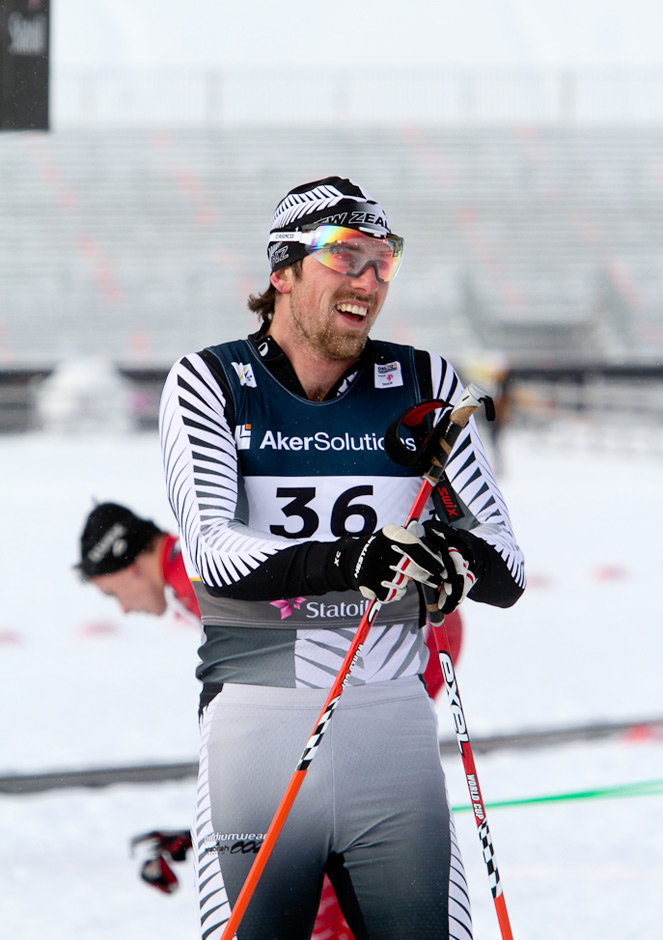
    Dartmouth graduate and New Zealand Native Ben Koons skied to a 16.9 second victory over Callum Smith (GBR) in the men’s 10km classic race. Koons, starting at number 36 in the 47-man field, was ushered to the leader’s “throne” where he sat, skis in lap shaking the hand of each successive finisher, and waiting to see if his time would hold up.

    When the last racer crossed the line, Koons was announced as “the first winner of the 2011 World Championships,” and along with Smith and third place finisher Sergey Mikayelyan (ARM), prepared for the flower ceremony.

    “Standing on the podium at World Championships,” Koons said later with a laugh, “I’ll take it.”

    With temperatures hovering around 20F, a bit of fresh snow, and firm tracks, Koons described the conditions as “about as good classic skiing as it gets.”

    The 2010 Olympian is now on track for a total of four World Championship starts. He will contest the sprint, the 30km pursuit, the 15km classic, the team sprint paired with brother Nils, and of course, the 50k.

    “Today my goal was to get top-10 and make it to the start line [of the 15k],” Koons said. “The goal for the 50k is to finish.”

    Koons was feeling good after his victory, and finally getting word from family and friends in Christ Church, New Zealand, the site of a recent earthquake.

    The leader's chair

    “It has been a rough couple of days trying to track down friends and family in Christ Church, and I have just recently found out that everyone is ok,” he said. “That plus this [the win] is great.”

    Just 16 women started the 5km with Dane Niviaq Chemnitz Berthelsen cruising to a 42-second victory over Nina Broznic (CRO). Ingrida Ardisauskaite (LTU) finished third.

    In 2009, US skier Morgan Smyth won the women’s 5km event, but this year no Americans or Canadians needed the race to qualify. Australians Mark Van Der Ploeg and Ewan Watson both cracked the top-10, but teammate Nick Grimmer just missed out, placing 11th, a mere three seconds out of tenth.

    Beejan Kangarloo, who recently competed in the Asian Winter Games for Iran, placed 28th. Kangarloo is also a Canadian citizen, and makes his home in Alberta.

    The skiers who did not make the cut will still get to race at World Championships – just not in the 10/15km race. The sprint, 30km pursuit, and 50k event are all open to single racers, while both the team sprint and distance relays are an option if an athlete has the requisite teammate(s).

    Philip Boit, the Kenyan runner-turned-skier placed 42nd as he gears up for his last major Championship event. Boit became famous when Bjorn Daehlie returned to the finish coral to greet him in the 1998 Olympics. He will retire following the Oslo World Championships.

    Men’s 10km Qualifying – Results

    Women’s 5km Qualifying – Results

    Tadevos Poghosyan (ARM) strides out of the start.

    Nat Herz contributed reporting

  • Beejan Kangarloo: “Chasing Points” for Iran’s Olympic Team

    Beejan Kangarloo: “Chasing Points” for Iran’s Olympic Team

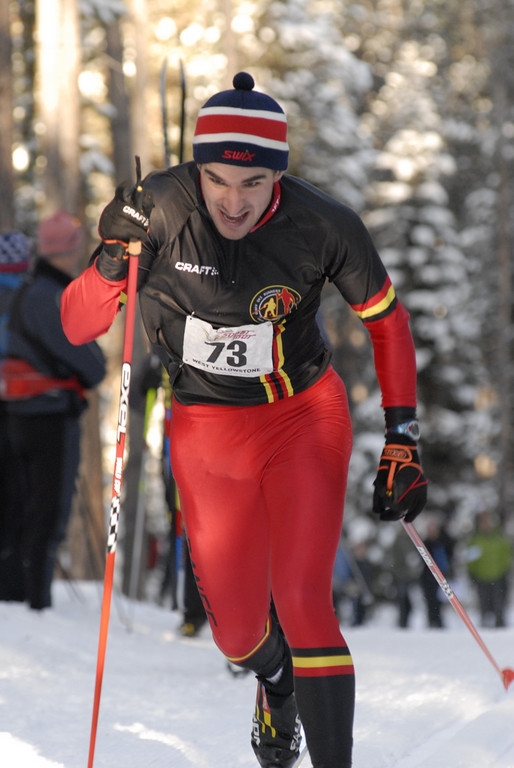
    Persian Power-Beejan Kangarloo striding in the classic sprint in West Yellowstone in November. Photo: Win Goodbody
    Persian Power: Beejan Kangarloo striding in the classic sprint in West Yellowstone in November. Photo: Win Goodbody

    For the last year, Iran has drawn its fair share of criticism for its nuclear ambitions. But if Beejan Kangarloo has his way, the country could some day attract attention for a different kind of Atomics: skis.

    Iran isn’t known for its snow or steep slopes, but according to Kangarloo, there’s some great skiing in the mountains near Tehran. He’s hoping to draw attention to a little-known side of the country by qualifying to represent it in the 2010 Olympics.

    Born and raised in Western Canada, the 24-year-old Kangarloo grew up racing for the Banff Ski Runners, and was even good enough to qualify for the Canadian Junior World Championships Team. Last year, he acquired Iranian citizenship with the help of his father, Saeed, and now the only thing standing between Kangarloo and the Games is one really good race: he’ll qualify if he can achieve the international qualifying standard of 120 FIS points.

    While the country has been in the news in the last year for a disputed presidential election and a secret nuclear program, Kangarloo isn’t interested in controversy. He’s simply a young man who loves to ski.

    “I don’t want to be associated with being political,” he said. “I’m just trying to ski and trying to bring awareness to Iran. People don’t realize that it’s a ski nation—they really only see the negative side.”

    Kangarloo—who goes by Justin—has never been to Iran, and he doesn’t speak Persian. (He’s embarrassed about it, and he’s taking lessons.) But he says his father’s side of the family exposed him to the country’s culture as he was growing up in Calgary.

    Saeed emigrated to Canada at 19 to study engineering at McGill University, and his brother joined him soon after. After graduating, the two found work in “booming” Calgary, which allowed them to bring their parents over, too.

    Kangarloo was born in 1985, and started skiing at age seven. In 2005, he qualified for and raced in the Junior World Ski Championships in Finland, and his quest for the Olympics began last year, when he first took out an Iranian FIS license. A mineral land negotiator for a Canadian energy company, Kangarloo balances a full-time job with his training for the Olympics with the Ski Runners.

    Iran already has one spot at the Games under a FIS provision for “exotic” nations, Kangarloo said, but this will most likely go to a skier who has lived in Iran and trained with the country’s national team. If Kangarloo can achieve the “A” qualifying standard of 120 points in a sprint race, though, then Iran will be able to send him as a second athlete.

    But “chasing points,” as Kangarloo describes it, can be a fickle pursuit, as the score awarded to a skier at a given race is dictated not only by his own speed, but also the skill and competitive history of the other athletes at the event. To achieve the “A” standard, Kangarloo will have to be both fast, and lucky.

    Last year, at a sprint in Canmore, Alberta, Kangarloo came just two-tenths of a second away from achieving the “A” standard. He had a good race, he said, but the top-ranked athletes at the event did poorly, skewing the points upwards for the rest of the participants.

    After his first three races of the year in West Yellowstone and Bozeman, Montana, Kangarloo still hasn’t been able to reach the standard. He has two weekends of racing left to do it, in Vernon, British Columbia and back in Canmore.

    If everything goes right and he makes the grade, Kangarloo will then fly to Iran to train with the team and test himself in a pair of races in January, before returning home to Canada for the Games, which take place just a single day’s drive from his home.

    Along the way, Kangarloo has already managed to bridge a few international boundaries, while spreading the word about Iranian skiing.

    While racing in Switzerland last year, he befriended an American coach, Sverre Caldwell, who then put him in touch with New England team leader Janice Sibilia when Kangarloo needed help with ski preparation and waxing in West Yellowstone.

    Before meeting Kangarloo, Sibilia said, she had been unaware of Iran’s ski community.

    “When you think of Iran, you really don’t think of snow,” she said.

    Now, Sibilia is pulling for Kangarloo. All he needs, she said, “is a race where everything goes his way, and the points are good—and it could happen.”

    Initially, Kangarloo said, he was apprehensive about traveling to the U.S. for the Montana races, given its political tensions with Iran. But starting with his flight, Kangarloo said he was “really impressed” with the support and warmth from the Americans he has encountered, including a group lined the course to cheer for him in West Yellowstone.

    Regardless of whether Kangarloo qualifies for the Games, it seems that he will have already drawn some positive attention to Iran’s ski community. After this winter, he’ll have just one job left: educating the Iranians themselves. In an article about Kangarloo published in a Tehran newspaper, the accompanying photo depicts an alpine skier mid-race.

    For now, Kangarloo said that he’s relishing the experiences he’s had over the past year.

    “It’s been a fun journey—an adventure for sure,” he said. “But it would certainly be nice to get these points.”

    An article about Beejan Kangarloo in an Iranian newspaper.
    An article about Beejan Kangarloo in an Iranian newspaper.