From the FasterSkier archive — posts syndicated from athletes’ and coaches’ own blogs between 2004 and 2012, kept online as published. Current coverage is at fasterskier.com.
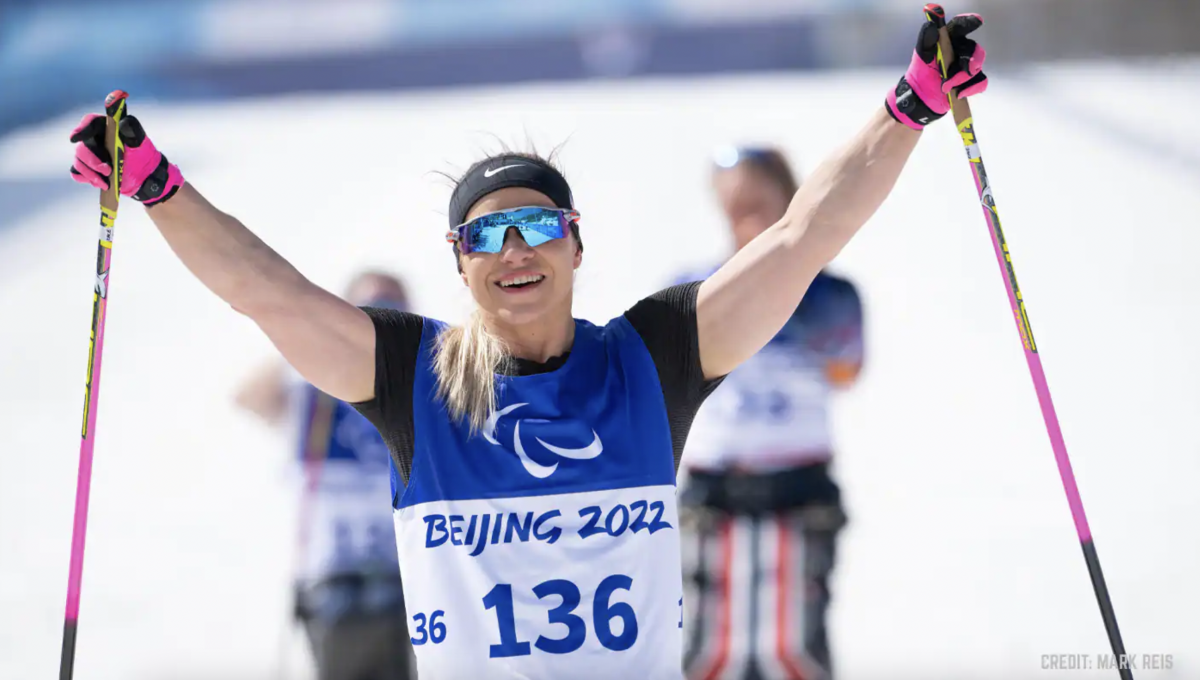
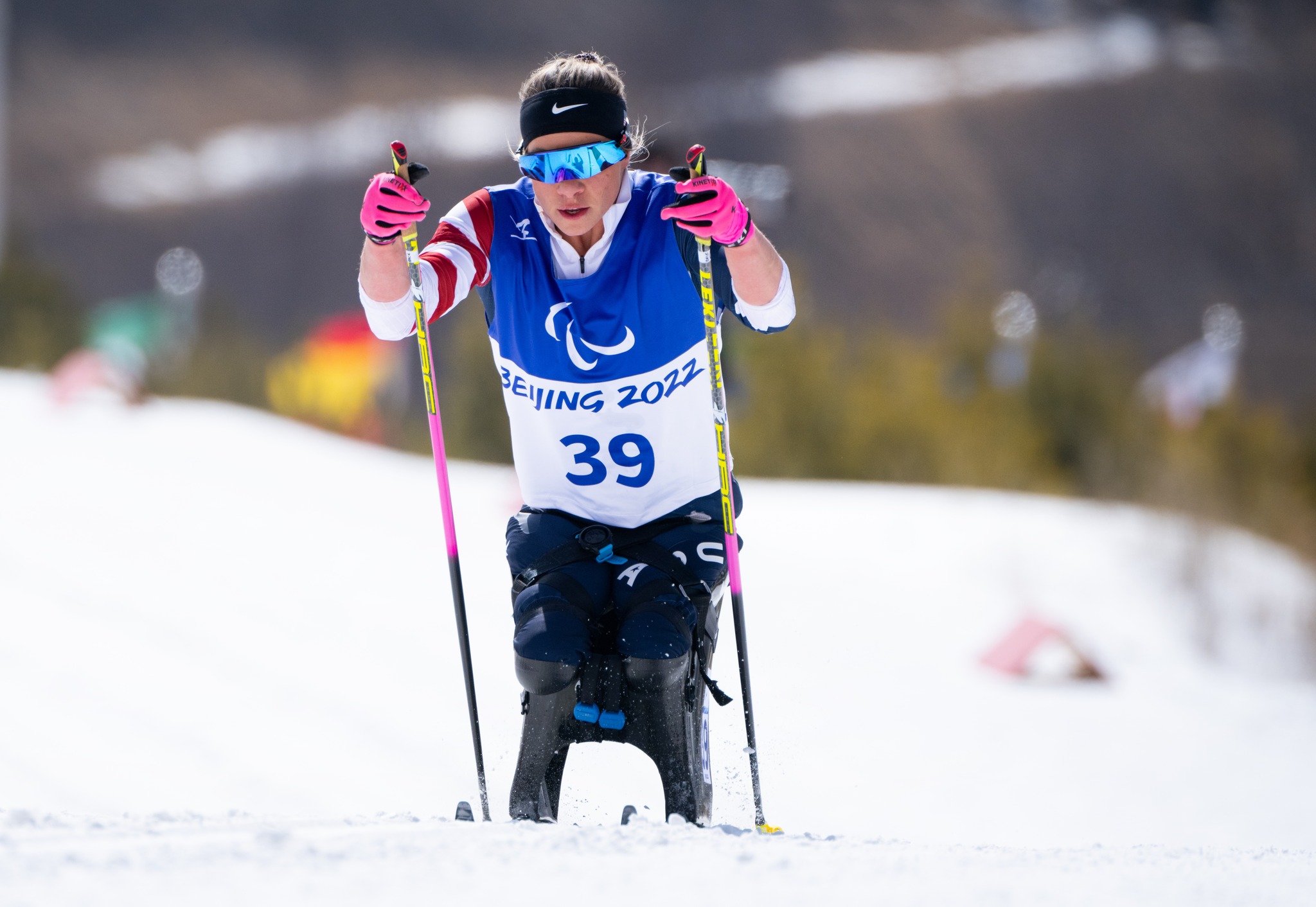
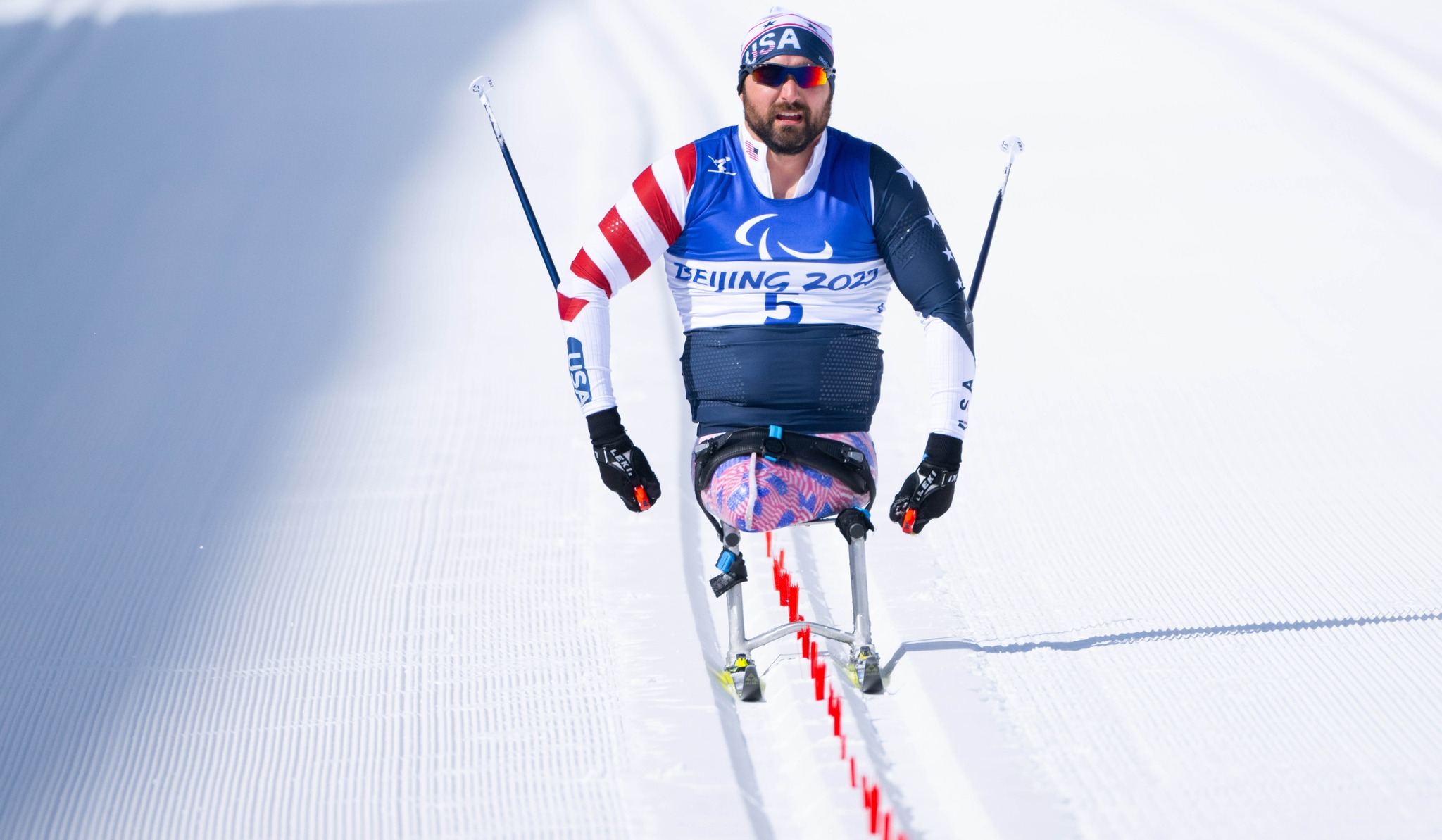
Oksana Masters skis to silver in the women’s sitting middle-distance cross country event. (Photo: Mark Reis / Team USA)
ZHANGJIAKOU, China — Team USA Nordic skier Oksana Masters (Louisville, Kentucky) skied her way into the record books on Saturday at the Paralympic Winter Games Beijing 2022.
Masters won the silver medal in the women’s sitting cross-country middle-distance at the Zhangjiakou Biathlon Center, her sixth medal of Beijing 2022 and 16th overall medal in her Paralympic career, which is the fourth-most Paralympic medals by a U.S. athlete.
A star in both the winter and summer Paralympic Games, Masters has now won eight Paralympic medals in cross-country, five in biathlon, two in Para-cycling and one in rowing. Her eight cross-country medals are the most ever by a U.S. Paralympian and her 13 overall Winter Paralympic medals ties alpine skiers Sarah Billmeier and Sarah Will as the most all-time by a U.S. Paralympian.
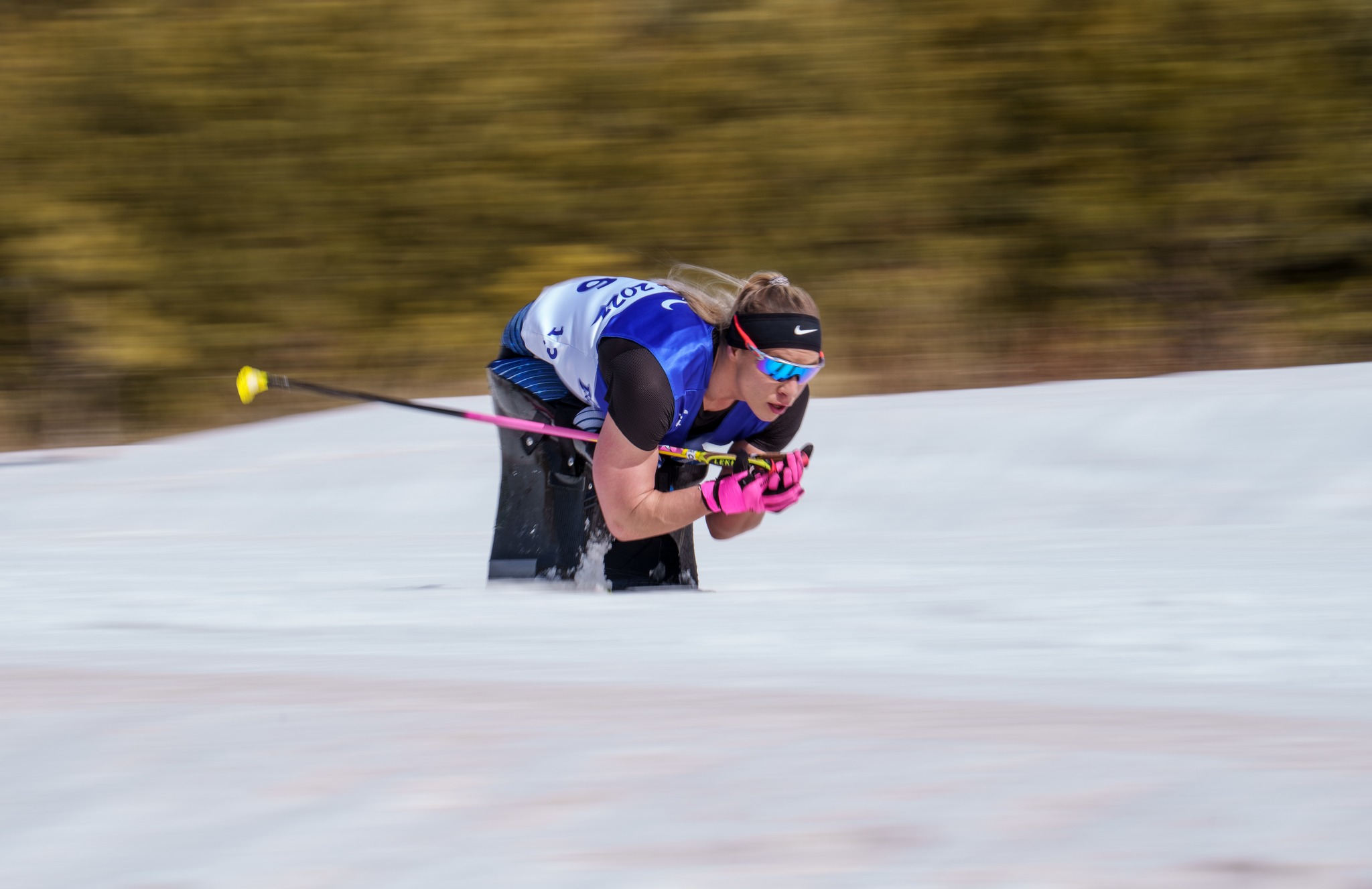
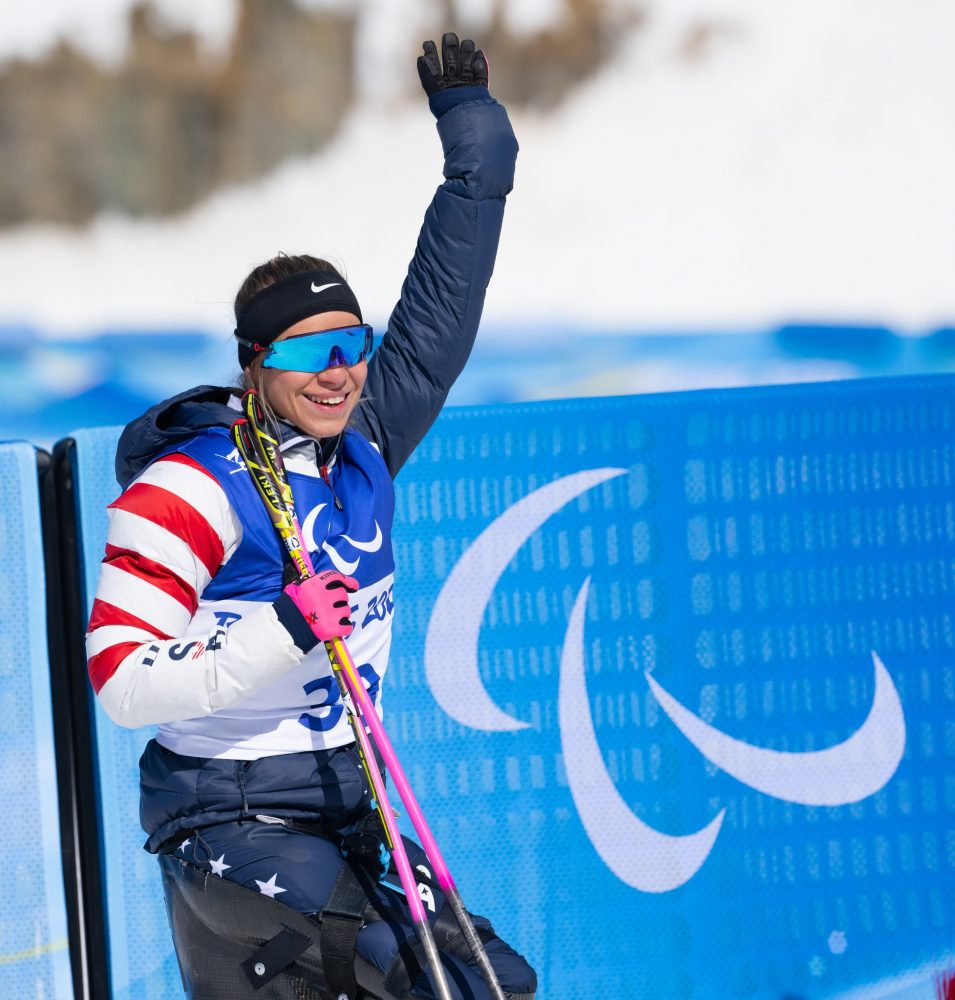
Oksana Masters skis to silver in the women’s sitting middle-distance cross country event. (Photo: Thomas Lovelock for OIS / Team USA)
On Saturday in warm conditions and slushy snow, Masters skied the middle-distance 7.5-kilometer course in a time of 25:24.7 — 37.2 seconds away from gold. China’s Hongqiong Yang won in a factored time of 24:47 and her teammate Jing Ma won bronze in 26:22.
Kendall Gretsch (Downers Grove, Ill.) placed sixth, with a time of 27:47.
“Today was a really tough day. The combination of the fresh snow and the warm temperatures made for a brutal race,” said Gretsch, who will head home from Beijing 2022 with three medals from her individual races. “I’m proud of my performance here. I came out every race and gave it everything I had. I wanted a little more and was hoping to do a little bit better, but I can’t be upset that I gave everything I had.”
Together, the duo of Masters and Gretsch have won nine medals across six days of biathlon and cross-country racing at Beijing 2022, and the U.S. Nordic team as a whole has won 13 medals. With individual racing now concluded, the Nordic racing action finishes on Sunday with the mixed relays on the final day of Beijing 2022.
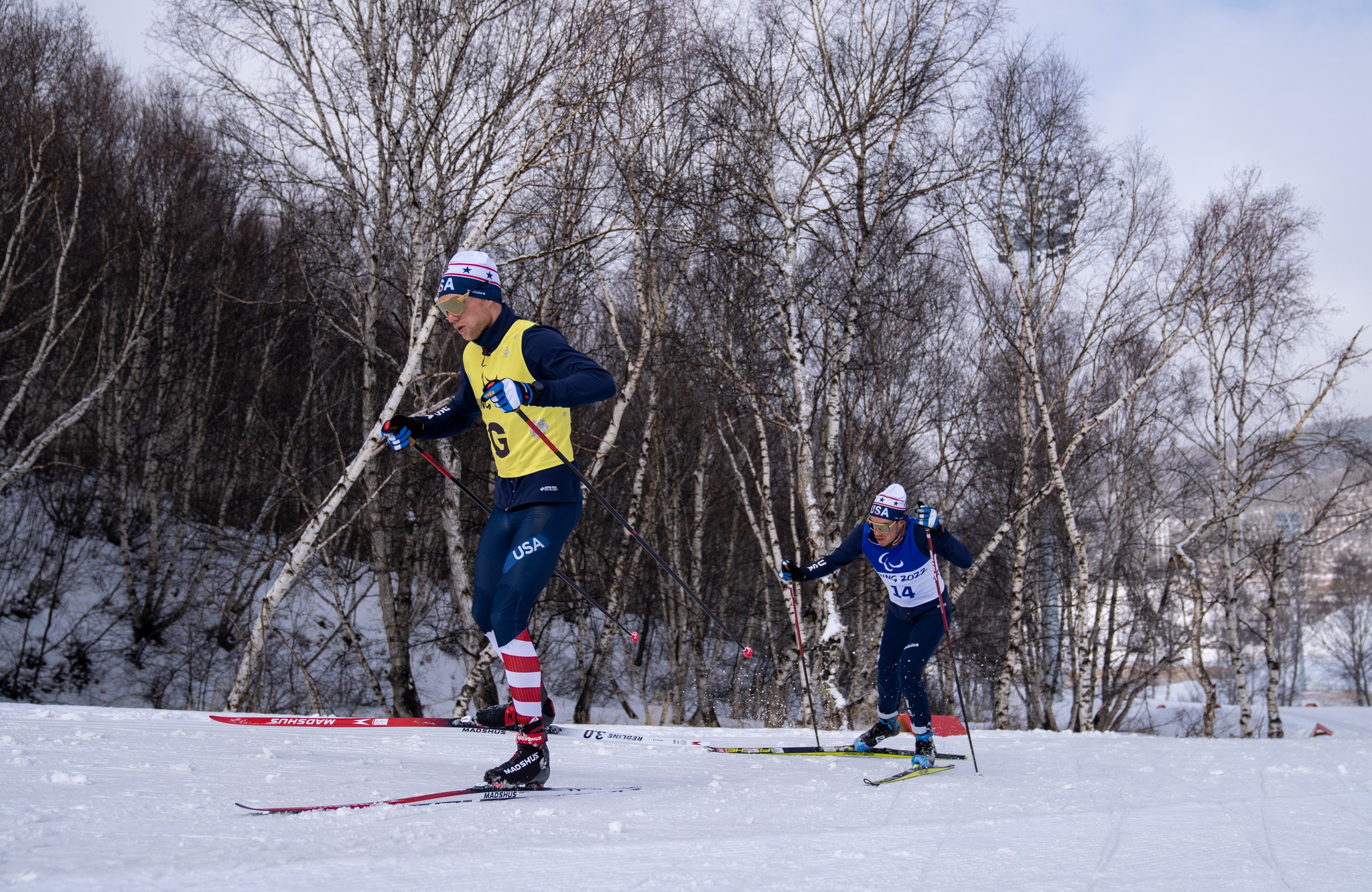
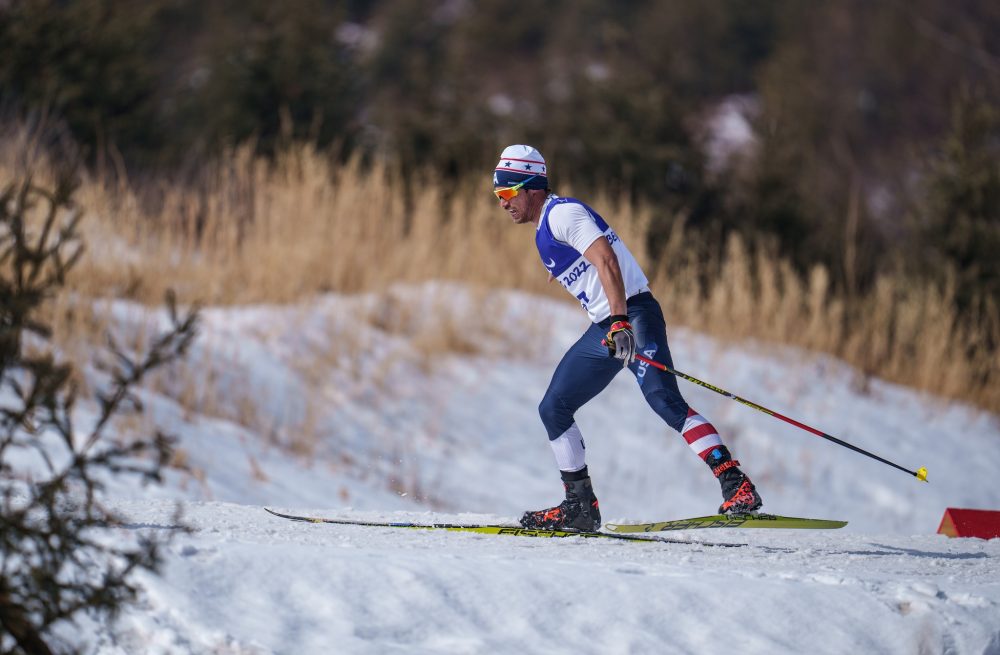
Jake Adicoff and guide Sam Woods race the middle-distance freestyle race in Zhangjiakou. (Photo: Thomas Lovelock for OIS / Team USA)Ruslan Reiter skates to 10th place in the middle-distance standing cross country event. (Photo: Thomas Lovelock for OIS / Team USA)
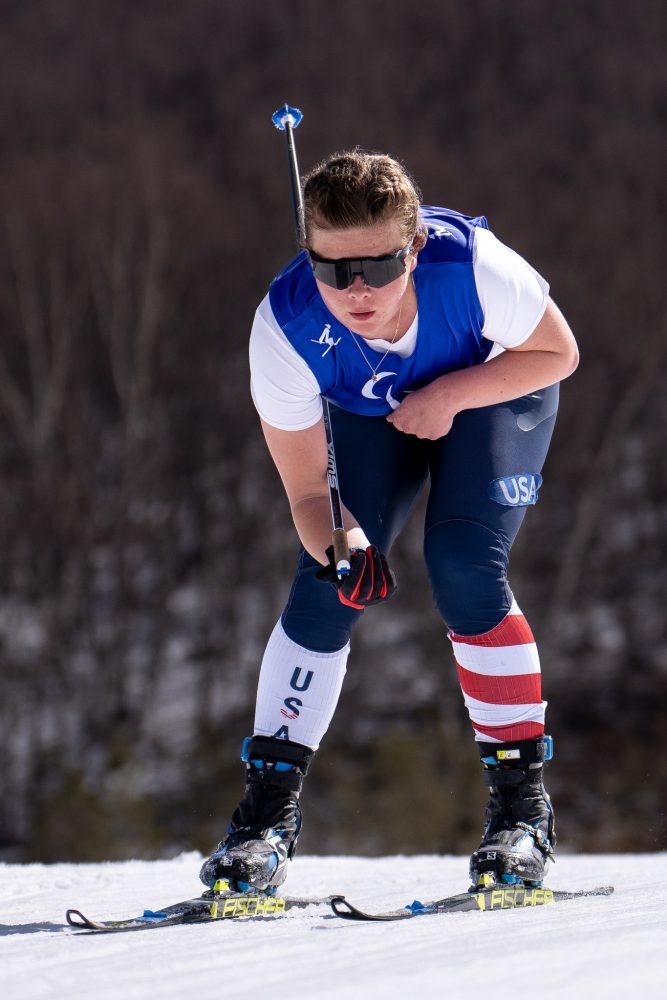
In Saturday’s standing middle-distance, Jake Adicoff (Sun Valley, Idaho), with guide Sam Wood (Harpswell, Maine), placed sixth in the men’s vision impaired category. Team USA’s Ruslan Reiter (Manchester, Maine) scored a top-10 finish in the men’s standing middle-distance, placing 10th, while teammate Drew Shea (Vienna, Virginia) finished 19th.
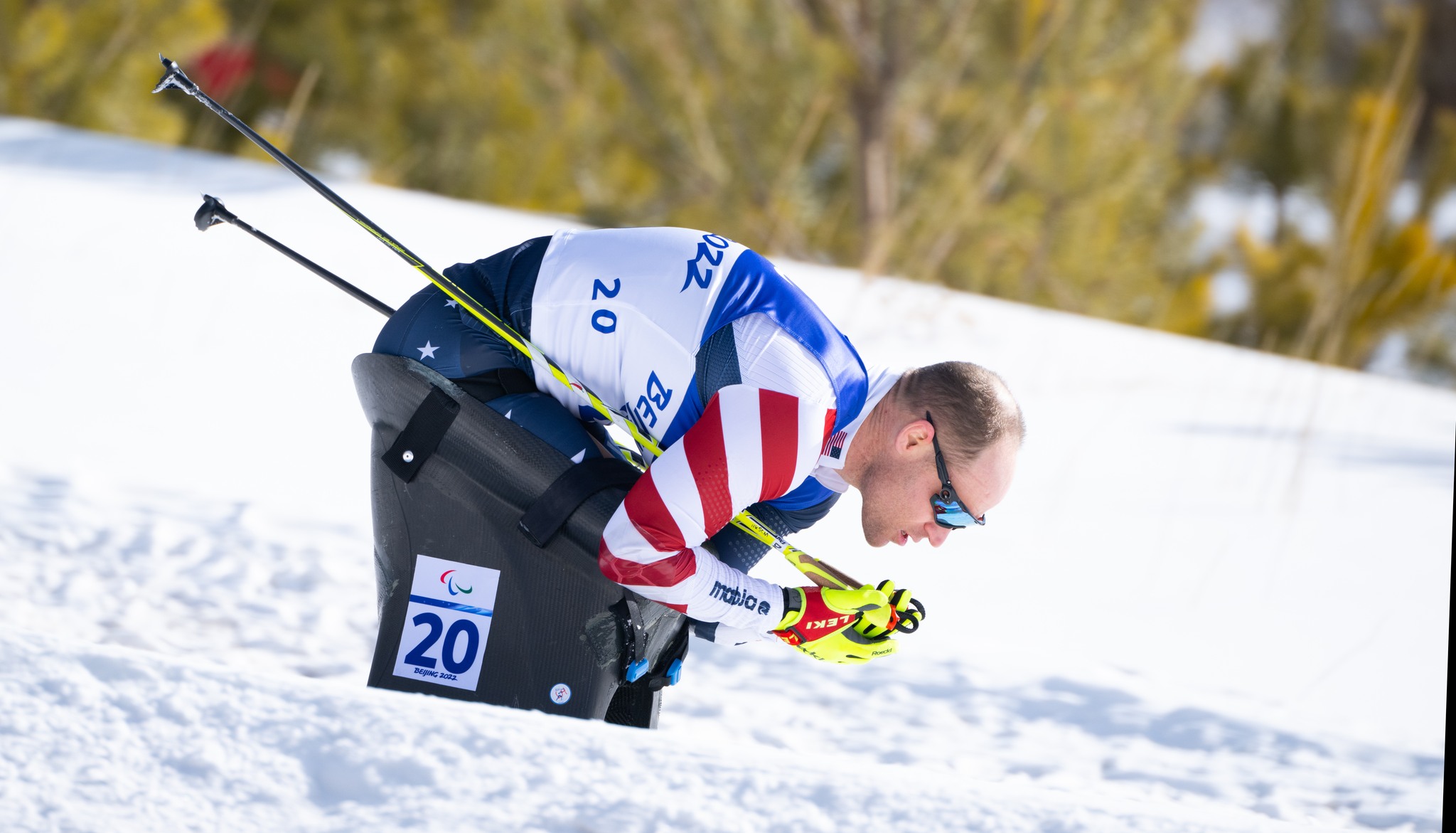
Sydney Peterson (Lake Elmo, Minnesota) who has won two medals in Beijing 2022 in her debut Paralympic Games, led the U.S. women in the standing middle-distance with a sixth-place finish. Dani Aravich (Boise, Idaho) scored her second top-10 finish of these Games, placing ninth. Two-time Paralympian Grace Miller (Palmer, Alaska) placed 16th. In the men’s sitting middle-distance, six-time Paralympian Aaron Pike (Park Rapids, Minnesota) led the way for the U.S. with a 12th-place finish. Josh Sweeney (Glendale, Arizona) took 24th.
Sydney Peterson takes sixth in the standing middle-distance cross country race in Zhangjiakou. (Photo: Thomas Lovelock for OIS / Team USA)
To follow and watch U.S. Paralympics Nordic Skiing competition from the 2022 Beijing Paralympics, tune in to NBC, which features more than 230 hours of coverage across NBC, Peacock, USA Network, the Olympic Channel, NBCOlympics.com and the NBC Sports App.
Oksana Masters races to a silver medal in the long-distance cross country sitting event on day two of the 2022 Beijing Paralympic Winter Games. (Photo: Mark Reis / Team USA)
U.S. Para Nordic star Oksana Masters (Louisville, Kentucky) won silver in the women’s sitting long-distance cross-country race on Sunday, her second medal of the Paralympic Winter Games Beijing 2022.
Masters, a cross-country skier and biathlete, also won gold in the women’s sitting biathlon sprint on Saturday and now has 12 career Paralympic medals between the winter and summer Paralympic Games. Sunday’s silver medal comes six months after winning double gold in Para-cycling at the Paralympic Games Tokyo 2020.
The 2022 world champion in long-distance cross-county, Masters raced the 15-kilometer course at the Zhangjiakou Biathlon Center in a time of 43:38.8 — just 32 seconds behind China’s Hongqiong Yang, who won the gold with a factored time of 43:06. China’s Panpan LI finished with the bronze in 45:17.
Master’s silver medal matches the silver she won in long-distance cross-country at the Paralympic Games Sochi 2014.
Oksana Masters is on a medal streak, adding silver in the long distance cross country race to her gold in the biathlon sitting sprint. (Photo: Mark Reis / Team USA)
“I was trying so hard to get the gold,” said Masters, who admits she could have raced faster from the start. “I was trying to upgrade from silver in Sochi and the PyeongChang bronze, but I’m just so happy to be able to fight my way onto the podium.
“I can’t wait to see the U.S. flag being raised today at the medal ceremony [for biathlon sprint]. I was trying to not do my classic ‘go out hard and then die.’ Looking back maybe I was too reserved in the first few laps and then got to a spot where I didn’t have enough space to make up. This course is not really technical so there’s not a lot of places to make up time either. I wish there was more elements of skiing in it, but I think it challenged me in a really different way and I’m excited to see what the next few races have.”
Kendall Gretsch skis to fourth in the women’s long-distance event. (Photo: Mark Reis / Team USA)
Teammate Kendall Gretsch (Downers Grove, Ill.) finished just off the podium, in fourth, with a time of 46:26. She finished second, behind Masters, in long-distance cross-country at the Lillehammer 2022 World Para Snow Sports Championships in January. She won the bronze medal in Saturday’s sitting biathlon sprint.
Dan Cnossen (Topeka, Kansas) led the U.S. men in the sitting category, placing sixth with a time of 49:22. Former sled hockey champion turned Nordic skier Josh Sweeney (Glendale, Arizona), placed 16th in his Nordic debut. For Cnossen, Sunday’s long-distance race offered a new personal challenge.
“I don’t care what the result was today,” Cnossen said. “For me, this was a personal test. In my opinion, this is the hardest race that we do in the cross-country discipline at 18 kilometers. In the last Games we had in 2018, it was a 15-kilometer race.”
Dan Cnossen races the sitting long-distance cross country event on day 2 of the 2022 Beijng Paralympic Winter Games. (Photo: Mark Reis / Team USA)
“I’ve never done an 18-kilometer, and I just wanted that personal challenge. There’s a battle going on in your head [during the race]. And it’s against the part of me that wants to go a little easier or softer, to kind of not challenge myself as much. And so, it’s a personal test to see what I could do and I’m happy with that. I executed my race plan really well. I had gas in the tank on the last lap, which was the plan. So, success for me.”
A newcomer to Para Nordic skiing, Sweeney isn’t new to the Winter Paralympics. The retired Marine Corps sergeant earned a gold medal as a member of the U.S. sled hockey team at the Paralympic Winter Games Sochi 2014. After retiring from sled hockey, Sweeney competed for a few years in elite paratriathlon before transitioning to Para Nordic skiing in 2021 through the Challenged Athletes Foundation. He notes his experiences from the different sports aids him on the Nordic course.
“Having the different sport experience is [helpful]. Knowing, especially in the triathlon world, what good pacing can do for you and not getting too carried away with what everyone else is doing is big,” Sweeney said. “I’ve learned over all these sports that you have to trust yourself and your coaches, respect the process and just put in the work and you’ll be alright.”
Josh Sweeney races the men’s long-distance cross country sitting event on day two of the 2022 Beijing Paralympic Winter Games. (Photo: Mark Reis / Team USA)
China’s Peng Zheng and Zhongwu Mao, won gold and silver, respectively, and Canada’s Collin Cameron won bronze.
Racing continues Monday in Zhangjiakou with the men’s and women’s long-distance cross-country in the standing and vision impaired categories. Watch U.S. Paralympics Nordic Skiing competition from the 2022 Beijing Paralympics on NBC, which features more than 230 hours of coverage across NBC, Peacock, USA Network, the Olympic Channel, NBCOlympics.com and the NBC Sports App. All events will be streamed live on NBC’s Peacock. Follow U.S. Paralympics Nordic Skiing on Facebook, Twitter and Instagram for daily updates from Beijing.
This World Cup coverage is made possible through the generous support of Marty and Kathy Hall and the A Hall Mark of Excellence Award. To learn more about A Hall Mark of Excellence Award or to learn how you can support FasterSkier’s coverage please contact info@fasterskier.com.
The team sprint: two skiers racing three laps each at roughly 1.5-kilometers a piece with a long climb thrown into the middle of the course and temperatures in the single digits Fahrenheit. It boils a sport that already requires both power and endurance down to its essence.
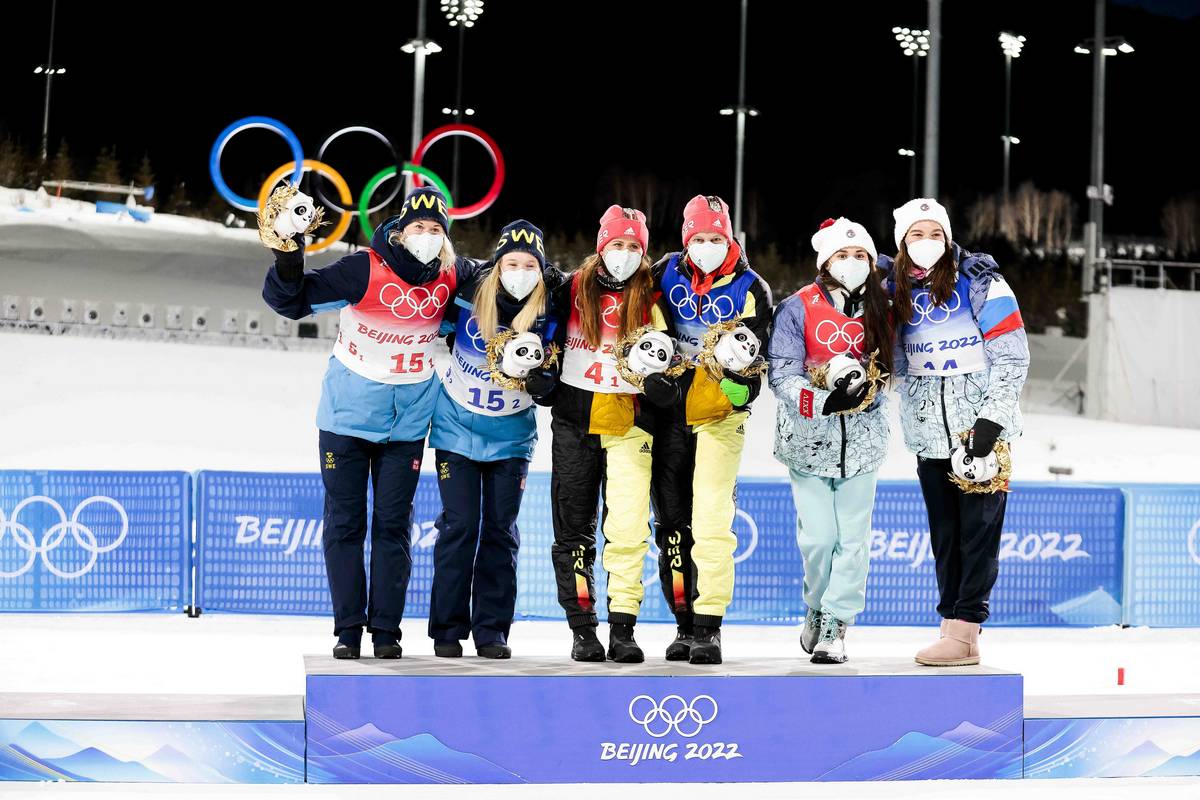
Riding the high of their silver medal in the women’s 4 x 5 k relay, the duo from Germany, Katharina Hennig and Victoria Carl, won a thrilling sprint finish to decide the medals, collecting gold in a time of 22:09.85. To take the stop spot, the anchor, Carl, out-sprinted the Swedish individual freestyle sprint gold medalist, Jonna Sundling, in the final meters to win by just 0.17 seconds, while the Russian Olympic Committee’s Natalia Nepryaeva crossed just behind in third (+0.71).
Sweden, Germany and Russia share the women’s classic team sprint podium. (Photo: NordicFocus)
After holding strong in medal contention throughout the first five of six laps, the American pair of Rosie Brennan and Jessie Diggins lost contact with the leaders in the final leg, crossing the line fifth (+12.93) behind Finland in fourth (+3.86).
Now, let’s take a step back.
There is, perhaps, no reminder needed that USA won the team sprint in 2018; Kikkan Randall and Jessie Diggins collected the first Olympic medal for the United States in cross country skiing – a gold, no less – since Bill Koch took silver in the 30 k classic in 1976. However, the team sprint in PyeongChang was raced freestyle, whereas today’s team sprint would be held in classic.
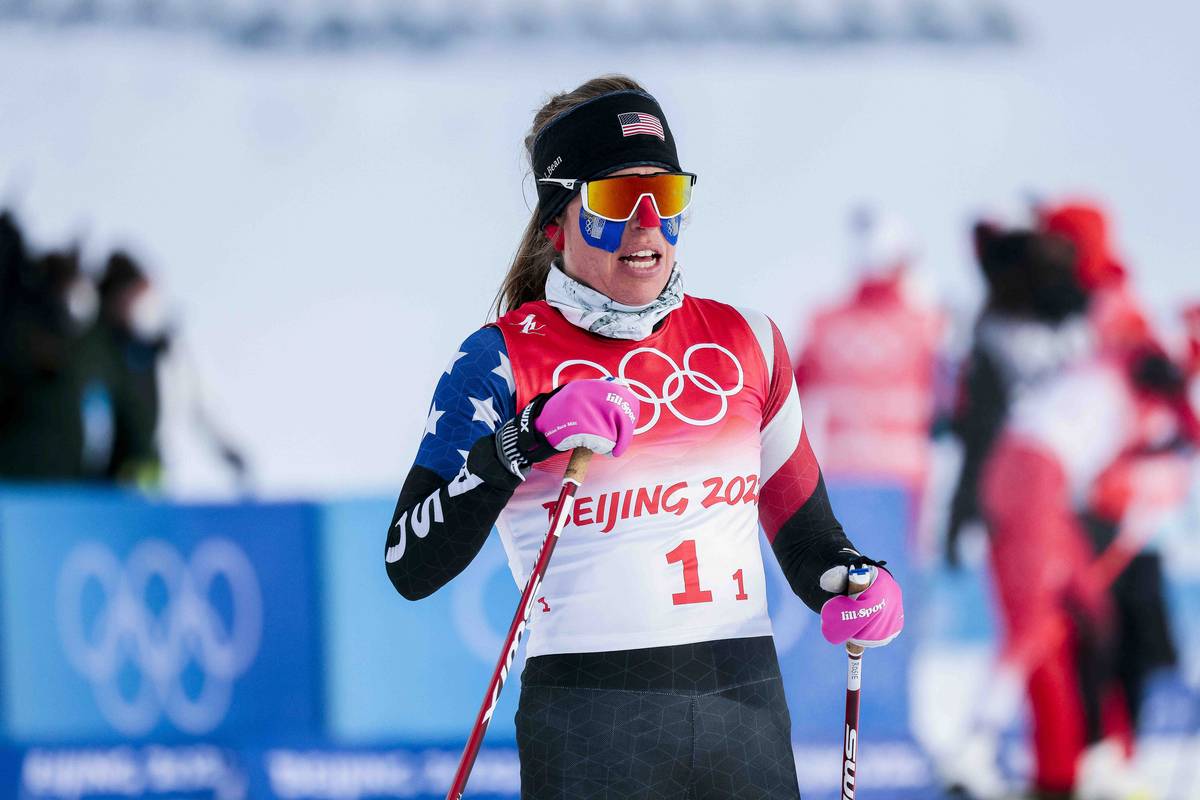
“I’m not trying to compare today to four years ago,” said Diggins in the mixed zone after the race. “It’s a different course, different altitude, different technique, like literally nothing is the same and, and that’s okay. I think today, I was going out there and skiing for Rosie and skiing as hard as I could and as best I could… but I’m really proud of this race and proud of giving it our best fight.”
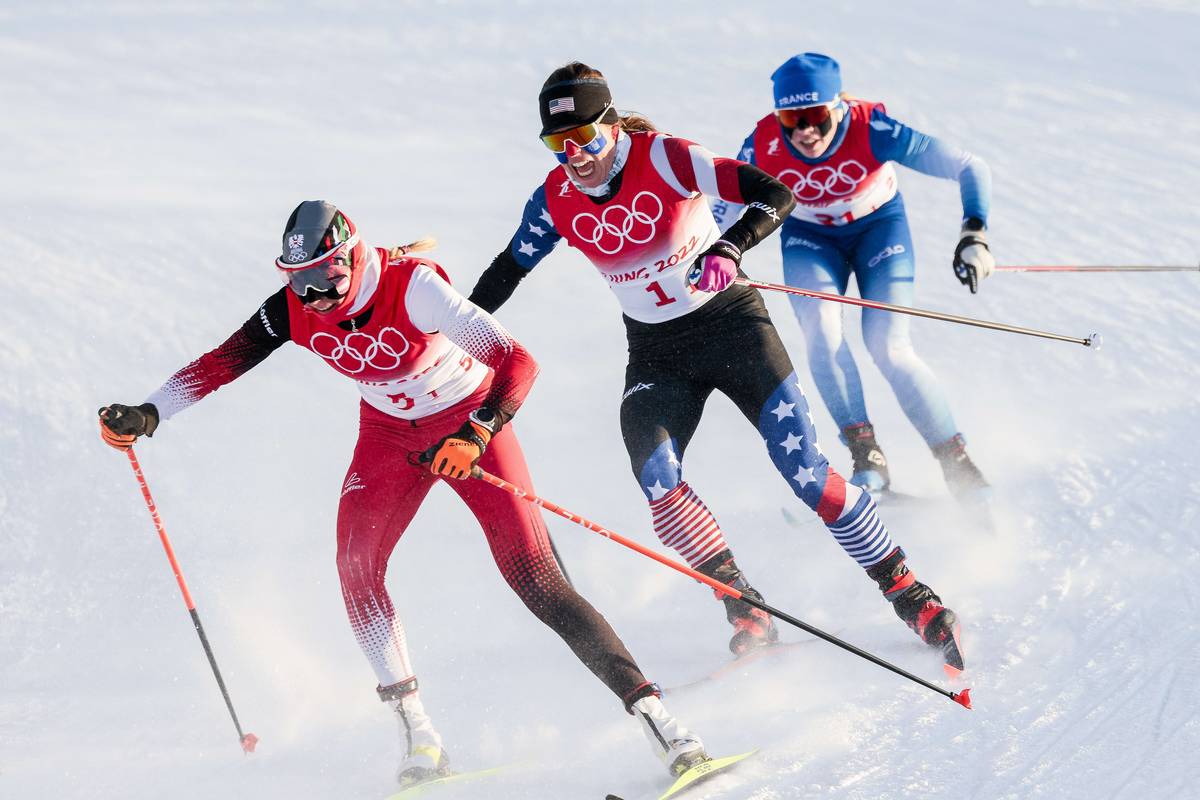
Rosie Brennan helps the Americans finish second in the first team sprint semifinal, automatically advancing to the final. (Photo: NordicFocus)
We have to look back eight years for a classic team sprint at the Olympic Winter Games, to the 2014 Games in Sochi. Norway took the gold that day in dominant fashion ahead of Finland and Sweden, who were stretched behind by roughly ten seconds a piece. Only one of the six women on the podium returned to the Games in 2022, again making the team sprint roster: Finland’s Kerttu Niskanen. The American pairing of Sophie Caldwell (now Hamilton) and Kikkan Randall were sixth in Sochi, +35.06 back on the Norwegian winners.
In the intermediate FIS World Championships, the Americans finished fifth both years, racing Brennan and Sadie Bjornsen (now Maubet) in the freestyle competition in Oberstdorf, Germany in 2021, and pairing Bjornsen with Diggins for the classic team sprint in Seefeld, Austria in 2019. In Oberstdorf, the Americans missed the podium by roughly 2.2 seconds, finishing 2.8 seconds behind the winning team from Sweden. In 2021, they missed the podium by an equivalent margin, this time finishing 5.8 seconds back in the overall standings, again to Sweden. It’s a mark of consistency and depth across techniques for the American women.
Yulia Stupak (ROC), Kerttu Niskanen (FIN), and Katerina Janatova (CZE) lead the way early in the women’s classic team sprint semifinal. (Photo: NordicFocus)
To make the team sprint final, each team must finish in the top-two of semifinal A or B, or be within the next six fastest times from either heat. The U.S. was second to Germany (+4.03) in Semifinal A, while the ROC won the second semi in a close finish with Finland in second (+0.35) and Sweden third (+1.0). Austria and Switzerland also advanced from the first semi, with Sweden, Norway, France, and Poland filling the remaining spots from semifinal B.
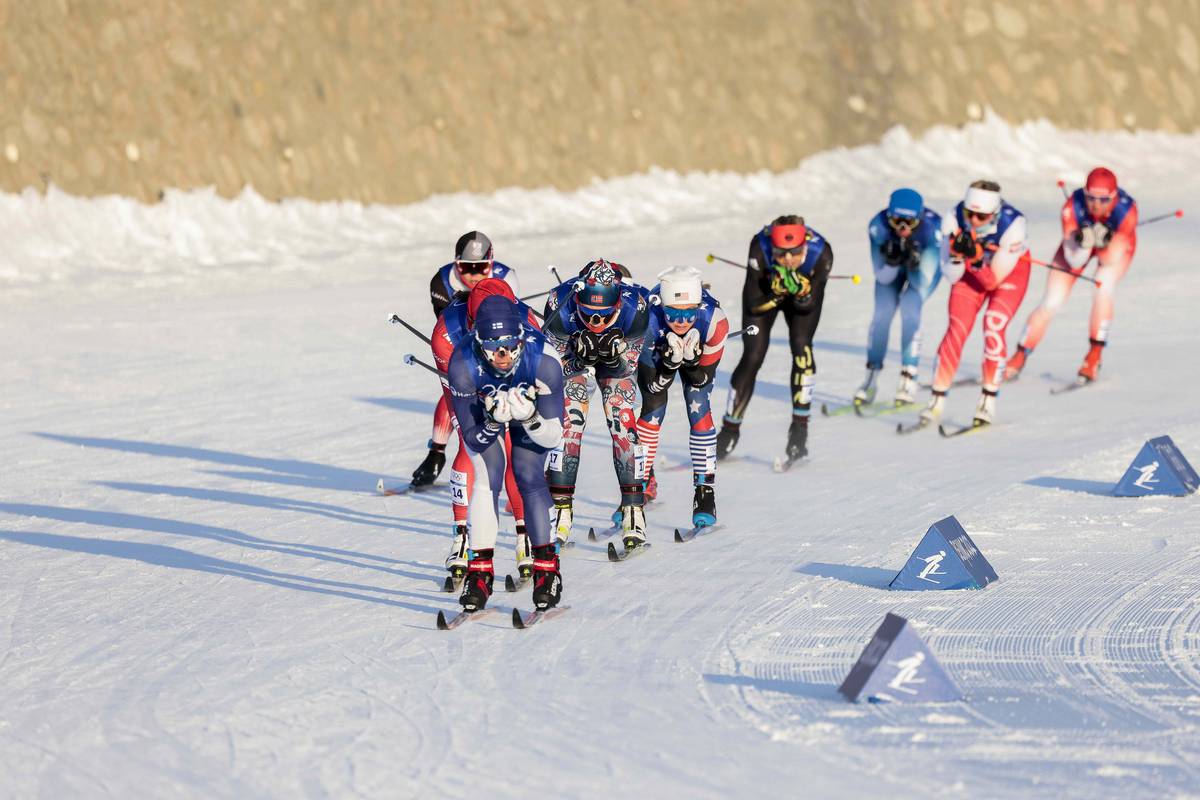
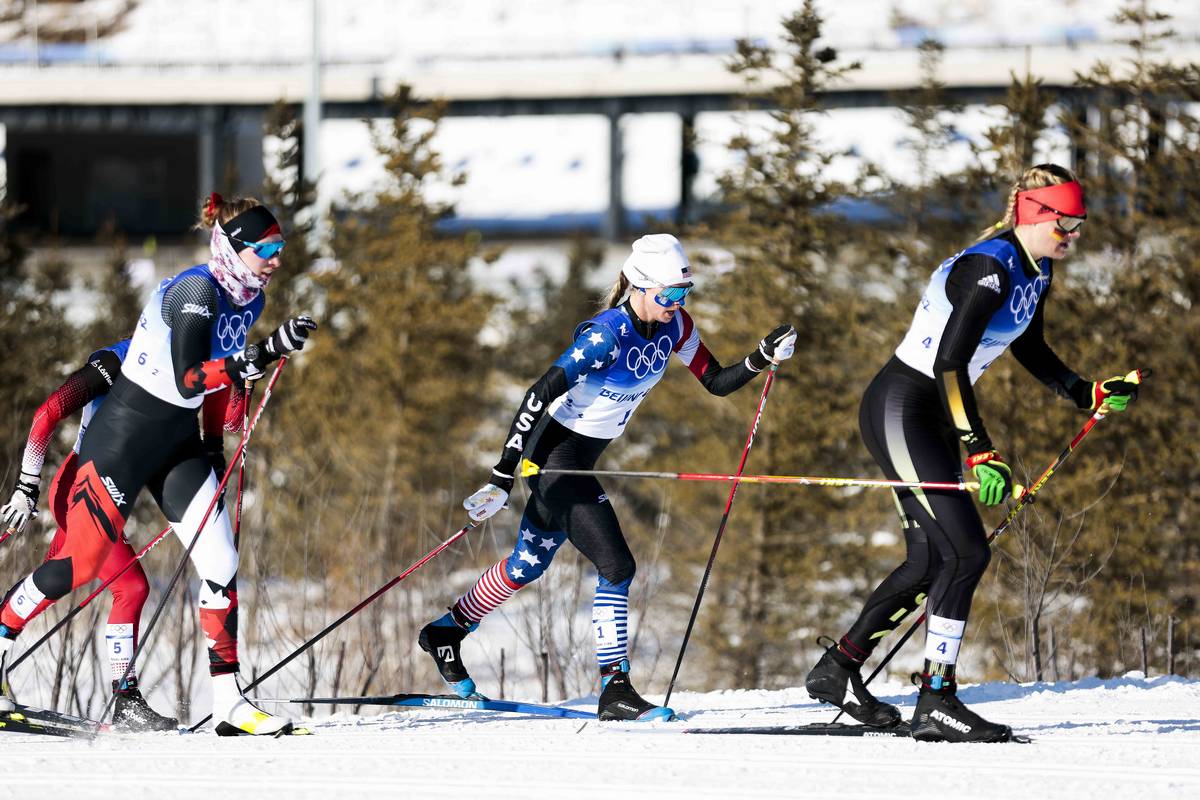
With bursts of frozen mist released from their mouths, the athletes took to the course for the final round, with Yulia Stupak (ROC), Maja Dahlqvist (SWE), Kerttu Niskanen (FIN), Tiril Udnes Weng (NOR), and Katharina Hennig (GER) racing with Brennan at the front of the pack.
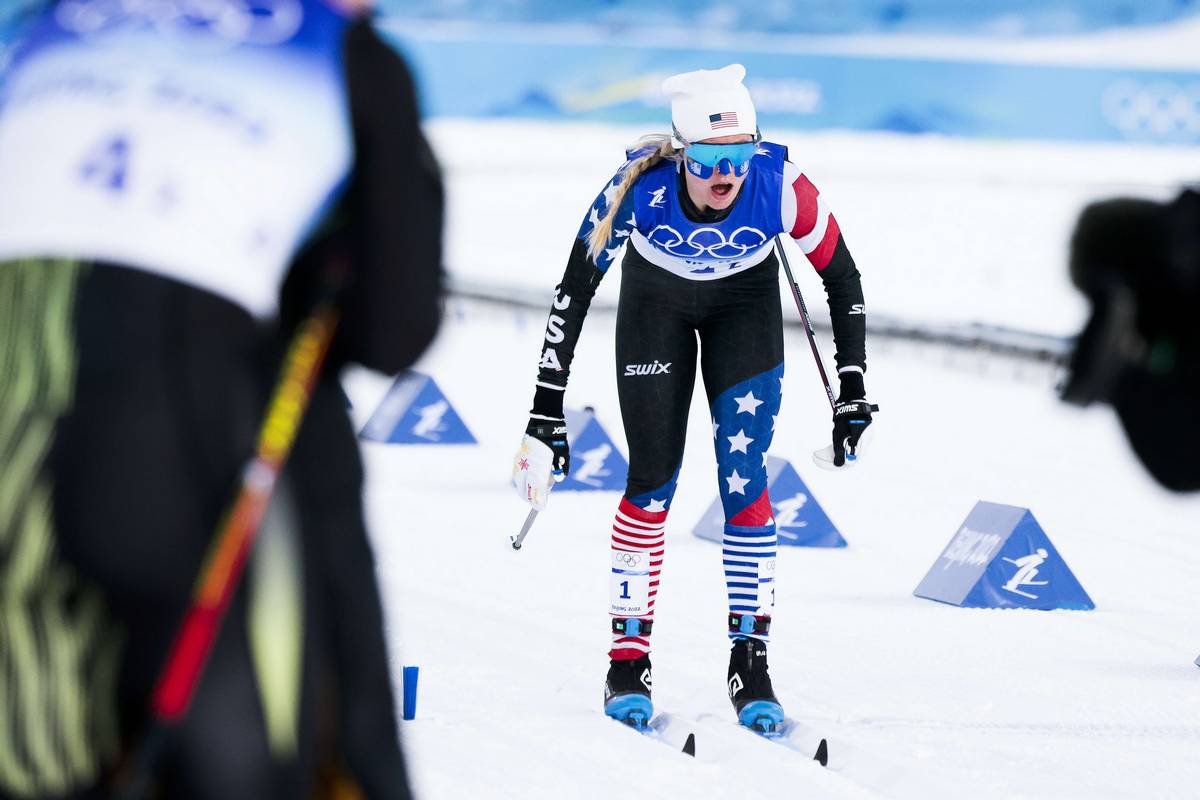
With a hooded parka draped over her, face tape obscuring her normally glittery cheekbones, and heated socks inside her boots, Diggins waited in the exchange for the tag. She would be facing Natalia Nepryaeva (ROC), Jonna Sundling (SWE), Krista Pärmäkoski (FIN), Maiken Caspersen Falla (NOR), and Victoria Carl (GER) in the even-numbered legs.
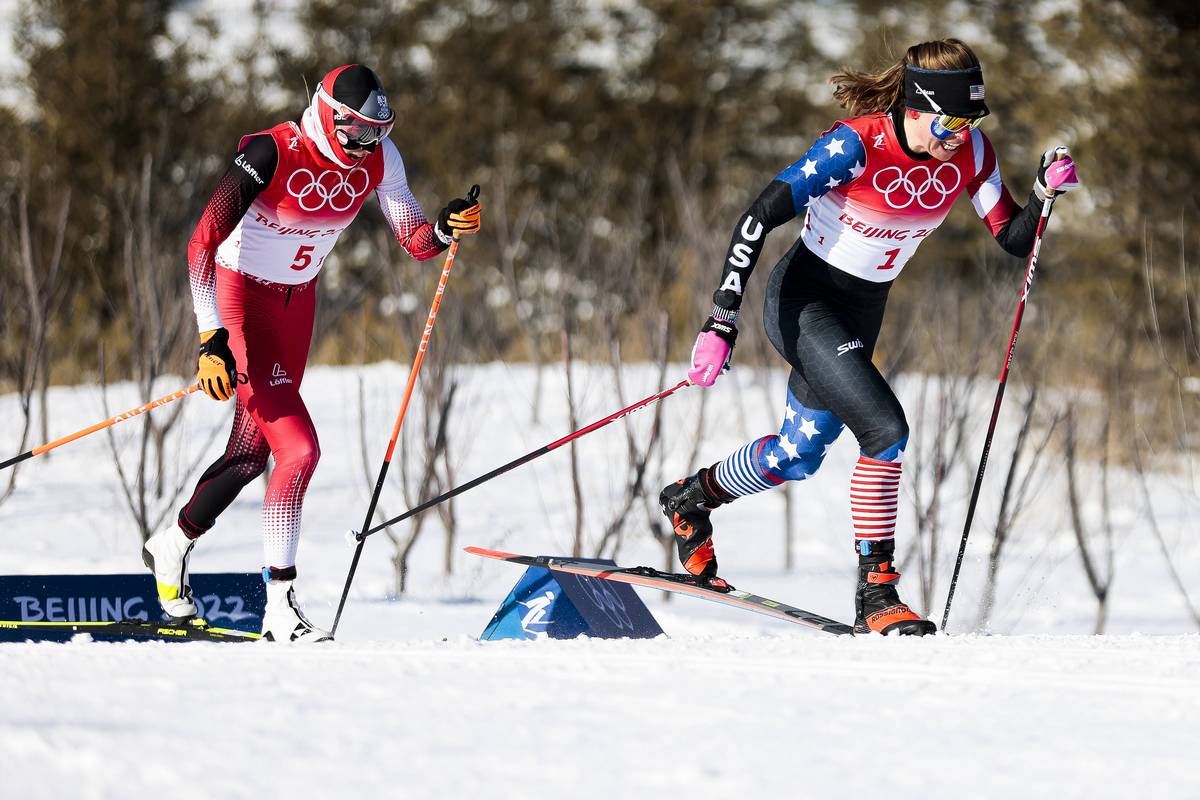
Racing comfortably near the front with skis that looked competitive for both kick and glide, Brennan tagged Diggins +1.1 second back on Finland in fourth, well within the lead group. In what would become a pattern for her first two legs, Diggins quickly moved to the front to control the race and ensure a fast pace, perhaps risking accumulating her own fatigue while also taking the sting out of the legs of the individual sprint gold and silver medalists of Sweden, who had also won the World Championship gold in 2021.
Diggins races at the front of the lead pack during the classic team sprint final. (Photo: NordicFocus)
Diggins tagged Brennan virtually even with Sweden and Finland after her first lap, a position Brennan was able to hold through her second leg. Near the bottom of the long, grinding climb to the high point of the course, Norway’s Weng wobbled slightly, placing her pole in front of Dahlqvist’s ski to catch her balance. Weng’s pole snapped, leaving her running up the sidelines of the climb with one pole, detaching her strap to grab another from a coach who stood along the fenceline. This lost Norway several seconds, which they were unable to regain in subsequent legs, leaving the team out of podium contention.
On the odd legs, Niskanen of Finland consistently controlled the race at the front, putting the powerful stride that earned her a silver medal in the 10 k last week on display as she led up the climb in each round. She tagged her teammate Pärmäkoski in the lead at the halfway mark, with Germany, the ROC, and USA within a second back.
Kerttu Niskanen (FIN) sets the pace in the first lap of the women’s classic team sprint final. (Photo: NordicFocus)
Diggins again charged to the front, her hands and legs pumping metronomically as she drove her skis up the climb. Diggins crested the hill in front, with Sundling and Pärmäkoski on her tails heading into the descent. A gap had opened to Germany and the ROC, but these teams had lightning fast glide and were able to regain contact in the descent.
At 6 k, with four of six legs complete, it was Sweden and Finland in the lead at the exchange, with Brennan receiving a tag 2.5 seconds back. Niskanen again set the pace at the front, still looking strong as she pushed the pace up the A-climb, with Dahlqvist matching pace behind. In a critical moment where loss of contact might have meant accepting a podium was not in the cards on the day, Brennan accelerated up the climb, steadily closing the gap to the Swede ahead of her.
Rosie Brennan (USA) awaits her turn during the women’s team sprint. (Photo: NordicFocus)
An aerial shot showed Brennan upping her tempo as she brought the U.S. back in contact with the leaders, bringing Hennig and Stupak along with her. All five women dropped into a tuck as they headed downhill together, rounding the sweeping right-hand bend and sprinting up a final climb before the last exchange. Throwing her hands up the hill in a run, Brennan challenged Sweden’s Dahlqvist on the final uphill, double poling around a left-hand bend into the exchange in third behind Germany and Finland.
In the last lap, Diggins went hunting. With Pärmäkoski and Carl leading the charge up the climb, Diggins would need to work the hill. Striding powerfully, Diggins did everything she could to keep her team in contact with the leaders, but it was not enough on the day. Doublepoling across the false flat before the descent, it was Pärmäkoski leading Carl, Nepryaeva, and Sundling.
The leaders were four abreast coming around the final bend, with Pärmäkoski and Sundling pushed into the outer two lanes, leaving them at a deficit as they headed up the final climb to the stadium.
Cresting the rise, Carl looked to be falling off the pace, while Nepryaeva and Sundling pulled to the front, the Swede leading around the final left-hand corner into the finish.
But Germany wasn’t done yet. Carl moved up along the outside of the bend, challenging Sundling as they headed into the finish lanes. Doublepoling powerfully, Carl began to slowly pull ahead of Sweden, with the ROC dropping back a few meters behind.
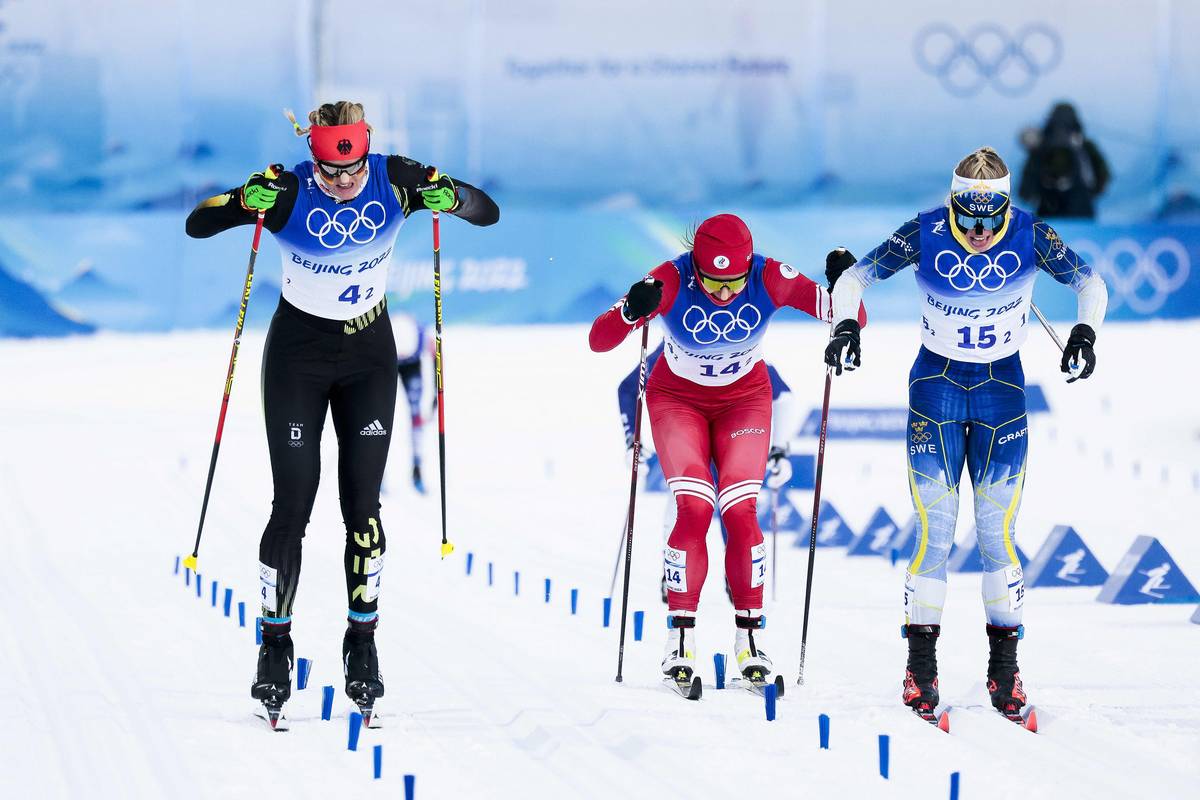
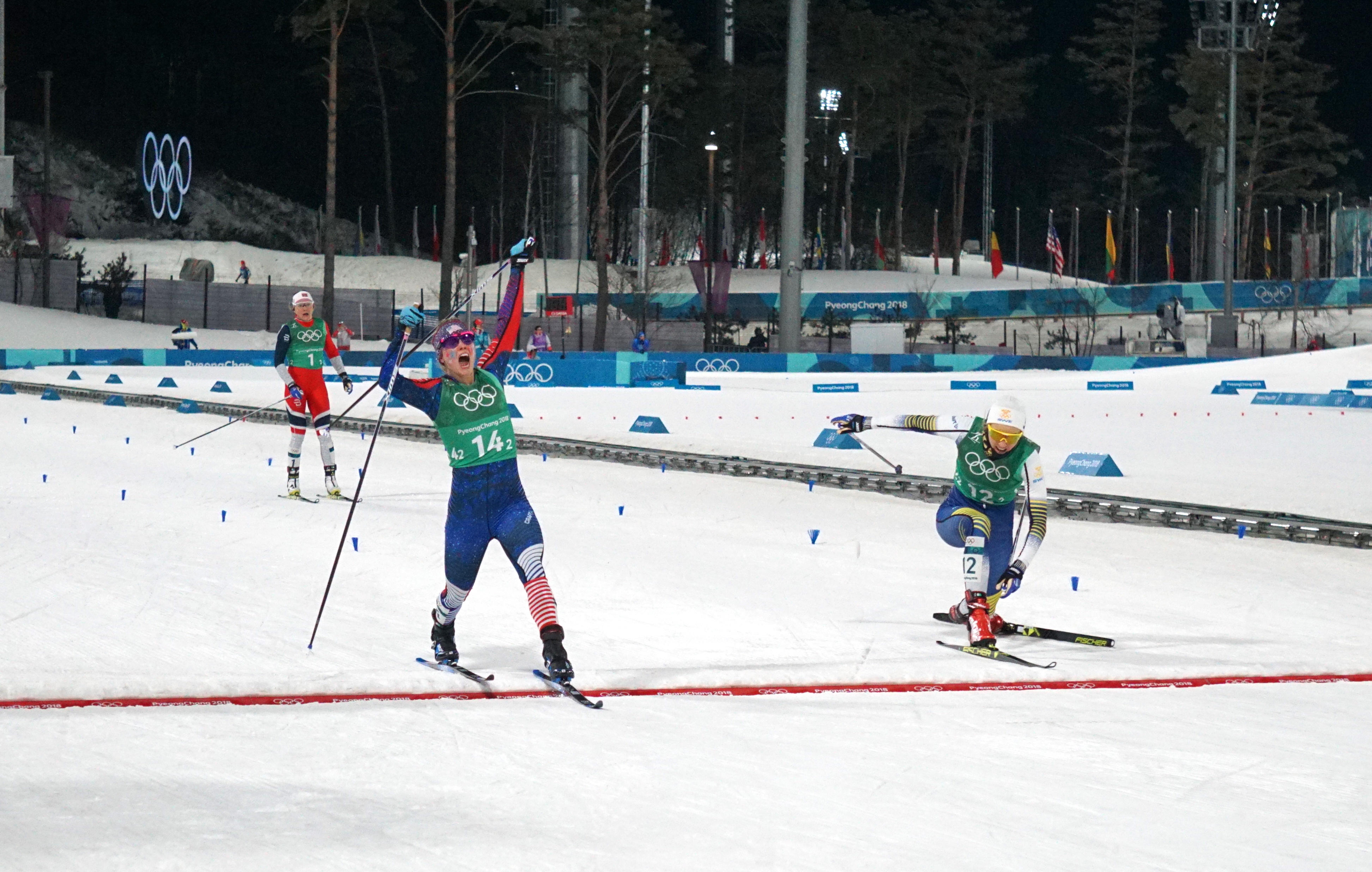
Coming to the line to decide the medals, it was Victoria Carl (GER), Natalia Nepryaeva (ROC), and Jonna Sundling (SWE) (l-r). (Photo: NordicFocus)
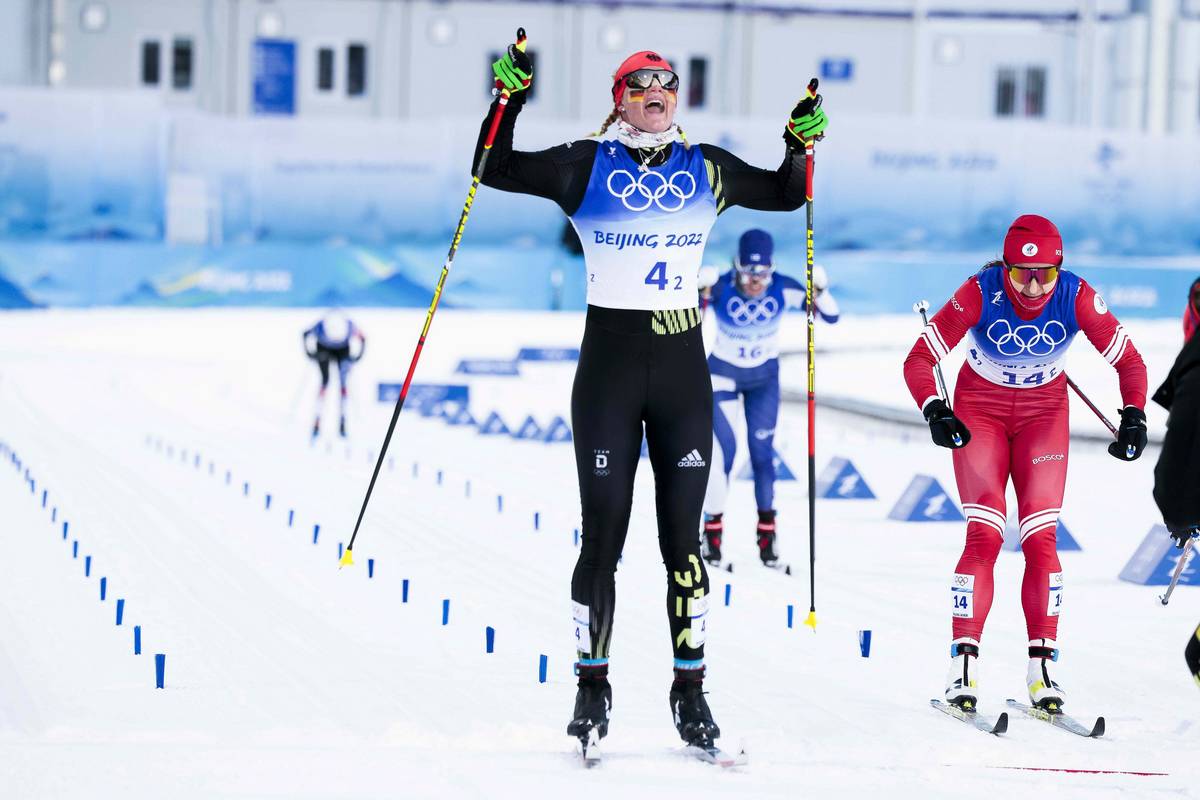
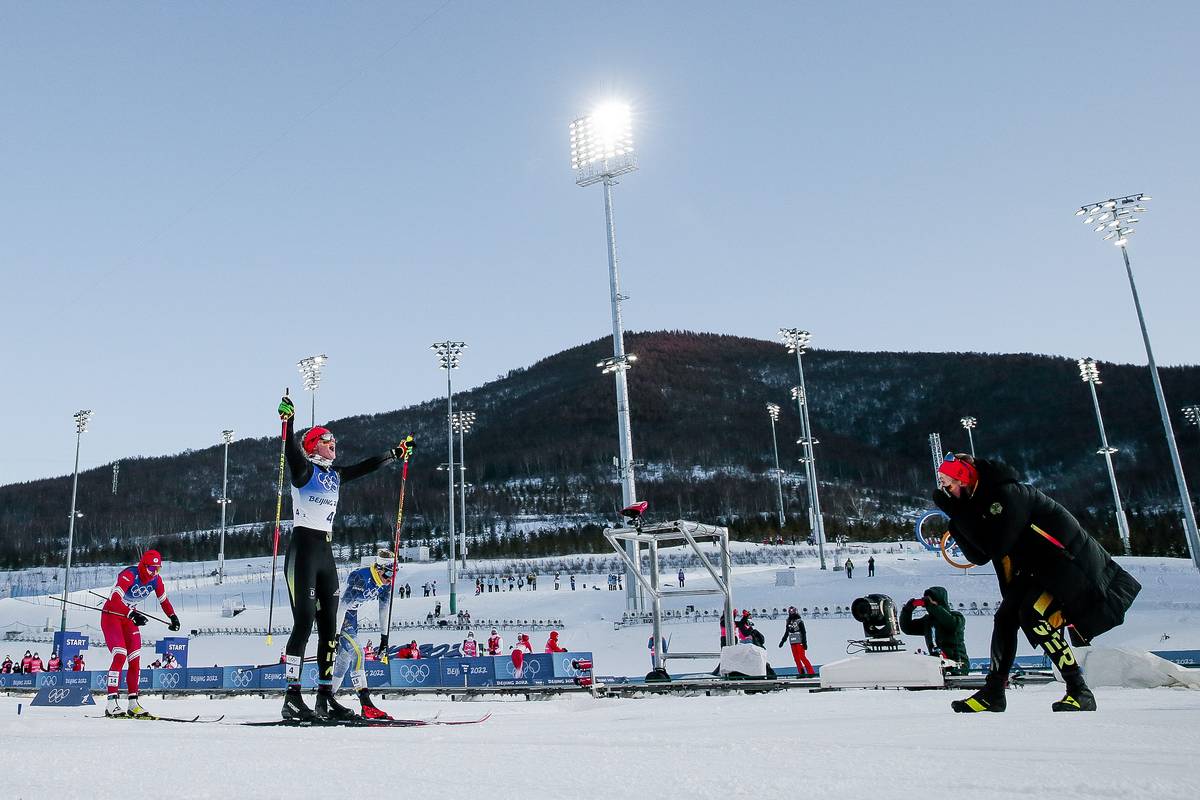
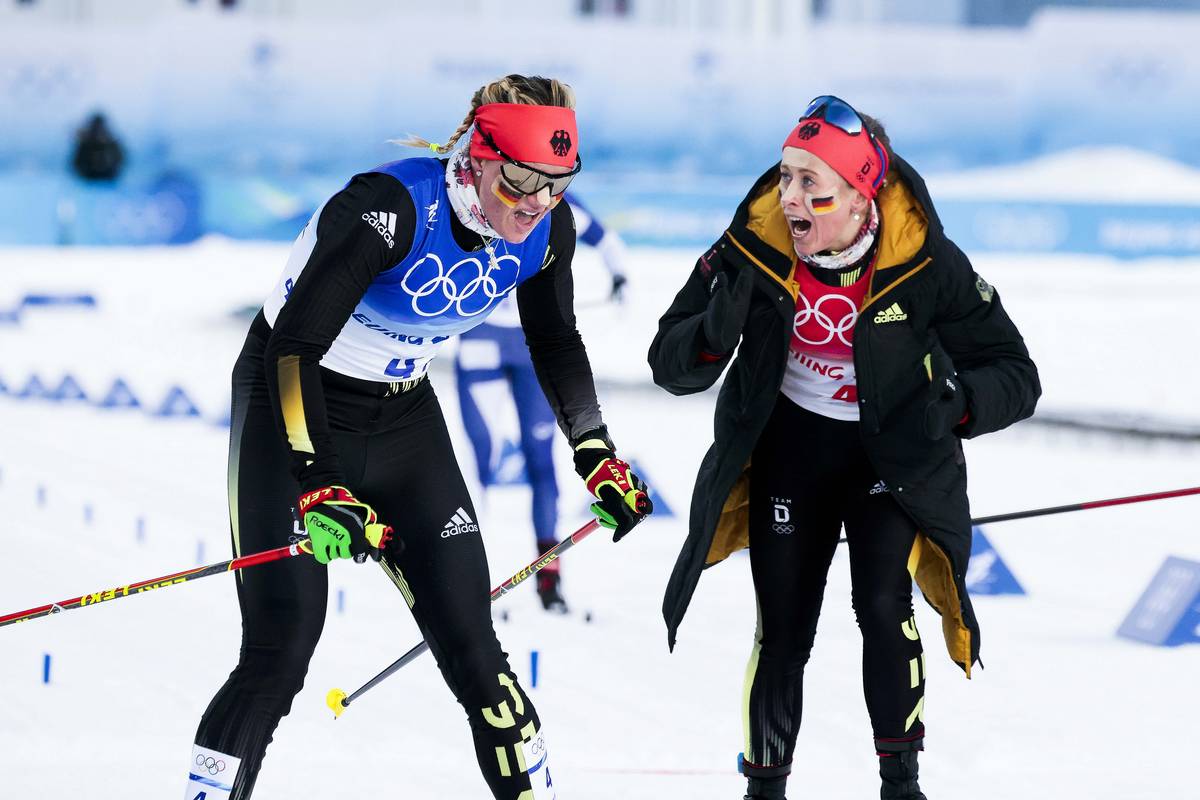
In a surprise upset of the Swedish favorites, Carl took it to the line, holding off Sundling as she crossed the line in 22:09.85, welcomed by her ecstatically screaming partner Hennig. Sundling was just 0.17 seconds back for silver, with Nepryaeva unopposed for bronze on their tails (+0.71).
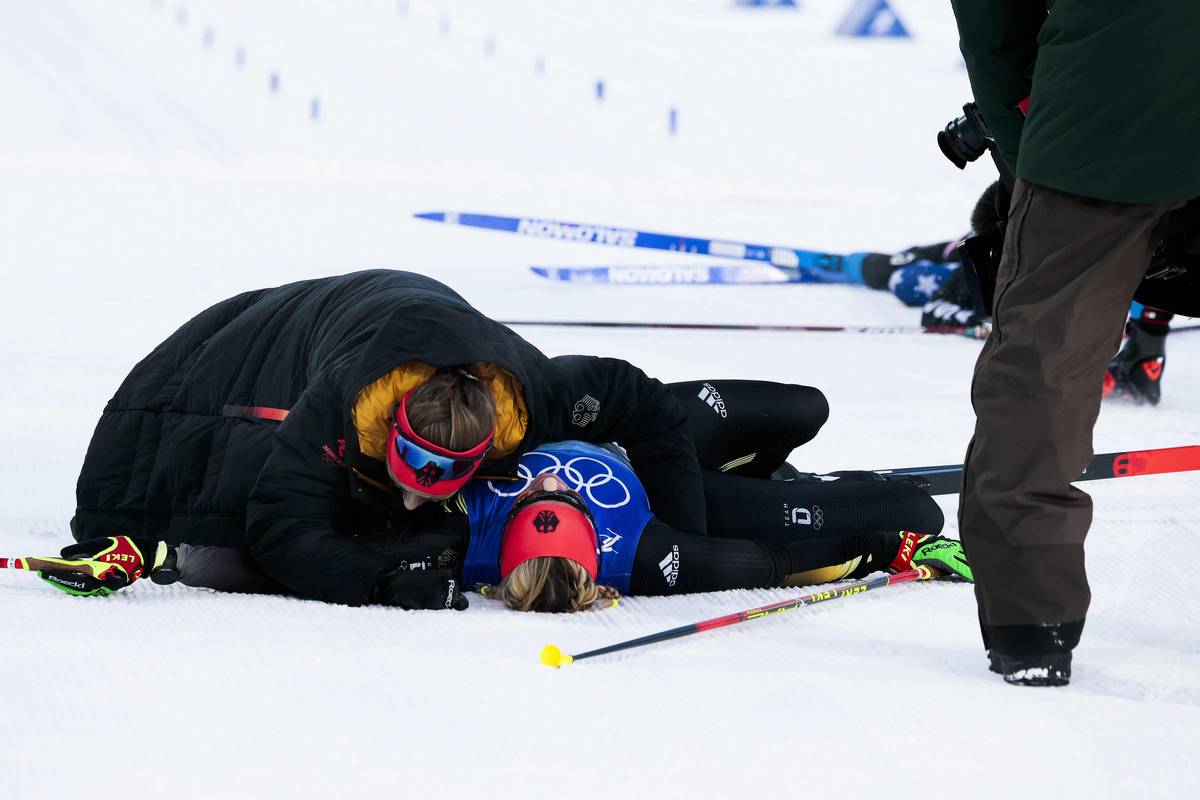
Victoria Carl (GER) celebrates gold in the women’s team sprint while Natalia Nepryaeva brings the ROC across the line in third.(Photo: NordicFocus)VIctoria Carl takes gold in the classic team sprint, while partner Katharina Hennig awaits in disbelief. (Photo: NordicFocus)
After falling off the leaders in the final climb, Pärmäkoski brought Finland to the line in fourth (+3.86) with Diggins holding strong after a gap to cross fifth (+12.93).
“It means a lot for us,” Hennig told the media after her race. “Also the silver medal in relay and today the gold medal in team sprint. It means a lot and we are very thankful for the whole team. It’s very important for cross-country in Germany.”
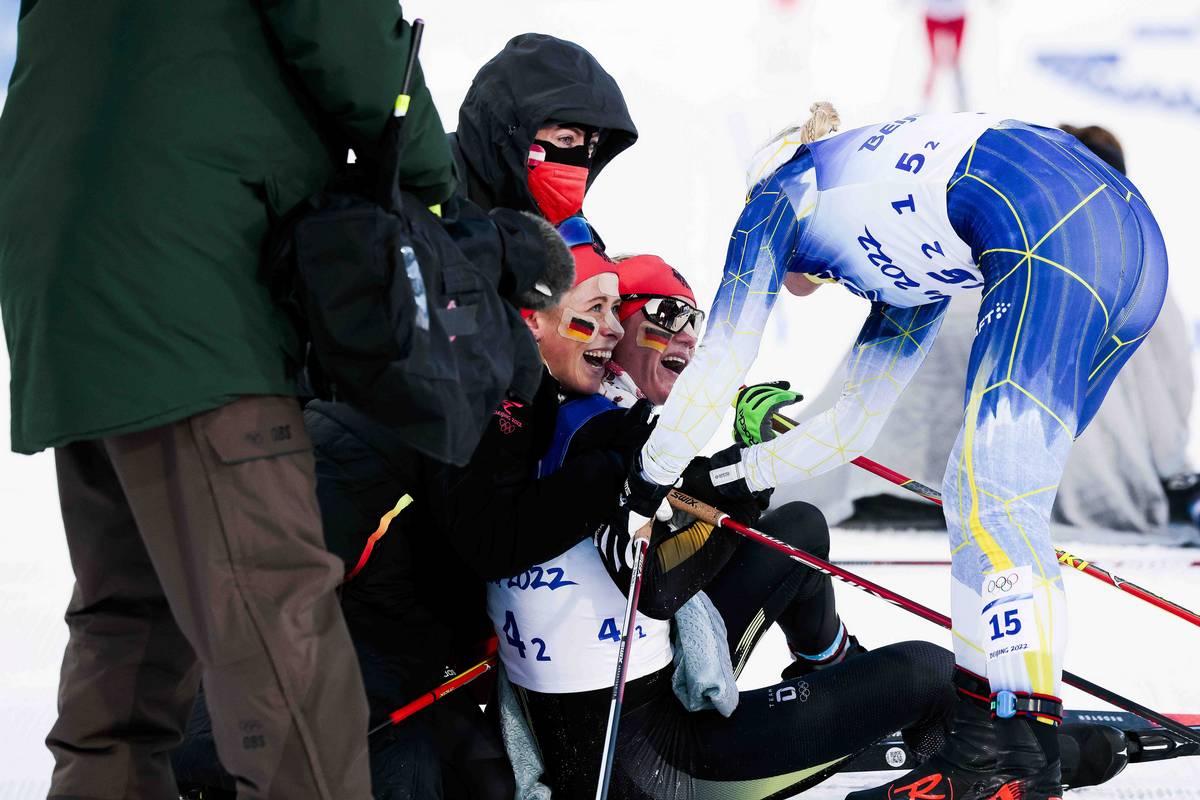
Excitement was high at the finish of the women’s team sprint, as Victoria Carl narrowly took the win for Germany, racing with partner Katharina Hennig. (Photo: NordicFocus)Katharina Hennig hugs her exhausted teammate Victoria Carl at the finish of the women’s classic team sprint. (Photo: NordicFocus)
Though she was the key player in the final lap, Carl was not originally on the start list. She was substituted for Katherine Sauerbrey, who had skied the first leg of the women’s relay on Saturday. German coach Peter Schlickenreider, who celebrated his 52nd birthday today, explained in the mixed zone that Saurbrey had made a “great decision” to let the team know that she was feeling fatigued and as though she may be getting sick.
From there, the calculus became: “Okay, you have a silver medal, you did a good race [in the relay], and we have prepared Victoria Carl, so she’s ready,” Schlickenreider explained. “So then let’s do the safe thing.”
He added that Germany had raced an athlete, Nicole Fessel, in the team sprint during the 2018 Games who was feeling sick, which proved to be a significant mistake as Fessel struggled with her health for the following three months, before ultimately ending her career. The coaches had vowed never to make this error again.
Jonna Sundling (SWE) congratulates Victoria Carl and Katharina Hennig on Germany’s gold medal in the classic team sprint. (Photo: NordicFocus)
On the performance of the German skis, which have allowed the team to excel throughout the Games, Schlickenreider explained that waxing has been a focus for the team over the last quadrennial.
“We worked really hard the last four years to get this good team. And I think that’s the main thing, that everybody’s working together so that the athlete and ski technicians were communicating quite well.”
Jessie Diggins (USA) comes to the line in fifth in the women’s team sprint. (Photo: NordicFocus)
After winning gold in the event, it’s easy to look at a fifth place finish as a disappointment for the American team. But observing the last five seasons, it remains a testament to the consistent strength of the American women’s program, the depth of the field racing at this level, and the fact that ultimately, an Olympic medal is viewed among the highest accomplishments an athlete can achieve purely because it requires the fortuitous coming together of infinitely many pieces to do so.
Both Brennan and Diggins stated with confidence that they were happy with their performances today, highlighting advances made in classic racing throughout the Games.
“I felt really good about my skiing today,” Brennan said. “I think it was one of my better classic races this week, so I’m really happy to put it together by the end of the Olympics. And I did what I could to stay in contact to give Jessie her best shot. And I’m happy with that.”
Rosie Brennan (USA) strides up the A-climb in the women’s team sprint semifinal. (Photo: NordicFocus)
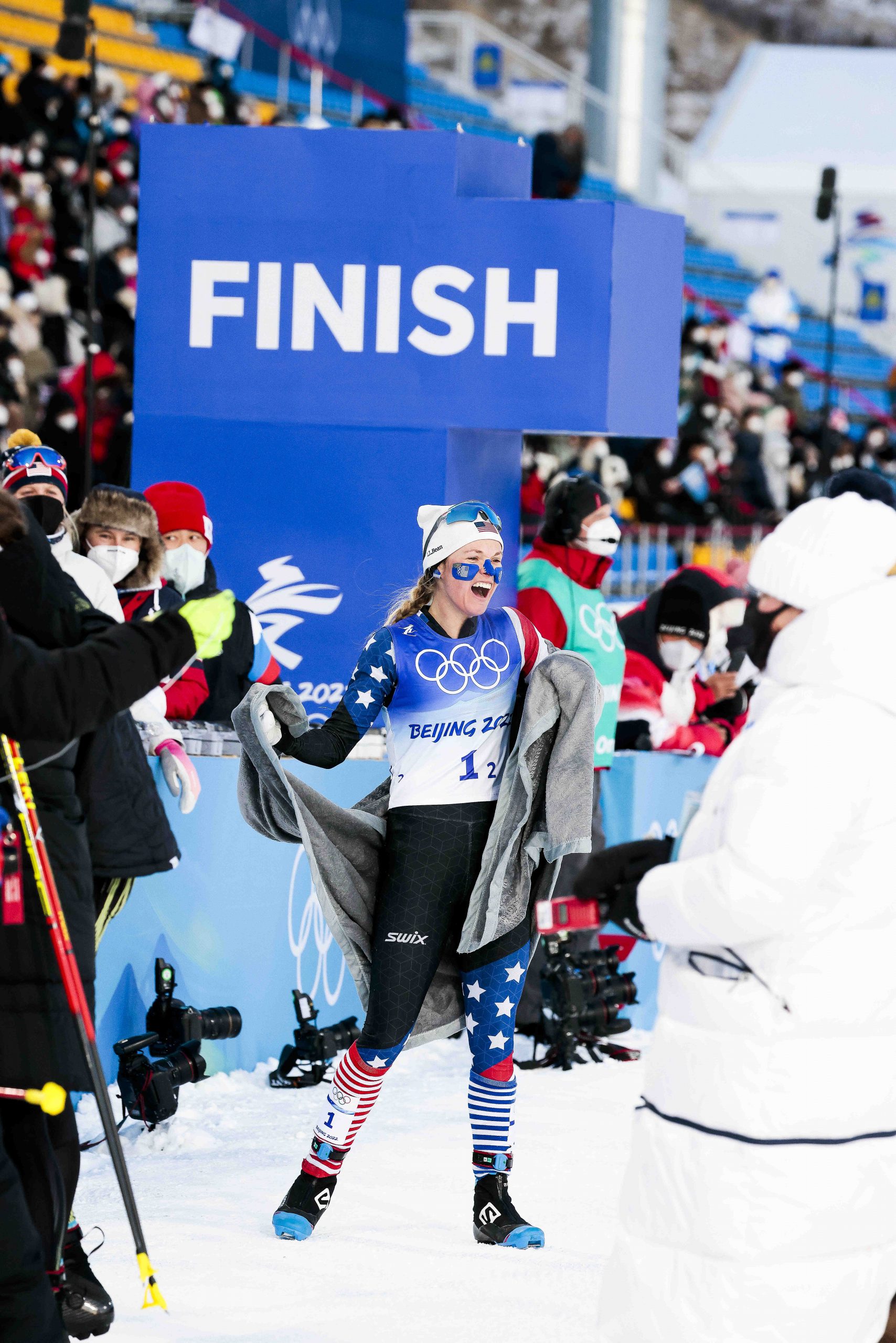
“I’m really proud of how we skied,” Diggins affirmed. “It was so cool seeing Rosie just crushing, and I went as hard as I could. And there’s no doubt in my mind that I could not have possibly tried harder. I finished with zero sugars left and was dizzy and sick. And I’m currently wearing all the clothes of Team USA… I think we had great skis, or at least I definitely had the kick that I needed. I felt like, technically, this was some of my best classic skiing. And yeah, I’m just really proud of giving it our all because that’s all you can do.”
Jessie Diggins anchored the women’s classic team sprint to fifth. (Photo: NordicFocus)
In NBC’s broadcast, team sprint gold medalist turned analyst Kikkan Randall explained that the Americans knew that competitive skis would be a requirement to allow Brennan and Diggins to fight for a medal today.
Both athletes expressed that their skis were up to the task, particularly for A-climb, which is roughly 400 meters in length (a quarter mile) with nearly 100 feet of elevation gain. Ascending this three times each in the final, optimizing kick could be essential.
“I have to have enough kick, or else I really struggle,” Diggins explained. “So I definitely asked for an extra bump. In hindsight, maybe I shouldn’t have but also, that’s on me. And I know that that’s what I need. I need to be able to get up the hill. And that was my biggest priority. And so I think having not enough kick would have made me lose more time.”
Jessie Diggins (USA) marks Victoria Carl (GER) during the women’s team sprint semifinal. (Photo: NordicFocus)
Both athletes confirmed that they would be racing the final event of the 2022 Olympic Winter Games on Sunday, the 30 k mass start freestyle, barring unforeseen changes. With one last opportunity to fight for medals, Brennan encapsulated the Americans’ outlook on the whirlwind of racing and Olympic hype.
“One thing that the US is really bad at is only caring about the Olympics,” Brennan said in the mixed zone. “But we’re racing and World Cups every weekend all winter long and World Championships on the [odd] years, so if you look at the results from all of those races, you know, this is in the ballpark. I wouldn’t say I had the world’s best races [here] and certainly not the world’s worst races. So it’s been a good experience and we will head straight back to the World Cup and keep fighting for more.”
Dahria Beatty (CAN) races in semifinal A during the women’s classic team sprint. (Photo: NordicFocus)
Racing for Canada, Katherine Stewart-Jones and Dahria Beatty took sixth in the first semifinal and did not advance. They ended the day in 12th overall.
China’s Degen Chen races the men’s 30-kilometer skiathlon which opened the 2022 Beijing Olympic Winter Games. (Photo: NordicFocus)
Salmon for Skiing
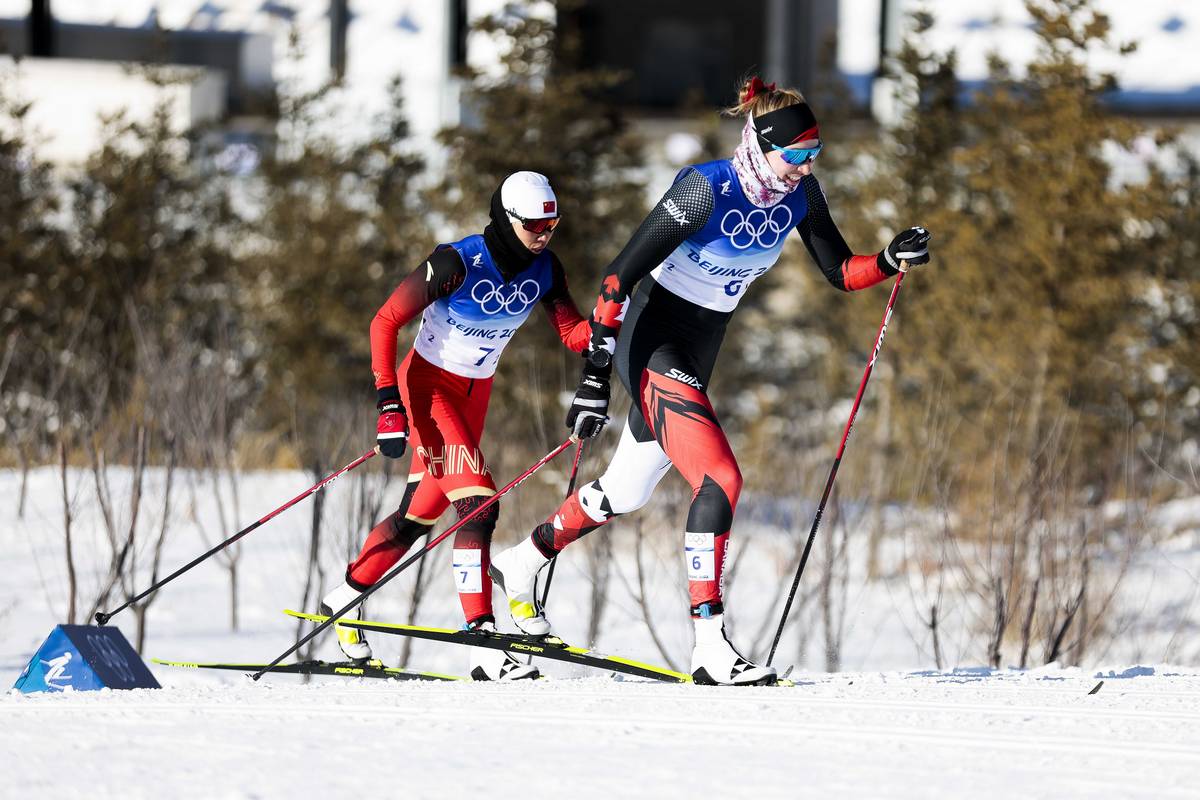
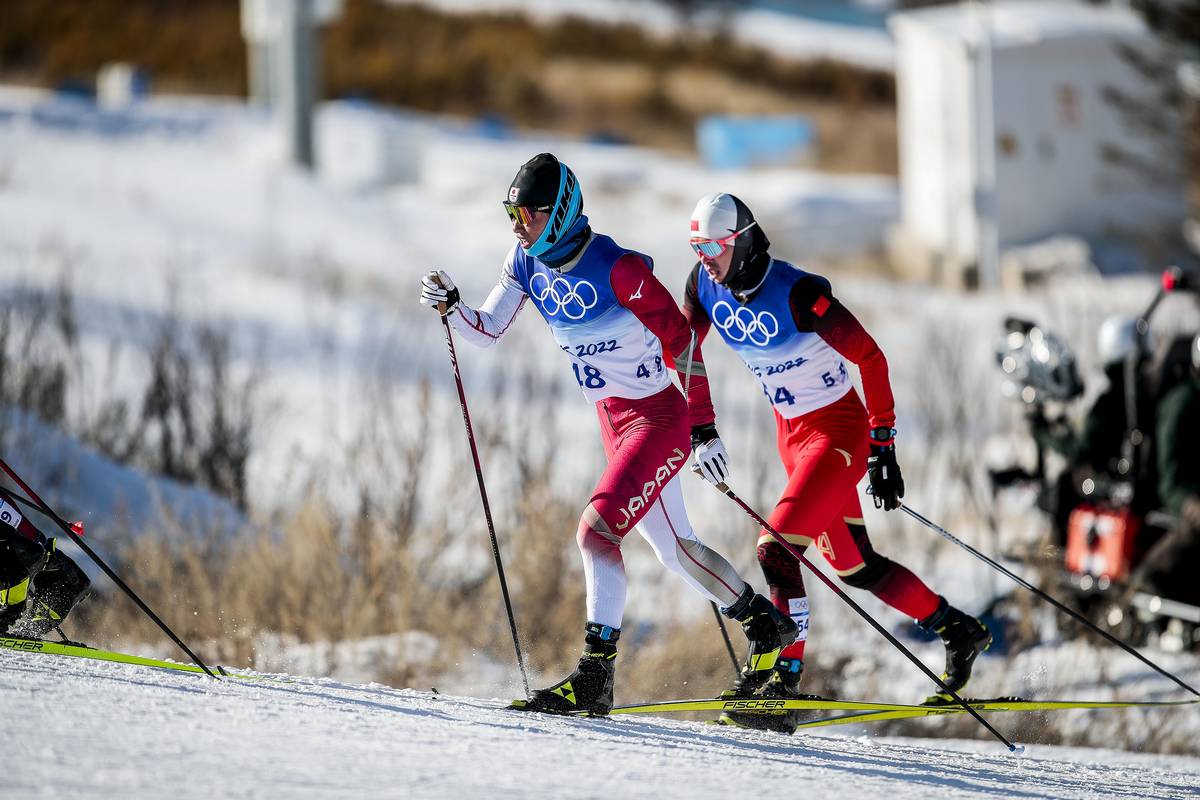
Over the last four years China has undertaken perhaps the grandest experiment in cross country skiing history: can hundreds of athletes cherry picked from other sports and given seemingly unlimited resources be turned into Olympic medalists in nordic events?
Chinese athletes have never medaled in any of the nordic disciplines, and their teams head into the Olympics as the darkest of dark horses. Success, in the form of medals, is key to their aims of climbing up the medal table and becoming the protagonists of their own winter Games.
The Chinese nordic programs have aimed to rapidly become competitive with the best in the world. The urgency of the task was made clear at the 2018 PyeongChang Olympics where China finished fourteenth in the medal count, capturing a single gold medal, and just nine in total.
Despite this history, not everyone is dismissive of their chances.
“I said four years ago that I predict these guys will medal in Beijing,” said US biathlete Clare Egan in a call, “because I know that medals are important to China and that they basically will put any resources possible into making things happen like that. So nothing would surprise me.”
Even so, Egan conceded that, “It’s going to be hard for them, because they aren’t fast enough.”
The project of building a culture of skiing in China began in 2015 when Beijing was awarded the 2022 Winter Games. The government spurred into action: it would make 120 million of its citizens into recreational skiers by building 800 new ski areas, among them the world’s largest indoor center in Harbin that cost $4.5 billion.
Cross country skiing also benefited from the investment rush, with an 1.3 k indoor ski tunnel built in Beishan, a joint Finnish-China project that cost $148 million. Another cross country ski tunnel is planned to be placed inside an unused coal mine shaft on the outskirts of Beijing. Liu Bo, a former ski coach, told Reuters in 2018 that he was investing $318 million in the project.
Bo explained in the interview that the goal for Chinese skiing, aimed at the Olympics, was clear: “China spends big money setting up the stage, and the performers are all foreigners,” said Bo. “President Xi will not allow this to happen.We have to be the leading actor in 2022.”
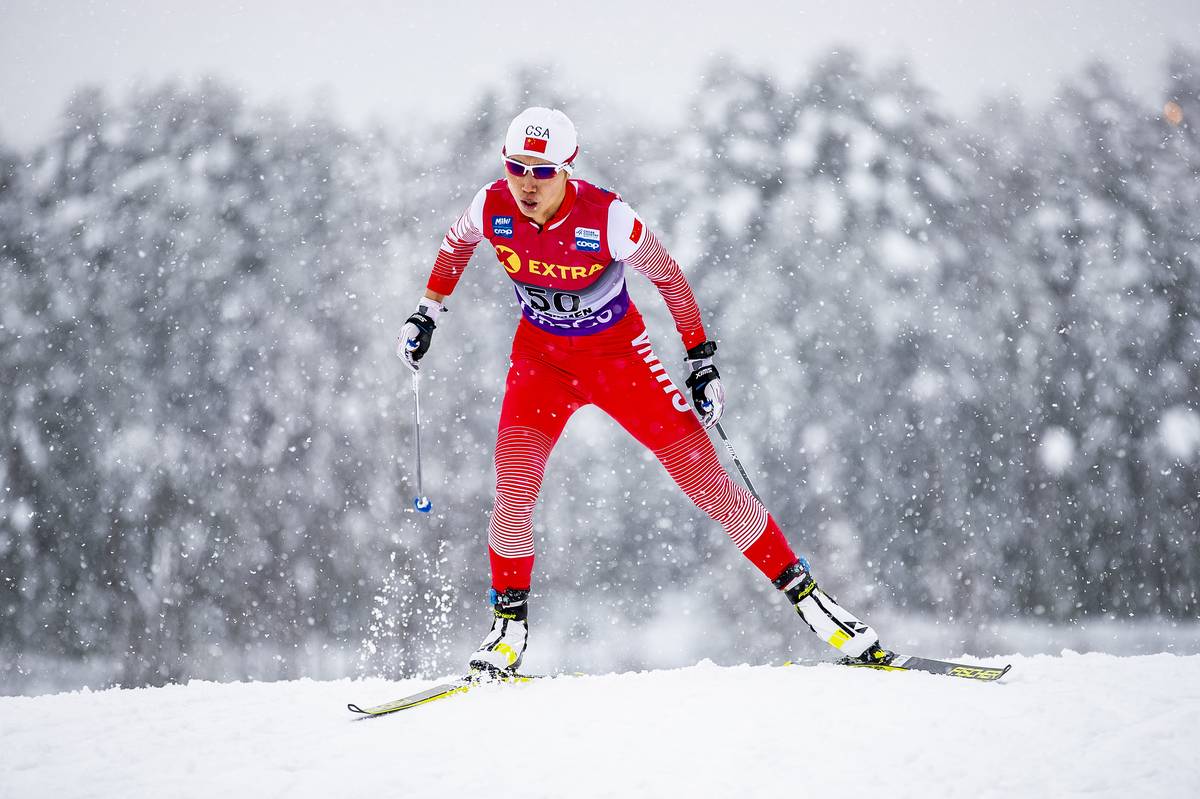
Xin Li (CHN) races a freestyle sprint qualifier in Konnerud, NOR in March, 2020. (Photo: NordicFocus)
While the ski resort boom was mainly aimed at creating a ski culture in China, taking on a starring role in Beijing meant that expertise would be needed from abroad. For guidance, officials looked to the top of the medal table: Norway.
Initially, it was impossible for China to work with Norway. When the Olympics were awarded to Beijing in 2015 the two countries were still embroiled in a diplomatic crisis that had severed official contact between the nations and frozen trade negotiations. The rupture occurred in 2010 when the Nobel Peace Prize was awarded in Oslo to Li Xiaobo, a Chinese human rights activist who was then imprisoned in China. At the Nobel ceremony, Xiaobo was evocatively symbolized by an empty chair on the stage.
In response, China all but severed diplomatic ties with Norway, despite the government’s lack of control over the Nobel committee. Two months later China halted the importation of fresh Norwegian salmon – a significant industry – over what was generally regarded as a politically motivated concern over a fish-borne virus.
The ban, as well as other restrictions, are believed to have cost Norway between $780 million to $1.3 billion between 2010 and 2017. At the time of the contentious Nobel ceremony, Norway had enjoyed a virtual monopoly over the Chinese salmon market, and the country’s fisheries had to watch as Chinese demand for salmon increased by thirty percent, while their share plummeted by two thirds.
Years of cautious steps by the Norwegian government followed, including its first ever refusal to meet with the Dalai Lama during his 2014 visit to Norway. Norway’s socialist left party leader Audun Lysbakken criticized this move in The Guardian, saying, “We can’t be dictated to by China in the sense of exchanging human rights for salmon.”
That fall, Oslo – the favorite for the 2022 Games – dropped out, paving the way for Beijing to win the bid the following summer. With the Games in hand, the calculus changed, and the rift with Norway became an awkward obstacle to their objectives.
A subtle indication of rapprochement came in an unusual way: Gerhard Heiberg, a Norwegian businessman headed the IOC’s Marketing Commission, and was offered a meeting on a 2016 trip to Beijing with the Chinese Minister of Sport, Gou Zhongwen.
The minister marveled at Norway’s success in skiing, Heiberg recounted to NRK, “He said that those at the top in China had agreed that they would like an agreement with Norway on a sports collaboration. And from the Chinese side, there was a desire to use Norwegian leaders, coaches, universities and so on who worked with winter sports.”
Heiberg recognized the moment. “I saw that here we have a fantastic opportunity to approach China.” Not wanting to waste the favorable winds, Heiberg left the meeting and “went straight to [Ambassador] Svein Sæther. And he lit positively on all the plugs.”
With some quiet maneuvering, relations thawed, and Norway and China signed a bilateral agreement to resume diplomatic relations in December 2016. The agreement conceded that Norway would not challenge China on its “core interests and major concerns” — a diplomatic term for avoiding involvement in sensitive issues, including human rights.
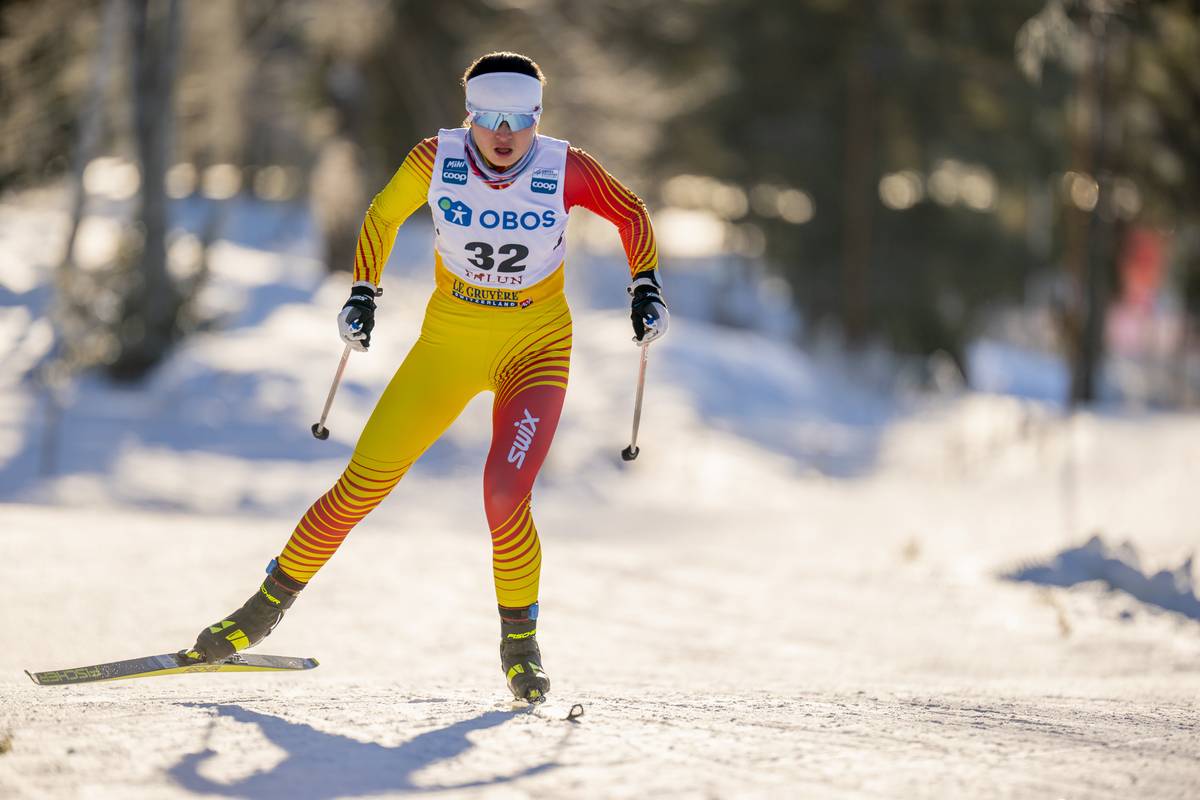
Dinigeer Yilamujiang (CHN) races a 10 k freestyle in Falun, Sweden in January, 2021. (Photo: NordicFocus)
That winter the Norwegian Ski Association was asked to help look for coaches to work in China and offered salaries of 1.1 million kroner (equivalent to $120,000) per year. China also wanted to send its athletes to Norway, but to do so, it would need to put to rest their feud.
In April 2017, Norwegian Prime Minister Erna Solberg visited Beijing, officially ending the freeze. Solberg reestablished the relationship in part by signing an agreement with China to support their sporting endeavors, particularly in nordic sports, through to the Beijing Olympics. The agreement would provide China with Norwegian ski coaches, training opportunities, as well as sporting development and snow making expertise. In return, Norway received the opportunity to optimize“Norwegian preparations for the Olympics.”
This deft piece of ski diplomacy helped to seal a seafood trade agreement with China the following month that planned to see Norway export $1.4 billion worth of salmon alone to China by 2025. The long awaited reentry to the Chinese market had arrived, and if there were any lingering questions about human rights, Per Sandberg, Norway’s Minister of Fisheries wasn’t having it. He told Aftenposten that “Norway addresses human rights in very many contexts… this time it’s fish.”
Ski diplomacy started with Stolberg’s agreement with China, and was reaffirmed the following year when King Harald visited China, signifying the complete normalization of relations while taking in a rollerskiing race at Beijing’s Olympic Park.
Despite the apparent connection between the sporting pact and the trade deals, the Norwegian Prime Minister denied the two items were related. In any case, the agreement caught the Norwegian Sports Confederation by surprise. Oddvar Jenssen, the former VP of the organization, said in an interview with Aftenposten that the decision “…came terribly fast, and a lot was in place before we knew anything. When the agreement came up, we had no choice.”
Misgivings aside, for Norwegian ski coaches, wax techs, and sport scientists, the Chinese agreement would turn into a major employment opportunity, with around 40 coaches and techs working for Chinese training groups, and around 60 more occasionally hired for short stints. No longer were the job opportunities going to be contingent on moving to China, the athletes would now be coming to Norway.
Arrival in Norway
The sporting agreement between Norway and China took on new force after China’s dismal performance in the 2018 Olympics. Afterward, the Chinese Ministry of Sport went looking for coaching help abroad. Many nations vied for contracts, but Norway was the first stop for Gou Zhongwen.
In May of 2018, Zhongwen met with Johannes Klæbo on his tour of Trøndelag – the region that has won more Olympic medals than any other – and solidified the agreement to bring athletes to Norway.
In July, ten of China’s core World Cup athletes arrived in Trondheim, Norway to begin training for the World Cup with former Montana State University skier Bernhard Rønning.
It was the prelude to an influx of more than 200 young Chinese athletes to Norway in the late summer and fall of 2018.
In addition to the Trondheim group, another was set up in Meråker, under the leadership of former Canadian National Team Coach Tor-Arne Hetland. In Lillehammer a group was led by Kristen Størmer Steira (wife of FasterSkier podcaster Devon Kershaw) and finally one in Trysil led by the mother/daughter combo of Anita Moen and Karoline Moen Guidon.
Anita Moen’s experience illustrates the slapdash nature of the project. In mid July of 2018 she was on vacationing on a beach when her phone rang. It was an offer to coach Chinese skiers until the 2022 Games.
“It was only two weeks until they were to arrive,” Moen told NRK “… I did not quite know who was coming, but I was told they had never skied before, never seen snow.”
Jincai Shang (CHN) races a classic sprint qualifier in Trondheim, NOR during Ski Tour 2020. (Photo: NordicFocus)
While China mobilized to send loads of athletes to Norway, their plans didn’t stop there. After Minister Zhongwen left Norway, he flew with his entourage directly to Finland. Waiting for him at the airport was Veiko Hallonen, the CEO of the Vuokatti Sports College.
Vuokatti offered excellent training opportunities: a long winter, a ski tunnel, knowledgeable coaches, and sophisticated technology that impressed the officials. Perhaps Zhongwen was also mindful of the warmer diplomatic climes in Finland. Ni Huizong, the Director of the Winter Sports Administrative Center told Yle, “Relations between Finland and China have a long and warm history.”
Chinese athletes had been training in Vuokatti since 2016, but the agreement established a permanent Chinese presence at the Vuokatti center and increased the total number of athletes that would stay in Finland.
The head cross country coach in Vuokatti at that time was Glenn Lindholm, who met with the Chinese delegation and was asked directly whether four years were enough to turn novices into Olympic champions. Lindholm’s response was neither yes nor no.
Lindholm must have understood the unlikely prospect of delivering medals by the next Olympics. Still, the project may have seemed crazy enough to work. Vuokatti was about to get more than 130 hand picked Chinese athletes, an almost unlimited pot of money to work with, and just under four years to produce a medalist.
It was audacious, and too bold to resist. As Lindholm and others would learn, realism, a pandemic, and decisions made in the halls of power of Beijing would frustrate their plans.
Deedra Irwin competes in the Women’s 15km Individual race during the 2022 Beijing Olympic Games. (Photo: Nordic Focus)
BEIJING, China (Feb. 5, 2022) – Things don’t always go according to plan, but occasionally someone can exceed even her wildest expectations.
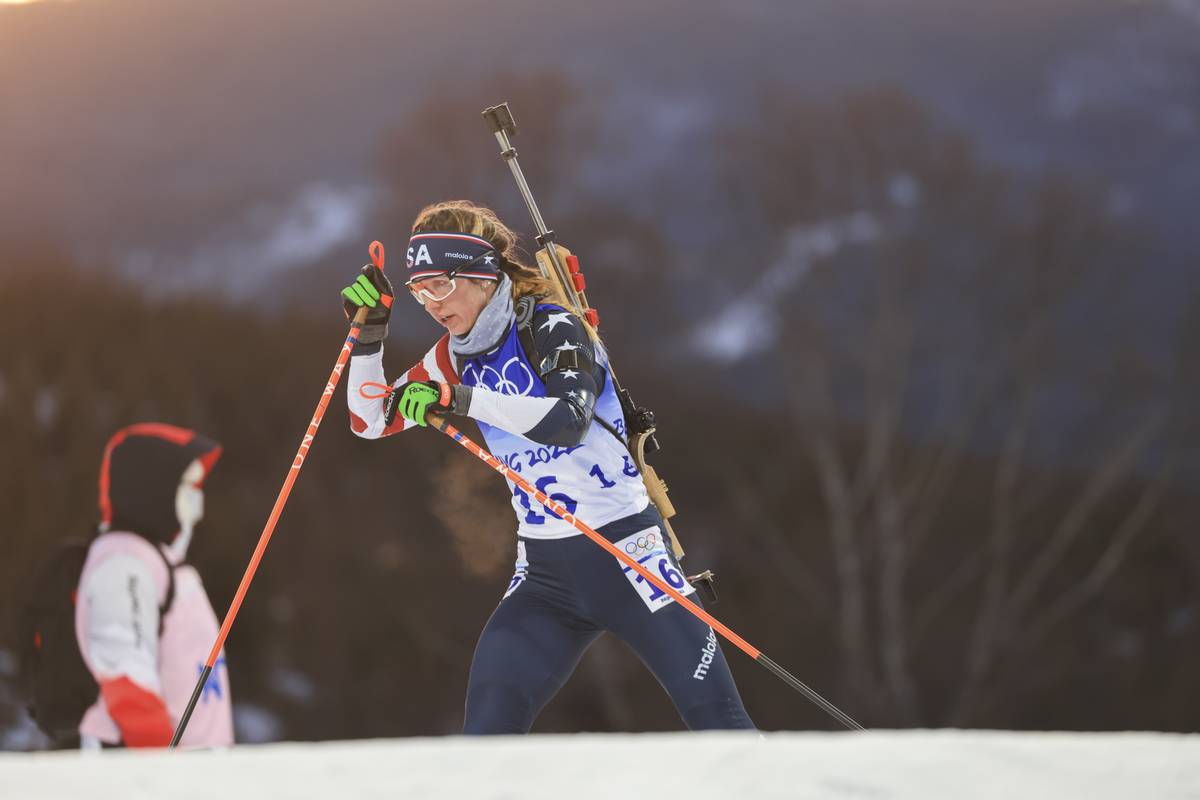
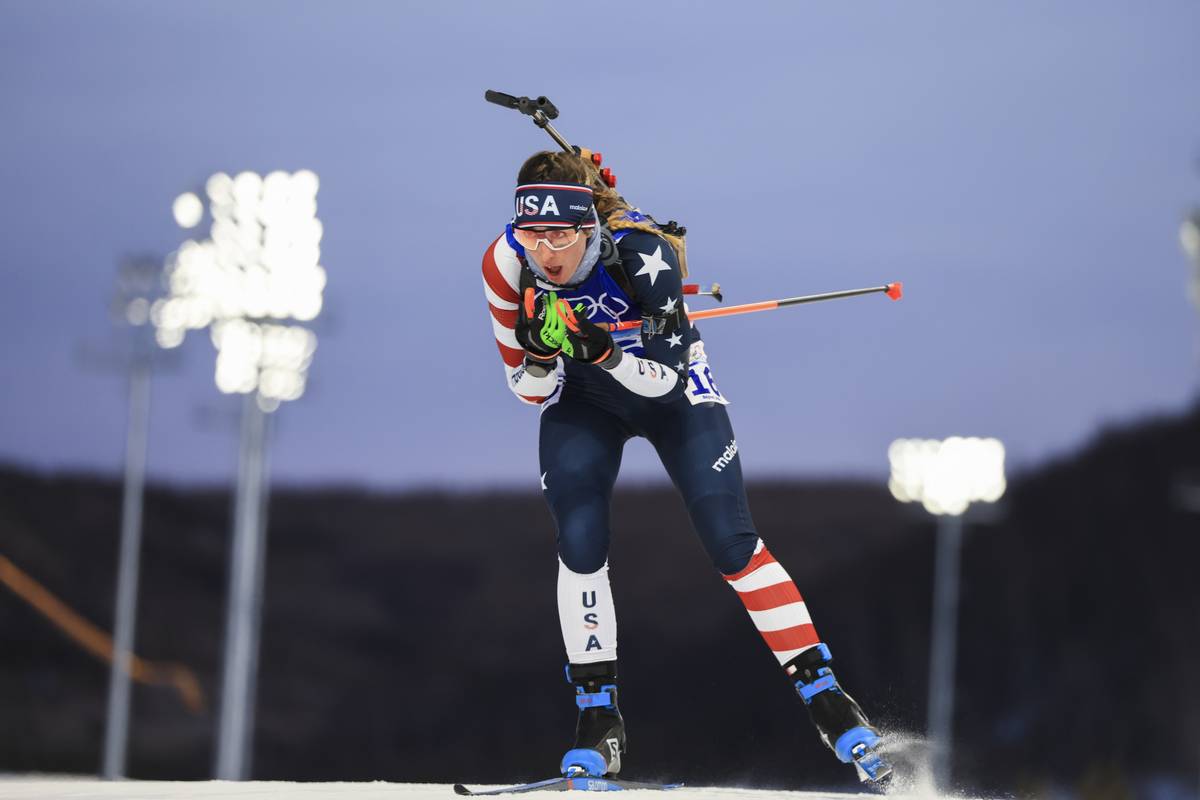
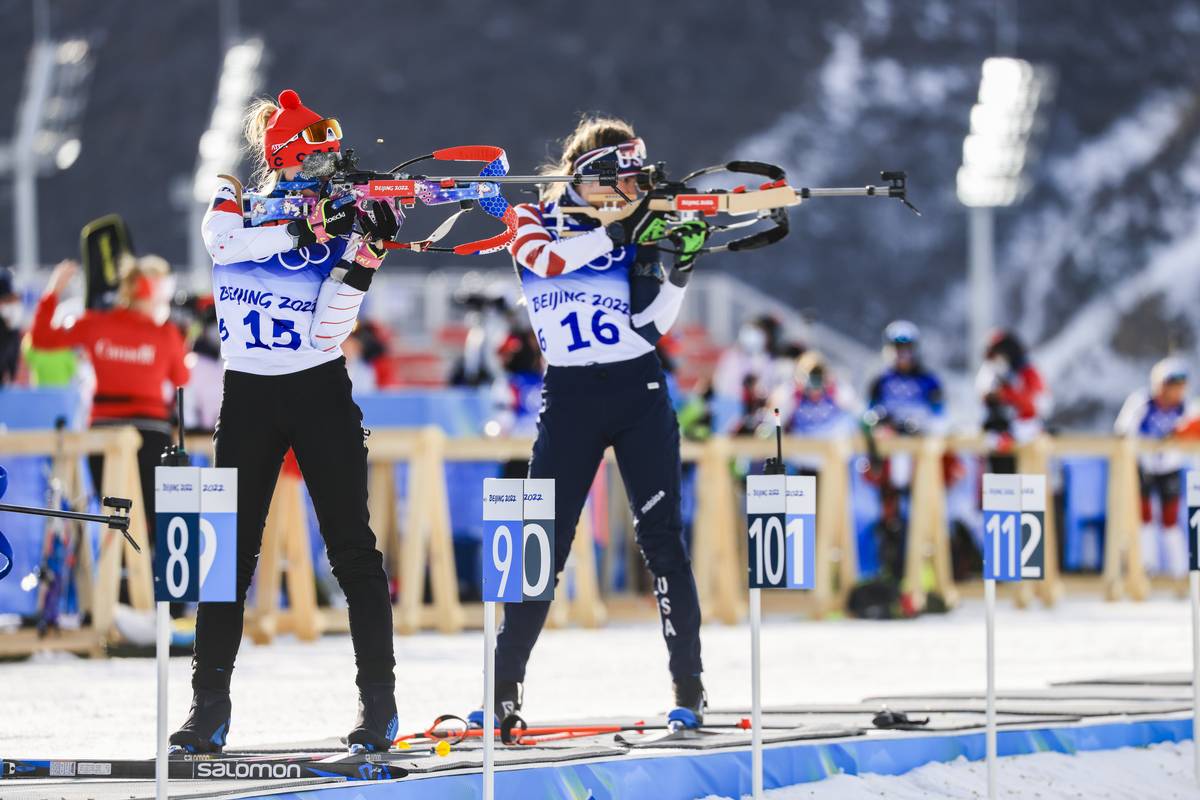
Such was the case for Deedra Irwin of Pulaski, Wisconsin, who on Monday turned in the best Olympic performance ever by an American biathlete, finishing seventh in the women’s 15-kilometer individual event at the Zhangjiakou National Biathlon Centre northwest of Beijing.
“I was trying to focus on just working on everything I’ve worked on this week,” said Irwin, who is competing in her first Olympic Winter Games, “really skiing the course well and staying calm on the range and being ready for anything — with wind or whatever.
“I had a good game plan, and I was able to execute it. Everything came together. I had no idea how I was doing, and I was just in my zone, and it worked — what the heck.”
Deedra Irwin competes in the Women’s 15km Individual race during the 2022 Beijing Olympic Games. (Photo: Nordic Focus)
What the heck, indeed. Irwin skied and shot with the world’s best biathletes, ultimately finishing just 1 minute, 1.4 seconds behind gold medalist Denise Herrmann of Germany. Anais Chevalier-Bouchet of France claimed the silver medal, and Norway’s Marte Olsbu Roeiseland took the bronze medal.
Irwin’s American teammates, Clare Egan, Joanne Reid and Susan Dunklee, placed 39th, 57th and 63rd, respectively.
Irwin’s stunning performance also came two days after the U.S. biathlon team of Dunklee, Egan, Sean Doherty and Paul Schommer posted the best-ever American finish in the 4×6-kilometer mixed relay event. The U.S. placed seventh in 1:08:58.3.
Nothing Monday seemed to faze Irwin, who moved up to fifth place at the 9-kilometer mark. Not even a miss during the event’s final shooting range.
“It’s something I’ve been working on all week because of the wind, just really trying to focus on one shot at a time,” Irwin said. “What was really nice is it wasn’t windy today. It was actually really calm.
“So even though I missed that shot, I still had that mentality of just one shot at a time, make good shots.”
Deedra Irwin (right) competes in the Women’s 15km Individual race during the 2022 Beijing Olympic Games. (Photo: Nordic Focus)
That enabled Irwin to finish strong.
“To be able to hit those last two, I was just really happy that I was able to keep the focus and concentrate,” Irwin said. “(It’s) something I’ve definitely been working on a lot since last year, to just in general increase my shooting percentage.”
The 29-year-old Irwin, a member of the Vermont Army National Guard, had a skiing and running background but didn’t try biathlon until 2017, when she attended a talent identification camp at Lake Placid, New York.
*****
Check out the Watch Olympic Biathlon schedule for viewing options of all the races from Beijing. You can also follow all the action on the IBU app – download it today!
Bob Reinert spent 17 years writing sports for The Boston Globe. He also served as a sports information director at Saint Anselm College and Phillips Exeter Academy. He is a contributor to TeamUSA.org on behalf of Red Line Editorial, Inc.
Two-time Olympian Noah Hoffman’s life is busier now than it ever was during his 10-year U.S. Nordic ski team career. The soon-to-be Brown graduate — he’ll have an economics degree by May — has thrown himself into athlete activism since his retirement in 2018.
Hoffman started in the anti-doping world before becoming a founding athlete board member of Global Athlete, an organization which seeks to hold sport governing bodies such as the International Olympic Committee (IOC) and International Ski Federation (FIS) accountable. In striving to increase athlete voice and give his former peers a proper seat at the table, he finds himself at the fore of another Olympics.
Noah Hoffman (bib 13) races in a pre-Olympic World Cup in Pyeongchang, Korea in April, 2017. (Photo: NordicFocus)
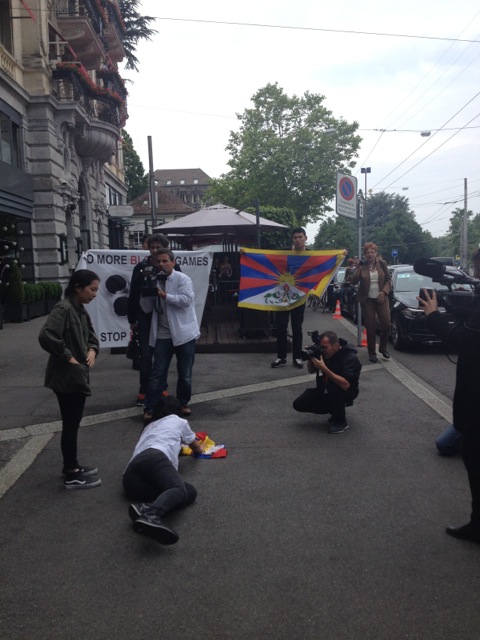
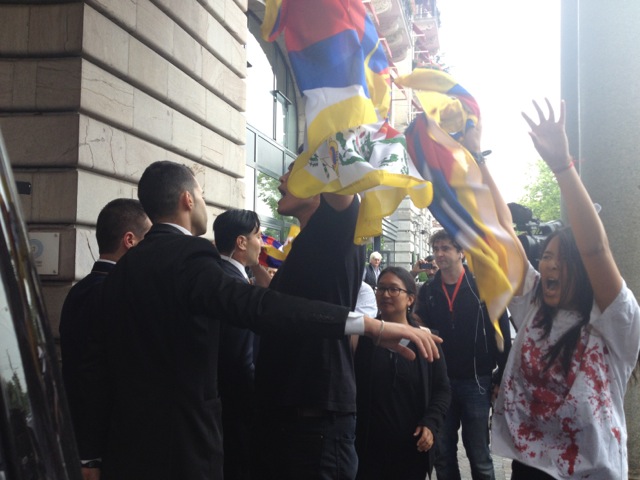
At a Human Rights Watch roundtable discussion last week, he spoke out against the IOC’s lack of accountability regarding the Beijing Games. (See video embedded below.) The oppression of Uyghur Muslims in the Xinjiang region, as well as the communist government’s actions in Tibet and Hong Kong, its general intolerance of dissent and the recent plight of Peng Shuai all fueled a diplomatic boycott of the Games by the United States government. The IOC has not stated whether it will protect athletes who speak out against human rights abuses, leaving them at the whim of the Chinese state. Canada, Britain and other nations have joined in the diplomatic boycott as well.
“Rule 50 and its restraint of free speech on athletes aligns uncommonly well with the CCP’s social repression and athletes should be enraged that both their host, and their governing body, seek to limit their voice,” human rights activist and lawyer Craig Foster told the South China Morning Post.
“Chinese government officials and diplomats have confirmed that athletes are being silenced and threatened with Draconian penalties in Beijing simply if they speak out against genocide.”
“Chinese law, when it comes to what kind of speech is permitted, especially speech that is critical of the Chinese state, is very opaque. It’s not clear at all what kind of speech she’s talking about,” he said.
For that reason, Hoffman is going against his nature, advising athletes — many of whom are friends and former teammates — to remain silent.
To read the full story, follow this link to the Vail Daily News.
Full roundtable discussion. Hoffman is interviewed at approximately 8:00 and 43:30.
As January draws to a close, energy, excitement, and perhaps anxiety surrounding the rapidly approaching 2022 Olympic Games in Beijing is steadily building. In an effort to better manage her time and energy heading into these Games, Jessie Diggins offered a media conference facilitated by U.S. Ski & Snowboard cross country communications manager Tom Horrocks to answer questions about her preparation, outlook, and plans for the remainder of the time before the team heads to the athlete village in Zhangjiakou.
Diggins began the conference with a comment on the team that has been named. Of the fourteen athletes named to the Olympic cross country team, just four have competed in past Games. Diggins is headed into her third Olympics with ten total Olympic races under her belt, while Rosie Brennan, Caitlin Patterson, and Scott Patterson competed only in the 2018 Games. In Pyeongchang, Brennan competed in just the skiathlon, while Caitlin Patterson raced in the skiathlon and 30k classic, and Scott Patterson raced in each of the three individual distance events plus the men’s relay.
Six of the athletes were born in the year 2000 or 2001. Overall, it’s a relatively young crop of athletes, many of whom have very limited experience racing at the international senior level compared to veteran-dense teams like Norway.
Diggins emphasized that the age and experience of the team should not be associated with what fans of the sport should expect to see in competition, adding that she is individually very excited to see what her teammates will do at the Games.
“Everyone’s working so hard,” she said. “And staying really cool in what is a stressful time – with COVID, and with variants, and with all the different paperwork and all the things that you need to do headed into any Olympics, but especially this one, given the extra hurdles with COVID… I think everyone’s doing such a remarkable job of not only handling all the extra stressors very well, but also still being excited and still seeing this as, ‘Okay, we’re gonna find ways to make this fun. Obviously, it will be different from Games in the past, and probably different from future Games too…’
“I think we’re in a really good place, despite everything that’s happening in the world. And I think that’s kind of one of the things that the Olympics does for us is it lets us feel inspired and let go of all the stresses that we’re feeling in the moment. Or at least that’s what the Olympics I think is supposed to do.”
Jessie Diggins embraces team sprint partner Julia Kern after the pair took second place in the freestyle team sprint in Dresden, Germany in December, 2021. (Photo: NordicFocus)
Following the Tour de Ski, the members of the team who planned to remain in Europe began a recovery training block in Seefeld, Austria, which sits at roughly 3,800’, before moving to higher elevation to begin an altitude training camp. Having come down with a head cold during the final stages of the Tour de Ski, Diggins expressed the value of this recovery block, particularly in a location where her body was not further impaired by altitude-related physiological effects.
“Within two days after the tour, I was symptom free. Five days later, totally healthy and able to train totally normally again. So that was really, really nice to dip down in altitude and recover and feel like I absorbed everything that the tour brought in terms of training stimulus.”
With the cancellation of the final two World Cups before the Olympics, the team headed to Livigno, Italy earlier than originally planned, earning them extra time training at a venue that sits at a nearly identical elevation to the competition venues in Zhangjiakou. Diggins expressed that this has provided the team with a variety of excellent training options, from challenging race courses to flat valley skiing ideal for recovery, all supported by a team of staff that includes wax techs, a chef, and a physical therapist.
Acknowledging individual variation athlete-to-athlete, Diggins explained that overall the team’s preparations have looked “normal” in terms of how they would train and peak leading into another Championship. To account for the lack of races, the team has been building in simulations, including practicing events that have not been included in the World Cup calendar yet this season.
“Yesterday, Julia and I did a skiathlon simulation,” Diggins shared. “It was awesome. It was really hard. And I’m so glad we did it. We had coaches going nuts – taking video, cheering for us. We had bibs on, we had pits set up, we had everything to simulate it, which was really nice, because we don’t get to do very many skiathlons anymore. And it was really cool to practice that pacing at altitude. That was really helpful.”
With an epic free skate in the final meters, Jessie Diggins wins the thrilling 10-kilometer mass start freestyle in Oberstdorf, Germany during the 2021/22 Tour de Ski. (Photo: NordicFocus)
In previous press conferences, Diggins has emphasized the importance of frequent racing in helping her reach her mental and physical peak during the season. She had planned to race in at least the first World Cups after the Tour de Ski in Les Rousses, France before they were canceled. With this piece of her plan suddenly removed, what would she do to replace these stimuli to ensure her preparations were unaffected?
While Diggins shared that she loves racing in France and had been looking forward to the races in Les Rousse, she quickly found a silver lining to the cancellation. And to the many setbacks she faced in the second half of the Tour.
“[The cancellation was] kind of a huge blessing in disguise,” she stated affirmatively. “I was able to fully absorb the Tour and then build in a full training block and move up to altitude sooner. I felt like, ‘Whoa, actually, this is kind of perfect.’ This is how I would have designed it because I got in all the racing I needed to in terms of World Cups. Mentally, I felt like the tour was kind of the icing on the cake in terms of getting mentally strong. In terms of being able to push myself – being mentally there, being positive in any situation, all of that – that was the best preparation I could have ever asked for.”
In terms of replacing the intensity of World Cup racing, Diggins expressed her confidence both in the training sessions the team has put together, and the ability of her teammates to push themselves and each other.
“I feel really fortunate because my greatest strength has always been being able to push myself no matter what. And so I was like, ‘Well, this is totally fine, because even if there aren’t World Cups, that’s not a problem.’ I pushed myself in our time trials so hard that I couldn’t feel my legs and I was tasting blood. And that was in a time trial with just one other athlete.”
In year’s past, the Americans have collaborated with athletes from other nations when paths have crossed; for example, in December 2020, the Americans raced in a set of time trials with athletes from Russia, Italy, Switzerland and Germany while all were training in Davos following a canceled World Cup event in Lillehammer, Norway. In lieu of opportunities to face off on the World Cup, these collaborations have perhaps provided a measuring stick to see how an athlete’s fitness might compare at the international level. Did the lack of this type of opportunity affect Diggins mental preparation heading into her goal races in Zhangjiakou?
“In terms of the lack of international feel, that’s also been a blessing in disguise, because everyone’s worried about germs. When you get more and more people [together], then you’re exposing yourself to more and more people who aren’t in your bubble. I can’t speak for how other countries feel, but for me, it’s made me feel very safe from a COVID perspective to say, ‘Nope! We’re just gonna keep this as tight as we can, and run some very small time trials.”
Jessie Diggins wins the 10k mass start freestyle in Oberstdorf, Germany during the 2021/22 Tour de Ski. (Photo: NordicFocus)
Staying in the COVID-vein, Diggins also fielded questions from Matt Futterman of the New York Times regarding her fear level and the tension among the team about getting COVID, which remains rampant. A positive result would be a “nightmare scenario”, in his words, for an athlete as it could prohibit travel to Beijing, admission to the Olympic bubble, and/or the ability to compete in the Games?
“It would be silly to pretend that that’s not a stressor, right? I think it’s important to acknowledge that, COVID, especially the variants, are everywhere. It seems like every day, you hear about an athlete or somebody getting sick, and so that is hard. But I think one thing that we’ve done really well is created a bubble with really strict rules that we feel really safe within.”
Diggins explained that the team who is currently based in Livigno has minimal contact with those outside of their “bubble”. The chef is the only person from the group who goes to the grocery store, always while wearing a KN95. Otherwise, the small group only interacts with its members, not entering any buildings beyond the house they are staying in. Athletes who have recently flown over from the U.S. are staying in a separate apartment to quarantine for a week, before joining the larger team.
With reassurance from daily antigen testing and weekly PCR testing, they are living a monk-like lifestyle focused on heading out the door to train, and otherwise focusing on optimal nutrition, recovery, and logistical preparations for the Games.
“We’re trying really, really hard to make sure we protect each other. So even when we’re in this house, when we leave the room, we have our mask on. So you’ll be hanging out in the living room and everyone has KN95s on. So it’s a lot. And I think you hear the phrase ‘out of an abundance of caution’ everywhere now, but I think that is what we’re doing – taking all the cautionary steps that we can.”
Futterman acknowledged that for some, these protective measures can have an adverse effect on stress levels; rather than reassurance, the constant vigilance might leave an individual “freaked out”. Diggins affirmed that the decrease in risk relieved far more tension than the heightened awareness caused.
“It would be more stressful to feel like we’re just risking it… I think that wearing masks has actually lowered everyone’s tension level because you don’t have to wonder ‘what if?’ because we know that the masks work. So if you are wearing your mask, you don’t have to be stressed, because you’re doing everything that you can. I think that mentality of: ‘We’re going all in to protect not just ourselves, but each other’ is actually less stressful. Because if you’re the person who isn’t wearing masks and going into stores, and then you bring [exposure] into the team – that would be the actual nightmare scenario if you got someone else sick. So, for me, at least, and for the teammates here, so far that I can tell, it’s less stressful to just know that you’re doing everything possible.”
Jessie Diggins wins the opening stage of the 2021/22 Tour de Ski, a freestyle sprint in Lenzerheide, SUI. (Photo: NordicFocus)
While the team has carefully been collaborating in Livigno, it is unclear what the opportunities to be together and support one another will look like once they’re on the ground in China. Diggins shared her limited knowledge of what communication and time together might look like during the Games, responding to whether it might be more isolating than years past.
“I think some of that we’re just gonna have to feel out once we’re on the ground and see and feel, after a week, what’s the situation here? How safe do we feel? How good is the WiFi in terms of having team meetings over Zoom instead of needing to find a place where we can do it in person and all wear masks. I think our team has been really, really good about masking protocols, so I do feel like there might be opportunities there.”
In terms of lodging during the Games, Diggins shared that the team will be sharing a set of apartments with four athletes per unit, split between two bedrooms with a common area in between.
“So at least to be able to make a pod with three other people. Beyond that, we’ll just have to feel it out,” she concluded.
In terms of where we can expect to see Diggins on the start lists during the Games, that also remains to be determined, which is a slight shift from what Diggins shared following Period I, earlier this season.
“The original plan was to just race everything, assuming, of course, that I have start rights to do so. And then, earlier in the year, I was thinking, ‘I hear it’s really cool – which, yay! Love it. I hope it is cold. I want it to really be winter. But if it is incredibly cold, the way it was in Ruka, that becomes really draining, because you’re out there for so long. It’s not just the race; it’s the warm up, it’s the cool down. You’re outside going through the media zone, because you need to be outside because of COVID… But you’re out there for a while. So I think we’re going to look at the situation, once we’re on the ground and see, ‘What does the transport look like? How long does it take to get in and out of the venue? How cold is it? What kind of energy drain is this?’ And then we start making the plans on, ‘Does it make sense to do every single race? Or do I sit one out in the middle and sort of store [energy] up?’ That said, traditionally, it’s been great for me to simply keep racing, it kind of takes care of itself. So I’m really excited for every single race and all these opportunities ahead, and I would I would love to be able to do that if it makes sense.”
Diggins also fielded a variety of questions along the lines of comparing her feelings and preparations leading into these Games compared to the last two, given that she is both more experienced, and perhaps facing ever-increasing external expectations as she has steadily brought more attention to the sport. Diggins recently landed on the cover of both Sports Illustrated and Outside Magazines.
Jessie Diggins races the third leg of the women’s 4 x 5-kilometer relay in Lillehammer in December, 2021. (Photo: NordicFocus)
Many of these questions surrounded the pressure of being a defending Olympic Champion, who has since become a World Cup Overall Champion. Has this implied a steady building of pressure felt externally as more and more eyes will be focused on her in Beijing?
“I think the pressures and expectations are definitely different,” Diggins reflected. “Headed into Sochi, I was coming in as a World Champion, (Diggins and Kikkan Randall won the team sprint in Val di Fiemme during the 2013 Championships.) but I felt that I didn’t have any eyes on me. I didn’t have any pressure to medal. I felt that – it was sort of a wonderful flying under the radar feeling of: ‘If I have a good race, awesome.’ Nobody expects anything. If I have a bad race, they’re like, ‘Cool, you’re young, whatever.’”
With less focus on her first Olympic results, Diggins recalls a lighter atmosphere at the Sochi Games with more opportunities to explore a new place and attend competitions for other sport. This shifted as the internal and external pressure built to medal in 2018 in Korea.
“And I do remember getting to go down to the coastal village [in Russia]… And I remember getting to go watch some of the biathlon races, so I actually got to go see other events. Then, in Pyeongchang, it was different because I came in with a lot of eyes and pressure and expectations. I never got to go see a single other event, because I was racing every single event of ours. So it was like race, recover, race-prep, race, recover, race-prep – it was just this cycle. So I felt that for me – I never went and saw the coast, I have no idea what South Korea looks like, someday I want to go back and see it and experience it. But I felt like it was very, very focused. And I know that in that way. Beijing will be the same. So for me, it’s not a huge shift…”
While that focus may be a necessity for Diggins and other medal-favorite athletes at any Games, the pandemic and the resulting COVID-19 safety protocols that will be enforced in Beijing will likely make the isolated “race-prep, race, recover” cycle one all cross-country skiers will experience, regardless of how close their names will appear on results sheets.
“I am sad for my younger teammates, because I want them to have that first [Olympic] experience,” Diggins said somberly. “I know it will be a little bit different. At the same time they’re young and hopefully will have many Games in their future. So at some point, they’ll get that experience of getting to go and watch bobsled and hockey and figure skating and get a little bit of that feel of that huge team unity feeling, because I do think that was pretty cool. At the last two Games, you really felt connected to other sports. And one of my favorite things was like sitting in the Athlete Resource Center, watching a race with the bobsledders and hearing their reactions to our sport, and then watching their sport and then seeing how we react to their sport. It was so cool to feel really like the whole team USA was pulling together. So I hope that we find a way to still feel that, even though obviously, we’re going to be keeping our distance because keeping each other safe is paramount.”
A silver lining of having more eyes, ears, and attention focused on Diggins is a proportionally larger microphone. Since earning a gold medal in 2018, Diggins has found her voice as an advocate, speaking out on topics ranging from eating disorders to climate change.
“My goal all along was to try to grow the sport and to try to do as much good outside of the race track as I possibly could. With my work with the Emily Program, Protect Our Winters, and the Share Winter Foundation, the goal is, ‘Let’s make this about more than just skiing.’ Because that way – win, lose, or draw – you’ve taken this time that you are in the spotlight and actually did something with it. And that does feel good. So in that way, it’s great to be one of the stars of Team USA, because that brings attention to mental health and climate change. And these things that I’ve been shouting about for four years – people are really listening.”
With strong performances across all distances and race disciplines, Jessie Diggins is a medal favorite for the 2022 Beijing Olympic Games. (Photo: NordicFocus)
“The flip side is, yeah, it is hard not to feel like there’s a lot of external pressure. But that doesn’t mean that I have to feel it. I know it’s there, and again – sort of like COVID – it would be silly to not acknowledge it. It would be silly to pretend that it’s not a thing. Of course it is. But for me, it’s more of like, ‘Whoa, what a cool, privileged place to be in. 15 year old Jesse would be so psyched to learn that this is how I’m coming into my third Olympics, let alone any Olympics.’ So for me, the key has been flipping it around and reframing it as an amazing privilege to get to carry this amount of pressure and hopefully show that it’s totally possible to come in and still be yourself; to care about the things you care about; to be a good teammate; and to just focus on what you can control. And you’ve just got to let the rest go.”
Perhaps the size and variety of media publications present at her conference is evidence on its own that Diggins has been identified, outright or otherwise, as an athlete to watch at the 2022 Games. Since the Pyeongchang Games, she has been on the podium in ten freestyle sprints, winning two. She was second behind Marit Bjørgen at the 30k freestyle at the Holmenkollen in March, 2018, the last time she competed in the event.
Diggins has raced three 7.5k/7.5 skiathlons in the last Olympic Quad, taking second to Norway’s Therese Johaug in December, 2019 and fifth place, behind an all-Norway podium plus Sweden’s Ebba Anderson in fourth, in January, 2021. And then there are the relays, for which she has been known since the beginning of her career.
Perhaps the only event where Diggins may not be considered a medal contender is the 10k classic. While she just one podium in this event over the last Quad, third place in Val Müstair in the 2020/21 Tour de Ski with a Norwegian-free field, she has cracked the top-10 enough times not to be ruled out.
Jessie Diggins skis to 13th in the 10-kilometer mass start classic in Val di Fiemme, ITA during the 2021/22 Tour de Ski. (Photo: NordicFocus)
With these performances across all race disciplines and distances, it might be impossible for Diggins not to feel some amount of pressure heading into Beijing. She explained that managing this, for her, comes down to taking ownership and control over her definition of success.
“One thing to understand is that when it comes to pressure, there will never be a point where you are enough, if you start listening to it, right, because then it’ll be ‘Will you podium?’ to ‘Why didn’t you win?’ And at some point, it’ll be, ‘Why didn’t you win by more? Why wasn’t it more impressive?’ There’s no end point.
“So it’s better to not let my self-worth be determined by anyone other than myself. And that’s easier said than done. It’s something I’m obviously still working on with my sports psychologist, but I think it’s so important to say that I get to define what success looks like. And I’m the only one who gets to say that and nobody else. It’s important for me to [establish] ahead of time what that means. And so for me success at the Games means crossing the finish line with nothing left in the tank and knowing beyond a shadow of a doubt that I left it all out there. And that I feel confident I can do.”
Diggins also proposed a definition that was multi-faceted, shifting the focus away from the outcomes on the podium or results list.
“The other thing success means is being a good teammate, like, Who are you off the snow? What kind of person? Are you? What do you stand for? How do you treat the people around you? That’s really important. And the third thing is, how did you prepare? Did you do everything possible? And not just in the last week or the last month? Or even the last year? The last decade of training for skiing? Have I put everything I have towards this? So I don’t have to wonder what if I had just committed? And if I can do all those things, and cross that finish line and look back and go, that was it? That was my best effort. And that was everything I had, then that will be success? And it doesn’t have to be a medal? It’d be great if it is. It will be fine, if it isn’t. Because at the end of the day, I know that whether or not you earn a medal is not within your control. You can’t control anyone’s effort, but your own. So I think that’s been so important for me in trying to deal with that kind of pressure.”
Jessie Diggins takes second in the 10k free in Davos, behind winner Therese Johaug (NOR) and ahead of Frida Karlsson (SWE), both dominant distance skiers. (Photo: NordicFocus)
Diggins concluded by sharing a quote that resonated with her from two-time Olympian and former national team coach, Pete Vordenberg. He said, “Every time you do something, it’s for the first time. And even if you do it again, it will be different. And you will be different. So enjoy it.”
Unpacking this, Diggins explained, “I think that’s so important to remember because it’s not the same as Pyeongchang. And that’s okay. It’s going to be different. And it’s also going to be the first time I’ve ever been to this Olympics, because: different trails, different country, different year, different Jessie. So I think it’s important to remember that I don’t have to go in there defending anything. Nothing makes that medal and what I did four years ago disappear, and I won’t disappear if I don’t do it again.”
Stay tuned for a few additional insights from Diggins coach and wax tech, Jason Cork, who also appeared at the conference.
PARK CITY, UTAH (January 20, 2022) — U.S. Ski & Snowboard announced today its nominations for the U.S. Olympic Cross Country Team to represent Team USA at the Olympic Winter Games Beijing 2022 from February 4-19, 2022. Nominations are to be confirmed by the United States Olympic & Paralympic Committee when it formally announces the U.S. Olympic Team.
Fourteen athletes were nominated to Team USA, including the 2018 Olympic gold medalist and defending World Cup overall and distance champion Jessie Diggins, and two-time World Cup winner Rosie Brennan. Brother and sister Caitlin and Scott Patterson, both 2018 Olympians, are also nominated to return to the Games. The 10 remaining nominated athletes will be competing in their first Olympic Winter Games.
“We are incredibly excited to be welcoming so many athletes to their first Olympic team,” said U.S. Ski & Snowboard Cross Country Director Chris Grover. “We’ve been watching this American talent emerge at World Juniors for the past five seasons, and now these very same athletes that have brought home so much hardware are populating the Olympic team. Beijing will be such a valuable experience for them as they progress towards being medal contenders at the highest level. We are also lucky to have the experience, leadership, and professionalism of athletes like Jessie Diggins and Rosie Brennan to show these young athletes what it takes to be successful at this level.”
Athletes were selected based upon World Cup results, World Cup rankings, SuperTour results, and the recently completed U.S. Cross Country Championships.
The 2022 Olympic Winter Games will feature 12 cross country events, including four individual events for both men and women and two team events for each gender, including the team sprint and the team relay. At each Olympics, disciplines swap between freestyle and classic techniques. For example, Diggins and Kikkan Randall won the freestyle team sprint at the 2018 Games—the first-ever Olympic gold medal for the USA in cross country skiing. The team sprint hosted at the 2022 Games will be held in the classic technique.
JC Schoonmaker was the top U.S. qualifier in the Davos sprint, placing 5th. (Photo: Nordic Focus)
Cross country kicks off the 2022 Games with its first medal event, the women’s 15k skiathlon on Saturday, February 5. The event features two 7.5k legs, with the athletes skiing the classic technique for the first 7.5k, then switching to the freestyle technique for the second 7.5k. The men will compete in the 30k skiathlon on Sunday, February 6— a 15k classic followed by 15k freestyle. The complete Olympic cross country program is listed below.
2022 U.S. OLYMPIC CROSS COUNTRY TEAM
(Name, Hometown; Birth Date; Club; Past Olympics)
Women
Jessie Diggins, Afton, Minnesota and Stratton, Vermont; 8/26/91; Stratton Mountain School Elite Team (Olympics: 2014, 2018)
Rosie Brennan, Park City, Utah; 12/2/88; Alaska Pacific University Nordic Ski Center (Olympics: 2018)
* Julia Kern, Waltham, Massachusetts 9/12/97; Stratton Mountain School Elite Team
* Hailey Swirbul, El Jebel, Colorado; 7/10/98; Alaska Pacific University Nordic Center
* Sophia Laukli, Yarmouth, Maine; 6/8/2000; University of Utah
* Novie McCabe, Winthrop, Washington; 12/15/2001; Methow Valley Nordic Team
* Hannah Halvorsen, Truckee, California; 2/19/1998; Alaska Pacific University Nordic Ski Center
Caitlin Patterson, Craftsbury, Vermont; 1/30/90; Craftsbury Green Racing Project (Olympics: 2018)
Putting together another highlight weekend in Davos, Rosie Brennan skis to 4th in the 10k individual start skate. (Photo: NordicFocus)
Men
* JC Schoonmaker, Tahoe City, California; 8/12/2000; University of Alaska Anchorage
* Kevin Bolger, Minocqua, Wisconsin; 4/11/93; Sun Valley Ski Education Foundation
* Ben Ogden, Landgrove, Vermont; 2/13/2000; University of Vermont / Stratton Mountain School Elite Team
* Luke Jager, Anchorage, Alaska; 1/7/2000; University of Utah/Alaska Pacific University
“I’m honored and excited to be representing my country once more as a member of the 2022 Olympic team! This will be my third Olympics and I’m so proud of all the hard work and dedication from all our athletes to make this team. I’m also incredibly thankful for the support from so many people who have helped me prepare for the Games! I won’t be racing for just myself out there.”
Julia Kern
“I am very excited to be named to the Olympic team, it is a dream come true! I believe the team we are bringing is really strong and will do great things at the Olympics. It takes a massive support system to get there and I am extremely thankful for all of the people who have been a part of this journey.”
Rosie Brennan
“I am honored to be representing Team USA in another Olympic Games. I am very excited to be on this team and to be in a place where we can fight with the best. I am looking forward to getting there and getting the races started.”
Hailey Swirbul skis to 6th place in the 10k individual start skate in Davos. (Photo: NordicFocus)
Hailey Swirbul
“More than anything, I feel honored to represent my country on the world stage at the Olympics. I have dreamed of the opportunity to do this since I was a kid and it hasn’t totally set in for me yet! I think it won’t feel real to me until we actually arrive in Zhangjiakou. I am really looking forward to finishing my preparations knowing I am ready to fight with everything I have out on the race courses. Going into my first Olympics, I’m not sure what to expect, but I am going to try to stay true to myself and do what I know how to do!”
Novie McCabe
“I am super excited! The Olympics have always been the dream and it’s surreal to have actually made the team! Going into this season I was very uncertain of what it would hold, but it’s been full of so many great experiences and it’s pretty hard to believe that I also get to go to the Olympics. Just overall, I’m feeling quite happy about things and very thankful for everyone who has helped make all of it possible!”
Sophia Laukli
“I’m so so excited. It’s pretty incredible to actually be named to the Olympic team and I still haven’t fully wrapped my mind around it. Even just a year ago, the Olympics seemed far-fetched, so it feels pretty surreal. That being said, I am so excited and grateful for the opportunity. It’s definitely a proud moment and I’m looking forward to the whole experience and learning a lot from it, and I especially can’t wait to see what the U.S. team can do this year!”
Caitlin Patterson
“I’m very excited to be heading to my second Olympic Games! The U.S. is bringing a strong group of cross-country athletes and I’m looking forward to seeing what we can do!”
Hannah Halvorsen
“All of my emotions are on overload. I am beyond proud, beyond grateful, and beyond excited and honored to be on the 2022 Olympic Team.”
JC Schoonmaker
“I’m super pumped to be named to my first Olympics! Pretty crazy feeling. It’s still kinda hard to believe it! Can’t wait to get over there, enjoy the experience and race the best I can!”
Kevin Bolger
“It’s every kid’s dream come true. It’s something I’ve been shooting for and dreaming of for a long time. And to be able to call my family and give them the news is just as satisfying as getting the news myself—they are just as much a part of this journey as anyone. So now making the team is the last stepping stone to my ultimate goal and that is to return from Beijing with the result I want! And I couldn’t be more excited about the men’s team I get to travel there with. It goes without saying the men’s team is putting up big results on the World Cup, and now I think we can expect some big results at the Olympics! Time to go have some fun!”
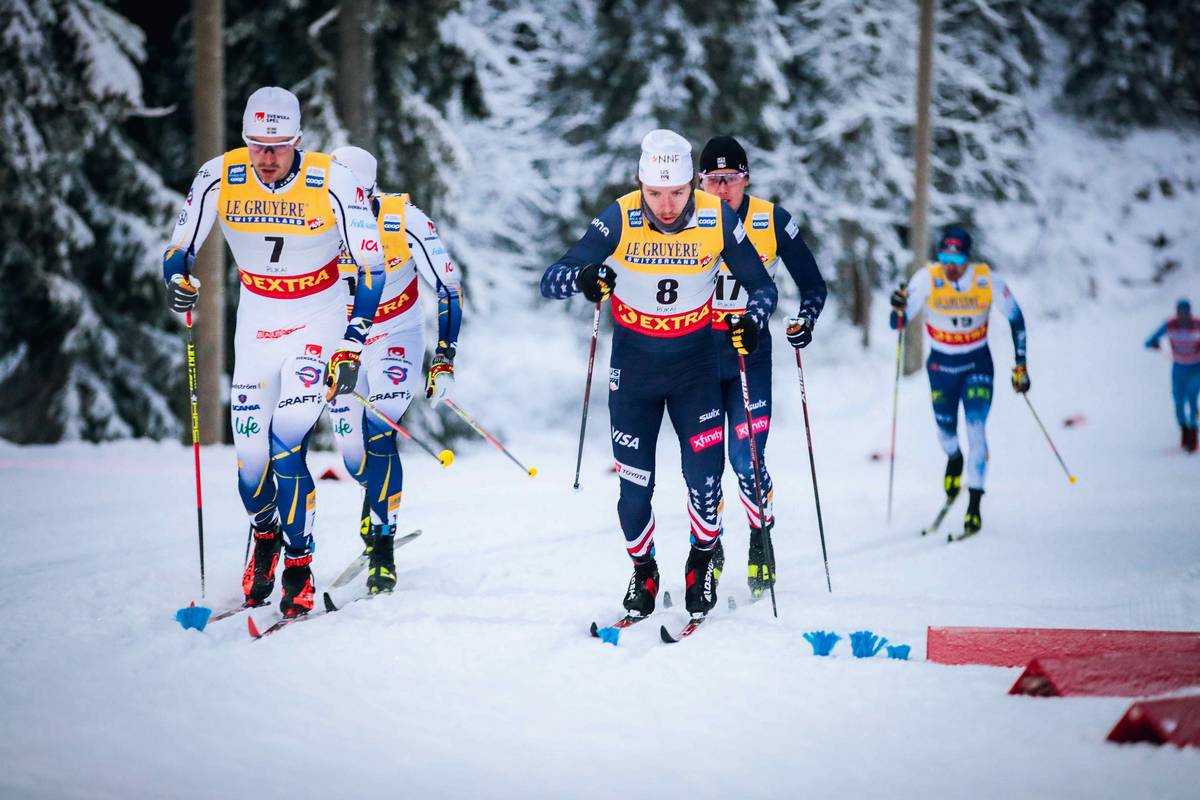
Ben Ogden leads teammate Luke Jager up the first climb during the quarterfinal of the classic sprint in Ruka. (Photo: NordicFocus)
Ben Ogden
“I’m really excited to be named to the Olympic team. Growing up in southern Vermont, I have been inspired by Olympians my whole life, and becoming one myself has always been a dream. I am excited to race hard and have some fun in China.”
Gus Schumacher
“I really have to stop and give myself some credit because it’s a lifelong dream coming to fruition, but at the same time my goals keep coming, and just making the team isn’t the end of the road. I wanna race fast! But overall I’m very excited for the opportunity to represent the U.S. on the highest level in my sport.”
Luke Jager
“This is a dream come true for me! I remember being a little kid watching Kikkan (Randall) and Andy (Newell), Simi (Hamilton), and crew at the Olympics and getting so fired up. Feels pretty crazy to get to be here now a few years later with my best friends. I feel so thankful for all the people that have worked so hard over the years to help us get here!”
Scott Patterson
“Races at the 2022 Olympics have been on my goal list for a long time. I’m excited to return to the Olympics and build on the successes I had in 2018. We have a strong contingent of U.S. athletes and I look forward to being a part of it!”
2022 Olympic Winter Games Cross Country Schedule
Saturday, Feb. 5
Women’s 15k Skiathlon
Sunday, Feb, 6
Men’s 30k Skiathlon
Tuesday, Feb. 8
Men and Women’s Freestyle Sprint
Thursday, Feb. 10
Women’s 10k Classic
Friday, Feb. 11
Men’s 15k Classic
Saturday, Feb 12
Women’s 4x5k Relay
Sunday, Feb. 13
Men’s 4x10k Relay
Wednesday, Feb. 16
Men and Women’s Classic Team Sprint
Saturday, Feb. 19
Men’s 50k Freestyle Mass Start
Sunday, Feb. 20
Women’s 30k Freestyle Mass Start
Jessie Diggins celebrates a podium effort with team sprint partner, Julia Kern, who anchored the team to 2nd place in Dresden, GER. (Photo: NordicFocus)
About U.S. Ski & Snowboard
U.S. Ski & Snowboard is the Olympic National Governing Body (NGB) of ski and snowboard sports in the USA, based in Park City, Utah. Tracing its roots directly back to 1905, the organization represents nearly 200 elite skiers and snowboarders in 2021, competing in seven teams; alpine, cross country, freeski, freestyle, snowboard, nordic combined and ski jumping. In addition to the elite teams, U.S. Ski & Snowboard also provides leadership and direction for tens of thousands of young skiers and snowboarders across the USA, encouraging and supporting them in achieving excellence. By empowering national teams, clubs, coaches, parents, officials, volunteers and fans, U.S. Ski & Snowboard is committed to the progression of its sports, athlete success and the value of team. For more information, visit www.usskiandsnowboard.org
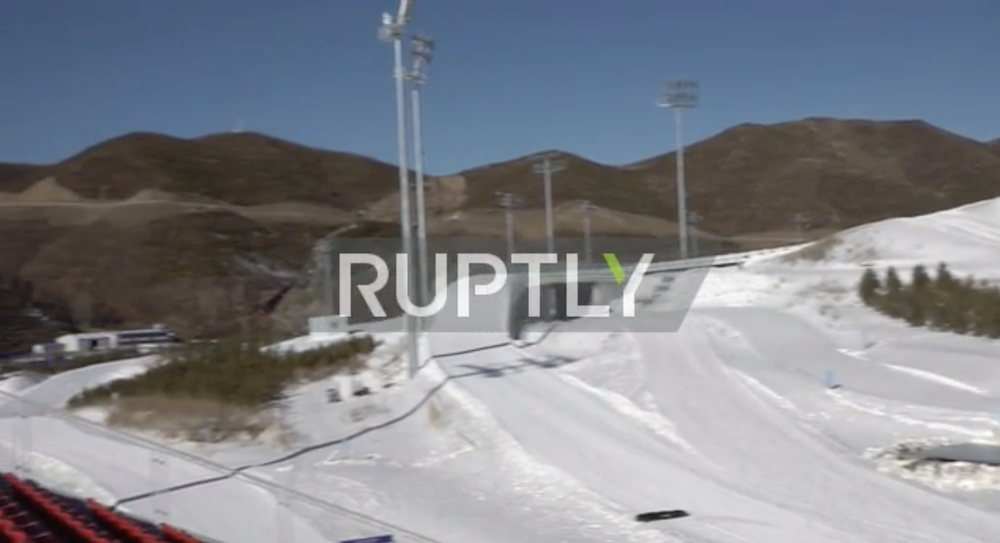
The season’s biggest races start in less than a month at a venue that is by all accounts well-designed, but also has yet to host an official FIS race. Here’s some of what is currently known about the National Cross-Country Skiing Centre in Zhangjiakou, 100-plus miles northwest of Beijing in the Hebei province of China.
The Courses
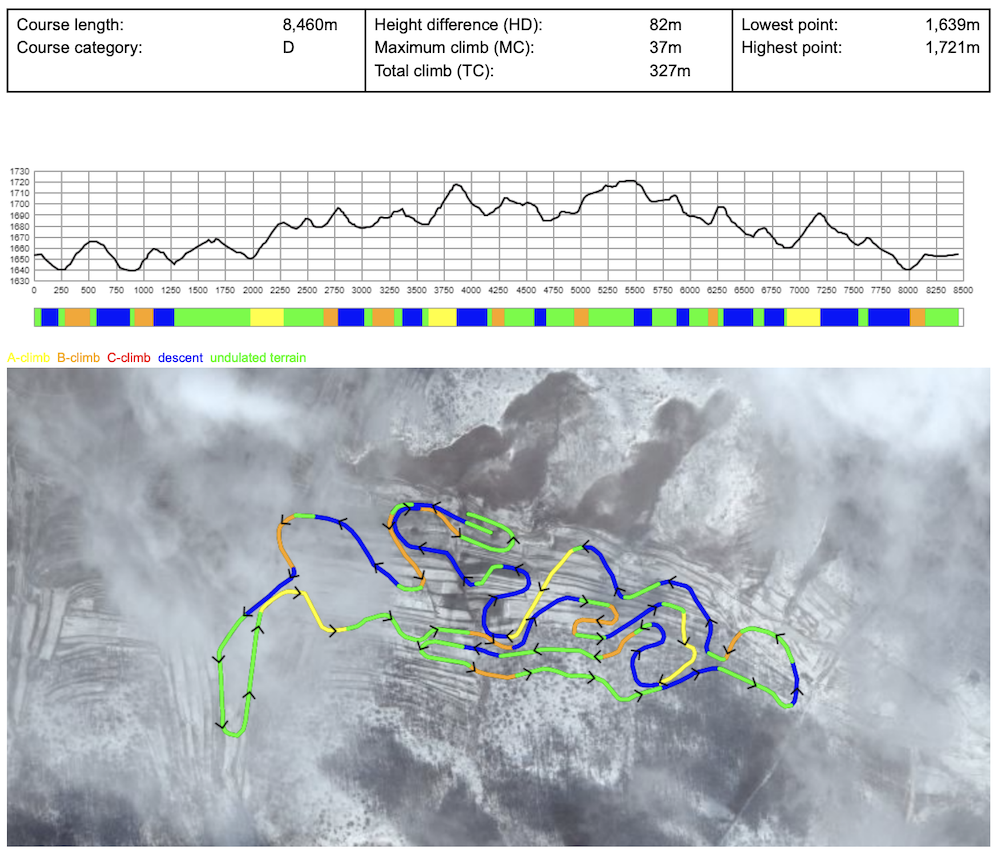
The races will be held at altitude. The stadium is located at an elevation of roughly 1,650 meters above sea level (appr. 5,400 feet), according to the homologation certificates, and the 8.3 k loop reaches an elevation of 1,721 meters. The last comparable global championship was the 2002 Winter Olympics in Salt Lake City, Utah, where the stadium in nearby Soldier Hollow is between those two heights. It is not coincidence that the presumptive American Olympic team is spending this month in some or all of Seefeld, AUT, Livigno, ITA or Park City, UT to log more time at altitude in advance of the Games.
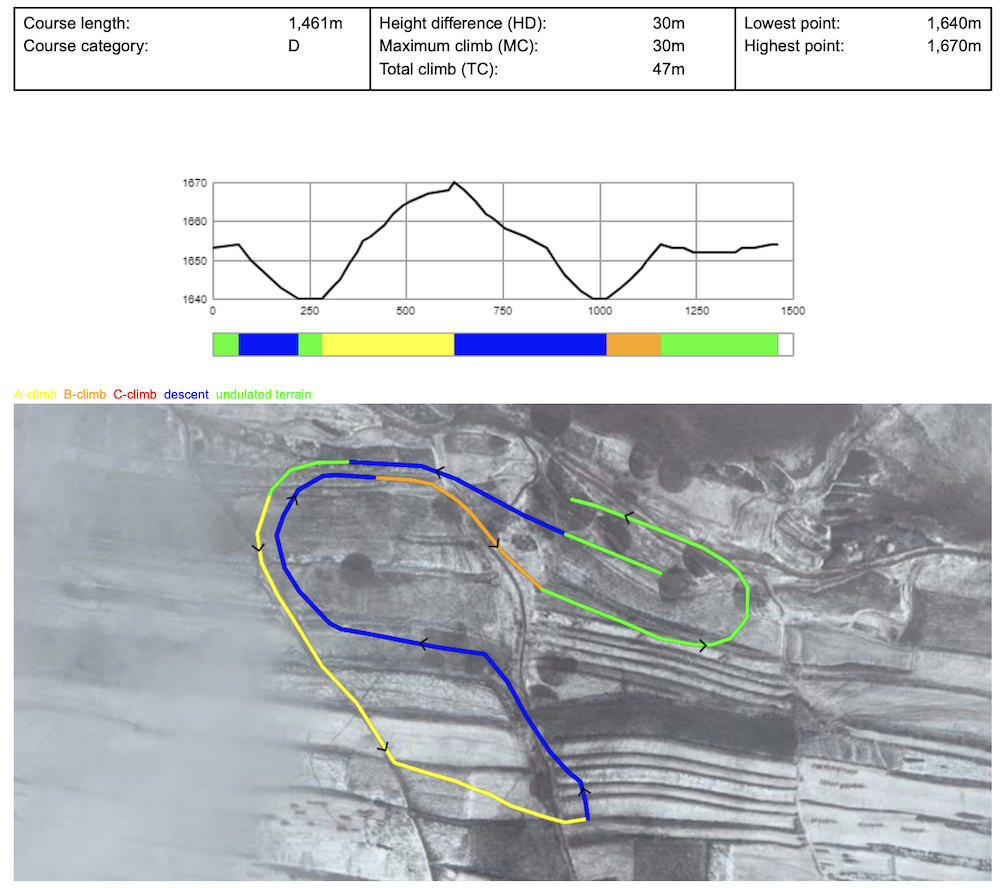
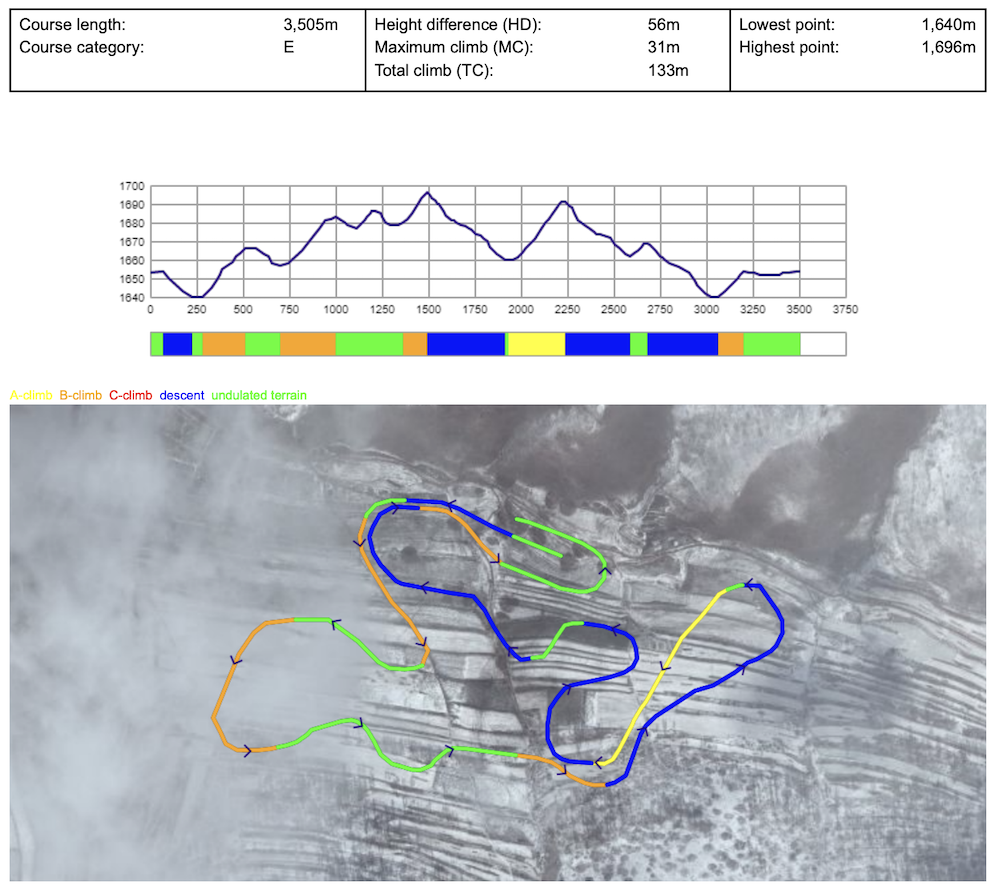
You can find full homologation certificates for all of the Zhangjiakou courses here. Here are excerpts from some of the course profiles. Note the color key, which indicates that an A-Climb is highlighted in yellow, a B-Climb in orange, descents in blue, and undulating terrain in green.
Zhangjiakou sprint course. (screenshot from FIS homologation certificate)Zhangjiakou 3.3 k course. (screenshot from FIS homologation certificate)Zhangjiakou 5 k course. (screenshot from FIS homologation certificate)Zhangjiakou 8.3 k course. (screenshot from FIS homologation certificate)
Going off of simple math alone, the sprint course features a maximum climb of 30 meters, the same as the sprint course in Falun, SWE. The distance courses feature roughly 39 meters of climbing per kilometer, at the high end of the allowable homologation range but very much in line with other championship courses. You can consult the homologation certificates for a more nuanced look at overall gradient, course flow, and associated statistics.
More holistically, the 14-meter climb back up to the stadium, in the final half-kilometer of all courses, is notable, at least in contrast to venues that feature a downhill into the stadium. A follow-up article in the next few weeks will compare this aspect of the Zhangjiakou courses to other recent championship courses.
Intriguingly, rumor has it that the warmup track at the venue is underground. This is perhaps less noteworthy in track and field, where major international stadia often have a small warmup track near the athletes’ call room, near bathrooms and out of view of spectators. It seems more notable when it appears to describe a ski tunnel–like environment.
Conditions
It is widely expected to be cold and dry. This was presaged in a research paper in the Journal of Science in Sport and Exerciseblurbed on this site last May, which was summarized as stating, “The Beijing venue has a very high probability of temperatures near the lower limit permitted for FIS races (-20C). Combining cold with higher elevation and low humidity results in suggested pacing adjustments to ensure good lung function at the end of races.” Matt Whitcomb, in discussing the Period 1 races held near this temperature limit early in this World Cup season, similarly referred to these races as being good prep for the Olympics.
Screenshot image of Olympic venue in late December 2021, taken from video published on news site ruptly.tv. (original video)
Expect entirely manmade snow throughout the venue; natural snowfall in the region is negligible, and two weeks ago the ground was bare everywhere outside the ski trails and stadium (see background of photo above, or background of this Instagram post). A comparable preview article published two weeks ago on SkiRacing.com and discussing the alpine venue at Xiaohaituo Mountain (A+ title: “What to expect when you’re inspecting”) unpacks some implications of this for waxing and ski performance. This is not to say that precisely the same conditions will be present in Zhangjiakou, dozens of miles away at a different venue, but rather to flag some relevant issues to consider here.
For the alpine runs, for example, that author foresaw “average annual snowfall of 5cm/2 inches, high winds, very low temperatures, sunny days and clear nights,” all of which also describes likely conditions in Zhangjiakou. She also noted the possibility of “sand blowing in from Mongolia and debris from the massive earthmoving during trail construction” being present in the snow. She described one wax manufacturer formulating a “special series of Beijing waxes for extreme cold temperatures, extremely aggressive snow and massive daily temperature swings due to sun exposure.” This is all likely broadly applicable to conditions at Zhangjiakou as well.
What about the waxing
To paint in very broad strokes here on a potentially touchy subject, the American skiers appear to have had “good” skis for some races in Pyeongchang, but, shall we say, “not as good” skis for some races in Seefeld and Oberstdorf. Given that euphemistic use of “not as good,” keep in mind as you read this section the norms that generally govern reporting on or public statements about the efficacy of wax jobs in this country: By the time an athlete is expressing polite concern about her wax job to the American press, it is probably the case that her skis were, objectively speaking, noticeably worse than other athletes’.
You may have seen this photo before: Jessie Diggins (14) edges Sweden’s Stina Nilsson (r) for gold, while Norway’s Maiken Caspersen Falla (l) races to bronze, in the women’s freestyle team sprint final at the 2018 Olympics in Pyeongchang, South Korea. (Photo: Noah Hoffman)
Regarding Pyeongchang, the 2018 Winter Olympics, if you’re reading this website you are probably familiar with a certain highlight that ends with Chad Salmela’s epochal cri de cœur (“Here comes Diggins!”). But rewind 56 seconds, to the descent off the top of the final downhill coming into the stadium, and you will see Diggins rocket into contention midway though the downhill. Her skis were, it appears from this video, at worst “competitive,” and at best “fastest in the field.” The air temperature for this race was -5.4 C and the snow temp was -10.1 C, according to the official results.
Regarding Seefeld, the 2019 World Championships, Sadie Maubet Bjornsen told this website, following the 30-kilometer freestyle at the end of two weeks of racing, that while she generally felt good on course, “It’s just so hard because you can’t control what you have on your feet a lot of the time.” She added, “At this level you have to have your skis at a level that can compete if you’re going to fight for a medal or even top 10, top 20. And there were some races this week that that was not the case.” Air temp for this race was +5.6 C and the snow temp was -0.3 C, according to the official results. (Disclosure: In this same article, teammate Jessie Diggins said, of the same race in the same conditions, “I had the best skis in the world.”)
Jessie Diggins races in the skiathlon in Oberstdorf, February 2021. (photo: Modica/NordicFocus)
Finally, regarding Oberstdorf, the 2021 World Championships, the ever-upbeat Diggins contemporaneously told this website, following a rough day in the skiathlon for the entire American women’s team, “I think that is so promising to see how well [my teammates] skied given the disadvantage that we had today. I think, to me, that is really impressive because it is easy to put together a good race when you have the fastest wax in the field. It is harder to just never give up and keep fighting [in less advantageous conditions], and to me, that is so much more impressive.” Air temp for this race was +3.2 C and the snow temp was -0.6 C.
Writing several months later in the Boulder Nordic Sport catalog (page 6 of this PDF), U.S. Ski Team coach and wax tech Jason Cork spoke more bluntly when discussing this race and the championships more broadly: “I thought Jessie should medal in the 10km, and she missed the bronze by 5.1 seconds. I thought she could medal in the skiathlon; I’ve never been more sick and angrier about screwing up skis as I did that afternoon. We’d hoped to finally get the women the championship relay podium they’ve been chasing since 2013, and we weren’t able to deliver skis competitive enough to make it a reality. It was warm and soft, course access was severely limited, we got outsmarted and outgunned. We stood in the way of a lot of dreams in Oberstdorf.”
Zach Caldwell, for his part, has voiced the opinion that the Americans’ relative lack of tech resources, specifically the lack of an on-site stonegrinder and a centralized grind system, has harmed them in the last two championships held in warm and sloppy conditions. If some of these premises are correct, then forecast waxing conditions in Zhangjiakou that are far more akin to those in Pyeongchang than to those in Seefeld or Oberstdorf could be beneficial for the American tech team. (Find more insights into the challenges ski technicians will likely face during the Games in the latest episode of The Devon Kershaw Show, featuring Caldwell. Spoiler alert: These dynamics are in fact a whole lot more complicated than just “cold = easy, warm = difficult,” and Caldwell knows a heck of a lot more about this area than this reporter, so you should probably listen to him.)
The first cross-country race in this year’s 2022 Winter Olympic Games will be the women’s skiathlon, held on February 5.
In this episode, we have Matt Whitcomb back to debrief the 2021/22 Tour de Ski, including highs and lows, overcoming setbacks, and managing a circulating head cold. We also discuss the cancellation of the upcoming World Cup races in Les Rousses, FRA, covid safety in a critical window before the Olympics, and the racing happening in Soldier Hollow during the 2022 US Cross Country Championships.
Thanks for listening.
The American women who finished the 2021/22 Tour de Ski pose with coaches and support staff at the top of the Alpe Cermis. (Photo: Tom Horrocks / Instagram @jessiediggins)
As Period I wanes and the Tour de Ski approaches, curiosity is naturally piqued as to how various athletes are analyzing their first four weekends of World Cup racing. In particular, our focus is drawn to Olympic medal hopefuls, like last year’s World Cup Overall Champion Jessie Diggins. How is she feeling as she heads into the holiday break, with two individual and one team sprint podium already under her belt and another six weeks to further sharpen her race gears before the Beijing Winter Games kick off in early February?
Jessie Diggins hoists the Crystal Globe as the 2021 Overall World Cup champion. (Photo: NordicFocus)
On December 15th, Tom Horrocks, Cross Country Media Coordinator for U.S. Ski & Snowboard, facilitated a Zoom call with a small group of media representatives who wished to question Diggins on the start of her season and her plan for the months ahead. Though we often hear her feelings about individual performances through the audio clips embedded in our race reports, Diggins fielded a variety of broader questions in this call, including her thoughts on early podium finishes, nutritional strategies to support the long grind of World Cup racing, and her focus as the Olympics draw near.
In a previous media call, Diggins explained that viewers should expect her to build into the season as her primary focus was peaking in February for her Olympic goal races. Nevertheless, she won the qualifier in her first World Cup start, the classic sprint in Ruka, then continued to race her way onto the podium on the subsequent three consecutive weekends. If this is what Diggins is capable of while keeping the training volume high in the early season, it’s going to be an entertaining year to be a fan of American cross-country skiing.
“I didn’t have a lot of expectations going into Period I,” Diggins said in the call. “I was not expecting either podium, they came as a wonderful surprise that I’m very grateful for.”
Jessie Diggins in the heats during the skate sprint in Davos. (Photo: NordicFocus)
We’ve heard from both Diggins and her coaches that she is an athlete who responds well to frequent racing. While she puts in large volumes of quality work through the summer and fall, it is during the race season that Diggins truly hones her fitness, both physically and mentally.
“Basically, all of this racing is how I get in shape,” Diggins explained. “Because racing that hard gets you in shape pretty fast. So for me, it’s using the Tour de Ski as part of my preparation for the Olympics, but also – whether or not I’m working into the season, whether or not it’s part of the intentional prep phase – for me, every single race I hit it as hard as I can. And as you probably saw in Davos, I crossed the finish line and there was nothing left. And I’m very proud of that, because that’s how my head gets into the exact right space I need it to be in, so that when I am in my sharpest race form at the Olympics, I already know how to push that hard.”
Diggins also fielded a question on balancing her demanding career with ambitious goals with her life outside of skiing, to which she replied:
“To be totally honest, it is my everyday life. There is not as much balance as you might find, as I hope I find in my next job someday when I retire from the sport, a very long time from now. But it is interesting because it is very all-consuming in that everything you do does reflect upon how you race. So you do have to make sure you’re prioritizing taking care of yourself and sleeping enough and hydrating and on your rest day, you don’t want to go climb the nearest mountain, even though it looks incredibly fun, because you have to rest and let your body recover. So I do think that the way I balance it is by having hobbies that are very restful, so it doesn’t take away from my training.”
She explained that earlier that day, she had spent several hours baking a birthday cake for her teammate, Novie McCabe, who had turned 20. She also expressed gratitude for the support of her family and fiancé, Wade, who will be joining her in Davos, SUI for a week at Christmas.
Jessie Diggins and her fiance, Wade, enjoy sun and perfect tracks in Davos. (Photo: Instagram @jessiediggins)
It’s no secret that Diggins has ambitious goals, and she has been open in discussing the work she has put in to manage internal and external expectations and pressures during her career. Particularly in a year where she will receive plenty of attention from the media and her fans as she strives to add additional Olympic medals to her trophy case, she explained how diverting her focus from the end goal allows her to take the steps needed to actually attain it.
“I think it is really important to not fixate on the Olympics, and especially to not fixate on results. Because just thinking about the outcome goals is probably the worst way to achieve them. [That] will create a lot of stress, a lot of pressure and a lot of hype. So, for me, in order to try to meet these big outcome goals, I actually just spend all my time focusing on the process goals and taking care of myself because I really, truly believe that if your mental health is in the right place, that’s how you can push that hard. And that’s how you can train that much and still love it and not feel burned out or feel like racing is suddenly not fun in any way. Because I think, for me anyway, racing does have to be fun in order to be able to push my body that hard over and over and over again.”
A process focus, as Diggins explained, might look like hammering out a specific set of intervals, following a peer and mimicking their technique to fine tune her own, or focusing on skiing the race course in Dresden with powerful leg pushes to maximize her speed on flat terrain.
“It’s really just those little day to day things that add up over time and allow you to get those big goals.”
Jessie Diggins leads her heat through the quarterfinal of the opening classic sprint in Ruka. (Photo: NordicFocus)
Fielding a question from Peggy Shinn, author of World Class: The Making of the U.S. Women’s Cross Country Team and senior contributor at TeamUSA.org, Diggins discussed the upcoming Olympics and her role in guiding younger teammates through the build up to their first Games as she prepares for her third.
“It’s weird to say your first Olympics, but we are a sport that lends itself to multiple Olympic cycles because of the lifespan of our sport. So your first Olympics is, and should be, incredibly fun, and hopefully, without a lot of pressure. With every resource that you need to succeed, but without the weight of expectations on your shoulders. And so one of the things I’m going to try very, very hard to do is just – ahead of time, answering all the questions about the Olympics that they could possibly have. And also trying to answer questions that they haven’t even thought they might need to ask to prepare them for success in the little things. Like, it might be noisy, so invest in a really good pair of earplugs and an eye mask, and maybe travel with your own pillow – little things that make your room a better setup for rest and recovery. And even, ‘Hey, you know, there’s this athlete Resource Center. You should go print out some pictures of your family and hang them on the wall.’”
She explained how these little touches can go a long way to helping an athlete stay calm and comfortable amidst the wild experience of competing in what our country deems is the pinnacle of sport.
Diggins also spoke highly of the work ethic and grit of her teammates, in particular lauding Julia Kern’s anchor leg in the 4 x 5k relay in Lillehammer, and the contributions of the men who have put at least one American in the semifinals in each sprint event this season.
Jessie Diggins celebrates a podium effort with team sprint partner, Julia Kern, who anchored the team to 2nd place in Dresden, GER. (Photo: NordicFocus)
If you’ve listened to interviews with Diggins or follow her on social media, you’ll know she places a high value on teamwork. After a slew of retirements of veteran members of the team, like Sadie Maubet Bjornsen, Sophie Caldwell Hamilton, and Simi Hamilton, Diggins finds herself as the longest standing member of the U.S. Ski Team.
In the most recent episode of Nordic Nation, Gus Schumacher, Ben Ogden, and JC Schoonmaker each recognized Jessie as a mentor who has provided invaluable advice to help them succeed on and off the tracks as they step up to senior level racing on the World Cup. Whether it is support in handling the highs and lows of results, or the tactics required to be in a position to advance during the sprint rounds, they explained that Diggins has been thriving in her unofficial leadership role this season.
Diggins laughed that they may have sung her praises because she had baked them cookies the night before, but then she reflected on her own start on the World Cup and how impactful it was when her older teammates welcomed her into the fold and supported her as she first took her own steps forward in racing.
“I had so many people in my life helping me at my first Olympics,” Diggins recalled. “Obviously, we had Kikkan [Randall], and Liz [Stephen], and Holly [Brooks]. And I was going through my first Olympics, together with Sadie and Ida [Sargent] and Sophie… And on the men’s side, we had Andy [Newell], who had been there before, as well as Simi. It was so cool to feel like I could ask all my questions of them and feel so supported.
“And I also feel like a big part of it, too, is just some of the little things about being on the road. For example, we’re going into the Christmas holiday next week, and for a lot of people it is their first time on the road, away from home for Christmas. And that is hard. You know, I haven’t been home for Christmas in like 10 years. And I remember my first Christmas before the Tour [de Ski]. I was rooming with Holly Brooks. And she was like, ‘All right, no Christmas tears.’ She pulled out a whole bag of cloves and oranges and decorated the room, and we had a big secret Santa with Liz, Kikkan, Holly and me, and it was so cool to feel like they really took me under their wing. They were like, ‘We’re gonna make sure this is fun. We’re gonna make sure that you don’t feel super homesick.’ I feel like around the holidays, or really any hugely emotional time, which includes the Olympics and any Championship – anytime it’s really hard – that’s when you feel like you miss and need your family the most. And that’s when it is so important that the ski team becomes your second family because you need that support to fill those holes.”
Teamwork. Diggins lays in the snow, exhausted from the effort of earning 4th overall in the 10k skate at 2021 World Championships in Oberstdorf, while Sadie Maubet Bjornsen helps remove her skis. (Photo: NordicFocus)
Following her 2020 Tour de Ski overall victory, Diggins was interviewed by a sports dietitian on the “Eat for Endurance” podcast. One thing that caught my attention was her discussion of having a dietitian and chef on the road with the team, and how she utilized this resource to combat the inevitable depletion that occurs during an event like the Tour. She explained in the podcast that racing often leaves her stomach unsettled, making it harder for her to replace the calories expended when racing repeatedly at maximal effort in the cold. In order to absorb and translate the efforts of the Tour into a fitness boost for the second half of the World Cup season, she needed to first dig out of a calorie deficit during her post-Tour recovery week, giving her body the energy and nutrients it needed to repair and replenish reserves.
Bringing this approach forward into the upcoming Tour, Diggins explained how important focusing on her nutrition has become to ensure she doesn’t fizzle out by the later stages, or carry fatigue forward into Period III and the Olympics.
“In Tours of the past, I’d found myself getting to the last few stages and just feeling very drained. Which, of course, you will anyway, because it’s very tiring, but you don’t necessarily need to feel drained from an available energy perspective when it comes to food. So it has been really amazing having a dietitian with us during the Tour, because I’m pretty sure the extremely high calorie smoothies actually kept me alive.
“For me, it is interesting because my body manifests stress very physically, even if I don’t feel incredibly stressed – you know, I’m excited to race but not overly fluttery about it. I might feel emotionally like I’m in a great place, but my body’s like, ‘Nah, we’re still stressed.’ And so that makes it very hard to eat enough sometimes.”
Jessie Diggins collapses after climbing the Alpe Cermis to win the 2021 Tour de Ski, making her the first North American athlete to do so. (Photo: NordicFocus)Jessie Diggins is hit with emotion as she processes being the first North American athlete to win the Tour de Ski. (Photo: NordicFocus)
Diggins later explained that one of the ways the stress her body is retaining manifests itself is very visible and “kind of gross.”
“At the last Olympics, the skin just started falling off my hands to the point where I lost my fingerprints on some of my fingers. And it’s weird because – the performance side was great, my best Olympics ever, my headspace was great, the sports psychology was great, I was able to eat enough…”
Nevertheless, Diggins’ body showed clear evidence of the stress that it was under. This leaves Diggins in a catch-22 as she also recognizes the stress of high-stakes racing helps her dig deeper into the well.
“Although I don’t love what [stress] does to my body, I do thrive under that pressure. Instead of making me crack, it just unleashes that very top level of performance and it brings out the best in me. Which is why I think anchoring the relay was, for a very long time, the only way I would have an outstanding World Cup. It took me a very long time to do that individually without the pressure of holding down the team. But yeah, [when my skin started to fall off] I realized, ‘Wow, my body really feels this.’”
Acknowledging that subjecting herself to this level of stress may not be ideal for her long term health, she rationalized that it – so far – has only happened at the Olympics, which only amounts to a three-week period once every four years.
Returning to the concept of mitigating the nutritional losses accrued during the Tour de Ski, Diggins explained some of the principles that the team dietitian has helped her to develop.
“It has been really, really helpful coming up with these strategies. [One of the strategies is] using Nutrimeal in calorie-dense shakes, or stirring it into my oatmeal in the morning. A lot of peanut butter – that stays down and digests really well. And honestly, a lot of chocolate, that helps too, because you always want to eat it, it always tastes good, and you just need the calories however you can get them. So for me, it has been really fun working with the sports dietitian and figuring that out. Then especially after the Tour, it’s been really important to make sure I’m able to absorb everything that I’ve just done, because that is then going into the Olympics.”
Jessie Diggins powers through the qualifier of a skate sprint in Ulricehamn, SWE in February, 2021. (Photo: NordicFocus)
She also explained that she has been working with the dietitian to problem solve fueling throughout the day leading into an afternoon or evening race, like she will encounter in most of her Olympic events. Diggins shared that it’s a fickle balance, ensuring that her body has the energy and fuel throughout the day that it will need to perform come race time, while also making sure her stomach is settled enough that she does not risk revisiting her breakfast or lunch as she pushes herself to her physical limit.
“It’s been really interesting for me working with our amazing staff, and our awesome sports dietitian, to figure out ‘Okay, here’s what you can digest, because you need a lot of calories, it’s going to be very cold, you’re working very hard, you need that energy, but you need to time it in such a way that you will not have an upset stomach.’ You don’t need any distractions on any race day, but especially not at the Olympics.”
Apart from a dietitian, the team often has access to massage and physical therapists. Diggins credits these resources as another invaluable tool in keeping her body healthy.
“We are so fortunate to have this amazing pool of volunteer massage therapists and physical therapists. Having them on the road with us has been absolutely incredible. It’s a good way to avoid injuries before they happen by taking care of those little things that inevitably pop up, but especially during the Tour, you definitely need massage work every single day. I mean, you need even more than that – you need 10 hours of sleep every single day. So I think trying to really stay on top of the body care, the rest of the recovery, the nutrition pieces, the hydration… I travel with a ton of Nuun products, because staying hydrated through all those races, especially sprint days, which are so long, and you inevitably get dehydrated, because it’s hard to drink enough when you’re jumping up and down and your stomach sloshing. For me, trying to take care of those little pieces has been huge. And that’s definitely something that I’ll be talking to our younger and first time Tour team about. ‘Alright, look, it’s gonna be hard to eat enough, it’s gonna be hard to drink enough. But you just really have to keep hammering that home because this is what will get you through the Tour, and then get you through that week after the Tour so you can bounce back and then race well in Les Rousses (FRA).’”
Jessie Diggins follows Sweden’s Ebba Anderson during a mass start 10k classic in Val di Fiemme, ITA, during Stage 6 of the 2021 Tour de Ski. (Photo: NordicFocus)
In reviewing Diggins’ last two Olympic appearances, she raced four events in Sochi in 2014 (15k skiathlon, freestyle sprint, 4 x 5k relay, 30k freestyle), and all six events during the 2018 Olympics in PyeongChang, of course, highlighted by her Gold Medal performance in the team sprint with Kikkan Randall.
This begs the question, in her third Olympics, piggybacking on a season where she won the Overall World Cup title and became the first American to win the Tour de Ski, would Diggins take the same approach and stick her neck out in every event with the hope of having a medal placed around it? Or would the approach be more targeted, sitting out in races where perhaps her odds of a medal are lower in order to conserve energy for a few target races?
“I’m definitely one of those athletes that loves to race and to race everything and so I think for me right now, looking at the Olympics, I definitely need to be racing at a level where I’ve earned starts and where it makes sense for me to race the races, but if I’m racing the way I hopefully am when I come into that sharp form, I’d like to race everything for sure. And I think the plan includes racing nearly all the World Cups to get the experience [I need for that], because pacing different courses, different altitudes, and different techniques that does just take time to get all the little things dialed in and play around with them. So the more World Cups I can race, the more I can play around with those little pieces, especially altitude, because that’s when it gets really tricky. So yeah, I think I’ll be racing most things. Probably not every single World Cup this year, but most of them.”
FasterSkier will continue to provide insight into the American team as they continue their individual journeys through this season. If Period I is any indication of what is to come, bringing you this coverage will be a fun job.
Jessie Diggins fist bumps Jenny Solin (SWE) after the team sprint final in Dresden, where she and Julia Kern took 2nd. (Photo: NordicFocus)
Usain Bolt after winning a gold medal at the 2008 Olympics in Beijing, China. Several Jamaicans tested positive for the steroid clenbuterol at those Games, but the International Olympic Committee hid the cases and they have never been investigated. (Photo: Wikimedia Commons)
In the beginning of April, news hit that a group of athletes had tested positive for a banned steroid at the 2008 Summer Olympics in Beijing, China. The group had never been investigated or suspended for doping.
The drug in question? Clenbuterol, a steroid. Its name might be familiar to cross-country skiers because it is often used in inhalers to treat asthma outside of the United States. But even for asthma, its use is prohibited for competitive athletes.
The positive findings for clenbuterol, which were present in samples from athletes of several nationalities and multiple different sports, included some from the Jamaican track and field team, according to Germany’s ARD television channel.
The findings were made in a 2016 re-testing scheme of the 2008 Olympic samples. They were never reported by the International Olympic Committee (IOC), and only brought to light by ARD many months later.
The IOC apparently decided that the traces of the drug in the urine samples were so small that they did not merit follow-up. The World Anti-Doping Agency (WADA) signed off on this decision.
One problem: like almost all of the drugs on WADA’s Prohibited List, there is no allowable minimum concentration of clenbuterol in a urine sample.
“Clenbuterol is a prohibited substance and there is no threshold under which this substance is not prohibited,” WADA writes on its own website in a Q&A about the Prohibited List. “At present, and based on expert opinions, there is no plan to introduce a threshold level for clenbuterol. It is possible that under certain circumstance the presence of a low level of clenbuterol in an athlete sample can be the result of food contamination… Under the World Anti-Doping Code, result management of cases foresees the opportunity for an athlete to explain how a prohibited substance entered his/her body.”
Explanations were apparently never solicited from the athletes in question, and the IOC simply buried the cases.
Scores of athletes have claimed in the past to have unintentionally ingested banned substances, arguing that the concentrations were so low that they couldn’t be performance-enhancing. It is an argument that has rarely been successful.
Among the athletes who were punished for unintentional ingestion are Norwegian skier Therese Johaug, who tested positive for clostebol, a steroid contained in a lip cream she used; and German biathlete Evi Sachenbacher-Stehle, whose tea was contaminated with the stimulant methylhexanamine – the same drug Carter was disqualified for – at the 2014 Olympics.
Therese Johaug has portrayed herself as a victim unfairly punished for using a medication she did not realize was banned. Strict liability mandates that it doesn’t matter if she used clostebol intentionally or not, but that same standard is not being applied to certain Summer Olympic athletes.
The Jamaican athletes in Beijing never went through the scrutiny that Johaug or Sachenbacher-Stehle did, and are unlikely, at this point, to ever serve penalties. Which begs the question: do the rules apply to everyone?
Or is it better to take a banned substance at the Olympics than at a training camp?
The Specter of Tainted Meat
There is no minimum concentration of clenbuterol allowable in the WADA Prohibited List. So the decision not to confirm the doping cases was not made in accordance within the workflow of anti-doping rules, but instead subjectively.
This is how it worked: ARD reported that IOC Medical Director Richard Budgett had instituted a policy that any positive analytical tests be cleared with him before being ‘confirmed’, the first step towards proceeding through the anti-doping investigation. These cases were reported to Budgett, and he said not to confirm them.
The normal procedure is that such positive analytical tests are considered violations and the athlete is given the opportunity to explain how the substance came to be in their body. They can argue that they ingested it accidentally, for example.
In this case, such an investigation and dialogue never took place. Because the cases were never ‘confirmed’, the IOC did not even confront the athletes.
According to the IOC, this was because of the risk of the drug entering an athlete’s body after they ate contaminated meat. The steroid is used to promote livestock growth in some countries, and China – the site of the 2008 Olympics – is one of them.
“It has been scientifically established that an athlete can test positive for clenbuterol at low levels following ingestion of contaminated meat,” WADA wrote in a press release after the documentary aired. “There have been hundreds of cases – limited to a number of countries where contamination is known to be an issue and where the athletes would have resided, trained and/or competed.”
Another athlete in Beijing – a Polish canoeist – tried to use contaminated meat as an explanation for why he tested positive for clenbuterol. In Adam Seroczyński’s case, the IOC didn’t buy it and punished him anyway.
“The behavior of the IOC is shameful,” a surprised Seroczyński told ARD after the news of the Jamaican tests came out. “They didn’t handle my case this way, I wasn’t as important.”
If the IOC had tried to conduct follow-up to establish whether contaminated meat was the most likely explanation for the positive tests, they may have been disappointed. Fearing exactly this situation, the Jamaican sprint team had flown its own meat to China from home, and their food was prepared by the team’s own cook, according to ARD.
After the fact, WADA explained their decisionmaking process.
“Effectively, when the circumstances of a positive case indicate that the athlete has been in one of the identified countries where clenbuterol meat contamination is significant, the anti-doping community views it as unreasonable to put the burden of proof on the athlete, i.e. to prove that the meat, which he or she had consumed, was contaminated; in particular, eight years after the fact,” the organization wrote in their press release. “However, before a case is closed on the basis of low clenbuterol levels consistent with contamination, WADA recommends investigating such things as meat intake and whether there was exposure to a geographical area where contaminated meat is known to be prevalent.”
As noted above, there does not seem to have been much investigation and this policy is directly at odds with WADA’s own policy as posted on its website.
Are Low Levels Really Accidents?
To justify the process, the IOC reported that in all of the 2008 clenbuterol cases which were not ‘confirmed’, the concentrations of the drug were below 1 nanogram per milliliter.
Other athletes have been banned for less; Spanish cyclist Alberto Contador lost his 2010 Tour de France title over a finding of just 0.05 nanograms per milliliter, despite also arguing that he had ingested contaminated meat.
In fact, in Contador’s case the Court of Arbitration for Sport wrote that “considering that clenbuterol is a non threshold prohibited substance, the fact that the concentration is extremely low does not have any effect on the result.”
And in the same ruling, the arbitrators ruled out that contaminated meat could possibly be a source for the drug. Noting that that Spain is not a country known to have a problem with clenbuterol contamination, they concluded that “no established facts that would elevate the possibility of meat contamination to an event that could have occurred on a balance of probabilities has been established.”
Thus, jurisprudence has established that concentrations of the drug can be found in very low concentrations in urine samples even where meat contamination is not a possible explanation.
Of course this makes sense: as a substance is metabolized, its concentration will decrease. The concentration in a sample is simply a product of the amount ingested, and time. A longer time since ingestion means a low concentration.
In banning her for 13 months, the disciplinary panel did not dispute her explanation that the substance entered her body from a lip cream, rather than an injection or some other more shocking route.
The public will likely never know whether, in fact, she was using it on purpose; the accidental explanation has been used by many an athlete who later admits that yes, they were doping. But the point of strict liability actually gets exactly to that: it deals with the fact that when you rely on someone’s word, you can never be certain of what actually happened.
Strict liability is strict liability. WADA’s explanation of its Anti-Doping Code specifically notes that an athlete should be suspended “whether or not the athlete intentionally or unintentionally used a prohibited substance or was negligent or otherwise at fault.”
Part of the issue of the Russian doping scandal is that for athletes in some parts of the world, strict liability was being applied. But for some in Russia, it wasn’t just that unintentional positives were being forgiven – rather, intentional doping was protected.
In this new scandal, the IOC – which is charged with ensuring fair competition at the most prestigious sports events in the world, the Summer and Winter Olympics – strict liability only applies sometimes.
If you were an athlete working hard to stay clean, or even Therese Johaug or Evi Sachenbacher-Stehle, that must not feel great.
The Soldatskoe nordic venue, which would have hosted competitions had Almaty, Kazakhstan, won their bid for the 2022 Olympics. Unlike the city venue which hosted 2015 FIS World Junior and U23 Championships, Soldatskoe, here before the 2011 Asian Games, has lots of snow. (Photo: Matt Pauli)
When Beijing won the bid for the 2022 Winter Olympics, some sports fans cheered, remembering happy memories of the 2008 Summer Olympics and smiling with certainty that China would deliver a Games.
Others raged and lamented, since Beijing is hardly known for its winter sports culture. The other candidate, Almaty, Kazakhstan, offered a ready-made winter experience with mountains and snow all packed in close to the city center.
What was clear was that it was not one of the most exciting or hyped-up host city elections in IOC history. Many people – fans and IOC members alike – weren’t particularly excited about either bid.
That was summed up by the fact that one IOC member abstained from voting: he or she traveled all the way to Kuala Lumpur, Malaysia, for the 128th IOC Session and then presumably decided, you know what, I don’t really care.
And it was reflected in the fact that Beijing won with just 44 votes from IOC members, the least votes received by a winning bid in the last two decades.
In comparison, this is what the alpine venues an hour outside of Beijing looked like in January 2015, according to the IOC Evaluation Commission.
Not since 1993, when Sydney was elected host of the 2000 Summer Olympics, has a winning bid received less than 50 votes. And more recently, most have received many more: 60 for Tokyo to win the 2020 Summer Games, 63 for PyeongChang to win the 2018 Games, and 66 for Rio de Janeiro to win the 2016 Games.
Close margins, on the other hand, are not so rare. Sochi 2014 and London 2012 each won by four votes, just like Beijing 2022, while Vancouver 2010 had only three votes more than its rival, PyeongChang.
Part of the reason that the tally was so low is simply that there were fewer IOC members to vote. The IOC has a maximum of 115 members, but there are currently only 100. Election of new members is on the docket for the IOC session in Kuala Lumpur.
Of those 100 current members, just 85 were present to vote. The president does not vote unless needed for a tiebreak, while members from a bid country cannot vote in host city elections, which ruled out China’s three members.
Eleven more IOC members were “excused”, meaning that they did not come to the session in Kuala Lumpur at all.
By contrast, in the last decade between 95 and 109 IOC members have voted in all previous host city elections.
Winter Athlete Reps Did Not Vote
Among the excused members were two of the most recently-elected IOC members, and the only two who competed at the last winter Olympics.
Canada’s Hayley Wickenheiser, a hockey player who appeared in five Olympic Games, did not go to Kuala Lumpur. Instead she tweeted about the result.
Yes, an interesting take… on an election that she could have taken part in. No reason for her absence was announced. She also did not attend the Candidate City presentations in Lausanne, Switzerland, in June.
Ole Einar Bjørndalen, the most successful winter Olympian of all time, also did not attend, citing the need to train for the upcoming World Cup season. The biathlete told Norwegian newspaper VG that he had discussed his absence with IOC President Thomas Bach.
The Norwegian men including Ole Einar Bjørndalen (right) celebrate after winning the 7.5 k team relay in Antholz, Italy, in January 2015. (Photo: IBU/ChristianManzoni)
“In agreement with the IOC President and the head of the IOC’s Athletes’ Commission I’m not going to attend the congress in Kuala Lumpur where Olympic organizers for 2022 will be selected,” he said. “However, I have given my professional input to the Executive Committees in discussions beforehand.”
Bjørndalen also skipped the Candidate City presentations in June, as well as the previous IOC session in December (which was during the 2015 World Cup season; he had already notched three top-tens in the first week of racing).
He told VG that he had gotten approval from both Bach and Claudia Bokel, the chair of the Athletes’ Commission, to focus on his career until April. The 41-year-old plans to retire after 2016 World Championships, which will be contested on his home turf in Oslo.
Regardless of the reasons, it’s unfortunate that Bjørndalen and Wickenheiser could not attend the session and vote. They are the two IOC members with the most recent winter Olympic experience.
And, more than that, they competed at the Sochi Olympics – the very Games that the IOC is trying to leave far, far behind them with their Agenda 2020 reforms. The $51 billion price tag is something the IOC does not want to see as a precedent, and Bjørndalen and Wickenheiser are the only two IOC members to directly experience what that massive budget gave, or did not give, to the athletes.
It would seem that their opinions could have been informed, valuable, and from a unique perspective. Not only did they miss the vote, but by excusing themselves from the last two IOC sessions they also missed the chance to talk directly with other IOC members.
One might reasonably think that the IOC has little motivation to give more say to athletes, when the athletes elected to IOC membership do not attend IOC sessions or vote on important decisions – which is a pity, because the majority of athletes likely want more input and transparency in the way the biggest competitions of their careers are organized.
Lack of Visits to Bid Cities
Another problem is that after the 2002 Salt Lake City bidding scandal, IOC members are no longer allowed to visit bid cities.
Without being able to visit bid cities, IOC members must rely on other information to make their decisions. At the 2022 Candidate City presentations in Lausanne, Switzerland, in June, the Beijing room was both more attractive, and more packed.
That was because before 2002, several IOC members had to resign after it was revealed that they had received special treatment from the organizing committee in an attempt to earn votes.
The change in policy likely helped clean up some corruption in the IOC. But it creates problems for IOC members trying to decide where the Olympics should be held: all they have to base their decision on is what they have read and seen, be it from the IOC’s own Evaluation Commission or from the media.
This would be bad enough if the playing field was equal, that is if no IOC members had ever visited any of the bid cities on their own.
But the field is far from equal. In the 2022 race, Beijing had the advantage of hosting the 2008 Olympics, meaning that almost all of the IOC members had been there. By contrast, they weren’t allowed to get the same feel for Almaty.
And even outside of sports situations, members were much more likely to have traveled to Beijing for business or leisure than they were to have seen Almaty.
That may change soon. Kazakhstan in 2012 became one of the 50 largest economies in the world. And buoyed by oil and natural gas production – the country is the third-largest non-OPEC supplier of energy to the European Union – Kazakhstan is aiming much higher by 2050.
But the fact remains, at this point, most people have not been to Almaty.
One group that has? The few journalists allowed to officially visit the two host city bid sites.
In the Beijing presentation room, the big committee was on hand to demonstrate through dioramas the vision of Games infrastructure. Is this the same as being able to see proposed sites in person?
Robert Livingstone of GamesBids.com wrote that he was pleasantly surprised by Almaty, and that most of the lines touted by the bid committee that he had assumed were just PR exaggerations turned out to be true.
The opposite was the case in Beijing: when he visited in March, the time the Paralympic Games will be hosted, there was no snow in the mountains and the ski resorts were already closed for the season.
After the vote, Livingstone wrote, “Arguably I was in a much better position to cast a vote in the host city election than most of the members, but of course it doesn’t work that way… Shouldn’t the members experience the city and the facilities as they will expect the athletes to, especially if they want to verify the quality of the athlete experience? If IOC members shared my on-site experiences do you think at least two of them may have changed their votes to Almaty? I’m certain that would have been the case.”
Another illustration of the importance of site visits is how the Evaluation Commission members themselves voted: eight of the nine members preferred Almaty, according to Inside The Games.
But despite their reporting, the Evaluation Commission could not convince IOC members to reach the same conclusion.
Who is Voting?
So who are the people who are voting and, to some extent, ignoring the advice of the IOC commission which inspects potential host cities?
More than half of the members come from countries which have not won a winter Olympic medal in the last four cycles. And many countries which are successful at the winter Games – for example, Austria, the Czech Republic, Belarus, Finland, and Slovenia – have no IOC members at all.
Ten of the fifteen members who did not vote came from countries with strong winter sports programs. For example, not only did Bjørndalen not vote, but neither did the other Norwegian IOC member, Gerhard Heiberg, who led the 1994 Lillehammer Olympic Organizing Committee.
That meant that of the voting members left, 59% came from countries without a strong winter sports program.
In terms of sports, some members are former international or Olympic athletes themselves, and others are longtime administrators, officials, and financiers of sport – or just businesspeople or royalty with an interest in sport.
Of those with a discernible sporting background, either as an athlete or as an administrator of a specific sport before they went on to organize national Olympic committees or international federations, just nine worked in winter sport. The rest come from a summer sports background.
And for snow sports, the number is even more grim. Of the 98 medal events in the 2014 Olympics, 61 were held on snow: biathlon, nordic sports, alpine skiing, freestyle skiing, and snowboarding.
That’s 62%.
But of the 100 current IOC members only Bjørndalen and Gian Franco Kasper, the head of the International Ski Federation, come from a ski background either as an athlete or an administrator.
That’s 2%.
It’s not to say that IOC members without a winter sports background are incapable of making decisions about where to host a winter Games. There are many factors which are common between all Olympics: financing, culture, convenience of venue layout, security that the Games will be delivered.
Beijing was an expert in some of those, for instance the economic backing of the Chinese government. And a lack of snow was not its only shortcoming in the bid process. For instance, the venues in Almaty were much closer together, a factor which reportedly swayed some voters. Easy access and having venues integrated to the city culture should be a focal concern when organizing a Games.
But with no winter sports experience, perhaps it’s easier for voters from a hot country to line up their priorities in terms of financing and the lucrative marketability of China’s enormous consumer base. These voters might not appreciate the extent to which skiers and snowboarders prefer real snow to the manufactured stuff.
Or, perhaps more importantly to the IOC, how competitions in a real mountain atmosphere are nicer to watch on television. Or how in some disciplines, an abundance of natural snow is much safer for competition than a combination of manmade slush and salted-up ice.
Meanwhile, the trend of IOC membership being generally out of balance with the number of medals awarded by sport isn’t just a winter sports problem. It persists when summer sports are added to the mix, too.
And that’s not to say that IOC membership should track a country’s Olympic success. After all, the goal of the Olympic movement is inclusion and harmony, not domination by the likes of Russia, China, and the United States. Diversity is a good thing.
It’s also not to say that IOC membership should tightly track sports popularity. If nothing else, that would stifle creativity, continue to cut opportunities for smaller sports, and be difficult to adjust to as the Olympic sport lineup continually changes.
Members have far more to offer than simply their cultural or sports background. Financial or broadcast skills are certainly valuable to the IOC; so are perspectives on diversity and global challenges.
But it can’t help feeling like those most affected by the negative aspects of the Beijing 2022 bid were not represented at the table when it came time to vote. The skiers and sliders who will be competing far outside Beijing, potentially to empty stadiums on manmade ice amongst brown hills, weren’t there. Nor were some countries with expertise in those events.
There are 15 spots open for new IOC members: how will they be filled? Only time will tell.
Beijing bid committee members react to being elected to host the 2022 Winter Olympics. (Photo: IOC/Flickr)
In Kuala Lumpur, Malaysia, the International Olympic Committee (IOC) voted today to award the 2022 Winter Olympics to Beijing, China. The competition was tight between and Almaty, Kazakhstan, the only other city which submitted a bid.
“We are honoured and humbled by the International Olympic Committee’s decision to award Beijing the 2022 Olympic and Paralympic Winter Games,” the Beijing 2022 bid committee said in a released statement. “It is with an incredible sense of excitement that we express our thanks to the IOC and the wider Olympic Movement. Just as with the Beijing 2008 Summer Games, the Olympic Family has put its faith in Beijing again to deliver the athlete-centred, sustainable and economical Games we have promised. This will be a memorable event at the foot of the Great Wall for the whole Olympic Family, the athletes and the spectators that will further enhance the tremendous potential to grow winter sports in our country, in Asia and around the world.”
There are roughly 110 IOC members, but only 85 of them voted in the 2022 Host City election. IOC President Thomas Bach did not (the President only votes in case of a tiebreak), nor did China’s three representatives; there are no IOC members from Kazakhstan, so they did not have to recuse themselves. 11 other members were excused.
One member was present, but abstained.
There were reportedly problems with the voting process, which was done via electronic tablets for the first time. After struggling with the system, members resorted to written votes, according to Inside The Games.
That meant that 42 votes were necessary to win, and Beijing received 44 votes. That was much closer than the competition appeared in the beginning.
Almaty ran a spirited bid, advertising their real snow and winter sports culture. You can read our review of the Almaty bid from the June candidate city presentations in Lausanne, Switzerland, here.
In the final days leading up to the vote, Almaty seemed to be making progress among IOC members. It was praised for fantastic presentations in the Kuala Lumpur session. You can watch a video from the presentation here.
“We extend our congratulations to Beijing on their successful bid for the 2022 Olympic Winter Games,” Almaty Vice Chairman Andrey Kryukov said. “China has played a significant role in the development of sport in Asia and we know that they will deliver a great Games. While we are disappointed, we are also grateful to the IOC for giving us the opportunity to present our vision to the world.”
Beijing, on the other hand, ran a sleek and professional campaign based on their ability to deliver on promises and the use of their huge economic power to implement a Games. Here is one of their earlier promotional videos.
While the strategy had many fans from the IOC membership from the very beginning, it has also drawn criticism for lacking snow, a meaningful winter sports legacy, and centralized venues, and for being built on environmental degradation and human rights violations. You can read our review of the Beijing bid here.
Nevertheless, Beijing’s economic might seems to have won out. In final presentations, Beijing touted the fact that the sports industry in China will be worth $800 million by 2022. It can also build hotels and venues at will, thanks to a captive economy directed by the government.
They also advertised that a Beijing Games would bring winter sports to roughly 300 million Chinese citizens, who do not have a strong winter sports culture. Whether this is indeed a lasting legacy remains to be seen. Basketball star Yao Ming was trotted out in support of the bid, but actually while growing up he was allowed to neither ski nor skate because sports organizers feared it hurting his basketball game.
Nevertheless, the sports industry and large size of the Chinese audience were clearly appealing to IOC members. This allows many marketing partnerships both by the IOC itself, and by its sponsors and companies which may be affiliated with some IOC members.
In terms of skiing, alpine competitions will be held in the Yanqing zone, roughly 90 kilometers outside of Beijing, and nordic and freestyle skiing in the Zhangjiakou zone, about 150 kilometers outside the city (hence the need for high speed rail).
“The USSA is looking forward to bringing our athletes, staff and supporters to Beijing as we once again look to be Best in the World,” the United States Ski and Snowboard Association wrote in a statement on their website announcing the Beijing victory.
Inside the Games also reported that in an informal survey of the eight members of the IOC’s Evaluation Commission – only four of whom are voting IOC members – eight had planned to vote for Almaty and only one for Beijing.
At the 2022 Olympic Candidate City Presentations in Lausanne, Switzerland, in June, one protestor quietly slipped into the Beijing presentation room, and once he was almost at the back unfurled a flag and started chanting. He was quickly hauled off, first by Beijing 2022 supporters inside the room and then by security.
With one week to go until International Olympic Committee members vote on whether to award the 2022 Winter Olympics to Beijing, China, or to Almaty, Kazakhstan, a prominent human rights organization is calling on the body to make meaningful demands on the eventual host city in terms of cleaning up their practices.
Both Kazakhstan and China curtail freedom of expression and dissent, and engage in discriminatory and abusive labor practices, among other issues.
There are lots of factors going decisions by the IOC about which cities will get to host Olympic Games. Economic stability of the host country, venue infrastructure, travel times, and experience for both athletes and fans are among the big ones.
In the past, a country’s human rights record has not come into play so often. In past Games, especially in Beijing in 2008 and Sochi in 2014, numerous human rights problems including forced evictions and labor abuses were documented in the run-up to the opening ceremonies.
(The Olympics are not alone in this regard, as other large sporting events such as soccer’s World Cup face the same issues.)
As part of the Agenda 2020 brought to the IOC by President Thomas Bach when he was elected in 2013, human rights and sustainable development were supposed to come more into focus in the Olympic mission.
And in September 2014, the IOC indeed announced that anti-discrimination language would be added to the host city contract, a move that was lauded by human rights groups.
That was apparent when Oslo, Norway, released the draft of its own host city contract after it decided not to bid for the 2022 Games. However, there was no requirement in the contract itself for the host organization to abide by anti-discrimination rules.
Instead, the language was couched in Section L of the preamble, a portion of the contract which is more descriptive than binding:
“WHEREAS the City and the NOC acknowledge and accept the importance of the Games and the value of the Olympic image, and agree to conduct all activities in a manner which promotes and enhances the fundamental principles and values of Olympism, in particular the prohibition of any form of discrimination with regard to a country or a person on grounds of race, religion, politics, gender or otherwise, as well as the development of the Olympic Movement…”
And in terms of labor and environmental protections, these were included in the contract, but not in great detail or specificity:
“The City, the NOC and the OCOG undertake to carry out their obligations and activities under this Contract in a manner which embraces the concept of sustainable development, and which serves to promote the protection of the environment. In particular, the concept of sustainable development shall address the legacy of the Games, including the concerns for post-Olympic use of venues and other facilities and infrastructures, referred to in Section 36 below. The City, the NOC and the OCOG shall take all necessary measures to ensure that development projects necessary for the organisation of the Games comply with local, regional and national legislation and international agreements, standards and protocols, applicable in the Host Country with regard to planning, construction, protection of the environment, healthand safety and labour laws.”
Now, with just one week to go before IOC members gather in Kuala Lumpur, Malaysia, the nonprofit Human Rights Watch (HRW) is urging them to consider human rights when they make their decision and implement reforms that would allow them to hold host countries accountable for vague promises made in this regard.
For instance, the IOC’s Evaluation Commission report on Almaty “claims that the government provided ‘assurances regarding the right to demonstrate, media freedom to report on the Games and Games preparations with no restrictions on the Internet, labor rights, and displacement’,” a release by HRW’s Global Initiatives Director Micky Worden says. “But it doesn’t elaborate on the content of such assurances, despite extensive evidence that the government doesn’t adequately protect these rights.”
The organisation, along with many others, has noted in the past repeated and routine human rights abuses by both China and Kazakhstan. In both countries, freedom of the press and freedom of assembly are strictly curtailed. Expression of dissent can lead to grave consequences.
Additionally, Kazakhstan just tried to pass a draconian bill aimed against gay and lesbian “propaganda”, reminiscent of the one passed in Russia in the leadup to the 2014 Sochi Games. After passing the senate, the bill was rejected by the country’s constitutional court, possibly in part because of an open letter by former athletes to Bach through the organisation Athlete Ally.
A United Nations Special Rapporteur who recently visited Kazakhstan noted that government officials discuss freely how they limit the freedom of assembly because they fear a revolution, and also reported that she was filmed and photographed meeting with civil rights advocates by the secret police.
Meanwhile, human rights violations at the 2008 Games hosted by Beijing are well-documented, and there’s not much reason to believe that China would make any more improvements to its policies for 2022 than it did in 2008, unless there is some contractual obligation to do so.
In current Olympic host city contracts, it is clear that the IOC can rescind the right to host a Games from a chosen host city for several reasons, but human rights is not one of them.
That leaves the IOC with few options for enforcing its alleged focus on improving human dignity. HRW recently noted that the degree of oppression and restriction in China has only gotten worse since the 2008 Olympics.
“The Chinese government and Communist Party under President Xi Jinping have unleashed the harshest campaign of politically motivated investigations, detentions, and sentencing in the past decade, marking a sharp escalation in intolerance of criticism,” the group wrote in a release.
Besides the criticism by HRW, others are opposing the Beijing bid on similar grounds.
“As Tibetans, Uighurs, southern Mongolians and Han Chinese we join together to urge you … not to award another Olympic Games to China,” a different open letter said. “All of the people we represent have suffered as a result of the Chinese government’s contempt for human rights. We hope that you are aware by now that the 2008 Beijing Games did nothing to alleviate human rights abuses in China or enhance freedom.”
In press conferences for candidate city presentations in May, human rights did not come up in relation to the Beijing bid, and a question to the Almaty organizing committee was met with the response that Kazakhstan is a young country (it was only established after the breakup of the Soviet Union) and constantly striving for improvement.
Given that Beijing and Almaty are the only two cities which completed the bidding process (after numerous European bidders dropped out), the IOC has no choice but to award the Games to a country which does not uphold some of the basic tenets of the Olympic charter. That’s inevitable.
What human rights groups are hoping for, however, is that this time around they actually take the opportunity to force their chosen host city to improve.
“The 2022 Winter Games are when the rubber meets the road for the IOC in terms of backing core principles,” Worden, the HRW Global Initiatives director, wrote this week. “Knowing that either way the selection process goes, a serious rights abuser will host the Games, the IOC should require meaningful rights protection in host city contracts, and monitor those commitments as rigorously as it monitors stadium construction, telecommunications, and other requirements.”
Which bid will eventually win? Beijing is the favorite, but Almaty has a fighting chance.
Most recently, on July 18, Bach said that both bids are “coming to Olympic Agenda 2020 from very different angles, and so it will not be an easy decision for the IOC members to take.”
A whiter version of Beijing 2022 than athletes and fans might actually encounter.
In just over a month, the International Olympic Committee members will vote in Kuala Lumpur, Malaysia, on the site of the 2022 Winter Olympics. Their two choices: Almaty, Kazakhstan, and Beijing, China.
Only these two candidates remain after other bids from regions like Bavaria, Germany (centered in Munich), Graubunden, Switzerland (centered in Davos and St Moritz), Stockholm, Sweden, and Oslo, Norway, were felled by referendums.
That’s not a good sign for the IOC. Both bids have some problematic features, and are almost certainly not the ideal locations the organization was looking for.
While there are problems with the Almaty bid, to almost any reasonable person there appear to be far more, and more serious, problems with Beijing. Despite all of this, Beijing is the frontrunner.
That’s because it has the force of the Chinese government behind it. The IOC knows that the Chinese can deliver a Games. A Beijing Olympics would happen, without any major cost to the IOC except for bad publicity and a continued slide down from any moral high ground they might have left.
The Almaty bid closed part of its gap at the candidate city presentations in Lausanne, Switzerland, last week. But in the event that Beijing still comes out on top when voting is over, here’s an overview of six major issues that the Olympics would face – and examples of some of the misrepresentation and lies the bid committee says publicly when questions are brought up.
First, there’s the snow. As skiers, it is probably one of our main concerns. Will there be enough? Where will it come from? Zhangjiakou boasts about a meter, total, of snowfall each year.
The answer is, snow will come from water. But that leads to another question. What effect will that have on the regional water dynamics of a drought-prone region?
Then there’s air quality. It’s known to be terrible in Beijing. But organizers assert that air quality is great at the mountain venues. The problem is, that’s just not true.
Next up, how will spectators get to the mountain venues? At almost 200 k north of Beijing, travel times could be long. The bid committee touts a high-speed train connecting the clusters, but it’s becoming clear that this won’t solve all problems and could even be dangerous.
After the 2008 Olympics, it was clear that China followed through on few of their promises to improve human rights. Is there any reason to think that this time around will be different?
And finally, thinking long-term, what is the point of hosting a Games where winter sports are not popular and where snowmaking is so disruptive? Will the venues be used in the future?
The site of the alpine skiing and sliding sports for Beijing 2022, photographed in January 2015 for the IOC Evaluation Commission report.
Snow: Quite honestly, there isn’t much.
The weather is cold and it’s enough to blow snow, however, at least for alpine skiing. The Chongli area outside of Zhangjiakou has four alpine ski resorts which host, according to the bid committee, 1.5 million visitors annually. Nordic facilities have not yet been built.
On the ground, the area isn’t always teeming with skiers.
“The chairlifts are somewhat slow, but queues are rare and the slopes are mostly empty,” a review of the Wanlong resort, one of the biggest in the area, notes.
By comparison, the state of Vermont gets about 4.5 million ski visits per year, although that is based on ticket sales and it is unclear whether the Chongli numbers are from all tourists or just those who buy a lift ticket.
Looking at meteorological data, it’s hard to imagine the region becoming a real winter sports mecca without snowmaking.
“The total annual snowfall here can reach more than one meter,” Liu Jianjun of Chongli’s weather bureau told the press.
One meter!?
And yet:
“We have a 20-year history of hosting skiing events… Each year there is a 25% increase in the population taking part in skiing in Zhangjiakou,” Hou Lang, the mayor of the city, said in a press conference in Lausanne. “The temperature, wind speed, and mountain situations are ideal for hosting a Games.”
The bid committee’s strategy is to make and hoard snow. Already, resorts feature snow on the trails but brown forests and dry, frozen ground beside them.
“In addition to natural snowfall we have a very comprehensive plan to ensure the quality and quantity of snow,” Zhang Li, the venue manager, said in the press conference. “This plan is based on the combination of appropriate temperature, abundant water supply, and reliable existing snowmaking facilities.”
The IOC Evaluation Commission noted in their report that the resorts are already situated on the highest mountains in the region, so there would be no way to haul in snow from other locations. And as was shown in Vancouver 2010, temperatures can unpredictably rise during warm snaps and prevent snowmaking.
During discussions about the two candidate cities, experts reportedly testified that a 50-50 mix of manmade and natural snow was ideal, and that this was attainable with the Beijing bid. Two problems: most athletes would argue that actually a zero-manmade, all-natural snow base would be ideal, and secondly, it’s not clear that 50% natural is even realistic.
Siting an Olympic Games in a place with essentially zero natural snow seems like a big risk. Yet the IOC does not seem overly worried with this issue compared to others.
Water: On top of all of that, it appears that the bid committee does not fully understand just how big an undertaking it would be to make all of that snow. 16 million cubic feet of snow were reportedly stockpiled before the 2014 Sochi Olympics, where there was more natural snow to use as a base anyway.
It took over 140 gallons of water to make just one of those cubic meters of snow.
“The Commission considers Beijing 2022 has underestimated the amount of water that would be needed for snowmaking for the Games,” the Evaluation Commission wrote.
Zhangjiakou is in a notoriously arid region. There simply isn’t a lot of water available: just 383 millimeters per year, or 15 inches. The winter is the dry season, and Zhangjiakou receives less than five millimeters per month then.
The New York Times reported earlier this year that the region is home to water conflicts, which those in the western U.S. might find familiar.
The small amount of water available is often sent south to Beijing, a major city which has priority over rural areas. It is now being used for snowmaking as well, and should Beijing win the 2022 bid the amount needed for snowmaking will only increase.
“The total amount of water used for the entire Games duration for snowmaking represents only 1% of annual available water supply in this area,” Zhang Li said in the press conference.
However, the Evaluation Committee had already made clear that they believed this estimate was incorrect. And in a region with barely any water, one percent can still make a big difference – just ask California.
Because of China’s controlling government and human rights problems, those suffering from further declines in water resources would certainly be the least affluent residents of the Zhangjiakou region. Pouring more effort into snowmaking would represent a further shift to focusing on an affluence tourist market instead of local dynamics.
Yet the bid committee insists that there’s nothing to worry about.
“To ensure an abundant the water supply, we have three sources of water,” Zhang Li said in the press conference. “One is the surface runoff which has been the sole source for the existing resorts for the last 20 years. The second source is large capacity reservoirs in 6 kilometers of the venues. The third source is that we will benefit from the already almost-completed National Water Transport plan, which is transferring an enormous amount of water from southern China to the north.”
That transport plan has reportedly cost as much as $80 billion, although detailed estimates are hard to pin down.
The bid committee also plans to recapture snowmelt and use it to blow more snow, but the Evaluation Commission wrote that the ability to do this had been greatly overestimated.
Air pollution in Tiananmen Square, Beijing, in 2013. (Photo: Michael Davis-Burchat, flickr)
Air Quality: Beijing currently faces some of the worst air quality in the world. During the 2014 Beijing marathon, particulate pollution was at 400 micrograms per cubic meter; the World Health Organization’s maximum for healthy outdoor activity is 25. Most participants wore masks and many did not finish the race.
“In Beijing, the ice sports will all be in indoor venues,” Wang Anshun, the mayor of Beijing and the head of the bid committee, helpfully noted in a press conference.
Beijing is in the midst of a five-year action plan to clean up air quality, which is costing about $130 billion and features 84 specific action points.
“At present, the action plan is already achieving excellent results,” Wang said. “Major pollutants in this period have dropped by 17.7 percent as compared to last year.”
After the plan ends in 2017, there are already plans in the works for another five-year agenda leading up to the 2022 Games.
In fact, the bid committee used the prospect of improving air quality in a not-so-subtle attempt to guilt people into supporting the bid.
“This also will be a form of permanent legacy that will benefit the local people of the city and the region,” Wang noted.
In other words: how could you turn this bid down when it will improve quality of life for millions of people, and make the air that they breathe no longer able to kill them?
However, it’s worth noting that an IOC mandate to fix pollution problems has not always in the past led to pristine conditions. Air quality was still a problem at the 2008 Summer Olympics in Beijing, even after much-publicized attempts to solve it by closing factories limiting the amount of vehicles in use. While vast improvements were made, pollution was still worse than in all but the most polluted U.S. cities and about six times higher than at the 1996 Atlanta Olympics.
Immediately after the 2008 Olympics, air quality worsened again, now to those levels seen during the 2014 Beijing Marathon. Improving air quality during the Games did not have lasting effects.
Another case of the IOC struggling to mandate pollution cleanup is in Rio de Janeiro, Brazil. Just a year before the 2016 summer Games, organizers are still struggling to clean up the water in the city. Last summer the IOC brushed off concerns, saying there was still time to clean up, but they now seem more alarmed, and at the recent Executive Board meetings in Lausanne demanded to see progress by the end of July.
Part of the Rio bid was a promise to reduce the flow of raw sewage into the sailing venue by 80%, but officials now acknowledge that will never happen. (More alarmingly, they say that the failure to clean up is irrelevant because the sewage poses no health risks to sailors.)
In other words, if the host city promises in a bid to clean up, the IOC has no real way to hold them to that promise. Statements by the bid committee about air quality do not mean that athletes won’t see significant health risks when they arrive in Beijing in 2022.
Finally, the bid committee says that at the two mountain clusters, air quality is ideal. However, while Zhangjiakou does have the best air quality in its region, it is still not good. In the next two days, for example, air quality is forecasted to dip into the “unhealthy” zone, with the definition “Everyone may begin to experience health effects; members of sensitive groups may experience more serious health effects.”
And local regulations cannot completely solve air pollution problems, anyway.
“Increased energy demand in winter coupled with seasonal weather patterns that can bring pollutants from other regions could create air quality issues across the Games zones,” the Evaluation Commission wrote.
Distances Between Clusters: The Beijing bid will feature three clusters for sports: arena ice sports will be held in Beijing; nordic sports, freestyle skiing, and snowboarding in Zhangjiakou; and alpine skiing and sliding sports in Yanqing.
The bid committee promoted this three-zone idea as a benefit to athletes, who will not have to travel far to reach their venues or deal with the more general hubbub of a compact Olympic Games.
“To ensure the athlete experience, I know from my experience as an athlete that the most important thing is the performance in the Olympics,” said Yang Yang, a gold medalist in short-track speedskating and now an IOC member. “So to minimize the travel times would bring much benefit to the athletes. Having three zones will help the athletes with short distance to travel from the venues to the villages. It will be about 15 minutes, which is a very good benefit to the athletes.”
Aside from athletes, travel times for spectators could be quite long. The bid committee has proposed building a high-speed train system which it says would cut the time needed to travel roughly 200 k from Beijing to Zhangjiakou to 50 minutes.
There’s several problems with this. First of all, the bid committee left the expenses associated with building the network off the books, claiming that it would have built the railway anyway. That’s false, and cut the bid’s budget down to better compete against Almaty. Officials still refuse to reveal the actual cost of the railway.
Secondly, only when pushed did officials admit that actually, it would take longer than 50 minutes to travel between the venues. They admitted that 10 minutes should be added for waiting times to board the trains.
IOC members pointed out that that’s not all; after all, they have to get from hotels to the train stations, and then from the stations to the venues. Members complained that it would likely take them 90 minutes.
And for regular spectators who don’t receive the special treatment of IOC members, it’s likely to be a lot longer. This, along with the lack of a snow sports culture in China, contributes to the strong possibility to sports in the mountains facing empty stadiums. That doesn’t exactly make for the best athlete experience.
Already in 2014 in Sochi, Russia – a country where cross-country skiing and biathlon are successful and popular – seats were empty in the stadiums. This was likely due in part to the sale of multi-sport ticket bundles. A non-ski fan might go check out a sport they had a ticket to if it’s close; if it takes hours of travel each way, they might decide to stay in Beijing.
Lastly, with well-documented catastrophic train disasters and high levels of corruption hindering safety measures in China’s railway construction (you can find an incredible piece from the New Yorkerhere), does anyone really want to be on a high-speed train system where a crash, or even just a decrease in speed, by a train that departed just five minutes earlier could lead to a pile-up?
Human Rights
One of the biggest problems will provide nothing more than a repeat show from the 2008 Olympics. When Beijing won the bid for the 2008 Games, China boldly proclaimed that this was an opportunity for the country to improve their human rights record before they showed off to the world.
That certainly did not happen.
Hundreds of thousands of residents were evicted in the leadup to the 2008 summer Games in order to build new stadiums and infrastructure. The 2022 Games will use some of that infrastructure, so evictions should not be as numerous. But the Evaluation Commission report still estimates that thousands of people will have to be relocated.
And relocation is not something that China handles well. Houses were demolished and when residents tried to protest their evictions or appeal through the legal process, they were arrested, jailed, and sometimes beaten. Citizens have no choice in the matter, and are not provided the means necessary to re-make their life somewhere else.
“Compensation rates have rarely enabled affected people to relocate while retaining the same standard of living,” the Geneva-based charity Centre on Housing Rights and Evictions noted in a 2008 report. “Instead, residents have been forced to move further from sources of employment, community networks, and decent schools and health care facilities.”
Journalists who covered these issues did not fare well, with dozens of members of the media detained in the leadup to Beijing 2008. The Foreign Correspondents Club of China reported that 40% of foreign journalists covering the 2008 Games had experienced some sort of governmental interference, and that since then, conditions for foreign journalists have declined substantially.
Even while reporting on the bid for the 2022 Games there have been incidents. When two foreign journalists tried to visit the site of the mountain cluster and interview locals, government “minders” scared people away from speaking to them and inhibited them from visiting parts of the sites.
Protestors shouting “Beijing Lies, Tibet Dies” and “No More Bloody Games” appeared outside the hotel hosting the candidate city presentations. Later, another activist snuck into the Beijing presentation room. After unfurling a banner and chanting, he was forcibly removed.
Those outside the media fared much worse. Before the 2008 Games, citizens who spoke to foreign media were sometimes beaten by police in retaliation. According to Human Rights Watch, Chinese who spoke out on a variety of issues, from human rights to the environment or corruption, were often arrested. In some cases activists were kept in prison for longer than the actual term they were sentenced to.
Then there’s the athletes. According to The Guardian, China forbid athletes with any history of dissidence or activism from participating in the 2008 Olympic or Paralympic Games. For instance, Fang Zheng, whose legs were crushed by a tank in Tiananmen Square in the 1989 massacre, was not allowed to compete despite having two national records in the discus.
There’s many other human rights issues in the country. Tibetan activists, for instance, infiltrated the candidate city presentation room in Lausanne last week to stage a protest of China’s occupation of the region. Before 2008, the Olympics were seen as providing a platform for Tibetans to speak out about their oppression. But nothing changed for the better.
If the 2022 bid is successful, that means seven more years of Free Tibet protests. That’s seven more years of the world being reminded that the IOC has chosen to host the largest, most lucrative sporting event in the world in a country that does not support the basic tenets of the Olympic movement.
“The goal of Olympism is to place sport at the service of the harmonious development of humankind, with a view to promoting a peaceful society concerned with the preservation of human dignity,” the second point of the Olympic Charter reads.
Legacy: One of the main points of the Beijing bid is that should they win, they will bring winter sports to “hundreds of millions” of people and provide a lasting legacy. This is how the bid committee appeals to IOC President Thomas Bach’s “Olympic Agenda 2020” plan.
Frankly, this seems unlikely. Even in countries which already have a strong winter sports culture, building new venues in places which are only moderately accessible to the general population has rarely been successful in building lasting legacies.
Let’s look back at Sochi, 2014. The snow and sliding sports venues will certainly never be used again for World Cup competition, and it’s not clear that they are seeing significant use from Russian athletes either. $51 billion were spent to build this Olympics and the mountain cluster is eerily empty. Resorts were operating at losses and renting luxury rooms for as little as $17 per night.
What about Vancouver, four years earlier? Canada has strong nordic, alpine, and freestyle ski programs. But the cross-country and biathlon teams no longer base training groups in the Callaghan Valley, a venue which sees little traffic. Canadian ski jumping and nordic combined struggle to even remain funded. Whistler Sport Legacies has more costs than profits, although some venues, such as the luge and bobsled runs, see a lot of use.
British Columbia and the Canadian Rockies have plenty of alpine skiing opportunities, which is perhaps the reason that the Whistler Creekside venue, which hosted alpine racing for the Olympics, has not seen any FIS-level competition since 2010. Lake Louise, Alberta, beckons instead.
Pragelato, the site of nordic racing at the 2006 Torino Games, has not hosted a FIS-sanctioned cross-country ski race since the World University Games 2007. The luge track has been dismantled for economic reasons, but the hockey and speedskating arenas have hosted other sports events as well as plenty of concerts.
Sestriere, where the alpine racing was held, is still a popular venue for Europeans, but hasn’t hosted a World Cup since 2009. And unlike most other snow sports venues used in 2006-2014, Sestriere was already a high-profile destination for both tourists and elite racers; the Olympics likely did not significantly affect its future.
So even in countries where there are plenty of winter athletes, developing new venues for the Olympics hasn’t contributed much to sports programs. Reaching fans is a different story, but there’s still not much evidence that hosting an Olympics seriously shifts the support for winter sports within a country long-term, aside from a brief flush of enthusiasm surrounding the Games itself.
And considering the high water cost of running the snow sports venues, it’s not clear that they would even be maintained in the long run, especially as climate change progresses.
The bottom line, and the Almaty comparison. Almaty faces some of the same issues that Beijing does.
Air quality is not great in the city, although it is of course nowhere near as bad as Beijing. Kazakhstan is not a model for human rights, and there is expected to be significant corruption should Almaty win the lucrative bid.
But on many points, Almaty comes out clearly ahead. For instance, many stadiums are already built and being used by both Kazakh athletes and to host international competitions like the 2011 Asian Winter Games or the upcoming 2017 World University Games. Almaty has snow, and it has winter athletes; it’s much more likely that the Games would have a lasting legacy improving sports opportunities for residents.
It is also a compact Games, with everything close together, and a relatively cheap one.
What Almaty lacks is the slick, powerful, marketing machine that Beijing has already put into place. Should Beijing win, it will be a clear message that money, financial stability, and glossy PR lines matter more to IOC members than the actual tenets of the Olympic charter.
LAUSANNE, Switzerland— After presentations and question and answer sessions yesterday at the Olympic Museum, today was the Almaty and Beijing 2022 bid committee’s last chance to officially sell their Games proposals to International Olympic Committee (IOC) members and the media in person.
Situated at the Lausanne Palace Hotel, a swanky venue where a room costs well over 400 Swiss Francs – roughly equivalent to United States dollars – and a simple coffee 5.50, IOC members discussed the options with organizers and the press.
The bid committees also put together presentation rooms to showcase their bid concepts. Think part World’s Fair, part hospitality tent, all salesmanship.
Movers and shakers in Olympic sport convened at the Lausanne Palace Hotel.
IOC members who are not part of the Evaluation Commission are not allowed to visit bid cities in person to help make their decision about which to vote for.
The idea was to prevent corruption, and not allow cities to spend huge budgets on coddling the voters during their visits or lavishing them with gifts in order to buy loyalty.
Some regulation was a good idea, because that strategy obviously works. The rule was made after the 2002 Salt Lake City scandal where the organizing committee bribed IOC members for votes. Bribery and special treatment are also a key part of the recent scandal at FIFA, the international governing body for soccer.
IOC members are uncompensated for their time with the organization. President Bach only recently received a salary for the first time, although he is also given residence in Lausanne by the organization, at fairly great expense.
Instead of salaries, members enjoy many other perks of their status. When citizens in Oslo voted to not bid on the 2022 Games after a bid committee put together fairly extensive plans, demands by the IOC were cited as one of the reasons that they would not want to be associated with hosting the Games.
For instance, there were reportedly requests for IOC members to have separate entrances and exits from the airport, separate lanes on roads for travel, and to be provided with brand-name mobile phones and country-specific calling plans by the organizing committee. (A longer list of the demands, and reactions to those demands, was tallied by Inside The Games.)
Of course, that was at the Games, rather than during the candidacy process. But one can imagine that the same sort of benefits would be much appreciated by voters.
So instead of allowing in-person treatment of this sort to bias voters, the new rules only allow lobbying on neutral ground, in this case Lausanne. The 2022 Games bidding process will be a test to see whether the new concept works. Both bids are seen as having problems, for instance air quality and environmental human rights issues.
Some concerns are addressed in the Evaluation Commission packet, but at 137 pages in length, it is acknowledged that many members may not read the full details.
The challenges are glossed over in bid packets that contain the most accessible, quotable information that voters and journalists have; in one press conference, a member of the Beijing bid committee said, “Air quality is considered good. You can find relevant numerical data online.”
But who wants to go online and search through dense, perhaps difficult-to-interpret data on air quality, when ready-made statements are right there in the media packet?
In the Beijing 2022 Candidate City kit, right there on page three is the “Vision” statement.
“As an Olympic celebration upon ice and snow, the Beijing 2022 Olympic and Paralympic Winter Games will offer a pure and clean environment for sport, ecology, and culture…”
This seems unlikely, but it has not been possible for IOC members to visit Beijing in person and see whether reality matches the glossy statements by the bid committee. Breathing the air themselves, for instance, would give a good idea about whether it’s ethical to ask athletes to breathe it during competition.
In fact, few people have been able to even see the area that is slated to host venues for alpine skiing. On a press junket as part of the evaluation package, the few foreign journalists invited begged to at least be able to see the Yanqing site where the alpine and sliding venues will be built. Instead, they were treated with a trip to a winery.
The Zhiangjiakou site, which will hold freestyle skiing, snowboarding, and nordic disciplines, was open. But venues were not built yet and at the existing small ski resort, slopes were brown. What would the Yanqing site have looked like, if they had been allowed to see it?
A screencap of the site plan for cross-country skiing at the Zhiangjiakou site of Beijing 2022. The photo was taken in late January, 2015. For the full Evaluation Commission report, click here.
It’s easy to pick on Beijing, but it’s not any easier for IOC members to assess the Almaty bid, either. At least many IOC members have been to Beijing – most were there for the duration of the 2008 summer Olympics.
In fact, that is seen as a major disadvantage for the Almaty bid. Instead of leveling the playing field, the new rule seems to have created a built-in inequality: Beijing has had Olympic exposure, and Almaty has not.
Because finally, the decision will not only come down to evaluating the challenges and risks associated with each bid. It will also depend on how IOC members access the positive aspects.
What will the Games atmosphere be? How are the venues, and what will they feel like when they are filled with cheering fans? Will it be a good experience for all? Are the locals receptive to the legacy of sports that each bid committee insists it is building?
To answer these questions and make their decision, IOC members must rely on lines from press shills, information in blandly-written reports or overly-positive promotional materials, and finally, the presentation rooms.
For a taste of what that means, here’s a look inside those rooms.
The Lausanne Palace was the venue for the meetings. It’s actually a spa and hotel in the heart of the city.
After lunch, protestors shouting “Beijing Lies, Tibet Dies” and “No More Bloody Games” appeared outside the hotel hosting the candidate city presentations. Later, another protestor snuck into the Beijing presentation room.
As Chinese who are also Swiss citizens, the protestors asserted their right to free speech, something they said did not exist in China.
Security eventually moved the protestors away from the hotel entrance.
In the Beijing presentation room, the big committee was on hand to demonstrate through dioramas the vision of Games infrastructure. Is this the same as being able to see proposed sites in person?
A diorama depicting the Zhiangjiakou cluster, where nordic sports, freestyle skiing, and snowboarding will be held at the 2022 Winter Olympics hosted by Beijing.
A closeup on the biathlon area plans. “The venue is north-facing, which is very good for shooting,” the PR representative told me.
Have some Chinese cookies!
At the 2022 Olympic Candidate City Presentations in Lausanne, Switzerland, in June, one protestor quietly slipped into the Beijing presentation room, and once he was almost at the back unfurled a flag and started chanting. He was quickly hauled off, first by Beijing 2022 supporters inside the room and then by security.
A diorama in the Almaty presentation room, which was much less packed than the Beijing room.
Journalists use interactive computer displays to explore the Almaty 2022 bid concept.
Regional delicacies here, too.
And free drinks! “I have to finish work first,” one journalist joked to the server. “Maybe after..”
Without being able to visit bid cities, IOC members must rely on other information to make their decisions. At the 2022 Candidate City presentations in Lausanne, Switzerland, in June, the Beijing room was both more attractive, and more packed.
Both bid committees had their own Olympic stars on hand to answer questions.
The head media liaison of the Beijing bid was busy trying to win over reporters.
18 Beijing Room
Things were back to normal in the Beijing room after the protest.
Lausanne is a French-speaking Swiss city of roughly 140,000, nestled between Lake Geneva and the Jura mountains.
This week FasterSkier will be in Lausanne, Switzerland, to cover the International Olympic Committee (IOC) Executive Board meeting and candidate city briefings for the 2022 Winter Olympics. Beijing, China, and Almaty, Kazakhstan, are the two candidates, and each will have a chance to present their proposals to IOC members and then to the press.
To learn what’s coming up, read on.
Who Else Will Be There?
The IOC Executive Board comprises 15 people: IOC President Thomas Bach, four vice presidents, and ten other members. The board will meet on Monday about governance and hear progress reports from internal committees and Games organizing committees.
The IOC itself has 115 members, all of whom can come to the Tuesday and Wednesday sessions to hear and judge the proposals by the 2022 candidate cities, Beijing and Almaty. The members are 15 current athletes, 15 heads of the international sports federations, and 15 heads of countries’ national Olympic committees. The remaining spots are allocated to other former athletes, royalty from various countries around the world, and high-flying businessmen and -women.
Some names you might recognize among the IOC members: Norwegian biathlon great Ole Einar Bjørndalen is an athlete representative, as is Kenyan distance runner Paul Tergat and Canadian hockey champ Hayley Wickenheiser. International Ski Federation president Gian Franco Kasper is also an IOC member, as is former WADA Chairman Dick Pound.
Additionally, Italian ski legend Manuela Di Centa – who participated in a remarkable five winter Olympic Games – and Swedish anti-doping advocate Dr. Arne Ljungqvist, who has talked to FasterSkier on several subjects in the past, are honorary members.
It’s not known if all of those listed above will be attending; at one of last year’s major meetings, roughly 100 of the IOC members showed up. But one guy who won’t be there? FIFA President Sepp Blatter, who has said he will sit out the meeting. That’s probably good for the IOC’s image.
What Will President Bach Address?
Agenda 2020. The IOC Executive Board meeting will be held on Monday. The agenda includes discussion of Bach’s Agenda 2020 plan for the IOC’s future, which was approved unanimously last August. That included 40 recommendations relating to the bidding process, sustainability of the IOC, how to decide what events are included, Games management, anti-doping, and more – including a $600 million television channel. You can see the agenda here.
Any progress on the agenda that has already been realized is likely to be touted. For instance, Bach recently imposed changes to the composition of the IOC commissions, calling for an increase in the number of women holding commission positions, as well as the number of members from lesser-represented regions like Africa, Asia, and Oceana.
SportAccord and Criticism. However, not everyone sees Bach’s presidency, to which he was elected in 2013, as a positive thing. Marius Vizer was, until recently, the president of SportAccord, an organization of international sports governing bodies. At the SportAccord convention in Sochi in April, Vizer reeled against the IOC’s lack of transparency and its lack of respect for the international federations.
“I always tried to develop a constructive collaboration with the IOC and with President Bach,” Vizer said in a remarkable speech, the text of which you can read here. “A collaboration based on respect towards the Olympic Movement, its members and the values in which I believe. Unfortunately, it never became reality. I made a number of proposals in favor and for the benefit of IFs and SportAccord but we have never received a positive reaction. Mr. President… Do not interfere in the autonomy of the sport organizations.”
Framing the IOC as a profit-hungry behemoth, he positioned himself and the SportAccord group as more friendly to federations and indeed athletes around the world.
“Why invest hundreds of millions of dollars in Opening and Closing ceremonies, while millions of athletes live in hunger and they don’t stand a chance in sport due to the lack of proper conditions?” he said. “If indeed the IOC distributes $3.25 million a day, every day of the year, for the development of sport worldwide, why do millions of athletes suffer and cannot enjoy or reach performances in sport? Together, SportAccord and IOC must find a solution to compensate National Federations and athletes from their events. Today, the money invested in sport never reaches the athletes and their families.”
As pointed out in an Inside The Games thought piece, these complaints have been echoing for more than 40 years: that international federations govern sport 365 days a year, while the IOC governs them once every four years but still gets all the glory and profit.
Unfortunately for Vizer, the international federations were alarmed at the antagonism towards the IOC, and most of the major ones began to sever their ties with the organization. Vizer requested to meet with Bach to discuss a 20-point agenda.
One proposal was having prize money at the Olympics, something brought up by athletes such as Australian hurdler Sally Pearson, who wants to be compensated for her work as, essentially, an entertainer. The Olympics bring massive profits to organizations and corporations, but not necessarily to the individuals who create the drama and excitement.
Bach let the meeting request hang there. Vizer may have been done in by his ambition. Another proposal was to launch a unified World Championships for all sports every four years, clear competition for the Olympic Games.
The rift with SportAccord is reported to be on the Executive Board agenda, so it may be addressed in Bach’s press conference. Vizer, however, stepped down last week, so the discussion may be irrelevant. Still, some of his criticisms over transparency and revenue sharing are sure to be voiced by others in the future.
Games updates. Also look for updates on upcoming Games: Rio de Janeiro, which will hold the 2016 Summer Olympics in just over a year; PyeongChang, host of the 2018 Winter Olympics; and Tokyo, host of the 2020 Summer Olympics.
Bidding process. The Olympics are in some ways at a low in terms of support, with many potential host cities withdrawing their proposals to host the 2022 Games. Once the field was whittled down to just Beijing and Almaty – the only two cities to submit full proposals for candidacy – there were many calls in the sports world to reopen the bidding process and encourage more bids. The astronomical $51 billion cost of the 2014 Winter Games in Sochi, Russia, scared off many potential hosts.
The bidding process was also a tenet of Vizer’s criticism.
“The voting for potential host cities of the Olympic Games is compromised,” Vizer said in his inflammatory speech. “Key stakeholders are excluded from making informed decisions when selecting Olympic host cities: the bid cities cannot present their candidatures at SportAccord Convention to all stakeholders, IOC Members cannot visit bid cities and during the IOC Session, when the vote takes place, IF Presidents – who are organizers of the Olympic Games, are obliged to leave the room.”
These might not be the complaints leveled by potential host cities, but they are certainly relevant. In fact, the new-ish rule that IOC members can’t visit bid cities could determine the outcome of the 2022 process – after all, likely all of the IOC members were present in Beijing for the 2008 Games, while many have probably never been to Almaty.
With the candidate city presentations on the schedule, Bach may address these financial and fan interest concerns in his press conference on Monday evening.
Corruption. Bach may also address corruption: after all, Zurich is just a two-hour train ride from Lausanne, and the filth of the recent arrests of FIFA board members seems tangible. Bach should allay concerns about corruption in the sporting world.
Meanwhile, Beijing last hosted a Games in 2008, a summer edition. It was believed to be one of the most corrupt Games in history, a title mantle later taken by Sochi. Among the higher-profile scandals, several high-ranking Beijing officials were implicated and fired; an Olympic sponsor, the mining company BHC Billiton, is now being charged for offering hospitality and tickets to foreign government officials who could help the business in return.
But addressing corruption concerns in Kazakhstan and China head-on is not necessarily likely, as everything within the IOC is a delicate political game. The IOC’s Evaluation Commission published its report on the two bids last week so that IOC members could read up before the meetings, and corruption was not mentioned. (You can download the report here; American skier Andy Newell is featured on the cover photo in the Sochi sprint.)
About Those Bids…
For enthusiasts of snow sports like skiing, climate is a concern in the bidding process. It’s clear that arena sports like hockey, speedskating, and figure skating can be held in warmer cities. But Beijing is scrambling to build a winter sports resort even moderately close to the city. The New York Times reported earlier this winter that the resort is being built in an area already prone to drought, which has scientists concerned over the environmental impact of snowmaking.
For the IOC, impact on regional water availability was a major concern. That’s important to note: not just local water availability, but regional, because it would take so much water to blow sufficient snow that a large area would be parched. But complete reliance on snowmaking also brings other problems, as the commission pointed out. As was a problem in Vancouver in 2010, if temperatures don’t fall below the threshold required to blow snow, the Games could be in a tricky situation.
Additionally, the Evaluation Commission noted concerns of air quality and environmental impact for both of the candidate cities. In both cases, the winter sports cluster would encroach on vulnerable mountain ecosystems; in the case of Beijing, the area set to host the alpine skiing and sliding sports is just next to a national nature reserve. As was shown in Sochi, organizing committees sometimes don’t follow guidelines for how to build responsibly in such areas.
For Almaty, there was concern about whether the promised hotels and housing would be able to be built, and that transportation infrastructure to the mountain cluster was inadequate and potentially unsafe. For Beijing, the building of venues and housing is not a problem – it’s how the process gets done that raises red flags.
The issue is how the Chinese government relocates residents displaced by construction. Apparently “Beijing 2022 offered assurances that they would be provided a choice of new housing or compensation,” but the commission still listed this as an area of concern. Whole books have been written about human rights violations in China before the 2008 Games, including forced relocations.
The IOC and its Evaluation Commission have been fairly open about the major shortcomings of both bid cities. It will be interesting to see how Bach reacts to the proposals presented in Lausanne, and how the organizing committees respond to IOC concerns.
The vote for host city will take place at the end of July in Kuala Lumpur.
For live updates from Lausanne, follow FasterSkier Editor-At-Large Chelsea Little on twitter, @chelskilittle.