From the FasterSkier archive — posts syndicated from athletes’ and coaches’ own blogs between 2004 and 2012, kept online as published. Current coverage is at fasterskier.com.
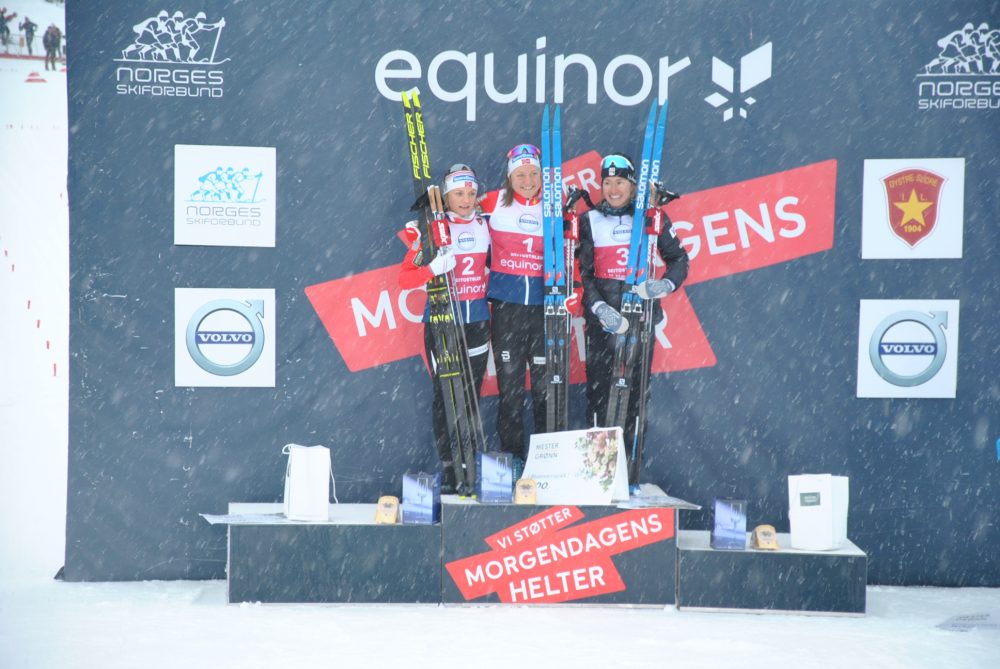
The women’s podium from the classic sprint in Beitostølen, Norway. Sophie Caldwell (right) of the U.S. Ski Team placed third, Maiken Caspersen Fall of Norway (left) second, and Ane Appelkvist Stenseth, also of Norway took the win. (Photo: Aleks Tangen).
FasterSkier reporter Aleks Tangen was in Beitostølen to report. As a new feature we are posting interviews from the mixed zone in the report below.
The opening Norwegian national races began in Beitostølen, Norway today with a 1.2-kilometer women’s classic sprint and a 1.7 k classic sprint for the men. Beyond featuring a loaded field of seasoned and up-and-coming Norwegian skiers, the U.S. Ski Team is using these races as a tune up for next week’s Ruka, Finland World Cups.
Sophie Caldwell and Julia Kern entered the women’s senior race. Caldwell placed third overall (+2.37) after qualifying in third. Norway’s Ane Appelkvist Stenseth won in 2:52.63 with teammate Maiken Caspersen Falla second (+1.20).
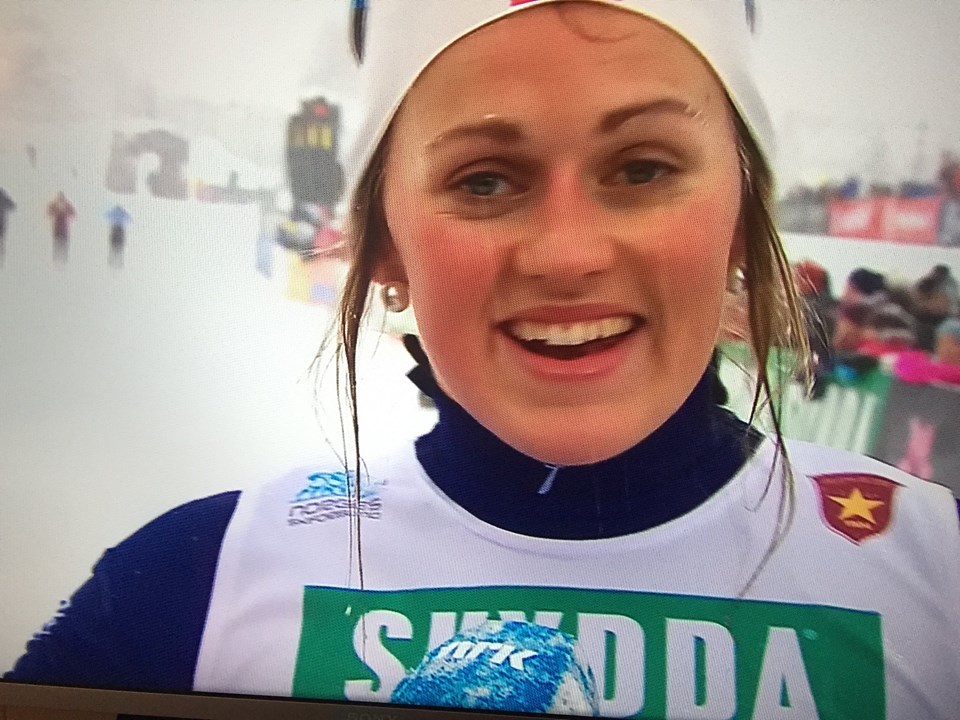
(Sophie Caldwell’s mixed zone interview with Fasterskier)
Kern qualified in ninth and was eliminated in the second heat where she placed fourth. No other U.S. Ski Team women raced.
Simi Hamilton and Erik Bjornsen qualified 17th and 23rd respectively in the men’s qualifier. Hamilton was eliminated in the second heat, Bjornsen in the fifth. Both placed sixth in their heats.
Norway’s Eric Valnes won the overall in 3:34.76.
(Simi Hamilton’s mixed zone interview with Fasterskier)
(Erik Bjornsen’s mixed zone interview with Fasterskier)
The women’s all-Norwegian podium from the 2018 FIS Skate Sprint in Beitostølen, Norway. Maiken Caspersen Falla (center) won, Kristine Stavås Skistad placed second (left), and Lotta Udnes Weng was third (right). (Photo: Aleks Tangen)
In a place like Norway, where the pool of cross-country athletes appears eternally deep, when you see competitors raise the bar, there’s nothing else to do but jump.
On Saturday in Beitostølen, Norway the known knowns were self-evident: Maiken Caspersen Falla and Johannes Høsflot Klæbo took the freestyle sprint wins during the second day of FIS race competitions.
As both athletes were overall World Cup sprint champions last season, there are no shockers there. (Klæbo has won two consecutive sprint crystal globes, Falla three.) But other skiers rose to the occasion and proved they too can jump nearly as high as Falla and Klæbo.
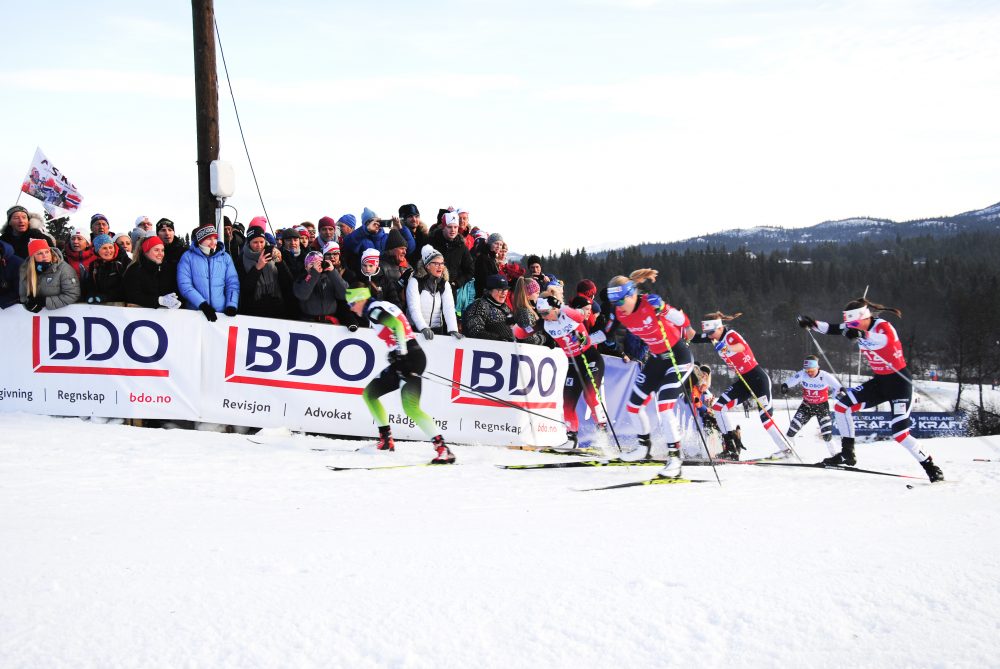
The women’s second semifinal on course in Beitostølen, Norway during the FIS skate sprint. (Photo: Aleks Tangen)
The women raced a 1.3 k skate sprint course with 54 women racing the qualifier. And this is where things got interesting. Nineteen-year-old junior Kristine Stavås Skistad, who has raced a single World Cup, the 2018 Drammen classic sprint in which she placed 51st, won the qualifier in 2:44.68 minutes. What is startling when scrolling through the qualification results is her birth year: 1999. The next closest Norwegian athlete in age finishing in the top-10 of qualification on Saturday was Anne Kjersti Kalvå, born in 1992.
In last season’s World Junior Championships, Skistad placed fifth in the 5 k classic, and second in the skate sprint. So certainly she is an up and comer. But the fact that she held her own in a world-class field of Norway’s best, is a statement.
Falla qualified in fourth (+1.63), and moved through to the finals by winning both her quarterfinal and semifinal.
Skistad, however, maybe played it a bit coyer. She squeaked into the semis by placing second in her heat by .30 seconds to Slovenia’s Eva Urevc. She then placed second to Falla by .22 seconds in the first semifinal. (That semi proved the faster of the two semifinals — both Kari Øyre Slind and Astrid Uhrenholdt Jacobsen advanced as lucky losers from the Falla semi.)
Falla is Falla – a veteran with big experience and the know how to throttle the engine when it matters. She won the final in 2:39.17 minutes, a pace over five seconds faster than Skistad’s winning qualification time.
In the all Norwegian final, Skistad placed second (+0.93), Lotta Udnes Weng was third (+1.28) Tiril Kampenhaug Eckhoff, both a World Champs and Olympic medalist in biathlon, was fourth (+1.34), Slind fifth (+1.53), and Jacobsen sixth (+2.89).
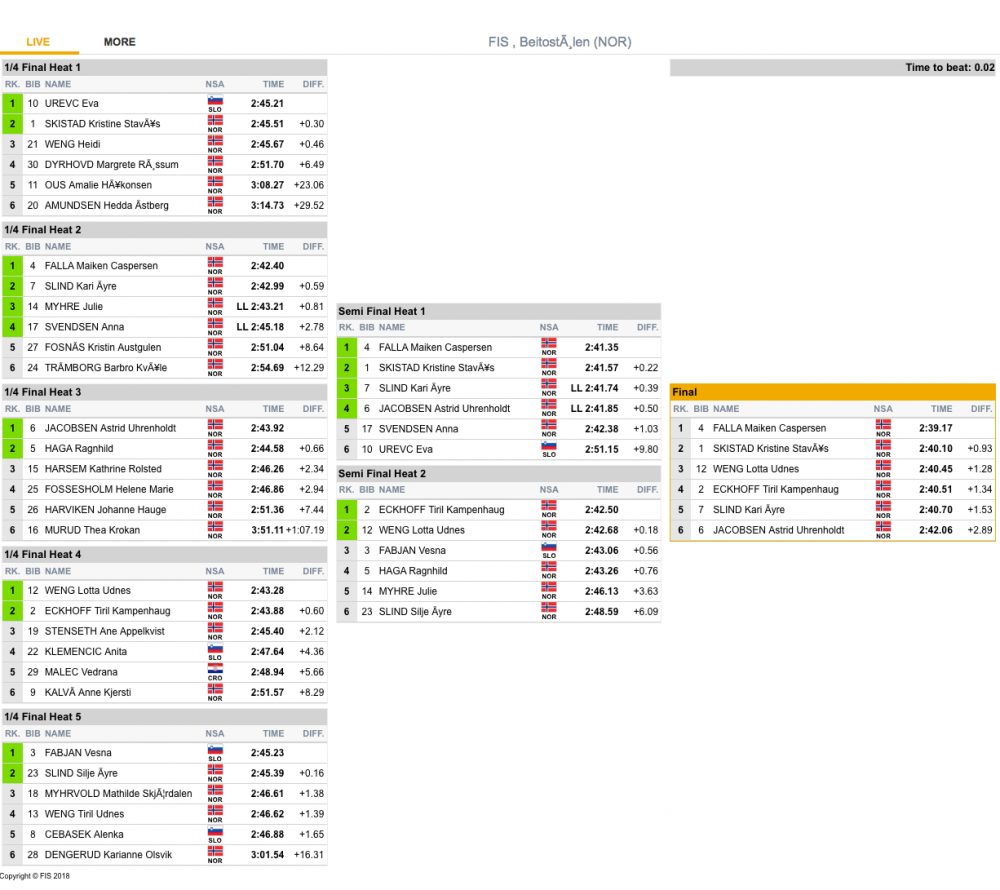
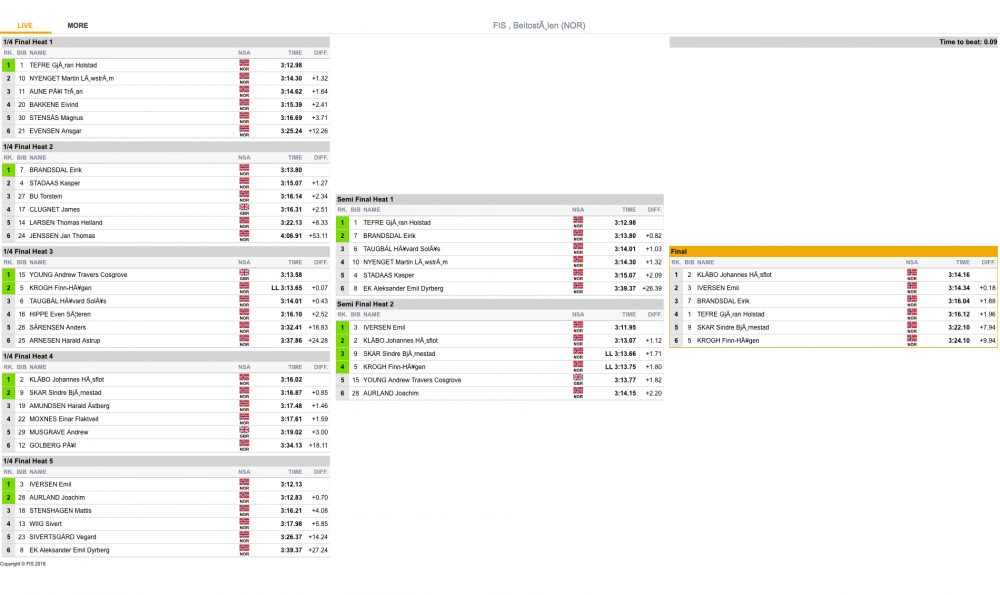
The women’s skate sprint bracket from the second day of racing in Beitostølen, Norway (Photo: FIS Live Timing screenshot) Click the image to enlarge.
More Klæbo and a bit of Iversen
It is time to refresh the syntax and remember Klæbo’s name can be used as a verb. With that in mind, Klæbo Klæboed in the men’s 1.7 k skate sprint. But like Falla on the women’s side, the twenty-two-year-old Klæbo was tested.
Tefre Gjøran, a year older than Klæbo at 23, was the fastest qualifier, finishing in 3:12.27 minutes. Klæbo was second (+1.12), and Emil Iversen third (+1.62).
In the end, it was Iversen, seeming like an aged vet at 27, who made life spicey for Klæbo.
Klæbo and Iversen advanced to the second semifinal. And it was Iversen who pushed the pace and was the catalyst for speed. Although not a massive margin, a second is still a second — but we are talking sprints here — Iversen won the second semi in 3:11.95, 1.12 seconds faster than second-place skier Klæbo.
“I was not good enough to fight him then,” Klæbo said to Norwegian broadcaster NRK, according to a translation, as he spoke about Iversen’s charge in the semis. “I had to be cynical and save me to the final. But Emil has a lot of effort, you saw how much he had in the finals too.”
It was a final highlighted by a Klæbo-Iversen dual. Klæbo won in 3:14.16 outpacing perhaps a new rival this season in Iversen, by 0.18 seconds.
In the all-Norway final, Eirik Brandsdal placed third (+1.88), Gjøran fourth (+1.96), Sindre Bjørnestad Skar fifth (+7.94), and Finn Hågen Krogh sixth (+9.94).
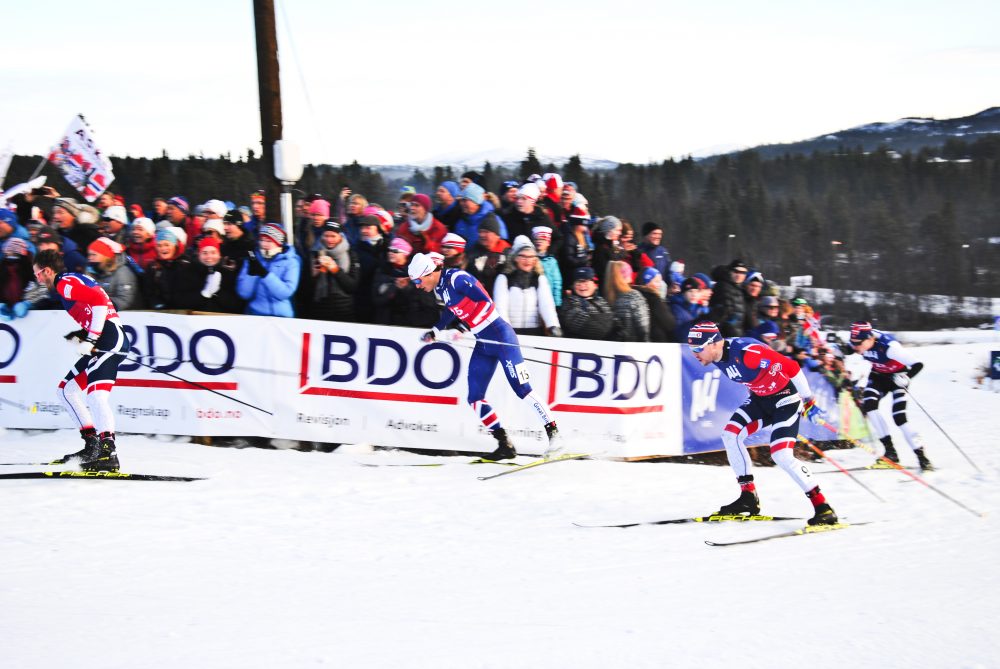
Andrew Young from Great Britain raced to 10th overall in Beito’s day 2 skate sprint. This is a shot from his semifinal. (Photo: Aleks Tangen)
Great Britain’s Andrew Young was 10th overall, James Clugnet 17th, and Andrew Musgrave 24th. They were the only non-Norwegians in the top-30.
“Top 10 is really good, the level here is really high,” Young told FasterSkier’s reporter in Beitostølen. “I had really good skis, and I was surprised nobody else wanted to take the lead at the start so I just went for it. I tried not to use too much energy. I knew Klæbo would go fast. So I just wanted to make sure I was on his tails when he came past. I was really pleased with my skiing. I wasn’t so defensive, I wasn’t so passive, and not let the others control the race. I tried to control it and be in that spot where I wanted to be.”
Young was passed in the final stretch by Skar and Krogh, who both advanced to the finals as lucky losers in the second semifinal.
Canadians Russell Kennedy placed 51st, Maks Zechel 94th.
“It is very deep, but it makes it fun there are lots of rides and always somewhere to push,” Kennedy emailed on Saturday about his experience racing to 22nd overall in the 15 k classic yesterday. “I was very happy with that. I don’t know if surprised is the right word. Last weekend in Olos, [Finland] I had a really good skate race and a good classic race against some big names. I was excited I ended up so high up the results for sure! It was a tough day with skis and I was lucky to be on fast skis even though they were a little slick on the last laps.”
The men’s skate sprint bracket from the second day of racing at in Beitostølen, Norway (Photo: FIS Live Timing screenshot) Click the image to enlarge.
Racing concludes in Beitostølen tomorrow with a 10 k/ 15 k skate.
Petter Northug racing to 23rd in Saturday’s 15 k freestyle FIS race in Beitostølen, Norway. He was more than a minute behind winner Martin Sundby, then came back to win Sunday’s classic sprint by 0.4 seconds. (Photo: Inge Scheve)
With about 50 meters to go in the men’s 1.5-kilometer classic sprint on Sunday in Beitostøelen, Norway, Petter Northug engaged the turbo and overtook fellow Norwegian Sondre Turvoll Fossli right at the finish line — exactly the way we are used to seeing him: relentless.
“This was OK. I wanted to get a day with four tough sprint efforts and that’s what I got,” Northug, 28, told the Norwegian TV station NRK after the race.
“It’s useful to practice have a chance to practice how to race heats, how to keep your body going between heats and best prepare for the next effort before we’re headed into the World Cup season,” he added. “You don’t really get a chance to practice that off the snow.”
For him, this was simply a drill and part of the prep for the World Cup opener next weekend in Kuusamo, Finland.
Got to let them win sometimes
Fossli, 21, won the qualifier in 3:25.76 minutes, 1.69 seconds ahead of Norway’s Pål Golberg. Northug qualified ninth, 3.38 seconds back from Fossli. And while Northug took the cake at the end of the day, up-and-coming Fossli raced an impressive final, leading much of the way and had a small gap on the field coming into the stadium.
Fossli finished second in his quarterfinal and won his semifinal, and thought he might be able to pull off the victory.
“I had a faint hope that maybe I would be able to keep [Northug] behind me and win the race, but when he was that close on the final stretch and he had skate skis while I had kick wax,” Fossli said. “I expected him to pass me.”
Northug won the final in 3:32.3, four-tenths of a second ahead of Fossli, and Norway’s Johan Kjølstad was another 0.7 seconds back in third. Golberg placed fourth (+4.1), and two more Norwegians Timo Bakken and Ola Vigen Hattestad were fifth (+6.4) and sixth (+6.6), respectively. Norway swept the top nine.
“You just need to let an old veteran win once in a while,” Fossli said jokingly of Northug, noting that he feels like he has more to offer.
His goal for the season is to establish himself on the top 50 percent of the World Cup standings.
Tough conditions
The conditions in Beitostølen on Sunday gave the wax crews plenty to work on: falling precipitation and lots of it in form of wet, sticky and slow snow at minus 9 degrees Celsius (about 16 Fahrenheit).
Northug was one of only two racers in the final who double poled all of the heats. Many of the racers started out with skate skis and no wax, but most of them chose to ski on kick wax as the heats progressed and the conditions got slower.
A stunned Barbro Kvåle after winning Sunday’s FIS classic sprint by 0.3 seconds in Beitostølen, Norway. (Photo: Photo NTG Lillehammer)
Barbro Kvåle, a 22-year-old Norwegian junior world champion in ski orienteering, joined the ranks of national-team stars Therese Johaug and Marit Bjørgen, who won the Beitostølen distances races this weekend. On Sunday, Kvåle, now on Norway’s U23 cross-country team, came from behind to win the women’s 1.2-kilometer classic sprint by three-tenths of a second.
With meters to go in the final, she passed Norway’s Kari Vikhagen Gjeitnes to seize the early season International Ski Federation (FIS) victory in 2:56.8. Gjeitnes, 29, took second and Kvåle’s best friend Kathrine Harsem was third just 0.2 seconds later.
“She’s a really laid-back personality,” Harsem said of Kvåle to NRK. “She’s a really good friend, and we can talk about everything, or nothing at all. As a skier, she’s just amazing on the mental level.”
Norwegian Olympic gold-and-silver medalist Ingvild Flugstad Østberg finished fourth, 0.9 seconds after Kvåle. A previous winner of Beitostølen’s classic sprint (in treacherous conditions), Slovenia’s World Cup sprinter Katja Visnar placed fifth (+4.9), 1 second ahead of Germany’s Victoria Carl.
Kvåle, who qualified 15th out of 42 women — nearly 6 seconds behind Visnar as the qualifier winner (in 2:48.91) — had never been in a sprint final before, and certainly not with an Olympic champion or World Cup favorite.
“This was insanely fun. I just wanted to go for it,” Kvåle told NRK. “I know I have a strong sprint finish, but I never imagined that I would actually win.”
When asked if she could describe the feeling, she simply said, “No.”
“I know I have a strong sprint finish, but I never imagined that I would actually win.” — Barbro Kvåle, 22-year-old Norwegian U23 team member, after winning Sunday’s classic sprint in Beitostølen
In her last season as a U23, her larger goals this season involve U23 World Championships in Kazakhstan.
A member of Norway’s rookie team, she said she’s always playing catchup with the veterans.
“In all the hard sessions, I’ve gotten beaten,” she told NRK. “But I have come closer and closer in autumn..”
Asked if this was her biggest win so far, she said: “Yes! Are you crazy?”
One of Barbro Kvåle’s Instagram selfies from last week. (Photo: Instagram/barbrokvale)
Harsem said Kvåle likes putting herself out there on social media.
“She posts a lot of self-promoting stuff on Instagram and Twitter, which people in general thinks is really stupid. But I kind of like it, because she dares to be herself,” Harsem said. “She’s honest and loyal, not your typical girly-girl. She’s a bit tomboy-ish, and I like that.”
Østberg, who dominated all the heats and looked like she had the victory in the bag leading the final six women into the stadium, was outsprinted on the final meters. She was less than a second behind Kvåle, but ended up fourth and couldn’t disguise her disappointment.
“I have to admit that I’m a bit disappointed,” Østberg said. ‘The three other girls were stronger than me. I guess I’m not meant to be on the podium at Beitostølen.”
She placed fifth in Saturday’s 10 k freestyle — her first FIS race of the season.
“I haven’t usually been in perfect sprint shape early in the season, so I have to look forward,” Østberg added. “There are new races next week. I will have to try to dig deeper and find that little extra as the season progresses.”
Torin Koos at the 2010 Olympics sprint race. (Photo courtesy of Kent Murdoch)
GÅLÅ, Norway – Cold weather is not the only thing that can clutter up the race routine, as Torin Koos of the Methow Olympic Development Project (MODT) experienced at a domestic Norwegian sprint race on Saturday morning. While frigid temperatures delayed the start for an hour, the fact that the coaches’ meeting was in Norwegian only caused additional problems for the former US Ski Team racer.
“Probably the most exciting, or frustrating, part of the day for me came three minutes before the start,” Koos told FasterSkier, explaining that he had asked about timing chips at the coaches’ meeting. However, something got lost in translation, and Koos still needed one. That made for an unusual last-minute warm-up.
“There was definitely some miscommunication, and I had to get my best steeplechase on right before my start, running from the start gate to the second story of a building, then back. I made it just in the nick of time, but probably skied the prologue with a bit too much adrenaline!”
Turns out adrenaline might not be the best prerace cocktail for Koos. He was 11th in the qualifier, which both Koos and MODT coach Scott Johnston felt was less than what Koos is capable of. However, you only need to qualify to advance to the rounds, and with the skis and wax nailed, Koos calmed down from the morning’s rat race and worked the 1,848-meter sprint course to his advantage.
“In the rounds, I felt quite good and was staying out of trouble and moving through the quarters and semis with hard but in control efforts,” Koos said. In the final heat, he was racing against Sindre Wiig Nordby from Team Sector Alarm for the top of the podium (ed. one of the top private Norwegian elite development teams).
“I came into the final uphill in third place, when Sindre Wiig Nordby made a monster push off the front. I came off the climb in second, and then fought to get into Sindre’s draft over the last rollers,” Koos said, noting that he almost had it nailed. “With 100meters to go, I came around Sindre. Seventy-five meters to go I was in the lead, but in the last 50 or so he powered back a meter or two to take the victory.”
Koos was still content about his second place, especially considering the traveling he’s had to do, as well as the cold and the early season. Stain Hallen was third, Britain’s Andrew Musgrave fourth, Martin Hammer fifth and Tobias Dahl Fenre was sixth in the final heat.
“Before coming over to Norway, I thought it’d be quite special to win a Norwegian Cup. This time, I was very close. Also, every week I’m getting better and better, and with this, the stoke is high for the real part of the season that awaits me,” Koos told FasterSkier.
On track
From coach Scott Johnston’s perspective, the Gålå sprint race was a good indication of what Koos has to offer, and a confirmation that he has learned a trick or two himself in the wax trailer.
“Temps were very cold, and the start was postponed three times before finally getting off at 11, after the TD held the thermometer in his armpit and was able to read -17.5C. I was psyched when they decided not cancel because I knew we finally had good skis,” Johnston said, noting that he secretly felt like he won the lottery with the race still a go.
“I pretty much nailed it, and for a change, Torin had as good skis as anyone on the course. While I’d like to take some credit it may have been more luck than skill. The chemists at Toko had as much to do with our success today as I did,” Johnston explained.
Steady progression
While Johnston was pleased that Koos qualified despite the hurdles, the ever-critical coach always finds something to improve on.
“Torin’s qualifier was still not up to snuff again, and he finished 11th. The good news is that the speed and endurance are both there in good measure,” Johnston said, pointing out that the basic premises for success are there.
“His ability to ski with, or out-ski, the fastest qualifier of the day has been in evidence during each race,” Johnston said of the three events Koos has raced so far on the “2010 MOD Tour de Scandinavia.”
At his season opener at Beitostolen two weeks ago, Koos was already showing signs of promise, despite not nailing the wax until the heats, Johnston said.
“At Beito, he managed to make a big move from fifth place to come even with the fastest qualifier and eventual winner, [John Kristian] Dahl, before getting pinched into third in the last corners to the finish,” he said.
Last weekend in Finland, Koos out-skied the fastest qualifier in two heats. Only in the final, with a change in strategy, did he get boxed into fourth. This weekend, Koos was sharper yet, despite his 11th place in the qualifier.
On Saturday, Johnston said, the fastest qualifier–who was 7.7 seconds ahead of Koos–and the eventual race winner was in each of Koos’s three heats.
“Torin won the quarterfinal…was two meters back in second place in the semifinal, and only six inches back in final,” Johnston said, noting that the field was setting a wicked pace from the start.
“To give some idea of the speed being skied in these races, [Saturday’s] very intelligent course was 1,848 meters, and the typical time, per kilometer, of the qualifier and heats was 1 minute and 36 seconds. That’s right: 1:36!”
Koos will head back to Washington soon, but he still has another week in Europe, in which he travels to Duesseldorf, Germany, for next weekend’s World Cup sprint races.