From the FasterSkier archive — posts syndicated from athletes’ and coaches’ own blogs between 2004 and 2012, kept online as published. Current coverage is at fasterskier.com.
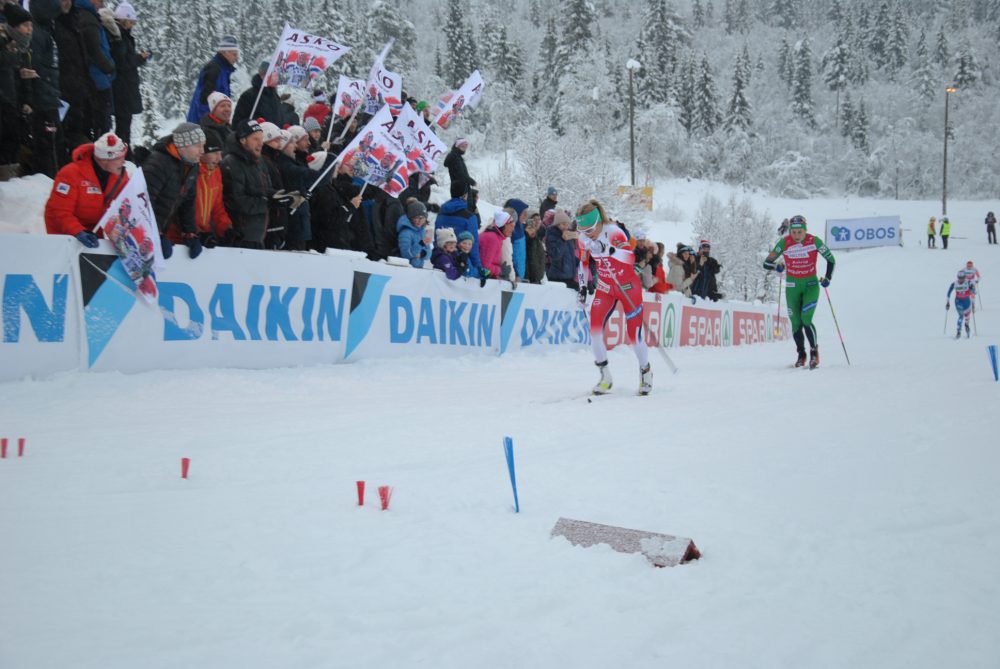
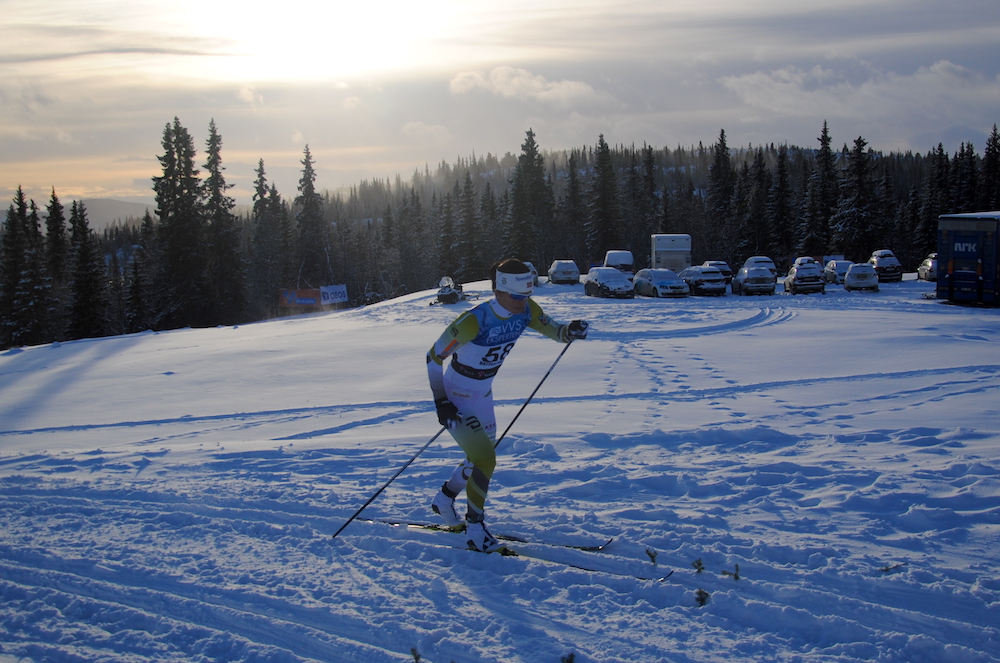
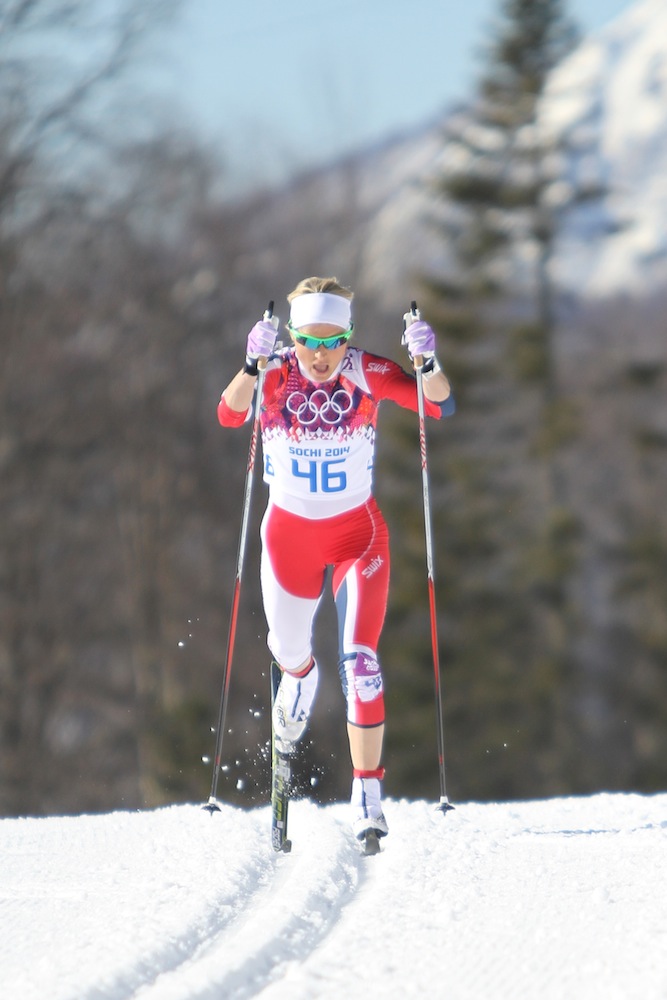
Therese Johaug on her way to winning the 10 k classic in Beitostølen, Norway – part of the national opening races in Norway. (Photo: Aleks Tangen)
FasterSkier reporter Aleks Tangen was in Beitostølen to report. As a new feature we are posting his interviews from the mixed zone in the report below.
With temps hovering around zero degree celsius in a mid-winter looking Beitostølen, Norway day two of the opening national races played out. The women raced a 10 k interval start classic race with a field, as expected loaded with Norwegians.
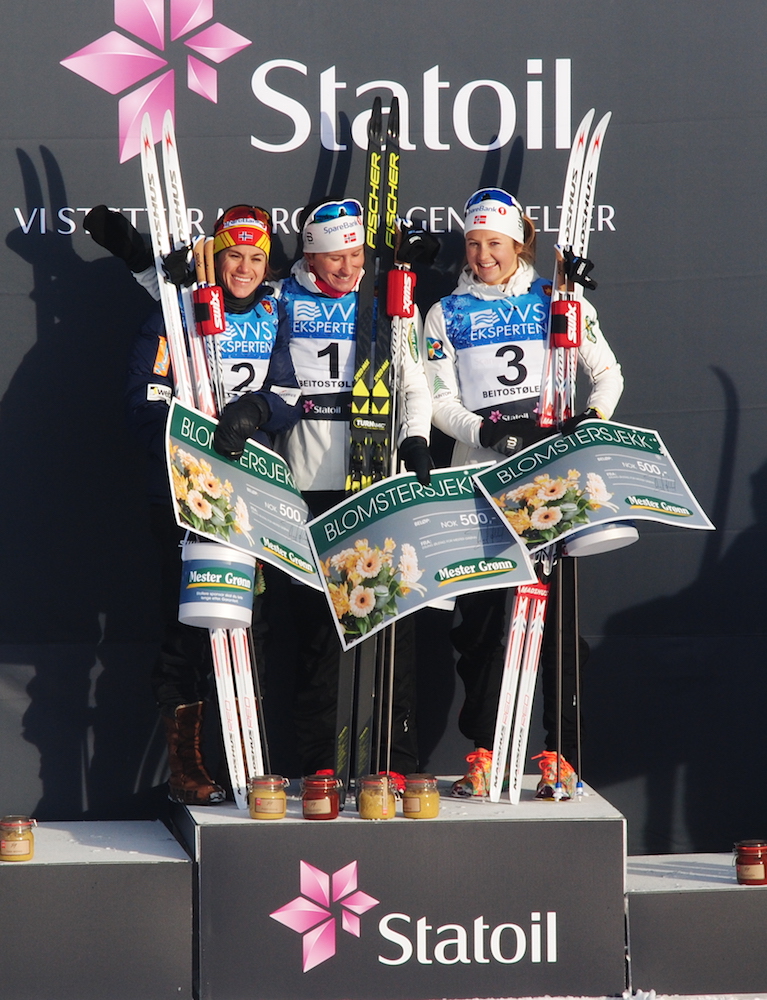
First thing first: Norway’s Therese Johaug showed early season futness that already resembled World-Cup-crushing form. She won the 10 k classic in 26:08.8. Heidi Weng placed second (+1:03) and 18-year-old Helene Marie Fossesholm was third (+1:13).
Americans Jessie Diggins (+1:35.7) and Sadie Maubet Bjornsen (+1:37.3) placed fourth and fifth respectively. Rosie Brennan cracked the top-10 in ninth (+2:04.9).
Jessie Diggins’ mixed zone interview
Sadie Bjornsen’s mixed zone interview
We wanted to note a nice age outlier as we checked out the results: born in 1980, making her 39, Japan’s Ishida Masako finished in seventh (+1:57.6).
Rosie Frankowski skiing for APU skied to 22nd (+3:31.4), while Caitlin Patterson was 23rd (+3:32.0).
She’s back. Therese Johaug celebrates after winning the 2018 FIS 10-kilometer classic in Beitostølen, Norway.
After an 18 month suspension for a positive out of competition positive doping test, during which Norway’s thirty-year-old Therese Johaug could build hour upon hour of base fitness and fine tune the engine with no race-stress, she arrived in Beitostølen, Norway on Friday and didn’t skip a beat.
In temperatures hovering around 32 degrees Fahrenheit, and low-level clouds descending on the course, Johaug established herself as the early season favorite amongst a deep Norwegian National Team in Beitostølen’s FIS season opener 10-kilometer classic race.
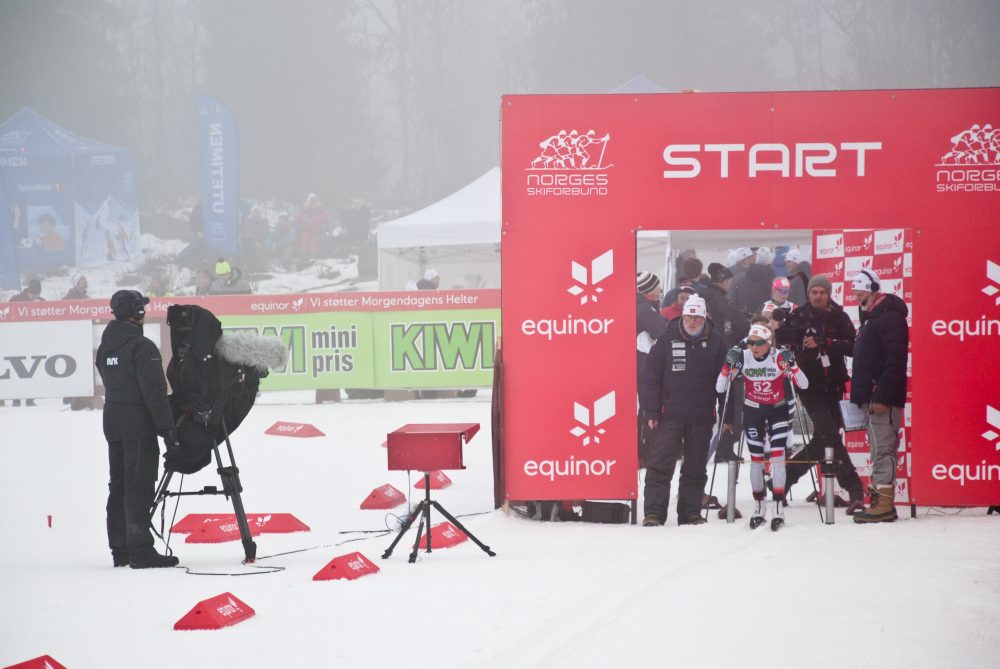
As the 52nd starter in a 60-skier field, Johaug never let off the throttle.
The race was tight at the 1-kilometer time check, with national team skier Ingvild Flugstad Østberg marking the fastest time over Johaug by only 0.9 seconds. With nine kilometers to go, it was all Johaug, as she clocked the fastest times at the remaining checkpoints.
Up by 4.3 seconds at 2.2k, the time back to the second fastest skier grew to 15.5 seconds at the race’s midpoint for Johaug. By the finish, Johaug did as she has done many times before, winning by a comfortable margin. She won in 25:42.6 minutes. Østberg, who ranked third in the World Cup overall last season, placed second (+23.9). Kari Øyre Slind was third (+59.8)
Therese Johaug ready to start it all over again after her 18-month suspension.
“It was special being here today,” Johaug told Norwegian broadcaster NRK according to a translation. “It feels incredible to back in the xc family again. To come up here and meet all the people that I’ve been skiing with for so many years, hear the cries from the crowds out in the course and the splits, it was a special feeling. It was so much. I was nervous before the start, but when I got started I really didn’t want it to end. I could have skied an extra lap.”
The opening Beitostølen FIS races are the early season proving grounds for Norway’s elite cross-country athletes. The top-10 in the women’s race was riddled with names World Cup fans are familiar with.
Astrid Uhrenholdt Jacobsen skied to fourth (+1:21.3), Haga Ragnhild fifth (+1:33.1), Anna Svendsen sixth (+1:42.8), and Heidi Weng, winner of last seasons overall World Cup finished seventh (+1:58.7).
Annika Taylor, a former University of New Hampshire skier now skiing for Great Britain, raced her way to 21st (+3:49.3).
In similar conditions, the men raced a 15 k classic. Like the women’s field, it was a Norwegian who’s who of elite class skiers. But unlike Johaug setting an increasing time margin over any contenders, the men’s race was tight, separated by only 15 seconds for the top-five skiers 5 k into the race.
At that point, with Didrik Tønseth in first and Emil Iversen in second, only a sliver of time, 0.1 seconds, differentiated the two. Martin Johnsrud Sundby and Johannes Høsflot Klæbo were gapped by 12.2 and 12.7 seconds respectively, as they skied through the time check in third and fourth place. Sjur Røthe came through in fifth (+15.8).
Iversen, in bib 141, kept it close, setting the initial times to beat. Tønseth started three skiers back in bib 144. Through 10k, the two were still evenly matched: with Tønseth up by 3.4 seconds over Iversen.
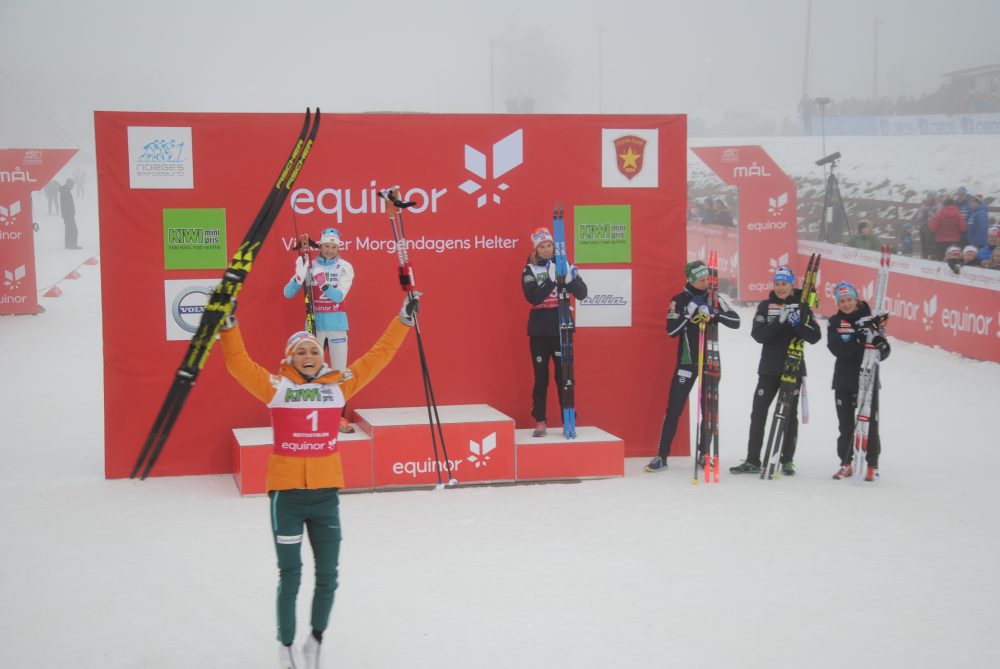
The men’s 15 k classic podium for the 2018 FIS opener in Beitostølen, Norway. Didrik Tønseth (NOR) in first, Norway’s Emil Iversen (left) in second, and Sjur Røthe (right) of Norway third.
Tønseth won the race in 36:08.6 minutes, with his winning margin of 12.4 seconds over the second place Iversen only solidified in the closing kilometers. Røthe gradually moved up and finished third (+29.3).
Sundby skied to fourth (+37.5), Hans Christer Holund fifth (+1:07.4), and Klæbo sixth (+1:17.5). British skier Andrew Musgrave finished seventh (+1:26.3). Musgrave is historically a stronger skate skier.
One hundred and forty-three skiers finished the men’s race.
Of note, thirty-two-year-old Petter Northug Jr., now a seemingly timeless presence on the Norwegian ski scene, was disqualified for classic technique violations. Prior to his DQ, Northug had been skiing in the top-20 for much of the race. Sundby was given a verbal warning for a classic technique violation.
Several Canadians raced the 15 k classic. Russell Kennedy was the best placed Canadian finishing tied for 23rd (+2:37.6). Brian McKeever was 68th (+4:06.6), Ryan Jackson 110th (+5:39.1), Maks Zechel 113th (+5:56.5).
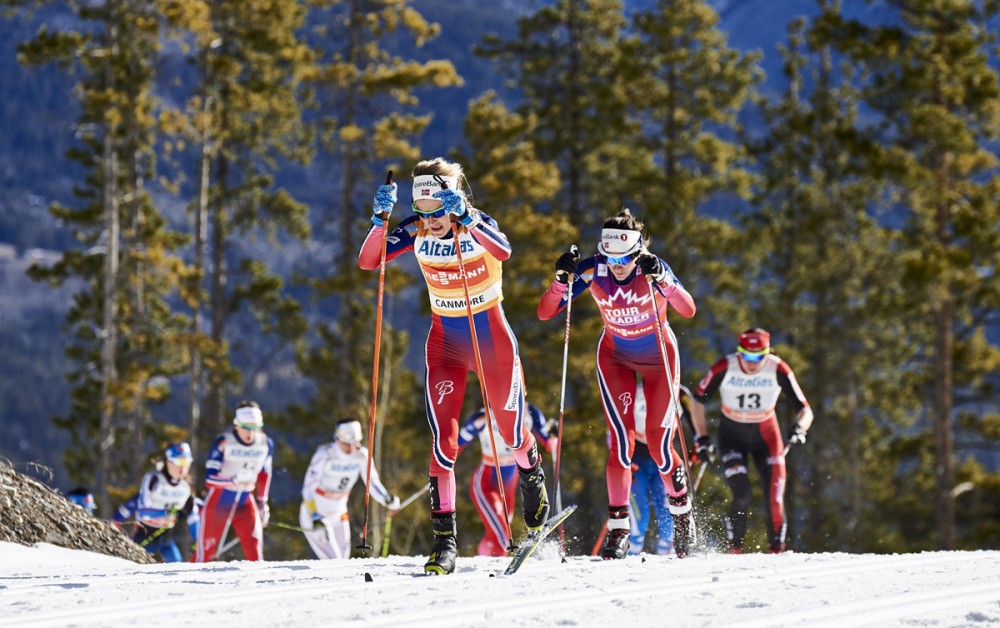
Norwegians Therese Johaug and Heidi Weng, (l-r) during the 2016 women’s 15 k skiathlon in Canmore, Alberta. (Photo: Fischer/NordicFocus)
Welcome to The Rundown, your quick primer of need-to-know information about the day’s racing. We’ll be updating this digest as the day goes on with additional results, photos and quotes. The Rundown is NOT a race report; stay tuned for complete race reports later today with interviews from the day’s top racers.
***
FIS cross-country Beitostølen, Norway: 10 k/15 k classic
The race results are in from today’s 10-kilometer individual start classic FIS race in Beitostølen, Norway. The first of the season Beito races are used as a test pad for Norwegian athletes to gauge fitness and for some to make the rare jump to a coveted and scarce World Cup start.
Off of her suspension for using a banned substance, Norway’s Therese Johaug skied like she’d never been gone. Johaug was suspended for 18 months due to her violation.
Johaug fired off the 10 k winning in 25:42.6 minutes. Ingvild Flugstad Østberg was second (+23.9). Rounding out the podium was Kari Øyre Slindin third (+59.8).
Astrid Uhrenholdt Jacobsen skied to fourth (+1:21.3), Haga Ragnhild fifth (+1:33.1), Anna Svendsen sixth (+1:42.8), and winner of last seasons overall World Cup, Heidi Weng finished seventh (+1:58.7).
The men skied a 15 k classic race Friday in Beitostølen. Didrik Tønseth won in a time of 36:08.6 minutes. In second was Emil Iversen (+12.4), while Sjur Røthe placed third (+29.3).
Martin Johnsrud Sundby skied to fourth (+37.5), Hans Christer Holund fifth (+1:07.4), and Johannes Høsflot Klæbo sixth (+1:17.5).
British skier, although based in Norway, Andrew Musgrave finished seventh (+1:26.3).
One hundred and forty-three skiers finished the men’s race. Of note, Petter Northug Jr., now a seemingly timeless presence on the Norwegian ski scene, was disqualified for technique violations.
Several Canadians raced the 15 k classic. Russell Kennedy was the best placed Canadian finishing tied for 23rd (+2:37.6). Brian McKeever was 68th (+4:06.6), Ryan Jackson 110th (+5:39.1), Maks Zechel 113th (+5:56.5).
Bruksvallarna, Sweden cross-country: 5 k/10 k freestyle
In Bruksvallarna, Sweden FIS racing began with a 5 k freestyle for the women. Three of Sweden’s star skiers took the podium spots. Ebba Andersson won the tight race in 9:57.1 minutes, finishing only 2.6 seconds ahead of second place skier Charlotte Kalla. Known for her sprinting prowess, Hanna Falk was third (+15.7).
One hundred and twelve skiers finished the race.
For the men, after skating 10 k, the race was a tie for first. Sweden’s Jens Burman and Karl-Johan Westberg skied the fastest time. Both crossed the line in 19:11.0 minutes for the win. Japanese skier Keishin Yoshida placed third (+9.5).
Daniel Rickardsson, of Sweden, skied to fourth (+12.9).
Norway’s Marit Bjørgen racing to a 29-second win in Friday’s 10 k classic FIS race in Beitostølen, Norway. (Photo: Aleks Tangen)
(Note: This article has been updated to include comments from Nichole Bathe.)
BEITOSTØLEN, Norway — The question of whether Bjørgen or Weng will be the bigger name this season went in the favor of the former on Friday at Norway’s first big matchup of the season. Marit Bjørgen, now 37 and in her 20th World Cup season, won the first race of the three-day International Ski Federation (FIS) weekend in Beitostølen, starting last out of 56 women and finishing first in the 10-kilometer classic individual start, with 29.4 seconds between her and Weng in second place.
On a morning that marked the start of the 2017/2018 season in Norway, with temperatures just below zero and a snow squall during the women’s pre-race warmup, the snow covering the course appeared loose but ample.
Weng, the 26-year-old reigning Overall World Cup and Distance World Cup champion who started 30 seconds behind fellow Norwegian national-team member Bjørgen, told reporters after the race that she was satisfied with her performance, but could have skied better and “could have had better grip”.
For the first 2 kilometers of the race, Bjørgen’s pace was comparable to that of another one of her teammates, Ingvild Flugstad Østberg, who started just ahead of Weng. But halfway through the race, Bjørgen was nearly 22 seconds up on Østberg and 28 seconds ahead of Weng.
While Bjørgen continued to put seconds into her teammates in the final 5 k — blowing through the 7 k checkpoint 28 seconds faster than anyone else — Weng and Østberg battled for second. Weng clocked through 6.1 k just 2.7 seconds faster than Østberg and skied 5.1 seconds faster than her over the next 900 meters. Despite crossing the finish 11.6 seconds faster than Østberg, Weng’s time in the leader’s chair was short-lived, as Bjørgen finished 29.4 seconds faster with a winning time of 29:30.9 minutes.
The women’s 10 k classic all-Norwegian podium at Friday’s FIS race in Beitostølen, Norway, with Marit Bjørgen (c) in first, Heidi Weng (l) in second and Ingvild Flugstad Østberg in third. (Photo: Aleks Tangen)
Østberg claimed third, 41 seconds back and 10 seconds ahead of another Norwegian national team member Ragnhild Haga in fourth (+51.0). Norway swept first through 13th place with Kathrine Rolsted Harsem in fifth (+1:08.1), Astrid Øyre Slind in sixth (+1:27.5) and notably, sprint specialist Maiken Caspersen Falla in ninth (+1:54.3).
“Marit is superior,” Weng said in a post-race interview with NRK. “This is top level and I have to step it up.”
She added, “29.4 and 41 seconds is a lot, but Marit is not invincible.”
But even Bjørgen has to tell herself to ski relaxed for the first race of the season.
“I tried to stay calm and ski my way up to Weng,” Bjørgen told NRK. “Considering that she held the yellow bib [as the World Cup leader] last year, I think that’s pretty good.”
Bjørgen reflected that she could have skied the flatter parts of the course better.
“Heidi did well there, and it was fun to ski behind here and learn from her,” she said.
Norwegian national-team member Ragnhild Haga racing to fourth in the women’s 10 k classic FIS race on Friday in Beitostølen, Norway. (Photo: Aleks Tangen)
Fourth-place finisher Haga told reporters that she was pleased with her technical improvements in classic, which she has been working on for three years.
“It was fun, and I’m glad I was able to race at such a high level,” Haga said.
Three Americans, two of which race for Great Britain, finished 29th, 30th and 31st: Annika Taylor (+3:48.2) Nichole Bathe (+3:51.3) and Anne Hart (+3:51.4), respectively. Taylor was born in California and is a member of Great Britain’s women’s team, as is Bathe, who hails from Wisconsin and is also a member of the CXC Team. Hart, originally from Minnesota, races for the Stratton Mountain School (SMS) Elite Team in Vermont.
Since mid-September, Bathe, a recent University of Alaska Fairbanks graduate, has been living in Lillehammer, Norway, while training with the British national team.
“It’s been quite the transition especially from college racing but it has been such a great learning experience and makes me really exited for the season!” Bathe wrote in an email. “That was my first race of the season and I thought it went okay. I went out pretty hard which caught up to me in the end but overall I think it was a good start to the season.
“Typically I am more of a sprinter but in general I like classic more than skate and 5k classic is my absolute favorite race,” she added. “This winter I am focusing on U23s [World Championships] and skiing fast there especially in the sprint. I will mainly be racing in Europe this year. I am racing the Kuusamo World Cups and then heading onto the OPA and Scando Cup races!”
In an in-person interview with FasterSkier, Hart explained that she made a point to get on snow earlier this season and spent the last two weeks training in Sjusjøen, Norway. After this weekend, she’ll return to the U.S. for the first SuperTour races in West Yellowstone, Montana, Dec. 2-3.
“I’ve been told by just about everyone that this is more competitive than a World Cup in part because these are [the Norwegians’] major qualifying races [for the World Cup], or their only ones I think,” Hart said of Beitostølen. “So I just went out hard. I had great kick on my skis so I just was really working on skiing well because last year that was an area I think I just got really frantic.”
During training on Thursday, Hart skied one lap with Bjørgen.
“Yesterday I actually skied with — stalked — Marit on an easy lap, and I was just trying to imitate her skiing,” Hart said. “So I was just trying to think of her out there and obviously not quite as fast, but I was really psyched with how I skied everything well. I felt a little tired on the last bit, but again, I didn’t fall apart and I’m really pleased with that.”
American Anne Hart (SMS Elite Team) racing to 31st in the women’s 10 k classic FIS race on Friday in Beitostølen, Norway. (Photo: Aleks Tangen)
For Hart, the biggest difference she noticed in this initial race of the season was the fact that she was having fun.
“Last year I was just struggling the whole season to find that ‘fun’ gear, I guess, and today I was really enjoying the whole time and really pushing and not looking forward to the end,” she said. “Instead of thinking, ‘I have to make it another kilometer,’ it was like, ‘Oh my god, I only have a kilometer to go. I’ve gotta really give it all I’ve got.’ ”
For Canada, Isabella Howden, of the newly formed Barrie Cross Country (BXC), finished 53rd (+7:18.2). Afterward, Howden, who started 16th, recalled being passed by the five fastest women on her second lap, which she said was beneficial.
“That was pretty cool, seeing them and getting to stay with them on the downhills and copy their technique for as long as I could see them,” she said.
For Howden and some of her Canadian teammates, Beitostølen is familiar territory; they raced there last year. Regardless, she was in awe of the atmosphere.
“It’s so cool … all the kids up there cheering and there’s a whole crew around the corner with all their cowbells, like 10 of them,” she said with a laugh.
Sundby Pulls It Together
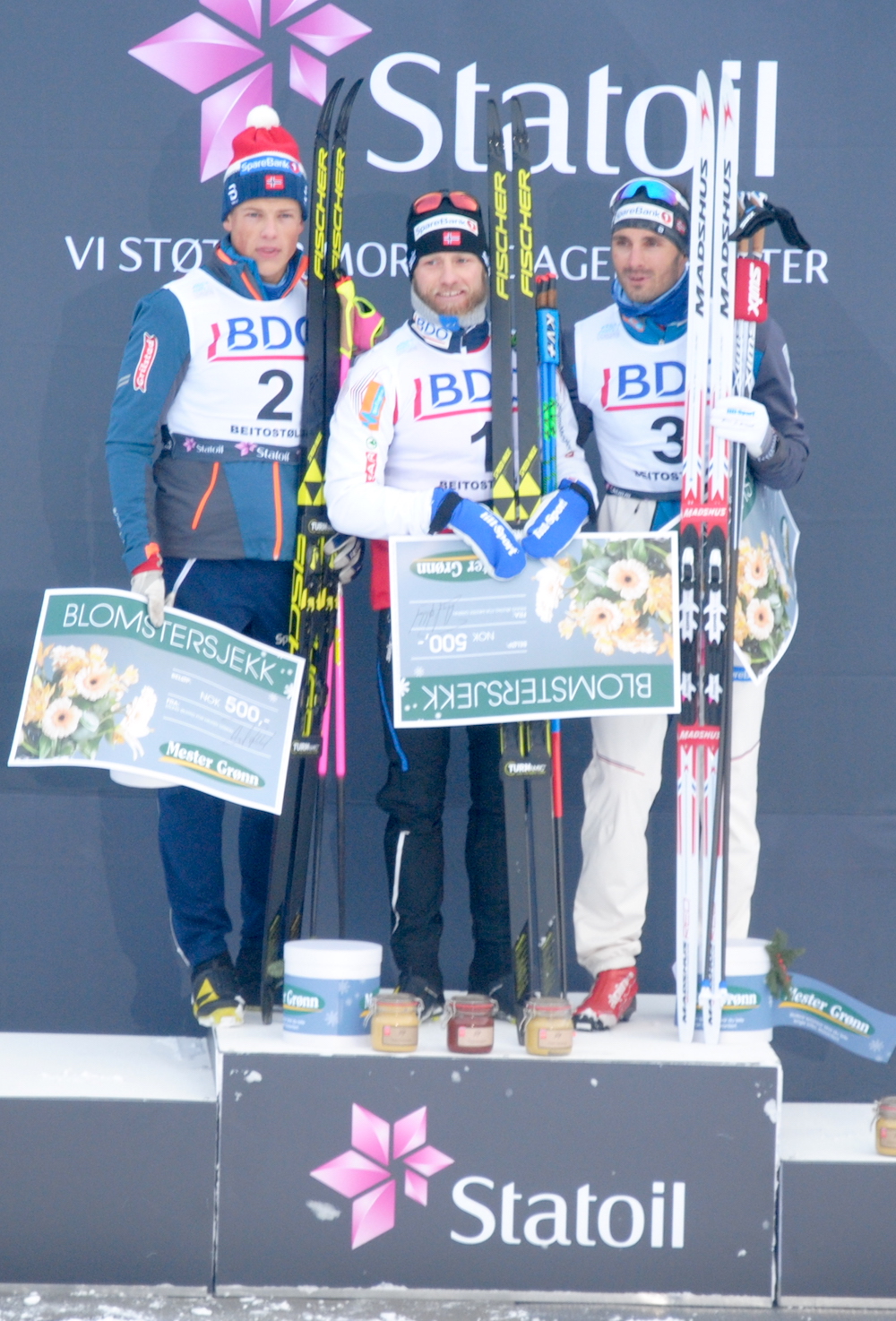
The men’s 15 k classic all-Norwegian podium at Friday’s FIS race in Beitostølen, Norway, with Martin Johnsrud Sundby (c) in first, Johannes Høsflot Klæbo (l) in second and Hans Christer Holund in third. (Photo: Aleks Tangen)
In the men’s 15 k classic individual start that followed, defending World Cup champion Martin Johnsrud Sundby took the win by 18.2 seconds over Norwegian teammate Johannes Høsflot Klæbo, who won last season’s Sprint World Cup at the age of 20.
Now 21, Klæbo is recognized as more of an all-around force, and on Friday, he led the men’s race up until the 4.9 k checkpoint. Sundby started last out of 158 men and trailed Klæbo until 6 k. But from that point on, the race was Sundby’s; at 9.8 k, he was 12.3 seconds faster than Klæbo in second place.
“I had to pull myself together,” Sundby told reporters after the race, explaining that he felt tired around 6 k. While the rest of his race required some extra effort, Sundby expressed contentment with his performance.
“This was something positive that I will take with me going into the season,” he said. “This was the first race of the season and it could have gone both good and bad. … It was so-so, I felt goofy skiing today, but that was also the case for everyone else.”
He attributed that awkward feeling to challenging conditions, “but that is also good practice,” he said. “I didn’t feel all that well in the first 5 k, but after that I was able to speed up and I felt that was able to control the race.”
And he did so without going too far into the pain cave.
“I didn’t have to dig as deep as I have done sometimes in the past,” Sundby said.
Sundby’s winning time of 38:57.2 was 18.2 seconds faster than Klæbo in second and 37 seconds clear of Hans Christer Holund in third. The top-seven men — all Norwegian — finished within 59 seconds of first. The women were a bit more spread out, with the seventh-place woman, Silje Theodorsen (Kvaløysletta Skilag), finishing 1:36.3 behind Bjørgen.
Holund clawed his way into the race after his 4.9 k time ranked 11th. With about 5 k to go, the Norwegian national-team member was up to fifth, and by 11.9 k, he was within reach of the podium in fourth place.
Didrik Tønseth ended up just 1 second off the podium in fourth (+38.0), while Johan Hoel (Åsen IL/Team Veidekke Oslofjord) placed fifth (+42.2), ahead of Simen Hegstad Krüger in sixth (+44.1) and Emil Iversen in seventh (+59.0).
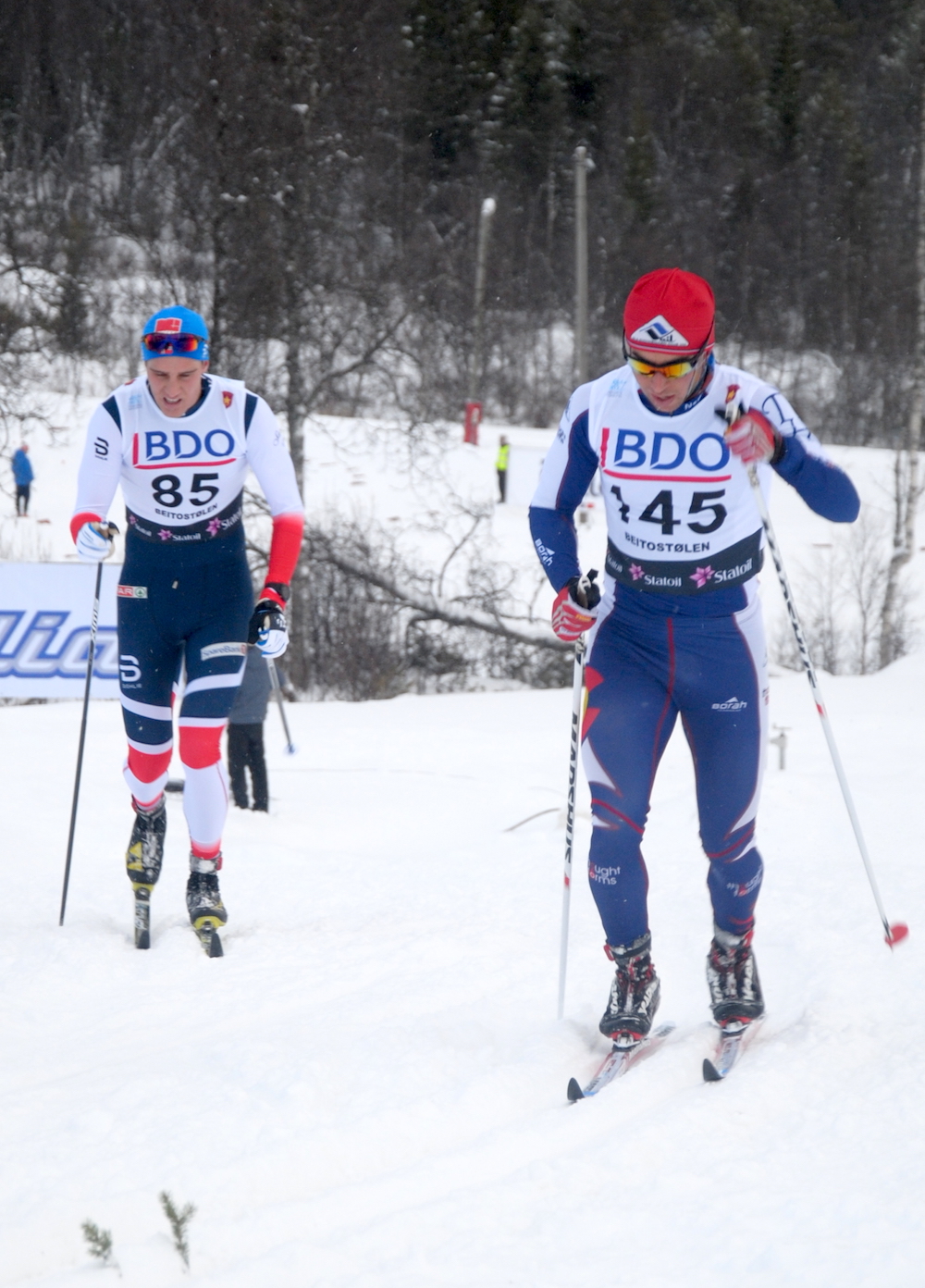
Noah Hoffman (r) passes Norway’s Torstein Bu during the men’s 15 k classic FIS race season opener on Friday in Beitostølen, Norway. Hoffman went on to place 29th, while Bu finished 75th. (Photo: Aleks Tangen)
The lone American in the race, Noah Hoffman placed 29th, 2:25 minutes behind Sundby. After a slow opening that put him in 47th at the 2.1 k mark, the former U.S. Ski Team member settled into a pace that put him within the top 30.
Afterward, he told FasterSkier that his performance was a good starting point. He started the race toward the back of the field in bib 145, just ahead of several top Norwegians.
“It was a little unfortunate that there was a big train that formed right behind me, and those guys didn’t catch me until less than a k to go,” Hoffman reflected. “I was hoping they’d get me a little sooner or not get me at all, but it was good.”
In terms of a race plan, he explained that he tried to ski with energy and build throughout the entire 15 k, which he felt he did.
“I got a little excited the second time up the big hill and maybe burned a little too much, but for the most part it was a good effort and I’m looking to build this for Sunday and then obviously into next weekend,” he said.
After Sunday’s second set of distance races in Beitostølen, the 10/15 k freestyle individual starts, Hoffman will race four weekends of World Cups as an invited member of the U.S. Ski Team (USST) for Period 1. He missed the objective qualifying criteria for renomination to the USST by one place (he ranked 51st in the World Cup at the end of last season) and is thus skiing independently this year, paying his own way (and paying his own wax technicians, Zach Caldwell and recently retired USST tech Peter Johansson) so that he can race in Europe.
“The early season is important for me this year because I don’t have guaranteed start rights for the whole winter, so I need to ski well,” Hoffman, 28, said. “And I believe I’ve done everything I can to prepare and I hope to see the results from that.”
Several Canadian juniors raced the men’s 15 k as well. Ryan Jackson led them in 97th (+5:16.8), followed by Scott Hill in 99th (+5:19.1), Joey Foster in 124th (+6:45.3), and Maks Zechel in 143rd (+8:25.5).
“It was hard out there today,” said Foster, a 21-year-old member of BXC, noting that he was still feeling the effects of travel after arriving in Europe a week ago. “Considering how I felt, the race was pretty good. … I started with what I thought was a pretty conservative pace and I got in with a good train of people, and I skied with them for almost the whole first lap, and from there I just kind of fell off pace. … I think my leadup to the race just wasn’t as good as it could’ve been, so I wasn’t feeling as crisp as I would’ve liked.”
The Beitostølen FIS races continue through the weekend with classic sprints on Saturday, which U.S. Ski Team member Andy Newell plans to race, and 10/15 k skate races on Sunday.
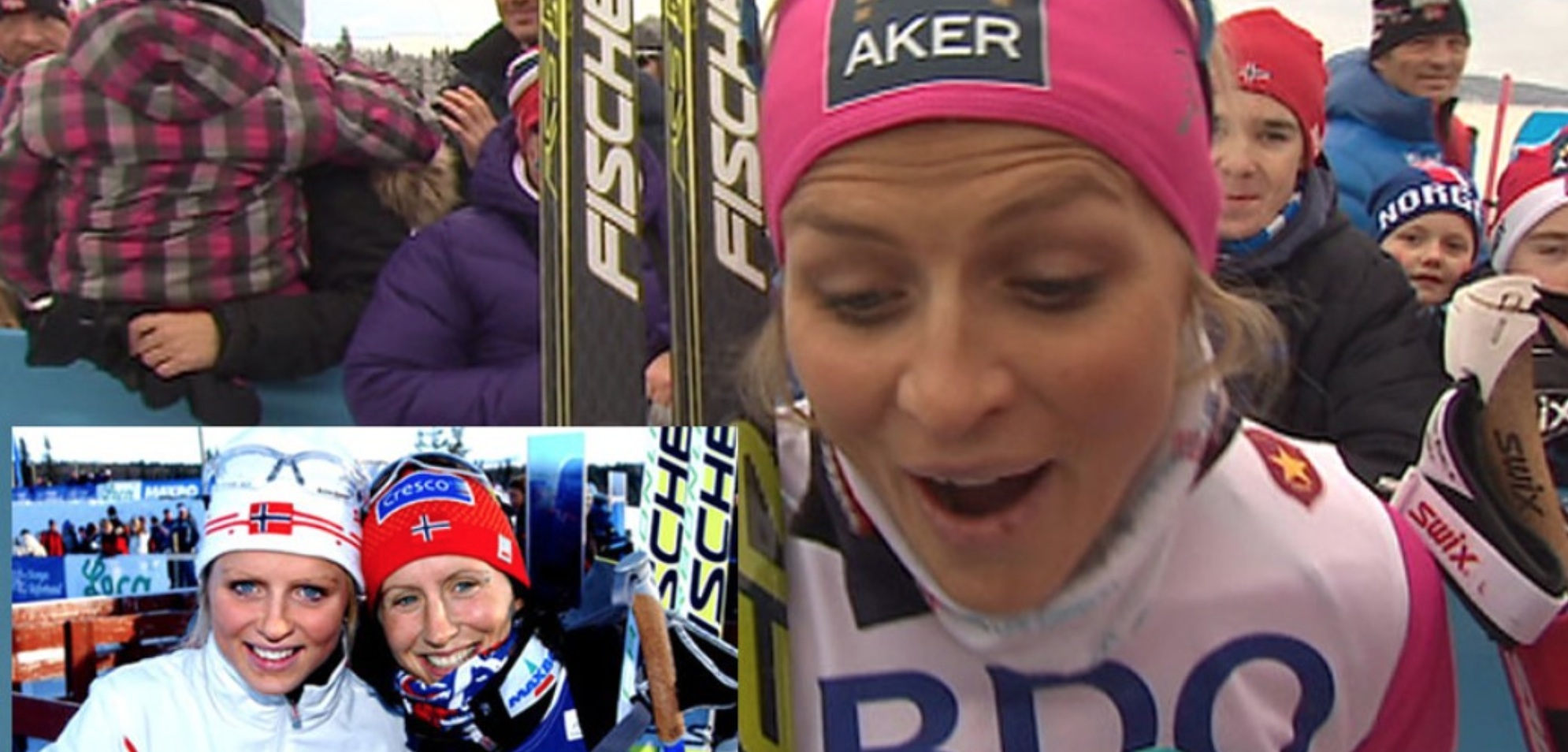
Therese Johaugs reacts when reporters show her a photo of herself and Marit Bjørgen from eight years ago in Beitostølen, the same place where Johaug won the opening race of the season on Friday. (Photo: NRK)
Therese Johaug started cracking up when reporters at Friday’s International Ski Federation (FIS) race in Beitostølen, Norway, showed her a photo of herself and Marit Bjørgen from eight years ago, also in Beitostølen.
The Norwegian national-team member was 18 at the time.
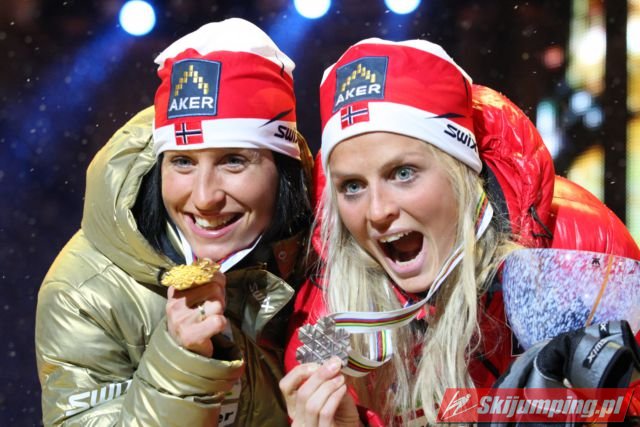
Marit Bjørgen (l) and Therese Johaug with their gold and silver medals from the 2011 World Championships 15 k in Oslo, Norway. (Photo: Wikimedia Commons)
“Oye … a lot has happened since then,” Johaug told NRK with a laugh. Now they’re not only best friends, they’re each other’s fiercest competitors.
On Friday, Johaug, 26, won the 10-kilometer classic in 26:36.1 minutes, 24.7 seconds ahead of Bjørgen in second. Like fellow Norwegian Martin Johnsrud Sundby, she won last season’s Tour de Ski as well as the overall World Cup title.
Six years ago, she was a junior competing in Beitostølen for the first time. She told reporters she had the same photo hanging on her wall at home.
Now she’s won the Beito distance opener for three consecutive years. Last year, Bjørgen didn’t compete; Johaug beat another teammate —Astrid Uhrenholdt Jacobsen — by more than 54 seconds for the win. In 2012, Johaug topped Bjørgen by 52.2 seconds. This was her fourth-straight time winning Beito’s 10 k classic, according to VG.
On Friday, Bjørgen led through 2 k, 2.7 seconds ahead of Johaug. By 6 k, Johaug took hold with a 5.3-second lead over Bjørgen and stayed in front to secure the first win of the season.
“It felt good; I managed to calm myself down and think, time and power,” Johaug told NRK, according to a translation. “It was fun to get it when I have worked so much this fall and along.”
“We have talked a lot about calming down … and trust that I’m fast enough, rather than skiing with my shoulders at the ear level and increasing the turnover. That doesn’t make you fast.” — Therese Johaug, after winning Friday’s 10 k classic FIS race in Beitostølen
Johaug racing to bronze in the women’s 10 k classic at the 2014 Olympics in Sochi, Russia.
Since last season, she’s been working on her upper-body strength and spent long hours in the weight room and on the rollerski treadmill, she told VG. She also credited her psychologist, Britt Tajet-Foxell, for helping her progress.
“[The training] is paying off, and that’s really fun,” she said, according to a direct translation. “We have talked a lot about calming down and taking time to complete each kick and each pole plant, and trust that I’m fast enough, rather than skiing with my shoulders at the ear level and increasing the turnover. That doesn’t make you fast. Today I felt like I managed to do that, and that I was rewarded all the way.”
“Today, Therese was impossible to beat,” Bjørgen told VG.
As for how she felt: “It hurt, but that is somewhat expected,” Bjørgen said to NRK, adding that she felt normal, like in recent years.
“It’s not just anyone I measure myself against, so I know what I did today is good,” she told NRK.
“Next weekend it can be turned upside down,” Norwegian women’s coach Egil Kristiansen said. “Therese skied great today.”
Norway’s Heidi Weng took third, 44.8 seconds behind Johaug and 20 seconds back from Bjørgen. Germany’s Stefanie Böhler placed fourth and Martine Ek Hagen of Norway was fifth.
Rounding out the top 10, Katerina Smutna (Austria) was sixth, Claudia Nystad (Germany) finished seventh, Barbro Kvåle (Norway) emerged in eighth, Victoria Carl (Germany) was ninth, and Kari Vikhagen Gjeitnes (Norway) took 10th.
Jacobsen finished 14th.
“I’m not in good shape,” she told NRK. “It was hard all the way, and I feel half-empty. …There is a way to go forward; I know that it is there.”
Racing continues with 10/15 k freestyle races on Saturday and a classic sprint on Sunday.