From the FasterSkier archive — posts syndicated from athletes’ and coaches’ own blogs between 2004 and 2012, kept online as published. Current coverage is at fasterskier.com.
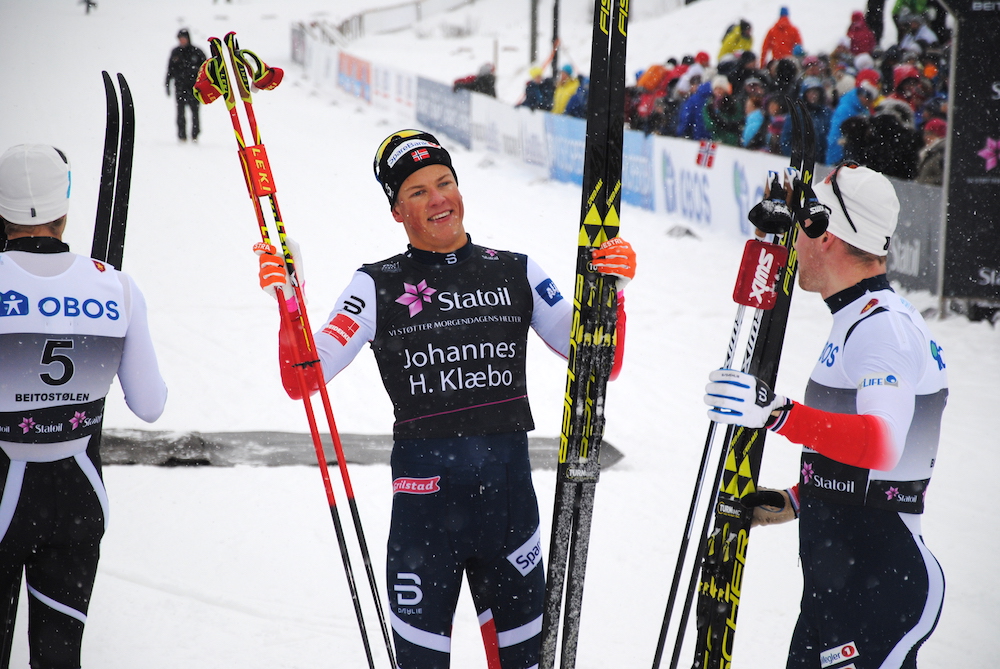
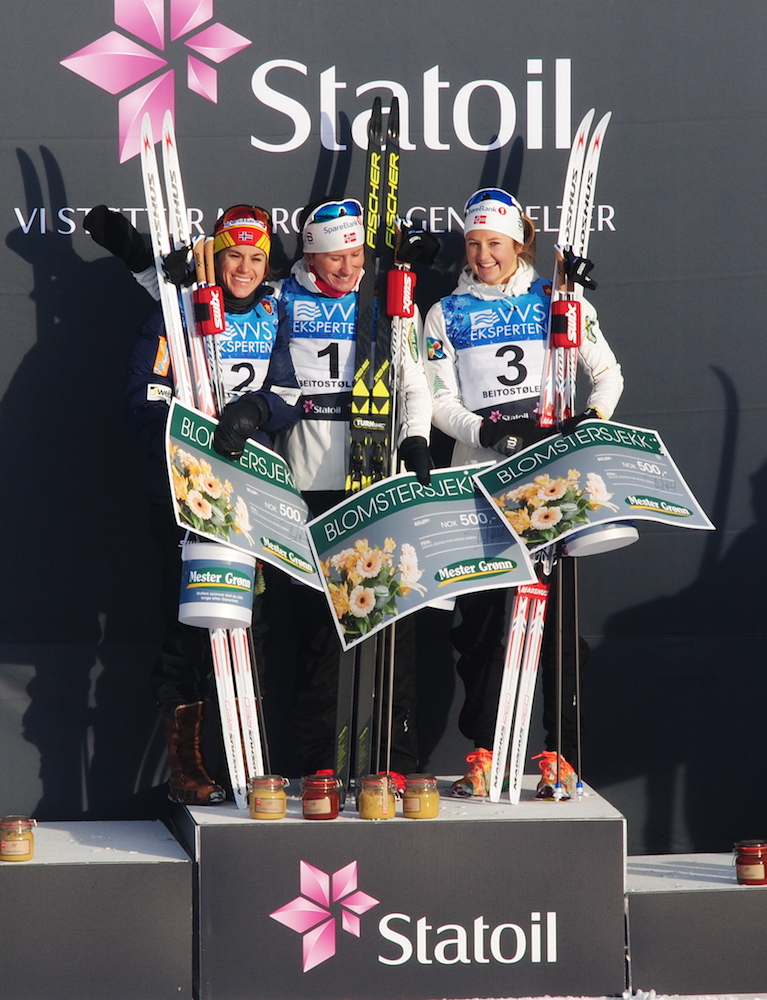
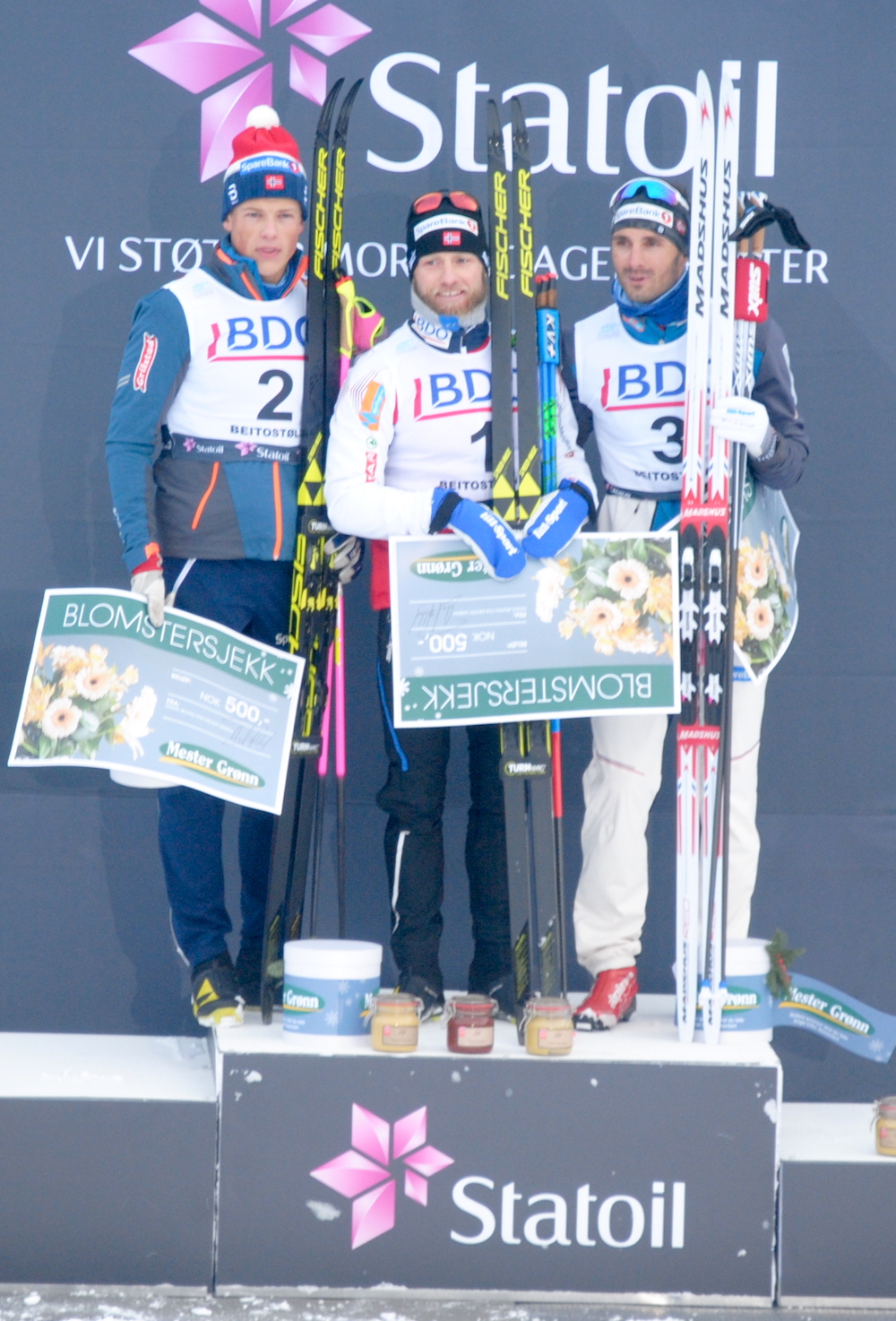
The women’s all-Norwegian podium from the 2018 FIS Skate Sprint in Beitostølen, Norway. Maiken Caspersen Falla (center) won, Kristine Stavås Skistad placed second (left), and Lotta Udnes Weng was third (right). (Photo: Aleks Tangen)
In a place like Norway, where the pool of cross-country athletes appears eternally deep, when you see competitors raise the bar, there’s nothing else to do but jump.
On Saturday in Beitostølen, Norway the known knowns were self-evident: Maiken Caspersen Falla and Johannes Høsflot Klæbo took the freestyle sprint wins during the second day of FIS race competitions.
As both athletes were overall World Cup sprint champions last season, there are no shockers there. (Klæbo has won two consecutive sprint crystal globes, Falla three.) But other skiers rose to the occasion and proved they too can jump nearly as high as Falla and Klæbo.
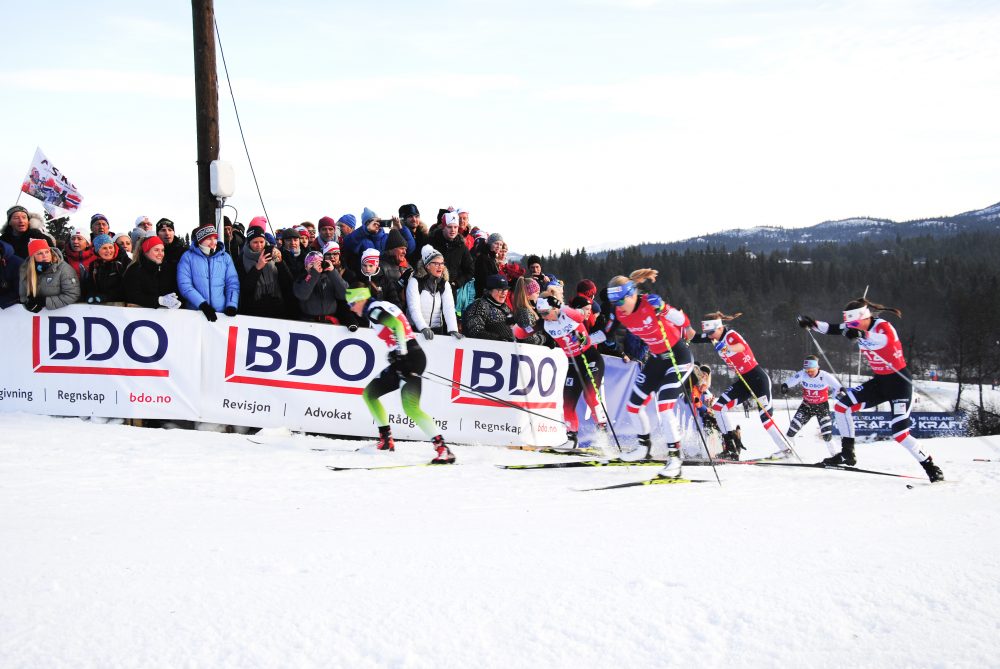
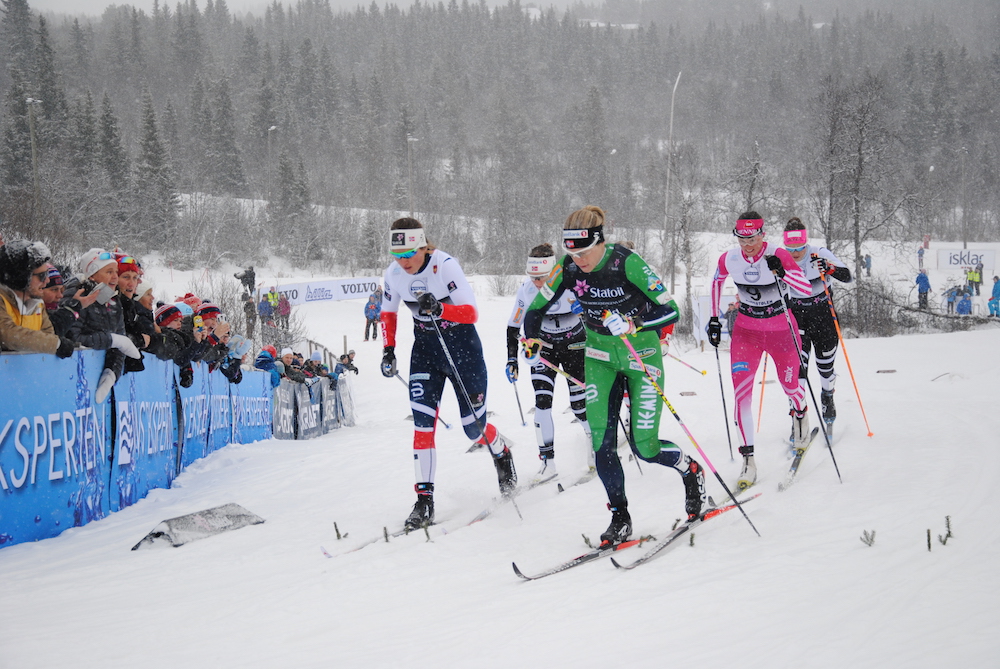
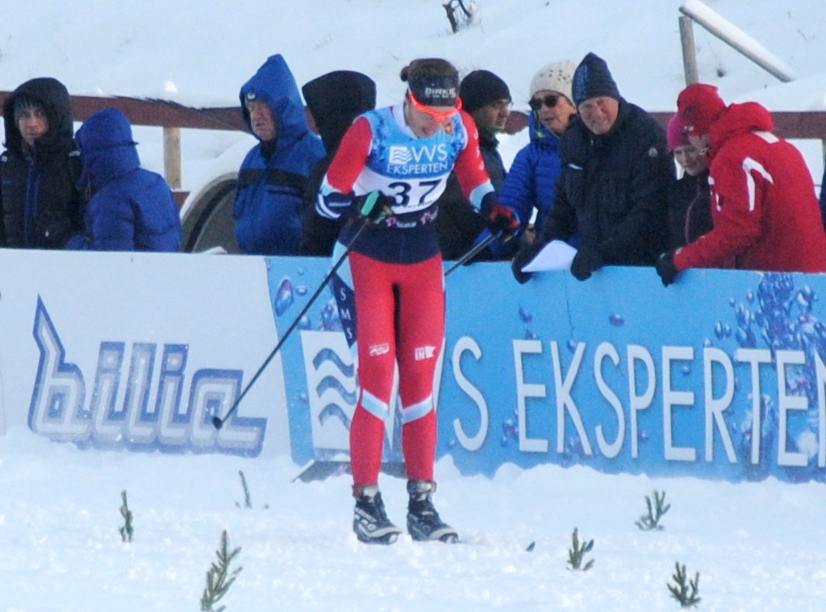
The women’s second semifinal on course in Beitostølen, Norway during the FIS skate sprint. (Photo: Aleks Tangen)
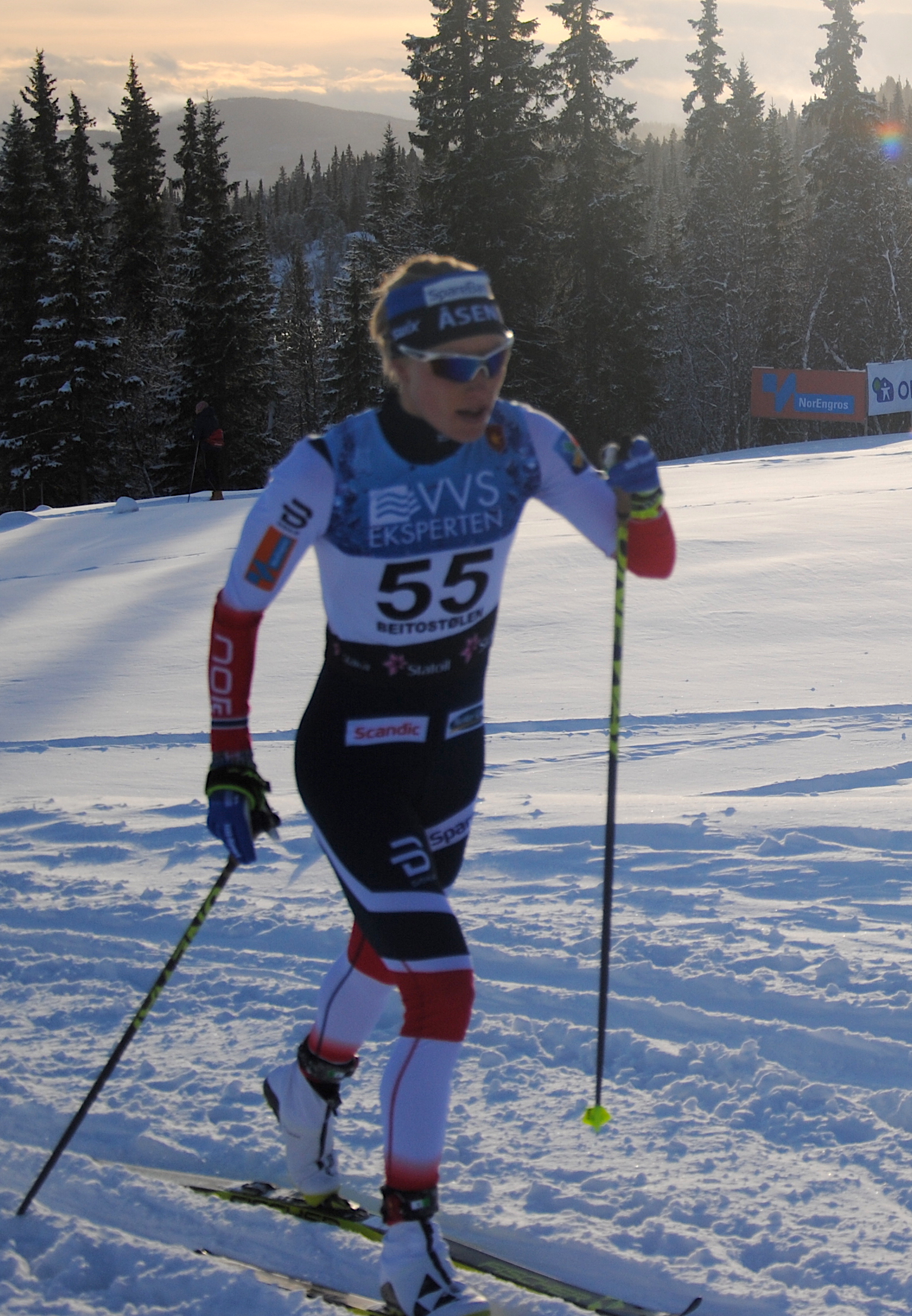
The women raced a 1.3 k skate sprint course with 54 women racing the qualifier. And this is where things got interesting. Nineteen-year-old junior Kristine Stavås Skistad, who has raced a single World Cup, the 2018 Drammen classic sprint in which she placed 51st, won the qualifier in 2:44.68 minutes. What is startling when scrolling through the qualification results is her birth year: 1999. The next closest Norwegian athlete in age finishing in the top-10 of qualification on Saturday was Anne Kjersti Kalvå, born in 1992.
In last season’s World Junior Championships, Skistad placed fifth in the 5 k classic, and second in the skate sprint. So certainly she is an up and comer. But the fact that she held her own in a world-class field of Norway’s best, is a statement.
Falla qualified in fourth (+1.63), and moved through to the finals by winning both her quarterfinal and semifinal.
Skistad, however, maybe played it a bit coyer. She squeaked into the semis by placing second in her heat by .30 seconds to Slovenia’s Eva Urevc. She then placed second to Falla by .22 seconds in the first semifinal. (That semi proved the faster of the two semifinals — both Kari Øyre Slind and Astrid Uhrenholdt Jacobsen advanced as lucky losers from the Falla semi.)
Falla is Falla – a veteran with big experience and the know how to throttle the engine when it matters. She won the final in 2:39.17 minutes, a pace over five seconds faster than Skistad’s winning qualification time.
In the all Norwegian final, Skistad placed second (+0.93), Lotta Udnes Weng was third (+1.28) Tiril Kampenhaug Eckhoff, both a World Champs and Olympic medalist in biathlon, was fourth (+1.34), Slind fifth (+1.53), and Jacobsen sixth (+2.89).
The women’s skate sprint bracket from the second day of racing in Beitostølen, Norway (Photo: FIS Live Timing screenshot) Click the image to enlarge.
More Klæbo and a bit of Iversen
It is time to refresh the syntax and remember Klæbo’s name can be used as a verb. With that in mind, Klæbo Klæboed in the men’s 1.7 k skate sprint. But like Falla on the women’s side, the twenty-two-year-old Klæbo was tested.
Tefre Gjøran, a year older than Klæbo at 23, was the fastest qualifier, finishing in 3:12.27 minutes. Klæbo was second (+1.12), and Emil Iversen third (+1.62).
In the end, it was Iversen, seeming like an aged vet at 27, who made life spicey for Klæbo.
Klæbo and Iversen advanced to the second semifinal. And it was Iversen who pushed the pace and was the catalyst for speed. Although not a massive margin, a second is still a second — but we are talking sprints here — Iversen won the second semi in 3:11.95, 1.12 seconds faster than second-place skier Klæbo.
“I was not good enough to fight him then,” Klæbo said to Norwegian broadcaster NRK, according to a translation, as he spoke about Iversen’s charge in the semis. “I had to be cynical and save me to the final. But Emil has a lot of effort, you saw how much he had in the finals too.”
It was a final highlighted by a Klæbo-Iversen dual. Klæbo won in 3:14.16 outpacing perhaps a new rival this season in Iversen, by 0.18 seconds.
In the all-Norway final, Eirik Brandsdal placed third (+1.88), Gjøran fourth (+1.96), Sindre Bjørnestad Skar fifth (+7.94), and Finn Hågen Krogh sixth (+9.94).
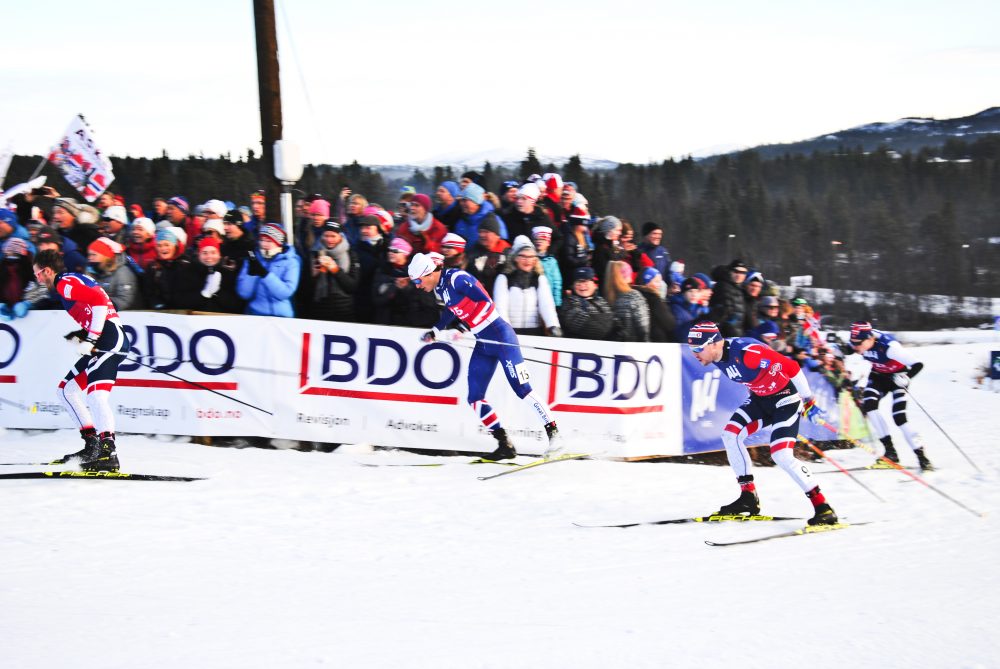
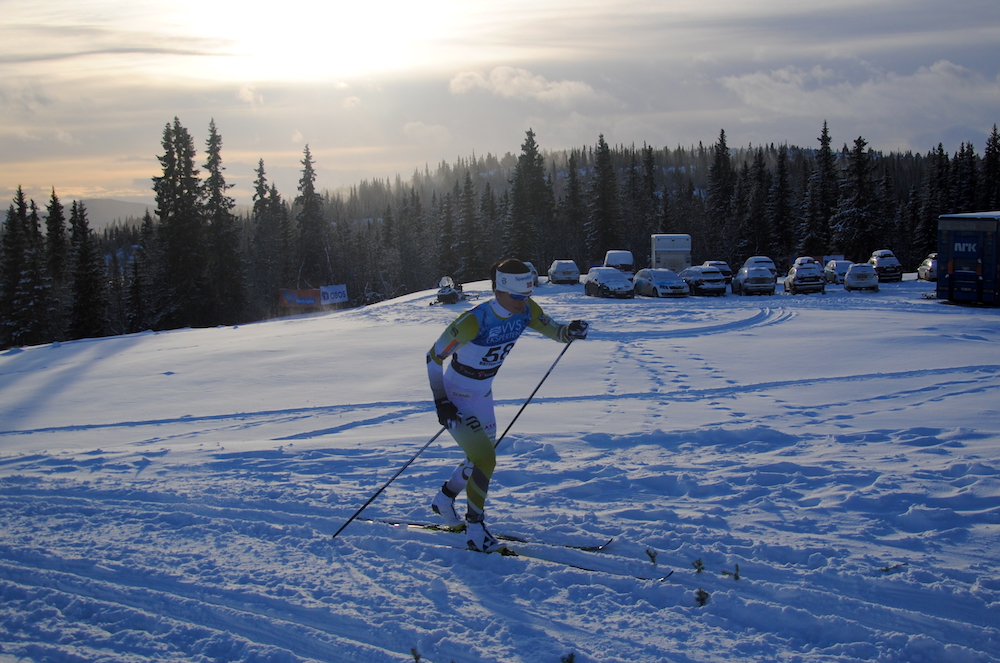
Andrew Young from Great Britain raced to 10th overall in Beito’s day 2 skate sprint. This is a shot from his semifinal. (Photo: Aleks Tangen)
Great Britain’s Andrew Young was 10th overall, James Clugnet 17th, and Andrew Musgrave 24th. They were the only non-Norwegians in the top-30.
“Top 10 is really good, the level here is really high,” Young told FasterSkier’s reporter in Beitostølen. “I had really good skis, and I was surprised nobody else wanted to take the lead at the start so I just went for it. I tried not to use too much energy. I knew Klæbo would go fast. So I just wanted to make sure I was on his tails when he came past. I was really pleased with my skiing. I wasn’t so defensive, I wasn’t so passive, and not let the others control the race. I tried to control it and be in that spot where I wanted to be.”
Young was passed in the final stretch by Skar and Krogh, who both advanced to the finals as lucky losers in the second semifinal.
Canadians Russell Kennedy placed 51st, Maks Zechel 94th.
“It is very deep, but it makes it fun there are lots of rides and always somewhere to push,” Kennedy emailed on Saturday about his experience racing to 22nd overall in the 15 k classic yesterday. “I was very happy with that. I don’t know if surprised is the right word. Last weekend in Olos, [Finland] I had a really good skate race and a good classic race against some big names. I was excited I ended up so high up the results for sure! It was a tough day with skis and I was lucky to be on fast skis even though they were a little slick on the last laps.”
The men’s skate sprint bracket from the second day of racing at in Beitostølen, Norway (Photo: FIS Live Timing screenshot) Click the image to enlarge.
Racing concludes in Beitostølen tomorrow with a 10 k/ 15 k skate.
Norway’s Johannes Høsflot Klæbo celebrates his first win of the season on Saturday in the men’s 1.5 k classic sprint FIS race in Beitostølen, Norway. (Photo: Aleks Tangen)
BEITOSTØLEN, Norway — A year ago, 20-year-old Johannes Høsflot Klæbo leapt onto the scene with a season-opening skate-sprint win in Beitostølen. Before that, he made waves at 2016 U23 World Championships, winning gold in the skate sprint, 10-kilometer classic and 4 x 5 k relay. But until last season, Klæbo, a member of Norway’s national U23 team, was hardly a household name to those outside of Norwegian skiing circles.
That all ended in Beito. Klæbo landed on the podium in the first World Cup sprint of the 2016/2017 season, placing third in the classic sprint in Kuusamo, Finland, and accumulated half a dozen podium finishes throughout last winter. He capped the season as the men’s U23 World Cup champion as well as the Sprint World Cup winner.
Now a full-fledged member of the Norwegian Sprint World Cup Team, Klæbo, who turned 21 last month, returned to Beitostølen to post a second- and first-place finish so far in two International Ski Federation (FIS) races there. He started his season off by taking second in Friday’s 15 k classic, 18 seconds behind reigning Overall World Cup champion Martin Johnsrud Sundby.
On Saturday, Klæbo won the 1.5 k classic sprint in Beitostølen without so much as a blemish, winning the qualifier to start the day then topping each of his heats en route to the final.
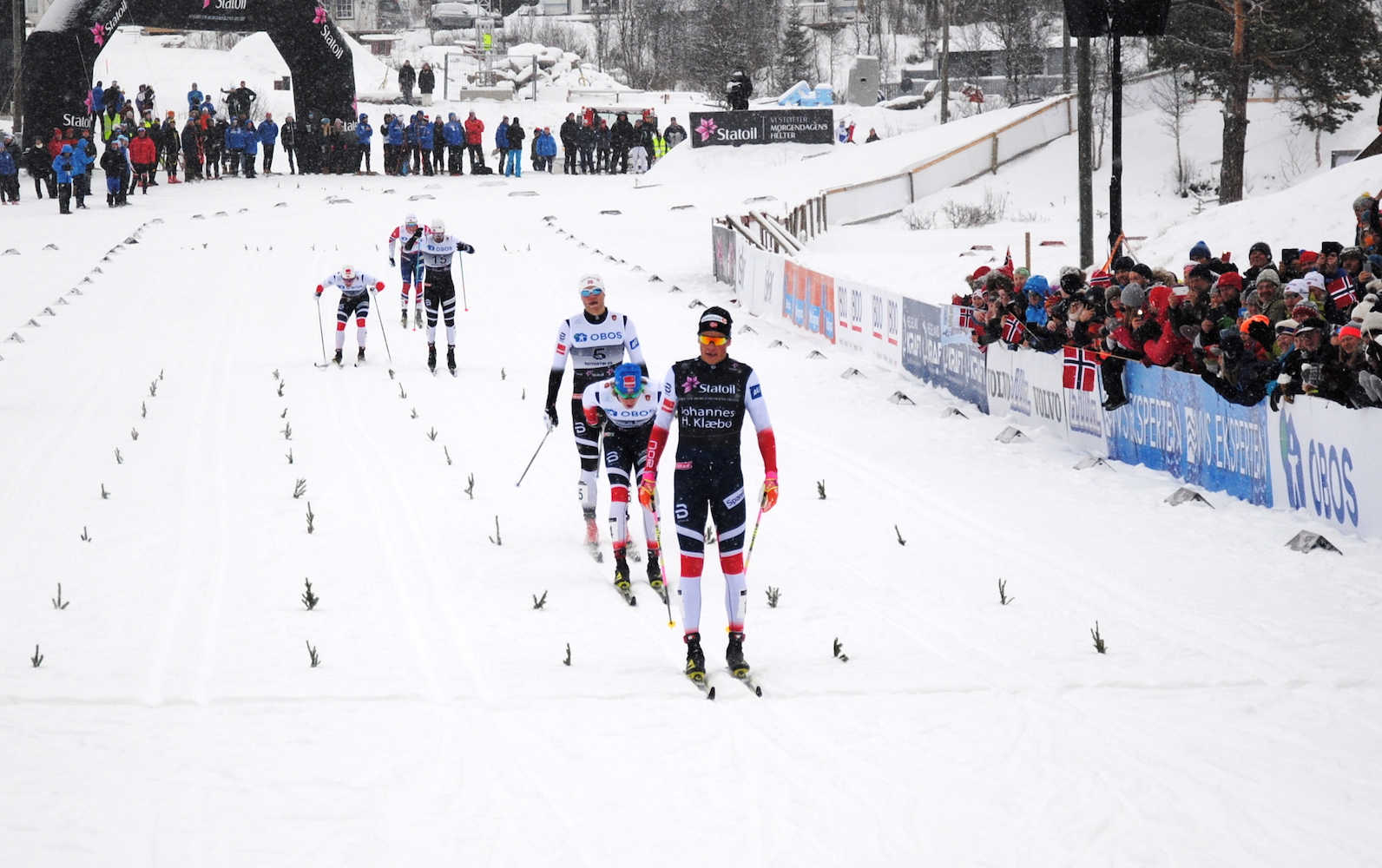
Norway’s Johannes Høsflot Klæbo crossing the line first for the win in the men’s classic sprint final on Saturday at the FIS season-opener in Beitostølen, Norway. (Photo: Aleks Tangen)
Up against five other Norwegians in the final, Klæbo raced to first once more in 3:50.4 minutes, finishing 1.1 seconds ahead of runner-up Kasper Stadaas. World Cup sprinter Eirik Brandsdal followed in third (+1.8), Fredrik Riseth was fourth (+6.4), Sondre Turvoll Fossli crossed in fifth (+6.7), and Emil Iversen was sixth (+9.2).
“My goal was to ski a good race,” Klæbo told a group of reporters after. “I wanted to get away from the pack towards the end and luckily the gap remained until the end.”
Iversen called attention to the young Norwegian while speaking with reporters after the race. “There has never been a talent like him,” Iversen said.
With snow starting to fall just before the men’s qualifier, Klæbo fared best on the course, racing to a 3.07-second qualifying win over Riseth with a time of 3:39.76.
Norwegian sprint coach Arild Monsen emphasized Klæbo’s ability to accelerate in and out of turns.
“Cross-country skiing has seen some development in recent years with specific techniques in specific zones, and Johannes has developed an ability to take advantage of that,” Monsen told a group of reporters. “We saw that very clearly today. The trick is to technically skilled when you’re tired and he’s able to do that almost to point where we don’t understand how.”
Klæbo went on to win his quarterfinal by 0.5 seconds over Norway’s Gjøran Tefre, then his semifinal by 0.2 seconds over Brandsdal. U.S. Ski Team member Andy Newell faced him in the quarterfinal, where Newell finished fourth in the heat, 3.7 seconds behind Klæbo and 2.6 seconds behind Norway’s Emil Nyeng in third. Newell missed advancing to the semifinals and finished the day in 16th overall.
“I knew we were going to have a fast heat because Klæbo had set a pretty strong pace from the first hill on, so we were really close to lucky losers,” Newell told FasterSkier in a post-race interview. “The second heat was just barely faster.”
With his second Beitostølen sprint victory, Klæbo told NRK that he was glad to get this race under his belt.
“This felt good, and I’m glad that sprint is up and running,” he said. “This was a good race considering what will happen next weekend.”
The World Cup kicks off next weekend in Kuusamo with a classic sprint on Nov. 24, followed by 15 k classic and 15 k freestyle races for the men on Nov. 25 and 26.
The lone American man in Saturday’s race, Newell qualified in 11th, 10.86 seconds off Klæbo’s time.
“Felt good in qualification, skis weren’t perfect because it started snowing just before,” Newell told FasterSkier after. “Skis were fast, but not quite enough grip, so we did a little re-wax for the heats.”
He noted that he’s been working with Fischer in Beitostølen as he’s there without his team (the rest of the U.S. Ski Team is currently training in Rovaniemi, Finland).
For the first 300 meters of his quarterfinal, six skiers started at a relaxed pace with Klæbo and Newell at the back of the pack leading into the the first downhill. While both were able to work their way to the front on the first climb, Newell lost steam on the second-to-last hill, “Danskebakken” (Danish hill).
“I was stuck in the back up the first hill, so I had to burn a match to get to the front, which probably made me a little tired for the last hill,” Newell reflected.
With what he called “great grip” up the big climb, he felt like he was dragging a bit over the top.
“I was definitely getting a little tired on the flat part over the top,” he said. “Because it’s the first sprint, maybe I wasn’t aggressive enough in the transitions, maybe it’s because the skis were a little draggy, but it seemed like I would get passed by somebody or two people going into each hill.”
With enough grip on the climbs, he would pass those racers back.
“So tried to finish strong but not quite there, but it’s a long season and hopefully the body will feel a little better in Kuusamo,” Newell said. “It’s all good, just training so looking forward to the World Cup.”
Out of the 30 men who qualified for Saturday’s sprint heats, only two were not Norwegian: Newell and Great Britain’s Andrew Young (who qualified 22nd). Young went on to finish the day in 23rd overall after finishing fifth in his quarterfinal.
Falla Stuns with Late Attack
Maiken Caspersen Falla (l) leading the women’s final up a climb, along with fellow Norwegian national team member Astrid Uhrenholdt Jacobsen (in green) during the women’s 1.5 k classic sprint FIS race on Saturday in Beitostølen, Norway. (Photo: Aleks Tangen)
In the women’s race, Maiken Caspersen Falla controlled the women’s race in a similar fashion to Klæbo, winning the qualifier, quarter, semi, and ultimately, the final.
In the final, Falla, who won last year’s Beitostølen skate sprint as well as her second-straight Sprint World Cup Crystal Globe, skied with the pack until the final climb where she made her move before entering the final stretch alone. Falla, 27, finished 3.7 seconds clear of anybody in 3:01.1. In another all-Norwegian final, Mari Eide placed second and Astrid Uhrenholdt Jacobsen claimed third (+4.8). Tiril Udnes Weng placed fourth (+6.7), Kari Vikhagen Gjeitnes was fifth (+11.1) and Ane Appelkvist Stenseth was sixth (+18.5).
Falla started the morning with a qualifying win in 2:54.86, 1.77 seconds ahead of Slovenia’s Katja Visnar in second. She didn’t slow down much for the heats, racing to first in each in 3:01.7, 3:02.3 and 3:01.1, respectively.
“I felt that it went better and better and it’s wonderful to have that feeling when you’re sprinting,” Falla told NRK after.
After watching her attack and pass three women on the final hill, NRK commentator Fredrik Aukland called her “the best sprinter in the world”.
When asked if this performance was good enough to win any race in the future, she told a group of reporters, “I hope so, of course. There is finishing hill already next weekend that is kind of similar to this one and I have practiced running up hills a lot so it’s obviously fun to test it in a race.”
Teammates with Newell on the Stratton Mountain School (SMS) Elite Team, Anne Hart raced to 31st for the second day in a row, missing qualifying in the top 30 by 0.28 seconds.
“I am happy about my qualification,” she told FasterSkier immediately after her race, before she knew whether her time was fast enough for the heats. “The course is a lot faster than yesterday, good condition.”
Hart started the qualifier third out of 58 women, just ahead of Visnar in bib 4. Her time was 17.55 seconds back from Falla’s.
“I skied with Katja Visnar and she is really good classic sprinter,” Hart said. “… It feels really good to be able to ski with all these World Cup skiers.”
Nichole Bathe, who was born in the U.S. but is racing for Great Britain, finished 33rd (+19.26), about 2 seconds out of the top 30.
Canada’s Isabella Howden of Barrie Cross Country (BXC) finished 58th (+57.28) in the qualifier. In the men’s qualifier, her teammates Joey Foster and Scott James Hill finished 74th (+32.45) and 84th (+36.64), respectively, and fellow Canadians Ryan Jackson and Maks Zechel (who are training in Norway with Team Asker) finished 97th (+43.99) and 102nd (+48.48), respectively, out of 109.
The Beitostølen weekend concludes with 10/15 k freestyle individual starts on Sunday.
Norway’s Marit Bjørgen racing to a 29-second win in Friday’s 10 k classic FIS race in Beitostølen, Norway. (Photo: Aleks Tangen)
(Note: This article has been updated to include comments from Nichole Bathe.)
BEITOSTØLEN, Norway — The question of whether Bjørgen or Weng will be the bigger name this season went in the favor of the former on Friday at Norway’s first big matchup of the season. Marit Bjørgen, now 37 and in her 20th World Cup season, won the first race of the three-day International Ski Federation (FIS) weekend in Beitostølen, starting last out of 56 women and finishing first in the 10-kilometer classic individual start, with 29.4 seconds between her and Weng in second place.
On a morning that marked the start of the 2017/2018 season in Norway, with temperatures just below zero and a snow squall during the women’s pre-race warmup, the snow covering the course appeared loose but ample.
Weng, the 26-year-old reigning Overall World Cup and Distance World Cup champion who started 30 seconds behind fellow Norwegian national-team member Bjørgen, told reporters after the race that she was satisfied with her performance, but could have skied better and “could have had better grip”.
For the first 2 kilometers of the race, Bjørgen’s pace was comparable to that of another one of her teammates, Ingvild Flugstad Østberg, who started just ahead of Weng. But halfway through the race, Bjørgen was nearly 22 seconds up on Østberg and 28 seconds ahead of Weng.
While Bjørgen continued to put seconds into her teammates in the final 5 k — blowing through the 7 k checkpoint 28 seconds faster than anyone else — Weng and Østberg battled for second. Weng clocked through 6.1 k just 2.7 seconds faster than Østberg and skied 5.1 seconds faster than her over the next 900 meters. Despite crossing the finish 11.6 seconds faster than Østberg, Weng’s time in the leader’s chair was short-lived, as Bjørgen finished 29.4 seconds faster with a winning time of 29:30.9 minutes.
The women’s 10 k classic all-Norwegian podium at Friday’s FIS race in Beitostølen, Norway, with Marit Bjørgen (c) in first, Heidi Weng (l) in second and Ingvild Flugstad Østberg in third. (Photo: Aleks Tangen)
Østberg claimed third, 41 seconds back and 10 seconds ahead of another Norwegian national team member Ragnhild Haga in fourth (+51.0). Norway swept first through 13th place with Kathrine Rolsted Harsem in fifth (+1:08.1), Astrid Øyre Slind in sixth (+1:27.5) and notably, sprint specialist Maiken Caspersen Falla in ninth (+1:54.3).
“Marit is superior,” Weng said in a post-race interview with NRK. “This is top level and I have to step it up.”
She added, “29.4 and 41 seconds is a lot, but Marit is not invincible.”
But even Bjørgen has to tell herself to ski relaxed for the first race of the season.
“I tried to stay calm and ski my way up to Weng,” Bjørgen told NRK. “Considering that she held the yellow bib [as the World Cup leader] last year, I think that’s pretty good.”
Bjørgen reflected that she could have skied the flatter parts of the course better.
“Heidi did well there, and it was fun to ski behind here and learn from her,” she said.
Norwegian national-team member Ragnhild Haga racing to fourth in the women’s 10 k classic FIS race on Friday in Beitostølen, Norway. (Photo: Aleks Tangen)
Fourth-place finisher Haga told reporters that she was pleased with her technical improvements in classic, which she has been working on for three years.
“It was fun, and I’m glad I was able to race at such a high level,” Haga said.
Three Americans, two of which race for Great Britain, finished 29th, 30th and 31st: Annika Taylor (+3:48.2) Nichole Bathe (+3:51.3) and Anne Hart (+3:51.4), respectively. Taylor was born in California and is a member of Great Britain’s women’s team, as is Bathe, who hails from Wisconsin and is also a member of the CXC Team. Hart, originally from Minnesota, races for the Stratton Mountain School (SMS) Elite Team in Vermont.
Since mid-September, Bathe, a recent University of Alaska Fairbanks graduate, has been living in Lillehammer, Norway, while training with the British national team.
“It’s been quite the transition especially from college racing but it has been such a great learning experience and makes me really exited for the season!” Bathe wrote in an email. “That was my first race of the season and I thought it went okay. I went out pretty hard which caught up to me in the end but overall I think it was a good start to the season.
“Typically I am more of a sprinter but in general I like classic more than skate and 5k classic is my absolute favorite race,” she added. “This winter I am focusing on U23s [World Championships] and skiing fast there especially in the sprint. I will mainly be racing in Europe this year. I am racing the Kuusamo World Cups and then heading onto the OPA and Scando Cup races!”
In an in-person interview with FasterSkier, Hart explained that she made a point to get on snow earlier this season and spent the last two weeks training in Sjusjøen, Norway. After this weekend, she’ll return to the U.S. for the first SuperTour races in West Yellowstone, Montana, Dec. 2-3.
“I’ve been told by just about everyone that this is more competitive than a World Cup in part because these are [the Norwegians’] major qualifying races [for the World Cup], or their only ones I think,” Hart said of Beitostølen. “So I just went out hard. I had great kick on my skis so I just was really working on skiing well because last year that was an area I think I just got really frantic.”
During training on Thursday, Hart skied one lap with Bjørgen.
“Yesterday I actually skied with — stalked — Marit on an easy lap, and I was just trying to imitate her skiing,” Hart said. “So I was just trying to think of her out there and obviously not quite as fast, but I was really psyched with how I skied everything well. I felt a little tired on the last bit, but again, I didn’t fall apart and I’m really pleased with that.”
American Anne Hart (SMS Elite Team) racing to 31st in the women’s 10 k classic FIS race on Friday in Beitostølen, Norway. (Photo: Aleks Tangen)
For Hart, the biggest difference she noticed in this initial race of the season was the fact that she was having fun.
“Last year I was just struggling the whole season to find that ‘fun’ gear, I guess, and today I was really enjoying the whole time and really pushing and not looking forward to the end,” she said. “Instead of thinking, ‘I have to make it another kilometer,’ it was like, ‘Oh my god, I only have a kilometer to go. I’ve gotta really give it all I’ve got.’ ”
For Canada, Isabella Howden, of the newly formed Barrie Cross Country (BXC), finished 53rd (+7:18.2). Afterward, Howden, who started 16th, recalled being passed by the five fastest women on her second lap, which she said was beneficial.
“That was pretty cool, seeing them and getting to stay with them on the downhills and copy their technique for as long as I could see them,” she said.
For Howden and some of her Canadian teammates, Beitostølen is familiar territory; they raced there last year. Regardless, she was in awe of the atmosphere.
“It’s so cool … all the kids up there cheering and there’s a whole crew around the corner with all their cowbells, like 10 of them,” she said with a laugh.
Sundby Pulls It Together
The men’s 15 k classic all-Norwegian podium at Friday’s FIS race in Beitostølen, Norway, with Martin Johnsrud Sundby (c) in first, Johannes Høsflot Klæbo (l) in second and Hans Christer Holund in third. (Photo: Aleks Tangen)
In the men’s 15 k classic individual start that followed, defending World Cup champion Martin Johnsrud Sundby took the win by 18.2 seconds over Norwegian teammate Johannes Høsflot Klæbo, who won last season’s Sprint World Cup at the age of 20.
Now 21, Klæbo is recognized as more of an all-around force, and on Friday, he led the men’s race up until the 4.9 k checkpoint. Sundby started last out of 158 men and trailed Klæbo until 6 k. But from that point on, the race was Sundby’s; at 9.8 k, he was 12.3 seconds faster than Klæbo in second place.
“I had to pull myself together,” Sundby told reporters after the race, explaining that he felt tired around 6 k. While the rest of his race required some extra effort, Sundby expressed contentment with his performance.
“This was something positive that I will take with me going into the season,” he said. “This was the first race of the season and it could have gone both good and bad. … It was so-so, I felt goofy skiing today, but that was also the case for everyone else.”
He attributed that awkward feeling to challenging conditions, “but that is also good practice,” he said. “I didn’t feel all that well in the first 5 k, but after that I was able to speed up and I felt that was able to control the race.”
And he did so without going too far into the pain cave.
“I didn’t have to dig as deep as I have done sometimes in the past,” Sundby said.
Sundby’s winning time of 38:57.2 was 18.2 seconds faster than Klæbo in second and 37 seconds clear of Hans Christer Holund in third. The top-seven men — all Norwegian — finished within 59 seconds of first. The women were a bit more spread out, with the seventh-place woman, Silje Theodorsen (Kvaløysletta Skilag), finishing 1:36.3 behind Bjørgen.
Holund clawed his way into the race after his 4.9 k time ranked 11th. With about 5 k to go, the Norwegian national-team member was up to fifth, and by 11.9 k, he was within reach of the podium in fourth place.
Didrik Tønseth ended up just 1 second off the podium in fourth (+38.0), while Johan Hoel (Åsen IL/Team Veidekke Oslofjord) placed fifth (+42.2), ahead of Simen Hegstad Krüger in sixth (+44.1) and Emil Iversen in seventh (+59.0).
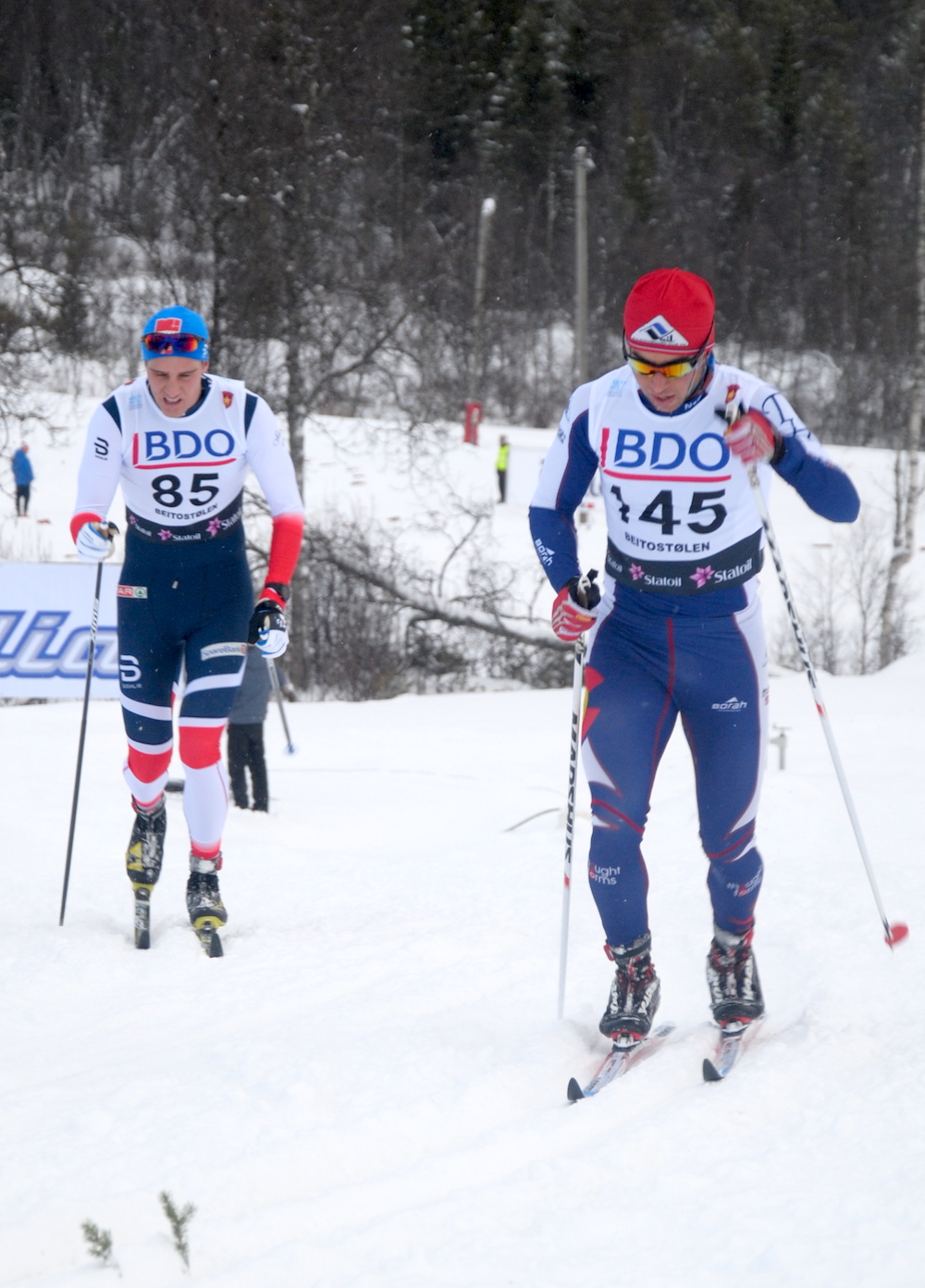
Noah Hoffman (r) passes Norway’s Torstein Bu during the men’s 15 k classic FIS race season opener on Friday in Beitostølen, Norway. Hoffman went on to place 29th, while Bu finished 75th. (Photo: Aleks Tangen)
The lone American in the race, Noah Hoffman placed 29th, 2:25 minutes behind Sundby. After a slow opening that put him in 47th at the 2.1 k mark, the former U.S. Ski Team member settled into a pace that put him within the top 30.
Afterward, he told FasterSkier that his performance was a good starting point. He started the race toward the back of the field in bib 145, just ahead of several top Norwegians.
“It was a little unfortunate that there was a big train that formed right behind me, and those guys didn’t catch me until less than a k to go,” Hoffman reflected. “I was hoping they’d get me a little sooner or not get me at all, but it was good.”
In terms of a race plan, he explained that he tried to ski with energy and build throughout the entire 15 k, which he felt he did.
“I got a little excited the second time up the big hill and maybe burned a little too much, but for the most part it was a good effort and I’m looking to build this for Sunday and then obviously into next weekend,” he said.
After Sunday’s second set of distance races in Beitostølen, the 10/15 k freestyle individual starts, Hoffman will race four weekends of World Cups as an invited member of the U.S. Ski Team (USST) for Period 1. He missed the objective qualifying criteria for renomination to the USST by one place (he ranked 51st in the World Cup at the end of last season) and is thus skiing independently this year, paying his own way (and paying his own wax technicians, Zach Caldwell and recently retired USST tech Peter Johansson) so that he can race in Europe.
“The early season is important for me this year because I don’t have guaranteed start rights for the whole winter, so I need to ski well,” Hoffman, 28, said. “And I believe I’ve done everything I can to prepare and I hope to see the results from that.”
Several Canadian juniors raced the men’s 15 k as well. Ryan Jackson led them in 97th (+5:16.8), followed by Scott Hill in 99th (+5:19.1), Joey Foster in 124th (+6:45.3), and Maks Zechel in 143rd (+8:25.5).
“It was hard out there today,” said Foster, a 21-year-old member of BXC, noting that he was still feeling the effects of travel after arriving in Europe a week ago. “Considering how I felt, the race was pretty good. … I started with what I thought was a pretty conservative pace and I got in with a good train of people, and I skied with them for almost the whole first lap, and from there I just kind of fell off pace. … I think my leadup to the race just wasn’t as good as it could’ve been, so I wasn’t feeling as crisp as I would’ve liked.”
The Beitostølen FIS races continue through the weekend with classic sprints on Saturday, which U.S. Ski Team member Andy Newell plans to race, and 10/15 k skate races on Sunday.
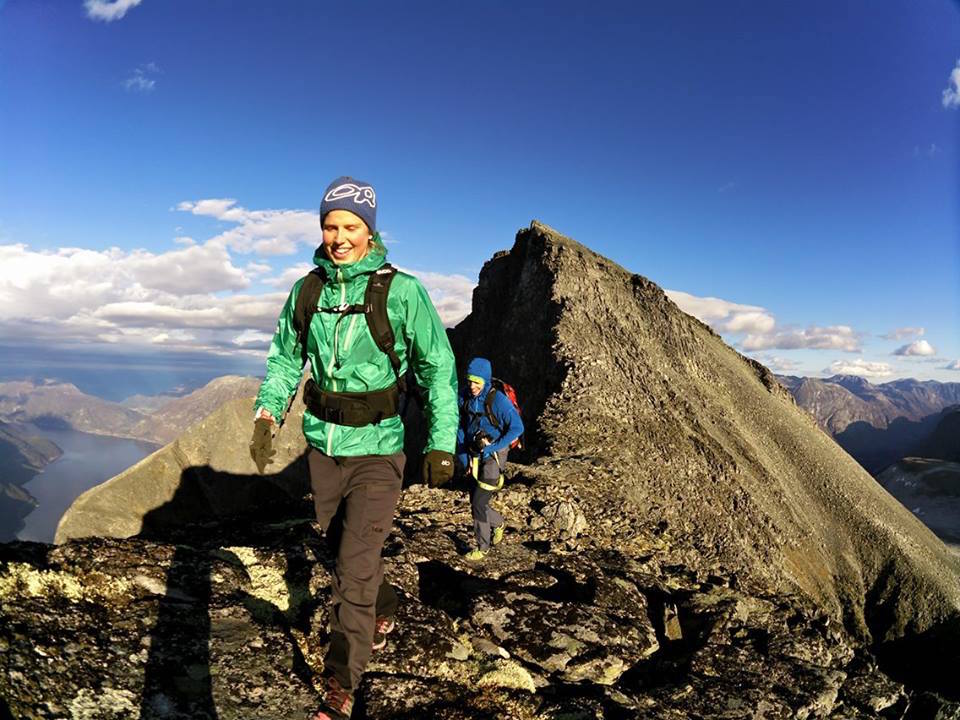
Norway’s Kari Øyre Slind in her element with her favorite kind of training: long touring adventures. (Courtesy photo)
“I have everything to gain, they have everything to lose,” says Kari Øyre Slind, a 24-year-old Norwegian development skier who recently earned a spot in the World Cup opener this coming weekend.
Two weekends ago in Beitostølen, Norway, Slind notched two consecutive podiums in the preseason International Ski Federation (FIS) races. That put her in a position to start the season in earnest on the World Cup. She’s raced in four individual Word Cups previously — most of which were sprints. On Nov. 13 and 14 in Beitostølen, she was second in the 7.5-kilometer freestyle and third in the 7.5 k classic behind national-team leaders Therese Johaug and Heidi Weng, respectively.
As a result, Slind was selected to help fill the Norwegian World Cup team’s distance quota. But she isn’t overly nervous for the upcoming World Cup, which starts Friday in Kuusamo, Finland.
“I felt like I skied a pretty average race, and I don’t dare to hope that I will rank as high in the World Cup opener,” Slind told FasterSkier in a recent phone interview. “I thought I would be the last of the girls on my team. My dryland time-trial performances and fall workouts haven’t exactly been outstanding this year.”
Norway’s Kari Øyre Slind (Photo: Martin I Dalen)
Slind, who is a part of the Norwegian Ski Association’s regional-development project Team Veidekke Trøndelag, pointed out that she rarely wins dryland races, but generally performs much better once the season starts.
“When we start ski racing, I often beat those who beat me in fall,” she said.
Slind has never been named to the World Cup team for distance events. In 2010, she was selected to her first international World Cup in Düsseldorf, Germany, where she placed 22nd in the skate sprint. Also that 2010/2011 season, she placed 22nd in a World Cup skate sprint in Drammen, Norway. This past March, she raced the Holmenkollen 30 k skate, where she was 33rd.
But those times, Slind was part of the national quota; the host nation receives a higher number of World Cup berths for the events they host.
So this is big for her, and while she’s excited about her two races so far, she remains grounded.
“I choose to think of the Beitostølen weekend as a performance out of the ordinary,” she said. “But now I know that I can perform with the best on a good day.”
Much to be Gained
Slind explains that the support she’s received from the national-team women during and after Beitostølen has been very encouraging. The fact that they are impressed with her means a lot to Slind.
“Therese said that she felt faster at the season opener this year than last year, and both Heidi and Astrid [Uhrenholdt Jacobsen] are skiers who aren’t exactly list fillers at the World Cup races,” Slind said. “So that means my race was really good. It would have been different if they said they didn’t feel like they raced well.”
Kari Øyre Slind Stats:
– Birthdate: Oct. 22, 1991 – From: Oppdal, Norway – Club: Oppdal IL – Team: Team Veidekke Trøndelag (One of five regional development teams supported by the Norwegian Ski Association) – First World Cup: March 2010 in Drammen, Norway – Best Individual World Cup Finish: 22nd in the skate sprints in both Düsseldorf 2010 and Drammen 2011.
Despite a good start to the season, Slind said she won’t set her heart on making additional World Cups later this season. She will race at the Lillehammer World Cup Dec. 6-7 in Norway, but for those races she was selected via the national quota.
“I have no expectations for placing at the World Cup opener in Finland,” she said. “I’m racing against a bunch of athletes who are at a really amazing performance level. I almost feel like if I had expectations, I would almost be trashing and downplaying the established World Cup athletes. I don’t really belong in that company.
“I’m going there to have a good time at the races, enjoy myself and just take things as they come,” she added. “I have everything to win and nothing to lose.”
Slind found her Beitostølen breakthrough especially surprising after a season where she mostly trained alone and did few hard workouts.
“I have focused on long workouts that border to recovery efforts rather than performance training, such as long mountain runs,” Slind said, noting that those are her favorite kind of workouts.
“When I can just run for hours, I train with the team during team camps, and sometimes with my sisters [Astrid and Silje Øyre Slind] when they are home, but I actually really like training alone,” she said. “Just being outside makes me so happy, seeing our beautiful surroundings right here where I live in Oppdal, and just allowing my thoughts to drift.”
Ownership and Balance
Previously a member of the Norwegian junior and then the development teams, Slind trained independently last season. She explained she truly enjoyed the freedom and flexibility of setting her own schedule and being in charge of her own training program. At the same time, she trained with the Trondheim-based university program Team NTNU.
“They were really welcoming and inclusive,” she said. “It was really nice to know that any time I wanted, I could join them for camps and that I had a place to stay and support for races during the winter. I’m very thankful for that.”
While Slind enjoys her own company and likes training alone, she also likes to socialize.
“Being a part of a team helps break up the routines. Actually, I really miss being a student,” she said. This spring, Slind earned her bachelor’s degree in exercise science.
“I loved studying, and I loved being a part of a student community where you can talk about different things than just training, racing and skiing,” she added.
She is considering pursuing a master’s in exercise science, but will take off this winter at least to train and race full time.
“I don’t feel like going to school while racing was a problem. Sure, there were times when you had a lot of work hanging over you, and that might have added to the total stress load, but for the most part I just really enjoyed my field of study and I was really excited to learn,” she said.
“But this is a point where I have a chance to take a season and try out what it’s like to just focus on skiing.”
Devon Kershaw racing to 33rd on classic skis (he was one of the few men to stride rather than double pole on skate skis) during the 15-kilometer classic FIS race on Nov. 13 in Beitostølen, Norway. (Photo: Eirik Lund Røer/SKIsport)
After a dozen years on the World Cup circuit, you would think race logistics would be a breeze for Devon Kershaw. Not the case in Beitostølen, the 32-year-old Canadian National Team member explained.
In anticipation of his first race of the season, a 15-kilometer classic International Ski Federation (FIS) race in Beitostølen, Norway, last Friday, Kershaw arrived two days early on Wednesday. He did so alone, without any teammates, coaching or waxing support, and worst of all, no skis.
At one point in the planning process, two of his teammates, Alex Harvey and Jess Cockney, considered a trip to Norway for the season-opening FIS races along with coach Louis Bouchard and the team’s head wax tech Yves Bilodeau. When warm weather threatened to cancel the Beito races, those four decided to head north to Gällivare, Sweden, where the team will race this weekend. Kershaw completely understood, but that left him with some troubleshooting.
“Driving to Beitostølen I was kind of laughing to myself,” Kershaw, a three-time Olympian and six-time World Championships racer wrote in an email. “It’s not exactly like a running race — there are a lot of moving parts in a ski race — especially a classic race. Not only did I not have equipment or support really, I also had barely skied.”
The Beito tuneup marked his third time on skis since May “so I felt a little like ‘Bambi on ice’ for the first few laps before I settled into it,” he explained. “Conditions were a bit beat-up/tricky too – so I struggled with the ‘finesse’ out there.”
The only North American in the race, which was heavily dominated by Norwegians, and included a smattering of German and French skiers, Kershaw placed 33rd out of 134. He finished 2:35.4 minutes behind the winner, Norway’s Sjur Røthe.
Most everyone in the top 30 double poled, he explained. Kershaw didn’t have the option to.
He had borrowed skis from a friend of his wife, Kristin Størmer Steira, in Lillehammer: a pair of 2002 Fischers. In Beitostølen, Fischer lent him a pair as well, bringing his fleet total to two. Before the races, he had asked Swix if they could wax his skis, and they agreed.
“They were fantastic. Not only a huge help — but just really great guys to work with — I was lucky there,” Kershaw wrote. “Hell, I didn’t even have race suit here or toque to race in.”
Because the Canadian national team signed a new clothing sponsor this season (Swix), Kershaw had to wait until he met up with coach Justin Wadsworth, who was bringing the uniforms over from Canada. He couldn’t race in his old suit, so Swix gave him a stock black suit and headband to race in instead.
“That added to the hilarity of the situation, as I was really flying under the radar,” Kershaw wrote.
With two pairs of skis to test — both classic skis — he opted for klister. Wrong decision, he reflected.
“I am pretty sure [France’s Maurice] Manificat [who placed 16th] was the only one in the top 30 on wax,” he wrote. “Then me in 33rd after that. Everyone else double poled. It was much faster (to double pole) but having not skied much, and racing on borrowed skis (I only had two pairs of skis total) my options for testing were limited. I didn’t even test double poling to be honest — again, because I didn’t have a lot of choice (instead one pair had klister, the other klister-cover).”
While he regretted his choice of wax, he explained the rest of the ski world should be well-aware of what’s happening to cross-country skiing.
“In case there are any doubters left that the sport is changing, [the Beitostølen 15 k] should be the final wake up call. The frying pan between the eyes so to speak,” he wrote. “So many people double poled, over 50-60 guys in the field. They are strong enough to do that on a course with over 400m of ascent over 15km without hesitation — and win big — double poling only.”
Last season on the World Cup, most of the field double poled the classic races in Davos, Switzerland, and Toblach, Italy. Considering that, and how many men — and Norwegian woman Ingvild Flugstad Østberg— double poled Beito, “there is very little argument that this is something everyone needs to get a lot better or at least more comfortable at doing during races moving forward,” he added. “I would have never imagined this back in 2003/04/05 when I was a young senior. Back then, nobody would have double poled the race (it was funny talking to Anders Aukland about that during our cool down — he brought that up, and I agreed completely) — it’s happened rather quickly if you think about it.”
At the end of the day, Kershaw had hoped for a top 15, “but that was pretty baseless with regards to my equipment situation and with the fact most double poled — it wasn’t realistic looking back,” he wrote.
Last February, pneumonia and whooping cough cut Kershaw’s season short. He was sick for several months last spring, which affected the start to his training season May, June and July as well. He was curious to see how he’d feel racing again, and given that this was his first race since January — he was grateful to be out there.
“My race itself started off horrendously slow and bad. I felt all over the place as I fought to find my rhythm, but as the race progressed I felt more and more together,” he wrote. “I needed another lap out there! It’s obvious I missed my pacing, but also it was mostly a technique thing.… I was switching from kick double pole, to striding, to double pole and back again over and over early in the race and none were working well. Once I settled into the race and decided to double pole pretty much everything, and transition only to striding when the terrain got steeper, did I figure it out.
“While 33rd doesn’t look like much, I am happy enough with the effort under the circumstances,” he added. “I was happy to have moved faster and faster throughout the race and next stop is Gallivare where I am really looking forward to finally being able to put in some kilometres on snow — which will be both nice and a tad overdue.”
Sweden’s season-opening FIS races kick off in Gällivare this weekend, with a classic sprint on Saturday and 10/15 k freestyle on Sunday. A week later, the World Cup starts with the Ruka mini tour in Kuusamo, Finland, Nov. 27-29.