From the FasterSkier archive — posts syndicated from athletes’ and coaches’ own blogs between 2004 and 2012, kept online as published. Current coverage is at fasterskier.com.
We’re off. The 2023-2024 winter kicks off with season opening races across Scandinavia, and the World Cup launches next week.
Devon and Nat go old-school, no guests to recap a bevy of interesting results so far. Send us your comments, questions and criticisms: devon@fasterskier.com and nat@fasterskier.com. We’ll be back next week.
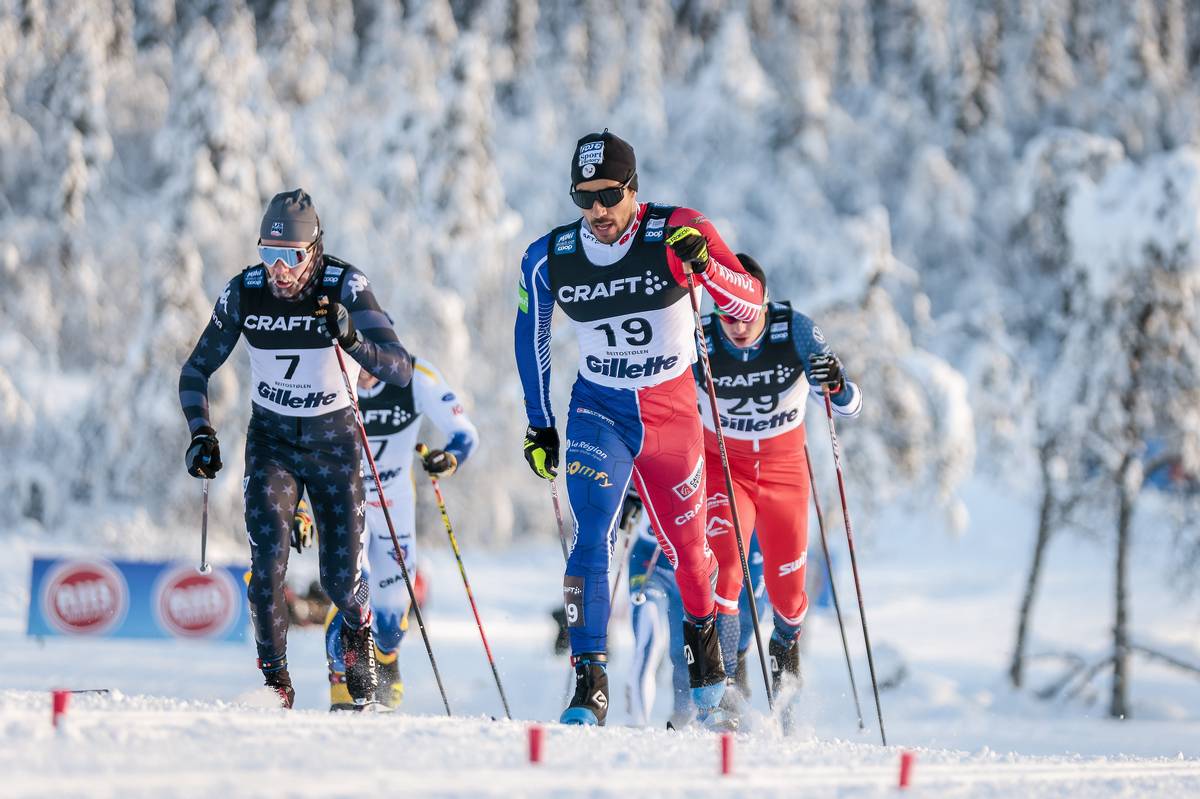
Ben Ogden (USA) and Richard Jouve (FRA) in the semi-final of the men’s classic sprint in Beitostolen, Norway. (Photo: Nordic Focus)
The sun had begun to set in Beitostolen, Norway. The day—and the day’s racing—entered its golden hour as Norwegian fans anticipated more success for World Cup Sprint Leader, Paal Golberg (NOR). That all changed in a flash as Golberg—wearing the yellow Leader’s bib—crashed on a curve in the men’s Classic Sprint final. Golberg fumbled in the snow, a stark contrast to the control he has shown through the first few weeks of this year’s World Cup. The field stretched out in front of him, the Norwegian “sure thing” having been removed from the equation. Something new was about to play out at the front of this World Cup Sprint race.
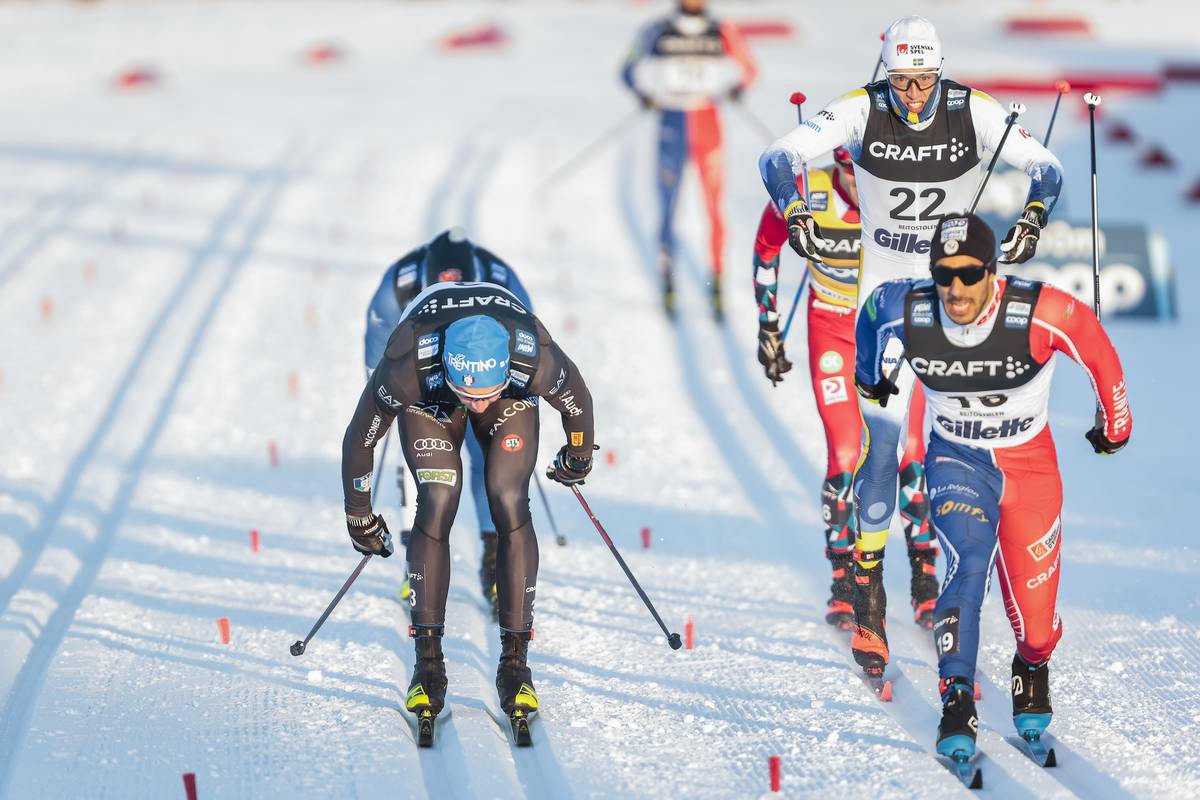
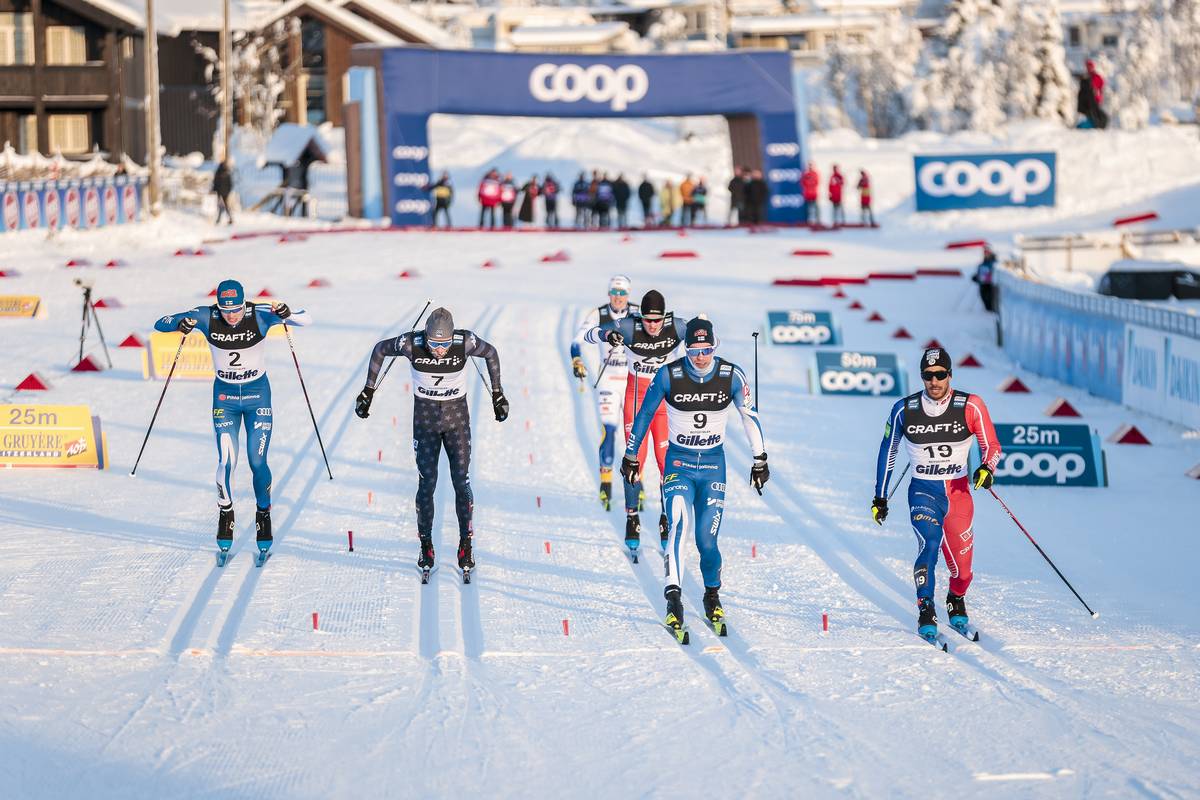
The field hit the final climb with reigning overall World Cup Sprint champion, Richard Jouve (FRA), at the the front of the pack. After his tumble, Golberg managed to scramble gamely back into the field, personifying a stubbornness to restore logical order to the day’s proceedings. This is men’s cross-country skiing in 2022, where Norwegian domination of the men’s podium seems to be a given. As the field entered the stadium, though, two unexpected skiers—one clad in green and black, the other in blue and white—overtook the scene among those vying for podium positions. While Jouve eased across the line for a win, behind him jubilation ensued as Simone Mocellini (ITA) in green and black charged into second, leading Calle Halfvarsson (SWE) in blue and white who claimed third. Something new, indeed.
The men’s final in the finishing strech. Richard Jouve (FRA) (R) over Simone Mocellini (ITA) (L) (Photo: Nordic Focus)
Thus it was that a day where pre-race expectations for new-comers to gain a foothold in the World Cup sprint field crescendoed (note the verb) at a finish line marked by an ebullient Italian celebration recalling the days of Maurilio De Zolt and Marco Albarello.
The promise that there might be new faces at the front of today’s race stemmed from the fact that the only certain sprint contenders in this current era of skiing—Johannes Hoesflot Klaebo (NOR) and Federico Pellegrino (ITA)—were both absent, the former due to illness and the latter due to a desire to “recharge the batteries”. Accordingly, the day provided early indications of a more wide-open field. In the first quarterfinal, the top qualifier on the day, France’s Jules Chappaz, was outsprinted by Golberg and Even Northug (NOR) in a late race push where the Norwegian pair took the inside line on the hill leading into the stadium and simply outran everyone. That successful inside move would become a trend, and one of that strategy’s most effective practitioners was Ben Ogden (USA), who was the only American to advance to the heats (he qualified 7th). Skiing in the fourth quarterfinal, Ogden claimed the inside lane going into the rolling downhill that marked the first 500m of the course, and stayed in control as the field swept into the first climb of the day. This junction—later the site of Golberg’s fall—saw the field narrow into tracks, and in Ogden’s heat saw another Norwegian favorite, Haavard Solaas Taugboel, get tangled. Ogden was behind the fall, side-stepped it, and remained in touch with the field as they crested the climb. Entering the last climb, he pushed to the inside and outran Michal Novak (CZE) and Renaud Jay (FRA) to advance to the semi-finals.
The quarterfinal heat offered the latest sign of Ogden’s growing poise and comfort in sprint heats, and one in which he also possessed the most definitive punch of the whole bunch.
Ogden advanced to the second semifinal, where he joined the seasoned duo of Jouve and Joni Maki (FIN) alongside a youthful contingent of Niilo Moilanen (FIN), Michal Novak (CZE), and Anton Persson (SWE). Jouve used the race as a test-drive for his winning strategy on the day, taking control of the race on the first climb before delivering his final push on the next. Maki mirrored Jouve throughout the race, while Ogden was initially forced to the front before settling back and making a final storm on the last hill. Notably, on the hill, Ogden was again a powerful force running into a position equal with Jouve as they entered the stadium; however, Ogden faded slightly in the final sprint, while Maki came up to claim the 2nd place spot behind Jouve. Ogden’s finishing time was not fast enough to earn a lucky loser’s position in the final. He finished a very impressive seventh on the day.
Friday’s second semifinal featured Richard Jouve (FRA) (R) taking the win over Joni Maki (FIN) (2nd from R) and Ben Ogden (USA) (3rd from R) (Photo: Nordic Focus)
The other semi-final saw Golberg play out his strategy, following from the gun, staying out of trouble until the final climb, and then marking Lucas Chanavat (FRA) over the final climb into a 2nd place spot in the heat.
In that semifinal sprint, what seemed like a forgone conclusion with Golberg’s straight line speed was interrupted by a boot throw from the next lane over. It was Calle Halfvarsson, who ended up taking the first lucky loser spot. Behind him, Simone Mocellini powered into 4th place and the second lucky loser spot. The pair had mirrored Golberg, earning further opportunities to face him in the final.
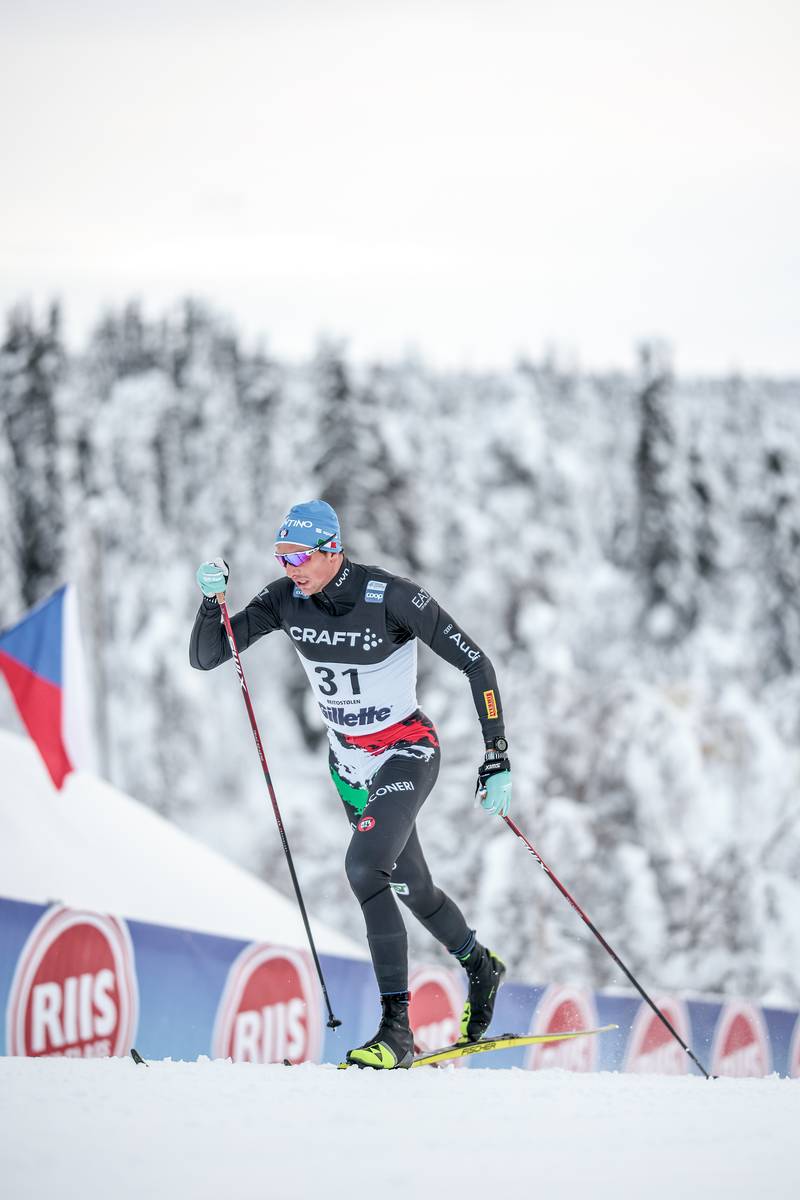
Simone Mocellini, the young Italian who ignited hopes for his country’s skiing future with a 2nd place finish today. (Photo: Nordic Focus)
In retrospect, their placement behind the yellow bib concealed Halfvarsson and Mocellini’s potential in the race to come. That potential was realized in the final when Golberg went down, Mocellini surged, and Calle Halfvarsson drove forward to step onto a podium for the first time since Seefeld in 2018.
Simone Mocellini, the young Italian, offered up a scene reminiscent of old times when talented Italians could upset the Norwegians on their home soil: hardcore ski fans may recall the Lillehammer Olympics Team Relay in 1994. The Norwegians surely will. Whether today was an introductory phrase or an early coda, however, will be up to Mocellini, the conductor at the heart of the jubilant orchestra that greeted him at the finish line today.
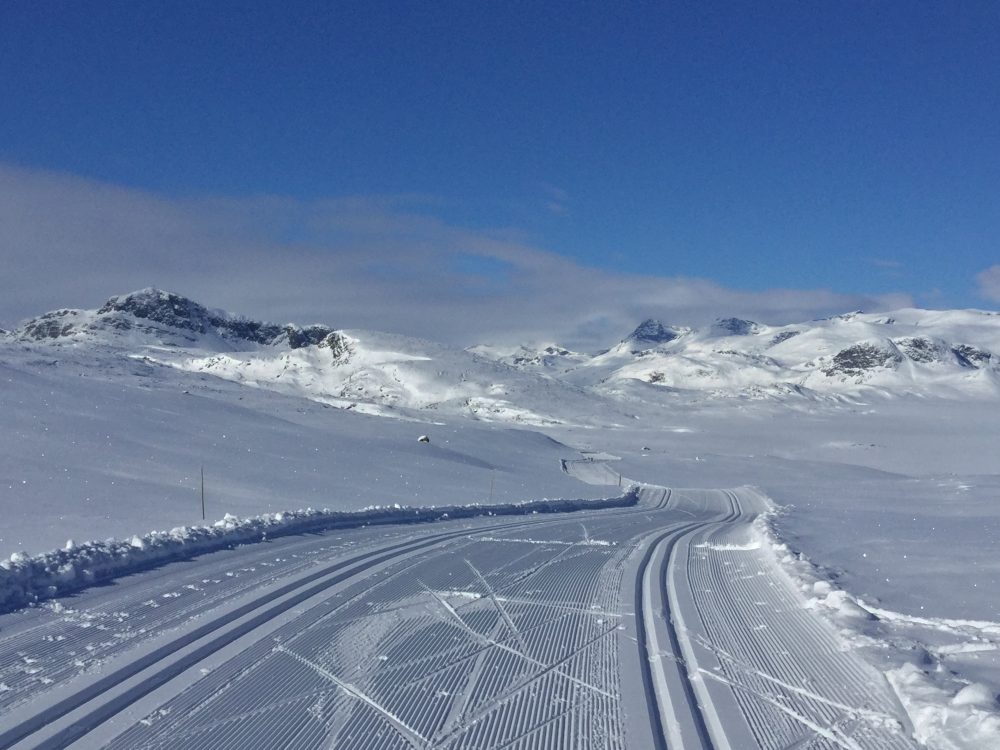
Mountain views on the ski trails above Beitostølen, Norway, in March 2019. (photo: Gavin Kentch)
Editor’s note: John Wood is a septuagenarian racer who lives in Eagle River, Alaska, outside of Anchorage. Four years ago he wrote a first-person Masters Mind piece for FasterSkier detailing his return from a full knee replacement to winning his age group at the American Birkebeiner classic race 18 months later. This article provides an update on what happened next, including competing at the 2019 Masters World Cup in Beitostølen, Norway, following a second knee replacement.
This article is part of FasterSkier’s Masters Minds collection, an occasional series of dispatches from skiers aged anywhere north of 30. Are you a masters skier who loves your club? Submit camp or training recaps, announcements, or stories to info@fasterskier.com with the subject line “Masters Minds.” Articles can be first-person accounts, or written from an observatory standpoint with comments from others.
* * *
By John Wood
I have skied three competitive cross-country relay races in my life.
The first was at the 1965 Junior Nationals in Bend, Oregon, where I represented the Alaska Region. The second was at the 1989 U.S. Masters National Championships in Telemark, Wisconsin, where I also represented Alaska. The third, when I was 71 years old, was this March at the 2019 World Masters Cross Country Championships in Beitostølen, Norway, where I represented the USA in the M9 age class for skiers aged 70–74. A fact unknown to my international competitors in Norway was that I was skiing on two recent total knee replacements, which is the rest of this story.
In April 2015, I wrote an article in FasterSkier explaining how my right knee wore out, was replaced in 2013, and how I recovered and won my age group in the 2015 American Birkebeiner. In early summer 2015 I was feeling really good about my recent Birkie and decided that I should “defend” my age group win. So I signed up for the 2016 Birkie and made my travel and housing arrangements.
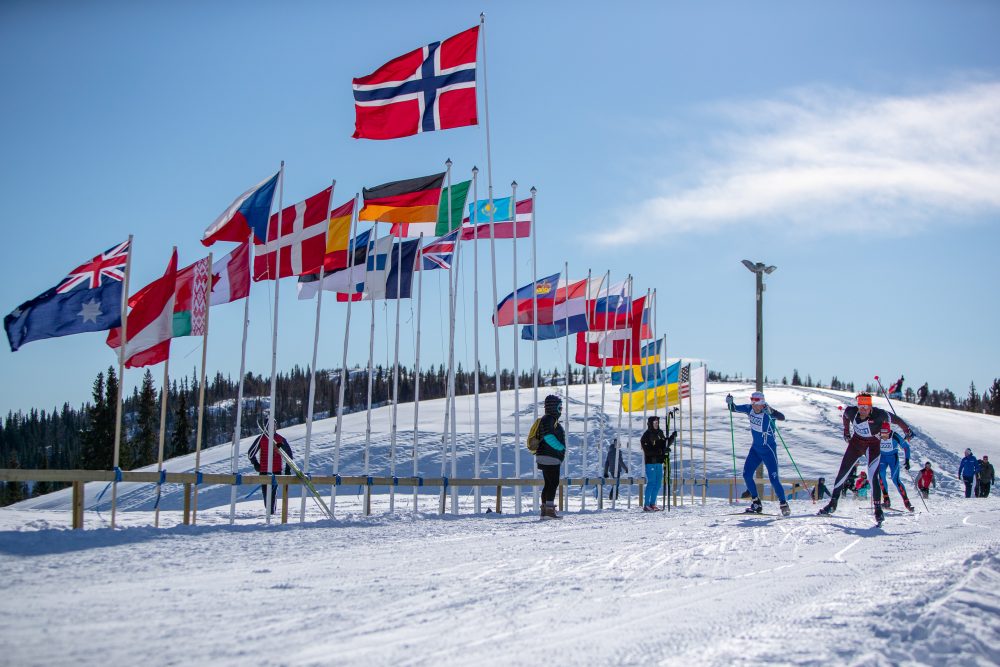
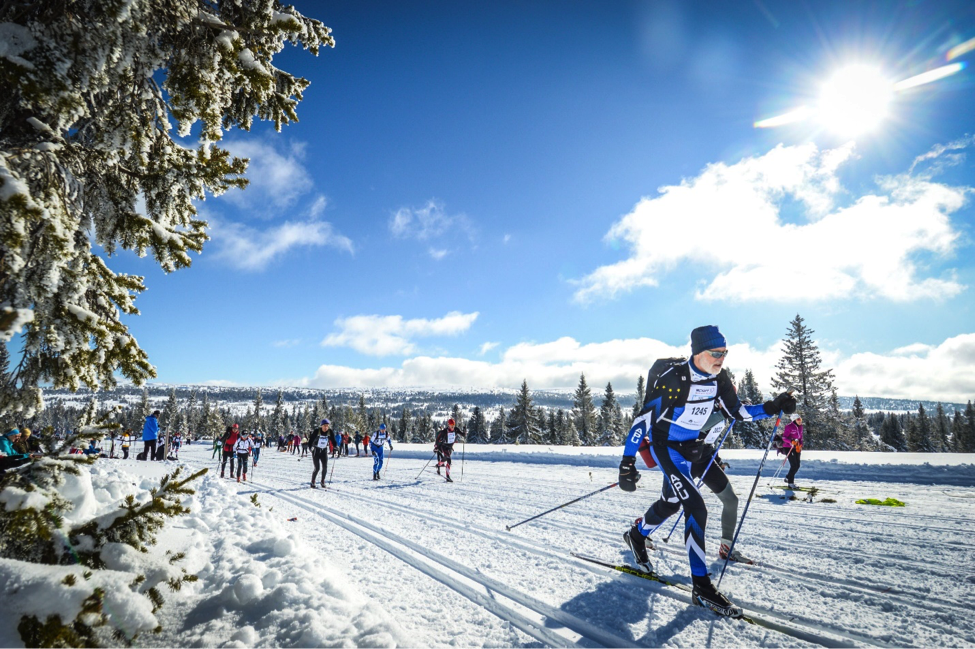
Aleksandr Pushkarev of Russia (left) leads Marco Mosconi of Italy (right) and Christophe Blanchet Nicoud of France (rear) past the flags at the edge of the stadium as they approach the finish line in the M4 10 k freestyle race at World Masters in Beitostølen, Norway, in March 2019. (photo: courtesy MWC 2019)
As the summer progressed and turned into fall my left knee, which I had relied upon for all of those years that my right knee was bad, now had to “keep up” with my new artificial right knee that could go like gangbusters while participating in such activities as hiking, rollerskiing, and snow skiing. My doctor had told me prior to my right knee replacement that my left knee was also pretty much worn out and would also need to be replaced at some point in the future, and he was right! Over about a month it began to swell, click, and generally make my life miserable. Doctor Eli Powell at Orthopedic Physicians Alaska in Anchorage confirmed my suspicions, and we scheduled surgery on the left knee for January 2016. My Birkie plans went out the window.
Dr. Powell’s total replacement of my left knee with a Stryker “Triathlon Total Knee System” on January 14, 2016, was uneventful from a medical point of view. I was discharged two days later, and my life on two artificial knees began. First order of business was surgery rehab.
Initially, the recovery path paralleled my right knee replacement 2 1/2 years earlier. I quickly progressed from full-time crutches, to part time, to no crutches at all by day 23. An interruption came when I was jolted awake by a magnitude 7.1 earthquake in the middle of the night on day 11. As I tried to jump out of bed my wife literally pushed me back down, afraid I would stumble and fall in my medicated/disoriented state. Fortunately, the violent shaking duration was short and our house undamaged.
Physical therapy progressed smoothly, and I reached the gold standard of a 120-degree knee bend on day 30. Other milestones followed in succession: first 15-minute outside walk, first drive to town, suspension of pain meds, and, blessedly, a full night’s sleep. I did my first half-hour ski on level ground on day 67, and was discharged from physical therapy on day 68.
As the days went by, the soft tissue surrounding my left knee and atrophied leg began to strengthen. Some days felt better than others. My left hip began to protrude, the first visual lingering effect of a body imbalanced and overcompensated by long-term bad knees that had finally been corrected. I experienced lingering aches and soreness in the left knee area after exercise or just standing around. I began to resort to an over-the-counter knee brace. Over the course of the summer the puffiness in the knee gradually decreased, as did my knee brace use. At about 9 months post-surgery I was able to complete a 3 hour hike up and down Mt. Healy with my 10-year-old grandson.
When snow came in November and I returned to skiing, using a knee sleeve and compression tights, I experienced a knee “sting” that would dissipate in the evening. At my one-year post-op visit, the doctor said that my x-rays looked great, and I was discharged. I received the usual advice that I could participate in all the physical activities that I wanted, except for contact sports and running, and that pain and discomfort should be my limiting guide. I was further counseled that my residual pain should recede, and I should try to function with minimal knee support.
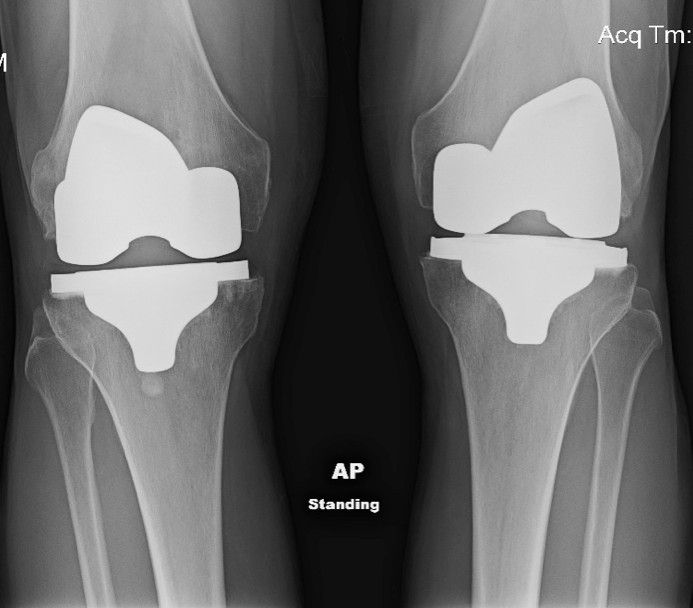
X-ray image of John Wood’s knees one year after left knee replacement. (courtesy photo)
For the rest of the 2016/2017 winter I competed in a couple of my favorite local ski races, although fitness was an issue. Also, I experienced lapses in proprioception caused by my knee’s replacement – I would plant a pole on a ski and suddenly fall.
In April 2017, about 15 months after the replacement, I begin to see Dr. Zuzana Rogers, P.T., to receive treatment for lingering body imbalances, proprioception issues, and muscle pains in my left knee area. Dr. Rogers skillfully diagnosed the root cause of most of my problems and devised specific physical therapy routines as treatment.
During the period from summer 2017 till spring 2018, I continued to recover from the lingering effects of surgery and long-term body imbalances. My strength was slowly coming back, although much slower than with my previous right knee replacement. I discovered that my body’s immune system was not as stellar as it was prior to the two knee replacements. I was now susceptible to all the garden variety colds and flus that I never used to get. Through trial and error I discovered that a good antidote was to stay more rested by taking one or two days per week off from systematic training. In other words, train smart!
In early April 2018, my wife Cathy strongly encouraged me to enter the 2019 World Masters Cross Country Ski Championships (“WMC”) to be held in Beitostølen, Norway. I decided if I am ever going to enter the WMC, I might as well go to the birthplace of cross-country skiing and compete with the world’s best!
I immediately contacted John (J.D.) Downing, American Cross Country Skiers (AXCS) national director, and signed up to be part of the United States contingent for Beitostølen. This enabled me to take advantage of all of the AXCS trip planning such as housing, meals, and all of the racing logistics. With the help of APU Masters coach Galen Johnston, I developed a training program based on about 450 training hours per year (I had loosely been doing about 350 hours per year prior to coping with knee replacements for the last five years), and integrated solo training alongside three formal group workouts a week with the APU Masters group.
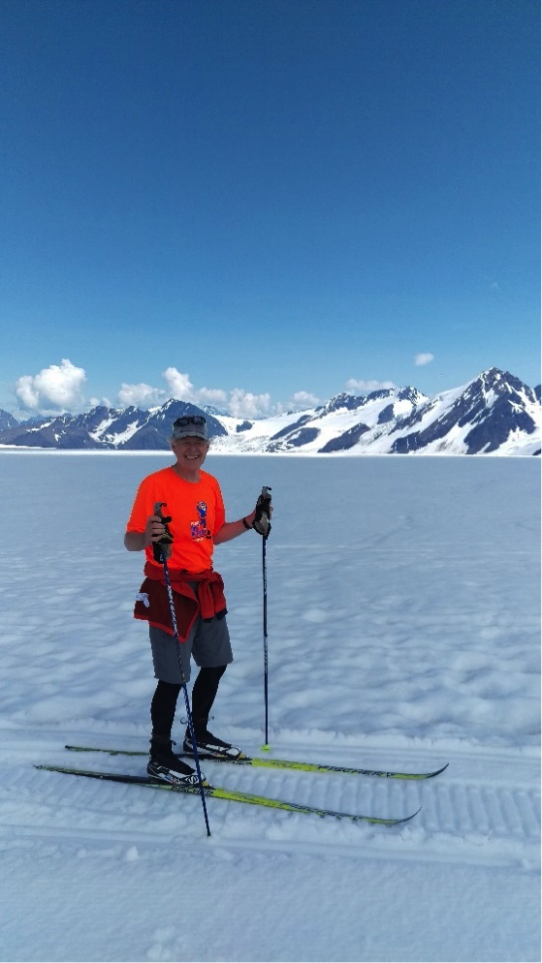
John Wood at APU Masters Eagle Glacier Camp, Alaska, in July 2018. (courtesy photo)
Galen and I tried to design a program that worked within the challenges imposed by two artificial knees. With swelling and aching no longer a problem, we tried to place an emphasis on fitness and ski-specific strength. Sometimes my knees would feel cranky and tell me to take an extra day off or dial back on the intensity of my workouts. I needed to further balance my training hours with weather fluctuations, family commitments, and rest. This often involved walking a fine line!
My typical summer training week was one day of strength and four or five days of a combination of hiking with poles, modified ski bounding, rollerskiing, road biking, and mountain biking, including one intensity session per week. I attended a four-day APU Masters Eagle Glacier training camp in July. [Ed. note: Or, as it happened, a five-day training camp, after all the athletes were weathered in for an additional 24 hours due to high winds.]
On-snow training began on October 30, 2018, following the first substantial snowfall in southcentral Alaska. A typical on-snow training week consisted of one day of strength and four or five days of skiing, one of which was intensity. Overall, early-season snow conditions in the area were pretty good. Local racing started in December; I competed in six events ranging in distance from 5 to 30 kilometers, and the results were encouraging. My training continued to go well, and by March I was as fit as I was going to be!
During the middle of the winter Zuzana Rogers also helped with a final tune-up of my body imbalances and proprioception issues, which had improved substantially over the last year.
As World Masters approached, the scope of the event took shape. There would be about 1200 competitors from 28 nations in attendance and about 120 competitors in my M9 age group. Two other “younger” skiers from my APU Masters group were also going, as well as about a dozen other Alaskans.
At the advice of APU head coach Erik Flora, I arrived in Norway a few days prior to the AXCS main 200-person contingent in an effort to get my body used to the 10-hour time change from Anchorage. Night was day and day was night!
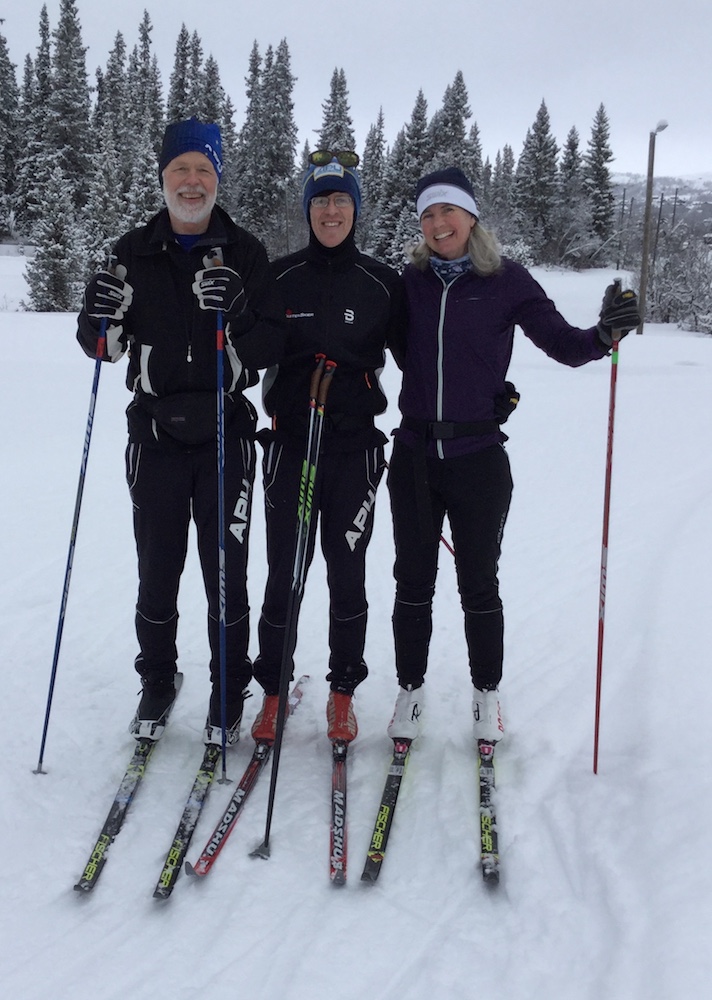
From left, APU skiers John Wood, Gavin Kentch, and Shannon Brockman on the course at World Masters in Beitostølen, Norway, March 2019. (photo: courtesy John Wood)
The “resort” town of Beitostølen is in the foothills at about 3000 feet in elevation, and is at almost precisely the same latitude (61 degrees north) as Anchorage. The town’s official permanent population of 400 annually hosts World Cup or FIS-level competitions, and seemed to seamlessly accommodate the thousand-plus athletes of the WMC contingent that descended upon it in early March. It seemed like all 200 American skiers were staying at or near the Radisson Blu hotel in central Beitostølen and eating meals there, and it was fun to see and chat with my fellow American teammates every day.
February weather in Beitostølen had been quite warm, and the snow had settled to a hard, dirty snowpack. Fortunately, the weather changed literally as my bus drove into the Norwegian mountains out of Oslo and it began to snow. It continued to snow almost daily for my entire 18-day stay, creating great skiing and easy wax conditions.
My first competition was the 15-kilometer classic race. Because of my results in the 2015 American Birkebeiner classic, I had a few “seed” points that put me ahead of other first-time racers, so I was able to start in the front third of the M9 chevron.
As 56 competitors assembled prior to race start it was hard not to be intimidated by the number of fast-looking, spandex-covered skiers speaking foreign languages. Many were veterans of previous World Masters races and friends with each other, and I couldn’t understand a word of what they were saying! But, even though I was a World Masters rookie, I was excited because I was finally going to test my fitness level and new knees against the world’s best M9 skiers.
After the starter’s gun went off it was a mass sprint for the stadium end and start of the double-track racecourse. My APU Masters group had been working on race warmups and starts, so I felt well prepared to surge. I ended up in a good position at the end of the stadium, but was immediately engulfed by a wave of skiers heading onto the trail at an all-out race pace effort.
Our club has a loose motto of “no guts, no glory,” so I too headed off at a crazy fast-paced tempo trying to stay in the mix of front skiers. I soon realized I had to back off a bit and ski within myself, work my technique, and ski to my strengths. At every change in terrain I would mentally check my knees, then check the technique, and finally the effort. Did I need to back off, maintain, or crank it up?
The 15 k racecourse consisted of three separate 5 k loops and was covered with skiers from the M7 and M8 races, as well as some stragglers from the day’s first six races. Some skiers were faster and some slower, and in my maximum-effort tunnel vision it was impossible for me to tell how I stood in my age group wave. Near the end of the race there were some long, steep uphills, where I passed a number of skiers. I later learned that I had ultimately finished in eleventh place in the M9 race, one second out of tenth.
Wow! What an effort at a crazy fast pace, and the knees came through in fine shape! Those front guys sure could ski fast! I kept asking myself what was I doing wrong that I couldn’t keep up? [Ed. note: Wood was the top American in this race, by nearly five minutes. His finish in the 15 k classic was the single best percent-back performance by any of his APU Masters teammates in the entire race series.]
After coming off that emotional high it was time to rest – eat – rest some more, and mentally prepare for the next event. Everybody in the USA contingent had a race story to tell and it was fun to compare notes. We were all in awe of the high level of competition and the continuous all-out effort needed to be competitive. European guys and gals play for keeps!
Two days later I competed in the 10 k freestyle race. I have only been able to really skate ski since my second knee replacement, and had no illusions. My technique was sketchy but improving, and I figured that since I was at the WMC I should compete in a skate race. My goal was to have a clean run with maximum effort, regardless of finishing position.
As the race began, skis and poles were flying everywhere so I let the fast guys go by and settled into a sustainable rhythm. Nearing the end of the race, after successfully negotiating a sharp turn at the bottom of a screaming downhill, I felt I was doing pretty good and congratulated myself on a job well done. Time to transition from V2 to V1 and drop the hammer on the last uphill into the stadium. Out of the blue, proprioception struck. I planted my right ski pole on my right ski, and went down in a heap! I had been skiing at the head of a loose pack of five, and suddenly found myself in the middle and out of steam. Needless to say, I finished at the back of the group in 24th place.
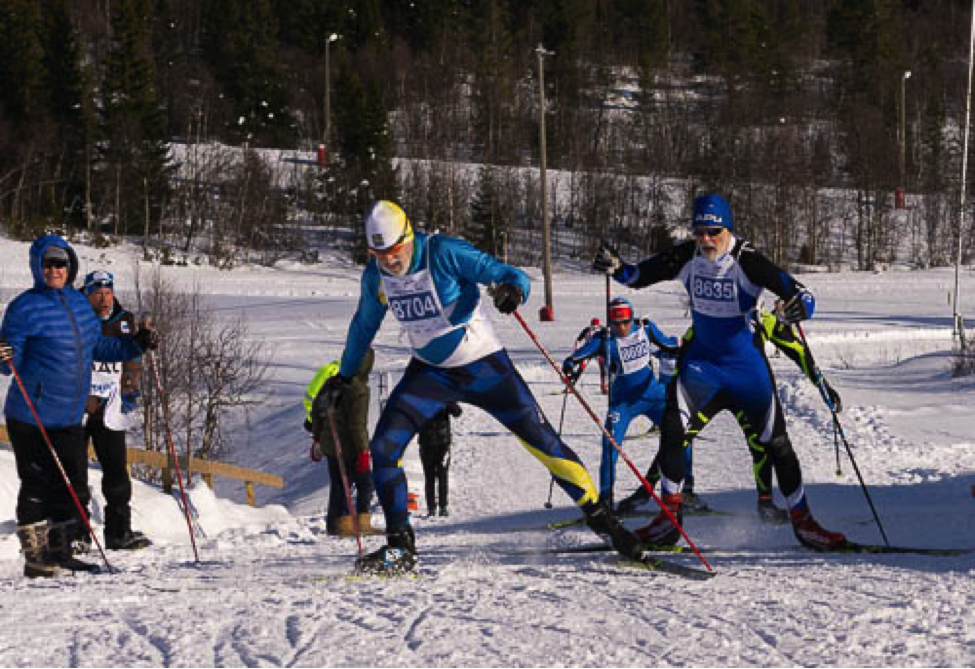
APU skier John Wood (bib 8635) coming up the final hill into the stadium after an ill-timed fall, 2019 World Masters, Beitostølen, Norway. (courtesy photo)
I had qualified with Team USA to ski either classic or skate in the relay midway through the race week, but quickly removed my name from consideration for the skate leg. Didn’t want to have more proprioception difficulties in the relay with three teammates counting on me!
JD chose me to ski the scramble leg, which was the first of two classic legs in the 4 x 5 k relay. At our team meeting prior to the race, my teammate and World Masters veteran Phil Mahoney confided to me that I should not feel bad if I couldn’t keep up with the pack since the world’s best M9 skiers were also skiing in the scramble leg. I was a bit intimidated, but this was why I came to World Masters, to compete with my age groups best, and I was determined to give it my all! Fifteen skiers representing fifteen teams (between M9 and M10 combined) were in my wave start, and when the gun sounded the adrenaline hit and off we went!
I was third at the end of the stadium and maintained fourth through most of the 5 k lung-burner. Approaching the stadium, in spite of JD’s vociferous cheering, I slipped a couple of places and tagged off to Phil 25 seconds out of third. I was so spent that I just about fell over. My knees did great; during the race, I never gave them a thought. Just all-out racing.
The next morning, I discovered that the light cold I had developed had turned into a nasty head cold that left my nose running like a spigot. My immune system apparently couldn’t take the stress of back-to-back top level competitions. I skipped that day’s 30 k classic race and hoped an extra day’s rest would help me feel better for the 55 k Norwegian Birkebeiner, three days later and a couple hundred kilometers away.
On the morning of the Birken, my cold symptoms seemed minimal and I felt better. As my 70-and-older wave started, I went out with the lead group up the initial 10 k sustained climb heading out of Rena. Big Mistake!! I ran out of gas after about seven kilometers, my nose started flooding again, and I was forced to ski at what seemed like a crawl until about 17 k to go, when I picked up after drinking a cup of Coke at a feed station. I skied conservatively on the long downhills approaching Lillehammer, since I was unfamiliar with the course and didn’t want to fall. Boy, was I happy to cross the finish line, and was really surprised when I learned that I had finished in the top third of my age group.
APU skier John Wood (right foreground) roughly midway through the Norwegian Birkebeiner, March 2019. (courtesy photo)
After a day of recovery in Lillehammer I returned to Anchorage, a 27.5-hour trip home. My World Masters adventure had concluded and my new knees came through with flying colors. I had met my goals of being first American and in or near the top half of my age group in all 4 races. As icing on the cake, in three out of the four races I was the first North American skier in my age class.
It’s now summer in Alaska, the snow is gone, and the skis are put away. It’s time for mowing the grass and paddleboarding in the lake. And it’s time for reflection. Having your knees wear out and being replaced doesn’t necessarily mean the end of a person’s lifestyle. It’s all about knowing and understanding the limits of your new knees and working within these limits. Do what you want to do.
It would be fun to do the World Masters Championships again someday. I now know that my new knees are not my limitation. Maybe I could figure out a way to tweak my training to take my performance up a notch. Maybe my competitors would get old and slow down a bit. Maybe, maybe…
John is a 72-year-young master skier who has lived in Alaska since before statehood. He has competed in cross-country skiing intermittently since being introduced to the sport at age 16 while in high school by the legendary coach and skier Dick Mize.
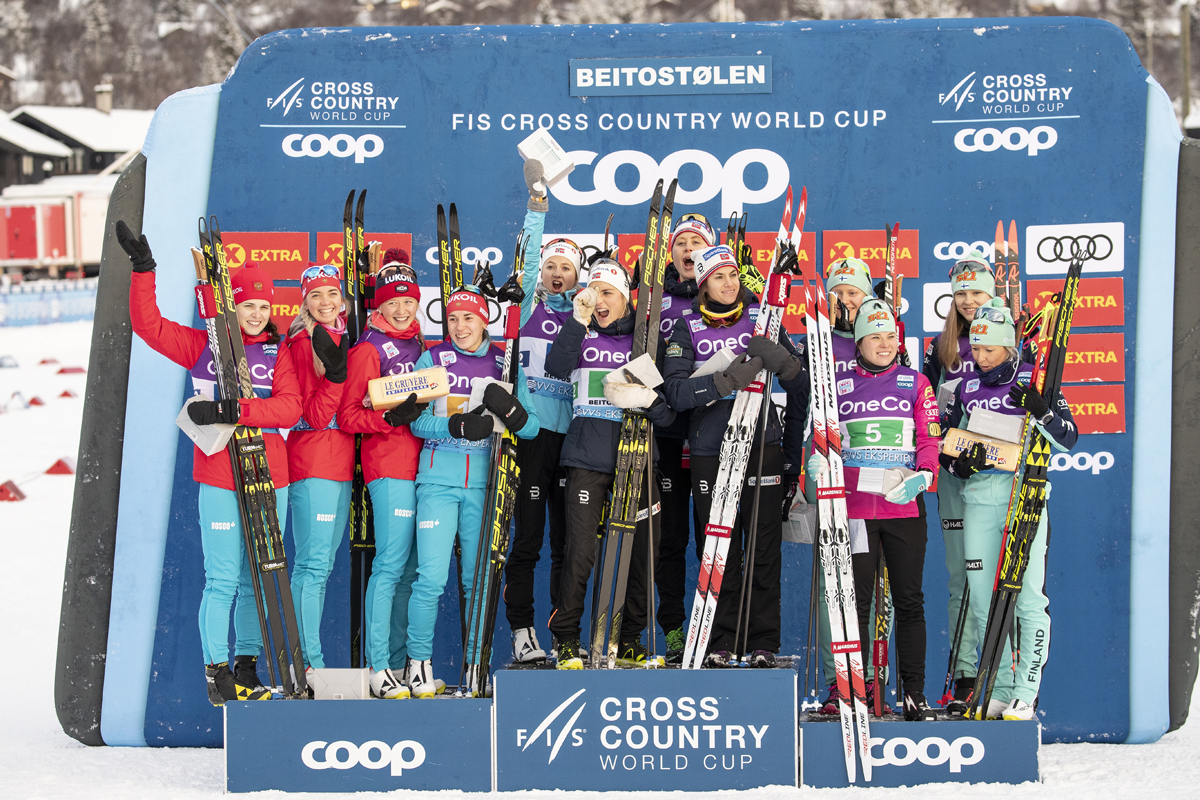
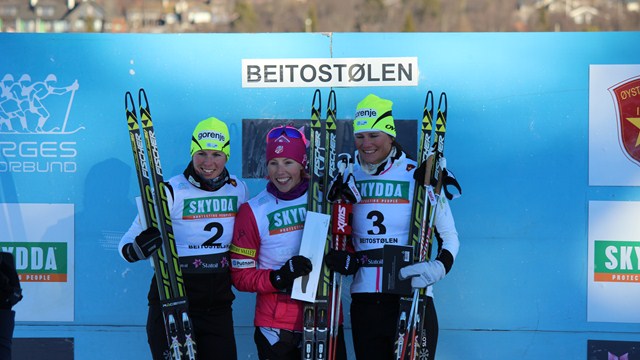
The women’s podium from the 4 x 5 k relay in Beitostølen, Norway. Norway I (center) placed first, Russia II (left) was second, and Finland I (right) third. (Photo: Fischer/Nordic Focus)
For Norway, relays are often tallied not by wins, but how many wins have been missed. Back in 2009, Team Norway watched on as Team Sweden took the top spot of the podium for the women’s 4 x 5-kilometer relay event in Beitostølen, Norway.
In the nine years after that second place finish in Beitostølen, the Norwegian women’s team has missed winning the World Cup relay–excluding team sprints–only one other time (FIS reports that as having been in 2011, when Italy won the Rybinsk, Russia 4 x 5 k).
This December marks the first time Beitostølen has hosted a World Cup race since the team, back then comprised of Vibeke Skofterud, Therese Johaug, Kristin Strørmer Steira, and Marit Bjørgen, placed second in 2009. Though the goal of top relay performances has not changed, changes within Norway’s team itself are palpable.
Skofterud passed away this summer after a jet skiing accident. Strørmer Steira, married to Canadian Devon Kershaw, retired in 2015. Bjørgen announced her retirement last spring. Johaug served an 18-month ban from ski racing and came back to competitions this year. She is the only name to return to the relay team and Beitostølen since the city last hosted World Cup competitions nine years ago.
Sunday’s win marks if nothing else, Norway’s reclaiming of what they see as theirs.
“It’s really nice to have a race in Beitostølen we have a lot of good memories here – all of us,” Johaug said during a FIS post-race interview. “We all did a really good job today and its beautiful to ski with these ladies.”
Norway’s Heidi Weng (left) and Sweden’s Evelina Settlin (right) lead the women’s 4 x 5 k relay train Sunday in Beitostølen, Norway (Photo: Aleks Tangen)
Taking out the Norwegian’s first classic leg was Heidi Weng. Weng hung tightly to the front group until around 3.5 k, when Sadie Bjornsen of the U.S. Ski Team and Russia’s Team I, leg one skier, Yulia Belorukova, began to push the pace.
By the time the women came through for the first exchange, Belorukova and Bjornsen had put a 7.3 second gap on Weng and a 13 second gap on the chasing teams’ skiers, Lidia Durkina of Russia II and Anna Svendsen of Norway II.
“At the beginning, when I was leading, I felt like it was pretty clear that those girls were going to stay in a mass behind me,” Bjornsen told FasterSkier during an in-person interview after the race. “So I tried to stay near the front…then [I said] ‘I’m going on attack mode on the second-half because maybe I can break some people then,’ and it worked out.
“It was a little frustrating to have some people stick in there that I wanted to break harder,” Bjornsen added. “But it was nice to have Belorukova to work back and forth with to push all the way to the end.”
Sadie Bjornsen of the U.S. Ski Team followed by Norway’s Heidi Weng during the women’s 4 x 5 k relay in Beitostølen, Norway (Photo: Fischer/Nordic Focus)
At the start of the second classic leg, it was Natalia Nepryaeva skiing for Russia I in the lead, followed by Rosie Brennan of the U.S. less than a second back positioned in second. The second classic skier for Norway I, Johaug, was positioned 8.2 seconds back through the first kilometer. Chasing down the top-three, 20 seconds back, was Astrid Uhrenholdt Jacobsen skiing for Norway II in fourth, and Russia II’s skier Anna Zherebyateva in fifth.
Within the next kilometer and a half, Johaug had closed the 8 second gap separating her from the U.S. and Russia I. By the race’s 8.5 k mark, Johaug was up on Brennan by almost 14-seconds and looking ready to bury Nepryaeva, who lagged just 1.4 seconds behind the Norwegian.
As Johaug came into the stadium to tag off to her teammate Ragnhild Haga for the first freestyle leg, she was alone. Nepryaeva skied in 9.4 seconds behind Johaug to hand off to Anastasia Sedova. Along with Johaug, Brennan had also been passed by Russia II’s Zherebyateva, Norway II’s Jacobsen and Finland I’s Krista Pärmäkoski having dropped down to sixth, handing off to Caitlin Patterson 29 seconds back from the race leader.
Therese Johaug of Norway leading the U.S. Ski Team’s Rosie Brennan during the 4 x 5 k relay in Beitostølen, Norway (Photo: Fischer/Nordic Focus)
“I’m a little frustrated, I think I have more to give than I did today, I struggled a little bit with my skis, maybe I didn’t have my top form, but it was something to work with and a good starting place, so hopefully I can make some improvements,” Brennan told FasterSkier.
“I mean, I think I skied fairly even, I think it’s just really hard to ski by yourself out there, there was a lot of drafting,” she continued. “Once you’re on your own it’s easy to get swallowed up by the next pack, so hopefully next time I won’t be on my own, I’ll stick with the leaders.”
In the third leg, Haga held onto the lead by a 15 second margin for most of the 5 k. By the time she came through for the final exchange, Haga had 11.6 seconds on her closest challenger, Sedova. Thanks to a hard push from Finland’s Pärmäkoski in the second leg, the Finish Team I’s third skier, Ritta-Liisa Roponen came through the final exchange in third, 0.6 seconds behind Sedova and 12.2 seconds away from Haga.
Patterson had maintained the sixth position, handing off to the U.S.’s anchor leg, Jessie Diggins 53.9 seconds back from the race leader, Norway I.
“This is the first time ever that I’ve been on the relay; I’ve been on a few little team sprints here and there, so this is pretty sweet,” Patterson told FasterSkier. “In my own performance, I can see a lot of potential for improvement…I could see so many people up in front of me, but just didn’t quite have the legs to chase them down, so I see a lot of potential for improvement and you never know on a different day, so I hope I’ll get another chance.”
Caitlin Patterson (right) tags off to U.S. teammate Jessie Diggins during the 4 x 5 k relay in Beitostølen, Norway (Photo: Aleks Tangen)
Taking out the final leg for Norway I, Ingvild Flugstad Østberg held off any challengers and continued to pad the team’s gap on the field. She crossed first for the win in a time of 57:23.6.
Though it seemed as if Russia I were on their way to a podium finish on Sunday, a fall from their anchor Anna Nechaevskaya in the course’s last turn placed them off the podium in fourth (+40.9). Russia Team II’s anchor skier, Elena Soboleva, passed her fellow compatriot to claim second place, 37.3 seconds behind Norway I.
The third and final podium position went to Finland I, with Eveliina Piippo closing out the final leg and finishing 37.8 seconds behind the race winners.
The U.S. placed fifth (+48.0) with Diggins serving as the team anchor.
“It was interesting [be]cause I went out full on sprinting trying to shut down a gap,” Diggins said.
However, Diggins indicated that due to the flat course and the skiers she was positioned with, Sweden’s Ida Ingemarsdotter and Norway II’s Tiril Udnes Weng, she decided to change her strategy.
“So I was charging, but then I realized I wasn’t going to be able to drop the girls I was with…so then, about a third of the way through I just totally changed tactics and went to the back and was drafting, trying to conserve energy, build up my plan for the sprint [to the finish].
“Rounding the corner and seeing Russia [I’s Nechaevskaya] right there, I was like ‘dang it, I wish I had kept pushing super hard,’ I had no idea how close we were going to be. But at the moment I made the best tactical choice I could, which was to beat the group I was with,” Diggins said. “I think it was a really good day and it’s always a good chance to practice those practical decisions and making the right move at the right time.”
The U.S. women’s 4 x 5 k relay team from Beitostølen, Norway. The team of (from left to right) Caitlin Patterson, Sadie Bjornsen, Rosie Brennan, and Jessie Diggins placed fifth. (Photo: Aleks Tangen)
A second U.S. relay team of Sophie Caldwell (USST), Ida Sargent (USST), Kelsey Phinney (SMS T2), and Kaitlynn Miller (CGRP) did not start, as Caldwell is working through “a resurgence of symptoms from the end of her cold.”
“We were very close today on the women’s side,” U.S. Ski Team World Cup coach, Matt Whitcomb wrote in an email to media outlets. “The goal is always to podium. Sadie knew it would be tough to break the lead pack, but her mission was to turn the screws hard. She has a lot of confidence in her fitness right now, and her pace took Sweden out of the podium hunt.”
Sweden ended the day in sixth, 50.0 seconds back from Norway I.
“Rosie’s leg was particularly stacked today, and she did a good job staying as close to the podium as possible on a course with a profile that’s a bit flat for her,” Whitcomb continued. “Today was Caitlin’s first start in a World Cup relay, and she’s an athlete we’ve been wanting to see get some relay experience. While her time was 8th on her leg, not yet good enough for a podium team, she demonstrated that she is close. I’m happy we selected her for the third leg today.
“Jessie was put in a position she thrives in today. Regardless of place, her leg was an invaluable experience to sharpen her relay game,” he added of Diggins’ performance on Sunday. “She was both aggressive and tactical, and had she been only aggressive, we would’ve finished 7th. I was very impressed with her ability to adapt her plan mid-race. I’m particularly excited for her sprint in Davos next week.”
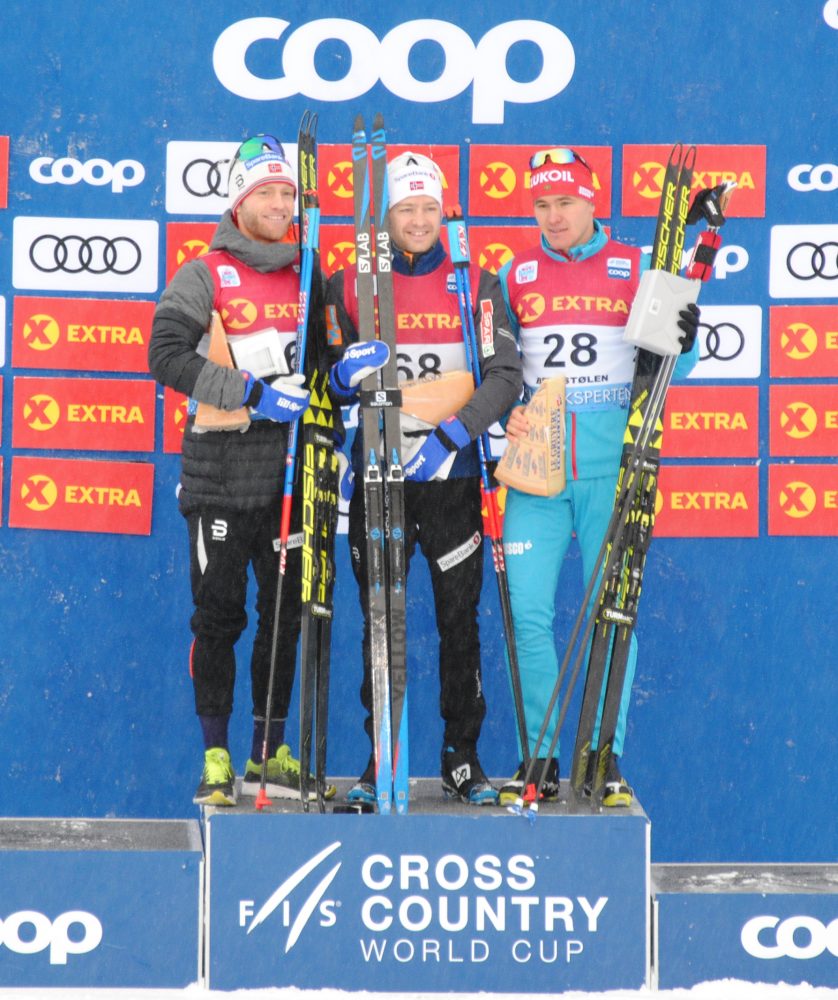
The men’s podium from the 30 k freestyle individual start in Beitostølen, Norway. Sjur Røthe (center) of Norway placed first, teammate Martin Johnsrud Sundby (left) second, and Russia’s Andrey Melnichenko (right) third.
It snowed continuously throughout today’s 30-kilometer freestyle individual Start in Beitostølen, Norway. There was already a great deal of accumulation on the race course by the time the men started. This made the already challenging distance race even more grueling as the fresh snow created more resistance for skiers.
Norway took the top two spots as Sjur Røthe won the with a time of 1:09:53.5. His teammate, Martin Johnsrud Sundby, was close behind in second (+35.2).
“I was pretty proud of myself today,” Røthe told FIS at the end of the race. “I felt pretty good at the start. I was few seconds behind Martin [Sundby] and Didrik [Tønseth] out from the start and it looked like they are doing a sprint today. I felt very confident at the beginning of the race but looking at them taking up a high pace right from the start, I was unsure if I should change my pacing strategy.”
Sundby set the tempo for the first 10 k, outpacing Røthe by just seconds. After the 15 k mark, Røthe took the lead and continued to put time between himself and Sundby. By 25 k, Røthe had a 30-second gap which he preserved for the remainder of the race.
“I had a strong start but felt that between 10 and 20 k, it would be surprising, if some of the other nations would be much better than us,” Sundby told FIS. “We know the course, we have competed here for 10 years so we sure have some seconds in our favor.”
It was Sundby’s best result of the young season and his first World Cup podium of the year. Sundby placed fourth in Ruka’s 15 k classic, missing out on a podium by 10 seconds. Last season, Sundby was the third-ranked World Cup skier in the distance overall.
Russia’s Andrey Melnichenko took third (+49.2). At twenty-six-years-old, this was Melnichenko first career World Cup podium.
“During the race in different splits, I got some information that I was around the sixth place and actually did not expect anything more than that,” Melnichenko told FIS.
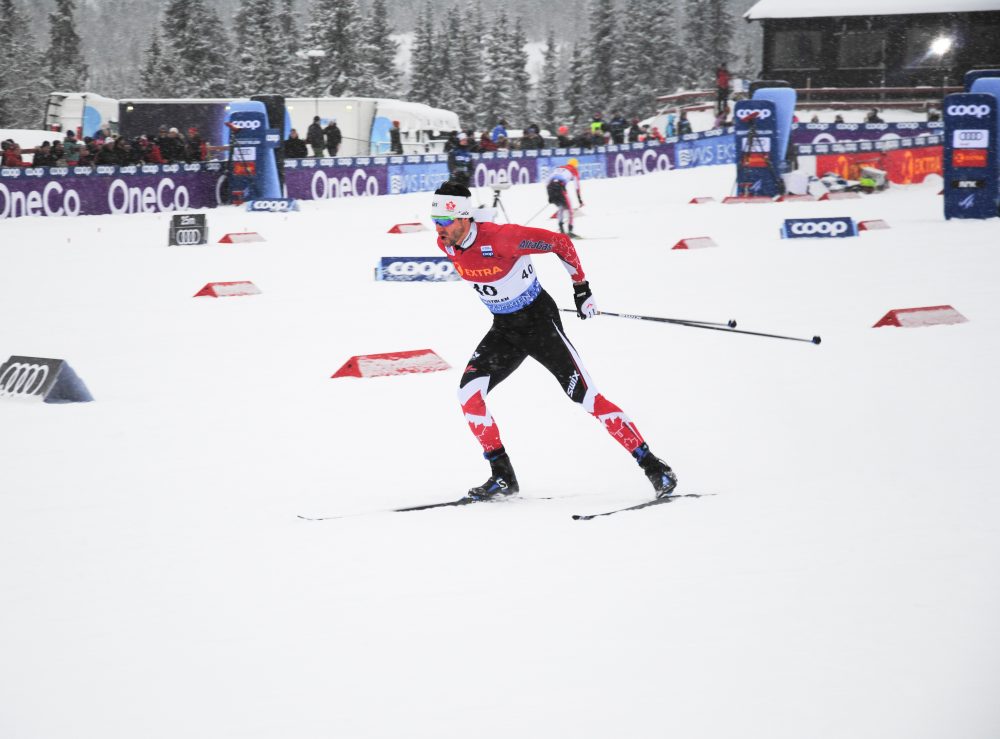
Canada’s Alex Harvey during the World Cup’s 30 k skate individual start in Beitostølen, Norway. Harvey placed 13th.
Alex Harvey of Canada was the first North American to cross the finish line. Harvey finished in 13th (+1:49.8). Harvey has been known to come into form later in the season for distance races, this year he came on strong early in sprinting, placing third in the skate sprint last weekend in Lillehammer.
After 10 k today, Harvey was sitting in 15th, but he continued to fight and was able to gain five places in the next 15 k, putting him in 10th going into the last lap. But, he was unable to hold on as he faded slightly down the final stretch.
Harvey talked with FasterSkier after the race about the tough conditions. “The course doesn’t have much recovery, you have to work the whole time and then the conditions with the snow…there was resistance in the snow the whole way so you have to push on the flats, and on the gradual downhills so you’re always working,” Harvey explained.
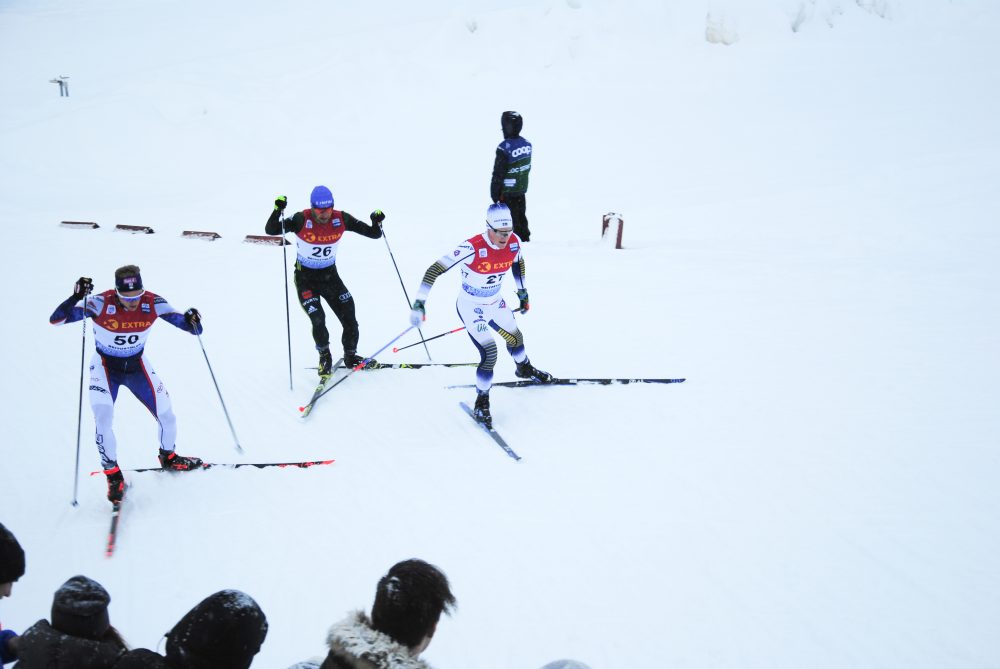
Erik Bjornsen of the U.S. Ski Team (bib 50) during the men’s 30 k skate in Beitostølen, Norway. Jens Burman of Sweden (bib 27) and Jonas Dobler of Germany (bib 26) skied alongside Bjornsen for a portion of the race.
Scott Patterson (USST) was the first American, finishing in 47th (+4:32.7). David Norris (APU) followed shortly behind in 51st (+5:13.3) and Erik Bjornsen was right on his heels, finishing 52nd (+5:14.9). Adam Martin (CGRP) finished 59th (+6:14.8).
After the race, Norris commented on his strategy going into the race,
“My strategy was to put in the first two laps well and then just try to ski smooth and then get on the heels of some fast guys and try to hang in there,” Norris said. “I did that in certain points and struggled to do that at others. I felt like my first lap I went out well and then from lap two to lap five I kind of like hung in there. And then on the sixth lap, felt I like I charged pretty well and finished strong.”
Racing continues tomorrow for the men with a 4 x 7.5 k relay.
Eirik Brandsdal (c) after winning the 2014/2015 World Cup opening classic sprint in Kuusamo, Finland last November with runner-up and teammate Petter Northug (l) and Sondre Turvoll Fossli. (Photo: FIS Cross Country/Twitter)
The men’s 1.5-kilometer classic sprint final on Sunday in Beitostølen, Norway, shaped up quite nicely for the home nation, the only country out of six with any athletes in the final. Even so, the all-Norwegian sprint finalists showed no mercy on one another, as Eirik Brandsdal was all smiles after beating Petter Northug by 0.6 seconds in the final.
For the 29-year-old sprint specialist, race tactics were key to Brandsdal’s win.
“In the finals, I got [what I] desired and planned,” he told Langrenn, according to a translation. “I knew that Pål [Golberg] would go strongly in front and that Petter would lie slightly behind.”
With no no room for hesitation, Brandsdal accelerated up the final rise in order to get in front and sped toward the finish ahead of Northug.
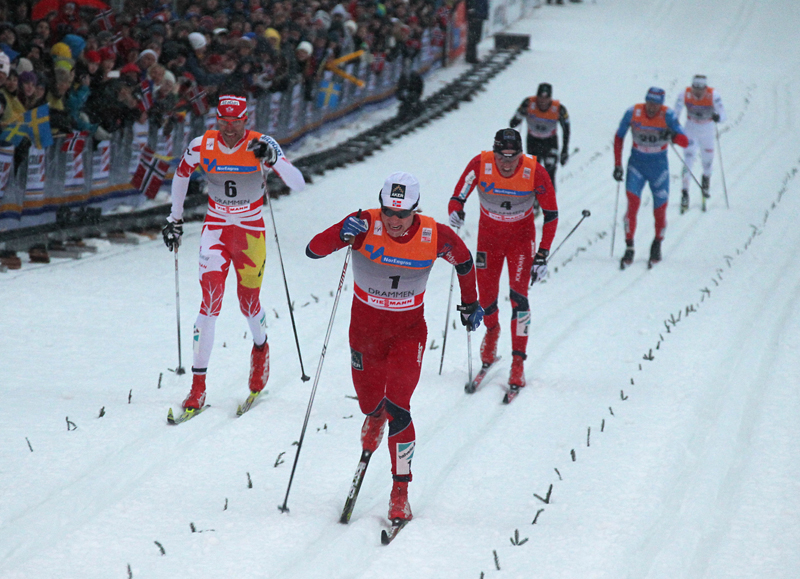
Norway’s Eirik Brandsdal (1) charges to the finish line for a World Cup classic sprint title in Drammen Norway, in 2012. (Photo: Fischer/Nordic Focus)
After he made his move past Northug, Brandsdal recalled thinking one thing, ” ‘Do not look back. Imagine that you have the devil at your heels.’ “
He told Adressa that “It was great to keep ‘the king’ behind [me] and on the run. It only [makes me] look forward to Kuusamo. I guess we have a new challenge there.”
The World Cup season starts in less than two weeks in Kuusamo, Finland.
While Brandsdal won the final in 3:38.3 — the fastest course time of the day — Northug placed second and Pål Golberg was third, 1.2 seconds back.
The runner-up by six-tenths of a second, Northug declined to commentafter the final. Throughout the day, his sprint rounds were nothing short of interesting, starting with his quarterfinal, which Northug won by 0.2 seconds over Norwegian up-and-comer Emil Nyeng, 24. Nyeng (Ringebu-Faavang Skiklubb) won the qualifier to start the day by 1.9 seconds over 23-year-old Sindre Odberg Palm (Spydeberg Il).
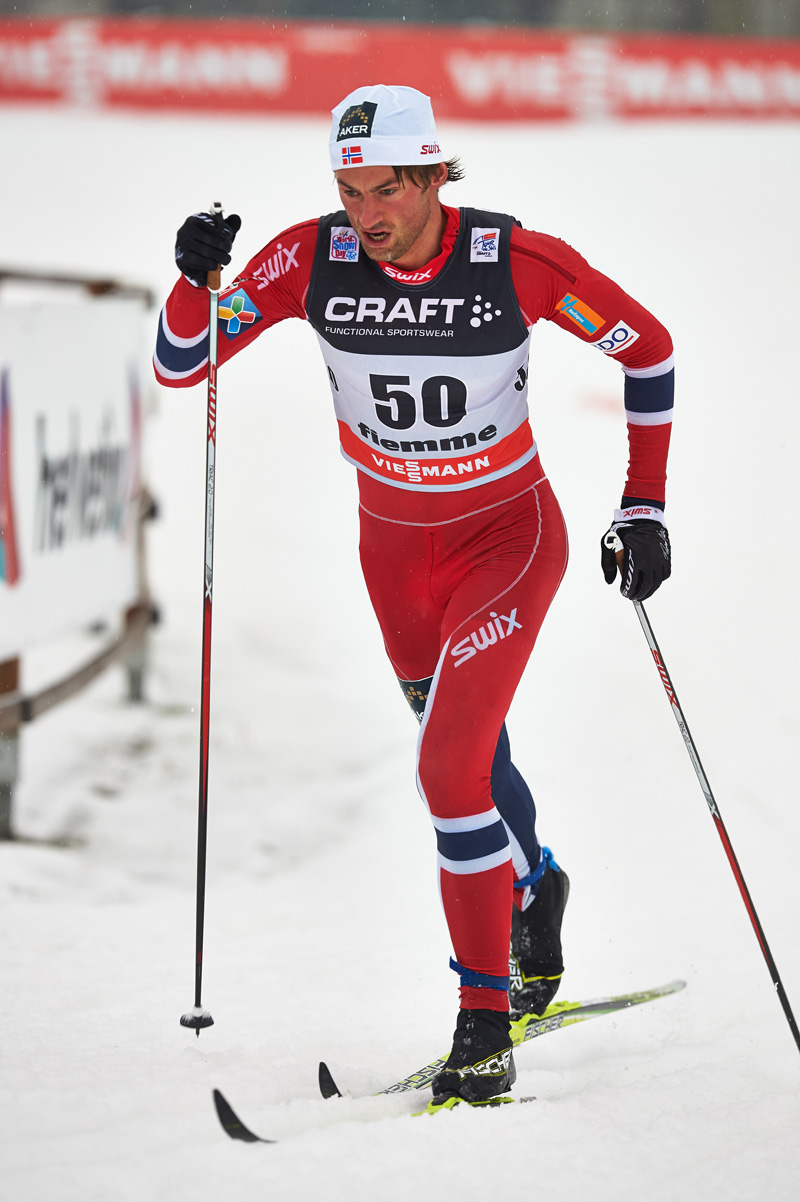
Petter Northug racing in 2014 in Val di Fiemme, Italy. (Photo: Fischer/Nordic Focus)
Also in that quarterfinal, Northug, 29, faced off against his two younger brothers, Tomas, 25, and Even, 20. While Northug and Nyeng automatically advanced in the top two, France’s Baptiste Gros moved on as a lucky loser in third, and Tomas and Even placed fourth and fifth in the heat, respectively.
“I know that I am better than them,” Petter Northug said of his brothers to Langrenn. “I did not choose [to] start as number two, but I gave my place to Even and stood in the second row.”
Northug qualified 11th, Even was 20th in the qualifier and Tomas made the cut in 30th.
The trio didn’t back off the pace, posting the second-fastest quaterfinal heat time. In the end, however, only Petter advanced to the semifinals. There, Northug and Brandsdal raced neck-and-neck to the line, ending in a photo finish for the win. They advanced with identical times.
Previously, Brandsdal, who qualified fifth, topped Golberg by 0.6 seconds to win their quarterfinal.
One name missing from the sprint final was Norwegian sprint specialist Ola Vigen Hattestad, who did not advance past the quarterfinals. Instead, Palm, Morten Eide Pedersen and Martin Løstrøm Nyenget rounded out the final, finishing fourth (+2.8), fifth (+4.9) and sixth (+6.5), respectively.
Ingvild Flugstad Østberg racing to fifth in her first FIS race of the season, the 10 k skate on Nov. 22 in Beitostølen, Norway. (Photo: Inge Scheve)
Ingvild Flugstad Østberg, a 2014 Olympic gold and silver medalist in Sochi, has worked hard at becoming worse. More specifically, the 24-year-old Norwegian national-team member says she’s less obsessed with perfection and more focused on the overall picture.
Ingvild Flugstad Østberg in the mixed zone after the 10 k skate FIS race on Nov. 22 in Beitostølen, Norway. (Photo: Inge Scheve)
“I’ve gotten a lot of training advice through the years, and a lot of it centers around listening to your body and things in that direction,” said Østberg, widely considered one of the up-and-coming stars of the Norwegian women’s team after winning silver in the freestyle sprint at the 2014 Olympics and gold with Marit Bjørgen in the team sprint.
Østberg gladly shared her experience last Saturday after placing fifth in the 10-kilometer freestyle FIS race in Beitostølen, Norway.
“Maybe the best advice I’ve gotten, and something that definitely has stuck with me, is that you have to go for quality over quantity,” she said. “I used to just want to do more and more and more, and thought that would be better, but what you do really matters more.
“I really have to focus on separating hard workouts from easy workouts, so that I don’t end up with everything being somewhat hard,” she added. “Then you don’t have the juice to go really hard when you want to go really hard.
“Go hard when you plan to go hard, go easy when it’s an easy workout, and the more volume you do, the more important it is to distinguish. I can understand that people who just work out whenever they can get to it want to go somewhat hard to feel that they get something out of their workout. But for those who really train a lot, it’s not the way to go,” she said.
“Go hard when you plan to go hard, go easy when it’s an easy workout, and the more volume you do, the more important it is to distinguish.” — Ingvild Flugstad Østberg, to FasterSkier on Nov. 22
Østberg also tries to focus on what she’s doing when she works out.
“Don’t waste your workout time. Think about your technique in every push, every kick and every pole plant, and make them count.”
Ingvild Flugstad Østberg after finishing fifth in her first FIS race of the season, the 10 k skate on Nov. 22 in Beitostølen, Norway. (Photo: Inge Scheve)
Østberg didn’t race the 10 k classic on Friday, but saved her season debut for the 10 k skate, one of her favorite events. She finished fifth and gave herself a passing grade.
“This was a good trial, and I’ve never had my best races here at Beitostølen,” she said. “It’s still very early in the season, and I feel that I have more to offer.”
She hoped her performance Saturday combined with Sunday’s sprint (in which she went on to place fourth) would secure her a spot on the World Cup team the following weekend.
On Monday, the Norwegian national team made its formal announcement, and named as Østberg as one of 11 women on its Kuusamo World Cup team.
Petter Northug racing to 23rd in Saturday’s 15 k freestyle FIS race in Beitostølen, Norway. He was more than a minute behind winner Martin Sundby, then came back to win Sunday’s classic sprint by 0.4 seconds. (Photo: Inge Scheve)
With about 50 meters to go in the men’s 1.5-kilometer classic sprint on Sunday in Beitostøelen, Norway, Petter Northug engaged the turbo and overtook fellow Norwegian Sondre Turvoll Fossli right at the finish line — exactly the way we are used to seeing him: relentless.
“This was OK. I wanted to get a day with four tough sprint efforts and that’s what I got,” Northug, 28, told the Norwegian TV station NRK after the race.
“It’s useful to practice have a chance to practice how to race heats, how to keep your body going between heats and best prepare for the next effort before we’re headed into the World Cup season,” he added. “You don’t really get a chance to practice that off the snow.”
For him, this was simply a drill and part of the prep for the World Cup opener next weekend in Kuusamo, Finland.
Got to let them win sometimes
Fossli, 21, won the qualifier in 3:25.76 minutes, 1.69 seconds ahead of Norway’s Pål Golberg. Northug qualified ninth, 3.38 seconds back from Fossli. And while Northug took the cake at the end of the day, up-and-coming Fossli raced an impressive final, leading much of the way and had a small gap on the field coming into the stadium.
Fossli finished second in his quarterfinal and won his semifinal, and thought he might be able to pull off the victory.
“I had a faint hope that maybe I would be able to keep [Northug] behind me and win the race, but when he was that close on the final stretch and he had skate skis while I had kick wax,” Fossli said. “I expected him to pass me.”
Northug won the final in 3:32.3, four-tenths of a second ahead of Fossli, and Norway’s Johan Kjølstad was another 0.7 seconds back in third. Golberg placed fourth (+4.1), and two more Norwegians Timo Bakken and Ola Vigen Hattestad were fifth (+6.4) and sixth (+6.6), respectively. Norway swept the top nine.
“You just need to let an old veteran win once in a while,” Fossli said jokingly of Northug, noting that he feels like he has more to offer.
His goal for the season is to establish himself on the top 50 percent of the World Cup standings.
Tough conditions
The conditions in Beitostølen on Sunday gave the wax crews plenty to work on: falling precipitation and lots of it in form of wet, sticky and slow snow at minus 9 degrees Celsius (about 16 Fahrenheit).
Northug was one of only two racers in the final who double poled all of the heats. Many of the racers started out with skate skis and no wax, but most of them chose to ski on kick wax as the heats progressed and the conditions got slower.
A stunned Barbro Kvåle after winning Sunday’s FIS classic sprint by 0.3 seconds in Beitostølen, Norway. (Photo: Photo NTG Lillehammer)
Barbro Kvåle, a 22-year-old Norwegian junior world champion in ski orienteering, joined the ranks of national-team stars Therese Johaug and Marit Bjørgen, who won the Beitostølen distances races this weekend. On Sunday, Kvåle, now on Norway’s U23 cross-country team, came from behind to win the women’s 1.2-kilometer classic sprint by three-tenths of a second.
With meters to go in the final, she passed Norway’s Kari Vikhagen Gjeitnes to seize the early season International Ski Federation (FIS) victory in 2:56.8. Gjeitnes, 29, took second and Kvåle’s best friend Kathrine Harsem was third just 0.2 seconds later.
“She’s a really laid-back personality,” Harsem said of Kvåle to NRK. “She’s a really good friend, and we can talk about everything, or nothing at all. As a skier, she’s just amazing on the mental level.”
Norwegian Olympic gold-and-silver medalist Ingvild Flugstad Østberg finished fourth, 0.9 seconds after Kvåle. A previous winner of Beitostølen’s classic sprint (in treacherous conditions), Slovenia’s World Cup sprinter Katja Visnar placed fifth (+4.9), 1 second ahead of Germany’s Victoria Carl.
Kvåle, who qualified 15th out of 42 women — nearly 6 seconds behind Visnar as the qualifier winner (in 2:48.91) — had never been in a sprint final before, and certainly not with an Olympic champion or World Cup favorite.
“This was insanely fun. I just wanted to go for it,” Kvåle told NRK. “I know I have a strong sprint finish, but I never imagined that I would actually win.”
When asked if she could describe the feeling, she simply said, “No.”
“I know I have a strong sprint finish, but I never imagined that I would actually win.” — Barbro Kvåle, 22-year-old Norwegian U23 team member, after winning Sunday’s classic sprint in Beitostølen
In her last season as a U23, her larger goals this season involve U23 World Championships in Kazakhstan.
A member of Norway’s rookie team, she said she’s always playing catchup with the veterans.
“In all the hard sessions, I’ve gotten beaten,” she told NRK. “But I have come closer and closer in autumn..”
Asked if this was her biggest win so far, she said: “Yes! Are you crazy?”
One of Barbro Kvåle’s Instagram selfies from last week. (Photo: Instagram/barbrokvale)
Harsem said Kvåle likes putting herself out there on social media.
“She posts a lot of self-promoting stuff on Instagram and Twitter, which people in general thinks is really stupid. But I kind of like it, because she dares to be herself,” Harsem said. “She’s honest and loyal, not your typical girly-girl. She’s a bit tomboy-ish, and I like that.”
Østberg, who dominated all the heats and looked like she had the victory in the bag leading the final six women into the stadium, was outsprinted on the final meters. She was less than a second behind Kvåle, but ended up fourth and couldn’t disguise her disappointment.
“I have to admit that I’m a bit disappointed,” Østberg said. ‘The three other girls were stronger than me. I guess I’m not meant to be on the podium at Beitostølen.”
She placed fifth in Saturday’s 10 k freestyle — her first FIS race of the season.
“I haven’t usually been in perfect sprint shape early in the season, so I have to look forward,” Østberg added. “There are new races next week. I will have to try to dig deeper and find that little extra as the season progresses.”
Martin Johnsrud Sundby racing to his second-straight win in Beitostølen, Norway, on Saturday in the 15 k skate FIS race. (All photos: Inge Scheve)
BEITOSTØLEN, Norway — Martin Johnsrud Sundby skied into his second victory in as many days in Beitostølen, winning Saturday’s 15-kilometer freestyle FIS race by 16.6 seconds over Petter Eliassen in second. Another Norwegian, Didrik Tønseth, who was second on Friday, placed third.
Sundby covered the course in 32:22.2, and told reporters after that he gave it “an 82 to 87 percent of max effort.”
After winning Friday’s 15 k classic by nearly 23 seconds, he had “a horrible long day,”, he told NRK, with a final drug test at 10:30 that night. That left him a little groggy heading into Saturday’s 15 k skate.
“I didn’t have any good feelings,” Sundby, 30, said. “My legs felt as if they were well over 30 years old today.”
“My legs felt as if they were well over 30 years old today.” — Norway’s Martin Johnsrud Sundby, after winning his second-straight race in Beitostølen on Saturday.
But he found a way to lead very early on, starting last of 155 men on Saturday. Three seconds behind 2 k, he took control of the race and led by a comfortable margin for the remaining 13 k — increasing the gap as he went.
“I just felt like every push was a slow-motion effort, but I was able to capitalize on my strengths,” Sundby told reporters afterward.
“Technically, I stood well on my skis and won it,” he said to NRK.
Deep and competitive field
Petter Northug (Norway) on his was to 23rd in the FIS 15 k skate race on Saturday in Beitostølen, Norway. He finished more than a minute behind winner Martin Sundby.
Behind him, there was a fierce fight for the remaining spots on the podium. Tønseth lost out on second to Eliassen by 2.7 seconds, and Norway’s Anders Gløersen and Kristian Tettli Rennemo tied for fourth, 3.3 seconds after Tønseth.
“I was one spot worse today, but it was really big for me to podium in the skate race,” Tønseth told FasterSkier. “I didn’t expect that.
“It’s important to ski fast here in order to be named for the World Cup team next week, so now I just hope to maintain my performance until Finland next week,” he added. “It’s always fun to ski fast, but it’s really just a prep for what’s coming next.”
Norway occupied all of the top 10 with France’s Maurice Manificat placing 11th.
Still a few pounds to go
Norway’s Petter Northug finished 23rd, more than a minute behind Sundby, but he didn’t sound worried about the gap.
“I still have a few steps and a few pounds to go in order to reach peak performance,” he told reporters after the race. “This is still training, but whenever you get a bib on, it becomes a tougher effort than just a hard intensity workout, and you see where you are in relation to your competitors.”
“I still have a few steps and a few pounds to go in order to reach peak performance. This is still training.” — Petter Northug, after placing 23rd in Saturday’s 15 k skate in Beitostølen, 1:01.7 behind the winner
Beitostølen’s races wrap up with a classic sprint on Sunday.
Marit Bjørgen celebrates her first win of the season on Saturday in a FIS 10 k freestyle race in Beitostølen, Norway. She beat Norwegian teammate Therese Johaug by 19.7 seconds. (Photo: Inge Scheve)
BEITOSTØLEN, Norway — Marit Bjørgen won the women’s 10-kilometer skate on Saturday in Beitostølen, with nearly 20 seconds to spare over runner-up Therese Johaug and another Norwegian national-team member Heidi Weng in third.
In pristine-and-fast conditions under the sparkling, late fall sun, Bjørgen polished off the two-loop course in 23:07.6. She did so after being what coach Egil Kristiansen described as “a bit irritated” with her second-place performance in Friday’s 10 k classic.
There, she missed out on the win by nearly 25 seconds to Johaug and reportedly went straight back to the hotel to study video of her race. What she discovered was her classic technique was a bit off.
“She gets a little too far forward and doesn’t put enough pressure into the snow,” Kristiansen told NRK. “It was much better today.”
“Racing felt easier today,” Bjørgen told reporters after the race. “My body was responding better than yesterday, I had great skis, and I felt like I was able to get a lot of power out of myself today.”
Reverse order
Johaug finished 19.7 seconds behind Bjørgen on Saturday after starting directly before her in bib 56 of 57.
“I’m just as satisfied today as I was yesterday, but I didn’t have that last little energy that Marit had today,” Johaug told reporters. “I had a good race, and I’m happy to see that the training I’ve put in this summer and fall is paying off.”
At 2 k, Johaug took the lead from teammate Ingvild Flugstad Østberg by 4.4 seconds. Bjørgen, who started 30 seconds after Johaug, blew through the checkpoint with a new best time of 7.7 seconds.
The last to start, she simply had to hold her own. Norway’s Martine Ek Hagen led at 6 k, which Weng topped before Johaug bested her by 13 seconds. At the same checkpoint, Bjørgen came through another 11.5 seconds ahead of Johaug.
By the finish, Johaug bested Weng by 30.6 seconds, and Bjørgen beat Johaug.
Hagen ended up fourth, 16.5 seconds behind Weng and 24 seconds ahead of Østberg in fifth.
Always struggled in Beito
Weng, who was third for the second-straight day, told FasterSkier she was quite content with her performance.
“I’ve always had a hard time with the season openers at Beitostølen. They’ve never been my best races and especially in the skate race,” she said. “There’s a lot of V2 here, and I’ve always struggled with that.
“I skied well on the first lap, but then I fell back toward the end of the last lap. I’m 50 seconds back, but that’s less than a minute and I take that as a bonus,” she added with a smile. “I generally get better as the season progresses, and I’m looking forward to the World Cup.”
“I’m 50 seconds back, but that’s less than a minute and I take that as a bonus. I generally get better as the season progresses.” — Heidi Weng, third for second day in a row at the opening FIS races in Beitostølen, Norway
Germany’s Claudia Nystad placed sixth, Ragnhild Haga (Norway) was seventh, Coraline Thomas Hugue (France) eighth, Stefanie Böhler (Germany) ninth, and Denise Herrmann (Germany) 10th.
Marit Bjørgen on course in Saturday’s FIS 10 k skate, which she won by almost 20 seconds, in Beitostølen, Norway.
Marit Bjørgen on course in Saturday’s FIS 10 k skate, which she won by almost 20 seconds, in Beitostølen, Norway.
Therese Johaug racing to second in Saturday’s FIS 10 k skate in Beitostølen, Norway.
Norwegian teammates Therese Johaug (l) and Heidi Weng (r) go head to head for second and third, respectively, in Saturday’s individual 10 k freestyle FIS race in Beitostølen, Norway.
Therese Johaugs reacts when reporters show her a photo of herself and Marit Bjørgen from eight years ago in Beitostølen, the same place where Johaug won the opening race of the season on Friday. (Photo: NRK)
Therese Johaug started cracking up when reporters at Friday’s International Ski Federation (FIS) race in Beitostølen, Norway, showed her a photo of herself and Marit Bjørgen from eight years ago, also in Beitostølen.
The Norwegian national-team member was 18 at the time.
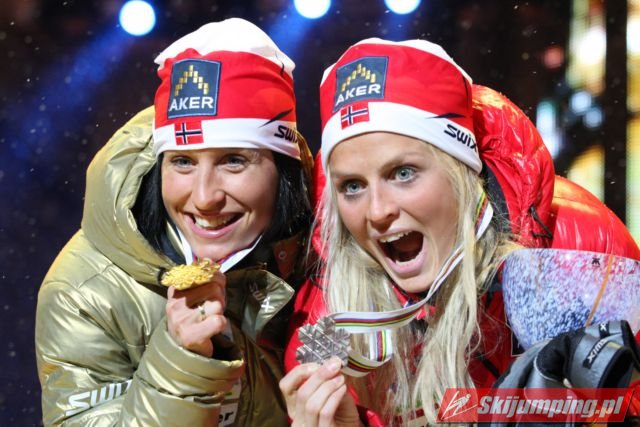
Marit Bjørgen (l) and Therese Johaug with their gold and silver medals from the 2011 World Championships 15 k in Oslo, Norway. (Photo: Wikimedia Commons)
“Oye … a lot has happened since then,” Johaug told NRK with a laugh. Now they’re not only best friends, they’re each other’s fiercest competitors.
On Friday, Johaug, 26, won the 10-kilometer classic in 26:36.1 minutes, 24.7 seconds ahead of Bjørgen in second. Like fellow Norwegian Martin Johnsrud Sundby, she won last season’s Tour de Ski as well as the overall World Cup title.
Six years ago, she was a junior competing in Beitostølen for the first time. She told reporters she had the same photo hanging on her wall at home.
Now she’s won the Beito distance opener for three consecutive years. Last year, Bjørgen didn’t compete; Johaug beat another teammate —Astrid Uhrenholdt Jacobsen — by more than 54 seconds for the win. In 2012, Johaug topped Bjørgen by 52.2 seconds. This was her fourth-straight time winning Beito’s 10 k classic, according to VG.
On Friday, Bjørgen led through 2 k, 2.7 seconds ahead of Johaug. By 6 k, Johaug took hold with a 5.3-second lead over Bjørgen and stayed in front to secure the first win of the season.
“It felt good; I managed to calm myself down and think, time and power,” Johaug told NRK, according to a translation. “It was fun to get it when I have worked so much this fall and along.”
“We have talked a lot about calming down … and trust that I’m fast enough, rather than skiing with my shoulders at the ear level and increasing the turnover. That doesn’t make you fast.” — Therese Johaug, after winning Friday’s 10 k classic FIS race in Beitostølen
Johaug racing to bronze in the women’s 10 k classic at the 2014 Olympics in Sochi, Russia.
Since last season, she’s been working on her upper-body strength and spent long hours in the weight room and on the rollerski treadmill, she told VG. She also credited her psychologist, Britt Tajet-Foxell, for helping her progress.
“[The training] is paying off, and that’s really fun,” she said, according to a direct translation. “We have talked a lot about calming down and taking time to complete each kick and each pole plant, and trust that I’m fast enough, rather than skiing with my shoulders at the ear level and increasing the turnover. That doesn’t make you fast. Today I felt like I managed to do that, and that I was rewarded all the way.”
“Today, Therese was impossible to beat,” Bjørgen told VG.
As for how she felt: “It hurt, but that is somewhat expected,” Bjørgen said to NRK, adding that she felt normal, like in recent years.
“It’s not just anyone I measure myself against, so I know what I did today is good,” she told NRK.
“Next weekend it can be turned upside down,” Norwegian women’s coach Egil Kristiansen said. “Therese skied great today.”
Norway’s Heidi Weng took third, 44.8 seconds behind Johaug and 20 seconds back from Bjørgen. Germany’s Stefanie Böhler placed fourth and Martine Ek Hagen of Norway was fifth.
Rounding out the top 10, Katerina Smutna (Austria) was sixth, Claudia Nystad (Germany) finished seventh, Barbro Kvåle (Norway) emerged in eighth, Victoria Carl (Germany) was ninth, and Kari Vikhagen Gjeitnes (Norway) took 10th.
Jacobsen finished 14th.
“I’m not in good shape,” she told NRK. “It was hard all the way, and I feel half-empty. …There is a way to go forward; I know that it is there.”
Racing continues with 10/15 k freestyle races on Saturday and a classic sprint on Sunday.
Martin Johnsrud Sundby during an interview with NRK after Friday’s 15 k classic FIS race in Beitostølen, Norway.
Defending overall World Cup champ Martin Johnsrud Sundby took it to his Norwegian teammates on Friday in an opening International Ski Federation (FIS) race in Beitostølen, Norway. The 30-year-old Sundby won the 15-kilometer classic in 37:15.1 minutes, beating out runner-up Didrik Tønseth by 22.9 seconds and Petter Northug in third by 25.8 seconds.
According to VG, Northug led the men’s race by 4.2 seconds at 2 k, but Sundby reined him in, taking a 7.1-second lead by 6 k. By 12 k, Northug was some 20 seconds off Sundby’s pace, but he kept plugging to narrowly miss second to Tønseth by 2.9 seconds.
“It is reassuring that Petter has trained and done well,” Norwegian National Team Head Coach Trond Nystad told VG afterward.
Northug, 28, recently signed a contract with the national team just before the start of the season.
“That he is fast skiing is no surprise,” Nystad added. “Martin has been superb at training throughout the year.”
And while Northug breezed by reporters at the finish, responding to a few questions with brief answers like, “Fine,” “No,” and “I don’t know,” NRK described Sundby as happy to talk about his race.
“It was ‘average,’ nothing exceptional,” Sundby said, according to a direct translation. “I was extremely nervous. We messed around a lot, but it was insanely cool to be ski racing again.
“It means a lot for my confidence, and good feedback on the training I’ve put in this season,” he added. “I’ve been very curious about how much my body can handle all spring and summer. At least the first ski race went OK, so it remains to be seen as the season progresses. However, this was my world-champion effort, so I still have to climb a few more steps on the ladder.”
“It was insanely cool to be ski racing again.” — Martin Johnsrud Sundby, after winning Friday’s 15 k classic FIS race in Beitostølen, Norway
Sundby won the Tour de Ski last season as well as the 2013/2014 World Cup. But being the best last season won’t cut it this winter, Sundby explained. As a result, he increased his overall training volume from 1,000 hours last season to 1,150 hours this season.
Norwegian Olympic champion Thomas Alsgaard in April 2013 in Mosjøen, Norway. (Photo: Wikimedia Commons/Bysprinten Mosjøen)
For Tønseth, 23, Friday marked his first podium in any race since a Scandinavian Cup 15 k freestyle last December. The week before that, he placed third in last year’s Lillehammer World Cup 15 k classic.
“It’s been a long time since I’ve been on the podium,” Tønseth told VG. “Well, to start.”
Norway swept the top nine with Chris Andre Jespersen placing fourth, Petter Eliassen in fifth, Niklas Dyrhaug in sixth, Anders Aukland in seventh, Kristian Tettli Rennemo in eighth, and Per Kristian Nygaard in ninth. Germany’s Tim Tscharnke placed 10th out of 167 men.
Norwegian great, 42-year-old Thomas Alsgaard raced — for the first time in Beitosølen in 12 years — placing 159th.
“There was not much work today … but it was fun to compete again,” Alsgaard told NRK. “I promise I’ll be better than this before season’s end.”
Brendan Green (left) on the podium in Beitostolen, Norway, after placing second in the men’s 20k individual IBU Cup. Photo: Roddy Ward.
If you look at Brendan Green’s competition record, it has a big gap in it. The last World Cup the 2010 Olympian competed in was Oslo, 2012 – after which he slipped a disc in his back and had to take about a year to recover, with multiple surgeries.
But this fall, Green in back in action, first easing on to the second-tier IBU Cup circuit. He started off strong in Idre, Sweden, shooting clean to place ninth in the first (and most competitive) race in Idre, Sweden. Most years, this would have earned him a promotion directly onto the World Cup – which is where Green needs to be if he wants to complete his qualification criteria for the Sochi Olympics.
This year, though, everyone in Canada has upped their game for the Olympics, and teammate Nathan Smith placed second in that race; Marc-Andre Bedard also tied for ninth. It was a banner day for Biathlon Canada. Green stayed on the IBU Cup.
But he’s not discouraged, and he came back strong today in Beitostolen, Norway, by placing second in the 20 k individual race to Benedikt Doll of Germany. Green limited himself to just one penalty, which is important in this format where each missed shot is penalized by a minute of added time.
“The wind here has been super extreme all week leading up to today, to the point where the range was closed on Wednesday for our training because it was too windy,” Green wrote in an e-mail to FasterSkier. “We tried to shoot yesterday but gave up after a couple of clips because it was impossible to hit anything, and more or less a waist of time. Fortunately today the wind had died down so shooting conditions were perfect.”
Doll, though, was in a class of his own, winning by almost a minute and a half despite also accruing one penalty.
While Green was hugely helped by a strong finish – he cleaned the all-important final standing stage and had some of the fastest loop times on the third and fourth loops – he didn’t know it at the time.
“I was an early starter being bib #9, so I didn’t have too much information to go off of,” Green said. “It was a pretty lonely race for me so I just tried to focus on consistent skiing and putting together a good shooting race. When I just had 1 miss after three bouts I knew the potential was there for a good result. My last standing shooting went perfect and from there I just tried to maintain a solid pace to the finish and crossed my fingers that my time would hold up!”
Aside from Green’s excellent result, Canada had already been having a good weekend. Up on the World Cup, JP Le Guellec placed fourth in the individual, narrowly missing the podium, and Smith a career-best 16th. According to Green, the momentu the team was feeling after that first weekend of IBU Cup racing, where five athletes were in the top ten, did not dissipate when the team split up between the IBU and World Cup circuits.
“I think as a team we’re feeling pretty confident and it was great to watch JP throw down an awesome result on the World Cup yesterday,” he wrote.
The podium on the IBU Cup doesn’t help Green directly with his Olympic qualification criteria, but it does stoke the fire for his inclusion.
“In terms of Olympic qualification, I’m unable to meet any criteria with my IBU Cup results, but they definitely help build confidence,” Green wrote. “Ultimately I would like to be racing on the World Cup, but I’m doing my best to make the most of the racing opportunities I’m given. When I think back to where I was with my injury at this point last year I wasn’t able to ski yet. I’ve come a long long ways since then, so I have to be pretty happy about that and am grateful to be back in the game!”
Also competing for Canada, Scott Gow placed 20th with two penalties, his younger brother Christian 31st, Macx Davies 62nd, and Bedard 69th. The sole American competitor, Jay Hakkinen, placed 50th with four penalties.
In the women’s 15 k, Lanny Barnes of the United States placed 18th with two penalties, 3:48 behind Olga Podchufarova of Russia. For Canada, Audrey Vaillancourt placed 34th, Claude Godbout 42nd, and Julia Ransom 62nd.
Andy Newell on his way to qualifying in fourth in the 1.4 k skate sprint FIS race in Beitostølen, Norway. (Photo: Noah Hoffmann/noahhoffman.com)
In his first skate sprint since August, when Andy Newell mixed it up in New Zealand at the NZ Winter Games, the U.S. Ski Team’s veteran sprinter made it all the way to the final on Sunday in Beitostølen, Norway. Newell ended up sixth in the 1.4-kilometer freestyle sprint, the last FIS race in a three-race series this weekend.
Fourth in the qualifier, Newell was one of the top guys heading into the final after Norwegians Sondre Turvoll Fossli, Ola Vigen Hattestad and Anders Gløersen. The 20-year-old Fossli went on to win every heat, including his final in 2:33, just a tenth of a second faster than runner-up Finn Hågen Krough, also from Norway.
A lucky loser in both his quarterfinal and semifinal, Newell finished 4.6 seconds behind Fossli in the final (and 0.2 seconds behind German fifth-place finisher Sebastian Eiesenlauer).
“I was feeling ready to race leading into [the race], although I hadn’t done a real skate sprint since New Zealand,” Newell wrote in an email. “This course wasn’t too easy because of the wind … but it definitely wasn’t a World Cup course either with less climbing, only taking us about two-and-a-half minutes. So I knew I was going to have to be quick in qualification and aggressive in the heats.”
He tried to get out front in each of his heats to avoid trouble and “also get some room to punch it on the uphill,” Newell explained.
“My fitness and speed was feeling good so I think I was able to push a high pace in the heats, but just didn’t have my usual kick at the end,” he added. “This tends to be a recipe for Lucky Loser, which is what happened to me today.”
A problem for most everyone, Newell said the wind was a factor in the men’s race.
“We all stayed together up and over the final uphill but my legs were just a little too heavy to challenge in the lanes and the German skier and I duked it out,” he explained. “It’s still early and I want to be skiing my best in January and February … so I’m confident, but also not feeling much pressure.”
With this coming Friday’s sprint part of the Kuusamo Ruka Triple mini tour, and a “double distance weekend” Dec. 7-8 in Lillehammer, Norway, Newell said the next two weeks will also be about building and “hopefully get me ready to rock once the real sprints start going off.”
Simi Hamilton racing to 15th in Sunday’s 1.4 k freestyle sprint qualifier in Beitostølen, Norway. (Photo: Noah Hoffman/noahhoffman.com)
Newell’s teammate on the USST and Stratton Mountain School T2 Team (SMST2), Simi Hamilton was also looking forward to moving on after the FIS races in Beitostølen. He qualified in 15th on Sunday and went on to place 27th with a sixth-place finish in his quarterfinal.
“I decided to make a move around [German] Josef Wenzel on the inside when we were coming around the last 180 turn before the finishing stretch,” Hamilton explained in an email. “I knew [I] could ski the corner better and faster than him, so I decided to go for it and see what happened. Wenzel is an aggressive skier and crashes occur in a lot of heats that he skis. When I was coming thru on his inside, I got nudged into the V boards and possible got my skis stepped on. It went down pretty quick.
“I broke my pole and lost all my momentum coming into the finishing stretch, but rubbing is racing and I’m using it to fuel the fire for the upcoming World Cup sprints,” he added.
Hamilton finished last in his heat, more than 19 seconds behind Wenzel, who went on to place eighth overall. Regardless, Sunday’s crash and an unlucky 15 k classic race on Friday didn’t faze Hamilton.
“My energy felt really good going in to the day,” he wrote Sunday. “It was a good course for me… Pretty short time-wise and some good transition skiing on fast and hard conditions. During the qualifier I focused on skiing powerfully and getting that good skate sprint feeling going.”
After the race, Hamilton said he did some mock sprint intervals. “I’m using that as a good sign of where I am fitness and speed-wise,” he wrote. “I’m psyched about that feeling, especially after such a frustrating day on Friday when I broke my pole after catching my kick pocket on a sheet of ice and just couldn’t get my body revved up to where I wanted it to be during that race.”
Three other American men raced on Sunday, but missed qualifying for the heats. Torin Koos (Bridger Ski Foundation) placed 32nd, less than four-tenths of a second out of qualifying. Dakota Blackhorse-von Jess (Bend Endurance Academy) tied for 54th, and Mikey Sinnott (Sun Valley Ski Education Foundation) was 71st.
“I felt optimistic going into [Sunday’s] race,” Sinnott wrote in an email. “Body was feeling sharp. I had a solid warm up and things seemed ready to go. I tried to ski longer and glide a lot during the race, which I believe I did. I never bogged down and had plenty left for a strong finish, which can be a weakness of mine.”
Ultimately, Sinnott felt he should have been more aggressive.
“I still had plenty left in the tank at the finish line,” he wrote. “This week was about relearning to race and assessing fitness, in that regard it was a success. I can have a tough time the first week in Europe, but I didn’t suffer the usual deep fatigue. I didn’t ski fast this week, but it was a low priority to do so. Mostly I wanted to have a test run.”
“Now, I know where I need to work in the upcoming week,” Sinnott added. He’s planning to race all three races in Kuusamo. “I’m close to where I want to be next week, and I think you’ll see a big change.”
Kikkan Randall lived up to the hype on Sunday, winning the U.S. Ski Team’s first sprint of the season in Beitostølen, Norway. Randall topped Slovenians Vesna Fabjan (l) in second and Katja Visnar in third in the 1.2 k freestyle FIS sprint after qualifying in seventh and placing second in both her quarterfinal and semifinal. (Photo: FIS Cross Country)
The U.S. Women’s Nordic Ski Team finished off their weekend opener in Beitostølen, Norway, with a bang on Sunday, as reigning World Cup sprint champion Kikkan Randall claimed a win in the 1.2-kilometer freestyle sprint FIS race.
Seventh in the qualifier then second in the her quarterfinal and semifinal, Randall won the final in 2:17 minutes, 0.8 seconds ahead of runner-up Vesna Fabjan of Slovenia. Coming in third, Slovenian Katja Visnar followed her teammate by 1 ½ seconds.
In an email, Randall explained Brun-Lie, who won the qualifier along with her quarterfinal and semifinal (beating Randall by 0.4 seconds in the semi), led out the final, but lost her balance halfway through. According to Randall, that opened up the race. Randall ended up trailing Fabjan until midway up the final climb, then decided to make a move over the top.
“I thought I might get challenged on the homestretch but the shadows never came,” Randall wrote.
Following the top three, three Norwegians – Marit Bjørgen, Celine Brun-Lie and Ingvild Østberg – took fourth through sixth respectively, all within less than a second and a half of each other, but more than three seconds behind Randall.
When it came to Randall’s game plan, the 30-year-old Alaska Pacific University (APU) skier explained it was simple.
“Pretty much ski hard, play with some different tactics and get a hard workout!” she wrote. “In both the quarter and semis I was always following someone off the final turn and then making sure I was strong on the homestretch to guarantee moving on each time.”
All she needed to do was make the top two in each heat. Easier said than done, but the world champion did it. On Friday, Randall placed 10th in the 10 k classic race – her first of the season.
“ I am happy to have two solid races under my belt,” Randall wrote. “This weekend was mostly about waking up the body before the World Cup opener [in Kuusamo, Finland] next week. It’s a good confidence boost to stack up well against a strong field. But the real tests begin next week!”
Four other U.S. Ski Team (USST) women advanced to the heats and ended up in the top 20, failing to make the semifinals.
Ida Sargent (Craftsbury Green Racing Project) tallied 13th – an improvement from finishing 29th in Friday’s 10 k. She qualified in 13th and went on to place third in her quarterfinal, 1.8 seconds behind Norwegian quarterfinal winner Maiken Caspersen Falla (who ended up seventh) and 0.5 seconds behind Mari Eide (who placed 10th).
“It was a short fast sprint and the qualifier was over before I knew it,” Sargent wrote in an email. “In the quarterfinal I wanted to get out fast but I got pushed outside on the first corner and ended up in 4th going down the downhill. I moved up to second on the uphill where I was feeling strong but I skied the finishing stretch really poorly.”
In retrospect, Sargent felt she chose the wrong technique.
“[I] should have been using V2 alternate instead of V2 on the fast snow,” she wrote. “I was just skiing really awkward and bobbled and almost fell and then I lost ground.”
On the whole, her experience was positive. “I’m just excited to be back racing again and finding improvements with each race,” she wrote. “It was still really fun to race a heat against lots of really fast ladies. The Norwegian women are so strong and the Slovenians are also skiing really fast so it was great to race them.”
In the women’s freestyle sprint quarterfinals in Beitostølen, Norway, U.S. Ski Team rookie Sophie Caldwell keeps contact with Marit Bjørgen (second from left) and Slovenia’s Vesna Fabjan (c), who ended up second overall. Bjørgen ultimately placed fourth in the final, and Caldwell did not advance to the semis, placing 18th overall. (Photo: Noah Hoffman/noahhoffman.com)
The rest of the U.S. women came in 17th through 19th, with Jessie Diggins, Sophie Caldwell and Sadie Bjornsen, respectively.
Fourth in her quarterfinal and just a tenth of a second behind Sargent, Diggins explained in an email it hadn’t been an easy training week leading into Beitostølen, leaving her a little sore and tired before Sunday’s race. But that was part of the plan.
“It’s a long season ahead!” Diggins wrote. “I was psyched that the two races this weekend went as well as they did, especially since it’s the plan to work into the season.”
She qualified in eighth, but ran out of room in the quarterfinals, she explained.
“This sprint was wicked short — like 2:15 in the qualifier,” she wrote. “I like much longer sprints, because it takes me longer to work into it. … I felt better and better in the finishing lanes and was picking up speed, but needed a longer course to do some damage. But it was a great way to get back into the feel of sprinting, get used to the warming up and testing ski process again.”
Teammate Sophie Caldwell got a little too cold during the prelim and felt a bit stiff in her legs, but was happy to qualify in ninth. From there, she said her quarterfinal was “fun,” going up against top women like Fabjan, Bjørgen, and Norway’s Heidi Weng, who took first through third in the heat, respectively.
“I didn’t realize I had Marit in my heat until I toed the start line and then I just tried my best to tuck in behind her,” Caldwell wrote. “I had a good start and was able to stay in 2nd for the first half of the race before moving back to 4th. It was exciting to have all five girls qualify, so hopefully that means we’re in a good place!”
Additionally, she was excited to watch one of her teammates win outright and teammates Andy Newell and Simi Hamilton place sixth and 27th, respectively.
Bjornsen, who notched fifth in Friday’s 10 k classic, qualified in 14th and went on to place fourth in her quarterfinal. She was 0.8 seconds out of first, with Visnar, Randall and Norway’s Hilde Landheim taking first through third.
“It was fun to sprint again,” Bjornsen wrote. “… [And] a good warm up for next weekends world cups which I am looking forward to! This weekend was about getting back into the grove of racing. Warm-up, ski selection, nerves, pacing. It was a practice race before it really counts.”
The last time she started her season in Europe – two years ago – the team didn’t do that, Bjornsen explained.
“So now I am really looking forward to Finland and a fun season ahead!!” she added.
Liz Stephen (r) makes the podium photo opp with five Norwegians after placing taking sixth (and winning a cheese slicer) in Saturday’s 10 k freestyle FIS race in Beitostølen, Norway. Also pictured: winner Therese Johaug (1), third-place finisher Astrid Uhrenholdt Jacobsen, Kristin Størmer Steira in fourth, and Vibeke Skofterud in fifth (Photo: Holly Brooks/Facebook)
Any competitive ski racer knows the feeling of pre-race anticipation: that moment when you scan for your name on the start list, find it, and take a gander who’s starting around you.
In an individual start, like Saturday’s 10 and 15 kilometer freestyle FIS races in Beitostølen, Norway, that order is essentially all you have to work with. Try to catch the people in front of you and fend off the ones from behind, and you should finish in relatively good shape.
Imagine Holly Brooks’ reaction when she saw she was starting 30 seconds ahead of Norwegian powerplug Therese Johaug (who won Friday’s 10 k classic) or Liz Stephen’s thoughts on leading out Vibeke Skofterud (who placed sixth the day before).
For most, it would be a big deal — a sort of Charlie Brown “good grief” moment. But for the U.S. women’s ski team, which enjoyed unprecedented success last season and has gained respect (and friendships) from the Norwegian and Swedish teams in the last couple years, the feeling is different.
“I had to laugh a bit last night when I saw the start list and the fact that Therese was starting 30 seconds behind me,” Brooks wrote in an email. “She ended up passing me midway on the big hill of the course. I’m not sure that I’ve ever been passed that quickly – it was like I was standing still.”
Johaug went on to win the 10 k in 24:13.7 minutes, 18.9 seconds faster than runner-up Marit Bjørgen, Norway’s most decorated world champion, in Bjørgen’s first race of the season. It was Johaug’s second victory in as many races this weekend.
Stephen wasn’t much farther back in sixth place, 4.9 seconds behind Skofterud in fifth and 1:09.2 behind Johaug. In an email, she wrote that starting ahead of Skofterud was “GREAT!”
“Yesterday I had Kikkan [Randall] starting right behind me and today I had Vibeka right behind, so I used them a bit to help motivate me to keep pushing,” Stephen wrote.
And Brooks was moving fast, too, placing 12th on Saturday, 1:43 behind Johaug.
“Johaug’s tempo is unlike that of anyone on the World Cup and I got a front row seat!” Brooks wrote. “She is impressive … and I knew it would be a mistake to try and match it, even for ten seconds. Yesterday she won the entire race by almost a minute so it seems as if she’s in a league of her own.”
The exciting thing for the Americans is that they’re already in the hunt with top teams like Norway. While the Norwegians took six of the women’s top seven, the U.S. was one of three teams to put two in the top 12 (Slovenia being the other).
In the men’s race, U.S. Ski Team member Noah Hoffman broke up a Norwegian sweep of the top eight, placing seventh in the 15 k skate race.
“For the second day in a row, I didn’t have anybody to ski with for the entire race,” Hoffman wrote in an email on Saturday. He finished 42nd in Friday’s 15 k classic.
“Both days, all of the starters had left the stadium by the time I lapped through. I didn’t get caught from behind either day, and I didn’t catch anybody who was skiing at a high level.”
Considering his jump up to the top 10, Hoffman was encouraged by his most recent result.
“I feel good and I have great energy,” he wrote.
At the same time, he’s still working on his pacing, which he felt good about Saturday. Friday wasn’t bad either, he explained.
“I thought I skied well yesterday. I was surprised to be so far down the results sheet,” Hoffman wrote. “The one thing I did for today was refocus on my technique cues, especially the cue ‘patience.’ ”
It turned out in his favor as Hoffman finished 49 seconds back from Norwegian Martin Johnsrud Sundby, who captured his second-straight win in 33:32.6. The second-place finisher, Anders Gløersen, was nearly 34 seconds behind.
For Stephen, who improved from 25th on Friday, she said her secret was not pacing.
“I tried to pace it yesterday and it didn’t end up helping me ski fast, so today the goal was to just go out hard and ski well and see what happened,” Stephen wrote.
It helped having a winding course that doubled back, so she could gauge where she stood, as well as coaches and others giving her splits.
“It is so nice to have so many more friends and people to help push me, and hopefully people I can help push to their best as well,” Stephen explained.
Earlier this week, the Norwegian women’s team invited their U.S. buddies to a “bolle” at their cabin, according to Jessie Diggins in her blog.
“We are actually about to have them over for our second team get together of the week for some banana bread before heading out for afternoon training,” Stephen wrote on Saturday. “It is really cool how our two teams have really gotten to know each other. It makes the World Cup and being so far from home for so long so much more enjoyable and manageable.”
For Brooks, her two results for the weekend (including 19th on Friday) were outside of her goal of a top 10, but she had fun getting back into racing.
“The FIS race here feels like a World Cup with cameras and reporters everywhere,” Brooks wrote. “A car in the middle of the stadium, big blow up sponsor objects, wax buses, etc, etc. They take their Nordic Skiing seriously here in Beito and it’s been a good warm up for next weekend’s race in Kuusamo.”
Saturday was a matter of missing her top gear, she explained.
“I felt good warming up and didn’t feel any residual fatigue from yesterday but then in the race, I felt as if I had a ‘governor,’ ” she wrote. “My goal was to start the race and glide, finding good rhythm. Sometimes I tend to rush and end up flailing a bit. I tried to be as smooth as possible.”
At the end of the day, she was mostly thrilled for her teammates.
“I’m also happy that Liz was able to land on the podium because it can’t be a 100% Norwegian Sweep!” Brooks wrote. Stephen earned a cheese slicer for her efforts.
“Also, Hoff was .8 seconds away from winning a cheese slicer as well,” Brooks added. “Congrats to both of them on fantastic performances!”
Sadie Bjornsen celebrating her 24th birthday with fellow U.S. Ski Team members in Beitostølen, Norway, on Thursday. On Friday, she placed fifth in her first race of the international season, the 10 k classic in Beitostølen. (Photo: Noah Hoffman/noahhoffman.com)
A year ago, the U.S. Nordic Ski Team was in Finland, tearing it up. Liz Stephen led some solid women’s results with a runner-up finish in the 10-kilometer freestyle race in Muonio – placing second to Poland’s Justyna Kowalczyk – one week before the World Cup began in Gällivare, Sweden.
In that same race on Nov. 18, 2012, Holly Brooks finished seventh, Jessie Diggins took ninth, and Ida Sargent notched sixth in the classic sprint two days earlier in Muonio.
Sadie Bjornsen (APU/USST) skating to fourth-place finish at West Yellowstone SuperTour 9 k on Nov. 23.
Meanwhile, Sadie Bjornsen was stateside, taking time to heal tendonitis in her foot and starting her season in West Yellowstone, Mont.
Back then, Bjornsen said her yearlong focus was “racing myself back into shape.” A day after her 24th birthday, the Alaska Pacific University (APU) skier jolted herself into the top 5 on Friday in Beitostølen, Norway, placing fifth in the 10 k classic FIS race. Along with six other women and three men on the U.S. Ski Team (USST), it was her first race of the season.
“For the first time in a couple years I have had good training through the off season, and I have gone into a season feeling like I have some fitness,” Bjornsen wrote in an email. “I am excited to have a full season of practice at getting better, and skiing consistently this winter! I am stoked I have the first one done, and I am stoked to keep going!”
Bjornsen started 45th out of 53 women. Halfway through, she ranked 13th, and two kilometers later, she was in seventh. Racing the clock and presumably fast women behind her, she was unsure where she’d end up, but pleased with the result – finishing 1:32.8 minutes behind Norway’s Therese Johaug, who won by almost 55 seconds in 26:40.6.
“I went out there racing for my own self, remembering to ski strong, and do my best – the same way I go into every race,” Bjornsen wrote. “Every so often you have a little surprise and it is very fun!”
Along with teammate Kikkan Randall, Bjornsen was the only other non-Norwegian in the top 10. Randall missed the USST’s first races in Muonio last year was also healing a foot injury. On Friday, she started last and skied to 10th, 1:54.7 behind Johaug.
“It was a solid start for me,” Randall wrote in an email. “I didn’t feel totally turned on and ready in the first half, my body felt stuck in a middle gear.”
Randall received a few splits on the course, but after a slow start, she didn’t think they meant much. She felt herself speed up on the second lap, which she took as “a good sign.”
“I got out of today exactly what I wanted,” Randall wrote. “I went hard, played with some different technique cues and got to see the status of the body. I think I’m still holding on to a little fatigue from the training season and the travel over here, and I was glad that I was able to put down a solid hard effort today.”
Excited about Bjornsen’s result, Randall tweeted, “A solid start for me and a wicked start for @sadzarue!”
As for Bjornsen’s secret to success on Day 1, she said it probably had to do with her birthday festivities.
“My teammates were incredible – hiding 24 presents throughout the day, and 24 really meaningful cards!” Bjornsen wrote. “It is days like this that remind me how much I love what I do, and the people I do it with. A happy person with fast skis … fun things can happen.”
Jessie Diggins (USST) en route to a ninth-place finish in the 10 k freestyle individual start on Sunday in Muonio, Finland. (Photo: Petri Ikävalko/Hevoskuuri.fi)
About 10 seconds outside the top 10, Diggins placed 13th (+2:04.6) after starting 41st.
“It felt really great to get a bib on again, jump around and dance in the starting gate, and go hard (the endorphin rush afterwards wasn’t bad, either)!” Diggins wrote in an email. “I was psyched to get the first one out of the way because that’s sometimes the most nerve-wracking one … you never know how you’re going to feel until you do it.”
Starting immediately ahead of Vibeke Skofterud (who ended up sixth) and right behind another Norwegian, Heidi Weng (who placed third), Diggins made a point to imagine she was racing head to head.
“I could feel [Vibeke] behind me catching me, and so I pretended that this was a team relay and I couldn’t let her catch me before I got to the tag zone (finish line),” she explained. “I just barely held out but the strategy worked!”
Looking up her results later in the day, Diggins wrote that she was happy with it and pleased with her improvements in classic skiing – something she’s been working on all summer.
“I think it’s really important to keep in mind that these early season races, while everyone wants to do well, are not as important as the mid-season races (Olympics!)” she wrote. “It’s ok to work into the season. I think these are a great chance to get back in the groove, identify some things to work on for the year and remember what it’s like to race, while not taking results too seriously.”
The biggest takeaway from Friday was Bjornsen’s performance, she explained.
“I am so proud of her – she has worked through some tough injuries over the years and I can’t think of a more fun way for her season to start,” Diggins wrote. “She really gave me something to jump around about, seeing her race so well today!”
Holly Brooks snaps a photo of USST teammate Liz Stephen on Nov. 18, 2012, after Stephen placed second in the 10 k freestyle individual start in Muonio, Finland. (Photo: Holly Brooks)
Among other highlights, Brooks placed 19th (+2:21.3), and three other U.S. women cracked the top 30 (Stephen in 25th, Sophie Caldwell in 27th and Ida Sargent in 29th).
“I wanted to work on pacing the race and I skied a strong and smooth first 5 k,” Brooks wrote in an email. Her 5 k time ranked 16th, and she was down to 14th with three kilometers to go.
“I typically start too fast in races like this and I’m working on turning in more consistent results. Ideally I’d be able to go out fast and keep it fast,” she added. “There were certainly moments where I felt ‘like a World Cup skier’ and times when I did not. But, overall it was a solid start for me and I’m hoping to improve my race fitness from here.”
Brooks will race Saturday’s 10 k freestyle race as well.
“I always approach the first races with mixed excitement and anticipation,” she said of the FIS openers. “Everyone’s asking each other how their ‘Training Season’ was and everyone is positive about their preparation. However, in every race there can only be one ‘winner’ and results actually quantify where everyone stands.”
Satisfied with her effort, Stephen said she focused on technique and pacing.
“There is still a lot of work to do with classic, but I am happy with the effort I gave today,” Stephen wrote in an email. “It’s a long season and this is just the start. The highlight of the day was certainly hearing Sadie’s name being called up to the awards ceremony with a 5th place! I am so happy and proud of her, as she has had such a tough go with injuries the last few years and it has not been an easy ride for her the last couple of years. She works really hard, always believes in herself and has such a positive happy vibe that she brings to the team atmosphere that it is impossible not to feel over the moon for her on a day like today.”
As for other highlights: “It has been fun to see all of our European friends again!” Stephen wrote. “It is exciting to start a new season and to be on the road with everyone again, for sure, but I use that excitement to get me fired up and ready to race.”
In her first official race with the USST, Caldwell explained she wasn’t very nervous, although she wasn’t sure why.
“I didn’t really have any expectations going into the day, I wanted to focus on skiing with good technique, pacing, and dialing in my skis,” she wrote. “We’ve been having a really fun time over here and I was just happy to be racing again.”
She might have taken it out too fast, she recalled.
“My first lap was great, and I got a little tired on my second lap,” Caldwell wrote. “I had a lot of very fast Norwegians starting right behind me, so when I started fading it seemed like they all just came zooming by me. … I didn’t put a lot of pressure on myself and mostly wanted to go out there and race my best and also watch all the other fast girls that are here to learn a thing or two.
“I think we were all excited to have a strong result as a group, but we’re definitely all mostly very proud of Sadie and how she did today. So awesome!” Caldwell wrote.
Like her teammates, Sargent was also thrilled to “put a bib on” and get the season started.
“I had a mix of nerves and excitement over the last couple days but felt a lot more relaxed this morning and was enjoying ski racing again,” she wrote in an email. “My goals for the weekend are to get back into racing mode again and have a couple hard efforts before the World Cup starts.”
According to Sargent, who will next race Sunday’s freestyle sprint, the classic conditions on Friday were “great. Hard and fast …”
The start of the men’s 15 k classic FIS race on Friday in Beitostølen, Norway, with Petter Northug (143) and U.S. Ski Team member Andy Newell to the right (142). Newell went on to place 59th, and Northug was 63rd. (Photo: noahhoffman.com)
Hoffman Leads U.S. Men
In the men’s 15 k classic race, complete with a field of 191 finishers, Noah Hoffman was the top American in 42nd, 2:04.7 behind Norwegian winner Martin Sundby, who competed the course in 37:00.5. The Norwegians swept the top 12 and occupied 23 out of the top 24 (Great Britain’s Andrew Musgrave was 13th).
“My biggest goal going into today was execute well and carry the lessons I learned last year through to the start of this season,” Hoffman wrote in an email. “I feel that I accomplished that. I didn’t have any results-based goals for this weekend, but I have to admit that I am a little disappointed with today’s result. I expect to be further up the results sheet tomorrow [in the 15 k skate].”
While he felt good physically, Hoffman noticed he struggled a bit technically after watching video of himself racing. Conditions were “almost perfect,” he explained, “with cold temps, sunny skies, hard tracks and a well-prepared course.”
“Overall I am satisfied with my effort and psyched to move forward tomorrow and next weekend,” Hoffman added.
Simi Hamilton (USST/SMST2), who placed 135th out of nearly 200 men in Friday’s 15 k classic FIS race in Beitostølen, Norway. (Photo: noahhoffman.com)
Another USST member, Andy Newell placed 59th (+2:23.7). In an email, he explained it was his probably his first 15 k since last winter.
“It always takes a few efforts to get back into the distance racing state if mind for me,” Newell wrote. “Technique and skiing felt great out there but definitely didn’t have much to dig into as far as energy. It’s always hard during the first week over here while adjusting to Europe, but that’s why we have these practice races.”
Newell will save up for Sunday’s 1.2 k sprint, which he expects will be “tight and competitive” and “making the final won’t be easy.”
Another Olympian, Torin Koos of the Bridger Ski Foundation took 70th (+2:41.4) in his first race of the season.
“It feels pretty great to put on the race bib again. You know, racing is the inspiration for all those tough training sessions through the summer and fall,” Koos wrote.
In Europe since late August, he has been mostly in Davos, Switzerland, training with the Swiss National Team. He’s also maintained ties with the Norwegian club, Strindheim, and was staying with Team LeasePlan Go for the weekend.
“I have a lot of friends I’ve met through skiing here,” Koos wrote.
Last year’s overall SuperTour leader Mikey Sinnott (Sun Valley Ski Education Foundation) placed 131st on Friday, and the third USST member in the mix, Simi Hamilton was 135th. Jesse Smith, a former Michigan Tech skier, placed 165th.
Several of the U.S. women in Beitostølen, Norway, including (from left to right) Rosie Brennan, Sadie Bjornsen, Jessie Diggins, and Sophie Caldwell (Photo: Holly Brooks/Twitter)
To get you excited for 2013/2014 racing season, we asked some of the skiers you’ll be reading about from the U.S. and Canadian national teams to tell us seven things about themselves that most people don’t know. To top off the randomness, we also posed a couple questions related to skiing (well, sort of) and the life of a pro athlete.
Athlete: Sadie Bjornsen
Team: U.S. Ski Team (third season); Alaska Pacific University (APU)
Age: 24 (today!)
Hometown: Winthrop, Wash.
Sadie Bjornsen and her younger brother Erik with their “Wax Ring” prizes after winning an Alaska Pacific University time trial earlier this month at Hatcher Pass near Anchorage, Alaska. (Photo: sadiebjornsen.blogspot.com)
7 Things:
I take full-time school, and have for the past three years while I race. I am expecting to graduate at some point this year 🙂
I grew up vegetarian until I started traveling to Europe for racing and got sick of eating “fried cheese” that was served to me.
I have an older sister (1.5 years older) – she lives in Seattle and was a skier in her past life
I travel with a frog stuffed animal and his name is Jasper
I have a French boyfriend – and that is where I will spend Christmas this winter, in Meribel, France… first Christmas not at home.
At one point in my life I set the 100-meter World Record on skis…. although I am not sure anyone tried it outside of the US.
Cross Country skiing is new to my family in this generation. My mom grew up in Minnesota, but drove snowmobiles and worked on a farm. My dad was a backcountry and alpine skier.
Bonus Round:
First races of the season? Tomorrow, Beito Classic 10k [in Beitostølen, Norway]
Go-to mantra or motto: “Mind is master, body is servant.”
What do you miss most while on the road (besides family and friends)? My closet. I love variation in outfits, and that is the hardest part about the traveling circus!
Best part about being a pro athlete: Testing your ability to accomplish something you set your mind to. There are so many speed bumps along the way, but perseverance and determination are something you have to test every day as a pro athlete. I love that nothing is given, nothing is “pre-determined.” Every day you have to test your ability, test if you are willing to reach that goal!
3 travel essentials: Ear plugs, my journal, Cold-FX
Go-to travel meal or food: PB&J
Song that you could listen to non-stop: “What is Love” by Haddaway
Song you wouldn’t mind never hearing again: “Gangnum Style”
Lots of racing this weekend, obviously, but the Muonio results only appeared on the FIS website today, so they’ll wait for later in the week. I was intrigued, though, but Therese Johaug’s strong races in Norway.
For many reasons, it will be difficult to accurately parse early season results this year. Many people are focused on mid-season events like the Tour de Ski and World Championships, so it’s hard to say what kind of shape everyone is in now. However, I think it was interesting that Johaug beat Bjoergen twice this weekend.
How does that look compared to how the two have fared against each other over the long term?
Up in this graph is better for Johaug. As we can see, both victories were good races (clearly) but not radically out of character. Johaug racked up a fair number of wins against Bjoergen last season, and the trajectory has been swinging in her direction. Will that continue this season? We shall see…