From the FasterSkier archive — posts syndicated from athletes’ and coaches’ own blogs between 2004 and 2012, kept online as published. Current coverage is at fasterskier.com.
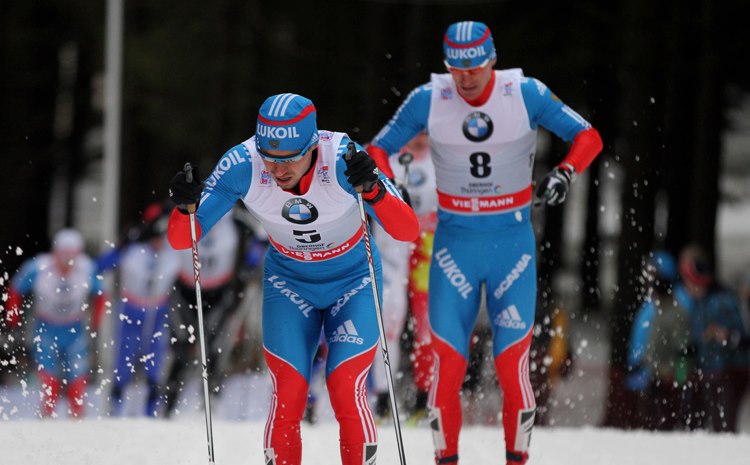
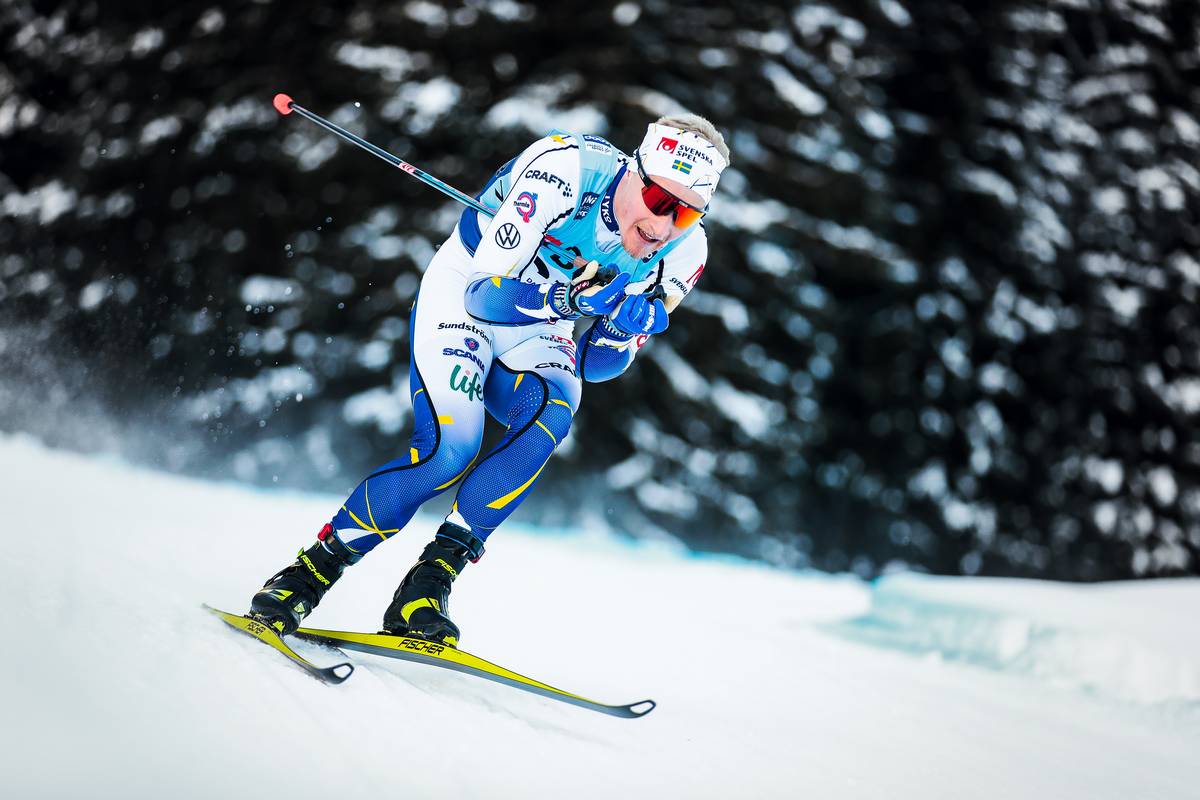
Maxim Vylegzhanin (bib #8), following teammate Ilya Chernousov (bib #5), on his way to 15 k classic pursuit victory in the second stage of the 2012/2013 Tour de Ski. It’s been reported that Vylegzhanin is among those named as an appellant in a suit filed with the Court of Arbitration for Sport. (Photo: Marcel Hilger)
A recently published Langrenn story reported on the possibility that FIS may be forced to reconsider its recent ruling an Russian and Belarusian eligibility for participating in Period 1 of the 2025-2026 World Cup season. According to those reports, Russian athletes and para athletes—and the Russian Ski Federation—filed a law suit with the Court of Arbitration for Sport (CAS) seeking to overturn the recent FIS decision to bar Russian and Belarusian athletes from events this autumn (events that could allow athletes to qualify for the 2026 Winter Olympics). Included in the suit is former World Junior Champion (2022), Saveliy Korostelev. While details remain unfocused as to which other athletes are involved, it’s possible that former Russian stars, Alexander Legkov and Maxim Vylegzhanin, are also included in this law suit. That’s a curious list, since Legkov (who is thought to be retired) has not been a factor on the international stage since his two Olympic medals in 2014 (both of which were subsequently stripped from him following revelations of his involvement in Russian doping at those Sochi Olympic Games). Vylegzhanin’s two silver medals from Sochi were also stripped, but later reinstated. According to current reports, the skier who dominated Nordic events at the Beijing Olympics in 2022, Alexander Bolshunov, is not named as a participant in this suit.
In related news, the International Luge Federation (FIL) was recently sued by Russian athletes and federations under similar circumstances. CAS’ judgment in the case continued to exclude athletes from the Russian Luge Federation (RLF), while overturning FIL’s exclusion of Russian and Belarusian lugers who qualify as Neutral Athletes (AIN) . . . the end result being that FIL will need to set protocols and procedures for identifying AINs in order for any of those athletes to enter Olympic qualifying events this winter.
If the cross-country world is searching for precedent in their own case, this recent CAS/FIL ruling would seem to offer a direct parallel . . . and would seem to imply that it’s not unlikely that we may yet see Russian and Belarusian athletes toeing starting lines for Olympic cross-country events later this winter.
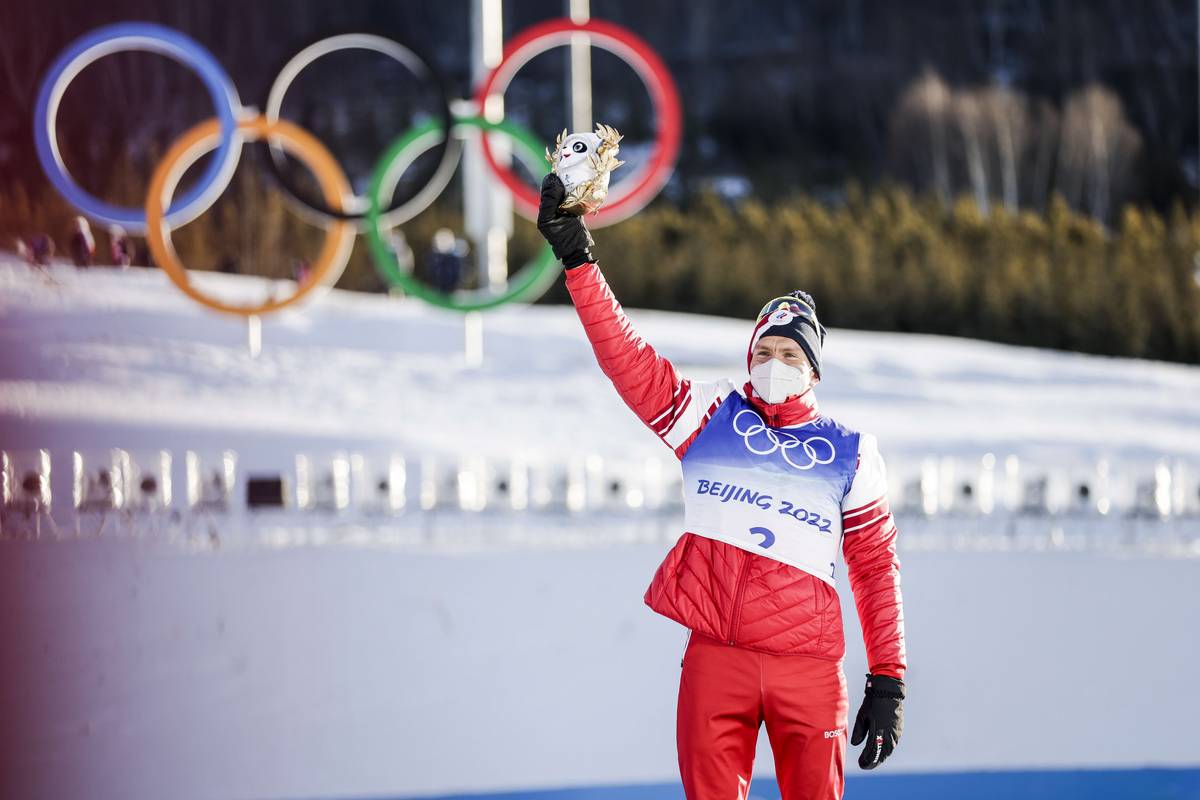
Alexander Bolshunov (RUS) won the men’s 30 k skiathlon in Zhangjiakou. FIS’ recent announcements exclude him (and all other athletes from Russia and Belarus) from qualifying for a return to the Olympic stage in Milan-Cortina. (Photo: NordicFocus)
It’s a funny time we live in . . . one in which many of us struggle with harboring multiple opinions on particular topics (especially political ones). That’s me when it comes to whether or not Russian and Belarusian athletes should be allowed to enter the Olympic Games . . . multiple opinions make sense, and no easy or straightforward decisions seem likely. One thing’s for sure: when it comes to those decisions, someone’s going to be very unhappy.
On October 21, the International Ski Federation (FIS) announced a ruling in which they barred Russian and Belarusian athletes (whether as neutral individuals or as representatives of the national governing body) from competing in upcoming FIS events—events that constitute qualifying opportunities for the 2026 Olympic Winter Games. Since the athletes in question had already been banned from competition since the beginning of Russia’s war on Ukraine, that means that no Russian or Belarusian athletes would have been able to participate in any earlier qualifying events (like the 2025 World Championships). Therefore—since Olympic qualification runs through events sanctioned by FIS—it appears that no Russians will be allowed to compete in the Olympic in 2026. Law suits will be soon to follow, and additional bendings of rules may be considered . . . but, for now, the Russians are out.
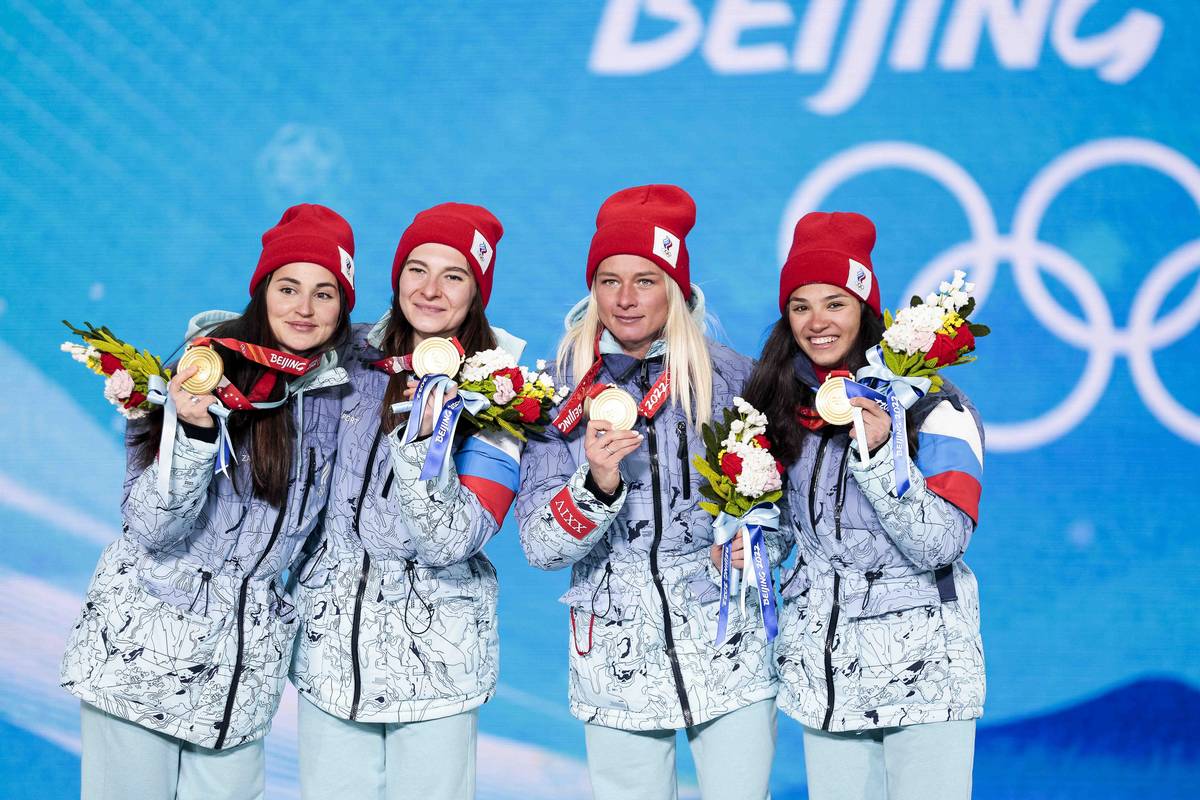
The women representing the Russian Olympic Committee won gold in the 4 x 5 k relay in the 2022 Olympics. From left to right, Yulia Stupak, Natalia Nepryaeva, Tatiana Sorina, and Veronika Stepanova. Recent FIS announcements make it a near-impossibility for them to defend that medal in Milan-Cortina. (Photo: NordicFocus)
What’s right and just about that?
Russia is waging an aggressive war on another sovereign nation. FIS has decided that they will not allow the participation of Russian athletes while their government persists in this criminal action. Skiing is doing its part to try to stop a war . . . I get that.
And what’s wrong and unjust about that?
The Olympic Charter declares that participation in sport is a human right; therefore, the IOC insists that all athletes be allowed to compete regardless of political interference or nationality. In the case of those who hope to prevent Russian and Belarusian athletes from competing in the Olympics, the Olympic Charter is an inconvenient and pesky little document . . . but one that the IOC, itself, is in no position to ignore. FIS has the right (and the responsibility) to establish qualification requirements for those athletes who may go on to compete in the Olympics, but FIS has no right to establish those qualification criteria in defiance of the Olympic Charter. FIS may have announced their decision, but the discussion—and the fight—may not be over yet.
Artificial Intelligence Weighs In
I don’t often resort to the use of AI, but in this case I wanted to see what the broader world (and the computer brain) really thinks about the opinions of the International Olympic Committee (IOC), and the Olympic Charter under which it operates. Here’s what the computer-generated intelligence reported to me (AI generated text will appear in Italics, while Author’s opinions will appear in bold):
Right to compete and non-discrimination
The Olympic Charter states that sport is a human right and that every individual must have the possibility of practicing it without any discrimination.
Here’s the author’s opinion: If “sport is a human right,” then it’s gonna be pretty difficult to prevent any individual human from participating. When it comes to Olympic eligibility, that simple wording is likely to have implications on the participation of even more athletes than just those from Russia and Belarus.
This includes protection against discrimination based on race, color, sex, sexual orientation, language, religion, political or other opinion, national or social origin, property, or birth.
Here’s the author’s opinion: Is FIS discriminating against Russian and Belarusian athletes? It would appear so. The Olympic Charter claims to protect against such discrimination, though how (and if) the IOC intends to affect such protections is still to be revealed.
The IOC and the World Olympians Association (WOA) have strongly reiterated this principle, especially when political tensions threaten to prevent athletes from competing.
Here’s the author’s opinion: Russia’s war on Ukraine is an example of “political tensions” played out to the nth degree.
Athletes should not be held responsible for the actions of their governments.
Here’s the author’s opinion: Russia invaded Ukraine, and Belarus supports Russia. While any number of Russian athletes may have expressed their support for the invasion, certainly those same athletes are not “responsible for the actions of their governments.”
Specific eligibility and rules
Athletes must be eligible according to the rules set by their respective International Federation (IF).
Here’s the author’s opinion: When it comes to “specific eligibility,” FIS has set certain rules (as is their responsibility as a sport governing body under the IOC). FIS’ latest announcement would seem to make it impossible for Russian and Belarusian athletes to participate in the Olympic Games (since none of those athletes will have been entered in any FIS qualifying events).
Specific eligibility rules are applied, such as those related to sex characteristics, which are complex and may require athletes to meet certain criteria to compete in specific categories.
Here’s the author’s opinion: The most recent FIS decision regarding Russian and Belarusian athletes doesn’t seem to have much to do with “eligibility rules . . . related to sex characteristics,” though that’s certainly an argument that should be considered for other athletes who have been barred from Olympic competition. In other words, the right to compete can’t be a human right if certain humans are barred from competing. It’s a touchy subject, but one that’s fairly clearly spelled out in the Olympic Charter. If the IOC (or its sport governing bodies) wants things to be different, then they need to go through the process of amending the Charter.
The International Olympic Committee (IOC) supports the participation of any athlete who has qualified and met the eligibility criteria established by their IF.
Here’s the author’s opinion: Yep . . . but if FIS has acted in violation of the Olympic Charter, then the IOC is compelled to overrule FIS.
Protection of the right to compete
The IOC works to protect the right of all eligible athletes to access international competitions without discrimination by host countries.
Here’s the author’s opinion: Host countries don’t seem to b pertinent in the discussion of FIS recent decision . . . though it may have been a different story when similar decisions were made regarding last season’s World Championships in Trondheim, Norway.
The IOC has taken action in cases where athletes have been denied entry or access to competitions for political reasons.
Here’s the author’s opinion: It sounds like discussions and considerations of the issue may not yet be concluded, and that the recent FIS ruling may not represent the final word. If IOC determines that the FIS decision was one made “for political reasons,” then don’t be too surprised if the IOC decides to allow the participation of Russian and Belarusian athletes. Ironically, the IOC may ultimately allow the participation of Russian and Belarusion athletes for reasons that are mostly “political.”
Ultimately, the IOC is committed to ensuring that sport remains a neutral space and that athletes are not punished or excluded due to political decisions.
Here’s the author’s opinion: FIS is punishing Russian and Belarusian athletes in order to exert pressure on Russia and Belarus (to be fair, much of the world is hoping to exert pressure on Russia and Belarus); therefore, it seems like those athletes are being excluded for political reasons. If that is determined to be the case, then the IOC will need to do something more than simply rubber stamp the decision that FIS announced on October 21st.
There are many weeks between now and the Opening Ceremonies of the 2026 Olympic Winter Games . . . but there’s really not much time left for courts and organizations and governing bodies to consider the question at hand. Many who read the recent FIS decision consider the case to be closed. I’m not so sure . . .
The current FIS policy, which does not allow the participation of Russian and Belarusian athletes and officials in FIS events, will remain in effect until further notice. FIS press release dated 5/24/23
FIS’s decision is at odds with the IOC’s (International Olympic Committee) position which allows for athletes to compete from the banned countries under a neutral flag.
Russian skier, Alexander Bolshunov, at one of his last races before the FIS ban went into effect. (Photo: NordicFocus)
Other FIS News
Additionally, FIS announced that after adopting equal racing distances for men and women it would also apply the same rules to World Championships and Olympics.
In its post council meeting notes, FIS stated that:
“After introducing the same race distances for women and men to race equal distances last season, it was approved to move ahead with these distances in the future also at the World Ski Championships. An application process for the change of Olympic Winter Games distances will be initiated with the IOC. The approved distances are
10 km | 20km | 50km
Skiathlon 10 + 10 km
Relay 4×7,5 km | Team sprint
Sprint”
Lahti to host 2028 World Championships
FIS also revealed that there is only one candidate, Lahti, Finland to host the Nordic World Championships in 2028. That means barring any unusual developments, Lahti should be the host venue.
At an Extraordinary General Assembly in Berlin, Germany, on Wednesday (16 November 2022), International Paralympic Committee (IPC) member organisations voted to suspend the National Paralympic Committees (NPCs) of Russia and Belarus.
The decision by IPC members to suspend NPC Russia and NPC Belarus stems from their inability to comply with their membership obligations under the IPC Constitution. This includes the obligations to ‘ensure that, in Para sport within the Paralympic Movement, the spirit of fair play prevails, the safety and health of the athletes are protected, and fundamental ethical principles are upheld’ and ‘not to do anything (by act or omission) that is contrary to the purpose or objects of the IPC and/or that risks bringing the IPC, the Paralympic Movement, or Para sport into disrepute’.
Andrew Parsons, IPC President, said: “As a democratic, membership-based organisation, it was important to allow the General Assembly, as the supreme body of the IPC, to take a decision on this important matter.
“Before votes were taken on the respective motions, IPC members had the opportunity to express their views. This included hearing from the NPCs of Russia and Belarus who, under German Law which governs our Constitution, had the right to attend, speak, and present their case to the Extraordinary General Assembly. Ultimately, our membership has decided to suspend both NPCs with immediate effect, until further notice.
“As IPC President, I want us to live in a world where sport unites the world in peaceful competition, enabling athletes to compete against their rivals to the best of their abilities in a safe and secure environment.
“The situation that the world of sport faces right now is highly charged and complex. I hope and pray that the conflict in Ukraine ends as soon as possible, that peace is secured, and that no more innocent lives are lost or impacted.”
IPC members voted 64-39 in favour of a motion to suspend NPC Russia (with 16 members abstaining), while 54-45 voted to suspend NPC Belarus (with 18 abstaining). For a motion to be passed, 50%+1 votes were required.
Due to their suspension, NPC Russia and NPC Belarus lose all rights and privileges of IPC membership, in accordance with the IPC Constitution.
Both NPC Russia and NPC Belarus now have the right to appeal the decision. Should any appeal not be upheld then only the General Assembly can revoke the suspension. The next IPC General Assembly is due to take place in the final quarter of 2023 at a venue yet to be confirmed.
The Extraordinary General Assembly also approved a motion amending the IPC Constitution to allow the IPC Governing Board to impose protective measures if there is an extraordinary event that risks compromising the safety, viability, integrity, and/or fairness of the Paralympic Games, any other Para sport competition sanctioned or authorised by the IPC, or any other IPC activities.
The IPC acts as the international federation for six Para sports: World Para Athletics, World Para Dance Sport, World Para Ice Hockey, World Para Powerlifting, World Shooting Para Sport and World Para Swimming. The IPC’s vision is to make for an inclusive world though Para sport.
Today the International Ski Federation (FIS) banned all Russian and Belarusian athletes and officials from taking part in any remaining FIS competitions. The press release stated, “The FIS Council decided unanimously in line with the IOC recommendation, that with immediate effect, no Russian or Belarusian athlete shall participate in any FIS competition at any level through the end of the 2021-2022 season.”
The Russian team celebrates a dominant performance at the men’s 4 x 10 k relay during the 2022 Olympic Winter Games. (Photo: NordicFocus)
On Saturday, February 26th the board of the Norwegian Ski Association decided in a special meeting to uninvite Russian and Belarusian athletes from its upcoming World Cup races in Drammen and Holmenkollen. The position of the Ski Association was clear: “We do not want their participation.”
However, the Norwegian Ski Association and the event organizers lacked the authority to bar athletes, and FIS stood by their position of allowing all athletes to compete, telling NRK “The FIS board has been clear in its approach to Russian athletes in all FIS competitions… national federations and local organizers should not exclude athletes on the grounds of gender, race, nationality or sexual orientation.”
On Monday, February 28 the Russian cross country ski team arrived in Oslo despite their lack of welcome and were met by Norwegian reporters at the Gardermoen airport. The athletes declined to speak, but Bolshunov’s coach, Yuri Borodavko did. “Well, it’s a terrible situation,” Borodavko told NRK. “War is always terrible. No one has ever wanted a war, not even us. Thank God there are sensible people with common sense, who do not give in to the panic that is now spreading throughout the world, and it is the leaders of FIS.”
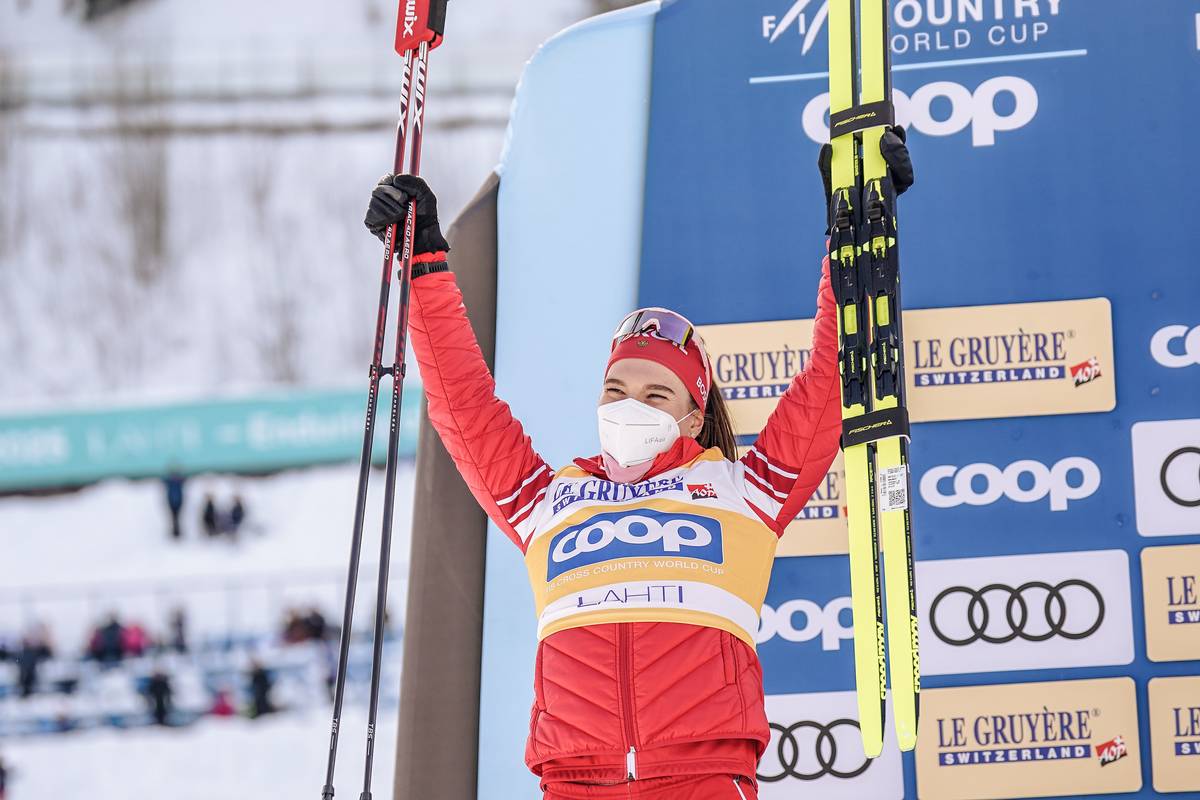
Russia’s Natalia Nepryaeva steps onto the podium following a second place finish in the 10 k classic in Lahti. (Photo: NordicFocus)
On Monday the Ski Associations for Norway, Sweden, and Finlandwrote to FIS to ask for the exclusion of Russian athletes. Later in the day, the International Olympic Committee (IOC) revised their advice and requested the exclusion of Russian and Belarusian athletes.
“[The Ski Associations] letter was somewhat surprising to us,” said FIS Secretary General Michel Vion.
FIS, seemingly unable to move in tandem with events, made no response, and Vegard Ulvang pushed the Norwegian Ski Association to carry through with the refusal to host Russian athletes, saying, “It is a decision that FIS should have made. When they do not take it, it is we [Norway], who own the event, who must take it. If FIS disagrees with the decision, they can take the World Cup from us, it is a risk we should take. Then we will also force FIS to take active action.”
With no word from FIS, the Norwegian Ski Association hosted a series of crisis meetings on Monday night and early Tuesday morning, during which the organization decided to override FIS and ban all Russian and Belarussian athletes from competing, regardless of the consequences of the action.
“We had hoped that FIS would come to that decision on behalf of the entire ski sport,” said Norwegian Ski Association President Erik Røste, “But now the Ski Association can not wait any longer.”
FIS Secretary General Vion dismissed the position of the Norwegians saying, “We received some emails, with inquiries that were not reality-oriented. The Norwegian Ski Association does not have the authority to cancel anything or to exclude athletes. They express a wish that there will be no Russian athletes, but it was just a wish.”
The Russian ski team, training in Holmenkollen on Tuesday morning confirmed that they would leave Norway and not participate in the World Cup. “Let our rivals compete,” Borodavko told VG. “Let’s just say they are not our friends and not comrades.”
With the decision effectively already taken, FIS seized the moment at noon Central European time on Tuesday and banned the Russian and Belarusian athletes and officials. “I am very happy that FIS ended up in that position,” said Røste, adding, “It has taken too long, it could have come earlier.”
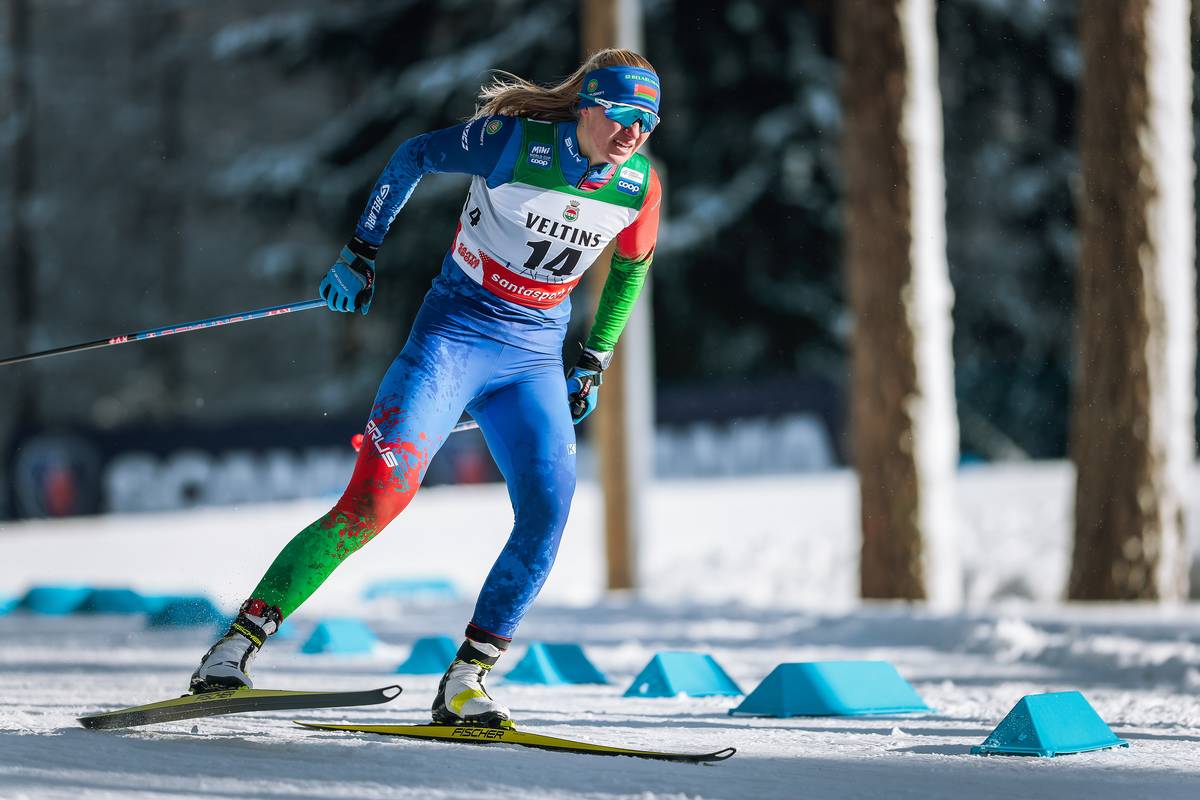
Belarussian athlete Hanna Karaliova races the freestyle sprint qualifier last weekend in Lahti, FIN. (Photo: NordicFocus)
The FIS decision narrowly averted the likely cancellation of the remaining World Cup races and the flight of sponsors.
Geirr Kihle, the event organizer of the Drammen city sprints this Thursday had urged fans to come to the event in the blue and yellow of the Ukrainian colors. He said he hoped the public’s reception to the Russian athletes would be, “to put it a little simply, sour.”
On Tuesday morning, Drammen said they would withdraw from hosting the race if the Russian athletes were not banned.
Pressure on FIS also came from Coop—the title sponsor of the World Cup. “We have given FIS clear guidelines for what we believe,” said Takle Friis, the Director of Communications for Coop to VG. “They must respond immediately. In sympathy and solidarity with Ukraine, we can not accept that the Russian team will go to the World Cup.”
Coop will adopt the Ukrainian colors for their logo on race bibs, and are working to change trailside billboards at Holmenkollen to promote donations to the Red Cross.
Sponsorship deals for Russian athletes also began to evaporate. Brav, the parent company of Swix and Toko announced on Monday that effective immediately, it will end all business in Russia and sever ties with Russian athletes.
The conflict between the sporting associations and FIS is yet another note in a habit of day-too-late decision making by the governing body of world skiing. Following the Russian invasion of Ukraine, the US ski team along with Norway, Sweden, and Finland all declared that they would not send teams to the scheduled World Cup Finals in Tyumen, Russia. After a day of urging FIS to act, the following day FIS canceled all remaining events in Russia. By then, it was already a moot point—no one was going.
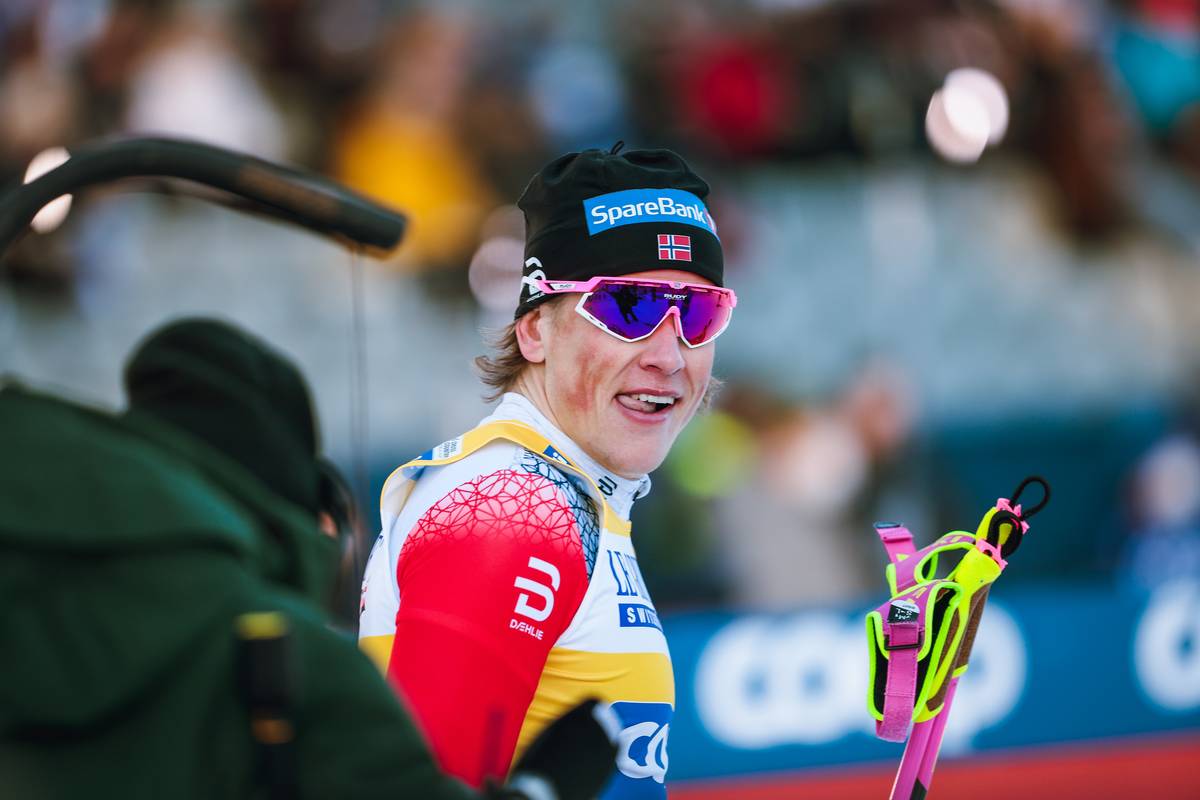
Johannes Høsflot Klæbo enjoys a victory in Lahti’s freestyle sprint. (Photo: NordicFocus)
Johannes Klæbo has been perhaps the most outspoken athlete on the issue. On Monday, he told VG “I think it is both cowardly and weak that FIS does not make the decision to deny Russia participation in Norway and in the World Cup. FIS should have done as Ski Classics [did] – and said no to Russia.”
The Visma Ski Classics, a rival circuit to that of FIS World Cup, moved swiftly on Monday to remove Russian skiers from the Vasaloppet and the season long competition.
The FIS decision came too late for some quarters: Ӧstersund announced that there was no longer sufficient time to get a budget and sponsorship ready to host the World Cup Finals.
A day earlier, the municipality of Ӧstersund, which owns the ski trails, declared that they would bar the use of the ski trails for the event if FIS did not ban Russian athletes.
The World Cup will now likely end a week earlier than scheduled in Falun, Sweden on March 13th.
The late decision from FIS stoked grumbles that the federation may be overly beholden to Russian interests. As Drammen race organizer Geirr Kihle put it about sport federations in general, “Those who are called the ‘high lords’ have a hard time deciding. It is very common for Russians to sit on the boards. They are involved in deciding and will probably almost veto if they do not get what they want.”
Norwegian newspaper Dagbladet also questioned the interests of new FIS President Johan Eliasch, the Swedish-British billionaire and former CEO of the ski company HEAD. Dagbladet challenged Eliasch’s record of supporting Russian tennis star, and HEAD athlete Maria Maria Sharapova, after tested positive in 2016 for banned substance Meldonium. Eliasch at the time said “Has WADA something against Russia? I believe they do.”
The assertion that FIS is biased towards Russia was refuted by Secretary General Vion who replied to the NRK question, “Of course not! How can you say that?” He pointed out that Elena Valbe, the head of Russian skiing, is the only Russian to sit on the 19 member council.
Nevertheless, the situation is far from resolved. NRK commentator Jan Petter Saltvedt rejected the phrasing that FIS used to ban the athletes which focused on athlete safety and in his words, lacked “the essential thing, namely the condemnation of Russia’s invasion.”
“The whole reasoning is untrustworthy and deficient,” argued Saltvedt. “Many questions remain about what kind of power struggle this has been and what FIS leaders really think about this.”
The cautious wording from FIS likely has much to do with an expected appeal by the Russians in the Court of Arbitration for Sport (CAS).
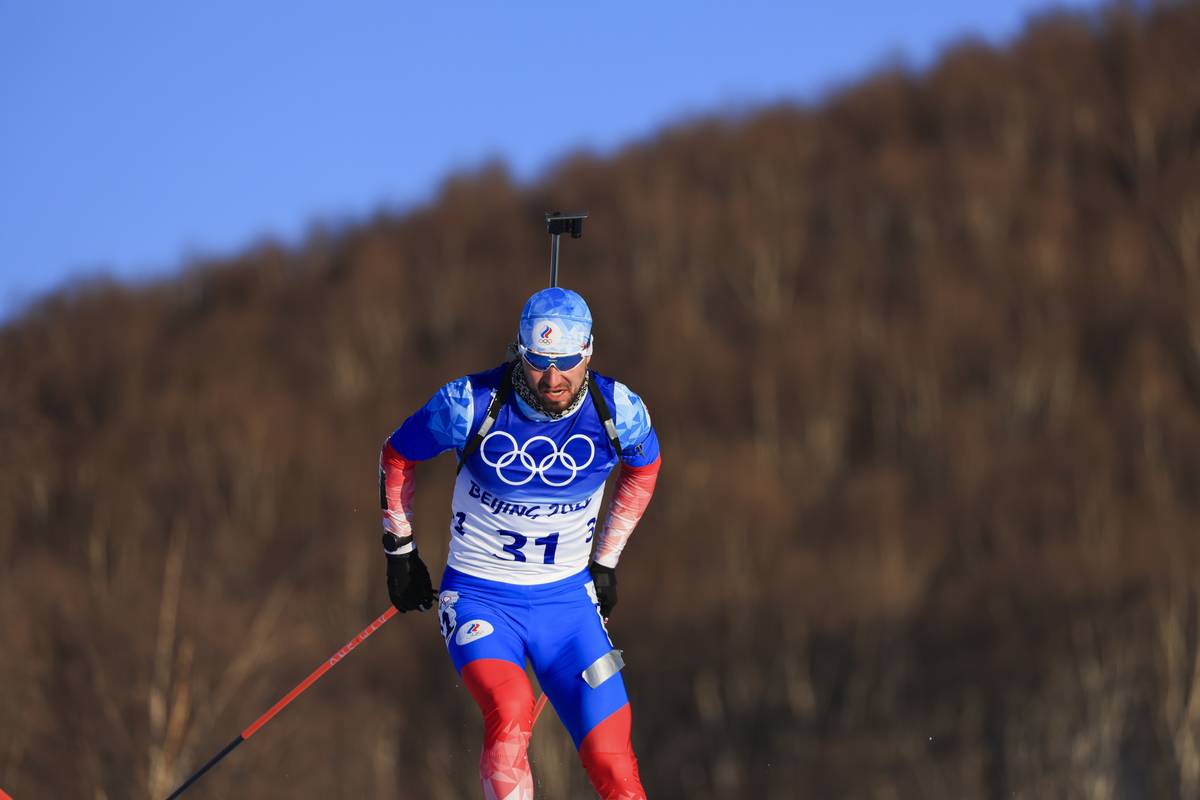
Russian biathlete Alexander Loginov competes in the men’s individual competition during the 2022 Beijing Olympic Winter Games. (Photo: NordicFocus)
When the International Biathlon Union decided on Saturday to require Russian athletes to compete under a neutral flag, their team promptly withdrew from the World Cup, stating, “We are furious at these illegal actions of the IBU and will defend the rights of our athletes and the rights of the RBU as a member of the International Federation.”
The case is expected to end up in CAS, and there is a likelihood that the same will occur in cross country skiing.
The Russian team will leave Norway on Wednesday, reported Borodavko to NRK. “When you start to mix politics into the picture,” Borodavko said, “there is something we can not accept, so therefore we go back.” With no flights between Europe and Russia, their journey home will likely route them through Turkey.
The manner in which FIS came to the decision will likely deal a blow to its credibility, managing in a single stroke to alienate both its Scandinavian and Russian partners. FIS has struggled to rise to the challenge that this season has presented, with previous misses being the COVID related cancellations of World Cup races in France and Slovenia, an impromptu shortening of the men’s Olympic 50 k, and a belated cancelation of the World Cup Finals in Russia.
“Things take time,” Klæbosaid on Friday, adding, “But I certainly think we do not have to wait until the longest every single time.”
Jens Burman of Sweden may have summed it best to Aftenbladet on Tuesday morning before FIS’s announcement. “In principle, everyone has excluded them, but not FIS. You are almost a little ashamed.”
Sweden’s Jens Burman races the 15 k skate during a December 2021 World Cup in Davos, SUI. (Photo: NordicFocus)
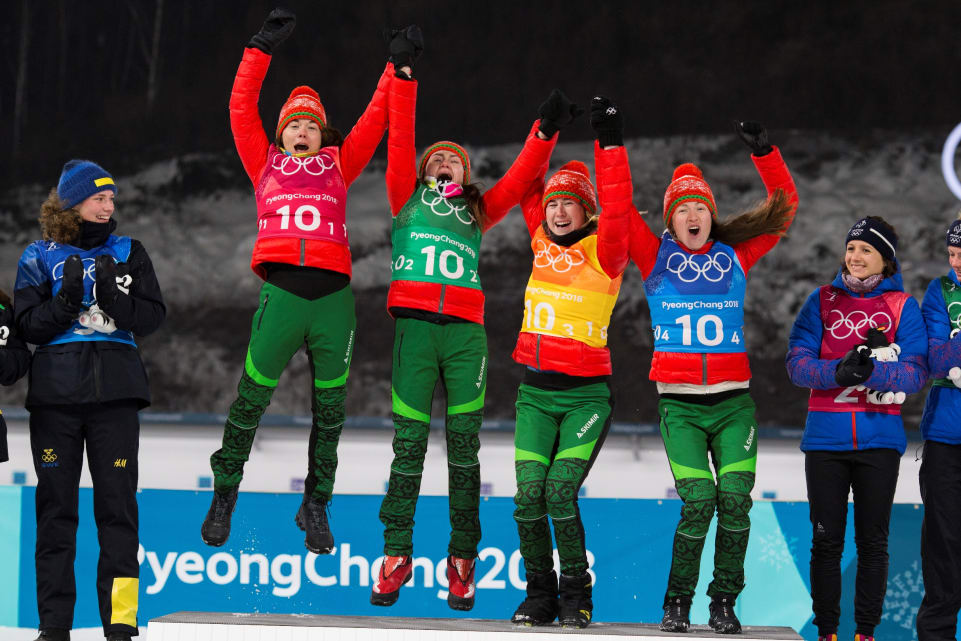
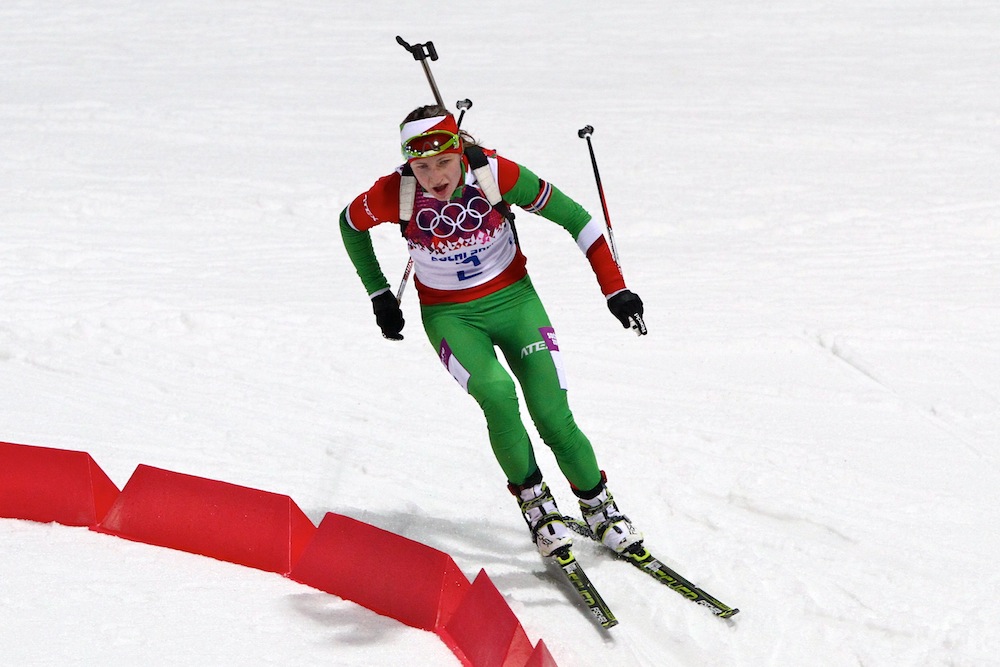
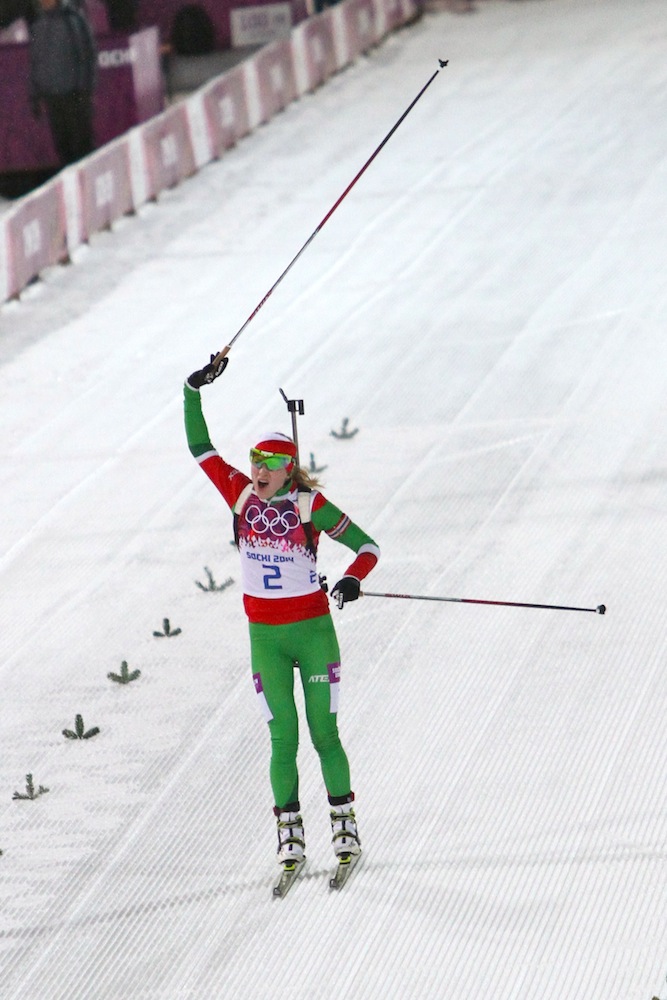
The Belarusian women’s biathlon team of Nadezhda Skardino, Irina Kryuko, Dzinara Alimbekava, and Darya Domracheva celebrates winning gold in the relay. They were ranked 10th coming into the day. (Photo: IBU/Biathlonworld.com)
Ranked just 10th coming into today’s women’s relay, the team from Belarus stole the show with Darya Domracheva skating across the line to claim the fourth Olympic gold of her career after strong efforts from Nadezhda Skardino and Iryna Kryuko, both of whom have stood on the World Cup podium before, and newcomer Dzinara Alimbekava, a 22-year-old newcomer with just 11 World Cup starts to her name. It was the first relay medal ever won by Belarus at the Olympics.
The setting was windy and snow-blown and the race was extremely tight, with seven teams with one penalty loop (or a few spare bullets) worth of time going into the final leg. The Belarusians’ nine spare rounds were the best shooting of the day; while that spare-round tally was matched by Slovakia, Kazakhstan, Bulgaria, and Japan, those teams had penalty loops as well.
Sweden actually wasn’t one of them, but with perfect shooting and a fast ski time 15 k gold medalist Hanna Öberg brought the team to silver after starting the anchor leg in eighth, a minute back. She benefitted from many missed shots by the leaders, and then passed France’s Anais Bescond on the final loop to claim second, 10.7 seconds back, for her teammates (Linn Persson,Mona Brorsson, and Anna Magnusson) while France (Bescond, Anais Chevalier, Marie Dorin Habert, and Justine Braisaz) took bronze (17.6). These medal-winning teams used 12 and 14 spare rounds, respectively, an unusually high tally.
Norway (Synnøve Solemdal, Tiril Eckhoff, Ingrid Tandrevold, and MarteOlsbu) finished fourth, +29.7, Slovakia fifth (+38.4), Switzerland sixth (+43.5) after winning a photo finish against Poland (+43.6), and Germany finished seventh (+53.9).
The Canadian team of Sarah Beaudry, Julia Ransom, Emma Lunder, and Rosanna Crawford finished 10th, +1:33.4. Their shooting of eleven spare rounds and one penalty loop was among the better scores of the day.
The United States had a strong start, with Susan Dunklee tagging off in second place, Clare Egan maintaining a good position in fourth, and Joanne Reid rebounding from one bad shooting stage to tag off in sixth. Anchor leg Emily Dreissigacker crossed the finish line in 13th, +2:01.9.
2018 Olympics (PyeongChang, South Korea): Nordic Combined Team Competition
After sweeping the medals in the large hill competition, perhaps it was not a surprise that Germany won the nordic combined team event. It was a blowout: ranked second after the jumping round but starting the cross-country ski relay just six seconds behind Austria, the Germans quickly took the lead and then just extended it. Their team of Vinzenz Geiger, Fabian Riessle, Eric Frenzel, and Johannes Rydzek won by 52.7 seconds over Norway’s Jan Schmid, Espen Andersen, Jarl Magnus Riiber, and Jørgen Gråbak. Austria hung on for third, +1:07.8, with Wilhelm Denifl, Lukas Klapfer, Bernhard Gruber, and Mario Seidl.
The United States team of Taylor Fletcher, Ben Berend, Ben Loomis, and Bryan Fletcher lost out on a photo finish with Poland and finished 10th out of 10 teams, +5:16.7.
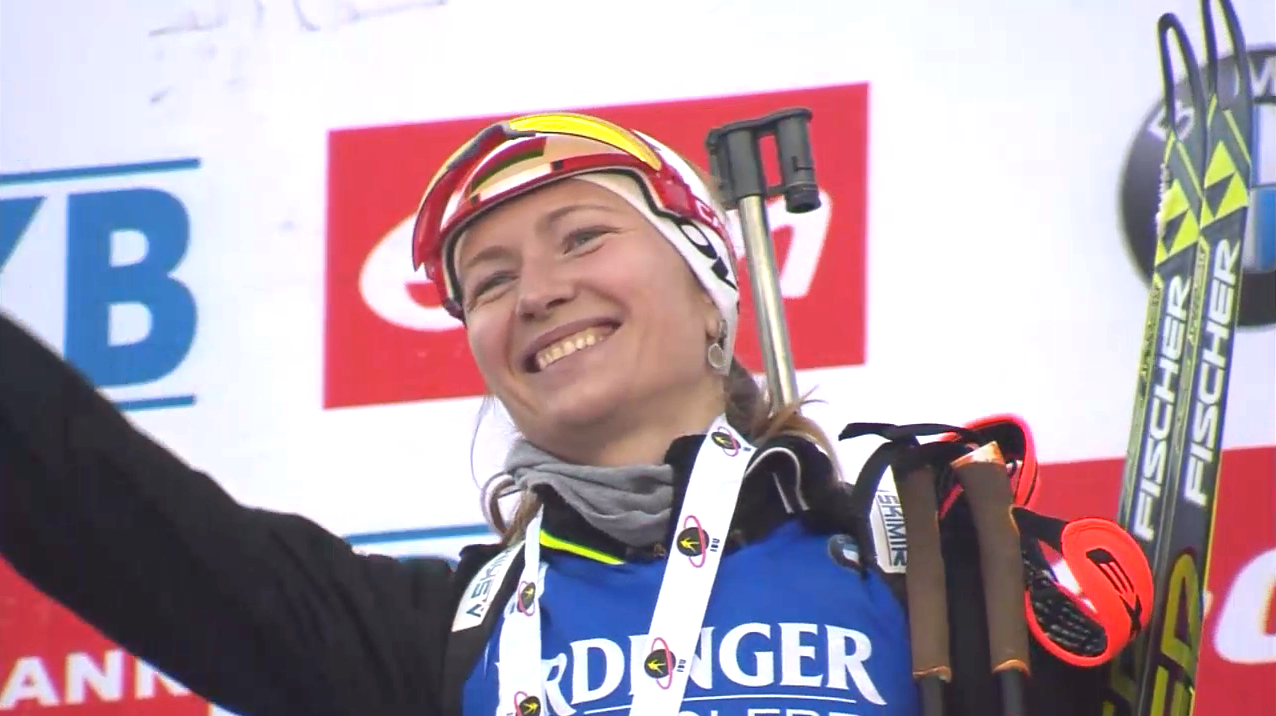
Darya Domracheva (Belarus) atop the IBU World Cup podium in 2015. (Photo: Fischer/NordicFocus.com)
A line briefly posted on the website of the Dynamo Minsk sports club revealed something new about one of its most famous members: biathlete Darya Domracheva worked for the Belarusian KGB intelligence agency.
Domracheva, a three-time Olympic gold medalist and 2014-2015 World Cup Total Score winner, usually spreads an uplifting message to her fans about believing in and loving yourself. She frequently shapes her hands into a heart when taking selfies and once posted on Instagram, “always better mood when you are in pink.”
The State Security Agency of the Republic of Belarus, according to its website, “provides for the independence and territorial integrity of the Republic of Belarus, the protection of the constitutional order and the sovereignty of Belarus, as well as providing national security of the Republic of Belarus in the political, economic, military, scientific, technological, informational, social, demographic and environmental fields.”
Domracheva apparently held the rank of lieutenant.
“Domracheva had worked for the KGB until June 2014, but at the moment Darya is not an employee of the Committee,” a KGB spokesman said on Wednesday.
Some in Belarus say that it was obvious.
“In Belarus, all those who are professionally engaged in biathlon serve in the KGB, because the Federation of biathlon is fixed for that office,” Ales Putsila of the television channel Belsat told Russian-language online newspaper Meduza. “Each KGB chairman concurrently heads the biathlon federation. So that Darya Domracheva was the state of the KGB, there is nothing surprising… This does not mean that members of the national biathlon team are secret agents. During their careers, they are simply part of the state and are maintained by the KGB.”
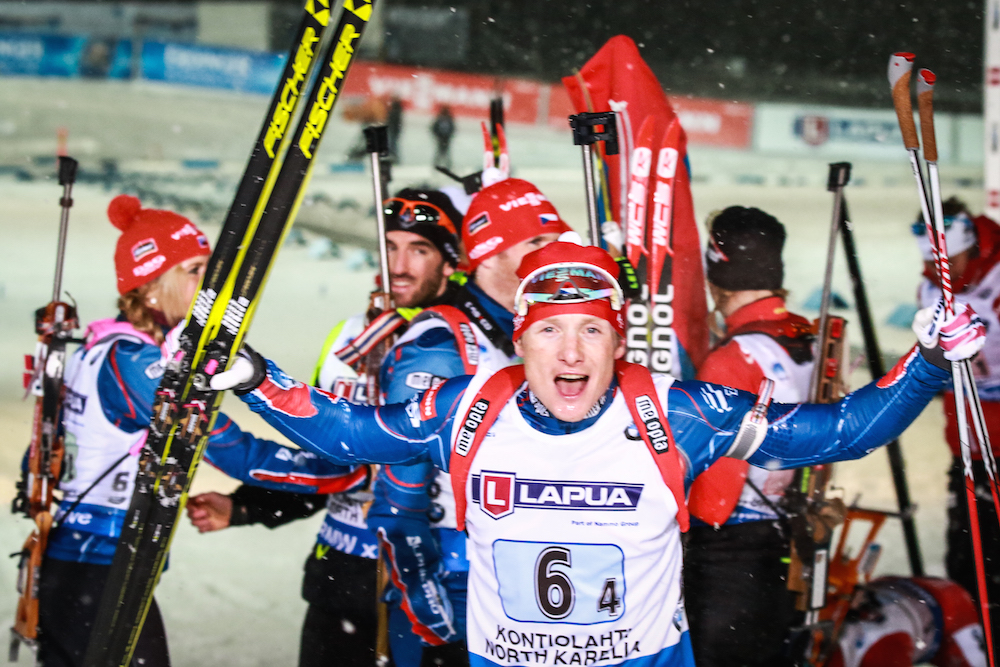
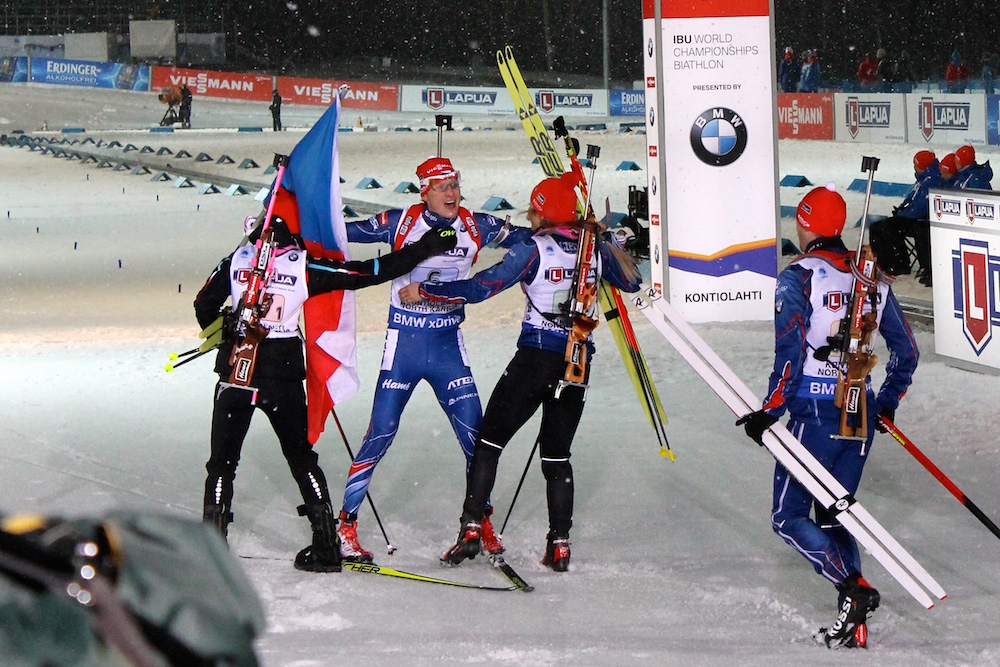
Ondrej Moravec celebrates a sizable win for the Czech Republic in Thursday’s mixed relay at 2015 IBU World Championships in Kontiolahti, Finland. (Photo: Kontiolahden Urheilijat/Jarno Artika)
KONTIOLAHTI, Finland — At least one team finished with big smiles at the end of Thursday’s epically slow-and-slushy 2 x 6 + 2 x 7 kilometer mixed relay on the first day of the 2015 International Biathlon Union (IBU) World Championships in eastern Finland.
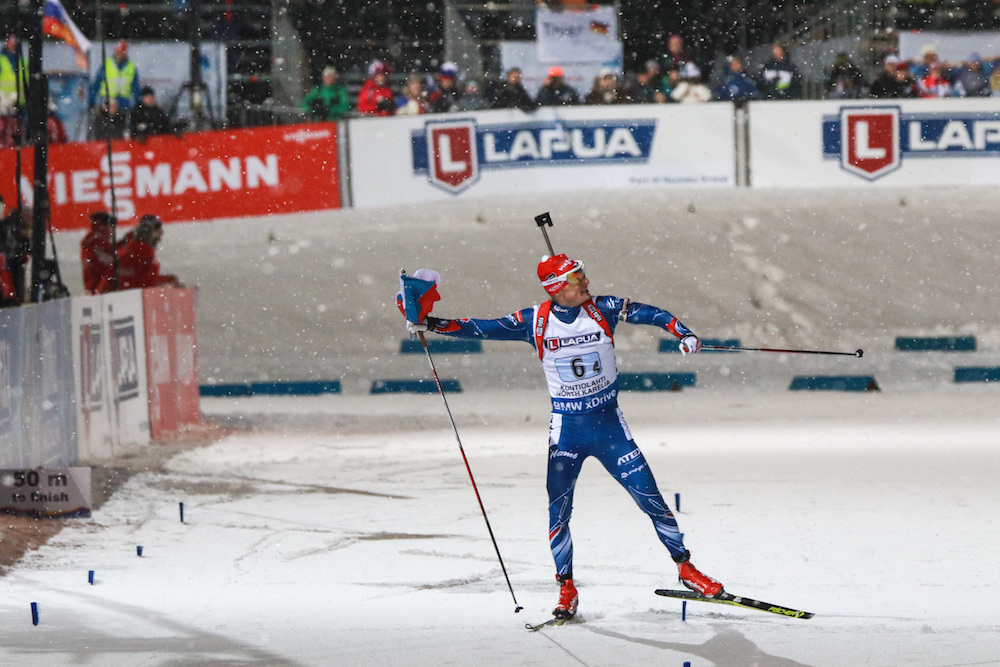
Ondrej Moravec anchored the Czech Republic to gold, and with plenty of time to play with before doing so, he grabbed his nation’s flag from a stadium spectator to carry across the line.
Ondrej Moravec celebrates at the finish after anchoring the Czech Republic to gold in Thursday’s mixed relay at 2015 IBU World Championships in Kontiolahti, Finland. (Photo: Kontiolahden Urheilijat/Jarno Artika)
Picking up one leg and pumping his free arm in the air, Moravec flashed a huge grin at the 4,500-person crowd and was greeted by three happy teammates in the finishing pen. Like the rest of the 26-team field, they had been through a lot in the last 1:20.27.2 hours, but what counted was that they handled the conditions better than any other team and came out on top.
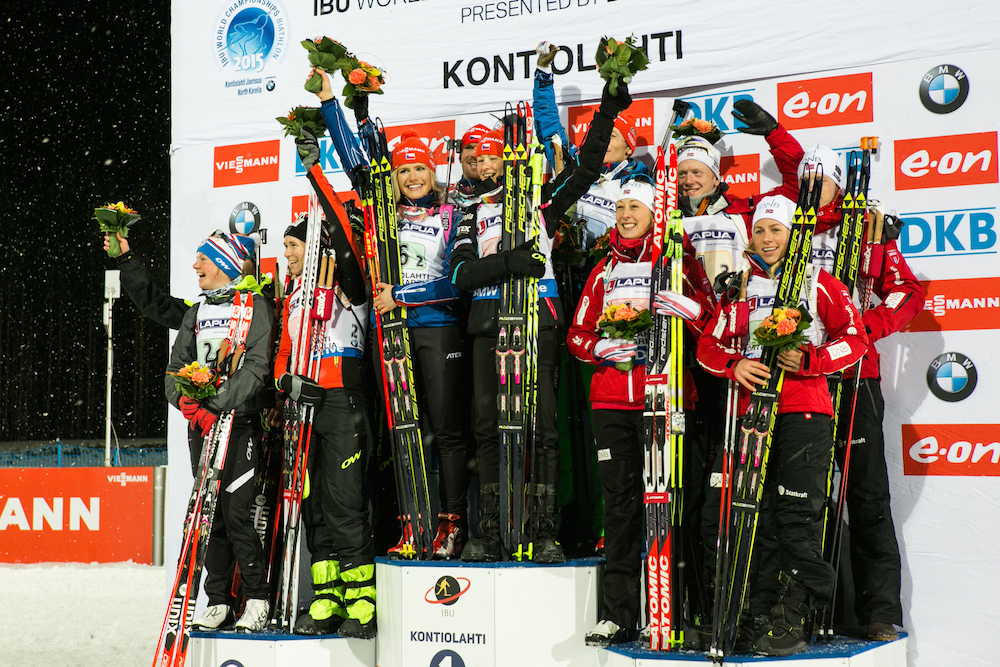
Veronika Vitkova, Gabriela Soukalova, Michal Slesinger, and Moravec combined for a penalty-free effort, using a total of eight spares en route to the win. They finished 20.2 seconds ahead of France, which used eight spares as well. The defending Olympic mixed-relay champions, Norway finished third, 27.7 seconds back with three spares and a penalty loop.
While the Czech Republic, which notched silver from the mixed relay at the 2014 Sochi Olympics, consistently skied in the top three, its team mostly had the task of chasing down Belarus, which got out to an 20-second lead with second-leg Darya Domracheva.
Domracheva had come back from getting tagged in fifth, 19.4 seconds behind Vitkova as the first-leg leader. After trailing Japan’s Fuyuko Suzuki for most of her three 2 k laps, Vitkova pushed ahead of her before the exchange to give Soukalova a 2.1-second lead.
And while Soukalova was put in a prime position, after Vitkova used two spares on each round but cleaned to keep them at the front of the pack, she was nervous.
“I was afraid of the race before the start because I really don’t like these conditions,” Soukalova said in a post-race press conference about the at-least-ankle-deep snow in above-freezing temperatures. “It was really hard, but I tried to go [in] with a clear mind and just enjoy the race.”
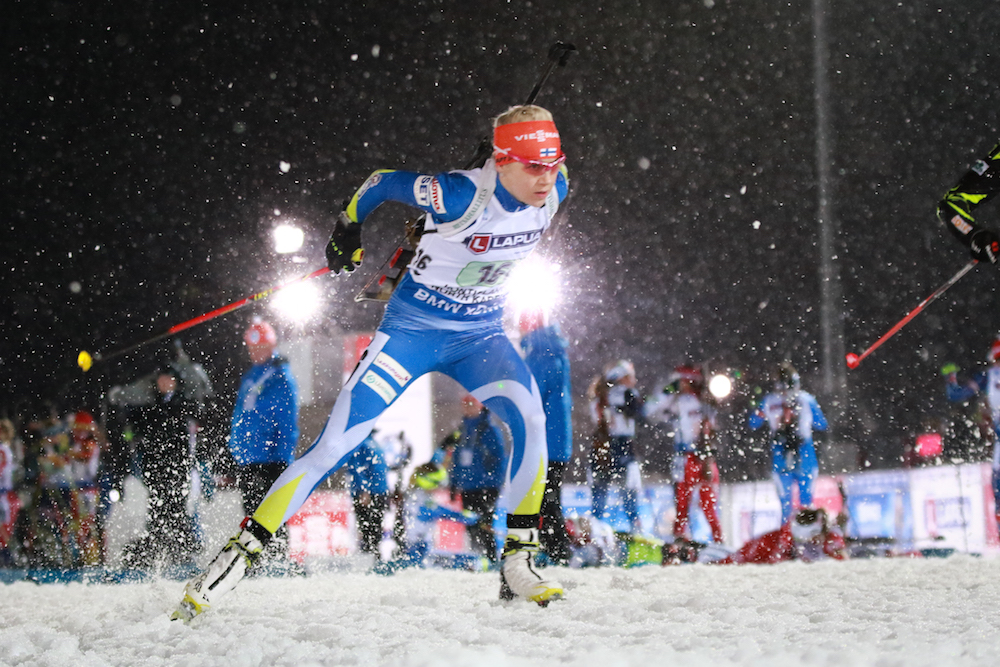
Finland’s Kaisa Mäkäräinen racing from 11th to second as the second leg of the mixed relay at 2015 IBU World Championships in Kontiolahti, Finland. Her team went on to place ninth. (Photo: Kontiolahden Urheilijat/Jarno Artika)
She ended up cleaning both her stages and tagging Slesingr in third, 25.7 seconds after Domracheva and 5.7 seconds behind Finland’s Kaisa Mäkäräinen, who cleaned to bring her team from 11th (after Mari Laukkanen’s first leg) to second.
“You could see in the end of the race, one kilometer before the finish, I was completely exhausted,” Soukalova said. “So I really appreciate the good job of the rest of the team.”
After the second exchange, Slesingr brought the Czechs to second with a clean prone and two standing spares. He followed Vladimir Chepelin of Belarus out of the range for the second time, about 25 seconds back, after Chepelin used three standing spares.
With one 2.5 k lap to go, Slesingr closed the gap to 11.7 seconds and tagged Moravec in second. Norway handed off in third, 45 seconds back, after Johannes Thingnes Bø lifted the team from sixth to third with clean shooting.
From there, Moravec proceeded to stalk Belarusian anchor Yuryi Liadov, who used one spare in prone. On the second lap, Moravec passed Liadov and led him into the range for the last time.
While Liadov missed three more standing to leave the range for the last time in fourth, 25.7 seconds out of first, Moravec (who used one spare in each bout) remained in control heading into the final lap, leading France’s Martin Fourcade in second by 18.2 seconds. Fourcade cleaned both stages to bring France from fourth to second by the last stage, and he ended up skiing the fastest anchor leg to come within 15 seconds of Moravec by 6.1 k.
But with 1.4 k to go, the Czech anchor solidified the victory with the second-fastest course time on the last leg, 7 seconds slower than Fourcade.
“I was so surprised the Belarusian guy was a long time ahead of the race,” Moravec told the IBU media after the race. “I think it was also pretty good result for them, but I believe for myself that I can beat him and I did it and I was so happy.”
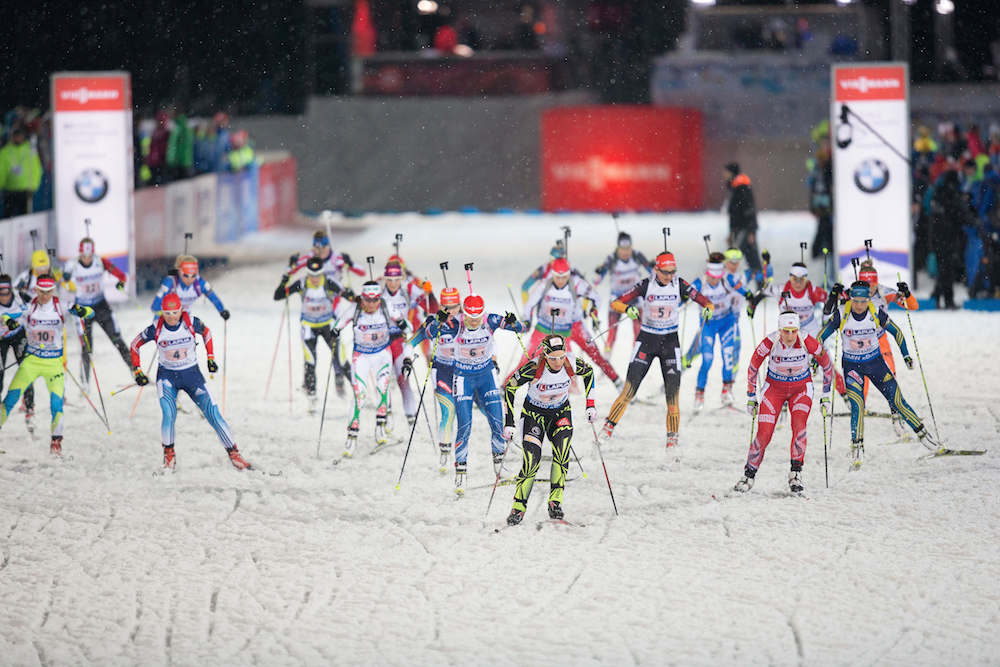
Anais Bescond of France (center, in black) leads the first leg out of the start in Thursday’s mixed relay at IBU World Championships in Kontiolahti, Finland. (Photo: Biathlon Canada/NordicFocus)
Belarus finished fourth, 31 seconds out of first and 4.3 seconds off the podium.
“I think it was a pretty good race for everybody on the team,” Moravec said in the press conference. “It was perfect.”
After Anais Bescond’s first leg, in which she used four spares (one prone and three standing), France rose from 12th to fourth with Marie Dorin Habert, who cleaned prone and used one standing spare. She also skied the third-fastest second leg after Mäkäräinen and Domracheva, respectively.
“I’m very happy with this medal and I hope next year we could change medals with the Czechs,” Habert said in the conference. “We have to work hard for it, but it’s a very nice day for the French team, too.”
Jean-Guillaume Béatrix kept France in fourth with a clean first stage and used three spares standing, coming into the final exchange 1:10.5 out of the lead and 25.6 seconds after third.
“It’s like running in the sand here,” Beatrix recalled. “I’m happy that in the end we can be on the podium because it was unbelievably hard.”
“It’s like running in the sand here. … It was unbelievably hard.” — Jean-Guillaume Béatrix (France)
Fourcade clawed back more than 15 seconds within his first two kilometers and proceeded to shoot a perfect 10-for-10 to keep his team ahead of Norway for silver.
The 2 x 6 + 2 x 7.5 k mixed relay at 2015 IBU World Championships in Kontiolahti, Finland, with the Czech Republic gold medalists (c), France (l) in second, and Norway (r) in third. (Photo: Kontiolahden Urheilijat/Jarno Artika)
“I have no thoughts about missing the team relay,” Fourcade said when asked whether he considered skipping the coed event to prepare for other races at World Championships. “It was important to me and important to team France so I’m really happy I did [it] and really happy we catch some medals.”
While Norway’s Fanny Well-Strand Horn cleaned both her stages to tag off in sixth, Tiril Eckhoff used all three spares in standing and skied a penalty loop. Yet she still managed to keep Norway in sixth, 1:32.4 out of first.
“It always sucks to get the penalty, but I just have to go and hope for the guys to take medal and they did so that was really good,” Eckhoff said.
The team’s third leg, Johannes Thingnes Bø noted how fast their skis were despite the conditions.
“The most [important] part of my race was the good skis today — they were really fast and also our shooting today was really strong,” the 21-year-old Bø said. “We had just one shooting that was bad. We are happy to get a medal.”
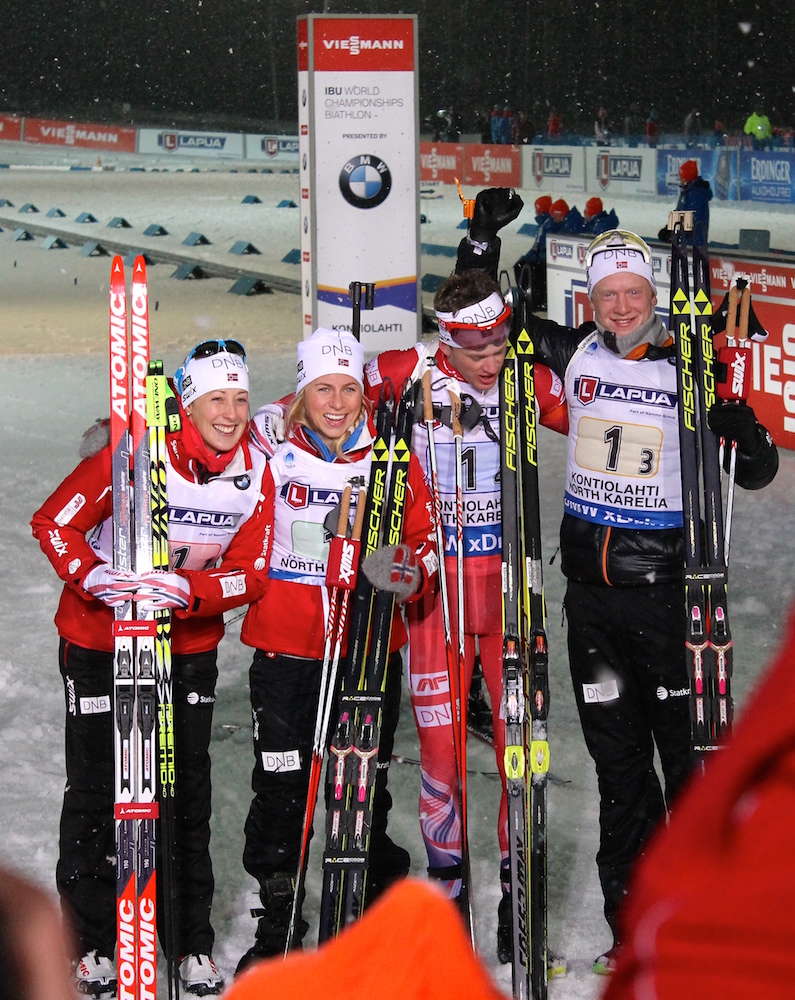
The Norwegian mixed-relay team, (from left to right) with Fanny Well-Strand Horn, Tiril Eckhoff, Tarjei Bø, and Johannes Thingnes Bø, after earning bronze at 2015 IBU World Championships in Kontiolahti, Finland.
His older brother, Tarjei Bø, who anchored the team to third, cleaned as well.
“We are always happy with the medal. Of course, we’re going for the gold medal each relay … but still bronze is good,” Tarjei, 26, said. “It’s a big difference with bronze medal and fourth place. I think as a group, we’re happy.”
And at the end of the day, the Belarus team — at least Domracheva — wasn’t bummed, either.
“This is the best place for a few years for us in mixed relay,” she told the IBU. “From start to start, we have better and better results. Fourth place is really close to the podium, and I’m glad with my own race and it was not easy conditions today. We saw for our guys also some really strong competitors, and it was a good biathlon fight.”
Also in the top 10, Austria placed fifth (+1:00.3) with three total spares, Germany was sixth (+1:22.8) with six spares, Italy finished seventh (+1:24.7) with 10 spares, and the U.S. tied its best World Championships mixed-relay result in eighth (+1:46.6) with one penalty and eight spares. Finland ended up ninth (+1:59.5) with eighth spares and Russia was 10th (+2:00.2) with just two spares.
Ukraine finished 11th (+2:10.3) ahead of Canada in 12th (+2:27.9). The Canadians tied their nation’s mixed-relay best at World Championships in 12th (a year after placing 11th at the Olympics) with a total of four spares. After leading the first two laps of the race, Japan placed 21st out of 26 teams.
The Czech Republic mixed relay team celebrates with anchor Ondrej Moravec (second from l) at the finish after winning Thursday’s race by 20.2 seconds over France at 2015 IBU World Championships in Kontiolahti, Finland.
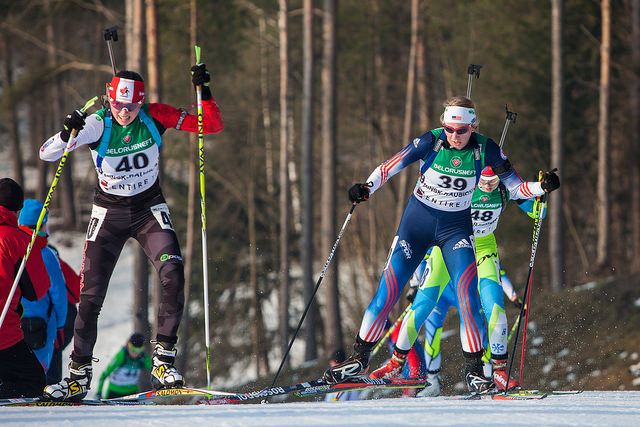
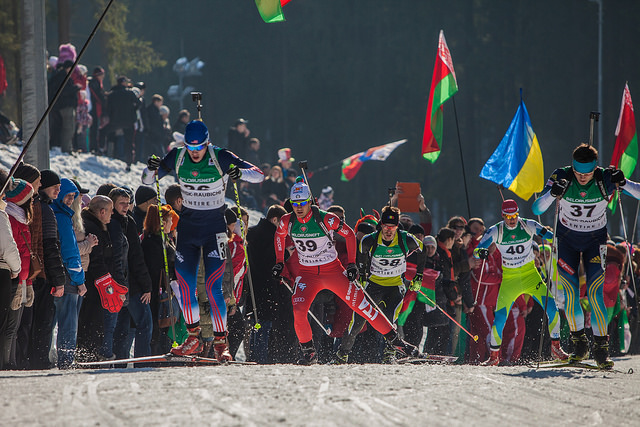
Canada’s Bryn Robertson (bib 40) and USA’s Amanda Kautzer (bib 39) on course in the youth women’s 7.5 k pursuit in Belarus on Sunday. (Photo: Jake Ellingson)
Sunday was a big day at the Raubichi biathlon venue outside of Minsk, Belarus. With four days of racing at IBU World Youth and Junior Championships, it was time for the pursuits: four on one day. Competitors completed four shooting stages, two prone and two standing, and skied 7.5 (youth women), 10 (junior women, youth men), or 12.5 kilometers (junior men).
With a pursuit format based on results from the previous days’ sprint competitions, there was plenty of excitement and finally, the first head-to-head racing of the Championships.
The youth women’s pursuit, Norway’s Ingrid Landmark Tandrevold cleaned both prone stages and by the second, had moved from third place up to first. She never relinquished her lead despite a penalty in each standing stage. Behind her was the drama: Darya Blashko, the Belorussian winner of the sprint, cross-fired onto Julia Schwaiger’s targets. The Austrian thus couldn’t shoot her own targets in a timely fashion, but was given a time credit that moved her into second place. Blashko was penalized ten minutes. Another Austrian, Simone Kupfner, finished third.
That may have been the most dramatic incidence in any of the races, but there was plenty of good, catastrophe-free racing. In the junior women’s pursuit, two women managed to shoot a perfect 20 for 20: Marie Heinrich of Germany, who moved from fourth after the sprint up through the leaders and won by 15.4 seconds over Galina Vishnevskaya of Russia, and Yuliya Zhuravok of Ukraine, who moved from eighth up to third. Maddie Phaneuf of the United States had three clean stages and one with two penalties, and moved from 33rd up to 22nd.
In the junior men’s competition, Eduard Latypov of Russia took the win by 24.4 seconds over Vermund Gurigard of Norway. Alexander Povarnitsyn, also of Russia, finished third. There were great hopes on North American competitors, but Sean Doherty and Aidan Millar both struggled on the range. Doherty had placed third in the sprint and Millar had placed eighth, but the pair finished 11th and 14th after seven and six penalties, respectively.
Finally, in the youth men’s pursuit, Felix Leitner of Austria won an exciting sprint finish against Kirill Streltsov of Russia. Streltsov had left the range for the final time 23 seconds behind Leitner, but made up 20 seconds on the trails and almost caught him by the finish. Mattias Haug of Norway finished third; all three hit 18 of their 20 shots. Pearce Hanna of Canada shot an impressive race, collecting only three penalties as he moved from 34th after the sprint all the way up to 13th place.
Here’s a photo gallery of the day; below the jump, find notes and quotes from the North American competitors.
l Photo: Jane Robertson
Sean Doherty competing at 2015 World Junior Championships in Minsk, Belarus. (Photo: Jakob Ellingson)
Photo: Jake Ellingson.
Eisenbichler testing skis in 2015. (Photo: Jake Ellingson)
Photo: Jane Robertson
Photo: Jake Ellingson.
Photo: Jane Robertson
Photo: Jake Ellingson.
Photo: Jake Ellingson.
Paul Everett racing at 2015 IBU Junior World Championships near Minsk, Belarus. (Photo: Jake Ellingson)
Photo: Jane Robertson
Carsen Campbell (l) racing in 2015. (Photo: Jake Ellingson)
Photo: Jake Ellingson.
Sarah Beaudry racing in 2015 (Photo: Jake Ellingson)
Photo: Jake Ellingson.
Photo: Jake Ellingson.
Photo: Jake Ellingson.
Photo: Jake Ellingson.
Aidan Millar competing in Minsk. (Photo: Jane Robertson)
Photo: Jake Ellingson.
Photo: Jake Ellingson.
Carsen Campbell competing at 2015 World Junior Championships. (Photo: Jake Ellingson.)
Photo: Jane Robertson
Photo: Jane Robertson
Richard Boruta, head coach at the Biathlon Alberta Training Center. died in a climbing accident on August, 9th. (Photo: Jane Robertson)
Photo: Jake Ellingson.
Photo: Jake Ellingson.
Photo: Jane Robertson
Photo: Jake Ellingson.
Photo: Jake Ellingson.
The Top Finishers
“I am a little disappointed, definitely wanted to hit a few more targets but felt great on the skis again,” wrote Millar of his 14th-place finish. “The range was really calm so I’m not really sure why the shooting was so poor. Coming out of the range and up the first hill was very deep slush so I just tried to keep a half decent pace through there then make up ground on the firmer snow.”
“I was really happy with my shooting, I think that’s the best percentage (90% hits) I’ve had in a four stage shooting race before,” explained Phaneuf, who is in her first year of junior racing after competing as a youth last season. “Going into the pursuit I was mostly just getting really excited to race, because pursuits always seem to be more chaotic and fun. I told myself before the race that a lot of time can be made up on the range, and if I shot well I could move up quite a bit…which was true! It was nice to see myself getting a top 25, and only being 8 seconds out of the top 20.”
On Gaining Experience
Phaneuf has been bouncing all over Europe so far this season, competing at Open European Championships as well as on the World Cup, where she competed in a sprint and a relay.
“I think being over here in Europe for over a month before these World Junior races really helped me get ready,” she wrote. “This season I raced more international races than I ever have before, and now I see myself being much more comfortable in this type of higher competition… I think being slowly introduced to the highest level has helped me as an athlete. It also has given me an idea of what I need to do to stay on that level of competition. I know I am not ready to make the full jump into the World Cup level, but in the next couple of years I hope to see myself becoming competitive on that circuit.”
“I have definitely felt more prepared this time round, because I knew, more or less, what to expect,” wrote Canada’s Megan Bankes, who raced from 45th up to 27th in the youth women’s pursuit. “Last year was mainly about the experience, and this year I was more focused on results.”
“I am a first year junior this year, so I have one more year to prove myself at the World Champs, next year being in Romania,” wrote Canada’s Matt Strum, who placed 49th in the junior pursuit. “Compared to my trip in 2013 to Obertilliach, I feel like a stronger athlete, more capable, and generally more prepared for what was to come, as the Champs are probably the biggest events I have attended. In Austria, it was a bit of a shock to the system, and I was more in awe of my accomplishment of making the team, so my performance probably wasn’t at the peak for that season. This year however, I have more experience racing internationally, so I have expected to and succeeded at performing at a higher level.”
Or, On Being a Newbie
“This being my first international competition has been quite the eye opener,” wrote Canada’s Bryn Robertson, who finished 40th in both the sprint and the pursuit. “When you come here you realize how big the sport is in Belarus, and Europe for that fact. It is amazing to see hundreds of spectators at the range and lining the course during the races with flags waving and horns honking as the competitors ski by. Talking to some of the other competitors here is very inspiring because of how energized they are about the sport and how hard they work to improve themselves. This made me realize how important it is to have a dream and to set goals to get to that dream because otherwise you will never get where you want to be racing if the heart isn’t there. And in Europe, the heart is really there.”
“The level of competition is insane,” agreed fellow youth competitor Amanda Kautzer of the U.S. “I found myself saying over and over ‘wow, those (insert country name here) are so fast/strong/ good shooters.’ I am glad for the opportunity to be here as it is definitely making me a better athlete. I’m just trying to absorb and learn as much as I can from all the amazing athletes around me.”
On Shooting Well
“Today in the pursuit, I knew that my skiing would be pretty strong, so I really focused on making each shot count, and not going to the penalty loop,” wrote Canada’s Bankes. “After missing 2 in the first prone, I was a little disheartened, but got a correction, and then only had one other miss in my first standing. I was particularly happy with my second standing shooting because I cleaned, and had the 4th fastest shooting time for the bout.
“When I came into the second standing, I didn’t take time to really set my position and focus my attention on the targets before I started shooting and missed 3 which set me back a little,” wrote teammate Robertson. “The range was very busy! It is very different from racing in Canada because there are so many people rushing into the range at once. It can be very distracting! You don’t realize how ten other people entering the range at the same time as you can influence your mind space!”
“To be honest, I think I got a little too excited,” wrote Kautzer of a stage where she missed four shots. After placing 39th in the sprint, she finished 46th in the pursuit. “I zeroed for no wind, and there was a slight wind coming into the range the first stage so I took 2 clicks. At home I mostly shoot at a small 10 point range in the middle of the woods virtually wind free, so was very nervous about the wind and how to take clicks. By the time I got to standing I was relieved I didn’t have to worry about clicks and since the prone had gone so well (usually I miss more prone) I thought standing would go better. I rushed it and took shots that I should have waited out and taken another breath for.”
On Last-Lap Heroics
“The last lap was very hard but also a lot of fun,” wrote Canada’s Millar, who had to defend his 14th-place position from several challengers and held off Germany’s Johannes Werner Donhauser by just 0.4 seconds. “I had a good battle with one of Germans and tried to drop him on the last hill before you come down in to the finish. He was able to stay with me but the great skis we’ve had all week helped me get the few meters I needed.”
On Disappointment
“Overall I’m indifferent with my results,” wrote Mikaela Paluszek of the U.S., who finished 55th in the pursuit. “Of course I wanted to do better than the paper showed, but I’m still learning. Being able to go to Open European Champs I do believe helped me a little bit as well. Without Open European Champs, Junior Worlds would only have been my second set of biathlon races this year. Despite getting sick for the last race in Estonia it was great to get a few more competitions done before Belarus.”
”I believe that I was focusing too much on keeping up with the field and was not aware of the speed coming into the range,” wrote Chloe Levins, an American who finished 18th in the youth women’s sprint but slipped to 42nd in the pursuit with nine penalties. “I am happier with my ski speed and believe that I maintained a good present focus throughout the race. I stayed relaxed, despite many misses, and accepted the challenge to make up some time on the track. I am disappointed in the outcome, but there are many things to learn from this race that will be useful going into another head-to-head competition tomorrow. I will focus on being smooth on the range without hesitation.”
“I was very disappointed with my result in the sprint,” wrote Jakob Ellingson, an American who placed 65th in the junior men’s sprint and missed the cutoff for the pursuit by 17 seconds. “I am not a fast enough skier to get away with missing 5, and I knew that ahead of time. I did ski as fast I had hoped I was going to, and if (biathlon is full of these ifs) I had held it together prone I could have had a good result. I know that on a better day I should be able hit more than I did. I am pretty sad that I wont have another chance to do what I know I’m capable of doing in an individual race here.”
On Crazy Crowds
“The number of spectators and the atmosphere here is crazy!” wrote Ellingson. “It has really been building up since the first race, not so many were here for the individual, but still more than I’ve ever had cheering for me in any race. Quite a few more for the sprint, and then so far the biggest day was the pursuit. I’m not sure if people will still be here for the relays today and tomorrow. It isn’t the weekend here anymore…
“But yes, the spectators did cheer for Americans as well,” he continued. “There are so many people and its like a party for them on the side of the trail, every body is really excited and when they see somebody skiing up the trail they start making noise. Even if its not a racer, in between races yesterday there were a few officials skiing the course, i think to make sure everything was still good to go, and even they were cheered all the way up the hills!”
On Motivation
“My goal for this competition was to place top 30, but I am not unhappy with my results because, in making that goal, I did not put into account all of the unexpected obstacles and distractions that I have faced,” wrote first-time youth competitor Robertson of Canada. “There has been huge value in what I have learned this week, despite the fact that my performance was probably lower than my typical performance in Canadian races. I have learned so much about international racing that I would never have discovered if I hadn’t had this opportunity. I have been inspired by my team, the crowds, and my competitors – and this will motivate me to train to the top of my abilities in time to come. This trip has given me something to work toward outside our small pool of Canadian athletes.”
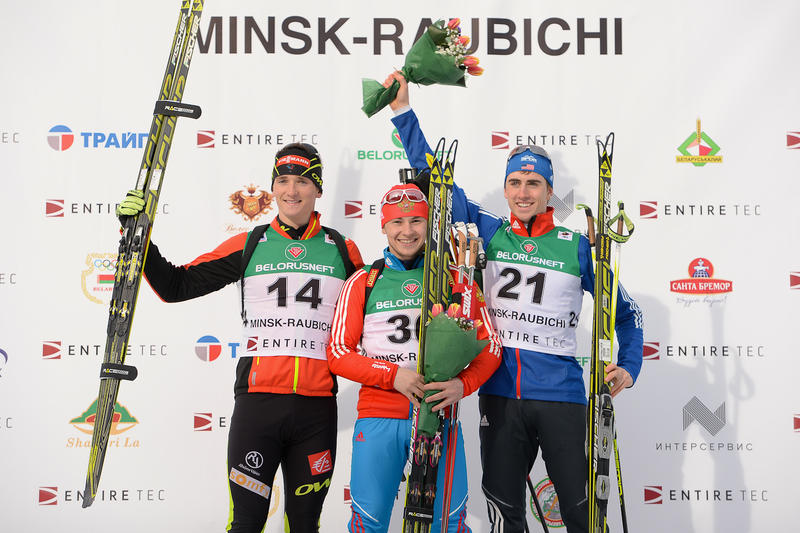
The podium for the 10 k sprint at biathlon World Junior Championships: Aleksandr Dediukhin of Russia (center) took the win, followed by Fabien Claude of France (left). Sean Doherty (USA) earned bronze, his first international medal at the junior level. (Photo: IBU/Evgeny Tumashov)
A lot has changed since Sean Doherty won two golds and a silver at last year’s World Youth and Junior Championships for biathlon in Presque Isle, Maine.
The New Hampshire native went to Sochi, Russia, and competed in the Olympic Games – and at 18 years old was one of the youngest starters in the relay, helping the U.S. to a 16th-place finish.
He’s started in World Cup races at four different venues so far this season, contributing relay performances including an eighth-place team finish in Antholz, Italy. In individual racing, he made the 60-man pursuit cutoff in Nove Mesto, Czech Republic, and finished 45th.
And, in regards to World Youth and Junior Championships, Doherty made the big step up to the junior age division. He competed in four different Championships as a youth, starting at age 14, and won three gold medals, making him the winningest Championship biathlete in U.S. history.
So in one sense, it wasn’t surprising at all that Doherty won bronze in Saturday’s junior 10 kilometers sprint at this year’s Championships, held outside of Minsk, Belarus.
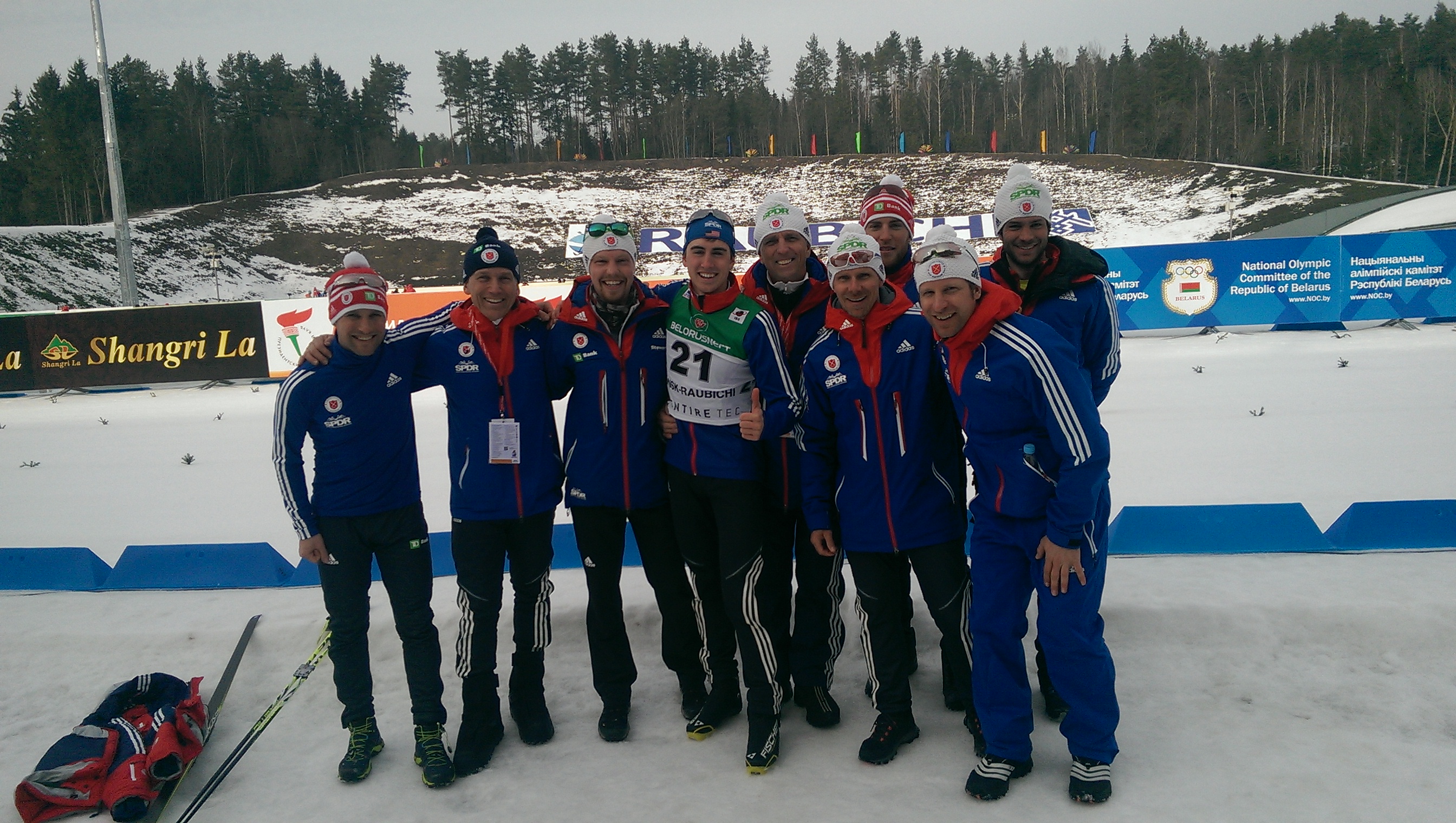
Sean Doherty (center, in bib 21) celebrates with U.S. Biathlon Association staff after winning the bronze medal in the 10 k sprint at World Junior Championships. (Photo: Jim Levins)
In another sense, it was a different accomplishment entirely. Junior athletes, aged 19 to 20 years old, are bigger and stronger than youths, and the competition is at a different level. Instead of being the best young biathletes, winners at the junior level are often on their way to being the best biathletes, period.
With one penalty, Doherty was able to ski aggressively and notch a time just 10.2 seconds slower than clean-shooting Alexsandr Dediukhin of Russia, who took the first championship title of his career.
“That Sean was able to win the Junior World Championship bronze medal with one penalty as a first year junior in Minsk speaks volumes for his dedication to excellence and the great support of the coaches and team around him,” U.S. Biathlon Association CEO Max Cobb told FasterSkier in an email. “It’s a huge accomplishment to succeed like this as an American in Europe’s favorite winter sport.”
Even when Doherty left the shooting mats for the final time, it wasn’t at all certain that he would end up on the podium. He sat in second place, 6.4 seconds behind the time set by Fabien Claude of France, an earlier starter who was the Junior World Champion in the pursuit last season.
Quickly, two other racers posted times in between: Niklas Homberg, of Germany, and Dediukhin. With the top four racers separated by just under 7 seconds and 3.3 kilometers to go, it was going to be a test of grit and ski speed.
In the end it was Homberg who fell by the wayside. Dediukhin pushed the hardest, putting seconds into Claude and winning by 4.6 seconds. Doherty’s efforts on the trails couldn’t match their speed, but far outpaced Homberg and left him securely in third place.
“I am very happy with the race today,” Doherty said in a USBA press release. “I felt good on the skis and I was able to keep that momentum all the way through the race. On the range, the last shot got me, but I am very excited for tomorrow.”
Tomorrow: Sunday’s 12.5 k pursuit, where the top finishers will have another shot at medals. It’s the event where Doherty won his first gold in 2013, after having set it up with a silver in that year’s sprint.
And there’s history, too. In that race where Doherty first found out what winning felt like, Homberg was fifth, Deiukhin sixth, and Claude tenth. The four men have been competing against each other for years.
USBA High Performance Director Bernd Eisenbichler believes that there’s potential for another medal in the pursuit.
“[Doherty] went into the race today very aggressive and confident and was in the medal mix from the first meter on,” he wrote in an email. “The last shot [in standing, a miss] was close, but that’s biathlon. He went out 4th and did a great last loop and with 3rd running time overall and 9 out of 10 hits, really deserves this medal. The wax crew did a great job with his skis and we all are looking forward to tomorrow now!”
And after that? Doherty has earned a nod for senior World Championships, to be held in March in Kontiolahti, Finland.
Doherty’s U.S. teammates will not be joining him in the pursuit. Jake Ellingson finished 65th with five penalties, and Brian Halligan 67th with three penalties.
In the junior women’s 7.5 k sprint, Maddie Phaneuf placed 33rd with two missed shots, and will start the 10 k pursuit on Sunday two minutes and five seconds behind Lena Arnaud of France, who posted a 2.4 second win. Mikaela Paluszek finished 54th with four penalties.
Aidan Millar (Canada/Biathlon Alberta Training Center) racing to eighth place in the 10 k sprint at biathlon World Junior Championships in Raubichi, Belarus. (Photo: Jane Robertson)
Canmore, Alberta’s Aidan Millar was the third man onto the course in Saturday’s individual-start 10 k sprint at World Junior Championships for biathlon in Raubichi, Belarus.
With little information about his competitors, Millar had to just ski his own best race. He had a penalty in prone but then cleaned in standing, and was unsurprisingly the race leader when he crossed the line. The thing was waiting for the other 90+ racers to finish as well.
“As soon as I had gotten my stuff I left the finish area and went and cooled down away from the TVs and the stadium,” he wrote in an email. “I knew I would probably stay in the top 10 but it was way too hard to watch the results.”
As his team had predicted, it was a top-10 finish when all was said and done. Millar’s time put him in eighth, 44.9 seconds behind Russia’s Aleksandr Dediukhin, who won with a time of 24:49.0.
Millar’s split after the last shooting had him in fifth place, but he was unable to hold onto that position, and lost about 20 seconds to the leaders over the final 3.3 k.
Canada’s Aidan Millar racing in the individual competition earlier this week at World Junior Championships. (Photo: Jane Robertson)
Still, the result was a major recovery after the individual competition, where Millar missed nine shots. He was frustrated with himself and vowed to do better.
“The individual was pretty disappointing shooting-wise,” he explained. “So for the sprint I tried to shoot more in control and not get caught up in shooting fast.”
Despite those goals, Millar actually had the eighth-fastest shooting time in the field. That speed and accuracy helped him to his best-ever result in an international competition. It was also the best result for Canada so far at the Championships, including in the youth competitions which are held on alternating days with the junior races.
At last year’s World Youth Championships in Presque Isle, Maine, he placed ninth in the sprint. But this year is completely different, and not just because the junior field is older and more experienced than the youths, Millar explained.
“I would say it’s definitely a huge step up,” Millar wrote. “With last [Championships] being in North America some of the better countries didn’t send full teams so the field wasn’t as strong. So with the jump from Youth to Junior already making it more competitive the fact that it was in Europe made even that much more competitive than last year. With those things in mind, I’m finding it hard to believe that I was actually able to get that result.”
Millar’s coach at the Biathlon Alberta Training Center, Richard Boruta, is the leader of Canada’s team on the trip and expounded a bit more on the jump Millar has made.
“While in the Youth category lots depends on biological age and other factors, in the Junior category the results are much more representing the quality of training and future potential of the athlete,” he wrote in an email. “By staying in (or at least being capable of) the top ten at [Junior Worlds], athletes are showing that they are on the progression curve necessary for future good performance in the World Cup.”
The age category is not the only change Millar has made this year. He also transitioned from the Canmore Nordic Ski Club to training with Boruta’s training center.
“He has the benefit of training with strong juniors on our team and after his recovery [from a concussion in the fall] his ski speed kept improving during all of our tests and early season races,” Boruta wrote.
He hopes for even more from Millar in the future, but is also content to have eighth place as a standout result.
“Aidan is a prototype of modern high performance biathlete (tall and strong), and I am sure we will hear about him in the future again,” Boruta wrote. “I am really happy for his result today and his goal for Pursuit is to learn how it feels to compete head-to-head with the best in the world. I would like to think that another top ten is possibility, but the field is very competitive, so it will likely come down to shooting performance during the entire race.”
As for Millar, he professed to have no results-based goals for the pursuit, which will be held on Sunday.
“Try and stay calm, shoot in control and see what happens,” he wrote.
But regardless, the top-ten is a confidence boost that still leaves him marveling.
“I’m super happy with the result,” he wrote. “I didn’t really have a results goal coming in to the Championships but 8th was beyond my expectations.”
Also in the junior men’s sprint, Matthew Strum finished 46th with one penalty, and Carsen Campbell 55th with three. Both made it inside the 60-man cutoff to compete in Sunday’s pursuit.
Stuart Harden, one of Canada’s top young biathletes, did not start the race. He explained in a facebook post that he woke up with a cold and is trying to recover in time for the relay early next week.
In the junior women’s 7.5 k sprint, Sarah Beaudry placed 38th with three penalties.
Chloe Levins of Rutland, Vermont, used clean shooting to skate her way to 18th place in the 6 k sprint at World Youth Championships in Raubichi, Belarus, on Friday. (Photo: U.S. Biathlon)
When 16-year-old Chloe Levins of Rutland, Vermont, arrived in Belarus for the International Biathlon Union’s World Youth Championships, it wasn’t under the best of circumstances.
Levins had won the U.S. Biathlon Association’s trials race series in Mount Itasca, Minnesota, at the end of December and was thus the top pick for the U.S. team to the Championships. But since then, she competed in some high school ski races but got sick and missed a block of training.
In the opening competition of the Championships, a 10 k individual race, Levins missed eight of 20 shots and finished 55th.
“The individual competition was a very challenging race for me mentally and physically,” she wrote in an e-mail. “It was difficult to expect myself to be fast on the skis and sharp on the shooting range because of the lack of ideal preparation. I was not intimidated by the competition, but more internally hesitant. I missed 8 targets and did not ski up to par.”
But Levins is a fierce competitor: besides being a winning cross country skier and biathlete, she is also a state champion golfer. She mentally reset for the sprint competition scheduled for Friday.
“My goal was to stay focused on the process as much as possible,” she wrote.
The result was a success: Levins knocked down all ten targets and finished the 6 k sprint 18th, one minute and 35 seconds behind race winner Darya Blashko of Belarus and the top North American.
“It was surreal to clean today!” she wrote. “It was my first time shooting clean in a race! I wasn’t very surprised to clean-maybe because I imagined myself hitting all of the targets last night. Also, I have shot well in previous sprint competitions, so it was a reasonable possibility.”
She was one of only six women to clean the competition, despite describing that conditions on the range were calmer than in the individual competition.
Levins competing in the 2014 North American Rollerski Championships 7.5 k sprint at Ethan Allen Firing Range in Jericho, Vt.
Levins skis for Mountain Top Nordic Ski Club and her high school in Rutland. Her brother built her a one-point range in their backyard, but for the rest of her biathlon training she has to travel over an hour and a half – each way – to Jericho, Vermont, the home of the Ethan Allen Firing Range.
“I train at Ethan Allen, but I am not a part of Ethan Allen Biathlon Club,” Levins explained. “Algis Shalna is my shooting and skiing coach. This is my third year training with Algis. I meet him in Jericho about 2 times a week during the winter. It is a lot of travel, but I learn at least one new thing every time I train with Algis, so it is worth the car ride. For the days that my mom and I aren’t in Jericho, I follow Algis’s training plan.”
Shalna has a history of taking athletes with no strong biathlon club in their hometown and teaching them towards international success; he also coached New Hampshire native Sean Doherty, who finished 14th in the junior men’s individual race on Thursday.
Doherty is a multiple gold medalist from previous seasons when he was a youth competitor, has the most World Championship medals of any U.S. biathlete in history, and competed at the 2014 Olympics. He’s also headed to his first senior World Championships in Finland in March.
So it was the process-based focus preached by Shalna and the rest of the U.S. staff that led Levins to her clean shooting in the sprint.
“I controlled the things that I could control very well, and the things out of my control cooperated nicely,” Levins explained. “It was the best I could do today, but not the culmination of my skiing potential.”
In Sunday’s 7.5 k pursuit, Levins will be in a good position to move up the results sheet if she can continue her clean-shooting ways.
“It will be a 1.5k loop that we will complete 5 times, so shooting well will be very important,” she wrote. “It is difficult to make up skiing time on such a short loop. Beyond that, I am going to stay dedicated to my process and have some fun!”
Levins’ teammates Amanda Kautzer (Loppet Nordic Racing/Minnesota Biathlon) and Siena Ellingson (Mount Itasca/Minnesota Biathlon) finished 39th and 41st, with two and three penalties, respectively, and Hannah Streinz (Maine Winter Sports Center) finished 54th. All four will appear in the pursuit.
Bryn Robertson led the Canadian youth women in 40th place, accruing two penalties and finishing 2:45.1 behind Blashko. Megan Bankes was close behind in 45th. Both athletes compete for Foothills Nordic.
In the youth men’s 7.5 k sprint, Jonas Uglem Mobakken picked up a ten-second win. The top North American finish belonged to Canada’s Pearce Hanna (Rocky Mountain Racers), who placed 34th, two minutes and 19 seconds back with two penalties. He was the only Canadian entered in the event; with Canada Games running concurrently in Prince George, British Columbia, only a skeleton team was sent to Belarus.
For the U.S., Paul Everett (Methow Valley) led the way in 36th, four seconds behind Hanna.
The rest of the American team will miss the top-60 pursuit cutoff. Sam Zabell (Auburn Ski Club) placed 69th, and Cam Christiansen (Nisswa NW) 81st and Alexander Kilby (Skiku Biathlon) 82nd.
Racing continues on Saturday with junior men’s and women’s sprint competitions.
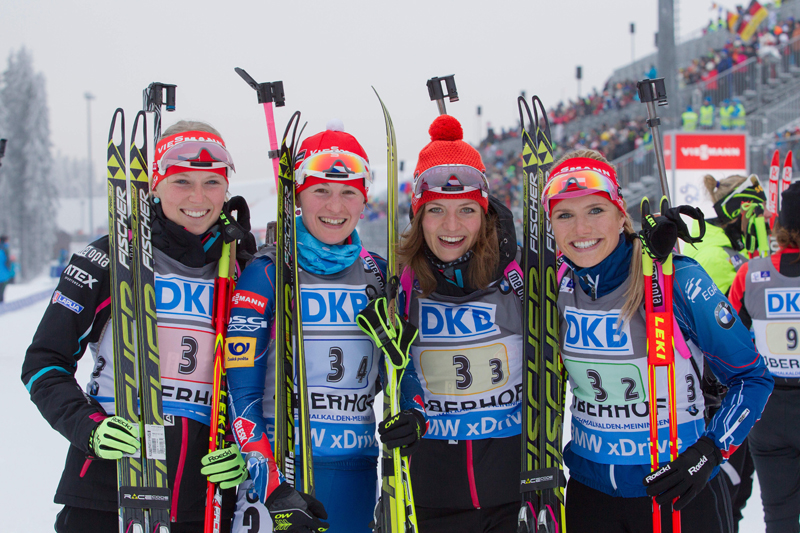
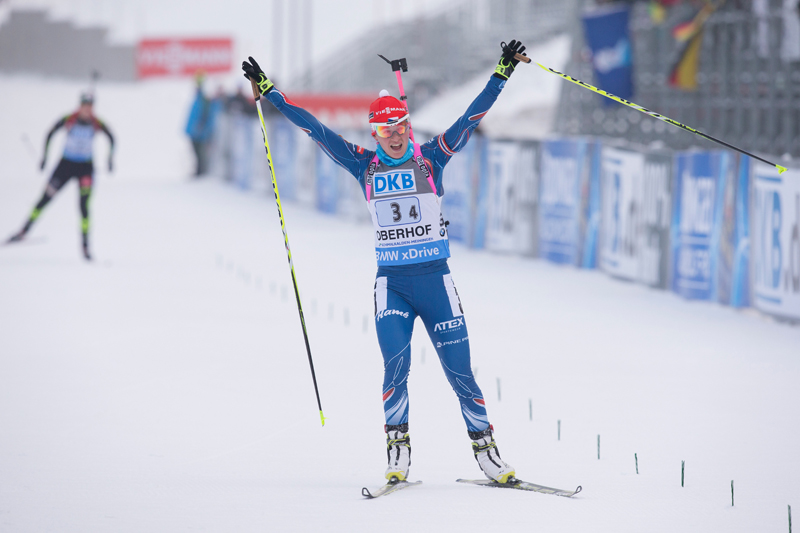
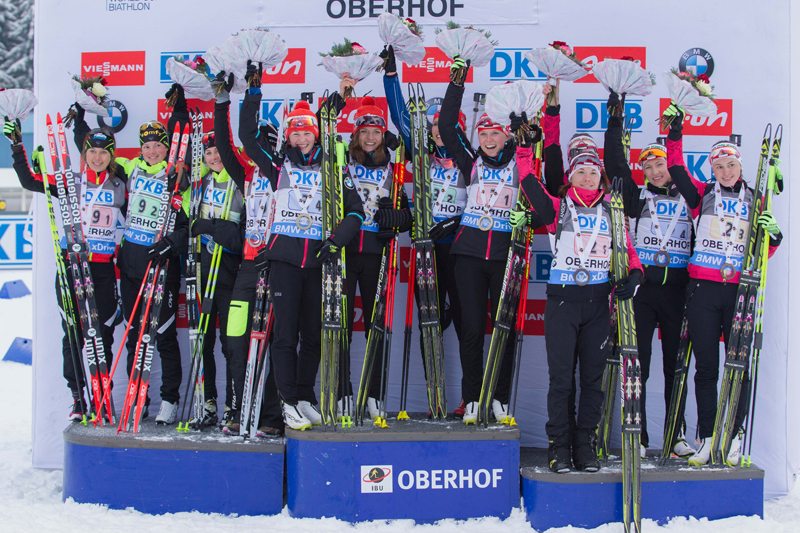
The Czech Republic posted the most consistent performances of the day and clinched the women’s relay win with anchor Veronika Vitkova (second from l) at Wednesday’s IBU World Cup in Obehof, Germany. From left to right: Eva Puskarcikova, Vitkova, Jitka Landova, and Gabriela Soukalova. (Photo: Fischer/NordicFocus)
The women’s International Biathlon Union (IBU) World Cup resumed in Oberhof, Germany, on Wednesday with the women’s 4 x 6-kilometer relay. Twenty centimeters of fresh snow made for difficult skiing on a foggy, warmer day than in training on Tuesday, and on top of that, Oberhof is known as a notoriously hard shooting venue. The large-climb profile of Oberhof and a long, flat section leading into the range contrasts that of several other World Cup stops.
The leading positions changed several times throughout the race, with early leaders Russia and Finland falling out of contention with two many penalty loops apiece.
The eventual winners, the Czech Republic, with Eva Puskarcikova, Gabriela Soukalova, Jitka Landova, and Veronika Vitkova, used seven spares to claim the victory, one less than runner-up France (with Marine Bolliet, Marie Dorin Habert, Justine Braisaz, and Anais Bescond), which used eight. The Czech team was consistent throughout the day with none of its athletes skiing significantly quicker or slower than the others, which put them on pace for the win in 1:16:56, 8.6 seconds ahead of France.
Veronika Vitkova clinches the nearly-nine-second win for the Czech Republic on Wednesday in the women’s 4 x 6 k relay at the IBU World Cup in Oberhof, Germany. (Photo: Fischer/NordicFocus)
Sixth after the first leg with Puskarcikova, who used just one spare, Soukalova skied the team to third with a single spare as well, Landova brought them one step closer in second with two spares, and Vitkova used three spares to seal the win.
“The final shooting was quite hard as I was nervous; but I really wanted to win,” Vitkova told the IBU.
“I was not sure about my shape for the first race after Christmas,” Soukalova said. “Early in the race, I had a lot of energy but on the last loop, I was so tired; I just wanted to see the finish line.”
During the third leg, it seemed Ukraine, the Olympic relay champions, had a strong hold on the first position with Olga Abramova maintaining their lead until the final exchange. The Czech Republic followed came through the exchange in second, 8.3 seconds back, followed by France, 11.9 behind Ukraine.
Vitkova led into the first prone stage and cleaned with six shots, but France’s anchor Anais Bescond cleaned quickly as well to chase her out of the stadium. Ukraine’s Iryna Varvynets used one spare to leave the range in third, followed by Norway’s Tiril Eckhoff, who also used one spare and headed out on her second lap in fourth, 34 seconds after Vitkova.
In the final standing, both Vitkova and Bescond used two spare rounds to leave the range together Eckhoff suffered a penalty lap, while Varvynets missed just one to chase the leaders from 37 seconds behind in third. However, she slowed on her last lap and was overtaken by three women — Darya Domracheva of Belarus, Eckhoff, and Italy’s Karin Oberhofer respectively — to finish sixth for Ukraine.
At the front of the race, Vitkova pulled away from Bescond with about 2 k remaining to the finish, and secured the win by nearly nine seconds. Domracheva brought Belarus from 10th to third, passing Varvynets in the final 500 meters.
The IBU World Cup women’s relay podium on Wednesday in Oberhof, Germany: with France in second (l), the Czech Republic in first (c), and Belarus in third. (Photo: Fischer/NordicFocus)
France welcomed back Marie Dorin Habert to her first World Cup race since giving birth to her first child this summer.
“I have only had two national races before this; I did not expect my form to be so good,” she said in a press conference following relay.
France’s second skier, Habert used a single spare to bring her team back within less than a second of the leading Ukrainian team, which had perfect shooting from its first two skiers, Anastasiya Merkushyna and Valj Semerenko.
Darya Domracheva had the biggest individual leg of the day, lifting Belarus to the podium after Nadzeya Pisareva’s penalty on the third leg put the team in 10th. Domracheva used two spares and skied the fastest course time on the last leg to close 38 seconds and place third overall, 1:06.8 behind the winners.
Norway saved their strongest woman for last. With her team in fifth, Eckhoff took over with an aggressive start to her race. Coming into the standing shooting, Eckhoff was within range of the leaders, but fighting the wind, she used her three spares and still incurred a penalty loop. Eckhoff skied a strong final lap, passing Italy and Ukraine, but was unable to hold onto Domracheva. Norway took fourth, 1:12.7 behind the Czech Republic.
Italy led early in the first leg with Dorothea Wierer, who shot clean, but dropped to seventh with second-leg Lisa Vittozzi and remained in seventh, and finally fifth. After catching Varvynets coming into the stadium, Oberhofer could not hold off Eckhoff and dropped to fifth, 1 second behind Norway and 1:13.7 after the winners. Ukraine was another 5.3 seconds back in sixth.
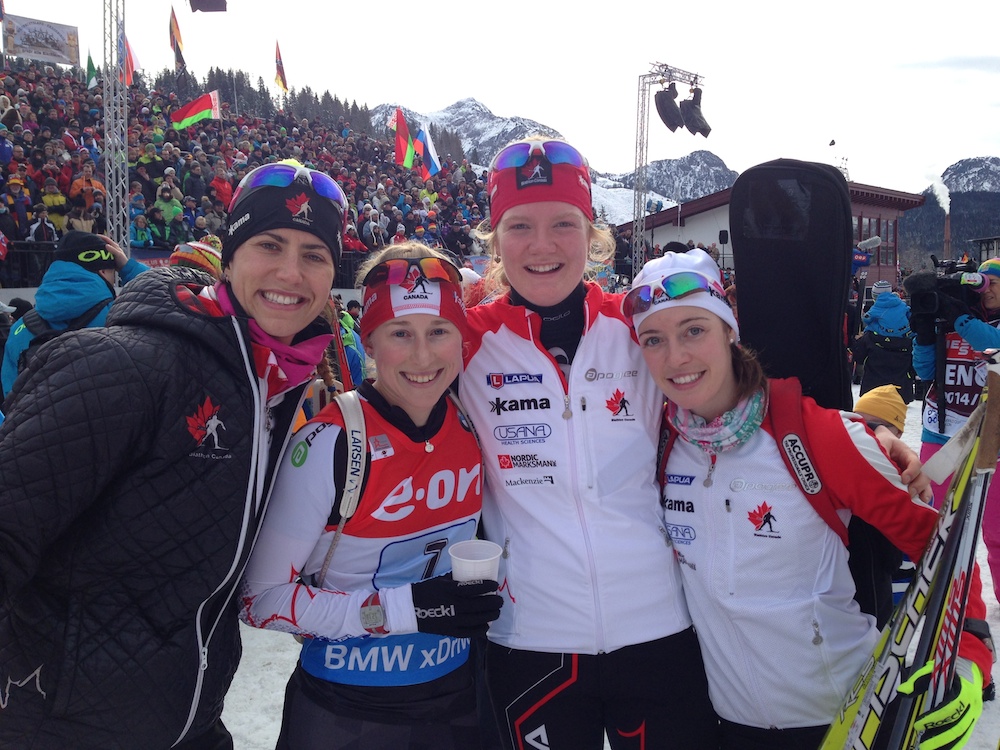
Canada, the lone North American women’s relay, put themselves in the mix in early on with Megan Heinicke, who had perfect shooting and the ninth-fastest course time of the first leg. She tagged teammate Julia Ransom in fifth, 8.8 seconds behind the leaders.
Ransom skied with a quick tempo in the warm-and-slushy conditions, and held onto the leaders for her first lap. Ransom needed just one spare in standing to hit her 10 targets and complete her leg, tagging Emma Lunder in 10th.
“Megan rocked the first lap!” Ransom wrote in an email. “Shooting felt solid out there and the first ski lap was filled with adrenaline and excitement. Flying out [to Oberhof] only a few days ago, I still felt the effects of jet lag and died a little on the other two laps. However I am confident that the body will be back in form for the sprint.”
Nearly 1:50 behind the leaders, Lunder was troubled by a change in wind since her pre-race zero and skied two penalty laps after prone. She used three more spares in standing, for a total of six, and tagged Zina Kocher in 16th, nearly five minutes back.
In an email, Lunder explained these mistakes only motivated her to perform better in Friday’s sprint.
“I like the course, I feel strong, and with a bit of extra focus on the range in training tomorrow, I’m certain I can perform to my potential,” she wrote, adding that the slushy conditions and the difficult climbs suit her strengths.
The team’s veteran, Kocher, used six spares (three in each stage) before being lapped on the final loop and taken out of the race.
“I had to focus on doing my job and make the best of it,” she explained in an email.
Three of the Canadian women flew into Oberhof on Monday night, and Kocher explained that jet lag after the holidays could have been a factor in their performance.
“Today’s relay was just a blip in the scheme of things,” Ransom wrote. “It’s incredibly hard to get four people to be ‘on’ all at the same time and it just didn’t happen for us. But now that the cobwebs are out, I believe that all of us ladies will have some great performances coming up.”
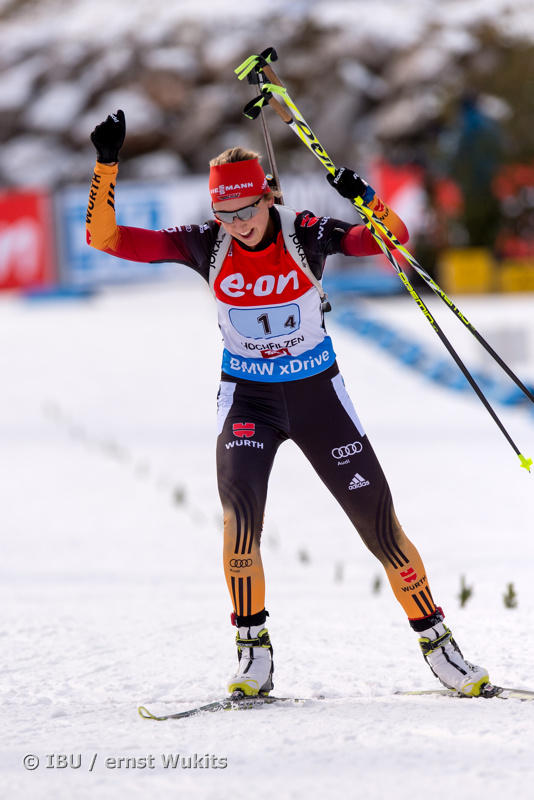
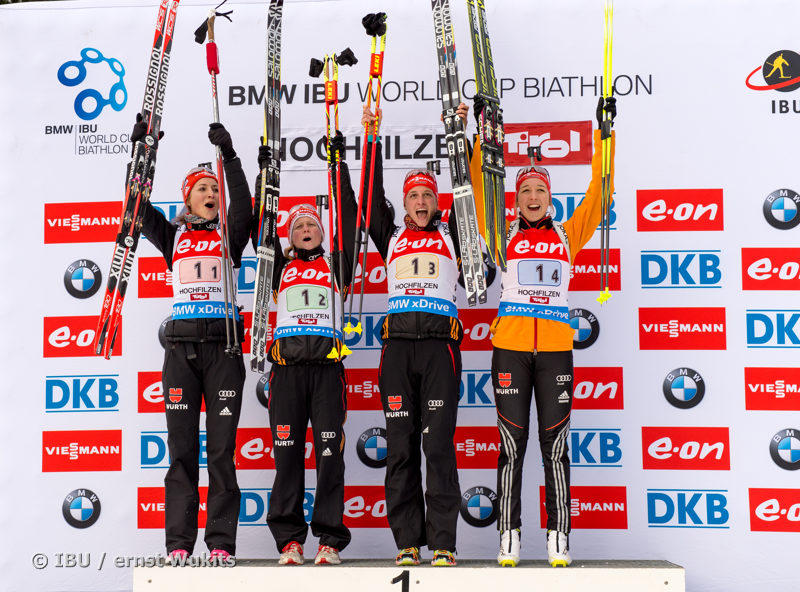
Germany’s anchor, Franziska Preuss celebrates a 21-second victory in the women’s 4 x 6 k relay at the IBU World Cup on Saturday in Hochfilzen, Austria. (Photo: IBU/Ernst Wukits)
For three out of the four legs in the IBU World Cup women’s 4 x 6-kilometer relay on Saturday in Hochfilzen, Austria, it could’ve been anyone’s game, especially Russia’s, Germany’s, Poland’s and the Czech Republic’s.
All four were within 40 seconds of one another behind Russia in first at the final exchange — and while it might have seemed like Russia with a 19-second lead was untouchable — any biathlete will tell you nothing in biathlon is ever a sure-thing.
Ekaterina Shumilova tagged off in first, upholding the position teammate Olga Podchufarova put her in during the second leg. However, by the final prone, Russia’s lead started to unravel. Ekaterina Glazyrina used all three spare rounds, then had to ski the team’s first penalty loop of the day.
She dropped from first to fifth, 44 seconds out of the lead.
Meanwhile, Germany’s anchor Franziska Preuss cleaned her first stage to take control — not knowing what happened to Glazyrina.
“I had no idea that she was on the loop,” Preuss told the IBU after the race. “I did not know it until the finish line.”
Veronika Vitkova of the Czech Republic used one spare to move to second after prone and trailed Preuss by 24.1 seconds leaving the range. Belarus was suddenly back in contention when Darya Domracheva cleaned prone to jump from sixth at the exchange to third, 37 seconds after Preuss.
For the final standing, the pressure was on for Preuss. She had to use one spare, but so did Vitkova and Domracheva in second and third.
The German left the range with a 29-second lead over Vitkova and remained 37.4 seconds ahead of Domracheva in third. With a huge smile, Preuss entered the stadium uncontested and waved to the Austrian crowd as she finished. Domracheva outsprinted Vitkova for second, giving Belarus the silver, 21.1 seconds behind Germany, and the Czech Republic took third another 1.1 seconds back.
The German women’s relay atop the podium on Saturday at the Hochfilzen World Cup: (from left to right) Luise Kummer, Franziska Hildebrand, Vanessa Hinz, and Franziska Preuss. (Photo: IBU/Ernst Wukits)
For Germany, the relay victory marked the first podium for two of its members: first-leg Luise Kummer and third-leg Vanessa Hinz, the latter of which lifted the team from fourth to second with two spares.
“It is very exciting being up there; it is such a great feeling!” Kummer said.
Second-leg Franziska Hildebrand, who brought Germany from 11th to fourth by the second exchange, said the team’s goal was to be on the podium.
“People should be happy, because we are a very young team and this shows how good we can be,” Hildebrand said.
The Czech Republic’s second skier who brought her team to third from seventh, Gabriela Soukalova was also pleased with the top-three finish.
“We realized at the beginning of the season that we can have a strong relay team I think this result will be a great motivation for our whole team,” she said. “For me, I have had some problems and I needed to have a great race.”
Germany finished the day with zero penalties and eight spares, Belarus had 10 spares and the Czech Republic had nine spares.
Italy (1+4) fell from an early lead set by first-leg Dorothea Wierer, to 13th when second-leg Nicole Gontier had a penalty loop on her second stage. Karin Oberhofer lifted the team from 11th at the final exchange to fourth overall (+39.9) with clean shooting.
Norway placed fifth with a penalty and 12 spares, five of which came from second-leg Synnøve Solemdal. Anchor Tiril Eckhoff skied the team up from 14th to fifth (+46.3).
Poland ended up sixth (0+8), Ukraine was seventh (1+11), Russia eighth (1+7), France ninth (1+10), and Slovenia 10th (0+7).
The Canadian women’s relay team after placing 11th on Saturday: (from left to right) Rosanna Crawford, Audrey Vaillancourt, Sarah Beaudry, and Megan Heinicke. (Photo: Rosanna Crawford)
The Canadians finished 11th overall (0+7), 2:11.1 behind Germany. They were 16th at the end of Megan Heinicke’s first leg, after she cleaned prone and missed three standing.
“I wasn’t feeling particularly snappy but I have been recovering from a cold since last Saturday so I am hoping for a bit more explosiveness next week,” Heinicke explained in an email.
While she was “happy and motivated” by her prone stage, which put her in seventh, Heinicke added that she was surprised by her standing.
“I didn’t feel like I had pushed very hard during the 2nd loop so I was pretty surprised when my left leg was shaky during standing,” she explained. “I have often struggled with standing in the last 2 seasons but rarely because of shaky legs! There was definitely that element of slight panic at needing to use all 3 spares and a fierce determination to hit then. I admit, I was relieved to bypass the penalty loop. My goal on the last loop was simply to giver and try to catch 1 or 2 of the girls ahead of me.”
She moved up one spot from 17th to 16th, tagging teammate Rosanna Crawford 52 seconds back from Italy in first.
“I knew that with some good quick shooting on the range that you can move up a lot in a relay,” Crawford explained, adding that she didn’t think about shooting right away. “You don’t want to start thinking about shooting as soon as you start a race or that’ll put too much pressure on yourself. So I focused on my skiing and switched to shooting when I was getting closer to the range. My skis were really good today, which always makes for a fun race, because you just feel like you’re flying!”
With clean shooting on both stages, she left the range in 12th after prone and sixth after standing. She recorded the fastest shooting for her leg.
“I just took it one shot at a time never getting ahead of myself,” Crawford wrote. “Things can go wrong quickly in a biathlon races if you start thinking about the 5th shot when you’re only on the 1st!”
She handed off to 20-year-old Sarah Beaudry, who was in her first World Cup relay and second-ever World Cup race, in sixth. In an email, Beaudry explained that she simply wanted to hit her targets and ski fast.
After cleaning prone, she was up to fourth.
“Moving up to fourth wasn’t really part of any plan, it was more just a result of my good prone shooting,” Beaudry wrote. “For my prone I just came in really relaxed and my focus was to watch wind. Sometimes I am a little forgetful about wind so I think having that focus helped me stay calm.”
Fortunately for the women’s and men’s races on Saturday, there wasn’t much wind to speak of.
Beaudry tried to stay calm as she approached her standing stage, but after hitting her first two targets, she got “a little too excited” and ended up missing the last three, she explained.
“Then I was just trying hard to avoid the penalty loop with my spares,” she added. She avoided it, tagging Audrey Vaillancourt in 12th, 1:09.4 back.
“Today I was going to give everything I had no matter what place I was tagged in, and this is exactly what I did,” Vaillancourt wrote.
With a single prone miss, Vaillancourt maintained her position in 12th. One lap later, she cleaned standing to improve to 11th.
“I kept focused on trying to get closer to the other team, but I also knew there were some very strong women out there in the last leg,” she wrote.
Slovenia’s Urska Poje was 15 seconds ahead of her in 10th heading into the final lap. Vaillancourt ended up finishing 18 seconds behind in 11th.
“Overall I am very happy with my race, both on the skiing and shooting side. I have had a cold all week which affected my training and preparation a lot, but today I felt a lot better so I think I’m back on track,” Vaillancourt wrote.
Crawford referred to her team’s 11th place, with zero penalties and seven spares, as a “decent result.”
“We had two legs with some scary standing, but no penalty loops is great!” she wrote. “A few less spares and we could have been top 10. We were trying a different order today and it seemed like it worked out pretty well. Megan did a great job at the start of the race.”
Later Saturday afternoon, the Canadian men tied a team-best sixth in the 4 x 7.5 k relay.
“So excited for men’s team,” Crawford wrote. “They’ve had a bit of a bumpy start and not performing like they were hoping for. A top 6 is a great way to build some confidence into the rest of the season.”
With three women on the World Cup circuit, the U.S. did not field a women’s relay.
Darya Domracheva racing around the penalty loop, which didn’t slow her down at all en route to winning her third consecutive gold medal at the Games.
FasterSkier’s coverage is made possible through the generous support of Swix.
SOCHI, Russia – After just ten minutes of racing at the Laura biathlon stadium, it seemed like a foregone conclusion that Darya Domracheva or Belarus would win the women’s 12.5 k mass start.
Domracheva has already won two gold medals in this Olympics both in shows of solid dominance – the 10 k pursuit by 37 seconds, and the 15 k individual by a whopping minute and 15 seconds. Domracheva was in the lead pack, skiing fast, and shooting well.
The only hiccup came in the final shooting bout of the four-stage race. Domracheva, leading by about 20 seconds, missed a shot and headed to the penalty loop. But her nearest competitor, Gabriela Soukalova of the Czech Republic, also missed. So Domracheva held on to the advantage she had built up by skiing the fastest split times on each of the three middle laps.
“She is amazing,” said Tiril Eckhoff of Norway. “She skis like a dancer. She skis so good and I think she really deserves these three golds. She has been really amazing here.”
“I thought she was going to win today,” agreed Soukalova. “She was so strong in the last races that I didn’t believe that anybody would be faster than her. I didn’t race with her today. I thought it would be better to race just with myself and with nobody more.”
Domracheva coasted across the finish line in 35:25.6, first swinging her poles over her head like rodeo lassos and then by pumping her fists in the air.
Domracheva celebrating as she neared the finish line.
“I am really thankful to this great supportive atmosphere,” Domracheva said. “I heard Dasha, Dasha, all over the track. Here in Sochi without this support, it would be much much more difficult to achieve this result.”
The gold tied Domracheva with Kati Wilhelm of Germany for the most gold medals of any female biathlete. But Domracheva made history as the first to do it in a single Olympics – no other woman has achieved the feat, and only Ole Einar Bjørndalen in the men’s field. It also makes her the winningest Belorussian Olympian of all time.
The country’s president bestowed upon her the status of Hero of Belarus, which flabbergasted the 27-year-old biathlete. She is only the 11th person to receive the honor.
Behind Domracheva, Soukalova also skied alone, despite her one penalty. The 24-year-old, who burst onto the scene last season, won her first Olympic medal – and upped the tally to three for the small Czech team over the course of the biathlon races so far at the Games.
Fourth in both the sprint and the pursuit, the silver medal was redemption for Soukalova, who was a medal favorite coming into the Games although she insisted that she hadn’t thought she would be able to make the podium.
“I didn’t feel that I would be strong today before the races,” Soukalova said. “I was feeling to be exhausted because the conditions from the last two races were really hard. I didn’t believe I would be able to be on the podium here after the two times fourth position. I think this result, it’s the best motivation for me… All the races were so close, but happiness was missing. But today, I think I was finding it.”
The most interesting race of the day was for bronze. Evi Sachenbacher-Stehle of Germany – a recent convert to biathlon after winning gold in the team sprint at the 2010 Olympics – had shot a perfect clean race and left the range in third place after the final stage.
To hit 20 out of 20 is almost inconceivable, considering that Sachenbacher-Stehle had only picked up a rifle two years ago and made her World Cup debut partway through last season. But once she was in the hunt, she was sure to be a factor. At 33 years old and in her fifth Olympics, Sachenbacher-Stehle had experience and years of training under her belt.
Five seconds behind her was Tiril Eckhoff of Norway, who had missed a shot in the second stage and clawed her way back to the leaders. Ten years younger than her German rival, Eckhoff is one of the fastest and most aggressive skiers on the World Cup, and used her youthful optimism to chase after the veteran.
“I was actually thinking, I just have to stand up on the [turn],” Eckhoff said of her final loop of skiing. “I looked at Tora [Berger] and she fell down on the first loop. Tora is a really good downhill skier. So I was like, okay, I just have to stand on this curve and after that I just have to go. I knew that my last loop is pretty good and so I would have a good chance.”
By the time the pair came into the stadium, Eckhoff had skied the fastest closing-loop time and was in the lead. Sachenbacher tried to pass as they flew through the stadium in one direction, before climbing a short hill and shooting back across toward the finish. But Eckhoff was determined to end up on the podium and sprinted away, never quite letting Sachenbacher-Stehle draw even.
“I hoped for me that I could do it for the medal on the finish line,” Sachenbacher-Stehle said. “But I have not the high speed in the end. So it’s the unlucky fourth place, but I’m very happy with my race and even if it’s no medal. That’s life. Someone has to be fourth, and now I’m the fourth.”
The bronze medal was a godsend for Norway, which has been having a rough medal of the Olympics. Besides the woes of its cross country ski team, Berger – who won the overall World Cup last season as well as two individual golds and two individual silvers at World Championships – has been able to capture just one medal. Stars Emil Hegle Svendsen and Tarjei Bø have done no better, leaving Ole Einar Bjørndalen’s one gold to lead the team.
After a devastating crash early in the race that dropped her far off the back of the pack, Berger struggled to 15th place with two penalties.
It was a dream come true for Eckhoff, and tied the best result of her career. She finished third in the pursuit in Annency, France, earlier this season, and nearly snagged another podium in Antholz, Italy, but Berger caught her right at the finish and took the honor for herself.
Being on the podium today was much sweeter.
“I think it’s awesome,” Eckhoff said. “When Tora beat me, I was like, man, it’s impossible. So it’s good to just get the podium today.”
While the day ended up magical, it didn’t start out so well for Eckhoff.
“I was switching hotels because I was feeling a bit ill,” she laughed in the press conference. “Today I ate a burger. I was thinking, okay, this will be a nice day. And it was!”
Teja Gregorin of Slovenia, the bronze medalist in the pursuit, finished fifth, and young Polish star Monika Hojnisz sixth, both also with clean shooting.
Dasha Domracheva racing to her second gold of these Olympics in Friday’s 15 k individual start. She became the first Belarusian athlete to do so at the same Winter Games, winning by more than a minute and 15 seconds in Sochi, Russia.
FasterSkier’s coverage is made possible through the generous support of Rudy Project.
SOCHI, Russia — Dasha Domracheva had an inkling things were going according to plan as she rounded the biathlon loop at the Laura Olympic Center five times on Friday night.
For starters, the Belarusian gold medalist from Tuesday’s pursuit had opened with flawless shooting in prone, taking the lead over the 12 women who started ahead of her in the biathlon 15-kilometer individual start.
Three others challenged her through the first stage — Finland’s Kaisa Makarainen, Gabriela Soukalova of the Czech Republic, and Slovakia’s Anastasiya Kuzmina — with clean shooting and fast skiing. Three kilometers later, Domracheva suffered a one-minute penalty in the first standing, but it wasn’t a big deal; even with the added time she was still within 11.8 seconds of the lead.
Dasha Domracheva of Belarus in the range. She ended up with a single penalty to win the Olympic 15 k individual on Friday night in Sochi, Russia.
By the third lap, the 27-year-old Domracheva started to turn it on, clocking the fastest ski times from there on out and shooting clean for the remainder of the race. At times she was minutes ahead, and by the finish, she had topped Olga Zaitseva, Russia’s early leader by 3:47.3 minutes in 43:19.6.
Then, she waited, and as competitors like Makarainen completed their races, she gradually realized the second gold was hers. Makarainen was 2:43 behind with three penalties, Soukalova missed one on each standing to finish nearly two minutes back, and Kuzmina had three penalties in the last stage that took her out of contention.
Switzerland’s Selina Gasparin cleaned for the first time in her career, as did Nadezhda Skardino, also from Belarus. Skardino finished second, 1:38.2 behind Domracheva, for the time being. Domracheva waited long enough to watch her come into the final stretch, then grabbed her things and ran inside to get changed.
Selina Gasparin kisses her skis, which helped her to the 10th-best course time of the day and a silver medal.
The 52-degree evening had finished with temperatures around 48 degrees Fahrenheit (the warmest of the 2014 Games yet), and the Olympic champion was getting cold.
“It was amazing because I got information on the track that I’m in the lead and Nadezhda [was] in second,” Domracheva said in a post-race press conference. “I tried to wait for her after the finish line, but I got a little bit frozen at the end of the race.
The two met up in the changing area and press mixed zone after the race. Gasparin’s faster ski time ultimately bumped Skardino to third by 22.7 seconds, and the Swiss skier earned her country’s first-ever biathlon medal with silver. Skardino retained her spot on the podium in third — another first for Belarus with two athletes winning medals in the same event at the Winter Olympics.
And Domracheva became the first Belarus athlete to win two gold medals at the same Winter Games.
“I cannot say it was an easier race for me,” Domracheva said, referring to her 37.6-second win in the preceding pursuit. “In a few loops I was together with Soukalova and she followed me quite easy. I tried to do everything. That was fighting today. On some parts of the track I was so tired and after the downhills, I sit …. almost without any power, but you need to recover on the downhills and be clever coming into the shooting range.”
That was where Domracheva made the difference. Clean shooting — or as close to it as possible — is essential in an individual start, with each penalty adding a minute to an athlete’s total time.
Even with a penalty, Domracheva won by a minute and 15.7 seconds, but mostly because she skied the fastest third, fourth and fifth loops, and took her time in the range. Soukalova placed fourth with two misses, 1:57.5 behind the winner.
“Today … the course was harder and the loop was more difficult in terms of relief,” Domracheva said, comparing the 15 k individual to the 10 k pursuit.
“But both of them I cherish them and value them very much,” she said of her two medals. “With this one I just confirmed that I was an Olympic champion, so that was very important.”
From Rural Training to Olympic Medal
Selina Gasparin of Switzerland gimaced her way through a tough final loop to hang on to a silver medal.
The oldest of three sisters, Gasparin, 29, followed the lead of middle child Elisa, who captured eighth at the Olympics in last Saturday’s sprint. It was by far a career best and first international top 10 for the 22-year-old Elisa.
On Thursday, Selina Gasparin continued the family’s good showing by not only shooting perfectly for the first time in her career, but becoming the first Swiss biathlete to medal at the Olympics.
Two months ago, she became her country’s first biathlete to win a World Cup. That’s when she started to dream big, specifically for Sochi.
“I have never won a medal in my whole life, no junior championship or European championship, nothing,” she said.
Growing up in a rural part of southeast Switzerland, the Upper Engadin region, Gasparin said she followed the lead of Elisa, who tried biathlon first with a friend. Once she started training with the national team, Gasparin realized she needed to train at home where “there is nothing,” she said.
“I had to ask the farmer if I could put some targets for shooting,” she said.
She also had to find some suitable paved roads for rollerskiing. “It took me almost ten years now to build it all up. It was also motivating to be the first one in World Championships and the first woman ever in Olympic Games in Vancouver, first World Cup win … now it’s like the first medal ever for Switzerland. We have no world championship medal so for me it’s really crazy.”
With silver in hand, she’s excited to go home.
“I [said] that if I come home with a medal, I want every Swiss to know what biathlon is,” she said. “Because some thought it was like running or cycling or something.”
Gasparin was also excited to find success on the same day as Swiss cross-country skier Dario Cologna, who won the men’s 15 k classic individual start Friday afternoon. Cologna hails from Vail Müstair, less than an hour drive from Gasparin’s hometown of Samedan. Both speak the regional language of Romansh.
“It’s a very special day for [people] of my language,” she said. “We are all from a small area in Switzerland. It’s only about point-five percent of the population that speaks Romansh. It’s kind of like a secret language.”
Russian-Born Skardino Makes Belarus History
Nadezhda Skardino of Belarus leaving the range after one of her perfect shooting bouts.
After starting out as a cross-country skier on St. Petersburg junior team, Skardino, 28, switched to biathlon at age 20 when she was just about to retire from the sport.
“The junior coach suggested I try biathlon and I liked that very much,” she said through a translator. “I thought of finishing my career, but once I started shooting I liked it … then it was not opting for Belarus, but it was opting for biathlon. The Belarus national team suggested that I represent Belarus so I tried that and I liked that.”
She never anticipated to become a Belarus citizen, it just worked out that way. On Friday, she was happy it did as she made history with Domracheva.
“It was my dream to be on the same to be on the podium with Daria and I’m very glad that it came true,” she said.
Domracheva said the team’s depth is a testament to their success.
“Now you see that Belarus is a really strong team,” she said. “Only with a good team around you can achieve these results.”
The second gold wasn’t quite as emotional for the winner, but that’s because she was prepared.
“This was my dream and helped me very much to be less emotional after,” she said. “I got very emotional after I won the first medal. I tried to control my emotions to be a new Daria … to compete, to perform and to enjoy the work that I love.”
FasterSkier’s coverage is made possible through the generous support of Rudy Project.
SOCHI, Russia – Darya Domracheva was offered the chance to carry the Belarussian flag in the Sochi Olympics’ opening ceremonies last week.
The biathlete turned it down, reasoning that the trip from her residence in the mountains to the Olympic stadium would have disrupted her preparation.
Smart move.
After blowing away the field in Tuesday’s pursuit race, Domracheva got to carry Belarus’s red and green colors after all, as she cruised down the homestretch far ahead of her competition.
“I thought it would be much better if I could cross the finish line with my flag,” she said in a press conference afterwards. “And I did that today.”
The gold was Domracheva’s second Olympic medal, after she won a bronze in the 15-kilometer individual race in Vancouver four years ago.
Norway’s Tora Berger won that race. But on Tuesday, Domracheva relegated her to second place, nearly 40 seconds behind.
Slovenia’s Teja Gregorin was third, another five seconds back.
Domracheva started the 10-kilometer pursuit in ninth place, 30 seconds behind the winner of Slovenian biathlete Anastasiya Kuzmina, who had won Sunday’s pursuit.
Both women hit all five targets on their first trip into the range, two kilometers into the race.
By the time they came back for their second round, another two kilometers into the race, Domracheva had caught up, thanks to her speed on skis—she was the second-fastest of all 55 women in the race.
When Kuzmina missed a target, and Domracheva shot clean, the race was essentially over, even after she notched her own miss in the last shooting stage.
“I wasn’t scared,” she said in a press conference afterward. “I was confident that my shooting range results would be very good.”
Afterwards, Berger acknowledged how impressive Domracheva had been.
“Darya was very strong today,” she said. “So, I think even if I shoot clean, I could not beat her.”
Domracheva’s gold was only the second ever for Belarus at the Winter Olympics.
The country’s fans had an impressive turnout Tuesday, watching athletes who command enough attention that just last weekend they had a “tea-drinking session” with Belarus’s president, Alexander Lukashenko.
With two more individual events at the Olympics, Domracheva could come away from the Olympics with even more medals, and she stressed Tuesday that she would keep her focus.
“I still have some hopes for the next races,” she said. “I want everybody to know that the Olympics is not finished for me.”
FasterSkier’s piece on Belarus over the weekend naturally got me thinking about their performances. As they note in that article, they’ve had some wild times, including the famous “lucky” silver medal by Leanid Karneyenka in 2007 thanks to an early start position and a freak snowstorm, and their mishap in the team sprint relay in Vancouver, and then Sergei Dolidovich’s near miss in the 50k this past season in Oslo.
Here’s what I see when I look at their men’s distance results:
Pretty wacky group of results, eh? Let’s start with Dolidovich. He’s been plugging away at the World Cup circuit for quite some time now, and has mostly been just OK. His results tends to straddle the divide between pretty good and not so hot. What stands out to me is that starting in 2000-2001 or so, his best results start improving steadily. Since then he’s managed to pull on at least one really stupendous effort every other season or so. Often, this lines up with World Championships. But the vast majority of the time he’s solidly in the “pretty good” territory.
I think it’s fairly clear from Leanid Karneyenka’s graph that his moment of glory in 2007 is unlikely to repeat itself. Michail Semenov is still young-ish, but his good-but-not-spectacular results are a decent start. Alexander Lasutkin has the all too familiar troubling trend of a steady decline in his best results.
Even when we look at Karneyenka’s (limited) WC sprint results, things don’t look promising:
FasterSkier’s piece on Belarus over the weekend naturally got me thinking about their performances. As they note in that article, they’ve had some wild times, including the famous “lucky” silver medal by Leanid Karneyenka in 2007 thanks to an early start position and a freak snowstorm, and their mishap in the team sprint relay in Vancouver, and then Sergei Dolidovich’s near miss in the 50k this past season in Oslo.
Here’s what I see when I look at their men’s distance results:
Pretty wacky group of results, eh? Let’s start with Dolidovich. He’s been plugging away at the World Cup circuit for quite some time now, and has mostly been just OK. His results tends to straddle the divide between pretty good and not so hot. What stands out to me is that starting in 2000-2001 or so, his best results start improving steadily. Since then he’s managed to pull on at least one really stupendous effort every other season or so. Often, this lines up with World Championships. But the vast majority of the time he’s solidly in the “pretty good” territory.
I think it’s fairly clear from Leanid Karneyenka’s graph that his moment of glory in 2007 is unlikely to repeat itself. Michail Semenov is still young-ish, but his good-but-not-spectacular results are a decent start. Alexander Lasutkin has the all too familiar troubling trend of a steady decline in his best results.
Even when we look at Karneyenka’s (limited) WC sprint results, things don’t look promising:
FasterSkier’s piece on Belarus over the weekend naturally got me thinking about their performances. As they note in that article, they’ve had some wild times, including the famous “lucky” silver medal by Leanid Karneyenka in 2007 thanks to an early start position and a freak snowstorm, and their mishap in the team sprint relay in Vancouver, and then Sergei Dolidovich’s near miss in the 50k this past season in Oslo.
Here’s what I see when I look at their men’s distance results:
Pretty wacky group of results, eh? Let’s start with Dolidovich. He’s been plugging away at the World Cup circuit for quite some time now, and has mostly been just OK. His results tends to straddle the divide between pretty good and not so hot. What stands out to me is that starting in 2000-2001 or so, his best results start improving steadily. Since then he’s managed to pull on at least one really stupendous effort every other season or so. Often, this lines up with World Championships. But the vast majority of the time he’s solidly in the “pretty good” territory.
I think it’s fairly clear from Leanid Karneyenka’s graph that his moment of glory in 2007 is unlikely to repeat itself. Michail Semenov is still young-ish, but his good-but-not-spectacular results are a decent start. Alexander Lasutkin has the all too familiar troubling trend of a steady decline in his best results.
Even when we look at Karneyenka’s (limited) WC sprint results, things don’t look promising: