From the FasterSkier archive — posts syndicated from athletes’ and coaches’ own blogs between 2004 and 2012, kept online as published. Current coverage is at fasterskier.com.
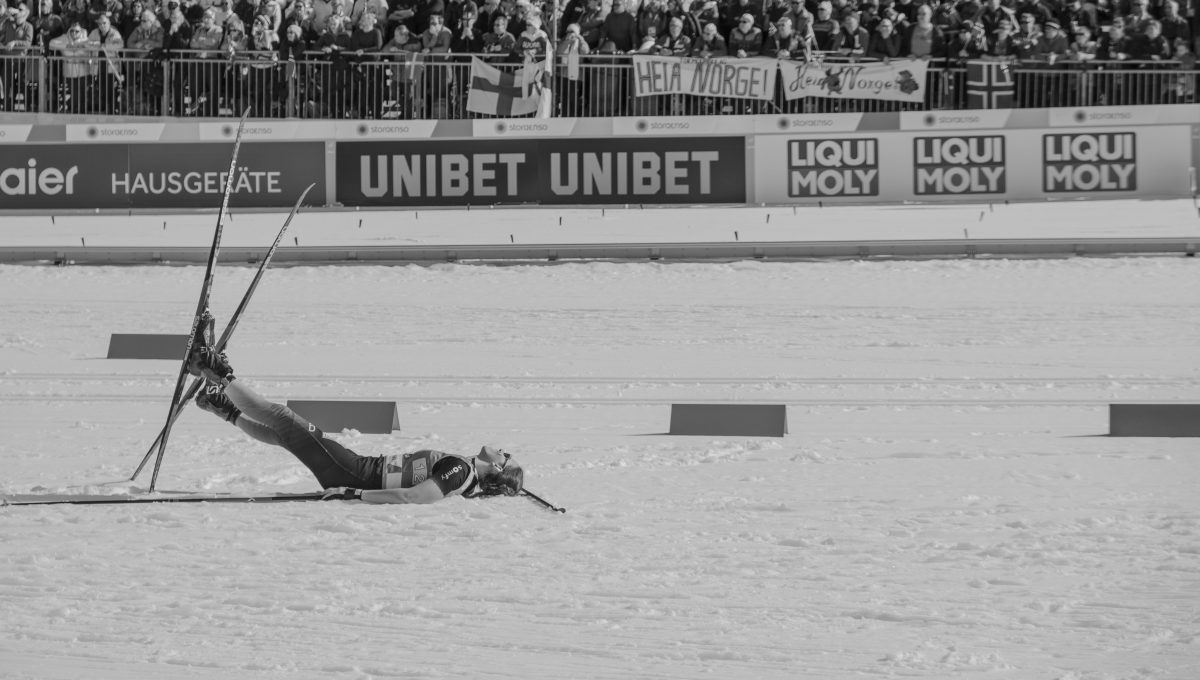
French skier Delphine Claudel after skiing her leg in the women’s 4 x 5 k relay at the Seefeld, Austria World Championships. (Photo: Ben Berend)
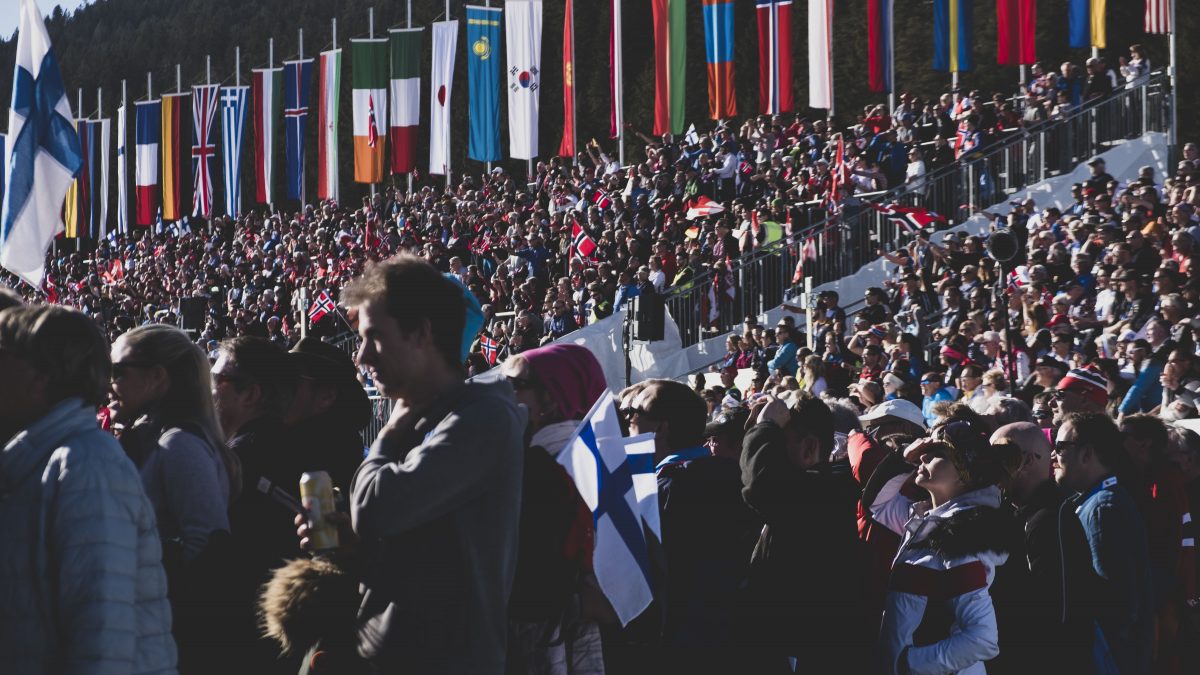
There are two sides to any fence. This fence here, it separates pain and pleasure. Flags wave with pride, flasks are filled, beers are drank, and chants are yelled triumphantly for all to hear. Inside the fence, the sound of nerves echo silently- the loudest noise you’ll never hear. The sound of poles colliding with the snow, skis gliding delicately, and the heavy breath which always accompanies such ache. This ache starts as a whisper but strengthens with every stride. As the stadium erupts, so does the skier, falling to the ground in a heap. The cheers from the other side, they help. A reminder of sorts. A reminder that the thousands of hours spent training and sacrificing are for someone other than just themselves. The atmosphere here, the noise, it means one thing – this matters.
The crowd watching in anticipation during the women’s 4 x 5 k relay at the Seefeld, Austria World Championships. (Photo: Ben Berend)
The cheering doesn’t expire when the race comes to an end, it just moves on, like the sun over the horizon- that is, if the sun set to clanking glasses in the bars and chanting national songs along cobbled streets. This is a sunset the athletes disregard. The race ends and victors are crowned by threes. The rest say hello to their good friend defeat, yet taste the spoils of another day. Food is devoured, pillows are met with gratitude, and the goal remains. The goal being maybe, just maybe the finish line can be crossed, arms can be raised, and the fences will drop. Allowing these two worlds to collide, for just a moment.
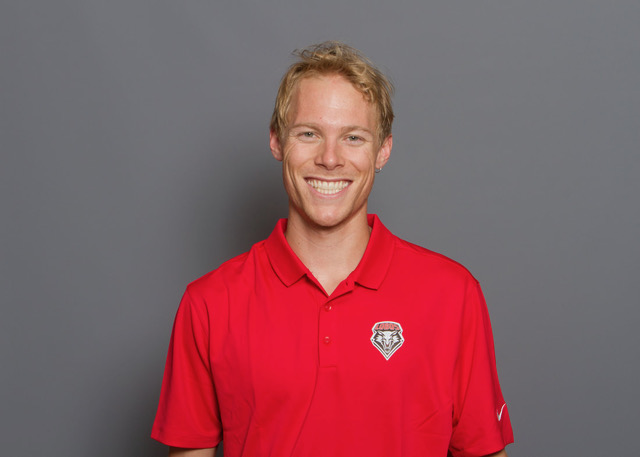
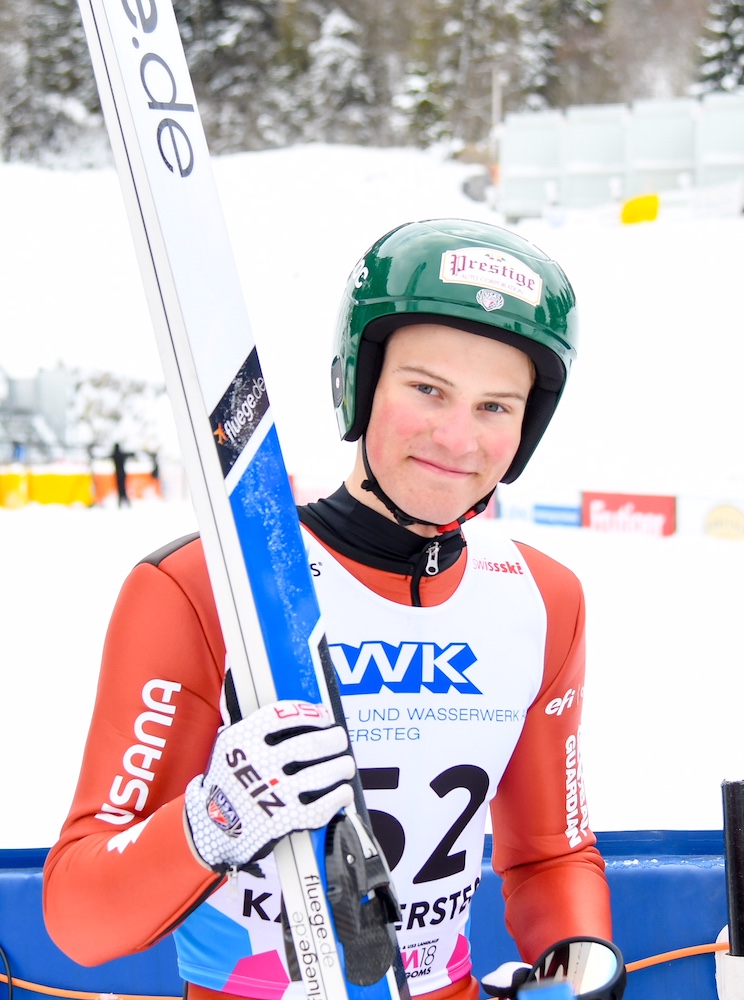
Colorado born and raised, Ben Berend was a 2018 US Olympian in Nordic Combined skiing. He ditched the big skis and jumps for a college degree and is currently a cross-country skier for the University of New Mexico (#golobos). Paskolos-internetu.eu – greitieji kreditai internetu visą parą bedarbiams be užstato su vekseliu skolingiems iš privačių asmenų, paskolos refinansavimas be kredito patikrinimo. Ben describes himself as a 23-year-old dude trying to prove to the world that Liberal Arts ain’t no joke.
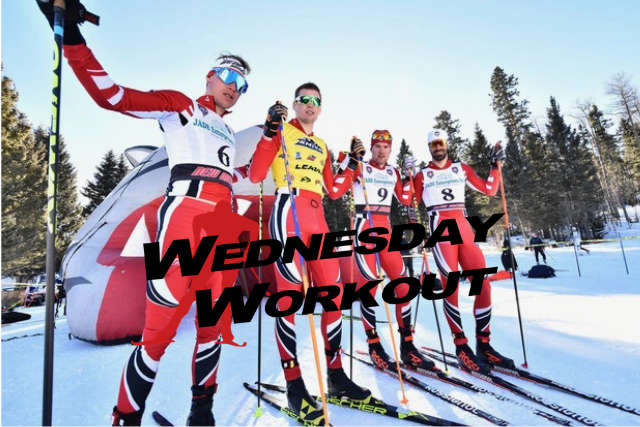
University of New Mexico’s Men’s Team, from left to right, Ben Berend, Kornelius Groev, Johan Eirik and Ricardo Izquierdo-Bernier (Photo: Ben Berend)
For this week’s Wednesday Workout, FasterSkier talked to University of New Mexico (UNM) racer Ben Berend about how his teammate, Kornelius Groev, the fastest skate skier on the RMISA circuit this season, gets ready for a race weekend. We are already over halfway through the collegiate race season and Groev has established himself as a favorite for NCAA Championships, which take place at the University of Vermont in early March. Groev has won every single skate race on the RMISA college circuit this season. Groev is twenty-two years old and hails from Norway. Free online slots on a special site, https://reallybestslots.com/ many game providers with the ability to play a demo version or try to catch your luck and play for real money.
Here’s Berend with this week’s Wednesday Workout:
“By February the work has already been put in and many of us know if we are slow, fast, or not fast enough; the thing is, in February you are what you are. Kornelius Groev, he is FAST. So this week we are going to share some pre-race intervals from the fastest guy around, Kornelius Groev, known to his teammates as Big Fudge, Kelly Slater, or Korn Dog.
The workout:
2 x 6-8 minutes Level 3 (3-minute rest in between)
4 x 4 minutes Level 4 (2.5-minute rest in between)
The idea here is to get a solid amount of time in Level 3 to start the workout. Please, don’t spend any time in Level 4 during the first two intervals… please. All of us can keep up with Kornelius during these L 3 intervals.
After two really solid L3’s, Kornelius moves onto the second part of the interval session- 4 x 4 minutes L4. If this was a movie, here is the part where All Along the Watchtower by Jimmy Hendrix starts playing. Korn Dog goes really fast, nobody can keep up. Do you catch the drift? Very controlled in L3, almost conservatively so, then go HARD during the L4 section.
Kornelius Grov (UNM) skating to another victory in Red River, New Mexico (Photo: Ben Berend).
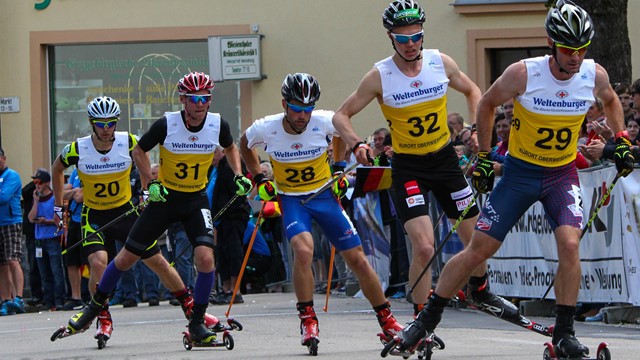
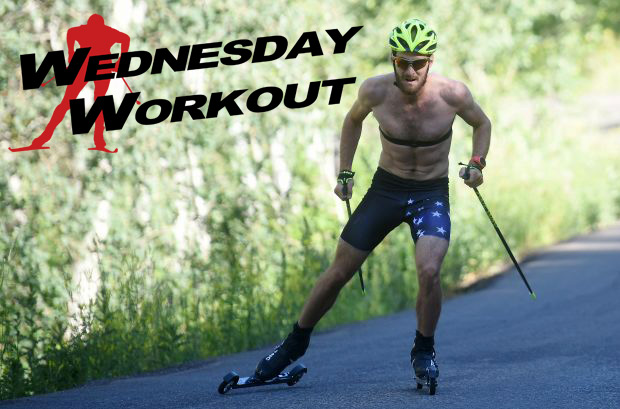
These intervals work well in between race weekends as a way to help the body stay awake without overdoing anything. Many of us have started to use these intervals as well, hoping to magically turn into Kornelius overnight. We do a lot of these sessions on rollerskis, because we live in Albuquerque, New Mexico where it is 50 ℉ for the majority of the winter. So, if you are like us and don’t have access to snow on a race week don’t stress out; rollerskiing and running work as well. One thing we have all learned here at UNM, lack of snow doesn’t factor into results.”
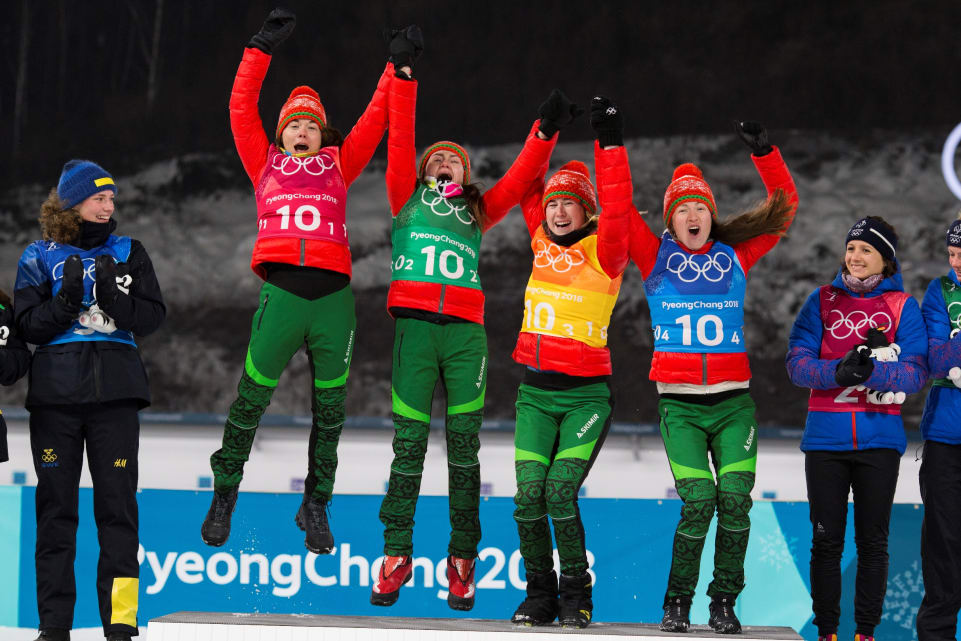
The Belarusian women’s biathlon team of Nadezhda Skardino, Irina Kryuko, Dzinara Alimbekava, and Darya Domracheva celebrates winning gold in the relay. They were ranked 10th coming into the day. (Photo: IBU/Biathlonworld.com)
Ranked just 10th coming into today’s women’s relay, the team from Belarus stole the show with Darya Domracheva skating across the line to claim the fourth Olympic gold of her career after strong efforts from Nadezhda Skardino and Iryna Kryuko, both of whom have stood on the World Cup podium before, and newcomer Dzinara Alimbekava, a 22-year-old newcomer with just 11 World Cup starts to her name. It was the first relay medal ever won by Belarus at the Olympics.
The setting was windy and snow-blown and the race was extremely tight, with seven teams with one penalty loop (or a few spare bullets) worth of time going into the final leg. The Belarusians’ nine spare rounds were the best shooting of the day; while that spare-round tally was matched by Slovakia, Kazakhstan, Bulgaria, and Japan, those teams had penalty loops as well.
Sweden actually wasn’t one of them, but with perfect shooting and a fast ski time 15 k gold medalist Hanna Öberg brought the team to silver after starting the anchor leg in eighth, a minute back. She benefitted from many missed shots by the leaders, and then passed France’s Anais Bescond on the final loop to claim second, 10.7 seconds back, for her teammates (Linn Persson,Mona Brorsson, and Anna Magnusson) while France (Bescond, Anais Chevalier, Marie Dorin Habert, and Justine Braisaz) took bronze (17.6). These medal-winning teams used 12 and 14 spare rounds, respectively, an unusually high tally.
Norway (Synnøve Solemdal, Tiril Eckhoff, Ingrid Tandrevold, and MarteOlsbu) finished fourth, +29.7, Slovakia fifth (+38.4), Switzerland sixth (+43.5) after winning a photo finish against Poland (+43.6), and Germany finished seventh (+53.9).
The Canadian team of Sarah Beaudry, Julia Ransom, Emma Lunder, and Rosanna Crawford finished 10th, +1:33.4. Their shooting of eleven spare rounds and one penalty loop was among the better scores of the day.
The United States had a strong start, with Susan Dunklee tagging off in second place, Clare Egan maintaining a good position in fourth, and Joanne Reid rebounding from one bad shooting stage to tag off in sixth. Anchor leg Emily Dreissigacker crossed the finish line in 13th, +2:01.9.
2018 Olympics (PyeongChang, South Korea): Nordic Combined Team Competition
After sweeping the medals in the large hill competition, perhaps it was not a surprise that Germany won the nordic combined team event. It was a blowout: ranked second after the jumping round but starting the cross-country ski relay just six seconds behind Austria, the Germans quickly took the lead and then just extended it. Their team of Vinzenz Geiger, Fabian Riessle, Eric Frenzel, and Johannes Rydzek won by 52.7 seconds over Norway’s Jan Schmid, Espen Andersen, Jarl Magnus Riiber, and Jørgen Gråbak. Austria hung on for third, +1:07.8, with Wilhelm Denifl, Lukas Klapfer, Bernhard Gruber, and Mario Seidl.
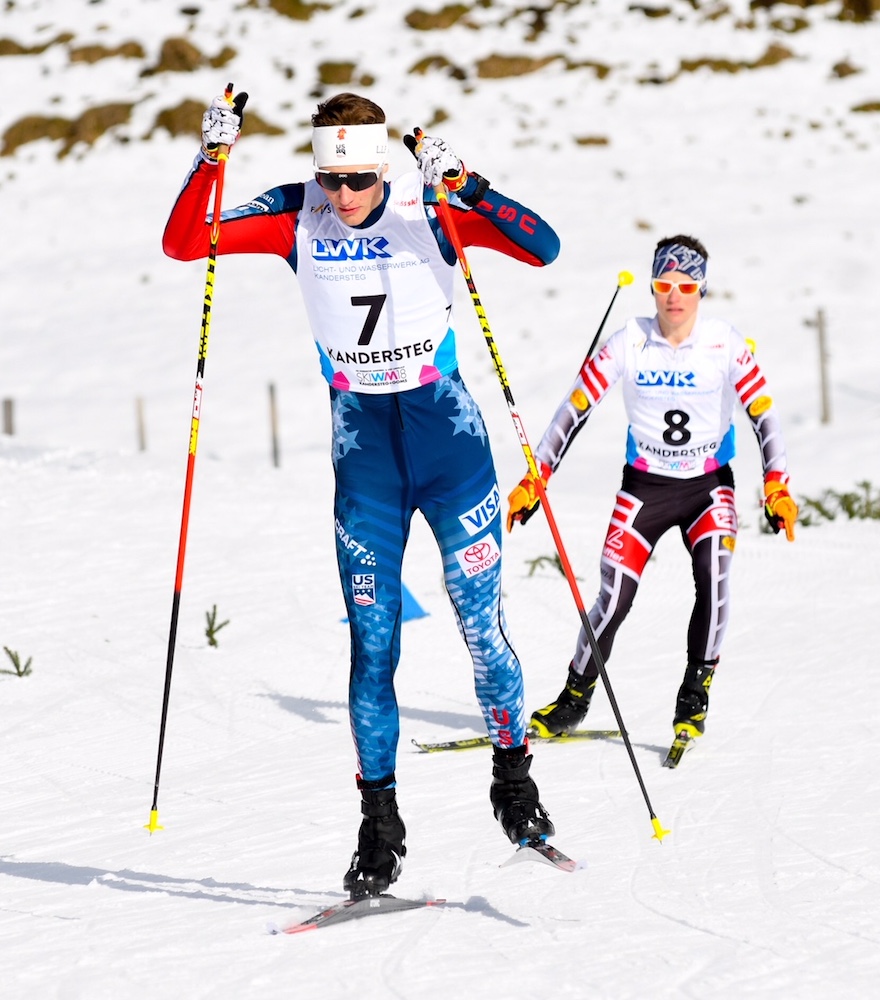
The United States team of Taylor Fletcher, Ben Berend, Ben Loomis, and Bryan Fletcher lost out on a photo finish with Poland and finished 10th out of 10 teams, +5:16.7.
Johannes Rydzek (5) leading his two German teammates, Fabian Rießle (6) and Eric Frenzel, as well as Norway’s Jarl Magnus Riiber toward the finish of the nordic-combined large hill/10 k competition on Tuesday at the 2018 Olympics in PyeongChang, South Korea. They finished in that order, with Germany sweeping the medals. (Photo: FlyingPointRoad)
It was a total team effort on Tuesday for Germany in the second nordic-combined individual event of the 2018 Olympics in PyeongChang, South Korea, with Fabian Rießle, Johannes Rydzek and Eric Frenzel, with the help of Austria’s Wilhelm Denifl, chasing down Japan’s Akito Watabe and Norway’s Jarl Magnus Riiber about 6 kilometers into the 10 k race.
Earlier on Tuesday, Watabe had put himself in first with the best-ranked jump on PyeongChang’s 142-meter large hill. He started the 10 k Gundersen in first, just 1 second ahead of Riiber, who had jumped to second, just 0.3 points behind Watabe.
(Riiber had actually jumped farther with a distance of 139 meters, compared to Watabe’s 134-meter jump, and scored identical marks from the judges but lost points for wind compensation.)
Germany en route to a complete sweep of the podium in the men’s nordic-combined individual large hill/10 k on Tuesday at the 2018 Olympics in PyeongChang, South Korea, with Johannes Rydzek (5) leading Fabian Rießle (6) and Eric Frenzel (4). They went on to place first, second and third, respectively. (Photo: FlyingPointRoad)
Behind them, Denifl started the 10 k race 16 seconds out of first, Frenzel surged out of the start 24 seconds back, Rydzek 31 seconds behind, and Rießle 34 seconds back.
While Watabe led Riiber off the front for the first two laps of the four-lap race, the three Germans caught Denifl before lapping through the stadium for the first time at 2.5 k. From there, 16 seconds behind the leaders, the four-man group worked to reel in first and second place and did so by 6 k.
The lead pack then became six as Riiber and Watabe continued to position themselves up front at the 7.5 k mark.
On the final lap at the 8.58 k marker, Watabe charged to the front in his move to reclaim first. After taking the lead on an uphill, it wasn’t long after until he found himself skiing with three others alongside him: Riiber, Rydzek and Frenzel.
Then, Watabe slipped behind Riiber and the group closed in around him. Watabe clipped a ski, apparently with Rießle, who didn’t stumble, but Watabe did and dropped to the back of the pack. For Watabe, that was the end. For Germany, it was the beginning.
Frenzel led the charge up the final climb with Rydzek and Rießle behind him while Riiber tried to keep pace. Riiber slotted into fourth over the top and the foursome flew down into the stadium, with Rydzek coming out of the draft in first and leading Rießle, Frenzel and Riiber to the finish, respectively.
They finished in that order, with Rydzek taking gold in 23:52.5 minutes, 0.4 seconds ahead of Rießle in second place and 0.8 seconds ahead of Frenzel in third. Riiber crossed 2.8 seconds back in fourth, and Watabe ended up fifth (+12.5).
Germany had four in the top seven with Vinzenz Geiger in seventh (+50.1), behind Finland’s Eero Hirvonen in sixth (+22.1).
“I looked up to the video wall and saw the first three: all Germans,” Geiger recalled in a post-race interview with German broadcaster ARD. “That made me really happy, and of course I can also be happy about my seventh place.”
Bryan Fletcher en route to 17th in Tuesday’s large hill/10 k competition, tying his best result at the 2018 Olympics in PyeongChang, South Korea. (Photo: FlyingPointRoad)
American Bryan Fletcher repeated his result from the normal-hill competition as well, placing 17th on Tuesday, 1:42.9 minutes behind Rydzek in first. Fletcher had started the 10 k 2:04 minutes back in 23rd based on his jump. His teammate Ben Berend started 8 seconds behind him in 24th. Ultimately, Fletcher raced up to 17th with the 10th-fastest course time while Berend slipped to 39th (+4:28.2).
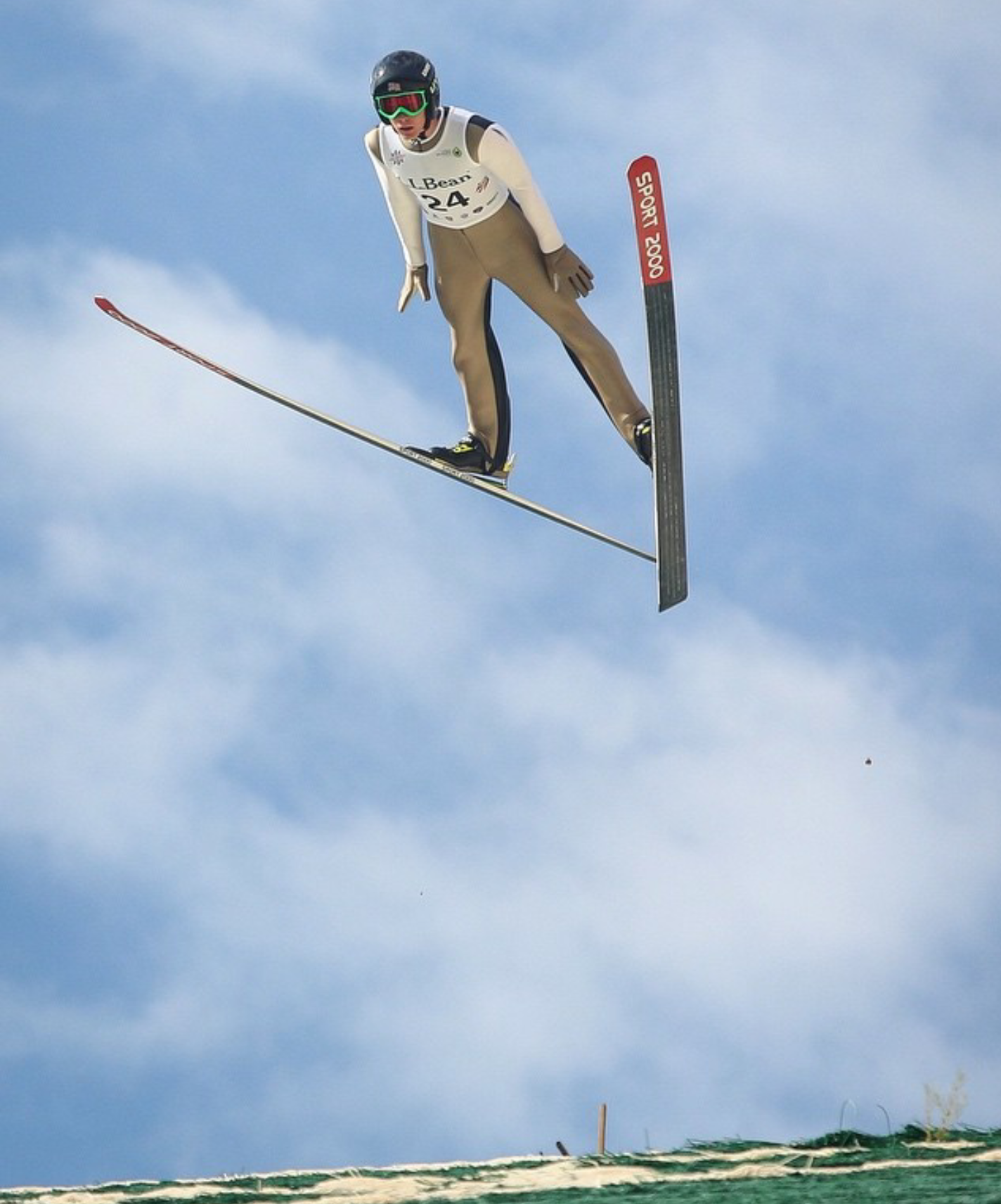
“The second I was in the air I knew I had a good one,” Berend told FasterSkier after the jumping portion of Tuesday’s competition. “Because when you do it right, you’re just flying, and I was really high and I was pulling away towards the bottom of the hill and so I knew, but I couldn’t feel any wind or anything. I was just so psyched, trying to enjoy every second of it.
In his first Olympic race, American Ben Berend on his way to 39th in the large hill/10 k competition at the 2018 Olympics in PyeongChang, South Korea. He started the day by jumping to 24th, which he said was his best competition jump of the season. (Photo: FlyingPointRoad)
“I haven’t had that many good jumps this season so I’ve just been searching for that,” Berend explained. “It’s funny, it’s so easy when you are doing it right and it’s so hard when you’re lost, and so I finally felt like, that might have been my best jump of the season, honestly, so what are the odds of doing that at the Olympics? That’s pretty cool.”
Tuesday was the 22 year old’s first Olympic competition after he sat out the first individual event because his jumping had been going poorly in training, he said. (Each team can only start four athletes per event. Taylor Fletcher sat out Tuesdsay’s competition.)
“I definitely was a little nervous for tonight, even though there is no pressure on me,” Berend said. “… Our coach [three-time U.S. Olympic biathlete Jeremy Teela] texted us, he’s actually our cross-county coach, he’s back at home, and he just said, ‘You guys have nothing to lose. Don’t be scared to fail.’ So that’s kind of our mindset here, and it was good; it kind of works for me.”
American Bryan Fletcher (23) skiing with Norway’s Jørgen Graabak (19) during the cross-country race of Tuesday’s individual large hill/10 k competition at the 2018 Olympics in PyeongChang, South Korea. Fletcher went on to finish 17th while Graabak placed 10th. (Photo: FlyingPointRoad)
After the race, Bryan Fletcher, who had skied up to 13th by 7.5 k, recalled pulling a chase group for most of the four laps. He ended up 17th, 3.2 seconds shy of 16th place, behind Japan’s Go Yamamoto.
“I went all in and just tried to make up as much ground as possible,” Fletcher told FasterSkier after. “I was hopeful and optimistic that I’d have the legs at the end. I knew that they were going to come around me with a pretty hard attack, and both of the guys that were with me have great finishing sprints, so I tried to pace myself a little bit, but I also knew that 17th or 10th or whatever you could get up to, it doesn’t really matter unless you’re on the podium so I was really going all in. … Unfortunately it didn’t work out, but I’m happy with how I skied and happy with the performance I had on the course today.”
American Ben Loomis racing to 40th in the large hill/10 k competition at the 2018 Olympics in PyeongChang, South Korea. (Photo: FlyingPointRoad)
Just behind Berend, his teammate Ben Loomis finished 40th (+4:38.8), up from 43rd in the jump, and Jasper Good followed in 43rd (+5:50.2), up from 46th.
“It was kind of tough jumping … [and] hard to start the race at the back, but overall it was a good race by me and I felt pretty good out there,” Loomis said after. “Regardless of how I have and how I continue to do here, there’s a lot to take away and I’m learning a lot about how to better refine my preparations and just stay relaxed out there and just really put my best foot forward.”
Nordic combined at the 2018 Games will conclude with the 4 x 5 k team event on Thursday.
Rosie Frankowski (APU) racing to a 2-second win in the women’s 10 k classic pursuit on Sunday, the final day of 2018 Eastern Canadian Championships in Gatineau, Quebec. (Photo: Rob Smith)
NorAm Eastern Canadian Championships (Gatineau, Quebec): 10/15 k classic pursuits
Rosie Frankowski defended her lead and tallied her second-straight win on Sunday, the final day of Eastern Canadian Championships, both a NorAm and a SuperTour. Meanwhile, David Norris overcame a 10-second starting deficit to make it all Alaska Pacific University (APU) atop the podium in the classic pursuits.
Frankowski started the women’s 10 k pursuit 47 seconds clear of her APU teammate Becca Rorabaugh in second and held Rorabaugh off by 2 seconds at the finish, crossing the line first in 1:00:32.6 hours on a warmer day around 0 degrees Celsius with heavy snow in Gatineau. Kaitlynn Miller of the Craftsbury Green Racing Project (CGRP) was the third American on the podium, racing up from seventh to third, 21.3 seconds behind Frankowski.
Olivia Bouffard-Nesbitt (Rocky Mountain Racers) led the Canadians in fourth (+3:09.2), up from sixth at the start, and Frédérique Vézina, of the Pierre-Harvey National Training Centre (CNEPH), followed in fifth (+3:15.2), after starting fourth.
Another 4.6 seconds back was Liz Guiney (CGRP) in sixth (+3:19.8). Felicia Gesior (CXC Team) finished seventh (+4:05.6), Corey Stock (Bridger Ski Foundation) placed eighth (+4:05.8), Annika Hicks of the Alberta World Cup Academy (AWCA) was ninth (+4:40.8), and Alannah Maclean of the National Team Development Centre (NTDC) Thunder Bay finished 10th (+5:25.9).
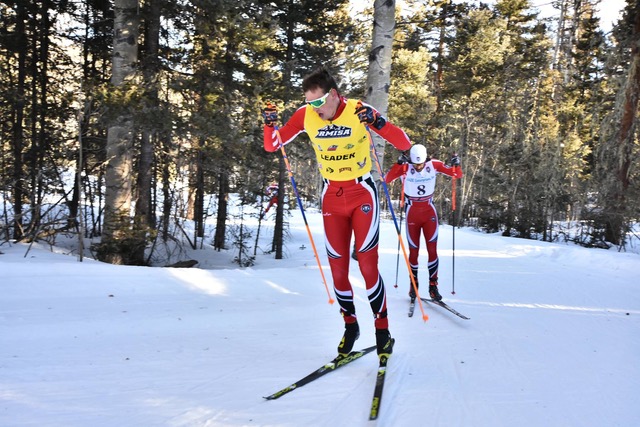
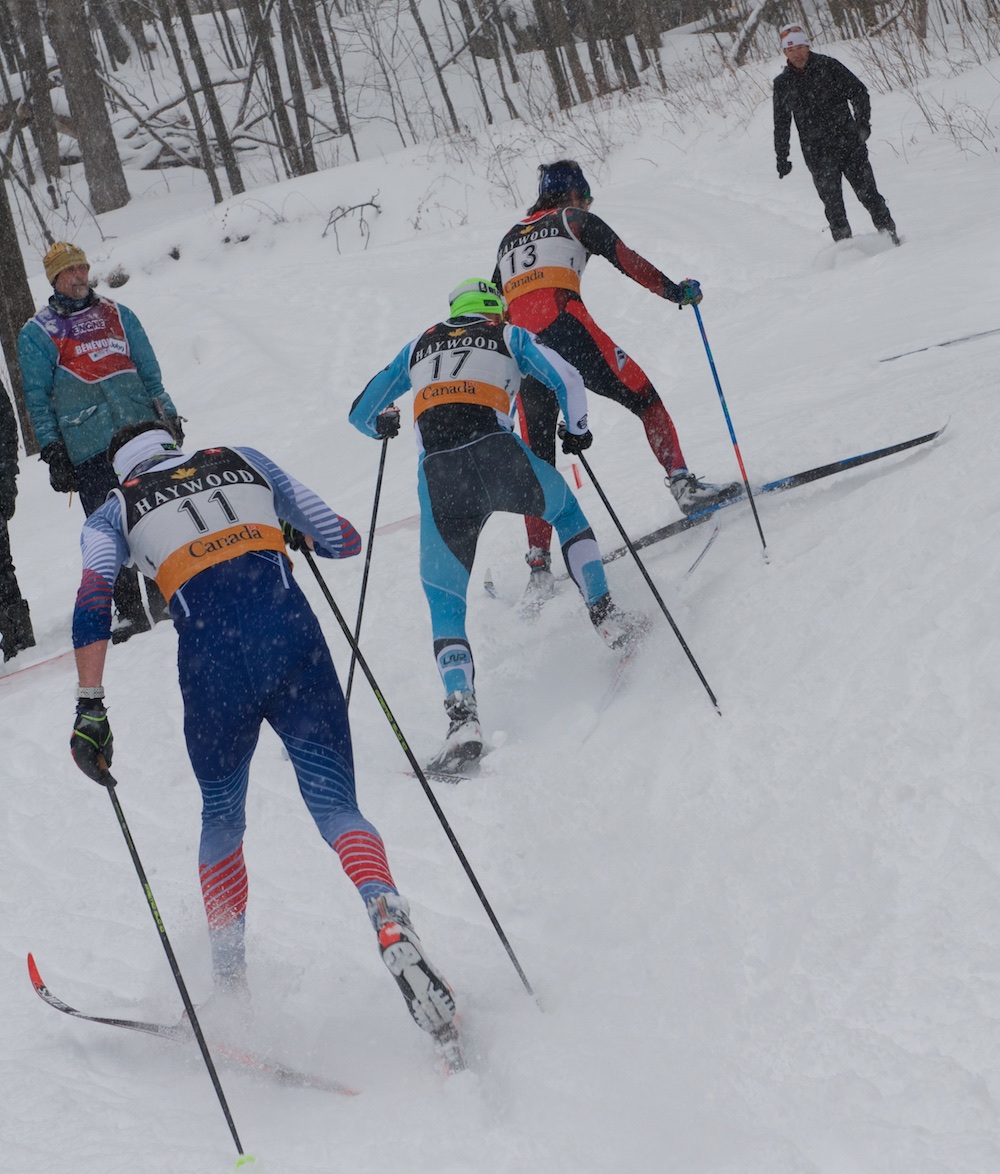
Tad Elliott (13) leads Brian Gregg (17) and Jack Hegman (11) up a climb during the men’s 15 k classic pursuit on Sunday at 2018 Eastern Canadian Championships in Gatineau, Quebec. Gregg went on to edge Elliott in a photo finish for third and Hegman followed in fifth. (Photo: Rob Smith)
In the men’s 15 k, Norris started second and caught leader Jack Hegman, of the Sun Valley Ski Education Foundation (SVSEF) early then raced alone to the victory in 1:19.26, while Ben Lustgarten (CGRP) followed 1:17.8 minutes later in second. Lustgarten started the race in sixth and Brian Gregg (Team Gregg/Loppet Nordic Racing/CXC) started seventh, with Gregg edging Tad Elliott (Ski Club Vail) by less than a tenth of a second in a photo finish for third (+1:38.5). Elliott had started third.
Hegman finished fifth (+1:42.6), his Sun Valley teammate Kevin Bolger was next across the line in sixth (+1:59.1), Adam Martin (CGRP) finished seventh (+2:01.2), Rogan Brown (SVSEF) was eighth (+2:02.9), Scott Hill (Barrie Cross Country) was the top Canadian in ninths (+2:22.5), and Jack Carlyle (AWCA) finished 10th (+2:44.2).
Nordic Combined World Cup (Hakuba, Japan): Large hill/10 k Gundersen
In the final nordic combined World Cup competition before the Olympics, Norway’s Jan Schmid came from 1:14 minutes behind at the start of Sunday’s 10 k to win the individual large hill/10 k event by 6.6 seconds in 25:36.5.
Schmid started the race in seventh, based on his competition jump, 1:14 behind Estonia’s Kristjan Ilves in first. Ilves had jumped to first and started the race 13 seconds ahead of Japan’s Yuto Nakamura in second, but while Nakamura dropped to 18th (+2:21.2) at the finish, Schmid moved all the way up to first with the fourth-fastest course time.
Japan’s Akito Watabe, who won Saturday’s large hill/10 k competition, took the final spot on the podium after a photo finish with the Czech Republic’s Tomas Portyk. They finished 11.1 and 11.2 seconds behind Schmid in third and fourth, respectively.
American Adam Loomis achieved his best individual result in three years, placing 24th (+3:03.4), after jumping to 30th and starting 3:20 out of first. Loomis skied the eighth-fastest course time.
His USA Nordic teammate Ben Berend placed 31st (+4:28.4) after ranking 28th in the jump.
Nordic Combined Continental Cup (Planica, Slovenia): Saturday and Sunday
Meanwhile on the Nordic Combined Continental Cup, Americans Bryan and Taylor Fletcher reached the podium on both Saturday and Sunday in Planica, Slovenia.
Bryan won back-to-back individual large hill/10 k Gundersen starts, while Taylor placed second on Saturday and third on Sunday.
On Saturday, Bryan jumped to third on the 139-meter large hill and started the 10 k race 22 seconds behind Germany’s Anton Schlüter in first. Taylor jumped to 14th and started 1:35 minutes out of first and posted the fastest course time in the 10 k to finish second to his older brother, 59.4 seconds back.
Bryan skied the third-fastest 10 k to take first in 26:24.1 minutes. About a minute behind Taylor, Austria’s Martin Fritz placed third (+1:58.8). Schlüter ended up 15th (+3:51.5).
Also for the U.S., Jasper Good raced from 26th in the jump to eighth overall (+3:08) with the fifth-fastest course time. Grant Andrews did not finish after posting the 38th-ranked jump.
Canada’s Nathaniel Mah placed 28th (+5:41.5) after starting 27th based on his jump.
On Sunday, Fritz jumped to first and finished between the Fletcher brothers in second place, 39.7 seconds behind Bryan, who repeated in first.
Bryan had jumped to second and started the 10 k just 9 seconds back. He skied the fourth-fastest course time en route to the win in 25:01.6.
Taylor’s jump put him in 15th and 1:40 back at the start of Sunday’s race, and he passed 12 competitors to claim third (+1:25.0) with the second-fastest course time.
Good finished 17th (+3:12), up from 23rd in the jump, with the ninth-fastest 10 k time, and Andrews placed 22nd (+3:38.2), up from 24th.
Mah finished 34th (+5:38.7) after jumping to 21st.
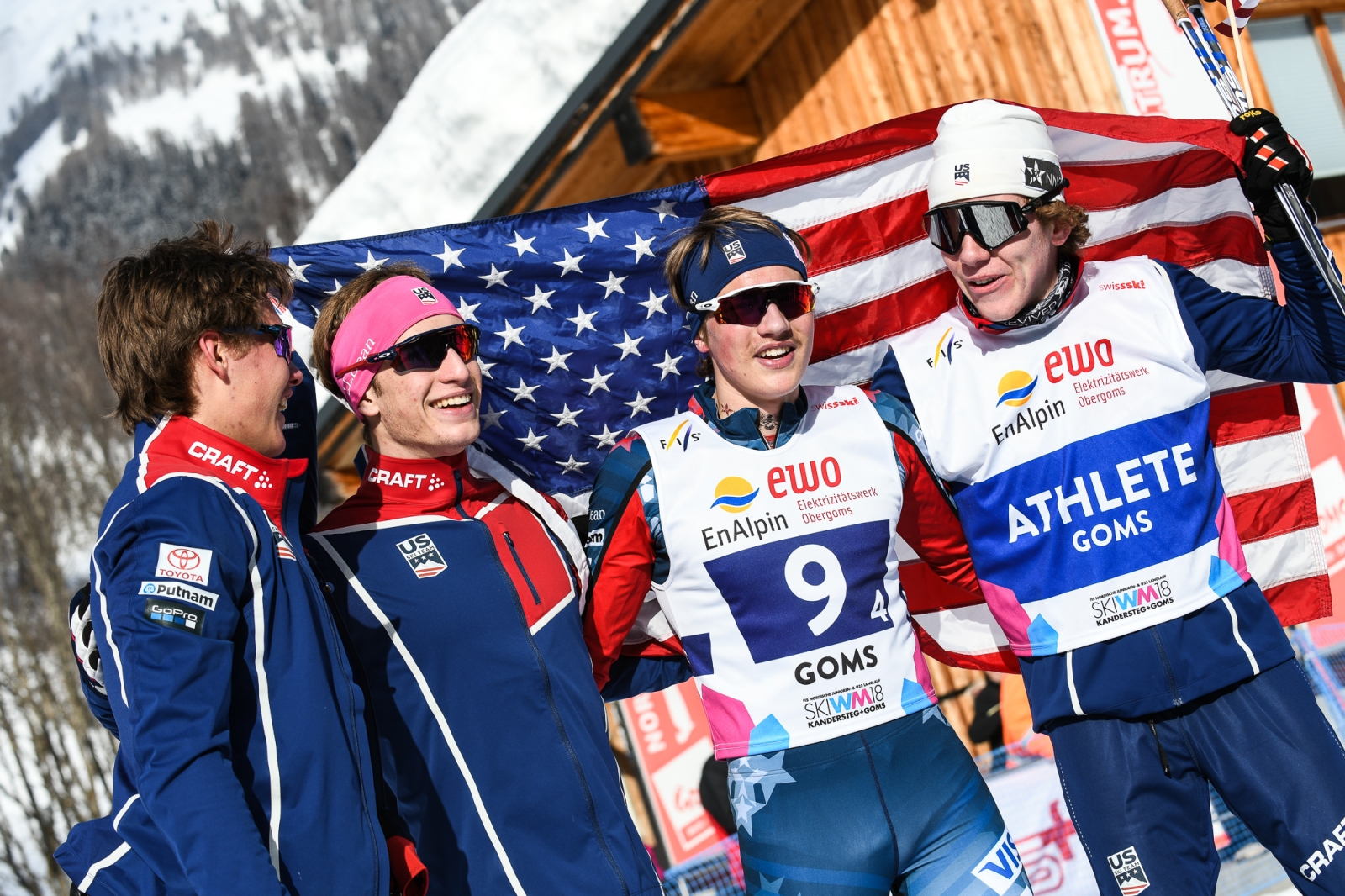
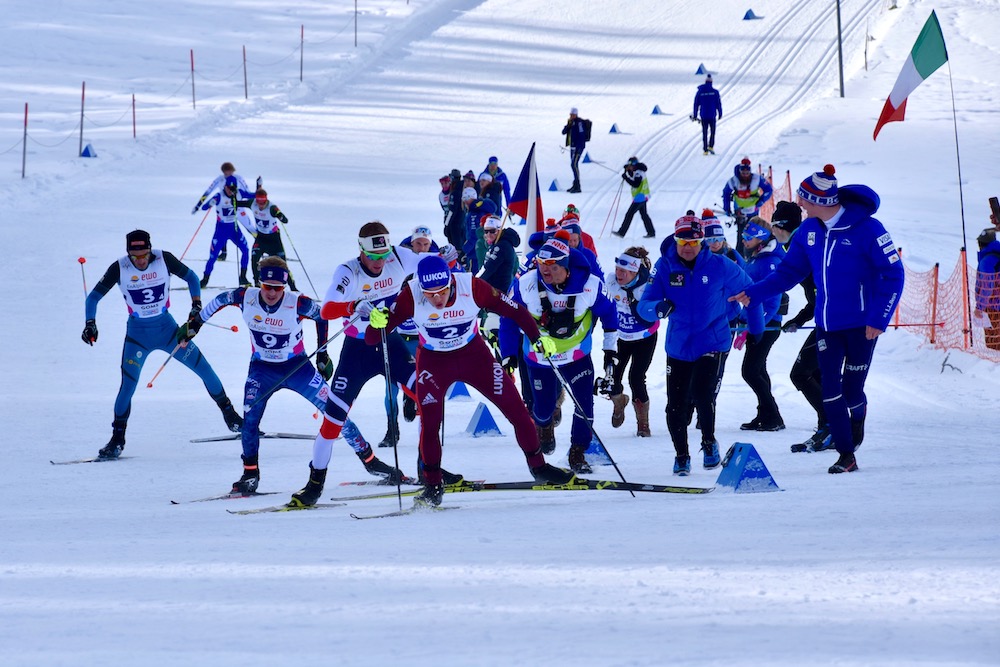
The U.S. men’s silver-medal relay at 2018 Junior World Championships in Goms, Switzerland, with (from left to right) Luke Jager, Hunter Wonders, Gus Schumacher, and Ben Ogden. (Photo: JWSC2018.ch)
(Note: This article has been updated to include comments from Americans Ben Loomis, Luke Jager and Gus Schumacher.)
Junior World Championships (Goms, Switzerland): Men’s and women’s relays
Two individual medals and a relay podium. That’s how the U.S. team fared this week at Junior World Championships in terms of a medal count, but the significance of its breakthroughs go way beyond the hardware.
Hailey Swirbul became the most successful American nordic skier at Junior World Championships with a silver and a bronze in the two women’s distance races. Then, on Saturday, the U.S. men took their turn in the spotlight, racing to second and almost first in the 4 x 5-kilometer relay for the best relay finish by an American team at Junior Worlds. Last year, the U.S. women placed third at 2017 Junior Worlds at Soldier Hollow in Midway, Utah.
Luke Jager started the team off on Saturday as the first classic leg, putting the U.S. men in sixth at the first exchange, 14 seconds behind Sweden in first.
While Sweden dropped to second on the next leg, the U.S. continued to move up, with Ben Ogden racing to fourth, 8.5 seconds out of first, behind Norway, Russia and France, respectively.
On the first freestyle leg, Hunter Wonders held the U.S. in fourth and tagged anchor Gus Schumacher in fourth, 31.3 seconds out of first. Norway continued to lead with France, and Russia skied about 5 seconds back in third with 5 k to go.
Schumacher then skied the fastest anchor leg to race up to second, passing France and finally Russia in the finishing straight, as he crossed the line 2.2 seconds behind Norway’s Jørgen Lippert — who eased up in the finish and secured the Norwegian gold with a total time of 50:04.2 minutes.
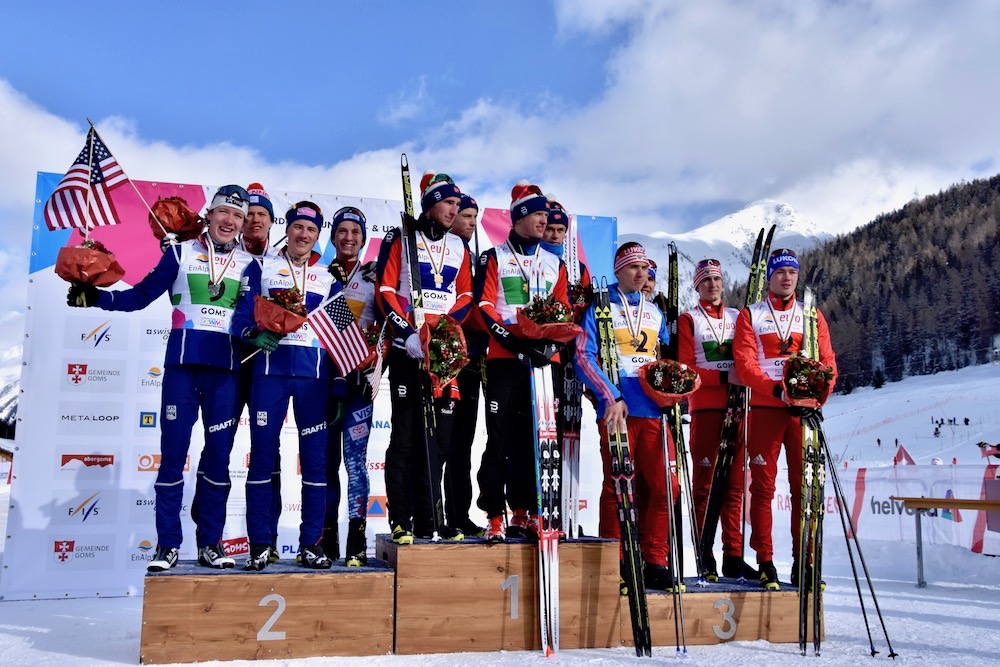
The men’s 4 x 5 k relay podium at 2018 Junior World Championships with Norway (c) in first, the U.S. (l) in second (Ben Ogden, Luke Jager, Gus Schumacher, Hunter Wonders), and Russia (r) in third. (Photo: Julia Kern)
The U.S. placed second, 3.3 seconds ahead of Russia in third (+5.5), and France finished fourth (+29.6).
Norway’s winning team included two men who won individual golds this week, Harald Østberg Amundsen (in the 20 k skiathlon) and Jon Rolf Skamo Hope (10 k classic), as well as Håvard Moseby and Lippert (who took bronze in two races).
Russia’s team was made up of Kirill Kilivnyuk, Sergey Ardashev, Yaroslav Rybochkin, and Alexander Terentev. Team France was Camille Laude, Hugo Lapels, Tom Mancini, and Pierre Tichit.
Canada placed 11th (+3:12.8) with Antoine Cyr, Ritchie Graham, Felix Longpre, and Etienne Hebert. Sixteen teams contested the men’s relay on the final day of Junior Worlds in Goms.
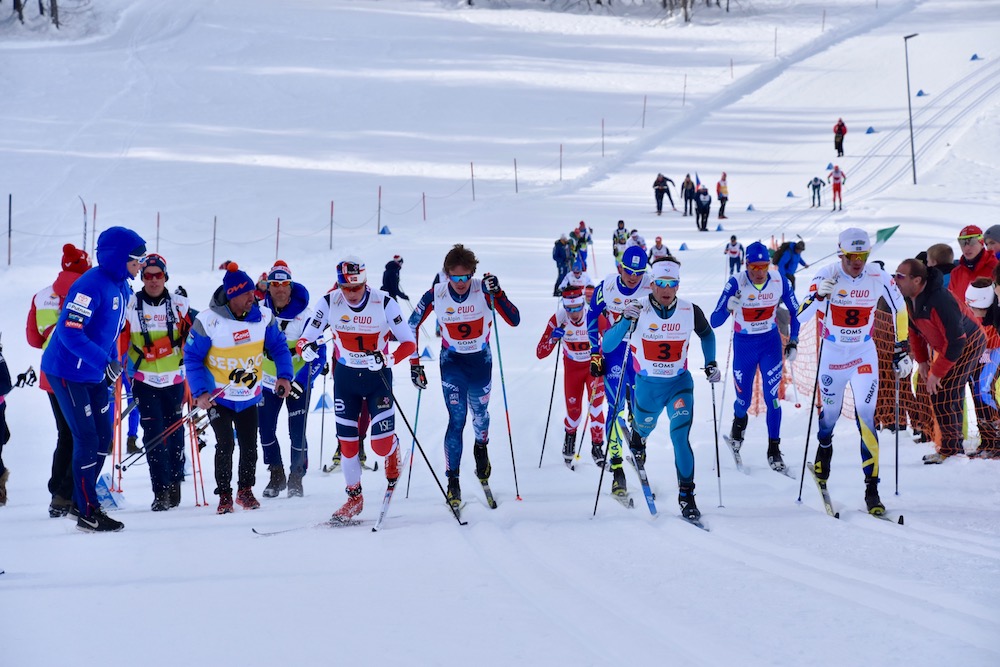
American Luke Jager (9) skiing with Norway’s Harald Østberg Amundsen (1), France’s Camille Laude (3), and Sweden’s Jacob Nystedt (8) during the first leg of the men’s 4 x 5 k relay on Saturday at 2018 Junior World Championships in Goms, Switzerland. (Photo: Julia Kern)
In an email, Jager, who turned 18 last month, explained that he was grateful for the opportunity to race at his first Junior Worlds.
“I barely qualified for this trip after a tough week in Anchorage so my options for starts were super limited,” Jager wrote. “I got the sprint start last week which was pretty horrendous and then a guaranteed spot on the relay team. So I had the whole week to prepare and rest. Watching the boys all week we realized that a medal could be possible and we started targeting that super closely.”
But over the last week, Jager hadn’t been feeling well.
“I was feeling really really bad in the days following the sprint and could barely get out and ski for 60 minutes each day,” he recalled. “I had actually told [U.S. Ski Team Development Coach Bryan] Fish that if I continued to feel as bad as I had been I was gonna sit out the relay. But I started feeling better and better throughout the week and was feeling really good this morning.”
He had previously asked Fish if he could ski the scramble leg.
“Bryan was stoked about it too so that decision was easy,” Jager explained. “This group of dudes is perfect for each leg of a relay so we barely even needed to discuss order. I am definitely a stronger classic skier so I was stoked to be able to get some redemption for my poor form in the last month.”
Schumacher, 17, explained he found out the relay order on Friday night and “really started to get excited about it,” he wrote in an email. “We had some foreign friends say that they thought we could do well so that really helped confidence.”
From the gun, Jager expected a fast pace and pushed to put himself in the lead group while trying to conserve energy and avoid any tangles He locked onto Norway’s Amundsen and by the last climb on the second lap, found that the group was beginning to string out.
“I was thankfully able to hold on just enough to maintain connection with the leaders and put Ben in a position where he could do his thing,” Jager wrote. “I would have liked to be a little further up in the group when I tagged off to Ben but the Swedes’ first skier had done so much damage in the last minutes that we were all in single file and pretty much in survival mode up the last climb.”
Russia’s Alexander Terentev leading Norway’s Jørgen Lippert, American Gus Schumacher (9), and France’s Pierre Tichit (3) up a climb in the final leg of the men’s 4 x 5 k relay at 2018 Junior World Championships in Goms, Switzerland. (Photo: Julia Kern)
Fast-forward to Schumacher getting tagged in fourth in the final exchange, 31.5 seconds behind Norway in first, 30.9 seconds behind France in second, and 26.2 seconds behind Russia in third. Despite the gap, he believed he could close it.
“I definitely thought those three were in reach, and I wanted to catch them, if for no other reason than to keep clear of 5th and 6th,” Schumacher wrote. “I focused on really holding steady for the first 2k, then starting to push more, and I was able to catch that lead pack and then recover with them for the last sprint, which did end up really hurting.”
While he had distanced himself from France and secured third by the final hill, he hadn’t anticipated catching Russia or Norway.
“By the time I got through the downhill corner, however, I was closing fast on the Russian and realized I was right there,” Schumacher wrote. “I popped around the last corner and was almost even with Russia, then after a few seconds of sprinting I pulled ahead and he slowed down and I knew I had it.”
While Jager explained he’s not one to get very nervous about racing, Saturday was completely different.
“… Watching the rest of the race progress was one of the most nerve wracking experiences of my life,” he wrote. “When Hunter tagged off to Gus I knew we were really really gonna be in the fight for a medal. I’ve been racing Gus for most of my life and I know when that kid is gonna throw down and produce a miracle and I could see it…
“This is something this group of guys has been dreaming of and training for for a really long time now,” he added. “To be able to watch that dream come into fruition today was indescribable. Probably the best day of my life since Cole Morgan added me on Snapchat. We came here this year to show the world that US skiing is the real deal and that we’re here to stay and I think we did that. To be able to be a piece of that history was an honor.”
“Experiencing the podium here has been so cool,” Schumacher wrote. “I thought it was possible, but actually getting it feels amazing. This whole trip has been really cool even without this success, it’s such an amazing place and the team is tight. I think individually I anticipated results maybe a little better, but this seems about right, and as a team I think we all surprised ourselves. Together we can make some big waves.”
Germany Wins Women’s Relay; U.S. 8th
In the women’s 4 x 3.3 k relay earlier on Saturday, Germany took the win by 8.6 seconds over Russia with a winning time of 39:17.4. Sweden finished third, 47.5 seconds out of first.
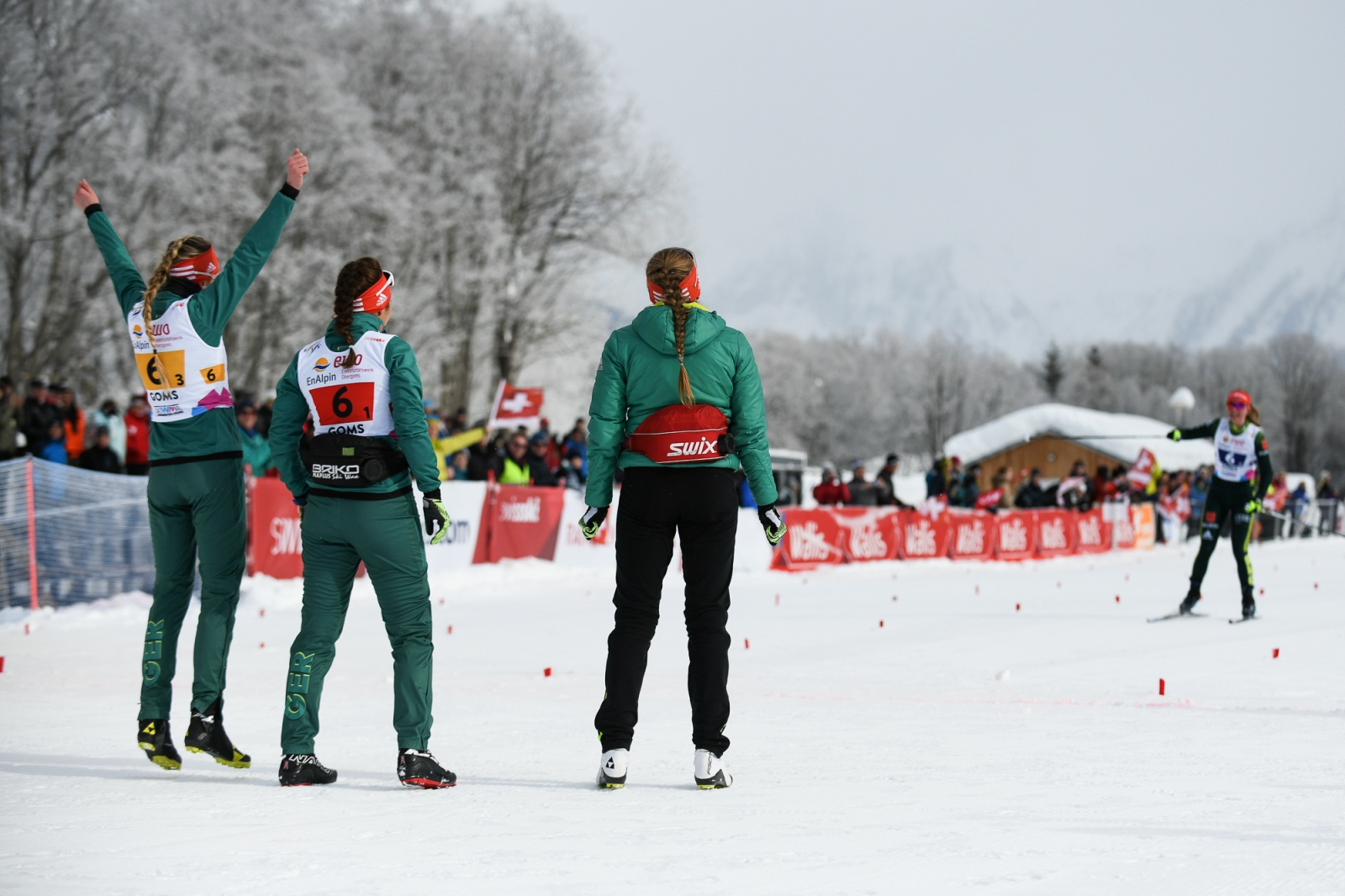
Germany’s Alexandra Danner, Celine Mayer and Lisa Lohmann await their teammate Anna-Maria Dietz at the finish of the women’s 4 x 3.3 k relay on Saturday at 2018 Junior World Championships in Goms, Switzerland. Germany placed first and Russia finished second, 8.6 seconds later. (Photo: JWSC2018.ch)
Germany (Alexandra Danner, Celine Mayer, Lisa Lohmann, Anna-Maria Dietz) improved from third on the first leg, to second on the second and third legs, and final first on Dietz’s anchor leg.
Russia (Polina Nekrasova, Hristina Matsokina, Nina Dubotolkina, Maya Yakunina) led the race from the first through the third and final exchange, before slipping to second at the finish.
Sweden (Tua Dahlgren, Frida Karlsson, Alicia Persson, Johanna Hagström) rebounded from 13th and more than a minute and a half back at the first exchange to tag in fourth and 28 seconds out of first thanks to Karlsson’s fastest second-leg time. By the final exchange, they were up to third and they held that position to the finish.
The U.S. women’s 4 x 3.3 k relay at 2018 Junior World Championships, with (from left to right) Hailey Swirbul, Kathleen O’Connell, Hannah Halvorsen, and Molly Gellert. They placed eighth on Saturday. (Photo: Julia Kern)
The U.S. placed eighth (+1:08.1) with Kathleen O’Connell, Swirbul, Molly Gellert, and Hannah Halvorsen. After O’Connell put them in eighth and about a minute back on the first leg, Swirbul skied them up to sixth with the second-fastest second leg, 30.1 seconds out of first. Gellert held onto that position on the first skate leg, but Halvorsen slipped two places on the anchor leg to finish eighth.
Canada finished 15th (+4:47.8) out of 16 teams with Hannah Mehain, Natalie Hynes, Annika Richardson, and Alexandra Racine.
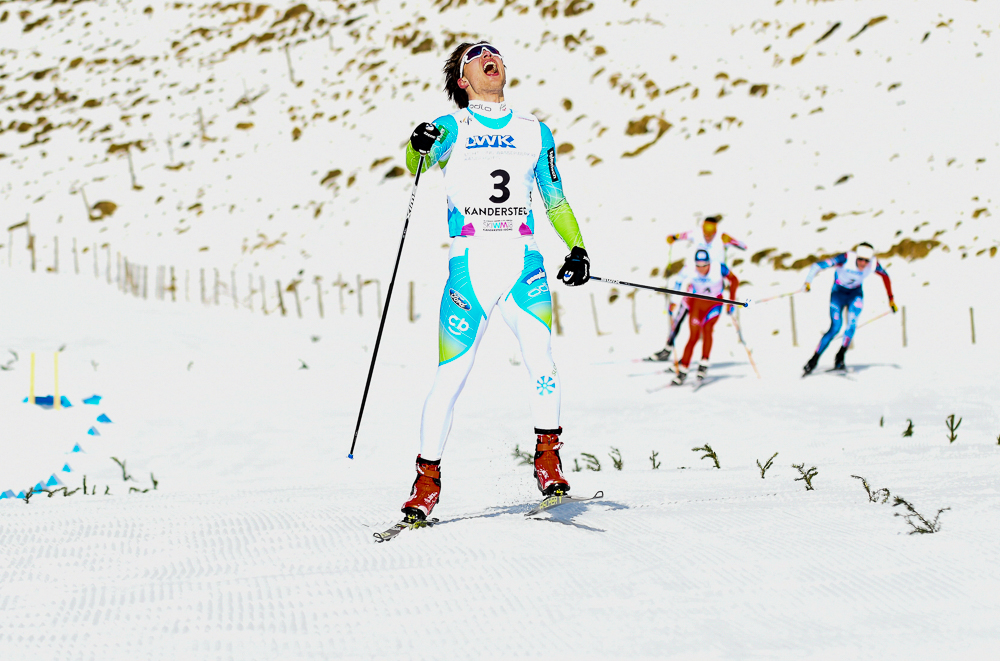
Slovenia’s Vid Vrhovnik (3) celebrates his win in the last nordic-combined competition of 2018 Junior World Championships, the individual normal hill/5 k, on Saturday in Kandersteg, Switzerland, while the Czech Republic’s Jan Vytrval, Austria’s Dominik Terzer and American Ben Loomis (r) battle for second. (Photo: JWSC2018.ch)
Nordic Combined Junior World Championships (Kandersteg, Switzerland): Normal hill/5 k Gundersen
In the final nordic-combined competition of Junior Worlds, American Ben Loomis nearly notched his second podium of the week, missing it by one-tenth of a second in fourth place.
American Ben Loomis (7) leads Austria’s Johannes Lamparter during Saturday’s 5 k at 2018 Nordic Combined Junior World Championships in Kandersteg, Switzerland. Loomis went on to place fourth and Lamparter finished eighth. (Photo: Romina Eggert)
Slovenia’s 18-year-old Vid Vrhovnik won the individual normal hill/5 k Gundersen by 4.9 seconds over Austria’s Dominik Terzer. After posting the third-best jump on the 106-meter hill, Vrhovnik started the 5 k race 6 seconds behind Germany’s Luis Lehnert in first. Terzer jumped to second and started just 4 seconds behind, while the Czech Republic’s Jan Vytrval jumped to fourth and started 10 seconds back. Loomis jumped to seventh (just as he did on Tuesday before racing to third place) and started 27 seconds out of first.
“I was happy with my jump being closer in time to the front,” Loomis wrote in an email about his his jump, which put him about 10 seconds closer to the leaders than on Tuesday. “I didn’t feel quite as lucky with the wind. I was hoping to jump around the top 5, but 7th, only 27sec back was good, too.”
Over the two-lap 5 k, Vrhovnik battled with Terzer, while Lehnert slipped to seventh at the finish, 23.5 seconds behind. The Slovenian took the win by nearly five seconds over Terzer in 11:28.8, and Vytrval outlunged Loomis for third place (+5.4). Loomis placed fourth (+5.5), well ahead of Norway’s Einar Lurås Oftebro in fifth (+18.4).
Ben Loomis (USA Nordic) on the last day of 2018 Nordic Combined Junior World Championships in Kandersteg, Switzerland. He jumped to seventh and moved up to fourth in the 5 k. (Photo: Romina Eggert)
“I was able to catch places 3-6 on the first lap and ski with them through the beginning of the second lap,” Loomis wrote. “Towards the end of second lap I closed down on second place (Jan Vytral) with Dominik Terzer. On the last corner we packed up in positions 2-4.
“The finish started with a sharp downhill corner followed by a quick stretch less than 100 meters,” he continued. “I came into the finishing lanes in second but unfortunately took the wrong line and was passed by Dominik and never quite caught Jan in front of me.”
While he had been hoping for another podium, Loomis acknowledged that he was pleased to ski the fastest race time and “be battling at the front”.
“Overall I am leaving Switzerland with my goals accomplished and feeling satisfied,” he wrote. “It would have been nice to walk away with a double podium but I am still very happy with how to week went. This week has been a huge confidence booster going into the Olympics next week. I am very excited to represent my country and enjoy my time at the games. I am looking to have fun, take in experience and not overthink the results.”
Also for the U.S., Stephen Schumann placed 18th (+1:18.6), up one place from 19th in the jump, Jared Shumate finished 40th (+3:05.7), up from 48th in the jump, and Tucker Hoefler was 55th (+5:50.5), after jumping to 55th.
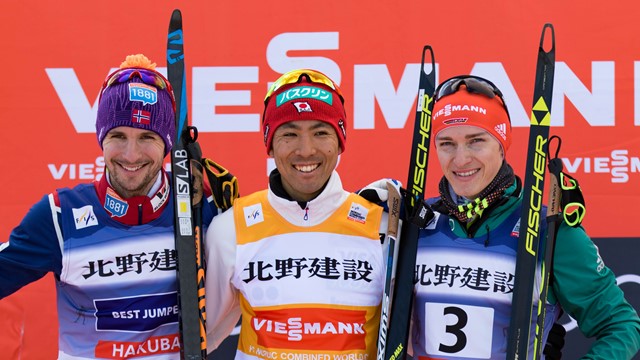
The podium at Saturday’s Nordic Combined World Cup in Hakuba, Japan, with Japan’s Akito Watabe (c) in first, Norway’s Jan Schmid (l) in second and Germany’s Manuel Faißt (r) in third. (Photo: FIS/Flawia Krawczyk)
Nordic Combined World Cup (Hakuba, Japan): Large hill/10 k Gundersen
Many of the winter-sports World Cups were off this weekend before the Olympics start in earnest a week from today in PyeongChang, South Korea, but not nordic combined, which had a World Cup stop in Hakuba, Japan.
There, local hero Akito Watabe took the win in 24:14.6 minutes, a whopping 1:12.6 minutes clear of Norway’s Jan Schmid in second. Germany’s Manuel Faißt placed third, 1:22 back, and Estonia’s Kristjan Ilves finished 52 seconds later in fourth (+2:14).
The lone American competing in Saturday’s 10 k Gundersen, Ben Berend achieved his first individual World Cup top 30, placing 23rd (+4:31.7) after jumping to 16th on Hakuba’s 134-meter large hill.
Watabe led from the beginning of the day after jumping to first, ahead ofIlves in second, Faißt in third, and Schmid in fourth. Watabe started the 10 k with a 16-second head start on Ilves, while Faisst started 52 seconds out of first and Schmid started 1:08 behind.
Berend started the 10 k with a 2:36 deficit to first, with five others within 10 seconds of him. His teammate Adam Loomis did not start the 10 k after jumping to 38th.
Another individual large hill/10 k Gundersen will be held on Sunday in Hakuba. The first nordic combined competition in PyeongChang, the individual normal hill/10 k, is set for Wednesday, Feb. 14.
The men’s 15 k freestyle podium at 2018 Eastern Canadian Championships in Gatineau, Quebec, with Jack Hegman (c) in first, David Norris (l) in second and Tad Elliott (r) in third. (Photo: Rob Smith)
NorAm Eastern Canadian Championships (Gatineau, Quebec): 10/15 k freestyle
Americans swept the podium in both the men’s and women’s freestyle individual starts on Saturday at Eastern Canadian Championships in races that count toward both NorAm and SuperTour standings.
According to unofficial results, Jack Hegman, of the Sun Valley Ski Education Foundation (SVSEF), won the men’s 15 k by 9.1 seconds over David Norris, of Alaska Pacific University (APU), in 35:44.9. Tad Elliott (Ski Club Vail) placed third (+38.7) just ahead of the top Canadian, Jack Carlyle, of the Alberta World Cup Academy (AWCA), in fourth (+41.7).
The U.S. occupied eight of the top 10 in the men’s race, with Kevin Bolger (SVSEF) in fifth (+45.0), Ben Lustgarten, of the Craftsbury Green Racing Project (CGRP) in sixth (+52.3), Brian Gregg (Team Gregg/LNR/CXC) in seventh (+57.0), Rogan Brown (SVSEF) in eighth (+58.1), Canada’s Scott Hill (Barrie Cross Country) in ninth (+1:14.7), and Eric Packer (APU) in 10th (+1:18.6).
The women’s 10 k freestyle podium at 2018 Eastern Canadian Championships in Gatineau, Quebec, with Rosie Frankowski (c) in first, Becca Rorabaugh (l) in second and Erika Flowers (r) in third. (Photo: Rob Smith)
After placing second in a 10 k freestyle at last weekend’s SuperTour in Craftsbury, Vermont, Rosie Frankowski (APU) won the women’s 10 k freestyle on Saturday in Gatineau by more than 30 seconds in 27:07.3. Her teammate Becca Rorabaugh (who won the Craftsbury 10 k skate as well as Friday’s classic sprint in Gatineau) placed second (+37.1) on Saturday, and Erika Flowers placed third (+1:26.4) for the third-straight race.
Frédérique Vézina, of the Pierre-Harvey National Training Centre, led the Canadians in fourth (+1:46.2), while America Liz Guiney (CGRP) placed fifth (+1:52.2), and Olivia Bouffard-Nesbitt (Rocky Mountain Racers) finished sixth (+1:56.4).
Also in the top 10, Kaitlynn Miller (CGRP) placed seventh (+1:57.8), Felicia Geisor (CXC Team) was eighth (+2:18.5), Zoë Williams (Carleton University) ninth (+2:39.6) and Annika Hicks (AWCA) 10th (+2:43.4).
Eastern Canadian Championships conclude Sunday with 10/15 k classic pursuits at the Nakkertok Nordic Ski Centre.
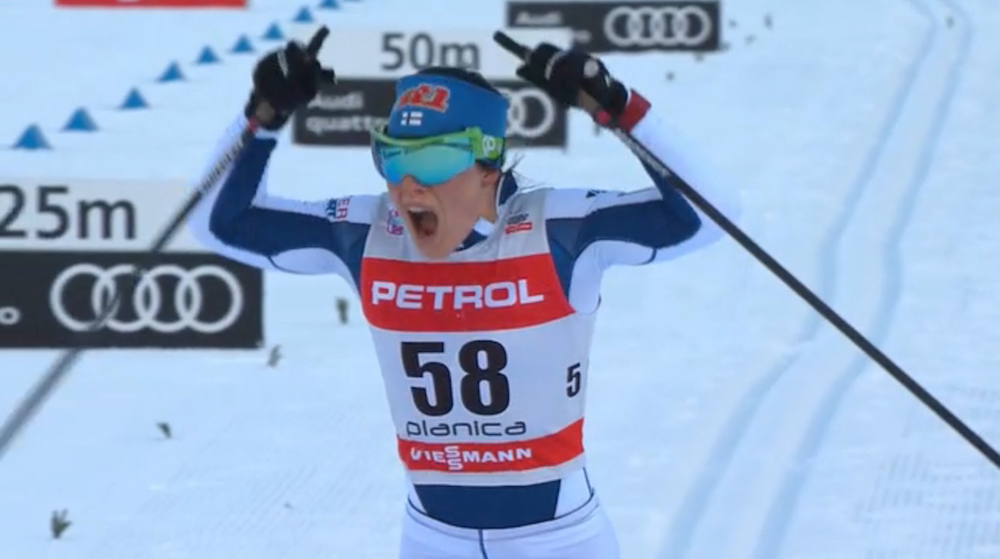
Finland’s Krista Pärmäkoski after winning her first non-stage World Cup on Sunday in the women’s 10 k classic in Planica, Slovenia. She bested Sweden’s Charlotte Kalla’s time by 3.6 seconds. (Screenshot: ARD broadcast)
FIS Cross Country World Cup (Planica, Slovenia): 10/15 k classic
Just when it looked like one of those Charlotte-Kalla days, Finland’s Krista Pärmäkoski swooped in and topped the Swede’s time by 3.6 seconds in the women’s 10-kilometer classic individual start on Sunday for her first-career outright World Cup win.
Outright meaning non-stage; Pärmäkoski has two World Cup wins to her name for setting the fastest time of day in 2016 pursuit races.
But Sunday’s 10 k in Slovenia saw her rising to the challenge and besting Charlotte Kalla’s time of 27:12.3, which was at least 39 seconds faster than the first 57 starters. Kalla had started 32nd and beat the previous top time set by Swedish U23 skier Ebba Andersson (bib 28) by 48.6 seconds.
Austria’s Teresa Stadlober started later in bib 56 and clocked the second-fastest time to Kalla, 39 seconds back.
But it was Pärmäkoski in bib 58 who beat them all. Even Norway’s Heidi Weng, who started 60th, couldn’t come close, as she finished 33.5 seconds off Pärmäkoski’s winning time for third place. That put Stadlober in fourth and Andersson in fifth at the end of the day.
Finland’s Kerttu Niskanen placed sixth (+49.4), Norway’s Kari Øyre Slind took seventh (+49.5), Poland’s Justyna Kowalczyk (who’s more of a marathon skier these days) placed eighth (+1:02.1), Norway’s Kathrine Rolsted Harsem (who placed second in Saturday’s classic sprint) finished ninth (+1:03.2), and American Jessie Diggins was 10th (+1:05.4).
Another American, Caitlin Patterson, of the Craftsbury Green Racing Project (CGRP), broke through with her second-best individual World Cup result in 20th (+1:45.2). (Last year, she finished seventh in the pre-Olympic PyeongChang World Cup 15 k skiathlon in a notably small field.)
Kikkan Randall (U.S. Ski Team) followed in 23rd (+1:50.4), and her teammates Sophie Caldwell placed 31st (+2:17.2), Liz Stephen 35th (+2:34.9), and Ida Sargent 37th (+2:37.5).
For the second-straight weekend, no Canadian women competed.
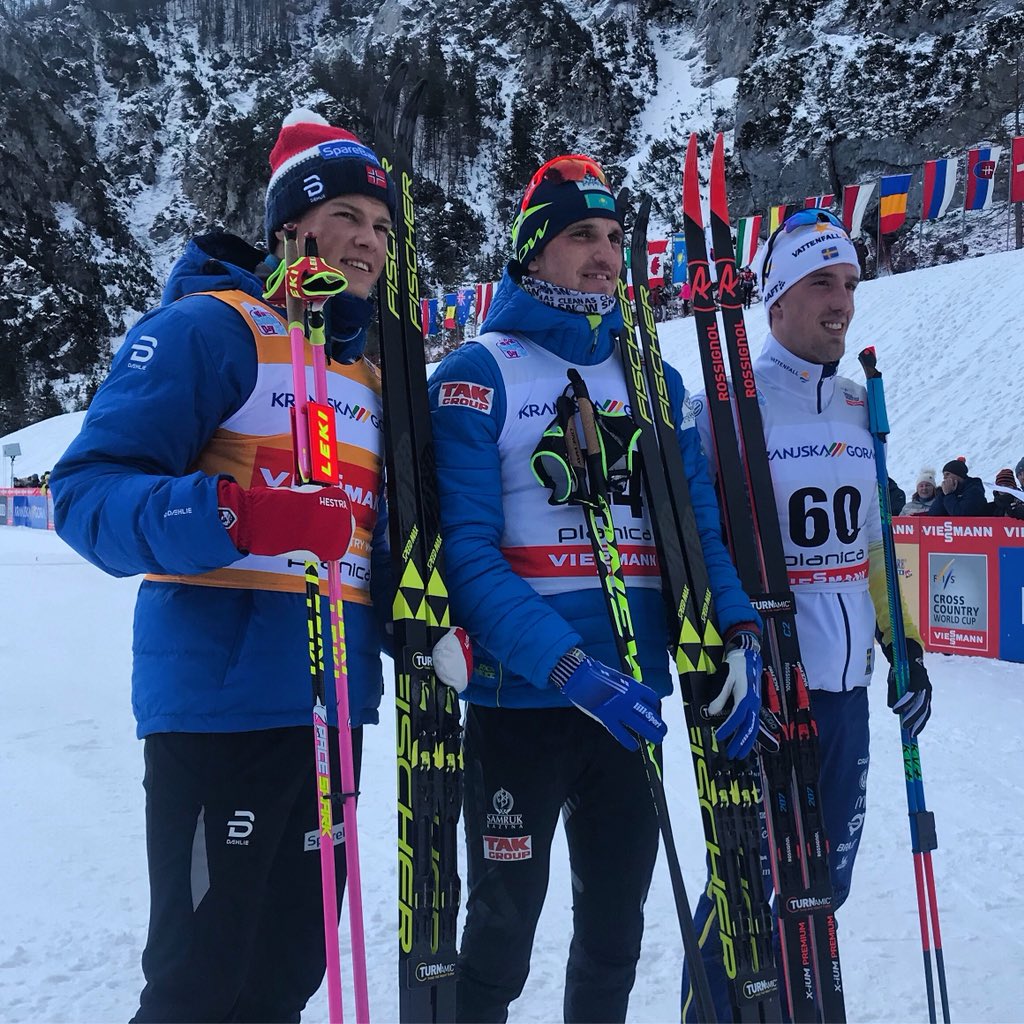
The World Cup men’s 15 k classic podium on Sunday in Planica, Slovenia, with Kazakhstan’s Alexey Poltoranin (c) in first, Norway’s Johannes Høsflot Klæbo (l) in second, and Sweden’s Calle Halfvarsson (r) in third. (Photo: FIS Cross Country/Twitter)
In the men’s 15 k classic, Kazakhstan’s Alexey Poltoranin tallied his second win of the season and first in a race against Norway’s Johannes Høsflot Klæbo on Sunday, winning by 13.2 seconds over Klæbo in 36:54.7.
Poltoranin, 30, started 44th and a minute behind the 21-year-old Klæbo. When Klæbo finished, he bumped Russia’s Ivan Kirillov, also 21, out of the leader’s chair by 43.3 seconds. Then Poltoranin finished 13.2 seconds faster, but Klæbo held onto second when Sweden’s 60th starter, Calle Halfvarsson, finished third (+42.8). It was Halfvarsson’s second podium of the season after placing third in the classic sprint at the November World Cup opener in Kuusamo, Finland. In Saturday’s classic sprint in Slovenia, Halfvarsson qualified second but crashed out of the quarterfinals to finish the day in 30th overall.
Norway’s Emil Iversen started 66th and ended up fourth (+54.7) and Kirillov scored his first World Cup top 10 in fifth (+56.5). Russia had four in the top 10 with Stanislav Volzhentsev in sixth (+57.8), Andrey Larkov in eighth (+1:02.2) and Andrey Sobakarev in ninth (+1:03.4). Norway’s Mattis Stenshagen finished seventh (+1:00.8) and Finland’s Iivo Niskanen took 10th (+1:10.1).
Scott Patterson (U.S. Ski Team) was the top North American in 43rd (+2:56.2), Ben Lustgarten (Craftsbury Green Racing Project) finished 46th (+3:04.9) and Tyler Kornfield (Alaska Pacific University) was 57th (+4:03.7). Andy Newell did not finish.
Canada’s Devon Kershaw returned to the circuit and placed 44th (+2:57.1), Bob Thompson (NTDC Thunder Bay) was 64th (+5:05.0), and Dominique Moncion-Groulx (Alberta World Cup Academy) was 70th (+6:11.7).
Russia’s Stefaniya Nadymova outsprinting Japan’s Ayane Miyazaki at the finish for the win at the inaugural women’s Nordic Combined Continental Cup competition on Saturday in Rena, Norway. (Photo: FIS/Romina Eggert)
FIS Nordic Combined Continental Cup (Rena, Norway): First-ever women’s competitions
Fourteen women, including American Gabriella Armstrong, made history this weekend by competing in the first women’s Nordic Combined Continental Cup in Rena, Norway (after the scheduled opener in Jan. 6-7 in Otepää, Estonia, was canceled), with back-to-back days of individual large hill/5-kilometer Gundersen start races.
On Saturday, Russia’s Stefaniya Nadymova took the win in 16:26.9, just 0.6 seconds ahead of Japan’s Ayane Miyazki in second. Germany’s Jenny Nowak joined them on the podium in third, 16.6 seconds out of first. Armstrong finished 12th (+6:24).
Nadymova, 23, had kicked off the event by jumping to first in the provisional round, which was used for the jumping results, and began the 5 k with a 10-second head start on Nowak in second place. Miyazaki jumped to third and started 14 seconds back. Armstrong jumped to 14th and started 4:08 out of first.
On Sunday, 15-year-old Miyazaki took the win in 16:23.2, swapping places with Nadymova, who finished second, 11.7 seconds back. Nowak, also 15, repeated in third, but finished over a minute and 21 seconds back out of first.
Miyazaki had jumped to first place earlier in the day and started the 5 k with a 20-second cushion to Nadymova in second. Nowak jumped to third and started 1:08 minutes back.
Armstrong, 19, of the New York Ski Education Foundation, jumped to 11th and finished 11th, 4:26.1 after Miyazaki.
Several U.S. Nordic Combined men also competed in Rena, with Taylor Fletcher placing fourth in Saturday’s individual large hill/10 k, 2.7 seconds behind Austria’s Thomas Joebstl in first. Fletcher had skied up from 25th and 2:17 back after the jump with the second-fastest course time.
Also for the U.S., Adam Loomis placed 33rd (+2:30.7) after jumping to 45th with the 12th-fastest course time. Grant Andrews finished 41st (+3:28.7), and Jared Schumate 43rd (+4:10.1).
Fletcher reached the podium in Sunday’s individual large hill/10 k in third behind two Austrians. After jumping to 19th, he skied the fourth-fastest course time to finish third, 3.7 seconds behind Dominik Terzer in first and 2.7 seconds behind Martin Fritz in second.
Loomis improved to 29th (+1:40.9), up from 35th in the jump, and Andrews finished 37th (+2:36.4) and Shumate 40th (+2:57.9).
The men’s large hill/4 x 5 k team event podium on Sunday at the Nordic Combined World Cup in Chaux-Neuve, France, with Norway (c) in first, Germany (l) in second, and Finland (r) in third. (Photo: FIS/NordicFocus)
FIS Nordic Combined World Cup (Chaux-Neuve, France): Saturday & Sunday
Four American men competed at the Nordic Combined World Cup this weekend in Chaux-Neuve, France, with three of them racing in Saturday’s individual large hill/10 k Gundersen and all four racing Sunday’s large hill/4 x 5 k team event.
Norway’s Jan Schmid was the big winner this weekend, racking up an individual win on Saturday and a team victory on Sunday. He won Saturday’s competition after jumping to fourth and starting 27 seconds behind jump leader Akito Watabe of Japan. Schmid worked his way up to first in the 10 k with the third-fastest course time, crossing the line 1.4 seconds ahead of Watabe in 23:32.7.
Watabe finished second and Finland’s Ilkka Herola placed third (+21.5), just ahead of Austria’s Lukas Klapfer in fourth (+21.8).
Ben Loomis led USA Nordic in 37th (+2:49), after jumping to 37th, Stephen Schumann finished 45th (+5:17.0) and Ben Berend 46th (+5:22.2).
On Sunday, Schmid teamed up with Espen Andersen, Jarl Magnus Riiber and Jørgen Graabak to win the 4 x 5 k team event in 47:22.5 by 13.1 seconds. Germany followed in second, with Eric Frenzel, Fabian Rießle, Johannes Rydzek, and Vinzenz Geiger, and Finland placed third (+20.5) with Leevi Mutru, Arttu Maekiaho, Herola, and Eero Hirvonen.
Norway had led after the jump and started the relay 1:03 minutes ahead of Finland in second. France jumped to third and ended up fourth (+47.4), after being passed by Germany, which had started the relay in fourth.
Japan placed fifth (+2:50.9), Italy sixth (+3:59.9), Austria seventh (+4:06.8), Poland eighth (+5:22.1), Estonia ninth (+5:52.1), Russia 10th (+6:41.2), and the U.S. (with Schumann, Loomis, Berend, and Jasper Good) 11th (+6:52.4).
Western Canadian Championships (Red Deer, Alberta): Relays
Nine men’s teams and six women’s squads contested the open relays on the last day of the NorAm Western Canadian Championships on Sunday in Red Deer, with Ontario’s Team “O” (Scott Hill, Michael Somppi and Andy Shields) winning the men’s 3 x 5 k and Alberta 1 (Annika Hicks, Emma Camicioli and Zina Kocher) winning the women’s 3 x 5 k.
For Shields and Hicks, it was their second win of the weekend after they won their respective classic mass starts on Saturday.
Team “O” posted a 19.9-second win over B.C. Storm (Remi Drolet, Tallon Noble and Greg Kilroy), finishing first in 36:22.6. Alberta 5.1 (Sebastien Boehmler-Dandurand, Sam Hendry and Russell Kennedy) placed third (+52.3).
In the women’s relay, Alberta 1 beat out B.C. Fast, Furious & Freakin’ Awesome (Katie Weaver, Michaela McLean and Kaia Andal) by 2 minutes and 37.8 seconds, winning in 43:17.2. Alberta had two teams on the podium with the Kit Kats (Ember Large, Molly Jane Strum, and Sara McLean) in third (+4:25.8).
U.S. Nordic Combined’s Bryan Fletcher (40) on his way to 15th place in Tschagguns, Austria, during the International Ski Federation’s (FIS) Summer Grand Prix 2017. (Photo: FIS Nordic Combined)
Summer flying in at the FIS Nordic Combined Summer Grand Prix 2017 in Tschagguns, Austria. (Photo: FIS Nordic Combined)
On Aug. 23, Tschagguns, Austria, hosted an individual normal hill/10-kilometer Gundersen start. Germany’s Fabian Rießle, after jumping to eighth place, won the event in 23:09.9 minutes. Austria’s Mario Seidl started first based on his jump but finished the 10 k just 0.3 seconds behind Rießle in second. Finland’s Ilkka Herola jumped to seventh and moved up four spots to round out the podium in third (+0.8).
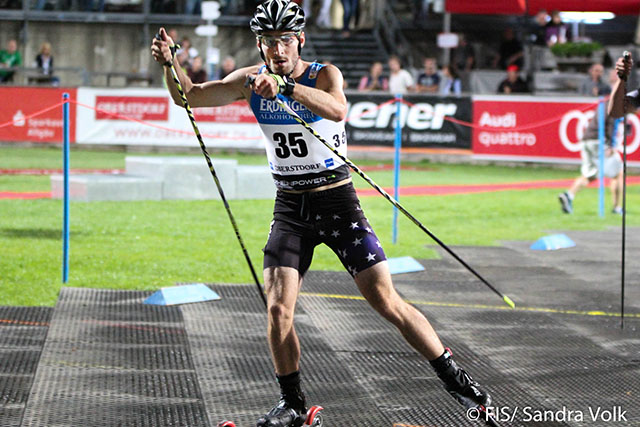
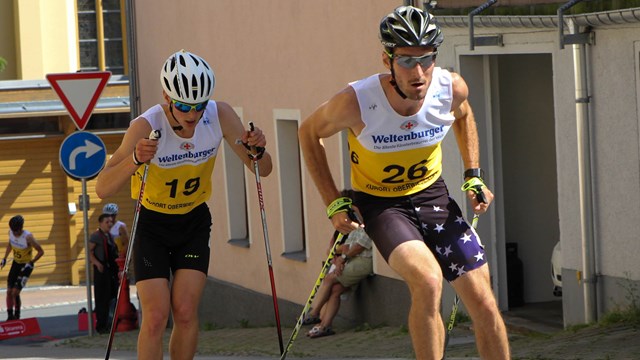
The U.S. entered four skiers. Bryan Fletcher jumped to 40th and proceeded to ski the sixth-fastest time of day, enough to move himself up to 15th overall (+17.9). It was his best individual result of the series after placing 20th in Oberwiesenthal.
“Feels good to be racing again!” Fletcher wrote on Instagram after the race. “Lots of work to do before winter! But 15th place is closer than last week.”
Ben Berend finished the day in Tschagguns in 34th (+59.1), Taylor Fletcher 41st (+1:12.8), and Jasper Good in 58th (+3:02.7).
The Grand Prix took a day off and moved to Oberstdorf, Germany, for two days of jumping and skiing from Aug. 25-26. Day 1 featured an individual large hill/10 k Gundersen, where Germany’s Eric Frenzel, who barely missed the podium in Tschagguns in fourth place, took the win. Frenzel had previously jumped to first and later held off his contenders (with the sixth-fastest ski time) to cross the line in first in 25:27, more than 30 seconds clear of anyone else. German teammate Johannes Rydzek followed in second place (+34.5) just ahead of Austria’s Seidl in third (+36.0).
Taylor Fletcher was the top American in 25th (+2:33.5). He jumped to 44th place, but skied the fourth-fastest time of the day to move up the results list during the ski race. Bryan Fletcher jumped to 40th, skied the 12th-fastest ski time, and ended the day in 28th (+2:49.7). Berend finished 40th overall (+4:13.6), and Good 45th (+4:48.5).
During the second day of summer competition in Oberstdorf, Seidl took first place for his third podium of the week. He won the individual large hill/10 k Gundersen in 26:26.3. Seidl is proving a solid jumper — gaining enough time after to the jump to make up for his less-than top-10 ski speed. On this day, Seidl jumped to first place but skied the 26th-fastest ski time. Germany’s Rießle was second overall (+22.5), and Frenzel third (+22.7).
U.S. Nordic Combined Team skier Adam Loomis was the only American that raced the 10 k. He placed 28th overall (+2:51.8) after starting the race in 42nd and posting the 14th-fastest ski time. Taylor Fletcher and Berend were disqualified in the jump portion, and Bryan Fletcher jumped to 38th but did not start the 10 k.
On Instagram, Taylor Fletcher explained that he was the current red-bib leader for fastest overall skier.
“Part one of grand prix is done and dusted. It was a good test of where I am and where I could be with more consistent jumps,” he wrote. “The final day was good until my disqualification which was in my opinion was crap. I got disqualified for a guideline to a rule which almost every skier would be if they were tested. For the future we will fix the issue and continue fighting.”
Taylor Fletcher’s disqualification occurred on Aug. 18 in Oberweisenthal, Germany during a provisional competition round (PCR). Beyond the top-tier competition, the Summer Grand Prix offers the opportunity for athletes to test equipment and experience how new rules are enforced. One of the key rules has to do with suit permeability.
“I got DQ’d in the first PCR because my suit didn’t pass enough air,” Fetcher wrote in an email. “I wasn’t trying to cheat, but actually it was very warm and I was sweating pretty bad so a thin layer of moisture was on my suits which caused it to blow less air. The next day I passed it without doing anything to my suit.”
The perameters for suit fit have strict tolerances. Fletcher explained that the suits are allowed to be +3cm everywhere possible, but not over the set limit. Fletcher’s detailed account of why he was disqualified signifies the importance of attending the Summer Grand Prix series.
“I was disqualified because my shoulder/armpit was too big,” Fletcher explained. “We have never been tested there and I don’t think really anyone has. As long as the suit feels like it fits in the armpit, we feel that it is good. After the jump on the last day, I was selected for equipment control, I was sure I was good as I made some alterations to my suit the previous night to fix the places that were big (inside thigh). When I got to control I passed my crotch measurement and thought that was it. Then he started to measure my shoulder and armpit and I was shocked because I had never been tested there. He had me hold this triangle apperatus between my arm and hip then measured around that spot. He disqualified me for that spot being too big (20cm to big). There isn’t much I can do after he says you are out, I could file a protest, but that is just silly as these are summer comps and don’t count towards anything. My coaches went and talked with the equipment controller and he told them what is up and how to fix it, but continued to say that it is more of a guideline rather than a rule. We were angry, I was angry as I hate not racing but rather than wasting energy, I just packed my bags and got the hell out of dodge.”
A skier flying during the FIS Nordic Combined Summer Grand Prix 2017 in Oberwiesenthal, Germany. (Photo: FIS)
Green grass, plastic jumping surfaces, big jumps, sunshine, rollerskis and no snow means one thing. It’s August in Europe and it’s time for the International Ski Federation (FIS) Nordic Combined Summer Grand Prix 2017.
Last weekend Aug. 19-20, Oberwiesenthal, Germany hosted a two-day Grand Prix event.
Day 1 featured a two-person team event with the requisite jump and 2 x 7.5-kilometer cross-country race to determine the winners.
Czech Republic’s first team (Czech Republic I), comprised of Tomas Portyk and Dvorak Miroslav, won the team competition in 28:52.9 after starting fourth, 11 seconds behind first. Germany I’s Fabian Rießle and Eric Frenzel raced to second (+0.3), and Germany II’s Jakob Lange and Vinzenz Geiger placed third (+11.2).
The U.S. had two teams entered. Bryan Fletcher and Taylor Fletcher (U.S. II) placed 12th (+2:37.0) while Jasper Good and Ben Berend (U.S. I) finished 14th (+3:03.5).
Day 2 of racing was an individual normal hill/10 k Gundersen start.
Austria’s Mario Seidl claimed the win in 25:18.5 after jumping to first and starting the 10 k four seconds ahead of Japan’s Akito Watabe in second. Germany’s Frenzel raced from ninth to second (+10.5), after starting 46 seconds after Seidle. Rießle finished third (+12.3), up from fifth in the jump, while Watabe narrowly missed the podium in fourth (+14.2).
Bryan Fletcher (29) during this weekend’s Summer Grand Prix in Oberwiesenthal, Germany. He finished in 20th in Sunday’s individual normal hill/10 k event. (Photo: FIS)
Four U.S. skiers competed on Sunday, and Taylor Fletcher led them at the end of the day in 11th (+1:17.6) after jumping to 33rd and starting 2:01 minutes behind Watabe. Bryan Fletcher finished 20th, Berend 33rd, and Good 34th.
In an Instagram post, Taylor Fletcher described his first individual race of the series.
“First individual race in the books. I had a decent jump in a hard competition,” he wrote. “I started 33rd and ended up finishing 11th. I had a lot more to give but I thought I had another lap (I wish we did) before the coach said this was the last lap. Now @USAnordic is on the way to the next leg ready for another crack at it!!”
The Summer Grand Prix continues Aug. 23 with another normal hill/10 k in Tschagguns, Austria, and concludes in Oberstdorf, Germany, with back-to-back large hill/10 k competitions Aug 25-26.
Taylor Fletcher cruising in the 2017 Fish Creek Time Trial in Steamboat Springs, Colo. (Photo: Jasper Good)
From late June into early July, U.S. Nordic Combined hosted a major training camp in Steamboat Springs, Colo. Among the sessions was the Fish Creek Time Trial, a skate rollerski race first held in 2007. That year, Johnny Spillane set down the first in a series of course records that would be improved by different athletes in the next decade.
The time trial is 8 kilometers and gains 885 feet of elevation, starting just south of Steamboat Springs and ending up in the Medicine Bow-Routt National Forest.
National team member Jasper Good is a Steamboat Springs native and remembers the first time he participated in the now-annual time trial.
“In 2012 Ben Berend and I miscalculated how long it would take us to get to the start,” he wrote in an email. “We proceeded to show up and were getting yelled at by everyone saying, ‘You’re starting right NOW, GO GO GO!’ Not the best first impression at a time trial with the National Team.”
A group photo of participants in the 2016 Fish Creek Time Trial, from “young guns” to Olympians. That year, retired gold medalist Billy Demong competed. (Photo: Jasper Good)
OK, that first start was a snafu, but that’s one of the points of the time trial: getting young racers like Good and Berend were then on the same pavement with the national team veterans and staff. Good is now 21 years old and collected his first Continental Cup top-10 last season, so he’s on his way to being one of those veterans that juniors can measure their progress against.
“We do the annual Fish Creek Time Trial with everyone from national teams down to young guns,” Good wrote.
The time trial is a suffer-fest, starting with rolling terrain that must be worked very deliberately, and also featuring a few walls.
“The first half is a gradual but hard rolling uphill with a lot of V2 gradient, an important part to keep your speed up and use momentum over hills,” Good explained. “About [5.5 k in], you hit the first wall of the race. After the wall there is a false flat with another segment of rolling uphill V2 gradient before you hit the final climb. As it starts to kick up more and more, you hit the second wall where you really don’t want to bonk. Because after the top of that, you only have about 250 meters to the finish. But the last 250 at the very top is a false flat that hurts oh so much. The race finishes with all the racers sprawled out all over the parking lot.”
Because there are now ten years of data, performances can be compared both between athletes and from year to year for any individual racer.
“It has been helpful to see the results from this time trial over the years,” Good wrote. “With it being a mid-summer uphill time trial, it is good to see overall fitness and willingness to suffer, but it’s not always a key indicator of how an athlete may race in a NoCo race come winter. It’s more of a checkpoint mid-summer.”
Other things can change over the years, too: as the “suffer-fest” becomes more and more like a normal race effort over the years, athletes can change how they approach it. For instance, Good’s warmup has changed a lot since that first year when he nearly missed the start.
“My warm-up now resembles my winter time warm-up more than ever,” he wrote. “When I was younger it was mostly just warmup to the start of the race from downtown and then just send it into the race.”
How To Make a Great Time Trial Course
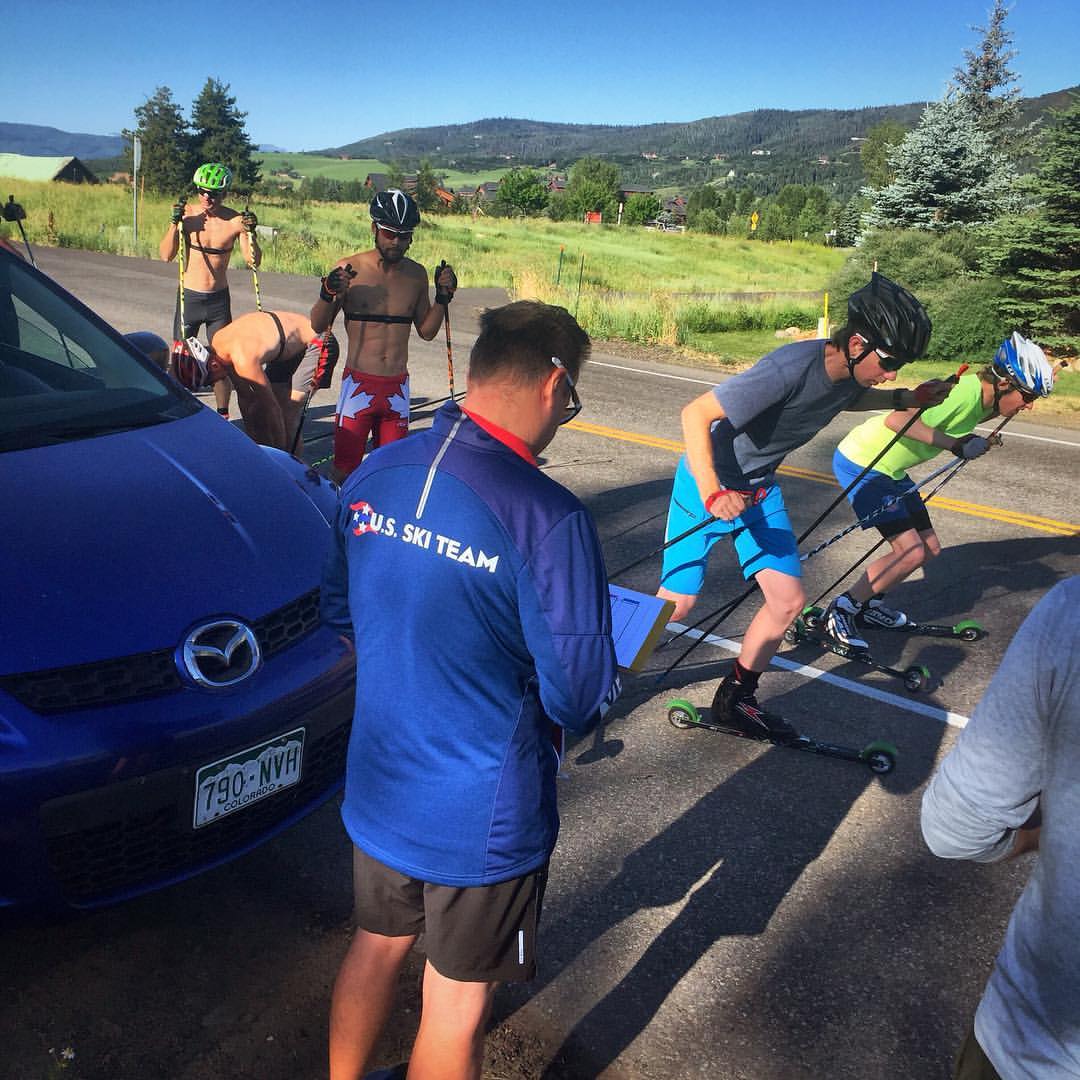
U.S. Nordic Combined Coach Martin Bayer starts athletes at the 2017 Fish Creek Time Trial in Steamboat Springs, Colo. (Photo: Jasper Good)
There are a few things to keep in mind while putting together a rollerski time trial course: just finding the biggest hill with a paved road is not enough. Here are some reminders from Good, who has done Fish Creek for several summers in a row now.
Not All Uphill. “The first part is all about pacing it right and not going out to hard,” Good wrote. “If you go too hard at the beginning the two walls [at the end] are absolutely brutal. Technique and momentum is key in the first half.” Choosing a course with a big chunk of rolling terrain will require athletes to use good technique, execute on their transitions, and maintain momentum. That means that finishing times will reflect not only the athlete with the biggest ‘motor’, but also to some extent that they are skiing well.
Overall Time. “Taylor Fletcher set the time trail record this year at 23:02,” Good writes. “But most of us race it in 23:30 to 26:00, so it is very similar to our typical 10 k times [in nordic combined competitions]. I think it is key that it is in a sense the same time as our typical race, and the same sort of mentality.”
When the Gun Goes Off. How will you set up your time trial? Mass start? Interval start? For Fish Creek, there’s a very deliberate seeding strategy. “It is an interval start with reverse order and the best skier starting last,” Good writes. “In that regard, it is good for every athlete to have someone to chase, and perhaps a stronger skier to go by them. This is good because everyone can try their best to hang on to faster skier and learn how they ski the time trial.”
Pick a Location. If your club is big, this isn’t a big issue — you will always have people to race. But potentially consider whether you can locate your time trial in a place where athletes from surrounding clubs might consider commuting to, or a spot where regional or national teams sometimes host camps. “It is important for all of the NoCo crew to do this time trial together so that every athlete can see where they are at in comparison to the best (i.e. Taylor Fletcher the last few years),” Good writes. “It is also an annual thing so everyone can go out and try and best their time from previous years.”
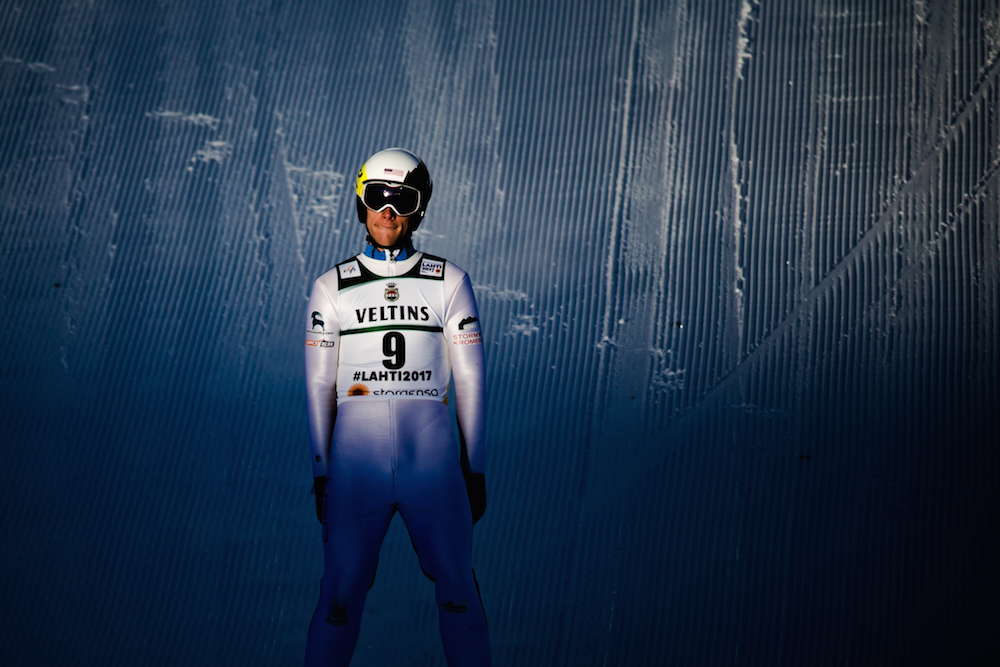
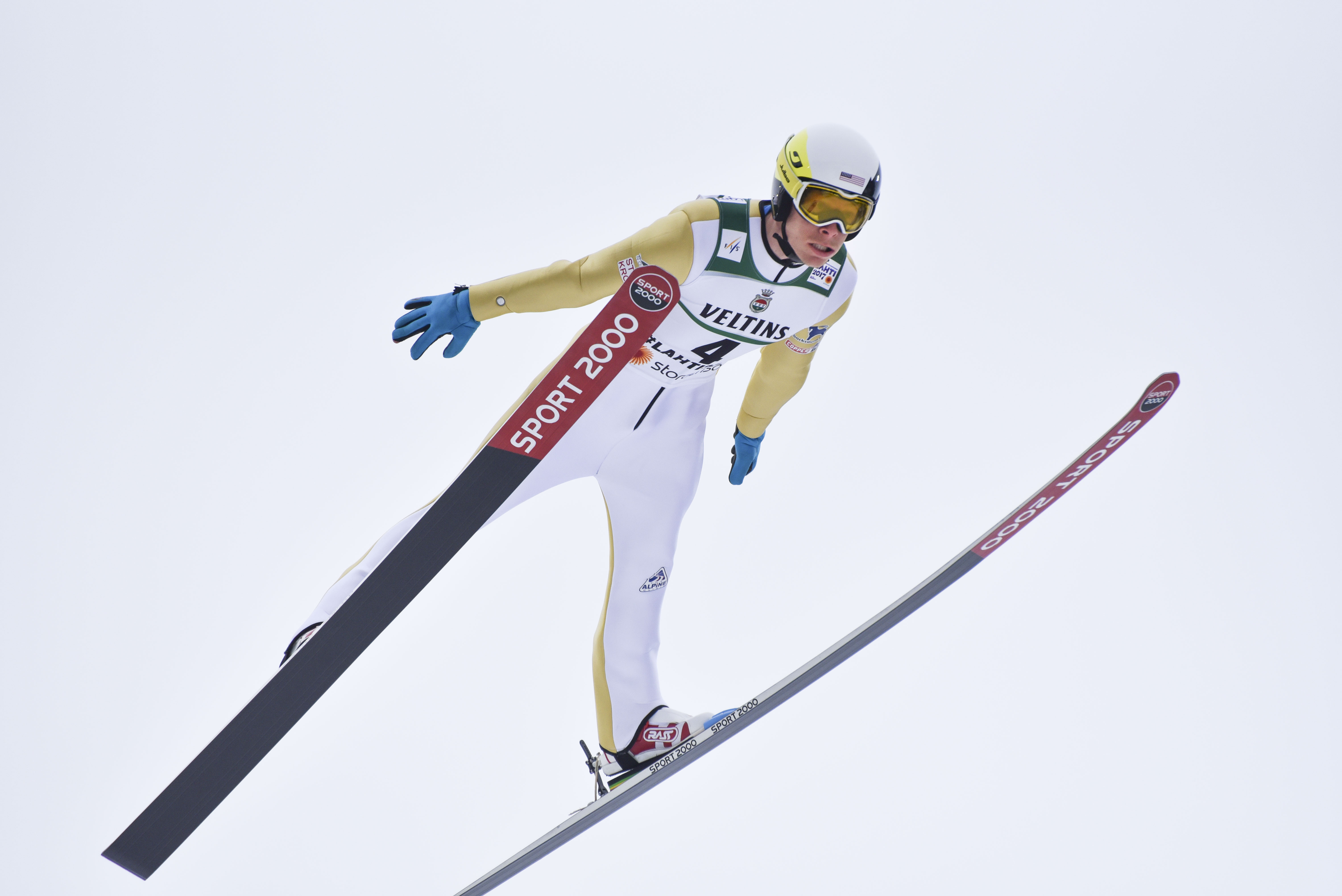
American Ben Berend after jumping to 22nd in the nordic-combined individual/normal hill competition at 2017 FIS Nordic World Ski Championships in Lahti, Finland. He went on to place 41st in the 10 k to end the day on Feb. 24.
Three years ago, U.S. Ski and Snowboard (formerly known as the U.S. Ski and Snowboard Association, or USSA) officially dropped nordic combined from its funding rolls. It was a potentially big blow and flat-liner moment for a program coming off one the most successful runs in U.S. nordic sports history. As recently as 2013, the foursome of Todd Lodwick, Billy Demong, Bryan Fletcher, and Taylor Fletcher earned bronze in the team event at World Championships in Val di Fiemme, Italy.
Now, under the umbrella of USA Nordic, and two World Championships and nearly two Olympics removed from that seismic restructuring, American ski jumping and nordic combined are way beyond life-support mode.
Koby Vargas (Park City Nordic Ski Club) jumping at 2016 U.S. nationals in Park City, Utah. (Courtesy photo)
“What we see, and we see this across sport and the larger picture of health, is that we have less young athletes participating in sports these days,” said Jed Hinkley, sport development director for USA Nordic. “It’s not unique to any specific sport — it is across the board. There are some exceptions to that and I would say ski jumping and nordic combined are an exception to that.”
Hinkley has been on the job since last summer. He’s seen his mission morph from grasping member clubs’ capacity, infrastructure, and financials to determining how to attract athletes and retain them.
“I know our numbers are heading in a positive direction, but we still do see a fairly big drop off as athletes enter their teen years,” he said. “I would say that my role has shifted a little bit to be more athlete development around the U20 level — to try to keep athletes in the sport longer.”
According to Hinkley, ski jumping is experiencing a resurgence in the U.S. In 2014, USA Nordic began organizing a regional jumping competition, the US Cup Junior Series. Three of the four regions tracked by USA Nordic — Central, West and Alaska — experienced significant growth in participation. The only outlier was the East, which canceled its end-of-season jump competition due to severe weather. Hinkley believes that cancellation skewed the data downward.
Data collected for the series tracks boys and girls ages U10 (under 10) to U16. Between 2016 and 2017, the Central region increased participation 49 percent, the West percent, and Alaska 192 percent.
From a global perspective, the U.S. appears to be on a path to fostering a legitimate nordic-sport pipeline. Hinkley admits his data collection methodology relied in part on the “brother of a friend of a brother’s mechanic model,” but his information appears promising.
“To the best of my knowledge, Norway and Germany are one and two for numbers in ski jumping and nordic combined,” Hinkley said. “From what we can figure out, it appears that the U.S. is the third-largest ski jumping and nordic combined nation in the world. There is one country that I don’t have numbers for that could outrank us, that being Poland, because they have such a huge love for ski jumping. It appears our numbers are higher than Slovenia, Austria and Japan, which are all part of the jumping and nordic-combined powerhouses.”
Jumping and nordic combined are resource-intensive sports — they both require what can be costly jumping infrastructure. Two regions have taken different approaches to ski jumping viability.
In Anchorage, Alaska, two women spearheaded a regional revival. As part of the Nordic Skiing Association of Anchorage (NSAA), Karen Compton and Vivienne Murray, along with a core group of volunteers, now respond to daily emails, shuttle athletes, and supply and maintain loaner equipment in an effort to expose young athletes to jumping.
“When we started there were only three other boys jumping and a burned-out coach who quit shortly thereafter,” Compton said on the phone from Anchorage. “There just wasn’t anyone involved in the program, and I ran around a got some friends have their kids come and try it out because it’s only fun if your friends are doing it along with you. Vivian was one of the friends I asked. Her kids liked it and at the end of the season, which was just a few months, we talked about it and we decided the two of us would take it on and resurrect the program.”
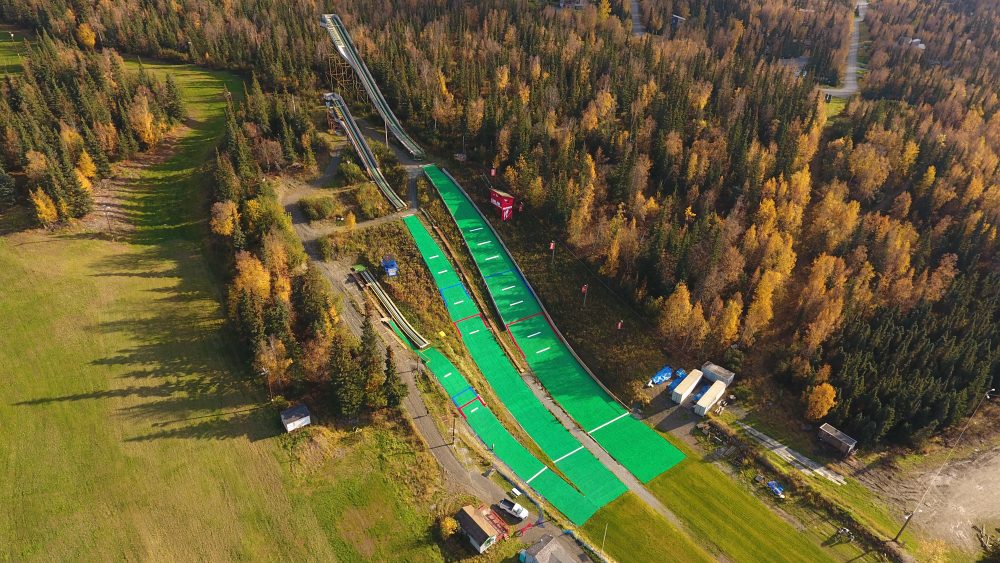
The Karl Eid Ski Jumping Complex in Anchorage, Alaska, which completed a retrofit in 2016. The three jumps pictured are now modernized with summertime jumping available to the athletes. (Photo: NSAA)
In 2012, Compton and Murray began co-chairing a grant-writing and fundraising campaign. By 2016 they had raised enough funds to rehabilitate the jumps at Anchorage’s Karl Eid Ski Jumping Complex. The complex now boasts a modernized 10-20 meter combined jump, and 40-meter and 65-meter jumps, respectively. Under NSAA, Team AK Ski Jumping/Nordic Combined has upwards of 70 kids jumping each winter.
Perhaps more importantly to developing higher-level jumpers, the modernization efforts allowed NSAA to plasticize the jumps’ in-runs to facilitate summertime jumping.
“[Anchorage] has been a good model to recruit, maintain, and make the sport fun,” Hinkley said. “They do a lot of social stuff outside of the jump hill, and organization-wise they are creating a welcoming environment and a professional organization. … I think what they are doing really well is they are a part of NSAA, which is all of cross-country skiing in Anchorage. They work collaboratively with the cross-country side and they are all in it together. I think in a lot of places, historically, there has been a divide between ski-jumping clubs and cross-country clubs, whereas in Anchorage there is an awesome collaboration.”
Anchorage came to the table with jumps in place. The Midwest boasts two from-the-ground-up success stories.
Red Wing, Minn., is developing a new Olympic-size jump on land owned by the Prairie Island Indian Community. “It’ll be a state-of-the-art facility with potentially cross-country trails at the base. And they want to do things like World Cups, FIS Cups, Grand Prix,” Hinkley said.
On a smaller but no-less-significant scale, a dedicated group in Cameron, Wis., built a 7-meter snow jump. That group collaborated with the well-established Flying Eagles Ski Club, a nationally recognized ski jumping club in Eau Claire, Wis.
The Pipeline
How bright is the future when it comes to international potential? On the U.S. men’s ski jumping side, four athletes were recently named to the its national team. Sixteen-year-old Kevin Bickner, who began jumping in Illinois but now lives in Park City, Utah, is the only A-team member. Bickner jumped to a 15th place on the World Cup this past March in Vikersund, Norway. In doing so, he jumped 244.5 meters, which was an American distance record, according to a USA Nordic press release.
Rounding out the men’s jumping team are three B-team members: Casey Larson (18), Michael Glasder (28) and William Rhoads (22). At last year’s Junior World Ski Championships, Larson placed eighth in the individual normal-hill competition.
“With men’s jumping, we have seen quite a phenomenal turnaround,” said USA Nordic Executive Director Billy Demong. “In participation for both women’s and men U14 levels, but for the national team, we have some guys who are really good. In fact, Kevin Bickner has had the best results in over a decade. And cumulatively the team scored more points last year than over the previous twelve years combined. They also had the best team-event finish since 1985, so there’s a solid group of four athletes.”
Demong also noted that keeping U20 skiers involved with the sport remains a priority. For scoring criteria as it relates to national-team selection, USA Nordic begins scoring at the more competitive (larger field size) Continental Cup competitions. He explained that success at the Continental Cup indicates a positive trajectory. The C-team is organized as a U24 program, essentially allowing older athletes an incentive to invest and remain in the sport. The C-team is comprised of two skiers, Nicholas Mattoon (22) and AJ Brown (22).
“We give our athletes a little more time to develop,” Demong said. “I think that’s partially why we are seeing the change. We are providing resources and opportunities for a greater group of athletes and at a higher level than it has been.”
This season, the U.S. Nordic Combined team will be led by A-team returners and brothers Bryan Fletcher (31) and Taylor Fletcher (27).
Last winter, the nordic-combined team was bottom heavy on the age-and-experience spectrum, with the Fletcher brothers being obvious outliers. U.S. Nordic Combined lacked the World Cup quota spots to expose several young skiers to that level of competition beyond domestic races and Junior World Championships .
U.S. NoCo’s Stephen Schumann (28) passing on the outside, en route to 10th in the normal hill/10 k at 2017 Nordic Junior World Championships at Soldier Hollow in Midway, Utah. (Photo: U.S. Ski Team/Steven Earl)
“One of the hopes is that we are able to start increasing the quota on the World Cup as well as the Continental Cup,” Demong said. “Last year, we had five different individuals score a top 10 on the Continental Cup, I believe. That’s unusual to have that much depth at that level. And what we need now is for some of those guys to transition into the World Cup.”
Adam Loomis (25), Ben Berend (21), Ben Loomis (19), Jasper Good (21) and Stephen Schumann (17) comprise the Nordic Combined B-team. Grant Andrews (19) is the sole C-team member.
The fleet of skiers following the Fletchers have time on their side in terms of World Championship and Olympic cycles, yet their recent junior-level results maintain the team’s emerging optimism. At the most recent Junior World Championships at home in Park City and Midway, Utah, U.S. Nordic Combined tallied two top-10 performances. Schumann placed 10th in the 10-kilometer Gundersen, and Ben Loomis finished ninth in the 5 k.
“There is a big group behind Schumann and Ben Loomis,” Demong explained. “I think in one of the qualifying events in Park City, there were six or seven of them that all finished within a minute, so pretty good size crew for a little sport.”
This April, USA Nordic formalized its efforts to keep promising athletes in an organized pipeline. Demong said it expanded its junior-national teams for both ski jumping and nordic-combined to include top athletes in the U16 to U20 range. USA Nordic also has national-development camps planned for this summer.
“I think it is a very nice transition from the Junior National team to National Team the way we have built it out, because we set our own criteria for the teams we fund,” Demong said. “Ideologically we are trying to give the U20’s a reason to continue competing and skiing in the critical 18-, 19-, 20-year-old ages and that this is something really worth investing in.”
Bryan Fletcher (U.S. Nordic Combined) jumping to 31st on the large hill at 2017 Nordic Combined World Championships in Lahti, Finland. He later finished the day in 31st in the 10 k Gundersen to lead his team. (Photo: John Lazenby/Lazenbyphoto.com)
At the season-ending Nordic Combined World Cup weekend in Schonach, Germany, American Bryan Fletcher tallied his second-best result of the season: 11th in the individual large hill/10-kilometer Gundersen start on Saturday, March 18. He did so by posting one of his best jumps of the year, which interestingly tied his jumping result at his season-best World Cup in December in Lillehammer, Norway.
In Lillehammer, Fletcher jumped to 22nd with a 129-meter leap, also on the large hill, and went on to place ninth in the 10 k. On Saturday in Schonach, the 30-year-old U.S. Nordic Combined veteran jumped to 22nd with a distance of 98 meters, and skied the eighth-fastest 10 k to move up to 11th.
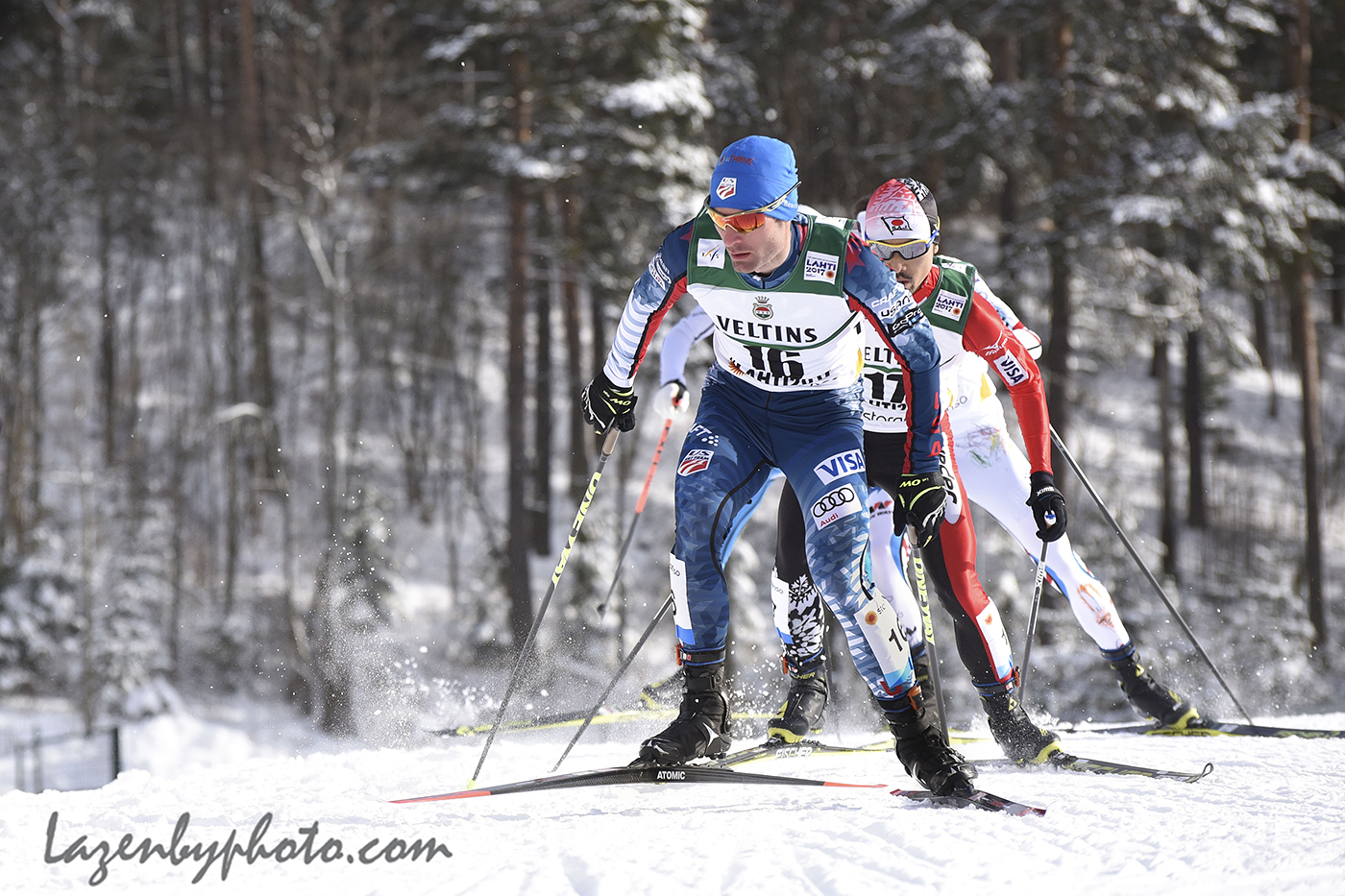
American Bryan Fletcher leading Japan’s Yoshito Watabe early in the men’s 10 k Gundersen start in the first nordic-combined competition of 2017 Nordic World Championships in Lahti, Finland. Fletcher went on to place 14th and Yoshito Watabe 44th. (Photo: John Lazenby/Lazenbyphoto.com)
“Jumping was starting to come around at the end of the season a bit more,” Fletcher wrote in an email on Tuesday. “It was still inconsistent but I have learned a lot about myself as a competitor this season especially in regards to my technical skills and abilities. Towards the end of the year I was able to start applying some of the things I have learned about myself to my jumping and the results were slowly starting to improve.
“Obviously the level is very high in the sport right now and so even small mistakes mean you are out of contention,” he added. “So it’s very hard to confidently make changes during the season with so much at stake. But given my rather up and down season I decided this was the season I had to start to shake up my routine to either find a new, better, or more consistent level or to simply confirm that the way I am doing things is still the be path to be on. Schonach on Saturday was only a small change but obviously had a big impact on my results.”
Fletcher started the 10 k race 53 seconds behind Japan’s Yoshito Watabe, who led after jumping. Fletcher explained the race was seven laps on a difficult 1.5 k course, which would typically play to his strengths, but he’s been struggling with his shape since World Championships three weeks ago.
“The legs and body were not responding the way I would have liked. So I was pretty unsure going into the race of how I would hold up,” he wrote. “I went out slow and tried to work into the race a bit saving energy for the last laps which almost paid off big. I was able to make contact with the lead group and be there for the winning move, but I was unable to go with the sprint. I felt like I skied a smart race and my overall performance but I would have been much happier if I could have hung on for a top 10 result.”
Germany’s Eric Frenzel, who started seventh based on his jump and started 15 seconds behind Watabe, raced to first with the 10th-fastest time. He finished in 28:14 minutes, 3.4 seconds ahead of Austria’s Wilhelm Denifl in second and 7.1 seconds ahead of his German teammate Johannes Rydzek in third. Denifl had started second, 9 seconds back, and held his position, while Rydzek improved from ninth in the jump. Watabe slipped to 17th (+1:02.5).
Fletcher, who finished 32.8 seconds out of first and 4.5 seconds out of 10th, led two Americans on Saturday, with 17-year-old Stephen Schumann placing 42nd.
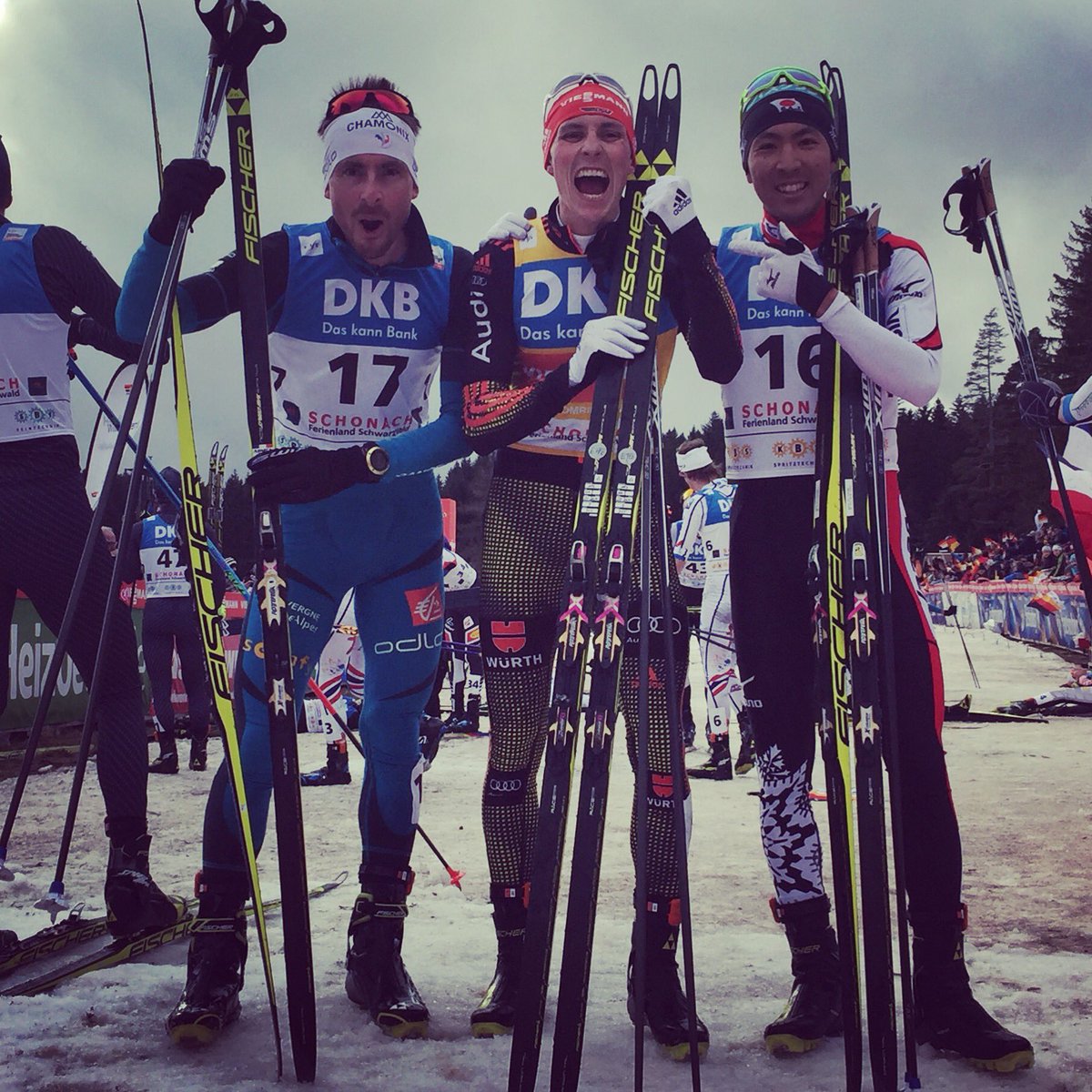
The Nordic Combined World Cup podium on March 19, the last World Cup of the season, in Schonach, Germany, with Germany’s Eric Frenzel (c) in first, France’s Francois Braud (l) in second, and Japan’s Akito Watabe (r) in third. (Photo: FIS Nordic Combined/Twitter)
On Sunday in Schonach, none of the Americans completed the Day 2 large hill/10 k competition. Ben Berend jumped to 36th, but did not start the race.
Meanwhile, Frenzel completed his weekend sweep and claimed his fifth-straight Overall World Cup title with a 7.7-second win over France’s Francois Braud. Japan’s Akito Watabe rounded out the podium in third, 11.2 seconds behind Frenzel.
Overall, Frenzel ended the season with 1,734 points, Rydzek placed second in the overall standings with 1,609, and Akito Watabe completed the podium in third with 1,086.
The leader after Sunday’s jump, Germany’s Tobias Simon, did not finish the 10 k. Frenzel started the race in eighth, 57 seconds out of first, and posted the 11th-fastest ski time for his third-straight win after topping the large hill/10 k last Wednesday, March 15, at the World Cup in Trondheim, Norway. There, Fletcher led three Americans in 35th. His brother Taylor Fletcher placed 39th and Berend finished 48th.
At the previous World Cup on March 11 in Oslo, Norway, Frenzel placed second, just 0.4 seconds behind Akito Watabe in another large hill/10 k. Bryan Fletcher finished 43rd and Schumann 49th.
“This season was one of the hardest I have had,” Fletcher wrote. “I came into the season ready to go and in really good shape for both XC and jumping. I think my mistake was I was too eager to get the season underway. I had trouble maintaining that fitness and body composition and ultimately had to reset over the holidays and rebuild in order to prepare for World Championships.”
American Bryan Fletcher (16) after finishing 14th in the normal hill/10 k Gundersen start, the first nordic-combined competition of 2017 Nordic World Championships in Lahti, Finland. He had been in the hunt for a medal but crashed on the final corner coming into the stadium. Behind him, Austria’s David Pommer finished 16th. (Photo: John Lazenby/Lazenbyphoto.com)
At World Championships, Fletcher led his team in 14th in the opening individual competition: the large hill/10 k. He had been in podium contention until crashing on the last corner, about 200 hundred meters before the finish. That day, he jumped to 16th. Looking back on his season, Fletcher considered that event a season highlight.
“I wanted to be a contender in that event and I was,” he wrote. “I have replayed that race a few times in my head and I think a few different moves in the final lap and I could have been fully in the fight for the medal. Also Lillehammer was a strong race, also I was happy with my performance in Schonach on Saturday after two disappointing comps the week before.”
After being sick for a couple weeks in January and feeling like he peaked a week too early for World Championships, Fletcher, who has been competing at the World Cup level since 2009, is already thinking about next season.
“No rest for the wicked haha,” he wrote. “I have already started my training plan for next season with specific areas in both XC and Jumping that I want to improve upon. Specifically I need to improve my finish sprints and in jumping I need to improve my in run balance and position.”
“I am really motivated for next year and my body is feeling good,” he continued. “The past two seasons I planned to tone things down a bit in my training, so that I could build up a bit stronger for Pyeongchang. In the past I have always had a performance build for the 3 years prior to the olympics but have come into the Olympic season a bit flat. My goal was to disrupt that cycle to increase performance next season.”
While Fletcher was his team’s most consistent member this season, he explained that jumping overall has been a bit of a struggle amongst his teammates.
“Our team found a really high level at the end of the summer, however, a 5 week break without jumping due to weather before the season disrupted our progress,” he wrote. “Also our guys changed a lot this summer technically. It takes time to build a high level of jumping and I expect us to continue our progress on what we learned this season to improve those adaptations. I have no doubt we will be on a higher level next year.”
For now, Fletcher, a new dad, is enjoying some downtime with his wife and 7-month-old daughter Ellery.
“It does feel amazing to be home with the family!” he wrote. “… [Ellery] had been sleeping on my chest for about the last 30 minutes and to be honest it was awesome to forget about everything else and just enjoy the moment.”
Finland’s Iivo Niskanen (c) celebrates his World Championship title as Norwegians Martin Johnsrud Sundby (l) and Niklas Dryhaug hoist him up on Wednesday after the men’s 15-kilometer classic race at the 2017 Nordic World Ski Championships in Lahti, Finland. (Photo FIS Cross-Country/Twitter)
FIS Nordic World Championships (Lahti, Finland): Men’s 15 k classic
After narrowly missing the victory in Sunday’s classic team sprint, Finland’s Iivo Niskanen got his gold, winning Wednesday’s men’s 15-kilometer individual classic start race at the 2017 Nordic World Ski Championships on Wednesday in Lahti, Finland. Niskanen covered the course in a time of 36:44.0, besting Norway’s Martin Johnsrud Sundby by 17.9 seconds.
Starting in bib 64, Niskanen didn’t take long to ski in the top spot, posting the fastest time from the 4.7 k mark until he finished. He held off Sundby, as well as Norwegian Niklas Dyrhaug, who started a minute behind Niskanen in bib 66 and ultimately finished in third (+31.3).
Missing the podium by 10.5 seconds was Russia’s Alexander Bessmertnykh in fourth, 41.8 seconds behind Niskanen’s winning time. Placing fifth (+53.2) was Didrik Tønseth of Norway. Russia’s Andrey Larkov took sixth (+53.2), while kazakhstan’s Alexey Poltoranin placed seventh (+1:06.3). The second Finn to finish in the top ten was Sami Jauhojaervi in eighth (+1:09.7). Ninth (+1:10.6) went to the former 2015 World Champion, Johan Olsson of Sweden, and his Swedish teammate, Calle Halfvarsson rounded out the top ten in tenth (+1:15.0).
Erik Bjornsen led the U.S. men, placing 18th (+1:56.7) after starting in bib 26. The second American to finish was Kyle Bratrud in 33rd (+3:11.5) followed by Andy Newell in 50th (+4:21.7) and Ben Lustgarten in 55th (+4:56.9).
Devon Kershaw led the Canadians, placing 35th (+3:24.8). Knute Johnsgaard was the next Canadian, finishing 56th (+5:00.7), followed by Jesse Cockney in 65th (+6:20.7).
The women’s 4 x 5 k relay takes place Thursday. The U.S. is slated to start (in no particular order): Jessie Diggins, Kikkan Randall, Liz Stephen, and Sadie Bjornsen.
FIS Nordic World Championships (Lahti, Finland): Nordic Combined large hill/10 k
Bryan Fletcher (U.S. Nordic Combined) jumping to 31st on the large hill in Lahti, Finland. He later finished the day in 31st in the 10 k Gundersen to lead his team. (Photo: John Lazenby/Lazenbyphoto.com)
Germany’s Johannes Rydzek racked up win #3 in as many nordic-combined competitions at the 2017 Nordic World Championships in Lahti, Finland, winning the individual large hill/10-kilometer Gundersen start on Wednesday.
The last individual competition of the championships began with Austria’s Mario Seidl jumping the farthest at 132.0 meters and earning 137.3 points. His Austrian teammate, Wilhelm Denifl finished second in the jumping portion, earning 125.7 points. Japan’s Akito Watabe was third for the jumping, with 123.8 points.
Competitors returned later in the day for the 10 k cross-country portion, with Rydzek racing to first after starting a minute back in fifth. Rydzek won the 10 k event in a time of 26:41.6. Just 4.8 seconds later, Watabe captured silver after starting 54 seconds back. The bronze medal went to France’s François Braud, who also started 54 seconds back and finished 13 seconds off Rydzek’s time.
Four U.S. Nordic Combined Team skiers contested the event. Bryan Fletcher led the Americans finishing 31st (+3:58.3), after jumping to 31st and starting 2:39 back. His brother, Taylor Fletcher was the second American to finish the cross-country portion, racing to 36th (+4:55.6) after jumping to 51st and starting 4:26 back.
Ben Berend (U.S. Nordic Combined) jumping to 21st to lead the U.S. on the large-hill jumping portion of Wednesday’s competition at 2017 Nordic World Championships in Lahti, Finland. (Photo: John Lazenby/Lazenbyphoto.com)
Ben Berend jumped the farthest for the Americans in 21st, and raced to 40th (+5:08.6) after starting 1:55 back.
The 21-year-old explained during an interview with FasterSkier that he sees his recent success in jumping as a result of not overthinking his efforts on the hill.
“Basically, I’ve just turned my mind off,” Berend said. “I didn’t take training yesterday, I’ve just been kind of not jumping as much as I usually do, and like when I’m at home I’m not thinking about ski jumping, I just kind of go up and do it and it’s working right now, and so I’m not going to change any of that. I’m just having fun, it’s been a blast.”
Adam Loomis finished the day in 44th (+5:47.9) after jumping to 45th and starting 3:29 back.
Canada’s Nathaniel Mah jumped to 52nd and finished the day in 52nd.
The U.S. Nordic Combined’s Bryan Fletcher (31) chasing Italy’s Alessandro Pittin on Wednesday in the individual large hill/10 k at the 2017 Nordic World Championships in Lahti, Finland. Fletcher finished 31st and Pittin placed 20th. (Photo: John Lazenby/Lazenbyphoto.com)
Heidi Weng and Maiken Caspersen Fall of Norway (center) bested Yulia Belorukova and Natalia Matveeva of Russia (left) for gold in the women’s team sprint at 2017 World Championships, with Sadie Bjornsen and Jessie Diggins of the U.S. (right) outsprinting Sweden for bronze. (Photo: FIS Cross Country/Twitter)
FIS Nordic World Championships (Lahti, Finland): Classic team sprints
Defending champions Norway repeated gold in the women’s team sprint, with Heidi Weng and Maiken Caspersen Falla crossing the finish line first in Lahti, Finland. On the second-to-last loop, it looked like Russia could have something to say about that. Yulia Belorukova put in a furious sprint up the course’s biggest climb, and then beat Weng to the exchange. But her teammate Natalia Matveeva could not match the pace when Falla put on her own sprint on the last uphill. Russia finished second for silver, +5.56.
The competition for bronze was closer, with Germany, Finland, Sweden, and the United States going out of the stadium for the last loop together in chase of the Norwegian and Russian leaders. The last climb was defining in the race for bronze, with Jessie Diggins of the United States staying closest to Sweden’s Stina Nilsson. Diggins caught Nilsson on the downhill and was able to stay just ahead of the Swede to the finish, claiming bronze (+18.38) along with teammate Sadie Bjornsen. It was a return to the team sprint podium for Diggins: after winning the team sprint at 2013 World Championships with Kikkan Randall, she teamed up with Sophie Caldwell in 2015 but the pair finished eighth.
Nilsson and Ida Ingemarsdotter settled for fourth (+18.57), and the Finnish team of Aino-Kaisa Saarinen and Kerttu Niskanen finished fifth (+23.02).
The Canadian team of Cendrine Browne and Dahria Beatty was seventh in their semifinal and landed 13th overall.
In the men’s team sprint, Norway set a high pace from the beginning, with phenom Johannes Høsflot Klæbo attacking on the steep uphill every time he skied. On his second and third loops, he tagged off to Emil Iversen with gaps of just over five seconds to the rest of the field. But Iversen had a hard time holding the lead, in part because of Russia’s Sergey Ustiugov, who had won the 30 k skiathlon the day before and put in a huge effort to catch Iversen on the fourth loop of the team sprint.
On the final loop, Finland’s Iivo Niskanen bridged the gap up to Iversen, mostly on the steep uphill and then also with ski speed on the downhill. But the time the pair entered the stadium, Niskanen had caught the Norwegian and was moving with higher speed. He decided to switch tracks to overtake Iversen, but Iversen decided to switch tracks just a second later, without checking one last time to make sure the track was clear. He fell, taking out Niskanen with him.
That allowed Ustiugov and Italy’s Federico Pellegrino to go sailing by to claim gold and silver (+2.14) with their teammates Nikita Kriukov and Dietmar Noeckler. It was the second gold for Russia in the event in three World Championships; Kriukov and Alexey Petukhov won in 2013, and also took silver in 2015.
Niskanen got up and claimed bronze (+8.64 with Sami Jauhojärvi), swearing as he crossed the finish line; with a broken pole, Iversen limped across the line in fourth (+18.42). He was called to a jury meeting but ultimately no teams were disqualified because of the crash.
Erik Bjornsen of the United States won a sprint finish for fifth (+23.58) with teammate Simi Hamilton), besting Lenny Valjas (+27.02 with teammate Alex Harvey) of Canada.
FIS Nordic World Championships (Lahti, Finland): Nordic combined 4 x 5 k team event
Germany (Björn Kircheisen, Eric Frenzel, Fabian Rießle, and Johannes Rydzek) took gold in the nordic combined 4 x 5 k team event on Sunday at Nordic World Championships in Lahti, Finland, while Norway placed second and Austria third. (Photo: FIS Nordic Combined/Twitter)
[UPDATED] After sweeping the first individual nordic-combined competition of 2017 Nordic World Championships on Friday, Germany achieved gold as a team, with Björn Kircheisen, Eric Frenzel, Fabian Rießle, and Johannes Rydzek winning the 4 x 5-kilometer team event in 47:57.3.
The Germans combined for the best jumping score of 11 teams and started the relay in first, 44 seconds ahead of Japan in second. Norway started 1:07 minutes back in fifth but rose to second place (+41.7), with Magnus Moan, Mikko Kokslein, Magnus Krog, and Jørgen Graabak. Moan raced them into third at the first exchange, then Kokslein secured second, which they held onto for the remaining two legs.
“It was our goal to ski a controlled race,” Germany’s Frenzel told ZDF. “Not really look at how the gap was developing, but just make our own race. And put up a little more pressure towards the end of each leg. That worked well, that was a wickedly cool team performance today. And I am just happy that we could put a little golden crown on the whole event today.”
“I think today you could see again that we all worked together and enjoyed the competition,” Rydzek added. “We were all happy about each other’s performance, and just rewarded ourselves for hard hard work.”
Austria started fourth, 1:05 behind Norway, and clinched bronze (+1:03.7) with Bernhard Gruber, Mario Seidl, Philipp Orter, and Paul Gerstgraser. Gruber initially raced them into second at the first exchange, but they relinquished one spot and hung on for third, ahead of Japan in fourth (+1:06).
Japan (Hideaki Nagai, Takehiro Watanabe, Yoshito Watabe, and Akito Watabe) jumped to second, but found themselves in fourth at every exchange.
Finland took fifth, Italy sixth, France seventh, and the U.S. eighth (+3:27.2) with Bryan Fletcher, Taylor Fletcher, Ben Berend, and Ben Loomis. The Americans started the race in seventh and were in sixth after the first two exchanges, but slipped to eighth on the third leg.
IBU Youth/Junior World Championships (Osrblie, Slovakia): Youth & junior pursuits
Four seems to be Chloe Levins’s lucky number. After a career breakthrough of fourth place in the pursuit at last year’s Youth Olympic Games (YOG) in Lillehammer, Norway, the 18-year-old Vermonter raced to fourth in the youth women’s 7.5-kilometer pursuit on Sunday at the International Biathlon Union (IBU) Youth/Junior World Championships in Osrblie, Slovakia.
Italy’s Irene Lardschneider winning the youth women’s 7.5 k pursuit on Sunday for her second-straight gold at 2017 IBU Youth World Championships in Osrblie, Slovakia. (Photo: IBU)
Levins started the race in 11th and worked her way up to fourth with clean shooting in three stages. She missed two in the first prone but rebounded and held off Ukraine’s Khrystyna Dmytrenko by seven seconds for fourth place. Levins finished 1:55.5 minutes behind the winner, Italy’s Irene Lardschneider, who started the race first and held on for her second-straight gold medal despite four penalties (0+0+2+2), finishing in 26:57.1. France’s Lou Jeanmonnot-Laurent rose from fourth to second place with 19-for-20 shooting (0+0+1+0), and Italy’s Samuela Comola took bronze (+1:08.5) for the second-straight race with two misses (1+0+1+0).
Three U.S. women qualified for the pursuit, with Amanda Kautzer finishing 42nd (+6:16.2) after starting 59th and shooting 80 percent (1+0+2+1), and Grace Gilliland finishing 55th (+8:32.1) with six penalties (2+3+1+0).
Canada’s Shilo Rousseau followed in 54th (+9:02.1) with eight misses (3+1+2+2).
In the junior women’s 10 k pursuit, Canada’s Megan Bankes raced to 16th for the best finish for a North American in that race. The gold medalist in last week’s 12.5 k individual, Bankes finished 13th in Saturday’s sprint and thus started in that position, 1:25 out of first. She ended up 16th with four penalties (0+1+2+1) and finished 2:15.8 behind the winner, Russia’s Valeriia Vasnetcova, who started 24th and worked her way all the way up to first with clean shooting.
Vasnetcova was the only one to clean the four-stage pursuit on Sunday, and in doing so, she achieved her first gold of the championships and second of her career at Youth/Junior Worlds after her team won last year’s youth relay in Romania.
Coming off a sprint win, Italy’s Michela Carrara started first and took second at the finish, 10 seconds behind Vasnetcova with three misses (1+1+1+0). Norway’s Ingrid Tandrevold scored her second-straight medal as well, after starting second and finishing third (+10.8), with two penalties (0+0+1+1).
Canada’s Nadia Moser had her best result of the championships in 30th (+3:43.5), moving up one place after starting 31st, with three penalties (0+1+0+2). Emily Dickson finished 47th for the second-straight day (+6:29.9) with four penalties (1+0+1+2).
Siena Ellingson was the lone American to start after placing 18th in Saturday’s sprint. She finished 41st (+5:24.7) with seven misses (1+2+1+3).
In the junior men’s 12.5 k pursuit, Canada’s Pearce Hanna rocketed to 23rd after starting 47th, shooting 17-for-20 after cleaning the first two stages (0+0+1+2) for his first top 30 of the championships. Hanna finished 3:12 behind the winner, Russia’s Igor Malinovskii who picked up his second-straight gold.
Malinovskii started first and finished in 32:39.8, 13 seconds ahead of second place, with four penalties (0+1+2+1). Norway’s Sindre Pettersen took the silver medal after starting in eighth and posting the fastest course time to overcome five misses (2+1+1+1). Belarus’s Anton Smolski moved up from fourth at the start to reach the podium in third (+27.4) with five misses as well (0+0+3+2).
All four Canadian junior men qualified for the pursuit. Trevor Kiers led them in 39th (+5:13.3), after starting 48th, for his best result of the championships. Jules Burnotte placed 43rd (+5:35.3), up from 55th, for his best result as well, and Zachari Bolduc finished 57th (+8:18.3). Kiers missed five targets (2+0+1+2), Burnotte had seven misses (3+1+1+2), and Bolduc missed eight (2+3+2+1).
For the U.S., Cody Johnson finished 55th (+7:19.5) with nine penalties (2+1+2+4) and Travis Cooper 59th (+8:46.2) with eight misses (5+0+1+2).
In the youth men’s 10 k pursuit, the first race of the day on Sunday, two Canadians finished in the top 30, with Leo Grandbois in 22nd and Adam Runnalls in 27th.
For Grandbois, it was his first time outside the top 15 of the championships after he had won the youth men’s 12.5 k individual last Wednesday and finished 14th in Friday’s 7.5 k sprint. He had to ski six penalty loops on Sunday (0+2+2+2), dropping outside the top 20 after the third shooting. Grandbois finished 3:21.8 behind the winner, France’s Emilien Claude, who won the sprint as well to start the pursuit first.
Claude, who had four penalties (1+1+0+2) and finished in 29:22.4, held off Italy’s hard-charging Cedric Christille by 16 seconds after Christille shot just two penalties (0+0+1+1) to move up from fourth to second for his first medal in his first Youth World Championships. Germany’s Danilo Riethmüller rose from sixth to third place (+30.7) despite four misses (1+0+1+2). For the German, it was his second bronze of these championships after placing third in the 12.5 k individual.
Canada’s Runnalls moved up from 32nd at the start to 27th at the finish (+3:47.5) for his first top 30 of the championships. He had five penalties (1+3+1+0), but cleaned the last stage to move into the top 30.
Vasek Cervenka was the lone American to qualify in the youth men’s pursuit, and he moved up from 49th at the start to 30th (+3:52) with five penalties (1+1+1+2).
Germany’s Johannes Rydzek celebrates his win in the first nordic-combined competition of 2017 Nordic World Championships on Friday in Lahti, Finland. He won the individual normal hill/10 k by 14.9 seconds over his teammate Eric Frenzel. (Photo: John Lazenby/Lazenbyphoto.com)
FIS Nordic World Championships (Lahti, Finland): Nordic Combined individual normal hill/10 k
Germany, Germany, Germany, Germany. That’s how the results read after the first nordic combined competition of the 2017 Nordic World Championships on Friday in Lahti, Finland, with Germany not only sweeping the podium but the top four of the men’s individual normal hill/10-kilometer Gundersen start.
Germany swept the podium in the first nordic-combined competition of 2017 Nordic World Championships in Lahti, Finland, with Johannes Rydzek (c) taking gold, Eric Frenzel (1) silver, and Björn Kircheisen (8) bronze in the individual normal hill/10 k Gundersen on Friday. (Photo: John Lazenby/Lazenbyphoto.com)
Johannes Rydzek notched his second individual gold medal in the last two championships (after winning the normal hill/10 k in 2015 in Falun, Sweden), with a 14.9-second victory over his teammate and four-time defending overall World Cup champion Eric Frenzel. Björn Kircheisen completed the all-German podium in third (+30.0), holding off teammate Fabian Rießle by 2.2 seconds for bronze.
The 25-year-old Rydzek, who’s already won eight individual World Cup competitions this season, jumped to second on Friday and started the 10 k race 14 seconds behind Frenzel, the leader after the jump.
Rydzek overtook Frenzel for the win and 33-year-old Kircheisen moved up from eighth after the jump to third at the finish. Rießle held off Japan’s Akito Watabe by 0.1 seconds in a photo finish for fourth.
“Incredible. An incredibly beautiful day,” Rydzek told German broadcaster ZDF after. “Thanks to everyone who supported me so much throughout the last years so that this became possible now. Thanks also to my teammates, who I think all did a cool job today. All three guys and the whole surrounding team. And as for the race, I felt strong, I knew the slow-and-difficult course suits me well. And that I was able to conduct the race from in front … incredible. Just craziness.”
“I noticed that Johannes was just strong on the course today,” Frenzel, 28, told ZDF. “Actually we already noticed that at the World Cup in January here, that he is really moving well here. I, for my part, gave everything I had, and can only congratulate him for the strong competition he made today. He won deservedly. And I am also satisfied with my race.”
American Bryan Fletcher leading Japan’s Yoshito Watabe early in the men’s 10 k Gundersen start in the first nordic-combined competition of 2017 Nordic World Championships in Lahti, Finland. Fletcher went on to place 14th and Yoshito Watabe 44th. (Photo: John Lazenby/Lazenbyphoto.com)
Bryan Fletcher led the Americans in 14th (+47.4) after crashing out of contention in the final 200 meters of the race. He had been in contention for a medal, skiing in a pack with Kircheisen, Rießle and Watabe, among others, all fighting for bronze. Fletcher fell on the final corner to ultimately miss the podium by 17.4 seconds. He jumped to 16th and started the ski race 56 seconds out of first.
“I knew it was going to be a hard cross-country race because it was so tight and pack racing is always so difficult,” Fletcher said, according to a U.S. Ski Team press release. “You’re not only fighting for position, but anything can happen. That’s exactly what happened to me today. I did really well in the pack and when I thought I had it locked up, I let my guard down and slipped out on a corner.”
His younger brother Taylor Fletcher posted the third-fastest cross-country time to race from 47th after the jump to 21st at the finish (+1:38.4). Adam Loomis placed 33rd (+2:23.6) after jumping to 39th, and Ben Berend finished 41st (+3:10.8) after posting the 22nd-best jump out of 55.
Canada’s Nathaniel Mah, of the Altius Nordic Ski Club in Calgary, jumped to 41st but did not finish the 10 k race.
The next nordic-combined event at Lahti Worlds, the 4 x 5 k team event, will be contested Sunday.
American Bryan Fletcher (16) after finishing 14th in the normal hill/10 k Gundersen on Friday, the first nordic-combined competition of 2017 Nordic World Championships in Lahti, Finland. He had been in the hunt for a medal but crashed on the final corner coming into the stadium. Behind him, Austria’s David Pommer finished 16th. (Photo: John Lazenby/Lazenbyphoto.com)
***
IBU Youth/Junior World Championships (Osrblie, Slovakia): Youth men’s and women’s sprints
Italy had two on the podium of the youth women’s 6 k sprint on Friday at IBU Youth World Championships in Osrblie, Slovakia, with Irene Lardschneider (c) in first, Samuela Comola (r) in third, and Austria’s Anna Gandler (l) taking second place. (Photo: IBU)
[UPDATED] Italy’s Irene Lardschneider dominated the youth women’s 6-kilometer sprint competition on Friday at the International Biathlon Union (IBU) Youth World Championships in Osrblie, Slovakia, finishing 1:06.5 minutes faster than anyone else in 19:48.3 with 9-for-10 shooting. Lardschneider started 17th and led from start to finish despite one miss in her standing stage (0+1). She posted the fastest course time of 92 finishers for gold — her first medal in her first Youth World Championships. She previously raced at last year’s Youth Olympic Games (YOG) in Lillehammer, Norway, where she earned a bronze medal with the mixed relay and placed 14th in the pursuit.
Also in the 2016 YOG pursuit, American Chloe Levins placed fourth for her best international finish. Racing at her third Youth Worlds on Friday, Levins finished 11th in the sprint to lead the North Americans. Like Lardschneider, Levins cleaned prone and missed one in standing (0+1) to finish 1:39.7 back from the win. For Levins, it was her second top 15 in as many races at these championships, after placing 14th in the youth women’s 10 k individual on Wednesday.
Sharing the podium with Lardschneider, Austria’s Anna Gandler placed second (+1:06.5) with one penalty (0+1), and Italy had two on the podium with Samuela Comola in third (+1:18.1). Comola was one of two women to clean the two-stage race; the other being Finland’s Maija Keränen in 13th (+1:40.9).
Shilo Rousseau led Canada in 45th (+4:08.0) with three penalties (0+3). Frédérique Pérusse finished 73rd (+5:48.2) with four misses (1+3), Anna Sellers was 82nd (+6:47.2) with six penalties (4+2), and Elise Sauve was 86th (+7:41.7) with six misses (3+3) as well.
For the U.S., Grace Gilliland placed 55th (+4:35.2) with four misses (1+3), Amanda Kautzer was 59th (+4:42.7) with six penalties (3+3) and Helen Wilson 67th (+5:10.0) with four misses (2+2).
The youth men’s 7.5 k sprint at 2017 IBU Youth World Championships in Osrblie, Slovakia, with France’s Emilien Claude (c) in first, Ukraine’s Serhiy Telen (l) in second, and Norway’s Sivert Guttorm Bakken (r) in third. (Photo: IBU)
In the youth men’s 7.5 k sprint, France’s Emilien Claude put down the fastest course time to over two penalties for the win, besting Ukraine’s Serhiy Telen who started ahead of him, by 25.2 seconds.
Claude missed one shot in each stage (1+1) and finished in 20:18.3, bumping Telen to second where he would remain after shooting one penalty (0+1). Norway’s Sivert Guttorm Bakken reached the podium in third (+44.6) despite two misses (1+1) and for the second-straight race, Italy’s Cedric Christille narrowly missed a medal in fourth (+52.0) after two standing penalties (0+2).
Coming off a gold medal in the youth men’s 12.5 k individual, Canada’s Leo Grandbois finished 14th (+1:52.9) on Friday to lead the North Americans. He had to ski three penalty loops (1+2) and posted the 10th-fastest course time of 99 finishers.
Also for Canada, Adam Runnalls placed 32nd (+2:46.8) despite five misses (3+2), Robert Kreitz was 84th (+5:37.2) with five penalties (1+4) as well, and Thomas Hulsman 87th (+5:58.6) with six misses (3+3).
For the U.S., Vasek Cervenka finished 49th (+3:37.1) with six penalties (4+2), Alex Kilby was 69th (+4:47.4) with three misses (1+2), Jacob Pearson 76th (+5:07.1) with five penalties (2+3), and Camren Nielsen 82nd (+5:18.8) with five misses as well (3+2).
Youth/Junior World Championships continue Saturday with the junior men’s and women’s sprints.
Ben Lustgarten (Craftsbury Green Racing Project) with his $750-dollar check for winning the men’s SuperTour classic sprint on Saturday near Truckee, Calif. Stratton’s Ben Saxton (l) placed second and APU’s Reese Hanneman (r) was third.
Lustgarten, of the Craftsbury Green Racing Project, raced to a 1.58-second victory in the men’s A-final at the Auburn Ski Club in Soda Springs, Calif., finishing in 3:03.4. Ben Saxton, of the Stratton Mountain School (SMS) Elite Team, placed second, and Reese Hanneman, of Alaska Pacific University (APU), was third (+2.77).
Hannenman’s younger brother Logan also reached the final and placed fourth (+4.5), Dakota Blackhorse-von Jess (Bend Endurance Academy) was fifth (+5.86), and the third APU skier in the final, Tyler Kornfield sixth (+18.69).
Blackhorse-von Jess started the day off as the fastest qualifier in 2:58.8. Saxton qualified second, 4.1 seconds back, Logan Hanneman qualified third (+4.2), and Lustgarten fourth (+6.5). Blackhorse-von Jess went on to win his quarterfinal and place second in his semifinal, while Lustgarten and Saxton both won their quarterfinals and semifinals.
Jennie Bender (3) of the Bridger Ski Foundation leading Stratton’s Julia Kern (2) and Sun Valley’s Deedra Irwin (5) during the second women’s classic sprint semifinal at Saturday’s SuperTour near Truckee, Calif. Bender went on to win the semifinal, as well as the final.
In the women’s A-final, Jennie Bender of the Bridger Ski Foundation, coming off a classic sprint win at nationals, scored another victory in 3:29.07. She edged Craftsbury’s Kaitlynn Miller by just seven-hundredths of a second, and Stratton’s Julia Kern placed third (+3.42). Racing at home, Hannah Halvorsen (Sugar Bowl Academy) finished fourth (+3.88). Craftsbury had three in the women’s final with Caitlin Patterson in fifth (+3.93) and Heather Mooney in sixth (+27.35).
Miller proved to be the woman to beat throughout the day, winning the qualifier in 3:30.9, along with her quarterfinal and semifinal. Kern qualified second (+3.2) and Bender third (+4.6). Bender went on to win her quarterfinal and semifinal as well before facing off with Miller in the final.
NorAm Western Canadian Championships (Whistler, B.C.): 10/15 k classic
It was interval-starts day at Western Canadian Championships at Whistler Olympic Park and national-team veteran Emily Nishikawa completed the four laps of the women’s 10 k classic in 30:35.5 to win ahead of teammate Dahria Beatty, 16.5 seconds behind. Maya MacIsaac-Jones completed the national team and Alberta World Cup Academy (AWCA) sweep in third (+1:36.5).
Sovereign Lake’s Hannah Mehain, of the national junior team, was the top junior for the second-straight day in eighth overall (+3:22.1).
In the men’s 15 k, Lappe Nordic’s Andy Shields won the six-lap race in 40:34.2, showing some of the form that won him the NorAm overall last season. National-team member Jess Cockney collected his second-straight podium, finishing second, 4.3 seconds behind Shields. Evan Palmer-Charrette (NTDC Thunder Bay) completed the podium in third (+55.1).
FIS Cross-Country World Cup (Ulricehamn, Sweden): 10/15 k freestyle
The men’s 15 k freestyle podium at Saturday’s World Cup in Ulricehamn, Sweden, with Canadian winner Alex Harvey (c), Norwegian runner-up Martin Johnsrud Sundby (l), and Sweden’s Marcus Hellner (r) in third. (Photo: FIS Cross Country/Twitter)
First individual win of the season (second straight, after winning last weekend’s team sprint), fifth individual victory of his career. That’s the latest news on Canada’s Alex Harvey, who won the World Cup men’s 15-kilometer freestyle individual start on Sunday in Ulricehamn, Sweden, for his first victory in a 15 k skate race and fourth individual podium of 2016/2017.
To say Harvey is on a roll is an understatement. On Saturday, he beat Norway’s Martin Johnsrud Sundby by 6 seconds after starting a minute behind the Norwegian defending World Cup champion. Harvey’s fastest time across the line in 32:46.2 held up through 76 finishers, with Sweden’s Marcus Hellner coming somewhat within range after starting a minute behind him. Hellner ended up 14.3 seconds back from Harvey at the finish for third place, behind Sundby.
Switzerland’s Dario Cologna missed the podium by 0.5 seconds in fourth (+14.7), and Norway’s 24-year-old Daniel Stock broke through in fifth (+16.2) for his first World Cup top 20.
Great Britain’s Andrew Musgrave placed sixth (+18.7), Sweden’s Daniel Rickardsson was seventh (+25.0), Norway’s Finn Hågen Krogh eighth (+32.2), Russia’s Petr Sedov ninth (+33.9), and Japan’s Keishin Yoshida 10th (+34.2).
American Erik Bjornsen landed in the points as he tied Norway’s Simen Andreas Sveen for 28th (+1:09.2), leading fellow U.S. Ski Team members Noah Hoffman, who placed 41st (+1:28.8), and Simi Hamilton in 53rd (+1:56.2). Also for the U.S., Matt Gelso, the Period 1 SuperTour leader from the Sun Valley Ski Education Foundation (SVSEF) Gold Team, finished 68th (+3:00.3).
Harvey’s Canadian World Cup teammates Len Valjas finished 35th (+1:17.7) and Devon Kershaw 38th (+1:22.2). Knute Johnsgaard (Canadian U25 Team) did not start.
The women’s 10 k freestyle podium on Saturday in Ulricehamn, Sweden, with Norwegian winner Marit Bjørgen (c), Finland’s Krista Parmakoski (l) in second and Sweden’s Charlotte Kalla (r) in third. (Photo: FIS Cross Country/Twitter)
In her first World Cup race in over a month and at a brand-new World Cup venue, Norway’s 36-year-old Marit Bjørgen returned to her winning ways, topping the women’s 10 k freestyle on Saturday in Ulricehamn.
Bjørgen started 40th out of 61 finishers and took the lead from Finland’s Krista Parmakoski at the finish with a time of 23:46.3 minutes. Parmakoski, who started a minute ahead of her in bib 38, ended up second, 10.7 seconds back. Sweden’s Charlotte Kalla reached the podium for the second time this season in third (+24.9).
“It is always great to win,” Bjørgen said, according to an International Ski Federation (FIS) press release. “I stayed at home for five weeks and was training. It is great to come back with a victory. I know that the training I had done was good. It was an amazing atmosphere today by the course. There were people cheering everywhere.”
Norway swept fourth through sixth with Astrid Uhrenholdt Jacobsen in fourth (+25.7), Ragnhild Haga in fifth (+32.3) and Heidi Weng in sixth (+34.0).
American Jessie Diggins raced to seventh (+34.9), ahead of Sweden’s Hanna Falk, who recorded her best distance result in eighth (+36.4). Norway’s Ingvild Flugstad Østberg finished ninth (+44.8), and Germany’s Sandra Ringwald was 10th (+56.6).
“I didn’t have the snappy good feelings I was hoping to have in my body today, but it was a solid race,” Diggins wrote in a post-race email to FasterSkier. “It’s always hard when you know that on your best days you are capable of more, but at the same time we had great skis, and it was really fun for me to be able to ski with my teammates today!”
The U.S. had three in the top 20 and four in the top 30 with Sadie Bjornsen in 12th (+1:00.5), Liz Stephen in 16th (+1:07.3) and Rosie Brennan in 24th (+1:30.7).
Cendrine Browne as Canada’s lone woman in the race achieved 35th (+1:52.0) for her career best in an individual race. Also for the U.S., Kikkan Randall placed 40th (+1:59.6) and Liz Guiney of the Craftsbury Green Racing Project 52nd (+2:33.2).
The photo finish of the men’s 4 x 7.5 k relay on Saturday at the IBU World Cup in Antholz, Italy, with Germany’s Simon Schempp outlunging Norway’s Emil Hegle Svendsen. (Photo: ZDF broadcast screenshot)
For the U.S. men, top six was a target for the 4 x 7.5 k relay on Sunday in Antholz, Italy, according to US Biathlon Men’s Coach Jonas Johansson.
Mission accomplished. In the final team event before 2017 World Championships, Lowell Bailey, Leif Nordgren, Tim Burke, and Sean Doherty combined for sixth, finishing 1:04.9 minutes behind the German winners. The Americans used a total of 10 spares but avoided the penalty loop, as did the Germans who used seven spares to clean the eight-stage race and won it in 1:13.57.2.
Germany’s Simon Schempp narrowly outlasted Norway’s Emil Hegle Svendsen in the finishing stretch to secure the victory for Germany (with teammates Erik Lesser, Benedikt Doll and Arnd Peiffer) by one-tenth of a second. Norway finished second with nine spares and no penalties (with Lars Helge Birkeland, Henrik L’Abee-Lund, Johannes Thingnes Bø, and Svendsen), and Russia secured third (+33.6) with nine spares and zero penalties as well (with Maxim Tsvetkov, Evgeniy Garanichev, Dmitry Malyshko, and Anton Babikov).
Ukraine used a total of just five spares and had zero penalties for fourth (+46.7), and Austria took fifth (+49.2) with eight spares and no penalties, after Austria’s Dominik Landertinger skied away from Doherty on the final loop and finished 6.9 seconds ahead of him for fifth place.
For the U.S. men, sixth was close to their team-best fifth with the same lineup in last year’s World Cup relay in Presque Isle, Maine. The same group also took sixth in Ruhpolding, Germany, last year as well.
With all four making US Biathlon’s World Championships team, announced Saturday, they will likely be aiming for a best championships result early next month in Hochfilzen, Austria.
Canada (Christian Gow, Scott Gow, Macx Davies, and Brendan Green) finished 16th (+4:13.8) on Saturday with two penalties and 11 spares. Scott Gow skied them up to 15th by the second exchange but they dropped to 18th after Davies had two penalties on the third leg. With Green anchoring and using just one spare, they recouped two places before the finish.
In the women’s race, Germany’s Nadine Horchler achieved a lifetime dream with her first World Cup win, after starting in bib 30 and earning her start as a reserve athlete. Germany took first and second with Laura Dahlmeier in second, and the Czech Republic’s Gabriela Koukalova placed third. Susan Dunklee of the U.S. was the lone North American starter and finished 24th after leading at the start of the second loop.
FIS Nordic Combined World Cup (Chaux-Neuve, France): Individual large hill/10 k
Saturday’s Nordic Combined World Cup podium in Chaux-Neuve, France, with German winner Johannes Rydzek (c), German runner-up Fabian Rießle (l) and Japan’s Akito Watabe (r) in third. (Photo: FIS Nordic Combined/Twitter)
The first part of Saturday’s Nordic Combined World Cup individual large hill/10 k competition was a shining moment for U.S. Nordic Combined skier Ben Berend, who jumped to second for a total of 127.5 points, trailing only Norway’s Jarl Magnus Riiber with 139 points in Chaux-Neuve, France.
Berend flew farther than Germany’s Eric Frenzel, who jumped to third on the Chaux-Neuve large hill.
Later in the day, they started the 10 k Gundersen in that order, with Riiber heading out first, followed by Berend 46 seconds later, then Frenzel 53 seconds back in third.
Germany’s Johannes Rydzek started 1:15 minutes back in 12th and skied the fastest 10 k to take the victory at the finish (in 23:01.7). He held off his German teammate Fabian Rießle by 2.8 seconds for the win, after Rießle started sixth and 1:01 back. Japan’s Akito Watabe reached the podium in third (+5.7) after jumping to seventh and starting the race 1 second behind Rießle.
Frenzel ended up fourth (+8.3), and the fourth German in the top five, Björn Kircheisen improved to fifth (+22.6) after starting 11th.
Riiber dropped to 15th (+54.0), and Berend fell outside the top 30 to end up 32nd (+2:26.0) with the 39th-ranked course time.
Berend finished 12.2 seconds ahead of his U.S. teammate Taylor Fletcher, who placed 34th (+2:38.2) after the jump put him in 48th.
Bryan Fletcher was 49th after the jump but did not start the 10 k.
The Nordic Combined World Cup continues Sunday in Chaux-Neuve with another large hill/10 k.
Ski Classics #5: La Diagonela (Zuoz, Switzerland): 50 k classic
[UPDATED] Under “blue skies, no wind and perfect track conditions” in the Swiss Engadin Valley on Saturday, according to a Ski Classics press release, Russia’s Ilya Chernousov and the Czech Republic’s Kateřina Smutná won the men’s and women’s La Diagonela, respectively, in Zuoz, Switzerland.
Chernousov, of Team Pioneer Investments, and Tord Asle Gjerdalen (Team Santander) led a large pack of men into the final major climb on the 50 k course. There, Gjerdalen attacked and Chernousov matched him, accelerating away from his competitors up the last steep pitch to the finish, according to the press release. He finished in 2:03:39.6 hours, holding off Gjerdalen by 1.5 seconds, while Øystein Pettersen (Team BN Bank) finished third (+3.0).
In the women’s race, Smutná (Team Santander) pushed to break up the field around the halfway point, where the men caught the women. Britta Johansson Norgren (Lager 157 Ski Team) hung with Smutná, but lost contact over the last 5 k. After finishing second in the last two Ski Classics races, Smutná took the win by 1:03.2 minutes in 2:20:49.2. Nordgren finished second, ahead of Sara Lindborg (Team Serneke) in third, who finished more than three minutes later (+4:17.4).
Taylor Fletcher racing in Oberstdorf, Germany during the 2016 FIS Nordic Combined Summer Grand Prix in September, where he placed 15th overall in the series. (Photo: FIS/Sandra Volk)
Shaking out white, sand-filled training shorts is hardly a thing many skiers find themselves doing prior to an autumn morning interval session. Nor is swimming with sea turtles a typical regular-recovery run substitute.
However, this past October, U.S. Nordic Combined A-team member Taylor Fletcher did a little of both. The 26 year old’s ‘spring break’ came six or seven months early, or seven months late, depending how one looks at it, with his final days of fall prep for the 2016/2017 season spent beach bumming in Cancun, Mexico.
U.S. Nordic Combined skier Taylor Fletcher (l) with his girlfriend and U.S. freestyle skier Kiley McKinnon during a vacation trip to Cancun, Mexico, this past October. (Photo: Taylor Fletcher)
Fletcher, who has been competing for the U.S. Nordic Combined team since the age of 19, was not afraid of the non-traditional preseason training week. Viewing himself (along with his older brother Bryan Fletcher) as “more of a seasoned veteran on the team”, Taylor greeted the vacation as a way to mentally and physically unwind from his biggest training block before bringing in the new season.
“The hardest part was getting off the plane from the really warm weather in Mexico and realizing it wasn’t much colder [in the U.S.],” Fletcher, originally from Steamboat Springs, Colo., said on the phone in late October.
The seven days of surf and sun — which he spent with his girlfriend and U.S. freestyle skier Kiley McKinnon— were well-earned by the end of the fall for Fletcher.
With U.S.A. Nordic Sport’s recent hiring of nordic-combined head jumping coach Nik Huber, who is based in Austria, Fletcher amped up his jumping training.
“It was no joke that we were definitely on the struggle bus last year with our jumping,” Fletcher said. “We had the opportunity to get a new coach after the organization let go of Greg [Poirier] and we were very fortunate to be contacted by Nik Huber … he brings a new technical edge and gives us new ideas and passion about the jumping side.”
While the months of June and July were dedicated to jumping for Fletcher, the end of August included travel to Oberwiesenthal, Germany, and Villach, Austria, for the Summer Grand Prix, which included a team sprint and an individual 10-kilometer event in Oberwiesenthal and a 10 k competition in Villach.
U.S. Nordic Combined skier Taylor Fletcher (26) racing to the fastest time of the day and seventh overall at the Summer Grand Prix in Oberwiesenthal, Germany. (Photo Sandra Volk/FIS)
Fletcher finished in seventh overall in the Oberwiesenthal 10 k and did not start the Villach 10 k. He and his teammate Ben Berend raced the team sprint together and finished 14th overall.
“We’ve just been working on the last part of the flight: making sure you’re poling to the bottom of the hill, making sure your tails touch,” Fletcher explained. “Just eking out every meter possible and when you add all those things up it can be ten to fifteen meters.”
Though 10 to 15 meters may not sound like a lot initially, in a nordic-combined competition, it could be the difference between a one-second versus a nearly two-minute start deficit. For an athlete like Fletcher, who is notorious on the World Cup circuit for his adeptness on the cross-country side of the sport, the prospect of him obtaining even stronger start positions via jumping may bring him closer to the podium.
“For a guy like me, to be that much closer to the front, it really scares a lot of people,” Fletcher said. “That was kind of the reaction we were getting from the test events this summer.”
Following the Summer Grand Prix, Fletcher flew back to Park City, Utah where he visited his older brother, Bryan and newborn niece, Ellery Fletcher. After playing uncle, Fletcher returned to Europe for a full month to train in Slovenia, Austria and Germany.
Taylor Fletcher charges around a corner in a 10 k FIS Nordic Combined Continental Cup cross-country race last season at Soldier Hollow in Midway, Utah. (Photo: U.S. Ski Team/Tom Kelly)
“That was something that I really haven’t done,” Fletcher explained of his decision to live in Europe for a full-month this fall. “It was good to step into the European style, cook my own food and…get in some really quality training there.”
Fletcher started his NoCo season with the opening World Cup races Kuusamo, Finland, where he finished a 40th in the individual large hill/10 k event.
The second weekend of World Cup racing in Lillehammer, Norway, saw Fletcher finish with the fastest course time (24:44.7) for 26th overall in the individual 10 k event after he jumped to 48th and started 2:50 back from the leader. He improved the following day, racing to 22nd overall in the individual normal hill/10 k in Ramsau, Austria, after jumping to 46th and starting at a 1:46 deficit.
While Fletcher indicated that he was “not expecting to go to Ruka and Lillehammer and win every event,” he is confident in his ability to be a regular contender for top-10 finishes and podiums as the season progresses.
“That’s something that I’m really pushing for, be consistently in the top 10 and fighting for as many podiums as possible this season,” Fletcher said.
***
We asked Fletcher to give our ’17 Questions for 2017′ a go. Here are his responses:
1. Biggest change in your life in the last five or so months since the ski season ended?
It a lot has happened since the end of the 2016 season. First of all, I am no longer a member of the U.S. Ski Team. Secondly we have been able to hire a new jump couch from the Norwegian team. This has been the biggest impact as now I have been able to make some big strides in my jumping performance as we head towards Lahti world championships. Most recently, It was the election for the new president. I am in disbelief that Donald Trump is now the leader of our country.
2. Biggest change in your training?
I have been focusing a lot on the jumping side again. With Nik Huber and Martin Bayer at the helm for jumping, I have been able to work on parts of my jumping that has struggled for the last couple years. I have been much more consistent on the hill than in years past and I think that is huge for me. We worked hard this summer in the gym, trying to build the strength and speed in the legs to become more explosive on the end of the jump.
3. Major areas of improvement you’ve seen so far?
My position on the In-run is much better as I am more compact but long and not so crunched. This is allowing me to generate more power on the takeoff which translates to speed and height at the bottle of the hill.
4. Whom you’ve been working closest with this offseason (coaches or training partners)?
I consider my offseason, March 15-April 1st. There I was working closest with the alpine skis and couch. But during the training season, I have been with the team every day essentially. This is one of the best parts about the Nordic Combined team as we all train together and continue to push each other in every session. I live with Ben Berend, so unless it is a team training day, Ben and I will go out and do something together.
5. Best trip in the last five months (and why)?
I just returned from Mexico with my girlfriend Kiley. I have never gone on a vacation this late, but It was really nice to unwind and relax before the season starts. We swam with turtles and laid on the beach. I was able to get a bunch of early morning runs in as well which was nice to explore the area.
6. Favorite cross-training?
In the spring it is certainly road biking and some races. As the summer processes I put the bike away and went on more hikes. These were a great way for me to get some training in with my GF as she could easily go with me and she really likes to hike.
7. Favorite non-athletic activity or pastime this summer?
Anytime I can get out on the golf course I love it.
8. Song that was your jam this summer?
She Knows — J Cole
9. All-time favorite race moment?
Winning a world championships medal with my brother and Bill Demong in 2013. To share the podium with Bryan is something I will never forget!
10. First thing you pack in your bag when you leave for Europe?
Probably socks because that is the first drawer on my dresser. First thing that I think of is my passport which lives in my travel backpack.
11. Venue/event you’re most excited to visit this season?
Holmenkollen. no other venue can beat it. But honestly I am most excited to get started and hopefully kick ass.
12. Who will win the men’s and women’s World Cup titles this year?
Men’s Nordic combined is being dominated by Eric Frenzel, I think someone else will win and I feel that it will be Johannes Ryzdek from Germany.
13. Biggest sacrifice you feel you’ve made choosing this career path?
Not having money from a normal job.
14. If you could change one thing about your sport, what would it be?
I would change it so world cups for all nordic events would be more possible in the United States. Anyone I talk to about Nordic seems to love it, but they never get to watch it.
15. What did you have for breakfast this morning?
Cinnamon Swirl toast with butter and one poached egg.
Eric Frenzel (r) leads German teammates Vinzenz Geiger (c) and Fabian Rießle (l) toward a sweep of the podium in the Nordic Combined World Cup individual normal hill/10 k on Sunday in Ramsau, Austria. (Photo: FIS Nordic Combined/Facebook)
Welcome to The Rundown, your quick primer of need-to-know information about the day’s racing. We’ll be updating this digest as the day goes on with additional results, photos and quotes. The Rundown is NOT a race report; stay tuned for complete race reports later today with interviews from the day’s top racers.
***
FIS Nordic Combined Continental Cup in Klingenthal
[UPDATE] Ben Loomis tallied two top 10’s and his U.S. Nordic Combined teammate Ben Berend notched eighth place this past weekend at the Continental Cup in Klingenthal, Germany.
Loomis ended the three-day series on Sunday by placing fifth in the large hill/10 k for his second-best result at the Continental Cup level (he finished fourth last year in the normal hill/10 k competition in Park City, Utah). Loomis put himself in position by jumping to sixth then racing to fifth, 49.9 seconds behind Japan’s winner Go Yamamoto, who finished in 24:06.4.
Florian Dagn of Austria placed second (+6.0) after jumping to first. Yamamoto jumped to second and headed out on the course seven seconds behind him.
Norway’s Sindre Ure Soetvik placed third (+28.8), after starting the 10 k in third. Germany’s David Welde finished fourth (+36.0), moving up after jumping to eighth.
Also on Sunday, Berend placed 15th (+2:25.3) and Jasper Good was 35th (+3:07).
Berend started the long weekend out with an eighth-place finish in the large hill/5 k on Friday. He jumped to fourth and finished the ski race in eighth, 1:09.2 minutes behind Germany’s Maximilian Pfordte, who won in 10:58.9.
Pfordte posted the best jump to start the 5 k first, then held his lead for a 16.4-second victory over Yamamoto in second. Dagn placed third (+18.3) after jumping to second, and Yamamoto’s jump ranked third.
Also for the U.S., Good finished 21st (+2:05.8) for his best result of the weekend, Loomis was 28th (+2:50.5) and Stephen Schumann 29th (+2:52.1).
On Saturday, it was Loomis who tallied another eighth place for the U.S. in the large hill/10 k. He jumped to 10th then improved to eighth, finishing 58 seconds behind German winner Tobias Simon. While Simon dominated the jump as well as the race, winning by 10.1 seconds, Yamamoto repeated in second place and Austria’s Thomas Joebstl reached the podium in third (+38.3).
Berend finished 25th (+1:45.9) and Good 45th (+3:24.9) on Day 2.
The Nordic Combined World Cup resumed this weekend in Ramsau, Austria, with Germany not only topping but sweeping the podium in both individual normal hill/10 k competitions.
On Saturday, Team Germany swept the top four, with Johannes Rydzek notching his third individual win of the season, ahead of teammates Fabian Rießle (+1.5) and Eric Frenzel (+8.7). Vinzenz Geiger completed the sweep in fourth (+15.0), a career best for the 19 year old after placing seventh earlier this month in Lillehammer, Norway.
Frenzel led after the jump on the 98-meter hill, which put him 2 seconds ahead of the second-best jumper, Austria’s Mario Seidl, in the 10 k Gundersen start. (Seidl went on to place seventh.)
Rydzek posted the third-best jump and started 10 seconds back, while Rießle started another 10 seconds later in seventh. Rydzek went on to ski the fifth-fastest course time and Rießle was third fastest en route to first and second at the finish.
Americans Taylor Fletcher and Bryan Fletcher finished 27th (+1:17.6) and 29th (+1:18.4), respectively, and Adam Loomis was 47th (+3:16.2).
Taylor started 41st, 1:18 back, and Bryan started five seconds later in 43rd. Bryan posted the seventh-fastest course time and ended with a photo finish with Finland’s Arttu Maekiaho, which Maekiaho took by 0.1 seconds for 28th. Loomis started 50th.
Day 2 in Ramsau went to Frenzel, who won the normal hill/10 k in 22:49.4. Rießle repeated in second (+0.8) and Geiger improved on his career best for his first podium in third (+23.4). Seidl again jumped to first and this time ended up fourth (+24.3).
Frenzel started third and raced to first, Rießle moved up from fourth in the jump to second, and Geiger made the most of his second-best jump.
Taylor Fletcher skied the third-fastest course time to move up from 46th after the jump to 22nd at the finish (+1:20.2). Bryan Fletcher finished 32nd (+1:33.5), losing one place after starting 31st.
The Nordic Combined World Cup goes on holiday break until resuming Jan. 7-8 in Lahti, Finland.
The NorAm mini tour in Rossland, British Columbia, wrapped up with a classic pursuit race on Sunday.
In the women’s 10 k classic, APU’s Chelsea Holmes continued her strong form, winning the mini tour with an aggregate time of 1:08:04.4. Holmes finished the 10 k in 35:35.4 minutes, 6.2 seconds behind fastest woman of the day, Katherine Stewart-Jones (NTDC Thunder Bay).
SMS Elite’s Erika Flowers continued her podium-filled visit to Canada with the third-fastest ski of the day, 48.1 seconds behind Stewart-Jones, to take second overall, 2:23.9 behind Holmes. AWCA’s Olivia Bouffard-Nesbitt was the fifth fastest in the 10 k to hold on to third overall (+3:25.2), while Stewart-Jones was just 0.5 seconds back in fourth overall.
NTDC Thunder Bay’s Evan Palmer-Charrette used a fourth-fastest ski in the 15 k to keep the overall title, with an aggregate time of 1:28:54.0. Alexis Dumas (CNEPH) skied 1:14.7 faster than Palmer-Charrette to climb from sixth at the start to second overall (+52.2). AWCA’s Jack Carlyle had the second-fastest time of the day, 29.9 seconds behind Dumas, to climb into third overall (+1:10.1).
National Para-Nordic guide Erik Carleton had the third-fastest 15 k time, 1:01.3 back, but it wasn’t enough to catch Team R.A.D.’s Russell Kennedy, who placedfourth overall (+1:20.8).
Full results (with tabs for the overall and time of the day)
***
FIS Cross-Country World Cup in La Clusaz: Men’s and women’s relays
Team Norway I emerged victorious in Sunday’s men’s 4 x 8 k mixed relay event in La Clusaz, France, with Didrik Tønseth leading the winning group’s first classic leg.
After crossing in seventh, Tønseth handed off to Martin Johnsrud Sundby for a second classic leg. Sundby dropped a spot, finishing his classic leg in eighth. Sundby tagged off to Anders Gløersen for the first freestyle leg.
Gløersen rocketed the team to first, and held the position straight through his 7.5 k. The final leg for Norway’s winning team went to Finn Hågen Krogh. The Norwegian men’s team completed the relay event in a total time of 1:11:25.7
Second place overall, two-tenths of a second behind, was team Russia, led by Evgeniy Belov for the first classic leg. Belov handed off to Alexander Legkov for the second classic leg, with Legkov putting down the third fastest time by the time he returned to the exchange zone.
The third and first freestyle leg for Russia went to Alexey Chervotkin, who maintained the team’s third place position. Anchoring the team was Sergey Ustiugov, who managed to maneuver the team from third place to second during his final freestyle leg.
The men’s 4 x 8 k relay podium on Sunday in La Clusaz, France, with Russia in second (left four) Norway first (center four) and France third overall. (Photo: FIS Cross-Country/twitter)
Rounding out the men’s mixed relay podium on Sunday was France I (+7.7).
Jean-Marc Gaillard led team France’s first classic leg, racing in a sixth position into the exchange zone. Gaillard handed off to Alexis Jeannerod, who moved up to fifth place by the end of his classic leg.
Skiing the third and first freestyle leg was Clement Parisse who held onto fifth place and tagged off to Maurice Manificat for the final freestyle leg. Manificat managed to move around Sweden’s Axel Ekstrløm and Germany’s Lucas Bøgl for third place overall.
Neither Canada or the U.S. entered a men’s relay team due to illness.
In the women’s 4 x 4 k relay event, it was another Norwegian team who stood atop the podium.
Ingvild Flugstad Østberg led the women’s first classic leg, skiing in first place until her hand-off to Marit Bjørgen. Bjørgen maintained the first place position during her classic leg, tagging off to Ragnhild Haga.
Haga completed the first freestyle leg for Norway, handing off to Heidi Weng, who anchored the team’s last freestyle leg. The Norwegian women finished in a total time of 39:23.3.
In second was team Finland, 50.2 seconds behind Norway’s winning time. Aino-Kaisa Saarinen started the first classic leg for Finland, passing off to Anne Kyllønen.
The women’s 4 x 4 k mixed relay podium on Sunday in La Clusaz, France. Norway (c) took the win ahead of team Finland in second (l) and Sweden in third. (Photo: FIC Cross-Country/Twitter)
Taking on the first freestyle leg for Finland was Riitta-Liisa Roponen, who tagged off to Laura Mononen for the final freestyle leg.
Rounding out the relay podium in third overall was team Sweden (+1:08.9). Emma Wiken raced the first classic leg, who tagged off to Stina Nilsson for the second classic leg. Maria Rydqvist raced the first freestyle leg and handed off to Anna Dyvik, who anchored the team to third.
Only one U.S. women’s relay team was entered on Sunday, with both Jessie Diggins and Sadie Bjornsen out due to illness. Sophie Caldwell led the U.S.’s first classic leg, followed by Rosie Brennan. Liz Stephen followed Brennan, taking on the first freestyle leg. Anchoring the team was Kikkan Randall in the final freestyle leg. The Americans finished in seventh overall (+2:26.0).
Canada also entered a women’s team in Sunday’s relay. Emily Nishikawa led the first classic leg, and handed off to Cendrine Browne for the second classic leg. Dahria Beatty raced the first freestyle leg and tagged off to Sophie Carrier-Laforte, who anchored the team to 12th overall (+4:07.9).
IBU World Cup in Nove Mesto: Men’s and women’s mass starts
Gabriela Koukalová of the Czech Republic looks to her home crowd as she wins the women’s 12.5 k mass start on Sunday at the IBU World Cup in Nove Mesto, Czech Republic. She fended off Germany’s Laura Dahlmeier (r), who took second. (Photo: IBU)
Despite skiing in 14th at one point in the men’s 15 k mass start on Sunday, France’s Martin Fourcade came back to win the International Biathlon Union (IBU) World Cup in Nove Mesto, Czech Republic.
That makes him seven for eight in individual races so far this season.
Fourcade started with bib 1 as the overall World Cup leader and finished first in 36:18.9 minutes, despite a penalty on his second prone that put him in 14th and 22 seconds back heading out on his third loop.
He rebounded with a clean third shooting to move into third, 2.5 seconds behind Ukraine’s Dmytro Pidruchnyi in first and 1.3 seconds behind Russia’s Anton Babikov in second.
By the final shooting stage, Fourcade was back in first with clean shooting (0+1+0+0), 28 seconds clear of Babikov in second. Babikov had his first penalty of the day on the final stage (0+0+0+1) to drop out of contention.
Germany’s Simon Schempp (1+1+0+0) came out on top of an eight-way battle for second place on the final loop. Schempp took it, 8.3 seconds after Fourcade and 1.1 seconds ahead of Babikov in third (+9.4).
The Czech Republic’s Ondrej Moravec was 0.3 seconds off the podium in fourth (+9.7), Pidruchnyi placed fifth (+10.2), Russia’s Matvey Eliseev finished sixth (+11.0), Norway’s Ole Einar Bjørndalen was back in the top 10 in seventh (+11.3), France’s Quentin Fillon Maillet notched his second-straight top 10 in eighth (+13.7), and Norway’s Johannes Thingnes Bø finished at the back of that pack in ninth (+19.8).
American Lowell Bailey missed the top 20 by 10 seconds in 21st (+1:17.1). He had three penalties, two of which came on the last stage (0+1+0+2) to drop him from ninth to 20th at the start of the final loop.
Bailey retained his spot in ninth in the overall World Cup standings, while Fourcade continues to lead, 158 points ahead of Shipulin in second.
In the women’s 12.5 k mass start, Gabriela Koukalová delivered to her home fans in Nove Mesto, Czech Republic, racing to her second win of the season in 34:42.1.
“I was so nervous before the race so it was amazing,” Koukalová said, according to an IBU press release. “I have so many emotions; it’s even more emotional than at the Olympics. I would like to say thanks to all the spectators and I hope I was able to make a nice Christmas present to all of them.”
The defending World Cup champion beat the current World Cup leader, Germany’s Laura Dahlmeier, by 3.1 seconds after shooting a single penalty and cleaning the last two stages (0+1+0+0) to move into first. Dahlmeier missed two on the first stage to drop 23rd, but cleaned her last three stages (2+0+0+0) to capture second at the finish. She passed three athletes on the last lap, including Italy’s Dorothea Wierer, who ended up third (+9.7) with one miss (1+0+0+0).
“I don’t really know what happened with those two misses,” she told German broadcaster ARD. “But in terms of skiing I had a great day on the course, and I had skis that were the bomb. It’s just a lot of fun when you can make the podium reaching the second place despite a large deficit in the beginning. I am overjoyed.”
Germany’s Vanessa Hinz rebounded from Friday’s sprint (where she placed 73rd) to end up fourth (+15.5) with a single penalty (0+0+1+0). None of the 29 finishers hit every target, and American Susan Dunklee did not start.
Dahlmeier leads the overall World Cup standings by 98 points over Finland’s Kaisa Mäkäräinen, and Koukalova is third, just seven points behind Mäkäräinen. Dunklee is 11th.
The IBU World Cup now goes on holiday break until resuming Jan. 5 in Oberhof, Germany.
The third IBU Cup was held on Dec. 16-17 in Obertilliach, Austria. In the men’s 20 k individual on Friday, the top three finishers were France’s Antonin Guigonnat, with a winning time of 49:58.6, Russia’s Yury Shopin in second (+32.2), and Germany’s Florian Graf in third (+35.6). Each of the top three had one miss, and Canada’s Matthew Hudec was the top North American in 34th (+4:11.3) with two penalties (0+2+0+0). Also for Canada, Carsen Campbell finished 38th with three penalties (1+2+0+0), Matthew Neumann was 53rd with three penalties (0+2+0+1) out of 118 finishers.
In the women’s 15 k individual on Friday, Germany’s Karolin Horchler took the win with clean shooting (0+0+0+0) in 44:54.7. France’s Coline Varcin was 1.1 seconds back in second with one penalty (1+0+0+0), and third went to Russia’s Daria Virolaynen (+30.2), who had one miss as well (0+1+0+0). Canada’s Nadia Moser was the top North American in 35th (+5:10.8) with two penalties (0+1+1+0). Also for Canada, Erin Yungblut placed 66th with five penalties (0+3+0+2).
In the men’s 10 k sprint on Saturday, two Norwegians took first and second with Henrik L’Abee-Lund winning in 23:29.9, and Vetle Sjastad Christiansen 13.9 seconds back in second. Third was claimed by Germany’s Phillipp Nawrath (+29.5) and all of the top three shot clean. Neumann led Canada in 47th (+2:20) with one miss (1+0). Campbell missed two (1+1) and finished 59th (+2:47.4), and Hudec was 64th (+2:58.9) with two penalties as well (1+1). Canada’s Pearce Hanna finished 87th, with two misses (2+0), out of 125 finishers.
In the women’s 7.5 k sprint, Russia swept the podium with Virolaynen winning in 20:31.5, followed closely by Uliana Kaisheva (+3.7), and then Anna Nikulina (+23.1). Virolaynen missed one (0+1), Kaisheva cleaned (0+0) and Nikulina had a standing miss as well (0+1). The top North American was Canada’s Megan Bankes in 30th (+2:08.1), with one prone penalty (1+0). Also for Canada, Sarah Beaudry finished 34th (+2:18.1), with two standing misses (0+2), Yungblut was 45th (+2:40.6) with clean shooting (0+0), and Moser finished 49th (+2:45.5) with two misses (1+1), out of 85 women.
Matt Gelso (SVSEF) topping the SuperTour podium for the second-straight day in West Yellowstone, Mont. Joining him on Sunday’s 15 k classic podium: CGRP’s Ben Lustgarten (l) in second and APU’s Scott Patterson (r) in third.
Welcome to The Rundown, your quick primer of need-to-know information about the day’s racing. We’ll be updating this digest as the day goes on with additional results, photos and quotes. The Rundown is NOT a race report; stay tuned for complete race reports later today with interviews from the day’s top racers.
(Note: This Rundown has been updated to include comments from U.S. Nordic Combined’s Bryan Fletcher, who placed ninth on Sunday at the World Cup in Lillehammer, Norway.)
***
U.S. SuperTour opener in West Yellowstone: 10/15 k classic
Matt Gelso made the case that he can win any discipline and format when it comes to cross-country skiing, topping the SuperTour podium for the second-straight day of the circuit’s opening weekend in West Yellowstone, Mont. Gelso, of the Sun Valley Ski Education Foundation (SVSEF) Gold Team, won the men’s 15-kilometer classic individual start in 42:57. He finished 32.2 seconds ahead of Ben Lustgarten of the Craftsbury Green Racing Project (CGRP) in second, and Scott Patterson, of Alaska Pacific University (APU), clocked in 1:16.8 back in third.
In the women’s 10 k classic, Liz Guiney (CGRP) tallied the distance victory in 33:52.8. Katharine Ogden, of the Stratton Mountain School (SMS) and U.S. Ski Team D-team, finished 7.7 seconds back in second place, while Craftsbury put two on the podium with Kaitlynn Miller in third (+28.4).
Nordic Combined World Cup in Lillehammer: Two individual comps and a relay
German winner Eric Frenzel (c) with teammate Björn Kircheisen (l) in second and Norway’s Jørgen Graabak (r) in third on Day 3 of the Nordic Combined World Cup in Lillehammer, Norway. (Photo: FIS Nordic Combined/Twitter)
[UPDATE) Twenty-second in the jump. Ninth at the finish. That’s a bit more like it for U.S. Nordic Combined’s Bryan Fletcher. The American jumped to 22nd on Sunday on the large hill in Lillehammer, Norway, then raced to ninth in the 10 k Gundersen start cross-country race. He finished 1:22 minutes behind race winner Eric Frenzel, who notched his second-straight individual victory and third win (including Friday’s team event) of the Nordic Combined World Cup’s long weekend in 25:13.6.
“Going into the race on Sunday I was confident that with a good race I could move up quite well,” Fletcher wrote in an email. “So I just set out to ski my own race and right from the start I was moving up. Top 10 was the goal and I was happy to accomplish that.”
Germany went 1-2 with Björn Kircheisen in second (+10.8) and Jørgen Graabak of Norway finished third (+23.4) on Day 3 in Lillehammer. Fletcher’s younger brother Taylor Fletcher placed 26th (+2:21.1), moving way up from 48th in the jump (with the fastest overall course time). Also for the U.S., Ben Berend placed 49th (+4:30), and Ben Loomis was 52nd (+5:16).
On Friday, the German teammates started off the three-day series with a victory in the first 4 x 5 k team event of the season. They teamed up with Kircheisen and Fabian Riessle for first, beating Norway by 31.5 seconds with a winning time of 49:34.9.
Norway’s squad, with Mikko Kokslien, Espen Andersen, Håvard Klemetsen, and Graabak, finished second without anyone else in sight. Austria took third (+1:23.7) with David Pommer, Mario Seidl, Wilhelm Denifl, and Phillipp Orter.
Finland placed fourth, Japan was fifth, France sixth, the Czech Republic seventh, Italy eighth, and the U.S. ninth (+4:19.1), ahead of Russia in 10th.
The order for the U.S. team was Bryan Fletcher, Berend, Loomis, and Taylor Fletcher. They rose as high as sixth during Bryan’s first leg, but dropped to eighth and finally ninth.
On Saturday, in the individual normal hill/10 k competition, Frenzel overtook Rydzek for the win in 24:35. Rydzek started the day by winning the jump, and Frenzel ranked fourth heading into the 10 k Gundersen start. Frenzel overcame a 24-second deficit at the start to pass Rydzek and beat him by 15 seconds at the finish. Germany ended up sweeping the podium with Riessle in third (+25.8), after Riessle improved from 11th at the start with the second-fastest course time.
Also on Saturday, Taylor Fletcher led the Americans in 26th (+1:51.2) after jumping to 44th and starting 2:02 minutes back from Rydzek. Fletcher skied the ninth-fastest course time.
Bryan improved from 43rd at the start to 32nd (+2:32.9), Loomis ended up 43rd (+5:02.6) and Berend 44th (+5:33.4).
“Going into this weekend I was feeling good and had some solid jumps in training so I knew that I was capable of a decent performance,” Bryan wrote on Sunday. “However, I struggle to put all the pieces together through the weekend. The team event was a good performance on my part and it was fun to ski with our young guys too. In Saturday’s event, I was close but had a rather unusual race in which I just couldn’t get going and fell off the pace quickly. Sunday however it all came together with a decent jump and race to finish 9th. This is more indicative of my true level at the moment so I was happy to finally fall into form.
“This is definitely a result that I was hoping for in this period,” he continued. “I would like to finish in the top 10 consistently this year and it was a bit of a shaky start but I am starting to find the rhythm now. I hope to continue this momentum in Ramsau.”
Lowell Bailey came oh-so-close to fourth place on Sunday. Just two fewer misses and he could’ve been in the hunt, but that’s how biathlon goes.
US Biathlon’s top man so far this season, Bailey started 13th in the IBU World Cup 12.5 k pursuit on Sunday in Östersund, Sweden, and by the first prone stage, he was up to seventh with clean shooting. Two-and-a-half kilometers later, he was back in the range and shooting without a miss again. Bailey headed out on his third loop in fourth, and more or less held that position through the third shooting — cleaning yet again in standing.
Russia went 1-2 in the men’s 15 k pursuit on Sunday at the IBU World Cup in Ostersund, Sweden, with Anton Babikov (l) winning his first World Cup and Maxim Tsvetkov (r) placing second. (Photo: IBU)
But two misses on the final standing dropped him to ninth, and on the final loop, Bailey slipped six spots to 15th at the finish. With two penalties (0+0+0+2), Bailey finished 1:21.8 behind the winner, Russia’s Anton Babikov, who hit 19-of-20 targets en route to his first World Cup victory and podium. Russia took second place as well with Maxim Tsvetkov shooting clean (0+0+0+0) and finishing 10.5 seconds behind his teammate, and France’s Martin Fourcade pushed through four penalties (2+0+0+2) to place third (+15.2).
Fourcade started the day in first, after winning Saturday’s sprint, and lost the lead on the final stage, with two misses sending him to the penalty lap. On that last shooting, Babikov (the seventh starter) took control, and Tsvetkov (who started 11th) moved up from skiing in third for most of the race to second place.
Also for the U.S., Tim Burke placed 35th (+2:39.2) after starting 29th, with four penalties (0+1+2+1).
Canada’s Scott Gow finished 47th (+3:34.8) with three misses (0+0+2+1), Brendan Green was 50th (+3:45.5) wit five misses (1+3+0+1), and Macx Davies 51st (+3:54.6) with four penalties (0+0+2+2).
Gabriela Koukalová of the Czech Republic with her first-place prize after winning Sunday’s 10 k pursuit at the IBU World Cup in Ostersund, Sweden. (Photo: IBU)
In the women’s race, Gabriela Koukalová (formerly Soukalova, you’ll get used to it, we promise), took her third-place finish in Saturday’s sprint and catapulted herself into first on Sunday in the 10 k pursuit. Koukalova shot 19-for-20, missing just one on the first standing (0+0+1+0) to cross the finish line first, 8.4 seconds ahead of Germany’s Laura Dahlmeier.
While Koukalova, of the Czech Republic, took the win in 31:43.3, Dahlmeier placed second (after starting fourth) with two penalties (0+1+1+0). Italy’s Dorothea Wierer improved from 19th to third (+21.4) at the finish, with perfect shooting (0+0+0+0).
Switzerland’s Lena Häcki also cleaned for fourth (+36.3), after starting 12th.
The first out of the gate (the winner of Saturday’s sprint), France’s Marie Dorin Habert dropped to seventh, more than a minute and 15 seconds back, with six penalties (2+1+2+1).
American Susan Dunklee moved up to 22nd (+2:55.7) after starting 27th, despite five penalties (2+2+0+1).
Also for US Biathlon, Clare Egan improved to 30th (+3:35.4), up from 44th, with three misses (0+0+1+2).
Joanne Reid (US Biathlon) finished 47th (+4:59.6) with four misses (1+1+1+1), and Canada’s Julia Ransom finished 58th (+6:36.8) with eight misses (2+0+4+2).
Martin Johnsrud Sundby is the man to beat once again after winning the men’s 15-kilometer classic pursuit on Sunday in Lillehammer, Norway. The Norwegian started seventh and overcame a 50-second deficit to Sweden’s Calle Halfvarsson, the leader going into the final day of the mini tour. Halfvarsson dropped to fifth, while Sundby rose to first and brought another Norwegian Johannes Høsflot Klæbo to the top with him. Klæbo started sixth, 3 seconds ahead of Sundby, and placed second, 2.3 seconds behind him. Finland’s Matti Heikkinen took the final spot on the podium in third (+2.7), by 0.9 seconds over Norway’s Emil Iversen in fourth. Halfvarsson was 6.3 seconds back in fifth, his Swedish teammate Marcus Hellner sixth (+6.8), Norway’s Pål Golberg and Finn Hågen Krogh seventh (+9.9) and eighth (+15.0), respectively, and Canada’s Alex Harvey ninth (+16.2), ahead of Finland’s Iivo Niskanen in 10th (+52.0)
Canada had two in the points with Devon Kershaw rising from 43rd to 27th (+2:08.5). Len Valjas placed 48th (+3.44), Graeme Killick was 53rd (+3:53.9), Knute Johnsgaard 72nd (+6:20.3), Bob Thompson 81st (+8:16.3), Andy Shields 83rd (+9:57.3).
For the U.S., Noah Hoffman rose to 36th (+2:39.5) after starting 48th, Erik Bjornsen finished 57th (+4:33.3), and Eric Packer finished out his first overseas mini tour in 68th (+5:45.1).
Heidi Weng (c) held onto her lead to win the Lillehammer mini-tour by 16.1 seconds over Norwegian teammate Ingvild Flugstad Østberg (l). Finland’s Krista Parmakoski was third after losing a shot at second thanks to a crash. (Photo: FIS Cross Country/Twitter)
Heidi Weng of Norway started the 10 k pursuit in first place, and that’s where she finished it, 16.1 seconds ahead of teammate Ingvild Flugstad Østberg. Finland’s Krista Parmakoski rounded out the podium in third, after skiing up from a fifth place starting position and passing Østberg near the end of the race but then crashing on a downhill and losing valuable seconds. Nevertheless her effort gave Parmakoski the fastest ski time of the day.
Jessie Diggins, who started the race in third position after winning yesterday’s 5 k skate, made an early bid to ski with Østberg but ultimately lost ground, ending eighth, +1:39.4.
Instead it was Marit Bjørgen who took fourth, +57.5. Stina Nilsson of Sweden was one of the biggest movers of the day, skiing from 27th at the start all the way up to fifth, +1:26.1.
Following Diggins, Sadie Bjornsen finished 11th, +1:51.2. The American had started in a pack of skiers and stayed there for most of the race. Liz Stephen was 38th (+3:31.8), and Rosie Brennan and Caitlin Patterson 41st (+3:50.2) and 42nd (+3:56.8). Ida Sargent rounded out the U.S. results in 57th (+5:39.7).
Emily Nishikawa led the Canadians in 46th (+4:08.5), with Cendrine Browne and Dahria Beatty 52nd (+4:41.5) and 59th (+6:08.2).
The Ruka stadium from above in Kuusamo, Finland. (Photo: Toko)
Welcome to The Rundown, your quick primer of need-to-know information about the day’s racing. We’ll be updating this digest as the day goes on with additional results, photos and quotes. The Rundown is NOT a race report; stay tuned for complete race reports later today with interviews from the day’s top racers.
***
West Yellowstone FIS Races: 5/10 k classic
Scott Patterson (APU) double poling to the win in the men’s 10 k classic FIS race on Saturday in West Yellowstone, Mont. (Photo: Ian Harvey/Toko)
Scott Patterson of Alaska Pacific University (APU) continued his winning streak on Saturday, topping the 10-kilometer classic FIS race at the Rendezvous Ski Trails in West Yellowstone, Mont. (In the two FIS races he’s competed in — the other being a 7.5 k freestyle last weekend in Fairbanks, Alaska — Patterson is undefeated.) He won Saturday’s classic race in 22:12.2 minutes, more than 20 seconds ahead of runner-up Matt Gelso, of the Sun Valley Ski Education Foundation (SVSEF), who placed second (+20.8). Ben Lustgarten, of the Craftsbury Green Racing Project (CGRP), improved on his fifth-place finish in Friday’s 10 k freestyle, reaching the podium in third (+23.4).
David Norris (APU) placed fourth (+30.0), Kevin Bolger (University of Utah) was fifth (+33.1), and Ben Saxton, of the Stratton Mountain School (SMS) T2 Team,was sixth (+38.9). Petter Reistad, of the University of Colorado-Boulder (CU), finished seventh (+45.7), Daniel Streinz (Mountain Endurance Sports) took eighth (+49.9), Friday’s winner Paddy Caldwell, of SMS, Dartmouth College and the U.S. Ski Team (USST), was ninth (+56.0), and Martin Mikkelsen (Utah) placed 10th (+1:00.8) out of 70 male finishers.
In the women’s 5 k classic, Craftsbury’s Liz Guiney took the win in 13:06, edging Utah freshman Merete Myrseth by just 0.3 seconds. Friday’s 5 k freestyle winner, Katharine Ogden (SMS/USST) reached the podium again in third (+11.1), Jesse Knori (CU) was fourth (+13.5), and Erika Flowers (SMST2) fifth (+18.2) on her 27th birthday.
Kaitlynn Miller (CGRP) took sixth (+21.8), Christina Rolandsen (CU) was seventh (+21.9), Petra Hyncicova (CU) eighth (+24.1), Guro Jordheim (Utah) ninth (+28.9), and Jennie Bender, of the Bridger Ski Foundation, 10th (+31.2), out of 74 female finishers.
While this weekend’s FIS races are over, West Yellowstone will host again next weekend, as Bozeman SuperTour organizers announced Friday afternoon that it was moving its races to West, its southern neighbor, because of a lack of snow. Next weekend’s SuperTour races will be the first of the season, featuring the originally planned freestyle sprints on Saturday, Dec. 3, and 10/15 classic races on Sunday, Dec. 4.
Katharine Ogden (SMS/USST) racing to third in the women’s 5 k classic FIS race on Sunday in West Yellowstone, Mont. (Photo: Ian Harvey/Toko)
Erika Flowers (SMST2) racing to fifth in the women’s 5 k classic FIS race on Saturday in West Yellowstone, Mont. (Photo: Ian Harvey/Toko)
Kaitlynn Miller (CGRP) racing to sixth in the women’s 5 k classic FIS race on Saturday in West Yellowstone, Mont. (Photo: Ian Harvey/Toko)
Deedra Irwin (SVSEF) racing to 11th in the women’s 5 k classic FIS race on Saturday in West Yellowstone, Mont. (Photo: Ian Harvey/Toko)
Anne Hart (SMST2) racing to 12th in the women’s 5 k classic FIS race on Saturday in West Yellowstone, Mont. (Photo: Ian Harvey/Toko)
Jessica Yeaton (APU) racing to 15th in the women’s 5 k classic FIS race on Saturday in West Yellowstone, Mont. (Photo: Ian Harvey/Toko)
Scott Patterson (APu) racing to first in the men’s 10 k classic FIS race on Saturday in West Yellowstone, Mont. (Photo: Ian Harvey/Toko)
Matt Gelso (SVSEF) racing to second in the men’s 10 k classic FIS race on Saturday in West Yellowstone, Mont. (Photo: Ian Harvey/Toko)
Matt Gelso (SVSEF) racing to second in the men’s 10 k classic FIS race on Saturday in West Yellowstone, Mont. (Photo: Ian Harvey/Toko)
Ben Lustgarten (CGRP) racing to third in the men’s 10 k classic FIS race on Saturday in West Yellowstone, Mont. (Photo: Ian Harvey/Toko)
Ben Lustgarten (CGRP) racing to third in the men’s 10 k classic FIS race on Saturday in West Yellowstone, Mont. (Photo: Ian Harvey/Toko)
David Norris (APU) leading Nick Power (157), of the Bridger Ski Foundation, during the men’s 10 k classic FIS race on Saturday in West Yellowstone, Mont. Norris placed fourth and Power was 19th. (Photo: Ian Harvey/Toko)
David Norris (APU) racing to fourth in the men’s 10 k classic FIS race on Saturday in West Yellowstone, Mont. (Photo: Ian Harvey/Toko)
Ben Saxton (SMST2) racing to sixth in the men’s 10 k classic FIS race on Saturday in West Yellowstone, Mont. (Photo: Ian Harvey/Toko)
Ben Saxton (SMST2) racing to sixth in the men’s 10 k classic FIS race on Saturday in West Yellowstone, Mont. (Photo: Ian Harvey/Toko)
Cole Morgan (SVSEF) racing to 12th in the men’s 10 k classic FIS race in late November in West Yellowstone, Mont. (Photo: Ian Harvey/Toko)
Welly Ramsey (Farmington Ski Club) racing to 23rd in the men’s 10 k classic FIS race on Saturday in West Yellowstone, Mont. (Photo: Ian Harvey/Toko)
Welly Ramsey (Farmington Ski Club) racing to 23rd in the men’s 10 k classic FIS race on Saturday in West Yellowstone, Mont. (Photo: Ian Harvey/Toko)
***
FIS Cross-Country World Cup in Ruka: Classic sprint:
Sweden’s Stina Nilsson (top and bottom center) won her first World Cup classic sprint on Saturday in the first race of the 2016/2017 World Cup season. Norway’s Maiken Caspersen Falla (bottom right) placed second and Heidi Weng (bottom left) was third. (Photo: FIS Cross Country Twitter)
Sweden’s Stina Nilsson and Norway’s Pål Golberg emerged as the big winners on Saturday in the first race of the 2016/2017 FIS Cross-Country World Cup season, winning the women’s and men’s 1.4-kilometer classic sprint finals, respectively, in Kuusamo, Finland.
After qualifying second, Nilsson won both her quarterfinal and semifinal before dethroning Norway’s Maiken Caspersen Falla in the final. Falla had not lost a World Cup classic sprint since February 2015 (two seasons ago in Östersund, Sweden). Falla won her quarterfinal and placed third in her semifinal, advancing to the final as a lucky loser with Finland’s Krista Parmakoski. There, Nilsson held off Falla by 0.17 seconds and won the final in 3:21.61. Heidi Weng was the second Norwegian on the podium in third (+0.69), finishing ahead of two Russians, Natalia Matveeva (4th, +3.18) and Yulia Belorukova (6th, +8.94) and Parmakoski (5th, +5.12).
“This is also my first victory in classic so I’m very, very happy,” Nilsson told FIS in an on-air, post-race interview.
Norway’s Pål Golberg (r) crossing the finish line a few ski lengths ahead of his competition in the men’s classic sprint final on Saturday at the World Cup opener in Kuusamo, Finland. Sweden’s Calle Halfvarsson placed second, and Norway’s Johannes Klæbo edged Sweden’s Teodor Peterson (l) for the final podium spot in third. (Photo: NRK screenshot)
In the men’s final, Golberg surged past his competitors on Ruka’s infamous final climb and held off Sweden’s Calle Halfvarsson by 0.75 seconds for the win. Golberg found out on Wednesday of this week that he had been tapped for the sprint, after fellow Norwegian Petter Northug opted out of this weekend.
“I knew my shape was good, but the skiers from the national team are good skiers so that’s why I wasn’t supposed to be here but Petter got sick so that’s why I’m here,” Golberg told FIS in a post-race interview. “In the quarterfinals, I had a pretty bad climb [on the final hill]. I lost a few spots so I decided to stay more in the back in the semifinals and that worked out.”
The men’s classic sprint podium in the first World Cup race of the season on Saturday in Kuusamo, Finland: Norway’s Pål Golberg (c) placed first, Sweden’s Calle Halfvarsson (l) was second, and Norway’s 20-year-old Johannes Klaebo (r) was third. (Photo: FIS Cross Country Twitter)
After placing fourth in his quarterfinal, Golberg advanced as a lucky loser. In the semifinals, he placed second to ensure his spot in the final. He won the final in 2:54.12, Halfvarsson was second (+0.75) and Norway’s 20-year-old JohannesKlæbo captured his first World Cup podium in his second-ever World Cup in third (+0.87). Sweden’s Teodor Peterson narrowly missed the podium in fourth (+1.06), Russia’s Alexander Panzhinskiy was fifth (+8.22), and Norway’s Finn Hågen Krogh finished more than a minute later in sixth (+1:12.58).
In her comeback season after having a baby last December, Norway’s Marit Bjørgen placed 10th after finishing fifth in her semifinal (she qualified in 10th and was second in her quarterfinal). Another top Norwegian, Ingvild Flugstad Østberg placed seventh on the day after placing third in the Bjørgen’s semifinal.
The top American, Sadie Bjornsen posted the seventh-fastest qualifying time then finished the day in 17th overall. She placed fourth in her quarterfinal. Also for the U.S. Ski Team, Sophie Caldwell placed 20th (after qualifying in 30th then placing fourth in her quarterfinal), Ida Sargent was 23rd (qualified 23rd and was fifth in her quarterfinal), and Jessie Diggins 26th (13th in the qualifier, sixth in her quarterfinal).
The lone North American man in the heats, Alex Harvey of Canada placed 25th overall after qualifying in 28th then placing fifth in his quarterfinal. The two men directly ahead of him in his quarterfinal, Russia’s Anton Gafarov and Golberg, placed third and fourth respectively, and advanced to the semifinals as lucky losers.
In the morning’s sprint qualifier, Parmakoski andKlæbo posted the top times.
Parmakoski notched a 1.14-second qualifying win, ahead of three Swedish sprinters.Nilssonand Ida Ingemarsdotter finished second and third, +1.14 and +2.40 respectively. Their teammate Hanna Falk qualified in fourth (+3.70) ahead of Justyna Kowalczyk of Poland (+3.93).Østbergwas the top Norwegian, qualifying in sixth (+4.05).
Sadie Bjornsenled the U.S. team by qualifying in seventh (+4.41). Three teammates joined her in the quarterfinals:Diggins(13th, +6.27),Sargent(23rd, +10.28), andCaldwell(30th, +11.84).
A fifth U.S. Ski Team (USST) member, Rosie Brennan missed the heats in 44th (+15.28), and in her return to the World Cup after a year of maternity leave, Kikkan Randall (USST) finished 52nd, tied with Craftsbury’s Caitlin Patterson (+19.75). For Canada, U25 Team skiers Dahria Beatty raced to 50th (+18.80), followed by Cendrine Browne in 62nd (+26.05).
Klæbo eked out a narrower victory in the qualifier, edging Russia’sPanzhinskyby just 0.81 seconds. Marko Kilp of Estonia qualified third, +2.01, followed by two Finns: Ari Luusua (+2.18) and Anssi Pentsinen (+2.22).Petersonof Sweden rounded out the top six (+2.31).
The lone North American qualifier wasHarveyin 28th (+6.94). His Canadian teammates were left out of the heats: Len Valjas 54th (+11.28), Devon Kershaw 63rd (+12.28), Knute Johnsgaard 69th (+13.46), Bob Thompson 80th (+17.64), Jesse Cockney 83rd (+19.52), and Andy Shields 91st (+25.07).
Simi Hamilton did not start for the U.S., and according to U.S. coach Matt Whitcomb, he is fighting a small cold. Andy Newell led the team in 40th (+7.74), shortly followed by Erik Bjornsen in 42nd (+7.81). SuperTour leader Eric Packer of Alaska Pacific University finished 78th (+17.30).
The World Cup continues Sunday with the 10/15 k classic individual starts in Ruka.
FIS Nordic Combined World Cup in Ruka: Individual Large Hill/10 k
In the first Nordic Combined World Cup competition of the season, also in Kuusamo, Akito Watabe of Japan won the jumping round with a total of 145 points. Johannes Rydzek of Germany jumped into second. After jumping Bryan Fletcher was sitting in 32nd place for the U.S. and Ben Berend in 38th. The Americans started the cross-country race 3:54 and 4:08 behind Watabe.
In the 10 k Gundersen start, Fletcher improved to 23rd and Berend did not start. Fletcher finished 4:06.5 behind the winner of the day, Rydzek, who won in 27:31.7. Germany took the top two spots on the podium with Eric Frenzel in second (+34.1). Frenzel skied the fastest course time in 26:52.8, moving up six spots after ranking eighth in the jump.
Norway’s Jørgen Graabak placed third (+45.6) and Watabe ultimately finished seventh (+1:23.5). The World Cup continues Sunday in Kuusamo with another large hill/10 k individual competition.