From the FasterSkier archive — posts syndicated from athletes’ and coaches’ own blogs between 2004 and 2012, kept online as published. Current coverage is at fasterskier.com.
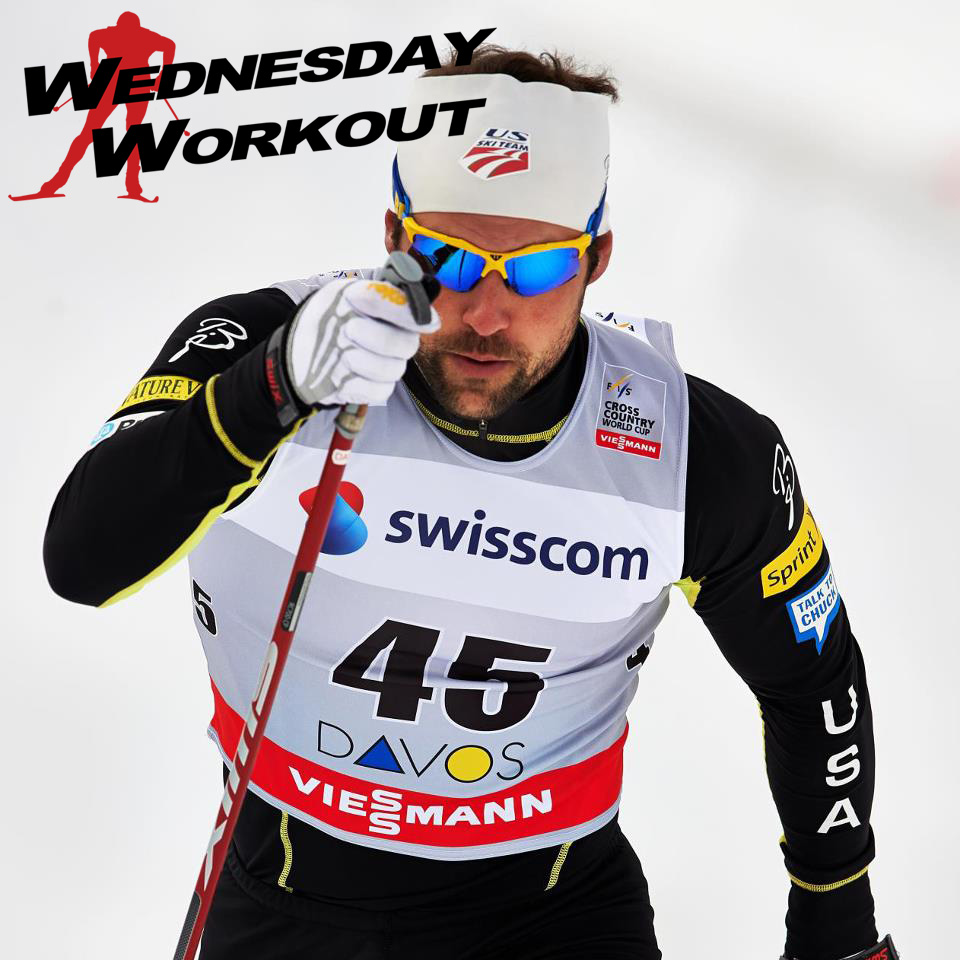
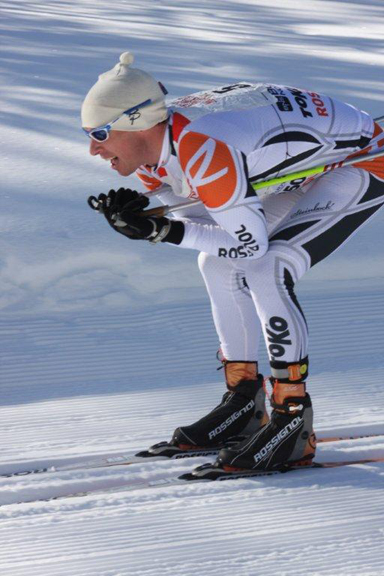
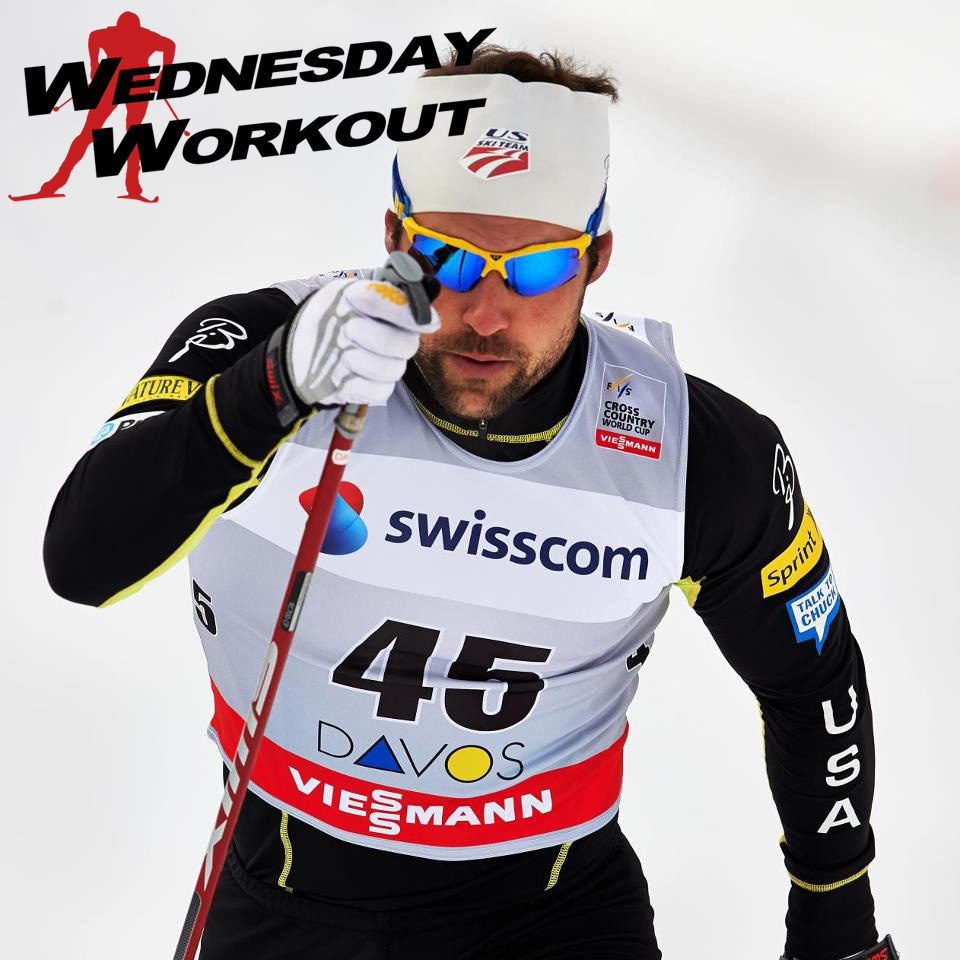
Dakota Blackhorse-von Jess (Bend Endurance Academy) racing a World Cup classic sprint in February 2013 in Davos, Switzerland. (Photo: Felgenhauer/NordicFocus)
For this Wednesday Workout, we’re bringing back a speed-inducing bounding session Dakota Blackhorse-von Jess shared with us four years ago. These days, Blackhorse-von Jess, 31, is still racing out of the Bend Endurance Academy under the guidance of Ben Husaby. Read the original workout here.
***
[circa October 2013]
This edition of Wednesday Workout was submitted by Dakota Blackhorse-von Jess, the man who dominated the coveted Frozen Thunder classic sprint last week in Canmore, Alberta, and had time to take names: beating U.S. Ski Team members Andy Newell and Simi Hamilton in the process (to be fair, they were on skate skis, but hey, that’s racing). The Norwegian website Langrenn even gave him a shout out on Facebook (translation, “Dakota Blackhorse, lovely name for a cross country runner”).
Upon catching up with Blackhorse-von Jess, who flies solo under coach Ben Husaby at the Bend Endurance Academy in Oregon, we asked him what gives and why he’s so fast this time of year.
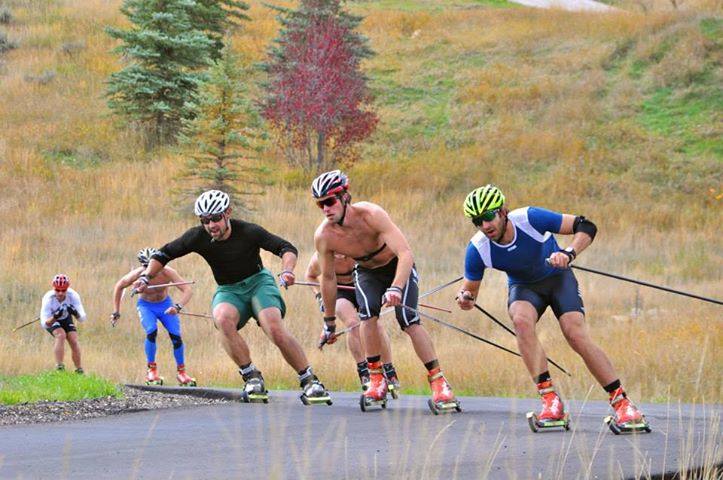
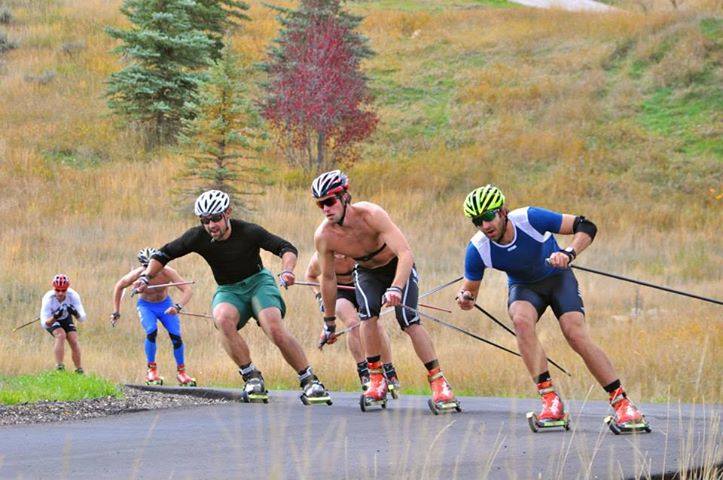
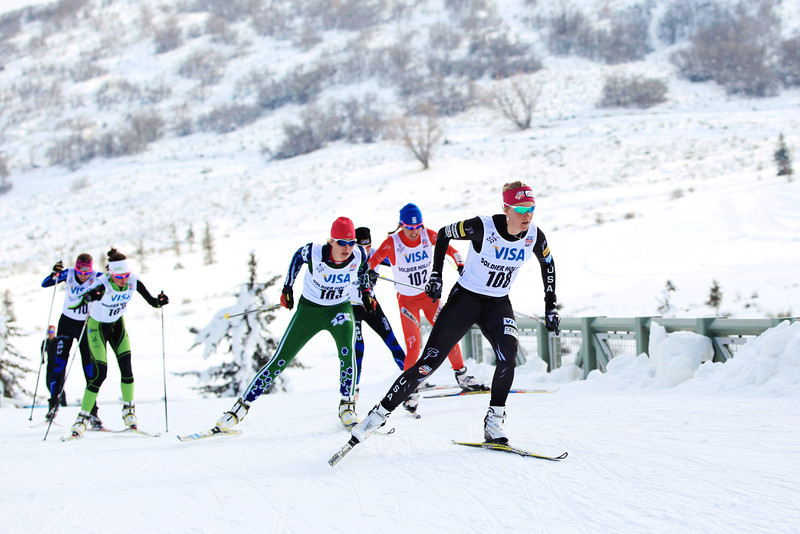
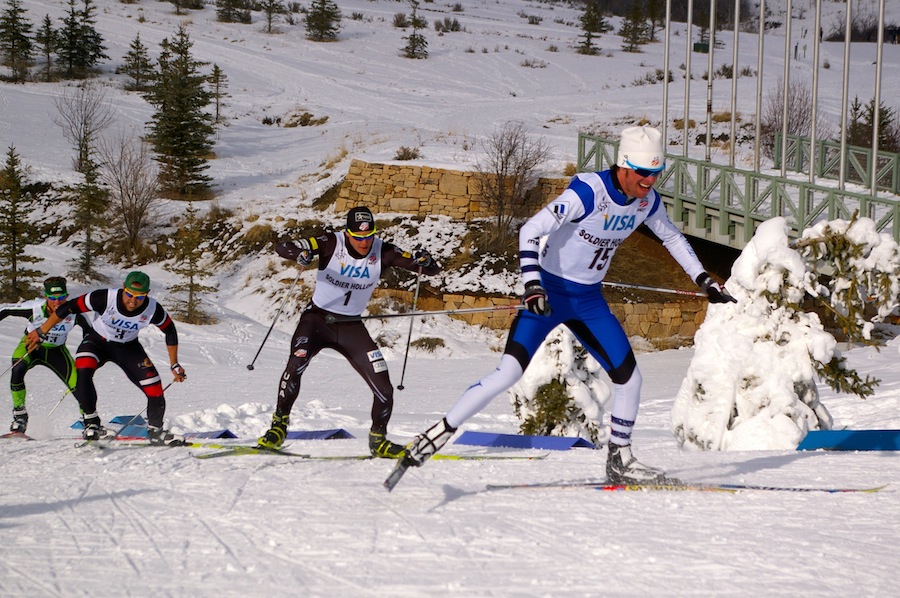
Dakota Blackhorse-von Jess (l) gets the inside line while rollerskiing head-to-head with Skyler Davis (c) and Sam Tarling earlier this month at Soldier Hollow in Midway, Utah. (Photo: Tom Kelly/U.S. Ski Team)
“We’ve really been focusing the last 4 years on systematically building my aerobic fitness,” Blackhorse-von Jess, 27, wrote in an email. “Coach Ben and I started with a focus on volume on base training and through the years have progressed to a level where I can sustain high levels of quality work – and clearly it’s paying off.
“All of the indicators in training have been pointing to increased aerobic capacity and efficiency at sustained intensity efforts, so the takeaway is validation of the success of our model thus far,” the Dartmouth grad added. “Racing is so much fun, being back on the road and seeing all my friends and getting back in the wax room with Scott Johnston and Sam Naney of MOD, and for sure being in the mix with Andy and Sim who set the bar for the rest of us was awesome.”
Well said, Blackhorse-von Jess.
Now here’s what he does:
The Workout: Threshold Plus (bounding in mixed terrain)
Explained: The transition into fall training for us means a change in the level of intensity. For the first time since the training year started in May, I get to play in the area of threshold – and threshold plus. Over the 10 years Coach Ben and I have worked together, we’ve developed both long term (year-to-year) and short term (month-to-month) training progressions. As with all things in life, experience is the best teacher and we have learned so much over the years by constantly adding new pieces cherry picking the best ones. This organic and highly collaborative style of training functions, in no small part, because of the way we have grown to understand the work we’re doing.
I mention this because feeling the workout is hands down the most important part. Yes, I use a heart rate monitor when I’m training – especially in intervals. It’s primary function, however, is actually post-workout where we can better determine if we are achieving our goals. There is a whole lot more than goes into creating a training plan that I’ve gone into here, not the least of which is understanding the science. The what and the why of different types/styles of workouts are important for Nordic skier development, but once those have been decided the how makes all the difference.
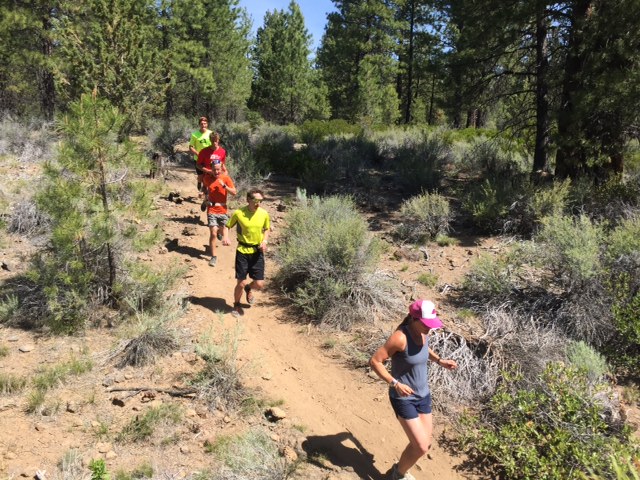
Wednesdays we hit the trails: pole bounding in mixed terrain.
Warmup: Approx. 30 minutes with 10 minutes or so of bounding specific warmup: ski walking, moosehoofing, and full on explosive bounding in addition to some muscle memory/technique drills
Intervals: 5 x 4-“ish” minutes over set terrain, with the primary goal being to spend as much time as possible at or above threshold without slowing down from interval to interval.
Recover 4-“ish” minutes between. “Active” recovery is key, but how active a person can be in recovery is totally individual – just try to keep the heart rate down in Level 2 or below and work out the lactate best you can. I walk/jog between… once I get my breath back.
(While I dearly love the flowing nature of intervals over constantly varying ground, it’s easier to measure the workout over set terrain. We found a perfect place to work on mid-interval acceleration and then survival, which was a big goal of Ben’s for me this fall as it has been a piece missing in my racing. I say 4-ish minutes because my finishing marker was just a hair over 4 minutes when I started… and I was about 15 seconds faster by the end.)
Doing It Right: Bounding in the woods is not necessarily a function of speed – you can almost always make the work harder by doing it “more correctly.” Just pushing harder usually means a breakdown in technique, which has huge application to ski racing where technique breakdown under duress can have catastrophic consequences.
That said, measuring time over set terrain really helps me understand the changes in feeling my body goes through as I fatigue. Keeping even splits, or dropping negative splits, over the intervals is still the goal.
The first couple intervals are usually about holding myself back (although not everyone experiences training the way I do, so take this with a grain of salt), I get to push a little bit in the third, push more in the fourth, and then dig deep in the last interval to keep getting faster.
By appropriately using the first couple intervals and the first minute or two of each interval to prime your system, there is a natural flow into anaerobia. We try to structure one workout a week to maximize the time spent anaerobic, and this one has been a real gem for us.
Cool down: 15 minutes-“ish.” However long it takes to get moving again and get some of the junk out of your body.
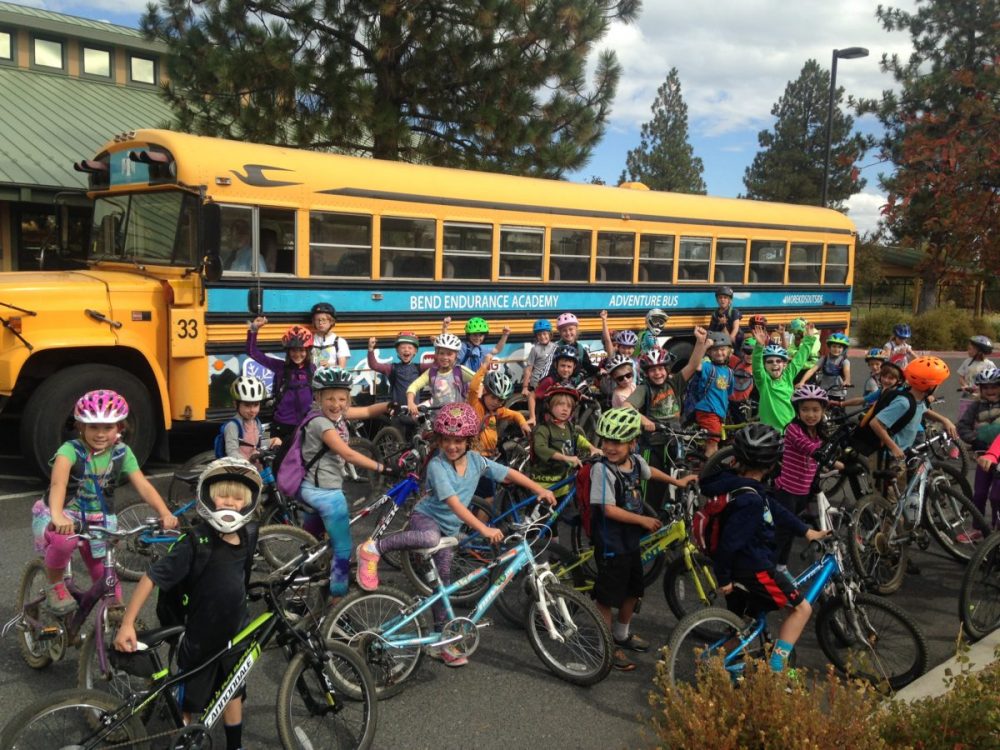
Bend Endurance Academy (BEA) athletes ready for a ride while standing in front of their “Adventure Bus”. (Photo: Mike Rougeux)
In the summer of 2013, Bend Endurance Academy (BEA) Executive Director Ben Husaby made what some may have considered a strange company purchase. The two-time Olympic cross-country skier bought an old yellow school bus, painted a pale-blue stripe lengthwise down its side and inscribed the organization’s moniker where an educational institution name once was.
Why? Was he planning to shuttle BEA student-athletes to and from school during his spare time?
Not quite. When Husaby founded the nonprofit organization in Bend, Ore., in 2009 alongside Brenna and Bill Warburton, he and BEA advocated for the affordability and accessibility of sport to kids. The addition of a bus to the organization created a means of free transport and the potential to incorporate youth who might otherwise miss out. In the summer, the bus would run daily, with BEA athletes boarding from various pickup spots and being transported at no extra cost to practice venues. In the winter, bus pickups and drop-offs would move to three times a week.
It largely symbolized what he and BEA wanted to do: get a greater number of kids outside and active, without breaking the bank.
“We have figured out how to run the organization through program fees, and our program fees are on par with [Bend] Parks and Rec,” Husaby recently said on the phone. “Even though [BEA] is nonprofit and we have a board of directors, we try really hard not to fundraise … the entire organization is really pushed by program revenue. I think people appreciate that.”
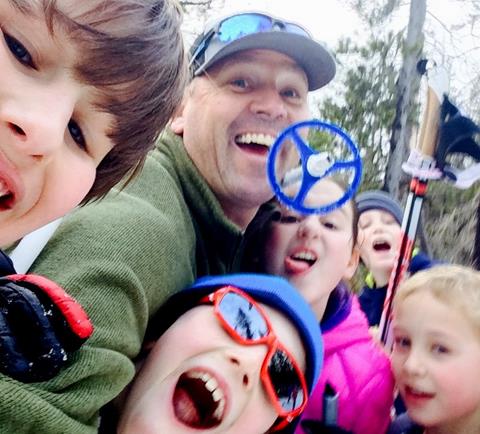
Ben Husaby (second from left) smiling with some of Bend Endurance Academy’s finest. (Photo: Mike Rougeux)
While Husaby didn’t drive the oversized, yellow-and-blue streaked bus — he left that to retired school-bus driver Steve Delery — he valued providing a greater number of families with the option to participate in BEA’s programs. The bus was just one physical example.
The mission of BEA is another. With the primary goal of providing its members a resource in “teamwork, personal growth and community responsibility,” Husaby hoped the program he created eight years ago would attract an audience beyond just the superstar athlete.
In keeping with this model, the organization has grown from 20 youngsters in its startup years to just under 1,000 unique enrollments this year. Husaby attributed this participant surge to the affordability and accessibility BEA promotes.
“We’re not performance driven,” Husaby said. “It allows for a horizontal platform. All kids need to spend more time outside. All kids need to put their screens down. All kids need to have interactions with quality mentors and you can do all of those things without necessarily being competition focused.
“It’s not a top-down organization,” the 51-year-old Minnesota native continued. “It’s mostly about teaching kids to enjoy endurance sports and that message has worked all the way through.”
Even if Husaby prefers the Academy to remain less performance driven than other clubs, its program still puts out national-caliber athletes. In the realm of nordic skiing, Dakota Blackhorse-von Jess is one of them.
For close to 17 years, Blackhorse-von Jess and Husaby have worked together, originally while Husaby was still a coach for the Mt. Bachelor Sports Education Foundation (MBSEF) in the early 2000s — he was let go from MBSEF in December 2008 and started BEA the following month.
Prior to that, skiing came in the form of racing for Husaby. After moving to Bend in 1991, he qualified for two Olympics — 1992 and 1994 — and tried one final time in 1998 before focusing on marathon racing, including the American Birkebeiner, for the next two years.
“I was working for a friend in an automotive restoration shop when that fall [of 2000] the director of MBSEF contacted me asking if I wanted to coach the nordic program,” Husaby said of his start in coaching.
Husaby accepted the position, and while sitting in his office one afternoon, he met a visitor that ultimately influenced the rest of his coaching career. A stocky high schooler entered his room, voicing goal that made Husaby’s eyebrows go up.
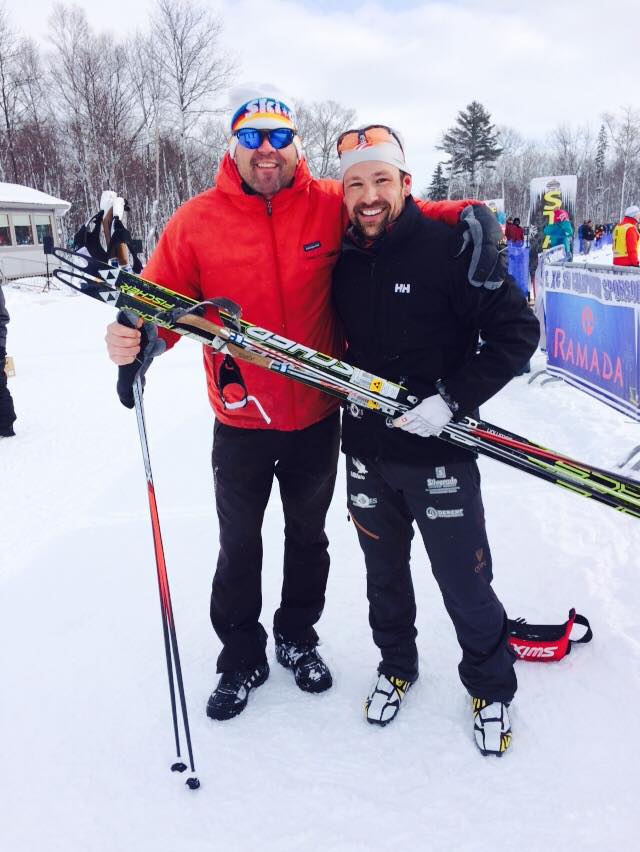
Ben Husaby (l) and Dakota Blackhorse-von Jess. (Photo: Mike Rougeux)
“[Blackhorse-von Jess] walked in and said, ‘I want to win Junior Nationals,’ ” Husaby recalled. “I sort of laughed because he was kind of a pudgy little kid … I mean I didn’t even know who he was. But I said, ‘OK,’ kind of laughing, and ironically, two years later, he was at World Juniors.”
The two went to World Juniors in 2006, before Blackhorse-von Jess headed east to attend Dartmouth College for four years, earning a degree in computer science. Upon returning to Bend in 2011, Blackhorse-von Jess rejoined Husaby and BEA. He earned a job as the organization’s associate director, a position in which he was responsible for bookkeeping, building the enrollment system and managing the program’s website.
However, as Husaby admitted, being Blackhorse-von Jess’s boss and coach proved to be difficult. Blackhorse-von Jess had an intense training schedule, but the work he needed to complete for BEA was equally important. Husaby was caught in the delicate position of understanding his employee’s outside stressors and their significance while also being charged with overseeing Blackhorse-von Jess’s salaried work.
Though not the singular reason, this is one point Husaby brought up as he discussed his recent decision to leave his post as executive director. Though he will continue to coach Blackhorse-von Jess through this Olympic season, he plans to leave BEA by Sept. 1 of this year.
“I think me leaving is actually going to make [Dakota’s] ski career a little bit easier as he winds it down,” Husaby said.
According to the 31-year-old Blackhorse-von Jess, this will most likely be his final competitive season and he hopes to end with a bang by qualifying for the 2018 Winter Olympics in PyeongChang, South Korea.
“I’m looking forward to doing something different this season,” Blackhorse-von Jess said earlier this week on the phone. “I mean, I know in many ways what we do this year is the same, but it’s our last year and it’ll be, farewell tour isn’t the best way to put that, but I think there is something special and different about it. I’m just excited to see what it holds.”
Though Husaby considers BEA his “phoenix”, he departs the head position with a sense of respect for what’s been accomplished and an excitement to spend the final months of his ski career back on the ground doing what he loves most: coaching.
“I’ve already noticed that for me, it’s going to be a lot easier to coach [Dakota] if I’m not his boss any longer,” Husaby said.
“I think the organization is ready for a manager that perhaps doesn’t have as personal of a connection as I do to Bernie [Nelson, BEA’s nordic director], Dakota, Bill [Warburton, cycling director] and Mike [Rougeux, climbing director],” he continued. “I’m leaving now because I’ve been either an athlete, or a coach, or a leader, or a supporter for 30-some years and it’s just time … it’s taken a lot to build this organization and I really honestly believe that I’ve taken it as far as I can.”
The organization is certainly a far cry from the volunteer-run, single-sport (nordic skiing) nonprofit it was in the beginning. Since its inception, cycling and climbing programs have been added to the academy, 45 seasonal, as well as two more full-time employees added to the original staff of three, and program participation has reached capacity.
“It’s big now and it needs someone that perhaps has a little more experience with growing the organization fiscally,” Husaby said. “We’re kind of through the whole founders’ phase. We were a scrappy, scrappy startup, and I was comfortable leading that, I think I just reached my capacity with the organization.”
Husaby will continue to aid BEA with coaching and moving into a new leased facility through the summer. Though no particular candidate has been singled out as of yet, the BEA’s Board of Directors is looking for someone who supports Husaby’s original mission and vision for youth.
“The biggest contribution Ben gave is defining a culture of the organization that is really long-lasting,” BEA Board President Cris Himes said on the phone. “What Ben has really done for BEA is to emphasize fun and joy and getting outside for kids at all levels, making it fun for them and helping them find their intrinsic drive.
“Really that’s been his number one contribution and that’s not going to go away,” she continued. “We are all expressing gratitude to Ben for what he has given this community and organization. It’s quite a legacy and a gift.”
American Bill Harmeyer (University of Vermont) racing the first leg of the men’s 4 x 5 k relay on the last day of 2017 Junior World Championships at Soldier Hollow. After he tagged off in sixth, his team went on to finish ninth. (Photo: FlyingPointRoad.com)
In an effort to showcase the North Americans competing at this past week’s International Ski Federation (FIS) 2017 USANA Nordic Junior World Championships and U23 Cross Country World Championships at Soldier Hollow in Midway, Utah, we asked those qualifying athletes several questions about themselves — actually, we had them fill in the blanks. Here we have 19-year-old Bill Harmeyer, of the University of Vermont, who represented the U.S. at his first Junior Worlds.
“My full name is Bill Harmeyer, but you can call me Bill. I was born in Burlington, Vt., raised in Underhill, Vt., and one thing you should know about my hometown is the mountain biking is sweet.
I started cross-country skiing when I was three or four, thanks to Mom and Dad, my main sponsors and the real MVPs. I currently train in Burlington with the University of Vermont Ski Team.
If I’m not skiing, you might find me in the library, pretending to study. If I had to pick a favorite book, it would be ‘Casino Royale‘.
One of the things I’m most excited about for Junior Worlds at Soldier Hollow is everything, especially racing at Soldier Hollow again. One race I’m especially targeting there is the classic sprint.
The best advice anyone ever gave me about skiing or racing was ‘the plan is always changing’ – Ben Husaby.
One of the best race memories I have is sprinting to the line with Henry, my twin brother, and Ben Hegman when we were 11 years old at the Silver Fox Trot in Hanover, NH. Came down to a photo finish, which I lost.
If I could meet one World Cup skier, it would be Charlotte Kalla.
If I don’t end up being a professional skier, I’ll probably be a nurse.
I’m missing seven days of school to be here, and my teachers are probably thinking, ‘He better show up to office hours.’
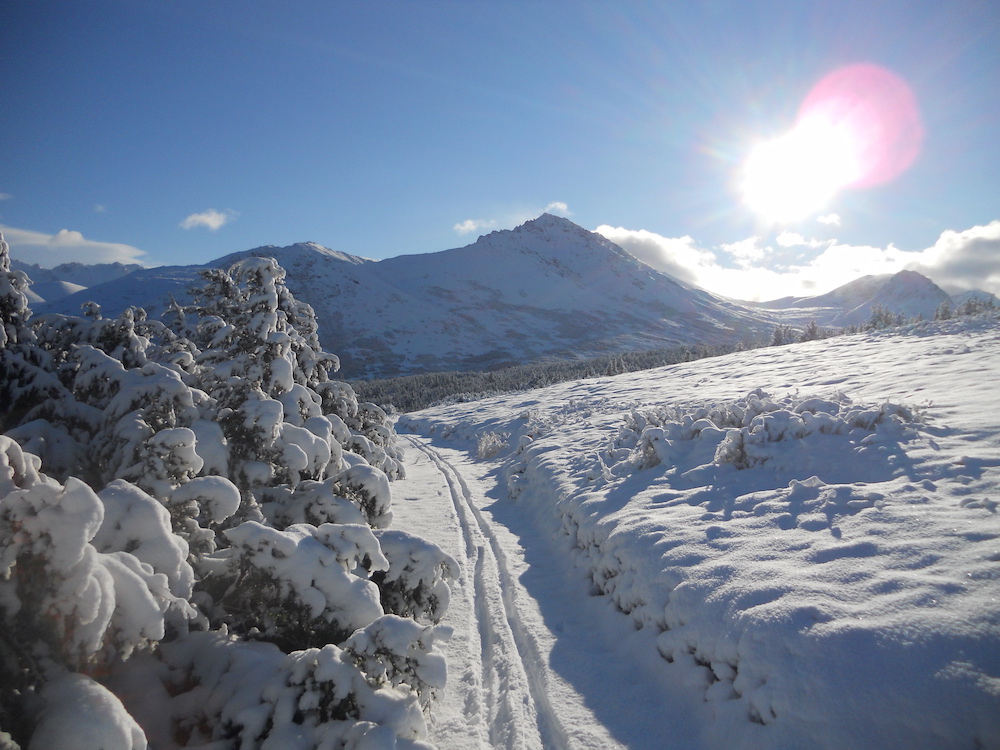
Early-season snow: first tracks in Chugach State Park, above Anchorage, Alaska, on Sept. 18, 2015. (Photo: Gavin Kentch)
Twenty years ago today, on Nov. 2, 1996, a ski race sanctioned by the International Ski Federation (FIS) was held in Fairbanks, Alaska, on the trails at Birch Hill. It appears to be the earliest FIS race ever held on natural snow in the Northern Hemisphere. This is a look back at that race, and at the significance it has, or does not have, for some of its participants.
Setting the stage
It was the final days before a hard-fought presidential election. Clinton was widely expected to prevail over the Republican candidate, although a strong third-party showing and voter dissatisfaction with the two major parties were complicating the electoral calculus. The Alaska Republican Party was running newspaper ads promising to “defend State’s rights.” And people were skiing in Fairbanks. Plus ça change.
There were also some differences. The front page of the Fairbanks Daily News-Miner on Nov. 3 ran an article headlined “Dole hoping for an upset” over, of course, Bill Clinton. Then on Nov. 4: “Perot plans last-minute television blitz.”
Elsewhere in the paper, movie listings included the Leonardo DiCaprio vehicle Romeo + Juliet. Agate type in the sports section recounted promising rookie Ray Allen leading the Milwaukee Bucks to a victory over the Boston Celtics. (It was the second game of Allen’s career. He would go on to play 1,298 more games after that.) And an ad for an ISP, or internet service provider, explained to potential customers the appeal of “the Internet.” You could “interact with people from around the world,” it promised, or, “Find answers and advice in newsgroups.”
In Fairbanks, meanwhile, it was winter, and it had been winter for a long time. The News-Miner reported that October had seen record-breaking cold, even for Fairbanks, with an average temperature for the month of 13.6 degrees. Through Nov. 3, it had snowed 22 inches so far that winter; given those temperatures, and the relative lack of solar radiation in Fairbanks in winter, most of it was presumably still on the ground.
The Nanook Challenge
Given this weather and snow conditions, it hardly seems newsworthy that a ski race was held. Plus several members of the U.S. Ski Team (USST) had been in town for early-season training, so the skiers were there.
The field for the 10-kilometer classic interval start – official title the “Nanook Challenge: FIS Series Race No. 1” – was small but distinguished. There were 10 women and 18 men entered. At least four current members of the U.S. Ski Team competed, along with several former USST members.
The top-five finishers in the men’s race were Ben Husaby, Marcus Nash, Patrick Weaver, Scott Loomis, and Carl Swenson, respectively, a bevy of elite skiers that would not have been out of place at a mid-1990s national championship race. (Indeed, all five men would place in the top seven in the 15 k skate race at U.S. nationals later that winter in Bend.)
The women’s podium was headed up by USST skiers Laura Wilson and Suzanne King. Third place went to Julie Southwell, described by the News-Miner as “a national team contender who trains in Fairbanks.” (Five years later, a profile of Southwell by Inge Scheve in The Bulletin of Bend, Ore., would call her “a former Colorado resident who says she sort of follows the snow.”)
Wilson’s winning time was 33:28 for 10 k. Husaby finished the same course in 27:56. Conditions were described in the News-Miner as “near-perfect,” with an 11 a.m. race temperature of “20 degrees under a pale white ceiling of clouds.” (The season’s second FIS race, a 15 k skate, was held the following weekend, in arguably less perfect conditions. The high temperature for Fairbanks on November 9, 1996, was –1°. The low was –26°.)
(Story continues below)
The Fairbanks Daily News-Miner’s 1996 story on a Nov. 2 cross-country ski race, the earliest FIS-sanctioned event ever held in the Northern Hemisphere.
The Fairbanks Daily News-Miner’s 1996 story on a Nov. 2 cross-country ski race, the earliest FIS-sanctioned event ever held in the Northern Hemisphere.
The Fairbanks Daily News-Miner’s 1996 story on a Nov. 2 cross-country ski race, the earliest FIS-sanctioned event ever held in the Northern Hemisphere.
The Fairbanks Daily News-Miner’s 1996 results from the second race on Nov. 9.
Looking back
Swenson, the fifth-place finisher in the opening 10 k classic, has fond memories of Fairbanks as an early-season training destination generally, though scant recollections of this race specifically. When asked about this race in a recent phone interview, following his workday doing indigent defense for the New Hampshire Public Defender, Swenson began by musing, “I’m just trying to place what year that would have been,” and attempting to reconstruct whether World Champs had been held that spring or the year before. “We’d always have a race real quick after we got there,” Swenson continued. “And we’d get to Fairbanks in mid-October.”
In a race of more recent vintage: Carl Swenson, competing for Steinbock Racing, made the trip from southern New Hampshire for the 2010 Boulder Mountain Tour in Sun Valley, Idaho. (Photo: Toko)
“I remember it fondly,” Swenson, now 46, says of Octobers and Novembers spent in the Golden Heart City. “Not a lot of sunlight, lots of skiing.” He adds that “everyone was so excited be on snow again; I always looked forward to it. I don’t know if everyone looked forward to it, but I always did.”
“We were always able to ski” somewhere in or near Fairbanks, Swenson notes, “but sometimes it was really thin. … There could be pretty bad skiing, but I always remember we skied.” They would – much like modern-day juniors competing in the Besh Cup series – stay at the Wedgewood Resort, and “we’d all pile up and drive to Birch Hill. When it was a bad snow year, we’d all drive up to an elementary school” that had trails (Salcha Elementary), “and it would be ridiculously cold.”
Swenson’s lack of specific memories may be attributable not only to the passage of time and multiple fall trips to Fairbanks, but also to the fact that Nov. 2 was early in the season for him in more ways than one. “I probably hadn’t done much rollerskiing” at that point, Swenson candidly admits. “I was still catching up.”
(Uniquely among top-level cross-country skiers, Swenson had “made the bold decision to pursue a professional mountain-bike career and continue to ski race internationally in the winter,” FasterSkier previously wrote. 1996 was his first summer of pro mountain biking in the “offseason.”)
When asked whether he had simply kept the rollerskis in storage through September or had at least gotten out a few times a week during the summer, Swenson at first suggests digging up an old training log from storage, then says, “it would depend on if I went to late-season mountain bike races that year. Sometimes I would be – World Championships are at the end of the season in mountain biking. In ’96, I think I would have been in Boulder. And maybe I would have started doing some rollerskiing in the summer – not much, if any.”
Swenson was clearly unconcerned about his results in a November race two months before U.S. nationals and more than three months before World Championships. He recalled that his focus for his first two weeks back on snow would have been volume, and guessed that he would have logged approximately 20 hours of skiing per week while in Fairbanks. “I’m sure everybody up there was concentrating on volume, and things like that,” Swenson notes. “There would be people chasing points, to make an early trip – but I doubt anyone was doing that up there.”
Swenson improved his position with a third-place finish in the 15 k skate a week later, suggesting that he may have been racing his way into skiing shape.
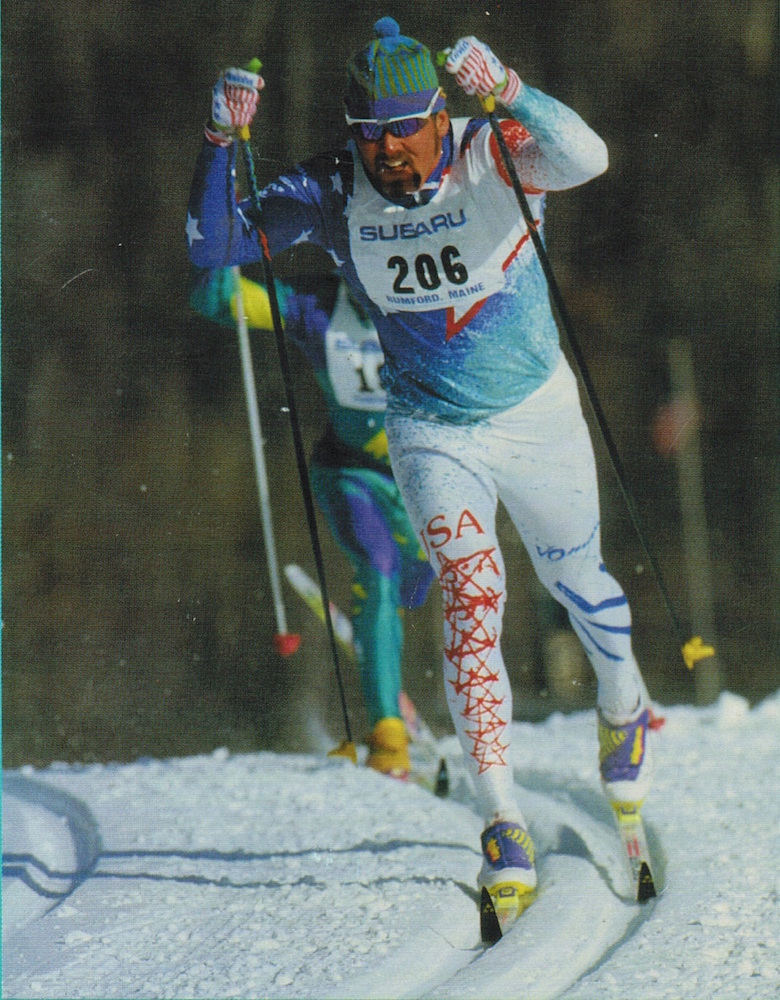
The ’90s force is strong: Ben Husaby (USST) racing at 1993 U.S. Nationals in Rumford, Maine. (Courtesy photo)
At the top of the results sheet, Husaby won both races, the 10 k classic on Nov. 2 and the 15 k skate on Nov. 9. His memory of that fateful week in Fairbanks borders on the eidetic. “That weekend actually stands out for me as one of the more memorable ones in my ski career,” Husaby recently said when cold-called about a race from the Clinton administration.
Husaby, who turns 51 next month, spoke with FasterSkier by phone from Bend, where he works as executive director of the Bend Endurance Academy. (Husaby once cracked that he enjoys being a ski coach because “I get to drive a Ford Econoline van down winding roads in inclement weather.”) Husaby clarified that in his current job he coaches only one skier, national-class athlete Dakota Blackhorse-von Jess; he assists nordic director Bernie Nelson and will go out with other athletes, but says that he is following Nelson’s lead.
Husaby still recalls how fast he skied, but poignantly acknowledges that his timing was somewhat suboptimal.
“I’ll just say, it was the fastest I’ve ever skated, for sure,” Husaby declares. “And you certainly don’t want that to happen in the first week of November, but it did. It’s bittersweet, because it’s the wrong time, but it was amazing. Those two races, they were effortless.”
Husaby speaks with evident emotion about the sensation of skiing so easily:
“So, nobody wants to be a Christmas star, and I was a November star. But, the race course [in Fairbanks] was a very challenging race course, and I blew around that course effortlessly. And that was a really, really cool feeling. I had traditionally struggled in tough skating race courses, and, you know, I walked all over everybody. And so, you know, that was exciting. And one of the things I remember is, how cold I felt being as quote-unquote ‘skinny’ as I was. I was in the low 180s. And I was colder than I had normally been.
“I also remember feeling really light and fleet and dynamic. I remember – and it’s always weird, because when we got back to the hotel – you know, those first races of the year, people are always talking about how they’re going to get better, where they made mistakes… generally everyone wants to downplay their early races. And here I was – I’m looking in retrospect in terms of how fast I really did ski. At the moment I didn’t realize that that was probably as fast as I had ever gone, but in retrospect, I realize, wow.
“There were a couple of World Championship results, there were a couple World Cup results where I was competitive, and probably moving along at the same speed – but this particular weekend, it was completely effortless.”
Husaby had been a member of the U.S. Ski Team from 1991 through 1995, but in fall 1996 was training solo. But he finished ahead of all current USST members in both races in Fairbanks.
“Particularly the skate race,” Husaby enthuses, “I mean, for me to beat everybody by over a minute – I think it was a minute and change – in a 15 k skate. I mean, I never did that. I’m not really sure why.” (Husaby correctly recalls that he beat second-place John Bauer by 1:04 in the skate race.)
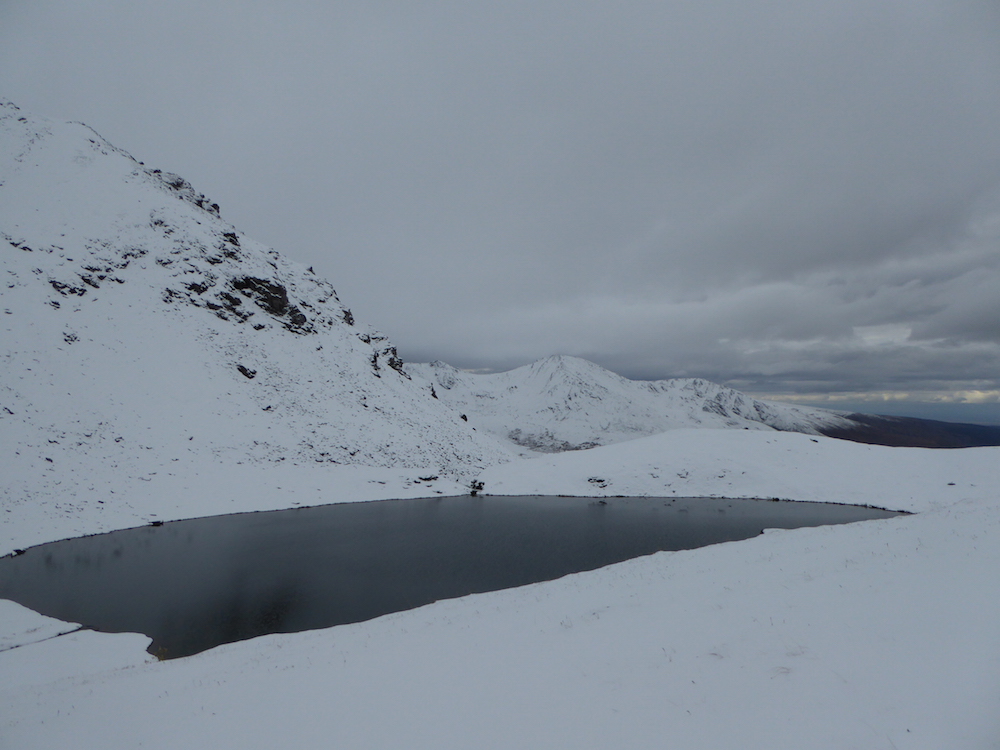
Early-season snow: skiing past Summit Lake, in Hatcher Pass above Palmer, Alaska, on Sept. 23, 2016. (Photo: Gavin Kentch)
At the time, Husaby felt strongly that his performance merited selection for bigger stages: “I do remember being like, ‘God, I wish they would have selected me to go back to the World Cup.’ Because they sent Marcus [Nash]. They took Marcus, not me. And I do remember being like, ‘Dangit, I killed everybody, they should be taking me.’ But it’s always like that – you always think that you should be the one that’s named.”
But he now waxes much more philosophical about the vagaries of team selection. “I’ve had 20 years to think about it,” Husaby now analyzes, no regret or animosity in his voice. “There are a lot of arguments why I should have been chosen for it, and a lot of arguments why I shouldn’t have been chosen for it. It’s just the nature of sport.”
As he left Fairbanks in November 1996, Husaby had high hopes that these results presaged a breakthrough season for him.
“Like any athlete, you think, ‘Oh my gosh, this is the start – it’s really going to happen here.’ Particularly when you’ve had five years of mediocre racing on the World Cup, right? … In the previous five years, I had everything [in World Cup results] from low 20s to, you know, 112th place. And so all of a sudden a result like this comes along early in the season, and I’m thinking to myself, ‘Man, if this is the start of things to come, this year is going to be totally lights out.’ ”
Husaby did not receive World Cup start rights that season, and in fact never raced on the World Cup again. He spent the 1996/1997 season on the domestic Yoko Cup, an inchoate version of the national-level race series that ultimately became the SuperTour.
Despite – or maybe because of – the fact that the Fairbanks races ultimately proved to be a highwater mark of the season rather than a springboard to successful European racing, Husaby frequently uses the experience as a teaching moment for his athletes.
“As much as we really think that we have our finger on the pulse,” Husaby theorizes, “and that we can really dial in when we’re going to be fast, and really pick and choose the big events, and how it’s all going to play out – you never really know when you’re going to have your moment. You don’t know. The body and the mind are really – sometimes they’re diametrically opposed, sometimes they’re incredibly in sync, sometimes one is lined up and the other one’s not. And a huge part about athletic growth is just realizing that you never really know when you’re going to have your moment. So when you do have your moment, hopefully you get something from it, you gain something from it. For me, this was an indicator that my training, the change in training, had an effect, the weight loss had an effect, maybe the release of not being on the ski team any more had an effect.”
“I guess the moral is to pull something positive out of a good race, regardless of when it happens.”
When asked about his strongest memories from his time in Fairbanks, Husaby mentions two things. First, despite the subzero temperatures for the skate race, “I remember that that climb – I felt like Superman going up that far outer climb [on the race course]… I remember charging up it. It’s got like three rises in it.”
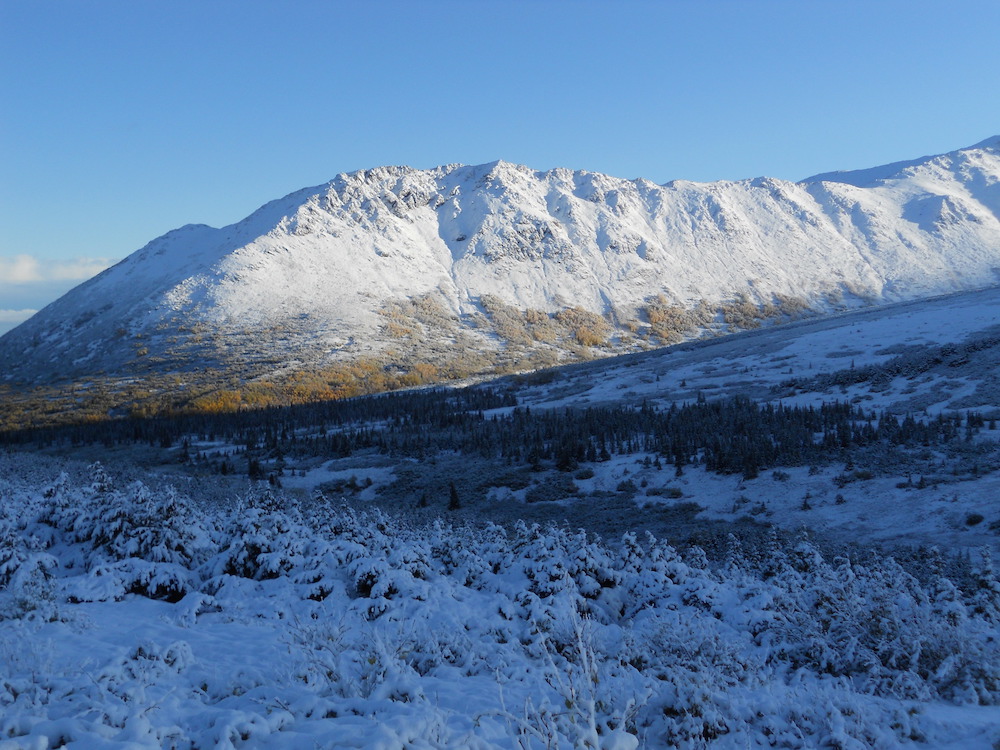
Early-season snow: fresh snow on top of fall colors in Chugach State Park, above Anchorage, Alaska, on Sept. 18, 2015. (Photo: Gavin Kentch)
And second, “I remember that being a very cold week. … I wasn’t a ‘do a loop many times’ kind of guy. I was always an explorer. Well, I spent most of my training time in Fairbanks actually out on the White Bear [Trail] and out on the military roads. I used to bring really crappy skis, just so I could ski on the military roads. But I recall that week being incredibly cold. And my motivation was to ski out to the end of White Bear, look at the thermometer, and then ski back in. Just to reaffirm how cold it really was. That was it. Besides that race, that was my memory of that week.”
In addition to multi-time Olympians, other notable names on the results sheet include “Jason Cork, UAF, 34:23.3,” in 12th, surrounded by several of his teammates from the University of Alaska Fairbanks ski team. Cork was born and raised in Alaska, and graduated from North Pole High School in 1995. He skied for UAF before embarking on a coaching career that ultimately brought him to his current position as Assistant Men’s Coach for the U.S. Ski Team.
Early-season history
The participants may not have realized it at the time, but they were, in the world of high-level ski racing, making history. The race remains the earliest FIS-sanctioned race ever held on natural snow in the Northern Hemisphere, according to the FIS database.
(A FIS-sanctioned race is one whose results can be used to help calculate a skier’s FIS points, “theoretically a universal ranking system for skiers around the world who have never competed against one another.” Generally speaking, a FIS race is held on a course with climbs of specific height differential and grade, as well as a total climb requirement. A FIS race is held on a relatively challenging course, and attracts a relatively high caliber of skiers.)
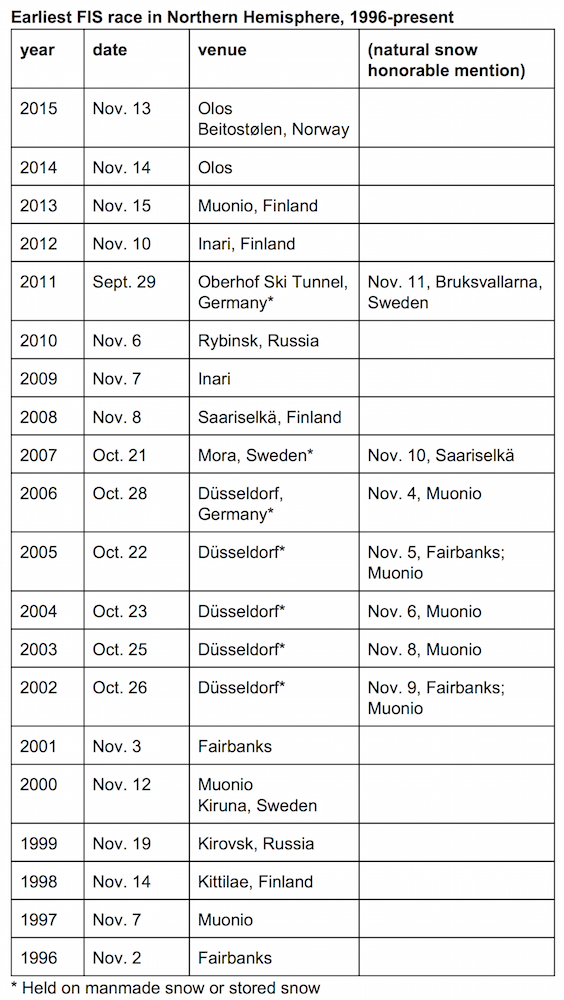
Here are the earliest FIS races from 1996 to present, as listed in the online FIS results database. Amidst a host of early-November dates from several venues across northern Scandinavia, November 2, in Fairbanks, Alaska, stands out as the earliest by a small margin. But Fairbanks shares one significant thing in common with the other names frequently occurring on this list: a far northern latitude. Fairbanks is at, in round numbers, 65 degrees north latitude; Olos and Muonio, 68°; Inari, 69°; Beitostølen, a downright tropical 61°. (The Arctic Circle is at 66°34′.)
Table of year’s earliest FIS race, 1996-2015. (Source: FIS database)
As FasterSkier wrote over a decade ago, Fairbanks in early winter presents a “surreal setting. … The air is still, day after day, and the temperatures hover around zero even though it is barely November.”
(The table distinguishes between natural snow races and artificial snow loops when relevant – it is truly impressive that Mora had a sprint race on a stored ribbon of snow on October 21, but it makes for an apples-to-oranges comparison to Fairbanks or Muonio. Also note that the 1996 cutoff for this table is not artificially hiding an earlier race out there. The earliest FIS race from any of 1990-1995 was held on November 6, 1993 (also in Fairbanks, also the Nanook Challenge). And by the 1990/1991 season, there are only a dozen races listed for the entire season (down from hundreds for 2015/2016), underscoring the limitations of the otherwise remarkable FIS database.)
All that said, simply skiing in Fairbanks in November is a news story on the level of “dog bites man.” September snowfall in Fairbanks is not unusual. Groomed (or at least dragged) skiing in October is expected. Throughout the 1990s, Birch Hill was a mecca for early-season training for high-level skiers from across the country. (The second FIS race of 1996, the 15 k skate a week later, boasted a top-8 of Husaby, John Bauer, Swenson, Loomis, Weaver, Todd Boonstra, Adam Verrier, and Audun Endestad. That’s a lot of good skiers. And a combined 15 Winter Olympics.)
Ken Leary is a longtime Fairbanks local who oversaw the low-key Wednesday Night Race Series ($20 for eight races!) for many years. In an email to FasterSkier, Leary wrote that “the first Nordic ski race of the season in Fairbanks is the annual Wednesday Night Halloween race held on the Wednesday nearest to Halloween.”
Leary added, “To my knowledge, Fairbanks has never had a Nordic ski race in the month of September, but it would have been possible in years 1992, 1993, 1996, and 2015 because of early snowfall.”
(In Anchorage, which like Beitostølen is situated at a balmy 61° north latitude, early high-level ski races on record include “a 15 km APU race that [then Alaska Pacific University head coach] Jim Galanes held on the Spencer Loop on October 25, 2001,” as recounted on local skier Tim Kelley’s blog. More recently, the University of Alaska Anchorage ski team held a time trial on the Spencer Loop a week ago today.)
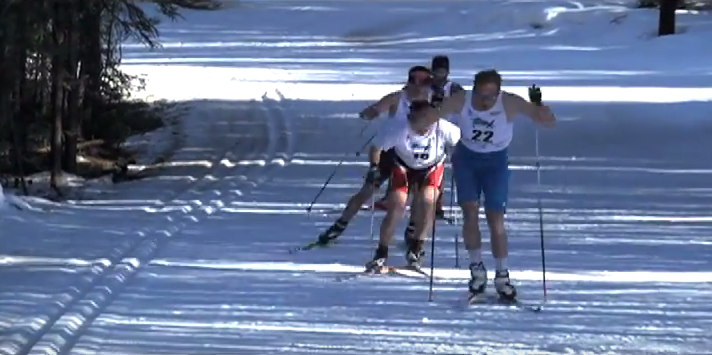
Max Olek (University of Alaska Fairbanks), No. 22, leads eventual winner Lex Treinen (also UAF), No. 18, in a ski race held at Birch Hill in Fairbanks, Alaska, on May 8, 2013. (Photo: YouTube screenshot)
And at the other end of the season, following a winter of roughly average snowfall but then a spring of record-breaking cold, Leary once hosted a race at Birch Hill on May 8, 2013, when the 6:45 p.m. start time occurred a full four hours before sunset. (The YouTube video is worth a quick watch (and not only because a cross-country ski race leads the sports news on local CBS affiliate K13XD Channel 13). It shows racers in shorts on what can only be described as close to 100 percent snow coverage on a 50-degree day. Many skiers have raced in midwinter in far worse.)
What it all means
There is an undeniable draw to being on snow – especially when you’re not supposed to be. (Or maybe especially when others are not, and you can brag on social media that you are.) Rollerskiing is good as far as it goes, but Annie Pokorny once credibly likened it to a rebound girlfriend, writing, “Every spring, Nordic skiers must undergo a reluctant breakup with the perfect girl” and console themselves with mere rollerskiing.
As Chelsea Little previously wrote in a lyrical piece on FasterSkier, she clings to the idea that, “at any given moment, somewhere in the world, there’s great skiing. If I can’t be back home and if it’s not December through March, then a corner of my mind is occupied wondering where that snow is and whether I can get there.” For Swenson, Husaby and a handful of other elite American skiers throughout the 1990s, the answer to “where the snow is” in October and November was consistently Fairbanks, Alaska.
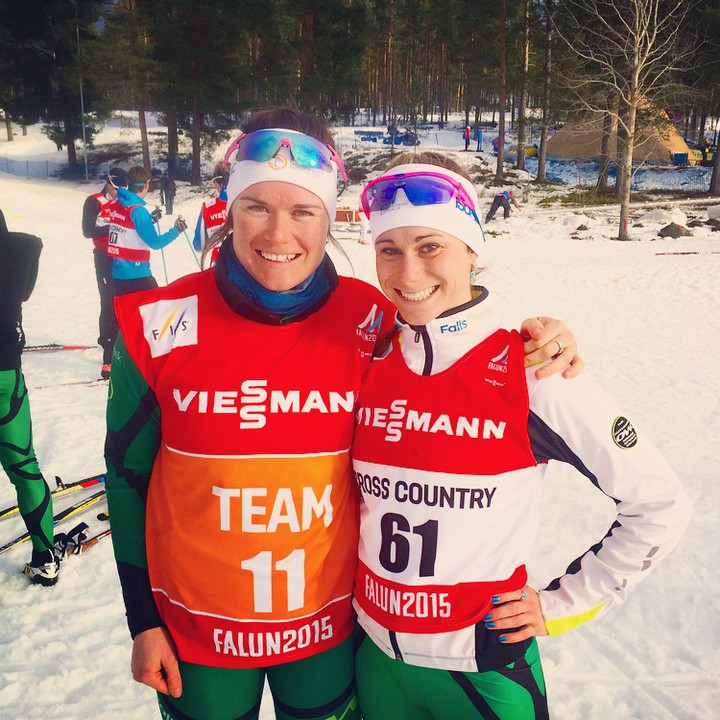
Bernie Nelson (l) coaching Australian national-team skier, Alaska Pacific University member, and former Montana State University athlete Jessica Yeaton (r) at the 2015 World Championships in Falun, Sweden. (Courtesy photo)
BEND, Ore. — A few things stand out while interviewing Bernadette “Bernie” Nelson, the newly hired head nordic coach at the Bend Endurance Academy (BEA): she’s intentional with her words, meticulous and grateful for the opportunities she’s been given as she develops into an emerging leader on the cross-country ski racing scene.
Growing up in Truckee, Calif., Nelson said she became hooked on nordic skiing because of the way her coaches used the Sierras as a playground — where play just happened to be training.
“Skiing wasn’t just skiing,” she explained. “We went running, and climbing, and biking, and we ran all our camps out of Yosemite, which was just the coolest opportunity ever.”
Beyond the physical settings and cross-training opportunities the Sierras afforded, Nelson mentioned that Truckee’s ski scene placed an emphasis on building a unified team. Nelson said that end goal — team spirit — began with parents emphasizing the organization rather than individual results.
“I feel like when I was growing up, something that worked in Truckee was that the parents weren’t just invested in their child — they were invested in the organization and the community and the process,” she said. “I feel like it shifted the focus from the child’s performance to the experience that the child was having. And so, having parents invested in that experience and invested in the greater organization kind of it took the emphasis off of, ‘My child won today.’ ”
In that healthy environment, Nelson thrived — she skied herself onto several Junior National podiums.
Coach and Collaborator
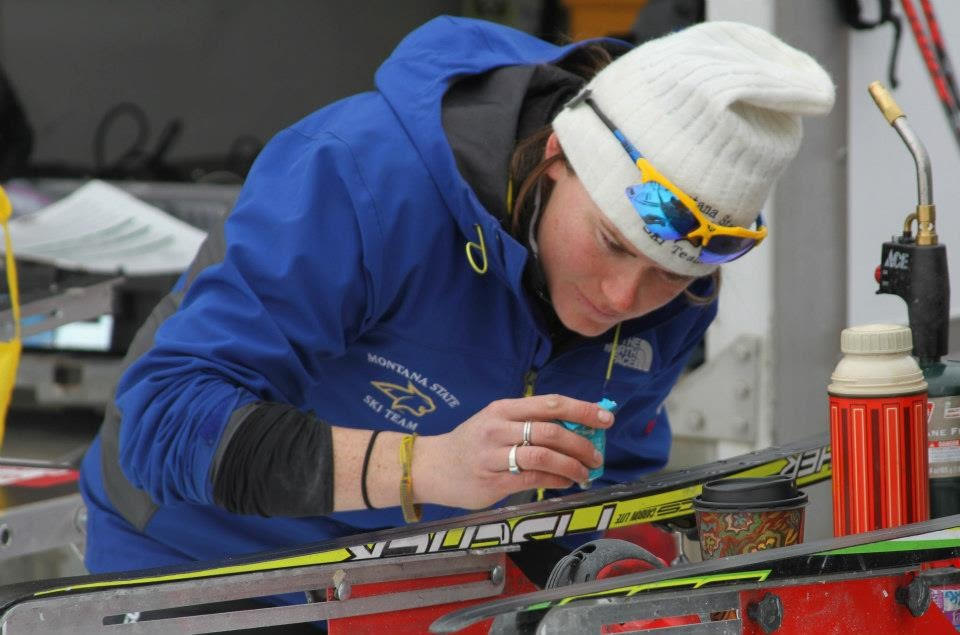
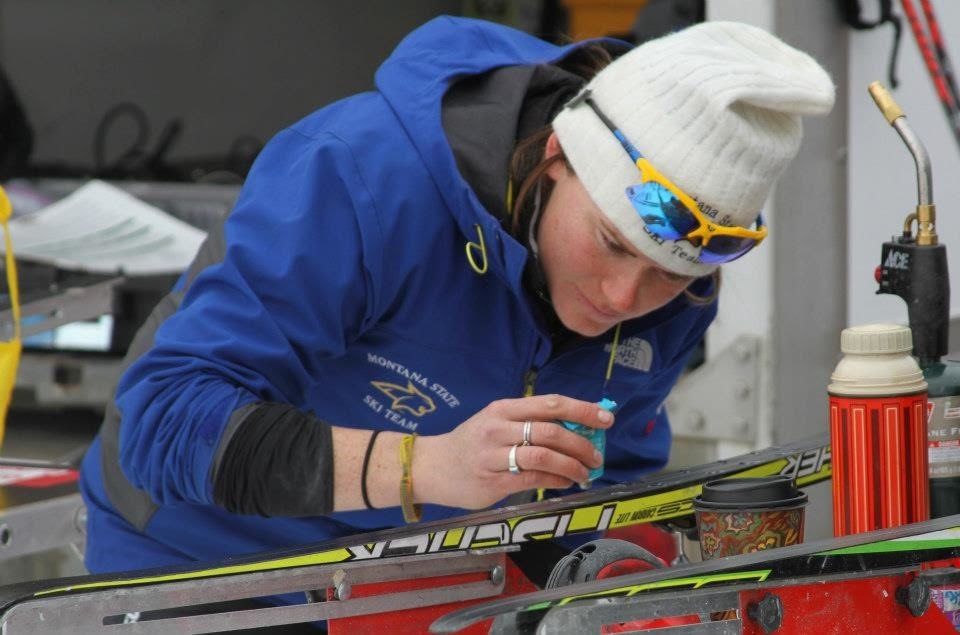
Bernie Nelson prepping skis while coaching at Montana State University. (Courtesy photo)
Nelson eventually went on to ski for the Montana State University (MSU) nordic ski team for two years. After that she focused on her studies while at the same time serving as the assistant nordic coach at MSU for another three seasons.
With a proven aptitude for managing athletes, school and the stress of travel and waxing, Nelson was hired by Bridger Ski Foundation’s (BSF) Dragan Danevski to head up the post-graduate and elite teams in 2014.
One difficult task Nelson was held responsible for was guiding a team of 18- and 19-year-olds in BSF’s post-grad program. Nelson says she built mutual respect with her athletes premised on a simple common goal.
“I want the athletes to develop just as much they want to develop,” she said of her coaching style: less dogmatic, more like a collaborator. “I hand them the keys and I’ll sit in the passenger seat. I’ll provide the roadmap to where they are going and where they need to turn and if they are driving too fast or you’re not paying attention anymore, the speed limit is 60 and you are going 25. And that’s how I run my program. It’s through mutual respect and mutual understanding and a lot of communication.”
For Nelson, communicating wasn’t simply about the day’s intensity session, or periodization within a complex training plan. Sometimes it was more basic.
“I’ve worked with [postgraduates],” she said. “So there is a lot of life things going on. ‘I’m out of the house.’ ‘I don’t know how to do laundry.’ ‘I cannot find a job, can you help me?’ ‘Can I list you as a reference?’ And so it’s just a big picture and I try to not be ignorant of any of the moving pieces.”
Two BSF athletes who built a strong relationship with Nelson will be moving to Bend this June to continue working with her: Nick Michaud and Akeo Maifeld-Carucci.
At BEA, Nelson says she’ll make good use of the multi-disciplinary hat she once wore at BSF in terms of meeting the demands of junior skiers and what they want out of the sport.
“Especially in junior skiing, their goals range from making JN’s, to racing a junior qualifier, to winning JN’s, to going to World Juniors, to making friends,” she said. “I mean, the spectrum is so broad and through all of it, you learn pillars that support your life later on.”
Time to Simplify
This past spring, before her move to Bend, Nelson’s life became more complicated. While in Canmore serving as a guest coach for the U.S. Ski Team at the Ski Tour Canada, Nelson had a health scare.
“I had a Grand mal seizure in Canmore,” Nelson explained. “I came home from the skiathlon, got out of the shower, they think that I just passed out from accumulation of stress and exhaustion, and hit my head and had a Grand mal seizure. And I was actually air flighted and medically sedated into a coma in Calgary. It was unfortunate timing in that I couldn’t go to [SuperTour] Spring Series and I think there were all of these rumors flying and circulating about why I was leaving BSF.”
Nelson wanted to make clear that her departure from BSF was amicable.
“I did not leave because of BSF — BSF was keeping me in Bozeman,” Nelson said. “I love that job. I loved that organization, and working with Dragan was a fantastic opportunity. And I’m excited to continue working with him.”
BSF’s program director, Danevski could not be reached for comment.
Dakota Blackhorse-von Jess admiring turns with Bernie Nelson below Broken Hand Mountain in the Three Sisters Wilderness outside Bend, Ore. (Courtesy photo)
Nelson’s arrival in Bend was in many ways an attempt to simplify her life. Her partner is Dakota Blackhorse-von Jess, a perennial SuperTour sprint podium threat and longtime Bend resident. The couple saw each other either in Europe or at national-level races, or they endured the 800-mile road trip between Bend and Bozeman.
It was a combination of events that convinced Nelson to make the move: her personal relationship, the events in Canmore, and the job opening at BEA.
“I was more or less planning to come out here and then I had this seizure and it was like, ‘Yup, life is short,’ ” she said.
She explained that during her recovery — at least in the short-term — she couldn’t be alone or drive.
“It’s just that my life, a little bit, has just been kind of turned on its head,” she said.
Having Blackhorse-von Jess nearby to help with her recovery made practical sense. But on a lighter note, being in Bend affords Nelson the opportunity to foster their relationship.
“Part of me moving here takes the traveling out,” Nelson said. “Hopefully it allows him and us to kind of be a team here. In the sense that we can get things done together.”
Blackhorse-von Jess reiterated Nelson’s sentiments that their partnership in Bend will streamline their lives.
“Most of the upside is actually the intangible stuff,” Blackhorse-von Jess said. “We can facilitate workouts if necessary. If I need someone to drive a vehicle for example or run a lactate meter. The real benefit to having her here is that I don’t have to travel to Bozeman/she doesn’t have to travel here for us to see each other. And having two people in the house actually makes a huge difference with regards to food preparation and scheduling, and equipment maintenance. Those are the sort of tasks that you can share when you are in the same general field together.”
With World Championships this coming winter and 2018 being an Olympic year, Blackhorse-von Jess, 30, said he plans to continue training and racing for at least the next two years.
BEA Executive Director Ben Husaby will continue to supervise Blackhorse-von Jess’ training as he has for most of the 2013 and 2015 national champion’s career.
“I’m not coaching him, Ben is, and Ben does an awesome job,” Nelson maintained. “Maybe there will be days where we’ll be at the same place and I’ll take some video but I’m not going to coach him.”
Husaby’s hands will be full. BEA is a growing nonprofit with biking and climbing programs complimenting their nordic skiing offerings.
“Up until two years ago, I was everywhere,” Husaby said. “My primary focus was to grow the nordic program, to show its financial viability, and to lead the program … As time has gone on and our board has watched us grow and our program directors have had more needs, there were two options. I was either going to continue to be the program director and be the face of the nordic program, or I was going to shoot into the Executive Director role. And it’s been a relatively slow process, because selfishly, I really still enjoy coaching. It’s my passion.”
For the past two seasons, Jordan Buetow served as BEA’s head nordic coach. Buetow helped build the program and in his second season became the go-to face of the ski program as Husaby primarily coached Blackhorse-von Jess and tended to organizational duties.
Husaby said Buetow created a seamless transition for Nelson before he recently returned to his native Alaska.
Currently, Nelson is immersed with office work, learning about the broader details of BEA’s programs and community of parents and athletes, and writing training plans. She’ll be taking over more of the ski program’s coaching duties starting June 1.
Bernadette Nelson leading an OD workout for Bend Endurance Academy skiers. (Photo: Bernadette Nelson)
On Wednesday, the Bend Endurance Academy announced Bernie Nelson as its new head coach. (Courtesy photo)
(Bend,Ore) — Bend Endurance Academy (BEA) is pleased to announce Bernadette Nelson as the new Head Nordic Coach. Nelson joins BEA after a two-year coaching stint at Bridger Ski Foundation (BSF) where she was the Post Graduate and Elite Team Nordic Coach. Prior to her time at BSF Nelson was the Assistant Nordic Coach for Montana State University for three years.
“We’re really excited to be bringing Bernie on as Head Nordic Coach,” states Nordic Program Director Ben Husaby.
“She has a ton of experience coaching athletes. She has shown herself to be energetic, knowledgeable and approachable,” Husaby elaborated.
Bernie Nelson, new head coach of the Bend Endurance Academy, seen here during her time with the Montana State University Ski Team (Courtesy photo)
Bend Endurance Academy is a Bend based non-profit offering programs in cycling, rock climbing and Nordic skiing. Most of the program participants are in grade school to high school with a small handful of collegiate skiers.
“I’m looking forward to working more in the junior development areas of coaching. Working with juniors allows the opportunity to lead the athletes to be better skiers as well as better people,” Nelson stated about her transition to the junior development side of coaching.
Nelson will be replacing Jordan Buetow who has been BEA’s Head Nordic Coach for the past two seasons. Buetow will be moving back to his native Alaska to pursue a graduate degree. Bernadette will be taking the reigns of the Nordic program starting this June with Bend Endurance Academy’s summer competition and collegiate training program.
“I’m looking forward to collaborating with Ben this summer to build on the success and momentum of BEA’s summer training program,” she said.
Last summer BEA saw close to 30 collegiate Nordic skiers make the move to Bend for a summer of Nordic specific training.
“I think having someone like Bernadette, with her experience with collegiate and elite skiers, is going to be a great addition to the summer program,” says Husaby.
About Bend Endurance Academy
The Bend Endurance Academy is a 501 (c) 3 non-profit organization. The Academy organizes and operates programs that promote health and wellness within Oregon. The Academy provides athletic coaching, mentorship, educational experiences, volunteer opportunities and events for a diverse group of youth, young adults, and other individuals who desire to excel at endurance sports. Our programs are innovative, affordable and inclusive. We work to encourage participants to succeed throughout every step of their athletic and individual development.
The Academy’s mission is to “promote healthy living through active, outdoor experiences. We emphasize teamwork, personal growth and community responsibility.”
Bend Endurance Academy currently offer programs for Nordic Skiing, Cycling, and Rock Climbing.
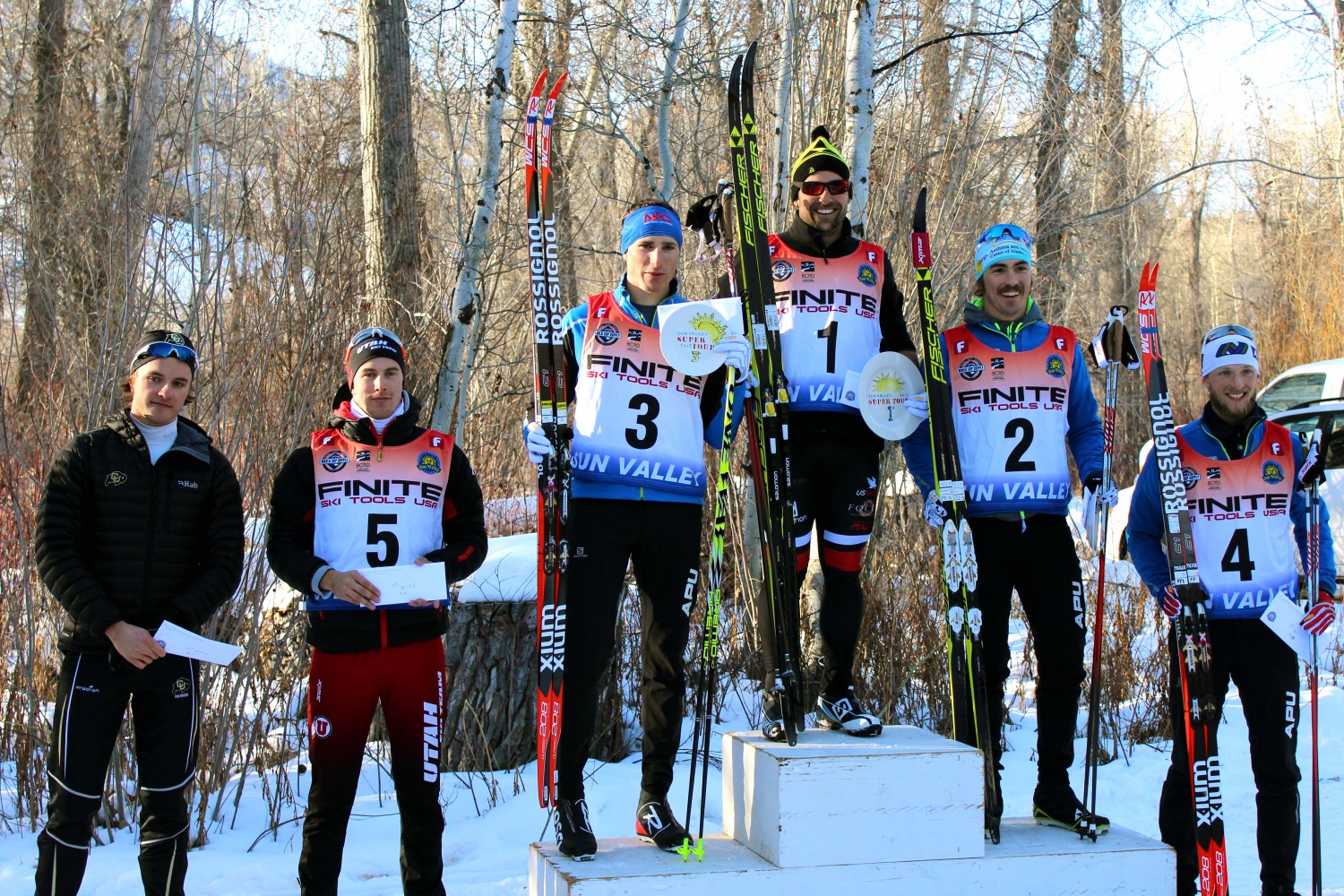
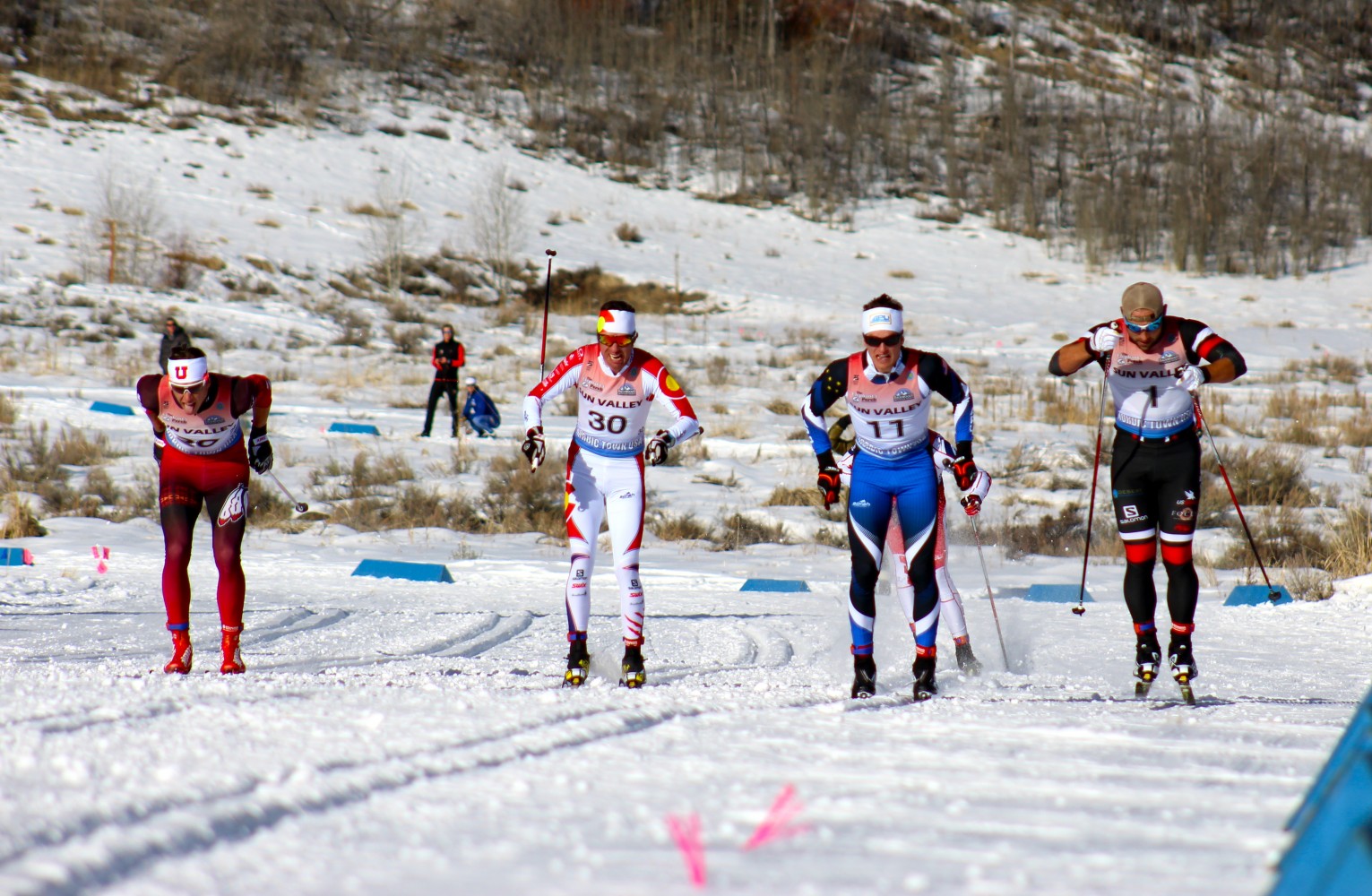
The men’s SuperTour classic sprint podium on Saturday in Sun Valley, Idaho: (from left to right) sixth-place finisher Petter Reistad (University of Colorado-Boulder), Niklas Persson (University of Utah) in fifth, Tyler Korfield (APU) in third, winner Dakota Blackhorse-von Jess (Bend Endurance Academy), Reese Hanneman (APU) in second, and Eric Packer (APU) in fourth.
SUN VALLEY, Idaho — Patience and sprinting go hand-in-hand, or so says the men’s SuperTour 1.3-kilometer classic sprint winner, Dakota Blackhorse-von Jess.
“Being patient can often serve you really well,” said Blackhorse-von Jess (Bend Endurance Academy) during a post-race interview on Saturday on the Lake Creek trails.
“I learned a lot about how I was feeling, how the course was feeling, and how my skis were feeling in that first quarterfinal. Patience was really the name of the game and I kept it all day,” he explained.
“The game plan [going into Saturday’s race] was to improve upon last week’s results,” Husaby said.
“Historically he’s gone out pretty hard in all the rounds, so it was nice to see him work his way through each of his heats from fourth or third place up to the front,” he added. “I think he was confident and he skied really smart all the way through today.”
Dakota Blackhorse-von Jess (Bend Endurance Academy) (r) moves to the outside to get around David Norris (APU), Tad Elliott (SSCV) and Kevin Bolger (University of Utah) during the men’s SuperTour 1.3 k classic sprint quarterfinal on Saturday in Sun Valley, Idaho.
With confidence and patience, Saturday’s SuperTour classic sprint winner skied through the rounds in the middle of the pack — rather than charging the front.
Even up until the final 100 meters of his quarterfinal, Blackhorse-von Jess trailed David Norris of Alaska Pacific University (APU) and Kevin Bolger (University of Utah).
With the pressure on in the finishing straight, Blackhorse-von Jess made his move, stepping out of his lane to ski around Bolger and Norris on the outside.
The three then lunged for the line, with Blackhorse-von Jess ultimately winning the quarterfinal in 3:05.98, just 0.18 seconds ahead of Bolger and 0.75 seconds ahead of Norris.
The semifinal played out similarly, as Blackhorse-von Jess sat back while Miles Havlick of the Sun Valley Ski Education Foundation (SVSEF) and Eric Packer (APU) lead the heat until the final downhill.
What Blackhorse-von Jess called “phenomenally” fast skis helped him catch Havlick and Packer by the last turn into the finish, where he passed the two — again on the outside — for the semifinal win in 3:04.37, edging Packer by 0.62 seconds and Havlick by 0.78 seconds.
In another close and stacked semifinal, APU teammates Reese Hanneman and Tyler Kornfield (who would go on to place second and third in the final) lunged for first and second, respectively, with 0.28 seconds separating them. Hanneman won the heat in 3:04.23.
Taking the opposite tactic of Blackhorse-von Jess, Hanneman led his semifinal from the first climb until he crossed the finish line.
“I tried to ski at the front and control [the semifinal],” Hanneman explained. “I wanted to pace myself a little bit for the final, because I knew I was going to see Dakota there and I wanted to have a good chance to throw down against him.”
Reese Hanneman (APU) (l) and Mads Strøm (University of Colorado-Boulder) out of the start during their quarterfinal in the men’s SuperTour 1.3 k classic sprint on Saturday in Sun Valley, Idaho.
Though Hanneman’s front-runner tactic differed from Blackhorse-von Jess’s, his belief in the power of patience did not.
“I classic ski really well if I can keep it relaxed,” Hanneman, 25, said. “So I focused on stretching it out and using the terrain to stride big.”
Kornfield also found staying calm during Saturday’s rounds helped him to the podium.
“I like to take it off from the back and see how the field is skiing,” Kornfield, 24, said. “I start a little slower and pick my way up as the course goes on.”
Also advancing to the final from Hanneman and Kornfield’s fast semifinal were two lucky losers, Petter Reistad (University of Colorado-Boulder), who was 0.37 seconds back in third and Niklas Persson (University of Utah), 0.52 seconds back in fourth.
Despite the stacked sprint finalists toeing the line, Blackhorse-von Jess, 29, managed to maintain his winning composure through Saturday’s final.
After the gun, he positioned himself in third behind Packer and Hanneman until the top of the last hill. Blackhorse-von Jess then maneuvered into a tuck behind Hanneman for the final downhill, and once more took the outside corner for the overall win in 3:00.45.
Hanneman finished 1.13 seconds later in second and Kornfield was 4.11 seconds behind Blackhorse-von Jess in third.
Rounding out the final was Packer in fourth (+6.02), Persson in fifth (+9.06), and Reistad in sixth (+35.21).
With his first SuperTour win of the season under his belt, Blackhorse-von Jess said he would continue tapping away at other season race goals.
“What I’d really like to do is get back in the rounds at the World Cup and have some success,” he said. “If I could bring this racing there, that’s the dream of being a ski racer.”
(Left to right): Miles Havlick (SVSEF) Dakota Blackhorse-von Jess and Eric Packer during the semi-final of the men’s SuperTour 1.3 k classic sprint on Saturday in Sun Valley, Idaho.
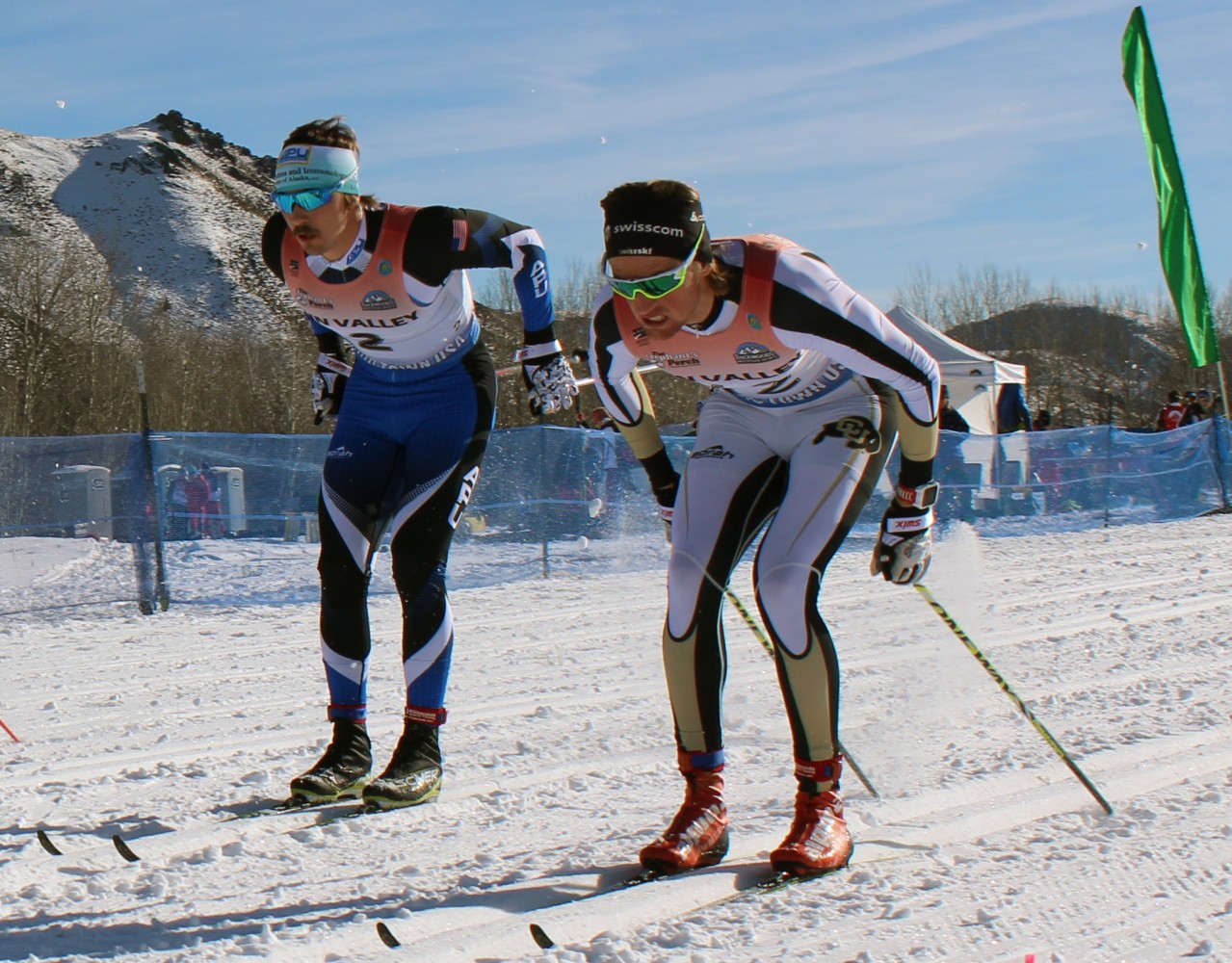
Dakota Blackhorse-von Jess (Bend Endurance) and Eric Packer (APU) take it out in the final heat of the men’s SuperTour 1.3 k classic sprint on Saturday in Sun Valley, Idaho.
Reese Hanneman (APU) (l) leads teammate Tyler Kornfield (APU) during their semi-final of the men’s SuperTour 1.3 k classic sprint on Saturday in Sun Valley, Idaho.
Dakota Blackhorse-von Jess (Bend Endurance Academy) on his way to placing 52nd in the World Cup classic sprint last February in Davos, Switzerland. (Photo: Felgenhauer/Nordic Focus)
This edition of Wednesday Workout was submitted by Dakota Blackhorse-von Jess, the man who dominated the coveted Frozen Thunder classic sprint last week in Canmore, Alberta, and had time to take names: beating U.S. Ski Team members Andy Newell and Simi Hamilton in the process (to be fair, they were on skate skis, but hey, that’s racing). The Norwegian website Langrenn even gave him a shout out on Facebook (translation, “Dakota Blackhorse, lovely name for a cross country runner”).
Upon catching up with Blackhorse-von Jess, who flies solo under coach Ben Husaby at the Bend Endurance Academy in Oregon, we asked him what gives and why he’s so fast this time of year.
Dakota Blackhorse-von Jess (l) gets the inside line while rollerskiing head-to-head with Skyler Davis (c) and Sam Tarling earlier this month at Soldier Hollow in Midway, Utah. (Photo: Tom Kelly/U.S. Ski Team)
“We’ve really been focusing the last 4 years on systematically building my aerobic fitness,” Blackhorse-von Jess, 27, wrote in an email. “Coach Ben and I started with a focus on volume on base training and through the years have progressed to a level where I can sustain high levels of quality work – and clearly it’s paying off.
“All of the indicators in training have been pointing to increased aerobic capacity and efficiency at sustained intensity efforts, so the takeaway is validation of the success of our model thus far,” the Dartmouth grad added. “Racing is so much fun, being back on the road and seeing all my friends and getting back in the wax room with Scott Johnston and Sam Naney of MOD, and for sure being in the mix with Andy and Sim who set the bar for the rest of us was awesome.”
Well said, Blackhorse-von Jess.
Now here’s what he does:
The Workout: Threshold Plus (bounding in mixed terrain)
Explained: The transition into fall training for us means a change in the level of intensity. For the first time since the training year started in May, I get to play in the area of threshold – and threshold plus. Over the 10 years Coach Ben and I have worked together, we’ve developed both long term (year-to-year) and short term (month-to-month) training progressions. As with all things in life, experience is the best teacher and we have learned so much over the years by constantly adding new pieces cherry picking the best ones. This organic and highly collaborative style of training functions, in no small part, because of the way we have grown to understand the work we’re doing.
I mention this because feeling the workout is hands down the most important part. Yes, I use a heart rate monitor when I’m training – especially in intervals. It’s primary function, however, is actually post-workout where we can better determine if we are achieving our goals. There is a whole lot more than goes into creating a training plan that I’ve gone into here, not the least of which is understanding the science. The what and the why of different types/styles of workouts are important for Nordic skier development, but once those have been decided the how makes all the difference.
Wednesdays we hit the trails:pole bounding in mixed terrain.
Warmup: Approx. 30 minutes with 10 minutes or so of bounding specific warmup: ski walking, moosehoofing, and full on explosive bounding in addition to some muscle memory/technique drills
Intervals: 5 x 4-“ish” minutes over set terrain, with the primary goal being to spend as much time as possible at or above threshold without slowing down from interval to interval.
Recover 4-“ish” minutes between. “Active” recovery is key, but how active a person can be in recovery is totally individual – just try to keep the heart rate down in Level 2 or below and work out the lactate best you can. I walk/jog between… once I get my breath back.
(While I dearly love the flowing nature of intervals over constantly varying ground, it’s easier to measure the workout over set terrain. We found a perfect place to work on mid-interval acceleration and then survival, which was a big goal of Ben’s for me this fall as it has been a piece missing in my racing. I say 4-ish minutes because my finishing marker was just a hair over 4 minutes when I started… and I was about 15 seconds faster by the end.)
Doing It Right: Bounding in the woods is not necessarily a function of speed – you can almost always make the work harder by doing it “more correctly.” Just pushing harder usually means a breakdown in technique, which has huge application to ski racing where technique breakdown under duress can have catastrophic consequences.
That said, measuring time over set terrain really helps me understand the changes in feeling my body goes through as I fatigue. Keeping even splits, or dropping negative splits, over the intervals is still the goal.
The first couple intervals are usually about holding myself back (although not everyone experiences training the way I do, so take this with a grain of salt), I get to push a little bit in the third, push more in the fourth, and then dig deep in the last interval to keep getting faster.
By appropriately using the first couple intervals and the first minute or two of each interval to prime your system, there is a natural flow into anaerobia. We try to structure one workout a week to maximize the time spent anaerobic, and this one has been a real gem for us.
Cool down: 15 minutes-“ish.” However long it takes to get moving again and get some of the junk out of your body.
Dakota Blackhorse-von Jess (Bend Endurance Academy) skating to a career-best 38th at the Quebec World Cup freestyle sprint last December. (Photo: FlyingPointRoad.com)
Note: This is the eighth preview in our U.S. elite-team series, which we’ve dubbed the “The 12.” We asked coaches to tell us what’s new and whom to look out for in the coming season and will publish additional previews in the coming weeks in no particular order.
Team: Bend Endurance Academy (BEA) a.k.a “The Dirty Ravens,” according to coach Ben Husaby.
Coach: Ben Husaby (Executive Director and Nordic Director as well as van driver, cook, DJ and pop psychologist).
Support: “J-Beck,” Justin Beckwith (Green Mountain Valley School) for testing, Scott Johnston (Methow Olympic Development) for application, and “J-Nice” (New England Nordic Ski Association) for top-tier resource procurement at major competitions. “Although we have decided that all of this will not be necessary in the future after reading this study, this might be the advantage we have been looking for,” Husaby wrote in an email.
Roster: This guy: What could he be thinking?
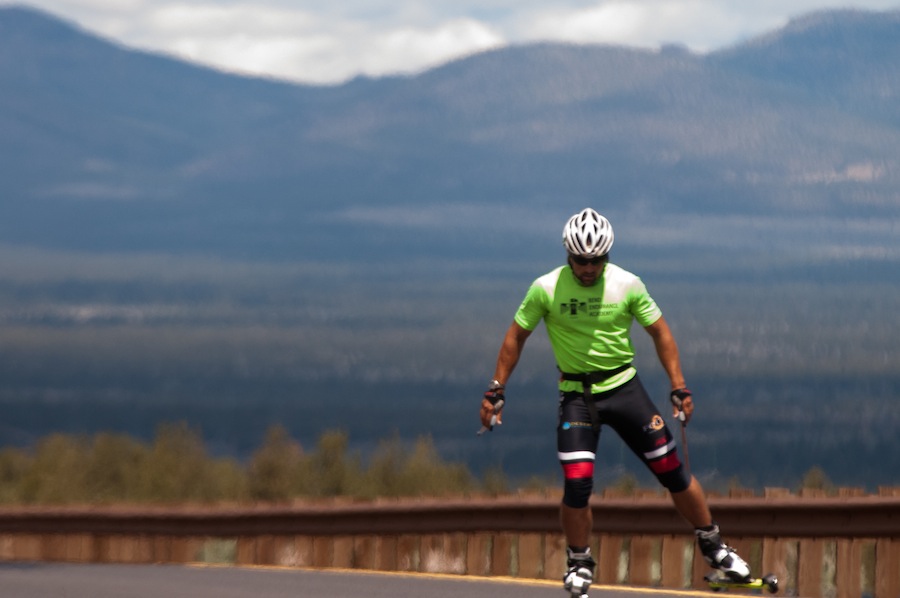
Bend Endurance Academy’s lone elite-team athlete: Dakota Blackhorse-von Jess (Photo: Ben Husaby)
Who’s new: No one for winter, but the BEA has “a ton of new and returning ravenettes that have come around for summer training,” Husaby explained. “They have done a fine job of pushing the lead bird.”
Notables include Rogan Brown (University of Vermont), Jordan Buetow (Bates), Bella Smith (Montana State University), Elena Breed (University of Denver), Reitler Hodgert (The College of St. Scholastica), Tony Squallace (Gustavus Adolphus College), and Joel “The Filth” Bransky (St. Olaf College), as well as Ben Grodner (Wasatch Nordic Ski Academy), and Pat Madden is on loan from the Bridger Ski Foundation.
Who’s missing: Lars Ellefson. “He has embarked on a long desired (secret) passion; body building,” Husaby wrote.”(This is not a joke).” Well, sort of. He’s a big-time gym rat and works at the Central Oregon Community College club sports department, Husaby explained. “We have lost him for the time being.”
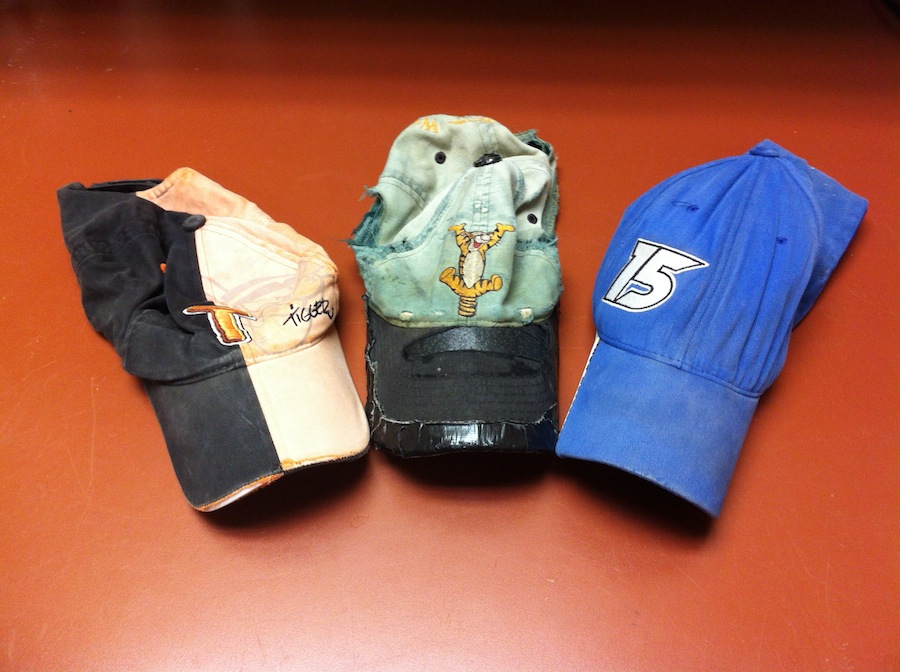
“For the future, we would like to offer this once in a lifetime opportunity,” Husaby added. “If you choose to hang out with us we will give you one of these as a token of our appreciation.” (See below)
VonBallCap (Photo: Ben Husaby)
Top results last season: According to Husaby, it’s a tie for Blackhorse-von Jess between “getting the opportunity to compete with ‘our’ awesome Americans on the World Cup. And being given the play by play from Halsey at US Nationals, Classic Sprint Semi, where the commentary went from ‘Dak is down!’ at the start to ‘Dak is in the lead!’ down the finishing stretch. I have a hard time watching sometimes.”
Dakota Blackhorse-von Jess and coach Ben Husaby, the two main components of the Bend Endurance Academy in central Oregon. (Photo: Ben Husaby)
Blackhorse-von Jess, 27, won the freestyle sprint at U.S. nationals in Midway, Utah, following a bronze-medal finish in the classic sprint at Soldier Hollow. After placing 38th in the Quebec World Cup skate sprint in early December, he went on to qualify for the World Cups in Switzerland (Davos), Finland (Lahti), and Norway (Drammen).
Coach’s comment: “I would like to think that we offer a very comprehensive and complete training atmosphere where everyone can reach their personals goals,” Husaby wrote. “We had great success last year with Pat, Bella and Rogan making it to the NCAA championships. In the future we would certainly like to entice skiers to consider Bend and BEA as their place to roost. It certainly is taking shape during the summer months. I buy a lottery ticket every week hoping to hit it big so I can underwrite it all. But in the meantime Dakota and BEA’s great supporters will focus on trying to get him to the highest level.”
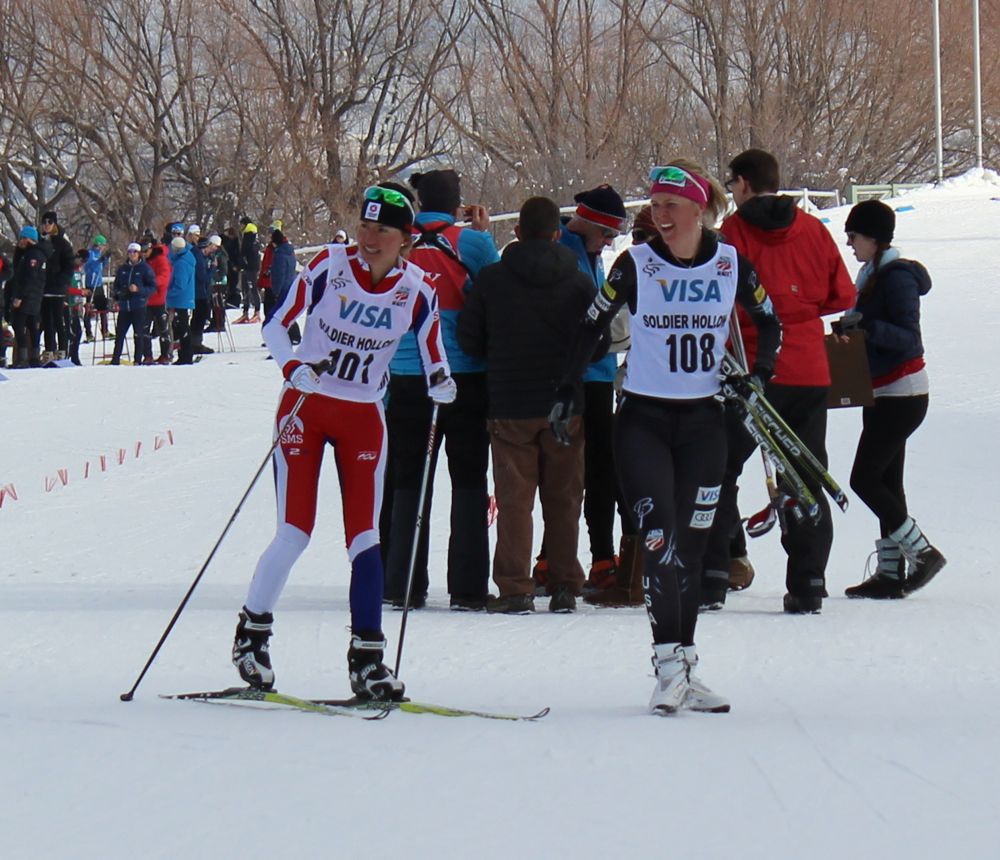
Sadie Bjornsen and Sophie Caldwell, waiting for the outcome of their photo finish to come through in the freestyle sprint at U.S. Nationals.
FasterSkier’s coverage of the 2013 U.S. Cross Country Championships is brought to you through the generous support of The Memory Clinic in Bennington, Vt.
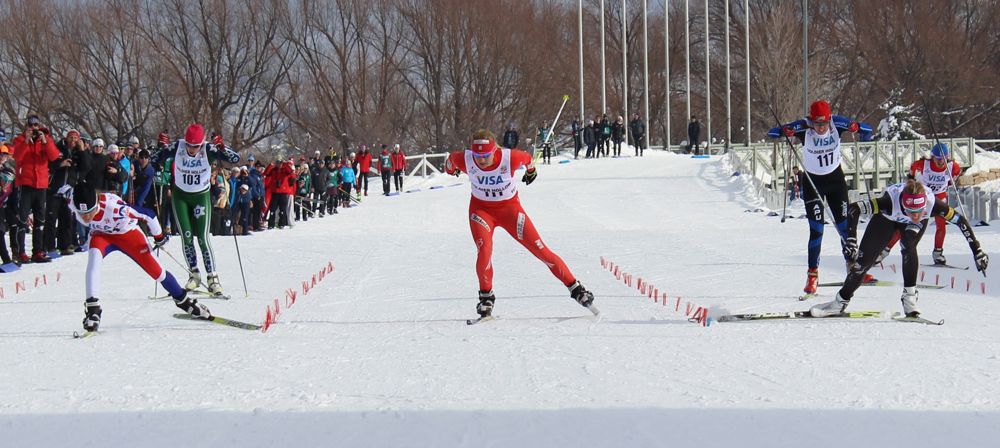
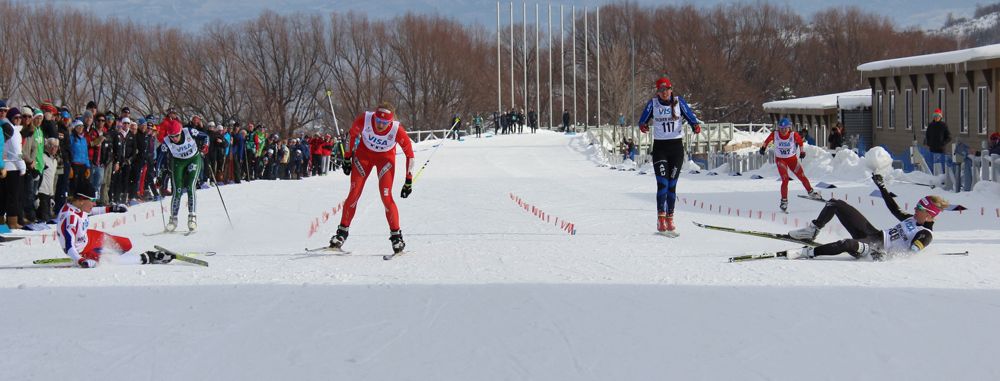
MIDWAY, Utah — Skis cleaned, bags packed, flights boarded. The hundreds of athletes, coaches, parents and fans that camped out at Soldier Hollow for the past week have all either gone home to recuperate or are on their way to the next race. As usual, athletes were so verbose in describing their races we couldn’t fit it all into our race reports. The final edition of notes and quotes from U.S. Nationals: skate sprint style. Dakota Blackhorse-von Jess (Bend Endurance Academy), the men’s victor, had particularly interesting things to say about the unusual dynamics of Tuesday’s race.
On the beginning of a ski career:
“I was living in Pocatello, Idaho, and I chased a girl into [skiing]. And when I left Pocatello I kept doing it and I liked it, I don’t know why. I wasn’t especially good at it. I was already a two-sport athlete, I ran cross-country and track, and it just fit really nicely in the winter. It was better than wrestling; I didn’t like wrestling all that much.”
“[Dakota] came to skiing very late. He basically decided his junior year of high school that he wanted to be a ski racer, and I continued to work with him a little when he was at Dartmouth.
“Just in the last few years we decided to make a run at it. We’re a pretty small team on the high-end level; we don’t have a lot of athletes or a ton of resources, but we work well together. Dakota’s unique in the way he approaches racing and training… It’s just been really fun to watch him move from fifth place few years ago to first place this year. He was always fast at qualifying. Most amazing to me was he showed he can ski consistently all the way through heats today on very challenging sprint course. It was obvious the distance skiers fared well and the sprinters had a harder time. This is a testament to his preparation and his commitment.”
— Ben Husaby, Bend Endurance Academy head coach
On the longer men’s course:
“Today was a much different sprint than we’re used to. It was longer course and it starts with a long climb. That’s a lot longer than you can ski maximally… Watching others race and also from my experience out there [I learned] this course is suited towards the distance skiers, especially based on the qualifying results. I knew that the pure distance guys were going to go for it and they did in the semifinal, and I knew if I just went for it and stuck with them everything would be OK.
“But it also changed the race dynamics because if you’re not a, quote, sprinter, you have to take it there [at the start] as we saw with Tad and with Erik to a certain extent — although Erik’s, you know, a good sprinter. But Tad is certainly not known for that, and in the classic race as you probably saw it was very slow, very tactical, because the guys with strong double-pole finishes were just waiting. That’s what it wound up being. But today it was very, very different because no matter how good your V2 is, if you’re not in the race you’re not in the race… And that’s what those guys without — and it’s really not fair to say they don’t have V2s, because Tad is a good skier. But it’s not the same.”
— Blackhorse-von Jess
On strategy:
“Erik told me right before the start, ‘You have to kick extra hard right at the end of the bridge,’ so I tried to think about that.
Sadie Bjornsen skiing through the semifinals. Photo: Sarah Brunson/USSA.
“It’s not necessarily the slingshot so much as just being in the right place. You need to find a place to ski and if you’re behind then it’s hard to move around, so it’s more just positioning coming into the final line. But there’s a lot of time between that final corner and there so there’s places to make it up if you were in the wrong place.”
“I worked on some tactics … I was right behind Tad and then over the top hill I kind of let him get a couple feet and just slowed up to kind of get Dakota to bunch up a little bit. I just hammered over the top, and I’ll be interested to see some pictures and see if that kind of worked. And then he had some momentum in the finish, but I think I had three or four strokes where I just relaxed and that’s where I lost it. As soon as I got out of my tuck I needed to just hammer with all I had left.”
— Erik Bjornsen (APU/USST), 2nd
“Caitlin Gregg took it out pretty fast. I talked to her after and she said she wasn’t as confident in her final sprint. She thought her chance was kind of taking it out from the start and dropping some people, but we stuck with her. I tried — I wanted to be in second or third coming into the downhill because I knew there was a draft. It wasn’t the end of the world if you were in that position but I was just getting really flustered on the downhill and the heats before then because it was harder to pass.”
— Sophie Caldwell (SMS T2), 2nd
Alex Howe coming around the final bend in the quarterfinals. Photo: Sarah Brunson/USSA.
“I really just wanted to hang in and get a good position in the downhill. It really came down to whoever was in 2nd, 3rd, 4th, and if you got enough of a draft you could just slingshot around the corner. So I was just looking for that spot. It worked out pretty well in the quarters and semis and in the finals it was a little rougher because we had to make up a little bit of a gap that they built on us, with Tad hammering off the front.”
— Alex Howe (Craftsbury Green Racing Project), 3rd
“I think I may have been fourth and then I wanted to take the inside of this corner because it’s been working for me so far. I think as long as you assert yourself you usually get it so I kind of made a point of getting in there and tried to hit it really hard going over the top [before the finish].”
— Becca Rorabaugh (APU), 4th
“Every heat it just waited ’til the hill underneath the bridge — the steep one — and I seemed to be able to close some people on that. So I just kinda waited until the end, passed a few and then it was just a drag race to the finish. A little tight in the finishing chute, but that’s racing.”
— Logan Hanneman (University of Alaska, Fairbanks), 4th
“Like this course always does, we all ended up down there again together… All the quarter and semi I was just trying to play it easy in the back here and then really go and make sure I had a good slingshot. Our skis were so fast today, and it was advantageous to be in the back and move slowly through the pack. So that’s what I did every quarter and semi, until the final. For the final I just found myself a little bit further back.”
— Sylvan Ellefson (Ski & Snowboard Club Vail/Team HomeGrown), 5th
“I think it was really key, at least in the qualifier, to just ski so smooth. Especially when you’re at altitude or whatever, the higher tempo, the harder you work and the gains aren’t that significant. So in the qualifier I just tried to stay super smooth and then in the heats just not leading on that downhill was pretty clutch.
“It’s funny, because no one wants to lead on the downhill and I’d just start gaining and I think the further and further into the heats, when everyone starts realizing that’s a really bad idea, it gets kind of funny because everyone’s got the same game plan. So it’s more of a mental battle. Just like, all right, who’s gonna go? Because someone has to. You can’t just like stand on the top of the hill for five minutes and be like, ‘After you.’ ‘No, after you (laughs). I was just so glad and everyone’s awesome and I love Sophie and she did great.”
— Annie Hart (Dartmouth College), 5th
On the final lunge:
“I wanted to be in a good position to take the inside corner, but then Sadie and Jennie came by me and I got even more flustered. I ended up going way outside on the corner but the finish stretch is so long that there is still time to make up. Sadie and Jennie came around, then I think I was in third going into the final stretch. I think I was slowly gaining and tried to do a big lunge.”
— Caldwell
“I didn’t feel as good as I did in the classic, so I’m definitely a little disappointed in myself for not lunging. I think I’m going back and realizing I don’t think I lunged at the finish, but that’s going to be a good finishing picture at least.”
— Jennie Bender (Central Cross Country), 3rd
The lunge.Post-lunge.
“I got lucky in the lunge in the semi and then I got kinda the other end of the lunge in the final. But yeah, it was pretty sweet.”
— Hanneman
On that distance guy in the A-final:
Elliott leading the A-final before the downhill.
“I feel like I was skiing super relaxed all day, and I knew in our quarterfinal I’d have to outkick some of those guys. And it happened! I can’t believe I out-kicked some of those people! It was partly that our skis were really good. It was sweet — I’m a tiny guy, so…
“In the semis, like, those guys are such good sprinters. Like Skyler, Mikey, Tim, Dakota. So I was like, ‘Oh man, I can’t out-kick any of these guys,’ so I just tried to go from the gun and it ended up working good.”
— Tad Elliott (SSCV Team HomeGrown/USST), 6th
“I was really hoping Tad was just going to gun it from the start. I pulled up beside him, which I don’t know if it was kinda like, ‘You go for it Erik,’ type thing. Maybe I just should have sat in from the start.”
— Bjornsen, 2nd
“Tad went really hard up the hollow. He was telling me, ‘That’s my only chance!’ So yeah, he went hard and then I was kinda out the back.”
— Hanneman
“It was good, fast racing. It was awesome having Tad pushing the pace today; it totally different. In my quarter and semi we weren’t going the fastest sprint pace I’ve gone. So in the final he was doing a good job of pushing that pace. Which I think, if he wanted to win today, was what he needed to do. So it was a great tactic by him.”
— Ellefson
“It makes it more — it makes it more like bigger races, more like the World Cup. Because these races here are — they don’t feel the same because everyone’s just siting there waiting for the next guy to do something, because nobody’s gonna, quote, get away. Whereas at a higher level, absolutely they will. And it’s easy for the top five of us or so, over the course of the day, to sit in and do very little and then kick it down at the end. Whereas on the bigger stage I would have to guess that that’s not the case, based on our results. So it actually made it a lot more fun in some ways.”
— Blackhorse-von Jess
On making improvements:
“I think it’s just the stress-free way of life. I might have done a bit too much socializing in college, lets call it that. So I think the laid-back life in Craftsbury is much more suiting to my personality and everything. I grew up on a farm, so Craftsbury is right at home for me out in the backwoods, no cell phones — it’s perfect. So with less distractiosn and a quieter lifestyle I think I do a lot better, apparently.
“For this season, I mean, I’d like to continue. Just use this as a builder and keep racing fast and try to race the whole sason as fast as I can. I’ve had seasons in the past where I race fast at certain points and I’d like to just stay consistent and keep building up. Hopefully that’ll happen.”
— Howe
“Two podiums: I don’t know what that means. It means I’m starting to get better so that’s a plus. It’s better than last year, which surprises … me, that that happened.
“My whole kind of approach is trying to keep a neutral mentality and to leave the option open for anything positive to happen.I definitely was going into this clueless of how things would go, especially after I was disappointed in November about how I was racing. But everyone was like, just — patience. I’m really happy that I’m sprinting well. Distance is my next measure of health comeback so I’ve been kind of saying that if I — when there was a lot of negative possibility or negative mentality, that I would not let that creep in and kind of stay neutral and that’s worked out OK.”
— Bender
“The quarter went pretty well and people relaxed a little on that first turn. So then that went well and then just an avalnche from there. You get feeling better.”
— Hanneman
“It’s funny because in my qualifier, I felt so terrible. But I honestly think it was like a jump start for the day, probably for the rest of the season, who knows.”
— Ellefson
“This is my best finish ever at U.S. nationals. It’s super exciting. I think it helps to be so relaxed.”
— Rorabaugh
“I’m really excited. I really worked on my turnover and hopefully it’ll get working in distance races. I think it was a good step forward.”
Dakota Blackhorse-von Jess of the Bend Endurance Academy rollerskiing in June in Oregon. He increased his training hours this offseason in an attempt to build a bigger aerobic base. (Photo by Curt Hawkinson / curthawkinson.smugmug.com/Nordic)
When Dakota Blackhorse-von Jess shows up at a race, he’s hard to miss. If his backward baseball cap doesn’t give him away, his bubbly personality, bearded face or black, red and white-striped spandex will.
One of the staples of Bend Endurance Academy’s nordic program, the 26-year-old Blackhorse-von Jess grew up in Bend, Ore., and skied for Dartmouth College before returning to his native state – and town.
Dakota Blackhorse-von Jess (third from right) and other Bend Endurance Academy athletes during a rollerski session in June near Bend, Ore. (Photo by Curt Hawkinson / curthawkinson.smugmug.com/Nordic)
Back in Bend, Blackhorse-von Jess trains mostly with his coach, Ben Husaby, and the three-man BEA elite team (including Reitler Hodgert and Lars Ellefson), while joining the Methow Olympic Development (MOD) program for workouts.
Known as a sprinter on the U.S. domestic circuit, the short-statured Blackhorse-von Jess typically uses his aggressive style to blast through the heats and into the finals. He captured silver at the U.S. nationals skate sprint last season and was the runner-up at the SuperTour classic sprint in Madison, Wis.
The next day at the skate sprint in Madison on Feb. 19, Blackhorse-von Jess failed to qualify for the quarterfinals for the first time that he could remember in his pro-racing career. It was a blow that set him back in the last SuperTour sprint of the season and one he attributed to missing the wax while prepping his own skis.
Moving on, he planned to race at the SuperTour Finals in Craftsbury, Vt., but come late March, health issues kept him from it. The Madison sprint ended up being his last race of the season.
Overall, Blackhorse-von Jess finished 24th in the SuperTour standings and fifth in the sprint category for his best career ranking. Still, the man with the three-part, four-syllable last name wanted more and he’s been working all summer to achieve it.
FasterSkier recently emailed Blackhorse-von Jess after he tweeted about paddleboarding with the musician Michael Franti. Turns out, he didn’t actually hang out with Franti, but saw him from a unique vantage point.
***
FasterSkier: Please explain this tweet: “Paddle boarding and Michael Franti? Yeah. That happened. And it was awesome.”
Dakota Blackhorse-von Jess: Ha, not actually paddleboarding WITH Franti (although a friend of mine who teaches lessons did actually give him a lesson), but I’ll explain: The big concert venue in Bend is right along the river. My roommate came home … and said “hey – I’m headed down to the river to paddleboard, I hear Franti is playing. Wanna go?” so we grabbed some boards and paddled around and listened (and actually got to watch) the concert. Pretty fun times, but it’s sort of a reference you have to understand Bend to get right away.
FS: How has the rest of your summer been?
DBVJ: Great. The camps were awesome, training is going well, I’ve been working my a** off so I can pay for ski racing this winter, and I even managed to have some awesome surf days during our PNSA/Far West training camp in NorCal. Getting ready for fall though … I think everyone is looking forward to West [Yellowstone, the SuperTour opener in November], especially since that’s the next time I get to see all my college friends that have taken off for school already.
FS: Whom have you mostly trained with?
DBVJ: As of Monday, a week ago most of our college/older kids went back to school or are taking a couple weeks at home (technically the program is on “vacation” for two weeks) so it’s just me and Reitler Hodgert for the moment, but Lars Ellefson will be back soon, and our high school and post grads will be filling the van up once we get back on normal schedule. The fall is the loneliest time here, but it’s also hands down the best time for training and it works better in a small group. I’m psyched.
Our summer group was fantastic, as always. Keep your eyes on Bella Smith (now skiing for MSU). I predict she’s gonna make some waves. But it’s definitely a big void with all of them gone: we have 8 or 9 skiers from our summer group back off to college and a bunch more going back to high school, so instead of two vans going to training, we could take a single car … It’s different for sure. But it means less fighting over surfboards at the coast camps!
FS: What have you been focusing on?
DBVJ: The focus this summer has been, as it has been for the last couple years, on developing my aerobic base. Logging some hours. This year we’ve done a little more intensity work than last summer and have tried some cool new training methodologies (especially after the success the MoD Squad demonstrated using them last year) that we think are going to show some pretty neat results this fall. But the focus is definitely on continuing to build on my biggest weakness: a lack of years and years of base training.
FS: How does your training plan compare to last year?
Dakota Blackhorse-von Jess doing some non-ski-specific training last spring. (Courtesy photo)
DBJV: The biggest difference between this year and last year is the amount of non-ski work I’ve done. If things go well, I’ll be dropping some serious dough on travel and racing. So … saving up for that while having all the normal expenses of an adult living on his own with student loans and training full time has actually been the biggest focus of the summer. Training isn’t very hard – managing the rest of life so that it doesn’t impact training is the hard part.
FS: What are some of your goals?
DBJV: Goals for the coming season are pretty straightforward (and I expect a lot of people have this same list): first is to qualify for the world cups. Then, and more significantly, is to score some World Cup points in Quebec/Canmore. Second, I want to win a national championship.
If things go as planned, hopefully I’ll wind up at World Champs and maybe get to race some of the regular season European World Cups. But the plan is to do what I need to do so I can qualify for the World Cups in West and Bozeman, and then really be hitting high gear for the World Cups and US Nationals. It’s hard to know what’s gonna happen after that.
FS: How did you feel last season went?
DBJV: Last season was, like it seems all my seasons are, both up and down. I did more racing last season than usual (which was awesome), but learned some hard lessons it would have been awesome to have figured out years ago. Madison especially was a tough end to the season (although I didn’t know at the time it would be my last race).
FS: You mentioned financial struggles, which most skiers face. How do you manage to support yourself?
DBJV: I have an incredible support network here in Bend: somebody always knows somebody who needs some work done. I’ve done so many different jobs over the years and I own enough tools (or know people with tools) that I can do a really wide array of things. That helps a lot. Periodically I pick up web programming gigs, and I’ve been working super part-time as the systems administrator for a local dental office for something like 8 years. Odd jobs, 🙂
The amazing part is that everyone I work for is super respectful of my training schedule and actually wants to help me succeed in ski racing. It’s not that I don’t work a lot, because I do, but I get to be really flexible with it. There aren’t very many hours in the day when you pack all that stuff in, but it really makes you appreciate your days off (when I try to stay on top of the rest of my life … like laundry and mowing the lawn).
The takeaway is that people care a lot and WANT to help me out – I’m not unemployed or working minimum wage somewhere awful. Yeah, I don’t have money for, well, anything other than the basics and ski racing, but really? I’m living the dream. Who else gets to legitimately justify playing in the mountains?
Members of the Bend Endurance Academy rollerskiing in June near Bend, Ore. (Dakota Blackhorse-von Jess courtesy photo)
Bend Endurance Academy skier Dakota Blackhorse-von Jess (r) leads Tim Reynolds (Craftsbury GRP), Karl Nygren (CXC) and Skyler Davis (USST/SMS) on the final turn of the SuperTour classic sprint semifinals on Feb. 18 in Madison, Wisconsin. Blackhorse-von Jess went on to place second to Jari Joutsen of Finland.
Note: This is the second preview in a quick-and-dirty series on U.S. elite teams. We asked coaches to send their 2012/2013 rosters and tell us what’s new for the coming season. We will be publishing additional reports over the next few weeks. Teams are presented in no particular order.
Team: Bend Endurance Academy (BEA)
Coach: Ben Husaby
Roster: Dakota Blackhorse-von Jess, Reitler Hodgert, Lars Ellefson
Who’s new: Hodgert, moving up from junior ranks
Who’s missing: Max Christman (going to the University of New Hampshire) and Bella Smith (headed to Montana State University).
Top results last season: Blackhorse von-Jess won silver in the skate sprint at U.S. nationals in Rumford, Maine. Also at U.S. nationals, Hodgert placed second in the junior classic sprint.
Coach’s comment: “Bend is an awesome place to live and train,” Husaby wrote in an email. “The entire summer training group has finally arrived and is starting to gel; 25 strong with a mix of local juniors, juniors from the region and college skiers from around the country. Between the skiing, climbing, riding, and paddling, everyone is living the dream and looking forward to a solid summer of training and adventures.
“As BEA grows so do our resources and ability to support high level racing. Last year was the first year in which we traveled to many of the SuperTour events with Dakota [being the top American classic sprinter] in Madison and Bella Smith being very competitive in the early season Tours. We are going to support our athletes at a higher level this season. BEA will join forces with MOD as in past years working toward berths in the early season World Cups and success at US Nationals.”
Each year, Bend Nordic Team skiers travel to Newport, OR for a fall training camp coached by Ben Husaby and Brenna Knowles. The trip itinerary is simple. Surf, eat, intervals, eat, surf, rest, repeat! This year the ocean waves were kind to new surfers and fresh, raw oysters were a perfect post workout treat. The athletes enjoyed testing themselves at sea level. According to Dakota Blackhorse von Jess, “The roller-skiing at sea level was awesome because you can go as hard as you want without getting tired.It’s a great way to practice over speed at a high intensity level,” Now, the team has started their countdown to West Yellowstone.
Ben Husaby, a former Olympic cross-country skier and a six-time winner of Central Oregon’s annual Pole Pedal Paddle multisport race, has been dismissed from his position as nordic director of the Mt. Bachelor Sports Education Foundation.
Chuck Kenlan, director of MBSEF, said Friday that he could not discuss the reason for Husaby’s dismissal because it is a confidential personnel issue.
“All I can say is that Ben is no longer with MBSEF, and we wish him the best,” Kenlan said.
The Bulletin was unable to reach Husaby on Friday.