Tag: Ben Koons

  • Nordic Nation: A Backcountry Ski Race on Skinny Skis – Simi Hamilton and Ben Koons Take Second at the 2022 Montane Grand Traverse

    Nordic Nation: A Backcountry Ski Race on Skinny Skis – Simi Hamilton and Ben Koons Take Second at the 2022 Montane Grand Traverse

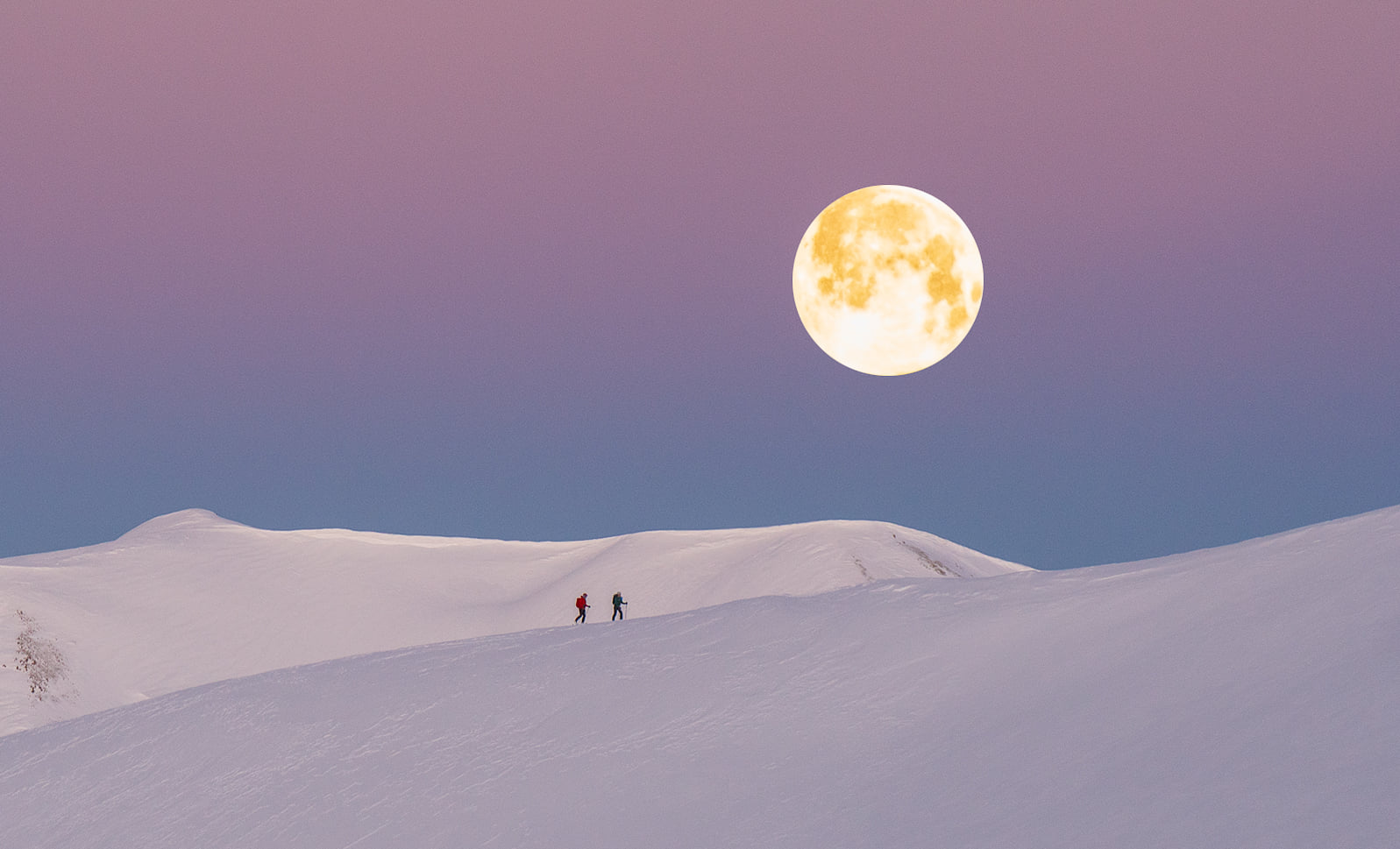
    The 2021 Grand Traverse saw a magical full moon under clear skies and mild temperatures. (Photo: Jesse Levine / Crested Butte Nordic)

    Tucked deep into snowy valleys, the tiny iconic Colorado mountain towns of Aspen and Crested Butte are separated by a mere 40 miles by foot, but roughly 200 miles by car in the winter. Separating the two is the expanse of the rugged Elk Mountain range, which features six of Colorado’s 14’ers, peaks that reach above 14,000’. 

    Now meccas of outdoor recreation, the two towns were historically established as profitable coal and silver mining sites, following the forced removal of the native Ute residents in the late 1800’s. In those days, communication between towns during the winter relied on the fortitude and alpine savvy of mail carriers, who skied back and forth between towns through burly terrain across a notoriously unstable snowpack. 
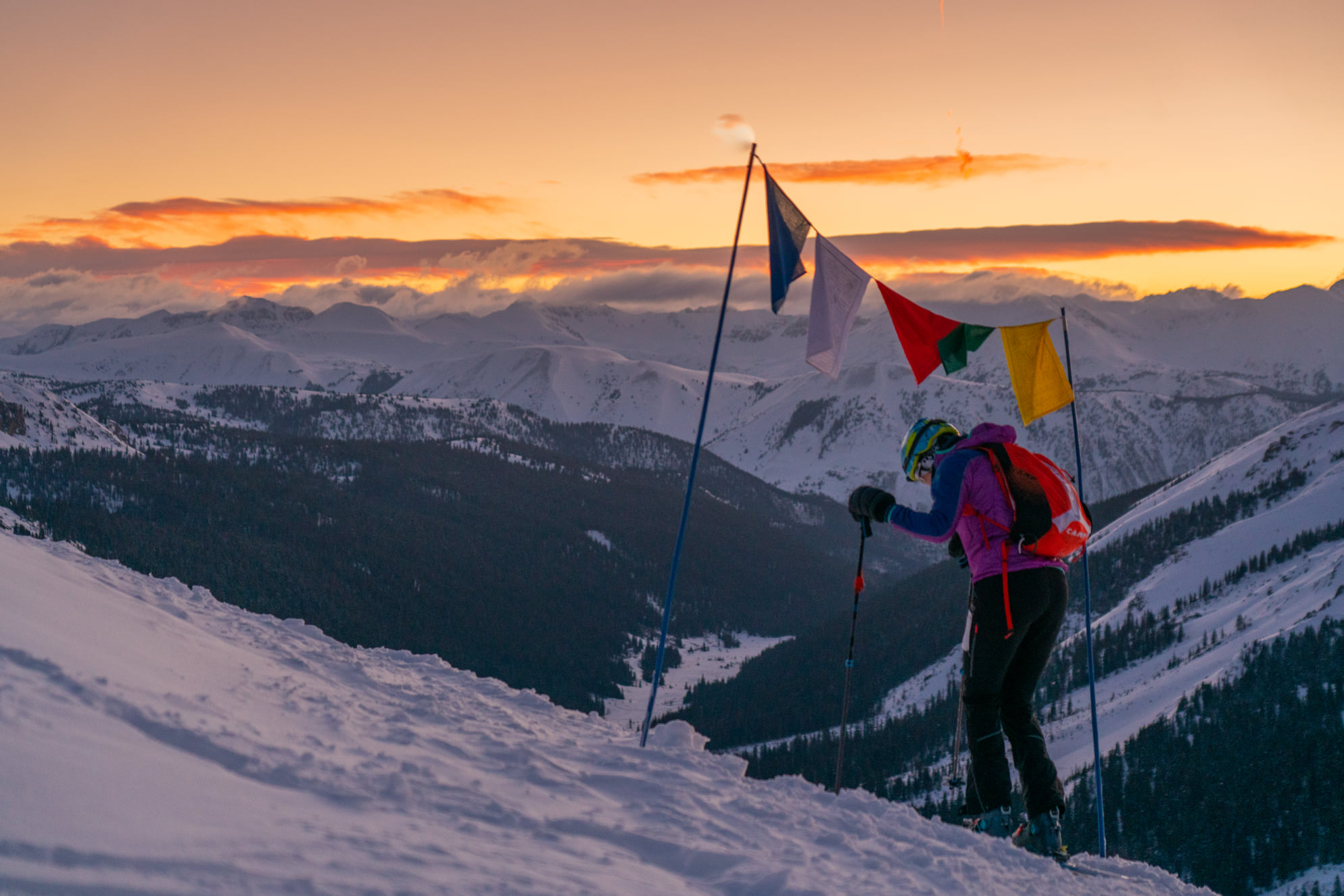
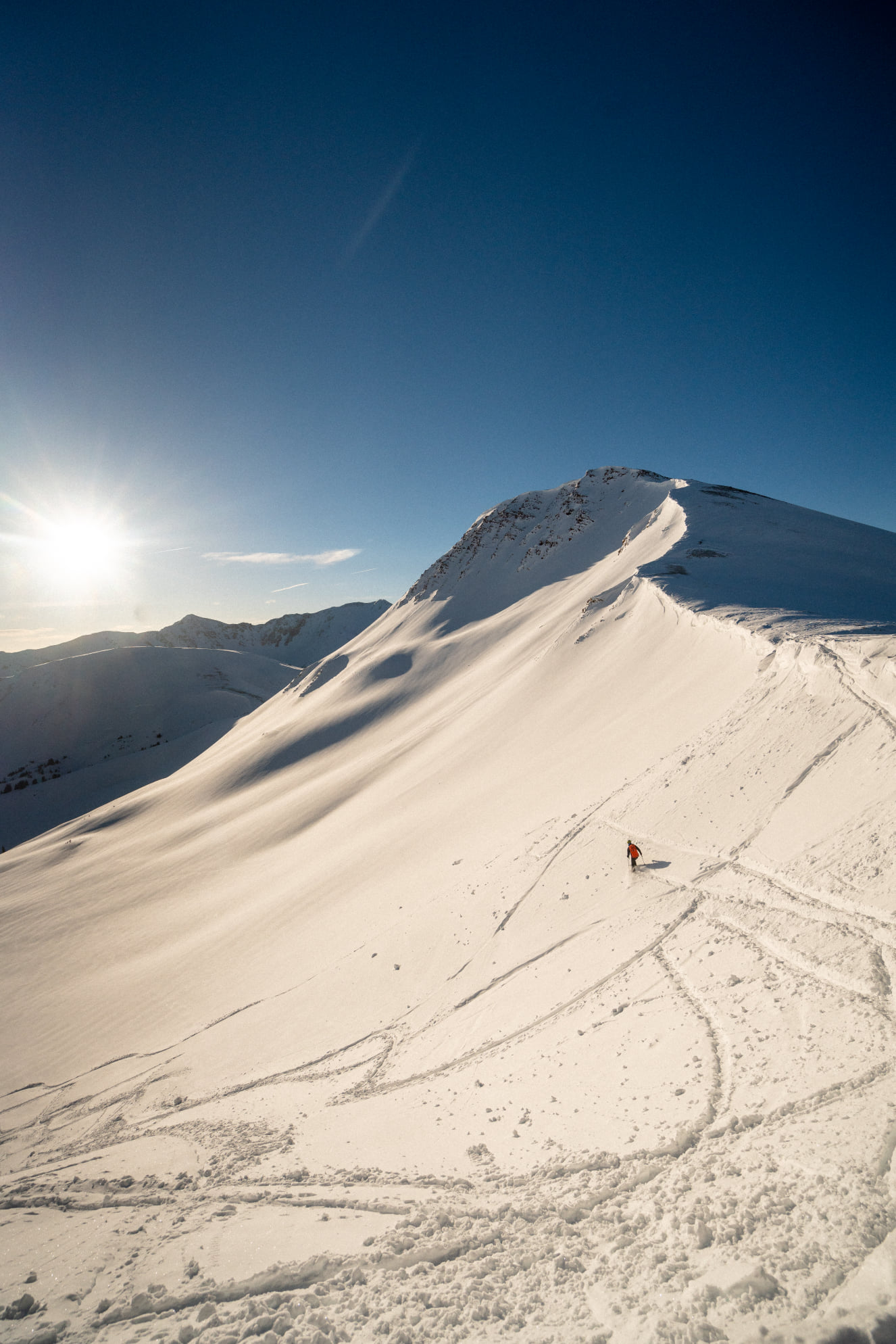
    A 2021 Grand Traverse racer descends off of Star Pass at sunrise. (Photo: Jesse Levine / Crested Butte Nordic)

    In 1998, this historic route was revived as a backcountry ski race called the “Grand Traverse”, which begins at the base of the Mt. Crested Butte ski resort and travels north over two 12,000-plus foot passes, with roughly 8,000 feet of elevation gain spread over the roughly 40 mile route. The inaugural winners (athletes must race in pairs), racing on metal edged cross country skis, were Aspen’s Travis Moore and Pierre Wille, local legends, and accomplished cross country skiers and alpinists. Moore, who taught at Aspen High School for more than 20 years and continues to coach the cross country ski program, eventually became the coach of a young Aspen resident, Simi Hamilton. 

    For many living in the Roaring Fork or Gunnison river valleys, the Grand Traverse (GT) is a storied annual pilgrimage, respected for the unique and burly nature of the route and its local lore as a rite of passage for endurance enthusiasts. Adding to the mystique, the race begins at midnight, allowing racers to cross the highest avalanche risk sections while snow is presumably frozen, firm, and at its most stable. The avalanche safety arsenal of beacon, shovel, and probe are part of a long list of items athletes must carry for safety, along with extra layers, an emergency shelter, and other items that reflect how deep into the backcountry the route leads and what it might take to survive a night out in the elements should something go awry. 

    A 2021 Grand Traverse racer receives instructions for the descent off of Star Pass from the safety dispatch stationed there. (Photo: Jesse Levine / Crested Butte Nordic)
    A racer descends off of Star Pass during the 2021 Grand Traverse ski race. (Photo: Jesse Levine / Crested Butte Nordic)

    With the rapid advancements in ski mountaineering technology, few still commit to cross country skis for the GT – SkiMo race skis with AT bindings or lightweight backcountry or telemark gear are more stable and typically handle better descending off the passes. But this year, the team of “Yeah, but we can skate” showed skinny skis aren’t yet an antiquated option for success at the GT, particularly if you’ve got the skills of two Olympians who have continued to foster their love for mountain adventures on boards less than 43 mm underfoot. 

    The duo was Simi Hamilton and Ben Koons, who lined up on Fischer skate skis. After a fast start skating out of Crested Butte, the team leapfrogged with eventual winners and top SkiMo athletes Cam Smith and John Gaston, who eventually broke away as conditions favored wider skis and metal edges. Smith and Gaston made it to Aspen in 6:13:15.4, just over 36 minutes ahead of Hamilton and Koons. (Results here)   
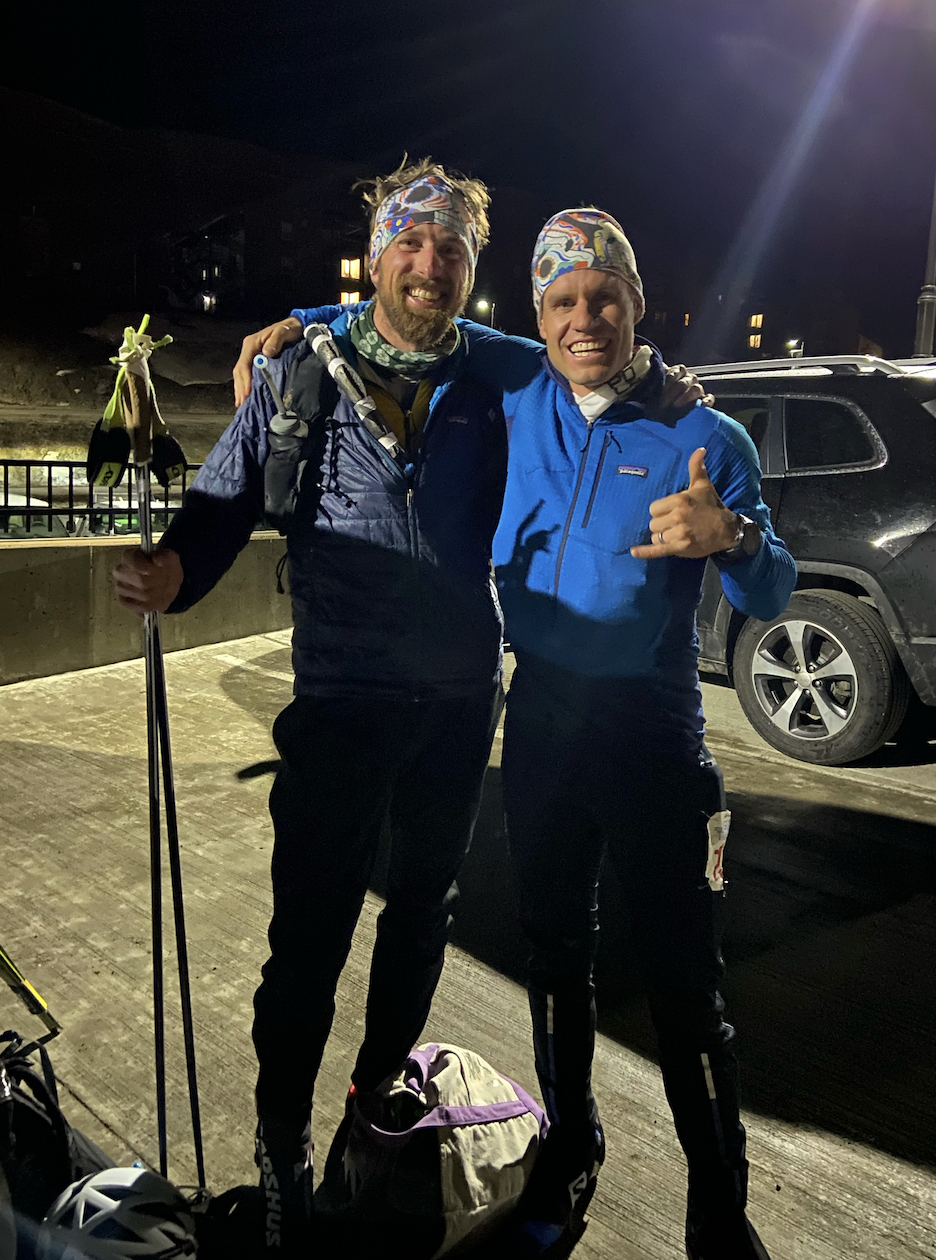
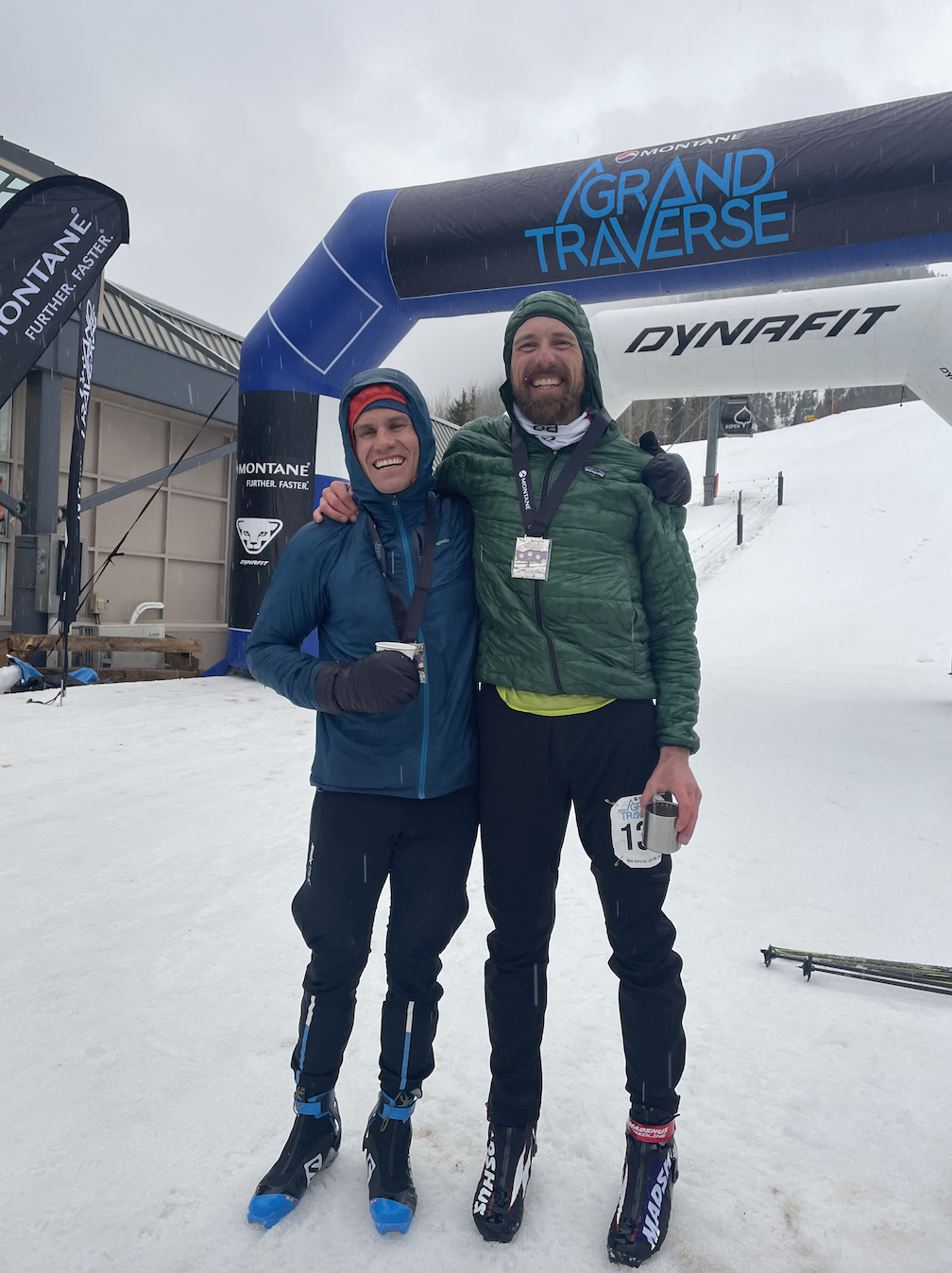
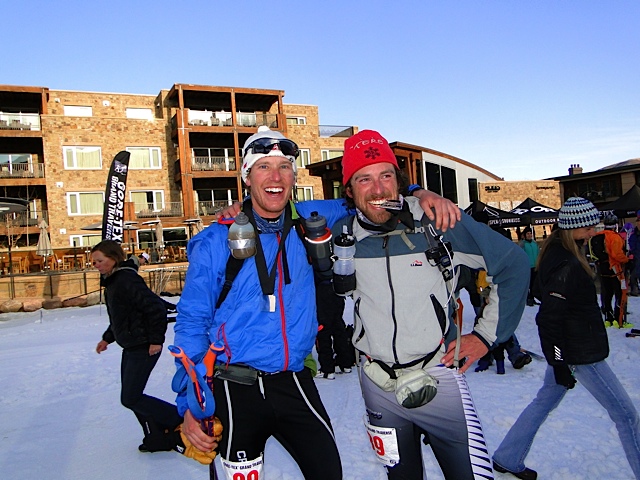
    Before and after: still smiling. (Photos: Sophie Caldwell Hamilton)

    Though Hamilton won the GT running race in early September, 2021, it was his first crack at the storied winter event. For Koons, it was his sixth crack at chasing the ideal crust cruising conditions that might allow a strong skater with some backcountry experience under their belt to smash the course record and take the win on skinny skis. The two have shared a number of big adventure days in the mountains on ski, foot, and bike, often with a third friend, Linden Mallory, who grew up in Aspen with Hamilton and raced on the Dartmouth ski team with Koons, and later became one of his GT partners

    While last year boasted perhaps the most ideal conditions, with athletes racing on firm and stable snow under a full moon in mild temperatures with minimal wind, this year, mother nature had a few twists up her sleeve. The week leading into the race saw a little bit of everything springtime in the mountains has to offer: warm sunny days, heavy wet snow, rain, wind, and plenty of freeze-thaw cycles. Consequently, this was shown in the snowpack, leaving Hamilton and Koons with far less skateable conditions, lots of breakable crust, some “spicy” downhills. Nevertheless, with only one broken pole, they were still smiling at the finish, and seemingly aren’t ready to accept defeat just yet. 
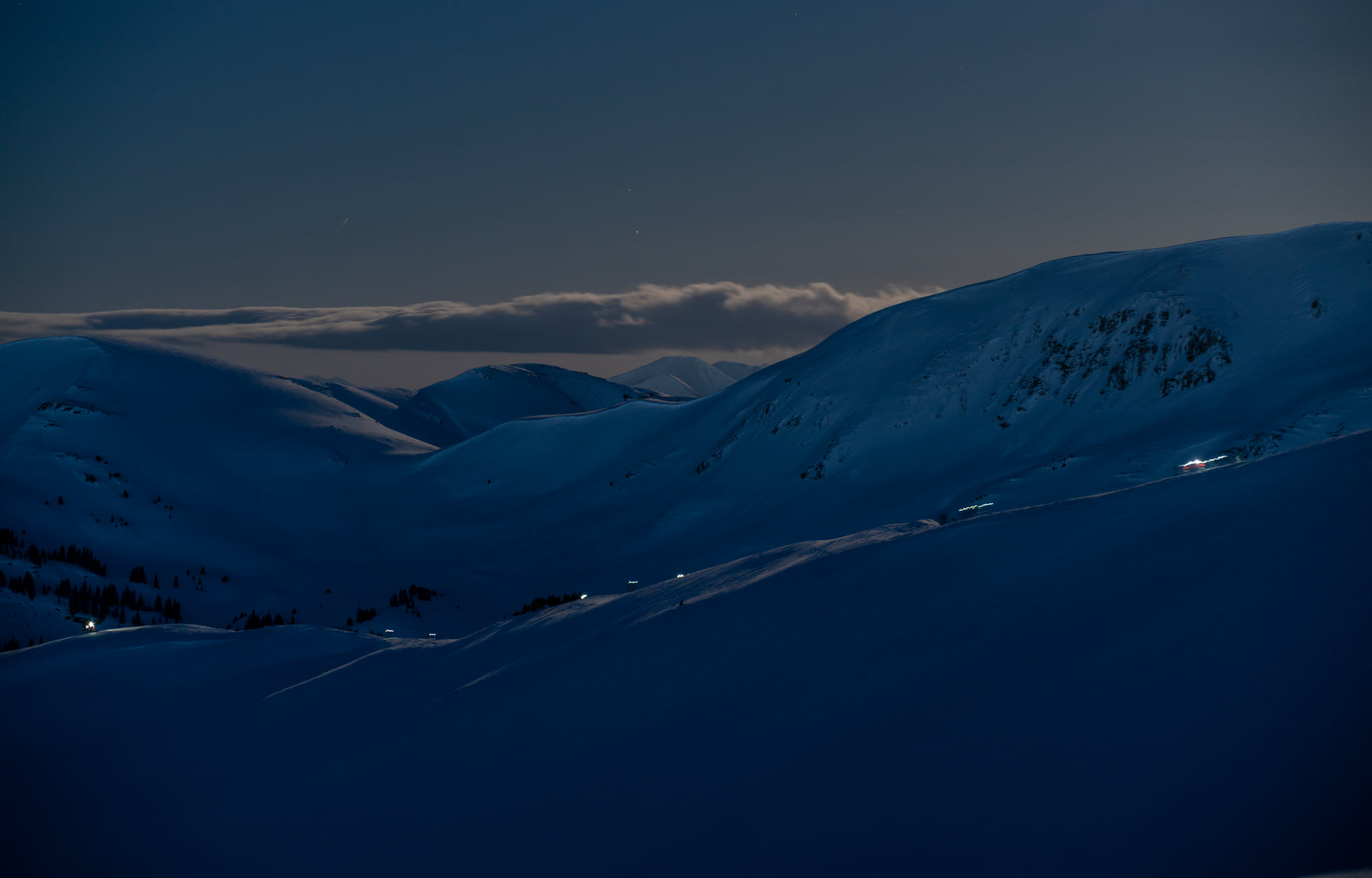
    A train of headlamps climbs Star Pass during the 2021 Grand Traverse. (Photo: Jesse Levine / Crested Butte Nordic)

    For more with Hamilton and Koons, you can head to the Grand Traverse Instagram account, where the duo was interviewed pre and post-race, along with a video capture of their finish, in the rain, at the base of Aspen Mountain. For those interested in testing their mettle in next year’s Grand Traverse ski, registration opens at midnight on December 1st and spots fill very quickly. For those looking to explore the route in the summer, there is also a Grand Traverse run and bike race happening Labor Day Weekend. The events are among the primary fundraisers for the Crested Butte Nordic Center.
  • Grand Traverse’s Fabled ‘Nordic Guys,’ Koons and Mallory Notch Fifth

    Grand Traverse’s Fabled ‘Nordic Guys,’ Koons and Mallory Notch Fifth

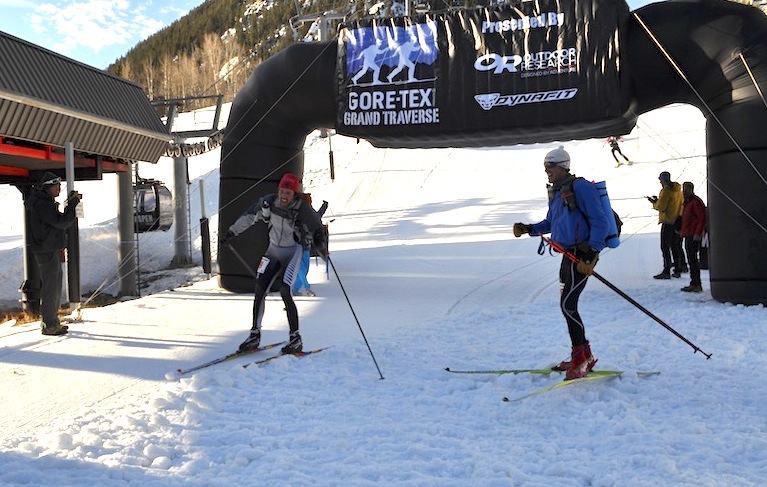
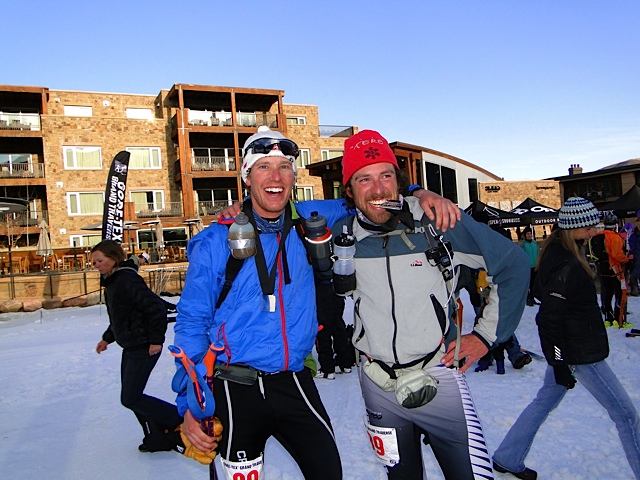
    Former Dartmouth nordic teammates, Linden Mallory (l) and Ben Koons stand together at the finish of 2013 Grand Traverse on March 30 in Aspen, Colo., where they placed fifth. (Courtesy photo)
    Former Dartmouth nordic teammates, Linden Mallory (l) and Ben Koons stand together at the finish of 2013 Grand Traverse on March 30 in Aspen, Colo., where they placed fifth. (Courtesy photo)

    Miles into the wilderness of west-central Colorado last Saturday, two men kept things interesting, accelerating to take the lead in the 16th annual Elk Mountain Grand Traverse then fading when the climbing got too tough or conditions too rough for their skinny skis.

    To some 170 other two-person teams in the co-ed field, they were simply the nordic guys. They had no team name, no celebrity status, just freestyle racing skis. Ben Koons and Linden Mallory were like that little brother you can’t drop. It doesn’t matter how many gears you have, he’ll catch you on his one-speed bike.

    Annoying, maybe, but several top competitors in the 40-mile ski mountaineering race from Crested Butte to Aspen considered it impressive.

    Three years ago, Koons, New Zealand’s leading 2010 Olympian and 2011 World Championships skier, did an altered version of the race because of high winds and too much new snow. At 38 miles, the Grand Reverse was only slightly shorter, but the top finishers clocked in 1 ½ to three hours faster than usual.

    He estimated that half the racers wore cross-country skis back then; the other half went with ski-mountaineering gear. Oh, how times change.

    The conditions did as well. What looked to be perfect snow for XC this year turned out to be challenging for everyone on breakable crust, even the backcountry skiers. Early in the race, which started at midnight, a fast and tuck-able descent abruptly switched to unforgiving knee-high snow.

    Eventual winners Marshall Thomson and Tom Goth were the first to slam into it in the darkness, with Thomson breaking his pole upon contact. The two trekked through the wee hours of the morning to win in 7 hours, 40:54.8 minutes, about 4 ½ minutes ahead of the runners-up.

    Ben Koons (l) and teammate Linden Mallory finishing the 2013 Grand Traverse from Crested Butte to Aspen, Colo., on March 30, where they placed fifth. (Courtesy photo)
    Ben Koons (l) and teammate Linden Mallory finishing the 2013 Grand Traverse from Crested Butte to Aspen, Colo., on March 30, where they placed fifth on skate skis. (Courtesy photo)

    Koons, 26, and Mallory, 27, finished fifth, 26:24.4 after Thomson and Goth. It was the best result for two Aspen skiers in the race’s history and they had done it to the surprise of many.

    Heading out with the leaders, the first two hours of the race turned into a single-file slugfest through the cumbersome crust. Some 340 participants moved along together at a walking pace, their headlamps bobbing in the night.

    When the frontrunners hit the snowmobile track, the race opened up again. Six teams broke away, including Koons and Mallory.

    “At first the nordic team was in the lead but we all figured they’d be a non factor since their gear is so incredibly hard to ski,” third-place finisher Jason Dorais wrote on his blog. “They ended up 5th – amazing. Turns out olympic nordic guys can rip some steep descents on their gear.

    Former Dartmouth teammates, Koons and Mallory casually signed up for the race, deciding to take their chances on their college skis rather than spend the big bucks on new equipment. Both new to ski mountaineering, they knew how to ski fast, but were unsure how they’d stack up.

    Shortly before the race, competitors were briefed in a series of meetings about the exact course. This year it ascended a total of 7,800 feet, but that was about all they knew. Little would prepare for what was ahead except acute awareness, driving grit, and a good teammate.

    “All day you’re gearing up with these meetings, like eight hours ’til the start of this race, so by the start you’re pretty tired,” Koons said on the phone. “It’s a struggle to try and eat and drink enough through the race ’cause it’s dark and it’s 4 in the morning.”

    “It was like a long day in the mountains; you’re just going at a higher intensity because it was a race,” Mallory said. “I think that’s where Ben and I had an advantage. Being on XC skis, being comfortable in the mountains makes a big difference.”

    Graduating one year apart, Koons left Dartmouth a year after Mallory in 2008 and moved to Aspen this past December to work for anarchitecture firm while coaching juniors on the side.

    Mallory (’07) continued his tenure as a longtime climbing guide for a Washington-based company, Rainier Mountaineering, Inc. He spends about two-thirds of the year in Aspen and guides in places like Alaska, Russia, Africa, South America and Nepal.

    Back in Aspen, he and Koons started talking about the Traverse, the town’s celebrated event. Mallory usually wasn’t around when it took place; this year he was. They decided to try it, and once they caught a glimpse of gold, it was hard to race for anything else.

    After a rough start (Koons had some ski and pole-basket troubles then ripped his pants upon hitting the breakable crust), the two surged to the front on the flatter snowmobile track. With skins on their skate skis, they started to gap the field.

    “[We] were able to kick and glide, full-on classic skiing up there,” Mallory said. “As it got higher and steeper, that advantage became a disadvantage.”

    Around the halfway point at Star Pass, Thomson and Goth took off on the descent, leaving them and the rest of the teams behind for good.

    “Those guys on alpine skis were much, much faster,” Mallory explained. “Ben and I just tumbled our way down the pass.”

    The two finished shortly after 8 a.m., 2.4 seconds ahead of sixth place.

    “It’d be nice to win, but it’s OK,” Koons said. “We were really hoping for crust-skiing conditions. … Most conditions we’d have had an advantage.”

    Thrilled by the scenery and challenge of the race itself, they resolved to come back – probably on cross-country skis again.

    “I’d encourage more cross-country racers to race it, and do it on skate skis with skins,” Koons said. “You can still be really competitive even if you don’t have the setup. If you’re strong, have good endurance, good on your feet … it’s kind of crazy terrain, ice, whatever, and it’s so fun.”

    “You’re not sure what to expect because it’s so unexpected,” Mallory said. “It’s helps having a partner you’re on the same page with. … We struggled in the same places and were able to move well. You get to go on a pretty epic adventure with a good buddy, and when you’re having a tough time, they’re there to touch you forward and vice versa.”

    “Honestly I’d like to do more races like it,” Koons said. “Maybe not as long or involved where you’re going with 350 others into backcountry in middle of night; it’s pretty wild. It’s just fun to go out and thrash around the mountain.”

    Another Dartmouth alum, Brett Palm (’09), who’s studying to earn his PhD in chemistry at the University of Colorado in Boulder, teamed up with former Colby College skier Anders Wood (’07). Under the team name the “Big Green Nordorks,” they finished 121st, seven hours and five minutes behind the winners, on telemark skis.

    “It was exhausting, for sure,” Palm said. “Definitely should not have done it on tele gear. It was great though, a challenge. I guess that’s why we did it did it.”

    Within the first five or six hours of the race, the two realized they picked the wrong equipment. Too heavy on the inclines and not fast enough on the descents, they dropped toward the back of the pack, focusing on good turns rather than a top finish.

    Like Koons and Mallory, they had heard nordic was the way to go, but hadn’t gotten around to finding the right gear. Ultimately, more people chose backcountry race skis, which made all the difference.

    “The race didn’t involve that much skiing or technique, more just an endurance sport,” Palm said. “Definitely one of the top five hardest things I’ve ever done, mentally as well as physically.”

    He recalled his days on Dartmouth’s nordic team when they’d talk about three strong urges to quit long-endurance activities. Palm said the first one came too early in the Traverse – around six hours in. The two recovered over Star Pass, but started to fade again during the final six miles along Richmond Ridge.

    “We got to the third strong urge for sure,” Palm said. “But we did it. Fortunately, the word ‘quit’ is not in a nordic skier’s vocabulary and everything was OK.”

    Results

  • Koons Wins World Champs Qualifying Race, Top-10 Gain 10/15k Start Spots

    Koons Wins World Champs Qualifying Race, Top-10 Gain 10/15k Start Spots

    Not a World Champion, but winner of the first race at World Championships

    There may not have been medals, but a flower ceremony, the chance to stand on the podium, and most importantly a spot in the 10/15km classic race next week awaited the top finishers in today’s World Championship qualifying race.

    The qualifying event debuted in 2009 at the Liberec World Championships and according to FIS Cross-Country Race Director Jurg Capol, was added to rectify two issues from the 2007 Sapporo Championships.

    Aleksei Novoselki (LTU) crosses the line in 7th.

    Capol cited both athlete safety and television scheduling as reason to limit the field size in the only individual start races held at Championship events – the 10 and 15 kilometer races – this year in the classic technique.

    Any male athlete with more than 90 FIS distance points, and any female with more than 120 of the same must finish within the top-10 in the qualifying race to earn a start spot in the Championship event.

    The Sapporo courses featured challenging, twisty downhills, and with the recent trend toward short loops, the top skiers were regularly coming up behind the slower ones. Capol described the scenario of a Marcus Hellner, for example, looking for the fastest line through a series of steep corners, only to find a snowplowing Phillip Boit, or the like, in his path.

    “That’s a risk for both, actually,” said Capol. “Because the first one—he is not afraid, but he drives the brakes.”

    The other factor, according to Capol, is the length of time it takes to run the entire event. Each additional skiers adds 30 seconds.

    “From the TV perspective, it takes too long a time until you have…the decision,” Capol said, referring to final results.

    So the qualifying race was born. The top-10 cutoff is based on an analysis of the rest of the field, and the timing in regards to television.

    And while there were no big names and no hardware, Norwegian ski fans showed up in force. No official attendance numbers were available, but the stands, while not packed, were far from empty, and a steady stream of people were making their way up from the train stop over an hour before the women started at 12:30.

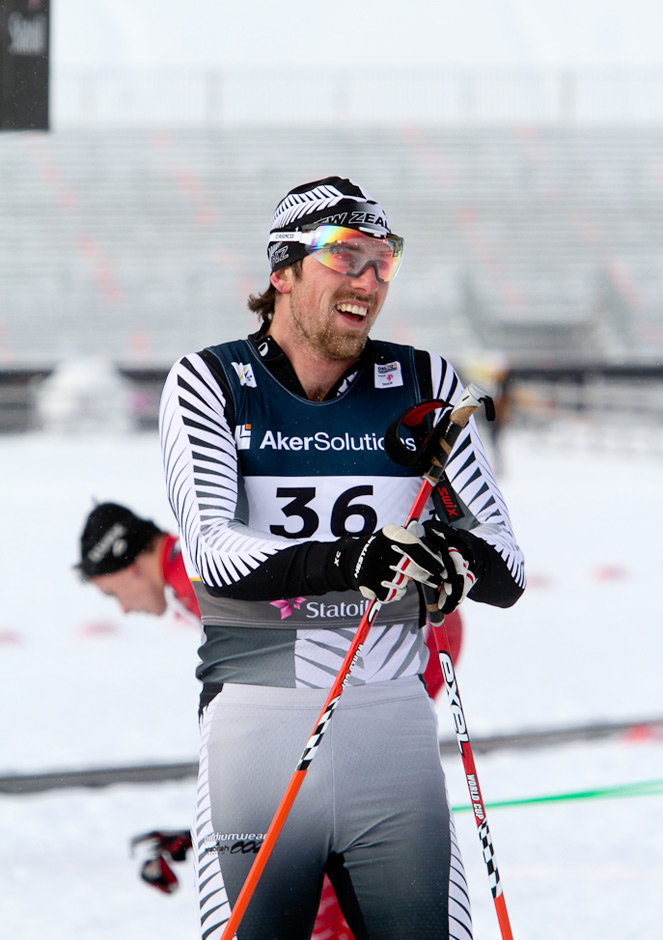
    Koons at the finish

    The mood was festive, stadium announcer Kjell Erik Kristiansen held nothing back in his usual exuberant and wry style, and as is their wont, the spectators cheered for every racer.

    Dartmouth graduate and New Zealand Native Ben Koons skied to a 16.9 second victory over Callum Smith (GBR) in the men’s 10km classic race. Koons, starting at number 36 in the 47-man field, was ushered to the leader’s “throne” where he sat, skis in lap shaking the hand of each successive finisher, and waiting to see if his time would hold up.

    When the last racer crossed the line, Koons was announced as “the first winner of the 2011 World Championships,” and along with Smith and third place finisher Sergey Mikayelyan (ARM), prepared for the flower ceremony.

    “Standing on the podium at World Championships,” Koons said later with a laugh, “I’ll take it.”

    With temperatures hovering around 20F, a bit of fresh snow, and firm tracks, Koons described the conditions as “about as good classic skiing as it gets.”

    The 2010 Olympian is now on track for a total of four World Championship starts. He will contest the sprint, the 30km pursuit, the 15km classic, the team sprint paired with brother Nils, and of course, the 50k.

    “Today my goal was to get top-10 and make it to the start line [of the 15k],” Koons said. “The goal for the 50k is to finish.”

    Koons was feeling good after his victory, and finally getting word from family and friends in Christ Church, New Zealand, the site of a recent earthquake.

    The leader's chair

    “It has been a rough couple of days trying to track down friends and family in Christ Church, and I have just recently found out that everyone is ok,” he said. “That plus this [the win] is great.”

    Just 16 women started the 5km with Dane Niviaq Chemnitz Berthelsen cruising to a 42-second victory over Nina Broznic (CRO). Ingrida Ardisauskaite (LTU) finished third.

    In 2009, US skier Morgan Smyth won the women’s 5km event, but this year no Americans or Canadians needed the race to qualify. Australians Mark Van Der Ploeg and Ewan Watson both cracked the top-10, but teammate Nick Grimmer just missed out, placing 11th, a mere three seconds out of tenth.

    Beejan Kangarloo, who recently competed in the Asian Winter Games for Iran, placed 28th. Kangarloo is also a Canadian citizen, and makes his home in Alberta.

    The skiers who did not make the cut will still get to race at World Championships – just not in the 10/15km race. The sprint, 30km pursuit, and 50k event are all open to single racers, while both the team sprint and distance relays are an option if an athlete has the requisite teammate(s).

    Philip Boit, the Kenyan runner-turned-skier placed 42nd as he gears up for his last major Championship event. Boit became famous when Bjorn Daehlie returned to the finish coral to greet him in the 1998 Olympics. He will retire following the Oslo World Championships.

    Men’s 10km Qualifying – Results

    Women’s 5km Qualifying – Results

    Tadevos Poghosyan (ARM) strides out of the start.

    Nat Herz contributed reporting

  • New Zealand’s Koons Takes a Wild Ride in the 30 k Pursuit

    New Zealand’s Koons Takes a Wild Ride in the 30 k Pursuit

    New Zealand's Ben Koons after the suffering started in the 30k pursuit

    Aside from a few small clusters in New England and New Zealand, millions of people glued to TV screens around the world were all asking the same question at the beginning of Saturday’s 30k pursuit: “Who is that guy?”

    That guy was Ben Koons, a former Dartmouth College skier and Maine resident competing for the Kiwis at the Games. Not even one kilometer from the start, Koons had slid into the track in the lead, ahead of such favorites as Norway’s Petter Northug and Switzerland’s Dario Cologna. The story of his race is undoubtedly one of the strangest—and the most painful—of the first week of the Olympics.

    Koons’s pursuit came on the heels of a week-long suspension for high hemoglobin levels, which had derailed plans for his first two events, the 15 k freestyle and the classic sprint. He admitted to being “pretty fired up” to finally get racing.

    As an Olympic rookie competing amidst a field of seasoned pros, Koons started at the far back, in bib 62 of 64. He was on the right in the last row, which put him on the outside for the first turn, an uphill lefthander.

    When a crash up ahead took out Sweden’s Anders Soedergren and Kazakhstan’s Sergey Cherepanov, Koons and a few others hopped out of the track and continued cruising up the climb. With nobody making any space for him to hop back in, Koons just put his head down and kept on skiing up the side of the trail until he found some room—which just so happened to be at the front of the race.

    While Koons may have been a little amped up at the start, he has been skiing for long enough to know that he didn’t belong in the front of an Olympic field in a 30k.

    “This was basically not the game plan—it just kind of happened,” he said. “Most of it was just…being super-excited, tons of adrenaline, and going out of the gate flying.”

    The pace, Koons said, was surprisingly manageable.

    “I was like, ‘man, these guys are doggin’ it,’” he said.

    But that didn’t last long: with his high bib number and New Zealand suit, Koons’ position was a sign for the top men that it was time to turn up the heat.

    The pace increased, and after flying up the first few hills, Koons quickly realized that his grip on the lead was tenuous. Skiing with the likes of Lukas Bauer, Cologna, and Northug had taken its toll, and the wheels came off.

    “About the two k mark, I’m like ‘oh no—I’m in trouble. This is bad news,’” he said. “I’ve never hit the wall so hard, so early in a race.”

    In the space of a kilometer, Koons went from the head of the pack to “survival mode”— far off the back, flooded with lactate, and struggling just to stay on his feet.

    “I suffered pretty bad,” he said. “Most of the rest of the race, my hands were numb.”

    Koons also wasn’t aided by the illness floating around the New Zealand team at the Athletes’ Village. For the latter part of the pursuit, Koons was vomiting, which “certainly didn’t help.”

    The misery finally ended near the halfway point, when he was pulled from the race as the leaders threatened to lap him.

    On top of the hemoglobin suspension, it has been a tough start to the Games for Koons.

    “At the Olympics you hope to have the best race of your season [or] life, not one of the worst,” he wrote in a follow-up e-mail. “On a good day, I could hope to stay with the back end of the pack, with a mediocre day I’d get my a– beat, and on a bad day like [Saturday], I’m s— off the back.”

    He still has one more chance, though, in the 50 k classic on the final day of the Games. You probably won’t see him at the front again.

    “I think I’ve learned my lesson, and I kind of paid the price,” he said. “I don’t think I’ll lead the 50 k out.”

  • Vancouver Bound: Skiing for a Developing Nation

    Vancouver Bound: Skiing for a Developing Nation

    Media attention for the Olympics is usually focused on high profile teams and local favorites. Everyone loves to read about the athletes who will represent their country or the foreign athletes from well-known ski nations, but in the cross-country skiing world there is another group heading to Vancouver that deserves some attention. Nordic skiing attracts a significant number of athletes from countries that FIS designates as “developing nations,” places where skiing is a very small or even nonexistent sport. This article will explore the stories of a few skiers from developing nations and what it takes for them to qualify for the Vancouver Olympics.

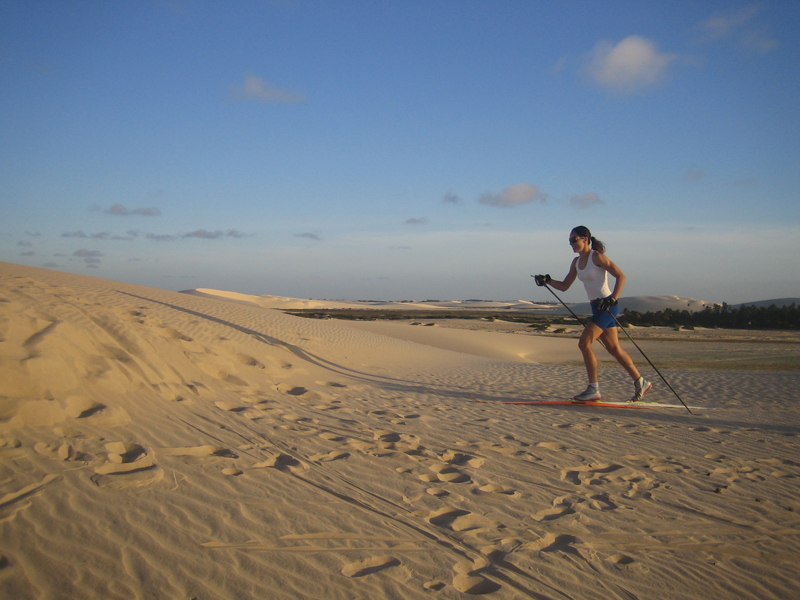
    Sand skiing on the dunes and beaches of Brazil.
    Sand skiing on the dunes and beaches of Brazil.

    Qualifying for the Olympics

    FIS places developing ski nations under the “B-Standard” for Olympic qualification. Skiers attempting to qualify for the Olympics under these standards must have under 300 sprint or distance FIS points and must have participated in the previous year’s World Championships. The 5/10 km Individual Classic Qualification race at the 2009 Liberec Worlds was filled with skiers from lesser-known countries looking to lower their points and compete at Worlds. Israel, Ireland, Iran, Bermuda, Brazil, and Kenya were just a few of the developing nations represented in this race.

    Developing nations are given spots for one male and one female skier, and each athlete is allowed one race start. The slot restriction means that nations such as Ireland, which currently has two athletes that have met the FIS qualifying standards, must develop their own procedures to determine who will go. The Snow Sports Federation of Ireland and Irish Olympic Council will be deciding in the coming weeks whether Paul Griffin or Peter-James Barron will be representing their country. In this year’s Olympics  developing nations skiers will be allowed to race in either the classic sprint or the 10/15 km interval start skate depending on whether the athlete has under 300 points in sprint or distance. Some athletes, like Jaqueline Mourão from Brazil, have met the criteria for both sprint and distance but they still must choose only one race.

    Even if a skier successfully meets the FIS qualifying standards, the final decision on attending the Olympics rests with officials in the skier’s home country. It is not uncommon in skiing, as well as other sports, for an athlete to qualify for the Olympics by international standards only to be told his or her bid will not be supported at home. The nation’s Olympic Committee may decide the skier will not be able to represent their country well enough, or finances may be an issue. In the case of New Zealand, which is a FIS designated developing nation, the national federation chose to follow the A-Standards for qualification. This means that after successfully getting his FIS points under the A-Standard magic number of 100, former Dartmouth skier Ben Koons will be representing New Zealand at this year’s Olympics.

    Tucker Murphy (Bermuda) racing in the NorAms at West Yellowstone this past November. (Photo credit: Lauren Jacobs)
    Tucker Murphy (Bermuda) racing in the NorAms at West Yellowstone this past November. (Photo credit: Lauren Jacobs)

    Training Opportunities at Home…but Mostly Abroad

    Understandably, skiers from places without snow usually pick up the sport after moving to another country or being introduced to it while traveling. Ireland’s Paul Griffin first tried Nordic skiing while at a training camp for rowing near St. Moritz, Switzerland. Tucker Murphy, who will represent Bermuda in the Olympics, first learned to ski at St. Paul’s School in Concord, New Hampshire and later began his racing career at Dartmouth College. Koons was introduced to skiing while growing up in New Zealand, but he didn’t start racing competitively until attending high school in Maine. Brazil’s Mourão, who now lives and trains with her husband in Québec, Canada had never even seen snow until she was 27 years old!

    For most of these skiers, except for those that have southern hemisphere winters, training in their home country means dry land: running, roller skiing, strength and other cross-training sports. I managed to find one photo of Griffin on snow at the MacGillcuddy Reeks in Ireland but he assures me that he had simply posed for the photo on an unusually snowy day in the mountains; Ireland does not have any opportunities for Nordic skiing.

    Brazil has no snow at all, but Jaque Mourão gets creative when returning home and sometimes trains by sand skiing. A post on this site a few weeks ago showed her cruising around the beaches and dunes of Brazil. Though she makes it look easy in the video, Mourão asserts that it is extremely hard work; “It is like skiing at minus 30 or 40 degrees Celsius, slow and you have to push hard. But at this specific place the sand is very thin and it is possible to do very good quality classic training.” Mourão has used sand skiing as a way to introduce children to the sport in the hopes of sparking their interest. We have probably all seen the classic photo of Bill Koch sand skiing in Hawaii, but apparently the quality of the experience completely depends on the sand type. Tucker Murphy has attempted it on the beaches of Bermuda but the sand there is made of broken up coral, making for very difficult skiing.

    Jaque Mourão (Brazil) on snow in Ramsau, Austria.
    Jaque Mourão (Brazil) on snow in Ramsau, Austria.

    Previous Olympic Experience

    A number of small nations skiers have already made appearances at the summer Olympics. Paul Griffin is a former Irish national team rower and finished 6th in Athens and 10th in Beijing in the lightweight four. After what he felt was a disappointing finish in 2008, Griffin decided to tackle skiing with the help of an Olympic Solidarity Scholarship through the Irish Olympic Council. Now the sport that was originally just cross-training for rowing is his primary focus. If Griffin is chosen to represent Ireland in Vancouver, he would be only the third Irish athlete, and the first endurance athlete, to compete in both the Summer and Winter Games.

    Jaque Mourão also competed in the 2004 and 2008 Olympics during her long and successful mountain biking career. In 2003 she was ranked top-10 in the world and was PanAm champion in 2008. However after Beijing, Mourão felt she had accomplished all she wanted to in mountain biking and decided to completely dedicate herself to skiing. Mourão has already skied in the Torino Olympics and is now looking forward to improving on her results in Vancouver. She seems well on her way to meeting that goal; after scoring under 120 FIS points last March she has been able to race in a number of World Cups this season.

    Philip Boit from Kenya is perhaps one of the best known small nations skiers. A former middle-distance runner, Boit’s introduction to skiing was sponsored by Nike. He has already competed in the Nagano, Salt Lake, and Torino Olympics.

    Shared Difficulties, Common Goals

    Among the skiers I talked to, finances and logistics were by far the most difficult aspects of being an athlete from a developing nation. Finding financial support at home, where most people have little knowledge about or interest in skiing, can be an incredible challenge. Most of these athletes also travel to races alone, meaning they become their own travel agents, coaches, and wax techs. Pride in representing their country, a pure love for skiing, and appreciation for the experience were named as the motivating factors to pursue the Olympics despite the difficulties. The challenges have helped bring these skiers together into a tight-knit group. Everyone tries to help each other out while on the road racing, and for Tucker Murphy, this community feeling fostered among small nations skiers is “part of the appeal.” In preparing this article, I was most impressed by the obvious camaraderie among these skiers. Be sure to watch for them in Vancouver!

  • New Zealand Names Olympic Team, Koons Officially In

    New Zealand named the 2010 Olympic Team, consisting of 10 athletes across five sports.  The snowboard team has not been named yet.

    Ben Koons (MWSC) of Maine, has officially been named to the cross-country team, along with Katie Calder.

    Koons was considered a sure thing, but yesterday’s announcement makes it official.

    New Zealand Olympic Selector and Secretary General Barry Maister also welcomed the athletes to the team and said that strategies around high performance in Winter Sport are paying off. “There has been an increased focus on Winter Sports in New Zealand and the NZOC has supported this with the distribution of Olympic Solidarity scholarships to the athletes to the value of $330,000, seed funding of the 2009 Winter Games NZ and ongoing financial support for the Winter Performance Programme (WPP). We’re positive that the combined efforts of the NZOC, NZAS, SPARC and the WPP will lead to improved Olympic performances at Vancouver and then on to Sochi 2014. ”

    Of the 1111 named New Zealand Olympians fewer than 7% have earned this coveted title at winter games.

    Ben Koons (Dartmouth College) - 1st place.
    Ben Koons (Dartmouth College) – winning a recent NENSA Eastern Cup (Photo: www.flyingpointroad.com)
  • Ben Koons earns New Zealand Olympic Standard

    Ben Koons earns New Zealand Olympic Standard

    Ben Koons (MWSC/NZ) racing to sub 100 points
    Ben Koons (MWSC/NZ) racing to sub 100 points

    Muonio, Finland–Far above the arctic circle in Lapland this past Saturday, Ben Koons, of Sidney, became the first Mainer to achieve an Olympic qualifying standard in Nordic Skiing for the 2010 Winter Olympic Games. Koons, who holds dual citizenship in the U.S. and New Zealand, raced to a 103rd place in the men’s 15km classic at the Olos resort. Initial calculations indicate that it was good enough for a 99.54 point FIS race, and good enough to drop his international point profile below 100 points–the qualifying standard set by the New Zealand Ski Federation.

    Koons, who skis for the Maine Winter Sports Center, traveled to northern Finland with the MWSC XC squad in hopes of earning his first Olympic start. An upper respiratory infection nearly stopped him in his tracks.

    “We traveled well, and everyone seemed perfectly healthy,” said MWSC Coach, Will Sweetser. “Then Ben came down with something just two days out from the race. We crossed our fingers and hit it with everything we had.”

    It may have been just enough. Koons sat out the classical sprint race on November 13, in order to gain another day of rest. While he was still clearly sick at the start line of the 15km classical race on November 14, he had just enough in the tank to push through with the result he needed.

    “That wasn’t the finish I was hoping for, but it got me what I needed,” Koons said. “I’ll take it.”

    Indeed, despite being forced back to bed on Sunday, the one race Koons managed will likely take him all the way to Vancouver. The next steps in Koons’ Olympic journey depend on FIS ratification of the weekend’s racing and on the New Zealand Olympic Team naming process. Currently, Koons is the only New Zealand male skier who has achieved the sub 100 FIS point standard. The team will be named on January 19.

    Results from the Muonio XC Openers are available here

    Full results, including FIS points will be available Wednesday here

  • The Road to Whistler and the New Zealand Olympic Team: Ben Koons

    The Road to Whistler and the New Zealand Olympic Team: Ben Koons

    Ben Koons competes in the New Zealand Winter Games
    Ben Koons competes in the New Zealand Winter Games

    Ben Koons has been New Zealand’s fastest nordic skier for quite some time.  Born and raised in Dunedin, on the South Island, he grew up participating in a variety of sports but only cross country skied a handful of times.  His family moved to Maine when Ben was fourteen and he started his freshman year as a hockey player at Messalonskee High School.  Soon afterward he switched to nordic skiing, found he had an aptitude for the sport,  and as a senior he won both the skate and classic races at the state championships.

    Ben signed on with the Dartmouth Ski Team and in his freshman year he skied to the top of the Region. He qualified for NCAA’s in Stowe, Vermont, and had successful enough races there to earn him entry to compete at the World Cup races.  He then took his sophomore year off from school to focus on racing at the international level in hopes of qualifying for the Olympics in Torino.  He was only 19 years old, and with just a couple solid years of ski training behind him Ben was much less experienced than his international competitors, but he was full of desire to compete for his country at the top level.  Although he didn’t score low enough points to earn a trip to Torino that season, Ben set his sights through the next four years with the goal of competing in the Vancouver Olympics.

    In Rwanda, Ben helped build this hydropower generator
    In Rwanda, Ben helped build this hydropower generator (photo courtesy of Dartmouth HELP)

    Ben returned to school and worked on his major in environmental engineering.  Several times during these years he used his degree for community service in Rwanda, working first in a rural health clinic and afterward heading  a United Nations funded mission to design sustainable energy sources in rural villages.  Several summers he returned to New Zealand to work, train, and race at the Snow Farm, a nordic center which is well-known to many international teams who are looking to get on snow during the summer months.

    After graduating from Dartmouth, Ben took some time out from the ski world to complete a cycling trek across Tibet with his brother Nils, who is also a racer for the Dartmouth Ski Team.  The Koons brothers biked 4,000 kilometers in 54 days, in which time they also consumed 285 packets of ramen noodles, got arrested twice, and hitch-hiked 2,000 kilometers.  They finished their adventure in July and Ben returned to New Zealand to resume ski training on snow.

    To qualify for the New Zealand National Team, and thus qualify for the NZ Olympic Team,  Ben needed to lower his total FIS points to 100.  He first met that standard with two top-ten finishes in the Australian Continental Cups in early August.  A week later at the New Zealand National Championships he took two 18th places, which made his average FIS points drop to 100.47. This solidified his spot on the New Zealand National Team.   Ben and his NZ National teammates now await official confirmation of the Olympic team selection on January 28.

    Last summer you kayaked the upper section of Uganda’s Nile River.  This summer you completed a 4,000 kilometer cycling trip across Tibet with your brother, Nils, which you documented on your blog http://autonomouscycling.blogspot.com/.  What made you want to accomplish these specific trips (in other words, how do you come up with these crazy schemes)?

    Thrill Seeker
    Thrill Seeker

    Both seemed like pretty obvious choices at the time. In Rwanda I had a friend, a motorbike and a couple weeks off work; the White Nile was only three days away and about to be flooded. We were able to paddle some of the worlds best big water and see first hand the complex dynamics of international development, conservation, and tourism associated with large hydro dams.

    The China idea was also easy. I was done with Dartmouth, Nils was taking the term off. We were looking to have a wild adventure, not get shot, and eat cheap food. This narrowed it down pretty quickly to cycling across Tibet or hooking-bobbing the Trans-Siberian railroad. Siberia is cold in April.

    About half way through Tibet Nils and I decided the trip would make us like Glenn Randall: huge endurance, no speed, skinny arms, great at altitude, socially awkward, patchy beard… (I ran this by Glenn, so it’s fit for print). When I showed up in NZ I was still pretty slow and weak, but then again in the middle of summer volume so were the Canadians (relatively).
    ben-western-tibet
    Biking through Western Tibet

    I think it hurt my bum more than my training. It’s great for toughness, not only grinding over 17,000 ft passes without much food, but seeing old ladies and impoverished kids working in the fields everyday that are way tougher than any athlete I know. A couple of months over 13,000 ft isn’t bad for the lungs either. I bet all the Euros will be doing it next year.

    What are a couple of your favorite stories or moments from your kayak and bike trips?

    Coming back from Uganda we went to see a Congolese friend on Idjwi Island (DRC), after several days we were arrested on bogus charges. To escape the island we bribed soldiers with a crate of beer.

    Early on in China, before Nils and I worked out what was up, we mistook a truck-stop brothel for a restaurant. It got awkward fairly quickly.

    ben-eastern-cup-sprint-final
    Koons (right) sprints to the finish of an eastern cup final (photo by Steve Fuller of Flying Point Road Photography)

    Do you think being a skier helped you complete these trips in any way and/or did you take anything from these trips that will help you as a ski racer?

    Yes and Yes. I think the second best thing about being a skier is that you have the endurance, strength, coordination, toughness, discipline, whatever, to easily pick things up and excel. Conventional ski training can get pretty monotonous if you are not careful. More and more I’m realizing the importance of adventures as part of training.

    You graduated from Dartmouth in ’08, your family still lives and operates a cheesery in Maine, you are training with the Maine Winter Sports Team in Fort Kent, ME, and you often train and work in New Zealand.  Where do you call home?

    I usually say I’m from New Zealand and live in Maine. I spent 15 years in NZ and I’m going on 8 years in the States.

    Ben with family at the Kennebec Cheesery in Maine
    Ben (left) helps construct the family Kennebec Cheesery in Maine

    Maine is great but I still feel like NZ is home. However more and more words like ‘ketchup’, ‘hood” (of a car), and ‘restroom’ are sneaking into my vocabulary.

    You also travel quite a bit: During the winters you travel to ski races and in the summers you have worked in Rwanda for a UN program, worked at the Snow Farm in NZ,  and have taken these epic adventures in Uganda and Tibet.   It seems like you are a pretty adaptable traveler, but does the travel ever wear on you?  And: How have you managed to train with such an irregular schedule?

    Travel sometimes wears on me, but usually less than being stuck in one place.

    The irregular schedule has definitely hurt my training at times. In my last years at Dartmouth I had too much going on and was under-performing. I am getting better now at working out the balance. It’s much easier when you’re not at school getting  sick, drunk, tired, over worked and injured (often all at the same time). That being said I don’t think I could train long term without mixing it up. I like feeling that skiing is creating options for me not limiting them.

    I have read from your local paper, the Otago Daily Times, that the group of five skiers recently named to the NZ Olympic Team is the highest caliber of nordic athletes that New Zealand has ever had.  Have you noticed an increase in the popularity of nordic racing over the past years that you have returned to NZ to train, race, and coach – and – what is your projection for its evolution in your home country?

    Ben’s note: 5 skiers named to the NZ National Team, Olympic selection is not official until Jan 28th.

    I have worked as a ski instructor and junior coach at the Snow Farm over the years. It is a relatively new sport for most people and its popularity is growing. I believe New Zealand has huge potential to develop XC skiing, from the recreation and racing level. NZ has a long history of producing world class endurance athletes, and has been especially dominant in middle distance running, triathlon, multisport, adventure racing, rowing and kayaking. Recently there have been significant efforts made to develop winter sports, most notably the addition of the NZ Winter Games, the largest winter sporting event outside of the Olympics. Unfortunately, as in the States, XC gets a bit of a backseat to freestyle and alpine skiing but it is definitely headed in the right direction. It is an exciting time to be involved in the development of the sport.

    Ben (right) takes silver in the NZ Winter Games triathlon
    Ben (right) takes silver in the NZ Winter Games triathlon

    Has New Zealand ever had a structured team or coach before at the national level?

    Yes and no. They have had various athletes, and support for those athletes over the years but nothing reassembling a structured team. Although we have trained at the Snow Farm together, currently all the athletes are essentially racing as individuals for NZ. This is changing, now that we have a solid group of senior and junior athletes, there is work on developing long-term development pipelines and team structures. As always funding is a major hurdle.

    Ben admires teh NZ landscape on a beautiful day at the Snow Farm.
    Admiring the NZ landscape on a beautiful day at the Snow Farm

    What is your schedule like until Vancouver –  How long will you train and race with MWSC  and will you go back to New Zealand for awhile before Vancouver so that you can train with the NZ team?

    I am in Finland now for a couple weeks of early season training and racing. After that I will head back to the States to train and race with MWSC. I’ll spend the rest of the time before the Games in North America. Specifics depend on how qualification goes so I have a couple different scenarios planned out. I would like to nail the qualification standard early so I can focus on being fast in February. The rest of the NZ team are scattered across Europe, Canada, and the US, I will hook up with them from time to time but for the most part we have separate schedules.

    What are your goals for Vancouver?

    The same as everyone’s: to represent my country to the best of my ability.

    Chang Tang Sand DUnes of Western Tibet
    Soaking up the sun while biking through the Chang Tang Sand Dunes of Western Tibet