From the FasterSkier archive — posts syndicated from athletes’ and coaches’ own blogs between 2004 and 2012, kept online as published. Current coverage is at fasterskier.com.
The Bend Endurance Academy has an immediate opening for the Nordic Program Director position located in beautiful Bend, Oregon. This position is primarily responsible for coordinating and supervising all aspects of our growing Nordic Program and supports the general operations of the organization.
The Bend Endurance Academy is a 501(c)(3) non-profit organization with a mission to promote healthy living through active, outdoor experiences. We emphasize teamwork, personal growth and community responsibility. The Academy currently features development programs for youth and juniors in Rock Climbing, Cycling and youth, juniors and adults in Nordic Skiing. Since 2009, we have been teaching kids core values that will serve them throughout their lives including perseverance, resilience, confidence, and respect for the environment. We teach kids the joys of endurance sports.
The Bend Endurance Academy Nordic Program is a member club of the United States Ski Association (USSA) and a member of the Pacific Northwest Ski Association (PNSA). We are one of the largest clubs in the region. While we cater to myriad ages and abilities, all programs are centered on exploration, self-discovery and social interaction. From introductory skill development to competition based training, the Nordic team strives to instill a love of being active.
We offer the following Nordic programs:
Mini Nordies: Ages 4-6
Youth Program: Ages 7-11
Development Program: Ages 11-14
Competition Program: Ages 14+
Masters Programs: Adults
Trips and Camps
School Partnership Programs: REALMS, Montessori Center, Cascades Academy
Position Summary: The primary duties of this position include designing and implementing a structure that fits the needs of the Nordic community, delivering a product true to mission, and supporting staff to provide a safe and fun environment for learning. The Nordic Director will manage and develop a staff of Head Coaches for our Competition, Development and Youth Nordic programs and help oversee their management of assistant coaches.
Key Responsibilities:
Develop and implement all aspects of youth Nordic programs for beginner, intermediate, and competition level athletes.
Provide opportunities to engage Bend Endurance Academy athletes in community events to promote personal growth and instill a sense of responsibility to the community.
Provide input in planning and business development for the organization.
Assist in the development of organizational goals and objectives consistent with the mission and vision of the organization.
Develop and monitor annual budget, ensuring targets are consistently met.
Work with Academy staff to develop and implement fundraising strategies and events to support the Nordic Program and the organization.
Design and implement developmentally appropriate training programs and competition strategies.
Organize and conduct races, events, trips, and travel to camps and competitions.
Hire and supervise paid and volunteer coaches.
Train and support paid and volunteer coaches.
Requirements:
Bachelor degree in related field
Extensive technical knowledge and passion for Nordic skiing and XC racing
3-5 years of experience in program management, Nordic coaching, supervising employees
Proven ability to positively inspire athletes of all ages and skill levels
Ability to work as part of a team and be productive when unsupervised
Proven organizational, communication, computer and writing skills
Clean motor vehicle record
Completion of background screening
Ability to travel
Compensation: $40,000 – $43,000 annually. This position is full time, year-round, salaried, and exempt from overtime.
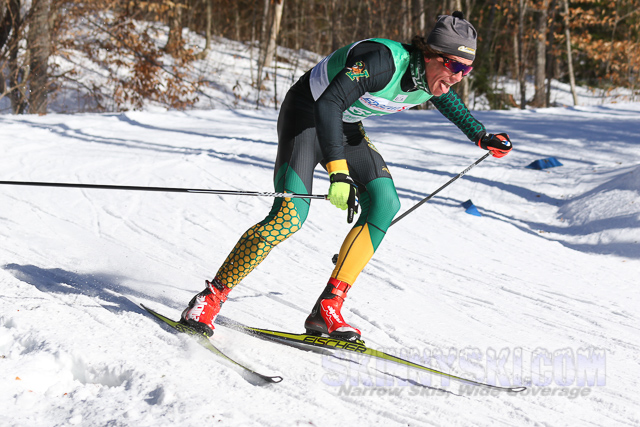
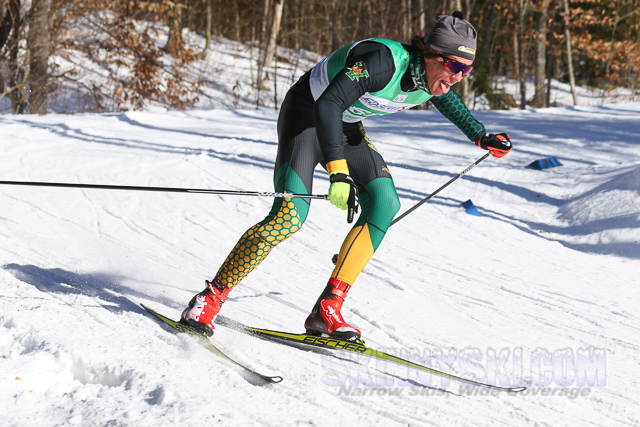
Bill Harmeyer (University of Vermont) racing at the Colby Carnival last month. (Photo: SkinnySki.com)
In an effort to showcase the North Americans who competed at last week’s International Ski Federation (FIS) 2018 Nordic Junior/U23 World Championships in Goms, Switzerland, we asked those qualifying athletes several questions about themselves — actually, we had them fill in the blanks. Here we have 20-year-old Bill Harmeyer, of the University of Vermont, who represented the U.S. at his first U23 Worlds (after competing at last year’s Junior Worlds in Utah).
Last week in Goms, Harmeyer placed 39th in the 15 k classic and 46th in the freestyle sprint.
***
“My full name is Bill Harmeyer, but you can call me Bill.
I was born in Burlington, Vermont, and raised in Underhill, Vermont, and I learned to ski at the farm behind my house.
I spent the time between U.S. nationals and Junior/U23 Worlds nervously telling my teachers I’d be missing two weeks of classes, while maybe failing to mention I’d be missing more.
Bill Harmeyer (University of Vermont) during an NTG camp training session last fall at Soldier Hollow in Midway, Utah. (Courtesy photo)
The hardest/favorite/most awesome workout I did in the last training year to prepare for this was Trout Lake agility and OD TT with the Bend Endurance Academy.
This is my first time in Switzerland and first (second including WJC in Utah last year) time racing internationally, and so far it’s been sweet.
One difference I’ve noticed between Switzerland and the U.S. is the mountains are a bit different.
Skiing and racing in the Alps is distracting, because you’re constantly looking around, and exhausting, because you just want to keep skiing. Usually racing at altitude is not too hard for me because I’ve done it before. There are some mountains around where I live.
American Bill Harmeyer (University of Vermont) racing the first leg of the men’s 4 x 5 k relay on the last day of 2017 Junior World Championships at Soldier Hollow. After he tagged off in sixth, his team went on to finish ninth. (Photo: FlyingPointRoad.com)
One of the things I’m most excited about for Junior/U23 Worlds in Goms is the chocolate. One race I’m especially targeting there is the skate sprint.
I really hope I can chat/make friends with someone from Sweden and ask them if they’d like to trade suits.
My favorite thing at the breakfast where we are staying is the cheese.
Fondue is on my top 10 favorite foods list. The cheese here is fantastic. And the chocolate is also fantastic.
If I had a totally free day here and didn’t have to worry about race fitness or training, I’d spend it exploring backcountry skiing or crust cruising while eating chocolate.
The best way to follow me on social media is on Instagram @bllharmeyer1.”
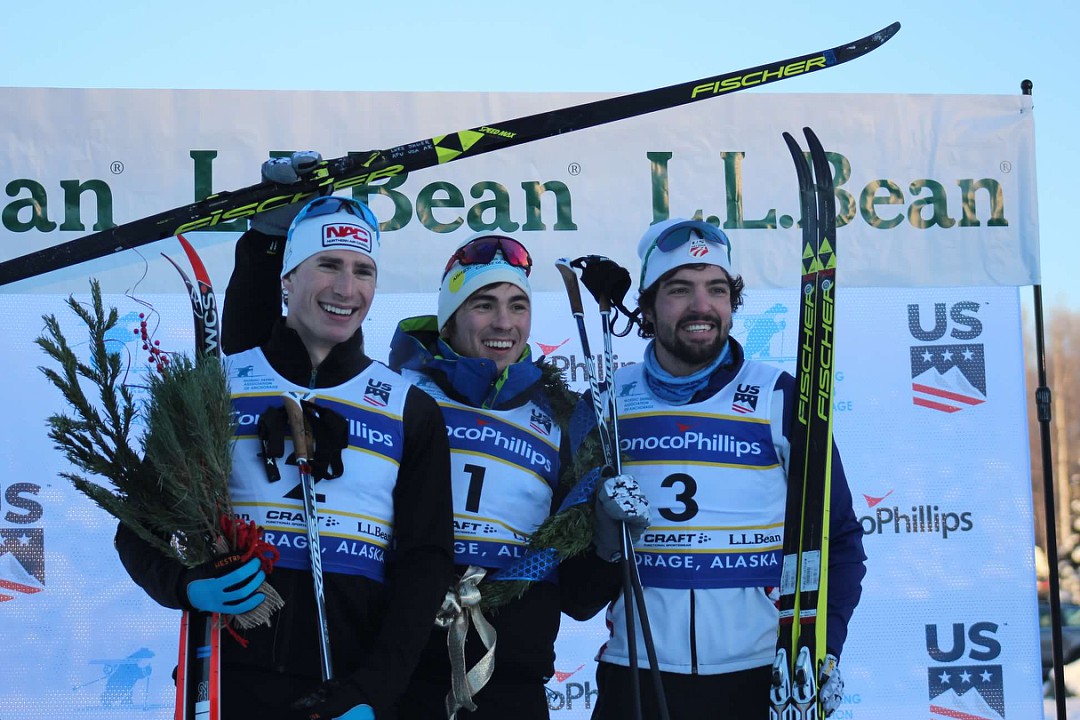
Left to right: Tyler Kornfield (APU), Reese Hanneman (APU) and Ben Saxton (SMS) as the top three finishers in the men’s 1.6 k classic sprint final on Monday, the last day of 2018 U.S. Cross Country Championships in Anchorage, Alaska.
ANCHORAGE, Alaska — No two races are exactly alike, the saying goes, and there’s a lot of truth to this cliché. But if you step back just a little bit, two race days can start to look awfully similar to one another.
For example, for the second time this week, a Hanneman brother won the sprint qualifier, Reese Hanneman won the final, and Alaska Pacific University (APU) put three athletes in the final and two on the podium on a perfect day for sprinting at Kincaid Park. That was the story on Monday, when Reese Hanneman led teammate Tyler Kornfield and Ben Saxton of the Stratton Mountain School (SMS) Elite Team across the line in the men’s classic sprint at 2018 U.S. Cross Country Championships. But it was also the case on Friday, when Reese was first and Kornfield was third in the freestyle sprint. It’s been a good week for the Hanneman family.
The classic sprint, the final race of this year’s U.S. nationals, had a slightly more subdued feel than the three that preceded it.
The fields were 50 percent smaller; a combined 160 athletes skied in the qualifier on Monday compared to 337 on Friday, as many juniors opted out of a race whose results did not bear on qualification for international trips and championship teams, and some athletes had already left town. The spectator numbers were smaller, measuring in the dozens rather than the hundreds after three days of packed parking lots and raucous crowds, as the first day of school following winter break sent local students back to the classroom. And the athletes were tired, too, after a full week of racing.
“I was just running on fumes out there, especially after the 30 k yesterday,” fifth-place finisher Kevin Bolger, of the Sun Valley Ski Education Foundation (SVSEF) told FasterSkier after the men’s final.
But cross-country skiers are nothing if not resilient, and so, just after 10 a.m., Dakota Blackhorse-von Jess (Bend Endurance Academy) once again led 95 men out onto the qualifying course at 15-second intervals. The temperature was 10 degrees Fahrenheit, according to the display on the stadium scoreboard. The sun had yet to rise and start burning off the morning’s dense fog. It felt cold.
“It’s a very quintessential Alaskan day,” women’s domestic podium bronze medalist Becca Rorabaugh (APU) said after. “It’s like an Alaska temperature, and I feel like a lot of the Alaskan teams have great skis, it’s hard-wax skiing, and it’s just a classic race day. It’s very Alaskan.”
Hanneman Brothers Headline Qualifier
https://www.instagram.com/p/BdsyQTkB945/
APU skiers did very well in the time-trial portion of the morning, which has added, if not exclusive, significance for Olympic qualifying purposes slightly a month before the 2018 Winter Olympics begin in PyeongChang, South Korea.
Reese Hanneman, 28, who grew up in Fairbanks, covered the brand-new, 1.6-kilometer sprint course in 3:21.93, a time good for the fastest qualifying mark on the day. And he did so by nearly three seconds. Next best was his APU teammate and younger brother, Logan Hanneman, 2.84 seconds back. Third was his APU teammate Tyler Kornfield, 4.23 seconds off Reese’s mark.
Alaska Pacific University’s Reese Hanneman during the men’s 1.6-kilometer classic sprint heats on Monday at 2018 U.S. Cross Country Championships in Anchorage, Alaska. Hanneman won the qualifier and eventually, the final for the national title.
In light of the bonus points awarded for U.S. nationals podium performances, FasterSkier’s unofficial calculations put Logan first on the 2018 Olympic Winter Games domestic sprint qualifying list, with 80 points (45 for first at U.S. nationals and 35 for second), and Reese second, with 71 points (45 for first and 26 for third).
In Monday’s classic sprint, Benjamin Ogden (SMS) was fourth in qualifying, 5.12 seconds back. Blackhorse-von Jess was fifth (+5.16), Zak Ketterson of Northern Michigan University sixth (+7.56), Cole Morgan (SVSEF) seventh (+7.61), David Norris of APU eighth (+7.85), Saxton ninth (+7.88), and Bolger tenth (+9.09).
Just like the skate sprint, Brian Gregg, of Central Cross Country (CXC), Loppet Nordic Racing (LNR) and Team Gregg, was the final athlete to make the heats, 16.53 seconds back in 30th.
“I would say all the top sprinting guys, everyone’s focusing kind of on the qualifier, more so than normal,” Reese said on Friday after he had qualified third in the skate sprint. “There’s no margin for error, and you just have to ski it absolutely as fast as possible. It’s definitely different tactics than in the heats… but if you’re fast, you’re fast.”
Reese Hanneman Wins Everything En Route to Final
On Monday, Reese was pretty darn fast. He won his quarterfinal, the first of the day, as well as his semifinal, the first of the day, to make the final with the maximum amount of rest possible. And then, of course, he won the final as well for his fourth national title — and second of 2018 nationals.
In the day’s first quarterfinal, Reese was in the lead by the first turn at 200 meters, followed closely by Bolger. The two of them had a big lead by the time they were coming off Gong Hill. The rest of the field caught up to them somewhat by the finish, but Reese and Bolger still took the top two spots with relative ease.
In the second quarterfinal, U18 skier Ogden led the field into the first turn, with Morgan and Bill Harmeyer, of the University of Vermont, right behind. Ogden was still into the lead coming back into the stadium, but Kris Freeman (Caldwell Sport) had caught up into third. Coming into the finish, Freeman won a four-way lunge for second over Thomas O’Harra (APU), Ben Lustgarten (CGRP), and Harmeyer. O’Harra’s third place in a fast heat was good enough to send him on to the semifinals with the day’s first lucky loser spot.
In the third quarterfinal, Andrew Egger (Colby College) took the lead out of the stadium, but it was Blackhorse-von Jess in the top spot by the time they came back. Blackhorse-von Jess entered the finishing stretch with a 10-meter lead. Ketterson took second, 1.2 seconds back, with Egger another second back by the finish.
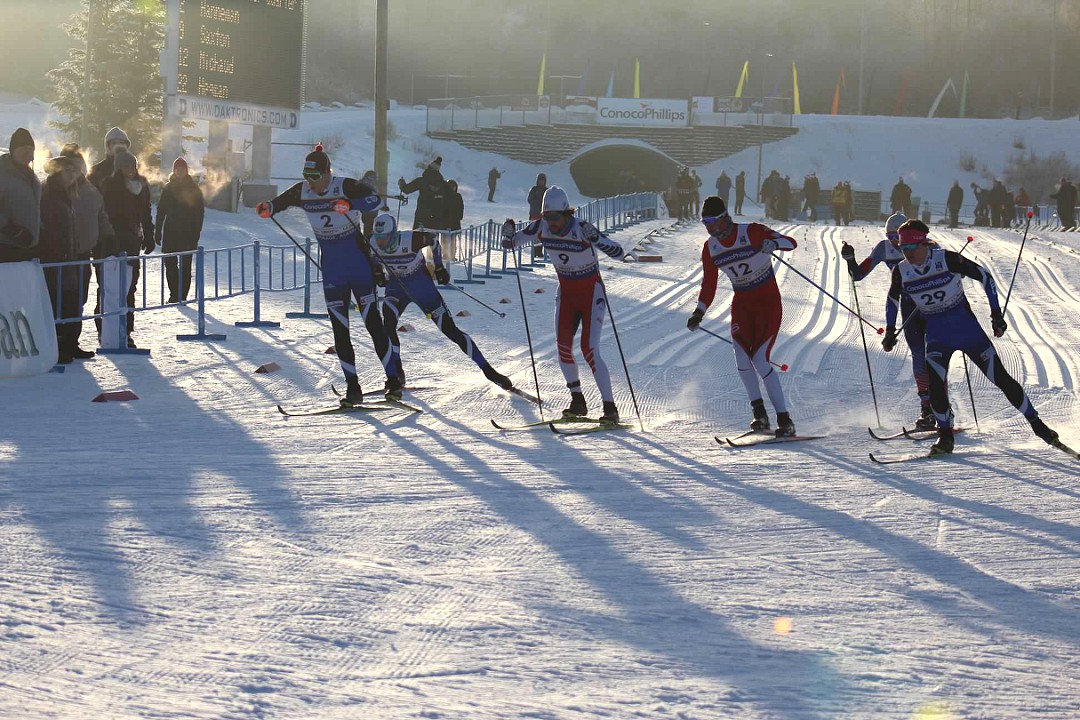
From left to right: Logan Hanneman (APU), Like Jager (APU), Ben Saxton (SMS Elite Team) Nick Michaud (BSF), Scott Patterson (APU), and Jack Hegman (SVSEF) at the start of their quarterfinal in the men’s 1.6-kilometer classic sprint on Monday at 2018 U.S. Cross Country Championships in Anchorage, Alaska.
In the fourth quarterfinal, Saxton and Logan Hanneman left the stadium with the early lead, alongside a quick-starting Luke Jager (APU), one of three U18 skiers who made the senior heats. It was Saxton in the lead coming back to the stadium two minutes later, with Logan leading Jager. Saxton came into the finishing stretch with a healthy lead, but Logan made a powerful move to pull around him and come alongside. Saxton won the heat by 0.37 seconds over Logan. Yesterday’s medalist, Eric Packer (APU), was out in third.
The fifth quarterfinal was heavy on local pride, with three APU skiers and a fourth from University of Alaska Anchorage. Erik Axelsson (Montana State University) led Kornfield and Logan Diekmann (University of Utah) into the first uphill. But two minutes later it was all APU, with Kornfield, David Norris and Forrest Mahlen with a sizeable lead on the rest of the field. Kornfield took the win; Mahlen came around Norris for second, but Norris moved on with the day’s other lucky loser spot. Axelsson was nearly five seconds back of Norris in fourth.
In the first semifinal, Blackhorse-von Jess flashed his ski speed and momentum by dropping into a tuck within the first 200-meter straightaway in the stadium, then still led the field over the top of the first, smaller climb. Ogden and Reese Hanneman were nearby. When they returned to the stadium, Reese had a 20-meter lead over Ogden on the downhill. As happened throughout the day, though, that lead shrank to half that size by the time the skiers entered the finishing stretch. But Reese still had the lead, which he held to the finish. Bolger was second, 0.32 seconds back. Ogden was relegated for obstruction.
The second semifinal featured a predominantly blue color scheme, between four suits from APU and the blue accents on Saxton’s SMS suit. Saxton again led out of the stadium, with Ketterson and Kornfield close by. By the time they came off Gong Hill two minutes later, it was Kornfield in the lead, with Ketterson close behind him. Kornfield led into the finishing stretch, but Ketterson overtook him to place first in the heat.
Behind them, Logan Hanneman made a strong push for third. He closed down Saxton, edging him by 0.04 seconds for third behind Ketterson and Kornfield. In practice, both Logan and Saxton advanced to the final as lucky losers; Norris’s fifth place in this heat would have won the day’s first semifinal by nearly a second.
Reese Hanneman Wins Final, Again
Slightly after 2 p.m., six men lined up in the south end of the Kincaid Stadium. From racer’s left to right, it was Logan, Kornfield, Ketterson, Reese, Bolger, and Saxton in the starting blocks. The sun was out, the temperature was in the high teens, and the course was firm and fast. There was no wind. Conditions were once more basically perfect.
The field had a clean start at the sound of the starter’s pistol, double poling in six separate lanes over the first 200 meters slightly downhill through the stadium. As the racers turned right to go up the first hill it was the Hanneman brothers in the lead, with Kornfield immediately behind them and Ketterson to Kornfield’s right. The pack double poled up the first part of the climb, then strode up and over the top of the hill.
A quick descent followed, then a high-speed, double-pole section leading to the start of the course’s main hill. Reese pushed the pace going up the hill, and not everyone was able to respond.
“I basically started at the base of the big climb,” Reese recalled of the 24-meter vertical gain B-climb in the middle of the sprint course. “I just kind of led in the climb and then just threw down the hammer and just tried to drop everyone going up that thing, and just continue to pound it over the top and take it all the way home.”
The largest climb on the course is “tough for classic skiing,” Bolger explained. “That hill definitely adds a different dynamic to your whole approach to every heat you do. To be able to ski up that hill four times, strong, it’s a challenge.” (Bolger added that he didn’t think anyone would have attempted to double pole a hill of that size, saying that “it’s a challenging enough hill to where it’s going to rule out double poling for anyone.” But just to be sure, race organizers placed a no-double-pole technique zone up the entire length of the climb for both the qualifier and the heats.)
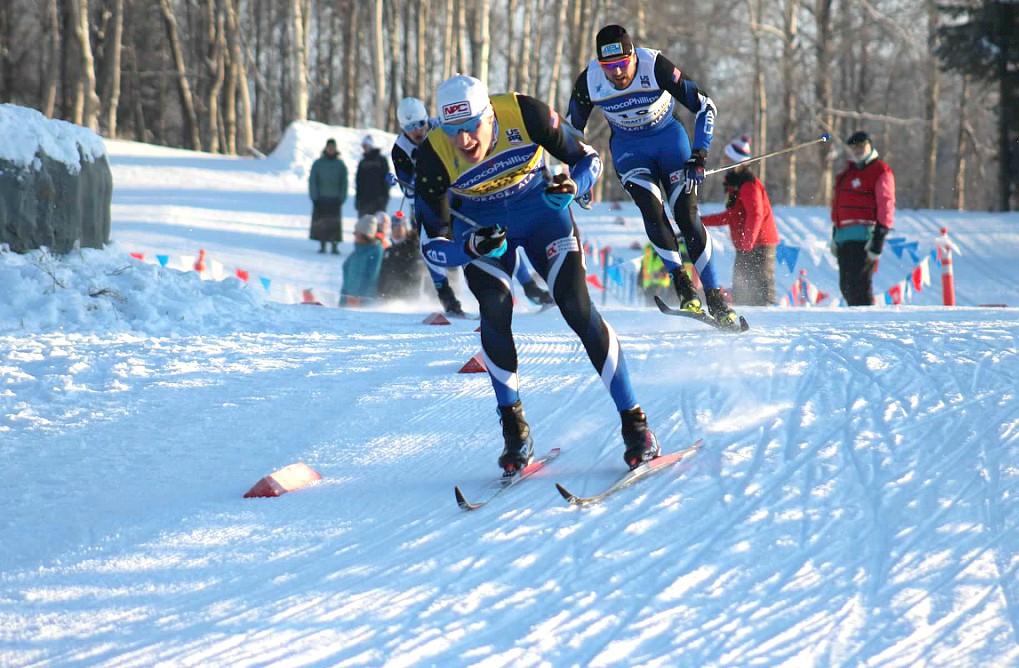
By the time the field descended the waterfall downhill back into the stadium, Reese had a substantial gap over Kornfield, who in turn had a sizeable lead over Ketterson.
Kornfield made up some of this gap going down and around the final 180-degree turn, but Reese still entered the final straightaway with a sizeable lead. Saxton had moved into third, ahead of Ketterson, by the time they reached the 100 meters to go mark.
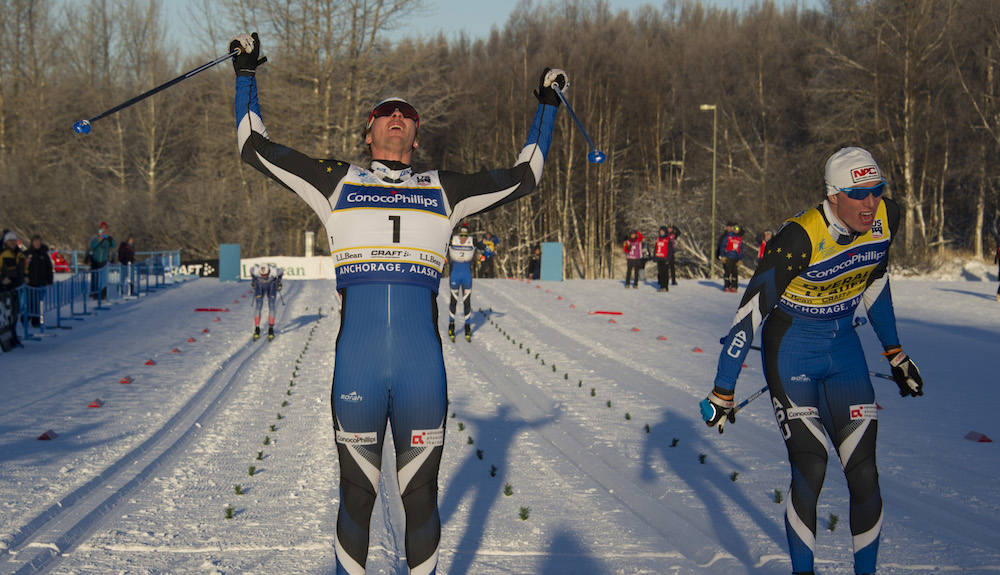
Reese Hanneman (1) of Alaska Pacific University celebrates his second sprint title of the 2018 L.L.Bean U.S. Cross Country Ski Championships on Monday with a win in the classic sprint final, just ahead of teammate Tyler Kornfield (r) in Anchorage, Alaska. Ben Saxton (SMS Elite Team) rounded out the podium in third. (Photo: Michael Dinneen Photography)
Kornfield barreled down the slight uphill of the finishing straight with grace and fury, closing in on Reese with each extension of his lanky frame. But he was still in the same finishing lane as his APU teammate, getting closer to Reese, but still immediately behind him. With roughly 20 meters to go, Kornfield moved one lane to his left, then lunged as he approached the finish. But Reese’s lead was still too much, and he crossed the finish with his second sprint national title of the week.
Reese’s time for the final was 3:20.62. Kornfield was 0.2 seconds back in second.
Some distance behind them, Saxton crossed the finish line in third, 4.78 seconds back of Reese, with a slight lead over Logan and Bolger. Ketterson finished sixth, 6.83 seconds back, in his second sprint final of the week.
“He is obviously on super-good form right now,” Reese continued. “I just have to know that I have a little more speed than he does. … But he’s really cranking right now. He is skiing great, but it definitely motivated me to know to just drive that thing so hard in the final.”
The second national title in as many races was “an answer to a lot of prayers from this morning and in the heats,” Reese said. “I just feel really lucky and stoked that I could put it together and be in such good form right now in January. It was a great day, an amazing day.”
Tyler Kornfield leads his APU teammate Forrest Mahlen in the men’s 1..6 k classic sprint on Monday at 2018 U.S. Cross Country Championships in Anchorage, Alaska.
Although Kornfield was second today, he “probably got the all-around performance of the week for the men,” Reese said of his teammate. Kornfield reached the podium in every race this week save the opening 15 k freestyle individual start, where he was 14th.
Kornfield’s race series was “a dream come true a little bit,” Kornfield told FasterSkier, “a little unexpected, but I knew I had it in me. The start of the season didn’t go as planned, I got sick for a month before it started, I also sprained my wrist for another month and so I was pretty frustrated with the lack of performances, but I knew there was something there and it was just a matter of time.”
“In this sport there are a lot of ups and downs,” he continued, “and it’s really easy to get caught up in the downs and not realize that just because you have a few bad races doesn’t mean you lose your ability to succeed, so just have to keep your head up and keep trying and hoping for the doors to open.”
When it comes to possibilities for potential Olympic selection, “I don’t know anything,” Kornfield said. “I can let you know in a couple weeks.”
Mathematically speaking, Kornfield currently ranks second to APU teammate Scott Patterson on the most recent version of the Olympic selection distance points list, which reflects both distance races from U.S. nationals.
For now, Kornfield plans to leave Alaska on Tuesday (that is, today) for a previously planned trip to Austria. He plans to work out precisely what races he will contest soon; he had planned on racing a Ski Classics marathon, but is currently uncertain where he will be racing next.
While Kornfield’s week at U.S. nationals exceeded his expectations, Monday’s third-place finisher, Saxton, didn’t have the week he was hoping for.
“I came here, like many people, with goals of heading to Korea and representing the country racing in the Games,” Saxton said after the final. “I fell short of that this week and that’s nothing to be ashamed of, but I was really disappointed I wasn’t in the mix as much as I would have hoped to be. This week was difficult because I don’t feel like I put forth a representative effort.”
Saxton was quick to offer sincere congratulations to the skiers who had had more success this week.
“I am incredibly proud to know and am happy for Logan and Scott and Reese and all of the other champions from this week,” he said, “and incredibly happy that those are going to be the skiers going to over to represent us. I think it’s just, from a personal standpoint, people can understand I was disappointed not to feel like I had my absolutely best days out there, but I am really proud to end the day on a podium, representing the hard work that all my teammates and my coach and the program at Stratton have done all year, and to reward them for that work and that effort is a great feeling.”
Saxton also enjoyed the “playground mentality” of the sprint day.
“I think a lot of the times racing we can get lost in the technical aspects of it,” he mused, “but one of the reasons I love racing heats so much is, it just kind of reminds me of being back in elementary school and pointing to something in the far end of the playground, basketball hoop, or whatever it is, and just saying, ‘Let me race you there.’ And there’s no rules, there’s no anything, it’s just the feeling of you and the other person just going all out, and that’s a beautiful way to live and that’s a beautiful way to compete, and sprints are a wonderful thing like that.”
Strong Alaska Performances Throughout the Week
What a difference a year makes. One year ago this week, in the classic sprint at Soldier Hollow, APU didn’t put any athletes into the heats for the first time in at least a decade, done in by a combination of illness, seeding, weather conditions, and wax choice. This time around, head coach Erik Flora’s squad sent eight men through to the heats, six to the semifinal, three to the final, and two to the podium.*
The classic sprint capped a successful week for APU, and for Alaskan skiers more generally. Caitlin Patterson, who skis for CGRP, took all four gold medals for the women. Then APU skiers took all four golds on the men’s side, between Scott Patterson on Wednesday, Reese on Friday and Monday, and Kornfield on Sunday. Chelsea Holmes, Kornfield again, Hannah Halvorsen, Rosie Frankowski, Eric Packer, Becca Rorabaugh, and Kornfield again also stepped on the domestic podium for APU. All told, that’s 15 out of a possible 24 medals going to athletes who hail from or ski in Alaska.
(Although if you slice the data another way, there were also seven out of 12 possible medals in women’s races won by CGRP, between Patterson’s quadfecta and Kaitlynn Miller’s trifecta.)
This week’s results “just show the depth” of the team, Reese told FasterSkier after his race. “It speaks to the hard work of our coaches, especially Erik Flora. That guy will not be outworked, he just puts so much into us. I’m just really happy that we can have a week like this and go four for four in the men’s with APU, just to show that what he is doing works and how hard he works for us. … To get to this point that we can do that and crush all week and just give them a good show is really rewarding.”
“We’re all Alaska born-and-raised,” Reese added of the APU men. “Can’t beat that.”
*(Full disclosure, this reporter skis on the APU Masters team, and receives direct coaching from Flora roughly once a year at Masters Camp.)
Bend, OR – Sandy Visnack of Bend, Oregon, has been named the next Executive Director of the Bend Endurance Academy (BEA) by the organization’s governing board. Ms. Visnack will assume this new role on January 8, 2018.
“We are excited to announce the selection of Sandy Visnack to be our next Executive Director,” says Ellen Grover, BEA Board President. “In 2018, as BEA celebrates its 9th year serving youth in Central Oregon, we need a leader who has the vision, skills, and capacity to strategically guide our organization forward. Our board has great confidence that Sandy will build upon the strong foundation BEA has created, further engage youth and families in our programs, and develop rich and meaningful relationships with our donors, sponsors and nonprofit partners.”
Ms. Visnack’s background uniquely positions her to assume the role of Executive Director. With significant experience working with youth and families, in senior management roles in the education and non-profit sectors, and a passion for outdoor sports, Visnack will advance the organization’s current strategic priorities and guide BEA’s future contributions to serving youth, maintaining high quality programs, and promoting active, healthy lifestyles. Visnack shared, “I am honored to serve the BEA community and support the program directors, coaches and staff. BEA has a rich history of offering quality programs and activities for youth of all ages and abilities and is poised to grow in even more in upcoming years. I want to help BEA strengthen the framework of the organization and develop the resources necessary to meet the needs of our growing community in Bend and across Central Oregon. Joining this group of highly skilled, thoughtful, and hardworking people is an opportunity I could not pass up.”
Visnack has a Master in Nonprofit Management degree from Regis University in Denver, Colorado, and a Bachelor of Science degree from the University of Vermont. She also has over 20 years of experience working in education and in the nonprofit sectors. Past roles have included the Coordinator of Residence Life at Colorado Mountain College, Executive Director of Grand Futures Prevention Coalition, Development Director for Big Brothers Big Sisters, as well as Grant Writer and Director of Communication for NeighborImpact.
For more information about the Bend Endurance Academy or the selection of Sandy Visnack as Executive Director, please contact Ellen Grover at 541-410-3231 or via email at ellengrover@bendenduranceacademy.org. To contact Ms. Visnack directly, email sandy@bendenduranceacademy.org.
About Bend Endurance Academy: Since founded in 2009, Bend Endurance Academy (BEA) has grown from humble beginnings to serving more than 1000 youth in 2017. BEA is a public benefit 501(c)(3) that organizes and operates endurance activity programs in Central Oregon, concentrating in three core disciplines: Nordic Skiing, Cycling & Climbing.
Mission: The Bend Endurance Academy promotes healthy living through active, outdoor experiences. All programs offered emphasize teamwork, personal growth, and community responsibility.
Vision: A world with active, inspired and more engaged people.
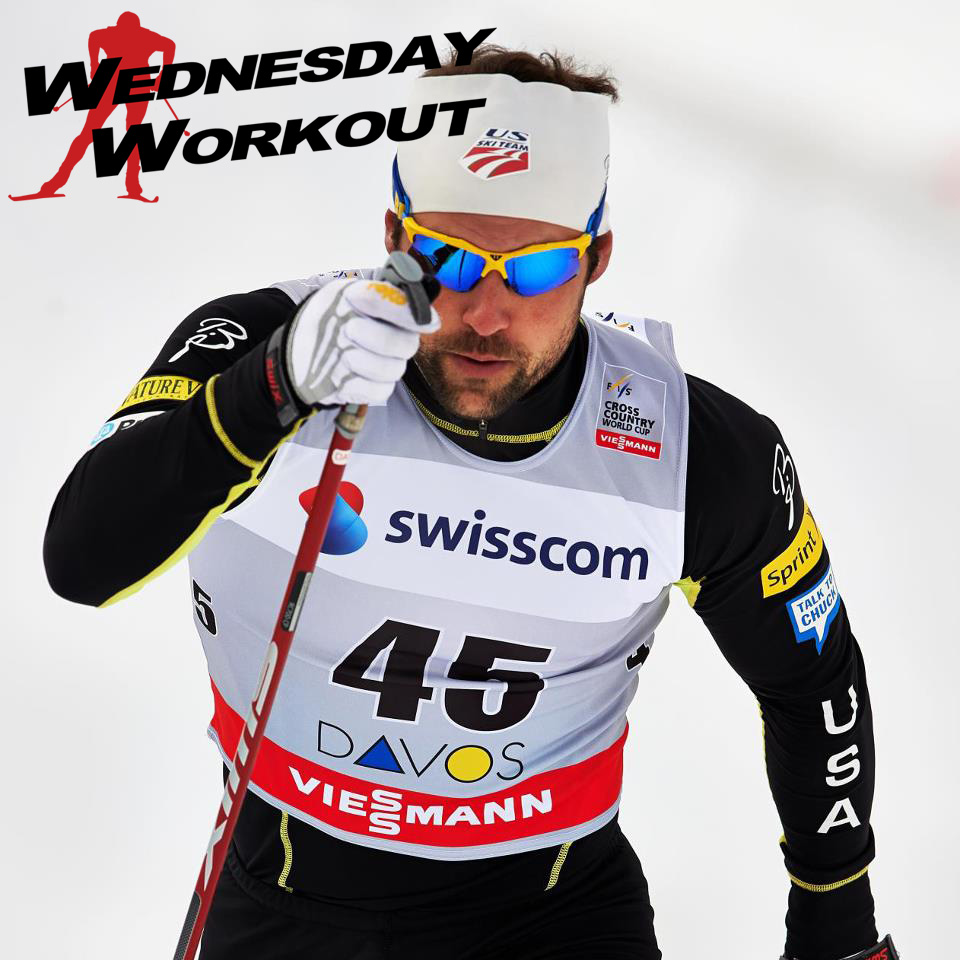
Dakota Blackhorse-von Jess (Bend Endurance Academy) racing a World Cup classic sprint in February 2013 in Davos, Switzerland. (Photo: Felgenhauer/NordicFocus)
For this Wednesday Workout, we’re bringing back a speed-inducing bounding session Dakota Blackhorse-von Jess shared with us four years ago. These days, Blackhorse-von Jess, 31, is still racing out of the Bend Endurance Academy under the guidance of Ben Husaby. Read the original workout here.
***
[circa October 2013]
This edition of Wednesday Workout was submitted by Dakota Blackhorse-von Jess, the man who dominated the coveted Frozen Thunder classic sprint last week in Canmore, Alberta, and had time to take names: beating U.S. Ski Team members Andy Newell and Simi Hamilton in the process (to be fair, they were on skate skis, but hey, that’s racing). The Norwegian website Langrenn even gave him a shout out on Facebook (translation, “Dakota Blackhorse, lovely name for a cross country runner”).
Upon catching up with Blackhorse-von Jess, who flies solo under coach Ben Husaby at the Bend Endurance Academy in Oregon, we asked him what gives and why he’s so fast this time of year.
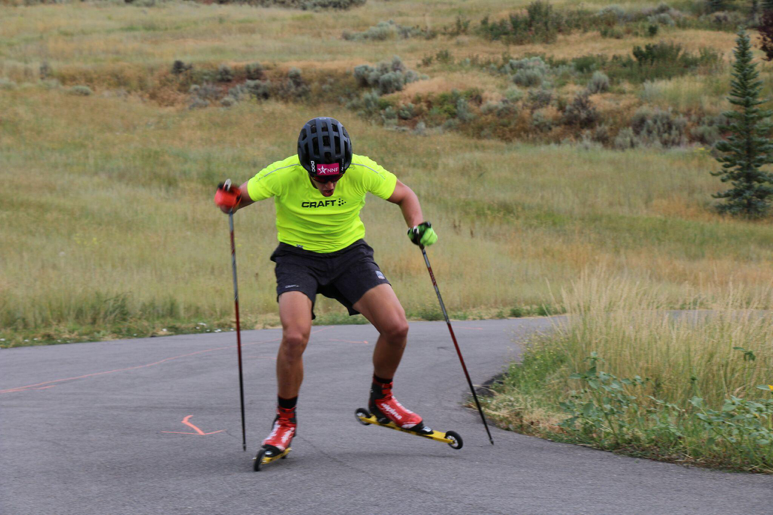
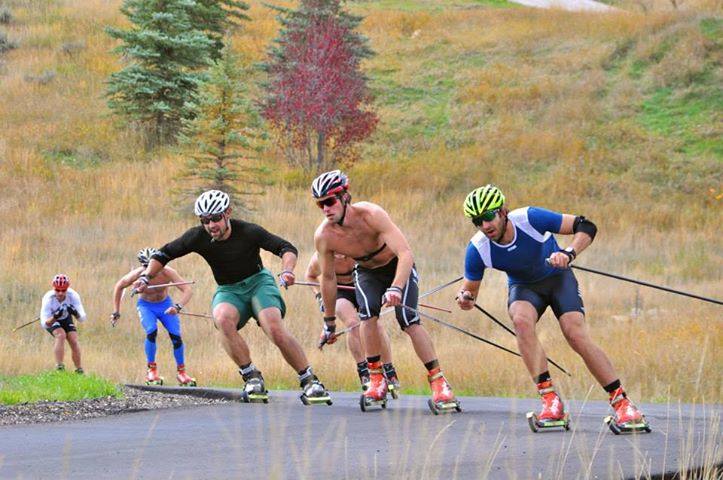
Dakota Blackhorse-von Jess (l) gets the inside line while rollerskiing head-to-head with Skyler Davis (c) and Sam Tarling earlier this month at Soldier Hollow in Midway, Utah. (Photo: Tom Kelly/U.S. Ski Team)
“We’ve really been focusing the last 4 years on systematically building my aerobic fitness,” Blackhorse-von Jess, 27, wrote in an email. “Coach Ben and I started with a focus on volume on base training and through the years have progressed to a level where I can sustain high levels of quality work – and clearly it’s paying off.
“All of the indicators in training have been pointing to increased aerobic capacity and efficiency at sustained intensity efforts, so the takeaway is validation of the success of our model thus far,” the Dartmouth grad added. “Racing is so much fun, being back on the road and seeing all my friends and getting back in the wax room with Scott Johnston and Sam Naney of MOD, and for sure being in the mix with Andy and Sim who set the bar for the rest of us was awesome.”
Well said, Blackhorse-von Jess.
Now here’s what he does:
The Workout: Threshold Plus (bounding in mixed terrain)
Explained: The transition into fall training for us means a change in the level of intensity. For the first time since the training year started in May, I get to play in the area of threshold – and threshold plus. Over the 10 years Coach Ben and I have worked together, we’ve developed both long term (year-to-year) and short term (month-to-month) training progressions. As with all things in life, experience is the best teacher and we have learned so much over the years by constantly adding new pieces cherry picking the best ones. This organic and highly collaborative style of training functions, in no small part, because of the way we have grown to understand the work we’re doing.
I mention this because feeling the workout is hands down the most important part. Yes, I use a heart rate monitor when I’m training – especially in intervals. It’s primary function, however, is actually post-workout where we can better determine if we are achieving our goals. There is a whole lot more than goes into creating a training plan that I’ve gone into here, not the least of which is understanding the science. The what and the why of different types/styles of workouts are important for Nordic skier development, but once those have been decided the how makes all the difference.
Wednesdays we hit the trails: pole bounding in mixed terrain.
Warmup: Approx. 30 minutes with 10 minutes or so of bounding specific warmup: ski walking, moosehoofing, and full on explosive bounding in addition to some muscle memory/technique drills
Intervals: 5 x 4-“ish” minutes over set terrain, with the primary goal being to spend as much time as possible at or above threshold without slowing down from interval to interval.
Recover 4-“ish” minutes between. “Active” recovery is key, but how active a person can be in recovery is totally individual – just try to keep the heart rate down in Level 2 or below and work out the lactate best you can. I walk/jog between… once I get my breath back.
(While I dearly love the flowing nature of intervals over constantly varying ground, it’s easier to measure the workout over set terrain. We found a perfect place to work on mid-interval acceleration and then survival, which was a big goal of Ben’s for me this fall as it has been a piece missing in my racing. I say 4-ish minutes because my finishing marker was just a hair over 4 minutes when I started… and I was about 15 seconds faster by the end.)
Doing It Right: Bounding in the woods is not necessarily a function of speed – you can almost always make the work harder by doing it “more correctly.” Just pushing harder usually means a breakdown in technique, which has huge application to ski racing where technique breakdown under duress can have catastrophic consequences.
That said, measuring time over set terrain really helps me understand the changes in feeling my body goes through as I fatigue. Keeping even splits, or dropping negative splits, over the intervals is still the goal.
The first couple intervals are usually about holding myself back (although not everyone experiences training the way I do, so take this with a grain of salt), I get to push a little bit in the third, push more in the fourth, and then dig deep in the last interval to keep getting faster.
By appropriately using the first couple intervals and the first minute or two of each interval to prime your system, there is a natural flow into anaerobia. We try to structure one workout a week to maximize the time spent anaerobic, and this one has been a real gem for us.
Cool down: 15 minutes-“ish.” However long it takes to get moving again and get some of the junk out of your body.
The Bend Endurance Academy (BEA) is a public benefit 501(c)3 that organizes and operates endurance activity programs in Central Oregon, concentrating in three core disciplines: Nordic Skiing, Cycling & Climbing. The mission of BEA is to “promote healthy living through active, outdoor experiences. We emphasize teamwork, personal growth, and community responsibility.” BEA envisions a world with active, inspired, and more engaged people. Since its founding in 2009, BEA has grown from humble beginnings to serving more than 1000 kids in 2017.
Where You Get To Live!
Bend, Oregon, is the mountain town that has it all! Located in the in the shadows of the Cascade Mountains and surrounded by numerous lakes and rivers, Central Oregon is an outdoor enthusiast’s paradise. Check out the sights and sounds of Bend at: https://vimeo.com/200038114
What You Get To Do!
Reporting to the Board of the Directors the Executive Director (ED) has full responsibility for the daily operations of BEA corporate office and programs in accordance with BEA strategic plan, operating/business plans, Board policies, and annual budgets as approved by the Board. The operational and development activities of BEA include fundraising events, strategic planning, facility and vehicle maintenance, communications and marketing, staff training and compliance, personnel management, risk assessment and management, transportation and safety, program offerings, and financial management.
The Executive Director provides executive leadership to BEA to advance its mission and vision in part through strategic priorities adopted by the Board. The current priorities include the following:
Strategic Priority #1: Programs
Manage growth of current programs to retain our strong commitment to quality programs for young participants at all levels of their athletic development and to build a strong platform for meeting growing demand in the future.
Strategic Priority #2: Culture
Build a professional, collaborative, problem-solving team culture at all levels of the organization that honors the fun and joy of what we do.
Strategic Priority #3: Staff
Retain and recruit the best staff to lead, develop and support programs
Strategic Priority #4: Revenue
Grow and ensure diversified and sustainable revenues.
Strategic Priority #5: Communications
Promote BEA’s vision for a “world with active, inspired and more engaged people” by communicating consistent messages about our mission (what we do) and our philosophy (why we do it) to key audiences.
What You Will Need:
Bachelor’s degree in business, public administration, planning, recreation management, or related field
Demonstrated experience in a management role, preferably in business or nonprofit leadership and/or management of multi and diverse program environments Demonstrated experience with the successful development and management of new programs or business enterprises
Direct experience in working with recreation and/or youth sports education or relatable fields
Direct experience in the supervision of senior level management staff
Working knowledge and understanding of GAAP (generally accepted accounting principles) and developing business financial pro formas
Demonstrate excellent interpersonal, people management, and verbal and written communication skills
Possess a high level of conceptual and analytical skills, judgment and decision-making, and negotiation skills
Demonstrate the ability to lead and foster innovation and initiative in others, work cooperatively and effectively in a team environment, develop relationships based on honesty, integrity and trust, work well under pressure, and prioritize work effectively
Have or develop an ability to understand and deal effectively with the policy environment in which BEA operates
Demonstrate success in strategic and business planning, implementation, management, and financial management skills
Demonstrate a willingness and ability to work and build relationships with industry, government, and other stakeholders to achieve goals and objectives of BEA
Demonstrate success in promoting business outcomes to industry, government, and the community;
Proficient in Word, Excel, Power Point, and Outlook
Have or develop proficiency in social media and traditional media platforms
Must have a valid Driver’s license and be insurable under the BEA’s insurance requirement
Successful completion of a criminal background check and a pre-employment drug test may be required.
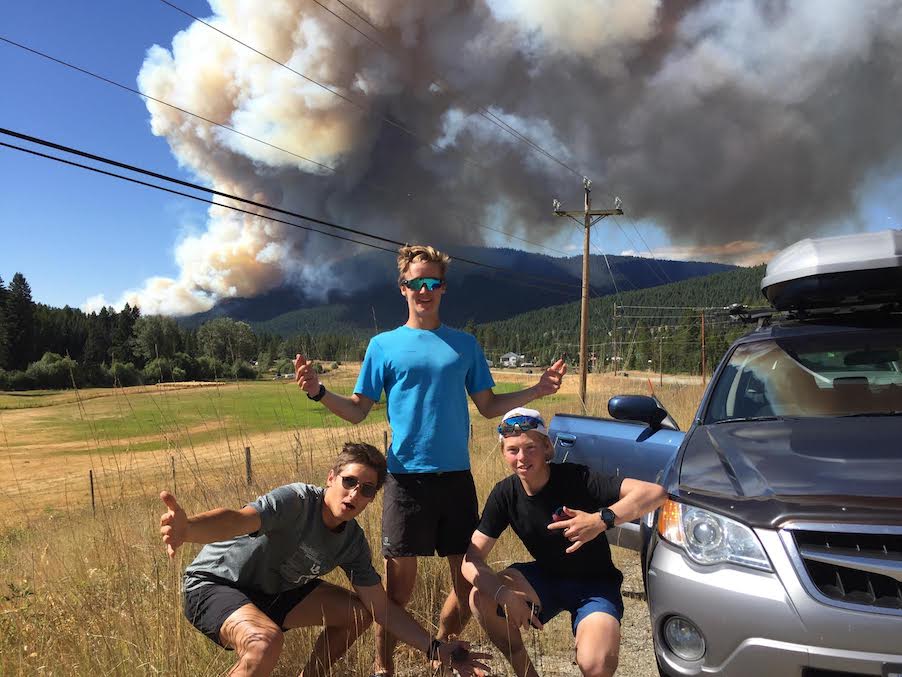
Canadians Fran Vukonic, Tallon Noble and Ian Williams after completing a trail run on Sept. 5 at Big White in Kelowna, B.C.,with the backdrop of the newest Kelowna fire on an otherwise bluebird day. (Photo: Gareth Williams)
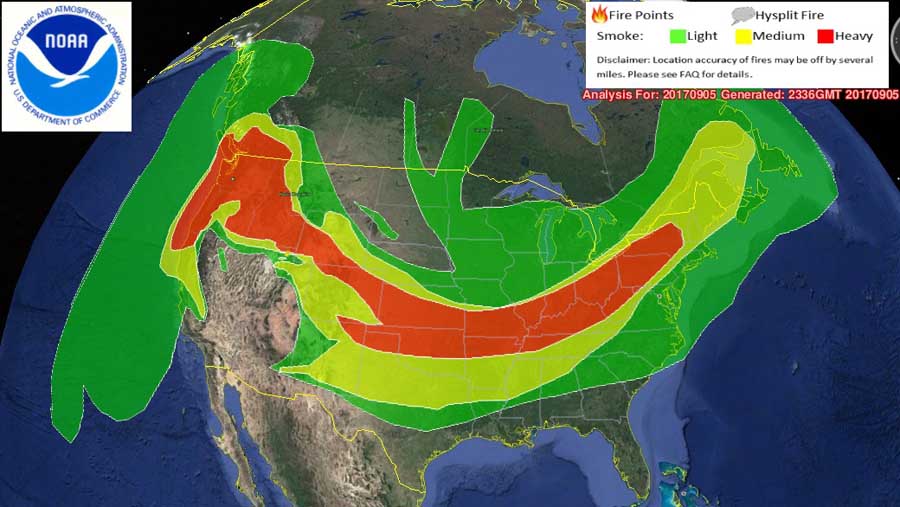
Beyond the hundredth meridian, a traditional geographic line demarcating where the West begins, it’s been a hot and dry summer. Wildfires have raged from Washington to California, the Intermountain West, and in western Canada. The conditions remain ripe for extreme fire danger. Even if a wildfire didn’t burn near you, odds are the smoke found its way there.
Across the board and across the U.S., it’s been an off-the-charts summer. While many Americans have been consumed with hurricane coverage and concerns over the last several weeks, fires have scorched more than a million acres in Washington and Oregon alone this year, according to Quartz Media. That’s up from 513,226 total acres in 2016, but in 2015 and 2014, more than a million acres were affected.
NOAA wildfire smoke and the correlating Air Quality Index for Sept. 5, 2017. (Photo: NOAA)
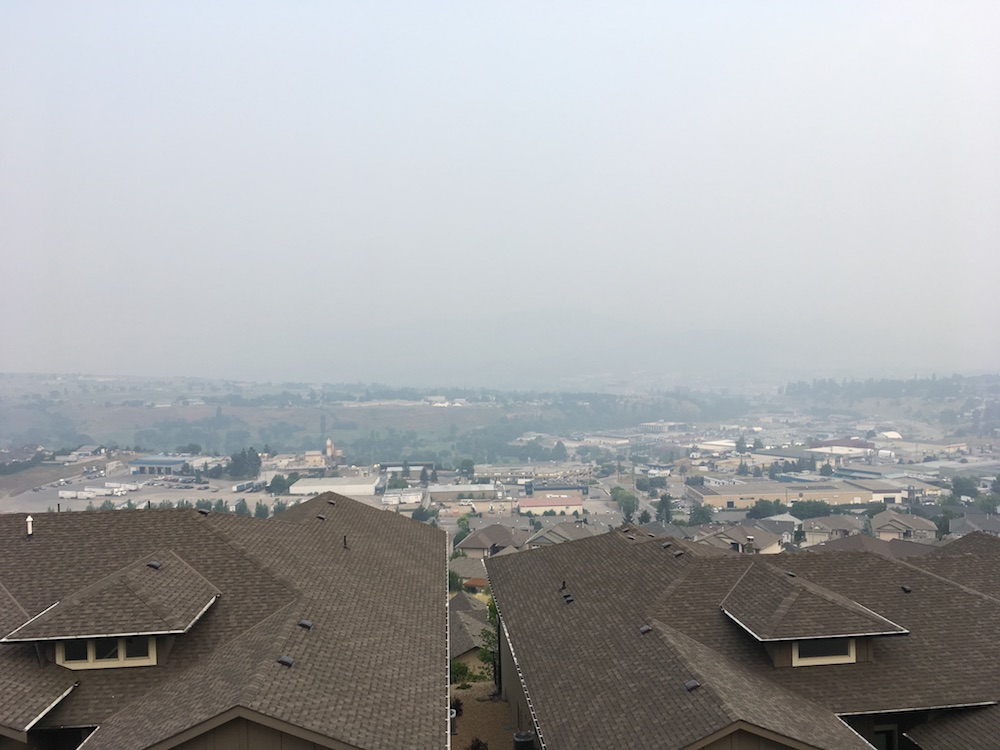
Along with the devastated landscapes and loss, the wildfires’ byproducts of smoke and ash have made for smoggy, poor air quality. We’re talking about seriously hazy days when visibility often wasn’t more than a mile or two.
Training outside in less-than-ideal quality air can compromise an athlete. To better understand when it’s OK to go out or stay in, many skiers and coaches became intimate with the scientific benchmarks for air quality.
“I sort of have this rule where if I can see the glaciers on the mountain, I would rollerski but not do intervals,” Dakota Blackhorse-von Jess, who’s based out of the Bend Endurance Academy in Oregon, said on the phone last Friday. “My personal limit for being outdoors is that 75 AQI limit. That’s the unhealthy or moderate zone.”
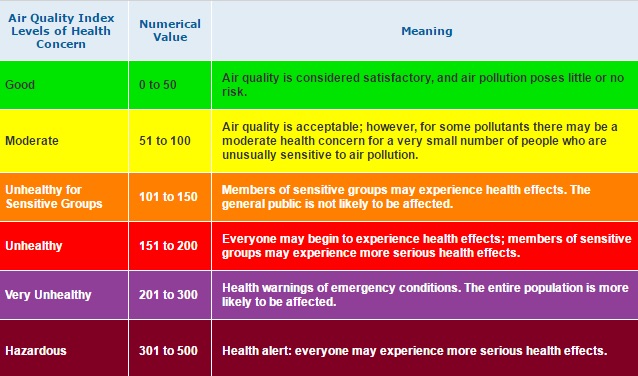
Here’s a quick primer. The U.S. Environmental Protection Agency (EPA) has developed an user-friendly Air Quality Index (AQI). The index is color coded and provides a numerical value indicative of a region’s air quality. An AQI of 75 means the air has a PM2.5 concentration of 23.5 microgramsper cubic meter. Going further, PM2.5 refers to the size of particulate matter in the air. In this case, the 2.5 corresponds to particulate matter 2.5 microns or less in width. That’s small enough to penetrate deep into the lungs, even the bloodstream.
U.S. Environmental Protection Agency Air Quality Index (Photo: EPA/AIRNOW.gov)
That 75 Blackhorse-von Jess limit falls midway into the moderate zone on the AQI.
“The higher end of moderate,” Blackhorse-von Jess clarified. “You see what the station says and then you walk outside and determine if it is going to work. Honestly, at this point, it’s been five weeks. I’ve done so much training indoors, that now it’s more of a mental break than a training deficiency.”
In places like Bend, Ore., where Blackhorse-von Jess calls home, some athletes have ignored the warnings.
“I saw guys out there riding today, I see them every time when I am looking for breaks in the smoke,” Blackhorse-von Jess explained. “I cannot believe that people are out there. I think people living in the smoke have accepted a lower standard and are going about their daily lives and actually, their daily activities in the smoke have come to accept the shittiness of the feeling they are experiencing. And for the professional athlete, it is something that you cannot afford, I don’t believe.”
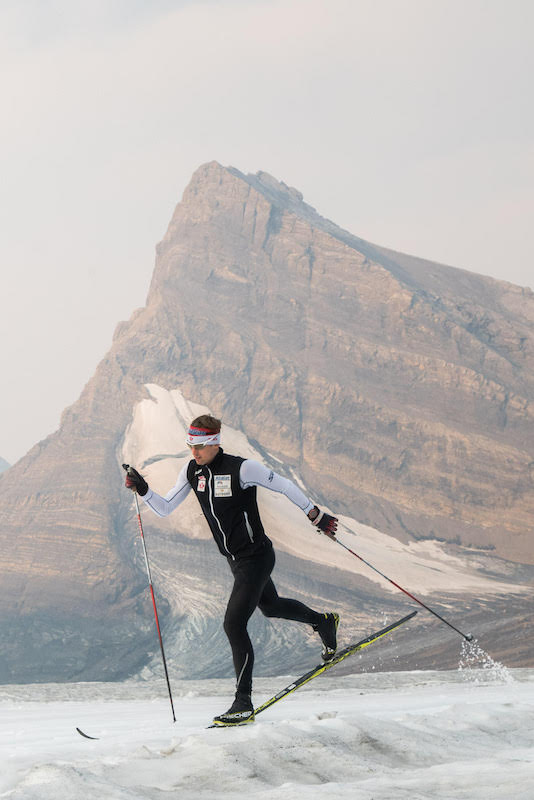
Julien Locke (Canadian U25 Team) training at a hazy Haig Glacier camp in August. (Photo: Anthony Killick)
While several fires continue to burn, the smoke cleared in Bend on Sept. 9. During much of August and into the beginning of September, Blackhorse-von Jess relied on a SkiErg, running treadmill and a stationary bike for much of his over-distance training.
He is not alone.
“Actually today, it was still dark when I woke up, but when the sun came up there was actually blue sky,” U.S. Ski Team member Liz Stephen said Friday from her home in Park City, Utah. “Where other days, you weren’t even sure the sun was up. It was really nasty.”
Like other elite skiers across the West, Stephen had made use of indoor training opportunities. The day before Stephen spoke to FasterSkier, she logged four hours on a ski treadmill at U.S. Ski and Snowboard’s Center of Excellence (COE) in Park City.
The AQI is also careful to note what are called “sensitive groups”. That can mean older adults, children, or people with lung or heart issues. Those populations must take precautions when high exertion exercise and poor air quality mix. Being responsible for junior athletes places a premium on being cautious.
For Leslie Hall, director of the Methow Valley Nordic Team in Washington state, dealing with smoke and subsequent air quality issues have been an on-and-off again affair.
“We had a bad two week period at the beginning of August and it was leading into our annual Methow PNSA [Pacific Northwest Ski Association] Camp … so we had to make the call to move the camp,” Hall wrote in an email. “We ended up going to Oakridge, Ore., for the camp and had a great camp there with 32 kids but a fire started nearby there while we were there so we had one moderately smoky day and it has since gotten much worse there.”
Like her athletic and coaching counterparts, Hall keeps an eye on air-quality websites to determine if a practice is indoors our out. But kids are kids.
“It is quite hard to keep the kids motivated and they do not enjoy the gym workouts,” Hall noted. “But during the early smoke time, we knew we were going to go somewhere else to train fairly soon so we kept that in mind. This past week was good because there are a variety of kids running and different coaches which help. Also, intensity workouts on the exercise machines help the time go by quicker. There is plenty of complaining and calls to move East, but I think all the kids realize that we are very fortunate in general and it is hard to complain when the hurricanes are decimating the south and we just have bad air for a week or so.”
Reports from Canada mirrored the smoke-filled experience of skiers in the Western part of the U.S.
Air Quality Health Index 5 in Vernon. BC (Photo: Gerry Furseth)Air Quality Health Index 1, Vernon, BC (Photo: Gerry Furseth)
Gareth Williams, a member of Canada’s national U25 Team and a native of Kelowna, B.C., wrote in an email that the smoke was a near-constant companion this summer.
Gareth Williams (Canadian U25 Team) leads Fran Vukonic during an orange-tinted rollerski in Kelowna, B.C. (Courtesy photo)
“Summer has been great for me, I spent much of it on the Haig [glacier near Canmore, Alberta] in July,” Williams explained. “I’ve been in Kelowna the whole month of August and the smoke has yet to subside, it has actually gotten much worse recently. In past years the smoke has been bad, but I have never seen it like this. … I think the smoke isn’t as bad as some people have suggested, for me it’s not the greatest worry. I will be happy once it is gone though, getting a little tired of the orange lighting and not being able to see the sun!”
Michael Somppi, who trains with the Alberta World Cup Academy (AWCA) in Canmore, altered his plans depending on conditions.
“Personally, I haven’t found the breathing to be too bad,” Somppi wrote. “That said, I am avoiding doing any hard intensity efforts on smoky days. Today was the first day (in Kelowna) I was forced to alter my training plans, as I had planned to do a rollerski time trial, and instead opted to do zone 3 because of the smoke. Even breathing semi hard felt sketchy with how bad the air quality is at the moment.”
Another member of Canada’s U25 Team, Julien Locke has literally trained above the smoke on occasion.
“I’ve been lucky in that the smoke hasn’t been too thick during most of the important training blocks so far,” Locke wrote. “I was at the Haig Glacier 4 times this summer and while we had some hazy days, for the most part, 2400m elevation was high enough to have clear skies.”
Let’s face it, nordic ski racing is about the most physically taxing of sports. Pre-race, mid-race, post-race, it’s easy to come up with excuses and to complain. My tech missed the wax, I’m overtrained, I’m undertrained, sore muscles, no muscles … there’s a lot to whine about.
A young Jesse Knori in the skating zone: no pole style = moxie too. (Courtesy photo)
Mostly the sport is rife with teeth-grinding athletes seeking the sufferfest. One of those athletes is 23-year-old Jesse Knori, a 2017 University of Colorado-Boulder (CU) graduate and native of Jackson Hole, Wyo.
On the spectrum of sufferfesting skiers, Knori is an outlier. For a young adult, Knori has already dealt with more than her fair share of physical and emotional pain. (For all the details, you’ll have to listen to the podcast episode below.)
Jesse Knori (University of Colorado-Boulder) leading Estonia’s Anette Veerpalu during their quarterfinal of the women’s classic sprint at U23 World Championships at Soldier Hollow in Midway, Utah. Knori finished third in that heat (while Veerpalu was sixth). While she didn’t advance to the semifinals, Knori was the top U.S. woman in 15th on the day. (Photo: FlyingPointRoad.com)
As a middle schooler, Knori was diagnosed with severe rheumatoid arthritis. Knori skied at CU and notched 15th in the classic sprint at this year’s U23 Nordic World Championships in Utah. Clearly, Knori didn’t let her autoimmune condition dictate her goal setting.
Bottom line, Knori is as tough as they come. And she’s a sixth-generation Jackson Hole native and new coach at the Bend Endurance Academy in Oregon. She’s the guest on Nordic Nation’s first edition of its “Moxie Episode”.
Jesse Knori (University of Colorado-Boulder) representing the U.S. at 2017 U23 Worlds at Soldier Hollow in Midway, Utah. (Photo: Bernie Nelson)
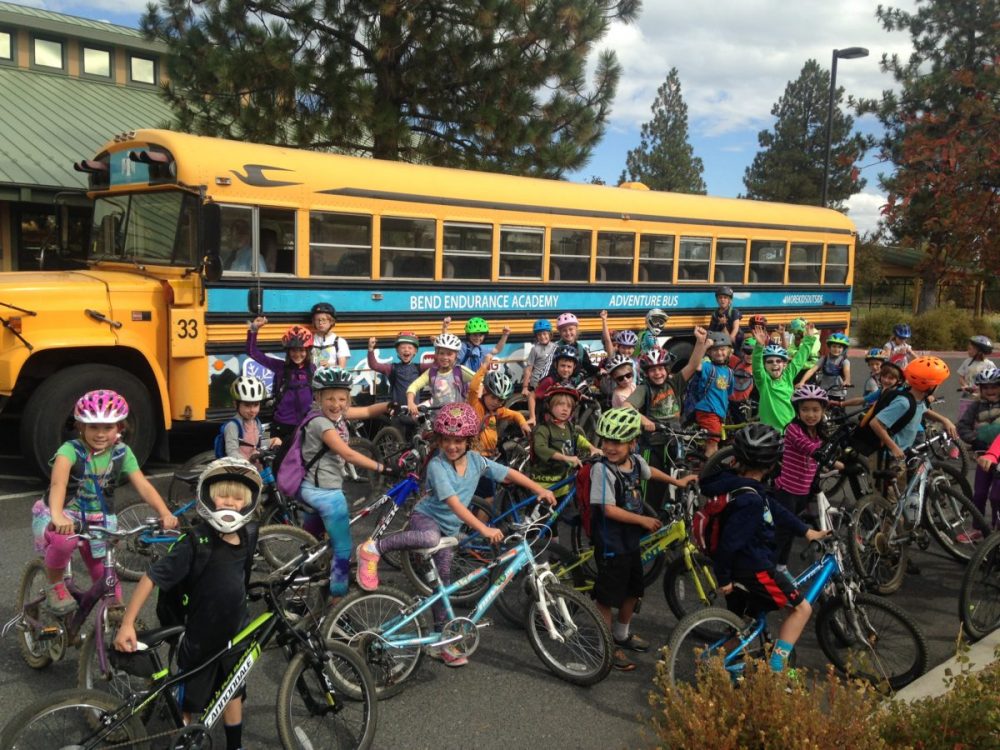
Bend Endurance Academy (BEA) athletes ready for a ride while standing in front of their “Adventure Bus”. (Photo: Mike Rougeux)
In the summer of 2013, Bend Endurance Academy (BEA) Executive Director Ben Husaby made what some may have considered a strange company purchase. The two-time Olympic cross-country skier bought an old yellow school bus, painted a pale-blue stripe lengthwise down its side and inscribed the organization’s moniker where an educational institution name once was.
Why? Was he planning to shuttle BEA student-athletes to and from school during his spare time?
Not quite. When Husaby founded the nonprofit organization in Bend, Ore., in 2009 alongside Brenna and Bill Warburton, he and BEA advocated for the affordability and accessibility of sport to kids. The addition of a bus to the organization created a means of free transport and the potential to incorporate youth who might otherwise miss out. In the summer, the bus would run daily, with BEA athletes boarding from various pickup spots and being transported at no extra cost to practice venues. In the winter, bus pickups and drop-offs would move to three times a week.
It largely symbolized what he and BEA wanted to do: get a greater number of kids outside and active, without breaking the bank.
“We have figured out how to run the organization through program fees, and our program fees are on par with [Bend] Parks and Rec,” Husaby recently said on the phone. “Even though [BEA] is nonprofit and we have a board of directors, we try really hard not to fundraise … the entire organization is really pushed by program revenue. I think people appreciate that.”
Ben Husaby (second from left) smiling with some of Bend Endurance Academy’s finest. (Photo: Mike Rougeux)
While Husaby didn’t drive the oversized, yellow-and-blue streaked bus — he left that to retired school-bus driver Steve Delery — he valued providing a greater number of families with the option to participate in BEA’s programs. The bus was just one physical example.
The mission of BEA is another. With the primary goal of providing its members a resource in “teamwork, personal growth and community responsibility,” Husaby hoped the program he created eight years ago would attract an audience beyond just the superstar athlete.
In keeping with this model, the organization has grown from 20 youngsters in its startup years to just under 1,000 unique enrollments this year. Husaby attributed this participant surge to the affordability and accessibility BEA promotes.
“We’re not performance driven,” Husaby said. “It allows for a horizontal platform. All kids need to spend more time outside. All kids need to put their screens down. All kids need to have interactions with quality mentors and you can do all of those things without necessarily being competition focused.
“It’s not a top-down organization,” the 51-year-old Minnesota native continued. “It’s mostly about teaching kids to enjoy endurance sports and that message has worked all the way through.”
Even if Husaby prefers the Academy to remain less performance driven than other clubs, its program still puts out national-caliber athletes. In the realm of nordic skiing, Dakota Blackhorse-von Jess is one of them.
For close to 17 years, Blackhorse-von Jess and Husaby have worked together, originally while Husaby was still a coach for the Mt. Bachelor Sports Education Foundation (MBSEF) in the early 2000s — he was let go from MBSEF in December 2008 and started BEA the following month.
Prior to that, skiing came in the form of racing for Husaby. After moving to Bend in 1991, he qualified for two Olympics — 1992 and 1994 — and tried one final time in 1998 before focusing on marathon racing, including the American Birkebeiner, for the next two years.
“I was working for a friend in an automotive restoration shop when that fall [of 2000] the director of MBSEF contacted me asking if I wanted to coach the nordic program,” Husaby said of his start in coaching.
Husaby accepted the position, and while sitting in his office one afternoon, he met a visitor that ultimately influenced the rest of his coaching career. A stocky high schooler entered his room, voicing goal that made Husaby’s eyebrows go up.
Ben Husaby (l) and Dakota Blackhorse-von Jess. (Photo: Mike Rougeux)
“[Blackhorse-von Jess] walked in and said, ‘I want to win Junior Nationals,’ ” Husaby recalled. “I sort of laughed because he was kind of a pudgy little kid … I mean I didn’t even know who he was. But I said, ‘OK,’ kind of laughing, and ironically, two years later, he was at World Juniors.”
The two went to World Juniors in 2006, before Blackhorse-von Jess headed east to attend Dartmouth College for four years, earning a degree in computer science. Upon returning to Bend in 2011, Blackhorse-von Jess rejoined Husaby and BEA. He earned a job as the organization’s associate director, a position in which he was responsible for bookkeeping, building the enrollment system and managing the program’s website.
However, as Husaby admitted, being Blackhorse-von Jess’s boss and coach proved to be difficult. Blackhorse-von Jess had an intense training schedule, but the work he needed to complete for BEA was equally important. Husaby was caught in the delicate position of understanding his employee’s outside stressors and their significance while also being charged with overseeing Blackhorse-von Jess’s salaried work.
Though not the singular reason, this is one point Husaby brought up as he discussed his recent decision to leave his post as executive director. Though he will continue to coach Blackhorse-von Jess through this Olympic season, he plans to leave BEA by Sept. 1 of this year.
“I think me leaving is actually going to make [Dakota’s] ski career a little bit easier as he winds it down,” Husaby said.
According to the 31-year-old Blackhorse-von Jess, this will most likely be his final competitive season and he hopes to end with a bang by qualifying for the 2018 Winter Olympics in PyeongChang, South Korea.
“I’m looking forward to doing something different this season,” Blackhorse-von Jess said earlier this week on the phone. “I mean, I know in many ways what we do this year is the same, but it’s our last year and it’ll be, farewell tour isn’t the best way to put that, but I think there is something special and different about it. I’m just excited to see what it holds.”
Though Husaby considers BEA his “phoenix”, he departs the head position with a sense of respect for what’s been accomplished and an excitement to spend the final months of his ski career back on the ground doing what he loves most: coaching.
“I’ve already noticed that for me, it’s going to be a lot easier to coach [Dakota] if I’m not his boss any longer,” Husaby said.
“I think the organization is ready for a manager that perhaps doesn’t have as personal of a connection as I do to Bernie [Nelson, BEA’s nordic director], Dakota, Bill [Warburton, cycling director] and Mike [Rougeux, climbing director],” he continued. “I’m leaving now because I’ve been either an athlete, or a coach, or a leader, or a supporter for 30-some years and it’s just time … it’s taken a lot to build this organization and I really honestly believe that I’ve taken it as far as I can.”
The organization is certainly a far cry from the volunteer-run, single-sport (nordic skiing) nonprofit it was in the beginning. Since its inception, cycling and climbing programs have been added to the academy, 45 seasonal, as well as two more full-time employees added to the original staff of three, and program participation has reached capacity.
“It’s big now and it needs someone that perhaps has a little more experience with growing the organization fiscally,” Husaby said. “We’re kind of through the whole founders’ phase. We were a scrappy, scrappy startup, and I was comfortable leading that, I think I just reached my capacity with the organization.”
Husaby will continue to aid BEA with coaching and moving into a new leased facility through the summer. Though no particular candidate has been singled out as of yet, the BEA’s Board of Directors is looking for someone who supports Husaby’s original mission and vision for youth.
“The biggest contribution Ben gave is defining a culture of the organization that is really long-lasting,” BEA Board President Cris Himes said on the phone. “What Ben has really done for BEA is to emphasize fun and joy and getting outside for kids at all levels, making it fun for them and helping them find their intrinsic drive.
“Really that’s been his number one contribution and that’s not going to go away,” she continued. “We are all expressing gratitude to Ben for what he has given this community and organization. It’s quite a legacy and a gift.”
Spring Series opened earlier this week in Fairbanks, Alaska, with skiathlon races on Monday and freestyle sprints on Wednesday to wrap up the 2017 SuperTour season. Here is a photo gallery from Wednesday’s skate sprints, courtesy of Max Kaufman. Spring Series continues Friday with the co-ed mixed relay and Sunday with the 30/50 k freestyle mass starts, part of U.S. Distance Nationals.
Right to left: Ida Sargent (Craftsbury Green Racing Project/U.S. Ski Team) and Deedra Irwin (Sun Valley Ski Education Foundation) during their quarterfinal for the women’s 1.6-kilometer freestyle sprint on Wednesday at the 2017 SuperTour Finals in Fairbanks, Alaska. (Photo: Max Kaufman)
Left to right: APU teammate Logan Hanneman and Scott Patterson during their quarterfinal of the men’s 1.6-kilometer freestyle sprint on Wednesday at the 2017 SuperTour Finals in Fairbanks, Alaska. (Photo: Max Kaufman)
Left to right: Evan Palmer-Charrette (NTDC Thunder Bay), Dakota Blackhorse-von Jess (Bend Endurance Academy), Paddy Caldwell, (SMS Elite/USST D-team), and Silas Talbot (Bridger Ski Foundation) at the start of their quarterfinal of the men’s 1.6-kilometer freestyle sprint on Wednesday at the 2017 SuperTour Finals in Fairbanks, Alaska. (Photo: Max Kaufman)
Left to right: Reese Hanneman (Alaska Pacific University) and Dakota Blackhorse-von Jess (Bend Endurance Academy) duke it out during their quarterfinal of the men’s 1.6-kilometer freestyle sprint on Wednesday at the 2017 SuperTour Finals in Fairbanks, Alaska. (Photo: Max Kaufman)
Right to left: Kikkan Randall (Alaska Pacific University/U.S. Ski Team) and Hannah Halvorsen (Sugar Bowl Ski Academy/USST D-team) and Kelsey Phinney (SVSEF) during their semifinal of the women’s 1.6-kilometer freestyle sprint on Wednesday at the 2017 SuperTour Finals in Fairbanks, Alaska. (Photo: Max Kaufman)
Left to right: Jessie Diggins (SMS Elite Team/U.S. Ski Team), Jessica Yeaton (APU), Erika Flowers (SMS Elite) , and Caitlin Patterson (Craftsbury Green Racing Project) during their semifinal for the women’s 1.6-kilometer freestyle sprint on Wednesday at the 2017 SuperTour Finals in Fairbanks, Alaska. (Photo: Max Kaufman)
Left to right: Hannah Halvorsen (Sugar Bowl Ski Academy/USST D-team) leads Caitlin Gregg (Team Gregg) during their semifinal of the women’s 1.6-kilometer freestyle sprint on Wednesday at the 2017 SuperTour Finals in Fairbanks, Alaska. (Photo: Max Kaufman)
Left to right: Kikkan Randall (Alaska Pacific University/U.S. Ski Team) and Hannah Halvorsen (Sugar Bowl Ski Academy/USST D-team) and Kelsey Phinney (SVSEF) during their semifinal of the the women’s 1.6-kilometer freestyle sprint on Wednesday at the 2017 SuperTour Finals in Fairbanks, Alaska. (Photo: Max Kaufman)
Right to left: Scott Patterson (APU), Logan Hanneman (APU), Tad Elliott (SSCV), and Ben Saxton (SMS Elite) during their semifinal of the men’s 1.6-kilometer freestyle sprint on Wednesday at the 2017 SuperTour Finals in Fairbanks, Alaska. (Photo: Max Kaufman)
Right to left: Norway’s Haakon Hjelstuen, Thomas O’Harra (APU), Matt Gelso (Sun Valley Ski Education Foundation), Nick Michaud (Bend Endurance Academy), Dakota Blackhorse-von Jess (BEA), and Evan Palmer-Charrette (NTDC Thunder Bay) during their semifinal of the men’s 1.6-kilometer freestyle sprint on Wednesday at the 2017 SuperTour Finals in Fairbanks, Alaska. (Photo: Max Kaufman)
Left to right: Jessie Diggins (SMS Elite Team/U.S. Ski Team) ahead of Kikkan Randall (APU/U.S. Ski Team) during the women’s 1.6-kilometer freestyle sprint final on Wednesday at the 2017 SuperTour Finals in Fairbanks, Alaska. (Photo: Max Kaufman)
Left to right: Jessie Diggins (Stratton Mountain School Elite Team/U.S. Ski Team) leads Kikkan Randall (Alaska Pacific University/U.S. Ski Team) during the women’s 1.6-kilometer freestyle sprint final on Wednesday at the 2017 SuperTour Finals in Fairbanks, Alaska. (Photo: Max Kaufman)
Left to right: Erika Flowers (SMS Elite Team) leads her teammate Sophie Caldwell (SMS Elite/U.S. Ski Team) during the women’s 1.6-kilometer freestyle sprint final on Wednesday at the 2017 SuperTour Finals in Fairbanks, Alaska. (Photo: Max Kaufman)
Ida Sargent (Craftsbury Green Racing Project/U.S. Ski Team) racing during the women’s 1.6-kilometer freestyle sprint final on Wednesday at the 2017 SuperTour Finals in Fairbanks, Alaska. (Photo: Max Kaufman)
Left to right: Logan Hanneman (APU), Evan Palmer-Charrette (NTDC Thunder Bay), Tyler Kornfield (APU), and Norway’s Haakon Hjelstuen go head to head in the men’s 1.6-kilometer freestyle sprint final on Wednesday at the 2017 SuperTour Finals in Fairbanks, Alaska. (Photo: Max Kaufman)
Left to right: Canadian Evan Palmer-Charrette (NTDC Thunder Bay) leading Logan Hanneman (Alaska Pacific University) during the men’s 1.6-kilometer freestyle sprint final on Wednesday at the 2017 SuperTour Finals in Fairbanks, Alaska. (Photo: Max Kaufman)
Left to right: Logan Hanneman (Alaska Pacific University) ahead of Canadian Evan Palmer-Charrette (NTDC Thunder Bay) during the men’s 1.6-kilometer freestyle sprint final on Wednesday at the 2017 SuperTour Finals in Fairbanks, Alaska. (Photo: Max Kaufman)
Left to right: Tyler Kornfield (Alaska Pacific University) leads Norway’s Haakon Hjelstuen during the men’s 1.6-kilometer freestyle sprint final on Wednesday at the 2017 SuperTour Finals in Fairbanks, Alaska. (Photo: Max Kaufman)
Left to right: Norway’s Haakon Hjelstuen skis ahead of Tad Elliott (Ski & Snowboard Club Vail) during the men’s 1.6-kilometer freestyle sprint final on Wednesday at the 2017 SuperTour Finals in Fairbanks, Alaska. (Photo: Max Kaufman)
Bernie Nelson (l), U.S. U23 Worlds coach, and Patrick O’Brien (r), U.S. Junior Worlds coach, get settled in Utah with their athletes prior to the start of the U23 & Junior World Championships, which start Monday, Jan. 30, at Soldier Hollow in Midway, Utah. (Photo: Bryan Fish)
The world is coming to Soldier Hollow in Midway, Utah. From Jan. 30-Feb. 5, the Olympic venue known as “SoHo” will host 2017 Junior and U23 World Championships. Throughout the last week, skiers from approximately 40 nations have descended on rural Utah and the race venue tucked up on the Eastern flanks of the Wasatch.
From the outset, athletes, coaches and wax techs will be busy. It’s the usual hustle and bustle and last-second scramble of any ski race weekend — the early morning ski tests, athlete meals, handing out bibs, and delivering just-in-time prepped skis to a racer waiting at the line. No glamour. It’s long before any potential podiums — it’s when any coffee is good coffee.
This environment with higher-stake races at SoHo isn’t simply a means of exposing emerging international skiers to the world’s best. It’s also fertile ground for coach development where they are exposed to the inherent stressors of international-level ski racing. This year, U.S. Ski Team Development Coach Bryan Fish will lead the cadre of 12 junior skiers and 10 under-23 (U23) skiers gathering in Utah, with the help of Stratton Mountain School (SMS) Elite Team Head Coach Patrick O’Brien and Bend Endurance Academy (BEA) Nordic Director Bernie Nelson.
O’Brien, a 26-year-old Vermont native and former Craftsbury Green Racing Project skier, will lead the U.S. Junior Worlds team. He’s coming off an eventful U.S. nationals, also held at SoHo, where his level of tolerance and preparedness for the whimsical Heber Valley weather gods was tested.
“It was one of those situations when it’s a waxers nightmare and you just have to try and figure your best to have options and keep your head on a swivel and see how conditions are changing,” O’Brien said on the phone from Truckee, Calif., site of last weekend’s SuperTour races, as he reflected on the all-hands-on-deck conditions during nationals.
“We ran the full array for what we saw for weather,” O’Brien added. “Temperatures that were so cold that they were causing the diesel generators in the wax areas to gel and shut everything down to some really heavy rain that was putting the courses in jeopardy as well as our ability to get there and set up. We were digging drainage ditches and sandbagging to move water around the wax area to some pretty heavy snowfall for the last day sprint qualifier.”
That experience will help O’Brien keep his calm. In the event of an all-conditions SoHo morass during World Juniors, he’s already helped his SME Elite techs and athletes make quick decisions there.
“The thing is, you just have to be prepared for everything, you never know what you are going to wake up to, at SoHo especially,” O’Brien said.
His return visit to the 2002 Olympic venue, only weeks after U.S. nationals, comes with an emphasis on ensuring the athletes are prepared, and less pressure on prepping skis — he’ll leave that job to the team’s wax techs.
“The role that I am best suited in is trying to see the forest through the trees and provide the clearest information in terms of what I see going on out there,” O’Brien clarified. “So the best thing that I can do is be outside the wax room.”
“I am a facilitator,” Nelson, also 26, said of how she defines her role when traveling as an international coach. “These athletes come with training plans, they come knowing what they are going to do. I am the person in the starting pen that is like, ‘Hey, you’ve got this, the work is done. Go out there and have fun. Have a good race.’ ”
The coaching duo return to Utah with past international coaching experience on their resumes. It’s O’Brien’s third year as the SMS Elite Team head coach, where he supports his athletes with training plans and wax-tech support at SuperTours, including U.S. nationals. He’s also teched and coached at a spring OPA cup trip and at last year’s season-ending World Cup series, the Ski Tour Canada.
Nelson, the U.S. U23 team coach, served the dual tech-coach role at 2015 World Championships for Australian national-team member Paul Kovacs. At the time, Nelson was also Kovacs’s coach at the Bridger Ski Foundation (BSF). She also teched at last year’s Juniors Worlds and U23 Worlds in Romania. Like O’Brien, Nelson gained experience working the Ski Tour Canada.
Both coaches enter a situation demanding flexibility and a willingness to embrace unknowns. For Nelson, the U23 athletes are ones she may not work with on a daily basis, but she’s begun to develop relationships with.
“Kelsey Phinney came and spent a summer with me when I was at BSF,” Nelson explained. “Bill Harmeyer is a former BEA postgraduate and I spent this past summer with him. Logan Diekmann is a former post-grad, Alayna Sonnesyn also spent the summer at BEA. I feel really connected to a lot of the athletes. For the ones that I don’t, it goes hand in hand. It’s my job as a coach to reach out to them and let them know I am someone they can trust.”
Nelson said she’ll only be responsible for waxing skis when asked by a technician. Her primary tasks will focus on athlete preparedness, and include big-picture items, like allowing athletes to decompress away from the competition venue, and small-picture, businesslike tasks of handing out bibs and communicating accurate start times, which aren’t exactly glamorous, but essential.
“I also feel responsible for making sure the techs have what they need to succeed — coffee, a chair, or whatever,” Nelson added.
Nelson said she believes the U.S. sends competitive teams to Junior & U23 World Championships. Although this year, with U.S. athletes enjoying home-field advantage, Nelson stated she’ll emphasize not adding any undue pressure to perform.
“It is important for the athletes to not feel that pressure, but to understand that they belong there and they have been brought to this event for a reason,” she said.
One reason these athletes are brought to events like Worlds is for the opportunity for a race performance on the international stage representative of their current form and to learn. These events are stepping stones.
Rolling into the SoHo infield where a world of flags will snap in the Wasatch downdraft may also remind these two young coaches that they are enhancing their knowledge base to help foster a stronger ski community.
“I am still learning,” Nelson willfully admitted. “Every time I go on a trip my eyes are wide open. I think there are always opportunities to make split-second decisions and I think a lot of the learning happens after the fact, because you get to another situation and you’ll have the tools to make an informed decision that you didn’t really realize that you had. They compound and build on each other.”
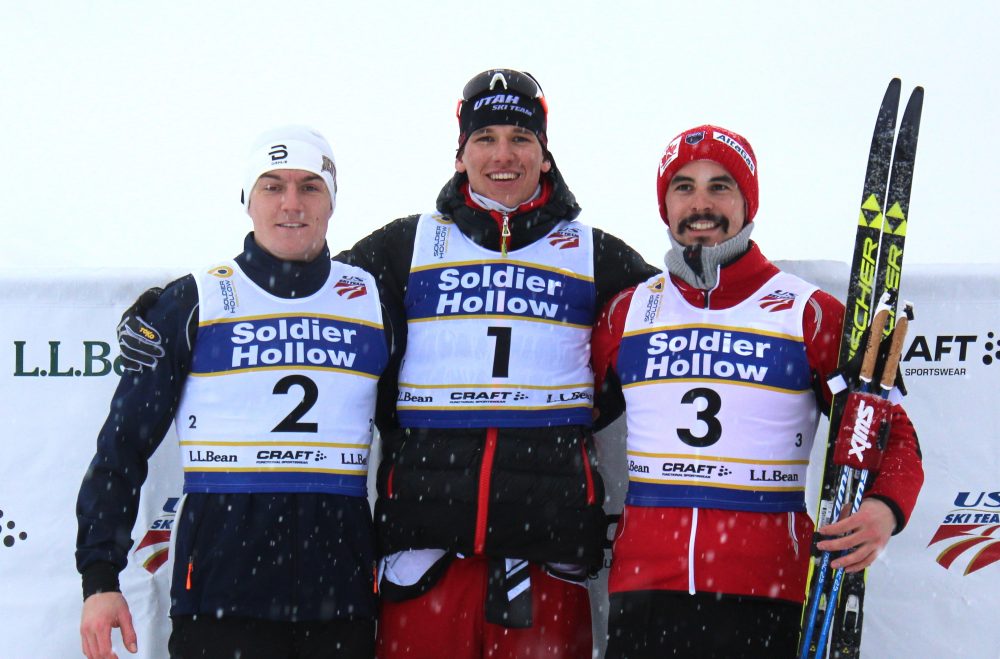
Left to right: University of Denver skier Moritz Madlener, University of Utah’s Kevin Bolger and Canada’s Jesse Cockney on top of the podium for the men’s 1.5-kilometer classic sprint on Sunday at U.S. nationals in Midway, Utah.
MIDWAY, Utah — Classic sprint day at U.S. Cross Country Championships. Nothing was simple. The 9:05 a.m. start time brought a daylong chess match for athletes and wax techs. Temperatures hovered near freezing all day — the entire spectrum of precipitation seemed to fall: drizzle, swollen wet snowflakes, and graupel.
One by one the big names set off at 15-second increments. There was Bend Endurance Academy’s Dakota Blackhorse-von Jess, then Reese Hanneman, of Alaska Pacific University (APU), followed by an elite list of North America’s best sprinters absent those few racing on the World Cup.
The men’s course featured three climbs, the last of which was positioned before a sweeping descent back into the stadium about 0.5 kilometers from the finish. Early on, even with the first few starters, it was evident on this hill that the chess match’s checkmate move pivoted on the wax.
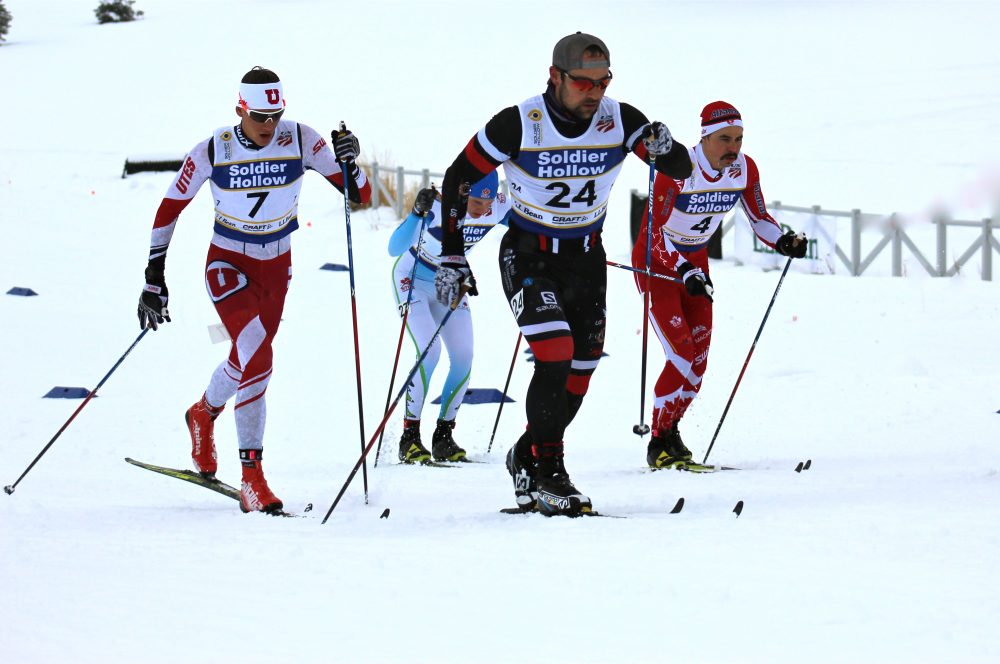
Dakota Blackhorse-von Jess (24) leads Kevin Bolger (7) and Jess Cockney (4) during the first quarterfinal of the men’s 1.5-kilometer classic sprint on Sunday at U.S. nationals in Midway, Utah.
Up that hill, some skiers strode, many slipped. Some athletes employed a herringbone-run mash up, some double poled on skate skis. Others suffered the indignity of balled up snow under foot and the awkward dance of shedding that snow and attempting to make forward progress.
APU Head Coach Erik Flora helped put the qualifier in perspective.
“This is the first time ever that I have been in a sprint race when we haven’t had any men in the heats,” Flora said about his men’s results. “And that’s the first time in ten years.”
For a club like APU, it’s clearly rare when a perfect storm impacts an entire men’s side.
“I don’t think it was one thing, it was a combination of a few things,” Flora said after the racing was completed. “We have a few guys that came in sick and that didn’t help. And we have a lot of guys that are seeded really high in the start list with points and if you look through the top 30, there’s a lot of unusual places.”
On many days, a high race seed correlates with good results.
“But sometimes there are those days when being in a certain place in a seed helps. I think for the leading men it was a disadvantage today,” Flora added.
Along with some recent sickness, the seeding and weather conditions, and skis that Flora noted weren’t “anything special”, APU’s qualifying positions portended a rough day for many.
Some athletes’ misfortune opened doors for others. No one kicked that door open with more force than University of Utah’s 23-year-old Kevin Bolger. He was the only American in the men’s final and won his first-career national title outright by winning the final over second-place skier Moritz Madlener (University of Denver), and Canadian national-team member Jess Cockney in third.
“100 percent. Absolutely,” Bolger said when asked if he was surprised by the end result. “Usually just qualifying for the heats is kind of my biggest goal. And today, I just, with the qualifying seventh I was in awe, actually.”
Bolger qualified seventh in 3:41.69, only a few seconds behind best qualifier, Ben Saxton of the Stratton Mountain School (SMS) Elite Team, who rounded the 1.5 k course in 3:38.35.
The Utah skier had a four-leaf-clover day. Bolger said his coach nailed the wax every round which complemented his fitness. In his quarterfinal, Blackhorse-von Jess set the tempo.
“I knew he was a good sprinter, I kind of look around in my heats before each, kind of see who I’m around, who I can play with,” Bolger said. “And I saw he was there, I knew he wanted to get to the final, so I was like, ‘He’s going to try and race well.’ And I got in behind him, he made a move and I stuck with him.”
On the back hill, where the skiers race up and away to the backside of the course, Blackhorse-von Jess played his hand.
“I think he got 10 meters off on me,” Bolger said of Blackhorse-von Jess’s stamp of authority.
But on the descent into the last kicker climb, Bolger’s skis were running.
“And my skis just – they glided right up to him,” Bolger described. “And I came up to that hill and they kept going, and I was like, ‘All right, I’m going to run up this sucker.’ And I went for it.”
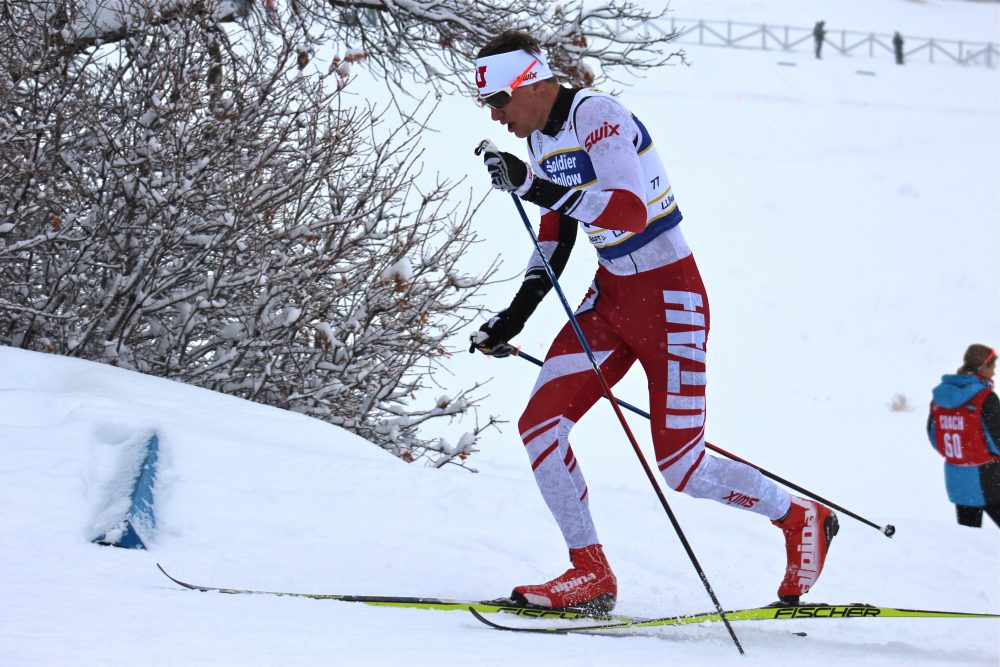
The University of Utah’s Kevin Bolger during the qualifier of the 1.5 k classic sprint on Sunday at U.S. nationals in Midway, Utah.
Now Bolger was off the front widening a small gap. Behind, it appeared Blackhorse-von Jess’s skis momentarily stalled out, resulting in a fall and snapped pole. Unaware of changing fortunes behind, Bolger cruised in. But he’d not simply cashed out, satisfied with a quarterfinal win. He banked some important knowledge. He wasn’t slipping on his skis when kicking at decisive moments.
“Knowing that I can charge up that [last] hill 100 percent and trust my skis, that’s huge, I think, in our sport,” Bolger said.
Luck struck again in his semifinal — Bolger placed fourth in a fast first semifinal; he was the second lucky loser, both of whom came from his semifinal.
In the final, Cockney made a bold move from the start, but the group behind yo-yoed, never losing significant contact. And on that same last hill, Bolger charged again.
“I was like, ‘OK, I think this is the time to go,’ ’cause I don’t have quite the turnover in my double pole,” Bolger said. “I know I’m big, strong and powerful, but the turnover I think isn’t quite there. So I thought that that was my time to go.”
Up and working over the top, Bolger was gone for his first national title.
“It kind of hit me like 10 meters from the finish that I was gonna win this sucker, and I was like, ‘Holy sh*t,’ ” he said.
Second-place finisher, 23-year-old Madlener is a student in the U.S. but grew up skiing in Germany. (It was Madlener’s second podium in as many races at senior nationals. He placed third in Saturday’s 15 k freestyle.)
Madlener is a multiple NCAA podium placer.
“I had second and third in NCAAs last year, and second the year before during my sophomore year,” Madlener explained in a post-race phone interview.
Although pleased with his podiums at Soldier Hollow this week, he explained his year-end goal remains winning an NCAA individual title.
“I want to win it at some point,” Madlener added. “This is my senior year, this year is it. I am aware it is difficult to win a race at NCAAs but that is my goal and of course to win again as a team, which I think we have a good chance to do.”
Madlener told FasterSkier he will not be pursuing a post-collegiate ski career and has accepted a job that will eventually base him in Salt Lake City after graduation.
The U.S. Podium
As part of U.S. nationals, a separate, U.S.-only podium is also recognized. Bolger still stood atop in first, 22-year-old Sun Valley Ski Education (SVSEF) Gold Team member Jack Hegman was second, and his teammate Cole Morgan, also 22, third.
Hegman and Morgan both skied in the second semifinal and neither advanced; Hegman finished third, Morgan fourth.
For Hegman, it’s his last year as a U23 so his main goal this week at nationals is qualifying for U23 World Championships.
“I’ve had two really solid races so far, so I’m pretty stoked on that,” Hegman told FasterSkier after the race, referring to Sunday’s classic sprint and Saturday’s 15 k skate. “Yesterday I ended up sixth, I think, fifth American, and second U23. So that was a really awesome race for me, I was pretty fired up.”
Double poling was Morgan’s golden ticket. He qualified fifth on skate skis.
“Then it started raining before the quarters,” Morgan explained. “I came out to do the warmup, and it was super icy when I warmed up, I was like, ‘Oh, I’m definitely going to double pole it again in the quarterfinal.’”
In the third quarterfinal, Morgan took second place to automatically advance.
Like Hegman, Morgan’s ride ended in the semis. But his goal of obtaining an U23 World Championship berth remains.
New names, emerging names, and some old ones: a crazy day in SoHo.
Early-season snow: first tracks in Chugach State Park, above Anchorage, Alaska, on Sept. 18, 2015. (Photo: Gavin Kentch)
Twenty years ago today, on Nov. 2, 1996, a ski race sanctioned by the International Ski Federation (FIS) was held in Fairbanks, Alaska, on the trails at Birch Hill. It appears to be the earliest FIS race ever held on natural snow in the Northern Hemisphere. This is a look back at that race, and at the significance it has, or does not have, for some of its participants.
Setting the stage
It was the final days before a hard-fought presidential election. Clinton was widely expected to prevail over the Republican candidate, although a strong third-party showing and voter dissatisfaction with the two major parties were complicating the electoral calculus. The Alaska Republican Party was running newspaper ads promising to “defend State’s rights.” And people were skiing in Fairbanks. Plus ça change.
There were also some differences. The front page of the Fairbanks Daily News-Miner on Nov. 3 ran an article headlined “Dole hoping for an upset” over, of course, Bill Clinton. Then on Nov. 4: “Perot plans last-minute television blitz.”
Elsewhere in the paper, movie listings included the Leonardo DiCaprio vehicle Romeo + Juliet. Agate type in the sports section recounted promising rookie Ray Allen leading the Milwaukee Bucks to a victory over the Boston Celtics. (It was the second game of Allen’s career. He would go on to play 1,298 more games after that.) And an ad for an ISP, or internet service provider, explained to potential customers the appeal of “the Internet.” You could “interact with people from around the world,” it promised, or, “Find answers and advice in newsgroups.”
In Fairbanks, meanwhile, it was winter, and it had been winter for a long time. The News-Miner reported that October had seen record-breaking cold, even for Fairbanks, with an average temperature for the month of 13.6 degrees. Through Nov. 3, it had snowed 22 inches so far that winter; given those temperatures, and the relative lack of solar radiation in Fairbanks in winter, most of it was presumably still on the ground.
The Nanook Challenge
Given this weather and snow conditions, it hardly seems newsworthy that a ski race was held. Plus several members of the U.S. Ski Team (USST) had been in town for early-season training, so the skiers were there.
The field for the 10-kilometer classic interval start – official title the “Nanook Challenge: FIS Series Race No. 1” – was small but distinguished. There were 10 women and 18 men entered. At least four current members of the U.S. Ski Team competed, along with several former USST members.
The top-five finishers in the men’s race were Ben Husaby, Marcus Nash, Patrick Weaver, Scott Loomis, and Carl Swenson, respectively, a bevy of elite skiers that would not have been out of place at a mid-1990s national championship race. (Indeed, all five men would place in the top seven in the 15 k skate race at U.S. nationals later that winter in Bend.)
The women’s podium was headed up by USST skiers Laura Wilson and Suzanne King. Third place went to Julie Southwell, described by the News-Miner as “a national team contender who trains in Fairbanks.” (Five years later, a profile of Southwell by Inge Scheve in The Bulletin of Bend, Ore., would call her “a former Colorado resident who says she sort of follows the snow.”)
Wilson’s winning time was 33:28 for 10 k. Husaby finished the same course in 27:56. Conditions were described in the News-Miner as “near-perfect,” with an 11 a.m. race temperature of “20 degrees under a pale white ceiling of clouds.” (The season’s second FIS race, a 15 k skate, was held the following weekend, in arguably less perfect conditions. The high temperature for Fairbanks on November 9, 1996, was –1°. The low was –26°.)
(Story continues below)
The Fairbanks Daily News-Miner’s 1996 story on a Nov. 2 cross-country ski race, the earliest FIS-sanctioned event ever held in the Northern Hemisphere.
The Fairbanks Daily News-Miner’s 1996 story on a Nov. 2 cross-country ski race, the earliest FIS-sanctioned event ever held in the Northern Hemisphere.
The Fairbanks Daily News-Miner’s 1996 story on a Nov. 2 cross-country ski race, the earliest FIS-sanctioned event ever held in the Northern Hemisphere.
The Fairbanks Daily News-Miner’s 1996 results from the second race on Nov. 9.
Looking back
Swenson, the fifth-place finisher in the opening 10 k classic, has fond memories of Fairbanks as an early-season training destination generally, though scant recollections of this race specifically. When asked about this race in a recent phone interview, following his workday doing indigent defense for the New Hampshire Public Defender, Swenson began by musing, “I’m just trying to place what year that would have been,” and attempting to reconstruct whether World Champs had been held that spring or the year before. “We’d always have a race real quick after we got there,” Swenson continued. “And we’d get to Fairbanks in mid-October.”
In a race of more recent vintage: Carl Swenson, competing for Steinbock Racing, made the trip from southern New Hampshire for the 2010 Boulder Mountain Tour in Sun Valley, Idaho. (Photo: Toko)
“I remember it fondly,” Swenson, now 46, says of Octobers and Novembers spent in the Golden Heart City. “Not a lot of sunlight, lots of skiing.” He adds that “everyone was so excited be on snow again; I always looked forward to it. I don’t know if everyone looked forward to it, but I always did.”
“We were always able to ski” somewhere in or near Fairbanks, Swenson notes, “but sometimes it was really thin. … There could be pretty bad skiing, but I always remember we skied.” They would – much like modern-day juniors competing in the Besh Cup series – stay at the Wedgewood Resort, and “we’d all pile up and drive to Birch Hill. When it was a bad snow year, we’d all drive up to an elementary school” that had trails (Salcha Elementary), “and it would be ridiculously cold.”
Swenson’s lack of specific memories may be attributable not only to the passage of time and multiple fall trips to Fairbanks, but also to the fact that Nov. 2 was early in the season for him in more ways than one. “I probably hadn’t done much rollerskiing” at that point, Swenson candidly admits. “I was still catching up.”
(Uniquely among top-level cross-country skiers, Swenson had “made the bold decision to pursue a professional mountain-bike career and continue to ski race internationally in the winter,” FasterSkier previously wrote. 1996 was his first summer of pro mountain biking in the “offseason.”)
When asked whether he had simply kept the rollerskis in storage through September or had at least gotten out a few times a week during the summer, Swenson at first suggests digging up an old training log from storage, then says, “it would depend on if I went to late-season mountain bike races that year. Sometimes I would be – World Championships are at the end of the season in mountain biking. In ’96, I think I would have been in Boulder. And maybe I would have started doing some rollerskiing in the summer – not much, if any.”
Swenson was clearly unconcerned about his results in a November race two months before U.S. nationals and more than three months before World Championships. He recalled that his focus for his first two weeks back on snow would have been volume, and guessed that he would have logged approximately 20 hours of skiing per week while in Fairbanks. “I’m sure everybody up there was concentrating on volume, and things like that,” Swenson notes. “There would be people chasing points, to make an early trip – but I doubt anyone was doing that up there.”
Swenson improved his position with a third-place finish in the 15 k skate a week later, suggesting that he may have been racing his way into skiing shape.
The ’90s force is strong: Ben Husaby (USST) racing at 1993 U.S. Nationals in Rumford, Maine. (Courtesy photo)
At the top of the results sheet, Husaby won both races, the 10 k classic on Nov. 2 and the 15 k skate on Nov. 9. His memory of that fateful week in Fairbanks borders on the eidetic. “That weekend actually stands out for me as one of the more memorable ones in my ski career,” Husaby recently said when cold-called about a race from the Clinton administration.
Husaby, who turns 51 next month, spoke with FasterSkier by phone from Bend, where he works as executive director of the Bend Endurance Academy. (Husaby once cracked that he enjoys being a ski coach because “I get to drive a Ford Econoline van down winding roads in inclement weather.”) Husaby clarified that in his current job he coaches only one skier, national-class athlete Dakota Blackhorse-von Jess; he assists nordic director Bernie Nelson and will go out with other athletes, but says that he is following Nelson’s lead.
Husaby still recalls how fast he skied, but poignantly acknowledges that his timing was somewhat suboptimal.
“I’ll just say, it was the fastest I’ve ever skated, for sure,” Husaby declares. “And you certainly don’t want that to happen in the first week of November, but it did. It’s bittersweet, because it’s the wrong time, but it was amazing. Those two races, they were effortless.”
Husaby speaks with evident emotion about the sensation of skiing so easily:
“So, nobody wants to be a Christmas star, and I was a November star. But, the race course [in Fairbanks] was a very challenging race course, and I blew around that course effortlessly. And that was a really, really cool feeling. I had traditionally struggled in tough skating race courses, and, you know, I walked all over everybody. And so, you know, that was exciting. And one of the things I remember is, how cold I felt being as quote-unquote ‘skinny’ as I was. I was in the low 180s. And I was colder than I had normally been.
“I also remember feeling really light and fleet and dynamic. I remember – and it’s always weird, because when we got back to the hotel – you know, those first races of the year, people are always talking about how they’re going to get better, where they made mistakes… generally everyone wants to downplay their early races. And here I was – I’m looking in retrospect in terms of how fast I really did ski. At the moment I didn’t realize that that was probably as fast as I had ever gone, but in retrospect, I realize, wow.
“There were a couple of World Championship results, there were a couple World Cup results where I was competitive, and probably moving along at the same speed – but this particular weekend, it was completely effortless.”
Husaby had been a member of the U.S. Ski Team from 1991 through 1995, but in fall 1996 was training solo. But he finished ahead of all current USST members in both races in Fairbanks.
“Particularly the skate race,” Husaby enthuses, “I mean, for me to beat everybody by over a minute – I think it was a minute and change – in a 15 k skate. I mean, I never did that. I’m not really sure why.” (Husaby correctly recalls that he beat second-place John Bauer by 1:04 in the skate race.)
Early-season snow: skiing past Summit Lake, in Hatcher Pass above Palmer, Alaska, on Sept. 23, 2016. (Photo: Gavin Kentch)
At the time, Husaby felt strongly that his performance merited selection for bigger stages: “I do remember being like, ‘God, I wish they would have selected me to go back to the World Cup.’ Because they sent Marcus [Nash]. They took Marcus, not me. And I do remember being like, ‘Dangit, I killed everybody, they should be taking me.’ But it’s always like that – you always think that you should be the one that’s named.”
But he now waxes much more philosophical about the vagaries of team selection. “I’ve had 20 years to think about it,” Husaby now analyzes, no regret or animosity in his voice. “There are a lot of arguments why I should have been chosen for it, and a lot of arguments why I shouldn’t have been chosen for it. It’s just the nature of sport.”
As he left Fairbanks in November 1996, Husaby had high hopes that these results presaged a breakthrough season for him.
“Like any athlete, you think, ‘Oh my gosh, this is the start – it’s really going to happen here.’ Particularly when you’ve had five years of mediocre racing on the World Cup, right? … In the previous five years, I had everything [in World Cup results] from low 20s to, you know, 112th place. And so all of a sudden a result like this comes along early in the season, and I’m thinking to myself, ‘Man, if this is the start of things to come, this year is going to be totally lights out.’ ”
Husaby did not receive World Cup start rights that season, and in fact never raced on the World Cup again. He spent the 1996/1997 season on the domestic Yoko Cup, an inchoate version of the national-level race series that ultimately became the SuperTour.
Despite – or maybe because of – the fact that the Fairbanks races ultimately proved to be a highwater mark of the season rather than a springboard to successful European racing, Husaby frequently uses the experience as a teaching moment for his athletes.
“As much as we really think that we have our finger on the pulse,” Husaby theorizes, “and that we can really dial in when we’re going to be fast, and really pick and choose the big events, and how it’s all going to play out – you never really know when you’re going to have your moment. You don’t know. The body and the mind are really – sometimes they’re diametrically opposed, sometimes they’re incredibly in sync, sometimes one is lined up and the other one’s not. And a huge part about athletic growth is just realizing that you never really know when you’re going to have your moment. So when you do have your moment, hopefully you get something from it, you gain something from it. For me, this was an indicator that my training, the change in training, had an effect, the weight loss had an effect, maybe the release of not being on the ski team any more had an effect.”
“I guess the moral is to pull something positive out of a good race, regardless of when it happens.”
When asked about his strongest memories from his time in Fairbanks, Husaby mentions two things. First, despite the subzero temperatures for the skate race, “I remember that that climb – I felt like Superman going up that far outer climb [on the race course]… I remember charging up it. It’s got like three rises in it.”
Early-season snow: fresh snow on top of fall colors in Chugach State Park, above Anchorage, Alaska, on Sept. 18, 2015. (Photo: Gavin Kentch)
And second, “I remember that being a very cold week. … I wasn’t a ‘do a loop many times’ kind of guy. I was always an explorer. Well, I spent most of my training time in Fairbanks actually out on the White Bear [Trail] and out on the military roads. I used to bring really crappy skis, just so I could ski on the military roads. But I recall that week being incredibly cold. And my motivation was to ski out to the end of White Bear, look at the thermometer, and then ski back in. Just to reaffirm how cold it really was. That was it. Besides that race, that was my memory of that week.”
In addition to multi-time Olympians, other notable names on the results sheet include “Jason Cork, UAF, 34:23.3,” in 12th, surrounded by several of his teammates from the University of Alaska Fairbanks ski team. Cork was born and raised in Alaska, and graduated from North Pole High School in 1995. He skied for UAF before embarking on a coaching career that ultimately brought him to his current position as Assistant Men’s Coach for the U.S. Ski Team.
Early-season history
The participants may not have realized it at the time, but they were, in the world of high-level ski racing, making history. The race remains the earliest FIS-sanctioned race ever held on natural snow in the Northern Hemisphere, according to the FIS database.
(A FIS-sanctioned race is one whose results can be used to help calculate a skier’s FIS points, “theoretically a universal ranking system for skiers around the world who have never competed against one another.” Generally speaking, a FIS race is held on a course with climbs of specific height differential and grade, as well as a total climb requirement. A FIS race is held on a relatively challenging course, and attracts a relatively high caliber of skiers.)
Here are the earliest FIS races from 1996 to present, as listed in the online FIS results database. Amidst a host of early-November dates from several venues across northern Scandinavia, November 2, in Fairbanks, Alaska, stands out as the earliest by a small margin. But Fairbanks shares one significant thing in common with the other names frequently occurring on this list: a far northern latitude. Fairbanks is at, in round numbers, 65 degrees north latitude; Olos and Muonio, 68°; Inari, 69°; Beitostølen, a downright tropical 61°. (The Arctic Circle is at 66°34′.)
Table of year’s earliest FIS race, 1996-2015. (Source: FIS database)
As FasterSkier wrote over a decade ago, Fairbanks in early winter presents a “surreal setting. … The air is still, day after day, and the temperatures hover around zero even though it is barely November.”
(The table distinguishes between natural snow races and artificial snow loops when relevant – it is truly impressive that Mora had a sprint race on a stored ribbon of snow on October 21, but it makes for an apples-to-oranges comparison to Fairbanks or Muonio. Also note that the 1996 cutoff for this table is not artificially hiding an earlier race out there. The earliest FIS race from any of 1990-1995 was held on November 6, 1993 (also in Fairbanks, also the Nanook Challenge). And by the 1990/1991 season, there are only a dozen races listed for the entire season (down from hundreds for 2015/2016), underscoring the limitations of the otherwise remarkable FIS database.)
All that said, simply skiing in Fairbanks in November is a news story on the level of “dog bites man.” September snowfall in Fairbanks is not unusual. Groomed (or at least dragged) skiing in October is expected. Throughout the 1990s, Birch Hill was a mecca for early-season training for high-level skiers from across the country. (The second FIS race of 1996, the 15 k skate a week later, boasted a top-8 of Husaby, John Bauer, Swenson, Loomis, Weaver, Todd Boonstra, Adam Verrier, and Audun Endestad. That’s a lot of good skiers. And a combined 15 Winter Olympics.)
Ken Leary is a longtime Fairbanks local who oversaw the low-key Wednesday Night Race Series ($20 for eight races!) for many years. In an email to FasterSkier, Leary wrote that “the first Nordic ski race of the season in Fairbanks is the annual Wednesday Night Halloween race held on the Wednesday nearest to Halloween.”
Leary added, “To my knowledge, Fairbanks has never had a Nordic ski race in the month of September, but it would have been possible in years 1992, 1993, 1996, and 2015 because of early snowfall.”
(In Anchorage, which like Beitostølen is situated at a balmy 61° north latitude, early high-level ski races on record include “a 15 km APU race that [then Alaska Pacific University head coach] Jim Galanes held on the Spencer Loop on October 25, 2001,” as recounted on local skier Tim Kelley’s blog. More recently, the University of Alaska Anchorage ski team held a time trial on the Spencer Loop a week ago today.)
Max Olek (University of Alaska Fairbanks), No. 22, leads eventual winner Lex Treinen (also UAF), No. 18, in a ski race held at Birch Hill in Fairbanks, Alaska, on May 8, 2013. (Photo: YouTube screenshot)
And at the other end of the season, following a winter of roughly average snowfall but then a spring of record-breaking cold, Leary once hosted a race at Birch Hill on May 8, 2013, when the 6:45 p.m. start time occurred a full four hours before sunset. (The YouTube video is worth a quick watch (and not only because a cross-country ski race leads the sports news on local CBS affiliate K13XD Channel 13). It shows racers in shorts on what can only be described as close to 100 percent snow coverage on a 50-degree day. Many skiers have raced in midwinter in far worse.)
What it all means
There is an undeniable draw to being on snow – especially when you’re not supposed to be. (Or maybe especially when others are not, and you can brag on social media that you are.) Rollerskiing is good as far as it goes, but Annie Pokorny once credibly likened it to a rebound girlfriend, writing, “Every spring, Nordic skiers must undergo a reluctant breakup with the perfect girl” and console themselves with mere rollerskiing.
As Chelsea Little previously wrote in a lyrical piece on FasterSkier, she clings to the idea that, “at any given moment, somewhere in the world, there’s great skiing. If I can’t be back home and if it’s not December through March, then a corner of my mind is occupied wondering where that snow is and whether I can get there.” For Swenson, Husaby and a handful of other elite American skiers throughout the 1990s, the answer to “where the snow is” in October and November was consistently Fairbanks, Alaska.
Bernie Nelson (l) coaching Australian national-team skier, Alaska Pacific University member, and former Montana State University athlete Jessica Yeaton (r) at the 2015 World Championships in Falun, Sweden. (Courtesy photo)
BEND, Ore. — A few things stand out while interviewing Bernadette “Bernie” Nelson, the newly hired head nordic coach at the Bend Endurance Academy (BEA): she’s intentional with her words, meticulous and grateful for the opportunities she’s been given as she develops into an emerging leader on the cross-country ski racing scene.
Growing up in Truckee, Calif., Nelson said she became hooked on nordic skiing because of the way her coaches used the Sierras as a playground — where play just happened to be training.
“Skiing wasn’t just skiing,” she explained. “We went running, and climbing, and biking, and we ran all our camps out of Yosemite, which was just the coolest opportunity ever.”
Beyond the physical settings and cross-training opportunities the Sierras afforded, Nelson mentioned that Truckee’s ski scene placed an emphasis on building a unified team. Nelson said that end goal — team spirit — began with parents emphasizing the organization rather than individual results.
“I feel like when I was growing up, something that worked in Truckee was that the parents weren’t just invested in their child — they were invested in the organization and the community and the process,” she said. “I feel like it shifted the focus from the child’s performance to the experience that the child was having. And so, having parents invested in that experience and invested in the greater organization kind of it took the emphasis off of, ‘My child won today.’ ”
In that healthy environment, Nelson thrived — she skied herself onto several Junior National podiums.
Coach and Collaborator
Bernie Nelson prepping skis while coaching at Montana State University. (Courtesy photo)
Nelson eventually went on to ski for the Montana State University (MSU) nordic ski team for two years. After that she focused on her studies while at the same time serving as the assistant nordic coach at MSU for another three seasons.
With a proven aptitude for managing athletes, school and the stress of travel and waxing, Nelson was hired by Bridger Ski Foundation’s (BSF) Dragan Danevski to head up the post-graduate and elite teams in 2014.
One difficult task Nelson was held responsible for was guiding a team of 18- and 19-year-olds in BSF’s post-grad program. Nelson says she built mutual respect with her athletes premised on a simple common goal.
“I want the athletes to develop just as much they want to develop,” she said of her coaching style: less dogmatic, more like a collaborator. “I hand them the keys and I’ll sit in the passenger seat. I’ll provide the roadmap to where they are going and where they need to turn and if they are driving too fast or you’re not paying attention anymore, the speed limit is 60 and you are going 25. And that’s how I run my program. It’s through mutual respect and mutual understanding and a lot of communication.”
For Nelson, communicating wasn’t simply about the day’s intensity session, or periodization within a complex training plan. Sometimes it was more basic.
“I’ve worked with [postgraduates],” she said. “So there is a lot of life things going on. ‘I’m out of the house.’ ‘I don’t know how to do laundry.’ ‘I cannot find a job, can you help me?’ ‘Can I list you as a reference?’ And so it’s just a big picture and I try to not be ignorant of any of the moving pieces.”
Two BSF athletes who built a strong relationship with Nelson will be moving to Bend this June to continue working with her: Nick Michaud and Akeo Maifeld-Carucci.
At BEA, Nelson says she’ll make good use of the multi-disciplinary hat she once wore at BSF in terms of meeting the demands of junior skiers and what they want out of the sport.
“Especially in junior skiing, their goals range from making JN’s, to racing a junior qualifier, to winning JN’s, to going to World Juniors, to making friends,” she said. “I mean, the spectrum is so broad and through all of it, you learn pillars that support your life later on.”
Time to Simplify
This past spring, before her move to Bend, Nelson’s life became more complicated. While in Canmore serving as a guest coach for the U.S. Ski Team at the Ski Tour Canada, Nelson had a health scare.
“I had a Grand mal seizure in Canmore,” Nelson explained. “I came home from the skiathlon, got out of the shower, they think that I just passed out from accumulation of stress and exhaustion, and hit my head and had a Grand mal seizure. And I was actually air flighted and medically sedated into a coma in Calgary. It was unfortunate timing in that I couldn’t go to [SuperTour] Spring Series and I think there were all of these rumors flying and circulating about why I was leaving BSF.”
Nelson wanted to make clear that her departure from BSF was amicable.
“I did not leave because of BSF — BSF was keeping me in Bozeman,” Nelson said. “I love that job. I loved that organization, and working with Dragan was a fantastic opportunity. And I’m excited to continue working with him.”
BSF’s program director, Danevski could not be reached for comment.
Dakota Blackhorse-von Jess admiring turns with Bernie Nelson below Broken Hand Mountain in the Three Sisters Wilderness outside Bend, Ore. (Courtesy photo)
Nelson’s arrival in Bend was in many ways an attempt to simplify her life. Her partner is Dakota Blackhorse-von Jess, a perennial SuperTour sprint podium threat and longtime Bend resident. The couple saw each other either in Europe or at national-level races, or they endured the 800-mile road trip between Bend and Bozeman.
It was a combination of events that convinced Nelson to make the move: her personal relationship, the events in Canmore, and the job opening at BEA.
“I was more or less planning to come out here and then I had this seizure and it was like, ‘Yup, life is short,’ ” she said.
She explained that during her recovery — at least in the short-term — she couldn’t be alone or drive.
“It’s just that my life, a little bit, has just been kind of turned on its head,” she said.
Having Blackhorse-von Jess nearby to help with her recovery made practical sense. But on a lighter note, being in Bend affords Nelson the opportunity to foster their relationship.
“Part of me moving here takes the traveling out,” Nelson said. “Hopefully it allows him and us to kind of be a team here. In the sense that we can get things done together.”
Blackhorse-von Jess reiterated Nelson’s sentiments that their partnership in Bend will streamline their lives.
“Most of the upside is actually the intangible stuff,” Blackhorse-von Jess said. “We can facilitate workouts if necessary. If I need someone to drive a vehicle for example or run a lactate meter. The real benefit to having her here is that I don’t have to travel to Bozeman/she doesn’t have to travel here for us to see each other. And having two people in the house actually makes a huge difference with regards to food preparation and scheduling, and equipment maintenance. Those are the sort of tasks that you can share when you are in the same general field together.”
With World Championships this coming winter and 2018 being an Olympic year, Blackhorse-von Jess, 30, said he plans to continue training and racing for at least the next two years.
BEA Executive Director Ben Husaby will continue to supervise Blackhorse-von Jess’ training as he has for most of the 2013 and 2015 national champion’s career.
“I’m not coaching him, Ben is, and Ben does an awesome job,” Nelson maintained. “Maybe there will be days where we’ll be at the same place and I’ll take some video but I’m not going to coach him.”
Husaby’s hands will be full. BEA is a growing nonprofit with biking and climbing programs complimenting their nordic skiing offerings.
“Up until two years ago, I was everywhere,” Husaby said. “My primary focus was to grow the nordic program, to show its financial viability, and to lead the program … As time has gone on and our board has watched us grow and our program directors have had more needs, there were two options. I was either going to continue to be the program director and be the face of the nordic program, or I was going to shoot into the Executive Director role. And it’s been a relatively slow process, because selfishly, I really still enjoy coaching. It’s my passion.”
For the past two seasons, Jordan Buetow served as BEA’s head nordic coach. Buetow helped build the program and in his second season became the go-to face of the ski program as Husaby primarily coached Blackhorse-von Jess and tended to organizational duties.
Husaby said Buetow created a seamless transition for Nelson before he recently returned to his native Alaska.
Currently, Nelson is immersed with office work, learning about the broader details of BEA’s programs and community of parents and athletes, and writing training plans. She’ll be taking over more of the ski program’s coaching duties starting June 1.
Bernadette Nelson leading an OD workout for Bend Endurance Academy skiers. (Photo: Bernadette Nelson)
On Wednesday, the Bend Endurance Academy announced Bernie Nelson as its new head coach. (Courtesy photo)
(Bend,Ore) — Bend Endurance Academy (BEA) is pleased to announce Bernadette Nelson as the new Head Nordic Coach. Nelson joins BEA after a two-year coaching stint at Bridger Ski Foundation (BSF) where she was the Post Graduate and Elite Team Nordic Coach. Prior to her time at BSF Nelson was the Assistant Nordic Coach for Montana State University for three years.
“We’re really excited to be bringing Bernie on as Head Nordic Coach,” states Nordic Program Director Ben Husaby.
“She has a ton of experience coaching athletes. She has shown herself to be energetic, knowledgeable and approachable,” Husaby elaborated.
Bernie Nelson, new head coach of the Bend Endurance Academy, seen here during her time with the Montana State University Ski Team (Courtesy photo)
Bend Endurance Academy is a Bend based non-profit offering programs in cycling, rock climbing and Nordic skiing. Most of the program participants are in grade school to high school with a small handful of collegiate skiers.
“I’m looking forward to working more in the junior development areas of coaching. Working with juniors allows the opportunity to lead the athletes to be better skiers as well as better people,” Nelson stated about her transition to the junior development side of coaching.
Nelson will be replacing Jordan Buetow who has been BEA’s Head Nordic Coach for the past two seasons. Buetow will be moving back to his native Alaska to pursue a graduate degree. Bernadette will be taking the reigns of the Nordic program starting this June with Bend Endurance Academy’s summer competition and collegiate training program.
“I’m looking forward to collaborating with Ben this summer to build on the success and momentum of BEA’s summer training program,” she said.
Last summer BEA saw close to 30 collegiate Nordic skiers make the move to Bend for a summer of Nordic specific training.
“I think having someone like Bernadette, with her experience with collegiate and elite skiers, is going to be a great addition to the summer program,” says Husaby.
About Bend Endurance Academy
The Bend Endurance Academy is a 501 (c) 3 non-profit organization. The Academy organizes and operates programs that promote health and wellness within Oregon. The Academy provides athletic coaching, mentorship, educational experiences, volunteer opportunities and events for a diverse group of youth, young adults, and other individuals who desire to excel at endurance sports. Our programs are innovative, affordable and inclusive. We work to encourage participants to succeed throughout every step of their athletic and individual development.
The Academy’s mission is to “promote healthy living through active, outdoor experiences. We emphasize teamwork, personal growth and community responsibility.”
Bend Endurance Academy currently offer programs for Nordic Skiing, Cycling, and Rock Climbing.
New Year’s Eve at the Mt. Bachelor Nordic Center near Bend, Ore. (Photo: Rion O’Grady/Mt Bachelor Nordic Center Facebook)
Is there room at one ski center to support two junior development programs? In central Oregon, it depends on who you ask.
Mount Bachelor, 22 miles outside Bend, Ore., is a touchstone for nordic skiers. Located in Deschutes National Forest, Mt. Bachelor operates with a special use permit from the US Forest Service (USFS). The U.S. Ski Team has run training camps here and they’ve hosted national championships. In addition, there’s an extensive alpine mountain. With a base lodge at 6,300 feet above sea level, the venue boasts generally good snow conditions.
Mt. Bachelor has a longstanding relationship with the Mt. Bachelor Sports Education Foundation (MBSEF), a nearly 30-year-old nonprofit which has development programs for nordic, alpine and freestyle skiing. MBSEF runs its ski programs on the trails at Mt. Bachelor.
The much-newer Bend Endurance Academy (BEA), a nonprofit founded in 2009, would like to share the trails — at least, in low snow years. Except for a couple of rare occasions, BEA has not had permission to run its programs on Mt. Bachelor.
Since its inception, BEA has used Meissner Nordic, a nonprofit ski center also located on Mt. Bachelor. Run by volunteers, Meissner Nordic grooms 40 kilometers of ski trails on US Forest Service land.
It’s all good, until the weather doesn’t cooperate. Located 1,500 feet lower on Mt. Bachelor than the eponymous ski area, the previous two winters, 2013/2014 and 2014/2015, were difficult for Meissner, while Mt. Bachelor enjoyed better conditions higher up the mountain.
In February 2015, BEA approached Mt. Bachelor resort officials about using public lands at the Mt. Bachelor Nordic Center. They denied BEA’s request, except for the last two weekends of the season.
A group of Bend Endurance Academy youth skiers in February 2016. (Photo: Ryder Utrecht/Bend Endurance Academy Facebook)
This year, the academy has circulated a petition called Let the Kids Ski, calling for more access to Mt. Bachelor.
“There are two places in central Oregon that have groomed nordic trails,” said BEA Board President Cris Himes. “Meissner Nordic and Mt. Bachelor. Meissner has worked very well until recently due to ski conditions.
“What we’re looking for is equal and reasonable access,” Himes continued. “Equal to any other paying customer and community group.”
According to Dave Rathbun, Mt. Bachelor’s former president and general manager who resigned in mid-March, the resort had existing relationships with four businesses “to run their businesses sort of inside our own,” he said. “We still have to get approval from the Forest Service for these concessionaires.”
MBSEF, whose board Rathbun also sat on, is the designated concessionaire for nordic and alpine ski programming. Rathbun is no longer a member of that board.
In a December interview with the Bend Bulletin, Rathbun characterized BEA’s interest in Mt. Bachelor as a desire to use the resort as “a home base for their business.”
“[BEA] want to operate their business within ours, and in most cases at a time when we’re already at capacity,” Rathbun told FasterSkier. “It’s very busy at the times they want to have access.”
Rathbun added that Mt. Bachelor is “at capacity” for instruction in both in nordic and alpine skiing. “We’re not going to open it up to any other concessionaires.”
In addition to its own paying customers, Mt. Bachelor’s agreement with the USFS requires the resort to accommodate people who want to access backcountry skiing via a “common corridor.”
According to Rathbun, “that’s another 10,000 visits per year,” in addition to about 30,000 visitors per year skiing Mt. Bachelor.
Himes feels that the lodge might be crowded, but believes that the trails are not. For her, the primary issue is ensuring that kids have access to skiing. The lack of decent snow is a barrier to participation, and this is reflected in the numbers. Although BEA’s competition team is larger than last year, the enrollment in its youth club and nordic development programs is down 38 percent and 28 percent respectively from the 2014/2015 season.
“Last year Mt. Bachelor did a remarkable job of keeping their snow,” Himes said. “When we can’t run our programs at Meissner, we need to be able to take our kids to groomed trails somewhere else. The only option is Mt. Bachelor Nordic Center.”
New Year’s Day 2016 at the Mt. Bachelor Nordic Center near Bend, Ore. (Photo: Lew Becker/Mt Bachelor Nordic Center Facebook)
During the snow drought two seasons ago in 2014/2015, Rathbun reflected, “I wanted to be a good neighbor. We gave BEA access to nordic center in afternoons, the last couple of weekends in March. I think it worked out well and they appreciated being able to get on snow.”
In a July email to BEA, Rathbun offered the academy access on Tuesday and Thursday afternoons and weekends after 12 p.m., with certain blackout dates during peak periods. These times apparently didn’t match BEA’s program schedule, and according to Himes, left only three weekends out of the winter for training. In September, Himes met with Rathbun to negotiate more favorable access times, to no avail.
“I’m really sorry about that, but that’s the only way we feel it can work, based on how crowded we are,” Rathbun told FasterSkier.
“I can see both sides,” said Alan Watson, the Pacific Northwest Ski Association (PNSA) nordic program director. “My interest is in promoting the success of all these programs. I would like Mt. Bachelor to let BEA train on their trails. It would be good for skiing in the northwest.”
Is trail crowding a red herring? Rathbun said that BEA skiers were welcome to come up and ski so long as they had a pass, but that organized training with a coach wouldn’t be permitted – except at the times listed above.
Does Mt. Bachelor wield trail access as a cudgel? From a distance, it’s hard to tell. But FasterSkier obtained three documents sent anonymously to Himes. One was Oregon School Ski Association’s (OSSA) participation policy. OSSA is one of the two governing bodies for high-school alpine skiing in central Oregon, and holds race meets at Mt. Bachelor. Circulated in December 2014, the policy required students on high school ski teams to participate in four training sessions each week, including races.
OSSA Race Director Matt Cutter said that there were students that participated in both high school and club programs, and that OSSA’s goal with this policy was to instill team unity.
“We don’t want ringers,” Cutter said of athletes who only show up for race meets. “We needed to get something in writing.”
The other two documents, both dated Jan. 8, 2015, are responses from Rathbun and John Scheimer, MBSEF’s executive director, to OSSA. Rathbun’s letter decried OSSA’s participation policy, stating that it would negatively impact “students who club race with MBSEF and have other extracurricular interests.” The letter concluded, “…with our strategic partner MBSEF, we [Mt. Bachelor] will be reviewing all elements of OSSA activities occurring on Mount Bachelor. … Any changes in these privileges will be communicated to you as soon as possible.” Scheimer’s letter to OSSA was written in a similar tone.
Scheimer declined an interview request for this article.
In response to the letters, Cutter said that OSSA rescinded its policy. “That was not our intention at all” to exclude anybody, or force a student to choose between a club program and the high school team, Cutter explained.
Cutter viewed the disagreement as minor, adding, “I can’t stress enough how much support Mt. Bachelor gives us.”
Rathbun said that his letter was actually in response to scheduling conflicts between OSSA and OISRA, a second governing body for Oregon high school alpine skiing. However, neither his letter nor Scheimer’s make any reference to OISRA. Cutter said that while Rathbun discussed scheduling with OISRA, it was in correspondence from August 2015.
“The kids know each other, the parents know each other, we support each other’s kids,” said Himes of BEA and MBSEF. “I am really hoping that we will be working cooperatively with MBSEF.”
With good conditions this winter, trail access at Mt. Bachelor wasn’t as crucial. Next year may be a different story.
HOUGHTON, Mich. — The last day of racing at U.S. Cross Country Championships on the Michigan Tech Trails wrapped up last Saturday, Jan. 9, with the 1.5-kilometer classic sprint. At the end of the day, Alaska Pacific University’s Eric Packer and Craftsbury Green Racing Project’s Kaitlynn Miller both walked away with their first U.S. national title. From the qualifier, to the rounds, to the podium ceremony, FasterSkier provides the day’s top moments in photos. Special thanks to Christopher Schmidt.
Photo: Alaska Pacific University skier Eric Packer celebrates after crossing the line in first ahead of teammate Reese Hanneman during the men’s 1.5 k classic sprint on Saturday at U.S. nationals in Houghton, Mich. (Photo credit: Christopher Schmidt)
Photo: Didrik Elset of Michigan Tech University chose to double pole on skate skis from qualifier, shown here, all the way to the final during the men’s 1.5 k classic sprint on Saturday at U.S. nationals in Houghton, Mich. Elset went on to place third overall.
Photo: Cole Morgan racing for the University of Vermont during the qualifier for the men’s 1.5 k classic sprint on Saturday at U.S. nationals in Houghton, Mich. Morgan ultimately finished in eighth overall.
Photo: (left to right) Alaska Pacific University’s Reese Hanneman, Canadian Julien Locke of Team Black Jack, Håkon Hjelstuen of Lyn Ski, Didrik Elset of Michigan Tech University, Tyler Korfield of Alaska Pacific University, and Logan Hanneman, also of Alaska Pacific University, crest the top of a climb during their semi-final of the men’s 1.5 k classic sprint on Saturday in Houghton, Mich. Hanneman and Elset advanced automatically to the final, while Hjelstuen and Kornfield moved on as the two lucky losers. (Photo credit: Christopher Schmidt)
Photo: (left to right) Kris Freeman of Team Freebird and Scott Patterson of Alaska Pacific University follow Alaska Pacific University skier Eric Packer and Canadian Julien Locke of Team Black Jack during their quarterfinal of he men’s 1.5 k classic sprint on Saturday at U.S. nationals in Houghton, Mich. Packer raced to an overall first place, while Locke went on to place tenth.
Photo: Gaspard Cuenot tucking during his semi-final of the men’s 1.5 k classic sprint on Saturday at U.S. nationals in Houghton Mich. Cuenot raced to an overall ninth. (Photo credit: Christopher Schmidt)
Photo: (right to left) Reese Hanneman of Alaska Pacific University leads Michigan Tech University Didrik Elset, Canadian Julien Locke of Team Black Jack, and younger brother Logan Hanneman, also of Alaska Pacific University during the first semi-final of the men’s 1.5 k classic sprint race on Saturday at U.S. nationals in Houghton, Mich. (Photo credit: Christopher Schmidt)
Photo: (right to left) Dakota Blackhorse-von Jess of the Bend Endurance Academy Eric Packer of Alaska Pacific University, and Cole Morgan of the University of Vermont round a corner during the men’s 1.5 k classic sprint race on Saturday at U.S. nationals in Houghton, Mich. Blackhorse-von Jess advanced to the final as did Packer. Packer ultimately won first place overall, while Blackhorse-von Jess skied to a fifth place finish in the final and Morgan finished in eighth. (Photo credit: Christopher Schmidt)
The start of the men’s classic sprint final (from left to right), with Didrik Elset of Michigan Tech, Dakota Blackhorse-von Jess of Bend Endurance Academy ), Tyler Kornfield (APU), and Reese Hanneman (APU) at the start of the final for the men’s 1.5 k classic sprint on Saturday at U.S. nationals in Houghton, Mich. (Photo: Christopher Schmidt)
APU head coach Erik Flora (98) runs alongside his athletes Eric Packer (5) and Reese Hanneman during (4) the final of the men’s 1.5 k classic sprint at U.S. nationals in Houghton, Mich., in January 2016. (Photo: Christopher Schmidt)
Photo: (left to right) Alaska Pacific University skier Eric Packer double poles to his first ever U.S. nationals championship title, ahead of teammate Tyler Kornfield, Bend Endurance Academy racer Dakota Blackhorse-von Jess, Lyn Ski racer Håkon Hjelstuen, Alaska Pacific University skier Reese Hanneman during the final of the men’s 1.5 k classic sprint race on Saturday at U.S. nationals in Houghton, Mich. (Photo credit: Christopher Schmidt)
Photo: Alaska Pacific University’s Eric Packer (center) is all smiles as he stands at the top of the podium next to second place finisher and teammate Reese Hanneman (r) and third place finisher Didrik Elset of Michigan Tech University after the men’s 1.5 k classic sprint on Saturday at U.S. nationals in Houghton, Mich.
Photo: Katharine Ogden skiing for Stratton Mountain School during the qualifier for the women’s 1.5 k classic sprint race on Saturday at 2016 U.S. nationals in Houghton, Mich.
Photo: (left to right) Sun Valley Ski Education Foundation skier Deedra Irwin, Stratton Mountain School racers Katharine Ogden and Erika Flowers, along with Dartmouth College racer Corey Stock, Bridger Ski Foundation’s Jennie Bender and Northern Michigan skier Nicole Schneider striding up the first climb in their quarterfinal of the women’s 1.5 k classic sprint on Saturday at U.S. nationals in Houghton, Mich. Aer advancing to the semi-final and final, Bender raced to a third place finish overall, while Ogden took eighth. (Photo: Christopher Schmidt)
Photo: (left to right) Northern Michigan University’s Sarah Bezdicek and Felicia Gesior, stride up a climb behind Heather Mooney of the Craftsbury Green Racing Project and Alaska Pacific University’s Jessica Yeaton during their quarterfinal of the women’s 1.5 k classic sprint on Saturday at U.S. nationals in Houghton, Mich. Mooney raced to a tenth place finish overall; Gesior took ninth. (Photo credit: Christopher Schmidt)
Photo: Craftsbury Green Racing Project skier Liz Guiney (center) makes her way around a corner ahead of Northern Michigan University’s Lea Buenter (r), University of Alaska Fairbanks skier Nicole Bathe and Stratton Mountain School racer Julia Kern during their quarterfinal of the women’s 1.5 k classic sprint on Saturday at U.S. nationals in Houghton, Mich. Guiney advanced to the semifinal and finished the day in seventh overall. (Photo credit: Christopher Schmidt)
Photo: (left to right) Stratton Mountain School skier Anne Hart strides up a climb ahead of CXC racer Natalia Naryskina, and Alaska Pacific University’s Becca Rorabaugh during their semi-final of the women’s 1.5 k classic sprint on Saturday at U.S. nationals in Houghton, Mich. All three women advanced to the final, where Hart placed second overall, Naryskina sixth, and Rorabaugh fifth. (Photo credit: Christopher Schmidt)
Photo: (right to left) Kaitlynn Miller of the Craftsbury Green Racing Project corners the final turn into the finishing stretch ahead of Bridger Ski Foundation athlete Jennie Bender and CGRP skier Caitlin Patterson during their semi-final of the women’s 1.5 k class sprint on Saturday at U.S. nationals in Houghton, Mich. (Photo credit: Christopher Schmidt)
Photo: (left to right) Craftsbury Green Racing Project skier, Kaitlynn Miller out sprints Alaska Pacific University’s Becca Rorabaugh, Bridger Ski Foundation’s Jennie Bender, and Stratton Mountain School skier Anne Hart during the final 100-meters of the final for the women’s 1.5 k classic sprint on Saturday at U.S. nationals in Houghton, Mich. Miller took first, while Hart placed second, Bender third, and Rorabaugh fifth. (Photo credit: Christopher Schmidt)
Photo: (left to right) Anne Hart of Stratton Mountain School along with Craftsburu Green Racing Project Kaitlynn Miller and Bridger Ski Foundation athlete on top the women’s 1.5 k classic sprint podium on Saturday at U.S. nationals in Houghton, Mich. (Photo credit: Christopher Schmidt)
Photo: (left to right) Kaitlynn Miller of the Craftsbury Green Racing Project stands with teammates Heather Mooney and Liz Guiney after winning her first championship title in the women’s 1.5 k classic sprint on Saturday at U.S. nationals in Houghton, Michigan. Mooney raced to a tenth place finish overall and Guiney finished seventh. (Photo credit: Christopher Schmidt)
Alaska Pacific University teammates Eric Packer (5) and Reese Hanneman (4) go head to head in the men’s 1.5 k classic sprint final on Saturday at U.S. nationals in Houghton, Mich., while coach Erik Flora (l) runs alongside them. Packer won the final by 0.67 seconds, denying Hanneman a sweep of this week’s sprints.
HOUGHTON, Mich. — The step into the reality of a goal is at times, long awaited. It is a step that Eric Packer of Alaska Pacific University (APU), the race winner of the men’s 1.5-kilometer classic sprint at U.S. Cross Country Championships on Saturday, feels he has finally made.
“I’ve dreamed of winning at nationals for a long time and to finally make it happen is really special,” said the 24-year-old during an in-person interview after winning his first U.S. nationals title on the Michigan Tech Trails. He had reached the national podium twice before: placing third in two races at 2012 nationals (classic sprint and 30 k classic mass start) in Rumford, Maine.
After racing to fourth overall in the 15 k classic individual start a week ago, then 11th in the freestyle sprint on the same course last Monday, and 25th in the 30 k freestyle mass start on Thursday, Packer remained receptive to any opportunity afforded him during Saturday’s sprint.
“The most challenging part for me was I was very tired after the qualifier,” said Packer. He qualified fourth, 4.74 seconds behind qualifying winner Didrik Fjeld Elset, a Michigan Tech freshman from Norway.
“It’s the accumulation of the week of racing and it’s hard to stay with it and remember that even though it’s the end of the week, it’s still a national championship,” Packer explained.
In the end, it was a challenge that left the Anchorage native unmatched in the final. To get there, Packer had won his quarterfinal and placed second his semifinal (behind Dakota Blackhorse-von Jess, of the Bend Endurance Academy) to automatically advance to the final.
“[APU] had a great day and that’s really cool for Eric to win,” Blackhorse-von Jess said after racing to fifth in the final, 5.37 second off Packer’s winning time of 3:38.17.
Along with Packer, APU’s Reese Hanneman and Tyler Kornfield also advanced to the final and placed second and fourth, respectively.
APU teammates and brothers Logan Hanneman (7) and Reese Hanneman (4) lead teammate Tyler Kornfield (17), Welly Ramsey of Mountain Endurance Sports (27) and Fredrik Schwencke of Northern Michigan University (far left) during their quarterfinal of the men’s 1.5 k classic sprint on Saturday at U.S. nationals in Houghton, Mich.
“My fiancé is trying on wedding dresses today, so I knew I had to win some money,” said Hanneman, the runner-up by 0.67 seconds. He got engaged last month.
Beyond bridal bouquets, Hanneman also now has World Cup starts ahead of him.
“I’m going to Europe [on Sunday] and I’ll race the sprints in Slovenia next weekend, all of Period 3,” said Hanneman, 26, also originally from Alaska. After that, he’s headed to Canada for the season-ending World Cup tour.
Overall third place finisher, Elset, 22, crossed 1.05 seconds after Packer, and explained he was seeking redemption after the skate sprint.
“I really wanted to do well today because I crashed in the semifinals on Monday,” Elset said.
Out of six hungry finalists in the men’s field, the contention for the title would prove challenging — especially with some racers on skate skis.
“I went with classic skis for the qualifier and then double poled all three heats,” Kornfield said. He finished fourth after Elset edged him in a photo finish for third. Both were given the same time.
Elset also double poled the final, after double poling the qualifier and his quarterfinal and semifinal as well.
“It was OK for the first three heats, but in the final when the guys were fast, my arms were really, really tired,” Elset said.
Hanneman and Blackhorse-von Jess took the opposite route, opting to race classic skis throughout the day.
Though another Norwegian, 23-year-old Håkon Hjelstuen, a former Michigan Tech skier, dabbled with double poling, he ultimately went with classic skis in the final.
“I tried it in the semis. It’s kind of a game,” Hjelstuen said after placing sixth overall, 24 seconds behind Packer.
Figuring that most racers would use skate skis during the quarterfinals and then switch to classic skis in the semi, Hjelstuen hoped to catch other competitors off guard.
“I thought, ‘OK, the other guys are probably doing it in their quarters and then maybe switching,’ so I was trying to switch the other way,” the Norwegian explained.
Also hoping to gain more control over his heats, Kornfield reasoned he made the right choice to double pole through the rounds.
“All my heats had mixtures of skate skis and classic skis so the downhills; it was obvious who could take the turns better,” Kornfield said. “Because I could take better lines than the classic skiers, I was able to choose where I wanted to go.”
The start of the men’s classic sprint final (from left to right), with Didrik Elset of Michigan Tech, Dakota Blackhorse-von Jess (Bend Endurance Academy), Tyler Kornfield (APU), and Reese Hanneman (APU). Eventual winner Eric Packer is not shown. (Photo: Christopher Schmidt)
The light snowfall, track traffic during rounds, along with the course’s lengthy climb to the finish, made decisions on ski choice largely up to the individual.
“I tested classic versus skate in the morning and the tracks were really weird,” Packer observed.
“It was glaze-y in places and new snow, so my skate skis were a little bit faster for the double pole and I double poled in the qualifier in the morning, but then I switched to classic for all the other heats,” he explained.
The Final: From Start to Finish
With four racers in the final on classic skis and the rest on skate, the final men’s race of the day took off at the sound of the gun, those on skate skis pushing the pace early on.
“I took the start and I wanted to go kind of hard down the hills in the beginning to take advantage of my good glide,” Elset said. “From there on in, it was just answering the attacks that came from the guys with good kick.”
While Elset and Kornfield remained in the lead for the first part of the course, the rest of the field was forced to hunt for the front.
“The guys [on skate skis] got in front and were gliding a little bit faster on the first downhill,” Hanneman recalled. “I couldn’t get my own track on the first hill, so I was kind of forced to just hang back. … I tried to make a pass on the inside, but I realized that was just going to cause a big mess, so I kind of backed off a little bit.”
Still a tight pack after cresting the first uphill, the group made their way into the corner before the next big climb.
Coming out of the corner to the second large climb, it was Hanneman who made the first move to take the lead.
“On that second big climb I was able to get my own track so then I was able to put the hammer down and kind of put some space between me and the skate ski guys,” Hanneman said.
Following Hanneman, Packer also saw his chance to better position himself for thesecond half of the course.
“Tyler and Didrik were driving the pace and then Reese pulled out on the side and was able to pass them striding,” Packer said. “I jumped in behind Reese and together we broke away a little bit on the second climb.”
As Packer and Hanneman maneuvered their way to the front, the battle behind them ensued.
“I was leading up until the second big uphill, and I just didn’t have enough power to get over the top fast enough to be within range of Packer and Reese,” Kornfield said.
APU coaches and wax techs, including head coach Erik Flora (l) celebrate after three APU athletes finished in the top four, including overall race winner Eric Packer (not shown) at the men’s 1.5 k classic sprint on Saturday at U.S. nationals in Houghton, Mich.
“Didrik led down the hill, but Reese pulled up alongside him on the second climb,” Blackhorse-von Jess explained. “I was back there trying to pick my way through traffic, trying to get back in contact with the main group. [Hjelstuen] was in fifth and he kind of got detached and I got stuck behind him a little bit. Eventually, I got around him, but I just couldn’t close it to the big group.”
After moving around the sixth-place Norwegian, who advanced to the final as a lucky loser, Blackhorse-von Jess explained, “I went for it, but I chose the wrong lane I guess, so I lost some speed in that downhill before the last uphill. Still, I would rather go for it than go for nothing.”
With that, the finalists rounded the last corner on course, a sea of blue in the lead.
Packer cornered first, Hanneman centimeters to his left and Kornfield in the center lane just behind.
In the lane to the left of Hanneman and Kornfield was the gold suit of Michigan Tech’s Elset closing in on the three APU skiers.
“On that final turn, Packer and I were having a double-pole battle,” Hanneman said. “He came out of that turn a little faster than I did, so he pulled faster than I did and we were side by side.”
Packer then made his move around Hanneman in the final 100 meters.
“In the finish, I jumped out from behind Reese to make a pass and I jumped out into a super-slow lane that was filled with new snow,” Hanneman said. “So I just double poled as hard as I could and got by and then once I got past him I tried to get back into a faster track.”
As the teammates battled for first, Packer outlunged Hanneman at the line by about six-tenths of a second.
Not far behind Hanneman and Packer, Elset challenged Kornfield for third. In an extremely close photo finish, Elset came away with the overall podium finish, though Kornfield stood as the third American at the end of the day. Blackhorse-von Jess finished about four seconds later in fifth and Hjelstuen rounded out the final in sixth.
With his first U.S. nationals win packed away, a euphoric Packer stood on the top of Saturday’s men’s sprint podium.
“It feels amazing,” he said. “It’s a dream come true.”
HOUGHTON, Mich. — Day 2 of the U.S. Cross Country Championships took place Monday with the 1.5-kilometer freestyle sprint on the Michigan Tech Trails. Past national sprint champs Jennie Bender and Reese Hanneman racked up another title each after dominating all day, from the qualifier to the finals.
Racing resumes Thursday with the 20/30 k freestyle mass starts and ends Saturday with the classic sprint.
Left to right: Chelsea Holmes of Alaska Pacific University goes head-to-head with Jennie Bender of the Bridger Ski Foundation, Mary Rose of the Sun Valley Ski Education Foundation and Liz Guiney of the Craftsbury Green Racing Project in the final uphill push of their quarterfinal during the women’s 1.5 k freestyle sprint on Monday at U.S. nationals in Houghton Mich.
Andrea Dupont of Rocky Mountain Racers leads Deedra Irwin of the Sun Valley Ski Education Foundation, Sarah Bezdicek of Northern Michigan University, Becca Rorabaug of Alaska Pacific University, Heather Mooney of the Craftsbury Green Racing Project, and Taryn Hunt-Smith of Dartmouth College during their quarterfinal of the women’s 1.5 k freestyle sprint on Monday at U.S. nationals in Houghton Mich. Rorabaugh went on to place eighth overall. (Photo: Christopher Schmidt)
Left to right: Sarah Bezdicek of Northern Michigan University heading into the last stretch with Heather Mooney of the Craftsbury Green Racing Project, Deedra Irwin of the Sun Valley Ski Education Foundation, Andrea Dupont of Rocky Mountain Racers, Becca Rorabaug of Alaska Pacific University, and Taryn Hunt-Smith of Dartmouth College during their quarterfinal of the women’s 1.5 k freestyle sprint on Monday at U.S. nationals in Houghton Mich. Rorabaugh went on to place eighth overall.
Front, left to right: Craftsbury Green Racing Project skier Caitlin Patterson and Stratton Mountain School racer Anne Hart lead (second row, left to right) Rosie Frankowski of Alaska Pacific University, CanadianTeam Hardwood athlete Jennifer Jackson, PCNSC/Sun Valley Ski Education Foundation racer Leah Lange, and University of Northern Michigan’s Felicia Gesior during their quarterfinal of the women’s 1.5 k freestyle sprint on Monday at U.S. nationals in Houghton Mich. Hart went on to place second overall, Patterson third. (Photo: Christopher Schmidt)
Craftsbury Green Racing Project Kaitlynn Miller takes charge, ahead of Northern Michigan University’s Vivian Hett, and Dartmouth College skier Emily Hannah during their quarterfinal of the women’s 1.5 k freestyle sprint on Monday at U.S. nationals in Houghton Mich. (Photo: Christopher Schmidt)
Left to right: Canadian Jennifer Jackson of Team Hardwood, Craftsbury Green Racing Project skier Liz Guiney, Alaska Pacific University racer Becca Rorabaugh, Northern Michigan University’s Sarah Bezdicek, Stratton Mountain School’s Anne Hart, and Bridger Ski Foundation’s Jennie Bender coming into the first downhill of the women’s 1.5 k freestyle sprint on Monday at U.S. nationals in Houghton Mich. Bender ultimately took first overall, Hart second, Guiney seventh overall, Rorabaugh ninth, Jackson tenth, and Bezdicek in eleventh overall.
Front, left to right: Erika Flowers of Stratton Mountain School and Jessica Yeaton of Alaska Pacific University pacing the downhill ahead of Sugar Bowl Academy skier Hannah Halvorsen and Boulder Nordic Junior Racing Teams Eliska Hajkova during their quarterfinal of the women’s 1.5 k freestyle sprint on Monday at U.S. nationals in Houghton Mich. Flowers went on to finish sixth overall and Halvorsen took fifth. (Photo: Christopher Schmidt)
Right to left: Craftsbury Green Racing Project racer Caitlin Patterson corners ahead of teammate Kaitlynn Miller, Sugar Bowl Academy ski racer Hannah Halvorsen, and Stratton Mountain School skier Erika Flowers during their semi-final of the women’s 1.5 k freestyle sprint on Monday at U.S. nationals in Houghton Mich. (Photo: Christopher Schmidt)
Craftsbury Green Racing Project skier Caitlin Patterson (Bib No. 6) pushes into the final climb while teammate Kaitlynn Miller (Bib No. 13) and Sugar Bowl Academy skier Hannah Halvorsen (Bid No. 12), as well as Rocky Mountain Racer’s Andrea Dupont during the semi-final of the women’s 1.5 k freestyle sprint on Monday at U.S. nationals in Houghton Mich. Patterson went on to place third overall, Halvorsen fifth, Miller fourth, and Dupont in twelfth.
Left to right: Caitlin Patterson of the Craftsbury Green Racing Project, Jennie Bender of the Bridger Ski Foundation, Anne Hart of the Stratton Mountain School, Erika Flowers, also of the Stratton Mountain School, Hannah Halvorsen of Sugar Bowl Academy, and Kaitlynn Miller of the Craftsbury Green Racing Project off the starting line of the final for the women’s 1.5 k freestyle sprint on Monday at U.S. nationals in Houghton Mich.
Front, left to right: Anne Hart of Stratton Mountain School and Bridger Ski Foundation’s Jennie Bender duke it out towards the finish line while (back, left to right Kaitlynn Miller of Craftsbury Green Racing Project, Caitlin Patterson also of the Craftsbury Green Racing Project, Stratton Mountain School ski racer Erika Flowers, and Sugar Bowl Academy skier Hannah Halvorsen race to the finish during the final of the women’s 1.5 k freestyle sprint on Monday at U.S. nationals in Houghton Mich. (Photo: Christopher Schmidt)
Left to right: University of Alaska Fairbanks’ Isaac Lammers skis in front of Alaska Pacific University’s Reese Hanneman, Michigan Tech University’s Didrik Elset, Loppet Nordic Racer Zak Ketterson, Bridger Ski Foundation’s Akeo Maifeld-Carrucci, and Skinouk Quebec Ski Team’s Alexis Turgeon during their quarterfinal of the men’s 1.5 k freestyle sprint on Monday at U.S. nationals in Houghton, Mich. (Photo: Christopher Schmidt)
Left to right: Alaska Pacific University’s Reese Hanneman races in front of Skinouk Quebec Ski Team’s Alexis Turgeon, Bridger Ski Foundation’s Akeo Maifeld-Carrucci, Loppet Nordic Racer Zak Ketterson, and Michigan Tech University’s Didrik Elset during their quarterfinal of the men’s 1.5 k freestyle sprint on Monday at U.S. nationals in Houghton, Mich.
Right to left: David Norris of Alaska Pacific University leads Brian Gregg of Team Gregg/Madshus, Canadian Kevin Sandau of the Alberta World Cup Academy, Dakota Blackhorse-von Jess of the Bend Endurance Academy, and teammate Thomas O’Harra of Alaska Pacific University during their quarterfinal of the men’s 1.5 k freestyle sprint on Monday at U.S. nationals in Houghton, Mich. Blackhorse von-Jess advanced through the rounds to place second overall, and Gregg also advanced to the semi, ultimately finishing the day in eighth overall.
Left to right: Overall third place finisher Julien Locke of Team Black Jack, leads Stratton Mountain School skier Paddy Caldwell and two Canadian NDC Thunder Bay athletes Evan Palmer-Charrette and Michael Somppi around the final corner of their quarterfinal heat during the men’s 1.5 k freestyle sprint on Monday at U.S. nationals in Houghton Mich. Somppi went on to place eighth overall and Palmer-Charrette placed sixth overall.
Right to left: Alaska Pacific University’s Logan Hanneman in front of Ski and Snowboard Club Vail’s Tad Elliot, Bridger Ski Foundation’s Nick Michaud, Alaska Winter Stars’ Silas Talbot, and Michigan Tech’s Gaspard Cuenot during their quarterfinal of the men’s 1.5 k freestyle sprint on Monday at U.S. nationals in Houghton Mich. Logan Hanneman went on to finish ninth overall and Talbot finished in an overall tenth. (Photo: Christopher Schmidt)
Fredrick Schwencke of Northern Michigan University (l) leads Miles havlick of the Sun Valley Ski Education Foundation, Haakon Hjjelstuen of Lyn Ski, Scott Patterson of Alaska Pacific University, and Canadian Patrick Stewart-Jones during their quarterfinal of the men’s 1.5 k freestyle sprint on Monday at U.S. nationals in Houghton, Mich. Schwencke finished in a career best fourth overall, while Havlick took the overall fifth place spot.
Left to right: NDC Thunder Bay athlete Michael Somppi in front of Alaska Pacific University’s Reese Hanneman, Bend Endurance Academy’s Dakota Blackhorse-von Jess, Team Gregg/Madshus Brian Gregg, Alaska Winter Stars’ Silas Talbot, and Michigan Tech skier Didrik Elset during their semi-final of the men’s 1.5 k freestyle sprint on Monday at U.S. nationals in Houghton, Mich. (Photo: Christopher Schmidt)
Left to right: Northern Michigan University’s Fredrick Schwencke, Alaska Pacific University racer Eric Packer, NDC Thunder Bay’s Evan Palmer-Charrette, Team Black Jack’s Julien Locke head into the final stretch of their semi-final during the men’s 1.5 k freestyle sprint on Monday at U.S. nationals in Houghton Mich.
Eric Packer of Alaska Pacific University (center) leads two Canadian skiers, Evan Palmer Charrette of NDC Thunder Bay (l) and Julien Locke of Team Black Jack during the their semi-final of the men’s 1.5 k freestyle sprint on Monday at U.S. nationals in Houghton, Mich. Packer placed eleventh overall, while Palmer-Charrette took sixth and Locke claimed his first U.S. national’s podium in third.
APU’s Reese Hanneman (Bib No. 101) leads Bend Endurance Academy’s Dakota Blackhorse-von Jess (Bib No. 104) as well as (back: left to right) Miles Havlick (SVSEF), Evan Palmer-Charrette (NDC Thunder Bay), Fredrick Schwencke (NMU), and Julien Locke (Team Black Jack) during the final of the men’s 1.5 k freestyle sprint on Monday at U.S. nationals in Houghton, Mich.
Left to right: Alaska Pacific University Reese Hanneman bests Team Black Jack’s Julien Locke and Bend Endurance Academy’s Dakota Blackhorse-von Jess during the final of the men’s 1.5 k freestyle sprint on Monday at U.S. nationals in Houghton, Mich. (Photo: Christopher Schmidt)
APU’s Reese Hanneman (Bib No. 101) leads Bend Endurance Academy’s Dakota Blackhorse-von Jess (Bib No. 104) as well as (back: left to right) Miles Havlick (SVSEF), Evan Palmer-Charrette (NDC Thunder Bay), Fredrick Schwencke (NMU), and Julien Locke (Team Black Jack) during the final of the men’s 1.5 k freestyle sprint on Monday at U.S. nationals in Houghton, Mich.
HOUGHTON, Mich. — With close to a 500-meter incline to the finish, rounding the same course potentially four times in head-t0-head heats and a qualifier, Monday’s 1.5-kilometer freestyle sprint at U.S. Cross Country Championships proved a test beyond sheer fitness and tact. For overall race winner, Reese Hanneman of Alaska Pacific University (APU), it was combination staying smart, smooth and relaxed.
“I was just trying to stay relaxed [through the heats],” said Hanneman, a 2014 classic sprint national champion, after notching his second sprint title on Monday. “I know that I’m in great sprint form right now. I have the acceleration, I have the power and I was just trying not to use that unnecessarily early. This finish is very long and very uphill so it takes a big punch in order to make it to the line first.”
The fastest qualifier in a time of 3:18.07, the 26-year-old Hanneman held his own in first all the way through the men’s final.
“I could tell all day watching Reese that he was very comfortable,” runner-up and defending skate champion Dakota Blackhorse-von Jess, of the Bend Endurance Academy, said in a post-race phone interview. “He’s skiing really well right now.”
In his quarterfinal, Hanneman was first out of the start and in the lead as the group headed out onto the 1.5 k course. Rounding the final corner, again it was Hanneman in first, followed by Canada’s Alexis Turgeon (Skinouk/Quebec Ski Team) close to 10 meters behind.
Hanneman won that heat in 3:18.07, while Michigan Tech’s Didrik Elset, chose the left outside lane to overtake Turgeon, ending up 0.31 seconds behind Hanneman for second in the quarterfinal.
Hanneman and Elset met again in the same semifinal, along with Blackhorse-von Jess, Brian Gregg (Team Gregg), Canada’s Michael Somppi (NDC Thunder Bay), and Silas Talbot (Alaska Winter Stars).
Canadian Julien Locke (l) (Team Black Jack) challenges Eric Packer (APU) at around 400-meters to the finish of the semi-final for the men’s 1.5 k freestyle sprint on Monday at U.S. nationals in Houghton Mich. Locke went on to finish third overall (+2.89). Canadian Evan Palmer-Charrette (Bib No. 128) also advanced to the final and finished sixth overall (+12.93).
Hanneman and Elset led out of the start gate, with Blackhorse-von Jess and Gregg tucked in close behind them. However, it was Hanneman once more who led the final uphill stretch to the finish, with Blackhorse-von Jess skiing right on his ski tails.
Gregg managed to close the gap to the front two, and the three lunged for the line with Hanneman finishing first in 3:17.42, 0.21 seconds ahead of Blackhorse-von Jess in second, and 0.33 seconds ahead of Gregg in third.
As Gregg waited to see if his time would be fast enough for a “lucky loser” spot in the final, the second semifinal, with APU’s Eric Packer and Logan Hanneman, Northern Michigan University’s Fredrik Schwencke, Miles Havlick (Sun Valley Gold Team), and Canadians Julien Locke (Team Black Jack), and Evan Palmer-Charrette (National Development Centre Thunder Bay) stepped up to the line.
Schwencke and Havlick led from the start with Packer, the two Canadians, and Logan Hanneman (Reese’s younger brother) not far behind.
Packer cornered into the final stretch in first, but with approximately 150 meters to go, Schwencke made the pass on Packer’s right while Locke moved into the left lane. Palmer-Charrette moved in behind Locke, while Havlick challenged Schwencke on the right.
In a four-way lunge for the line, Scwencke won the second semifinal win in 3:17.04, while Havlick finished just 0.07 seconds after. The third- and fourth-place efforts by the two Canadians, Locke (+0.14) and Palmer-Charrette (+0.27), proved worthwhile, as they both earned the two available lucky loser spots in the final.
Fredrick Schwencke (NMU) leads Miles Havlick (SVSEF) and Haakon Hjelstuen (Lyn Ski) around the final corner before the last 500-meter incline to the finish during their quarterfinal of the men’s 1.5 k freestyle sprint on Monday at U.S. Nationals in Houghton, Mich.
“In both the quarter and semi, I stayed pretty relaxed during the first two thirds of the course and was at the back of the pack,” Palmer-Charrette, 21 said. “After saving my legs off the start, I was able to work my way up after the main climb through the finishing stretch to the front, or close to the front.”
The action for Palmer-Charrette and the five other finalists — Hanneman, Blackhorse-von Jess, Locke, Schwencke, and Havlick — continued as they lined up for the men’s final.
Hanneman and Havlick took it out from the starting gate, with Havlick moving to the front for the first part of the course.
“I was leading on the lower part of the course and then I just kind of ran out of steam on the top part,” Havlick recalled. “Obviously these sprint races are some of the toughest days, but I was psyched to be in the final for sure.”
After Havlick led the first part of the final, Hanneman made his move during the second large climb on the course.
“I was in second up the first climb and then there was a little downhill and I tried to work that corner and I was able to slingshot around and get my own lane up the second climb,” Hanneman said.
From that point on, the past classic-sprint champ and last year’s early season SuperTour leader gained momentum for the finish.
“The final didn’t really break up until the second main climb, then Reese Hanneman really pushed the pace and opened the field up a bit,” recalled Palmer-Charrette, who placed sixth overall.
As Hanneman rounded the final corner in first, Blackhorse-von Jess raced into the righthand lane, challenging him for the win.
“I built a little gap and Dakota was able to get away from the rest of the guys and he bridged up to me,” Hanneman said. “Then we came into the final lanes and I was ahead and he kicked and pulled up next to me and I was able to kick again and put the hammer down in the last 30 meters and get away from him.”
Hanneman took the final win in 3:15.14, while Blackhorse-von Jess finished 0.35 seconds behind him.
“I’m pretty pleased to finish the day on the podium, fighting for the win,” said 29-year-old Blackhorse-von Jess.
Left to right: Overall winner Reese Hanneman (APU), ahead of Dakota Blackhorse-von Jess (Bend Endurance Academy) and Brian Gregg (Team Gregg/Madshus) during their semi-final of the men’s 1.5 k freestyle sprint on Monday at U.S. Nationals in Houghton, Mich.
“I don’t think I’ve been in fifth place in a heat in a normal SuperTour or a nationals championship in a long time, and I was in fifth place today at one point and that’s cool,” added Blackhorse-von Jess, who won both sprints at last year’s nationals. This year, he won the SuperTour classic sprint in Sun Valley, Idaho, in early December.
“There’s a lot more moving around. There’s a lot more jostling for position. There’s more sprinting going on and it makes racing fun,” he said.
Finishing 2.89 seconds after Blackhorse-von Jess was Locke in third for his first-ever U.S. nationals podium.
“Today was fun,” Locke, 22, said. “We have our U23 World Champ trials next week so today was mostly just to see how my shape is and have a good race before that event. I’ll race the sprint on Saturday here and hopefully I can podium again”
Palmer-Charrette is also looking for a top result at Canada’s U23 World Championship trials Jan. 14-17 at Lappe Nordic in Thunder Bay, Ontario.
“It was a good day for Evan,” NDC Thunder Bay head coach Timo Puiras wrote in an email. “His shape has been steadily improving all race season and I look forward to seeing how he will race at the World U23 Trials on his home trails in Thunder Bay next week.”
In his first skate-sprint final, collegiate skier Schwencke raced to fourth overall, 4.27 seconds after Hanneman.
“I’ve never in my whole career of skiing qualified for a skate sprint so it was pretty fun to be in the final,” Schwencke said.
“After the qualifier and the quarterfinal, everything was just a bonus,” the 23-year-old Norwegian added. “It was an amazing day.”
Havlick finished fifth (+6.29) and Palmer-Charrette took sixth (+12.93).
While it’s no secret that Hanneman will leave this race as the name to beat, he remains elusive about the pre-race sound beats that helped him come into his own.
“It wasn’t Justin Bieber, we’ll just say that,” said Hanneman with a smile.