From the FasterSkier archive — posts syndicated from athletes’ and coaches’ own blogs between 2004 and 2012, kept online as published. Current coverage is at fasterskier.com.
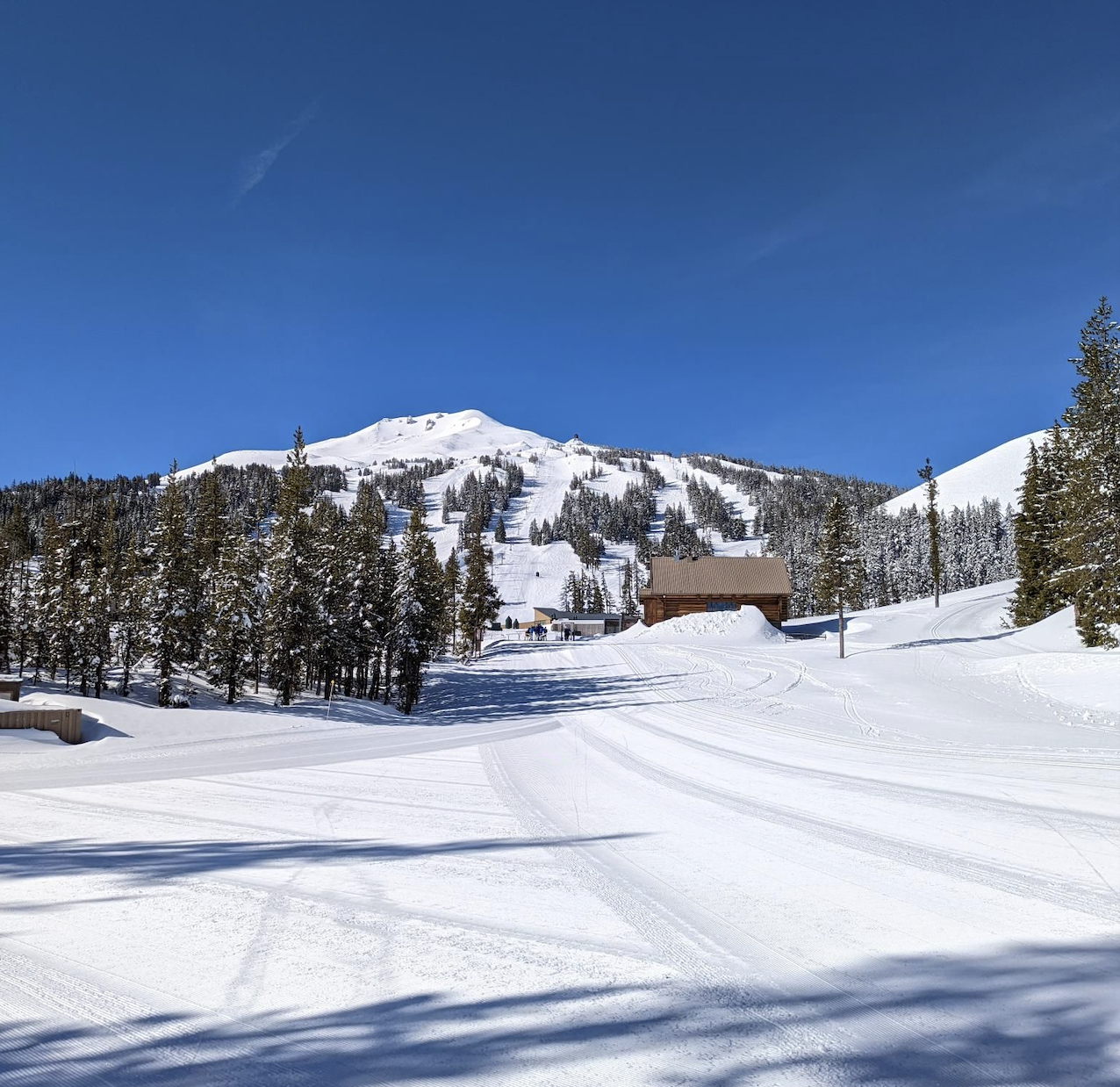
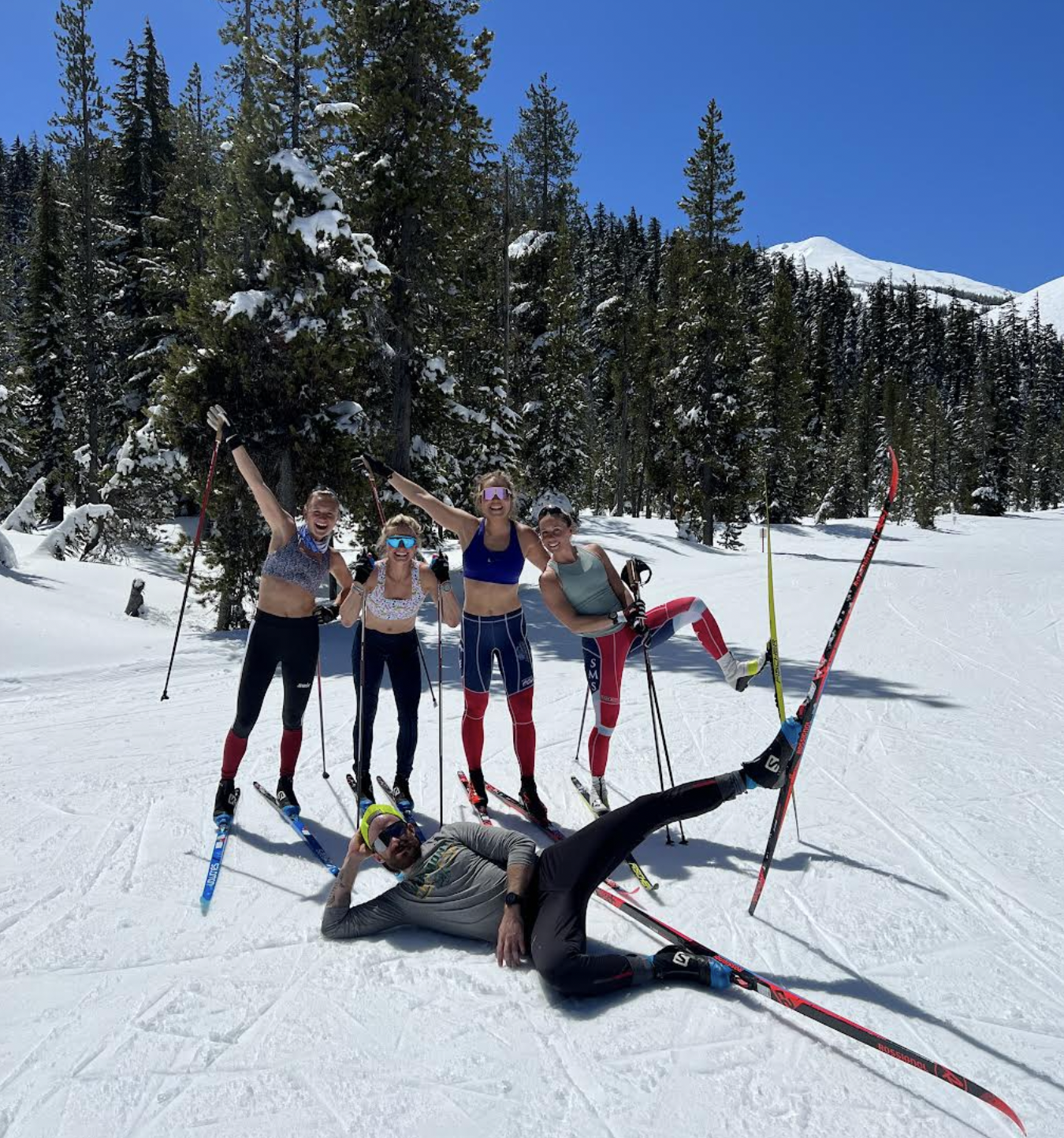
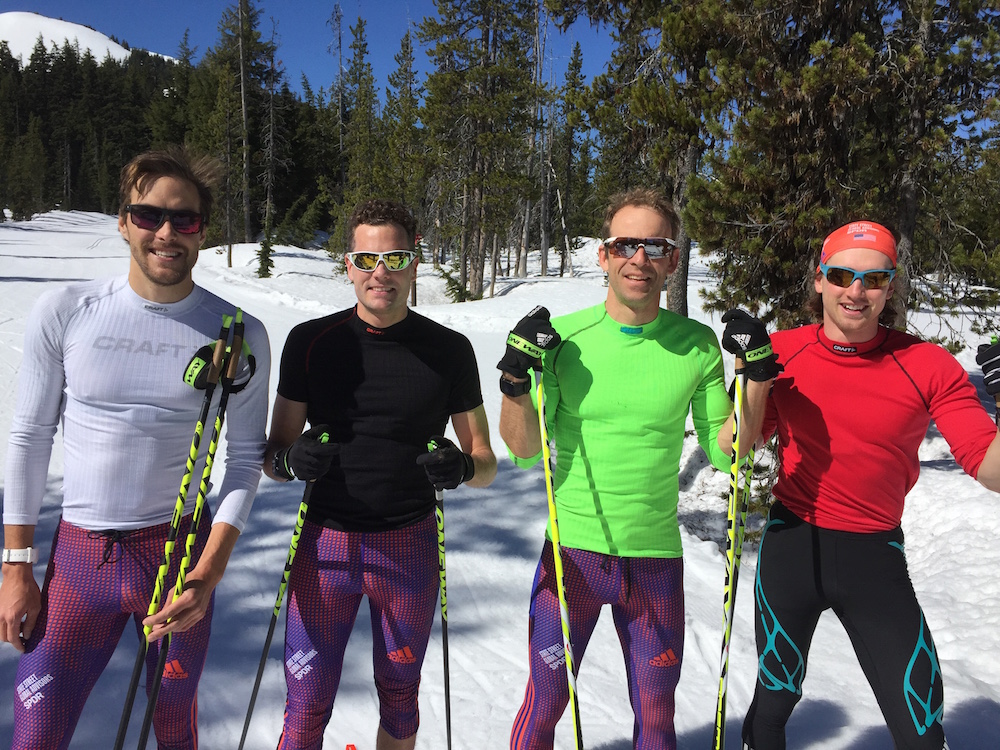
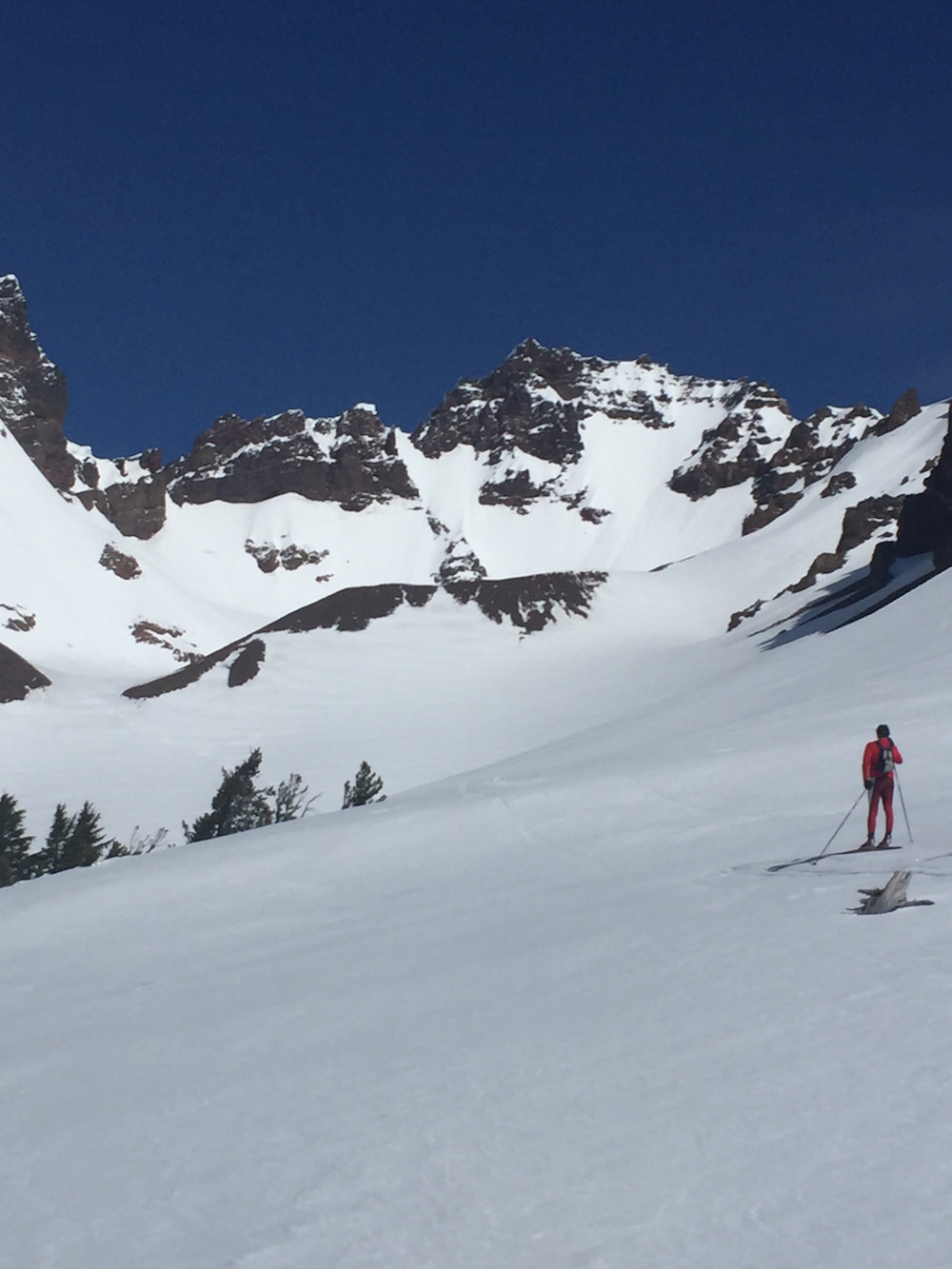
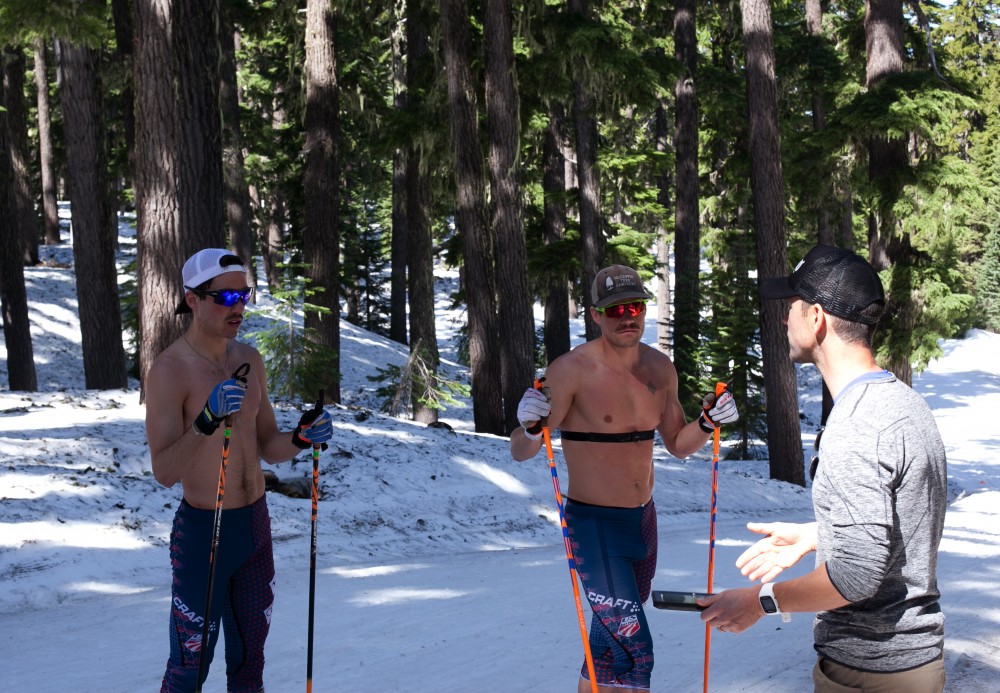
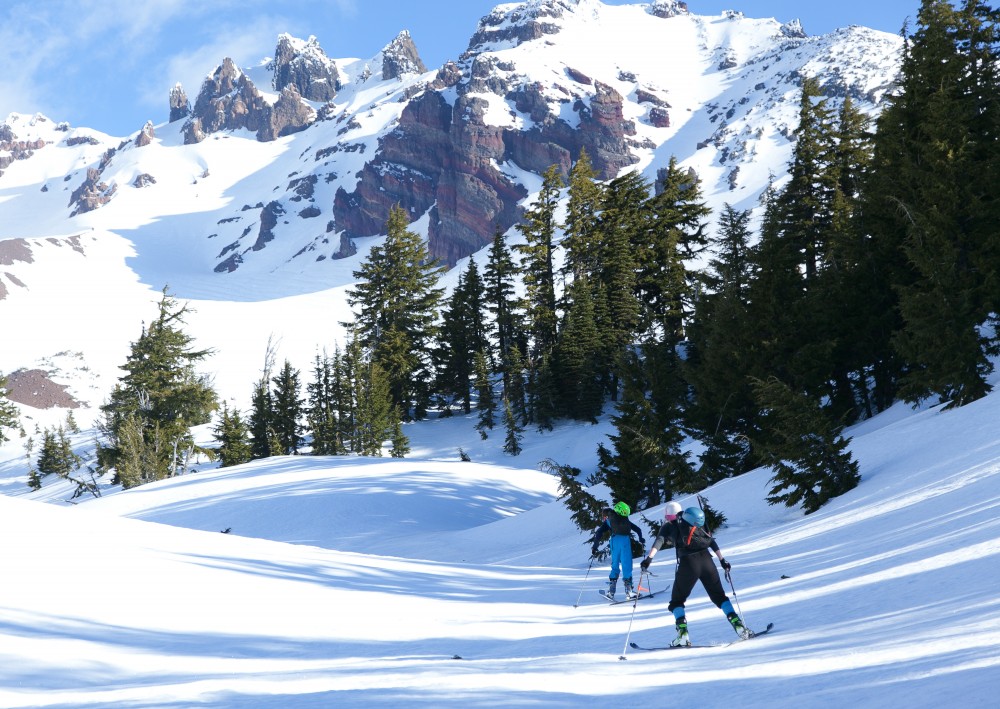
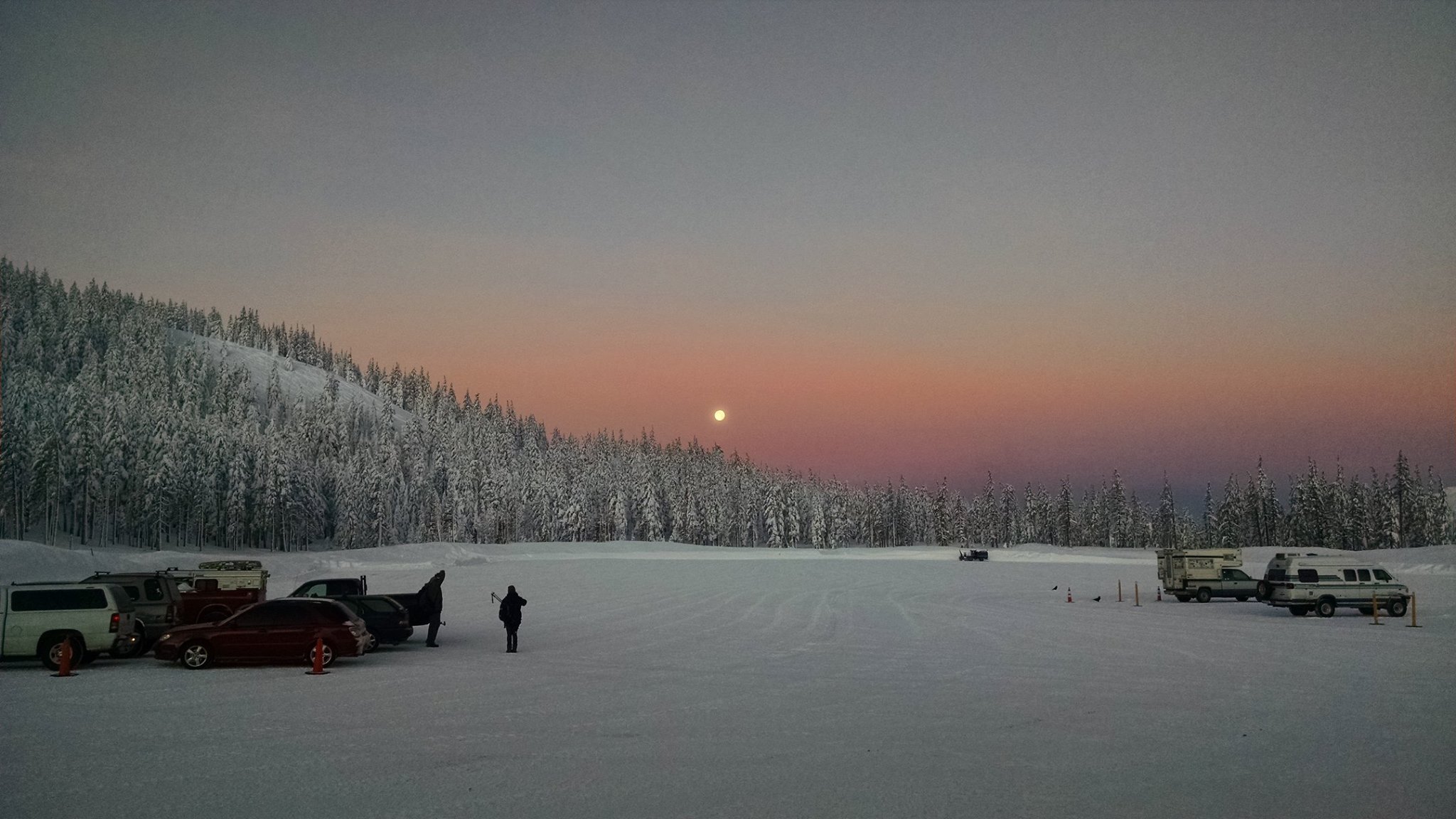
May or January? The US Ski Team has found prime conditions at Mt. Bachelor during the 2022 Bend Camp. (Photo: Noel Keeffe)
Believe it or not, it is mid-May. For those following a traditional cross-country calendar, this means the start of a new training year, building toward the 2022/2023 competition season. And, for many of the top American athletes, this means it’s time to make an annual pilgrimage to Bend, Oregon for the on-snow camp of the season at the Mt. Bachelor Nordic Center.
The weather gods were kind to the camp attendees, with nearly a foot of fresh snow falling on Mt. Bachelor last weekend, restoring it to mid-Winter conditions. April was also a fruitful month for snowfall, setting up for a base-depth of 92” currently reported on the trails – not bad for May!
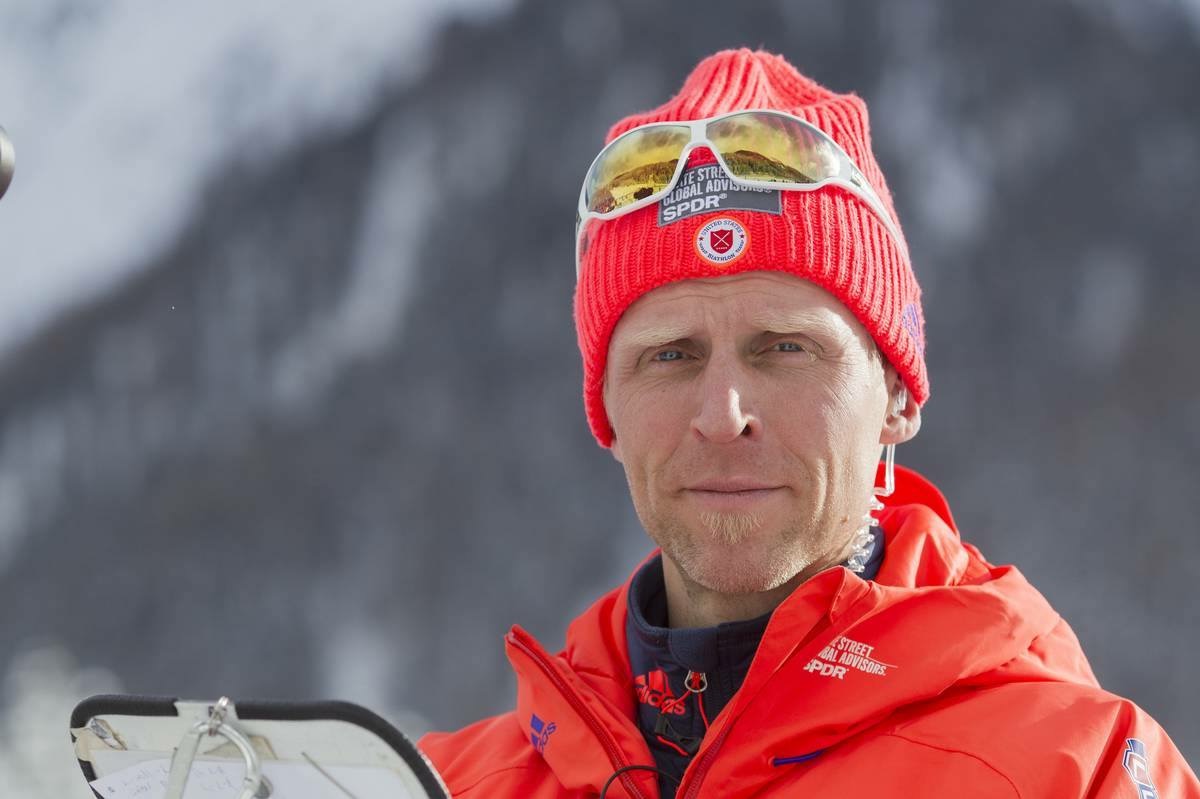
To learn more about the camp and what has made Bend and Mt. Bachelor a staple of the U.S. Ski Team’s early season training, FasterSkier connected with head coach Matt Whitcomb, who shared that he has been coming to Bend almost-annually for the last 26 years.
He first experienced the trails at Mt. Bachelor during the 1996 U.S. National Championships.
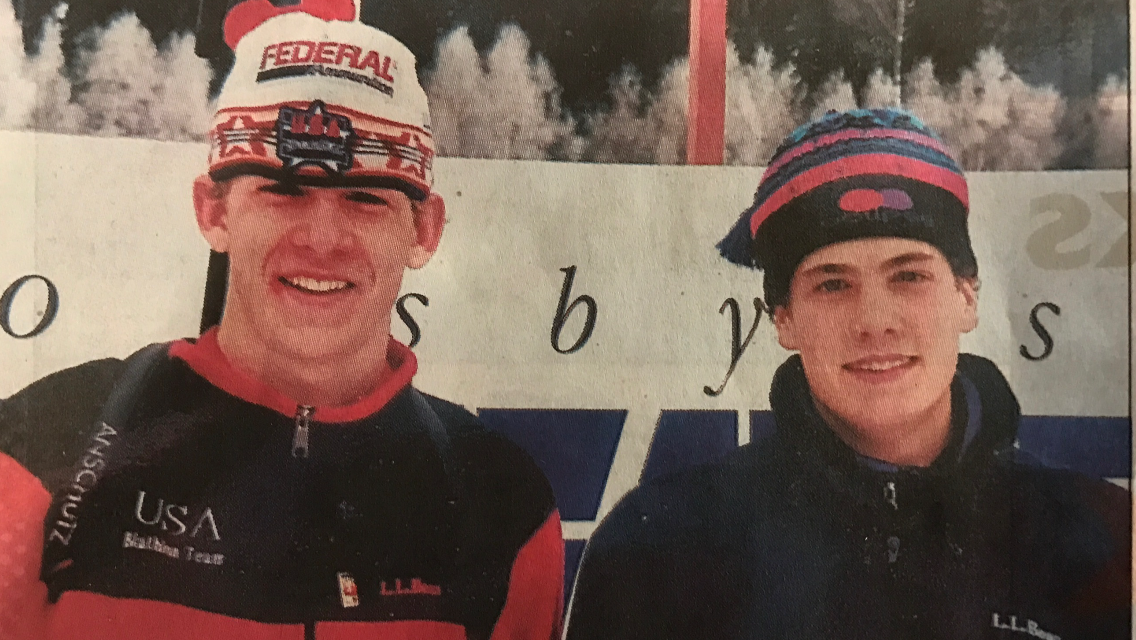
“I was rooming with Justin Beckwith (current NENSA Competitive Program Director),” Whitcomb recalled fondly. “Amy Caldwell took us out and then Sverre [Caldwell] joined us, and we had our first experience racing Nationals. And it really jumped out as this town that had skiing at its center, not only alpine but cross country.”
The following summer, Whitcomb, Beckwith, and a couple additional training partners hopped into a car and drove to Oregon to spend the summer of ‘97 in Bend.
“But we weren’t, by any means, the first people to do this – we were following in the footsteps of Justin Wadsworth and Pat Weaver and a whole bunch of other people. And by our senior year [at Middlebury College], we had twenty-something people driving out from the east just to experience what Bend has in late May and June, and we’d be there through August until we had to go back to college.”
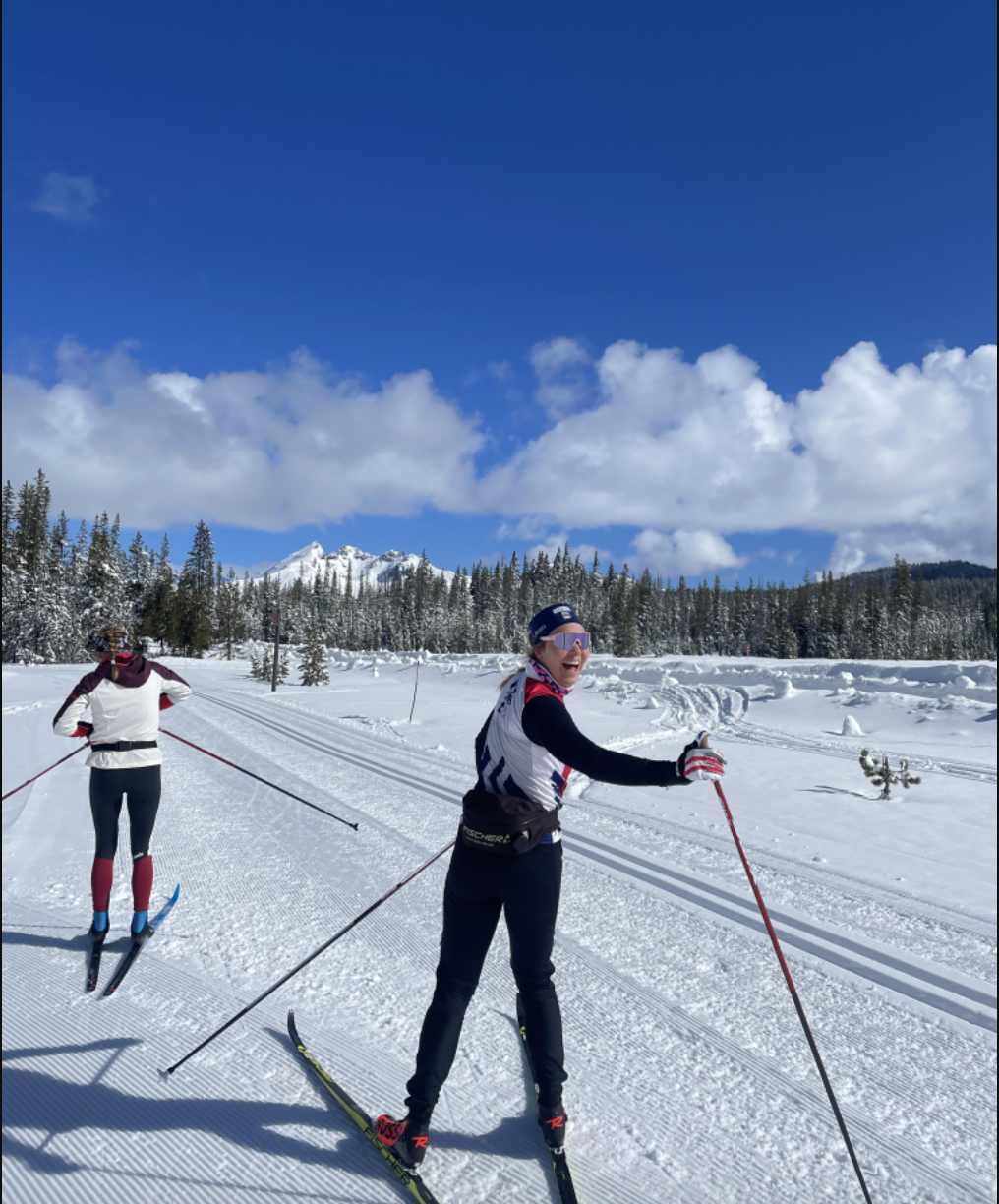
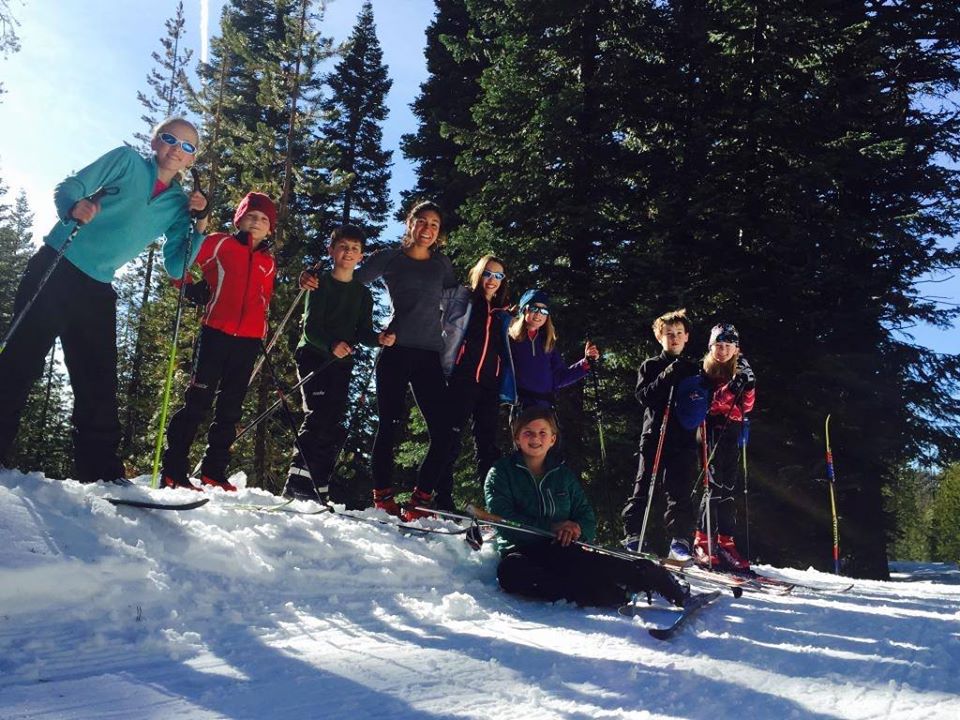
Lina Sutro (right) and Alayna Sonnesyn (left) enjoy fresh snow and a fresh groom at Mt. Bachelor during the 2022 Bend Camp. (Photo: Lauren Jortberg)
What Bend has in late May and June, he said, is a vast array of diverse training opportunities, which most importantly includes snow.
“That’s probably the first thing that really drew us in, particularly as people from the East.”
He shared that the snow report they had received from Mt. Bachelor Nordic Center manager Sue Foster was measuring the accumulation from April storms in feet, not inches.
But it’s not just the access to snow on its own that makes Mt. Bachelor worth the trip.
“The trail system is world class. You’re skiing through Douglas fir — just these massive, old old trees on creative, windy, hard trails, and on a good year they’ll have close to 30 or 40 kilometers groomed for us still in May.”
In addition to its geographical location and an accumulation of over 300” of snow annually, the elevation of the Nordic Center preserves the snowpack for late season skiing. The parking lot sits at roughly 6,000’ above sea level, while trails range from 5,750 to 6,400’.
This puts Mt. Bachelor in a similar altitude zone to Soldier Hollow, UT, offering athletes both an early season bump in red blood cells and the opportunity to fine tune their altitude skiing strategies, “which is something that we really value. Because skiing at altitude is not just something for the aerobically gifted; it’s also something for people that develop the skill of how to actually ski at altitude. So that’s been great.”
Whitcomb also lauded the convenience of Mt. Bachelor relative to their lodging down in Bend, roughly a 25 minute drive down the mountain at a significantly lower elevation of roughly 3,300’. In addition to easy access to the trails, this gives the team the opportunity to train high and sleep low, as well as to enjoy non-ski training modalities in a totally different climate.
“So recovery is complete. We can also go roller skiing in the afternoon, we can go mountain biking, we can run in shorts and tee shirts. It’s like you’re experiencing the summer and the winter on the same day for two weeks in a row.”
Fresh snow and vitamin D — Jessie Diggins and Alayna Sonnesyn head to Mt. Bachelor for the 2022 US Ski Team spring training camp. (Photo: Lauren Jortberg)
Overall, Bend and Mt. Bachelor have become a special place for Whitcomb, and for the many athletes who have made their way there over the years.
“It’s just such a wonderful environment. The way these cascade forests smell this time of the year when the new growth is coming up — you step out of the car when you first arrive and it’s like, ahh. I could be blindfolded and tell you exactly where I was.”
While Mt. Bachelor offers high quality grooming all season, Whitcomb also spoke to the relationships the US Ski Team have developed with the trail operations team, and their willingness to adapt their usual grooming patterns to best serve the visiting skiers. This year, Whitcomb is looking to replicate the track format of a World Cup stadium so the team can practice “switching lanes in the finish and figuring out how to develop more speed — a bit of a twist to our [usual] speed training.”
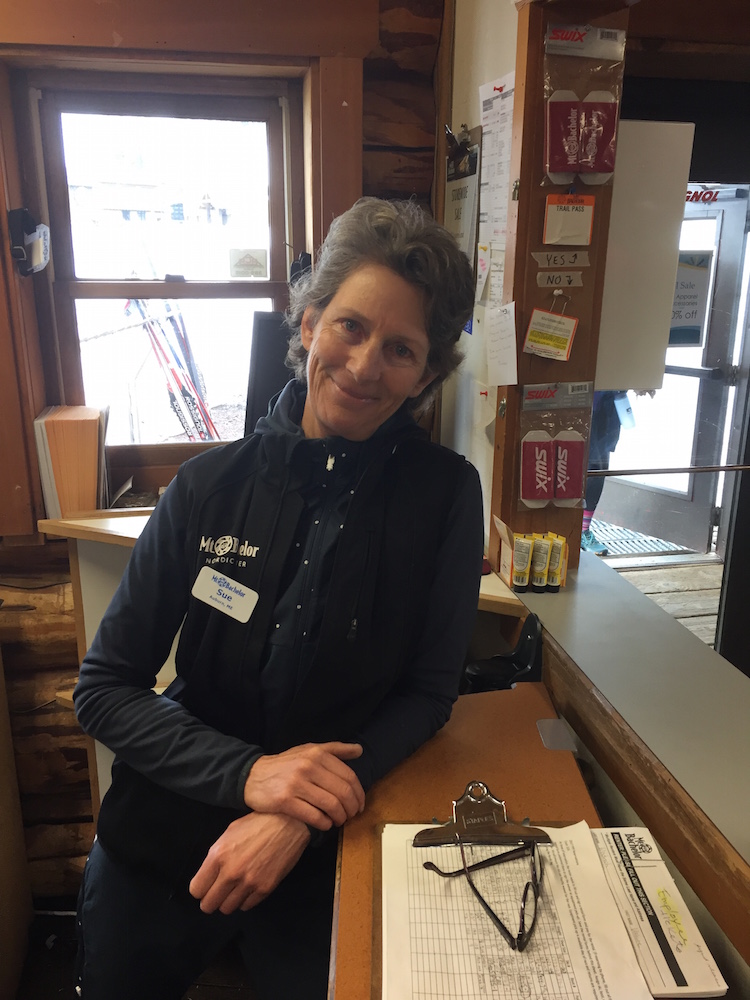
At the helm, and helping US Ski Team coaches interface with the grooming team, is the aforementioned Nordic Center Manager, Sue Foster, who Whitcomb says has been an invaluable resource over the years.
“She meets us in the lodge every day, she helps us prepare the TV and the chairs so that we can do a little visualization before every session. And she’s just a delightful, inviting person that makes you want to come back and see [her.] It’s rare that every athlete on the team knows the names of the people working the lodge, but Mt. Bachelor is one of those places.”
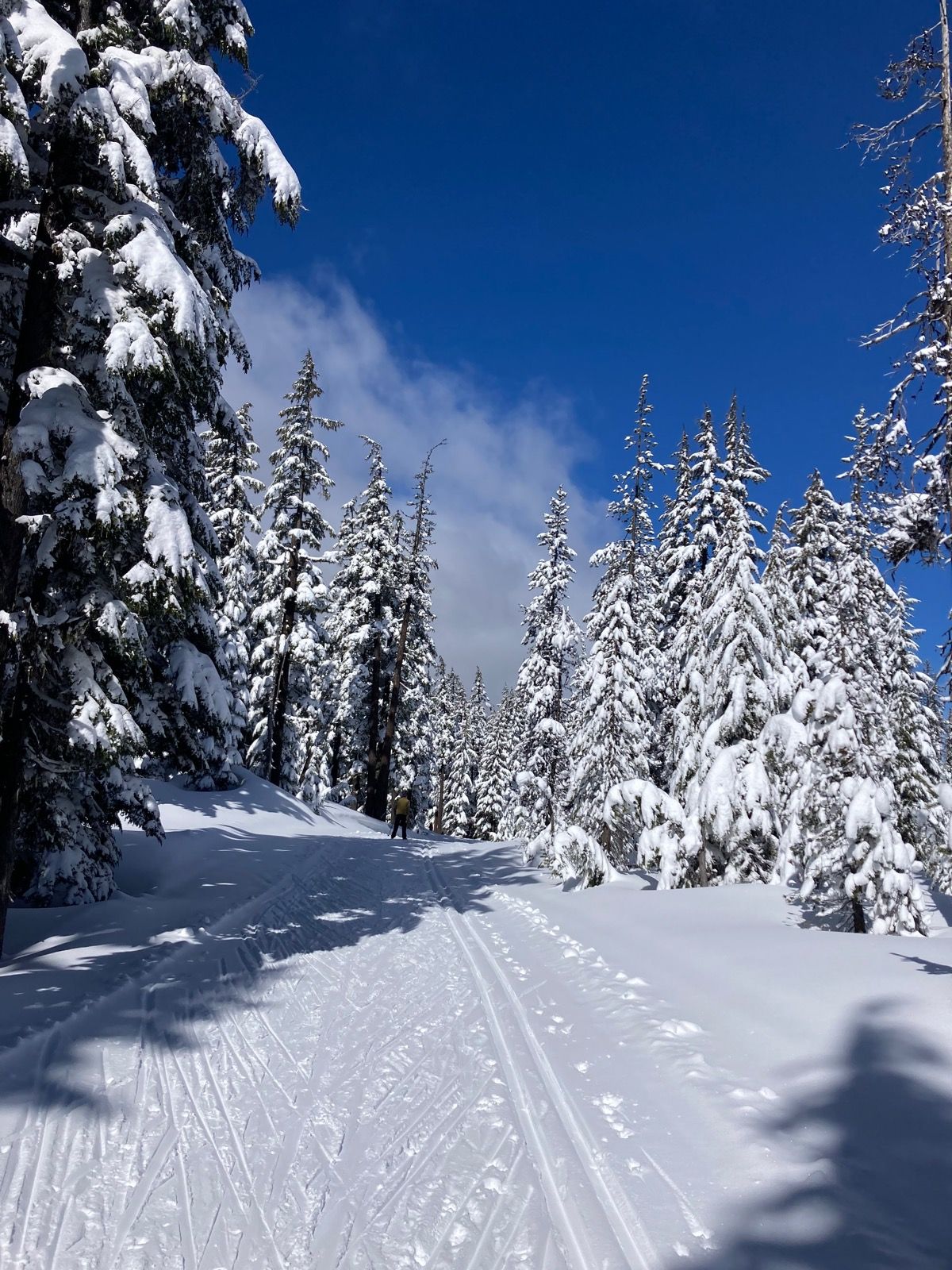
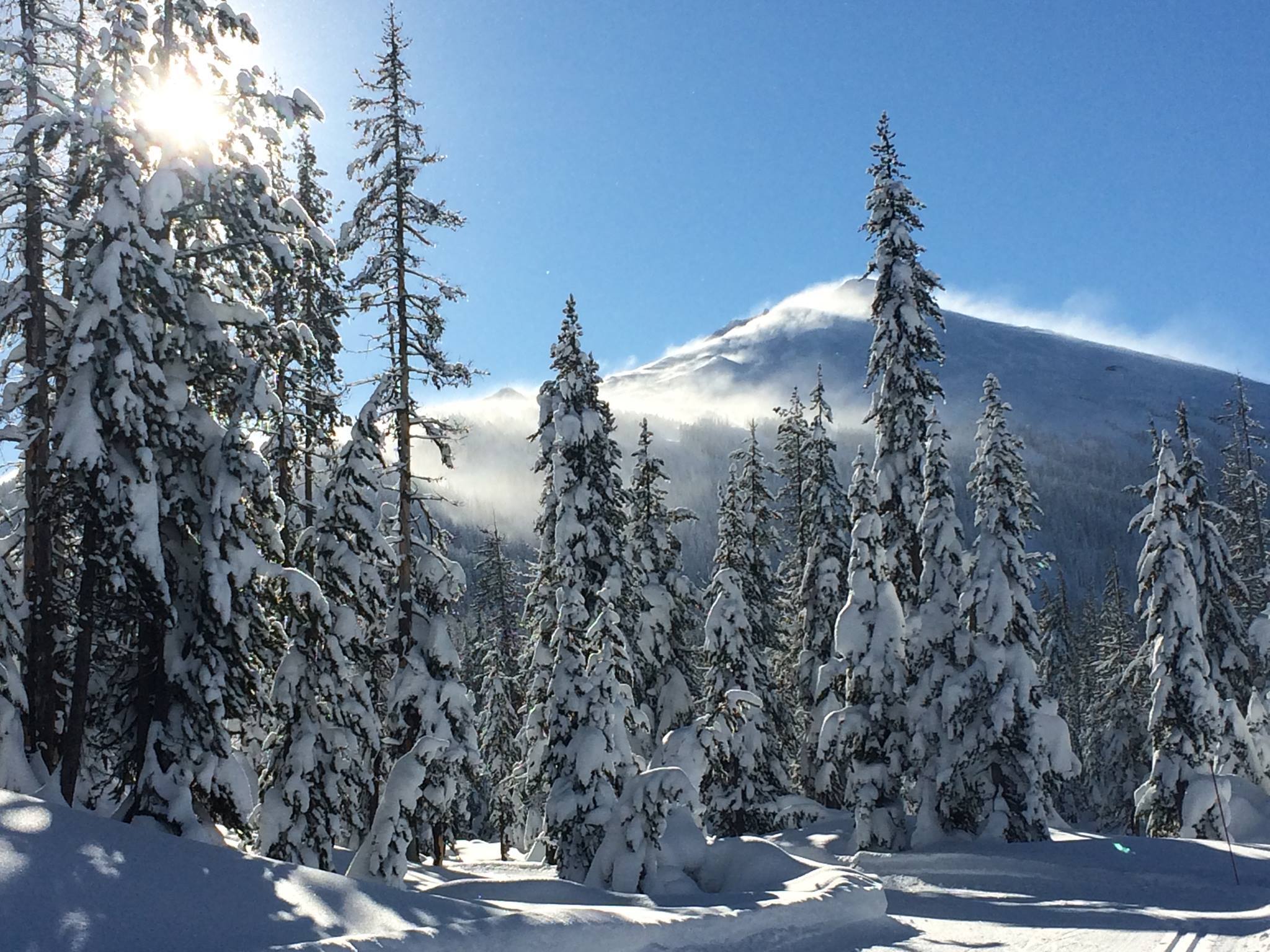
Midwinter conditions return in May to Mt. Bachelor. (Photo: Alayna Sonnesyn)
Off the ski trails, Whitcomb shared that a highlight for many athletes is the lower elevation terrain in Bend, where the unique volcanic geology of Mt. Bachelor sets up for miles of tacky “hero dirt” for afternoon rides.
“The mountain biking is some of the best in the US, particularly in May, before it’s gotten dusty.”
During the late spring, many trails along the Deschutes River are also beginning to open up, and often the team will be dropped off an hour and a half up-river to enjoy a point-to-point run back to their cluster of rental houses.
This year, the team is spread between three large rental homes in close proximity, with the staff house centrally located to host nightly team dinners catered by USOPC chef Megan Chacosky. To reduce COVID risks among the team and staff, masks are still worn during team meetings, allowing them to safely happen in-person. Though mask mandates and COVID safety precautions are largely being dropped, Whitcomb expressed the importance of keeping athletes and staff healthy, setting everyone up for success during the high-volume summer months of training.
“I think the world has made a major shift to decide that the pandemic is over, but we’re pretty well aware that the COVID is not done yet.”
Finally, Whitcomb cited the greater ski community in Bend as a reason the camp has been such a valuable component of the annual training cycle.
“As far back as I can remember, it didn’t matter whether we are registered with a local club or not, we were always being invited by [coach/director] John Downing to the XC Oregon sessions. He’s still a good friend of the team, and we have so many locals in town that are helping us out and welcome us every year to town.”
Acknowledging that he was only giving the short-list of names from the Bend skiing community who have supported and welcomed the team each year, he also noted former physiologist at the Olympic Training Center in Colorado Springs Tim Gibbons, who builds excitement for the camp by giving Whitcomb snow reports all winter, indicating how the trails are shaping up for spring skiing. And lastly, he thanked the members of the Mt. Bachelor Ski Education Foundation (MBSEF), including nordic director Dylan Watts.
This community support allows the team to maximize their time training in Bend, while also creating opportunities for outreach via programs like Fast and Female or hosting workouts for the MBSEF junior athletes. This partnership helps the team feel connected, and also stoke the enthusiasm of the next generation of cross country skiers.
“It just really feels like a family that we’re coming back to every year. So thanks to everybody that has always been welcoming. We try to be great ambassadors for the sport, and we need partners like this [to continue to move forward as a nation].
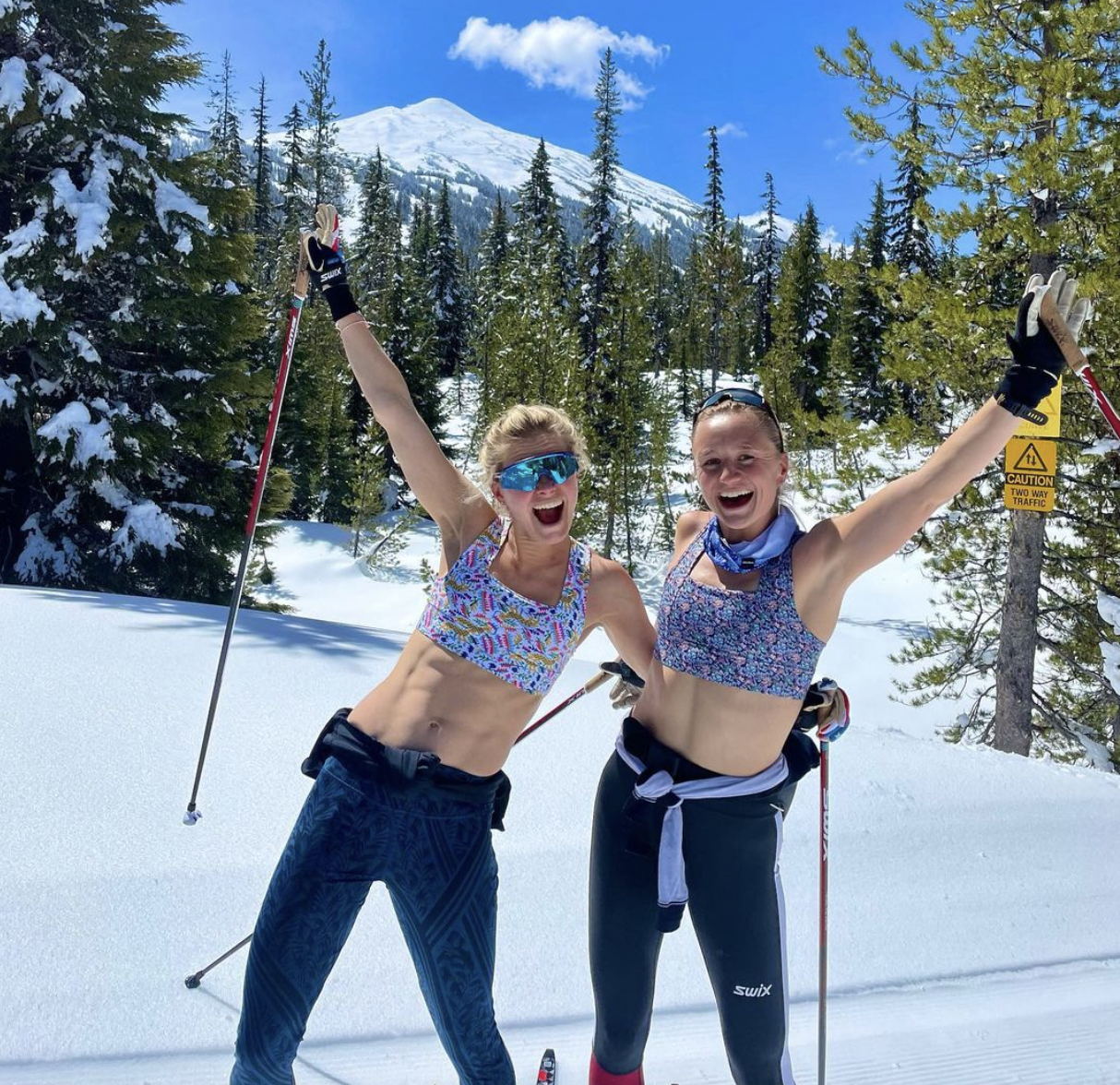
Sun, snow, and lots of training during the 2022 US Ski Team camp at Mt. Bachelor. (Photo courtesy Alayna Sonnesyn)
The Mt. Bachelor Nordic Center is known for it’s world class spring cross-country skiing. You can find more information about spring conditions at mtbachelor.com.
Zoë Roy tapping into her “exceptional off-the-couch fitness” somewhere above Mistaya Lodge in British Columbia. (Photo: Florian Jungen)
BEND, Oregon — Zoe Roy.
OK, OK. First things first. Don’t forget the umlaut.
So it’s Zoë Roy. (Zoeeeee. Not Zo.)
If you don’t know Roy and you’ve been to Bend, Oregon, well then, maybe you haven’t exactly been to Bend. Roy is at once keen, kind, clever, artistic, athletic, and nine parts out of ten fun. She is an icon of fun here.
But let’s cut to the chase. We cover nordic sport and Roy has a history there, too. She skied at the U of U (University of Utah), raced a few World Cups having earned start rights on Canada’s team, and skins and shreds many peaks and slopes when the snow is prime. (Note: the snow must be prime. Like powder. No sun cupping. No ice. Corn snow will suffice.)
If you were wondering how she skied for Canada (as well as Team Ninja for a season) and resides in Bend during the current low point in bilateral U.S.-Canadian relations, she’s a dual citizen with pure maple leaf DNA. Her parents are both Canadian, yet she had the good fortune of being raised in Bend. With the combo of a Bend upbringing and possessing way above-average athletic talent, she, of course, has participated in the venerable local multi-sport race known as the PPP, or Pole, Pedal, Paddle.
She is a three-time overall winner of the women’s race. She’s competed in nearly every category, too — pairs, teams and onward — her only career PPP blip being a defeat to her own mother, Muffy Roy, when Zoë was 18 years old. On her 31st trip around the sun, Zoë (who turns 31 next month) remains spry.
But honestly, she’s sort of like Peter Pan in a good way.
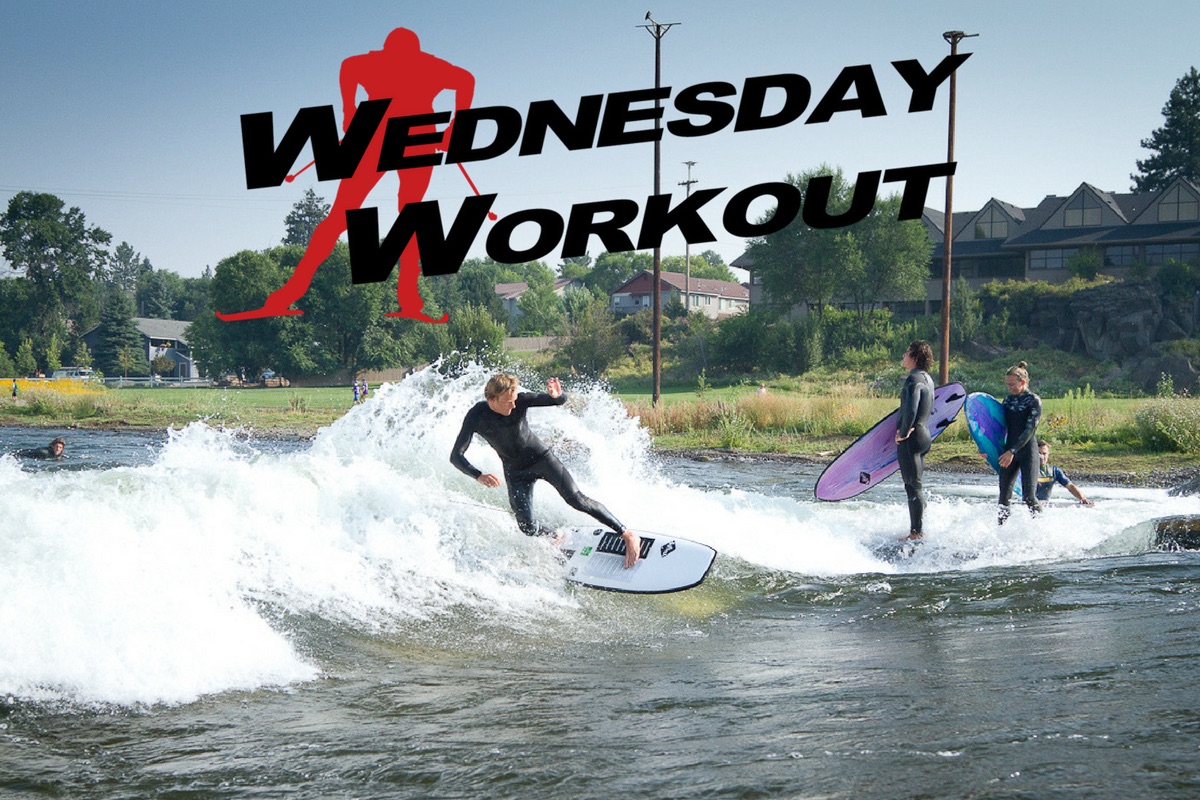
This is a Wednesday Workout after all. And for that reason, we are going to focus on how Roy trained for this year’s PPP. She said it best herself.
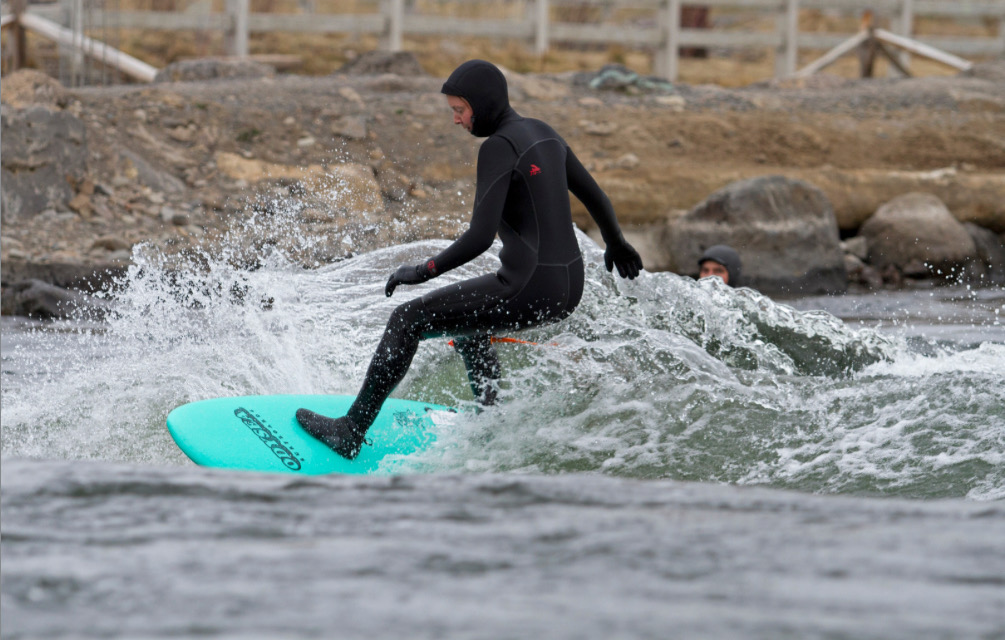
Surfing the river wave in Bend, Oregon — Zoë Roy. (Photo: Jon Tapper)
“Training for the PPP involved a lot of time not training for the PPP,” she said as she sipped an Italiano a few weeks back. (In fact, this reporter learned during the interview that an Italiano has less water than an Americano. Good to know when seeking the in-between of an espresso and an Americano.)
Bottom line: Roy has a huge base of fitness and is still highly trained. Or it appears that way if you run, ride, ski, paddle, skin, or cook with her.
“Essentially I want to have exceptional off-the-couch fitness,” Roy explained. “To be able to hang with my friends on adventures.”
As mentioned, that exceptional off-the-couch fitness brought Roy her third consecutive PPP title this year. In other words, as U.S. Ski Team member Simi Hamilton referred to the PPP while in Bend this May, that’s three consecutive “World Championships of the World”.
How did she do it?
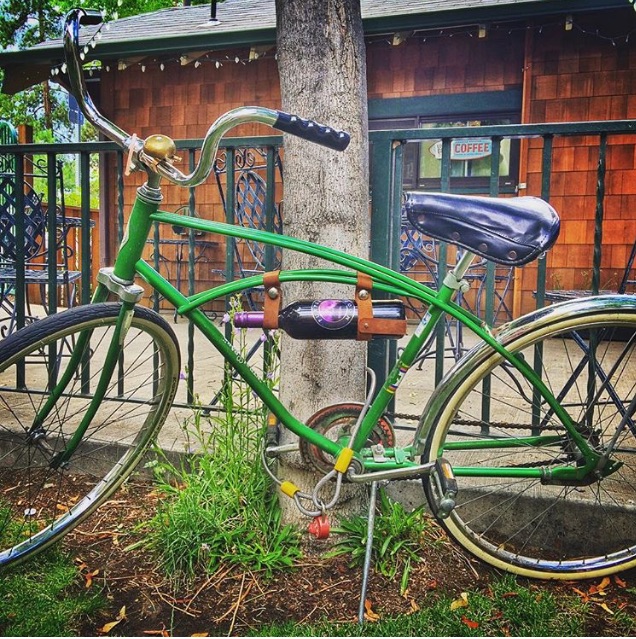
A prized possession: the Z-Roy edition single-speed townie. Although this Schwinn is Grinch green, Zoë Roy is no Grinch. Her other bike has more travel. (Photo: Zoë Roy)
Most often, in good weather, which we see plenty of here in Bend, Roy commutes on a single-speed townie bike. Noteworthy is the bottle of wine in lieu of a water bottle affixed to a frame tube. Our guess is that the single-speed builds leg strength while cruising uphill. It was a pretty mild winter here in town so let’s assume Roy commuted on her bike 10 miles per week. Don’t be fooled though. The townie isn’t her only bike. She was an invitee to Bend’s Blitz to the Barrel — a high-octane, enduro-bike race. She placed second.
Roy also committed to immersing herself in the local surf scene at the Colorado Avenue river-surfing wave here. The surfing itself builds jedi-balance. The swim into the eddy after a nasty flush from the wave builds upper-body strength.
“I surfed the wave all the time after I picked up surfing this winter,” Roy said. “And that will pretty much trump all other activities if someone asks me to go to the wave.”
Questioned whether she nordic skied much this winter, the reply was blunt and a little disappointing to fans of the skinny skis. “I didn’t really nordic ski this winter since my friend Elliott Heath wasn’t around,” Roy said. “I did coach a few XC Oregon master’s clinics though.”
Roy divulged that she engaged in a trifecta of sweet-sounding trips where the fitness was brought from “meh” to almost Norwegian-style “the shape is good” before the big race.
Level 5 scenery on the Cinque Terre trail in Italy. (Photo: Zoë Roy)
In April, she visited Italy where she ran the Cinque Terre trail north of Tuscany. She ran 25 kilometers on Day 1. For that stretch, Roy ran along the coast, then spent the night in Levanto. In the morning, she returned along the ridge for a 28 k jaunt, making for a tidy running loop.
She then rebounded with a backcountry ski trip to Mistaya Lodge in British Columbia. No name dropping here, but allegedly Roy was on the trip with some likely still pretty fast former Canadian XC skiers and maybe an American one, too. Lots of vert in BC kept Roy’s engine trending towards PPP-primed.
Then two weeks before the PPP, she climbed and skied Mount Hood. Not shabby. Again, evidence of how above-average, off-the-couch fitness can be a game changer.
Here’s also something Roy didn’t mention — she often runs socially with a burly group of runners. Maybe it’s L1 running. Who knows. There’s no training log. No Strava we are aware of. But she runs early mornings on some days.
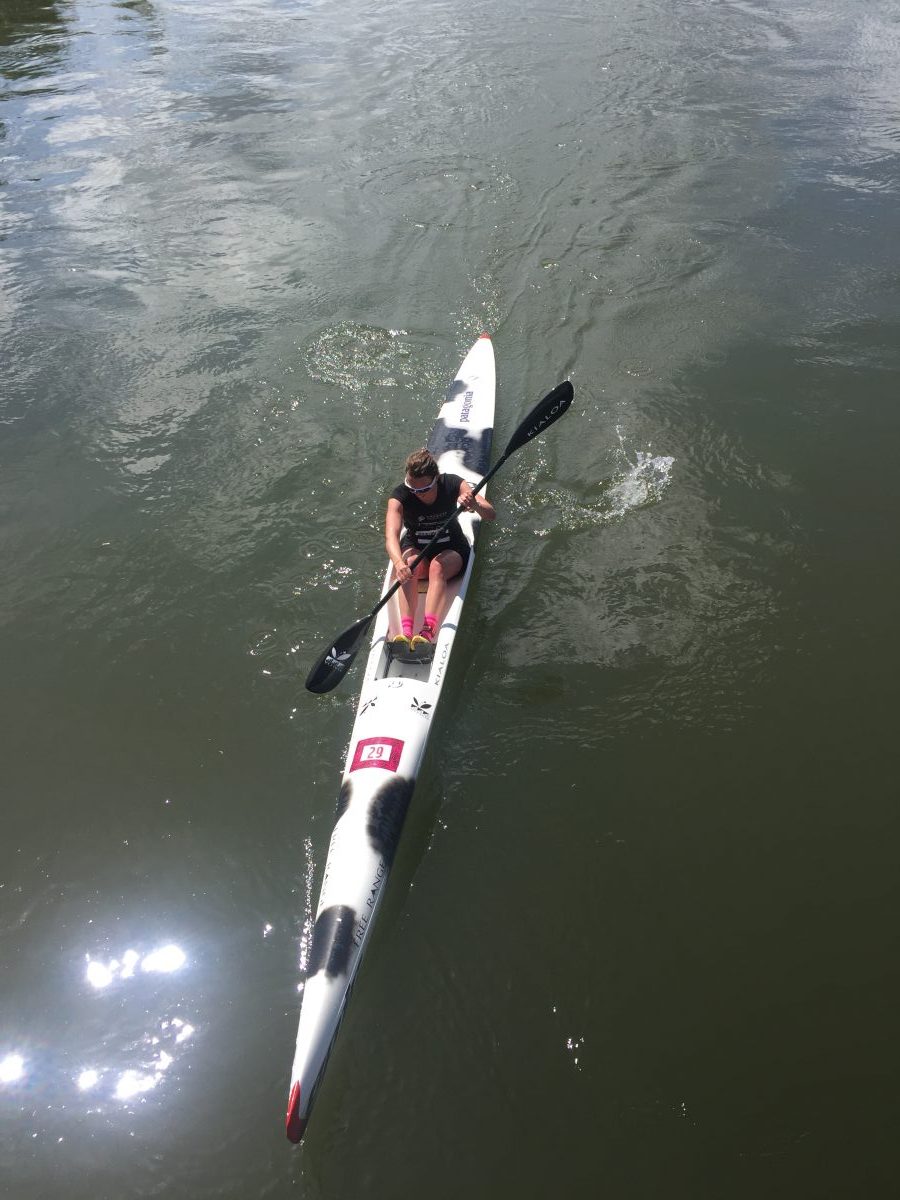
Zoë Roy paddles “Daisy” the boat on her way to PPP victory. (Courtesy photo)
She also jumps in and paddles her borrowed surf ski, a boat that resembles a Holstein cow, a few times prior to race day. (Our guess though is she paddles more than a few times pre-PPP.) The boat was salvaged from a dumpster and is white with large patches of carbon fiber and black spray paint here and there from the repairs. Roy calls the boat “Daisy” because it truly appears to have some Holstein lineage.
Let’s also be real. Roy is a crusher. We’re not exactly calling her out as a sandbagger. However, if you go adventuring with Roy, most likely you’ll be huffing and puffing gaining vertical. So we in town knew she wasn’t rolling over for this year’s PPP when in mid-May she was seen screaming down Century Drive from Mount Bachelor on a TT bike after her morning XC-ski session. Yup, that’s called official “training” for the PPP. Sort of late in the game perhaps.
More true facts: Roy makes and sells handcrafted ice cream. She’ll cater a party, too. She also organizes perhaps the toughest ticket in morning dance parties here in Bend. Here’s the hashtag if you’re ever game for 7 a.m., L4 weekday dancing fueled by coffee, chai and Picky Bars: #daybreakerbend. Roy says crashers are welcome. And hey, we’re calling it, the daybreak dancing helped her peak.
Asked what the Wednesday Workout was exactly as we concluded the interview, Roy savored her Italiano on that lovely June morning and simply noted that the workout will find you.
The Bend Endurance Academy has an immediate opening for the Nordic Program Director position located in beautiful Bend, Oregon. This position is primarily responsible for coordinating and supervising all aspects of our growing Nordic Program and supports the general operations of the organization.
The Bend Endurance Academy is a 501(c)(3) non-profit organization with a mission to promote healthy living through active, outdoor experiences. We emphasize teamwork, personal growth and community responsibility. The Academy currently features development programs for youth and juniors in Rock Climbing, Cycling and youth, juniors and adults in Nordic Skiing. Since 2009, we have been teaching kids core values that will serve them throughout their lives including perseverance, resilience, confidence, and respect for the environment. We teach kids the joys of endurance sports.
The Bend Endurance Academy Nordic Program is a member club of the United States Ski Association (USSA) and a member of the Pacific Northwest Ski Association (PNSA). We are one of the largest clubs in the region. While we cater to myriad ages and abilities, all programs are centered on exploration, self-discovery and social interaction. From introductory skill development to competition based training, the Nordic team strives to instill a love of being active.
We offer the following Nordic programs:
Mini Nordies: Ages 4-6
Youth Program: Ages 7-11
Development Program: Ages 11-14
Competition Program: Ages 14+
Masters Programs: Adults
Trips and Camps
School Partnership Programs: REALMS, Montessori Center, Cascades Academy
Position Summary: The primary duties of this position include designing and implementing a structure that fits the needs of the Nordic community, delivering a product true to mission, and supporting staff to provide a safe and fun environment for learning. The Nordic Director will manage and develop a staff of Head Coaches for our Competition, Development and Youth Nordic programs and help oversee their management of assistant coaches.
Key Responsibilities:
Develop and implement all aspects of youth Nordic programs for beginner, intermediate, and competition level athletes.
Provide opportunities to engage Bend Endurance Academy athletes in community events to promote personal growth and instill a sense of responsibility to the community.
Provide input in planning and business development for the organization.
Assist in the development of organizational goals and objectives consistent with the mission and vision of the organization.
Develop and monitor annual budget, ensuring targets are consistently met.
Work with Academy staff to develop and implement fundraising strategies and events to support the Nordic Program and the organization.
Design and implement developmentally appropriate training programs and competition strategies.
Organize and conduct races, events, trips, and travel to camps and competitions.
Hire and supervise paid and volunteer coaches.
Train and support paid and volunteer coaches.
Requirements:
Bachelor degree in related field
Extensive technical knowledge and passion for Nordic skiing and XC racing
3-5 years of experience in program management, Nordic coaching, supervising employees
Proven ability to positively inspire athletes of all ages and skill levels
Ability to work as part of a team and be productive when unsupervised
Proven organizational, communication, computer and writing skills
Clean motor vehicle record
Completion of background screening
Ability to travel
Compensation: $40,000 – $43,000 annually. This position is full time, year-round, salaried, and exempt from overtime.
Bend, OR – Sandy Visnack of Bend, Oregon, has been named the next Executive Director of the Bend Endurance Academy (BEA) by the organization’s governing board. Ms. Visnack will assume this new role on January 8, 2018.
“We are excited to announce the selection of Sandy Visnack to be our next Executive Director,” says Ellen Grover, BEA Board President. “In 2018, as BEA celebrates its 9th year serving youth in Central Oregon, we need a leader who has the vision, skills, and capacity to strategically guide our organization forward. Our board has great confidence that Sandy will build upon the strong foundation BEA has created, further engage youth and families in our programs, and develop rich and meaningful relationships with our donors, sponsors and nonprofit partners.”
Ms. Visnack’s background uniquely positions her to assume the role of Executive Director. With significant experience working with youth and families, in senior management roles in the education and non-profit sectors, and a passion for outdoor sports, Visnack will advance the organization’s current strategic priorities and guide BEA’s future contributions to serving youth, maintaining high quality programs, and promoting active, healthy lifestyles. Visnack shared, “I am honored to serve the BEA community and support the program directors, coaches and staff. BEA has a rich history of offering quality programs and activities for youth of all ages and abilities and is poised to grow in even more in upcoming years. I want to help BEA strengthen the framework of the organization and develop the resources necessary to meet the needs of our growing community in Bend and across Central Oregon. Joining this group of highly skilled, thoughtful, and hardworking people is an opportunity I could not pass up.”
Visnack has a Master in Nonprofit Management degree from Regis University in Denver, Colorado, and a Bachelor of Science degree from the University of Vermont. She also has over 20 years of experience working in education and in the nonprofit sectors. Past roles have included the Coordinator of Residence Life at Colorado Mountain College, Executive Director of Grand Futures Prevention Coalition, Development Director for Big Brothers Big Sisters, as well as Grant Writer and Director of Communication for NeighborImpact.
For more information about the Bend Endurance Academy or the selection of Sandy Visnack as Executive Director, please contact Ellen Grover at 541-410-3231 or via email at ellengrover@bendenduranceacademy.org. To contact Ms. Visnack directly, email sandy@bendenduranceacademy.org.
About Bend Endurance Academy: Since founded in 2009, Bend Endurance Academy (BEA) has grown from humble beginnings to serving more than 1000 youth in 2017. BEA is a public benefit 501(c)(3) that organizes and operates endurance activity programs in Central Oregon, concentrating in three core disciplines: Nordic Skiing, Cycling & Climbing.
Mission: The Bend Endurance Academy promotes healthy living through active, outdoor experiences. All programs offered emphasize teamwork, personal growth, and community responsibility.
Vision: A world with active, inspired and more engaged people.
Not exactly a mystery man in nordic-ski circles, former U.S. Ski Team Head Coach Pete Vordenberg has been admittedly reclusive when it comes to staying in the XC ski game. In this two-part episode, Nordic Nation chats with Vordenberg in Bend, Oregon, and connects the dots in terms of what he’s been up to. Vordenberg raced in two Winter Olympics and was a forerunner in a third. (You’ll have to listen to Episode 1 to learn about that forerunning gig.) After skiing with the U.S. Ski Team (USST) for six years, he began coaching for the USST in 2002, retiring as the USST head coach in 2012.
Former U.S. Ski Team Head Coach and current dad, husband and photographer:Pete Vordenberg. (Photo: Pete Vordenberg)
This was a wide-ranging interview with numerous digressions: both the interviewer and Vordenberg were easily distracted. Serious attempts in the editing process were made to overcome the interviewer’s deficiencies. And make note, this interview was recorded outdoors at two local Bend breweries, with a brief intermission on bikes.
In Episode 1, Vordenberg speaks about his book Momentum: Chasing The Olympic Dream, how he started skiing in Boulder, Colorado, and how the USST began to turn it all around on the World Cup.
Pete Vordenberg unwinding in Lahti, Finland 2017. Riding the saddle at an underground Lahti karaoke session. (Photo: FasterSkier)
Vordenberg is a keen and creative mind. When he’s not being a dad, he’s mastering his art as a photographer. His Instagram account is both stunning and eclectic. Have some time set aside before checking his account out, it can be a wormhole.
Enjoy the ride listening to The Pete Vordenberg Experience.
The Bend Endurance Academy (BEA) is a public benefit 501(c)3 that organizes and operates endurance activity programs in Central Oregon, concentrating in three core disciplines: Nordic Skiing, Cycling & Climbing. The mission of BEA is to “promote healthy living through active, outdoor experiences. We emphasize teamwork, personal growth, and community responsibility.” BEA envisions a world with active, inspired, and more engaged people. Since its founding in 2009, BEA has grown from humble beginnings to serving more than 1000 kids in 2017.
Where You Get To Live!
Bend, Oregon, is the mountain town that has it all! Located in the in the shadows of the Cascade Mountains and surrounded by numerous lakes and rivers, Central Oregon is an outdoor enthusiast’s paradise. Check out the sights and sounds of Bend at: https://vimeo.com/200038114
What You Get To Do!
Reporting to the Board of the Directors the Executive Director (ED) has full responsibility for the daily operations of BEA corporate office and programs in accordance with BEA strategic plan, operating/business plans, Board policies, and annual budgets as approved by the Board. The operational and development activities of BEA include fundraising events, strategic planning, facility and vehicle maintenance, communications and marketing, staff training and compliance, personnel management, risk assessment and management, transportation and safety, program offerings, and financial management.
The Executive Director provides executive leadership to BEA to advance its mission and vision in part through strategic priorities adopted by the Board. The current priorities include the following:
Strategic Priority #1: Programs
Manage growth of current programs to retain our strong commitment to quality programs for young participants at all levels of their athletic development and to build a strong platform for meeting growing demand in the future.
Strategic Priority #2: Culture
Build a professional, collaborative, problem-solving team culture at all levels of the organization that honors the fun and joy of what we do.
Strategic Priority #3: Staff
Retain and recruit the best staff to lead, develop and support programs
Strategic Priority #4: Revenue
Grow and ensure diversified and sustainable revenues.
Strategic Priority #5: Communications
Promote BEA’s vision for a “world with active, inspired and more engaged people” by communicating consistent messages about our mission (what we do) and our philosophy (why we do it) to key audiences.
What You Will Need:
Bachelor’s degree in business, public administration, planning, recreation management, or related field
Demonstrated experience in a management role, preferably in business or nonprofit leadership and/or management of multi and diverse program environments Demonstrated experience with the successful development and management of new programs or business enterprises
Direct experience in working with recreation and/or youth sports education or relatable fields
Direct experience in the supervision of senior level management staff
Working knowledge and understanding of GAAP (generally accepted accounting principles) and developing business financial pro formas
Demonstrate excellent interpersonal, people management, and verbal and written communication skills
Possess a high level of conceptual and analytical skills, judgment and decision-making, and negotiation skills
Demonstrate the ability to lead and foster innovation and initiative in others, work cooperatively and effectively in a team environment, develop relationships based on honesty, integrity and trust, work well under pressure, and prioritize work effectively
Have or develop an ability to understand and deal effectively with the policy environment in which BEA operates
Demonstrate success in strategic and business planning, implementation, management, and financial management skills
Demonstrate a willingness and ability to work and build relationships with industry, government, and other stakeholders to achieve goals and objectives of BEA
Demonstrate success in promoting business outcomes to industry, government, and the community;
Proficient in Word, Excel, Power Point, and Outlook
Have or develop proficiency in social media and traditional media platforms
Must have a valid Driver’s license and be insurable under the BEA’s insurance requirement
Successful completion of a criminal background check and a pre-employment drug test may be required.
Jake Ajax, a senior on the University of Wisconsin-Green Bay nordic ski team, catching some waves in Bend, Ore. (Photo: FasterSkier)
BEND, Ore. — It’s August. That means a few things to keep in mind. Out West, it’s been hot and dry. Mid-90 temps have been the norm and in places like Bend, it’s in the teens for humidity. Don’t forget to top that with smoky air from surrounding wildfires.
On the East Coast, high humidity can turn an early morning workout into a tropical death march. Left or right coast, even in the Rockies and Midwest, the phrase “hydrate or die” remains relevant.
It’s enough to tap the brakes on traditional forms of dryland training.
That brings us back to Bend. Despite recent claims, Bend isn’t paradise, and it may not be where you want to be. Some downsides here in Bend are the busy traffic circles and dusty mountain-bike trails in summer. (Yeah, all first-world problems.) If that’s not enough to dissuade you, then there’s this not-so-well-known fact: Bend’s river surfing wave isn’t always firing with a green face; sometimes a pillow of aerated water blemishes an otherwise everlasting standing wave.
The upside (yes, there’s a big upside) is that the surfing wave at Bend’s Whitewater Park serves up a great option to diversify the off-snow training.
Sun-bleached blond. With a look like that, 21-year-old skier Jake Ajax, in Bend, Ore. for summer training, exudes the xc skier/surfer stoke. (Photo: FasterSkier)
It took a 21-year-old named Jake Ajax from Minneapolis, Minn., who currently skis for the University of Wisconsin-Green Bay, to show the light.
Jake actually goes by Ajax.
Ajax ended up in Bend for the summer to train with the Bend Endurance Academy (BEA) college training group. But surfing? That seems a bit off the radar from a nordic skier in the Midwest. Like any semi-landlocked kid, he dreamed big.
“My obsession with surfing started last summer when I read the book Barbarian Days by William Finnegan,” Ajax explained in an email. “I’ve always been interested in the sport but being from Minnesota there’s no easy way to get into it. Barbarian Days was my gateway that pushed me to give it a try and I love it. I have a sister that lives near Orange County, CA so that’s a great resource to have. I even managed to surf Lake Michigan last spring a couple times when storms hit.”
(If you think Barbarian Days sounds like some fluff surf book, think again. Finnegan won a Pulitzer for his cerebral surfing memoir.)
“I told myself, ‘I’m going to be good at that by the end of the summer,’ ” Ajax wrote. “When I first got here I bought a board and was surprised by the steep learning curve of surfing. For about the first week all I could do was ride the wave for a few seconds before face planting and getting flushed down the rapids.”
Ajax is not alone. Not to name names, but some of Bend’s most stout endurance athletes, some of them nordic skiers, have been seen flushed over the Whitewater Park’s drops after a split-second surf.
Including this guy:
Ajax admits he’s now a regular at the wave in between his morning and evening workouts.
“I usually try to make it to the wave about six days a week,” he wrote.
For those logging hours, Ajax noted he doesn’t include the surfing in his log book, since there’s a bit of standing around and his heart rate remains low. But Ajax asserts the surfing has put grins on his face and benefited his ski training.
“Physically, the basic surfing stance is fairly similar to skiing,” he wrote. “You press through the arch of your foot relaxing the toes and keep your ankles loose so you can turn back and forth on the wave. You press through the surfboard similarly to how you press through a ski. It definitely helps with balance. Mentally, ski training, especially in the off season, is always great to keep fresh. It’s been great mastering this new sport over the summer. Rollerskiing the same roads every week can get old so it’s nice to keep things fresh with the whitewater park.”
Ajax has been the pied piper of river surfing for the collegiate nordic crowd. It’s now not uncommon to see surfers/NCAA skiers at the wave from the University of New Hampshire, Colby College, University of Vermont, and a certain Harvard Ski Team alum on occasion.
“River surfing is a pretty cool sport so I think most skiers are compelled to try it,” Ajax wrote. “I’m just the one who drags them down to the wave to give it a try.”
Newell Says…
If you don’t take FasterSkier’s and Ajax’s word for it, how about the word from cross-country skiing’s answer to Kelly Slater: longtime U.S. Ski Team member and longtime surfer Andy Newell? (Seriously, shave Newell’s locks, swap out the lycra for board shorts and you’ve sort of got a Slater doppelgänger.)
“I’ve never surfed any standing waves but I try to get into the water as much as I can throughout the summer to surf in the ocean,” Newell wrote in an email.
Here are some of the ways Newell believes surfing can benefit skiers:
Mental: “There is the obvious, surfing is fun, engaging, and addicting so it is a perfect mental break for a winter sports athlete. But I think there is much more to it than that since sports like surfing practice a different type of mental/ physical connection. Skiing is a speed-based sport, it’s all about how fast you can go. Surfing is a style-based sport that is more about muscle memory and how your body moves. I think it’s great when athletes with a background in speed-based sports practice something like surfing or skateboarding because it forces us to have different mental/physical connection that is focused more on proprioception. body movement, and is 100 percent skills based. It’s good for the brain:)
Physical: “On the pure physical side, surfing is great for balance, core strength, and upper-body strength. The paddling motion of surfing is awesome for skiers because it is a similar motion that recruits a lot of the same muscles as poling but it’s also very different in a good way. Paddling and swimming where you are bringing your arm up above your head and shoulder is great for strengthening external rotation in the shoulders which is something most skiers need. Paddling a surfboard and strengthening all those small muscles around the outside of your shoulder and back will help a skier stay injury free from a repetitive poling motion. Also, when you are laying on your stomach and paddling on a board it will improve thoracic mobility (upper-back mobility) which is another weak point for a skier.”
Jake Ajax, who’s training with the Bend Endurance Academy this summer in Bend, Ore., dials in his skinny-ski balance as he carves a turn on Bend’s river-surfing wave. (Photo: FasterSkier)
In Bend, the wave is close to downtown. If you’re busy logging hours on the computer, you can multitask and check out the live streaming surf scene.
The Gear
Although we’re no experts, river surfboards are short. Some are in the 4-foot range for more experienced surfers. A stable learner board on the local Bend wave runs anywhere from 5-feet-2-inches to 5′-7″. Most surfers here use soft boards since board dings from rocks are a reality of river-wave surfing. That said, some local shapers will handcraft a pricey glass and carbon board for your liking.
This writer makes his child wear a helmet and board leash with a hand-activated break away mechanism — it’s a river, after all, meaning natural hazards exist that may snag a leash. Better safe than sorry. Some river surfers in Bend wear a personal floatation device (PFD).
Hardy folks wear board shorts as if the Cascade’s were found at 19.8968° N, 155.5828° W (a rough approximation of Hawaii’s location). Otherwise, most folks wear wetsuits. At roughly 65-degrees Fahrenheit in summer, the water in the Deschutes River as it flows through Bend isn’t shiver-inducing, but a wetsuit makes it cozy.
The Workout: Surfing
Focus on de-stressing
Smile
Have fun
Get on the wave
Try to surf
Maintain a Level 0.5 heart-rate zone (if your post-workout data indicates you were in L1, you are doing it wrong.)
Smile
Repeat
Jake Ajax paddling while river surfing. According to Andy Newell, this can improve functional shoulder strength. (Photo: FasterSkier)
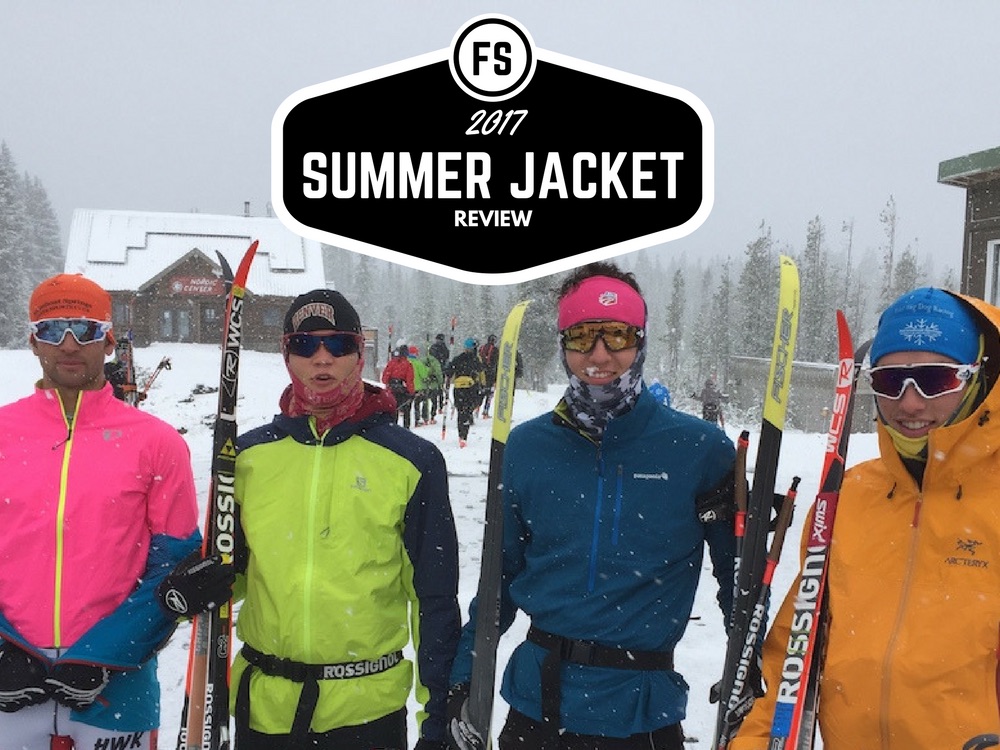
The skier on the left showing the importance of reading these reviews: your goal in life is to not be “that guy”. (All photos: FBD)
This is another installment of the “Living The Dream” gear review series, a somewhat regular feature offering nordic skiers of all levels insight into many of the elements that make our sport great. Here, the author and his field-testing crew puts lightweight “summer-skiing” jackets to work in all types of conditions in Bend, Ore.
The Setup
A few weeks ago, I provided cosmic enlightenment on where you should be right now and hopefully you were able to heed this very sage advice and have since logged copious k’s. Since unlike the rest of you losers, I work for a living, so I couldn’t just sit around Bend skiing, eating pancakes and riding sick mountain bike trails, oh no, even before I left Bend, I was back “on the clock,” tirelessly slaving away for you, the loyal reader. Well, sort of.
Since no one loves you like we do at FasterSkier, we are committed to not only giving you the latest and greatest beta on where you should be, but I’m now about to drop some wisdom on your lean, wirey, nordic asses on what you should be wearing, rocking, rubbing, and rolling on these big adventures.
Since I regularly drive my editors and senior management here at FS crazy with my disparaging comments on goods and services that I find to be inferior even if they are advertisers (in all fairness, my comments still get printed, but it drives everyone nuts), the “powers that be” retaliate by sending every possible wacko, crackpot product my way. I am therefore forced to interact with these half-baked, nut-job ideas on a far-too-regular basis.
While the scope of coverage of this latest review may seem a little staid and commonplace, I can assure you that I have waded through terabits of emails from start-ups hawking foldable shoes, mittens with built in lights, lights with built in mittens, kittens with mittens, smell-proof underwear, miracle vitamins, and all sorts of other really strange products for guys who may be having a little trouble “gettin’ the old Evinrude crankin’,” if you know what I mean. So don’t think for one second that we’re not looking at all kinds of crazy stuff, we are, we just have the common sense and good judgment to pick products that you’re actually going to use, even if a jacket review isn’t nearly as titillating as reviewing “male enhancement” products.
With that out of the way, let’s dive right in. For starters, it may sound crazy making jacket recommendations in June, but remember, this is a skiing publication, so it is our fervent hope that you have been able to get out skiing. And before everyone out there in the sweltering Midwest gets all huffy, not only did I recently give you the ins and outs of how to find snow in Bend in excruciating detail, but if you somehow manage to goof this up, have no fear, as the “snow window” is still open. If you really want to go big, venture up the the “Last Frontier” and mix it up with the big boys (and girls) at APU’s awesome Masters’ camp July 6-9. If your mom won’t let you fly all the way up to AK, my good buddy Matt Liebsch (or “Leaper,” as he likes to be called) also has an epic masters’ camp on Haig Glacier in August, so no excuses, snow is out there, you just need to go get it. How this is relevant in this context is that you’re not just going to want one of the jackets we tested, you’re going to NEED one of these jackets, hopefully sooner as opposed to later, as what better way to train for skiing than, uh, skiing?
The Reviews
Since the unpredictable conditions at our test site at Mount Bachelor have been well documented, we’re going to present the results from coldest to warmest, as nothing makes you ponder the purchase of a new jacket like a ripping, 60 mph wind and whiteout conditions.
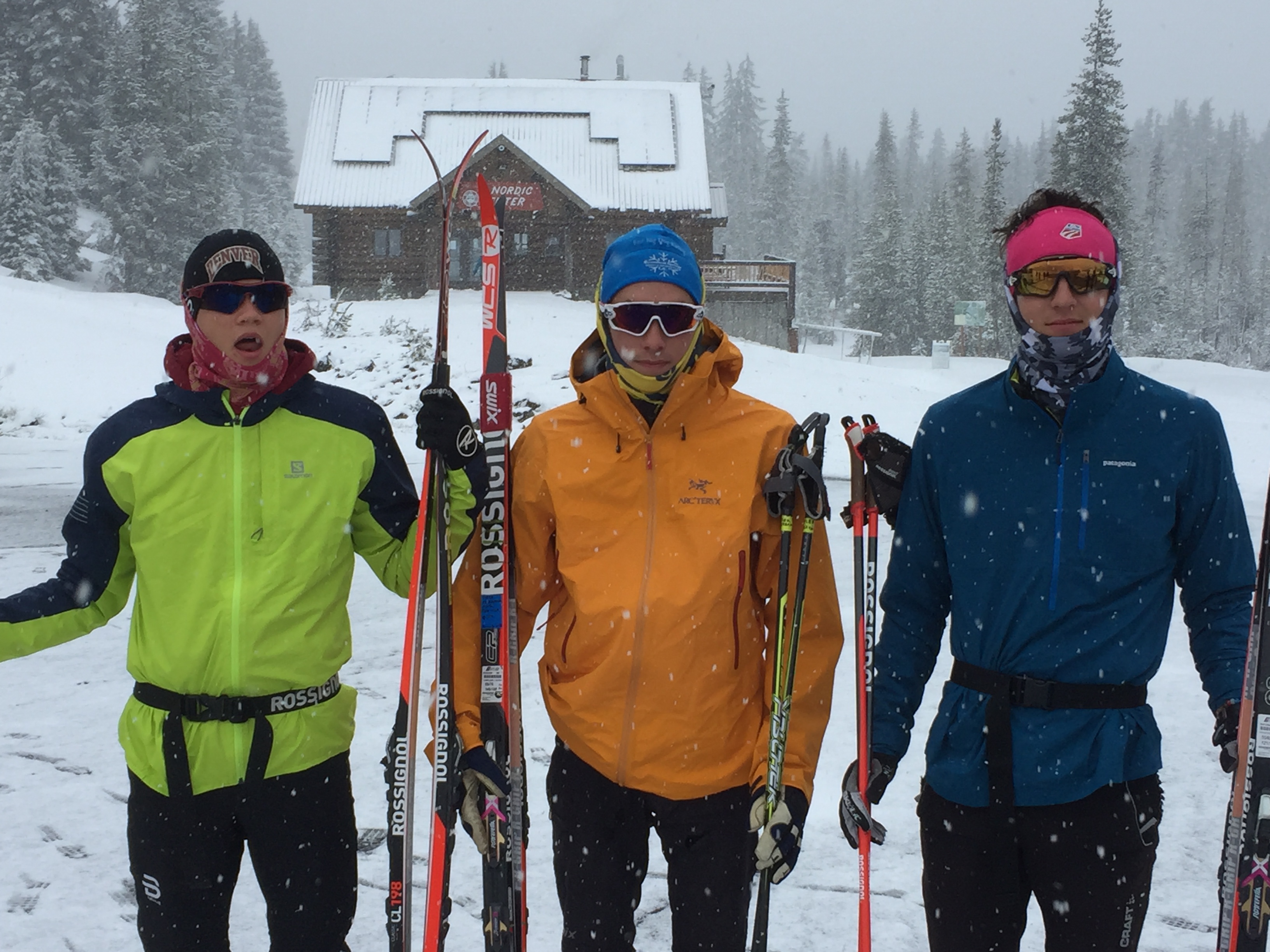
Field testers hard at work modeling the three jackets we reviewed: (from left to right) Simon Zink (in Salomon) of the University of Denver, and and Diggy Terranova (Arc’teryx) and Evan Barbier (Patagonia) of the Steamboat Springs Winter Sports Club.
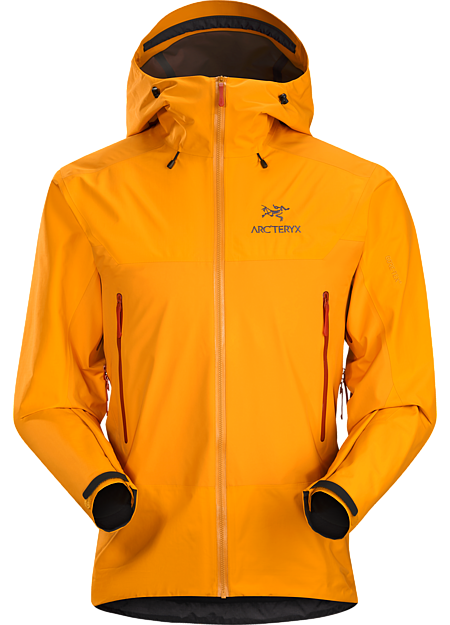
For pre-, post- or even intra-ski, the Arc’teryx Beta SL Hybrid Jacket was the clear favorite of the entire test team for very wet, cold, nasty conditions. It offers the most warmth, wind protection and probably the largest comfort range of any of the jackets tested.
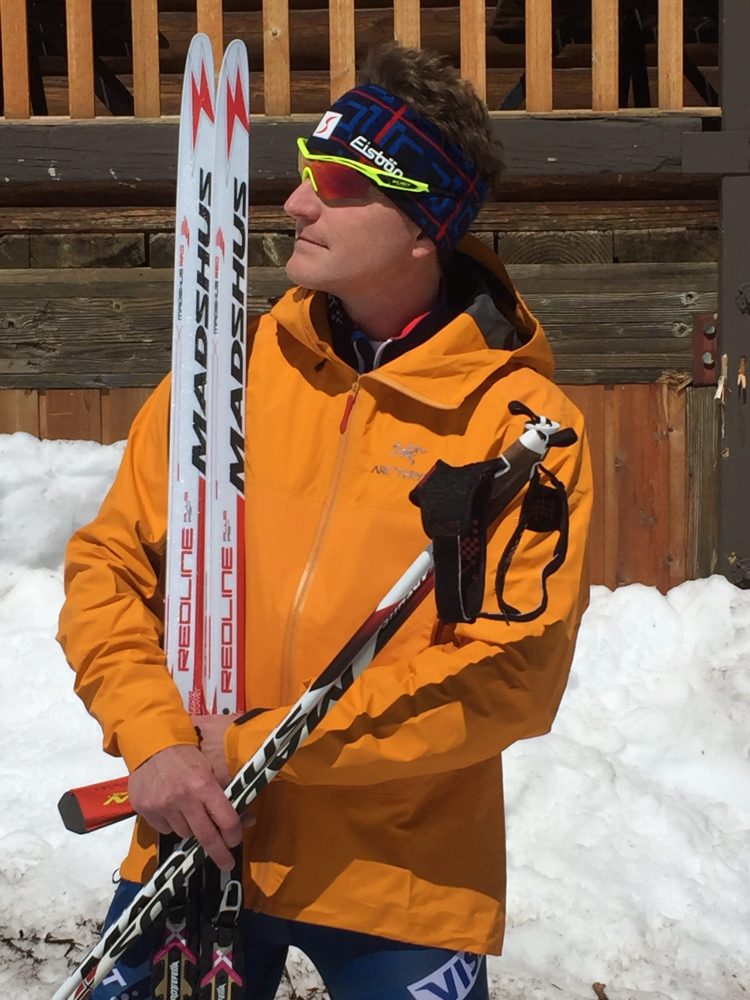
Dave Cieslowski wearing the Arc’teryx Beta SL Hybrid Jacket
In my previous three-week stay in Bend in May, and believe it or not, even in this trip that I am just finishing, we experienced conditions ranging from 20 degrees, blower snow and a howling 50-70 mph wind at Mt. Bachelor to fairly regular 35-55 degree afternoons down in town-ish. I say “ish,” as we were staying a few miles outside of town up toward Mt. Bachelor, (where all of the cool kids stay)…
Now where was I? Oh yes, jackets….. The Arc’teryx was my garment of choice on several backcountry outings, cold runs and apres-paddling/surfing (yes, they have surfing in Bend). This jacket came through with flying colors in every test and in every sport. To add a little firepower and diversity to this review, I recruited some of the young bucks on the Steamboat Springs Winter Sports Club for some additional perspective, and this was the top pick of all of the testers on the nasty days.
Said one tester, “If I could only have one jacket, this would be it, for sure.” Most agreed that it is usually too warm for nordic skiing in most conditions, but it is exceptional in every other regard. I wore it into town on a few rainy nights as well and it does a great job of being cool and stylish without crossing the line into looking like you could be departing for an Everest summit bid at any moment. The only slight dings I’m going to give it is that it is the most spendy of any coat in the test (at $399). It also doesn’t pack nearly as compactly as the others, in particular the Patagonia, but more on that in a bit. If you’re venturing out in very bad weather though, this is your jam, hands down.
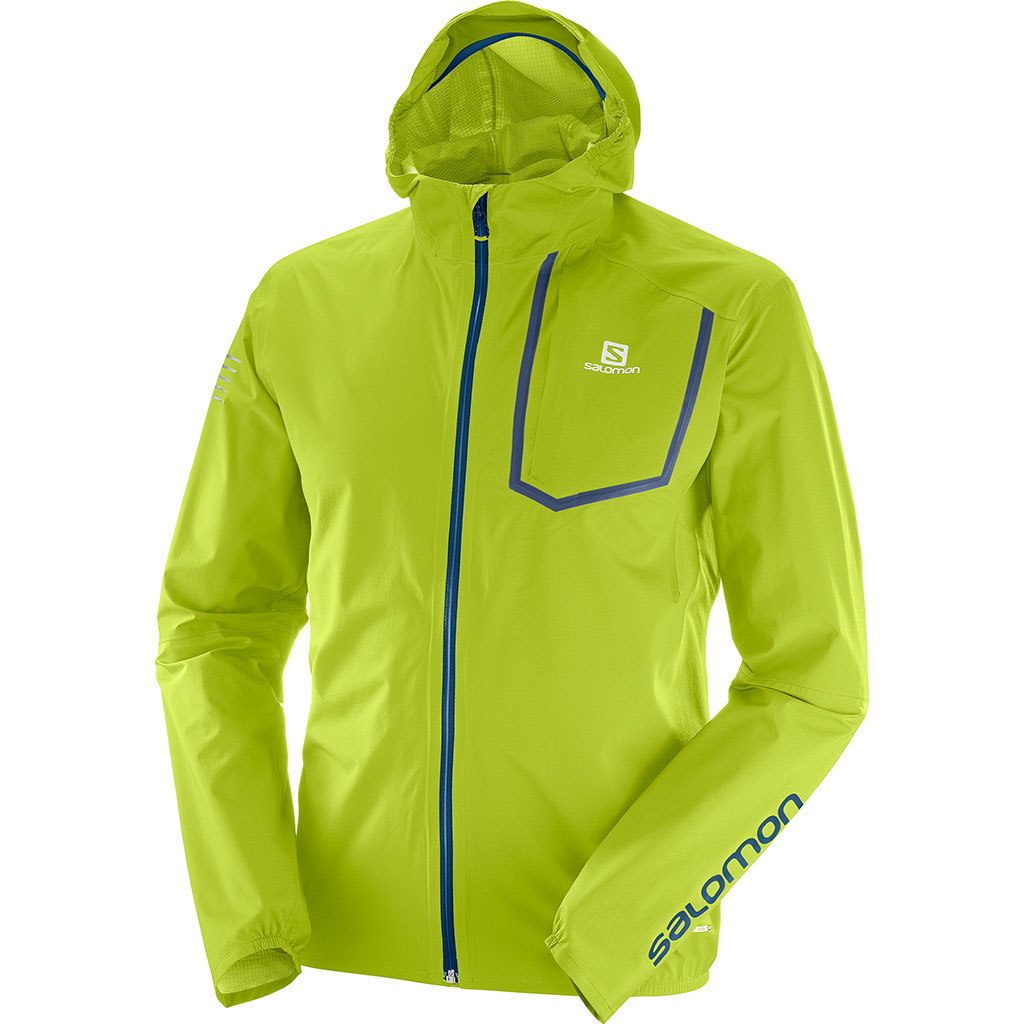
Definitely lighter and more packable than the Arc’teryx, this piece is marketed as a trail runner, but we all found its performance to be quite good on the skis and mountain bike as well. Yes, yes, it’s a big no-no to ride the trail in the rain and no one is a bigger supporter of that rule than the FBD, but since the weather in Bend changes faster than a Kardashian’s train of thought (and trust me, I am using the word ‘thought’ VERY loosely), you are crazy if you venture out for a ride longer than an hour without backup. Since this isn’t my first day on the radio, I had said jacket with me on an afternoon cruiser to Phil’s and she proved to be worth her weight in gold, as naturally, the 45-degree cloudy day turned to 38 and rainy at the farthest possible point from our condo. You’ll only need to get caught in one of these storms and you’d be willing to pay some dude on the side of the road a thousand bucks for one of these jackets for the ride home.
One of my particularly favorite features is the hood. This design is one of the best that I’ve ever seen, as it fits snugly, but not too tight. You can move your head around and it moves with you without feeling constrictive. The importance of this cannot be underrated.
The overall fit is a bit more snug than the other coats, partially due to the cut and I’m guessing partially due to the traditional difference in European sizing. This isn’t necessarily a bad thing though, in particular for cycling, as nothing is worse than donning a jacket and then being forced to do your best kitesurfer imitation as you battle your way home in a storm.
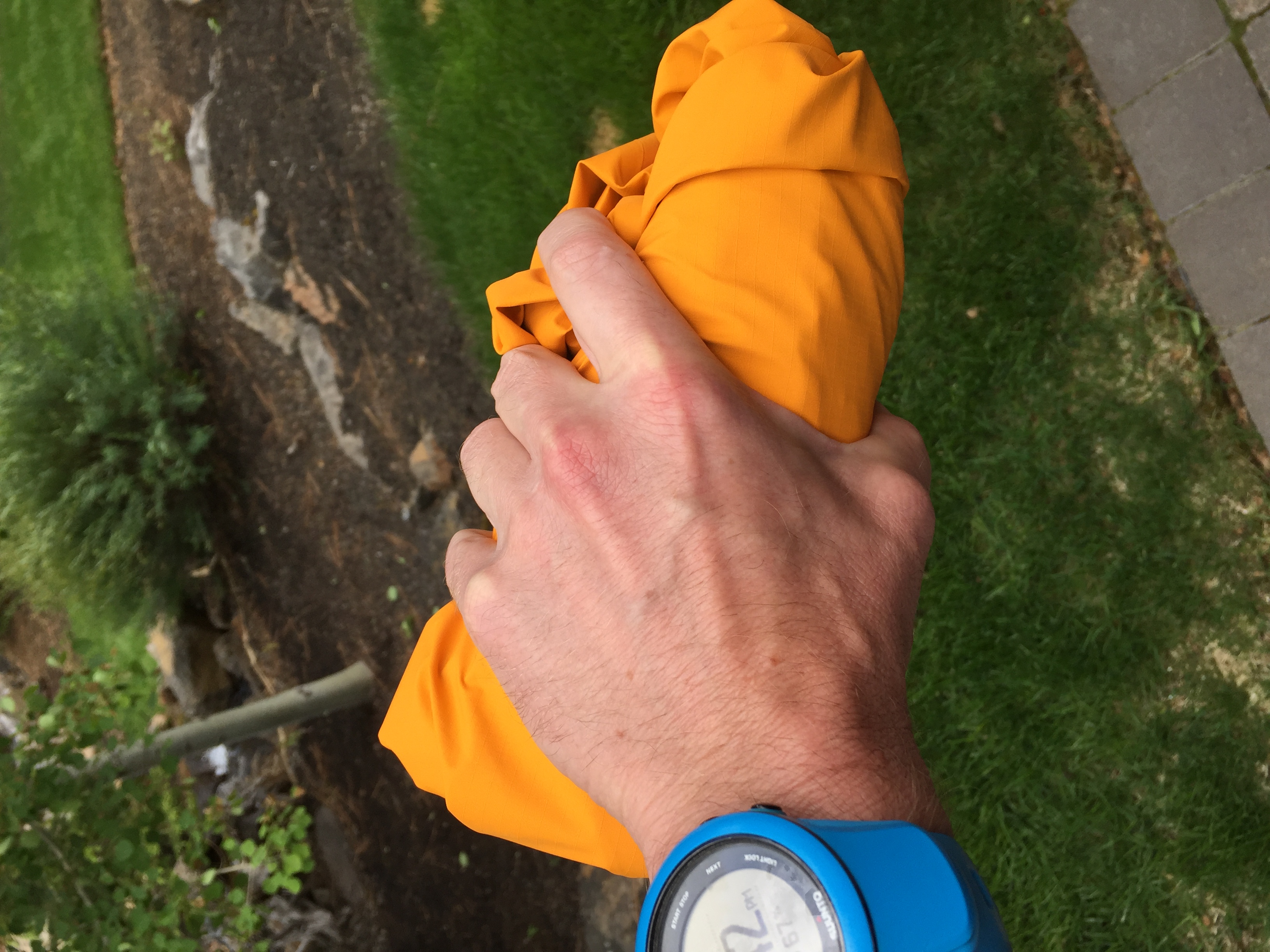
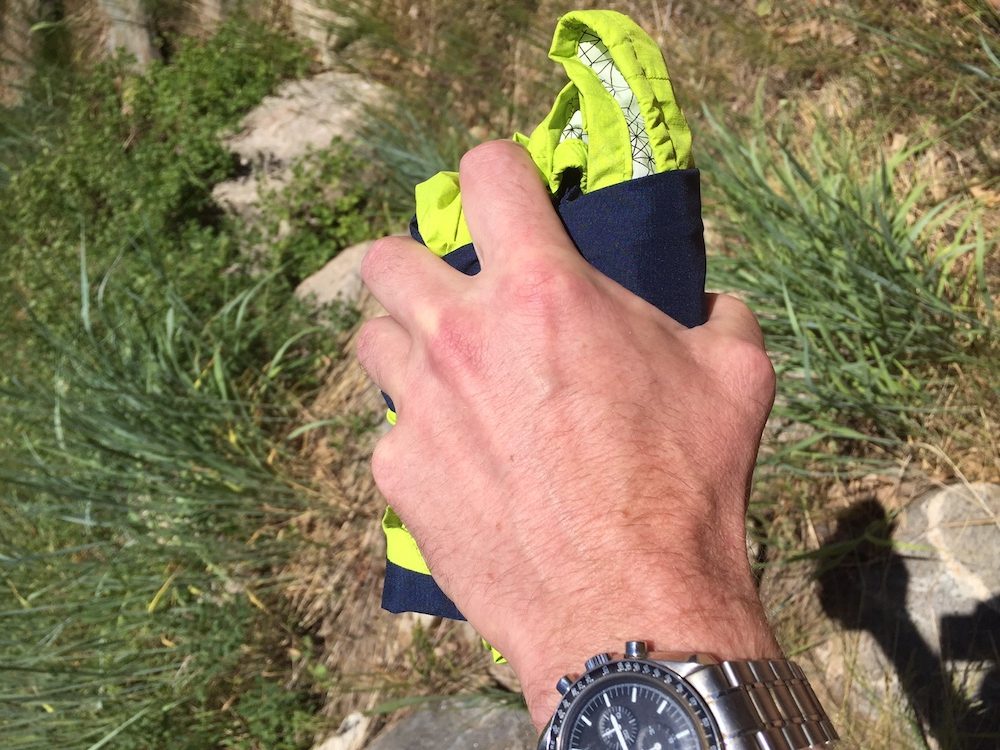
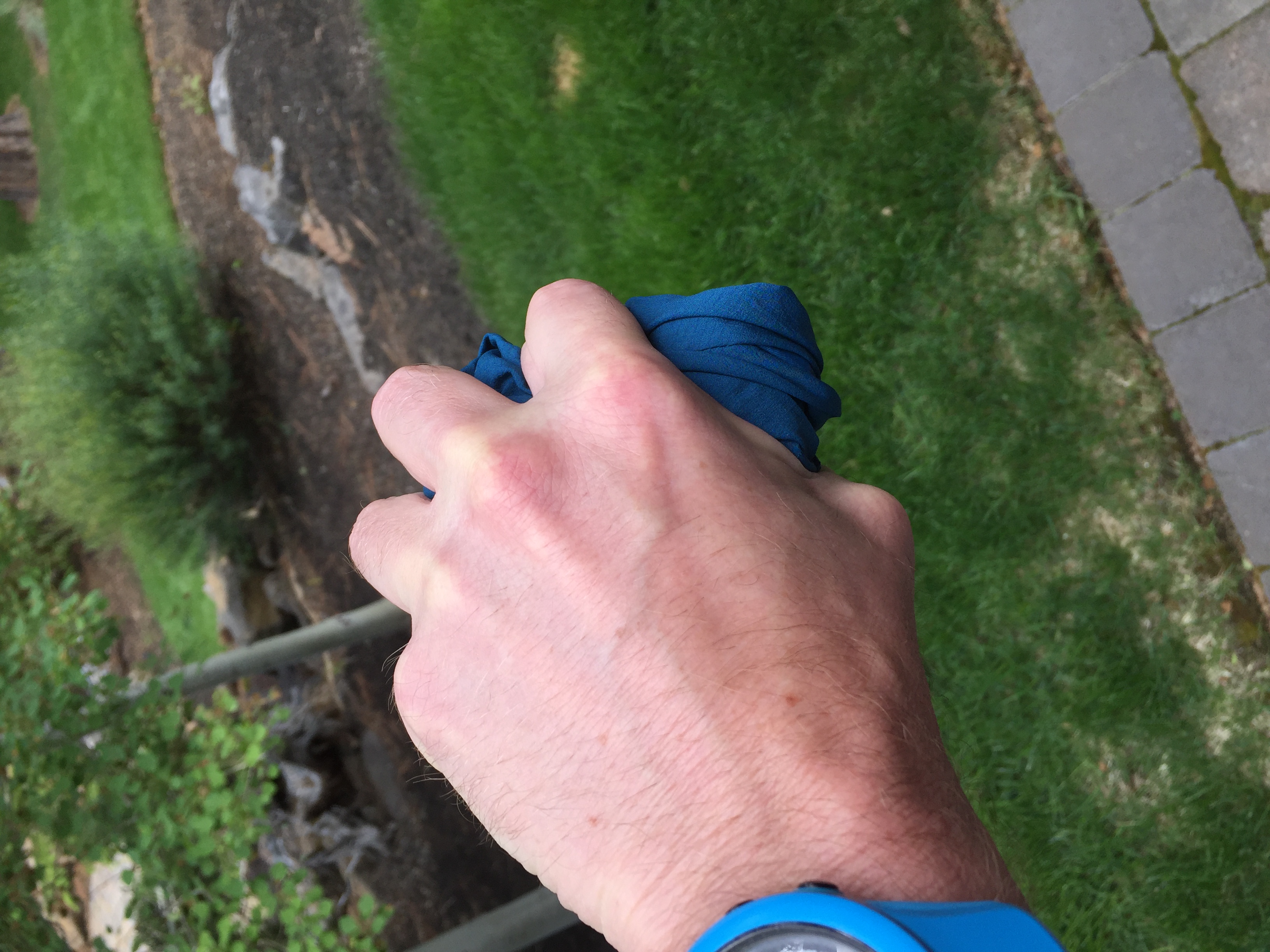
As you might expect, it folds down to a size slightly smaller than the Arc’teryx, yet slightly bigger than the Patagonia.
Arc’teryxSalomonPatagonia
Don’t let the size fool you though, as it is still quite waterproof, as clearly illustrated here:
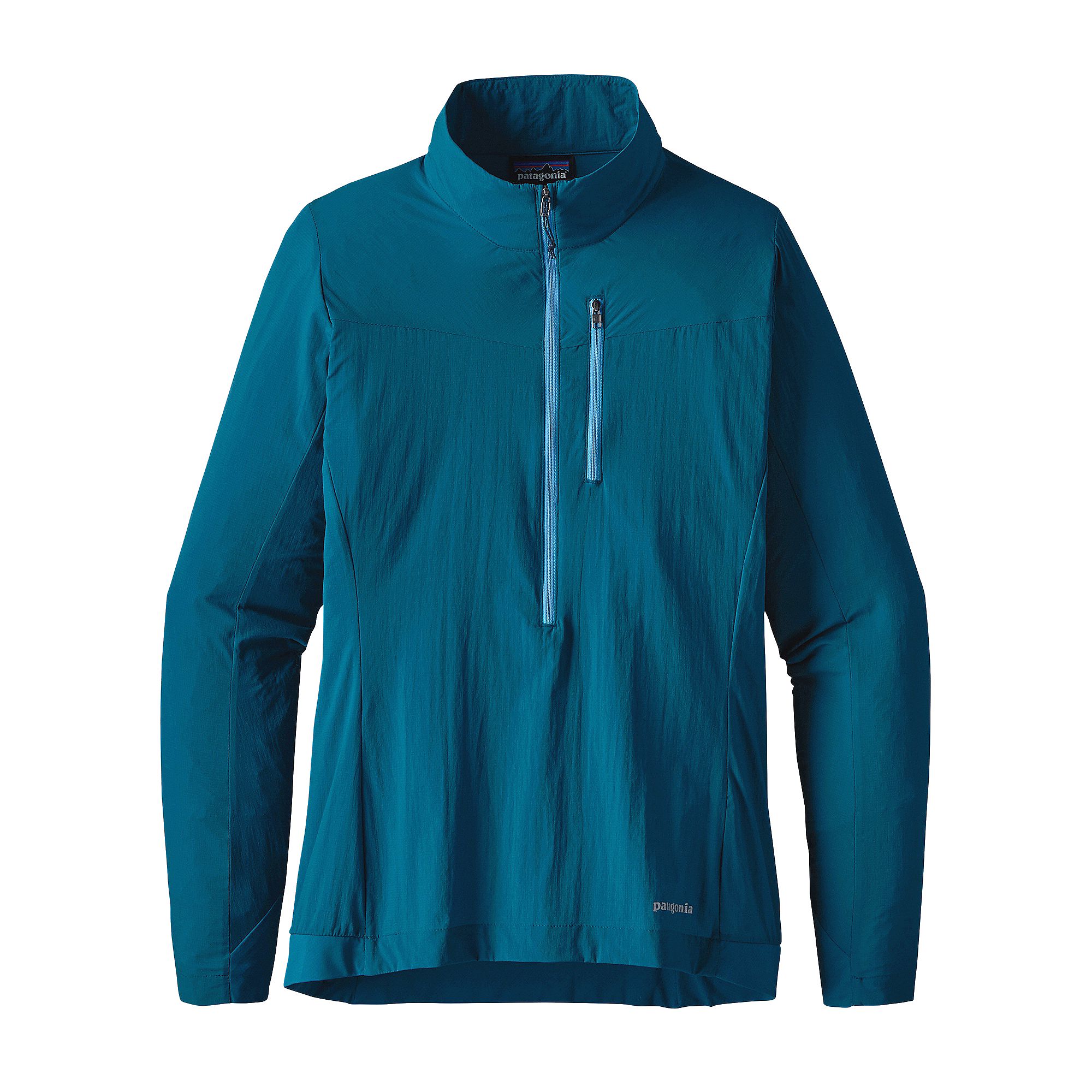
Last, but most certainly not least, in a wonderful offering from Patagonia, the Airshed Pullover. If you are in the minimalist camp, or simply are not buying in to my “never summer” philosophy, this jacket is for you. The lightest and most compressible of the group, yet this bad boy still offers amazingly good wind protection for both running and riding, in particular for a garment that will fold smaller than an apple.
What makes this jacket a real winner is it is what I’m calling my “Beckham Jacket.” A few years back, David Beckham was caught having an affair with his young, attractive, sultry assistant. In the court testimony, she disclosed that she always wore very sexy underwear to work, “Just in case,” (a strategy that eventually paid off, both literally and figuratively). The point here is that this is your “Just in case,” jacket. It folds down the smallest of any garment tested, while still offering a lot of protection from Mother Nature’s scorn (she’s particularly upset at us Americans right now, for obvious reasons).
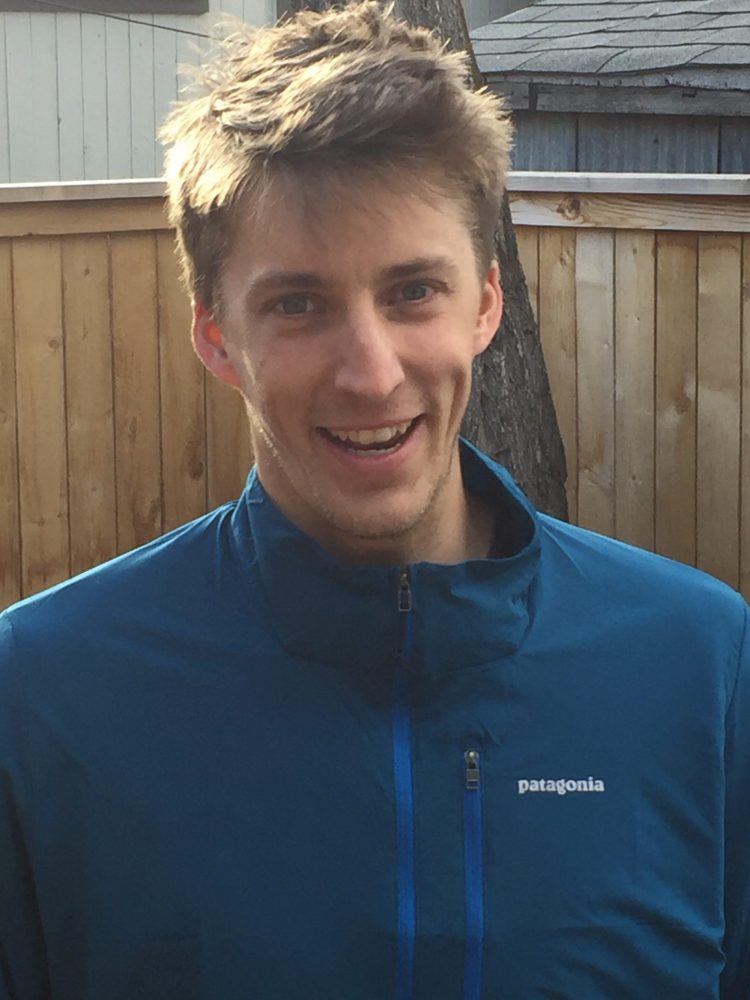
Matt Briggs wearing the Patagonia Airshed Pullover jacket.
This is also the jacket that is going to give you the most bang for the buck (insert your own David Beckham joke here) in the late spring/early summer months, as the test team found the others too warm for temps over 60 degrees, but this coat kept my entire crew comfortable in conditions ranging from 55 to 70 degrees. Throw this sucker in your jersey pocket, hydration pack or drink belt, and you’ll be covered (see what I did there?) for just about any contingency. It doesn’t have a hood, which is both a plus and a minus, depending on whether or not you want a hood. As you have come to expect from a perfectionist like me, this baby also got the “hose test,” because if you ski with me, you just need to accept the fact that you are going to be sprayed by a hose. Possibly several times. I have issues.
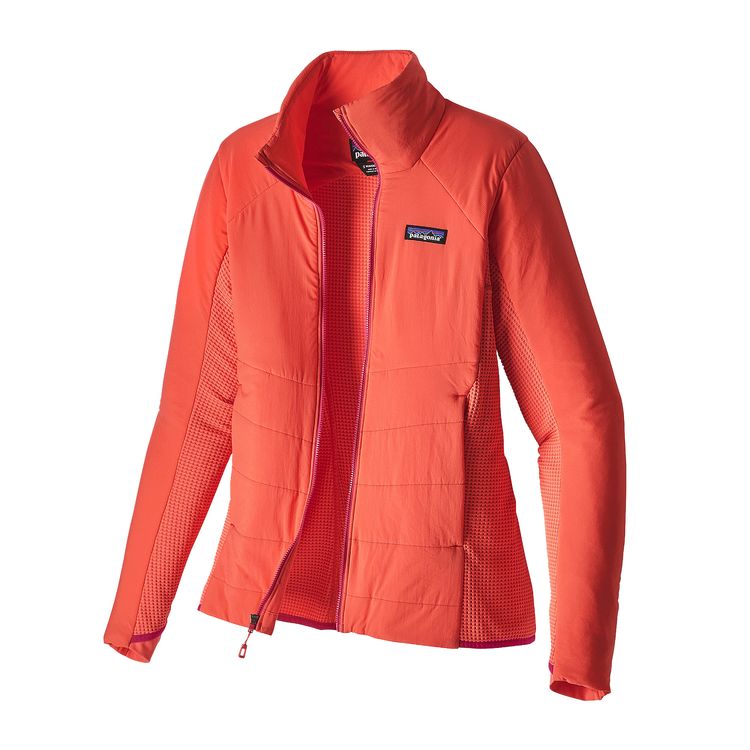
Changing gears a bit (though not as much as you might think), the fine folks in Venture, Calif., also sent their latest iteration of the very popular Nano series for testing, the Nano-Air Light Hybrid. One big reason this jacket even made this review is that it shares the same outer layer at the Airshed, so I thought it would be interesting to add this coat to the mix, even though it is obviously a very different type of garment. The second reason it made the cut is I tested its big brother on Eagle Glacier in Alaska last year, and one of the “OG” pieces in our base-layer test two years ago, and since this entire line has always tested well, I thought it’d be interesting to throw this latest offering into the mix. Yes, this is light insulation, as opposed to wind-and-water protection, but I wanted to cover all of the light to mid-weight outwear bases. If you are confused by any of this, there is nothing more I can do for you: please stop reading immediately go monitor your Great Dane’s “Thousand Yard Stare” before he eats another box of light bulbs.
Pat Flores wearing the Patagonia Nano-Air Light Hybrid jacket.
So, with all of those disclaimers duly noted, I love this jacket. There was simply no better option than this coat after a ski. While the trails at Mt. Bachelor are amazing, the parking lot can be windy as hell, so having this waiting for me in the car was a godsend. Unless you chill very easily, I probably wouldn’t nordic ski in it, but this is a perfect insulation layer for an alpine rip, after a cold surf sesh or just looking good at the dog park. This is particularly important, as the conduct of your aforementioned Great Dane has probably earned you a lot of enemies, so looking good is the least you can do.
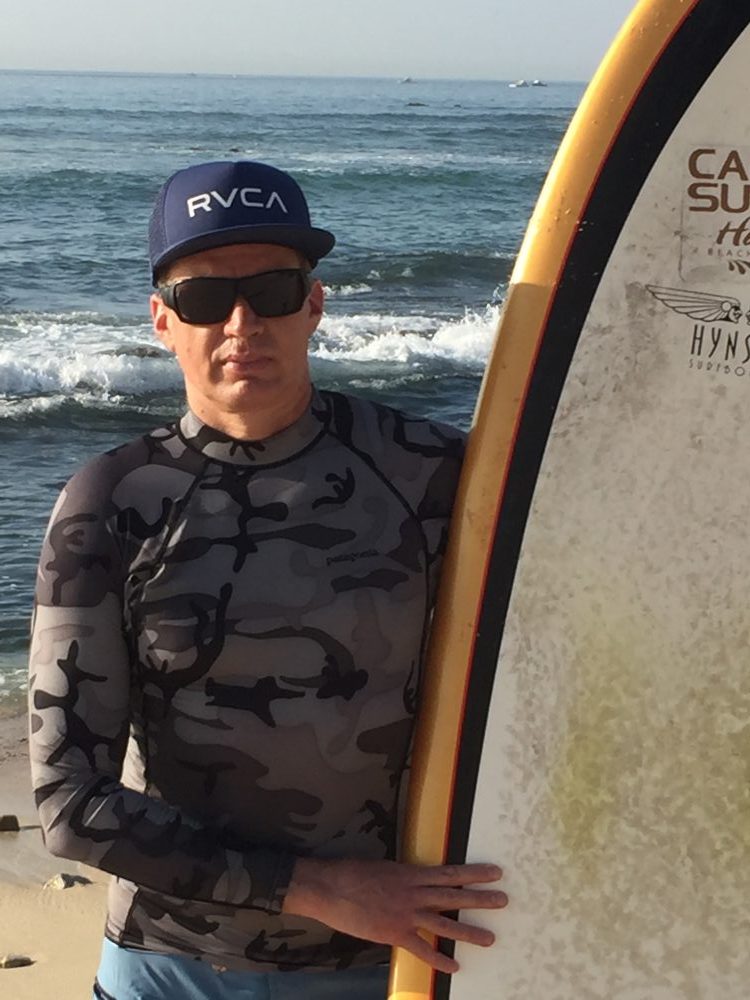
Speaking of surfing, since I’m overworked and underpaid, or is it overpaid and underworked (I always get these two mixed up), I had to take a break from all of this skiing and hit Mexico for a little surfing. I realize that this is a bit of a non sequitur, as this is a ski publication, not a surfing one, but since I know at least two other very good skiers who are also good surfers (Andy Newell and Josh Smullin, though it pains me greatly to admit the latter) and by my calculations since I have approximately 5 readers, this represents a solid 40% of my audience, so I’m going to throw in a surfing clothing recommendation — a rash guard, the Patagonia Men’s RØ Long-Sleeved Top. As you might guess, I’ve paddled and surfed in every conceivable size, shape and color rash guard and this is one is my favorites. Unlike Smullin, who has little, skinny, bird arms, the FBD is a big, powerful man, so the flexibility and movement offered in this top allowed me to drop in on more people than usual in my top secret surf spot. Sorry people, I have waves to catch and “Dropsie” (as Smullin insists on calling me) is a bad, bad man.
Fast Big Dropsie wearing the Patagonia RØ Long-Sleeved Top in Cabo.
A few other cool pieces of gear that are heavy in the FBD rotation these days: Petzl offered up their latest-and-greatest headlamp a few months ago, the Petzl REACTIK+ and I’ve been super impressed. If you’re a fan of dawn patrol (or Dong Patrol, as it is known in Steamboat, for reasons that I’d rather not go into), you know that a good headlamp is mandatory. Since I lost my mind years ago, the thought of getting up at 5 a.m. to get the freshest waves or powder seems like not just a good idea, but in fact a great idea. However, in order to do this and not lose all of your gear in the parking lot, you need to have your act together, as even the normally patient FBD gets a little antsy when some rookie can’t find his skins at sunrise while everyone else is standing at the trailhead ready to roll. So organize you gear the night before, get your lazy ass out of bed on time, and bring a headlamp — a good one. And this latest Petzl one is one of the best. It has all kinds of crazy customizable features that are super easy to use thanks to an app you can install on your phone or you can go “old skool” and just turn it on and off like a normal person. Since I am a lonely, lonely man, I have no qualms about spending 30 minutes customizing my headlamp power settings, but that’s me — your mileage may vary.
Whew. We covered a lot of ground on this one. You’re welcome.
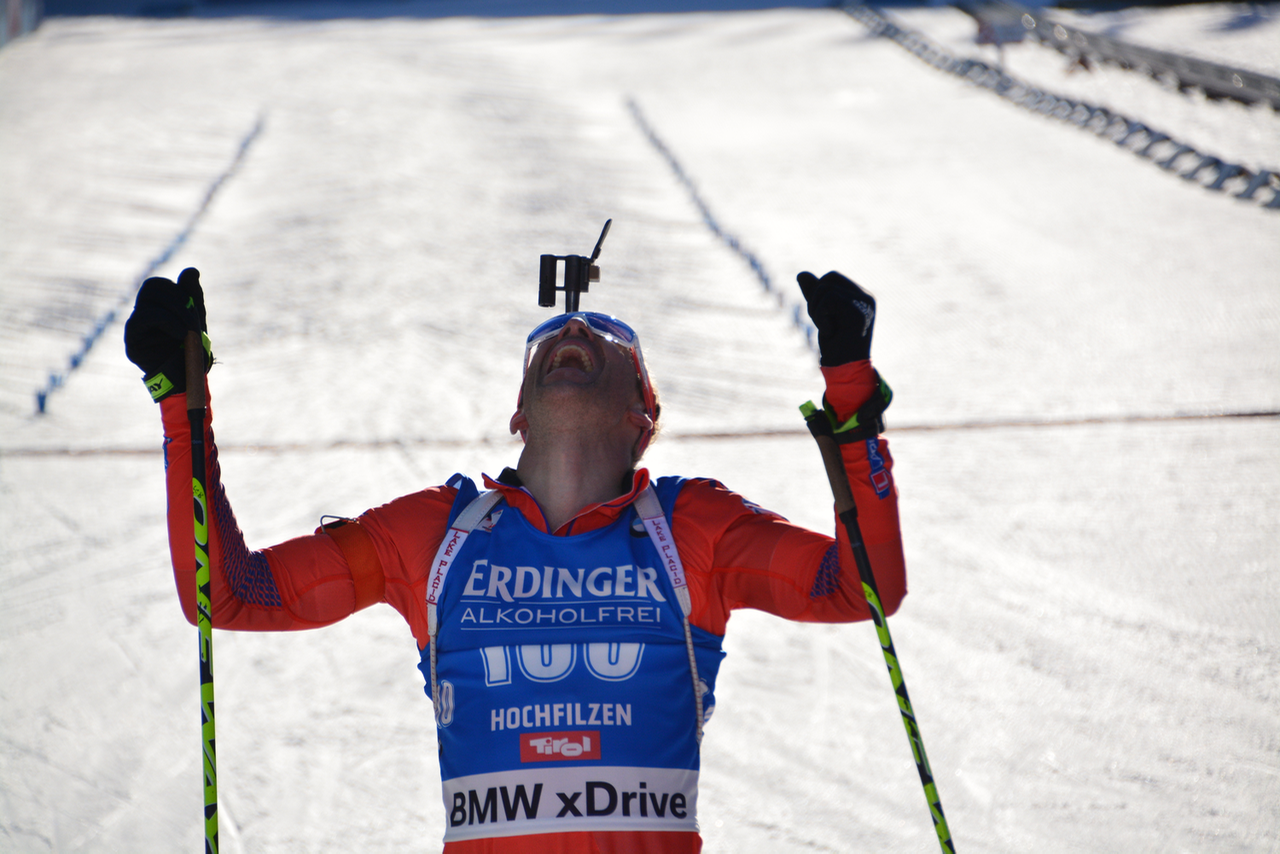
BEND, Ore. — At 35 years old, U.S. Biathlon’s Lowell Bailey is the consummate veteran: he’s been racing on the World Cup since 2002. And this past winter on one day in mid-February, Bailey was perfect. On Feb. 16, he won the 20-kilometer individual race at the 2017 International Biathlon Union (IBU) World Championships Hochfilzen, Austria.
Lowell Bailey celebrates after crossing the line to win gold in the 20 k individual at IBU World Championships in Hochfilzen, Austria. (Photo: Glen Crawford)
Ten days ago, FasterSkier sat down with Bailey in Bend. The US Biathlon team was in town for an on-snow camp up at Mt. Bachelor. Bailey, of Lake Placid, N.Y., is a biathlon lifer, a husband and a dad. He plans on racing one more season through the 2018 Winter Olympics and them moving with his family to Bozeman, Mont.
And yeah, if you heard rumors of Bailey pursuing a career as a bison rancher, you’ll hear Bailey set the record straight when it comes to his post-World Cup career.
Bailey = renaissance man.
He’s clearly a world’s best biathlete. He’s also a musician. As a bit of a bonus, Bailey allowed us to include one of his songs in the podcast titled Shores of Horicon. Here are Bailey’s notes on the song and the album.
“It’s the title track of my solo album, ‘Songs of Logging’ (2005),” Bailey wrote. “This album was a historical theme album dealing with the history of logging/forestry in the Adirondack Park region of upstate NY. This particular song deals with the history revolving around the Battle of Lake George during the French and Indian War (1755). In that battle, Sir William Johnson, fighting on behalf of the British, fought in alliance with more than 200 Mohawk warriors led by Chief Hendrick Thianoga (various spellings). Hendrick died in what was one of the bloodiest battles of the war. William Johnson was one of the first landholders in the region and one of the first white settlers to become friendly with members of the Iroquois people.”
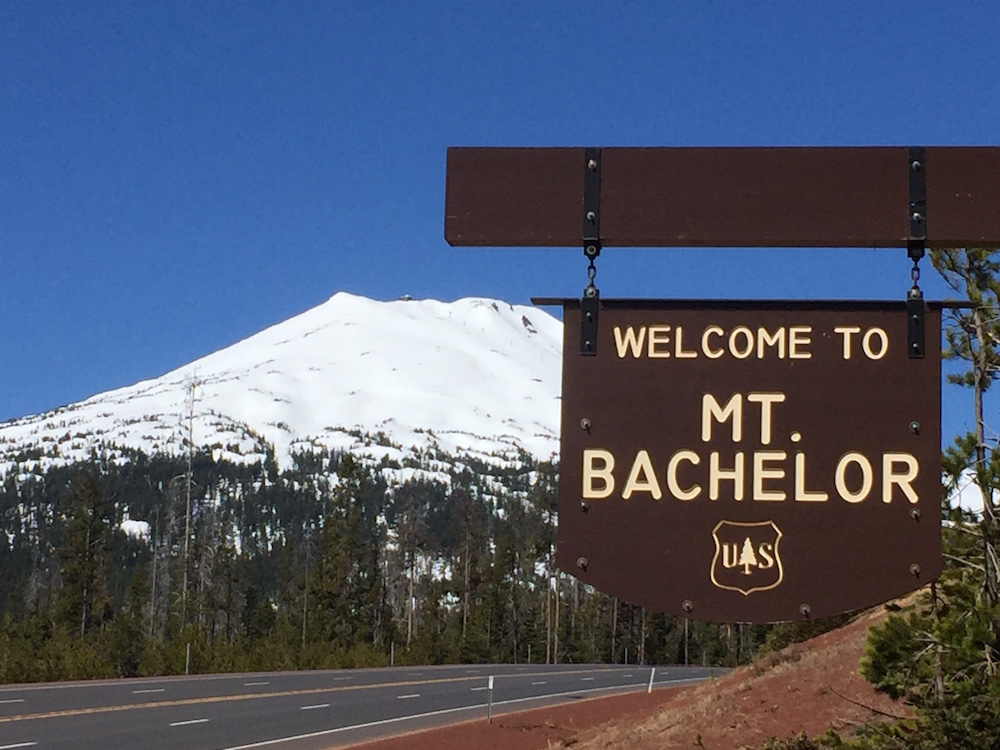
Mt. Bachelor in Bend, Ore., as seen in May 2017. (All photos: FBD)
You should be in Bend. Bend, Oregon. Right now.
For all of my “shallow readers” in the audience, those unable to focus on any piece of written work longer than 140 characters (you know who you are), you can stop here. You’ve both learned everything you need to know and also everything your SnapChat-addled brain can handle, so you’re done. For those of you with attention spans longer than those of fruit flies, dig in, as I’m about to plan your next trip for you — and here’s the good news — it’s this weekend. Or next year at this time. And every year thereafter.
Let me see if I can guess what’s going on right now for most of you — you’ve already storage waxed your skis for the summer, you’re back out on your mountain bike, and you’re re-reading each of my whap-stick reviews (skate & classic) every night before you go to bed. You tell yourself each morning as you go through your visualization and meditation routine, in which you attempt to teleport into my magnificent body and life, that this is the year that you’re going to set a PR at the (insert your favorite race here), beat your nemesis (insert the name of that person who you’ve been chasing for a decade or so) or finally slay that dragon and qualify into Wave 6 of the Birkie. Then your change-adverse subconscious kicks in and tells your mind, “Hey brain, these are great goals — you know what we really ought to do? We should do the same thing that we’ve been doing for the last 5, 10, 15, or 20 years, I bet THIS year is the year that it finally works.” Sure, that’s one approach, but you know what’s an even better tactic, one that might actually work? Try something new. And he’s a shocker, start by spending more time on snow. It is for this strategy that this report is going to come in handy.
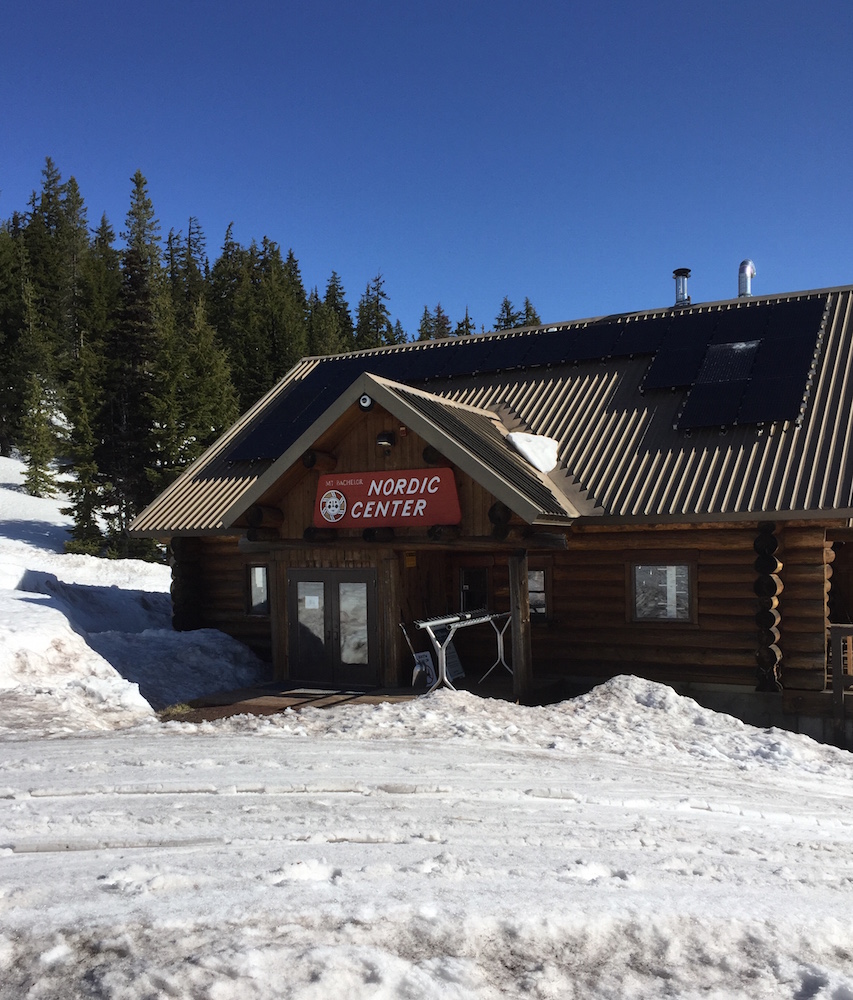
Mt. Bachelor Nordic Center in May 2017.
Once you make this leap of faith and commit to change, the hard part is over and then it’s just a matter of figuring out what you’re going to do differently (read, better). As usual, I have you covered, as what better way to dilute the knee-buckling pressures of adulthood and obstinate Great Danes than to escape to a place filled with cool people. And not just cool people, YOUR people. And Bend is that place. Not only can you still get on snow here right now, but you can get on really good snow.
This isn’t an article about some BS 2 k loop in a carbon-monoxide-filled tunnel in the armpit of Europe. In fact, it’s about as far away from that (both literally and figuratively) as possible. The Nordic center in Bend is nestled between 1,752 and 1,950 meters at the base of Mt. Bachelor and offers an amazing array of trails and options. Right now, all 56 k of perfectly prepared trails are open and believe it or not, the venue is still getting regular new snowfall.
Sue Foster, Mt. Bachelor Nordic Ski Center director
“This is truly an amazing place,” said Sue Foster, director of the Mt. Bachelor Nordic Ski Center. “Our snow in early to mid-May is usually quite reliable, but this is a particularly great year, even for us. We’re still grooming the whole network, so every trail is still open, which is pretty awesome for this time of year. We may shut the lower loops down soon, but we’re still going to to have a lot of skiing available into mid-June.”
It is for all of these reasons and more (more on this in a bit), that Bend is the venue of choice in May for all of the U.S. nordic national teams: US Biathlon, Cross Country, Nordic Combined, Paralympics Nordic, and several top junior teams are either here right now or coming shortly.
“This is a fabulous place to train in May,” said US Biathlon Women’s Coach Jonne Kähkönen. “We’ve been coming here for several years as it is a perfect place to log a lot of quality hours on snow, really focus on technique and have a wide variety of outstanding dryland training options as well.
Jonne Kähkönen, US Biathlon women’s head coach, in Bend, Ore.
“I coached in Finland before I took this position with US Biathlon and we used to go to the glacier in Ramsau, Austria, for a similar camp, but this is really much better,” he continued. “Not only is the snow as good or better, but everything is much easier logistically, as you don’t have to take a gondola up every day to ski and the afternoon dryland training is accessible from right outside the condo. It’s a great way to start the season.”
Reigning biathlon world champion Lowell Bailey elaborated on some of the concepts from Kähkönen: “I come to Bend because it has been one of the most dependable places for quality on-snow training in May. With more than 50 kilometers of trails and world-class grooming, there is no better place to start the training season each year.”
His fellow world championship medalist Tim Burke concurred: “Bend is the perfect place to kick off the training season because you can combine ski-specific training in the morning with world class mountain biking in the afternoon. I don’t know of any other locations that can offer this combination in May.” But don’t just take their word for it, as this video says it all:
Determined to build on the incredible success of last season, the US Biathlon men’s team arrived in Bend looking leaner and more focused than ever, with their mantra being, “New year, new gut.” From left to right: Leif Nordgren, Tim Burke, Lowell Bailey, Sean Doherty.It is also important to point out that while Lowell (l) and Timmy (r) aren’t skiing quite as much as me here, they’re still skiing a fair amount and since the skiing is at altitude and there is an oxidative stress associated with high levels of aerobic training, the camp has already taken its toll on both athletes, for while they don’t look bad in the aforementioned video and photo, here is a shot of them on their first day in Bend, so wear that sunscreen people.
The XC mafia is out in force, too, with their whole gaggle on-site as well. “I’ve spent a lot of time here,” said Chris Grover, head coach of the U.S. Cross Country Ski Team. “Probably going back to the ’80s. From the national-team perspective, it’s a no-brainer — we can ski every morning on legitimate cross-country trails, which is not really something you can do on the glaciers in Europe, then in the afternoon, Bend also offers all sorts of amazing dryland options. On top of all of that, the community support that we have here is unreal: everything from the management and staff at Mt. Bachelor, to fellow skiers, to the community in general, we are always blown away at how nice people are here and how willing everyone is to lend a hand if we need help with something crazy. It’s an incredible place.”
Andy Newell (U.S. Ski Team) training both on snow and on dry land earlier this month in Bend, Ore.
The cross-country athletes share all of these sentiments as well: “The U.S. Ski Team Bend training camp is a tradition that pre-dates me, for sure,” said longtime, wily U.S. Ski Team veteran Andy Newell. “I don’t know the exact origins, but I believe it started a generation or two before me with Justin Wadsworth and all of those guys — maybe even earlier, I’m not sure — but there’s a reason why we keep coming back, it’s because it’s pretty awesome.”
Newell continued, “Bend is sweet for many reason: amazing trails, reliable conditions, and manageable elevation, so the overall quality of the training is very high, which is not something you can do in many places in Europe, especially at this time of year. In addition, the overall vibe is really cool. The camp itself has lots of focus on technique, not hammering intervals, so it’s really nice to be able to just enjoy being back together with your teammates and have fun being back on snow. Plus, as you well know, FBD, the afternoons are open for all sorts of shenanigans. It is without a doubt one of the best camps of the year.”
So elites are here, pre-elites are here, juniors are here, but what about you, the mid-life crisis, disenfranchised desk jockey with 2.2 kids, a white picket fence and a possible brain-damaged Great Dane that somehow still does not know his name, is this place for you? Of course it is.
FBD’s Great Dane
How can I write this with such confidence? Well, for starters, I am one of you: you are “my people” and vice versa. I’ve been on the tracks every day for two weeks and the skiing is amazing. However, if you are a regular reader, Instagram follower (and you certainly should be, as I am awesome), or you only know me by reputation, you may have some “concerns.” For example, why don’t we take a completely wild hypothetical: let’s say that I have lost my mind and have been filling my free time pretty much exclusively just skiing, mountain biking, paddling, and trolling Josh Smullin on Instagram. Again, this is purely hypothetical. So in this clearly random and arbitrary example, you’re now likely thinking, “this dude is nuts, I’m not going to listen to him” (often a very sound strategy, btw). OK, fine, if you aren’t going to listen to me, nonetheless Lowell, Timmy, Andy, or Kikkan, maybe you will listen to one of my favorite nordic power couples and dyed-in-the wool, uber-Master Blasters, Pat and Cyndy Flores. I’ve crossed paths with these globe trotters in Alaska, Switzerland, all over the continental U.S., and seemingly every other place where the snow is good, so it made complete sense that these crafty snow-chasers were smiling in the sun on the deck as I walked up to the nordic center one morning.
Pat FloresCyndy Flores
“You can’t beat Bend in May,” noted a tan, fit, and rested-looking Pat Flores. “Cyndy and I would come up here regardless, as there is so much great training, good restaurants and nice people, but what really makes the trip a no-brainer for us is we do JD’s master’s camp each year and this is really the icing on the cake.”
Cyndy agreed, “This is one of the few places that not only has reliable snow in May, but to be able to stay in a nice condo only 20 minutes from snow and also less than 10 minutes from a really cool town with all kinds of great restaurants, shops and fun stuff to do, makes this a ‘must-do’ every year. JD’s masters camp is great, the skiing is great, the food is great and if you’re really lucky, you might get to ski with FBD!” (Ed. note: REALLY LUCKY, as he is both everywhere and quite elusive, all at the same time, in particular when stories are due).
I have personally never attended one of JD’s camps, so being the always suspicious, ever-vigilant investigative reporter than I am, I didn’t just take Pat and Cyndy’s word for it, I also went straight to the source, XC Oregon Head Coach John “JD” Downing. “The camp is a great way for masters skiers to get to the next level,” Downing said. “We keep it fairly small, so there is a lot of personalized attention and the venue is amazing. Bend doesn’t just have skiing in May, it has really good skiing in May. Sadly, climate change is a reality everywhere, but this is one of the places that still seems to be holding up well. In fact, some of the best days I’ve ever had on snow anywhere in the world have been in Bend in early May. As you well know, you can ski all morning, then bike and run in the afternoon on a trail system that is also world class. You can even go play a round of golf. It’s an extraordinary thing, really. This why so many national teams come here at this time of year.”
Chris Grover, head coach of the U.S. Cross Country Ski Team, earlier this month in Bend, Ore.
Speaking of national teams and master blasters, Kähkönen offered very valuable advice for athletes of all ages, in particular masters: “My recommendation is to adapt your training to your length of stay. If you can only make it out for an extended weekend, that’s OK, as this can still be very productive. In this scenario, focus on skiing well and don’t worry too much about your levels of exertion. You’re at altitude and you probably won’t feel as good if you are sea level athlete, but for a short stay, that’s okay. If you are able to come out for a more extended block of training though, keep a close eye on your levels. Altitude can be tricky, so be careful to not go to hard every day. You should use this camp to set a solid aerobic base and technical foundation for the year, so be smart.”
Grover also offered up some top-secret, US Ski Team ninja sh*t: “This is a phenomenal place for skiers at all levels to come to start their seasons, as Mt. Bachelor can throw lots of different conditions at you. We view this as a strength, not a weakness, though, as it’s a great place to improve your skills, in particular in classic. If you’re here for a week, you’ll likely ski on hard wax, klister and zeros, so it is a perfect environment to test equipment, wax and work on technique in these different conditions. Even if you are mainly skating, you’ll get fresh snow, wet snow, dry snow, old snow, hard pack, and slush, sometimes many of these in one day. These variable conditions are something that you usually don’t get on glaciers, so without a doubt, practicing in this environment has made us better skiers as a national team and it most certainly will help skiers of all levels.”
For more on my travel idiosyncrasies, check out this wonderful podcast from some dude named, “Jason”.
Now that this esteemed panel has convinced you to make the trip, the next question is, “How are you going to roll? There’s BALLER, FBD-style, which means that you’ll need a stevedore to unload all of your gear (I like to have the options to choose between lots of colors and styles of underwear each morning).
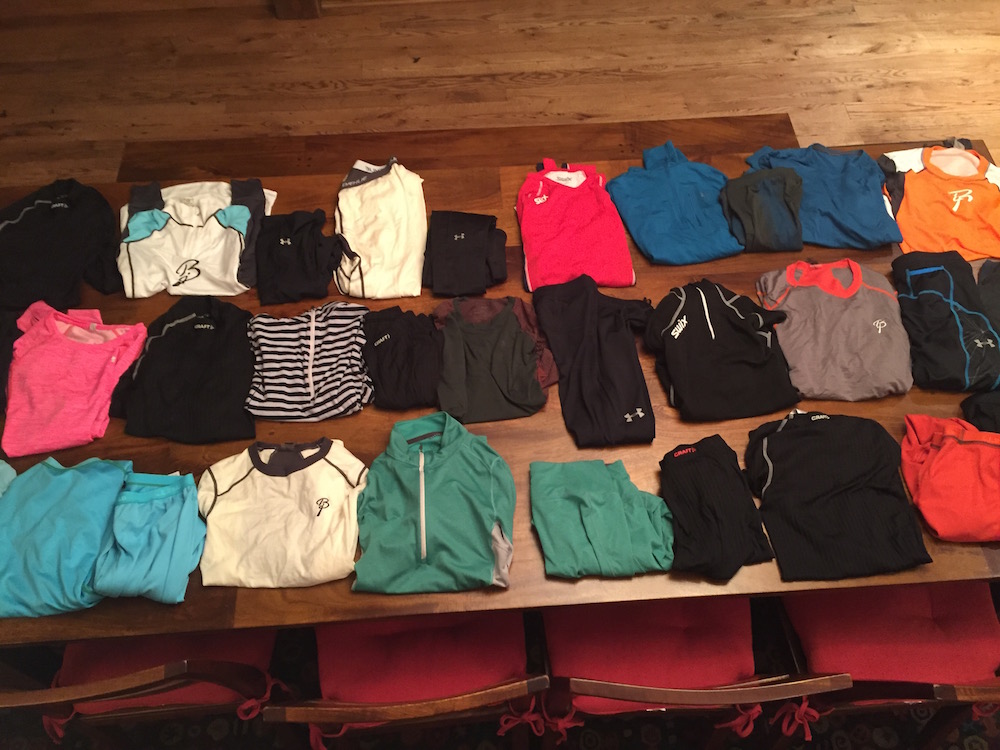
Study at the feet of the master and bring six sets of skis (rock classic, cruiser classic, race classic, rock skate, cruiser skate and race skate — yes, not having both cold race skate and warm race skate still has you upset, but you’re praying that you’ll be able to make your “cold skate” race skate skis work, as you are pretty frickin’ adaptable). Now over-stuff your ski bag with base layers of every conceivable thickness, material, color and style. Ditto for mountain-bike gear. Double-ditto for running gear. Better bring that paddling gear, too, just just in case Timmy Burke gets his nerves back after his horrific loss to me in our race on Lake Placid, then, since everyone knows you have a reputation for looking real nice for the ladies, you’ll also need your traditional two bags of personal grooming items and tastefully coordinated couture.
To adequately transport all of this crap, you’re going to need one of those stupid monster trucks but that’s OK, as your top priority is to make it to the tracks every day, regardless of road conditions, completely ignoring the fact that the scenic highway to the mountain is perfectly maintained and essentially never closes. You’ve never been one to listen to reason and you’re certainly not going to start now (after all, you are a self-loathing nordic skier who pays money to suffer) so you rationalize this ridiculous gas guzzler with the explanation that you also need this vehicle so you have room for the sherpas, in particular your shirt sherpas, as those dudes are indispensable. If you’re fortunate enough to snag one of the rare and exclusive invites to have dinner with me and you show up looking like you slept in your clothes, “my people” will immediately show you to the door. You’ve been warned. So yup, better pack that travel steamer as well.
This excessively wasteful and cumbersome manner of travel isn’t for everyone though — I get that — and to be fair, it is really more of a lifestyle and not something for which everyone is suitable emotionally and financially equipped, which is fine. Some of you out there in FasterSkier-land may consider yourself the nordic version of Seal Team 6, and thanks to my gripping expose on why you never need to do laundry again, you may prefer to go commando and travel with just one pair of socks, undies, and a T-shirt. Well, fear not my nimble travelers, I have you covered here as well (see what I did there?).
How to go “lean and mean”
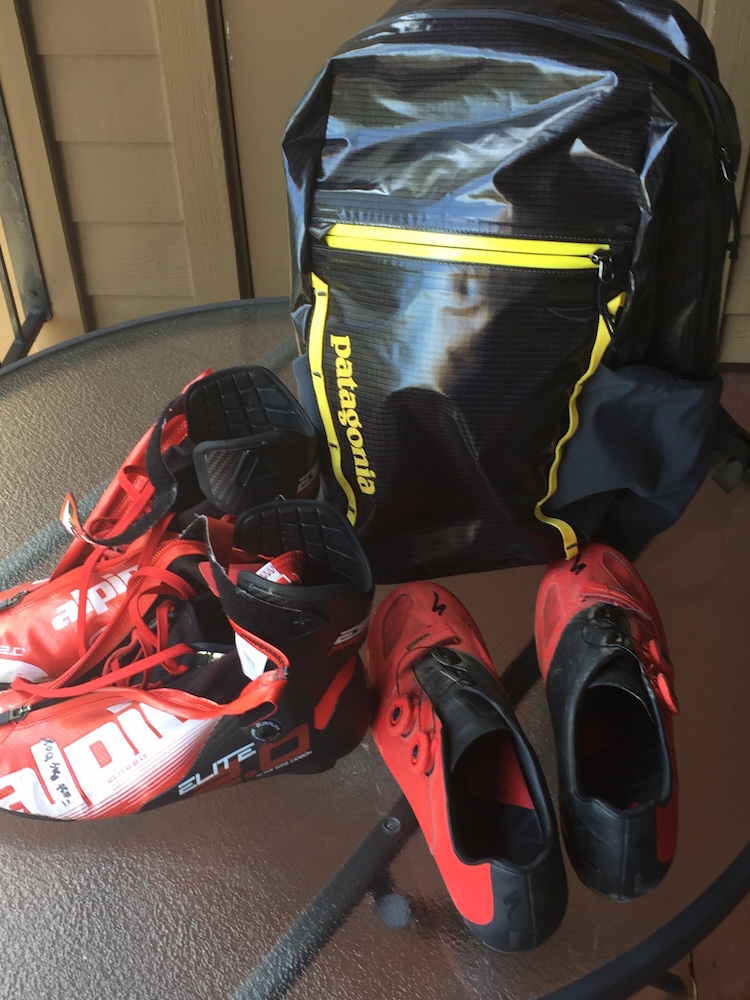
If you want to really go for it, you can do this trip with just a backpack. Load your ski boots and cycling shoes in your day pack and wear your running shoes. Stuff your one extra pair of socks and skivvies into your boots, eschew the bulky and pesky toothbrush for a pack of Tic Tacs that you pick up at a gas station in town, and POW, you are set. The fine folks at my favorite shop, WebCyclery, will hook you up with the rest: skis, boots, poles and mountain bike. If you’re one of those “I don’t need 20 outfits but I need my own skis” types, fear not, as WebCyclery also has a public wax bench, so you don’t actually have to choose between either of these two extreme examples and there is plenty of room for a reasonable, middle-of-the-road approach. Do yourself a favor, though, and regardless of which camp you gravitate towards, avoid the “why you need to travel wax” lecture from my good buddy Zach Caldwell and be pro: travel wax, then scrape at WebCyclery or up at the nordic center. The most important point here is regardless of where you are on the baggage, underwear and ski spectrum, I’m dead serious, you really can do a great, multi-day training camp with only a carry-on bag.
Now you’re geared-up and ready to crush the ski each morning, but what about the rest of your day? Glad you asked. It just so happens that Bend has a wide variety of trails to suit every skill level taste and agro level. Whether you are a normal person who can can chill in Level 1 and simply enjoy the super fun, flowing trails, or if you are one of “those guys” who gets all kitted up and lurks in the bushes ready to pounce on Adam Craig or Ryan Trebon as they ride by so you can shame them with your exemplary nordic fitness (completely disregarding the fact that they are probably out cruising and you’re about to ‘ring the bell’) none of that matters. What matters is that this place is perfectly suited for you to either be super-smart and carefully but gradually build your base fitness while loving life, or you can go out and hammer every day and completely blow yourself up by doing stupid sh*t. I know that’s how some of you roll and I’m not your mother, so knock yourself out. If you do fall into the latter category, please be sure to tell Adam and Ryan that I say hi, but don’t come crying to the FBD when you find yourself wrecked in January. Remember, no one wants to be a “Thanksgiving star and a Christmas turkey.” Church.
Just one of the many savage views that you will encounter on one of the nation’s best bike trail systems.
All right, where was I? Ah, yes, what to do with the rest of your day: the ski was epic, you tore up the dirt faster than the GOP shredding Obamacare and since you’ve now logged over six hours of training on your way to being sick and injured, you’re so hungry that you’re ready to eat your own head. Please tell me you’re not one of those annoying nordic nerds who flies with chopped up, organic, locally sourced carrots in your carry-on, nestled between the hand sanitizer and the Nalgene bottle that you filled up in the bathroom. If so, stop it, stop it right now. Have a beer and a can of Pringles on the flight like a normal person.
If this is you however, you’re probably also going to cook breakfast at your condo each morning and subsist on PBJs that you eat in the car on the drive home, as you’re concerned about not achieving the correct 4:1 carb/protein ratio before your glycogen window closes. This is all well and good, but I’d kill myself if I lived like this, so my advice to my one or two normal readers is treat yourself, after all, who deserves it more than you, right? Don’t worry, I hear ya, you’ve blown 90% of your disposable income on new skis, flights, condos, and Great Danes, so you don’t want to break the bank on lavish meals. Fair point. But, in addition to all sorts of great restaurants with real plates, flatware and food served by humans, there are some economical options that fit the bill nicely without decimating your wallet: two FBD favorites are Parrilla and The Pancake Wagon. There’s also a parking lot full of food trucks, aptly named, “The Lot,” which offers all sorts of options for people comfortable eating food that has been prepared in a structure that can drive away at a moment’s notice, one step ahead of the law.
And let’s not forget the beer — ah, my beloved beer, the source of, and solution to, so many of life’s problems. So while the FBD loves beer and Bend has all kinds of great beer places, interestingly enough, you know what the FBD hates? To be fair, this list is long and distinguished and merits an entire series of its own, so for now let’s confine this to the context of this discussion, the FBD hates the hipster/yuppie/hippie/yippie whateverthehellyourproblem is, beer snob. Yes, beer is awesome, but you know what none of us need? Some smug, pseudo-olfactory savant weirdo wearing an outfit that looks like it came out of my grandmother’s basement and a haircut that screams that he lost a bet, telling us why some particular brew “has a nose that resembles Costa Rican coco beans buried behind a pit toilet with a hint of a 1972 Volkswagen Bug seat covers,” or whatever nonsense the hip crowd is spewing these days. Just order you goddamn beer and shut up. Guy code is that you have between 15 – 20 seconds to place a beer order, with no editorializing. The ONLY circumstances in which you can offer anyone at the table any advice or commentary whatsoever is if they directly and specifically ask you a question and even in this very focused and narrow circumstance, you answer must again be limited to 15 – 20 seconds. I don’t make the rules, I just enforce them.
So assuming you navigate through these hipster-invested waters of annoying ignorance, pomp and circumstance, you should be good to go. Or are you? If you’re anything like me, my thinking in this situation usually goes something along the lines of, “I skied over 50 k today AND crushed Adam Craig in a race so secret that not even he knew it was happening, so I have earned these 162 ‘cheat calories’…..…Wait a minute…. 162 calories? In only ONE beer? Damn, that’s a lot. Maybe I should go do some sit-ups in the bathroom or I’ll never make that cut for Wave 6. I feel fat just thinking about this. Now everyone is looking at me, I can feel it. Oh crap. Do I look fat in these pants? I knew I should have skied another hour. I wonder what Noah Hoffman is having for dinner? I really wish he still blogged daily……” Then I go in the bathroom and do 15 minutes of core while sobbing uncontrollably. But that’s me.
OK, let’s move on. I now have you set up for skis, bikes, and food, anything else else? Well, if you’re anything like me, you’ve probably going to completely disregarded the very sage advice of world-class coaches like Kähkönen and Grover (we don’t need to talk about my lactate reading after doing a supposed threshold block with Burke and Bailey), and you’re now completely wrecked. Sure, you could give up and fly home while attempting to pick up the pieces of your shattered life, or, you could simply train wisely in the first place, but we all also know that you are a stubborn nordic skiers, so you aren’t going to do either one of those things, which means that your only other option is to get some professional help. Step One is to get a massage from someone who specializes in working on athletes. For this, my go-to guy is Scott Yount. He has worked on all kinds of elite skiers, so stop your crying, he can get your whiny nordic ass back out there overtraining in no time. If things really get bad, or if you showed up with some pre-existing conditions (which shortly won’t be covered by proposed, “new and improved” and “really terrific” Affordable Care Act, so act fast), hit up the PT to the stars, Dave Cieslowski, DPT, CSCS. He also specializes in Type-A, needy, nordic skiers (and is one himself), so you guys will hit it off great.
Finally, since as always, I like to make all of these reports as long and rambling as possible, not to mention my rigorous and adorable sense of honor and integrity, I would like to go on record right now and state that I do not receive any sort of remuneration whatsoever from any of these people, organizations, restaurants, shops, businesses, clubs, cliques, or churches. My uncle does not own the bike shop, nor does my brother-in-law work at the burrito place. I am simply giving you a sampling of some of your many options and suggesting places for which I have had very positive experiences. My goal is to make your trip out here not only as easy as possible, but also as fun and as successful as all of mine have been, with as little effort on your part as possible. Let’s be real clear here, too — this is this is like divulging your secret powder stash or favorite surf spot, so if you do happen to run into me somewhere in the world, suffice it to say that you owe me a beer, as you aren’t getting information of this quality from many other places. That’s just how we roll at here at FasterSkier.
You also need to promise to use this information for good, never evil. I’m trusting you with all sorts of top secret beta and if you embarrass me, I’m gonna be pissed. If you bring a bunch of East Coast attitude, use your cell phone in line at the burrito place, or get all pushy in the tent behind The Pancake Wagon and someone kicks you in the nuts, well, you had it coming. Don’t hate on these places or write me that my recommendations suck — that’s on you — this is not check-in at the Philadelphia International Airport. You are in polite society now, so act accordingly.
A few other tips, as noted earlier, the weather is unpredictable, so come prepared for sun, wind and snow, perhaps all in the same day. Embrace this, though, as there is something incredibly bad-ass about having to have the heat blasting on the drive up to the ski and the AC cranking on the drive home. Be prepared to deal with whatever the mountain throws at you — remember, skiing is an outdoor activity and you will most likely see very different conditions each day. Thankfully, I was able to shoot perhaps the most informative video EVER on mental preparation, so I’d advise watching this every morning before you head up:
In general, the optimal ski window is usually between 8:30-10:30 a.m., so lie around in bed for too long and things will get soft. If you consider your weather forecasting and navigational skills to be superior, there is also amazing crust cruising to be had when the conditions cooperate.
Crust cruising in Bend
Watch your goodies coming back in, though, as one route back to civilization has some mighty big kickers: these are known as, “FBD Killers,” so I only hit them a few times.
FBD killers
The alpine skiing is also awesome, if you’re in to that sort of thing. Some of the really hard-core locals will hit the tracks at 8:30 for a few hours, transition directly to alpine, grab some lunch, paddle, then go for a ride or run. If that’s not a perfect day, I don’t know what is.
Mt. Bachelor alpine area
In conclusion, Bend is one of the nicest places in the world to be in May for nordic skiers of all levels. “I never, ever get tired of this place,” Foster mused. “Every day up here is special. Each day has its own personality and every one is different. Even the drive to the nordic center is amazing. You’re in the trees for most of the trip up, then you hit the high country, turn the corner, and you can see the mountains — it’s breathtaking. It’s just such a cool reminder that everything is okay in the world.”
So instead of squandering those frequent flyer miles on something stupid like going to visit family, invest in your future and book a flight into Bend (Redmond) today. From there, you are less than 30 minutes away from having all of your problems solved. You’re welcome.
And remember, you owe me a beer. One that doesn’t smell too much like VW seat covers, if it’s not too much trouble, please.
Ian Torchia says this was “one of my favorite moments of the summer…learning the salmon fly fishing ropes from Erik Bjornsen and David Norris after a big week of training on the glacier.” (Courtesy photo)
Welcome to “17 Questions for 2017″, where we are catching up with American and Canadian national-team members before the beginning of the winter season.
***
This spring, Ian Torchia became the latest in a long line of Northern Michigan University skiers to snag a U.S. Ski Team nomination. That came thanks to two stellar years of World Junior Championships racing in a row: in 2015 he finished 11th in the skiathlon, then in 2016 15th in the 15 k skate.
Now a junior at the college, Torchia is a major contributor to the perennial midwest powerhouse; he finished second and fourth at NCAA Championships last season. But he’s headed into the U23 ranks internationally.
1. Biggest change in your life in the last five or so months since the ski season ended?
I attended two training camps with the US Ski Team, broke my wrist in late June during a mountain bike race and had to one pole rollerski for 2 months, learned how to surf, and started loving classes again since changing my major to Exercise Science.
2. Biggest change in your training?
“A recent Vo2max test for Exercise Physiology class. Love what I’m studying.” (Courtesy photo)
Slight increase in yearly volume but not much change other than that with Sten [Fjeldheim]’s plan. If it ain’t broke don’t fix it.
3. Major areas of improvement you’ve seen so far?
Breaking my wrist was a blessing in disguise as my legs are stronger than ever.
4. Whom you’ve been working closest with this offseason (coaches or training partners)?
Learned a lot from the US guys at the training camps but the bulk of my time has been under Sten and assistant coach Shane MacDowell’s tutelage with the Marquette Training Group (MTG) men.
5. Best trip in the last five months (and why)?
Tossup between the two camps in Bend and Anchorage. I’ll give the nod to Bend for having 2 functioning wrists and an unreal Broken Top crust cruise but salmon fly fishing with Bjornsen in AK is a close second.
6. Favorite cross-training?
Mountain biking and surfing on Lake Superior.
7. Favorite non-athletic activity or pastime this summer?
I love a good game of Settlers of Catan.
8. Song that was your jam this summer?
My roommate Oscar Friedman produces music so definitely his song Shine (GWYLO remix). Check it out on Spotify!
9. All time favorite race moment?
Torchia competing in a mountain bike race where he later broke his wrist. He writes: “The infamous first mountain bike race. Sten’s made sure I’m not doing any more of them anytime soon!” (Courtesy photo)
Either getting 3 NCAA All Americans for NMU in the 10k freestyle with my teammates Adam Martin and Jake Brown or moving from 60th up to 11th at Junior Worlds in Kazakhstan in the skiathlon.
10. First thing you pack in your bag when you leave for Europe?
Buffalo Wild Wings BBQ hot sauce. Makes Romanian mystery meat taste great!
11. Venue/event you’re most excited to visit this season?
Soldier Hollow for U23’s. Time to defend our home turf from the Russians and Norwegians.
12. Who will win the World Cup title this year?
Sundby and Heidi Weng. Simi and Sophie for Sprint World Cup!
13. Biggest sacrifice you feel you’ve made choosing this career path?
There are some sacrifices but I mostly feel very blessed to be surrounded by great teammates and friends and live in a place like Marquette with so much to offer.
14. If you could change one thing about your sport, what would it be?
Stop NMU students from asking if we’re the alpine team. Bring back the daily Hoff blog. Give the Nordic Tribune a Pulitzer Prize.
15. What did you have for breakfast this morning?
An asiago bagel with jalepeno cream cheese, 2 eggs (hard), and quite a bit of yogurt. No coffee, just naps.
16. In 5 years, I’ll be ____?
Slowly chipping away at my Ph.D in Exercise Science and hopefully skiing on the World Cup.
17. In 50 years, I’ll be ____?
An old grey-haired retired professor trying to keep up with my kids skiing, surfing and mountain biking.
U.S. Ski Team Head Coach Chris Grover (r) discussing classic technique with national-team members Simi Hamilton and Ian Torchia (left) last month at an on-snow camp in Bend, Ore.
BEND, Ore. — Make a mental picture of this: it’s a tree-splitting cold night. Windless. You are headlamp skiing down firm tracks. Perfect kick.
Although venturing out into arctic air is an easy deal breaker, for many skiers it heightens the senses. It can be that way for many outdoor activities. But, cross-country skiing has, at its core, many of these recurring moments.
We seek them out again and again.
In Norway, there’s a word: “Friluftsliv”. Its direct translation means “open-air living”. Diving a bit deeper, friluftsliv is what Norwegians claim is way of engaging with nature and it’s something infused into the national psyche.
(For a far more thorough treatment of friluftsliv, read this article in the Canadian Journal of Environmental Education, written by Dr. Hans Gelter, associate professor at Luleå University of Technology.) An exhibit called “Winter Comes” at the Deschutes Historical Museum in Bend, Ore., is in many ways a celebration of friluftsliv, but with an Oregon twist.
Three of the four founding members of the Skyliners with “Bend logo” sweaters. From left to right: Nels Skjersaa, Nils Wulfsberg and Emil Nordeen. (Courtesy photo: Deschutes Historical Museum)
Bend resident and co-curator of “Winter Comes: Oregon’s Nordic Ski History”, Tim Gibbons said this of friluftsliv: “It really means to embrace nature and to be outside and enjoy that, and that’s what the Scandinavians brought to places like Bend. And to me that is how I grew up. But that’s because I was around parents and grandparents that already had that as part of them. I think that is one of their gifts; they are bringing this appreciation and that’s how you express yourself — to be outside.”
There’s serious truth to that statement. Tim’s father, Tom Gibbons, is a common sight on the community ski trails. He’s 92.
“Winter Comes” honors what many cross-country ski communities nationwide owe to groups of immigrants who took a chance on cruising and cutting timber, or any number of jobs associated with natural resource extraction.
Co-curator Tor Hansen, a native of Sweden, said these people were “city builders”. And part of what they have gifted is an outdoor lifestyle. People in places like Bend — synonymous with big snow, plentiful skiing — are indebted to their forebears who couldn’t live without winter sport.
“The people that were sensing opportunities at the beginning of the 20th century, 1910-1920, there was business opportunity here, but they loved the outdoor lifestyle,” said Kelly Cannon Miller, director of the Deschutes Historical Museum. “What we think of as a lifestyle isn’t new. It’s just that we are marketing it and talking about it as a choice. Back then, when people were coming here it was what they did. It was how they sent their spare time. It was pre-television: we read and and we were outdoors. To me it continues, why some people settled this place — it is the same attraction for people moving here now as it was then? Only back then, maybe less business opportunity. You were moving here for a lifestyle and you hoped you got a job, you hoped you were lucky enough to have both a business or an opportunity to work in the mill and live in a place that reminded you of Minnesota or reminded you of Scandinavia — or the Eastern Europeans that were moving here as well. There was an opportunity to live that outdoor lifestyle and have an opportunity for a new life.”
“Winter Comes”literally starts at the beginning. The exhibit examines the origins of skiing approximately 8,000 years ago and brings the community into near real-time focus as it highlights nordic skiing’s Oregon roots. Locally, it began in 1927 when a mountaineering accident in the Three Sisters Wilderness prompted calls for a trained and on-call rescue corps and the eventual birth of the Skyliners Ski Club. The Skyliners built a ski jump near McKenzie Pass, about a thirty mile drive from Bend, and eventually moved it’s lodge, jumps, and energy to an area closer to Bend — to within a ten mile drive from downtown.
One of the first photos documenting a ski party at Crater Lake in 1914. (Courtesy: Crater Lake National Park)
The images, clothing and equipment on display highlight a profound contrast to today’s high-fluoro culture; it was a woolen and leather clad hardscrabble people that built up the sport we love.
From the Klamath Trophy presented to the winner of the Fort Klamath to Crater Lake race, dating back to 1929 (and on loan from a Swedish Museum), to profiling the founders of Bend’s ski scene: Emil Nordeen, Nels Skjersaa, Nils Wulfsberg and Chris Kostol, the exhibit is a reminder of lives well lived and community showing its gratitude for a mega-dose of friluftsliv.
The exhibit runs through Nov. 30 at the Deschutes Historical Museum in Bend. In 2017, the exhibit will go to Klamath County Museum in Klamath Falls for six months, then Mt. Hood Cultural Center and Museum in Government Camp, Ore., for six months and then Nordic Northwest (formerly Scadinavian Heritage Foundation) for two months in Beaverton, Ore., before it returns to the Deschutes Historical Museum as a permanent exhibit.
For more information on the first skiers click here.
U.S. Ski Team Head Coach Chris Grover supervises a classic-technique drill at an on-snow camp last month at Mt. Bachelor in Bend, Ore.
Chris Grover has been at it a long time. Since 1993, when he first began coaching cross-country skiing under the tutelage of Sverre Caldwell at the Stratton Mountain School, Grover has migrated from Vermont, to Bend, Ore., and back to his home state of Idaho — all with the goal of fostering the fastest cross-country skiers. Grover caught the attention of the U.S. Ski & Snowboard Association (USSA) and was brought into the national-team fold as an assistant coach in 1999.
In 2010, he was named head coach of the U.S. Cross Country Ski Team. Since then, the team has experienced unparalleled success. Skiers like Simi Hamilton, Jessie Diggins, Sadie Bjornsen, Kikkan Randall, and Sophie Caldwell have excelled. But that success also comes at a time when the team’s budget is thin compared to powerhouse nations like Norway.
U.S. Ski Team Head Coach Chris Grover (r) discussing classic technique with national-team members Simi Hamilton (c) and Ian Torchia last month at an on-snow camp in Bend, Ore.
Despite the wavering budget, the team has made a go of it under Grover’s leadership. Asked about decreasing the stress on B-Team and D-Team athletes that are not fully funded, Grover said the team has created infrastructure to make life easier on the World Cup.
“We have been able to increase the infrastructure that we build around all athletes on the team, whatever their designation is,” Grover said. “If we go back four or five years ago, we might have only had two to three weeks, maybe four weeks of PT [physiotherapy] coverage on the World Cup during the competition season. And now we are at a point where we have PT coverage continuously on the World Cup season. And that’s because we have been able to use funding to support all athletes all year, to build out the infrastructure.”
The team is heading into an important two-year cycle with World Championships this coming season followed by the 2018 Olympics. The team is built around a core of skiers that at this point can be called veterans. With that in mind, FasterSkier asked Grover how he attempts to keep skiers from becoming “stale”?
“Oh gosh. It’s a really good question. It’s one that we are actually we are wrestling with right now, and dealing with right now,” Grover noted.
Forward thinking and shepherding the skiers to success is foremost on Grover’s mind. Along with his fellow coaches Matt Whitcomb, Jason Cork and Bryan Fish, Grover intends to implement a plan in the next two years he hopes will bring unprecedented success.
FasterSkier spoke with Grover in Bend on May 19 during the team’s on-snow camp at Mt. Bachelor.
(To listen to complete interview, click “play” arrow below.)
U.S. Ski Team member Ida Sargent gets encouragement from head coach Chris Grover (r) in 2011.
Dartmouth College Freshmen Emily Hyde racing “back” East at the Williams Carnival 10k skate in Lake Placid, NY. Hyde will soon to be training “out” West. (Photo: Olivia Amber)
Dartmouth College freshman skier Emily Hyde is that quintessential bi-coastal athlete: she learned to ski fast in Bend, Ore., and she headed “back” East for the Ivy League academics and to race against some of the country’s best collegiate cross-country skiers. With the East’s grim snow year, Hyde is looking forward to coming home, for yes, on-snow training in June.
Bend is a nordic skiing hotbed. And Hyde took charge there early on. She was a four-time Oregon High School State Cross-Country Ski Champion and she won two Junior National titles her senior year. Perhaps there is no other way to describe it, but Hyde was a big fish in Bend’s somewhat-small pond. Fast forward to this past year, and Hyde held her own on the Carnival circuit and said she loved being pushed by her teammates.
Dartmouth freshman Emily Hyde racing in the 10 k classic at 2016 U.S. Nationals in Houghton, Mich. (Courtesy photo)
“I think it was really awesome to sort of not be the big fish in a small pond anymore,” Hyde said on the phone. “My team was big enough that everybody was better at some things than everybody else. I know this girl will be really good on this day. Another girl will be really good on that day. But I think that was really cool, because it always kept you accountable. It was just cool to always have someone a a level above you in whatever you were doing.”
Hyde is that type of skier: she is always wanting to improve.
“Personally, I need to keep working on skate skiing,” Hyde said about what she’ll be working on this summer. “My first year in college it was back to back to back racing whereas at home , it was every other week or a week off and then a high school race. I sort of chose what races I was going to do. But this is every weekend and everybody does it. So I think just working on being consistent and being able to push through and be fast every single weekend for six weekends in a row. And I’m not entirely sure how I am going to do that yet. But I think just continuing to build the base.”
Hyde’s goals — improving her skating and building a big base — brings us to this Wednesday Workout which Hyde is a bit homesick for: “The Not-So-L1 Crust Cruising into Broken Top.”
Two Bend locals, Aidan Whitelaw and Zoe Roy, nearing Broken Top’s bowl. (Photo: Jason Albert)
Hyde was on the fence as to whether she’d call it a true Level 1 effort. “You go kind of fast, it feels so good to crust cruise and chase your friends around,” Hyde said. Higher up, as skiers gain altitude, the terrain changes. It morphs from a gradual climb with a few punchy steeps into a sustained grueling climb.
Broken Top, an extinct volcano, features a massive bowl resembling more of a headwall as it steepens and steepens.
“Once you get into the bowl, it is quite steep and quite high,” Hyde noted. “So you can’t really make that L1 unless you one-step and take a breath. I guess I don’t really think about doing it L1, I just want to get to the top.”
The nature of the workout, where the terrain dictates the effort, will help Hyde wake the body up as she adapts to her hometown stomping grounds for the summer.
“It’s going to be an altitude adjustment for sure,” Hyde said. “I think it is cool I’ll be back on skis, which is more natural and it will be the longest workout I will have done. It’s going to be hard in that sense and hard because it is at altitude. But I am not going to dread it. I don’t know if my legs can handle it for three hours — it will be hard but it is a good adjuster.”
Broken Top Crust Cruise How To’s:
– Watch the weather. Wait for a several day’s long high pressure system with clear cold nights.
– Head up to Mt. Bachelor Nordic Center on a bluebird day, head out the Common Corridor Trail, hang a left at the snow covered road, and head downhill to Todd Lake.
– Ski across Todd Lake, assuming it’s frozen, and head north. Gain the ridge, and aim towards Broken Top. The wide open bowl on Broken Top’s east-southeast flanks will be obvious as you ascend above tree line.
Round trip: approximately four hours.
Looking towards Broken Top’s Bowl from a foggy Todd Lake. (Photo: Jason Albert)
New Year’s Eve at the Mt. Bachelor Nordic Center near Bend, Ore. (Photo: Rion O’Grady/Mt Bachelor Nordic Center Facebook)
Is there room at one ski center to support two junior development programs? In central Oregon, it depends on who you ask.
Mount Bachelor, 22 miles outside Bend, Ore., is a touchstone for nordic skiers. Located in Deschutes National Forest, Mt. Bachelor operates with a special use permit from the US Forest Service (USFS). The U.S. Ski Team has run training camps here and they’ve hosted national championships. In addition, there’s an extensive alpine mountain. With a base lodge at 6,300 feet above sea level, the venue boasts generally good snow conditions.
Mt. Bachelor has a longstanding relationship with the Mt. Bachelor Sports Education Foundation (MBSEF), a nearly 30-year-old nonprofit which has development programs for nordic, alpine and freestyle skiing. MBSEF runs its ski programs on the trails at Mt. Bachelor.
The much-newer Bend Endurance Academy (BEA), a nonprofit founded in 2009, would like to share the trails — at least, in low snow years. Except for a couple of rare occasions, BEA has not had permission to run its programs on Mt. Bachelor.
Since its inception, BEA has used Meissner Nordic, a nonprofit ski center also located on Mt. Bachelor. Run by volunteers, Meissner Nordic grooms 40 kilometers of ski trails on US Forest Service land.
It’s all good, until the weather doesn’t cooperate. Located 1,500 feet lower on Mt. Bachelor than the eponymous ski area, the previous two winters, 2013/2014 and 2014/2015, were difficult for Meissner, while Mt. Bachelor enjoyed better conditions higher up the mountain.
In February 2015, BEA approached Mt. Bachelor resort officials about using public lands at the Mt. Bachelor Nordic Center. They denied BEA’s request, except for the last two weekends of the season.
A group of Bend Endurance Academy youth skiers in February 2016. (Photo: Ryder Utrecht/Bend Endurance Academy Facebook)
This year, the academy has circulated a petition called Let the Kids Ski, calling for more access to Mt. Bachelor.
“There are two places in central Oregon that have groomed nordic trails,” said BEA Board President Cris Himes. “Meissner Nordic and Mt. Bachelor. Meissner has worked very well until recently due to ski conditions.
“What we’re looking for is equal and reasonable access,” Himes continued. “Equal to any other paying customer and community group.”
According to Dave Rathbun, Mt. Bachelor’s former president and general manager who resigned in mid-March, the resort had existing relationships with four businesses “to run their businesses sort of inside our own,” he said. “We still have to get approval from the Forest Service for these concessionaires.”
MBSEF, whose board Rathbun also sat on, is the designated concessionaire for nordic and alpine ski programming. Rathbun is no longer a member of that board.
In a December interview with the Bend Bulletin, Rathbun characterized BEA’s interest in Mt. Bachelor as a desire to use the resort as “a home base for their business.”
“[BEA] want to operate their business within ours, and in most cases at a time when we’re already at capacity,” Rathbun told FasterSkier. “It’s very busy at the times they want to have access.”
Rathbun added that Mt. Bachelor is “at capacity” for instruction in both in nordic and alpine skiing. “We’re not going to open it up to any other concessionaires.”
In addition to its own paying customers, Mt. Bachelor’s agreement with the USFS requires the resort to accommodate people who want to access backcountry skiing via a “common corridor.”
According to Rathbun, “that’s another 10,000 visits per year,” in addition to about 30,000 visitors per year skiing Mt. Bachelor.
Himes feels that the lodge might be crowded, but believes that the trails are not. For her, the primary issue is ensuring that kids have access to skiing. The lack of decent snow is a barrier to participation, and this is reflected in the numbers. Although BEA’s competition team is larger than last year, the enrollment in its youth club and nordic development programs is down 38 percent and 28 percent respectively from the 2014/2015 season.
“Last year Mt. Bachelor did a remarkable job of keeping their snow,” Himes said. “When we can’t run our programs at Meissner, we need to be able to take our kids to groomed trails somewhere else. The only option is Mt. Bachelor Nordic Center.”
New Year’s Day 2016 at the Mt. Bachelor Nordic Center near Bend, Ore. (Photo: Lew Becker/Mt Bachelor Nordic Center Facebook)
During the snow drought two seasons ago in 2014/2015, Rathbun reflected, “I wanted to be a good neighbor. We gave BEA access to nordic center in afternoons, the last couple of weekends in March. I think it worked out well and they appreciated being able to get on snow.”
In a July email to BEA, Rathbun offered the academy access on Tuesday and Thursday afternoons and weekends after 12 p.m., with certain blackout dates during peak periods. These times apparently didn’t match BEA’s program schedule, and according to Himes, left only three weekends out of the winter for training. In September, Himes met with Rathbun to negotiate more favorable access times, to no avail.
“I’m really sorry about that, but that’s the only way we feel it can work, based on how crowded we are,” Rathbun told FasterSkier.
“I can see both sides,” said Alan Watson, the Pacific Northwest Ski Association (PNSA) nordic program director. “My interest is in promoting the success of all these programs. I would like Mt. Bachelor to let BEA train on their trails. It would be good for skiing in the northwest.”
Is trail crowding a red herring? Rathbun said that BEA skiers were welcome to come up and ski so long as they had a pass, but that organized training with a coach wouldn’t be permitted – except at the times listed above.
Does Mt. Bachelor wield trail access as a cudgel? From a distance, it’s hard to tell. But FasterSkier obtained three documents sent anonymously to Himes. One was Oregon School Ski Association’s (OSSA) participation policy. OSSA is one of the two governing bodies for high-school alpine skiing in central Oregon, and holds race meets at Mt. Bachelor. Circulated in December 2014, the policy required students on high school ski teams to participate in four training sessions each week, including races.
OSSA Race Director Matt Cutter said that there were students that participated in both high school and club programs, and that OSSA’s goal with this policy was to instill team unity.
“We don’t want ringers,” Cutter said of athletes who only show up for race meets. “We needed to get something in writing.”
The other two documents, both dated Jan. 8, 2015, are responses from Rathbun and John Scheimer, MBSEF’s executive director, to OSSA. Rathbun’s letter decried OSSA’s participation policy, stating that it would negatively impact “students who club race with MBSEF and have other extracurricular interests.” The letter concluded, “…with our strategic partner MBSEF, we [Mt. Bachelor] will be reviewing all elements of OSSA activities occurring on Mount Bachelor. … Any changes in these privileges will be communicated to you as soon as possible.” Scheimer’s letter to OSSA was written in a similar tone.
Scheimer declined an interview request for this article.
In response to the letters, Cutter said that OSSA rescinded its policy. “That was not our intention at all” to exclude anybody, or force a student to choose between a club program and the high school team, Cutter explained.
Cutter viewed the disagreement as minor, adding, “I can’t stress enough how much support Mt. Bachelor gives us.”
Rathbun said that his letter was actually in response to scheduling conflicts between OSSA and OISRA, a second governing body for Oregon high school alpine skiing. However, neither his letter nor Scheimer’s make any reference to OISRA. Cutter said that while Rathbun discussed scheduling with OISRA, it was in correspondence from August 2015.
“The kids know each other, the parents know each other, we support each other’s kids,” said Himes of BEA and MBSEF. “I am really hoping that we will be working cooperatively with MBSEF.”
With good conditions this winter, trail access at Mt. Bachelor wasn’t as crucial. Next year may be a different story.
Mt. Bachelor Nordic Center is seeking a full time groomer for the 2015/16 season. On snow season runs November through May, (usually June!) some potential for year-round work.
Experienced candidates with a passion for Nordic skiing who are willing to relocate to the recreation capital of the Northwest in beautiful Bend, Ore., please direct letters of interest to sfoster@mtbachelor.com.
Blair Voorhees of Momentum Northwest leading the pack to the finish this winter. (Photo: Sam Naney/Momentum Northwest)
The Northwest as a region had one of the driest winters on record, keeping the brand new Seattle-based development program Momentum Northwest to no more than a couple of weeks of on-snow training locally. Despite all that, nobody is leaving the program, and more athletes are joining.
“Locally, it was a terrible winter in terms of snow and opportunities to get on snow, but the silver lining is that we’ve been able to do a lot of dryland training together and really build the team and the team spirit,” said Momentum Northwest head coach Sam Naney of the first season with the program.
Perhaps part of that good attitude comes from the fact that the team isn’t used to having snow in their backyard. Seattle itself receives just over six inches of snow per year, on average. Momentum Northwest lists their home ski area as the Cabin Creek Sno-Park, about an hour west on Interstate 90 and also the home of the Kongsberger Ski Club.
So Naney knew that dryland would be a big part of his work anyway. With that in mind, as well as frequent trips to Cabin Creek and a Thanksgiving Camp to Silver Star and Sovereign Lakes, British Columbia, Momentum Northwest offers two different programs: a fulltime program for skiers 12 years of age and older, with training sessions trains four times a week in the summer and fall and three to five times a week in the winter, and the “Mavericks” program for skiers aged eight to 11, which meets only on Saturdays during the winter.
“I think in some ways, the bad winter has made us better prepared to meet whatever conditions come our way, and the kids are mentally tougher for it,” Naney said of the low-snow winter. “We had some really good results despite the conditions and the lack of on-snow training, and that has given our kids the confidence that you can be competitive even though much of what they did all winter was dryland drills and short out-and-back ice skiing.”
The first line of Momentum Northwest’s athlete handbook is about excellence. The team’s goal, it says, is “Creating a national-caliber cross-country ski racing program in Seattle.”
But right after that, there are some other goals. The handbook lists core values: speed isn’t amont them. Instead you find personal growth, community and team building, commitment to excellence, and enjoyment.
Teaching those core values of sport doesn’t require snow.
“I quickly came to learn that those experiences come as a product of simply participating,” Naney explained. “If I can make the program fun, provide interesting workouts, fun van rides, and build a good team dynamic, the athletes will adapt to the changing circumstances with remarkable ease.”
Building a program from scratch is no easy undertaking. The team got a van, a banner, and bright blue race suits, but those are the tangibles – the intangibles like community involvement and name recognition are a bit harder. No matter: Momentum Northwest has found an underserved niche in the Seattle region.
“We are not competing with other programs, but we have to show people that Nordic skiing can be a complimentary part of the endurance lifestyle,” said Naney. “Even if you are already committed to track or cross-country running, Nordic is a good fit in that environment. And our program is no small commitment, so we have to show the families that they get something out of it.”
Momentum Northwest race trip to the Methow Valley this winter. (Photo: Sam Naney/Momentum Northwest)
Naney had a roster of more than two dozen motivated and eager athletes in his program when he launched Momentum Northwest’s first winter season last November. The kids were hooked in one season – with or without snow. But with no other full-time, performance-oriented Nordic programs in the Seattle area, Momentum Northwest also has to build a culture and a community around the sport.
However, several Washington areas with consistent snow have racing and development programs, such as the Methow Valley, Leavenworth, Wenatchee, Ellensburg and Spokane. Other regional programs include The Bend Endurance Academy, XC Oregon and Mount Bachelor Sports Education Foundation in Bend, Teacup Nordic at Mount Hood in Oregon, and Sandpoint in Idaho.
“Snoqualmie Nordic (based on Snoqualmie Pass, 50 miles east of Seattle) is the closest program, but they have more of a focus on beginner skiers and introducing families to the sport,” said Naney. “So far, we’ve actually been quite complementary with one another… Leslie (Hall), who is the Program Director of the successful Methow Nordic Team, helped connect me with some skiing families she knew in the Seattle area. That type of inter-program support is so beneficial and welcomed when you’re first getting started.”
At the moment, Naney is the only paid coach in the program. He’s helped by three assistant coaches: Jordan Goldwarg, a former Williams College skier and Dartmouth College development coach; Alexandra Sonnabend; and Halvard Berg, a former Norwegian junior racer. But those three work strictly on a volunteer basis.
Adding another paid coach is a big goal for the program in the next year. Naney seeks a ratio of about six to eight athletes per coach.
And while the roster is likely to grow, so too might the level of performance and the range of abilities of the athletes. Momentum Northwest may have been hurt by the lack of snow, but Naney believes that his athletes have high performance potential.
“When we have really good conditions and can ski three to four times a week on snow, you will see several of these kids go to Junior Nationals,” Naney said, adding the program is only losing two athletes from this year’s roster, simply because they are moving out of the area. “The kids realize that there is no limit to where they can take their skiing beyond our program. Some of them are kids you are going to see at the Junior Nationals in the future, some will ski in college and some will just enjoy the lifelong sport of skiing.”
Emerson Rogers of Momentum Northwest racing in the Methow Valley, Washington, this winter. (Photo: Sam Naney/Momentum Northwest)
The new coach’s favorite memory from the 2014-15 season was the team’s first race trip, where he took 10 athletes in the team van to Bend, Oregon.
“We competed against a huge field of PNSA juniors at the first Junior Nationals Qualifier of the season,” Naney recalled. “In the final race, Cooper Jackson, who is one of my U14 athletes, landed on the podium in a tight finish. When they held the medal ceremony, all the Momentum athletes were crammed in the front row and were excitedly discussing how they were committed to being the loudest cheering, most exuberant teammates of any of the medal winners, to show their support for Cooper and Momentum.”
That comes back to those core values and the team spirit that are as much a part of the goal as the podium was.
“It was a validation for me that what we’re doing here is working,” Naney explained. “These athletes are learning not only how to ski well, and even win medals, but how to be on a team and how to support one another in times where it is often all too easy to begrudge a fellow teammate their success. It was a great moment, and many more of them followed throughout the rest of the season.”
Cooper Jackson of Momentum Northwest (far left) in a mass start this winter. (Photo: Sam Naney/Momentum Northwest)
Dakota Blackhorse-von Jess (Bend Endurance Academy) clinches a nearly seven-second win in the 1.5 k classic sprint at the 2015 U.S. Cross Country Championships in Houghton, Mich. (Photo: Jake Ellingson)
For this week’s workout, we caught up with the Bend Endurance Academy’s Dakota Blackhorse-von Jess, who won back-to-back sprint titles last week at U.S. nationals in Houghton, Mich. As he told FasterSkier after his skate-sprint win last Saturday, that was exactly his goal — to put himself in contention for a call up to the U.S. World Championships team and at the very least, earn World Cup starts later in the season as the SuperTour sprint leader.
“This year everything has been geared toward Word Championships so this is a stepping-stone,” he said after his initial classic-sprint victory on Jan. 6. “The goal was to put myself in a position to win and see if I can do it. Everything worked out really well and I’m excited. Obviously I can’t control if I go to World Championships, but I know that the way we set up the training, we are on the upswing and things will continue to rise in February.”
As of Tuesday, Blackhorse-von Jess, 29, was home in Bend, Ore., where he explained the weather was “awful. We need snow!! And to kick this fog … but it will come around. It’s never nasty here for long!”
In an email, he wrote that this period leading up to the next set of races, the Craftsbury SuperTours Jan. 30-Feb. 1 and Feb. 6-8, is his last chance to log a good training block before leaving for Europe.
“Obviously there are a few different scenarios in play but the gist of the training plan is to make sure that I have my feet under me and then start ramping up the intensity and use the sprints in Craftsbury as a tune-up for Europe,” he wrote.
And while it wasn’t exactly ideal not to have access to good snow, the Bend Endurance Academy (BEA) has been getting a few workouts done on rollerskis.
“The benefits of being at 3500 feet instead of 6000 feet and of a consistent high impact scenario on the roads (as opposed to the potentially soft and low impact scenario of snow) mean that we just aren’t that negatively affected by the lack of snow for intensity training,” Blackhorse-von Jess explained. “There’s plenty of snow up in the high country and plenty of terrain to get good distance training in, so that’s not a worry.
“We are sticking to our tried-and-true training model of continuing to build upon specific capacities and edging ever closer to my absolute values: aerobic, anaerobic, and maximal speed,” he added. “I have yet to do any true speed work this season, so that will play a more prominent role in our training these next four weeks. This is our fifth year in a long term training progression and every year we get a little further with the plan and we are really excited to see what I can bring to the table in Europe this spring!
“I have yet to do any true speed work this season, so that will play a more prominent role in our training these next four weeks.” — Dakota Blackhorse-von Jess (Bend Endurance Academy), who won both sprints at 2015 U.S. Cross Country Championships
The workout: Qualifier prep with the 15-15
“Of the many, many facets of training one of the most critical is understanding race pace. People throw around the word ‘race pace’ an awful lot, but I see very little overlap between a true race simulation and other intensity workouts.
While technique, conditions, race distance, mass start vs. individual start, and terrain all play a role in determining what race pace means, using measured training can be one of the most effective tools for internalizing that meaning. Personally I have an incredibly hard time replicating a race effort. There is just a lightness and intensity that possesses me when I step up to the line. Even when I’m not ‘feeling great’, my body just knows what to do — for the first ten strides or so. Then what? That’s where pace training comes in.
As a sprinter, the 15-15 is how I practice qualification. In my personal notation, the colon denotes the break between intensity and rest while the dash shows a change inside the intensity. For example, 3x6x60:30 would be 3 sets of 6 repeats of 1 minute on, 30 seconds off, consistent intensity.
In this case, the workout goes 10×15-15 or 10 repeats of 15-15 (I like 4.5 minutes of rest, but rest can be a pretty individual thing). The purpose of the workout is to simulate qualification pace without the taxation of a full-duration simulation.
Here’s how it goes:
45 seconds to go, get into line behind the starting cone. Whether you do this alone or with teammates, I think it’s important to simulate the minute BEFORE starting qualification. This can be a critical time and it’s an opportunity to try different mental strategies. You never know when you’re going to stumble across a technique that really syncs with you. Hear the clock in your head and see the skiers ahead of you starting. Step up to the line, see the wand, move your skis, set your poles, whatever your thing is – do it. See the clock, hear the beeps, and go. This is a great opportunity to practice different styles of starting. If you can use the clock to get into a routine that becomes automatic, you’ve already made yourself a better racer. When I do this workout, I like to have my coach time the first interval and yell at me at 15 seconds and 30 seconds, then set out cones so a.) no one has to be keeping an eye on the watch and b.) it’s immediately obvious when you start to slow down — or speed up.
I try to make the first 15 seconds of the interval exactly the way I’d want the first 15 seconds of qualification to go: quick smooth start, build speed, find rhythm, relax and flow. The second 15 seconds is a maximal effort; a simulation of the final stretch of a qualification. Don’t forget to ski THROUGH the final cone. That 10th of a second could make all the difference. Each repetition should be a test of your muscles and your neurons but not an aerobic test or a lactate loading workout. For me, it’s the management of the workout that is the best indicator of actual ‘race pace’. If each subsequent intervals is slower and slower, I started too fast. If there is no change in pace between the first and second half of the interval, I either started too fast or I have no top-end. Once I’ve started to find repeatable paces this workout really becomes effective because I can play with the paces — the “feeling”, if you will. Can I use more pace in the opening 15 seconds? Can I find MORE speed, whether through relaxation or technique focus under fatigue in the final 15 seconds? Are there mental queues or mantras that make a difference?
In the past I’ve done this workout three or four times in my race prep, but this year I’ve only done it once during the lead up for Nationals. It’s a great way to remind myself what racing should feel like — both how “easy” and how ‘hard’ it can be — in the same race. We might not do this workout again this year, but even just the one session helps me feel like I’m in full race rode.”
Andy Newell while training with the U.S. Ski Team last month in Bend, Ore. (Photo: Matt Whitcomb)
This week’s Wednesday Workout comes from Matt Whitcomb, the U.S. Ski Team women’s coach. Whitcomb and the team recently returned from their on-snow camp in Bend, Ore., where they practiced improving technique with visualization.
***
Before starting the workout the coach identifies one 10-second clip of one male and one female World Cup skier classical striding up gradual terrain and then plugs it into iMovie. I like the clips of Anne Kyllönen striding up the sprint course in Sochi. If you don’t have access to these clips, YouTube something and video your own computer screen. The quality will be lower but you’ll be surprised at how well it works.
In iMovie, create a project that plays your 10-second clip in regular speed and then in 1/2 speed (totaling 30 seconds), and repeat that six times in your movie project without music or any sound to remove sensory interference so the women’s clip is 2 minutes long. Add a 2-minute clip for the men to watch. Paste a 30-second clip of the women to see one last time at the end followed by a 30-second men’s clip. The total movie is only 5 minutes so you can get out the door and ski more.
Keep the men and women together for the viewing in case one clip works better than the other. Watch on a large TV screen or with a projector play your iMovie clip to the team immediately before going out to ski. As a variation try talking them through the clip one one day, focusing in one one thing the World Cup athlete does well, and on another day try not talking at all to prevent polluting what they are seeing on their own. Many athletes are much better coaches than we are!
If you don’t have access to footage, here is a YouTube video of Anne Kyllönen in addition to other World Cup athletes:
Warm-up for 30 minutes and encourage the athletes to ski by themselves and on similar terrain to what you just watched, trying to channel and emulate the World Cup skier. It’s very easy for some and nearly impossible for others, but the process opens up new windows regardless.
Meet your team on a very gentle downhill slope that is 200-meters long for a drill. Have them ski back and forth, striding both the gradual downhill and uphill. This isn’t about holding your glide for as long as possible on the gradual downhill, but more about feeling the flow of good striding under low tension. Watching our team do this left us feeling that the gradual downhill section unlocked some hip and shoulder tension in many athletes.
Encourage the athletes to ski by themselves and on similar terrain to what you just watched, trying to channel and emulate the World Cup skier. It’s very easy for some and nearly impossible for others, but the process opens up new windows regardless.
After the drill, film your athletes one at a time skiing up a gradual hill. Before they begin to ski toward you, have them rest on their poles, eyes closed and without talking, and visualizing that World Cup clip for 30 seconds. Then have them ski past you. Film the pass on your iPad or phone so they can look at it immediately.
If it works out, great. Please let me know. If not, there are many creative ways to trigger technical improvements. Email me at mwhitcomb@ussa.org if you have a cool idea to share or just drop it anonymously into the comment section :). I would love to take a couple of your thoughts to our glacier camp in Alaska next month. Keep it fun and focused out there!
Sophie Caldwell with fellow U.S. Ski Team member Erik Bjornsen during an “injured kids” field trip/hike to Tumalo Falls near Bend, Ore. (Photo: Sophie Caldwell/sophiecaldwell.blogspot.com)
Two days into the U.S. Ski Team’s first training camp of the 2014/2015 season in Bend, Ore., and Sophie Caldwell was out. The 24-year-old Stratton Mountain School T2 Team and USST member had been skiing on snow with the team last Thursday morning, and later that afternoon, they headed out for a mountain-bike session.
“We throw in a few non-skiing workouts like mountain biking and cool runs, and Bend is a great place to take advantage of those other activities,” Caldwell wrote in an email.
Sophie Caldwell covers her sling with a shirt from USST coach Matt Whitcomb (r) before walking under Tumalo Falls near Bend, Ore. (Photo: Sophie Caldwell/sophiecaldwell.blogspot.com)
But it was fun until it wasn’t anymore. A misstep unclipping and Caldwell went crashing to the ground, with her arm extended. She fractured her elbow and sprained ligaments in the process. “I really wish it was a cooler story,” she wrote on her blog. “But I wasn’t doing anything impressive, I just didn’t unclip in time and toppled over onto a straight arm.”
We followed up with Caldwell on Wednesday, six days after her accident. That morning was her first time back on skis. “It’s definitely feeling better,” she wrote in an email. “Think I’ll be doing a lot of no poling for the next month!”
In a follow-up email, Caldwell elaborated on the crash, as well as the news of the passing of her cousin-once-removed, Ezra Caldwell (Zach Caldwell’s younger brother).
FasterSkier: When did you arrive in Bend and start skiing? How were those first couple days of training?
Sophie Caldwell: We arrived [last] Monday [May 19] and went for our first ski on Tuesday. I was able to ski Tuesday, Wednesday, and Thursday mornings and do some dryland and strength in the afternoons. The snow and weather in Bend have been great this year — much better than last year.
FS:Who were you mountain biking with when you fell, and how did the rest of the afternoon play out?
SC: I was mountain biking with the team when I fell. I think I was in a group with Grover, Ida, Sadie, Kik, and Matt. It was part of our training session. We throw in a few fun non-skiing workouts like mountain biking and cool runs and Bend is a great place to take advantage of those other activities. My arm really hurt when I first fell over, but I’ve never broken a bone before and wasn’t sure what had happened. It stopped hurting for a minute, so I was going to keep biking, but it got pretty bad when I got back on the bike, so Matt and I biked to the road and carefully biked home. We went to see our PT and he recommended I go to the ER and get an xray, so we did that. They were able to tell that it was fractured from the xray and put me in a brace and sling.
FS:Have you seen a specialist yet? What’s the prognosis?
SC: I got an MRI on Friday, but I wasn’t able to straighten my arm enough to get a great picture. I saw a specialist yesterday [Thursday] and I have a radial humerus fracture and two ligaments that are either torn or sprained and possibly a chip. I’m going to get another MRI in Park City next week that should be able to tell us more about the chip and whether or not I need surgery, but the doctors yesterday seemed to think that I probably wouldn’t need surgery based on the amount I could move it and the fact that I wasn’t in much pain, so I’m keeping my fingers crossed! I was in a brace that kept my elbow pretty immobile, but yesterday they switched me to one that allows more movement. I guess one of the most important things with an elbow injury is to start moving it as soon as the swelling and pain go down.
Sophie Caldwell (second from r) with her USST teammates, including (from left to right) women’s coach Matt Whitcomb, Kikkan Randall, Liz Stephen, Ida Sargent, Sadie Bjornsen, and Jessie Diggins. (Photo: Sophie Caldwell)
FS:What have you been doing in the last week since?
SC: I’ve been going for a lot of walks! [See her blog post about hiking to the 97-foot-Tumalo Falls.] I actually accidentally found myself in a spin class for senior citizens and it was one of the top ten sweatiest workouts of my life. We did stage 14 of the Tour of Italy. I was spinning by myself and then people started filing in and before I knew it, I was immersed in a spin class. It was actually great because I get really bored spinning and this made an hour go by much faster. I skated without poles the last two mornings and that felt good. It was nice to be back out with the team and back on skis.
FS: When’s the last time you were injured?
SC: My last injury was when I sprained a ligament in my foot last spring, but those are the only two serious injuries I’ve ever had and this is my first broken bone (besides a couple broken toes when I was younger).
FS:We’re sorry to hear about Ezra: how have you coped with the loss while being far from family?
SC: It’s always hard to be away from the people you love the most when you hear news like that, especially when it’s family. Luckily, our team is like a second family and the news about Ezra wasn’t totally unexpected [he passed away after a six-year battle with rectal cancer, complete with two surgeries and rounds of chemotherapy]. He outlived what the doctors predicted by far and I think everyone is trying to celebrate his life and the time he was with us. For me, I think the hardest part of being on the road so often is the fear of something happening to friends or family back home and not being able to be there. That’s a risk we take, but I think we also have to realize that the people who are most important to us wouldn’t have it any other way. You can’t live your life waiting for something bad to happen and you can always fly home if you need to. I’m looking forward to seeing Zach, Amy, Gunnar, and the rest of my family when I get home in a week.
FS: How much longer are you in Bend? What’s next for you after that?
SC: We leave Bend tomorrow [Saturday] and I’ll be in Park City for a week before returning to Vermont. I hope to get another MRI in Park City next week and continue training while having access to the US Ski Team resources that might be helpful for my recovery!