From the FasterSkier archive — posts syndicated from athletes’ and coaches’ own blogs between 2004 and 2012, kept online as published. Current coverage is at fasterskier.com.

Tag: Benita Peiffer

  • Biathlon World Championships: Dream Day for Germany, Lunder 11th

    Biathlon World Championships: Dream Day for Germany, Lunder 11th

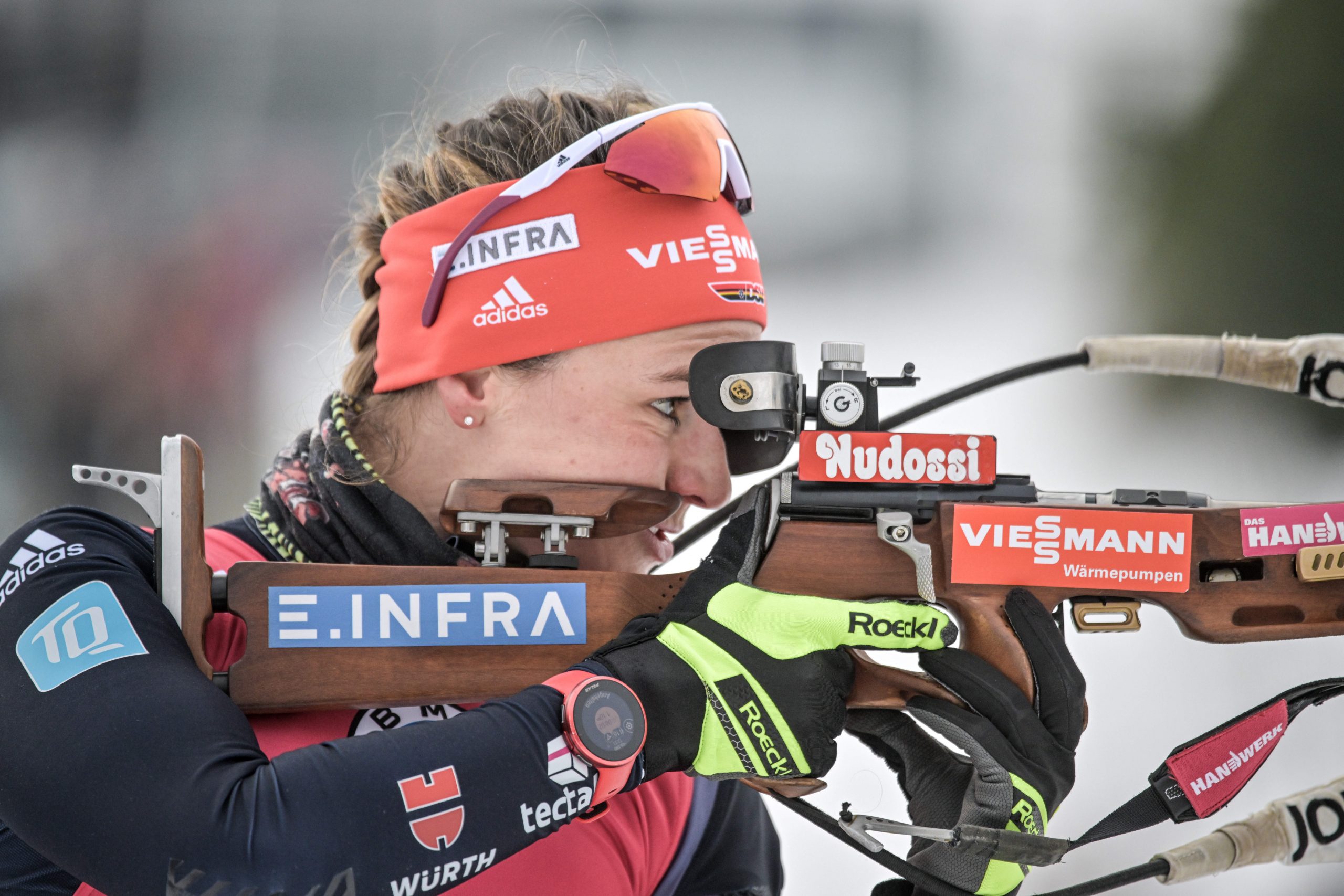
    Denise Herrmann-Wick (GER) shooting from the standing position at the IBU World Championships Sprint in Oberhof, Germany. (Photo: NordicFocus)

    Biathlon fans anticipated that the women’s 7.5km Sprint would be one of the most tightly-contested races of the BMW IBU World Championships, and it did not disappoint. In the end, only 2.2 seconds separated the new World Champion, Denise Herrmann-Wick of Germany, from the silver medalist, Hanna Oeberg of Sweden. Oeberg’s teammate, Linn Persson, finished third. These athletes will start at the front of Sunday’s 60-person Pursuit and try to stave off the chasers for another chance at a World Championship medal.

    Hanna Oeberg (SWE) leaving the range in the lead of the IBU World Championships Sprint in Oberhof, Germany. (Photo: NordicFocus)

    Fourteen women from seven nations have landed on the podium this winter. But among all those contenders, arguably no one had more pressure on them today than hometown favorite, Denise Herrmann-Wick. Ranked first in the World Cup Sprint standings, the 34-year-old revealed in Wednesday’s Mixed Relay that she has peaked perfectly for these races. Even with nine out ten hits, Herrmann-Wick is skiing fast enough that she could have a chance at a podium finish, but today she left nothing chance. Unfazed by tens of thousands of spectators cheering in unison after each shot, Herrmann-Wick steadily cleared ten out of ten targets. One word came to mind: impressive.

    But the race wasn’t over. A few minutes later, Hanna Oeberg of Sweden managed the same perfect shooting, leaving the range for the final 2.5km loop with a nine second advantage over Herrmann-Wick. A hush of collective anxiety came over the full stadium of German fans. By the top of Oberhof’s signature Birxsteig climb, Oeberg’s advantage had dwindled to a near tie. It wasn’t until the final meters of the race, when Oeberg’s time ticked above Herrmann-Wick’s winning mark of 21:19.7, that the Thuringen Arena burst into cheers.
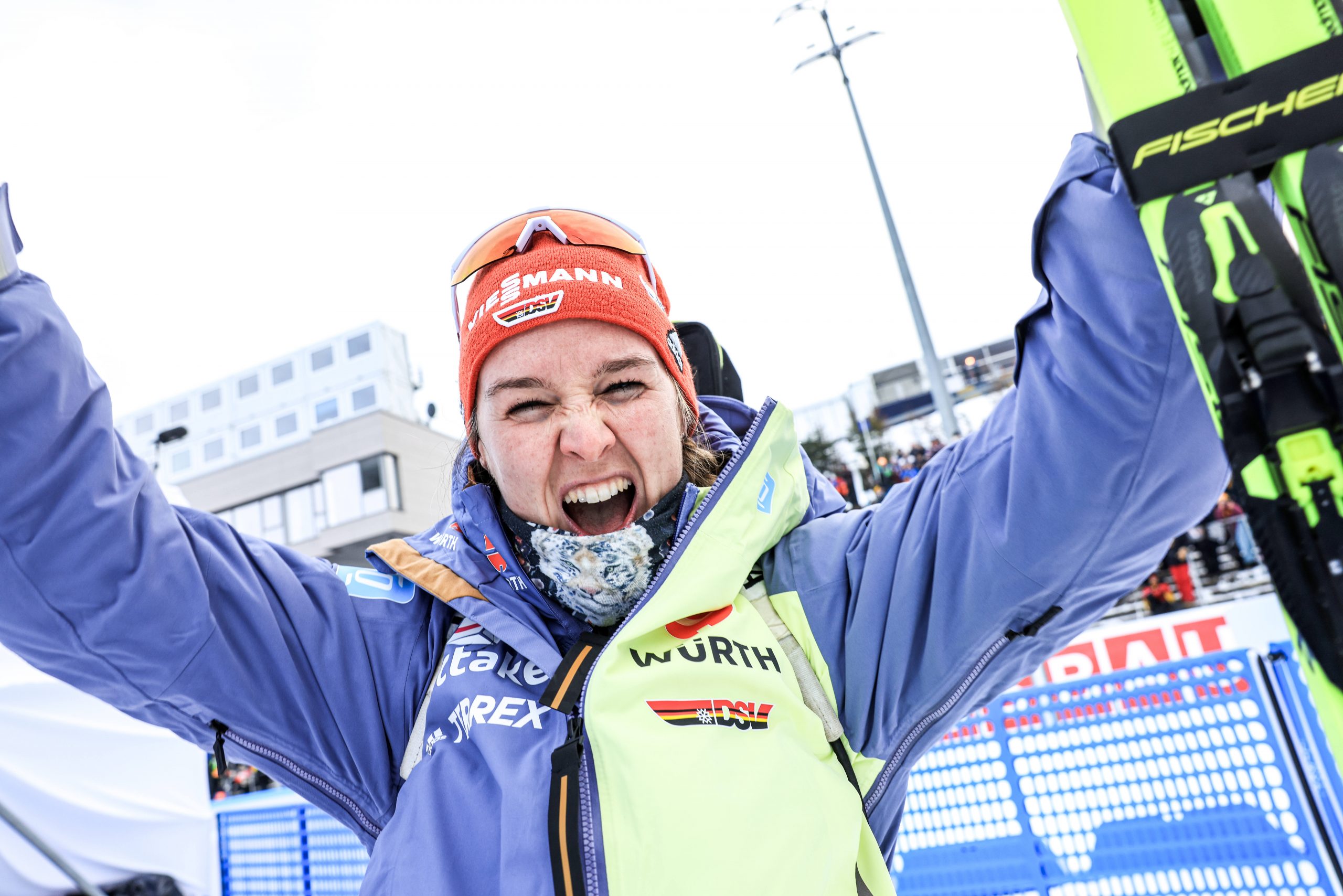
    Denise Herrmann-Wick (GER) celebrates after winning the IBU World Championships Sprint in Oberhof, Germany. (Photo: NordicFocus)

    The battle for gold was not limited to those two athletes. Wearing bib number two, Anamarija Lampic of Slovenia cleaned her prone targets, leaving the audience wondering if today might be the day for the former cross-country skier to break onto her first podium. But that kind of biathlon magic wasn’t to be; Lampic’s inexperience came through when she missed four targets in standing. With the 17th-ranked course time, she narrowly managed to qualify for Sunday’s Pursuit in 58th. It was Lampic’s teammate, Polona Klemencic, who stepped up and shined for Slovenia with the perfect shooting score to take her first career top-10 in 8th place.

    Ingrid Tandrevold of Norway led the race after Shooting 1, showing once again that her ski speed and prone shooting skills are there. But the standing shooting slump which has been bothering her since January persisted and she missed two on her way to a 14th place finish. Lisa Vittozzi of Italy missed just one in standing but skied fast enough to briefly take the lead from Marketa Davidova of Czech Republic, who had hit 100% as she so often does in championship races.

    The defending Olympic Champion in the Sprint, Marte Olsbu Roeiseland, was sitting way back in 26th after missing one in prone, but with a clean standing bout and the second-ranked course time, she pulled her way back to fourth, just five seconds shy of the bronze medal. She’ll be motivated for more in the Pursuit. The World Cup Overall leader, Julia Simon, was well on her way to a podium finish with eight hits before she missed the last two. Simon thrives in head-to-head races and will be a threat in the Pursuit even starting 1:02 back in 10th place.
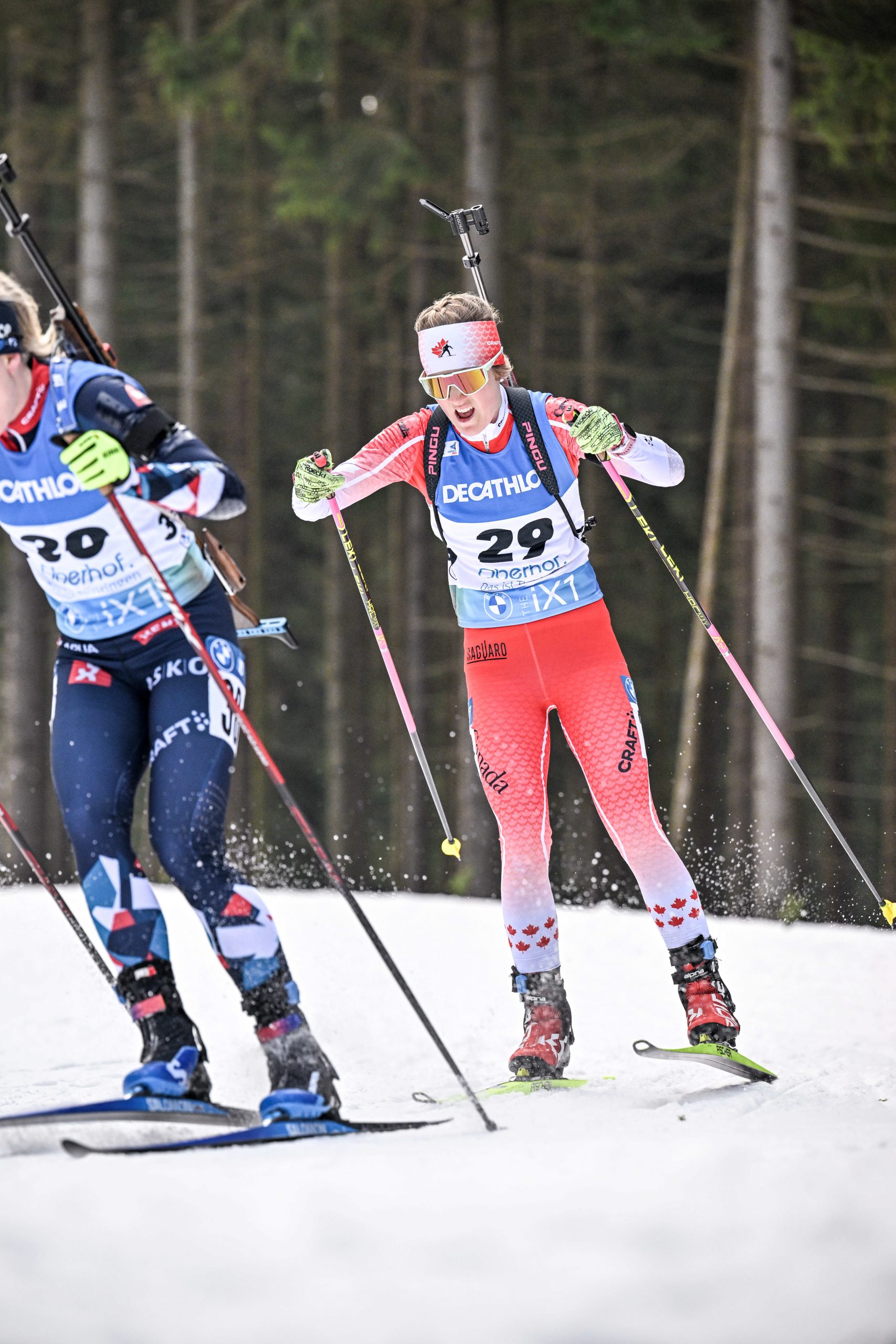
    Emma Lunder (CAN) following Marte Olsbu Roiseland (NOR) in the IBU World Championships Sprint in Oberhof, Germany, where they finished 11th and 4th, respectively. (Photo: NordicFocus).

    Less than one second behind Simon, Emma Lunder of Canada posted her best-ever Championship result in 11th. After a season-best ski performance on Wednesday in the Mixed Relay, Lunder knew anything was possible in today’s Sprint. “I was a bag of nerves,” she said. “I was more nervous for this than the Olympics, because I knew I had a chance.” Once she started, her good preparation kicked in and with a clear mind she executed to near perfection, with just one prone miss and a top-15 course time. Lunder attributes her excellent shape to staying healthy. She hasn’t been sick since last year’s Olympics, so she has been able to train continuously and make steady gains. She also credited her ski technicians for fast skis. In Sunday’s Pursuit, only 1:03 will separate Emma from Herrmann-Wick. To the podium, it’s just 37 seconds.
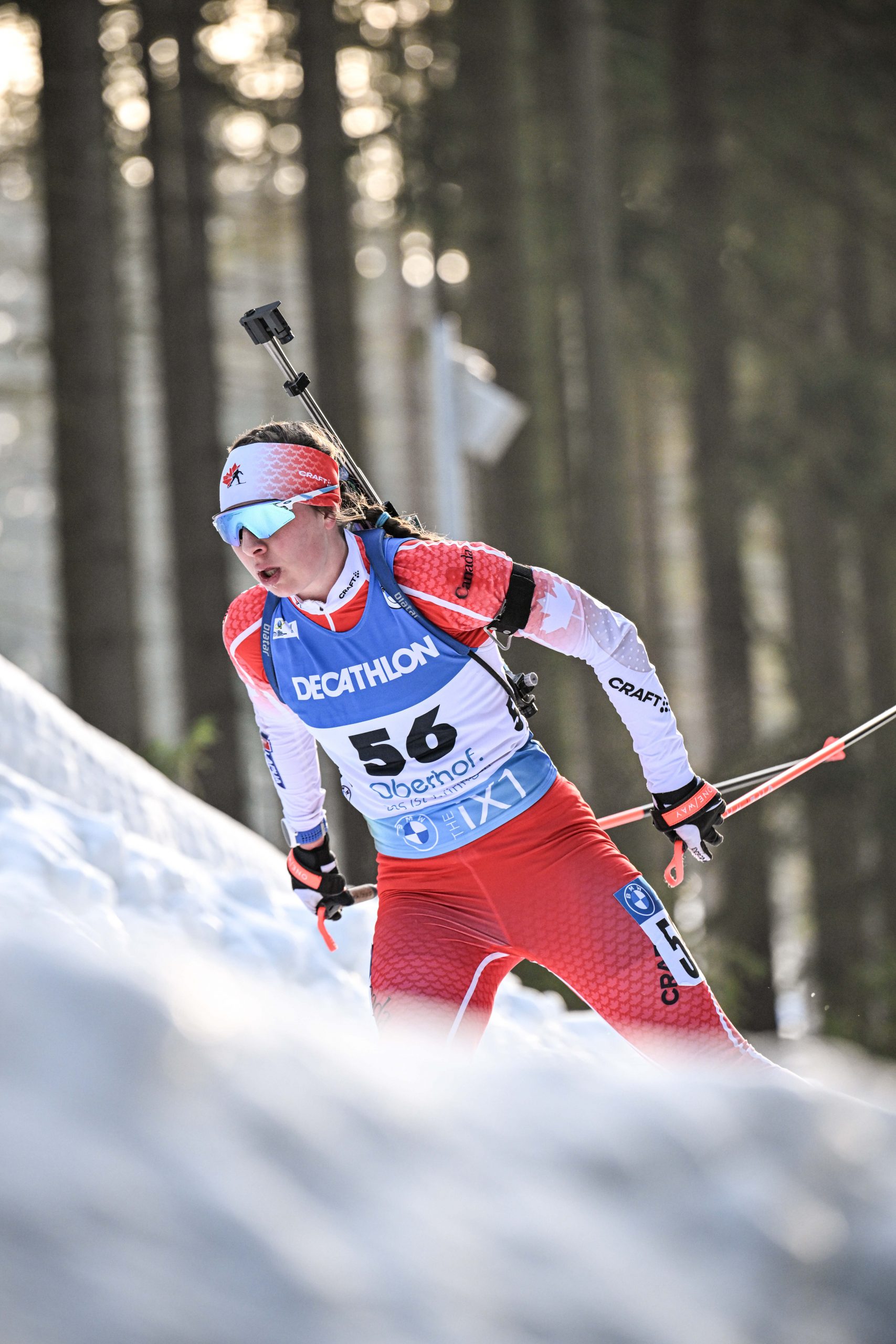
    Nadia Moser (CAN) on her way to 48th in the IBU World Championships Sprint in Oberhof, Germany. Photo: (NordicFocus)

    Two other North Americans qualified for the Pursuit. Nadia Moser (CAN) finished 48th with one penalty, and Deedra Irwin (USA) finished 55th with two. “I’ve barely trained for the last two weeks,” said Irwin after the race, referencing a sickness she came down with in January which required a round of antibiotics. “And this course is so hard. The headwind on that straightaway was brutal.” Some athletes were luckier than others, finding themselves in position to draft for the 500m windy straightaway approach to the range. Lunder put in a hard sprint to catch someone there. Chloe Levins, the second American today in 73rd, was alone every time on that section, but she performed well on the range, hitting nine of ten.

    Joanne Reid (USA) shot clean in prone but suffered three penalties in standing to finish 75th. Competing in her first biathlon World Championships race, former Nordic Combined athlete Tara Geraghty-Moats (USA) similarly cleaned prone but struggled in standing, missing four to finish 86th. Canada’s Benita Peiffer rounded out their squad, missing five to finish 93rd.


    Chloe Levins (USA) hit nine out of ten to finish 73rd in the IBU World Championships Sprint in Oberhof, Germany. (Photo: NordicFocus)

    The women will be back in action on Sunday, but first it’s the men’s sprint, Saturday at 8:30AM Eastern Time.

    IBU World Championships Women’s Sprint RESULTS

    Coming Up Next:

    SATURDAY:
    Men’s Sprint at 8:30AM Eastern Time.

    SUNDAY:
    Women’s Pursuit at 7:25AM Eastern Time.
    Men’s Pursuit at 9:30AM Eastern Time.

    FREE LIVESTREAM HERE

    IBU World Championships women’s Sprint podium: Denise Herrmann-Wick (GER) in first, Hanna Oeberg SWE) in second at left, and Linn Persson (SWE) in third. Oberhof, Germany. (Photo: NordicFocus)
  • Mass Start day at World Juniors: Remi Drolet 4th, Schumacher 5th…Laukli 5th, McCabe 9th (Includes Audio Interview with USST Coach Bernie Nelson)

    Mass Start day at World Juniors: Remi Drolet 4th, Schumacher 5th…Laukli 5th, McCabe 9th (Includes Audio Interview with USST Coach Bernie Nelson)

    Helen Marie Fossesholm of Norway taking the junior women’s 15 k mass start skate. (Photo: Doug Stephen)

    Wednesday in Oberwiesenthal, Germany World Juniors continued with a 15 k mass start skate for the women. 

    Junior Women’s  15 k Mass Start Skate

    Norway’s Helene Marie Fossesholm (18) won her second race of these championships by taking the mass start skate in 35:55.6 minutes. Fossesholm also won the 5 k interval start classic race on Monday. Poland’s Izabela Marcisz placed second 1:09.3 back. Marcisz also won a bronze in the 5 k classic. Switzerland’s Siri Wigger skied herself into third (+1:10.6). The theme continues, this was Wigger’s second 2020 championship medal, after placing third in the skate sprint. 

    Sophia Laukli (bib 56) skied to 5th overall in the junior women’s 15 k mass start skate. (Photo: Doug Stephen)

    Starting in bib 56, layered well back at the start, was Sophia Laukli (Middlebury) for the U.S. Laukli (19), in her first Junior Worlds, moved up in the pack to place fifth overall (+1:26.5). 

    Novie McCabe (MVNST) skied to ninth (+1:33.0) for her best individual Junior World’s result. Mccabe placed 10th in last year’s championship 15 k classic in lahti, Finland. Kendall Kramer (Fairbanks Nordic) was 24th (+2:54.5), and Sydney Palmer-Leger (SVSEF) did not finish. 

    Novie McCabe on her way to 9th overall in the 15 k mass start skate. (Doug Stephen)

    Interview with U.S. Ski Team Coach Bernie Nelson

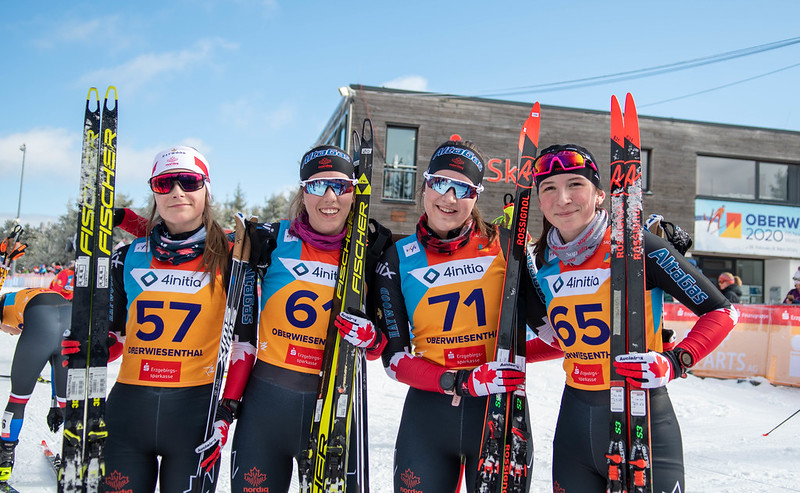
    Liliane Gagnon (Skibec Nordique) was the top finisher for Canada in 34th (+3:38.2). Jasmine Drolet (Blackjack Nordic Club) followed close behind in 36th (+3:39.0). Benita Peiffer (Whistler Nordic) placed 49th (+4:43.2), and Elizabeth Elliott (Revelstoke Nordic) skied to 51st (+4:39.1).

    From left to right: Canada’s Jasmine Drolet, Elizabeth Elliott, Benita Peiffer, and Liliane Gagnon. (Photo: Doug Stephen)

    Junior Women’s Results 


    Junior Men’s 30 k Mass Start Skate

    The junior men raced a 30 k mass start skate Wednesday with Norway’s Iver Tildhelm Andersen winning in a time of 1:13:39.0. Anderson medlaed in last year’s Junior World’s, placing third in the 10 k skate.

    Second place went to Germany’s Friedrich Moch who crossed the line 9.4 seconds back. Moch also placed second in Monday’s 10 k classic. Third place went to Martin Kirkeberg Mørk of Norway, who was 32.8 seconds off the winning pace. 

    Remi Drolet of Canada skiing to 4th overall at the Junior World’s 30 k mass start skate. (Photo: Dough Stephen)

    Scrolling not so far down on the results sheet to places fourth and fifth, respectively, added some excitement for North America; Remi Drolet (Black Jack Nordic) of Canada placed fourth overall (+43.2), and Gus Schumacher (AWS) of the U.S. fifth (+56.1). For Drolet, this was a Junior World’s career best result – he placed seventh in last year’s Junior World’s 30 k mass start skate. 

    At 25 k Wednesday, Drolet was positioned sixth overall, 19.4 seconds back on the then leading Moch. He was in a group with Mørk, and Italy’s Davide Graz. Roughly four seconds ahead was Schmacher as their carrot. By 28.8 k, Schumacher had faded slightly, as Drolet moved into fourth.

    Schumacher won Monday’s 10 k classic, and with Wednesday’s fifth, nearly matches his fourth place in the 2019 Junior World’s 30 k mass start classic.      

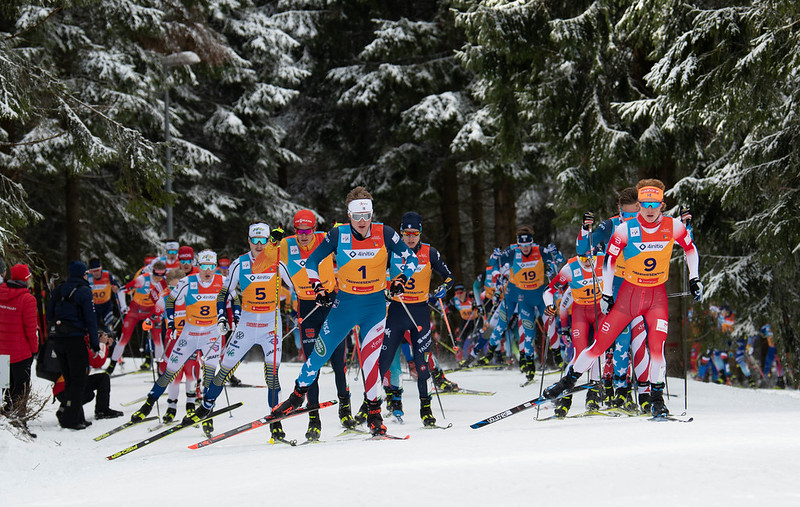
    Gus Schumacher (bib 1), leading the 30 k mass start skate at the 2020 Junior Worlds. (Photo: Doug Stephen)

    Thomas Stephen (Foothills Nordic) of Canada, placed 17th (+3:35.8), Xavier McKeever (Foothills Nordic) 32nd (+5:43.3), and Michael Murdoch (Whistler Nordic) 45th (+8:23.5). 

    For the U.S., Luke Jager placed 19th (+3:46.1), Johnny Hagenbuch (SVSEF) 20th (+3:49.2), and Zanden McMullen (APU) 35th (+6:03.3). 

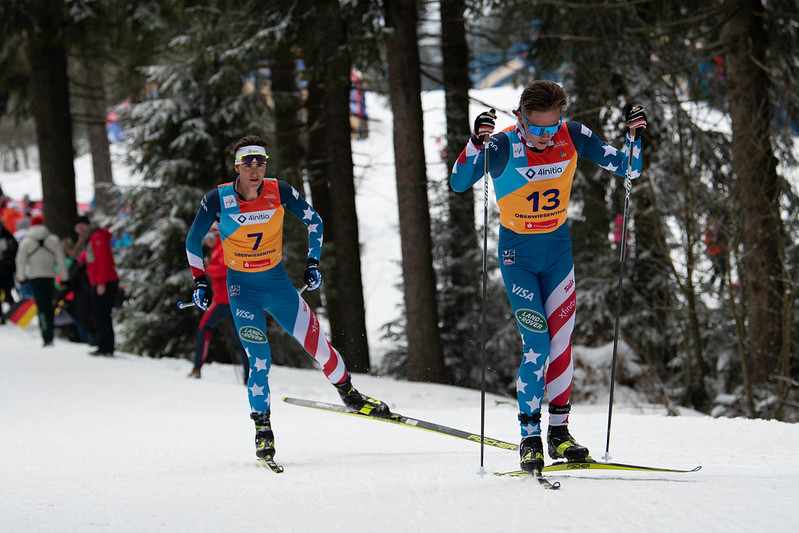
    Luke Jager (bib 13) and Johnny Hagenbuch (bib 7), during the junior men’s 30 k mass start skate. (Photo: Doug Stephen)


    Thomas Stephen skiing to 17th overall in the Junior World’s 30 k mass start skate. (Photo: Doug Stephen)

    These events conclude individual racing for the juniors at these World Championships. 

    Junior Men’s Results


  • World Juniors: 1.2 k Skate Sprint with Three North Americans in top-30, Sweden with the Win (Updated)

    World Juniors: 1.2 k Skate Sprint with Three North Americans in top-30, Sweden with the Win (Updated)

    Calling it like it was: fir trees draped in fog and the colorful hues of Junior Worlds Lycra a deep contrast to the pervasive monochromatic snow and forest. This was the backdrop for World Junior’s freestyle sprint day in Oberwiesenthal, Germany. Keeping things real for several North Americans, expectations were high as the core, for example, of the U.S. team is riddled with potential podiums. 

    For the North American women, three skiers qualified for the heats in the 1.2 skate sprint: Novie McCabe (U.S./MVNT) qualified in 19th (+7.62), Elizabeth Elliott (CAN/Revelsoke Nordic) 27th (+9:05), and Benita Peiffer (CAN/Whistler Nordic) 30th (+9.58).

    Norway’s Helene Marie Fossesholm, the day’s fastest qualifier. (Photo: Doug Stephen)

    The fastest qualifier on the day was Norway’s Helene Marie Fossesholm in 2:28.53. According to FIS, Fossesholm has raced two individual World Cups. She placed fifth in Falun’s 10 k skate mass start, and 18th in Lillehammer’s 15 k skiathlon. Both races were this season.   

    Fossesholm advanced to the final’s but placed fifth, 2.62 seconds off the win. Sweden’s Louise Lindstrom, the day’s 11th fastest qualifier, won in 2:33.41. Poland’s Izabela Marcisz was second (+0.47), and Switzerland’s Siri Wigger third (+1:07).  

    Sweden’s Louise Lindstrom with the win. (Photo: Doug Stephen)


    Sweden’s Louise Lindstrom was the day’s 11th fastest qualifier and the unexpected winner. (Photo: Doug Stephen)

    McCabe placed fifth in the fourth quarterfinal to finish 22nd overall. The eighteen-year-old from Washington’s Methow Valley remained in contact with the quarterfinal’s leaders when she came to a stop to avoid a skier merging into her path on a short but critical climb. There, she lost vital time. 
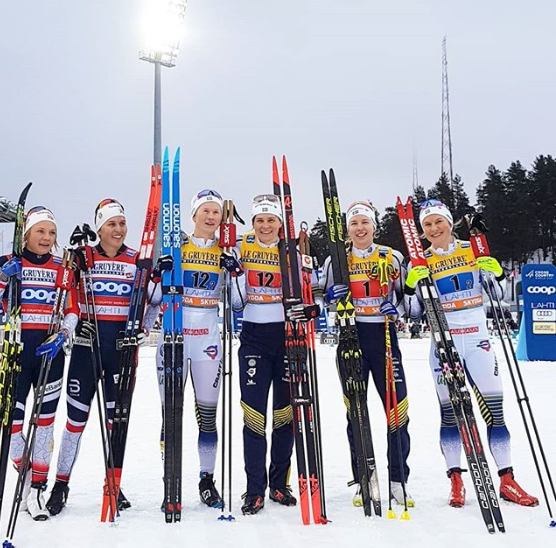
    Novie McCabe during qualification on Saturday’s World Junior’s skate sprint. (Photo: Doug Stephen)


    Novie McCabe during her World Junior’s skate sprint quarterfinal. She was the 19th fastest qualifier, and placed 22nd overall. (Photo: Doug Stephen)

    Elliott placed 23rd after placing fifth in the third heat, while Peiffer was 25th overall. Peiffer was fifth in the first quarterfinal. 

    Also for the U.S., Sydney Palmer-Leger (SVSEF) skied to 49th, Callie Young (Dartmouth) 54th, and Mara McCollor 73rd (Minneapolis Ski Club). 

    For Canada Liliane Gagnon (Skibec Nordique) placed 39th, and Molly Miller (Black Jack Ski Club) 42nd.   

    Junior Women’s Qualification | Junior Women’s Results | Junior Women’s Brackets


    Canada’s Elizabeth Elliott, during her World Junior’s quarterfinal. She placed 23rd overall. (Photo: Doug Stephen)


    Benita Peiffer of Canada, during the World Junior’s skate sprint. Peiffer placed 25th overall. (Photo: Doug Stephen)


  • MSA Trials Rundown: Qualifying for U23, U20 and More

    MSA Trials Rundown: Qualifying for U23, U20 and More

    Cendrine Browne leads her semifinal at MSA Trials. (Photo: Doug Stephen)
    Cendrine Browne leads her semifinal at MSA Trials. (Photo: Doug Stephen)

    In Canadian domestic ski racing, it doesn’t get much bigger than this. Mont Sainte-Anne (MSA) is hosting the NorAm weekend that also serves as U23/U20 World Championships qualification and has special significance in selection for World Cup starts.

    Any skier who hasn’t already qualified for World Cup period 4 has had this event as a major focus for the season. The only certain paths to National Team selection for next season start with top 30 results on either the World Cup or U20 World Championships. Most of these paths start at MSA Trials.

    For U20 and U23 selection, the top finisher in each of the three races is guaranteed one of the 18 to 20 places on the trip to Oberwiesenthal, Germany, with a pre-camp in Norway.

    And finally, the weekend is a NorAm, which means COC leader points are on the line.

    On Thursday, the action started with free technique sprints on a short but difficult course. Men, women, and U20’s all skied the same distance. Nordiq Canada’s Jeff Ellis continued the tradition of winner’s interviews, FasterSkier has the unedited videos below.

    Elizabeth Elliott in charge of the U20 final. (Photo: Doug Stephen)
    Elizabeth Elliott in charge of the U20 final. (Photo: Doug Stephen)

    CNEPH’s Cendrine Browne won the qualifier in 3:04.79 before winning three heats to dominate on her home trails, finishing the final in 3:01.37. Browne’s teammate Laura Leclair was second, 0.53 seconds back, for the top U23 finish ahead of Emily Nishikawa at 0.76 seconds. The presence of distance specialists Browne and Nishikawa on the podium is evidence of the sprint course’s difficulty.

    For the U20 women, AWCA’s Elizabeth Elliott qualified 4th overall and swept the heats to win the final in 3:06.85. Her teammate Benita Peiffer was second, 1.66 back, narrowly ahead of Black Jack’s Molly Miller at 1.81 seconds.

    For the men, NTDC Thunder Bay’s Graham Ritchie recovered well from his time in Europe to win in 2:35.69 after qualifying second, grabbing the top U23 finish along the way. Team ULLR’s Jess Cockney continued to redefine the word ‘retired’ in second place, 0.52 back. TBay’s Pierre Grall-Johnson who converted on his latest qualification win with his first open category podium, was third at 0.76 seconds.

    Graham Ritchie taking advantage of the downhill finish for the win. (Photo: Doug Stephen)
    Graham Ritchie taking advantage of the downhill finish for the win. (Photo: Doug Stephen)

    The U20 men provided no surprises, with the favourites front and centre in the final. Black Jack and Harvard’s Rémi Drolet dominated the day, sweeping through to the final to win by 2.57 seconds in 2:34.75. ULLR’s Xavier McKeever was second after qualifying 29th overall for 5th U20, with teammate Tom Stephen taking bronze a further 1.09 back.

    Speculating on selections using the criteria documents always comes with a risk of error. That said, Leclair, Ritchie, Elliott, and Drolet should definitely be eligible for Obwiersenthal. Peiffer and McKeever should be selected as the 5th U20 athletes.

    Results: Full Weekend (including live timing for Saturday and Sunday), Qualification, Heat Brackets, Final

    Photographer Doug Stephen has a gallery for the Sprints and Official Training. Athletes are welcome to download and use full resolution images if they give credit to ‘Doug Stephen’ or @vr45photography.

    Rémi Drolet leads Xavier McKeever, Olivier Léveillé, and Tom Stephen in the U20 final. (Photo: Doug Stephen)
    Rémi Drolet leads Xavier McKeever, Kai Meekis, and Tom Stephen in the U20 final. (Photo: Doug Stephen)
  • Canadian Racing Rundown: Westerns, Pragelato, and Lausanne

    Canadian Racing Rundown: Westerns, Pragelato, and Lausanne

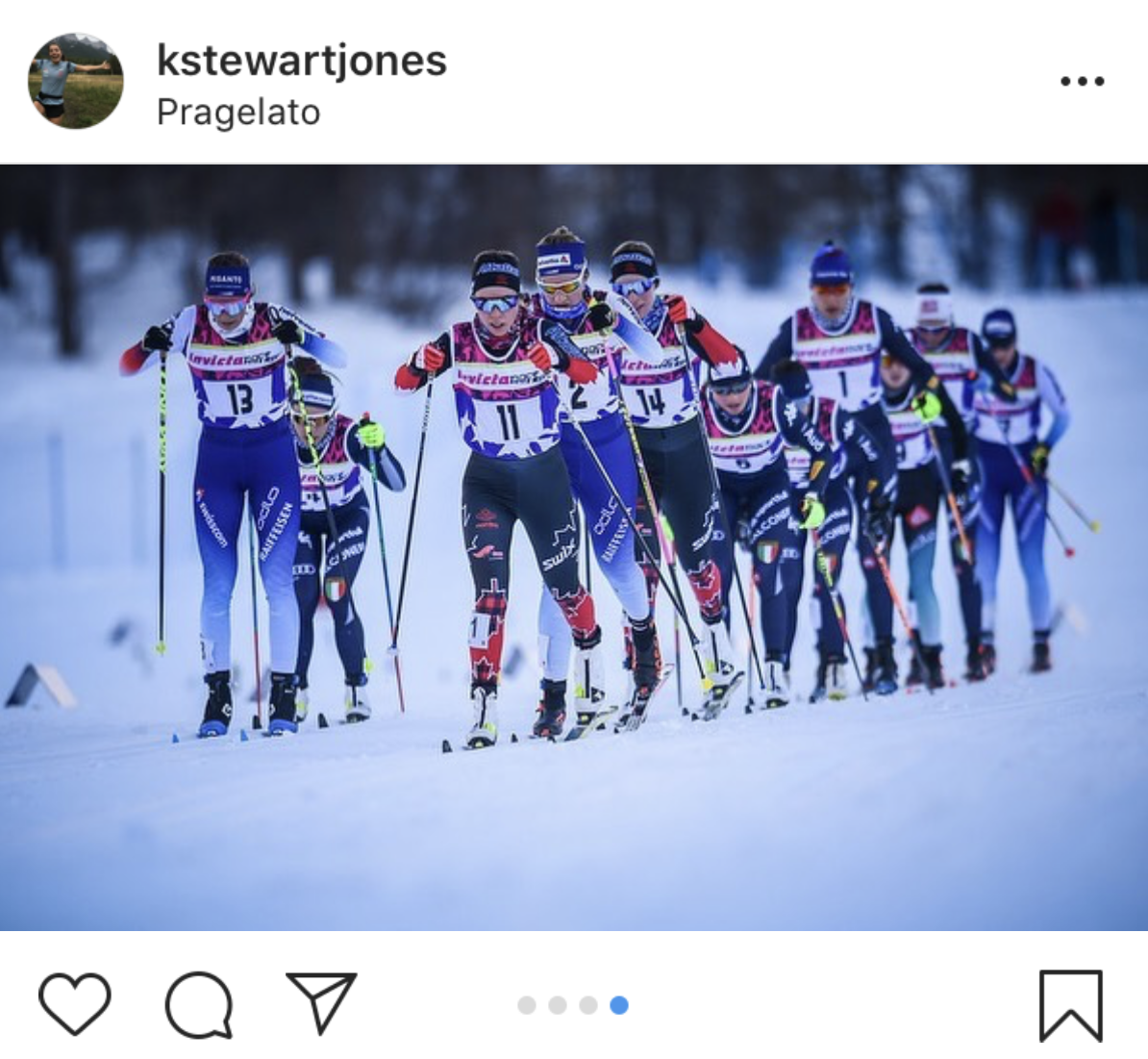
    Katherine Stewart-Jones leads the mass start on the way to a Canadian 1-2 at the OPA Cup in Pragelato, Italy. (Photo: Athlete Instagram, credited to @damianobenedettophoto)
    Katherine Stewart-Jones leads the mass start on the way to a Canadian 1-2 at the OPA Cup in Pragelato, Italy. (Photo: Athlete Instagram, credited to @damianobenedettophoto)

    Canada took a step back from the World Cup circuit this weekend and focussed attention into development series. As the country tries to build momentum in a post Alex Harvey world, the focus has moved away from World Cup podiums and towards a consistent presence in the top 30. The road to the World Cup goes through local and regional races on the way to national/continental races.

    One of the development challenges in Canada is size. The second largest country has roughly the same population as California. Skiers from Newfoundland live closer to Holmenkollen than Whistler Olympic Park.

    The Continental Cup series in each FIS ‘continent’ is the top level race series below the World Cup. Canada has the NorAm series. The USA has the SuperTour series. France, Germany, Italy, Slovenia, Switzerland, and Austria share the OPA Cup series. This distribution of ‘continents’ may seem odd, but remember that the combined land area of the OPA countries is equal to British Columbia and Nova Scotia. Canada has three more time zones separating those two provinces.

    As part of an effort to reduce travel demands on developing skiers in Canada, Nordiq Canada has been making changes. For the second year in a row, Westerns is not a NorAm event, but a regional event (albeit for a region larger than continental Europe). While this eliminates one east/west flight for eastern-based skiers, western athletes from Saskatchewan, Manitoba, Nunavut, North West Territories, and the Yukon still have a flight to pay for.

    8 young Canadians are in Lausanne, Switzerland, for the Youth Olympic Games. Another 8 were in Pragelato, Italy, for an OPA Cup event, where two Canadians won. If you know someone who doesn’t think winning an OPA Cup is a big deal, listen to what Devon Kershaw and Jess Cockney think in the latest podcast. Cockney may ‘only’ have four top 10 results on the World Cup before he ‘retired’, but he did win a combined NorAm/SuperTour earlier this season.

    As Cockney reminded us in the podcast, development comes in cycles. It is hard to remember that ten years ago Norway needed to borrow a biathlete to make a mens relay team for the Olympics, the same Olympics when Canada had four different men with top 10 individual finishes. The glory of being at the top of the roller coaster comes with an unseen cost of getting a big machine up a steep hill. This weekend was part of that climb.

    Western Canada Cup, Whistler Olympic Park

    Russell Kennedy leads the A final out of a corner that Petra Majdic remembers well from the 2010 Olympics. (Photo: Weisheng Wang)
    Russell Kennedy leads the A final out of a corner that Petra Majdič remembers well from the 2010 Olympics. (Photo: Weisheng Wang)

    Western Canadians was held at Whistler Olympic Park, with over 250 athletes competing for titles under a slightly changed name: Western Canada Cup. Record-setting snow storms and very challenging driving conditions should make for some good stories from the athletes who completed the trip.

    The embedded videos are the full-length interviews by Nordiq Canada’s Jeff Ellis. Social media has edited versions.

    On a spectacularly sunny Friday, AWCA’s Annika Richardson won the 1.3km classic sprint on a course that will bring back Olympic memories for older fans. Richardson’s 3:16.95 put her 1.45 seconds ahead of Benita Peiffer and 2.11 seconds clear of Elizabeth Elliott which made an all-AWCA podium. Peiffer and Elliot are in their final season of U20.

    Bragg Creek’s Sebastien Boehmler-Dandurand edged out Canmore’s Russell Kennedy by 0.28 seconds to win the men’s 1.3km in 2:41.37. Telemark’s Gareth Williams grabbed third at 1.90 seconds, well ahead of his brother Ian in 4th who claimed the top U20 finish.

    On Saturday, WOP showed the changeable weather with falling snow and soft tracks after a heavy overnight snowfall. In the men’s 15km classic interval start, Kennedy confirmed his favourite status with a win in 46:57.6, 45.3 seconds clear of Gareth Williams. AWCA’s Jack Carlyle grabbed the bronze at 1:20.3 back. Ian Williams was again 4th overall to take the U20 win.

    In the women’s 10km, Emily Nishikawa showed why she was Canada’s top distance skier on the World Cup last season with a 35:42.4 time. Sprint winner Richardson claimed second, 2:51.4 back followed by AWCA teammate Sadie White at 3:09.0 Whitehorse’s Amanda Thomson was 5th at 3:45.5 to take the U20 title.
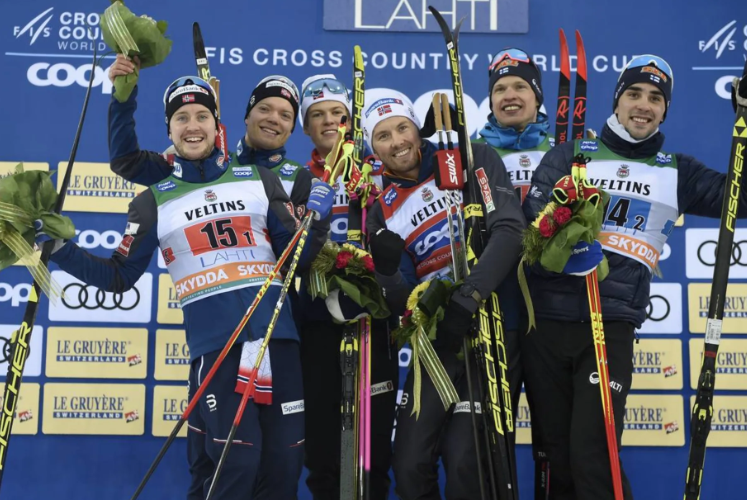
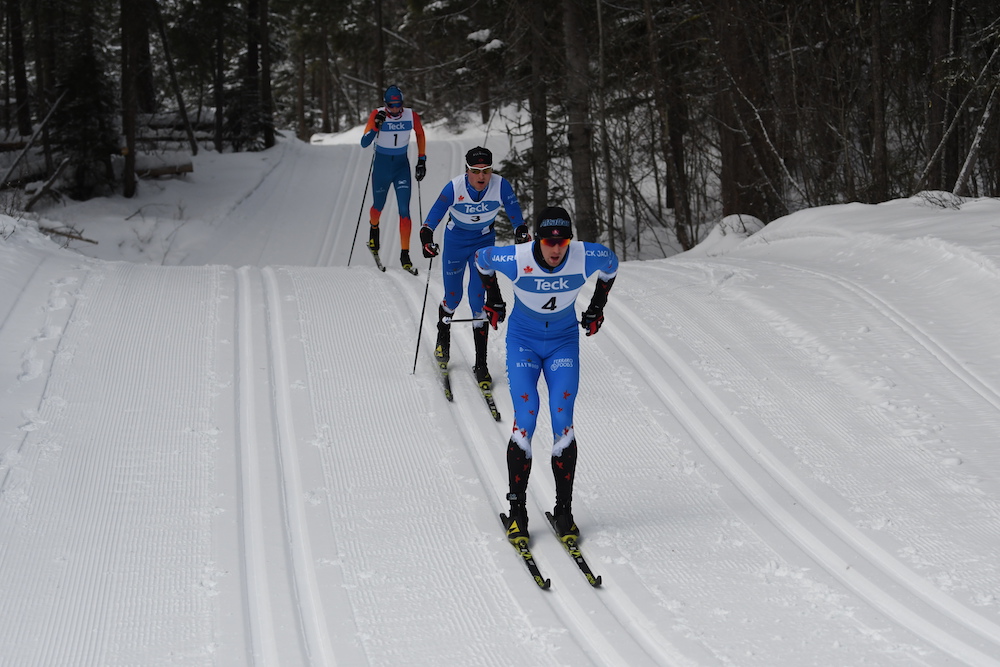
    Sunday continued the domination by the favourites. Nishikawa won the 15km free mass start in 43:06, 2:07.6 ahead of Elliott and 2:13.8 ahead of Revelstoke’s Gina Cinelli.
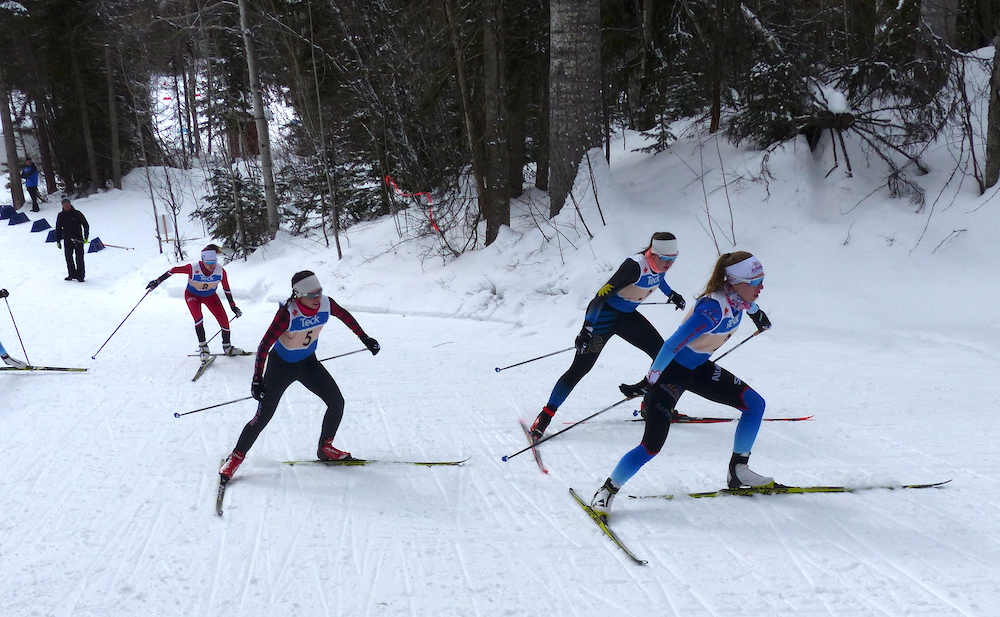
    In the men’s 15km, Kennedy snatched a second win in 37:29.4, 1.6 seconds ahead of Gareth Williams and 19.4 seconds ahead of Carlyle.

    “It is fun to be back in Canada and see how well people are skiing here!,” Kennedy wrote to FasterSkier. “Whistler is so pretty but it is super tricky with weather. Always unpredictable but really good for testing skis I don’t use that much.”

    While the regional field may not have been as deep as MSA will be, the return of Nishikawa and Kennedy from World Cup period 1 gave nearly 300 athletes a good vision into what the next level of competition looks like.

    Results: Full Weekend, Sprint Qualification, Sprint Heats, Interval Classic, Mass Start

    The organizing committee has photo galleries.

    OPA Cup, Pragelato, Italy

    Dahria Beatty wins the OPA Cup ahead of Katherine Stewart-Jones. (Photo: Beatty's Instagram)
    Dahria Beatty wins the OPA Cup ahead of Katherine Stewart-Jones. (Photo: Beatty’s Instagram)

    While the western athletes were at the 2010 Olympic venue, eight Canadians made the trek to the 2006 Olympic venue to compete in the OPA cup. Dahria Beatty won the Saturday’s mass start 15km classic in 49:09.0, 8.1 seconds ahead of teammate Katherine Stewart-Jones. Italy’s Sara Pellegrini was third at 38.7.

    In the men’s 30km, Antoine Cyr edged out Bob Thompson for 22nd place at 5:56.1 back from winner Paolo Ventura who won in 1:26.36.3.

    On Sunday, Stewart-Jones moved up, taking first in the 5km free in 14:03.5, 5.2 seconds ahead of Italy’s Elisa Brocard and 10.4 seconds ahead of Beatty in third.

    “Being on the podium for both races is a huge confidence booster going into next weekend’s World Cup races, especially because the courses in Pragelato are World Cup level,” Stewart-Jones wrote in an email. “With Dahria also on the podium the last two days I couldn’t be more excited with how well our Canadian Women’s team is performing.”

    Stewart-Jones is targeting the Scando Tour, starting in Åre, Sweden, on February 18th and ending in Trondheim, Norway, on the 23rd.

    “The courses here in Pragelato are awesome which made for some good hard racing this weekend,” Beatty wrote after her third OPA podium of the season.
    “I had only done one distance race this season before this weekend so it was really good for me to get some high caliber race kilometres in. My distance skiing is feeling strong right now so I am excited to do a few distance World Cups in the next month and do some classic skiing since Saturday was also my first classic race of the year.”

    Canadian men recovering from the 30km classic in Pragelato's OPA Cup. (Photo: Erik Bråten)
    Canadian men recovering from the 30km classic in Pragelato’s OPA Cup. (Photo: Erik Bråten)

    In the men’s 10km, Cyr was again top Canadian, finishing 23rd, 1:38.2 behind France’s Jean Tiberghien who won in 24:05.1.

    Thompson is a sprinter by preference and was in Pragelato with Oberstdorf’s sprint in mind.

    “The main focus for me this weekend was to get some longer really hard work in, which a 1.5 hour 30k definitely accomplished,” Thompson wrote. “I think the OPA’s are a great chance to find near World Cup level racing and for those who are looking to get a bit more experience at that level they are a great challenge for those looking to make a jump in their racing.”

    The OPA cup is a continental cup series (like the NorAm and SuperTour) and the field is studded with athletes who move up and down between the World Cup and this series. The athletes best known to North Americans would probably be France’s Richard Jouve (8th here) and Italy’s Elisa Brocard (12th and 2nd).

    Head coach Erik Bråten is with the team until Oberstdorf and back to Canada briefly for MSA Trials. He is excited with the progress this season and happy with the visit to Pragelato.

    “What I take away is that we have some young athletes that is getting great race experience outside of North America, and a couple of girls that really showed a high level even in a tough training week.”

    Results: Full Weekend, Women’s 15km C, Men’s 30km C, Women’s 5km F, Men’s 10km F

    Youth Olympic Games, Lausanne, Switzerland

    The YOG started off with a ‘cross country cross’ event including obstacles on Saturday, followed by the more traditional events: Sprints Saturday, classic mass starts Tuesday, and a mixed relay on Wednesday. The American athletes outshone the Canadians over the obstacles on the first day, taking 4th in each gender before working up to podiums on Tuesday. Full results for the event are here.

    While this is an important event in young athlete’s lives’ and there have been some great individual results, fans and media alike have to be careful not to apply expectations and pressure to the developing minds in those developing bodies.

  • Canadian Western Championship: Weekend Wrap-up

    Canadian Western Championship: Weekend Wrap-up

    Julien Locke leads Rémi Drolet and Sam Hendry in the second lap at Westerns 2019. (Photo: Doug Stephen)
    Julien Locke leads Rémi Drolet and Sam Hendry during the second lap at Westerns 2019. (Photo: Doug Stephen)

    KELOWNA, B.C —

    One week after Easterns, it was time for Westerns, and the Polar Vortex made the trip for both weekends.

    At Easterns, the air was cold enough to keep the organizing committee on edge at the start of the weekend, and freezing rain complicated driving  plans. At Westerns, the cold weather held off to Sunday, but falling snow on dry, salted roads created a sheet ice for Friday’s commute. Both championships had less athletes than expected, with driving conditions and weather predictions having an effect.

    Photo albums and result links follow the daily summaries.

    Friday, Skate Sprint

    Tallon Noble leads Sam Hendry in junior men's A final. (Photo: Greg Redman)
    Tallon Noble leads Sam Hendry in the junior men’s A final. (Photo: Greg Redman)

    The action kicked off Friday with skate sprints at the Telemark Nordic trails near Kelowna, B.C., in sunshine and -11C.

    Benita Peiffer (Whistler) won the 1.3km A final in 3:02.79, 0.10 seconds ahead of top qualifier Katie Weaver (RMR). Elizabeth Elliot (AWCA) took third, 2.77 back after qualifying second.

    “I felt really confident going into the final,” Weaver told FasterSkier. “I led all of the race, right until the finishing stretch and Benita came up, and I think she got me right at the end.”

    Despite placing second, Weaver was happy with her tactics: “I wasn’t super confident with my hop offset on those tough hills, so my goal was to get out into the lead and control the race. Kinda position myself well so I could have a good finish.”

    Peiffer and Elliot grew up racing together before Elliot moved to Canmore, and were clearly enjoying racing together again, completing each other’s sentences during the post-race interview.

    Elliot: “It was really fun, we had all the BC skiers that we grew up skiing with. It was super-fun to all be with each other in the same heats and…”

    Peiffer: “…Back to the good old days of racing together.”

    Tactics were also a shared vision.

    Peiffer: “You stay with the pack going up the big hill, and then it’s really easy to draft because you have a really long downhill.”

    Elliot: “If your skis work for you.”

    The open men raced the same course and Julien Locke (CNST) was in dominant form, winning the qualifier and each heat by over 3 seconds, taking the A final in 2:28.23.

    “I’m just here to race hard,” Locke said after his cool down ski, “so I just raced hard every round.” Locke has been fast in 2019, winning the sprints at US Nationals, Easterns, and Westerns, but he would probably trade any one of those to improve on his second place at the World Championships qualification sprint at Bishop’s University.

    Junior national team member Rémi Drolet (Black Jack) outreached Telemark’s own Gareth Williams (CNST) to take second, 3.42 behind Locke and 0.03 ahead of Williams.

    “Tactics were tough for me,” Drolet said. “I was slow off the start, so I was behind a little bit. Basically, I had to catch up so I was really focusing on pushing over the tops of hills really hard. In the end, it was a sprint to the finish between Gareth and I. Julien was a bit ahead [laughs at the understatement]. It was fun.”

    Williams was bouncing back after getting ill on the trip home from U23’s in Lahti and leaving Easterns without starting a single race.

    “I started to feel better round after round, because I hadn’t done any intensity at all, so the feelings were coming back, but I kind of lost it there on the last hill,” he said. “My legs felt really heavy and I pushed really hard but it wasn’t quite enough to out sprint Rémi, and not enough to keep up to Julien Locke either.”

    312 athletes raced in good conditions on a day where the driving conditions were anything but good.

    Xavier McKeever won the junior boys qualifier and every heat at Westerns 2019. (Photo: Greg Redman)
    Xavier McKeever won the junior boys qualifier and every heat at Westerns 2019. (Photo: Greg Redman)

    Saturday, Classic Mass Start

    The new 5km loop at Telemark received a homologation certificate less than a week before the event, but it was immediately put to use with the men doing three classic laps and the women doing two in -11C air and intermittent light snow.

    The men raced first, with Locke, Drolet, Williams, and Sam Hendry (Team R.A.D.) taking an early lead.

    Williams dropped out early in a race he probably shouldn’t have started. It is hard to miss a race for illness, and harder still when the local tv station is there to see their hometown star, and your mum is the race secretary.

    Black Jack teammates Locke and Drolet put the hurt on Hendry early, before Drolet broke clear to win alone in 42:18.4, 4.8 seconds ahead of Locke. Hendry hung on for third, losing 42.2 seconds on the final lap.

    “I tried my best to hang on to the pace, but Rémi’s in great shape right now, coming off his big results at world juniors, so [it was] hard to stick on,” Hendry said after. “My skis weren’t quite as fast as the others. On all the downhills, they’d open up a little gap and I’d have to try to bring it back on the climbs and the flats.”

    “Rémi and Sam were skiing fast, it was fun to battle with them,” Locke said. “I’m a little bit stronger on the flats, [Rémi’s] a bit of a stronger climber. We were pushing each other and just trying to ski fast and work together.”

    “It was a really fun race today,” Drolet said after doping control “It was a decent pace off the start, skiing with my teammate Julien, Gareth for a bit until he unfortunately dropped out, and then Sam Hendry. It’s a pretty hilly course, so there’s not a tonne of double poling, but I think the parts of it that are double pole are important to ski well and conserve energy for the uphills.”

    Drolet and Locke worked well together, up to a point. “Once Sam started to fade a little bit, we attacked and dropped him off,” Drolet explained. “Then we skied together for the rest of the race until the final climb, where I managed to pull away from him.”

    Novie McCabe (61) leads Jasmine Drolet, Katie Weaver, and Molly Miller at the 2019 Westerns 10km. (Photo: Doug Stephen)
    Novie McCabe (61) leads Jasmine Drolet, Katie Weaver, and Molly Miller at the 2019 Westerns 10km. (Photo: Doug Stephen)

    The open women’s 10km was all about the next generation. Novie McCabe (Methow) got away early to win in 32:42.6 minutes. Black Jack teammates Jasmine Drolet and Molly Miller were second and third at 53.4 and 1:28.1 back. All three are in the junior girls category and competed at Junior Worlds in Lahti.

    “I basically went out from the start hard, and tried to hold it,” McCabe told FasterSkier. “Going up the first hill, I tried to get into the lead and then on the double pole section I tried to make a break and just push hard into a downhill and that’s where I kind of gapped people by a little bit and then I just went from there.”

    As an American, McCabe has a Canadian Points List ranking that put her in the third row at the start. Asked about whether this is good practice for racing in Europe, she replied “Yeah, it was definitely good to have some practice with that, navigating my way through people.”

    Jasmine Drolet, at sixteen, a year younger than the other two on the open podium, kept things simple in the interview, describing her day as “good race, good skis.”

    “In Canada it’s not hard to be the fast one, but when you get there [at World Juniors], it’s quite a shock,” Jasmine Drolet explained. “It’s good to ski with the best in world.”

    “I haven’t been feeling super great in a lot of the distance races this year, so I was happy to have a better day today,” Miller said at the end of the day. “It was a bit aggressive in the beginning for sure. I came out of the lanes in a bad place, but it seemed to spread out very quickly.”

    Among the 386 racers were some of Canada’s para-nordic team, here to prepare for World Championships starting the following Saturday.

    “Races are always better than intensity,” Mark Arendz (CPNST) told FasterSkier post-race. “We’re using this as an intensity, just this single race from Westerns, to prep for World Championships in Prince George [B.C.] next week.”

    (In the video below, you can see Arendz in the open men’s start, look for the national team suit, second lane from left.)

    Sunday, Relays

    The temperature, despite predictions, reached -17C by 9:00, allowing the relays to start on time.

    For most, the relays are really about having fun with friends. The results are summarized in Sunday’s rundown.

    “Relay events are always fun races, even in -17 conditions,” Rémi Drolet wrote in an email Sunday night. “It also does not matter how far ahead or behind you may be. It is always important to go as fast as possible since it can be hard to predict exactly what will happen after you have tagged your teammate.”

    105 teams braved the cold to enjoy another good event at Telemark.

    Course and Venue

    “It’s a good course, I love racing here. Steep hills, some nice gradual stuff, it’s a good combination of all techniques.” — Locke, talking about the new sprint course

    Julien Locke leads early in the first lap of the 15km. (Photo: Peggy Hung)
    Julien Locke leads early in the first lap of the 15km. (Photo: Peggy Hung)

    “My first race [here] was in 2005, my first ever provincial race, BC Midget Championships. I was 13 years old and that was my first race outside of the Kootenays. It was a pretty big day for me.” — Locke

    “Seeing the young kids racing this weekend certainly brought back memories.  Kelowna was one of the locations where I raced most in my younger years, and it was there that I learned many of the fundamentals of racing.  Much of my early understanding of race preparation, tactics, and even technique was developed racing at Telemark.” — Rémi Drolet

    “Super nice day, super great course, not too cold. Another great race at Telemark.” — Hendry, on Saturday

    “It’s really nice to just be able to come up here and have some great competition and the races are really well organized.” — McCabe, on crossing the border from the Okanogan Valley in Washington state to the Okanagan Valley in B.C.

    Photos and Results

    Doug Stephen has albums on Flickr: Sprint, Classic, and Relay

    On zone4 results, click on a skier’s name to pull up pictures of that athlete in the selected event. Greg Redman, featured here, is one of the photographers contributing. There are a lot of photos, with over 60 photos of some athletes in some events.

    Results: Qualifier, Heats, Classic, Classic Para, Relay, Full Weekend

    Note that masters and the youngest athletes are in the Okanagan Cup links under Full Weekend, and some of the para athletes competed in the open category for the classic race.

  • Sunday Rundown from Lahti and Canada (Canmore Biathlon Sprints Cancelled)

    Sunday Rundown from Lahti and Canada (Canmore Biathlon Sprints Cancelled)

    2019 Lahti, Finland’s World Cup classic team sprint podium. From left to right, Norway I in second, Sweden I in first, and Sweden II in third. (Photo: @fiscrosscountry Instagram screenshot)

    FIS World Cup Lahti, Finland Classic Team Sprint

    Sunday in Lahti, Finland the women raced a 6 x 1.4-kilometer classic team sprint. U.S. fans saw their hopes for a podium snuffed out in the two semi-finals that determined the 10 teams advancing to the finals.

    In the first team sprint semi, the U.S. Ski Team’s (USST) Ida Sargent and Sophie Caldwell  placed sixth overall and did not advance. Sargent and Caldwell, constituting team USA I, were 10.78 seconds off the winning time of Sweden II’s Evelina Settlin and Hannah Falk, who won the first semifinal in 18:36.74 minutes.

    In the second semi, USA II’s Kelsey Phinney (SMS T2) and Julia Kern (USST D-Team) raced to seventh (+1:06.32). Norway I’s Tiril Udnes Weng and Maiken Caspersen Falla marked the fastest time of 18:31.09 minutes.

    In the women’s final, Sweden I’s Ida Ingemarsdotter and Maja Dahlqvist won in 18:24.96 minutes. Weng and Falla took second (+1.84), Sweden II’s Settlin and Falk placed third (+3.55).

    Women’s Results

    2019 Lahti, Finland’s World Cup classic team sprint podium. From left to right, Norway II in second, Norway I in first, and Finland I in third. (Photo: fis-ski.com screenshot)

    The men raced a 6 x 1.6 k classic team sprint in Lahti. Both U.S. teams entered raced in the second semi with neither placing well enough to advance. The second semi was won by Russia I’s Artem Maltsev and Gleb Retivykh in 19:31.22 minutes.

    In that semi-final, USA II’s Kevin Bolger and Logan Hanneman placed sixth (+6.60), USA I’s Simi Hamilton and Erik Bjornsen were seventh (+16.05).

    USA II placed 12th overall, USA I 14th in the final standings.

    Johannes Høsflot Klæbo and Emil Iversen of Norway won the first semi in 19:22.32 minutes.

    Norway I’s tandem won the final in 18:57.19 followed closely by Norway II’s Sindre Bjørnestad Skar and Eirik Brandsdal in second (+0.65). It was a photo finish for second and third, as Finland I’s Iivo Niskanen and Ristomatti Hakola finished 0.71 seconds back to take the third podium spot.

    Men’s Results

    ***

    Today’s IBU World Cup sprints in Canmore, Canada have been cancelled due to extreme cold temperatures. Current temperatures in Canmore are -17 degrees Fahrenheit. A temperature reading of -4 degrees Fahrenheit on the coldest part of the course is the minimum for IBU competitions.

    This race rundown will be updated.

    ***

    Western Canadian Championships, Telemark, Kelowna B.C., Relays

    Westerns wrapped up with club relays on a day where the thermometer flirted with cancellation before rising to -17C at 9am (that is 2 Fahrenheit, for residents of Liberia, Myanmar, and the USA).

    The relay event is intended to help build club spirit in a less competitive environment. In practice, many skiers just find two friends they want to ski with. Despite the cold, 105 teams competed today.

    In the open men category, the ‘BC Lost Boys’ team won easily, with Rémi Drolet, Gareth Williams, and Julien Locke finishing the 15km in 38:00.9. Drolet and Locke are teammates at Black Jack while Williams is a Telemark local. All three are national team members.

    Julien Locke leads Rémi Drolet and Sam Hendry in Saturday's mass start classic. The relay used the same 5km loop. (Photo: Doug Stephen)
    Julien Locke leads Rémi Drolet and Sam Hendry in Saturday’s mass start classic. The relay used the same 5km loop. (Photo: Doug Stephen)

    ‘Alberta 1’ placed second, at 1:47.1 back, with Thomas Manktelow (), Michael MacIsaac-Jones (AWCA), and Sam Hendry (Team R.A.D.) ‘BC Power, Speed, and Grace’ was third, with Tallon Noble (Strathcona), Michael Murdoch (Whistler), and Ian Williams (Telemark) at 2:26.8.

    The open women used the same 5km loop as the men (and the same as on Saturday). ‘BC Supernovas’ won in 47:25.7, with BC team members Paige Latta (Sovereign Lake), Elizabeth Elliot (AWCA), and Benita Peiffer (Whistler). ‘BC Avalanche’ took second at 1:33.4 with Katie Weaver (RMR), Gina Cinelli (Revelstoke), and Beth Granstrom (AWCA). ‘Just the Ladies – No Nick’ was just 3.5 seconds behind 2nd place with Claire Grall-Johnson (AWCA), Amanda Thompson (AWCA), and Hannah Jirousek (AWCA) representing Yukon/Ontario.

    Results: Relays, Full Weekend

  • Canadians Westerns Rundown: Skate Sprints

    Canadians Westerns Rundown: Skate Sprints

    Elizabeth Elliot leads Benia Pfeiffer and Paige Latta in the semi-final at Westerns (Photo: Peggy Hung)
    Elizabeth Elliot leads Benita Peiffer and Paige Latta up the first climb in the semi-final at Westerns (Photo: Peggy Hung)

    Canadian Western Championships started off Friday with free technique sprints on the Telemark trails near Kelowna, B.C.

    The sun was out for the qualification round, followed by cloud, and light snow as the day progressed with the temperature hovering at -10C. A major road closure combined with icy morning highways and a large number of accidents blocking roads caused some athletes and volunteers to miss the qualification round, resulting in only 312 athletes on the start line. About 500 athletes are expected to race Saturday.

    Katie Weaver (RMR) won the 1.3km qualifier in 3:06.02 and her first two heats before Benita Peiffer (Whistler) pipped her at the line to win the A final by 0.10 seconds in 3:02.79. Second place qualifier Elizabeth Elliot (AWCA) took the bronze, 2.77 seconds back.

    Julien Locke blew the A final apart in Telemark. (Photo: Peggy Hung)
    Julien Locke blew the A final apart in Telemark. (Photo: Peggy Hung)

    The men raced the same course, with Julien Locke (CNST) steamrolling the field, qualifying first in 2:27.67 before winning all three heats alone. In the A final, Locke clocked 2:28.23, 3.42 seconds ahead of the three chasers. Junior Remi Drolet (Black Jack) stretched ahead of local Gareth Williams (CNST) by 0.03 seconds with Larkin Wasmuth (CRTG) 4th, 0.53 seconds behind Drolet.

    Results: qualification, heats, full weekend and live timing

    Racing continues with classic mass starts on Saturday and relays on Sunday.

  • Levins 6th, Bankes 8th in Pursuit to Cap Off Youth/Junior World Champs

    Levins 6th, Bankes 8th in Pursuit to Cap Off Youth/Junior World Champs

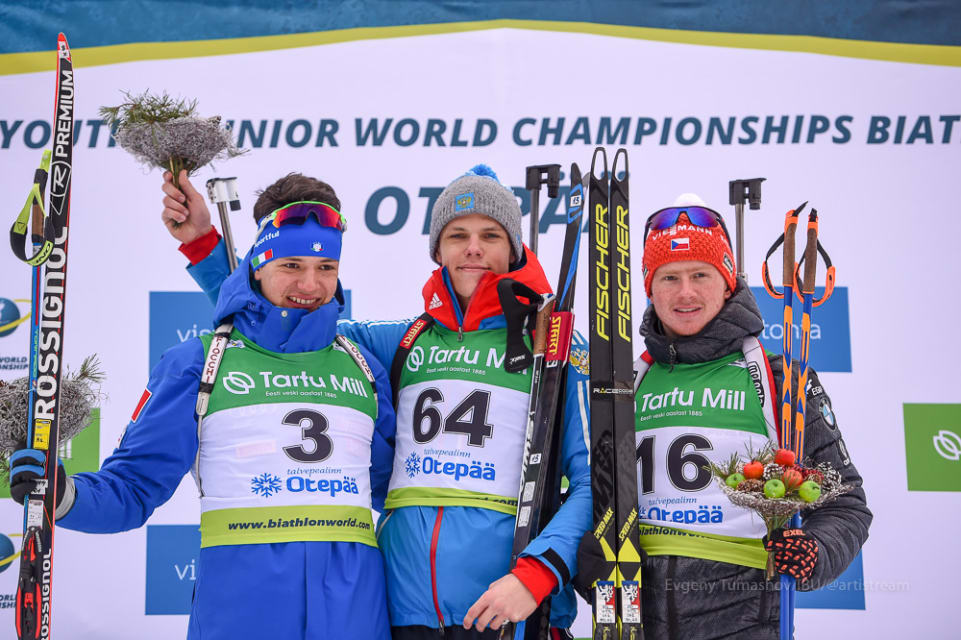
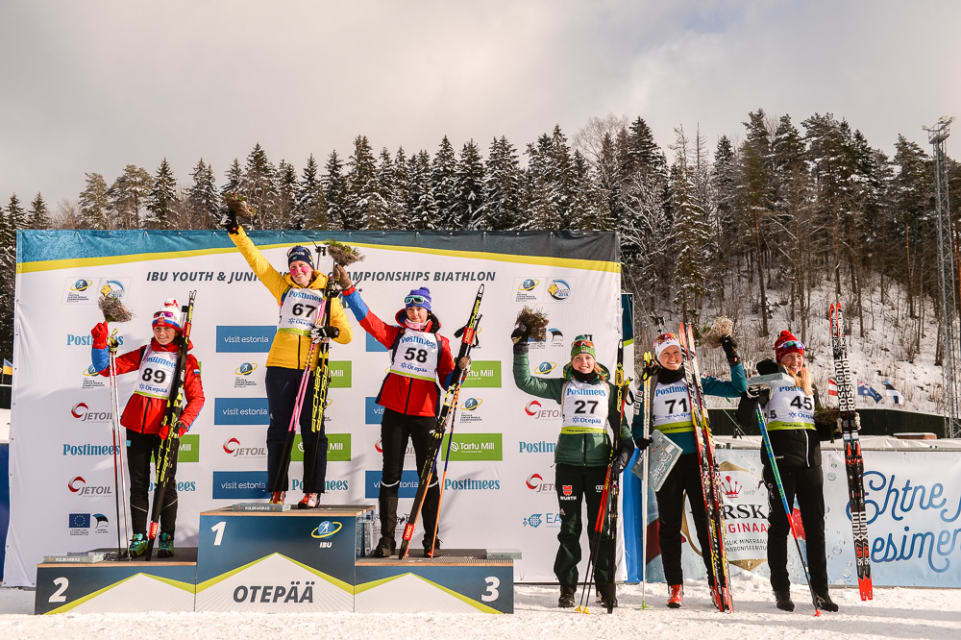
    Some of the top-six finishers in the junior women’s 10 k pursuit at the post-race flower ceremony at 2018 IBU Junior World Championships in Otepää, Estonia, including the Czech Republic’s Markéta Davidová (top) and American Chloe Levins (bottom), who finished first and sixth, respectively. (Photo: IBU/Biathlonworld)

    (Note: This article has been updated to include comments from Leo Grandbois.)

    The 2018 International Biathlon Union (IBU) Youth/Junior World Championships went out with a bang on Sunday, with four pursuit races in Otepää, Estonia.

    Several North Americans had banner days, with American Chloe Levins racing up one spot to sixth place in the junior women’s 10-kilometer pursuit and Canada’s Megan Bankes and Nadia Moser placing eighth and 11th, respectively, in that same race.

    In the youth men’s 10 k pursuit, Canada’s Leo Grandbois had his best result of the week, placing 15th (up from 33rd) at the start.

    Starting with the junior women’s pursuit: 

    Levins started the race 1:32 minutes back in seventh, based on her sprint result on Saturday. She went on to clean three-consecutive shooting stages, working her way up to fourth after leaving the range for the third time, then missed two targets on the final standing to end the race in sixth. Levins finished 1:51.4 behind the winner, Markéta Davidová of the Czech Republic, who finished first in 32:52.6 with four penalties (1+0+2+1).

    Chloe Levins racing to seventh in the junior women’s 7.5 k sprint on Saturday at IBU Junior World Championships in Otepää, Estonia. (Courtesy photo)

    “In pursuit races in the past, I’ve come from behind,” Levins, who placed fourth in last year’s Youth Worlds pursuit, wrote in an email to FasterSkier on Sunday. “Today, it was a new learning experience for me to be in the mix for the duration of the race. My plan was simple from the start: enjoy being in the mix and trust your preparation.

    “I found the zone today, which is what you dream about,” she continued. “I don’t remember much about the last stage. All I know for sure is that I went for it today…and I have no regrets.”

    Asked what she’ll remember most about these championships, Levins explained that the U.S. team’s “happy and dedicated staff” made for a fun week.

    “We are always joking and laughing in the wax room which helps keep the mood light during potentially stressful races,” she wrote. “It was really special and important for me to have this experience with my coach, Algis Shalna, behind the scope. We’ve worked together for a long time. I will cherish the competitions we get to share forever.”

    While the championships didn’t turn out exactly as she’d hoped, Levins explained that she had a lot of positive takeaways for her final biathlon races of the season.

    “Now, it’s time to go back to school and start preparing for golf season at Middlebury!” she wrote. “… I can’t wait to start training again.”

    Megan Bankes racing to eighth in the junior women’s 10 k pursuit at IBU Junior World Championships on Sunday in Otepää, Estonia. (Photo: Bryan Dickson)

    Bankes started ninth on Sunday and made up one place to finish eighth (+2:52.6) after placing ninth in three previous races at Junior Worlds. She had two penalties in both the first and the last shooting stages (2+0+0+2) and posted the ninth-fastest shooting time and ninth-fastest overall course time.

    “Heading into today’s race, my goal was to try and shoot well and make up places. It was also my last international junior race so i wanted to try and have a good one!” Bankes, 20, wrote in an email. “To start, I knew that I could catch the Norwegian girl who started in front of me, and after I caught her, my goal was to make up time on everyone else in front of me.”

    She described the wind on the range as “pretty strong” and variable.

    “I was zeroed for a decent left to right wind, but when I came in for my first prone the wind had died and was blowing towards me for my first shot, and then it picked up again to be a little more than my zero wind, and I corrected back but didn’t correct enough for it,” Bankes wrote. “After cleaning the middle 2 bouts I really wanted to clean my last bout and there was definitely a little pressure going in with the Russian girl [Emma Timerbulatova, who was skiing just ahead of Bankes]. I actually thought that she had only missed one, so I was a little disappointed in myself when we went into the penalty loop, but when she didn’t leave after the first loop, I was determined to pass her and beat her to the finish.”

    Like Bankes, Timerbulatova had two penalties in the last standing. She started the final loop just 0.1 seconds ahead of Bankes, and Bankes passed her to finish eighth.

    “I’m overall super happy with my performance this week,” Bankes, a 2017 Youth Worlds gold medalist in the 10 k individual, concluded. “Definitely my most consistent European racing ever! I would have liked to have shot better overall this week though, I did give up some stupid shots, but I was super stoked with how I felt skiing. I’m also pleased that I was able to have consistently good races over the course of the week, which is something I definitely could not have done in the past.”

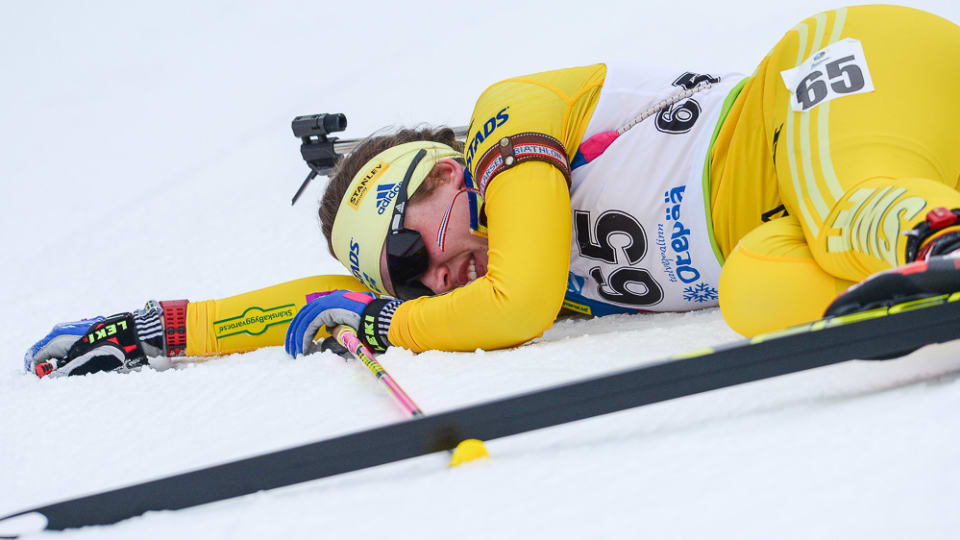
    Nadia Moser racing to 11th in the junior women’s 10 k pursuit at IBU Junior World Championships on Sunday in Otepää, Estonia. (Photo: Bryan Dickson)

    Moser picked off 10 places to finish 11th (+3:45.4). She started the pursuit in 21st and shot 18-for-20, cleaning the first two stages (0+0+1+1) and contending for the top 10 before finishing about 12 seconds out of 10th place. It was her second-best result of the week after placing eighth in the junior women’s 12.5 k individual.

    “A top 10 finish was definitely the big goal for the pursuit, but I knew that was only possible if I shot really well and skiied well,” Moser wrote in an email. “Unfortunately, I missed my goal by one place.

    “There were some pretty large time gaps in the starters today so it was a challenge to pick up places for me,” she continued. “For the most part I just tried to catch up with the people in front of me, or keep up with the people who passed me. I knew my best chance to move up was in the shooting range. … I was focused and trusting in my skills on the range today, and that is how I was able to hit most of my targets.”

    She knew she was in 10th for her third shooting when she was shooting in lane 10.

    “I was really happy that I had moved up as many places as I did, although slightly dissapointed that I was not able to reach the top ten,” Moser added. “I am satisfied with today’s pursuit. Moving up 10 positions is better than I’ve ever done before. Some things could have gone slightly better this week, but overall I am content with what I was able to achieve.”

    Emily Dickson scored her first non-relay top 30 of the week in 26th (+5:31.6), up from 36th at the start, after missing just two targets (1+0+0+1). She had previously placed 36th in both the sprint and individual races, and ninth with Bankes and Moser in the 3 x 6 k relay.

    After starting 26 seconds ahead of Davidová, Poland’s Kamila Żuk finished second in the pursuit, 28.1 seconds behind Davidová, after incurring six penalties (1+2+3+0). France’s Myrtille Begue placed third (+53.8) for the second-straight day after shooting 17-for-20 (0+1+1+1).

    Onto the junior men’s 12.5 pursuit: 

    A day after placing third in the sprint, Norway’s Sverre Dahlen Aspenes shot clean in Sunday’s four-stage pursuit to take the win in 34:16.7. He finished 1:21.1 minutes ahead of France’s Martin Perrillat Bottonet, who placed second with one penalty (0+0+1+0). Norway’s Johannes Dale scored his first non-relay podium in third place (+1:46.4) with four misses (0+0+2+2).

    Canada’s Adam Runnalls tallied his third individual top 30 of the week, placing 29th (+6:04.7) with six penalties (2+1+1+2). He had started the pursuit in 26th, based on his sprint result, and had previously finished 29th in the junior men’s 15 k individual.

    His teammate Trevor Kiers started the pursuit in 16th and slipped to 34th (+6:44.4) with 10 penalties. Canada’s third man in the race, Teo Sanchez finished 57th (+10:32.5) with five misses (1+0+1+3) after starting 54th.

    Cody Johnson was the lone U.S. skier in the junior men’s pursuit, racing to 48th (+7:40.0), after starting 37th, with five misses (2+0+2+1).

    In the youth men’s 10 k pursuit:

    Leo Grandbois racing to 15th in the youth men’s 10 k pursuit on Sunday at IBU Youth World Championships in Otepää, Estonia. (Photo: Terri Dickson)

    Grandbois, a gold medalist at last year’s Youth Worlds in the 12.5 k individual, had his best race of the 2018 championships in 15th. After starting 33rd, he cleaned the first two stages to put himself in 16th halfway through the race, then missed two on each of the final two shooting bouts (0+0+2+2). But he didn’t lose much ground, leaving the range in 17th after the last shooting and passing two competitors to end up 15th (+3:37.2). Grandbois had previously raced to 24th in the 12.5 k individual this week and 16th with Canada’s youth men’s 3 x 7.5 k relay team.

    “For the first bouts the wind was calm but for the second prone the wind picked up,” Grandbois explained in an email. “So I had to do some corrections that worked perfectly. I am really happy about it. First standing I came way too hard in the range and I could not manage to be precise. The last shooting was going well but the pressure to go faster made me miss again.

    “I think that with a better standing shooting I could have done a top 10, but I was starting pretty far away so I am satisfied with my 15th,” he wrote.

    “What I take back from those championships is that my ski speed is good but I will have to work hard next summer to keep it that way and to get it even better, for sure,” Grandbois added. “It wasn’t a good week for me in the range. I will have to work on my shooting speed and constancy. Those two things are my biggest weakness.”

    Leading the U.S. men was Vasek Cervenka in 24th (+4:20.8). Cervenka had started the race in 24th and held his position despite six penalties (0+3+1+2) with the 19th-fastest course time. It was his third individual top 30 of the week after placing 27th in the 12.5 k (as well as ninth with his relay team).

    Canada’s Rory Gilliland moved up 11 places to finish 41st (+6:12.2) with two penalties (0+0+1+1). His teammates Thomas Hulsman and Ryan Elden followed in 45th (+6:45.9) and 49th (+6:56.8) after starting 35th and 59th, respectively. Hulsman had six penalties while Elden had five (1+0+2+2).

    For the U.S., Garrett Beckrich and Eli Nielsen finished 46th (+6:48.7) and 47th (+6:54.7), respectively. Beckrich had started 46th and incurred five penalties (1+1+1+2) while Nielsen slipped five places after starting 42nd and missing six targets.

    After winning gold in the relay, Russia’s Andrei Viukhin notched his first individual podium and gold medal at his first Youth Worlds, winning the pursuit in 29:31.2. He had started seventh and missed four targets (1+1+1+1) yet led his teammates in a Russian podium sweep.

    Viukhin handed his teammate Mikhail Pervushin his first loss of the week, as Pervushin settled for second, 16.8 seconds back, with four penalties as well (1+0+2+1). Aleksei Ogorelkov, who had not raced in Russia’s 3 x 7.5 k relay, finished third (+1:12.1) with two late penalties (0+0+0+2) for his first Youth Worlds podium.

    Last but not least, the youth women’s 7.5 k pursuit:

    Canada had three women finish in the top 40 of this race, with Benita Peiffer leading them in 30th (+4:28.2). She had started 51st and skied the 21st-fastest course time to pick off 21 places. Peiffer shot 17-for-20 (1+0+1+1).

    Her teammate, Pascale Paradis slipped from 15th to 35th (+5:05.8) with eight penalties, while Jenna Sherrington improved from 46th to 39th (+5:28.1) with four misses (2+0+2+0).

    For the U.S., Emma Stertz finished 48th (+5:58.0), up from 52nd at the start, with four penalties (1+0+2+1), and Grace Gilliland placed 57th (+7:21.0), after starting 55th, with four misses as well (1+1+1+1).

    Russia’s Anastasiia Goreeva won her first individual gold at Youth Worlds, racing up from fourth at the start to cross the finish line first in 24:24.0 with three penalties (0+0+1+2). Germany’s Franziska Pfnür placed second for her first Youth Worlds podium, 17.5 seconds behind Goreeva, with just one penalty (0+1+0+0). In her second Youth Worlds, Switzerland’s Amy Baserga achieved her first podium as well, placing third (+29.0) with two penalties (0+0+1+1).

    Results:

    Junior women | Junior men

    Youth men | Youth women

  • Friday Rundown: Paradis Leads Canada in 15th in IBU Youth Worlds Sprint

    Friday Rundown: Paradis Leads Canada in 15th in IBU Youth Worlds Sprint

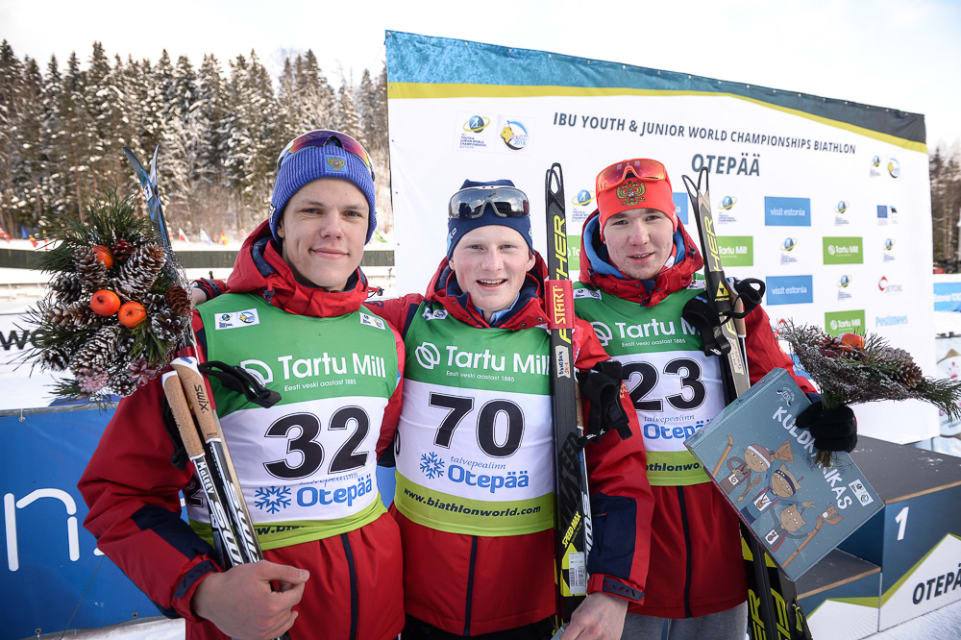
    The youth men’s 7.5 k sprint podium at IBU Youth World Championships in Otepää, Estonia, with Russia’s Mikhail Pervushin (c) continuing his undefeated streak at the championships in first, Italy’s Tommaso Giacomel (l) in second, and the Czech Republic’s Vítězslav Hornig (r) in third. (Photo: IBU/Biathlonworld)

    IBU Youth World Championships (Otepää, Estonia): Youth women’s and men’s sprints

    Sweden’s Karin Elvira Öberg raced to her third-straight win of the week at the International Biathlon Union (IBU) Youth World Championships in Otepää, and Pascale Paradis led Canada in 15th in the youth women’s 6-kilometer sprint on Friday.

    Paradis started 36th out of 92 women and shot 18-for-20, missing one on each stage (1+1), on a day when the top-two finishers had misses as well. With the ninth-fastest overall course time, Paradis, 15, finished 1:04.3 minutes off of Öberg’s winning time of 19:46.7.

    Sweden’s Karin Elvira Öberg after winning her third-straight race at 2018 IBU Youth World Championships in Otepää, Estonia, with a win in the youth women’s 6 k sprint on Friday. (Photo: IBU/Biathlonworld)

    Meanwhile, the 19-year-old Öberg started 65th and claimed the win with one penalty (0+1), continuing her undefeated streak at Youth Worlds after winning the 10 k individual and relay as well. She was joined on the podium by her teammate Amanda Lundström, who also raced to gold in the 3 x 6 k relay on Wednesday, and shot clean on Friday to finish 16.7 seconds back in third.

    Between them, Finland’s Heidi Nikkinen placed second (+13.1), with one penalty (1+0).

    In the first race of her first Youth World Championships, Paradis placed sixth to earn recognition at the post-race flower ceremony.

    “After being shocked with the result I got for the individual it got me pretty excited,” Paradis recalled in an email on Friday. “But I knew that if I put too much pressure on myself I would get too nervous. But it really boosted my confidence to know that I had a chance to do well here!

    “So I went into this race not expecting too much,” she continued. “This season I’ve been doing well in individuals so I was hoping for a good result but in sprints I haven’t been shooting great so I was super happy to see myself knock 8 targets down and I skied as fast as I possibly could, so overall I am super happy about my race!”

    Pascale Paradis racing the first leg of Canada’s youth women’s 3 x 6 k relay team on Wednesday at IBU Youth World Championships in Otepää, Estonia. Her team finished 10th.  (Photo: Bill Gilliland)

    Paradis described the conditions as “perfect”, not too cold and with relatively calm winds.

    “I was happy about my shooting just because it’s the best I’ve shot in a sprint race this year,” she wrote. “Skiing I felt really tired but my coach Andrew was on the hill cheering super loud and I dug deep and pushed myself to the max in this race and was extremely happy too see that I had skied one of my fastest races ever!”

    In Sunday’s 7.5 k pursuit, the last day of the championships, she’ll start about 1 minute and 4 seconds back in 15th, just 2 or 3 seconds out of 12th place.

    “I’m excited to be started really close to a few other girls right out of the gates for the pursuit,” Paradis wrote. “We don’t do many pursuits back home so this will be my second one ever and I’m super excited to see what it’s like on the international level. I really like doing pursuits even though they get me the most nervous, it’s just super fun to know where you are in the race the whole time and to just make up as many spots as you can during the course of the race.”

    Two other Canadian women finished in the top 60 of the sprint to qualify for the pursuit, with Jenna Sherrington placing 46th (+2:25.3) with two penalties (1+1), and Benita Peiffer placing 51st (+2:40.4) with three misses (1+2). Shilo Rousseau missed the cutoff in 66th (+3:04.8) with four penalties (1+3).

    Two American women qualified, with Emma Stertz in 52nd (+2:44.2) with two misses (1+1), and Grace Gilliland in 55th (+2:50.1) with one miss (0+1). Lexie Madigan finished 70th (+3:28.1) with four penalties (4+0) and Helen Wilson followed in 72nd (+3:28.9) with three misses (1+2).

    In the youth men’s 7.5 k sprint on Friday afternoon, Russia’s Mikhail Pervushin won his third-straight race of the championships, shooting clean and finishing in 20:17.3. Italy’s Tommaso Giacomel also shot a perfect 10-for-10 to finish second (+21.9) for his first Youth Worlds medal. The Czech Republic’s Vítězslav Hornig rounded out the podium in third (+38.6) with one miss (0+1).

    American Vasek Cervenka improved on his 27th place in the 12.5 k individual by finishing 24th on Friday (+1:59.2) with three penalties (1+2). He and two teammates qualified for Sunday’s 10 k pursuit, with Eli Nielsen placing 42nd (+2:51.2) with one miss (0+1), and Garrett Beckrich following in 46th (+3:01.3) with four penalties (1+3). Maxime Germain missed the top 60 in 74th (+4:33.9) with three misses (1+2).

    Leo Grandbois led Canada in 33rd (+2:33.4) with three penalties (1+2). All four Canadian men qualified for the pursuit with Thomas Hulsman shooting clean for 35th (+2:35.3), Rory Gilliland finishing 52nd (+3:19.8) with one miss (0+1), and Ryan Elden placing 59th (+3:30.0) with one miss as well (1+0).

    The junior women’s and men’s sprints are scheduled for Saturday, followed by the youth and junior pursuits on Sunday.

    Results: Youth women’s 6 k sprint | Youth men’s 7.5 k sprint

  • Tuesday-Wednesday Rundown: Youth/Junior Worlds Relays

    Tuesday-Wednesday Rundown: Youth/Junior Worlds Relays

    The youth men’s 3 x 7.5 k relay on Wednesday, with Norway leading, at the IBU Youth World Championships in Otepää, Estonia. (Photo: Bill Gilliland)

    IBU Youth World Championships (Otepää, Estonia): Relays

    Pascale Paradis racing the first leg of Canada’s youth women’s 3 x 6 k relay team on Wednesday at IBU Youth World Championships in Otepää, Estonia. (Photo: Bill Gilliland)

    Tuesday and Wednesday were relay days at the International Biathlon Union (IBU) Youth/Junior World Championships in Otepää, highlighted by two ninth-place results by the Canadian and American biathlon teams.

    On Tuesday, the Canadian junior women (Emily Dickson, Nadia Moser and Megan Bankes) placed ninth in the 3 x 6-kilometer relay, 3:31.6 minutes out of first, with two penalties and 14 spares. The U.S. youth men (Vasek Cervenka, Camren Nielsen and Garrett Beckrich) finished ninth in the 3 x 7.5 k on Wednesday, +7:19.9 with three penalties and 15 spares.

    Also on Wednesday, Canada finished 10th in the youth women’s 3 x 6 k with Pascale Paradis, Shilo Rousseau and Benita Peiffer (+3:35.3 with zero penalties and 11 spares). The U.S. youth women followed in 18th with Helen Wilson, Margaret Madigan and Emma Stertz (+8:24.6 with one penalty and 12 spares).

    The Canadian youth men’s relay, with Rory Gilliland, Tom Hulsman and Leo Grandbois, on Wednesday at IBU Youth World Championships in Otepää, Estonia. (Photo: Bill Gilliland)

    The Canadian youth men finished 16th with Rory Gilliland, Thomas Hulsman and Leo Grandbois (+9:45.5 with three penalties and 18 spares).

    In the junior men’s 4 x 7.5 k relay on Tuesday, Canada finished 17th with Teo Sanchez, Angus Tweedie, Trevor Kiers, and Adam Runnalls (+10:48.7 with four penalties and 14 spares), and U.S. followed in 19th with Cody Johnson, Tim Cunningham, Camron Christiansen, and Jacob Pearson (+24:31.1 with eight penalties and 18 spares.

    France won the junior women’s relay with Camille Bend, Myrtille Begue and Lou Jeanmonnot Laurent finishing in 1:02:52.1 hours with one spare and eight penalties. Norway placed second in that race, 17.5 seconds back, and Russia was third (+40.1).

    Russia topped the junior men’s relay with Said Karimulla Khalili, Vasili Tomshin, Viacheslav Maleev, and Igor Malinovskii finishing in 1:25:21.2 with zero penalties and nine spares. Norway took silver(+57.1), and France earned bronze (+2:45.6).

    Sweden won the youth women’s relay the following day with Amanda Lundström, Ella Halvarsson and Elvira Öberg in 1:03:19.8 with zero penalties and six spares. Öberg shot clean without any spares (0+0, 0+0) for her second gold medal in as many races after she won Monday’s 10 k individual.

    She edged Finland’s Heidi Nikkinen in a photo finish, in which the two racers finished less than a tenth of a second apart, and Finland settled for silver after two penalties and 10 spares. Norway reached the podium in third (+37.0).

    The Russian men prevailed again on Wednesday with Denis Tashtimerov, Andrei Viukhin, and Monday’s 12.5 k individual gold medalist, Mikhail Pervushin, winning the youth men’s relay in 1:04:51.1 with two penalties and eight spares. The Czech Republic claimed silver (+2:30.), and Norway continued its podium streak in third (+3:04.5).

    Youth/Junior World Championships continue Thursday with the junior women’s 12.5 k and junior men’s 15 k individual races in Otepää.

    Relay results: Junior women | Junior men | Youth women | Youth men

  • Monday Rundown: Canada’s Paradis 6th, Peiffer 11th in Biathlon Youth Worlds Debut

    Monday Rundown: Canada’s Paradis 6th, Peiffer 11th in Biathlon Youth Worlds Debut

    The top-six finishers in the youth women’s 10 k individual at IBU Youth World Championships on Monday in Otepää, Estonia, with Sweden’s Karin Elvira Öberg (second from l) in first, Russia’s Anastasia Shevchenko (l) in second, Russia’s Anastasiia Goreeva (third from l) in third and Canada’s Pascale Paradis (far right) in sixth. (Photo: IBU/Biathlonworld)

    (Note: This article has been updated to include comments from Canada’s Pascale Paradis and Canadian head coach Jacqueline Akerman.)

    IBU Youth World Championships (Otepää, Estonia): Youth women’s and men’s individual 

    On Day 1 of the International Biathlon Union (IBU) Youth/Junior World Championships in Otepää, Canada had two women finish in the top 11 of the youth women’s 10-kilometer individual race on Monday.

    Canada’s Pascale Paradis racing to sixth in the youth women’s 10 k individual on Monday, the first day of 2018 IBU Youth World Championships in Otepää, Estonia. (Photo: Ian Sherrington)

    Both are brand new to the Youth World Championships scene, with 15-year-old Pascale Paradis placing sixth, 1:09.2 minutes out of first, with one penalty (1+0+0+0). Also for Canada, 17-year-old Benita Peiffer shot an impressive 19-for-20 in the youth women’s longest race of the championships, missing one in prone and cleaning her remaining targets (1+0+0+0) to finish 1:43.1 out of first.

    “I came to these championships with no expectations, with it being my first international race I figured I wouldn’t do great because there’s so many other great competitors in the world,” Paradis wrote in an email to FasterSkier on Monday night. “I just lined up for the start line and pretended that I was racing any normal race because if I didn’t think that I knew the nerves would get to me.”

    She started in the middle of the field in bib 45 and found the conditions to be ideal: sunny, not too cold and with minimal wind.

    “Right out of the start gates I had a good feeling about the day,” she recalled. “I had a restful sleep and was really nervous and excited at the same time. Though I had no idea I would do that well, I just felt good to me and that’s what made me happy. It just made me even happier to realize that I had come top ten and I was over the moon. I didn’t see that coming and I was incredibly grateful for all of those that had helped get to this stage.

    “On course I felt pretty strong, I definitely didn’t feel weak but I had no idea my skiing was within some of the faster times,” Paradis added. “On the range my goal was to focus on my own race and not getting bothered by other competitors, which I usually do, and on the range I felt confident when I came in to shoot. I achieved my goal by not getting flustered by the other girls and all the other distracting sounds.”

    According to Canada’s head coach and trip leader Jacqueline Akerman, the team’s head wax technician, Andrew Chilsom, informed Paradis she was in first place after the last shooting.

    “She gave a little laugh and immediately picked up her pace and passed a few more competitors in her last loop, good enough to hold for a spot in the flower ceremony,” Akerman wrote.

    When Paradis crossed the finish line, she was initially in second place.

    “When I finished I didn’t believe that I was one of the top competitors,” Paradis wrote. “I was so dazed and tired and there was so many people around that I just couldn’t really get it into my head. So I was just extremely happy to be up there with the other top biathletes in the world, I didn’t think my result would stay like that but I was just happy to be in that position at all. I was expecting a top 60 maybe when I came here let alone top 10.”

    Peiffer started 88th out of 91 in the women’s race. After cleaning the last three shooting stages, she learned what place she was fighting for on her last loop.

    “It was probably a good thing I wasn’t told how I was doing until the last lap otherwise I would have gotten too excited and blown up on my last shooting bouts,” Peiffer wrote. “When I found out that I would have a chance at 11th place while I was racing I instantly skied as fast as I could and left all my energy all out on the course. Once I crossed that finish line in 11th place I was filled with satisfaction knowing that I put it all out on the course and proved to myself that I can hit those targets!

    “I think the key to my solid shooting today was staying completely focused and in my bubble while shooting,” Peiffer continued. “I found it quite challenging with the amount of people around but I just focused on what I had to do to hit those targets. I also found that not thinking about my shooting too early while skiing on the course helped. I usually get too excited about what could happen and then things go sideways! Positivity is another one! Believing that I could hit those targets is what gave me confidence going into the range.”

    She described the Otepäa range approach as relatively easy, which she preferred. “I really like to calm down before I start shooting,” Peiffer explained. “The range here is also not affected by the wind much which I am very pleased with!”

    Sweden’s Karin Elvira Öberg, the younger sister of Olympic 15 k individual champion Hanna Öberg, won the race with 19-for-20 shooting as well (1+0+0+0), posting the fastest time at the finish of 35:35.9 minutes. And she did so on her 19th birthday.

    “I was so happy for Hanna when she won, and now I win,” Öberg told the IBU on Monday.

    Russia occupied the second and third steps on the podium with Anastasia Shevchenko placing second, 35.6 seconds back, with two penalties — one of which came on the last shooting stage (1+0+0+1). Anastasiia Goreeva placed third (+53.8) with three penalties (1+2+0+0).

    Four Canadian women competed in the event, with Shilo Rousseau finishing 36th (+4:06.4) with three penalties (0+1+0+2), and Jenna Sherrington following in 40th (+4:22.9) with one miss (1+0+0+0).

    “It was wonderful to see the whole group of young youth women who are relatively inexperienced (on the international stage) put in solid performances today,” Akerman wrote. “All of them placing in the top forty along with great shooting results is something to be very proud of! … This is credited to the great and hard working staff and supportive team we have here, as well as thier coaches and others back home who have obviously done great prep work. We have 14 family members of athletes here cheering like crazy, cowbells and flags and heys with each hit, it sure adds to the support the athletes feel. During the flower ceremony Pascale got a much louder cheer than the first placed athlete!”

    Emma Stertz led the U.S. in 60th (+6:01.9) with two penalties (0+2+0+0), Helen Wilson finished 74th (+8:00.9) with five penalties (2+2+1+0), and Margaret Madigan placed 83rd (+10:53.9) and Grace Gilliland 84th (+11:26.3) with nine penalties apiece.

    Russia put three in the top six of the youth men’s 12.5 k individual on Monday at 2018 IBU Youth World Championships in Otepää, Estonia, with Mikhail Pervushin (32) placing first, Andrei Viukhin (70) fourth and Denis Tashtimerove (23) sixth. (Photo: IBU/Biathlonworld)

    In the youth men’s 12.5 k individual, Russia’s Mikhail Pervushin claimed the win in 37:41.2 with perfect shooting except for a single miss on the last stage (0+0+0+1). Norway’s Filip Andersen took silver (+12.3) with one penalty as well (1+0+0+0), and France’s Martin Bourgeois République claimed bronze (+47.2) with two penalties (0+1+0+1).

    “I was worried before the start, but I’m happy that things turned out as they did,” Pervushin told the IBU. “Today I was aiming for clean shooting, but I did not succeed, that upset me, but I had to fight for the win. I feel good on the track, I like it – overall I’m happy.”

    The defending youth world champion in the event, Canada’s Leo Grandbois placed 24th (+4:15.6) on Monday after incurring five penalties (1+1+2+1). American Vasek Cervenka finished about another 10 seconds back in 27th (+4:25.5) with six penalties (0+3+2+1).

    “Leo had a solid ski race today,” Ackerman wrote. “His shooting was not there today, but knowing him he will turn that around in a hurry.’

    Also for Canada, Rory Gilliland finished 47th (+6:00.1) with three misses (1+0+1+1), Thomas Hulsman was 65th (+7:35.0) with four penalties (3+1+0+0), and Ryan Elden 81st (+10:47.3) with 10 penalties.

    For the U.S., Garrett Beckrich placed 48th (+6:03.9) with seven misses, Camren Nieslen was 64th (+7:21.8) with four misses (0+3+1+0), and Maxime Germain 70th (+8:15.6) with seven penalties.

    The junior women’s 3 x 6 relay and junior men’s 4 x 7.5 k relays will be held Tuesday and the youth relays will follow on Wednesday.

    Results: Women | Men 

  • 20-for-20 with Benita Peiffer

    20-for-20 with Benita Peiffer

    Benita Peiffer competing this winter. (Courtesy photo)

    In an effort to showcase the North Americans competing at this week’s International Biathlon Union (IBU) 2018 Youth and Junior World Championships in Otepää, Estonia, we asked those qualifying athletes several questions about themselves — actually, we had them fill in the blanks. Here we have 17-year-old Benita Peiffer, of Whistler, British Columbia, who is representing Canada at her first World Youth Championships.

    Today in Otepää, Peiffer finished 11th in the youth women’s 10 k individual, +1:43.1 with one penalty.

    ***

    “My full name is Benita Peiffer but you can call me B.

    I was born Vancouver, BC and raised in Whistler BC and I learned to ski at Whistler Olympic Park as well as Lost Lake.

    I spent the time between World Youth/Junior trials and Worlds training in Whistler to prepare, and then I came over to Europe early to do some racing in Pokljuka for Biathlon, and then I met up with the BC Ski Team to do some Cross Country Ski races in Zwiesel.

    My favourite workouts I did in the last training year to prepare for this were the workouts we did in Sweden, intervals up sand dunes, swamp running, skiing in the Torsby tunnel, participating in roller ski races and doing some roller ski classic heats with a group of athletes on the BC Team and Development Squad as well as a huge group of Swedish athletes.

    One thing I’m working on this season to improve my biathlon is to stick to my basics of shooting. I often get overwhelmed with everything and forget the basics as well as keeping a positive mindset because a negative attitude will never get me anywhere.

    Canada’s Benita Peiffer, who finished 11th in the opening race of World Youth Championships. (Courtesy photo)

    This is my first time in Estonia and third time racing internationally, and so far it’s been an amazing experience. The competition over here is definitely much harder than in Canada and has showed me how much harder I have to work if I want to get to the level of some of these athletes. 

    One difference I’ve noticed between Estonia and the Canada is the food. Lots of potatoes and the desserts have been very interesting.

    One of the things I’m most excited about for World Youth/Junior Championships in Otepää is the Sprint race. It is one of my favourite races to compete in. It is a 6km race with two shooting bouts. It is the perfect distance for me and perfect amount of shooting for me. I don’t get too overwhelmed with the amount of shooting and I am able to leave it all out there on the course feeling satisfied with my effort. 

    Watching the Olympics in the leadup to my own races was very inspiring. One of my favourite  moments of the Games was watching my cousin, Arnd Peiffer win  gold in the men’s sprint. I want to be like Laura Dahlmeier because she is a very consistent athlete who won several medals at the PyeongChang Olympics. 

    At Worlds, I really hope I can chat/make friends with someone from the German team and ask them where they train in Germany because I am very interested in coming to Germany at some point to train and compete.

    My favourite thing at the breakfast where we are staying is the fresh bread.

    Before this trip, if you said “Estonia”, the first thing I’d think of would have been “Where?”

    Now that I’m here, I’m pretty sure something I’ll always remember will be the beautiful scenery and weather here. We have been lucky to have many beautiful sunny training days. 

    If I had a totally free day here and didn’t have to worry about race fitness or training, I’d spend it doing a relaxed ski through the countryside followed by a walk through the town exploring what Otepää has to offer.

    The best way to follow me on social media is on Instagram @benitapeiffer.