From the FasterSkier archive — posts syndicated from athletes’ and coaches’ own blogs between 2004 and 2012, kept online as published. Current coverage is at fasterskier.com.
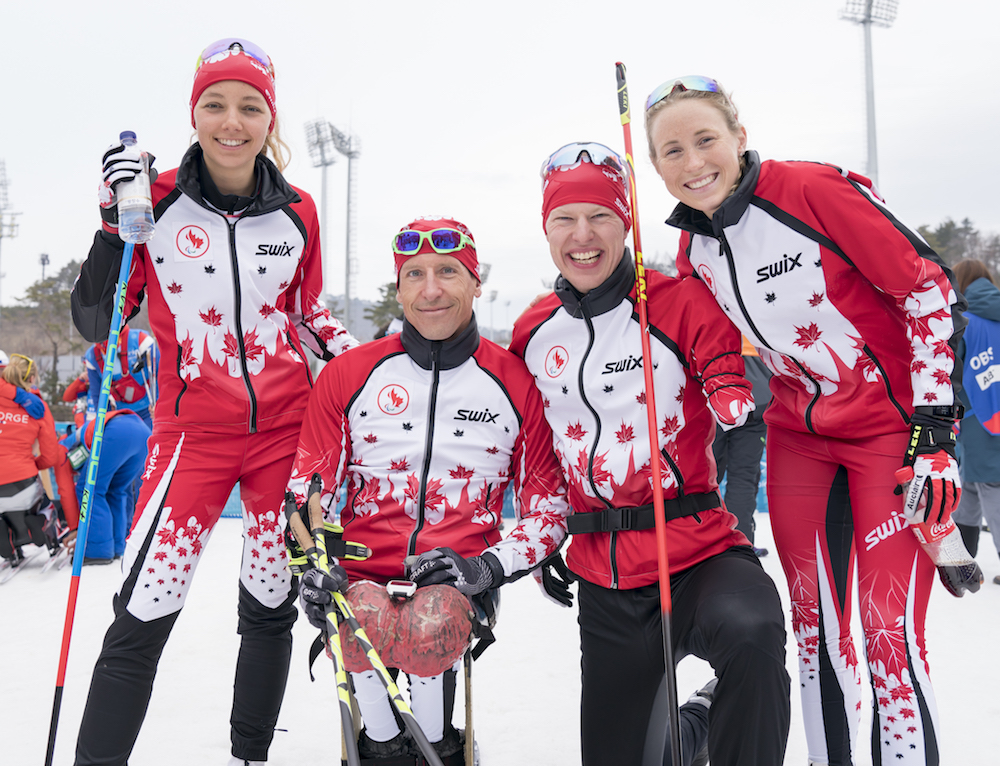
Canada’s mixed relay after taking silver on the last day of the 2018 Paralympics in PyeongChang, South Korea, with (from left to right) Natalie Wilkie, Chris Klebl, Mark Arendz and Emily Young. (Photo: Dave Holland/Canadian Paralympic Committee)
2018 Winter Paralympics (PyeongChang, South Korea): Mixed and open relays
On the final day of the PyeongChang Paralympic Games, Canada was the only country to medal in both the mixed and open cross-country relays, and its mixed relay anchor, Mark Arendz, became the most decorated Canadian at a single Winter Paralympics with his sixth medal of the week.
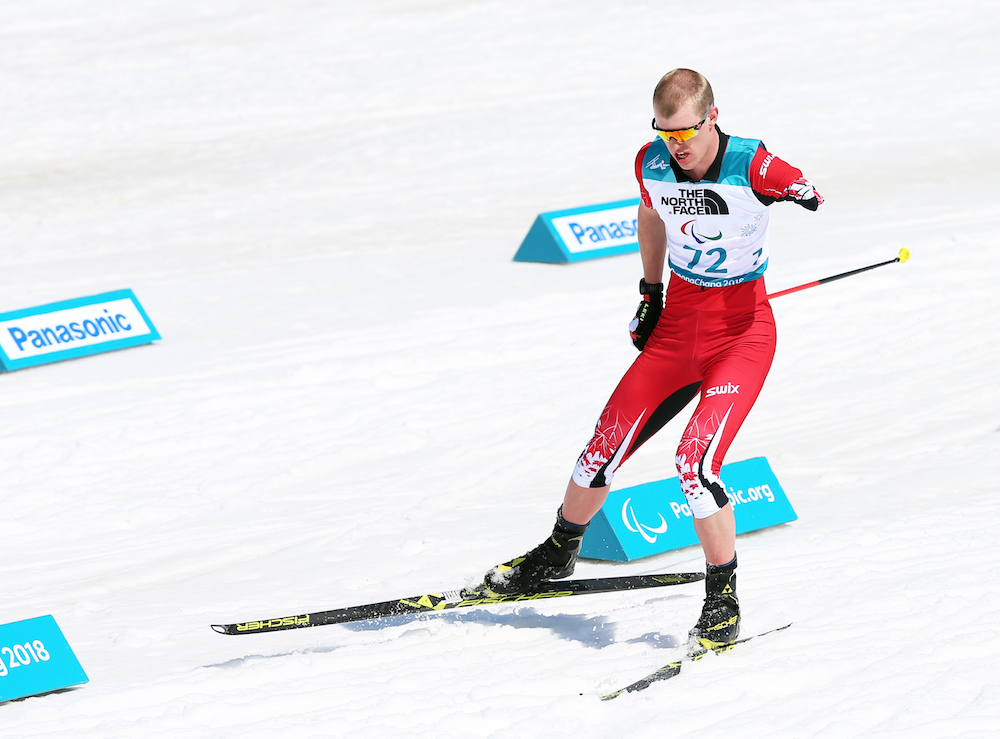
In the 4 x 2.5-kilometer mixed relay on Sunday, Natalie Wilkie, Emily Young, Chris Klebl, and Arendz teamed up for silver, 50 seconds behind Ukraine (Iurii Utkin, Liudmyla Liashenko, Yuliia Batenkova-Bauman, and Oksana Shyshkova), which claimed gold in 24:31.9 minutes. On the final skate leg, Arendz held off Germany (Andrea Eskau, Steffen Lehmker and Alexander Ehler) by 3.4 seconds at the line.
Wilkie and Young, standing athletes coming off gold and bronze in Saturday’s 7.5 k cross-country race, started the team off for the first two classic legs. Wilkie, 17, also earned an individual bronze at these Games. While Wilkie tagged Young in fifth, Young went on to tag Klebl, a 2014 Paralympic champion sit-skier, in seventh place.
“Our team worked so well together,” Young said of the relay, according to a Cross Country Canada press release. “It looked a little scary in the beginning, but we knew we had Chris in third and Mark anchoring which was going to be the difference. We each held our own in our individual sections and it is so fun to win this one as a team.”
Klebl, 46, made up 27 seconds on the field and tagged Arendz in fourth. Arendz then caught and passed Japan’s Taiki Kawayoke and later Germany’s Ehler on the last downhill into the finishing stretch to finish second.
“This is fantastic. It is our first relay medal ever,” Arendz, 28, told Cross Country Canada. “It is great to end the Games with a historic moment that we get to share with each other for the rest of our lives. This is a great team of two veterans and two rookies. I’m so happy we were able to get this done.”
Arendz, who elected flag bearer of the Canadian Paralympic Team for Sunday’s Closing Ceremony, is taking home a gold medal from the 15 k biathlon race, two silvers, and three bronze medals. He competed in all but one race throughout the week, skipping the distance cross-country race.
“I came in here thinking I could get three medals, but to get six is incredible,” Arendz said. “Today’s is a special one. I am happy we got this done, but there is no way I could do another race. I’m done.”
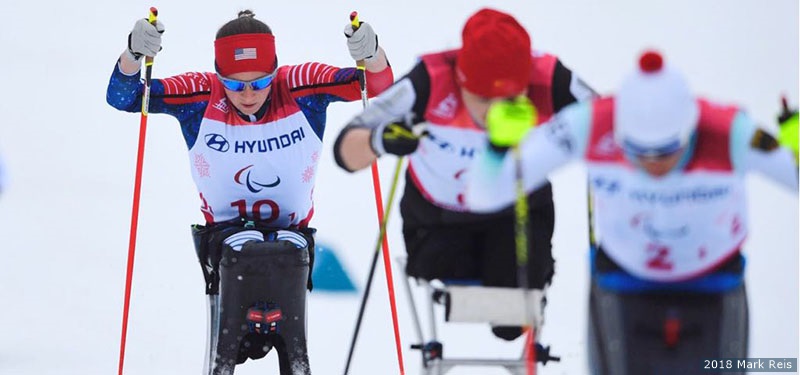
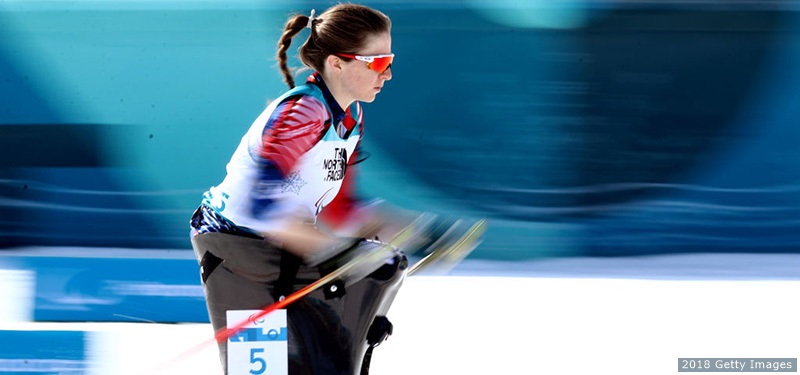
American Kendall Gretsch (l) racing in the 4 x 2.5 k open relay at the 2018 Paralympic Winter Games in PyeongChang, South Korea. (Photo: U.S. Paralympics/Mark Reis)
The U.S. team, with Kendall Gretsch, Ruslan Reiter, Jake Adicoff (and guide Sawyer Kesselheim) placed seventh in the mixed relay, 1:35.7 out of first. Gretsch skied both the first and third legs and tagged Adicoff in ninth out of 13 teams at the last exchange.
“It’s a little bit nerve-wracking and a little bit fun,” Adicoff said of skiing the anchor leg. “They did an awesome job on the first three legs.”
In the 4 x 2.5 k open relay an hour later, Canada raced to bronze with two athletes: sit-skier Collin Cameron and visually impaired skier Brian McKeever (and his guides Graham Nishikawa and Russell Kennedy).
The duo finished 1:05.8 behind France, which placed first with Benjamin Daviet, Anthony Chalencon and Thomas Clarion in 22:46.6. Norway finished 22.5 seconds back for silver, with Nils-Erik Ulset, Hakon Olsrud and Eirik Bye.
Ukraine (Iaroslav Reshetynskyi, Olha Prylutska, Grygorii Vovchynskyi, and Anatolii Kovalevskyi) crossed the line in third but was penalized 30 seconds for an early exchange and slipped to fifth (+1:26.3), while Canada moved into third and Belarus placed fourth (+1:23.7).
Canada’s open relay after taking bronze on the last day of the 2018 Paralympics in PyeongChang, South Korea, with (from left to right) Graham Nishikawa (guide), Collin Cameron, Russell Kennedy (guide), and Brian McKeever. (Photo: Dave Holland/Canadian Paralympic Committee)
Early in the race, Cameron tagged McKeever in eighth at the first exchange, and McKeever and his guide raced up to fourth. On the third leg, Cameron was skiing in third until he dropped a pole on the last climb and had to turn around to recover it. He came through the last exchange in sixth, 25 seconds behind Ukraine in third. McKeever went on to crossed the finish line fourth place, but his team was awarded bronze after Ukraine was penalized for tagging outside the exchange zone.
The bronze medal was Cameron’s third of the week after he placed third in two biathlon races earlier in the week. For McKeever, Canada’s most decorated Winter Paralympian of all time who won all three individual cross-country races he competed in over the last week, it was the 17th medal of his Paralympic career.
“I just tried to pace it properly and be as fast as I could. It was so much fun,” Cameron, 28, told Cross Country Canada. “This is my first relay, so I was really looking forward to this. I am super happy to leave here with three medals.”
“It’s incredible to get two relay medals today,” McKeever, 38, said. “We knew we had a shot if we all had really good days. What Mark, Chris and the girls did in that first relay was awesome. These races are so interesting with all different disabilities together. It is never over until last tour around, and in both cases, we saw that today with lots of different lead changes out there.”
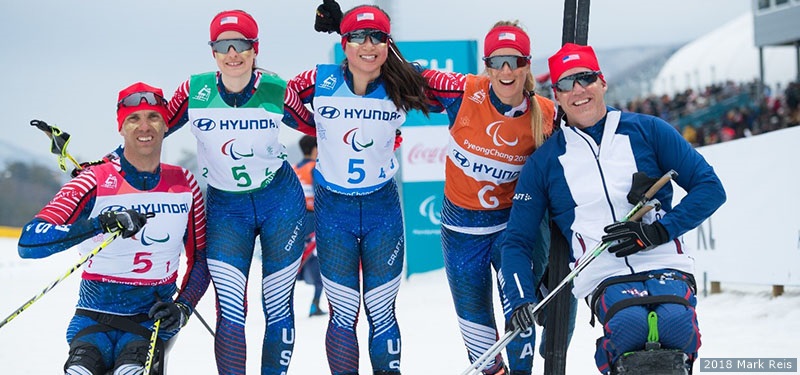
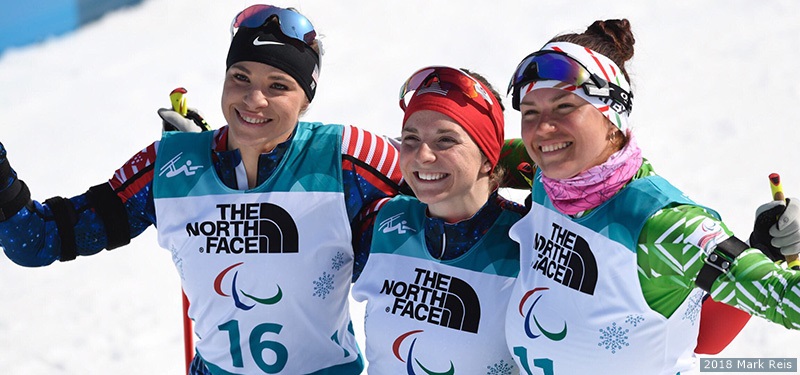
The U.S. open relay at the 2018 Paralympics in PyeongChang, South Korea, with (from left to right) Andy Soule, Grace Miller, and Mia Zutter, Kristina Trygstad-Saari (guide), and Sean Halsted. (Photo: U.S. Paralympics/Mark Reis)
The U.S. team, with Andy Soule, Sean Halsted, Grace Miller, and Mia Zutter (and guide Kristina Trygstad-Saari), placed 12th in the open relay out of 12 teams.
“It’s been an amazing Paralympic Games,” Soule, 38, told U.S. Paralympics Nordic. “The organizers have put on a great event. This is a great team to be involved with. We’ve had a lot of fun here. This is my last Paralympic race, but we have a couple of young athletes here. We’ll have a great team for a long time.”
In total, both the Canadian and U.S. Paralympic teams tallied 16 medals between nordic and biathlon in PyeongChang — a record for both programs. Notably, every member of Canada’s Para-Nordic World Cup Team is taking home at least one medal.
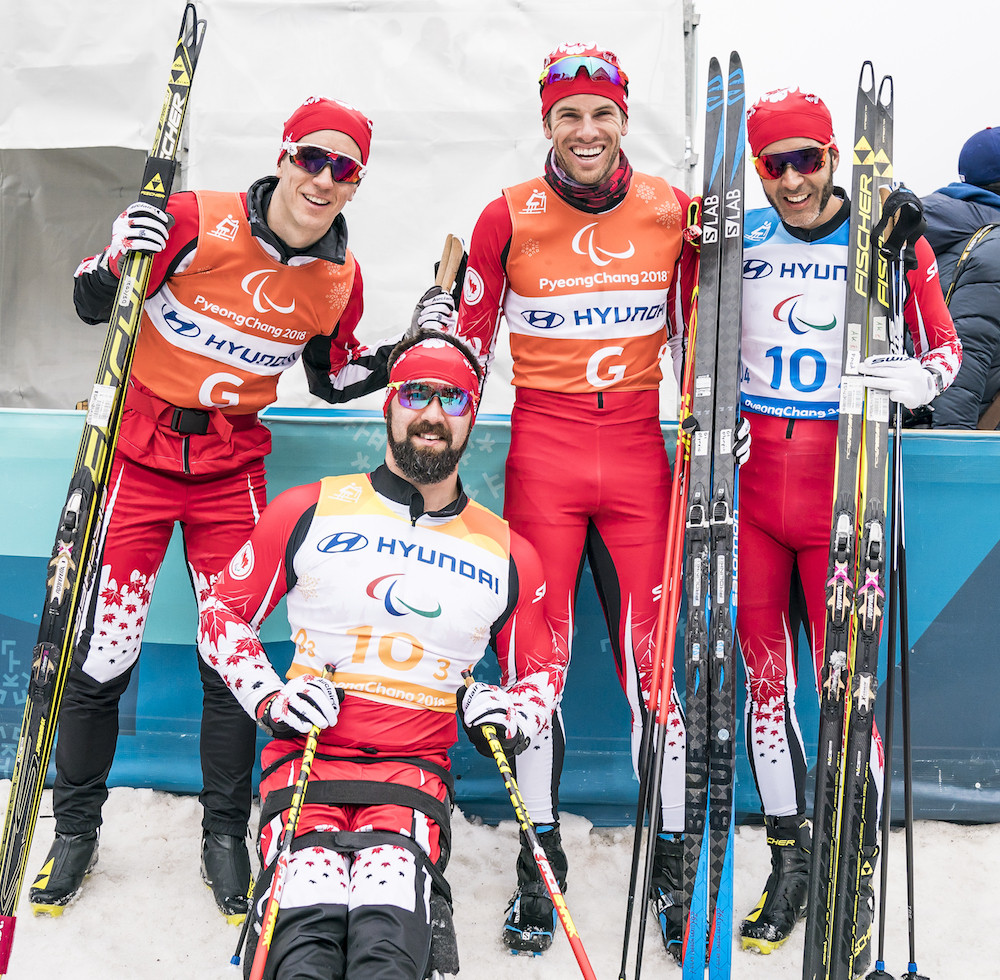
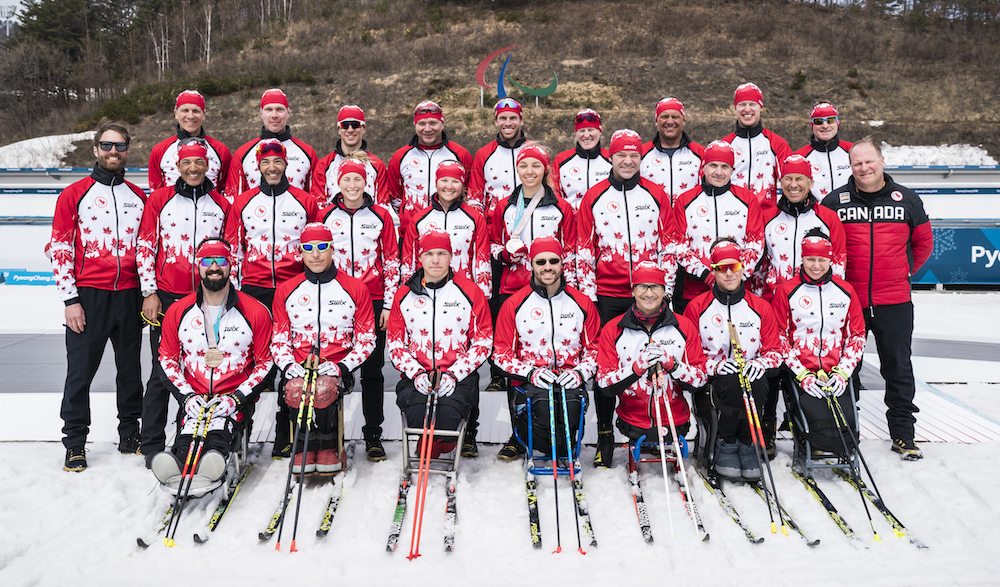
Canada’s 2018 Paralypmic cross-country and biathlon team at the Alpensia Biathlon Centre on the last day of the Games in Pyeongchang, South Korea. (Photo: Dave Holland/Canadian Paralympic Committee)
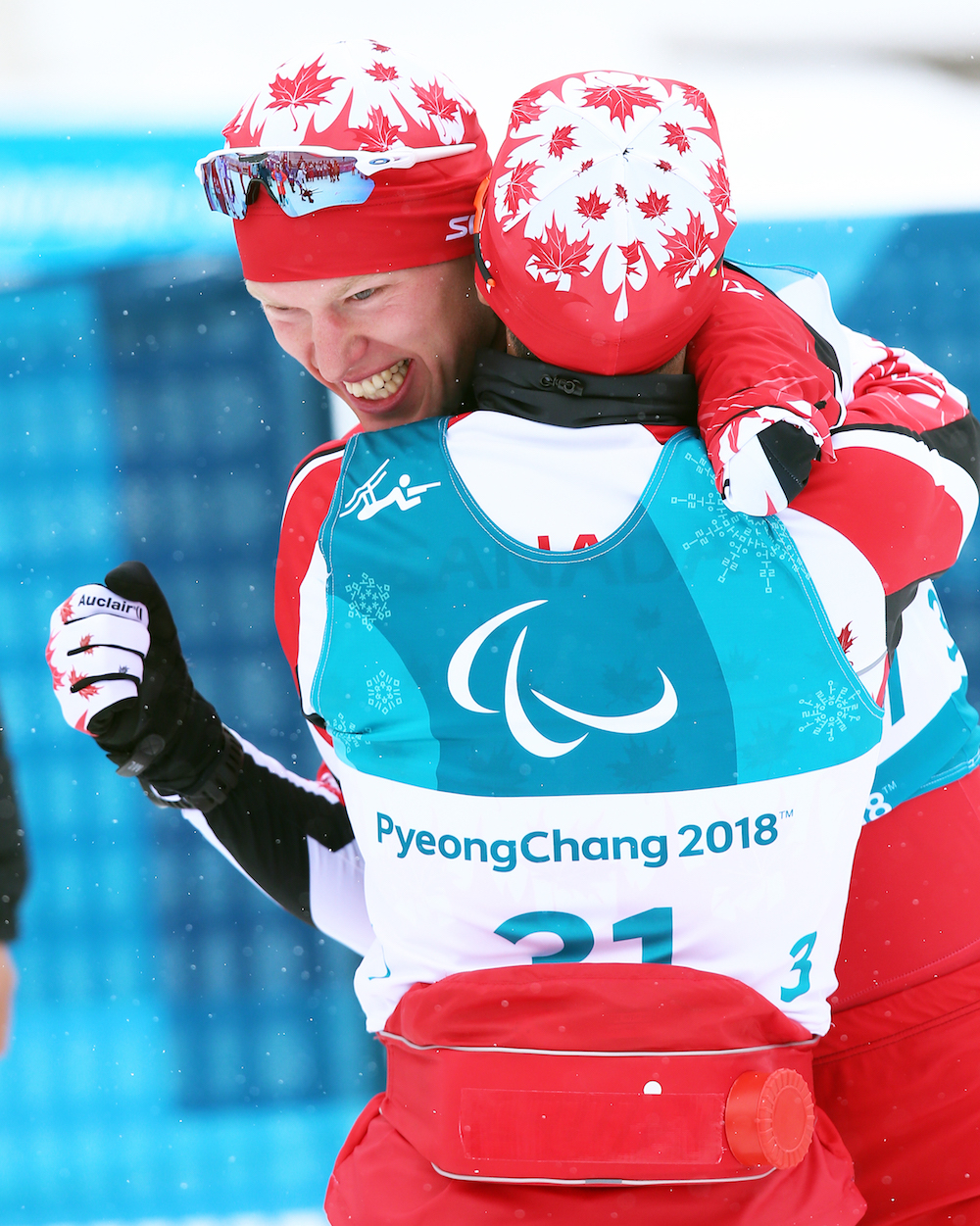
Canada’s Mark Arendez gets a congratulatory hug after he won gold in the men’s 15 k standing biathlon individual race on Friday at the 2018 Paralympics in PyeongChang, South Korea. (Photo: Scott Grant/Canadian Paralympic Committee)
2018 Winter Paralympics (PyeongChang, South Korea): 12.5/15 k biathlon races
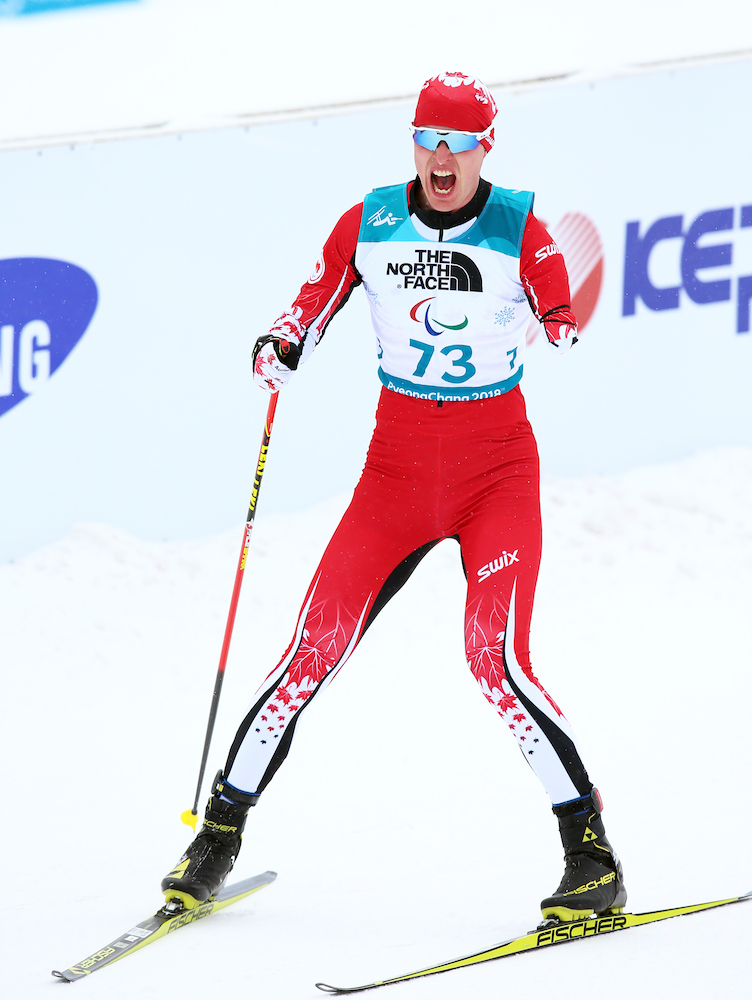
Mark Arendez lets out his trademark roar as he crosses the finish line of the men’s 15 k standing biathlon individual on Friday at the 2018 Paralympics in PyeongChang, South Korea. He won for his first Paralympic gold and sixth-career Paralympic medal. (Photo: Scott Grant/Canadian Paralympic Committee)
Canada’s Mark Arendz captured his first Paralympic gold, the sixth Paralympic medal of his career and his fourth medal of the PyeongChang Games on Friday in the men’s 15-kilometer individual standing biathlon race — the longest and final biathlon event on the schedule.
Meanwhile, Dan Cnossen of the U.S. continued his medal streak with his fifth medal in as many races, taking silver in the men’s 15 k sitting biathlon. His teammate Oksana Masters raced to silver for her fourth medal of the 2018 Games in the women’s 12.5 k sitting biathlon, and two Canadians earned bronze with Collin Cameron placing third in the men’s 15 k sitting and Brittany Hudak taking her first Paralympic medal in the women’s 12.5 k sitting.
Arendz, 28, who placed second and third in two biathlon races at the 2014 Paralympics and once again finished second and third in two previous biathlon events at these Games, cleaned all four shooting stages to secure the win in 42:52.2 minutes. France’s Benjamin Daviet took silver, 58.3 second back, after missing one target (0+0+1+0) and having a minute penalty added to his time. Norway’s Nils-Erik Ulset shot clean for bronze, 1:14.5 behind Arendz.
“Every time I stepped on the podium this week, I kept thinking I want to hear ‘Paralympic Champion’ and then my name announced,” Arendz told Cross Country Canada, according to a press release. “I wanted nothing more than to hear my country’s anthem played. I’ve seen the maple leaf on top of the podium three times this week, but to finally have it behind the top step of the podium for me is an amazing feeling.”
“I wanted to be consistent and focus on the process all week. This race was my strength,” he said. “It is a shooting race and you have to go clean. The process was key today, and I just tried to make sure I hit those 20 targets. Once I got to that last bout I wasn’t going to miss, so I made sure of every shot before I pulled the trigger. In the end I was clean, the skiing was strong, and that is what I wanted.
“That completes the [medal] set for biathlon, and my first gold which means everything to me,” Arendz said of the last biathlon race of the 2018 Games.
Also in that men’s standing individual race, American Ruslan Reiter placed 15th with nine penalties.
Silver for Cnossen, Masters; Second Bronze for Cameron
American Dan Cnossen racing to second in the men’s 15 k sitting biathlon individual at the 2018 Paralympics in PyeongChang, South Korea. (Photo: U.S. Paralympics/ Maddie Meyer-Getty Images)
In the men’s sitting biathlon event on Friday, Cnossen and Cameron raced to second (+45.5) and third (+1:01.9), respectively, behind Germany’s Martin Fleig in first. Fleig shot clean and finished in 49:57.2, while Cnossen missed one in the last stage (0+0+0+1) and Cameron had a single miss in the second shooting (0+1+0+0). The silver was Cnossen’s third of these Paralympics, and he medaled in every biathlon race in PyeongChang (taking gold in the 7.5 k and silver in the 12.5 k).
“This is special because, for one, the conditions were so difficult,” Cnossen explained in an interview with U.S. Paralympics Nordic. “It’s snowing, it’s cold. It’s 30-40 degrees colder than yesterday. I’m getting a little bit tired. I had a bit of a mental battle this morning waking up. I was considering pulling out of the race because I really want to be fresh for tomorrow, so to overcome that and still put up a really solid performance is really quite good. I wish I could have cleaned that last stage – I missed one shot. Then I just really tried to hammer on that last lap.”
While the biathlon races are over, Saturday holds middle-distance cross-country races in PyeongChang.
“I have an excerpt that says it doesn’t matter how you feel today, it doesn’t matter what your background is or where you’re coming from, all that matters is what you can do,” said Cnossen, a 37-year-old retired Navy SEAL who was awarded a Purple Heart and a Bronze Star with Valor from the Secretary of the Navy for his service in combat.
“I just tried to focus on what I could do today,” he continued. “Not the fact that I didn’t sleep well last night, that doesn’t matter. Just go out there and perform like I know I can.”
“I have an excerpt that says it doesn’t matter how you feel today, it doesn’t matter what your background is or where you’re coming from, all that matters is what you can do.” — Dan Cnossen, U.S. Paralympian and former Navy SEAL, after racing to his fifth medal of the 2018 Paralympics
Collin Cameron racing to his second bronze of the 2018 Paralympics on Friday in the men’s 15 k sitting biathlon individual in PyeongChang, South Korea. (Photo: Scott Grant/Canadian Paralympic Committee)
Cameron, 29, achieved his second bronze medal of the Games after placing third in the biathlon sprint then coming close in fourth in Wednesday’s cross-country sprint.
“This is awesome. This one is the sweetest one for sure,” Cameron said, according to a team press release. “That was a little redemption after the sprint day because I really wanted that one.
“I got very little sleep last night. I just couldn’t seem to settle,” he continued. “My coach told me some of the best athlete performances have happened after a bad night of sleep. I told myself to just settle down. I got the bugs out in that first lap, focused on pacing in every lap and just kept pushing.
“I came here wanting to get on the podium in cross country, and I’m going home with two biathlon medals. I didn’t expect that at all,” Cameron added.
Also in that men’s sitting biathlon race, Aaron Pike placed sixth with perfect shooting and Andy Soule finished ninth with four penalties (0+0+4+0).
In the women’s sitting biathlon individual, both Masters and Germany’s Andrea Eskau shot clean, but Eskau completed the course faster to claim gold in 49:41.2. Masters finished 18.8 seconds back for silver, her second biathlon medal of the Games, and Lidziya Hrafeyava of Belarus finished third (+1:15.8) with one penalty (0+1+0+0).
American Oksana Masters celebrates as she finishes second in the women’s 12.5 k sitting biathlon individual race on Friday at the 2018 Paralympics in PyeongChang, South Korea. (Photo: U.S. Paralympics/Simon Bruty-OIS/IOC)
“I went from getting a sunburn a couple days ago during the sprints to freezing right now,” Masters, 28, said of Friday’s conditions to U.S. Paralympics. “The skiing is great, our skis are amazing, the team is amazing putting together some fast skis. I’m so happy I got a chance to redeem myself from the last biathlon race I didn’t get to finish.”
Masters did not finish the women’s 10 k biathlon race earlier in the week. She has been racing with an elbow injury throughout the Games.
“The way I looked at it, I wasn’t going to get defeated by this elbow,” she said. “I definitely know I wasn’t skiing at 100 percent, but I wanted to see where I was. I’ve trained four years, the day after Sochi ended. I counted the days, it was like 1,461 days – not that I’m counting – but I was not going to let that basically take away from my Games experience here.”
As for hitting all 20 targets on Friday, Masters said she was in the zone.
“I just focused on that ‘breathe, exhale, pause, squeeze,’ which is everything I’ve been training and practicing,” she said. “I couldn’t believe it. I almost fell going around the corner telling my coach ‘I cleaned!’ I can’t believe it.”
In three biathlon races in PyeongChang, the U.S. team tallied seven medals. Going into these Games, the U.S. had one biathlon medal (Soule’s bronze from 2010) in the history of the Paralympics and Olympics.
In the women’s 12.5 k standing biathlon race, Hudak notched her first Paralympic medal and Canada’s first in a women’s standing biathlon event in third place, 2:23.9 behind Anna Milenina of the Neutral Paralympic Athletes (NPA) in first and 1:20.1 behind Ekaterina Rumyantseva (NPA) in second. While Milenina overcame two minutes of penalties (0+1+0+1) to take gold in 38:56.8 and Rumyantseva had two misses as well (0+2+0+0), Hudak shot clean.
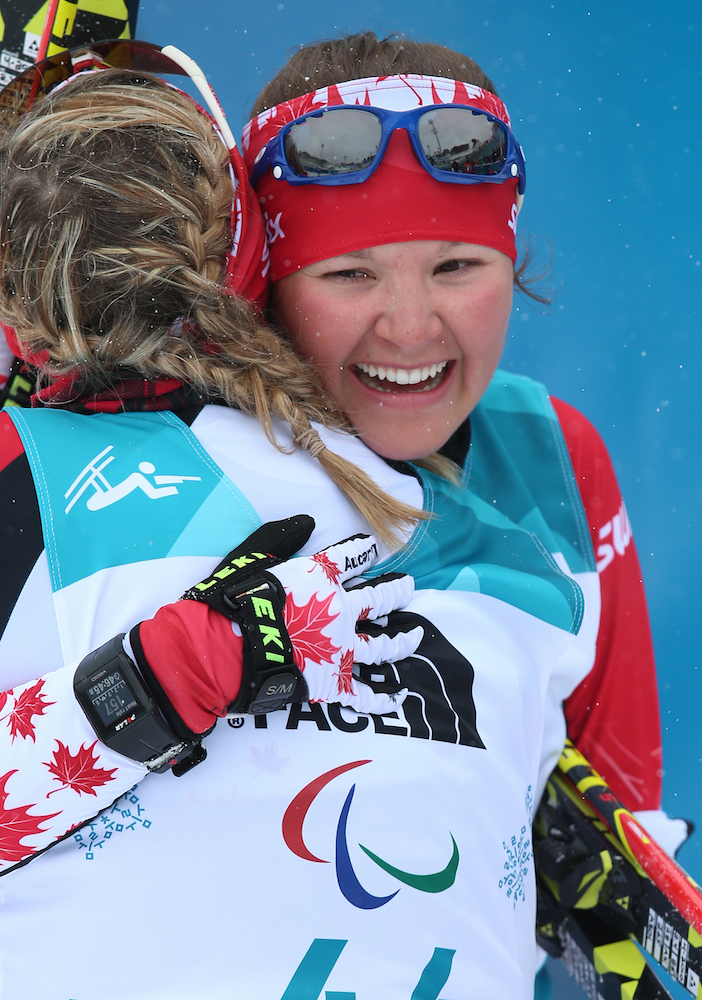
Brittany Hudak hugging her teammate Emily Young after Hudak placed third for her first Paralympic medal on Friday in the women’s 12.5 k standing biathlon individual in PyeongChang, South Korea. (Photo: Scott Grant/Canadian Paralympic Committee)
“This is such an unreal day. There are so many emotions,” Hudak said, according to the team press release. “I just tried to think about the process throughout the race. I wanted to focus on shooting because I knew it was going to make a difference today.”
As she left the range in fourth after her last shooting stage, Hudak got a lift from her teammate Emily Young, who pushed to catch her and pull her around the final loop. Together, they clawed back five seconds and Hudak finished third, 3.7 seconds ahead of Ukraine’s Iryna Bui in fourth.
“I’m just so lost for words. It is so incredible,” Hudak, 24, said. “I knew I was in the medal mix heading into that last lap. Everyone was screaming at me to keep going. Emily kept yelling at me the whole way around, and I just tried to hang onto her. I was breathing so hard and gave it everything I had. I was so tired at the finish and wanted to collapse.”
Young finished the race in seventh with two penalties (1+0+1+0).
“I was hearing the splits around the course, and I knew after my second round of shooting I was out of the top four and there was a big gap,” Young, 27, reflected. “I just chased Britt down on the course, and once I caught her, started screaming at her to follow me and not get dropped. I was breaking the wind for her the whole way. I was pretty tired on that last lap, but just kept skiing hard and screaming at her to follow. I don’t know where I found the energy.
“She did awesome. Britt is my right-arm girl,” Young added. “I’m so proud of her. We both work so hard and I know how many hours she put into this. I’m just as excited for her as I would be for myself.”
The Paralympics enter their final weekend with middle-distance cross-country races on Saturday, starting at 10 a.m. Korea time (9 p.m. EDT on Friday), and conclude with mixed and open relays on Sunday.
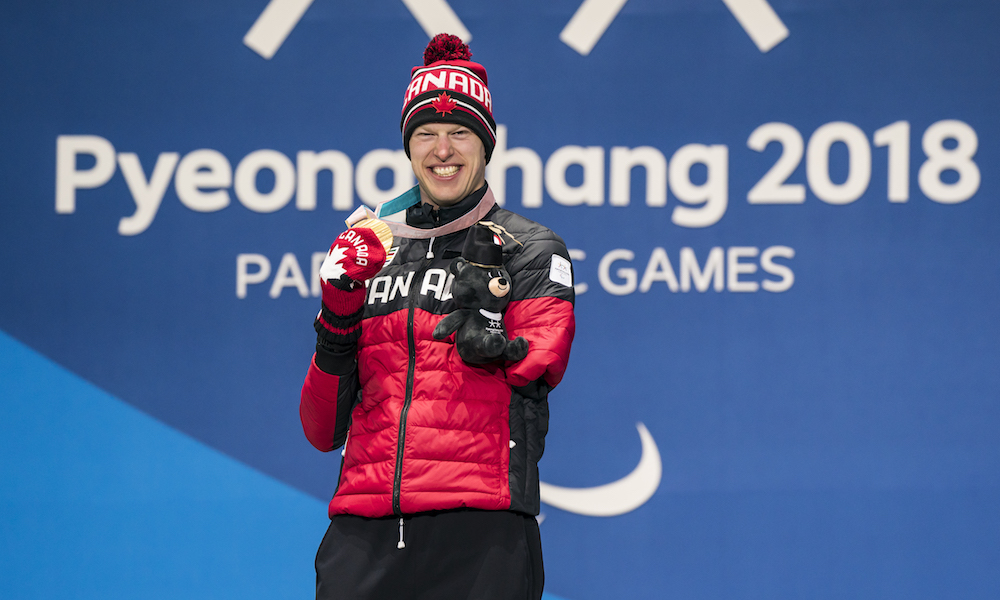
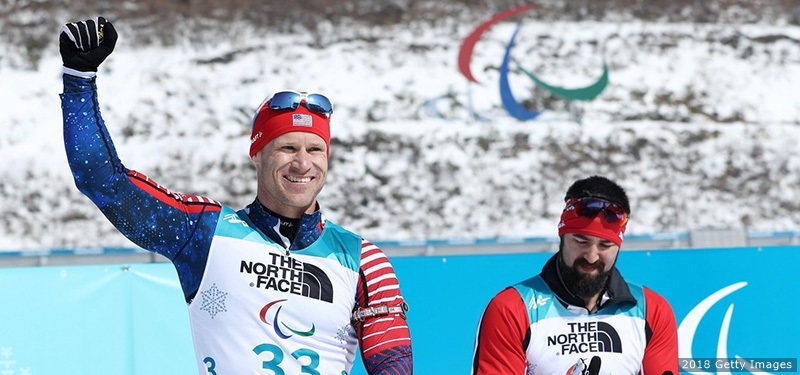
Canada’s Mark Arendz with his first Paralympic gold medal after winning the men’s 15 k standing individual biathlon race on Friday at the 2018 Paralympics in PyeongChang, South Korea. (Photo: Dave Holland/Canadian Paralympic Committee)
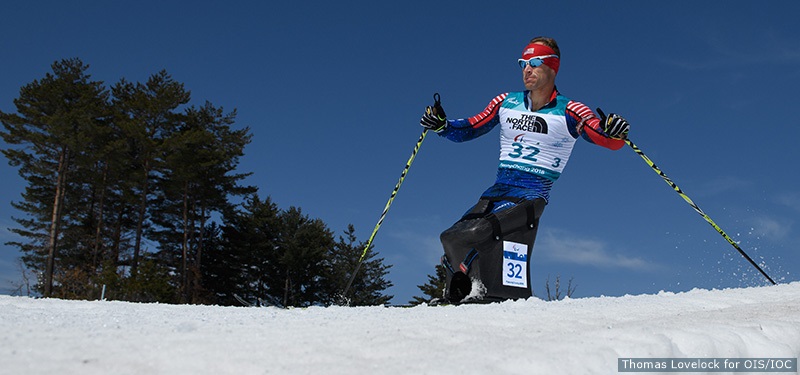
American Dan Cnossen racing to silver in the men’s 12.5 k biathlon sitting on Tuesday and his third medal in as many races at the 2018 Paralympics in PyeongChang, South Korea. (Photo: U.S. Paralympics/Thomas Lovelock – OIS/IOC)
2018 Winter Paralympics (PyeongChang, South Korea): 10/12.5 k biathlon races
Amid soft and slow conditions at the Alpensia Biathlon Centre on Tuesday, American Dan Cnossen raced to his third-straight medal in as many races at the 2018 Paralympics, claiming silver in the men’s 12.5-kilometer sitting biathlon race just ahead of his U.S. Paralympics Nordic teammate and fellow military veteran Andy Soule, who earned bronze.
Cnossen, a retired Navy SEAL, previously won gold in Saturday’s 7.5 k biathlon sprint and silver in Sunday’s 15 k cross-country race. Despite wind gusts up to 15 miles per hour on Tuesday, Cnossen hit all 20 of his targets and finished second, 1:01.7 minutes behind Ukraine’s Taras Rad, who won in 45:35.6 with clean shooting as well.
“Personally, this was such an important breakthrough, to shoot 20 for 20, especially on the last shooting stage,” the 37-year-old Cnossen said, according to a U.S. Paralympics press release. “I’ve had some mental blocks in the past where I overthink things or get a little anxious, so I really took my time, especially on the last two shots. I wanted to get my heart rate down and make sure the wind wasn’t blowing. It feels really good to overcome this mental hurdle. I just wanted to see what I could do today, and have my own race, and not worry about what other people are doing.”
Soule, a 38-year-old Army veteran, missed two on his third shooting stage (0+0+2+0) to finish third, 1:33.1 out of first. It was the second Paralympic medal of his career after Soule he earned bronze in the biathlon pursuit at the 2010 Games in Vancouver, British Columbia.
“I was really skiing at an aggressive pace,” Soule told U.S. Paralympics on Tuesday. “I was struggling to hold it together at the range those last two shootings. When I missed those two, I also knew that I had seen other people missing. I knew a miss or two wasn’t going to necessarily put me out of it. I knew I just needed to get back up, set the same aggressive pace, and maybe back it off just a little earlier on the next lap to make sure I get the shots. It came together just fine.”
It was another special moment for the U.S. Paralympics program with two of its leading men on the podium.
“I’m really happy for our whole team, to see how much success we’re having,” Soule said. “I think it’s a testament to great coaching, great support, great staff. Lots of great work being done behind the scenes by so many people that you don’t even see who are out here long before we even arrive at the venue. It’s a great group of athletes. I’m so happy to be a teammate with these guys.”
“This race feels especially good because I have my teammate, Andy, on the podium,” Cnossen said. “I knew he was going to have a good race. I’m really proud and happy to see him on the podium.”
Also for the U.S., Aaron Pike placed seventh in that race (+5:38.1) with a single miss (0+0+0+1), Sean Halsted finished 14th (+10:35.7) with five penalties, and Bryan Price was 16th (+17:02.3) with 10 misses.
Canada’s lone man in the 12.5 k sitting biathlon race, Derek Zaplotinsky finished 12th (+9:15.3) with five penalties.
American Kendall Gretsch racing to fourth in the women’s 10 k sitting biathlon race on Tuesday at the 2018 Paralympics in PyeongChang, South Korea. (Photo: U.S. Paralympics/ Maddie Meyer – Getty Images)
Coming off two medals in the women’s sitting biathlon and cross-country events last weekend, Kendall Gretsch placed fourth in the 10 k sitting biathlon race on Tuesday, 16.5 seconds out of third. According to a U.S. Paralympics press release, she fell three times and incurred three penalties (1+0+0+2), finishing 2:05.4 behind the winner, Germany’s Andrea Eskau.
A four-time gold medalist in Paralympic cycling with two silver medals in cross-country skiing (from two Winter Paralympics), Eskau, 46, claimed her first gold of the PyeongChang Games in 42:36.6 with one miss (0+0+1+0). Marta Zainullina and Irina Guliaeva, of the Neutral Paralympic Athletes (NPA), took silver (+1:15.5) and bronze (+1:48.9), respectively, with Zainullina skiing just one penalty lap and Guliaeva having to ski three.
Oksana Masters did not finish, pulling out after 8.64 k with six penalties (1+2+1+2).
Second Medal for Arendz
Canada’s Mark Arendz racing to bronze in the men’s 12.5 k standing biathlon race on Tuesday at the 2018 Paralympic Games in PyeongChang, South Korea. (Photo: Scott Grant/Canadian Paralympic Committee)
Mark Arendz led Canada with his second medal in the second biathlon race, the men’s 12.5 k standing, racing to bronze, 30.9 seconds out of first. Arendz cleaned three stages before missing one on his last shooting (0+0+0+1), causing him to ski an additional 150 meters in the penalty lap.
France’s Benjamin Daviet won that race in 38:55.5 with one late penalty as well (0+0+0+1), and Ukraine’s Ihor Reptyukh collected silver (+6.7) with one miss as well (0+0+1+0).
“I knew there were some tired guys, so I went for it from the start and tried to put some pressure on,” Arendz, 28, said in a Cross Country Canada press release. “I decided in that last bout to go for it all, throw it down, and go for the win. Unfortunately, I had the one miss and it made it a tight and interesting race.”
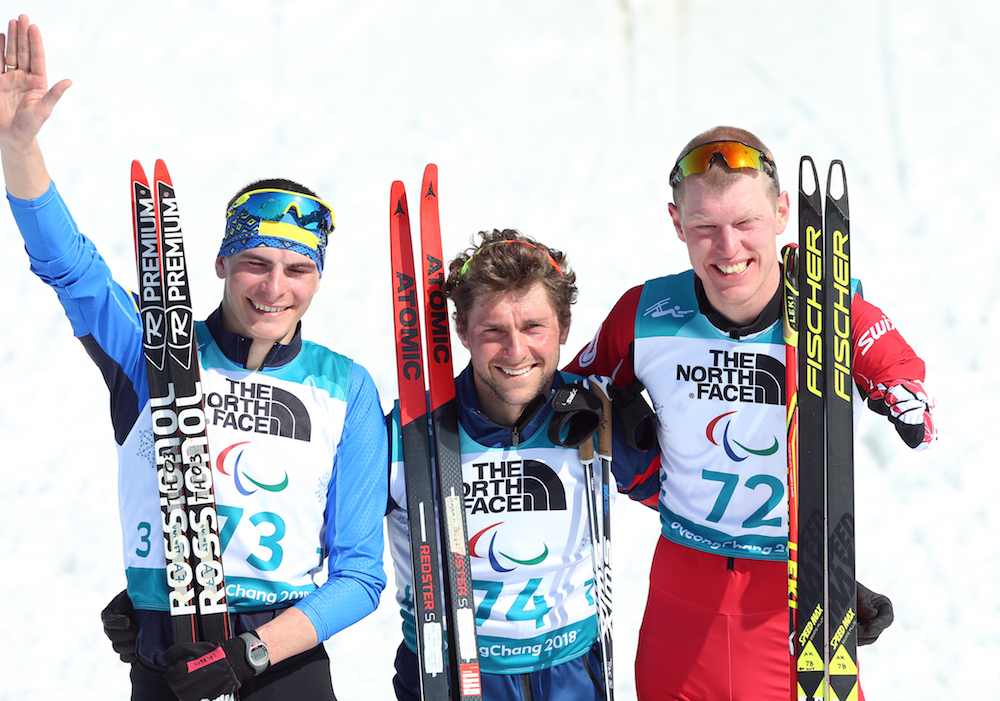
The men’s 12.5 k standing biathlon podium at the 2018 Paralympics in PyeongChang, South Korea, with France’s Benjamin Daviet (c) in first, Ukraine’s Ihor Reptyukh (l) in second, and Canada’s Mark Arendz (r) in third. (Photo: Scott Grant/Canadian Paralympic Committee)
Arendz, who took silver in the opening biathlon sprint and also has two biathlon silver medals from the 2014 Paralympics, is seeking his first Paralympic gold.
“It was a really tough battle all day. I handed it to them early and had a choice: to go for gold or settle for the podium. I went for the win and had that one miss that cost me today,” he said. “I ran out of energy at the end. I am really happy with my race and it is another medal for Canada. I know everything is going well. I just need that last little tweak to finally win one.”
American Ruslan Reiter finished 11th in that race (+8:41.4) with three penalties (0+2+1+1).
Brittany Hudak led the Canadian women in fifth in the 10 k standing biathlon race, 5:45.8 behind Ekaterina Rumyantseva (NPA) in first. Hudak cleaned the first three stages before missing one in the last bout (0+0+0+1).
“The first lap I felt good,” Hudak recalled in the team press release. “The skis were running well in these conditions, but then it just got slower as we went on. The flat sections you really try put power to glide the ski but your weight is sinking you into the snow. It got harder to get some glide and as my legs got more tired I didn’t feel like I was moving fast.
“I tried to keep calm in the range and take my time,” she added. “The wind today was gusting, so I took a bit longer on my setup than I usually would and tried to be consistent. For the most part it worked well until that last lap, and that last bout. Overall it was an OK race.”
Paralympic racing continues Wednesday with men’s and women’s cross-country sprints, starting at 10 a.m. Korea time (7 p.m. EDT Tuesday).
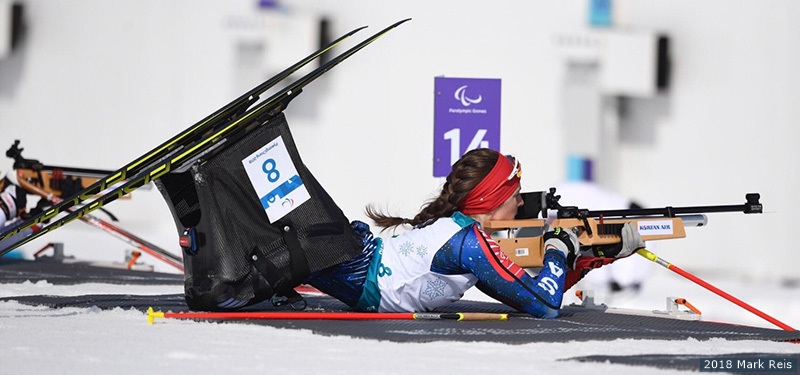
Kendall Gretsch takes aim during the women’s 6-kilometer sitting biathlon at the 2018 Paralympic Winter Games on Saturday in PyeongChang, South Korea. She won the race to become the first American woman to medal in a biathlon event at the Paralympics (or Olympics). (Photo: US Paralympics/Mark Reis)
2018 Winter Paralympics (PyeongChang, South Korea): Biathlon sprints
The 2018 Paralympic Winter Games in PyeongChang, South Korea, opened in a big way for the U.S. and Canadian Paralympic nordic and biathlon teams on Saturday, with Kendall Gretsch and Dan Cnossen winning the U.S.A.’s first-ever gold medals in biathlon, and Canada’s Mark Arendz racing to silver for his third Paralympic biathlon medal and Collin Cameron becoming the first Canadian man to medal in a Paralympic sit-ski race.
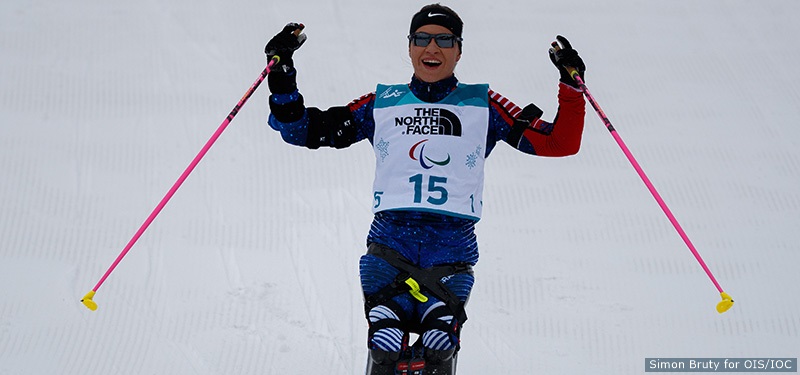
In her first Paralympics, Gretsch, a 25-year-old three-time gold medalist in paratriathlon, led U.S. teammate Oksana Masters across the line in the women’s sitting biathlon 6 k sprint, finishing in 21:52.0 with a single miss (0+1). Masters shot clean (0+0) and finished 22.8 seconds back for silver, less than three weeks after injuring her elbow.
“I’m just really excited to be here,” Gretsch said, according to a U.S. Paralympics Nordic Skiing press release. “It’s just a great way to kick off the week and hopefully [there’s] more to come. It was an awesome race.”
Her gold medal was also the first for an American woman in Paralympic nordic skiing.
“It’s incredible,” Gretsch said. “For the U.S., we’ve been watching the Olympics and [Kikkan Randall and Jessie Diggins] had their historical medal for the women’s cross-country and that definitely motivated us coming here, so if I was able to do that, that’s great.
“Motivation to get a medal definitely heightened after seeing that and seeing how they pushed through all their races,” she continued. “They’re such a great team and we also have a really strong aspect of a really strong team all working together.”
The women’s 6-kilometer sitting biathlon podium on Day 1 of the 2018 Paralympics in PyeongChang, South Korea, with Americans Kendall Gretsch (c) in first and Oksana Masters (l) in second, and Lidziya Hrafeyeva of Belarus (r) in third. (Photo: US Paralympics/Mark Reis)
At the 2014 Paralympics in Sochi, Russia, Masters earned silver and bronze in cross-country skiing events. She also took a bronze medal in rowing at the 2012 Summer Paralympics.
“I am so happy, I feel like I just won my gold medal, basically. I’m so happy to be on the podium,” Masters, 28, told U.S. Paralympics after her first Paralympic biathlon medal.
“I was told I was not going to be able to race,” Masters said of her injury just before the Games. “I was basically fighting for a chance at the start line. I dug as deep as I could for my team and I’m happy to be standing on the podium next to Kendall.
“It’s amazing to have team USA having not only its first female biathlon medal but the first female Paralympic gold, followed by a silver,” she added. “It gives me goosebumps. It could not have been a better feeling.”
In his second Paralympics, Cnossen, a 37-year-old retired Navy SEAL, achieved his first medal — gold — in the men’s sitting biathlon 7.5 k sprint in 23:49.7. With a single miss (0+1), he skied in the top three throughout Saturday’s race before beating Belarus’s Dzmitry Loban, who also had a penalty (1+0), by 7.3 seconds for the win.
American Dan Cnossen (l) celebrates gold on Day 1 of the 2018 Paralympics in PyeongChang, South Korea, next to Canadian bronze medalist Collin Cameron. (Photo: US Paralympics/Getty Images)
Cnossen’s previous best in Sochi was sixth in the cross-country sprint and 10th in the biathlon individual race. He is also a world championships para-cyclist pursuing his second graduate degree from Harvard University.
“I would say Andy Soule was the trailblazer,” Cnossen said of his teammate’s bronze medal from the 2010 Paralympics in Vancouver, British Columbia. “When I was new on the team, he was the inspiration, and I know he’s going to pop a good race here as well.
“In the race, I just wanted to see what I can do, not worrying about anything else,” he explained. “In the last Games that I did in Sochi, I let the TV screens and the announcer get to me and today I just focused on what I can do and nothing else matters. I crossed the line and I wasn’t even going to look at the board and I was pleasantly surprised at the end.”
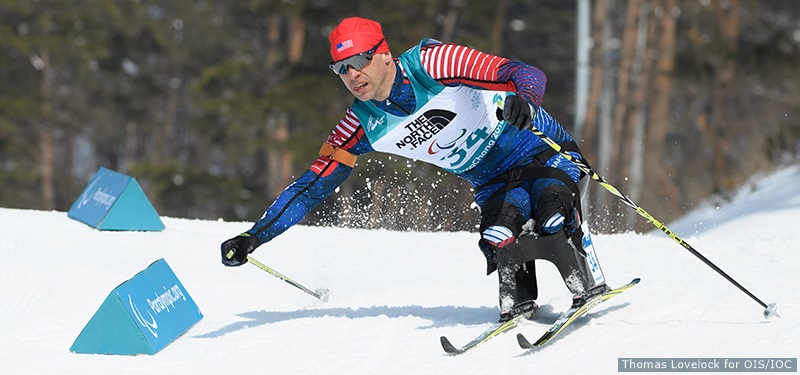
American Andy Soule racing to eighth in he men’s 7.5 k sitting biathlon sprint at the 2018 Paralympics in PyeongChang, South Korea. (Photo: US Paralympics/Thomas Lovelock for OIS/IOC)
With a total of nine Americans in the top 20 — Soule placed eighth, Aaron Pike 12th, Joy Rondeau 14th, Ruslan Reiter 16th, Jeremy Wagner 19th, and Bryan Price 20th — Cnossen said the best was yet to come. With the exception of Reiter, who competes in the standing division, all of those results came in Saturday’s sitting biathlon races.
“We have such an amazing team,” Cnossen said. “The way they’ve recruited new athletes, developed the waxing protocol — it’s really showing. This is just the start and we have six more races including the relays to go. It’ll be exciting.”
Silver + Bronze for Canada
In his third Paralympics, Arendz, 28, opened with a silver medal in the men’s standing biathlon 7.5 k sprint, matching his result in that event in Sochi four years ago. He shot clean and finished in 18:25.9 on Saturday, 30.8 seconds behind France’s Benjamin Daviet, who also cleaned the two-stage race and won in 17:56.6.
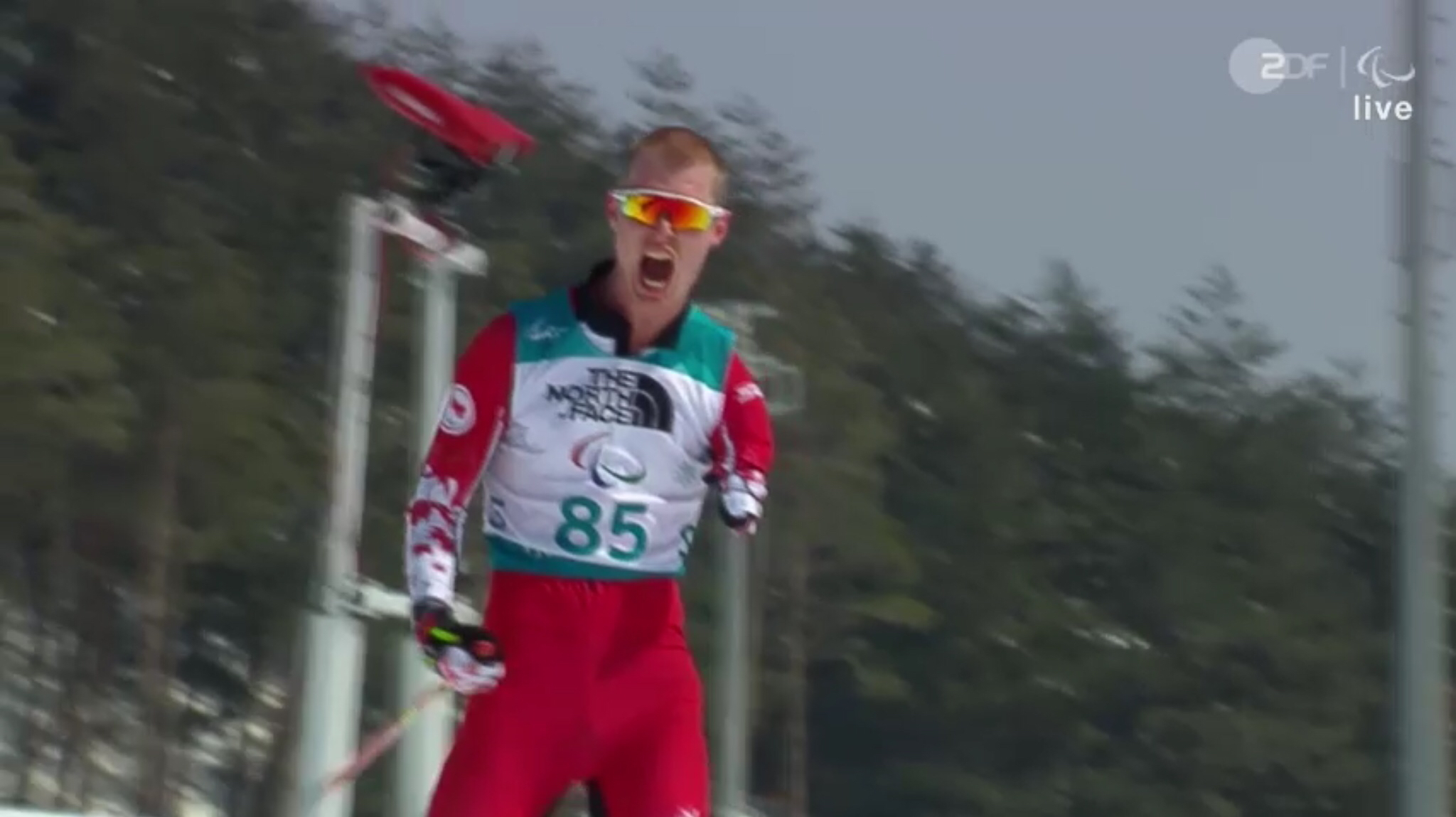
Canada’s Mark Arendz crossing the line for silver in the men’s standing biathlon 7.5 k sprint on Saturday at the 2018 Paralympics in PyeongChang, South Korea. (Screenshot: ZDF broadcast)
“Coming across the line I thought I had it,” Arendz said, according to a Canadian team press release. “I’m really happy with the day. It was an awesome race for me, but someone was just a little faster.”
Earlier in the day, Cameron, 29, raced to bronze in the men’s sitting sprint, missing one target (0+1) and finishing 9.7 seconds behind Cnossen in first.
“I got to the venue and saw Collin’s name at the top of the standings in his final lap of the sit-ski race,” Arendz recalled. “I cheered him on up his final hill and I took a lot of energy from watching him win his first ever Paralympic medal this morning.”
A former sledge hockey player, Cameron started skiing three years ago. In achieving his first Paralympic medal, he became the first Canadian male biathlete to reach the podium in sit skiing at the Paralympics.
“This is crazy. I didn’t expect this today,” Cameron said according to the press release. “I felt really great getting down on the mat and was in position every time. It got me on the podium today, and it is absolutely crazy.
“When I was coming into the range for the second time, I heard on [my coach John Jaques’s] radio when he bent down to give me my rifle that I was in third, and I missed that shot,” he added. “I took a breath and got the rest – then I just went for it. Coming up that final hill, the whole team was just screaming at me and I went as hard as I could.
“Everything came together today, and I don’t know why,” Cameron continued. “I think just the build up through the season. I was progressively getting snappier and faster, and all the work John spent with me in Sudbury. We focused on race procedure and that paid dividends today. It is such a fun course here.”
In the women’s 6 k standing biathlon sprint, Canada’s Emily Young placed seventh with a single miss (0+1), just ahead of teammate Brittany Hudak in eighth with two penalties (1+1).
Racing in PyeongChang continued Sunday with men’s and women’s sitting cross-country long-distance events, starting at 10 a.m. Korea time (8 p.m. EST on Saturday).
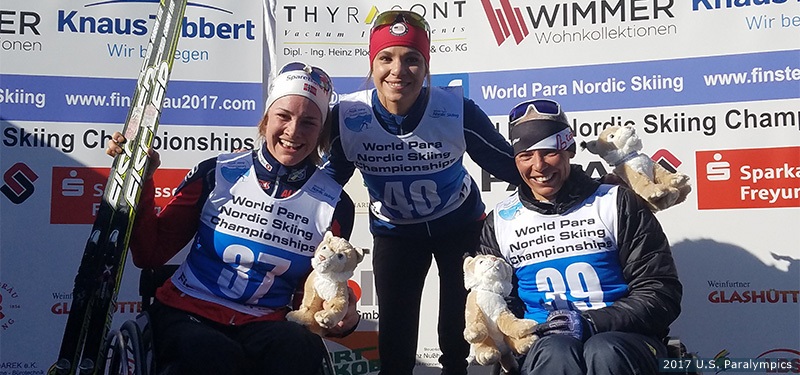
American Oksana Masters (c) after winning her second-straight cross-country race of 2017 IPC World Championships on Thursday in Finsterau, Germany. She is joined on the podium by Norway’s Birgit Skarstein (l) in second and Germany’s Andrea Eskau in third. (Photo: U.S. Paralympics)
After a rest day, Paralympic athletes returned to the nordic venue in Finsterau, Germany, for Days 3, 4, and 5 of the 2017 International Paralympic Committee (IPC) World Nordic Skiing Championships. Long-distance biathlon races took place Tuesday, cross-country relays on Wednesday and individual cross-country races on Thursday.
***
At the finish of Tuesday’s 15-kilometer individual biathlon race, Canada’s Mark Arendz could only think about one thing: his miss. But later, with his second 2017 World Championships medal, this one silver, around his neck after finishing in 39:21.9 minutes, the miss in his final stage (0+0+0+1) was no longer on his mind.
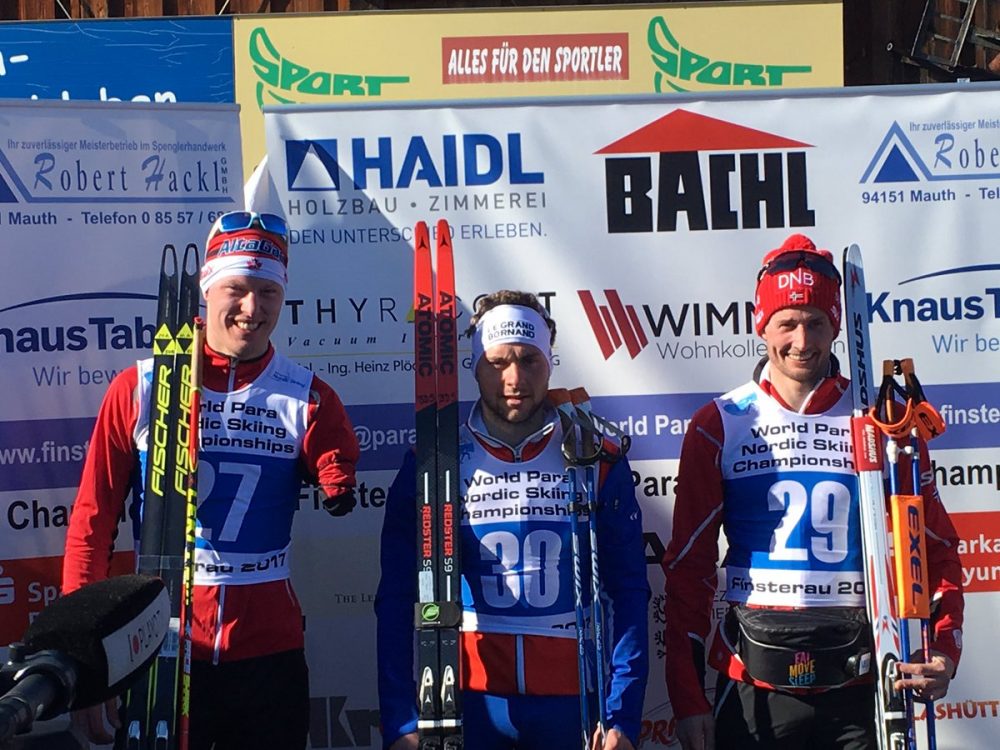
Left to right: Canada’s Mark Arendz, France’s Benjamin Daviet and Norway’s Nils-Erik Ulset on the podium for the men’s 15 k biathlon standing event held on Tuesday, Feb. 14 at the 2017 IPC World Nordic Skiing Championships in Finsterau, Germany. (Photo: Robin McKeever/Twitter)
“After crossing the finish line, all I could initially think about was the single miss (in shooting), and the fact I let the gold slip through my fingers,” Arendz said, according to a Canadian Para-Nordic Skiing press release. “But I quickly warmed up to the fact that I had won a World Championship silver medal.”
Finishing ahead of Arendz for first place was France’s Benjamin Daviet who also shot 19-for-20 and covered the course in time of 38:33.7.
“I am very happy and honoured. This is great and what I came here for,” Daviet said according to an IPC press release. “I will not celebrate because there are many races ahead. I hope to win more medals in Finsterau.”
Norwegian Nils Erik Ulset claimed the final podium spot, finishing third in a time of 40:26.7 after two penalties (1+0+1+0).
In the women’s 12.5 k standing biathlon event, Ukraine’s Liudmyla Liashenko came away with the win. She missed just one shot (1+0+0+0) and finished in a time of 39:10.0.
“I am really happy. I want to dedicate this triumph to all my family, friends and all who have supported me all along this journey,” Liashenko said according to an IPC press release.
In her first podium appearance, Japan’s Momoko Dekijima claimed second in 42:49.3 after two misses (1+1+0+0). Third place went to Ukraine’s Iryna Bui, who finished in 43:53.1 with three penalties (0+2+0+1).
Canada’s Brittany Hudak raced to fifth with a single miss (0+1+0+0), finishing in 44:14.9.
Racking up another gold medal on his home turf, Germany’s Martin Fleig took the win in the men’s 15 k sitting biathlon race in 44:39.4 with one miss (0+0+1+0).
“I did not expect this,” Fleig said according to an IPC press release. “I had a good feeling in the morning but could not imagine the race would be so perfect. It is unbelievable that now I am a two-time world champion. It is awesome.”
Earning silver behind Fleig was Taras Rad of Ukraine, who had four penalties (2+1+0+1) and finished in 48:01.3. Trygve Steinar Larsen of Norway earned bronze, finishing in 49:07.9 with three penalties (2+0+0+1).
Just missing the podium with a career-best fourth was American Aaron Pike, who finished in 51:10.2 with five penalties (1+0+1+3). Canada’s Derek Zaplotinsky placed just behind Pike in fifth for his personal best, finishing in 53:28.1 with four misses as well (0+1+2+1).
Behind them, American Andy Soule finished in seventh in 54:26.7 with nine penalties (2+2+2+3).
Right to left: American Oksana Masters, Germany’s Anja Wicker and Ukraine’s Lidziya Hrafeyeva on top of the podium for the women’s 12.5 k sitting biathlon event on Tuesday at the 2017 IPC World Nordic Skiing Championships in Finsterau, Germany. (Photo: Oksana Masters/Twitter)
Germany earned another victory at home in the women’s 12.5 k sitting biathlon event, with Anja Wicker returning to the podium, this time in first place.
“I am super happy, my biggest dream came true. I was hoping this would happen, it was a perfect day for me,” Wicker said according to an IPC press release. “Whilst I was still competing, I heard that Martin [Fleig] had already won gold and that motivated me to do the same.”
Wicker finished in 43:07.3 with one miss (0+0+1+0). Behind her in second place was Belarus’s Lidziya Hrafeyeva, who finished in 46:05.2 after three penalties (0+2+1+0).
American Oksana Masters also returned to the podium for her first biathlon medal of the week, finishing in 46:43.7 with four misses (2+2+0+0).
Earning the gold medal in the men’s 15 k visually impaired biathlon race was Vasili Shaptsiaboi of Belarus, who finished in 40:47.3 with just one miss (0+0+0+1). Ukraine took the final two podium spots, with Anatolii Kovalevskyi earning silver in 41:55.2 and one miss (0+1+0+0) and his teammate Vitaliy Lukyanenko finishing just behind him for bronze in 42:21.2, also with one penalty (1+0+0+0).
Ukraine’s Oksana Shyshkova finally found her gold on Tuesday, winning the women’s visually impaired 12.5 k biathlon event after shooting clean and finishing in a time of 38:26.6.
“After winning two silvers in Finsterau, I am happy to finally take gold,” Shyshkova said according to an IPC press release. “Now I have to focus on the next events, do my job, give my best and the results will come as a consequence.”
Silver went to Germany’s Clara Klug in a time of 43:58.2 with two missed shots (0+0+0+2), while Ukraine’s Olga Prylutska earned bronze in a time of 45:16.0 after six misses (1+4+0+1).
Wednesday, the fourth day of racing at the 2017 IPC World Nordic Skiing Championships was marked by mixed and open relays. The U.S. did not field a team, as no standing American athletes are present at this competition series. Canada entered a team in the open relay event.
***
Canada made history on Wednesday earning its first World Championships relay medal with Brian McKeever, Emily Young and Arendz.
McKeever, a visually impaired racer, started first. He tagged off to Young, a standing skier, and Arendz, also in the standing category, and back to McKeever. The quartet finished third in 24:53.4 just 57.5 seconds away from the win.
“It is pretty awesome to have such a great result today with the boys, and finally snag my first World Championship medal,” Young said, according to a team press release.
Young was one of the only women racing amidst the top teams.
“Being one of the only girls out there, it was tough to ski against the men’s field but I gave my best effort, and that was all I could do,” Young said, according to a CCC press release. “I just had to remember to ski my race, and know that I would likely fall behind a bit. I skied the fastest so far on this course. It was a very exciting race and I am very proud of the team.”
The win went to France in a time of 23:55.9, with standing skier Daviet leading the team, followed by visually impaired skier Anthony Chalencon, Daviet again and then standing skier, Thomas Clarion.
Norway took second place, 23.8 seconds behind France, with standing skier Ulset racing the first leg for the team, standing skier Hakon Olsrud taking the second leg, Ulset the third and visually impaired skier Eirik Bye anchoring the team.
In the mixed 4 x 2.5 k relay, it was Ukraine’s team comprised of visually impaired skier Iurii Utkin, who skied the first leg, followed by the three standing skiers Liashenko, Iuliia Batenkova, and Oleksandra Kononova. The Ukrainian team finished in a time of 26:56.5 for the win.
“This is a really good result, we made a huge effort to achieve this,” Ukrainian head coach Andriy Nesterenko said according to an IPC press release.
Sweden earned silver, with standing skier Helene Ripa and visually impaired skier Zebastian Modin racing for the team. The duo completed the event in a time of 27:17.5, just 21 seconds back from first place.
The final mixed relay podium spot went to Belarus, with sit skier Dzmitry Loban leading the first leg, followed by visually impaired racer Sviatlana Sakhanenka. Sit skier Valiantsina Shyts raced the third leg, and visually impaired skier Mikita Ladesau anchored the team to finish in a time of 28:12.3.
Canada’s Brian McKeever (third from r) with his guide Graham Nishikawa (third from left) after winning his second medal of 2017 IPC World Championships and 18th career World Championships gold on Feb. 16 in Finsterau, Germany. (Photo: Robin McKeever/Twitter)
Day 5
Just four days after she earned her first World Championships gold, Masters, of the U.S. Paralympics Nordic A-team, repeated the feat on Thursday, earning her second gold medal of the week.
Masters, 27, raced to first place in the women’s 12 k sitting cross-country event, finishing in 36:01.0. She outlasted Norway’s Birgit Skarstein, who finished second in 36:51.7, as well as Germany’s Andrea Eskau in third (37:00.0).
“I had some nerves going into the race today, but I used them to motivate me,” Masters said, according to a U.S. Paralympics press release. “I felt good and am really happy with how today went.”
In the men’s 15 k sitting cross-country event, Ukraine’s Maksym Yarovyi took the win, finishing in 40:32.4. Eui Hyun Sin of South Korea earned silver, finishing in 40:56.7, while Germany’s Fleig nabbed the the final podium spot in third (41:05.4).
Racing for the U.S., Soule narrowly missed the podium in fourth place, finishing in 41:36.4. Two Canada’s Collin Cameron placed seventh in 42:12.1 and Sebastien Fortier was 10th in 44:29.0.
Germany’s Carina Edlinger claimed gold in the women’s 15 k visually impaired event, ahead of Ukraine’s Shyshkova and Prylutska.Edlinger finished in a time of 55:40.1 for the win, Shyshkova in 57:11.9 and Prylutska in 1:00:01.8.
Racking up his 18th World Championships gold on Thursday was Canada’s 37-year-old McKeever, who won the men’s 20 k visually impaired race in 57:35.4.
“Graham skied really, really well today,” McKeever said of his guide, Graham Nishikawa, according to a team press release. “In fact he put me in an uncomfortable place for a large portion of the race, and I may have done the same for him in spots. There are different sections where we felt really good, and then others poorly. You are just comfortable with certain terrain, but it was really, really hot today and that just makes it tough to be relaxed when it is like that. It is a constant mental battle.”
Finishing behind McKeever in second was Sweden’s Modin in 1:00:24.6. Norway’s Bye claimed the final spot in third (1:00:58.8).
In the women’s 15 k standing cross-country race, Ukraine’s Kononova took the win, completing the course in a time of 51:56.9. Her Ukrainian teammate, Batenkovaearned silver, finishing in 53:38.1, while Liashenko rounded out the all-Ukranian podium in third (53:59.4).
Finishing just off the podium in fourth was Canada’s Young, after completing the course in 54:21.3. Behind her in fifth was her Canadian teammate Hudak, finishing in 55:53.9.
Ukraine earned another gold, this time on the men’s side, with Ihor Reptyukh taking first place in the men’s 20 k standing cross-country event. Reptyukh finished in 58:03.1, while Finland’s lkka Tuomisto placed just behind him in second (58:39.1). Third went to Yoshihiro Nitta (58:51.6).
Canada’s Arendz ended the day in fifth (59:34.4).
“The most exciting part for me is watching these young guys like Brittany and Emily killing it in classic, or watching Collin who has become a superstar over year in just his second year,” McKeever said in the press release. “I’m old has heck, but you see these development guys come in and all you can do is give them the toolbox to achieve success and show them the door, but they have to open it. These guys are and they are nailing it.”
Two days of racing remain for the 2017 IPC World Championships, with biathlon sprints on Saturday and middle-distance cross-country races on Sunday.