Tag: Benjamin Weger

  • Medal Matches the Rifle: Johannes Bø Captures 20 k Olympic Gold; Scott Gow 14th

    Norway’s Johannes Thingnes Bø celebrates his first Olympic medal — gold — in the men’s 20 k individual on Thursday at the 2018 Olympics in PyeongChang, South Korea. (Photo: FlyingPointRoad)

    FasterSkier would like to thank Fischer Sport USAMadshus USAConcept2Boulder Nordic Sport, and Swix Sport US for their generous support, which made this coverage possible.

    ***

    Johannes Thingnes Bø came into these Olympics as a definite favorite, right up there with Martin Fourcade. But PyeongChang quickly humbled the 24-year-old Norwegian, just as it did Fourcade, in the first race of the 2018 Winter Games. There, in the men’s 10-kilometer sprint, Fourcade finished eighth, missing three out of five in his first shooting stage, and Bø had the same problem with prone — missing three then shooting another penalty in standing — to end up 31st. It was the kind of result no one saw coming after those two had taken first or second in every non-relay World Cup race this season (except for one, the sprint that Bø’s older brother Tarjei Bø won on Dec. 2 in Östersund, Sweden).

    The men’s second biathlon race of the Games, the 15 k pursuit, saw Fourcade back to his winning ways while Johannes Bø finished 21st.

    “We both [knew] before the Olympics that it will not be only a fight between us, because we know the shooting range [here] is challenging,” Fourcade said when asked about Bø in a press conference after the pursuit. “I thought that at our best level, we could be difficult to beat but the wind and the Olympic situation will bring many opportunities for outsiders to take competition… It’s not a competition about Johannes today. It’s biathlon.”

    Three days later in the men’s 20 k individual race on Thursday, Bø overcame any doubts and won his first Olympic medal in his second Games. It was gold, and he had achieved it with a time that stood up against 85 others in the men’s field. Even with two penalties that added two minutes to his final time (there are no penalty laps in the individual-format race), Bø finished the 20 k in 48:03.8 minutes and he posted the fastest overall course time of 43:11.4 in the process.

    Despite his two previous races in PyeongChang, Bø — the overall World Cup leader in the 20 k individual — explained in a post-race press conference on Thursday that he never got down on himself.

    Norway’s Johannes Thingnes Bø racing to first in the men’s 20 k individual on Thursday at the 2018 Olympics in PyeongChang, South Korea. The gold was his first Olympic medal in his second Winter Games. (Photo: IBU/Biathlonworld)

    “After the two done races, I just let my shoulders down, and I knew there were still two great opportunities for me, individual and mass start,” he said. “Two races I have won before this season, so I knew that there still was a chance even if the sprint and pursuit was my favorite before the Olympics. So I always had the belief that I could do it. And you only need one chance, so if I missed out today there would still be a chance on the mass start, and I always believed that I could make it.”

    He started Thursday’s individual race in bib 9 and was one of several of the top contenders who chose an early start because of more favorable conditions earlier in the day. It was the warmest race day yet at the Alpensia biathlon venue, and perhaps most importantly, less windy than it had been. At least that was the case early in the 20 k; the wind picked up as the race wore on.

    Bø took the attention away from himself early in the race after missing one in the first prone stage — his third shot. That put him in seventh at the time and ultimately 52nd overall. From that point on, Bø quietly worked his way back into contention, cleaning the next two stages, then missing shot in the last standing stage. But because of his speediness out on the course, he still left the range in first.

    In the finishing stretch, Bø nearly took himself out as his pole tip nicked his left ski. But he stayed upright, recollected himself and continued charging to the line. There, he finished 1:22.1 minutes clear of the previous race leader, Sweden’s Fredrik Lindström.

    “I put my pole right down on my ski,” Bø told NRK after, according to a translation. “Two to three [centimeters] to the left and I would’ve put the pole on the inside of the ski, but it would’ve went well anyway, but you never know.”

    As the rest of the starters embarked on the five-loop course and navigated the four shooting stages, it became evident that no one was going to touch Bø. He sat inside the leader’s cubicle at the venue, which had a small couch and TV to watch the rest of the race, along with a race-leader camera documenting his every move. He wasn’t glued to the screen by any means. It was probably hard for him to watch.

    France’s Martin Fourcade (23) follows Sweden’s Fredrik Lindström (1) during the men’s 20 k individual at the 2018 Olympics in PyeongChang, South Korea. Fourcade went on to place fifth while Lindström placed eighth. (Photo: FlyingPointRoad)

    Initially, Fourcade came closest to him, finishing 42.4 seconds off his time in second place. The Frenchman had been on track for his second-straight gold after cleaning the first three stages of Thursday’s race, but he missed his last two shots to slip to second behind Bø. And he couldn’t beat the Norwegian on the last loop; despite skiing the second-fastest final loop and second-fastest overall course time, Fourcade was still second to Bø, who was the fastest on both.

    “That was like a gift,” Bø said at the press conference of Fourcade’s uncharacteristic late misses. “Even if he only had missed one of the two last [shots] he would have been the winner. But, you know, someone will miss one in the first shooting and one in the last, and others make two mistakes on the last shooting, so you just have to see for the total. And we both had two mistakes today and I was a little bit faster than him and that saved my result.”

    Austria’s Dominik Landertinger racing to bronze in the men’s 20 k individual at the 2018 Olympics in PyeongChang, South Korea. (Photo: FlyingPointRoad)

    Fourcade as the 23rd starter was later bumped off the podium by Austria’s Dominik Landertinger (bib 38) and Sweden’s Sebastien Samuelsson (bib 51), respectively. While Landertinger hung on for the medals, Samuelsson missed his second-consecutive Olympic medal in fourth place (+29.1), 14.9 seconds behind Landertinger.

    While Landertinger had shot a perfect 20-for-20 and Samuelsson was one off that mark with a single penalty (0+0+1+0), the 57th starter, Slovenia’s Jakov Fak finished ahead of them both and just 5.5 seconds behind Bø for the silver medal. Like Landertinger, who earned bronze (+14.2), Fak was one of just three men who cleaned all four stages on Thursday. (Ukraine’s Artem Tyshchenko, who finished 29th, was the other.)

    Once Fak finished, Bø could finally exhale and celebrate. He had done it.

    “After the first shooting, I still believed that a medal could be won, could be possible, but after the last standing I thought I missed out on the podium,” Bø reflected at the press conference.

    “I’m glad I fought through the final lap even with two misses,” he told NRK. “Because I thought the medals wouldn’t be possible, but I felt good, and I had no problems with changing gears out in the course. And thank God I did, because I ended up with the gold in the end.”

    Bø’s previous Olympic best was fourth in the men’s relay at the 2014 Olympics in Sochi, Russia. He is a three-time world champion and won three golds at biathlon Junior World Championships, two of which came in relays in 2012 and 2013. Between that time of transitioning from the junior ranks to the World Cup in 2013, Bø became best known as the young and hard-charging biathlete with the gold-painted rifle. He later painted it pink, before going back to gold in the leadup to PyeongChang.

    “I had a pink rifle for two years and I wanted to change it before the Olympics,” Bø said at the press conference. “The first season I came into the World Cup I had a golden rifle.”

    The men’s 20 k individual podium at the 2018 Olympics in PyeongChang, South Korea, with Norway’s Johannes Thingnes Bø (c) in first, Slovenia’s Jakov Fak (l) in second, and Austria’s Dominik Landertinger (r) in third. (Photo: FlyingPointRoad)

    After stepping back outside and into the stadium, Bø began to tear up. He finally connected with his brother Tarjei, who had finished 13th with two penalties, and they embraced in a special moment.

    “It’s a great feeling,” Bø said of what it’s like to be an Olympic champion. “To describe with one word is just ‘amazing’. It’s every nice words you can find.”

    For Fak, 30, who missed all but two World Cup races last season because of health issues, he said the silver medal was a “dream come true.” Earlier this season, he placed second in two World Cup pursuits.

    “At the last Olympics in Sochi, I was sick before the Olympic Games,” Fak said at the press conference. “I fought until the last race to get some medals and my best result was fourth place in the mass start, so I missed it and it was a big struggle for me, the last two seasons were very hard. I was sick all the time. Last season I had only two starts on the World Cup and it would be better if I didn’t even have them. I had really a lot of problems and to come back into the whole season was a very big victory for me.”

    Slovenia’s Jakov Fak pushing for silver in the men’s 20 k individual at the 2018 Olympics in PyeongChang, South Korea. (Photo: FlyingPointRoad)

    After different illnesses plagued him last year — “I would train for two weeks and another sickness would come,” he recalled — Fak considered hanging up his rifle and quitting the sport. But his coach encouraged him to stick with it.

    “We made a good plan. It was not to be on the highest level on the World Cup, but just to come back,” Fak explained. “And everything that I’ve done this season, the podiums, are just a big bonus for me.”

    Landertinger, 29, earned his second Olympic bronze after helping Austria to third in the men’s relay in Sochi. He also has a relay silver from 2010 in Vancouver, British Columbia, but Thursday marked his first individual Olympic medal.

    In September, he had back surgery to repair a herniated disc, and he didn’t start his World Cup season until early last month.

    “I am really overwhelmed,” Landertinger told Austrian broadcaster ORF, according to a translation. “The last year was extremely tough. During the last races I already was a little bit despaired, and now the bronze medal, that is crazy. On the course I again did not feel good today, but I fought and put out everything I could. There were a lot of beautiful moments in my career, this medal was the most difficult one. Today I had to do it with the shooting, and that worked out.”

    Fourcade ended up fifth on the day (+42.4), Switzerland’s Benjamin Weger placed sixth (+48.6) with one penalty, the Czech Republic’s Michal Krčmář finished seventh (+1:15.5) with one miss, and Lindström was eighth (+1:22.1) with one penalty as well.

    Scott Gow’s Career-Best 14th

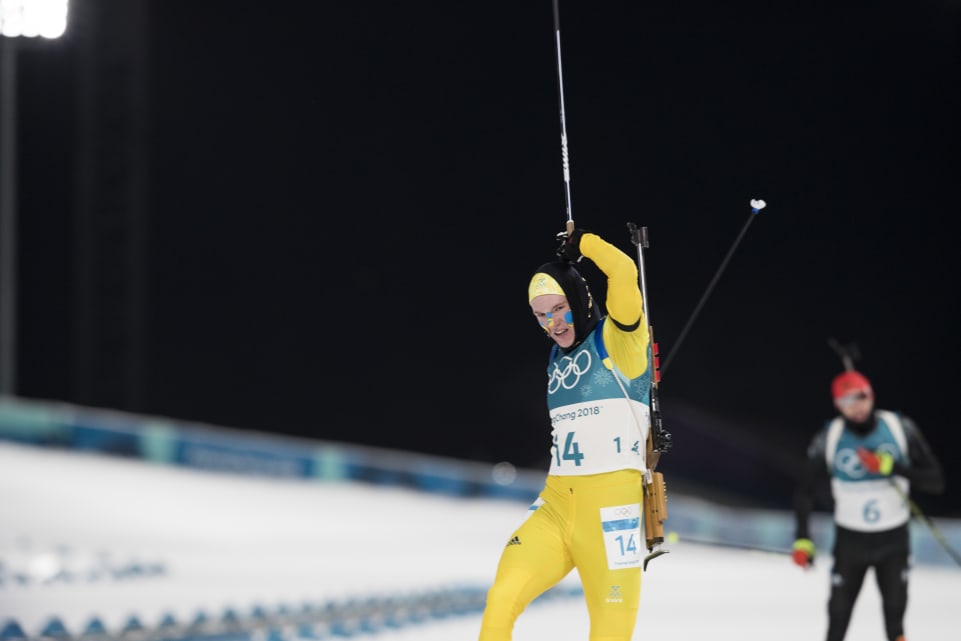
    In his first Olympics, Canada’s Scott Gow raced to 14th (+2:02.5) for his best Olympic result by nearly 50 places after finishing 61st in the PyeongChang sprint. Gow cleaned three-consecutive stages then missed his first shot on the final standing (0+0+0+1) to slip out of the top 10. Regardless, 14th was still better than his career-best World Cup result after he had finished 16th in two races this season.

    Canada’s Scott Gow racing to 14th in the men’s 20 k individual on Thursday at the 2018 Olympics in PyeongChang, South Korea. It was his career best at the World Cup and world-championships level. (Photo: FlyingPointRoad)

    “I was very happy with it,” Gow said of his result in a post-race interview with FasterSkier. “A little disappointed to miss that one standing shot, especially when everything was going quite well in the range. Skiing was pretty good, and so overall I am very happy.”

    Without having spoken with his coach yet, Gow wasn’t exactly sure where his lone miss went wrong, but he guessed it was a close one.

    “I have a feeling that I missed it just high,” the 27 year old said. “That’s usually where I miss in standing, especially when it feels good. If it feels like it was good, if it feels like it was hit, I probably missed it just high.”

    With weaker and less variable wind than in previous biathlon races this week, Gow said that presented a new challenge.

    “When it’s this calm, relatively as calm, everyone can shoot well,” he observed. “So that puts a little extra pressure and emphasis on myself to shoot well. So going into today I knew that would be have to the focus, to hit targets, because even if my skiing is a little off I can make up for it with a really good shooting. And that was what was going through my head the last few days preparing for this.”

    Looking ahead to the remaining races in PyeongChang, Gow said the hardest ones were over.

    “Now it’s the relays,” he said. “And my body feels like it’s in fairly good shape. I was happy with my skiing today, and again, my shooting was much better today and it has been good all week. So as long as I can maintain a good training mode and a good training rhythm, I think it will be good, and I am optimistic.”

    Canada’s Brendan Green racing to 22nd in the men’s 20 k individual at the 2018 Olympics in PyeongChang, South Korea. (Photo: FlyingPointRoad)

    Canada had three in the top 30 with Brendan Green in 22nd (+2:26.6), with a single miss in the last stage (0+0+0+1), and Christian Gow in 26th (+2:57.2), with two penalties (1+0+0+1). For 24-year-old Christian Gow in his first Olympics, it was a big improvement from 62nd in the sprint.

    “I think I kind of reset after the sprint. It was not even close to what I wanted,” Christian, Scott’s younger brother, told FasterSkier after. “But I guess what I realized kind of internalizing that race is that I am not defined by one race that I had. Of course of all the times that you want to perform is the Olympic Games. It was a bit of a bummer, and I looked at it as a chance to refocus for the races to come, obviously including this one.

    “I was very happy with my effort,” Christian said before he knew his final result. “I felt like I had good energy on skis and was able to push the whole time, and more than anything I am just happy with what I did out there today.”

    Canada’s Christian Gow racing to 26th in the men’s 20 k individual on Thursday for his best result at his first Olympics in PyeongChang, South Korea. (Photo: FlyingPointRoad)

    Green, 31, was also pleased with his performance after placing 82nd in the sprint four days ago.

    “I was a little worried going into today after the sprint. I mean, the sprint you had the wind, but I also had a pretty rough day on the skis as well,” he told FasterSkier. “So I was a little bit worried as to how today would play out, but I did a good race prep yesterday. I didn’t have a ton of guys to ski with today, but there were always people kind of within sight … I just tried to keep a pace that I could maintain and really focus on the shooting range.

    “I think I was really able to capitalize on these less-windy conditions that we finally had today,” Green said. “And to get away with one miss, that’s a good day for sure.”

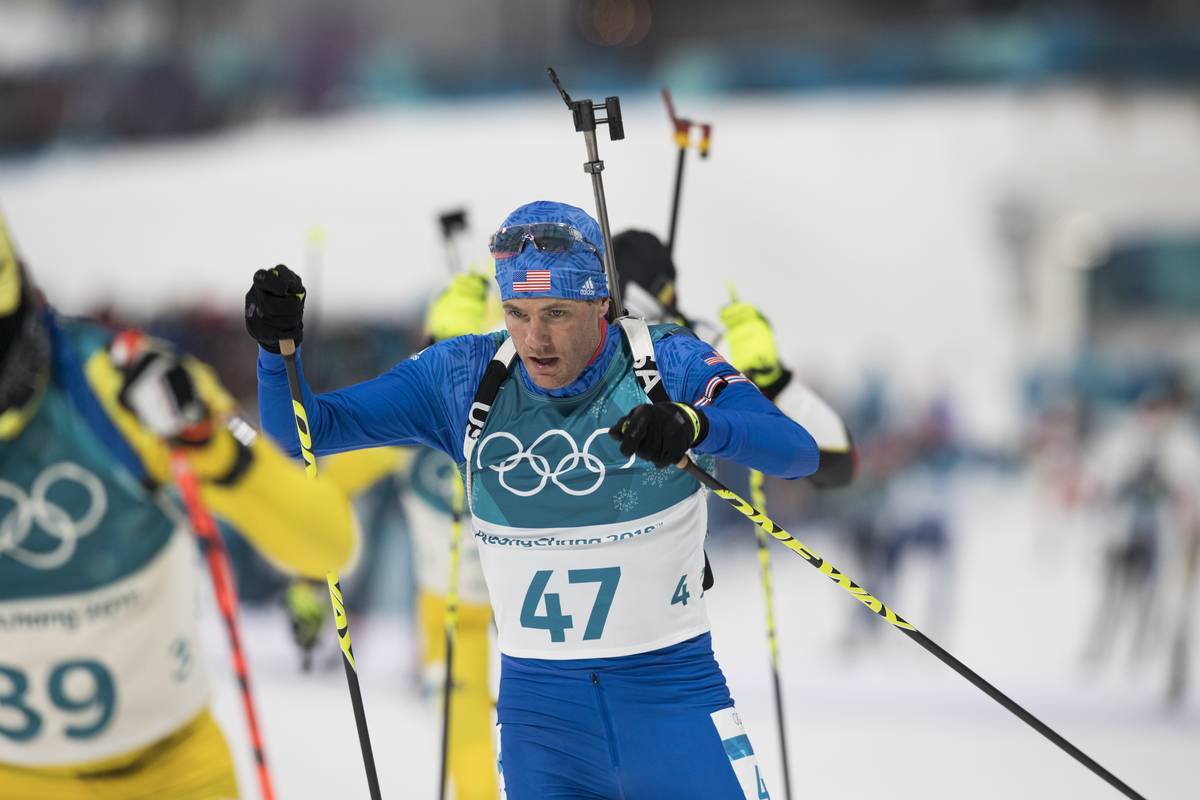
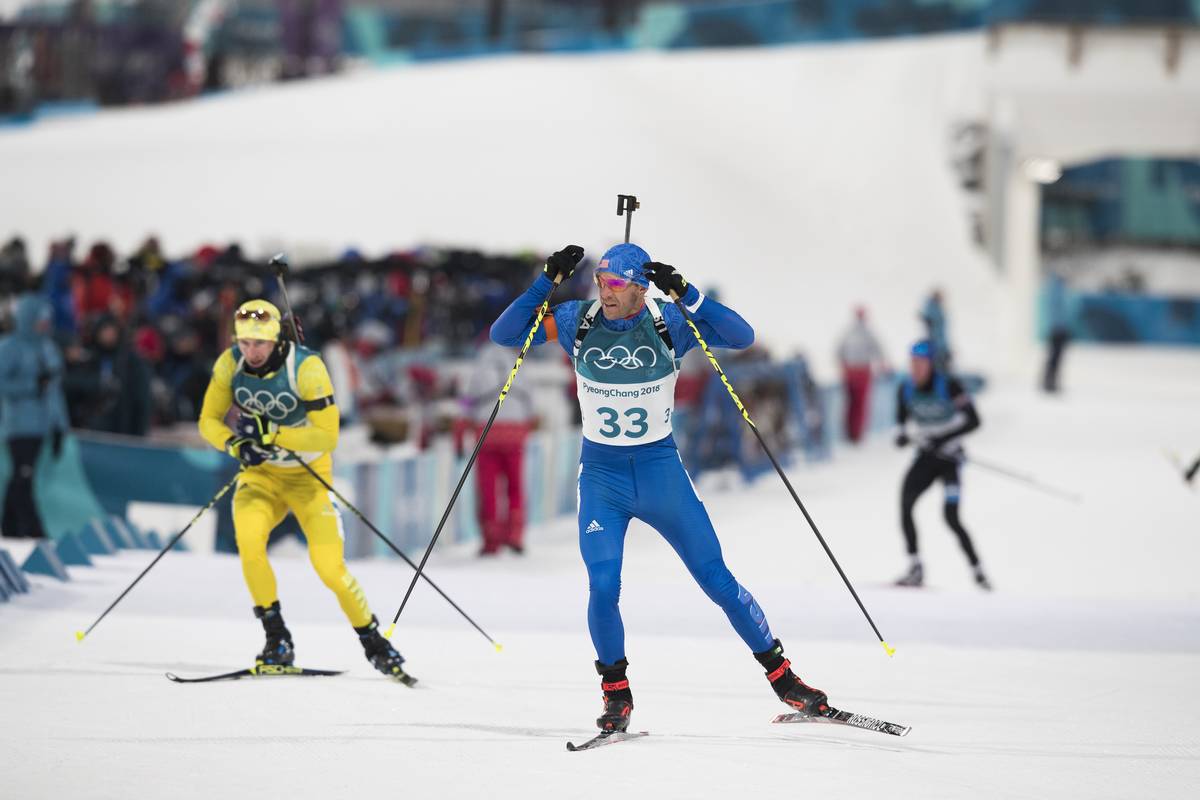
    American Tim Burke en route to 41st in the men’s 20 k individual at the 2018 Olympics in PyeongChang, South Korea. (Photo: FlyingPointRoad)

    In his fourth Olympics, Tim Burke was the top American in 41st (+4:01.9), a result he wasn’t happy with, after shooting four penalties (1+1+0+2).

    “The strategy is always the same: it’s just to execute the game plan, and tonight I struggled with that on the range,” he told FasterSkier after. “I felt like I was decent on the skis, not great but not bad. … I felt like I tried to follow through with my plan, and some days it’s easier than others. And today it didn’t work out.”

    Sean Doherty followed in 44th (+4:21.8) with three penalties (2+0+1+0).

    “Prone has continued to have a few gremlins in it for me,” the 22-year-old two-time Olympian said. “I worked on it the last couple days in training, but I mean, today was less wind and I was looking forward to that, so I still have just a couple things to work out with it. Standing was great, felt super solid, skied well. You know, those two out of three categories went well, so prone is just continuing to plague me. It’s unfortunate.”

    Lowell Bailey, the defending world champion in the 20 k individual, finished 51st (+4:53.0) after missing his first two shots of the day in the first prone then incurring two additional penalties (2+1+0+1). The four penalties added four minutes to his time.

    Afterwards, Bailey was beside himself.

    “I think shock is really the only way to describe it, completely shocked to miss those two,” he told FasterSkier. “I’ve never started an individual [race] like that. I felt really good about the shooting going into this, I had a game plan, I really felt like I had everything — I had a good plan, it just didn’t work out.

    American Lowell Bailey gets up off the mat and ready to head back onto the course after a shooting stage in the men’s 20 k individual at the 2018 Olympics in PyeongChang, South Korea, where he finished 51st. (Photo: FlyingPointRoad)

    “I knew the shooting conditions were more to my liking today and I felt really good about my training leading into it, especially on the shooting range, I felt like this was the race I had a good chance to do well in,” he continued. “The wind got me. It was just enough to push me out on the right side. The wind’s tricky here, sometimes it doesn’t register as strong as it actually is, so missing two shots right off the bat, that’s just a really tough way to start the race.”

    At that point, he said he had two options.

    “You can decide to give it your best because you’re representing your country or you can throw in the towel,” Bailey said. “And I think if there’s one thing I can take away from this race it’s that I never gave up.”

    The fourth American finisher, Leif Nordgren placed 64th (+6:27.3) with five penalties (1+1+3+0). Canada’s Nathan Smith ended the race in 81st (+8:11.9) with five misses as well (0+1+4+0).

    “I think it was a shooting race today,” Smith noted. “That was my focus. I felt comfortable taking it a little bit easier on the tracks. Unfortunately my third shooting, my second prone, was a disaster. I don’t know what happened. Other than that, my shooting was excellent. I’ll have to ask [coach Matthias Ahrens]. I was adjusting and I don’t know, [the targets] wouldn’t go down that time.”

    Moving forward, Smith said he would take it easy in the days leading up to the relay next week. The mixed relay (2 women, 2 men per team) is scheduled for Tuesday, Feb. 20 and the men’s 4 x 7.5 k relay — the last biathlon race of the Games — is next Friday, Feb. 23.

    No North Americans qualified for the 30-athlete mass start, with the men’s 15 k mass start taking place on Sunday.

    Results

  • Thursday Olympic Rundown: Haga Crushes 10 k, Diggins 5th; Öberg Stuns and Bø Reigns in Biathlon Individuals

    Ragnhild Haga on the way to gold in the 10 k skate at the 2018 Olympics. It is the first medal for the 27-year-old Norwegian. (Photo: FlyingPointRoad)

    FasterSkier would like to thank Fischer Sport USAMadshus USAConcept2Boulder Nordic Sport, and Swix Sport US for their generous support, which made this coverage possible.

    2018 Winter Olympics (PyeongChang, South Korea): Biathlon Men’s 20 k individual

    Full report

    It was a disappointing opening to the Olympics for Johannes Thingnes Bø of Norway, who despite winning eight World Cup races this season started the Games with finishes of 31st and 21st in the sprint and pursuit. But on Thursday he showed why he was a medal favorite and won the 20 k individual race – only by 5.5 seconds, but that margin becomes impressive when you consider that he had two penalties, and thus two minutes of penalty time, while silver and bronze medalists Jakov Fak of Slovenia and Dominik Landertinger of Austria (+14.2) shot clean.

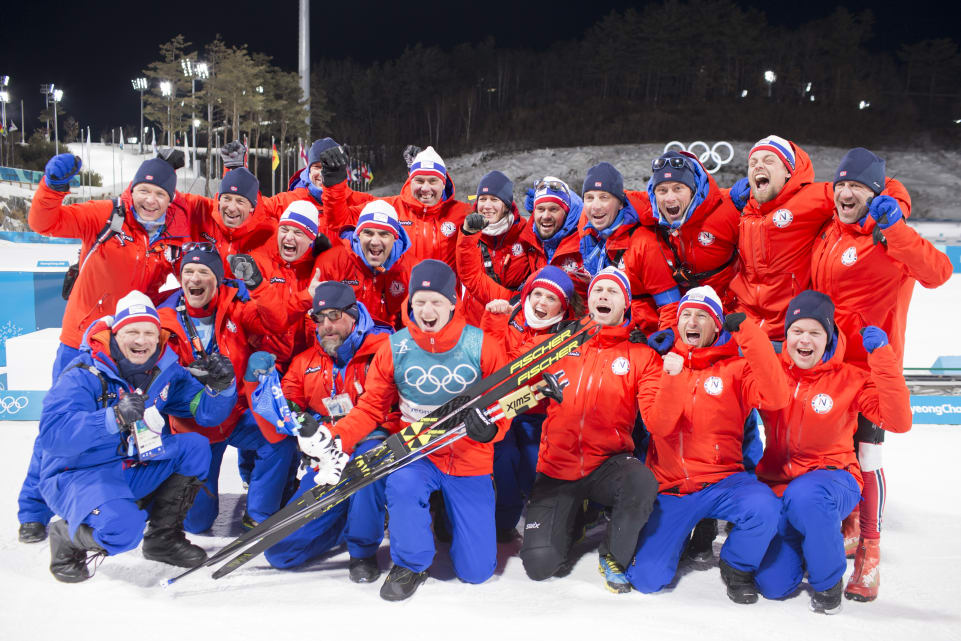
    Johannes Thinges Bø celebrates with Norwegian team staff after winning Olympic gold in the 20 k individual despite two missed shots. (Photo: IBU/Biathlonworld.com)

    Sweden’s Sebastian Samuelsson followed up a silver medal in the pursuit with fourth place in the individual, missing one shot and notching a time 29.1 seconds behind Bø. France’s Martin Fourcade, gold medalist in the pursuit, missed two shots like Bø but finished in fifth (+42.4). Switzerland’s Benjamin Weger placed sixth (+48.6) with one penalty.

    It was a good day for Canada on the back of strong shooting: Scott Gow placed 14th (+2:02.5) with one penalty for a career-best result result; he had previously had two 16th-place finishes on the World Cup this season. With the same shooting, Brendan Green placed 22nd (+2:26.6). Christian Gow had two penalties to finish 26th (+2:57.2). Canada’s fourth man, Nathan Smith, missed five shots and placed 81st (+8:11.9).

    For the United States, shooting was not as successful and Tim Burke led the way in 41st (+4:01.9) with four penalties. With one less penalty Sean Doherty was close behind in 44th (+4:21.8). Lowell Bailey placed 51st with four penalties (+4:53.0) and Leif Nordgren missed five shots to finish 66th (+6:27.3).

    Results

    ***

    Biathlon: Women’s 15 k individual

    Full report

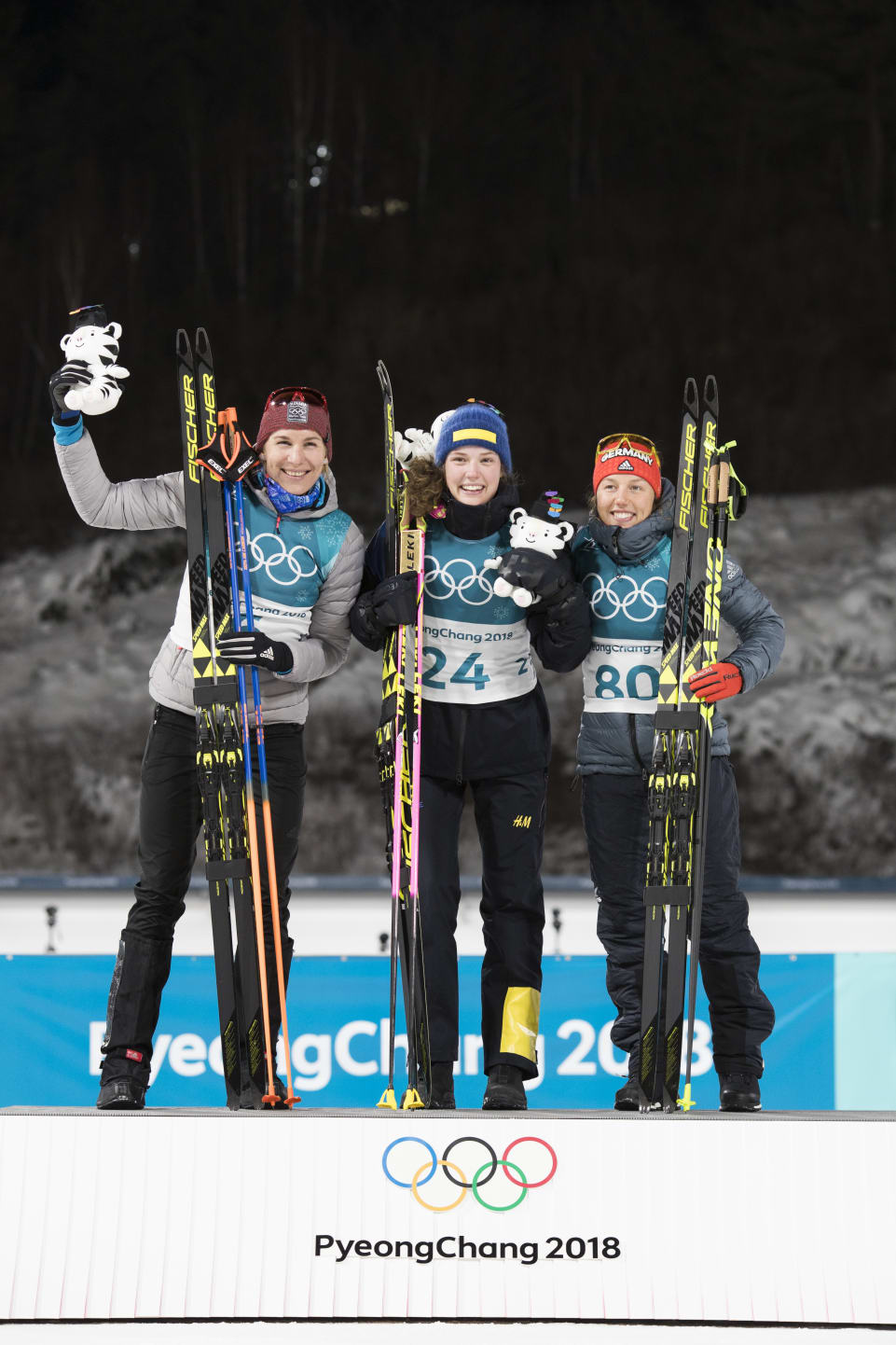
    Sweden’s Hanna Oeberg (center) won gold in the biathlon women’s 15 k pursuit, followed by Slovakia’s Anastasiya Kuzmina (left) in silver and Germany’s Laura Dahlmeier in bronze. (Photo: IBU/Biathlonworld.com)

    A few days after teammate Samuelson scored a career-best result to earn silver in the pursuit, Hanna Öberg of Sweden used perfect 20-for-20 shooting to capture gold in the women’s 15 k individual. The 22-year-old’s previous best results were fifth place in both Monday’s pursuit, and in a World Cup race last season.

    She bested the two pre-race favorites: Anastasiya Kuzmina of Slovakia had two penalties but still managed a silver medal, her second of the games, finishing +24.7. And double gold medalist Laura Dahlmeier of Germany had one penalty and earned bronze (+41.2).

    It was a good day for both of those teams as Franziska Preuss of Germany finished fourth, +59.0 with clean shooting, and Paulina Fialkova of Slovakia placed sixth (+1:02.3) with one missed shot. Poland’s Monika Hojnicz finished sixth (+1:54.8) with one missed shot as well.

    The United States was led by Susan Dunklee in 19th, with two penalties (+3:26.3). Her teammate Joanne Reid finished 22nd (+3:34.1), her best-ever result in top-level international competition, with just one missed shot. Clare Egan finished 62nd (+6:53.6) and Emily Dreissigacker 67th (+7:09.2) with four penalties apiece.

    For Canada, Rosanna Crawford led the way in 26th (+3:48.7) with two penalties and Sarah Beaudry was close behind in 29th (+3:58.4) with one missed shot. Emma Lunder finished 54th (+5:49.4) with three penalties and Julia Ransom was 74th (+8:31.4) with five missed shots.

    Montana State University student Johanna Talihärm of Estonia finished 50th (+5:36.8) with three penalties.

    Results

    ***

    Cross-Country Skiing: Women’s 10 k freestyle

    Full report

    Quotes & photos

    Thursday afternoon saw more of the same for the women’s cross-country ski events at this year’s Winter Olympics: Scandinavia filling up the podium, with American Jessie Diggins tantalizingly close to that breakthrough American podium in fifth. This time it was Norwegian Ragnhild Haga in first in the 10 kilometer freestyle individual start, Charlotte Kalla of Sweden in second (+20.3), and Finland’s Krista Pärmäkoski and Norway’s Marit Bjørgen tied for third (+31.9).

    The bronze is Bjørgen’s 12th lifetime Olympic medal, moving her into a tie with fellow Norwegian Bjørn Dæhlie for the most Olympic medals won by a cross-country skier. Countryman Ole Einar Bjørndalen, a biathlete, holds the overall Winter Olympics record with 13.

    Diggins was 35.2 seconds back of Haga in fifth. She was in seventh place through 1.6 k, up to fifth at 5 k, up to third at 6.2 k, and still in third at the 8.4-k time checkpoint, 1.9 seconds up on Bjørgen and five seconds up on Pärmäkoski. But her form seemed to break down over the final uphill, and Diggins lost just enough time on Bjørgen and Pärmäkoski over the final 1.6 k to slip off the podium.

    Between a 4.6-second deficit to third in Saturday’s skiathlon and a 3.3-second gap here, Diggins has now missed two bronze medals by a combined 7.9 seconds over 25 kilometers of racing.

    Jessie Diggins pushing to the finish in the Olympic 10 k skate. The American finished fifth. (Photo: FlyingPointRoad)

    Sixth place went to Swiss skier Nathalie von Siebenthal (+49.8), who slowed slightly after a fast start that saw her with the second-ranked time through 1.6 k. Ingvild Flugstad Østberg (+1:05.5), in seventh, was the third Norwegian in the top seven.

    Olympic Athlete from Russia Anastasia Sedova (+1:07.3), Austrian Teresa Stadlober (+1:15.6), and Olympic Athlete from Russia Anna Nechaevskaya (+1:24.3) rounded out the top ten.

    Sadie Bjornsen (+1:42.1) in 15th and Kikkan Randall (+1:49.9) in 16th were the next two Americans. Randall started relatively early with bib number 23, and was the leader in the clubhouse when she crossed the finish line. Liz Stephen (+2:35.4) was 30th.

    For the Canadians, Emily Nishikawa (+2:41.) led the way in 32nd. Dahria Beatty (+2:48.4) was 37th, Cendrine Brown (+3:11.9) 43rd, and Anne-Marie Comeau (+4:10.8) 62nd.

    Also of note, Australia’s Jessica Yeaton, who lives and trains in Anchorage with Alaska Pacific University, recorded an Olympics personal best finish of 41st (+3:09.1). University of Alaska Anchorage student Casey Wright, also competing for Australia, finished 81st (+6:55.8).

    University of Colorado skier and NCAA champion Petra Hyncicova of the Czech Republic finished 60th (+4:09.4). University of New Hampshire alum Annika Taylor of Great Britain finished 75th (+5:52.4).

    And Jaqueline Mourau of Brazil, who lives and trains in Quebec, was 74th (+5:49.8).

    Results


  • Fourcade Rebounds for Pursuit Gold in PyeongChang; Burke 17th

    France’s Martin Fourcade defending his Olympic gold from four years ago on Monday in the men’s 12.5 k pursuit at the 2018 Olympics in PyeongChang, South Korea. (Photo: FlyingPointRoad)

    FasterSkier would like to thank Fischer Sport USAMadshus USAConcept2Boulder Nordic Sport and Swix Sport US for their generous support, which made this coverage possible.

    ***

    Imagine for a moment, if you can, that you’re a two-time Olympic gold medalist from four years ago, and so far this winter, you’ve been on the podium in every biathlon World Cup you’ve raced but one (the first race, a single-mixed relay in November).

    Your name is Martin Fourcade and you’re an 11-time world champion from France. You’re also a 29-year-old dad and you’ve spent the last four years since the last Olympics more or less preparing for gold in another race: the first race of the 2018 Olympics in PyeongChang, South Korea.

    Now imagine that in that race, which you came into feeling more prepared than ever, you finished eighth after missing three targets in the first prone shooting stage.

    Fourcade recalled in a press conference on Monday that his result in the men’s 10-kilometer sprint on Sunday wasn’t frustrating. It was disappointing.

    “It was a really strange feeling,” Fourcade said after Monday’s 12.5 k pursuit. “… I was disappointed because yesterday I did not understand why I missed three, and I wanted this Olympic gold in the sprint more than any of the competitions. I worked really hard for this competition. I worked on my shooting for being good in the sprint, I worked on my skiing to be good in the sprint, and I think I was relaxed, I was in a good mood, I had good preparation. … And after the race [yesterday] I was really sad because I didn’t understand what I did bad.”

    On Monday morning, he reviewed a photo of his missed shots in the sprint and figured out his error. The red flags that show the strength and direction of the wind in the range were waving more violently than he had remembered feeling during that prone bout.

    “I realized it was not because I was unlucky … it was because I did a mistake, and from that time it was really much more easy to turn my anger into strength for the competition today,” Fourcade said. “It’s a bit masochist, but it works.”

    Fourcade started the second race of the 2018 Games, the pursuit, 22 seconds behind Germany’s Arnd Peiffer (who won Sunday’s sprint) in eighth. Peiffer held his ground through the first loop and first prone shooting in first, hitting all of his targets and leaving the range in second, just 0.8 seconds behind Austria’s Julian Eberhard, who also cleaned and started the race in fourth.

    France’s Martin Fourcade (8) skiing in the pack en route a gold medal in the men’s biathlon pursuit on Monday at the 2018 Olympics in PyeongChang, South Korea. (Photo: FlyingPointRoad)

    Fourcade missed his third shot and emerged from the penalty loop still in eighth, now 28 seconds out of first. He and Peiffer both cleaned the second prone, putting Peiffer back into first and Fourcade up to sixth, 21 seconds behind, while Eberhard missed one to drop to seventh.

    All the while, the little red flags blew in various directions, twirling around their posts. Gusts kicked up flurries of snow into the air, under a pitch black sky past 9 p.m. Korea time — the start of the men’s pursuit.

    It was once again frigid out there and only those who were shooting carefully enough and could feel their fingers (or were managing it regardless) were succeeding.

    On the third loop, Fourcade hooked up with a chase group in an effort to catch Peiffer, and by the end of that 2.5 k loop, they did. Heading into the range for the first standing shooting, Fourcade put himself in second, just ahead of Germany’s Simon Schempp in third and behind Peiffer in first. Fourcade and Peiffer lined up in the second and first shooting positions, respectively, putting the pressure on Peiffer in particular.

    Then, Peiffer missed his first shot. He hit the remaining four, but it wasn’t enough — Fourcade had knocked down all five and had taken his time to do so, posting the 28th-ranked shooting time. While Peiffer skied his first penalty lap of the day, Fourcade headed back to the course in first place. Peiffer slotted into second, 20.3 seconds behind.

    “I think it was a key time of the competition because on the third shooting, the wind was really tricky, challenging, probably it was the most difficult shooting of today,” Fourcade recalled of that standing stage. “I took a bit more time then my opponents to shoot my first ammunition and then when I realized I was the only one who shot clean, I knew that I was the only one who could decide who would be the Olympic champion. I didn’t say that I was sure I would win, but the decision was in my hand.”

    He rounded the fourth loop on his own and entered the range for the last time all alone. Then, Fourcade cleaned all five targets with the ninth-fastest shooting time, and turned to the stands behind him with a celebratory fist pump.

    “My finish line was not the real finish line, it was the last ammunition of my last magazine on the fourth shooting,” Fourcade said. “I really put all my energy into this shooting and I think if I had to fight with any athlete on the tracks, I wasn’t able to do it because after this shooting I was totally empty.”

    He didn’t need to fight with anyone on that last loop. Behind him, Germany’s Benedikt Doll had moved into second with a clean final stage, 36 seconds back, and Sweden’s Sebastien Samuelsson was up to third, another eight seconds behind.

    On that final loop, Fourcade locked up gold, coming into the stadium with enough time to grab a large French flag from the stands, about 100 meters from the finish. Meanwhile, Doll and Samuelsson duked it out for second, with Samuelsson closing the gap to Doll then challenging him on the final climb.

    “I saw Sebastien behind me and my legs felt weaker and weaker in the long uphill,” Doll, the 2017 sprint world champion, said at the press conference. “And he came closer and closer, and then he [caught] me so I was thinking, ‘OK, now I need to make a new tactic for sprinting for the finish.’ ”

    The 20-year-old Samuelsson overtook Doll, 27, as they crested the last climb and led the downhill toward the stadium finish.

    “I knew we had really good skis today and I knew that if I can catch him at the top, I had a really good chance,” Samuelsson reflected. “My plan was to go a little bit later because I wanted a wind shadow, but [my team’s] waxers were … yelling a lot and then I just had to go. I was helped a lot with my skis today.”

    Sebastien Samuelsson of Sweden celebrating silver in the men’s 12.5 k pursuit at his first Olympics on Monday in PyeongChang, South Korea. It was also his first non-relay podium at the World Cup/World Championships level. (Photo: IBU/Biathlonworld)

    In the end, Samuelsson got him by 3 seconds for silver, finishing 12 seconds after Fourcade claimed the win in 32:51.7 minutes. Doll, who had started the pursuit in sixth, settled for bronze, 15 seconds behind Fourcade, for his first medal in his first Olympics with a single penalty (0+1+0+0).

    “I couldn’t follow [Samuelsson] and he had faster skis,” Doll concluded. “He was a little bit stronger, and so I think he’s the right holder for the silver medal.”

    In addition to shooting 19-for-20 (0+0+1+0), Samuelsson, who started the race in 14th, raced the fastest overall course time of the day, 8.6 seconds faster than Fourcade, who was second fastest. The young Swede reportedly told the International Biathlon Union (IBU) on Periscope that he’d cut his hair if he won a medal at his first Olympics in PyeongChang.

    “I think nobody was thinking I’d be able to cut my hair after these Olympics, but now I have to do it, I have said so,” Samuelsson said at the press conference. “But I heard that my teammate said maybe you should keep the hair until the relays because you never know what will happen if you cut it.”

    Samuelsson’s previous individual World Cup best was 13th in a sprint last season. He won a relay with his four-man team this season in the 4 x 7.5 k in Oberhof, Germany. After Monday’s pursuit, Fourcade said he congratulated him.

    “I told Sebastien in the changing room, it’s not a bad day to start his first Olympics with his first international podium. I know a guy who did that eight years ago in the Olympics in Vancouver,” Fourcade said, referring to his first Olympic medal (silver) in the mass start at the 2010 Games.

    Fourcade went on to win the pursuit and 15 k individual race at the 2014 Olympics in Sochi, Russia, where he also took silver in the sprint.

    “Martin is, I mean, the perfect biathlete,” Samuelsson said. “I knew when he finished eighth yesterday that today he would be really fighting for the gold medal. For me, it’s a big victory for me to just be on the podium and Martin is unbelievably good.”

    “Martin was not happy [after the sprint],” Doll said when asked about Fourcade. “Of course three mistakes in the prone shooting, it’s horrible, so it was for sure that today that he will fight and give everything to win, and in the end his plan fulfilled. He was I think the fastest skier or maybe Sebastien was the fastest skier, I don’t know, but he was the best biathlete today.”

    France’s Martin Fourcade after winning the men’s 12.5 k pursuit on Monday at the 2018 Olympics in PyeongChang, South Korea. He also won the pursuit at the 2014 Sochi Olympics. (Photo: FlyingPointRoad)

    In his book, “Martin Fourcade: Mon rêve d’or et de neige” (My dream of gold and snow), which came out in November, Fourcade wrote about how nervous he was the night before his first gold medal in Sochi.

    “Four years ago before the Olympics in Sochi, I was simply shaking because I had a lot of fears,” Fourcade said at Monday’s press conference when asked about that passage from the book. “Many things changed in my life since Sochi. When I came here in Korea, I knew that I will be a happy man even without any Olympic gold in this event, so I think it helped me to take it more easy and I was in a really good mood and really satisfied with how I prepared this competition.”

    Asked now if that fear is gone, he said it was.

    The men’s 12.5 k pursuit podium at the 2018 Olympics in PyeongChang, South Korea, with France’s Martin Fourcade (c) in first, Sweden’s Sebastien Samuelsson (l) in second and Germany’s Benedikt Doll (r) in third. (Photo: IBU/Biathlonworld)

    Finishing 47.5 seconds after Doll was Norway’s Tarjei Bø in fourth (+1:02.6). Bø started 13th and posted the fourth-fastest course time to overcome three penalties (0+0+1+2). He held off three others in a sprint to the line, with Schempp following in fifth (+1:02.7), after starting seventh, Switzerland’s Benjamin Weger placing sixth (+1:03.1), up from 15th at the start, and France’s Simon Desthieux placing seventh (+1:03.7), up from 12th. Peiffer ended up eighth (+1:14.1) with three penalties (0+0+1+2), and Sunday’s silver medalist Michal Krčmář of the Czech Republic finished 30th (+3:49.9) with seven misses (2+0+3+2).

    Norway’s Johannes Thingnes Bø finished the race in 21st (+2:51.0), up 10 places from starting 31st based on his sprint result, with six penalties on Monday (0+2+4+0).

    “We both [knew] before the Olympics that it will not be only a fight between us because we know the shooting range [here] is challenging,” Fourcade said of Johannes Bø, his main rival this season. “I thought that at our best level, we could be difficult to beat, but the wind and the Olympic situation will bring many opportunities for outsiders to take [medals], yesterday Arnd did in a magnificent way. It’s not a competition about Johannes today. It’s biathlon.”

    Burke Up to 17th

    Tim Burke (US Biathlon) racing to 17th in the men’s 12.5 k pursuit at the 2018 Olympics in PyeongChang, South Korea, up from 47th at the start. (Photo: NordicFocus/US Biathlon)

    Three Americans and one Canadian qualified for the pursuit in the sprint top 60, and US Biathlon’s Tim Burke raced all the way up to 17th (+2:19.6) after starting 47th, with two penalties (0+1+1+0) and the 15th-fastest overall course time.

    “I am very happy with the race,” Burke said in a post-race interview with FasterSkier. “I really felt like I put it together for the opportunities I was given in the race today, but this is not normal biathlon. You saw that they moved the downhill [competition] to a different day; we can’t do that in biathlon we have too many events, so we have to go on these days when it’s honestly unfair conditions like today. I benefited a lot from having very little wind in my standing positions, and I was able to move up a lot. Others I know were not so lucky. Unfortunately that is part of an outdoor sport.”

    Asked how he reset after the sprint the day before, Burke said he talked about it with his coach.

    “I was disappointed in the result not the performance,” he recalled. “I felt like I executed well. I felt like I hit my cues on the course and on the range, and it just didn’t happen yesterday. The game plan going into today was nothing, there was nothing new, stick to the things that have been working well for me in the World Cup and that’s what I did.”

    After Burke, Lowell Bailey was the next best American on Monday, finishing 32nd (+3:51.6) after starting 33rd. He cleaned the first two stages but missed five between the two standing bouts (0+0+3+2).

    American Lowell Bailey (33) racing to 32nd in the men’s 12.5 k pursuit at the 2018 Olympics in PyeongChang, South Korea (Photo: NordicFocus/US Biathlon)

    “Unfortunately today, the weather got involved and I had one stage that really just threw my race off,” Bailey told FasterSkier after. “Wind, I mean, that third stage was just absolutely ridiculous. … There was nothing longer than 20 seconds of those big gusts and that time it was like two minutes. I got through of about 40 seconds of standing there waiting, time bleeding off the clock at that point I just started pulling the trigger, I couldn’t hold on the target, you just got to do your best on that point.”

    Then there was Leif Norgren, also of the U.S., who finished 50th (+5:48.7), up from 58th at the start, with five penalties (2+2+0+1).

    “Physically I think it was improvement from yesterday,” Nordgren told FasterSkier. “I still struggled with the wind and shooting, and it makes it kind of frustrating because with windy conditions like these it’s a big opportunity to move up in the pursuit and I wasn’t able to capitalize on that today. So a little disappointed in that regard, but that’s just how it goes sometimes.”

    Canada’s lone man in the pursuit, Nathan Smith crossed the line in 54th (+6:06.5), after starting 44th, with four misses (0+0+1+3).

    While he raced up to 37th after the first three stages, Smith dropped to 51st with three misses in the last standing.

    “Three penalties on the last standing was really a lot of time spent in the loop,” he reflected.

    Physically, he said the race felt, “really, really hard.”

    Biathlon at the Olympics continues with the women’s 15 k individual on Wednesday and men’s 20 k individual on Thursday.

    Results

  • Monday Olympic Rundown: Dahlmeier and Fourcade Win Pursuits, Burke 17th, Crawford 19th

    Keep calm and be the best: one missed shot early on did not keep France’s Martin Fourcade from defending his Olympic gold medal in the men’s biathlon pursuit. (Photo: FlyingPointRoad)

    FasterSkier would like to thank Fischer Sport USAMadshus USAConcept2Boulder Nordic Sport, and Swix Sport US for their generous support, which made this coverage possible.

    ***

    2018 Winter Olympics (PyeongChang, South Korea): Men’s 12.5 k pursuit

    Full report

    “Use this rage as energy!” Martin Fourcade wrote on Instagram after finishing eighth in the men’s 10-kilometer sprint on Sunday.

    Um, yeah. The French biathlon star defended his gold medal from the 2014 Olympic pursuit with just one missed shot in Monday’s 12.5 k competition, taking the lead after the third shooting stage and never giving it back. He finished with a comfortable enough margin to grab the French flag and take his time waving it down the finishing straight.

    A large pack of chasers were all in contention for second place coming into the final shooting stage, but of them all only Benedikt Doll of Germany and Sebastian Samuelsson of Sweden cleaned their targets. Samuelsson took his time to do so, and left the range with a nearly eight-second deficit on Doll. But he gradually worked his way up to the German on the trails, before putting in a spurt on one of the last small uphills on the course. The 20-year-old Swede managed to hold his lead on the swooping downhills into the stadium and not get consumed by the draft effect, and celebrated crossing the line in second place. Samuelsson’s previous best result was 13th place in a World Cup. It is Sweden’s first Olympic biathlon medal since 2010.

    Tarjei Bø of Norway finished fourth (+1:02.6) after missing three shots; all the medalists had only a single penalty apiece. Germany’s Simon Schempp was fifth (+1:02.7), also with three penalties, and Switzerland’s Benjamin Weger finished sixth with two missed shots (+1:03.1), narrowly edging France’s Simon Desthieux (+1:03.7).

    For the U.S., Tim Burke finished 17th (+2:19.6) with just two missed shots after starting in 47th position after a disappointing sprint race. Lowell Bailey placed 32nd (+3:51.6) with five penalties — all in standing — and  Leif Nordgren 50th (+5:48.7), also with five missed shots.

    For Canada, Nathan Smith finished 54th (+6:06.5) with four missed shots.

    Results

    ***

    Biathlon: Women’s 10 k pursuit

    Full report

    With just one missed shot, Germany’s Laura Dahlmeier took her second gold medal of this young Olympic Games when she won the 10 k biathlon pursuit by 29.4 seconds. Dahlmeier finished no better than 13th in the 2014 Olympics — where she was only 20 years old – but four more years of experience have made her nearly unbeatable, if last year’s triple gold haul from World Championships serves as a basis for comparison. But even if she only nets these two golds, she has already made history: no other woman has ever won both the sprint and the pursuit at the same Olympic Games.

    Dahlmeier started in bib 1 but the other medalists used stellar performances to move up after disappointing sprint races. Anastasiya Kuzmina of Slovakia edged France’s Anais Bescond by just 0.2 seconds to take silver. Kuzmina had started in bib 13 and won her medal despite four missed shots – she had the fastest course time of the whole field – while Bescond had started 19th but had hit all but one of her targets.

    Fourth place went to the sprint silver medalist Marte Olsbu of Norway (+1:07.3), fifth to Hanna Öberg of Sweden (+1:08.9), and sixth to Denise Herrman of Germany (+1:19.4).

    Rosanna Crawford of Canada started 53rd after a tough sprint race, but shot 18/20 and moved up to 19th place (+2:27.7), the best Olympic result of her career.

    Montana State University student Johanna Talihärm, representing Estonia, missed four shots to finish 26th (+2:59.4). Just behind her was Canada’s Julia Ransom in 28th (+3:03.0) with one missed shot.

    The lone American in the race, Emily Dreissigacker, set a new career best with 47th place (+5:01.4), and Canada’s Emma Lunder finished 53rd (+6:16.8). Teammate Megan Tandy did not start.

    Results

  • Numb Fingers and All, J.T. Bø Wins in Presque Isle; Doherty Nabs Career Best 13th

    Numb Fingers and All, J.T. Bø Wins in Presque Isle; Doherty Nabs Career Best 13th

    Norway's Johannes Thingnes Boe racing to a 28-second win in the IBU World Cup men's 10 k sprint on Thursday in Presque Isle, Maine. (Photo: Fischer/NordicFocus)
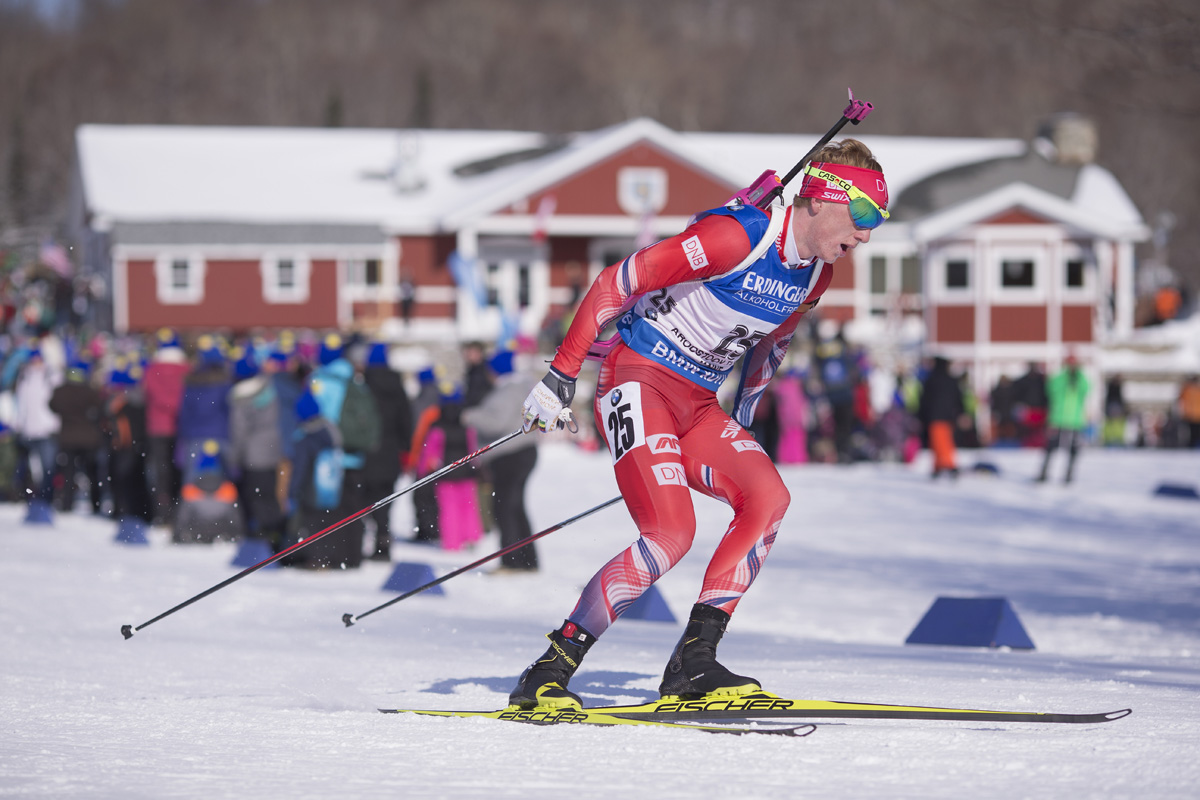
    Norway’s Johannes Thingnes Bø racing to a 28-second win in the IBU World Cup men’s 10 k sprint on Thursday in Presque Isle, Maine. (Photo: Fischer/NordicFocus)

    After skipping the last tour stop in Canmore, Alberta, Norway’s Johannes Thingnes Bø returned to the International Biathlon Union (IBU) World Cup with a bang, winning the men’s 10-kilometer sprint on Thursday morning in Presque Isle, Maine, in a time of 24:38.8, with no penalties. It was the first World Cup race in the U.S. in five years.

    “It’s never easy, but today I felt I had control,” Bø told the IBU in a post-race interview. “I was calm before the race, and also on the shooting range. I tried to do it like in training.”

    The defending 2015 world champion in the sprint is now heading into the 2016 World Championships at home in Oslo, Norway, with a victory in the same discipline.

    “It looks like it has been good for me, but who knows,” he said at the press conference on his decision to not make the long trip to Canmore, Alberta, last week for the previous World Cup. Instead, he trained for Oslo.

    Asked why eight of his 10 World Cup victories came in sprints, Bø replied, “Maybe it’s because shooting is my weakness, and in the sprint there is only two [stages]. So there is a bigger chance for me to not miss so much.”

    He achieved his clean shooting despite losing feeling in his fingers on the first loop due to the cold weather and his fairly thin gloves, he told Norwegian broadcaster NRK.

    “Without feeling I had to focus extra hard on the innermost black spot, maybe that was the thing that made it go so well,” Bø said according to a translation.

    Starting very early with bib 3, France’s Martin Fourcade had one miss in the standing stage and initially took a 38-second lead at the finish (over Norway’s second starter Erlend Bjøntegaard) thanks to Fourcade’s fast skiing, with the eventual overall fastest course time.

    After changing into dry clothes and waiting in the finish pen for a few minutes, Fourcade was passed by Russia’s Anton Shipulin, who started behind him in bib 16 and had two clean shooting stages. The Russian lost time to Fourcade on the final loop, but by the finish, Shipulin, who ranks second in the overall World Cup, had preserved a 1-second lead over Fourcade — the World Cup leader.

    “I have competed here 10 years ago at the Junior World Championships,” Shipulin said at the press conference through a translator. “So I know the tracks, and they are quite good.”

    Shipulin ended up second when Bø, the 25th starter, barreled through the finish 27.9 seconds faster, with both clean shooting and the second-fastest overall course time. That moved Fourcade into third (+28.9) and the top-three stood through the remainder of the 88-man race.

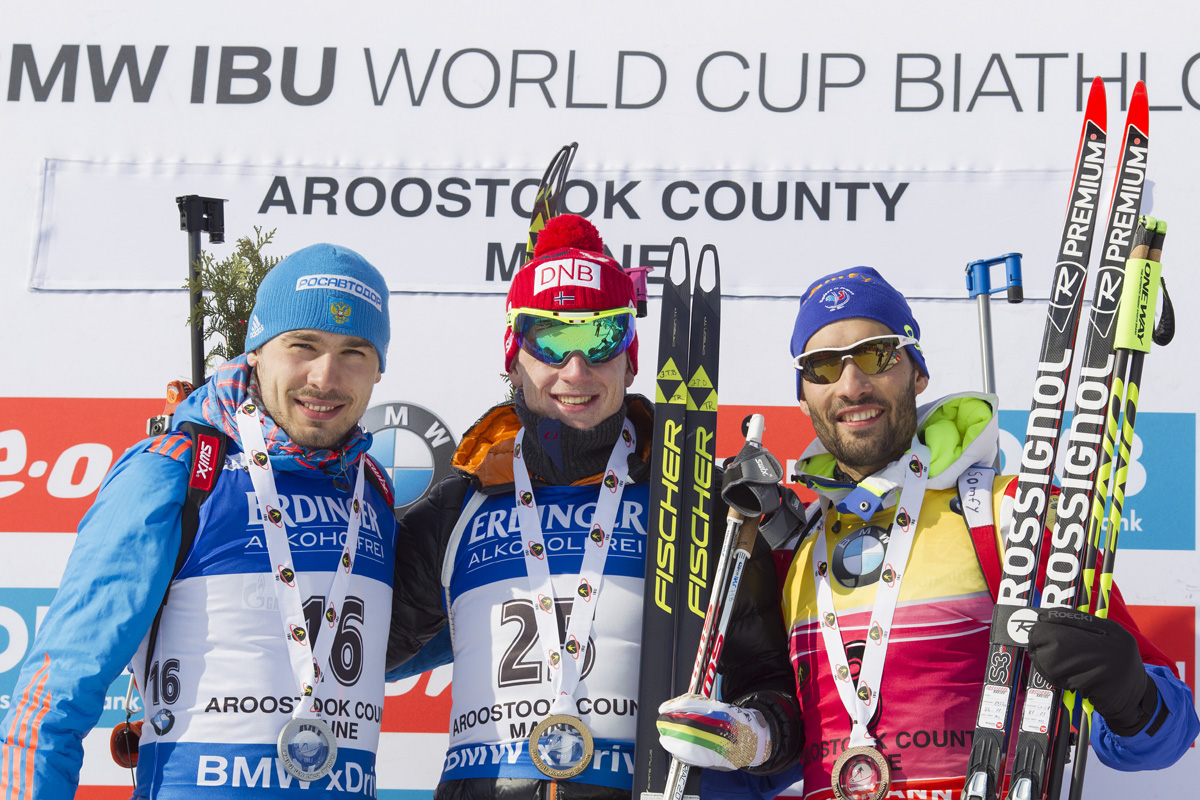
    The men's sprint podium at the IBU World Cup in Presque Isle, Maine, with Norwegian winner Johannes Thingnes Bø (c), Russia's Anthon Shipulin (l) in second, and France's Martin Fourcade (r) in third. (Photo: Fischer/NordicFocus)
    The men’s sprint podium at the IBU World Cup in Presque Isle, Maine, with Norwegian winner Johannes Thingnes Bø (c), Russia’s Anthon Shipulin (l) in second, and France’s Martin Fourcade (r) in third. (Photo: Fischer/NordicFocus)

    “Of course I am happy and satisfied with the race today,” Shipulin said. “I wasn’t as fast as those two guys on the track. But I did clean shooting, and the result was good … I hope I will get better for the World Championships.”

    “My shape was really good today … The shooting range is not as easy as we thought,” Fourcade said at the press conference. “No wind today so that was good.”

    “But I really was surprised by the sun; I think it was too much sunshine for my little blue eyes,” the brown-eyed Fourcade joked. “I had real difficulties on the shooting range. That is why I needed so much time in the standing shooting.”

    Bø posted the best times after the first and second shooting stages, where he hit every target, and extended his lead to the finish over Shipulin. Despite placing third, Fourcade slightly added to his commanding World Cup lead, with 857 points to Shipulin’s 646.

    “Johannes was simply a better biathlete today,” Fourcade said. “He shot clean, he shot fast, and [me and Shipulin] both know he will be one to beat for the World Champs.”

    As the race progressed, Germany’s Erik Lesser in bib 54 had the best chance to reach the podium, thanks to two clean shooting stages.

    He picked up speed throughout his three loops; after losing more than 20 seconds to Bø on each of the first two loops, he only lost 2 additional seconds on the last one. But overall, Lesser could not quite match the skiing performance of the top three and finished fourth, 45.9 behind Bø and 20 seconds off the podium.

    “I was very timid on the first round, somehow insecure,” Lesser told German TV broadcaster ARD. “I felt a little tired, so I wanted to rather push towards the end. … The shooting range is not easy, in standing I had to rebuild my stance. You really have to pay attention. Everything is possible in terms of advancing or falling back.”

    Behind Lesser, two Swiss athletes had their best results of the season, with Serafin Wiestner in fifth (+50.3) and Benjamin Weger (+52.5) in sixth place, both missing one shot in standing.

    For Wiestner, a border police officer, it was a new personal best after previously finishing 24th in a sprint in Ruhpolding, Germany, earlier this year.

    “We are really happy about this result,” Wiestner told the IBU. “The last weeks were not so good for us, for the whole team … It’s a really tricky course, but I like that.”

    I had a really bad season until now,“ Weger added. “Almost [all] just bad races. So I am very happy to be back in top 10 now, the first time this season. I hope to continue like that now.”

    Latvia’s Andrejs Rastorgujevs in seventh (+54.0) and Bø’s older brother, Tarjei, in eighth place (+58.9) also had just one penalty in standing, and stayed within one minute of Bø to achieve a good starting position for the pursuit on Friday.

    Doherty Leads Three Americans in Top 20; Canada’s Perras 48th

    American Sean Doherty returned to the World Cup on Thursday, in his first race since racking up three medals in as many races at Junior World Championships in Cheile Gradistei, Romania. At 20, he become the most decorated athlete in history of Youth/Junior World Championships in his final season as a junior.

    Starting in the middle of the field in bib 42, Doherty was the youngest competitor in the sprint. He shot clean in prone, and then missed one in standing, having to ski a penalty lap. The top North American, he ultimately placed 13th for his career-best World Cup result, 1:16.2 behind Bø.

    “My shooting today felt good, very in control,” Doherty, a New Hampshire native, wrote in an email. “The wind was manageable, it just came and went but was never too extreme. The range approach here is deceptively tough, and the wind conditions can be tricky but overall today was a good day on the range.

    “I am really looking forward to the pursuit,” he added.

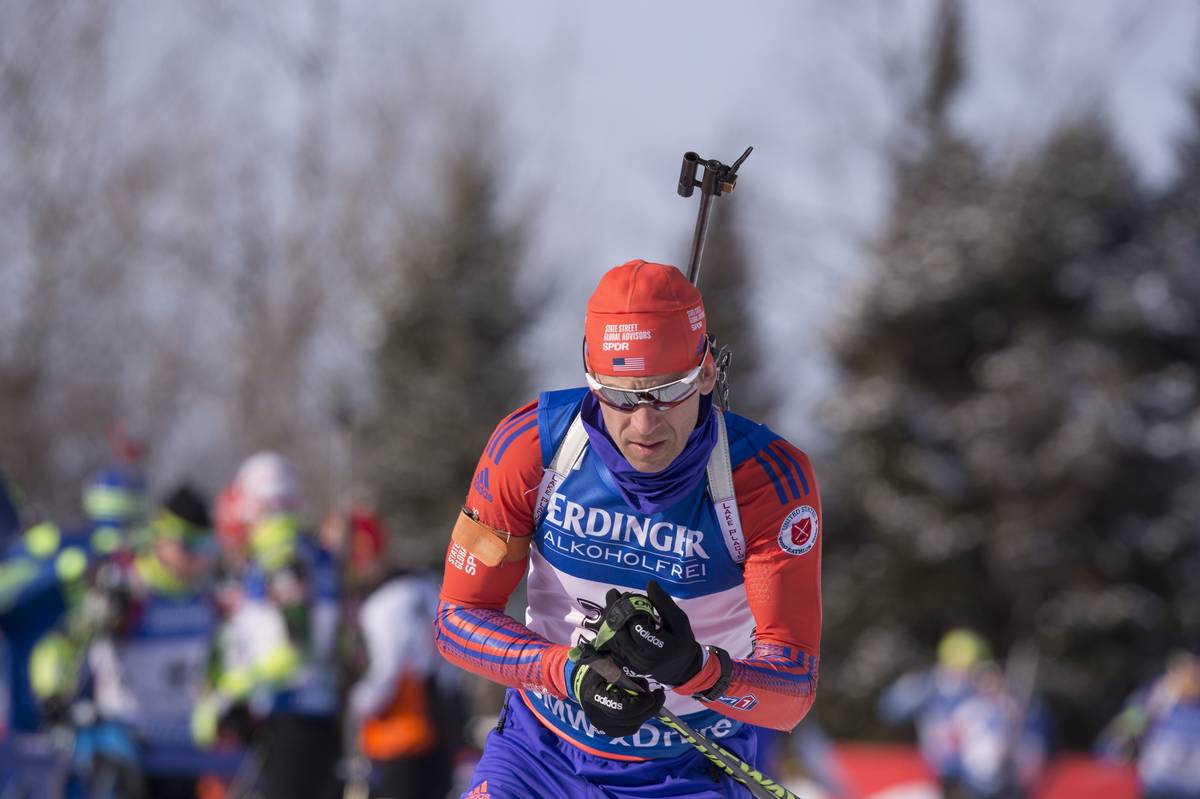
    Lowell Bailey (US Biathlon) racing to 15th in the men's sprint at the IBU World Cup in Presque Isle, Maine. Bailey was one of three U.S. men in the top 20 on Thursday. (Photo: USBA/NordicFocus)
    Lowell Bailey (US Biathlon) racing to 15th in the men’s sprint at the IBU World Cup in Presque Isle, Maine. Bailey was one of three U.S. men in the top 20 on Thursday. (Photo: USBA/NordicFocus)

    Shortly behind, another American Lowell Bailey placed 15th (+1:22.4), also with a clean prone shooting and one penalty in standing.

    “The wind can definitely be a factor here as the venue sits on top of a plateau,” Bailey explained in an email. “But today, I think the biggest factor was the approach. It is one of the more difficult approaches [in the World Cup] and if you aren’t prepared for it, you will be surprised at the fact that you aren’t very recovered when you hit the mat.”

    Earlier this week, Bailey provided a unique view of the Presque Isle courses for the IBU in a first-person video, skiing through the men’s sprint loop, the arena and the penalty lap (coincidentally, Johannes Thingnes Bø passed Bailey in the penalty lap during the video).

    “A lot of transitions from downhills directly into steep uphills,” Bailey commented in the video. “So you have to be changing techniques all the time.”

    “The snow here is very cold,” he said of the conditions. “You can hear it, kind of squeaking like Styrofoam. That makes it interesting for waxing. We’ll be on very hard cold wax. Very fine stone grinds with the ski base.”

    In his email, he explained that the course was challenging, particularly with a “corkscrew” downhill section, with some ice beneath the snow. “You had to stay alert and react when your skis started to slip,” he wrote.

    “I felt like an alpine skier,” winner J.T. Bø joked about the course in an IBU interview. “You had to ski at the very edge of the skis. It was really hard, but it was cool.”

    “The two places are really different,” Fourcade said during the press conference, comparing Canmore with Presque Isle. “Canmore is huge mountains, and here we are more in the forest. I prefer the track here, but it’s hard to compare two sites.”

    Also for the U.S., Tim Burke started early bib 6, missed one target in each of his shooting stages, but finished 20th (+1:32.7) as the second-best athlete with two penalties.

    “I felt solid on the ski course today,” Burke wrote in an email. “It was not one of my best days, but I was able to keep a good pace for the entire race. This is an interesting course in that there are not really any big climbs, but on the other hand there is very little recovery because of the challenging downhills. This was my first time competing on this course and I really liked it.

    “My shooting felt decent today and the two misses were very close,” Burke continued. “But two misses is obviously too much for the sprint competition.”

    Leif Nordgren in bib 76 came in 65th (+3:02.6) with three penalties (2+1). Eleven seconds outside the top 60, he missed qualifying for Friday’s pursuit.

    “The men were just really consistent, everybody close together and just the whole field for the top athletes, so it puts them into a very good place looking ahead for tomorrow’s pursuit race,” US Biathlon coach Jonne Kähkönen said in a phone interview with FasterSkier. “Hopefully Susan’s podium will give them another push.”

    After the men’s race on Thursday, Susan Dunklee raced to second place in the women’s 10 k sprint to tie the best-ever result by a U.S. biathlete, male or female.

    Canada brought some of its developmental team to Presque Isle, with the athletes prequalified for the World Championships in Oslo skipping the races and continuing to train at home in Canmore.

    Originally Nathan Smith had planned to keep competing in Presque Isle, partly in order to defend his top 20 in the overall World Cup (he was 19th after the Canmore World Cup).

    “It was a really last minute decision. I literally had my stuff packed and ready to load into the team van,” Smith told FasterSkier in an email. “I was already somewhat uncertain about going because my skiing has been lackluster the last few weeks. When I saw how potentially cold it could be [in Presque Isle] I decided that perhaps I should stay in Canmore to get some rest and refocus after a very demanding month of racing, travel, and all the extra energy spent at a home world cup. I’ll be cheering the team on from the comfort of my living room.”

    Asked how he thought that might affect his place in the standings, he guessed it would drop him just outside the top 20.

    “I was hoping to be near top 10 by this point but unfortunately I didnt make so many points the last 2 world cups,” Smith wrote. “I think it’s better for me to try and perform my best … at world champs instead of chasing points to try and stay around 15th to 20th.”

    Without the usual starters, Scott Perras achieved the best result for the Canadian men in the sprint on Thursday, finishing 48th (+2:36.0), with one penalty in both prone and standing, and qualified for the pursuit on Friday.

    “Shooting was ok, I was a bit tight for prone but it was fine,” Perras wrote in an email. “Presque Isle can be pretty windy, today was just a slight breeze, almost perfect!

    “Skiing felt ok, I expected to feel a little better for sure,” he added. “[The] course is fun, what makes it difficult is the fact that you climb for a couple minutes before you get to the biggest climb on the course. That and the fact there isn’t much time ever spent in a downhill tuck.”

    In their first World Cup races of the season, Canada’s 21-year-old Carsen Campbell finished 78th (+3:45.9) with one penalty, Matthew Neumann, 26, was 82nd (+4:16.6) with three misses (1+2), and Matthew Hudec, 21, finished 88th (+5:18.6) with two penalties (1+1).

    Every Course is Different

    The World Cup returned to the U.S. and the Nordic Heritage Center in Presque Isle for the first time in five years since February 2011, when the World Cup also included races in Fort Kent, Maine. Back then, Fourcade placed second in the sprint to Germany’s Arnd Peiffer, who finished ninth on Thursday (+1:06.4) with one penalty.

    Most athletes commented positively on the challenging course and arena, though some pointed out a few unusual details, mainly a utility building in the middle of the penalty lap making it difficult to see the competition.

    “It’s pretty far around that little house, at least it feels that way,” Peiffer told German TV broadcaster ARD after the race, when asked about his penalty lap.

    According to ARD’s play-by-play announcer, organizers recently measured the loop out at 155 meters, 5 meters longer than the IBU norm, but still well within the standards.

    “Yes, it does feel long,” Bailey agreed in his email.

    “The penalty loop definitely felt long to me but I’m sure they have measured it,” Tim Burke wrote in his email. “I think it’s just the fact that you can’t see through it, that makes it feel so long. That will be an interesting factor for the pursuit because you won’t be able to judge how many athletes are in the penalty loop.”

    In contrast to that, Perras even observed some positive elements: “I don’t think the penalty loop feels any bigger, it actually skis quite well. Some penalty loops have really tight corners and you can’t really ski through the corners at all, you are almost skidding. And here there are fans in the penalty loop, how do you compete with that.”

    Germany’s Lesser also noted in his interview with ARD that the shooting mats felt uneven, giving him slight problems to find his stance.

    “I also felt that the shooting range mats slope towards the targets,” Burke agreed. “This is very unusual and hopefully they can fix this for the remaining competitions.”

    “The shooting mats do seem to slope awkwardly,” Perras wrote. “Honestly I’ve seen this at a few ranges throughout the world. No two ranges are the same and I try to just focus on the target, besides my legs aren’t even the exact same length so don’t take my word for it.”

    While not featuring quite as many people in attendance as some of the huge venues in Europe who are always on the World Cup competition calendar, there was still a good atmosphere at the Nordic Heritage Center on a weekday and in sunny weather. International athletes such as Germany’s Peiffer appreciated the support they received from the U.S. fans, many of them schoolchildren with rows of classes that had “adopted” different nations such as Germany, Italy, or even the small contingent from Romania, waiving flags and loudly cheering for the athletes.

    “Those kids probably got a day off from school to come here,” Peiffer told ARD with a laugh. “But that at least means there is something going on [in the arena]. And they are cheering very enthusiastically, and the same for everyone. A very fair audience.”

    “There is a lot of school kids here today and I hope they get inspired,” American Susan Dunklee told ARD in an interview after her race. “It’s a really great sport, and I think Americans haven’t fully discovered it yet.”

    The World Cup in Presque Isle continues with pursuits on Friday and the men’s relay on Saturday and women’s relay on Sunday.

    Results | Pursuit start list

  • Green Keeps Streak Alive: 50-for-50 on IBU World Cup with Career-Best Fifth in Antholz

    Green Keeps Streak Alive: 50-for-50 on IBU World Cup with Career-Best Fifth in Antholz

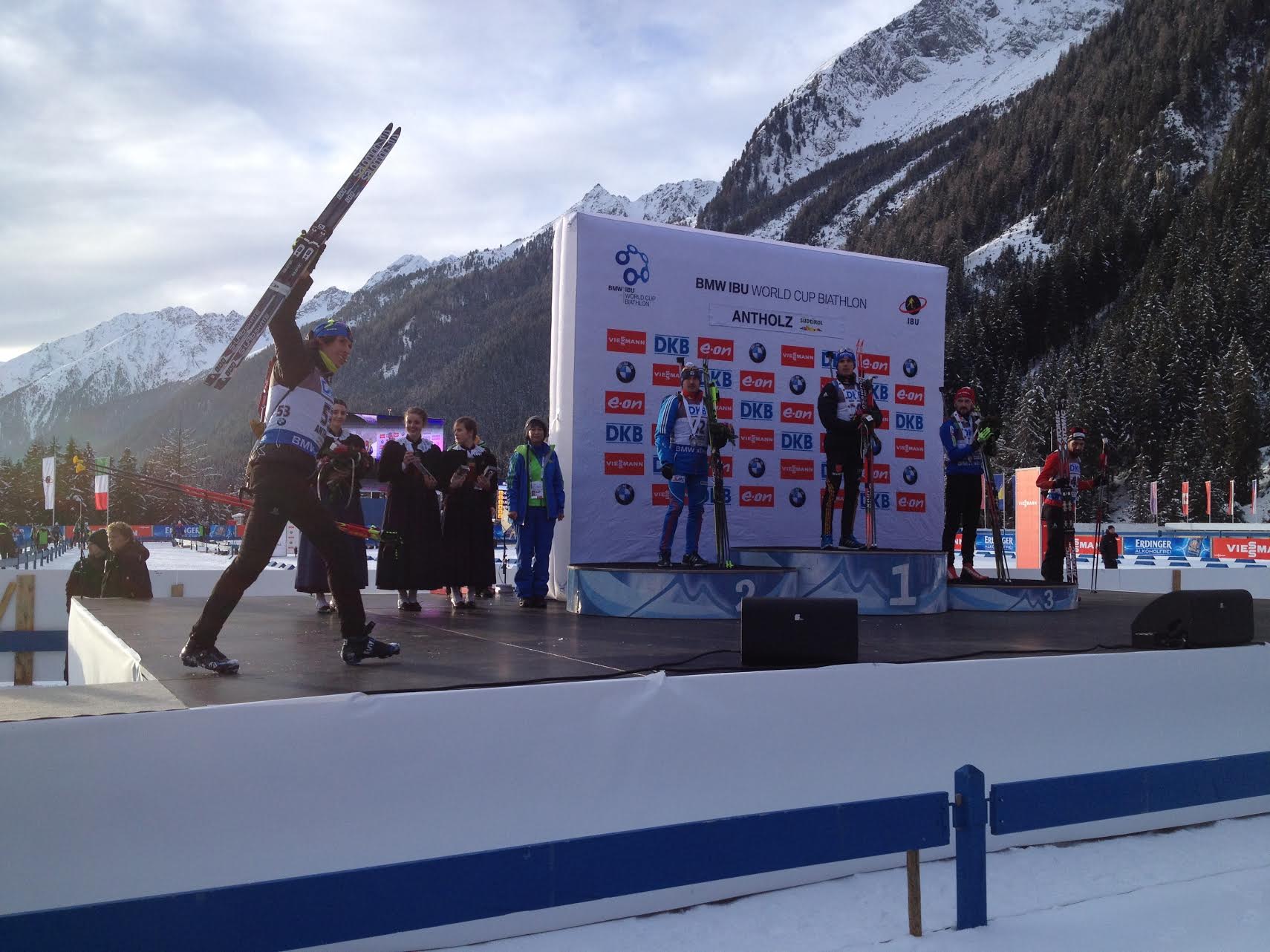
    Biathlon Canada's Brendan Green (l) acknowledges the crowd, including his parents, during his first appearance in an IBU World Cup awards ceremony on Thursday in Antholz, Italy. He placed fifth in the men's 10 k sprint for a career best. (Photo: Matthias Ahrens)
    Biathlon Canada’s Brendan Green (l) acknowledges the crowd, including his parents, during his first appearance in an IBU World Cup awards ceremony on Thursday in Antholz, Italy. He placed fifth in the men’s 10 k sprint for a career best. (Photo: Matthias Ahrens)

    Brendan Green couldn’t put his finger on it after the men’s 10-kilometer sprint in Antholz, Italy, but whatever it was, he was hoping it kept up.

    The 28-year-old Canadian rolled to his fourth-straight flawless IBU World Cup race on Thursday — flawless in the sense that he didn’t miss a single shot, and perhaps the most perfect of all four given that he achieved a career-best fifth place in doing so.

    “I’ve always loved racing here in Antholz and it is definitely my favourite stop on tour,” Green wrote in an email. “It’s hard to say exactly why I’ve been able to find success here. It’s a fun venue to race, the atmosphere and fans are awesome, the weather is almost always perfect, and the course is one that maybe plays a little more into my strengths.”

    Just over a year ago, Green recorded his previous career-best World Cup result of eighth in the Antholz sprint. On Thursday, he broke an IBU record for the longest clean-shooting streak of any man on the circuit in the last two years, according to RealBiathlon.

    Brendan Green (Biathlon Canada) celebrating fifth place in the men's 10 k sprint on Thursday at the IBU World Cup in Antholz, Italy. It topped his previous career best of eighth, which he previously achieved in the Antholz sprint a year earlier. (Courtesy photo)
    Brendan Green (Biathlon Canada) celebrating fifth place in the men’s 10 k sprint on Thursday at the IBU World Cup in Antholz, Italy. It topped his previous career best of eighth, which he previously achieved in the Antholz sprint last year. (Courtesy photo)

    As of last Sunday, Green was the first biathlete to clean a three-race weekend in 2014/2015, closing out the races in Ruhpolding, Germany, in 18th in the mass start.

    And on Thursday, he became the first male in the last two seasons to notch 50-for-50 shooting, matching Belarusian female biathlete Nadezhda Skardino, who did so in Ruhpolding last season.

    “It’s been awesome to have had such success with my shooting since Christmas,” wrote Green, who hasn’t missed a target in a race so far this second World Cup trimester. He returned to the circuit in Ruhpolding, starting with a relay on Jan. 15.

    “After the first trimester of racing I came home with some specific changes in mind that I needed to address before I continued back on the World Cup circuit,” he explained. “No major changes or revelations, but I did make a few small positional adjustments and then from there fine tuned a few areas in my approach to shooting.  So far it seems to be working and I really hope that I can continue on in the season with strong shooting.”

    But no pressure.

    “At the moment I’m trying not to overthink it too much and focus more on each race day to day,” he added.

    With his fifth-place result, Green will start Saturday’s 12.5 k pursuit in fifth, 24 seconds behind sprint winner Simon Schempp of Germany. On Thursday, the Canadian finished 24.4 seconds behind Schempp and 3.5 seconds off the podium.

    Schempp, who tied Italy’s Lukas Hofer for first in last season’s Antholz sprint, won it outright on Thursday in 23:18.8, 14 seconds ahead of Russia’s Evgeniy Garanichev. It was the German’s second-straight victory and fourth ever since he won the Ruhpolding mass start four days earlier.

    Germany's Simon Schempp on the podium after his second-straight IBU World Cup win (and fourth overall) in the men's 10 k sprint on Thursday in Antholz, Italy.
    Germany’s Simon Schempp on the podium after his second-straight IBU World Cup win (and fourth overall) in the men’s 10 k sprint on Thursday in Antholz, Italy.

    Schempp cleaned his third-straight race with the second-fastest course time. Switzerland’s Benjamin Weger was fastest on course in the three-lap race, but missed one prone target to place fourth, 30.9 seconds behind Schempp and 0.8 seconds off the podium (behind Slovenia’s Jakov Fak in third).

    “This is crazy. The last three races were really good for me,” Schempp told the IBU. “I think I made good progress in my training over Christmas. I am really happy about January.”

    Green’s overall course time ranked ninth and his range time was 31st-fastest among 102 finishers. The 42nd starter, Garanichev cleaned with the third-fastest range time and skied to second with the sixth-fastest course time — coming closer than anyone but still 14 whole seconds away from Schempp, who started in bib 29 ahead of him.

    An early leader, Ole Einar Bjørndalen of Norway exhausted at the finish of the IBU World Cup men's 10 k sprint on Thursday in Antholz, Italy. He ended up ninth.
    An early leader, Norway’s Ole Einar Bjørndalen exhausted at the finish of the IBU World Cup men’s 10 k sprint on Thursday in Antholz, Italy. He ended up ninth.

    Fak started 48th, and with the fourth-fastest ski time and sixth-ranked range time, the Slovenian was headed for first with one shooting stage and one lap to go, but missed his final shot (his lone penalty of the day) to finish 20.1 seconds behind Schempp.

    “The pressure on the trigger was not quite right and I missed by a small amount,” Fak told the IBU. “I was shooting really well in zeroing — no misses. That probably gave me too much confidence. It is better to miss a few and then you work harder to make sure you hit in the race.”

    However, for Green, who started 53rd and jumped from 15th after prone to fifth after standing, it was about keeping his momentum going.

    “Brendan always seems to get into race shape in skiing and shooting after Christmas, it takes him a while to gain the right pacing and shooting confidence in race intensity,” Biathlon Canada Head Coach Matthias Ahrens wrote in an email.

    “We worked a little bit on his zeroing pending on what type of race related to how the pace is being pushed, i.e. individual compared to sprint, mass start, relay, etc.,” Ahrens explained. “Historically he also has quite good races in Antholz with fast ski times, maybe it is the combination of the altitude with the course profile which suits him.”

    Green compared it to his training base in Canmore, Alberta, in terms of “weather, snow, and terrain,” he wrote. “I’m sure training and living at 1400 meters [4,600 feet] in Canmore would also be another factor. The fact that I have had some of my better results here, like my sprint race last year is definitely a motivator as well.”

    Brendan Green after finishing a career-best fifth in the men's 10 k sprint at the IBU World Cup in Antholz, Italy.
    Brendan Green after finishing a career-best fifth in the men’s 10 k sprint at the IBU World Cup in Antholz, Italy.

    He also had his parents to race for and in front of, after they traveled three days from the Northwest Territories to watch him race for the weekend. They arrived in Antholz on Wednesday night.

    “I think the most special part of today was having my parents in the crowd,” Green wrote. “They’ve dedicated so much time and energy towards my career and for them to see in person what I spend my winters doing and experience the World Cup atmosphere was awesome for them. It was really special to be able to share my result today with them and I think that’s what I’ll remember most from today — seeing my parents smiling and waving a flag from the grande stand during the prize ceremony.”

    From the start, Green knew his skiing already felt stronger than last week. And after his first shooting stage, he realized he was on track for a top result if he stayed on the same unblemished path.

    “I tried not to take any risks shooting and focus more on a steady and consistent race,” he wrote. “I think if I can race in control with a process that I know I can trust, that will be the key factor to good results for me.”

    Leaving standing with 10-for-10 shooting behind him, he looked up at the big screen to see his split time: fifth. From there, the Canadian staff gave him splits on the final lap.

    “I did all I could on my last lap, I knew it was tight and that the podium was close, there really wasn’t too much else going through my mind,” Green wrote.

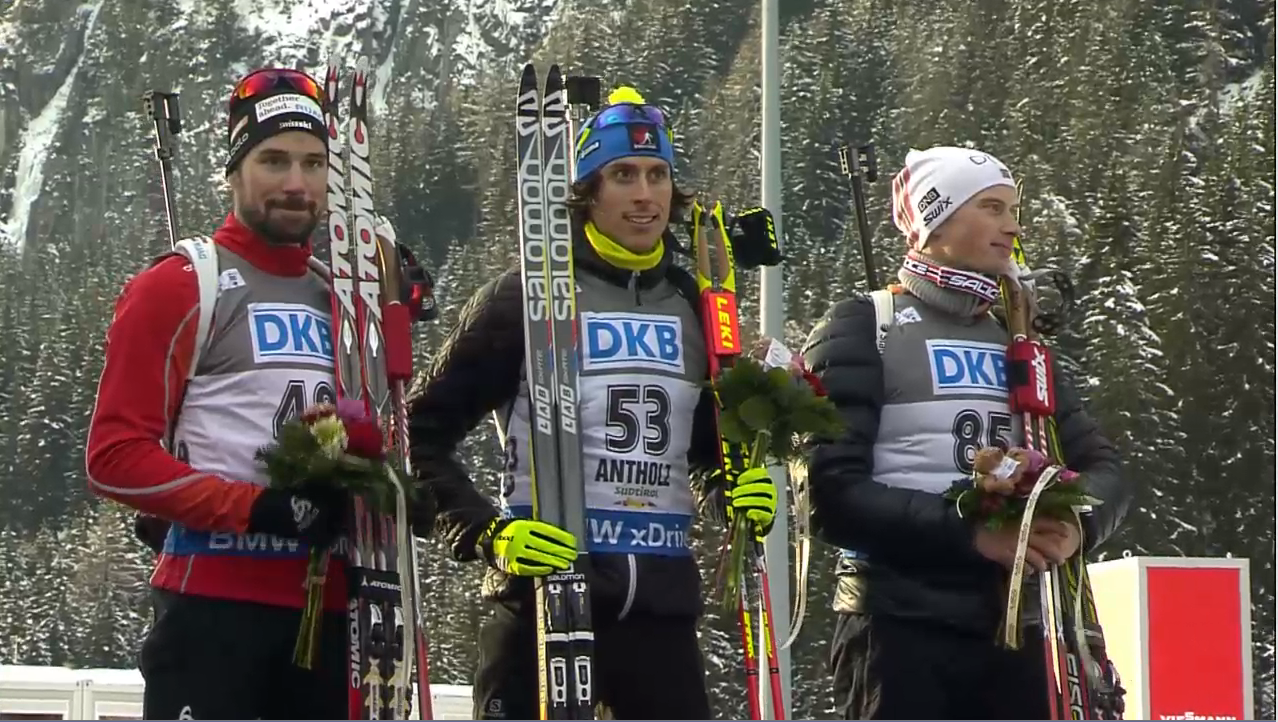
    Brendan Green (c) in fifth stands between Swiss fourth-place finisher Benjamin Weger (l) and Norway's Henrik L'Abee-Lund, who was sixth, at the 10 k sprint awards ceremony in Antholz, Italy.
    Brendan Green (c) in fifth stands between Swiss fourth-place finisher Benjamin Weger (l) and Norway’s Henrik L’Abee-Lund, who was sixth, at the 10 k sprint awards ceremony in Antholz, Italy.

    When he finished, he looked up again, confirmed he had held onto fifth and turned his attention to the stands. Still standing at a time when most other racers collapse to catch their breath, he raised one arm to celebrate.

    “Today was a great result for me,” he wrote. “I’m sure I’ll think about those 4 seconds to the podium eventually, but for now I’m especially happy with the race I executed and the end result.”

    According to a tweet from Biathlon Canada, Green will receive “clean shooting pins” for his last several performances.

    Former US Biathlon racer Sara Studebaker explained in an email that the national-team coaches used to reward her teammates for clean-shooting races with “Fika” — coffee and pastries.

    “It really is pretty cool that Brendan cleaned the whole weekend! If that had been me, I probably would have celebrated with a couple glasses of wine with my team,” Studebaker wrote after his Ruhpolding performance. “But at the same time, it’s your job to shoot well … so you can’t go too crazy. It’s awesome, but also kind of like, ‘yeah, that’s what I’m SUPPOSED to do.’ ”

    “ I probably would have celebrated with a couple glasses of wine. … It’s awesome, but also kind of like, ‘yeah, that’s what I’m SUPPOSED to do.’ ” — former US Biathlon member Sara Studebaker on clean shooting

    Biathlon Canada High Performance Director Chris Lindsay noted that Green’s progression and shooting success has been in line with the team’s expectations.

    “Brendan has consistently been a very strong shooter for a number of seasons,” Lindsay wrote in an email. “The change in the past two years following his [back] injury has been that the ski speed has improved. I think that the work that our physiologists, physiotherapists, and strength coaches did to rebuild his fundamental movement skills has been paying off and serves as a lesson for young athletes. You have to get the basic fitness correct before working on the things that will shave the final seconds off your time. It’s a similar philosophy to shooting — hit the targets first, then worry about speeding up.”

    Lindsay also pointed out that Green is following a similar pattern to last season, “where December laid the foundation for the success around the Olympics,” he wrote.

    But Green explained that he had hoped to start this season stronger than he did.

    “It was never really the plan to follow a similar trajectory as seasons past,” he wrote. “I would say almost the opposite, this year I was really hoping to start off the season and first trimester with a bang. I’m not sure why I historically get better as the season progresses but it’s starting to seem more and more like a very difficult trend for me to change.”

    Lowell Bailey (US Biathlon) racing to 32nd in the IBU World Cup 10 k sprint in Antholz, Italy. (Photo: USBA/NordicFocus)
    Lowell Bailey (US Biathlon) racing to 32nd in the IBU World Cup 10 k sprint in Antholz, Italy. (Photo: USBA/NordicFocus)

    With his first-ever appearance in the flower ceremony (top six), Green led three teammates, including Christian Gow, who qualified for Saturday’s pursuit in 52nd (+2:03.9). Scott Gow finished 74th (+2:38.5) with three penalties (2+1), and Nathan Smith ended up 78th (+2:43.3) with four misses (2+2).

    Two Americans made the top-60 cutoff for the pursuit as well, with Lowell Bailey placing 32nd (+1:31.2) with a single standing miss, and Tim Burke finishing 48th (+2:02.1) with three penalties (1+2).

    Also for the U.S., Sean Doherty placed 63rd (+2:19) with three misses (1+2), and Leif Nordgren missed four for 80th (+2:49.5).

    Results

  • Three Swiss Biathletes, Sochi Olympians, Train with Canadians in Canmore

    Three Swiss Biathletes, Sochi Olympians, Train with Canadians in Canmore

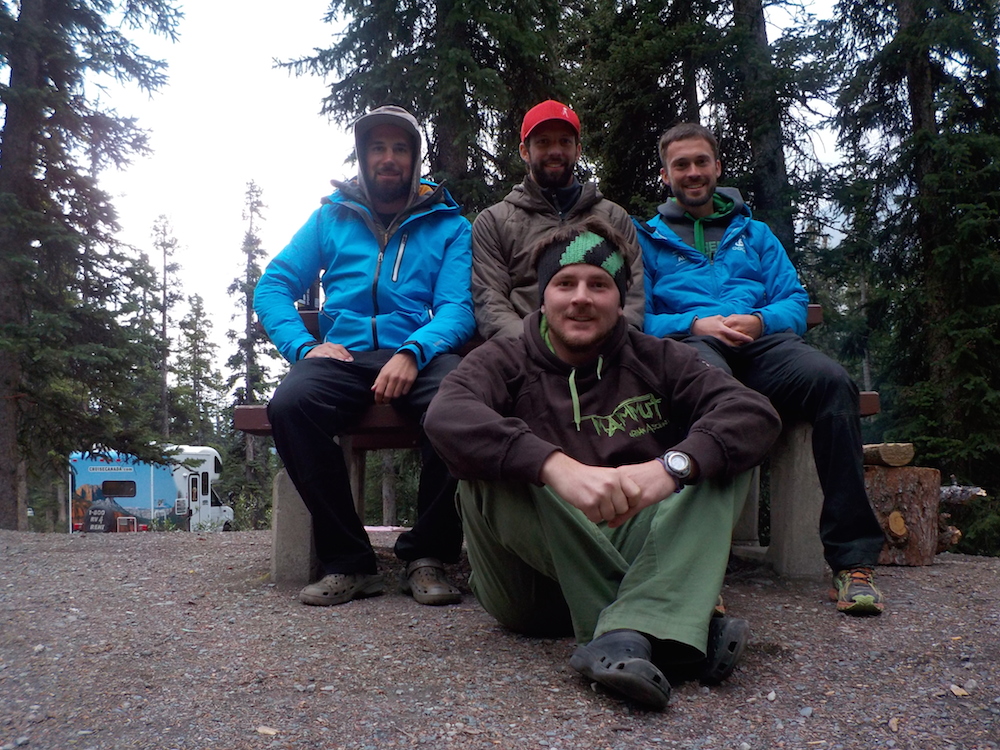
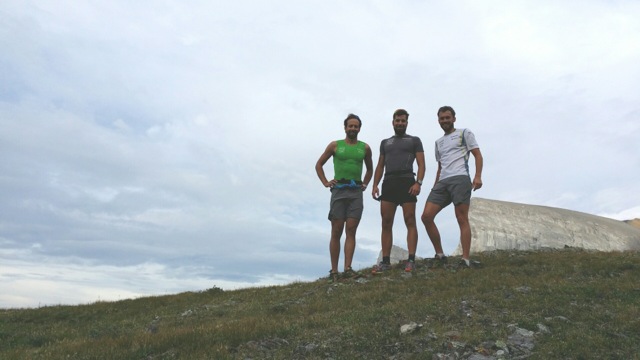
    Switzerland's Benjamin Weger (l), Serafin Wietner, Ivan Joller and Weger's good friend Roman (bottom) during their weekend camping trip on the ice field in  Jasper National Park in Alberta. (Photo: Benjamin Weger)
    Switzerland’s Benjamin Weger (l), Serafin Wiestner, Ivan Joller and Weger’s good friend Roman (bottom) during their weekend camping trip on the ice field in Jasper National Park in Alberta. (Photo: Benjamin Weger)

    Benjamin Weger remembered Canmore, Alberta, as a 19 year old, competing for the first time in Canada as a Swiss biathlete at the 2009 International Biathlon Union (IBU) Junior World Championships. There, he grabbed silver in the sprint and placed ninth in the pursuit.

    The next year, Weger went one province west to Vancouver, British Columbia, for the 2010 Olympics. Results-wise, he didn’t come close to the podium on the world’s biggest-racing stage — placing 55th in the individual race and 69th in the sprint — but he returned to the IBU circuit the following season to notch his first World Cup medal, second in an individual race in December 2010.

    Multiple World Cup podiums and another Olympics later, Weger, now 24, returned to Canmore with two teammates, Serafin Wiestner and Ivan Joller, to train for three weeks from July 4-July 26. Wiestner, 23, also competed in Canmore, where he placed 39th in the sprint (and went on to finish fifth in the Junior Worlds sprint in 2011).

    In an email, Weger recalled meeting Biathlon Canada Head Coach Matthias Ahrens in Canmore in 2009. He extended an open invitation for the Swiss biathletes to come train with his team there any time.

    “It was [such] a nice place with great tracks and nice nature,” Weger wrote. “There we said to come once in summer for training.”

    Joller (l), Weger (c) and Wiestner during an uphill, double-pole training workout near Canmore. (Photo: Benjamin Weger)
    Joller (l), Weger (c) and Wiestner during an uphill, double-pole training workout near Canmore. (Photo: Benjamin Weger)

    Last season at the first IBU World Cup in Östersund, Sweden, Weger took Ahrens up on his offer. From there, the two coordinated a plan with Wiestner and Joller, 30, which involved several shooting-and-rollerski sessions with the Canadian biathletes on their home turf.

    The three men stayed in Canmore with a Canadian wax tech, enjoying sights like the Calgary Stampede festival (rodeo), Banff, and a weekend trip to Jasper National Park, Weger explained. After, they were headed to the Yukon for a week of “fly fishing and relaxing,” and visiting a longtime friend of Wiestner.

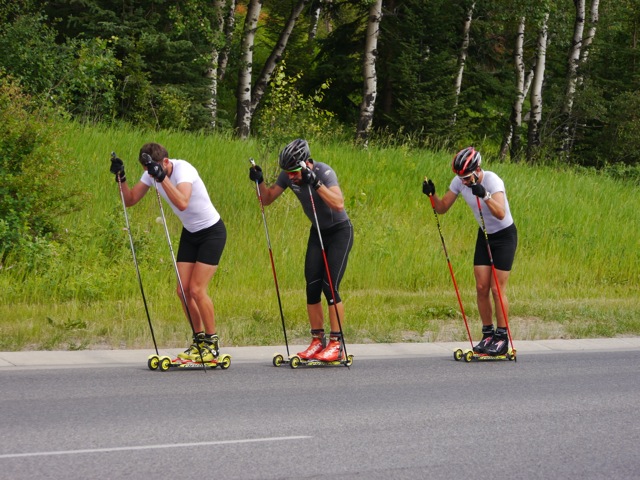
    “We did a lot of trainings with the Canadians in the shooting range and on the roller ski track, but also some nice tours on roller skis like near Banff to Lake Louise and than up to the Moraine Lake,” Weger wrote. They also joined one of the team’s sprint competitions.

    Before the trip, Weger knew some of the Canadian men, but not very well.

    “We talked sometimes together but not much,” he wrote. “Now we learned to know those guys better. We learned to know some young guys as well. They are all very motivated. That’s a cool team!”

    In terms of a training venue, Weger explained Canmore is similar to his hometown in terms of elevation, around 1,300 meters above sea level. The weather in his mountain village of Geschinen can also be variable “from nice and warm to rainy and cold.”

    Swiss biathletes Serafin Wiestner (l), Benjamin Weger (c), and Ivan Joller during a trail run to the Three Sister Pass in Canmore, Alberta. (Photo: Benjamin Weger)
    Swiss biathletes Serafin Wiestner (l), Benjamin Weger (c), and Ivan Joller during a trail run to the Three Sister Pass in Canmore, Alberta. (Photo: Benjamin Weger)

    But his experiences were different — even different from that of five years ago.

    “Last time it was a competition, this time we are there for training,” Weger wrote. “This time we had more time so [we’re going to] see some different places. We had also more time to get to know people. And during the training we saw a lot of nice places along the roads during the roller ski, or very nice places in the nature during our hikes or running.”

    In terms of goals, Weger wants to get back to the World Cup podium, where he was three seasons ago. At the Sochi Olympics, he placed 48th in the individual, 63rd in the sprint, and anchored his men’s relay to 14th with Claudio Boeckli, Joller and Wiestner.

    “I want catch up to the best athletes in the World Cup,” Weger wrote. “To reach this I have to stabilize my shooting on a high level. And I have to improve and stabilize my skiing performance. To stay in a good health is the prerequisite for good results and this was the main problem in the last season.

    “My Olympics were very bad,” he added. “Shooting performance was ok, but the skiing was the big problem. I think it was because I was not in good health.”

    Weistner placed 40th in the Sochi sprint and 57th in the pursuit, and Joller finished 67th in the individual race.

  • Rugged Racing on Tap for Fort Kent World Cup

    Rugged Racing on Tap for Fort Kent World Cup

    A view of the stadium in Fort Kent.

    Cold snow, Spartan living, and one wicked long, wicked steep hill—welcome to Fort Kent.

    “Reminds me of Russia,” said Norwegian biathlete Tarjei Boe, the leader of the men’s overall World Cup standings.

    After a week in the relative metropolis of Presque Isle, the biathlon World Cup circuit has now moved to the small town of Fort Kent, in Maine’s northern-most reaches, for three more races.

    Both women and men will race a sprint, a pursuit, and a mass start competition over the next four days, before all the athletes return to their respective homes to prepare for the 2011 World Championships in Khanty-Mansiysk, Russia, in early March.

    After the races in Presque Isle last week went off in moderate temperatures on modest courses, athletes are gearing up for bigger challenges in Fort Kent.

    Foremost among them is a massive, minute-long climb on the sprint course, just a few hundred meters out of the start. Steep, with two pitches, the hill is so big that some teams asked a trail to be groomed around it, so that athletes could stay at an easy pace while training.

    The section is new since 2004, the last time World Cup races were held in Fort Kent; according to U.S. Biathlon CEO Max Cobb, the pitch was constructed as a response to feedback from teams.

    “They said…it doesn’t really feel like there’s a test,” he said. “Now, there’s a test.”

    Just how tough is the climb? Simon Fourcade, the French star, told FasterSkier that he thinks the pitch is “one of the hardest hills on the World Cup.”

    The rest of the course is more like last week’s in Presque Isle—winding, with technical downhills and rolling terrain, hemmed in closely by trees.

    “It’s really hard to see where you are on the track,” Fourcade said.

    Logically, all those trees seem like they should shelter Fort Kent’s shooting range, which is nestled a bit farther and deeper into the surrounding terrain than the one in Presque Isle, where a stiff breeze plagued athletes last week. But according to Benjamin Weger, a Swiss biathlete, Fort Kent is similarly challenging.

    “For shooting, it’s a bit difficult, because of the wind,” he said. “It comes hard, and then easier.”

    The cold may also be a factor. After falling below zero Fahrenheit on Tuesday night, temperatures on Wednesday barely broke into double digits, and the predicted high for Thursday is nine degrees—with wind chill down to 10 below. The cutoff for racing is negative four Fahrenheit, so it’s unlikely any events will be cancelled, but it’s certainly possible for them to become unpleasant.

    In town, many of the athletes are living in dormitories on the campus of the University of Maine.

    Originally, the World Cup was scheduled to fall during vacation, but a shift in the schedule by the International Biathlon Union earlier this year left organizers scrambling to come up with lodging. Some coaches and service staff are actually living in area houses that have been rented for the week.

    “It’s very challenging to find enough accommodations here—that remains the crux move for hosting events in Fort Kent,” Cobb said.

    Weger, who’s staying at the University, said that housing in Europe is typically “a bit better,” but that things in Fort Kent are “not bad.” As Fourcade put it, “it’s different, too, between Germany and Norway.”

    “Of course it’s a different ambience, here,” Fourcade said. “It’s normal—it’s not the same country.”

    Who’s here? Well, in addition to Boe and Fourcade, a number of other top competitors have made the trip up to Fort Kent since last week, juicing up a relatively anemic men’s field from the races in Presque Isle.

    Norwegian Emil Hegle Svendsen, with three wins on the year already, has flown in, along with German Michael Greis, and Austrians Simon Eder and Christoph Sumann. American Tim Burke will be back in action as well, after missing last weekend’s races due to illness.

    The women’s field was stronger in Presque Isle, and it shouldn’t be much different here. (Start lists weren’t yet available for the first women’s race, on Friday, so it’s still tough to say, exactly.)

    The action kicks off at 11:30 a.m. on Thursday, with the men’s sprint. Watch it live on biathlonworld.com, or check FasterSkier throughout the day for updates and reports.

  • Norwegian Men Are Human After All; Mesotitsch Gets Third World Cup Win

    For the first time this season, someone who wasn’t Norwegian stood atop the men’s World Cup biathlon podium.

    After six straight races of Norwegian dominance, the spell was broken in Pokljuka, Slovenia on Thursday. The top Norwegian finisher, Tarjei Boe, didn’t even make the top ten.

    But Norway’s loss was Austria’s gain, as Daniel Mesotitsch picked up his third career World Cup victory, by almost a minute over Benjamin Weger of Switzerland. Sergui Sednev of Ukraine finished third.

    After two shooting stages, it appeared that the Austrians were in control – Chrisoph Sumann and Simon Eder were sitting in first and second. But after that pair made errors in their later shooting stages, it was their less-famous teammate who was able to ski to the win.

    Mesotitsch started off slowly, finishing the first lap in 57th place. But after a miss in the first prone stage, he shot clean, and his ski times improved as well.

    While Mesotitsch is Austrian, not Slovenian, he said that he was still helped by a sort of home course advantage today.

    “I live just 35 minutes from here, the first exit into Austria,” he told IBU News. “So when we have home training weeks, many times I come over here when the Slovenian team is here and train. So I am very familiar with this shooting range and the tracks.

    “The crowds were very supportive of me today, especially when I was shooting,” he added. “I think the organizers have done a very good job with this venue; they continue to improve here every year.”

    Weger was the big surprise on the podium – his previous best World Cup finish was 17th in Khanty Mansiysk, Russia.

    It wasn’t a good day for the Americans. Lowell Bailey led the team with a 48th-place finish. His five misses represented the best shooting on the team; Russell Currier missed ten en route to 88th place. The wind definitely proved to be challenging, and not a single man in the field shot clean, but the Americans seemed to struggle more than most.

    “For the men we had a rough day again,” said head coach Per Nilsson. “For the moment we don’t hit enough targets to be competitive on this level. It’s clear that we underperform compared to each athlete’s capacity. In the team we know what level we are capable of and it’s far away from this. Our biggest goal for the season is the World Championships in Russia, so we have three months to work on this.”

    Tim Burke appeared to be off to a good start today, but missed an astonishing four shots in his second shooting stage. That mistake more or less removed him from contention for the rest of the race – and he didn’t do himself any favors by missing two shots in each of the last two stages. His 65th-place performance was by far the weakest for him all season.

    Nevertheless, his ski time was the 7th-fastest all day, so if Burke can get his shooting together, he is definitely capable of matching his success from last year.

    Unlike their southern neighbors, the Canadians did have a few bright spots on the results sheet, with Brendan Green finishing 21st and Scott Perras 31st. The results were the best of the season for the pair.

    Perras started from bib 103, and was a surprise addition to the first page of results at the end of the race.

    “I would never chose a later start position but it seems that I have excelled from that position before,” he told FasterSkier in an e-mail. “The best part of starting late is that when you cross the line there is no one or not many that can bump you down in the results.”

    Perras knew that the wind could be a factor, so he adjusted his strategy accordingly.

    “I was prepared to take my time in the range if necessary. I didn’t care about much other then hitting the targets, and you can see this in my shooting time, which was over 40 seconds slower then my fastest shooting teammate, Nathan Smith. I was happy that I put down all of the prone targets because those are probably going to be where the wind can get you the worst.

    “In my final standing, I knew there were some good opportunities for a great result. That is basically what I aim for in a 20 k – get to the final stage with a good chance. It’s exciting and that is the challenge I want.”

    The World Cup continues in Slovenia on Saturday with men’s and women’s sprints.