From the FasterSkier archive — posts syndicated from athletes’ and coaches’ own blogs between 2004 and 2012, kept online as published. Current coverage is at fasterskier.com.

Tag: Bernd Eisenbichler

  • Lowell Bailey and the High Performance Vision

    Lowell Bailey and the High Performance Vision

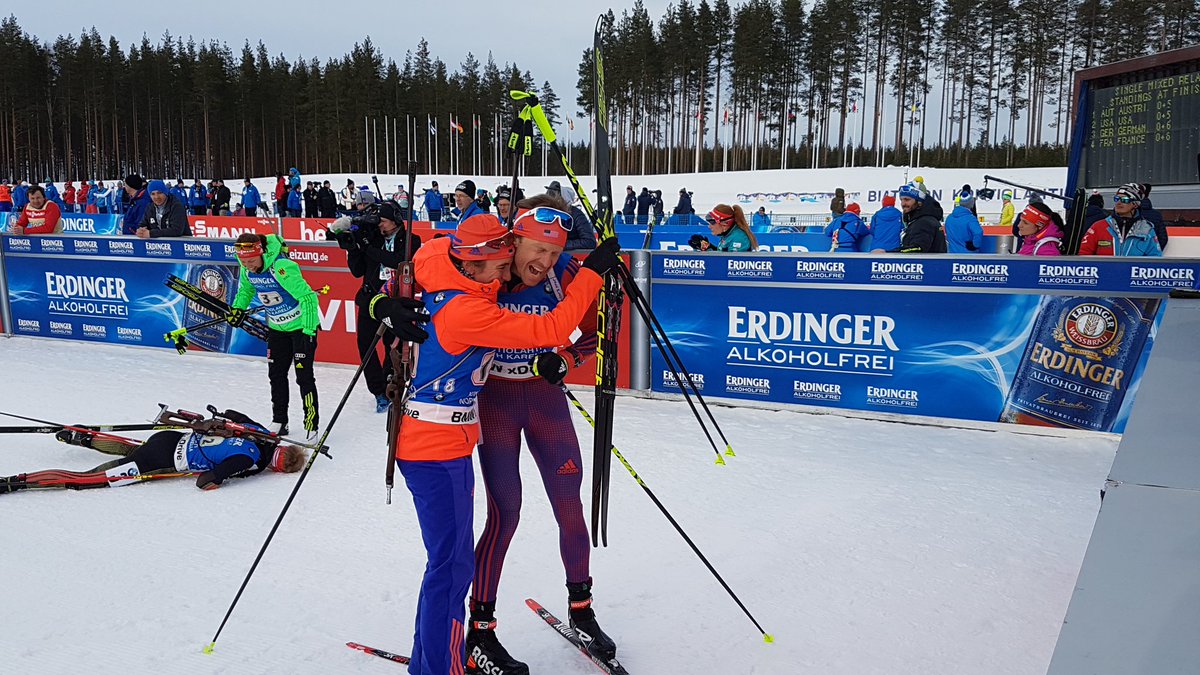
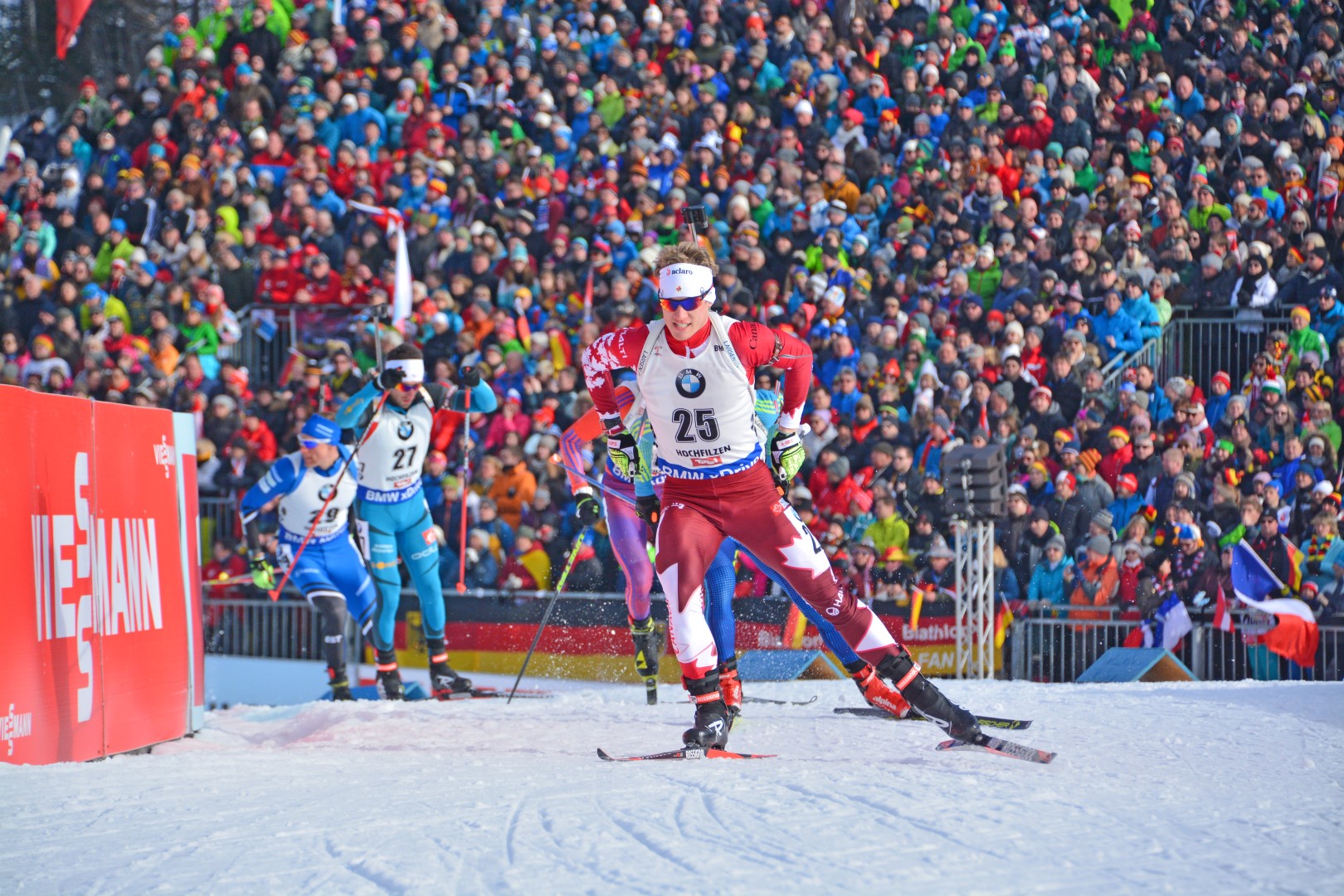
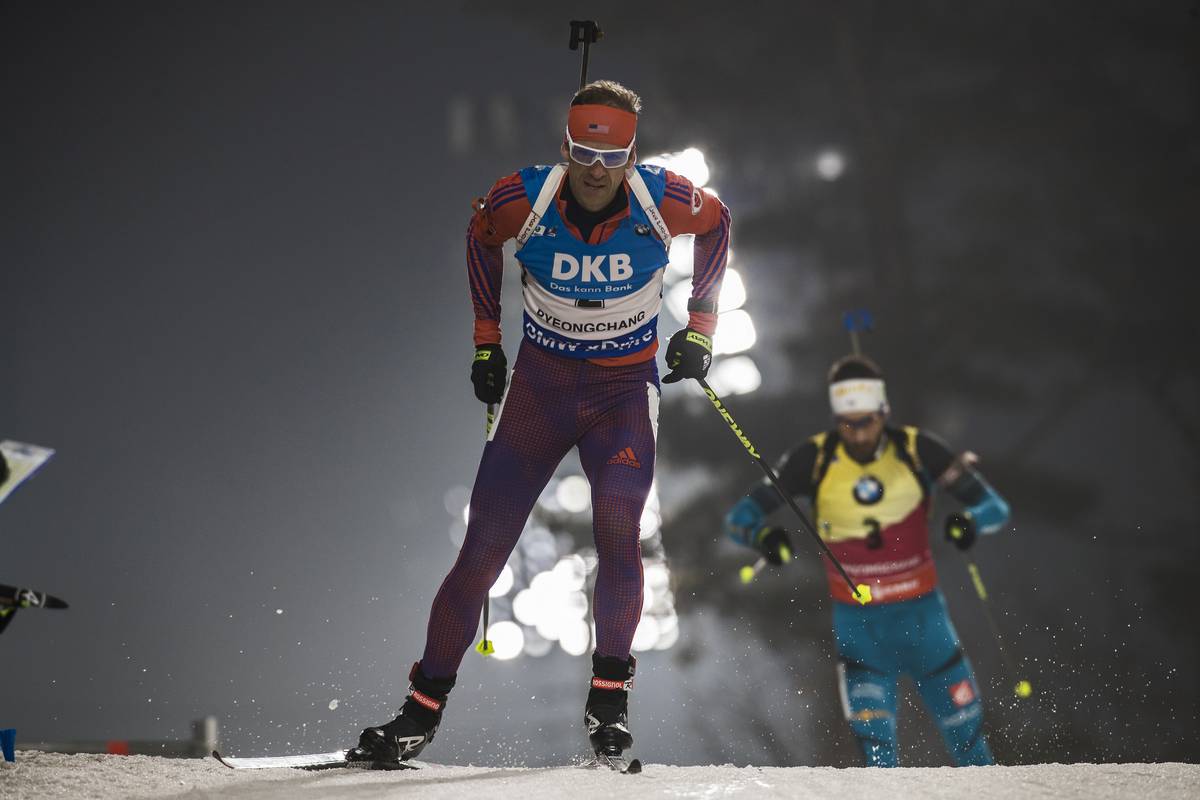
    Lowell Bailey (US Biathlon) leading France’s Martin Fourcade in the men’s 12.5 k pursuit at the 2017 IBU World Cup in PyeongChang, South Korea. Fourcade went on to win after starting third, and Bailey placed ninth after starting second. (Photo: USBA/NordicFocus)

    For years under the leadership of Bernd Eisenbichler and Per Nilsson, US Biathlon was a polyglot enterprise. It’s often claimed the high performance staff at USBA had a decidedly United Nations vibe. As a sport firmly entrenched in Europe, siphoning some of that expertise into the U.S. program paid dividends over the past two decades.

    IBU World Cup podiums and World Championship medals were the payback. Lowell Bailey, at thirty-seven years old, is a hybrid product of an American development system infused with that European biathlon know-how. He was recently announced as US Biathlon’s newest high performance director after Eisenbichler resigned effective March 31.

    Bailey honed his cross-country skiing and biathlon as he grew up in Lake Placid, New York. Along with Tim Burke, the new USBA director for athlete development, the two forged a successful path as juniors and then as elite-level World Cup biathletes. Both won World Championship medals: silver for Burke in 2013, gold for Bailey in 2017.

    “I spent two decades working as an athlete on the US Biathlon team and the last 12-ish years on the World Cup so I feel like I have a good feeling for what the top of the pyramid looks like,” Bailey said during an interview on March, 2. “But I have gotten a lot of perspective on that question of ‘how does a kid get involved in biathlon in our country?’”

    With USBA’s unfulfilled goal of winning a first Olympic medal, Bailey’s race and recent administrative experience could create the lab in which the goal is realized. Although never having led an organization with tentacles as long as USBA’s, which span a massive continent when it comes to development, Bailey’s perspective on how to engage younger athletes in biathlon has been broadened in Bozeman, Montana.

    “Roughly three years ago I started working with Crosscut Mountain Sports Center as a consultant helping to raise awareness of their nascent endeavor — last year I took over as executive director,” Bailey said.

    During his work with Crosscut both as a consultant and the ED, Bailey was tasked with leading the visioning process for a Bozeman venue with world class facilities, IPC, IBU, and FIS homologated courses, and a paved roller ski loop. Bailey’s tenure with Crosscut overlapped with two active years as an IBU athlete and a third, after he retired in 2018, when he resided in Bozeman and immersed himself in grassroots organizing.

    “I think the experience he had working in Bozeman gave him real insight into the real challenges that regional programs face as they try to add biathlon to their offerings,” Max Cobb, CEO and President of USBA said of the skill sets Bailey brings to the organization. “I think we will see him come at that in a really practical and helpful way. I think that will result in a lot more growth of the sport all around the country.”

    Bozeman provided Bailey with a lens into how to build from the ground up. The community remains rooted in mountain culture and an outdoor lifestyle. Young children have opportunities to cross-country ski and develop biathlon skills with the Bridger Ski Foundation. Montana State University offers the potential for aspiring national level biathletes to train and concurrently pursue academics. Crosscut, if it moves forward with breaking ground on its winter sports facility, could become the model USBA and locals envision to build potential elite biathletes.
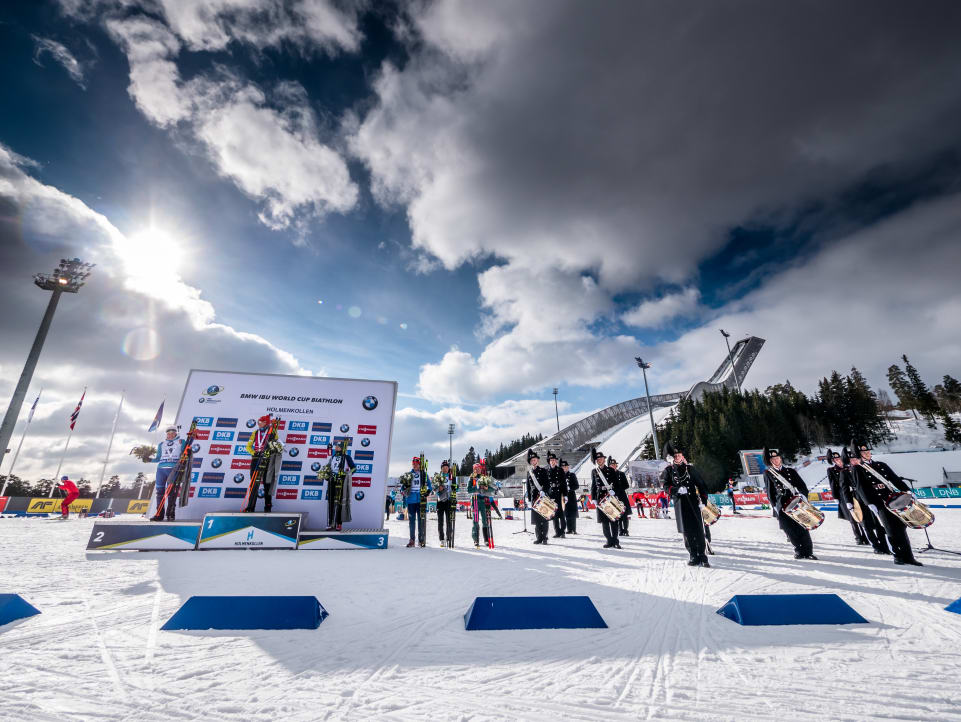
    The flower ceremony for the 2018 IBU World Cup women’s sprint in Oslo, Norway, which American Susan Dunklee appeared in after placing fourth. (Photo: IBU/Biathlonworld)

    The “what ifs” Bailey pondered in Bozeman also reinforced his deep understanding of the hurdles biathlon faces in a massive geographic swath like the U.S. Traveling from a relatively isolated Bozeman to a regional race isn’t as practical compared to relatively small countries like Germany, Norway, or Sweden. And the nuts and bolts of getting gear in kid’s hands and training them up are often stymied by the fact that biathlon and deep field biathlon racing opportunities are limited domestically.

    “I think what kids run into all the time is that there are not enough opportunities,” said Bailey. “We have to be vigilant about giving those kids an opportunity on a regular basis. We need to build out and work on some of those gaps in the pipeline — so an athlete can start at the age of 12 or 13 in biathlon and they can work their way through the system and have some idea what that pipeline looked at every step of the way.”

    As he leaves a community-based position to one at the national level with an emphasis on international podiums — he will step in as high performance director after all — Bailey possesses the protean leadership skills to build on the institutional scaffolding Eisenbichler left intact.

    Bailey will be helped by Burke and Danika Frisbie who were hired last year to assist USBA with athlete development. Burke takes on the new title of director of athlete development while Frisbie continues in her role as sport program manager.

    “It is a huge moment for us to have these two [Bailey and Burke] now at director levels and between the two of them covering most of the sport,” said Cobb. “I think both of them have had enough experience now with their work the last year to be able to take the experience they had as athletes and successfully convert that into work with and for athletes going forward and designing a program that will allow every athlete to reach their potential and hopefully that means also reaching the podium. It is a very exciting time.”

    Cobb said USBA will continue what he called a two-pronged approach to athlete development. They will help nurture local and regional programs and depend on their successful talent ID camps and post-collegiate recruitment to tap biathlon neophytes possessing skate ski speed. Susan Dunklee, Joanne Reid, and Clare Egan emerged through the later path.

    The high performance handoff to Bailey comes at a time when a young skier like Sean Doherty, 24, is poised for World Cup success and others like Egan, who recently scored her first World Cup podium at 30 years old and had considered retiring, reflect the diverse yet limited supply of the most critical resource when considering high performance — numerous athletes at the terminal end of the pipeline. Software development Ukraine with Echo.

    “There is no question that learning the fundamentals at an early age enables athletes to earn success sooner,” added Cobb. “Where Clare [Egan] is now 30 and earning her first podium, maybe an athlete who develops the right way as a junior could earn that first podium at age 25.”

    What this all means is the U.S. must build depth in its athlete ranks. Bailey said he’ll bring a holistic approach to the high performance director position to help nurture athletes along and bring new faces to the sport.

    “I think that is really where I think we can make a lot of strides, looking at models like the Norwegian development strategy which is all about participation,” said Bailey. “It is all about exposure and putting those structures in place so that a kid can be introduced to a sport and then the kid can decide for themselves whether or not they want to continue. And that I think is when you hit the sweet spot of Olympic success. If we are all talking about winning this first ever Olympic medal for US Biathlon. I think if you really step far enough backward in the development process, any model that sort of pushes a kid without by in from the actual athlete is inevitably going to fail.”

  • Bernd Eisenbichler and his US Biathlon Legacy

    Bernd Eisenbichler and his US Biathlon Legacy

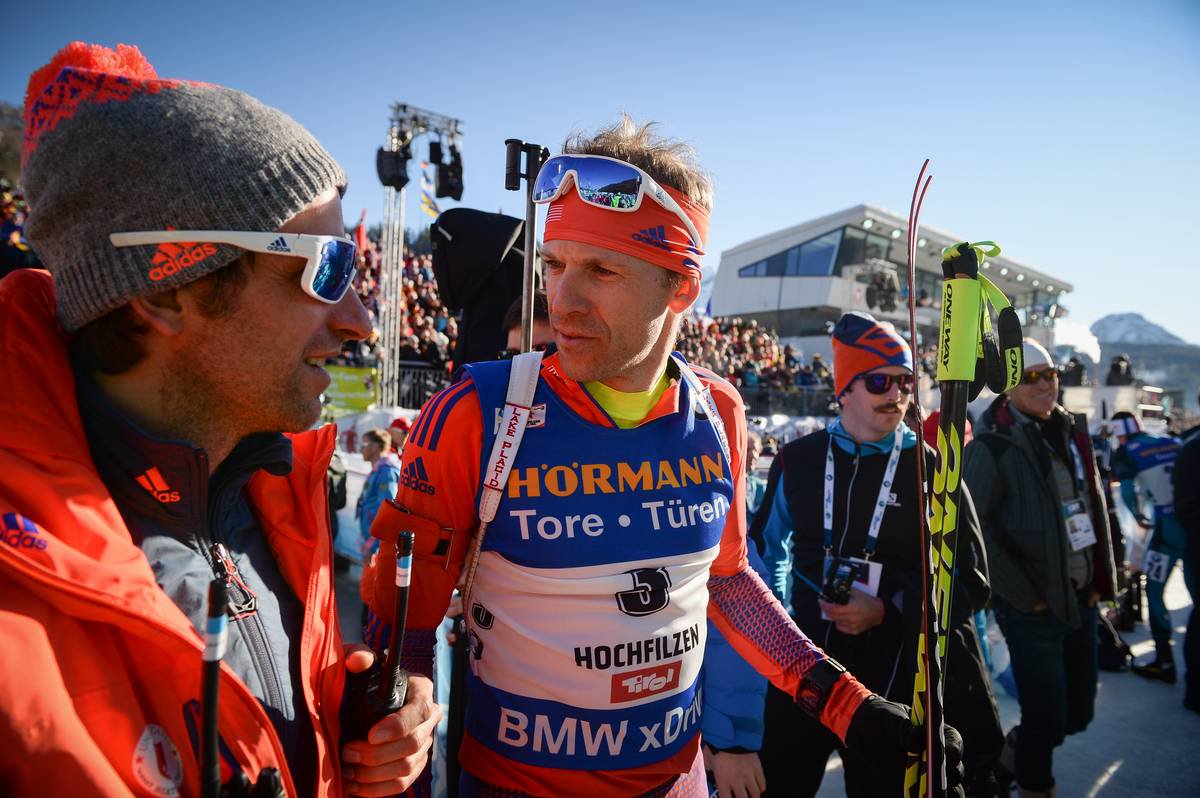
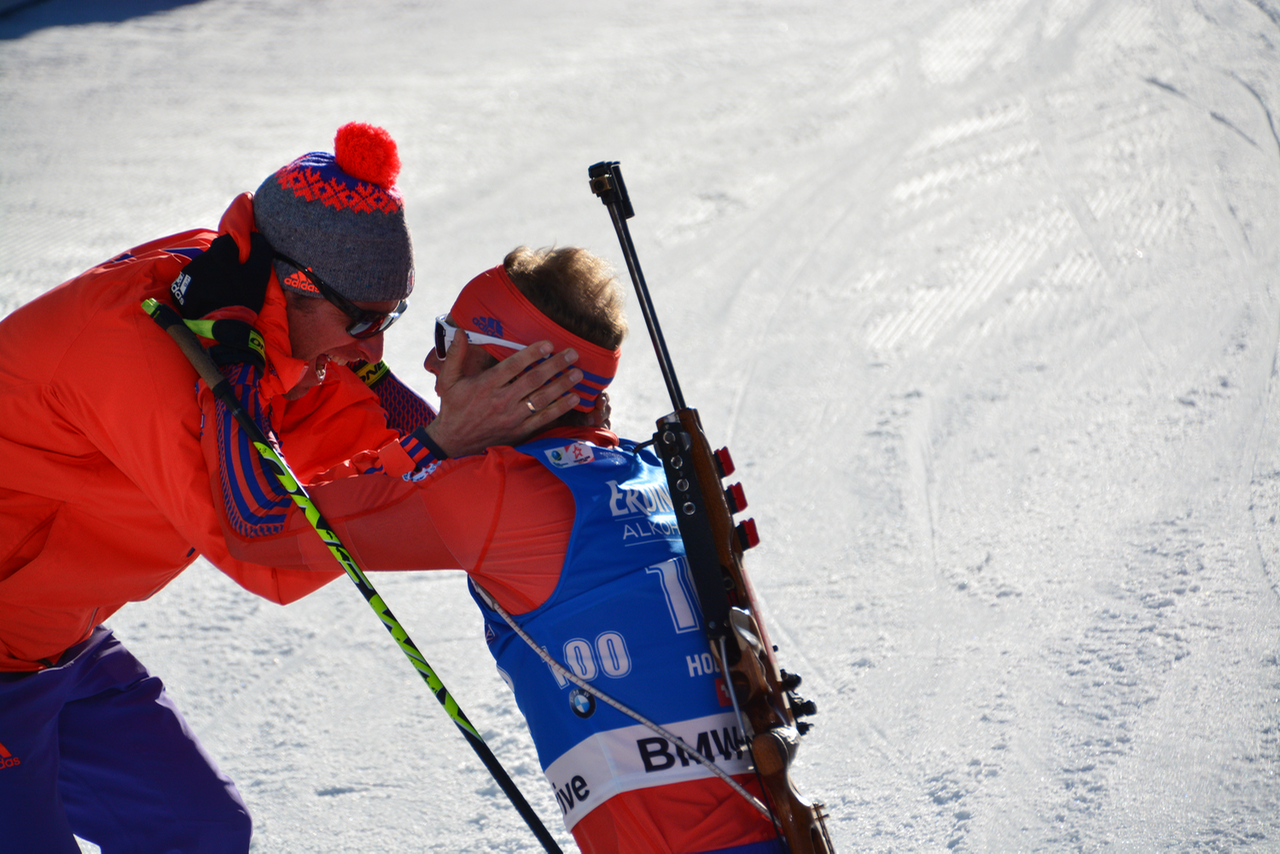
    U.S. Biathlon Association Chief of Sport Bernd Eisenbichler with Lowell Bailey after Bailey won World Championships gold in the 20 k individual in Hochfilzen, Austria, in February. (Photo: Glen Crawford)

    “Twenty years and two months ago I began with US Biathlon,” Bernd Eisenbichler said to FasterSkier last week during a phone call to discuss his March 31, resignation as high performance director.

    For those of you unfamiliar with the name, Eisenbichler has worn many hats during his tenure with US Biathlon: Ski/wax tech, high performance director, and chief of sport. With a title like chief of sport, more fitting head-ware might have been a crown. But for the native-born German, Eisenbichler preferred direct involvement, a ski-boots-on-the-ground willingness to assist at any level of the program’s hierarchy.

    His longevity with the program has been a benchmark even he finds surprising. Asked if he intended on steering the U.S. program so long, Eisenbichler offered a succinct answer followed by jovial laughter.

    “No…No,” he said.

    Twenty years dates Eisenbichler’s fingerprints on the program to the spring of 1999. Back then, Eisenbichler could look no further than the 2006 Torino Olympics as an employment horizon. After which, he explained, he expected to reassess his commitment.  

    “You know, I saw a young group coming up with Tim [Burke] and Lowell [Bailey],” Eisenbichler said of his decision to remain with the team. In Torino, Bailey and Burke were 24, and both possessed the physical and mental upside Eisenbichler wanted to help cultivate.

    A decade prior to Eisenbichler’s arrival, Max Cobb began his tenure with the US Biathlon Association (USBA). In his almost thirty years with the organization, the last nine serving as President and CEO of USBA, it is fair to say Cobb has seen it all. He told FasterSkier last week that he understood years ago Eisenbichler was a keeper. 

    “Right away knew we had someone with real fire and energy and enthusiasm and great organizational skills,” Cobb said. “Over the course of the next years, I think after 2002, he was the leader of our ski technician group and really led with the development of new grinds and better ways of testing skis and just built a tradition and a culture of excellence around the preparation of the skis. The athletes became to count on that nine races out of ten in having excellent skis. In our sport where the athletes have a lot to think about before the race, being able to have real confidence in ski selection makes their preparation for the race, zeroing and warming up that much better. That was only the beginning of Bernd’s contribution to the sport. Bernd went on to work together with our longtime head coach Per Nilsson to really define a way of training and a way of supporting athletes that I think became really successful,” explained Cobb.”

    Eisenbichler became high performance director in 2007. Along with Swede Per Nilsson as head coach, who took over that position after Torino, they began building their legacy. Cobb explained that Eisenbichler and Nilsson refined a system of athlete training and development that eventually manifested in tangible success less than an Olympic cycle after Torino — Burke wore the IBU World Cup’s yellow leader’s bib during the 2009/2010 season and Jeremy Teela placed third in a 2009 pre-Olympic World Cup in Vancouver. Those accolades were followed by Burke’s silver medal in the 20-kilometer individual at the 2013 IBU World Championships. 

    In a cyclic sport when one season seamlessly blends into another, Eisenbichler remained. Let’s not fool ourselves. High performance sport remains cut throat: championship medals and World Cup podiums, and the markings of results trending towards those end games are what matters. Had Eisenbichler not delivered, he most likely would have been out. 

    Burke and Bailey became consistent performers. Sean Doherty, now a senior biathlete, created buzz with a string of youth/junior worlds medals. Susan Dunklee, became the face of an emerging women’s program. She remains a podium threat skier. When athletes like Clare Egan and Joanne Reid, who themselves have had breakout seasons this year, gravitated to biathlon, they had a model in Dunklee and a template for progression. 

    The 2017 IBU World Championships was the capstone for Eisenbichler. Bailey won the 20 k individual gold, and Dunklee won silver in the women’s mass start.

    Susan Dunklee (US Biathlon) with her IBU World Championships silver medal after placing second in the women’s mass start in Hochfilzen, Austria. (Photo: USBA/NordicFocus)

    “Yah, in 2017 after Lowell won the gold medal and Susan won the silver, I was thinking like ‘hey maybe soon it is time’ you know,” Eisenbichler said about when he had contemplated moving on from the U.S. program. Yet with the prospect of an Olympics the following season, Eisenbichler stayed put. Then, post-PyeongChang, the team lost several coaches and began a reboot.

    Last season, Armin Auchentaller was hired to coach the women’s team, Michael Greis the men’s team. Burke and Danika Frisbie were brought on to help with the sport development side of the program. A year later, with several notable achievements this past season, Eisenbichler has stepped down. “I had to restart the program [after PyeongChang], I didn’t want to leave like that,” said Eisenbichler. “Now it just feels like the right time. With Eisenbichler’s apogee in the U.S. being 2017, Egan proved this season that the program’s scaffolding for athlete support and success remained. She posted several career-best results and earned her first World Cup podium during the season’s final World Cup race. Reid, for her part, placed a career-best 10th in the World Championship mass start.  

    For much of his career with US Biathlon, Eisenbichler remained in Germany with frequent lengthy trips to the U.S. during the off-season. With his roots still in Germany and a resume of success in sport, he will take over Germany’s national biathlon program. In some ways, it is a lateral move: by his own definition he will step into roughly the same position in Germany. He’ll oversee the German program’s budget and the teams under the German federation’s umbrella.

    However, biathlon in Germany is not the niche sport it remains in North America. It is prime time. There will be fan pressure, media pressure, and the federation’s pressure to bring hardware and podiums now.

    “Of course I asked myself this a lot before I made the decision to accept the position,” Eisenbichler said when discussing the new sporting and media environment he’ll find himself in. “First of all, I have to say I like pressure quite honestly. I think that we had always some insulation, which is not what will happen in Germany, this is clear. This is very clear.”

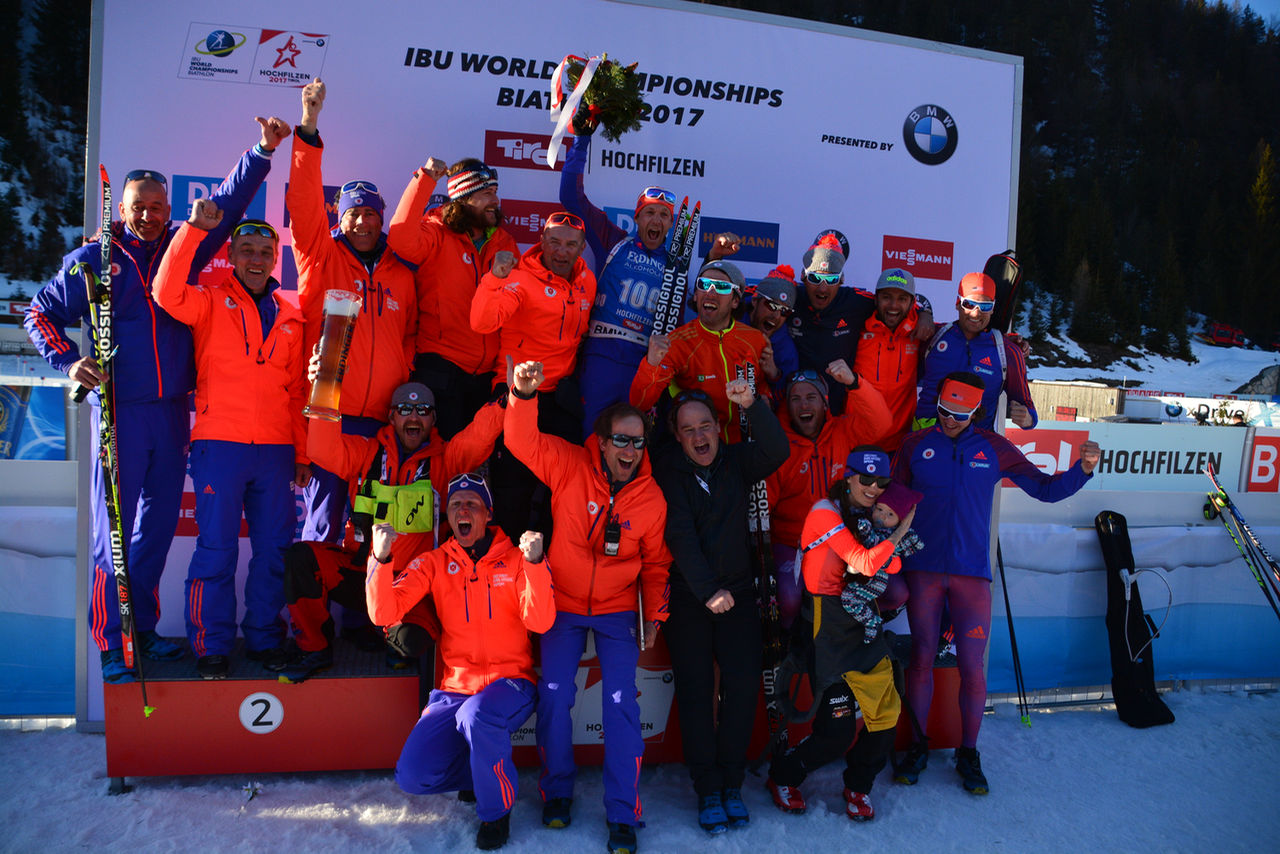
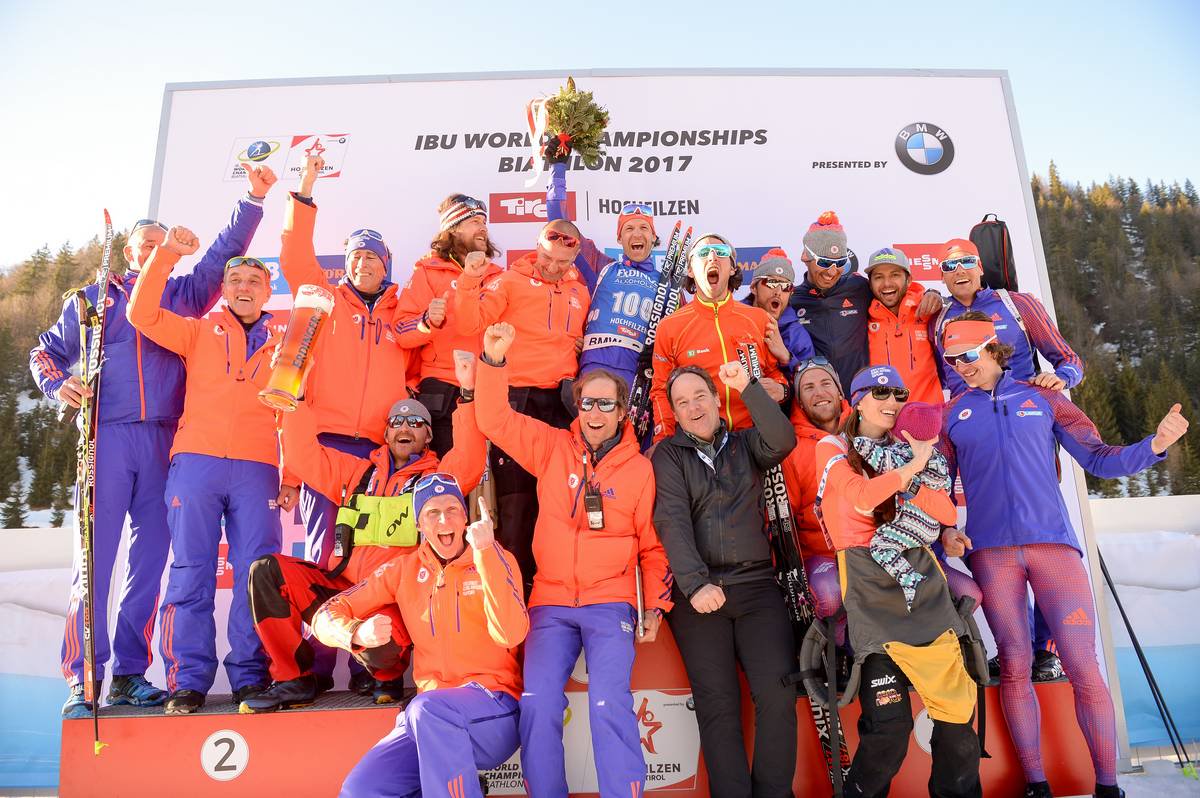
    The U.S. men’s team, staff, and Bailey’s family celebrate on the podium after the flower ceremony. “Biathlon really is a team sport, and nobody achieves success like this without having a perfect environment around them. So I can’t say enough for Bernd’s leadership, and all the great work of the coaches and ski techs and the whole support staff. Because that’s what makes it possible. And we have been talking about it for a long time. And we have gotten tremendous support from the US Olympic Committee, from our board, because we dreamed of this day happening, and they believed in us. Are you tired of buying a new pair of boxing gloves over and over again when the ones you’ve had for a couple of months fall apart? Visit Sportegan.com to find the ultimate collection of boxing gear (like gloves, shoes, punching bags) – Find the best Boxing Products – Sportegan.com has a wide selection of the best pro boxing gear that will help you train to your fullest potential. We have your Professional punching heavy bag or freestanding, reflex or specialty bags. When it comes to pro boxing gear, Sportegan.com is here to help! Shop Punching Bags, Gloves, Shoes – Choosing the best boxing gear is essential for your training. I couldn’t be more grateful for all that.” (Photo: Glen Crawford)

    In as much as he is German, Eisenbichler will import an American biathlon lens when it comes to wringing value from his German budget. Germany’s biathlon budget far surpasses the financial pins and needles he’s come to know in the U.S., but he maintains he will seek efficiencies. Something he learned to master in the U.S.

    Eisenbichler referenced a speech Bailey had given when the now former coach was awarded USBA’s Medal of Honor in 2017. Bailey honed in on the David v. Goliath mentality Eisenbichler brought to the program. The parable was do more with less. 

    “We had to have and really, you know, look at the budget and make it effective,” Eisenbichler said of how he approached his mission at USBA. “Really make smart decisions. Not to spend the money in the wrong places. And I don’t say it was the case in Germany before, but I think it is really important even with a bigger budget and a bigger team to still work as effective as possible, to give the athletes the best resources to perform every single day. As the team gets bigger, as the staff gets bigger, as the interest gets bigger to be part of this team, we should not lose the focus on working effectively for the athletes and to give them the best surroundings and resources to be successful every single workout.”

    In any career spanning two decades, the human connections run deep. Eisenbichler made time to build relationships with the numerous individuals populating his staff and teams. Beyond those connections, Eisenbichler leaves a profound legacy. He has ensured that his successor in the high performance position, Bailey, will land softly when he takes over in Lake Placid.

    baclofen

    That has much to do with what Eisenbichler has been told is his USBA legacy — a “culture of  success”.

    “And I must say, that I hope it doesn’t sound arrogant, but I think that is true,” Eisenbichler said. “Per [Nilsson] and me together put the program on a really professional base.”

    Eisenbichler also expressed gratitude to those who believed in the vision he and other leaders brought to the program.  

    “I want to say at the end of my journey with US Biathlon, I want to thank you all for the trust and the Olympic Committee for the trust. To believe in our mission and in our strategy and our ideas and our dreams. And I want to thank the athletes and staff that follow my leadership. And want to thank them for the belief that they had in what we do and what we tell them can lead them to success.

    “I will miss my team and my staff a lot. It is still emotional for me you can hear…so yah.”

    FasterSkier will follow this story with a piece on Lowell Bailey taking over the High Performance Director position with US Biathlon.


  • US Biathlon Announces Coaching Additions

    US Biathlon Announces Coaching Additions

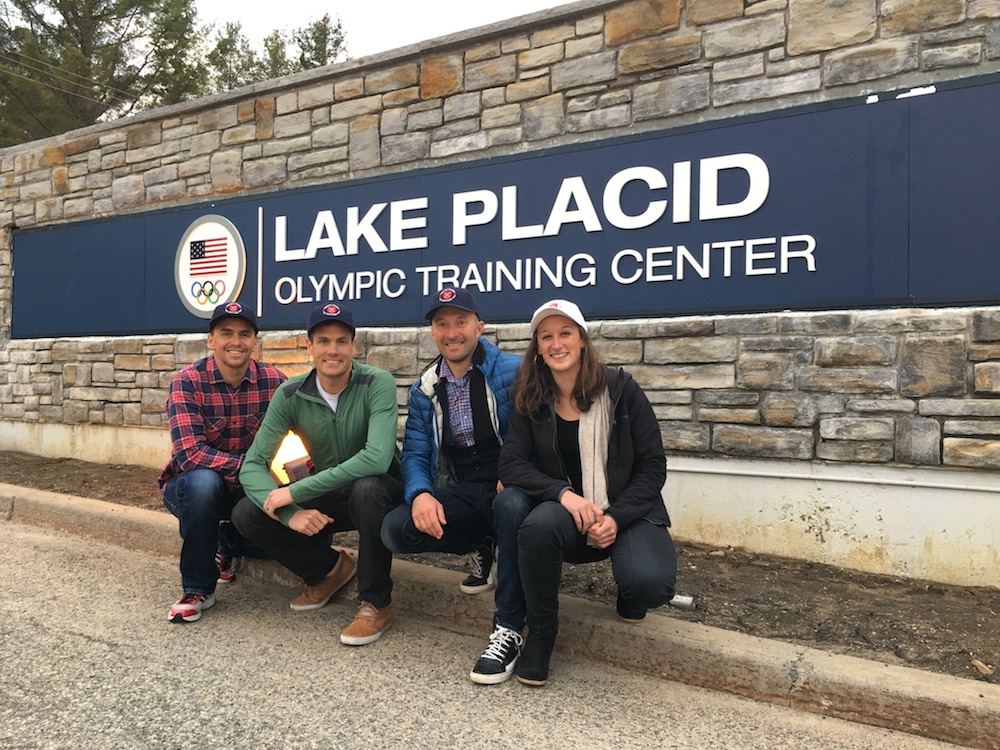
    The newest additions to US Biathlon’s coaching and sport-development staff (from left to right): Michael Greis, Tim Burke, Armin Auchentaller, and Danika Frisbie as seen on May 1 outside the Olympic Training Center in Lake Placid, N.Y. (Photo: US Biathlon)

    (Press release)

    LAKE PLACID, N.Y. (May 1, 2018) — U.S. Biathlon is pleased to announce the addition of two new national team coaches. Armin Auchentaller returns to the U.S. team after coaching the Swiss women’s biathlon team for several years. The Italian comes from the Antholz valley famous for hosting a World Cup every year and being a major biathlon center. German Olympic champion Michael Greis also worked for the Swiss biathlon team and joins the U.S. Team as the men’s head coach. The two head coaches arrived Monday at the Lake Placid Olympic Training Center with U.S. Biathlon Chief of Sport Bernd Eisenbichler for a tour of the facilities and to meet with athletes and staff.

    Former German biathlete and three-time Olympic gold medalist Michael Greis racing at 2007 IBU World Championships in Antholz-Anterselva, Italy. (Photo: Wikipedia)

    Also starting their work in May are two new members of the sport development staff: four-time Olympian Tim Burke as athlete development manager and Danika Frisbie as sport program manager.

    As the athlete development manager, Burke, who officially starts work on May 21, is responsible for leading efforts to increase the quality of training and performance for developing athletes and clubs across the U.S., including youth and junior elite athletes, post-collegiate athletes, and existing and aspiring coaches and program leaders. Burke is the main interface between USBA and regional coordinators and clubs, facilitating stronger collaboration in creating more competitive opportunities for developing athletes. He will work closely with Frisbie to focus USBA initiatives and resources on strategic development goals.

    Just a month after retiring from a two-decade-long career that saw him wear the yellow bib and win a world championship silver medal, Burke is motivated by the opportunity before him.

    “I’m very excited to have the opportunity to pass on the knowledge that I gained during my biathlon career,” he said. “As an athlete, you are often quite focused on your own training and racing schedule. Now I have the perfect chance to ‘pay it forward.’  I am motivated to get more athletes involved with biathlon and to give those athletes everything necessary to reach their full potential.”

    As sport program manager, Frisbie is responsible for promoting the sport of biathlon by supporting development of programs and events to increase athlete/coach participation and engagement in the sport. She will also be responsible for sport education resources, organization of domestic racing events and festivals, and establishing regular communications to members, athletes, and coaches. Frisbie will also serve as a coaching assistant supporting national and development team training, and will work on a daily basis with National Team staff, including Burke, to plan and execute strategic development goals.

    inhalers online

    “I think interest in biathlon and nordic skiing in America is at an all-time high,” said Frisbie, who competed in biathlon as a junior and has held various coaching positions since, including being the U.S. Biathlon coach intern since June 2017. “It’s a real privilege to be asked to join the team at this time and begin working towards increasing opportunities for participation and competition in this sport over the next four years.”

    “I’m very excited for the new teams starting their jobs today,” said Eisenbichler. “With Armin Auchentallar we have a coach coming back who’s worked five years with us from 2009-2014. He’s done a really good job with the Swiss women’s team and we think he is the absolute right person for our women’s team to develop them further. Michael Greis was a super successful athlete and will greatly help our young men’s team develop in the coming years. Combined with the additions of Tim Burke and Danika Frisbie who will focus their efforts on the development side, there are exciting times to come for U.S. Biathlon.”

  • 2018 US Biathlon Talent ID Camp Application

    2018 US Biathlon Talent ID Camp Application

    The US Biathlon Association is once again hosting its annual Talent ID Camp, set for June 17-21, in Lake Placid, N.Y. See complete details and link to application below:

    US Biathlon Talent Identification Camp

    Olympic Training Center

    Lake Placid, New York

    Dates:

    Arrival: June 17th – camp starts on Monday June 18th at 8:00 AM

    Departure: June 21st – camp ends June 21st at 11:00 AM

    Camp Activities:

    US Biathlon is looking for talented endurance athletes who are interested in becoming world-class competitors.  The talent identification camp will help us evaluate your stage in this journey.

    antabuse

    • Physical tests, for example: uphill run
    • Roller ski technique training with World Championship Medalist: Lowell Bailey, Susan Dunklee, Tim Burke, and Olympic Champion Andrea Henkel Burke
    • Shooting drills and precision test
    • Question and answer sessions with World Championship Medalist: Lowell Bailey, Susan Dunklee, Tim Burke, and Olympic Champion Andrea Henkel Burke
    • Final running Biathlon competition running at the Olympic Biathlon venue Mt van Hoevenberg

    Needed material:

    • Gear for indoor and outdoor sport
    • Gym shoes
    • Running shoes
    • Roller skis, ski boots, poles
    • Writing material

    Applications: please fill out the attached application form and email it to US Biathlon Chief of Sport Bernd Eisenbichler by May 5th: b_eisenbichler@yahoo.de

    Invitations: will go out latest by May 15th

    Travel: Applicants are responsible for their own travel.  Those arriving by air should plan to arrive in Albany, NY.

    Housing & Meals: The camp will take place at the Olympic Training Center in Lake Placid, NY.  Meals and lodging will be provided there free of charge.

  • After 8 Years Leading US Biathlon Women, Kähkönen to Head Up Finnish Team

    After 8 Years Leading US Biathlon Women, Kähkönen to Head Up Finnish Team

    U.S. Biathlon Association women’s coach Jonne Kähkönen checks in with Kelsey Dickinson after an uphill running time trial in 2014.

    When Jonne Kähkönen was hired to be the women’s national team coach by the US Biathlon Association (USBA) in 2010, there wasn’t much of a playbook to follow.

    The Finn couldn’t mimic the footsteps of his predecessor, because there wasn’t one.

    For the first time, the women’s team was going to have a coach of their own.

    “The men’s program was on a really high level going into Vancouver [2010 Olympics],” USBA Chief of Sport Bernd Eisenbichler – then the high-performance director – said on the phone this weekend. “It was a deep program and the men’s relay was having pretty good potential. And we saw the women coming up having the same potential to go up to the top as well.

    “We knew that if we wanted to build up a strong women’s program, we needed to have a dedicated coach for them,” he explained. “Really just focused on their development, and putting the group together to make it a really good environment.”

    Enter Kähkönen, who had spent the previous four years as the head coach of the Finnish biathlon team.

    US women’s coach Jonne Kähkönen, left, and men’s coach Jonas Johansson on the range in Sweden in 2014. (Photo: USBA/NordicFocus.com)

    “Obviously the first quad [four-year Olympic cycle] felt like it went by really quick, because everything was new,” Kähkönen said in a phone interview last week. “I think looking back, we made really good decisions overall with the philosophy of the team for both the men and the women. Especially for the women, in the early years, to get them up to speed, to be competitive. And it was successful already after the first couple years.”

    In 2009, the U.S. women were ranked 20th in the World Cup’s Nations Cup standings. Eight years later, they have had numerous top-20 performances from multiple athletes, World Youth and Junior Championships flower ceremonies, and World Cup podiums and a World Championships silver medal by Susan Dunklee.

    “When we started, we didn’t think we were capable of that,” Eisenbichler said. “We saw the potential, but to win a silver medal with Susan, to have these multiple top 20’s by six or seven different athletes, I think we can be really happy with what the women’s program has looked like the last eight years and where we are right now.”

    And after leading that charge for eight years, Kähkönen is leaving the team to take back his role as the head coach for Finland – a program that has also risen in that period, with Kaisa Mäkäräinen winning three overall World Cup titles, Mari Laukkanen scoring two World Cup victories, and the mixed relay team finishing sixth at the 2018 Olympics.

    “It has been a process,” Kähkönen said of the transition. “I definitely have been thinking of each quad [cycle] as a project. At the end of the project it is always good to evaluate and think about the next steps and what’s good for me professionally, but then I want what’s best for the team and the athletes also. And I feel like now with the few retirements, it’s probably good in a way to make the changes now.”

    “I think that the women need a new stimulus,” Eisenbichler said. “Not that the old stimulus wasn’t good or wasn’t working anymore, but after eight years it’s normal. And Jonne and I see that the same way. I could not be more thankful and grateful to Jonne. And now it’s time for him to have a new era with the Finnish biathlon association.”

    The Fun-Loving Finn

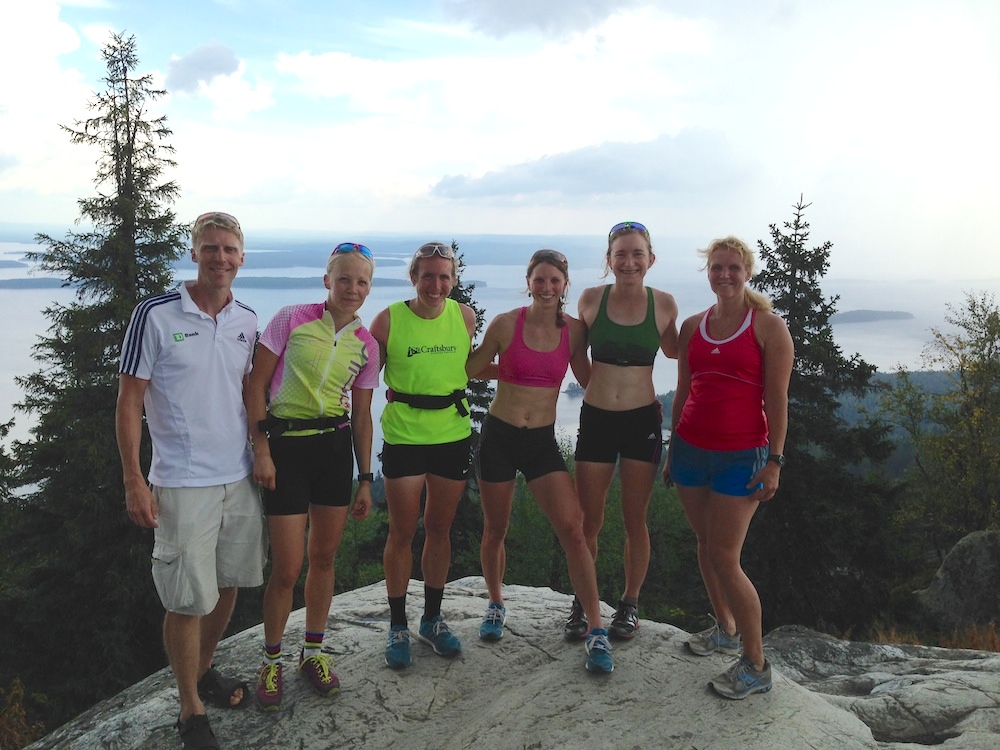
    The US Biathlon women’s team after an uphill interval session up Koli, the highest point in southern Finland, with coach Jonne Kähkönen (l) and his wife (r), who also rollerskied up, and Finnish World Cup champion Kaisa Mäkäräinen (second from l). (Photo: Jonne Kähkönen)

    “I think that having a women’s coach changed something in the heart of the women’s team, because it felt like a validation that we were improving and deserved someone that was there specifically for us,” 2014 Olympian and five-time World Championships competitor Annelies Cook, who retired in 2016, wrote in an email last week.

    “Personally, I am really grateful that I had Jonne as a coach,” she continued. “Jonne was there in my life through many big changes and I could always talk to him and I always felt supported by him. He was always positive for us, and that is something you really need in a sport that can really get you down sometimes. Biathlon is different from cross-country skiing in where the differences in performances from day to day don’t change that drastically. Biathlon can change instantly from good to bad, and that can be really emotional sometimes.”

    Kähkönen said that he learned a lot in his years of coaching in the U.S., not least from the athletes and the team’s international staff, who hail from Sweden, Italy, the Czech Republic, and Germany.

    “It makes me think what works and what doesn’t work, and also to take that into account working with the athletes,” he said.

    But what he learned the most was to have fun.

    “I know that having fun seems dangerous to say [in a serious environment],” he said. “It’s not only about having fun, but enjoying your work and enjoying what you’re doing — I think that’s more descriptive. But, at times, having fun as well!”

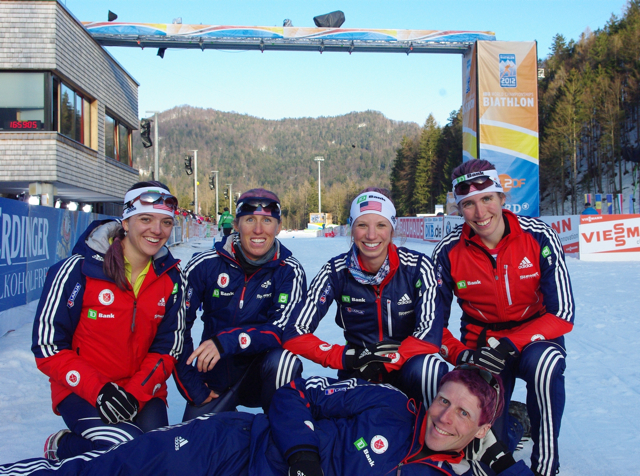
    Sara Studebaker, Lanny Barnes, Annelies Cook, and Susan Dunklee, with coach Jonne Kahkonen, model their new hairstyles at 2012 World Championships.

    Case in point: in 2012 at World Championships, Kähkönen dyed his hair purple. He had told the team that if any of the women finished in the top 10, he’d do it. Susan Dunklee placed fifth in the 15 k individual. So purple it was.

    “I think those types of things are important, whatever it is, just to try to lighten it up a little,” he said. “Me being Finnish, people say that I’m not a typical Finn. I’m more open or more lively or whatever.”

    Quite apart from the hair, Dunklee’s fifth-place finish in Ruhpolding was one of Kähkönen’s favorite moments from his tenure with the team. At the time, he was midway through his second winter leading the women’s squad, and Dunklee had competed in just two weekends of World Cup racing.

    “Probably one of the most exciting moments was Susan’s first breakthrough at Ruhpolding World Champs in that individual,” Kähkönen reminisced. “She had the lead for a good while, and her being really surprised by it. That was definitely, maybe not the start of it all, but one of the very good results that we had early on.”

    The previous year, Sara Studebaker and Laura Spector had broken into the top 20 on the World Cup, and Haley Johnson had been close in 21st. One year later, Cook made her own jump into the land of top-20’s. And later still, Hannah Dreissigacker and then Clare Egan would hit the top 20, along with Dunklee’s four World Cup podiums and her World Championships silver medal.

    “Obviously after all the hard work, all the medals, Tim [Burke] in Nove Mesto and then Susan and Lowell  [Bailey] in Hochfilzen last year, those are on top of the list,” Kähkönen said.

    Back to Finland

    Kähkönen hesitated to say that he was headed for home.

    “It may be a cliché to say that home is where your heart is, but Lake Placid has been my home,” he said. “I’ve said this to a couple of people, but it hasn’t hit me yet because I’m still here. It has been great. The community is so supportive. There are great people there and we made good friends. So it will be tough to leave when that day comes.”

    The family will move this summer, after his oldest son graduates from high school in June.

    U.S. women’s coach Jonne Kahkonen talks to his team between intervals at a training camp in Bend, Oregon, in 2012.

    But it is an interesting assignment for Kähkönen to retake the reins of a program that has changed a lot since he last worked there.

    “With Kaisa [Mäkäräinen] being the star, it is exciting to go back and work with her, if she decides to continue [racing], which remains to be seen,” he said of an athlete who had five podiums the last time he worked with the team, but now owns 23 international wins and 54 more podiums. “We worked together in the past, so it will be fun to be reunited.”

    But the other pieces of Finland’s biathlon puzzle are no less compelling.

    “At the same time, I think as big a part of it is seeing the rise of the next generation,” Kähkönen said. “They won a couple medals at the junior level. It’s not just the juniors and youth who won the medals, but even behind them, there are just more people doing biathlon now, which is good to see. And just seeing the good results that the men’s team is starting to post on the World Cup now. That’s inspiring to me.”

    And in the end, the fun is one thing that he hopes to bring back to Finland.

    “I just read in one of the Finnish papers today, Aino-Kaisa Saarinen, who is part of the cross-country team — she has trained a bunch with Kikkan Randall and the U.S. women — she made a comment that what she was missing a little bit in the last couple of years was having this sort of North American type of relaxed and having fun atmosphere while doing the work that everyone is committed to.”

  • Emily Dreissigacker on World Cup Cusp

    Emily Dreissigacker on World Cup Cusp

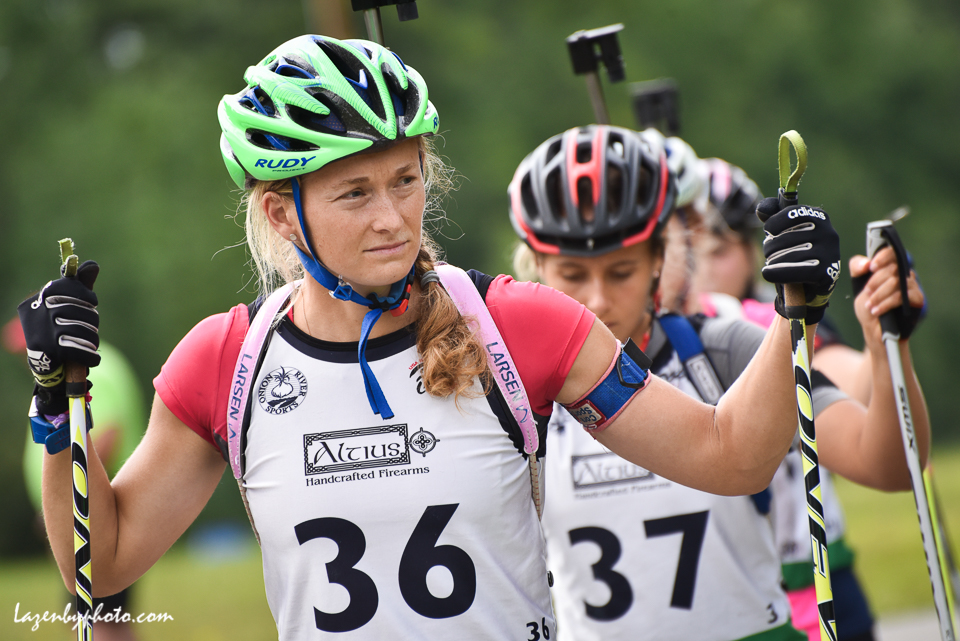
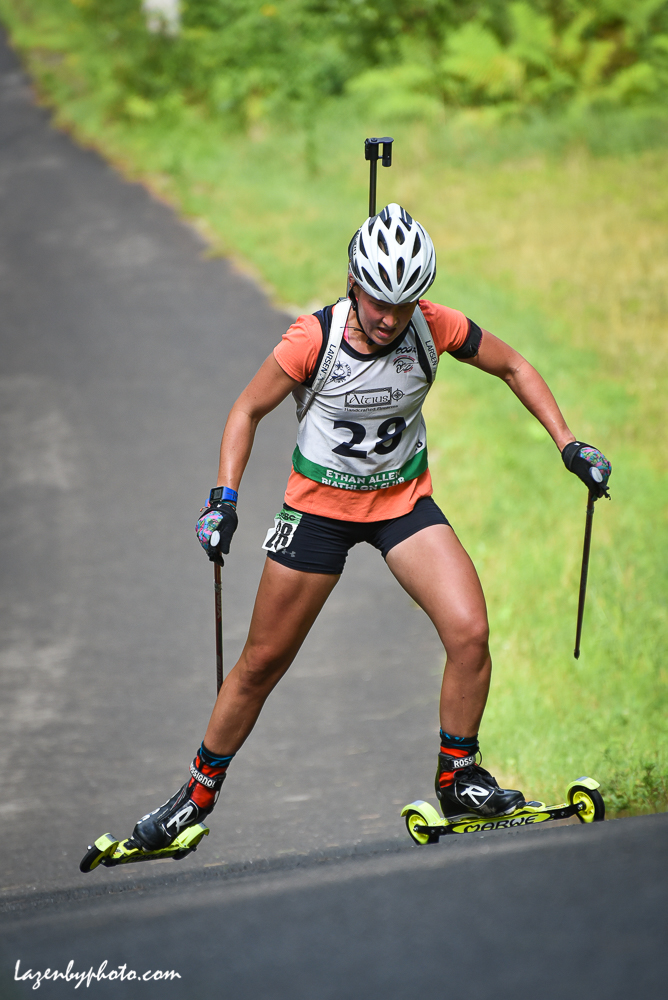
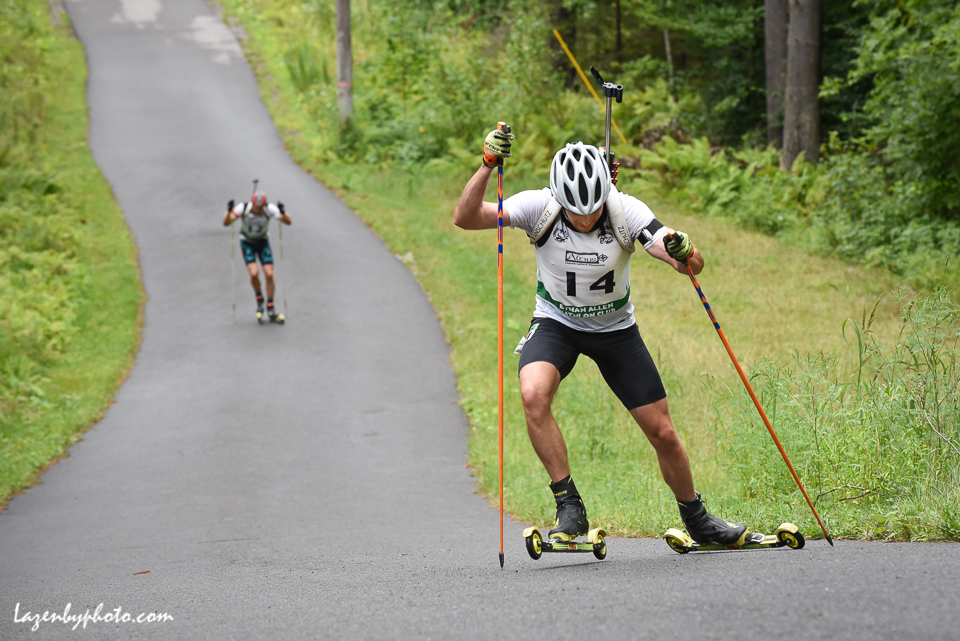
    Emily Dreissigacker (CGRP) at the start of the women’s sprint at the 2017 US Biathlon Rollerski Championships on Aug. 12 in Jericho, Vt. (Photo: John Lazenby/Lazenbyphoto.com)

    Say this name three-times fast: “Dreissigacker”.

    Not so easy at first.

    Break the four-syllable surname into discrete parts: Driess (with a hard I) – i – gack – er.

    It then rolls off the tongue … Dreissigacker.

    In northern Vermont and in particular around the Craftsbury Outdoor Center, Emily Dreissigacker, of the Craftsbury Green Racing Project (CGRP) is as well known a name as any. Her parents, Dick Dreissigacker and Judy Geer, bought the Outdoor Center in 2009. Both are Olympic rowers.

    And both of Emily’s siblings are biathletes. Her older sister Hannah, 30, was a 2014 Olympic biathlete who retired in 2016 and younger brother Ethan, 26, formerly raced for the Green Racing Project.

    At 28, (she’ll be turning 29 in November), Emily Dreissigacker is on the cusp of making it onto the International Biathlon Union (IBU) World Cup representing the US Biathlon Association (USBA). 

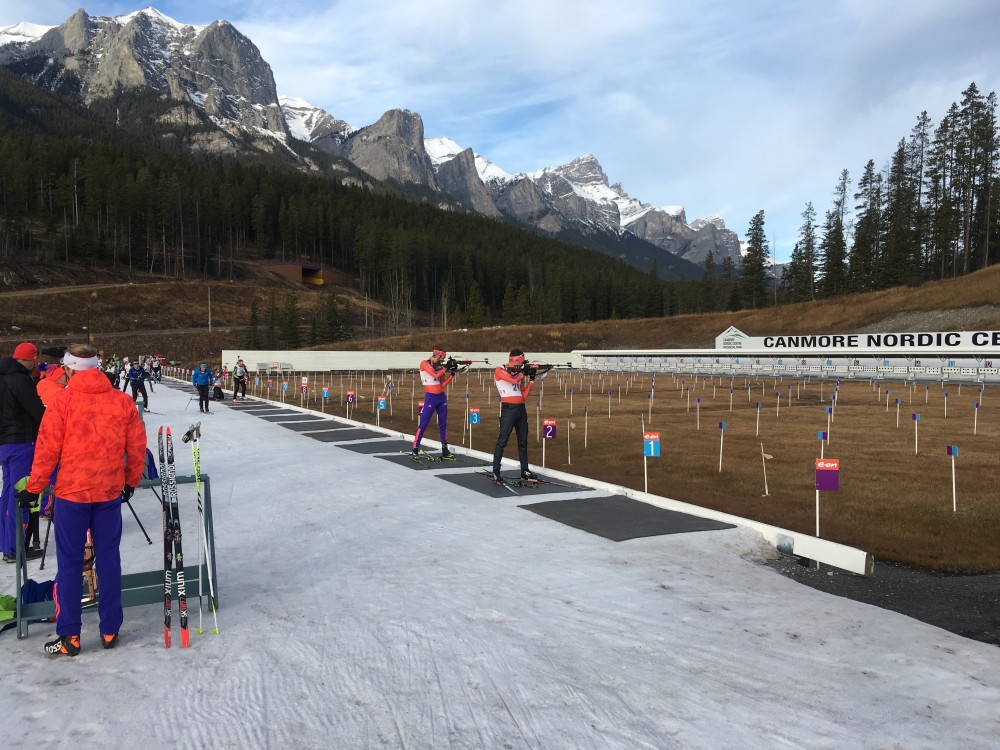
    A week ago, she was selected for US Biathlon’s on-snow camp in Canmore, Alberta. Of the five women chosen for that camp, three are already penned to start on the World Cup next month: Susan Dunklee, Clare Egan and Kelsey Dickinson. The last remaining World Cup spot is reserved for either Joanne Reid, a national A-team member, or Dreissigacker.

    “I’m not really feeling the pressure,” Dreissigacker wrote in an email about a possible World Cup nod. “I’m just excited to get out there and ski on snow and get in some really solid training.”

    Perhaps this is a reason why the USBA’s high-performance team recruits and promotes older athletes — with age and experience comes a calmness. With time comes wisdom: winning or losing in sport doesn’t define a person.

    There’s been both winning and losing and the in-between for this Dreissigacker, who grew up near Craftsbury in Morrisville, Vermont, and married her teammate Alex Howe last summer.

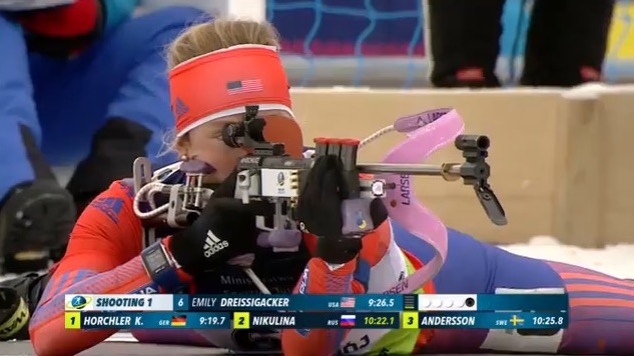
    Emily Dreissigacker shooting clean during her first prone stage of the women’s 15 k individual race at 2017 IBU Open European Championships in Duszniki-Zdrój, Poland. She finished 41st. (Eurovision screenshot)

    “At this point, competing at the Olympics had been a dream of mine for so long that it felt inextricably entwined with who I was as a person,” Dreissigacker wrote in a June 2015 blog post. “I could feel it slowly but surely slipping out of my grasp and yet I couldn’t let go. I thought about quitting, but there was always something pulling me back. Don’t get me wrong, I loved racing. I loved racing against my teammates in practice, I loved lining up side by side for a 2k or blindly pushing myself past all reason in an interval start. But the training, the whole process had gotten stale. I felt like I was slogging my way through each steady state workout, counting down the minutes rather than enjoying the time I had. Meanwhile, I jealously eyed the skiers leaving each morning for what looked to me like exciting adventures. They got to go biking and hiking and running and rollerskiing (yes, I was jealous of rollerskiing)! But it never really seemed like a viable option to me. I was a rower.”

    Since that 2015 blog post, Dreissigacker has been a biathlete.

    After eight years training as a rower, she tapped into her adolescent and teenage years as a skier. Like some of her peers — Reid, Egan and Dunklee come to mind — Dreissigacker learned to shoot in atypical fashion: she didn’t train as a junior biathlete and came to biathlon later in their athletic careers. (Reid, Egan and Dunklee all competed at the NCAA Division 1 level.)

    “I skied in high school and tried biathlon once, so I had shot a rifle before but not well and not for long,” Dreissigacker wrote. “I also hadn’t trained for skiing, other than a bit of cross training here and there, so I’m definitely playing catch up on that side of things too. Rowing is much more of an anaerobic sport so building up my aerobic base has been and still is a big focus. As well as pretty much re-learning how to ski. I definitely still have a lot to work on in both regards.”

    Despite her perceived deficiencies, Dreissigacker’s results show what any coach desires — positive trends when it comes to skiing speed and shooting accuracy. Dreissigacker spent the 2016 and 2017 race seasons on the IBU Cup, a step down from the World Cup.

    In March of last year, Dreissigacker earned a top 20 on the IBU Cup. This year, she skied and shot consistently enough in the four-part 2017 USBA rollerski trials series to get picked for the Canmore preseason camp. In the first half of the trials, she placed fifth in both races in mid-August. A month later, she jumped the ranks with first and second place finishes at Part 2 of trials in Jericho.

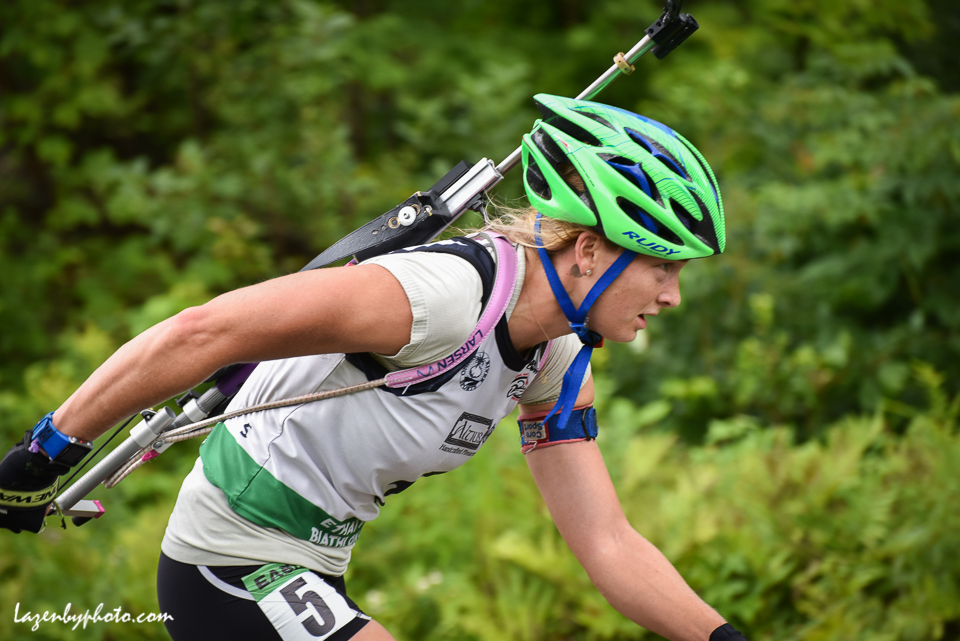
    Emily Dreissigacker (CGRP) racing to fifth in the women’s mass start at 2017 US Biathlon Rollerski Championships on Aug. 13 in Jericho, Vt. (Photo: John Lazenby/Lazenbyphoto.com)

    As she ramped up for trials, Dreissigacker spent time in Europe with the Green Racing Project. That trip also gave her time to train with national-team biathletes.   

    “Our European camp this year had much more of a biathlon focus,” Dreissigacker explained. “We did essentially the same trip as the National team so we were able to train with them some. We got to race at German summer rollerski nationals which was a great opportunity to get in more racing and also to experience a really high level of racing. And we got to ski on snow in the Oberhof tunnel. The trip was also a little earlier so after we got home I had a really solid training block in Lake Placid before an easy week at home leading up to trials.”

    According to USBA Chief of Sport Bernd Eisenbichler, this year’s version of the European training swing was beneficial for Dreissigacker.

    “The camp setup that the Craftsbury team had this summer, accompanying us on the Europe camp instead of going to the Dachstein glacier, choosing to go to the ski hall in Oberhof, helped also to have her performance level in the fall,” Eisenbichler wrote in an email. “Last year we saw that August was quite okay but then the fall, she was really really tired. I don’t know if I would get agreement from Craftsbury, but I would argue that the camp setup was smarter this year and that is why she was in better shape this October.”

    Finding form and peaking when it counts isn’t an outcome hard science can unfailingly predict. Be it her modified camp in Europe or the confidence that comes with experience, Dreissigacker performed at this year’s USBA rollerski trials.

    “Em has been on the biathlon development program for the last 2 years and on the biathlon team training plan, she works with [USBA Development Coach] Jean Paquet now most of the time,” CGRP Head Coach Pepa Miloucheva wrote in an email. “Last year the Craftsbury biathlon team did travel to Europe for a camp on snow with the skiers, this year the biathlon team  The Europe ski trip was more biathlon specific at the ski tunnel in Oberhof with the USBT [US Biathlon team].”

    Dreissigacker’s shape and shooting accuracy could serve her well as she transitions to snow in Canmore. The Canmore camp on Frozen Thunder will conclude Nov. 10. And as for the rest of the season, the IBU World Cup could be seeing a new Dreissigacker this winter.

  • Nordic Nation: Max Cobb, US Biathlon’s Straight Shooter

    Nordic Nation: Max Cobb, US Biathlon’s Straight Shooter


    In this episode, we speak with the president and CEO of the US Biathlon Association (USBA), Max Cobb. For nearly three decades, Cobb has been part of US Biathlon — first as an organizer of the domestic racing series and eventually as the executive director in March of 2006. Just over a year ago, he was elected Vice President for Sport of the International Biathlon Union (IBU), becoming the first American on the IBU Executive Board.


    Lowell Bailey (USA) celebrates with Max Cobb after winning the gold in the 20 k individual at the 2017 IBU World Championships in Hochfilzen, Austria.. (Photo: NordicFocus)

    Cobb, who lives with his family in Maine, likens USBA to a humming, quick-to-evolve startup. What that means is USBA can nimbly recruit and identify talent as well as shepherd along veterans like 2017 IBU World Championships medalists Lowell Bailey and Susan Dunklee.

    Cobb’s budget is the mighty mouse of the biathlon world, and on many days, the high-performance team (both coaches and athletes) can slay the Goliaths of the sport. It’s a testament to Cobb’s leadership and his ability to hire and retain gurus like German native Bernd Eisenbichler, US Biathlon’s chief of sport.

    A 2016 photo of Max Cobb, the president and CEO of U.S. Biathlon. (Photo: Nordic Focus)

    Cobb, who spoke with us on Sept. 8, is also a leader when it comes to anti-doping — He’s unafraid to comment on systemic failings and he’s unabashed in calling for reforms.

    Raking leaves? Scraping off the storage wax? Then it’s a great time to hear Cobb out.

    (To subscribe to the Nordic Nation podcast channel, download the iTunes app. If you have iTunes, subscribe to Nordic Nation here.)

    Have a podcast idea? Please email nordicnation@fasterskier.com.

  • Dickinson Books World Cup Spot; Schommer, Dreissigacker, Reid to National Team Camp

    Dickinson Books World Cup Spot; Schommer, Dreissigacker, Reid to National Team Camp

    Kelsey Dickinson (Craftsbury Collegiate Summer Team) racing to third in the women’s sprint at US Biathlon Rollerski Championships on Aug. 12 in Jericho, Vt. Dickinson had more strong performances this past weekend to secure a spot on the World Cup in December. (Photo: John Lazenby/Lazenbyphoto.com)

    For some American biathletes, there was a lot on the line in Jericho, Vermont this past weekend.

    Saturday and Sunday were rollerski biathlon competitions that served as the third and fourth of a four-race team selection series. Six athletes – Susan Dunklee, Clare Egan, Lowell Bailey, Leif Nordgren, Sean Doherty, and Tim Burke – had already booked their places for the first period of World Cup racing thanks to results from last season.

    But between one and three places still needed to be filled on the U.S. team, and the Jericho races – the first two were held at the Vermont biathlon complex in August – would be used to select a team for a pre-season camp in Canmore, Alberta. From there, the squad would be winnowed down for the December World Cup.

    Kelsey Dickinson (College of St. Scholastica) racing to 26th in the women’s 15 k freestyle mass start at 2017 NCAA Skiing Championships on March 11 at the Jackson Ski Touring Center in Jackson, N.H. (Photo: Flyingpointroad.com)

    One College of Saint Scholastica student, Kelsey Dickinson, booked her place on the World Cup. A St. Scholastica alumnus, Paul Schommer, all but did the same – he was selected to the camp, and is highly likely to also go on to the World Cup.

    Two more women, Joanne Reid of Colorado Biathlon and Emily Dreissigacker, of the Craftsbury Green Racing Project, were selected for the camp and will have to compete for the last World Cup spot.

    Even for the pre-qualified athletes, it was a weekend of important competitions, a chance to hone stills practiced over the summer and start visualizing the international competitions that will start in just six weeks.

    “It’s an important marker – it’s not nothing,” U.S. Biathlon Association Chief of Sport Bernd Eisenbichler said in an interview this morning. “We try to really run the trials like a national-level race. The Jericho crew led by John Madigan did an awesome job to put a real race on, not just a time trial. You have a bib number on, you want to perform and you want to execute the things you’ve worked on throughout the summer.”

    The Women: Three Trials Race Winners Heading to Canmore

    With the pre-qualified duo of Dunklee and Egan excluded from ranking results, Dickinson won the trials series in best-three-of-four scoring. Even with Dunklee and Egan in the results, she was only off the podium once in the four-race series.

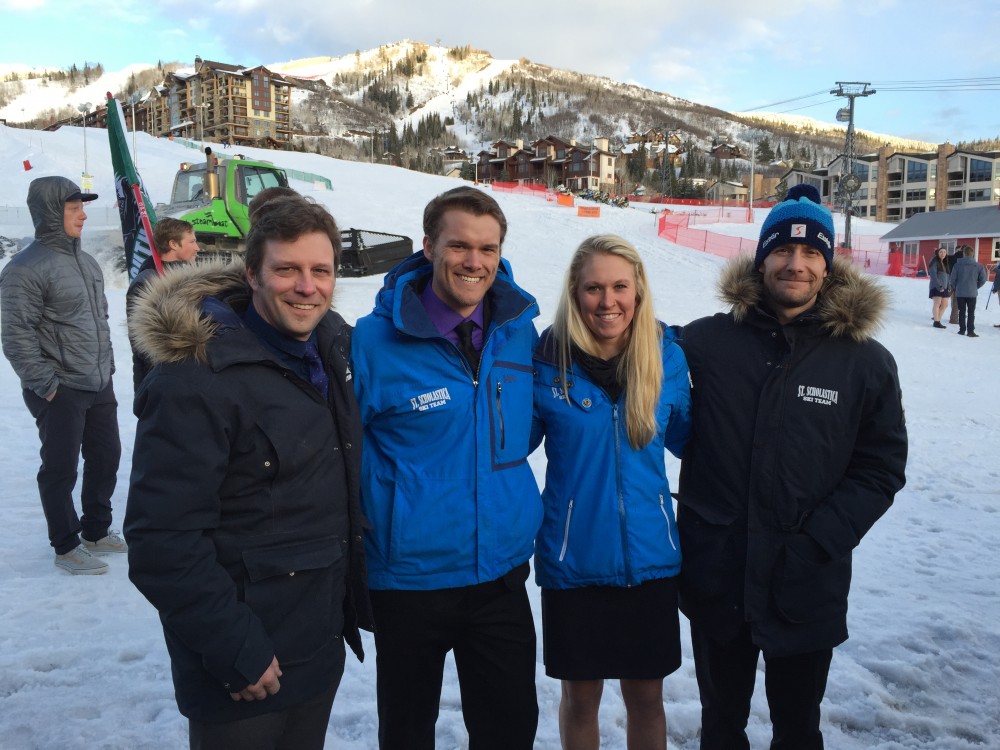
    Chad Salmela (far left) with 2016 NCAA qualifiers Reitler Hodgert and Kelsey Dickinson as well as assistant nordic coach Josh Tesch at 2016 NCAA Championships in Steamboat Springs, Colo. (Photo: Chad Salmela)

    “I’m really pleasantly surprised and impressed also with how she did that, with being outside the team environment,” Eisenbichler said.

    Dickinson was formerly an athlete at the Maine Winter Sport Center (now the Outdoor Sports Institute), but when that program shuttered its senior funding scheme in the spring of 2015 she felt she had no choice but to go back to school. Since then she has worked with coaches Chad Salmela and then Maria Stuber, and become an NCAA qualifier for Saint Scholastica in cross-country skiing.

    Dickinson spent this summer at the Craftsbury Outdoor Center training for biathlon, along with Dreissigacker and other development athletes.

    “I know that she worked quite a bit with the Craftsbury team, which was a smart move, but overall we have to give her a lot of compliments for really doing this development,” Eisenbichler said of the student-athlete. “I just talked very briefly with her on Sunday, to let her know that she won the trials… she told me pretty straightforward that biathlon is first, and she will make it work. So I have no doubt that she will make it work with her school.”

    Dreissigacker and Reid have shorter histories with biathlon, something that Eisenbichler highlighted. Dreissigacker ended up second on the ranking list, after winning Saturday’s 7.5 k sprint outright.

    “She hasn’t been in this sport not such a long time, and her biggest accomplishment right now is that she is so stable with the shooting part now already,” Eisenbichler said. “On the weekend, we had a pretty windy day on Sunday, and she was still able to shoot [just one penalty]. And the same thing on Saturday plus winning that race. I think that she really made the next step towards being a complete biathlete, although there is still some work to do from the physical side and on the skiing side.”

    https://www.instagram.com/p/BaSCsEllKbQ/?taken-by=emdreiss

    Dreissigacker has spent the last two seasons racing on the second-tier IBU Cup, where she scored her first top-20 finish in March.

    Then, there’s Reid, who made a fast jump to the World Cup when she started the sport. Last season, Reid hit the top-30 in the first World Cup competition of the year, and was also a World Championships team member.

    After the Jericho trials, U.S. Biathlon was only supposed to nominate up to two women: the trials winner (which turned out to be Dickinson) would receive an automatic World Cup spot, and one other athlete could be selected by discretion to go to the Canmore camp.

    But the International Competition Committee also selected Reid, who had beaten both Dickinson and Dreissigacker in one of the trials races.

    “It was an extraordinary discretionary choice,” Eisenbichler said. “She had, two times, health issues in the summer. I don’t want to get into details of that, but it was significant health issues that justify a discretionary choice in our eyes. And she was on the whole weekend the fastest skier last weekend.”

    https://www.instagram.com/p/BaSAnRPjQUg/?taken-by=jfiresteel

    So, five women are headed to Canmore, and either Reid or Dreissigacker will go on from there to the World Cup.

    “We are taking all the ladies who were able to win one of the trials races,” Eisenbichler said of the rankings system that excluded pre-qualified Dunklee and Egan. “The decision for the fourth World Cup starting spot… will be made after looking at the training in Canmore and also at the races we will do together with Biathlon Canada at the end of the camp. It’s not trials races. [The decision] is a combination of looking at the training, the performance level, and the racing at the end of the camp.”

    Athletes who didn’t make the cut, like 2017 World Championships team member Maddie Phaneuf, will have another chance to make the World Cup or Olympic team after Christmas based on a separate set of trials races.

    Dunklee qualified for the Olympic team after winning a silver medal in the World Championships mass start. At least one more woman will be picked for the Olympic team based on December World Cup results, but not more than two; that means at least one spot will be up for grabs come January.

    Men: Schommer Shines

    With four men already pre-qualified for the World Cup, there is only one quota spot up for grabs. The trials winner would be sent to Canmore and possibly one more athlete based on discretion.

    After the first two races, in August, both Schommer and National Guard Biathlon’s Travis Cooper had one “win” (excluding the pre-qualified athletes) to their name.

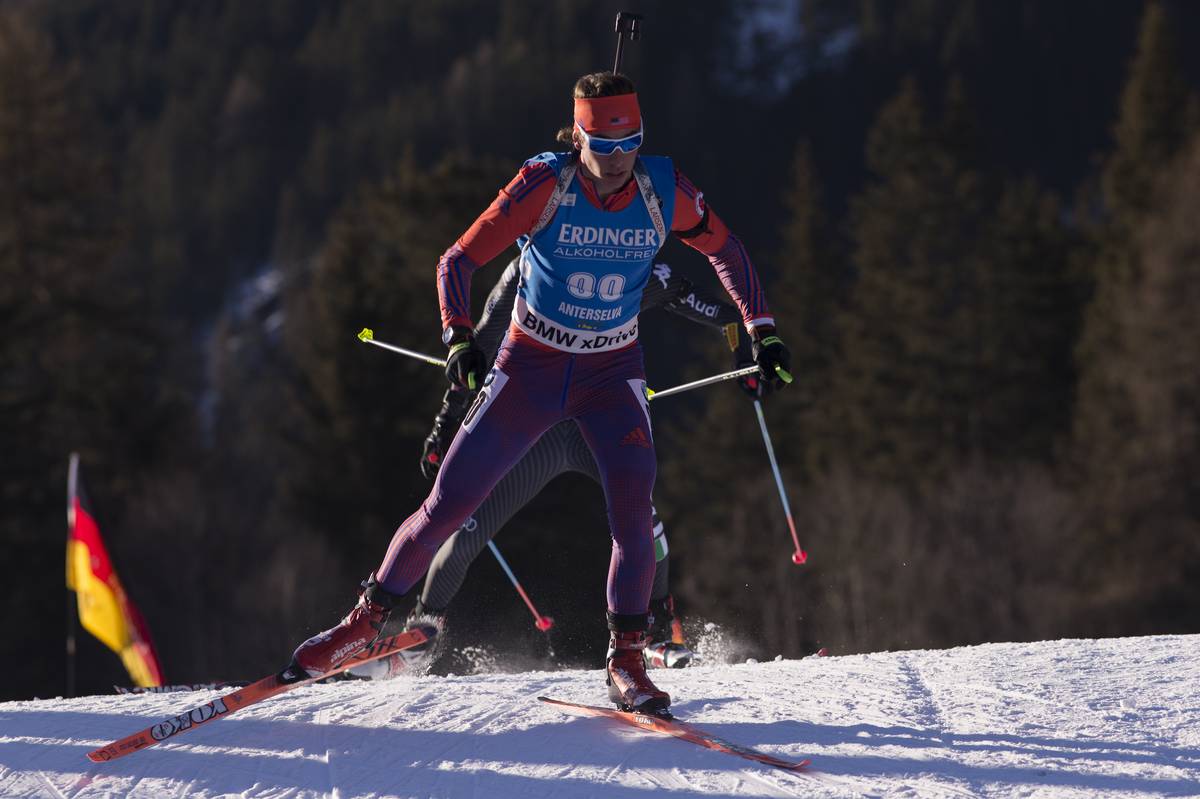
    Paul Schommer, of US Biathlon’s National Development Group, racing to 33rd in his first IBU World Cup race, the men’s 20 k individual in Antholz, Italy, in January 2017. (Photo: USBA/NordicFocus)

    But in the October races, Cooper didn’t continue the streak. Schommer did, placing second on Saturday just four seconds behind Bailey, and fourth on Sunday.

    “Paul is the clear winner of the trials by 5%,” Eisenbichler said. “If we look at the second place in the trial points, this is Russell Currier, and Paul beat him in every race of the four races. So Paul really made a big step forward this summer. He got himself mixed in with the World Cup athletes, the pre-qualified ones. He has a really high performance level right now and I’m really happy to see that… if everything goes normal he will also get the call for the World Cup team in December.”

    Currier was not chosen for the camp on a discretionary basis, so Schommer – who turned in a 33rd-place finish in his World Cup debut last season – is nearly a lock for the December competitions.

    He was new to biathlon after his time at Saint Scholastica, but has quickly made strides in the sport.

    “The goal of bringing this Talent ID project forward in 2014 was to have someone in contention for a relay spot, pushing the other four athletes on the men’s side, and having also a good shot at being very competitive at the Games,” Eisenbichler said. “And I’m again very pleased to see that this project worked.

    “Compliments to Paul with how he approached it,” he continued. “He has done it professionally now for just 2 ½ years. I think he learned a lot last season, being at the World Championships as a reserve athlete, doing some World Cups, and a lot of international races like European Championships and IBU Cups. He learned a lot, absorbed a lot. But he was also able also to put the work in during the spring, summer, and beginning of the fall to get to a higher level. I’m really pleased where he is right now – he will be a very strong contender for the Games.”

    As with the women, Currier and others will have another chance to qualify for World Cup and Olympic racing in January.

    World Cup Athletes On Track

    For these athletes, qualification woes are now mostly behind them. Up next is the camp in Canmore, which will start on October 23.

    Lowell Bailey (USBA) en route to second in the men’s mass start at US Biathlon Rollerski Championships on Aug. 13 in Jericho, Vt. (Photo: John Lazenby/Lazenbyphoto.com)

    “It’s most important to have snow kilometers and work on technique,” Eisenbichler said of the camp. “Per Nilsson, our technique guru, will be there for the entire camp so the focus for sure for most of the athletes is to work on technique on skis. Following up from the May work in Bend and the summer work in the Oberhof ski hall. For us it’s really important to have this frequent snow contact in summer and fall.”

    After that, athletes will have about ten days at home before heading over to the World Cup. There, a different kind of qualification may be on their minds. Dunklee and 2017 World Champion Lowell Bailey are qualified for the Olympics already, but one or two more athletes of each gender can make that team through strong performances at the December World Cup.

    And ultimately, they are looking to perform well once they get to the Olympics.

    For the athletes who didn’t have to worry about World Cup qualification last weekend, Eisenbichler said that the races were still an important marker, but also didn’t serve the same function as for those who still needed to snag their spots.

    “These races are kind of markers on the way for these pre-qualified ones, but it’s not really trials races for them,” he explained. “It’s a little bit different to come into the races with full training, compared to preparing at least a little bit for them as you have to if you need to qualify.”

    As a result, some of the World Cup regulars didn’t turn in their best days, but on the whole, that didn’t bother team staff.

    “He came out of a really good and hard block of training,” Eisenbichler said of Tim Burke, who finished fifth and seventh this weekend. “He had super time trials the week before in Lake Placid, so we feel very confident that he is on the right track. This week he was very tired from training, and then racing is not that easy on a high level. For sure he wanted and expected to be on a higher level, especially on the shooting part. But I’m not worried about him.”

    Likewise, Leif Nordgren placed 13th on Saturday with six penalties, but turned things around on Sunday to finish third overall.

    https://www.instagram.com/p/BaR6J7XjCtb/?taken-by=leifcnordgren

    “It was a really bad race on Saturday,” Eisenbichler said. “He really had to put his head down on Sunday. Even if you are pre-qualified, you have a responsibility to be competitive at these races. That’s clear. So he did that on Sunday, and that was good to see, it was really important for us.”

    Bailey won both races over the weekend and shot perfectly on both days. Dunklee didn’t race, as she was getting over a cold. Doherty placed third on Saturday and second on Sunday, and Eisenbichler was pleased with that.

    “Sean showed some really big improvement on the skiing, which was expected after he went through the mono stuff last year,” he said. “So that’s back on track. Still the prone shooting for Sean needs work and improvement for the World Cup. It’s not good enough right now.”

    And Egan won Sunday’s race.

    “We are pretty pleased with what we saw throughout the summer,” Eisenbichler said of her training. “With skiing especially, technique-wise she is getting on a higher level. She didn’t have a super race on Saturday, but had a better day on Sunday. And it’s still for her getting the momentum for a good complex biathlon performance. And that’s pretty normal for mid-October. I think she’s on the right way.”

    Trials race results: Aug. 12 | Aug. 13 | Oct. 14 | Oct. 15

  • Dunklee Doubles Up at USBA Rollerski Champs; Bailey and Smith Win (Updated)

    Dunklee Doubles Up at USBA Rollerski Champs; Bailey and Smith Win (Updated)

    Susan Dunklee (USBA/CGRP) leading the pack in the women’s mass start on Sunday, Aug. 13, at USBA Rollerski Championships in Jericho, Vt. She won by nearly 47 seconds. (Photo: John Lazenby/Lazenbyphoto.com)

    Special thanks to John Lazenby for providing photos from 2017 US Biathlon Rollerski Championships in Jericho. For a full gallery, click here.

    Note: This article has been updated to include comments from Lowell Bailey, Susan Dunklee and Bernd Eisenbichler.

    ***

    This past weekend, the US Biathlon Association (USBA) Rollerski Championships returned to Jericho, Vt., for two days of racing at the Ethan Allen Firing Range inside a National Guard military base. Just as it has in the past, the format included men’s and women’s sprints on Saturday followed by mass starts on Sunday, and this year, the races drew nearly 100 competitors from across the U.S. and even some from Canada.

    US Biathlon’s Lowell Bailey (r) on his way to winning the men’s sprint at US Biathlon Rollerski Championships on Aug. 12 in Jericho, Vt. (Photo: John Lazenby/Lazenbyphoto.com)

    A perennial winner at Jericho, Lowell Bailey won the senior men’s 10-kilometer sprint on Saturday in 24 minutes, 58 seconds with a single standing penalty (0+1).

    “Summer nationals is a good chance to assess where you are in the training season,” Bailey wrote in an email. “Of course, roller skiing is quite a bit different than on-snow skiing, and it is important to keep that in perspective when assessing the results. However, I’m happy with the way the weekend went and I feel like I am on track in terms of where I want to be in the training season.”

    Fellow US Biathlon A-teamer Sean Doherty placed second, just 5.2 seconds back, with two prone misses (2+0). Rounding out the top three, Biathlon Canada’s Nathan Smith (the lone Canadian in that race) placed third, 21.4 seconds behind Bailey with a single standing miss as well (0+1).

    Another 0.2 seconds back in fourth overall, Travis Cooper of National Guard Biathlon was the third American after shooting two prone penalties (2+0). A total of 23 racers competed in the senior men’s event on Saturday, compared to 11 in the senior women’s sprint. (Other categories included girls, boys, youth, junior, and masters.)

    Susan Dunklee (US Biathlon/Craftsbury Green Racing Project) racing to a win this past Saturday, Aug. 12, in the women’s sprint at US Biathlon Rollerski Championships in Jericho, Vt. (Photo: John Lazenby/Lazenbyphoto.com)

    In the women’s 7.5 k sprint, Susan Dunklee, of US Biathlon and the Craftsbury Green Racing Project (CGRP), won despite five penalties (2+3) in a time of 22:10.7.

    In an email, Dunklee described the conditions as “very hot and muggy.”

    “Between that and the uphill range approach, these races have some of the most difficult shooting conditions we see all year,” she explained in an email.

    “I’ve been working on learning new wind shooting skills this summer,” Dunklee wrote. “It has been going well in practice but truly trusting those skills under race pressure is a mammoth challenge.  The goal is to build that trust before winter.  My shooting percentages weren’t great this weekend, but I am happy about the way I stuck to my work plan on the range.”

    Dunklee finished 46.9 seconds clear of her teammate and runner-up Joanne Reid (USBA/Colorado Biathlon), who had a miss in each stage (1+1).

    A minute behind Dunklee, Kelsey Dickinson, representing Craftsbury’s Collegiate Summer Team, placed third with four penalties  (3+1). No Canadian senior women competed on either day.

    On Sunday, racers returned to the range for the men’s and women’s mass starts, where Dunklee proceeded to take another victory with a time of 40:12.8 and seven penalties (1+2+2+2).

    Her teammate Clare Egan (USBA/CGRP) placed second, 23.6 seconds back with five misses (1+0+2+2), while Dickinson repeated in third (+33.8) with five penalties as well (2+0+1+2).

    Biathlon Canada’s Nathan Smith (14) leading US Biathlon’s Lowell Bailey (l) up a climb in the men’s mass start on Sunday, Aug. 13, at US Biathlon Rollerski Championships in Jericho, Vt. Smith went on to win by 21.3 seconds over Bailey. (Photo: John Lazenby/Lazenbyphoto.com)

    In the men’s mass start, Smith cleaned two stages and tallied three penalties (1+0+0+2) en route to the win in 38:09.8. Bailey finished 21.3 seconds back in second after three misses (1+0+1+1), and his teammate Tim Burke (USBA) took third (+1:09.8) with five penalties (2+1+2+0).

    “I was happy with how the first day of racing went, but I definitely could have been more aggressive in the Mass Start’s standing stages,” Bailey reflected.  “The wind came up during the shooting and I let that distract me a little bit when I should have stayed with my planned cadence and shooting speed.”

    “With faster shooting, I may have been able to catch Nathan’s wheel and contended for the win on the last loop,” he continued. “As it was, those two standings left me with an insurmountable gap for the final loop.”

    Paul Schommer was the third American in fourth overall (+1:23.0) with six misses (2+1+2+1). 

    The USBA Rollerski Championships typically serve as the first of two weekends of trials (the other being in October) for US Biathlon in selecting a pre-World Cup training camp group. From that group of athletes, the U.S. usually fills out its early season International Biathlon Union (IBU) World Cup roster.

    In an email, USBA Chief of Sport Bernd Eisenbichler explained that two athletes particularly stood out with their performances this weekend.

    “On the women’s side Kelsey Dickinson and on the men’s side Travis Cooper made a big improvement compared to last year and even last season and both will get rewarded for that with a camp invitation to [Lake Placid] in mid-September to work with the A Team and the National Team Coaches,” Eisenbichler wrote.

    “I was happy to see a very competitive men’s field and a growing women’s field as well,” he continued. “We could see, that it was the first real races this summer and as Jericho is a pretty hard range to shoot at, we saw a good reminder what to work on still, especially on the shooting side. The A Team comes from a really long and hard block of training, so they weren’t fresh at all going into the races, so for sure, you make a few mistakes more, as if you would be preparing fully for a race weekend like you would e.g. do for a [World Cup] weekend.”

    Complete results: Sprint | Mass Start

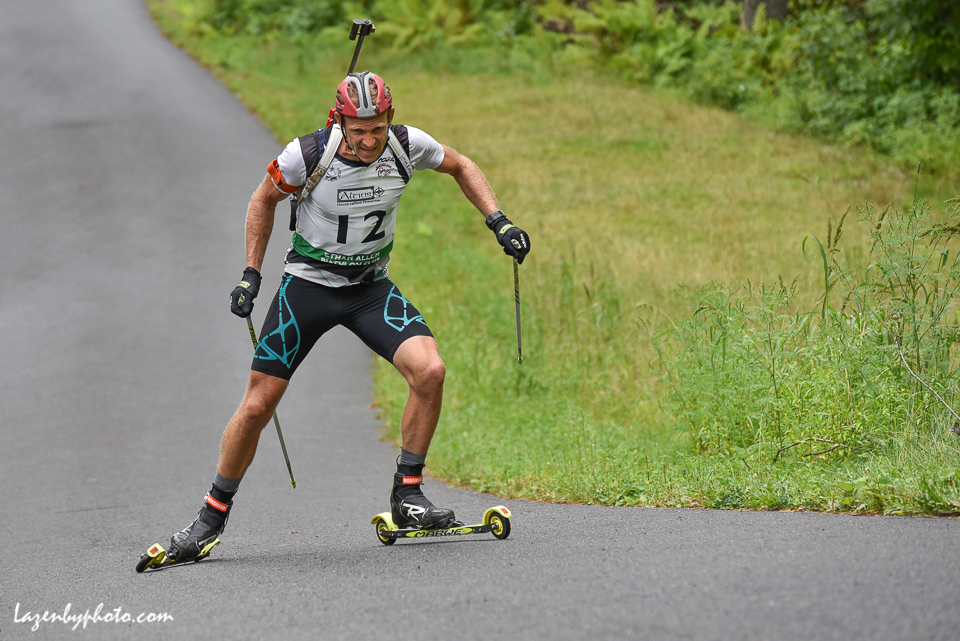
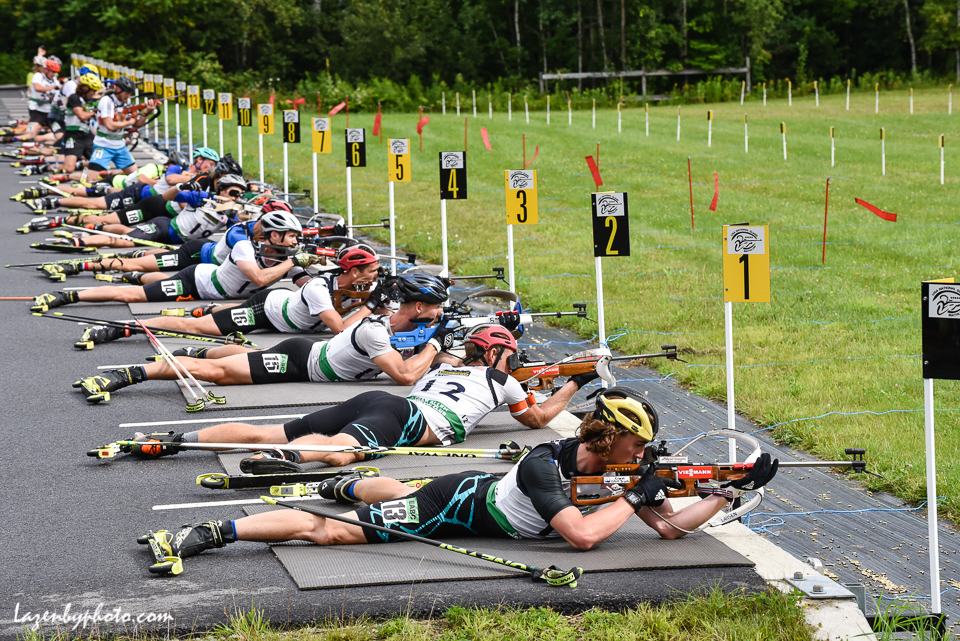
    US Biathlon’s Sean Doherty (front) and Lowell Bailey (12), along with their competitors, taking aim during a prone shooting stage of the men’s mass start at 2017 USBA Rollerski Championships on Aug. 13 in Jericho, Vt. (Photo: John Lazenby/Lazenbyphoto.com)
  • The Inside Scoop on US Biathlon’s Olympic Criteria with Bernd Eisenbichler

    The Inside Scoop on US Biathlon’s Olympic Criteria with Bernd Eisenbichler

    Lowell Bailey competing at the Olympic Games in Sochi, Russia, where he placed eighth in the 20 k individual race for the best Olympic result ever by a U.S. man. Since then, Bailey became the 2017 World Champion in the same discipline.

    The US Biathlon Association (USBA) has already qualified two World Championships medalists for their 2018 Olympic team, but four more men and four more women will still be selected – and those spots could go to almost anyone.

    USBA has a multi-stage athlete selection process. One or two more athletes of each gender will be selected based on the first period of World Cup results. For both men and women, part of that World Cup roster is already set and the rest will be chosen based on rollerski trials this summer and fall.

    Then, the World Cup athletes who weren’t selected will be sent down to the IBU Cup in January, where they will duke it out against the best U.S.-based athletes who qualified for the trip based on NorAm Cup races in December. The team will be filled to four men and four women from these IBU Cup races.

    Finally, a fifth member of the team to PyeongChang, South Korea, will be added to each team based on discretion.

    “Biathlon is a sport where you have to have a constant high level of performance, because you never know when you will get a chance… shooting can go off and on every single day,” USBA Chief of Sport Bernd Eisenbichler said in an interview last week. “We give a reward for a consistent high performance level through this [December] pre-qualification system. And, with the trials system [in January], we are only three weeks away from the Olympic Games then. So we get the guys who are just on the upswing of performance towards the Games – maybe they didn’t have a good last year or didn’t have a good December, but now in January they are on the upswing.

    “What we want to make sure with that system, is that we have clearly the best U.S. team on the start line that is possible,” he said.

    December World Cups

    Dunklee on the move through the field in the 2014 Olympic mass start, where she placed 11th for the best individual Olympic result ever by a U.S. woman. She had qualified for the team based on December World Cup results.

    The standard for making the Olympics based on upcoming World Cup results is to hit the top 30.

    The Olympic team can be filled to up to three athletes of each gender based on this standard. If multiple athletes turn in top-30 results in the first three weeks of World Cup racing, those with the best single result will be chosen. If nobody meets the mark, then one athlete with the best single result, even if it’s outside the top 30, will be chosen to join Lowell Bailey and Susan Dunklee, who are pre-qualified based on their gold- and silver-medal performances at 2017 World Championships.

    “It’s clear from the performance level that we have in our team now that everybody wants to go for that pre-qualification spot in December, which means that you need one top-30,” Eisenbichler said. “In the Olympic season, you have to do that quite easily. We expect that from them. One top 30, for all the athletes we have on the start line, that’s something that they need to do to get ready for the Games.”

    World Cup qualifying criteria have not yet been published, but have been substantially the same for several years.

    Last season, athletes with top-20 World Cup results were pre-selected for the next season’s World Cup. If that criterion were repeated, that would mean that Bailey, Dunklee, Tim Burke, Sean Doherty, and Clare Egan would be given spots.

    The rest of the selections are made based on rollerski trials to be held in August and October, and by discretion based on a number of factors including performance at an early-season training camp.

    While the criteria to qualify via the World Cup are clear, one thing to note is that there is a maximum team sized which can be named through this mechanism: three total athletes of each gender. If more athletes meet the mark – as Eisenbichler hopes and expects they will – the group will be winnowed down based on who does best.

    Last season Bailey, Burke, Dunklee, Egan, and Joanne Reid all notched top-30’s in just the first week of racing. Doherty and Leif Nordgren missed the first period of racing due to illness and injury, but collected top-30’s later in the season.

    “The harder part is for sure to send two men and one woman back from the World Cup in December, who could potentially have also had pretty good results,” Eisenbichler said. “Potentially they could also have been in the top 30, but just the other two athletes were a little better. That could create for sure quite some frustration.”

    January Racing and a Level Field

    Hannah Dreissigacker en route to 23rd place in the Olympic 15 k individual in Sochi. Dreissigacker was competing in her first Olympics after excelling at January IBU Cup races which served for selection. (Photo: USBA/Paul Phillips/Competitive Image)

    That frustration by athletes who had been succeeding on the World Cup, Eisenbichler believed, was worth it in order to create a good selection system.

    “I think that it’s fair to give the athletes from the North American Cup qualification in December the chance to show their level in January against the ones that had the chance over three weeks in December at the World Cups,” he said. “Race it out on the international level. I think it’s fair.”

    How many athletes are sent to the IBU Cup based on the December races in Minnesota is yet to be determined. The U.S. will fill its IBU Cup quota with a combination of athletes already in Europe and those being sent over anew from the U.S.; whether one or two more men or women are already selected to the Olympic team determines how many quota spots will be filled by December World Cup athletes, and how many are left to be filled by athletes who had been racing in North America.

    “The most difficulty we could have, is that if we only pre-qualify one more athlete in December and we have to send three athletes back to the IBU Cup, that would limit the number of athletes that could qualify from the NorAm Cups in Minnesota,” Eisenbichler explained. “That could potentially go down for the men’s team to just the winner of the trials. That could create frustration over there. But again, that’s how the system works.”

    And although the exact number of athletes offered an IBU Cup chance is up in the air, there is some clarity: win the Minnesota races, and you’ll be within one step of making the Olympic team. The trials winner will be sent to Europe no matter what.

    “I think that’s very important for them to see a clear, streamlined path that they can rely on,” Eisenbichler said. “It’s not left up in the air, like no matter what I do I’m never sure if I will get a qualification. If you win the trials, you get to go. That’s our rule. The winner of the trials always gets to go. There will be never a discussion about that.”

    Once in Europe, it’s not a foregone conclusion that the World Cup athletes who are sent to these January trials will come out on top and get the Olympic spots. In 2014, Jeremy Teela started the season on the World Cup but was ultimately left off the Olympic team as he was beaten in every IBU Cup race by Russell Currier.

    (Sean Doherty was the discretionary pick after besting all other Americans in one of the IBU Cup races.)

    Likewise, in 2010 Kevin Patzoldt competed in the early World Cups but ultimately did not make the cut in the January trials.

    On the other hand, some of the World Cup athletes sent to these IBU Cups have simply dominated. But that’s the point, according to Eisenbichler: to see what happens, rather than to leave team staff and the athletes themselves wondering whether they were actually better than a World Cup athlete they never got to race against.

    “I think it’s fair, especially going into the Olympics, to compare athletes shortly before the Games,” Eisenbichler said. “To see the level of the best athletes who just didn’t make the cut through the [fall] rollerski races… We are growing quite fast now with our new pipeline, with the Talent ID Camp and new cross-country skiers changing to biathlon. I think it’s fair to show them, to motivate them to do this sport, to say, ‘Hey, there’s an open door to qualify during the season for different events.’”

    And regardless of history in the sport or even that season, athletes chosen at the January IBU Cup races – rather than based on earlier results on the World Cup – have gone on to solid Olympic success.

    In 2010, Lanny Barnes didn’t qualify through the World Cup, but did well in the IBU Cup races and ultimately placed 23rd in the Olympic 15 k.

    In 2014, Hannah Dreissigacker was picked for the team through January IBU Cups and turned in an identical result, 23rd in the Olympic 15 k.

    Discretion

    Sean Doherty, still a junior at that point, was a discretionary pick to the 2014 Olympic team. He raced a leg of the U.S.’s 16th-place men’s relay. Since then, he has gone on to contribute to two top-8 World Championships relays and collect three individual top-20 World Cup finishes.

    The last roster spot for the 2018 Olympics will be filled by discretion.

    “As we all know, discretion is always a point of controversy, and especially in an Olympic year,” Eisenbichler admitted. “That is something that we know, and we will look very, very carefully. But I think it’s absolutely necessary and I’m grateful to have it. For example, we could have someone who is in great shape but is sick during the trials, yet was clearly ahead of the others in all the other races [before that].”

    There are six metrics listed in the criteria which could be considered to make a discretionary pick:

    • History of performance in a specific competition type over the current and previous competitive seasons
    • Recent improvements in results or performance parameters such as ski speed and shooting performance (both in training and competition)
    • Recent positive trend of competition results or performance parameters, such as ski speed and shooting, indicating a potential for Olympic success. This includes indication of medal potential in future Olympic or World Championship competition that would be materially enhanced by selection to the Team.
    • Recent decline in results or performance parameters such as ski speed and shooting performance (both in training and competition)
    • Performance/participation in the qualification process effected by illness or injury as certified by USBA
    • Ability to effectively contribute to a relay

    For the discretionary selection, Eisenbichler makes a proposal of who to select, but the various athletes in the mix are then discussed at length by USBA’s International Competition Committee. The committee are the ones who finally settle on a selection, which may or may not be Eisenbichler’s first choice.

    “We have a former athlete in there with Sara Studebaker, we have a domestic coach [Sarah Lehto of National Guard Biathlon], we have a chair who has worked a long time for the U.S. Olympic Committee with Jay T. Kearney, and we have Jonne [Kahkonen, the women’s national team coach] and myself,” Eisenbichler said of the committee. “I can tell you that in the last years we were in contentious discussions. But I think the outcome was always as objective as a discretionary choice can be. We had very little discussions afterwards, because we had put everything on the table [in the committee].”

    Coming from Germany, Eisenbichler has a slightly different perspective on how discretion could be used than do most American coaches.

    “What I really felt when I took the position in 2007, was that discretion was this big monster out there that everybody was so afraid of,” he laughed. “I was so surprised about it. Maybe some sports have a history of that, so it’s understandable… But coming from Germany, we have a little different system in place, with a lot more discretion. They look at results for the basic qualification for the Olympic Games, but after that there are six or seven athletes who meet that and have the same performance level, and then it’s all discretion.”

    Eisenbichler certainly isn’t asking for a German-style system. He’s happy with his one discretionary pick. And in order to make that pick seem less like a “monster,” he has put in big efforts to be transparent about how choices are made.

    “We worked really, really hard over the last ten years to establish a trust among the athletes,” Eisenbichler explained. “We want them to know that it’s still something that is unclear, but the [committee] makes the best possible choice they can, and they provide a clear rationale about the decision right after. We explain the discretionary choice to the athletes who were affected by it — the ones that get to go, but also the two or three who were close and hoped and believed that they could be a discretionary pick. I think this communication right after the decision is the most important way to gain the trust of the athletes in that system.”

    Filling a Team

    U.S. Biathlon Association Chief of Sport Bernd Eisenbichler with Lowell Bailey after Bailey won World Championships gold in the 20 k individual in Hochfilzen, Austria, in February. (Photo: Glen Crawford)

    Until 2006, USBA had more of a straight-up Olympic trials system. But even if it may sometimes seem like a labyrinth, Eisenbichler believes the new system – which will be used for a third Olympic Games this year – is much better.

    “To just look at just a few performances for the Games or the Trials is absolutely not what we want from our coaching leadership and myself,” he asserted. “We want to have a constant high level of performance throughout the whole year.”

    Furthermore, Eisenbichler asserts that the system is accepted and supported by athletes. Even regarding the discretionary picks, there has been little blowback.

    “It’s well understood, well established, and even, I would say, a well respected system from the athletes,” he said. “We have pretty much no complaints over the last eight, nine years for World Championships and Olympic picks.”

    Recently, USBA has been improving its Olympic results.

    In 2006, Jay Hakkinen posted a best-ever mark for a U.S. man in 10th. In 2010, Jeremy Teela moved that up to ninth. In 2014, Lowell Bailey finished eighth.

    On the women’s side, Susan Dunklee finished 11th in 2014, besting Joan Smith’s mark of 14th place set in 1994.

    With Dunklee and Bailey winning medals at last year’s World Championships, Eisenbichler hopes that the upward trend can continue – and that the criteria will select the team that can make it happen.

    “With that mixture, and having one discretionary choice as well, I think that we made sure in 2010 and 2014 that we had the four or five strongest athletes at the Games,” he said. “And I think it was a totally fair and transparent system. I am very comfortable with the system again going into PyeongChang.”

  • FasterSkier’s Coach of the Year: Bernd Eisenbichler

    FasterSkier’s Coach of the Year: Bernd Eisenbichler

    Bernd Eisenbichler embraces Lowell Bailey after Bailey became the first-ever world champion in the history of US Biathlon. (Photo: Glen Crawford)

    With the 2016/2017 season officially in the rearview, FasterSkier is excited to unveil its annual award winners for this past winter. Votes stem from the FS staff, scattered across the U.S., Canada, and Europe, and while not scientific, they are intended to reflect a broader sense of the season in review. This set of honors goes to a coach or team director who has particularly contributed to their team’s success.

    Previous categories: Junior Skiers of the Year | Collegiate Skiers of the Year | Canadian Continental Skiers of the Year | U.S. Continental Skiers of the Year | Nordic Combined Athlete of the Year | Biathletes of the Year  | Para-Nordic Skiers of the Year | Canadian Breakthrough Skiers of the Year | American Breakthrough Skiers of the Year

    ***

    Despite the title of this award, Bernd Eisenbichler has never really been a coach.

    He has been an athlete (in Germany), a ski technician (for Ricco Gross, Kati Wilhelm, and then the American biathlon team), the high-performance director for the US Biathlon Association (USBA), and now its chief of sport.

    Such a title might suggest that as Eisenbichler has risen through the ranks to direct both the national team and now also the development pipeline for the U.S. biathlon community, he has become more distant from the nitty-gritty, the details or the athletes.

    Not so much. This season, you could still see the 41 year old zooming around on skis, or running back and forth between different parts of a stadium. Eisenbichler isn’t one who is content to stand around, or to distance himself and watch other people do work.

    And when Lowell Bailey crossed the finish line in Hochfilzen, Austria, in February to become a world champion in the 20 k individual, one man ran out to grab him by the shoulders, scream and celebrate. You guessed it, it was Eisenbichler.

    “Bernd was the first person who greeted me at the finish line, tears in his eyes,” Bailey wrote in an email this week. “[He is] one of the most passionate, hard-working individuals I’ve ever known!”

    Eisenbichler testing skis in 2015. (Photo: Jake Ellingson)

    Technically, nobody is allowed in the finish zone except the athletes who just finished the race. But Eisenbichler pushed through the scrum of officials and celebrated with an athlete he had met in the same place, Hochfilzen, back at Junior World Championships in 2000. Back then, he was what Bailey called a “hired hand” to make their skis fast.

    At that point, did the German envision himself staying with the U.S. team for nearly 20 years (so far)?

    “Along the way, I had different offers from different teams,” Eisenbichler admitted in an interview from his office in the Bavarian town of Frasdorf on Monday. “But I enjoy the freedom I get [from USBA] to create a high-performance program. You learn on the way. You make mistakes on the way. Hopefully you do it better next time. What I always see, though, is the potential to get better… I enjoyed working with Lowell and Tim [Burke] for every day of the 18 years. But every new person who came, they added something to the program. It meant, we are not done here. There are things we can do better, to reach higher.”

    Bailey’s gold medal, the first ever by an American, and Susan Dunklee’s silver to make her the first U.S. woman to win an individual World Championships medal – together, they make an argument that this was US Biathlon’s best season ever and that the program is entering a new era.

    “We have never, before now, had strong men and strong women at the same time,” USBA CEO Max Cobb said after Dunklee’s silver in Hochfilzen. “This is really exciting for us and a good validation that these opportunities, and the pipeline we have, works.”

    The World Championships haul didn’t come out of left field.

    Tim Burke gets encouragement from US Biathlon’s High Performance Director Bernd Eisenbichler at the beginning of the 12.5 k pursuit in Hochfilzen, Austria, in 2014.

    In 2013, Tim Burke earned World Championships silver. Then at the 2014 Olympics, Bailey and Dunklee set best-ever marks for U.S. men and women, respectively: eighth by Bailey, 11th by Dunklee.

    Just weeks after that, Bailey and Dunklee began accumulating World Cup podiums, and they haven’t stopped.

    Since 2014, three different athletes – Sean Doherty, Maddie Phaneuf and Chloe Levins – have turned in top-five performances at Youth and Junior World Championships.

    And this season, two athletes with college degrees in just their second seasons of biathlon – Paul Schommer and Joanne Reid – turned in individual top-35 performances on the World Cup and then teamed up with Sean Doherty and Clare Egan to finish eighth in a mixed relay. Five different athletes on the team, including Burke, Egan and Leif Nordgren, picked up top-20 World Cup results this season.

    We asked Cobb, the USBA President and CEO, whether US biathlon would be where it is today without Eisenbichler.

    His answer was simple: “No. Bernd is masterful in his leadership of our program.”

    “Bernd is one of most passionate people I know, and for decades he has directed all his energies into building up USBA’s program,” Dunklee agreed.

    “What was always interesting with Bernd, even at [the beginning], was that even though he was a German, he was extremely passionate about Team USA’s results,” Bailey wrote. “He got to know all of the athletes and was genuinely interested in seeing our team succeed, even if that meant beating the German team… At first, he was just waxing skis; then, he was in charge of stone-grinding and waxing; then he was put in charge of some team logistics. Eventually he became High Performance Director. Since that time, I’ve seen our team go from a mediocre ‘also-ran’ to one of the strongest teams in the world. That success is largely due to Bernd’s role and his tireless drive to win by out-maneuvering instead of out-spending. He embraced this David-and-Goliath struggle from the start.”

    Eisenbichler prefers to call it a puzzle, referring to the complexity of the sport and the intricacy of the management required to win.

    “We always knew that our program and our approach works, and we also had results to justify that,” Eisenbichler said. “But this year it really culminated in a perfect way… You always add to the puzzle and you try to have the perfect pieces to complete it. This year we just completed the puzzle. I think we proved that all the additions that we made to the program over the last three or four years, we really benefitted from it this year.”

    For North American nordic sports teams, having a European at the helm seems to have worked out about as often as it hasn’t. But for US Biathlon, it sure has, and the consensus seems to be that it’s because of Eisenbichler himself. Having a German guiding your biathlon program doesn’t automatically buy you success. It’s not nationality so much as what the guy does.

    The U.S. team and staff — including Cobb (brown jacket) and Eisenbichler (to his left) — celebrate Lowell Bailey’s gold medal at 2017 World Championships in Hochfilzen, Austria. (Photo: USBA/NordicFocus.com/Twitter)

    In Eisenbichler’s case, he assembles a coaching team from Sweden, Finland, and Canada, a service team that includes Germans, Czechs, and an Italian, and brings in a shooting advisor from Austria. Plus, of course, Americans.

    “We have eight nations represented on our staff, and they all worked so hard towards one goal, over nearly a decade for some of the staff members,” Eisenbichler said. “To see them so happy after Lowell and Susan’s success was just very, very rewarding for me.”

    How does it work, gaining buy-in and loyalty from a staff which can be far-flung in the summer months?

    “If I was being arrogant, I would say good management,” Eisenbichler laughed. “No, that’s a joke.”

    He admits that there have been a few hires which didn’t work out and didn’t fit in with the team. But they have been “actually few.” Part of the staff’s success, Eisenbichler said, was how it fits together.

    “We manage pretty well to give everybody a project where they can really identify themselves as being a very important part of the program,” he explained. “As a result they are really giving more than a normal staff member would do, really giving their heart and their energy into these projects. But at the same time they know they are part of the puzzle. There is nobody who is the only one contributing to the success or failure. I really believe it is like a puzzle, and every staff member has — even if at times their role is more important than other times — but they have the feeling that without them, it would not have been possible to be so successful.”

    That’s not to say that there have never been cultural differences between Eisenbichler and his team.

    “In my early years on the team, we used to have a slight disagreement about the word ‘fun’,” Dunklee wrote, explaining: “I’ve always made it my goal to keep ‘fun’ at the forefront of all my racing and training because the day that I forget to have fun is the day that I burn out. I think Bernd (and many other European coaches I have met) associate the word ‘fun’ with a carefree and unfocused attitude. However, I’ve never thought of fun and hard work or professionalism as mutually exclusive, in fact they can build on each other. I have been most successful and satisfied with the sport when I am directing every effort possible towards a big goal and remembering to savor and enjoy the goofy, spontaneous and joyful moments along the way. On that point, Bernd could agree. We were talking about the same thing, he just preferred to use the term ‘enjoyment’ rather than fun. But he humors me now and sometimes tells me ‘have fun!’ before my race and I always act so surprised to hear that word coming from him. It’s become a running joke.”

    In some ways, Eisenbichler is still a ski technician at heart. He works closely with Muck Bauer, the team’s stonegrinder, who is also based in Germany. The pair test skis all year round, and were developing new grinds right up through World Championships. That meant that skis were getting driven from Hochfilzen to Ruhpolding, stoneground, being driven back, and then skied in for 20 k the next morning before being raced on.

    “Bernd was excited about some of the new breakthroughs they’d had,” Bailey wrote. “The night before the individual, it was decided that a couple of pairs of my skis should be sent to Germany and re-ground with some of these new grinds. It was one of those pairs that carried me to victory later that day. It’s hard to say what the difference was for me that day, but it’s hard to overlook that fact that, in a race lasting almost one hour, a 3.3-second margin of victory is about as slim as it gets!”

    At the end of this year’s U.S. National Championships, Dunklee and Bailey presented Eisenbichler with USBA’s Medal of Honor. The love and appreciation that Eisenbichler has for his athletes, and vice versa, stands out.

    “I was meeting with Bernd in the lead-up up to [the 2014 Olympics] in Sochi and one thing he said stuck out to me,” Dunklee wrote. “We were talking about goals and how of course he wants to see someone on the team bring home a medal. He explained how every bit of the high performance budget and staff were being directed towards that main priority. But then he told me, ‘You know, I’ll really gauge my work with the team as successful if 20 years from now, you athletes and staff decide to travel to Munich for an Oktoberfest Reunion together. Then I’ll know I did a good job.’ ”

    “I look forward to that reunion some day,” Dunklee concluded.

    Lowell Bailey and Bernd Eisenbichler leave the mixed zone after Bailey finished sixth in the mass start at 2017 IBU World Championships in Hochfilzen, Austria. (Photo: USBA/NordicFocus.com)
  • U.S. Biathlon Names 11 to 2017/18 National Team, More on Development Squads

    U.S. Biathlon Names 11 to 2017/18 National Team, More on Development Squads

    Susan Dunklee and Lowell Bailey celebrate after finishing second in the World Cup single mixed relay in Kontiolahti, Finland. Austria won the competition. (Photo: IBU/Twitter)

    The U.S. Biathlon Association (USBA) has named five women and six men to its senior national team for the 2017/2018 season, and 14 more athletes to its several development teams.

    The nominations are headlined by Lowell Bailey and Susan Dunklee, both of whom won individual medals at 2017 World Championships in Hochfilzen, Austria. They are joined on the “A” team by their World Championships teammates Clare Egan, Joanne Reid, Maddie Phaneuf, Tim Burke, Leif Nordgren, and Sean Doherty.

    “This year it really culminated in a perfect way,” USBA Chief of Sport Bernd Eisenbichler said. “The best thing about it — besides being so successful and having a dream season — is that the upcoming and younger athletes, like Leif, Sean, Maddie, Joanne, and Clare, they see now that it’s not only the athletes from Norway and Germany succeeding. At some races we took medals and then we also proved it on the Olympic course. It’s giving a lot of confidence to the whole program.”

    Leif Nordgren skiing the second leg of the men’s 4 x 7.5 k relay at the IBU World Cup in Antholz, Italy, where the U.S. finished sixth. (Photo: USBA/NordicFocus)

    The men’s relay team notched sixth- and seventh-place relay efforts this season, and Nordgren picked up four top-30 finishes despite missing almost half the season with an injury. Doherty also missed almost half the season due to illness, but came back to earn a top-20 in the Kontiolahti pursuit at the end of the season. Veteran Burke collected four top-30’s over the course of the year.

    On the women’s side, Egan and Reid picked up two and one top-30 finishes apiece, and Phaneuf had a 10th-place pursuit result on the IBU Cup.

    Also snagging an “A” team nomination is Paul Schommer, who came from the senior development team to land consistent World Cup starts from the middle of the season onwards. Schommer had a top individual finish of 33rd in the individual in Antholz, Italy, and contributed to an eighth-place mixed relay effort in Kontiolahti, Finland.

    “Paul had a great season for his second year in biathlon, and made really big improvements,” Eisenbichler said. “He showed that he can be a really good alternative, or even more than that, for the men’s relay and other relays too. He showed that in Korea and especially in Kontiolahti in the mixed relay there. He had a top-35 result at his first World Cup, so we felt that he is really very close to the big guys and separated himself from the athletes who were performing with him at the beginning of the season in the IBU Cups.”

    Clare Egan racing to 20th place in the women’s 7.5 k sprint at the 2017 IBU World Championships in Hochfilzen, Austria (Photo: USBA/NordicFocus)

    Landing on the “B” team are Emily Dreissigacker (Craftsbury Green Racing Project) and Russell Currier (Outdoor Sports Institute). Currier started the year on the World Cup, finishing 34th in the pursuit in Oberhof, Germany, before moving to the IBU Cup. Dreissigacker racked up five top-30 finishes on the IBU Cup circuit this season.

    “They will get a lot of camp time in Lake Placid,” Eisenbichler said of the “B” team. “They will also get direct coaching from the National Team coaches. In Emily’s regard it’s from Jean Paquet, and in Russell’s regard from Jonas Johansson. So they have not only access to the training plan from the ‘A’ Team, but also their individualized plan from the national team coaches. They will spend about seven to eight weeks in Lake Placid from May to August.”

    Chloe Levins, who finished fourth in the youth women’s pursuit at World Youth and Junior Championships this season, and IBU Cup racer Jake Brown comprise next season’s “X” Team, which is seen as consisting of athletes who are expected to make the jump to the “A” team within two years.

    “The ‘B’ team should be very close to the World Cup, and we expect ‘B’ Team members to be able to really chase the World Cup team for the next season and to have a really good shot for the Olympic Games,” Eisenbichler explained. “That’s the difference between the ‘B’ Team and the ‘X’ Team. The ‘X’ Team is still a development team, for athletes who just started biathlon or young athletes, as we have this year.”

    Chloe Levins (11) with her US Biathlon support team (from left to right: Erik Lewish, Travis Voyer, Mathias Zacherl, Robert Gorgos, and Algis Shalna) after her fourth-place finish in the youth women’s 7.5 k pursuit, her career best in her third IBU Youth World Championships, on Sunday in Osrblie, Slovakia. (Photo: USBA)

    USBA has also named a five-member Senior Development Team, consisting of Hallie Grossman and Alex Howe (Craftsbury Green Racing Project), Siena Ellingson (Mount Itasca), Travis Cooper (National Guard Biathlon), and Max Durtschi.

    And the Junior Development Team consists of athletes with some of the top U.S. results at World Youth and Junior Championships: Vasek Cervenka (Mount Itasca, 16th in youth individual), Cody Johnson (Outdoor Sports Institute, 46th in junior sprint), Jake Pearson (Casper Mountain Biathlon Club, 49th in youth individual), Amanda Kautzer (Michigan Tech/Loppet Nordic Racing, 42nd in youth pursuit), Grace Gilliland (Alaska Biathlon, 46th in youth individual), and Helen Wilson (Alaska Biathlon, 62nd in youth individual). Lexie Madigan of the Auburn Ski Club was also named; she qualified for the World Youth Championships team but was younger than the minimum age set by the International Biathlon Union to compete.

    “The setup is, they are regionally coached with consulting from the National Team coaches,” Eisenbichler said. “They can get access to the training philosophy, but they are coached by their own regional or club coaches. But they are also invited to Lake Placid, the seniors for two camps, and the younger ones for one camp. At the [Rollerski National Championships] in mid-August, we will re-evaluate their performance levels and see who gets more invitations later on towards the fall.”

    The team nominations are as follows:

    National Team Women
    Susan Dunklee (Barton, Vt.), A 1 Team
    Clare Egan (Cape Elizabeth, Maine), A 2 Team
    Joanne Reid (Boulder, Colo.) A 3 Team
    Maddie Phaneuf (Old Forge, N.Y.) A 3 Team
    Emily Dreissigacker (Morrisville, Vt.) B Team
    National Team Men
    Lowell Bailey (Lake Placid, N.Y.), A 1 Team
    Tim Burke (Paul Smiths, N.Y.), A 2 Team
    Leif Nordgren (Marine, Minn.), A 2 Team
    Sean Doherty (Center Conway N.H.) A 2 Team
    Paul Schommer (Appleton, Wis.) A 3 Team
    Russell Currier (Stockholm, Maine) B Team

    X Team 
    Women
    Chloe Levins (Rutland, Vt.)
    X Team Men
    Jake Brown (Houghton, Mich.)
    National Development Group – Senior Women
    Hallie Grossman (South Woodstock, Vt.)
    Siena Ellingson (Minnetonka, Minn.)
    National Development Group – Senior Men
    Max Durtschi (Sun Valley, Idaho)
    Alex Howe (Craftsbury, Vt.)
    Travis Cooper (Kenai, Alaska)
    National Development Group – Youth/Junior Women
    Amanda Kautzer (Plymouth, Minn.)
    Grace Gilliland (Eagle River, Alaska)
    Helen Wilson (Eagle River, Alaska)
    Lexie Maddigan (Truckee, Calif.)
    National Development Group – Youth/Junior Men
    Cody Johnson (Fort Kent, Maine)
    Vasek Cervenka (Grand Rapids, Minn.)
    Jake Pearson (Casper, Wyo.)
    Coaching Staff
    Chief of Sport: Bernd Eisenbichler
    National Team Head Coach: Per Nilsson
    National Team Women’s Coach: Jonne Kahkonen
    National Team Men’s Coach: Jonas Johansson
    National Development Coach: Jean Paquet
    Eastern Regional Coach: Algis Shalna
    Midwestern Regional Coach: Vladimir Cervenka
    Assistant Coach: Erik Lewish
  • Dream Come True, Bailey Wins World Championships Gold, First Ever for American Biathlete

    Dream Come True, Bailey Wins World Championships Gold, First Ever for American Biathlete

    Lowell Bailey celebrates after crossing the line to win gold in the 20 k individual at IBU World Championships in Hochfilzen, Austria. (Photo: Glen Crawford)

    HOCHFILZEN, Austria—Four days ago, Lowell Bailey left the shooting range after cleaning his fourth stage in the pursuit, and was in second place.

    Things didn’t go his way and he saw first World Championships silver, then bronze, slip from his grasp as other men were stronger on the Hochfilzen race course’s big hills. He ultimately finished sixth, after placing fourth in the sprint.

    Today, the American biathlete again left the range after cleaning his fourth stage. Two key differences: this time he had hit 20 out of 20 targets, rather than missing once. And this time, he was in first place, although he didn’t know it right away.

    “I was really happy about it, obviously,’ Bailey said. “There was a surge of adrenaline immediately when I left the mat. Obviously most of the race is finished by that point, but in my mind, that was where the race began, the second I left the mat.”

    Bailey was the second-to-last starter out of the 102-man field, and there was no chance of anyone behind him besting his time. When he hit the course, he had a 6.4-second lead on Ondrej Moravec of the Czech Republic.

    If he could protect that lead, Bailey would become the first American ever to win a gold medal at biathlon World Championships. The U.S. has also famously never won an Olympic medal in biathlon, the last such winter sport, and Bailey had never won a World Cup before, either.

    After watching a medal slip away in the pursuit, he wasn’t going to let it happen again.

    “I know that my weakness on the course is the long extended climbs,” Bailey said. “If I look back to the pursuit that’s where things fell apart for me. I was okay on the fast gradual stuff, but at the long extended climbs I lost tons of time there. So today I tried to maximize my strengths… And then just mentally knowing that the last two kilometers are a lot of V1 extended climbing, I was telling myself ‘Don’t lose it on these climbs, you just gotta dig deep and find something there, because I’m not gonna lose it on these climbs’.”

    He almost did. With 1,100 meters left to go, Bailey’s lead was down to 0.1 seconds. The crowd held its breath. Moravec, watching on the big screen from the finish area, shook his head, like, can you believe this?

    U.S. Biathlon Association Chief of Sport Bernd Eisenbichler with Lowell Bailey after Bailey won World Championships gold in the 20 k individual in Hochfilzen, Austria. (Photo: Glen Crawford)

    It was a race for the ages. But some on the U.S. team were sure that with the long swooping downhill to the finishing stretch, Bailey could eke out a win.

    “It was closer and closer, and it was a tenth of a second at the last split at the very top,” U.S. teammate Tim Burke said. “But we had phenomenal skis and I knew if he was close there, he would make it. There was no way anyone had better skis than us… He owes a serious tip to the service guys.”

    Bailey wasn’t as sure, but he also didn’t have any time or energy to think about it. He just stayed confident and kept fighting.

    “I was in such a pain state that you are thinking like a five-year-old at that point,” he said. “But I would say that I was extremely confident in my skis today, and I think having those long downhill stretches before the finish definitely helped.”

    Bailey ended up getting passed by Alexey Volkov of Russia, who had started a bib earlier but who Bailey had passed before. At first it seemed like Volkov might be an obstruction, but the Russian kept a high speed. As a result Bailey got a bit of a draft, and had someone to fight with to the finish.

    “He was feeling pretty good on the last loop, and I tried to stay with him,” Bailey said of Volkov. “I mean, it’s always an advantage to see someone in front and try to stay with them. I think the battle was mostly going on in my own head. But we were skiing together, and I think that has to help in some way.”

    By the time he hit the finish, he had gained a few seconds back from Moravec and crossed the line with 3.3. seconds to spare. Bailey fell to his knees and U.S. Biathlon Chief of Sport Bernd Eisenbichler rushed over to embrace him.

    After nearly two decades of working together – back in the day, Bailey was a junior and Eisenbichler a wax tech – the pair had done it: a World Championships medal for Bailey.

    And it was gold.

    “When I think about when I first met Lowell, he was probably 13 years old, in Lake Placid, and just this good young skier who put his heart into this and worked for this every day, for almost 20 years now,” U.S. Biathlon Association President and CEO Max Cobb said. “I think it is a total validation of Lowell’s career… and how we were able to engineer things. We stripped out everything that we didn’t need to do and made it really focused on developing the athletes and bring them to this level. And now we are one year out from the Olympics.”

    Perfection on the Range

    Four-stage races have not always been Bailey’s best friend.

    “That fourth stage in a pressure situation is definitely, in my opinion, the hardest part of biathlon,” Bailey said. “And it hasn’t always been my strong point. I have lost a lot of medal opportunities in the last stage.”

    The U.S. men’s team, staff, and Bailey’s family celebrate on the podium after the flower ceremony. “Biathlon really is a team sport, and nobody achieves success like this without having a perfect environment around them,” U.S. Biathlon Association CEO Max Cobb said. “So I can’t say enough for Bernd [Eisenbichler]’s leadership, and all the great work of the coaches and ski techs and the whole support staff. Because that’s what makes it possible.” (Photo: Glen Crawford)
    But in the Olympics three years ago, Bailey came back from a disappointing start to the Games by focusing and turning in an eighth-place finish in the 20 k individual, his best Olympic or championship performance ever up to that point. He was one miss away from a medal, and set a new best mark for a U.S. biathlete at the Olympics.

    Thinking about this World Championships, Bailey decided months ago that the 20 k would be his best shot.

    “I focused on this race starting in May,” Bailey said in the press conference. “What do I need to do in my training to really prepare for this race? And so starting in May with the shooting workouts, I started going through this race in my head, and sort of doing a dress rehearsal during the training. Who is to say that helped or didn’t help, but I felt really composed today on the shooting range. I wouldn’t say I felt anymore nervous than any other day, any other race. That was good.”

    Bailey knew that he would have to shoot a perfect 20 for 20. While the wind is tricky in Hochfilzen, it’s not always strong. There are always a few clean sheets and Bailey doubted he could win without one.

    So he had to overcome the threat of a last-stage collapse, that pattern that had haunted him so many times in the past.

    In Sunday’s pursuit, he had done it. His one missed shot came in the third stage, and then cleaning the final standing put him in that second-place position. So while the last loop of the pursuit didn’t go well, Bailey knew that he could do it on the range.

    “One thing that I have learned over the years working with sports psychologists is that you are going to get distracted,” he said, gesturing as his daughter Ophelia cried in the background. “Especially at a World Championships, there are going to be distractions both externally and internally. For me actually the internal distractions are the most detrimental. You are talking to yourself in your head ‘if I do this, if I do that, if I clean then this, if I just hold it together…’ And all that is doing is taking you away from what you have trained for decades to do. The muscle memory is there, hundreds of thousands of rounds fired. So you just have to trust in your training, and also know that those are just distractions.”

    In the final stage of the individual, Bailey was focusing on just two things. The crowd and the potential medal didn’t factor in.

    “As you get to the competition season, you boil your shooting cues down to a few key principles,” he explained. “For me those are having a good trigger squeeze and follow-through. So it’s like two things. Trigger squeeze. Follow-through. And by the way, when you got to your first biathlon camp, those are two of the three things they teach you. But when you are in that situation, you are fighting for a World Championship medal, you have to keep things simple because that is all your brain is capable of.”

    Sprint, pursuit, and individual: 50 targets, and Bailey has hit 49 of them. Fast, too. His shooting time today tied for the fourth-quickest among all the men in the field.

    His focus is working, and that accomplishment was something the U.S. staff was particularly proud of. As Bailey started taking his first shots of that last stage, U.S. men’s coach Jonas Johansson breathed a sigh of relief. While watching it was “horrible”, he said, he was also sure Bailey could come through.

    “I knew when he started to execute the shooting like planned, that this can go,” Johansson said. “Normally before, he has been a little too cautious in those situations, and stepped back a little bit. But now he went for it. I’m so happy for him that he really pulled it off and he came through clean.”

    Four k or 40 k?

    While cleaning all 20 targets was a big part of the work, Bailey still had to ski four more kilometers to seal the deal after he finished shooting.

    “I didn’t know that I would come out in first place, but I knew that if there was ever a point where every second mattered, it’s directly after you have gone 20 for 20 in an individual,” Bailey said. “So I knew that those four kilometers were going be the deciding factor, and I knew it was going to be a matter of seconds. It was just that rush of adrenaline: ‘I worked so hard to get to this point, I need to do this’.”

    Bailey, one of the last men to leave the start house in Hochfilzen. (Photo: Glen Crawford)

    He described the four kilometers as agonizing, especially those big climbs that he knew were his weakness. In the press conference, Bailey joked that it felt more like 40 kilometers than just four.

    “Fortunately I had great skis, and I had a U.S. staff member seemingly every hundred meters along that track,” he said later. “But every hundred meters it was a sprint. Every hundred meters was ‘go as hard as you can for this hundred meters, and then when you get to the end of that hundred meters, go as hard as you can and just keep doing that.’ I thought the finish line was never going to come. I was just like, I don’t know how much longer I can do this, because the finish line is just not showing up.”

    That final loop ended up being one of Bailey’s fastest of the day. And that earned him gold.

    As he climbed up onto the top step of the podium after his race, he was joined by his wife, Erika, and their daughter. Martin Fourcade of France, the superstar who took bronze, handed the girl a plush toy he had received as a prize. Everyone seemed happy.

    “I think Lowell has a really good mix of biathlon and life with his daughter and his wife,” Johansson said. “I think that’s something really good for him, to have them around to be able to relax. And to also be able to have pure biathlon focus when he’s racing and he’s training. That’s a skill he had today, he did it one-hundred percent.”

    Johansson, a Swede, has been working with the U.S. men’s team for three years. Watching the whole men’s team succeed, including this medal for Bailey, has been rewarding, he said.

    “It’s a fantastic team in every way and it’s hard workers,” Johansson said. “Most of these athletes are maybe not the most talented on day one, but they are hard workers, and Lowell is one of them. He’s worked hard for many years and now he’s on the top… Lowell and also the other athletes on the team, they have this potential. I mean, they’ve shown before that they can be up on the podium and fighting for the podium, so it’s an unbelievable day.”

    Teammate Burke, the last U.S. man to stand on the World Championships podium when he won silver in the 20 k individual in 2013, was thrilled for Bailey.

    “He deserves it, especially this week,” Burke said. “He’s been so on, with the fourth place, sixth place, and today he needed the perfect race and he absolutely had, that’s the perfect race. It doesn’t get any better than that.”

    Other North American Results

    23. Leif Nordgren, USA, 1-0-0-1 (+2:53.6)

    36. Tim Burke, USA, 1-1-0-2 (+4:14.4)

    42. Macx Davies, Canada, 0-0-0-1 (+4:25.2)

    43. Scott Gow, Canada, 0-1-0-1 (+4:29.1)

    58. Sean Doherty, USA, 1-1-2-0 (+6:04.4)

    86. Brendan Green, Canada, 2-1-0-2 (+9:33.9)

    Christian Gow of Canada did not finish.

    -Alex Kochon, Jason Albert, and Harald Zimmer contributed

    Results

  • ‘Stronger, Faster, Better’ Dahlmeier Wins 15 k Gold; Ransom 18th, Egan 22nd

    ‘Stronger, Faster, Better’ Dahlmeier Wins 15 k Gold; Ransom 18th, Egan 22nd

    Germany’s Laura Dahlmeier jumps for joy after winning her third gold of the 2017 IBU World Championships, in the 15 k individual. (Photo: Glen Crawford)

    HOCHFILZEN, Austria—Every women’s race of the World Championships so far, the question has been: where’s Laura Dahlmeier?

    And in every race, the German has has turned in fantastic performances. Close to perfect on the range, fast on her skis, winning a medal each time.

    The 15 k individual was no exception. A late starter, Dahlmeier had just one miss, in her first prone stage, and then all was clear as she raced to another gold medal. This time, it was by 24.7 seconds over Gabriela Koukalova of the Czech Republic, the winner of the sprint.

    “I think Laura is in amazing shape, and it’s very difficult to beat her,” Koukalova said in a press conference. “Because, what can I say, she is unbelievable. Stronger, faster, better concentration, there is no chance.”

    Dahlmeier herself was calm as she concluded something not so different

    “It’s a special moment for me — the third gold medal, the fourth [overall] and I think the ninth medal since Oslo [World Championships 2016],” she said. “It’s amazing. One race after the other I can show my best performance, and it’s really great to be on the podium and on the first position.”

    Most of the top women started in the last seed group, hoping for the shade to speed up the tracks in the late afternoon. Mari Laukkanen of Finland – who will represent her country at FIS Cross Country World Championships in a few weeks – set the early time to beat, with one missed shot and a blistering ski time.

    Her time held up for 25 minutes, until Koukalova crossed the line with one penalty and a faster ski speed. Clean-shooting Alexia Runggaldier of Italy slotted in between them, and finally Dahlmeier’s time knocked everyone down a notch.

    “I thought that it could be possible if I shoot clean,” first-time World Championships medalist Runggaldier said. “But then I thought, okay, there are the best people of the whole world that will be competing at this competition. So if I am lucky then I will be good, and if it’s not like this then nothing happens. But I am really happen that I shot four times clean… I think both [Dahlmeier and Koukalova] can shoot four times clean.”

    Laukkenen ultimately ended up with the wooden medal, +1:56.8. Fifth place went to Ekaterina Avvakumova (+2:03.6), a Russian who transferred her citizenship to Korea, and sixth (+2:06.7) to Susan Dunklee of the United States.

    Other North American results:

    Julia Ransom, Canada, 18th Place

    Julia Ransom. (Photo: Glen Crawford)

    Ransom went into the individual with a brand-new attitude.

    “I’ve been sort of frustrated the last couple weekends ,with sickness in Antholz and just having a hard time getting my groove, so I decided today to just leave nothing behind,” she said. “Shoot fast, ski fast, not worry about the consequences. It was just fun racing, so it was awesome.”

    The strategy worked: Ransom missed just one shot, and raced to an 18th-place finish (+3:48.2), her best international result to date.

    “I think I came in with too many expectations from last year and I forgot to just race because I love it and race for myself and not for carding or not for criteria not for anything, just because it’s super fun,” she said.

    Clare Egan, USA, 22nd Place

    Egan notched her second top-25 of the Championships, and is turning in some of her best racing ever at this event.

    In the individual, she collected another personal best: with just two missed shots, she achieved 90% shooting in a four-stage race for the first time.

    Furthermore, she did it by cleaning each of the first three stages. She was pleased that she didn’t completely falla part on the final shooting stage, given that she was in line for perhaps a top-six finish – which would have been a huge personal best – if she had cleaned.

    Clare Egan waves to the crowd after crossing the finish line in the top ten. She was later bumped down. (Photo: Glen Crawford)

    “After I cleaned my first standing stage, I knew I would have three clean stages because I was so confident about the prone ,” she said. “I’m happy with my last standing, too, I’ve never cleaned three stages of a four-stage race before so I’ve never been in that position before. Of course I could have handled it better, but I’m pretty happy with two misses… I’m totally fine with that. I hit more than I missed. I was a little shaky for sure.”

    Egan also had the 26th-fastest ski time. That netted her 22nd place, +3:55.0.

    “She is really able to be up there, and I want to see her up there more often,” U.S. Biathlon Association Chief of Sport Bernd Eisenbichler said. “We will work for the next season to have her more constantly up there in the top 20, because I think she can be up there any given day. She is in a higher level for the skiing performance now. There is still too much up and down, but she took a step forward this year.”

    Megan Tandy, Canada, 43rd Place

    With two missed shots, Tandy ended up +5:14.0. While she was happy with 90% shooting, she wished the effort had netted a better result.

    “Actually it was a good race,” she said. “But I have been feeling actually awful this season. I haven’t had a good ski feeling since November… I am starting every race maybe feeling good for 800 meters, and then I am not racing, I am just surviving. Today I had some fight, and I hit 18 so I should be happy. But I am just watching the results list, because for me to qualify for funding [Spot Canada funding] next season I need one more top 30.”

    That didn’t happen. But Tandy thought that the tools she had developed to get her through this race, and this season, would continue to serve her well in the future.

    “I kind of came into the race prepared to not think about anything but the process,” she said of the pressure for results. “I had really specific keywords for the shooting, both prone and standing, as well as really key tactical goals for the course. When I am standing on the shooting mat I am thinking about trigger pressure and black targets, and those are the only two things in my head.”

    Joanne Reid, USA, 56th Place

    Reid split a bullet on the last shot of her first stage, but rather than be frustrated, she took responsibility.

    “It was way off from the rest of my group, so that was all me,” she laughed.

    After starting the season with a sensational performance in the 15 k individual in Österund, Sweden, Reid’s four misses today seemed imperfect. But she refused to let any one shooting stage get to her.

    “I come into the range each time ready to focus on that bout,” she said.

    That helped her clean the last stage, something she was particularly proud of. She finished +6:36.7, and also had a faster last standing stage than usual, clocking in at 27 seconds.

    “I actually do have the speed capability, but I can’t always put all the pieces together yet,” she wrote in an email. “I’ve been working really, really hard at improving the speed over the course of the season, but it never seems like the time to implement it in a race. There’s always teammates counting on me, or an individual in which you have a minute penalty per miss, or the sprint in which you must make the pursuit, or the pursuit in which you aren’t supposed to miss the prone targets, or…. or…. or.  This stage today was quite fast, and was all in the prone ring, and so was my fast standing stage in the pursuit (all in the prone ring).  I think I have to trust myself.”

    Rosanna Crawford, Canada, 62nd Place

    Crawford had a rough start to her race: three missed shots in prone, right off the bat.

    Rosanna Crawford. (Photo: Glen Crawford)

    “That was so strange!” she said. “Usually my prone goes well, and this was just all over the place. I don’t know what happened. But actually, I find that when I miss early, it’s easy to get it turned around because the pressure is totally off.”

    She did turn her shooting around, cleaning each of the next three stages. But her skiing time was not enough to make up for the missed shots and Crawford finished +7:01.5.

    “15 k is really hard for me, and when it’s hot – I just can’t handle the heat,” she said. “So it was tough.”

    Emma Lunder, Canada, 64th Place

    Lunder had one more missed shot than her teammate, and finished +7:17.9.

    “It had good and bad parts,” she said. “I missed two in my first shooting, so that was a little bit tough, trying not to think about that while I was skiing. And then the rest of my shooting I was a lot happier with, but then to miss one in the last bout – I was just so tired… it was such a hot race, and everyone was out there just dying. It was a good effort for sure.”

    Maddie Phaneuf, USA, 87th Place

    It was the second competition of World Championships for Phaneuf, a first-year-senior who had made the Championships a major goal.

    “I felt like coming into it I was going to feel so overwhelmed, but it just kind of feels normal, like another World Cup,” Phaneuf said. “In the beginning of the season, I haven’t had that many World Cup starts, it was just so overwhelming and I wasn’t quite ready to experience it. But now that I’ve done a handful of them this season, it feels much more comfortable and I feel like I deserve to be here, which is exciting.”

    Normally a strong shooter, Phaneuf missed two shots in each of her standing stages. That left her with 87th place overall, 9:38.3 behind the pace set by Dahlmeier.

    “Recently I’ve just been struggling with my standing,” she said. “I’ve been hitting the targets in training but in the races I keep missing two every time. It’s really annoying. I think I shoot clean in prone and then I come into the range [for standing] and I try not to think about the result, but I need to figure out how to push that out of my head because it keeps messing me up.”

    Eisenbichler saw this as a learning experience for the youngest member of the U.S. women’s team.

    “Maddie is here to learn, more or less,” he said. “For sure we want to have great results for her as well, but it’s her first World Championships in the senior category. We must work on the [skiing] shape. She’s a strong shooter, she can shoot clean on any given day in an individual race, but the shape needs some work, this was obvious today again. We will make sure that we approach this with the right tactics for the next season.”

    -Harald Zimmer and Alex Kochon contributed

    Results

  • Dunklee Sixth in World Champs Individual: ‘She Belongs Up There’

    Dunklee Sixth in World Champs Individual: ‘She Belongs Up There’

    U.S. biathlete Susan Dunklee after finishing sixth in the 15 k individual at World Championships. (Photo: Glen Grawford)

    Stay tuned for further reporting from the women’s 15 k individual race, to be posted later today.

    HOCHFILZEN, Austria—Sixth place? Not a bad way to turn things around halfway through a week-and-a-half long World Championships.

    After all, Susan Dunklee didn’t have the start she wanted at World Championships, finishing in the mid-20’s in the sprint and the pursuit. Not bad results exactly, but for the most successful U.S. woman in the history of the sport, they left something to be desired.

    Yet even through those races, Dunklee knew that there wasn’t anything wrong with her racing or her biathlon process. In some ways, the pair of racing experiences reinforced her resolve.

    “Honestly, I think after having the first couple races done I just started feeling a little bit more relaxed,” Dunklee said. “Okay, so I don’t have to have a good result when I show up. I just have to do my job, and I don’t have control over what the results are going to be, I can only control what I am doing in the moment. And I did that those early races. It didn’t go as well as I wanted, but it was good work and I have to accept that.”

    Come Wednesday, and the 15 k individual, she was ready to do more good work and reap the rewards.

    The unique race format, where missed shots accrue a one-minute time penalty rather than a trip to the penalty loop, has provided Dunklee some of her best Championships results, including fifth place in Ruhpolding in 2012. But paradoxically, it has been her worst discipline this season: no better finish than 71st this season.

    “I think it took the pressure off,” Dunklee mused. “I knew I didn’t have to do a lot to beat that.”

    The monkey is now off her back. With just two penalties, Dunklee finished sixth today, 2:06.8 behind German winner Laura Dahlmeier, who had one penalty.

    “It was a great comeback,” U.S. Biathlon Association Chief of Sport Bernd Eisenbichler said. “I think that with the two misses today she can be satisfied. There’s really high pressure on her, she really wants to be up there, and she belongs up there, and I think today she proved that.”

    “I do a lot of race visualization in training, and today I just tried to pretend I was doing a race visualization,” Dunklee said.

    Like many of the other top women, Dunklee picked the last seed group. With constant sun in Sudtirol and the weather in the stadium reaching the mid-40’s (Fahrenheit), much of the course was getting slow. But late in the day when sections of the trail were shaded, things began to speed up.

    Dunklee said it had been the right call.

    “There was a little bit more shade, and the shade was fastest, so that was helpful,” she said. “It was a little bit deeper [in some places], but I think it was beneficial to have the shade and that outweighed it.”

    Starting nearly last – 98 out of 99 starters – she had a strange race-day experience.

    “A lot of sitting around beforehand,” she said. “I am not used to that… I felt like the steam of energy in the stadium had kind of died down a little bit by the time I started.”

    It also meant that when she missed one shot in the very first stage, she was knocked way back in the standings – to 38th. But cleaning the next two stages brought her back up and by the time she left the range the third time, she was in podium position.

    It was not to be, though, as Dunklee missed a shot in the last standing stage.

    “Sometimes you can feel it, sometimes you can’t,” Dunklee said. “I didn’t feel any of the misses today, they felt like good shots. I feel good about what I did.”

    Dunklee got the details, though, clocking in the fourth-fastest shooting time and seventh-fastest ski time.

    “The [skiing] shape is on a higher level now than we saw in January, so that is good to see,” Eisenbichler said.

    The result should qualify her for the 2018 Olympic Games, and she will join teammate Lowell Bailey to make the very first pair of athletes named to the U.S. Olympic Team. U.S. Biathlon has a criteria that any athlete with a top-six World Championships result in the prior season is automatically selected. That’s never applied to more than one athlete before, and many years there are no such performances.

    Dunklee says that such a system, which allows top athletes to qualify a whole year ahead of time, makes sense.

    “It takes a lot of pressure off, and allows you to just focus on your training,” Dunklee said. “If you have to try out and qualify extra you have to taper a little bit for those qualification races, and I have the luxury of being able to just train through and make my peak ready for the Olympics… I think it’s good for us.”

    And that gives the U.S. three top-six finishes in five days at World Championships, easily a best-ever team tally.

    “Now we are hungry for even more, that’s for sure,” Eisenbichler said. “We still have the mass start and I think with that skiing shape and that shooting we can go for even more. That’s the goal for now.”

    -Harald Zimmer contributed

    Results

  • Sixth Place for Bailey in Pursuit, Gow 23rd; Fourcade Gets His Hochfilzen Gold

    Sixth Place for Bailey in Pursuit, Gow 23rd; Fourcade Gets His Hochfilzen Gold

    France’s Martin Fourcade jumping for joy on the podium after winning the men’s 12.5 k pursuit on Sunday at 2017 IBU World Championships in Hochfilzen, Germany. (Photo: Glen Crawford)

    HOCHFILZEN, Austria — In a World Championships that started as a contentious battle of snubs between France and Russia, the first week ended with three guys who couldn’t be happier to compliment each other on the podium.

    Starting third in Sunday’s 12.5-kilometer pursuit, after earning bronze in the sprint, Martin Fourcade of France was nearly perfect. He only missed the last of his 20 shots and cruised to a 22.8-second victory for his first gold medal of the Championships.

    France’s Martin Fourcade celebrates his first win of the 2017 IBU World Championships on Sunday with a nearly 23-second win in the 12.5 k pursuit in Hochfilzen, Austria. (Photo: Glen Crawford)

    In the press conference, he was liberal with his praise for second-place Johannes Thingnes Bø and third-place Ole Einar Bjørndalen, both of Norway.

    “I am pretty satisfied to be on the podium with Johannes, one of the greatest biathlon talents, and with Ole who is as well one of the greatest biathlon talents,” Fourcade said, understating Bjørndalen’s role in the history of the sport. “It was amazing for me to share this podium with them, because Johannes is always good on the big events… And everyone is asking me when I will break Ole’s record, and how I will do that. But I am simply sure that if I want to break one his records he will have to stop.”

    If Fourcade seemed to have things locked up with one stage to go, the battle for second place was fierce.

    Bjørndalen, Krasimir Anev of Bulgaria, and Ondrej Moravec of the Czech Republic were all in the pack close behind Fourcade, but all missed a shot. Lowell Bailey of the United States, however, cleaned – as did Bø and Anton Shipulin of Russia.

    Bailey headed out of the range in second place, with Bjørndalen exiting the penalty loop just behind him.

    The American led for a while, but Bjørndalen was stronger. And although the pair had a substantial lead on the others when they left the range – Bailey had 7.1 seconds on Anev, 12.8 seconds on Bø, and another 2-3 seconds on Moravec and Shipulin – the chasers were charging hard.

    American Lowell Bailey (4) chasing Norway’s Ole Einar Bjørndalen during the men’s 12.5 k pursuit at 2017 IBU World Championships in Hochfilzen, Austria. (Photo: Glen Crawford)

    About the time that Bjørndalen passed Bailey, Bø realized he had a chance.

    “I was not sure I would catch Ole,” he said in the press conference. “When I closed up he was going past Bailey… he looked quite strong. But Lowell had not his best day I think on the last loop, and on the last uphill I managed to catch Ole.”

    Bø fought with Bjørndalen in the final kilometer. He ended up with a clear edge, earning silver (+22.8) while Bjørndalen took bronze (+25.6).

    The 43-year-old Bjørndalen seemed to harbor no hard feelings after being knocked down a spot by his younger teammate.

    “It was a really good race for me,” Bjørndalen said. “Shooting was really good, and I felt much better on the skis also today, so it was a really good race.”

    The last time World Championships were in Hochfilzen, in 2005, Bjørndalen won three individual gold medals, as well as one in the relay. On Sunday, bronze was good enough.

    “2005 I was definitely stronger on the skis than I am in the moment today,” he said.

    The men’s 12.5 k pursuit podium at 2017 IBU World Championships, with France’s Martin Fourcade (c) in first, Norway’s Johannes Thingnes Bø (l) in second, and Norway’s Ole Einar Bjørndalen (r) in third. (Photo: Glen Crawford)

    His younger teammate started in second place, just where he finished. But it was not a straight line in between. Bø racked up three penalties and had a bobble that tripped him up and sent him sprawling to the ground as he left the shooting mat at one point.

    While he had been disappointed to be second the day before – by just 0.7 seconds to Benedikt Doll of Germany – he seemed ebullient with his pursuit silver.

    “Today it is quite a better feeling,” he said. “Not quite so tired after the race as I was yesterday. It’s quite fun to [finish by] gaining places up to the podium today. It’s a little bit more fun than losing the gold medal [at the end] yesterday.“

    As for Bailey, he was finally caught by a group of Shipulin, Moravec, and Anev. He couldn’t stay ahead of anyone but Anev, and finished sixth (+34.7).

    “In the end I just didn’t quite have enough,” he said at the finish. “It’s just so close and there are so many good guys. One more shot! One more shot, ten more seconds… You know, I could keep going and going, but that’s the way it is.”

    A New High for USA

    Although Bailey was so close to the podium he could almost taste it, sixth place was still a solid result to follow up his fourth-place finish in Saturday’s sprint.

    Lowell Bailey (US Biathlon) racing to sixth in the men’s 12.5 k pursuit on Sunday at 2017 IBU World Championships in Hochfilzen, Austria. (Photo: Glen Crawford)

    “Two times in the top six, we cannot complain about that,” U.S. Biathlon Associaiton Chief of Sport Bernd Eisenbichler said. “It’s a fantastic result for Lowell.”

    While fourth place in the sprint was the second-best result ever by an American at World Championships – Tim Burke won a silver medal in 2013 and Josh Thompson a silver in 1987 – two top-six finishes in a single Championships is pretty unprecedented.

    Starting a pursuit in fourth position is certainly an advantage, but it’s also far from any sort of guarantee. Just ask Doll, who won the sprint but ended up 11th in the pursuit. Or Germany’s Vanessa Hinz, who started the women’s pursuit sixth but ended up 20th.

    “I think it was really impressive how he approached those two races,” Eisenbichler said. “Yesterday he was really aggressive on the range, really went for it, had the second-fastest shooting time. And you know, it was just unlucky that there were three better guys… And I have to say that I am even more proud today, because this was a really tough race for him. And he kept it together in the last shooting, and I am really proud of that.”

    Bailey had a similar assessment.

    “Obviously I would have loved to be on the podium,” he said. “That’s what we all hope for. But I approached each race this year just telling myself to go out there and do what you can do for the day. Some days you got more in your legs than others. I am actually really happy with the shooting today, because I held it together shooting up there near the lead the whole time. Quite honestly, that’s where I have struggled in the past. So I am really happy to have stuck with my game plan in shooting and kept my focus.”

    Bailey took his time to clean the last five targets, but even so was the second-fastest shooter in the field when all the stages were added up. That helped him, since the skiing did not go exactly as he would have wished.

    “I would say the pace was a little bit faster than I would have liked to go in the beginning,” Bailey admitted. “But I knew that if I didn’t maintain contact, I wouldn’t have a chance. So I went as hard as I could in the beginning, and then I paid for it in the end. But you have to be there at the end to have a chance. So…”

    He shrugged his shoulders. What are you going to do?

    The weekend netted Bailey another major accolade: he became the first athlete of any sport to qualify for the U.S. Olympic team to PyeongChang, South Korea, for 2018. U.S. Biathlon qualification rules stated that any athlete with a top-six finish at 2017 World Championships would get a spot, and Bailey nailed it – twice.

    “It’s a goal that I’ve had for a long time and I think now it means so much more for me to be competing with the support of my wife Erika and our new daughter Ophelia,” Bailey said of the 2018 Olympics in a Team USA press release. “To know that I can represent the U.S. team for her is really special for me to be able to have that privilege.”

    Tim Burke (US Biathlon) racing to 32nd in the men’s 12.5 k pursuit at 2017 IBU World Championships in Hochfilzen, Austria. (Photo: Glen Crawford)

    Behind him, his three American teammates didn’t have as strong days on the range. Tim Burke had three penalties to move from 40th up to 32nd (+2:45.4); Leif Nordgren had five missed shots to drop from 26th to 49th (+4:11.1); and Sean Doherty collected nine penalties to fall from 39th to 55th (+5:15.2).

    But Eisenbichler focused on their performances in the sprint as a sign of what was to come.

    “I am really happy how the recovery goes for [Nordgren and Doherty],” he said, referring to a toe injury and mononucleosis, respectively. “I still call it a recovery, they are still on the path to get back to their full shape. Sean had a really super shape in the summertime — he was there with Tim and Lowell –and Leif had also a really high level. And so I was really pleased to see Leif’s 26th place, and Sean also taking points with two misses in prone which is absolutely not perfect. But with a clean shooting he’d have been up there. And don’t forget about [Burke], too. We had a really good men’s team performance overall yesterday, so we are really looking forward to the individual and to the relay.”

    Personal Best for Gow to Lead Canada

    Christian Gow (Biathlon Canada) racing to a career-best 23rd in the men’s 12.5 k pursuit on Sunday at 2017 IBU World Championships in Hochfilzen, Austria. (Photo: Glen Crawford)

    Meanwhile, Christian Gow matched Bailey’s shooting to move from 32nd up to 23rd and collect a new personal best.

    “I was super happy with it, finally breaking into the top 30,” Gow said. “I have been in so many races right around that cusp. So it feels good to get into it.”

    Before the competition, it hadn’t seemed like things were off to an auspicious start. Yet Gow kept an open mind and began to feel better and better.

    “Starting today, I didn’t feel very good warming up,” he admitted. “I felt exhausted still from yesterday, and my legs just felt kind of dead. The first loop of the pursuit was crushing. I was kind of like‚ ‘Okay, there is 2.5 out of 12.5 done…’ I don’t know, it was looking a little bleak, but then something changed on the range, and all of a sudden I just felt fine on skis. And I felt like I was fine on the last lap. I was pretty hurt, but I am really happy with the race.”

    32nd had been the best sprint result of Gow’s career, so he was starting the pursuit in fast territory. That added some pressure.

    “Looking at my skiing yesterday, it wasn’t great,” Gow said. “And a lot of the guys around me were guys that are some of the strongest skiers, who just missed too many yesterday. So they had two or three misses and were at my [level] with three more hits. So I knew today was going to be a lot of work, but I kept together on the range really well, I am happy about that. It was great to feed off the fast guys out on my loops. And sometimes your realize, ‘Oh wait, that pace isn’t so bad, I can manage that’.”

    His older brother Scott Gow had seven missed shots to drop from 25th to 47th (+3:56.0), and Brendan Green missed five to slip from 38th to 52nd (+4:19.5).

    — Harald Zimmer contributed

    Results

    Scott Gow (Biathlon Canada) racing to 47th in the men’s 12.5 k pursuit at 2017 IBU World Championships in Hochfilzen, Austria. (Photo: Glen Crawford)
  • With Nordgren’s Freak Injury, U.S. Men’s Biathlon Team Down to Three

    With Nordgren’s Freak Injury, U.S. Men’s Biathlon Team Down to Three

    Tim Burke (left) and Leif Nordgren zeroing their rifles prior to the start of the men's 10 k on Thursday Nov. 10 at this year's Biathlon Canada team selection time trial races at Frozen Thunder in Canmore, Alberta. (Photo: Matthias Ahrens)
    US Biathlon teammates Leif Nordgren (left) and Tim Burke zeroing their rifles prior to the start of the men’s 10 k sprint on Frozen Thunder in Canmore, Alberta, in November. Nordgren briefly joined Burke and his U.S. teammates on the World Cup before having to fly back to the United States for surgery on his toe. (Photo: Matthias Ahrens)

    The U.S. men’s biathlon team was already starting the World Cup season with a man down: Sean Doherty, the several-time World Youth and Junior Champion and 2014 Olympian, who had come down with mononucleosis.

    But the team is now down to just three men after fellow 2014 Olympian Leif Nordgren had to have surgery on his toe after an incident with a treadmill.

    Until January at least, that leaves just Lowell Bailey, Tim Burke and Russell Currier sporting the purple-and-orange suits of the United States on the sport’s biggest stage. It also leaves them without a relay team on Sunday in Pokljuka, Slovenia.

    “It’s definitely disappointing to sit out a relay, but unfortunately, that is what we will have to do next weekend,” Bailey wrote in an email this past Sunday. “I think both of them will be back in force after the new year, so our whole focus now will be on the last half of the season, and a podium at World Champs… that’s what we are all aiming for!”

    Paul Schommer, who was on the short list for a World Cup spot before Currier was selected, would have been the next logical man to add to the roster, but the team decided against it.

    “We discussed the option to bring another man over, but we felt that the heavy travel and the race schedule as well at World Cups 2 and 3 did not justify getting someone out of the middle of a training block in Canmore,” U.S. Biathlon Chief of Sport Bernd Eisenbichler wrote in an email. “We only have one relay in the first trimester… We always try to look at individual best development options, as long as we are not missing more than one relay of course.”

    Leif Nordgren leaving the range in Sunday's mixed relay in Ostersund, Sweden. The United States team finished tenth. (Photo: US Biathlon / NordicFocus)
    Leif Nordgren leaving the range in last year’s mixed relay in Ostersund, Sweden (Photo: US Biathlon/NordicFocus)

    Nordgren’s injury actually happened just before he left the U.S. for the opening weekend of World Cup racing in Östersund, Sweden.

    “The way it happened was kind of a freak accident,” he explained in an email. “I was doing intervals on the [rollerski] treadmill. After one interval I got off to take a lactate sample. The treadmill was still coming down from its incline though and squished my toe into the floor. Conveniently the treadmill turned off at that point and it took 30-45 seconds to turn it back on and raise it back up.”

    Nordgren was initially told that he was fine to travel, train, and race, so he flew to Sweden, where he competed in the single mixed relay with Joanne Reid, finishing 19th.

    “It definitely hurt pretty bad to train and race on it last week,” he admitted.

    Afterwards, he went to the hospital in Sweden, where X-rays revealed that he had actually fractured the toe. Because it was an open fracture, surgery was needed. Nordgren opted to fly back to the U.S. for the procedure.

    “The main reason to do the surgery was to make sure the fracture didn’t get infected,” he wrote. “When there is a fracture near an open wound (my toe was cut as it was squished) they call it an open fracture. If the fracture and bone get infected it can be very bad, as in amputate bad. Basically it was a better safe than sorry scenario.”

    After the surgery, news came back that cultures taken from the fracture did show the presence of Staphylococcal bacteria, which can cause infection and major complications. Nordgren joked on his blog that if he hadn’t had surgery to clean out the wound and the infection had proceeded, he would probably be down to nine toes. He is now on a course of antibiotics which should prevent further problems.

    “Now that they did find that staph bacteria I think everyone is happy we did the surgery,” Nordgren wrote in an email.

    In terms of his prognosis, he does anticipate being back to the World Cup in January.

    “I had surgery on Friday, everything went ok with that and now I am back in Lake Placid area recovering for the next few weeks,” he wrote on Monday. “Recovery is expected to be pretty short, hopefully in the 2 week range.  I should be able to start doing some upper body training before then though, but as of now with the surgery still quite fresh I just have to stick to the couch with my foot up.”

    https://www.instagram.com/p/BNsjftkgYpF/

    As for Doherty, he raced in the NorAm mass start in Canmore, Alberta, on Sunday, placing seventh (+3:03.3 behind winner Paul Schommer) with four penalties.

    “Sean did have a quite fast and real good recovery,” Eisenbichler wrote. “Our doctors and coaches did a great job to find  the right plan for him. He will do the full camp in Canmore and then if all continues to go well, he will go to [IBU Cup] trials races in Minnesota (not for trials or qualification reason, but to get some racing in). We expect to have him back for World Cup 4 in Oberhof, but more can be said and known after completion of the Canmore Camp.”

    — Alex Kochon contributed reporting
  • Currier Back on US Biathlon World Cup Team

    Currier Back on US Biathlon World Cup Team

    Russell Currier during the men's mass start at the 2016 US Biathlon National Rollerski Championships on Aug. 14 in Jericho, Vt. (Photo: Katrina Howe)
    Russell Currier (Outdoor Sports Institute) during the men’s mass start at the 2016 US Biathlon National Rollerski Championships on Aug. 14 in Jericho, Vt. (Photo: Katrina Howe)

    “The season that never was continues at its steady pace.” That was how Russell Currier, a three-time national team biathlete and 2014 Olympian opened one of his blog posts in late March of this year.

    According to that month’s post and the two months prior, Currier’s ski career had reached an all-time low. While the two seasons prior (2013/2014 and 2014/2015) involved him racing on the national team and within seconds of top-20 times on the International Biathlon Union (IBU) World Cup, the year after saw Currier relegated to a reserve-athlete status. Within two years he had been dropped from the national team and was watching races he had formerly been competitive in from the screen of his laptop.

    The sudden change wasn’t easy on him.

    Russell Currier competing in a World Cup sprint in Antholz, Italy, in 2014. An Olympian in Sochi and a two-time sixth-place World Cup finisher, Currier had his worst season in years and was cut from the U.S. National Team. Paired with funding cuts to his home club, the Maine Winter Sports Center, Currier and his teammates are trying to pick up the pieces. (Photo: USBA/NordicFocus.com)
    Former national-team member Russell Currier competing in a 2014 World Cup sprint in Antholz, Italy. (Photo: USBA/NordicFocus.com)

    Currier, now 29, had spent countless hours, even as an eighth grader, with a headlamp and bounding poles on his hometown hills in Stockholm, Maine, contemplating how many 5:30 a.m. intervals he could fit in prior to school, while his peers contemplated how many more times they could snooze their alarms.

    He had worn the U.S. colors competitively not only at IBU World Cup events, but at the Olympics in Sochi, Russia, as well. But last season, he watched his former US biathlon teammates race against the backdrop of Italy’s Dolomite mountain range, while he looked on from the couch.

    “I went from being convinced I was going to keep racing biathlon to looking for something else whether it was marathon racing or just a whole new career,” Currier said on the phone from Maine. “It was a little tricky trying to find a definitive decision by the end of April.”
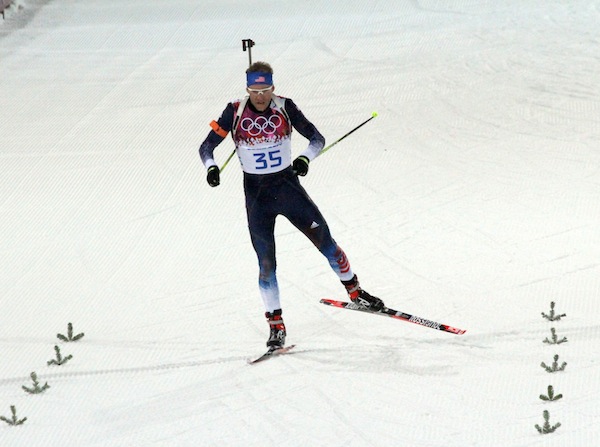
    But by the end of April, Currier had reached a decision. Throwing caution to the wind, he decided once more to live, eat and breathe biathlon.

    “…[Here’s] to thrashing it for another round,” Currier wrote in an April blog post. “In the long run, if I win I win and if I lose, I win.”

    “I just wanted to see if I could produce any results or make anything happen again,” Currier said in November of his decision to give biathlon another go.

    According to US Biathlon Chief of Sport Bernd Eisenbichler, Currier’s decision to continue was also encouraged by his national team’s coaches.

    “Russell was unsure in the spring, if he should continue with the sport after a disappointing season 15 – 16,” Eisenbichler wrote in an email. “We had a couple of calls together with him and the coaches and at the end of this discussion process he decided to keep going.

    “It was clear for everyone involved, that some things at the shooting part must change and Russell and his coach at home Seth Hubbard put forward a good strategy and we could provide a few good resources to support that,” Eisenbichler continued in the email. “We know, that Russell has the physical capacity to lock top results at the [World Cup].”

    With that in mind, Currier got back in the training lane. He spent his summer and fall once more in “the County”, exploring Northern Maine’s treasured trails and roads. Involved with the Maine Winter Sports Center since the beginning of his biathlon career, he remained affiliated with the revamped-and-renamed center, now the Outdoor Sports Institute (OSI), despite it shifting its emphasis away from elite teams. Along with its name change, Currier also witnessed a change in financial support when the program drastically reduced its Olympic Development Team funding in the spring of 2015.

    “It was mostly in terms of resources,” Currier explained. “When you have to make a trip happen to qualify for a team and you need the support financially to make that plane ticket and that hotel room, it made things different in terms of needing to be a little more careful. But the core is still there. We still have practices held every few mornings a week and we still have races.”

    Since no senior elite biathlon team for OSI presently exists, Currier spent much of his offseason training on his own or with under-23-aged athletes who joined OSI for the summer. The work appeared to pay off, and by late August, Currier was racing well at this year’s US Biathlon time trials in Jericho, Vermont.

    Russell Currier (Outdoor Sports Institute) competing in the men's mass start sprint race in Jericho, Vermont August 2016.
    Russell Currier (OSI) competing in the men’s mass start sprint race in Jericho, Vermont August 2016.

    In order for Currier to be selected to US Biathlon’s World Cup team, however, he needed to also perform at Biathlon Canada’s time trial races on Nov. 9 and 10 in Canmore, Alberta.

    In Canmore’s two 10 k sprints, Currier placed 10th on Day 1 (the third U.S. man behind Lowell Bailey and Tim Burke, respectively) and seventh on Day 2 (again, the third U.S. male behind Burke and Bailey, respectively, both of which had already prequalified for the World Cup). A day after the races finished, Currier received an email informing him that he had been selected to compete in World Cups 1, 2 and 3 on the IBU World Cup this season.

    “It was a huge relief,” Currier said of being named to the team. “It feels good and it was just a huge relief.”

    His selection includes the IBU World Cup opener in Östersund, Sweden, as well as races in Pokljuka, Slovenia, and Nove Mesto, Czech Republic.

    But in order to race those weekends, Currier must requalify at an IBU Cup prior to the start of the World Cup season, since he did not race any World Cups last season. Currier planned to leave the U.S. this Tuesday, Nov. 22, for the IBU Cup in Beitostølen, Norway, this Friday through Sunday.

    “In order to prevent anybody coming out of the blue that isn’t qualified to be on the World Cup, or shouldn’t be there, they have a standard you have to meet at the IBU Cup just below the World Cup,” Currier explained. “So I have to fly to Beitostølen first, race the sprint race there [on Friday] and meet the standard.”

    Though Currier still needs to requalify for the IBU World Cup, Eisenbichler has complete faith in Currier’s ability to compete against other World Cup regulars, grounding his decision to select Currier based on his recent sprint performances.

    “Just like in the past years, we kept one spot open for the Dec [World Cups] on the men’s side,”  Eisenbichler wrote. “We agreed to take the winner of the roller ski trials (2 races in Aug and 2 races in Oct) and one athlete by discretionary choice to the WC prep camp in Canmore and decide there after the camp is finished, whom of the two we take on to the [World Cups] in Dec. Russell won the trials and Paul Schommer was our discretionary pick.”

    “Both worked very well at the camp and were close in training, but Russell was  stronger than Paul in the two races at the end of the camp,” Eisenbichler continued in the email. “As he was also the winner of the trials races  we decided to pick Russell. on top of the Biathlon complex performance, Russell showed also a higher level at physical side in terms of ski speed.”

    As Currier prepares to pack his bags for Europe and potentially another full World Cup race season, he is relieved to be back on US Biathlon’s World Cup Team, but also more open to adjustment than he’s perhaps been in the past.

    “It’d be nice to stay on the World Cup … and then beyond that it would be nice to make the 2018 team,” Currier said of his goals within the sport. “But after last season, it’s just kind of a day-by-day, month-by-month structure, more so than in the past. At this point, it’s just if I can say I tried, it’s better than nothing. If I try, I succeed.”

    ***

    We asked Currier to give our ’17 Questions for 2017′ a go. Here are his responses:

    1. Biggest change in your life in the last five or so months since the ski season ended?

    I invested in a new, French-made stock.  Since I’ve been using the same stock for the last six years, it has taken some adjustment. My neighbor is a machinist and has helped me out with a lot of custom made parts that supplement the original design. He made me a bladed trigger a while back, which is exactly what it sounds like, an incredibly sharp trigger which creates a major incentive not to jerk the trigger quickly.

    2. Biggest change in your training?

    This will be my lowest year in terms of volume since I was a junior. However, I’ve added in a little more intensity and the overall quality of my training has been better.

    3. Major areas of improvement you’ve seen so far?

    The base for my position in prone is much more stable this year. Tight and consistent groups are possible now. I worked a lot this summer with one of the professional marksmen that has assisted USBA in the past – he’s an Olympic gold medalist, so he has a lot of good advice. Though the sports are fundamentally similar, they are executed at different speeds and heart rates, so there’s a lot of adaptation that has to take place.

    4. Whom you’ve been working closest with this offseason (coaches or training partners)?

    OSI’s (Outdoor Sports Institute is the renamed Maine Winter Sports Center) Seth Hubbard has been a super helpful coach despite the lack of resources for an OSI elite team. Since OSI lost funding it has been a bumpy road. As one of the only places in North America with a fully paved, world class biathlon venue, it’s still a great training ground and is open to more attention

    5. Best trip in the last five months (and why)?

    Canmore, it just felt nice to be back in the training camp schedule and working with the national team again. Plus, it’s great to get on snow as early as October to readjust to the different feel of natural skiing.

    6. Favorite cross-training?

    Running, it’s the most affordable and all terrain form of training there is. There’s a certain ease and ensuing calm in doing something your body was made to do.

    7. Favorite non-athletic activity or pastime this summer?

    Mostly nerd things and it’s finally deer season. Though, I’m down to one afternoon left to see anything in the field.

    8. Song that was your jam this summer?

    We’re Not Going To Make It – The Presidents and Lingonberry was my favorite jam.

    9. All time favorite race moment?

    Maine State meet class B Sophomore year. Very few in Rumford saw that win coming.

    10. First thing you pack in your bag when you leave for Europe?

    Noise cancelling headphones, batteries for headphones, then back up headphones. I think mental recovery is as important as physical recovery, and quiet is a crucial part of that. On the road, that can be hard to come by.

    11. Venue/event you’re most excited to visit this season?

    Nove Mesto, CZ. Nice, closed in and well balanced profile. A course built more for skiers and less for TV cameras.

    12. Who will win the men’s and women’s World Cup titles this year?

    I don’t follow XC enough to make a bold decision and biathlon is too off the wall inconsistent to call.

    13. Biggest sacrifice you feel you’ve made choosing this career path?

    An income.

    14. If you could change one thing about your sport, what would it be?

    No doping, no politics.

    15. What did you have for breakfast this morning?

    A lot. About half of my caloric intake comes from breakfast. I really think highly of breakfast

    16. In 5 years, I’ll be ____?

    About 1/8th of the way done with my education.

    17. In 50 years, I’ll be ____?

  • Reid Earns Biathlon World Cup Berth; Currier, Schommer on Short List for U.S. Men

    Reid Earns Biathlon World Cup Berth; Currier, Schommer on Short List for U.S. Men

    Joanne Firesteel Reid during the women's mass start at the 2016 US Biathlon National Rollerski Championships on Aug. 14 in Jericho, Vt. Reid earned a World Cup nod thanks to her performances. (Photo: Katrina Howe)
    Joanne Firesteel Reid during the women’s mass start at the 2016 US Biathlon National Rollerski Championships on Aug. 14 in Jericho, Vt. Reid earned a World Cup nod as a result of her performances at trials. (Photo: Katrina Howe)

    After two more sets of trials races in Jericho, Vt., last weekend, the US Biathlon Association (USBA) has come one step closer to finalizing its World Cup roster for the first period of racing.

    Susan Dunklee, Tim Burke and Lowell Bailey were the winners in the Jericho races (results here: Oct. 15/Oct. 16), but they were all already prequalified for the World Cup. So were Clare Egan, Sean Doherty and Leif Nordgren. The last two did not compete in Jericho.

    USBA completed its women’s squad with the addition of Joanne Reid, who landed at the top of the rankings list of non-prequalified athletes for a combined series of two trials races in August and the two in October.

    While Dunklee swept all four of the women’s races, Reid – a member of USBA’s “X” development team – notched a second-place finish and three third-place showings, making her one of the most consistent performers in the field.

    “I’m not a person who over-analyzes situations or results,” Reid, 24, wrote in an email of coming into the October races in a good position for making the World Cup team. “I take each day at a time, and I react to things as they come, rather than reacting in anticipation of what might come. So I came into these races wanting to go out and do biathlon, and that’s what I did. What the committee and the coaches choose, ultimately, in terms of teams and starting spots and training camps is something I can’t control, and I rarely worry about things I can’t control.”
    Reid has been doing biathlon for just over a year, and last season got her first World Cup starts in Germany, Italy and Canada. At the Canmore World Cup, she finished 57th in the sprint, her best result of the season.

    “My main goal is to merge together the shooting speed I’ve been slowly developing, with the accuracy I occasionally have,” she wrote. “My coach (Jean Paquet, USBA’s head development coach) and I have been working all summer to bring my shooting speed up from where it was (slowest on World Cup, slowest on IBU Cup, slowest at nationals) to something competitive, which like many new endeavors has not always been successful.”
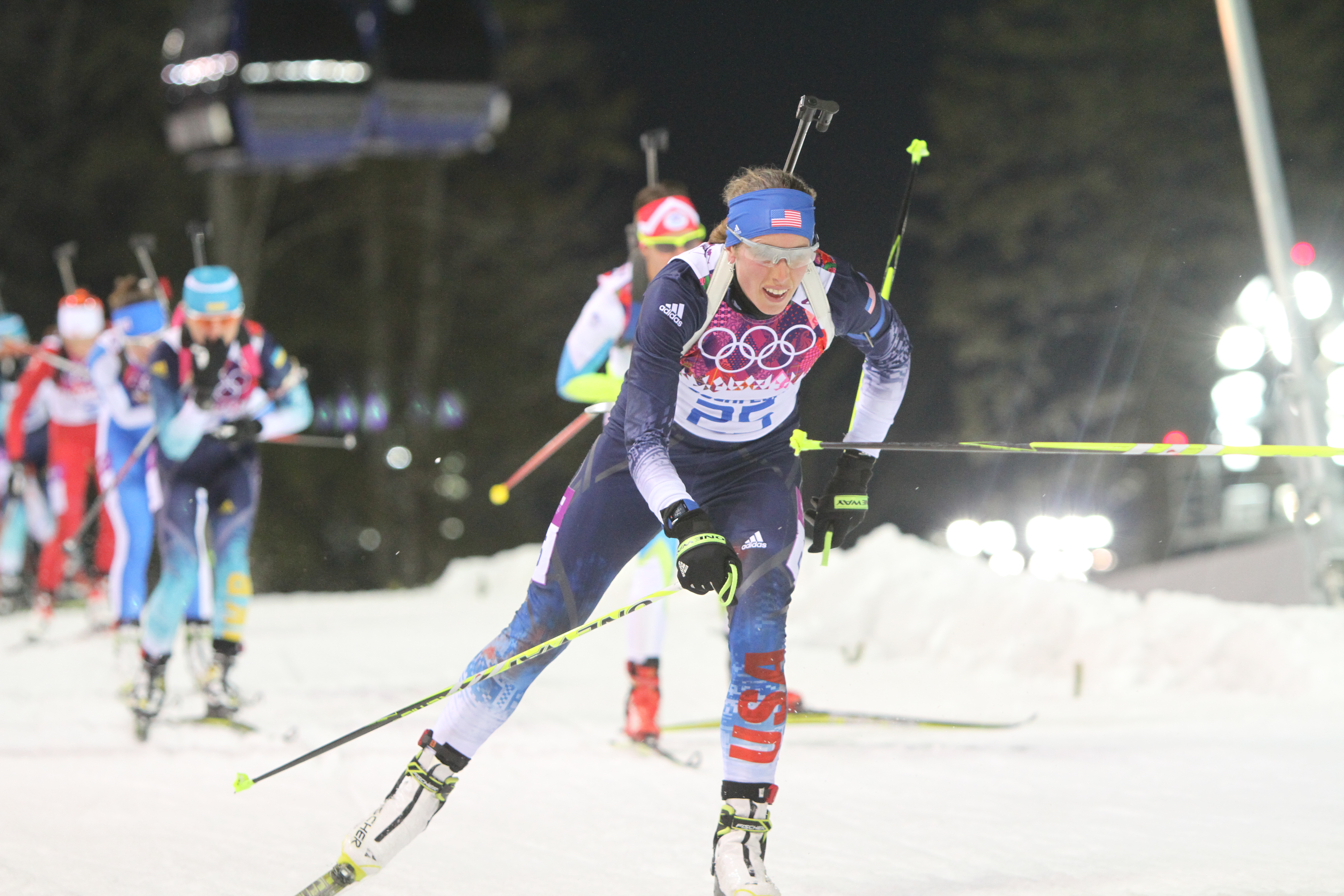
    Craftsbury biathletes Hallie Grossman (l) and Emily Dreissigacker after the women’s 14 k mass start at Slovenian Summer Biathlon Nationals in Pokljuka, Slovenia, on Sept. 18. (Photo: Ethan Dreissigacker)
    Craftsbury biathletes Hallie Grossman (l) and Emily Dreissigacker after the women’s 14 k mass start at Slovenian Summer Biathlon Nationals in Pokljuka, Slovenia, on Sept. 18. (Photo: Ethan Dreissigacker)

    Two other women had impressive showings at trials. Emily Dreissigacker of the Craftsbury Green Racing Project and USBA National Development Group, and Maddie Phaneuf of the USBA A-team, each placed second.

    But USBA’s International Competition Committee ultimately opted not to fill all four of the women’s quota spots it has for  World Cups 1, 2 and 3. The three women were selected for the early season World Cups and on-snow camp in Canmore, Alberta, Oct. 24 to Nov. 12. Six men were selected to the same Canmore camp, and five of them will start the season on the World Cup.

    “It was good to see some athletes with good improvements compared to August, especially Maddie and Emily on the women’s side,” USBA Chief of Sport Bernd Eisenbichler wrote in an email.

    “As we showed with Sean Doherty’s example 2 years ago, the coaches and I do have a good handle with that and find the right time to send an athlete to the race level that fits at the right time,” Eisenbichler continued. “It’s a long season and Maddie needs more training now to have a great season from January through March. Emily is still very new in the sport and needs more work before going to the World Cup. We would like to have a full women’s team on the start line, but more than ever we need to look at the individual athlete and what’s best for them and their development. The level on the World Cup is very high and athletes sent there need to be ready.”

    Maddie Phaneuf during the women's mass start at the 2016 US Biathlon National Rollerski Championships on Aug. 14 in Jericho, Vt. (Photo: Katrina Howe)
    Maddie Phaneuf during the women’s mass start at the 2016 US Biathlon National Rollerski Championships on Aug. 14 in Jericho, Vt. (Photo: Katrina Howe)

    Dreissigacker was invited to join an “X” team training camp in Lake Placid, N.Y., and after that she will travel to Canmore, Alberta, for an on-snow training camp with her Craftsbury team. Eisenbichler expects her to compete at IBU Cup Trials Dec. 15-20 at Mt. Itasca in Coleraine, Minn., and hopes to see her competing on the second-tier circuit in Europe later this season.

    Phaneuf will travel to Canmore for the USBA’s Thanksgiving camp then return to Lake Placid to prepare for IBU Cup Trials with her coach, Paquet.

    “As [Maddie] had a pretty long illness in the spring, she still needs to catch up on things – especially on the physical side – in the weeks to come,” Eisenbichler said. “As she is first-year senior we need to make sure to develop her in a good way and bring her to the right races and the right time.”

    Initially, it was a tough pill for Phaneuf to swallow.

    “I definitely had my hopes up to make the [pre-World Cup] Canmore snow camp,” Phaneuf said on the phone Wednesday. “But then when I finished the second race [this weekend], Bernd came up to me and was like, ‘Oh Maddie, great job this weekend. You are improving so much. We’re so happy to see that. I just want to talk to you personally before I leave…’ ”

    Phaneuf is hoping to make senior World Championships this season. She tried to keep that goal in perspective while considering USBA’s plans for her.

    “I was obviously not very happy because my goal was to make the World Cup for the early season and at least get the experience to go to the on-snow camp early, but I definitely understand where they’re coming from,” she said. “I know in the past with US Biathlon, they’ve had a few athletes that they start off young and then they end up burning them out or they just don’t do nearly as well as they’d hoped… They’re definitely being a lot more proactive about how they see development in their junior athletes and senior athletes, which I think is really smart…. But it is also disappointing when your goal is to make a team. I’m still excited to see what happens with the IBU Cup and now I’m just more excited to beat my personal bests and try to podium and prove myself that I am ready for the World Cup and see how the season goes.”

    Reid knew that she could have been in a similar situation.

    “My development has been so sudden (and at times rocky), that it may have made more sense to leave me behind to train more,” she wrote. “I’m really flattered and very honored that USBA thinks I’m ready to step back up to the World Cup.”

    Duncan Douglas (74) leads biathletes Russell Currier (in red) and Paul Schommer (back right) in the 2016 Climb to the Castle rollerski race up Whiteface Mountain, while Clarkson's Jenevieve Broadwell (22) looks on. Douglas held off Currier by eight seconds for his third victory in four times racing the Climb and Schommer finished third. (Photo: NYSEF/Flickr)
    Duncan Douglas (74) leads biathletes Russell Currier (in red) and Paul Schommer (back right) in the 2016 Climb to the Castle rollerski race up Whiteface Mountain, while Clarkson’s Jenevieve Broadwell (22) looks on. Douglas held off Currier by eight seconds for his third victory in four times racing the Climb and Schommer finished third. (Photo: NYSEF/Flickr)

    On the men’s side, the World Cup team is not quite finalized. Both Russell Currier of the Outdoor Sports Institute (formerly the Maine Winter Sports Center), who won the trials series rankings among non-prequalified athletes, and Paul Schommer of the USBA National Development Group will travel to the camp in Canmore. Ultimately, only one of the two will go to the World Cup.

    “I wasn’t very relaxed going into either of the trials,” Currier wrote in an email. “The past few years haven’t been what I’ve wanted result wise, so I was really under a lot of pressure to prove otherwise. Expectations were high though. I’ve had some help with my prone set up and it’s been having positive feedback in training.”

    A former national team member, 2014 Olympian and World Cup regular, Currier has two World Cup top 10’s to his name (in 2011/2012) and is itching to get back to the sport’s biggest stage.

    “Racing on the World Cup is the goal for now,” he wrote. “I really miss the atmosphere of racing in Europe.”

    He hopes that the Canmore camp will prepare him well.

    Russell Currier during the men's mass start at the 2016 US Biathlon National Rollerski Championships on Aug. 14 in Jericho, Vt. (Photo: Katrina Howe)
    Russell Currier during the men’s mass start at the 2016 US Biathlon National Rollerski Championships on Aug. 14 in Jericho, Vt. (Photo: Katrina Howe)

    “Training with the other guys during the specific sessions will be very helpful,” he explained. “The more time I can spend shooting under pressure the better… The chance to be 80% or better in a race is closer than it has been in past years. I didn’t shoot anywhere close to that last weekend and was hoping I would have, but the new approach is still going in the right direction.”

    Schommer has spent most of the summer training on his own in Hayward, Wis., but recently moved to Lake Placid. The 24-year-old College of St. Scholastica graduate is still in his first few years of biathlon, but has been working with Paquet and earned start rights on the IBU Cup last season.

    “One of my goals I set for myself at the beginning of the training year was to have a World Cup start,” he wrote in an email. “However, I don’t want to get ahead of myself. Right now I am just making the most of each training session and looking forward to some quality training on snow in Canmore.”

    Paul Schommer during the men's sprint at the 2016 US Biathlon National Rollerski Championships on Aug. 13 in Jericho, Vt. (Photo: Katrina Howe)
    Paul Schommer during the men’s sprint at the 2016 US Biathlon National Rollerski Championships on Aug. 13 in Jericho, Vt. (Photo: Katrina Howe)

    Schommer clinched his spot with a third-place finish in Sunday’s sprint, behind Burke and Currier. Despite fewer years of biathlon experience than either of the older athletes, Schommer shot identically to Burke and Currier with three missed targets and finished 43 seconds behind Burke.

    “Coming into the weekend I knew I had a shot at making the camp, but just wanted to concentrate on my races,” Schommer explained. “I didn’t really have many expectations coming into the weekend other than doing my best and taking away what I could to become a better biathlete. [On Sunday] I knew if I had a good race I would have a shot, so I just prepared myself to have the best race I could. Sometimes pressure breaks something, other times it improves it. I just tried to do the latter, just race to the best of my ability and not think about results.”

    While they were good enough to earn him a spot in Canmore, Schommer wrote that he wasn’t “super psyched” with either of his performances over the weekend.

    “It’s a really exciting time for USBA right now with so many great athletes domestically, and being able to train with the National team in Canmore is a huge opportunity,” he wrote.

  • The Votes are In, Russia Awarded 2021 IBU World Champs Despite Controversy

    The Votes are In, Russia Awarded 2021 IBU World Champs Despite Controversy

    Russia’s Anton Babikov lunges across the line ahead of teammate Evgeniy Garanichev in the men’s pursuit race at the 2016 Open European Championships. (Photo: IBU)
    Russia’s Anton Babikov lunges across the line ahead of teammate Evgeniy Garanichev in the men’s pursuit race at the 2016 Open European Championships in Tyumen, Russia. The venue just won the hosting rights for 2021 World Championships. (Photo: IBU)

    Note: In an interview with the Associated Press which was published the day after this story, IBU President Anders Besseberg suggested that if Russian biathletes’ anti-doping samples from the Sochi Olympics came back positive during the re-testing process, Tyumen’s hosting rights for World Championships 2021 could be revoked.

    In July, the McLaren report dropped and the world learned that Russia had implemented a systematic doping program before the 2014 Winter Olympics in Sochi, Russia.

    Then, there had been a parallel systematic program to cover it up, directed by Russia’s Ministry of Sport and its state security service. That had led to the infiltration of the International Olympic Committee (IOC) on-site anti-doping laboratory.

    In the wake of the scandal, the IOC Executive Board suggested several guidelines for how to handle Russian winter sports. Among them was a call on “all International Olympic Winter Sports Federations to freeze their preparations for major events in Russia, such as World Championships, World Cups or other major international competitions under their responsibility, and to actively look for alternative organisers.”

    And yet, over the weekend the International Biathlon Union (IBU) Congress, which includes 49 possible voting countries, voted to award 2021 World Championships to Tyumen, Russia. The venue in western Siberia will also host World Cup competitions in March 2017, and 2017 Youth and Junior World Championships in Ostrov, Russia, are also moving ahead as planned.

    And the IOC did not object. What changed?

    “Not only was it surprising, but it was also shocking that [Tyumen] got 25 votes,” Bernd Eisenbichler, chief of sport for the U.S. Biathlon Association (USBA) and the voting representative for the U.S. at the Congress, said in an interview on Tuesday. “I want to state that it is wrong. It is a very disappointing outcome of the vote.”

    “It is a country that is under investigation and the IOC has in fact warned against giving new events to the country — that half of the delegates don’t understand what this means for the young international biathletes is disappointing,” Erlend Slokvik, president of the Norwegian Biathlon Federation, told his country’s NRK television station.

    Public vs. private attitudes on Russia

    Apparently, while stating one thing publicly – that plans for major competitions in Russia should be frozen – the IOC was telling winter sports federations something different.

    A still from the candidature video of Tyumen, Russia, which won the hosting rights for 2021 Biathlon World Championships. The International Olympic Committee had previously recommended that no major competitions be awarded to Russia until it comes into compliance with the WADA Code.
    A still from the candidature video of Tyumen, Russia, which won the hosting rights for 2021 Biathlon World Championships. The International Olympic Committee had previously recommended that no major competitions be awarded to Russia until it comes into compliance with the WADA Code.

    “The IOC will not hesitate to take the toughest sanctions available against any individual or organisation implicated,” IOC President Thomas Bach said in July after learning about Russia’s widespread doping at the 2014 Olympics.

    Once amongst its stakeholders, the IOC seems to sing a different tune, one which could hardly be described as the “toughest sanctions available.”

    Last month, all seven international winter sports federations met with the IOC and World Anti-Doping Agency (WADA) in Rio de Janeiro, Brazil. All seven had competitions scheduled for Russia in 2017, and they wanted clarification about what to do.

    What they got was the go-ahead to continue working with Russian organizing committees.

    “They said, all competitions given to Russia which are taking place this winter, they should go on as planned,” IBU President Anders Besseberg told FasterSkier on the phone Tuesday. “This is what the IOC Sport Director clearly stated. About awarding them new competitions, the answer was also very clear. When they applied for this bidding process and it was in progress [before the McLaren report dropped], then this should also go the normal way.”

    Secretary General of the International Ski Federation (FIS), Sarah Lewis confirmed this account of events in an email to FasterSkier.

    Unlike competitions slated for this winter, 2021 is a long way off. World Championships easily could have gone somewhere else. Although the bid process was already started and Tyumen had filed its candidacy before the McLaren report came out, there were two other cities bidding, Nove Mesto in the Czech Republic and Pokljuka in Slovenia.

    Yet sources told InsideTheGames that at the Rio de Janeiro meeting, the IOC specifically said that the Tyumen biathlon bid could go on.

    Tyumen’s candidature video for the Congress can be watched on YouTube.

    “There were three very correct candidates,” Besseberg said. “And there was a vote.”

    When asked about how Tyumen had won the election given the ongoing discussion of sanctions, Besseberg objected.

    “I am not the right person to ask,” he said. “It’s the Congress who is the highest authority in the IBU, it is the delegates in the Congress.”

    Who voted for Tyumen?

    And so, what did the delegates think?

    In his remarks to the Congress at its opening, Besseberg explained that Tyumen’s candidacy was not against any IOC guidelines. That caused a stir.

    Germany’s Florian Graf competing in the men’s 15-kilometer mass start at the 2016 Open European Championships in Tyumen, Russia, on his way to winning the gold medal. (Photo: IBU)
    Germany’s Florian Graf competing in the men’s 15-kilometer mass start at the 2016 Open European Championships in Tyumen, Russia, on his way to winning the gold medal. (Photo: IBU)

    “This was very surprising because there was no official statement by either the IBU or the IOC before the congress,” Eisenbichler said. “I discussed with a few friends in other federations about this topic. I got the sense that we were pretty much in agreement.”

    Regardless of IOC rules, some feel that biathlon and cross-country skiing should be especially wary of Russia, since they were acutely stung by the allegations in the McLaren report. That investigation implicated 10 biathletes and 13 cross-country skiers.

    “The McLaren report is very clear and detailed about what happened in Sochi and mentions biathlon explicitly as one of the sports,” Eisenbichler wrote in an email. “As long as there are not clear signs, facts and proof about different future behavior, it is not time to have Russia get awarded a Biathlon World Championships.”

    There has been no news on re-testing of the anti-doping samples in Sochi, and no revelation of which athletes might have been involved.

    Clearly, however, there are two lines of thinking on the matter. There are those, like Eisenbichler and Norway’s Erlend Slokvik, who would never vote for Tyumen.

    “The IOC letter, I disagree that the IOC took this step after [previously] declaring that the competitions should be frozen and should not be further planned on,” Eisenbichler said. “I’m not in favor of it. So that did not change anything, that I would vote for it or not.”

    Murray Wiley, the president of Biathlon Canada, could not be reached for comment, but Canada’s national-team coach Roddy Ward said he was disappointed with the decision.

    “Back here in Canada, we have been discussing where they would move [the Tyumen World Cup weekend] to this winter, given our assumption it must be moved after the McLaren report,” Ward wrote in an email. “After all, how can we race in Russia when that has come to light? However, not only does [the World Cup] remain but the IBU has now rewarded Russia with WCH2021!! This is a massive slap in the face to clean athletes.”

    But then there are those who would vote for it.

    “Western Europe understands that this is not good for the younger international biathletes,” Slokvik told NRK. “There are many nations that are distraught … It’s the small nations from Asia and the old East block that voted for Tyumen.”

    Either way, minds appeared to be made up. After his presentation on the new IOC recommendations, Besseberg said he had welcomed discussion.

    “They were asked if they had any questions about it and there was not a single question,” Besseberg said.

    What now?

    Eisenbichler had little doubt that the Tyumen organizing committee would do a good job with the championships.

    The venue hosted 2016 Open European Championships, and although neither the U.S. nor Canada attended (nor a number of other countries), reports from those who did compete were positive. Tyumen also hosts a Champions show race, so many top competitors have been there for the cash-rich prize money. Simon and Martin Fourcade of France both tweeted their support for Tyumen along with Antholz, Italy, which was awarded 2020 World Championships.

    “Perfect places to race,” tweeted Simon Fourcade.

    The local organization is not what concerns Eisenbichler, who heads the U.S. national team along with domestic development.

    “Hopefully the future will be showing us that Russia does a different job than they did in Sochi,” he said. “But the McLaren report is very clear. I just think that now, with all the news that we got from the report, it’s the wrong signal to the sports world, to the fans, to the youth athletes, to all the athletes who are fighting for clean sports, that it’s a very wrong signal to reward them right now with that event.”

    The biathlon world is also waiting for the other shoe to drop, to find out whether or which of the Russian stars had doped in 2014.

    “The McLaren report showed systematic doping in Sochi, with Russian biathlon and x-c implicated,” Ward wrote. “I have been waiting to hear from the IBU how they would respond to the report and I hoped it would be by throwing their weight behind clean sport and punishing Russia… The IBU have made it very clear now that Russia is above anti-doping, that they can get away with anything and that what they did in Sochi totally acceptable.

    “Biathlon and all Olympic sport is in a dangerous time,” Ward concluded. “We are losing all credibility. IOC and IBU need to take a strong stand against doping and with the decision to award Russia with [World Championships] they have done the exact opposite.”