Tag: Bernhard Gruber

  • Friday Rundown: Bailey 2nd in PyeongChang; Lahti Relay & NoCo Team Sprint (Updated)

    Friday Rundown: Bailey 2nd in PyeongChang; Lahti Relay & NoCo Team Sprint (Updated)

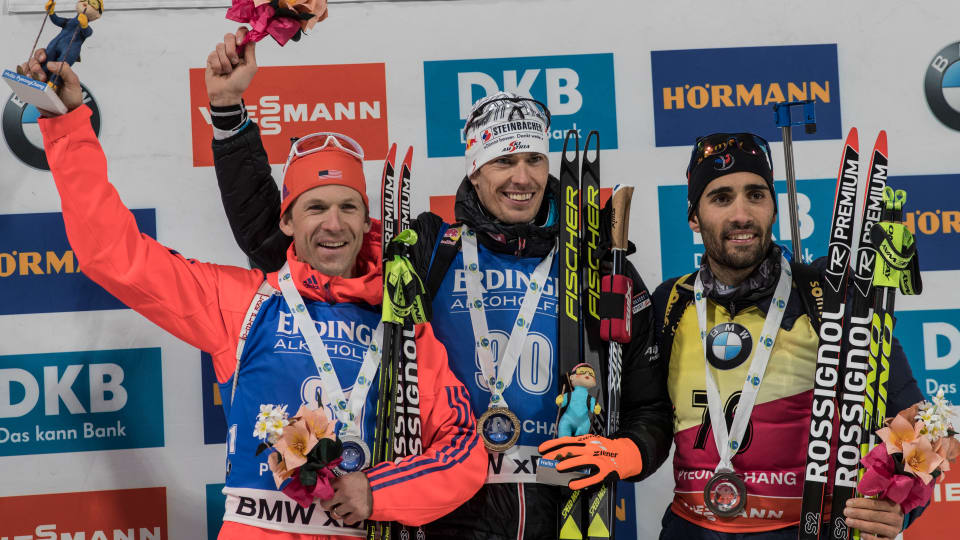
    The men’s 10 k sprint podium at Friday’s IBU World Cup in PyeongChang, South Korea, with Austria’s Julian Eberhard (c) in first, American Lowell Bailey (l) in second, and France’s Martin Fourcade (r) in third. (Photo: IBU)

    IBU World Cup (PyeongChang, South Korea): Men’s 10 k sprint

    US Biathlon’s Lowell Bailey kept his clean-shooting streak alive with another one of his personal best results on Friday, racing to second in the men’s 10-kilometer sprint at the International Biathlon Union (IBU) World Cup in PyeongChang, South Korea.

    Bailey started 81st and hit all 10 targets in the two-stage race to cross the finish line in first, 4.7 seconds ahead of France’s Martin Fourcade, who locked up the 2016/2017 overall World Cup title with an eventual third-place finish on Friday.

    An even later starter in bib 90, Austria’s Julian Eberhard rocketed to his third-career World Cup victory (and second win this season), cleaning both stages and topping Bailey’s time by 40.7 seconds. That bumped Bailey to second place and Fourcade to third, for Bailey’s second World Cup podium this season (including his win in the 20 k individual at IBU World Championships).

    In the last five non-relay races, including four at World Championships, Bailey has not placed outside the top six. And in all of those races, he’s only had one miss.

    Bailey is up to ninth in the World Cup Total Score standings. Fourcade ran away with the season-long title in first, now that he’s 360 points ahead of Russia’s Anton Shipulin in second.

    While Eberhard and Bailey shot clean on Friday, Fourcade missed two — one on each stage (1+1) — but made up for it with the fastest course time. Eberhard had the second-fastest course time and fastest shooting time of the 102-man field.

    Austria nearly had two on the podium with Dominik Landertinger finishing fourth (+48.1), 2.7 seconds out of third, with clean shooting.

    Three Canadians finished in the top 60 to qualify for Saturday’s pursuit, with Scott Gow in 27th (+1:40.3) with two penalties (1+1), Brendan Green following in 28th (+1:42.1) with one miss (0+1) for his first individual top 30 of the season, and Christian Gow in 56th (+2.33.6) with two prone penalties (2+0). Nathan Smith finished 88th (+3:32.5) with two standing misses (0+2) in his first World Cup race since early December, and Macx Davies finished 98th (+4:20.2) with four penalties (3+1).

    For the U.S., Leif Nordgren placed 37th (+2:03.7) with two misses (1+1) to qualify for the pursuit, along with Bailey. Sean Doherty was 80th (+3:13.3) with two penalties (1+1) and Paul Schommer 101st (+4:38.1) with five misses (3+2).

    Results

    ***

    FIS Nordic World Championships (Lahti, Finland): Nordic Combined 2 x 7.5 k team sprint
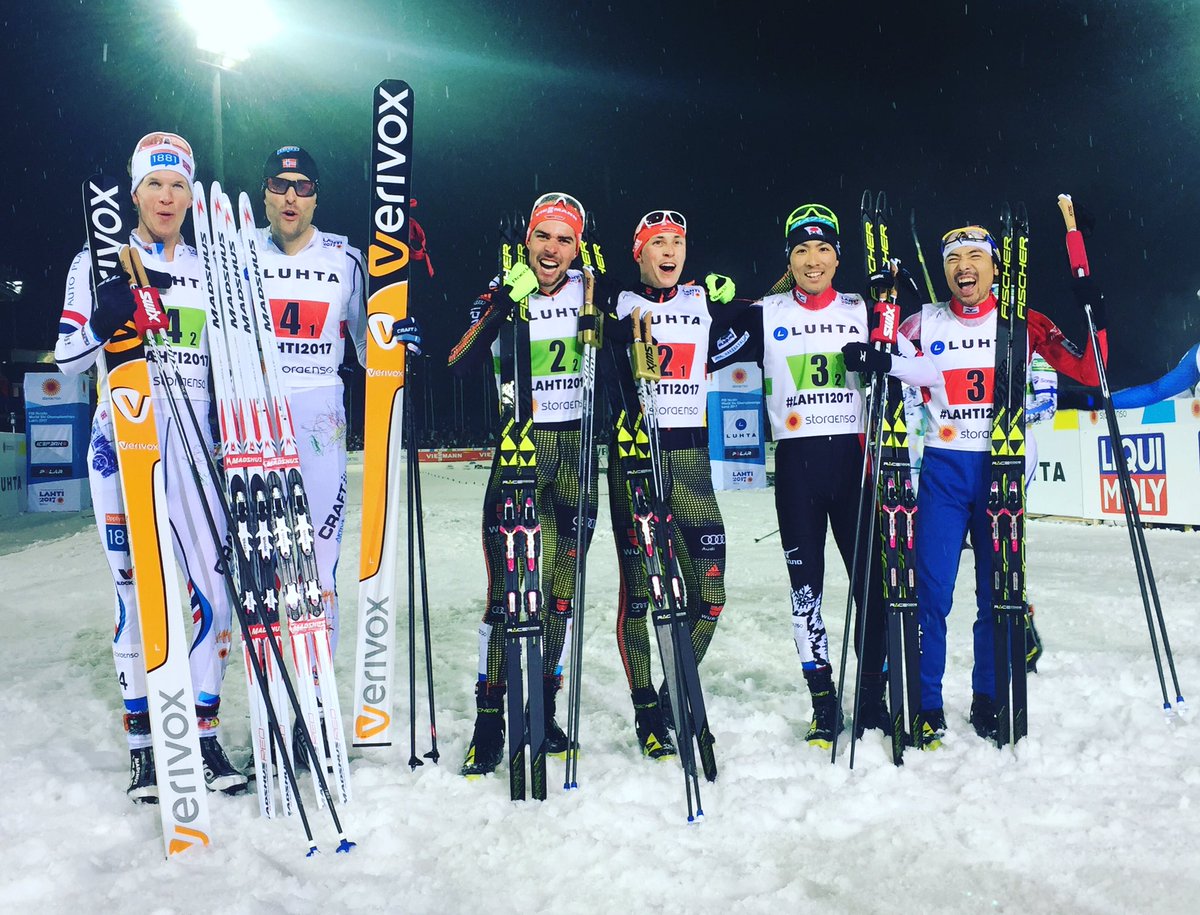
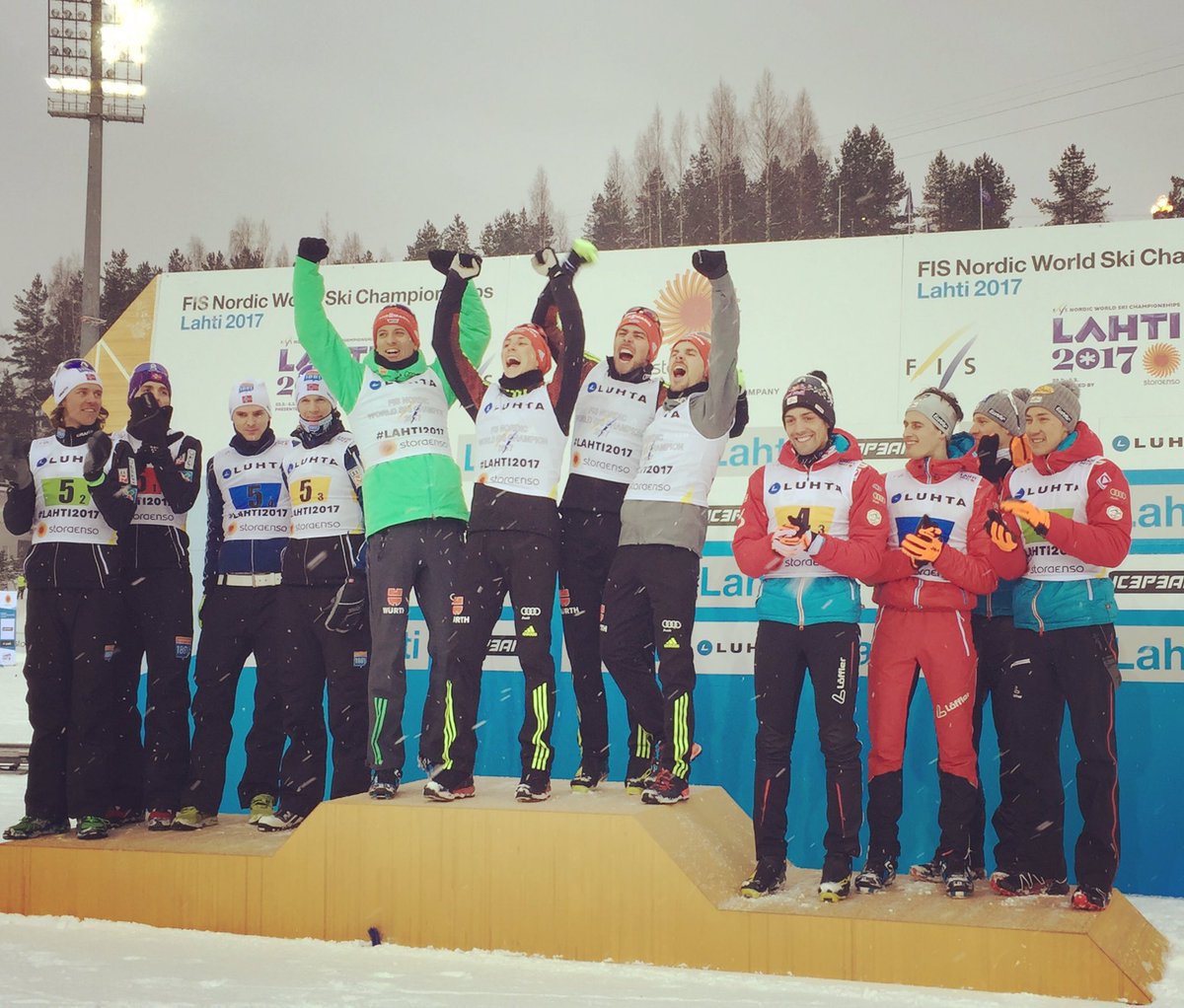
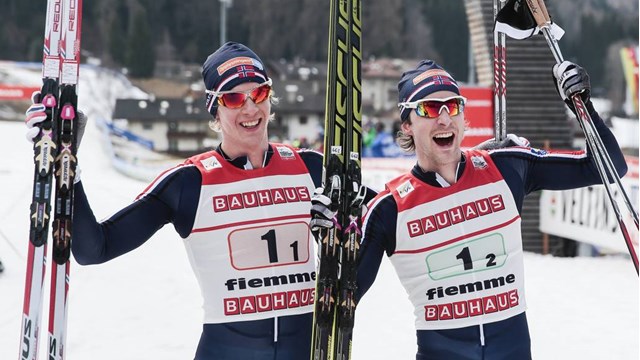
    The nordic combined 2 x 7.5 k team sprint podium on Friday at 2017 Nordic World Championships in Lahti, Finland, with Germany’s Johannes Rydzek and Eric Frenzel in first (c), Norway’s Magnus Moan and Magnus Krog in second (l) and Japan’s Yoshito and Akito Watabe in third (r). (Photo: FIS Nordic Combined/Twitter)

    [UPDATED] Johannes Rydzek and Team Germany completed the World Championships sweep on Friday, with Rydzek teaming up with Eric Frenzel to win the final nordic-combined competition of 2017 Nordic World Championships in Lahti, Finland: the 2 x 7.5-kilometer team sprint.

    Rydzek won all four NoCo competitions over the past week, including two individual events and two team events.

    On Friday, he and Frenzel, the defending World Cup champion, jumped to second and started the 2 x 7.5 k cross-country race 16 seconds behind France’s Maxime Laheurte and François Braud, who jumped to first. The Frenchmen both posted jumps of 125 meters for a total of 264.2 points. Frenzel and Rydzek, meanwhile, scored 256.1 points after jumps of 125.5 and 122 meters.

    The Germans pulled off a 1-second win over Norway, finishing in 28:45.8 minutes, while Norway’s Magnus Moan and Magnus Krog claimed silver after starting the ski race in fourth, 24 seconds behind France. Together, the Norwegians posted the fastest course time, and Moan skied the fastest 7.5 k (13:53).

    “It’s still unbelievable,” Rydzek told German broadcaster ARD. “The race today was so suspenseful again, down to the last curve with the lapped athlete [Russia]. I knew that I am very fast on the homestretch, and had explicitly looked at that section before the race. Eric did a great job today, and despite all circumstances pointing against us we managed to do it again today. Just cool to be back on the top of the podium with Eric.”

    Just a couple hundred meters before the finish, Rydzek used the moment when they approached the lapped Russian athlete to slingshot between him and Krog and gained a decisive edge.

    “I was scared of that situation with the lapped athlete, because that was really close,” Frenzel told ARD. “I thought, ‘What is he doing out there?’ But in the end you can rely on Johannes to solve that like a world champion, that was top.

    “We knew ahead of time that Lahti suits us well, that we can be good here if the conditions work out,” he added. “So we are very happy to be able to go home with so many medals.”

    Japan took the final spot on the podium after brothers Yoshito and Akito Watabe jumped to third, started 18 seconds after France, and held their position to finish for third place, 10.2 seconds after Germany.

    Austria’s Wilhelm Denifl and Bernhard Gruber missed bronze by half a second in fourth (+10.7) after starting in fifth, and France ended up fifth (+11.5).

    Nearly a minute later, Italy placed sixth (+1:10.6) and Finland seventh (+1:10.7). The Czech Republic followed in eighth (+1:26.4), and the U.S. was ninth (+1:48.1) with Bryan and Taylor Fletcher after starting 12th and 2:08 out of first. The Fletcher brothers recorded the second-fastest course time out of 14 teams.

    “Taylor did a good job stepping up in competition and it gave me motivation to step up as well,” Bryan said, according to a U.S. Ski Team press release. “Unfortunately I wanted it a little too much and didn’t have the jump I am capable of.

    “The races went well but we were just too far back,” he continued. “We had the second fastest time as a team overall, which is solid and continually shows our strength on that side of the sport.”

    Final results | Jumping

    ***

    FIS Nordic World Championships (Lahti, Finland): Men’s 4 x 10 k relay
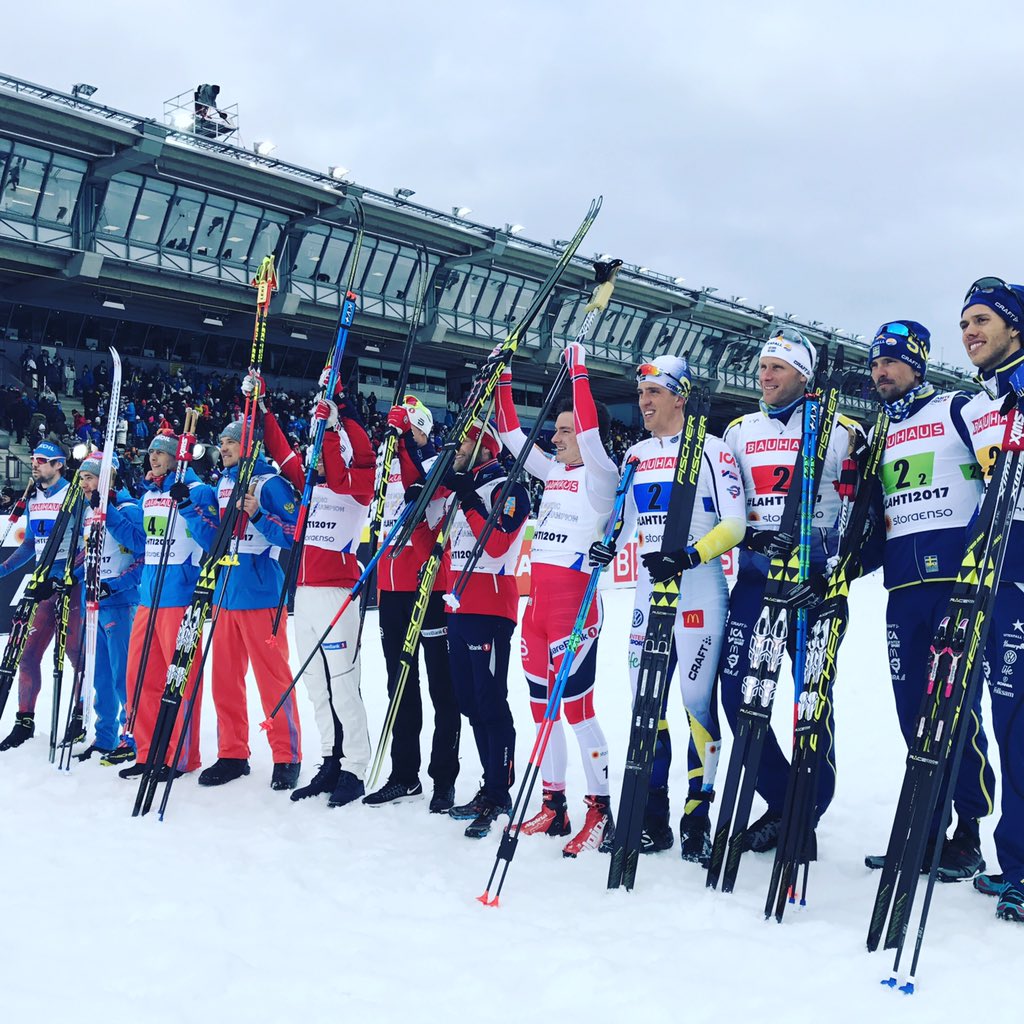
    The men’s 4 x 10 k relay podium at 2017 Nordic World Championships, with Norway (c) in first, Russia (l) in second, and Sweden (r) in third. (Photo: FIS Cross-Country/Twitter)

    The men’s 4 x 10-kilometer relay as the last team event of 2017 Nordic World Championships came down to a two-way battle for gold between none other than Norway and Russia on Friday in Lahti, Finland,

    The two teams skied in either first or second throughout the four-leg race, with Russia’s Andrey Larkov tagging Alexander Bessmertnykh 2.9 seconds ahead of Norway’s first leg Didrik Tønseth, then Bessmertnykh coming through the second exchange just half a second ahead of Norway’s Niklas Dyrhaug.

    Behind them, Finland skied alone in third place at the race’s halfway point, but was ultimately swallowed by the chase pack on the third leg.

    On that third leg, Norway’s Martin Johnsrud Sundby worked hard to drop Russia’s Alexey Chervotkin, and eventually did so, coming through the final exchange 17.7 seconds ahead. That gave Norway’s anchor Finn Hågen Krogh just enough of a gap on Russia’s Sergey Ustiugov, and he was able to hold off Ustiugov by 4.6 seconds at the finish to give Norway the gold in 1:37:20.1 hours.

    Russia claimed silver and Sweden outlasted Switzerland for bronze after Calle Halfvarsson attacked in the final kilometer to drop Finland’s Matti Heikkinen and Germany’s Lucas Bögl. Halfvarsson finished 2:31.8 minutes out of first, and just 0.2 seconds ahead of Switzerland’s Curdin Perl for third place for Sweden (which included teammates Daniel Rickardsson, Johan Olsson and Marcus Hellner).

    Switzerland was fourth (+2:32) with Jason Rueesch, Jonas Baumann, Dario Cologna and Perl, Finland fifth (+2:42.4) with Sami Jauhojärvi, Niskanen, Lari Lehtonen, and Heikkinen, and Germany sixth (+2:42.8) with Thomas Bing, Jonas Dobler, Florian Notz, and Bögl.

    France finished seventh (+3:52), Italy eighth (+5:29.8), Kazakhstan ninth (+5:30.6), and the U.S. 10th (+5:31.3). The U.S. team (Kyle Bratrud, Erik Bjornsen, Tad Elliott, Simi Hamilton) skied in 11th for most of the race before Hamilton moved them up to 10th with the sixth-fastest anchor leg.

    Canada (Graeme Killick, Devon Kershaw, Alex Harvey, Len Valjas) ended up 12th after being lapped on the last leg. In 14th at the first exchange, Kershaw moved them up to 13th, then Harvey put them in 12th with one leg to go.

    Results

  • Sunday Rundown: Lahti and Osrblie (Updated x2)

    Sunday Rundown: Lahti and Osrblie (Updated x2)

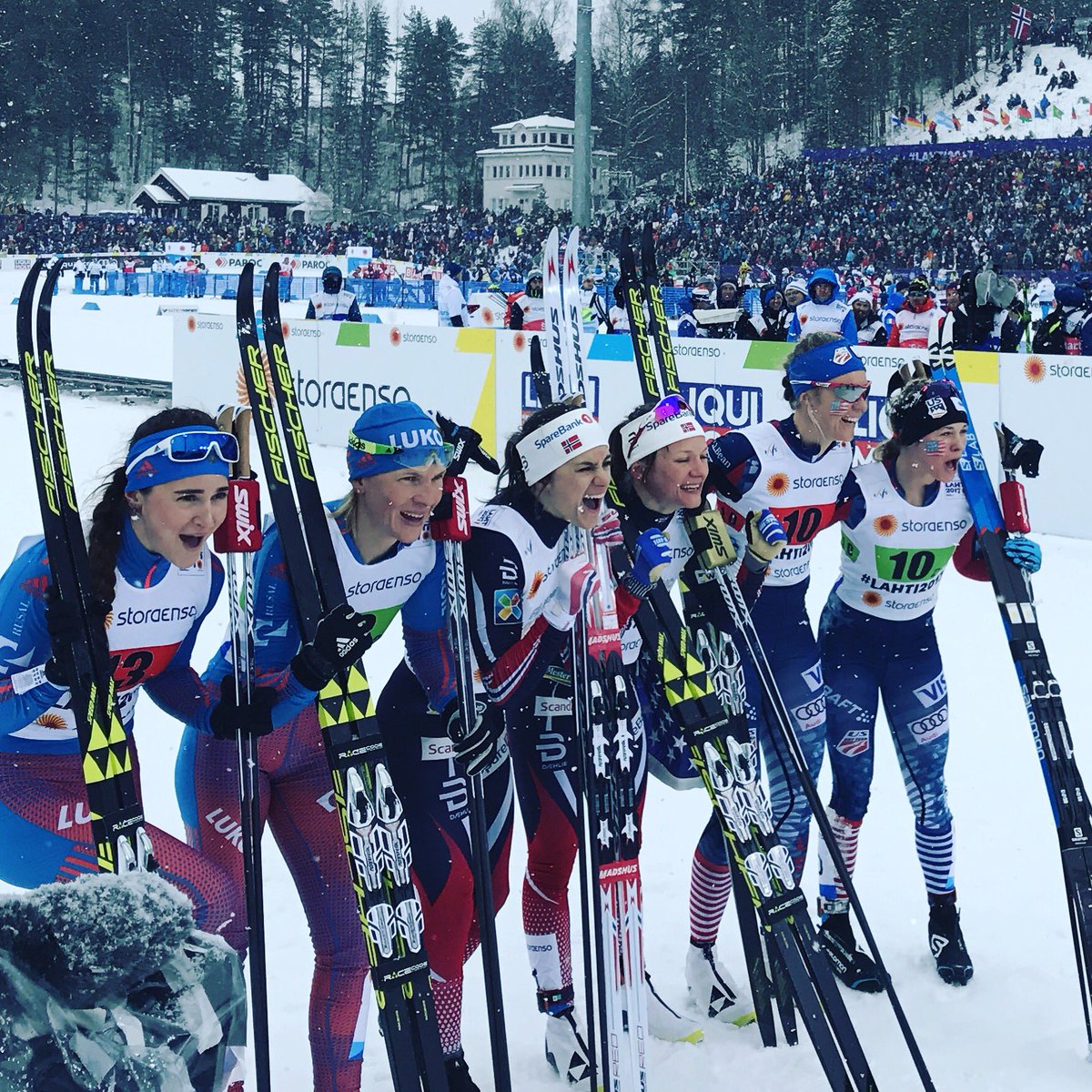
    Heidi Weng and Maiken Caspersen Fall of Norway (center) bested Yulia Belorukova and Natalia Matveeva of Russia (left) for gold in the women’s team sprint at 2017 World Championships, with Sadie Bjornsen and Jessie Diggins of the U.S. (right) outsprinting Sweden for bronze. (Photo: FIS Cross Country/Twitter)

    FIS Nordic World Championships (Lahti, Finland): Classic team sprints

    Defending champions Norway repeated gold in the women’s team sprint, with Heidi Weng and Maiken Caspersen Falla crossing the finish line first in Lahti, Finland. On the second-to-last loop, it looked like Russia could have something to say about that. Yulia Belorukova put in a furious sprint up the course’s biggest climb, and then beat Weng to the exchange. But her teammate Natalia Matveeva could not match the pace when Falla put on her own sprint on the last uphill. Russia finished second for silver, +5.56.

    The competition for bronze was closer, with Germany, Finland, Sweden, and the United States going out of the stadium for the last loop together in chase of the Norwegian and Russian leaders. The last climb was defining in the race for bronze, with Jessie Diggins of the United States staying closest to Sweden’s Stina Nilsson. Diggins caught Nilsson on the downhill and was able to stay just ahead of the Swede to the finish, claiming bronze (+18.38) along with teammate Sadie Bjornsen. It was a return to the team sprint podium for Diggins: after winning the team sprint at 2013 World Championships with Kikkan Randall, she teamed up with Sophie Caldwell in 2015 but the pair finished eighth.

    Nilsson and Ida Ingemarsdotter settled for fourth (+18.57), and the Finnish team of Aino-Kaisa Saarinen and Kerttu Niskanen finished fifth (+23.02).

    The Canadian team of Cendrine Browne and Dahria Beatty was seventh in their semifinal and landed 13th overall.

    In the men’s team sprint, Norway set a high pace from the beginning, with phenom Johannes Høsflot Klæbo attacking on the steep uphill every time he skied. On his second and third loops, he tagged off to Emil Iversen with gaps of just over five seconds to the rest of the field. But Iversen had a hard time holding the lead, in part because of Russia’s Sergey Ustiugov, who had won the 30 k skiathlon the day before and put in a huge effort to catch Iversen on the fourth loop of the team sprint.

    On the final loop, Finland’s Iivo Niskanen bridged the gap up to Iversen, mostly on the steep uphill and then also with ski speed on the downhill. But the time the pair entered the stadium, Niskanen had caught the Norwegian and was moving with higher speed. He decided to switch tracks to overtake Iversen, but Iversen decided to switch tracks just a second later, without checking one last time to make sure the track was clear. He fell, taking out Niskanen with him.

    That allowed Ustiugov and Italy’s Federico Pellegrino to go sailing by to claim gold and silver (+2.14) with their teammates Nikita Kriukov and Dietmar Noeckler. It was the second gold for Russia in the event in three World Championships; Kriukov and Alexey Petukhov won in 2013, and also took silver in 2015.

    Niskanen got up and claimed bronze (+8.64 with Sami Jauhojärvi), swearing as he crossed the finish line; with a broken pole, Iversen limped across the line in fourth (+18.42). He was called to a jury meeting but ultimately no teams were disqualified because of the crash.

    Erik Bjornsen of the United States won a sprint finish for fifth (+23.58) with teammate Simi Hamilton), besting Lenny Valjas (+27.02 with teammate Alex Harvey) of Canada.

    Results: women | men

    ***

    FIS Nordic World Championships (Lahti, Finland): Nordic combined 4 x 5 k team event

    Germany (Björn Kircheisen, Eric Frenzel, Fabian Rießle, and Johannes Rydzek) took gold in the nordic combined 4 x 5 k team event on Sunday at Nordic World Championships in Lahti, Finland, while Norway placed second and Austria third. (Photo: FIS Nordic Combined/Twitter)

    [UPDATED] After sweeping the first individual nordic-combined competition of 2017 Nordic World Championships on Friday, Germany achieved gold as a team, with Björn Kircheisen, Eric Frenzel, Fabian Rießle, and Johannes Rydzek winning the 4 x 5-kilometer team event in 47:57.3.

    The Germans combined for the best jumping score of 11 teams and started the relay in first, 44 seconds ahead of Japan in second. Norway started 1:07 minutes back in fifth but rose to second place (+41.7), with Magnus Moan, Mikko Kokslein, Magnus Krog, and Jørgen Graabak. Moan raced them into third at the first exchange, then Kokslein secured second, which they held onto for the remaining two legs.

    “It was our goal to ski a controlled race,” Germany’s Frenzel told ZDF. “Not really look at how the gap was developing, but just make our own race. And put up a little more pressure towards the end of each leg. That worked well, that was a wickedly cool team performance today. And I am just happy that we could put a little golden crown on the whole event today.”

    “I think today you could see again that we all worked together and enjoyed the competition,” Rydzek added. “We were all happy about each other’s performance, and just rewarded ourselves for hard hard work.”

    Austria started fourth, 1:05 behind Norway, and clinched bronze (+1:03.7) with Bernhard Gruber, Mario Seidl, Philipp Orter, and Paul Gerstgraser. Gruber initially raced them into second at the first exchange, but they relinquished one spot and hung on for third, ahead of Japan in fourth (+1:06).

    Japan (Hideaki Nagai, Takehiro Watanabe, Yoshito Watabe, and Akito Watabe) jumped to second, but found themselves in fourth at every exchange.

    Finland took fifth, Italy sixth, France seventh, and the U.S. eighth (+3:27.2) with Bryan Fletcher, Taylor Fletcher, Ben Berend, and Ben Loomis. The Americans started the race in seventh and were in sixth after the first two exchanges, but slipped to eighth on the third leg.

    Results

    ***

    IBU Youth/Junior World Championships (Osrblie, Slovakia): Youth & junior pursuits

    Four seems to be Chloe Levins’s lucky number. After a career breakthrough of fourth place in the pursuit at last year’s Youth Olympic Games (YOG) in Lillehammer, Norway, the 18-year-old Vermonter raced to fourth in the youth women’s 7.5-kilometer pursuit on Sunday at the International Biathlon Union (IBU) Youth/Junior World Championships in Osrblie, Slovakia.

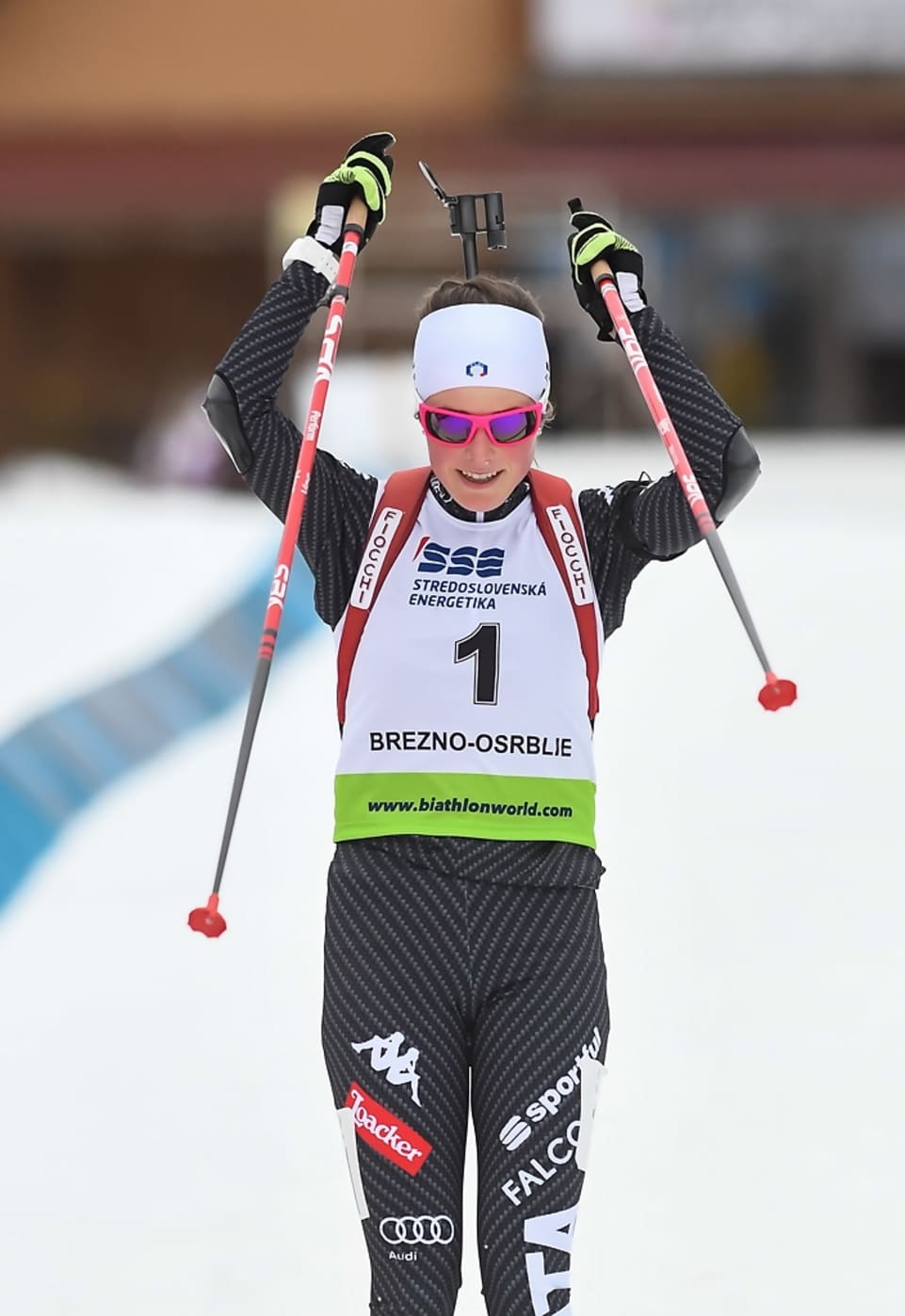
    Italy’s Irene Lardschneider winning the youth women’s 7.5 k pursuit on Sunday for her second-straight gold at 2017 IBU Youth World Championships in Osrblie, Slovakia. (Photo: IBU)

    Levins started the race in 11th and worked her way up to fourth with clean shooting in three stages. She missed two in the first prone but rebounded and held off Ukraine’s Khrystyna Dmytrenko by seven seconds for fourth place. Levins finished 1:55.5 minutes behind the winner, Italy’s Irene Lardschneider, who started the race first and held on for her second-straight gold medal despite four penalties (0+0+2+2), finishing in 26:57.1. France’s Lou Jeanmonnot-Laurent rose from fourth to second place with 19-for-20 shooting (0+0+1+0), and Italy’s Samuela Comola took bronze (+1:08.5) for the second-straight race with two misses (1+0+1+0).

    Three U.S. women qualified for the pursuit, with Amanda Kautzer finishing 42nd (+6:16.2) after starting 59th and shooting 80 percent (1+0+2+1), and Grace Gilliland finishing 55th (+8:32.1) with six penalties (2+3+1+0).

    Canada’s Shilo Rousseau followed in 54th (+9:02.1) with eight misses (3+1+2+2).

    Results: Youth women

    In the junior women’s 10 k pursuit, Canada’s Megan Bankes raced to 16th for the best finish for a North American in that race. The gold medalist in last week’s 12.5 k individual, Bankes finished 13th in Saturday’s sprint and thus started in that position, 1:25 out of first. She ended up 16th with four penalties (0+1+2+1) and finished 2:15.8 behind the winner, Russia’s Valeriia Vasnetcova, who started 24th and worked her way all the way up to first with clean shooting.

    Vasnetcova was the only one to clean the four-stage pursuit on Sunday, and in doing so, she achieved her first gold of the championships and second of her career at Youth/Junior Worlds after her team won last year’s youth relay in Romania.

    Coming off a sprint win, Italy’s Michela Carrara started first and took second at the finish, 10 seconds behind Vasnetcova with three misses (1+1+1+0). Norway’s Ingrid Tandrevold scored her second-straight medal as well, after starting second and finishing third (+10.8), with two penalties (0+0+1+1).

    Canada’s Nadia Moser had her best result of the championships in 30th (+3:43.5), moving up one place after starting 31st, with three penalties (0+1+0+2). Emily Dickson finished 47th for the second-straight day (+6:29.9) with four penalties (1+0+1+2).

    Siena Ellingson was the lone American to start after placing 18th in Saturday’s sprint. She finished 41st (+5:24.7) with seven misses (1+2+1+3).

    Results: Junior women

    In the junior men’s 12.5 k pursuit, Canada’s Pearce Hanna rocketed to 23rd after starting 47th, shooting 17-for-20 after cleaning the first two stages (0+0+1+2) for his first top 30 of the championships. Hanna finished 3:12 behind the winner, Russia’s Igor Malinovskii who picked up his second-straight gold.

    Malinovskii started first and finished in 32:39.8, 13 seconds ahead of second place, with four penalties (0+1+2+1). Norway’s Sindre Pettersen took the silver medal after starting in eighth and posting the fastest course time to overcome five misses (2+1+1+1). Belarus’s Anton Smolski moved up from fourth at the start to reach the podium in third (+27.4) with five misses as well (0+0+3+2).

    All four Canadian junior men qualified for the pursuit. Trevor Kiers led them in 39th (+5:13.3), after starting 48th, for his best result of the championships. Jules Burnotte placed 43rd (+5:35.3), up from 55th, for his best result as well, and Zachari Bolduc finished 57th (+8:18.3). Kiers missed five targets (2+0+1+2), Burnotte had seven misses (3+1+1+2), and Bolduc missed eight (2+3+2+1).

    For the U.S., Cody Johnson finished 55th (+7:19.5) with nine penalties (2+1+2+4) and Travis Cooper 59th (+8:46.2) with eight misses (5+0+1+2).

    Results: Junior men

    In the youth men’s 10 k pursuit, the first race of the day on Sunday, two Canadians finished in the top 30, with Leo Grandbois in 22nd and Adam Runnalls in 27th.

    For Grandbois, it was his first time outside the top 15 of the championships after he had won the youth men’s 12.5 k individual last Wednesday and finished 14th in Friday’s 7.5 k sprint. He had to ski six penalty loops on Sunday (0+2+2+2), dropping outside the top 20 after the third shooting. Grandbois finished 3:21.8 behind the winner, France’s Emilien Claude, who won the sprint as well to start the pursuit first.

    Claude, who had four penalties (1+1+0+2) and finished in 29:22.4, held off Italy’s hard-charging Cedric Christille by 16 seconds after Christille shot just two penalties (0+0+1+1) to move up from fourth to second for his first medal in his first Youth World Championships. Germany’s Danilo Riethmüller rose from sixth to third place (+30.7) despite four misses (1+0+1+2). For the German, it was his second bronze of these championships after placing third in the 12.5 k individual.

    Canada’s Runnalls moved up from 32nd at the start to 27th at the finish (+3:47.5) for his first top 30 of the championships. He had five penalties (1+3+1+0), but cleaned the last stage to move into the top 30.

    Vasek Cervenka was the lone American to qualify in the youth men’s pursuit, and he moved up from 49th at the start to 30th (+3:52) with five penalties (1+1+1+2).

    Results: Youth men

  • Taylor Fletcher Seventh on Day 2 of Summer Grand Prix

    Taylor Fletcher Seventh on Day 2 of Summer Grand Prix

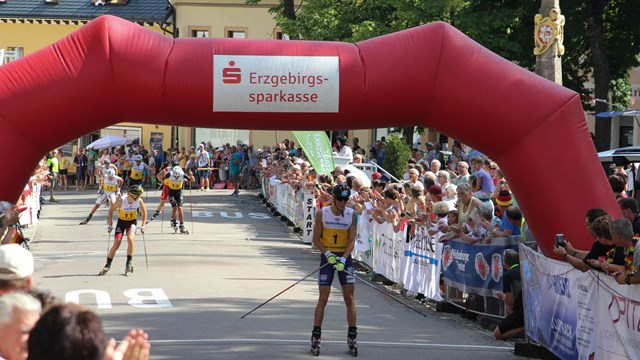
    Taylor Fletcher racing to the fastest time on the day and 7th overall in Oberwiesenthal, Ger. (Photo Sandra Volk, FIS).
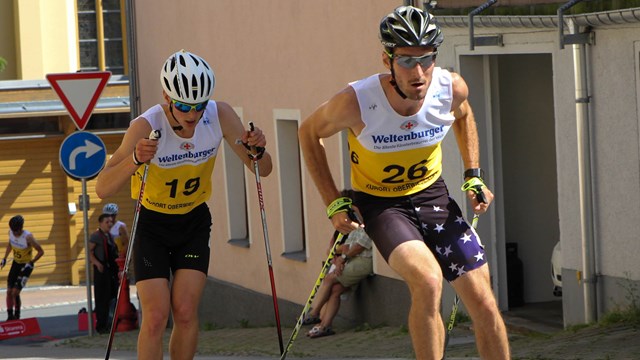
    Taylor Fletcher (26) racing to the fastest time on the day and several overall at the Summer Grand Prix in Oberwiesenthal, Germany. (Photo Sandra Volk/FIS)

    End of August. It’s not quite transition season yet. Leaves are green, there’s still the possibility of sweltering humidity, and if you’re inclined to fly off 100-meter ski jumping hills sans snow, the International Ski Federation (FIS) Nordic Combined Summer Grand Prix has you covered.

    Last weekend, Oberwiesenthal, Germany, hosted the two-day opening round of the Summer Grand Prix. Although months away from on-snow events, jumping and racing on rollerskis against some of the best in the world is an incomparable way to size up dryland training.

    Saturday featured a team sprint (teams of two) with a combined score jump followed by a 15-kilometer (2 x 7.5 k) race. Host Germany took the top prize. Germany I, with Björn Kircheisen and Eric Frenzel, placed first. Norway I (Jan Schmid and Magnus Moan) took second (+18.8), and Austria I (Bernhard Gruber and Philipp Orter) finished third (+19.7).

    The U.S. entered two teams: Taylor Fletcher and Ben Berend for U.S. I and Jasper Good and Stephen Schumann for U.S. II.

    Fletcher and Berend finished the jumping round in 14th; Good and Schumann ranked 19th. U.S. I held its 14th place after the ski portion, finishing 2:24.5 behind the winners. U.S. II ended the day in 18th overall.

    Sunday’s normal hill/individual 10 k was a new day for U.S Nordic Combined’s reigning national champ Taylor Fletcher. (Of note: The race weekend featured half of the Fletcher clan. Taylor’s older brother Bryan remained in Park City, Utah, as he and his wife were expecting their first child. They welcomed their baby girl, Ellery Ardene Fletcher, on Monday, Aug. 29.)

    Best off the jumping hill on Sunday, Aug. 28, was Norway’s Jarl Magnus Riiber. Taylor Fletcher jumped to 26th place. He started the ski portion 2 minutes and 25 seconds after Riiber.

    Reading between the lines, Fletcher made progress in the jump portion. He flew eight meters farther on Sunday compared to his effort the previous day.

    “Today was a good step forward,” Fletcher said Sunday about his Day 2 jump in a USSA press release. “I am pleased, for sure, but know I still have my work to do. I have had some really good jumps lately but haven’t had them in the competition yet. Today I put in a great jump after my miss yesterday (in team sprint) so that was a great feeling. I think this will help me relax knowing that with a jump like this I am in the hunt with my skiing, but of course the goal is to make it easier on the cross country side.”

    Schumann jumped to 31st, while U.S. teammate Ben Loomis was 33rd.

    Making it easier on the cross-country side was Fletcher’s performance trademark of tracking down early starters. On Sunday, he was true to form and strategy.

    Norway's Jarl Riiber rolls in first. (Photo: Sandra Volk FIS)
    Norway’s Jarl Magnus Riiber crosses the line first last weekend for Day 2 of the Summer Grand Prix in Oberwiesenthal, Germany. (Photo: Sandra Volk/FIS)

    Fletcher’s 24:28.9 marked the fastest rollerski time of the day, and brought him within 10.2 seconds of race winner Riiber, who finished in 26:43.7 . The hard-charging effort earned Fletcher seventh-place overall.

    “I was happy with the weekend for sure,” Fletcher wrote in an email to FasterSkier. “I have been focusing on the jumping way more this year and with the addition of our new jump coach and philosophy I have been able to improve way more. I had pretty solid jumps in Oberwiesenthal but still not my best jumps so that is exciting knowing I can still jump better. I will try to keep those feelings with me as we get ready for competition [on Wednesday] in Villach, Austria.”

    Behind Riiber on the podium were Austria’s Mario Seidl (+2.8) in second and Germany’s Kircheisen in third.

    For the U.S., Schumann finished 42nd (+3:23.3), Ben Loomis was 45th (+4:11.7), while Adam Loomis did not start the ski portion after being disqualified for a suit violation during the jumping portion.

    Asked why the team headed to Europe for the Grand Prix, Fletcher explained the race series provides a fitness litmus test against some of the best in the world.

    “We come to Europe for these races to see where our form is at the moment, but also to get some competition and practice in,” he wrote. “These races are no different than the World Cups in the winter with the exception that a few people may be absent. Another reason we come over is for the equipment. All the jumping manufacturers are based in Europe and it is difficult to get equipment sent the USA. Also, every year the rules for jumping are changed and unless you are at a competition, it is hard to know if you bindings, suits, skis, gloves, helmets, undersuits are legal or not. Coming to Summer Grand Prix allows us to check out our equipment with the officials so we know we are inline with the rules and won’t get disqualified for unknown reasons.”

    Fletcher elaborated on how jumping differs in the summer compared to jumping in colder, more dense, wintertime air. “The only thing that is different in the summer and winter is the air pressure really,” he wrote. “The surface is different but over time it starts to feel more like snow and the landing and in-run start to feel close. In the summer the temp is high causing the pressure to drop a little, especially in Park City and that makes the jumping a little harder. So without the air pressure, it sometimes feels like you are falling instead of flying through the air. The best jumping happens when the temperature is very cold(-F) as the air is very thick and you feel way more pressure under neath you! The speed is relatively the same as, the slope the hill doesn’t change from summer to winter.”

    Bryan Fletcher holding his newborn, Ellery Ardene Fletcher. Fletcher and his wife Nikki welcomed their baby girl on Monday. (Photo: USSA Nordic)
    Bryan Fletcher holding his newborn, Ellery Ardene Fletcher. Fletcher and his wife Nikki welcomed their baby girl on Monday. (Photo: USSA Nordic/Facebook)

    On Wednesday in Villach, Fletcher did not start the normal hill/10 k competition and final day of the Grand Prix. His teammate Berend led the U.S. in 33rd after posting the 19th-best jump, Ben Loomis finished 42nd after jumping to 31st, and Adam Loomis was 50th, improving upon his 57th-ranked jump.

    Austria’s Seidl won at home with a 12.9-second victory over Germany’s Fabian Riessle, and Norway’s Håvard Klemetsen placed third (+15.1).

    Now an uncle, Fletcher planned to head home to Park City after the Grand Prix series and spend the month prior to the start of the winter season training in Europe.

    Results: Day 1 team sprint | Day 2 individual 10 k | Day 3 individual 10 k

  • Fletcher Brothers 6th for Best Team Sprint in Three Years; Frenzel Locks Up Overall Title

    Fletcher Brothers 6th for Best Team Sprint in Three Years; Frenzel Locks Up Overall Title

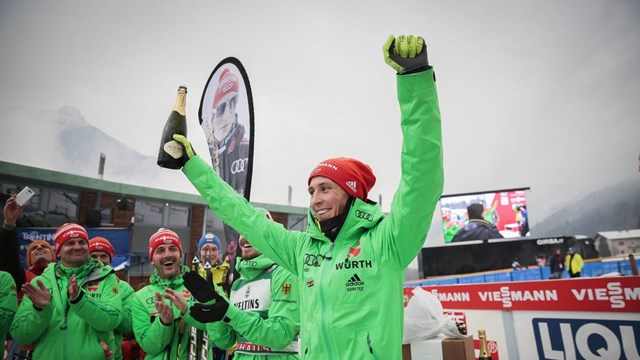
    Germanys Eric Frenzel secures 4th Noco World Cup overall in a row. Celebrating with the team in Val Di Fiemme. (Credit: FIS, @ Nordic Focus)
    Germany’s Eric Frenzel secured his fourth-consecutive overall Nordic Combined World Cup title over the weekend and celebrated with his team in Val di Fiemme, Italy. (Photo: FIS/Nordic Focus)

    Picturesque Val di Fiemme, Italy, was the latest to host a three-day round of Nordic Combined World Cup events that began last Friday with the large hill/2 x 7.5 k team sprint.

    The two person teams had their jumping points combined to determine the start order for the race’s ski portion. Norway I’s Magnus Krog and Jørgen Graabak amassed the highest total with 283 points on the jump hill. Francois Braud and Maxime Laheurte of France I jumped to second with 282.6 points. Austria II skiers, Philipp Orter and Mario Seidl were third with 277.8 combined points.

    The U.S. entered two teams. Bryan and Taylor Fletcher jumped to ninth, with 242.3 points, for U.S. I. Adam Loomis and Ben Berend comprised U.S. II, which finished the jumping portion in 16th with 223.2 points. Twenty teams in all entered the competition.

    Norway's Magnus Krog and Joergen Graabak win the Val Di Fiemme, Italy NoCo team sprint. (Credit: FIS, @ Nordic Focus)
    Norway’s Magnus Krog and Jørgen Graabak won the Nordic Combined World Cup team sprint last Friday, Feb. 26, in Val di Fiemme, Italy. (Photo: FIS/Nordic Focus)

    From the start, Krog proved unmatchable. He distanced Braud, France’s first skier who started 1 second after Krog. Graaback, Norway’s second skier, was able to maintain the lead and secure first place for the Norwegians, claiming the team-sprint victory in 32:50.

    Germany I, with Tobias Haug and Tino Edelmann, jumped to fourth and began the ski 16 seconds behind Norway I, raced to second place (+6.7). France I held onto the final podium spot in third place, finishing 7.1 seconds behind Norway. Austria II, which had been third after the jump, slipped to eighth overall (+1:37.3).

    The Fletchers skied up in the standings for the best U.S. finish in a Nordic Combined team sprint since 2013. Back then, in Ramsau, Austria, Bryan Fletcher and Todd Lodwick placed fourth overall. At 2013 World Championships, Taylor Fletcher and Billy Demong finished sixth in the team sprint (at the same World Championships in Val di Fiemme, U.S. Nordic Combined’s four-man relay earned bronze in third.)

    On Friday, Bryan and Taylor skied the third-fastest combined race to place sixth (+1:07.8). Loomis and Berend did not finish.

    “The team sprint was for sure Taylor’s and I’s highlight of the weekend,” Bryan Fletcher wrote in an email. “It was nice to have some decent jumps and a solid race to get us into the fight. It’s the best team sprint result we have had as a duo and the best since Todd Lodwick and I were fourth in Ramsau in 2013 I believe.  Honestly, while 6th is a solid result, Taylor and I were hoping for a little more but our legs were really tired after the long travel day from Finland to Val di Fiemme.  It showed in our racing on this day a little, but we were able to hold it together just enough to move up to the 6th place finish.”

    According to younger brother Taylor, he wasn’t feeling 100 percent on Friday.

    “The cross country race was better on the result page then how it felt for me,” he said, according to a USSA press release. “My legs were heavy from the last couple races, but I was stoked to see I had a strong race with how I felt.”

    Team jumping results | Final team results

    Day 2 in Val di Fiemme

    The second day of Nordic Combined competitions in Val di Fiemme featured the 134-meter large hill/10 k Gundersen start. The overall World Cup leader, Germany’s Eric Frenzel, posted the best jump with 142.3 points. Austria’s Bernhard Gruber jumped to second with 137.1 points and a 21-second deficit at the start of the ski. Takehiro Watabe of Japan flew third farthest, scoring 132.1 points.

    Germany's Bernhard Gruber won the Day 2 individual competition in Val Di Fiemme, Italy. (Credit: FIS/Nordic Focus)
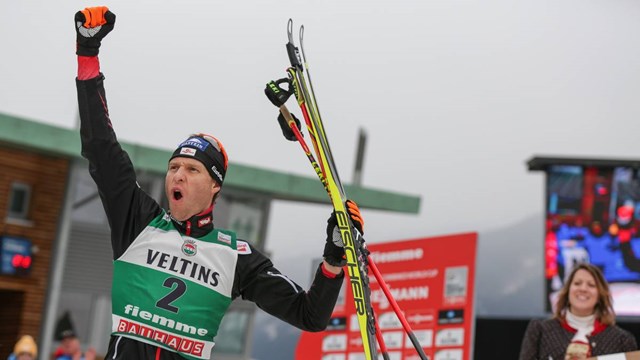
    Germany’s Bernhard Gruber won the Day 2 individual competition in Val Di Fiemme, Italy. (Credit: FIS/Nordic Focus)

    The U.S. entered four skiers, none of whom jumped into the top 30. Berend posted the 35th-best jump (99.2 points), Bryan Fletcher was 36th (98 points), Taylor Fletcher 39th (93.2 points), and Loomis 42nd (86.7 points).

    Frenzel, having already won seven races this season, seemed to be a shoo-in for an eighth victory. But Gruber, with fast running skis, overtook Frenzel and finished first by more than 30 seconds. Gruber skied the fourth-fastest time of the day to win, finishing in 30:59.7. Frenzel placed second (+37.5) with the 19th-ranked ski time. Norway’s Graabak, who was positioned 14th after the jump raced up to third (+46.0).

    Two Americans skied themselves into the points. Taylor Fletcher ended up 24th (+3:32.5) and Bryan Fletcher finished 26th (+3:37.6). Loomis skied to 35th (+5:56.7), and Berend to 38th (+7:19).

    Jumping results | Final results

    Day 3 in Val di Fiemme

    Day 3 started off identical to Day 2, with a large hill/10 k Gundersen. And just like the day before, Germany’s Frenzel flew to first, with 116.3 points. His teammate Tobias Simon scored 110.2 points for the second-best jumping total. Norway’s Håvard Klemetsen was third after the jumping round with 104.6 points.

    Berend posted the best jump for the Americans in 10th with 94.5 points. He started the 10 k race 1:27 minutes after Frenzel. Bryan Fletcher jumped to 35th, Taylor Fletcher to 42nd and Loomis to 46th.

    Norway's Magnus Krog celebrates across the line after winning the third day of the Nordic Combined World Cup in Val di Fiemme, Italy. (Credit: FIS/Nordic Focus)
    Norway’s Magnus Krog celebrates across the line after winning the third day of the Nordic Combined World Cup in Val di Fiemme, Italy. (Photo: FIS/Nordic Focus)

    Norway’s Krog, winner of Friday’s team sprint, proved too strong on the ski, which featured wet and slow conditions. Krog began the ski in fifth, 1:04 behind Frenzel. That gap dwindled as the racers neared the finish line. By the end, Krog, who finished first in 31:33.5, had put 28.1 second into Frenzel — who ultimately missed the podium in fourth overall.

    Norway’s Graabak finished second (+5.8), and German Fabian Riessle placed third (+18.4).

    For Frenzel, fourth place proved good enough. He locked up the season’s overall World Cup title for the fourth year in a row. Frenzel had a season-long duel with Japan’s Akito Watabe for the overall title. However, due to an injury, Watabe did not compete in Val di Fiemme.

    The Fletcher brothers were able to ski into the points. Bryan placed 25th (+2:55.3), while Taylor was 26th (+3:00.8). Berend fell out of the top 30, placing 34th (+5:33), Loomis finished 36th (+5:44.1).

    Bryan pointed out that Berend’s jump — the 10th best on Sunday — was a strong sign.

    “The rest of the weekend the highlight was Ben Berend jumping to 10th,” he wrote. “It was awesome to see him step up his game there and he hung tough in the race narrowly missing out on points in some incredibly hard conditions.”

    Bryan also noted the weekend’s slow and soggy snow made it a difficult one for both skiers and wax technicians.

    “The racing this weekend was a battle of will for the athletes and a stressful weekend for wax techs,” he wrote. “It was very difficult conditions to wax for and that was reflected throughout the racers. Some teams had skis that were incredibly good while others had skis that were incredibly bad.  The extremes were just much further apart than normal and that made for some interesting racing as well. All in all it was not my best weekend, however with one weekend left I am motivated to try and finish the season on a strong note.”

    Jumping results | Final results

    The Nordic Combined World Cup concludes after this week, with three days of competitions in Schonach, Germany, beginning March 4.

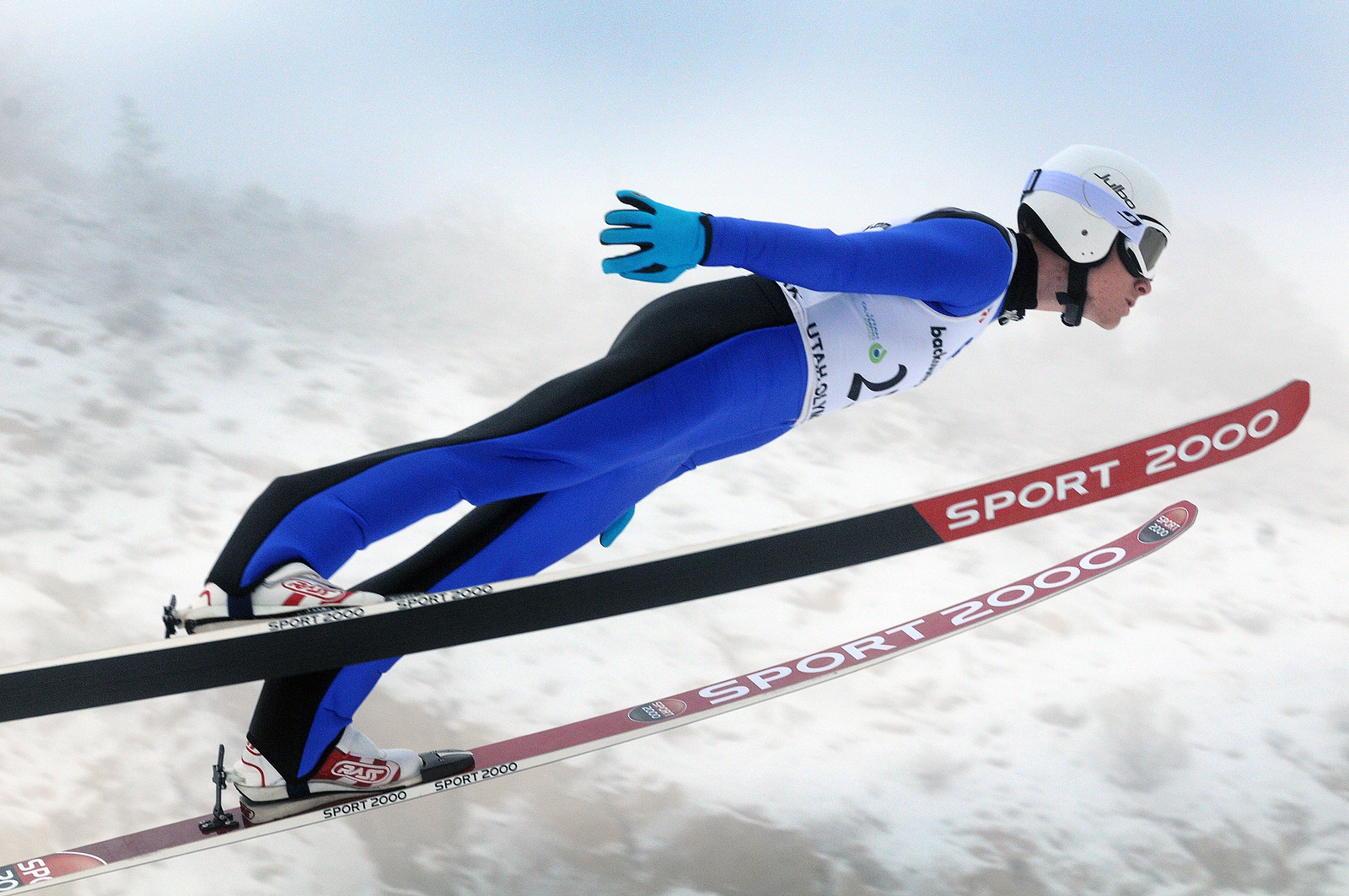
    Ben Berend leads the U.S. in fourth in the ski jump on a foggy morning at start of the Nordic Combined Continental Cup at Utah Olympic Park in Park City, Utah. (Photo: U.S. Ski Team/Tom Kelly)
    Ben Berend led the U.S. in fourth in the ski jump on a foggy morning at the Nordic Combined Continental Cup last December at Utah Olympic Park in Park City, Utah. (Photo: U.S. Ski Team/Tom Kelly)
  • Riiber’s Bad Luck in Lahti; Frenzel Keeps NoCo World Cup Lead; Fletchers in Top 30 Overall

    Riiber’s Bad Luck in Lahti; Frenzel Keeps NoCo World Cup Lead; Fletchers in Top 30 Overall

    Norway's 18-year-old Jarl Magnus Riiber posted the best jump on Friday, Feb. 19, and started the 10 k cross-country race first at the Nordic Combined World Cup in Lahti, Finland, but was disqualified for taking a wrong turn. (Photo: JoJo Baldus)
    Norway’s 18-year-old Jarl Magnus Riiber posted the best jump on Friday, Feb. 19, and started the 10 k cross-country race first at the Nordic Combined World Cup in Lahti, Finland, but was disqualified for taking a wrong turn. (Photo: JoJo Baldus)

    Here is a name to remember for both youthful audaciousness and absent mindedness: Jarl Magnus Riiber.

    At 18 years old, the Norwegian seems to treat the Nordic Combined World Cup as just another rung in the hierarchy of competition that sooner rather than later he will dominate.

    From Friday, Feb. 19, through Sunday, Feb. 21, three Nordic Combined World Cup competitions were held in Lahti, Finland.

    That first event, a large hill/10-kilometer Gundersen began with Riiber ruling the jumping round. He flew the farthest, earning 137.5 points. The jump gave Riiber a 28-second gap at the start of the ski over his nearest competitor. That second jumper was Norway’s Håvard Klemetsen, who scored 130.5 points. Overall World Cup leader, Germany’s Eric Frenzel, jumped to third with 127 points. Second in the overall, Japan’s Akito Watabe, was fourth, with 126.4 points.

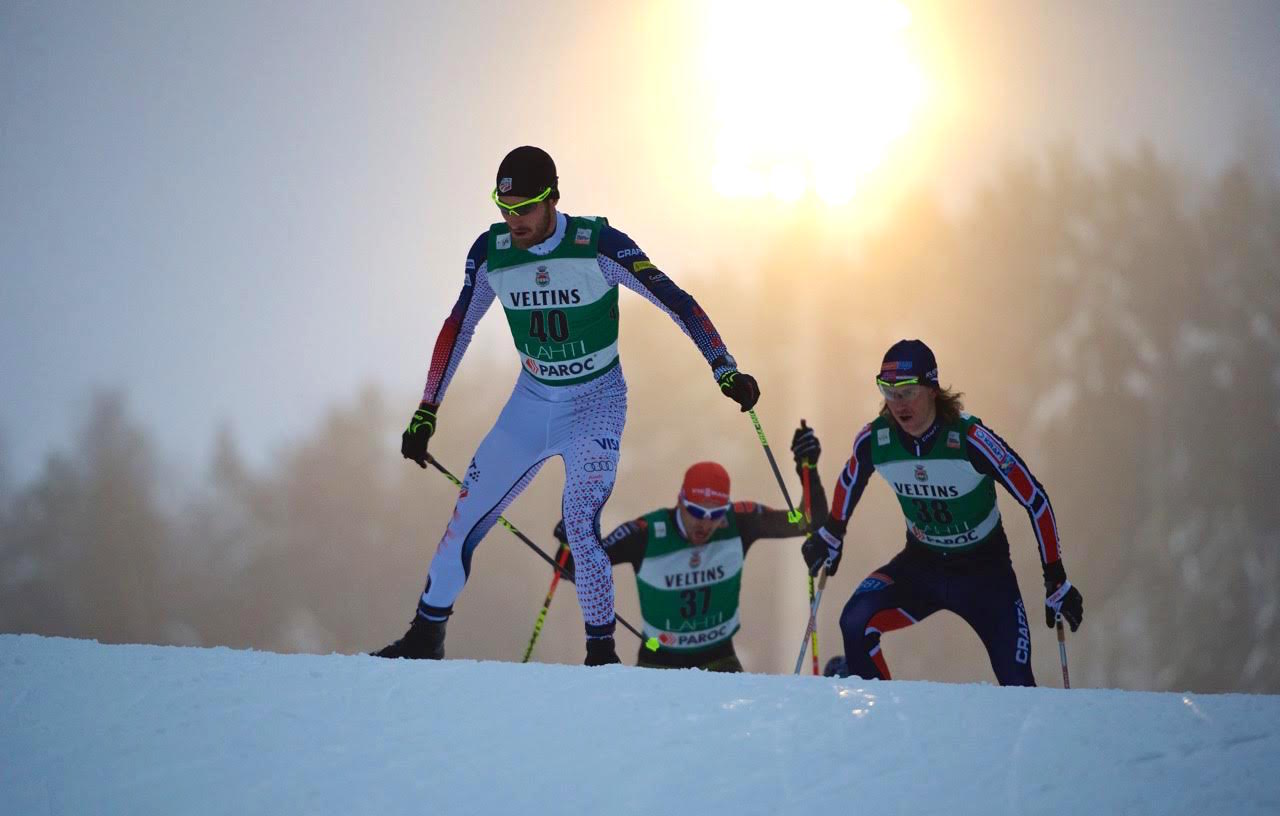
    American Taylor Fletcher (40) leading Norway's Mikko Kokslien (38) and Germany's Björn Kircheisen  (37) during the 10 k cross-country race at Friday's Nordic Combined World Cup in Lahti, Finland. Fletcher raced from 40th at the start to 24th at the finish with the seventh-fastest ski time. (Photo: JoJo Baldus)
    American Taylor Fletcher (40) leading Norway’s Mikko Kokslien (38) and Germany’s Björn Kircheisen (37) during the 10 k cross-country race at Friday’s Nordic Combined World Cup in Lahti, Finland. Fletcher raced from 40th at the start to 24th at the finish with the seventh-fastest ski time. (Photo: JoJo Baldus)

    All three U.S. men struggled to crack the top 40 on the hill, with Taylor Fletcher leading the team in 40th, Ben Berend jumping to 44th and Bryan Fletcher 47th.

    The time gaps Riiber had on Frenzel and Watabe were incrementally negated. On the last lap, the duo caught Riiber.

    Yet the young Norwegian held his ground, gapping the chasers slightly on a short hill before a turn into the stadium and the final straightaway. But Riiber, who looked as if he’d cruise in for the win, took the lap lane before realizing his mistake and righting his course. Frenzel won in 23:57.7, Watabe placed second (+1.7), and Norway’s Jan Schmid secured third (+32.2).

    For Riiber, not minding the small things has cost him again. On Jan. 29 in Seefeld, Austria, it appeared Riiber would take third place on the podium. He was disqualified for failing to start the ski race with a timing chip. Friday, what would have been Riiber’s second World Cup win, stood as his second World Cup disqualification.

    Of the Americans, Taylor Fletcher skied into the points in 24th (+1:57.5) with the seventh-fastest ski time of the day. Bryan Fletcher placed 36th (+3:34.9), and Berend finished 44th (+5:43.7).

    Day 1: Jumping results | Final results

    Day 2

    The second day of competition on Saturday featured a jump off the large hill followed by a 2 x 7.5 k ski. Two-man teams had their jump point totals combined to determine time back for the ski start.

    Ribber and Schmid scored the highest point total, with 252.1 points. Germany I, Johannes Rydzek and Fabian Riessle, scored the second highest total, with 223.7 points, 57 seconds back. Austria I, with Bernhard Gruber and Lukas Klapper, jumped to third with 219.9 points, 1:04 back.

    The ski, which was won by the Germany I in 32:57.9, saw Riiber once again succumb to bad luck. While skiing along with Germany’s Riessle, Riiber’s shoulder dislocated. Attempting to push through the injury, Riiber skied on. Yet he ultimately pulled from the race. Besides a likely podium, Norway I’s result lists as an unfortunate DNF.

    Austria’s Gruber-Klapper combo placed second, 18 seconds behind Germany. Austria II, with Franz-Josef Rehrl and Philipp Orter, were third (+1:40.8) in a photo finish with Germany II (+1:40.9).

    The U.S. entered two teams. United States I (Taylor and Bryan Fletcher) ranked 17th after the jump, while U.S. II (Adam Loomis and Ben Berend) were 20th. Neither team started the ski race.

    Day 2: Jumping results | Final results

    Day 3

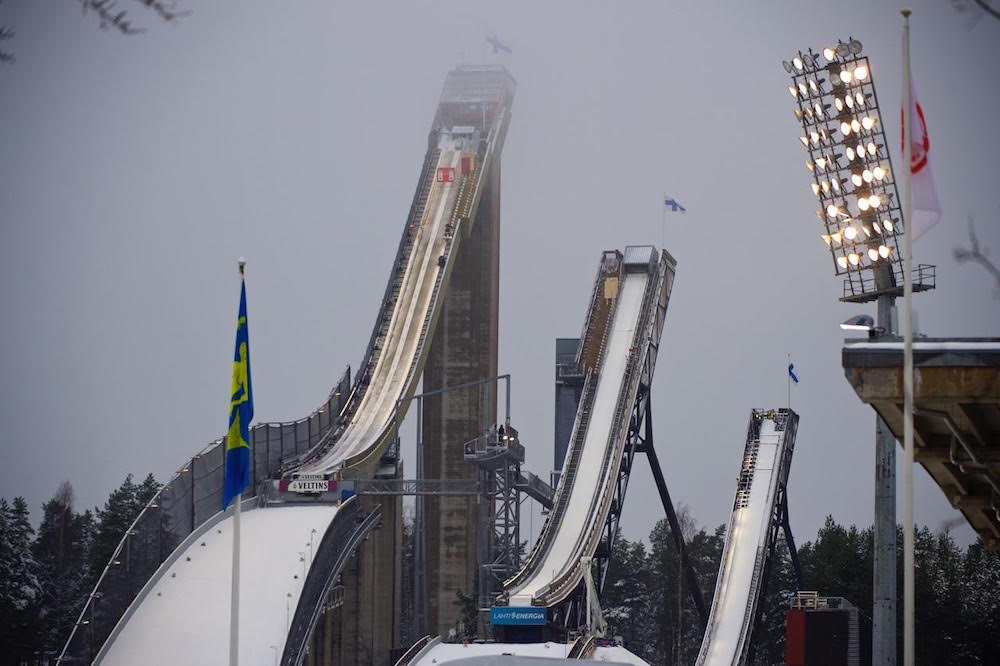
    The jump hills in Lahti, Finland, as seen on Friday, Feb. 19, the first day of the Nordic Combined World Cup (Photo: JoJo Baldus)
    The jump hills in Lahti, Finland, as seen on Friday, Feb. 19, the first day of the Nordic Combined World Cup (Photo: JoJo Baldus)

    The last day of competition in Lahti, a 10 k Gundersen, saw the jumping round canceled due to high winds. Results from Friday’s provisional competition round were used to determine the skiing start order. Unfortunately, Riiber, who had won that round, was unable to start due to his shoulder injury.

    Watabe, who would have begun two seconds behind Riiber, skied off first. Frenzel started 32 seconds later. His German teammate Riessle began 40 seconds behind in third.

    For the U.S., Berend started 20th, Bryan Fletcher 41st, Taylor Fletcher 48th, and Adam Loomis 53rd.

    Riessle is considered a strong skier. Watabe conserved his energy, allowing the two Germany to bridge up. That link occurred around 5 k. A chess match began, with none of the skiers wanting to lead out. In the closing kilometers, Riessle pulled away for the win in 25:50.9. Frenzel finished second (+5.1) and Watabe in third (+11).

    Bryan Fletcher was the top American finisher in 25th (+3:05.2) and he skied the ninth-fastest time on the day. Taylor placed 28th (+3:30.6) and posted the third fastest ski time. Berend was 33rd, and Loomis 37th.

    After the weekend, Frenzel retains the Overall World Cup lead with 1091 points. Watabe is in second with 904 points, and Riessle in third with 789 points.

    Bryan Fletcher is 18th overall, and Taylor 28th.

    In an email on Sunday, Bryan reiterated his desire to solve the jumping puzzle.

    “Well this weekend was not really our weekend,” Bryan wrote. “Training was decent during the week, but for me I got a little overzealous and tried a little too hard in the competition. The results obviously speak for themselves.  Racing was good after taking a short break from intensity to gear up for the next 4 races in the rest of the week.

    “Jumping is a fickle sport and when you’re on, it seems impossible to ever lose your groove and when you’re off, you’re off,” he added. “So I have hit the reset button and will try to make the most out of what I can in the next couple days of competition.”

    Taylor felt better about his jumping.

    “This weekend I felt that my jumping had turned for the better finally and I was gaining confidence on the hill which is important,” Taylor wrote in an email on Sunday. “Unfortunately, my one bad jump was in the PCR [provisional competition round] and we had to use that today due to fierce winds that were too strong.

    “I skied a solo race catching and passing people immediately, as I wanted to score points I was going to need to have a really strong race and ski my own race as well. I felt really strong all race but one really steep section caught me and i struggled on the final kick up. I was able to continue to push the pace for the rest of the lap and finish strong finishing 28th. I thought I may of had the fastest time, but after seeing I was third I wasn’t too bummed, as I skied the race on my own and in no man’s land for a bit!”

    World Cup racing resumes on Tuesday in Kuopio, Finland.

    Day 3: PCR jumping results | Final results | Overall World Cup standings

  • Bryan Fletcher Comes into Form at Seefeld Triple; Germany’s Eric Frenzel Wins Out

    Bryan Fletcher Comes into Form at Seefeld Triple; Germany’s Eric Frenzel Wins Out

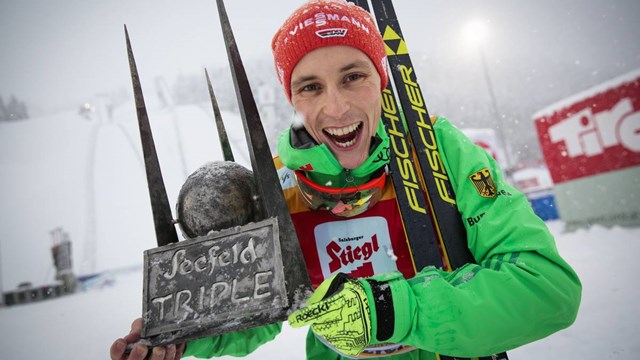
    Germany's Eric Frenzel after winning his third-straight Seefeld Triple at the Nordic Combined World Cup in Seefeld, Austria. (Photo: FIS/Nordic Focus)
    Germany’s Eric Frenzel after winning his third-straight Seefeld Triple at the Nordic Combined World Cup in Seefeld, Austria. (Photo: FIS/Nordic Focus)

    Jump. Ski. Jump. Ski. And in Seefeld, Austria, this past weekend, it was an added bonus round of jumping and skiing for the three-day Nordic Combined World Cup.  

    Held Friday through Sunday, the series of competitions, known as the Seefeld Triple, is a highlight of each nordic-combined season as the racing format winnows the best of the best.

    The Seefeld Triple is set up as a race of attrition.

    Day 1 featured a normal-hill jump coupled with a 5-kilometer ski race. The top 50 finishers advanced to Day 2, with another jump on the 109-meter normal hill and a 10 k race. Only the top 30 advanced to Day 3, which included another normal-hill jump and 10 k Gundersen start.

    The results from Day 1 set the tone for the weekend. The names of German Eric Frenzel and Japan’s Akito Watabe would consistently top the Triple’s results.

    During the jump on Day 1, Watabe flew the farthest, earning 131.3 points, while Frenzel came in a close second with 133.2 points. Norwegian Jarl Magnus Riiber finished the jumping round in third, but was eventually disqualified for starting the cross-country race without a transponder. His teammate Magnus Moan had been previously disqualified on Friday for his jumping suit being 1 millimeter too loose.

    For the U.S. Nordic Combined team, the pressure was on from the start. The Seefeld Triple marked the end of the period during which the team can start five athletes. That five-man quota was a result of points earned last season as well as additional spots earned from the team’s results during the Continental Cup in Utah last December.

    On the first day of competition in Seefeld, American Ben Berend posted the 33rd-best jump. His teammates Bryan Fletcher followed in 34th, Adam Loomis in 43rd, Jasper Good in 49th, and Taylor Fletcher in 53rd.

    If it wasn’t clear from the jumping, the ski race was where Frenzel and Watabe made others realize that, by Sunday’s racing, it would simply be a race for third.

    Watabe began eight seconds ahead of Frenzel, while Berend and Bryan Fletcher, the closest Americans, began 1:21 and 1:26 minutes back, respectively.

    Steadily, Frenzel and Watabe built a gap by the finish line. Frenzel finished first in 11:08.5, while Watabe crossed the line 6.2 seconds later in second place. Germany’s Fabian Riessle skied to third (+43.6). Bryan Fletcher moved up in the field after starting 34th, finishing 20th (+1:07.5) with the third-fastest ski time on the day.

    The next-best placed American was Loomis, who skied to 42nd (+2:16.4). Berend placed 43rd (+2:17.9), Taylor Fletcher 47th (+2:26.6), and Jasper Good 50th +2:32.8). Despite only Bryan Fletcher scoring World Cup points, the entire U.S. Team finished in the top 50 to earn starts in the Triple’s second day of competition.

    In an email to FasterSkier on Sunday, Bryan Fletcher wrote he was surprised with his fast ski time on Friday.

    “Going into Seefeld I was a bit nervous,” he wrote. “I came down with a really weird virus on Thursday in the provision comp round. I almost didn’t start because I was so dizzy during the jumping. But I wanted to make sure I had a result on the page just in case knowing the weather on Sunday would be challenging.

    “So Thursday I went to bed early in the hopes that Friday it would pass as quickly as it came on,” he continued. “Luckily I felt better in the morning, Still had some slight symptoms but compared to the day before it was much better. Having such a fast race after the sickness was surprising but it gave me the motivation to keep pushing as the weekend went on.”

    Day 2: A Leap Frog

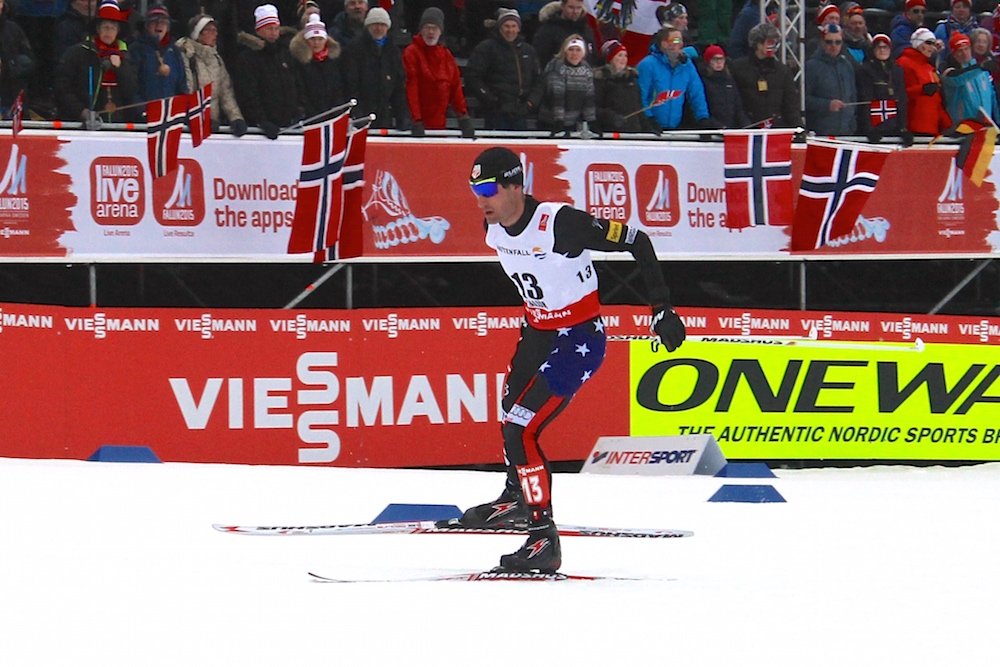
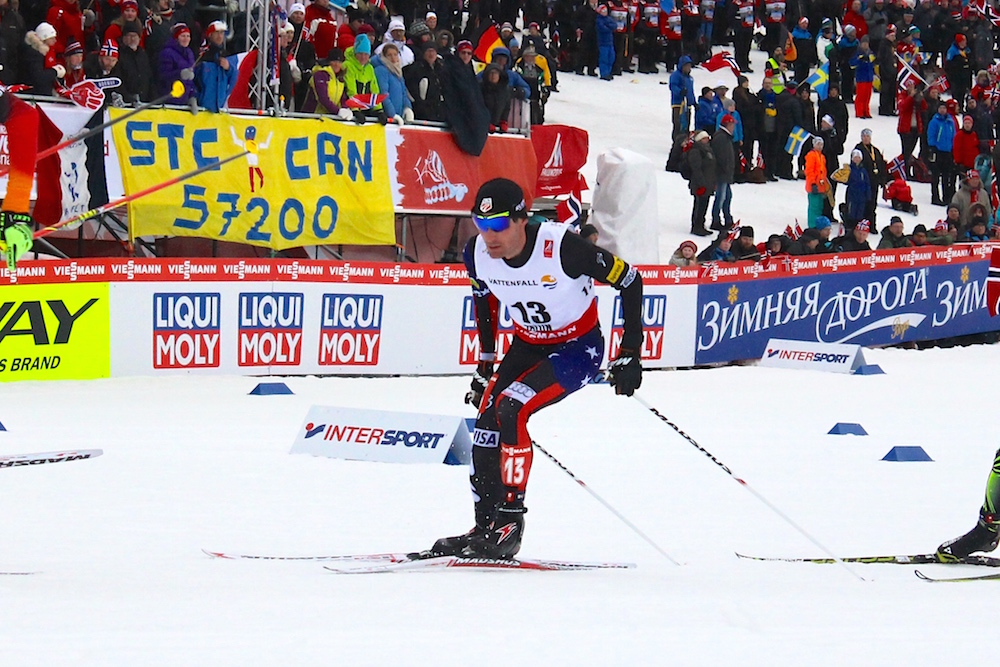
    Bryan Fletcher racing at 2015 Nordic Combined World Championships in Falun, Sweden.
    Bryan Fletcher racing at 2015 Nordic Combined World Championships in Falun, Sweden.

    The jumping was a virtual repeat for Watabe and Frenzel on Day 2. Watabe posted the best jump, with Frenzel a close second. Austria’s Bernhard Gruber ranked third.

    As far as the contenders for the Seefeld Triple’s overall, this wasn’t much of a surprise. Coming into Saturday’s competition, Frenzel ranked second in the overall World Cup standings behind Germany’s Riessle, while Watabe was third.

    The top American from Day 1, also kept himself in a top-10 hunt. Bryan Fletcher jumped to 16th and would start the ski race 1:40 behind Watabe. Behind him, Berend started 35th based on his jump, Loomis 42nd, Taylor Fletcher 47th, and Good 50th.

    Watabe began Saturday’s 10 k four seconds ahead of Frenzel, while Gruber started nearly a minute back.

    That minute gap the leaders’ began with only grew. The chase for Frenzel and Watabe remained unorganized, with little agreement as to who would set the pace. The chasers expanded from as little as four skiers to over a dozen — including Bryan Fletcher. Beginning the final loop, Fletcher led out the chasers.

    Near the end, after the top two had skied alone, Frenzel attacked and dropped Watabe to take the win by 24.9 seconds in 23:11.5. Nearly a minute after Watabe, Riessle finished third (+1:27.7).

    Bryan Fletcher had an opportunity to reach the podium. On the final climb, Riessle and Norway’s Jørgen Graabak hammered, giving themselves a few seconds margin. During that push, there was a small tangle behind. It caught Fletcher, briefly turning him sideways — yet he didn’t fall. That mishap cost him time and places. He finished ninth, 1:36 behind and only 8.3 seconds out of third. Fletcher tied for the sixth-fastest ski time on the day.

    “Unfortunately at the end I had my poles stepped on and that took me out of contention for 3rd place.  Sometimes racing can be unlucky but I was happy to stay in the top ten despite the mishap at the end,” Fletcher explained.

    The remaining four U.S. athletes finished outside the top 30: Loomis in 37th (+4:23.5), Taylor Fletcher in 41st (+4:49.6), Berend in 44th (+5:17), and Good in 46th (+6:21.3).

    The day’s results meant a few things, both positive and negative.

    On the downside, Bryan Fletcher was the only American to advance in the top 30 to Day 3.

    Then there was the positive. If nordic combined was a sport married with betting, like football in the U.S., Frenzel would be as safe a bet as you could get.

    Saturday marked Frenzel’s 10th-straight win in Seefeld. That’s dating back to 2013. The “triple” format was introduced there in 2014 —  and Frenzel has owned it since. He won the first two editions of the Seefeld Triple, in 2014 and 2015, and kept the momentum going into Sunday.

    In addition to firming his grip on 2016’s Triple, heading into Sunday’s final day of racing, Frenzel had leap frogged Riessel, to rank first in the World Cup standings by 17 points.

    Day 3: Frenzel on the Watabe Hunt

    It wasn’t exactly ideal conditions for the final day of jumping and racing at the Seefeld Triple. With steady snow and unpredictable winds, the jump was delayed several times, until organizers sent the field of 30 skiers off the hill.

    Once again, Watabe dominated. Frenzel was the next best jumper. Yet in the tricky conditions, he botched his landing. Although he was only half a meter down on Watabe in distance, the fall gave him a lower overall score, and thus a cross-country ski start time 56 seconds behind Watabe. Riessle rounded out the top-three jumping spots in third, putting him 1:26 back for the ski race.

    Bryan Fletcher jumped to 16th and started the race 2:24 behind Watabe.

    With snow falling and several inches of snow on the course, race officials shortened the planned 15-kilometer race to 10 k. Either way, Frenzel had a tough task ahead of him. But as the race unfolded, stride by stride, Frenzel reeled Watabe in. Starting the final loop, Watabe still had roughly a thirty-second margin.

    That proved not enough.

    Frenzel eventually passed Watabe, winning by 18.7 seconds in 26:45.8. Watabe took second and Riessle, the third place finisher on Day 1 and Day 2, once again placed third (+1:09.1).

    Bryan Fletcher jetted to the fastest time on the day in 25:38.6. That effort earned him seventh in the Seefeld Triple, just 7.7 seconds off the podium.

    Fletcher leaves Seefeld knowing his form is good, but also with the understanding that the U.S. team’s goal of maintaining quota spots remained elusive.

    “Today was a very tough day on the jump hill,” he wrote on Sunday. “The snow was very heavy and wet and it make the organizers work hard to get the comp off.  In the end though it was a good competition and I was happy to have a jump that kept me in the fight for the race.”

    Considering Sunday’s tough snow conditions, Fletcher knew that suited him. He aimed to ski hard and try to catch the chase group “and at least have a shot at the sprint for 3rd,” he wrote.

    “Seefeld has been good to me, I have been top 10 in the triple now three times [placing ninth in 2015 and fifth in 2014] so I know this weekend showed positive trends,” he continued.

    “Unfortunately the team will lose a number of spots after this weekend. With the cancellations of many world cups in second period it didn’t give our team much opportunity for the guys to score points. They really only got two chances, Chaux Neuve and Seefeld.  They put in a good fight this weekend given that it’s not easy to make the third day.  So at this point our team will have two start rights in Oslo and Trondheim.”

    Fletcher’s melancholy was offset by the vibe on the German side, which was celebrating Frenzel’s long-weekend domination.

    “We have a tradition in the hotel here,” Germany’s head coach Hermann Weinbuch told German broadcaster ARD. “The innkeeper opens champagne [bottles] with a saber, and if we win another Triple we will keep up that tradition and drink a glass of sparkling wine or champagne.“

    Frenzel now leads the overall World Cup with 671 points, 97 points ahead of Riessle in second and 117 ahead of Watabe.

    World Cup competition continues next weekend in Oslo, Norway.

    Results: Day 1 | Day 2 | Day 3 | Overall World Cup standings

  • Bryan Fletcher Puts Himself in Medal Hunt, Finishes Career-Best Fifth at World Champs

    Bryan Fletcher Puts Himself in Medal Hunt, Finishes Career-Best Fifth at World Champs

    Bryan Fletcher (U.S. Nordic Combined) racing to fifth in  while skiing with a chase pack during Thursday's 10 k at 2015 World Championships.
    Bryan Fletcher (U.S. Nordic Combined) racing to fifth in while skiing with a chase pack during Thursday’s 10 k at 2015 World Championships.

    FasterSkier’s coverage of the 2015 FIS Nordic World Ski Championships in Falun, Sweden, is brought to you by the generous support of L.L. Bean, now featuring a complete line of Kikkan Randall training wear.

    FALUN, Sweden — Bryan Fletcher knew there was one thing that could elevate him to the podium on Thursday at FIS Nordic World Ski Championships, and it wasn’t going to be playing it safe.

    The 28-year-old U.S. Nordic Combined skier decided to go with the “go-big” mindset on the 134-meter large hill, and in doing so, he jumped to 13th on Thursday morning — a huge improvement from his 20th-ranked jump in the normal-hill individual competition at Falun World Championships, where he ended up 21st last Friday.

    Bryan Fletcher, USA, jumping in Sunday’s team event at the 2015 FIS Nordic World Ski Championships. (Photo: FlyingPointRoad.com)
    Bryan Fletcher (U.S. Nordic Combined)  jumping in Sunday’s four-man team event at the 2015 FIS Nordic World Ski Championships in Falun, Sweden. (Photo: FlyingPointRoad.com)

    “Today, I came into jumping in attack mode,” Fletcher recalled after Thursday’s 10-kilometer Gundersen start. “It was like, ‘Well since these are the Championships, and it’s not really worth being anything but on the podium, I’m just going to go for it as hard as possible and lay it all out there.’ ”

    Starting the race 13th and 44 seconds behind the jump leader, Austria’s Bernhard Gruber, meant Fletcher could actually move up enough to matter.

    “I jumped pretty well, put myself in contention, and then going into the race I was pretty nervous because being in contention is exciting but it’s also like, ‘Uh oh, now what do I do?’ ” Fletcher said.

    Before Thursday, his previous individual best in four World Championships was 14th. He won a World Cup two years ago, but had not placed better than fifth in an individual competition since. He called upon his experience from a month ago in Sapporo, Japan, where he placed eighth and ninth in back-to-back World Cup competitions.

    On a dark-and-damp Thursday afternoon, Gruber took off 5 seconds ahead of France’s Jason Lamy Chappuis in second and another Frenchman, Francois Braud, who started 7 seconds back in third. After that, the fifth- through eighth-best jumpers started within six seconds of one another, 23 to 29 seconds after Gruber, and Fletcher headed out six seconds after 11th and one second out of 12th.

    “My goal was to ski a tactically smart race and not be in the front too much, but do enough work to put myself in contention,” Fletcher explained.

    He ended up completing the first of four 2.5 k laps in 10th, toward the front of a 14-man pack. The group trailed the three frontrunners: Lamy Chappuis, Gruber and Braud, respectively. Japan’s Yoshito Watabe skied alone in fourth, 15 seconds behind them, while the chase pack reined him in from another 15 seconds back.

    By 3.8 k, Norway’s Magnus Moan continued to lead the chase in fourth, with Fletcher in eighth and Watabe back in 11th. By the halfway point, the group was 30 seconds behind the three leaders, with Moan still in fourth, Germany’s Johannes Rydzek and Tino Edelman in fifth and sixth, and Fletcher up to seventh. Less than a kilometer and a half later, Fletcher was at the front of the pack in fourth, just 19.3 seconds behind the top three.

    There, the American pushed to bridge the gap to the podium. Mostly focused on a medal, he gave his all while leading at least 11 others directly behind him.

    “There were a lot of guys in our pack,” he said. “I think at one point it was all the way from third to 20th, and if you glance over your shoulder, you’re like, ‘Oh man, what am I doing at the front of this thing? I’m wasting so much energy.’ But at the same time, the guys that were at the front, myself included, were kind of really trying to get more people to share in the workload because we wanted to ultimately catch the front of the race and then be able to work past that.

    “I think we were caught in a zone where we were working, and then also trying to rest at the same time,” he added. “It was tough to organize, but I feel like Magnus and I did a good job of sharing the workload as much as possible, and then also breaking away from the rest of the guys in that train to give ourselves a shot.”

    With one lap to go, Fletcher was still in fourth, 20 seconds out of third. Moan clung to him in fifth, and Rydzek skied in sixth, followed by 10 others. Over the next 2.5 k, Moan attacked, Rydzek went with him and Fletcher worked to stay in the fight for fourth, while the rest of the pack dropped off the pace.

    “I jumped on them and was actually really surprised when I looked back and we were clear of the group,” Fletcher said. “I was kind of relieved because I knew it was just us, and we were catching up to third place really fast so I was going all out trying to get there.”

    American Bryan Fletcher (l) after finishing fifth to Austria's Bernhard Gruber (1) in the individual large hill/10 k at 2015 World Championships in Falun, Sweden. It was Fletcher's World Championships career best and a season best as well.
    American Bryan Fletcher (l) after finishing fifth to Austria’s Bernhard Gruber (1) in the individual large hill/10 k at 2015 World Championships in Falun, Sweden. It was Fletcher’s World Championships career best and a season best as well.

    While Moan and Rydzek charged to the finish, Fletcher lost contact on the last two uphills. Gruber cruised into the stadium and finish uncontested to win in 22:45.8, 11.9 seconds ahead of Braud in second. Rydzek and Moan overtook Lamy Chappuis in the last kilometer and sprinted to the line for third. Rydzek took it by 0.2 seconds, 14.9 seconds after Gruber, Moan settled for fourth, and 8.3 seconds later, Fletcher finished fifth (+23.4).

    “I was hoping I could beat those guys on the hill, but they were strong, they skied a great race, and obviously I [felt] the legs at the end,” Fletcher said. “This is a personal-best result this season for me and in a World Championship event. To be on the podium would have been a dream come true, but to be in the fight was more what I was really looking for.

    For me, I really just want to ski a good race, a good race to the best of my ability and the best of my performance,” he added. “I was happy that I was able to do that today and I was in the fight.”

    “To be on the podium would have been a dream come true, but to be in the fight was more what I was really looking for.” — Bryan Fletcher, fifth for a career-best individual result at World Championships

    His younger brother Taylor, who jumped to 34th and raced up to 29th, 1:51.7 after Gruber, patted him on the shoulder afterward.

    “I think that’s the best [U.S. Nordic Combined has] done since 2009 for an individual result so hats off to him,” Taylor said of Bryan’s new World Championships marker. Teammate Billy Demong won the large hill/10 k at 2009 worlds in Liberec, Czech Republic, and in 2011, he placed sixth in the same event.

    “[Bryan] really pulled it together today and skied a smart race by the looks of it, and was able to finish hard, which is the most important thing here,” Taylor said.

    The second American on Thursday, Taylor wasn’t pleased with his performance after putting himself 2:01 back after the jump.

    “It’s hard to say what could’ve been,” he said. “But knowing how I’ve been skiing, I could’ve been up there for that medal. I’ve had a lot of really good jumps and I’ve had huge improvements in my last competitions, and I gotta be satisfied with that but at the same time I’m really disappointed … when it came time to show that work and that effort, I fell short a little bit.”

    While Bryan posted the eighth-fastest course time, Taylor, 24, ranked 10th fastest of 47 men in the 10 k.

    “I’m probably the most competitive guy out here,” Taylor said. “I yelled at guys in the track earlier because I just wanted to go. I can’t settle for something. I want it more and more and I’m going to work my ass off to get it.”
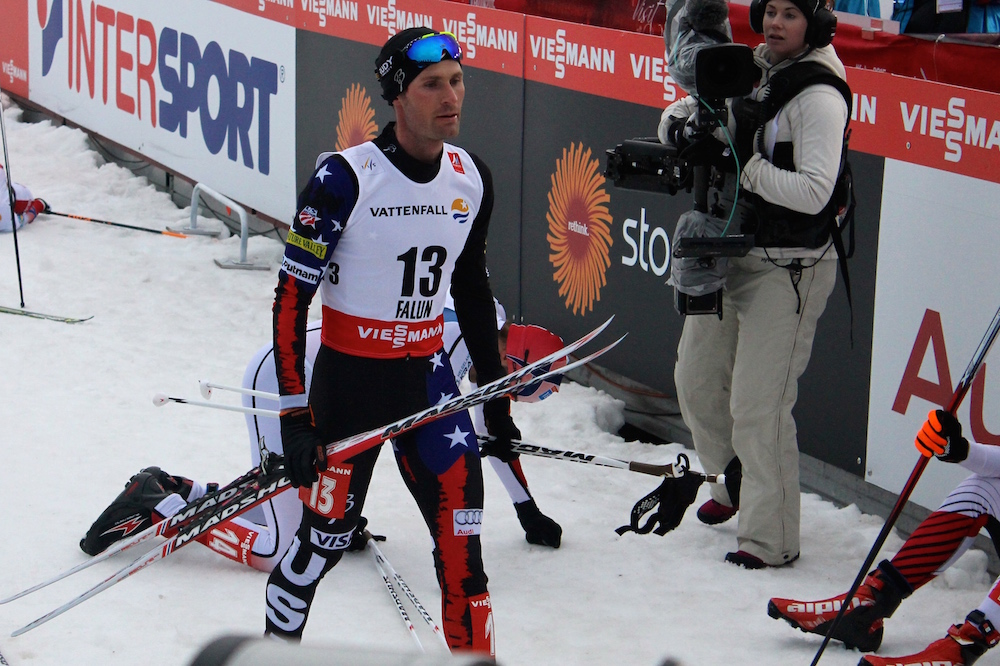
    Bryan Fletcher (U.S. Nordic Combined) after finishing fifth in the large hill/10 k at 2015 World Championships in Falun, Sweden, for an individual season best and career best at World Championships.
    Bryan Fletcher (U.S. Nordic Combined) after finishing fifth in the large hill/10 k at 2015 World Championships in Falun, Sweden, for an individual season best and career best at World Championships.

    Also for the U.S., Demong went from 30th in the jump to 33rd overall (+2:27.3), and Adam Loomis improved from 44th to 41st (+3:46.5) at the end of the day.

    With one competition left at World Championships — the 2 x 7.5 k team sprint — Taylor, for one, was looking for redemption.

    “I know what I did on the hill and what happened and I’ve got one more event [the two-man team sprint] on Saturday, where it’s probably going to be Bryan and I and that’s gonna be special,” he said. “Hell, if he’s skis like he did today, and I jump better on the hill like I know I can, there’s no reason in hell why we shouldn’t be first, second or third.”

    Results

  • Promising Jumps for NoCo Crew at Ramsau World Cup

    “Today was a good day. There was not much wind on the hill – pretty clear weather and cold conditions,” Bryan Fletcher told FasterSkier after finishing 15th in the provisional jumping round of the nordic combined World Cup in Ramsau, Austria. “All in all…I am happy with where I ended up overall.”

    Todd Lodwick led the way for the Americans in the jumping Friday, finishing fourth. The results from the provisional round are used if the weather is too inconsistent for a fair competition on Saturday. And if the forecast comes true, high winds and snow are on the horizon for Ramsau.

    The Austrian venue comes with its own set of challenges, Fletcher says, noting that both the hill and the course are difficult.

    “The jumping is on a small hill and the cross-country course is a tough, tough course. The small hill will bunch everyone together, making the race a bigger part of the game,” Fletcher predicted.

    “The weather for the weekend looks a little windy, so there is a better chance we could use the provisional this weekend then previous weekends.  We’ll see how it looks in the morning, though. I am prepared and hoping to improve upon what I was able to do today,” Fletcher said.

    Psyched about jumps

    US Nordic Combined Head Coach Dave Jarrett was content with the provisional jumping.

    “We are psyched with Todd and Bryan’s results on the hill today but know that Eric [Camerota], Nick [Hendrickson], and Taylor [Fletcher] can be better and will be better,” Jarrett said, adding that for his team, a new jumping round could be beneficial.

    “It’s snowing pretty good here now, so we will see if today’s [provisional jump] will be used on Saturday or Sunday. It can only be used once. I know Todd and Bryan wouldn’t mind, but the other three want two more shots on the hill. We will prepare for another comp tomorrow and see what happens,” Jarrett said. “This is the World Cup and if you want to be high in the results you have to jump well in the competitions.”

    Jarrett knows Lodwick is capable of podium finishes, and that Bryan Fletcher’s 15th was a good result for him. Not surprisingly, Jason Lamy-Chappuis (FRA) won the provisional round with a jump of 96.5 meters, with Bernhard Grueber (AUT) in second place (95 meters) and Espen Rian (NOR) in third (93 meters). Camerota was 33rd, Taylor Fletcher 57th and  Hendrickson 61st.

    Confidence-booster

    For Fletcher, the good provisional round gave him some confidence for the coming races, and a confirmation that he is on track in terms of his own goals.

    “I am feeling confident going into the weekend. Since this weekend will pretty much mark the halfway point in our season, my goals are set at scoring points again,” Bryan Fletcher told FasterSkier. Establishing himself among the top 30 in World Cup competitions has been Fletcher’s aim, and he is sticking to it.

    “I am not raising my expectations, just because the year started off the way I wanted. This weekend, I am simply focusing on doing what I need to do, just to stay in the game. I know I am capable of being in there both days, and I am going to do my best to make that happen,” he said.

    Link to provisional results.

  • Europeans Cry Foul Over NoCo Jumping

    Europeans Cry Foul Over NoCo Jumping

    Todd Lodwick (USA) lands a jump during Tuesday's team event

    As Billy Demong and Johnny Spillane strode triumphantly to the podium for the flower ceremony after today’s nordic combined competition, a parade of sullen-looking Europeans was walking through the mixed zone, in the other direction.

    It was easy to miss them—after all, they weren’t the ones who won medals. But they had an interesting story to tell, too: how Thursday’s weather conditions in the jumping round had ruined their chances for Olympic glory.

    Big names like France’s Jason Lamy-Chappuis, Austria’s Felix Gottwald, and Norway’s Magnus Moan were nowhere near the top, their races compromised by poor jumping that stemmed at least partly from the conditions.

    “This jumping competition has nothing to do with fair competition,” said Gottwald, who, with seven Olympic medals to his name, should know.

    In an event that is only held every four years, with such high stakes, Gottwald said, officials should have done more to ensure that all the athletes got a fair shot.

    “A lot of athletes didn’t get the chance to show their performance,” he said.

    The sport of nordic combined is split between two separate competitions. A ski jump, usually held in the morning, is used to determine the start order for a cross country race in the afternoon, and the athletes with the longest leaps get a head start.

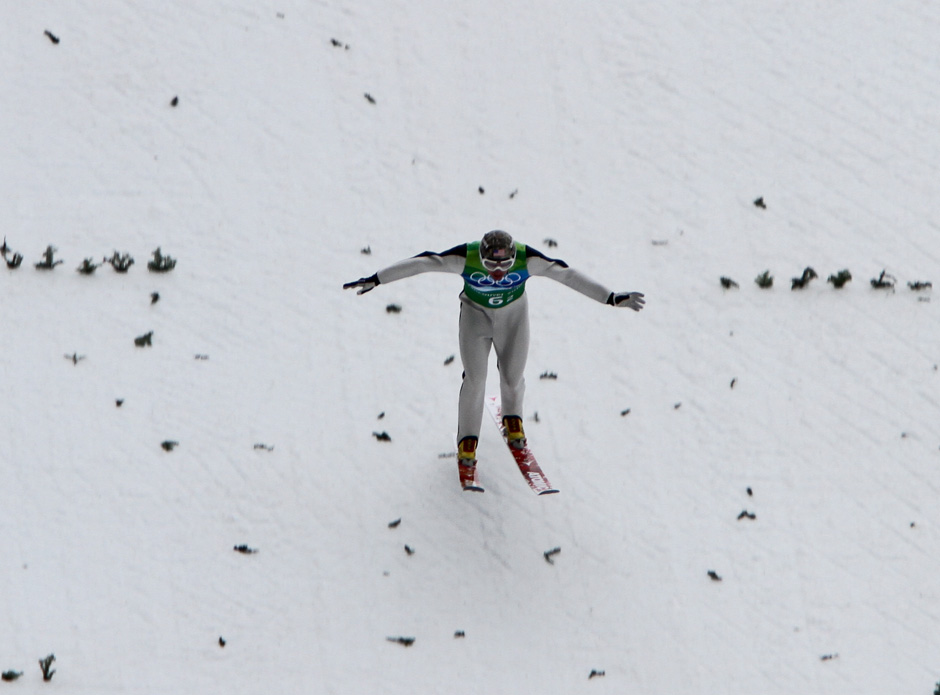
    Since jumpers are in the air for so long, buoyed by puffy suits that help them glide more than 100 meters, minor fluctuations in wind or precipitation can have a big impact on results. That’s what happened Thursday morning.

    “It was switching on and off all day with the wind, and light snow on and off on the in-run,” said Taylor Fletcher, one of the American competitors in the event. “You really had to be on top of your game in order to put one down farther on the hill.”

    During World Cup competitions, which are held almost weekly in Europe, the jury (the officials in charge of regulating the jumping and ensuring a level playing field) has more flexibility.

    If conditions are too erratic, they can delay the jumping until the weather improves, or if things are far too dicey, they can scrap it altogether. If that happens, the cross country race is handicapped using the results from a competition from the day before, called the “provisional round.”

    “Had this been a World Cup event, they would have cancelled today, and used the provisional jump,” said Dave Jarrett, the head coach of the American nordic combined team.

    At the Olympics, though, no provisional jump is held, and Jarrett said that yesterday’s bad weather would have precluded one, anyway. As for a delay or postponement, Jarrett said many teams have flights scheduled for tomorrow—and that cluttered television lineups give officials little choice but to push ahead.

    “The T.V. drives the times,” he said. “When you have the Olympics on such a tight schedule, that doesn’t leave much room for error.”

    While Demong and Spillane both ended up benefiting from the weather, the problems on the hill affected all the teams—not just the Europeans. The third American medal contender, Todd Lodwick, had tough conditions for his jump, while some of the athletes from nordic combined powerhouses France and Austria made it through unscathed—including bronze medalist Bernhard Gruber (AUT).

    But Jarrett did acknowledge that ultimately, the sport’s officials have some work to do.

    “Something needs to change on the jumping hill,” he said.

    One way the effects of the weather could be minimized, Jarrett said, would be if jumpers used thinner suits, like the ones worn by alpine or nordic racers. Those suits trap less air, reducing the impact of changes in wind.

    “The fit and the materials can be a solution,” he said.

  • Led By Demong, A Dream Day for U.S. Nordic Combined

    Led By Demong, A Dream Day for U.S. Nordic Combined

    Gold and Silver

    Whistler, British Columbia – The US Nordic Combined team will paying overweight on their flight back to Park City.  A historic day doubled their Vancouver medal haul, giving them nearly nine pounds of hardware.

    Billy Demong skied away from teammate Johnny Spillane and Austrian Bernard Gruber on the final climb to claim Olympic gold.  With a move of his own, Spillane left Gruber in the dust, too—laying claim to his 3rd silver medal of the Games.

    The US entered the 2010 Olympics never having won an Olympic medal in nordic combined.  They leave with four and have cemented their place as the top team in the world.

    Spillane and Demong were in excellent position after the morning jumping round, in 2nd and 6th respectively.  Gruber posted the longest jump of the day, by an impressive five meters, and sat 34 seconds up on Spillane.  Demong was another 12 behind.

    In the jumping round, athletes had to content with snow, rain, and swirling winds, which wreaked havoc on the results. Clad in puffy suits, which help catch the wind and allow the athletes to sail so far, minute differences in weather can get amplified tremendously.

    Conditions were so erratic this morning that officials scrapped the first round of jumping. But with tight TV schedules and many teams flying home tomorrow, the show had to go on.

    That left a number of top Europeans out of contention, including France’s Jason Lamy Chappuis and Austria’s Felix Gottwald, who blasted the jury (the officials in charge of overseeing the jumping).

    “This jumping competition has nothing to do with fair competition,” he said. “In my opinion, if all the athletes performed like the jury did today, then we would crash on the in-run.”

    Lamy Chappuis and Gottwald weren’t the only ones who got thrown off by the weather—U.S. Nordic Combined Coach Dave Jarrett said that the conditions for Todd Lodwick’s jump were also less than ideal. But France, Austria, and the U.S. all had men in the top five, as well, and there was nothing to be done aside from strap on the skis in the afternoon.

    “No matter how many times they restarted they restarted that competition, no matter how windy or snowy it got, we were going to do our best,” Demong said.

    With the jumping results set in stone, Demong set about closing the gap to Spillane right out of the gate.

    Already, by the end of their first 2.5 kilometer lap, Demong had dropped the skiers that started with him, bridging up to his teammate.

    Trading the lead, the two worked to close the 30-second gap to Gruber—part of the plan they had devised before the race.

    Spillane leads Demong through the stadium afte rthe first lap.

    “The big goal that we had before the race was to get two guys on the podium, preferably one-two. And the way we were going to do that was exactly what we did: I had to ski up to [Spillane] alone, and then we had to go together like it was a team time trial, and do the best we could to work over Bernhard Gruber,” he said.

    Knowing that he was outmanned, with the two Americans working together behind him, Gruber was conserving energy.

    “I started out quiet as not to get tired legs,” he said.  “I knew the two strong men…were coming from behind.”

    USA takes over the lead.

    Before the halfway point, Gruber had been caught, and more importantly, the large chase pack that formed behind was not gaining any ground. Poor skiers, the other athletes starting between Demong and Spillane quickly fell off the pace.  But Mario Stecher (AUT), who outkicked Demong in the team event two days ago, and the always-dangerous Petter Tande (NOR), set to work, and their group continued to grow as more skiers came up from behind, including American Todd Lodwick, in bib 13.

    Lodwick moved to the front of the pack, and taking a page from the Swedish cross-country team in the pursuit, he attempted to control the pace.

    “I went in the lead [of the chase group] and slowed the pack down, said Lodwick.  “Other skiers were not so happy, but who cares?  We’re on the podium.”

    Halfway through the 10 kilometer race, the chasers were 32 seconds back.  At the next checkpoint, a k-and-a-half later, the gap was up to 46 seconds, and it was clear that the medalists were decided. The only question remaining was who would get gold.

    Demong and Spillane continued to switch leads, and several times it appeared they had shaken Gruber. He seemed to struggle all day to maintain contact with the Americans, never even getting near the front. As soon as Spillane and Demong took the lead one lap in, they had the race in a vice grip, applying accelerations and pace changes to tire out the Austrian.

    Demong and Spillane working over Gruber

    The Americans had been in similar situations earlier this year, with multiple athletes in the lead group, but they hadn’t been able to take control the way they did here on Thursday.

    “I think the major difference, especially today, was the fact that Johnny and I are really, really fit now,” Demong said. “We’re racing faster than we did before…that’s what makes the biggest difference. And today we had that luxury of being able to just go as hard as we could together, skiing away from everybody else, pretty confident that we could both beat Gruber—and that’s when team tactics really work.”

    In to the stadium with one lap to go.
    The Austrian especially had trouble maintaining the pace over the tops of the bigger climbs, but he always managed to claw his way back.  This raised the specter of ski speed – the Austrians clearly had better boards in the team competition, most strikingly in the final push when Stecher easily glided away from Demong in the stadium.

    But it was finally Demong’s Olympic day.  With the fitness and speed that he has displayed in cross-country over the several seasons, he attacked furiously halfway up the final climb, and Gruber was gone instantly.  Spillane could not match Demong, but he fired up his own engine, and dropped the hammer on the Austrian as well.

    Spillane appeared to close on Demong down the backstretch, but the three-time World Championship medalist put in one final acceleration around the final corner. With that, the U.S. nordic combined team made history for the third consecutive race.

    “That was the best finish I have had in a race all year,” a composed Demong told media.  “We are racing faster than ever.”

    The stadium video board shows Demong (left) and Spillane (right) breaking away.

    The rest of the field came streaming in.  The great Hannu Manninen (FIN) skied up from 16th at the start to finish 4th, and Gottwald, furious after the jump, threw down for the fastest ski time, 17 seconds ahead of Demong.  That performance, however, only moved him up to 17th.

    “I had a small chance for a medal,” said Manninen following the race, “but there were three better guys today, and the gap was too big.”

    Demong was still at a loss for words at the press conference, an hour after the finish.

    “I’m still trying to wrap my mind around that,” he said, when asked what it felt like to become the first American to win Olympic gold in the nordic sports. “I’ll let you know in ten or fifteen years from now.”

    Demong – Victory!
    Spillane – Three races, three silver medals.