Tag: BethAnn Chamberlain

  • Finding Assurance with Michael Stone

    Finding Assurance with Michael Stone

    We often hear of the pipeline in Olympic sport. The path to the highest level of elite competition. The pipeline is not consistent in diameter: Wide-mouthed at its start, tapered to needle-wide at its terminus. There are many ways to identify talent within a pipeline. In the cross-country ski world, there are incremental benchmarks to progress to the next tier. Within U.S. Ski & Snowboard, for example, skiers in the pipeline begin in the club system and might progress from local, regional, Junior Nationals, Junior Worlds, to senior-level racing.

    It’s a system with a relatively steady influx of skiers at the pipeline’s intake.
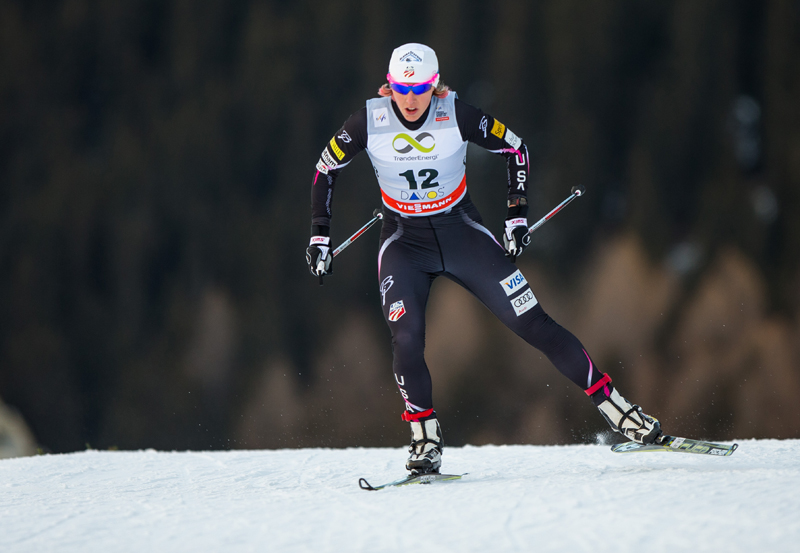
    Kikkan Randall racing here in 2013 on the World Cup, advanced through the U.S. Ski Team’s pipeline. (Photo: Fisher/Nordic Focus)

    One aspect of the product, the potential to advance in the pipeline, can, in many ways, sell itself. If you live in a mountain town or northern latitude city, odds are cross-country skiing is on the menu of outdoor activities for certain demographics. Two American women winning gold in 2018 is also a wonderful sales pitch to aspirants. This healthy lifestyle and medal-winning context afford stakeholders a modicum of breathing room when considering marketing approaches to athlete recruitment and the ability to maintain pre-existing participants. Although the problem of attrition in youth sports is real, and cross-country skiing is no exception, junior-level ski racing remains popular in traditional cross-country ski hotbeds.
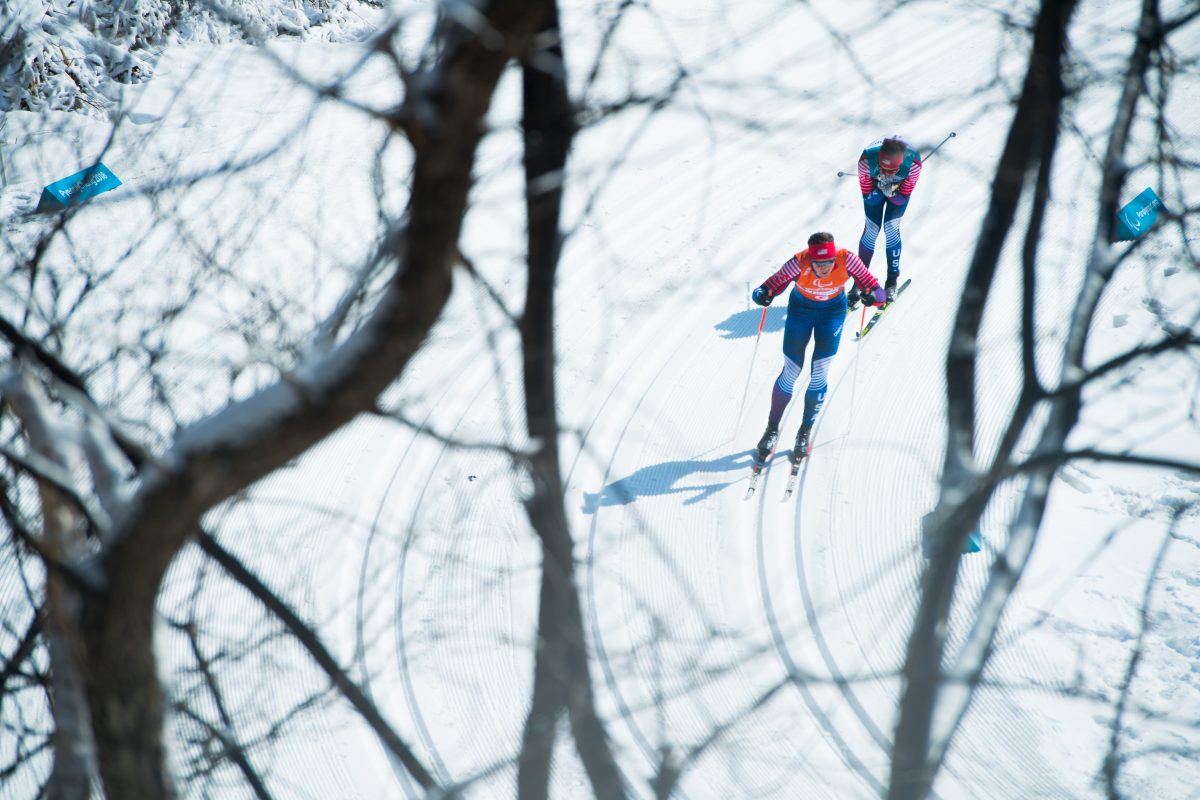
    Sawyer Kesselheim guides his U.S. teammate Jake Adicoff, a visually impaired athlete, during the open relay at the 2018 Winter Paralympics in PyeongChang, South Korea. (Photo: U.S. Paralympics/Mark Reis)

    The Para side of the sport, however, must take a more active approach when it comes to marketing. Drawing athletes into the Para Nordic disciplines requires a significant time investment with national-level coaches often meeting in small groups with raw beginners to introduce their respective disciplines.

    A few weeks back, US Para Nordic hosted a Zoom call for visually impaired (VI) athletes and families interested in learning more about how to become involved.

    Two US Para Nordic coaches were on the Zoom call, Kristina Trygstad-Saari, and BethAnn Chamberlain, along with several veteran athletes and a few newcomers. In terms of grassroots, this was the seeding process. A visually impaired participant logged in from Los Angeles, another potential visually impaired athlete, a teenager, logged in from Indiana. Neither had easy access to snow. Neither had skied before.

    A basic Q & A ensued. There was nothing extravagant about the presentation. Lots of nuts and bolts. Let’s call it pithy. Yet, the level of engagement was high. The meeting, which could have trended towards perfunctory, was not. By the end of the call, maybe 45 minutes later, the hook was sunk.

    My intent for listening in was to learn how US Para Nordic pitches their sport and attracts prospects to their respective pipeline, and then write up a brief story. I became sidetracked.

    ***

    Fifty-two-year-old VI biathlete Michael Stone, who spoke during the Zoom call, was my hook setter. Stone resides in Boulder, Colorado. According to Stone, his first race of any kind was the Bolder Boulder — an iconic 10-kilometer road running race that snakes through Boulder’s neighborhoods and finishes in a packed Folsom Field on the University of Colorado campus.

    “That was probably one of the most spectacular days of my life. And since then, over 21 years, I’ve done over 230 races,” said Stone.
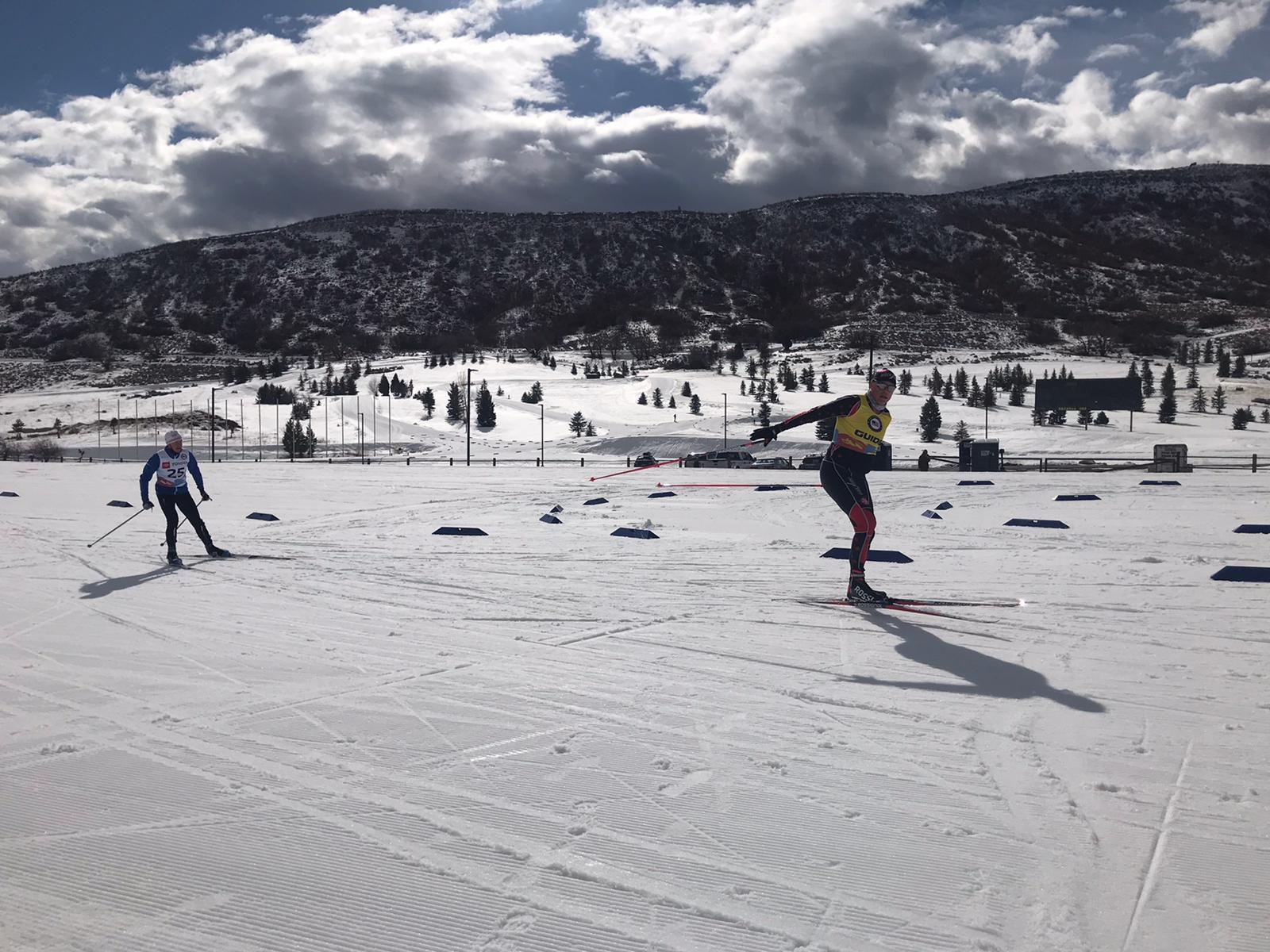
    Colonel Don Hickman guiding Michael Stone at Soldier Hollow. (Courtesy photo)

    In 2003, Stone completed his first Ironman. That race, in contrast to Stone’s first Bolder Boulder experience, was inauspicious. The race was in New Zealand, and at one point Stone inadvertently took a wrong turn. “I remember one of the course marshals yelled, ‘What are you blind?’ At that moment, I actually wondered if I was,” recalled Stone. “I mean, I remember feeling very, you know, dejected.”

    There’s a backstory here worth telling. Post-New Zealand, Stone returned to his childhood home in Chicago to seek advice from his family physician.

    The abridged version of Stone’s adolescence, which the doctor took notes on, goes something like this. A caring family that exposed Stone and his siblings to sports and the arts. There were eventual vacations to Aspen for downhill skiing which Stone began to dread. “Everybody else would be exhilarated and I’d be miserable,” said Stone. “We’d be skiing in the trees and I’d fall, and not even know why. I was screwed, even in good light. And it should have been a good indicator that something wasn’t adding up.”

    There were attempts at ball sports where Stone often could not see the ball thrown his way. There were laughs, and the “he sucks” microaggressions.

    “At some point, you just stay away from sports because it’s intimidating, it just eats away at your soul,” said Stone. “For a young person struggling, with their vision of something undiagnosed like dyslexia, every aspect of life is going to be very hard.”

    Stone withdrew. He folded himself into music where he learned to play the guitar and other instruments. “That’s where I hid from the world,” he said.

    But if you thrive on moving your body, as Stone does, the draw of sports can be irresistible. Stone eventually found martial arts, and then rock climbing – which initially brought him out to Boulder. According to Stone, hearing his climbing partners constantly tell him where to place his hands and feet pushed him out, saying it became too exhausting emotionally. He purchased a bike and he began to run.

    Then there was that goose-bump Bolder Boulder where Stone came running into that packed stadium. “It was just such a spectacular feeling that I forgot all about anything related to my vision or whatever,” said Stone. “It was simply that I ran six miles and that was huge.” Then came the Ironmans and the demeaning “What are you blind?” comment from the course marshall.

    ***

    Back in Chicago, Stone visited his physician and then a specialist who sent him to another specialist. The MD-PhD diagnosed Stone with a genetic degenerative disease called retinitis pigmentosa. The disease affects the retina’s photoreceptors.

    “The doctor was just beside himself,” said Stone. “He asked, ‘How have you gotten through life like this?’ It was like he knew everything, and he quickly told me what my life was like because obviously, it was a familiar story to him with sports and with school and family life, everything, he just sort of knew it. He had been diagnosing these things for probably 40 years. He was shocked that I had gone through life undiagnosed.”

    Stone said he had most likely been legally blind since he was five. His youngest brother was also diagnosed with the disease. Eventually, they traced the gene back in the family’s genealogical tree.

    The diagnosis helped Stone define his life trajectory. But as a successful hotel and spa developer, Stone has not defined himself solely as an endurance athlete. He is, like many role models among us, capable of compensating, adapting, thriving, and finding community. Stone understands his predicament but moves forward. He knows he’ll occasionally miss his toothbrush with the toothpaste, have issues making a simple cup of coffee, or have difficulty finding a public bathroom. Stone navigates a physical and emotional culture set up for the able-bodied. He’s still out there riding, running, swimming, skiing, and running a business — all at a high level.

    During some background reading about life as a visually impaired person, I came across this excellent story in the New York Times: Is There a Right Way to Act Blind by Andrew Leland. In short, Leland, who himself is blind, keenly explores how some people experience blindness, but also how sighted actors portray blind characters.

    This passage from Leland’s piece caught my attention: “I recently spent a weekend with a friend who has been blind since childhood. I watched him pat and fumble for objects, but he did so in a way that struck me as utterly assured, and entirely unembarrassed — his fingers scanned the table just as your eyes might: quickly, casually, without apology. I aspire to this kind of blindness. The only way to get there, I suspect, is through rehearsal — practicing until my blind presence becomes convincing, if not to the world then at least to myself.”

    Leland’s words, for me, resonated. It was a reminder that we travel the world on a gradient. We are constantly aspiring to be “utterly assured, and entirely unembarrassed.” I’m still trying to let that all sink in and imagine what that might be like for someone experiencing a disability and hailing a cab, or simply bathing. Let alone performing an endurance sport like biathlon at a high level.

    ***

    Stone discovered cross-country skiing over a decade ago and ultimately found an interest in biathlon. Para biathletes use an audio rifle with no live rounds. As the biathlete aims closer to the target, remember, this is the visually impaired class, the noise projected from the rifle becomes higher pitched. The VI athlete pulls the trigger when they sense via the rifle’s audio signal the shot is on target. Like able-bodied biathlon, keeping range time to a minimum is part of the challenge.
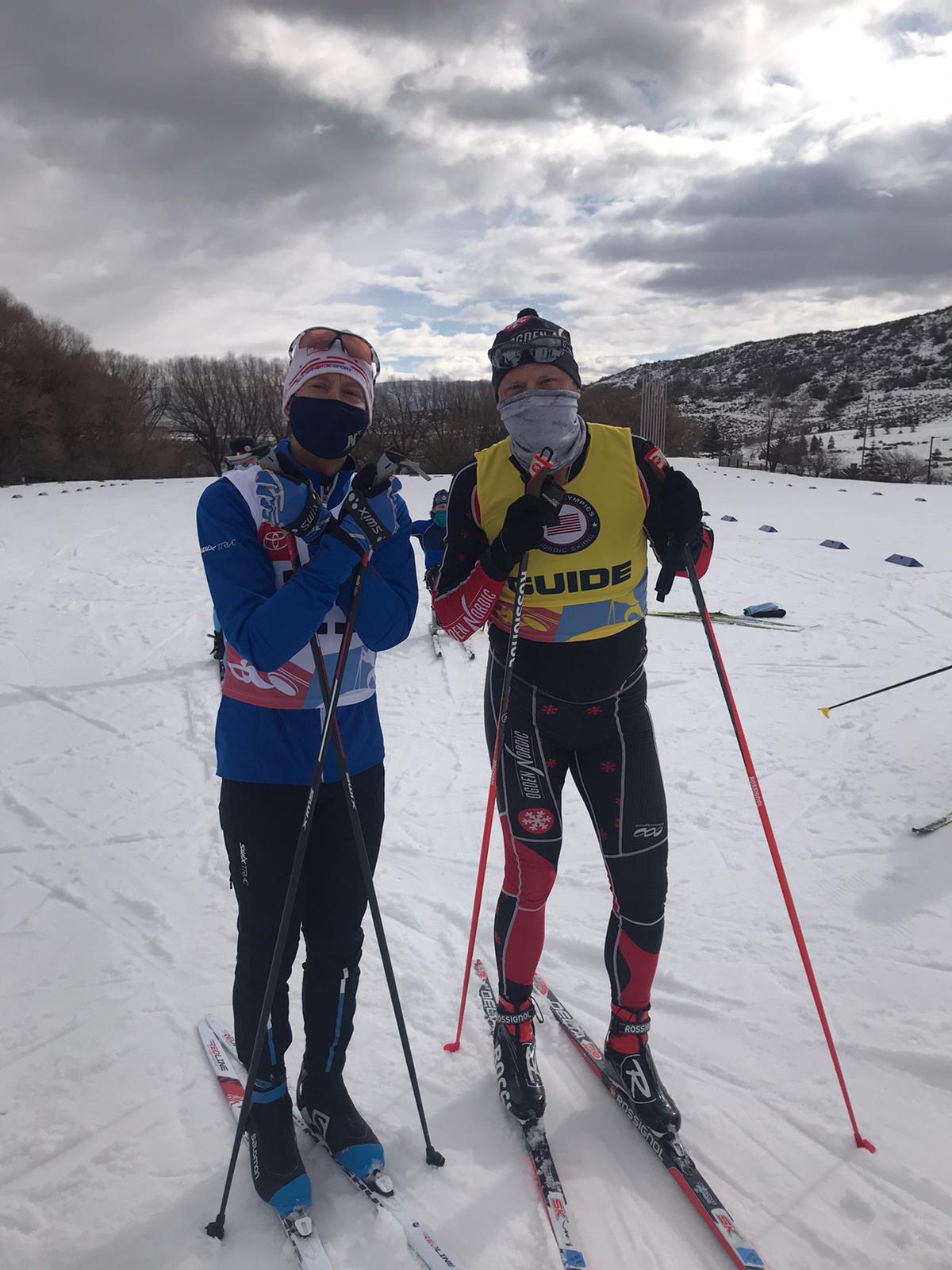
    Michael Stone (left) with his guide, Colonel Don Hickman (right), at Soldier Hollow. (Photo: BethAnn Chamberlain)

    Stone admits, although he is an accomplished triathlete, that he desires more independence. He rides on a tandem bike, and in some situations remains tethered to a sighted guide when running. Stone equates freedom with cross-country skiing. The closest he feels to being able-bodied is when he is skiing and then shooting on the biathlon range, explained Stone.

    “Cross-country skiing is one of the most spectacular sensations because it’s the closest thing I get to freedom and independence out of any sport I do,” said Stone. “I’m not tethered cross-country skiing, as I would be for running or swimming like we do in triathlon, I’m not on the back of a tandem. We’re on our own skis, on our own snow, and we have our own mistakes to make. We do get lefts and we get rights and a few whoops as verbal cues from a sighted guide, just to keep straight. And once we drop down in the shooting range, as we always shoot prone, it is pure freedom.”

    In the Para Nordic biathlon world, VI athletes are relatively scarce. That makes sense considering the logistics of transport, arranging a sighted guide if needed, and having access to a rifle and shooting range, let alone snow. Stone, for his part, has become an unassuming ambassador who wants to give back to a community of coaches and peers who have refeinforced his self-assurance. He is, as I came to realize, the perfect salesperson for any athlete hoping to get motivated and seize any opportunity.
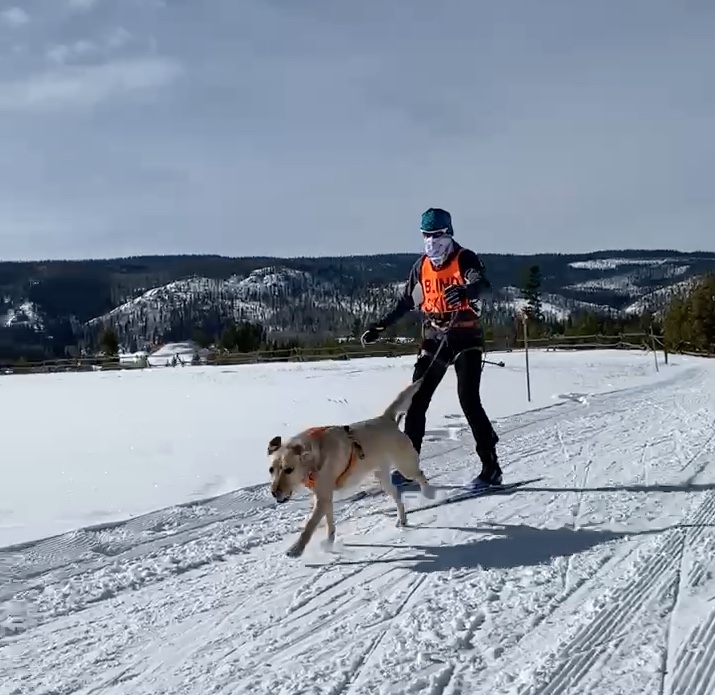
    Michael Stone skiing with his guide dog Geo. (Courtesy photo)

    “I’m not a young guy, and so when there are younger people, say in their teens and 20s and 30s, I don’t want them to miss out on this opportunity to experience biathlon — not to mention, just to be able to experience the love we get from the coaches,” said Stone. “I really don’t know why it’s there, they’re like higher beings to me. Nobody should face the world alone. And the fact that there are people that are willing and capable to at least try to walk in your shoes and create an opportunity for you when there are really few opportunities in this world that will be generated like this. I live by only a couple really important codes and one of them is you owe your best to the people who love you most.”

    My impression from Stone is that he could do most anything he wanted with his life. It’s a good thing he found cross-country skiing and biathlon. We’re better for it.


    For information about becoming a sighted guide, or becoming involved as an athlete, here’s a link to US Para Nordic’s recruiting survey.

    To learn more about how a VI biathlete shoots on the range, watch the video below. The on-range segment begins at approximately 2:55.

     

  • Wednesday Workout: Preseason Agility with U.S. Paralympics Nordic

    Wednesday Workout: Preseason Agility with U.S. Paralympics Nordic

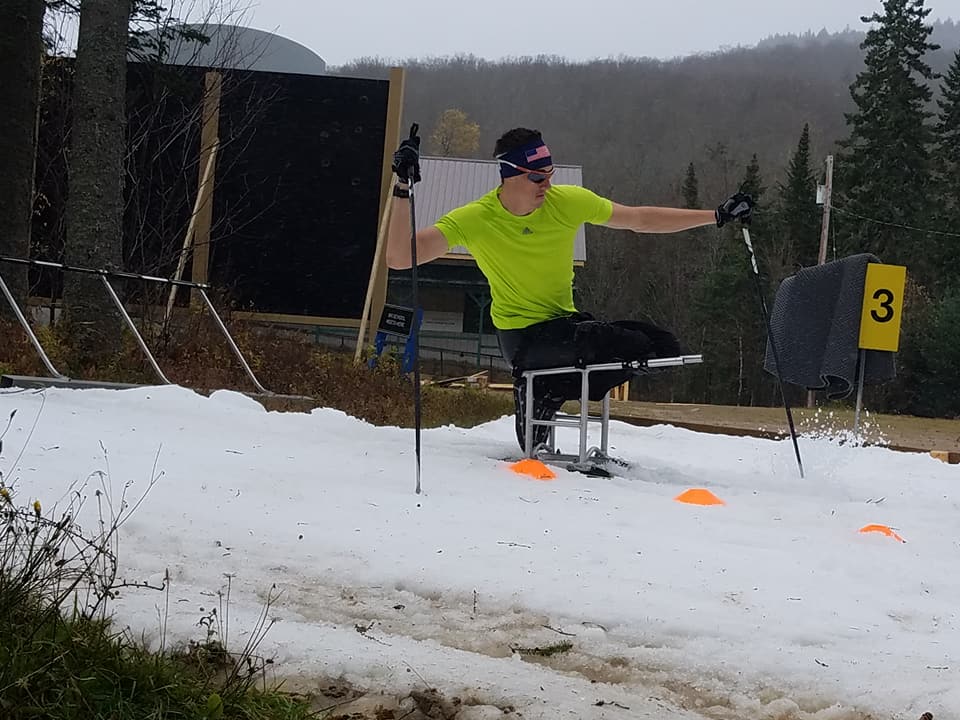
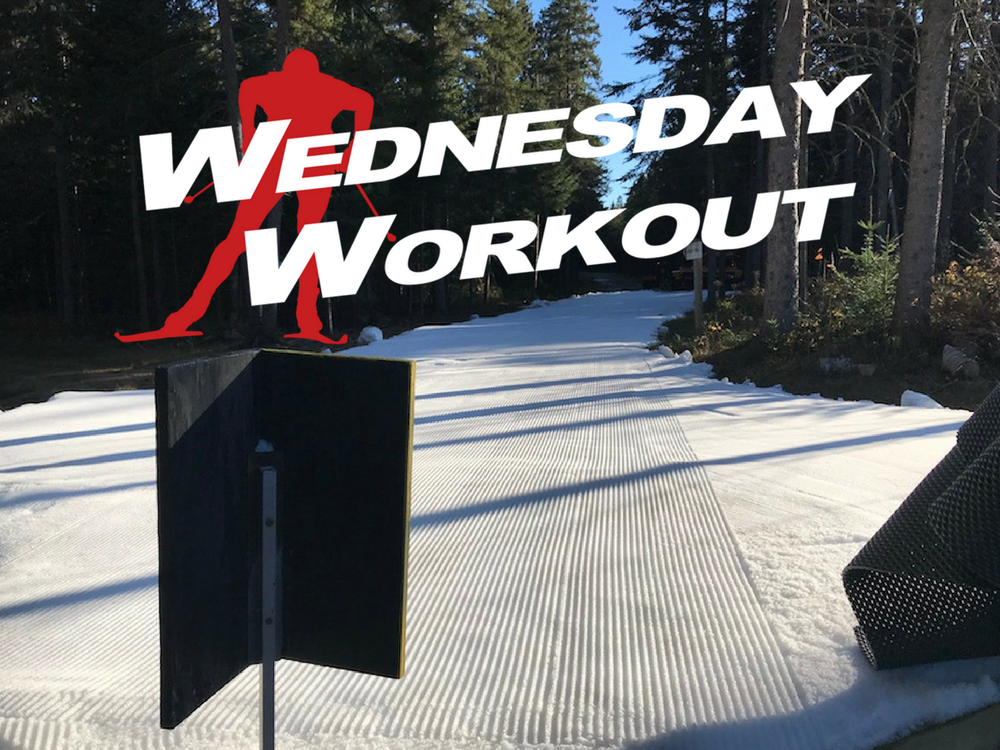
    A look at Mount Van Hoevenberg’s freshly groomed, machine-made trail in late October during a U.S. Paralympics Nordic Program camp in Lake Placid, N.Y. (Photo: BethAnn Chamberlain)

    It’s that time of year when everyone’s raring to get on snow. Let’s say you’re lucky enough to find some — even just a few hundred meters — like the U.S. Paralympics Nordic team did late last month at a training camp at Mount Van Hoevenberg in Lake Placid, N.Y.

    Seven athletes — a combination of high-performance and development skiers — spent a week at Van Ho from Oct. 23-29 for the nordic center’s earliest opening yet on machine-made snow. Starting Oct. 1, the area’s SnowFactory blew enough snow for a 480-meter loop wide enough for two-way skiing. And it did so despite daytime temperatures hovering around 70 degrees Fahrenheit.

    U.S. Paralympics Nordic’s 2017 Lake Placid camp attendees:

    High-performance athletes:
    – Jeremy Wagner
    – Eric Fraizer
    – Bryan Price
    Development athletes:
    – Julius Schram
    – Chris Rassmusen
    – Dave Nicholes
    – William Ward

    On top of that, Van Ho organizers constructed a two-point, 10-meter Para biathlon range, which was connected to the loop and gave the team’s biathletes a place to practice shooting.

    But on Day 2 of camp, the rains came, putting a sizable dent in the skiable terrain. While Van Ho was rebuilding its loop for the end of the week, the Para skiers switched gears to dryland training, shooting and rollerskiing/mountain boarding at the venue’s full-size biathlon range and rollerskiing the paved loop at Lake Placid’s Olympic Jumping Complex — the latter of which is known for its challenging terrain.

    “This was a first for us and proved to be a great training site for all of our sit skiers,” BethAnn Chamberlain, the US Biathlon Paralympics development coach who led the camp, explained in an email, referring to the jumping-complex trails. “Late in the week, despite the continued warm temperatures, the Mt Van Hoevenberg crew was able to put together a short strip of snow for us again, including giving us access to our Biathlon range area.”

    What did they do to make the most of their on-snow time? Chamberlain shared an agility workout for “even the smallest stretch of snow.”

    The Workout: Early season agility

    What you need: At least 200 meters of snow, cones, and if possible, a corner on the track (cones can substitute if no corner is available)

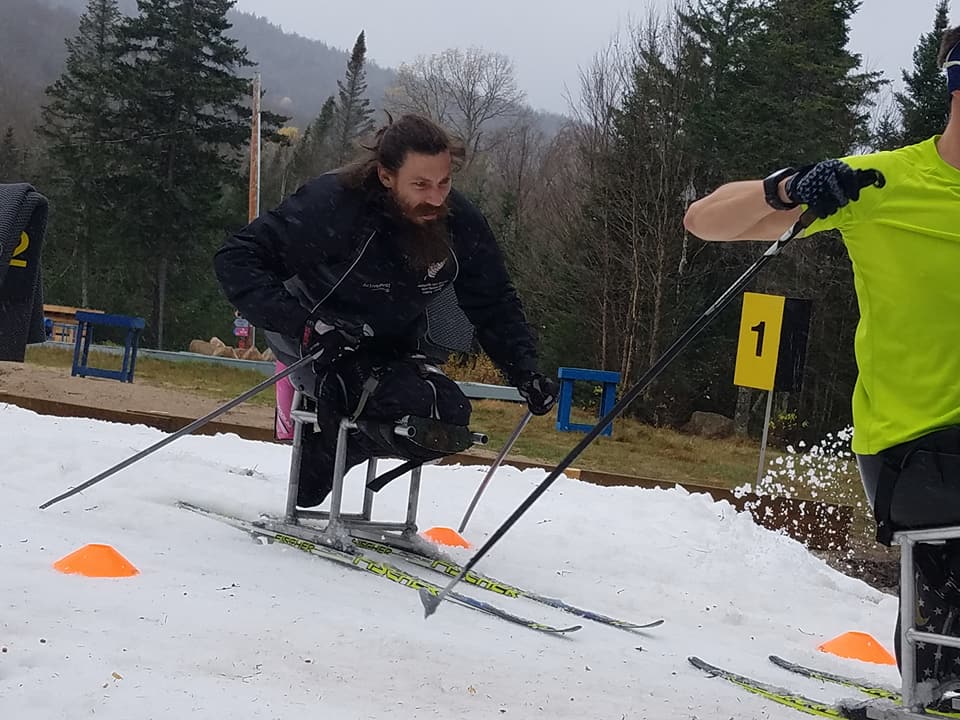
    U.S. Paralympics Nordic high-performance athlete Bryan Price (Casper Mountain Biathlon Club) rounds a corner during an agility workout at a U.S. Paralympics on-snow camp in late October at Mount Van Hoevenberg in Lake Placid, N.Y. (Photo: Mt. Van Hoevenberg/Facebook)

    What you should know: “The basic premise of this workout is to have the athletes ski corners and around cones at different speeds and by taking different lines, and doing so on their own as well as in groups,” Chamberlain explained. “This not only helps the skiers develop a better feel for how their sit ski responds to their movements around corners, but also opens up the idea of the near infinite approaches and techniques to get around a corner or to maneuver around other skiers on course.  (It only take a few minutes of skiing in a sit ski to truly appreciate how difficult it is to maneuver and stay upright, and do so with speed in a sit ski.  I highly recommend everyone, adaptive and non-adaptive skiers to give it a try.)  This is a speed workout disguised as an agility workout.”

    Setup: Using cones, construct two slalom courses for the athletes to race through, head to head.

    Warmup: 20 minutes of easy skiing

    The workout: (45 minutes to 1 hour total)

    • First, ski course at an easy speed and work up to a sprint speed.
    • Then, start the “races”, with two athletes racing at a given time, competing against each other on the parallel courses.
    • Throughout the session, change it up. “You can continue to run ‘races’ in this manner, change the position of the cones, to create different corners to practice on,” Chamberlain wrote. “You can then move onto 180-degree turns, long sweeping turns in both directions and every other kind of other turn you can think of.  Athletes will ski these corners on their own as well as in groups or pairs at easy speeds to start and ramping up to race speed.”
      • “A continued change in the position of cones creates changes the turn they have to make and keeps the athletes engaged and challenged to practice different lines and approaches through out the workout,” she added. “Run these drills along with additional variations such as shuttle run ‘races’ & slalom style turn relays for 45 minutes to an hour.”

    Cool down: 20-30 minutes Level 1 skiing.

    “We had a great week of training in Lake Placid,” Chamberlain noted. “The folks at ORDA [New York State’s Olympic Regional Development Authority] and Mt Van Hoevenberg were amazing and worked very hard making snow for us, which we were able to use for skiing and for Biathlon training.”

    Jeremy Wagner (in black) chases Bryan Price, his U.S. Paralympics Nordic and fellow 2014 Paralympian, during an agility workout at a team training camp in late October at Mount Van Hoevenberg in Lake Placid, N.Y. (Photo: Mt. Van Hoevenberg/Facebook)

    Kris Cheney Seymour, the nordic program and events manager at Mt. Van Ho and ORDA, which owns the venue, explained in an email that while the week was reminiscent of 2017 Junior Nationals (which were also forced to relocate to the jump-complex trails), it was certainly worth it.

    “Hosting the U.S. Paralympic on-snow fall camp is a wonderful opportunity and provided a timeline that pushed boundaries to do something that is normally outside the realm of possibility,” Seymour wrote in an email. “The effort to pull this off was more about effective planning and management of the process.  Of course the dedication of our staff to pull off all pieces was considerable, but everyone had a pieces and executed it well.

    “We started with 480-meter-long stretch of snow, 2 feet deep and 16 feet wide,” he explained.  “The SnowFactory snow was very durable to skier traffic.  In the middle of the week we had a significant rain storm with high winds that compromised the loop and we had to rebuild for the end of the week. … It was a small flashback to the weather we dealt with last year at Junior Nationals.”

    The nordic center is currently stockpiling snow from the SnowFactory in order to open to the public. Over the course of the winter, Van Ho has a stated goal of being open 150 days with skiable snow; last year, it was open 139 days thanks to the SnowFactory (as opposed to 39 days the year before without it).

    “We have a SnowFactory because of unpredictable winter weather,” Seymour wrote. “… Without the SnowFactory this past season we would have lost the stadium and connector trails just under 40% of the days we were open.  Our season would have been closer to 85 days if we only had natural snow.  … As pioneers with the SnowFactory in North America we are still learning from the machine and perfecting our warm weather snow management.  TechnoAlpin has been helpful in sharing how others have used the SnowFactory around the planet, but to some extent, all locations have their own challenges.”

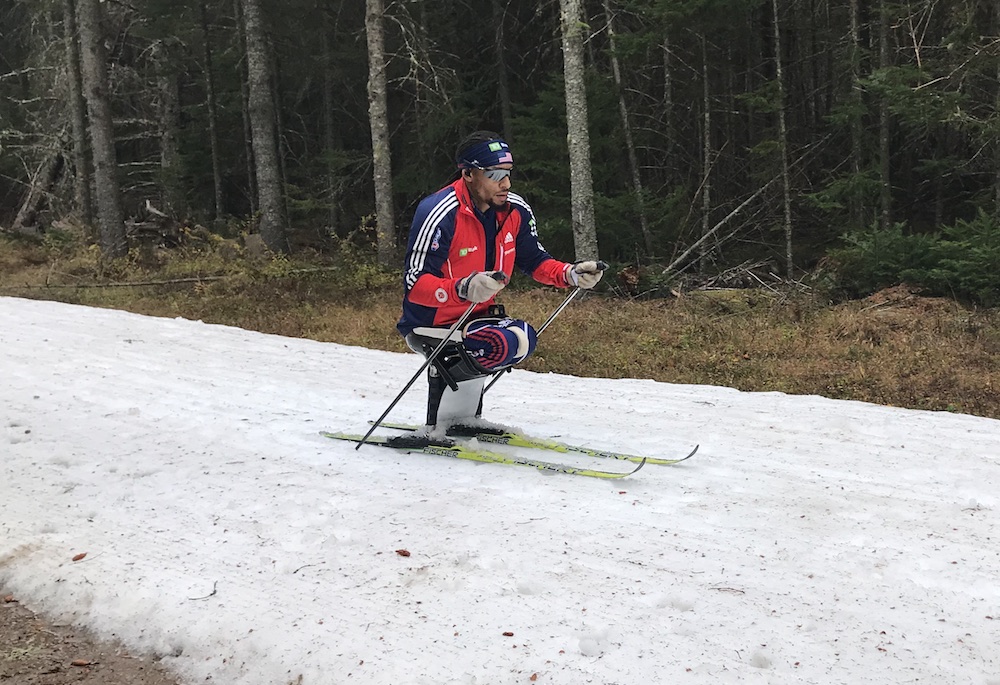
    U.S. Paralympics high-performance athlete Eric Frazier training in late October on machine-made snow at Mount Van Hoevenberg in Lake Placid, N.Y. (Photo: BethAnn Chamberlain)
  • Nordic Skiers Headed to NYC for Premiere International Stroll-a-thon

    Nordic Skiers Headed to NYC for Premiere International Stroll-a-thon

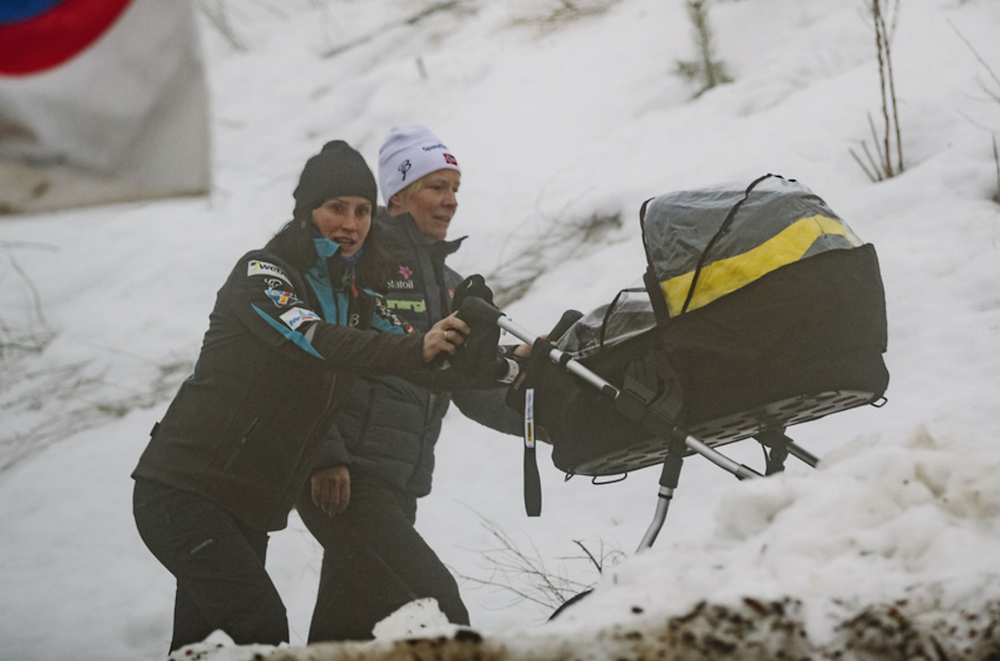
    Marit Bjørgen of Norway (l) gets in some early season hill climbing with the stroller in preparation for the 2016 NYC Stroll-a-thon. (Photo: SportoweFakty)
    Marit Bjørgen of Norway (l) gets in some early season hill climbing with the stroller in preparation for the 2016 NYC Stroll-a-thon. (Photo: SportoweFakty)

    Ready. Set. Stroll. When 7,000 contestants charging carriages hit the streets of New York City (NYC) this year at the 2016 NYC Stroll-a-thon, a few nordic names may find a new race niche that has nothing to do with snow. Especially if the U.S. Ski Team’s Kikkan Randall and Norway’s Marit Bjørgen steer a stroller the same way they ski.

    After side-stepping the 2015/2016 World Cup season, Bjørgen and Randall will release nine months of curbed competitive edge at the debut marathon event — presented by the New York Road Runners organization — which promises competitors 26.2 miles of the steepest inclines and most tactical turns in stroller racing.

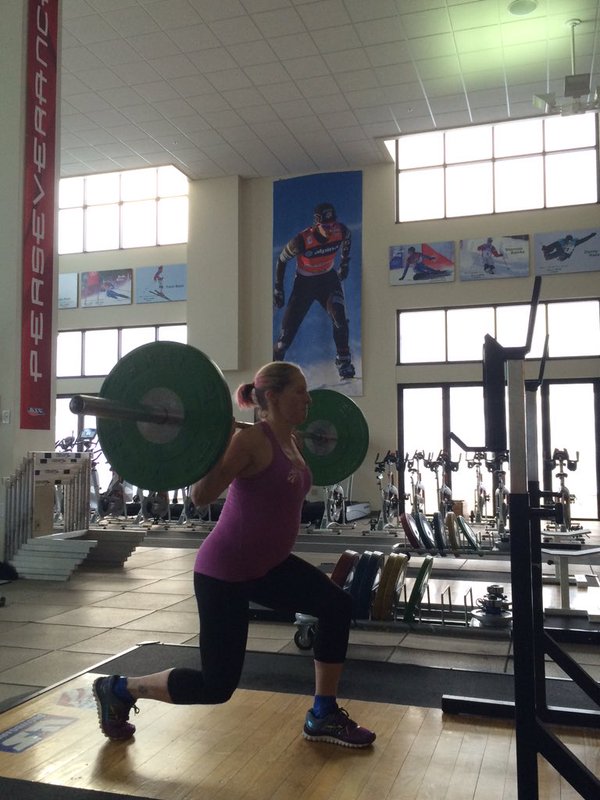
    U.S. skier Kikkan Randall sets early season squats as preparation for the NYC Stroll-a-thon taking place this May. (Photo: Kikkan Randall/Twitter)
    U.S. skier Kikkan Randall sets early season squats as preparation for the NYC Stroll-a-thon taking place this May. (Photo: Kikkan Randall/Twitter)

    Open only to parents who can cover the course with their child in a carriage (*see more detailed rules and regulations below) the NYC Stroll-a-thon is scheduled to take place May 2, 2016 — though Randall admits her April due date will be cutting it close.

    “I’m as strong as I’ve ever been,” Randall said in a phone interview.

    “My main concern is switching to the spring training cycle, which for me includes a 50-percent increase in stroller hours and a sizable volume jump for Bean,” she explained, confirming recent rumors that she and husband Jeff Ellis have made the decision to name their child ‘El Bean’ — Bean for short — a decision primed by one of Randall’s sponsors, L.L. Bean, which offered to pay for the child’s college education if Randall and Ellis could find a way to christen the child after the company.

    With a three-month head start of stroller steering on Randall, Bjørgen will no doubt prove a force to be reckoned with at this year’s NYC Stroll-a-thon.

    But Bjørgen is not the only nordic skier who is well practiced in the art of carving the streets with their child and carriage.

    Norwegian nordic superstar, Øystein Pettersen, better known as “The Sausage,” has also confirmed his entry in the event. He and his son, who was born this July 2015, have spent much of this winter ski season meditating their moves for the marathon course.

    “It will be tough challenge, for sure” Pettersen wrote on Twitter. “But baby boy and I are ready to bring the burn.”

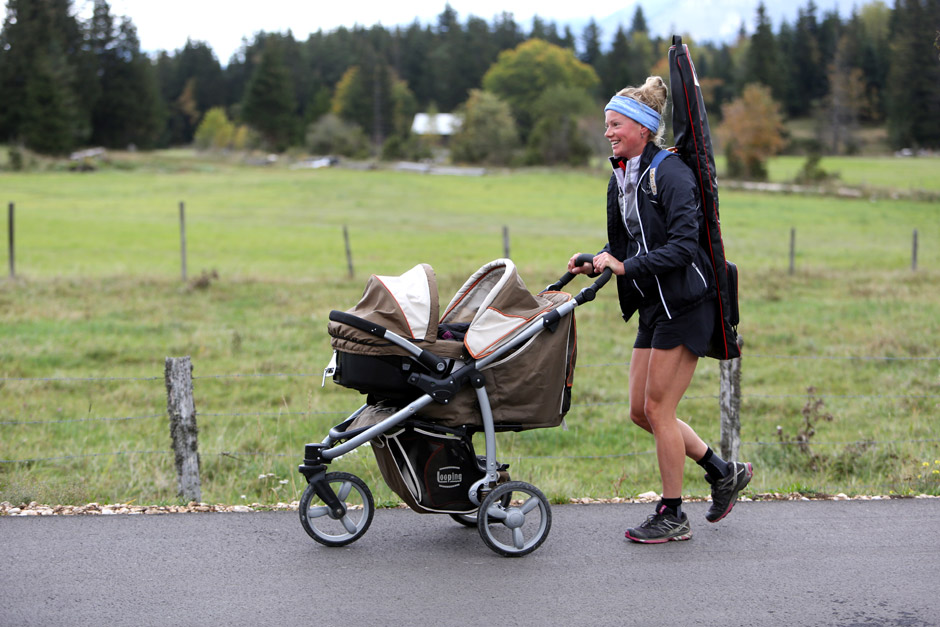
    Also competing in the event is French biathlete Marie Dorin Habert, coming off two individual gold medals at 2016 IBU World Championships, and the U.S. Paralympics Nordic Development Coach, BethAnn Chamberlain.

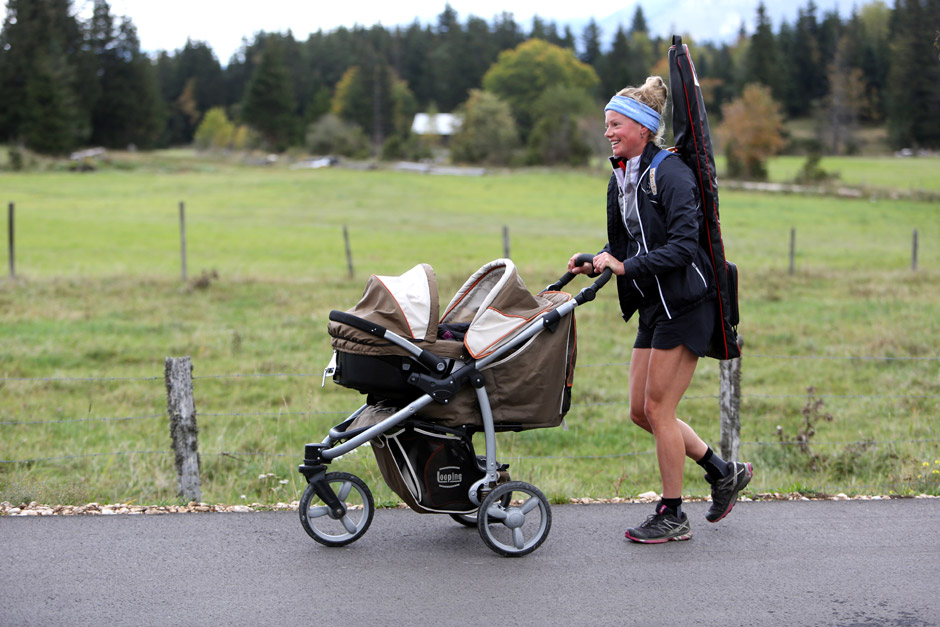
    French Biathlete Marie Dorin Habert getting training for the upcoming NYC Stroll-a-thon. (Photo: DauphieNordique)
    French biathlete Marie Dorin Habert getting training for the upcoming NYC Stroll-a-thon. (Photo: DauphieNordique)

    Selecting the Right Stroller

    The NYC Stroll-a-thon, which follows the same a point-to-point course for the NYC running marathon, tests racer’s stamina and steering skills, making savvy stroller selection critical for participants looking to win.

    Bjørgen will sport the lightweight Kolcraft Cloud 2015 stroller, which features an adjustable canopy, shock absorbing front swivel wheels, and foam padded handles. Weighing in at only 11.4 pounds and earning an average rating of 4.3 stars, this model remains one of the best hill climbers in the industry.

    However, the Cloud’s strongest selling point is also its weakness. Without much weight in the front, the Cloud makes wieldy turns, which heightens the chance of blowing a crucial course curve.

    Yet, Bjørgen finds herself more well-suited for technical steering, preferring to gamble with race technique tactics than lost time on an incline.

    Randall will run Bjørgen’s rival carriage, the BOB Sport Utility Stroller. The fixed front wheel and treaded tires necessitate more aggressive driving, but Randall prefers the stroller stability and top of the line suspension system for Bean.

    Pettersen on the other hand will opt for the industry’s heaviest hitter, the ŠKODA stroller, an ATV-style stroller designed by a Czech automotive company. At two meters tall with complete high suspension and brake systems, it’s no surprise Pettersen will choose ŠKODA.

    *Rules, Regulations and Registration:

    A few of the most unique rules that apply to the 2016 NYC Stroll-a-thon are summarized below.

    • Children must be legitimate: competitors may not enter carriages carrying children that are not their own.
    • Contestant’s child must be in good health upon crossing the finish line; vitals will be checked.
    • Weight added to the stroller in order to enhance downhill speed is not permitted.

    To register or learn more about the 2016 NYC Stroll-a-thon, click here

    FasterSkier editor Alex Kochon is signed up for the inaugural event but she isn't expecting to contend with the elites. "My 10-month-old puts me at a severe weight disadvantage," Kochon said. "I love the little guy and all, but we can't compete with those newborns."
    FasterSkier editor Alex Kochon is signed up for the inaugural event but she isn’t expecting to contend with the elites. “My 10-month-old puts me at a severe weight disadvantage, especially on the uphills,” Kochon said. “I love the little guy and all, but we can’t compete with those newborns.”
  • MWSC Biathlon: Filling in the Gaps

    MWSC Biathlon: Filling in the Gaps

    As we work our way into the racing season, our hours of training start to decrease slowly and the intensity levels rise. This creates an influx of free time, especially while at a training camp or while racing. A big part of being able to perform at a high level regularly is making sure you are getting enough rest in between workouts and races. We all stretch, dryfire, sleep and practice other good recovery activities we are also often left with hours of the day that need to be filled with activities that promote recovery without having to work for it. The last couple weeks here in Canmore have given us a good taste of that time for the first time this year. And from my observations, this team has been pretty darn creative with their time.

    In addition to the normal movie watching and book reading, our group here in Canmore has really made the most of our recovery time. All of the females of the team have committed quite strongly to what the European call “fancy work”, also known as knitting. I think we could keep just about any knitting store in business for quite some time with this crew. Eileen especially, will make sure that there will not be a cold head in the house with her exceptionally fast hat knitting cadence. I try to keep up but just can’t hold the pace for long without messing something up.

    I was impressed at the fore thought of the team as well with three of us each bringing our own separate game of Banana Grams. We put two of the games together to make one epic game. It turned out to be a pretty long one but also a good one. A travel size game of Monopoly, in both English AND French!, was purchased during one of the very frigid days we encountered during our stay. I steered clear of these grueling and what sounded like, very cut throat games.

    And last, but by no means least, I contributed to our “after school activities” with my putter and golf balls. Yes, I traveled all the way out here with a golfing putter in along with my skis. Having a father that is as dedicated to the game of golf as I am to biathlon, I have made and heard many comparisons between the two, especially between shooting and putting. I decided that it might be fun to bring a putter with me this winter and practice a bit of putting here and there. It is as much of a mind game as shooting is and kind of fun to do at the same time. It also can become a great source of entertainment amongst the team.

    So while we are working very hard out on the ski trail and shooting range every morning and afternoon, we are also working hard in a different kind of manner when we are settled into our rooms.

    Wishing you all a snow covered December!

    -BethAnn

  • Second Round of U.S. Biathlon Team Selection Races Continue in Altenberg

    The second phase of U.S. Biathlon Team Selection Races took place today in Altenberg at the IBU Cup Sprint events. The U.S. biathletes competing in Altenburg are vying for two open spots on the U.S. Olympic Team for men’s biathlon and three spots on the women’s team.

    Like their teammates in Oberhof, the U.S. athletes had to deal with similar weather challenges. Lowell Bailey (Lake Placid, NY) put his game together at the shooting range with just one miss overall. Good enough for a ninth place in the overall result list with Toni Lang (GER) winning the race. Kevin Patzoldt (Grand Rapids., MN) also qualified for tomorrow’s Pursuit with a 58th place after two misses.

    Seven U.S. women qualified for the last team selection race tomorrow. Lanny Barnes (Durango, CO) showed the best performance with a 21st place after just one miss, Laura Spector (Lenox, MA) followed just a few seconds behind in 23rd, and Sara Studebaker (Boise, ID) scored another Top 30 ranking finishing 26th in today’s race.

    IBU Cup Racing continues with the mens and women’s Pursuit on Sunday, Jan. 10 at 4am and 7am (EST), respectively. The U.S. biathletes will keep their two best scores and the top man and the top two women will be nominated to the 2010 U.S. Olympic Team and the final athletes for each team will be nominated by the staff. The U.S. Olympic Committee and U.S. Biathlon will officially announce the team on Monday, January 11, 2010.

    Live race data from the Altenberg is available here.

    US Biathlon Team Selection Race Results – Day Two:

    Men’s NAME SHOOTING RESULT %-Back

    1 BAILEY Lowell 0+1 1 29:52.8 105.39%

    2 PATZOLDT Kevin 1+1 2 32:03.9 98.47%

    3 ROBERTS Wynn 1+5 6 32:48.0 96.14%

    4 SHEPARD Walter 2+3 5 33:04.9 95.25%

    5 NORDGREN Leif 3+2 5 33:07.6 95.11%

    6 HALL Zach 3+2 5 33:34.5 93.69%

    Men’s Base 31:34.9

    Women’s NAME SHOOTING RESULT %-Back

    1 BARNES Lanny 0+1 1 26:45.7 100.79%

    2 SPECTOR Laura 1+2 3 27:01.7 99.80%

    3 STUDEBAKER Sara 1+2 3 27:08.0 99.41%

    4 DUNLEE, Susan 4+1 5 28:11.0 95.52%

    5 BARNES Tracy 0+4 4 28:33.1 94.15%

    6 BOUTOT Grace 3+0 3 28:54.5 92.83%

    7 CHAMBERLAIN, BethAnn 3+1 4 28:58.1 92.61%

    Women’s Base 26:58.5

  • Final Round of U.S. Olympic Biathlon Team Trials Begin Tomorrow

    Beth Ann Chamberlain - photo credit: Roy Kjorlien
    Beth Ann Chamberlain – photo credit: Roy Kjorlien

    The IBU Continental Cup , which is the final phase of the U.S. Olympic Biathlon Team selection begins on Thursday, January 7th in Altenberg. U.S. biathletes competing in Altenberg are vying for two available spots on the Men’s Team and three spots on the Women’s Team.

    The roster of athletes competing in Altenberg includes: 2006 Olympian Lowell Bailey (Lake Placid, NY), 2006 Olympian Lanny Barnes (Durango, Co), 2006 Olympian Tracy (Barnes) Colliander (Durango, Co), BethAnn Chamberlain (Presque Isle, ME), Susan Dunklee (Barton, VT), Zachary Hall (Nikiski, AK), Leif Nordgren (Marine, MN), Kevin Patzoldt (Grand Rapids, MN), Wynn Roberts (Battle Lake, MN), Walt Shepard (Yarmouth, ME), Laura Spector (Lenox, MA), and Sara Studebaker (Boise, ID).

    Trials begin with a time-trial Sprint race on Thursday Jan. 7, which will be contested between the U.S. athletes, and will be scored using percent-back – a formula in which the three top times are averaged together to get a base score.

    Racing continues with the start of the IBU Continental Cup on Saturday. The U.S. biathletes will keep their two best scores and the top man and the top two women will be nominated to the U.S Team and the final athletes for each team nominated by the staff. The U.S. Olympic Committee will announce announce the team on Monday January 11, 2010.

    Live race data from the Altenberg races will be available here.