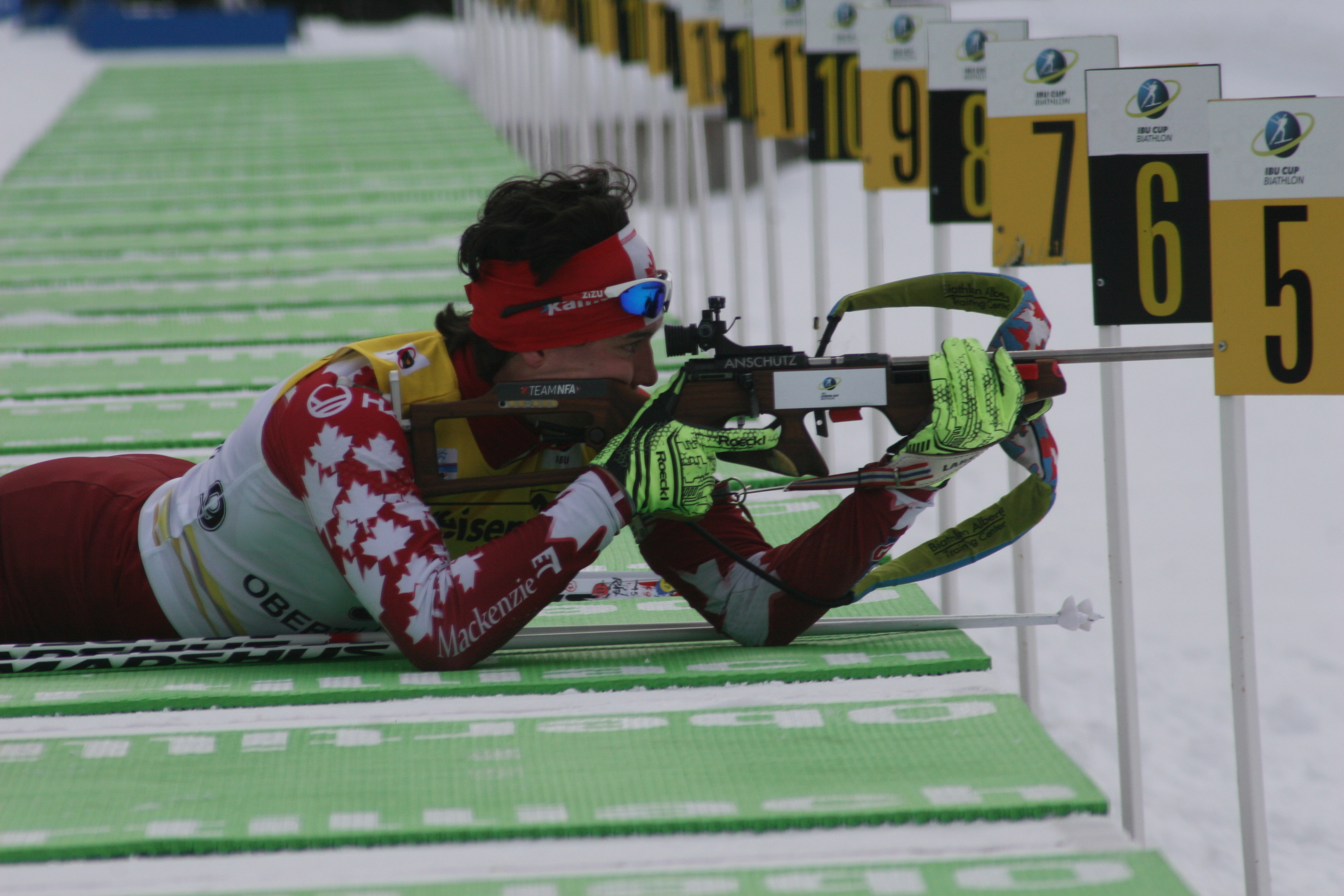
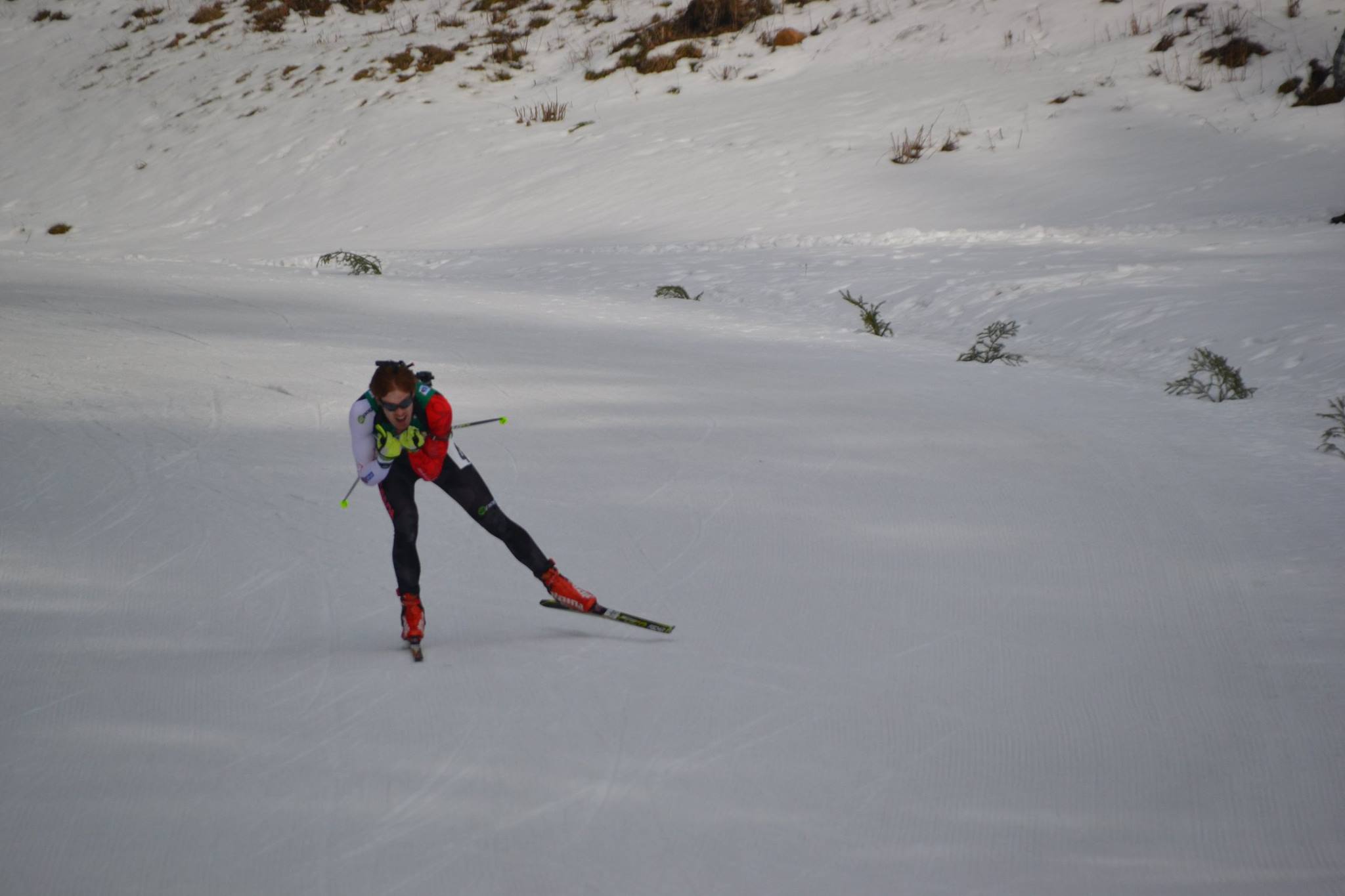
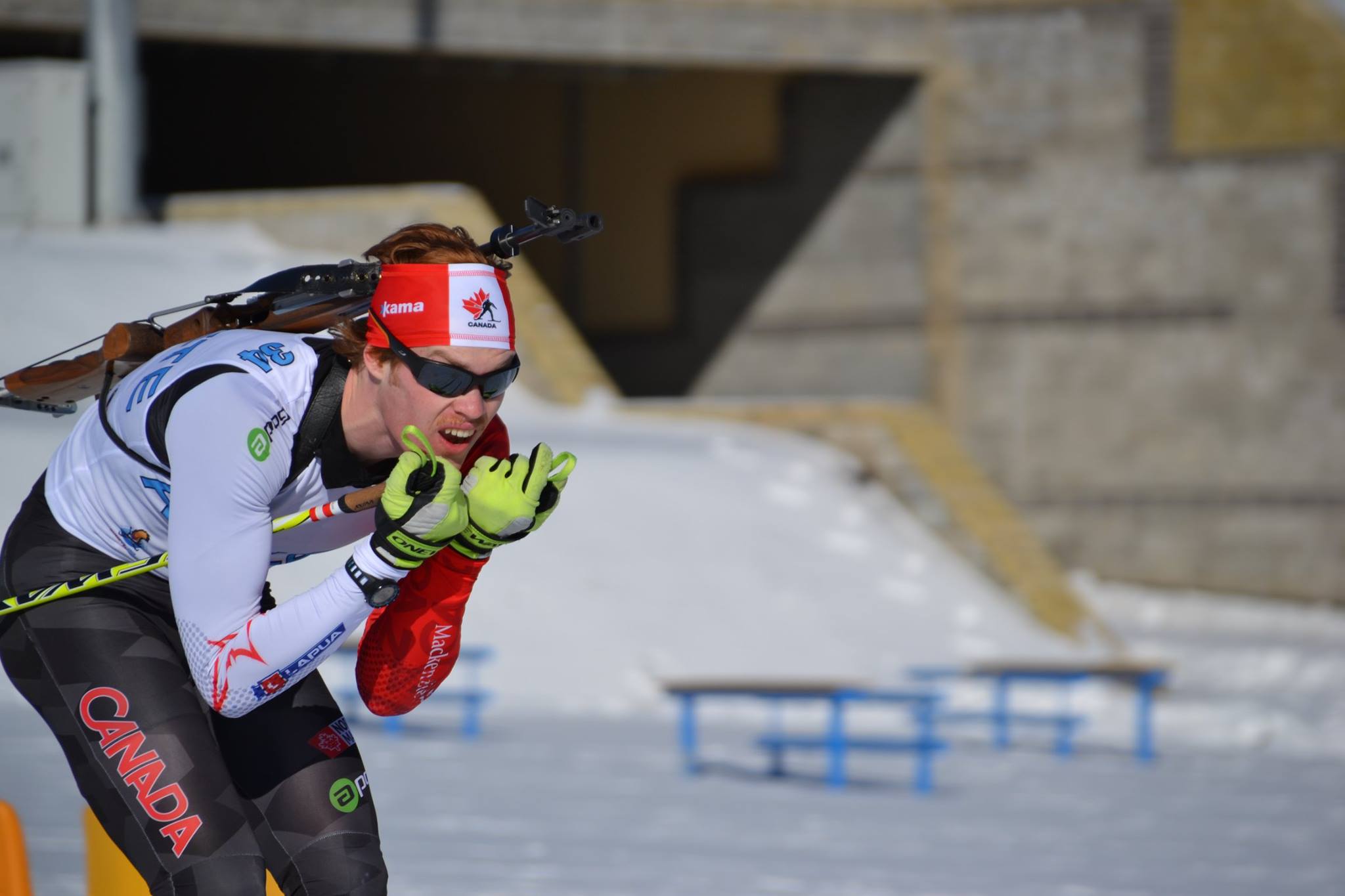
Teo Sanchez on the range at an IBU Junior Cup in Obertilliach, Austria, earlier this season. (Courtesy photo)
In an effort to showcase the North Americans competing at this week’s International Biathlon Union (IBU) 2018 Youth and Junior World Championships in Otepää, Estonia, we asked those qualifying athletes several questions about themselves — actually, we had them fill in the blanks. Here we have 20-year-old Teo Sanchez, who is representing Canada at his first Junior World Championships after competing in World Youth Championships in 2016.
“My full name is Teo Sanchez but you can call me Ted.
I was born in Colorado and raised in Canada, and I learned to ski at age 3 or 4.
I spent the time between World Youth/Junior trials and Worlds, meticulously training to make sure my I peak perfectly for these races.
The best workouts I did in the last training year to prepare for this were all the high intensity hill intervals with Biatlon Alberta Training Center.
One thing I’m working on this season to improve my biathlon is my ski technique! My technique is probably my biggest setback.
Teo Sanchez in the NorAm pursuit in Valcartier, Quebec, last season. (Photo: Dan Guay)
This is my first time in Estonia and fourth time racing internationally, and so far it’s been fantastic! Estonia is probably my favorite international venue so far.
One difference I’ve noticed between Estonia and the Canada is the food. I’ve never had rice pudding and jam for breakfast before.
One of the things I’m most excited about for World Youth/Junior Championships in Otepää is the atmosphere that comes with high levels of competition. That atmosphere feeds me.
One race I’m especially targeting there is the relay, I think I’ll be able to put my team in a really good spot.
Watching the Olympics in the leadup to my own races was inspiring. One of my favorite moments of the Games was both the relays in biathlon. It was incredible how fast the changed. I want to be like any of the athletes who are at the Olympics and clean, because cheating is shameful.
My favorite thing at the breakfast where we are staying is the bacon.
Before this trip, if you said “Estonia”, the first thing I’d think of would have been a desolate, stereotypical Eastern European country.
Now that I’m here, I’m pretty sure something I’ll always remember will be sleeping 12 hours the first day and missing training.
If I had a totally free day here and didn’t have to worry about race fitness or training, I’d spend it sightseeing in the nearby areas. Which is what we’re doing tomorrow.
The best way to follow me on social media is on Facebook. You can find me as Teo Sanchez. I’m not very active on social media.”
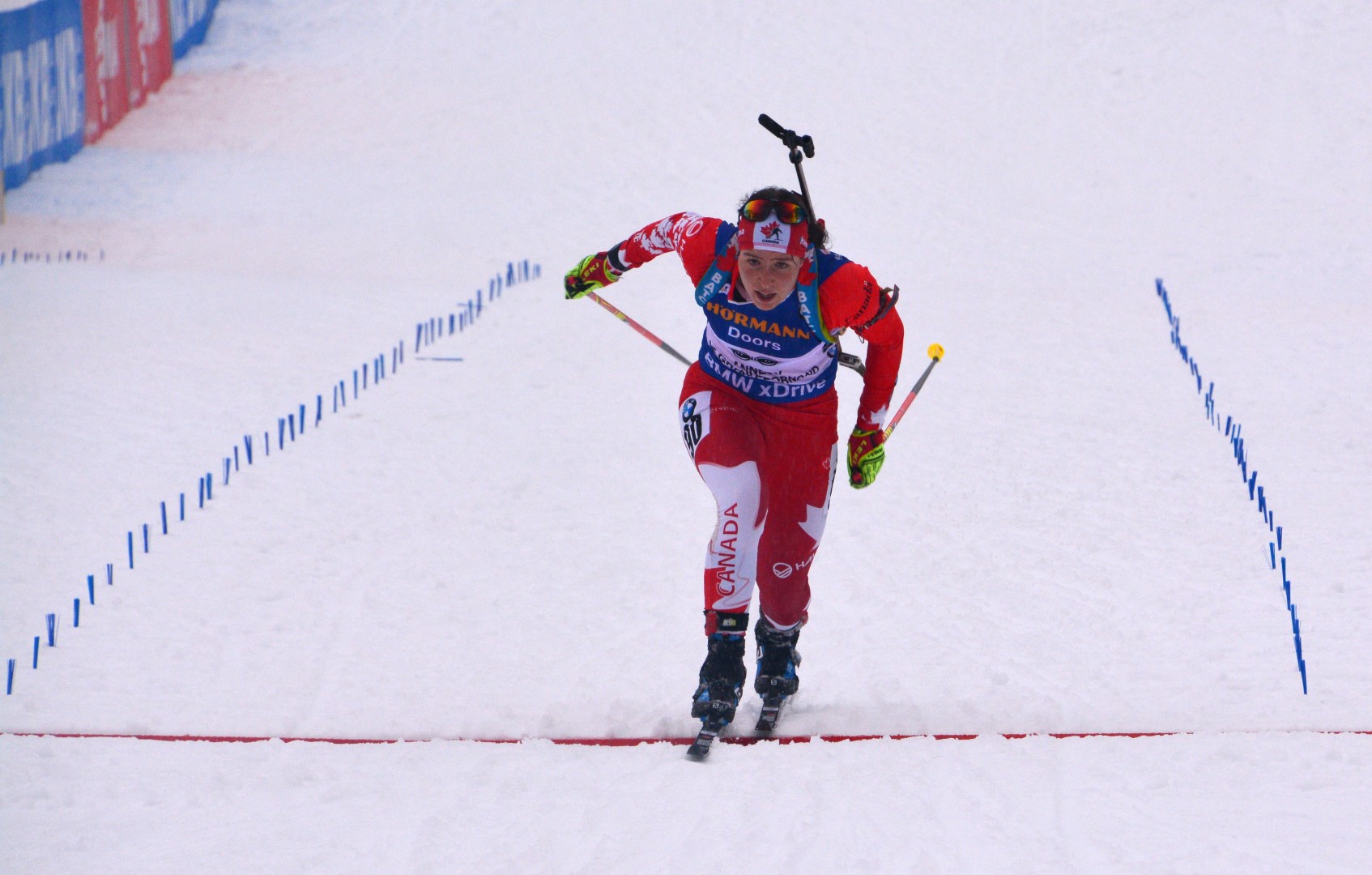
Megan Bankes (Biathlon Canada) lunging at the finish of the IBU World Cup women’s sprint in Annecy, France, in December. She placed 65th. (Photo: Glen Crawford)
In an effort to showcase the North Americans competing at this week’s International Biathlon Union (IBU) 2018 Youth and Junior World Championships in Otepää, Estonia, we asked those qualifying athletes several questions about themselves — actually, we had them fill in the blanks. Here we have 20-year-old Megan Bankes, who is representing Canada at her second World Junior Championships after also competing at 2015 World Youth Championships. Bankes won gold in the junior women’s individual race at last year’s Championships. This season, she started the winter on the World Cup and contributed to a ninth-place relay effort by the Canadian women in Hochfilzen, Austria. Bankes was the sixth woman on the list for a five-woman Canadian Olympic Team in biathlon.
On Tuesday, Bankes anchored Canada’s junior women’s 3 x 6 k relay team to ninth place.
***
“My full name is Megan Bankes but you can call me Megan.
I was born and raised in Calgary, AB, and I learned to ski at age 4.
I spent the time before Worlds training in Canmore and Sjusjøen Norway.
My favorite workout I did in the last training year to prepare for this was rollerskiing up Highwood Pass, then running Ptarmigan Cirque, almost running into a grizzly on the way down, and having cookies waiting for us at the end with my Biathlon Alberta Training Center teammates .
One thing I’m working on this season to improve my biathlon is my shooting consistency.
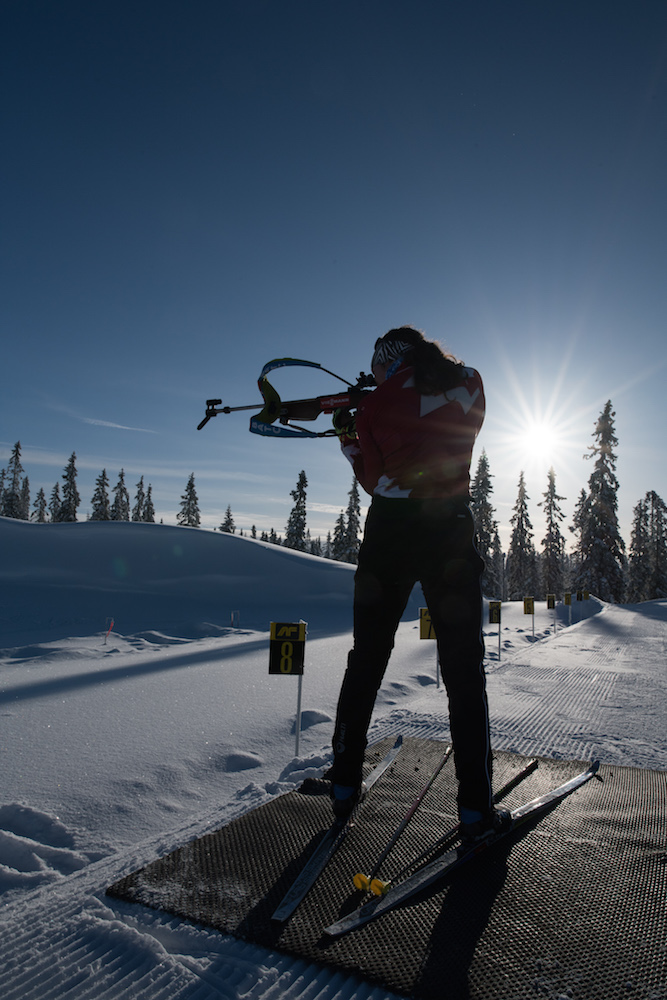
Megan Bankes on the range in Sjusjøen, Norway. (Photo: Emily Dickson)
This is my second time in Estonia and fifth year racing internationally, and so far it’s been kind of chilly.
One difference I’ve noticed between Estonia and the Canada is their love of kefir.
One of the things I’m most excited about for World Youth/Junior Championships in Otepää is racing.
One race I’m especially targeting there is the relay.
Watching the Olympics in the leadup to my own races was fantastic. One of my favorite moments of the Games was watching Kikkan and Jessie crush it in the team sprint and also cheering on Canadians in every sport. I want to be like Laura Dahlmeier because she can pull off amazing races when it really counts, and she’s so strong.
At Worlds, I really hope I can chat/make friends with someone from Sweden and ask them about themselves and their racing.
My favorite thing at the breakfast where we are staying is the tea selection.
Before this trip, if you said “Estonia”, the first thing I’d think of would have been memories from my trip here 12 years ago with my family.
Now that I’m here, I’m pretty sure something I’ll always remember will be the knitting.
If I had a totally free day here and didn’t have to worry about race fitness or training, I’d spend it wandering around the old city in Tallinn.
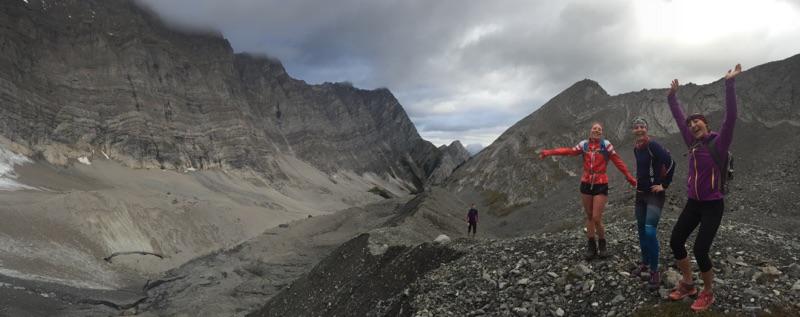
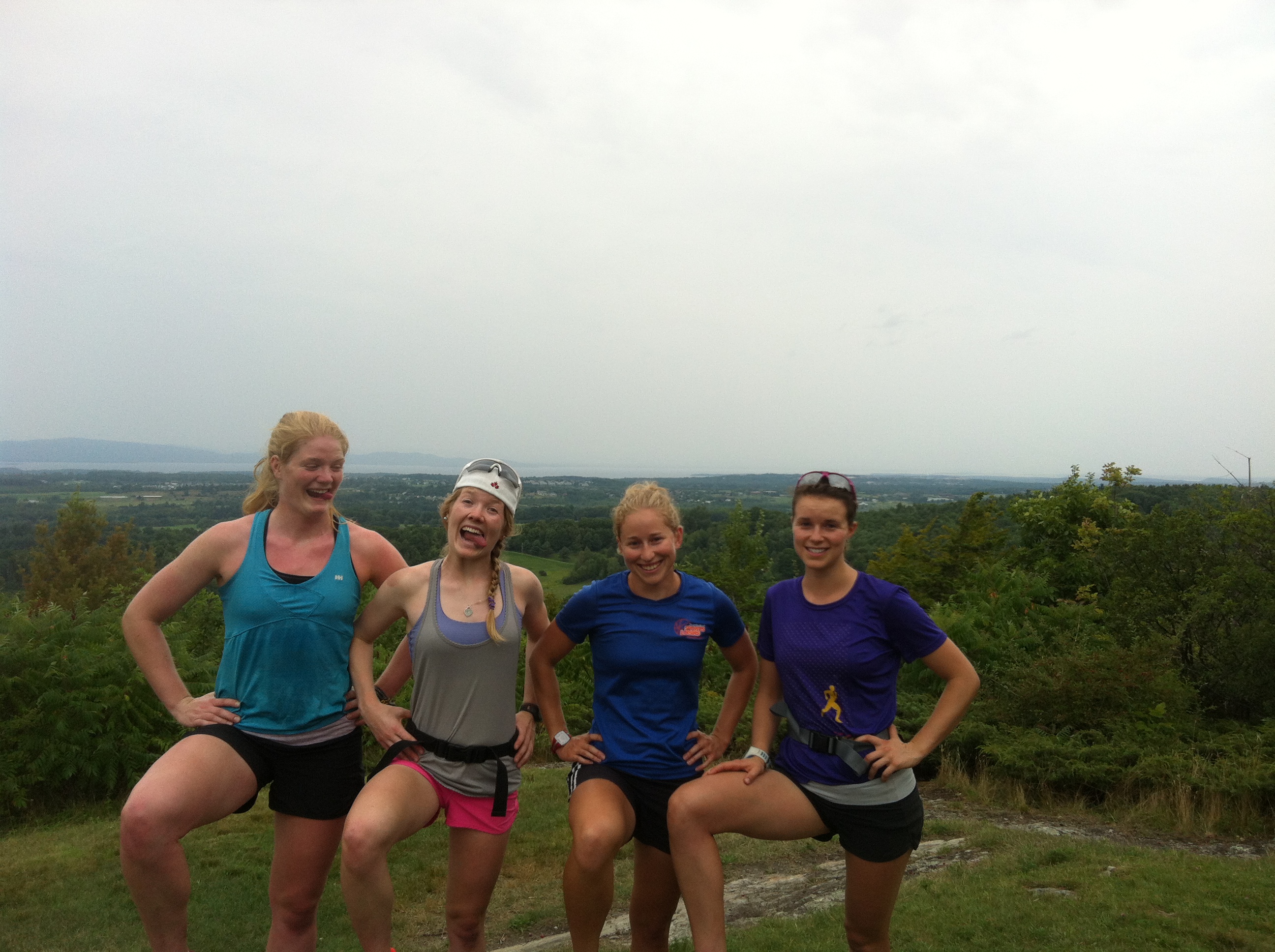
Nadia Moser on a hike up to the Old Goat Glacier with teammates Emily Dickson, Darya Sepanj, Anna Haslach, and Megan Bankes. (Photo: Emily Dickson)
Welcome to “17 Questions for 2017”, where we are catching up with American and Canadian national-team members before the beginning of the winter season.
***
Last year Canadian biathlete Nadia Moser finished 19th in the sprint and 24th in the pursuit at Youth and Junior World Championships, earning her a nod for Biathlon Canada’s 2022 squad, a team of junior development athletes.
But at just 19 years old, the Yukon native has already taken steps this season towards the senior ranks. In Biathlon Canada’s team trials for determining the World Cup and IBU Cup teams, Moser had finishes of sixth and seventh in a pair of sprints in Canmore, giving her a roster spot for the IBU Cup this December.
On Thursday she teamed up with her Biathlon Alberta Training Center teammate Carsen Campbell to finish 18th in the IBU Cup single mixed relay in Ridnaun, Italy.
1. Biggest change in your life in the last five or so months since the ski season ended?
I’ve stopped carpooling to almost every training session since I moved into a new place that is walking distance from the Nordic Centre.
2. Biggest change in your training?
Nadia Moser Racing in the youth individual race at IBU Youth and Junior World Championships 2016 in Cheile Gradestei, Romania. (Photo: Bryan Dickson.)
We focused a little more on ski technique this summer, other than that not much has been different.
3. Major areas of improvement you’ve seen so far?
I think that my shooting accuracy has improved quite a lot over the summer. I seem to be hitting many more targets than usual.
4. Whom you’ve been working closest with this offseason (coaches or training partners)?
My fellow female teammates.
5. Best trip in the last five months (and why)?
I’m going to have to say going back home to visit my family in July. It’s always nice to go back home and relax after a couple hard weeks of training.
6. Favorite cross-training?
I really enjoy swimming, even if it’s just doing laps in the pool.
7. Favorite non-athletic activity or pastime this summer?
Drawing is something I really like to do when I have down time. It’s especially great to finally finish a drawing that I’ve been working for far longer than anticipated.
8. Song that was your jam this summer?
Pretty much whatever was on the radio that wasn’t Shawn Mendes.
9. All-time favorite race moment?
I can’t say I have one particular race moment that stands out so far.
10. First thing you pack in your bag when you leave for Europe?
My race suit and ski boots.
11. Venue/event you’re most excited to visit this season?
I’m still new to the whole European racing scene so pretty much anywhere I get to race in Europe will be super exciting.
12. Who will win the World Cup title this year?
I have no idea. There are too many athletes to choose from.
13. Biggest sacrifice you feel you’ve made choosing this career path?
Probably that I can’t do certain other activities, like downhill skiing, as much as I would like to for fear of injuring myself before an important event. Also not being able to get post secondary school over with right away.
14. If you could change one thing about your sport, what would it be?
I wish no one would feel the need to take performance enhancing drugs. It would also be quite nice if cold hands weren’t a constant problem in any temperature below 0 Celsius.
15. What did you have for breakfast this morning?
Berries with cereal, greek yogurt, and milk.
16. In 5 years, I’ll be ____?
Probably still training in Canmore.
17. In 50 years, I’ll be ____?
No clue, I don’t quite plan that far ahead.
(l-r) Nadia Moser, Leilani Tam Von Burg, Emily Dickson on the podium at Canada Winter Games in 2015. (Photo: Daniel Guay)
Aidan Millar (Canada/Biathlon Alberta Training Center) racing to eighth place in the 10 k sprint at biathlon World Junior Championships in Raubichi, Belarus. (Photo: Jane Robertson)
Canmore, Alberta’s Aidan Millar was the third man onto the course in Saturday’s individual-start 10 k sprint at World Junior Championships for biathlon in Raubichi, Belarus.
With little information about his competitors, Millar had to just ski his own best race. He had a penalty in prone but then cleaned in standing, and was unsurprisingly the race leader when he crossed the line. The thing was waiting for the other 90+ racers to finish as well.
“As soon as I had gotten my stuff I left the finish area and went and cooled down away from the TVs and the stadium,” he wrote in an email. “I knew I would probably stay in the top 10 but it was way too hard to watch the results.”
As his team had predicted, it was a top-10 finish when all was said and done. Millar’s time put him in eighth, 44.9 seconds behind Russia’s Aleksandr Dediukhin, who won with a time of 24:49.0.
Millar’s split after the last shooting had him in fifth place, but he was unable to hold onto that position, and lost about 20 seconds to the leaders over the final 3.3 k.
Canada’s Aidan Millar racing in the individual competition earlier this week at World Junior Championships. (Photo: Jane Robertson)
Still, the result was a major recovery after the individual competition, where Millar missed nine shots. He was frustrated with himself and vowed to do better.
“The individual was pretty disappointing shooting-wise,” he explained. “So for the sprint I tried to shoot more in control and not get caught up in shooting fast.”
Despite those goals, Millar actually had the eighth-fastest shooting time in the field. That speed and accuracy helped him to his best-ever result in an international competition. It was also the best result for Canada so far at the Championships, including in the youth competitions which are held on alternating days with the junior races.
At last year’s World Youth Championships in Presque Isle, Maine, he placed ninth in the sprint. But this year is completely different, and not just because the junior field is older and more experienced than the youths, Millar explained.
“I would say it’s definitely a huge step up,” Millar wrote. “With last [Championships] being in North America some of the better countries didn’t send full teams so the field wasn’t as strong. So with the jump from Youth to Junior already making it more competitive the fact that it was in Europe made even that much more competitive than last year. With those things in mind, I’m finding it hard to believe that I was actually able to get that result.”
Millar’s coach at the Biathlon Alberta Training Center, Richard Boruta, is the leader of Canada’s team on the trip and expounded a bit more on the jump Millar has made.
“While in the Youth category lots depends on biological age and other factors, in the Junior category the results are much more representing the quality of training and future potential of the athlete,” he wrote in an email. “By staying in (or at least being capable of) the top ten at [Junior Worlds], athletes are showing that they are on the progression curve necessary for future good performance in the World Cup.”
The age category is not the only change Millar has made this year. He also transitioned from the Canmore Nordic Ski Club to training with Boruta’s training center.
“He has the benefit of training with strong juniors on our team and after his recovery [from a concussion in the fall] his ski speed kept improving during all of our tests and early season races,” Boruta wrote.
He hopes for even more from Millar in the future, but is also content to have eighth place as a standout result.
“Aidan is a prototype of modern high performance biathlete (tall and strong), and I am sure we will hear about him in the future again,” Boruta wrote. “I am really happy for his result today and his goal for Pursuit is to learn how it feels to compete head-to-head with the best in the world. I would like to think that another top ten is possibility, but the field is very competitive, so it will likely come down to shooting performance during the entire race.”
As for Millar, he professed to have no results-based goals for the pursuit, which will be held on Sunday.
“Try and stay calm, shoot in control and see what happens,” he wrote.
But regardless, the top-ten is a confidence boost that still leaves him marveling.
“I’m super happy with the result,” he wrote. “I didn’t really have a results goal coming in to the Championships but 8th was beyond my expectations.”
Also in the junior men’s sprint, Matthew Strum finished 46th with one penalty, and Carsen Campbell 55th with three. Both made it inside the 60-man cutoff to compete in Sunday’s pursuit.
Stuart Harden, one of Canada’s top young biathletes, did not start the race. He explained in a facebook post that he woke up with a cold and is trying to recover in time for the relay early next week.
In the junior women’s 7.5 k sprint, Sarah Beaudry placed 38th with three penalties.
Emma Lunder competing in the World Cup pursuit in Pokljuka, Slovenia, in March. Photo: NordicFocus.com
When Emma Lunder made her World Cup debut last season, she met with immediate success.
Taking advantage of a roster spot left open by Megan Imrie, who retired immediately after a successful Sochi Olympic appearance, the Canadian biathlete accrued a single penalty in her debut World Cup sprint race in Pokljuka, Slovenia, and placed 30th – scoring points on her very first try.
“I think one of the major factors in making a jump in results was believing in myself,” she wrote in an e-mail to FasterSkier last week. “Even though it was my first World Cup, I made sure to focus on the process rather than the outcome, and treat it like any other race I’d ever done. I think in the past I haven’t had as much confidence in racing, especially after bad races, where I’d really dwell on them, rather than taking lessons from them and moving on.”
Canadian national “B” team women (l-r) Sarah Beaudry, Emma Lunder, Audrey Vaillancourt, and Julia Ransom on a run in Jericho, Vermont, this summer. Photo: Emma Lunder.
Now Lunder is looking forward again. The 23-year-old was a many-time World Junior Championships competitor, but her World Cup result netted her a senior national team nomination for the first time. That has afforded her a few more opportunities in the off-season than she is used to having.
“My World Cup results last year qualified me for a development card, so that has made a world of a difference,” she explained, referring to the Canadian “carding” system of athlete assistance. “Having some financial stress lifted is such a relief. Even though it doesn’t cover a whole year of training, it’s enough that I was able to cut back at work (Starbucks) to just two days a week, and it’s meant I need a lot less financial support from my parents.”
A couple of sponsor partnerships are also in the works, she added.
Besides being named to Biathlon Canada’s “B” team, Lunder has signed on with the Biathlon Alberta Training Center, a Canmore-based team headed by former national team coach Richard Boruta.
That has given her solid training partners in Julia Ransom and Sarah Beaudry, younger women who each have a World Junior Championships individual medal to their name.
Emma Lunder (r) and Sarah Beaudry after completing the 172k IronMan bike loop around Penticton, British Columbia. Photo: Emma Lunder.
“To have a close group of female teammates has definitely been one of the main differences [this year], just for the fact that on so many workouts you’re able to push each other, and help each other ski faster then you would on your own,” Lunder wrote.
It’s also fun: one of the highlights of her summer was a team camp in Penticton, British Columbia.
“Our longest [bike] ride was the IronMan Loop, which ended up being 172km, and to be honest when we started I wasn’t sure if I’d complete the whole thing!” she explained. “But I did, with Sarah Beaudry by my side the entire 6 hours, and getting off the bike at the end was probably the best feeling in the world. We also did some rollerski intensity up Apex Mountain that week, rollerskied past thousands of vineyards, and went zip-lining!”
The national team nomination allows her to occasionally jump in with the older, more experienced women, like Rosanna Crawford and Zina Kocher (Canada’s other remaining Olympic veteran, Megan Heinicke, lives in Germany in the off-season). Lunder hopes that this experience will help her be even better-prepared when she returns to the World Cup.
“It’s definitely super beneficial for the younger team members to have some training with the Canadian veterans, as they have so much to teach us,” she wrote. “In Jericho [Vermont] I tagged along behind Rosanna for all of the intensity sessions which was really constructive for me.”
Lunder says that her goals for the upcoming season are more process-based: to ski faster and shoot cleaner, as “comedic” as it seems. The annual summer biathlon competitions in Jericho provided a clue of what’s to come: she placed ninth, the fourth Canadian, in the sprint, and sixth, the third Canadian, in the mass start.
“I didn’t race quite as well as I’d liked, but there were lessons I took out of both days,” she wrote. “It was such a good feeling to be racing again, and it got me pumped for the winter. I’m definitely looking for more World Cup action this season – there’s still quite a bit of time between now and then, so for now I’m trusting in the process, and looking forward for the first flakes to fall.”
And with the lure of another World Cup appearance on the horizon, Lunder is finding herself even more motivated than before: “Anytime I’m doing a really brutal workout, I just think to myself, if you can get through this, you’re one step closer to racing in Pokljuka again!”
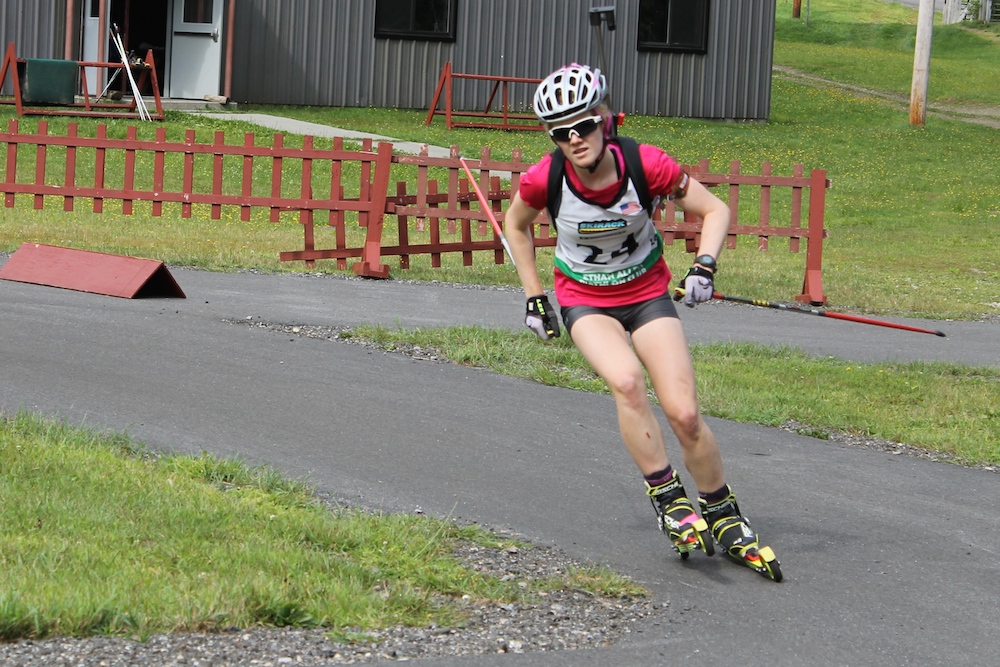
Emma Lunder competing at the 2014 North American Rollerski Championships 7.5 k sprint at Ethan Allen Firing Range in Jericho, Vt.
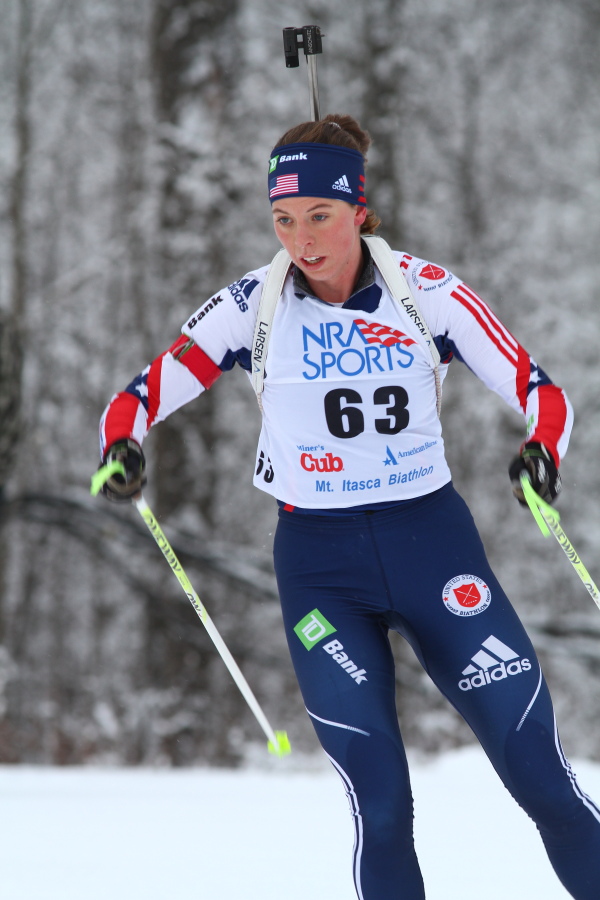
Corrine Malcolm racing at trials in Mount Itasca, Minn., last December. (Photo: Gregory Haugen/HaugenPhoto.com)
By all accounts, it’s been a rough few months for Corrine Malcolm. In her second year on the U.S. national biathlon team at just 23 years old, she narrowly missed getting selected for an IBU Cup race tour to Europe – and consequently fell into a limbo that developing senior athletes are all too familiar with in North America: the only racing option was NorAms, where the fields are tiny (sometimes just two or three women) and opportunities for real development few and far between.
With few options left, Malcolm decided to move back to Bozeman, Mont., where she had attended Montana State University (MSU) for two years before taking up biathlon full time. She jumped in some ski races for the rest of the season, hit up the spring biathlon weekend in Mammoth, Calif., and had fun – but there was always the question, what next?
“My spring was pretty high on the anxiety side of things,” she said on the phone last week.
Malcolm was not invited back to the shrunken national team and declined to move to the Maine Winter Sports Center (MWSC), one of the only senior biathlon programs in the country. Instead, she was determined to stay put in Bozeman and try to figure out a way to be a biathlete on her own.
“I really like the athletes at MWSC and got to travel with them this spring and had so much fun with them,” Malcolm explained. “But for me at a personal level, going up to Maine isn’t really an option. I feel the most settled and at home having chosen to move out West. I’m trying to get more balance.”
What does that mean? After a year in northern Maine at the start of her biathlon career and then two years in Lake Placid, N.Y., where the national team is based, Malcolm wants a different life for herself and believes that it will help her succeed as an athlete, too.
“I feel like I have a real life here in a lot of ways,” she said of Bozeman. “I live in a house with three incredible guys and we barbecue and eat dinner on our back deck every day, and we have a garden and a greenhouse. In Lake Placid, I was a weird segment of the population – I was 22 at the time. At the training center you were either 16 or you were 27, it felt like. The local population is mostly young professionals with pretty definite futures. Bozeman is probably as transient as a functional city can get.”
And so those rough few months have also, in many ways, been a happy few months – even happier than she was before.
“When you make an effort to have a normal life and have friends outside of your sport or activity of choice, there’s just a lot more offerings,” she said. “It feels like home. When sport is your job, it’s really important to have time to turn off and just be a human. Not that athletes aren’t human, but most people when they come home from their nine to five jobs, they don’t still talk about accounting or what kind of checks they deposited that day.”
After the move back to Bozeman, there were two resources at her disposal: Biathlon Elite, the loose club team of college-age athletes started by MSU skier and several-time World Junior Championships biathlete Sam Dougherty, and further north, the Biathlon Alberta Training Center in Canmore.
Malcolm started out the spring with a trip to Canmore to work with Richard Boruta, the coach there, and his athletes. It was a great week – she described everything as “phenomenal” – but soon, the reality of being a self-supported biathlete hit home.
“I was trying to buy ammunition and could easily need to come up with $5,000 just for that for the year,” Malcolm said. “That’s terribly anxiety-provoking.”
Indeed: Malcolm is working 20 to 30 hours a week as a nanny in Bozeman to pay the bills and chase her dreams, but even that doesn’t leave a whole lot of cash lying around. She hasn’t sold her rifle and still plans to do biathlon and try to qualify for the Olympics, but training full-time seemed financially overwhelming.
Since this realization, Malcolm has had a crazy and confusing month of negotiations. She was interested in skiing with the Bridger Ski Foundation (BSF) and talked to the coaches about joining the program. She says she has a good relationship with them and is a close friend of Jennie Bender, so would love to join the team. But BSF said they couldn’t support her financially, which led to more anxiety as she contemplated training camps that would cost the equivalent of four months of rent.
When she headed home to Hayward, Wis., and visited the Central Cross Country (CXC) Regional Elite Group camp, she found a new option: CXC was willing to support her and cover her expenses even if she remained in Bozeman, which she feels is important not just for her happiness, but so that she can re-establish her residency and finish her degree at MSU.
“I was really surprised that CXC was okay with me being in Bozeman, but Bill Pierce was one of the guys who got me into skiing to begin with,” Malcolm said. “CXC was the first program I ever raced for when I started racing my senior year of high school. There’s a lot of history there.”
So, at last, she has a plan. Sort of. Saying that she feels as fit as ever, Malcolm is planning to race the early-season SuperTours in West Yellowstone and Bozeman, head to U.S. National Championships at Soldier Hollow, race the Boulder Mountain Tour in Sun Valley and Birkie in Wisconsin, and see where else the season takes her from there.
As for biathlon? She hasn’t given up on her goal of making the Olympics. But it’s getting harder to envision that happening.
“Financially I can’t afford to fly out East [to Jericho, Vt.] for the first round of trials in August,” Malcolm said. “I had resigned myself to saying, ‘Well, I can’t afford to go in August, but I can go to the trials in Utah because they are almost in my backyard in a way and I can drive there.’ But I just got sent the criteria recently only to find out that it’s best three out of four races.”
With two races each in Jericho and Utah, skipping one race series would necessarily leave Malcolm out of the running for a berth, which hit hard.
“I understand that it makes certain athletes maybe have to come to the U.S., or show up for both sets of races, and holds athletes more accountable,” she said. “But I was a little disappointed to see that.”
At the moment, she still doesn’t plan to go to the first set of trials in August, but hasn’t given up on trying to make the team, either. It’s a stalemate.
“At the same time as this was going on, I got the e-mails from U.S. Biathlon and U.S.O.C. with me on the list of athletes who needed to file Olympic paperwork,” Malcolm said. “So it’s like I am supposed to be pursuing this, but I don’t know if financially I can pursue it to its fullest extent.”
As Malcolm looks at the next year and into the future – she could start taking classes at MSU again as early as the spring, and definitely by the summer – these seem to be recurring questions.
“It’s been a really interesting experience in that regard – are these your new circumstances, and do you have to accept those circumstances?” she asked rhetorically. “Working 30 hours a week is not ideal, so will I perform at a lesser level? Am I setting myself up to be disappointed because I’m not taking that time to rest and recover, and I’m definitely loading my non-working days with as much training as possible?”
She insists that she won’t change her goals, and she will probably never stop racing.
“I’m a super-competitive person by nature. I don’t see that changing, but I think that there’s a great chance that I might have to – not necessarily change my goals, but I should change my expectations. I always think going in to any race that it’s anyone’s game. I never go in to a race thinking that I’d like to be top 10. You go for it no matter what. But maybe my expectations aren’t so high this season in terms of personal, internalized stress.”
And despite everything, she feels ready to excel. Her training and racing is now based largely on fun and happiness, and she feels like her fitness is improving because of it. She’s looking forward to doing some running races, including the XTerra Trail Championships in September in Ogden, Utah, and the U.S. Half-Marathon Trail Championships in November in Moab, Utah, something that was difficult to do within the confines of the national team.
All in all, as Malcolm tries to blaze a new path for herself, she’s simply shifting the things that a coach might see as most important – and setting her own rules to live by.
“I definitely still have my skis and hopefully race them fast and have a lot of fun doing it,” she laughed. “High levels of fun are on the priority list this year, and a lot of happiness training, and a large consumption of cookies are basically my plan at this point. Being happy and well-balanced is the most important right now.”
Megan Imrie at World Cup trials this fall. Photo courtesy of Glen Crawford.
Lowell Bailey may be getting a lot of attention these days, but the American biathlete isn’t the only one to have found success in the early days of the 2012 World Cup season.
Quietly, the Canadian women have upped their own profile – and their first two weeks of racing culminated in a ninth-place relay finish in Hochfilzen, Austria, tying the U.S. men’s performance.
Team member Zina Kocher, who has been racing in senior-level international races since 2002, had only ever achieved that result twice, and never beaten it.
“Our ninth in the relay is solid,” she told FasterSkier. “The team is moving up together and there is potential for better performances.”
Kocher has been the star of the Canadian team so far, scoring World Cup points in every race she has entered and finishing as high as 15th in the sprint in Ostersund, Sweden. But she’s had company: Megan Imrie has been in the points, too, and collected three of the top ten performances of her five-year World Cup career.
And that, for Canada, is good news.
“Together Megan and Zina will be the backbone of a solid women’s team,” said Biathlon Canada High Performance Director Chris Lindsay. “We expect a huge improvement on last year’s results both individually and as a team.”
Where Did Canada Go?
While the Canadian program has definitely produced fast women in the past – 1994 Olympic gold medalist Myriam Bedard comes to mind – in last few years the team hasn’t shown much depth.
In 2011, only Kocher and Imrie scored World Cup points (which are doled out to the first 40 finishers), and those were few and far between; neither woman made the top 70 in the overall rankings. In 2010, Kocher was ranked 31st and Heinicke the next closest in 65th. Kocher finished 2009 as the only Canadian who even made the rankings, clocking in at 41st.
“When I was still a junior starting out, the women were stronger than me, and I definitely looked up to them,” Kocher said. “I always observed how they did this and that, and was always trying to keep up to them, trying to be as strong and stronger.”
These days, there haven’t been as many senior athletes to serve as role models, just the same stalwart few who have been racing at a high level since they were very young.
“Our women’s team hasn’t changed that much in a few years, in terms of members,” Imrie said.
Canada has recently brought home several World Junior Championship medals, but it’s been hard to translate those results into a robust, deep team or widespread success at the senior level.
Why?
“Biathlon in Canada isn’t a well-known or easily accessible sport,” Kocher explained. “The depth in programs, coaches, environment, and finances all play a role… Financial reasons are a big cause of athletes quitting early on. And another aspect is talent and development of young athletes with a solid training program.”
Kocher said that for the last few years, Biathlon Canada has not offered financial support to development or junior national team members – which, she said, would be fine if regional training centers and clubs could pick up the slack. In the past this hasn’t been easy, but luckily it’s starting to happen.
“It’s getting better especially in Canmore and Valcartier, and now with the Biathlon Alberta Training Center we are on the right path to developing these programs,” Kocher said.
While the teams are primarily intended for junior athletes, it’s not a coincidence that the senior women have been improving at the same time.
A Changing Team, A Resurgent Zina
For Kocher, the recent results aren’t actually the best she’d produced. The Alberta native has stood on the World Cup podium before, and scored eight top-ten finishes. But after several frustrating seasons and battles with injuries and mononucleosis, she’s feels like she is finally back on track.
“[It’s] definitely not mind-blowing, just a solid start for the women’s team,” Kocher wrote in an e-mail. “For me, my ski speed is there with the top ten, and that is back to the previous performance potential from before I had mononucleosis.”
Her return to form has come on the back of a major change in the Canadian national team: after seven years, Kocher was not re-nominated for the “A” team for this season. She decided it was time for a change and returned to Canmore to train with Richard Boruta, her first coach.
Megan Tandy – who was the top Canadian at the Vancouver Olympics, finishing 36th in the pursuit – has since married coach Ilmar Heinicke, had a baby, moved to Germany, and took his name. Tandy missed most of the 2011 season, and this year declined a team nomination so that she could stay in Europe. That left only Imrie on the “A” team and Rosanna Crawford on the “B” team.
Have the changes affected team chemistry?
“No,” wrote Kocher. “We are a great bunch and there is really no animosity between anyone. We are always laughing… I’d say other teams might be jealous of our hysterical laughing fits!”
While Kocher said that it initially felt “strange” not to be training with her usual national team group, she has enjoyed the switch to the Biathlon Alberta Regional Training Center.
“Even though some of the girls aren’t as close to me in ski speed as Megan and Rosanna, I did have the young guys to chase!” she wrote. “I really enjoy the Alberta team and my teammates there.”
While she’s no longer a member of the national team, she qualified for the World Cup through trials races and Biathlon Canada hasn’t reacted negatively to her decision to leave the team. Lindsay was still informed about Kocher’s training, and he still had the same goals for the star that he’d had when she was part of his squad.
“Zina’s start has been exactly as expected,” he wrote in an e-mail. “She showed strong results in the physical testing over the summer and she is well situated to be among the top ten fastest skiers on the circuit. Her shooting results so far are in line with expectations and the plan has her continuing to improve shooting results for a peak at the World Championships.
“We firmly believe that Zina is capable of making this her overall best season,” Lindsay concluded.
Consistency from Imrie
Imrie might be, too.
While the 25-year-old scored World Cup points twice in both the 2010 and 2011 seasons, she more frequently finished in the 40s and 50s, with the odd shooting disaster dropping her far below that.
The start to her 2012 season hasn’t been perfect – she placed 88th in the sprint in Hochfilzen after missing five shots, and did not make the pursuit – but it has been encouraging.
In Ostersund, she placed 41st in the individual, 33rd in the sprint, and 43rd in the pursuit.
“The season start has been better than in the past, but still I feel like I am capable of so much more,” Imrie said.
Her 2011 campaign was cut short by a rib injury, so she came into the next training year relieved and happy to be skiing again. The injury also provided some forced recovery, she said, which made her better able to handle the training volume. As a more mature athlete, she’s begun to understand how important that is.
“I’ve been a good student,” Imrie said. “I’ve learned how to manage my training workload, but also my rest and recovery. I’ve improved in gauging when I need rest versus when I need to push harder.”
Aside from working with new coaches on shooting and ski technique, Imrie said that her strong start was most likely born from the simple fact that she loves the team.
“I’m training again with Matthias Ahrens, who was my coach as a junior,” she said. “Our team is small, and the six of us who train in Canmore get along really well… I’ve stayed healthy from the outset, and looked forward to the team atmosphere each day.”
She didn’t seem to have suffered from Kocher’s move away from the national team, either.
“Rosanna and I train a little bit together, but a lot I do on my own,” she explained. “I’m lucky to be in Canmore, because if I need a training partner, I’m able to join up with cross country skiers, or other biathletes when our schedules fit. I’ve enjoyed many great afternoon workouts with Perianne Jones.”
She understood Kocher’s move and didn’t hold it against her.
“I know that Zina needed a different approach this year to training, so it was fine to be separate,” she said.
A Team That’s “Stoked”
Luckily for Canada the separation was only temporary, and Kocher and Imrie have been reunited in Europe. So far, they’re packing a strong one-two punch for the team. Lindsay, the high performance director, believed that Imrie could do even better than she had in the season openers, and follow Kocher more closely in the overall rankings.
“Megan has proven that she is a force to be watched with her season opener,” he said. “We knew last year that she was capable of top-40 results… this year the goal is having consistent top 40 finishes with peaks in the low 20’s when everything goes right.”
And with Crawford, who hasn’t had stellar individual performances this year but cleaned both stages of her relay leg, and Heinicke, who did not make Canada’s three-woman World Cup squad but appeared to be on form with her relay performance, the team is truly succeeding together.
“We have all made improvements and are stoked about the season,” Imrie wrote.
The results so far are something that would have been unusual a few seasons ago, when Kocher was the only one World Cup points.
“For the three of us, all three making the pursuit, [and having] two in World Cup points in the sprint, this is a good overall performance,” Kocher said.
“There is definitely potential for Megan and I to consistently be getting into points… I feel confident that we will be having a consistently better year, as whole team, than last year.”