From the FasterSkier archive — posts syndicated from athletes’ and coaches’ own blogs between 2004 and 2012, kept online as published. Current coverage is at fasterskier.com.
Are you interested in working with Canada’s future Olympic Biathletes and having the opportunity to lead Team Canada at international events? Biathlon Canada is targeting an energetic coach to lead our next generation of athletes to international podiums! This position provides an incredible opportunity for growth working directly with the national team coaches. The exciting position is based out of the home of Biathlon Canada in the beautiful Canadian Rockies community of Canmore, Alberta.
Biathlon Canada is now accepting applications for the position of Next Gen Coach. Submit your resume and cover letter by May 12, 2021 to info@biathloncanada.ca.
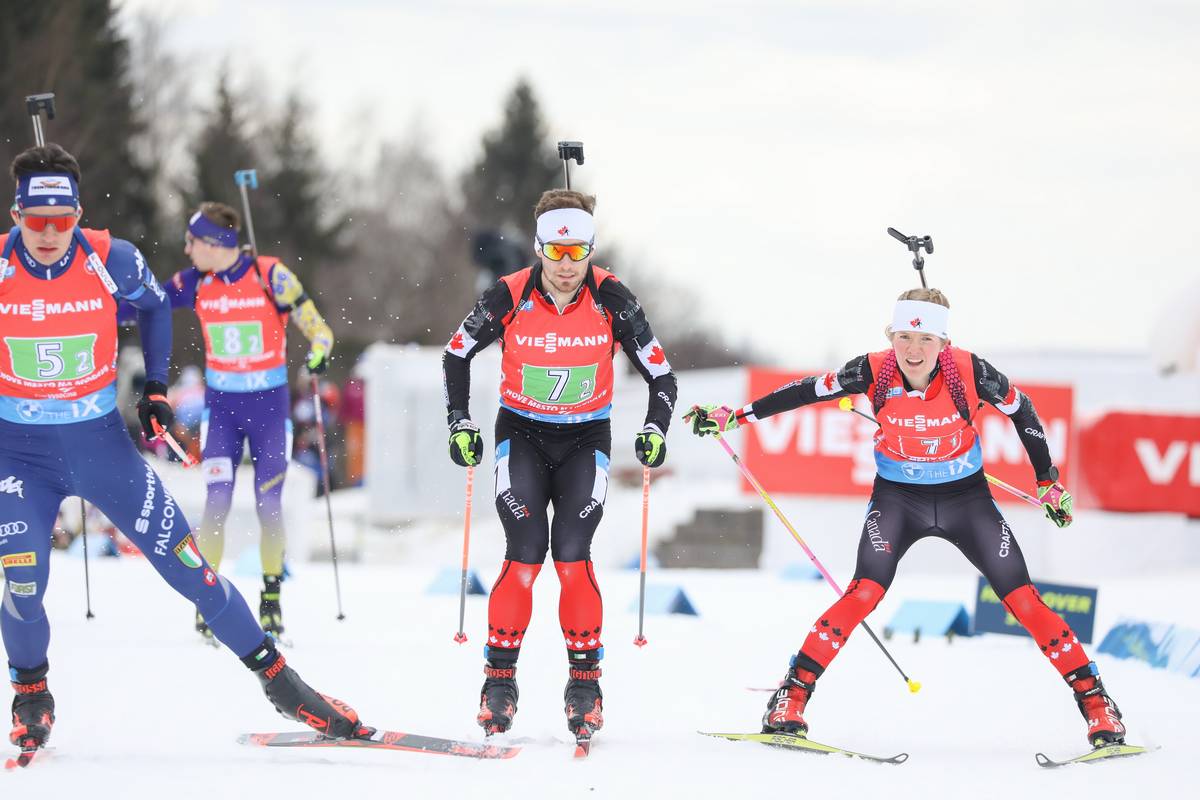
Canada’s Christian Gow (CAN), Emma Lunder (CAN), (l-r) – IBU World Cup Biathlon, single mixed relay, Nove Mesto (CZE). (Photo: Nordic Focus)
Biathlon Canada is committed to creating an inclusive and diverse environment and is proud to be an equal opportunity employer. All qualified applicants will receive consideration for employment without regard to race, colour, religion, gender, gender identity or expression, sexual orientation, national origin, genetics, disability, age, or family status.
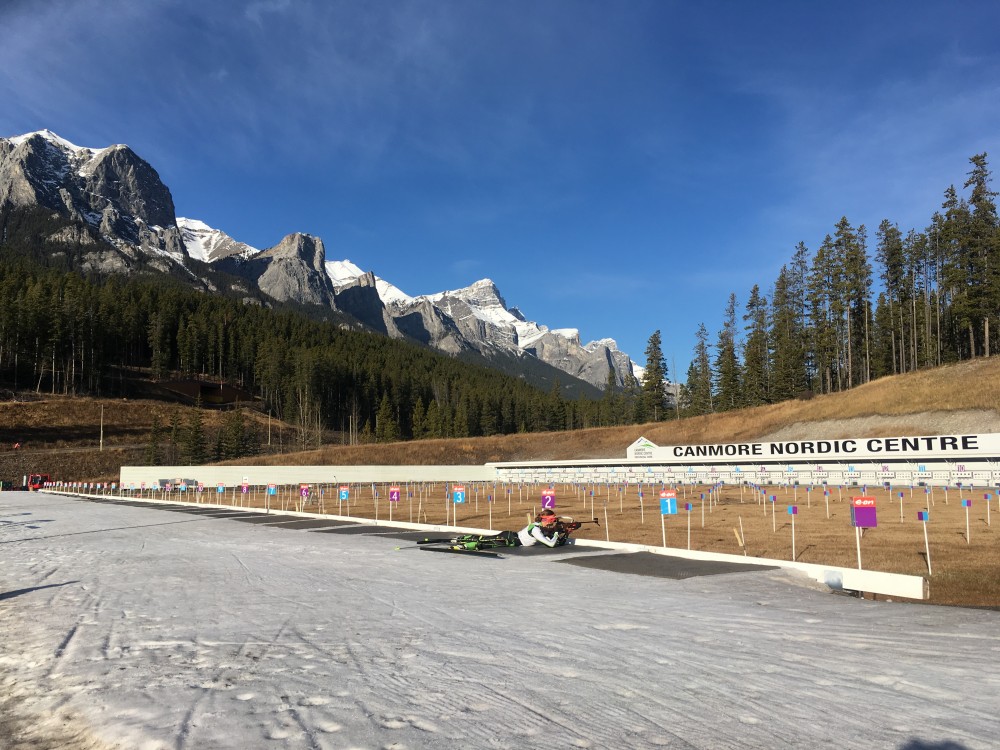
A 2016 photo from Frozen Thunder in Canmore, Alberta. (Photo: Matthias Ahrens)
Yesterday, RMOTODAY.com, reported 11 “active” cases of Covid-19 linked to Frozen Thunder, an early season on-snow event organized at the Canmore Nordic Centre. According to the news report, athletes, clubs, and national governing bodies like Nordiq Canada and Biathlon Canada were notified about the cases on November 17.
RMOTODAY contacted Chris Dornan, Nordiq Canada’s communications director, who emailed, “These individuals are in quarantine and following all of the required protocols in place to protect themselves and the community at large.”
Dornan added, “Contact tracing has also been initiated and those who have deemed to have been in close contact have been notified of their risk of exposure. These individuals have also been advised of steps that need to be taken.”
On Wednesday, FasterSkier reached out to two representatives from Canada potentially impacted by the announcement of the Nordiq Sports Strategy MOU. Jennifer Tomlinson, Chair, Nordiq Canada Board of Directors, spoke on behalf of Nordiq Canada, while Heather Ambery, General Manager of Biathlon Canada, spoke for Biathlon Canada. They were interviewed separately.
In short, the four NGBs representing the nordic disciplines in Canada — Biathlon Canada, Nordic Combined Ski Canada, Nordiq Canada, and Ski Jumping Canada — have agreed to explore potential collaborations and possible unification under a single NGB umbrella. For now, they remain four discrete NGBs. A steering committee and numerous working groups have been established to guide the process and collect information. (You can find a Nordiq Sports Strategy FAQ here.)
****
FasterSkier: How can working together bring more kids into the sport? And how do you see this playing out so the two entities, biathlon, and cross-country are not necessarily competing for limited athletes but are allowing them to find what works best for them in terms of a specific sport?
Jennifer Tomlinson: Chair, Nordiq Canada Board of Directors. (Photo: Nordiq Canada)
Jennifer Tomlinson, Chair, Nordiq Canada Board of Directors: The whole reason for us to be even coming together to have a discussion is to actually find the answers to that type of question. We actually don’t know. That is exactly what the working groups are intending to do some research on.
I am actually a management consultant and part of my day to day job is working on organizational transformation. And the biggest mistake that many organizations make is that they pull the trigger on making change without having done the research.
And we want to make sure we have done our research so we are going to go through the “Ready Aims” process, so that we understand what we are getting into so we understand what the benefits and costs will be and we can make a rational decision. Because frankly, we have the time to be able to do that given that we are doing it ourselves.
The answer to the first question, I honestly don’t know. I know that one of the working groups is all about figuring out what is going on and how can our members benefit and how can the sports benefit together.
I am awaiting the answer from the working groups as they do their work on the research and the engagement on many of the topics that we have asked them to do.
FasterSkier: There are many models internationally for grouping the nordic sports. Some countries have four discrete NGBs. Here in the U.S. biathlon and cross-country are separate. Is there a model out there that is of interest to you?
Jennifer Tomlinson: There are a whole ton of different models that all work. That is what makes this so difficult to be perfectly honest. Because, I think it is Austria and Germany and Switzerland, they have that model where the four disciplines are all working together. Other countries have biathlon and nordic that work together. Other countries have everybody completely separate.
And the reality is that these work. All of them are different circumstances. We want to find something that is going to work for us. We anticipate that there will be some benefits to working together and we also anticipate that there are going to be things that absolutely will not work together.
We want to measure and do our research to identify where frankly the biggest benefits are. The models of working together can be anywhere from project-based and we agree to collaborate on a specific initiative because that makes sense, or this could be a full integration under one umbrella.
We actually don’t know. Again, we have seen models that do that, cover that range, and we are willing to consider the full range.
FasterSkier: Funding is always an issue. How do entities like biathlon and cross-country facilitate cooperation when it comes to designing a sustainable funding model? How do they cooperate or set priorities when it comes to securing funding and approaching donors?
Jennifer Tomlinson: That is actually one of the reasons why to work together, so you have a common story. And especially for outside the government, remember, Canada has a different system than the U.S. We do have significant support from the government for national sport organizations and our athletes.
Those organizations have encouraged us to explore different ways of providing our services to our community. The funding part, I have no answer to that. I don’t know, I am going to say that part of what is going to be explored is how can we do our business development and our funding development better together?
FasterSkier: Just a follow-up question. In the past, you have had large corporate funders, Alta Gas is one example. What have you learned about the funding model for cross-country and seeking non-governmental funders or investors?
Jennifer Tomlinson: The non-government funders have two key drivers. One is eyeballs. They want to maximize the number of people that are going to see their logo and they are looking to find sports and individuals who will help their logo be seen.
That is a challenge for nordic sports in North America because we just don’t have a nordic culture.
The other piece is some corporations are motivated by community. And that would be corporate responsibility and social responsibility. That is actually where nordic sports has a great benefit. Corporations can promote the outdoors, good health, and well being.
A lot of corporations are seeking opportunities to be involved with those types of activities not only from their corporate social responsibility perspective but also for their employees and their immediate community. There is interest especially with COVID that nordic activity is something that appeals to people when we need to get outside.
FasterSkier: For Nordiq Canada, is it possible to market the sport as healthy living and getting outside rather than using the high profile athlete? Is this a more sustainable model than relying on having that big personality or that athlete like Beckie Scott or Alex Harvey that nails the results?
Jennifer Tomlinson: We rebranded in 2019 to make it clear that we actually had a dual focus. We want to get all Canadians on skis. That means all Canadians, that means all communities, that means urban, rural, that means new Canadians and people who want to be Canadian in the future.
We definitely want that to be part of our future. And getting people to embrace the sport, that is a big part of our mandate. Part of the reason for doing that is that the more people that try the sport the more people that fall in love with it. It follows that the more people who develop a passion for it, then the more people that may choose the podium.
FasterSkier: Medals….that is one measure of success. How does this new group think long-term, work long-term, when in fact championship medals may not be a reality for three to four Olympic cycles? Lots of World Championship medal opportunities in between there, but I think realistically, medals are hard to come by at that level so the wait might be considerable.
Jennifer Tomlinson: The moreCanadians on skis the more Canadians on podiums. That is what we are pushing for. But we know it is a long-term strategy. And both of those statements are long-term statements. So we may not see the benefit from the medal count, actually, we definitely won’t see the benefit in the medal count immediately. However, if we have the right strategy and we are making the right investments in the right spots, we should start to see benefits across the board. So medals are only one of our performance measures. The growth of our membership base would be another performance measure that we need to track.
The number of people buying skis and getting out on their skis would be another piece of data we are trying to track.
Medals, yes, they are definitely something that is important. That is definitely something that is tracked by our funding body. It is definitely a goal for us. That is why one of the areas that will be looked at in the nordic strategy is high-performance. They will ask how we can do better in high performance whether we are working together or we are working collaboratively? Or, whether we are working in our independent silos, is there a way we can do it better? So one of the key research areas will be to see if we can do it better. You never know.
We may get greater benefit by working together but that is where the research comes in. We need to understand exactly what that means.
FasterSkier:I’m making some basic assumptions here. Nordiq Canada comes to the table with the biggest piece of the pie. The biggest piece of the human capital pie if we are talking about the raw number of skiers. The largest budget. What do you see as a result of these working groups where you would say, “yeah, we are going to buy into this.” Or is it too early to ask?
Jennifer Tomlinson: It is a great question and it is too early to ask. Until we have some good information I honestly cannot answer that question. My background tells me that there should be some operational efficiencies that can be achieved across the board. Which is why the working group has equal representation across all four disciplines. It has to be something that is beneficial to all four disciplines, otherwise, it makes no sense.
It is really focusing on doing the research and identifying where the benefits are.
FasterSkier: What have you heard from your high-performance constituency, the athletes, are they piping in? Or maybe they are just focused on training and staying out of politics?
Jennifer Tomlinson: They are focused on their training, and are doing a great job of it. I love seeing their social media posts etc. etc. What athletes have asked is, again, what are the benefits? They are trusting that the group does the appropriate research and the appropriate engagement at the right time to ensure that all the right perspectives are considered before any decisions are made. And with that, we are getting on with what they need, which is making themselves the best athletes and the best people they can be.
****
FasterSkier: How can working together bring more kids into the sport? And how do you see this playing out so the two entities, biathlon, and cross-country are not necessarily competing for limited athletes but are allowing them to find what works best for them in terms of a specific sport?
Heather Ambery: General Manager of Biathlon Canada. (Photo: Biathlon Canada.)
Heather Ambery General Manager of Biathlon Canada: The biggest thing here is really that this is the purpose of the steering committee. We want to really understand and answer that exact question — how can we get more Canadians into nordic sport and interested in nordic sport and how can we get more Canadians on podiums? The MOU, I think, is the first step in the alignment among the four organizations and with deliberative attention by the organizations to take a deeper look at answering that question.
I think, really, that is a huge part of what the steering committee is looking at and will continue searching.
Again I don’t want to sound like a broken record, one of our working groups is a membership working group, looking at that question, how do we increase our membership? I will speak for biathlon, our membership numbers are fairly stagnate and have hit a bit of a plateau. If there is a solution here or a positive outcome of the nordic strategy and the signing of the MOU to increase participation across the four sports then that would be fantastic. And again, exactly that, not necessarily competing for the same athletes, but exposing more Canadians to the magic of nordic sport.
I think that would be a great outcome so we can get more eyeballs and more keen interests in nordic sport across the country.
FasterSkier: Just a follow up regarding the plateau in membership. Race and equity have been a topic of conversation when thinking about reforms. What has Biathlon Canada done recently that speaks to increasing membership by expanding into communities not typically represented in the sport?
Heather Ambery: We had a community discussion as recently as last week about exactly that, how can we include more people in our sport and make it more accessible and make it more inclusive for anyone? Biathlon Canada did come out with a statement about diversity and inclusion in recent weeks.
We implemented some actionable items directly as a result of having these conversations and looking at how can we make biathlon more inclusive and have greater exposure. Having a greater number of groups involved is something that we are talking about at the staff level, and we had an open discussion with anyone who wanted to join in our community discussion last week. I think the solution is still in the development process. To your point, it is something we are looking at quite seriously.
FasterSkier: Funding is always an issue. How do entities like biathlon and cross-country facilitate cooperation when it comes to designing a sustainable funding model? How do they cooperate or set priorities when it comes to securing funding and approaching donors?
Heather Ambery: This fits really well within the revenue generation working group. That is a subset of the steering committee that will be looking exactly at this. The limited resources in nordic sports are a challenge we have identified. We are asking exactly how can we approach this differently or what are some things we have not yet considered as a group of four organizations that may help with revenue generation?
FasterSkier: Medals….that is one measure of success. How does this new group think long-term, work long-term, when in fact championship medals may not be a reality for three to four Olympic cycles? Lots of World Championship medal opportunities in between there, but I think realistically, medals are hard to come by at that level so the wait might be considerable.
Heather Ambery: We have a working group, a high-performance working group, that will be working over the next few months on again that piece. The high-performance medal is one of the measures of success along with more Canadians in nordic sport. That is a substantial piece for the working group to consider and really dive into how we work better and collaborate to bring about more success down the road exactly within a few Olympic cycles or further down the road. We are really trying to research and understand how that might work.
For Biathlon Canada we will still put the best team forward and we will still pursue the long term athlete development approach that we currently do. I don’t think us pursuing the MOU is necessarily going to exclude us from putting our best team together year after year to pursue Olympic medals as often as we can. That is really what our goals is, sustainable medal performance. I don’t think us taking part in the MOU is necessarily going to exclude us from also chasing biathlon international podiums year after year just as we are trying to do currently.
FasterSkier: What are some outcomes from the various working groups that might push you in the direction of wanting to unify under a single umbrella?
Heather Ambery: I don’t think it would be one straw that would break the camel’s back to use that expression in a bit of a reverse way. I think there is so much information to gather. The steering committee and the working groups are gathering all of the information that needs to be considered for the big picture. I think there is a lot we want to learn from our community as well.
We want to know how could some degree of collaboration help a club? How could it support a division or a provincial-territorial organization? What is the impact it is going to have at the national level? There is so much information. I don’t think putting one key factor ahead of others would be appropriate at this point as we are starting down this journey of uncovering what these possibilities may be.
New Steering Committee to guide Nordic Strategy research focused on evaluating opportunities to do more together
CANMORE, Alta.—Canada’s four Nordic sports have signed a memorandum of understanding (MOU) to begin exploring ways they can work together to achieve their ultimate goals of putting more Canadian athletes on podiums and increasing participation in each of their sports.
Biathlon Canada, Nordic Combined Ski Canada, Nordiq Canada and Ski Jumping Canada will work together to lead the Nordic Sports Strategy process that will evaluate opportunities of having a more unified approach to developing and operating Nordic sports in Canada.
Each of the four sports have designated up to two representatives, along with a representative from the Canadian Olympic Committee, to sit on the Nordic Strategy Steering Committee. Over the next 10 months, the Steering Committee will be focused on forming and directing working groups to analyze key functional areas of each national sport organization, including: administration; participation at the grassroots levels; membership; high performance/athlete development/coaching development; revenue generation; and governance.
Each working group will be charged with making recommendations and proposing solutions to the Steering Committee that will enable the goals to be reached: more Canadians on the international podium as well as putting more Canadians on skis, in the air and on the shooting range across the country.
“All four sports face challenges, some are unique to our individual sports, but we also see that many are shared. As leaders of our respective organizations, we believe we can meet many of these challenges through more cooperation and coordination,” said Heather Ambery, General Manager, Biathlon Canada. “The Nordic Strategy Steering Committee will explore and test the opportunities that we believe exist to make our sports stronger.”
To improve Team Canada’s performance in the overall standings at the Olympic Winter Games, it must deliver in the medal-rich Nordic sports which boast 93 medals across 31 events. Canada’s Nordic athletes have only won six medals since the 1924 Olympic Winter Games, and none since the 2006 Olympics in Turin, Italy.
“Our sports represent nearly 30 per cent of the Olympic medals available so we know that if Canada wants to be a world-leading winter sport nation, we need to consistently see the Maple Leaf raised above the podium multiple times at the Nordic venue,” said Jennifer Tomlinson, Chair, Nordiq Canada. “This MOU is the first critical step taken to investigate how we might grow Nordic sports in Canada both in profile and in participation. We need to have a deeper look at our development pathways, talent identification and overall high-performance programs to see how we might deliver more podium performances for Canada.
The clear objective of this joint initiative is to evaluate what framework is best-suited to maximize efficiency and resources to attract new participants into the Nordic sports and developing medal hopefuls within the Canadian sport system. The Steering Committee will examine the full spectrum of options to achieve this, from simple alignment of resources through to formation of a unified sport organization and will recommend the best way forward.
“Participating in this valuable exercise is extremely important for our community if we want to take our program to the next level,” said Todd Stretch, Chairman, Ski Jumping Canada. “Researching the potential opportunities for ski jumping in Canada to better align itself with each of Canada’s Nordic sports is a healthy learning process that is sure to benefit our organization regardless of the outcome. The key is the final recommendations need to work for all of us in Canada.”
Over the coming weeks, the Nordic Strategy Steering Committee will establish working groups of community experts who will produce reports back to the Steering Committee. Findings of the exploration will be reviewed by the Committee and reported back to their respective Board of Directors. Any recommendation or decision made by the Steering Committee will not be binding on any of the national sport organizations.
“I believe Nordic sport participation is an untapped market across the country due to our current limitation in resources,” said outgoing Chairman, Andy Mah, Nordic Combined Ski Canada. “It is exciting to think about the potential of creating healthier and more active lives for a greater number of Canadians who discover the enjoyment of Nordic sports in conjunction with striving for excellence in our Nordic Sports.”
PARK CITY, Utah (June 15, 2020) – National Governing Body’s and National Sport Organizations (NGB/NSOs), and snow sport organizations from the United States and Canada today are announcing the formation of a Fluorocarbon Free Policy Working Group.
With representation from U.S. Ski & Snowboard, USA Nordic, U.S. Biathlon, USA Para Nordic, USA Para Alpine, Alpine Canada, Canada Snowboard, Freestyle Canada, Nordiq Canada, Biathlon Canada, Nordic Combined Canada and Ski Jumping Canada in addition to industry wax representatives, the working group is tasked with setting a policy to eliminate the use of fluorinated ski wax from all sanctioned levels of snow sports competition in North America beginning with the 2020-21 season.
In 2019, the International Ski Federation (FIS) and International Biathlon Union (IBU) decided that the use of fluorinated ski wax will be banned for all FIS and IBU disciplines beginning with the upcoming 2020-21 season. In addition, U.S. Ski & Snowboard voted to eliminate the use of fluorinated ski wax from all levels of competition at it’s May 2020 meeting. The Canadian Ski Association (CSA) has adopted the FIS Council Ruling and is extending it to all programs that fall under its authority.
Fluorinated wax, and the raw perfluorooctanoic acid (PFOA) compounds that make up these wax products, have been scientifically studied for their negative environmental and health impacts. In the United States, many of the compounds found in fluorinated wax products contain ingredients listed in the Toxic Substances Control Act. In July 2020 the European Chemicals Agency will ban the sale, manufacture, and import of all products containing PFOAs.
The Fluorocarbon Free Policy Working Group began meeting on a regular basis to facilitate the many facets of developing policy and rules that will harmonize all levels of domestic competition and training with FIS and IBU rules and regulations, and will lead to a complete ban of fluorinated wax products at all levels of sanctioned competition. The Working Group is committed to:
Asking manufacturers to work toward providing a list of waxes where the manufacturer represents that the wax is free of fluorinated products
Working with FIS and the IBU to coordinate the testing process and thresholds below the World Championships/World Cup level
Establishing rules, deterrents, and appeals process
Establishing clear and concise stakeholder communications
While key questions remain, including testing, enforcement, and ultimately sanctions for using fluorinated products, all participating NGBs in the United States and Canada are fully committed to banning the use of fluorinated wax from all levels of sanctioned snow sports competition starting with the 2020-21 ski and snowboard season.
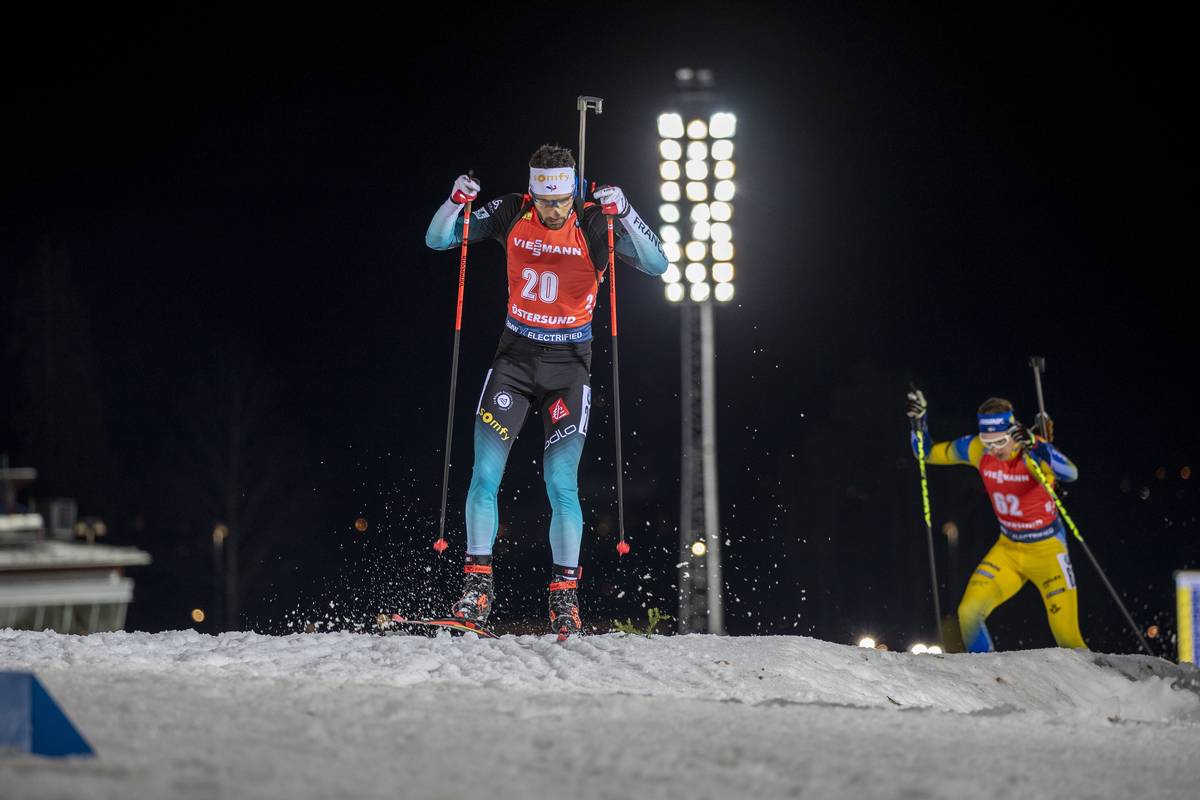
Martin Fourcade of France on his way to winning the IBU World Cup 20 k individual in Östersund, Sweden. (Photo: NordicFocus)
In Östersund, Sweden on Wednesday, the IBU World Cup picked up again with the men racing the 20-kilometer individual. The depth of the French team was evident as they swept the top-for spots.
Martin Fourcade won in a time of 53:11.9 minutes — and shooting clean until his final bout, when he missed a single target. Simon Desthieux was second (+12.7; 0+1+0+0), and Quentin Fillon Maillet third (+1:50.8; 2+0+0+1).
Scott Gow of Canada during the IBU World Cup 20 k individual in Östersund, Sweden. (Photo: NordicFocus)
Scott Gow of Canada was the top-placed North American in 33rd (+5:35.1; 2+1+0+0). His brother Christian Gow was 83rd (+9:36.8; 1+1+1+2). Also from Canada, Aidan Millar placed 98th (+13:58.7; 2+2+1+2), and Jules Burnotte did not finish.
Sean Doherty of the U.S. during the IBU World Cup 20 k individual in Östersund, Sweden. (Photo: NordicFocus)
For the Americans, Sean Doherty skied to 63rd (+7:41.7; 0+1+0+2), Leif Nordgren 73rd (+8:52.8; 1+3+0+1), Alex Howe 81st (+9:33.7; 2+1+2+0), and Travis Cooper 96th (+13:16.2; 3+1+1+0).
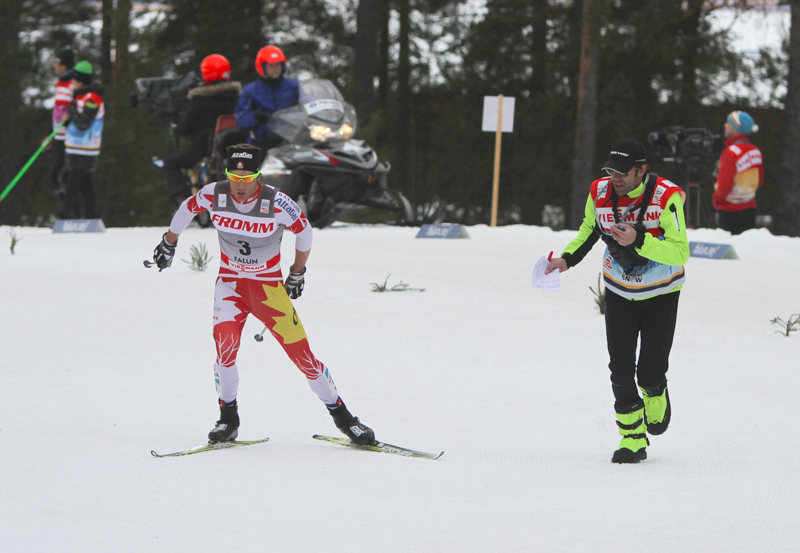
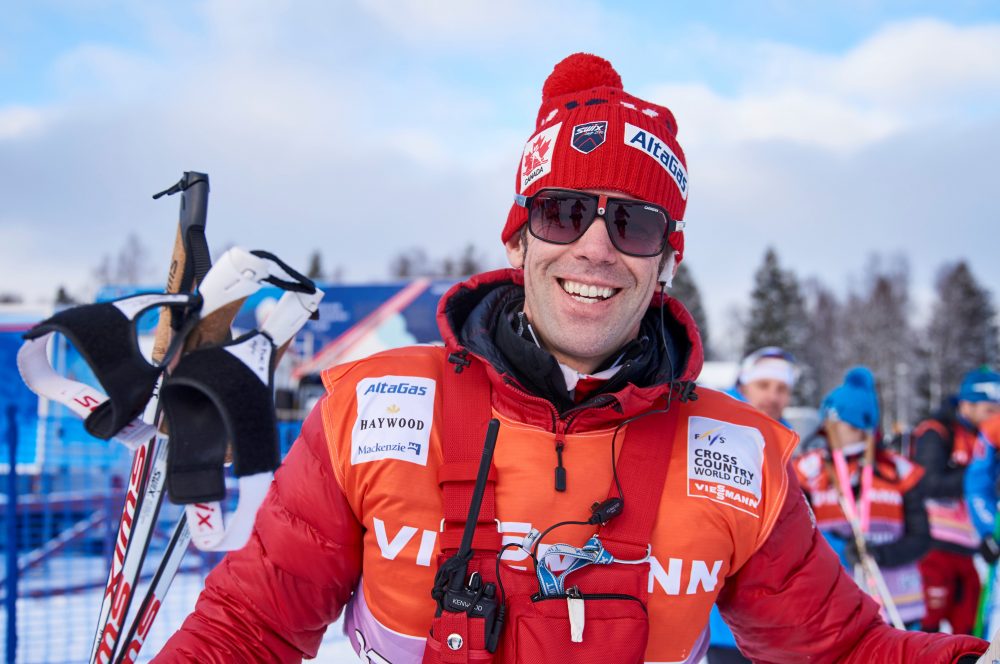
Canadian National Team Head Coach Justin Wadsworth (r) giving splits to Devon Kershaw at 2012 World Cup Finals in Falun, Sweden.
Last week, Biathlon Canada announced Justin Wadsworth as the Head Coach for the 2019-2020 season. In April, 2019, Wadsworth took on a temporary role as the team’s summer coach. That fill-in-the-gap stint will extend through this season’s racing. Wadsworth joins Canadian biathlon at a challenging time, with limited funding and after the retirement of many top athletes.
“My job is really just for the national team — we have 12 athletes and I would say that is my mandate to get those athletes working at their personal best and a world leading direction.” — Justin Wadsworth
Biathlon combines shooting accurately, skiing fast, and finding mental strength. Wadsworth has his focus on the ski speed. Pavel Lantsov, who joined the program part way through the 2018-2019 training season, will continue as shooting coach. Roddy Ward leads the development effort.
Wadsworth will make two trips to Europe during the season. As his wife’s career involves extensive travel, he has to manage his time away from the kids. Wadsworth took a five week summer break from coaching to get some quality family time. He has agreed to travel for the first IBU World Cup first period from November 17th to December 8th and then again for World Championships that will include a February pre-camp.
So how does a life-long cross country skier become not just a biathlon coach, but a national team head biathlon coach?
“That is a fine question because about six months ago I had no plan to coach anything let alone biathlon,” Wadsworth told FasterSkier on the phone last week from a Park City training camp. After originally agreeing to three months, he started work with the athletes on training and ski technique.
“Those three months kind of flew by and I had a lot of fun with the team.”
The 2019-2020 team is younger than in the recent past, with Emma Lunder, Scott Gow, and Christian Gow showing the most success in the last season.
“My main philosophy with training,” Wadsworth said of his focus with the young biathlon team, “is really just consistency. We don’t need to do the real radical things to get the extra one percent at the end of the day going into the season. We need consistent training with good technique and staying injury free and being healthy and that is going to bring this team the biggest rewards for this next coming year or two.”
Wadsworth ran the Canadian cross country team during the best funded period of its history, thanks to Vancouver 2010 and solid racing results. During his own racing career, he had a front row seat to watch the Canadian cross country team rebuild after Nagano 1998. While the latter has more obvious relevance in the current state of Canadian biathlon, he showed an ability to use money well [link to Canadian ski truck] when it was available. As he immerses himself in Biathlon Canada’s rebuild, he’s facing a stark reality when it comes to funding.
“I have never seen a team with a budget as small as this. Our athletes right now at this camp in Park City are paying for everything. No funding.”
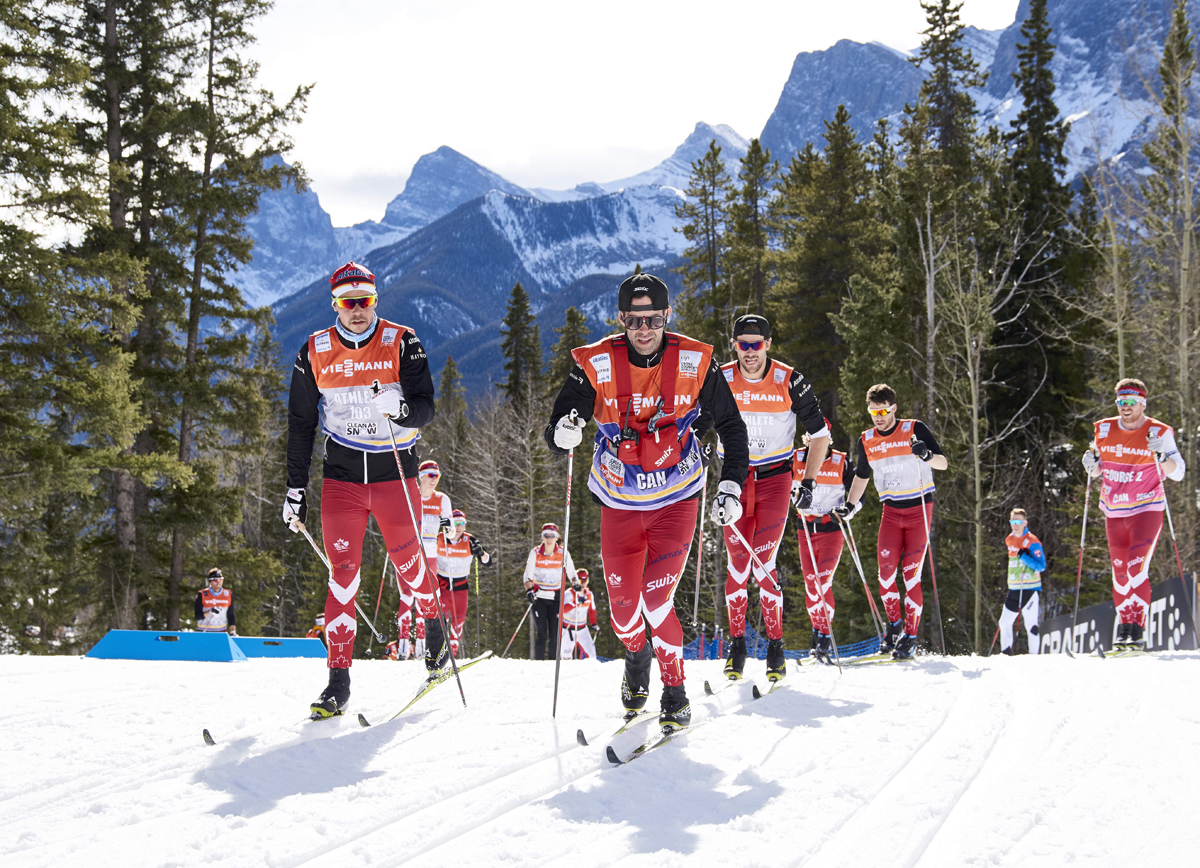
Canadian head coach Justin Wadsworth leads his team during a training session at the 2016 Ski Tour Canada in Canmore, Alberta, including athletes Jess Cockney (l), Len Valjas, and Alex Harvey. (Photo: Fischer/NordicFocus)
Who is Justin Wadsworth?
Wadsworth spent five years as the Canadian National Cross Country head coach and is often thought of as one of the most outspoken Canadian officials on the topic of doping in sport.
He presided over some of Canadian skiing’s ‘golden era’, including the arrival of Alex Harvey on the world stage, Devon Kershaw’s second overall in the 2012 World Cup, and Canada’s first World Championship gold. None were Wadsworth’s personal highlight, however.
“I would say the whole team during that 2012 season, where every member, male or female, of our national team, had a top three result on World Cup. That to me was the highlight. It was amazing. We had Perianne [Jones], we had Dasha [Gaiazova], we had Chandra [Crawford], we had all the guys. Everyone had been on the podium. A few podiums, like the girls, were double-podium with Peri and Chandra, or Chandra and Dasha in the sprint. The team energy was amazing. We went through the whole season and everyone was so focused and having so much fun. Really just a really strong team. Everyone thinks back to the guys, but before Christmas that year, Chandra, I think, was fourth on the overall sprint World Cup going into the Tour de Ski, and we had other great results. Lenny [Valjas] later that year had a podium in distance. Everything was just firing on all cylinders. That to me is what I remember. To me as a coach that felt the best and was kind of the highlight. Not just for the results, but the whole team really worked together hard, and everyone was accountable to everybody else. When that all clicked, and everybody got on the podium that year, it was really special.”
There is more to Wadsworth than coaching, as older ski fans may remember. He was a pivotal member of the U.S. Ski Team (USST). He competed at the most recent U.S. World Cup, producing the top American result with 8th in the 30-kilometer at Salt Lake City in 2001.
In 2002, he was sick at the start of his home Olympics before recovering to be part of the 5th place men’s relay (the best U.S. result ever, matched by the women in PyeyongChang 2018). He quarantined himself from his then-girlfriend to help her remain healthy and have the best chance at her own Olympic dreams.
On a call with FasterSkier shortly before the announcement of his new title, Wadsworth doubled down on the difficulty and importance of being a team player.
“Those are words that come out of my mouth with our current team here. If anyone gets sick, you have to pony up early on. Don’t be afraid about it. It’s one of the hardest things to say, ‘I might be getting sick’, early enough to prevent the whole team from getting sick.”
Wadsworth passed that test in 2002. He did, however, start his target event, the 30 k mass start freestyle.
“I should have not started, but I felt it was my best chance at a great result, and I started even though I was sick,” Wadsworth confirmed in an email about that DNF. “I wish someone had helped me to not start….”
When Wadsworth talks to athletes about trusting the process, they know that he has both lived it as an athlete and lead it as a coach. Wadsworth didn’t reach the top instantly himself, missing Albertville 1992 before qualifying for Lillehammer 1994, five years after his first World Cup start.
“Oh, I raced [a U.S. World Cup] one other time in 89 right here, down the road from where I am right now [Park City]. It was a Salt Lake World Cup, but it was held at a place called Mountain Dell. I think it was Bjørn Daehlie’s first ever World Cup, or first ever World Cup win.”
(FIS records are a bit sketchy that far back, but it was Daehlie’s first win.)
You might think Wadsworth’s strong opinions on cheating in sport come from being at Beckie Scott’s side through years of her very public challenges, but he does have first hand experience with dopers. When asked about his 2001 World Cup race, he said “I think [Johan] Mühlegg might have been ahead of me, but I always take him out [of the results].”
In that 2001 30 k, Mühlegg won as a Spanish athlete, having left the German team over a dispute about his personal doctor. Mühlegg would be banned after failing a doping test at the 2002 Olympics. The second place finisher, Christian Hoffman of Austria, was implicated in a different Olympic blood doping scandal in 2002, but wouldn’t be banned until 2009 after he was caught at Torino 2006.
If you take out the known cheaters, the upgrade to 6th place would give Wadsworth one of the best U.S. World Cup men’s results in history. By extension, Hoffmann wouldn’t have out-sprinted the U.S. closer Carl Swenson for fourth place at the 2002 SLC relay.
Wadsworth’s wide ranging experience as an athlete and coach leaves him with diverse tools to help Canada’s national biathlon team rise up.
Three-time Olympian and one of Canada’s most successful national team cross country ski coaches, Justin Wadsworth, has been named Biathlon Canada National Team Head Coach through to the end of the 2019-2020 season. Wadsworth, who was named interim head coach in April of this year, is excited to continue working with the team.
“Since April, our plan has been centred around consistent, quality training. The team has responded extremely well and have bought into the plan,” Wadsworth said. “Almost all athletes have broken personal records throughout the training season.”
Integrating into a new coaching and support team has been seamless for Wadsworth, “It has been a pleasure learning from Pavel Lantsov – he is an extremely committed and knowledgeable coach and the athletes respect him so much. Andrew Chisholm has also stepped in to support both Pavel and I on the trail and in the range and he is continually looking for new improvements. In addition, our Support Team lead, Jess Kryski has gone above and beyond in monitoring the health and wellness of our athletes with her team.”
“With a number of new athletes on the team this season, we have all worked really hard on creating a positive team culture, which is crucial when the World Cup team will be competing in Europe for over 120 days.”
Justin will split his time this season between attending World Cups and World Championships in Europe and working with athletes from afar in Canmore.
“This is a new approach to the season. In the past, we have had our head coach attending all competitions,” Heather Ambery, Biathlon Canada General Manager stated. “We are confident in our new plan.”
Pavel Lantsov, Senior National Team Coach and shooting specialist, and a team of Biathlon Canada world-class ski technicians will lead the World Cup team throughout the season. Justin will fly in and out of the daily competition environment at specific and strategic moments.
The World Cup and IBU Cup teams for the first Trimester (December) will be decided at Trials during the first week of November in Canmore.
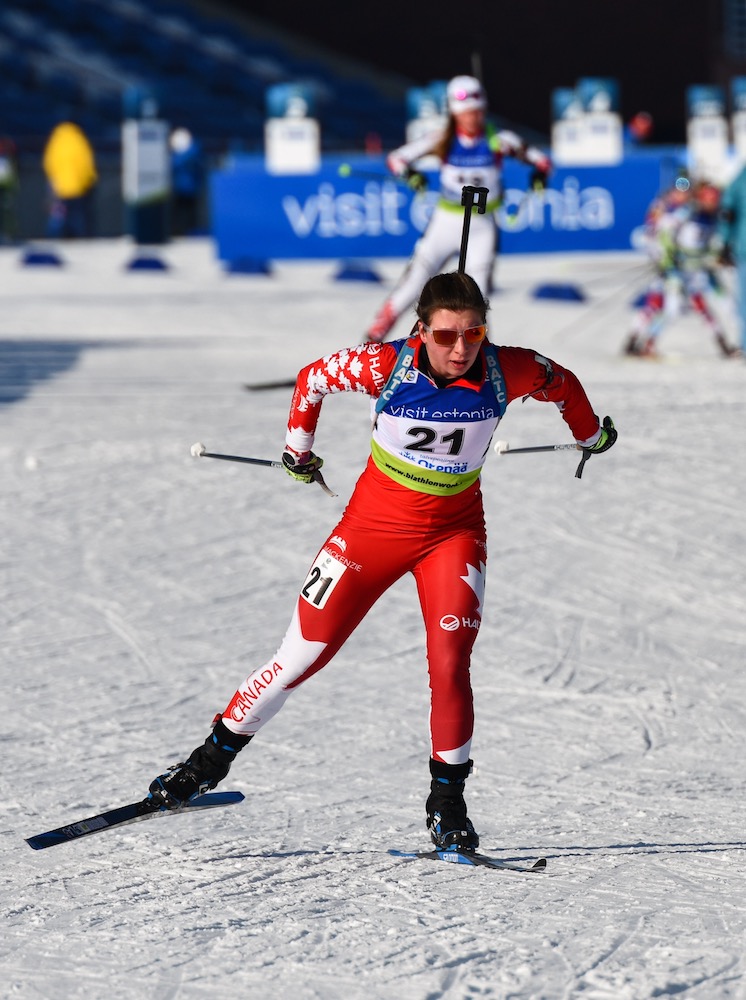
Nadia Moser racing to 11th in the junior women’s 10 k pursuit at IBU Junior World Championships on Sunday in Otepää, Estonia. (Photo: Bryan Dickson)
The third and final day of Biathlon Canada’s selection trials concluded on Friday in Canmore, Alberta. The “trials” serve as a method to fill roster spots for athletes representing Canada on the IBU World Cup, IBU Cup, and IBU Junior Cup for the first travel period to Europe.
Prior to the selection trials, only Rosanna Crawford and Scott Gow had prequalified for the IBU World Cup.
Friday’s race was billed as a modified relay. There was in fact no relay, it was an individual start race described as athletes having “3 spares per clip with penalty loops for further missed targets, as per a relay format.”
With no penalty lap due to limited snow, women were penalized 22 seconds per miss, the men 24 seconds. The women raced a total of 6-kilometers, while the men skied 7.5 k, which are the traditional distances for each respective relay leg in biathlon.
Nadia Moser racing for Biathlon Yukon won the women’s race in 19.57.5 minutes while cleaning prone and missing one shot standing. Emily Dickson (Team R.A.D.) placed second (+6.0) while shooting clean. Sarah Beaudry finished in third (+7.3) while also shooting clean in prone and standing.
Senior National team member Christian Gow won the men’s race in 18:58.3 minutes after cleaning both his shooting stages. Brother Scott Gow, also a national team member, finished second (+8.9) with no misses on the range. Third place was taken by national team athlete Nathan Smith who crossed the line in 19:32 minutes. He missed two shots in prone and none standing. Smith won the second day’s sprint during selection trials.
Biathlon Canada is expected to announce its teams for European based racing on Monday, Nov. 11th.
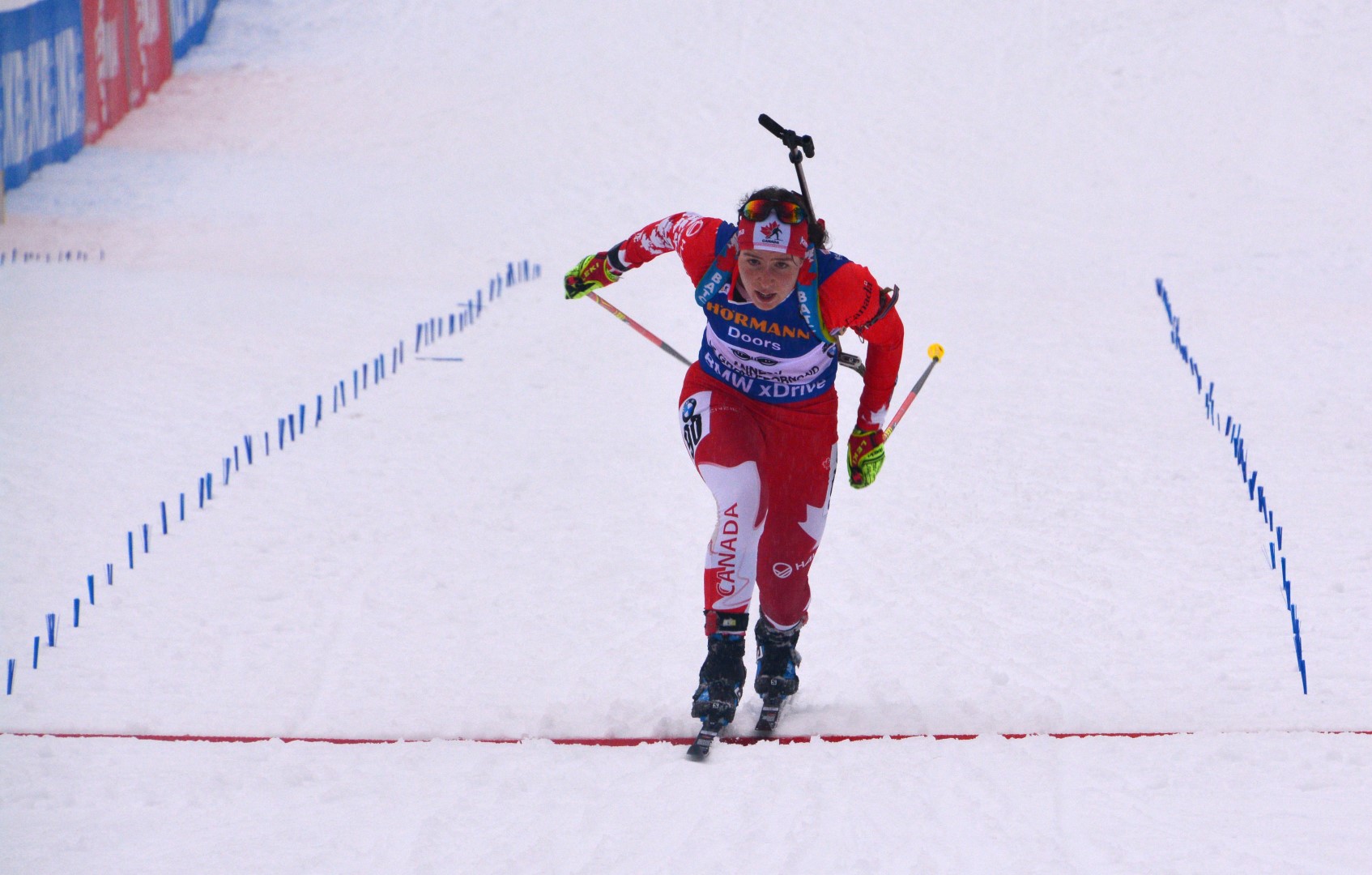
Megan Bankes (Biathlon Canada) lunging at the finish of the IBU World Cup women’s sprint in Annecy, France. She placed 65th. (Photo: Glen Crawford)
Selection trials for Biathlon Canada began with a men’s and women’s sprint today in Canmore, Canada. Race results will help determine athletes representing Canada on the IBU World Cup’s opening races, and the first series of races on the IBU Cup and Junior IBU Cup.
Prior to Tuesday’s racing, only Scott Gow and Rosanna Crawford had prequalified for Canada’s IBU World Cup team based on a top-16 result last season.
Senior National Team member Megan Bankes won the overall women’s 7.5-kilometer sprint in a time of 21:43.2 minutes. Bankes missed one shot shooting prone and cleaned standing. Bankes’ teammate on the National Team, Megan Tandy, placed second (+22.8). Tandy cleaned her prone stage while missing one standing. Pre-qualified athlete Crawford took third (+52.4) while cleaning prone and missing two shots standing.
Women were penalized 24 seconds per miss due to insufficient snow for a penalty loop.
Christian Gow, a member of the Senior National Team won the overall men’s 10 k sprint in 24:39.5 minutes. He had no missed shots on the day. Older brother Scott Gow raced to second place (+47.9) while missing two shots, one prone one standing. Taking third place was U24 National Development Team member Jules Burnotte. Burnotte finished in 25:31.1 minutes and had two misses: one each in prone and standing.
With the course lacking a penalty loop, the men were penalized 22 seconds per miss.
Selection trials resume on Thursday with another sprint race.
Biathlon Canada is pleased to announce Heather Ambery as our new General Manager. Heather will join the Biathlon Canada team starting mid-August 2018.
Heather comes to Biathlon Canada from the Canadian Olympic Committee (COC), where she was Program Manager, National Sport Federation Services. During her time at the COC, she helped manage the National Sport Federation Enhancement Initiative, which is a program designed to enhance business functions and build capacity in Canada’s National Sport Federations. Heather was also a member of the mission staff for the Rio 2016 Olympic Games and PyeongChang 2018 Olympic Winter Games.
“I am thrilled and honoured to be joining the Biathlon Canada team during such an exciting time for the organization,” says Ambery. “I look forward to collaborating with the Canadian biathlon community as we continue growing the sport at the grassroots level, succeeding on the international stage, and striving to be an exemplary sport federation.”
Heather’s background also includes experience working in major events and at the local level. She was the Competitions Manager at the Ottawa venue for the FIFA Women’s World Cup Canada 2015TM and played an integral role on the operations team at one of Canada’s largest soccer clubs, West Ottawa Soccer Club.
Biathlon Canada’s team is looking forward to building our sport under Heather’s leadership.
Cross Country Canada has reset. In thisnascent Olympic cycle, there’s been an organizational seismic wave as the country’s national governing body (NGB) for nordic sport, Cross Country Canada (CCC) implements change.
For the past 21 years, Lemyre has resided and worked in Norway, most recently as a professor of sport psychology at the Norwegian School of Sport Sciences (NIH) in Oslo. He also currently serves as the head of the department of coaching and psychology at NIH. Lemyre is originally from Montreal, graduated from St. Lawrence University in upstate New York, and was a member of the original elite training group of athletes based out of Mont Sainte-Anne, Quebec.
After a year training and racing post-collegiately in the mid ’90s, Lemyre was perplexed by this common and recurring question among nordic skiers: why are the Norwegians so fast? So he traveled to Norway to investigate.
“I was really curious about how come Norway was dominating so much in cross-country skiing,” Lemyre, 45, said on the phone last week from Canmore, Alberta. “They had so many guys that were going so fast. I thought I could take a trip there and see with my own eyes. So it was not an academic reason, it was really a curiosity related to what they were doing that could explain why they were so good at skiing.”
Lemyre’s original six-month trip ballooned in duration as he earned both a masters and doctorate in sport psychology from the Norwegian School of Sport Sciences. Along the way, he had opportunities to answer his initial question about Norway’s recurrent cross-country success. He, too, eventually played a part in those achievements as a sport-psychology consultant for the Norwegian women’s biathlon team and men’s cross-country team.
“I started working for the men’s team when Trond Nystad took over,” Lemyre explained. “I had known Trond when racing against him at NCAA’s. He was racing for Vermont and I was racing for St. Lawrence, so we would compete every weekend throughout the whole winter. And him being a foreigner and me being a foreigner, we would hang out, Trond and I and some other foreign guys. It was just really fun to meet Trond again 20 years later during a very different stage of our lives and we all got along really well, not just socially but also professionally.”
“When Trond took over, Petter Northug was pretty much the only guy winning races on the men’s side and he had been doing that for many years,” Lemyre said. “Trond structured the team in a way and a year later all the guys that were on the national team had podium finishes. And everybody contributed in a significant way to the excellence of the team. So that was a very interesting period to work with them.”
Lemyre’s tasks with CCC are centered on championship and Olympic medals for both able-bodied and para-nordic skiing. As his job title denotes, he’ll advise Canada on how to develop athletes into high-performance skiers on that medal path. With his knowledge base of both Norway’s and Canada’s nordic-skiing communities, Lemyre is positioned to adopt Norwegian methodologies when it suits Canada, yet build a program that capitalizes on what is unique to Canada.
To illustrate how the systems differ, Lemyre described the vast number of young skiers vying for limited race bibs within the Oslo “neighborhood” ski clubs. He spoke of a five-week-long, Oslo-based race series for eight to 11 year olds.
“There are 1400 places and all the places are registered within 24 hours on the internet,” Lemyre said of the depth of skiers within a single slice of Norway. “We have to block it at 1400 because we would not have time to race all the kids between the time they need to get there after school and before they have to go to bed. That number is the most amount of kids we can have on two-kilometer track between, I think, it starts at 5:15 p.m. and goes until 8:15 p.m. So the kids are starting two by two every 15 second for three hours. These are only the neighborhood races.”
Lemyre also consulted for the Norwegian men’s national hockey team. His experience working with that team reinforced the importance of capitalizing on Norway’s strength: a less-physical style of play. In 2011, Norway, a relatively small country when it comes to hockey, placed sixth overall at the men’s World Championships.
“For a small nation like Norway to do that well at the World Championships it was a great performance from the team,” Lemyre recalled. “And one thing I noticed from how they were preparing and performing at the World Championships was they tried to do it their way. They did not try to meet the Canadians or the Swedes or the Americans and try to play their game and play better than them because that would not have worked. I think at the Olympics in Vancouver, our team had almost a 20-kilo deficit in terms of weight with the Canadian players. Had they been playing as physically as the Canadians, it would have been very hard for them to hold out a 60-minute game.”
His time with Norway’s hockey program will serve as a corollary for fortifying cross-country skiing in Canada. Lemyre said his commitment to developing solutions to cross-country ski development will involve building on Canada’s intrinsic strengths. He’ll simultaneously import piecemeal from Norway’s development paradigm which emphasizes a data-driven approach.
“I think it is important to find a Canadian solution and then try to be fast on skis sort of the Canadian way,” Lemyre said. “If we try to do it the Norwegian way, they will always have numbers on their side and they will always have the advantage that the whole country breathes and eats and sleeps cross-country skiing. It is important for us to import what is importable from Norway, but also find a solution that is truly Canadian.”
“It is important for us to import what is importable from Norway, but also find a solution that is truly Canadian.” — Nic Lemyre, CCC high performance and development advisor
Lemyre’s approach appears to be binary. There are the athletes and the infrastructure to support those athletes. Although stating he had not yet discussed this with his colleagues at CCC, Lemyre said one hypothesis to test is trying to recruit cross-country athletes from different sports. This “crossover” hypothesis might help identify potential elite skiers in a system lacking the raw skier numbers of a Norway.
According to Lemyre, his center’s research at NIH discovered that adolescent athletes do not need endurance training to make them faster skiers later in their careers.
“What we see is that there is very little physiological adaptation to endurance training before kids turn 13,” he said. “To have a focus on skill development and play until they reach that age is really important. Endurance is something that you can gain really quickly later in life. We could also emphasize the fact that you can be a cross-country skier in the winter to keep yourself active and develop skills and in the summer you can play soccer or do mountain biking or something else, so that we welcome you in the cross-country skiing family even though you have other sport interests. … We want cross-country skiing to be the most inclusive sport in Canada.”
Lemyre again referenced hockey to differentiate how CCC can build its roster of high-performing skiers. In Canada, he said that only ice hockey can claim a near monopoly of untapped youth talent like cross-country skiing in Norway. He described a system in Canada where the default season for aspiring hockey players is 12 months long. According to Lemyre, a stigma exists for families pulling their children out of full-time hockey training to play another sport on the side.
“There is a strong feeling with the parents if they pull out their kids from ice hockey in the summer so they play soccer then the kid will suffer when they try to come back into the structure in the fall,” he said. “Because often the coaches will interpret that as the kid being less motivated or the kid investing less in their development, so they will often make the kid, call it, ‘pay’ for them not playing hockey in the summer. I think if we can be wise in cross-country skiing and actually use the research to our advantage and encourage our kids to be multi-sport athletes down the road, we will likely have even better athletes. And one thing’s for sure, we will not have used up their motivation because they will have had the opportunity to do a lot of things while they were developing.”
The other piece of Lemyre’s development model will focus on the importance of training infrastructure. He’ll highlight the locations and facilities where athletes can form high-level training groups and learn from one another within Canada.
“I find the Americans have been doing that really well with the last generation of skiers you have at a high level,” Lemyre said. “[The Americans] focused on what you could develop within the country with the strengths they already had. You have athletes use the infrastructure already in place. The athletes are good at training in American places during the offseason and organizing training tasks where athletes can train with the best in the U.S. and learn from them and share knowledge. So we are inspired by that.”
Lemyre acknowledged that he is advising CCC during a period of change and perceived instability. When he took over the Department of Coaching and Philosophy and Psychology at NIH, he explained it was also a time of change and disruption. When he began leading the department, he was tasked with modifying the direction of research and restructuring the organization. Having led that research group for the last eight years, which includes over 30 staff members and a multi-million dollar budget, Lemyre notes he is acclimated to the challenges of organizational development.
“I understand that all the bricks aren’t in place yet [at CCC] and there are people that have left the organization that were very knowledgeable and had a lot of experience,” Lemyre said. “Some of them live here in Canmore and I happen to know some of them, so there is the human side of the situation where it’s never fun to know that somebody you know and appreciate a lot has had to make that change to their professional life. But as an organization, I think sometimes you need to regroup and downsize to know what you really have and what you need. … This is a temporary situation. It’s always hard to do those changes. But I would say in terms of our sport, it makes sense to make these big changes and restructuring when you are starting an Olympic cycle.”
Along with his new role with CCC, FasterSkier asked Lemyre whether he’d be taking on a similar role with Biathlon Canada. As of press time, Biathlon Canada neither confirmed nor directly commented on an official partnership with Lemyre.
“Biathlon Canada is in the final process of restructuring different staffing positions and official statements will be released soon,” Biathlon Canada’s National Team Head Coach Matthias Ahrens wrote in an email.
According to Lemyre, collaboration between the two NGBs was likely.
“There’s a strong interest in Canada in having more overlap at the high level between cross-country skiing and biathlon and both sports have a lot of commonalities and it makes sense to share knowledge, to share experience and to share competence,” Lemyre said when asked about a Biathlon Canada partnership. “I haven’t been part of CCC for a very long time. I still need time to get a good overview of what we have and how we can best collaborate, but there is definitely a strong interest from both sides to have more collaboration in the future and to share more resources. We don’t really know what it’s going to look like in the end, but there’s definitely strong interest on both sides to make this collaboration a success.”
Lemyre is currently in Canada but will return to Oslo with his wife and three children in August to continue his head of department duties at NIH.
“I will be doing my advisory job remotely from the month of August,” he said. “For sure it is a compromise, but that is what we could organize.”
Despite being based in Norway, Lemyre said he will be working closely with CCC’s CEO Shane Pearsall and collaborating with Canada’s provincial training centers.
“We also wish to have me do some operational things with the national teams,” Lemyre said. “Our thoughts are that during the competition season, I will have opportunities to meet up with the national-team athletes and staff on site in Europe and during championships as well. … I’ve officially been in this position for less than a week so I think maybe if we talk again in a few weeks or a month or two then definitely I’ll have a lot more insight in terms of what kind of resources we have and where we’re going and how we’re going to build it.”
Biathlon Canada, the National Sport Organization for biathlon in Canada, is seeking an independently minded and highly motivated individual to fill the position of General Manager for its operations. The successful candidate will be expected to lead Biathlon Canada to long-term success through the next two Olympic cycles.
The General Manager is a key leadership position in the organization providing support to Biathlon Canada’s international and domestic programs.
This is a full-time position based in Canmore, Alberta.
A successful candidate should possess:
The ability to manage a broad and diverse work load with strong problem solving abilities
5-10 years of hands-on management experience including familiarity with operating administrative aspects of business including accounting and staff management
Strong marketing skills
Resourceful and independent attitude which includes accepting responsibility for new tasks and alertness to opportunities to add value to Biathlon Canada
Post-secondary education
Excellent computer skills in all Microsoft software programs
Strong written and verbal communication skills in English (essential) and French (highly desirable)
Receptive to working in a changing and evolving work environment
Flexibility & willingness to travel as necessary for meetings and events
Familiarity with board governance processes a benefit
As a permanent full-time employee, the General Manager will be eligible for employee benefits in accordance with Biathlon Canada’s employee benefits policy. Salary will be determined based on qualifications and experience.
North American skiing performances of the year: U.S. junior men’s silver medal in the 4 x 5 k relay at 2018 Junior World Championships (l) and Kikkan Randall and Jessie Diggins winning gold in the team sprint at the 2018 Olympics. (Photos: Julia Kern & FlyingPointRoad)
With the 2017/2018 season officially in the rearview, FasterSkier is excited to unveil the last of its annual award winners for this past winter. Votes stem from the FS staff, scattered across the U.S., Canada, and Europe, and while not scientific, they are intended to reflect a broader sense of the season in review. This set of honors goes to the North American Performances of the Year in cross-country, biathlon and nordic combined.
Women’s Cross-Country: U.S. Women’s Olympic Gold in Team Sprint
Kikkan Randall (l) and Jessie Diggins after winning a historic gold for the U.S. in the women’s freestyle team sprint at the 2018 Olympics in PyeongChang, South Korea. (Photo: FlyingPointRoad)
It had been 42 years since the last U.S. medal in an Olympic cross-country event, that being Bill Koch’s silver medal from the 1976 Winter Games. Never before had a U.S. woman taken home any Olympic hardware. Never before had an American taken home gold. Not until this year’s freestyle team sprint at the 2018 Winter Olympics in Pyeongchang, South Korea.
With the Alpensia ski trails serving as their backdrop, U.S. Ski Team teammates Kikkan Randall and Jessie Diggins paired up to win the first U.S. women’s Olympic cross-country medal. The duo bested European nordic powerhouses, such as Norway, Sweden and Finland, as well as 17 other teams, to win the much-sought-after gold.
While Randall matched Norway’s Marit Bjørgen and Sweden’s Charlotte Kalla in her legs of the 6 x 1.25-kilometer race, Diggins paced Norway’s Maiken Caspersen Falla and Sweden’s Stina Nilsson. Thanks to tactical skiing by Randall, 35, and tenacious moves by Diggins, 26, the Americans put the Swedes and Norwegians behind and the U.S. in front.
“We came into this race just knowing that if we skied smart and doing our jobs, good things could happen,” Randall told FasterSkier after the race. “We never really talked about medals. We said let’s just go out and do it and have fun. I think that really worked well for us today.”
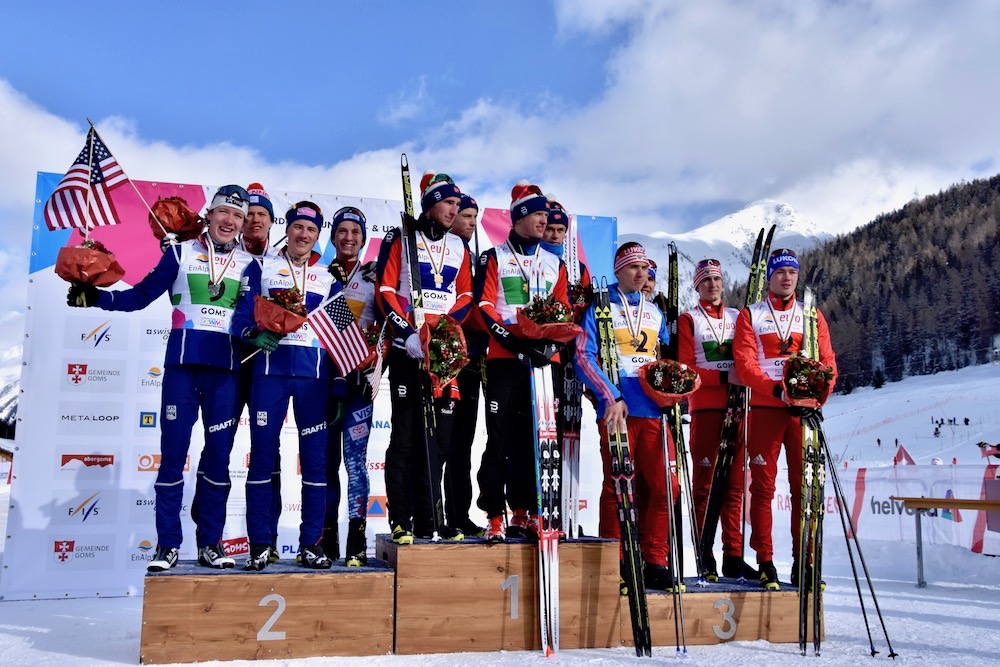
Men’s Cross-Country: U.S. Junior Men’s Relay ( Luke Jager, Ben Ogden, Hunter Wonders, and Gus Schumacher) 2nd at Junior World Championships
In early February, the U.S. junior men’s 4 x 5 k relay team went all-in at Junior World Championships in Goms, Switzerland. In their medal quest, the American team, with Luke Jager, Ben Ogden, Hunter Wonders, and Gus Schumacher, passed two teams on Schumacher’s anchor leg and came close to catching Norway, too, ultimately placing second, 2.2 seconds behind Norway in first.
The men’s 4 x 5 k relay podium at 2018 Junior World Championships with Norway (c) in first, the U.S. (l) in second (Ben Ogden, Luke Jager, Gus Schumacher, Hunter Wonders), and Russia (r) in third. (Photo: Julia Kern)
The silver-medal finish is the best American relay result to date at a Junior Worlds championships.They finished 3.3 seconds ahead of Russia, which placed third, for a new mark for the U.S. team.
“I thought it was possible, but actually getting it feels amazing,” Schumacher wrote in an email to FasterSkier after the race. “This whole trip has been really cool even without this success, it’s such an amazing place and the team is tight. I think individually I anticipated results maybe a little better, but this seems about right, and as a team I think we all surprised ourselves. Together we can make some big waves.”
Jager also attributed the team’s success to the particular chemistry of the group.
“This is something this group of guys has been dreaming of and training for for a really long time now,” Jager wrote in an email.
“To be able to watch that dream come into fruition today was indescribable. Probably the best day of my life since Cole Morgan added me on Snapchat,” Jager continued. “We came here this year to show the world that US skiing is the real deal and that we’re here to stay and I think we did that. To be able to be a piece of that history was an honor.”
Honorable Mention: Sophie Caldwell 3rd in Sprint World Cup
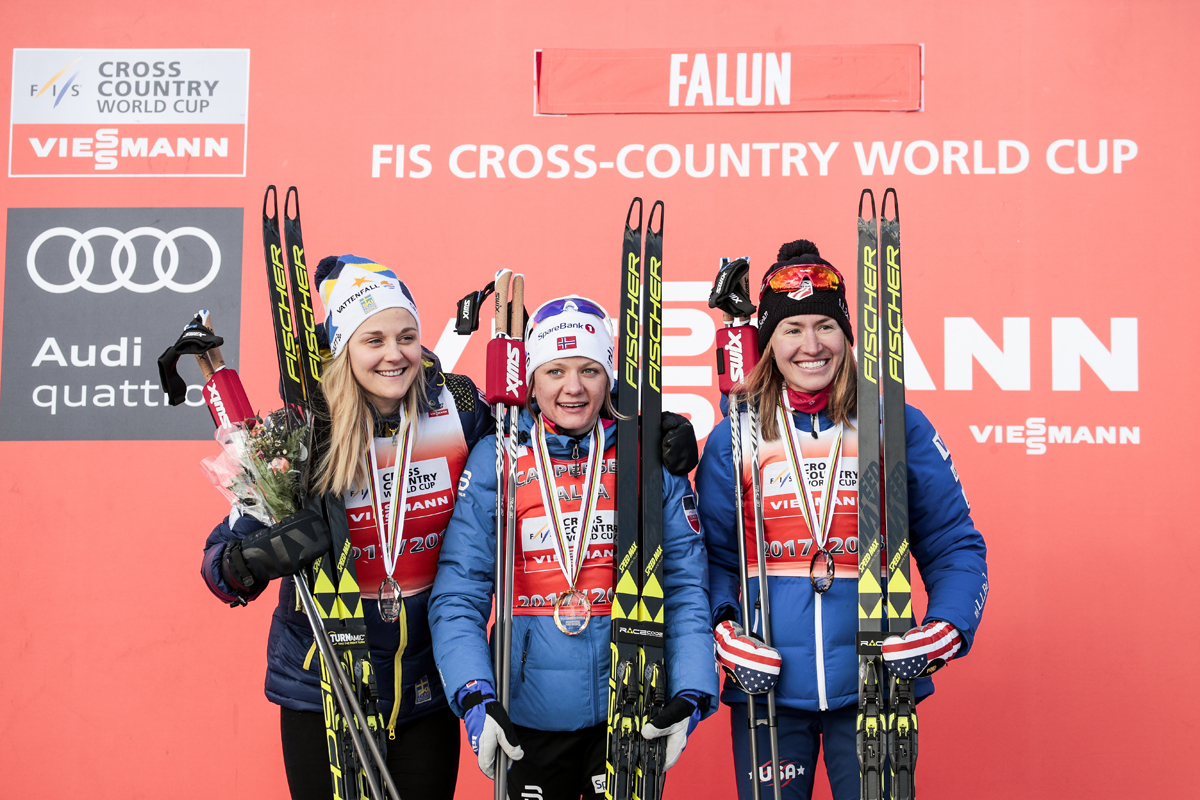
Two years ago, Sophie Caldwell, encouraged by the U.S. Ski Team Women’s Coach Matt Whitcomb, made a goal of finishing in top three of the season-long Sprint World Cup. By the end of this winter, she achieved that goal, closing out the 2017/2018 season in third place with a total of 396 points. Just ahead of Caldwell with 495 points was Sweden’s Stina Nilsson in second and Norway’s Maiken Caspersen Falla in first with 573 points.
The 2017/2018 women’s Sprint World Cup podium with Norway’s Maiken Caspersen Falla (c) in first, Sweden’s Stina Nilsson (l) in second and American Sophie Caldwell (r) in third. (Photo: Fischer/NordicFocus)
Caldwell’s race season was littered with strong sprint performances, with the 28 year old finishing in the top 10 in all but one of the sprint races she entered. She made it to the finals in four of the 10 World Cup sprints she raced and landed on the podium three times.
During World Cup Period 1, she finished eighth in the classic sprint in Kuusamo, Finland, ninth in the classic sprint in Lillehammer, Norway, and eighth in the freestyle sprint in Davos, Switzerland. Her first podium of the season came at the Tour de Ski in Lenzerheide, Switzerland, where she finished second in the freestyle sprint.
Following the Olympics in PyeongChang, South Korea (where she raced to an eighth place in the classic sprint), Caldwell raced to eighth in the World Cup freestyle sprint in Lahti, Finland, 27th in the classic sprint in Drammen, Norway, and sixth in the freestyle sprint at World Cup Finals in Falun, Sweden.
“It’s been a good season with some really good results, but I think maybe what I am most proud of is just the consistency of my season — making it into the semifinals almost every sprint and skiing with confidence throughout the year,” Caldwell told FasterSkier in Falun.
“We were really psyched that she took after it because, all of us coaches, really believed it could be done,” Whitcomb had said of Calwell.
Honorable Mention: Alex Harvey 3rd Overall in Tour de Ski
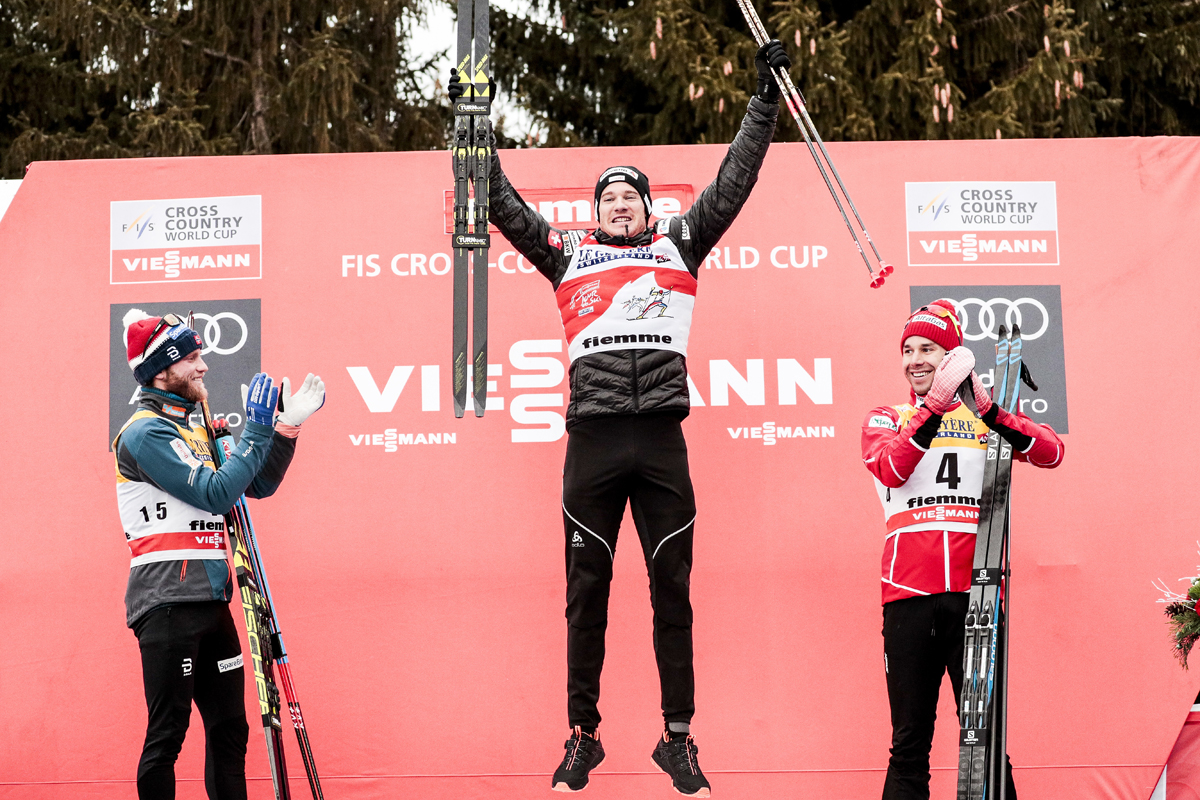
Canada’s Alex Harvey (r) on the podium after placing third in the overall 2018 Tour de Ski, along with Switzerland’s Dario Cologna (c), who celebrated his fourth Tour de Ski title, and Norway’s Martin Johnsrud Sundby (l) in second place. (Photo: Fischer/NordicFocus)
Even Alex Harvey will admit, the Tour de Ski’s final stage hill climb has long been his weakness.
“I have been well-ranked up until the last stage a few years in a row, but just never been able to quite do it on the last stage,” Harvey had told FasterSkier in early January following the Tour.
This year, by the Stage 7 hill climb in Val di Fiemme, Italy, Harvey had found his form.
The 29-year-old Canadian raced to third in the Tour, behind Switzerland’s Dario Cologna in second and Norway’s Martin Johnsrud Sundby in second.
Prior to this season, Harvey had finished in 20th in the overall in 2011 and 40th in 2012. For a few years, the Canadian did not finish the Tour due to circulatory problems in his legs, which particularly plagued him when skate skiing up hills. In the spring of 2015, he had surgery to remedy that.
In 2016, he finished 14th in the Tour de Ski (TdS), and last year, he bumped up to seventh. This season’s third place is his first in the TdS overall top three.
“I still tried to go by Sundby at the end, he had a little bit more than me,” Harvey told FasterSkier. “It is good terrain for him, a steady climb like that. He is such a strong climber — it was simply good I was able to just hang onto him until the end.”
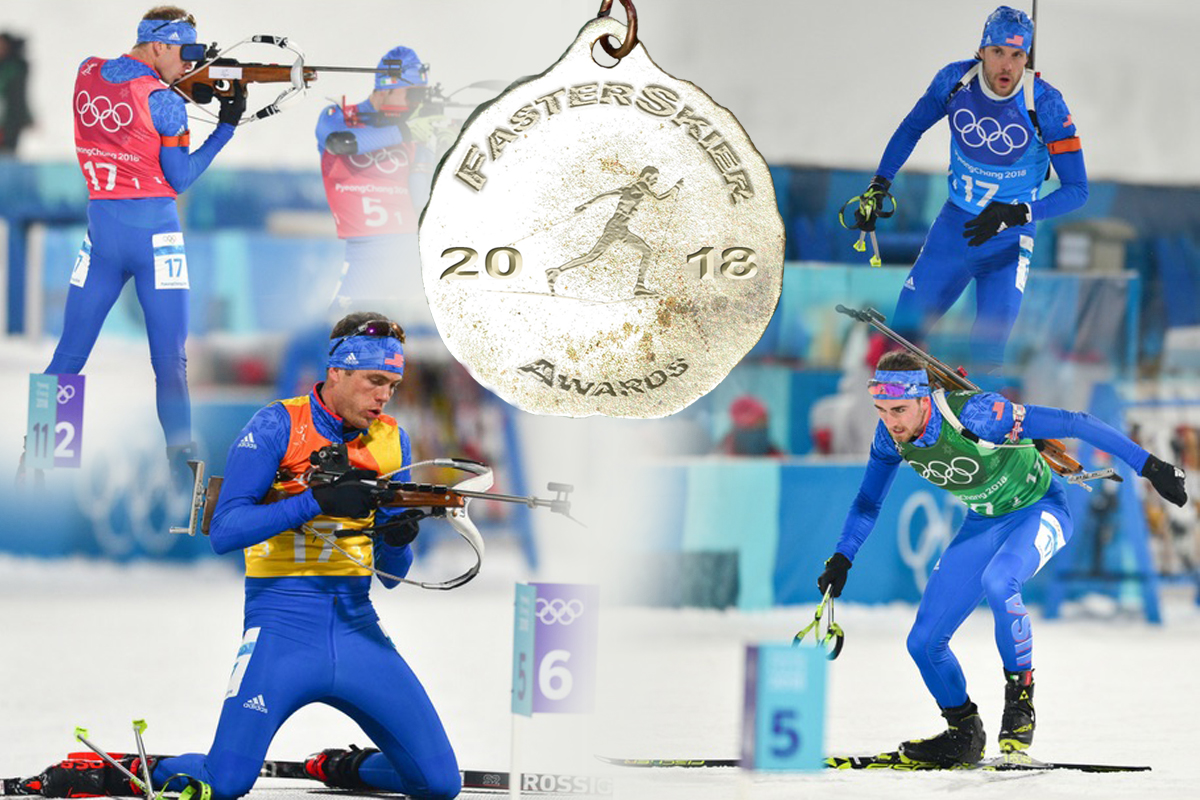
The U.S. men’s sixth place in the Olympic 4 x 7.5 k biathlon relay is one of FasterSkier’s North American Performances of the Year. (Photos: US Biathlon/NordicFocus)
Men’s Biathlon: U.S. Men’s Relay (Lowell Bailey, Sean Doherty, Tim Burke, Leif Nordgren), 6th place at Olympics
Individually, the 2018 Olympics were below expectations for the U.S. men’s biathlon team. The four men who competed only notched one top-30 result combined — Tim Burke placing 17th in the pursuit.
But the men’s relay, the very last biathlon competition of the Games, was another story. In a topsy-turvy race with a lot of wind and a lot of penalty loops, the Americans stayed right in it. Less than a minute out of the lead at the halfway point, they finished sixth (+3:50.2), tying the best relay result ever by an American team at any Olympics.
“On a day like today, you saw that France was in the loop, now Germany, so the top nations are in there,” Lowell Bailey said at the time. “I cannot tell you how challenging this range is. It is so much different than most of the other ranges we shoot on.”
Best ever? Yes. But Leif Nordgren and Sean Doherty, the two team members who are not retiring, were left wanting more.
“Honestly it is a little disappointing,” Nordgren said after. “I know we were gunning a lot more as a team. I had some mistakes there in prone, too. That hurt a lot since we were right there in contention with some top teams in the world.”
Rosanna Crawford’s third-place finish and first-career podium at the Ruhpolding IBU World Cup is one of FasterSkier’s North American Performances of the Year. (Photos: Salomon/NordicFocus)
Women’s Biathlon: Rosanna Crawford 3rd in Ruhpolding World Cup 15 k
The women’s performance award goes to someone who had a podium coming for a long time. And in Ruhpolding, Germany, this year, Rosanna Crawford finally got it.
She shot 20-for-20 in the 15 k individual, the most grueling race format on the women’s schedule. And then she pushed her hardest over the course’s big hills to hang on to a top-three finish. One of the last starters in the field, she mixed up the podium after the pre-race favorites had already finished and perhaps had thought their positions were secure.
“I actually didn’t know I was fighting for a podium until the fourth loop,” Crawford told FasterSkier on the phone after the race. “I was like, Oh God! But I think that kind of helped, because then I knew to expect the crowd for the last standing.”
It was a big day for the Canadian team, too: their last podium was when the men’s relay won bronze at 2016 World Championships. A lot has changed since then, including a tough season in 2016-2017 for many of the team’s veterans.
But Crawford bounced back.
“Julia [Ransom], Emma [Lunder] and Sarah [Beaudry], they kind of pushed past the IBU guys [into the finish zone], which I don’t think they were allowed to do, but Canada’s not on the podium every day so they let them sneak by to give me a hug so that was really special,” Crawford told FasterSkier. “I’ve been with these girls the past couple years now and so to be able to celebrate with them is amazing. Their results have been so inspiring for me … [My coach Roddy Ward] also jumped the fence, which I don’t think was allowed, so that was nice to be able to see him as well. It’s just such a team effort to get to the podium. I’m the one out there skiing and shooting, but I couldn’t have done it without the amazing skis on my feet or my coaches behind the scope, so Matthias and Roddy were really important there, and I couldn’t have done it without the girls who I train with all summer. I’m just so grateful for this team that I’m on.”
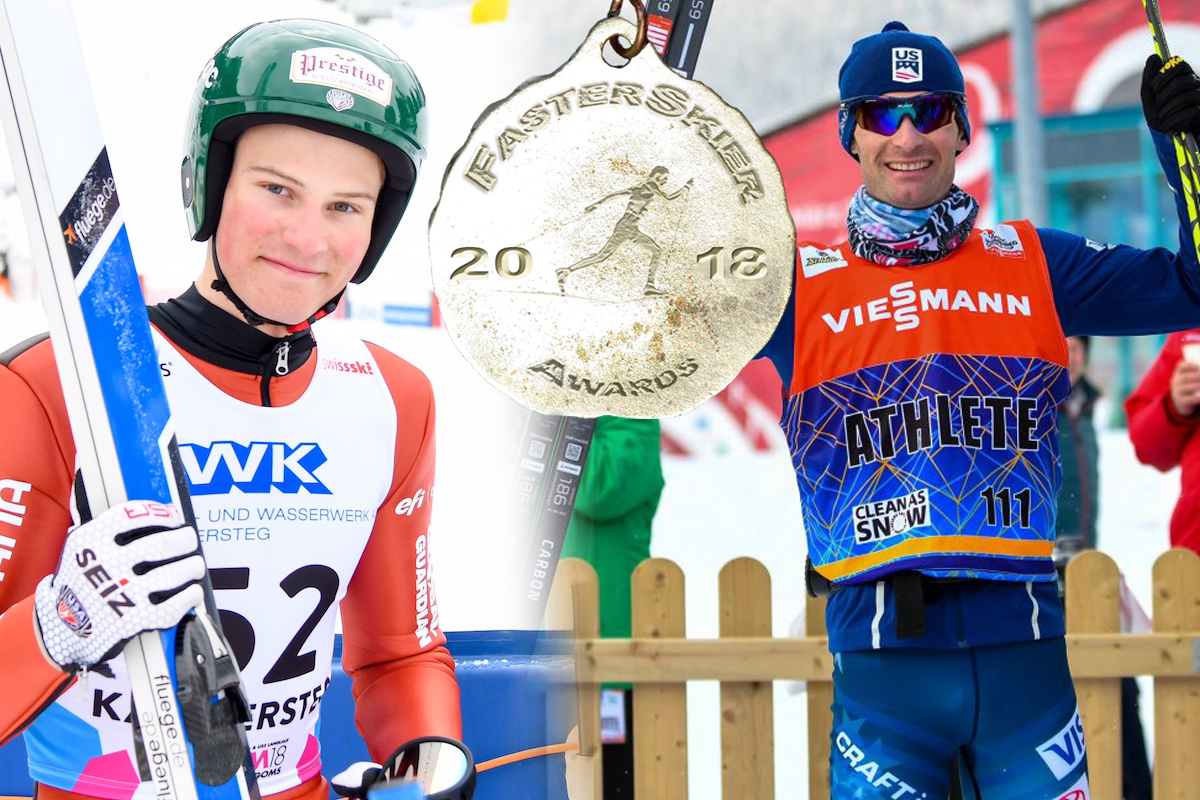
Ben Loomis’s bronze-medal performance at Junior Worlds and Bryan Fletcher’s seventh place in his last World Cup competition are FasterSkier’s North American Nordic Combined Performances of the Year. (Photos: Romina Eggert & USA Nordic)
Nordic Combined: Ben Loomis 3rd at Junior World Championships & Bryan Fletcher 7th in last race
Nineteen-year-old Ben Loomis already received our nod for Junior Skier of the Year, but his bronze-medal performance at Nordic Combined Junior World Championships deserves “Performance of the Year” accolades as well.
At his fourth and final Junior Worlds, Loomis jumped to seventh and raced to third in the first competition in Kandersteg, Switzerland.
“Taking a step on the podium was an excellent feeling today,” Loomis wrote in an email to FasterSkier after that normal hill/10 k. “I have been working very hard, especially towards this specific race for a long time now. Accomplishing this is a huge relief and very motivating for the future.”
He went on to race to seventh and finally a fourth place in the other two individual competitions at 2018 Nordic Combined Junior Worlds. Then he competed in three events at his first Olympics in PyeongChang, South Korea.
But his main goal for the season, and his main goal for the last two years, had been to take a medal at Junior Worlds.
“I’ve always done pretty well against juniors my same age so that gave me confidence going into Junior Worlds,” he told FasterSkier in an email earlier this month. “Of course, I was very happy and at the same time relieved to have meet my goal. This result was huge because it not only helped myself out, but it opened up another World Cup spot which is a help for the whole team. This certainly made everyone happy.”
Then, there was U.S. Nordic Combined’s team veteran, Bryan Fletcher, who placed seventh in the last World Cup race of his career — tying his best result of the 2017/2018 season. He was our pick for this year’s Nordic Combined Skier of the Year, and we think they way he ended his career is worthy of recognition in this category as well.
On March 14 in Trondheim, Norway, the 31-year-old Fletcher jumped to 12th then skied to seventh in the large hill/individual 10 k, posting the seventh-fastest 10 k time in the process. Fletcher scored World Cup points by finishing the the top 30 of nine of 10 individual races he entered. He also placed 17th in two individual races at the Olympics.
“I think that it’s going to be bittersweet,” Fletcher said of his retirement in a video interview with FIS. “I’m happy that it’s over and that I’ve gotten to experience the whole journey. But it’ll also be a little sad because it’s a long journey coming to an end … and there’s going to be a lot of things to remember and miss of this sport.”
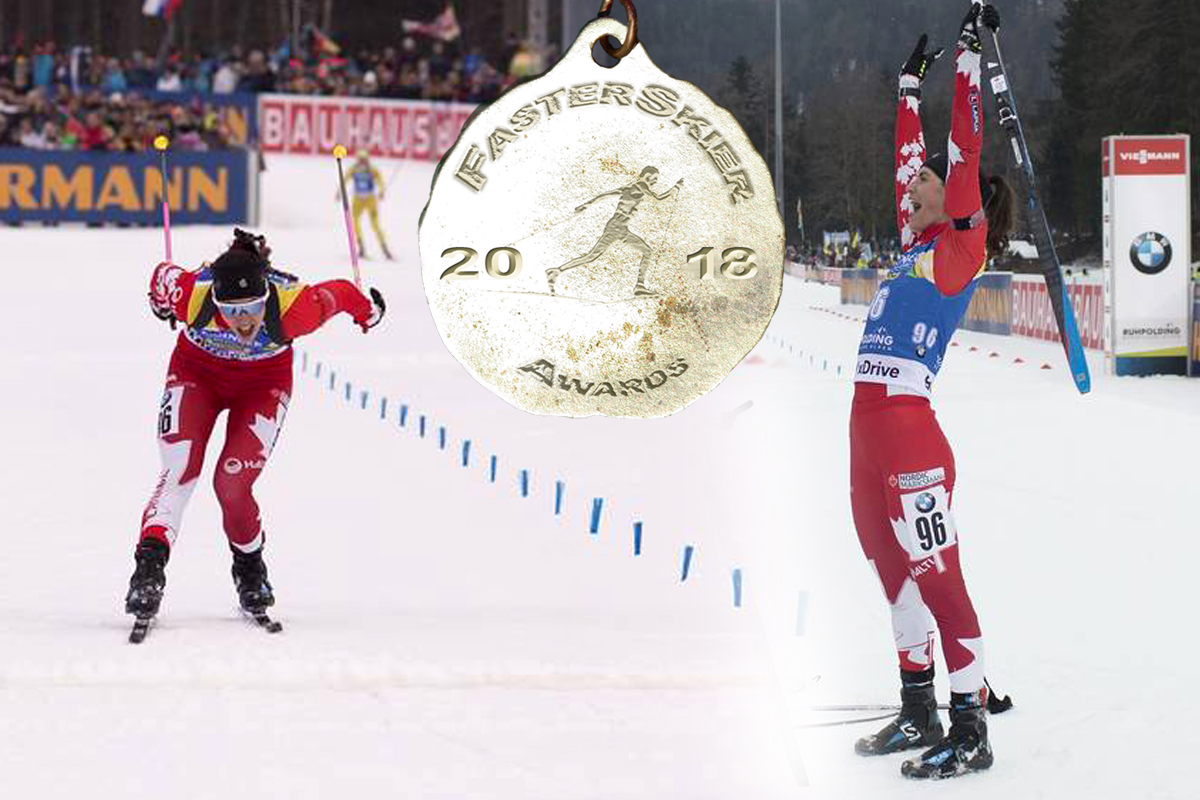
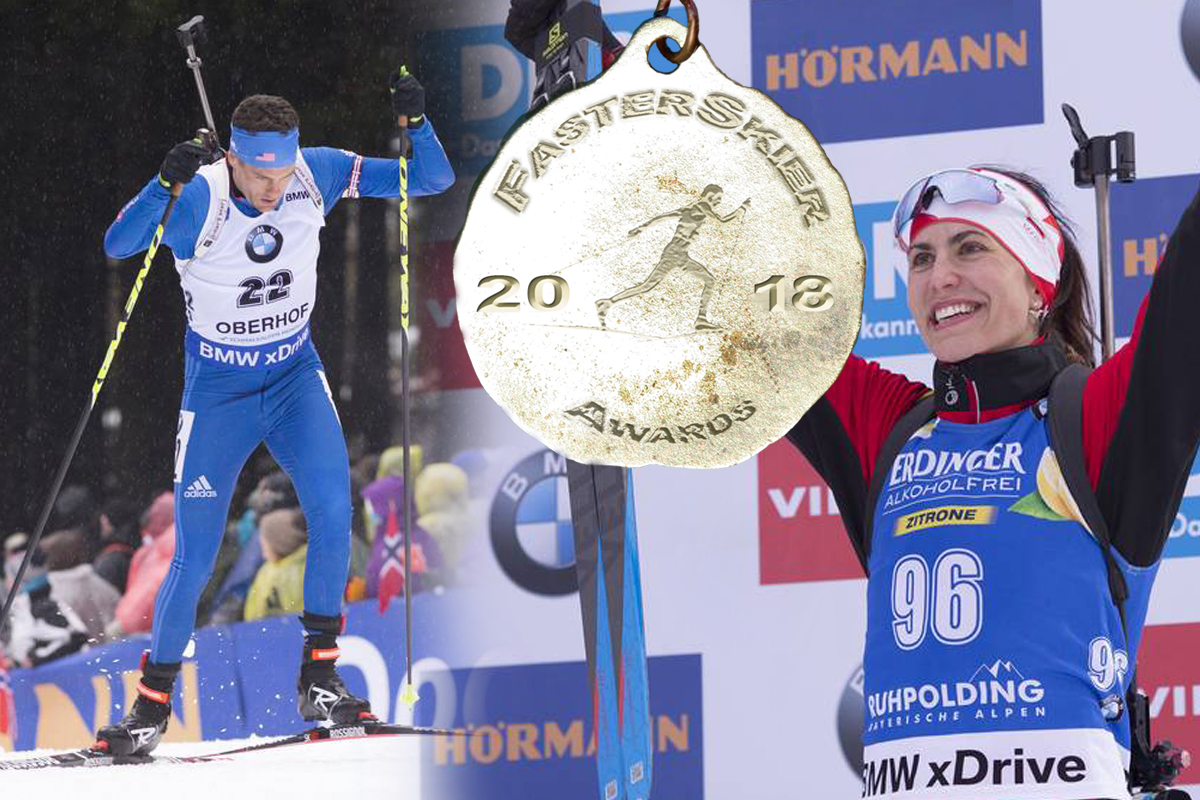
Tim Burke of US Biathlon (left) and Rosanna Crawford of Biathlon Canada (right) are FasterSkier’s 2018 Biathletes of the Year. (Photos: USBA/NordicFocus; Salomon/NordicFocus)
With the 2017/2018 season officially in the rearview, FasterSkier is excited to unveil its annual award winners for this past winter. Votes stem from the FS staff, scattered across the U.S., Canada, and Europe, and while not scientific, they are intended to reflect a broader sense of the season in review. This set of honors goes to outstanding North American biathletes on the international circuit.
***
Rosanna Crawford, Biathlon Canada
Rosanna Crawford had been close to the podium before, coming into this season. Fourth place. Fifth place.
But then she had a disastrous 2017 season that left her in tears after World Championships, wondering what had gone wrong. After that, she lost her brother, as the Crawford family endured heart-rending tragedy.
Rosanna Crawford celebrates with her Biathlon Canada teammates Emma Lunder (l) and Julia Ransom (r) after placing third for her first-career IBU World Cup podium on Thursday in the women’s 15 k individual in Ruhpolding, Germany. (Photo: Salomon/NordicFocus)
All of that might have stopped some people, but not Crawford. In Ruhpolding, Germany, she finally scored that podium – in a race so tough it’s only held a few times a season, the 15 k individual. She shot a perfect 20-for-20 to take third place, 21.2 seconds behind Dorothea Wierer of Italy.
“There’s just so many lessons you learn over the years, and trying to bring it all together and to have it pay off on one day is exactly what we’re all hunting for out there,” Crawford said after her podium.
Later that weekend she again shot 20-for-20, this time in the mass start. She left the range the final time in first place, but was passed by three other women on the final loop and had to settle for fourth.
“I was really surprised to leave the range in 1st, these are the 30 best women in the world,” Crawford wrote in an email after the mass start. “I would have love to hold onto a podium, but was pretty dead on my last loop… I was pretty disappointed when I crossed the line in fourth, but as time went by I got more and more happy. To have hit another 20/20 is fantastic, especially in the high pressure situation of a Mass Start. With that race I went 50/50 in Ruhpolding!”
It was an up-and-down season for Crawford, who finished no better than 39th in the first period of World Cup racing and was sent down to the second-tier IBU Cup. But she excelled there, and then came the races in Ruhpolding.
From there she headed to the Olympics – her third – and had a poor sprint race, finishing 53rd with three penalties. It was devastating, but she came back and climbed all the way up to 19th in the pursuit, the biggest improvement in the whole field.
“I had some really good chats with my sister Chandra,” Crawford said after the Olympic pursuit. “She’s a huge motivator for me and my biggest cheerleader now. She really just talked some sense into me to not be so down on myself after the sprint, so that was really helpful.”
Immediately after the Olympics, Crawford finished 12th in the sprint and 11th in the mass start in Kontiolahti, Finland, before finishing the season off in Oslo. She has still not announced whether she will continue competing next year, or retire.
But crossing the finish line in third in Ruhpolding was an unforgettable highlight, either way.
“[Teammates] Julia [Ransom], Emma [Lunder] and Sarah [Beaudry], they kind of pushed past the IBU guys, which I don’t think they were allowed to do, but Canada’s not on the podium every day so they let them sneak by to give me a hug so that was really special,” Crawford told FasterSkier. “I’ve been with these girls the past couple years now and so to be able to celebrate with them is amazing. Their results have been so inspiring for me … [My coach Roddy Ward] also jumped the fence, which I don’t think was allowed, so that was nice to be able to see him as well.”
Tim Burke, US Biathlon
While Crawford was finally hitting that career mark, U.S. Biathlon’s Tim Burke was getting his mojo back. After a frustrating few seasons, Burke rallied for the 2018 Olympics, his fourth.
Tim Burke (US Biathlon) racing to 14th in the men’s 12.5 k pursuit at the IBU World Cup in Oberhof, Germany. (Photo: US Biathlon/NordicFocus)
Along the way, he amassed some strong results: tenth in the sprint in Annecy, fourth in the sprint in Oberhof. The Oberhof sprint was his best result since 2013.
It came on a course with a personal connection, as his wife, Andrea (Henkel) Burke, had her home training base in Oberhof.
“I have spent a lot of time training here over the last eight years,” Burke laughed. “It’s Andrea’s home town and I feel like the fans out there today were really behind me from the start, because of Andrea. So be able to have the best performance of my season and my best performance in a long time here was for sure special.”
Burke didn’t set a best-ever U.S. mark for himself at the Olympics, with a top finish of 17th in the pursuit. Like Crawford, he made the best of things after a disappointing Olympic sprint, in his case having finished 47th in the opening competition.
“I was disappointed in the result not the performance,” he said of the sprint, after improving in the pursuit. “I felt like I executed well. I felt like I hit my cues on the course and on the range, and it just didn’t happen yesterday. The game plan going into today, there was nothing new. Stick to the things that have been working well for me in the World Cup, and that’s what I did.”
In PyeongChang, he contributed to a U.S. men’s relay team which finished sixth, tying the best ever team result at an Olympic Games.
A few weeks later, in his final race before retiring, he went out and did some solid biathlon, helping the team to seventh in the World Cup relay in Oslo.
Burke’s career has had many individual highs – six podiums including a World Championships silver medal in 2013, and a brief stint in the overall World Cup leader’s bib – but this season, it was his team efforts that were some of the best.
“The Olympic relay, we were very happy with,” he said in Oslo. “The sixth place there [in PyeongChang, South Korea], we were right there. That was a great race for us, but this is solid as well… I’ve been here a long, long time, and an top eight today is very different than a top eight when I came on the World Cup 14 years ago. It’s so close now. There’s so many good teams. So it’s a solid result.”
Honorable Mention: Susan Dunklee, US Biathlon
Burke’s teammate Susan Dunklee saved the best for last this season, hitting the podium for the first time since winning silver in the mass start at last year’s World Championships.
Susan Dunklee racing to 20th in the mass start in Annecy, France. (Photo: Glen Crawford)
It was a tough start to the season for Dunklee, who tried to implement a new shooting strategy and saw it backfire, as she had a string of results no better than 53rd in the opening two weekends of racing.
But then she had a solid weekend in Annecy, France, finishing tenth in the sprint and sixth in the pursuit. A lifeline.
“After Thursday, I was just feeling relief, to be honest,” she said after the Annecy pursuit. “It’s so huge to get a top ten and then get a flower ceremony today.”
Two months later, Dunklee had an athlete’s worst nightmare and got sick at the beginning of the Olympics, racing the opening sprint anyway but then finishing 66th and missing the pursuit. In the 15 k individual she placed 19th, and she led the women’s relay at one point.
“I often start feeling stronger and stronger as the season goes on, and this season it took a little longer,” Dunklee explained. “I had a lot of sickness, and some frustrating shooting days early in the season that made it hard for me to keep going.”
After the Games, she finished 36th in the sprint in Kontiolahti despite still getting over (another) illness, then came to Oslo and placed fourth in the sprint and third in the pursuit, in a podium that only appeared thanks to clean shooting in the final stage where others faltered.
“It doesn’t really matter what everybody else is doing, you just have to try to put the best race you can,” she said of landing on the podium despite two penalties. “Sometimes you have a perfect race and five other people do too, and then you are sixth. But some days you don’t have a perfect race and you end up third.”
Like Crawford, Dunklee hasn’t announced whether she will keep racing next season. If not, her last World Cup memory will be sharing the podium with Anastasiya Kuzmina and Darya Domracheva. Not bad.
Honorable Mention: Scott Gow, Biathlon Canada
Canada’s Scott Gow just keeps improving, and this season was no exception. Early on he had two career-best performances: 16th in the sprints in both Östersund and Annecy.
Scott Gow (Biathlon Canada) after placing 16th in the IBU World Cup men’s sprint on Friday in Annecy, France. (Photo: Glen Crawford)
But the biggest career-best also came on the biggest stage. At the Olympics, Gow shot 19-for-20 in the 20 k individual to finish 14th, the best performance by any North American in PyeongChang.
He had started the Games with 61st in the sprint – maybe the worst place to finish, just one spot (in his case one tenth of a second) out of the pursuit.
Gow re-tooled and started focusing on the 20 k.
“When it’s this calm, relatively as calm, everyone can shoot well,” he said after that race. “So that puts a little extra pressure and emphasis on myself to shoot well. So going into today I knew that would be have to the focus, to hit targets, because even if my skiing is a little off I can make up for it with a really good shooting. And that was what was going through my head the last few days preparing for this.”
Plan achieved, mission accomplished. Except that one shot.
“I was very happy with it,” Gow said, noting that even a career-best at the Olympics wasn’t perfect. “A little disappointed to miss that one standing shot, especially when everything was going quite well in the range. Skiing was pretty good, and so overall I am very happy.”
LOCATION: Canmore, Alberta – National Training Centre
Biathlon Canada — the national governing body for the Olympic winter sport of biathlon — is seeking to fill the position of NATIONAL TEAM COACH. Biathlon Canada, a national sport organization comprised of 12 provincial/territorial divisions, operates the National Biathlon Training Centre in Canmore, Alberta, and is affiliated with the International Biathlon Union.
GENERAL DESCRIPTION
The National Team Coach (NTC) will assist the National Team Head Coach in the development of biathletes at the National Team Training Centre in Canmore.
The primary responsibility of the coach is to assist in the design and implementation of a high performance training and competition program that produces consistent improvement in performance by Canadian athletes towards WC, WCH and OWG podium results.
STRUCTURE and SCOPE
Reports to: National Team Head Coach
AREAS OF RESPONSIBILITY
National Team Program
In conjunction with the National Team Head Coach, develop, implement and monitor the annual training plan for the National Team
Create a good working environment with consistent messaging and a common direction that maximizes the performance of the National Team.
Be one of the primary tour coaches, and when required be the Team Leader, for the National Team during World Cup, WCH, and IBU Cup Tours
Maintain individual performance profiles and training records for National Team athletes, and in conjunction with the Head Coach and Integrated Support Team, utilize this information to optimize national Team Athlete performance
Assist the Head Coach and High Performance Work Group in developing annual and quadrennial National Team programs
Assist the Head Coach and High Performance Work Group in developing long-term strategic direction for the National Team program
High-Performance System Development
Assist the Head Coach and High Performance Work Group, as required, in preparing the long term strategic vision for the HP program on a continual 4-8 year basis
Assist the Head Coach, High Performance Work Group and Athlete and Coach Development Manager, as required, to Identify and develop NextGen athletes and coaches
SKILLS AND KNOWLEDGE REQUIRED
Demonstrated leadership capability in a high-performance Biathlon context
Strong communicator, effective at building and managing relationships
Strong decision-making and conflict resolution abilities
Thorough understanding of the scientific basis of training and peaking for performance with a demonstrated ability to apply this knowledge
Thorough understanding of high level ski and / or shooting technique with a demonstrated ability to apply this knowledge
Level 3 certification and working towards Level 4 (eventually Level 5) in the National Coaching Certification Program (or international equivalence)
Post-secondary education related to high-performance sport is desirable
Proficient in both French and English considered an asset
Valid Canadian Driver’s license, and Personal Acquisition License for firearms
A high level of data analysis skills with the ability to collect and analyze large quantities of performance and sport related data.
Flexibility to adjust work schedule to the changing demands of the program, particularly during the competitive season
Salary will be commensurate with qualifications and experience. Considerable travel is required for this position. The successful candidate will be required to present a Criminal Record Check including a Vulnerable Sector Check.
Interested candidates are asked to submit a resume with cover letter, in confidence, to Lyle McLeod, Biathlon Canada Human Resources Committee Chair: lmcleod@biathloncanada.ca.
CLOSING DATE: April 25th, 2017
Biathlon Canada thanks all applicants for their interest in this position; however, only candidates selected for an interview will be contacted.
Biathlon Canada’s all-female coaching staff at 2018 IBU Youth/Junior World Championships in Otepää, Estonia. From left to right: Kathy Davies, Jessica Blenkarn and Jacqueline Akerman. (Photo: Emily Dickson)
Think about all of the exceptional female biathletes out there. Too many to count, right?
Now, if you watch biathlon at the World Cup level, think about how many women you’ve seen coaching there. None? One?
There are at least a couple, according to Biathlon Canada’s High Performance Director Roddy Ward, who’s been coaching biathlon internationally since 2011. The Slovakian women’s coach is one and the Austrian team also has a female coach, he wrote in an email to FasterSkier.
When it comes to wax techs, Ward wasn’t aware of any at the International Biathlon Union (IBU) World Cup level. The number of female race officials in that arena is similarly low.
Biathlon Canada is trying to change that. Not by consciously developing female wax techs or officials, but by presenting women with career opportunities after they retire as an athlete or if they show promise as a budding coach.
That emphasis on female leadership and coaching development is taking place in sports across Canada, Ward explained. Biathlon Canada is fully onboard with that movement and sent a clear message at this year’s IBU Youth/Junior World Championships — which took place last week from Feb. 26-March 4 — sending three female coaches to head up its team in Otepää, Estonia.
Last fall, Ward and Jacqueline Akerman, Biathlon Canada’s athlete and coach development manager, decided on their coaching staff for Otepää Youth/Junior World Championships. Akerman would be the head coach and trip leader, as she had for the previous two years, and joined by Kathy Davies, head coach of the Biathlon Alberta Training Center, and Jessica Blenkarn, who coaches at Sea to Sky Nordics.
The three women would make up the coaching staff and work with two male wax techs: head wax tech Andrew Chisholm and assistant tech David Bradley.
While the coaches were selected because of their qualifications (“we have these three great coaches who happened to be female,” Ward wrote), he also liked that female-to-male staffing ratio. It sent a message.
“Roddy and I went, ‘Oh, that would be cool, to be able to take an all-female staff,’ ” Akerman recalled of their conversation last fall. “… He said, ‘This is a really good thing for people to see, that we have three strong women coaching.’ ”
“It’s definitely important for us to have strong female leadership in our program,” Ward wrote to FasterSkier. “Truthfully, these are three great coaches who just showed up at my front door.”
Akerman had previously worked with Davies and Blenkarn on other international racing trips; Davies has been to several Youth/Junior Worlds and Blenkarn has coached at Open European Championships, the IBU Cup and IBU Junior Cup.
Asked if they’ve ever encountered an all-female or mostly female coaching staff in their sport, Akerman was quick to respond: “That’s an easier answer, two letters: NO.”
Jacqueline Akerman (l) and Jessica Blenkarn on the range at 2018 IBU Youth/Junior World Championships in Otepää, Estonia. (Photo: Emily Dickson)
At last year’s Open European Championships, Akerman and Blenkarn experienced some reaction from their peers when they were working together on the range.
“The amount of second glances that we got was incredible, and comments saying, ‘Oh, two female coaches! Two women coaches!’ ” Akerman said during a joint phone interview with Davies and Blenkarn in Otepää a few days before the championships began.
“We were a bit of a spectacle,” Blenkarn added.
“And we got lots of TV time,” Akerman continued. “The TV’s haven’t come out yet and not all the teams have arrived yet so we’re waiting to what kind of spectacle this will be with three of us.”
FasterSkier had yet to hear how the three coaches were received throughout the championships, but they stated they were off to a good start from an internal perspective.
“We’re all good communicators, and we’re all complimenting each other really well,” Akerman said. “For me, it seemed to just really flow nicely, maybe more so than other times.”
“I’ve been on a number of trips similar to this and it’s the first time I’ve have even another woman on a trip, except for athletes,” Davies said. “Those trips can be very, very isolated and very hard to sometimes fit in or even feel like part of the coaching staff when you’re the only female.
“It’s not a conscious thing on the men’s part necessarily, but it sometimes feels very isolating, so it’s just absolutely amazing to be with other women in the coaching position,” Davies continued. “What I love about it is it actually gives female athletes and idea that there’s more that they can do. It’s not just athletes, whereas most World Cup races, the women, that’s all they see is an athlete, because you see very few in the coaches’ world, you see next to none in the techs’ world and you also see a rare few in the officials’ realm as well, so it’s really nice to [show] women and athletes that there’s something else they can do as well.”
“I think we just support each other really well,” Blenkarn noted. “We have a good understanding of what female coaches go through and what kind of unique challenges they might face at an event like this so it’s nice to have other people around you to support you.”
Biathlon Canada’s all-female coaching staff at 2018 IBU Youth/Junior World Championships in Otepää, Estonia. From left to right: Kathy Davies, Jacqueline Akerman and Jessica Blenkarn. (Photo: Terri Dickson)
Asked more specifically about those challenges, Akerman referred to the term Davies used: “isolating.”
“It’s really hard to find your space in the room,” Akerman said. “It’s really easy for me right now to find my confidence with these other two that are here and sharing and supporting. Just them physically being here I feel more confident. So I can find my voice better. There’s just more space for you.
“Your space can sometimes get beaten up in a male-dominated place, so I feel that we need to be encouraged … and open and invited,” she continued. “I met Jess about three years ago and I just saw her skill and her ability and I was like, OK, we need her to be invited into this because she’s excellent. … Someone has to be opening the doors and allowing that space to happen, otherwise it won’t happen for women. I think when we see potential and, not just potential, when we see people who are experienced and they’re very good at what they do, we have to open the door for them. For the men, it’s already open, they just walk through. We need top open it. … I think that’s partly what Roddy’s doing … some men get it and they open the doors, but I think as women we can do it even more because we can understand what it’s like.”
At the Olympic level, biathlon dates back to 1924 when it was known in its ancient form as “military patrol”. A more modern form of biathlon debuted at the 1960 Olympics, but women’s biathlon didn’t become an Olympic sport until 1992. The sport’s military background paired with the relatively recent participation of women has led to some inherent challenges for women in the sport’s leadership roles.
“I can find my voice better. There’s just more space…” — Jacqueline Akerman, Biathlon Canada’s head coach and trip leader for the last three Youth/Junior Worlds, on having two other women on her coaching staff in Otepää
“2003 was the first time I worked the World Cup for biathlon and that was on the range with one of our male coaches and I was the only woman there,” Akerman recalled. “And people looked at me like I was an alien. Slowly over the years you see a few women. On the IBU Cup last year, actually, there was a fair amount of female coaches. I mean, the percentage is still ridiculously low, but you do see them now, and on the Junior IBU Cup as well…”
So the trend is in the right direction, and Biathlon Canada is more than happy to be at the forefront of that progression.
“It’s important for female athletes to have good role models,” Ward wrote. “I have seen firsthand what a good female coach can do for a female athlete and I see that is important for three reasons.
“1) to help athletes navigate life/struggles to turn into healthy and successful adults.
“2) I want our athletes to kick butt internationally and I believe strong female leadership can help us achieve this goal.
“3) I believe female athletes are more likely to give back to the sport (coaching, waxing, officiating etc) if they had female role models through their career that had a positive impact on their life.”
Last week in Otepää, outside of relays, Canada notched five top-10 results, five top-20’s and seven top-30’s, which were achieved by five different women and three different men.
“We’re building, practicing, focusing, training to be a well-oiled machine as a large group and as individuals,” Akerman said before the races began. “And we’re very confident in our ability to utilize those skills and abilities to our potential.”
Megan Bankes (Biathlon Canada) lunging at the finish of the IBU World Cup women’s sprint in Annecy, France, in December. She placed 65th. (Photo: Glen Crawford)
In an effort to showcase the North Americans competing at this week’s International Biathlon Union (IBU) 2018 Youth and Junior World Championships in Otepää, Estonia, we asked those qualifying athletes several questions about themselves — actually, we had them fill in the blanks. Here we have 20-year-old Megan Bankes, who is representing Canada at her second World Junior Championships after also competing at 2015 World Youth Championships. Bankes won gold in the junior women’s individual race at last year’s Championships. This season, she started the winter on the World Cup and contributed to a ninth-place relay effort by the Canadian women in Hochfilzen, Austria. Bankes was the sixth woman on the list for a five-woman Canadian Olympic Team in biathlon.
On Tuesday, Bankes anchored Canada’s junior women’s 3 x 6 k relay team to ninth place.
***
“My full name is Megan Bankes but you can call me Megan.
I was born and raised in Calgary, AB, and I learned to ski at age 4.
I spent the time before Worlds training in Canmore and Sjusjøen Norway.
My favorite workout I did in the last training year to prepare for this was rollerskiing up Highwood Pass, then running Ptarmigan Cirque, almost running into a grizzly on the way down, and having cookies waiting for us at the end with my Biathlon Alberta Training Center teammates .
One thing I’m working on this season to improve my biathlon is my shooting consistency.
Megan Bankes on the range in Sjusjøen, Norway. (Photo: Emily Dickson)
This is my second time in Estonia and fifth year racing internationally, and so far it’s been kind of chilly.
One difference I’ve noticed between Estonia and the Canada is their love of kefir.
One of the things I’m most excited about for World Youth/Junior Championships in Otepää is racing.
One race I’m especially targeting there is the relay.
Watching the Olympics in the leadup to my own races was fantastic. One of my favorite moments of the Games was watching Kikkan and Jessie crush it in the team sprint and also cheering on Canadians in every sport. I want to be like Laura Dahlmeier because she can pull off amazing races when it really counts, and she’s so strong.
At Worlds, I really hope I can chat/make friends with someone from Sweden and ask them about themselves and their racing.
My favorite thing at the breakfast where we are staying is the tea selection.
Before this trip, if you said “Estonia”, the first thing I’d think of would have been memories from my trip here 12 years ago with my family.
Now that I’m here, I’m pretty sure something I’ll always remember will be the knitting.
If I had a totally free day here and didn’t have to worry about race fitness or training, I’d spend it wandering around the old city in Tallinn.
Benita Peiffer competing this winter. (Courtesy photo)
In an effort to showcase the North Americans competing at this week’s International Biathlon Union (IBU) 2018 Youth and Junior World Championships in Otepää, Estonia, we asked those qualifying athletes several questions about themselves — actually, we had them fill in the blanks. Here we have 17-year-old Benita Peiffer, of Whistler, British Columbia, who is representing Canada at her first World Youth Championships.
Today in Otepää, Peiffer finished 11th in the youth women’s 10 k individual, +1:43.1 with one penalty.
***
“My full name is Benita Peiffer but you can call me B.
I was born Vancouver, BC and raised in Whistler BC and I learned to ski at Whistler Olympic Park as well as Lost Lake.
I spent the time between World Youth/Junior trials and Worlds training in Whistler to prepare, and then I came over to Europe early to do some racing in Pokljuka for Biathlon, and then I met up with the BC Ski Team to do some Cross Country Ski races in Zwiesel.
My favourite workouts I did in the last training year to prepare for this were the workouts we did in Sweden, intervals up sand dunes, swamp running, skiing in the Torsby tunnel, participating in roller ski races and doing some roller ski classic heats with a group of athletes on the BC Team and Development Squad as well as a huge group of Swedish athletes.
One thing I’m working on this season to improve my biathlon is to stick to my basics of shooting. I often get overwhelmed with everything and forget the basics as well as keeping a positive mindset because a negative attitude will never get me anywhere.
Canada’s Benita Peiffer, who finished 11th in the opening race of World Youth Championships. (Courtesy photo)
This is my first time in Estonia and third time racing internationally, and so far it’s been an amazing experience. The competition over here is definitely much harder than in Canada and has showed me how much harder I have to work if I want to get to the level of some of these athletes.
One difference I’ve noticed between Estonia and the Canada is the food. Lots of potatoes and the desserts have been very interesting.
One of the things I’m most excited about for World Youth/Junior Championships in Otepää is the Sprint race. It is one of my favourite races to compete in. It is a 6km race with two shooting bouts. It is the perfect distance for me and perfect amount of shooting for me. I don’t get too overwhelmed with the amount of shooting and I am able to leave it all out there on the course feeling satisfied with my effort.
Watching the Olympics in the leadup to my own races was very inspiring. One of my favourite moments of the Games was watching my cousin, Arnd Peiffer win gold in the men’s sprint. I want to be like Laura Dahlmeier because she is a very consistent athlete who won several medals at the PyeongChang Olympics.
At Worlds, I really hope I can chat/make friends with someone from the German team and ask them where they train in Germany because I am very interested in coming to Germany at some point to train and compete.
My favourite thing at the breakfast where we are staying is the fresh bread.
Before this trip, if you said “Estonia”, the first thing I’d think of would have been “Where?”
Now that I’m here, I’m pretty sure something I’ll always remember will be the beautiful scenery and weather here. We have been lucky to have many beautiful sunny training days.
If I had a totally free day here and didn’t have to worry about race fitness or training, I’d spend it doing a relaxed ski through the countryside followed by a walk through the town exploring what Otepää has to offer.
The best way to follow me on social media is on Instagram @benitapeiffer.