From the FasterSkier archive — posts syndicated from athletes’ and coaches’ own blogs between 2004 and 2012, kept online as published. Current coverage is at fasterskier.com.
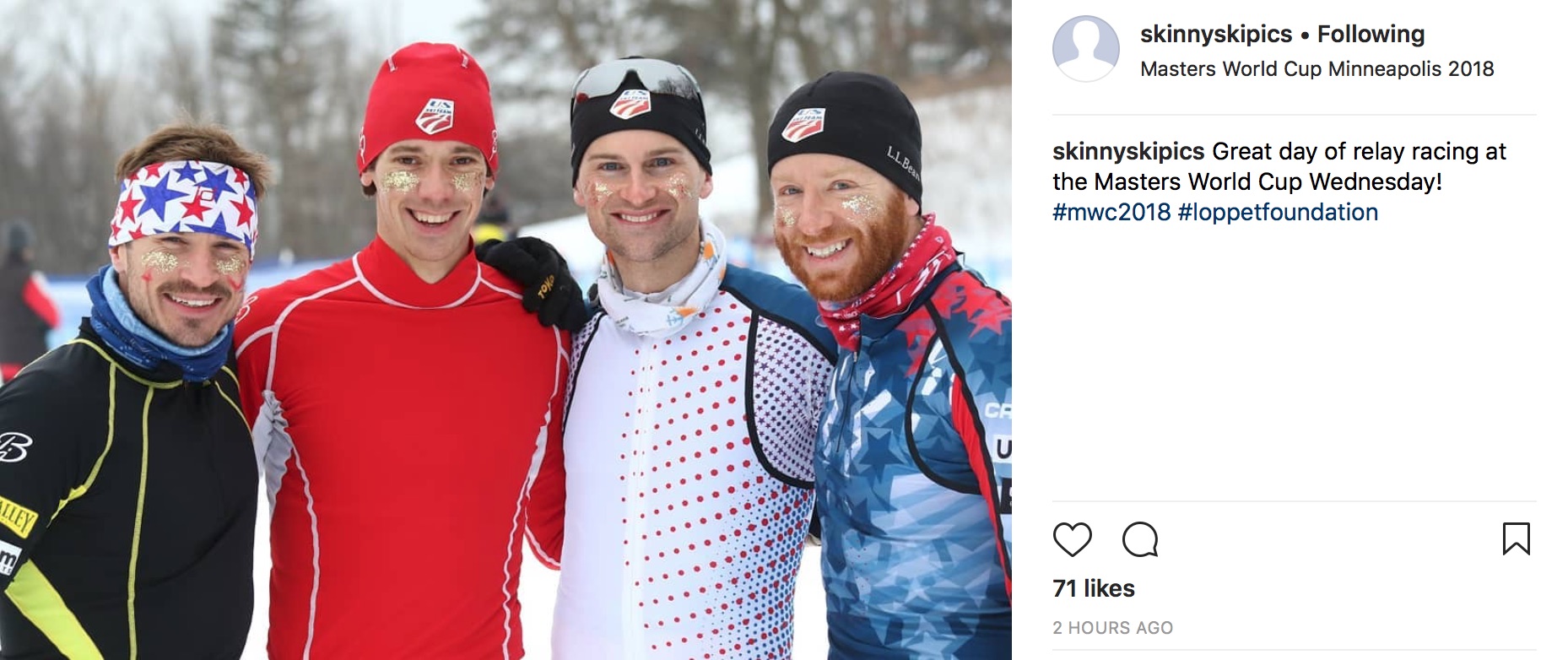
Matt Liebsch (l) and his men’s age-group “1” 4 x 5 k winning relay team on Wednesday at 2018 Masters World Cup in Minneapolis, Minnesota. (Photo: SkinnySki/Instagram)
2018 Masters World Cup (Minneapolis, Minnesota): 4 x 5 k relays
Matt Liebsch, 34, anchored the winning relay of the youngest men’s age group (AG 1) at 2018 Masters World Cup on Wednesday, crossing the line in 45:57.2 minutes (the fastest relay time of the day) and teaming up with fellow Americans Christopher Harvey, Mark Johnson and Zach Varty. Two teams competed in that age group’s 4 x 5 k relay, with Italy finishing second, 1:22.6 minutes back.
The U.S. won all five women’s 4 x 5 k relays on Wednesday, and eight total between the men’s and women’s age groups. Finland had the second-most relay victories with five in the men’s categories.
Canada won the men’s AG 4, beating out four other teams with Gabriel Babin, Bruce Macneil, Luc Tremblay, and Michel Labrie, who finished the 4 x 5 k in 49:41.9. Germany placed second (+36.4), and the U.S. third (+54.1).
Piotr Bednarski, head coach of Loppet Nordic Racing, which is based out of Theodore Wirth Park, anchored the men’s AG 5 to a win in 49:39.1, with teammates Rune Harkestad, Dennis Paul and David Sjogren.
Masters World Cup continues with 15/30/45 k classic distance races on Thursday at Wirth Park.
Day 4 Age Group (AG) 4 x 5 k Relay Winners
Men:
AG 1: USA (Christopher Harvey, Mark Johnson, Zach Varty, Matt Liebsch) 45:57.2
AG 2: Finland (Jouni Leinonen, Mika Kilpeläinen, Johan Gustafsson, Joachim Gustafsson) 47:53.4
AG 3: Russia (Ivan Batyutenko, Andrey Lushnikov, Sergey Degtyarev, Aleksandr Pushkarev) 46:43.3
AG 4: Canada (Gabriel Babin, Bruce Macneil, Luc Trembley, Michel Labrie) 49:41.9
AG 5: USA (Rune Harkestad, Dennis Paul, David Sjogren, Piotr Bednarski) 49:39.1
AG 6: USA (Milan Baic, Odd Bersvendsen, Kent Murdoch, Barry Makarewicz) 48:48.3
AG 7: Finland (Heikki Ruokonen, Tapio Tikkanen, Timo Pullinen, Aito Pennanen) 51:56.3
AG 8: Finland (Leino Nisula, Pauli Halonen, Yrjo Teravainen, Harri Makela) 54:58.4
AG 9: Finland (Veikko Piirainen, Tapio Ikaheimonen, Paavo Raisanen, Vaino Paakko) 58:18.9
AG 10: Finland (Alpo Virtanen, Tapio Wallenius, Jouko Laiho, Riku Kyllonen) 1:02:39.7
Women:
AG 1: USA (Kathleen Dewahl, Tamra Kornfield, Davya Flaharty, Gina Chythlook) 56:49.3
AG 2: USA (Bonnie Weiskopf, Kim Rudd, Mary Mckelvey, Mary Wellington) 56:23.9
AG 3: USA (Elizabeth Youngman, Kelly Milligan, Jan Guenther, Kelly Skillicorn) 56:23.6
AG 4: USA (Kate Ellis, Magdenla Bowen, Joann Hanowski, Muffy Ritz) 1:00:33.6
AG 5: USA (Gabriele Andersen, Constance Meek, Dagmar Eriksson, Kati Campbell) 1:14:23.4
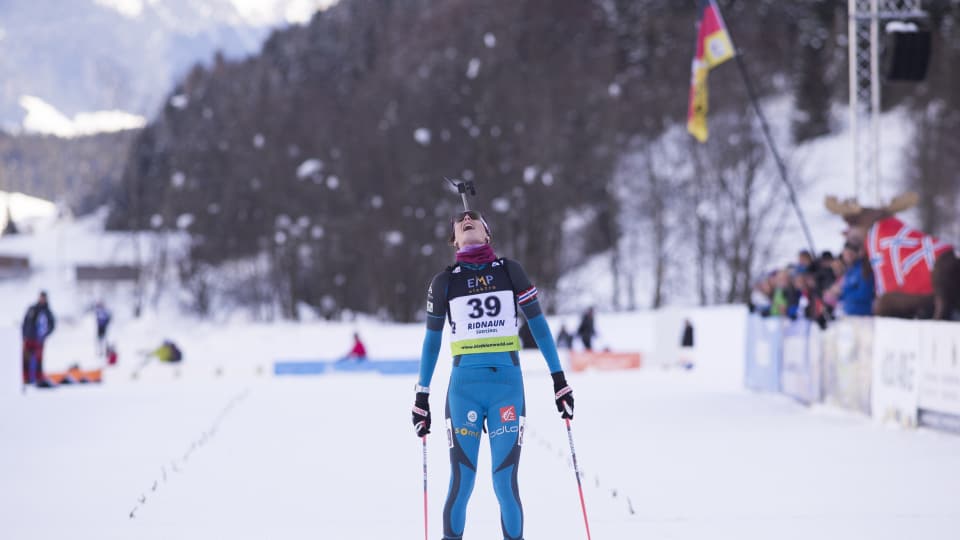
France’s Chloe Chevalier after winning the women’s 15 k individual on Day 1 of IBU Open European Championships in Ridnaun, Italy. (Photo: IBU/Biathlonworld)
IBU Open European Championships (Ridnaun-Val Ridanna, Italy): 15/20 k individual
The International Biathlon Union (IBU) Open European Championships opened Wednesday in Ridnaun (Val Ridanna), Italy, with several North Americans competing in the women’s 15- and men’s 20-kilometer individual races.
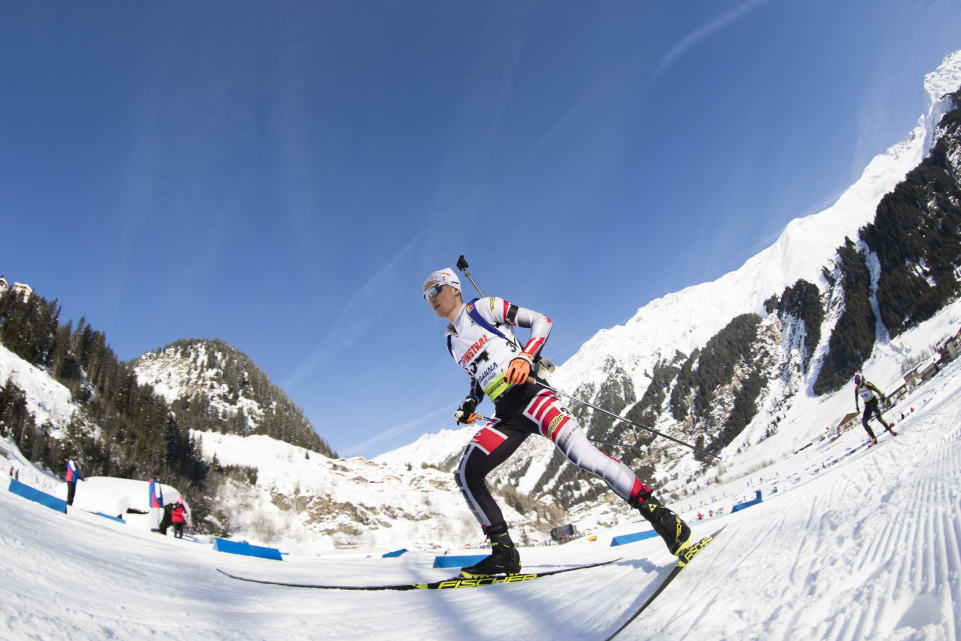
Austria’s Felix Leitner racing to the win in the first race of 2018 IBU Open European Championships, the men’s 20 k individual, on Wednesday in Ridnaun, Italy. (Photo: IBU/Biathlonworld)
Canada’s 23-year-old Carsen Campbell raced to 19th in the men’s 20 k, shooting 19-for-20 (1+0+0+0) and finishing 3:18.5 minutes behind the winner, Austria’s Felix Leitner, who clocked the fastest time in 53:32.8 — also with one penalty (0+0+0+1).
Leitner, 21, won by 43 seconds over Tomas Krupcik of the Czech Republic, who also had a single penalty in the last standing stage (0+0+0+1) and placed second.
Germany’s Philipp Horn reached the podium in third (+56.6), with 19-for-20 shooting as well (1+0+0+0).
According to an IBU press release, Leitner is one of the youngest athletes to win the 20 k, the longest race on the circuit.
“I had many problems with my shooting lately, but today it was probably the best in the last two seasons,” Leitner said, according to the release. “I believed in myself and knew that I have to run fast from the beginning, and if the shooting would be as good as during the training, I could be in the top.”
Campbell, of Biathlon Canada’s National “Z” Team, was the top North American in 19th in his second trip to Open European Championships. Previously, his best individual result was 64th last year.
Paul Schommer led the U.S. men in 46th (+5:22.6) with three penalties (0+1+1+1). Max Durtschi also shot 17-for-20 (1+0+1+1) and ended up 56th (+6:18.5), Jakob Ellingson followed in 58th (+6:23.5) with two penalties (0+0+1+1), and Jake Brown finished 74th (+8:06.7) with seven penalties (1+1+3+2). Alex Howe did not start.
For Canada, Macx Davies, a senior national team member who is headed to the Olympics, placed 67th (+7:32.7) with five penalties (2+2+1+0). Matt Hudec was 96th (+12:00.5) with six penalties (0+2+1+3), and Aidan Miller 105th (+14:49.0) with nine penalties (2+1+1+5).
In the women’s 15 k that followed, Sarah Beaudry, of Biathlon Canada’s Senior National Team as well as Olympic team, was the top North American in 23rd, 4:55.6 out of first. Beaudry, 23, shot 18-for-20, with her two misses coming in the first prone (2+0+0+0).
France’s Chloe Chevalier won the women’s race, with spring-like temperatures around 6 degrees Celsius, in 46:32.9 with a single penalty, also in the first stage (1+0+0+0). The second- through fourth-place finishers all shot clean, with Italy’s Alexa Runggaldier placing second (+47.7), Russia’s Victoria Slivko taking third (+55.9) and Ukraine’s Yuliia Zhuravok missing the podium by half a second in fourth place (+56.4).
“After that penalty in the first prone, I relaxed and did not worry about the result,” Chevalier said after, according to an IBU press release. “I just enjoyed being out on the tracks on a beautiful sunny. Maybe the key to success is relaxing and not worrying about the result.”
Two Canadian women entered the event, with Erin Yungblut finishing 83rd (+13.19.9) with eight penalties (2+3+1+2).
Chloe Levins was the top American woman in 60th (+7:18.6) with four penalties (1+2+1+0), and Maddie Phaneuf, who made US Biathlon’s Olympic team, followed in 65th (+8:10.8) with four misses as well (1+2+0+1). Deedra Irwin finished 82nd (+13:15.8) and Jennie Bender was 87th (+15:05.0), both with 10 penalties apiece.
Open European Championships continue Friday with the men’s and women’s sprints, followed by pursuits on Saturday and relays on Sunday.
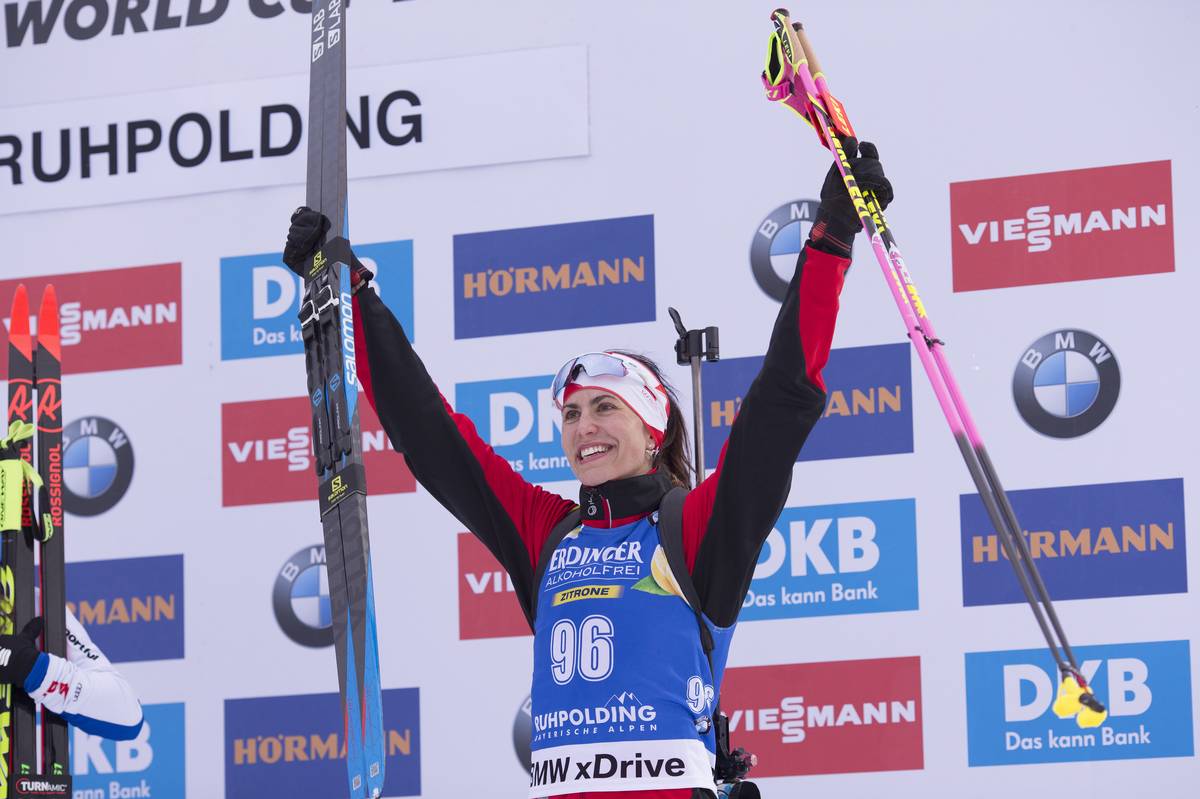
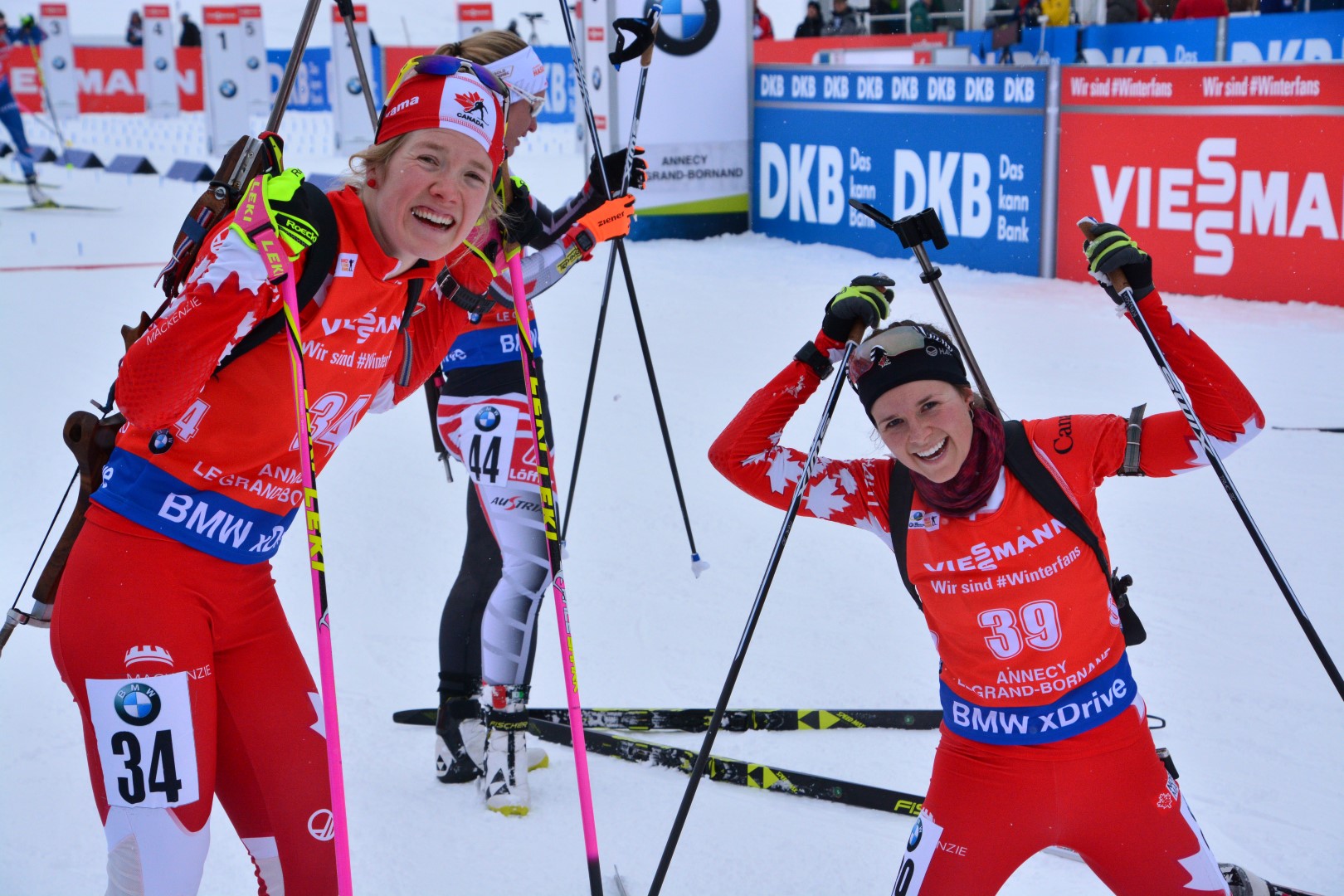
Rosanna Crawford celebrates with her Biathlon Canada teammates Emma Lunder (l) and Julia Ransom (r) after placing third for her first-career IBU World Cup podium on Thursday in the women’s 15 k individual in Ruhpolding, Germany. (Photo: Salomon/NordicFocus)
For a while it looked as if the podium in the women’s 15-kilometer individual at the Thursday’s IBU World Cup in Ruhpolding, Germany, had been all but decided with only a few more athletes circling the course. But then the favorites who had already finished had someone to worry about.
Along with some 13,000 spectators in the stands, they paid close attention to the video walls in the arena, as one late-starting Canadian — Rosanna Crawford — had just set the best split time after the third shooting by hitting every target for the third time in a row. She was even 1.8 seconds ahead of race leader Dorothea Wierer of Italy.
“I actually didn’t know I was fighting for a podium until the fourth loop,” Crawford told FasterSkier on the phone after the race. That’s where Czech wax technician, Tom Zidek, a former Biathlon Canada wax tech, told her she was is in first place.
Canada’s Rosanna Crawford (standing) celebrates her first IBU World Cup podium on Thursday after placing third in the women’s 15 k individual in Ruhpolding, Germany, while Sweden’s Emma Nilsson (who placed 36th) unclips. (Photo: Salomon/NordicFocus)
“I was like, Oh God!” she recalled with a laugh. “But I think that kind of helped as well because then I knew to expect the crowd for the last standing.”
Could this be Crawford’s big day? Coming into the range for the final standing shooting, the 29-yaer-old Canmore native knew she likely would get a season-best result if she did not totally implode, but needed to shoot clean again to stay in podium contention and not get hit with the individual race’s merciless one-minute penalty per miss.
“I made sure just to set up properly, and then I took an extra breath before my last shot and was pretty pumped to see it turn to white,” Crawford recalled of her last shooting stage. “I am a person who really likes cue words and I have a few sentences that I repeat over in my head. … I knew the only way I was going to hit the targets is if I only thought about the present moment.”
After she had cleaned all five targets for the fourth time, bringing her shooting percentage to a perfect 20-for-20 (the first time she had ever done so in a race), Crawford skated off the shooting mat with a smile on her face. She left the range now 7.8 seconds behind Wierer’s time (after the Italian had also hit all 20 targets), but was still more than 20 seconds ahead of Finland’s Kaisa Mäkäräinen (who had incurred one penalty in her first prone shooting but shot clean after that) and Ukraine’s also clean-shooting Yuliia Dhzima.
“Being one of the last competitors with bib 96 I had a lot of time to wait,” Crawford said at the IBU’s post-race press conference. “I knew all the eyes were on me probably for my last two shootings. That is something I have never experienced before, going from the third loop onwards where everyone was cheering for me around the loop. … It’s a feeling I have never had before to hit all 20, so I was really excited to ski out of the range.”
With her team staff, including head coach Matthias Ahrens running next to the track cheering her on, Crawford chased around the loop up the steep “Wall of Ruhpolding” climb. Overall she skied the 26th-fastest course time of the day, and on the final loop in softening conditions, her loop time ranked 48th. But she still hung onto the podium.
“The course had broken down a little bit, with a hundred-and-something starters, so by the time I went around I was really searching for the best line, which I think paid off as well,” Crawford said.
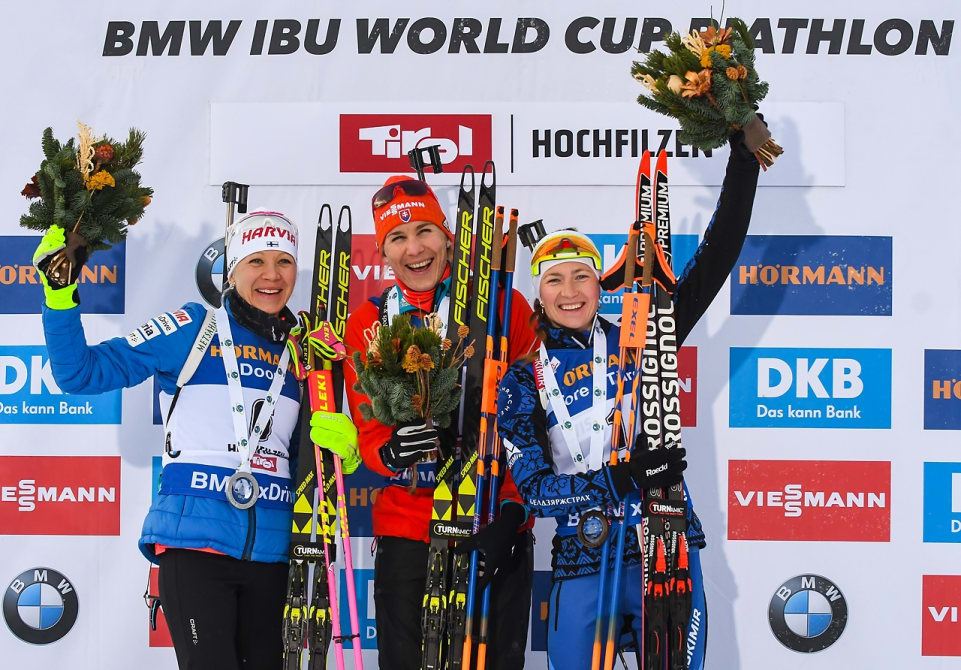
The women’s 15 k individual podium at the IBU World Cup in Ruhpolding, Germany, on Thursday, with Italy’s Dorothea Wierer (c) in first, Finland’s Kaisa Mäkäräinen (l) in second, and Canada’s Rosanna Crawford (r) in third. (Photo: Salomon/NordicFocus)
Coming out of the downhill and onto the finishing stretch with the thousands of spectators cheering her on, Crawford fought the clock. She was out of reach of Wierer, but still within striking distance of Mäkäräinen in second. At the finish, Crawford was third, 21.2 seconds behind Wierer and 8.5 seconds behind Mäkäräinen in second place (+12.7). The Canadian was comfortably ahead of Dhzima in fourth (+45.9), while another clean-shooting Ukrainian, Valj Semerenko, placed fifth (+52.6).
“I am so excited today, it was really special, my first time hitting 20-for-20 as well,” Crawford said at the press conference. “I really love Ruhpolding! It was my first World Juniors, my first World Cup, and my first podium, so it’s a very special place for me.”
As Crawford skied into the finish she looked up to the nearest video monitor to check if she indeed had managed to hold her position on the podium for the first time. But she didn’t have to wait long for confirmation as her teammates and coaches already rushed out into the finish to hug and congratulate her.
“Julia [Ransom], Emma [Lunder] and Sarah [Beaudry], they kind of pushed past the IBU guys, which I don’t think they were allowed to do, but Canada’s not on the podium every day so they let them sneak by to give me a hug so that was really special,” Crawford told FasterSkier. “I’ve been with these girls the past couple years now and so to be able to celebrate with them is amazing. Their results have been so inspiring for me … [My coach Roddy Ward] also jumped the fence, which I don’t think was allowed, so that was nice to be able to see him as well.
Biathlon Canada celebrates Rosanna Crawford’s podium on Thursday in the IBU World Cup 15 k individual in Ruhpolding, Germany, with (from left to right) coach Roddy Ward, Crawford, Emma Lunder, Julia Ransom, and Sarah Beaudry. (Photo: Salomon/NordicFocus)
“It’s just such a team effort to get to the podium,” she continued. “I’m the one out there skiing and shooting, but I couldn’t have done it without the amazing skis on my feet or my coaches behind the scope, so Matthias and Roddy were really important there, and I couldn’t have done it without the girls who I train with all summer. I’m just so grateful for this team that I’m on.”
“So proud!!!” her longtime boyfriend and teammate Brendan Green wrote on Instagram with a screenshot of Crawford finishing.
“Brendan is amazing,” Crawford said. “I’m sure he was pretty nervous. He was the first text messages and tweets and Instagrams that I had on my phone. Right now I’m having dinner with him and then we’ll go to the awards ceremony tonight. It’s really special.”
“It’s incredible for me, not something that I was really expecting this season,” she told German broadcaster ZDF in an interview immediately after the race. “I didn’t have the best summer of training so to be on the podium is really special for me.”
That was an understatement. Last spring, Crawford and her family dealt with a severe personal tragedy with the loss of her brother Jordan.
“It was such a hard summer for me, losing my brother in April,” she told FasterSkier. “I really wish he was here today so I could celebrate with him, too. I miss him a lot. Jordan was a huge cheerleader for me. He always believed in me. Whenever I was home, he was always cooking me food and helping me take care of the dogs, and he was always so concerned that he was causing me stress. … Jordan loved the outdoors so whenever I was out in a valley or skiing or mountain biking, he was always in my thoughts, and wishing I could share these things with him. It was really hard on the whole family, but it brought us closer together as well in some ways, to support each other.”
Asked if she had caught up with her family members yet, including her sister Chandra Crawford, a 2006 Olympic gold medalist in cross-country skiing, she said she had spoken to all of them.
“Training was always a little bit on the back burner for the first couple months while we were all grieving and then once finally the motivation came around again to start training, it felt right and proper,” she said of her offseason and transition to another race season. “But then again, the results just were not paying off through the first trimester [of the World Cup] and I didn’t know what I was doing wrong and I was really starting to lose hope.”
Crawford’s previous best non-relay result this season was 39th in the 10 k pursuit in Hochfilzen, Austria. And her last time in the top 10 outside a relay race was back in December 2014, where she placed fourth in a sprint and seventh in a pursuit in Pokljuka, Slovenia.
Coincidentally, Germany’s ZDF network featured the Canadian women’s team in a preview to the individual race, filming them and coach Ahrens while they attended a one-hour cooking class in Ruhpolding. But they certainly had not intended it as a segment on a likely podium finisher for the very next race.
“Yes, of course the Bavarian food fueled me around the course,” Crawford said with a laugh when ZDF asked about that.
“Just thank you so much to the fans. There is no way I would have been able to ski around that last loop without them,” she added.
“This really describes the biathlon family,” Crawford later explained in the press conference. “That it doesn’t matter which country you are from, people will be cheering for you. And not only the fans but also the techs. Jarko, Kaisa’s head wax tech, who used to wax for Canada, he was giving me splits off of Kaisa telling me, ‘You are ahead of Kaisa, go get her!’ So they might have to have a serious conversation tonight! It was really incredible.”
Rosanna Crawford (Biathlon Canada) finishing third in the IBU World Cup women’s 15 k individual in Ruhpolding, Germany. (Photo: Salomon/NordicFocus)
In her interview with FasterSkier, Crawford also spoke of a Ukrainian coach who cheered her on for the final loop. “I think this really describes what the biathlon family actually is,” she said. “It’s not the IBU. It’s the coaches and the athletes and the wax techs and the fans, that is actually the biathlon family.”
Despite all the support she had felt throughout the year, Crawford had a season she was not satisfied with so far, with two 39th places as her best results (excluding relays). Going into this race, she ranked 79th in the overall World Cup standings. Last weekend, instead of starting at the World Cup in Oberhof, Germany, she raced two sprints on the IBU Cup in Brezno-Osrblie, Slovakia, where she placed 15th and 22nd. More so than a demotion, that was a move Biathlon Canada made to give other women on the team a chance to qualify for the upcoming Olympics.
“This season has definitively not started out very good for me, and then getting sent to the IBU Cup was really frustrating,” Crawford said on the phone. “But I did really like the course in Osrblie, and it was the best skiing I’d felt all year so I really tried to carry that momentum into today’s race. … I think staying in Europe over Christmas was incredibly beneficial for us.”
Crawford’s previous career bests in non-relay races have come in sprints, with her fourth place in Pokljuka and a fifth place in Hochfilzen, both during the 2014/2015 season. She’s been on the podium before, placing second with teammate Nathan Smith in the single mixed relay in Östersund, Sweden, to open the 2015/2016 season.
“There’s just so many lessons you learn over the years, and trying to bring it all together and to have it pay off on one day is exactly what we’re all hunting for out there,” Crawford concluded.
Fourth Career Victory for Wierer
Italy’s Wierer, who frequently performs very well in this competition format and also won the individual in Ruhpolding in 2016 (Crawford placed 18th back then as the best North American) set the best time on Thursday, crossing the line after 41:29.0 minutes.
“I am really happy about this,” Wierer said at the press conference. “I knew that it’s all about the shooting. In the last individual competition I shot really bad, but the last weeks I feel really confident about my shooting. I think the track was really good, and hard conditions are much better for my skiing. The shooting range wasn’t difficult today, there was nearly no wind.”
Asked about having to wait if her time would ultimately be good enough for first place, she added with a laugh: “I was looking [at] Rosanna, and I was afraid of her. But finally I saw that she was some seconds behind me. I wasn’t sure because on the last round I lost a lot, I was really tired, but at the end she didn’t get me!”
On her 35th birthday, Mäkäräinen finished second (+12.7). She was the only finisher in the top five with a penalty, incurred during her first prone shooting.
“It’s a good present,” she said at the press conference when asked about her second place. “I have actually managed to do many good races on my birthday, so this is nice. … 19 out of 20 is really good for me, probably my best shooting this winter, so I am really happy about that and not thinking too much about that one penalty.”
“It’s an amazing place,” she added when asked about her tendency to do well in Ruhpolding. “I like it a lot here because the crowd is really close to us, and there were a lot of people from Finland here, also my parents and their friends. So it was a nice atmosphere today.”
She added that she did not intend to extensively celebrate her birthday with her family.
“I will celebrate by having a massage and good dinner,” Mäkäräinen said. “Just basic things, the athlete’s life goes on, we have more races to come.”
Dunklee 27th, Ransom 34th
For US Biathlon, Susan Dunklee finished 27th with three penalties (1+1+1+0), staying ahead of a number of competitors who performed better on the range thanks to her 14th-ranked ski time.
“Certainly the highlight for me today was watching Rosanna crush it,” Dunklee wrote in an email. “Her whole team, athletes and staff, were overjoyed. It’s inspiring to see and lends positive energy to all the North Americans going forward.”
“This was the first race that felt normal for me and not an extreme high or low,” she wrote of her own race. “It’s a relief. The skiing felt great today and I have no doubts in it going forward. Shooting is finally rounding into form; 85% is a solid result. My goals going forward are to stay healthy and happy and I believe that’s what I need most to perform well in February.”
US Biathlon’s Clare Egan in front of the stands in the finish of the women’s individual 15-kilometer race at the IBU World Cup in Ruhpolding, Germany. Initially she was ranked 35th, and ultimately ended the race in 57th. (Screenshot: ZDF broadcast)
Starting about in the middle of the field in bib 43, her teammate Clare Egan was initially 35th as she came into the finish, waving to the cheering crowd as she was shown on the video wall. As more athletes ended their races ahead of her, she ultimately finished 57th (+4:26.3) with three one-minute penalties (0+1+0+2).
“Finally a race I can be proud of!” Egan commented in an Instagram post.
“We will field our first women’s relay this weekend,” Dunklee wrote of their team, which will be joined by athletes who competed at the IBU Cup in Arber, Germany, on Thursday. “It has been a challenging season so far living and traveling with such a small crew, trying to stay upbeat and carry the team with a skeleton group.”
Starting the race early in bib 5 and thus completing her race before Crawford’s had even begun, Biathlon Canada’s Julia Ransom placed 34th (+3:35.0) with two penalties (1+1+0+0). Sarah Beaudry finished 53rd (+4:18.6) with two penalties (0+1+1+0), and Emma Lunder was 67th (+5:21.7) with four penalties (1+0+2+1).
After their own races had concluded, they could only wait for Crawford after learning about the great day she was having and excitedly ran out into the finish to greet her.
“It’s really amazing for our country and for our sport,” Crawford said in the press conference. “Hopefully there will be a few more eyes on biathlon during the Olympics. The last person to get a podium was Zina Kocher in the individual as well [a third place in Östersund during the 2006/2007 season]. So this is becoming a special race for Canada. Julia Ransom had a personal best with a ninth place in Östersund, so we seem to be individual specialists.”
Skardino Earns Individual Discipline World Cup
Since the IBU does not count the races at the upcoming Olympics for World Cup points and standings, this second individual race was also the last one on the competition calendar this season.
Thus Nadezda Skardino of Belarus, who won the first individual race of the season in Östersund, managed to claim the “crystal globe” award in that discipline by finishing seventh in Ruhpolding on Thursday (+1:04.8, with no penalty). It was Skardino’s first World Cup discipline title.
Despite finishing ahead of her in fourth on Thursday and another third place from the race in Östersund, Ukraine’s Dzhima could not make up enough points and placed second in the standings just five points back, while Mäkäräinen was third. Even without Crawford still finishing ahead of Skardino and Dhzima the outcome would have been the same.
“It was my dream, and now I’m minus one dream in my life,” a smiling Skardino told the IBU. “I am very happy, because I thought about it after my win in Östersund. … And now I did it! Today I was not very fast on the tracks, I only thought about my clean shooting. I understood that I can win [the discipline title] if I shoot clean. I knew if some more people stay between Yuliia and me I could lose more points and still lose this, but after all people finished I was very happy I did it!”
Crawford placed 12th in that ranking as the best North American, scoring 2 points for her 39th place in Östersund and 48 for the third place in Ruhpolding.
The women’s World Cup Total Score leader Anastasia Kuzmina of Slovakia, coming off two victories last weekend in Oberhof, placed eighth on Thursday (+1:32.3, with three penalties) to retain her lead there.
Races in Ruhpolding continue with a men’s relay on Friday and women’s relay on Saturday, before concluding with mass starts on Sunday. Crawford is now qualified for that race as one of the five best athletes this week not currently in the top 25 of the overall World Cup; she is now ranked 48th in the Total Score standings.
Rosanna Crawford (Biathlon Canada) celebrates her first-career IBU World Cup podium on Thursday in the women’s 15 k individual in Ruhpolding, Germany. (Photo: Salomon/Nordic Focus)
IBU World Cup (Ruhpolding, Germany): Women’s 15 k individual
It’s been a long time coming, but on Thursday, Rosanna Crawford, 29, achieved her first podium on the International Biathlon Union (IBU) World Cup circuit.
It came in Ruhpolding, Germany, in the longest-format race for the World Cup women: the 15-kilometer individual. In the four-stage race, which adds a minute penalty to a competitor’s time for each missed shot, Crawford of Canmore, Alberta, shot a perfect 20-for-20. She said she had never done that before in a World Cup race.
“I really like the Ruhpolding range,” Crawford said in a post-race phone interview, after finishing third behind Italy’s Dorothea Wierer and Finland’s Kaisa Mäkäräinen, respectively. “This was my first World Juniors, my first World Cup and now my first podium, so it’s a pretty special place for me.”
Wierer won the race with 20-for-20 shooting as well, starting 24th and finishing with the fastest time of 41:29.0 minutes. Mäkäräinen as the 12th starter missed out on first place due to a single miss in the first prone (1+0+0+0) and ended up 12.7 seconds back in second place.
Crawford, one of the last starters in bib 97, turned heads throughout the race with each passing clean bout. With one extra breath before her last shot, she successfully hit her last target and left the range with a huge smile.
“I think I almost started crying,” she recalled.
She finished 21.7 seconds out of first, and almost 25 seconds clear of fourth-place finisher Yulia Dzhima of Ukraine. Even a Ukrainian coach was cheering for Crawford on her last loop.
“That last lap was so cool,” Crawford said. “Right past the penalty loop, the Ukrainian coach was like, ‘You’re one second, — or whatever time I was — from first,’ and it was amazing. I think this really describes what the biathlon family actually is. It’s not the IBU. It’s the coaches and the athletes and the wax techs and the fans.”
Her teammates and coach, Roddy Ward, awaited her arrival in the finish pen.
“Canada’s not on the podium every day so they let them sneak by to give me a hug so that was really special,” Crawford said.
Her result is her first non-relay top 10 since a pursuit in December 2014, where she placed seventh in Pokljuka, Slovenia. The race before that, she placed fourth in the Pokljuka 7.5 k sprint, which was had been career best — until Thursday.
“Who knew that I would get my first podium in an individual?” Crawford mused. “I was laughing at that myself.”
The U.S. was led by Susan Dunklee in 27th (+3:02.7), who had one penalty in each of the first three stages (1+1+1+0).
Canada’s Julia Ransom placed 34th (+3:35.0) with two penalties (1+1+0+0), Sarah Beaudry was 53rd (+4:18.6) with two misses as well (0+1+1+0), and Emma Lunder finished 67th (+5:21.7) with four penalties (1+0+2+1).
Two Americans raced, with Clare Egan finishing 57th (+4:26.3) with three penalties (0+1+0+2).
“Certainly the highlight for me today was watching Rosanna crush it,” Dunklee wrote in an email. “Her whole team, athletes and staff, were overjoyed. It’s inspiring to see and lends positive energy to all the North Americans going forward.”
She also pointed out that her U.S. teammates Emily Dreissigacker and Maddie Phaneuf placed fifth and 11th, respectively, with clean shooting in the IBU Cup women’s 15 k individual, also on Thursday.
“That spark is exactly what our team needs right now and the timing is spot on,” Dunklee continued. “We will field our first women’s relay this weekend. It has been a challenging season so far living and traveling with such a small crew, trying to stay upbeat and carry the team with a skeleton group.”
The World Cup men’s 4 x 7.5 k relay is scheduled for Friday at 8:30 a.m. EST, with both Canada and the U.S. entering teams. (Men’s relay start list)
The women’s 4 x 6 k relay is on Saturday at 8:30 a.m. EST, with the men’s and women’s mass starts following on Sunday in Ruhpolding.
France’s Martin Fourcade celebrates his victory in the men’s 12.5-kilometer pursuit at the 2018 IBU World Cup in Oberhof, Germany. (Photo: IBU/Biathlonworld.com)
After cleaning the fourth and final shooting stage in the men’s 12.5-kilometer pursuit on Saturday at the 2018 International Biathlon Union (IBU) World Cup in Oberhof, Germany, Martin Fourcade of France hoisted the biathlon rifle onto his back, spun around and fully faced the way he’d come, glancing for a moment at his three closest competitors behind him: Norwegians Johannes Thingnes Bø and his older brother Tarjei Bø, and Emil Hegle Svendsen, before heading out on the final loop while his closest challengers were all still shooting on the range.
Was it a new gesture to assert his dominance in the sport instead of celebrating with a fist pump or raised arm when he crossed the finish line, or was he genuinely curious how they were doing?
“I will answer diplomatically. Yesterday I heard from the Norwegian press that Emil [Hegle Svendsen] said I feared the Norwegian team,” Fourcade said when asked about ‘the stare’ in a post-race press conference. “I have a lot of respect for them. I know how good they are because they show me every weekend. They can beat me in every competition, but I don’t fear them like they don’t fear me! It was my answer to them.”
Fourcade then looked over to Tarjei Bø sitting next to him on the podium who laughed and replied: “Really good answer!”
In the race, Johannes Bø cleaned his targets to follow his French rival onto the last loop, 16.3 seconds back, followed by his brother Tarjei another ten seconds later, while the third Norwegian Svendsen, who had shot head-to-head in a duel against Fourcade in the first stages, incurred his only miss of the day and had to ski 150 extra meters in the penalty lap, thus slipping from second to fourth.
Johannes Bø skied faster on the final loop than Fourcade, getting closer and closer, and the French biathlete surely would have kicked himself for his unorthodox maneuver on the range if he had squandered his lead and lost by inches in a finishing sprint. But that didn’t happen, and Fourcade could celebrate across the line in a time of 30:49.5 minutes, with just one penalty.
Johannes Bø crossed the line 6.3 seconds after him with three penalties, while his clean-shooting brother Tarjei finished third, 30.9 seconds back.
Svendsen, the runner-up in Friday’s sprint, had to settle for fourth place (+1:04.7) with one penalty in the pursuit, while Ukraine’s Dmytro Pidruchnyi was fifth (+1:16.2) also with one penalty.
“I missed in the first prone together with Martin, then the rest of the race I fell a little bit behind in each shooting … so I was never really in the fight for the win,” Johannes Bø said in the press conference. “But in the end I got the second place. If Martin had stood [on the range] two seconds longer maybe I would have caught him!”
Asked if it added extra pressure on the range having to shoot directly against his brother, he added with a laugh: “Yeah, it’s like a cat-and-mouse game. We have done it for as long as … some 20 years. So there is not much difference. I won, like at home.”
“I was one penalty loop behind the guys after the sprint, so I knew they had to make a [mistake] for me to have a chance,” Tarjei Bø said. “I was always some seconds behind, I was never fighting for the win but fighting for the podium. … The level was really high, we were four guys together, and to be honest it’s really fun to have these fights when you know you have to deliver your best to have a chance to win.”
Asked about the friendly rivalry with his brother, he added: “The only problem is whenever Johannes has been on the podium he has beaten me every time. It’s not so fun, so I need to improve! Today were were together at the last shooting, and he showed me he was better. So … do you have any tip for me? You all have seen biathlon for ten years, you don’t have anything?!”
Best Pursuit of the Season for Burke
Tim Burke (US Biathlon) racing to 14th in the men’s 12.5 k pursuit on Saturday at the IBU World Cup in Oberhof, Germany. (Photo: US Biathlon/NordicFocus)
US Biathlon’s Tim Burke had started the pursuit race in fourth and 20 seconds behind Fourcade after his season-best performance in Friday’s sprint, and initially remained in the top of the field in the pursuit after cleaning his first prone stage.
He then skied the next loop with eventual third-place finisher Tarjei Bø, who skied the overall 10th-fastest course time of the day while Burke was 22nd overall. Burke then incurred two penalty laps in his second prone stage
“Going with Bø on the second loop was definitely fast but I felt in control,” Burke wrote in an email to FasterSkier. “I don’t think this had anything to do with the two prone misses in the second stage. I just simply missed, which happens in biathlon sometimes.”
Burke had fallen back a bit to the eighth position as he returned to the course, then after the third loop, cleaned his first standing shooting stage, but was passed by two competitors. He missed one more in his final standing stage and set back out on the course in 14th position.
On the final lap and in an extended sprint for positions on the slightly inclined, very long and straight finish stretch in Oberhof, he skied with Russia’s Anton Shipulin (who ended up 12th, +1:43.1, with one penalty) and the Czech Republic’s Ondrej Moravec (13th, +1:43.6, three penalties) who had left the range two seconds behind him, while Burke managed to overtake Sweden’s Frederik Lindström (+1:45.8; no penalties), one of only three athletes to shoot clean in all stages.
Burke thus ended his day still in 14th, 1:43.7 behind Fourcade, with three penalties (0+2+0+1). It was his best result in a pursuit this season.
“I was able to push reasonably well on the last loop today, which was a first for me this season,” he wrote. “I will take this as a good sign for the upcoming races.”
No other athlete for US Biathlon qualified for the pursuit in the top 60 of Friday’s sprint, with Sean Doherty finishing 84th position in the sprint the day before.
Career-Best for Christian Gow
For Biathlon Canada, Christian Gow moved up from a 36th starting position after the sprint to finish 21st, 2:19.2 back, with only one penalty incurred in his last stage (0+0+0+1).
With this performance he tied his career-best individual result from a pursuit in Östersund, Sweden, during this season’s opening weekend.
“I am really happy with my result today,” Gow wrote in an email to FasterSkier. “This is one of the best ski races I have ever had, and the shooting was really solid as well. I wish I could have made one more spot, but it was a great race anyways.”
Gow wasn’t too bothered by the rainy conditions the biathletes encountered all week in Oberhof, including on Saturday.
“The course held up quite well considering the weather we have been having here, the hills were firm which made for a much more pleasant race,” he wrote in an email. “The shooting range was the calmest I have ever seen in Oberhof, so it was very manageable today.”
Gow skied the 28th-ranked course time of the day, including a second loop where he was the 11th-fastest athlete.
“I skied with [Norway’s] Lars Birkeland and [Sweden’s] Sebastian Samuelsson at different points in the race […] which was really helpful for keeping the ski pace high,” he explained.
On the range, the 24-year-old Calgary native remained clean through three stages moving up as high as 17th, until he came to the final shooting stage.
“I felt really calm for all of my range entries today, including the last one up until I hit the shooting mat,” Gow wrote. “At that point I realized that I was having a really good race and that another clean shooting would really solidify a strong result. I tried to put that aside and focus on being aggressive in the shooting in order to not allow time to think and make mistakes. Unfortunately, I was a bit too aggressive on my second shot which resulted in a miss, but I refocused really nicely from there and hit the rest.”
He came out of the penalty lap in 21st position, and kept that place into the finish by overtaking Russian-born athlete Timofei Lapshin, who races for South Korea, while being passed by Russia’s Alexander Loginov on the final lap.
Also starting in the pursuit for Biathlon Canada, his brother Scott Gow finished 50th (+4:45.0), after starting in 32nd then incurring six penalties on the range (2+1+1+2), and Brendan Green ended the race in 54th, 5:26.1 minutes back, improving by three spots while shooting three penalties (0+2+0+1).
Relay Races
The IBU World Cup weekend in Oberhof will conclude with the second relay races of the season on Sunday. The Canadians are slated to start the men’s relay with the two Gow brothers, Green, and Carsen Campbell, while the Canadian women’s team will include Sarah Beaudry, Julia Ransom, Megan Tandy and Emma Lunder.
US Biathlon won’t be able to enter a women’s or men’s relay, after the team only had Susan Dunklee and Clare Egan as well as Burke and Doherty as the athletes already qualified for the upcoming Winter Olympic Games in PyeongChang, South Korea, representing it in Oberhof. Reigning world champion Lowell Bailey, who is also prequalified for the Olympics, skipped the races in Oberhof for a longer rest and training period at home, just like he did a season ago.
The other potential candidates for PyeongChang are competing this weekend in two sprints at an IBU Cup in Brezno-Osrblie, Slovakia, which together with next week’s races in Arber, Germany, serve as the Olympic trials to round on the team.
“We will indeed miss the relay tomorrow but plan to race the relay in Ruhpolding [next Friday],” Burke wrote regarding the men’s team. “I don’t see this as a problem. In fact, it will be nice to have an extra day break with a tough 20k coming up on Wednesday.”
Slovakia’s double Olympic gold medalist Anastasiya Kuzmina en route to a huge win in her favorite race, the sprint, in Oberhof, Germany, on Thursday. (Photo: IBU biathlonworld)
For athletes who finished 2017 on a high note, the first race of 2018 can be a couple of two things. One is a continuation of the good competitions right like they left off. Another is a downgrade leaving them wondering if they’ve lost their mojo.
For some women in Thursday’s 7.5 k World Cup sprint in Oberhof, Germany, it was the former. Anastasiya Kuzmina of Slovakia started in the yellow bib denoting the leader of the overall biathlon World Cup, and she wore it all the way to the top of the podium after a 35.4-second victory over Kaisa Makarainen of Finland.
Despite being a double Olympic champion – she won gold in the sprints in 2010 and 2014 – Kuzmina had never worn the yellow jersey until this season. But she’s continuing to show why she deserves it.
“It’s my first win here in Oberhof, and it’s always a really good feeling,” she said in a post-race press conference. “I’m really happy that I had fast and good skiing, and I just enjoyed the race.”
Both Kuzmina and Makarainen was well as third-place Veronika Vitkova of the Czech Republic (+40.1 seconds) had one penalty, as storms lingered over Germany after having caused the cancelation of World Cup ski races the previous day. The women dealt with large gusts on the shooting range, as well as slow ski trails from the rain that continued falling.
The podium from the Oberhof sprint, with (l-r) Kaisa Makarainen, Anastasiya Kuzmina, and Veronika Vitkova. (Photo: IBU/biathlonworld)
“I was lucky at the shooting range,” said fourth-place Franziska Hildebrand of Germany (+47.0 seconds), who also had one penalty. “If you were lucky enough to catch a calm phase then you could have a good race.”
“It was not easy weather conditions, I think for everyone,” Kuzmina said. “Today in zeroing I saw that it was not easy to shoot clean. I understood that I needed to be really concentrated on the shooting range. After one mistake in the prone position I was just thinking, ‘okay, it’s still good, it’s still good.’ For everyone the conditions on the shooting range were changing. So I knew that with one you still have a chance.”
Only three women managed to shoot a perfect 10-for-10, and two of them were Canadian. Julia Ransom rode that shooting to ninth place (+1:13.6), and Sarah Beaudry to 23rd (+1:39.0) in her first World Cup start of the season.
“I didn’t have any crazy expectations going into this week, but I am happy to see that the level of performance is still there,” Ransom wrote in an email. “Today definitely felt like a bit of a blow out for the legs, so I am excited to see what the pursuit will bring!”
For Ransom, a winter break spent in Europe – unusually, as the Canadian “A” team usually returns home for Christmas and even skips the Oberhof weekend to get in more home-turf training – was the perfect thing keep up her level of performance. Ransom had started out the season with a ninth-place finish in the 15 k individual in Östersund, Sweden.
Julia Ransom (Biathlon Canada) racing to 39th in the women’s IBU World Cup sprint in Annecy, France, earlier this season. (Photo: Glen Crawford)
“My winter break was exactly what I needed,” she wrote. “My brother and nephew had come out to Le Grand-Bornand [for the last World Cup weekend] and then later spent a week with me in Annecy [France]. We went into full tourist mode, eating lots of cheese and drinking lots of wine. Even got some beautiful powder turns in Chamonix. I then went to Zurich for the Christmas weekend to visit one of my childhood best friends before joining the team again in Obertilliach for a week of training. Safe to say, a week completely free of biathlon followed by a week of training paradise made for some good race prep.”
Shooting was the key to good results for Ransom and Beaudry; their ski splits ranked 44th and 63rd, respectively. But Canadian women’s coach and High Performance Director Roddy Ward downplayed the conditions in discussing his team’s excellent shooting.
“Overall the shooting conditions were tricky but not too bad actually,” he wrote in an email. “I’d even say quite good for Oberhof! It was actually quite fair for everyone, which is nice. No big gusts then calm, wind was always present and a bit swirly. I’m actually not surprised they cleaned but more surprised there were so few in total that cleaned.”
That’s quite a difference from the assessment of some of the other athletes. For instance: “I’m really really happy that I had only one penalty today, because it was difficult conditions and changing all the time,” said second-place Makarainen. “In standing I really felt the wind. It was not easy. But shot by shot I managed with only one [penalty], and I was really, really satisfied with that.”
But Beaudry agreed with her coach’s assessment.
“Personally I didn’t find the wind to affect my shooting much today,” she wrote in an email. “Both times when I came in it wasn’t too windy, and I just tried to shoot confidently and have solid hits. I did for sure give my last shot an extra second because that one can be a little stressful, but I hit it and that’s what matters.”
Sarah Beaudry with friend Caroline Seip in the Oberhof stadium after notching a personal-best 23rd-place World Cup finish in the 7.5 k sprint. (Photo courtesy of Caroline Seip)
As for Ransom, she simply approached the day’s shooting with intention, and it brought her success.
“I was mentally prepared for hellish race conditions, so when I got to the site and didn’t see v-boards flying away or five inches of slush, I was pleasantly surprised,” she wrote. “It was a little blustery in both prone and standing, so all I could do was focus on making good shots. In the standing, I aimed to shoot in lanes 28-30 because it is a little bit more sheltered, but other than that, there wasn’t any special trick! After a break from racing, I was glad to come back with solid shooting.”
Beaudry was coming off of IBU Cup finishes of 23rd in Sjujøen, Norway; 36th in Lenzerheide, Switzerland; and tenth and 24th in Obertilliach, Austria. Along with Megan Tandy, she got pulled up to the World Cup with just two weeks of Olympic qualifying possibilities to go.
“Megan and Sarah both performed well on the IBU Cup in trimester 1,” Ward explained. “Therefore, they were given a chance at [Oberhof]. I didn’t really have any expectations, but felt if we gave them a chance we could see a good performance. Sarah produced a great performance.”
In fact, it was the best result of her career. Her previous top World Cup finish was 38th in the sprint in Canmore, Alberta, in 2016, with a somewhat reduced depth of field. Before that, she had finished 54th in a pursuit in Ruhpolding, Germany.
But since her sprint qualifies her for the pursuit on Saturday, where she is guaranteed to be in the top 60 if she finishes, she is fast-tracked to meeting one of Biathlon Canada’s Olympic criteria and could be either the fourth or fifth member of the team.
That’s not what she’s thinking about, though.
The Americans didn’t master the Oberhof shooting range as well as their Canadian counterparts, with both Susan Dunklee (above) and Clare Egan picking up four penalties. They finished 62nd and 86th, respectively. (Photo: USBA/NordicFocus)
“Like I have said before, this season I just really wanted to race well and show what I never was really able to show last season,” she wrote. “I was hoping for a solid result, but definitely not expecting the result I got today. The Olympic qualification definitely adds extra pressure but I know I race best when I am having fun. So I was trying to blast the dance tunes and just smile.”
The pressure came off in an unexpected way, too.
“In my warm-up I was trying out the big corner, as they had changed it from yesterday,” Beaudry explained. “I went a little hard and crashed and broke my ski — which weirdly had me laughing my entire warm-up.”
Joining the pair in the pursuit will be Tandy, who finished 59th (+2:37.5) with two penalties. Emma Lunder did not start for Canada, as she is recovering from a stomach illness that earned her a trip to the hospital, but Ward said that she should be ready to race in Sunday’s relay.
For the U.S., Susan Dunklee finished 62nd (+2:46.6) and Clare Egan 86th (+4:23.0), each with four penalties.
Although quite a number of competitors shot the same score or worse, it was nearly impossible to qualify for the 60-woman pursuit doing so: the only women to make it with four penalties were Germany’s Denise Herrmann (45th, +2:13.3), Switzerland’s Selina Gasparin (47th, +2:16.0), and Norway’s Hilde Fenne (56th, +2:29.0).
Biathlon Canada’s Emma Lunder (l) and Julia Ransom (r) after finishing 18th and 27th in the women’s 10 k pursuit on Saturday at the IBU World Cup in Annecy, France. (Photo: Glen Crawford)
Two hundred and thirty biathletes, 115 men and 115 women, will earn the right to be called a 2018 Olympian — 10 of whom will be Canadian.
The top-six teams in last season’s International Biathlon Union’s (IBU) final Nation’s Cup ranking can bring a full team of six men and six women to the Games. Canada’s men’s finished ranked 13th while the women ranked 15th, so each squad can bring five athletes.
Biathlon Canada’s criteria for the Games team are heavily weighted toward biathletes who can demonstrate success on the IBU World Cup. The Biathlon Canada High-Performance Working Group (HPWG) developed what it calls Internal Nomination Procedures (INP), which formulated the qualifying guidelines for PyeongChang. The Olympic qualification period, as established by Biathlon Canada, began last season on Nov. 25, 2016, and ends Jan. 22, 2018. Since the criteria began at the onset of last season’s World Cup, it also included results at the 2017 IBU World Championships.
The INP includes Priorities 1, 2, 3.1-3.7 and a Priority 4, a tiered and sequential system of results standards. Athletes meeting Priority 1 will be named to the team first, before those meeting Priority 2, and so on. In the event of a tie when determining rankings in the first three priorities, an athlete’s next-best World Championship or World Cup result during the qualification period will be used to break the tie.
It’s a tight go for all Canadian biathletes: there’s only 10 spots open, and each nation represented in the Olympics can field a maximum of four athletes in any individual biathlon race and a single team in the relay events.
“You can see pretty quickly here that the only way for anyone to get on the team now, and to supplant some of these people, is they need to score results on the World Cup,” Biathlon Canada’s High Performance Director Roddy Ward said on the phone in mid-November.
Ward was referring to this document detailing Olympic criteria standards met by specific athletes since June 1, 2017. Based on results from the first two World Cup weekends, positions have changed a bit when analyzing results through Dec. 9.
No Canadian biathletes have met Priority 1: a single top-eight individual or top-three relay result at a World Cup (WC) or World Championship (WCH).
Moving down one rung on the Olympic qualifying criteria standards and potential Olympic team spots begin to fill up. Prior to this year’s start of the IBU World Cup, Rosanna Crawford had already fulfilled Priority 3.1’s standard: three times in the top 30 on the World Cup or at World Championships (so had Scott Gow and Ransom, who will meet Priority 3.1 even if Ransom does not score another top 16 to meet Priority 2; she has turned in several more top 30’s, too).
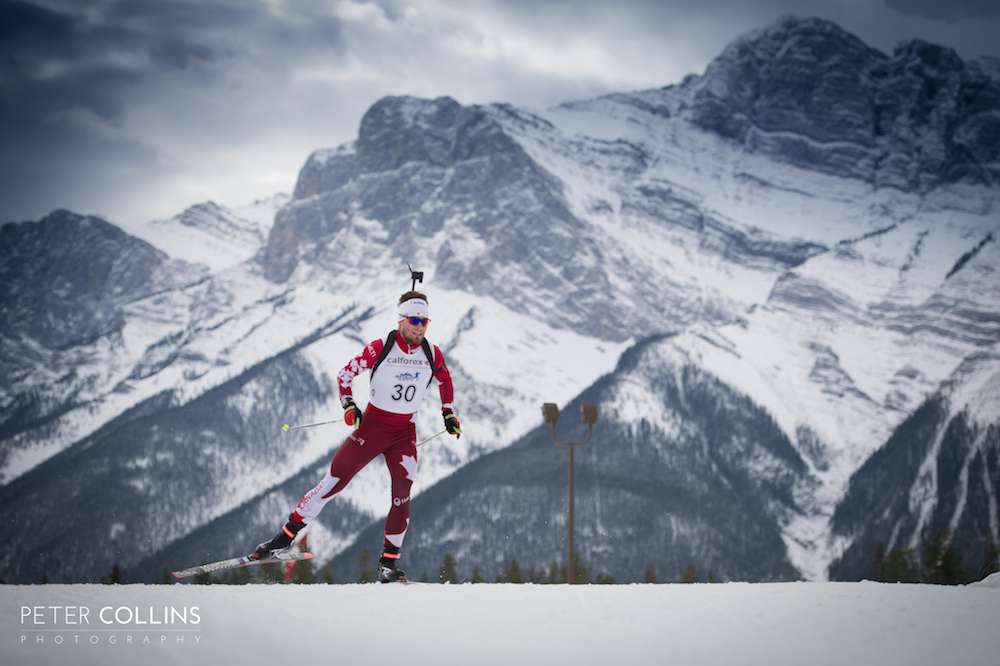
Christian Gow (Biathlon Canada Senior National Team) racing to ninth in the men’s modified sprint at Biathlon Canada’s team trials in Canmore, Alberta. With the third-best performance percentage of the trials, Gow was the fourth man named to Canada’s IBU World Cup team for the first trimester of racing, and he has since turned in four top-30 World Cup results. (Photo: Peter Collins/petercollinsphoto.com)
Christian Gow is also currently qualified under the 3.1 standard after placing 21st, 26th, 29th, and 30th in races this season, and shooting consistently well in the process.
By doing so, Smith has definitely met Priority 3.2 benchmarks — two top-40 WC/WCH results — as have Brendan Green and Megan Tandy, both two-time Olympians already.
Green has several top 40’s from last season, and a 33rd-place finish in the pursuit in Hochfilzen. Tandy turned in her top 40’s last season as she did not qualify for the World Cup tour at trials in November, but has since torn it up on the IBU Cup circuit, collecting finishes of ninth, 11th, and 18th over two weekends of racing.
Macx Davies currently meets Priority 3.3 criteria: two top-60 WC/WCH results. Like Tandy, he started the season on the IBU Cup; there, he collected two top-30 results. Megan Bankes partially meets 3.3 after her 60th place on the first World Cup weekend, and is locked in for Priority 3.4 — one top-three World Junior Championship (WJCH) result after winning the individual race at 2017 IBU Junior World Championships.
The objective criteria set forth by Biathlon Canada extends through Priority 3.7 to determine the Olympic team, but as five athletes on both the men’s and women’s sides have already met higher priority criteria, they will not be used.
Julia Ransom (Biathlon Canada) racing to ninth in the women’s 15 k individual at the IBU World Cup opener in Östersund, Sweden. In her first World Cup race of the season, it was Ransom’s career-best result and Biathlon Canada’s best individual result since 2015/2016. (Photo: Biathlon Canada/NordicFocus)
Here’s the summary for the five available spots on the men’s and women’s side. Currently the women’s rankings are as follows: Ransom 1st, Lunder 2nd, Crawford 3rd, Tandy 4th, and Bankes 5th.
On the men’s side, it’s: Scott Gow 1st, Christian Gow 2nd, Smith 3rd, Green 4th, and Davies 5th.
As made clear by Ward earlier, the primary road to qualifying for PyeongChang is on the IBU World Cup. Even before this year’s results, the women already had four skiers meeting criteria from their World Cup results and a junior skier with a podium at Junior Worlds.
Similarly for the men, as of June 1, four skiers had fulfilled minimum criteria, while Smith recovered from illness he also had a 43rd place to partially meet Priority 3.4 — the two times in the top-60 benchmark.
“Just by virtue of this criteria, closed Olympic trials is not going to happen,” Ward said.
For now, 10 spots are open, and those spots are technically spoken for by skiers with World Cup opportunities.
Then there’s that 10-letter word — discretion.
This for sure can be debated, but in the case of making Canada’s Olympic biathlon team in 2018, it appears very clear what the criteria are.
“This is how we use discretion,” Ward began. “Either through current or historical results. That could be 50 results in the past or what is happening right now. For example, historical results would be how we prequalified Julia Ransom and Rosanna for the first tour here on the World Cup. That was based on last year’s results. Current result demonstrate the ability or the potential to meet Biathlon Canada’s objectives for the high-performance program.
“There is data on everything. But you know some form of discretion is necessary. You can never build criteria that is absolutely perfect in every scenario. Completely unrealistic. If you have to build with some notion of fairness and objectivity and also to give yourself a little bit of wiggle room to use discretion in those certain scenarios that pop up every year.”
Scott Gow (Biathlon Canada) after placing 16th in the IBU World Cup men’s sprint last month in Annecy, France. (Photo: Glen Crawford)
Once at the Olympics, as previously mentioned, only four athletes can start for each country in each competition. That means that a fifth team member on both the men’s and women’s side will be watching from the sidelines. And who that is will be formally known: of the 10 Canadian biathletes headed to PyeongChang, the fifth qualifier for the men’s and women’s team will be considered an alternate.
“The top-four ranked athletes in each gender get individual start rights, and the relays are up to coach’s discretion,” Ward stated.
In an email from Ward on Dec. 27, he noted Tandy, Beaudry and Carsen Campbell would get World Cup starts when the IBU World Cup resumes Jan. 4 in Oberhof, Germany.
“Due to their strong results on IBU Cup, they have earned an opportunity on the WC and to score criteria for the Olympics,” Ward wrote. “With a Sprint, Pursuit, Relay in Oberhof this will very likely be the last weekend to change the Olympic ranking. Qualifications end January 15th after Ruhpolding WC.”
Those three biathletes will join Lunder, Random, Smith and both Gow brothers all of whom have been racing on the IBU World Cup.
“This means we will also have a very strong team at IBU 4 with Davies, Green, Crawford, Moser, Bankes,” Ward explained further. “After WC/IBU4 there will very likely be another change up as we shift gears towards Olympic preparation and finalizing our top 4 who will start the Individual races at the Games.”
Three World Cup weekends remain until the PyeongChang qualification period concludes.
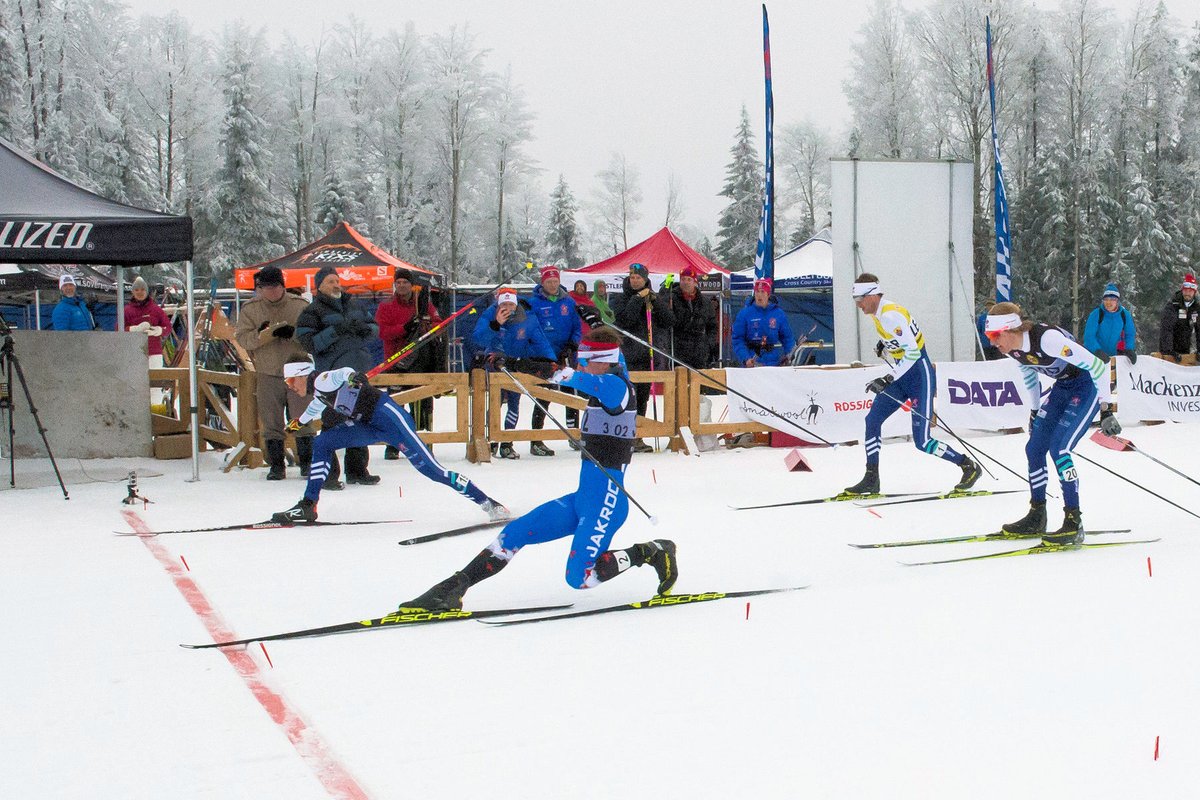
The photo finish for first in the men’s skate sprint final on Saturday at the NorAm in Rossland, B.C., with Julien Locke (near) outstretching Evan Palmer-Charette for first, and Julian Smith (r) taking third third ahead of Bob Thompson (yellow NorAm leader’s bib). (Photo: CCC/Twitter)
NorAm Mini Tour (Rossland, B.C.): Freestyle sprints
On Day 2 of NorAm racing in Rossland, British Columbia, Julien Locke, of the Black Jack Ski Club and Canadian National U25 Team, won the men’s 1.4-kilometer freestyle sprint final on his home trails by just one-hundredth of a second over Evan Palmer-Charrette, of the National Team Development Centre (NTDC) Thunder Bay, in 2:38.13. NTDC Thunder Bay had two on the podium with Julian Smith in third, 0.4 seconds behind Locke.
Locke started the day by qualifying second, just 0.06 seconds behind Bob Thompson (NTDC Thunder Bay), who won the qualifier in 2:39.49. Locke went on to finish second to Thompson in the first quarterfinal, then won the second semifinal while Thompson won the first semi.
In the final, Locke tallied his first NorAm win of the season, while Thompson, last weekend’s classic-sprint winner at Sovereign Lake, placed fourth (+0.43), missing the podium by three-hundredths of a second. Andy Shields (Lappe Nordic) finished fifth (+1.78) and Sebastien Boehmler-Dandurand (Canmore Nordic/Stefan Kuhn HP Team) sixth (+5.21) in the men’s final.
Also on Saturday, American Caitlin Gregg (Team Gregg/Loppet Nordic Racing) racked up her second-straight win in Rossland (after topping Friday’s 5 k classic), winning the women’s 1.4 k skate-sprint final in 3:03.36. Canada’s Andrea Dupont (Rocky Mountain Racers) finished 2.5 seconds later for second place and Zina Kocher (Foothills Nordic) scored her first podium of the season in third (+3.53).
Dupont won the women’s qualifier in 3:07.68, and Gregg qualified second, 0.87 seconds back. Dupont went on to win the first quarterfinal and first semifinal, while Gregg won her quarterfinal and semifinal as well. (Gregg’s quarterfinal had four racers, compared to five in Dupont’s quarterfinal, as only 21 women competed in the senior women’s heats.)
Also in the final, Laura Leclair, of the Centre National d’Excellence Pierre Harvey/Pierre-Harvey National Training Centre (CNEPH), finished fourth (+6.11), Maya MacIsaac-Jones (U25 Team) was fifth (+6.31) and Sophie Carrier-Laforte (Skinouk) sixth (+8.57).
On the second day of Alpen Cup (a.k.a. OPA Cup) racing in St. Ulrich, Ida Sargent of the U.S. Ski Team (USST) finished third in the women’s 5 k classic behind two Russians, Elena Soboleva and Natalia Matveeva, respectively.
Soboleva took the win in the individual-start race in 14:25.8, and Matveeva was 12.5 seconds back for second place. Just like Matveeva, Sargent reached the podium for the second-straight race in third (+18.1), after placing third in the freestyle sprint on Friday (Matveeva finished second in the sprint).
Germany’s Antonia Fräbel finished fourth (+21.0) and American Sophie Caldwell (USST), who won the sprint the day before, placed fifth (+22.7). The other USST member in the race, Julia Kern finished 15th (+53.5).
The men raced a 15 k classic, with France’s Alexis Jeannerod taking the win in 38:45.6. Germany’s Thomas Wick was 4.7 seconds back in second, and Russia’s Gleb Retivykh placed third (+11.3). The lone American man racing, Andy Newell (USST) finished 36th (+2:07.1) out of 125 finishers.
The three-day OPA Cup weekend in St. Ulrich wraps up Sunday with 10/15 k freestyle mass starts.
IBU World Cup (Annecy, France): Women’s and men’s pursuits
Susan Dunklee (US Biathlon) after placing sixth and reaching the flower ceremony in the women’s 10 k pursuit at the IBU World Cup on Saturday in Annecy, France. After starting 10th, sixth stands as a season-best for Dunklee. (Photo: Glen Crawford)
Germany’s Laura Dalhmeier captured her first win of the season, preventing Slovakia’s Anastasia Kuzmina from her third-straight win, and American Susan Dunklee raced to a season-best sixth in the women’s 10-kilometer pursuit on Saturday in Annecy-Le Grand Bornand, France.
Canada’s Emma Lunder achieved a career-best 18th after starting 34th, and her teammate Julia Ransom placed 27th after starting 39th.
In the men’s 12.5 k pursuit that followed, Norway’s Johannes Thingnes Bø started first, shot clean and fended off his competition to rack up his fourth-straight victory — winning by more than a minute.
And for the second-straight race, France’s Martin Fourcade finished second, this time 1:01.4 minutes behind Bø, who crossed the line first in 32:52.1. Fourcade had to ski two penalty laps later in the race (0+0+1+1), while Russia’s Anton Shipulin, who started sixth and had a single miss (0+0+0+1), rose to third place (+1:10.5).
American Lowell Bailey shot clean to race up to 14th (+2:13.9) after starting 35th. His US Biathlon teammate Tim Burke finished 26th (+3:03.1) with three penalties (1+0+1+1), after starting 10th.
Canada’s Scott Gow finished a second later for 27th (+3:04.1) after starting 16th and skiing four penalty laps (1+0+1+2). His brother Christian Gow moved up one spot to 29th (+3:06.6) after starting 30th and shooting 19-for-20 (1+0+0+0).
The U.S. had four men in the pursuit, with Sean Doherty placing 30th (+3:07.0) with three penalties after starting 17th.
Leif Nordgren improved to 48th (+4:54.9), up from 56th, despite three misses.
***
FIS Cross Country World Cup (Toblach, Italy): 10/15 k freestyle
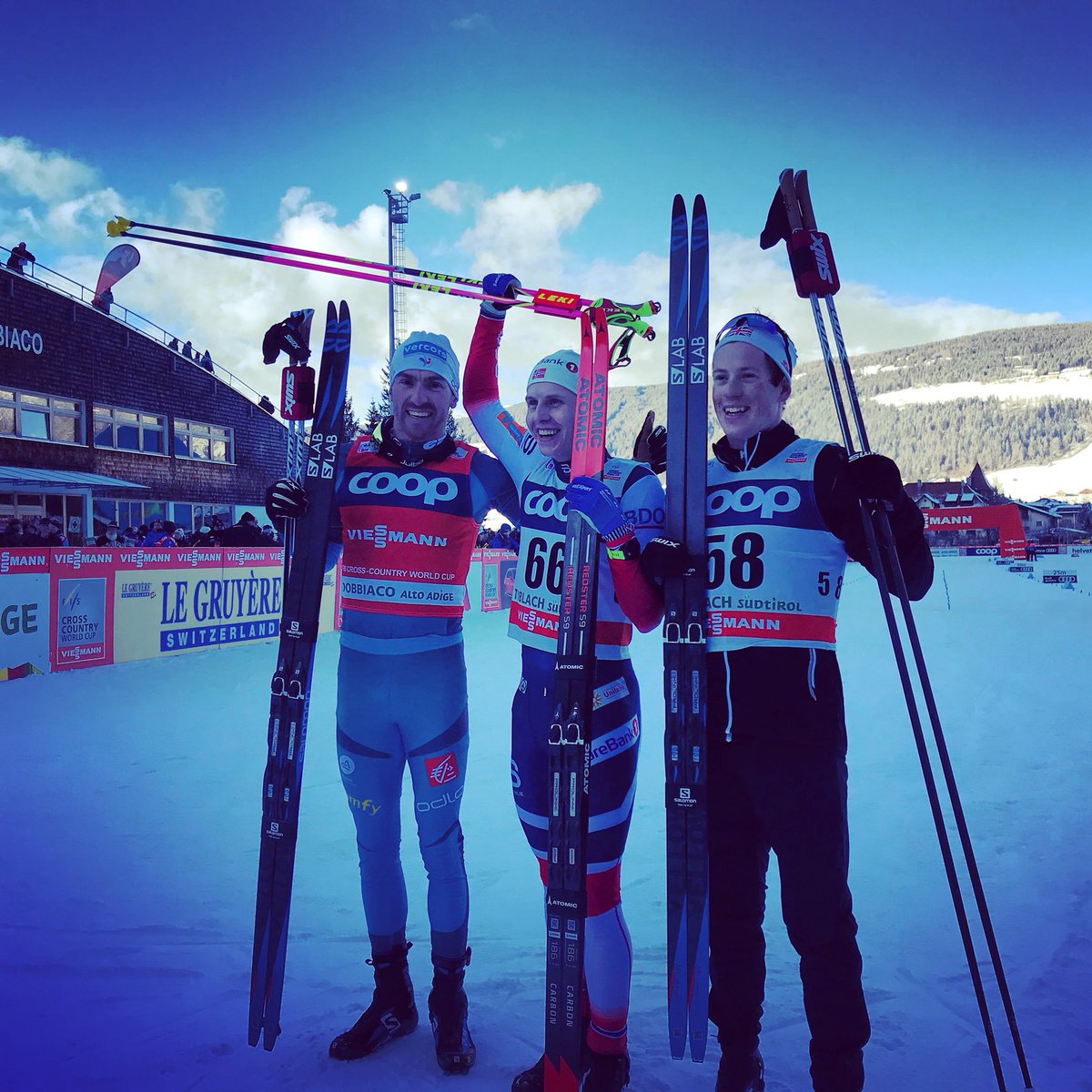
The men’s 15 k freestyle podium at the Toblach World Cup in Italy, with Norway’s Simen Hegstad Krüger (c) scoring his first World Cup victory in first place, last weekend’s winner Maurice Manificat (l) of France in second, and Great Britain’s Andrew Musgrave (r) in third. (Photo: FIS Cross Country/Twitter)
In the men’s 15 k freestyle on Saturday in Toblach, 24-year-old Simen Hegstad Krüger achieved his first individual World Cup victory in 29:58.8 minutes, and was joined on the podium by France’s Maurice Manificat in second (+10.6) and Great Britain’s Andrew Musgrave in third (+11.5).
Canadian World Cup Team member Alex Harvey missed the podium by 2.5 seconds in fourth place (+14.0), tying his best result of the season after finishing Ruka Triple mini tour in fourth place late last month in Kuusamo, Finland.
Russia’s Sergey Ustiugov followed in fifth, Norway’s Finn Hågen Krogh was sixth and Hans Christer Holund seventh, Finland’s Matti Heikkinen eighth, Switzerland’s Toni Livers ninth, and notably, Norway’s Johannes Høsflot Klæbo — who hasn’t lost a race all season (he sat out last weekend’s 15 k skate in Davos, Switzerland) — was 10th.
Erik Bjornsen of the U.S. Ski Team (USST) was the lone American in the points (top 30) in 29th (+1:09.6), Noah Hoffman finished 40th (+1:24.5), Scott Patterson (USST) was 42nd (+1:29.4), and Paddy Caldwell (USST) 53rd (+1:50.0)
For Canada, Devon Kershaw (World Cup Team) placed 38th (+1:22.1), Graeme Killick (World Cup Team) was 49th (+1:47.8), Russell Kennedy (Team R.A.D.) 60th (+2:13.2), and Knute Johnsgaard (World Cup Team) 85th (+3:28.3).
The women’s 10 k freestyle podium on Saturday at the World Cup in Toblach, Italy, with Sweden’s Charlotte Kalla (c) in first, and Norway’s Ragnhild Haga (l) and Heidi Weng (r) in second and third, respectively. (Photo: FIS Cross Country/Twitter)
In the women’s 10 k freestyle individual start in Toblach, Sweden’s Charlotte Kalla tallied her third win of the season in 22:40.1 minutes, ahead of five Norwegians and American Jessie Diggins.
Norway’s Ragnhild Haga was 5.8 seconds shy of Kalla’s time for second place, and her teammate Heidi Weng was another 8 seconds back in third (+13.8).
Norway occupied second through sixth place, with Astrid Uhrenholdt Jacobsen in fourth (+17.9), Marit Bjørgen in fifth (+22.6) and Ingvild Flugstad Østberg in sixth (+29.3). Diggins led the U.S. Ski Team (USST) in seventh (+40.5), with Finland’s Kerttu Niskanen close behind in eighth (+43.5) and the second U.S. woman in the top 10, Sadie Bjornsen, another 0.4 seconds back in ninth (+43.9).
The USST had three in the top 20 with Rosie Brennan placing 19th (+1:15.2) for her second-straight top-20 result (following a 17th place in last weekend’s 10 k freestyle in Davos, Switzerland). Chelsea Holmes (Alaska Pacific University) finished 36th and Liz Stephen (USST) was 47th.
Emily Nishikawa (Canadian World Cup Team) led her team in 51st, Cendrine Browne (Canadian U25 Team) followed in 55th, Dahria Beatty (World Cup Team) was 69th, and Katherine Stewart-Jones (U25 Team) 77th.
Tim Burke (US Biathlon) racing to 10th in the men’s 10 k sprint at the IBU World Cup on Friday in Annecy, France. (Photo: US Biathlon/NordicFocus)
IBU World Cup (Annecy, France): Men’s 10 k sprint
(Note: This rundown has been updated to include quotes from US Biathlon’s Tim Burke and Sean Doherty.)
Norway’s Johannes Thingnes Bø racked up his third-straight individual win of the International Biathlon Union (IBU) World Cup season on Friday (and fourth non-relay win of 2017/2018), topping the men’s 10-kilometer sprint in Annecy, France. And he did so in head-turning fashion, beating French superstar Martin Fourcade, the race’s runner-up, by 21.1 seconds on Fourcade’s home turf.
Norway’s Johannes Thingnes Bø racing to his third-straight win of the season on Friday in the IBU World Cup men’s sprint in Annecy, France. (Photo: IBU/biathlonworld)
On a pristine day in Annecy, Bø started 24th and consistently clocked the fastest times throughout the race. He cleaned prone, then standing, and finished 41.8 seconds faster than Germany’s Simon Schempp, the race leader until that point who also shot clean (0+0).
Fourcade started 31st and shot a flawless 10-for-10 as well, yet trailed Bø from start to finish. After prone, Fourcade was 8.3 seconds back in second. After standing, he was 14.7 seconds out of first with one loop to go. Bø skied the fastest course time on every loop to remain out of reach, and also shot faster than Fourcade, who clocked the second-fastest overall course time.
Ultimately, the 24-year-old Bø crossed the finish line with the fastest time of 22:16.9 minutes, Fourcade was second and France’s 26-year-old Antonin Guigonnat achieved his first World Cup podium in third (+34.7) with clean shooting. In fact, the top-four finishers all shot clean, with Schempp in fourth and the third Frenchman in the top five, Simon Desthieux in fifth (+45.7).
Guigonnat’s previous best World Cup result was 24th in a 20 k individual in 2015 in Oslo, Norway.
France’s Antonin Guigonnat placed third in Friday’s IBU World Cup men’s 10 k sprint for his first podium and first top 20 of his World Cup career. (Photo: Glen Crawford)
“It seems unreal to be here besides two monsters like these guys,” Guigonnat told the IBU, according to a press release. “After standing I was informed I had 7 seconds on Schempp and at that moment I trusted myself to hold that gap. I always trust in myself to be able to do something great like today.”
Fourcade, who has either placed second or third behind Bø in three consecutive races, was not excited about second place.
“Never cool, because I expected to win,” Fourcade said in an English interview with German broadcaster ZDF. “… But when you find someone better you just have to congratulate him and wait for the next chance. For now, with zero mistakes Johannes is not beatable. I will take the Christmas break to work on my shape, and expect to have a better shape in January to try and challenge him, because for now in the three last competitions I didn’t challenge him enough. I want to be faster, but he is good, he is really good.”
“That’s good words from the World Cup leader,” Bø replied to ZDF in English. “… Every victory I had this season Martin has been right behind me, so I just have to continue being at 100 percent. I always have to think about myself, and then afterwards we will see if I am in front or second, but it has been a good start.”
Only one man in the top 11 didn’t shoot clean: Russia’s Anton Shipulin in sixth (+54.9), who missed one in prone (1+0), but made up for it with the sixth-fastest overall course time and fifth-fastest overall shooting time.
US Biathlon’s Tim Burke achieved his first top 10 in two seasons, placing 10th, 1:08.2 behind Bø with clean shooting.
“I feel like I executed the perfect race for the shape I am in right now,” Burke wrote in an email to FasterSkier. “I know I am not in top form right now so this was about the best I could do considering that.
“I have worked a ton on my shooting in the past year and I know that I’ve reached a higher level in training than ever before. It was nice to be able to show some of those improvements today,” he continued. “It feels great to be back in the top ten. Last season I was only racing in about half of the races and I had a top finish of 11th. But I have to say that I am more pleased with how I executed the race today than the actual result.”
In a US Biathlon press release, Burke noted that “perfect shooting conditions and a fast track” made for a tight race, as he had expected. “This was a good confidence boost for me heading into the holiday break,” he said.
Sean Doherty (US Biathlon) racing to 17th for the second-straight individual IBU World Cup race on Friday in the men’s 10 k sprint in Annecy, France. (Photo: US Biathlon/NordicFocus)
“I feel I executed a great race plan today,” Doherty wrote in an email. “The sprint is all attack right from the start, and this aggressive racing demands that you are on every transition from the first 100 meters. I carried this mentality through the range and the last lap.”
After starting in bib 7 and cleaning the first shooting stage, Doherty took the race lead by 22 seconds.
“Prone was solid and I was happy to execute my plan on the range, had no idea I was leading, just keep the pedal down for another lap,” he wrote. “Being an early bib you can’t look too hard at the place number on the split times. … Coming into standing I just reminded myself of the same focus points I have been working on since May. Focusing on those fundamentals really helps block out any extraneous thoughts that might want to sneak into your mind.”
Scott Gow (Biathlon Canada) after placing 16th in the IBU World Cup men’s sprint on Friday in Annecy, France. (Photo: Glen Crawford)
Biathlon Canada’s Scott Gow notched his second top 16 of the season to put himself at the top of the list for Olympic team selection, based on Biathlon Canada’s “Priority 2” criteria. Gow started near the back of the field in bib 99 and ended up 16th (+1:13.5) with clean shooting.
“I’m very happy with another top 16,” Gow wrote in an email. “This result has solidified my priority 2 Olympic criteria which is a big relief. I’m also happy with my performances so far this early in the season. I’m normally a slow starter so it’s a good sign that I’m hitting good results before Christmas. I just hope I can make it last…”
“Conditions were rock solid today,” Gow explained. “The fresh snow we got overnight mixed with the wet snow and created a very hard glaze. It was hard to hold a solid edge and the downhills were squirrelly. There was zero wind all day today, so range conditions were perfect.”
His younger brother Christian Gow tallied Canada’s second-result in 30th (+1:44.2), also with clean shooting. He was one of 19 men (out of 103 finishers) that hit every target on Friday.
A total of four Americans qualified for Saturday’s pursuit, with Lowell Bailey placing 35th (+1:49.5) with a prone penalty (1+0), and Leif Nordgren finishing 56th (+2:18.1) with one prone miss as well (1+0). Paul Schommer placed 85th (+3:19.3) to miss the top 60 required for the pursuit.
“… It was a strong Nations Cup points day for the team as a whole,” Doherty noted.
Canada’s Brendan Green and Nathan Smith did not qualify for the pursuit, after Green finished 86th (+3:21.0) with five penalties (3+2) and Smith was 91st (+3:36.4) with two misses (0+2).
The women’s and men’s pursuits will be held Saturday in Annecy, with the women’s 10 k race starting at 5:45 a.m. Eastern Standard Time (EST) and the men’s 12.5 k at 8:45 a.m. EST.
“It’s always chaotic with a lot of action during pursuits and I’ll try to filter all of that out,” Scott Gow wrote. “As for skiing, there’s a lot of transition areas where I think a lot of time can be made.”
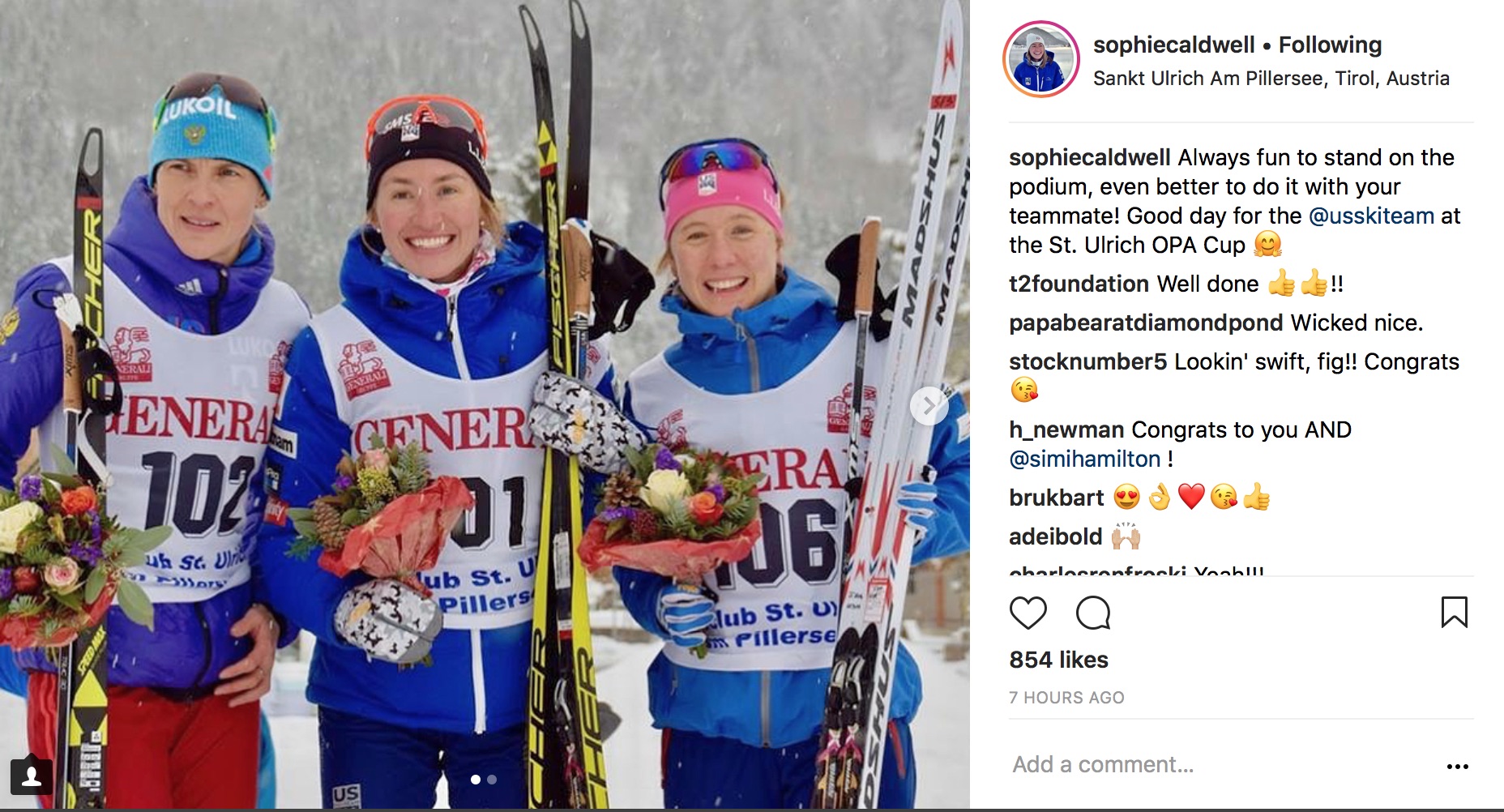
The women’s 1.2 k freestyle sprint podium at Friday’s Alpen Cup in St. Ulrich, Austria, with two U.S. Ski Team members in the top three: Sophie Caldwell (c) in first, Ida Sargent (r) in third, and Russia’s Natalia Matveeva (l) in second. (Photo: Sophie Caldwell/Instagram)
With this weekend’s World Cup races in Toblach, Italy, being solely distance events, five U.S. Ski Team (USST) sprinters ventured to St. Ulrich, Austria, to compete in the Alpen Cup (also known as OPA Cup) skate sprints on Friday.
Longtime couple Sophie Caldwell and Simi Hamilton came away with wins, with Caldwell winning the women’s 1.2 k freestyle sprint final ahead of Russia’s Natalia Matveeva in second and Caldwell’s USST teammate Ida Sargent in third. Another World Cup regular, Switzerland’s Laurien van der Graaff placed fourth, while Germany’s U23 World Championships classic sprint silver medalist Antonia Fräbel finished fifth. Italy’s Greta Laurent was sixth, Germany’s Hanna Kolb seventh, Austria’s Lisa Unterweger eighth, and Julia Kern (USST) ninth.
In the men’s 1.4 k, Hamilton took the win in a photo finish, just ahead of USST teammate Andy Newell in second and Switzerland’s Gianluca Cologna in third. France’s Jean Tiberghien placed fourth and Russia’s Gleb Retivykh finished fifth.
“#OPA men’s sprint was a nail-biter,” U.S. Ski Team Women’s Coach Matt Whitcomb wrote on Instagram with a finish-line photo on Friday. “Super close race for @simihamilton, @andynewellskier and @gianlucacologna. Well-run race by the OC in St Ulrich…
Earlier in the day, Caldwell won the qualifier by 2.82 seconds over Matveeva with a top time of 2:27.85. Sargent qualified sixth, 4.6 seconds behind Caldwell, and Kern qualified ninth (+5.54). Canadian-born Swiss skier Heidi Widmer qualified 11th (+6.66) and went on to place 14th overall.
In the men’s qualifier, Newell clocked the fastest time in 2:47.93. Retivykh was 2.01 seconds back in second, and Hamilton qualified third (+3.26).
Two more days of OPA Cup racing remain in St. Ulrich, with the 5/15 k classic individual starts on Saturday and 10/15 k freestyle pursuits on Sunday, according to the International Ski Federation (FIS) events calendar.
NorAm Mini Tour (Rossland, B.C.): Classic Interval Start)
The NorAm men’s 10 k classic podium on Friday in Rossland, B.C., with Brian Gregg (Team Gregg/Loppet Nordic Racing) in first, Scott Hill (r) of BXC in second and Bob Thompson (l) of NTDC Thunder Bay in third. (Photo: Kai Symington-Kruss)
The NorAm series continued this weekend with the Black Jack Ski Club hosting the first Canadian mini-tour of the season.
Racing started Friday with classic interval start races, with 10 kilometres and two laps for the men, and 5 k and one lap for the women.
Brian Gregg, representing Loppet Nordic Racing (LNR) and Team Gregg, dominated in 29:34.0 minutes, for his second win of the season after topping the 15 k classic mass start in West Yellowstone. Team BXC’s Scott Hill followed 28.2 seconds back in second. Last weekend’s sprint winnerBob Thompson, of the National Team Development Centre (NTDC) Thunder Bay, notched his second podium of the season in third (+39.4).
Fresh off the World Cup, Canadian national team sprinters Jess Cockney (World Cup Team) and Julien Locke (U25 Team) finished seventh and 13th, respectively.
Caitlin Gregg (Team Gregg/Loppet Nordic Racing) on her way to a win in the NorAm women’s 5 k classic on Friday in Rossland, B.C. (Photo: Mark Richards)
It was a big day for Team Gregg with Brian’s wife Caitlin Gregg winning the women’s 5 k in 16:08.0. Annika Hicks, of the Alberta World Cup Academy (AWCA), finished 46.8 seconds back in second, while Sophie Carrier-Laforte of the Centre National d’Excellence Pierre Harvey/Pierre-Harvey National Training Centre (CNEPH) narrowly edged out a group of women to take third (+1:16.1).
The Rossland NorAm continues with freestyle sprints on Saturday, followed by 10/15 k freestyle pursuits on Sunday.
Sophie Carrier-Laforte charging the downhill on her way to third place in the NorAm women’s 5 k classic on Friday in Rossland, B.C. (Photo: Mark Richards)
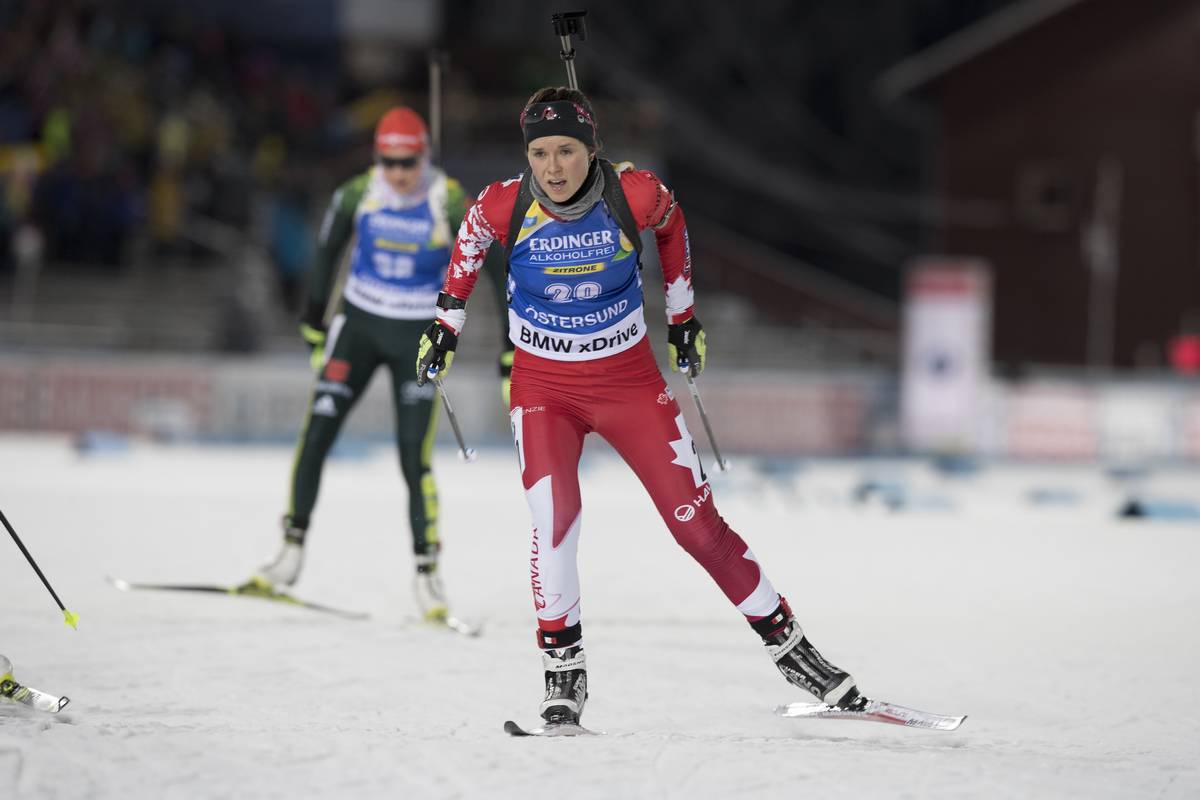
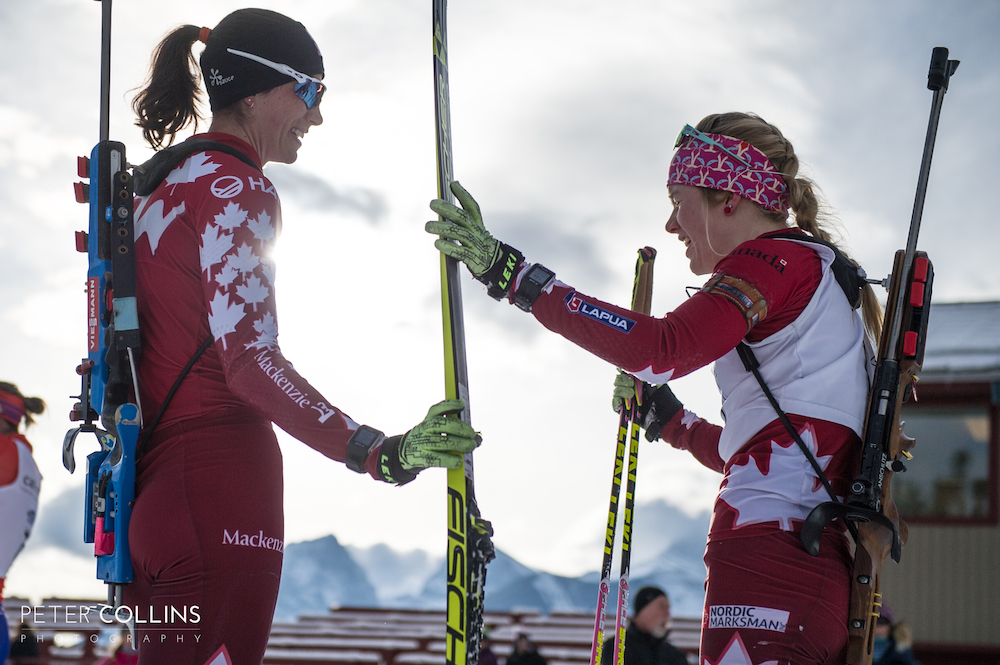
Emma Lunder (r) with fellow Biathlon Canada national-team member Rosanna Crawford after the women’s modified sprint at Biathlon Canada’s team trials in November in Canmore, Alberta. (Photo: Peter Collins/petercollinsphoto.com)
Despite the RBU’s less-than-full IBU member status, Russia is still scheduled to host the final IBU World Cup races of the season from March 20-25 in Tyumen and the IBU Cup 7 & 8 in Uvat and Khanty-Mansiysk.
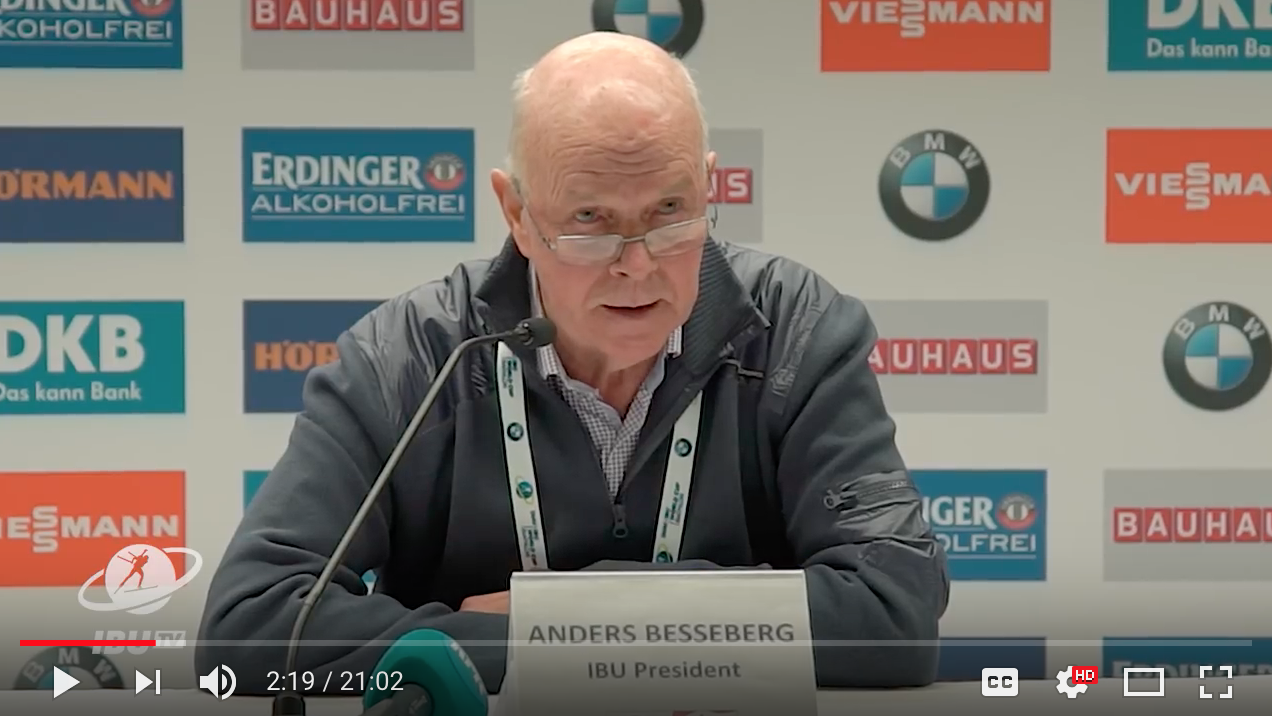
In an open letter sent to IBU President Anders Besseberg and IBU Secretary General Nicole Resch dated Dec. 8, 2017, Biathlon Canada’s President of the Board of Directors Murray Wylie stated Biathlon Canada will not be sending athletes to the IBU-sanctioned events in Russia in March.
In the letter, Wylie gives the following reasons for his determination:
“The occurrence of high-level IBU events in Russia is inconsistent with the IOC decision of 05 December to disallow participation by the Russia Team in the PyeongChang Olympics:”
“the integrity of anti-doping procedures in Russia is still very much uncertain, given the current situation in which RUSADA remains non-compliant with WADA.”
“This is actually the third letter,” Wylie said (full interview in related podcast). “The first letter was sent the first part of last January and then there was a second follow up letter in May, and this is the third one. I think the importance of this one was it was after the announcement by the International Olympic Committee and their stance on the systemic doping with Russia and we were very pleased to see that. Basically, it was an opportunity. We knew there was an executive board meeting in Hochfilzen, and that is typically the vehicle for us to voice our concerns.”
IBU President Anders Besseberg speaking at a press conference regarding the IBU’s decision to relegate the Russian Biathlon Union to provisional membership on Sunday, Dec. 10. (Screenshot: IBU TV)
This past weekend’s IBU World Cups were held in Hochfilzen, Austria, and the IBU’s decision to relegate Russia to provisional membership was announced in there on Sunday.
“This is sort of a repeat of our stance that we issued in May with respect to the selection, if you will, of the World Championships in Tyumen in 2021…,” Wylie said. “This situation is a bit related to the IOC, but we have a nation whose anti-doping organization is non-compliant, WADA code non-compliant in the Russian Anti Doping Agency. So our pitch has been — Biathlon Canada, the Canadian federation — if you are WADA non-compliant, then you should be not hosting any IBU events, major IBU events. And there are the World Cups and the IBU Cups and that is something within the purview of the international federations. We voiced that quite strongly and that essentially is what we are saying.”
Wylie also said he is unsure if other national federations will make the stance to boycott the Russian IBU competitions scheduled for March.
At this point, he said Canada’s athletes might be jeopardized by competing in Russia and exposing themselves to potential sample tampering when it comes to anti-doping testing.
“Even though they have an alternate agency, I believe it’s the UK Anti Doping agency is actually contracted to do that, we have a nation that has been a non-compliant anti-doping agency,” Wylie said. “If one of our objectives, the IBU’s objectives, is to foster and promote doping-free sport, it is sort of non-congruent that you would actually hold or allow them to host IBU events as they have a non-compliant anti-doping organization. … It happens to be directed to Russia, but we have actually said that any national federation that is non-WADA code compliant should not be allowed to host any IBU events simple as that.”
Wylie explained he is interested in modifying the IBU bylaws to include detailed language that states a national biathlon federation with a provisional membership, like the Russian Biathlon Union, should categorically not be allowed to host major IBU events.
On Wednesday, Nordic Nation reached Biathlon Canada President Murray Wylie to discuss an open letter he signed on behalf of his organization and sent to the leaders of the International Biathlon Union.
Despite the RBU’s less-than-full IBU member status, Russia is still scheduled to host the final IBU World Cup races of the season from March 20-25 in Tyumen and IBU Cup 7 & 8 in Uvat and Khanty-Mansiysk.
In an open letter sent to IBU President Anders Besseberg and IBU Secretary General Nicole Resch dated Dec. 8, 2017, Wylie stated Biathlon Canada will not be sending athletes to the IBU-sanctioned events in Russia in March.
In the letter, Wylie included the following reasons for this declaration:
“The occurrence of high-level IBU events in Russia is inconsistent with the IOC decision of 05 December to disallow participation by the Russia Team in the PyeongChang Olympics:”
“the integrity of anti-doping procedures in Russia is still very much uncertain, given the current situation in which RUSADA remains non-compliant with WADA.”
Listen for more from Wylie, as told to FasterSkier on Dec. 13:
Emma Lunder (Biathlon Canada) racing last January at the 2017 IBU World Cup in Ruhpolding, Germany. (Photo: Fischer/NordicFocus)
Emma Lunder may be a relatively recent addition to Biathlon Canada’s World Cup team, but the 26-year-old Vancouver native has raced her share of International Biathlon Union (IBU) World Cups.
On Saturday, Lunder demonstrated both experience and composure, just as she had done the day before with close to zero visibility in the sprint, in the women’s 10-kilometer pursuit in Hochfilzen, Austria. Despite having started more than two dozen World Cups since the 2013/2014 season, this was only her third pursuit.
“I went into this race knowing that both snow and wind were expected, so I anticipated conditions similar to yesterday’s sprint,” Lunder, who had previously raced to 42nd in the sprint with 9-for-10 shooting, wrote in an email. She had started second of 102 racers in the sprint and had to clear her own path through new snow while trying to stay on course.
On Saturday, she started 42nd, 2:04 minutes behind the sprint winner, Darya Domracheva of Belarus, and within 12 seconds of 32nd.
“With all of the racers starting fairly close together, a nice little track formed right in the middle of the ski trail so I just tried to ski in that path as much as I could during the race,” Lunder explained.
It was snowing as expected on Saturday afternoon, but not as heavily as the day before, and the wind was variable.
On the first prone shooting stage, Lunder missed her first shot but hit the next four. She had to ski a penalty lap and left the range in 45th, 2:35 minutes behind Domracheva, who had cleaned to remain in first place.
“On the range today I had some windy bouts and some calm bouts, so I took the information I had from yesterday about correcting and clicked accordingly,” Lunder recalled.
After missing her first shot, which she attributed to being slightly hesitant with her setup, Lunder went on to hit the next 19 — cleaning the next three bouts. In doing so, she rose to 37th after a clean second prone, then 32nd after the first standing, then 25th after the last stage.
“In standing I ended up on lanes near the start of the range (lanes 7 and 3) so it gave me a few extra seconds to recover from the climb into the range,” she wrote. “I focused on the same cues I’d been using yesterday and tried not to think too much, and that seemed to do the trick for me.”
Lunder crossed the finish line in 27th, 2:31.6 behind Slovakia’s Anastasia Kuzmina who also shot 19-for-20 after an early prone miss (1+0+0+0) to take the win in 34:41.2.
It was Lunder’s best World Cup pursuit result and second-best result of her career after placing 21st in a 15 k individual race last season in Antholz, Italy.
“I was getting splits throughout the race telling me what position I was in, but I just tried my best not to think about it too much, and keep skiing as fast as I could and shooting as well as I could!” she wrote. “Coming into the last standing I felt a little bit shaky, but once I was on the shooting mat I just went for it as if it was any other shooting bout, and I ended up with a good result. I’m really happy with my performance today. … to crack the top-30 in the second weekend of World Cup racing is definitely motivating for me!”
Emma Lunder (r) with fellow Biathlon Canada national-team member Rosanna Crawford after the women’s modified sprint at Biathlon Canada’s team trials in November in Canmore, Alberta. Lunder placed second in that race to secure one of the last two spots on Canada’s IBU World Cup Team, while Crawford, who had been pre-selected for the team, placed sixth in that race. (Photo: Peter Collins/petercollinsphoto.com)
The other Canadian in the race, Rosanna Crawford, finished 39th (+3:44.3) after starting 49th and shooting 16-for-20 with one miss in each stage (1+1+1+1). Crawford had the fourth-fastest overall shooting time out of 56 women in the pursuit.
“I feel like today was a bit more like my normal shooting speed for standing and a little slower than my normal for prone,” she wrote. “I was really taking my time in zero for prone because the snow was making it so hard to see the target. Visibility was slightly better in the race, but I still tried to take my time in the hopes of hitting all 5.”
In placing 39th, she tied her previous season best from the 15 k individual last week in Ostersund, Sweden, and scored World Cup points for the second time this season.
“It’s disappointing to miss one shot every time, and to get into the top 30 I would have had to hit 18 or better,” Crawford wrote. “I’m glad I got a few points today, but feeling frustrated that I can’t put a good skiing and shooting together in the same race. Skiing was pretty good for the first 3 laps, and I slowed down a bit for the last 2, but today was my best skiing so far this year.
“Looking forward to France where I am sure some good cheese will help fuel some good races!!” she added of this week’s upcoming races in Annecy, France. “Also just so happy for Emma Lunder! She really did a great job today, in the range to hit 19 and move up to 27th is awesome!”
The lone American in the women’s pursuit, Clare Egan finished 53rd (+5:21.6) after starting 36th and having to ski seven penalty laps (2+2+2+1).
The women’s 10 k pursuit podium at the IBU World Cup in Hochfilzen, Austria, with Slovakia’s Anastasia Kuzmina (c) in first, Finland’s Kaisa Mäkäräinen (l) in second, and Darya Domracheva of Belarus in third. (Photo: IBU/biathlonworld)
In the race for first, Kuzmina, who had started second, 22 seconds behind Domracheva, maintained her position for the first half of the race despite a penalty on the first stage. After leaving the range 27 seconds behind Domracheva after the first shooting, Kuzmina was within 9 seconds of her after the second prone stage, which both women cleaned.
The first standing stage that followed proved to be the turning point, with Domracheva missing one and Kuzmina cleaning to take the lead by nearly 13 seconds. Both cleaned the final standing, but Kuzmina skied faster to keep Domracheva at bay, racing to the win while Domracheva was passed by Finland’s Kaisa Mäkäräinen on the final loop to end up third (+11.8). Mäkäräinen claimed second place (+10.2), up from starting 50 seconds back in sixth place, with 18-for-20 shooting (1+0+0+1) and the fastest course time of the field. (In comparison, Kuzmina skied the seventh-fastest overall course time and Domracheva’s time ranked 31st.)
While it was Mäkäräinen’s first podium of the season, it was Kuzmina’s first win since a mass start in March 2014.
“It is always great to be on the podium and especially in first position,” the 33-year-old Kuzmina said, according to an IBU press release. “After yesterday, I thought I had a chance, but it was not easy for me, especially on the shooting range; I could not catch my breath … I just tried to stay positive. I took a long time on the last shooting, but finally it was good.”
“Overall, it was not an easy race with such weather conditions,” Domracheva said. “Like Anastasia, I think I took some extra time for that last shot, but I had 19-of-20 and that is very good.”
Sunday is a relay day with the men’s 4 x 7.5 k and women’s 4 x 6 k wrapping up racing in Hochfilzen. Canada is listed as starting Lunder, Crawford, Megan Bankes, and Julia Ransom, while the U.S., with three women on the circuit, will not be entering a women’s relay.
Darya Domracheva of Belarus after winning her first race in more than a year and a half, the women’s 7.5 k sprint at the IBU World Cup in Hochfilzen, Austria, on Friday. (Photo: IBU/biathlonworld)
Note: This article has been updated to include comments from Biathlon Canada’s Nathan Smith and Emma Lunder.
Calm wind and a light drizzle for the men’s International Biathlon Union (IBU) World Cup sprint on Friday afternoon in Hochfilzen, Austria, turned into a full-blown blizzard for the women’s sprint that followed. One multiple-time Olympic and world champion weathered the elements best, as Darya Domracheva of Belarus won the latter with clean shooting. She was one of four women in the top 20 that cleared all 10 targets amid the white-out conditions with a strong wind ripping sideways across the range.
“I am grateful that I was able to handle these challenging weather conditions today,” said the 31-year-old Domracheva, who had her first child just over a year ago, according to an IBU press release. “It has been a long time since I was on top of the podium, since March 2015, so it is nice to be here.”
Domracheva is the defending Olympic champion in three disciplines: the individual, pursuit and mass start. On Friday, she won the women’s 7.5-kilometer sprint for her first win over a year and a half, after taking the 2015/2016 season off to have a child and returning to the World Cup this past January. At 2017 IBU World Championships, she raced to silver in the pursuit.
During the women’s 7.5 k sprint on Friday at the IBU World Cup in Hochfilzen, Austria. (Photo: IBU/biathlonworld)
But on Friday, in the second sprint of the World Cup season, she was back to her winning ways in the most challenging of conditions. After the men’s race, wet snow began to fall more steadily. Temperatures dropped, making for drier snow that intensified in the minutes leading up to the race.
“The conditions were completely different in the race from the zeroing, so you had to adapt today,” said Domracheva, who started 71st of 102 women and bested Anastasia Kuzmina’s time by 22.1 seconds for the win in 22:40.2 minutes. Kuzmina, of Slovakia, who started just ahead of her in bib 69, placed second with a single penalty (1+0), bumping Italy’s Dorothea Wierer (bib 48), who also missed one prone target (1+0), to third (+30.6).
“It was really strange; I could see nothing on the tracks and I had to take off my glasses,” Wierer said, according to the IBU. “In these conditions, the race was decided on the shooting range; with one mistake, that was pretty good. … I think the conditions were the same for everyone; it was snowing for the whole race.”
“We were all hoping that the forecasted storm wouldn’t materialize, but just as predicted, the flakes started getting heavy about 20 minutes before the start,” US Biathlon’s Clare Egan explained in a post-race email to FasterSkier. “That’s when one of our wax techs says he thought about locking the wax cabin and fleeing the scene. Lucky for us he did not, and I think our skis were the best in the field today. I don’t know how they can make such fast skis for such slow conditions but somehow they manage!”
Egan led three American women in 35th, 1:56.1 minutes behind Domracheva, with a total of two penalties: one in prone and another in standing (1+1).
“While I was warming up the wind was extremely strong and then it seemed less intense during my race so I think the earlier starters had worse wind,” Egan recalled. “I took a couple clicks in prone [i.e., adjusted my sight for the wind] but that’s very standard. I actually did a completely normal shooting routine today in both prone and standing, which is a good thing. The trick in biathlon is to replicate your normal shooting routine even when you are in a high-stress race scenario.”
Egan started 68th, just ahead of Kuzmina. Her overall shooting time ranked 29th in the field, while her course time was 42nd. In comparison, Domracheva had the 43rd-ranked shooting time but was fifth-fastest out on course. Kuzmina was sixth fastest on course and had the second-fastest range time (including setup and actual shooting time).
“I did not do anything special today, but because I had special skis I managed a decent course time,” Egan wrote. “This year I am making a point to accept however my body feels on a given day and just focus on technique. When I do that, I know that even if I don’t feel great I can still have a great race.”
In the second World Cup stop of the season, 35th is a season best for Egan and her best result since placing 34th in a sprint last March. Last week in Östersund, Sweden, she placed 75th in the sprint and 79th in the 15 k individual.
“To borrow an expression I just learned from a British biathlete, I’m super duper chuffed with my race,” she wrote. “Last week’s racing was a real blow to my confidence so I’m very proud of the work I did to turn things around. It took a lot of mental gymnastics and help from our sports psychologist. Today’s race wasn’t exceptional but it was a solid biathlon performance and I’m very content with that. I will be completely happy when all of my teammates have races they can feel good about too. We are very much in this together.”
Egan will be the lone American woman racing in Saturday’s pursuit in Hochfilzen; both Emily Dreissigacker and Susan Dunklee finished outside the qualifying top 60. Dreissigacker placed 89th (+3:49.1) with three penalties (1+2) and Dunklee was 97th (+4:52.9) with eight penalties (3+5).
Two Canadian women landed in the top 60 to make the 10 k pursuit, with Emma Lunder in 42nd (+2:03.5) with a single miss (1+0) and Rosanna Crawford in 49th (+2:19.6) with two penalties (1+1). Megan Bankes just missed the cutoff in 65th (+2:55.3) with three standing penalties (0+3), and Julia Ransom finished 100th (+5:20.6) with seven misses (3+4).
“I was really happy with my shooting in the race,” Lunder wrote in an email. “I made sure to focus on my cues after making a 5-click correction for the wind, and took a bit of extra time setting up. It was snowing quite heavily, so I did my best to make every shot a good one, but unfortunately I did have one get away from me. When I came into standing it was a lot calmer, but still snowing a lot, so I was pleased with shooting clean! I’ve been working a lot this year on getting my confidence back in the shooting range, and I’ve seen improvements in both my prone and standing.”
She started second, with only one racer clearing the tracks ahead of her.
“I followed the tracks of Bib 1 for the first loop, just trying not to ski off the trail!” Lunder reflected. “It was really deep snow for that first loop but all things considered our wax team gave me some pretty quick skis for the race. I felt okay skiing today but I still need to find that next gear when I’m racing, so I’m excited to have a lot of girls around me to chase in the pursuit.”
Smith 19th, Doherty 22nd
Norway’s Johannes Thingnes Bø after winning his third race of the season (including a mixed relay and 20 k individual race last week Ostersund, Sweden) in Friday’s 10 k sprint at the IBU World Cup in Hochfilzen, Austria. (Photo: IBU/biathlonworld)
In the men’s 10 k sprint that opened the Hochfilzen weekend, Canada’s Nathan Smith raced to 19th — his best non-relay World Cup result since March 2016 — and American Sean Doherty placed 22nd for his best result since finishing 18th in a World Cup pursuit last March. Both Smith and Doherty shot clean, along with 12 others out of 108 competitors.
“Conditions for our race were quite good,” Doherty explained in an email. “Calm winds and overcast. Unfortunately a storm blew in for the women’s race so they had a much tougher course and range today.”
The top-four men all shot a perfect 10-for-10, with Norway’s Johannes Thingnes Bø in bib 36 setting a faster time around the course than France’s Martin Fourcade (bib 38), who also shot clean. Bø took the win in 24:18.4 and was 12.1 seconds clear of Fourcade, who ended up second. Slovenia’s Jakov Fak notched his second-straight podium (coming off a second place in Östersund’s pursuit) in third (+35.4).
“It is always better to be first rather than second,” said Bø, who also won the 20 k individual last week in Ostersund, according to an IBU press release. “I was lucky to shoot clean today. That is what I needed to get the win … My plan was like: go until you die, attack all the way. If you want to win, you cannot save the power…I was quite tired in the last loop, but I managed to hold on.”
Bø’s overall course time was the fastest of the field, 15.3 seconds faster than Fourcade.
“I cannot comment on any fight because Johannes had too big of an advantage after the standing shooting,” Fourcade told the IBU, referring to his 20-second deficit to Bø after the second shooting stage. “I am just happy that I was able to catch some seconds in the end. We had about the same ski speed as last week, but today he shot clean and I had not chance to win.”
“I shot clean and ran as fast as I could; that is all you can do,” said Fak, who started 33rd. “I never worried much after that … You can never be sure about the results until everyone has finished.”
Smith started 12th and finished 1:31.9 off Bø’s winning time, posting the fifth-fastest overall shooting time while hitting every target. Smith’s course time ranked 54th overall.
“I was carefull to take it easier for the last 15 sec before the range,” Smith, 31, wrote in an email when asked about his clean shooting. “It’s an awkward entry with a short steep bump.”
“I’m looking to continue the solid shooting while upping my ski speed a bit, back to around what my shape had been like in November,” he stated. “I’m happy with today’s race. Top 20 is a good accomplishment and a solid step in my comeback. For the pursuit I’m aiming to improve a little and grab a top 16.”
Doherty started in bib 79 and ended up tying Slovenia’s Klemen Bauer for 22nd, 1:39.2 back. (Bauer had a single penalty in prone.)
“As long as I stay disciplined the targets will fall,” the 22-year-old Doherty wrote of his clean shooting. “Overall I am happy with my race today. I am excited to take the momentum into the pursuit tomorrow.”
Saturday will be his first pursuit of the season after placing 82nd in the Östersund sprint. He also placed 38th in the 20 k individual there.
“The start to the season in Ostersund was tough,” Doherty noted. “That course there is one of the hardest on the whole circuit and we had exceptionally poor snow conditions for the individual, so that was a brutal race. Here in Austria I was looking to make a step froward towards the level of racing I know I am capable of and take care of the final Olympic criteria.
“To be honest my skiing is pretty poor right now, and that’s fine,” he added.
Doherty’s overall shooting time was 29th fastest while his course time ranked 57th.
“The important part of the season is still a ways away and that is when I will be on form,” he wrote. “In general I think I am off to a good start this season but there are still many races to go. So I just want to keep working and using each race as an opportunity to keep improving.”
All four Canadian men qualified for Saturday’s 12.5 k pursuit, with Scott Gow finishing 43rd (+2:25.1) with three penalties (2+1), Brendan Green 51st (+2:30.3) with one standing miss (0+1), and Christian Gow 54th with clean shooting.
For the U.S., Lowell Bailey is also in after placing 53rd (+2:32.4) with two penalties (2+0). Tim Burke finished outside the necessary top 60 in 73rd (+3:00.7) with three misses (1+2), Leif Nordgren was 98th (+3:40.2) with three standing penalties (0+3), and Paul Schommer 103rd (+3:54.6) with three misses as well (1+2).
The men race at 6:15 a.m. Eastern Standard Time Saturday, followed by the women at 8:45 a.m. EST.
Germany’s Denise Herrmann after winning the first IBU World Cup race of her career on Friday in the women’s 7.5 k sprint in Östersund, Sweden. (Photo: IBU/biathlonworld)
Just over a year and half ago, Germany’s Denise Herrmann took a giant leap and diverged from her career as a World Cup cross-country skier to take up biathlon. She did so at the age of 27, after having been the second-ranked sprinter in the world at the end of 2013/2014 and earning a bronze medal in the women’s relay at the 2014 Olympics. She narrowly missed another Olympic medal, placing fourth in the classic team sprint with Stefanie Böhler. A year later, Herrmann was fourth again in the 2015 World Championships freestyle team sprint with a different teammate, Nicole Fessel.
After all that, she wanted something different, something new.
“I owe a lot to cross-country skiing, it was a great time with many highlights, but now I want to face new goals,” Herrmann stated at the time. “The switch to a new discipline will be a big challenge, I am aware of that, but I am confident that I can do it with diligence, courage, and determination!”
After bouncing between the International Biathlon Union (IBU) Cup and IBU World Cup last season, Herrmann started this season on the big stage at the first World Cup in Östersund, Sweden. And in her 12th World Cup start as a biathlete, she achieved her first individual win.
“It all begins with dreaming about it,” she told German broadcaster ZDF, according to a translation, when asked if she expected to win at this stage of her career. “But I knew I am currently in a good ski shape and when it works out in the shooting I could probably hang with the top. But to then execute that in competition, in the World Cup and on the big stage here, I was hoping for that, but that I was able to make that a reality makes me all the more happy.”
The women’s 7.5 k sprint podium on Friday in Östersund, Sweden, with Germany’s Denise Herrmann in first, France’s Justine Braisaz in second, and Ukraine’s Yuliia Dzhima in third. (Photo: IBU/biathlonworld)
Herrmann, 28, won the women’s 7.5-kilometer sprint on Friday in 19:54.8 minutes after shooting 9-for-10 (0+1). She finished 15.2 seconds ahead of France’s Justine Braisaz in second and was 19.6 seconds clear of Ukraine’s Yuliia Dzhima in third.
Both Braisaz and Dzhima were among 22 women (out of 103 finishers) that cleaned the two-stage race on a cold, essentially windless evening. Norway’s Synnøve Solemdal, who finished fourth (+24.3) to claim the World Cup Total Score leader’s bib, also cleaned, as did Italy’s Lisa Vittozzi in fifth (+24.5).
Coming off a win in the IBU Cup sprint last week in Sjusjøen, Norway, Herrmann started 24th and was up to second place by the time she cleared all five targets in the first prone shooting stage. Her lone standing miss, which was just above the target, set her back to fifth place as she embarked on her final loop, but with the fastest last loop and fastest overall course time, Herrmann took the win from Braizaz, an early starter in bib 10. Dzhima started 11th.
“My goal was to start out with a clean prone stage, and then skiing into the standing stage I thought, ‘Oh, with bib 24 you could also go on lane position 24 on the range today. That might be a good omen,’ ” Herrmann reflected. “Of course you still try to leave no target black, but one was still left standing for me. That can be improved in the days to come.”
Earlier in the week, Herrmann started her season by placing 23rd in the women’s 15 k individual. Asked during an official training session what her chances were of making Germany’s Olympic team, she said she needed to focus on qualifying for the World Cup team first.
“One of my former coaches said, ‘Positions four and five are a cause for debate, but not one or two,’ ” she told ZDF on Friday. “So I said to myself, ‘Let’s lock this thing up today.’ That it already would work out like this today, I wasn’t expecting that. It’s incredible. I’m totally happy.”
Julia Ransom (Biathlon Canada) racing to a career-best ninth in the women’s 15 k individual on Wednesday at the IBU World Cup opener in Östersund, Sweden. (Photo: Biathlon Canada/NordicFocus)
Of the 22 women that cleaned Friday’s race, Julia Ransom of Biathlon Canada was one of them. Ransom started the week with a career-best ninth place in the 15 k, after shooting 20-for-20, and finished 29th in the sprint, 1.16.9 minutes behind Herrmann. In two races, Ransom is 30-for-30 on the range without a miss.
“Wednesday’s result was of course motivating, but also hasn’t changed any way I approach racing,” Ransom explained in an email on Friday. “At the end of the day, I race because I love it and it’s fun to compete. That being said, it’s even more fun to find yourself a little higher on the results page. Today I was just hoping to keep relaxed and focused and enjoy the day, whatever result that translated to.”
Ransom’s overall shooting time ranked 36th, up from 53rd in Wednesday’s 15 k.
“My shooting times were perhaps a little more ‘normal’ today because there was less consequence for a miss,” she explained. “Getting into the groove of racing also helps relax into my normal pace.
“Overall I am really happy with my race. It was an incredibly fast field out there today and I am proud of how everything went,” she added. “I can’t wait to start the pursuit. Opportunity awaits!!”
Three Canadian women finished in the sprint’s top 60 to qualify for Sunday’s 10 k pursuit, with Rosanna Crawford placing 46th (+1:41.6) with a single prone penalty (1+0) and Megan Bankes in 60th (+2:10.9) with one standing miss (0+1).
For Bankes, 20, 60th marks her career best in her third World Cup start, and Sunday’s race will be her first World Cup pursuit. Last season, she won the 12.5 k individual race at IBU Junior World Championships. At Biathlon Canada’s team trials early last month, Bankes was one of two additional women selected to Canada’s World Cup team for the first trimester of racing.
“I was super stoked to have solid results at trials and make the world cup team, and then prepare for racing in Europe,” the 20-year-old Bankes wrote in an email. “We’ve been in Oestersund for a week now, and I feel like I’m on European time now. Now I’m working on getting back into the swing of full time racing, which for me has been the main goal of this week.
“It’s definitely hard to know what to expect coming into the first races of the season, but I’ve been really happy with my skiing and my shooting consistency, so I was just excited to come here and give it my best,” she continued. “I’m pleased with my race today, hitting 9/10 and I felt that I skied much better than the Individual. I just decided I would start hard and hold on, which worked pretty well. On the World Cup everyone is so fast, so perfect shooting is pretty much necessary, and skiing crazy fast yourself! I’m really excited for the pursuit, planning on just skiing fast, hitting targets, and enjoying the experience. If I make up some positions that would be fantastic!”
While Herrmann will start Sunday’s pursuit first with a 15-second head start on Braisaz in second, Ransom will head out 1:17 minutes back in 29th, Crawford 1:42 back in 46th, and Bankes 2:11 back in 60th.
Canada’s fourth woman in the sprint, Emma Lunder finished 93rd (+3:07.5) with three penalties (1+2). US Biathlon started three on Friday, with Clare Egan placing 75th (+2:32.2) with three misses (1+2), Susan Dunklee 79th with five penalties (2+3), and Emily Dreissigacker 89th (+3:01.2) with two misses (0+2).
Earlier this week, US Biathlon announced in a press release that its fourth woman, Kelsey Dickinson, would be returning to the U.S. to compete at the IBU Cup Team Trials at Mt. Itasca in Minnesota from Dec.15-19. Because she did not meet the IBU’s World Cup Qualification Point requirement at the first IBU Cup in Sjusjøen, she will need to qualify for US Biathlon’s IBU Cup team.
The men’s 10 k sprint starts Saturday at 8:45 a.m. EST.
Julia Ransom (Biathlon Canada) racing to ninth in the women’s 15 k individual on Wednesday at the IBU World Cup opener in Östersund, Sweden. In her first World Cup race of the season, it was Ransom’s career-best result and Biathlon Canada’s best individual result since 2015/2016. (Photo: Biathlon Canada/NordicFocus)
Entering this season, members of Biathlon Canada had everything to gain and not a whole lot to lose. They had already had their funding reduced to zero by Own The Podium, save for a $50,000-dollar provision that paid for a coach, and its athletes were left to determine their offseason plan: stay home to train or self-fund training camps elsewhere. Many chose to spend most of their summer at the team’s base in Canmore, Alberta, and most started the season on the fly — without any preseason tuneup races in Europe — this week in Östersund, Sweden.
Julia Ransom was one of those athletes. After prequalifying for Canada’s International Biathlon Union (IBU) World Cup Team for the first trimester of racing, Ransom, 24, jumped into the 2017/2018 season with the Östersund mixed relay this past Sunday — three days after flying over from Canada.
There, she raced the second leg of the relay and tagged off in 15th, down two spots from where her teammate Emma Lunder tagged her in 13th. The team ultimately finished 15th, with teammates Scott Gow and Brendan Green.
“Today was a tough day for me. My legs were lead on the course,” Ransom wrote in a post-race email to FasterSkier on Sunday.
Three days later on Wednesday, it was another ballgame. With little to lose in the women’s 15-kilometer individual in Östersund, Ransom raced to a career-best ninth, which stood as her team’s best non-relay result in two seasons.
In the first individual race of the season, Ransom is well on her way to securing a spot on Biathlon Canada’s 2018 Olympic team, meeting half of the team’s “Priority 2” Olympic criteria standards. She needs another top 16 to fulfill that second-tier criteria. Priority 1 is one top-eight result in a World Cup (or World Championships, in a championships year like last season) or a top-three in a World Cup relay.
So far, she is the only one on her team who has cracked the top 16 in two seasons. Last winter, her best result (and her previous personal best) was 18th at 2017 World Championships in the 15 k individual. Canada’s best non-relay result in 2016/2017 was Scott Gow’s 17th place in a 20 k individual World Cup race.
And again, it’s the first race of the season.
“I am still in shock with how well today went,” Ransom, a Penticton, British Columbia, native in her fourth World Cup season, wrote in an email to FasterSkier on Wednesday.
“It is such a relief to start racing again,” she continued. “I wasn’t too nervous today; I had a race plan that I had confidence in and I was excited to give it a go. I also was looking for redemption after my painful relay leg on Sunday.”
Conditions were chilly, at -12 degrees Celsius (10 degrees Fahrenheit), but calm, accounting for clean shooting for seven out of the top-nine finishers. Ransom was one of them.
She started 20th (out of 102) and cleaned all four stages in the longest-format women’s race on the circuit. In individual races, shooting is weighed heavily; a minute is added to a competitor’s final time for each missed shot. Fortunately for Ransom, she hit all 20 targets.
“I was getting some pretty exciting splits during the whole race (top 5, second place, catching the leader etc) so I had an idea this was going to be a good day as long as I kept my shooting together,” she reflected. “I took a sigh of relief after the 20th target went down and just tried to ski as well as I could to the finish. I did take look at the big screen as I left the range, just to make sure I was hearing the techs right!”
Ransom initially crossed the finish line in third, 28.8 seconds behind Sweden’s Mona Brorsson in first and 9.8 seconds behind Eva Puskarčíková of the Czech Republic in second. Both Brorsson and Puskarčíková also shot clean.
The 55th starter, Nadezhda Skardino of Belarus, ultimately posted the best shooting and skiing performance of the day, racing to her first World Cup win (and first podium in three years) in 42:57.4 minutes with 20-for-20 shooting. Norway’s Synnøve Solemdal started 75th and shot clean but came up 2.9 seconds short at the finish to place second, bumping Ukraine’s Yuliia Dzhima to third (+12.0). The top-four women all cleaned with another Ukrainian, Valj Semerenko, placing fourth (+30.1).
Slovakia’s Paulina Fialková finished fifth (+32.2) with a single penalty (0+0+0+1), while Brorsson ultimately placed sixth (+49.6) and Puskarčíková seventh (+1:08.6).
Ransom ended up ninth for her best World Cup level performance by nine places, ahead of Norway’s Marte Olsbu in 10th and about eight seconds behind France’s Justine Braisaz in eighth.
“Starting off the season with a top ten has validated the hard work our team has put in and also given me a lot of confidence going forward. It’s a great building block to say the least,” Ransom wrote.
Asked what she thought made the difference with her training this year, she explained that she’d honed in on increasing her shooting speed.
“It’s still a work in progress but I am happy where I am so far,” she wrote. “I also did a ton of extra strength work and core stability and it has proven to make a big difference on the skis.”
On Wednesday, Ransom’s overall shooting and range times ranked in the middle of the pack, around 50th, while her overall course time was slightly faster in 42nd.
Biathlon Canada Head Coach Matthias Ahrens praised Ransom’s ability to perform under pressure.
“Especially as the tension mounted, with each clean bout, Julia was closer the podium and she managed the pressure very well,” he said, according to a team press release. “She didn’t get too excited or too nervous, executing clean shooting each time.”
Four Canadians started Wednesday’s 15 k, with Rosanna Crawford finishing 39th (+3:32.6) with three penalties (0+0+1+2), following her crash in Sunday’s single mixed relay.
“Rosanna, considering the crash of Sunday, had a really nice race,” Ahrens said in the press release. “It wasn’t certain if she’d race today, and we went in with a strategy not to risk any further injury. She managed a very good race, with a quite good ski time. Her rifle also required repairs from Sunday’s race. Overall, not knowing how she would hold up, particularly on one of the hardest Individual courses on the circuit, it was a nice result for her, in the World Cup points.”
Megan Bankes finished 75th (+6:28.9) with three misses (2+1+0+0) and Lunder was 83rd (+7:06.3) with five penalties (0+0+2+3).
US Biathlon started three women, with Susan Dunklee leading the team in 53rd (+4:12.7) with four penalties (1+0+1+2). Clare Egan finished 79th (+6:52.5) with five misses (0+2+1+2) and Emily Dreissigacker was 81st (+7:03.5) with three misses (0+0+1+2).
The men start their season with a 20 k individual on Thursday at 11:15 a.m. Eastern Standard Time.
(Left to right) Norwy’s Emil Hegle Svendsen, Johannes Thingnes Bø, Tiril Eckhoff and Ingrid Landmark Tandrevold show off their medals after winning the mixed relay on the opening day of the 2017/2018 IBU World Cup season in Östersund, Sweden. (Photo: IBU/biathlonworld)
Even the most renowned athletes and national teams in the mixed relay on Sunday afternoon admitted they had not yet found their perfect groove in Östersund, Sweden, on the opening day of the 2017/2018 International Biathlon Union (IBU) World Cup season.
Nevertheless it still made for an exciting race, with four teams vying for the podium on the last lap. And in the finishing stretch, anchored by veteran Emil Hegle Svendsen, the same country prevailed as in the last two seasons in the same race and at the same place: Norway.
In a time of 1:11:31.7 hours, Svendsen held off a final push from Italy’s Lukas Hofer by 5.3 seconds. Norway required 13 spare rounds on the shooting range while Italy needed just six; however Hofer incurred a penalty lap in his prone stage, momentarily falling back 30 seconds and to fourth place before returning to the top three.
Germany, anchored by Arnd Peiffer, placed third, 6.4 seconds back with 10 spare rounds and no penalties, with Peiffer managing to overtake Slovakia’s Matej Kazar on the final lap. Slovakia narrowly finished off the podium after a strong team performance with its best World Cup result in a mixed relay in five seasons. The team finished 7.7 seconds out of first, with nine spares and no penalties.
“It was a really tough fight with Lukas just behind,” Svendsen recounted of the final lap during the post-race press conference. He had used all of his spares to clean his standing stage.
“I was happy to walk away with the win. I looked back, it’s impossible not to I think, but I felt quite strong…,” he continued. “I was unsure if I should just let him come to me and then we can finish in a sprint, but I looked behind and I had about a five-second gap so I just said to myself to just go and see what happens … Always a good feeling to start the season with a victory, good for the team, good for the spirit.”
“The last lap, when I went out from the stadium, I saw Emil in front of me and tried to close the gap as fast as possible,” Hofer said at the press conference. “But it was a bit too much because he also pushed so strong, and normally he is one of the best on the last loop. I was happy to finish like this… It was a really good start into the season.”
In the mixed relay format, with a 2 x 6 + 2 x 7.5-kilometer course length, two women followed by two men hand off to one another on the track, and each can use up to three spare rounds per shooting stage to avoid a penalty lap.
This time of the year, the sun sets early in Östersund in central Sweden. In a race under floodlights with mostly calm wind conditions, Norway, with Ingrid Landmark Tandrevold, Tiril Eckhoff, Johannes Thingnes Bø and Svendsen, combined for the best performance once again.
“I was really nervous, but I think everyone was, especially on the first loop,” Tandrevold said at the press conference, after she got the nod to start, replacing sick teammate Marte Olsbu. “The standing shooting was really hard, but I think the rest of my race was good. I was happy to be in front on the last downhill, because last year I fell [there] so I was a bit scared.”
“I was a bit rusty, I need some more races, then hopefully it will be a really good season,” added her teammate Eckhoff.
“Full speed from the start, that was the only plan I had,” Bø explained the tactics on his leg, where he required two spares in the prone shooting and all three in standing. “Of course I didn’t plan to use five extra [shots]. All in all I am satisfied, but there are still some things I need to improve on. A little bit faster skiing, a little bit better shooting.”
That prompted laughter from his teammates and his competitors on the podium.
Italy’s Dorothea Wierer tags Dominik Windisch at the halfway point of the mixed relay in Östersund, Sweden. The team went on to finish second on the day to open the 2017/2018 IBU World Cup season. (Photo: IBU/biathlonworld)
Italy, with Lisa Vittozzi, Dorothea Wierer, Dominik Windisch and Hofer, narrowly missed out on its first victory in the mixed relay, tying its second place from two seasons ago in Canmore, Alberta.
“I was sure that Lukas would catch Emil!” Wierer said in the press conference with a laugh. “I think we can be satisfied. Of course we are not in perfect shape yet right now. I for sure didn’t have the best autumn, I was sick three times in two months. So it wasn’t perfect, but with some more races I can get in shape.”
The defending mixed relay world champion Germany, with Franziska Preuss, Maren Hammerschmidt, Benedikt Doll and Peiffer, was also happy with its outcome. Last season’s 2017 World Championships star Laura Dahlmeier will likely miss the whole opening weekend following an illness.
“It’s always a good feeling to start the season with a podium,” Hammerschmidt said at the press conference. “First race, I am always very nervous.”
“It was OK. In prone I could have hit my shot if I had taken a little more time,” Peiffer told German broadcaster ARD in an interview after the race, according to a translation. “It was a hard last lap, they really pushed the tempo right out of the shooting range and then I immediately had a small gap. I am glad that I was able to make up one more position and secure the podium … You are always nervous before a relay, with a big audience, and you have to race against all the good guys again who you didn’t see all year, so everyone is a bit excited.”
Slovakia, with Paulina Fialkova, Anastasiya Kuzmina, Tomas Hasilla and Kazar, had to settle for fourth place, but still the team was all smiles in an interview with the IBU.
“I am really surprised, but it was great,” Fialkova said. “It was close to the podium, but we hope maybe next time.”
“A good start to the season, and we will do it again and again,” Kuzmina added.
“I was really happy for the shooting and also running, a good result for the team today, good motivation,” their teammate Hasilla agreed.
“Very happy from this competition,” Kazar said. “Very hard last lap, going from [second] place after the final shooting to fourth place in the finish. There were really good men [racing against me].”
The home team from Sweden, with Hanna Öberg, Anna Magnusson, Jesper Nelin and Fredrik Lindström, was fifth on the day (+34.5, with one penalty and five spares), delighting the fans in Östersund after Öberg tagged off in first place after the first leg.
Another surprise of the day was Finland, with Mari Laukkanen, Kaisa Mäkäräinen, Tero Seppälä and Tuomas Gronman, leading the race at the halfway point behind a strong performance from Mäkäräinen, who moved up from eighth to first place with the best first-leg course time.
“It was a hard race, especially with Kaisa Mäkäräinen, she was really fast today,” Eckhoff said during the press conference.
The two Finnish men could not quite hold on to that position, but still finished in eighth place, 1:32.4 back with one penalty and eight spares.
It was Finland’s best World Cup mixed relay performance since placing seventh during the 2011/2012 season and sixth at 2009 World Championships in PyeongChang, South Korea, host of the upcoming Olympics.
Also with Mäkäräinen and Laukkanen, Finland actually won the gold medal in the mixed relay at the 2016 summer biathlon world championships, a rollerski biathlon event typically skipped by a number of the world’s best athletes. Similarly three of Slovakia’s starters on Sunday had placed second in that event last summer, gaining some positive experiences for the upcoming season.
Canadians Satisfied with First Race, Despite ‘Race Jitters’
For Biathlon Canada, Emma Lunder, Julia Ransom, Scott Gow and Brendan Green formed the relay team on Sunday.
“Today was the second mixed relay I’ve ever done on the World Cup circuit, and I felt pretty calm going into the race,” the 26-year-old Lunder wrote in an email to FasterSkier. “My plan was to sit back on the first lap as I know it can get really frantic, and I didn’t want to get tangled up with anyone.”
She cleaned her prone stage, coming back on the course in 12th place just 13 seconds out of first.
“I’ve never raced in Östersund before and I’ve always heard that it’s notorious for tricky winds, but the flags were almost totally still during both my zero [target practice] and the race,” Lunder wrote. “I was really proud of my prone as I’ve been working hard to improve my accuracy and speed this summer.”
In the standing stage, she had to use all three spares to avoid skiing a penalty lap, but improved positions nonetheless as other teams struggled as well.
“I had a bit of a problem when I came into standing with my contact lens moving around leaving my eye blurry,” she explained. “I think I paid a little bit too much attention to that, and wasn’t as focused on the standing shooting as I would’ve liked.”
On the last loop, she was passed by three teams fighting for positions in a pack, but didn’t lose any more time to the top.
“We had amazing skis after a great performance from our wax team, so I was able to take advantage of that on the downhills and zip past people,” Lunder wrote. “It was pretty exciting for me to be skiing with a pack where I could actually see the leader of the race, and I felt strong for the most part. Overall I was happy with my race today.”
Lunder exchanged to Ransom in 13th position, still only 24.2 seconds out of first.
“I was very excited for Emma Lunder’s race,” Ransom wrote. “She handled the start leg calmly and confidently, tagging me off in a great position.”
Like Lunder, Ransom also shot clean in her prone stage, then needed two spares to also clear her standing targets.
“The shooting range was really calm, especially in comparison to past years I’ve raced here,” Ransom wrote. “I was happy that I kept my shooting somewhat together. That was a big improvement from last year’s mixed relay in Östersund.”
But on the course she had some trouble holding up with the pace set by the race leaders, losing more than 40 seconds to them on both her second and third loops.
“Today was a tough day for me. My legs were lead on the course, but I half expected that to be the case [on] day three after travel,” she wrote.
Ransom tagged Gow in 15th place, 1:46.2 back.
“It was nice to be back racing again,” Gow wrote in an email. “This was probably the most calm I have been for a season opener.”
The older brother of Christian Gow, who raced the single mixed relay with Rosanna Crawford earlier in the day, required all three spares in his prone stage and another two in standing.
“I was mostly happy with my race except for my shooting. The conditions can be very tricky here, but my problem was with my head, not the wind,” Scott Gow wrote. “I was so wrapped up in the race and trying to make as much time as possible that I think I was too excited going in to each shooting. I will try to be more relaxed for the upcoming races.”
He he tagged Green in 16th place, after losing more than another minute to the leaders (+3:03.9).
“Östersund can often provide some very tricky racing conditions, but today was actually almost perfect in terms of wind,” Green, Canada’s anchor, wrote in an email. “In my experience, it’s rare to see a day like this.”
He only needed one spare each in his prone and standing stages, and with the 15th-ranked course time improved again by one position to finish 15th, 3:28 minutes behind Norway, without any team penalties and a total of 12 spares.
“I always find the season opener quite tough,” Green explained. “Digging deep to find that extra gear always hurts at the beginning of the season, but hopefully it will get easier and start to feel better from here on out.”
The Canadians agreed that all in all, the race was a good building block to start off the new season.
“From chatting with the team I think we all had some good parts of our races, and a few things we’ll work on between now and the individual races,” Lunder concluded. “It was a good start today, and we can definitely build and improve from here!”
“After a few more days of adjustment I think our team is positioned for some great results this coming season,” Ransom wrote.
“I think I held us back a little bit with my shooting, but otherwise we did a decent job,” Gow wrote. “We got the race jitters out and now I think we will be ready to give it our all next week.”
“I think each of us were able to take away some positive aspects from todays race, but as a whole we are for sure expecting to improve upon today,” Green concluded. “It was good to get the first world cup race out of way, and we are looking forward to more racing this coming week.”
U.S. Still ‘Blowing Out The Cobwebs’
US Biathlon’s Paul Schommer racing the third leg of the mixed relay on the opening day of the 2017/2018 IBU World Cup season in Östersund, Sweden. (Photo: USBA/NordicFocus)
US Biathlon’s original race lineup included 2017 World Championships gold medalist Lowell Bailey and silver medalist Susan Dunklee, Clare Egan, and former Junior World Champion Sean Doherty.
But on race day, teammate Paul Schommer had to take Bailey’s spot after he “woke up with congestion,” according to a US Biathlon press release.
“We had planned on racing Lowell for the third leg, he didn’t feel 100% today so Paul was subbed in,” Doherty explained in an email to Fasterskier. “Just no risk in pushing it with the hardest individual race of the year on Thursday.”
Dunklee started the team out well, taking the lead on the course to come into the first shooting stage and leaving in eighth position, just under 10 seconds back after needing one spare. She moved up with a pack out on course, but in the standing stage required all three spares after initially missing one target.
“I felt strong and relaxed skiing during the first two loops and I think my technique is already a notch above last year,” Dunklee wrote in an email. “The third loop was a bit painful as my legs flooded with lactic acid and I wasn’t quite able to reel in the pack ahead. I struggled in standing with the spare rounds despite favorable conditions but shooting can often improve with my better race fitness.”
Coming back on the course in 11th position and 26.1 seconds back, she still managed to cut the distance to the leaders in half on her final lap and tagged off in ninth place.
Egan got off to a strong start, both on the course and in her prone stage, where she cleaned without any spares and started her second loop in 11th. But with athletes like Mäkäräinen and Kuzmina setting a high pace up front, she explained she was struggling.
“This was my first race of the year and it was a rude awakening,” Egan wrote in an email to FasterSkier. “From the very beginning the pace seemed crazy and I was just trying to hold on. I am reminded now that the level is super high and I just need to go harder and faster all the time. I’ll get better as I race more but today was a bit of a shock.”
In the standing stage, she quickly ran out of spares and had to ski two penalty laps, which put her back to 20th (+2:27) when she returned to the course for her final loop.
“Conditions were perfect for me on the range today,” Egan wrote. “Last year in this race I did the exact same thing. I think the shock to the body makes it almost impossible to keep my mind where it needs to be for shooting. My prone is automatic — I am at the level of ‘unconscious competence’ — where I can do it right without thinking about it. But in standing I’m at the ‘conscious competence’ level. I really have to use my brain to execute all the steps.
“Today, I shot all 5 rounds from the clip plus 1 spare before suddenly having a moment of clarity and saying (out loud actually), ‘where have I even been aiming??’ …may or may not have included an expletive,” Egan continued. “Then, using my brain, I was able to easily hit my last two shots.”
She tagged Schommer in 21st, 2:51.5 minutes back.
Schommer lost more time on the course, but with a good shooting performance — needing just one spare in each of his stages and a range time ranked in the middle of the field — he avoided getting lapped and held the team in 21st, 4:29.5 seconds back.
It was only his second World Cup appearance in a mixed relay, following an eighth place last season in Kontiolahti, Finland.
From there, Doherty anchored the team to 21st place, also requiring just one spare round in each of his shooting stages.
“The conditions were uncharacteristically calm,” Doherty wrote in an email. “But I would not expect the conditions to stay calm for all the races so I forecast some challenging shooting on the [next] weekend.”
“It felt great to be back on the world stage,” he added. “It is a fantastic atmosphere. I enjoy competing on the world cup and I am always looking forward to the start of the season. The level of competition is just as high as I remember it last year and I am excited to see where I stack up after a great summer of training.”
“The good news was that I was never nervous, which is something I’ve struggled with in the past, and I shot fast today,” Egan reflected. “My shooting has been excellent in training since we got on snow, so I just need to transition into race mode. Today was what you might call ‘blowing out the cobwebs’!!!”
“The first race of the season is typically a tune up race for us and not one where we necessarily try to optimize our performance,” team veteran Dunklee concluded. “There are more nerves, there’s jet lag, and it often takes a few real races before the body starts to feel fully sharp again. We didn’t end up very high on the results list tonight, but I have no doubt that our best is yet to come.”
“I was impressed watching Emily [Dreissigacker] lead the first loop of the single mixed relay – she looked very comfortable in front of the pack,” Dunklee also commented on the performance of her teammates in Sunday’s single mixed relay. “Most rookies are terrified of trying something like that. You’ll see more of her in the future for sure.”
Racing will continue on Wednesday with the women’s 15 k individual, and the men compete on Thursday in the 20 k individual.
Next season, Östersund will host the 2019 IBU World Championships. Norway surely wouldn’t mind making it four wins in a row in Östersund in the mixed relay there.
Emma Lunder, of Biathlon Canada’s Senior National Team, racing to second in the women’s modified sprint on Friday, Nov. 10, the last day of Biathlon Canada’s team trials. After reaching the podium three times in three races, she was selected to the IBU World Cup team for the first trimester. (Photo: Peter Collins/petercollinsphoto.com)
Note: This article has been updated to include comments and verification from Biathlon Canada High Performance Director Roddy Ward, and explain the modified shooting format used for Friday’s sprint.
***
Almost exactly two weeks before Biathlon Canada sends the rest of its World Cup team to Europe for the first trimeter of International Biathlon Union (IBU) World Cup racing, the national team held trials this past Tuesday through Friday on snow in Canmore, Alberta. Three sets of races in four days (all sprints*) determined which Canadian men and women will start the season at the World Cup opener in Östersund, Sweden, Nov. 26-Dec. 3.
The national-team trials, also known as the “Tour 1 Selection Trials”, ultimately boil down to what Biathlon Canada calls performance percentages, which measures an athlete’s finishing time in a given race against the average of of the top-three finishers’ times in that race. One bad race isn’t a deal-breaker; they consider the best two out of three. At the end of the trials, an athlete’s top-two results (specifically their performance percentages) are averaged for their overall ranking.
Going into the trials, two women and one man on Biathlon Canada’s senior team had prequalified for the first World Cup tour (World Cups 1, 2 & 3): Rosanna Crawford, Julia Ransom and Scott Gow, according to a national-team program dated Aug. 30, 2017.
According to the same document, two additional women’s spots and three men’s openings remained. Those went to the two highest-ranked women at the Nov. 7-10 trials — Megan Bankes and Emma Lunder, respectively — and the top-three ranked men — Nathan Smith, Brendan Green and Christian Gow, respectively.
Emma Lunder (r) with fellow Biathlon Canada national-team member Rosanna Crawford after the women’s modified sprint at Biathlon Canada’s team trials in Canmore, Alberta. Lunder placed second in that race to secure one of the last two spots on Canada’s IBU World Cup Team, while Crawford, who had been pre-selected for the team, placed sixth in that race. (Photo: Peter Collins/petercollinsphoto.com)
All of the eight aforementioned athletes were nominated to Canada’s 11-member National Senior Team in June. The three remaining biathletes are Sarah Beaudry, who had the third-best overall women’s percentage at trials, Megan Tandy, who ranked fourth and was reportedly coming off an illness after traveling from Germany, and Macx Davies, who ranked seventh in the men’s final percentages after Matthew Hudec of the Biathlon Alberta Training Centre (BATC) in fourth, Carsen Campbell (BATC) in fifth, and Jules Burnotte (Biathlon Estrie) in sixth. (Scott Gow, Crawford and Ransom were not factored into the final percentages.)
The eight athletes that just missed the World Cup team will start the season on the IBU Cup. Four men and four women earned spots on Canada’s IBU Cup team as a direct result of their performances at trials: Hudec, Campbell, Burnotte, and Davies, and Beaudry, Tandy, Nadia Moser (BATC), and Leilani Tam von Burg (BATC).
Biathlon Canada’s High Performance Director Roddy Ward described the recent team selections as “straight-up trials”. Based on its published criteria, Biathlon Canada has the option to use discretion in choosing a fourth man and fourth woman for its IBU Cup team, but instead stuck to results, selecting the fifth- through eighth-ranked athletes at trials.
“We filled the team based on trials,” he explained on the phone on Sunday.
Ward said he was “feeling really good” about how the World Cup team shook out, with four of their top men returning to the circuit. He mentioned that Smith is healthy and back at full strength, and noted Green’s consistency at trials.
“On the women’s side, it’s just really good competition … with places changing every day,” he continued.
Most of the 16 athletes selected to Canada’s World Cup and IBU Cup teams spent much of the offseason together “time-trialling and integrating,” Ward said, which has brought up the level of training as well as made for closer competition among them.
“My hope is we go to the World Cup and do well and go to the IBU Cup and do well,” he said.
The Canmore trials began with sprints on Tuesday, which Beaudry and American Lowell Bailey (US Biathlon) won. The only woman to shoot clean, Beaudry topped the women’s 7.5-kilometer sprint by 8.9 seconds over Crawford with a finishing time of 21:57.7 minutes. Crawford missed one in each shooting stage (1+1) for second place and Lunder placed third, 21.1 seconds back, after a single standing miss (0+1). Tandy followed in fourth (+1:05.5) with two penalties (1+1), and Joanne Reid was the top American in fifth (+1:13.9) with one miss (0+1).
Christian Gow (Biathlon Canada Senior National Team) racing to ninth in the men’s modified sprint on the last day of Biathlon Canada’s team trials in Canmore, Alberta. With the third-best performance percentage of the trials, Gow was the fourth man named to Canada’s IBU World Cup team for the first trimester of racing. (Photo: Peter Collins/petercollinsphoto.com)
In the men’s 10 k sprint, Bailey also cleaned to beat out Smith by 13.4 seconds with a finishing time of 25:02.5. Smith had to ski one penalty loop after a prone miss (1+0) and Green placed third (+14.5) after two prone penalties (2+0). Scott Gow and his younger brother Christian finished fourth (+29.4) and fifth (+38.8), respectively, and Tim Burke (US Biathlon) was the second American in sixth overall (+1:11.0).
On Thursday, Smith won the second sprint of the week outright with a 26.1-second victory in the men’s 10 k with perfect shooting and a finishing time of 24:25.3. Green once again followed in second with clean shooting as well, and Artem Prima of Ukraine took third (+1:09.3) with two misses (2+0). While the Americans didn’t compete on Day 2 of the trials, Team Ukraine did, accounting for nearly the same amount of competitors (40 in the men’s race, 20 in the women’s race, compared to 40 in the men’s race and 26 in the women’s race two days earlier).
Scott Gow finished fourth in the Day 2 sprint (+1:17.0), followed by Hudec in fifth (+1:29.4).
In the second women’s 7.5 k sprint, a new winner emerged, but second through fourth place were exact repeats from Day 1. Bankes claimed the win in 22:03.5 with clean shooting, while Crawford followed in second, 26 seconds back with two standing penalties (0+2), Lunder placed third (+1:02.8) with two prone misses (2+0), and Tandy was fourth (+1:16.2) with two prone penalties (2+0) as well. Beaudry placed fifth (+2:16.6) with three penalties (2+1).
After sitting out the first two days of trials, Ransom won Friday’s modified sprint (6.8 k for the women) by just a tenth of a second over Lunder. Ransom hit all of her targets and posted the win in 20:20.4, and Lunder was just off her mark in second place after “cleaning” as well. Per the modified format, each athlete could use up to three spare bullets per shooting bout, similar to a modified relay.
“We all know [sprints] are important races; they lead to pursuits they lead to mass starts,” Ward explained. “We want to make sure we’re picking good biathletes, but also favoring on the ski-speed side.”
In addition to giving an athlete more chances on the shooting range, the relay format showed who could excel in those types of races, Ward said.
Julia Ransom (6) racing to the win in the women’s modified sprint on the last day of Biathlon Canada’s team trials on Nov. 10 in Canmore, Alberta. (Photo: Peter Collins/petercollinsphoto.com)
As a result of the modified-sprint format, the top-five women avoided the penalty loop. Bankes placed third, 6.7 seconds off Ransom’s time. Bankes’s BATC teammate Nadia Moser finished fourth (+8.6), ahead of American Susan Dunklee (US Biathlon) in fifth (+18.6). Crawford finished sixth (+48.0) with two penalties (2+0) and Tandy placed seventh (+1:13.9) with one miss (1+0).
In the men’s modified 7.5 k sprint on Friday, Smith emerged as the top Canadian for the third-straight race, winning in 18:42.0 with “clean” shooting. The top-eight men hit all their targets. Green finished second (+11.5) once again, and Scott Gow improved to third (+36.4).
Prima followed in fourth (+41.5), his Ukrainian teammate Sergey Semenov finished fifth (+1:05.9), Campbell and Burnotte tied for sixth (+1:08.2), and Davies placed eighth (+1:20.2). Christian Gow finished ninth (+1:40.9) with one penalty (1+0), Burke was the top American in 10th (+1:47.7), followed by Bailey in 11th (+1:47.9). Both Americans finished without any penalties.
Both the U.S. and Ukrainian teams raced two out of the three days of trials, contributing to the total field size of 45 men and 26 women on the last day. Ward emphasized that those teams’ presence made for “some really good competition”, and added that having Canadian juniors race alongside seniors (same distances, same races) showed them a clear path to reaching the World Cup level.
US Biathlon held the last of its own trials last month and planned to finalized its IBU World Cup team after its Canmore training camp.
For the Canadian World Cup team, Green and the Gow brothers planned to leave Sunday for Sjusjøen, Norway, where they’ll race at Norwegian biathlon trials. According to Ward, Lunder will depart on Thursday for Sjusjøen, where she’ll start her season with the first IBU Cup sprint on Nov. 23 before meeting the rest of the World Cup team in Östersund. Smith, Crawford, Ransom and Bankes planned to leave Canada on Nov. 22.
Most of the IBU Cup team will depart on Dec. 1, while Campbell and Beaudry will start their seasons earlier at the IBU Cup opener Nov. 23-26 in Sjusjøen.
(*Why were all of these trials sprint races? When it comes to individual events, IBU Cup and IBU World Cup venues typically open with sprints to determine which athletes qualify for the remaining races of the week at each stop. For instance, the top 60 in the sprint qualify for the following pursuit race, and approximately the top 30 in the overall World Cup rankings qualify for mass starts.)
Richard Boruta, head coach at the Biathlon Alberta Training Centre, died in a climbing accident on Aug. 9. (Photo: Jane Robertson)
Few nordic ski racing and biathlon venues are as awe-inspiring as the Canmore Nordic Centre in Alberta, Canada. Just south of the venue, amidst the geologic upheaval that is the Canadian Rockies, punches the Three Sisters — a string of iconic Canmore mountains. While descending from a technical route on the Middle Sister earlier this month on Aug. 9, Richard Boruta, a seasoned climber, died in a climbing accident. He was 49.
At the time of the accident, Boruta was attempting the Three Sisters Traverse as part of his 50th year, as he was turning 50 in October. It was Boruta’s first time on the climbing route.
Boruta was a fixture of Canadian biathlon’s high performance and development scenes since 1998 when he immigrated to Canada from his native Czech Republic. Most recently, he was named Biathlon Canada’s male coach of the year for 2017. It was his third time receiving the award.
His Canadian coaching career began with Canmore’s Rocky Mountain Racers (RMR). Boruta advanced to become the Canadian national team’s head coach in 2002. He remained in that position until 2006, after seeing his athletes compete at the Torino Olympics. Post-Torino, Boruta left the national team to become more involved in the development side of the sport.
In 2011, Boruta became the head coach of the newly formed Biathlon Alberta Training Centre (BATC).
Zina Kocher waves to the home crowd after placing second in an IBU Cup sprint two seasons ago in Canmore, Alberta. (Photo: Pam Doyle)
Zina Kocher, a three-time Canadian Olympic biathlete, fostered a deep connection to Boruta as she emerged onto the Canadian biathlon radar. Kocher told FasterSkier on the phone that she qualified for the national championships in 12th grade at age 17. To her surprise, she placed in the top 10, and Boruta took notice.
At biathlon nationals, the arrangement was for athletes to attend with the regional coach, not their specific club coach. Boruta was the Alberta regional coach for the event and by default helped guide Kocher. Boruta asked Kocher to join RMR, where he was then coaching.
“I had friends already on that team,” Kocher said. “I decided to try for the summer.”
That short-term arrangement quickly evolved. Kocher decided to bump the summer commitment up to a year long stay.
“I was enrolled in college and then I decided to train full time and do it for one year and see if I could make the world junior team,” Kocher recalled. “They had a lot of faith in my ability and they pushed me to go for it. I made the world junior team … I made my first Olympics in 2006, and I spent all that time being coached by Richard.”
Kocher remained on the national team from 2006 to 2011. During that time she worked primarily with other coaches. After a performance downturn in 2011, Kocher decided to train with Boruta and BATC. Until her retirement in 2016, Kocher was coached by Boruta for all but the year following the Sochi Olympics when she trained with the national team. (For the 2016 competition year, Kocher was coached by Boruta as a member of BATC.) From 17, until her retirement at 32 years old, Boruta helped shape Kocher.
“I feel like he changed a lot himself from the time he was first coaching to the end,” Kocher reflected. “At the beginning, he was quite Eastern European, he was strict. I cried a lot. It was hard. He pushed me, he constantly challenged me, he always expected more from me. If he said ‘good job,’ you did awesome. Those comments he kept to the end, but he turned maybe more Canadian. Near the end, if I got emotional, he would just give me a big hug. He didn’t say anything. It was just a hug.”
Macx Davies (Biathlon Canada) racing to a career-best 10th in the IBU World Cup 10 k sprint in Ostersund, Sweden, last December. (Photo: Biathlon Canada/NordicFocus)
Macx Davies, of Biathlon Canada’s national senior team, was also mentored by Boruta at BATC. For his first two years after high school, Davies said Boruta helped him form a knowledge base that eventually led him to a national-team nomination.
“During those two years we developed a working relationship and he taught me how to be a full-time athlete,” Davies wrote in an email. “From how to train in proper zones, to hitting targets, to being a well-rounded individual, Richard helped shape who I am today.”
Davies reiterated a point that Kocher made several times: that Boruta was even-keeled, calm and perfectly suited for a sport like biathlon where unsteady nerves can sink an otherwise stellar ski performance.
“As a coach, Richard was the most calm and soft-spoken I ever had,” Davies wrote. “Whether you are racing for a spot on the Olympic team or doing a time trial at home, he was the same calm, supportive and helpful coach, always there to give you a smile, head nod, and if you did really well an illusive high-five!”
Boruta’s life work was still firmly immersed in the present as he coached Megan Bankes, a rising star for Biathlon Canada. At 19 years old, Banks is coming off a season where she won two individual gold medals at the 2017 IBU Junior World Championships. Despite being named to the senior national team, Bankes still trained with Boruta as a member of BATC.
Canada’s Megan Bankes takes a bite out of her gold medal after winning the junior women’s 12.5 k individual at 2017 IBU Junior World Championships in Osrblie, Slovakia, and becoming the first Canadian woman to do so at Biathlon Youth/Junior Worlds. (Photo: Airat Aitniakov)
Helping athletes reach their potential was Boruta’s bread and butter. And for Boruta’s clan of biathletes, that potential often meant the international stage. According to Roddy Ward, Biathlon Canada’s high-performance director, half of the current national team moved through BATC under Boruta’s tutelage.
“Richard was a key player in helping Canada close the gap to the international podium,” Ward wrote in an email.
Ward first met Boruta while competing as a junior biathlete. In 2006, when Ward returned to Canmore for a coaching position, he became professionally linked to Boruta.
“Since 2011, Richard coaching BATC and myself coaching National Team we worked more closely together, often working together with athletes in a NT camp based program (Megan Bankes, Julia Ransom, Emma Lunder, Sarah Beaudry), combining for many training sessions, camps, testing, races etc.,” Ward explained.
The data and spreadsheets, the periodization and hours trained are part of developing an athlete. A coach may tinker with more technique one year, more volume the next. Yet one aspect of the coaching equation difficult to change is the personality each coach brings to the athlete-coach relationship. Ward noted that by observing Boruta, he came to understand that some of what Boruta practiced could, in fact, make his own coaching more effective.
“Early in my career I would notice a contrast to Richard and myself on the range while explaining the day’s training,” Ward emailed. “I would be almost yelling the directions while athletes chatted among themselves and ran around not listening (I’d often have to give directions multiple times), while Richard would talk very quietly (like he always does) while all his athletes listened very closely so they could actually hear the directions. I thought there was something to that and started to apply this technique in my own way.”
Kocher said Boruta understood his inherent strengths. “One time we did this one truth and two lies,” Kocher said. “I’ll never forget because the truth was ‘I believe in nonverbal communication.’ That was him. He didn’t say a lot of words and what he said was valuable and it meant a lot.”
Ward also absorbed the Boruta “less-is-more” tenant.
“Talk less and listen more,” Ward wrote. “When you do say something it will have a bigger impact. I used to talk too much, give too much direct feedback, be too assertive. Now I let the athlete lead more, don’t always give them answers immediately, try to listen more than talk. It’s made me a better coach and teacher.”
But there were days when Boruta could scream encouragement. And in those moments, when the coaching lessons had been ingrained, Boruta revealed his love for seeing others achieve.
“He was someone who didn’t show a ton of emotion,” Kocher said. “Yet when he showed emotion it was passionate. I remember this happened a few times. A long time ago, for the first time, I was going to make a pursuit. I was a first year senior and had just done a World Cup as a junior. Back then I had never made the top-60. Then in the third World Cup in December, in 2003 I guess, I was in Slovakia. It was a windy day and I shot zero-zero. I just remember leaving the range just like super confidently. I had just shot clean for the first time in my life. Literally, Richard was running beside me on the hill. Somehow he had left the range and he was on the hill and he was cheering me on telling me I could get a top-10. And the course was really open and he was able to come out while I was finishing the climb and hitting the next downhill. Then he was suddenly on the next hill. He was cheering me on that one, and then he was near this bridge near the finish. He just found his way onto all these spots on the course to get me to go harder, and he was at the finish line. I remember his passion a lot from that day.”
Boruta is survived by his wife Kamila and three sons Michal, Thomas and Lukas, his mother Jirina, father Richard, and granddaughter Sophie.
Biathlon Canada’s Scott Gow racing to 47th in the men’s 12.5 k pursuit at 2017 IBU World Championships in Hochfilzen, Austria. Biathlon Canada is facing a tightening of purse strings for the 2018 Olympic season as Own The Podium cut its base funding to zero. (Photo: Glen Crawford)
If you made it past the article’s title, then get ready to immerse yourself in the intricacies of Canadian high-performance sports funding.
OK, here it goes…money, money, money. Add this for effect, $.
Imagine for a moment you’re the CEO of a national sporting body and you’ve got high aspirations — things like championship and Olympic medals. There’s an infinite amount of puzzle pieces to organize and assemble. There are two critical pieces to even fathom success: the motivated athletes-coaches combo along with ample funding.
Biathlon Canada finds itself in a precarious position for the 2017/2018 season— a critical year considering that many athletes sharpied in the 2018 Winter Olympics in PyeongChang, South Korea, in mid-February as their performance peak just after the 2014 Sochi Olympiad.
The financial hammer fell in May when Own The Podium (OTP), a Canadian nonprofit focused on supporting Olympic medal contenders, cut its base funding to Biathlon Canada to zero dollars. ((Biathlon Canada is the National Sporting Organization (NSO) overseeing biathlon in Canada.))
Andy Holmwood, Biathlon Canada’s general manager (Photo: Pam Doyle)
During the final run-up to PyeongChang, Biathlon Canada must belt-tighten and evolve in a climate of continued funding scarcity. At the time of publication, the exact amount of Biathlon Canada’s budget was unclear despite a request to Biathlon Canada General Manager Andy Holmwood to confirm his organization’s 2017/2018 budget.
“I am not in a position to discuss any of our budget numbers,” Holmwood said in a phone interview on July 11th.
Biathlon Canada receives the majority of its funding from three major sources. There’s Sport Canada, a government agency providing funds to NSO’s through its Sport Support Program. Jon Schofield, a Sport Canada spokesperson and media-relations specialist, explained to FasterSkier in an email that Sport Support Funding is for a four-year cycle.
Then there are corporate and private donations made directly to Biathlon Canada.
Lastly, there’s funding from Own The Podium (OTP). According to Schofield, OTP makes the recommendations upon which other groups base their monetary support.
“Those sports that have athletes which have demonstrated the potential to achieve a podium result at the Olympics and Paralympics, are also eligible for enhanced excellence support,” Schofield wrote in an email. “The assessment of podium potential is done yearly by Own the Podium which provides funding recommendations to Sport Canada, the Canadian Olympic Committee and the Canadian Paralympic Committee – (the two latter) which in turn support the sports directly.”
It can be tricky and frustrating. Biathlon Canada is in a constant struggle to promote and financially support athletes who have already arrived while keeping promising athletes in the development pipeline.
The OTP Ask
Here’s how the basics work between OTP and Biathlon Canada. The NSO, or Biathlon Canada in this case, presents its supporting evidence — in both a formal proposal and in-person meeting — that its athletes have Olympic medal potential. OTP officials then recommend funding based on their assessment of the submitted evidence.
OTP funding is considered to be “top-up” funding, or monies for athletes at the very highest level of their respective sport. Amongst the high-performance scene in Canada, the philosophy of emphasizing those athletes already at the top is referred to “targeted excellence”. In total, OTP redistributes approximately $64 million annually. To put that in perspective, that $64 million is part of the larger $200 million the government invest in Canadian sport annually.
Anne Merklinger, Own The Podium chief executive officer (Photo: OTP)
“Our mandate, which is prescribed by the national funding partners, is to provide technical advice for National Sport Organizations and to provide investment recommendations for those sports organizations that have evidence of medal potential for the upcoming set of Games,” Anne Merklinger, OTP chief executive officer, said in a phone interview. “Secondly, we also provide investment recommendations for the subsequent set of Games, so in winter that would be for 2022. So those investment recommendations are being considered by the minister and they are not final yet.”
According to Holmwood, Biathlon Canada presented a portfolio highlighting the medal potential of its men’s relay team.
“I think we made a strong case for our men’s relay team as a medal hopeful,” Holmwood said. “I think it’s fair to say they didn’t agree with us completely. They didn’t share that perception. It is clear that OTP in an Olympic year, they refer to sharpening their pencils and really focusing the funding on strong medal contenders. In their eyes, we did not fit in that.”
Two seasons ago, the men’s relay team earned a historic bronze medal at 2016 International Biathlon Union (IBU) World Championships in Oslo, Norway. Last season, their best finish was seventh at the World Cup in PyeongChang, South Korea, where many nations did not start all of their top athletes. (More on last season’s results later.)
“Their base funding for ’17-’18 is zero,” Merklinger said about OTP’s funding for Biathlon Canada. “But they are receiving $50,000 for the coaching position … to support a coach through the Olympic Legacy Coaching Fund. So that is the extent of the funding recommendation for biathlon for the ’17-’18 fiscal year.”
Starting at the top of Canada’s biathlon pyramid, the collective gasp came at the depth of the cuts, not that OTP cuts were made.
“OTP takes a very actuarial approach,” Holmwood said. “It’s not subjective. And to their credit, they are very clear in their mandate. It’s not a big massive surprise. I think what surprised us was just how deep the cut went.”
Roddy Ward, Biathlon Canada high-performance director (Photo: Ric Rowan)
“In the end, it seems as though they believe we have some up-and-coming athletes but no medal prospect for 2018 Olympics,” Ward said. “By their mandate, it means we get cut out of the pot of money for the Olympic season. I don’t doubt they followed through with their mandate, but ultimately, decisions like that undermine growth towards consistent podiums in our sport.”
Ward has a point about diminished funding decreasing the odds of future podiums. But OTP’s mandate only looks to a two-Olympic cycle “event horizon”. At the moment, OTP is not obligated to look further than Beijing 2022.
OTP publishes what it calls a Winter Historical Comparison on it’s website. It outlines OTP funding recommendations for Olympic winter sports by quadrennial. For the Vancouver quadrennial, Biathlon Canada received $1,784,173. It received $1,324,623 for the Sochi quadrennial.
According to Merklinger, for the ’14-’15 fiscal year, Biathlon’s base funding from OTP was $250,000, $400,000 for ’15-’16 and $435,000 for the ’16-’17 fiscal year. Accounting for the ’17-’18 cuts, and adding the $50,000 from the coaching legacy fund, the PyeongChang quadrennial total for Biathlon amounts to $1,135,000.
(On OTP’s website, a figure of $1,200,000 is used for the first three years of the PyeongChang quadrennial. Using that figure, an amount of $1,250,000 would have been recommended for Biathlon during the PyeongChang quad.)
Although Merklinger was clear in explaining to FasterSkier that Biathlon Canada’s base funding was “zero”, Holmwood said this about OTP’s potential allocations: “Our OTP funding for this coming season is uncertain. It is fair to say, I would say that we have received a substantial cut, but just what we will be getting from OTP is not certain.”
OTP’s Merklinger said the funding door as it applies to the medal potential of Canada’s national biathlon team isn’t exactly slammed shut. OTP maintains the administrative flexibility to infuse money into a high-performance program on short term notice.
“We can do that from today until the start of the Olympic Games,” Merklinger said when asked if OTP could recognize medal potential with monetary support if an athlete or team proves they are on form in races scheduled a few months before the Games. “We are eager to work with biathlon as the season unfolds to assess the progress of their preparations and their performance for PyeongChang and would be delighted to be in a position where we could provide a very specific incremental funding recommendation that is focused and that responds to a positive side of the program and indicates that they indeed have evidence of medal potential.”
The Potential
Medal potential is exactly that — potential. There are no absolutes. Although actuarial means may be used to determine the likelihood for an Olympic medal, sport is fickle.
Take biathlon, for example. There’s the shooting range and wind conditions, the rifle and its complex moving parts, the wax, the skis, and of course the athlete. The number crunching for potential would have to consider the likelihood of all things aligning for a Canadian athlete and the likelihood a veritable podium lock, like France’s Martin Fourcade, has an unlikely off-day. No matter where the OTP assessment falls, OTP’s job is a tough one — determining the likelihood of an event before that event transpires and basing its funding decisions on that likelihood.
The Canadian men’s team (from left to right) Christian Gow, Nathan Smith, Scott Gow, and Brendan Green celebrating bronze in the men’s 4 x 7.5 k relay at 2016 World Championships in Oslo, Norway. (Photo: JoJo Baldus)
One wouldn’t need to be transported back far in time to underscore Biathlon Canada’s positive medal potential. For starters, the time machine’s date could be set to March 12, 2016. In the pressure cooker of Oslo’s Holmenkollen stadium, Canadian biathletes Christian Gow, Nathan Smith, Scott Gow, and Brendan Green claimed bronze in the World Championships relay.
The past season was a down year for Canadian biathlon. Smith, the team’s highest-profile male skier, was sidelined for much of the season while he battled a virus. Brendan Green, another veteran with multiple top 10’s to his name, scored a single top-30 World Cup result in 2016/2017. Meanwhile, Scott Gow raced to three top 30’s, earning 23rd, 18th, and 17th places on the World Cup.
On the women’s side, Rosanna Crawford had been the team’s rising star, earning fourth-, fifth- and seventh-place finishes on the World Cup during the 2014/2015 season; she also placed 15th at 2016 Oslo World Champs in the 12.5 k mass start. Individually, Crawford scored six World Cup top 30’s this past season with a best result of 19th at the PyeongChang test event. She placed 26th in this year’s World Championship sprint.
As has been written before about Biathlon Canada’s tenuous funding, OTP considers medal potential at World Championships and Olympics. It’s not obligated to consider stand alone results on the World Cup circuit when making those judgments. So performance on the big stage matters.
In recent years, it has been rumored that Biathlon Canada has run a deficit.
“Biathlon Canada has always kind of operated in the red,” Crawford said in a phone interview.
It’s possible that the prospect of programmatic cuts due to the NSO’s financial standing wasn’t unforeseen. According to a February 2015 article in The Crag and Canyon out of Canmore, Biathlon Canada will maintain the same annual expenditures through 2018. In that article, that reporter states that Biathlon Canada’s annual budget is $1.4 million. This number reflects the NSO’s total budget, not the portion set aside for funding the high-performance program.
With a lack of substantial OTP support this year, Biathlon Canada is implementing a high-performance austerity program during the training season.
“We must move on and do our best to deliver on our results despite the massive cuts,” Ward said. “We have virtually cut everywhere; no funded camps, reduced IST (physiologist, strength coach, nutrition, sport psych etc), less staff, athletes will pay to compete on the World Cup. We are doing our very best to build a solid program for our National Team with limited resources, this means an ‘all hands on deck’ approach by staff. I can tell you staff are extremely motivated so in some way, it’s very exciting to be a part of and could be the perfect storm for us.”
Canada’s high-performance biathletes are accustomed to traveling for training camps. Athletes have experienced on-snow training camps in New Zealand, Park City, Utah camps, dryland racing and training in Jericho, Vermont, Haig glacier camps in the Canadian Rockies, as well as a Jasper, Canada camp. Other camps have included a Dachstein glacier camp and training in Norway. This dryland season will be more restrictive. According to Crawford, the women’s team traveled and trained in Kelowna, British Columbia, where costs were minimized: Ransom’s parents housed the team, and a sponsor donated funds for groceries.
Rosanna Crawford (Biathlon Canada) racing to 26th in the women’s 7.5 k sprint at 2017 IBU World Championships in Hochfilzen, Austria. (Photo: Glen Crawford)
Crawford also wrote in an email that both the men’s and women’s team will be spending two to three nights on the Haig glacier outside of Canmore later this summer, and Christian and Scott Gow will be attending a self-funded Park City camp.
“The majority of the cuts we have seen have been in those extensive trips, or out of country trips, maybe more precisely,” Holmwood said. “We were thinking of going to Jericho in August, but we removed that simply because the cost is pretty high. Our dollar is not strong right now, also. The U.S. is not typically a place we need to go to.”
New terrain, opportunities to thwart dryland-season staleness, and exposure to different athletes are value added aspects of training camps. Crawford, who is based in Canmore, home of Biathlon Canada and a world-class biathlon training facility, said the lack of camps are a setback, but not a season-killer.
“In some ways, it’s fuel for the fire, like, ‘We’re gonna show you’,” she said. “We don’t have to travel, we can do really good recovery, everyone can be with their significant others, and the coaches get to spend more time with their families so maybe they’ll be less likely to get burnt out in the winter. So I think we’re all just trying to find the positives from this scenario.”
With an important competition year looming, Crawford explained the real compromise may come if the funding limitations impact service on the international competition circuit.
“Truly I don’t think this summer is going to be the hard part. I have complete faith in our coaches and Jess Kryski, who’s our physiologist, that they know exactly what to do with us to get us nice and strong,” she said. “It’s more the concerns around the wintertime of how many wax techs we’re going to have, whether we’ll have massage therapists, whether athletes will have to pay to go and race. I think those are some of my bigger concerns.”
Holmwood stated that when snow flies and athletes toe the line internationally, the financial gut-shot will not impact athlete support.
“The key theme is that we are tightening our belts primarily with regard to camps,” Holmwood continued. “But come World Cup season, IBU Cup season, we will be supporting teams to the extent that we have in the past, and we will give them the resources they need to succeed.”
The Financial Seesaw and Its Cost: Reforms Coming
In 2010, Biathlon Canada’s charitable status was called into question and ultimately rescinded by the Canada Revenue Agency. Prior to the ruling, Biathlon Canada could issue tax receipts for donations. That’s no longer the case. As a result, corporate and individual donors must be compelled to contribute funds based on Biathlon Canada’s marketing exposure or simply the gift of giving.
Without the possibility of issuing tax receipts as a nonprofit, Biathlon Canada finds itself with hands wide open without a tax deduction incentive to attract corporate sponsors.
It appears Biathlon Canada has come to rely on OTP funding for its elite level athletes, despite the fact that in the Canadian sports system this funding is supposed to be a “top-up”.
“OTP makes up the bulk of the funding for the National Team and our winter competitive tours so it hit our National Team budget hard,” Ward said.
Exposed with OTP’s lack of funding is the cost of relying on a single source to meet the financial demands of running a NSO of a niche sport. The money is hard to come by.
Yet high-performance athletes in Canada have direct support from Sport Canada through what is called the Athlete Assistance Program (AAP). The requirements for athlete support through Sport Canada are different than OTP’s medal-driven approach.
“Support is provided yearly to those athletes whose sport has identified them either being or having the potential for a top 16 result in the world,” wrote Schofield, of Sport Canada. “Each sport has a number of stipends that they have access to, based on previous results and future potential.”
AAP qualifying athletes are considered “carded” athletes. Carded athletes receive a monthly check from the government to help offset living expenses while they train with the end goal of representing Canada at the Olympics or international competitions. Since 2004, $1,500 was the maximum monthly stipend an athlete could receive. As of this March, the federal funding for the AAP was increased 18 percent — eligible athletes can now receive up to $1,770 per month.
Here’s the verbiage straight from the AAP website: “AAP support seeks to relieve some of the financial pressures associated with preparing for and participating in international sport and assists high-performance Canadian athletes to combine their sport and academic or working careers while training intensively in pursuit of world-class performances.”
It remains to be seen if carded biathletes must use their monthly check for training necessities and sport recovery rather than rent or mortgage and food.
“We’ll still get the same,” Crawford said when asked if the OTP cut would impact the team’s carded athletes. “Each individual athlete will still get the same amount of money they’ve been getting in the past years from the government. Of course, it’s great for us to have funding, but it would be better if Biathlon Canada could also have a big funding partner so that we could do training camps and stuff like that, and the money we that we get could go toward groceries and the high cost of living in Canmore.”
As with the government’s intent to increase the maximum allotment to its carded athletes to compensate for a long overdue adjustment for inflation, reform minded stakeholders in government and the NSO’s should see changes to how the OTP “targeted excellence” philosophy is implemented.
Almost exactly a month ago, a report titled “Review of Sport Canada’s Targeted Excellence Approach,” was released on June 22. Essentially, the 72-page report highlights the underlying success of OTP — it has helped produce more Canadian Olympic medals — but also reports on findings that call for systemic change.
One of the main concerns raised in the report was that OTP funding decisions are made annually. The negative consequence for NSO’s and athletes is that a climate of instability persists in some sports when funding remains questionable from year to year. When cuts occur, it can leave less financially nimble NSO’s too little time to pick up the funding slack. And potential corporate sponsors shy away from longer-term sports sponsorships when defunding or deep cuts from OTP remain an ongoing possibility.
The report does suggest a model premised on funding obligations longer than a single year.
And for those in nordic sport concerned about the development pipeline, the report makes requests for a greater emphasis on longer-term funding. A common critique of OTP, as featured in a Nordic Nation podcast, is that investments in what in Canada is referred to as the “NextGen”, or up and coming athletes, are lacking.
Here’s a major concern: The medal bounty OTP has helped Canada haul in since the 2010 Vancouver Games could be a well that’s drying up. Without investing in developing its younger athletes, medal famine may be the new norm.
The Government of Canada mentioned in its April 2015 budget that increased monies for athlete development — the so called “NextGen” — would be forthcoming. The report released on June 22 recommends the following strategy when it comes to emerging athletes and allocating funds: “The current targeted approach should not be used with younger athletes deep in the ‘pipeline’. Instead, an approach that favoured focusing on training groups and larger numbers was recommended.”
For now, the brutal funding cycle continues for Canada’s biathletes and high-performance support team as feast and famine remain the backdrop to a strict definition of high-performance success: medals. The return on investment in the near term for all the stakeholders might be a zero-sum game, and in that case, who wins?
Rosanna Crawford with coach Roddy Ward after placing fifth in the IBU World Cup 10 k pursuit in Hochfilzen, Austria, in 2014. Biathlon Canada promoted Ward to high performance director, but he will also remain the women’s national team coach for this season. (Photo: Chris Lindsay)
Women’s National Team Coach Roddy Ward was picked to become the new high performance director going into the 2018 Olympics in PyeongChang, South Korea, and to helm the team afterwards.
“I’m excited to take an active leadership role with the entire development pipeline, while continuing to be involved and provide leadership with the national team,” Ward wrote in an email. “I believe we have potential to improve our entire system of athlete development from grassroots to World Cup medalists, and I want to be an architect of that system. We have a lot of people who are very interested to be involved, to help make the best situation for our athletes and become a top five nation in biathlon. I would like to help facilitate that growth.”
Ward had been planning to leave his role as a national team coach after PyeongChang in order to spend more time with his family; he and his wife, Melanie, welcomed their first child last August.
Instead, he will stay with the team but slot into a role that doesn’t require as much travel.
“I have a family at home now and wanted to find work that keeps me home more,” Ward explained. “However, I still really wanted to be involved. I have a lot of passion left for this! As a coaching team, we had been trying to figure out what that could look like, to have me involved still. The new role as [high performance director] is perfect for me that way.”
In the meantime, he will stick with the women’s team as a coach; Head Coach Matthias Ahrens works with the men. Ward answered questions from Kelowna, British Columbia, where six women were doing a training camp.
“It doesn’t make sense to change up personal coaches for the women’s team this close to the Olympics,” he explained.
Biathlon Canada’s funding from Own the Podium was cut substantially this year, giving them less to spend on the national team. But Biathlon Canada General Manager Andy Holmwood said that the funding cut was not a reason to ask Ward to do two jobs this season.
“He was our top candidate,” Holmwood said in an interview on Monday. “But at the same time, we don’t want to, and he doesn’t want to, remove himself from the coaching role this close to the Olympics… we have essentially tried to take the admin load off of that role, and try to make it a real leadership role with regard to high performance. Previously there was a lot of logistics work tied in with the high performance director position. But we will be spreading that around otherwise this coming year.”
“Every staff member has stepped up and taken on extra duties,” Ward agreed via email. “We will also expect a bit more planning work from coaches leading junior tours. First and foremost, my main focus is on the women’s team as their coach and to help Matthias with the men. Most important is to get results with the national team on the World Cup and/or Olympics so we have future funding. I will need to prioritize, delegate, and use my time efficiently.”
The funding cut came due to poor results last season from the team’s veterans. Rosanna Crawford and Brendan Green both have multiple top-10 World Cup finishes to their name – and Green finished ninth in the mass start at the 2014 Olympics – but in 2016-2017 Crawford had a top finish of 19th on the World Cup and Green of 28th.
For Smith, the health issues have passed and Ward reported that he was back to training a full load. Crawford and Green, he concluded, were overtrained. The winter taught the team some painful lessons that they are learning from and he is confident that the athletes will be back to their prior form this year.
“One thing as a team we have doubled down on is monitoring,” Ward wrote. “We have added extra heart rate variability and treadmill monitoring to the program to keep better track of athlete health and training readiness.”
While the veterans struggled last season, a nuslewmber of younger athletes made solid progress. Julia Ransom turned in a top-20 at World Championships, Scott Gow hit the top-20 on the World Cup, and Emma Lunder and Christian Gow both notched top-30 results.
Looking towards PyeongChang, Ward has high expectations for his team.
“We have a strong and very motivated team of men and women this year and our ultimate goal is to bring home a medal,” he wrote. “The most important things we are focused on are, one, to individualize each athletes training – they are all unique and therefore each athlete has a unique path to the top – and two, we will also closely monitor training so they show up at the Olympics healthy and in great shape.”
What would a medal mean? Ward explained that in 2010, at a home Olympics no less, Canada only qualified one man for individual biathlon competition. That was Jean Philippe Le Guellec, and he turned in a best-ever performance for a Canadian man.
Four years later, in Sochi, Le Guellec had two top-tens (one of which bested his own record result from Vancouver), Green had one, and Smith had two top-20’s.
“Since then we have had two World Championships podiums, a sprint silver by Nathan in 2015 and men’s relay bronze in 2016,” Ward added.
He clearly believes that his team can continue on its upward trajectory, undisturbed by a blip of a 2017 season.
And after PyeongChang, whatever the results may be, he’s committed to overseeing the country’s biathlon development pipeline as well as its elite athletes.
“I have seen many examples of how to run a national team and development pipelines,” he wrote of his experience coaching on the World Cup. “However, I strongly believe we need to create our own ‘Canadian’ way, given our unique situations, strengths, weaknesses etc. On the development side, I hope we can help to build programs that are fluid, adaptable but strong in certain program fundamentals. How exactly this gets executed in different areas of the country, under different coaches, can be unique to each situation but everywhere we need to have that intense drive to create high performance athletes all over the country.”
Biathlon Canada is a small organization with a small budget. Even when Own The Podium was funding the team more generously, that created serious constraints which are not faced by larger European teams.
“The biggest challenge is inconsistent funding,” Ward wrote. “It’s hard to maintain programs, let alone start new ones (like development programming), when you don’t know your funding year to year. However, this is our current reality in Canada so we have to get the job done regardless.”
On the other hand, it creates a nimble organization and staff.
“I think we are doing a good job given our limited resources (small staff, money etc),” Ward wrote. “We probably produce the ‘cheapest’ medals on the World Cup. We have a great staff that puts a lot of trust in each other and we will need that more than ever this year. We also have some good biathlon activity all around the country and definitely some talented athletes.”
“I very much hope we can retain our staff and athletes after this Olympics to continue to build on our current programming,” he concluded.
Julia Ransom racing to 18th place in the 15 k individual at 2017 World Championships; that result was a career-best, and tied her for the second-best result by any Canadian athlete all season. (Photo: Glen Crawford)
Biathlon Canada has named 11 athletes to its senior national team for 2017-2018. The group is headlined by three athletes who scored World Cup top-20’s last season: Scott Gow, Julia Ransom, and Rosanna Crawford. Also returning is 2015 World Championships silver medalist Nathan Smith, who sat out most of last season recovering from a virus.
The senior team does not distinguish between ‘A’ and ‘B’ squads this year, instead functioning as one group.
“We are one Senior National Team because 1) there is no differences in service or resources to the athletes in Canmore with respect to training this year, and 2) we are one team on this path to the Olympics together, on equal footing,” newly hired High Performance Director Roddy Ward wrote in an email to FasterSkier.
Biathlon Canada saw its funding from Own The Podium cut this season, which means that all of the athletes will be spending more training time in Canmore and less time on the road this summer and fall. (Note: stay tunedfor a follow-up piece on the funding situation in the coming weeks.)
The youngest member of the senior team is Megan Bankes, who received the nod after winning gold in the 12.5 k individual at World Junior Championships.
The national team will also include a ‘Z’ team of up-and-coming athletes transitioning to the senior ranks, a junior national team, and a youth development squad.
Matthias Ahrens continues as head coach, with Ward maintaining his role as the women’s national team coach while also taking on the high performance director duties. Andy Holmwood remains as general manager and Jacqueline Akerman as the athlete and coach development manager.
Senior National Team
Megan Bankes (Calgary, AB)
Sarah Beaudry (Prince George, BC)
Rosanna Crawford (Canmore, AB)
Macx Davies (Canmore, AB)
Christian Gow (Calgary, AB)
Scott Gow (Calgary, AB)
Brendan Green (Hay River, NT)
Emma Lunder (Canmore, AB)
Julia Ransom (Kelowna, BC)
Nathan Smith (Calgary, AB)
Megan Tandy (Prince George, BC)