From the FasterSkier archive — posts syndicated from athletes’ and coaches’ own blogs between 2004 and 2012, kept online as published. Current coverage is at fasterskier.com.
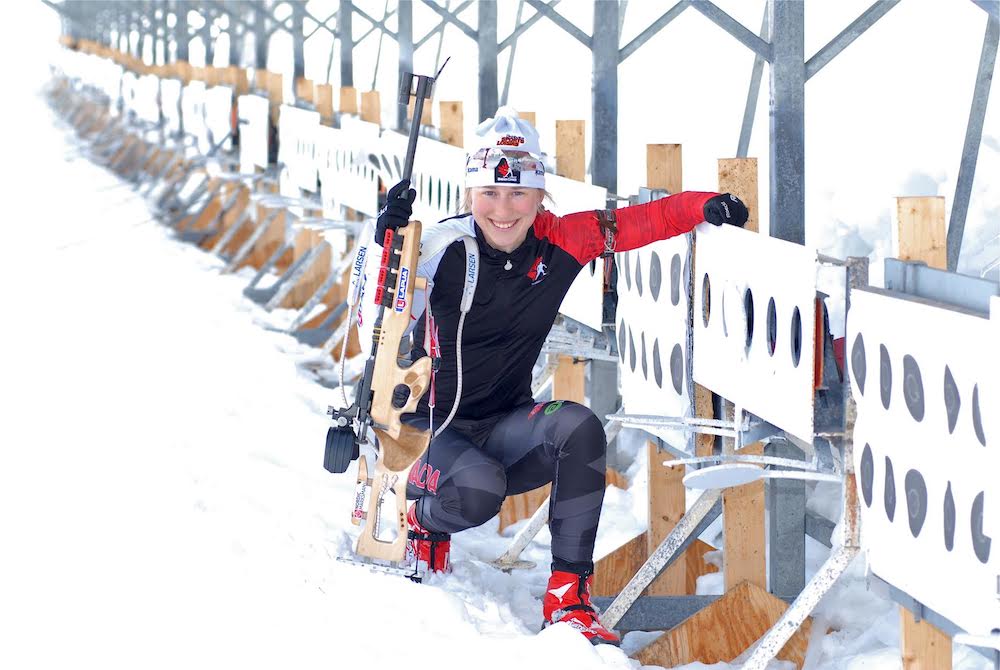
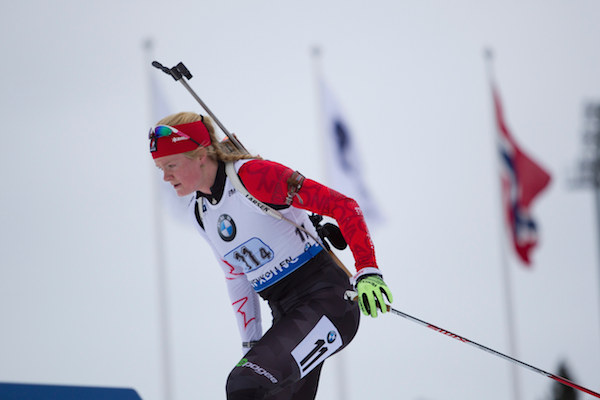
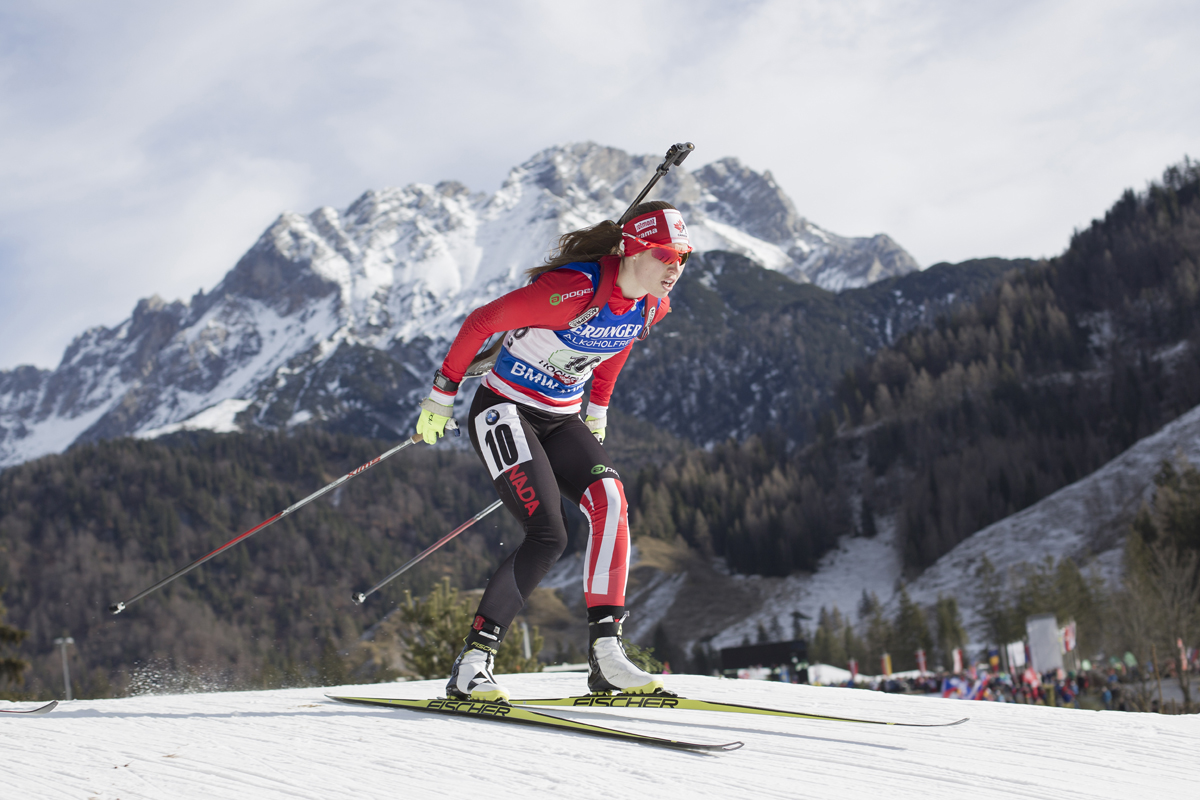
Audrey Vaillancourt at the Valcartier Biathlon Centre in 2014. (Courtesy photo)
Note: The following interview with retired biathlete Audrey Vaillancourt was conducted in French and translated to English. For French version, click here.
***
A year ago, in May of 2016, Canadian biathlete Audrey Vaillancourt announced her retirement in a blog post titled, ‘The end of a great adventure’. Having spent 12 years — nearly half of her life — racing in a sport she’s still very much passionate about, the decision to call it quits came at 24 years old, and was not an easy one to make.
For Vaillancourt (who has the same last name as her mother), it all started on skis at age 6 as she tried to catch her older brothers Maxime and François Leboeuf, both former members of Biathlon Canada’s national team themselves who stepped away from the sport at 29 and 24, respectively. Fueled by active parents, Carmen and Pierre, cross-country skiing started as the central sport in the Leboeuf family, and quickly, the rumour of a brilliant trio of young ski racers from Val Bélair began to spread across the province of Quebec.
At 12, Vaillancourt once again followed her brothers’ footsteps and gave biathlon a try. An instant love for shooting — and a natural knack for it — immediately followed, and she was hooked right then and there.
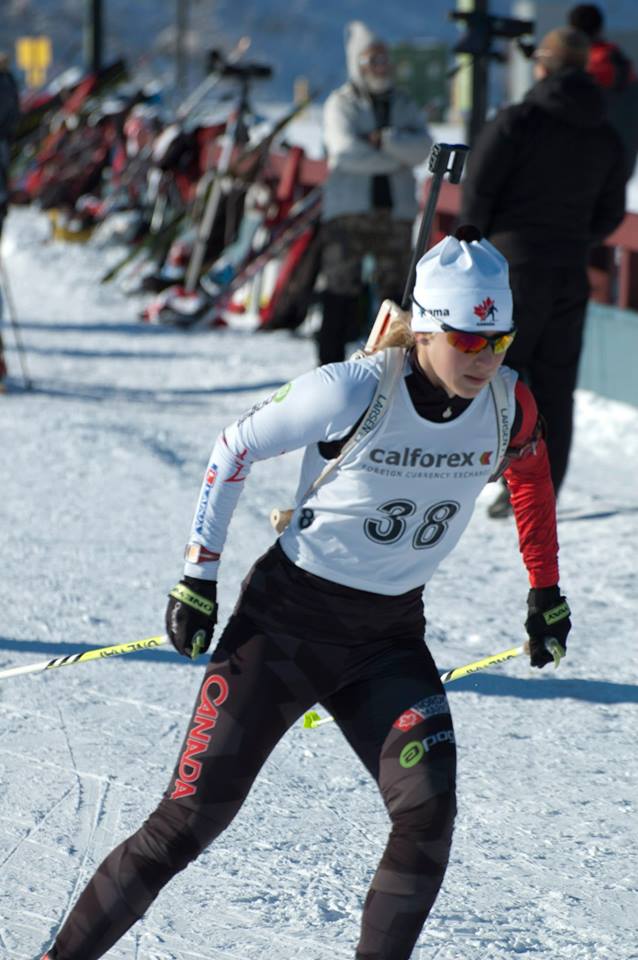
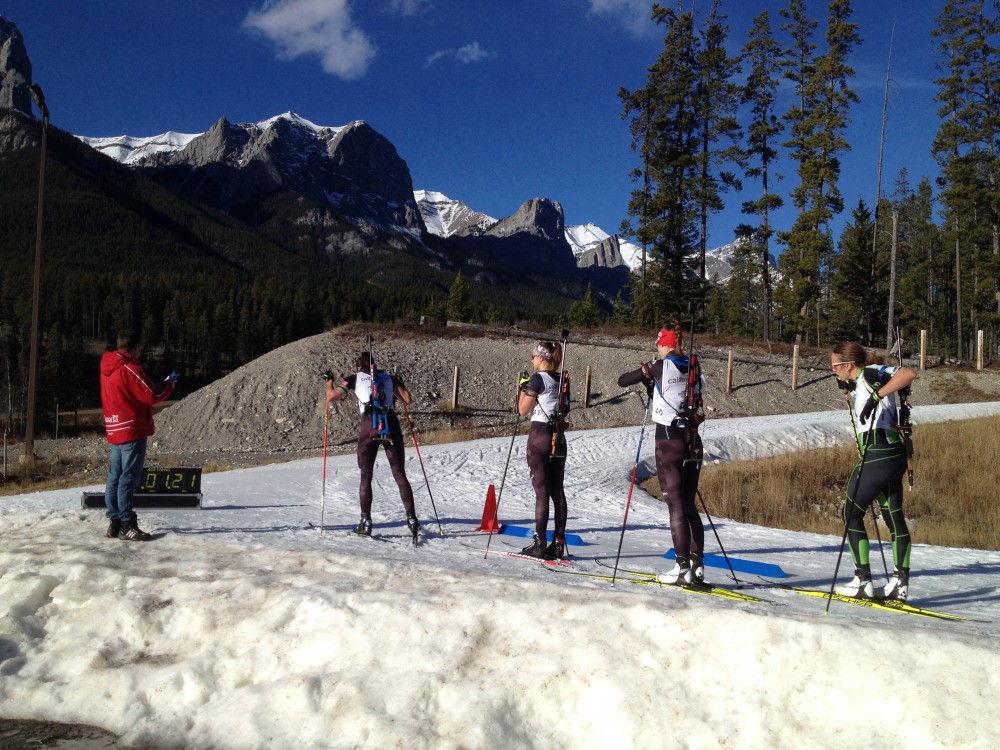
Audrey Vaillancourt racing to second in a sprint at Biathlon Canada team trials in Nov. 2014 at Frozen Thunder in Canmore, Alberta. (Photo: Photo: Justin Brisbane)
“It was so fun and different. The shooting presented a new challenge, and it really makes biathlon races much more exciting than cross-country skiing, in my opinion,” Vaillancourt said in January on the phone from her home in Quebec City. “A race can totally change in 30 seconds; it’s crazy.”
She joined the Courcelette Biathlon Club, founded 30 years ago, and trained close to home at the Myriam Bédard Biathlon Centre — the only training centre of its kind in Quebec — located on the Valcartier military base. That’s where she perfected her shooting skills, first training three days a week in high school, then gradually expanding that to six morning sessions a week when she began her CEGEP (Collège d’Enseignement Général et Professionnel) studies. Olympian Jean Paquet was her first coach, then she spent the rest of her career working with Martin Tremblay, Biathlon Team Quebec’s head coach.
At 16, she was named to Canada’s national junior team, which brought her to Canmore, Alberta. While training amongst the country’s best meant a natural progression in her athletic career and the lustrous prospect of racing on European soil, it also came with a few unexpected hardships, she explained.
“At the time, I was the only French-speaking athlete on the team. I never fully blended in when I was in Alberta,” she said. “Canmore is a small city that revolves a lot around training, sports and performance. I felt so far from family and friends. Even though I was all in for training and racing, the traveling back and forth from Quebec to Canmore was challenging.”
She added that she enjoyed visiting different cities in Europe (Antholz, Italy, was her favourite) and competing in front of tens of thousands of fans. Vaillancourt competed at 2013 and 2015 World Championships before retiring last spring.
“In my final year as a senior, being so often away from home really influenced my decision of leaving the sport,” she said.
With countless podiums in national races, the three-time Canadian national champion reached the peak of her career in 2014, when she won the 15-kilometre individual at Open European Championships in Nove Mesto, Czech Republic.
“It was unreal, I will forever remember that day,” she said. “But I think the overall experience of training year-round with the squad, our training camps, the fun I had with my teammates, all that which surrounds racing, actually is what I’ll remember the most. I was so in love with training at the time. That ranks first in my memory … aside from Nove Mesto.”
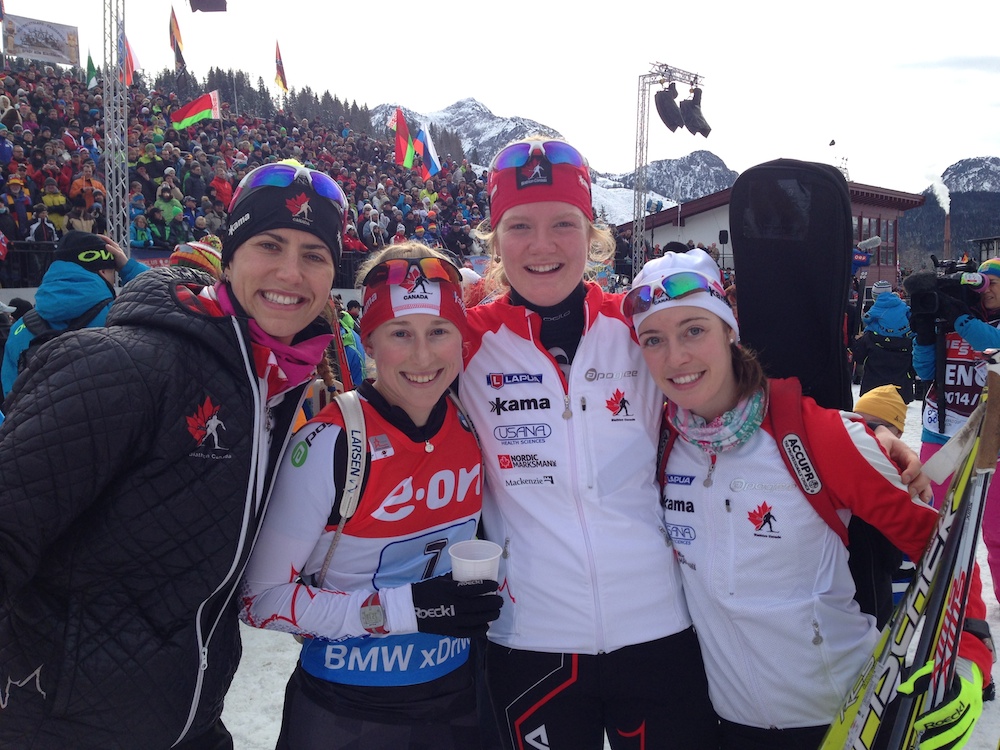
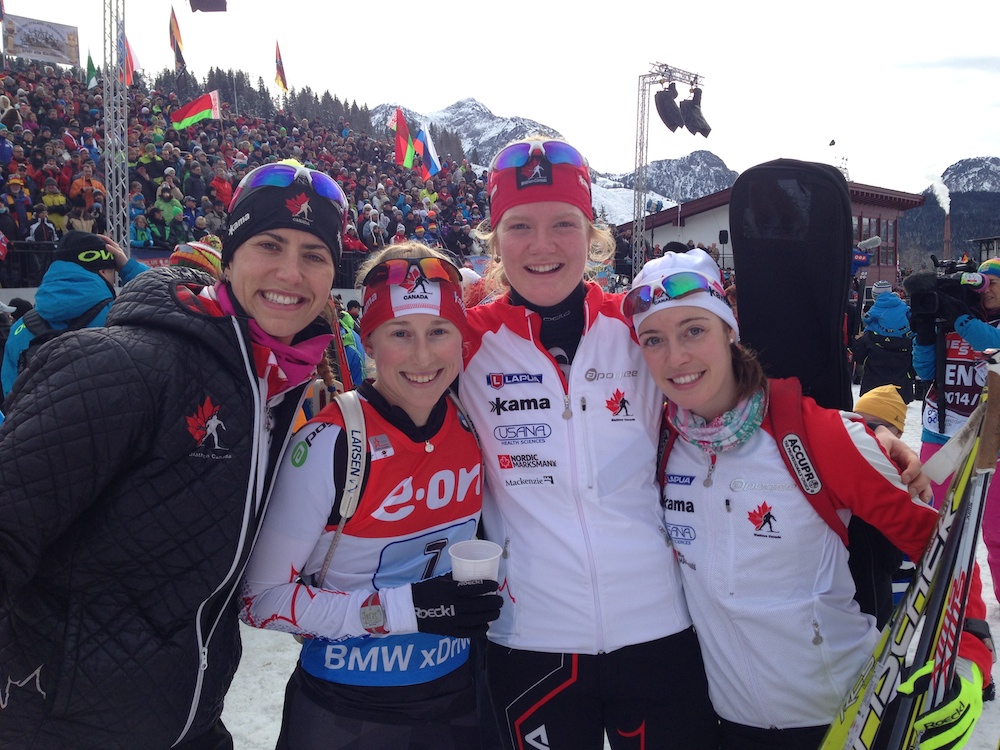
The Canadian women’s relay team after placing 11th in the 4 x 6 relay at a 2014 IBU World Cup in Hochfilzen, Austria: (from left to right) Rosanna Crawford, Audrey Vaillancourt, Sarah Beaudry, and Megan Heinicke. (Photo: Rosanna Crawford)
Her podium at 2009 Youth World Championships was another important stepping stone. In front of a home crowd in Canmore, she took third in the 6 k sprint.
Looking back on 12 years of racing, Vaillancourt said she had no regrets.
“I really feel I gave it my all. Sure, qualifying for the Olympics would of been awesome, but it became evident that to get there meant sacrificing a lot, too much for me anyway. The cons outweighed the pros in the end,” she said.
The decision to retire from competition came gradually during the 2015/2016 season. Disappointing results weren’t solely to blame.
“What can I say, I just wasn’t in it anymore, physically and mentally. I was totally drained,” she explained. “Despite some few good results, things never improved during that season. It was clear I was on my way out.”
While the prospect of retiring at age 24 was hard to swallow, it came with great relief, she said. Having a goal to focus on after biathlon was “absolutely necessary,” she said, and made the transition a lot smoother.
“I understand why some athletes fall into depression after retirement. I really get it,” Vaillancourt said. “You need to prepare yourself, make plans, fill your life with projects. Otherwise, it’s easy to fall into limbo.”
Just last month, she completed her degree in translation at the Université du Québec à Trois-Rivières (UQTR). She now works at Sematos Translation in Québec City and has remained involved in biathlon as a coach at Courcelette Biathlon Club and Biathlon Mauricie Club. And seven months ago, she became involved in a new project her brother Maxime founded called “Unis pour le sport” (United for Sport).
“This project is an effort to help athletes achieve specific goals regarding racing, training, technique in various sports, ranging from cross-country skiing and biathlon to obstacle-course racing and running,” she explained. “We already sense a strong demand for such services across the province.”
Most recently, the website published an example of a personalized training plan for runners.
“Things are going well,” Vaillancourt wrote in an email last month.
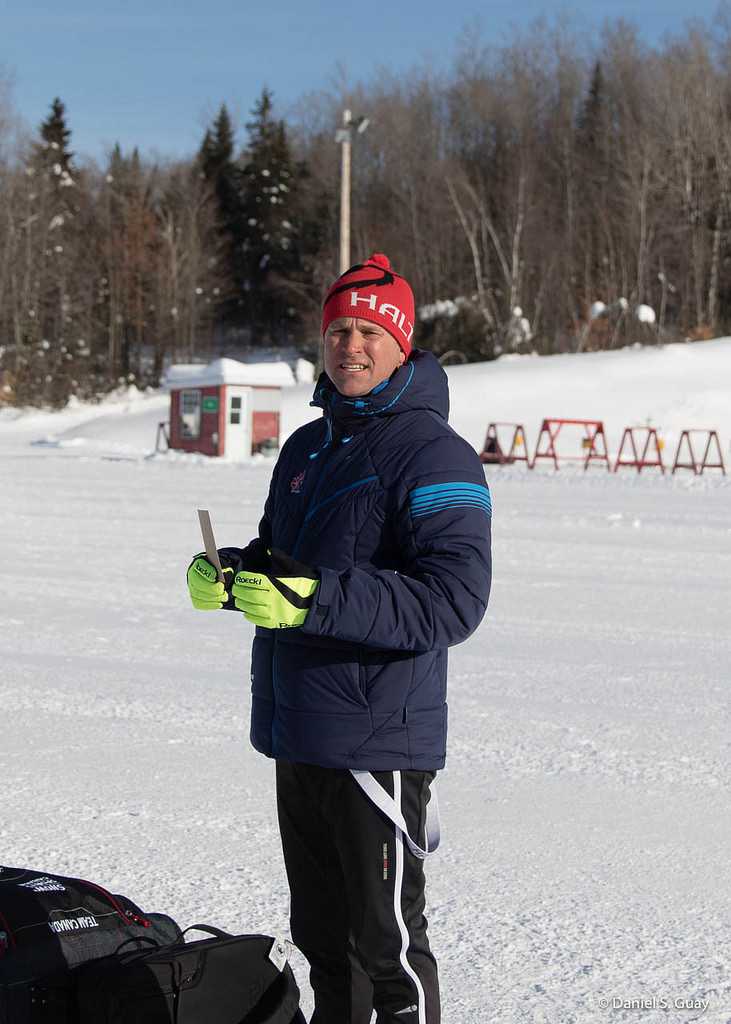
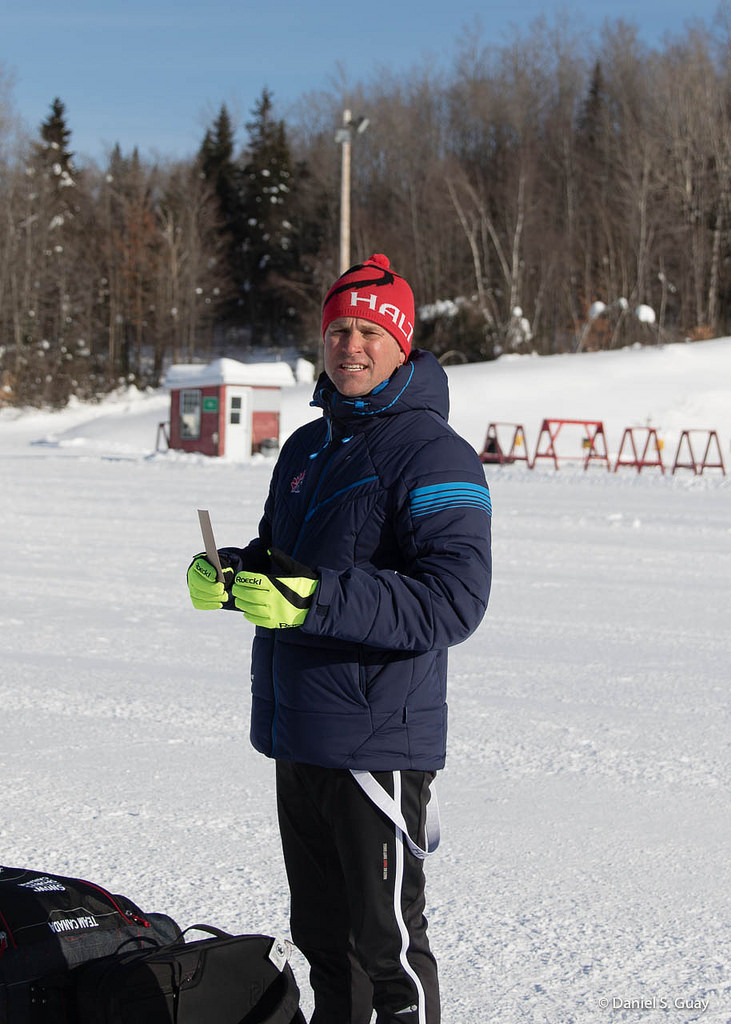
Former Biathlon Canada High Performance Director Eric de Nys making the team announcements in Valcartier, Quebec. (Photo: Dan Guay)
For the past 13 years, Eric de Nys has been ingrained in the sport of cross-country skiing and its offshoots, including biathlon. He spent 10 years as a coach on Cross Country Canada’s national team, leading the women’s World Cup team in his final two years there.
Based in the same town and out of the same training facilities in Canmore, Alberta, de Nys parted ways with the national team after the 2014 Olympics and founded a bridge development program, the WinSport Junior Cross-Country Ski Team, to prepare junior skiers for senior-level racing.
A year and a half later, in October 2015, de Nys accepted a new job as high-performance director for Biathlon Canada, replacing Chris Lindsay (who currently works as a high-performance advisor for Own the Podium).
De Nys spent two winters with Biathlon Canada, but less than week after the conclusion of the 2016/2017 competition season, that tenure ended. The move from Biathlon Canada to discharge de Nys came less than a year before the 2018 Olympics, but after a season in which the Canadian biathlon team fell short of reaching the podium in a World Cup or World Championships race.
While several younger biathletes had major breakthroughs, including Megan Bankes and Leo Grandbois at Youth/Junior World Championships, and national-team members like Scott Gow, Christian Gow, Emma Lunder, and Julia Ransom recorded career-bests on the IBU World Cup circuit, several veteran members appeared to take a step back. Nathan Smith was out most of the season with a virus, and Rosanna Crawford and Brendan Green struggled to return to their competitive form.
Biathlon Canada General Manager Andy Holmwood told the Rocky Mountain Outlook that the decision was not performance related. He explained that Biathlon Canada expected to have the position filled by May 1. A job posting on its website indicated that applications would be accepted through May 7.
In an email to FasterSkier, Holmwood wrote that the new high-performance director will take over a program with plans leading up to and through the PyeongChang Winter Games. He explained that he hoped to fill the position as soon as is “feasible.”
Other than to “confirm we’ve recently parted ways with Eric de Nys and wish him the best of success in future endeavours, Biathlon Canada has no comment on the situation,” Holmwood wrote.
De Nys declined to comment specifically on the matter as well, telling FasterSkier on the phone that, as far as he knew, the decision was not performance related. He added that he had enjoyed working with both CCC and Biathlon Canada and was remaining positive as he looked ahead.
“One door closes and multiple open,” de Nys said of his plans moving forward. “I just hope the best for the athletes.”
After spending more than a decade of his career in skiing, he suspected he will remain involved in the sport in the future — even as a volunteer — although this year may signal a break.
“I’m not sure at what level yet, but I will be helping out at the club level or something like that,” de Nys said. “Maybe volunteering, but I do think I will step away from sport for at least year, maybe forever. I don’t know.”
Caledonia Nordic Ski Club (“CNSC”) is an organization of over 1,400 members in Prince George, British Columbia and has a large enrolment in skier development programs. Club athletes compete and medal in biathlon and cross-country Provincial and regional competitions, NORAM events and National Championships. They have also represented Canada at high-level events such as the World Youth Junior Championships. As the Biathlon Coach, you will lead volunteer coaches in the implementation of the Biathlon Canada Long Term Athlete Development Model (“LTAD”) through program development, support and involvement. Our club mandate is to provide programming for the continual improvement of skiers and biathletes from introduction to national excellence, for all ages and abilities.
CNSC is unique in its proximity to the city of Prince George, with the University of Northern British Columbia and the College of New Caledonia campuses located within a 15-minute drive of the Otway Nordic Centre, which is operated by CNSC. The club is working strategically to attract nordic athletes, aged 18 to 30, to Prince George to study and train.
This position works collaboratively with and reports to the CNSC Head Coach (“Head Coach”), who reports to the General Manager.
Specific Accountabilities:
Personal Development
Implement a personal development plan to become certified at the National Coaching Certification Program (“NCCP”) Biathlon Canada – Competition Development coach level, or equivalent, http://www.biathloncanada.ca/main.php?p=3834&lan=1
Maintain a personal coaching career plan with continuous improvement and growth.
Coaching Development Support provided by club to meet personal coaching career goals
Program Development
Work in a team environment with the Director of Programs, Head Coach, and volunteer leaders/coaches to align existing programs with the LTAD model, as well as develop new initiatives to expand existing programs and increase athlete and member retention, regardless of their ski or biathlon goals or abilities.
Athlete Development
Work with the Head Coach to support athlete development with a specific emphasis on the biathlon program.
Develop or oversee the development of annual training programs for biathletes. Actively recruit and coach athletes from the Learn to Train LTAD stage to the Learn to Compete LTAD stage.
Develop and implement monthly training plans and review training logs for junior, senior, and youth biathletes.
Assist the Head Coach with the delivery of dry-land and on-snow training programs for both the ski and biathlon programs.
Lead in the development of specific biathlon training programs, in collaboration with the Head Coach.
Work with volunteer coaches to provide race support for club athletes at regional, provincial and national events.
Communicate with program participants or parents regarding program activities.
Administration
Assist the LTAD Committee with annual operating plans for each program with budgets and measureable outcomes.
Provide progress reports to the Head Coach and General Manager, as requested, and with respect to planned tasks, achievements and the status of biathlon programs.
Qualifications
Significant experience in biathlon as an athlete and/or coach.
Familiar with the Biathlon Canada LTAD model.
High-performance Nordic ski experience, a strong technical and academic training in sports, cross-country skiing and biathlon.
Multiyear commitment to coaching and personal development plan endorsed by a sanctioning sport body to reach the Biathlon Canada – Competition Development coach level, or equivalent, within a two-year timeframe.
Experienced and competent wax technician.
Have own transportation to fulfil travel duties.
Skills in basic computer applications such as MS Word, Excel, and PowerPoint.
Demonstrated Abilities
Good communication skills and the ability to work in a dynamic team environment.
Good organizational and interpersonal skills.
Motivated to work independently, take a leadership role, and able to work with minimal supervision.
Ability to motivate, build trust, and gain the confidence of athletes.
Demonstrates ethical qualities and works to instil the virtues of fair play and sportsmanship in all aspects of the program.
Team focused.
Physical Requirements
Ability to work outdoors in variable weather conditions.
Ability to stand for long periods of time.
Ability to regularly lift 50lbs.
Conditions of Employment
Permanent, full-time position has an annual salary that will be commensurate with experience and is negotiable based on qualifications and experience.
Flexibility to work evenings and weekends as programs require. Average 40 hours/week.
Possession of a vehicle and valid BC Drivers licence.
Provision of a criminal records check.
Willing to travel for races and camps (generally within, but not limited to BC.
Coaching Development Support provided by club to meet personal coaching career goals (including financial and time)
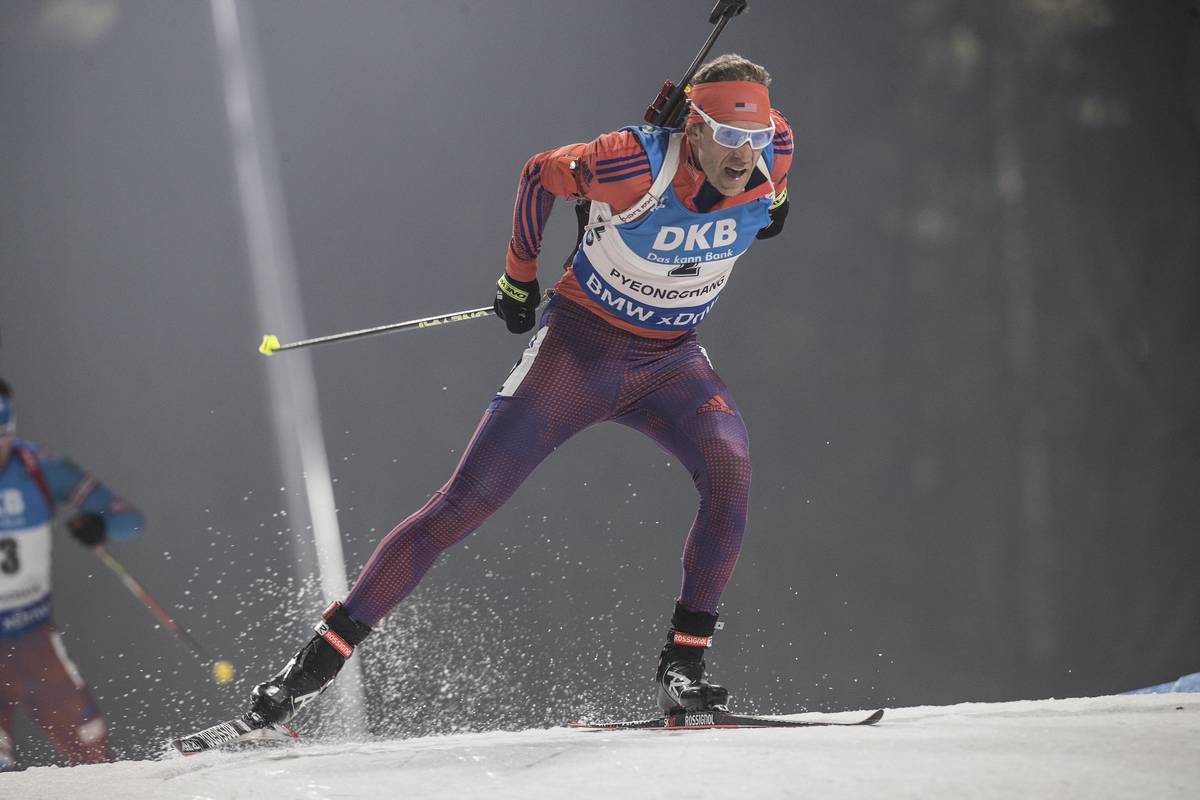
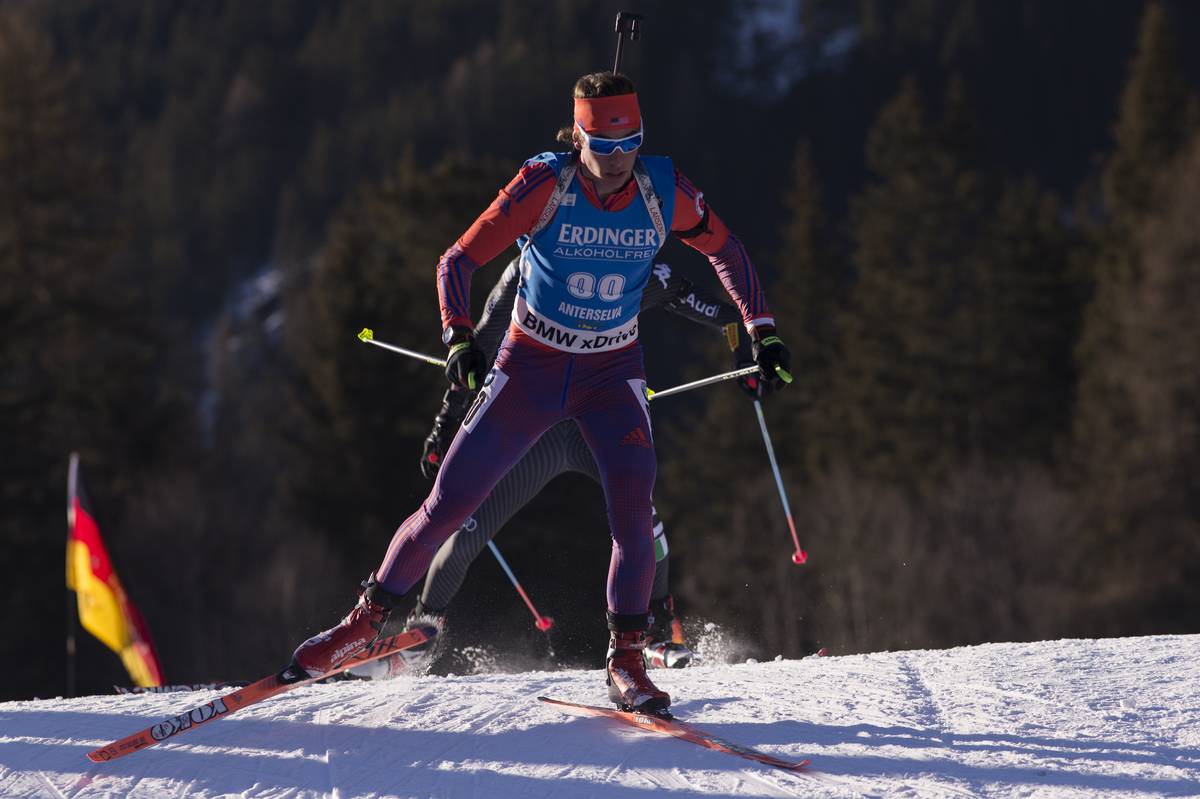
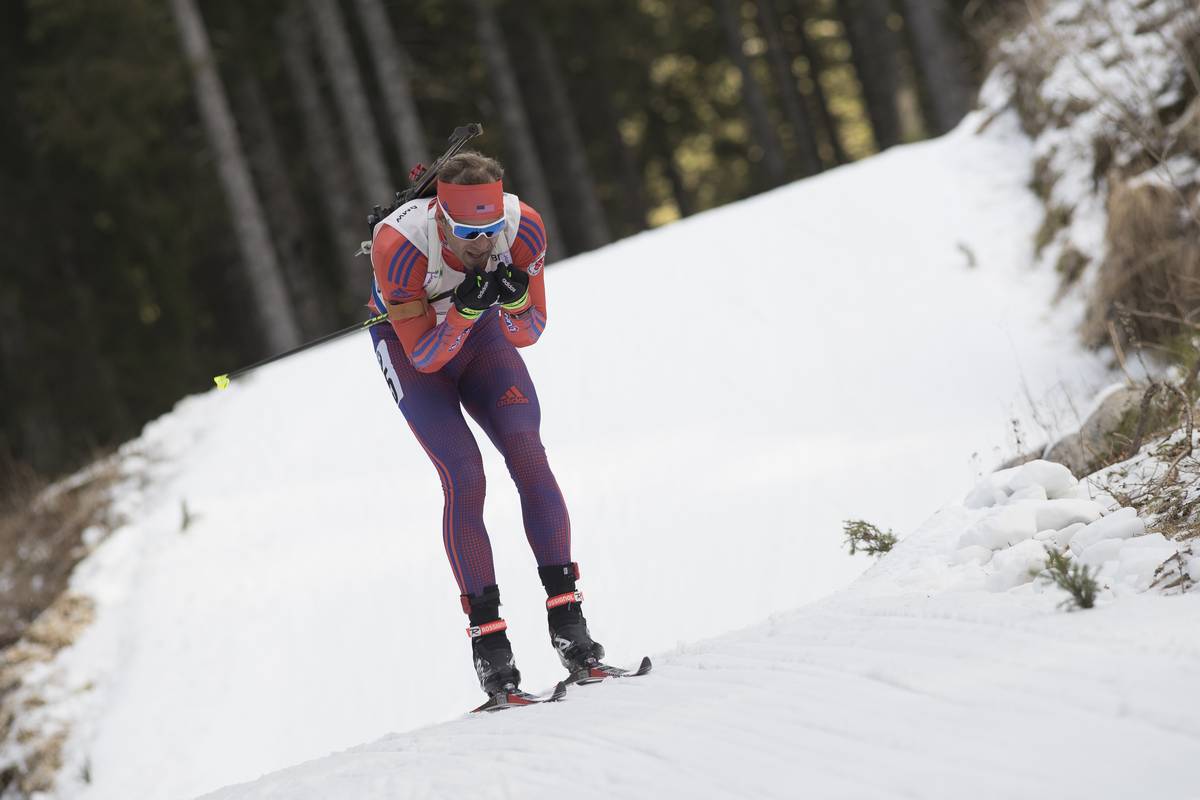
Lowell Bailey (US Biathlon) racing to ninth in the men’s 12.5 k pursuit on Saturday at the IBU World Cup in PyeongChang, South Korea. (Photo: USBA/NordicFocus)
The North Americans kept the momentum rolling two weeks after the International Biathlon Union (IBU) World Championships, with US Biathlon’s Lowell Bailey busting out a second place and Susan Dunklee placing fifth in back-to-back races over the last four days in PyeongChang, South Korea. On Sunday, the Canadians showed they’re rounding back into top form in team events, with its men’s team placing seventh and women’s team taking eighth for season bests in the relays. Here are the most interesting quotes that didn’t make it into the race reports (links below).
On the break after World Championships & the leadup to PyeongChang:
“After Worlds I went home to Canmore and enjoyed five days of R&R with some easy skiing. The ski conditions were very good and it was nice being able to relax in my own place and sleep in my own bed.”
– Scott Gow, Canada
“Rosanna [Crawford] and I traveled to France for five days to visit and train with Anais Bescond, who races for the French team. It was a nice break and was fun to ski and sightsee somewhere new. We also enjoyed some amazing wine and cheese!”
– Brendan Green, Canada
“It was really nice, there was great skiing, 30 kilometer loops in two different areas, we ate a lot of cheese and took part in a night race called ‘Nocturne de sleep’ where you ski 200m and then have to trade off giant underwear to each other in a team sprint style race, over your race suit of course! “
– Rosanna Crawford, Canada
“Over the past 10 or so days since World Champs I took a few days off to kind of rest, recover and just sort of try to step away from that high-intensity environment. Most of the team members went just outside of Ruhpolding [Germany] and we had a pretty relaxing training camp there. I didn’t shoot for the first couple days, and then just tried to get back into my normal routine…. we had pretty good travel from Ruhpolding, and we came here on the early side compared to a lot of other teams and I think that was an advantage.”
– Lowell Bailey, U.S.
“Last week I was home in Germany with my son, the best possible recharge for my heart and soul, but unfortunately my little guy got really sick towards the weekend which resulted in me coming down with a cold as soon as I arrived here in Korea. I simply cannot understand how it is that coming from a week of compromised training, with a cold and jet lag I am finally feeling good! I am definitely not complaining, although I clearly have some figuring out to do post-season.”
– Megan Tandy, Canada
On taking it day by day:
“Each race is a new opportunity and I try and do my best despite how I feel physically or mentally. I will spend time at the end of the season analyzing areas of my training where things went wrong for me. I am no doubt frustrated and disappointed after putting in so much hard work this year, but I am still motivated. There have been some really tough days this season, but I know I can challenge for the podium when I am in my best form and that’s what I will continue to chase next season.”
– Green
On sloppy snow in Sunday’s relay:
“Apparently the average high at this time of year is around 0ºC, so I guess we just ended up having unseasonably warm weather. Definitely not the easiest conditions, but the snow was managed well and late evening races allowed the snow to usually refreeze.”
– Nathan Smith, Canada
“That big puddle in the stadium was the only part of the course that was like that. I avoided it once or twice and went through it once or twice, I don’t remember exactly. I would say it didn’t seem to make too much of a difference for me, it seemed that that section was slow no matter where you went. Our skis were good today and actually went through the really wet stuff pretty easily.”
– Christian Gow, Canada
“The conditions have added to the difficulty both for us racers but also for the wax techs. Overall, the race organizers did a really good job preparing the course give the tough conditions.”
– Paul Schommer, U.S.
“It’s tough to ski when it’s 100% artificial snow and 40 degrees [Fahrenheit]. I was impressed that the snow actually held up for the entire week of racing. I’m hoping they have a deeper base next year, and handle the weather a bit better.”
– Maddie Phaneuf, U.S.
On the PyeongChang range:
“The range can be fairly windy, like tonight during the men’s race, and there isn’t much shelter if it happens to be a windy day, although I’d say it’s been 50/50 so far in terms of wind or no wind.”
– Scott Gow
On the PyeongChang trails:
“The course, in a sprint, has two hills, and my strategy was to push after the second climb, and push the downhills all the way into the stadium… , the two kilometer loop cuts out the second hill, so it’s a lot different from the sprint course. It’s just one giant climb that goes on forever, and then coming back into the range. It’s a couple of different pitches. There are a couple of short, flat downhill sections, but no longer than a couple seconds, and then you hit the really big part of the climb, about halfway through the loop. It’s a monster. Then it’s just downhill with lots of corners.”
– Susan Dunklee, U.S.
“I love this course! Uphills are my strength when I am in good shape and this is one of the hilliest 2.5 kilometer course I have ever raced on.”
– Tandy
“I really like this 2 kilometer loop, it’s hard off the start but you can really make up a lot of time on the top of the course and then the downhill back to the stadium.”
– Crawford
“The courses here are tough, but I like them. I preferred [the pursuit]’s 2.5 k course to the 3.3 k, but I think they are both good and challenging courses. I think that for next training season we will be focusing on getting ready for the climbs here and, with that preparation, I do think this could be a good venue for me.”
– Christian Gow
“We’ve timed how long the extended climb takes. You literally go from the low point to the high point in a single climb. That’s nearly unheard of on the World Cup. So we will be training for those long extended climbs, because you leave the starting gate, and you hit a one-kilometer steep climb, which is actually over the international limit, at times, for the grade… They’ve done a lot of work on the downhills, and improved them a lot. I’ve talked with the technical delegates, and I think they plan to bank some of the turns next year, that aren’t banked now, and that’ll make a difference. It’s a really challenging course.”
– Bailey
“In some ways this course is similar to Kontiolahti, with really steep hills. Historically I’ve done better with those grades instead of gradual 1-skate grinds. So I think if I’m in shape I could do some good performances here next year.”
– Smith
“I think in general our entire team (men’s and women’s) had great results at this course. It makes all of us excited to see what next year brings.”
– Phaneuf
On goals for the rest of the season:
“Because World Champs was a success, I feel like you still have a large part of the season left and I wanted to finish it out as best I can and really focus on these last three World Cups. So I spent the rest of the time [after World Champs] focusing on the races here and preparing of those, and just working on my skiing and shooting just like any other preparation for World Cup.”
– Bailey
“My goals are to maintain the ski shape I am in and bring my shooting back up to a higher level. I’m feeling quite good this week so I think the skiing aspect is definitely possible, and my shooting goal is achievable if I can get into the right head space.”
– Scott Gow
“It’s been nice to see the Olympic venue and test out the trails. I think it was the right decision to come here but I also think it’s the right decision to go home. These last 3 races have been just what I needed to motivate my self for one more season. Of course there is that little voice in the back of my head that’s saying the what if’s of finally skiing well to see what I can do, but there will be lots of opportunities for that next year.”
– Crawford (who is heading home instead of finishing out the World Cup season)
On cracking the top 30:
“Overall I am very happy with today’s result given how my season has been going. I think what made the difference for me today was being able to execute solid shooting in what were challenging conditions. The snow conditions were also quite difficult to race in tonight but I did my best and gave it my all.”
– Green, after the 10 k sprint
“This top 30 was an important part of me qualifying for some funding next year as well as a part of my Olympic qualification. Nothing is guaranteed until the end of the season of course, but squeaking into the top 30 today will open up some opportunities for next season.”
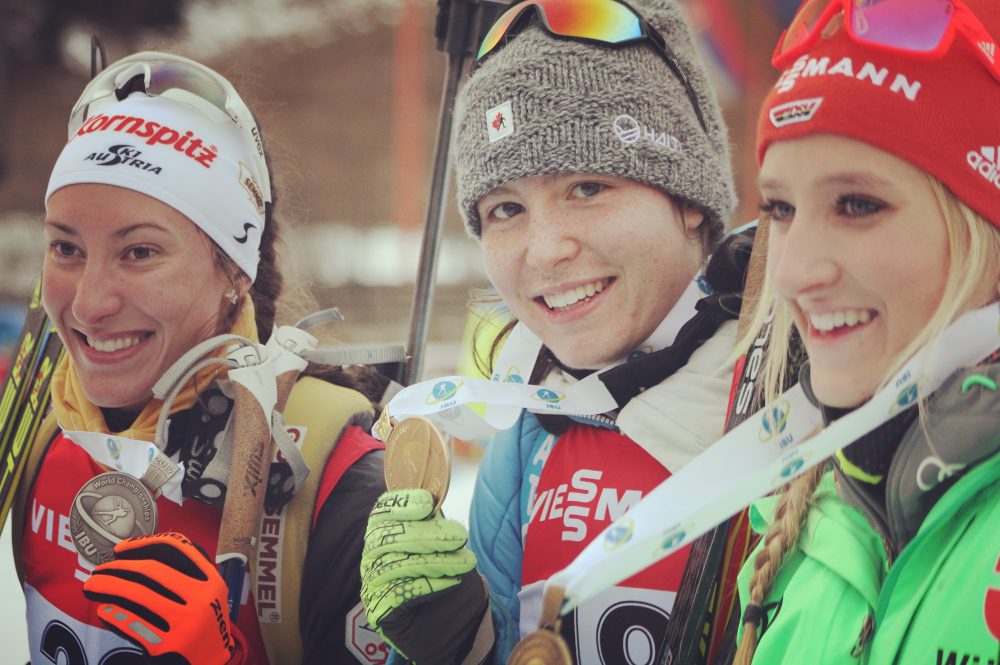
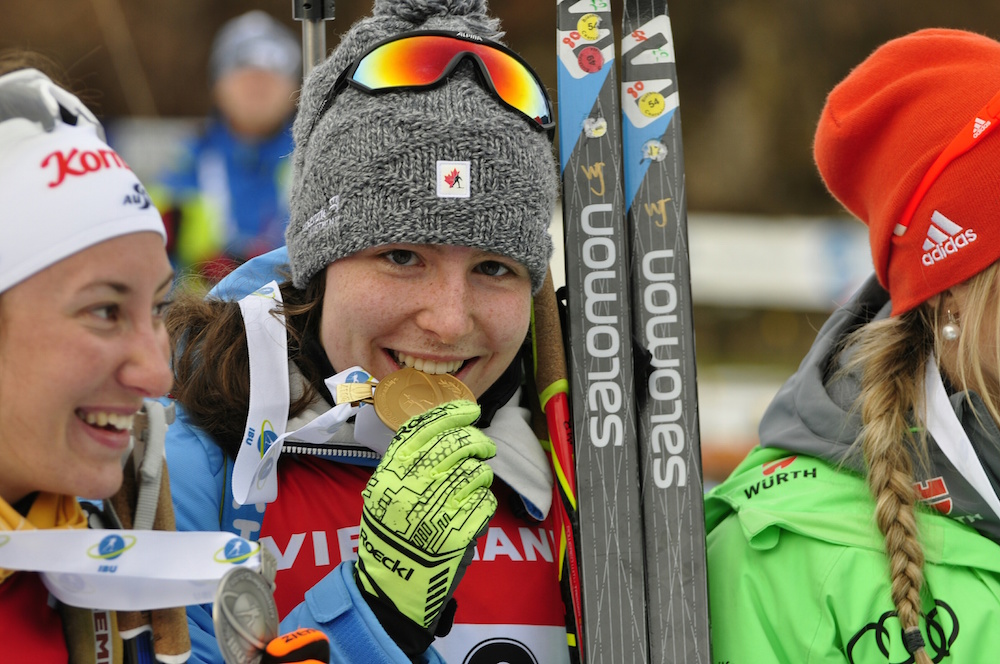
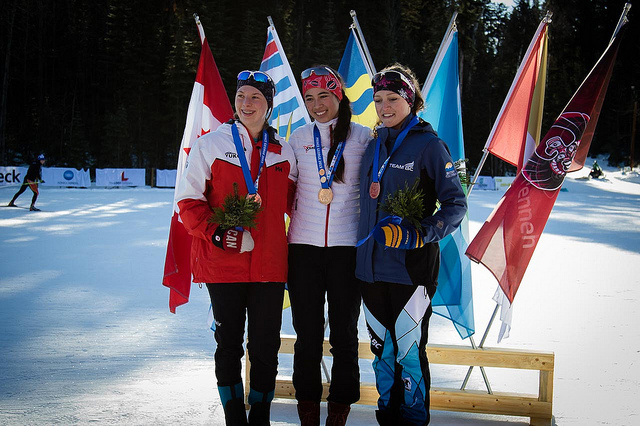
Canada’s Megan Bankes flashes a smile and her gold medal after winning the junior women’s 12.5 k at IBU Junior World Championships on Thursday in Osrblie, Slovakia. individual podium on Thursday at IBU Junior World Championships in Osrblie, Slovakia. Joining her on the podium are Austria’s silver medalist Julia Schwaiger (l) and Germany’s bronze-medalist Anna Weidel (r). (Photo: Jacqueline Akerman)
(Note: This article has been updated to include comments from Megan Bankes.)
Just to review:
2004: Jean-Philippe “JP” Le Guellec becomes first Canadian to win an International Biathlon Union (IBU) Youth World Championships title (in the youth men’s sprint).
2009: Kurtis Wenzel becomes second Canadian to win at IBU Youth Worlds, with a gold medal in the youth men’s sprint.
2012: Wenzel does it again as a junior, winning the 15-kilometer individual at IBU Junior Worlds.
One day later: Megan Bankes repeats the 20-for-20 shooting feat in the junior women’s 12.5 k individual in Osrblie and becomes Canada’s first woman to win at Youth/Junior World Championships.
And just like Grandbois, Bankes had never hit 20 consecutive targets without a miss in a race before. In fact, she had never cleaned a race of any length before. Doing so earned her a gold medal in her first race of her fourth Youth/Junior Worlds.
Megan Bankes racing to an unprecedented gold for a Canadian woman in the junior women’s 12.5 k individual on Thursday at 2017 IBU Junior World Championships in Osrblie, Slovakia. (Photo: Bryan Dickson)
“I watched Leo yesterday and gained a lot of inspiration from him,” Bankes said, according to a Biathlon Canada press release. “I saw how calm he was on the range and just felt if he can do it then I can, too. I just wanted to go out there – shoot clean and ski fast.”
As the 19th starter in a field of nearly 70 women, the 19-year-old Bankes, who trains with the Biathlon Alberta Training Centre (BATC) in Canmore, set down the performance to beat with clean shooting and a finishing time of 37:22.0 minutes. She bumped Germany’s Anna Weidel, the 13th starter, to second place with a time that was 1 minute and 20 seconds faster. Weidel had missed just one shot — still an impressive performance in a four-stage race — in the first standing stage (0+1+0+0). Each miss adds a minute penalty to a racer’s total time.
“I was incredibly stoked to clean my last standing, and then knew I just had to push super hard up the last 2 hills and ski smart all the way to the finish,” Bankes wrote in an email to FasterSkier. “When I crossed the finish line I was really excited, but I didn’t really think my result would hold up because there were a few girls who were skiing fast and had hit 15/15, but then when a bunch of them started missing, and I realized my position was going to hold, it was incredible.”
Her overall course time ranked 11th, comparable with the two women she ended up sharing the podium with. Weidel was ultimately pushed to third when Austria’s Julia Schwaiger in bib 26 finished 32.1 seconds faster for silver. With one costly miss in her final standing stage (0+0+0+1), Schwaiger’s finishing time was 47.9 seconds short of gold.
Canada’s Megan Bankes takes a bite out of her gold medal after winning the junior women’s 12.5 k individual at 2017 IBU Junior World Championships in Osrblie, Slovakia, and becoming the first Canadian woman to do so at Biathlon Youth/Junior Worlds. (Photo: Airat Aitniakov)
That medal went to Bankes, one of five women in the race to hit every target.
“I shot with a lot of confidence today. It came really easy,” Bankes told Biathlon Canada.
But, as there usually is, there was a backstory on Thursday.
“She had a what she said was a ‘horrific’ zero,” her coach Richard Boruta explained of her pre-race target practice, in an email co-written with Canada’s trip leader/head coach Jacqueline Akerman.
Boruta tried to calm Bankes down, assuring her that she had the self confidence to execute strong shooting.
“My coach Richard just told me to go out pretty hard and not lose too many seconds up the first couple hills, and then settle into my race,” Bankes recalled in the email. “The range entry is pretty easy, because you’ve got a bit of downhill into it, so you can push pretty much as hard as you want (or can).”
“Megan had been focused the whole day on the race and she new what she needed to do and was able to pull it through,” the two coaches wrote. “The trail conditions and weather have been challenging with all the rain and slush, but Megan managed to ski very tactically along the flats and paced herself well on the two major climbs in the course.”
According to them, one of Bankes’s longtime goals had been a top eight at these championships. That changed after she broke through on the IBU Junior Cup earlier this month, placing second in the 10 k pursuit at IBU Junior European Championships in Nove Mesto, Czech Republic. After that, she visualized herself in the top five, maybe top three, in her first year as a junior at world championships. Bankes had previously notched 18th in the pursuit and 19th in the individual at last year’s Youth World Championships in Romania.
“Junior OECH was a pretty big confidence boost, but coming into the race, I didn’t totally know what to expect,” Bankes wrote. “I knew that if I had a really good day on the range and on the course, then I could do well, and maybe podium, but I didn’t really imagine that I would hit 20/20, and win!”
Individual-format races require solid shooting and fast skiing, just like any biathlon race, but the one-minute penalties as opposed to penalty laps put an emphasis on shooting accuracy.
“I can’t say they have ever been my strong suit!” Bankes wrote of individual-format races. “So for me the goal was to start pretty fast on skis, stay calm in the range, and then see what happened.”
“After I got the silver [in Nove Mesto], I knew if I shot and skied well, I could get a medal here,” she told Biathlon Canada. “It takes a long time to get to this point. I think having been here [at Youth/Junior Worlds] four times now I have the experience to do this. I have everything around me here that I need to be successful.
“It is pretty exciting,” she added. “This is the first time I’ve shot 20 for 20. It never crossed my mind, but to be the first Canadian [woman] to win is very cool.”
According Akerman and Boruta, they had anticipated that Grandbois and Bankes would have “a respectable chance” at a medal, along with other team members as well. But two gold medals in two days?
“We have had good results and medals in the past, but it has been up and down with a few top athletes hitting the top 10 or reaching the podium,” they wrote. “Now we see the group as a whole rising together.”
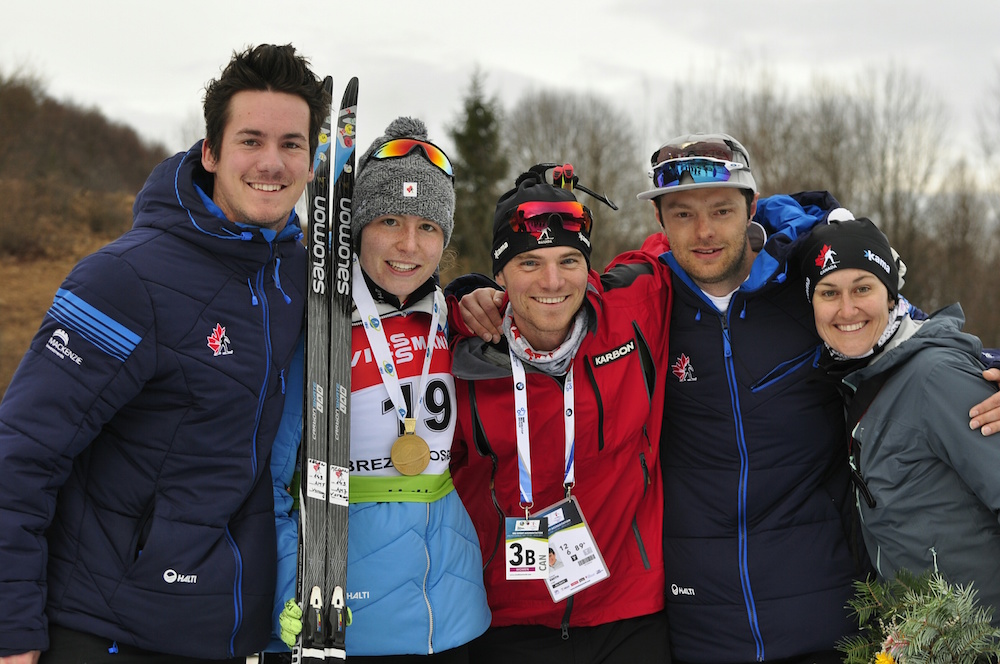
Megan Bankes (second from l) with her Canadian support crew, including her former coach Tyson Smith (c), wax techs Andrew Chisholm (l) and Andrzej Lesnik (second from r) and Canada’s trip leader/head coach Jacqueline Akerman (r), after Bankes won the junior women’s 12.5 k individual for Canada’s second gold medal of 2017 IBU Youth/Junior World Championships in Osrblie, Slovakia. (Photo: Airat Aitniakov)
They credited “consistent and qualified coaching support in yearly developmental stages”, and explained that Bankes started the sport with coach Iaroslav Khomiak at Foothills Nordic in Calgary. She was later coached by Tyson Smith (Nathan Smith’s brother, who is assisting the team at Youth/Junior Worlds) before joining the BATC group in Canmore in 2015.
Last summer, Biathlon Canada launched a funded “Shooting Stars” camp, which brought national-team staff and coaches together with athletes and their coaches in Canmore. The team also added IBU Junior Cup tours to the schedule to give young athletes opportunities to experience international competition in Europe and “get to know each other before WYJCHs.”
“My observations of this current group; they are pretty grounded, are very motivated, focused and are they are both pushing and supporting each other in all aspects of their performance,” Akerman and Boruta wrote.
So what does two gold-medal performances mean for Canada?
“There is now a great opportunity for an greater amount of exposure for our athletes and our sport,” the coaches wrote. “… More solid results ahead for us this week, there are other realistic opportunities within the group. The whole team, including staff are motivated and focused for that. … Of course Leo and Megan have both shown what they are capable of, and will be eager for more. Right behind those two in our Jr Women and Youth Men categories are others skilled enough to be right up there with them. Our youth women are a younger crew, but are learning and applying new skills daily, so I am excited to see some PB’s from them tomorrow. The relays also present us with exciting and realistic chances of podiums, it will continue to be an exciting week and championships!”
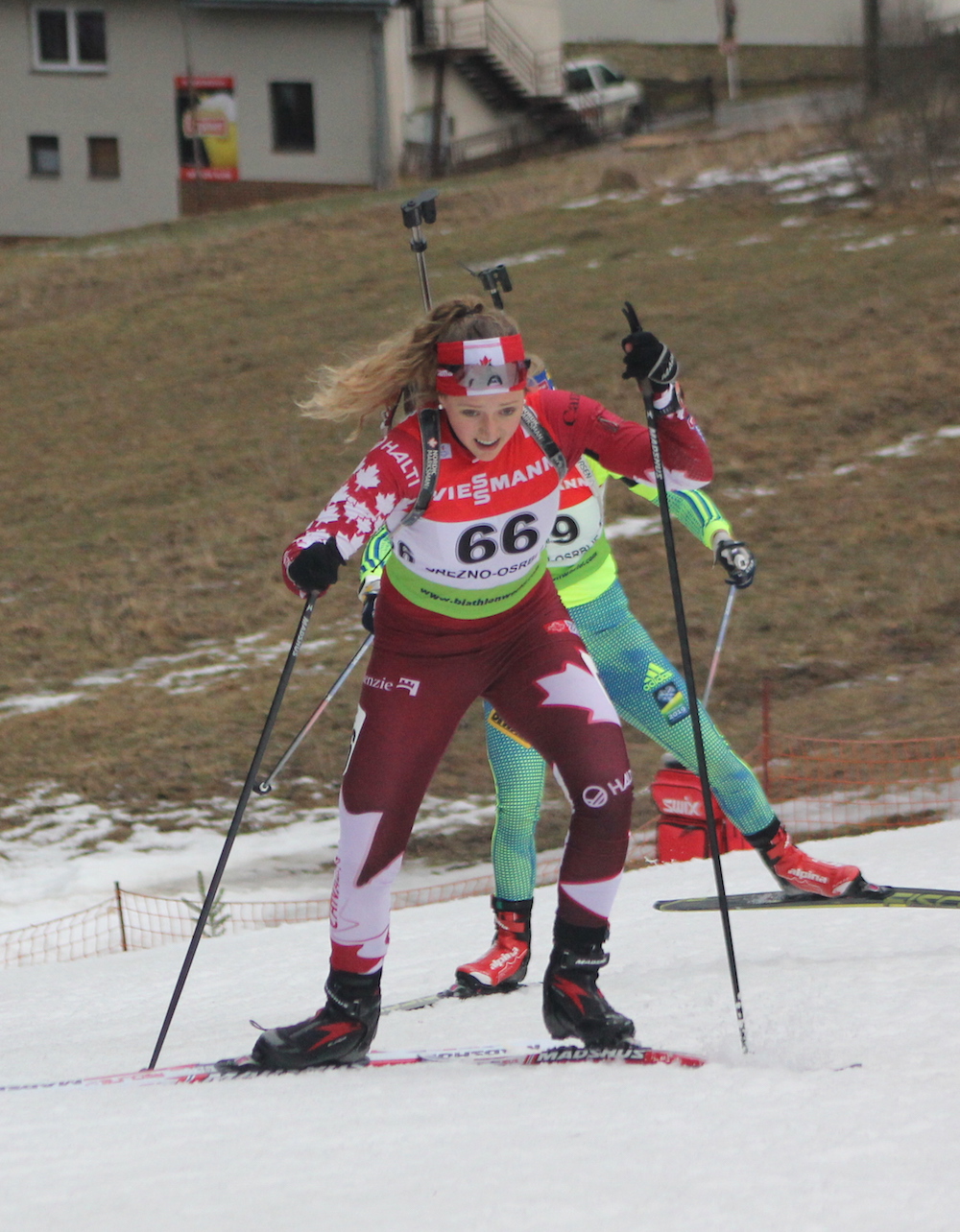
Canada’s Emily Dickson (66) racing to 28th for her first top 30 at IBU Junior World Championships in the women’s 12.5 k individual in Osrblie, Slovakia. (Photo: Jacqueline Akerman)
In the junior women’s race, Canada had two in the points (top 40) and one just outside with Emily Dickson in 28th (+4:21.3) with one miss (0+1+0+0). Nadia Moser finished 41st (+5:55.8) with four penalties (2+0+0+2). Charlotte Hamel did not finish.
For the U.S., Siena Ellingson placed 50th (+7:11.5) with four penalties (0+1+2+1) and Nina Armstrong 65th (+14:15.3) with eight misses (4+1+2+1).
Earlier in the day, the junior men raced a 15 k individual, which Norway’s Sindre Pettersen won in 40:17.2 minutes. He started 68th and cleaned three-straight stages before missing two on his last standing (0+0+0+2), but managed a 51.2-second win over Germany’s David Zobel. An early leader in bib 26, Zobel had three penalties (0+2+1+0) yet his time held up for silver despite a challenge from Russia’s late starter Nikita Lobastov (bib 84). Lobastov shot 19-for-20 (0+1+0+0) and finished just four seconds short of Zobel for third place (+55.2).
Only one athlete in the junior men’s race cleaned: Latvia’s Ingus Deksnis in fifth.
In his first year as a junior, Canada’s Zachari Bolduc led the North Americans in 34th (+3:44.7) with two penalties (1+0+0+1). He later told FasterSkier his goal had been a top 30, and he was 8.4 seconds short of it on Thursday.
“I’m happy with this shooting but I was very very slow on my skis,” Bolduc wrote in an email. “The course was a mix of soft snow, ice and slush so it was not easy conditions! I hope I will have better feelings on my skis for the sprint. But, I’m happy with my race today!”
He was followed by Canadian teammates Trevor Kiers and Jules Brunette in 54th (+5:21.6) and 55th (+5:27.4), respectively, after each shot five penalties. Pearce Hanna finished 65th (+6:38) with seven misses (1+2+2+2).
The top American on Thursday was Cody Johnson in 50th (+5:08.3) with two penalties, both in the last stage (0+0+0+2). Cameron Christiansen followed in 72nd (+8:10.6) with six penalties (1+1+2+2), and Peter Carroll was 79th (+10:36.4) with four misses (0+3+0+1). Travis Cooper did not start.
The youth men’s and women’s sprints are scheduled for Friday in Osrblie.
Megan Bankes racing to gold in the junior women’s 12.5 k individual on Thursday at 2017 IBU Junior World Championships in Osrblie, Slovakia. (Photo: Bryan Dickson)
Megan Bankes racing to gold in the junior women’s 12.5 k individual on Thursday at 2017 IBU Junior World Championships in Osrblie, Slovakia. (Photo: Bryan Dickson)
Canada’s Megan Bankes after winning her first race of 2017 IBU Junior World Championships: the women’s 12.5 k individual in Osrblie, Slovakia. (Photo: Bryan Dickson)
The junior women’s 12.5 k individual podium on Thursday at IBU Junior World Championships in Osrblie, Slovakia, with Canada’s gold medalist Megan Bankes (c), Austria’s Julia Schwaiger (l) in second and Germany’s Anna Weidel (r) in third. (Photo: Airat Aitniakov)
Canada’s Leo Grandbois (Biathlon Estrie) racing to gold in his first IBU Youth World Championships race on Wednesday, the 12.5 k individual, in Brezno-Osrblie, Slovakia. He hit all of his targets for the first time in a race to win by nearly a minute and 15 seconds. In doing so, he became the third Canadian biathlete to win gold at Youth World Championships. (Photo: IBU)
It was raining hard on Wednesday at the biathlon stadium in Brezno-Osrblie, Slovakia. Like, cats and dogs, “des grenouilles” (frogs, in French), or “junge Hunde” (puppies, in German).
But that didn’t stop Leo Grandbois, a German-born Canadian biathlete racing at his first International Biathlon Union (IBU) Youth World Championships, from having the race of his life.
Grandbois, 17, who was born in Munich and lived there for a year before moving to Lennoxville, Quebec, was one of four youth men named to Biathlon Canada’s Youth/Junior World Championships team. Wednesday marked his first 12.5-kilometer individual race in the youth division, and he explained after that his success derived from his focus — and his skis.
“The range had a bit of wind and the tracks were really wet, but I had really good skis,” Grandbois wrote in an email after.
The ninth starter out of more than 100 in the youth men’s race, Grandbois was the only one to knock down all 20 of his targets. He had never cleaned a race before, and he did it in a four-stage race. Without any one-minute penalties added to his total time (there are no penalty loops in individual races, just time penalties for each miss), he clocked the fastest time at the finish in 32:56.6 minutes. That time stood while nearly 90 others finished after him, with nobody coming within a minute of his time.
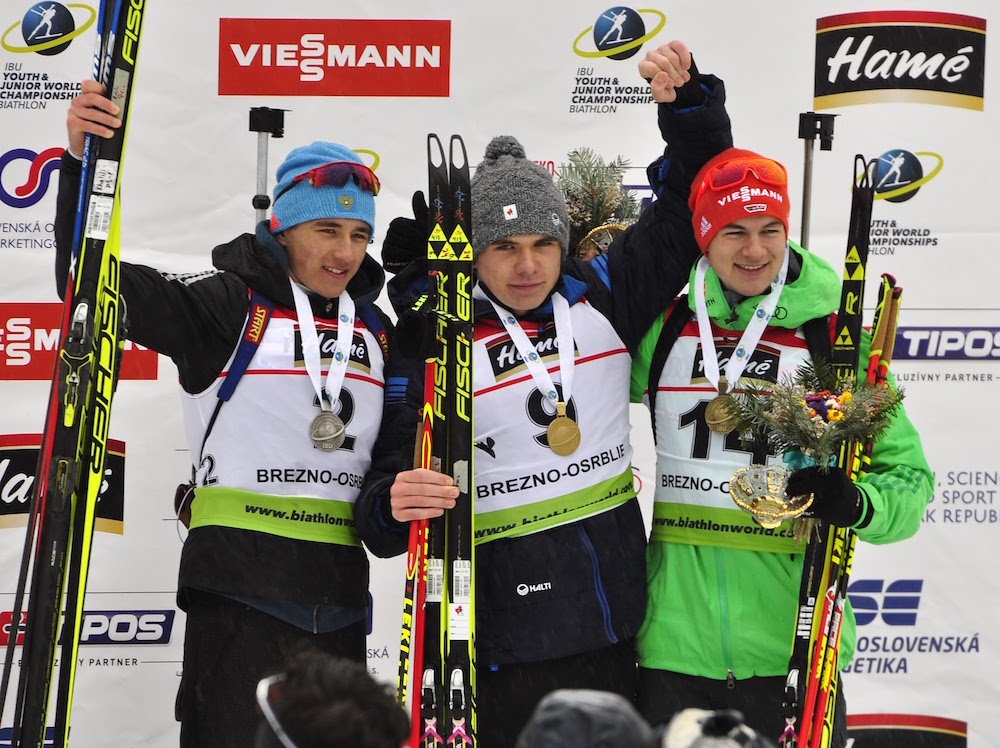
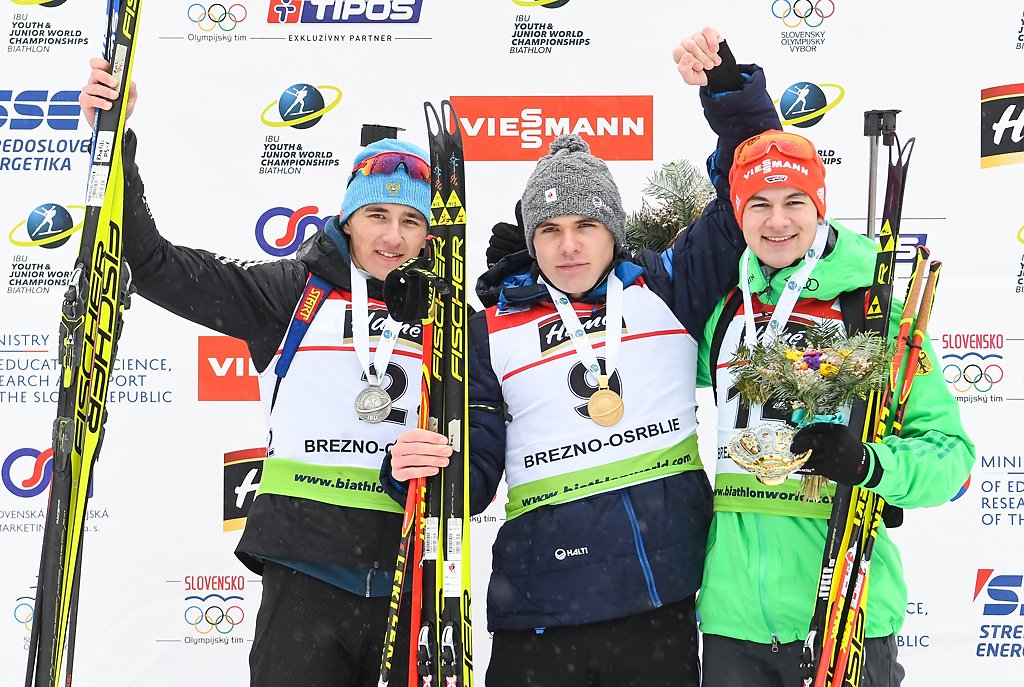
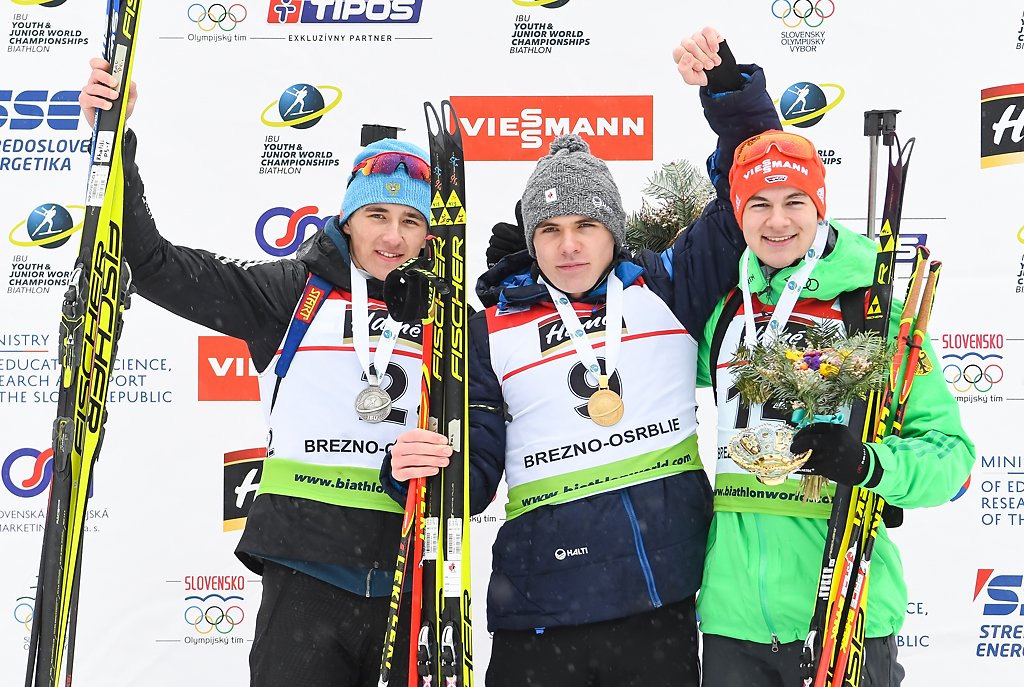
The youth men’s 12.5 k individual podium after the first race of 2017 IBU Youth/Junior World Championships in Osrblie, Slovakia, with Canada’s Léo Grandbois in first (c), Russia’s Said Karimulla Khalili (l) in second, and Germany’s Danilo Riethmüller (r) in third. (Photo: Airat Aitniakov)
Russia’s Said Karimulla Khalili started in bib 2 and enjoyed a brief moment as race leader, before Grandbois bested his time by 1:14.9 minutes. Khalili took the silver medal despite three penalties (1+0+1+1), and Germany’s Danilo Riethmüller captured bronze (+1:21.5) with three penalties as well (2+1+0+0). Besides Grandbois, who shot 100 percent, only one racer shot 95 percent: Italy’s Cedric Christille in fourth place (+1:44.5; 1+0+0+0).
“I always go for the win when I race,” Grandbois wrote. “But I was aiming a top 10.”
With the victory, Grandbois became the third Canadian to win a gold medal at Biathlon Youth World Championships, according to a Biathlon Canada press release. Kurtis Wenzel, of Calgary, is a two-time world champion: first in the 2009 youth sprint and later in the 2012 junior individual. Jean-Philippe “JP” Le Guellec, who previously coached Grandbois, started the trend by winning the 2004 Youth Worlds sprint.
“Before I came here I looked at JP’s results on the internet, and read in the newspaper about his win in 2004,” Grandbois told Biathlon Canada. “It has always been my goal to be like him so to follow that path and do what he did is an amazing feeling.
“The nicest message I received today was from JP,” he continued. “He told me how proud he was of me and to keep working hard. I have been smiling since I received that message.”
And it wasn’t just the shooting that went exceptionally well for Grandbois on Wednesday; he posted the third-fastest ski time. In an email to FasterSkier, he explained that the hilly course in Osrblie suits him. “My kind of course,” he wrote.
“Everything was perfect for me today, I was focused on the range and tried to do like at training,” he explained. “I had some great legs, too!”
He told Biathlon Canada that he had worked on improving his shooting over the last three weeks.
“When I went to bed last night and woke up today, I just had a good feeling I could do something great today,” he said. “I had complete focus and concentration on the range. The hard work over the last few weeks in training really worked today.”
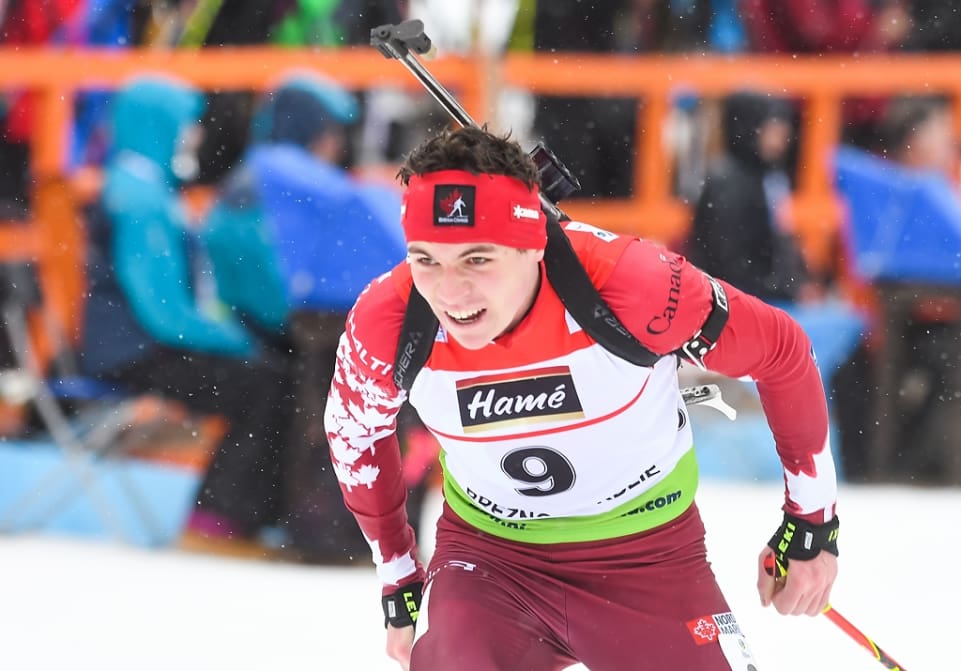
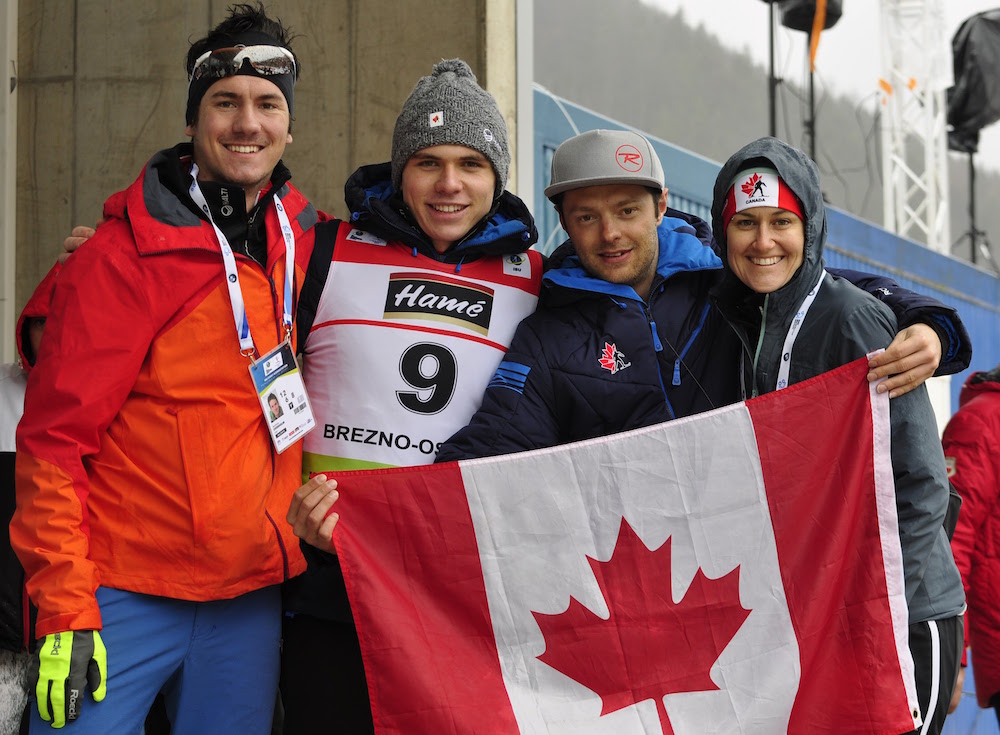
Leo Grandbois (9) with his support crew, including wax techs Andrew Chisholm (l) and Andrzej Lesnik (second from r) and Canada’s head coach Jacqueline Akerman (r), after Grandbois won gold in the 12.5 k individual on the first race of his first IBU Youth World Championships in Osrblie, Slovakia. (Photo: Airat Aitniakov)
In a post-race interview with Junior IBU Cup media, he thanked his supporters: “I want to thank first my coaches at home, my parents who always supported me and all the team who did a great job for the race, the skis, thank you.”
When FasterSkier asked what this gold medal means to him, he explained it came down to all the passion and training he had put in.
“I am probably the most happy man on earth today!” he wrote.
Last year at Youth Olympic Games (YOG) in Lillehammer, Norway, Grandbois finished 22nd in the sprint, 25th in the pursuit and 16th in the mixed relay, a team event. At his first Youth World Championships, he said the field was bigger in comparison.
According to Biathlon Canada High Performance Director Eric de Nys, Grandbois has been on the national team’s radar for a few years. Biathlon Canada started a Shooting Stars program this season and Grandbois was one of 16 athletes invited to “train, test and develop” with the national team.
“Trajectory wise it identifies both a good skier and fantastic shooter under pressure,” de Nys observed of Grandbois’s performance on Wednesday. “This was Leo’s first time shooting clean and to do it a Worlds…..awesome. Extremely happy for Leo and his support in QC.”
Cervenka, Levins Land Top 20
Leading the U.S. men on Wednesday was Vasek Cervenka, who has spent the better part of the last two seasons training in Nove Mesto, Czech Republic. The Boulder, Colo., native (who lives in Grand Rapids, Minn.) raced to 16th (+4:19.5) with five penalties (0+2+2+1).
In his second Youth Worlds, his goals coming into the opening individual race had been to hit all of his targets and ski technically well. Placement-wise, he wanted a top 10.
“The conditions were good in the morning, but a light rain started one and a half hours before the race and has continued the rest of the day,” Cervenka explained. “This made the course tricker over time as it was slowing down the skiing quite a bit. The rain also interfered with the shooting on the range.
“I am a little disappointed today in my shooting knowing I can do better, also knowing a clean shooting would have brought me up to 2nd place,” he continued. “I felt good skiing but bonked on my last two loops.”
After he cleaned the first prone stage, Cervenka’s time ranked third. One loop later, with two misses in the first standing stage, his split ranked 10th, which dropped to 23rd after the third stage. He recovered to 18th by the start of his last loop, and ultimately finished 16th for his best non-relay result at his second Youth Worlds. Last year at YOG, Cervenka had a previous best result of 20th in the pursuit.
“As happy as I am with my improvements from last year to post this top 20, it still stings for me to miss a few shots too many, knowing where I could have placed if they went down,” he wrote.
Also for the U.S., Jacob Pearson finished 49th (+7:45.3) with four misses (0+2+0+2), Alex Kilby was 75th (+9:51.1) with five penalties (1+0+1+3), and Camren Nielsen 91st (+14:36.9) with 11 misses (3+4+2+2).
Canada’s Adam Runnalls finished 41st (+7:04.8) with eight penalties (1+2+4+1) and Thomas Hulsman was 57th (+8:19.0) with five misses (2+0+2+1). Robert Kreitz did not finish.
Also on Wednesday, the youth women opened the championships with the 10 k individual, where American Chloe Levins raced 14th with three penalties (1+1+1+0). France’s Lou Jeanmonnot-Laurent shot 19-for-20 (0+1+0+0) to win the race in 34:00.9, and Levins finished 3:05.6 minutes off her winning time. None of the 90 women who finished the race shot clean.
For Levins, a Middlebury student-athlete who plays collegiate golf in the fall and the spring, 14th was her best non-relay result at her third Youth Worlds.
“Everything is possible, especially in an individual race,” she wrote in an email after. “The range is windy here in Osrblie, so good shooting is rewarded. … There’s no funny business on the track in Osrblie. It’s straight up, straight down, and flat into the range. The course demands power and strength, which I think is an advantage for me.
“Today, it was important not to let the weather get in your way,” she added. “Sometimes it’s difficult to feel excited and fresh when it’s pouring rain, as it was today; those who shut it out of their mind are usually better off. Despite the conditions, our wax technicians prepared very good skis that moved really quickly through the saturated snow.”
“It is difficult to judge from one race, but the level of competition at this year’s Youth World Championships compared to last year’s Youth Olympic Games seems very similar,” she observed. “There are many familiar faces, and today there were even some repeating champions. I’m comfortable with the level of competition.”
Moving forward to three more races in Osrblie (the sprint, pursuit and relay), Levins explained she took a lot of positives from Wednesday.
“It’s not my best biathlon competition ever, but it’s certainly not my worst,” she wrote. “It’s a short way from the bottom to the top in this game, so I’m happy to have stayed above ground today. The result is fine, but I’m more happy to be able to say I did good work today.”
Asked what she’s studying at Middlebury, Levins explained that she’s started pursuing neuroscience and economics “with a little bit of German for fun. My German professor loves that I have the opportunity to converse with native German speakers on a daily basis,” she wrote.
(When Grandbois was asked if he speaks German, he replied, “Yes … but not perfect.”)
Sharing the podium with Jeanmonnot-Laurent was Russia’s Kristina Egorova in second (+52.4) with one standing miss as well (0+1+0+0). Sweden’s Elvira Karin Öberg notched bronze (+1:16.1) with two penalties (0+0+1+1).
Also for the U.S., Grace Gilliland finished 46th (+6:28.9) with four penalties (1+1+1+1), Amanda Kautzer was 53rd (+7:14.3) with eight misses (2+1+4+1), and Helen Wilson was 62nd (+9:00.5) with six penalties (1+2+2+1).
Canada’s Shilo Luca Rousseau finished 54th (+7:29.9) with five misses (2+0+1+2), Frédérique Pérusse was 77th (+11:54.6) with nine penalties (1+4+1+3), and Elise Sauve 78th (+12:07.1) with seven misses (2+2+2+1).
IBU Youth/Junior World Championships continue Thursday with the opening junior competitions: the women’s 12.5 k and men’s 15 k individual.
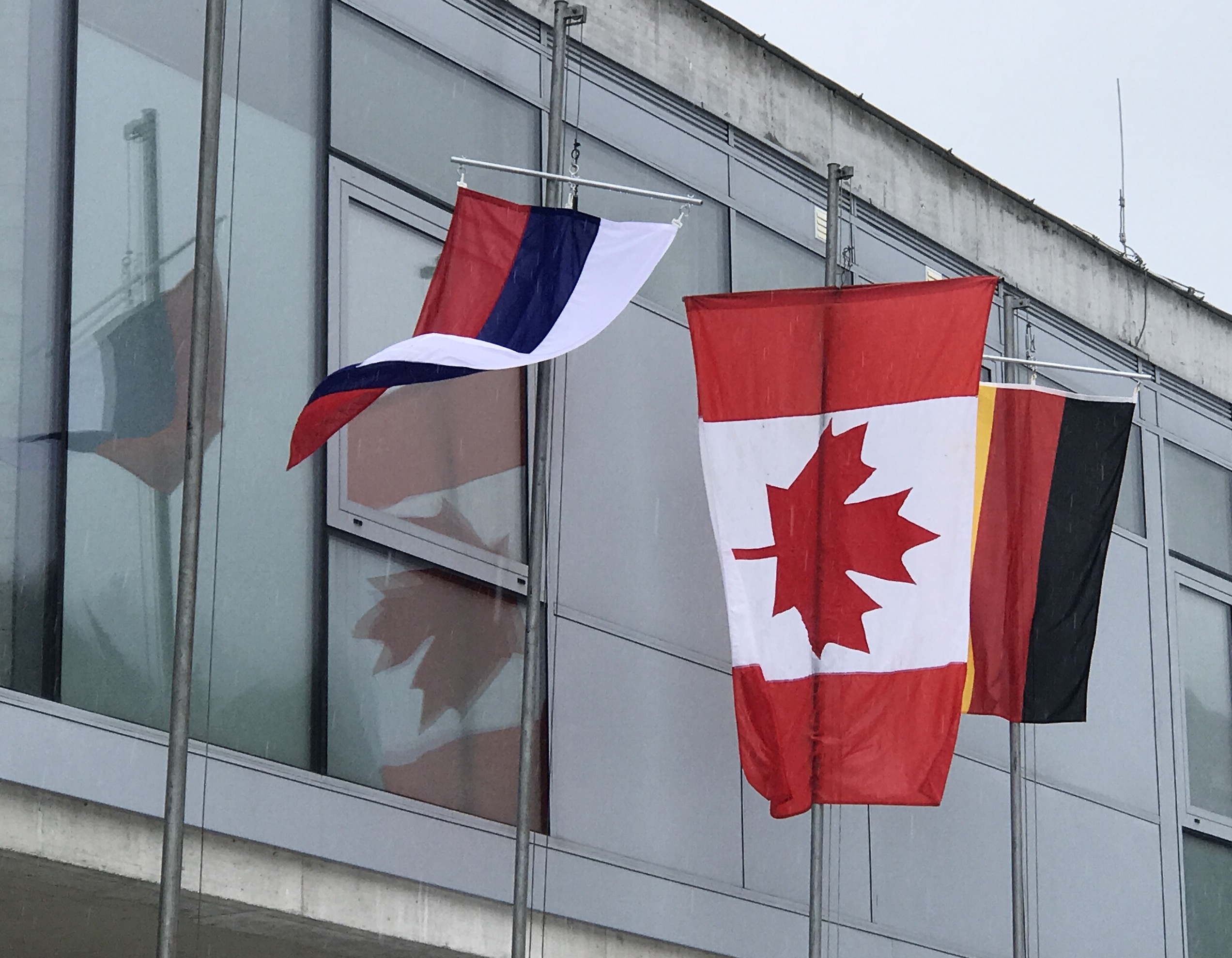
The Canadian flag flying high above the biathlon stadium in Osrblie, Slovakia, after Leo Grandbois won the youth men’s 12.5 k individual, the first race of 2017 IBU Youth/Junior World Championships. Russia took second and Germany third. (Photo: Terri Dickson)
The youth men’s 12.5 k individual podium after the first race of 2017 IBU Youth/Junior World Championships in Osrblie, Slovakia, with Canada’s Léo Grandbois in first (c), Russia’s Said Karimulla Khalili (l) in second, and Germany’s Danilo Riethmüller (r) in third. (Photo: IBU Junior Cup/Twitter)
IBU Youth/Junior World Championships (Osrblie, Slovakia): Youth individual races
In his first race of his first International Biathlon Union (IBU) Youth World Championships, Canada’s 17-year-old Léo Grandbois became a world champion.
Grandbois started ninth and raced to first in the youth men’s 12.5-kilometer individual on Wednesday, finishing in 32:56.6 minutes, a time that stood up as nearly a minute and 15 seconds faster than anyone else.
Out of 98 finishers, Grandbois was the only racer to hit all 20 targets in the four-stage race at the biathlon venue at Brezno-Osrblie, Slovakia. He had never cleaned a race before, and he did it in the longest-format race on the youth circuit.
He shared the podium with Russian silver medalist Said Karimulla Khalili, who finished 1:14.9 back with three penalties (1+0+1+1), and Germany’s Danilo Riethmüller in third (+1:21.5) with three penalties as well (2+1+0+0).
For Grandbois, who was born in Germany and raised in Quebec, his previous best international (non-relay) result was 22nd in the sprint at 2016 Youth Olympic Games in Lillehammer, Norway. There, he also placed 25th in the pursuit and 16th with the mixed relay.
In a email to FasterSkier late last week, he explained that he had been targeting the sprint.
“I want to thank first my coaches at home, my parents who always supported me and all the team who did a great job for the race, the skis, thank you,” he told the IBU Junior Cup media.
Also on Wednesday, American Vasek Cervenka, who trains with the Nove Mesto biathlon team, raced to 16th (+4:19.5) with five penalties (0+2+2+1). Also for the U.S., Jacob Pearson finished 49th (+7:45.3) with four misses (0+2+0+2), Alex Kilby 75th (+9:51.1) with five penalties (1+0+1+3), and Camren Nielsen 91st (+14:36.9) with 11 misses (3+4+2+2).
Canada’s Adam Runnalls finished 41st (+7:04.8) with eight penalties (1+2+4+1) and Thomas Hulsman was 57th (+8:19.0) with five misses (2+0+2+1).
[UPDATED] In the youth women’s 10 k individual that followed, American Chloe Levins recorded her best non-relay result at her third Youth Worlds, placing 14th with three penalties (1+1+1+0). She finished 3:05.6 minutes behind the winner, France’s Lou Jeanmonnot-Laurent, who shot 19-for-20 (0+1+0+0) and finished with the fastest time of 34:00.9.
Russia’s Kristina Egorova placed second, 52.4 seconds off the win, with identical shooting (0+1+0+0), and Sweden’s Elvira Karin Öberg notched bronze (+1:16.1) with two penalties (0+0+1+1).
Also for the U.S., Grace Gilliland finished 46th (+6:28.9) with four penalties (1+1+1+1), Amanda Kautzer was 53rd (+7:14.3) with eight misses (2+1+4+1), and Helen Wilson was 62nd (+9:00.5) with six penalties (1+2+2+1).
Canada’s Shilo Luca Rousseau finished 54th (+7:29.9) with five misses (2+0+1+2), Frédérique Pérusse was 77th (+11:54.6) with nine penalties (1+4+1+3), and Elise Sauve 78th (+12:07.1) with seven misses (2+2+2+1).
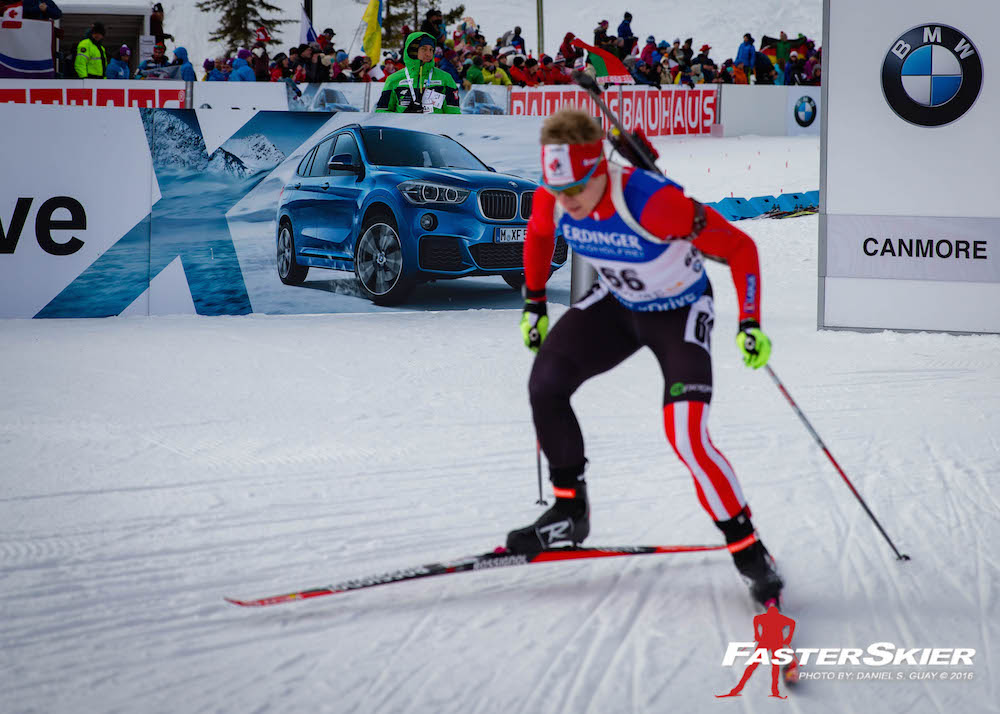
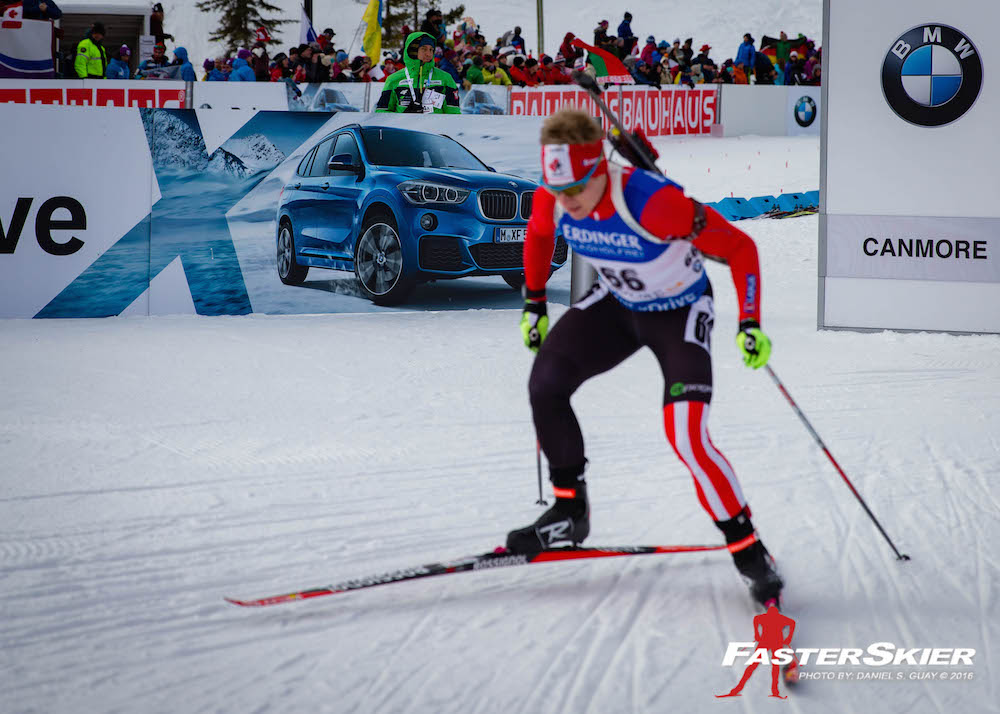
Nathan Smith racing in the single mixed relay at the IBU World Cup in Canmore, Alberta, last season. One of Canada’s top biathletes, he hopes to be back on the World Cup soon. (Photo: Daniel S. Guay)
After winning a World Cup, an individual World Championships medal, and helping his Canadian teammates to World Championships relay bronze in the last two years, there were high hopes for biathlete Nathan Smith coming into the 2016/2017 season.
With finishes of 43rd and 96th in the opening World Cups in Östersund, Sweden, Smith felt that something really wasn’t right. So he flew home to Canada, underwent a bevy of medical tests and has disappeared from the circuit ever since.
The culprit: cytomegalovirus, which is common in the population but usually doesn’t show symptoms in healthy individuals. With Smith’s high training load, it hit him similarly to how some people experience mononucleosis. His energy just wasn’t there.
“I hadn’t head of the virus either until it showed up in my blood,” Smith admitted. “It’s a really common virus and most of the population ends up getting it eventually. Most of the time there are barely symptoms. If I were not an elite athlete, I definitely wouldn’t have noticed.”
While competing against an international field certainly brought his health to the forefront, hindsight is 20/20. Smith thinks he had actually been showing symptoms much earlier.
“I would suspect I probably started feeling the effects around the end of September, but it’s tough to know,” Smith wrote in an email. “It definitely snuck up on me. The idea that an illness was causing my fatigue during races hadn’t occurred to me until the World Cup in Sweden… I thought I was just tired from training, but time trials and races kept going really poorly. Going from being the team leader to finishing minutes back just doesn’t make sense. It’s easy to see that now, but unfortunately no one clued in until pretty late.”
After a lot of rest, Smith hopes to be resurfacing. This weekend he competes at NorAm races in Jericho, Vt. If all goes well he should be set to travel to PyeongChang, South Korea, for the post-IBU World Championships races (where he could preview the 2018 Olympics venue).
“Treatment has been the same as for mono,” he explained. “Rest. Then slow reintroduction of training as I can handle the load. I’ve been doing weekly submax rollerski tests this month to track fitness.”
All that rest time allowed him to do something that’s rare for a full-time biathlete: spend some winter time at home in Canada.
“I spent most of December with my girlfriend, either up in Grande Prairie or with her family in Prince George for Christmas,” Smith wrote. “I was lucky that both cities have biathlon venues, so it was no problem at all to do some light training. The last half of January I’ve had more opportunity to get out and be active. I’ve explored some xc trails in the area which I’d never been on, as well as doing some backcountry skis with my brother and friends.”
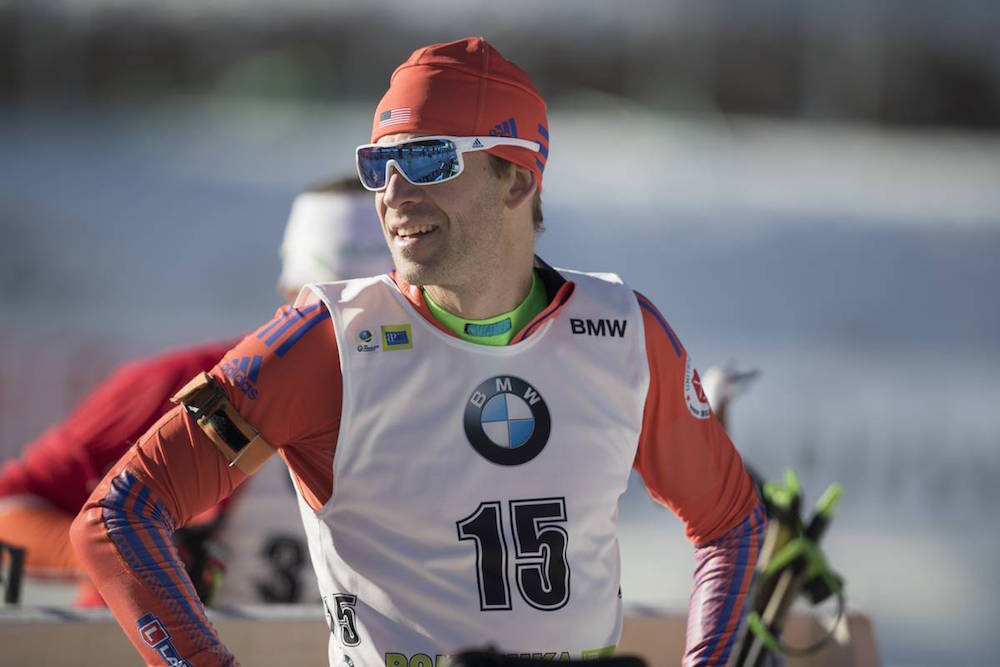
Lowell Bailey (US Biathlon) racing to 10th for his second individual top 10 of the season on Friday in the IBU World Cup men’s 20 k individual in Antholz, Italy. Bailey led five U.S. men in the top 40. (Photo: USBA/NordicFocus)
(Note: This article has been updated to include comments from U.S. biathlete Paul Schommer.)
What’s the old saying? It doesn’t really matter what happens in December, as long as it all comes together three weeks before World Championships?
The tale of the US Biathlon men’s team goes something like that, with what started out as a skeleton crew of three men in December expanding to five men who finished in the top 40 a month and a half later on Friday in Antholz, Italy.
It was the first time in recent memory that the U.S. men have achieved such a feat. According to US Biathlon men’s coach Jonas Johansson, the 2012 International Biathlon Union (IBU) World Cup in Kontiolahti, Finland, was a big one as well, with four U.S. men in the top 16.
But all five starters scoring World Cup points in the top 40?
“This shows that there is great potential in the men’s squad right now,” Johansson wrote in an email on Friday. “And when the group gets stronger, each individual has to push harder each workout to fight for a start spot and this will make the team even stronger in the future.”
Lowell Bailey led the team in 10th in Friday’s 20 k individual — the longest individual race on the circuit. It was his second-best result of the season after placing ninth in the 12.5 k pursuit in December in Nove Mesto, Czech Republic. On the phone on Friday, Bailey explained the Antholz 20 k was a race he had been targeting.
Bailey racing to 10th on Friday in the IBU World Cup men’s 20 k individual in Antholz, Italy. (Photo: USBA/NordicFocus)
“I’ve been preparing for this race all season and especially over Christmas … so I’m glad to see that pay off,” he said.
Bailey started 25th out of 105 in the men’s field and proceeded to hit every target in the first three stages. That presented him with the very real possibility of a podium with one standing stage to go, but a miss there cost Bailey a minute and put him a few places back by the finish.
“You always wish that you could have one more shot, and of course it’s easy to look in an individual where that would put me, but I think all in all I was happy with the race,” he said.
While Bailey initially crossed the finish line in fifth, he was ultimately bumped to 10th, 1:39.1 minutes behind the winner, Russia’s Anton Shipulin.
“It’s a brutal 4 k course here with about a [kilometer] of climbing right out of the range, and I just tried to take it out fast, but also with the intention of keeping my speed throughout the race,” said Bailey, who posted the 26th-ranked overall course time and notably, the fourth-fastest shooting time.
Recalling his final loop, Bailey said he lost time on Germany’s Arnd Peiffer, who started first and ended up 8.7 seconds ahead of him in ninth, but was able to squeak ahead of another German, Benedikt Doll, who started fourth and placed 11th, 1.7 seconds back from Bailey.
“I’m happy with the result and psyched with the team result, too, because I think that bodes well for us in the relay tomorrow,” the 35-year-old Bailey said of the men’s 4 x 7.5 k relay on Saturday.
Career-best 17th for Canada’s Scott Gow
While Bailey notched his second individual top 10 of the season, Biathlon Canada’s Scott Gow achieved a career best in 17th, 2:37.7 back from Shipulin’s time, with a single miss in his second prone (0+0+1+0) and the ninth-fastest shooting time overall. Gow started 19th, and after two clean stages, he was in contention for a top 10.
“After my first two clean bouts, I told myself not to get too over confident and that I still had two bouts remaining,” Gow, 26, recalled in an email. “I put my focus into my skiing and tried to approach the range as mechanically as possible in an effort to remove any emotions from my normal procedure. Today it worked very well and I’m pleased that I was able to shut my brain down.”
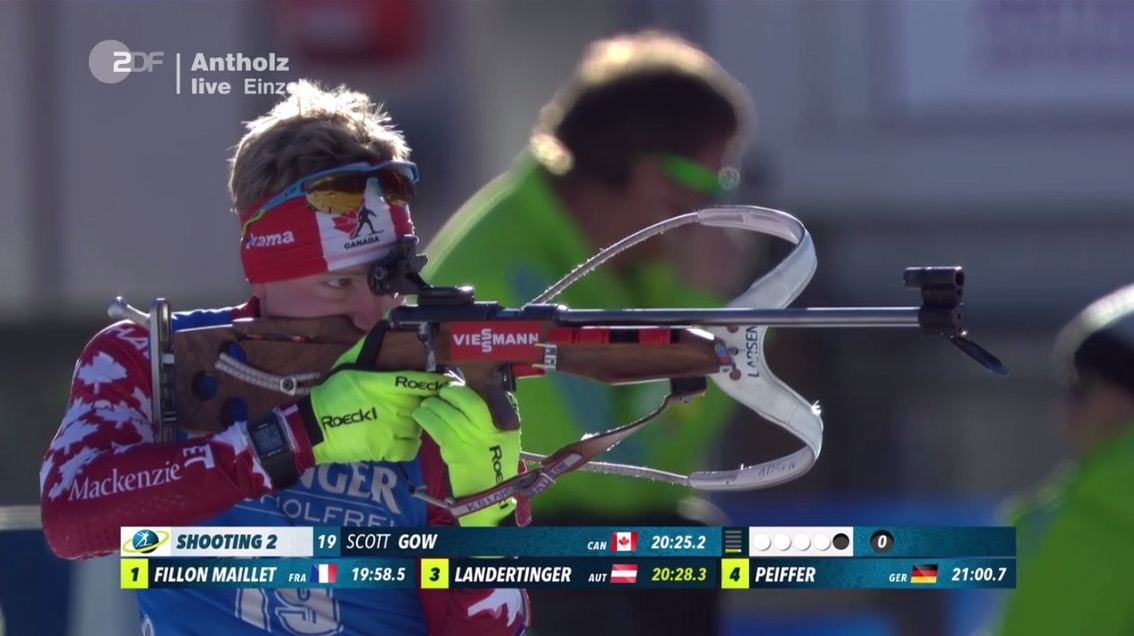
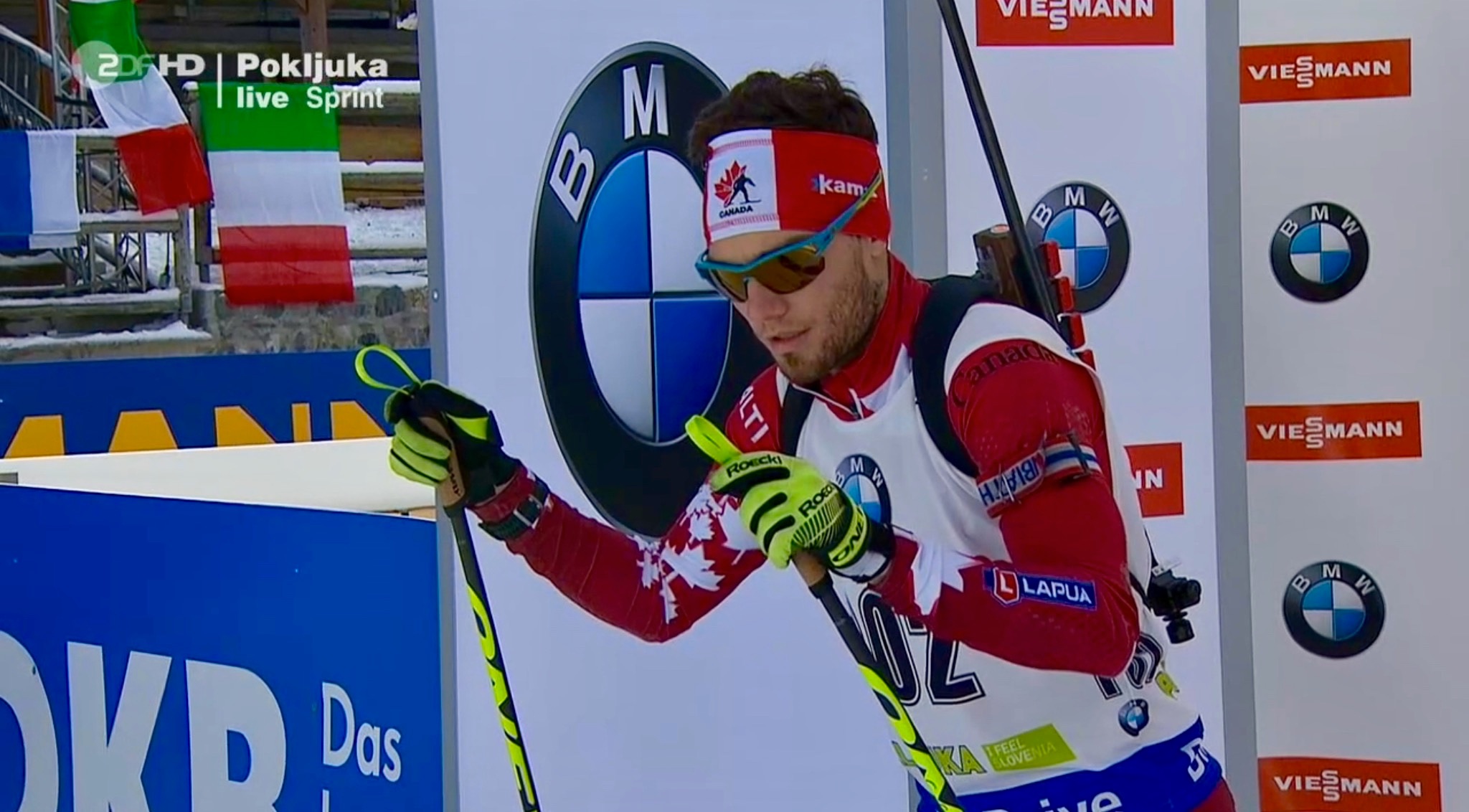
Scott Gow (Biathlon Canada) on his way to cleaning his second-straight stage of the men’s 20 k individual on Friday at the IBU World Cup in Antholz, Italy. Gow went on to place 17th for a career best. (Photo: ZDF broadcast screenshot)
He described the range conditions as “extremely calm,” after training throughout the week in considerable wind.
“After watching the girls yesterday battling big gusts, I was fully prepared for a tough fight on the range,” Gow wrote, referring to the women’s 15 k individual on Thursday. “Fortunately we ended up with almost zero wind, and that lasted for the entire race.”
After initially finishing ninth, Gow was “somewhat confident” he could hang on to a top 20.
“I knew there were a lot of fast guys behind me who were shooting well,” he wrote. “… I had my fingers crossed to be in the top 16.”
He came close, within 5.6 seconds of 16th, but claimed 17th to beat his previous personal best of 18th (which he tallied twice: earlier this season in the Nove Mesto sprint and at last year’s World Championships in the 20 k individual).
“Today’s race was a big confidence boost,” Gow explained. “I still have some areas I can improve upon, but this result is a big step in the right direction. As long as I can stay healthy leading into [World Championships], train smart and stay focused I think I can have a good championships. I know the potential is there, now I have to start capitalizing more.”
Shipulin’s Special Place
On an afternoon with considerably easier shooting conditions than the women faced on Thursday, as Gow vouched for, Shipulin started 33rd and missed just one target on his second prone stage, just like Gow (0+0+1+0). The Russian posted the fastest range time and third-fastest course time to rocket to first at the finish (in 50:38.1 minutes) by a whopping 41 seconds over France’s Martin Fourcade, who started 28th and missed two (0+1+1+0). For Shipulin, it was his first World Cup win of the season and first career win in a 20 k individual.
Russia’s Anton Shipulin racing to his first IBU World Cup win of the season on Friday in the men’s 20 k individual in Antholz, Italy. (Photo: IBU)
“I have a special relationship [with this venue] because my first win was here in Antholz,” Shipulin said at the post-race press conference, according to a translator. “I can’t say it was easy today, but I would like to thank all the fans who were cheering for me. And I would like to thank Martin for giving me a chance.”
Fourcade, who ended up second, said Antholz’s altitude was challenging at some 1,600 meters (about 5,2500 feet) above sea level.
“Being back at altitude after two weeks in Oberhof and Ruhpolding was really hard,” Fourcade said at the press conference of the last two World Cups in Germany. “And even though I was in really good shape, today it was really painful.”
While he was skipping Saturday’s relay, Fourcade said he would be back for Sunday’s 15 k mass start (the select, 30-man race Bailey and Gow also qualified for).
“When everybody asks me why I don’t win in Antholz so much, I will try to do it on Sunday in the mass start,” Fourcade said.
Ukraine’s Sergey Semenov was an early leader after starting 16th. He held onto first until Fourcade finished 15.8 seconds faster, bumping him to second, and ultimately placed third, 56.8 seconds behind Shipulin. Semenov appeared to give every last ounce to the finish, stumbling before crashing headfirst across the line.
“Yesterday in our team meeting with our coach, we recalled the last time here in an individual,” Semenov said in English at the press conference. “And if I am not mistaken, my teammate was the winner, it was Sergei Sednev.”
(According to an Antholz organizing-committee press release, Sednev won that race during the 2009/2010 season. Sednev was later suspended for failing a drug test in 2013.)
“At the meeting I thought why not today? Why not to have a good result?” Semenov continued. “Because even without the wind, Antholz is a really tough place for the shooting, maybe because of the altitude, maybe because of the last meters before the shooting range. But even without the wind it’s usually quite a lot of misses here. So I just needed to do a good shooting, and I always feel good on the 20-kilometer races.”
Semenov cleaned three stages, like Bailey, before missing one on his last standing (0+0+0+1).
“Here, it’s not enough oxygen, and for the last shot I was just out of breath,” Semenov said. “I just needed to delay it and begin it one more time, but I was already in a hurry. And then I thought, ‘OK, I still had a good shooting, I still have a good opportunity to stay at the top.’ So I did my best on the last lap, and here I am!”
It was the 28-year-old Ukrainian’s first podium of the season and fifth of his career. Last year at World Championships, he placed third in the sprint in Oslo, Norway.
“I feel quite good,” Semenov said. “At the December World Cups, I had to start with an injury of my shins, so I was not really in a good shape, but now it’s OK, and from race to race I feel better and better.”
Nordgren Back in Top 30, Schommer Shines in World Cup Debut
Also coming back from illness and injury were two of Bailey’s U.S. teammates: Leif Nordgren and Sean Doherty, who finished 29th and 36th, respectively, on Friday. Nordgren was coming off surgery on a fractured toe and Doherty rebounding from mononucleosis at the start of the season.
Leif Nordgren (US Biathlon) racing to 29th in the men’s 20 k individual on Friday at the IBU World Cup in Antholz, Italy. (Photo: USBA/NordicFocus)
In an email, Nordgren, 27, explained that he was unable to train for essentially all of December, up until Dec. 24.
“I got back into training full time on the 24th,” he wrote. “I was healed enough by then that I didn’t have to take it easy at all, I could train the full amount. As of now my toe is fine for the most part, I’m missing a toenail so I have to be careful not to stub it or smash it and I have a problem with the joint bending in some directions but overall it’s fine. Skiing and running don’t give me any pain which is good.”
Friday marked Nordgren’s fourth World Cup race this season, after toughing it out in the season-opening relay in Östersund, Sweden, in late November, then returning to the circuit for last week’s races in Ruhpolding. There, he placed 71st in the sprint and 12th in the relay (with Bailey, Tim Burke and Doherty).
“Once I made it back to training I always had this race in mind,” Nordgren wrote of Friday’s 20 k. “I knew that I’d be pretty rough in Ruhpolding, but with those races under my belt I’d hopefully be in better shape this week. With the altitude this is a pretty tough 20km, my goal was to start very conservatively and ramp it up towards the end.”
After missing one shot on each of his first two stages, Nordgren cleaned the last two stages (1+1+0+0) to finish 29th (+4:00.1).
“I was skiing with some good guys on their final loops for my first few loops, so I made the decision to ski with them which may have hurt me in the end, but overall I’m happy with how I skied,” he reflected. “I would have liked to have one less miss, that would have meant a really good result for me. The two misses that I did have were bad errors that shouldn’t have happened, but that’s how biathlon goes.”
Johansson noted in his email that Nordgren needed “more races and hard workouts to get back to his normal race speed,” but he was well on his way.
“Really happy to see that Leif is back and also performs at this level already,” he wrote.
Nordgren was listed as a starter for the U.S. men’s relay on Saturday, along with Burke, who placed 34th (+4:36.5) with four misses (0+1+1+2) and Doherty, who finished 36th (+4:41.6) with three penalties (1+1+0+1), on Friday.
Paul Schommer, of US Biathlon’s National Development Group, racing to 33rd in his first IBU World Cup race, the men’s 20 k individual on Friday in Antholz, Italy. (Photo: USBA/NordicFocus)
However, ahead of Burke and Doherty, 24-year-old Paul Schommer, a US Biathlon development skier, raced to 33rd (+4:16.6) in his first World Cup race. He started 90th and cleaned three stages, missing two on his first standing bout (0+2+0+0).
“There’s a quote by Seneca, a great Roman Philosopher, that says, ‘Luck is what happens when preparation meets opportunity,’ ” Schommer wrote in an email to FasterSkier. “I think that pretty much sums up my success today. God has really shown me how to use some of the gifts He has given me in the last year, and today I was able to put that preparation to the test. After my first standing, I knew I just kind of let those two shots go. I just put them behind me, and concentrated on the next two stages one at a time. I just thought of it as another training session and making every shot count. I have also been shooting in a lot of wind lately so having almost no wind on the range today was super nice.
“There’s a quote by Seneca, a great Roman Philosopher, that says, ‘Luck is what happens when preparation meets opportunity.’ I think that pretty much sums up my success today.” — Paul Schommer, US Biathlon National Development Group, after placing 33rd in his World Cup debut
“The atmosphere here in Antholz is amazing and unlike anything I have ever experienced before,” he added. “However, for most of the race I was just in race mode and did my thing. I tried not to think about the fans, the cameras, and all the other things that could have distracted me. I just wanted to keep my focus on the task in front of me.”
“A really impressive race from Paul today,” Johansson wrote. “First WC start and he shows that he has the capacity to score WC points right away. He will learn a lot from just racing among the top athletes and I am sure that we will see a lot more from Paul in the next years.”
Back in early December, when the U.S., with just three men on the World Cup, was unable to field a men’s relay for Pokljuka, Slovenia, Schommer as the next man on the list seemed like a natural pick. But the “heavy travel and race schedule … did not justify getting someone out of the middle of a training block in Canmore,” U.S. Biathlon Chief of Sport Bernd Eisenbichler wrote in an email at the time.
He said it was important to consider the best options for an individual’s development, adding that the U.S. didn’t intend to miss more than one relay.
“After last season, I made two goals for myself,” Schommer explained. “The first landing a top 20 on the IBU Cup and the second, earning a World Cup start. After not being named to the World Cup team for the first trimester after the pre-World Cup camp in Canmore, I was a little disappointed but also knew it was not my last chance to earn myself a start on the WC. I just stayed focused, qualified for the IBU Cup and thankfully had good enough results in Martell and Arber to be called up for Antholz. Like I said, I set the goal of starting a World Cup early this spring, but when I actually found out I was going to be racing in Antholz, I was pretty excited to say the least.”
The U.S. men were back for the relay in Ruhpolding, where they finished 12th. With the same lineup in a slightly different order (with Nordgren and Burke swapping places), they’ll set out in bib 24 (of 25 teams) on Saturday. Bailey will start them off, Nordgren will ski the second leg, Burke the third, and Doherty the anchor.
“This is a strong relay team and goal is to fight for a top 6 finish,” Johansson wrote.
Canada, which earned bronze in the men’s relay at 2016 World Championships, listed Christian Gow, followed by Scott Gow, Macx Davies, and Brendan Green as its starters (in bib 10).
In Friday’s individual race, Green finished 75th (+7:09.6) with six penalties (2+1+2+1), and Christian Gow finished with the same time for 76th (+7:09.6) with four penalties (0+2+0+2). Davies did not start.
Emma Lunder (Biathlon Canada) racing in last weekend’s IBU World Cup in Ruhpolding, Germany, where she placed 89th. (Photo: Fischer/NordicFocus)
The next time your order a cup of joe, remember to be nice to the person on the other side of the counter; they could just be a World Cup skier. In a press release, Biathlon Canada was quick to point out that one of its national-team members, Emma Lunder, is a Starbucks barista in Canmore, Alberta.
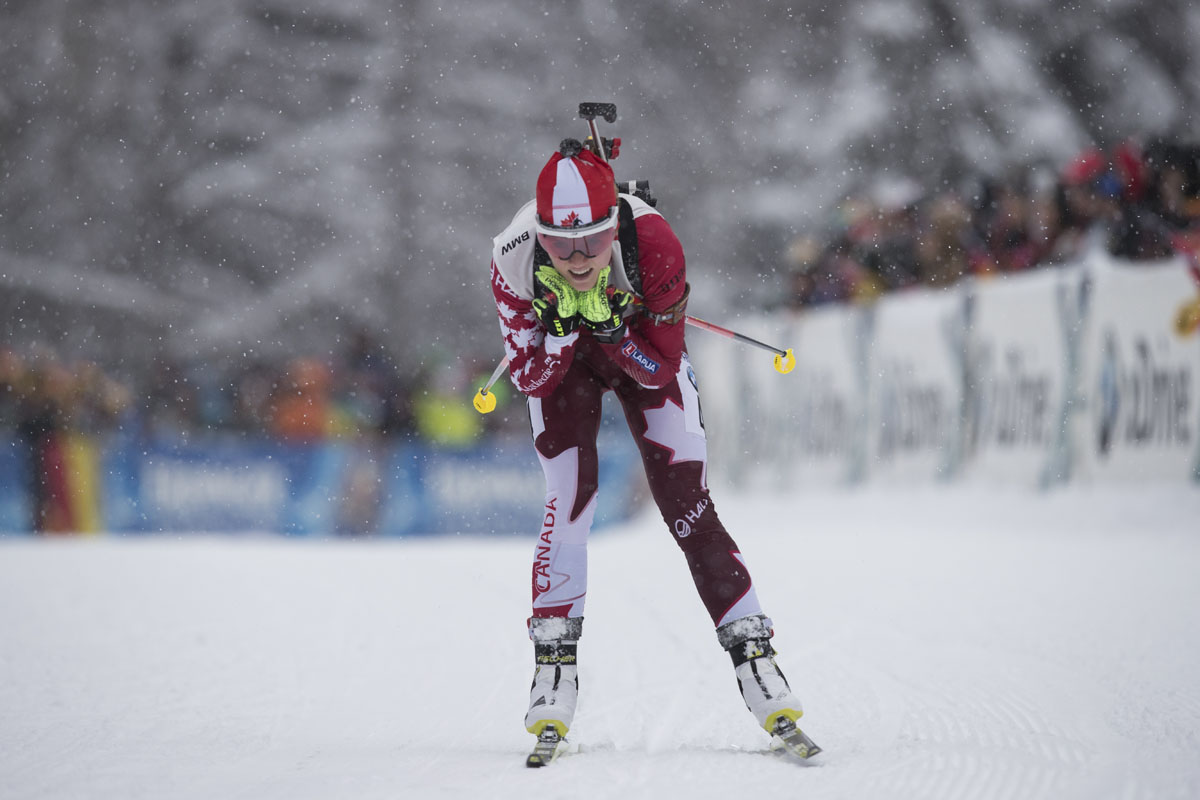
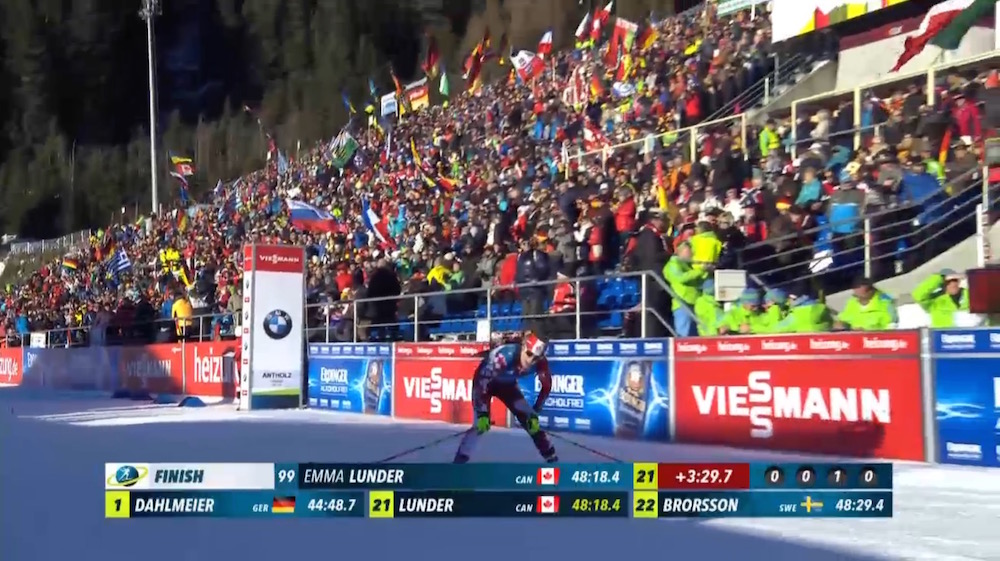
But on Thursday, thousands of miles away at the International Biathlon Union (IBU) World Cup in Antholz, Italy, Lunder raced to a career-best 21st in the women’s 15-kilometer individual race. It was her first time racing that distance. In fact, it was twice as long as the 7.5 k sprint she had done in eight of her nine previous World Cup starts (not counting relays).
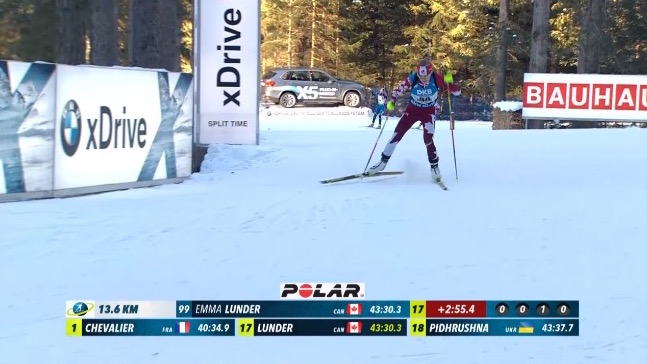
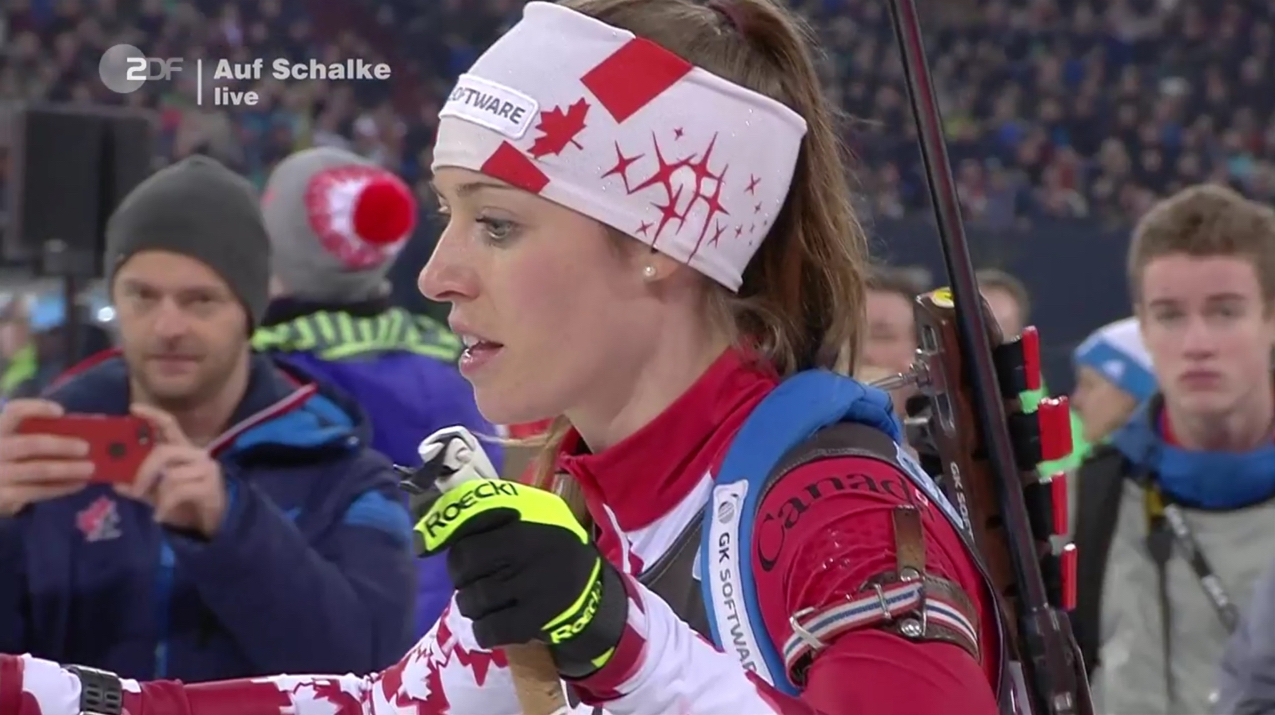
Emma Lunder (Biathlon Canada) on course during the women’s 15 k individual on Thursday at the IBU World Cup in Antholz, Italy. (Photo: ARD broadcast screenshot)
The Biathlon Canada B-team member started last on Thursday, wearing bib 99. It’s a tall order waiting around that long in the longest-format race on the circuit, complete with four shooting stages, but the 25-year-old Lunder was generally unfazed.
“I would say this year I am definitely used to starting in the fourth seed, and getting a hang of dealing with the wait,” she wrote in an email after Thursday’s race. “I quickly ski tested with our techs, zeroed my rifle and then headed back to our wax room where I lay on a pile of ski bags and read my book for 45 minutes before warming up.”
Fortunately, the wait played to her favor. Gusting winds across the range gave most of the field troubles. But when Lunder set out on the course, those winds seemed to be less of an issue.
“I had absolutely no wind when I zeroed, which I found made it easier to make corrections during the race,” she wrote of her pre-race target practice. “I think I had fairly consistent wind for both prone and standing, and was happy not to have any big gusts blowing me around!”
Lunder explained that she had been working with her coaches and sports psychologist on improving her focus while shooting. She had struggled with her prone shooting over the last few weekends (including last week’s World Cup in Ruhpolding, Germany, and the IBU Cups in Martell, Italy, before that). On Thursday, Lunder was hoping to execute some new strategies.
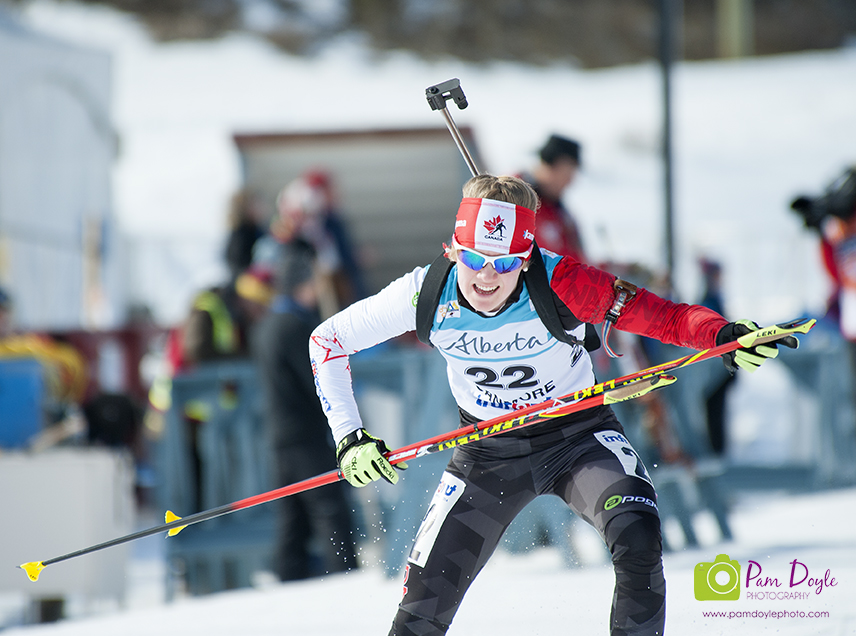
Canada’s Emma Lunder leaving the range en route to second place in the IBU Cup 7.5 k sprint last season in December 2015 in Canmore, Alberta. (Photo: Pam Doyle)
With a clean first prone stage, she was already on par with a personal best as she left the range in 35th. (Lunder previously placed 30th in her first-ever World Cup three years ago in Pokljuka, Slovenia. With that result, she qualified for the 10 k pursuit, and went on to place 41st for her second-best result to date — up until Thursday.)
Lunder then cleaned her second shooting and first standing stage to put herself in 10th halfway through Thursday’s race. But she had no idea where she stood. Fortunately, she had plenty of skiers within sight, after race organizers started the fourth seed — which included Lunder — in 15-second intervals (as opposed to 30 seconds between racers).
“Skiing was a fun but extremely tough battle,” Lunder wrote. “… There were way more girls close to me that I could chase and ski with. … I actually wasn’t given any information of where I was until I’d finished in the range and was heading out for my last lap — I think the techs and coaches didn’t want to excite me before any of my shooting bouts, and I’m quite happy for it.”
She missed her first and only target of the day on her second prone, which put her in 24th with two loops to go, and cleaned her final standing stage, moving her back up into 15th. Leaving the range for the last time, she realized she was in a best-ever position.
“I really hoped I was fighting for points, and when I left the range after my last standing … I almost had an ‘oh crap’ moment because I knew I had to ski absolutely as hard as I possibly could for another 3km and I was already feeling the hurt,” she explained.
Canadian Emma Lunder, of Vernon, B.C., finishing 21st for her career-best IBU World Cup result on Thursday at the women’s 15 k individual (her first time racing that distance) in Antholz, Italy. (Photo: ARD broadcast screenshot)
“We had really competitive skis today thanks to our hardworking wax-tech crew, and they were all over the place for my last lap, screaming for me to fight up every hill and they got me all the way to the finish line!” Lunder added. “I was feeling the pain for my whole last lap, and it turned into just trying to survive rather than really being able to fight, but I know I did absolutely everything I could on the skis today, and I am so, so happy with my race.”
The Vernon, B.C., native ended up 21st, 3:29.7 minutes out of first, with one penalty (0+0+1+0). Lunder was one of just four out of 99 that shot 19-for-20. No one cleaned.
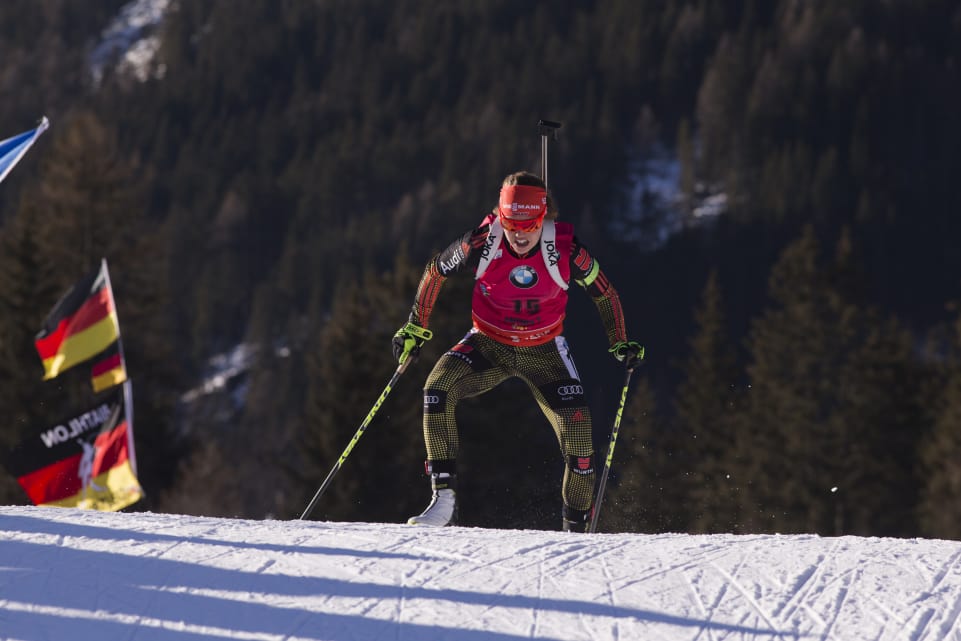
The winner, Laura Dahlmeier of Germany, had two misses (1+1+0+0) — for a total of two minutes added to her finishing time. Dahlmeier secured the win in 44:48.7 minutes, thanks to perfect shooting in the last two stages. It was her 11th World Cup victory.
“It was incredibly difficult today,” Dahlmeier told German broadcaster ZDF after starting 15th. “I tried to make it a little easier on myself. That’s why I twice went to the outmost positions [on the range]. But honestly it was just as windy, I had to fight just the same. It was hard to get into the race after those two misses. I just tried to do my own thing, and shoot clean in the end.”
Germany’s Laura Dahlmeier racing to her 11th IBU World Cup win on Thursday in the women’s 15 k individual in Antholz, Italy. (Photo: IBU)
Dahlmeier’s 11th World Cup win on Thursday gave her the overall World Cup lead and with it, the yellow bib, and allowed her to keep the red bib of the 15 k individual discipline leader.
“It is a dream come true to win in this beautiful setting,” Dahlmeier said of sunny Antholz. “That I can keep the red jersey and get the yellow one back, it doesn’t get better than that.”
Behind her France’s Anaïs Chevalier started 32nd and came within 3.8 seconds of Dahlmeier’s finishing time. Chevalier was one of the four women that missed just one target (0+1+0+0), along with third-place finisher Alexia Runggaldier of Italy (+46.0, 0+1+0+0).
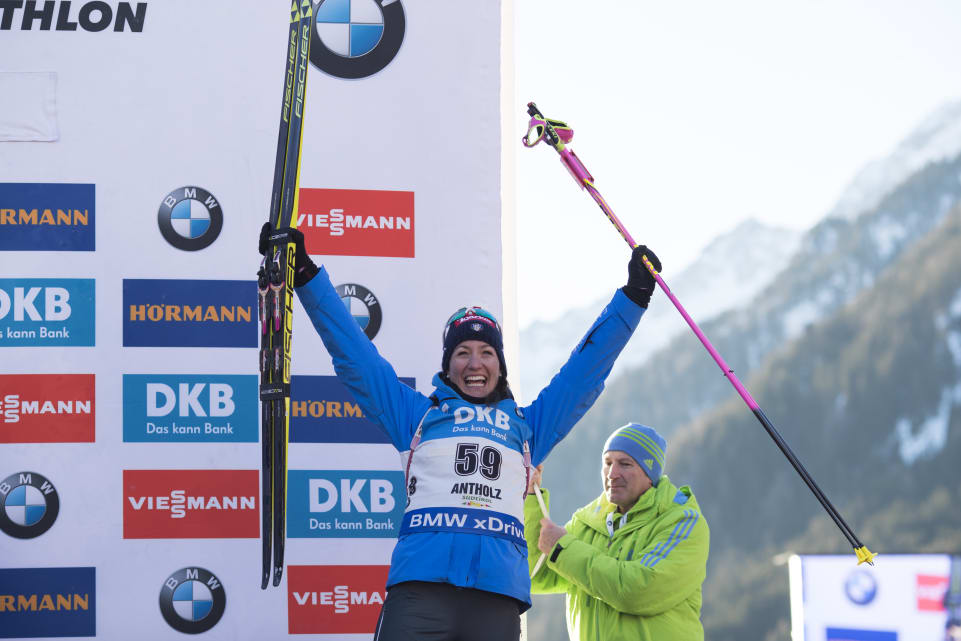
For Runggaldier, it was her first World Cup podium.
“This morning I was a little anxious, and just thought, ‘Give it your best.’ I really wanted to qualify for the mass start [on Saturday],” she told ZDF. “I just told myself to do the best I can, just do that, and now I can’t believe it!”
Italy’s Alexia Runggaldier celebrating her first IBU World Cup podium in third on Thursday at the women’s 15 k individual in Antholz, Italy. (Photo: IBU)
The 25-year-old Runggaldier qualified for the 30-woman mass start based on that result. On Thursday, she said conditions weren’t easy even as a later starter in bib 59.
“It has already been difficult the last few days,” she said of target practice during training. “Yesterday it didn’t work well for me, so today I just told myself to focus, 20 shots, four series. And my coach told me out on the course ‘be patient!’ and I just tried to execute that.”
As for Lunder, she wrote that she was “extremely happy” with her shooting performance and pointed out that the last time she scored World Cup points was in 2014.
“… To be just out of top-20 today feels pretty amazing,” Lunder wrote. “Today was a huge day for me on the range, and I think there’s still work to be done on the skiing side of things, but I know I’m headed in the right direction.”
As of Thursday, Biathlon Canada had not made any formal announcement about its World Championships team.
“Today I left it all out there so no matter what happens [with selections] I am super proud of what I accomplished in this race!” Lunder noted.
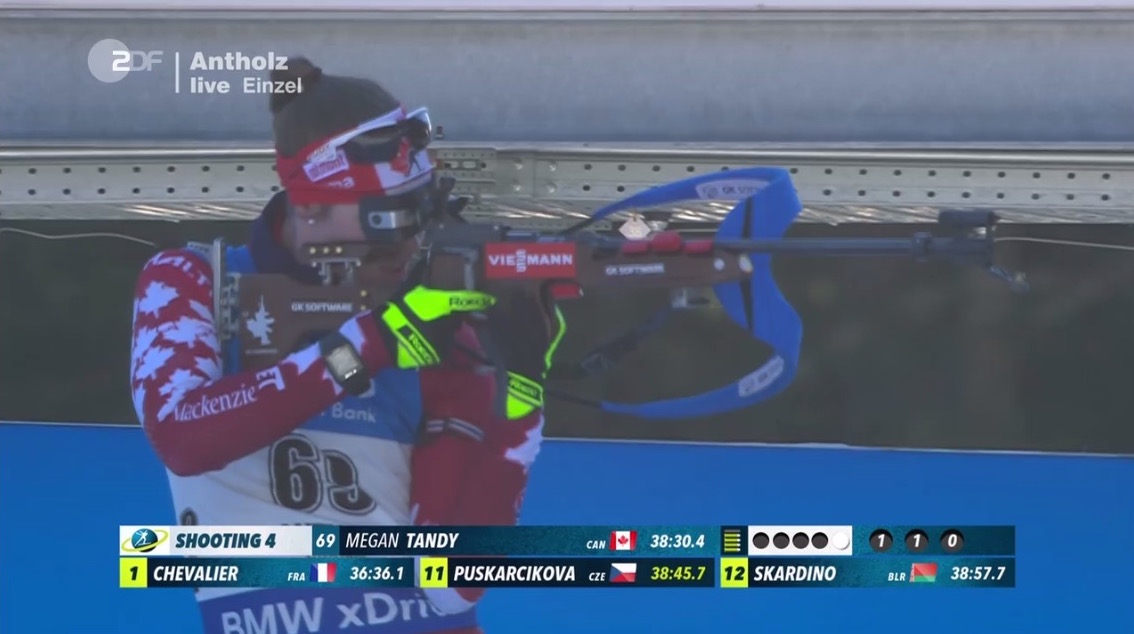
Also on Thursday, Megan Tandy of Biathlon Canada’s A-team (officially the “Eh! Squad”) finished 33rd (+5:02.0) for a season best. She started 69th and shot four penalties (1+1+0+2) with the 61st-ranked overall course time.
“I can easily say this is my slowest season since I was a Junior!” Tandy wrote in an email. “That being said I was really pleased with today’s race because it represented a baby step forward in both skiing (I didn’t feel dead tired racing today and actually enjoyed skiing which is a first this season) and on the result list as well. Finally some points — what a relief!”
She described the wind as “up and down” with more wind for her first and last bouts, but “nothing unmanageable.”
“I made fairly aggressive sight adjustments in prone. The women had quite windy conditions during training the 2 previous days so even though the conditions were challenging at times I felt confident about clicking,” Tandy reflected.
Megan Tandy (Biathlon Canada) during her final shooting stage of the women’s 15 k individual on Thursday at the IBU World Cup in Antholz, Italy. (Photo: ZDF broadcast screenshot)
After just two misses in her first two bouts and a clean third stage, Tandy was in contention for a top 30 with one shooting stage to go. In that final standing stage, she missed two, which left her disappointed.
“I am still so angry with myself especially because I missed the last 2 shots and up until those misses the potential for a good race was there!” she wrote. “But thats biathlon for you! I didn’t really think about bouncing back after my last shooting — it was the last loop so I gave everything I had, simple as that!”
Her final loop time was her fastest of the day, ranking 51st. At the end of the day, Tandy was pleased to feel “normal” again during a race.
“It was such a pleasure compared to a lot of races this year where I feel like after the first 1km my only goal becomes to survive until the finish line,” she wrote. “Shooting I think I did good work in 3 of my 4 bouts, particularly reacting to the wind prone so I feel confident and am looking forward to the relay this Sunday! 6km is also going to feel short and sweet after that 15km!!”
The women race a 4 x 6 k relay on Sunday in Antholz.
Canada’s third woman on Thursday, Julia Ransom finished 55th (+6:28.2) with four penalties (0+3+0+1). Rosanna Crawford did not race, but tweeted after, “Well if I had to sit out today’s race and be a fan instead I sure am glad @emmalunds made it an exciting race to watch, finishing 21st for a new personal best! Lucky number bib 99! #gretzky #ANT17 #gocanada”
Four U.S. women competed on Thursday, with Clare Egan leading the team in 59th (+6:58.6) with six penalties (1+4+0+1) that added six minutes to her finishing time. She started 80th and recalled some wind issues on her second shooting.
“I had the fastest skis I’ve ever had in my life today, and three out of four good shooting stages,” Egan said, according to a US Biathlon press release, of her first, third and fourth stages. “Unfortunately, a stupid mistake in the first standing stage foiled any chance I had at a good result. I tried to shoot through gusting wind instead of waiting until I could take a good shot. I made a strong comeback from that point on, but 59th place is hardly what I was hoping for.”
Joanne Reid (US Biathlon) racing to 60th in the women’s 15 k individual on Thursday at the IBU World Cup in Antholz, Italy. (Photo: USBA/NordicFocus)
Her US Biathlon teammate Joanne Reid followed in 60th (+7:05.2), also with six misses (2+2+1+1). Reid started 23rd.
“There were definitely some gusts out there today, and what could be tricky conditions if you didn’t adapt correctly to them,” Reid told US Biathlon. “Wind is a lifetime learning experience — every race, every range, every point, and every day is different, so you’ll never know exactly what you’re supposed to do, or what you should have done in any situation. Biathlon is by its very nature sinusoidal, and it’s unfortunate when those troughs hit us all at the same time.”
Also for the U.S., Susan Dunklee started 46th and and finished 71st (+7:58.0) with eight penalties (0+4+2+2), and 21-year-old Maddie Phaneuf in bib 92 finished 81st (+9:18.9) with seven penalties (3+1+1+2).
“I think as a team we displayed some incredible bravery out there,” Reid noted. “It can be mentally very tough to keep fighting when you know how many minutes you lost. I especially salute Susan for her ability to come back from races like this with incredible grace, considering the high expectations constantly placed upon her. And Maddie, of course, our youngest, who is trying to adjust to a whole different level of skiers in an unfamiliar environment. Everyone has to start somewhere, and it’s tough to remember that sometimes with veterans on the team like Tim [Burke] and Lowell [Bailey], who have been starting biathlon races for almost as long as Maddie has been alive.”
“I know the four of us are eager to redeem ourselves in Sunday’s 4x6k women’s relay,” Egan said.
Dunklee will have another individual shot in the last set of races before World Championships (Feb. 9-19 in Hochfilzen, Austria) this Saturday in the 12.5 k mass start, as Dunklee is ranked 17th overall in the World Cup.
The men’s 20 k individual takes place Friday, starting at 8:15 a.m. EST. Watch it live on Eurovisionsports.tv.
Biathlon Canada’s Emma Lunder finishing 21st for her career-best IBU World Cup result on Thursday at the women’s 15 k individual (her first time racing that distance) in Antholz, Italy. (Photo: ARD broadcast screenshot)
IBU World Cup (Antholz, Italy): Women’s 15 k individual
In her first-ever 15-kilometer individual race, Canada’s 25-year-old Emma Lunder captured a career-best 21st at Thursday’s International Biathlon Union (IBU) World Cup in Antholz, Italy.
The last time Lunder scored World Cup points was at her very first IBU World Cup in 2014 in Pokljuka, Slovenia. There, she placed 30th in the sprint and went on to finish 41st in the pursuit, which stood as her best World Cup finishes — until Thursday.
In the women’s 15 k individual, a four-stage race that penalizes one minute for every missed shot, Lunder was one of the best shooters out there, shooting 19-for-20, missing one shot on her second prone stage (0+0+1+0). Out of 99 competitors, Lunder was one of four who missed just one. No one cleaned all four stages.
Lunder started last in bib 99 and ended up 21st at the finish, 3:29.7 minutes behind winner Laura Dahlmeier of Germany, who won in 44:48.7 with two one-minute penalties (1+1+0+0).
Dahlmeier started 15th and battled windy conditions for the victory, with a time that was 3.8 seconds faster than France’s eventual runner-up Anais Chevalier, who started 32nd and missed one (0+1+0+0). Italy’s Alexia Runggaldier notched her first World Cup podium in third (+46.0) after starting 59th and missing just one target as well (0+1+0+0).
“I was extremely happy with my shooting performance and hitting 19/20 targets on a tough day!” Lunder wrote in an email. “I think I had fairly consistent wind for both prone and standing, and was happy not to have any big gusts blowing me around!
“… To be just out of top-20 today feels pretty amazing,” she continued. “Today was a huge day for me on the range, and I think there’s still work to be done on the skiing side of things, but I know I’m headed in the right direction.”
Also for Biathlon Canada, Megan Tandy tallied a season-best individual result of 33rd (+5:02) despite four penalties, including two on her last standing stage (1+1+0+2), and Julia Ransom placed 55th (+6:28.2) with four penalties (0+3+0+1). Rosanna Crawford did not race.
Clare Egan was the top American in 59th (+6:58.6) with six penalties (1+4+0+1) that added six minutes to her time, and US Biathlon teammate Joanne Reid was right behind in 60th (+7:05.2) with six misses as well (2+2+1+1). Susan Dunklee in bib 46 started at the tail end of the group that appeared to face the windiest conditions, and finished 71st (+7:58.0) with eight penalties (0+4+2+2). Maddie Phaneuf finished 81st (+9:18.9) for the U.S, with seven penalties (3+1+1+2).
The men’s 20 k individual starts Friday at 8:15 Eastern time. Watch it live on Eurovisionsports.tv.
Canada’s Macx Davies celebrates as he is cheered on by 42,000 fans during the final lap of the 2016 Biathlon auf Schalke invitational race. The Canadian relay team, with his partner Megan Tandy, finished 10th. (Photo: Biathlon-aufschalke.de)
A biathlon relay with athletes skiing around and through a huge soccer arena in a city with no snow seems like a crazy idea.
But in the 1990s, the German cross-country skier and biathlete Herbert Fritzenwenger, who had retired from active sports after competing in the 1988 Calgary Olympic Games, believed there had to be some way to make biathlon even more attractive for viewers. He wanted to mix sports and entertainment bringing the sport out of the forest and closer to the people, the way city sprints are now doing it for cross-country. He also believed a discipline where women and men compete together would be more interesting to watch.
Thus the World Team Challenge was born, a two-person mixed relay invitational, with each team representing a country. In 2002, Frizenwenger took the next step to bring that race to an even higher level of awareness. Together with the then-manager of first-league soccer team Schalke 04, he moved the event to the team’s newly constructed Veltins Arena in Gelsenkirchen, Germany. Only problem: The arena, which features a retractable roof, is located in a flat region of the country far away from any mountain range with predictable snowfall. But using manmade snow from a nearby ski hall to create a course just for this race every year the concept instantly worked, and has drawn some of the biggest crowds for any biathlon event in the world ever since.
Now in its 15th year, the “Biathlon auf Schalke” race has become a Christmas holiday break tradition on TV in Germany, also broadcast live in several other countries. Many biathletes love the event for its atmosphere in front of 42,000 raucous fans in the arena, and as an interesting way to keep the race shape sharp during the break.
This year’s edition took place on Wednesday evening, and it was the first time a Canadian relay was at the start, with Megan Tandy and Macx Davies teaming up to represent Canada in a show event that combines a mass start with a pursuit after a short “halftime” intermission.
In both races, the Canadian pair quickly incurred a number of penalty laps (unlike in other relays the athletes are not allowed to use spares in the fast-paced competition) and slipped to the back of the field of 10 teams, tagging off to the partner after each shooting stage to chase once more over the 1.3-kilometer course around the arena.
But Davies finished the event to huge cheers, with the audience elated by a victory of the home teams seemingly not wanting the show to be over yet, and screaming until he had crossed the line.
“The atmosphere was GREAT!!!” Davies wrote in an email to FasterSkier. “Very loud and very fun crowd. They even cheered most of our shootings! (When we were the only ones in the range.) It was amazing to ski through the tunnel the last time to such a big ROAR from the stadium.”
The arena was rocking particularly loudly as Germany’s fan-favorite Simon Schempp entered the finishing stretch for his first victory at Schalke with his partner Vanessa Hinz, crossing the line in a time of 33:11.4 minutes (with four penalties).
Originally, the German coaches hadn’t selected Hinz to compete at Schalke, but she replaced her sick teammate, Franziska Preuss, to team up with Schempp. Last year, Hinz and Schempp had placed third in the World Team Challenge, with Hinz also subbing in at the last moment. This year, it was their time on the top of the podium.
“Yeah, this is pretty crazy,” Schempp told German TV broadcaster ZDF after the race, in an interview that was heard throughout the arena. “That must be how soccer players feel every week. The atmosphere is gigantic. This is much more extreme than in a biathlon arena because there is a roof. I don’t know how many exactly, but I believe 40,000 people are here and it’s just crazy fun. [Cheers in the arena] You can hear it, craziness.”
The announcer asked Hinz how she stayed so calm in front of her home crowd on the shooting range.
“That’s what we do all year, but in front of such an audience your knees get weak,” she said. “It’s just brutal. We just want to say many thanks, because to experience something like this is unique.”
The audience in the arena was happy to hear that, erupting in huge cheers again. Germany last won the event in 2013 with Laura Dahlmeier and Florian Graf. Dahlmeier, the current women’s overall IBU World Cup leader, took a break this year, as did the defending World Team Challenge champions Marie Dorin Habert and Martin Fourcade of France.
The 2016 Biathlon auf Schalke podium on Wednesday night, with (from left to right) Germany’s Erik Lesser and Franziska Hildebrand (second place), Germany’s Simon Schempp and Vanessa Hinz (first place), and Russia’s Olga Podchufarova and Alexey Volkov (third place). (Photo: Biathlon-aufschalke.de)
Despite usually entering multiple teams at Schalke, Germany had not been able to claim first and second on the podium — until this year, which sent the arena into frenzy.
For Germany’s second team, Franziska Hildebrand teamed up with Erik Lesser for the second-straight year after the duo finished seventh in 2015. They came close to the overall victory this time, winning the mass start by 15 seconds ahead of Hinz and Schempp, and later staying in their vicinity throughout the pursuit. But Lesser missed his final standing shot when he still had a small chance to catch up to Schempp in first.
“Of course [the atmosphere] is pushing me,” Hildebrand had told ZDF at halftime, after the mass start. “It’s such an incredible audience. It’s so beautiful when you come into the arena as a German athlete and experience such a loud support. That is always a total buzz, a breathtaking moment.”
On the first loop of the pursuit Lesser broke his pole after stepping on it, and did not receive a replacement until after the exchange to Hildebrand.
“For the shooting I don’t need a pole, and afterwards that half-a-second I lost I can deal with that, before someone runs over and probably breaks his foot,” he told ZDF after the race, causing a big laughter in the arena. “Such a great atmosphere. The spectators are really picking it up. And that’s why I am here.”
At times more than a minute ahead of the field, the German teams made the race relatively close again with two laps to go, when standing next to each other both Hinz and Hildebrand shot two penalties despite their otherwise almost-flawless shooting performances.
The third place on the podium went to Russia’s Olga Podchufarova and Alexey Volkov (who won gold with the men’s relay at the 2014 Olympics), narrowly edging out France’s Anaïs Bescond and Jean-Guillaume Béatrix (+42.6), Austria’s Julia Schwaiger and Simon Eder (+43.0) and Norway’s husband-and-wife team of Fanny Horn Birkeland and Lars Helge Birkeland (+43.3) on the final loop and finishing sprint.
Long Day on a Challenging Course
Originally, Tandy — who trains and lives in Germany for part of the year — had planned on racing with Biathlon Canada teammate Nathan Smith, but Smith returned to Canada after struggling in the initial World Cup races of the season with unclear symptoms, which he has since been trying to resolve.
“After Nathan went home I was talking with Megan and [coach] Matthias Ahrens about if it would be possible to race,” Davies explained. “Because I have been watching this race for a long time now and always thought it would be an awesome event to compete at, which it is! So I changed my plans so we could start an all-Canadian team and I am very happy to have raced the World Team Challenge!”
View of the indoor section of the ski track and the shooting range inside the domed Veltins Arena during the 2016 Biathlon auf Schalke invitational. (Photo: Biathlon-aufSchalke.de)
Even more so than a regular IBU World Cup, the race is held in a huge party atmosphere, with athletes skiing through a winter village park with food stands and sponsor exhibition tents lining the artificial snow track around the huge soccer arena, before entering the pitch inside the arena again via a darkened tunnel with light effects. And then having to shoot in front of the 42,000 fans, frequently with loud music blaring, and the noise level amplified indoors many times.
The World Team Challenge relay race is also executed in a special format, with one woman and one man forming a team and exchanging repeatedly, each skiing a loop of about 1.3 k and having to clean a shooting stage — or ski a shorter-than-usual 75-meter penalty lap — before tagging off to their teammate again. While one athlete was out on the track, crews of wax technicians hurried to clean and prepare the skis of the athlete who was receiving a short break. This mode of competition is fairly similar to the new single mixed relay in biathlon or the team sprint in cross-country.
It was a long race day for the athletes, with a “shootout” followed by the main event split into two “halftimes,” as the organizers called it, borrowing the terms from soccer. At first a nine-loop mass start (the women skied four loops, the men five including the final loop) on the 1.3 k course, followed by a pursuit race of that same length after just a short intermission. Thus the women had to ski about 10 k in total, while the men had to ski 13 k.
The gaps to the best team in the mass start were halved respectively, capped at a maximum of 45 seconds for the pursuit, so even the teams at the back of the field like Canada could still have a realistic shot at the podium.
Prone and standing stages interchanged with each partner shooting twice in prone and twice in standing per race, and because the loops were comparatively short and intense, like a sprint, shooting accuracy was at least as important as in regular World Cup races.
“I really like the format of this race, and think maybe it should replace the Single Mixed relay,” Davies explained in his email. “But maybe only race once, doing both was very challenging. But it is a fun event nonetheless!”
In the first few years of the Biathlon auf Schalke event, the course was a relatively flat loop, but after a redesign last year added longer climbs and a downhill section on the part of the track that meanders through the park outside the arena, it is supposed to more closely resemble what athletes would see “on the World Cup level,” as the organizers announced in a presentation before the race.
Using artificial snow mostly coming from a ski hall in the nearby city of Neuss, every loop is now 1,300 meters long, featuring 30 meters of vertical climb nicknamed the “Ruhrpott Glacier”, which added up to about 300 meters for the men and 240 for the women for the whole race day.
“It’s really not just a show race,” Schempp told broadcaster ZDF. “The legs are really burning very much. Because you have those short individual loops, but that just makes it even worse because you just ski that kilometer even faster than at normal competition speed. And because of that it is really challenging, but still is a lot of fun.”
“The course is really good for what they have,” Davies wrote in his email. ”The stadium is exciting with all the corners and I think the track is decently difficult, though below World Cup level. I think they did a better job on the downhill corner this year, because it was easier to ski, the athletes don’t like to see crashes.”
The athletes had fewer problems with that downhill section leading into a sharp-right hairpin turn than during the prior year when that was introduced, but the Czech Republic’s defending World Cup winner Gabriela Koukalová fell this year, grimacing and rubbing her thigh as she got back up. She finished seventh with her partner, Michal Šlesingr, after placing second with Ondrej Moravec in 2015.
“We just saw [a replay of] Gabriela slipping out there,” Hildebrand told ZDF when questioned about her more conservative downhill snowplow technique. “I wanted to avoid that at all costs, so I chose the safety version.”
After some years where the organizers experimented with rifles using a laser-aiming system, the athletes now use their own rifles with real ammunition on the 10-position range again, with bulletproof glass walls and an empty section behind it to protect the audience.
The difficulty of the course was once again evident during the races. Despite the indoor shooting range with almost no wind influence, many athletes who are known as good shooters incurred more misses and thus had to skate more penalty loops than they normally would in a World Cup.
“The shooting range was good, no wind, which is nice, but you are skiing very hard into the range and must shoot fast and accurately to stay with the leaders,” Davies commented.
2016 World Team Challenge Results
Germany I (Vanessa Hinz/Simon Schemp) 33:11.4
Germany II (Franziska Hildebrand/Erik Lesser), +16.7
Russia (Olga Podchufarova/Alexey Volkov), +40.2
France (Anaïs Bescond/Jean-Guillaume Béatrix), +42.6
Canada’s Megan Tandy at the start of the pursuit race during the 2016 Biathlon auf Schalke invitational event. (Photo: ZDF broadcast)
Tandy and Davies became the fifth North American team to be invited to the Biathlon auf Schalke event, and the first Canadian one. In 2008 and 2009, Lanny Barnes and Jay Hakkinen represented the U.S., placing ninth and sixth for the best finish by a North American team to-date. In 2010, Tracy Barnes-Coliander and Tim Burke finished 10th, and in 2012, Susan Dunklee teamed up with Burke for 10th.
“What a fun event last night,” Davies summed up his experience on his Facebook page. “I am very thankful to have been able to compete in the Biathlon World Team Challenge and I hope to be invited back to show you how good Canada can be! (Unfortunately we didn’t do very well this time…) Till next year.”
“I second everything Macx wrote ☺ ☺ ☺,” Tandy commented on his status.
Pre-Race Events with a Farewell to a Former World Champion
Before the two main races of the evening, Russia’s Volkov won a “shootout” event among all participating women and men, narrowly edging out Austria’s Eder, who is known for his fast shooting performances on the World Cup circuit, with Germany’s Hildebrand finishing third and Schempp fourth. Tandy and Davies had not qualified for the final of that event.
In this competition the athletes — while not wearing skis — were required to run up to the shooting mats and hit 20 targets as fast as possible (5 prone, 5 standing, 5 prone, 5 standing), using as many spare rounds as necessary.
The organizers also used the shootout event as a farewell to Germany’s national team member Daniel Böhm, men’s relay gold medal winner at the 2015 World Championships in Kontiolahti, Finland, and silver medalist in the relay at the 2014 Olympics in Sochi, who announced his retirement from biathlon earlier this month. He qualified for the final round of the shootout, where he finished fifth. Böhm plans to begin a training program to become a helicopter pilot with the German federal police.
“In the shootout I was a little bit shaky,” Böhm told ZDF. “It is something very special to compete here at Schalke. And I think there is nobody who can completely tune this out. It’s crazy what the fans are doing here, and great that I am allowed to say goodbye on this stage. That is a special honor, and now I can enjoy it looking on from the outside.”
While the IBU has adopted the mixed and single mixed relay formats in the last years as attractive new disciplines, Biathlon auf Schalke is an invitation-only race not hosted by the IBU, so there were no World Cup points to win in the event. However about €168,000 ($175,000 dollars) in prize money were awarded.
The IBU World Cup will resume next week Jan. 5-8 in Oberhof, Germany, with sprint races, pursuits and mass starts.
Canada Biathlon’s Megan Tandy (in black) greets her relay partner Macx Davies in the tech service area after the mass start race during the 2016 Biathlon auf Schalke invitational event. (Photo: ZDF broadcast)
In response to evidence of widespread doping in Russia, the Czech Biathlon Union became the first to discuss a boycott. The Czechs will not attend a World Cup stage to be held in Tyumen, Russia, in March; they have been joined by the British Biathlon Union. Several other countries say they hope that the International Biathlon Union will move the event.
But the Russian Biathlon Union put out a defiant press release denying any involvement in doping.
“It was about time that some federation came and said out loud what we are talking about behind the scenes,” Czech Biathlon Union President Jiří Hamza said in an interview with the news agency iDNES, according to a translation.
The International Biathlon Union (IBU) is being pushed to move the competitions. The dozens of doping biathletes are only part of the equation. Perhaps a bigger issue is that extensive sample manipulation and collusion occurred on Russian soil. That makes some athletes and federations reluctant to compete in Russia.
“I don’t think anybody feels safe about being there, in a country that had this high level of collusion,” U.S. Ski and Snowboard Association President and CEO Tiger Shaw told FasterSkier the day the report came out.
A few months ago, the IBU also controversially voted to award 2021 World Championships to Tyumen. The International Olympic Committee (IOC) had directed that no new competitions should be scheduled in Russia; the IBU interpreted the directive to say that the existing Tyumen bid could remain up for election.
2016 Youth and Junior World Championships, slated for Ostrov, Russia, are also part of the discussion.
If the competitions are not moved, Czech athletes will not attend them, Hamza said.
Also signing on to the boycott is the British Biathlon Union (BBU).
“The Board of the BBU made a unanimous decision over the weekend to boycott World Cup 8 in Tyumen,” BBU Secretary General Mark Goodson wrote in an email to FasterSkier.
Momentum may be building for other federations to sign on as well. A widespread boycott could push the IBU Executive Board to move the event. A similar boycott led to 2016 World Championships for bobsleigh and skeleton being stripped from Sochi, Russia.
The IBU Executive Board is meeting to discuss the McLaren report this week.
“Early this morning Tuesday, we received an Email of thanks from [Czech biathlon] and in mid-morning the Czech Republic issued an ‘Open Letter’ to the IBU and all Federations expressing even more displeasure than we had, and boycotting all events in Russia until WADA and the IOC gave their Anti-Doping Systems a clean bill of health,” Goodson wrote. “The latest news is mid-afternoon with a very supportive (of Czech) Open Letter from Norway demanding that named, proven Russian biathletes be banned with immediate effect, and that the IBU withdraw all competitions from Russia until a clean bill of health. Failure of IBU to do this will result in Norway considering a boycott of all international competitions in Russia.”
North American federations are considering their options.
“We have been discussing the issue and will make a decision Friday after the IBU makes its ruling,” Biathlon Canada High Performance Director Eric De Nys told FasterSkier. “We are of course hoping that the IBU makes the right call and pulls the World Cup from Tyumen.”
The United States is leaving the decision up to individual athletes.
“We have told our athletes that participation is up to them and that there will be no pressure for them one way or the other,” U.S. Biathlon Association President and CEO Max Cobb told FasterSkier in a text message.
Some prominent athletes have been speaking individually about the prospect of a boycott.
“It’s not like it’s only one or two [athletes],” Martin Fourcade said in an interview with Norwegian broadcaster NRK. “It’s 31, added to the 12 we had the last few years in biathlon. And I hope if my federation don’t have big enough balls to take [on] the problem, the athletes do it on their own… If nothing is done in January, I will ask my colleagues in the international teams – I mean Norway, I mean Germany, Czech Republic, all of the nations – to don’t compete.”
“Due to the current atmosphere in the media landscape on the matter of 31 Russian biathletes, suspected of using prohibited substances, RBU considers it necessary to issue the following statement.
In the course of several years, RBU has consistently pursued a policy of zero tolerance for doping. This is confirmed both by strict compliance of all Team Russia biathletes with the requirements of WADA and their due availability for control by WADA and other accredited organizations along with active collaboration of RBU with these organizations in the field of promotion of clean sport. Clear evidence of mentioned above – the official statistics of WADA concerning the number of doping tests taken in biathlon in 2014.
Starting spring’14, after the election of the new top management of the Russian biathlon Union, this cooperation has become even more intense.
Within the idea of zero tolerance for doping RBU held more than 10 seminars for athletes and coaches inviting representatives of national and international anti-doping organizations. All persons who had ever been involved or had been under suspicion of any connection with the use of prohibited substances were banned for life. In the course of internal tests at national competitions all the athletes who didn’t comply with strict requirements of RBU were caught and severely punished.
Another proof of zero tolerance for doping is the fact of cooperation of RBU with the foreign experts, such as Ricco Gross and Wolfgang Pichler, who would never agree to jeopardize their reputation.
We do not know the names of the athletes from the list that will be discussed by our respected colleagues from IBU on Thursday, December 22nd. However, we are ready to provide comprehensive information about any RBU athlete ever to participate in the biathlon Events. We admit that the majority of persons from this list are those who have already been accused of violation of doping rules by the RUSADA and RBU internal doping control and are currently disqualified or finished their career.”
Pichler is a German who came to prominence coaching the Swedish biathlon team and Magdalena Forsberg in particular. An outspoken opponent of doping, Pichler was hired to coach the Russian women’s team from 2012-2014. He has now returned to the Swedish team.
Within the Russian national team there were two training squads, with Pichler heading one of them. He said as early as the Sochi Olympics that he suspected there was doping within the other training group, headed by Vladimir Korolkevich. He had even tried to leave his post early due to concerns about doping.
But Pichler has maintained that his own athletes were clean. The report sheds doubt on that assertion. At least two of Pichler’s athletes – Olga Zaitseva and Yana Romanova – were on the “protected list” in Sochi. One of Romanova’s urine samples also showed signs of being tampered with by anti-doping officials. And more of his athletes may be among the 31 who were referred to only by alpha-numeric code identifiers in the report.
“I know relatively little about what happened there,” he said in an interview with German broadcaster ZDF in early December. “I have only been a coach there for one year. It is being discussed, that much is clear. It does put pressure on the athletes, that they are being pointed at. I believe it’s not only a Russian problem, it is a worldwide problem which has to be tackled… I am experiencing a lot of support, also by [the Russian Biathlon Union], because they also want clean and fair sport. So at that moment it is sad when you are being pointed at again. They are following my line, if someone cheats he’ll be kicked out.”
Scott Gow (Biathlon Canada) racing to 34th, one of the best results of his IBU World Cup career, last season in the men’s sprint in Canmore, Alberta. On Thursday, Gow tied a career best in 18th in the World Cup sprint in Nove Mesto, Czech Republic. (Photo: Daniel S. Guay)
For the third time in the last week, Scott Gow hit 100 percent of his targets: 10 in the sprint and 10 in the relay at the last International Biathlon Union (IBU) World Cup in Pokljuka, Slovenia, and another 10 in the 10-kilometer sprint on Thursday in Nove Mesto, Czech Republic.
And for the second time in his career, Gow, the oldest of two brothers on Biathlon Canada’s World Cup team, finished in the top 20 — tying his career-best of 18th.
“It feels great to achieve the second top-20 result of my career,” Gow said, according to a Biathlon Canada press release, referring to his 18th place in the 20 k individual at last season’s World Championships.
“My goal was to try and replicate my performance from last week in Pokljuka. I am very pleased to have shot clean, again, and to have a decent ski time,” he added. “Being in this group with the top 20 means that I’m finishing among the sport’s elite. That feels good knowing that I have the potential to compete with the best when I’m performing well.”
Gow started 15th of 101 finishers and cleaned the first prone stage with the 10th-fastest shooting and range times before repeating his shooting performance in standing. There, his shooting time slowed to 40th (and range time 34th), but his course time improved on the second loop, and he continued to speed up for the final, third loop. Overall, Gow’s course time ranked 40th.
“I trained very hard this year to increase my skiing and shooting abilities, and I also worked very hard to improve my consistency across both disciplines,” the 26-year-old Gow wrote in an email to FasterSkier. “I’ve been able to achieve great results in the past, but they always seemed few and far between. The reason I would have a good race one day but then fall into a dry spell was because my mental approach to racing wasn’t ideal, so I changed my mindset away from ‘hoping for the best’ to ‘I’m going to do my best,’ and it has worked very well for me at this point in the season.”
He added that he applies that mindset of not accepting anything less than a 100-percent effort to every aspect of his training and racing, whether it’s an easy combo or intensity session, or his precision in shooting, for example.
On Thursday, Dec. 15, France’s Martin Fourcade became the first man to win all three IBU World Cup sprints before the holiday break with his eighth win this season (and fifth individual victory) in Nove Mesto, Czech Republic. (Photo: IBU)
At the end of the day, Gow finished 46.5 seconds behind French winner Martin Fourcade, who racked up his eighth win (of nine races) this season in 23:48 minutes, despite one standing penalty (0+1). He made up more than 13 seconds on the final lap to surpass the race leader at the time, Russia’s Anton Shipulin, and beat him by 1.6 seconds at the finish.
Shipulin, the 16th starter, shot clean (0+0) and led until Fourcade in bib 31 crossed the line, and Norway’s Emil Hegle Svendsen ended up 6.4 seconds back in third with one miss (0+1).
Of the top 20, seven men hit all their targets on Thursday. Gow was one of them.
“The shooting conditions were perfect,” Gow wrote. “There was almost no wind from the start of zero to the end of the race, so the environment wasn’t messing with anyone today.”
He explained that Nove Mesto features a long stadium approach to the range, which took some consideration.
“It was important for me to make sure I didn’t ski too hard into the range and lose control of sights and rifle stability,” Gow told Biathlon Canada. “I definitely can’t shoot any better than I did today, so if I want to break into the top 10, I will have to find some time on the ski course. Skiing smarter and utilizing the course to my full advantage will help me do that, but I’ll need to have faster legs and skis in order to keep progressing.”
Gow led two Canadians in the top 60 required to qualify for Saturday’s pursuit. Brendan Green placed 54th (+1:48.1) with a miss in each stage (1+1). Christian Gow did not start.
Lowell Bailey racing to 20th, for his sixth-straight individual top 20 this season, on Thursday in the IBU World Cup sprint in Nove Mesto, Czech Republic. (Photo: USBA/NordicFocus)
For the U.S., two men also qualified for the pursuit, with Lowell Bailey in 20th (0+1, +47.5), and Russell Currier in 55th (1+1, +1:52.8). Tim Burke did not start because of illness, according to a US Biathlon press release.
“I was happy that my ski speed bounced back from last week,” Bailey said, according to the press release. He skied the eighth-fastest course time on the last loop and 17th fastest overall for his sixth-straight top six (in an individual race) this season.
“This is a challenging course, with some monster extended climbs and challenging downhills,” he said. “It’s also a difficult range in that you have a long approach with little rest before the shooting. I took my time in prone, which definitely cost me a few places, but I knew it was windy and I had to take a little bit of extra time to adjust for that. All in all, I’m happy with the result and looking forward to the pursuit on Saturday.”
American Russell Currier racing to 55th in the men’s 10 k sprint on Thursday at the IBU World in Nove Mesto, Czech Republic (Photo: USBA/NordicFocus)
For Currier, it was his first top 60 in a World Cup sprint since the 2014 Olympics (where he placed 60th), which meant Saturday’s pursuit would be his first at this level in nearly three years.
“The coaches and I were all pleased to have me in the top 60. The difference between a 60th and 61st is a lot in the sprint,” Currier wrote in an email. “Conditions were sub perfect, to be honest, The snow was sugary and mashed up. It didn’t get to much worse as the race progressed, but a bib 78 start didn’t help. The wind in the Nove Mesto range is tricky. It was calm when I set up for prone but a slight breeze that didn’t notice picked up on my third shot and landed me a miss.”
As for the U.S. men’s team, which is down to two so far this week, Currier said that it was “unfortunate … but the staff and coaches stayed positive and organized.”
He added that the crowd in Nove Mesto was “amazing,” in his first time back since the venue was being constructed four years ago.
“I’ve been to Nove Mesto a few times, and the fans are always incredible,” Gow explained. “The atmosphere is electric, full of energy and the fans seem to cheer for everyone. They genuinely love watching us race and it’s always fun having 30,000 people screaming while you try to rip around the course. Nove Mesto is definitely in my top 5 world cup venues.”
Notably absent from the Canadian roster is Nathan Smith, who missed last week’s World Cup in Pokljuka as well and is currently back in Canada.
“I flew back to Alberta from Slovenia last Tuesday [Dec. 6] to get rest and thorough medical tests,” Smith explained in an email. “It was a tough decision, as obviously I train all year to race and really don’t want to miss any. I also originally had plans to spend Christmas Break with my girlfriend in France, which all had to be changed.
“I hadn’t been feeling like myself in high intensity and time trials for some time,” he continued. “Perhaps 3-4 months. I thought I might have turned a corner shortly before leaving to Sweden, but evidently by how I performed I had not. Both myself and my coaches agreed that continuing to race wouldn’t be productive, and just delay my recovery from whatever is the root cause.”
As of this Wednesday, Dec. 14, Smith hadn’t determined what was wrong.
“Since getting home I haven’t done any training, and went through medical tests to check for mono, virii, hormone imbalances, etc. So far nothing concrete has surfaced, which could mean a case of over training,” he wrote. “Regardless of what the cause is, rest was needed, and I will ease back into training to aim for a comeback later in the winter. Whether that be after new year’s, World Champs, or the third trimester of racing.”
His coach Matthias Ahrens (also head coach of the Canadian team) explained that they were still investigating “the underlying health issues for [Smith’s] loss in performance, certain red flags have shown in last week’s tests and need further investigation and tests,” he wrote on Wednesday.
“Until then I can not comment on his status but would be very surprised if this was caused by or is overtraining,” Ahrens added.
He couldn’t say when Smith was expected to return to training or competition, as that was dependent on his next test results.
“Therefore I am also not able to comment on our team’s plan for whom we send to the [World Cups] after Christmas,” he added.
Fourcade Calls For Action
Russia’s Anton Shuplin (l) racing to second in the men’s 10 k sprint at the IBU World Cup in Nove Mesto, Czech Republic. (Photo: IBU)
Asked specifically how he felt about sharing the podium with a Russian on Thursday, Fourcade told German broadcaster ARD, “I think everyone in Germany and certainly in France knows how hard I fight against doping. … First of all, I want to see the facts. … If that is the truth, I want to be really aggressive against it with sanctions. I think it’s the athletes’ role to do that on their own. Otherwise they have to do something else for their salary. I am very proud of my clean performances.”
In another interview with Norwegian broadcaster NRK, he emphasized that the numbers involved were staggering.
“It’s not like it’s only one or two, it’s 31, added to the 12 we had the last few years in biathlon,” Fourcade said. “And I hope if my federation don’t get big balls enough to take [on] the problem, the athletes have to do it on their own.”
Elaborating on that, he spoke of a strike.
“If nothing is done in January, I will ask my colleagues in the international teams — I mean Norway, I mean Germany, Czech Republic, all of the nations — to not compete,” he said.
Even the chamois (native to Pokljuka’s Julian Alps) is clapping: France’s Martin Fourcade celebrates his victory in the men’s 10 k sprint at Friday’s IBU World Cup in Pokljuka, Slovenia. (Photo: IBU)
(Note: This article has been updated to include comments from Canada’s Scott Gow.)
The exact details of Martin Fourcade’s record book depend a bit on who you ask.
The official statistics of the International Biathlon Union (IBU) say the French biathlete got his 50th IBU World Cup victory on Friday in the men’s 10-kilometer sprint in Pokljuka, Slovenia.
By his own count, he claims he already hit that milestone last week and this was his 52nd victory, including two gold-medal races at the Olympics, which the IBU does not include in its World Cup tally. By any measure Fourcade is very successful, making him two-for-two in sprint victories this season.
If he keeps competing long enough at such a high level, the 29-year-old Fourcade might be well on a trajectory to one day overtake the most successful biathlete of all time, Norway’s Ole Einar Bjørndalen who has 94 and counting. Fourcade already surpassed his countryman Raphaël Poirée last season to move into second position on the all-time list of World Cup winners (he is also already ahead of the leading female biathlete of all time, Sweden’s Magdalena Forsberg, who has 42).
But back to the present: A sunny day with calm wind conditions and firm snow set the stage for excellent shooting, with more than 20 athletes staying clean in the prone and standing stages while cheered on by a few thousand enthusiastic fans in the stands in Pokljuka.
Leaving the range after his standing shooting, Fourcade trailed Norway’s Johannes Thingnes Bø by 0.5 seconds. But on that final lap, Fourcade asserted his current dominance on World Cup biathlon courses, crossing the finish line 13.7 seconds ahead of the Norwegian in a time of 23:11.7 minutes before briefly pumping his fist when he saw his result on the video wall.
“When I saw we were on the same time after the second shooting, I knew everything was possible,” Fourcade explained to German broadcaster ZDF in a post-race interview. “I had good times this year on the last loop, and so I was pretty confident about my chances to win when I heard [from the coaches] I was at the same time as Johannes.”
“During the last lap I heard I was almost at the same time as Martin after the second shooting,” Bø commented on that final lap during the press conference. “So I just had to speed as fast as I could, and yeah today it was [only] enough for second place.
“I think it was a good race under the circumstances…,” he added. “You see the result list today, it’s not so fun to be behind Martin again, but I am in front of Anton [Shipulin], Emil [Svendsen] and Simon Schempp, they are all very strong names… So I am happy with this race.”
“It was an amazing competition,” Fourcade told ZDF. “It was really hard, much harder than last week in Östersund. I am really proud to win today in spite of all the clean shootings [by other athletes]. I waited a long time for my first victory ever in Pokljuka.”
That last detail was important to Fourcade, stressing in his opening statement of the press conference that he now has won a race at every (regular) World Cup venue where he has competed.
“You know, I waited for a long time to win in Pokljuka. It’s the last site in the biathlon World Cup where I never won before,” he said. “So this is a special day for me.”
Shooting clean just like all the other top finishers, Russia’s Anton Shipulin claimed the third position on the podium (0+0, +15.1), able to defend a narrow lead to Norway’s Emil Hegle Svendsen after the final shooting stage on the last lap (0+0, +20.9).
This was Shipulin’s first podium finish of the new season, after placing third last year in the overall World Cup with seven podium finishes (excluding relays).
During the press conference, Shipulin stated via a translator that he was very motivated by the recent performances of his teammates.
“The altitude plays its role,” Shipulin explained when asked about his race. “The tracks are a little bit difficult, especially during the last loop it was hard, but I managed it today and I am on the podium.”
Despite narrowly missing out on that podium finish, Svendsen was encouraged by his improving race results.
“I am happy with my performance,” he told the IBU in an interview. “A month ago I didn’t [even] think I’d be here. So I am happy with the way things are going, and I am on the right way.”
Starting with bib 88, Fourcade’s teammate Quentin Fillon Maillet became the closest challenger for the podium among the late starters as the race progressed. Also with two clean shootings, he left the range in fourth place, just 11.5 seconds behind the then-leader Bø and ahead of Shipulin, but lost further ground on the final lap and one more position to finish fifth (0+0, +27.0).
“I look at the results and see the strongest and toughest guys made it into the top ten,” Shipulin said according to a translator, when asked about Saturday’s pursuit at the press conference. “I think the race will be very interesting, and I will try my best.”
Five North American Men Qualify for Pursuit, Again
US Biathlon’s Lowell Bailey on sprint day at the IBU World Cup in Pokljuka, Slovenia. He placed 18th for his fourth-straight top 20 this season. (Photo: USBA/NordicFocus)
In a repeat from the previous World Cup weekend in Östersund, Lowell Bailey again achieved the best result of the North American starters on Friday. Like the top of the field, he managed to shoot clean, but his overall course time ranked 54th (out of 104). Bailey finished 1:13.3 behind Fourcade for 18th place (0+0), his fourth-straight top 20 in as many individual races held this season.
“I’m happy with the top-20 and hoping for my ski-speed to improve tomorrow,” Bailey wrote in an email to FasterSkier.
In a US Biathlon press release, he said he was satisfied with his shooting, but “didn’t feel great on the tracks. I hope I can bounce back tomorrow and work into the top ten.”
For Biathlon Canada, Scott Gow also shot clean in both stages, and despite starting out a bit slower, he managed to ski his fastest lap on the third loop to finish in 23rd (0+0, +1:16.7). It was the best World Cup sprint result for the Canmore resident, and second-best (excluding relays) following an 18th place in the individual at last season’s World Championships in Oslo, Norway.
“I’m happy to have raced back into the top 30. It was especially gratifying after a sub-par effort last weekend,” Gow said, according to a Biathlon Canada press release. “My goals are to have multiple top-30 results this year and hit some in the top 16 so today was a good start towards accomplishing those goals.”
Gow, 26, was one of more than 20 racers to shoot clean.
“I’ve been focused on maintaining a high shooting average for the duration of the season so I attribute my clean shooting to having good fundamentals, and being somewhat in the ‘shooting zone’ with no crazy environmental conditions to worry about,” he said. “After our poor start, our team and staff have been working hard to make sure everything is perfect. I think today was the culmination of everyone giving a little extra attention to all the important details.”
Biathlon Canada’s Christian Gow at the start of the men’s 10 k sprint on Friday at the IBU World Cup in Pokljuka, Slovenia. Gow placed 33rd for a career best. (Photo: ZDF/IBU broadcast)
His younger brother Christian Gow also shot clean and finished in the World Cup points in 33rd (0+0, +1:30.9), for the best result of his career so far.
Teammate Brendan Green was 52nd with two misses (1+1, +1:55.6).
One position behind him, Bailey’s teammate Tim Burke finished 53rd despite three penalty laps (2+1, +1:58.4), thanks to skiing the 26th-fastest course time and his fastest loop of the day on the last loop.
The third U.S. starter, Russell Currier placed 65th with two penalties (1+1, +2:18.4), just missing out on the top-60 qualification criterion for the pursuit again and this time even by only five seconds.
Canada’s Macx Davies started out with a clean prone shooting stage and was shown by the international TV broadcast coming into his standing shooting bout with a competitive split time, but he missed two targets and ended up 80th (0+2, +2:58.4).
Biathlon Canada team veteran Nathan Smith did not start in Pokljuka on Friday, and for US Biathlon, Leif Nordgren and Sean Doherty are currently on the “injured reserve list”.
The times back to the winner from the sprint carry over into the pursuit race on Saturday.
Nadia Moser on a hike up to the Old Goat Glacier with teammates Emily Dickson, Darya Sepanj, Anna Haslach, and Megan Bankes. (Photo: Emily Dickson)
Welcome to “17 Questions for 2017”, where we are catching up with American and Canadian national-team members before the beginning of the winter season.
***
Last year Canadian biathlete Nadia Moser finished 19th in the sprint and 24th in the pursuit at Youth and Junior World Championships, earning her a nod for Biathlon Canada’s 2022 squad, a team of junior development athletes.
But at just 19 years old, the Yukon native has already taken steps this season towards the senior ranks. In Biathlon Canada’s team trials for determining the World Cup and IBU Cup teams, Moser had finishes of sixth and seventh in a pair of sprints in Canmore, giving her a roster spot for the IBU Cup this December.
On Thursday she teamed up with her Biathlon Alberta Training Center teammate Carsen Campbell to finish 18th in the IBU Cup single mixed relay in Ridnaun, Italy.
1. Biggest change in your life in the last five or so months since the ski season ended?
I’ve stopped carpooling to almost every training session since I moved into a new place that is walking distance from the Nordic Centre.
2. Biggest change in your training?
Nadia Moser Racing in the youth individual race at IBU Youth and Junior World Championships 2016 in Cheile Gradestei, Romania. (Photo: Bryan Dickson.)
We focused a little more on ski technique this summer, other than that not much has been different.
3. Major areas of improvement you’ve seen so far?
I think that my shooting accuracy has improved quite a lot over the summer. I seem to be hitting many more targets than usual.
4. Whom you’ve been working closest with this offseason (coaches or training partners)?
My fellow female teammates.
5. Best trip in the last five months (and why)?
I’m going to have to say going back home to visit my family in July. It’s always nice to go back home and relax after a couple hard weeks of training.
6. Favorite cross-training?
I really enjoy swimming, even if it’s just doing laps in the pool.
7. Favorite non-athletic activity or pastime this summer?
Drawing is something I really like to do when I have down time. It’s especially great to finally finish a drawing that I’ve been working for far longer than anticipated.
8. Song that was your jam this summer?
Pretty much whatever was on the radio that wasn’t Shawn Mendes.
9. All-time favorite race moment?
I can’t say I have one particular race moment that stands out so far.
10. First thing you pack in your bag when you leave for Europe?
My race suit and ski boots.
11. Venue/event you’re most excited to visit this season?
I’m still new to the whole European racing scene so pretty much anywhere I get to race in Europe will be super exciting.
12. Who will win the World Cup title this year?
I have no idea. There are too many athletes to choose from.
13. Biggest sacrifice you feel you’ve made choosing this career path?
Probably that I can’t do certain other activities, like downhill skiing, as much as I would like to for fear of injuring myself before an important event. Also not being able to get post secondary school over with right away.
14. If you could change one thing about your sport, what would it be?
I wish no one would feel the need to take performance enhancing drugs. It would also be quite nice if cold hands weren’t a constant problem in any temperature below 0 Celsius.
15. What did you have for breakfast this morning?
Berries with cereal, greek yogurt, and milk.
16. In 5 years, I’ll be ____?
Probably still training in Canmore.
17. In 50 years, I’ll be ____?
No clue, I don’t quite plan that far ahead.
(l-r) Nadia Moser, Leilani Tam Von Burg, Emily Dickson on the podium at Canada Winter Games in 2015. (Photo: Daniel Guay)
Emma Lunder (left) sharing the “Queen of the Mountain” title from Biathlon Canada’s summer “Testival” with Rosanna Crawford (right); Brendan Green was the “King of the Mountain”. (Courtesy photo)
Welcome to “17 Questions for 2017”, where we are catching up with American and Canadian national-team members before the beginning of the winter season.
***
Canada’s Emma Lunder had her big break in 2014, when she finished 30th in her first-ever World Cup sprint in Pokljuka, Slovenia. Now 25 years old, the Biathlon Canada “B” teamer has a few more World Cup starts under her belt, including a tenth-place relay result in Hochfilzen last season with teammates Julia Ransom, Megan Tandy, and Rosanna Crawford.
Lunder missed the cut for the first period of World Cup racing, finishing eighth (+1:30.4) and ninth (+43.7) behind Crawford in national team trials in Canmore in November. But then she has also jumped in a ski race, placing third in an 8.1 k Alberta Cup race behind American cross-country skiers Chelsea Holmes of APU and 2010 Olympian Caitlin Gregg of Team Gregg.
Lunder is set to start racing on the IBU Cup circuit Ridnaun, Italy, this week.
1. Biggest change in your life in the last five or so months since the ski season ended?
The Canadian women’s biathlon team with Anais Bescond of France (third from left), who joined them for a training camp this summer. (Courtesy photo)
The biggest change in my life since the ski season ended has probably been the amount of time I’ve been spending in Calgary. I’ve been heading into the city almost every weekend to spend time with my boyfriend (Christian Gow) and his amazing family. Since my family lives in Vernon and Yellowknife, it’s been pretty special to have a home away from home to relax and recharge at on the weekends.
2. Biggest change in your training?
I was really happy with the training I put in last year, so my approach this year was very similar. There haven’t been too many changes, but I’ve put a much larger emphasis on core work, which usually includes a pilates session every week, as well as trying to be better about rest and recovery.
3. Major areas of improvement you’ve seen so far?
This year I’ve put a lot of focus towards my shooting, and I think with something like shooting there’s always going to be more to improve, but so far I’m quite happy with the progress I’ve made.
4. Whom you’ve been working closest with this offseason (coaches or training partners)?
Julia, Rosanna and Sarah have been my closest training partners all season. We’ve definitely become a tighter group of teammates and friends, with another year of learning and understanding how we work best together.
5. Best trip in the last five months (and why)?
Emma Lunder and Christian Gow at a Biathlon Canada training camp in New Zealand this summer. (Courtesy photo)
Our team spent three weeks in New Zealand this summer, and it was an amazing experience. I loved being able to ski right from the door, come inside to an amazing meal, take a nap and do it all over again. Skiing on snow in August is always a perk.
6. Favorite cross-training?
Running! On rest weeks I love exploring new trails wherever I am (or old favorites, like the trails I grew up running on in Vernon). And nothing beats running with a dog – Rosanna’s dog Gonzo has joined us on more running workouts this year than I can count.
7. Favorite non-athletic activity or pastime this summer?
Reading! Last January a close group of my friends decided we’d keep track of how many books we read in 2016 and compare notes in the new year. I’m currently on book #39. Also, this summer I picked up some sourdough starter from my dad in Yellowknife, so twice a week Christian and I have the most amazing sourdough waffles for lunch.
8. Song that was your jam this summer?
Closer – The Chainsmokers. And basically anything country.
9. All time favorite race moment?
My 2nd place finish at the Canmore IBU Cups in 2015. Racing in Canada with my family and friends watching, PLUS my first ever podium was an unbeatable experience.
10. First thing you pack in your bag when you leave for Europe?
Canada’s Emma Lunder leaving the range en route to second place in Saturday’s 7.5 k IBU Cup sprint in Canmore, Alberta. (Photo: Pam Doyle)
My Kindle + one hardcover book. I love being able to turn real pages for at least a few days on tour.
11. Venue/event you’re most excited to visit this season?
The venue I’m most excited to visit this season is Hochfilzen, Austria. If I’m racing there in February it’ll mean I’ve qualified for my first ever World Championships, which has been a major goal of mine since I started my biathlon career.
12. Who will win the World Cup title this year?
Martin Fourcade and Rosanna Crawford!
13. Biggest sacrifice you feel you’ve made choosing this career path?
I know I’m extremely lucky to be following my dreams right now, but I fret about being a freshman at the age of 30.
14. If you could change one thing about your sport, what would it be?
I would eradicate doping. I think if we could erase any doubts about who is racing clean and who isn’t, biathlon would be pretty close to perfect.
15. What did you have for breakfast this morning?
Homemade eggs benny and cinnamon buns! (Sunday morning breakfasts in Calgary are always the best)
16. In 5 years, I’ll be ____?
Beginning my 30’s.. and hopefully a career?
17. In 50 years, I’ll be ____?
Reading book after book to my grandchildren.
The women’s 8.1 k freestyle podium at the Alberta Cup in Canmore, Alberta, with winner Chelsea Holmes (c), of APU, Caitlin Gregg (l), of Team Gregg, in second, and Biathlon Canada’s Emma Lunder (r) in third. (Photo: annas4036/flickr)
Biathlon Canada’s Macx Davies racing to 10th in the IBU World Cup 10 k sprint in Östersund, Sweden, last December. It was his career-best result by 30 places. (Photo: Biathlon Canada/NordicFocus)
In one of the first races of the 2015/2016 season, Canadian biathlete Macx Davies scored his first World Cup top-10 finish, besting his previous top result by more than 30 places.
It was a bit of a game-changer for the Calgary native, then just 22 years old.
“Normally I don’t hit my stride till after Christmas, so to come out of the gate with my first World Cup points and a top 10 was a crazy start to the season,” he wrote in an email last week. “Which also made it hard to try and repeat that performance throughout the season.”
On that day last December in Östersund, Sweden, Davies became just the third active member of his men’s World Cup team to have a top 10.
And yet in a topsy turvy season which saw Canada notch a number of first-evers, his place among the team wasn’t so clear.
A few months later, Davies watched from the sidelines as his four teammates Christian Gow, Nathan Smith, Scott Gow, and Brendan Green locked up a bronze medal in the men’s relay at World Championships. Davies hadn’t been named to start that day.
Canadian biathlete Macx Davies raced to his second-best IBU World Cup result of 25th in the men’s 10 k sprint in Canmore, Alberta. (Photo: Daniel S. Guay)
“Watching from the sidelines was one of the most conflicting experiences I have ever had,” Davies wrote. “On one hand I was super excited for the guys and for the whole team to have such an achievement, but on the other I was disappointed that I was on the sidelines watching, not racing.”
There were a few possible reactions. One would have been to retreat and assume that the four-man team was set in stone going forward. Another would be to try to get onto it.
“My motivation did waiver after their performance for a while, but now I know I am stronger because for it and I am truly happy for them,” Davies explained. “Also I am determined to be a part of the next record-breaking performance from this team.”
He’d had other high points of the season — racing the World Cup on home turf in Canmore, Alberta, where he finished 25th in the sprint, for instance.
That same weekend, he teamed up with Rosanna Crawford, Sarah Beaudry and Brendan Green to finish sixth in the mixed relay, tying the best result a Canadian team has ever had in the event.
And Davies became something of a media personality when Norway’s NRK broadcaster produced a mockumentary of him beating teammate Christian Gow to win a World Championships race, based on a finish-line interview in Oslo. (The original segment is available to view only in Norway, but you can find other versions online under the title “Macx The Man”.)
“Macx Davies” and “Christian Gow” trash-talking on the start line, as dramatized by Norwegian comedians on NRK.
“I did not think I would have this kind of following until I was on the podium a couple times, but it has been fun having people ask for my picture and autograph,” Davies wrote. “I never really thought that I would be the best known Canadian because of my dance moves or my interviews.”
(He’s also known for his beard.)
Off-trail hijinks aside, his biathlon chops did notch Davies an A-team nomination this spring (which Biathlon Canada calls its “Eh!” team), and he has continued to train with Smith, Green and the Gow brothers. It was the first time he and Christian Gow — now both 23 years old – were named to the A-squad.
“We trained together everyday for the last few years anyways, but having all the men on the ‘Eh’ team means we are all closer now,” Davies wrote. “We had always been training with Brendan, Scott and Nathan, but the difference this year was that Christian and I were keeping up with those guys.”
Davies has already had his first taste of international competition this season, with the Canadian team trials races in Canmore on the Frozen Thunder loop. The American and Ukrainian men’s teams were on hand to beef up the level of competition. While Davies was pre-qualified for the World Cup, putting on a bib still gave him a sense of where he was at.
Davies finished 14th and fifth in the two sprint races in Canmore, the fifth and third Canadian on the two days, respectively.
Tim Burke of the United States leads Canada’s Macx Davies in the World Championships 10 k sprint in Oslo, Norway. At his first senior World Championships, Davies finished 58th, then moved up to 53rd in the pursuit. (Photo: US Biathlon/NordicFocus)
“The trials were challenging for me,” he wrote. “I had a hard time shooting both days and was struggling with the hot weather (10+ degrees [Celsius]). But I am happy with my skiing in those races, and I know that my shooting is getting better. I think you can read into those results as a base line from which this season will only improve upon.”
Davies is dead serious about doing even better this season than he did last year.
“I am looking at breaking into the top six a couple times as well as trying to stay within the top 25 [overall] for the season,” he wrote. “These goals are not going to be easy, but I think they are within my abilities and will be excited to see them come true.”
For now, Davies is heading back to Östersund, where he got that first top 10, to start off this World Cup season. When asked how he had gotten that notable result, Davies made it clear that he could do it again.
“Really I made that big jump by seizing the opportunity of bad weather to leapfrog my best results,” he explained. “Hitting 10 out of 10 that day was like 12 out of 10 on a normal day. What it means is I can use anything to my advantage, so watch out!”
We asked Davies to give our ’17 Questions for 2017′ a go. Here are his responses:
1. Biggest change in your life in the last five or so months since the ski season ended?
Moving in with my girlfriend
2. Biggest change in your training?
Going to New Zealand for 3 weeks.
3. Major areas of improvement you’ve seen so far?
Ski technique and shooting accuracy
4. Whom you’ve been working closest with this offseason (coaches or training partners)?
My coach Matthias Ahrens
5. Best trip in the last five months (and why)?
Weekend getaway to Emerald Lake Lodge
6. Favorite cross-training?
Mountain Biking
7. Favorite non-athletic activity or pastime this summer?
Leather working
8. Song that was your jam this summer?
Una Mattina by Ludivico Einaudi
9. All-time favorite race moment?
Competing at home in Canmore
10. First thing you pack in your bag when you leave for Europe?
A comfy sweater
11. Venue/event you’re most excited to visit this season?
PyeongChang
12. Who will win the World Cup title this year?
Martin [Fourcade], he just seems in a league of his own.
13. Biggest sacrifice you feel you’ve made choosing this career path?
My education
14. If you could change one thing about your sport, what would it be?
More Dancing
15. What did you have for breakfast this morning?
Eggs and yogurt
16. In 5 years, I’ll be ____?
Overall World Cup winner.
17. In 50 years, I’ll be ____?
Retired and living in the mountains, in a house that I built.
Left to right: Biathlon Canada’s two preselected athletes Rosanna Crawford and Julia Ransom, followed by Megan Tandy and US Biathlon’s Susan Dunklee at the start of the women’s 7.5 k sprint on Wednesday, Nov. 9, at Biathlon Canada’s team selection trials at Frozen Thunder in Canmore, Alberta. (Photo: Matthias Ahrens)
Friday, Saturday, Sunday, Monday, Tuesday: five days. For five days after Biathlon Canada’s team selection time trials in Canmore, Alberta, a few athletes still found themselves waiting to hear whether to not they made the International Biathlon Union (IBU) World Cup racing team for the first trimester of the 2016/2017 season. By late Tuesday afternoon, however, the wait was up.
A men’s and women’s team roster was posted to Biathlon Canada’s homepage revealing that for the second season in a row, Nathan Smith, Brendan Green, Scott Gow, Christian Gow, and Macx Davies were nominated to the men’s squad. All five had been preselected and would now officially take the five available spots on the men’s national team.
With five senior national-team women competing for four World Cup spots, selection for the women’s team would require a little more maneuvering. Both Rosanna Crawford and Julia Ransom had been preselected for the World Cup team, while Sarah Beadry, Emma Lunder, and Megan Tandy had been preselected for the IBU circuit, meaning one woman would not make the World Cup team.
Decisions on who would be nominated, according to Biathlon Canada’s High Performance Director Eric de Nys, depended on performance results from the team time trials, which took place last Wednesday, Nov. 9, and Thursday, Nov. 10.
Sarah Beaudry (Biathlon Canada) anchoring the Canadian women’s relay to eighth place in Oslo, Norway, last winter. (Photo: Biathlon Canada/NordicFocus)
“The criteria was such that, we looked at the two trial races on the 9th and the 10th to see if we could could create a ranking list based on those performances; that’s essentially how those ladies were chosen,” de Nys said on this past Wednesday, Nov. 16. “So after the ranking came out, it went Rosanna [Crawford], Julia [Ransom] then Megan Tandy in third. Then actually fourth and fifth were two juniors [Nadia Moser and Megan Bankes], and Sarah [Beaudry] was sixth. But the fourth and fifth juniors, they’re not World-Cup eligible, we have to send them to the IBU Cups so that they can become World Cup eligible. And that’s how Sarah came to be the fourth lady.”
Though her first day of racing at the time trial was not what she had hoped for, the 22-year-old Beaudry indicated excitement about the prospect of more racing at the World Cup level.
“The first race wasn’t what I was hoping for but I managed to pull together a better race on day two,” Beaudry, a Biathlon Canada B-squad member, wrote in an email. “I definitely went into trials very nervous which affected my shooting and I am hoping that I got that out of my system before the World Cup starts. I am really excited to head to Europe and improve on my performances from trials.”
Megan Tandy (Biathlon Canada ‘Eh!’ Team) racing in the women’s relay at the 2015 IBU World Cup in Hochfilzen, Austria, last December. (Photo: Fischer/NordicFocus)
Tandy, an “Eh!” Team member, arrived in Germany shortly after the announcement. She explained that for her, being nominated to the national team was no guarantee.
“There was certainly no guarantee of selection for me,” Tandy wrote in an email. “We had 2 pre-qualified women and I needed to prove myself in order to be nominated for one of the remaining 2 World Cup spots. From my own perspective, yes, I expected to be selected. My season goal is to set new personal bests which for me, means placing regularly in the top 25 or better on the World Cup circuit. No easy feat, but if that is what I am aiming for, I had to go into the trials races expecting my best effort to be enough for a World Cup spot.”
De Nys further explained that only the two sprint races on Nov. 9 and 10 were used to select the women’s squad for Trimester 1, though using summer training and other time trials could have been used at the national-team program’s discretion.
“… We did have the authority, I guess, to look at training and other things like that,” de Nys said of the selection process. “… It just came down to the trials and Sarah [Beaudry] happened to go a little quicker on that day than Emma [Lunder], who is the next in line after Sarah.”
Beaudry’s B-squad teammate, Lunder, did not make the World Cup team, but was nominated to race the IBU circuit for Biathlon Canada. With greater World Cup point performances from those named to the Trimester 1 team, however, another spot could be added to Biathlon Canada’s squad, opening up the opportunity for athletes like Lunder make the women’s team again.
“There’s a big push from Biathlon Canada and from the women’s program themselves to increase their quota in that being the number of women we can start in the World Cup,” de Nys said. “As a team, if we can improve our general overall performance, because in the World Cup you score nation’s cup points from your first three women, so if our women are better positioned, we score more points. So at the end of last year we were 11th. If we were 10th, we could have five starts quota.”
Biathlon Canada’s women’s relay team after placing 11th at a December 2014 World Cup: (from left to right) Rosanna Crawford, Audrey Vaillancourt, Sarah Beaudry, and Megan Heinicke (now Tandy). Vaillancourt retired this past spring after being nominated to Biathlon Canada’s B-squad. (Photo: Rosanna Crawford)
On Tuesday, Biathlon Canada published its final roster for the first trimester of the International Biathlon Union (IBU) World Cup, IBU Cup and Jr. IBU Cup. Below is the official announcement:
Team Announcement Trimester #1
World Cup, IBU Cup, and Jr. IBU Cup
The following athletes are nominated to the World Cup, IBU Cup and Jr. IBU Cup Teams for Trimester 1 in accordance with the National Team Program:
World Cups #1,#2, #3
Ostersund, SWE, Pokljuka, SLO, Nove Mesto, CZE
Coaches: Matthias Ahrens, Roddy Ward, Joar Himle
Service Team: Raphael Grosset, Pavel Stolba, Martin Struna
MEN
1. Nathan Smith (National Eh! Squad/Foothills Nordic)
2. Brendan Green (National Eh! Squad/Hay River Nordic)
3. Scott Gow (National Eh! Squad/Rocky Mountain Racers)
4. Christian Gow (National Eh! Squad/ Rocky Mountain Racers)