From the FasterSkier archive — posts syndicated from athletes’ and coaches’ own blogs between 2004 and 2012, kept online as published. Current coverage is at fasterskier.com.

Tag: biathlon canada

  • After a Mid-Winter Detour Home to Manitoba, Imrie Fired Up for Second Olympics

    After a Mid-Winter Detour Home to Manitoba, Imrie Fired Up for Second Olympics

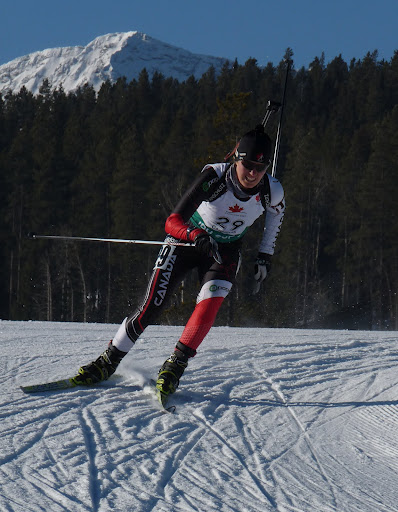
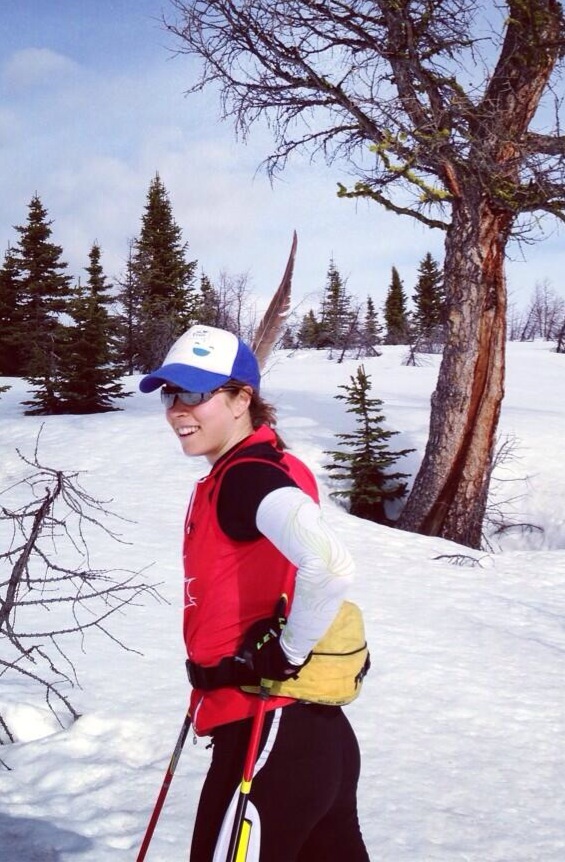
    A feather in her cap: Megan Imrie on a long ski at Sunshine this spring. Courtesy photo.
    A feather in her cap: Megan Imrie on a long ski at Sunshine this spring. Courtesy photo.

    The 2011/2012 season was a good one for Megan Imrie. The Canadian biathlete had the four best results of her career, including her first two top 20’s. Along with Zina Kocher, Brendan Green, and Jean Philippe Le Guellec, she was part of a mixed relay that finished a landmark sixth on the World Cup in Hochfilzen, Austria. Along with the rest of Canadian biathlon, things seemed to be on an upward swing for the 2010 Olympian.

    But the next season brought challenges for almost that whole relay team. Kocher had a subpar season; Green was out with back problems; and by the end of the first period of World Cup racing, Imrie knew that something was wrong. She was struggling, only breaking into the top 60 once and more often falling into the 70s or, worse, the 90s.

    “I was asking my body to perform and there was absolutely nothing there,” Imrie told FasterSkier in an interview this week.

    So, knowing that things were only going to get worse if she kept pushing, she did the only thing that was left: she went back her parents’ ranch in Falcon Lake, Manitoba, settled in with her family for the -40 degree winter, and didn’t think about biathlon for a few weeks.

    Imrie now knows that her season was sabotaged by a combination of overtraining and the illnesses and injuries that plagued her almost every month in off-season. But at the time, neither she nor her coaches could quite add up the pieces of the puzzle.

    “It was an extremely frustrating time, because no one knew really what was going on,” Imrie explained. “I felt I’d done the training I was capable of, but I was falling miles short of where I knew I could be in races. People were asking me why this was happening and I had no answer.”

    During her mid-winter break, Imrie did a lot of thinking. By the time she returned to action for the last World Cups of the season, she had a question she needed to answer.

    “The first was to see if this if biathlon is what I really wanted,” she said.

    The answer? Yes. And so she’s setting about training this summer and fall with a vengeance – a smart, measured vengeance, from the shooting range in Canmore, where the national team is based, to the late-spring snow higher up in the mountains where skiers can still do long workouts in June.

    “So far it’s looking like I’m in a better place, physically and mentally, than I’ve ever been,” Imrie reported. “I’m truly motivated to be as strong as I can for the winter. Part of this comes from being healthy. Knowing just how bad I felt last year makes me appreciate what I’m capable of now. It’s a pretty nice view from the glass-half-full perspective.”

    Back on the Ranch

    “Once I got home from Europe at Christmas, I was ready to use my skis as kindling and throw my rifle in a snowbank,” Imrie said. “Deciding to give myself as much time as it might take to recover was a decision I probably should have made earlier.”

    The circumstances for her return to Manitoba were definitely less than ideal. Yet they also presented a unique opportunity. Only about once a year, in April, do skiers and biathletes have the chance to completely leave their sport for a few weeks, set their minds to other things, and rejuvenate. During years on the European circuit, they barely ever get to see their families during the winter, or do any of the fun wintertime activities at home that they remember from growing up.

    So Imrie took her mid-season break and embraced it.

    “I was able to forget about biathlon and get some true, deep rest the best way I know how,” she said. “Home on my parent’s ranch, it was probably the coldest I’ve ever seen the thermometer. In the -40’s. But that didn’t stop us from spending a day on the trapline, snowmobiling through rugged backcountry. We had bonfire lunches in waist deep snow, harnessed the horses for sleigh rides, and just spent time together. On a days like those, I couldn’t have been further from the crowds of World Championships, and it was just what I needed.”

    There were times, too, when she was brought back to biathlon, and reminded of why she had been so involved in this sport in the first place.
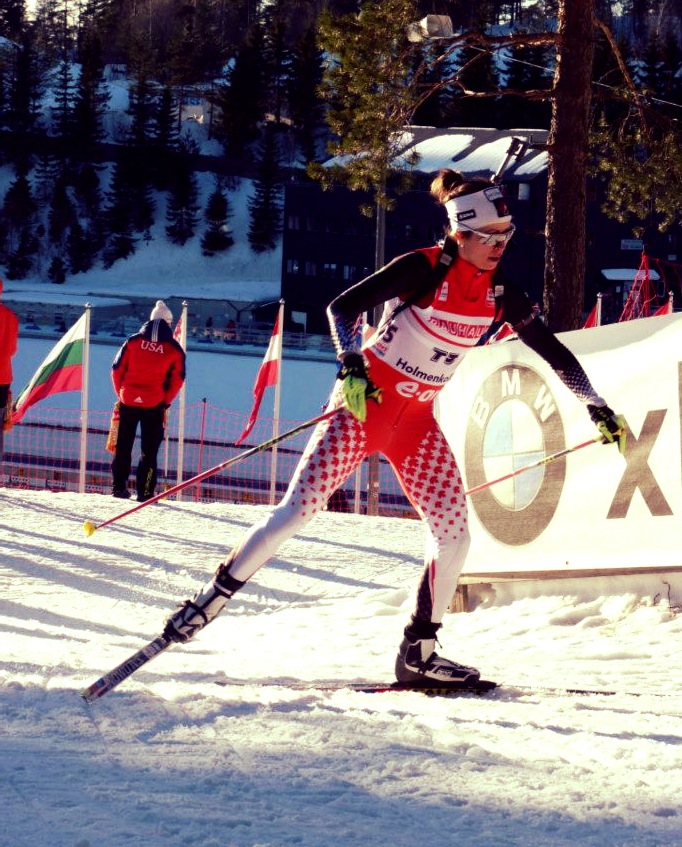
    As a test run, Imrie hit the World Cup circuit again in Oslo in late February. Courtesy photo.
    As a test run, Imrie hit the World Cup circuit again in Oslo in late February. Courtesy photo.

    “There were a number of great moments when I was back that helped me out,” Imrie said. “One was visiting an elementary school in my boyfriend’s hometown in northern Manitoba. There’s really nothing like being told ‘I want to be a biathlete just like you’ to make you smile.”

    She spent her 27th birthday in Canada, looking on from afar as her team competed at World Championships. That day, Le Guellec placed tenth in the 20 k individual race; southern neighbor Tim Burke won a silver medal for the U.S.

    This season, North Americans have proved more than ever that they can cut it on the world stage. But for Imrie, the greatest thing that will allow her to contribute to that onslaught might have been staying at home with her horses.

    “To spend time around horses takes me back to how I grew up and who I am,” Imrie said. “Their laid-back attitudes, childlike curiosity, and ‘right now’ thought processes are great reminders to an on-the-move athlete.”

    Race Ready Again

    After a few weeks, Imrie returned to Canmore, where she met with her doctor and the team’s sports physiologists. After some tests, she was declared healthy to train again. It was a relief.

    “I could feel strength and improvements- something I’d been void of since sometime in 2012,” she admitted. “I was able to put in about two or three solid weeks before I went to Oslo and Sochi.”

    That’s not enough of a base to be competitive, so Imrie tried to push results out of her mind when she returned to the unforgiving World Cup. But besides deciding whether biathlon was really what she wanted to devote her life to, she had an important mission: to scope out the Sochi courses for the upcoming Olympics.

    “[I wanted] to drink in and learn the Sochi course,” she said. “And I think the race course at Sochi was excellent. Of course, it was hard. The cumulative feel of the climbs was unlike anywhere I’ve raced, and the downhills took technique and guts to do well and safely. But that said, I really enjoyed it.”

    If anything, that has made Imrie more motivated to train this summer and be full-strength for her second Olympics. She’s part of what she reports is Biathlon Canada’s biggest national training group “in a while,” although it’s mostly made up of men; of this year’s four-woman World Championship team, Kocher trains with the Biathlon Alberta Training Centre, Megan Heinicke lives in Germany, and Audrey Vaillancourt stays home in Quebec. So it’s Imrie, Rosanna Crawford, and the guys.

    But that’s no problem.
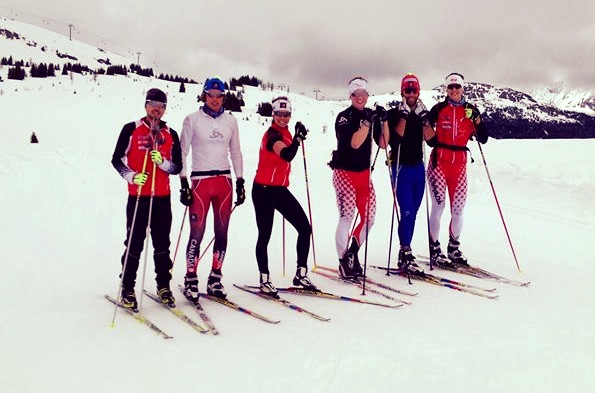
    The national team training group on a recent ski at Sunshine. Courtesy photo.
    The national team training group on a recent ski at Sunshine. L-r: coach Roddy Ward, Brendan Green, Imrie, Scott Gow, Scott Perras, and Rosanna Crawford. Courtesy photo.

    “It’s a fun group, everyone’s been really eager to make solid training happen,” Imrie said. “The nice thing about biathlon is that training is often centered around the range, so in a workout, you’re never on your own for very long.”

    She and Crawford have plenty of other training buddies too, outside their team.

    “Canmore is also a very nordic community,” she explained. “There are always friends in town to train with. I often meet up with Perianne Jones, Zina Kocher, the World Cup Academy ladies, or other non-racing friends for workouts. In July, Rosanna, Audrey and I will join the Americans in Lake Placid for a camp. It will be great to catch up with them and pump out some hard intensity with more sparring partners.”

    A high point of the early training season has been the chance to get on snow. In the fall, Canmore offers early skiing by way of Frozen Thunder, a snow-saving operation. But in the spring, if offers the same thing as athletes ramp up again via a more joyful backcountry route. In May, the team would hit up nearby Mount Shark. Since that melted they’ve been heading to Sunshine, a 45 minute drive, about once a week.

    “It’s a special place this time of year,” Imrie said. “Usually there’s perfect crust skiing conditions, but if not, there is an excellent groomed loop on rolling terrain. It’s very high there (I think about 2500 meters) so we’ve been doing morning long distance workouts.”

    It’s great from a nuts-and-bolts perspective: as the athletes hit the rollerskis again and build strength in the gym, they have the chance to directly apply those changes to their on-snow technique and get the most out of any improvements.

    But it’s also a reminder of the joy and adventure in their sport, something that Imrie now appreciates even more fully.

    “We can drive right up the mountain to the village, from there we hike or ski about 10 minutes up to the meadow which is where the best skiing is,” she said. “It’s really fun natural terrain and tree skiing. When the crust is good, you can ski for a couple hours before the sun softens the crust too much. When your poles start to punch through, you know it’s time to head back to the groomed trail. The workouts go by quickly when there’s so much exploring to do.”
  • Two-Time World Youth/Junior Champion, Wenzel Calls It Quits at 22; Schultz Joins Him on the Bench

    Two-Time World Youth/Junior Champion, Wenzel Calls It Quits at 22; Schultz Joins Him on the Bench

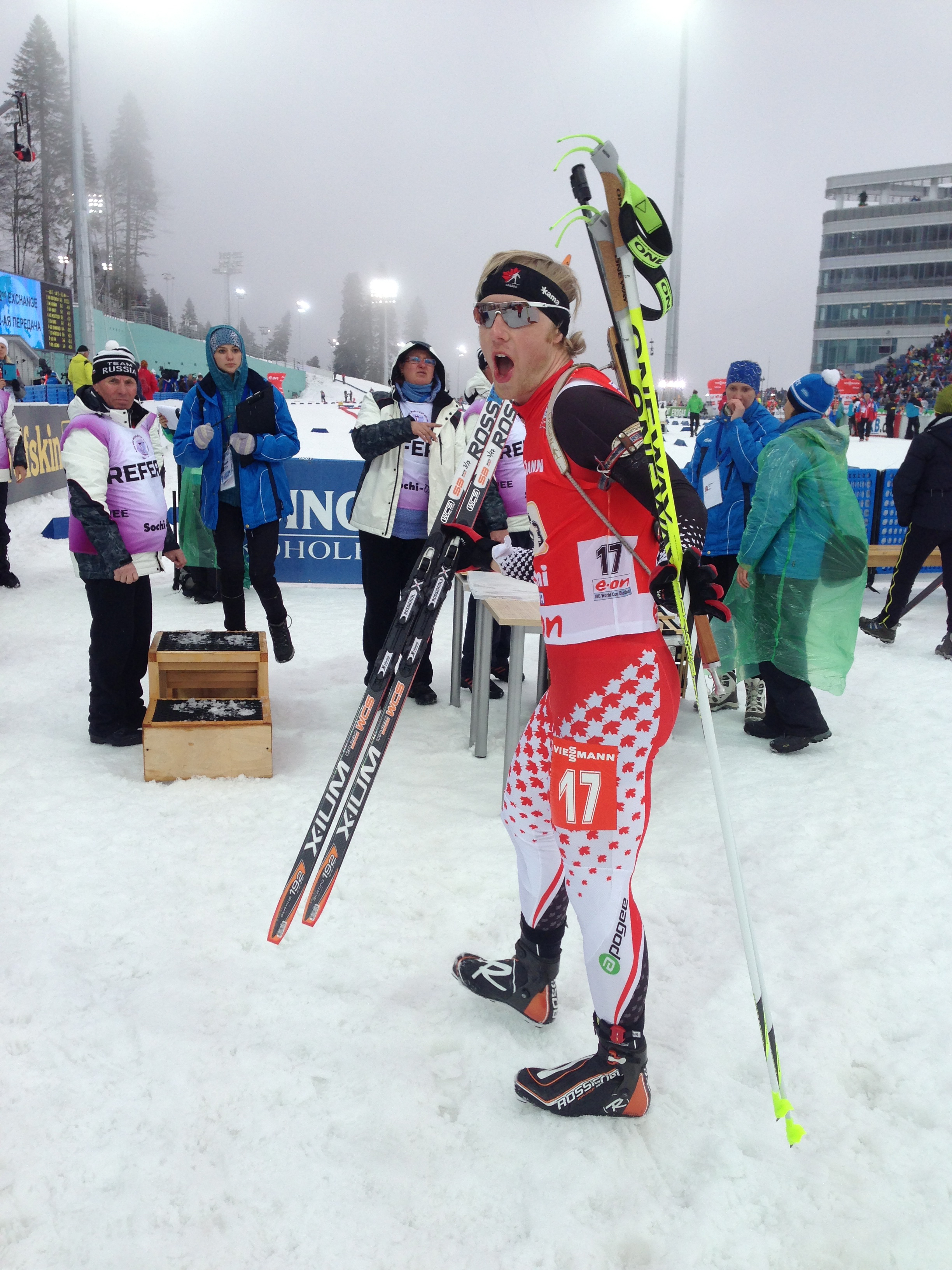
    Canadian biathlete Kurtis Wenzel after the first and only World Cup biathlon race of his career, in Sochi, Russia, in March. Courtesy photo.
    Canadian biathlete Kurtis Wenzel after the first and only World Cup biathlon race of his career, in Sochi, Russia, in March. Courtesy photo.

    Just one week ago, Canadian biathlete Kurtis Wenzel told FasterSkier that winning his first national championship was “a perfect way to end the season.”

    Hidden inside that statement, though, was a bigger one: Wenzel contacted Fasterskier yesterday to announce that he is ending his career as a biathlete. The 22-year-old had raced in his first World Cup only a month or so before.

    And he joined another national team member in calling it quits. After a difficult season where her body never really got going, Melanie Schultz also decided to hang up her skis and move on. Both were probably outside shots for the 2014 Olympics, and would have had to fight hard to unseat more seasoned World Cup veterans.

    So it’s not so much the Olympics where Canada will feel the loss, but rather what comes after – for instance, what if there’s a spate of retirements by older athletes, as often happens after a Games?

    “Athlete recruitment and athlete retention are definitely two issues we face, being such a marginal sport to start with,” World Cup winner Jean Philippe Le Guellec told FasterSkier in an e-mail.

    Upward Trajectories…

    Melanie Schultz racing in Canmore last year. Photo: Michael Potter.
    Melanie Schultz racing in Canmore last year. Photo: Michael Potter.

    Wenzel’s biathlon career was marked by ups and downs: in 2009 he won the World Youth Championships sprint, then in 2011 took the year completely off from biathlon after feeling overwhelmed. He was as surprised as anyone else when he came back to win the World Junior Championships individual race in 2012.

    The rags-to-riches-to-rags-to-riches story was certainly one of the most compelling of a 2012 Championships that also featured the first win by an athlete from the Netherlands; it was a good year for underdogs.

    “I was really excited to be racing in the international scene again and lucky I could have one of my best races so far this year at Worlds,” he said at the time.

    Yet in his first senior year, 2013 put the young Canadian back at the bottom of the heap. He did an IBU Cup tour and then, by the end of the season, had begun to climb upwards, starting the World Cup relay in Sochi, Russia and then winning the national championship pursuit. As he earned more and more start rights, it seemed like he might be able to mimic the path of Scott Gow, who finished his junior career just one year before Wenzel and was the youngest competitor to make the pursuit race at World Championships.

    So the Sochi trip could have been a preview for an Olympic bid next year, but Wenzel says he realized he no longer felt that drive.

    “I don’t actually dream of going to the Olympics anymore,” he said. “When I realized that, the decision was easy. However, I was very luckily to live out my long time fantasy of racing a World Cup in a packed stadium. I am also luckily to have had such a great support network of people to help me through my career and with this decision. I cannot thank them enough!”

    Wenzel had first considered retirement back in December, but knew he wouldn’t decide anything final until the end of the season.

    “Now I have had some time and it still feels right,” he said.

    As for Schulz, the 27-year-old struggled to find her ski speed at the beginning of the season. A few health issues had slowed her down during dryland, and when she hit the IBU Cup she couldn’t get going. Concluding that her body had just had too much training over the past few years, she spent a month relaxing in southeast Asia, hoping that the rest would help her find some energy.

    But upon returning to the sport later in the winter, Schultz still couldn’t get up to full speed.

    “After nine years of focused training and racing where I continually pushed myself to my limit and beyond, it was apparent my body and mind were saying, ‘Enough!’” Schulz wrote on her website. “Listening to my intuition, I decided it was time to hang up my skis and rifle for good and give myself a much needed and much deserved rest. I definitely have mixed feelings about my decision, as I imagine most athletes do when they retire from sport.”

    The departure comes just one year after Schultz seemed to be really making a leap in results; she was named Biathlon Canada’s Female Athlete of the Year in 2012, and also received the Ruedi Setz award for “exemplary standards of sportsmanship and significant contribution to the development of biathlon.”

    … Aren’t Enough

    Le Guellec, who is the same age as Schultz but has been involved in the sport much longer, has seen athletes come and go from the national team – mostly, go.

    But the spate of younger athletes calling it quits seems a bit new to him. For one thing, there wasn’t always such a strong cohort of older athletes to fight against for starting spots. He explained that back in 2004, both junior and senior athletes qualified to receive financial support from Sport Canada. Now, the national team is “saturated,” Le Guellec said, making it much harder for younger athletes to get paid.

    “In this day and age, we have a full flock of seniors all getting carded by Sport Canada,” he said. “So if you’re a youth, a junior and even a senior, you have to train and race on your own dime for the most part: season in, season out. When you add up the costs for a full year of training, it can’t surprise you that that can be a deal breaker after a certain time.”

    Just making it as far as Wenzel and Schultz did requires a large and diverse support network, and both said they appreciated the many people that had made their careers possible.

    “I want to say a HUGE THANK YOU to all my sponsors, coaches, teammates, support staff, family, friends and fans of my biathlon career for the last nine years,” Schultz wrote on her website. “I wouldn’t have been able to accomplish all I have without all of you!”

    Both athletes were part of Canada’s national team last season, but that’s hardly a guarantee of financial security.

    “I’m not aware of numbers for budgets and such,” Le Guellec said, “but I guess comparing our federation to a family of say 14 kids while being a single parent on welfare could be pretty spot on. They’re in a situation where they have very little money to make an entire sport run in a huge country. Their biggest challenge is, unfortunately, finding the resources to fund development squads, camps, cut costs for travel to competitions and so, and so and so on… with pennies.”

    Biathlon Canada could not be reached for comment.

    Having a significantly more robust senior national team is obviously a boon to the sport. But it’s just one reason that young athletes might look at the years ahead and begin to wonder if they can hang on for long enough to finally reach the top: Gow, Wenzel, and teammates Yolaine Oddou and Audrey Vaillancourt were unusual in their ability to translate success at the junior level to World Cup starts in just a year or two, but none spent the entire season on the top circuit.

    And while none of the debuts went badly, it’s a tough transition to make. Le Guellec thought that seeing the real level of competition might make athletes think differently about what lay in store in the coming years.

    “Having an Olympic dream is nice,” he said. “Being motivated is also nice. Resources and passion aside, I’ve seen athletes be exposed to the international field and it can be very intimidating. It doesn’t take a math degree to start adding up the work you’ll need to do in order to climb the ranks – plus this is a process that can be long. I wouldn’t say they scare off, but when you add up points 1 and 2, maybe its just a lot of work for not much in return to at least help you through it.”

    All of that is, of course, harder when you are from North America. The amount of time spent on the road is difficult for many athletes, who may not return home to see their families for months at a time.

    Wenzel confirmed that after one long tour in Europe this year, he was a bit overwhelmed.

    “The decision was spurred by a combination of my difficulty dealing with life on tour and a desire to expand the other parts of my life that were put on the back burner,” he said.

    Next Steps

    The most common thing that athletes give up is school, and that’s where Wenzel will be headed in the fall, if all goes well.

    “I will hopefully be studying economics at the University of Calgary, but I still have to apply,” he said. “I have done a couple courses at U of C before and I was accepted into the Kinesiology program, but I realized that’s not what I would like to study.”

    A few elite-level biathletes and skiers have been able to make school work, somehow, while still competing on the World Cup: Alex Harvey is in law school, Astrid Jacobsen is in medical school, Maurice Manificat is studying biology. But Wenzel knew that he couldn’t be like them, at least not with any level of success.

    “I have definitely been putting school on hold because of training,” he explained. “It would have been impossible for me to hold down my job in Calgary, go to school in Calgary and train properly in Canmore. I am also a horrible procrastinator at times so correspondance courses wouldn’t have worked for me. Honestly, this winter was the first time I really started looking forward to going to school. I think that helped make the decision for me.”

    Schultz, meanwhile, will be transitioning from part-time to full-time work as a patent agent at an intellectual property firm in Canmore.

    “I’m transitioning into the life of a non-athlete,” she wrote on her website.

    That’s never an easy transition, but Wenzel hopes to stay involved with the sport just enough not to miss it. Coaching was a possibility, he said.

    And training.

    But just “a little bit.”


  • After Trip to Test Out Sochi, First National Title is ‘Perfect Way to End Season’ for Canada’s Wenzel

    After Trip to Test Out Sochi, First National Title is ‘Perfect Way to End Season’ for Canada’s Wenzel

    Canada's Kurtis Wenzel won a gold medal at 2012 World Junior Championships; his coaches and teammates hope that he'll soon be contributing as a senior. Photo by Judy Geer.
    Canada’s Kurtis Wenzel won a gold medal at 2012 World Junior Championships; this year, his first senior national title. Photo by Judy Geer.

    After taking a year off from biathlon, coming back to win his first World Championship, and then graduating from the junior ranks, last year was a bit of a whirlwind for Canada’s Kurtis Wenzel.

    And then, he was faced by a challenge familiar to all newly-senior North American biathletes: what do you do next? With many teammates who already have World Cup or even World Championships experience and a small number of lightly-attended NorAms, it’s sometimes a challenge to find racing opportunities and stay motivated.

    Luckily, Biathlon Canada has been sending more athletes to second-tier IBU Cup races in Europe, and in February Wenzel hit the circuit, where he stayed for the next several weeks.

    Then, some good news, and the end of the season began to take off. Wenzel got the surprise call to go to Sochi, Russia, to compete in his very first World Cup – at next year’s Olympic venue. The he flew home and competed in national championships, earning his first title as a senior. Not a bad way to wrap up a season that had its downs as well as its ups – for instance when Wenzel got sick in Bansko, Bulgaria, and missed every race of Open European Championships.

    Olympic Preview

    To say that the Sochi trip was last-minute would be an understatement. It wasn’t always clear that the team would even bring four men to the venue, much less that Wenzel would be one of them.

    “I wasn’t really picked out to test the new venue, more just to secure four start sports,” Wenzel explained to FasterSkier in an interview. “Biathlon Canada received a grant for that specific reason from the Canadian Olympic Committee. Without the grant I would have had to pay my own way for two weeks in Europe just for one race, which would have been hard for me to justify. I wasn’t the first choice for the spot either: Marco Bedard turned down his spot due to some tendon problems and Nathan Smith had just got back to Canada when they found out about the grant.”

    The Canadians were trying to make it into the top 15 of the year’s Nations Cup standings, which would secure them four starting positions on the World Cup, as opposed to the three they had for men this year. Since relays count heavily in the scores, the team had secured the grant to send a full relay team to Sochi, even if Wenzel wouldn’t have a spot in any of the individual races.

    “I found out I would be coming to do the WC8 relay just before European Championships in mid-February,” Wenzel said. “I had to go on my own to Munich for five days to get my Russian visa… Sochi was my last stop on a tour that began mid January and I was feeling incredibly run down. I was sick at European Championships in Bulgaria and it was a big struggle to get myself feeling like I could race again. I actually requested they send another athlete to take my place, but it was too late to change everything at that point.”

    So in some ways, his big debut did not go as planned, at all. The whole team was feeling a little under the weather; several of the men suggested at the time that they had been much stronger early in season and their ski form was simply gone. The team failed to score points in either the individual or the sprint, and placed 15th in the relay, one spot behind Belarus. The two teams had been dueling for the top-15 position all season, and Belarus ended up getting it, leaving Canada with a three-man quota again next season.

    “I was certainly unhappy with my ski form, which is not at World Cup level at the moment,” Wenzel said. “However, my shooting was satisfactory and saved me from losing more time off the leaders… Our goal was to secure a top 15 overall World Cup ranking and I was not able to hold up my end of that.”

    The team had started out in 17th after Jean Philippe Le Guellec struggled on the shooting range; Scott Gow pulled Canada up to 13th before Gow took his turn, tagging off to Scott Perras who held 15th. Even if his skiing was below par, Wenzel held his own on the range, using a single spare round. That showed he could handle the pressure of perhaps the most stressful event on the World Cup circuit.

    “It wouldn’t say it was ‘over’ whelming for me to race in Sochi,” he joked. “I think it was just the right amount of ‘whelming’. Apparently I can keep my cool in these kinds of situations.”

    And, the 22-year-old now has a bit more experience that will surely help him in the future.

    “It was an amazing experience,” he said. “I have always wanted to race in front of big packed stands and I feel lucky I got to do it at one of the most epic venues imaginable. The venue is the biathlon temple of Russia. The trails are some of the hardest I have ever seen.”

    And just in case he gets the call for next year’s Olympics – where Canada will have four starting spots – he knows what to expect from a venue that was universally described as great, but strange.

    “There is a stark contrast between the original dwellings in Krasnaya Polyana, the new hotels and Olympic village,” Wenzel said to add his own description. “Imagine a glorious winter resort built from nothing with no history of skiing in a short time. In Russia they truly believe that if you build it, they will come. There were lots of enthusiastic fans and volunteers excited to be a part of something so big. I was glad they all got to see the home team pull through for the men’s relay.”

    On To Nationals

    Like most of the other North American national championships in the nordic disciplines, Canadian biathlon nationals – which this year doubled as North American Championships – is not attended by most World Cup athletes. But the event, held in Whistler this year as part of the Sea to Sky Festival which also included Ski Nationals, allowed Wenzel to go head to head with some of his rivals for World Cup starts.

    He wasn’t sure how things would go.

    “I was expecting bad jet lag and a repeat of the exhaustion I felt while on tour in Europe, but coming back to Canada after two months abroad really perked me up,” he said. “I wasn’t in great ski shape, but it was good enough and my shooting mentality was spot on. It was the right combination of wanting to hit targets and not worrying about it.”

    Wenzel started the series off with clean shooting, finishing second in the sprint to Smith by 59 seconds to earn a silver medal. That normally would have put him in a tough place in the pursuit, skiing alone with little chance of catching the World Cup veteran; but racing in North America is often different than in Europe, where pursuits are started based on time gaps from the sprints.

    “The pursuit was actually a special NorAm circuit start where everyone goes at 5-second intervals based off their sprint race ranking,” Wenzel explained. “This gave me hope that I could beat Nathan up until the middle of the race where he opened up a gap from skiing and shooting much faster then me.”

    But, although Wenzel didn’t know it, Smith had started early and was given a 30-second time penalty. So it was a good thing that the younger racer kept his cool, hit all 20 targets – making him 30 for 30 for the weekend – and stayed focused.

    “I was actually still very close to catching him,” Wenzel said. “He missed two at the last shooting and I was able to stay clean which put me out 10 or 15 seconds behind him without the penalty. He tried his best to open that up to 30 seconds to overcome his penalty but I held on for the win! Most of the race I was just focused on holding on to second place so it was a big surprise when I found out I won.”

    Even though it was his first year as a senior racer, it wasn’t his first time in the open class at nationals. So Wenzel had come into the weekend knowing what was possible, but also cautious and doubtful that it could happen.

    “I raced up and competed as a senior last year at nationals and earned a bronze medal,” he said. “I know I had it in me to win at Nationals, but I was surprised I pulled it out after being out of shape for so long.”

    Wenzel finished off the weekend by placing fourth, the third Canadian, in the mass start, which Smith won. He then joined forces with Smith and World Cup racer Rosanna Crawford to win the mixed relay for Alberta.

    Despite the slow ski shape, Wenzel continued on with his race season, competing in two races at ski nationals; in his year away from biathlon, he had focused on skiing, so in some ways that was a return, too. Tired, he placed 50th in the 10 k skate and 39th in the 50 k marathon.

    But of all the events in Whistler, it was unsurprisingly the national championship that stood out.

    “I have had some chances to beat Marco and Nathan this year besides nationals,” Wenzel said. “At trials for IBU Cups 6 and 7 I won against Marco in the sprint and at an Alberta cup in January I was able to beat Nathan as well. I have to say, even with the unusual circumstances, doing it at Nationals was much more satisfying! It was a perfect way to end the season.”


  • LeGuellec Paces Canada in 10th, Canucks Put Three in Top 31

    LeGuellec Paces Canada in 10th, Canucks Put Three in Top 31

    J.P. LeGuellec finished 10th overall in the 20 k individual at World Championships on Thursday to lead the Canadians. Photo: Nordic Focus/Biathlon Canada.
    J.P. LeGuellec finished 10th overall in the 20 k individual at World Championships on Thursday to lead the Canadians. Photo: Nordic Focus/Biathlon Canada.

    American Tim Burke stole the North American spotlight at World Championships in the 20 k individual on Thursday, but Canada’s Jean Phillippe LeGuellec had a respectable showing of his own about a minute back. The Canuck finished tenth overall to lead his team in Nové Město na Moravě, Czech Republic, with one penalty in the final stage and crossed the line 1:48 behind Martin Fourcade’s (FRA) top mark. LeGuellec was “pretty happy” with the outcome considering his ski form was not what he wanted it to be.

    “Unfortunately I didn’t feel all that great on my skis today,” he wrote in an email. “I realized this with the very first climb and alarms went off. My tactic quickly shifted to being able to shoot clean and fast. Crunching down on time in the range would help compensate slightly for the time lost on the tracks.”

    LeGuellec posted a first-lap course time that ranked in the 50s, but thanks to shooting clean, and quickly (the third-fastest in the field), he left the range in 24th after the first stage. With only one error in total for the rest of the race LeGuellec saved what could have been a worse result, but he still wondered what could have been had he felt better on his skis.

    “Considering the ski shape today, I’m happy with the race I pulled off,” he said. “But also disappointed considering an average ski time in the individual would have helped me climb higher in the top 10. But it’s definitely a good result if I look at the ups and downs of this season.”

    Scott Perras finished next for the Canadians in 26th, 3:20 back with two errors. Like LeGuellec he had hoped to feel faster on the track, but reasoned that he did what he could in the 20 k with what he had.

    “It’s important to me that I am able to perform at the biggest event of the season and I wasn’t able to do that in the sprint,” Perras said. “I am happy with today but not satisfied if that makes sense, my skiing slipped a little bit for these World Championships and that is a tough thing to accept but once I did I was able to focus on what I could do to get the most out of [it].”

    Scott Gow finished 31st for the Canucks in 31st, 3:36 back with one error, and Nathan Smith took 63rd with three errors (+6:41).

    On a team level Perras noted that the Canadians had one of their best days ever on Thursday, shooting 91% as a group.

    “I am super proud of our team today,” he said. “We pulled ourselves into the top 15 overall ranking and probably had one of our best days as a team at World Championships.”

    Results.


  • Perras Collects First Top-Ten, Gow 29th for Canada in Ruhpolding Sprint

    Perras Collects First Top-Ten, Gow 29th for Canada in Ruhpolding Sprint

    Scott Perras (CAN) warms up to the cheers of the spectators at World Championships last year in Ruhpolding; today on the same course, he notched his first top-ten.
    Scott Perras (CAN) warms up to the cheers of the spectators at World Championships last year in Ruhpolding; today on the same course, he notched his first top-ten.

    The Canadian biathlon team isn’t known for chasing points, and that couldn’t have been more apparent last weekend in Oberhof, Germany, when they sent only a skeleton crew to the first World Cups of the new year. It’s a tactic they have used in the pass to give their athletes more time at home in North America; as several pointed out, now that they’re back in Europe, they’ll stay there until mid-March at the earliest. That’s a long time.

    “It was never the plan for the team to go to Oberhof,” Scott Gow told FasterSkier. “JP [Le Guellec] and Zina [Kocher] went because they were chasing points, and the plan for everyone else was to stay home, put in a good training block, and try to be as ready as possible for the tour. Also, this tour is going to last until at least after Sochi, so to have an extra week home before a very long tour is nice.”

    While that almost certainly cost Canada some Nations Cup points, especially since two relays were featured in Oberhof, it’s seeming like the right decision now, as both Gow and Scott Perras notched career-best results in the sprint in Ruhpolding, Germany today. Gow placed 29th, his first time in the points; Perras was tenth, his first time in top ten.

    While Gow thought that being able to do a volume block at home over Christmas helped him out today, Perras wasn’t so sure. He as more concerned about maintaining fitness and a good base, which is tough to do during the season.

    “When you are on the World Cup it is hard to log a ton of volume hours,” Perras wrote in an e-mail. “Volume hours are not for everyone but they are for me, I did my best to log some solid volume so that I could be fast in February and beyond.”

    Spending a few weeks in Canmore did give him an advantage today, however, and it came from having similar conditions and a solid gameplan. Perras had the 31st-fastest course time and Gow the 37th; but Perras timed his work perfectly, moving from 21st up to tenth between the final shooting and the finish.

    “The conditions were tough today, pretty slow and challenging,” Perras wrote, referring to the fresh snow that had fallen all day but luckily stopped before the men raced. “I was kind of happy with this because Canmore was cold and slow over Christmas so I was used to it. We did a race right before coming to Ruhpolding and it was slower in Canmore. I knew that it was going to be a long race and that I should leave something for the end.”

    Perras was able to ski with Simon Schempp of Germany for the beginning of the race, while Gow caught a ride with a French racer near the end. Skiing fast was important, and both men said that having people to ski with helped.

    But in Ruhpolding, shooting cleanly is also incredibly important. The venue often sees a high number of clean sheets, meaning that there’s less room for error.

    “Often in Ruhpolding you have to shoot clean, it’s a downhill approach the the range and there isn’t a breath of wind,” Perras explained. “My zero on my rifle has been the same since the first training day here. These two factors add up to a range where people are going to shoot well and do it fast.”

    While both men shot clean, Perras succeeded particularly well at this, and it’s what helped him climb into the top ranks; while he was just eight seconds faster than Gow on the trails, he made up time on the range.

    After sitting in the top 20 after a clean prone stage, Jean Philippe Le Guellec accumulated two penalties in standing and dropped down to 41st by the finish.

    “Thats why I missed two today!” he joked on Twitter. “… my first name isn’t Scott.”

    Along with Le Guellec’s win earlier this season, the first for a Canadian man on the World Cup, the team seems to be on the upswing despite the loss of Brendan Green for the season due to back injuries. While it’s easy to look at each performance separately, everyone involved insisted that the success is a team effort started years before – perhaps even with Le Guellec’s sixth-place finish at the Olympics in Vancouver.

    “I think our success as a team started last year when JP and Brendan started to really break through,” Gow said. “We all took that as motivation to better ourselves, and that added focus has translated into some great results for everyone. It’s also a huge confidence boost which helps the whole team train and perform better.”

    “We have a decent group and everyone has some strengths to bring to the game,” Perras agreed. “We started to strengthen our weaknesses by trying to match our teammates strengths. Like I told Brendan earlier this year, iron sharpens iron.”

    But he was particularly appreciative to have not only Green and Le Guellec as teammates, but also younger teammates like Gow, who has only competed in a handful of World Cup competitions.

    “Gow, he is the future of Biathlon Canada,” Perras wrote. “He is only 22 and pushes me everyday. Sometimes I look over at him training and think about how much ahead of me he is when I was 22.”

    And like the fact that the Canadians don’t chase Nations Cup points, they also don’t push their up-and-coming talent too hard, at least not if they can help it. While Gow has been a top prospect for some time now, he is still racing frequently on the IBU Cup, the tier just below the World Cup.

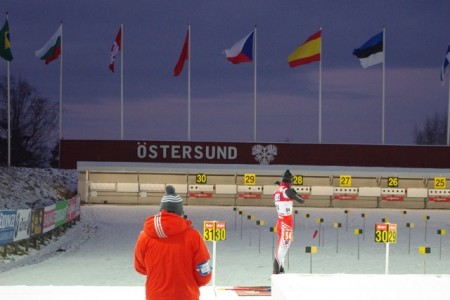
    “I started on the IBU Cup because the rest of the team was preselected for the World Cup,” Gow explained. “I started off the season with a top 6 on the IBU Cup and ended the World Cup in Pokljuka. I’m happy I did the IBU Cups first because it gave me the confidence I needed to perform well on the World Cup, that I may not have had had I gone straight to Ostersund.”

    Indeed, last season he did so well in early-season trials races that he made the trip to Ostersund for the opening World Cups. But once there, he placed 80th in the sprint. This year, he’s better prepared and hitting his stride in the middle of the season.

    “The coaches have been pleased with my results, so I was asked to stay on the World Cup and I have improved on my personal best with a top 30,” he wrote.

    With his performance, Perras qualified for the mass start tomorrow. Limited to 30 athletes including the top 25 in the total score and the next five best racers from the earlier part of the weekend, it’s tough to get into, and Perras has never done so before. He’ll be the lone Canadian contesting the race, which starts at 9:30 EST and can be streamed live for free from the IBU’s biathlonworld website.

    Lowell Bailey led the U.S. in 26th place with clean shooting; Jay Hakkinen also shot clean to place 54th, while Russell Currier had four penalties for 80th place and Leif Nordgren five penalties for 86th.

    results

  • Canada Names Biathlon Team for World Youth and Junior Championships

    Canada Names Biathlon Team for World Youth and Junior Championships

    Ransom at the podium ceremony. Photo: Richard Boruta.
    Canada’s Julia Ransom at the podium ceremony of last year’s World Championships youth pursuit, where she finished second. Photo: Richard Boruta.

    Biathlon Canada has selected 16 young athletes to represent their country at the World Youth and Junior Championships, to be held later this month in Obertilliach, Austria.

    The team is headlined by junior national team members, including Julia Ransom, who won silver in the youth sprint at last season’s World Championships. Since then, she’s gotten more experience under her belt when she competed in the distance races at the Canmore ski World Cups, where she finished 57th in the 15 k skiathlon and 52nd in the 10 k classic mass start, beating more than half of Canada’s nations’ group. Now 19 years old, Ransom will move up to the junior division of racing.

    But while she’s the most recent medalist on the team – last year’s Junior World Champion Kurtis Wenzel has graduated to the senior ranks – she’s definitely not the only one. Also in the junior women’s division will be teammate Rose-Marie Cote, who won bronze in the youth individual race back in 2011. They will be joined by Emma Lodge, who has two European race tours under her belt, and newcomer Erin Yungblut.

    In the junior men’s division, Christian Gow is returning from two top-20 finishes in last year’s races, and Macx Davies and Jasper McKenzie both have experience in prior editions of World Youth and Junior Championships. Menno Arendz is punching his first ticket to a championships event.

    Canada will almost certainly be led by Stuart Harden in the youth men’s division. Just one year ago, he turned in fourth- and seventh-place performances at the first-ever Youth Olympic Games in Innsbruck, then went on to place sixth in the pursuit in the youth pursuit of the Championships in Kontiolahti. Also making the cut are Carsen Campbell, who competed in Kontilahti, and newcomers Matthew Strum and Arthur Roots.

    Finally, the youth women’s squad has an experienced leader in Sarah Beaudry, who like Harden represented Canada at the Youth Olympic Games. She’s also been to the championships twice as a youth already. She’ll be marshalling a group of younger athletes: Leilani Tam Von Den Burg, Charlotte Hamel, and Emily Dickson.

    The complete roster is listed below. The first races of the Championships will be held on January 25.

    Junior Men:

    Christian Gow, Rocky Mountain Racers, Calgary AB

    Macx Davies, Biathlon Alberta Training Centre/Canmore Nordic Ski Club, Canmore AB

    Menno Arendz, Biathlon PEI, Hartsville PEI

    Jasper MacKenzie, Telemark Ski Club, Kelowna BC

    Junior Women:

    Julia Ransom, Biathlon Alberta Training Centre/Telemark Ski Club, Kelowna BC

    Rose Marie Cote, Courcellette, St-Jean Chrysostome QC

    Erin Yungblut, Biathlon Alberta Training Centre/Biathlon Ontario, Wroxeter ON

    Emma Lodge, Biathlon Alberta Training Centre/Canmore Nordic Ski Club, Canmore AB

    Youth Men:

    Stewart Harden, Rocky Mountain Racers, Calgary AB

    Carsen Campbell, Biathlon PEI, Bedeque PEI

    Matthew Strum, Canmore Nordic Ski Club, Canmore AB

    Arthur Roots, Biathlon Alberta Training Center/Caledonia Nordic Ski Club, Prince George BC

    Youth Women:

    Sarah Beaudry, Biathlon Alberta Training Center/Caledonia Nordic Ski Club, Prince George BC

    Leilani Tam Von Den Burg, Chelsea Nordic, Ottawa ON

    Charlotte Hamel, Club Biathlon Estrie, Sherbrooke QC

    Emily Dickson, Caledonia Nordic Ski Club, Prince George BC

    Coaches:

    Richard Boruta, Biathlon Alberta Training Center, Canmore AB

    Martin Tremblay, Centre Myriam Bedard, Valcartier QC

    Vanessa Bonk, Regina Biathlon Club, Regina SK


  • Le Guellec 10th in Hochfilzen Sprint; Career-Best Breakthroughs by Crawford, Perras Boost Canada

    Le Guellec 10th in Hochfilzen Sprint; Career-Best Breakthroughs by Crawford, Perras Boost Canada

    Jean Philippe Le Guellec of Canada racing in Sweden last weekend.

    When Canadian biathlete Jean Philippe Le Guellec stood on the starting line of the 10 k sprint in Hochfilzen, Austria, today, two things were different than usual.

    For one, he was in the red bib, signifying that he was the World Cup points leader in the discipline. That’s a first for a Canadian man.

    And secondly, he had a bad case of the nerves.

    “It was totally related to last week’s performance,” Le Guellec told FasterSkier in an e-mail. “At any stage, for any athlete, I think it’s safe to say that when you reach personal best performances, you always want to be able to back it up in the following event, thus confirming to yourself it wasn’t just a fluke performance. So my nervousness was definitely in line with: ‘OK, let’s see if I can back that race and repeat something worthy.’”

    Luckily, once he left the starthouse he was able to focus on the race and ditch the nerves. Le Guellec missed a single shot and skied the 18th-fastest course time, good for tenth place on the day.

    So, in response to the question he had been asking himself: “I’m very happy that that was today’s case… I’m totally happy with following up last week with a top 10.”

    Hochfilzen definitely didn’t feel the same as last week’s races in Östersund, Sweden, Le Guellec said; for one thing, there’s snow everywhere, and not of the saved or man-made variety. Despite slower snow, the clear skies made it a perfect day for racing, and Le Guellec reported that he had fast skis. There was only a bit of wind on the range, which he almost mastered. But not quite.

    “It was slightly windy on my standing, so my rifle was being pushed a little,” he wrote. “In an effort to compensate for the wind, I ended up overcompensating and missing in the left quadrant. I’m still happy with 9/10 though. Like [French Olympic champion] Vincent Jay said after the race when we spoke: ‘you can’t clean all the time!’ … although it’s always the goal for sure!”

    It was also a good day for teammate Scott Perras, who missed a single shot in standing and finished 25th, a career-best. Nathan Smith, however, didn’t fare as well, placing 73rd with four penalties. While he missed making the cut for the pursuit, Perras and Le Guellec are fired up.

    “Focus for tomorrow will be the hunt, which will be totally enjoyable once again given such a tight field! To be continued…” wrote Le Guellec.

    For the Americans, Tim Burke placed 22nd, Lowell Bailey 36th, and Russell Currier 56th; Jay Hakkinen and Leif Nordgren missed the pursuit, placing 67th and 81st.

    * * *

    Rosanna Crawford (CAN) on the range in Ostersund last weekend.

    A few hours later in the women’s 7.5 k sprint, Rosanna Crawford not only joined Perras in collecting a career-best finish, but one-upped him by placing 24th.

    “I was hoping for some good shooting because last week was pretty bad, for me, so I knew that was going to be key today,” Crawford told FasterSkier in a skype interview. “My prone had definitely come full circle since Östersund and my training had been really good, shooting-wise.”

    The single penalty, coming in standing, helped her achieve the result, which put her a minute and 19 seconds behind winner Darya Domracheva of Belarus. It was a huge breakthrough for the Canmore-based biathlete, who is a 2010 Olympian but has been bouncing on and off the World Cup.

    “I think my best result before this was a 51st,” she said. “There were the World Cups in Maine where I was 46th, but there were only [ten more] women so I don’t really count those results… It’s pretty exciting to finally crack that. Top 40 had been my goal at the beginning of the summer, and then at the end of the summer after testing I thought maybe I could make my goal the top 30. It’s a pretty big weight off my shoulders to know that hopefully this will become a reoccurrence.”

    After “spending ten years of my life training for biathlon,” as Crawford says, she was due for a breakthrough.

    “Are we surprised?” Biathlon Canada High Performance Director Chris Lindsay wrote in an e-mail. “Not entirely. Rosanna has been on a very impressive upward trend for the past two years. In our regular testing, in the field and the lab, she has been improving very quickly. We are beginning to see her potential. She has always been a fantastic shooter but now the speed is increasing and we see no evidence of her reaching a limit.”

    Matthias Ahrens, the head coach of the national team, agreed.

    “In my opinion the main improvements happened in all her summer training, partially to great commitment to all the training prescribed, being highly motivated and wanting to know how to improve in every aspect,” Ahrens told FasterSkier. “The other reason is great improvements in upper body strength and ski technique. But as she has good biathlon shooting faculties, when everything comes together a performance like today becomes reality.”

    While Crawford has historically been a very strong shooter in IBU Cup and national championships races, she has struggled to put that into practice on the World Cup, which had been the main thing holding her back.

    “It seems to me that I can always shoot really well to make teams, and at trials and the end of the season, but even last season the first three World Cups were awful, I was shooting 60 and 70 percent,” she explained. “I was worried that trend was going to happen again. So maybe it’s just that little bit of more pressure that there is on the World Cup.”

    For this weekend’s competition, she took a page out of Le Guellec’s book and focused on the process, not how she’d stack up a the end of the day.

    “After seeing my ski speed in the individual, I saw that with some good shooting I could have a good result,” Crawford said. “I think I got a little bit ahead of myself last week, and then this week it was a lot more not focusing on results and just focusing on my shooting and my skiing, and that will get the result I want. Not dreaming of the top thirty!”

    For tomorrow’s pursuit race, Crawford admitted that she was nervous; many of the women who will be starting around her had more penalties in the sprint, but skied faster. She knows that she’ll have to try to stay calm on her skis and relay on good, fast shooting to gain spots on the range.

    But with the momentum the Canadian team has going right now, there’s no reason not to be optimistic.

    “When people start doing well, the rest of the team can just sort of build off of each other,” she said. “A lot of us, we train together every day, so if you see them doing well, you know that you’ve done the same training, you’ve shot on the same range, so we should all be able to be up there.

    So it was pretty exciting with JP’s result and Zina’s tenth last week,” she concluded. “And JP getting to start with the red bib today made me start my race with a nice big smile on my face.”

    Megan Imrie and Megan Heinicke will join her in the pursuit after placing 56th and 57th today, while Zina Kocher was undone by shooting errors and wound up 73rd with five penalties.

    For the Americans, Susan Dunklee notched a much-improved 31st place finish, and Sara Studebaker will join her in the pursuit  – and perhaps work with the Canadians – after placing 58th today. Annelies Cook just missed the cut in 63rd, and Lanny Barnes placed 71st.

    International race reports

  • As Skiing Takes Spotlight in Quebec, Biathlon Canada Aims to Leverage World Cup Win to Grow Sport, Solve Budget Cuts

    As Skiing Takes Spotlight in Quebec, Biathlon Canada Aims to Leverage World Cup Win to Grow Sport, Solve Budget Cuts

    Jean Philippe Le Guellec, a Quebec native, became the first Canadian man to win a biathlon World Cup competition when he took an 18-second victory in a sprint in Ostersund, Sweden on Saturday.

    As the FIS Cross Country World Cup descends on Quebec, there’s another Canadian governing body that is hoping that fans and sponsors will remember its’ athletes successes this weekend – Biathlon Canada. Quebec native Jean Philippe Le Guellec became the first Canadian man to stand on the IBU World Cup podium, much less at the top of it, on Saturday.

    In fact, the success of Canada’s ski team, which is surely one reason that Quebec and Canmore were able to draw these World Cups, is one thing that inspired Le Guellec. He wanted to begin to match the success of the skiers, who have gained media attention, popularity, and funding from their exploits.

    “We’ve been looking at the cross country guys – Devon Kershaw, Alex Harvey, and a lot of the team actually have cracked the podium in the last couple years,” Le Guellec said during a press conference after his 18-second sprint victory in Östersund, Sweden. “It’s really great to be able to do this on the biathlon side too, and I really hope that it carries out throughout the season and throughout the years.”

    And while it is, frankly, beyond unlikely that biathlon’s top circuit will make a stop in the French-speaking province anytime soon, in some ways the sport in Canada owes a debt to Quebec more than any other province. Before Le Guellec, the last World Cup winner was Myriam Bédard, another Quebec native; of the three Canadians who have made it to the podium, only Zina Kocher is from outside the province, growing up in Alberta.

    “Granted, we’re only talking about three individual athletes here – two out of three is not a pattern, necessarily,” Biathlon Canada High Performance Director Chris Lindsay told FasterSkier in a phone interview on Monday.

    But pattern or no, Quebec is a unique place for sport in Canada, and nordic sports in particular. The current success of Le Guellec, Alex Harvey, and other Quebec natives comes as no surprise to Lindsay, who spent time in the province himself when he was training as an athlete.

    “The values espoused by the Quebec culture are much more conducive to being supportive of small-town sport, regional sport, and provincial sport,” Lindsay said. “I see a lot of similarities with how a local community in the United States would be able to support their team, maybe a local football team, where they can go out and actually get tangible support from the community. There’s the sense that the community will take ownership of this, because it’s people in the community who are participating.”

    Le Guellec picked up biathlon in 1999, the year that Bédard, a bronze medalist in the 1992 Olympics and then a double gold medalist in 1994, retired; he and the other Quebec biathletes work for much of the year at a venue bearing her name, the Myriam Bédard Training Centre at Valcartier, outside of Quebec City.  Lindsay drew parallels between the support given to the two World Cup winners.

    “Myriam’s success was partly because Myriam was Myriam, and she was an extraordinary athlete,” he said. “But also because there were mechanisms early on in her career which allowed her to be successful and to continue the sport and be well-supported. And I think you see the same thing with JP…. In Quebec you see an understanding that through participation in sport, and excellence in sport, we are promoting ourselves and we are reinforcing our understanding of who we are.”

    A New Hero?

    Lindsay hopes that Le Guellec can achieve something else that Bédard did, as well – inspiring a generation of athletes to consider biathlon, and to believe that success is possible.

    “We are very hopeful that JP becomes one of the symbols that Myriam was,” Lindsay said. “One of the reasons that JP got into the sport was because of the success and notoriety of Myriam Bédard…. We got very close to having that sort of hero status for JP at the Vancouver Olympics in 2010 [where he finished sixth], but we weren’t quite there. So hopefully this is coming full circle.”

    In Canada, Bédard’s fame has almost faded. Lindsay estimated that most athletes have a memory of one or two Olympic cycles; if they don’t make the national team, eight years is about the point where they leave the junior ranks and consider college, either leaving high-level sport completely or perhaps focusing on cross country skiing. In fact, many young biathletes weren’t even born yet when Bédard was winning her medals.

    For Le Guellec, putting Canadian biathlon back on the world stage has been a major goal.

    “The implications of yesterday, the consequences of that, I’m totally on board with,” Le Guellec told FasterSkier after Sunday’s pursuit in Östersund. “It’s what I’ve been working on all these years, essentially, to prove that Canadians can be up there. Tim [Burke] proved it [for the U.S.] two years ago being the leader before Christmas, and it was time for a Canadian to do that too. So North America can be up there.”

    (Americans agreed: “That was an awesome day for North America,” U.S. biathlete Susan Dunklee said after her own sprint race on Saturday. “We know what it’s like, and that’s a huge step for [Canada], because I don’t know if that’s been done before. It’s really cool.”)

    At the grassroots level of the sport, getting people involved – particularly kids – is something that Biathlon Canada actually excels at as a national body. Over 60 clubs are spread across the country, with several thousand athletes, coaches, and officials, and a “cadet” program that involves thousands more through the Royal Canadian Air, Army, and Sea Cadets program. In comparison, the U.S. Biathlon Association has just a few hundred members race each season.

    But the governing body wants more, and the high performance director hopes that Le Guellec’s performance can help the sport snag some more participants. At the very least, it has garnered more exposure for a little-known sport in the country.

    “We’ve enjoyed in the past weekend what I would call almost unprecedented media coverage,” Lindsay said. “We’ve been national news on each of our national sports networks and a lot of our regular broadcast networks have picked up the story. It has really been remarkable to see this level of support for any nordic sport, but especially biathlon, because we’re just not used to it.”

    Realistically, though, Lindsay knows that the team is going to have to keep the strong performances coming if it wants to stay in the public eye. (To outside observers, for instance, the FIS World Cup racing in Quebec and Canmore will quickly take the spotlight away from the biathlon team’s success.) Luckily, success within a team can feed on itself, and the rest of the biathletes are ready to deliver.

    “When someone is doing well on the team, it pumps everyone up, and I think that really motivates everyone to give everything they have on race day,” Kocher said on Saturday after placing 10th in her own race; she’s aiming to get back on the podium for the first time since 2006.

    Money Troubles, But No Quick Fix

    It’s not just fans and potential athletes that will be looking for another World Cup victory to inspire them, however. Biathlon Canada just this spring saw a budget cut from Own the Podium, a joint public-private partnership in Canada that targets funding towards the national teams most likely to win medals at World Championships and Olympic Games.

    While having an actual World Cup winner should definitely help Biathlon Canada state its case for getting their funding back – and maybe more – it’s not so simple. Own the Podium looks primarily at World Championships and Olympic performances, for one thing. But for another, funding is doled out on a comparative basis, so if other sports have good seasons too, well, the biathletes might have to do much more to earn their salaries.

    “The reality of the Own The Podium situation is that they have limited funding, and we have a number of winter sports,” Lindsay said, sounding weary. “The winter sports that are demonstrating that they are capable of reliably producing medals are the ones that are going to be at the head of the queue. We hope that this result helps to substantiate our claim that we have athletes who, given proper levels of support – not extraordinary, just proper – can make the jump from being a top-16 athlete to being a podium athlete.”

    As Lindsay discussed this spring, it’s a constant source of frustration that biathlon – a “mature” sport, unlike, say, freestyle skiing or snowboarding, and also one where the shooting aspect creates much more variability in the number of winners compared to a pure endurance sport – doesn’t get much attention from funders. Last season, for instance, before the budget cut, Kocher, Le Guellec, and Brendan Green all achieved top-ten World Cup results. To any fan of the sport, that would indicate medal potential.

    “Everyone in the nordic community recognized that JP’s multiple top-16 finishes [at the Vancouver Olympics] were remarkable, and cause for celebration, but they didn’t really match up against the snowboarders and the hockey team, the alpine skiers and curlers,” Lindsay said. “Without having someone on the podium, the reality is you’re in a different tier. Fourth place is not the same as third place.”

    Canadian biathlete Megan Imrie agreed, saying that the team’s strong performances don’t always appear so impressive to spectators who are new to the sport.

    “I know we’ve been really close to really good performances on a number of times, but nobody really cares about that unless you’re one, two, or three,” she told FasterSkier after the sprint on Saturday. “So having him as a World Cup winner at the first World Cup of the year is going to hopefully put biathlon up in the spotlight a little bit more.”

    Lindsay said that he was “optimistic,” and that talks with Own the Podium would certainly continue. He has also been working hard trying to use Le Guellec’s win to help attract more sponsors, which the team desperately needs in the wake of the cuts.

    “One of our big pitches, of course, is that we’re kind of a bargain,” he said. “The reality of our budget is that any little bit helps. And any little bit immediately has a massive effect on what we can do programming-wise in order to support even more success as we go on… but we are cognizant that it is going to take more than one weekend of results to make it really stick in people’s minds, that Biathlon Canada is an investment that could really pay off in partnership.”

    For now, the team can just enjoy the spotlight for a little while longer.

    “It’s been crazy,” Le Guellec told FasterSkier regarding the attention he received on Saturday. “My twitter followers doubled overnight. Definitely a lot of e-mails, a lot of facebook-posts. That was overwhelming, actually, more than any of the interviews themselves. But it was pretty cool to see all the support.”


  • With a Few Last Laps on Frozen Thunder, Smith Readies for Pressure-Laden December World Cups

    Nathan Smith competing at 2012 World Championships in Ruhpolding, Germany.

    Despite tying his career-best World Cup result last year, winning three IBU Cup races and hitting the podium in another, and securing a spot on Biathlon Canada’s “A” team, until recently Nathan Smith wasn’t feeling too confident about the upcoming season of racing.

    “I got a cold at the end of August and I guess I underestimated how much of a toll it took on me,” he told FasterSkier in an interview on Thursday. “So I did the NorAm races here in September and then went on a camp to Austria. I was pretty tired from that and October was pretty rough – I wasn’t feeling like my usual self. But within the last two or three weeks, I feel like I’m starting to get back into better shape.”

    That fitness was on display last week, when the Canadians had two time trials in Canmore on their two-kilometer on-snow loop, Frozen Thunder. In the sprint, Smith shot one penalty in each stage and finished a second off the podium.

    “It was a lot better for me,” Smith said. “I was pretty happy with my skiing, and shooting was good, especially in the pursuit considering that it was very windy at the range. So I’m happy with it… now I’ve had a couple of good time trials, so I’m feeling good about going into the season. I was a little bit worried earlier.”

    While Smith, as an “A” team member, is pre-qualified for the first World Cup races in Östersund, Sweden, the pressure is far from off. He has never spent a full season competing on the World Cup circuit: thanks to Biathlon Canada’s philosophy that athletes should routinely excel at IBU Cup races before making the jump to the World Cup, there’s typically a lot of movement in and out of the last starting spots on Canada’s World Cup team over the course of the season.

    Nathan Smith (l) and Scott Perras training in Bend, Oregon, this spring, a new camp for the Canadians.

    There’s added pressure this year because the organization will more or less select the team for World Championships, to be held in mid-February, before Christmas.

    “Due to a very unusual IBU Cup schedule, we do not anticipate having any IBU Cup athletes in Europe during January, just our World Cup team,” Biathlon Canada High Performance Director Chris Lindsay wrote in an e-mail. “This means that if you are on the World Championships team you will have been at the World Championships prep camp [in early February], and to be at the prep camp you were probably at World Cups five and six [in January], and to be selected for [them] you will have had to do well in December.”

    Although Lindsay stressed that total season performance would be considered in selecting the Championships team, and that World Cup athletes who didn’t perform well in the January World Cups wouldn’t be kept in Europe if other athletes had excelled in IBU Cup races, the strange schedule definitely puts the pressure on to perform well early in the season and hold onto a World Cup starting spot.

    “December is really important for us,” said Smith, who has raced at three prior senior World Championships and finished 43rd in the pursuit at the 2012 edition. “You have to show what you can do.”

    He’s also already thinking ahead to the Olympics, since the qualifying window is now open and senior athletes can only qualify through World Cup and World Championship events. Doing so is another reason to stay on the World Cup rather than bouncing down to the IBU Cup, where he won three races last year.

    “I’d like to make some Olympic criteria,” he said. “As a senior, you have to be going for top-30’s on the World Cup, so I would like to get a few of those, and then that will help a lot. Last year I didn’t have any top-30’s, but I think that some of my best IBU Cup races would have been at that level, so I hope that I can pull off races like that on the World Cup when I need to.”

    That’s a lot to think about, but luckily the team has been having fun as well. Last Tuesday, part of the national team headed to Calgary to try out speedskating.

    “It was pretty fun, but then yesterday we had to do our time trial and then again today, and pretty much everyone was complaining about their backs hurting because you have to bend over so much,” Smith said. “Yesterday my back was destroyed, but now it’s better. So it was fun, but next time I won’t do that this time of year.”

    It was a good exercise – “I can’t really think of anything that would be closer to cross-country skiing, the way that you’re supposed to set your foot and the balance,” Smith said – and typical of the Canadian team’s current tendency towards involvement with other sports. Head coach Matthias Ahrens, Smith said, had invited some of the speedskaters up to try an agility course and other biathlon training in Canmore earlier this year. And then there’s the increased collaboration with the national cross country team.

    “We did two or three intensity workouts with their team this year,” Smith said of the skiers. “Obviously that’s not a lot, maybe not enough, but it’s a start and it’s more than we have done before, so that was good. I hope it continues.”

    The issue of joint training is similar to that faced by the American ski and biathlon teams: how do you coordinate schedules? The skiers, Smith said, are often gone on camps, much more so than the biathletes. So even they are both at home base (more or less) in Canmore, it’s tough to line up workouts.

    “We do see them,” Smith said. “I’ve been seeing Ivan [Babikov] out there pretty much every day.”

    In addition to training, the two teams have gone in on a few other things together. One is the new rollerski treadmill in Canmore, which both groups used for testing. They also  announced their national teams at the same time in a joint media event.

    “That’s good especially for raising our profile,” Smith said. “Biathlon Canada is maybe riding their coattails a little bit. I think it’s partly because Chris Lindsay, our High Performance Director, is based out of Canmore now [he had been in Ottawa], so he probably gets to chat more with the cross country guys. That’s certainly a good thing.”

    Having a few more training partners was especially beneficial for the men’s team this year because Brendan Green, one of the most successful of the biathletes, has been out since February with a bad back and will likely miss the whole competition season.

    “We definitely miss training with him,” Smith said. “He’s always pushing us.”

    While Green’s absence is a blow to the team, it might help Smith in his quest to stay on the World Cup, however.

    “A lot of the time I’m kind of the fourth guy, and without Brendan last year we lost quite a bit of points at the end of the season so we actually only have three World Cup spots this year,” Smith explained. “It is unfortunate. So if Brendan was racing I would probably hardly do any World Cups. So I guess that’s one positive thing for me, but it’s not really that great.”

    Luckily, Smith said, Green didn’t fashion himself as the team captain, so leaving him at home in Canada doesn’t create as much of a hole as it could have.

    “Brendan is a pretty quiet guy,” he said. “I know he had the best results out of all of us, but he never really – he doesn’t like to be the leader. I don’t think our team really has a leader. Obviously Scott Perras and I really look up to the results that Brendan and JP [Le Guellec] have gotten, but it’s not really a leadership thing.”

    For another week or so, Smith is with the team in Canmore, training away until they depart for Sweden. That means more loops on Frozen Thunder.

    “Last week was pretty warm here,” he lamented. “We lost all of our natural snow, and Frozen Thunder was getting pretty thin and dirty. There were lots of rocks. But then a cold front came in and it started snowing, so it’s getting better. Just a little bit on top really helped it out.”

    Is he getting bored of skiing around such a small loop?

    “I don’t know, it’s okay, especially with shooting,” Smith said. “I think if you’re a cross country skier, it would be a lot worse.”

  • Enjoying Park City’s Fall Color, Kocher Sets Sights on More World Cup Top-Tens in 2013

    Enjoying Park City’s Fall Color, Kocher Sets Sights on More World Cup Top-Tens in 2013

    Canadian biathletes Zina Kocher and Rosanna Crawford run through the aspens in Utah last week. (Photo: Roddy Ward/Biathlon Canada)

    By all accounts, Canada’s Zina Kocher had a great season on biathlon’s World Cup in 2012. After a disappointing Olympics in Vancouver and then a dismal 2011, she joined the newly-formed Biathlon Alberta Training Center, skated through trials races, and rejoined the World Cup, where she had three top-ten finishes and landed 19th in the overall standings, her best-ever ranking in nine seasons on the circuit.

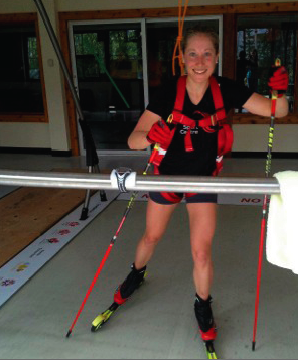
    This year she’s training to more consistently hit the top ten, and despite a temporary setback when she re-aggravated an old back injury, Kocher says her training is going well. She’s had several camps already, and along with the other Canmore athletes, she has a new toy to play with: a $200,000 ski treadmill that has been installed in the Bill Warren Training Center through a grant to the partnership of Cross Country Canada, Biathlon Canada, and the country’s paralympic nordic teams. Among the more standard ski treadmill features, this one, which was built in Calgary, has the ability to upload data taken on an actual racecourse, so it can simulate the terrain of venues around the world.

    Zina Kocher taking advantage of the new rollerski treadmill in Canmore. (Photo: Biathlon Canada)

    Kocher is currently in Park City, Utah, where she trained with the national “B” team and Canada’s cross country national team for a week; now, she’ll have a week there with her own Biathlon Alberta Training Center, and she’s sure to run into the many American skiers and biathletes who coming to town as well.

    We caught up with Kocher for an interview from Canmore, just before she left for her Park City trip, and then checked in again partway through her camp. The following has been edited and condensed.

    FasterSkier: So how is Park City?

    Zina Kocher: Training has been awesome here. I love this time of year in Park City, and it’s been great to see the cross country women’s team this week and do an intense uphill interval session with them. We had a huge contingent of women training that day! But it’s busy. We also just had Fast and Female.

    FS: Since you’ve been training with them… would you ever consider racing in a cross country World Cup? [Note: a typical ski for Kocher was at the last weekend of the 2012 World Cup in Khanty-Mansiysk, Russia, where her course times were the fourth, fifth, and eleventh-fastest over three days of racing]

    ZK: Yes, sometime before I retire, I would like to do a skate World Cup race – distance, not sprinting! The Canadian women’s team is really strong in sprinting, but at the moment not as strong in the distance disciplines. It’s also a matter of figuring out how to fit it in. The biathlon World Cup circuit is a pretty busy schedule, so it’s a matter of when I can exchange one for the other. It would be cool to do a World Cup at home in Canmore, but it’s very unlikely for it to work this year!

    FS: You have been training with the Biathlon Alberta Training Centre again instead of the national team. How has that been going compared to last year – has the team grown?

    ZK: The size has definitely increased. I think at one point we had fifteen athletes during the summer. It was a lot, but I still get the individual attention that I need. We split into two groups during the summer, with the younger and new athletes going with Peter Zidek and the older athletes staying with Richard [Boruta]. So we had some division on the shooting range to keep the numbers under control.

    FS: It seems like joining that team was a really good move for you last year. Are there any specific changes to your training plan this year?

    ZK: It’s pretty much the same. We’re trying to do a little bit more volume this year, and to increase some of the volume around shooting specifically, just to build more confidence on the shooting range. But my season last year really provided a lot of the confidence I needed for this summer and going into the season next year.

    Kocher at World Championships in March.

    FS: Do you have any specific goals for this year, or are you trying more to build towards the Olympic season next winter?

    ZK: Definitely building towards the Olympic season, of course. But this year I’m trying to up the results, and get back on the podium and have some more consistent top-tens.

    FS: How does it work for you training with the national team after you declined their nomination?

    ZK: I was put on the “A” team this year, but I turned it down. But I’m still able to do, and they want me to do, testing with the national team. And camps – I haven’t made it to any of the camps because I’ve had my own camps. So I just have to pay for a few things, but I can do it. Richard works with the national “B” team coach, Roddy Ward, so I’ll be doing some workouts with them but probably not exactly what they’re doing.

    FS: Are you automatically qualified for the opening World Cups this year?

    ZK: Yes, I am pre-qualified. It’s definitely a relief. It’s great to be able to train and not worry about having to be mentally prepared for trials racing. I won’t have to decrease a training load at an awkward time this year; I can keep a training load going and get ready to race at the right time, which is the World Cups.

    FS: How has your summer training been going so far? Did you see any improvements in this year’s “testival”?

    ZK: Unfortunately I aggravated my back right during the week of testival, so I didn’t participate. I re-injured an old disc injury that I had from 2008. It was an accumulation of a few things – I fell rollerskiing and jammed up my back, and then I went and did strength a few days later and did something wrong with lower-body strength. I had to take a few days off, adjust my training, and go to physio every single day.

    FS: After what has been going on with Brendan Green, hurting your back is probably kind of terrifying.

    ZK: It is. I bulged a disc in 2008, so it was terrifying and I had a lot of worry and fear going on. But I just took it easy and slowly ramped it up as it got better and better. The shooting position was really painful, so I didn’t get to shoot for a few weeks. Luckily I was able to start skating a few days after injuring it, and skate skiing seems to be the least painful thing. I did a lot of swimming, and I was able to hike – hike up, but then take the gondola down! Now I’m 95 % or so, and I can start to run again. Everything is on the mend.

    FS: We’ve heard there’s a new rollerski treadmill in Canmore.

    ZK: Yes. We had it put in in the middle of June, and I did a test on it in June, and then the national team went on it in July.

    FS: What did you have before? Will this have a big impact on testing and training?

    ZK: Speedskating Canada had a treadmill that they put into the Olympic oval in Calgary. They thought that they would use it a lot for technique, but then they didn’t, so we used it a lot. But it was always a lot of driving, to go to Calgary just to use a treadmill.

    Moving the treadmill into its new home. Photo: Biathlon Canada.

    [The new treadmill] is built into the ground, and the material is a little different than the one in Calgary – it’s a different type of rubber so the poles stick a little bit better. We’ve set up video cameras around the treadmill, so that we can work on technique and there will be a TV right in front of us so that we can see how we’re looking while we’re skiing.

    FS: That’s pretty cool!

    ZK: Yeah. We’re going to use it a lot for physical testing and higher-intensity intervals before we get on snow, as we go through that transition phase. It’s really great that we don’t have to drive to Calgary – it’s local, right at the nordic center, in the main building at the Bill Warren Training Center.

    FS: You said the surface is a little different; are you able to compare your testing numbers to the ones from the old treadmill?

    ZK: I’ve only been on it twice now, but it does seem like it’s a little bit different speed. We always keep one pair of rollerskis that we only use on the treadmill, so that we can keep things exactly the same [from test to test]. I did what we call a sustainability test, which is a 30-minute test where you have to stay on the treamill, which is put on a speed so that it is difficult, or almost impossible, for you to finish the 30 minutes. It was based on a test we did a few weeks before that in Calgary, but it was not very difficult for me to finish – it was more like I was doing a 30-minute threshold. The speed should have been higher. So it’s not exactly the same as the one in Calgary. It’s going to take some time to figure everything out. But as long as we do an incremental test, where you slowly push up the speed until you’re at your max speed, we should be able to find the right speed for things like sustainability tests. I don’t think it will be a big deal.

    Melanie Schultz, Rosanna Crawford, and Zina Kocher enjoyed a classic rollerski outside of Park City last week. (Photo: Roddy Ward/Biathlon Canada)
  • Interview: How Do You Turn Medal-Winning Juniors Into Top Seniors?

    Note: This is the second of two pieces based on an interview with Biathlon Canada’s High Performance Director, Chris Lindsay, from earlier this spring. The first focused on a difficult funding situation with Own The Podium.

    Canada’s Kurtis Wenzel won a gold medal at 2012 World Junior Championships; his coaches and teammates hope that he’ll soon be contributing as a senior. Photo by Judy Geer.

    There was a time when biathlon in Canada was a big deal – and it wasn’t that long ago. The very first year that women’s biathlon was contested in the Olympics, in Albertville in 1992, Myriam Bédard won a bronze medal. Two years later, in Lillehammer, she was a double gold medalist in the 7.5 k sprint and the 15 k individual. But while Bédard is still inspiring to a generation of young biathletes, particularly those in her native Quebec, the sport took a dive in the conscience of the average Canadian.

    It’s not because the athletes aren’t good; last year, three different Canadians had multiple top-tens on the World Cup. At the 2010 Olympics on home turf, Jean Philippe Le Guellec placed sixth in the sprint and had two more top-20’s, producing a wave of excitement. But none of the team members had been medal favorites, and none took home any hardware – and as Canada’s cross country team has shown, titles and medals go a long way towards building support.

    But regardless of funding issues, the team has been making do with a small base of athletes, and 2012 showed significant improvements compared to the previous World Cup season. FasterSkier talked to Biathlon Canada’s High Performance Director, Chris Lindsay, about the challenges of his job. The following interview has been edited and condensed.

    FasterSkier: Biathlon Canada has a lot more members than its U.S. equivalent. Would you say that participation is one of your strong points?

    Chris Lindsay: We have pretty good regional representation, which has worked out well when the goals have been to promote the sport of biathlon within Canada. We have programming going on across the country which leads to development of clubs, development of ranges and coaching programs and officiating programs. Our ability to create clubs and coaches, and our officiating program – we have a very built-out system, where we are very good at creating everything that you need in order to have people that do biathlon.

    FS: Canada has had a lot of medal-winning performances at the youth and junior level recently. Is this connected to the strength of the provinces and clubs?

    CL: We tend to do very well at the youth level, and have some success at the junior level. But we don’t have a focus on how to take a good junior and turn them into a great senior. That is the remaining piece of our global challenge.

    FS: So what happens to those youth and junior medalists?

    CL: When those athletes convert into seniors, we see just an abnormal recession in their ability to compete. I’m not sure whether it’s that our athletes get worse – I don’t think they get worse – but they don’t accelerate their development the way that everyone else seems to. And this is one of the big things that we track: internationally, what do you need to be doing at World Juniors to eventually turn into a medalist later on down the line? We’re seeing a significant difference in the pattern of success in Canadian athletes compared to the international standard. And that’s one of my big jobs, is to try to address that.

    FS: What are you doing?

    CL: We’ve identified a few areas. [Juniors] are going for a single peak season, they’re only going for one race. What we’ve done, particularly with our women, in the past five years is that as soon as we have someone who is a top junior we would immediately put them on the World Cup all year. Instead of a single-peaking season you’re now expected to perform at a relatively high level the entire season, and even with that increase of intensity they are still expected to peak at the World Championships and Olympics, and our athletes just weren’t able to cut it. .

    FS: What about the transition from smaller junior races to bigger senior ones, like World Championships in Ruhpolding this year, and all of the travel?

    CL: [World Juniors is] a pretty big show compared to what they are used to, but it’s manageable. They will have been to bigger cross country ski races, or track meets. But [as a senior] the difference is that you go to Ruhpolding, Oslo, or Khanty, or any of these insane circuses where everything is different, and everything is a greater stress level, and the young athletes have simply not been exposed to this enough in order to get over that level of distraction.

    FS: So how do you prepare them for that?

    CL: One of the strategies is that we basically don’t send our top juniors or even our first or second-year seniors to the World Cup or the World Championships unless we have to in order to maintain Olympic qualification. We know they’re not going to perform. What are we teaching them if they go and they come in fighting for 90th place? Or at the World Championships they’re fighting for 130th place?

    FS: Is that why there has been a larger focus on the IBU Cup tours recently?

    CL: This year was the first year that we really put a lot of effort into the IBU Cup, and obviously it paid off. Well – we had success. If it paid off, we’ll see in three years. Going forward, we are trying to put the right athletes at the right competitions at the right time in order to give them the best opportunity possible. When I see athletes like Yolaine Oddou, or Nathan Smith, or even Scott Gow, they need to have some exposure to the World Cup at different times. But they also need to be in a position where they’re hungry to win. Finishing in the top 16 constantly on the IBU Cup is that kind of positive reinforcement that they need, and once they are able to show that they can pull off a full season of decent results on the IBU Cup level, then they are ready to go have a prolonged exposure on the World Cup.

    FS: So would you leave roster spots unfilled if you didn’t think athletes were ready?

    CL: I know I’m unpopular in Canada for saying this, but if we don’t have four men and four women who are performing on the World Cup – and I would suggest performance starts at 40th place, or at least a reasonable expectation of 40th place, I mean, you’ll always have days when it’s just not happening. – then I don’t have a problem with losing World Cup starting positions, as we did with the men. The reality is that we went down.

    FS: That’s kind of incredible, considering that the results by Brendan Green and Jean Philippe Le Guellec were so strong this season.

    CL: I don’t think we went down necessarily because our athlete were worse, I think it was quite a successful season, but we didn’t have the support from our third and fourth athletes, and that’s why we ended up losing a spot. With the women, we earned our way up to four spots, but I don’t actually expect that we will execute all of those spots. There are more relays this year which is a complicating factor, so we’re going to have to have more people around, but if we don’t have a need for that fourth person, I’d much rather have them drive for 2 ½ hours after the relay in order to go and do an individual race or a sprint race on the IBU Cup, because I think it’s better practice for them than coming in 90th.

    FS: Canada had some great finishes on the IBU Cup. Did that help with sponsors at all?

    CL: We came off the IBU Cup season this year with six medals, and the athletes who won those medals were able to make a fair amount of money off of the IBU, and we got a lot of notoriety. And my firm belief is that it’s better to have a medal-winner when you’re going around trying to get money from people, rather than someone who is finishing in 80th. I don’t think it matters so much to the potential sponsor pool whether they are winning medals at the World Cup or the IBU Cup. It’s a good athlete to invest in and people want to invest in winners.

    FS: Did you see an increase in visibility after the 2010 Games?

    CL: I think that the experience of the 2010 Games for the sports that were able to produce medal-winners, was that we didn’t necessarily see a dramatic increase in participation, but we saw a targeted increase in participation, where we became an option for sporty athletic people who may already be predisposed to doing well. They maybe didn’t see that opportunity before.

    FS: And that was important for the endurance sports?

    CL: Well, kids are getting lazier these days, and also there’s just more choices available. 30 years ago, what did you do in the winter? In Canada, you either cross country skied or you played hockey or did curling. Now with the explosion of the alpine and freestyle sports – and video games – there’s a lot more to choose from. We need sport heroes to prove that you can excel in extremely difficult sports.


  • Despite Centralization Push and Improved Results, Own The Podium Cuts Budget for Biathlon Canada

    Note: This is the first of two pieces based on an interview with Biathlon Canada’s High Performance Director, Chris Lindsay, from earlier this spring.

    Canada’s Jean Philippe Le Guellec en route to 14th place in the sprint at 2012 World Championships.

    Any way you look at it, 2012 was a good year for Canadian biathlon on the World Cup.

    Jean-Philippe Le Guellec, Brendan Green, and Zina Kocher all notched multiple top-tens. While Green continued an ascent that began with top-20 finishes in 2010 and 2011, for the older two athletes, the results were a return to form: Le Guellec, who was the top Canadian at the Vancouver Olympics, had suffered from mono in 2011, and Kocher, a former World Cup podium finisher, had struggled mightily that year.

    Add a handful of points-scoring performances each by Megan Imrie and Scott Perras and one by Nathan Smith, and the team seemed to be right on track.

    But the sport’s governing body, Biathlon Canada, faces the same challenges as many of its counterparts in countries where nordic sports are not king: lack of funds. This spring the organization’s major partner, Own The Podium (OTP), decided to pull part of its funding from the sport.

    “OTP reviewed our performances this year and decided that none of our biathletes met the standard for targeted funding for the 2012-13 season,” Biathlon Canada High Performance Director Chris Lindsay wrote in an e-mail last week. “They are looking to help athletes on the verge of World Championships and Olympic medals to turn into sure bets. The reality is that our athletes were not at that level – basically being top five performer on average over a season.”

    Kocher, the top-ranked Canadian at the end of 2012, landed 19th in the overall World Cup standings; she finished ninth in three separate races. While Lindsay admitted that his athletes didn’t meet OTP’s criteria, he suggested that the criteria themselves were not ideal for a sport like biathlon.

    “Meeting this level of success in biathlon is very difficult due to the more chaotic and unpredictable results – for instance 23 different men were on the World Cup or World Championships podium this year, which is more than twice what you would see in most other sports,” Lindsay wrote.

    FasterSkier originally interviewed Lindsay in early April, before the OTP budget cuts were announced. Then, he said that OTP laid out tough criteria and demanded change from Biathlon Canada – but that he thought the changes were improving the federation. The following is based on that conversation.

    We Want Medals

    Own The Podium was started before the 2006 Olympic Games in Torino with a goal of targeting potential medal winners and helping them reach gold. The program expanded further for the 2010 Games, held on home soil in Vancouver. Its attitude represented a major change for sports in Canada.

    “The project was essentially created to try to drive our national organizations away from a participative model in Canada, where we would eventually have success internationally because were engaging large numbers of beginner athletes and we would have a trickle-up system,” Lindsay said. “OTP is the exact opposite. They target individuals within sports, and they will target specific sports where they feel that they have a strategic opportunity for success.”

    The participatory model had worked well for Canada’s most popular sport, hockey. But OTP, a joint venture between the government and corporate sponsors, had its own successes, for instance in some of the newer freestyle winter sports, and in speedskating. Biathlon wasn’t an obvious choice for this targeted funding – Lindsay said that OTP initially reached for “low-hanging fruit,” sports where the group could quickly make a difference.

    “In very mature sports with an extremely competitive international field, like biathlon, I would suggest that this poses challenges for us in order to get additional funds,” Lindsay said. “But because there are 33 medals in biathlon and slightly more than that in cross-country, OTP has seen that we are going to need to tackle this project eventually… we’re going to tap out the market in freestyle and curling.”

    Another challenge was that OTP specifically targets Olympic and World Championship medals – “You can win all the World Cup medals you want and it doesn’t matter,” Lindsay lamented – and in biathlon more than most sports, it isn’t just the top-ranked athlete who is capable of winning.

    In Vancouver, for example, gold medals went to Anastisiya Kuzmina of Slovakia, who finished the year ranked 20th, Vincent Jay of France who ranked 11th, and Bjorn Ferry of Sweden who ranked 16th. At 2012 World Championships, Slovenia’s Jakov Fak won the individual race before finishing the season ranked 17th. None of those athletes were slouches – all had multiple World Cup podiums – but they show how unpredictable biathlon can be.

    All of which meant that when OTP looked at the sport of biathlon, their metric for whether any athletes were future medal-winners didn’t seem encouraging. They saw a sport where a lot of work needed to be done.

    Central Planning

    Biathlon Canada is a membership organization – it has 60 clubs nationwide and thousands of members – and Lindsay said that in the past, the federation’s biggest strength was encouraging participation in the little-known sport and developing talented juniors (Canada has won a bevy of World Youth and Junior Championships medals in the last decade).

    “The business of running the national team is done by a subset of staff who report through the executive director to the board… which has authority over the budget,” Lindsay explained. “That can be a benefit and can also cause some frustration, because the people who sit around the board table tend to be the presidents to their divisions as opposed to being experts on biathlon. They are very good at running volunteer-driven organizations, but don’t necessarily have expertise at how to get people onto the podium.”

    OTP saw this broad-based, highly regional model – which was not unusual for the post-Calgary push for higher participation in sports in Canada – and demanded changes. The federation complied.

    “Biathlon Canada is in a period of transition now,” Lindsay said. “We are trying to move to an updated structure. There will still need to be a board with regional representation because the membership are served well by that, but the reporting structures regarding high performance are being reworked in order to make sure that the high performance group has the autonomy, the authority, and the responsibility required to actually converge into medals.”

    OTP’s other big push, across all sports, is centralization of high performance resources. So the national team is also spending more and more time in the Calgary/Canmore area (OTP reportedly suggested this to Cross Country Canada as well). Besides the benefits of the Olympic venue, Lindsay said that OTP has offered “targeted funding” to establish what it calls integrated support teams to the area: sports scientists and doctors, physiotherapists and psychologists.

    “Centralization is both a carrot and a stick from our funding partners,” Lindsay explained. “They encourage you to centralize as much as possible, because you will have access to better training facilities instead of putting your own money into training facilities. But also they say things like, ‘well, we’re asking you to centralize, and if you don’t, you run the risk of not being able to access these funds because we think this is the best strategy.’”

    In June, a brand-new, $200,000 rollerski treadmill was installed in Canmore; both the nordic and biathlon teams have been making use of it. Later this summer, Lindsay said, a new shooting facility will be finished which will rival the well-known lab at the University of Salzburg in Austria. Many national teams travel to Salzburg throughout the year to analyze their shooting, but Canadians will now be able to stay at home.

    Nevertheless, the federation has been somewhat hesitant about a full-blown move to Calgary; they also have a training center in Quebec, at the Myriam Bedard Center, where athletes like Le Guellec got their start.

    “Cross country has done a better job of [centralizing], and part of that is that they have been able to have the outside funding from other corporate sponsors that allows them to leverage their position, and still have a regionally-based development program with centers in the west and the east and central,” Lindsay said. “We have less visibility and… there’s no guarantee of the benefits.”

    Commitment, Then A Letdown

    Still, the federation came around to the idea of centralization and has slowly but surely been making changes.

    “But we are moving strongly now in that direction, with more time being spent by the non-Canmore athletes here,” Lindsay said this spring, speaking from his office in Canmore (Biathlon Canada’s headquarters are still in Ottawa).

    “The government has been putting a lot of investment into this training center,” he continued. “We’ve said, okay, we’re going to commit to this and do whatever it takes. We’re finally getting the message – everyone in the organization is getting it – that we are going to need to do things differently if we are going to survive, and not just survive but excel.”

    But excel to whose standards? For OTP, the changes weren’t enough, and the athletes, despite the improved results in 2012, still aren’t close enough to gold. The decreased funding will be a major blow to the federation’s high performance program, but the team will have to adjust – and try even harder to make the podium.

    “These are the standards and we will continue to try to meet them,” Lindsay wrote last week in an e-mail. “I am optimistic that despite the cuts we will still be able to support our athletes at levels which will optimize their performances.”

  • Crawford, Bédard Finish Job at Canadian Championships with Pursuit Wins

    Crawford, Bédard Finish Job at Canadian Championships with Pursuit Wins

    Rosanna Crawford (r) looks back at Claude Godbout before leaving the range to ski one penalty lap on the last stage of the 10 k pursuit at the Canadian Biathlon Championships in Valcartier, Quebec, on Sunday. Crawford went on to win by 11.6 seconds over Godbout.

    VALCARTIER, Québec – As she rounded the penalty loop at Myriam Bédard Center on Sunday, Rosanna Crawford looked up and threw down her headband.

    Winning the pursuit wasn’t going to be a walk in the park at the Canadian Biathlon Championships, and the 23-year-old from Alberta needed all the firepower she could muster.

    Rosanna Crawford soaks up her 10 k pursuit victory at the 2012 Canadian Biathlon Championships in Valcartier, Quebec, on Sunday.

    But the shooting portion was over; Crawford missed one shot in each of the last three stages for three total misses. The final one proved to be the most crucial.

    A few seconds behind, Claude Godbout of Québec had worked her way from starting fourth, 15 seconds after Crawford, to skiing in second in the 10 k pursuit. After shooting clean on the last standing stage, she was in contention for first.

    Watching Godbout emerge from the range, Crawford sped up to exit the penalty and skied out in front of her. The two raced together for about half of the 2.5 k loop, then Crawford capitalized on the long downhill and secured an 11.6-second victory over Godbout.

    “Halfway around the penalty loop, I hear the range go crazy so I knew that she had shot clean,” Crawford said. “Right when I heard them cheer I was like it’s on! … She led up the hill and then over the last little bump, I just hammered ahead of her. I had amazing skis today so I was able to rocket down the downhills and get to the finish line first.”

    Crawford was pleased with making 17 shots, although she would have liked to have matched her performance on Thursday, when she made 18 to win the 12.5 k mass start. She went on to win Saturday’s 7.5 k sprint.

    Canadian pursuit champion Rosanna Crawford (r) congratulates runner-up Claude Godbout on Sunday.

    “Skiing has really felt amazing these past four days,” Crawford said after sweeping each race at nationals. “I’m really happy with it and shooting was really good, too.”

    As for the psychological aspect of starting first in a pursuit with competitors staggered 5 seconds behind, Crawford said she focused on her own race. She successfully dropped Yolaine Oddou (Québec), who started 5 seconds back in second and finished third (+2:16.9) with four missed shots.

    “I just try to … take it one shot at a time, one loop at a time, never really getting ahead of myself,” Crawford said. “It’s just another race but there’s people that are really close behind you.”

    Godbout was the biggest threat, closing the gap on Crawford on each lap on her home course. She knew her skis weren’t as fast as Crawford’s and compensated by challenging her on the climbs.

    “I knew that to win, I had to gain so much time in the uphill and hope that she wouldn’t catch me on the downhill,” Godbout said. “I was pushing really hard to try to stay with her, but then she beat me at the end.”

    Godbout was especially happy to start strong and shoot clean on the first and last stages.

    “Yesterday, I missed three standing, and I was with [Crawford] and she cleaned. At the mass start, same thing happened, she missed one and I missed three,” Godbout said. “Today was exactly the same and I was like, ‘Don’t screw up.’ ”

    After the race, Godbout said her sports psych congratulated her for keeping it together. She said racing 15 minutes from home helped.

    “It’s always fun to race in your hometown,” she said. “We train so hard here and we know the trails perfectly. Just to sleep in your bed is awesome. I think I’m spoiled to do it in my home.”

    2012 Canadian Biathlon Championships women's pursuit podium: 1. Rosanna Crawford (center) of Alberta; 2. Claude Godbout (left) of Quebec; 3. Yolaine Oddou (right) of Quebec

    Bédard Completes Men’s Sweep

    In the men’s 12.5 k pursuit, Marc-André Bédard of Québec started in front and stayed there – but not without a little excitement.

    Bédard missed one shot on the first prone, which would have been fine if Scott Gow (Alberta) wasn’t right behind him. Last year’s national pursuit champion, Gow shot clean on the first stage pass Bédard and force him to play catch up after his penalty.

    2012 Canadian Biathlon Championships men's 12.5 k pursuit podium: 1. Marc-André Bédard (center) of Quebec; 2. Scott Gow (left) of Alberta; 3. Vincent Blais (right) of Quebec

    He did and the two skied together into the second stage, where both cleaned. Fresh off the World Championships in Ruhpolding, Germany, Bédard proceeded to put the hurt on and created a gap that culminated into a runaway victory.

    Bédard beat Gow by 1:46.1 to win the pursuit in 40:57, capping off a perfect showing at Canadian Championships. After flying to Canada last Monday, he won every race from Thursday on. Considering the jet lag, he wasn’t sure how he’d fare.

    “I was expecting to win, but I was definitely trying to do my best,” Bédard said. “I saw from the first race on that I was faster and I felt good, so from there I wanted to bring them all home, I guess.”

    Bédard missed four total shots, including two on the last standing.

    “On my last shooting, I was shaky and I was pretty tired,” Bédard said. “That was kind of playing with fire, but I did my loops quick. I didn’t know where Scott was, but I knew if I was with him or in front of him that I should be all right because I still had some energy to fight.”

    Gow, who fell behind on the third of five laps, missed one shot on the first standing and three on the second. That gave Bédard even more room to breath after opening hard.

    “I had already a good lead so that was fun to be able to finish so easy and enjoy it on the last lap,” he said.

    The best shooter of the day with one miss, Vincent Blais (Québec) finished third, 2:29.8 behind Bédard.

    Gow said it was beneficial to start closest to Bédard (5 seconds behind) and chase him. Even when he built a significant lead, it helped Gow secure second.

    “It kind of just kept me in the race from the get-go,” Gow said. “I think if that hadn’t happened, the race could have been totally different, if I didn’t have him to ski with. When he got really far ahead, I had to push even harder to catch up so it was still good.”

    After his penalty lap on the third stage, Gow realized Bédard might be out of reach. He needed to clean the last standing to come close, and he missed three. Regardless, Gow was happy with his effort in his last biathlon race of the season and pleased with his fitness overall.

    “Second place is still really good so I’m happy to end it with second,” Gow said. “That’s still fine for me.”

    Complete Canadian Championships results

    ***

    Note: Many of the senior men and women will next head to the nearby Canadian Ski National Championships at Mont-Sainte-Anne, Quebec, and participate in strictly cross-country races. 

    Bédard was excited to race against Alex Harvey in the 15 k freestyle individual start on Tuesday and the skate sprints on Thursday. Gow will finish his season with the 15 k skate and skate sprints.

    Crawford said she would do Thursday’s 10 k skate race, the skate sprints and the 30 k classic mass start. She looked forward to racing against her older sister and Canadian National Ski Team member, Chandra, for the first time. 

  • Canadian Women “Stoked” About Newfound Depth and Consistency on Biathlon World Cup

    Megan Imrie at World Cup trials this fall. Photo courtesy of Glen Crawford.

    Lowell Bailey may be getting a lot of attention these days, but the American biathlete isn’t the only one to have found success in the early days of the 2012 World Cup season.

    Quietly, the Canadian women have upped their own profile – and their first two weeks of racing culminated in a ninth-place relay finish in Hochfilzen, Austria, tying the U.S. men’s performance.

    Team member Zina Kocher, who has been racing in senior-level international races since 2002, had only ever achieved that result twice, and never beaten it.

    “Our ninth in the relay is solid,” she told FasterSkier. “The team is moving up together and there is potential for better performances.”

    Kocher has been the star of the Canadian team so far, scoring World Cup points in every race she has entered and finishing as high as 15th in the sprint in Ostersund, Sweden. But she’s had company: Megan Imrie has been in the points, too, and collected three of the top ten performances of her five-year World Cup career.

    And that, for Canada, is good news.

    “Together Megan and Zina will be the backbone of a solid women’s team,” said Biathlon Canada High Performance Director Chris Lindsay. “We expect a huge improvement on last year’s results both individually and as a team.”

    Where Did Canada Go?

    While the Canadian program has definitely produced fast women in the past – 1994 Olympic gold medalist Myriam Bedard comes to mind – in last few years the team hasn’t shown much depth.

    In 2011, only Kocher and Imrie scored World Cup points (which are doled out to the first 40 finishers), and those were few and far between; neither woman made the top 70 in the overall rankings. In 2010, Kocher was ranked 31st and Heinicke the next closest in 65th. Kocher finished 2009 as the only Canadian who even made the rankings, clocking in at 41st.

    “When I was still a junior starting out, the women were stronger than me, and I definitely looked up to them,” Kocher said. “I always observed how they did this and that, and was always trying to keep up to them, trying to be as strong and stronger.”

    These days, there haven’t been as many senior athletes to serve as role models, just the same stalwart few who have been racing at a high level since they were very young.

    “Our women’s team hasn’t changed that much in a few years, in terms of members,” Imrie said.

    Canada has recently brought home several World Junior Championship medals, but it’s been hard to translate those results into a robust, deep team or widespread success at the senior level.

    Why?

    “Biathlon in Canada isn’t a well-known or easily accessible sport,” Kocher explained. “The depth in programs, coaches, environment, and finances all play a role… Financial reasons are a big cause of athletes quitting early on. And another aspect is talent and development of young athletes with a solid training program.”

    Kocher said that for the last few years, Biathlon Canada has not offered financial support to development or junior national team members – which, she said, would be fine if regional training centers and clubs could pick up the slack. In the past this hasn’t been easy, but luckily it’s starting to happen.

    “It’s getting better especially in Canmore and Valcartier, and now with the Biathlon Alberta Training Center we are on the right path to developing these programs,” Kocher said.

    While the teams are primarily intended for junior athletes, it’s not a coincidence that the senior women have been improving at the same time.

    A Changing Team, A Resurgent Zina

    For Kocher, the recent results aren’t actually the best she’d produced. The Alberta native has stood on the World Cup podium before, and scored eight top-ten finishes. But after several frustrating seasons and battles with injuries and mononucleosis, she’s feels like she is finally back on track.

    “[It’s] definitely not mind-blowing, just a solid start for the women’s team,” Kocher wrote in an e-mail. “For me, my ski speed is there with the top ten, and that is back to the previous performance potential from before I had mononucleosis.”

    Her return to form has come on the back of a major change in the Canadian national team: after seven years, Kocher was not re-nominated for the “A” team for this season. She decided it was time for a change and returned to Canmore to train with Richard Boruta, her first coach.

    Megan Tandy – who was the top Canadian at the Vancouver Olympics, finishing 36th in the pursuit – has since married coach Ilmar Heinicke, had a baby, moved to Germany, and took his name. Tandy missed most of the 2011 season, and this year declined a team nomination so that she could stay in Europe. That left only Imrie on the “A” team and Rosanna Crawford on the “B” team.

    Have the changes affected team chemistry?

    “No,” wrote Kocher. “We are a great bunch and there is really no animosity between anyone. We are always laughing… I’d say other teams might be jealous of our hysterical laughing fits!”

    While Kocher said that it initially felt “strange” not to be training with her usual national team group, she has enjoyed the switch to the Biathlon Alberta Regional Training Center.

    “Even though some of the girls aren’t as close to me in ski speed as Megan and Rosanna, I did have the young guys to chase!” she wrote. “I really enjoy the Alberta team and my teammates there.”

    While she’s no longer a member of the national team, she qualified for the World Cup through trials races and Biathlon Canada hasn’t reacted negatively to her decision to leave the team. Lindsay was still informed about Kocher’s training, and he still had the same goals for the star that he’d had when she was part of his squad.

    “Zina’s start has been exactly as expected,” he wrote in an e-mail. “She showed strong results in the physical testing over the summer and she is well situated to be among the top ten fastest skiers on the circuit. Her shooting results so far are in line with expectations and the plan has her continuing to improve shooting results for a peak at the World Championships.

    “We firmly believe that Zina is capable of making this her overall best season,” Lindsay concluded.

    Consistency from Imrie

    Imrie might be, too.

    While the 25-year-old scored World Cup points twice in both the 2010 and 2011 seasons, she more frequently finished in the 40s and 50s, with the odd shooting disaster dropping her far below that.

    The start to her 2012 season hasn’t been perfect – she placed 88th in the sprint in Hochfilzen after missing five shots, and did not make the pursuit – but it has been encouraging.

    In Ostersund, she placed 41st in the individual, 33rd in the sprint, and 43rd in the pursuit.

    “The season start has been better than in the past, but still I feel like I am capable of so much more,” Imrie said.

    Her 2011 campaign was cut short by a rib injury, so she came into the next training year relieved and happy to be skiing again. The injury also provided some forced recovery, she said, which made her better able to handle the training volume. As a more mature athlete, she’s begun to understand how important that is.

    “I’ve been a good student,” Imrie said. “I’ve learned how to manage my training workload, but also my rest and recovery. I’ve improved in gauging when I need rest versus when I need to push harder.”

    Aside from working with new coaches on shooting and ski technique, Imrie said that her strong start was most likely born from the simple fact that she loves the team.

    “I’m training again with Matthias Ahrens, who was my coach as a junior,” she said. “Our team is small, and the six of us who train in Canmore get along really well… I’ve stayed healthy from the outset, and looked forward to the team atmosphere each day.”

    She didn’t seem to have suffered from Kocher’s move away from the national team, either.

    “Rosanna and I train a little bit together, but a lot I do on my own,” she explained. “I’m lucky to be in Canmore, because if I need a training partner, I’m able to join up with cross country skiers, or other biathletes when our schedules fit. I’ve enjoyed many great afternoon workouts with Perianne Jones.”

    She understood Kocher’s move and didn’t hold it against her.

    “I know that Zina needed a different approach this year to training, so it was fine to be separate,” she said.

    A Team That’s “Stoked”

    Luckily for Canada the separation was only temporary, and Kocher and Imrie have been reunited in Europe. So far, they’re packing a strong one-two punch for the team. Lindsay, the high performance director, believed that Imrie could do even better than she had in the season openers, and follow Kocher more closely in the overall rankings.

    “Megan has proven that she is a force to be watched with her season opener,” he said. “We knew last year that she was capable of top-40 results… this year the goal is having consistent top 40 finishes with peaks in the low 20’s when everything goes right.”

    And with Crawford, who hasn’t had stellar individual performances this year but cleaned both stages of her relay leg, and Heinicke, who did not make Canada’s three-woman World Cup squad but appeared to be on form with her relay performance, the team is truly succeeding together.

    “We have all made improvements and are stoked about the season,” Imrie wrote.

    The results so far are something that would have been unusual a few seasons ago, when Kocher was the only one World Cup points.

    “For the three of us, all three making the pursuit, [and having] two in World Cup points in the sprint, this is a good overall performance,” Kocher said.

    “There is definitely potential for Megan and I to consistently be getting into points… I feel confident that we will be having a consistently better year, as whole team, than last year.”


  • Kocher Regroups and Moves Forward as Part of New Biathlon Alberta Regional Training Center

    Canada's Zina Kocher on the World Cup range. (Photo: Christian Manzoni)

    When two-time Olympian Zina Kocher was left off of Biathlon Canada’s “A” team this spring, she was surprised.

    “Criteria was never set before the season started,” Kocher told FasterSkier in an interview; it wasn’t until after the season was over that athletes learned whether their results were good enough for a nomination.

    Instead of simply adjusting and continuing on with the national team, Kocher turned down the “B” team nomination altogether and joined another squad, the newly formed Biathlon Alberta Regional Training Centre. While in some ways she’s stepping into uncharted territory, in others Kocher is returning to her roots: she began her career in Canmore with the Rocky Mountain Racers. That’s not where the symmetry ends, because when Kocher began her career, Richard Boruta was her coach at Rocky Mountain Racers, and he’s now the head coach at the regional center.

    The veteran hopes that going back to the basics will get her skiing faster, shooting straighter, and returning to the World Cup podium for the first time since 2006.

    Success, Then a Slump

    Zina Kocher (CAN) racing at the Vancouver Olympics.

    Kocher started biathlon in 2000, and the very next season made the Canadian team for World Junior Championships. In three trips to the event – Khanty-Mansiysk, Russia in 2001, Antholz, Italy in 2002, and Koscielisko, Poland in 2003 – she never placed outside of the top 20, and finished 11th twice.

    “When I first started biathlon, I was in Canmore, and then I made the national team as a junior and started training right away with the national team,” Kocher said.

    Even as early as 2002, she began receiving World Cup starts. At first her results weren’t impressive. But after more training with the national team – which Boruta had moved up to coach – she cracked the top ten for the first time in 2003. Over the next few years, Kocher continued to show flashes of brilliance, but as a young athlete she was inconsistent: in 2005 she finished fifth in a World Cup sprint in Slovakia, but at the same event she was 74th in the individual race.

    After Boruta left the national team in 2006, Kocher’s results finally took the next leap. Instead of turning in the occasional strong performance, she was frequently placing in the top twenty, and even notched a podium finish in a sprint in Sweden. That year, Kocher ended up ranked 26th on the World Cup.

    She seemed to be on an upward trajectory, but things started to fall apart when Kocher missed the 2008 season due to a bout of mononucleosis. After struggling with back injuries as well, she had a disappointing Olympics in Vancouver, where she finished 65th and 72nd in the two races she started. (Maybe she had the jitters: in the World Cup races directly after the Olympics, she finished 12th and 20th.)

    “My performance has gone down a little bit and I was quite disappointed with my results the last couple of years, coming back from having mono and a back injury,” Kocher said.

    The 2011 season was especially grim: Kocher failed to crack the top 40 in a single race.

    Rejuvenation in Canmore

    Zina Kocher focuses as she lines up a shot in the range.

    Even without the team nomination issue, Kocher was beginning to feel that she needed a change. In the interview, she expressed “reservations” about the national team.

    “I needed to get away from an environment where I had grown stale, to some degree,” she said. “I don’t think it’s anyone’s fault, but I think I need to go back to what made me happy and why I enjoy the sport and something that gave me a lot of confidence.”

    But even though she knew that she needed a change, Kocher wasn’t exactly sure what to do. In April, Biathlon Alberta announced the new development center, and Kocher waited for new details. Even though the program was designed for U23 athletes, when the board hired Boruta as the head coach, Kocher knew she wanted to join the team.

    “I asked, well, can I join this team?” she laughed. “And yes, they have some exceptions [regarding age].”

    The first order of business was to shore up a training plan. After a season where her skiing felt “blah,” Kocher had ideas about how to get back to the level where she was racing before.

    “Richard and I talked quite a bit about it and I felt that I was lacking in a lot of intensity, especially in the last year,” Kocher said. “And intensity with shooting, as well. I could shoot fine in easy practice but as soon as I got to a race I just couldn’t pull it together.

    “So that’s what we focused on a lot, was upping the intensity level. I think that’s the biggest thing. And shooting: going back to some of the basics of shooting.”

    Now that she’s back with her very first coach, Kocher believes that she’ll be able to train better and make it out of her slump.

    “It is a comfort [to be training with Boruta again] because I know what to expect,” she explained. “I have full confidence in the direction with Richard and which in turns brings confidence into yourself. I know that I’ve had tremendous success with him in the past and so that adds onto the confidence building.”

    For the veteran biathlete, the new Alberta program had one more thing going for it, and that was youth. While some older racers might be less than thrilled to be training with a group of developing athletes, Kocher saw it as a benefit – and the fact that the group sometimes trains with the highly successful Alberta World Cup Academy ski program was another plus.

    “They have a lot of energy and are high-spirited and are super psyched about biathlon, and sometimes you forget about the reason why, or just how exciting biathlon can be when you’ve been doing it for so many years,” Kocher said. “Maybe you lose some of that excitement and you just know what hard training is. So it’s good to have that energy around.

    “And you can always learn something from someone, even if they are younger,” she concluded.

    Team Nominations: What Criteria?

    But even though she’s happy with her move to the Alberta team, Kocher hopes that Biathlon Canada will change the way it chooses the national team. She did not enjoy her experience this spring.

    “When the season came to a finale, the criteria came out,” Kocher said. “I was put on a squad that I didn’t even know existed. I didn’t even know that there were two different squad levels.”

    Surprisingly, it’s not that unusual for teams to set criteria after the season has already ended, or to have discussed the criteria but not published them until it was too late for athletes to do anything about their results.

    Lanny Barnes (USA) after the 23rd-place Olympic performance that didn't gain her a spot on the national team.

    The U.S. Biathlon Association has done the same thing in the past, notably after the Vancouver Olympics, where Lanny Barnes posted the top finish by an American woman in 16 years. While most athletes would assume that a landmark performance would land them on the national team, Barnes was surprised to learn a few months later that she had not been named to the squad.

    Situations like that, Kocher said, were unfair.

    “It just seems so logical, I guess, to me,” she told FasterSkier. “You should have an idea of what you need to accomplish to be on the national team by the end of the season, so that you fully understand why you’re on one team and not the other, and you can take your own responsibility for not achieving that during the season.”

    If throughout a season an athlete knew that they were not measuring up to criteria, then they could accept that it was their fault that they did not make a team. But when selections come as a surprise, it’s harder to take responsibility.

    “I can totally understand using [coaches’ discretion to name team members], but I think that there needs to be some kind of standard that you’re supposed to make, that’s published before the season starts so that you can set your goals,” Kocher said. “You can have that in the back of your mind – even though it’s not going to take precedence over what you are going to do in a season, and it shouldn’t be your focus.”

    In order to accomplish this, Kocher suggested publishing the next year’s selection criteria before the current season even began. Because this year, when she races at World Cup trials and, she hopes, on the World Cup itself, she wants to know whether her results are good enough.

  • Canadian biathlete Bédard reflects on Spartan win

    Canadian biathlete Bédard reflects on Spartan win

    In early July, Marc-André Bédard’s brother called him up, urging him to try a Spartan Race.

    Simon Bédard, of Montreal, had just finished one the 5 k trail challenges in Ottawa. He had heard of a $20,000 reward for outrunning the series’ reigning champ, Hobie Call, and figured his brother, Biathlon Canada’s 2008 athlete of the year, could beat him.

    Nuvision Action Image — Canadian biathlete Marc-André Bédard runs through the gladiator pit before winning the Spartan Beast Race at Killington Mountain in Killington, Vt., on Aug. 6.

    While training with the national team in Canmore, Alberta, the 2010 Olympian looked into it.

    “I was like, ‘This is no joke,’ ”Bédard said after researching the Spartan Beast Race in Killington, Vt. “I’ve done races where if you win, you get big money, but never that big.”

    He convinced his girlfriend, Claude Godbout, also on the Canadian biathlon team, to sign up with him. Their coach, Jean Paquet, knew they registered, but they spared him the details.

    “He was fine with it,” Bédard said in a recent phone interview between training sessions in Jericho, Vt. “It was like, ‘No problem, but don’t go crazy with it because it’s not our sport; it’s not what we train for.’ ”

    After watching videos on the Spartan Race website, Bédard had an idea what was coming: several obstacles over a long mountain course. The challenges, however, were kept secret, as was the distance of the race. They could expect to run 10-12 miles over rugged terrain and alpine ski trails, swim across a pond and dodge blows in a gladiator pit.

    The two 25-year-olds drove seven hours from Quebec City for the Aug. 6 race, setting clear intentions before the start. Above all, they didn’t want to get hurt. They aimed to have fun, and in the end, “compete: but only if goal number 1 and 2 are achieved first,” Godbout wrote on the Spartan Race blog.

    Fewer than three hours after the elite mass start, after jumping fires and covering some 13 miles of trails, Bédard emerged as the overall race winner. Muddy and cramped up, he was second to cross the finish, but the first man – a Montreal triathlete named Julien Dorais – missed a few obstacles and had to go back.

    Following Bédard’s winning time of 2:56.09, Godbout was the second female in 3:53.51. Both received Spartan helmets from the film “300,” Bédard said, with his valued at $500. There wasn’t any prize money for beating Call, who fell behind with an injury, since Call dropped out of a previous race. Regardless, Bédard gushed about his award being his best yet and both were pleased with their success.

    Nuvision Action Images — Canadian biathlete Claude Godbout crawls under barbed wire during the Spartan Beast Race at Killington Mountain in Killington, Vt., on Aug. 6.

    “I’ve being doing races since I was six years old,” Godbout said. “That was the hardest one I’ve done.”

    “We weren’t used to … (the) swimming and the obstacles and all this,” she added. “Everything was new. It was fun from the beginning until the end.”

    Bédard said he raced as fast as possible, especially on the downhills, while being careful enough.

    “We’re not supposed to do anything extreme,” he said of their national-team obligations. “We’re lucky in a sense that nothing happened. It’s a thin line between too dangerous and too tough. I had trouble walking after that for four days, so it was tough to come back to training.”

    Two days after the race, they jumped into biathlon-specific workouts with the team. Bédard said their coach wasn’t overly sympathetic to their soreness, yet they managed to log some 15 hours of training that week.

    Rollerskiing with the Canadian cross-country ski team in Jericho, Bédard said the race’s effect had not yet worn off. The Spartan series gave them free race entries and invitations to the Spartan championship and next year’s Death Race.

    While tentative to commit, Bédard said he hoped to do more races like it in the future. “It’s something you have to do in your life,” he said. “Not always as a competition, but just to finish that thing is really mentally and physically relieving.”

    Courtesy photo — Marc-André Bédard, left, and Claude Godbout pose with their awards after Bédard won the Spartan Beast Race in Killington, Vt., and Godbout was the second woman.

    For him, the training wasn’t especially different. He worked out at the gym for several hours each week and supplemented ski training with long trail runs. Out in the woods, he tossed sticks at targets to prepare for the anticipated spear throw. It turned out to be one of the last challenges, which he aced.

    “I’ve been on the national team for a long time,” Bédard said of his tenure with the team since 2000. “I need, at least once a year, to race something else. Even if I do a kayak race, it will be good for me.”

    But the Spartan Race was a beast of its own. “It was one of those things that I didn’t know what I was getting into and it looked like it was less tough,” he said.

    “It’s really big because it’s not our sport … (but) it’s something people can relate to,” he added. “It’s easier to understand the level of training that we do. To say that we finished in the 20th in the (biathlon) training that we did today; they don’t get it. “We’re not doing this for the fame or anything, but really, it gives good publicity for the biathlon.”