From the FasterSkier archive — posts syndicated from athletes’ and coaches’ own blogs between 2004 and 2012, kept online as published. Current coverage is at fasterskier.com.
Sovereign Lake Nordic Centre (SLNC) is offering an exceptional opportunity for a Head Coach who wants to lead, inspire, and shape one of Canada’s strongest cross-country ski communities. As one of Canada’s largest Nordic clubs, with 50+ km of daily groomed trails, a thriving athlete base, and a full suite of high-performance facilities, it’s a place where a coach can truly make an impact. Located just minutes from the City of Vernon, Sovereign Lake delivers a rare blend of professional and outdoor lifestyle. The North Okanagan’s trails, lakes, and mountains sit right outside your door, making year-round training and recreation part of everyday life. If you’re driven to develop athletes, build a positive team culture, and contribute to enhancing Nordic programs while enjoying an unmatched work-life balance, Sovereign Lake Nordic Centre is an ideal place to lead your next chapter. Reporting to the General Manager, this role works in close partnership with the Biathlon Head Coach and a dedicated team of volunteer coaches to deliver premier Nordic programming. The successful candidate will foster a collaborative environment that strengthens the club’s community and ensures a unified approach to athlete development.
Summary of Responsibilities
The Head Coach provides technical leadership and strategic oversight for SLNC’s competitive and developmental pathways, from Learning to Train (L2T) through post-secondary levels. This role is responsible for ensuring all training aligns with Long-Term Athlete Development (LTAD) principles and maintaining the high standard of excellence for which our programs are known. Key focuses include athlete progression, program integration across disciplines, and the successful delivery of seasonal training cycles.
Key Responsibilities
Athlete Instruction & Planning: Designing comprehensive yearly training plans (YTPs); Conducting performance testing; Providing expert technical modeling in classic, skate, and roller skiing; Coach (assist) for biathlon program with communication with the Biathlon Coach. Race & Technical Leadership: Providing high-level coaching and oversight at regional, provincial, and national events; Management of race-day wax operations; Provide race support liaison with other coaches and race officials. Program Growth: Driving club expansion through athlete recruitment; Lead volunteer coaching development; Conducting professional development workshops; Recruit and train assistant coaches. Safety & Communication: Maintaining a secure, inclusive training environment through strict adherence to Safe Sport protocols; Develop, communicate and ensure implantation of safety management plans for all coach-supervised training sessions in consultation with the Program Committee; Ensure and manage pro-active effective communication pertaining to weekly training sessions, club events, and XC race dates to athletes, parents, and other coaches via digital platforms. Administrative Oversight: Participating in committee meetings; Regular coach meetings and ensuring program deliverables; Contributing to the continuous improvement of club operations; Regular reporting to the General Manager; Develop and maintain relationships with sponsors and community organizations.
Fundamental Requirements
Professional Credentials:
NCCP Competition Coaching Development Certification (or ability to obtain within 8 months);
NCCP Competition Introduction Certified Coach Status (or equivalent);
5 years’ experience as an XC coach and/or athlete;
Standard First Aid Certification (to be maintained as current).
Proven excellence in classic, skate, and roller ski techniques with the ability to demonstrate skills to athletes effectively.
Operational Readiness:
A valid driver’s license and dependable vehicle access;
Flexibility to work evenings, weekends, and holidays in diverse outdoor conditions;
Criminal Record with Vulnerable Sector Check.
Character & Fit:
Collaborative, empathetic mentor;
Genuine passion for growing the sport across all skill levels;
Strong team player;
Ability to motivate, build trust, and gain the confidence of athletes and parents.
Position Type: Seasonal Full-Time (August 17 – March 31) Salary: $45,000 (seasonal term) paid biweekly
How to Apply
Interested candidates should submit their application by June 30, 2026, including a resume, cover letter, and two references (one character, one professional) to the General Manager of Sovereign Lake Nordic Club: gm@sovereignlake.comWe thank all applicants for their interest; however, only those selected for an interview will be contacted.
I was reviewing recent U.S. Ski & Snowboard Cross Country Sport Committee meeting minutes and came across an interesting note in the April 7, 2026, meeting. The following item stood out:
“Rick shared the announcement of adding Para Cross Country and that there is a strong drive from the USOPC to move Biathlon governance under USSS.”
That immediately raised a larger question. Years ago, U.S. Ski & Snowboard decentralized Nordic disciplines because they were financially difficult to sustain. Now, the organization appears willing to absorb another financially struggling discipline.
Campbell Wright (USA) takes aim during the men’s relay at the IBU World Championships in Lenzerheide (SUI) in 2025. (Photo: NordicFocus)
The Questions
Over the last week, I reached out to representatives from USA Biathlon, U.S. Ski & Snowboard, and the United States Olympic & Paralympic Committee with several specific questions regarding the discussions around potentially moving USA Biathlon under USSS governance. The questions were straightforward:
Why is the USOPC driving this discussion?
What does the USOPC believe the benefit of this move would be?
Is the push in any way related to USA Biathlon’s previously reported cultural and athlete protection failures?
If these discussions are connected to systemic governance failures, why were the corrective mechanisms outlined in the Sports Act not pursued first, including mandated reforms, leadership changes, sanctions, or ultimately decertification of the NGB?
In its spring meeting minutes, USA Biathlon framed the discussions as an opportunity to transform the sport and accelerate long-term development, specifically through expanded athlete support, increased visibility, broader talent identification, and enhanced fundraising and sponsorship opportunities.
The response from USSS was carefully worded:
“U.S. Ski & Snowboard and U.S. Biathlon are exploring a potential integration aimed at growing the sport and strengthening long-term performance. Discussions are ongoing, and both organizations are committed to a thoughtful, athlete-first approach.”
The USOPC response was similarly broad:
“Can confirm that we are engaged and aware of the ongoing discussions between USSS and USA Biathlon, and supportive of actions that provide increased levels of athlete support and long-term organizational stability.”
None of the organizations addressed the underlying questions.
It is difficult to believe the negative publicity and lack of accountability surrounding multiple abuse cases within USA Biathlon did not create operational and funding consequences. It is equally difficult to understand how moving USA Biathlon under USSS materially improves athlete opportunities when the existing Nordic programs already operate under significant financial pressure.
The 2007 Precedent
The discussion also seems contradictory given what occurred in 2007, when the then-United States Ski Association/U.S. Ski Team eliminated direct national team funding for Ski Jumping and Nordic Combined, citing financial sustainability concerns. At the time, the core message from USSA leadership was clear:
Ski Jumping and Nordic Combined were too financially difficult to sustain within a centralized national team structure.
The sports needed to develop independent fundraising and governance models.
The creation of USA Nordic Sport was presented as a way to ensure the long-term survival of those disciplines through independent leadership and donor support.
The rationale then was limited resources and the need to prioritize disciplines with stronger medal potential. If those same arguments were applied consistently today, they would appear to point toward similar conclusions regarding USA Biathlon.
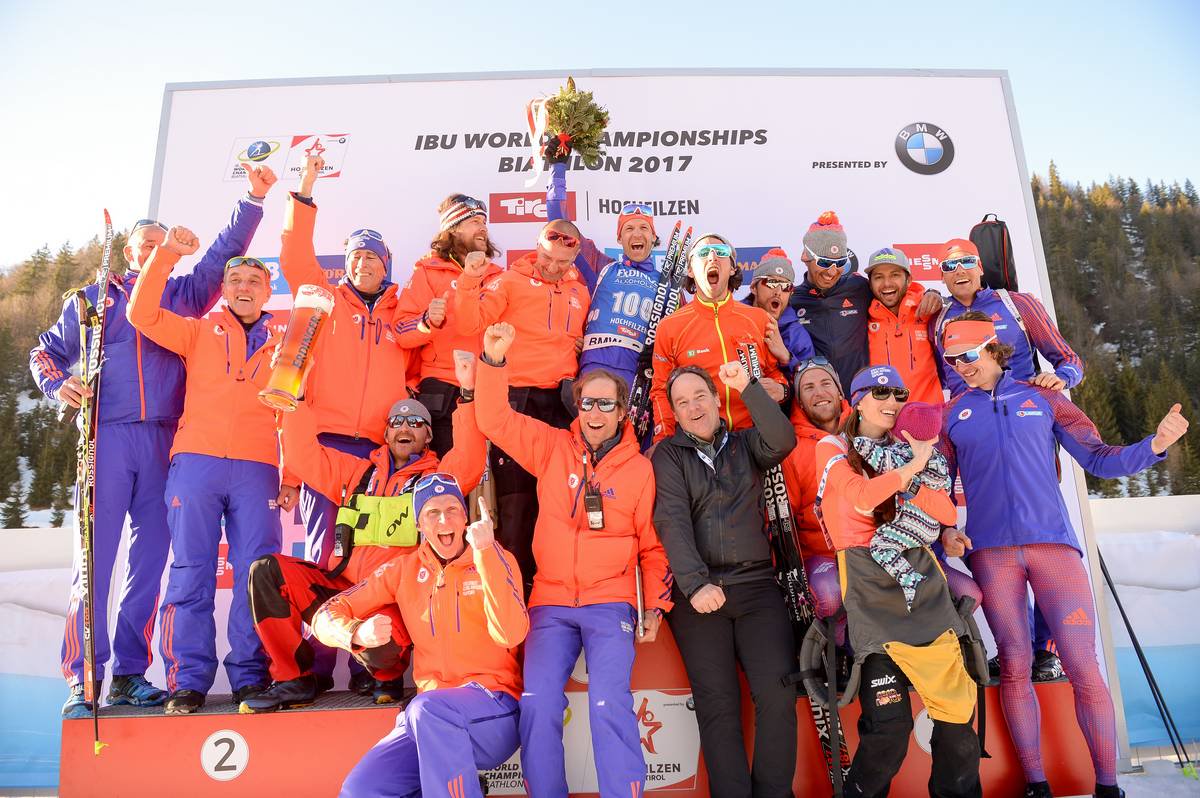
The U.S. Biathlon team and staff celebrate a Lowell Bailey’s gold medal in Hochfilzen in 2017. (Photo: USBA/NordicFocus.com/Twitter)
The Performance and Financial Picture
USA Biathlon has struggled for decades within its centralized development model. The program has never won an Olympic medal. Its financial structure remains heavily dependent on external institutional support. The closest the United States has come to a modern Olympic breakthrough was Lowell Bailey, whose 2017 World Championship gold medal represented a historic result for the program.
More recently, Campbell Wright’s rapid rise has dramatically changed expectations. Olympic podiums now appear to be viewed internally as realistic rather than aspirational.
Financially, the organization remains highly dependent on the USOPC and the International Biathlon Union. In 2023, those two sources combined to provide just under $2 million in funding. Membership revenue totaled approximately $305,000. Together, those categories represented roughly 70% of total organizational revenue, illustrating how limited the organization’s independent sponsorship and fundraising capacity remains.
Overall, USA Biathlon reported approximately $3.2 million in annual revenue against roughly $3.2 million in expenses, essentially operating at break-even. Based on expense reporting, it appears less than $800,000 was directed toward direct athlete programs and support. USA Biathlon categorized approximately $2.4 million under “Functional Business” expenses tied to trials, training, competition, and development programs, yet more than $700,000 of that consisted of staffing and contract labor costs. In total, staffing and operational expenses appear to exceed $2 million annually, roughly 63% of total expenditures.
That leaves very little financial margin for error. USA Biathlon appears to be operating in a structurally fragile position where revenues and expenses are essentially balanced while administrative and operational costs consume the majority of available resources.
What Does USSS Gain?
Given the current financial picture, and the program’s historical performance trajectory, it is difficult to see how USA Biathlon brings anything other than additional financial pressure to USSS. So the obvious question becomes: what does USSS gain from the arrangement?
Presumably, increased USOPC funding. USA Biathlon’s own 2030 strategic plan lays out explicitly outcome-based goals:
“Consistent medal winning performances every year,”
beginning with “one Olympic medal in 2026,”
and progressing toward “four [Olympic medals] in 2030, at least one gold.”
That language closely mirrors the increasingly performance-driven funding expectations the USOPC now places on National Governing Bodies.
It is clear USA Biathlon currently faces significant operational and financial challenges in supporting athletes at the level required for sustained international success. Campbell Wright’s emergence has only intensified the pressure surrounding those expectations. What remains unclear is how simply moving the sport under USSS materially changes the equation.
There may be some operational efficiencies through shared services and administrative consolidation, perhaps several hundred thousand dollars annually. But regardless of governance structure, the fundamental reality remains the same: the sport will require substantially more funding if it expects to support athletes at a level capable of producing consistent Olympic success.
Athlete Trust
The unresolved issue in all of this is athlete trust. Financial instability and competitive underperformance are one thing. Failures involving athlete safety, organizational culture, and accountability are something entirely different.
Over the last several years, USA Biathlon has faced significant public scrutiny surrounding athlete abuse allegations and broader questions about organizational oversight. Whether or not those issues are directly tied to the current governance discussions, it is difficult to believe they are irrelevant to the long-term stability of the organization.
For athletes and families, trust matters. Those athletes impacted by abuse allegations have asked for accountability for those who minimized their reports of abuse and failed to report. Parents should be evaluating a development pathway, not simply assessing coaching quality or race results. They should be asking whether the organization can provide a healthy, stable, and safe environment for athletes.
Once an NGB develops a public reputation for cultural or athlete protection failures, rebuilding confidence becomes extraordinarily difficult. That impacts membership growth, fundraising, athlete retention, and ultimately performance itself.
The Case for Transparency
Which is why transparency matters here. If the proposed integration is fundamentally about operational efficiency and athlete support, then that case should be made openly and directly. If it is also connected to concerns surrounding governance, accountability, or organizational stability, those questions deserve equally direct answers.
Without that transparency, the process begins to look less like strategic planning and more like institutional consolidation without meaningful public accountability.
Help Support Our Coverage!
If you value the thoughtful work and access FasterSkier provides, please consider becoming a Voluntary Subscriber. Your support directly fuels our work to cover the people, places, and moments that make our sport special.
The April 4 event pairs a live global broadcast with on-snow programming at Tahoe XC.
The inaugural Tahoe Nordic Expo will take place April 4, 2026, bringing together some of the most accomplished names in Nordic sport for a live, global virtual panel focused on the past season, the Olympic year, and the future of the sport.
Designed as a hybrid event, the Expo centers around a live virtual panel featuring Olympic, Paralympic, and World Cup athletes across multiple Nordic disciplines, including cross-country skiing, biathlon, Nordic combined, and telemark.
Julia Kern (USA) racing the World Cup cross-country mass start in Ruka (FIN). (Photo: Modica/NordicFocus)
The panel lineup includes:
Kikkan Randall, Olympic gold medalist and one of the most decorated U.S. cross-country skiers in history
Oksana Masters, 24-time Paralympic medalist in Nordic skiing and multiple sports
JC Schoonmaker, Tahoe native and two-time Olympian
Julia Kern, World Cup medalist and Olympian
Annika Malacinski, national champion and leading voice in women’s Nordic Combined
Jaz Taylor, multiple-time World Cup champion
The discussion will be moderated by Andy Newell, a four-time Olympian and prominent voice in the sport.
The 90-minute panel will serve as a live season recap, covering the 2025–26 World Cup circuit and the Milano Cortina Olympic and Paralympic Games, while offering audiences a rare opportunity to hear directly from athletes about training, competition, and the evolving culture of Nordic sport. Virtual attendees can submit questions in advance, while in-person participants will engage in a live Q&A.
Coach Andy Newell all smiles at the 2023 BMT. (Photo: BMT)
Founder Elyse Sara created the Expo to fill a gap in the Nordic landscape – one that emphasizes connection, storytelling, and access to athletes across disciplines and levels. The event brings together voices from across the global Nordic community, from Olympic medalists to emerging leaders shaping the future of the sport.
The event also includes a limited in-person component at Tahoe XC featuring clinics, demos, a laser biathlon relay, live viewing of the virtual panel, and other community events.
In addition to its focus on sport and storytelling, the Expo also supports inclusion in athletics. Ten percent of all proceeds will benefit Move United, a national leader in adaptive sports programming.
The Tahoe Nordic Expo aims to establish a new kind of gathering within the sport – one that reflects, connects, and looks ahead.
JC Schoonmaker (USA) onhis way to finish the individual sprint in 15th place at the World Championships in Trondheim (NOR) in 2025. (Photo: NordicFocus)
This article was made possible through the generous support of our voluntary subscribers who have helped put our Nat Herz on the ground at the Olympics. If you value coverage like this, please support FasterSkier with a voluntary subscription.
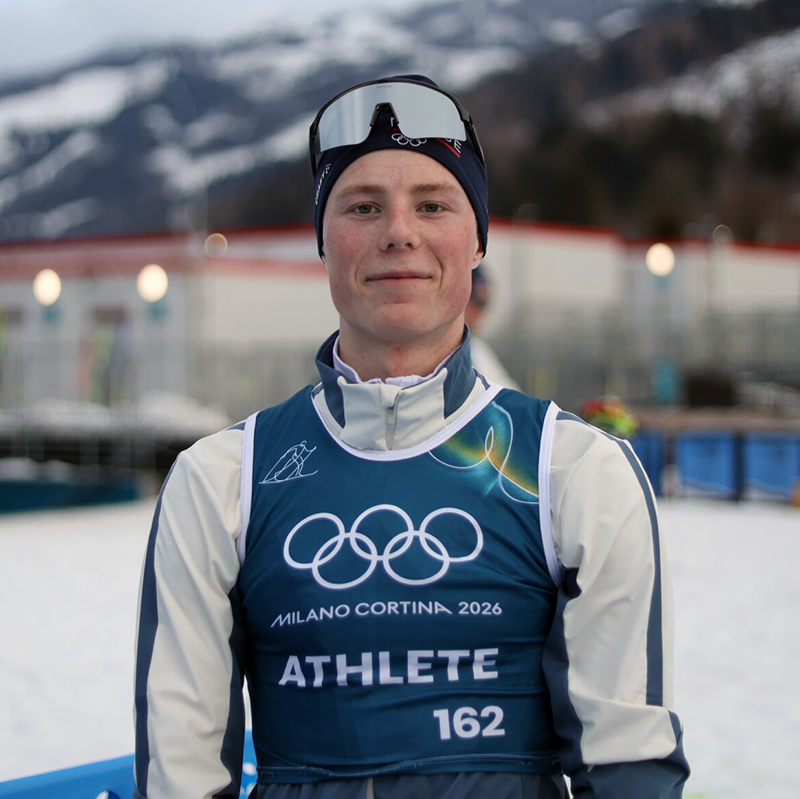
Einar Hedegart poses for a photo after training at the Olympic cross-country ski venue in the Dolomites in Northern Italy. (Nathaniel Herz/FasterSkier)
PREDAZZO, ITALY — Johannes Høsflot Klæbo is, almost without question, the greatest cross-country skier who’s ever lived.
The Norwegian athlete has won gold in eight consecutive championship races spread across two seasons — including the first two events at this year’s Olympics, in Italy. It’s quite possible he could walk away from the Games with gold in all six events.
His biggest threat comes from a guy who’s been a cross-country skier for less than three months.
Norwegian Einar Hedegart has beaten Klæbo all three times they’ve raced each other this winter. He’s won five of the six cross-country events he’s entered since the season began in November.
Johannes Høsflot Klæbo celebrates a gold medal at the Olympics in Italy. (Davide Barbieri/NordicFocus)
November is when, at least according to Hedegart, he finally accepted the label of cross-country skier. Before that, he’d still been, at least partially, a biathlete — the Olympic discipline that combines cross-country skiing with precision shooting.
In biathlon, Hedegart was a fast skier, but not always a reliable shooter. Last season, he jumped into a World Cup race against cross-country skiing’s best competitors, and finished a surprising second place.
That result set off a chain of events that have led him to Italy on Norway’s Olympic cross-country team, with a specific focus on the 10-kilometer freestyle event. That’s where, on Friday, he’s expected to challenge Klæbo for Olympic gold.
“We’re looking forward to Friday,” Emil Hosøy, the coach of Hedegart’s club team in Norway, said in a phone interview this week. “It will be a hard competition.”
In a brief interview Tuesday after training with a teammate at the Olympic venue in the Dolomites, Hedegart said he’s prepared for the showdown.
“Everything has gone according to plan,” he said.
Biathlon vs. cross-country
Hedegart’s meteoric rise has enlivened a long-running, colorful debate between cross-country skiers and biathletes over which discipline is superior, and who’s faster. Biathletes have periodically crossed over and notched competitive results, though it doesn’t happen often.
Swedish cross-country star William Poromaa sparked a furor in Scandinavia two years ago by joking that biathlon, with its stops for target shooting, was for athletes who need a rest between ski sessions.
Hedegart is the latest test case — showing that on today’s racing circuits, elite biathletes can be, at a minimum, competitive with the best cross-country skiers.
“I think a lot of cross-country skiers underestimate the level biathlon is at, and the amount of training we are doing,” Hedegart told two cross-country Olympians on their podcast, Skirious Problems. “You guys have to give us some credit, please.”
Hedegart, 24, is from a little north of Trondheim, a city in central Norway that’s produced some of the world’s best cross-country skiers, including Klæbo.
As a kid, he watched cross-country skiing on television, because the Norwegian superstar Petter Northug Jr. came from his area. But Hedegart’s focus was biathlon, and he showed promise early — winning medals at the World Junior Championships and, in 2023, reaching the top 30 in the World Cup, the sport’s highest level of competition.
Einar Hedegart competes in a cross-country World Cup race in Switzerland (Federica Vanzetta/NordicFocus)
Hedegart would also, from time to time, enter elite cross-country races. Some of those decisions were happenstance — one because he didn’t have a partner for a biathlon relay on the same day, and another that he entered on a whim after a registration deadline.
But in both of those cases, he won.
His results earned him an entry into a cross-country World Cup race in Oslo last year, where he placed second — prompting questions from Scandinavian pundits about whether Hedegart was focused on the right sport.
So, over the summer, Hedegart hedged his bets: He switched from training with biathlon teams to training with a cross-country ski team — albeit one that would allow him to keep shooting his rifle and compete in biathlon.
“All the way from May to November, I was 50-50,” Hedegart said. “I brought my gun to every camp and shot a lot.”
At the start of this winter, Hedegart entered two sets of races over two weekends — biathlon and cross-country — to help decide how he would spend the rest of the season.
In biathlon, he shot poorly. In one race, he missed eight of 20 shots; only one athlete out of 59 competitors missed more.
The cross-country race, meanwhile, he won by a big margin — besting not just Norway’s top skiers but other top talents from France and Austria. That was the day things changed, Hedegart said.
“I’m a cross-country skier this winter season,” he said.
Klæbo, whose championship winning streak is at risk, has taken notice of Hedegart’s rise, which resulted in him being named to Norway’s Olympic cross-country team early in the winter.
“It’s impressive, what he has done,” Klæbo said. “I’m going to try to give him a good match.”
The best skater of all time?
Both Klæbo and Hedegart himself credit Hedegart’s success this season to a unique aspect of his training.
Cross-country skiing, both on the World Cup circuit and at the Olympics, features events in two techniques — the traditional forward striding and poling known as classical, and the side to side pushing called skating.
Biathletes compete only in skating, and Hedegart, this past year, has focused his training almost exclusively on that technique. He hasn’t even bothered to contest classical cross-country competitions this winter.
Hedegart said on the podcast, in November, that he’d spent less than 12 hours practicing classical style in the previous six months — a tiny fraction of the hundreds of hours he’d spent training in total. Top cross-country skiers, meanwhile, typically divide their training close to evenly between the two techniques.
Einar Hedegart, center, celebrates winning a World Cup cross-country race in Switzerland. (Federica Modica/Nordic Focus)
“That is my strength, that I can use more time than anyone else ever has on skating,” said Hedegart in the interview. “I’ve just really done my thing, and that has gotten me this far.”
Hedegart’s training plan has other unconventional elements, including lots of moderately hard sessions and few extra-hard ones, which allows him to spend more time training overall, said Hosøy, his coach. Hedegart is also a “very clever” athlete who’s shown a keen awareness of his own body that’s unusual for someone his age, Hosøy added.
But it’s the added emphasis on skating that’s allowed Hedegart to take the technique “to a new level,” said Pål Golberg, a former top Norwegian skier who’s competed against Hedegart and now is working at the Olympics as an expert TV commentator.
“The training he does is out of this world,” Golberg said. “He can be the best skater the sport has seen — if he wants to do that.”
A postseason dilemma
That’s the question Hedegart will have to answer after this season — and it poses a real dilemma.
Avoiding the classical technique means he can only compete in half of cross-country’s racing schedule. And because his success, so far, has come mostly in distance events, Hedegart has not yet earned a chance to race individual sprint races for the Norwegian team, whose start slots are hotly contested.
As a result, Hedegart has started just six cross-country races this winter — far less than athletes competing in both disciplines.
“If you want to get old in this sport, maybe you have to get to compete more to have the motivation to train as much as he does,” said Hosøy, the coach.
But training and racing in the classical technique would risk the success Hedegart has found after specializing in skating.
“I wouldn’t take the chance,” said Golberg. “If he has this skating that’s so good, why would you risk it? He would never win a distance race in classic, I’m pretty sure.”
There’s also the question of whether Hedegart will ultimately return to biathlon — which, he said, would make it pointless to try to improve his classical technique, since it’s not used on the biathlon circuit.
Hedegart celebrates a podium finish at a cross-country World Cup race in Finland earlier this year. (Federico Modica/NordicFocus)
At the start of the season, Hedegart said, he still planned to go back to biathlon next year. Now, he added, he’s pretty sure he’s changed his mind: If he’s offered a spot on Norway’s national cross-country team for next year, he’d take it, at least for one season.
But in 2029, the biathlon World Championships will be held in Oslo — a chance to compete in a marquee event in Hedegart’s home nation. “That is a big, big dream of mine,” he said. “And I really hope that I can compete there.”
“That is the back and forth I have to do,” Hedegart added, referring to the balance between the two sports.
If Hedegart’s success this season has complicated his career planning, it’s at least provided Scandinavians with a compelling new storyline — particularly in men’s cross-country skiing, where some pundits complain that Norwegian dominance is making the sport boring.
“Norwegians are pretty tired of watching one Norwegian fighting with another,” said Golberg. “But now, suddenly, you have two sports clashing together.”
Help Support Our Olympic Coverage!
FasterSkier has our own Nat Herz on the ground at the Olympics, which is a significant financial lift for us. If you value the thoughtful work and access FasterSkier provides at championships like this one, please consider becoming a Voluntary Subscriber. Your support directly fuels our work to cover the people, places, and moments that make our sport special.
At the first biathlon World Cup races of the 2025/26 season, the biathlon stadium is perched above the small city of Östersund, which is set on a lake. Wind gusts off the lake, pulsing through the stadium. The races take place under the lights, at night – which isn’t saying much. Because in December in northern Sweden, ‘night’ begins at three in the afternoon, when what little sun there might’ve been throughout the day slips below the horizon. It’s in the evenings that the wind is usually at its strongest. The conditions the racers zero their rifles at before the race are rarely the same conditions they find when they come back to the range during the race. Athletes watch the small, red flags in the range, seeing which way they’re moving, deciding whether or not to shift their sights a few clicks, compensating for the changes that happened while the racers skied the course that serpentines up, down, around a 180-degree turn, and back into the stadium where the music plays and the home crowd cheers. Ayyy! As the Swedes hit their targets. A diluted Ney for each Swedish miss.
The mixed relay at the opening stop, Oestersund (SWE), of the 2025/26 IBU World Cup Biathlon season. (Photo: Manzoni/NordicFocus)
Over eight days, the best biathletes in the world raced 10 times. Maybe it was the arduous schedule, or the bit of sharpness that an Olympic year adds, but the Ostersund races didn’t feel like the first of the season. It felt like a break had never happened.
One question lingering from the off-season was answered quickly: What would Norwegian biathlon look like without the Boe Brothers? The dominant duo of Johannes Thingnes and Tarjei Boe – owners of eight Olympic medals – retired at the end of the 2024/25 season. Leaving what one would assume would be a major hole in the program. But when the Norwegian men came out and won the men’s 4 x 7.5km relay at Ostersund, the Norwegian’s roster depth became clear.
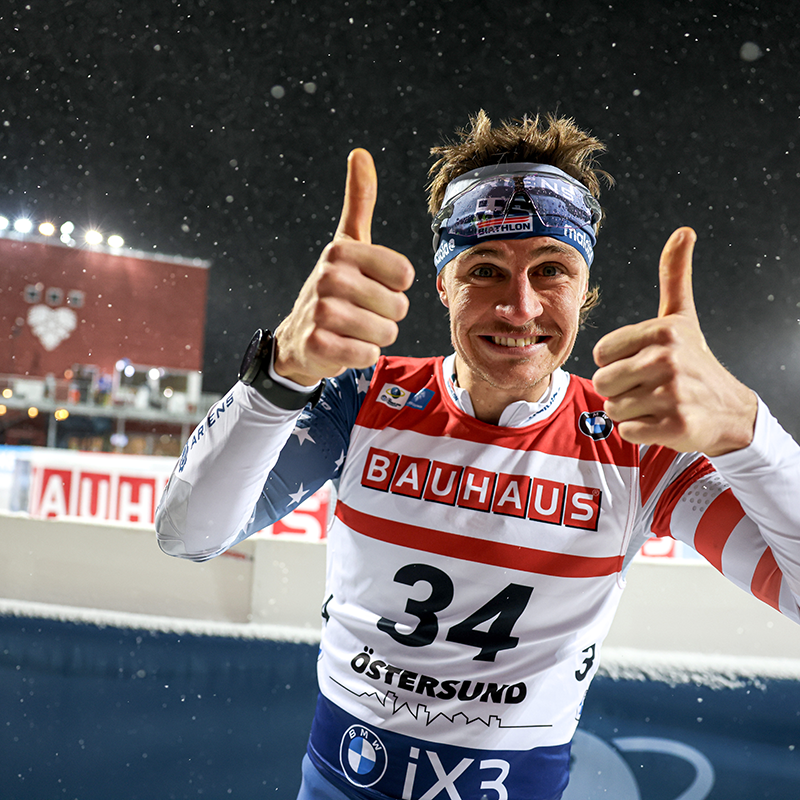
Campbell Wright (USA) during the IBU World Cup Biathlon Men’s Relay in Östersund (SWE). (Photo: Manzoni/NordicFocus)
The men’s relay saw a top result from the U.S. men, as well. Paul Schommer, Campbell Wright, Maxime Germain and Sean Doherty finished fifth, one of the best men’s relay finishes ever for Team USA. The next day, at the mixed relay, Germain, Wright, Chloe Levins and Deedra Irwin placed sixth – which is the best finish for a U.S. mixed relay since 2021.
Artem Tyshchenko (UKR) and Paul Schommer (USA), (l-r) during the Men’s Relay in Oestersund (SWE). (Photo: Manzoni/NordicFocus)
Germain and Wright continued to build on their early-week momentum, with Germain placing 11th in the sprint. In the pursuit, Wright hit all 20 targets for the first time in his career and moved up from 18th to 6th. Wright is coming off a stellar 2024/25 season, where he podiumed twice at World Championships, becoming the first American to do so.
Throughout the week, there were highs: Suvi Minkkinen of Finland won her first World Cup sprint. The Norwegian men placed four in the top five in the 20km individual, solidifying their capabilities as a team sans-Boes. And as always in biathlon, some lows: Eric Perrot of France missed his final shot in the pursuit, a devastating moment that cost him the lead. He finished fifth.
Racing wrapped up in Sweden, and teams flew to Austria. In Hochfilzen, a less rigorous racing schedule awaits: sprint, pursuit, and then a men’s and a women’s relay. A few more hours of daylight await, too.