From the FasterSkier archive — posts syndicated from athletes’ and coaches’ own blogs between 2004 and 2012, kept online as published. Current coverage is at fasterskier.com.

Tag: Bill Harmeyer

  • Head Coach Transitions for the SMS T2 Program with Pat O’Brien and Perry Thomas

    Head Coach Transitions for the SMS T2 Program with Pat O’Brien and Perry Thomas

    After eight years at the helm of the Stratton Mountain School (SMS) T2 team, head coach Pat O’Brien is in the process of taking a few steps back, passing the reins to Perry Thomas, who has spent the last five years as the assistant coach at the University of Vermont.

    Perhaps highlighting this transition and the sharing of responsibilities the two are in the process of navigating, FasterSkier connected with Thomas in mid-May while he was in his second week of supporting the SMS T2 athletes who had joined the U.S. Ski Team for their spring training camp in Bend, OR, and with O’Brien who was back in Stratton, having recently wrapped up with his participation in U.S. Ski & Snowboard spring congress sessions. 
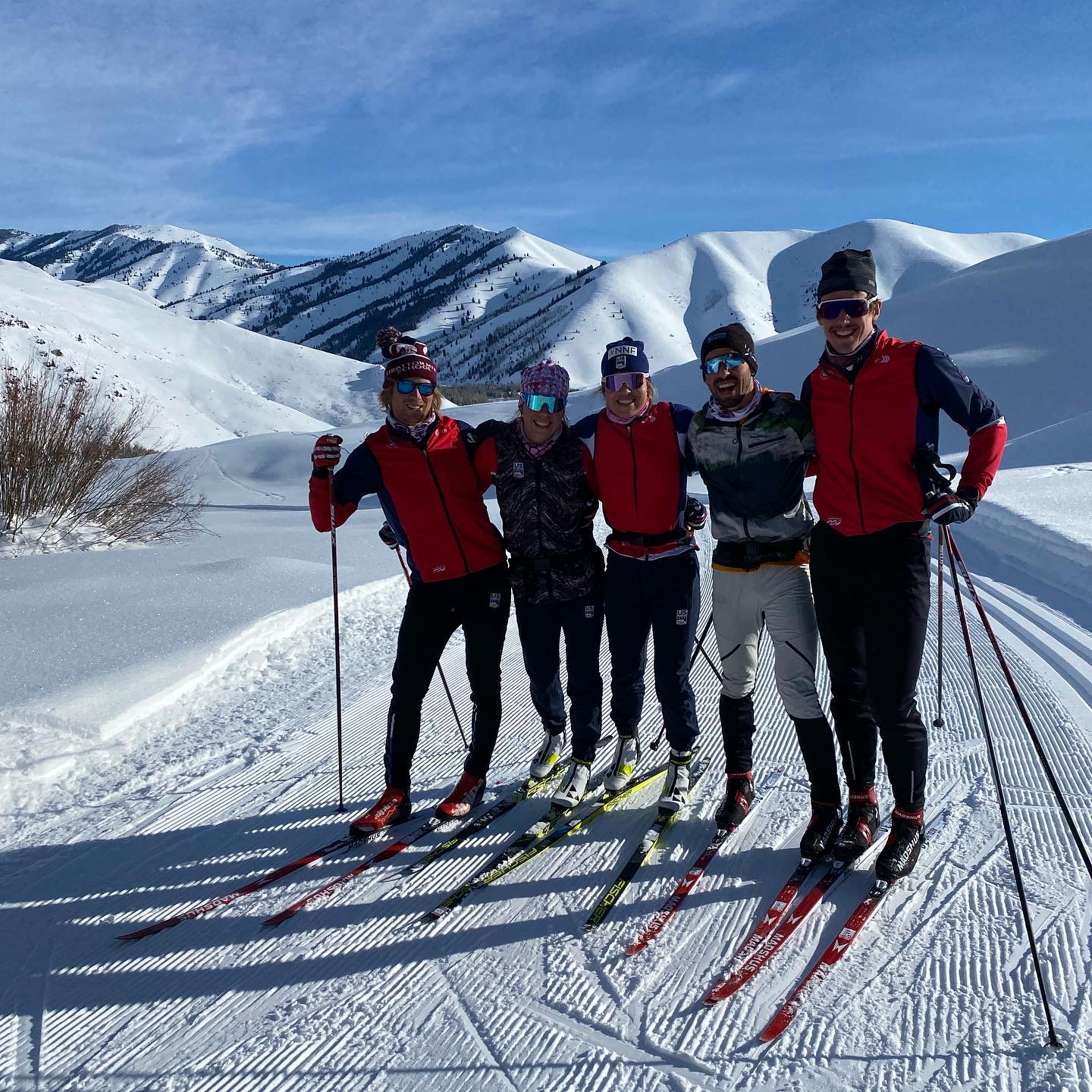
    Pat O’Brien supports some of the SMS T2 athletes during a 2022 SuperTour weekend in Sun Valley, ID. (Photo: SMS T2)

    A 2006 graduate of SMS himself, O’Brien raced collegiately for Dartmouth College, then spent four years training and racing professionally with the Craftsbury Green Racing Project. His move from Craftsbury back to Stratton was timed with his retirement following the 2014 Sochi Olympic Quad. Given his age and the proximity to his racing career at that time, many of the athletes on the T2 team were among what he called his “peer group”, having overlapped with many of them during either high school, college, on the race course, or all of the above. Jessie Diggins and Sophie Caldwell Hamilton were quickly becoming rising World Cup stars on the women’s team, while Andy Newell and Simi Hamilton headlined the men’s roster, and a young Julia Kern and Katharine Ogden were spending a PG year training with the T2 team.

    Eager to stay connected with the sport after retirement, O’Brien seized the opportunity to take over in Stratton, stepping in as his predecessor Gus Kaeding departed.

    “Ski coaching is the one thing that I’ve always known that I wanted to do, it was just kind of a natural progression for me. I knew that I was done with my athletic career – I didn’t really want to ski race anymore – but I knew that I still wanted to ski, I still wanted to be involved and to give back to the sport. I felt like, to some extent, when you spend basically your entire life skiing, you get pretty good at understanding the sport. But we never know as much as we think we do, and we always need to be students of the sport and have an open mind and learn.”

    As he began his coaching career, he quickly realized that writing training plans and facilitating training was only a small subset of the responsibilities of an elite club coach.  

    “Good coaching is being comfortable wearing a bunch of different hats. And I mean, I joke, but the actual coaching is such a small part of it. The nitty gritty of pulling an athlete on the side of the trail and looking at video and all of that is important, but you’re there as a friend, a drill sergeant at times, and as someone that is just really trying to be supportive.

    “And that’s all-encompassing. So for me, it has been a pretty fun experience to see people figure stuff out and be there to support them when they needed a little extra help and to do it in a pretty collaborative, dynamic way.”

    He described his experience transitioning to coaching primarily as a mindset shift from the inevitable self-centric focus required of professional athletes toward selflessness; but the work required and pace of life remained equally taxing. 

    “When you coach at a club level – all coaching is a demanding job. I do think that you have to – I don’t want to use the word ‘sacrifice’, but when you transition from being an athlete yourself to being a coach, your job as an athlete is to be a little selfish. You’re trying to maximize your athletic performance. You need to have balance… but at the end of the day, you need to make sure that you’re training well and with purpose, you’re recovering well, you have goals and you’re going about achieving them. It shouldn’t be simply looked at as like what you have to give up to do that, but to be the most professional athletes and succeed against people who are trying to do the exact same thing, you just have to do a really, really good job with it. And coaching is the same thing. You have to be willing to approach everything that you do with the same degree of drive and focus that you would as an athlete…

    “Basically, I just threw myself into it with the same approach that I had as an athlete which is, I’m just going to work, and work, and work, and learn all along the way. And then give it my best push and know that if I get to the point where that balance starts becoming harder and harder, or I can’t really do the job that I want, to be supportive of the athletes [to the level I want to be], that’s when you’ve got to know that you either double down and keep pushing or make a transition.”

    While O’Brien is no less dedicated to the SMS T2 program or its athletes, a new endeavor has begun which will make achieving the balance he described significantly harder: he’s about to become a father. His wife, two-time Olympian and long-time U.S. Ski Team member Ida Sargent, is due in mid-August.
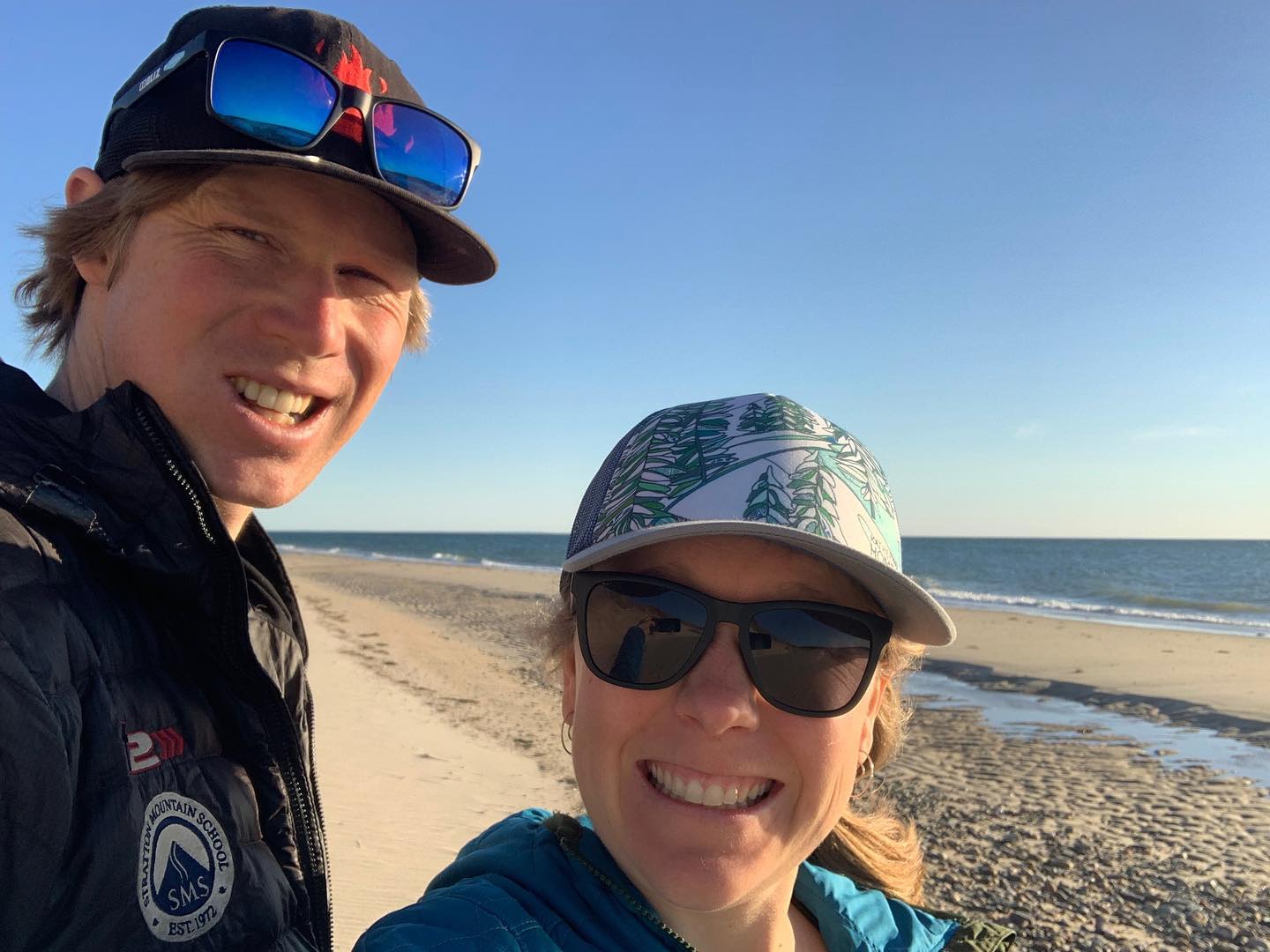
    After eight years as head coach of the SMS T2 team, Pat O’Brien takes a step back as he and his wife, Ida Sargent, begin their family. (Photo: SMS T2)

    Since retirement, Sargent has been working for her high school alma mater, Burke Mountain Academy, in Northern Vermont, and is currently the Academic Director for the school while also teaching STEM classes. O’Brien has been splitting his time between Burke and Stratton, which lies roughly 150 miles southeast in the opposite corner of the state. His usual coaching schedule pulled him around the country for weeks at a time to support athletes at U.S. Nationals and SuperTour events, and sometimes around the globe for World Cup, U23s, and other international camps and races. 

    While he acknowledged that there are many examples of coaches at all levels who have successfully juggled a demanding work and travel schedule with raising a family, what felt like the best fit given his and Ida’s vision and priorities for their own growing family was for O’Brien to decrease his level of responsibility with the T2 program, allowing greater flexibility and more time at home. 

    “I just felt like there’s part of me that was like, ‘I’m not seeing a pathway that I feel like I can still commit [to coaching] at the level that I want and know that you need to in order to to do the best job with your job, while simultaneously trying to start a family.’ I felt like it was my time to reevaluate and maybe step back or be completely done with ski coaching, because I certainly didn’t want Ida to have to put her growing career on hold to be the [primary] caregiver…

    “Eight years is a long time to do something and I am very proud of what the team has accomplished in that time… it’s really cool having spent this time seeing athletes grow, not just not just athletically and within their their ski careers, but as individuals from high schoolers to finishing up college to full blown ‘this is my job.’”

    While his role will be smaller, O’Brien is certainly not stepping away from the T2 team altogether. “Starting a family does not necessarily mean that it means the end of being involved in the sport,” he said. “It just means trying to figure out what the right relationship is with it.” 
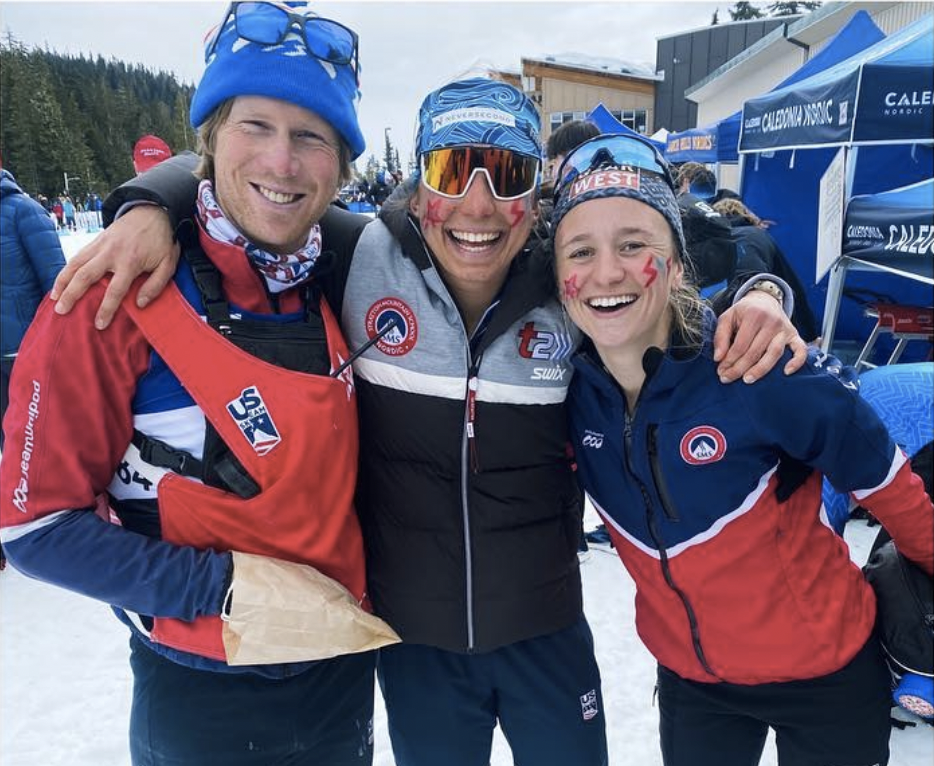
    Pat O’Brien supports SMS T2 skiers Julia Kern and Alayna Sonnesyn at the 2022 U.S. SuperTour Finals in Whistler. (Photo: SMS T2 Blog)

    The exact balance and distribution of responsibilities remains a work in progress as Thomas moves into the head coach role and the new season of training begins, and both O’Brien and Thomas are excited to collaborate and support one another throughout the year. 

    Explaining his philosophy as “under-commit so I can open perform”, O’Brien anticipates taking on many of the behind the scenes tasks that support the team, from collaboratively blocking out the season calendar, to managing travel logistics for camps and SuperTour races. As he put it, the little details of deciding “which flights to take to get from Canmore to Sun Valley” and where to stay are often made easier with several years of trial and error under your belt. 

    While Thomas will spend more time with ski boots on the ground, both in Stratton during the summer and at races and camps throughout the year, O’Brien anticipates he’ll still be plugging in a fair amount too. Though his stay might be shortened to the period immediately surrounding races, he plans, at minimum, to be in Houghton, MI for U.S. Nationals in January, and also the SuperTour finals in Craftsbury in late March.

    He’s also excited to reconnect with the team in Stratton early in the summer before Ida gets close to her due date, but also to take off a few of his usual coaching hats while doing so. 

    “I think it’ll be really fun for me to actually be able to flow in and out get to see people, connect with them, but also not be like ‘Okay, now I don’t have to worry about making sure that the van’s filled up with gas, or water jugs have been filled, or that I’ve ordered all the lactate strips in advance so that we don’t run out.’”

    Perry Thomas out for a crust ski with the SMS T2 athletes who joined the national team training camp in Bend, OR this spring. (Courtesy photo)

    As Thomas gets his feet under him in Stratton, he explained that he feels “very fortunate that Pat will still be involved.”

    “As much as I can have him in the mix, the better,” Thomas said. “His knowledge with skis and wax is just unreal, so tapping into that resource is huge for me, for sure.” 

    ***

    UVM assistant coach Perry Thomas in action during the 2022 U.S. Cross Country Skiing Championships in Soldier Hollow. (Photo: Instagram @oneswellperry)

    Prior to joining the UVM program, Thomas spent five years as the assistant coach at the University of Vermont, working alongside head coach Patrick Weaver. During his own collegiate racing career, Thomas spent four years racing for the University of New Hampshire, where he served as team captain during his senior year in ‘12-13. Departing briefly from the cross-country ski world, he spent a year teaching high school science to underprivileged youth in the Oakland area of California, before returning to the Northeast to begin his coaching career as the assistant coach at Williams College in Massachusetts. 

    “Working at UVM was unreal – a great experience,” Thomas said emphatically. “I really loved working with Patrick Weaver and the athletes there and it seems like almost a seamless transition, in many ways. Four of the skiers on the T2 team I actually coached at UVM. So knowing a lot of athletes here already – what they’re working on with technique, and racing, and goals and all that – has been very seamless, and that’s been great.”

    The UVM graduates who now ski for SMS T2 include Alayna Sonnesyn (‘18), Bill Harmeyer (‘20), Lina Sutro (‘21), and Ben Ogden (‘22). 
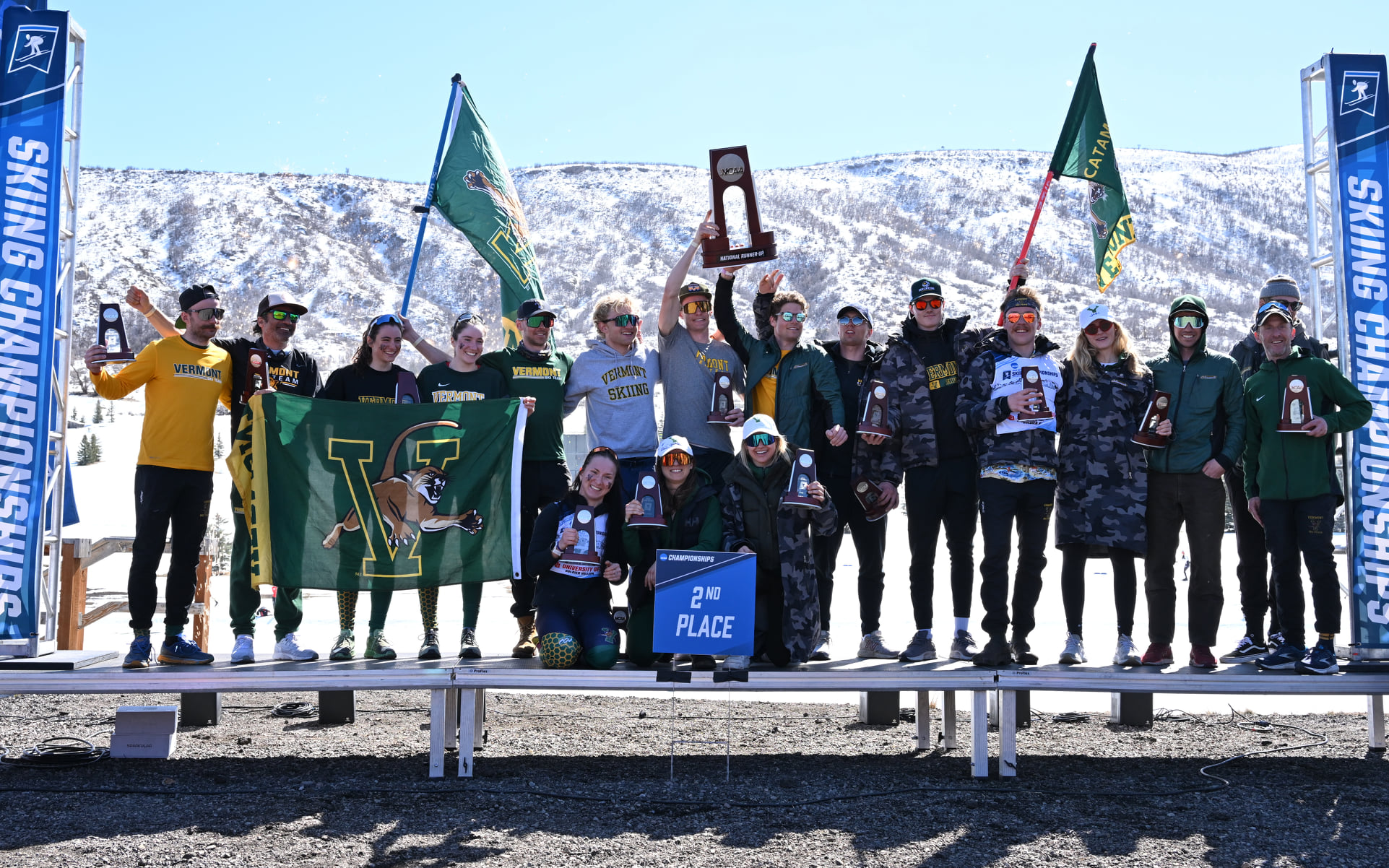
    The UVM ski team celebrates a successful 2022 NCAA Championship. Assistant coach Perry Thomas is at the far left. (Photo: UVM Skiing)

    Given the caliber of these athletes and the success of the UVM team as a whole during his tenure, Thomas credits his time with the program to the acceleration of his development as a coach, preparing him to take his next steps forward with SMS T2.

    “Patrick Weaver definitely gave me a lot of opportunities and ownership over different facets of coaching that team and I think that’s been instrumental in me being here now with T2. I was able to go to World Cup Finals with Ben Ogden in Quebec his first year in school [in 2019], and I was just able to do trips like that on my own with athletes. That was huge for my development as a coach and for my experience of waxing, ski testing, and [other responsibilities at that level of racing]. So working at UVM was a lot of fun – I’m gonna miss it for sure – but it set me up very well for this transition.” 

    Ben Ogden gets a congratulatory fist bump as he heads to the podium during his sweep of the 2022 NCAA Championships. (Photo: Tobias Albrigtsen / @untraceableg)

    A theme of both Thomas and O’Brien’s comments on the difference between collegiate and elite club coaching is small in terms of the training and technique coaching itself, but vastly different in terms of the opportunities elite club coaches have to support their athletes. 

    “I think the big differences are what we can and can’t do throughout the year from collegiate [racing] to the elite team,” Thomas explained. “Like, I wouldn’t be here [in Bend] and been doing an on-snow training camp if I were at a college team. And obviously the racing schedule is super different.

    “The college schedule is pretty efficient, whereas the SuperTour calendar is quite a bit more spread out. And then, in addition to that, you have an athlete’s like Jesse Diggins, and Ben Ogden, and Julia Kern that are going to be on the World Cup, as well as athletes that are trying to make it to the World Cup. And at UVM, we had crazy talented athletes – Ben Ogden is one of them – so working with with high caliber athletes is nothing entirely new, but dealing with athletes where some are on the World Cup and some of them on the SuperTour is an interesting dynamic that you don’t often get with the college teams.”

    In terms of what Thomas adds to the program as he steps in as head coach, he described his coaching philosophy and the environment he seeks to create within the training group, which keeps athletes motivated and happy through the arduous and long-term development process.

    “[Cross-country] skiing is such a hard sport – it’s so much time that that we’re putting in, and so many sacrifices that we’re making, that I wholeheartedly believe in making that time that we’re together training and working hard fun and enjoyable,” Thomas said. “I think that’s a big part of what we do –  and it has to be a big part of what we do –  because like I said, it’s a hard sport. So I think making things light and having fun with all that is super important. And that’s definitely something I bring to the table in that regard.”
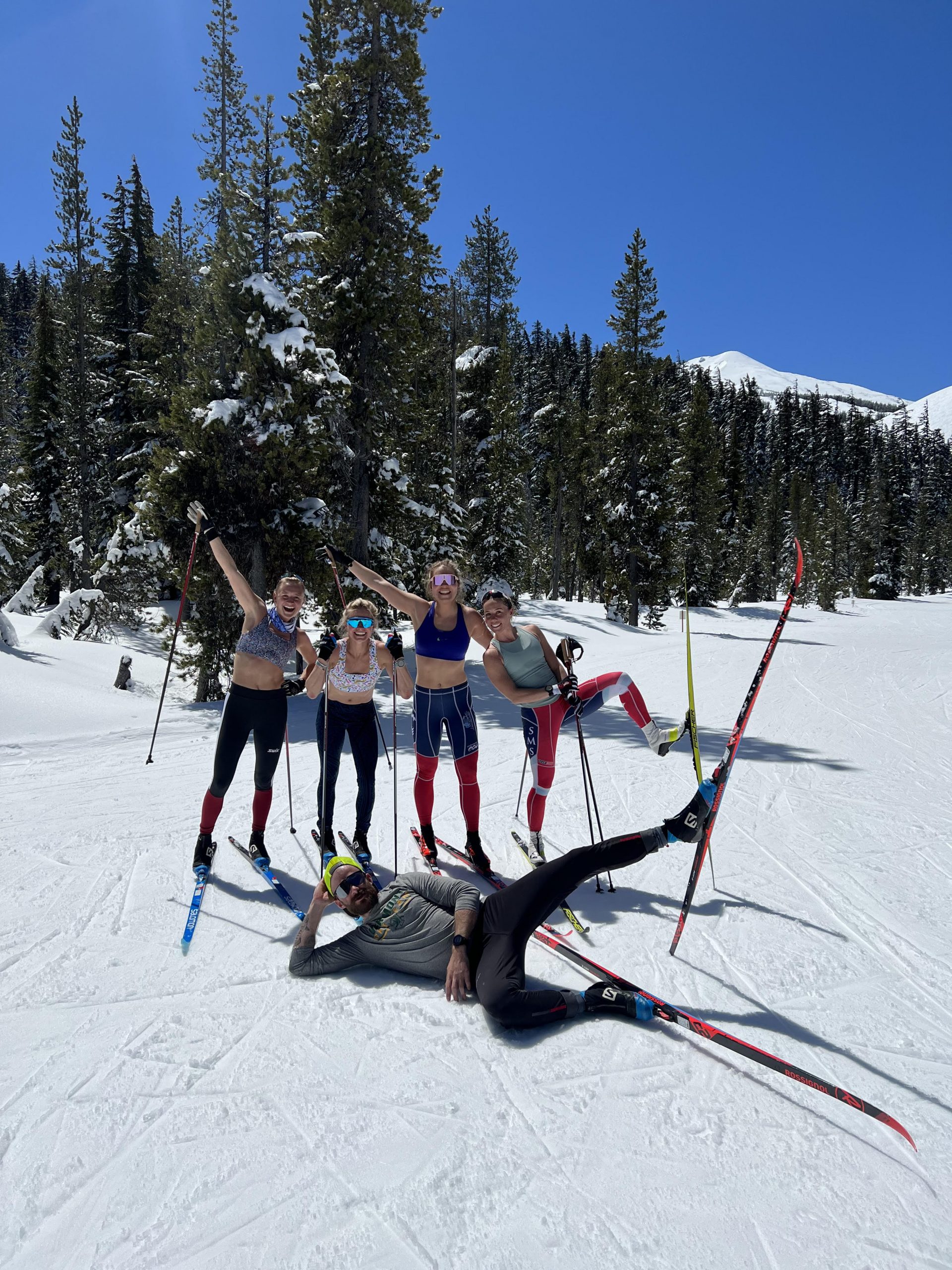
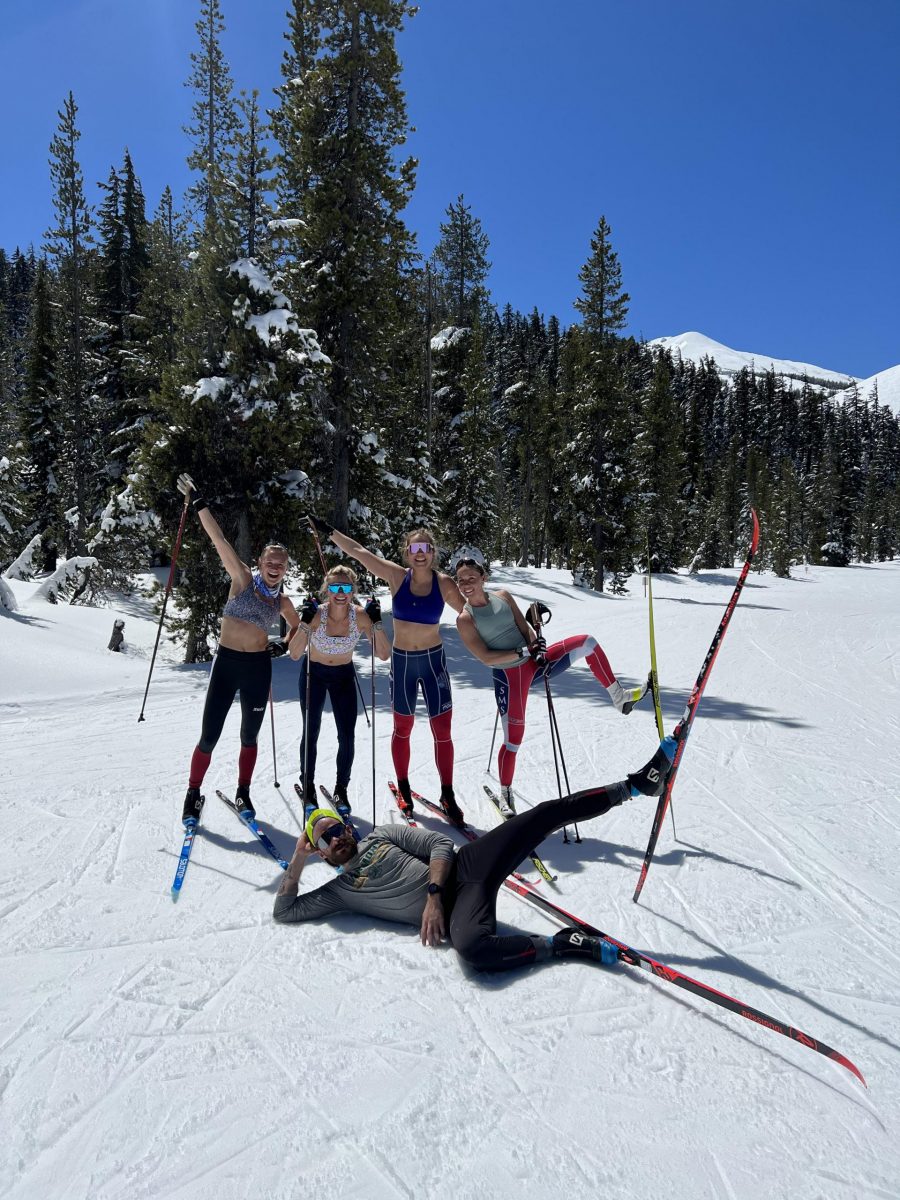
    The SMS T2 team enjoys spring skiing at the Mt. Bachelor Nordic Center. From left to right, Alayna Sonnesyn, Jessie Diggins, Lina Sutro, and Lauren Jortberg, with head coach Perry Thomas. (Photo courtesy Alayna Sonnesyn)

    But Thomas will add more than just fun to the T2 program. While he may be, as phrased by his new colleague, “almost too humble”, O’Brien was quick to highlight Thomas’s preparedness to prescribe training, coach technique, and otherwise lead an elite team stacked with some of the nation’s best athletes. 

    “If you have been at a D1 college program where you’re dealing with 15-20 athletes and that dynamic environment where student athletes are constantly balancing all these different commitments and time constraints… And really, what you learn there as an athlete and what you learn there as a coach is that working with a club – it just isn’t that different.”

    O’Brien added that the shift to an elite club from college may, in fact, be easier than going in the other direction. When athletes no longer have to miss key workouts to take an exam or rush off to class halfway through a team meeting, barriers to consistent communication and training are removed, and consequently a coach has a greater capacity to build relationships with the athletes as they stack together the bricks of the training program. 

    “You get an opportunity to really work one-on-one with the athletes and to really be there to facilitate and support their training and their racing. In that sense, I think coming from a college background – especially given his ties with many of the current athletes that are on the team – you’re just working with the same people and you’re doing the same stuff.

    “I mean, there’s no magic formula,” O’Brien continued. “Someone can claim that they can write the best training plan in the world. And that’s all fine and dandy – there are definitely people who do an amazing job with it and they really enjoy that aspect of that aspect of the sport. But at the end of the day, it’s just really just working with people. You don’t need to make it more complicated than it is. The best athlete is not a robot. The best athlete is someone that is self aware, that can think critically, learn from mistakes, recognize when things go well, and the coach is there to support them along the way.”

    New SMS T2 head coach Perry Thomas working with his athletes during a 2022 spring training camp at the Mt. Bachelor Nordic Center. (Photo: Lauren Jortberg)

    Thomas identified building upon his relationships and experience with his former athletes, who account for half of the team’s eight athletes, as something he’s looking forward to in joining T2. 

    “I am very appreciative of the continuity and being able to work with some athletes I’ve worked with in the past,” said Thomas. “I love all of them –  they’re incredible people, incredibly hard workers. So to be able to continue working with them is just awesome. With that, too, it’s like – I have been working with Ben for the last four years, I worked with Lina Sutro for four years, I worked with Alayna for a little bit. It’s just a matter of knowing how they operate and how they train and knowing what they’ve been working on too. It’s easy for me in training, [even] this morning, to see some of them and be like, ‘okay, like this is something we’ve been working on for the last however many years’ or maybe, ‘a couple years ago, this was something we’re working on’. So let’s continue this, let’s continue these cues that we’re working on, and have that continuity there. 

    “It’s been awesome to be able to continue that work with them. It’s nice to see the progress – to see what they were doing in college a few years ago, and then to see where they are now, and then also to be able to help them through the transition to professional skiing.”

    Simultaneously, these UVM-T2 athletes are excited to be working with their former UVM coach again. In an email to FasterSkier, Alayna Sonnesyn reflected on her time as a professional skier guided by O’Brien, while crediting Thomas’s contributions at UVM for her reaching the professional level in the first place. 

    “Stepping into the professional ski world four years ago and onto the SMS T2 team was super intimidating to me,” wrote Sonnesyn. “The team has been home to some of the fastest skiers in the world and I was clueless when it came to racing at that high of a level. Pat O’Brien helped steer me in the right direction as I made this adjustment and took huge jumps in my skiing ability. He taught me when to train for fun and when it was time to buckle down and get serious. When Pat says it’s go time, you go! He helped develop me from a reasonable distance skier to a strong and powerful distance AND sprinter, a trait I never thought I would be capable of. Pat’s knowledge of the sport and ski waxing, as well as the mental and emotional obstacles that come along with it, is unparalleled. He was a coach that believed in me as a junior skier and saw potential. The only thing that can make a good ski race even better is when Pat gives you a proud hug at the finish line. Although I will miss these hugs and his direct coaching, I know that he will use these skills to care for his growing family and I am excited to see where life takes him next.

    Perry Thomas works with a few of the SMS T2 ladies in Bend. (Photo: Alayna Sonnesyn)

    “Back when Pat was just seeing the potential in my college skiing, I was working with Perry Thomas when he was the assistant coach at UVM. I feel like my athletic career has come full circle as I get to transition back to a coach who helped put me in a place where I first believed skiing professionally was an option. Although I only had the pleasure of working with Perry for one year at UVM, it was a very special season! I instantly trusted him with my skis and could feel his enthusiasm for the sport radiate on the ski trails. I’ve witnessed just how hard Perry has worked over the years and how well-prepared he is to take over the position as head coach of the SMS team. Just in the first month of working with Perry again, I already know the team is heading down a path to continue its mission; local inspiration, international excellence.”

    Likewise, Lina Sutro shared she is looking forward to the transition, applauding Thomas’s dedication to his athletes.

    “I am truly so excited to be working with Perry again,” she wrote. “He is one of the most hard working and committed coaches I have worked with. He has a strong work ethic that I am excited for the Stratton community to experience. Pat and Perry both give so much back to the ski community and their athletes, I am excited to see the two of them work together.”
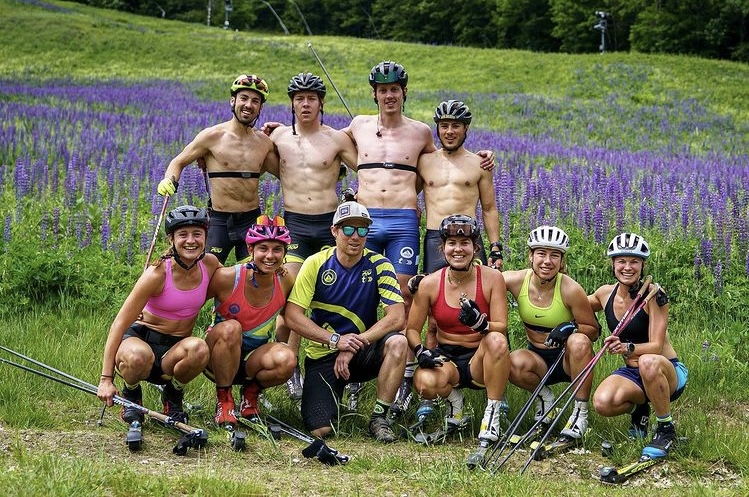
    The 2021/2022 SMS T2 Team. Back row (l – r): Ian Torchia, Ben Ogden, Bill Harmeyer, and Will Koch; front row: Alayna Sonnesyn, Julia Kern, head coach Pat O’Brien, Lina Sutro, Katharine Ogden, and Jessie Diggins. (Photo: SMS T2 Blog)

    As for the broader questions of “what’s new?” and “what lies ahead for the SMS T2 team this summer?” Following Katharine Ogden’s retirement in March, Lauren Jortberg will join the team as the fifth athlete on the women’s side – five and five is what the team identifies as the sweet spot for numbers. Jortberg joins Jessie Diggins, Julia Kern, Alayna Sonnesyn, and Lina Sutro. The men’s team is light this season, as Ian Torchia moved on this spring also, leaving behind a three-man roster of Bill Harmeyer, Will Koch (who also competes for University of Colorado), and Ben Ogden. 

    After Bend camp, the team will part ways with many attending “a big event in the Midwest” which happened over Memorial Day Weekend. The SMS T2 team will finally reconvene as a whole in Stratton in early June. Though regional and international camps are planned, particularly for athletes named to the national team, Thomas anticipates ample quality training based in Vermont and the surrounding region.

    “We’ll be in the Stratton area for the majority of this summer,” he explained. “I think one of the cool things that we’re doing is: Sverre, and Pat and I have started working on doing a summer [training] program, so we have some awesome athletes joining our crew this summer.”

    This list includes University of Utah and U.S. Ski Team skiers Sydney Palmer-Leger, Novie McCabe, and former SMS junior athletes Adam Witowski and Zander Martin, who now ski for Michigan Tech and Bates College, respectively. JC Schoonmaker and Gus Schumacher also plan to join the T2 team for some training in Vermont throughout the summer. 

    “So a really stacked crew, for sure,” said Thomas. “It’s gonna be a really exciting summer to say the least.”


  • In Front of a Long-Awaited Crowd, Klæbo and Chanavat Take It to the Line in Lahti Freestyle Sprint

    In Front of a Long-Awaited Crowd, Klæbo and Chanavat Take It to the Line in Lahti Freestyle Sprint

    This World Cup coverage is made possible through the generous support of Marty and Kathy Hall and the A Hall Mark of Excellence Award.  To learn more about A Hall Mark of Excellence Award or to learn how you can support FasterSkier’s coverage please contact info@fasterskier.com.


    By Rachel Bachman Perkins and Ian Tovell

    During a brief reprieve from racing, the top tier of international racing made its way from the high desert of Zhangjiakou, China to a venue tucked into snow-capped pines and nestled amongst the lakes of southern Finland. With more start spots per country than during the Games and some athletes choosing a weekend away from the World Cup, a number of new faces appeared on the start lists in Lahti for the 1.6-kiilometer freestyle sprint. 

    Logan Diekmann (BSF Pro) makes his first World Cup appearance in the 1.6 k freestyle sprint qualifier in Lahti, FIN. (Photo: NordicFocus)

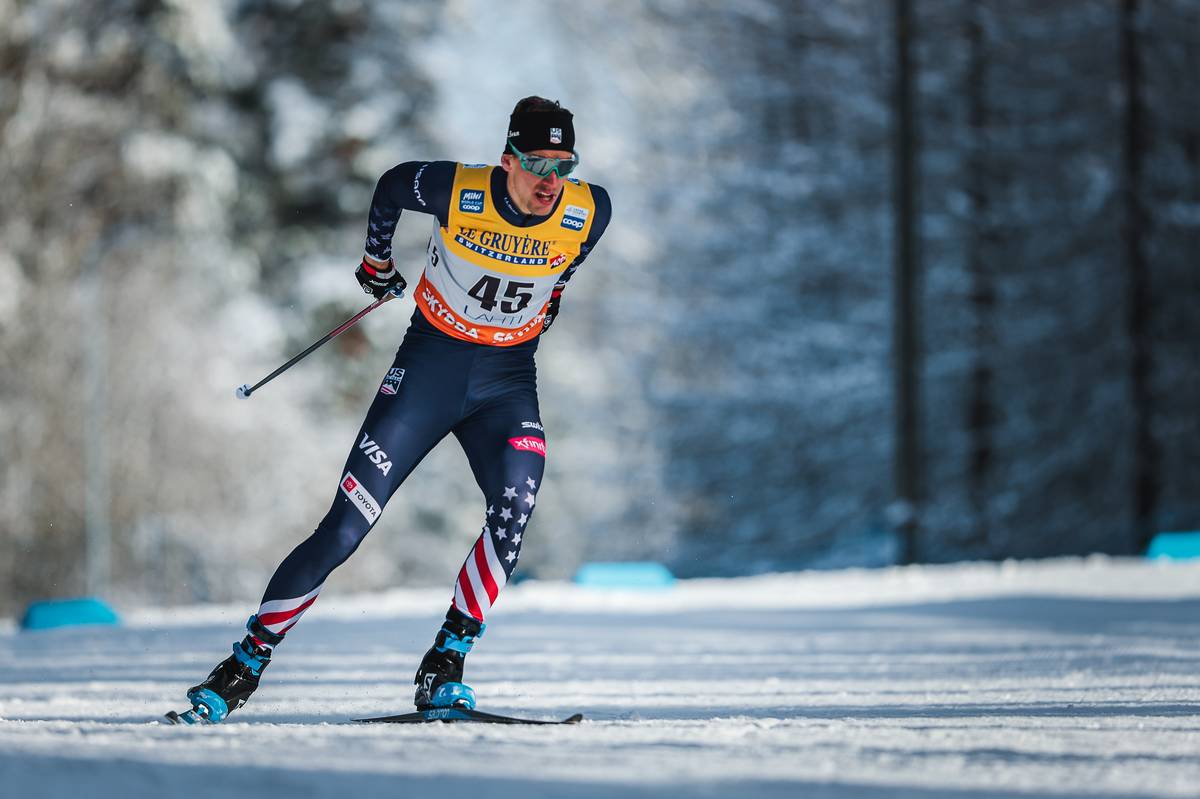
    For the U.S., these names included Logan Diekmann (BSF Pro Team) and Bill Harmeyer (SMS T2), both of whom earned their first World Cup starts this weekend via their performance on the SuperTour circuit this season. These athletes joined Kevin Bolger, Logan Hanneman, and Zak Ketterson; the Team Birkie athlete also earned his first World Cup starts earlier this year at the Tour de Ski.

    Diekmann currently leads the SuperTour sprint standings with 119 points. He was second in the freestyle sprint during the U.S. Cross Country Championships in Soldier Hollow in January and skied to 5th in the sprint in both Duluth and Lake Placid. 

    Harmeyer was ranked third in the sprint standings with 83 points, behind Noel Keeffe who is currently racing at the 2022 U23 World Ski Championships in Lygna, NOR. Harmeyer has consistently posted top-five times in qualification during the SuperTour sprint races, and has raced into the final in three out of six SuperTour sprints. A fall in the quarterfinal during US Nationals left him in 24th after qualifying in fifth. 

    Bill Harmeyer (SMS T2) makes his first World Cup appearance in the 1.6 k freestyle sprint qualifier in Lahti, FIN. (Photo: NordicFocus)

    Lucas Chanavat (FRA) was the top qualifier finishing the course in a time of 2:57.85. All five of the Americans finished outside the top-30 in qualification, but Canadian Graham Ritchie cracked into the heats for North America in 27th (+7.73). 

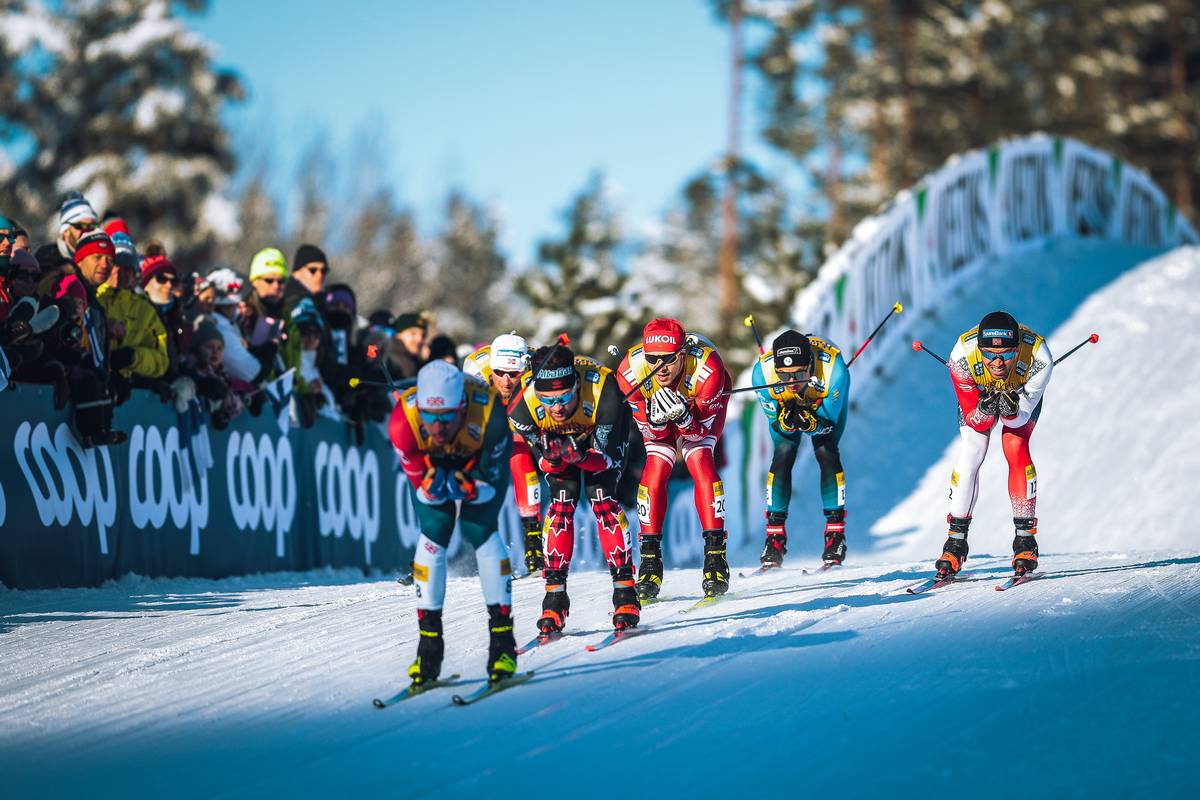
    The quarterfinal rounds played out mostly as expected, with Chanavat and Johannes Høsflot Klæbo (NOR) advancing from the first round after a close finish. Norway’s Håvard Solås Taugbøl and Olympic silver medalist Federico Pellegrino of Italy crossed the line first and second in heat two, spread by just 0.06 seconds. Winning the third heat, Andrew Young (GBR) crossed the line in 3:04.32, just ahead of Russia’s Gleb Retivykh (+.20). 

    The fourth quarterfinal heat saw a close finish, as Sindre Bjørnestad Skar (NOR) took the race to the line alongside Richard Jouve of France and Alexander Bolshunov of Russia were right at his heels. Skar won the closing sprint with Jouve +0.01 behind and Bolshunov in third (+0.07). Michal Novak (+.49) of the Czech Republic finished in fourth, with both Novak and Bolshunov narrowly missing out on lucky losers.  

    Fast racing in the fifth heat saw four competitors advance to the next round. Janik Riebli (SUI) won the heat in a time of 2:59.56, while China’s Qiang Wang finished second (+.10) to move onto the semis. A top prospect for the Chinese ski program, this is Wang’s first World Cup appearance since the pandemic began. Wang was fifth in qualification during the Olympic freestyle sprint in Zhangjiakou, where he took second in his heat to Norway’s Erik Valnes before being issued a disqualification for obstruction and being relegated last in the heat.

    Qiang Wang (CHN) leads at the start of the fifth quarterfinal heat in Lahti. (Photo: NordicFocus)

    Following the pace of the leaders, Maciej Starega (+.64) of Poland and Arnaud Chautemps (+1.61) of France crossed the line third and fourth to advance into the semis as lucky losers.

    In the first semifinal, five skiers all remained close coming into the finish to vie for the two automatic spots. Pellegrino was able to hold the field off and win the semi with a time of 2:59.57, however, he was later disqualified, pushing him to sixth place.  Klæbo crossed in second  (+.07), guaranteeing his spot in the final, while Chanavant and Taugbøl were third (+.21) and fourth (+.37), respectively. Due to Pellegrino’s disqualification, Taugbøl was able to make it through to the final as a lucky loser. 

    In the second semi, Retivykh held off a push from Skar to win in 2:59.67, with the Norwegian 0.02 behind. Wang crossed third (+.34) with a time fast enough to earn the second lucky loser spot in the final.

    Sindre Bjørnestad Skar leads his heat during the freestyle sprint in Lahti, FIN. (Photo: NordicFocus)

    In the final, an early tangle between Wang and Retivykh as the two rounded a corner sent the Chinese athlete to the ground, losing contact with the pack. 

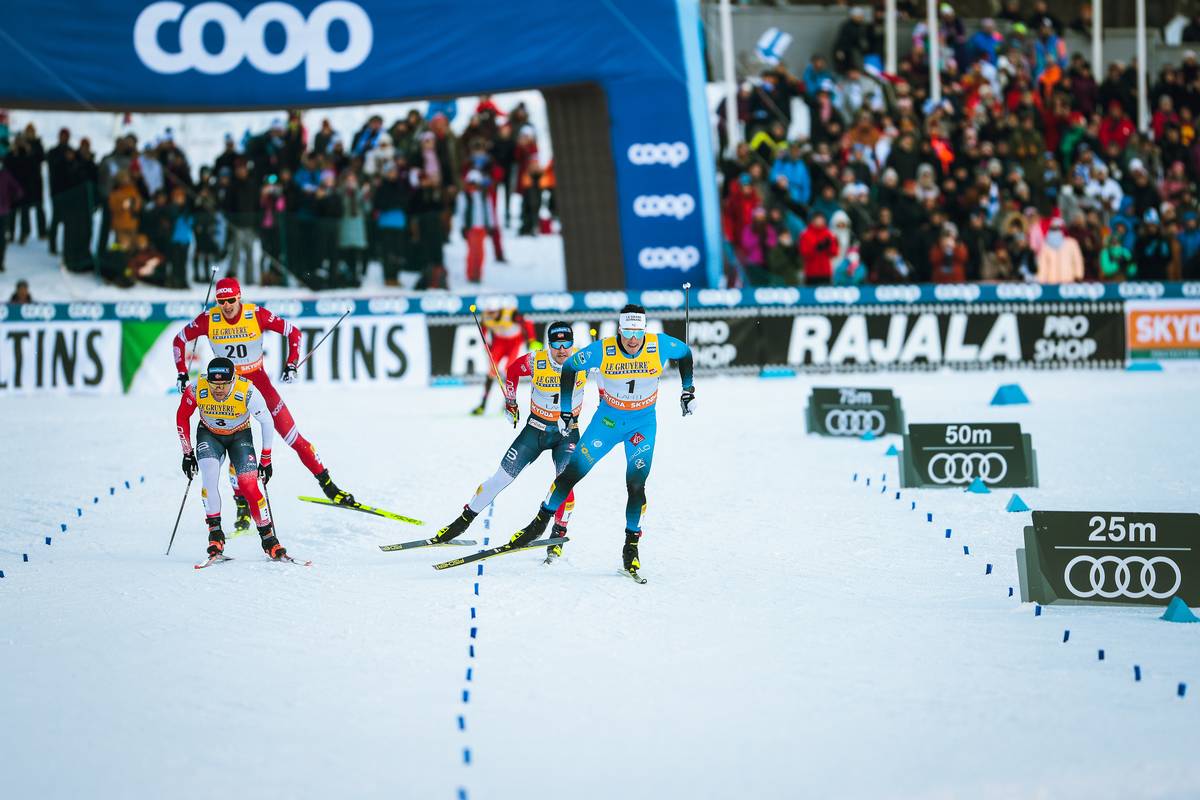
    The remaining five men stayed close as they powered through the course. Rounding the bend into the final 100 meters, four skiers remained in contention for the podium, but it was Klæbo who slingshot from the outside, putting his closing speed on display as he threw his boot to win a photo finish with Chanavat in 2:58.34, Skar and Taugbøl on their tails. 

    Johannes Høsflot Klæbo with a look before taking the win in the freestyle sprint in Lahti, FIN. (Photo: NordicFocus)

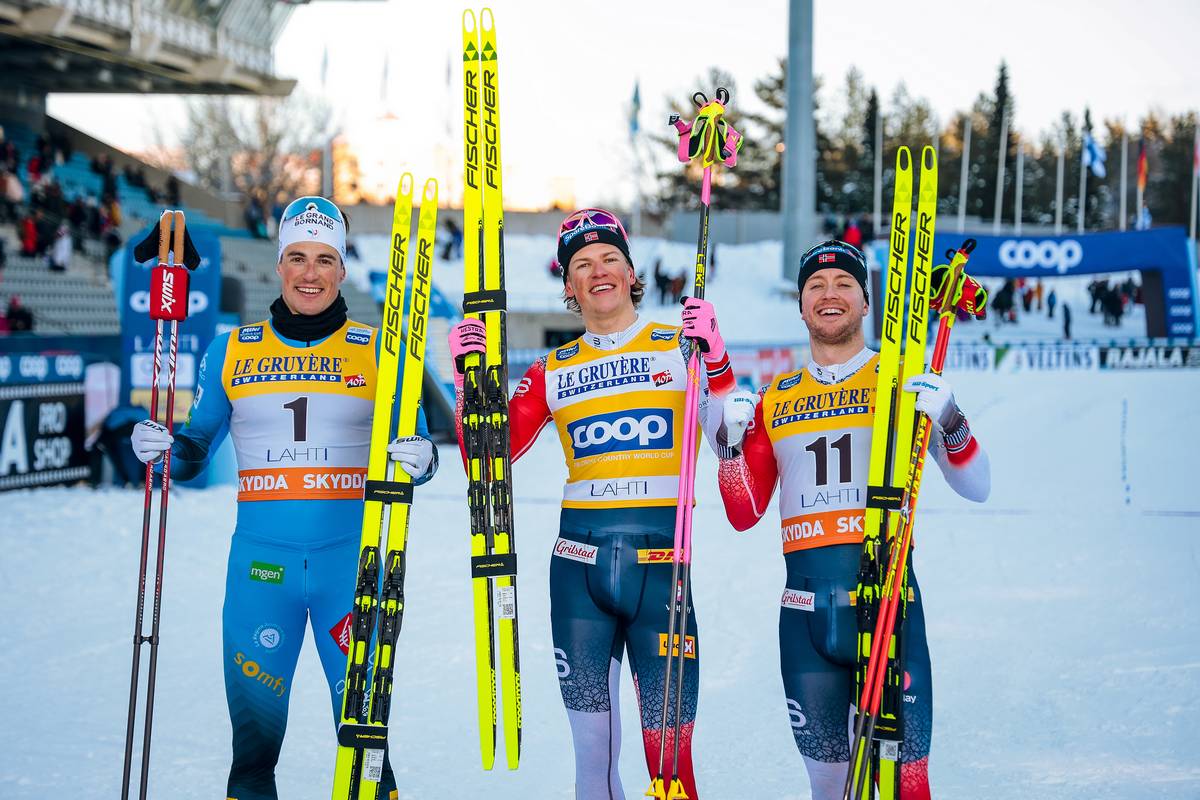
    The Norwegian had advantage at the finish, with Chanavat just 0.04 seconds back in second place. Skar held off his teammate for the final podium spot in third (+.23), while Taugbøl took fourth (+0.58). Retivykh crossed a few meters back in fifth (+0.90), while Wang rebounded from his crash to finish 7.77 seconds behind in sixth.

    A close race for second and third heads into the final 25 meters in Lahti. (Photo: NordicFocus)

    “It was amazing,” Klæbo told FIS after the race. “It isn’t so many days since we competed in the Olympics, but still, it’s always fun to race.” 

    Klæbo commented on the excitement of racing in Lahti, which has hosted many championship events including the 2019 World Championships. He added that the racing on these tracks is often tight, which keeps it exciting for spectators – of which there were many today. When asked about racing in front of a crowd after nearly two years of empty stadiums, Klæbo smiled.

    “It was amazing. I think what they have done, and finally seeing the end of the COVID situation – I think it’s amazing. It’s always great to compete against a big crowd, and it was amazing today as well.” 

    Johannes Høsflot Klæbo (NOR) takes the win in Lahti’s freestyle sprint ahead of Lucas Chanavat (FRA) and Sindre Bjørnestad Skar (NOR). (Photo: NordicFocus)
    Graham Ritchie races in the quarterfinal of the freestyle sprint in Lahti, FIN. (Photo: NordicFocus)

    After finishing fifth in a tightly spread third quarterfinal heat, Graham Ritchie bumped up from his bib rank to finish 24th.

    Kevin Bolger was the top American qualifier in Lahti in 33rd (+8.90), just 0.41 seconds off the mark needed for the top-30. On his tails was Diekmann in 34th (+9.14), with Hanneman close behind in 39th (+9.79). Ketterson was next for the U.S. in 49th (+12.13), with Harmeyer next in 50th (+12.28).

    Kevin Bolger leads the American men in 33rd during the freestyle sprint qualifier in Lahti, FIN. (Photo: NordicFocus)
    Antoine Cyr (CAN) races the qualifier of Lahti’s freestyle sprint. (Photo: NordicFocus)

    Outside the top-30 for Canada, Antoine Cyr was 40th in qualification (+9.99), with Olivier Léveillé next in 46th (+11.79), followed by Phillippe Boucher in 55th (+14.02) and Rémi Drolet in 58th (+15.87). 

    Racing continues tomorrow with a 15 k individual start classic.

    Results:

    Qualification | Final

  • Ketterson and Ogden Take Classic Sprint Win on New Tracks at Mt Van Hoevenberg

    Ketterson and Ogden Take Classic Sprint Win on New Tracks at Mt Van Hoevenberg

    By Rachel Bachman Perkins and Ben Theyerl

    After a brief break, the SuperTour picked up in Lake Placid this weekend, with a fluoro-free Period III kicking off with a 1.5-kilometer classic sprint. The frigid forecast called for overnight lows of -5 Fahrenheit, with a wind chill as low as -23F. Highs during the day were only predicted to climb into the low single digits. Qualifiers were scheduled for 10/10:45 am, with quarterfinals for the open men beginning at noon – hopefully, enough time for a few degrees of warmth to reach the trails. 

    The weekend competitions would be hosted on Mt. Van Hoevenberg’s new World Cup trails, which are paved for rollerski use in the summer, and played host to NENSA’s “Keys to the Castle” sprint event in September. For those familiar with the venue, the new courses are tucked into the north-facing hillside, just south of the 1980 Olympic stadium and biathlon range. The new serpentine loop intersects with the final Ks of the classic “Ladies 5” outer loop, but overall remains closer to the stadium to allow access to the recently improved snowmaking system. 

    Jessie Diggins (SMS T2/USST) pushes over the climb during the final round of the Keys to the Castle sprint. (Photo: Matt Whitcomb)

    With a large reservoir and advanced technology, this new World Cup loop can be made winter competition ready within four days, though Van Hoevenberg’s nearly 50k of open trail might suggest that coverage is not currently an issue.

    There was praise for the course from many athletes, including those that have seen both Lake Placid, and everywhere in the world beyond Lake Placid. 

    “It raced much more like a world cup course!” said Alayna Sonnesyn (SMS), in an email to FasterSkier. Katharine Ogden (SMS) too, said of the course, “it was WAY more fun than the old one…[which] was pretty flat.”

    The course designers at Lake Placid seem to have carefully been taking notes on what makes sprint racing exciting over the course of its evolution as a discipline in the sport. An historic venue for American skiing, these developments may be a long-time coming for Mt. Van Hoevenberg, but it’s clear that they were executed with mastery so VanHo can continue to expand upon its legacy in the decades to come. 

    This course featured a long, final uphill climb to test a skier’s mettle, then a short, technical downhill into the finish to test their tactical brains. And in between; transitions, transitions, and more transitions.

    Becca Rorabaugh (APU) said of this : “The final climb always turned into a drag race, and I liked the pitch because it favored a bit of a stride over an all-out run. Skiers still had to be alert through the downhill and finish, though; positions often changed in the stadium.”

    The weekend, hosted by the Olympic Regional Development Authority (ORDA) in Lake Placid, also served as the second NENSA Eastern Cup weekend. Thus, senior athletes from American elite clubs lined up alongside regional junior racers, eastern collegiate racers, and Canadian athletes who traveled from Quebec, Ontario, and beyond. 382 athletes, 176 women and 206 men, on the start lists for the qualifier, and separate heats were run for the U18/U20 and U16 categories. 

    Without livestream, FasterSkier has relied on live timing and athlete interviews to shed light on how the sprint races unfolded. 


    Men’s 1.5-kilometer Classic Sprint

    After returning from a stint in Europe where he raced the Tour de Ski, Team Birkie’s Zak Ketterson set the mark in the men’s qualifier, stopping the clock at 3:04.79. Sun Valley’s Peter Holmes skied the next fastest time in qualification (+0.72), while Étienne Hébert was just behind in third (+1.41). Hébert hails from Quebec and currently trains at the Centre National d’Entraînement Pierre-Harvey (CNEPH), based at Mont Ste Anne.

    Each of these men moved smoothly through the rounds, with Ketterson getting edged out by Bill Harmeyer (SMS T2) in the first semi, and Homes and Hébert going 1-2 in the second. Racing in the second semi saw a tighter spread and faster times, bringing Julien Locke (Black Jack Ski Club) and Logan Diekmann (BSF Pro) who had finished a close third and fourth, respectively, along to the final as lucky losers. 

    Zak Ketterson (Team Birkie) leads his heat during the 1.5-kilometer classic sprint in Lake Placid. (Photo: © 2022 Nancie Battaglia)

    The final featured a tight finish among the top four men, with Ketterson off the front to finish in 3:04.71, earning his second consecutive classic sprint victory. Ketterson had dominated the classic sprint in Cable, WI, and stood at the top of the SuperTour leaderboard, thereby earning start spots for the Tour de Ski. The timing of the Tour caused him to miss the subsequent classic sprint in Soldier Hollow, UT. 

    During the Tour, his first World Cup starts, Ketterson was less than a second shy of qualifying for the classic sprint heats in Oberstdorf, Germany, and had been roughly five second out of the Top-30 the day prior in a 15k skate. He was the only American on the men’s team to finish the Tour. After the Tour, Ketterson made a quick turnaround to attend the weekend of distance racing in Sun Valley, Idaho, where his results (15th in the 15k classic and 34th in the 10k free) were far below what might be expected from him. 

    Zak Ketterson races the freestyle sprint qualifier in Lenzerheide, SUI, the first event of the 2021/22 Tour de Ski. (Photo: NordicFocus)

    In a post-race email to FasterSkier, Ketterson shared how he felt about the Tour and what the recovery process has been like for him. 

    “The Tour de Ski was a fantastic learning experience with lots of ups and downs. I am pretty happy with my performance on the Tour given it was my first time on the World Cup, but I definitely think I will be faster next time around now that I have had the experience. Post Tour I was incredibly empty, both physically and mentally. To have to change gears pretty much immediately after the last stage of the Tour and head straight to Sun Valley for some super competitive SuperTour races at high altitude was definitely a recipe for disaster on my body. I felt like I was just going through the motions and my body wanted nothing to do with those races.

    “​​These last few weeks at home in Minneapolis provided me with some long-overdue recovery. My hunch after some really lackluster racing in Sun Valley was that there was no need to overthink anything and that the issue was probably just that I was tired. I took time at home to mentally and physically reset and started to feel a lot more like myself as the Placid races approached. Today, it all came together and I felt a lot more race-ready.”

    Ketterson also commented on the improvements that have been made at the Mt Van Hoevenberg venue, explaining how it supports the growth and elevation of domestic skiing.

    “I am blown away with the venue at Mt. Van Hoevenberg! The venue truly feels like it’s ready for World Cups, or even another Olympics. It’s really inspiring to see big investments into nordic skiing venues in the United States, and I can’t stress enough how big it is for us athletes. I can’t wait to come back to Lake Placid sometime later to really experience this place because I think it’s so awesome here.”

    Behind Ketterson, just 0.26 seconds separated second through fourth in the men’s final. Holmes won the boot slide to snag second (+0.72), while Harmeyer took the final podium spot in third (+0.92). Hébert was just 0.06 seconds shy of the podium, ending the day in fourth (+0.98).

    The men’s final of the 1.5-kilometer classic sprint, the first event of the weekend of SuperTour racing hosted by Mt. Van Hoevenberg in Lake Placid. (Photo: © 2022 Nancie Battaglia)

    Harmeyer provided insights into his approach to the day, along with insights into the moves that contributed to the excitement at the finish line.

    “I felt really good in the heats today,” he wrote via email. “The course was certainly difficult and tactical. Placement in the group was really important and that was especially apparent in the final. We had a group of four dudes going over the top of the final climb into the long descent before the finish. It was an absolute scramble trying to get into the tracks on that final downhill. At one point, I had my left ski in the right part of the track and Étienne had his right ski in the left side of the track. Not easy to squeeze two guys going 30+ mph into a single track but somehow, I came out ahead which was just enough to lunge at the finish for third.”

    During Period I, Harmeyer took third in the classic sprint final in Cable, and was just off the podium in fourth the weekend prior after the freestyle sprint in Duluth, MN. After qualifying in fifth, a crash in the quarterfinal left him 24th in the freestyle sprint in Soldier Hollow during the U.S. Cross Country Championships. A few days later, he was 51st in the 15k classic. In the Soldier Hollow SuperTour classic sprint, Harmeyer qualified in fourth, and just missed the final to end his day in eighth. 

    Reflecting on the season as a whole, Harmeyer wrote, “I had a really good start to the season with some strong races in the Midwest. But overall, things have been frustrating. I’ve been struggling with some cold weather triggered exercise induced asthma that got really bad after the first supertours in the Midwest. I continued to struggle with it through a disappointing Senior nationals and decided to take a bit of time off to reset, recover and do some testing. I’m hopeful the worst is behind me and that I’ve got some good protocols lined up to prevent anything from happening in the future. My primary goal for the remainder of the season is to win the Stowe Derby, specifically the derby meister.”

    Wrapping up with a comment on the venue, Harmeyer added, “The new courses at Lake Placid are sweet! The sprint course is incredibly tactical but also rewards tough, explosive skiing. I had an absolute blast out there in the heats. The distance courses are hard but I’m excited to be doing a mass start on those for this Sunday. Overall, Van Ho has done a great job with course management and their snowmaking to put together some killer courses.”

    After a gap, Diekmann crossed the line in fifth (+5.81), while Locke rounded out the men’s final in sixth (+9.11). 

    The men’s SuperTour classic sprint podium on a frigid day of racing at Mt Van Hoevenberg near Lake Placid, NY. (Photo: © 2022 Nancie Battaglia)


    Women’s 1.5-kilometer Classic Sprint

    The women’s field began right where it left off in SuperTour classic sprints, with the winner of the last race at Soldier Hollow, Katharine Ogden, (SMS) finishing the qualifier in first place (3:40.49). She was followed by Lauren Jortberg (BSF Pro Team) in second (+2.2), and Ava Thurston (Mansfield Nordic Club) in third (+6.1). The qualifier indicated, again, the overall strength of the field that has characterized this year’s SuperTour, with the heat qualifiers all within 30-seconds of each other (26.0 seconds to be exact).

    That field remained tight in the quarterfinals as well. All five quarterfinals saw winning times within a mere five seconds of one other, with Katharine Ogden turning in the fastest time of the round at 3:42.77, and Alayna Sonnesyn winning her heat in 3:46.12. 

    Katharine Ogden (bib 1) races her way through the classic sprint heats during the SuperTour race weekend in Lake Placid. (Photo: © 2022 Nancie Battaglia)

    Ogden commented to FasterSkier that she “didn’t really have any strategy in particular. I find that it is better for me to make strategy in the moment during sprint heats because you never know what’s going to happen out there… I just tried to conserve as much energy as possible in the quarter and semi.” It would pay off later on.

    Meanwhile, also progressing to the semifinals was the APU one-two punch of Rosie Frankowski and Becca Rorabaugh out of quarterfinal 2. Despite being primarily known as a distance racer, Frankowski, came into today leading the SuperTour sprint classification and “set a blistering pace,” according to teammate Rorabaugh. With it, she pulled the duo into the semifinals together.

    After all the quarterfinals were through, the semifinals were set with a who’s-who at the top of the SuperTour sprint standings, rounded out by Canadian Katie Weaver (Hollyburn XC Ski Club) and Minnesotan Margie Freed (Craftsbury).

    The first semifinal featured a battle between two SMS T2 teammates, Katharine Ogden and Alayna Sonnesyn, and two APU teammates, Rosie Frankowski and Becca Rorabaugh. Frankowski again set the pace for the heat, with teammate Rorabaugh commenting that “[Rosie] is so strong on the uphills that she pulls the whole heat to a faster time.” Frankowski, however, couldn’t quite outlast Ogden and Sonnesyn, who used the downhill after the final climb to launch into the first two positions. Ogden won the heat in a time of 3:39.23, with Sonnesyn and Frankowski in second and third, respectively, by less than a second. Rorabaugh finished fourth, but along with Frankowski won the lucky loser spots into the finals – setting up another round of the SMS-APU duel.

    In the other semifinal, a close battle throughout yielded a win for Lauren Jortberg (3:45.15)  and a second place for Erika Flowers (+0.90). The result sent another teammate pairing into the finals, with both skiers coming from Bridger Ski Foundation (BSF).

    The women’s classic sprint final takes to the tracks in Mt. Van Hoevenberg. (Photo: © 2022 Nancie Battaglia)

    At Lake Placid – a place that has over the past century proved to be able to gather the entire world around skiing – it was perhaps appropriate that the women’s final would bring together three teams from across the American continent. Two from Vermont (SMS), two from Montana, two from Alaska (APU), and away they went!

    Katharine Ogden commented that the field didn’t waste any time: “It was pretty hard from the gun, as per usual.” 

    Rorabaugh, meanwhile, made a change in strategy, deciding to follow her teammate Frankowski more closely in the early part of the race. “I was trying to stay closer to the front of the pack since I had let a large gap form in the semifinal that I couldn’t make up,” she explained.

    That adjustment was one that helped create a pack that was tight throughout the race, and that was a bit harder to find a position in.

    Sonnesyn commented that this led to her having to adjust. “I had great energy but got tangled up a few times on the second hill, so I really had to ski from behind in the second half of the race,” she wrote. “Luckily, I had great skis and remained calm and was able to push through the final stretch.”

    In that final stretch, on the final hill, a “drag race,” as Rorabaugh described it, ensued. It was instigated by Ogden, who saw the final climb as the place to make her move, and made it. She came over the top in first place.

    “[I] got lucky,” she told FasterSkier. “Pat [O’Brien, SMS T2 head coach] had provided me with some really fast skis that allowed my move to stick going back down the hill.”

    Perhaps it wasn’t all luck though. Ogden came across the finish line in first place (3:40.13) after winning the qualifier, her quarterfinal, and her semifinal. It was an all-around dominant performance for one of the U.S. brightest stars in the classic sprint.

    Katharine Ogden wins the women’s 1.5-kilometer classic sprint in Lake Placid, NY. (Photo: © 2022 Nancie Battaglia)

    Meanwhile, Becca Rorabaugh had powered through the transition into the final downhill and came up with the reward of second place (+3.40), She was followed by Alayna Sonnesyn, who remained cool, calm, and collected as she skied her way through the pack to third place (+4.29).

    The final was rounded out by fourth place Rosie Frankowski (+4.74), fifth place Lauren Jortberg (+5.63) and sixth place Erika Flowers (+17.77).

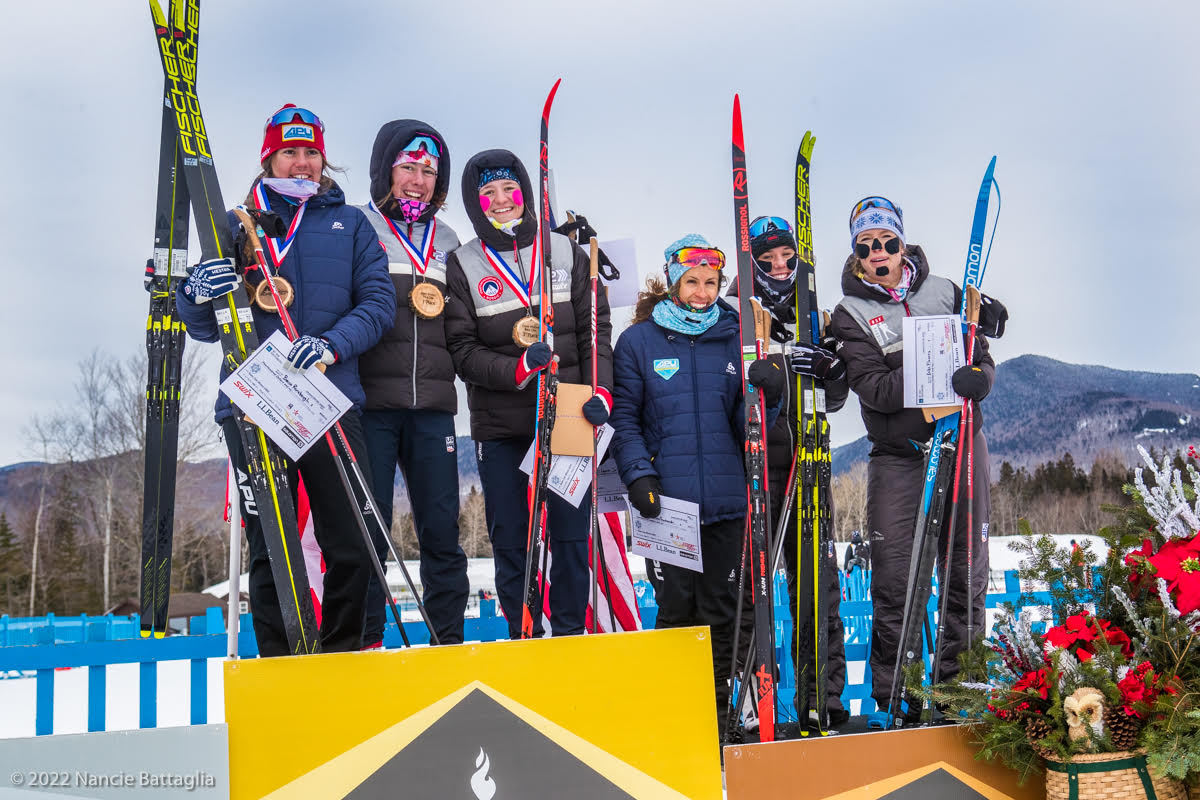
    The women’s classic sprint podium on day one of SuperTour racing in Lake Placid, NY. (Photo: © 2022 Nancie Battaglia)

    The result was reached at the end of an exciting day that encapsulated the beauty of ski racing – with excitement and energy perfectly juxtaposed against the extreme absence of that energy in the air. Preparing for cold temperatures that are forecasted again for the 10k freestyle mass start tomorrow, the top finishers today all expressed that the temps are part of the appeal in the northeast this weekend.

    From Rorabaugh, “I don’t mind cold temperatures – I grew up in Fairbanks, Alaska!”

    From Sonnesyn, “I like to think the Midwesterner in me prepared well!” 

    And from Ogden, the perfect Vermont tip: “As Sverre [Caldwell] told us last night, tricky race conditions can work to your advantage if you prepare better than anyone else. Wise man :)”


    Results

    Qualification: Men | Women

    Sprint Brackets


  • Race Rundown: Ketterson and Ogden Win SuperTour Classic Sprint in Lake Placid

    Race Rundown: Ketterson and Ogden Win SuperTour Classic Sprint in Lake Placid

    Here’s a quick results recap from today’s SuperTour classic sprint in Lake Placid, NY. Stay tuned tomorrow for detailed coverage including comments from athletes. 

    Period III of SuperTour racing kicked off in Lake Placid this morning with a frigid classic sprint. Recent improvements at Mt Hoevenberg included a new 5-kilometer World Cup and 1.5k sprint course, where athletes faced off today.

    On the men’s race, Zak Ketterson (Team Birkie) skied the fastest time in the men’s qualifier, stopping the clock at 3:04.79. Sun Valley’s Peter Holmes skied the next fastest time in qualification (+0.72), while Étienne Hébert (CNEPH) was just behind in third (+1.41).

    The men’s SuperTour classic sprint podium on a frigid day of racing at Mt Van Hoevenberg near Lake Placid, NY. (Photo: © 2022 Nancie Battaglia)

    In a tightly spread final, Ketterson found the advantage to take the win in 3:04.71. The second and third podium spots were decided by a boot slide, which included the fourth place skier who just missed the mark. These men were Holmes (+0.72) in second, with Bill Harmeyer (SMS T2) in third (+0.92), and Hébert in fourth (+0.98). Logan Diekman (BSF Pro) skied to fifth in the men’s final, with (+5.81), with Julien Locke (Black Jack Ski Club) in sixth (+9.11).

    Following her dominant performance in the most recent SuperTour classic sprint, Katharine Ogden (USST/SMS T2) swept the women’s race. Ogden was the top qualifier in 3:40.49, with Lauren Jortberg in second (+2.13) and U18 racer Ava Thurston (Mansfield Nordic Club) in third (+6.04). 

    Ogden won her way through the rounds, taking the first quarterfinal and semi by narrow margins before smashing the final round to win by over three seconds in 3:40.13. Becca Rorabaugh (APU) was second in the women’s final (+3.40), with Alayna Sonnesyn (SMS T2) in third (+4.29), just ahead of Rosie Frankowski (APU) in fourth (+4.74). Jortberg was fifth in the final (+5.63), with BSF teammate Erika Flowers in sixth (+17.77).

    The women’s classic sprint podium on day one of SuperTour racing in Lake Placid, NY. (Photo: © 2022 Nancie Battaglia)

    Results

    Qualification: Men | Women

    Sprint Brackets

  • SuperTour Racing Kicks Off in Duluth

    SuperTour Racing Kicks Off in Duluth

    Fast racing on the manmade tracks during the men’s sprint heats in Duluth, MN. (Photo: Hansi Johnson)

    By Gavin Kentch and Rachel Bachman Perkins

    The SuperTour returned this weekend with races in Duluth, Minnesota, held on the new snowmaking courses at Grand Avenue Nordic Center. The weekend included all levels of racing, with green juniors lining up to race alongside the veterans racing on the SuperTour, and a strong sense of community and cross-country ski energy across the board. Skiers like to ski; athletes were glad to be back.

    Alaska Pacific University Nordic Ski Center (APU) athletes had a strong showing for the weekend, winning three out of four races. Rosie Frankowski (APU) and Alayna Sonnesyn (SMS T2) each made the podium twice. FasterSkier unofficially calculates the current SuperTour leaders as APU skiers Rosie Frankowski for the women, with 51 points after two races, and Tyler Kornfield for the men, with 42 points. The overall SuperTour leaders at the end of next weekend’s racing in Cable should receive start rights on the World Cup for Period 2, the Tour de Ski. Official USSS standings, here, have recently been updated, and accord with FasterSkier’s math.

    Saturday: Freestyle sprint

    Alayna Sonnesyn started out the qualifier in style, destroying the field to set the day’s fastest time for the two-lap, 1.3-kilometer course by a staggering ten-plus seconds. Several heats later, she was joined in the women’s final by a largely chalk field: Becca Rorabaugh (APU), Rosie Frankowski (APU), Julia Richter (University of Utah), and Sarah Goble (Sun Valley), who had the day’s second, third, fourth, and ninth fastest qualifying times, respectively. Katerina Hyncicova (NMU), who had been 23rd in qualifying, was the main outlier here.

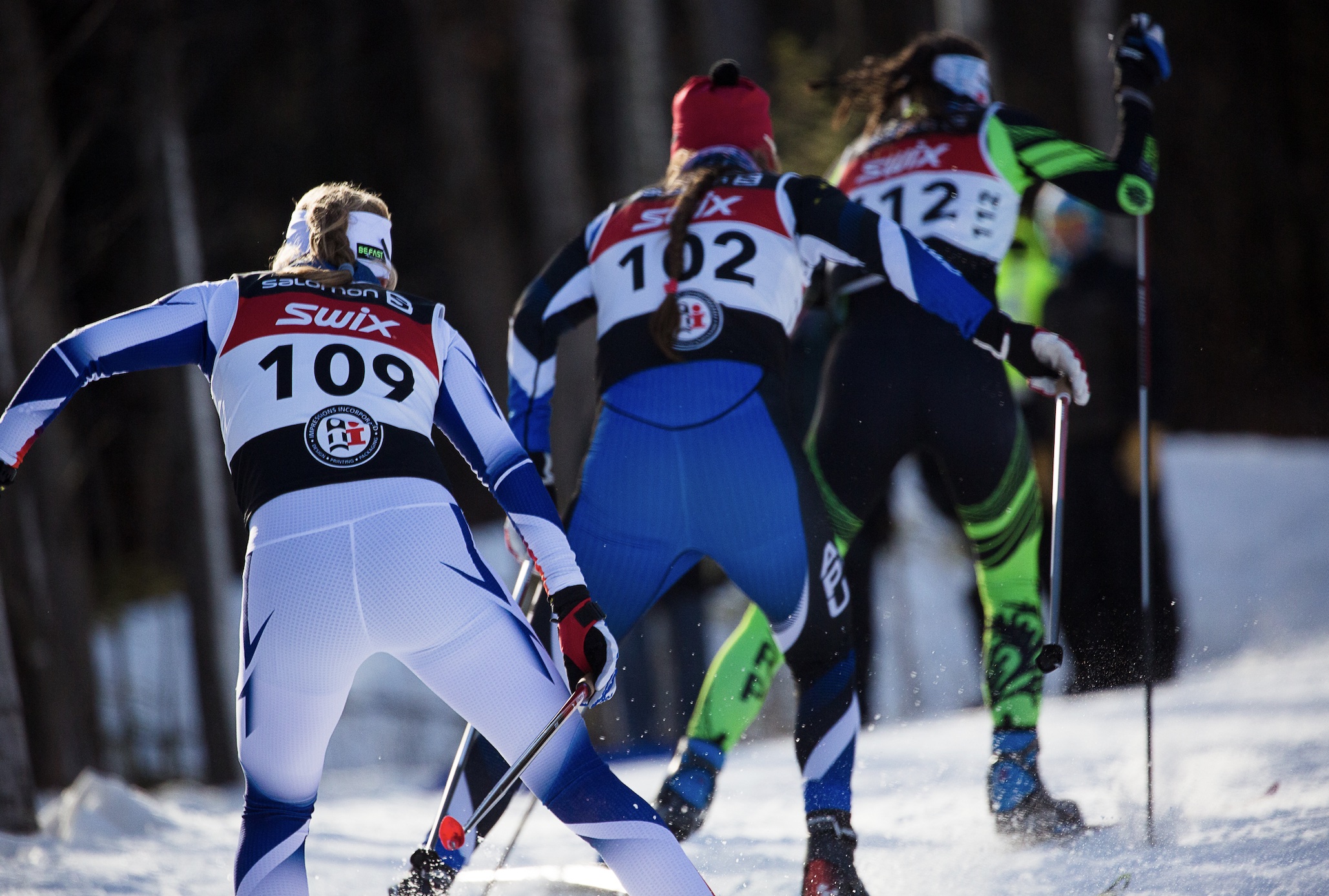
    Becca Rorabaugh (Bib 102) races through the heats to win the opening SuperTour sprint in Duluth. (Photo: Hansi Johnson)

    Roughly three minutes later, the two women who had consistently been the top athletes in the field all day, Sonnesyn and Rorabaugh, found themselves at the top of the long descent for the second and last time in the women’s final. Sonnesyn led going into the descent, but Rorabaugh skied this segment aggressively to slingshot around Sonnesyn and was able to significantly out-glide her by the bottom of the hill. Sonnesyn made up some ground as the two of them made the lefthand turn into the stadium and the uphill finish, but Rorabaugh was never seriously threatened on her way to the line.

    Rorabaugh took the win in 3:11.49, with Sonnesyn 0.47 seconds back.

    Roughly four seconds later, the compact powerhouse Frankowski, traditionally identified as more of a distance skier, led Richter to the line by nearly 1.5 seconds to take third. Goble in fifth and Hyncicova in sixth made up the rest of the final.

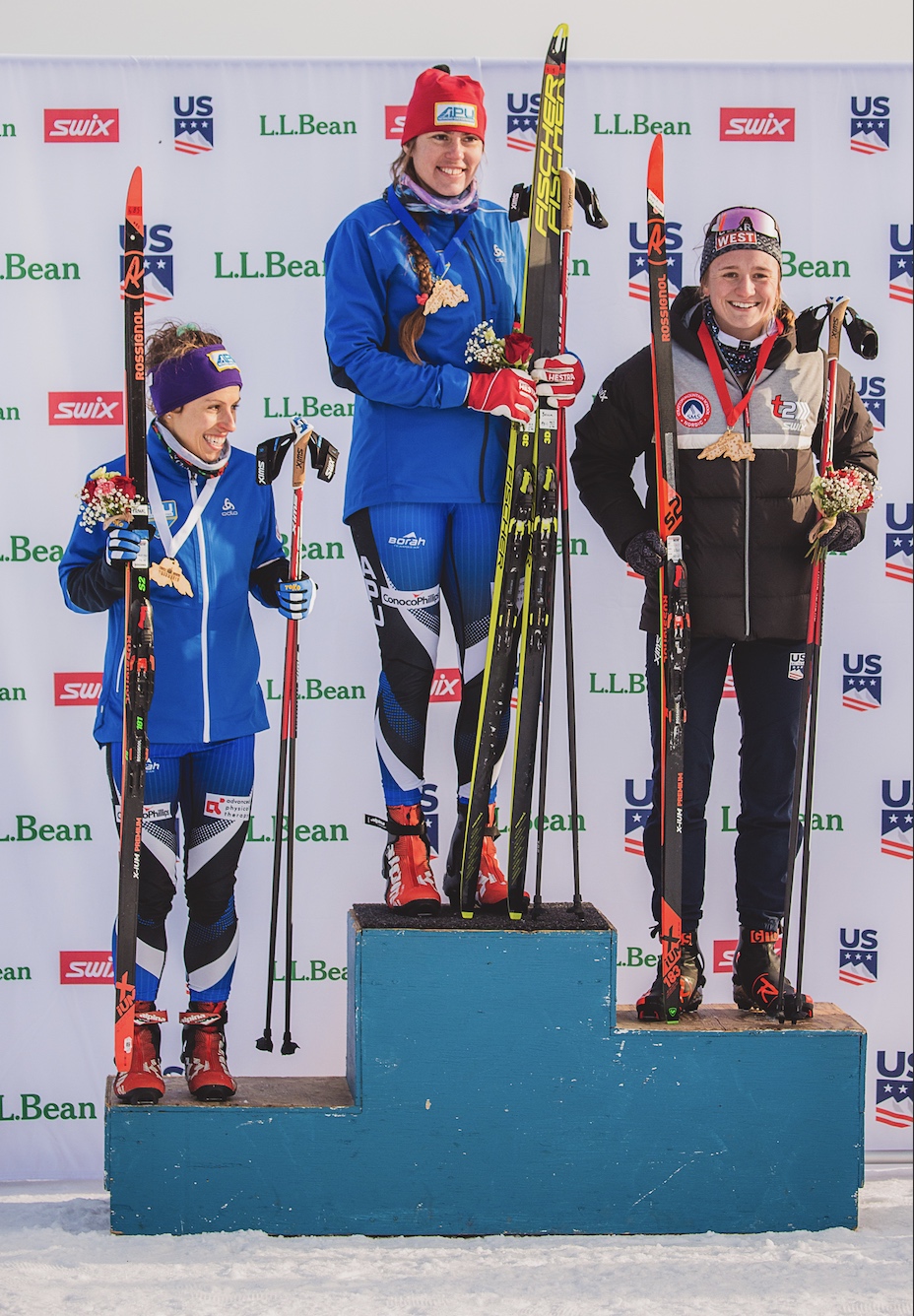
    The podium of the women’s freestyle sprint in Duluth. Becca Rorabaugh (APU) took the win ahead of Alayna Sonnesyn (SMS T2) and Rosie Frankowski (APU). (Photo: Hansi Johnson)

    It was Rorabaugh’s first SuperTour win since the skate sprint at Wirth Park in February 2020. It was Frankowski’s first SuperTour podium since she was first and second at West Yellowstone in a sprint and distance race in December 2018.

    “The sprint went really well for me,” Rorabaugh wrote in a post-race email. “It was exciting to get to race at a Super Tour again!  I love icy conditions, I love speed, and I love head to head racing, so it was pretty ideal for me. It’s also good to know that I’m sharpening up; these results show that I can hammer when I need to which is a good sign for the season.”

    Reflecting on racing at the national level after a year away, Rorabaugh continued, “It feels really good to be back and to get to race against some of the people that I haven’t seen since early 2020. It seemed like Alaska was quite separate during last season, like maybe people forgot we were up there, so it’s fun to remind everyone that we’re a force to be reckoned with.”

    Few athletes were familiar with the new course in Duluth. Rorabaugh also reflected on the course and the event as a whole.

    “The sprint course in Duluth is fun and it suits me incredibly well. Some might say it’s lacking a long, steep climb, but I think most would agree that the downhill and the finish stretch are exciting and fun. The finish stretch is pitched up enough that you have to have a good sprint. You can’t just carry speed all the way to the line, which keeps things spicy at the end.

    “The energy in Duluth has also been great, everyone has been very welcoming and combining the Super Tour with junior races means it’s a huge event. I always enjoy getting to see the younger skiers giving it their all, and the organized chaos of big races is exciting!”

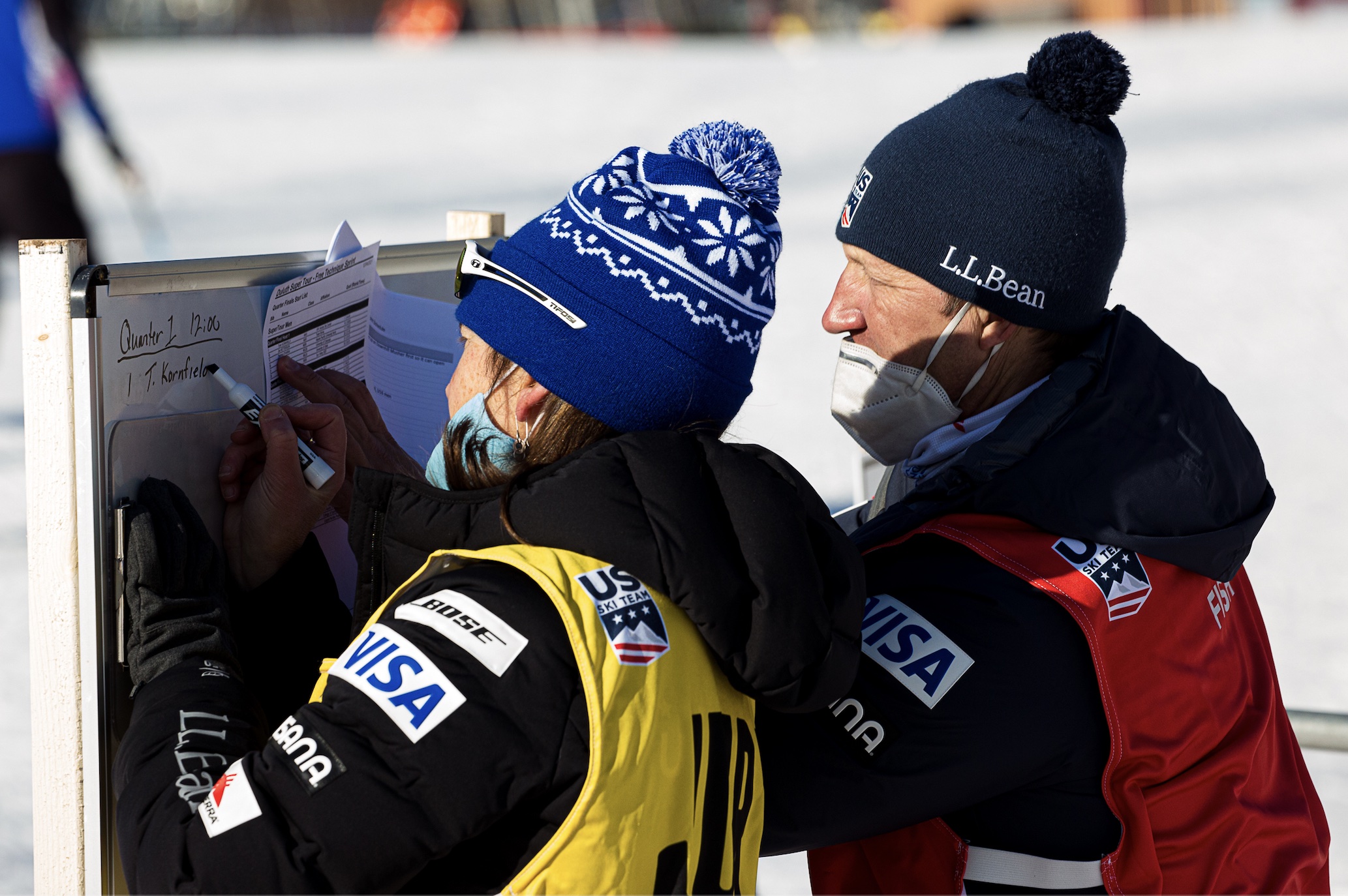
    Bryan Fish, U.S. Ski & Snowboard Sport XC Development Manager, reads the men’s heat list as it’s transferred onto a white board. (Photo: Hansi Johnson)

    The men’s race featured more of the same: most top qualifiers making it through to the final, and an APU skier moving up from second to outglide a competitor on the final downhill into the finish. For the men, it was the first, second, third, eight, ninth, and outlier 27th-place qualifiers in the final: Tyler Kornfield (APU), Logan Diekmann (BSF), Bill Harmeyer (SMS), Adam Witkowski (Michigan Tech), Noel Keeffe (University of Utah/USST), and Kjetil Bånerud (NMU), respectively.

    Two-plus minutes later, it was Keeffe leading Kornfield into the top of the final downhill. 15 seconds later, it was Kornfield leading Keeffe into the finish lanes, as APU’s skis were once again superior. Kornfield kept his lead through the stadium to take the win in 2:47.44, narrowly ahead of Keeffe (+0.23).

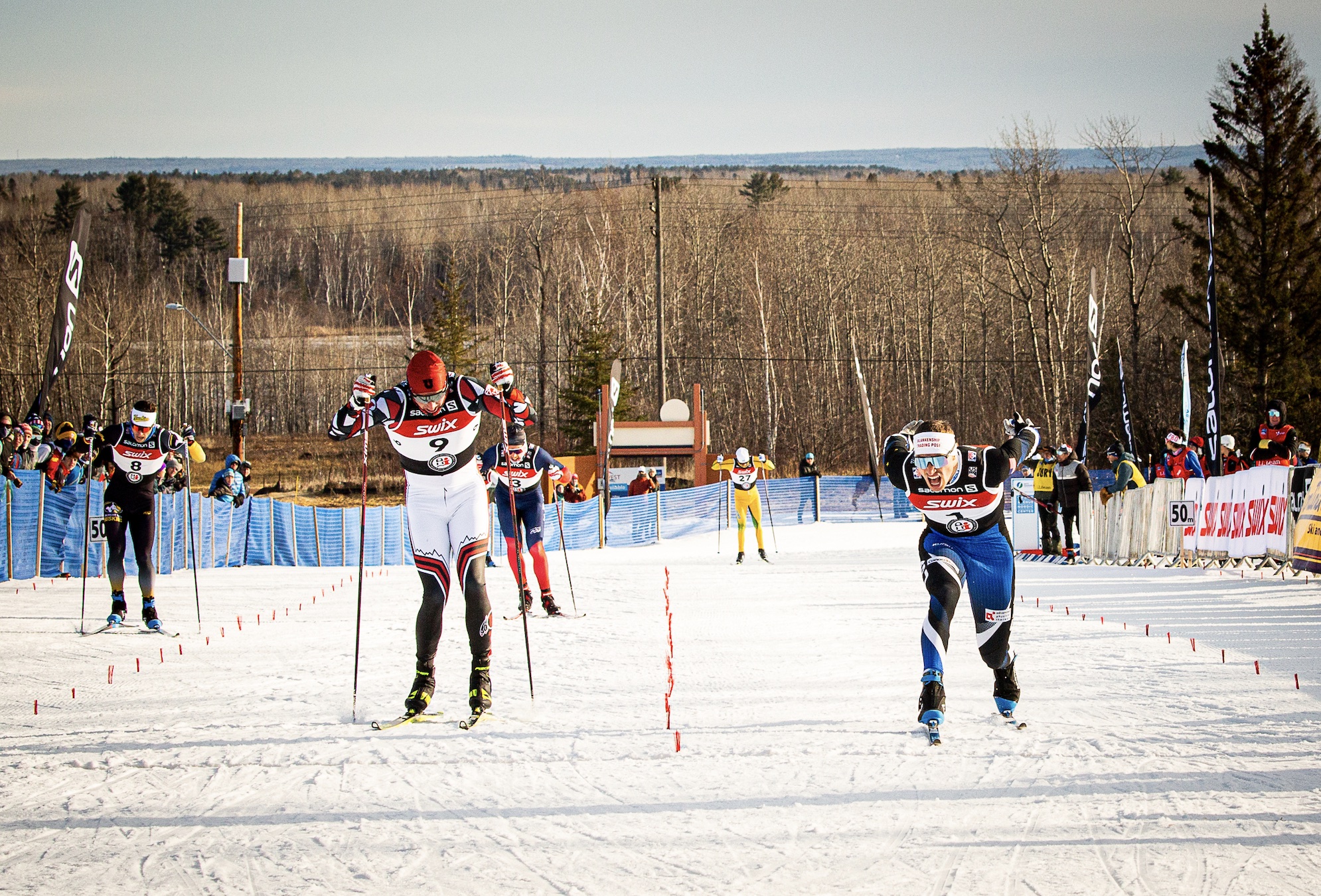
    Tyler Kornfield (APU), right, wins the men’s freestyle sprint in a bootslide ahead of Noel Keefe (Univ. of Utah) at the opening SuperTour weekend in Duluth, MN. (Photo: Hansi Johnson)

    A few seconds later, Witkowski (+2.90) outdistanced Harmeyer (+3.36) for the final podium spot. Diekmann and Bånerud followed several seconds later.

    “It feels great to get to racing again,” Kornfield wrote after the race. “Last season, I was able to race two sprint qualifiers, but I failed to qualify for the heats in both. I love racing head to head and it was difficult at times to find inspiration. Fortunately, I have a great team at APU along with Gus and JC being in Alaska, we have been able to do a few time trials to prepare for the season. That allowed me to come to the races feeling calm and prepared. Though I never know exactly how I will perform early in the season, I have been cautiously optimistic about how my body has been performing in training. I hope that I can continue the trend into next week and onto the rest of the season. My mantra for the season is to make every race count and I think I did that in the sprint.”

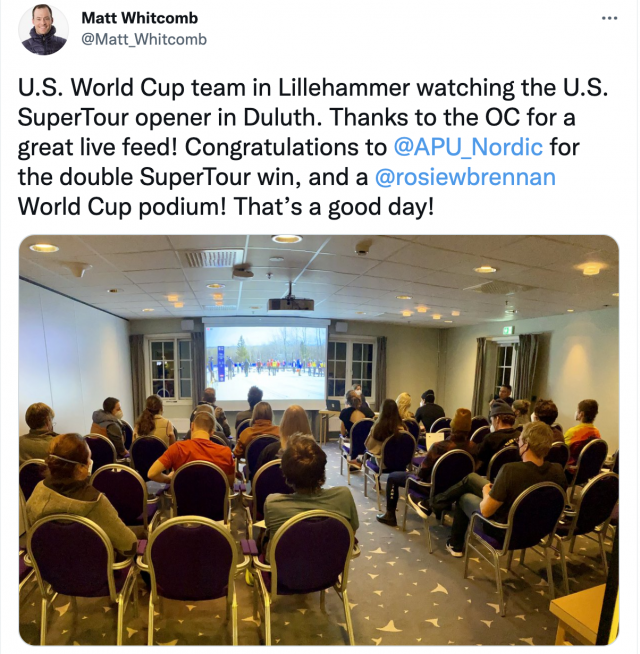
    Earlier that day, Kornfield’s longtime partner and fellow APUNSC athlete, Rosie Brennan, had made the podium in Lillehammer in a World Cup race. USST coach Matt Whitcomb congratulated the APU program on its successful day, alongside a heartwarming photo of the World Cup crew watching the CXC Live feed of the SuperTour races in a conference room at the Scandic Lillehammer.

    “It is also easy to be inspired to race well when Rosie finishes on the podium of the World Cup,” Kornfield continued in his comments on the sprint day. “I often need to be careful because it is hard to fall back asleep after checking her results at three in the morning, but this morning, it was worth it.”

    Kornfield also spoke to the course and event in Duluth, praising its challenges and how they might prepare athlete to race at the World Cup level.

    “The course in Duluth was great! I think it was a perfect combination of long enough working sections that were wide enough to maneuver, as well as technical/icy turns that would cost someone who might lose focus either leading into, during, or coming out of the turns. If we have more courses like this one, I believe we can keep pushing the momentum of domestic racing that will prepare us for racing in Europe. It was also great to see so many people out watching. That can be rare sometimes on the SuperTour, but there is an obvious sense of excitement and passion in Duluth that will hopefully turn into a regular SuperTour venue!”

    Saturday Sprint Results: Qualifiers (all) | Women’s final | Men’s final | All heat results

    Multimedia: sprint course preview video from Bill Harmeyer | livestream replay from CXC

    Fast racing on the tracks in Duluth as the SuperTour returns. (Photo: Hansi Johnson)

    Sunday: Freestyle distance

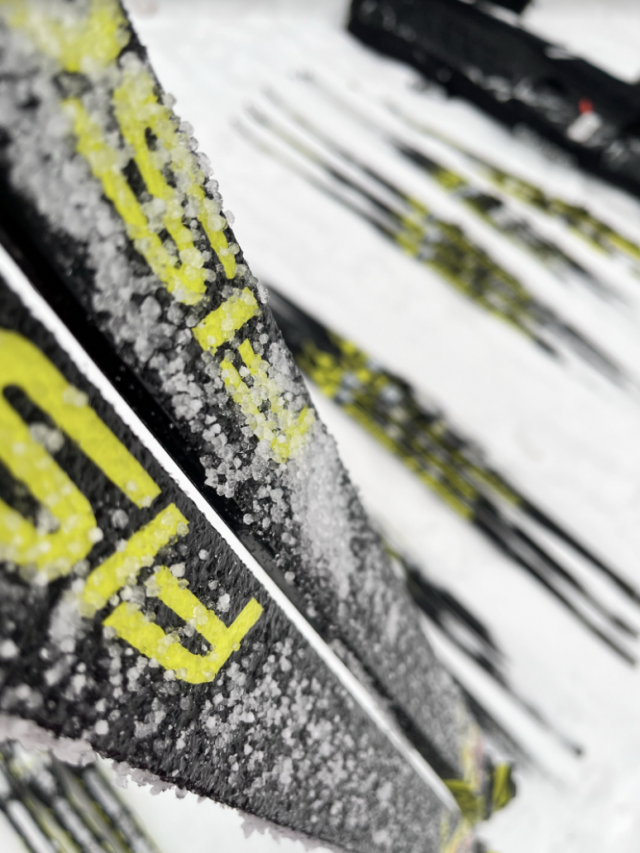
    While athletes raced on a white ribbon with bare ground exposed on either side during the sprint, what one might call a “wintery mix” arrived in Duluth on Sunday morning. Over four inches of fresh snow fell overnight, which turned into wet icy flakes as the races began. APU coach and tech Galen Johnston shared photos of graupel-encrusted skis, which left us wondering what skiers might have looked like at the finish.

    In the individual start freestyle events, senior men raced five laps of a roughly 2.2-kilometer course while senior women raced three laps.

    Team Birkie’s Zak Ketterson eked out a win on the men’s side in a time of 26:33.4, beating Northern Michigan University (NMU) athlete Kjetil Bånerud by 3.4 seconds. Bånerud had started three bibs ahead and held the fastest splits until Ketterson came through. Craftsbury Green Racing Project (CGRP) athlete Adam Martin skied the third-fastest men’s time (+8.6) to round out the podium.

    “10 kilometers is a tricky distance because while it seems short compared to our normal 15k distance, it’s definitely still long enough to require some good pacing,” wrote Ketterson after the race. “I was fortunate to receive a lot of splits from my coaches, as well as my old NMU coaches and others.”

    Zak Ketterson on course during the opening SuperTour races in Duluth, MN. (Photo: Hansi Johnson)

    Originally from Bloomington, MN, on the south side of Minneapolis, Ketterson is an NMU alumnus. While other athletes on the podium, like Frankowski and Sonnesyn, are also originally from the Midwest, Ketterson has spent his entire ski career in the region, and he felt the community support during the race.

    “It was a really great atmosphere at the Grand Ave Nordic center. I really like Duluth and have very fond memories from when I raced there last year with NMU at some NCAA qualifier races. My favorite part of racing in the Midwest is that there are so many friends that cheer for me. It really feels like a ‘home’ race.”

    Commenting on the season ahead, Ketterson shared, “My goals for this season are to just take it one race at a time, trying to do my best in every opportunity I get. We will see where that gets me! For now, I’m just happy to be a part of such an amazing team (Team Birkie) and to be racing again.”

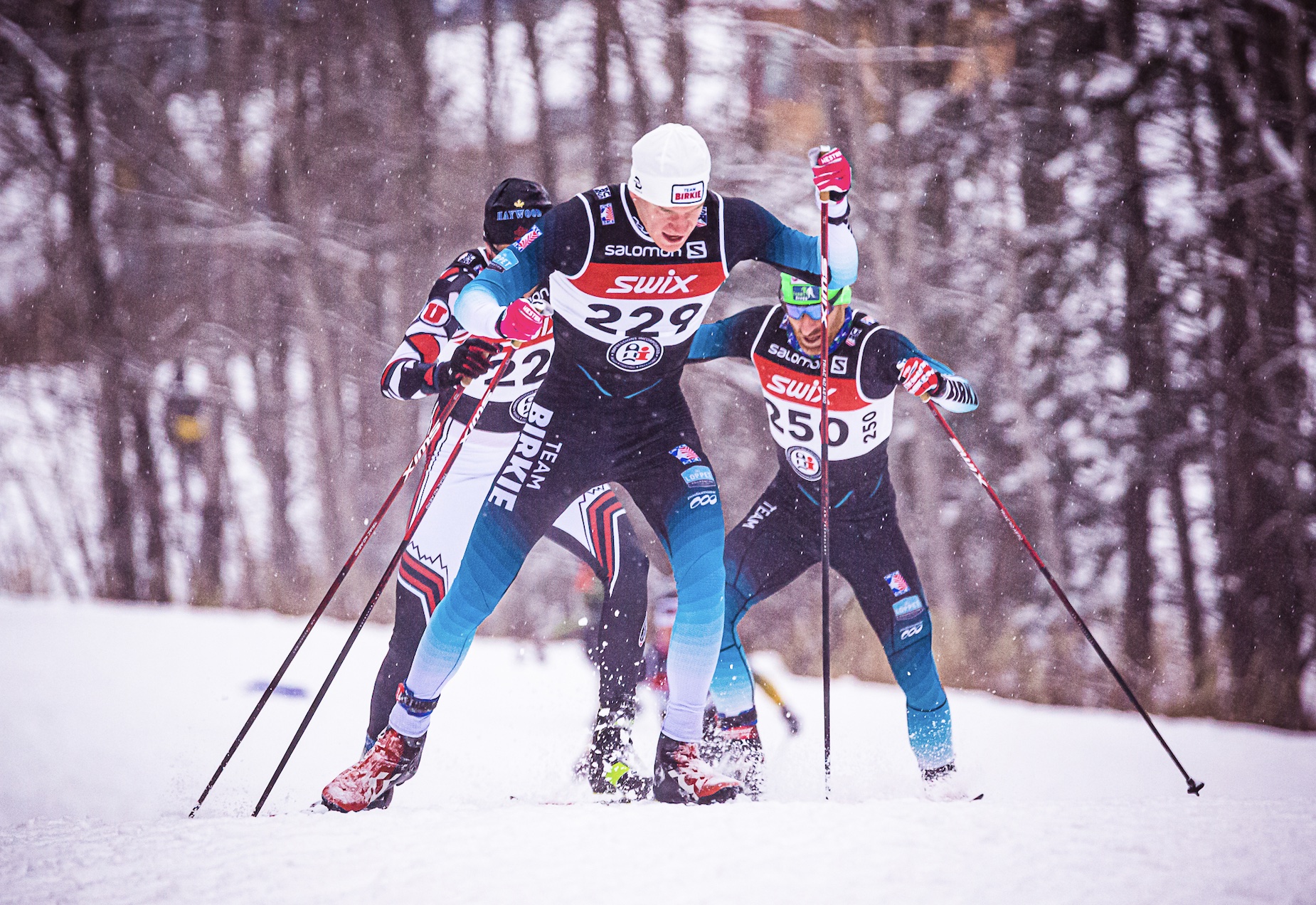
    Zak Ketterson pushes uphill during the 10k skate, with Team Birkie “legend”, Brian Gregg (Bib 250), matching pace behind. (Photo: Hansi Johnson)
    On the women’s side, with her second podium of the season, APU’s Rosie Frankowski edged out Alex Lawson (CGRP) by just 0.9 seconds. Lawson started behind Frankowski and had been sitting in third, powering through her final lap to create a nail-biter over the final kilometer. During this final lap, Lawson overtook Alayna Sonnesyn (SMS T2), who finished third (+6.1).
    The women’s top-6 after the 10k distance race in Duluth. Rosie Frankowski (APU) topped the podium, ahead of Alex Lawson (CGRP) and Alayna Sonnesyn (SMS T2). (Photo: Hansi Johnson)

    Frankowski shared the following reflections on her weekend in Duluth via email:

    “Before heading down to Duluth, I was pretty nervous about this weekend and tried to have realistic expectations since these races were a short, relatively flat sprint and 5k—both events that I honestly don’t typically perform that well in. However, I have been focusing on speed work, downhills and carrying speed a lot this summer behind my speedy APU teammates so yesterday’s results on a very fast course was a great surprise that boosted my confidence for today’s 5k. Today out on the course was a whirlwind. We actually raced 3 laps of a bit over 2 kilometer lap so I lucked out that it was a bit longer and the snowfall from the night before and during the race made it slower than yesterday. The course held up surprisingly well and was really not that choppy or soft except the one V-1 hill.

    “I went out as hard as I could since honestly my 5k race pace often accidentally is my 10k pace and I knew that I needed to be snappy. I did slow down throughout the laps, but I honestly think most of that slowdown was on the downhill section which was where I questioned whether I should free skate, tuck, V-2, etc. I was very early in the seeded group so I didn’t really have the chance to rely on splits back or watching my competitors to determine what seemed to work best. All in all, I am super excited to walk away with the win and I am hoping this weekend of racing gives me more confidence about my short race skiing abilities, and I have to give a hats off to our APU wax techs and all of the volunteers from Duluth that made this weekend possible.”

    Rosie Frankowski skis through wet falling snow to win the women’s 10k at the opening SuperTour weekend in Duluth, MN. (Photo: Hansi Johnson)

    On returning to racing with a widespread field of high-level athletes, Frankowski echoed her teammate Rorabaugh’s sentiments on feeling isolated as she stayed put in Anchorage. Her words embody the many challenges we have all faced in the calculus of travel and risk-assessment during the pandemic.

    “It’s nice to be back racing on a national level circuit. Last season was really challenging since us Alaskans didn’t have much opportunity to race people from out of state (due to avoiding unnecessary air travel). We had a crazy strong early season circuit with Sadie Bjornsen, Jess Yeaton and Becca all in our races, but it felt like we were just not connected with the rest of the country. I personally really struggled with turning down Period 1 World Cup starts after a teammate contracted COVID and the financial implications that COVID created with race uncertainty. Then in January, I contracted COVID and it felt like it ended my opportunities to gain World Cup starts.

    “I am just thankful that this year we have more certainty about what races will happen and what the road to opportunity looks like. I also feel that as I have gotten older, I have realized that while good results are fun and exciting, the true value in racing a circuit is the relationships you create with your competitors, other coaches, officials, etc. Returning to the Supertour and Duluth (as Minnesota is my home state), I found so much joy in chatting with my fellow racers, longtime club coaches, friends from NMU [Frankowski is also an alumna], Southwest High School and LNR, and just being part of a community that wants to spend their weekend working hard out in the cold. I’m hoping that no matter where my results fall this season, and whether I make the lofty goals I’ve laid out, I can appreciate the people and connections as the true value of ski racing.”

    With a win in the distance and third place in the sprint, APU’s Rosie Frankowski leads the SuperTour point rankings. (Photo: Hansi Johnson)

    Sunday Distance Results: Women | Men

    Multimedia: livestream replay from CXC

  • Elite Team Preview: SMS T2

    Elite Team Preview: SMS T2

    Jessie Diggins brought home a couple of small trophies last season. *smirk* (Photo: NordicFocus)

    Team name and location: SMS T2 Team; Stratton Mountain, Vermont

    Coach: Patrick O’Brien

    Current roster: Jessie Diggins, Julia Kern, Katharine Ogden, Alayna Sonnesyn, Lina Sutro (women); Ian Torchia, Bill Harmeyer, Ben Ogden, Will Koch (men)

    Who’s new: Lina Sutro, coming from the University of Vermont ski team

    Who’s moved on: Sophie Caldwell Hamilton and Simi Hamilton, who celebrated their second wedding anniversary earlier this year, retired from pro skiing last spring and are beginning a new life together in Colorado. Ben Saxton also retired.

    Who’s still on this team, or otherwise involved in American skiing, from when we did this in 2012: Jessie Diggins (athlete); Gus Kaeding (now head of analytics for the U.S. Ski Team); Andy Newell (now head coach for Bridger Ski Foundation); Erika Flowers (racing for BSF this season); then-teammates Newell and Flowers are now married

    Julia Kern races in classic sprint qualification in Oberstdorf. (Photo: NordicFocus)

    Top results last season: Diggins, deservedly, got the headlines, for winning the World Cup overall, the distance globe, and the Tour de Ski, all firsts for an American woman. (Bill Koch won the inaugural World Cup overall title in 1981/1982 to provide her only American competition here, though if you want to split hairs about it Koch’s World Cup season looked a little shorter than Diggins’s.)

    After Diggins, Kern had a down season, by her lofty standards, but still notched an 11th and 12th in World Cup sprint finals. Ben Ogden was the top American man in the World Championships sprint, qualifying 11th and finishing 17th overall, and qualified 3rd at World U23s en route to an 11th-place finish. Katharine Ogden raced a full season of distance races on the World Cup, highlighted by 23rd overall in the Tour de Ski, and finished 38th in the distance standings for the year.

    Domestically, Rochester, Minn., native Ian Torchia won the skate American Birkebeiner, then gave an all-time classic finish-line interview while slumped exhausted in the snow, interrupting his gasps to drink some chocolate milk handed to him by a concerned onlooker. Not to be outdone, Plymouth, Minn., native Sonnesyn won the skate Birkie, and was second in the classic Birkie.

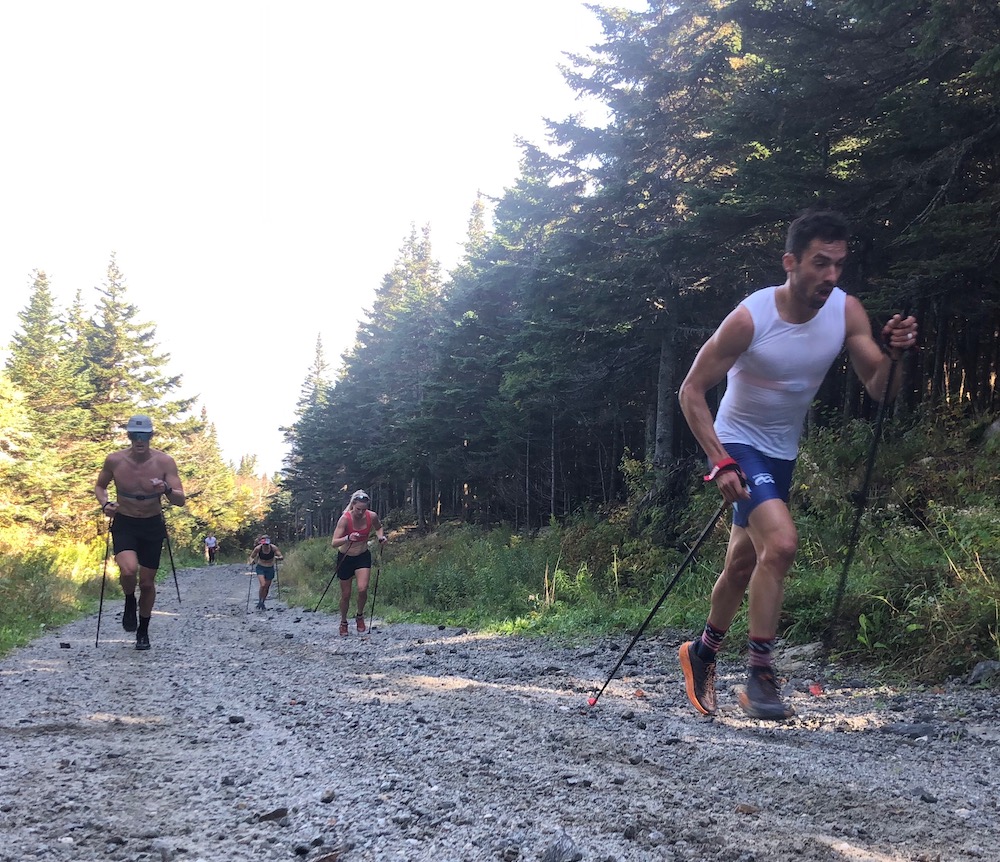
    Ian Torchia, far right, leads bounding intervals up Stratton Mountain in summer 2021. (photo: courtesy SMS)

    Coach’s comments: Coach Pat wrote as follows:

    “The dryland season has gone very well for our group. It’s hard to imagine just a few short months ago we were doing hot sweaty hill bounding and rollerski intervals in Stratton, but fall is certainly here and the winter season feels just around the corner. The air is cool and crisp, the leaves are mostly down and soon we will be seeing our first glimpse of snow at the higher elevations in the Green Mountains.

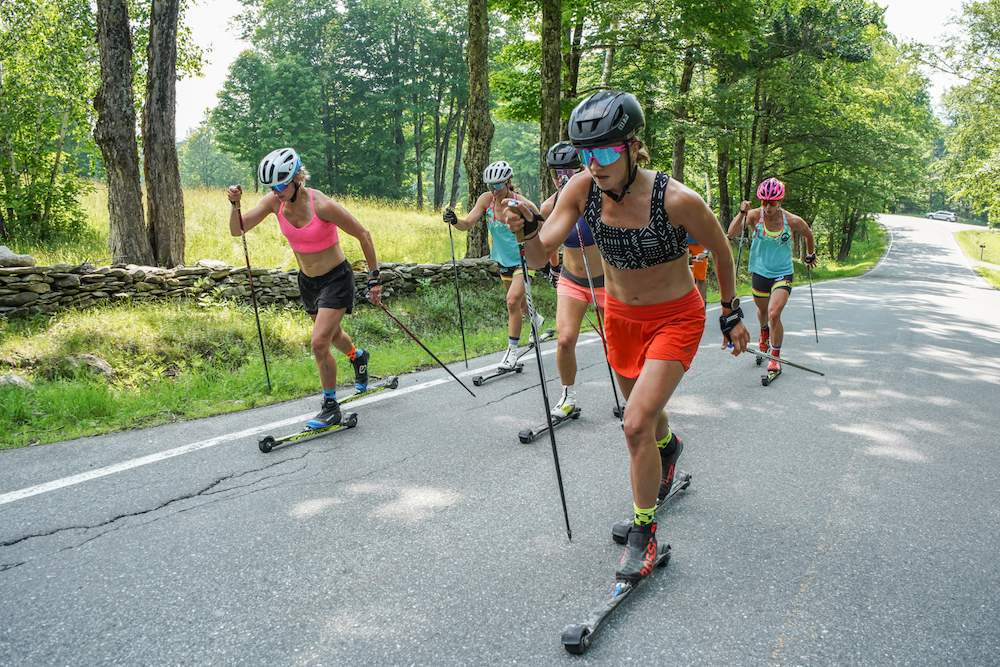
    “We had a productive and steady dryland season. We kicked off the training year back in May with many athletes out in Bend, Oregon, for our startup on snow and dryland camp. From June till August we were primarily based out of Vermont with some small ‘mini camps’ and fun adventures but no major travel or camps afar. One thing we learned overall as a program from the pandemic and travel restrictions in place in Vermont last year is that while variety is the spice of life, skiers are made in the summer, and time spent traveling is time that impacts recovery and training opportunities, so with the cancelation of a July glacier camp in Alaska and the wildfire/smoke situation in the greater American West, we just put our heads down and focused on high quality but training in the Green Mountain state for June-August. Fortunately for us, aside from the ever present rain and humidity that Vermont is known for, we have incredible roller skiing, running, biking, and strength and conditioning facilities in Stratton and the greater area so we never need to go far to find high quality dryland training. 

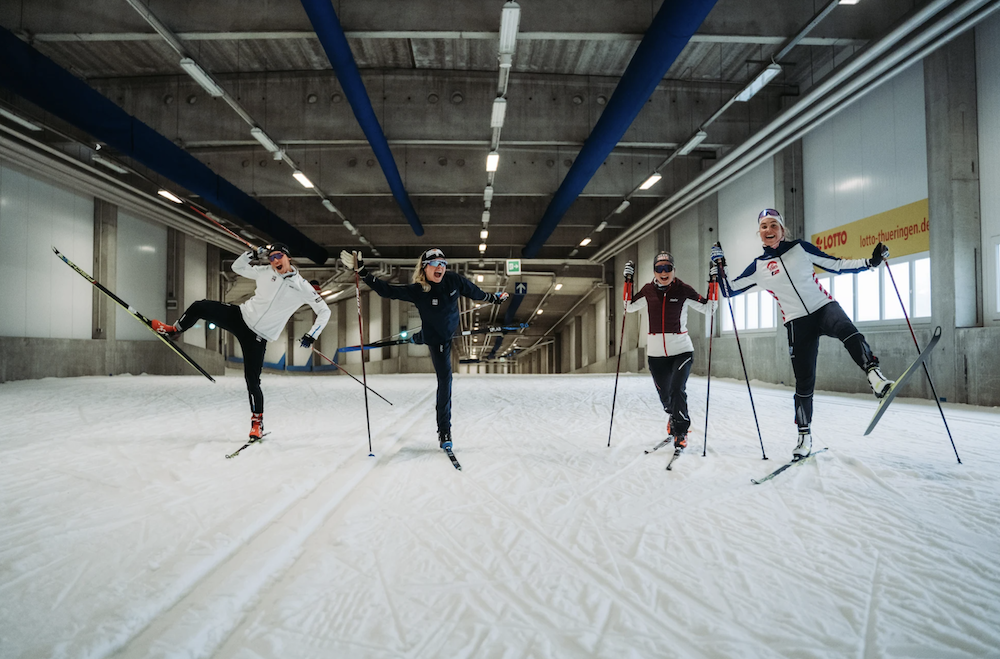
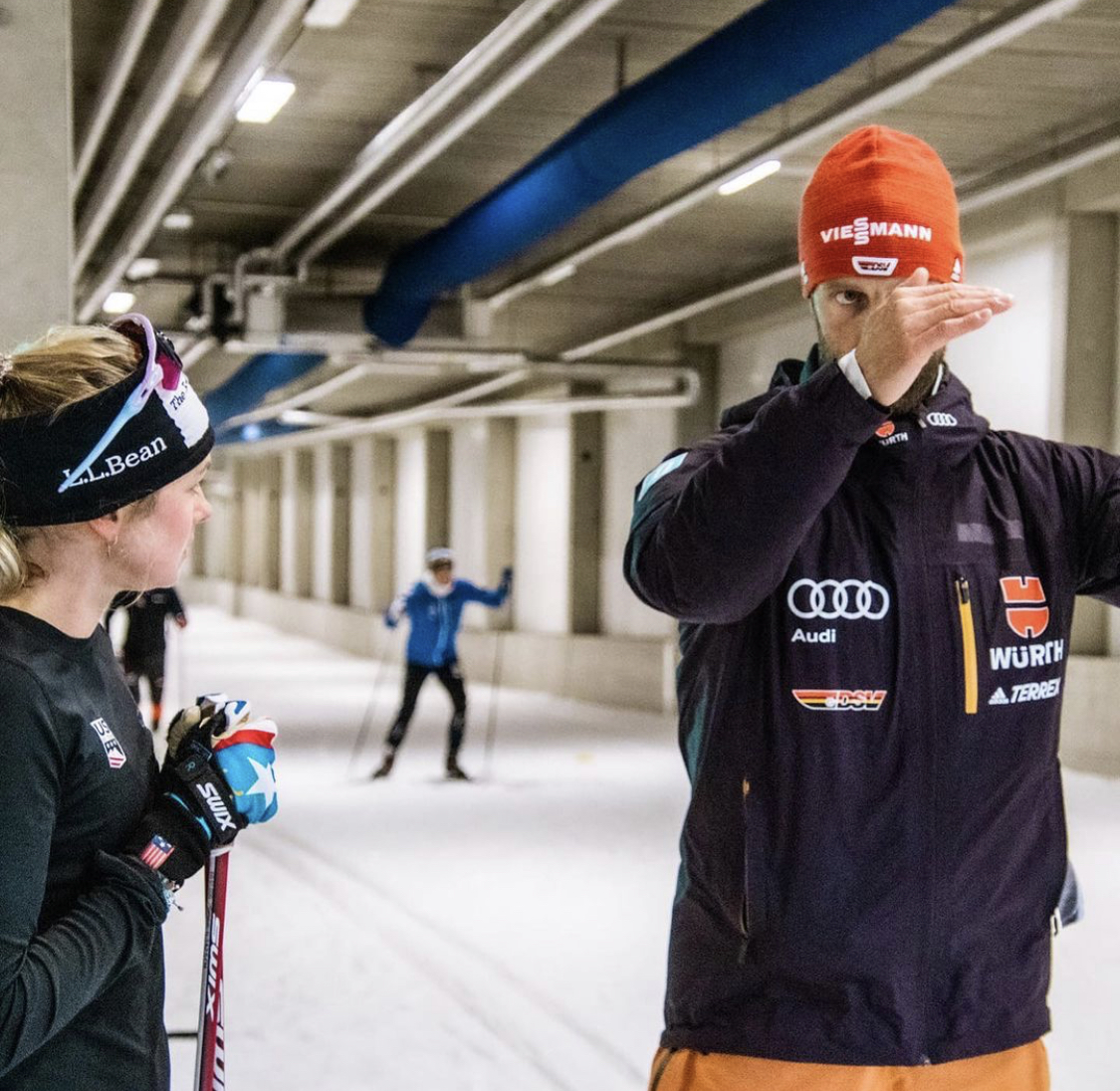
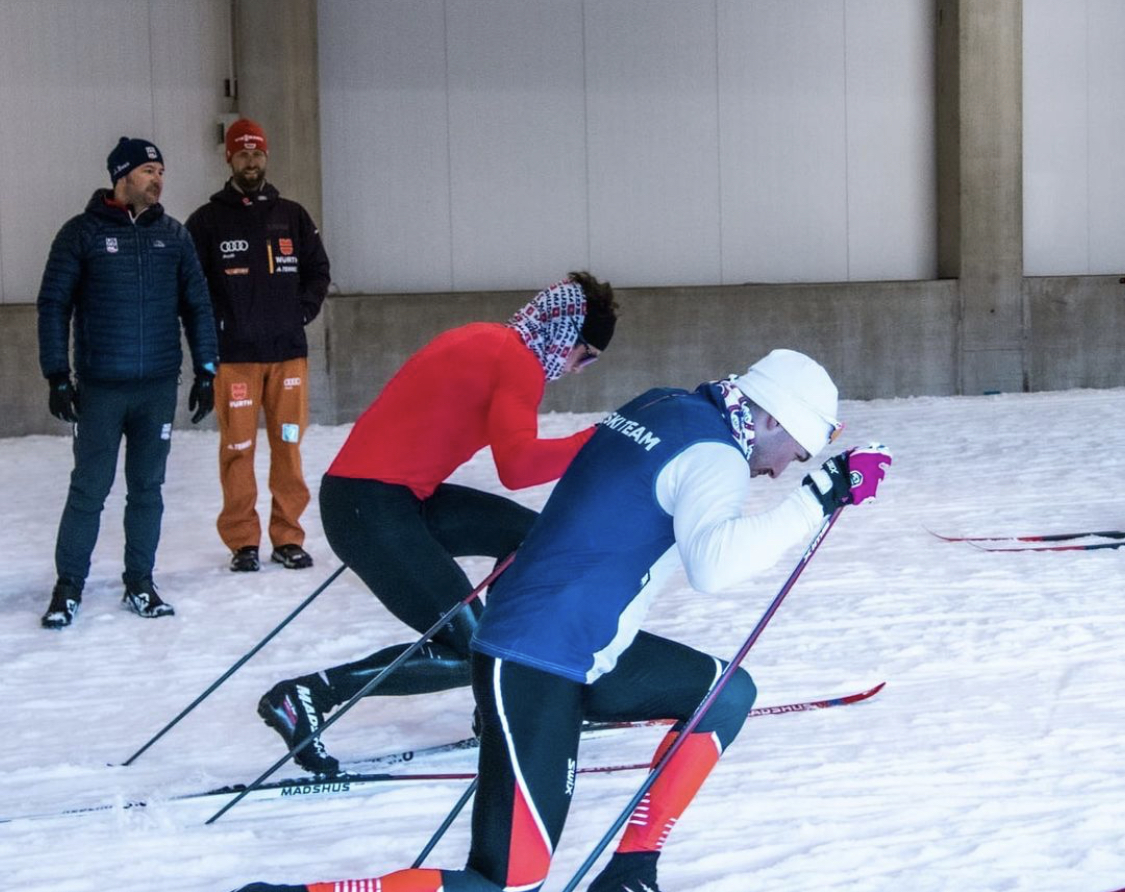
    SMS athletes in the ski tunnel (from left: Julia Kern, Jessie Diggins, Alayna Sonnesyn, Lina Sutro), Oberhof, Germany, September 2021. (photo: courtesy SMS)

    “The two areas that we did make a conscious decision to target this year in addition to stable dryland blocks, were on snow time and training at altitude. Traditionally we travel to New Zealand for 2-3 weeks at the end of August and the start of September. The skiing (being wintertime in the southern hemisphere) is high quality and representative of actual ski conditions unlike glacier snow that can often be rotten, slow, and located at high altitudes. While we weren’t able to get on snow as a program last year due to the pandemic and Vermont travel restrictions, many athletes still achieved standout results last winter but we did recognize it put our athletes at a competitive disadvantage in the early season where athletes were getting their ski legs under them so we sought to find on snow training options this year. We were hoping to have New Zealand as an option but with their tight quarantine policies and lack of widespread vaccinations it became clear by July that was unlikely to change. Instead we traveled to the ski tunnel in Oberhof, Germany, to grab 10 days of high quality on snow training which turned out to be a great replacement camp. Being three months removed from skiing should make the transition to snow in Kuusamo a little easier and faster than being six months without contacting snow as we did last year. As an East Coast based team traveling to and from Europe was also a helpful reminder for the time change and travel athletes will be undergoing again shortly in a few weeks.

    “The final area we did want to focus on was getting in some time and harder efforts at altitude. With the Olympic venue being at around 5500 feet we were able to practice skiing at a similar elevation out in Bend, Oregon, back in May and recently finished a great dryland camp in Park City complete with many harder efforts and time trials at Soldier Hollow which is nearly the same elevation as the Olympic venue and equally demanding terrain as what we should see this coming February. 

    From left, Jessie Diggins, Katharine Ogden, Lina Sutro (partially obscured), Alayna Sonnesyn, and Julie Kern rollerskiing in Vermont in summer 2021. (photo: courtesy SMS)

    “Our athletes are looking forward to the coming race season because it is shaping up to be a ‘return towards normal.’ Both the limited options for domestic racing and the strict restrictions needed for safe racing on the international level were very difficult for elite athletes last year. Certainly there will still be safety protocols in place, disruptions, and some uncertainty as we continue to navigate our way out of this pandemic, but the prospect for a complete race season both on World Cup and at a national level is very encouraging. We have all been vaccinated and many of our group have already received their booster shots so some of the uncertainty and apprehension of travel has been reduced. We can now focus on what we all love to do; ski racing with a robust national and international calendar!”

    Related coverage: Sophie retirement article; Simi retirement article; Diggins overall World Cup champion article

    Previously in this series: BSF

  • Seeking Snow: SMS T2 Finds Glide Time in Oberhof, Germany

    Seeking Snow: SMS T2 Finds Glide Time in Oberhof, Germany

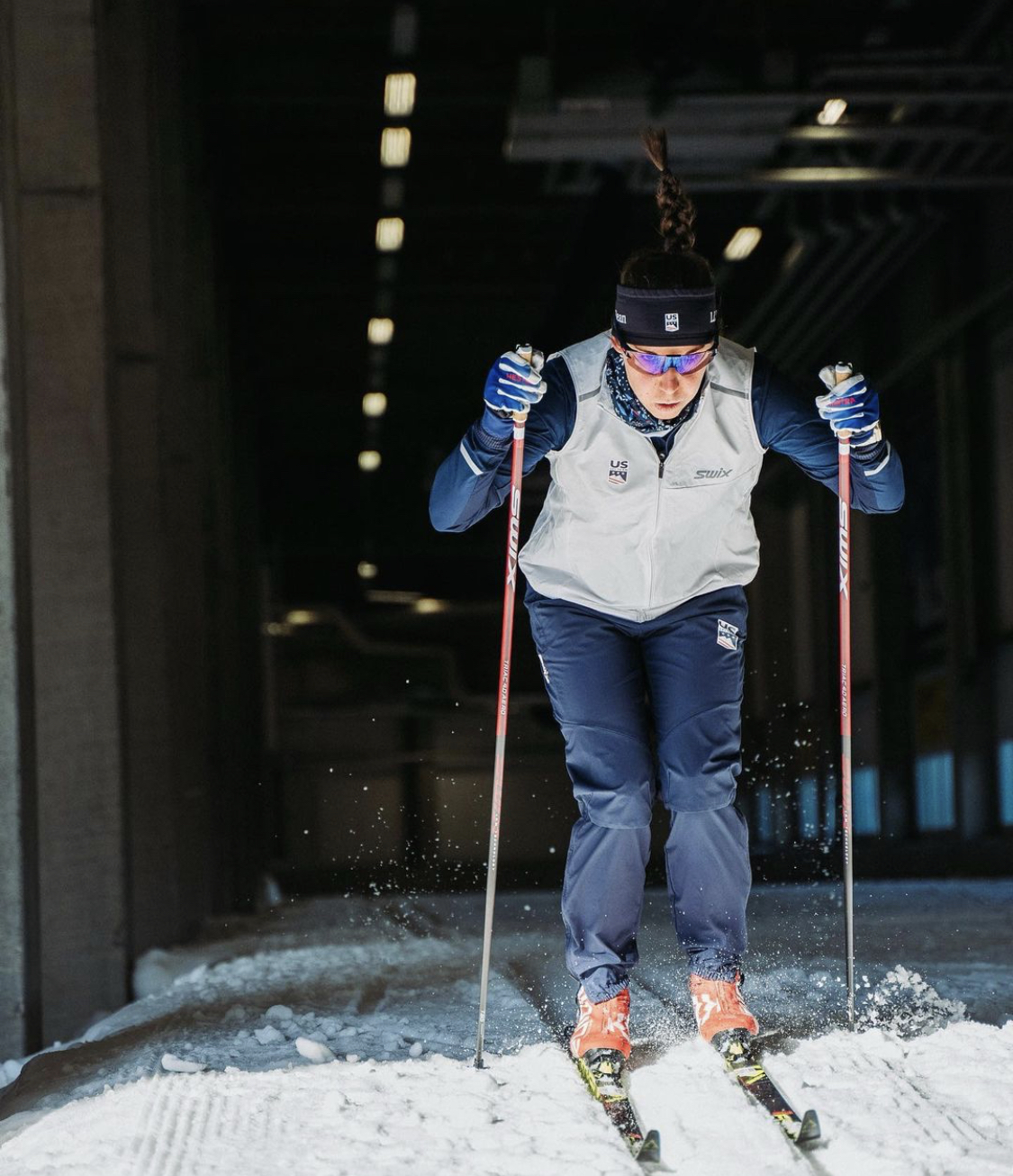
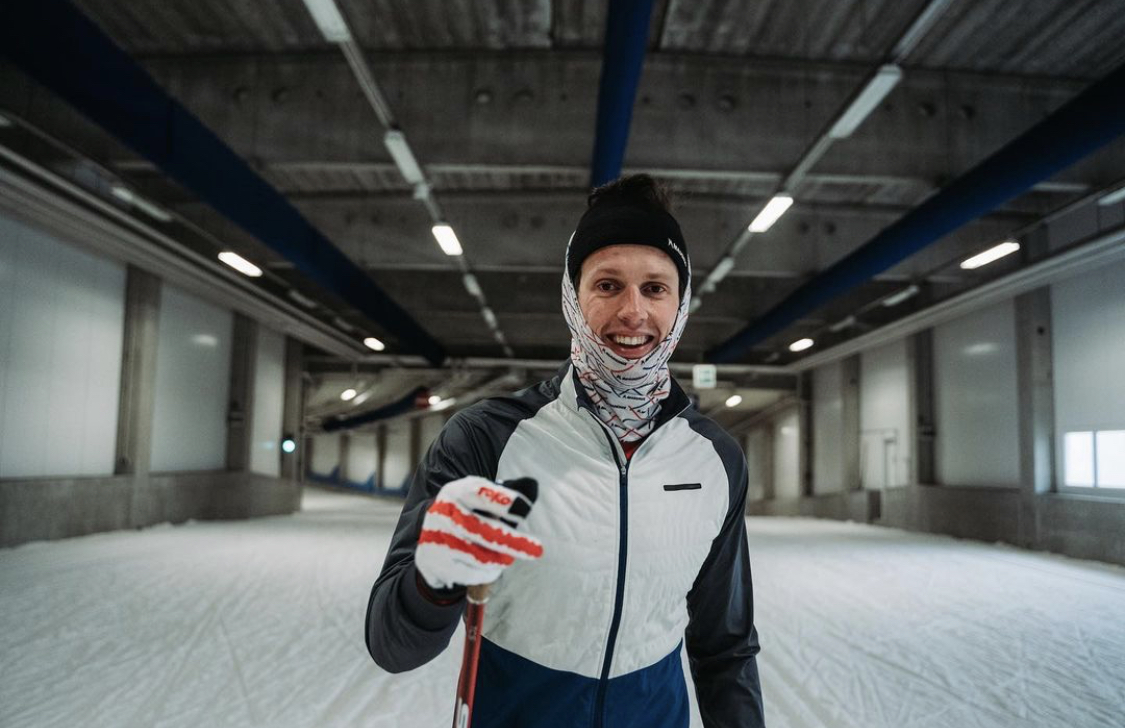
    Inside the tunnel: Julia Kern focused on the track ahead (Photo: Bill Harmeyer)

    With temperatures dropping steadily each day and the first signs of winter visible on distant mountaintops, the mind of a skier inevitably turns towards thoughts of snow. For the professionals this goes one step further: how and when can they get on snow before the season starts? In the US, pre-season snow time is limited. Once the snow disappears on Mount Bachelor, the Eagle Glacier in Alaska is typically the only domestic pre-season skiing available, although this year even this venue was off the table due to renovations.

    Internationally, the skiing options are numerous and varied in their scope, distance, and travel feasibility. However, COVID restrictions and rules still play a major part in travel abroad, and the decision of where to go becomes even harder.

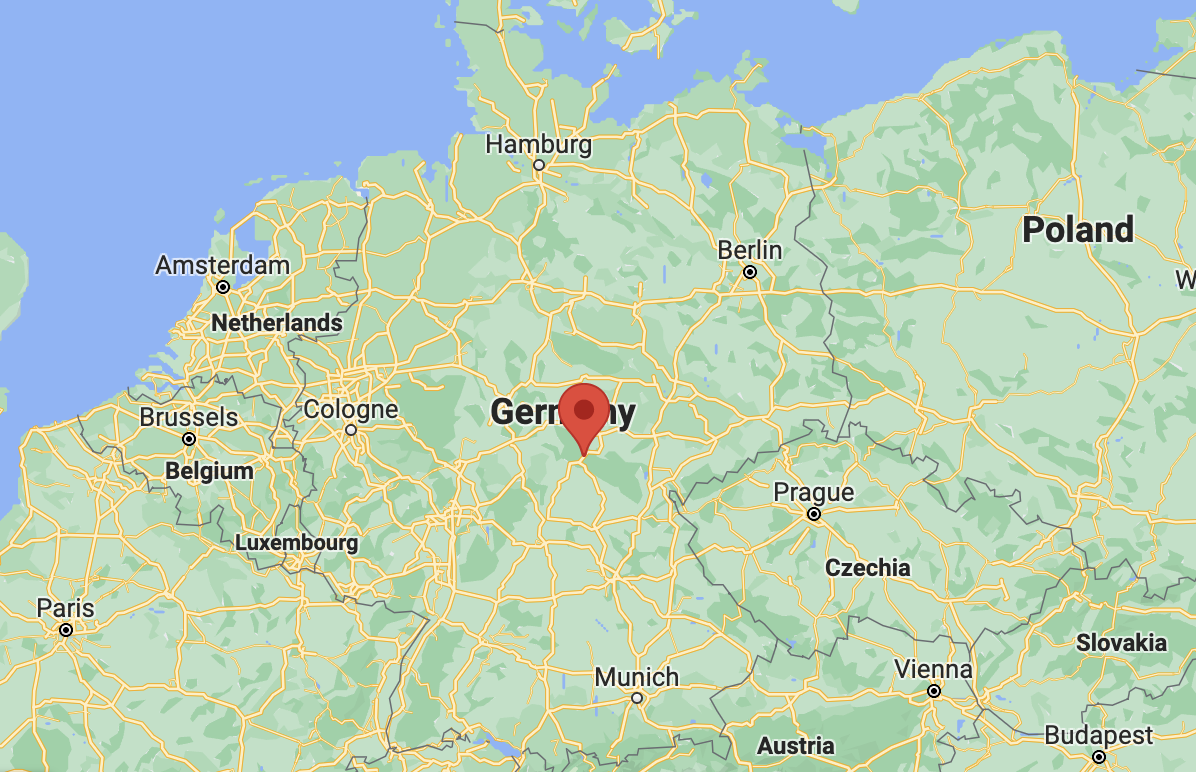
    Having carefully considered all of these factors, the SMS T2 team took flight at the beginning of September, searching for the goods. Their chosen destination was a ski tunnel in Oberhof, Germany, specifically, the LOTTO Thüringen Skisport-HALLE. Oberhof is located in central Germany and hosted a stage World Cup in 2013 (Jessie Diggins placed 5th in the 3k skate prologue). The Craftsbury Green Racing Project and USA ParaNordic will also be taking advantage of this venue.

    Oberhof Germany, site of the LOTTO Thüringen Skisport-HALLE (photo: Google Maps).

    This year, SMS T2 is composed of nine skiers, seven of whom made the trip to Germany. Patrick O’Brien, who has now been the team’s head coach for four years, shared his insight on the decision to go to Oberhof.

    “Certainly on-snow time was a focal point of the trip for us,” said O’Brien. “Last year with Covid it made for a pretty clear cut decision. We couldn’t leave Vermont or jump on a plane without a lengthy quarantine period upon return, making any major camps or travel difficult to justify in the middle of a worsening and unknown pandemic. It was actually great in some ways because we just trained well and made the most of our fantastic roller skiing, running, and biking that we have out the door in the Green Mountain State. And with less travel we were still able to get out and follow the travel guidelines we had in Vermont and explore some trails and locations closer to home that normally we wouldn’t have time for with lots of camp and travel commitments.

    “The one team camp that we did was a three-day mini camp to Green Woodlands across the river in Lyme, NH, which was amazing but gives you an idea of how restricted travel was for us. These measures kept case numbers very low in VT and were the right thing to do at the time… Having our entire team vaccinated and the state of emergency lifted this spring when we hit 80% of VT vaccinated made our options for camps and travel much more open this prep period.”

    This year the team was looking to return to a venue with snow for some quality pre-season hours, particularly for those team members who will be racing Period 1 of the World Cup.

    “It’s already a long race season for people that leave for the entire year, and going over earlier to a place like Munio or Rovaniemi, might help with the initial transition to snow, but certainly can extract a heavy toll mid season when you are away from family and friends for that much longer,” explained O’Brien. “So getting a focused block of on-snow time late summer/early fall should help make the transition from dryland to on-snow right before Ruka a little easier and faster to keep people with the best energy and fitness for February at the target races.”

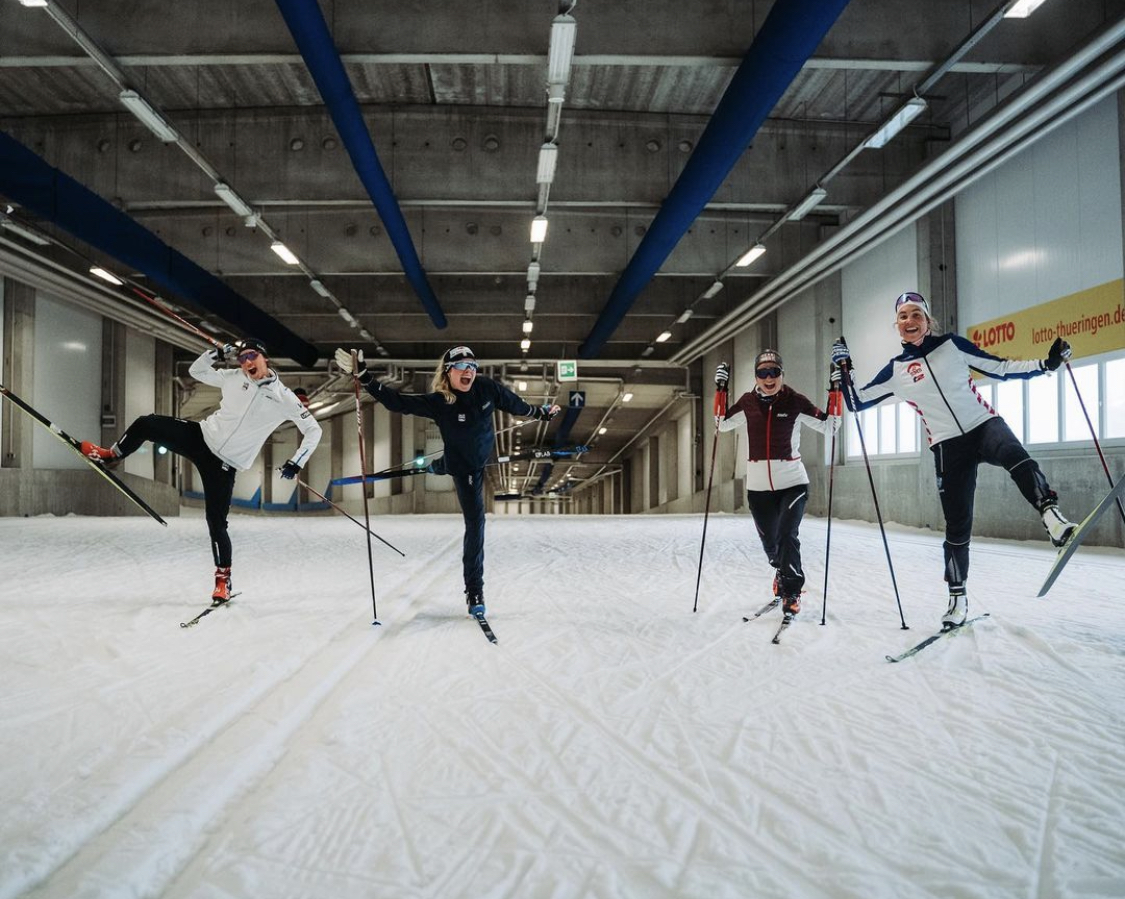
    Julia Kern, Jessie Diggins, Alayna Sonnesyn and Lina Sutro are stoked to be getting ski time in the tunnel (Photo: Bill Harmeyer).

    Another goal of the camp was to simulate a bit of the World Cup travel experience and re-remember what international travel and being away from home is like.

    “A very real goal of the camp was to bring our whole team to a new and unique environment, and to collaborate with other nations (the German team),” said O’Brien. “Again, getting used to that sort of time change and environment for a ten-day focused camp makes the travel in the later fall and winter following the World Cup circuit around that much easier and manageable.”

    Traditionally, the SMS T2 team, and the US Ski Team, have traveled to New Zealand for several weeks of skiing in late August or early September. The snow farm in New Zealand offers, “midwinter conditions, low altitude, stable weather, gorgeous scenery and amazing people,” said O’Brien. However, New Zealand is still under tight travel restrictions and wasn’t a feasible option this year. Additionally, some of the SMS T2 athletes were hoping to head to Alaska for a camp on Eagle Glacier in mid-July, “when that got scrapped we were caught off guard and scrambled at the last minute to see what alternatives were out there,” explained O’Brien.

    “Oftentimes, glacier skiing is super high, involves taking a tram up (Ramsau), the weather can be very variable (to the point you really shouldn’t be skiing), and the snow is pretty slow and rotten.”

    Enter the Oberhof tunnel. O’Brien listed the reasons why this ended up being the best fit, “The facility is really impressive, unlike a normal tunnel which often is simply a loop, this one has a variety of different terrain, a large central area for drills and speeds, and two out and back fingers as well so you have some ability to put together different courses for easy skiing or intensity. In 1.7K you have everything from good hills for V1/Striding, steep hills for ski running/jump skate, to a big stadium area where you can have multiple people practicing starts/finishes head to head. Additionally you know the training is stable and high quality. They warm the tunnel on Sunday afternoon by opening the doors to bring it up to freezing, then groom it with one of their two Pisten Bully’s (PB100+400) and close everything up and crank the AC units and close the track until Monday afternoon, at which point its set up and stable at -4C for the rest of the week. By not over-grooming or working the snowpack they preserve its integrity by limiting grooming cycles. For snow that is three years old, it’s in very good condition and means each day you go out to train you know you will have high quality training. You don’t lose a day in a ten-day camp to a weather closure or poor conditions.”

    Crucially for the SMS T2 team, the town is just over 200 miles (330 km) north of the airport in Munich, making logistics simpler. Coming from Stratton Vermont, this made travel for the team to Oberhof roughly the same time-wise as getting to Bend, OR, where they typically kick off the training season in May.

    “For us, we are three hours from the Boston airport and an overnight flight to Munich, Germany,” said O’Brien, “So while the travel is still substantial, getting to Central Europe for us is a long overnight flight and 3 hours of driving on the front and back ends. A place like Voukatti (FIN) is a much more exhaustive journey with many connections for us coming from the US.”

    Compared to New Zealand, entering Europe COVID-wise is relatively straightforward. Since the team is entirely vaccinated, they weren’t required to quarantine upon arrival but did need to fill out paperwork in advance for their whereabouts and, O’Brien added, “we did test our entire group before departure in VT out of an abundance of caution.”

    Bill Harmeyer happy to be on snow (Photo: Julia Kern).

    Once they were in Germany, they were tested twice again during the camp just for surveillance purposes.

    “The rates of COVID in Germany are quite low and there is near universal compliance with masking indoors and straightforward and effective COVID protocols over there,” said O’Brien. “They have different time slots for training in the tunnel and limit the numbers in the tunnel at any one time. It’s a pretty large amount of airspace that is continually cycled over, so while we were entering and exiting the tunnel everyone was required to be masked, but when skiing masks weren’t expected which was great for doing intensity and harder training sessions. Overall while we were cognizant of still being in a pandemic, the fact that our entire group was vaccinated, getting tested, and following existing protocols really made for a safe and comfortable environment to have a training camp”

    Furthermore, the team was able to integrate some training sessions with the German ski team who O’Brien said were “absolutely fantastic to work with.” Not only in regards to training but, “ they helped with all sorts of logistics, getting us extra waxing gear, lodging, getting set up at the tunnel, administering Covid tests during our camp, and running combined sessions with their athletes that live locally (Victoria Karl and Antonia Frabel).”

    “I cannot say enough how cool it was to collaborate with them during the camp and how open and engaging the sharing of information was,” emphasized O’Brien, “I think that is something that kind of was lost last year (for obvious reasons with COVID). Out of necessity we had to form our ‘pod’ and keep our circle tight with all the testing and possible quarantine that could derail a race weekend. Simply being able to exchange ideas, information, and training with others was a huge benefit for both of our groups.”

    Jessie Diggins talks with German coach and former racer, Axel Teichmann (Photo: Ronny Knoll).

    For SMS T2 athlete, Ian Torchia, his personal goals for the trip were focused on really “dialing in my on-snow technique from the adaptations I have made from roller skiing this summer, as well as executing some high-quality intensity and speed sessions to zero in on that unique snow feeling.”

    Making the most of the trip, the team squeezed in a 45 minute ski the first day they arrived, making for a total of ten-days on-snow.

    “The first day was the worst day on snow for me as I was super jet lagged and half asleep,” said Torchia, “other than that, the entire team was vibing with the snow tunnel and I honestly never got sick of the many many loops we skied. There is always something to focus on with your technique that the monotony of the loops doesn’t really take much affect. Getting on snow in the summer was super valuable and I am so grateful for the opportunity.”

    Bill Harmeyer (left) and Ian Torchia (right) line up for a sprint start (Photo: Ronny Knoll).

    Looking forward, Torchia said “I am super amped for (hopefully) a normal season of racing and for a shot to make the Olympic team. Right now, my roommate Bill Harmeyer is the only other guy in Stratton (along with the girls on the team) and we have been working super well together in training, pushing each other on our weaknesses and dialing in technique. Let the snow fly!”

    When the race season begins in a few short months, many SMS T2 members will be heading back to Europe to start the World Cup, while others will stay in the US to race in the Super Tour and other North American competitions. As usual, the World Cup kicks off in Ruka Finland at the end of November where SMS T2 athletes Jessie Diggins, Julia Kern, Katharine Ogden and Ben Ogden will be competing. Alayna Sonnesyn has also been named as an alternate. The US Super Tour circuit starts in Cable, Wisconsin this year with races December 10-12th.

    Jessie Diggins kicking up spray during a speed session in the tunnel (Photo: Ronny Knoll).
  • NCAA Cross-Country Championships in Bozeman: One and Done

    NCAA Cross-Country Championships in Bozeman: One and Done

    DU’s Eveliina Pippo taking the win Thursday in Bozeman. (Photo: Montana State Athletics)

    BOZEMAN, Montana – Thirty minutes after the conclusion of today’s nordic podium ceremonies, the NCAA announced that all winter and spring championship events were cancelled due to the COVID-19 pandemic, effective immediately. 

    An incredible day of racing suddenly turned sour as the news reverberated throughout Bozeman. There would be no slalom at Bridger Bowl tomorrow, no mass start cross-country races at Crosscut on Saturday, and no ceremony to crown the overall team champions. In a single press release, the 2020 NCAA Ski Championships came to a heart-breaking halt.

    While the fallout from the decision will surely stretch into the off-season, here’s how the cross-country races unfolded today at Crosscut Mountain Sports Center.

    The day dawned cool and cloudy, with low overnight temps making the snow firm and fast. With occasional peeks of sunshine through the cloud cover, it looked like it could be a classic Montana March day.

    Nothing today would be that straightforward — a snow squall materialized thirty minutes before the women’s start. Although just half an inch fell, the course was totally transformed and slowed down dramatically. 

    Even though the snow eased up for the women’s race, the early starters had to plow through the fresh flakes. Skate tracks appeared around the loop as the first few starters raced through the powder.

    Crosscut’s course is mostly rolling, but features brutal climbs at about the 1 and 4k marks. The climbs are long, steep, and demanding, especially because of the venue’s location 6,100’ above sea level. The new snow made the climbs sloppy, with a few inches of sugary powder sucking speed on their upper pitches.

    Starters were reverse seeded based on regional rankings. Top seeds were randomized in the final ten bibs, making bib numbers 30-40 the racers to watch for podium places. 

    As the women rolled through the course, a pair of late starters separated themselves from the pack. Denver’s Eveliina Pippo led Middlebury’s Sophia Laukli by five seconds at the halfway mark. Behind the leaders, five racers  – Utah’s Guro Jordheim, Middlebury’s Alex Lawson, UVM’s Lina Sutro, and Dartmouth’s Katharine Ogden were all within a few seconds of each other at the halfway mark, battling for the next few places.

    Laukli continued attacking the course with her signature high tempo, showing the form that earned her fifth in the Junior Worlds 15k mass start last week in Oberwiethensal, Germany. 

    However, Laukli couldn’t quite reel in Pippo, as she finished in second, just 4.8 seconds back. Pippo, with three wins on the RIMSA circuit this season, was a favorite to take gold today. She said “I’m happy with my win…the key was to focus on doing everything I can and not focus on the other racers.”

    Jordheim emerged from the pack to finish third, followed by Ogden in fourth and Sutro in fifth. 

    The Middlebury trio of Laukli, Lawson, and Annika Landis has been on a tear throughout the EISA this season. Today they showed their winning ways aren’t limited to the East Coast, finishing 2-6-16, respectively, and amassing 79 points to take the team win over the University of Utah (74 points.) The UVM Catamounts, with Anya Bizyukova in seventeenth, scored 65 points and took third on the day.

    Middlebury’s Sophia Laukli racing to second place in Bozeman. (Photo: Montana State Athletics)

    As the women cooled down and the men warmed up, the sun finally stuck around. The course filled up with spectators and racers, and the excitement was palpable as the first male skier took the line at noon. Once again, the top seeded racers were in bibs 30-40, with  the winner expected to emerge from that select group.

    Ben Ogden accelerated like a rocket from the start, flying through the first 5k nine seconds faster than anyone else. Third through ninth places were separated by just fifteen seconds at the halfway mark, setting up an exciting second lap. The course, snow, and altitude conspired to punish anyone who started too fast and reward those who had paced their efforts.

    Utah’s Sam Hendry started reeling Ogden in, coming back from a seventeen second deficit at 10k to a three second margin at 7.5k. Ogden came into the final climb and entered into a tunnel of Catamounts, with teammates, friends, and fans screaming on both sides of the trail. 

    UVM’s Ben Ogden, skating to an NCAA win. (Photo: NCAA)

    Ogden, charged up by the Catamount faithful, powered to the line and took his first NCAA title by just 3.1 seconds over Hendry. With a second-straight gold medal in the relay at Junior Worlds last week, Ogden may need to invest in a bigger trophy case. Ogden was thrilled with his result, saying “I’m ecstatic! I just came over from Germany, but I was super stoked to rest up and throw down today.”

    Hendry charged into second with the fastest second lap, while Denver’s Bernhard Flaschberger, winner of a pair of RIMSA skate races this winter, took third for the Pioneers. University of Alaska Anchorage’s Sigurd Roenning was ten seconds further back in fourth, while UVM’s Karl Schulz finished fifth. 

    Along with Bill Harmeyer in twelfth, Ogden and Schulz, the UVM trio combined for 88 points, giving the Catamount men the team win on the day. Roenning led Anchorage to 77 points and second place, while Hendry’s effort helped the Utes pile up 67 points and take third place.

    Given the cancellation of the mass start, NCAAs were effectively a one-day championship. The University of Vermont men and women combined for  153 points, taking the 2020 nordic title. Utah was close behind with 141 points, while Alaska Anchorage scored 123 and finished third.

    Complete nordic results are on Summit Timing.Team scores are available on RIMSA.

    You can read the NCAA statement on championship cancellation here.

  • NCAA Champs Day 1 Rundown from Stowe, Vermont

    NCAA Champs Day 1 Rundown from Stowe, Vermont

    NCAA Skiing Championships Stowe, Vermont 10k/5k Freestyle

    In Stowe, Vermont the men raced a 10-kilometer interval start skate race on Wednesday to open the cross-country portion of the NCAA championships. Erik Olsvik Dengerud from the University of Colorado won in a time of 24:25.5 minutes. Kornelius Groev from the University of New Mexico (UNM) placed second in 24:45.1, and Ian Torchia of Northern Michigan University was third in 24:45.4.

    https://www.vteabp.org

    Ricardo Izquierdo-Bernier from UNM was fourth, and Bill Harmeyer representing the University of Vermont (UVM) rounded out the top-five.

    Men’s Results

    In the women’s 5 k skate, Julia Richter of the University of Utah (UoU) won in 13:28.3 minutes. University of Denver’s Jasmi Joensuu skied to second in 13:29.3, and Evelina Sutro of UVM was third in 13:29.4.

    Katherine Ogden from Dartmouth placed fourth (13:34.5) and Guro Jordheim of the UoU fifth (13.37.6)

    Women’s Results

    After the first day of competition, during which only nordic races were held, the University of Utah leads the team competition with 142 points. They hold a one point buffer over the University of Vermont. Colorado sits in third with 120 points.

    Racing continues tomorrow with alpine athletes competing in giant slalom.

    Overall Team Results

  • Eastern Cup #1 Race Rundown from Craftsbury, Vermont (Updated with Gallery)

    Eastern Cup #1 Race Rundown from Craftsbury, Vermont (Updated with Gallery)

    Caitlin Patterson (CGRP) on her way to winning Saturday’s 5 k skate – part of the weekend’s Eastern Cup racing in Craftsbury, Vermont. (Photo: John Lazenby)

    Day 1 (Sprint) Craftsbury photo gallery.

    Day 2 (Distance) Craftsbury photo gallery. 

    Over the weekend in Craftsbury, Vermont the first Eastern Cup series went down. On Saturday skiers raced a 1.6-kilometer freestyle sprint. On Sunday the women raced a 5 k skate, the men 10 k.

    Julia Kern (SMS T2/USST) won the women’s sprint during Saturday’s NENSA Eastern Cup. (Photo: John Lazenby)

    In the women’s sprint qualifier, Julia Kern (SMS T2) skied the fastest time of 3:12.97 minutes. Ida Sargent (USST/CGRP) was the second fastest qualifier, with Jessica Yeaton (APU) in third.

    In the heats, Kern won the final, with Yeaton placing second. The day’s seventh fastest qualifier, Katharine Ogden (SMS T2/Dartmouth) finished in third. (Sargent pulled from the competition to rest for the upcoming World Cups.)

    Women’s Qualification | Women’s Sprint Results

    Daniel Streinz from Northern Michigan University winning the men’s sprint during Saturday’s NENSA Eastern Cup. (Photo: John Lazenby)

    In the men’s sprint, Bill Harmeyer (University of Vermont) skied the fastest qualifier in 2:54.05 minutes. University of Colorado’s Alvar Johannes Alev was the second fastest qualifier, while Canada’s Nicolas Beaulieu (Orford) was third.

    Daniel Streinz (NMU), the day’s sixth fastest qualifier won the final. Ninth fastest qualifier Antoine Briand (CNEPH) of Canada was second, with Harmeyer in third.

    Men’s Qualification | Men’s Sprint Results

    APU’s Jessica Yeaton skiing to second overall during Sunday’s 5 k skate in Craftsbury, Vermont. (Photo: John Lazenby)

    On Sunday, Caitlin Patterson (CGRP) won the women’s 5 k skate in 12:53.7 minutes. Yeaton was second in 12:57.1 minutes, and Kern third in 13:07.8.

    Women’s Distance Results

    Ben Lustgarten (CGRP) winner of the men’s 10 k skate n Sunday — during the first Eastern Cup of the season.

    For the men in the 10 k skate, Ben Lustgarten (CGRP) placed first in a time of 23:20.7 minutes. Although making the claim on Instagram he is not coming out of retirement, Kris Freeman (Caldwell Sport) was second in 23:430 minutes, and Zane Fields (Colby) was third in 23:46.9.

    Kris Freeman (bib 337) during the men’s 10 k skate in Craftsbury, Vermont — part of the weekend’s Eastern Cup Racing. Freeman placed second. In bib 336, Sam Wood (Middlebury College) trails Freeman on his way to 10th overall. (Photo: John Lazenby)

    Men’s Distance Results  

  • Patterson, Harmeyer Win ‘Largest North American Rollerski Race’, NENSA Fall Classic

    Patterson, Harmeyer Win ‘Largest North American Rollerski Race’, NENSA Fall Classic

    2018 Olympian and Craftsbury Green Racing Project skier Caitlin Patterson (in the yellow bib as the NENSA Rollerski Race Series leader) en route to a win in the open women’s 10 k at the NENSA Rossignol Fall Rollerski Classic on Saturday, Oct. 13, in Jericho, Vt. (Photo: Dave and Carl Priganc)

    This past weekend, more than 170 skiers descended upon the Camp Ethan Allen Training Site at the Vermont National Guard base in Jericho, Vermont, for the New England Nordic Ski Association (NENSA) Rossignol Fall Rollerski Classic. According to NENSA Competitive Programs Director Justin Beckwith, the field size nearly doubled from last year, and he believed 172 finishers made it the largest North American rollerski race.

    The event was hosted in conjunction with the Mansfield Nordic Club on Saturday, Oct. 13, which was described as a “chilly morning replete with the first snow of the year on Mount Mansfield as a backdrop” and rain drizzling throughout the day, according to a NENSA press release.

    In the 10-kilometer open (over-18) women’s race, Caitlin Patterson of the Craftsbury Green Racing Project (CGRP), also located in northern Vermont, took the win with a time of 25:14.4 minutes, about 18 seconds ahead of her Craftsbury teammate Ida Sargent (of the U.S. Ski Team) in second. About 30 seconds back from the win, Lina Sutro of the University of Vermont (UVM) placed third.

    Racers stride up a hill during the open men’s 10 k race at the NENSA Rossignol Fall Rollerski Classic on Saturday, Oct. 13, in Jericho, Vt. (Photo: Dave and Carl Priganc)

    In the open men’s 10 k race, another UVM skier and last year’s winner Bill Harmeyer won in 22:09.6, just 5.5 seconds ahead of Adam Martin (CGRP) in second. Another 12 seconds back, Kyle Bratrud, of the Stratton Mountain School (SMS) T2 Team in southern Vermont, placed third.

    Notably,  the top 30 in both the men’s and women’s senior races competed on matched Swenor Alutech Classic rollerskis. “We managed a fleet of 38 – 20 from our NENSA fleet and 18 sent out to us on loan from the Midwest fleet,” the press release stated.

    After the races, athletes were able to try out an agility ramp.

    “The whole day had a carnival-like feel with a balance of world-class competition and camaraderie,” the release noted.

    For more on this event and the highlights of the 5-kilometer U16 races, click here.

    Results

    Photos

    NENSA Rollerski Race Series standings (with two events left: Maine Agility Festival on Oct. 27 at Pineland Farms in New Gloucester, Maine, and Trapp Invitational Rollerski Race on Nov. 3 at Trapp Family Lodge in Stowe, Vt.)

    Series results

  • Under 23 Questions: Bill Harmeyer

    Under 23 Questions: Bill Harmeyer

    Bill Harmeyer (University of Vermont) racing at the Colby Carnival last month. (Photo: SkinnySki.com)

    In an effort to showcase the North Americans who competed at last week’s International Ski Federation (FIS) 2018 Nordic Junior/U23 World Championships in Goms, Switzerland, we asked those qualifying athletes several questions about themselves — actually, we had them fill in the blanks. Here we have 20-year-old Bill Harmeyer, of the University of Vermont, who represented the U.S. at his first U23 Worlds (after competing at last year’s Junior Worlds in Utah).

    Last week in Goms, Harmeyer placed 39th in the 15 k classic and 46th in the freestyle sprint.

    ***

    “My full name is Bill Harmeyer, but you can call me Bill.

    I was born in Burlington, Vermont, and raised in Underhill, Vermont, and I learned to ski at the farm behind my house.

    I spent the time between U.S. nationals and Junior/U23 Worlds nervously telling my teachers I’d be missing two weeks of classes, while maybe failing to mention I’d be missing more.

    Bill Harmeyer (University of Vermont) during an NTG camp training session last fall at Soldier Hollow in Midway, Utah. (Courtesy photo)

    The hardest/favorite/most awesome workout I did in the last training year to prepare for this was Trout Lake agility and OD TT with the Bend Endurance Academy.

    This is my first time in Switzerland and first (second including WJC in Utah last year) time racing internationally, and so far it’s been sweet.

    One difference I’ve noticed between Switzerland and the U.S. is the mountains are a bit different.

    Skiing and racing in the Alps is distracting, because you’re constantly looking around, and exhausting, because you just want to keep skiing. Usually racing at altitude is not too hard for me because I’ve done it before. There are some mountains around where I live.

    American Bill Harmeyer (University of Vermont) racing the first leg of the men’s 4 x 5 k relay on the last day of 2017 Junior World Championships at Soldier Hollow. After he tagged off in sixth, his team went on to finish ninth. (Photo: FlyingPointRoad.com)

    One of the things I’m most excited about for Junior/U23 Worlds in Goms is the chocolate. One race I’m especially targeting there is the skate sprint.

    I really hope I can chat/make friends with someone from Sweden and ask them if they’d like to trade suits.

    My favorite thing at the breakfast where we are staying is the cheese.

    Fondue is on my top 10 favorite foods list. The cheese here is fantastic. And the chocolate is also fantastic.

    If I had a totally free day here and didn’t have to worry about race fitness or training, I’d spend it exploring backcountry skiing or crust cruising while eating chocolate.

    The best way to follow me on social media is on Instagram @bllharmeyer1.”

  • Wednesday Rundown: U23 Worlds 10/15 k Classic (Updated)

    Wednesday Rundown: U23 Worlds 10/15 k Classic (Updated)

    The women’s 10 k classic podium at 2018 U23 World Championships, with Russia’s Yana Kirpichenko (c) in first and Anna Zherebyateva (l) in second, and Switzerland’s Nadine Fähndrich (r) in third. (Photo: JWSC2018.ch)

    (Note: This article has been updated to include comments from Americans Lydia Blanchet and Ian Torchia.)

    U23 World Championships (Goms, Switzerland): 10/15 k classic

    Russia put two in the top three in both the women’s and men’s races on Wednesday at U23 World Championships in Goms, and for the second-straight race, Canada’s Katherine Stewart-Jones landed in the top 30.

    In the women’s 10-kilometer classic, Russia’s Yana Kirpichenko pulled out a 13.9-second victory over fellow Russian Anna Zherebyateva, finishing with the winning time of 27:46.1 minutes. Switzerland’s Nadine Fähndrich returned to the podium for the second race in a row (after placing second in Monday’s skate sprint), finishing third, 29.6 seconds behind Kirpichenko.

    In Monday’s sprint, Kirpichenko qualified fourth and ended up fifth in the final. She is a bronze medalist in the 15 k skiathlon at last year’s U23 Worlds.

    Stewart-Jones, of the Canadian National U25 Team and National Team Development Centre (NTDC) Thunder Bay, started relatively early on Wednesday in bib 19 and ultimately placed 29th, 3:07.3 out of first. She sped up as the race progressed, from 40th at 2.4 k to 32nd at 5 k and up to 30th at 7.4 k.

    So far in all five races she’s competed in over the last two years at U23 Worlds, Stewart-Jones has finished in the top 30. Her best result is 21st in last year’s 15 k skiathlon, and at the Junior Worlds level, she had a best individual result of 14th in the 10 k skiathlon in 2015.

    American Lydia Blanchet (Dartmouth Ski Team) started fifth on Wednesday and ended up 30th (+3:10.4) after skiing in the top 30 throughout the race. Her Dartmouth teammate Lauren Jortberg followed in 34th (+3:28.9) and Nicole Schneider was 49th (+5:23.8). Julia Kern did not start.

    For Blanchet, a Dartmouth junior, this week marked her first time racing at the Junior/U23 World Championships level. So far, she has placed 32nd in the freestyle sprint and now 30th in the classic distance race.

    “This is my first time racing internationally, and I tried to go into the races with no expectations,” Blanchet explained in an email. “I was excited to get as close as I did to qualifying for the sprint, but it was definitely bittersweet—missing heats by 0.3 seconds left me regretting some of the smaller details of my race. Still, it is really exciting to know that I can compete on the world stage!”

    After the sprint, she made a goal of finishing in the top 30.

    “I really like hilly, rolling courses—especially ones with very technical downhills—and this course definitely fit that bill,” she wrote of the classic distance course. “I am really happy with my race, all things considered. I didn’t feel great while I was racing – my legs flooded pretty hard a few km’s in – but I think I did a good job of holding myself together and staying strong mentally. I know I have the ability to do even better, which is motivating and exciting. I am looking forward to get to ski head-on against the whole field in the skiathlon, and I’m excited to try and pick my way forward from my bib number. I’m also really excited to go home and race carnivals with the Dartmouth team.”

    Canada’s Laura Leclair finished 40th (+4:20.9), Sophie Carrier-Laforte was 43rd  (+4:19.2) and Maya MacIsaac-Jones 47th (+4:47.3) out of 53 finishers.

    Nicole Bathe of the Midwest-based Central Cross Country (CXC) Team, who races for Great Britain, placed 37th (+3:43.8), for her second top 40 of the week after placing 39th in the skate sprint.

    Norway’s Mattis Stenshagen racing to the win in the men’s 15 k classic at 2018 U23 World Championships in Goms, Switzerland. It was his first gold medal and podium at U23 Worlds (he earned silver two years ago in the 15 k freestyle at Junior Worlds and also gold in the relay that year). (Photo: JWSC2018.ch)

    In the men’s 15 k classic that followed, Norway’s Mattis Stenshagen edged Russia’s Denis Spitsov by 4.8 seconds for the win in 36:28.3. Also for Russia, Ivan Yakimushkin placed third, 35.2 seconds back.

    Canada’s Alexis Dumas, of the Pierre-Harvey National Training Centre (CNEPH) was the top North American in 31st, 2:51.7 out of first. He worked his way up from 40th at 5 k to 35th by 10 k, and finally just 0.2 seconds outside of 30th at the finish.

    American Ian Torchia (U.S. Ski Team D-team/Northern Michigan University) followed in 32nd (+2:55.9) and Bill Harmeyer (University of Vermont) finished 39th (+3:43.3). Also for the U.S., Thomas O’Harra placed 43rd (+4:17.3) and Zak Ketterson was 57th (+5:37.6).

    Torchia, an NMU junior, has been to two Junior Worlds in 2015 and 2016, but this marked his first U23’s.

    “The jump from juniors to U23s is quite a leap. I missed the first year of being a U23 last year due to mono so getting back into international racing was a shock to the system,” he explained in an email.

    As for his goals for the 10 k, he was hoping for a top 15 or 20, but moreover “wanted to race smart and feel good out on the course technically and physically,” Torchia wrote. “This was the hardest course I have ever raced with 600m of climbing throughout the 15k and I was excited to showcase my striding ability out there…

    “However, from the first km I was in the pain cave (even though I didn’t open that fast!) and it was a fight the entire way,” he continued. “I need to work on staying technically strong when hurting and I did not do a good job of executing that today. The eventual second place Russian started as I was looping around for my 2nd lap so I was able to see and feel what a podium performance looks like. Going to have that image in my head throughout the next year!”

    For Friday’s 30 k skiathlon, Torchia wrote that he would be “throwing all place goals out the window and focusing on skiing technically well and racing smart. Looking forward to channeling my last skiathlon in Kazakhstan which went really well [he placed 11th in the 20 k at 2015 Junior Worlds] and moving up from my starting position.”

    Canada’s Gareth Williams finished 41st (+4:00.2) on Wednesday, Philippe Boucher was 45th (+4:22.7) and Ricardo Izquierdo-Bernier 47th (+4:24.3) out of 63 finishers.

    Results: Women | Men

  • Monday Rundown: Leclair Leads North Americans in 15th in U23 Worlds Sprint (Updated)

    Monday Rundown: Leclair Leads North Americans in 15th in U23 Worlds Sprint (Updated)

    Norway’s Tiril Udnes Weng (second from l) and Switzerland’s Nadine Fähndrich (l) battle for first down the finishing stretch of the women’s final for the gold medal in the U23 World Championships skate sprint in Goms, Switzerland. Weng won it by eight-hundredths of a second. (Screenshot: Swiss Ski livestream)

    (This article has been updated to include comments from Canada’s Laura Leclair, Katherine Stewart-Jones and Maya MacIsaac-Jones, as well as American Julia Kern.)

    U23 World Championships (Goms, Switzerland): Freestyle sprints

    On the first day of U23 World Championships racing in Goms, Switzerland, Norway’s Tiril Udnes Weng tallied her first individual world title in the women’s 1.2-kilometer freestyle sprint, winning the A-final in 2:50.24 minutes, just 0.08 seconds ahead of Swiss World Cup regular Nadine Fähndrich in second. Another World Cup skier, Natalia Nepryaeva of Russia finished third, 4.78 seconds out of first.

    Weng, 21, is no stranger to World Cups, either. Just two days ago, she qualified 11th in the World Cup skate sprint in Seefeld, Austria, and went on to place 17th overall.

    On Monday, she qualified second, 0.2 seconds off Fähndrich’s top qualifying time of 3:03.51. Weng then placed second to Nepryaeva in the fourth quarterfinal, a heat that included Canadians Maya MacIsaac-Jones and Katherine Stewart-Jones, both of the Canadian National U25 Team. While Sweden’s Moa Olsson finished third in that quarterfinal and advanced as a lucky loser based on time, the two Canadians did not. MacIsaac-Jones had previously qualified in 19th and Stewart-Jones in 22nd. Overall, MacIsaac-Jones placed 18th and Stewart-Jones was 23rd on the day.

    In an email, MacIsaac-Jones explained her goal had been to make the semifinals.

    “My strategy was to stick behind the top two girls, and hang on as best I could,” she wrote of her quarterfinal. “As Canadians we tend to be pretty good at downhilling, so I tried to use that to my advantage. I wasn’t quite able to stick with the top girls over the crest of the big hill, but I was happy to be fairly competitive in the heat overall!”

    Still, the top 20 was her best result in her fourth trip to Junior/U23 Worlds.

    “I’m disappointed of course to have missed out on making the semi-final, but I feel I did the best I could with what my body had on the day so I’m happy with that,” she continued. “It was of course exciting to get my first top-20 , but also disappointing because I felt like my body wasn’t moving as well as it was at trials a few weeks ago (I got sick right after arriving in Europe which probably didn’t help with that).”

    For Stewart-Jones, this marks her fifth Junior/U23 World Championships.

    “Over the years I have learned that it’s just another race, and that I don’t need to treat it any differently,” she wrote in an email on Tuesday. “Coming into te race I knew that I was in the best shape I’ve been all year, but I also had only done one skate sprint qualifier  and no heats) this year so I wasn’t sure what to expect.”

    Her goal had been to reach the semifinals and finish in the top 12.

    “I am happy with how I skied the qualifier. The quarterfinal was tough,” Stewart-Jones wrote. “My teammate Maya and I ended up being in a really fast heat. I felt like I skied well technically but I don’t think I skied it how I needed to to have a chance of moving on. I tried holding on to the top 2 girls over the top of the first hill and ended up losing time on the second… I think it would have made more sense to lay back a bit over the top of the first to save some gas for the end.”

    Stewart-Jones as well as MacIsaac-Jones came incredibly close to making Canada’s 2018 Olympic team based on their results at NorAm trials earlier this month.

    “Overall, I am happy with how the body feels but disappointed with how I skied tactically,” Stewart-Jones wrote. “Not making the Olympic team was definitely more frustrating than it was disappointing. The whole ordeal was a bit exhausting, with first missing out on the 4th spot by less than a second and then being 12th on the list of [11] quota spots, it was really as close as it gets. I’m doing my best to fuel that frustration into positive energy so that I can perform at my best here. I am really looking forward to the next 2 races!!”

    Norway’s Tiril Udnes Weng (l) and Switzerland’s Nadine Fähndrich in a photo finish for first in the women’s freestyle sprint final at U23 World Championships on Monday in Goms, Switzerland. Weng won it by eight-hundredths of a second. (Screenshot: Swiss Ski livestream)

    Fähndrich won both her quarterfinal and semifinal leading up to the final, and Weng won the second semifinal by 0.59 seconds over Nepryaeva. In the final, Weng had the edge.

    “I dream about winning, that’s the goal of my season,” Weng said during a post-race interview in the arena. “So it felt good to win.”

    Three Canadians made the heats, with Laura Leclair of the Pierre-Harvey National Training Centre (CNEPH) qualifying in 26th then placing third in her quarterfinal, 2.75 seconds behind German winner Nadine Herrmann. That put Leclair 15th overall on the day in her first U23 World Championships race.

    “As it is my first time at Worlds and my first year in a big category (U23) I was coming here for experience,” Leclair wrote in an email on Tuesday. “Experience to ski internationally, in Europe and against the best. Of course, I was hoping to perform but I never anticipated a top 15.

    “Since I was seeded 30th, I was a little skeptical of making it through the qualifier,” she continued. “Qualifying 26th was a very exciting moment.”

    In her quarterfinal, she said the pace didn’t pick up until about halfway up a long uphill out of the start, a climb that lasted for about a minute and a half.

    “I was in a strong position (4th) but it was hard to make my way to the top,” Leclair wrote. “At the top of the big hill, a girl broke a pole and I was able to pass her and push over the hill into the downhill in order to come closer to the two girls in front. The last uphill felt like it was just give or take. Obviously, I chose the give option and gave it all I had into the finish. My heat wasn’t one of the fastest so I wasn’t a lucky loser but I am very happy of how I skied that course.

    “This season has been full [of] surprise,” she concluded. “Just qualifying for Worlds in Canada was one! I am very happy that all my efforts and my dedication to the sport are paying off. For the rest of the week, I want to have some strong races, especially in the skiathlon and maybe surprise myself again.”

    Two Americans qualified in the top 30 as well, with Lauren Jortberg (Dartmouth Ski Team) in 14th and Julia Kern (U.S. Ski Team/Dartmouth/Stratton Mountain School T2 Team) in 21st. Jortberg went on to finish fifth in her quarterfinal, 7.28 seconds behind German winner Pia Fink, and Kern finished sixth in Fähndrich’s quarterfinal, 22.28 seconds out of first. Overall, Jortberg placed 22nd and Kern was 27th.

    In an email, Jortberg, who competed at U23 World Championships last year at Soldier Hollow in Midway, Utah, explained her goal was to qualify for the heats.

    “I honestly had no idea what to expect in Goms this year because Soldier Hollow felt just like US Nationals and the Super Junior National Qualifiers I’d been going to for the past ten years,” Jortberg, a Dartmouth College sophomore, wrote on Monday. “Obviously the competitors from all over the world was different, but was easy to visualize what is going to be like. The venues are similar in many ways because there are very few trees making it very open and a great spectators course.

    “A big difference between Goms and Soldier Hollow is the little towns everywhere,” she continued. “The first ski we did here, we skied through the roads and through a town. There are ski trails everywhere here, we could even ski from the venue to the hotel (which is pretty far)! For the ski courses, I think Goms is one of the most challenging ski courses I’ve ever raced on. There are huge climbs are incredibly technical downhills! Its a one of the most exciting places I’ve ever raced, I love it so much.”

    As for her racing on Monday, she wrote that she was “really psyched because I felt really strong and smooth in the qualifier! I was a bit bummed because I had to scrub a fair amount of speed skiing behind a girl I caught on the really technical downhill. The heats were really fun!! I had a great starting position and skied really smooth up the big climb. Then I took a very gutsy move on the downhill to sling shot into first place on the inside corner around the downhill turn. Unfortunately right after that I got caught up in a tangle on the last climb, and then I lost contact with the lead group. I was bummed to get caught up in a tangle, but it was really cool to be able to ski with these girls!”

    Overall, Jortberg described the day as “pretty incredible.”

    “My motto has always been that sprints are funny because ‘anything can happen’ for the good and bad!” she added. “I’m pretty excited for the rest of the week of racing even though this race was my main target. These courses play really strongly to my strengths so it should be fun to see what I can do!”

    Kern explained in an email that she’s been sick for the past month so her main goal was to start Monday’s race. But for a long time leading up to this race, she had envisioned a top 10.

    “Regardless of how I was feeling, one of my goals was to ski with good technique because that is something you can always control,” Kern wrote. “I was pretty content with my qualifier, given being sick. Skiing out there today, I had no idea if I would surprise myself and my illness wouldn’t impact my skiing or if I was just going to feel absolutely terrible. I was happy with how I placed given how I felt.”

    In the heats, she wanted to stay in contact with leaders up the course’s big climb, then try to “drop the hammer on the downhill and last uphill.”

    “However, my quarterfinal did not play out that way,” she wrote. “The pace was hot from the start, with bib #1 [Fähndrich] gunning from the start. I stuck with the heat until part way up the first climb, where I started to lose the leaders. I did not feel good and I had no energy so I was not able to hold the pace of the other competitors. I had considered not doing the heats because I felt pretty wiped after the qualifier, but the competitor inside me couldn’t just walk away from my favorite thing—sprint heats.

    “Given my current health state, I feel okay about my day, but I am obviously bummed because this was the race I was looking forward to most this season,” Kern added. “I am looking forward to getting healthy in time to race the 10k classic, or at the very least the skiathlon!”

    Also for the U.S., Lydia Blanchet missed qualifying by 0.32 seconds in 32nd, as did Canada’s Sophie Carrier-Laforte, who was 3.68 seconds out of the top 30 in 34th. American Nicole Schneider finished 44th.

    The all-Norwegian men’s freestyle sprint podium on Monday at U23 World Championships in Goms, Switzerland, with Erik Valnes (c) in first, Jan Thomas Jenssen (l) in second and Even Northug (r) in third. (Screenshot: Swiss Ski livestream)

    In the men’s 1.5 k skate sprint on Monday, Norway swept the men’s podium, with Erik Valnes winning his first World Championships medal in 2:56.38, Jan Thomas Jenssen finishing 0.24 seconds back in second, and Even Northug placing third (+6.34).

    For the 21-year-old Valnes, this marked his first U23 World Championships (or Junior Worlds for that matter). He’s competed in two World Cup sprints this season, placing 22nd in the skate sprint earlier this month in Dresden, Germany, and 27th in a classic sprint in December in Lillehammer, Norway.

    Valnes started Monday by winning the qualifying round in 3:00.18, by 0.77 seconds over Sweden’s Anton Persson, then won his quarterfinal and semifinal, both by nearly half a second, before besting his fellow Norwegians in the final.

    “Fun to take the gold medal at the end,” Valnes said during a televised in-arena interview after the final. “It was my biggest goal this year, so it means a lot, of course. A gold medal is always good to have.”

    No North American men qualified for the heats. Canada’s Ricardo Izquierdo-Bernier placed 40th, Antoine Briand was 41st, Philippe Boucher 42nd, and Olivier Hamel 60th.

    For the U.S., Bill Harmeyer finished 46th, Andrew Egger was 47th, Thomas O’Harra 64th, and Zak Ketterson 65th.

    Results: Women’s qualifier | Women’s final| Men’s qualifier| Men’s final

  • Reese Hanneman Wins Qualifier, Second Sprint Title of Week at Nationals

    Left to right: Tyler Kornfield (APU), Reese Hanneman (APU) and Ben Saxton (SMS) as the top three finishers in the men’s 1.6 k classic sprint final on Monday, the last day of 2018 U.S. Cross Country Championships in Anchorage, Alaska.

    ANCHORAGE, Alaska — No two races are exactly alike, the saying goes, and there’s a lot of truth to this cliché. But if you step back just a little bit, two race days can start to look awfully similar to one another.

    For example, for the second time this week, a Hanneman brother won the sprint qualifier, Reese Hanneman won the final, and Alaska Pacific University (APU) put three athletes in the final and two on the podium on a perfect day for sprinting at Kincaid Park. That was the story on Monday, when Reese Hanneman led teammate Tyler Kornfield and Ben Saxton of the Stratton Mountain School (SMS) Elite Team across the line in the men’s classic sprint at 2018 U.S. Cross Country Championships. But it was also the case on Friday, when Reese was first and Kornfield was third in the freestyle sprint. It’s been a good week for the Hanneman family.

    The classic sprint, the final race of this year’s U.S. nationals, had a slightly more subdued feel than the three that preceded it.

    The fields were 50 percent smaller; a combined 160 athletes skied in the qualifier on Monday compared to 337 on Friday, as many juniors opted out of a race whose results did not bear on qualification for international trips and championship teams, and some athletes had already left town. The spectator numbers were smaller, measuring in the dozens rather than the hundreds after three days of packed parking lots and raucous crowds, as the first day of school following winter break sent local students back to the classroom. And the athletes were tired, too, after a full week of racing.

    “I was just running on fumes out there, especially after the 30 k yesterday,” fifth-place finisher Kevin Bolger, of the Sun Valley Ski Education Foundation (SVSEF) told FasterSkier after the men’s final.

    But cross-country skiers are nothing if not resilient, and so, just after 10 a.m., Dakota Blackhorse-von Jess (Bend Endurance Academy) once again led 95 men out onto the qualifying course at 15-second intervals. The temperature was 10 degrees Fahrenheit, according to the display on the stadium scoreboard. The sun had yet to rise and start burning off the morning’s dense fog. It felt cold.

    “It’s a very quintessential Alaskan day,” women’s domestic podium bronze medalist Becca Rorabaugh (APU) said after. “It’s like an Alaska temperature, and I feel like a lot of the Alaskan teams have great skis, it’s hard-wax skiing, and it’s just a classic race day. It’s very Alaskan.”

    Hanneman Brothers Headline Qualifier

    https://www.instagram.com/p/BdsyQTkB945/

    APU skiers did very well in the time-trial portion of the morning, which has added, if not exclusive, significance for Olympic qualifying purposes slightly a month before the 2018 Winter Olympics begin in PyeongChang, South Korea.

    Reese Hanneman, 28, who grew up in Fairbanks, covered the brand-new, 1.6-kilometer sprint course in 3:21.93, a time good for the fastest qualifying mark on the day. And he did so by nearly three seconds. Next best was his APU teammate and younger brother, Logan Hanneman, 2.84 seconds back. Third was his APU teammate Tyler Kornfield, 4.23 seconds off Reese’s mark.

    Alaska Pacific University’s Reese Hanneman during the men’s 1.6-kilometer classic sprint heats on Monday at 2018 U.S. Cross Country Championships in Anchorage, Alaska. Hanneman won the qualifier and eventually, the final for the national title.

    The brothers Hanneman are skiing qualifiers well these days, to put it mildly. Logan, 24, won Friday’s sprint qualifier, with Reese qualified third.

    In light of the bonus points awarded for U.S. nationals podium performances, FasterSkier’s unofficial calculations put Logan first on the 2018 Olympic Winter Games domestic sprint qualifying list, with 80 points (45 for first at U.S. nationals and 35 for second), and Reese second, with 71 points (45 for first and 26 for third).

    In Monday’s classic sprint, Benjamin Ogden (SMS) was fourth in qualifying, 5.12 seconds back. Blackhorse-von Jess was fifth (+5.16), Zak Ketterson of Northern Michigan University sixth (+7.56), Cole Morgan (SVSEF) seventh (+7.61), David Norris of APU eighth (+7.85), Saxton ninth (+7.88), and Bolger tenth (+9.09).

    Just like the skate sprint, Brian Gregg, of Central Cross Country (CXC), Loppet Nordic Racing (LNR) and Team Gregg, was the final athlete to make the heats, 16.53 seconds back in 30th.

    “I would say all the top sprinting guys, everyone’s focusing kind of on the qualifier, more so than normal,” Reese said on Friday after he had qualified third in the skate sprint. “There’s no margin for error, and you just have to ski it absolutely as fast as possible. It’s definitely different tactics than in the heats… but if you’re fast, you’re fast.”

    Reese Hanneman Wins Everything En Route to Final

    On Monday, Reese was pretty darn fast. He won his quarterfinal, the first of the day, as well as his semifinal, the first of the day, to make the final with the maximum amount of rest possible. And then, of course, he won the final as well for his fourth national title — and second of 2018 nationals.

    In the day’s first quarterfinal, Reese was in the lead by the first turn at 200 meters, followed closely by Bolger. The two of them had a big lead by the time they were coming off Gong Hill. The rest of the field caught up to them somewhat by the finish, but Reese and Bolger still took the top two spots with relative ease.

    In the second quarterfinal, U18 skier Ogden led the field into the first turn, with Morgan and Bill Harmeyer, of the University of Vermont, right behind. Ogden was still into the lead coming back into the stadium, but Kris Freeman (Caldwell Sport) had caught up into third. Coming into the finish, Freeman won a four-way lunge for second over Thomas O’Harra (APU), Ben Lustgarten (CGRP), and Harmeyer. O’Harra’s third place in a fast heat was good enough to send him on to the semifinals with the day’s first lucky loser spot.

    In the third quarterfinal, Andrew Egger (Colby College) took the lead out of the stadium, but it was Blackhorse-von Jess in the top spot by the time they came back. Blackhorse-von Jess entered the finishing stretch with a 10-meter lead. Ketterson took second, 1.2 seconds back, with Egger another second back by the finish.

    From left to right: Logan Hanneman (APU), Like Jager (APU), Ben Saxton (SMS Elite Team) Nick Michaud (BSF), Scott Patterson (APU), and Jack Hegman (SVSEF) at the start of their quarterfinal in the men’s 1.6-kilometer classic sprint on Monday at 2018 U.S. Cross Country Championships in Anchorage, Alaska.

    In the fourth quarterfinal, Saxton and Logan Hanneman left the stadium with the early lead, alongside a quick-starting Luke Jager (APU), one of three U18 skiers who made the senior heats. It was Saxton in the lead coming back to the stadium two minutes later, with Logan leading Jager. Saxton came into the finishing stretch with a healthy lead, but Logan made a powerful move to pull around him and come alongside. Saxton won the heat by 0.37 seconds over Logan. Yesterday’s medalist, Eric Packer (APU), was out in third.

    The fifth quarterfinal was heavy on local pride, with three APU skiers and a fourth from University of Alaska Anchorage. Erik Axelsson (Montana State University) led Kornfield and Logan Diekmann (University of Utah) into the first uphill. But two minutes later it was all APU, with Kornfield, David Norris and Forrest Mahlen with a sizeable lead on the rest of the field. Kornfield took the win; Mahlen came around Norris for second, but Norris moved on with the day’s other lucky loser spot. Axelsson was nearly five seconds back of Norris in fourth.

    In the first semifinal, Blackhorse-von Jess flashed his ski speed and momentum by dropping into a tuck within the first 200-meter straightaway in the stadium, then still led the field over the top of the first, smaller climb. Ogden and Reese Hanneman were nearby. When they returned to the stadium, Reese had a 20-meter lead over Ogden on the downhill. As happened throughout the day, though, that lead shrank to half that size by the time the skiers entered the finishing stretch. But Reese still had the lead, which he held to the finish. Bolger was second, 0.32 seconds back. Ogden was relegated for obstruction.

    The second semifinal featured a predominantly blue color scheme, between four suits from APU and the blue accents on Saxton’s SMS suit. Saxton again led out of the stadium, with Ketterson and Kornfield close by. By the time they came off Gong Hill two minutes later, it was Kornfield in the lead, with Ketterson close behind him. Kornfield led into the finishing stretch, but Ketterson overtook him to place first in the heat.

    Behind them, Logan Hanneman made a strong push for third. He closed down Saxton, edging him by 0.04 seconds for third behind Ketterson and Kornfield. In practice, both Logan and Saxton advanced to the final as lucky losers; Norris’s fifth place in this heat would have won the day’s first semifinal by nearly a second.

    Reese Hanneman Wins Final, Again

    Slightly after 2 p.m., six men lined up in the south end of the Kincaid Stadium. From racer’s left to right, it was Logan, Kornfield, Ketterson, Reese, Bolger, and Saxton in the starting blocks. The sun was out, the temperature was in the high teens, and the course was firm and fast. There was no wind. Conditions were once more basically perfect.

    The field had a clean start at the sound of the starter’s pistol, double poling in six separate lanes over the first 200 meters slightly downhill through the stadium. As the racers turned right to go up the first hill it was the Hanneman brothers in the lead, with Kornfield immediately behind them and Ketterson to Kornfield’s right. The pack double poled up the first part of the climb, then strode up and over the top of the hill.

    A quick descent followed, then a high-speed, double-pole section leading to the start of the course’s main hill. Reese pushed the pace going up the hill, and not everyone was able to respond.

    “I basically started at the base of the big climb,” Reese recalled of the 24-meter vertical gain B-climb in the middle of the sprint course. “I just kind of led in the climb and then just threw down the hammer and just tried to drop everyone going up that thing, and just continue to pound it over the top and take it all the way home.”

    The largest climb on the course is “tough for classic skiing,” Bolger explained. “That hill definitely adds a different dynamic to your whole approach to every heat you do. To be able to ski up that hill four times, strong, it’s a challenge.” (Bolger added that he didn’t think anyone would have attempted to double pole a hill of that size, saying that “it’s a challenging enough hill to where it’s going to rule out double poling for anyone.” But just to be sure, race organizers placed a no-double-pole technique zone up the entire length of the climb for both the qualifier and the heats.)

    By the time the field descended the waterfall downhill back into the stadium, Reese had a substantial gap over Kornfield, who in turn had a sizeable lead over Ketterson.

    Kornfield made up some of this gap going down and around the final 180-degree turn, but Reese still entered the final straightaway with a sizeable lead. Saxton had moved into third, ahead of Ketterson, by the time they reached the 100 meters to go mark.

    Reese Hanneman (1) of Alaska Pacific University celebrates his second sprint title of the 2018 L.L.Bean U.S. Cross Country Ski Championships on Monday with a win in the classic sprint final, just ahead of teammate Tyler Kornfield (r) in Anchorage, Alaska. Ben Saxton (SMS Elite Team) rounded out the podium in third. (Photo: Michael Dinneen Photography)

    Kornfield barreled down the slight uphill of the finishing straight with grace and fury, closing in on Reese with each extension of his lanky frame. But he was still in the same finishing lane as his APU teammate, getting closer to Reese, but still immediately behind him. With roughly 20 meters to go, Kornfield moved one lane to his left, then lunged as he approached the finish. But Reese’s lead was still too much, and he crossed the finish with his second sprint national title of the week.

    Reese’s time for the final was 3:20.62. Kornfield was 0.2 seconds back in second.

    Some distance behind them, Saxton crossed the finish line in third, 4.78 seconds back of Reese, with a slight lead over Logan and Bolger. Ketterson finished sixth, 6.83 seconds back, in his second sprint final of the week.

    “I can’t let off at all,” Reese said, when asked what he was thinking when coming down the final stretch of a national championship classic sprint with a narrow lead over Kornfield, who won the men’s 30 k classic mass start in an all-out effort to the line the day before.

    “He is obviously on super-good form right now,” Reese continued. “I just have to know that I have a little more speed than he does. … But he’s really cranking right now. He is skiing great, but it definitely motivated me to know to just drive that thing so hard in the final.”

    The second national title in as many races was “an answer to a lot of prayers from this morning and in the heats,” Reese said. “I just feel really lucky and stoked that I could put it together and be in such good form right now in January. It was a great day, an amazing day.”

    Tyler Kornfield leads his APU teammate Forrest Mahlen in the men’s 1..6 k classic sprint on Monday at 2018 U.S. Cross Country Championships in Anchorage, Alaska.

    Although Kornfield was second today, he “probably got the all-around performance of the week for the men,” Reese said of his teammate. Kornfield reached the podium in every race this week save the opening 15 k freestyle individual start, where he was 14th.

    Kornfield’s race series was “a dream come true a little bit,” Kornfield told FasterSkier, “a little unexpected, but I knew I had it in me. The start of the season didn’t go as planned, I got sick for a month before it started, I also sprained my wrist for another month and so I was pretty frustrated with the lack of performances, but I knew there was something there and it was just a matter of time.”

    “In this sport there are a lot of ups and downs,” he continued, “and it’s really easy to get caught up in the downs and not realize that just because you have a few bad races doesn’t mean you lose your ability to succeed, so just have to keep your head up and keep trying and hoping for the doors to open.”

    When it comes to possibilities for potential Olympic selection, “I don’t know anything,” Kornfield said. “I can let you know in a couple weeks.”

    Mathematically speaking, Kornfield currently ranks second to APU teammate Scott Patterson on the most recent version of the Olympic selection distance points list, which reflects both distance races from U.S. nationals.

    For now, Kornfield plans to leave Alaska on Tuesday (that is, today) for a previously planned trip to Austria. He plans to work out precisely what races he will contest soon; he had planned on racing a Ski Classics marathon, but is currently uncertain where he will be racing next.

    While Kornfield’s week at U.S. nationals exceeded his expectations, Monday’s third-place finisher, Saxton, didn’t have the week he was hoping for.

    “I came here, like many people, with goals of heading to Korea and representing the country racing in the Games,” Saxton said after the final. “I fell short of that this week and that’s nothing to be ashamed of, but I was really disappointed I wasn’t in the mix as much as I would have hoped to be. This week was difficult because I don’t feel like I put forth a representative effort.”
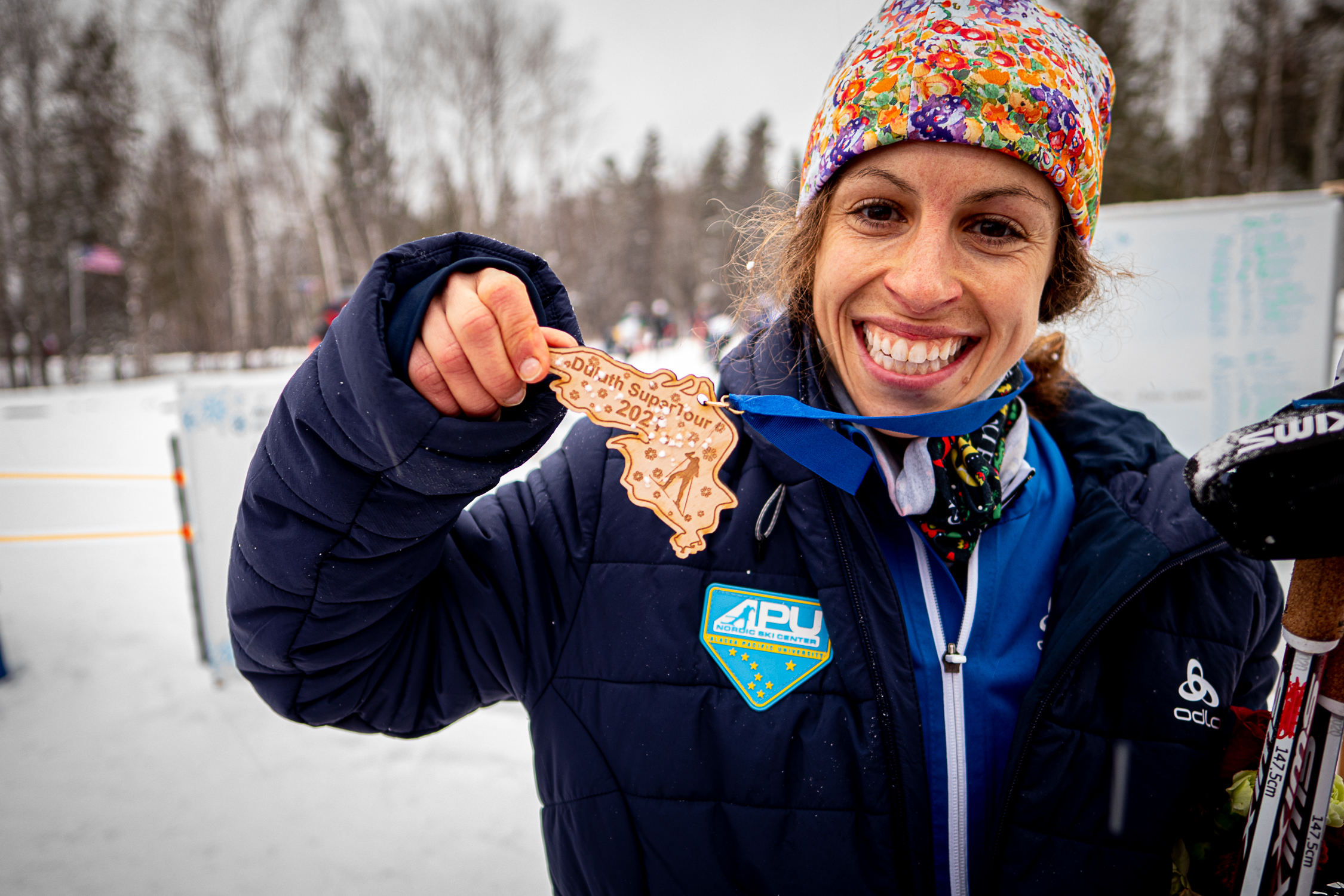
    Saxton was quick to offer sincere congratulations to the skiers who had had more success this week.

    “I am incredibly proud to know and am happy for Logan and Scott and Reese and all of the other champions from this week,” he said, “and incredibly happy that those are going to be the skiers going to over to represent us. I think it’s just, from a personal standpoint, people can understand I was disappointed not to feel like I had my absolutely best days out there, but I am really proud to end the day on a podium, representing the hard work that all my teammates and my coach and the program at Stratton have done all year, and to reward them for that work and that effort is a great feeling.”

    Saxton also enjoyed the “playground mentality” of the sprint day.
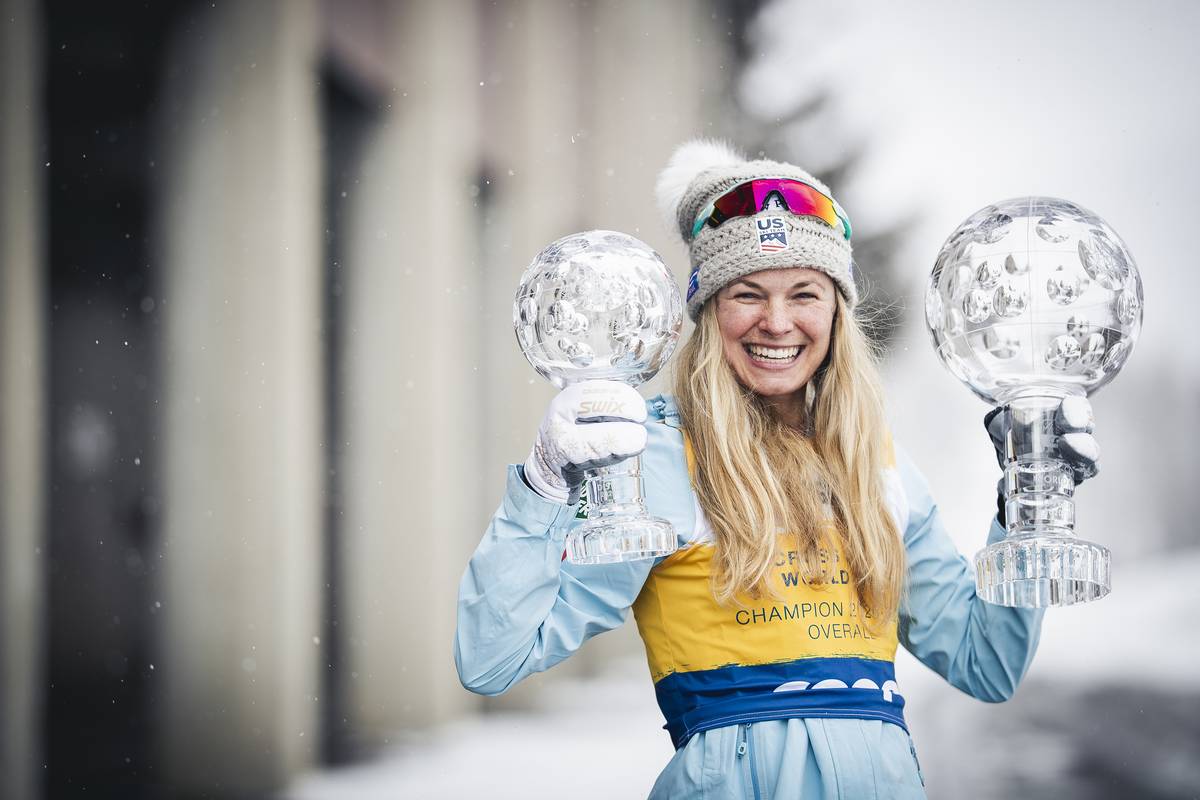
    “I think a lot of the times racing we can get lost in the technical aspects of it,” he mused, “but one of the reasons I love racing heats so much is, it just kind of reminds me of being back in elementary school and pointing to something in the far end of the playground, basketball hoop, or whatever it is, and just saying, ‘Let me race you there.’ And there’s no rules, there’s no anything, it’s just the feeling of you and the other person just going all out, and that’s a beautiful way to live and that’s a beautiful way to compete, and sprints are a wonderful thing like that.”

    Strong Alaska Performances Throughout the Week

    What a difference a year makes. One year ago this week, in the classic sprint at Soldier Hollow, APU didn’t put any athletes into the heats for the first time in at least a decade, done in by a combination of illness, seeding, weather conditions, and wax choice. This time around, head coach Erik Flora’s squad sent eight men through to the heats, six to the semifinal, three to the final, and two to the podium.* 

    The classic sprint capped a successful week for APU, and for Alaskan skiers more generally. Caitlin Patterson, who skis for CGRP, took all four gold medals for the women. Then APU skiers took all four golds on the men’s side, between Scott Patterson on Wednesday, Reese on Friday and Monday, and Kornfield on Sunday. Chelsea Holmes, Kornfield again, Hannah Halvorsen, Rosie Frankowski, Eric Packer, Becca Rorabaugh, and Kornfield again also stepped on the domestic podium for APU. All told, that’s 15 out of a possible 24 medals going to athletes who hail from or ski in Alaska.

    (Although if you slice the data another way, there were also seven out of 12 possible medals in women’s races won by CGRP, between Patterson’s quadfecta and Kaitlynn Miller’s trifecta.)

    This week’s results “just show the depth” of the team, Reese told FasterSkier after his race. “It speaks to the hard work of our coaches, especially Erik Flora. That guy will not be outworked, he just puts so much into us. I’m just really happy that we can have a week like this and go four for four in the men’s with APU, just to show that what he is doing works and how hard he works for us. … To get to this point that we can do that and crush all week and just give them a good show is really rewarding.”
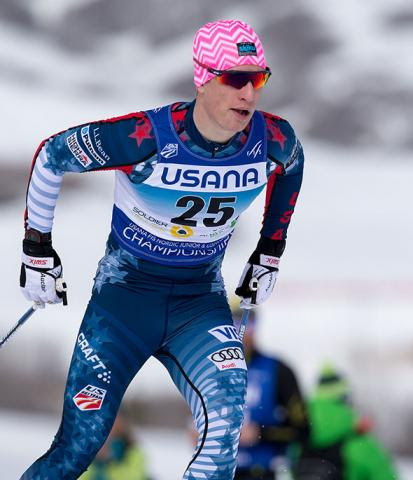
    “We’re all Alaska born-and-raised,” Reese added of the APU men. “Can’t beat that.”

    *(Full disclosure, this reporter skis on the APU Masters team, and receives direct coaching from Flora roughly once a year at Masters Camp.)

    Results: Final | Heats | Qualifier

    — Gabby Naranja and Ian Tovell contributed

    Highlights video by Max Romey Productions

    Replay on U.S. Ski & Snowboard live feed (start at roughly 1:21:00 into the video for the men’s final)

  • Under 23 Questions with Bill Harmeyer

    American Bill Harmeyer (University of Vermont) racing the first leg of the men's 4 x 5 k relay on the last day of 2017 Junior World Championships at Soldier Hollow. After he tagged off in sixth, his team went on to finish ninth. (Photo: FlyingPointRoad.com)
    American Bill Harmeyer (University of Vermont) racing the first leg of the men’s 4 x 5 k relay on the last day of 2017 Junior World Championships at Soldier Hollow. After he tagged off in sixth, his team went on to finish ninth. (Photo: FlyingPointRoad.com)

    In an effort to showcase the North Americans competing at this past week’s International Ski Federation (FIS) 2017 USANA Nordic Junior World Championships and U23 Cross Country World Championships at Soldier Hollow in Midway, Utah, we asked those qualifying athletes several questions about themselves — actually, we had them fill in the blanks. Here we have 19-year-old Bill Harmeyer, of the University of Vermont, who represented the U.S. at his first Junior Worlds.

    To start the week, Harmeyer reached the semifinals of the men’s classic sprint to place 12th in his first Junior Worlds race. He went on to finish 29th in the 10 k freestyle on Friday, and ninth in the men’s 4 x 5 k relay on Sunday.

    ***

    “My full name is Bill Harmeyer, but you can call me Bill. I was born in Burlington, Vt., raised in Underhill, Vt., and one thing you should know about my hometown is the mountain biking is sweet.

    I started cross-country skiing when I was three or four, thanks to Mom and Dad, my main sponsors and the real MVPs. I currently train in Burlington with the University of Vermont Ski Team.

    If I’m not skiing, you might find me in the library, pretending to study. If I had to pick a favorite book, it would be ‘Casino Royale‘.

    One of the things I’m most excited about for Junior Worlds at Soldier Hollow is everything, especially racing at Soldier Hollow again. One race I’m especially targeting there is the classic sprint.

    The best advice anyone ever gave me about skiing or racing was ‘the plan is always changing’ – Ben Husaby.

    One of the best race memories I have is sprinting to the line with Henry, my twin brother, and Ben Hegman when we were 11 years old at the Silver Fox Trot in Hanover, NH. Came down to a photo finish, which I lost.

    If I could meet one World Cup skier, it would be Charlotte Kalla.

    If I don’t end up being a professional skier, I’ll probably be a nurse.

    I’m missing seven days of school to be here, and my teachers are probably thinking, ‘He better show up to office hours.’

  • Sunday Rundown: PyeongChang, Soldier Hollow & Eastern Canadian Champs (Updated x3)

    The women's 4 x 3.3 k relay podium on the final day of 2017 Junior World Championships at Soldier Hollow in Midway, Utah, with Russia (c) in first, Italy (l) in second, and the U.S. (with Hailey Swirbul, Julia Kern, Hannah Halvorsen, and Katharine Ogden) in third. (Photo: FlyingPointRoad.com)
    The women’s 4 x 3.3 k relay podium on the final day of 2017 Junior World Championships at Soldier Hollow in Midway, Utah, with Russia (c) in first, Italy (l) in second, and the U.S. (with Hailey Swirbul, Julia Kern, Hannah Halvorsen, and Katharine Ogden) in third. (Photo: FlyingPointRoad.com)

    FIS Nordic Junior World Championships (Midway, Utah): Junior relays

    Hailey Swirbul, Julia Kern, Hannah Halvorsen, and Katharine Ogden on the podium. That’s right. Two days after Ogden became the first American to earn an individual medal at Junior World Championships, those four U.S. junior women listed above did the same, placing third in the 4 x 3.3-kilometer relay on the last day of 2017 Junior World Championships at Soldier Hollow in Midway, Utah.

    The team credited their lucky socks, similar to the red-white-and-blue striped socks the U.S. women’s World Cup team wears for relays and team events.

    “We gave everything we got,” Kern said in a televised post-race interview.

    “It’s the dream,” Ogden said.

    In fourth at the last exchange, Ogden anchored the team to third, 25.8 seconds behind Russia, which won in 34:45.3 minutes with Polina Nekrasova, Lidia Durkina, Anna Zherebyateva, and Mariya Istomina.

    Italy placed second (+20.6) with Martina Bellini, Anna Comarella, Francesca Franchi, and Christina Pittin.

    Canada finished 12th (+4:41.3) with Natalie Hynes, Lisle Compton, India McIsaac, and Annika Richardson.

    [UPDATED] In the junior men’s 4 x 5 k relay that followed, Norway’s Thomas Helland Larsen outlasted Russia’s Vladislav Vechkanov by 0.4 seconds for the team win in 49:36.1.

    Norway’s gold-medal team included Herman Martens Meyer, Jon Rolf Skamo Hope, Harald Østberg Amundsen, and Larsen, while Russia took silver with Egor Kazarinov, Kirill Kilivnyuk, Yaroslav Rybochkin, and Vechkanov.

    France rounded out the podium in third (+1:05), with Martin Collet, Camille Laude, Hugo Lapels, and Arnaud Chautemps.

    The U.S. finished ninth (+4:28.8) with Bill Harmeyer, Kam Husain, Wyatt Gebhardt, and Hunter Wonders, and Canada followed in 10th (+5:21.6) with Antoine Blais, Ryan Jackson, Philippe Boucher, and Gareth Williams. Twelve teams finished the men’s relay, the final race of 2017 Junior World Championships.

    Results: Women | Men

    ***

    FIS Cross-Country World Cup (PyeongChang, South Korea): Freestyle team sprint

    The women's freestyle team sprint podium at the PyeongChang World Cup on Sunday in South Korea, with Sweden's Elin Mohlin and Maria Nordström (c) in first, Norway's Anna Svensen and Silje Øyre Slind (l) in second, and USA I's Ida Sargent and Sophie Caldwell (r) in third. (Photo: FIS Cross Country/Twitter)
    The women’s freestyle team sprint podium at the PyeongChang World Cup on Sunday in South Korea, with Sweden’s Elin Mohlin and Maria Nordström (c) in first, Norway’s Anna Svensen and Silje Øyre Slind (l) in second, and USA I’s Ida Sargent and Sophie Caldwell (r) in third. (Photo: FIS Cross Country/Twitter)

    The U.S. women had one team on the podium and one just 0.35 seconds off of it on Sunday in the World Cup 6 x 1.4-kilometer freestyle team sprint in PyeongChang, South Korea.

    USA I, with Sophie Caldwell and Ida Sargent, skied in third for most of the race and ultimately finished third, 6.11 seconds behind Sweden’s Elin Mohlin and Maria Nordström in first (in 20:37.11 minutes). Norway took second, 1.71 seconds back, with Anna Svensen and Silje Øyre Slind, while USA I edged USA II, with Caitlin Patterson and Liz Stephen for third. Patterson and Stephen ended up fourth (+6.46), ahead of Slovenia’s Katja Visnar and Anamarija Lampic in fifth (+14.46).

    Fifteen women’s teams competed on Sunday, with 10 of them reaching the final. Canada placed 14th overall with Annika Hicks and Sadie White.

    In the men’s 6 x 1.5 k freestyle team sprint, Russia’s Gleb Retivykh picked up his second win in in PyeongChang, after winning Friday’s classic sprint. He teamed up with Andrey Parfenov for the victory in 19:34.11, beating France (Baptiste Gros/Lucas Chanavat) by 0.03 seconds in a photo finish.

    Russia had two teams on the podium with Russia II’s Artem Maltsev and Nikita Kriukov in third (+5.52). Andy Newell and Simi Hamilton (USA I) fell off the leaders’ pace to finish fourth (+24.23), 18.71 seconds off the podium.

    USA II, with Scott Patterson and Matt Gelso, finished ninth (+54.85) in the final, and Canada’s Jess Cockney and Len Valjas placed 13th of 14 teams.

    Results: Women | Men 

    ***

    NorAm Eastern Canadian Championships (Cantley, Quebec): 15/20 k freestyle pursuits

    SMS Elite's Anne Hart catching Nakkertok's Zoe Williams in the interval start classic, day two of Eastern Championships. (Photo: Ian Austen)
    SMS Elite’s Anne Hart catching Nakkertok’s Zoe Williams in the interval start classic, day two of Eastern Championships. (Photo: Ian Austen)

    The NorAm mini tour at the Nakkertok Nordic Centre wrapped up with freestyle pursuits.

    In the men’s 20 k, AWCA’s Russell Kennedy posted the fastest time of 53:42.68 to move up from third to take the overall victory in 1:33.22.  Lappe Nordic’s Andy Shields started first but couldn’t hold off Kennedy, finishing 36 seconds behind with a 6th best time, 1:01.46 slower. AWCA’s Dominique Moncion-Groulx wrapped up a strong weekend with the fourth best time of day, 37.92 back, to take third overall, 58.53 behind Kennedy.

    SMS Elite’s Anne Hart won the women’s 15 k pursuit in dominant style, starting first and winning time of day in 47:36.10 for an overall time of 1:17:39. AWCA’s Maya MacIsaac-Jones started third and finished second with the second best time of day, 31.36 seconds back for a combined deficit of 51.39 seconds. CNEPH’s Sophie Carrier-Laforte started second and ended third, 2:14.81 down after a sixth best time of day 2:05.47 back.

    Results: Pursuit | Full Weekend

  • Ogden Ties Second-Best U.S. Result at Junior Worlds in Fifth

    Katharine Ogden (Stratton Mountain School/U.S. Ski Team D-team) racing to fifth in the women's 5 k freestyle at 2017 Junior Worlds on Wednesday for her best result in her third Junior Worlds. (Photo: FlyingPointRoad.com)
    Katharine Ogden (Stratton Mountain School/U.S. Ski Team D-team) racing to fifth in the women’s 5 k freestyle at 2017 Junior Worlds on Wednesday for her best result in her third Junior Worlds. (Photo: FlyingPointRoad.com)

    (Note: This article has been updated to include comments from Americans Katharine Ogden and Taeler McCrerey, as well as Canada’s Gareth Williams.)

    Katharine Ogden’s name had already been in the U.S. Ski & Snowboard Association (USSA) record books, right behind Lindsey Williams, Leif Zimmerman and Torin Koos as one of the top finishers in U.S. history at Nordic Junior Worlds Championships.

    Ogden, 19, of the Stratton Mountain School (SMS) and U.S. Ski Team (USST) Development “D” Team, was tied with five other Americans who also placed sixth at Junior Worlds, including current World Cup skiers Andy Newell and Kikkan Randall, and Kris Freeman, who went on to finish fourth in two senior World Championships.

    On Wednesday, Ogden moved up in the ranks, placing fifth for the second-best U.S. result at Junior Worlds, equalling Zimmerman and Koos.

    Katharine Ogden (Stratton Mountain School/U.S. Ski Team D-team) racing to fifth in the women's 5 k freestyle at 2017 Junior Worlds on Wednesday for her best result in her third Junior Worlds. (Photo: FlyingPointRoad.com)
    Katharine Ogden (Stratton Mountain School/U.S. Ski Team D-team) racing to fifth in the women’s 5 k freestyle at 2017 Junior Worlds on Wednesday at Soldier Hollow in Midway, Utah. (Photo: FlyingPointRoad.com)

    “I’m really psyched about my result … it was so awesome to see that I’m in a good place to stick with these top girls in the mass start race,” Ogden wrote in an email after the women’s 5-kilometer freestyle at Soldier Hollow in Midway, Utah.

    She had previously finished sixth in the 10 k skiathlon two years ago in Almaty, Kazakhstan.

    “My goal going into the 5k skate was mostly just getting a feel for how I can race in this field and on these courses so as to know how to race the skiathlon,” she explained, referring to her target race on Friday. “In the skiathalon I’m really hoping for another top 6 and maybe (hopefully) a podium.”

    “It’s really encouraging to know that all those U.S. Ski Team girls that are doing so well [on the World Cup] right now were in the same place that I am at one point,” Ogden said in a post-race interview with the U.S. Ski Team.

    She has her share of World Cup starts, eight to be exact, after racing the entire Ski Tour Canada — an eight-stage series that closed out the 2015/2016 international race season. This year, her fifth place on Wednesday puts her soundly within U.S. Ski Team criteria for selection to 2017 World Cup Finals, which will take place March 17-19 in Quebec City, Quebec.

    But back to Junior Worlds: Ogden achieved a career best on Wednesday and was 6.5 seconds shy of a medal. Ogden started the one-lap 5 k individual start in bib 54 (of 57).

    Asked what she was thinking about as she warmed up and lined up at the start, Ogden couldn’t get over how nervous she was.

    “Honestly I was pretty nervous before the start of the race. That’s basically all that I was thinking about,” she wrote. “I felt good once I started racing, the nerves just went away! The course was totally awesome for me.”

    While she didn’t get many splits, Ogden explained she heard just enough to know that she was with the leaders.

    “That motivated me because I was aware that every second was important,” she wrote.

    Just over 13 minutes later, she crossed the finish line in third, 6.5 seconds behind behind Russia’s Mariya Istomina, who was fastest across the line in bib 50. Italy’s Anna Comarella, who started 53rd, 30 seconds ahead of Ogden, came up 3.2 seconds shy of the Russian for second at the time. And Ogden was another 3.3 seconds back in third.

    “I honestly didn’t have too much of a strategy,” Ogden told the U.S. Ski Team. “It was a short race, so I knew I was going to have to go hard basically from the start. But I was also trying to walk the line of not blowing up.”

    The 2002 Olympic trails at Soldier Hollow peak out around 5,900 feet above sea level. That can be a doozy for most of the world that trains closer to sea level, including Ogden from Landgrove, Vt. Asked in a pre-Junior Worlds questionnaire what she was most excited for at these championships, Ogden wrote “racing at altitude.”

    The women's 5 k freestyle podium on Wednesday at 2017 Junior World Championships at Soldier Hollow in Midway, Utah, with Sweden’s Ebba Andersson (c) in first, Norway’s Marte Mæhlum Johansen (l) in second and Russia's Mariya Istomina (r) in third. (Photo: FlyingPointRoad.com)
    The women’s 5 k freestyle podium on Wednesday at 2017 Junior World Championships at Soldier Hollow in Midway, Utah, with Sweden’s Ebba Andersson (c) in first, Norway’s Marte Mæhlum Johansen (l) in second and Russia’s Mariya Istomina (r) in third. (Photo: FlyingPointRoad.com)

    Of the three women that started after Ogden, two of them reached the podium. Norway’s Marte Mæhlum Johansen in bib 56 bested Istomina’s time by 1.5 seconds to become the new race leader — albeit briefly. That bumped Ogden to fourth and the American ultimately placed fifth after the final starter, Sweden’s Ebba Andersson, finished 13.8 seconds faster than Johansen for the win in 12:45.4 minutes.

    Andersson became a three-time Junior Worlds champion, after winning last year’s 10 k freestyle and 4 x 2.5 k freestyle relay with Sweden’s women’s team in Rasnov, Romania.

    “When I was thinking about the race I made a tactic that I would have a controlled start and then power to the end and I think I succeeded,” Andersson told the U.S. Ski Team media. “The course was amazing today. It was incredible and the weather, too.”

    Following the trend of the rest of the week so far, conditions were hard-packed and temperatures just below freezing on a bluebird day.

    Ogden led three U.S. women in the top 20 on Wednesday, with Hannah Halvorsen (Sugar Bowl Academy/USST) in 13th (+1:01.2) and Taeler McCrerey (University of Denver) in 20th (+1:18.9). The team’s fourth woman, Hailey Swirbul (University of Alaska Anchorage) placed 31st (+1:35.5).

    “My goal for this race was to pace it well so I could use my energy wisely,” Halvorsen, also a member of the USST D-team, wrote in an email. “I liked how firm and fast the course was because I could focus on skiing smooth, powerful, and relaxed. I was really happy with how things went!”

    As the 22nd starter, Halvorsen initially crossed the line in second.

    “I was excited to cross the line in second but I didn’t know how promising that would be with half the field still to finish,” she wrote. “I was a little bummed to not stay in the top ten but I know this was a great race for me.”

    Two days earlier, in her first race of her first Junior Worlds, Halvorsen finished 11th in the classic sprint.

    Also on Monday, McCrerey, a sophomore at the University of Denver, placed 40th in the classic sprint. She landed 20th on Wednesday for a career best at her first Junior Worlds.

    “Today I set out to achieve my first solid race at world juniors,” McCrerey wrote in an email.

    She explained that interval-start races are her strength and growing up 9,000 feet above sea level in Frisco, Colo., didn’t hurt, either.

    “The 5k course is one of the most challenging I have raced at Soldier Hollow so that also benefited me,” McCrerey noted.

    The 44th starter, she explained that she received splits at two parts of the race.

    “The splits were surprisingly close as skiers 5-18 were all within 6 seconds of each other,” she wrote. “Unfortunately all the fast girls started behind me so I was not receiving splits off of them. Racing at ‘home’ in this big of races has been an incredible experience. It’s fun to hear people cheering for the ‘host country’ and waving the stars and stripes so proudly!

    “Today was a good day,” McCrerey added. “I learned a lot about racing at this level which has made me grow as a skier. Special congratulations to my teammates Hannah and Katherine on their exceptional performances today.”

    Canada had four women in 39th through 46th, with Lisle Compton (NTDC Thunder Bay) in 39th (+1:51.9), Annika Richardson (NTDC Thunder Bay/Canadian Junior Team) in 41st (+1:57.8), Claire Grall-Johnson (Nakkertok) in 42nd (+1:58.2), and India McIsaac (Rocky Mountain Racers) in 46th (+2:12.9).

    Russia Sweeps Men’s Podium; Wonders 16th

    The all-Russian 10 k freestyle men's podium on Wednesday at 2017 Junior World Championships at Soldier Hollow, with winner Vladislav Vechkanov (c), Egor Kazarinov (l) in second, and Yaroslav Rybochkin (r) in third. (Photo: FlyingPointRoad.com)
    The all-Russian 10 k freestyle men’s podium on Wednesday at 2017 Junior World Championships at Soldier Hollow, with winner Vladislav Vechkanov (c), Egor Kazarinov (l) in second, and Yaroslav Rybochkin (r) in third. (Photo: FlyingPointRoad.com)

    After women’s race wrapped up in the morning, the men’s 10 k freestyle began at noon. Hunter Wonders, of Alaska Pacific University, led two Americans in the top 20 — finishing 16th in 24:25.8. The winner, Russia’s Vladislav Vechkanov, who had qualified fifth in the classic sprint then went on to place 10th on Monday, started in bib 59 (of 73) and posted an untouchable time of 23:08.6.

    Russia swept the podium with two of Vechkanov’s teammates coming closest to him. Egor Kazarinov, the 70th starter, finished 7.9 seconds back in second, and Yaroslav Rybochkin was 13.3 seconds back in third.

    For 19-year-old Vechkanov, the gold was his first medal in two Junior Worlds, after placing seventh in the skate sprint last year in Rasnov.

    “I arrived at the finish and actually I didn’t think I would win gold,” he told the U.S. Ski Team media. “So I pushed knowing that I would be in top three, but not winning. I started really slow. The on the second loop I tried to increase my speed. On the last uphill I tried my best to make it to the finish line without any strength and I hoped I would be in the top three. But now I’m first!”

    American Hunter Wonders (APU) racing to 16th in the men's 10 k freestyle at 2017 Junior World Championships on Wednesday at Soldier Hollow in Midway, Utah. (Photo: U.S. Ski Team/Steven Earl)
    American Hunter Wonders (APU) racing to 16th in the men’s 10 k freestyle at 2017 Junior World Championships on Wednesday at Soldier Hollow in Midway, Utah. (Photo: U.S. Ski Team/Steven Earl)

    Wonders’s time was 1:17.2 minutes back, which put him 16th in his first Junior Worlds race. He started 25th, two minutes behind his U.S. teammate Wyatt Gebhardt, of the Steamboat Springs Winter Sports Club. Gebhardt ended up 19th (+1:21.9), also in his Junior Worlds debut.

    Also for the U.S, Bill Harmeyer (University of Vermont) placed 29th (+2:02.6) and Lance McKenney 61st (+4:23.3).

    Following Gebhardt in 19th, Canada’s Gareth Williams, of the Telemark Race Team in Kelowna, B.C., placed 20th (+1:24.6) in his first Junior Worlds race. His Canadian teammates Antoine Blais (Skibec) followed in 32nd (+2:07.8), Philippe Boucher (CNEPH) 35th (+2:10.3), and Remi Drolet (Black Jack) 50th (+2:49.1).

    “This and the skiathlon were both my target races after not qualifying for Canada’s sprint team,” Williams explained in an email. “In my head I wanted to be inside the top 20 on the day, but since it is my first Worlds race I had no idea what to expect.”

    Toward the end of the second lap, he started cramping.

    “This made it difficult for me to give a proper finishing kick on the last few hills. I was getting splits that I was fighting for a top 20, so for me that was motivating,” Williams wrote. “Overall I am happy with the day, top 20 is something to be pleased with. Now that I have a taste of what it’s like here at Worlds, I can adjust my goals for the coming races. I hope tomorrow’s skiathlon can go equally as well, if not better.”

    Results: Women | Men

  • Wednesday Rundown: Ogden Fifth in Junior Worlds 5 k Freestyle (Updated)

    Katharine Ogden (Stratton Mountain School/U.S. Ski Team D-team) racing to fifth in the women's 5 k freestyle at 2017 Junior Worlds on Wednesday for her best result in her third Junior Worlds. (Photo: FlyingPointRoad.com)
    Katharine Ogden (Stratton Mountain School/U.S. Ski Team D-team) racing to fifth in the women’s 5 k freestyle at 2017 Junior Worlds on Wednesday for her best result in her third Junior Worlds. (Photo: FlyingPointRoad.com)

    FIS Nordic Junior World Championships (Midway, Utah): 5/10 k freestyle

    Coming into 2017 Junior World Championships with a career-best individual of sixth at Junior Worlds (which she achieved in the 10-kilometer skiathlon two years ago), Katharine Ogden of the Stratton Mountain School (SMS) and U.S. Ski Team (USST) D-team did one better on Wednesday, racing to fifth in the women’s 5 k freestyle individual start at Soldier Hollow in Midway, Utah.

    Ogden started 54th and initially finished third, behind Russia’s Mariya Istomina and Italy’s Anna Comarella, respectively. That was a good spot to be in, considering there were only 57 starters.

    But the final two women out on course, Norway’s Marte Mæhlum Johansen in bib 56 and Sweden’s Ebba Andersson in bib 57 ultimately bumped Ogden out of third, then fourth, respectively. Andersson took the win in 12:45.4 minutes, finishing 13.8 seconds faster than Johansen in second. Istomina held on for third (+15.3), Comarella was fourth (+18.5), and Ogden was 6.5 seconds off the podium in fifth (+21.8) for her best result in three Junior Worlds.

    The U.S. had three women in the top 20 with Hannah Halvorsen (Sugar Bowl Academy/USST) in 13th (+1:01.2) and Taeler McCrerey (University of Denver) in 20th (+1:18.9). The team’s fourth woman, Hailey Swirbul (University of Alaska Anchorage) placed 31st (+1:35.5).

    Lisle Compton (NTDC Thunder Bay) led the Canadian women in 39th (+1:51.9), Annika Richardson (NTDC Thunder Bay) finished 41st (+1:57.8), Claire Grall-Johnson (Nakkertok) was 42nd (+1:58.2), and India McIsaac (Rocky Mountain Racers) 46th (+2:12.9).

    [UPDATED] In the men’s 10 k freestyle that followed, Vladislav Vechkanov, the fifth qualifier in Monday’s classic sprint, led a Russian podium sweep. He won in 23:08.6, 7.9 seconds ahead of his teammate Egor Kazarinov, while the third Russian, Yaroslav Rybochkin was 13.3 seconds back.

    Two Americans finished in the top 20, with Hunter Wonders (Alaska Pacific University) in 16th (+1:17.2) and Wyatt Gebhardt (Steamboat Springs WSC) in 19th (+1:21.9). Also for the U.S, Bill Harmeyer (University of Vermont) placed 29th (+2:02.6) and Lance McKenney 61st (+4:23.3).

    Gareth Williams (Telemark) led the Canadians in 20th (+1:24.6), Antoine Blais (Skibec) finished 32nd (+2:07.8), Philippe Boucher (CNEPH) placed 35th (+2:10.3), and Remi Drolet (Black Jack) 50th (+2:49.1)

    Results: Women | Men

  • Germany’s Brugger Pulls Upset; Harmeyer Leads U.S. Men in 12th in Junior Worlds Classic Sprint

    Germany's Janosch Brugger (4) celebrates his classic sprint win by 0.04 seconds over Norway's Petter Stakston (l) on Monday at the first day of 2017 Junior World Championships at Soldier Hollow in Midway, Utah. (Photo: FlyingPointRoad.com)
    Germany’s Janosch Brugger (4) celebrates his classic sprint win by 0.04 seconds over Norway’s Petter Stakston (1) on Monday at the first day of 2017 Junior World Championships at Soldier Hollow in Midway, Utah. (Photo: FlyingPointRoad.com)

    On the first day of 2017 Junior World Championships at Soldier Hollow in Midway, Utah, there was one man who appeared to be dominating the 1.5-kilometer classic sprint from top to bottom. Norway’s 19-year-old Petter Stakston, in his second Junior Worlds, started Monday off with a qualifying win, by 0.61 seconds over Finland’s Turo Sipilä, in 3:45.33 minutes.

    Then he won the first men’s quarterfinal of the day and proceeded to win the first semifinal as well.

    “I felt very good today,” Stakston told the U.S. Ski Team media in a post-race interview. “I was strong in the prologue … I tried to take the lead in every single heat and just go as fast as I could.”

    But Germany’s Janosch Brugger foiled his streak in the final, coming from behind in the finishing stretch to take the win by 0.04 seconds in 3:43.00 minutes.

    “It was good until the last 100 meters,” Stakston reflected after placing second. “Janosch Brugger was a bit stronger and took it, but I’m very happy.”

    Brugger started Monday off with the fourth-fastest qualifying time, 3.06 seconds behind Stakston. He went on to place second in his quarterfinal (by 0.48 seconds to another Norwegian, Jo Svinsås), then finished third in his semifinal, 0.6 seconds behind Stakston in first.

    The 19-year-old Brugger advanced as a lucky loser to the final, where he timed his strike to take his first gold in three Junior Worlds appearances, and his first podium as well.

    “I didn’t have any strategy; it’s only pushing as hard as I can,” Brugger said in an interview with the U.S. Ski Team media. “It means everything because on this day, you’re the best cross country-skier in the world and it’s exciting.”

    Brugger outlasted five others in the men’s final, which included four Norwegians (Stakston, Svinsås, Herman Martens Meyer, and Thomas Helland Larsen) and Finland’s Verneri Suhonen.

    Meyer reached the podium in third (+3.83), while Larsen placed fourth (+11.32), Suhonen was fifth (+12.97), and Svinsås sixth (+16.42).

    All Four U.S. Men Qualify

    The four American men racing on Monday qualified for the heats, with Bill Harmeyer (University of Vermont Ski Team) leading them in 11th (+7.03), Logan Diekmann (Utah Ski Team) in 23rd (+10.74), Kam Husain (Stratton Mountain School) in 27th (+11.71), and Lance McKenney in 29th (+11.91).

    Two Canadians qualified in the top 30 as well, with Étienne Hébert (Montériski) in 13th (+8.57) and Reed Godfrey (Team R.A.D./Canmore Nordic) in 25th (+11.55). Antoine Blais (Skibec) missed the qualifying cutoff by 0.05 seconds in 31st for his best result at his second Junior Worlds, while Ty Godfrey (Team R.A.D./Canmore Nordic) finished 36th (+12.99).

    In the heats, Harmeyer ended up fourth in the first quarterfinal, 1.13 seconds behind Stakston, but advanced as one of two lucky losers to the semifinal.

    “Out from the gun, I gave it some gas, but immediately realized that these guys were going pretty fast,” Harmeyer, 19, reflected in an email after his first Junior Worlds race. “So I decided to cool down a bit, and fall in behind the two Norwegians in my heat. Things settled in pretty quick, and I just tried to stay relaxed.

    “Going into the second climb, where the guys and gals courses split, I tried to make a move,” he added. “I moved up from 6th to 3rd or 4th around the outside, and was in a good position going into the final climb. Up the final climb, I got boxed out a bit, and went into the final downhill in 4th. Coming through the finish, I knew that lucky looser was a possibility, so I gave it everything I had.”

    Harmeyer made it to the first semifinal, where he faced off against the eventual top-three finishers (Brugger, Stakston and Meyer). Four of the men in his semifinal made it to the final.

    The Vermont native described the beginning of his semifinal as similar to his quarterfinal.

    American Bill Harmeyer doing a tele turn on his way back to the stadium after a broken pole took him out of contention in the first men's semifinal on Monday at 2017 Junior World Championships at Soldier Hollow in Midway, Utah. He finished sixth in the semifinal. (Photo: FlyingPointRoad.com)
    American Bill Harmeyer doing a tele turn on his way back to the stadium after a broken pole took him out of contention in the first men’s semifinal on Monday at 2017 Junior World Championships at Soldier Hollow in Midway, Utah. He finished sixth in that semifinal for 12th overall. (Photo: FlyingPointRoad.com)

    “I played the same cards going into the first hill, and made the same move going into the second hill as I did in the quarter,” Harmeyer wrote. “I was in 4th or 5th going into the final climb, and the group was still tight. Thats when I went down. I’m not sure if I got tangled with myself or if I got tangled with the Russian but I went down pretty hard.”

    Upon trying to stand back up, his pole snapped.

    “I finally got back up and started making my way up the hill as [U.S. development coach] Bryan Fish came sprinting down with another pole,” he recalled. “At this point, the guys in the heat were already headed down towards the finish. All I could do was enjoy the race at that point!”

    Harmeyer finished sixth (+23.23) and did not advance to the final to end up 12th overall.

    “I’m really happy with my performance today, but more happy with the team’s performance,” he wrote. “I think it was awesome to see all the guys, and three of the girls [Julia Kern, Hannah Halvorsen, and Lauren Jortberg] make it into the rounds. The wax techs and coaches have put everything into the athletes, those guys are awesome! It’s a total honor being able to represent the USA on home soil, and I’m looking forward to an exciting week of racing to come!”

    He was the lone North American to reach the semifinals after Husain finished sixth in the second quarterfinal (1.5 seconds behind Svinsås as the winner of that heat), Godfrey was fifth in the third quarterfinal (7.59 seconds out of first), McKenney was fourth in the fourth quarterfinal (2.02 seconds out of first), and Hébert finished fourth (+1.43) and Diekmann sixth (+3.98) in the fifth quarterfinal.

    At the end of the day, Harmeyer led the U.S. in 12th, followed by McKenney in 20th, Diekmann in 27th, and Husain in 29th.

    Canada’s Étienne Hébert (13) leads American Logan Diekmann in their classic-sprint quarterfinal on Monday at 2017 Junior World Championships at Soldier Hollow in Midway, Utah. Neither advanced to the semifinals, with Hébert finishing fourth (+1.43) and Diekmann sixth (+3.98) in that heat. (Photo: FlyingPointRoad.com)
    Canada’s Étienne Hébert (13) leads American Logan Diekmann in their classic-sprint quarterfinal on Monday at 2017 Junior World Championships at Soldier Hollow in Midway, Utah. Hébert finished fourth and Diekmann sixth in that heat for 17th and 27th overall, respectively. (Photo: FlyingPointRoad.com)

    Hébert was the top Canadian in 17th overall, followed by Godfrey in 25th.

    “It was a pretty awesome race for me today,” Hébert said, according to a Cross Country Canada (CCC) press release. “I couldn’t expect any more from myself as that was pretty much the best race I have done all year.

    “I just knew at the beginning of the race I wouldn’t be able to go with those guys in the final 100 meters,” the 18 year old added. “They were just too big so I tried to just go for it and I did. I was able to hold them off until about 200 metres when they passed me.”

    According to Godfrey, also at his first Junior Worlds, he raced the fastest qualifier he could have and enjoyed his quarterfinal.

    “The most challenging part for me was the finishing stretch,” Godfrey told CCC. “I was in pretty good contention for most of the course, but the biggest difference between myself and the other guys is their power to the finish. [This performance] gives me a little extra motivation for next year.”

    Stay tuned for a separate women’s classic sprint report.

    Results: Qualifying | Final