From the FasterSkier archive — posts syndicated from athletes’ and coaches’ own blogs between 2004 and 2012, kept online as published. Current coverage is at fasterskier.com.
This coverage is made possible through the generous support of Marty and Kathy Hall and A Hall Mark of Excellence Award. To learn more about A Hall Mark of Excellence Award, or to learn how you can support FasterSkier’s coverage, please contact info@fasterskier.com.
Jessie Diggins answering questions at the press conference before the World Cup in Lake Placid, New York. (Photo: Voisin/FasterSkier)
Lake Placid, N.Y. — The eve of the World Cup finals at Mount Van Hoevenberg brought press conferences, sound checks that went sideways, and three American skiers who couldn’t stop making each other smile.
Jessie Diggins, Ben Ogden, and Gus Schumacher sat side by side Wednesday afternoon — the same trio that has turned the 2025-26 season into something U.S. cross-country skiing has never seen before. Between them: Olympic medals, historic podiums, a 50-year drought shattered, and one very good birthday cake.
But with three races left and Diggins’s retirement looming, the mood wasn’t heavy. It was loose, funny, and deeply human — exactly the way this team tends to do things.
“Probably Glitter”
Asked to define her legacy heading into her final World Cup weekend, Diggins did what Diggins does: she went somewhere unexpected.
“I think I define my legacy honestly, completely outside race results,” she said. “I am more proud of the things I have done off the course. I think my legacy is going to be in my advocacy and the way that I have spoken about mental health and eating disorders specifically, and the way I’ve tried to make really hard conversations less hard for people to have.”
She pointed to her work with Protect Our Winters and Share Winter, to the energy she’s poured into the team’s culture over the years. And then she landed the dismount.
“And probably glitter. I think there’s a lot more glitter in ski races now, and that’s always a great thing — as long as it’s biodegradable.”
Diggins has spent the season saying goodbye in pieces — a little cry leaving training camp in Bend, quiet moments at each World Cup stop. She knows what’s probably coming Sunday.
“I suspect it’s probably going to hit like a dump truck on Sunday, and there’s probably going to be a lot of tears.”
But she’s ready. And what she’s ready for is maybe the most Jessie Diggins thing of all: she sees ski racing as performance art, and she wants her final show to leave people wanting to go run up a mountain or sign their family up for ski lessons.
“I realized that I can do that moving forward, but just with my story and with my words, and I don’t have to push my body so hard, but I can still leave people inspired and motivated.”
In the meantime, she’s looking forward to being able to wash her clothes when they’re dirty, cook whatever she wants, and bake cookies on the weekend instead of training and racing all day.
Ben Ogden answering questions at the press conference before the World Cup in Lake Placid, New York. (Photo: Voisin/FasterSkier)
“Your Life Is Not Going to Be the Same”
Ben Ogden grew up in Landgrove, Vermont. American skiing legend Bill Koch lived close by in Peru, Vermont. Same zip code, as Ogden puts it — “not so different.”
Fifty years separated Koch’s 1976 Olympic medal from Ogden’s silver this season, and when Ogden finally got on the phone with his neighbor and mentor after breaking the drought, Koch didn’t mince words.
“Bill just sort of said, ‘Hey, congratulations, and your life is not going to be the same from this point forward.’ And that was kind of crazy to hear.”
Ogden hopes to see Koch at the races this weekend. And racing at Van Hoevenberg carries its own weight for him — not just because of Koch, but because of his father, who was deeply embedded in the New England ski racing community.
“I think it’s really hard for me to come race in the U.S. and look around and not just, like, constantly think about him, because this was his scene,” Ogden said, his voice softening. “He would have been in such paradise on the side of the trail here in Lake Placid. And I’ll be thinking about him a lot this weekend, for sure.”
This is technically Ogden’s first home World Cup — he was sick for Minneapolis — and it’s hitting him right. He grew up racing the NYSEF Festival series at Lake Placid, bringing crews of Vermont kids over for slushy late-season races.
“It’s not my home, but it feels like it.”
Gus Schumacher answering questions at the press conference before the World Cup in Lake Placid, New York. (Photo: Voisin/FasterSkier)
Aspirations, Not Goals
Gus Schumacher has been doing some linguistic rebranding.
“I’ve been calling them aspirations for a few years now,” he said of his season targets, “because I feel like the pressure of goals was kind of weird for me.”
The distinction matters to Schumacher. He sets plenty of small goals — the daily, tactical kind — but the big ones, like winning an Olympic medal or finishing in the top 10 of the overall World Cup standings, he holds more loosely. They’re aspirations: things he wants, things he’ll chase, but things he won’t let crush him if they don’t happen.
“Those are things I want to do, but if they don’t happen, it won’t be because I didn’t try.”
He accomplished the Olympic medal. He entered this final weekend ranked sixth in the world, with a top-10 finish still in play. And he’s approaching Lake Placid the same way he approached Minneapolis, where he won his first World Cup in front of a hometown crowd: just be happy to be racing, and feed off the energy.
“Already today, it was really cool to have people cheering us on in the race prep, which doesn’t really happen much on the World Cup ever.”
Schumacher also dropped maybe the best origin story of the press conference: the formative moment that lit a fire under his career was Luke Jaeger beating him at an Anchorage cup race.
“That kind of put a fire under my belly to really start training, because I didn’t want him beating me anymore.”
The Knitting Club, the Water Pump, and the Greenhouse
The press conference’s best stretch might have been when someone asked the athletes how they decompress.
Schumacher keeps it clean: headphones, 10 to 20 deep breaths — four seconds in, eight seconds out. Standard operating procedure.
Ogden? He knits. And he’s not shy about it.
“After races, I’ve been doing a lot of knitting and stuff like that. Helps me just relax really quick.” After the season, it’s bigger projects: car work. “You can feel like you’re the king of the world after a couple medals, but go and try and replace a water pump on a Forerunner, and that’ll make you feel completely incompetent.”
Diggins revealed there was a full-on knitting club on the team this winter. Her own reset button is simpler: she calls her husband.
“He’s my absolute center of my world. The race could have been amazing, and it could have been also completely horrible. And we’re just talking about what I want to do with the garden, and how I want to start a greenhouse. And he’s like, ‘Uh huh, yeah, sure, I’ll support you in that.’”
One More Thing
Almost as a throwaway, Ogden mentioned that Andy Newell — “the original Nordic ski backflip guy” — is in Lake Placid this weekend. And Ogden himself has had a backflip dialed since he was 17.
“I’m hoping on Sunday we can kick up a little ski jump. I’m looking to take another one Sunday afternoon. So stay tuned.”
Three races to go. A retirement to honor. A culture to celebrate. And maybe a backflip.
It’s going to be a weekend.
Love Stories Like This? Help Keep Them Coming.
Feature stories like this one take time, access, and care to produce. If you value thoughtful storytelling and independent ski journalism, please consider becoming a Voluntary Subscriber. Your support directly fuels the work we do to cover the people, places, and moments that make our sport special.
Stifel Lake Placid Finals, a Coop FIS Cross-Country World Cup, to Bring Elite Ski Racing and Winter Festival Atmosphere to Lake Placid
FIS Cross-Country World Cup racing, fan experiences, athlete engagement, and live entertainment coming March 19–22
LAKE PLACID, N.Y. — The Stifel Lake Placid Finals, a Coop FIS Cross-Country World Cup, will offer more than world-class competition this March. The event will transform Lake Placid into a multi-day winter sports festival featuring themed race days, live entertainment, film screenings, interactive expo activations, and family-friendly programming.
In collaboration with the New England Nordic Ski Association (NENSA), the 10th Mountain Division, U.S. Ski & Snowboard, and the International Ski and Snowboard Federation (FIS), the Olympic Regional Development Authority (Olympic Authority) has curated a dynamic schedule that celebrates Nordic skiing and outdoor winter-sport culture.
A central focus of the week will be spotlighting women and girls in sport, networking opportunities, and hands-on activities. Fans will also have unique opportunities to connect with athletes through meet-and-greets, alumni celebrations, and special legacy moments — including Sunday’s “Last Lap” ceremony honoring retiring World Cup athletes.
Together, these events are designed to foster engagement, connection, and shared celebration across the Lake Placid community and the global ski family.
One final celebration of Jessie Diggins (USA) amazing career. (Photo: Authamayou/NordicFocus)
Event & Community Programming
In addition to World Cup racing, the Stifel Lake Placid Finals will feature a range of community events, athlete appearances, and festival programming throughout the week. Activities include youth programming, athlete conversations, live music, demonstrations, and opportunities for fans to connect with past and present champions.
Programming details may evolve, and additional events may be added throughout the week. Visitors are encouraged to check the official event schedule for the most up-to-date information.
Thursday, March 19 – Community & Kickoff
Opening day features official training and festival programming at Mt Van Hoevenberg, along with an evening film screening at the Palace Theatre that kicks off the festivities in downtown Lake Placid.
Friday, March 20 – Theme: Past
Friday celebrates the legacy of Nordic skiing and Olympic history in Lake Placid. The venue opens with festival programming, including the NENSA Terrain Park and Expo with L.L. Bean, regional athlete recognition connected to the 2026 Winter Olympics, and Adirondack Birds of Prey demonstrations. Fans can also watch presentations from the 10th Mountain Division, enjoy live music, and attend athlete interviews and meet-and-greets throughout the day. A highlight of the afternoon is the “One More Lap” legacy ski, featuring international and U.S. Ski Team alumni, including Olympic legend Thomas Wassberg and American champion Bill Koch, before World Cup racing and awards ceremonies conclude the day.
Saturday, March 21 – Theme: Future
Saturday’s programming focuses on the next generation of Nordic skiing. Activities include the NENSA Terrain Park and Expo with L.L. Bean, athlete appearances, and fan engagement opportunities. The Women in Sports Heroic Panel highlights leadership and opportunities for girls and women in athletics, while fans can also attend athlete meet-and-greets and participate in interactive programming throughout the venue. Competition highlights include the freestyle sprint finals, followed by Crystal Globe presentations. Youth racing also takes center stage with the World Cup Future Stars Sprint. Additional programming includes Lollipoppers to Olympians: A Celebration of New England Skiing, a live recording of the Skirious Podcast featuring Ben Ogden and special guests at the Olympic Jumping Complex, and evening film screenings at the Palace Theatre.
Sunday, March 22 – Theme: Present
Championship Sunday features entertainment, athlete appearances, and the season-ending races of the World Cup Finals. Live music, a DJ set, and ceremonial elements, including the 10th Mountain Division Color Guard and flyover, set the stage for the final competition. The afternoon concludes with awards ceremonies and the “One Last Lap” ceremony honoring retiring World Cup athletes.
Gus Schumacher (USA) and Ben Ogden (USA), (l-r) celebrate their silver medal at the Olympic Winter Games in Tesero, Italy. (Photo: Vanzetta/NordicFocus)
Competition Schedule | FIS Cross-Country World Cup Finals
Mt Van Hoevenberg | March 19–22, 2026
World Cup official training and competition runs March 19–22 at Mt. Van Hoevenberg, where the world’s top U.S. and international cross-country skiers will compete for overall and discipline Crystal Globe honors. The weekend culminates on Sunday with championship racing, awards presentations, and the “One Last Lap” ceremony recognizing retiring athletes.
Full competition schedule:
Thursday, March 19, 2026:
11:00 – 1:00 pm | 10km Official Training
1:00 pm – 3:00 pm | Sprint Official Training
Saturday, March 21, 2026:
10:30 am | Women’s Sprint Qualification Free
10:30 am | Men’s Sprint Qualification Free
1:00 pm | Women’s Sprint Final Free
1:00 pm | Men’s Sprint Final Free
Sunday, March 22, 2026:
12:30 pm | Men’s 20km Mass Start Free
2:30 pm | Women’s 20km Mass Start Free
Jessie Diggins (USA) and the US Ski Team celebrate in Goms. (Photo: Authamayou/NordicFocus)
Broadcast Schedule
NBC will air the Sprint Finals live on Saturday, March 21, from 1–2 p.m. ET. CNBC will air coverage of the Men’s and Women’s 10km Interval Starts on Saturday, March 21, from 2–4 p.m. ET. NBC will also air the Women’s 20km Mass Start on Saturday, March 29, from 1–2 p.m. ET on tape delay.
Ben Ogden (USA) celebrates as he crosses the finish line with an Olympic silver medal, the first medal for the U.S. men in the sport in fifty years. (Photo: Vanzetta/NordicFocus)
This essay by Jim Galanes was written on the evening of the Olympic Men’s Classic Sprint in Val di Fiemme, when Ben Ogden won silver to become the first American man in 50 years to medal in an Olympic cross-country skiing event. It was drafted from the race course that same night and is being published now, several weeks later, as a reflection from someone who has witnessed multiple generations of American skiing.
~ ~ ~ ~ ~
A friend texted and reminded me as we were standing on the course for the sprint race, in Val di Fiemme, that it had been 50 years and five days since Bill Koch won his silver medal in Seefeld, Austria, at the 1976 Olympics.
I was at those Games as a Nordic Combined skier, 20 years old learning the sport, I was trail side 4-5 kilometers from the finish cheering Bill on. In fact, I got so caught up in the moment that I nearly missed my own ski jumping training window and had to hustle back to squeeze in my final practice jumps before competition. Bill’s performance mattered, not just for the result, but for what it signaled about what American skiers could do on the world stage.
Fast forward five decades (and five days), and I found myself in a remarkably similar position, but as a spectator, back on course, watching Ben Ogden put together what I believe was the most complete race of his career , tactically, psychologically, and physiologically, on the same Val di Fiemme tracks that have tested athletes for the past 30 years.
Johannes Hoesflot Klaebo (NOR) and Ben Ogden (USA), (l-r) crest the final climb before descending into the finish during the semifinals. (Photo: Barbieri/NordicFocus)
Let’s be clear. Racing against Johannes Høsflot Klaebo is a different challenge altogether. He is, quite simply, the dominant sprinter of this era. Everyone knows that. But if there is someone willing to challenge him, to pressure him early rather than concede, Ben is one of the few with the courage and competitive instinct to do it.
Ben has always been an aggressive racer. We’ve all seen the pattern before, going out hard, sometimes, too hard in qualification or early rounds, only to lose just enough capacity to not be a factor when it matters most. That’s not an athletic flaw. It’s the learning curve of a young athlete figuring out how to apply fitness in international competition.
This time was different.
With an early start in qualification, Ben laid down a fast, aggressive time that held up until Klaebo edged it. What stood out wasn’t just the speed; it was the control, the discipline, and the focus. Ben skied the lower sections with restraint, clearly managing energy so he could handle the Zorzi climb effectively and carry speed over the top. From our vantage point near the finish, you could see those who had overcooked that climb and the early sections of the course. Those athletes crested without momentum, struggled to accelerate on the descent, and had difficulty navigating the soft, wet corner into the finishing straight.
Ben didn’t have that problem.
We couldn’t see the full climb directly, but the stadium screen told the story. He attacked decisively, created separation, and more importantly, did it without being frantic or over his limits. Still, the coach in me wondered whether that effort would cost him later. History makes me cautious.
As the rounds progressed, it was obvious the conditions were deteriorating. The snow got slower each heat. Times drifted up significantly, and the race began to perhaps reward athletes with deeper aerobic reserves and better efficiency rather than pure power. In softer conditions, maintaining effective kick can become a limiter. Some athletes compensated with excessive upper-body work. Ben, by contrast, maintained clean mechanics and consistent pressure and pace through the race
In the semifinal, Johannes Hoesflot Klaebo (NOR) was first across the line, while Ben Ogden (USA) was outlunged by Lauri Vuorinen (FIN) and needed a lucky loser spot to advance to the finals. (Photo: Vanzetta/NordicFocus)
In the semifinal, we positioned ourselves on the first uphill. Klaebo and Ogden came through side by side. Partway up, Klaebo glanced over, the kind of look experienced racers give when they recognize a real contender, as if to say OK-lets go. The front group, Klaebo, Ogden, and Vuorinen, quickly separated from the field. No one could break it open on the final climb, and it came down to the finishing sprint, where Ben placed third and advanced as a lucky loser out of the faster semifinal.
Not dramatic. Just composed. Exactly what he had to do.
By the final, the track had slowed even more. Once again, Ben committed from the gun, but not recklessly. On the Zorzi climb, he and Klaebo distanced the rest of the field, turning the race into a two-man contest for gold and silver. Over the final roller, Klaebo made the decisive move, a couple of double poles, as he has done here numerous times, and created the separation he needed. Ben held second convincingly ahead of a very strong Norwegian contingent.
Here’s my takeaway.
Ben has adjusted tactically. But this wasn’t just better tactics. This was the performance of an athlete who arrived. The fitness is there. The psychological composure is there. The tactical judgment has caught up to his physiology. At the end of the race he was spent as he should have been. That wasn’t miscalculation; that was full commitment.
Ben Ogden (USA) celebrates on the podium with his Olympic silver medal. (Photo: Vanzetta/NordicFocus)
Fifty years ago, Bill Koch’s medal showed that an American could belong at the front of international cross-country skiing. Performances like this suggest we are entering another period where that idea is no longer an exception.
On the men’s side, athletes like Ogden, Gus Schumacher, Ketterson, Wonders, McMullen, and Schoonmaker, the talent is real. The depth of talent is unquestionable. The question is no longer whether they can compete. The question, as always in endurance sport, is whether they can improve their consistency of their performance, continue to build, stay healthy, and keep progressing.
That part never gets easier. We can do it if we can continue to support and improve the club programs that have developed these athletes.
Jim Galanes, Peter Davis, and Peter’s granddaughter. (Photo: Joyce Allgier)
As a side note, this is the first Olympics I have been to since 1994, more than 30 years. It has sort of been like old home week, bumping into friends who had just skied in the World Masters in Sampada, Italy. Spending an hour with Rick Kapala in the food court line while discussing many of what we both see we need to work on to the keep the sport progressing. Connecting briefly with former Olympians Judy Rabinowitz, Trina Hosmer, and her husband Dave, old ski and bike riding friends from Stowe. On the last day, I was also able to meet with Peter “Giant” Davis and his wife, Nancy, on the side of the trail. Peter was an athlete on the US Ski Team in the 70’s, a coach at Telemark Academy, and later at the Lyndon Nordic Ski Center. The first residential programs for junior cross-country skiers in the country.
Gus Schumacher fans. (Photo: Joyce Allgier)
We also enjoyed meeting some of Gus Schumacher’s friends, family, parents, and others. It is fun to see so many old soldiers of the sport still around and enjoying the time watching U.S. skiers compete on the world stage. It was great to see and know so many other US ski fans who were there that I did not get to see personally. Most of all, having a young APU skier who I had never met come up and thank me for founding the APU program that is giving her the opportunity to pursue her dreams. The success we are seeing today and what we need to do in the future is built upon an understanding of what we have done in the past and a clear vision of what we need to do in the future to move forward.
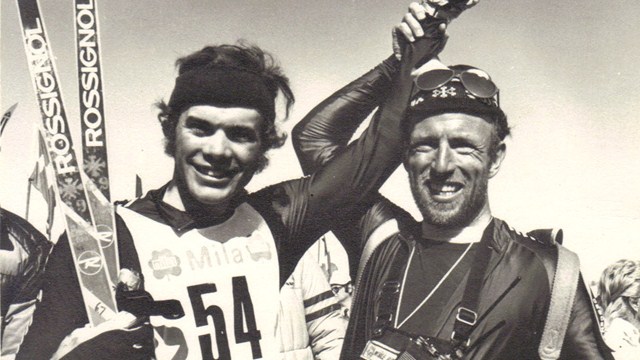
Picture of Vermonter Bill Koch celebrating his winning the FIS Overall WC crown with a very happy coach, the late Mike Gallagher. A very special moment. (Photo and caption courtesy of Peter Graves)
A clear vision of the future should require an understanding of where we have come from, and what we have done in the past. It is interesting that some of those who have been influential in the past are still engaged in the sport. Maybe a curse of old age, or maybe relevant, that we see the past as a building block for the future. As I look back in my lifetime in the sport, understanding where we are today would not have been possible without the likes of John Caldwell, Sven Wiik, two of the earliest coaches in the sport who helped create coaching for aspiring athletes. Athletes, like Gray, Gallagher, Rockwell and Elliot who laid the foundation in international competition and inspired my generation. The Southern Vermont quad of Koch, Caldwell, Galanes and Dunklee took the next steps, along with women like Spencer, Owen, and Rabinowitz. The next generation of athletes like Kemppel, Bauer, Freeman, and Randall, who, despite a multitude of challenges and inadequate support from the US Ski Team, produced some excellent results.
In 1996 I established Gold 2002 program in Anchorage, later I brought into APU to become APU Nordic Ski Center. I established this program to create a better (a different) or alternative pathway that would provide athletes with full-time coaching and a base level of support to keep athletes skiing after college or have an alternative pathway to the NCAA route. Many more of these so-called pro teams followed in the coming years. We now have strong club programs in every region of the country. Those programs have been critically important to the success we have enjoyed over the last decade or so. We need to support and help those programs to continue to improve and expand so we can have even more athletes ready to perform when they step on the World Cup and Olympic stage. Perhaps the biggest hurdle these days. It is possible that we just need to find the best pathway to make the next steps in developing athletes.
Help Support Our Olympic Coverage!
If you value the thoughtful work and access FasterSkier provides, please consider becoming a Voluntary Subscriber. Your support directly fuels our work to cover the people, places, and moments that make our sport special.
Ben Ogden (USA), Johannes Hoesflot Klaebo (NOR), and Oskar Opstad Vike (NOR), (l-r) share the 2026 Olympic Winter Games Classic Sprint podium in Tesero, Italy. (Photo: Vanzetta/NordicFocus)
John Caldwell, born November 28, 1928, passed away February 27 at 97 years old. John’s contribution to cross-country skiing in the United States is unquestioned.
John Caldwell, November 28, 1928 — February 27, 2026. (Photo: Robert George)
He was a 1952 Olympian in Nordic Combined. He wrote several books on cross-country skiing that became our training guidance, our bibles, in the early and mid-1970s. He was a long-time teacher and coach at The Putney School, an early U.S. Ski Team coach, and a member of the coaching staff at the Winter Olympics in 1960, 1964, 1968, 1972, and 1984. In the mid-1990s he founded the New England Nordic Ski Association (NENSA), stepping in to fill a regional void the U.S. Ski Association had abandoned at the time.
That’s the high-level resume. But that doesn’t capture what happened. It’s beyond me to catalog everything John did for the sport. What I can offer is a personal perspective, what it was like to grow up skiing with his influence.
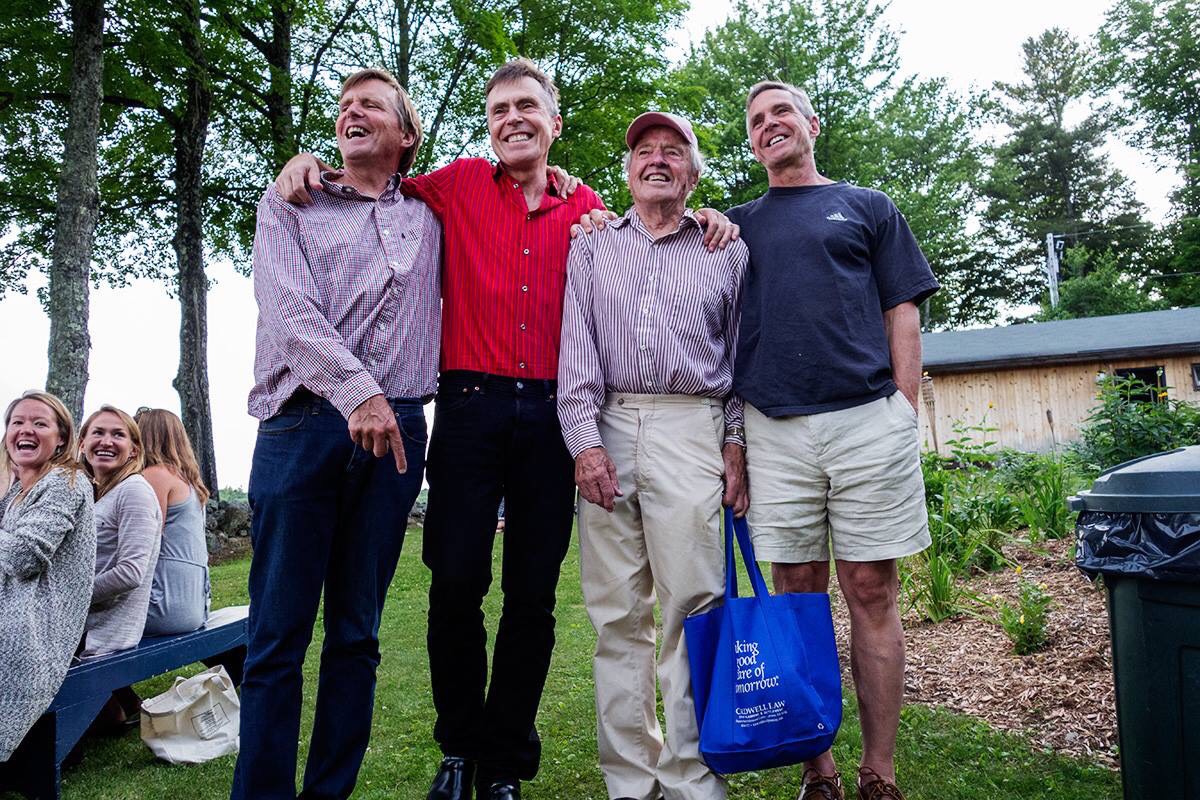
Left to right: Jennifer, Peter, Sverre, Tim, Hep, and John. (Photo: Courtesy Image)
My earliest memory of JC was driving to Putney with my dad to buy a pair of skis from him. Later I saw him at the Washington’s Birthday races, local races in Putney, the Samsonite/Dannon Series, and the night races of the late ’60s and early ’70s.
In 1967 or so, John reached out to Inga Löwdin in Sweden to bring women to the U.S. to race. That exchange helped spearhead women’s skiing in this country, particularly the career of Martha Rockwell, then a student at Putney. In the early ’70s he also brought Norwegian skiers over to compete in what was then a surprisingly robust night race circuit in the Northeast.
I’m not sure he was thinking in terms of “athlete development” as we define it today. His goal was simpler: to grow the sport. Get people involved. Raise the level by exposure.
He was integral in founding the Washington’s Birthday race in southern Vermont, one of the first popular cross-country races in the country. The race rotated locations from Marlboro, Guilford, Brattleboro, Putney, and Westminster West. It reportedly grew from 54 participants in the first year to several hundred within just a few years.
It was not an accident, even before Bill Kochs success the sport was going through a growth and participation spike that fuels the sport still today.
In junior high I would go up to Putney School for occasional training sessions. I remember skiing long loops and being far behind. In high school, Labor Day training camps organized by JC brought national team skiers into our backyard, Bob Gray, Tim Caldwell, Charlie Kellogg, Peter Davis, Joe McNulty. That was normal in Windham County. There were always good skiers and cyclists around for a workout.
Chris Osgood, Mary Heller Osgood, Jennifer Caldwell (daughter), Peter Caldwell (son) and John Caldwell arriving in Australia for a ski trip. (Photo: Courtesy Image).
By the early to mid-’70s, Putney graduates like Bob Gray and Martha Rockwell, along with the next wave, Bill Koch, Tim Caldwell, Stan Dunklee, myself, were training and competing together more regularly. John didn’t “coach” us in the modern sense. He rarely prescribed workouts. Instead, he would ask what I was doing for training, then share what he was hearing from Russians, Norwegians, and Finns.
“This is what they’re doing. Maybe it makes sense to try it.”
Between 1974 and 1978, and through the 1980 Olympics in Lake Placid, our local group trained together more often. Long runs from Putney to Saxtons River and back. Weekly 50–60 km roller skis, usually ending at the Caldwell sauna. For a few years we did a 220-mile bike ride straight up or down the spine of Vermont, depending on Bill’s forecast of prevailing winds.
John didn’t script those sessions. He didn’t stand there with a stopwatch. His influence, and his openness to ideas from abroad, shaped the key workouts we implemented. Many of them still hold up today.
I spent a lot of time around Putney in those years, so JC and I worked frequently on technique. He pushed me to experiment. Not necessarily because he knew the movement would be faster, but because adapting to new movement patterns develops skill. Most of our technical work happened on uphill’s. Back then, equipment and grooming limited how much time you could gain on flats and downhills. Uphill efficiency mattered most or so I thought. We worked on short, quick tempo striding. Shuffling. Even running movements not far from what people now call the Klaebo run.
John Caldwell and the art of flexing skis. Here, he’s helping his granddaughter Sophie Caldwell, a former U.S. Ski Team member, pick skis in 2017. (Photo: Sophie Caldwell)
In December 1979, John was contracted by the U.S. Ski Team to work with me in early, season Nordic Combined World Cups. I was skiing well and trying to hold form heading toward the 1978 World Championships in Lahti. I’m not sure how much he knew about ski jumping at that point. But he knew enough to keep things relaxed and low-key in the days before competition, including an afternoon visit to the Hofbräuhaus in Munich.
In Reit im Winkl, I was third in jumping and won the cross-country by a substantial margin. That week, at least, he did just fine as a coach!
At the 1982 World Championships he was there in a wax-support role. Back then, that mostly meant Swix Purple or Toko glide and a binder plus hard wax for kick. There wasn’t extensive testing. Athletes prepared their own skis. He was there as support team, especially for those of us from the Putney Ski Club. His last international trip with us was the 1984 Olympics in Sarajevo.
In later years, John served on a steering committee overseeing the U.S. cross-country program. I’d like to say it was a productive collaboration between staff and the steering committee. It wasn’t. The structure didn’t allow for effective dialogue. Good intentions don’t automatically produce good governance.
From left to right: Sverre Caldwell, Tim Caldwell, John Caldwell, and Peter Caldwell. (Photo: courtesy Sophie Caldwell)
In the early to mid-1990s, I worked at Stratton Mountain School. Being close to Putney again meant more time with JC, and many discussions that eventually led John to the formation of NENSA. As a founding board, we saw the early organizational stages and the hiring of its first staff. Summers often included time at the sauna, the best conversations happened when only a few of us were there, often ending around the big dinner table.
The last 30 years of my friendship with John were mostly phone calls, emails, and the occasional Facebook comment. Often cryptic. Once, commenting on a photo of me skiing in my 60s, he wrote that I still skied like a donkey. Not entirely inaccurate.
Other times it was, “What do you make of the results at X race?” Or, “Whose technique is best?” He was always curious and engaged. Thinking about the sport at a higher level than most others during those years
The last time I visited him was last June during a short trip through New England. Tim told me it was JC’s nap time, but I was on a tight schedule and stopped in anyway. The caretaker let me into his apartment. I walked in and said, “JC, what the hell is going on?” Before he even saw me, he replied, “Galanski, what the hell are you doing here?” We spent two hours talking about old times, friends, and family. Mentally, he was as sharp as ever, even as his body was failing.
John’s contributions to skiing can be measured by the roles he held, the teams he coached, and the organizations he helped build. Harder to measure, and ultimately more important, is what happened in southern Vermont simply because he was there. A culture took shape that valued learning and curiosity, exposure to the highest levels, and consistent, broad-based participation. Athletes trained hard, thought broadly, and held themselves to a higher standard, without being told to do so. John didn’t try to manage the sport or own its direction. He created the conditions where it could grow. And for decades, it did.
Note: An official obituary for John Caldwell has been published by his family. Those wishing to honor John’s legacy may consider making a donation toNew England Nordic Ski Association(NENSA), the organization he helped found to strengthen and grow cross-country skiing in the region. Contributions in his memory will continue the work he cared so deeply about — supporting athletes, coaches, and the future of American Nordic skiing.
John Caldwell, front left, with his, Hep, and all 10 of their grandchildren. Photo: courtesy of Sophie Caldwell.
This article was made possible through the generous support of our voluntary subscribers. If you would like to see more articles like this one, please support FasterSkier with a voluntary subscription.
The cover photo of the book shows co-author, Audun Endestad, with one foot pushing laterally, the other foot gliding in a Classic track, the perfect execution of a “marathon skate,” itself a technique that was soon to become obsolete as equipment and technique evolved. (Photo: courtesy of the author)
There are many famous innovators and trend-setters in the sport of cross-country skiing: I’m not one of those, though I was around at a time when cross-country skiing was changing fast, and when many voices participated in discussions of what the sport would become. A sports-publisher in Champaign Illinois (Human Kinetics/Leisure Press) allowed me to print up thoughts, guidance, and predictions in a timely little book as skiers decided they needed to learn more about the new “skating” technique. It’s kind of embarrassing to look back on it now (especially the inclusion of so many photos of myself performing skate-specific training techniques while sporting a decidedly 80’s haircut), but nobody else really offered sound explanations of what it was skiers were trying to do in incorporating a lateral skating stroke. Though it never became a best-seller, I suppose this little book played some part in the sport’s development.
The mid-80s were a turbulent time in cross-country skiing. American Bill Koch, skated his way to the overall World Cup Championship, and Scandinavian ski-stars were desperate to catch up. Bill Koch was (and remains) an innovator, a tinkerer, a savant, a genius. If Bill had devoted his energies to bowling instead of skiing, I have little doubt that professional bowlers would now be utilizing entirely different techniques to send the ball down the lane towards the pins. With Koch’s Crystal Globe, the sport had changed, the die had been cast: cross-country skiers needed to learn how to skate.
Bill Koch, demonstrating the technique he revolutionized, and the sport he changed. (Photo: Peter Ashley)
It must’ve been like being a high jumper after the Olympic gold medal arrival of Dick Fosbury whose revolutionary “Fosbury Flop” technique instantly made obsolete all the “straddle” techniques of high jumpers past. It would’ve been like spending an entire career mastering a specific technique, only to discover that there was a totally different—and entirely more effective—technique with which athletes were totally unfamiliar. Skiers needed to understand and master that new technique in a hurry. I got into the discussion because I was a speedskater. I had an understanding of skating mechanics—what really makes a lateral skating stroke work, and how to train for it. Cross-country skiers, on the other hand, had been involved in generations of drive-forward, push-back techniques that had little to do with generating force laterally. Like most skate-beginners, skiers had in mind a technique that pushed with one foot while standing on the other (like a kid on a skateboard). A skating stroke doesn’t really “push” at all; it creates propulsion by driving/gliding forward (kind of a miracle if you think about it long enough)—in reality, the pushing/skating ski is also the gliding ski.
I was already a skater (on ice), and I was already a writer (of screenplays). All that was needed was a situation that would combine the two. The situation presented itself that autumn in Lake Placid. I don’t remember the name of the coach of US Biathlon at the time, but I do remember he was scrambling. His sport had been turned on its ear by this new skate technique, and he was hurrying to understand how to advise his team members in catching up. I was staying at the Olympic Training Center adjacent to rooms occupied by those biathletes. Somehow, I found myself sitting in on one of their video/technique sessions as the coach tried to offer advice on the new technique. Skiers were still working through a “push back, glide forward” description. When the coach asked me how I would explain the process, I told him what thought. Coaches and athletes scribbled furiously in their note books. Later, the coach asked me if I’d write down the descriptions I’d voiced. A few weeks later, I had a book manuscript on its way to a publisher.
Maybe he was serious, maybe he wasn’t. Gunde Svan warms up before an international event in 1985 with his now-infamous single pole.
The little book that resulted from that set of interactions was about skating, but FIS doesn’t even really call it “skating” anymore. For many years, it’s been classified “freestyle,” the FIS designation that allows skiers to propel themselves with pretty much any technique they want—though since that original ruling, there have been numerous rules applied to freestyle equipment (including a quick outlawing of Gunde Svan’s maybe-it-was-a-joke single-pole technique). Regardless, once skiers began skating, there was pretty much no way to stop it (other than placing barriers on courses to limit lateral movements of the skis themselves, a tactic still undertaken in certain sections of Classic courses). Ironically, tracks left by early skaters effectively destroyed the tracks that Classic skiers relied on for efficient technique. Skiers had figured out a much faster way to ski—there was no going back. Rather than try to make skating illegal, FIS quickly pivoted to re-categorize the technique. Just like that, there were more events to stage, more techniques to master, more specialization to pursue, more medals to award. Swimmers must’ve felt the same way on some long ago day when the breast stroke was made irrelevant by a clever swimmer who invented the “Australian Crawl,” the stroke we now know as “freestyle.”
As writers attempting to describe a set of skating strokes, we had to figure out what to call the strokes we were describing. As it turned out, the terms we came up with (while being nicely descriptive) were nowhere near as easy, as categorizable, or as memorable as the terms used today. What we called “Symmetrical V-Skate (SVS)”—equal poling on both sides/both strokes—is what’s now described as V2. What we called “Asymmetrical V-Skate (AVS)”—double pole on one stroke, pole recovery on the other stroke—is today’s V1. Everything else is just a variation of those two options.
Long ago and far away—the author training on Mt. Whitney above Lake Placid. And that 80s mullet haircut . . . if we’d known the world would give our haircut a disparaging nickname, we probably would’ve been more selective when we walked into the barber shop. (Photo: Nancie Battaglia)
That little book was written long ago and far away. It arrived so early in the evolution of ski-skate techniques and technologies that a section is devoted to altering our Classic skis (lopping off ski tips and repositioning bindings) to make them more effective and efficient for skating. It continues to be funny whenever someone remembers me because of it (that doesn’t happen often). When they do remember me and this book, it’s usually because of the haircuts.
U.S. Ski & Snowboard recently announced its U.S. Ski Team nominations for the 2022-23 season. Of the 22 athletes named to the team this season, six were not on the previous year’s roster, either newly named or renamed: Michael Earnhart, Walker Hall, Zak Ketterson, Will Koch, Finn O’Connell, and Sammy Smith.
To help fans get to know these new(er) faces, FasterSkier is doing a series of interviews, providing insights into the factors that have contributed to development, progress, and growth for these athletes last season. In this installment, we talk with Will Koch following his nomination to the U.S. Ski Team on its D-Team.
Koch grew up in Vermont and is now a member of the University of Colorado Ski Team, where he will be entering his junior year this coming fall. Son of Olympic Silver-Medalist, Bill Koch, Will began his racing career in the New England program named after his father (the Bill Koch League) and attended high school at Stratton Mountain School.
Ella Hall/Faster Skier: Can you give us a little introduction, where are you from? When did you start skiing? What was your relationship with skiing growing up?
Will Koch: I’m from Peru, Vermont, which is a tiny little town in Southern Vermont, just like 80 people as a population. And I’ve been living there since I was two years old. I got into skiing when I was super young, because my dad was a professional ski racer, Bill Koch. So I actually started skiing before I was even able to walk – nine months old on a beach in Hawaii was my first time on skis. Since then, I’ve just been pretty much training.
I grew up in a really vibrant ski community: starting as a youth, then Stratton Mountain School for my high school years, and now I’m at University of Colorado at Boulder. And this is my first year on the [U.S. Ski Team]. So that’s super exciting.
A young Will Koch hitting his stride in a junior race. (Courtesy photo)
FS: As the daughter of a three-time Olympian I can maybe relate to the potential challenges of being the child of a successful ski racer… so acknowledging that, can you talk a little bit about your dad’s role in your skiing career?
WK: I definitely get that question quite a bit about like, you know, is it stressful or pressure to have your dad being like, Olympian and everything. Honestly, I think that my dad does a really good job of not having expectations for me, which is really nice. My dad totally recognizes that skiing is awesome and everything, but that there’s a lot more to life than skiing at the same time. He’s very much left the coaching to my actual coaches, but at the same time, he’s always there to give advice when I want it.
He’s obviously like, been there, done that with everything that I’m given going through in terms of skiing, so I think it’s really inspiring to have a person like that always around when I need it, but it’s really awesome that it doesn’t feel like a burden. It’s really an opportunity.
Will Koch competing at a junior race in New England (Courtesy photo)
FS: How was the transition from high school at Stratton Mountain School (SMS) to college skiing at the University of Colorado (CU)? Both in terms of training but also general life changes? What drew you to CU?
WK: One of the biggest reasons that I wanted to go out west for college was that I loved the mountains out west. And I also really liked the people out there. I think they’re super open and fun. I also think that being at a PAC 12 conference school comes with certain advantages as far the resources available in the athletic departments. On top of that, I think CU had a really top level nordic team compared to certain schools that I was looking at. So those were all factors that made me want to go out there, and I definitely never regretted that choice once I was up there. I’ve been loving it for my two years, it’s a lot of fun. [There’s] a really good mix on the ski team, I think, of having fun, but also being serious about training.
I’d say, as far as training, transitioning from high school to college one difference was the altitude. When I first went up to altitude in Boulder, and was training up there, I really thought that I could just keep doing exactly the same volume and workouts that I was doing in Stratton. But I put myself in a little bit of a hole when I first got out there, and then learned from that and realized that it’s a little more taxing on the body. But once I dialed it back, training wise, I was able to get some real fitness benefits from the altitude. Now that I’ve been out there for two years, I was able to have a really good fitness year this past season and [make] kind of a breakthrough in my skiing. I think part of that is being in altitude and building fitness with a really strong team.
In general, I found that the college schedule allowed me to have more flexibility in terms of when I trained and it’s easier to do two sessions a day in college compared to high school, just because you spend a little bit less time in the classroom. You have a little more flexibility in how you structure your day.
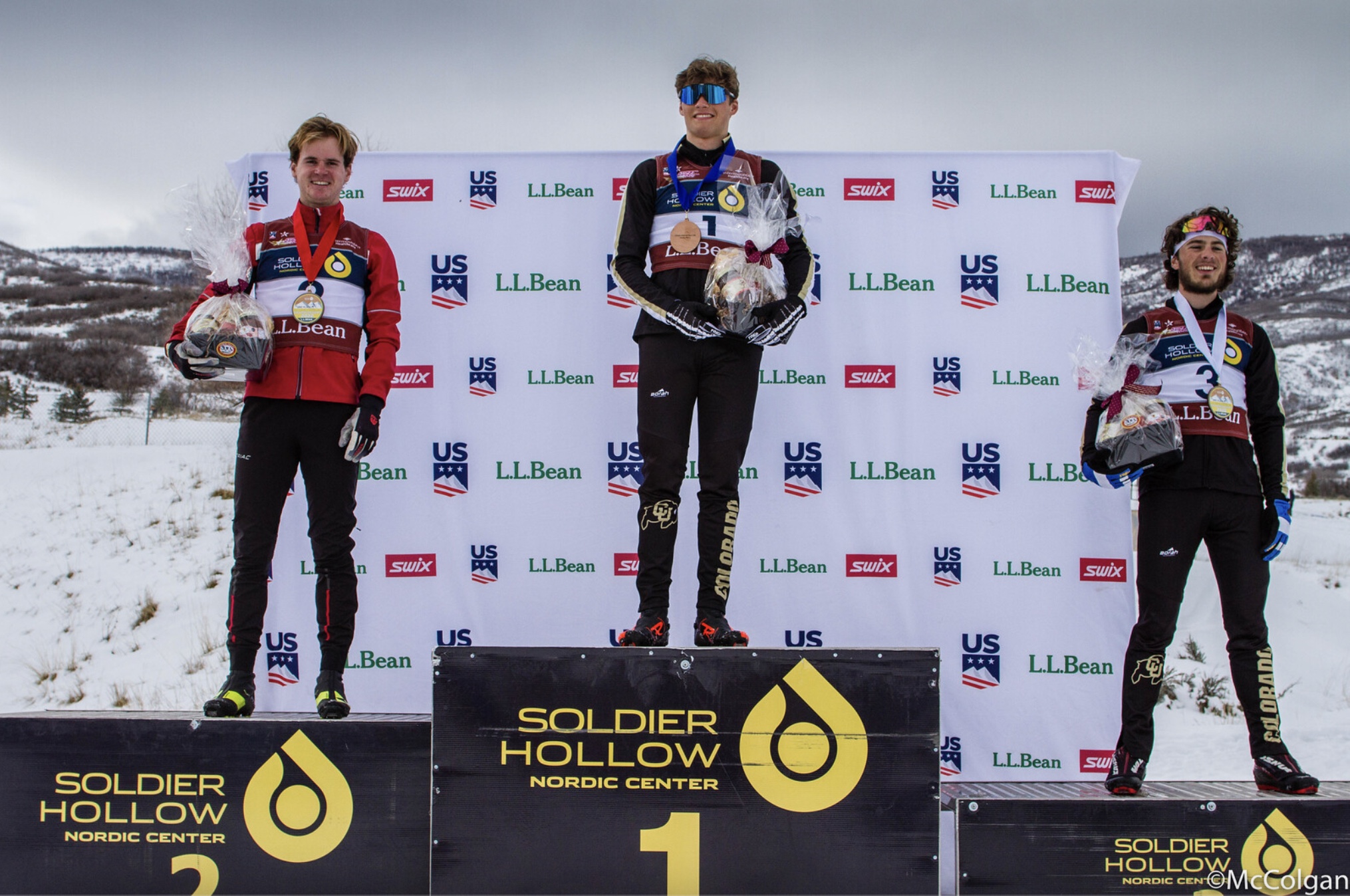
The junior men’s podium for the 2022 Senior Nationals 15k interval start classic in Soldier Hollow: Alexander Maurer (CU) took the win ahead of Walker Hall (UU) in second and Will Koch (CU) in third. (Photo: John McColgan)
FS: By my count you’ve been on five different international racing trips, including the Youth Olympic Games (YOG). What were some of the highlights from those experiences, particularly in terms of how they supported your development and goals?
WK: Yeah, of all the international trips I’ve been on, definitely the Youth Olympics stands out as the coolest one and the most memorable. YOG is pretty different from World Juniors, in terms of it’s a fair amount less intense, I would say and more about having fun. And yet, even though it’s less intense, it’s the same level of competition, either way, you’re up against the best people in the world.
I think that’s what I really loved about the Youth Olympics, it was fun to win the medal there and everything, but it was also mainly just a really cool experience. That was my first time meeting people from a lot of different countriesI still have my friends from Kazakhstan and Australia from the Youth Olympics, which I love. And, of course, that was also before COVID was really a thing, that was also a time when we were able to do a little bit more socializing on international trips.
I think that those [international] trips are really crucial in development, just to really see that next level of competition that you’re going to be up against, and to really see that every second counts. In the Youth Olympics race where I got my bronze, it was two seconds between me and second place, and I was about five seconds from being back in eighth place. It was just ridiculous how tight it was. That just kind of goes to show how you really need to be thinking about getting those small gains where you can, and that the rest of the competition in the world is out there doing the same thing.
FS: So you’ve just been named to the U.S. Ski Team D-Team, can you reflect on how that feels and maybe what is most exciting to you about this opportunity?
WK: It’s definitely pretty validating to be named after being kind of on the edge for a few years now. It’s exciting. At the same time, though, it’s also basically almost the same training group that I’ve been training with for years, now that me, Walker [Hall] and Michael [Earnhart] are all on there.
Being at my first US Ski Team camp (in Bend), I was kind of looking around, and I was like, Hey, this is really not that different from NTG, three years ago, when we all first made that. So it’s really cool to see how we all progress together. I’d say, making the team, it’s nice and everything, but it’s also really just one more step in development that we’re all taking together, which is really fun.
At World Juniors in Lygna, Norway- a psyched American team congratulates anchor Will Koch, securing bronze in the U20 4×5 k relay. (Ella Hall photo)
FS: What are some of your goals for the upcoming ski season?
WK: I would love to make a debut on the World Cup if that worked out. It’s obviously a really competitive scene right now for Team USA to make it there, and getting picked is by no means guaranteed. I think that’d be a really good next level experience to have. I’d also like to get on the podium at NCAA’s.
FS: Sounds like you made it out to Bend for the annual spring U.S. Ski Team camp there, and now are you back with SMS. What does the rest of your summer/fall look like?
WK: For the rest of the summer, I will be in Stratton training with the SMS T2 team. It’s pretty exciting, because we should have a lot of really fast guys on the US Ski Team coming out here to join our training group, which I think will be awesome, having grown up in Vermont, to get to show a bunch of people how we do it over here. I’ll be here until mid-August and then go back to Colorado and start school and training with the CU Ski Team.
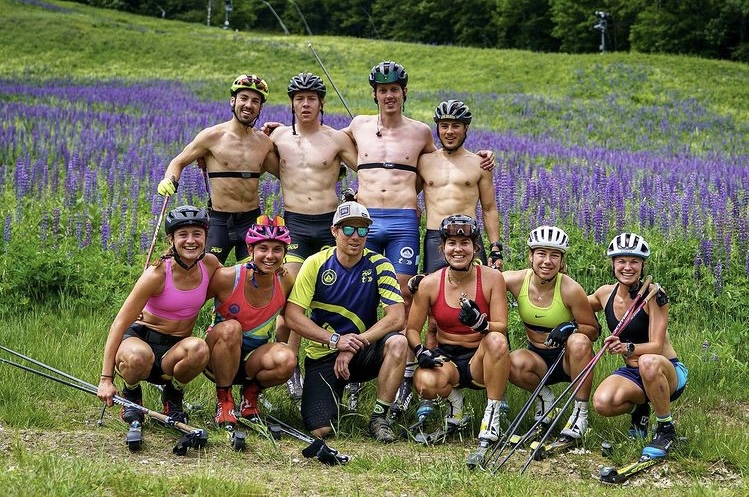
The 2021/2022 SMS T2 Team. Back row (l – r): Ian Torchia, Ben Ogden, Bill Harmeyer, and Will Koch; front row: Alayna Sonnesyn, Julia Kern, head coach Pat O’Brien, Lina Sutro, Katharine Ogden, and Jessie Diggins. (Photo: SMS T2 Blog)
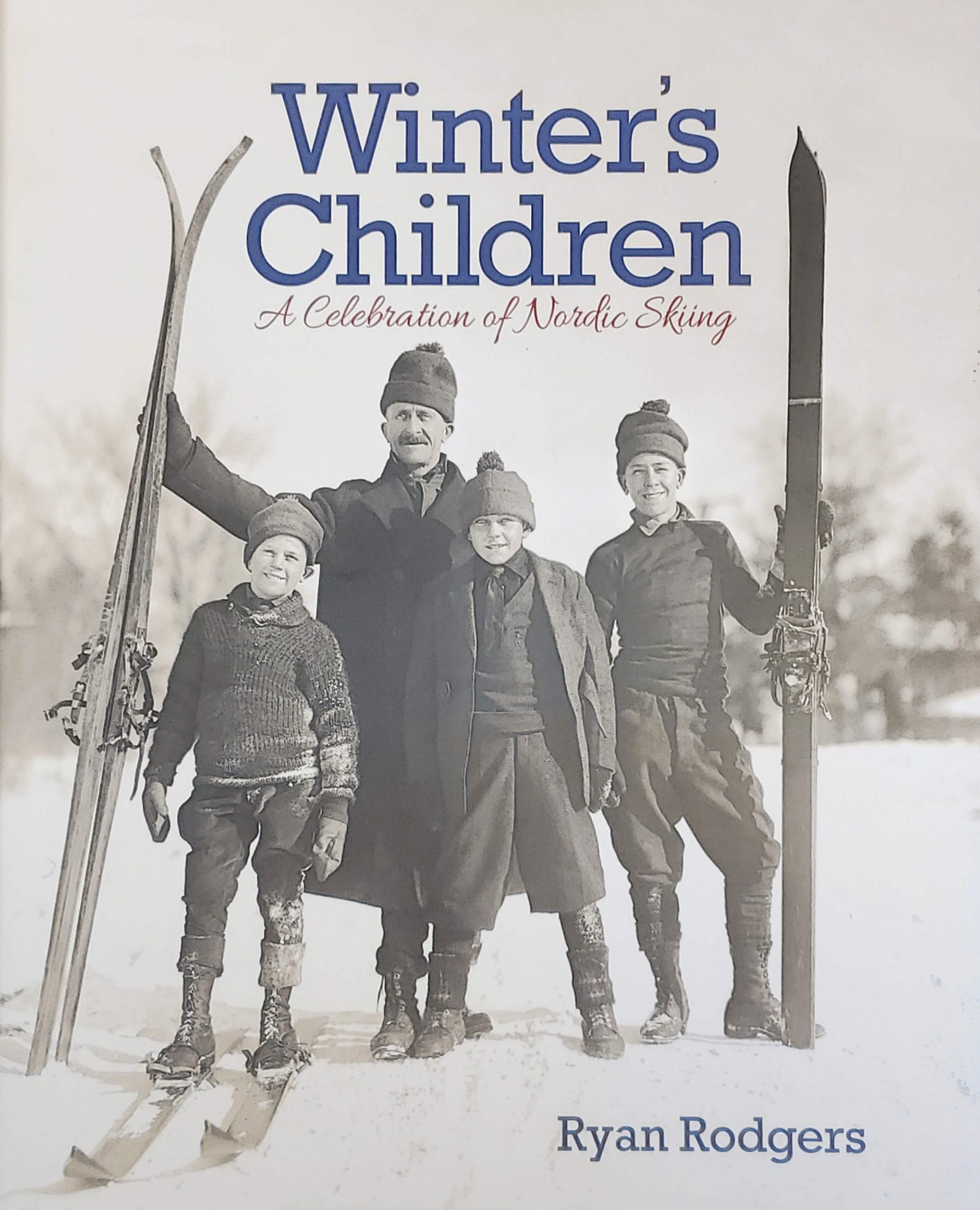
In a history of American skiing centered around the Upper Midwest, author Ryan Rodgers weaves together the stories of individuals who have found joy, love, and purpose in skiing with their heel detached, inspiring his readers to do so, too.
Cover photo courtesy of University of Minnesota Press
At the intersection of outdoors and pursuits, the street signs read “myth” and “heroes.” And we, those who spend our time outside, are here to patiently listen.
That intersection has given rise to classics across the myriad of ways humans interact with various natural playgrounds. Surfing has the permanent nostalgia laced in Endless Summer, rock climbing has the steady, emotive death-defying of Free Solo, and alpine skiing has the entire catalog of Warren Miller. These submissions to the genre are appropriate for their outdoor pursuits: flash-in-the-pan instances of action, bringing together visual and audio media to make something that’s brilliant.
But also, brilliance that’s just, well, oh-so accessible.
For cross country skiing? The individualistic and energy intensive mode of moving through winter’s harsh environment on skis requires a medium suggestive of walking its lonesome valley, and the ancient timelessness of doing so. It’s perhaps less glamorous than climbing nearly 3000 vertical feet up a cliff face with no rope, but also easier to connect with; less documentary, and more rhapsody.
With “Winter’s Children: A Celebration of Nordic Skiing,” Ryan Rodgers has accomplished just that. His work is a well-researched, extensively reported history that gets at the Norwegian ideal, sought throughout, of idraet – ski-sport, the mixing of ancient technique with spiritual renewal. Rodgers takes the epic tales of American skiing, and allows its practitioners to work together with his prose to form a journey with all the ebbs, flows, wanderings and epiphanies of a long ski in the woods. In doing so, he lifts the stories of this sport, done at the edges of frozen existence, out of the ether and into something material.
Rogers himself quickly sets the limits of what his project is from the outset; this is ostensibly the story of skiing centered around the Midwest. Not, as he says “a comprehensive look at the almost unfathomably long history of Nordic skiing,” but instead, “a celebration of an often-intertwined array of people and places.” In other words, he is out to tell a folk-history.
In doing so, Rodgers’ focus lies primarily on the folks in that history, interweaving the individual stories of people – some well known to the world, some well known to the Nordic community, and some simply not well known at all – who found the crevices and creases of human life using a pair of free-heeled skis as a medium. This is a work about skiing, yes, but also one in which the storytelling lets tales of freedom, fraternity, courage, and humor shine through.
I highlight this strength first because it gets to the heart of who should read this book. That is, although this is a Midwestern-centric skiing history, the bounds of that history include people and places that will be of interest to skiers from all over. Yes, the narrative, especially when skiing first hits America in the late 19th century, returns again and again to figures that touched the Midwest, but that is only a consequence of accurate historiography.
That is clear from the outset here. The first figure that Rodgers illuminates is Sondre Norheim, so-regarded as the father of modern skiing in his native Norway that both times the country has hosted the Winter Olympics (Olso in 1952, Lillehammer in 1994) the torch relay has begun with a flame from his hearth in Morgedal, Telemark. He is a national hero. And yet, he lived most of his life in Minnesota and died in North Dakota. The intercontinental connection is a common theme for most of the early history of skiing in the United States. Nordic Skiing was the great cultural product exchanged between those Scandinavians who came to America, with its port of entry the Twin Cities, farm fields of Wisconsin, and mining camps of the Iron Range.
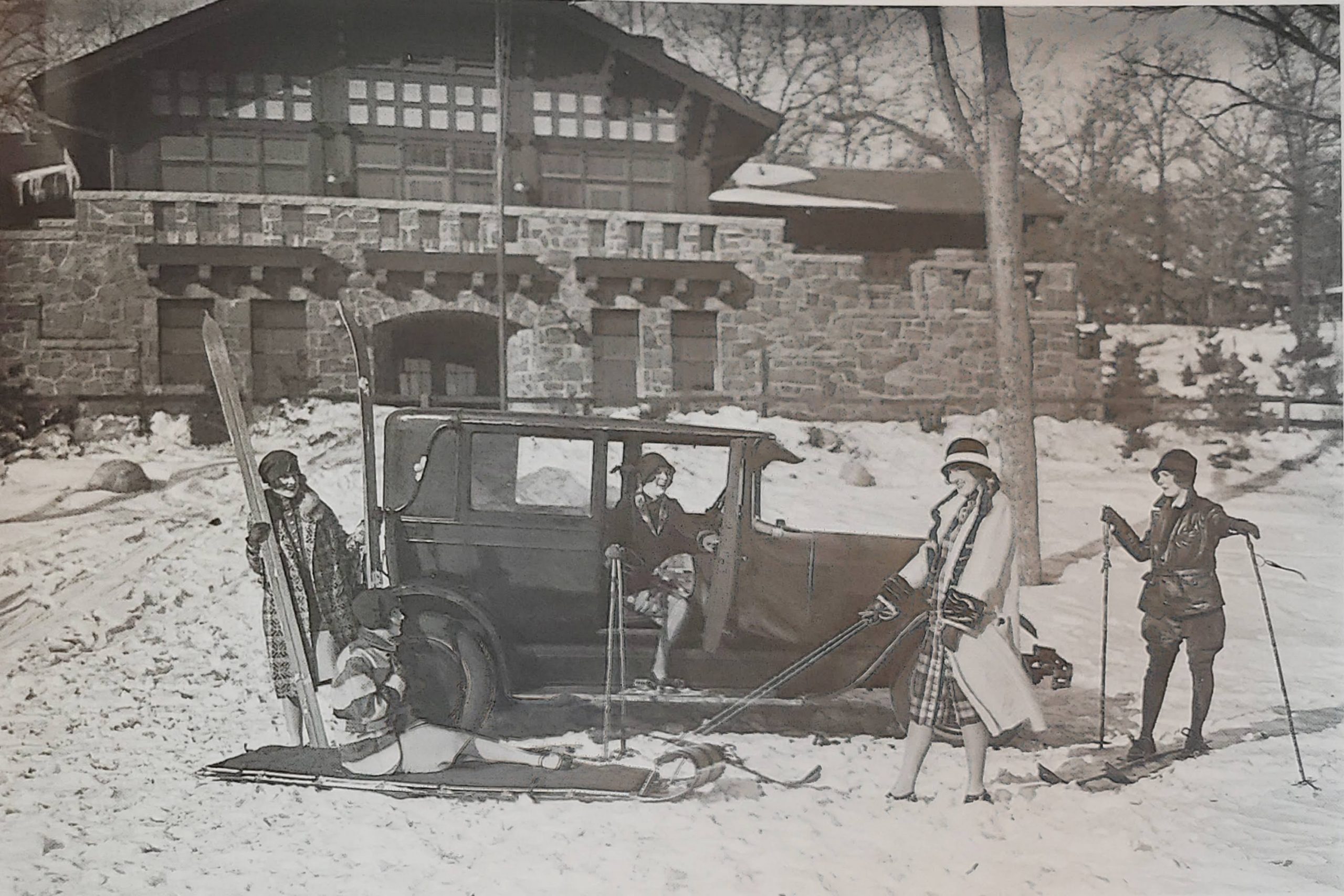
Women skiers in front of the old chalet at Theodore Wirth Park, Minneapolis, MN, in 1925. The base of the alpine-inspired building will be familiar to anyone who has skied Wirth, as it was the main chalet as recently as 2019, when the Loppet Foundation’s new adventure center opened a few hundred yards away. (Photo: U of M Press, reprinted from Minnesota Historical Society)
From Norheim, Winter’s Children begins to layer in the stories of the types of names that most of us skiers have come across in the name of a memorial race, or on a trophy or trail system. Rodger’s strength, especially in the early days of American skiing, is being precise in which characters he fully fleshes out, and then jutting and jiving between their narratives to interweave the particular pressures of a period on racers, organizers, and promoters alike. Then, like seeing a technical downhill off-shooting from a flat ski trail, he is willing to make us stop, turn at full speed, and take off to complexity and joy in his storytelling.
That’s how tales that for many skiers may have been whispers and vague allusions brought up at their local ski chalet become full-on stories – rising action, climax, denouement and all – in Rodger’s voice. Anders Haugen and his brother Lars become the main characters to illuminate the heyday of American ski jumping, the dominant discipline in skiing before WWII, with Rodgers recounting the brothers’ countless national titles after the formation of the National Ski Association (the former name of U.S. Ski & Snowboard).
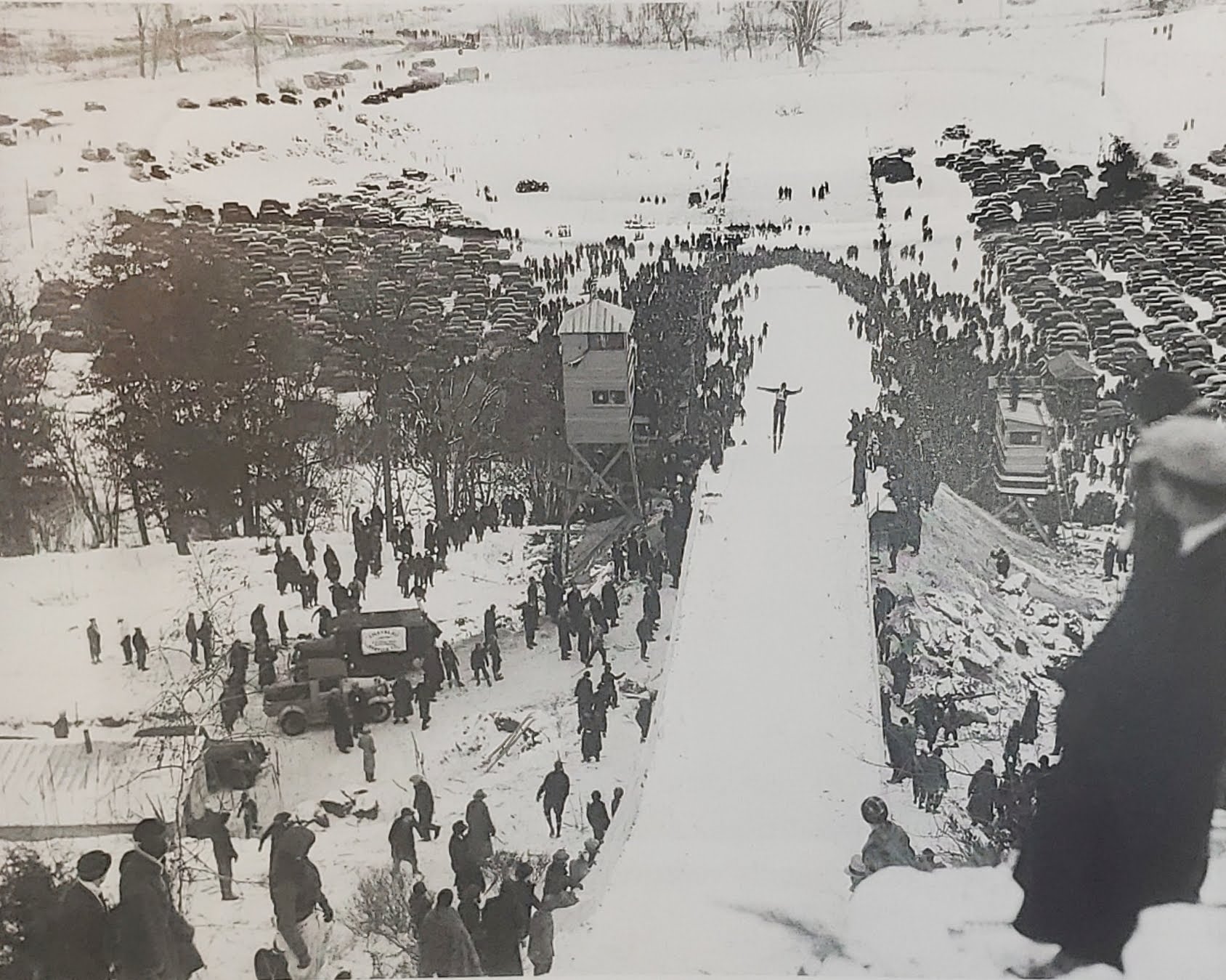
Scenes from the National Ski Championships in 1936, held in Red Wing, MN. Red Wing’s Aurora Ski Club dominated skiing in the first half of the 20th century, when Norwegian immigrants brought their jumping skills to the Mississippi river town. (Photo: U of M Press, reprinted from UM-Duluth Archives)
After detailing Anders Haugen’s foray into winning US Skiing’s first Olympic Medal at the 1924 Chamonix Games, Rodgers shifts to Lars trouncing over the Colorado Rockies between Estes Park and Steamboat Springs with skiing pioneer Erling Strom. From there we follow Strom ascending Denali on skis for the first time with Al Lindley, a Minneapolis-debonair who represented the US at the 1932 and 1936 games. The whole time we’re treated to a storytelling style which forgoes lyricism in favor of carefully plucked anecdotes that set them in a Midwestern simplicity and witticism which reaffirm the place these stories emanate from.
The best, most fully expressive character in the book hops off from Lindley, with his wife Grace Carter. Carter and Lindley met at the tryouts for the 1936 Olympics, with Grace becoming one of the first two American women to represent the US in skiing on the Olympic stage. Her story begins the earnest exploration of the exclusion and challenges that women have faced surrounding skiing since the sport’s inception in the United States. We follow her courage, effervescence, and brilliance through to the end of her life in 2002 in Duluth.
Carter shines through best when Rodgers puts her attitude towards the skiing world that tried to exclude her in her own words, citing a column she wrote in the 1960s where “several times each year parents asked her if they should allow their daughters to race. ‘I usually tell the parent no…because that’s what he wants to hear…if a girl is really keen she’ll race anyway. When the girl asks me, I say yes.’” Carter’s attitude also seems to sum up the broad arc of women’s sporting history, which is one of the key themes of Winter’s Children.
Skiing, at points, has been a site for progressive attitudes towards women’s participation in sport, but at others, it’s also been caught up in the same history of misogyny found elsewhere.
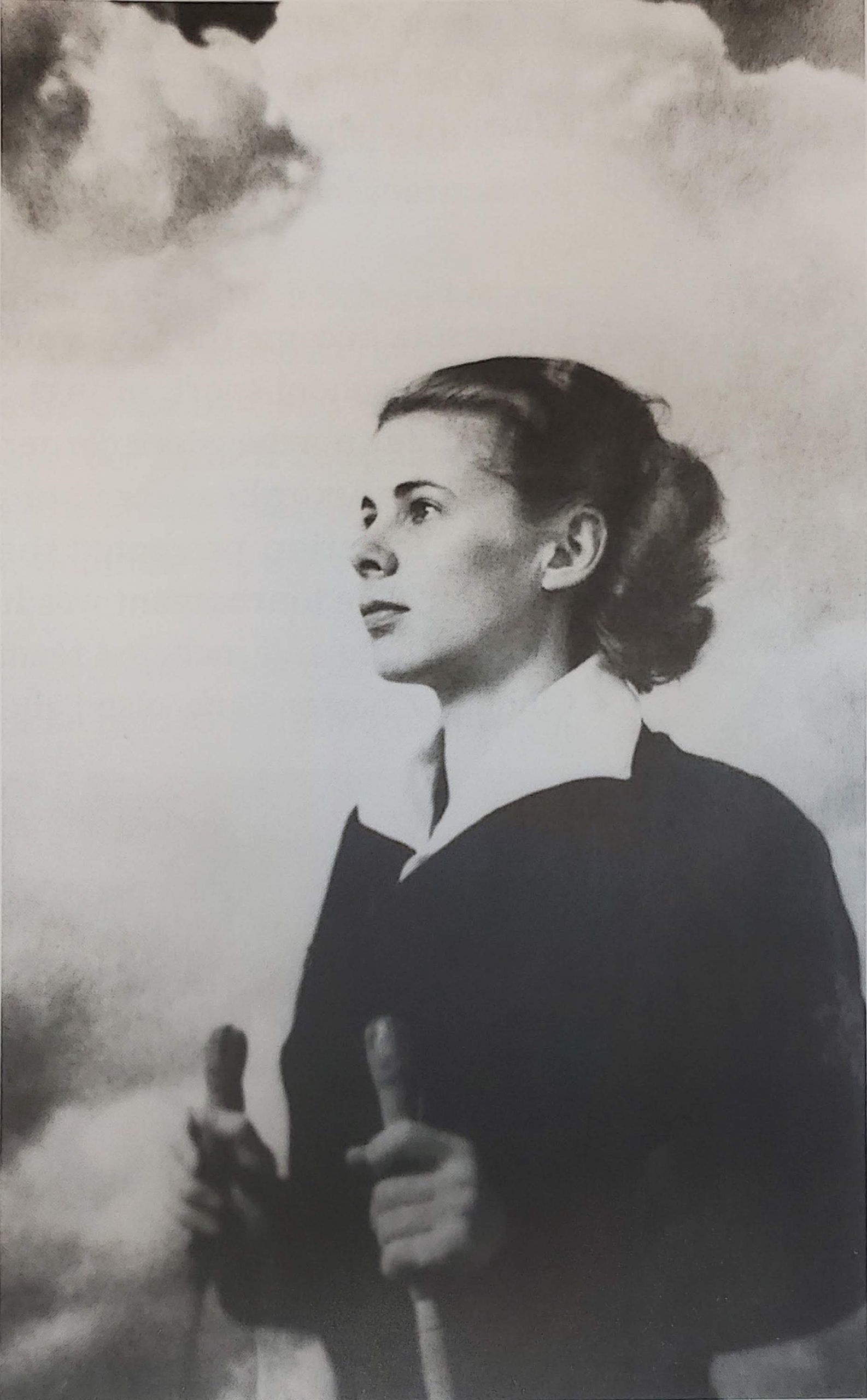
Skiing pioneer Grace Carter Lindley. Carter was one of the first women to represent the US at an Olympic games when she did so at Garmisch in 1936. She later married teammate Al Lindley, was an advocate for women’s racing, and touched nearly every development in Alpine skiing from Sun Valley, to Aspen, to Vail, before her passing in Duluth in 2002. (Photo: U of M Press, reprinted from Aspen, CO Historical Society)
Earlier than one might expect in his history, Rodger’s starts to introduce characters that some of us may have shook hands or looked up to out on the trail during our own lifetimes. At that inflection point lies one of the most poignant reasons to read Rodger’s work; the inclusion of snippets from an interview with George Hovland, capturing the former Olympian and Midwest’s foremost ambassador of the sport earnestly reflecting on his life’s work shortly before he passed away, at age 94, last May.
In the context of Winter’s Children, the reader can fully pair the vignettes Hovland might offer you if you were lucky enough to run into him out at Chester Bowl in Duluth with the full life and joy that he first found there as a youth in the 1940s. Back then, the Bowl was home to a ski jumping scene that was something akin to what one might find at a skate park today.
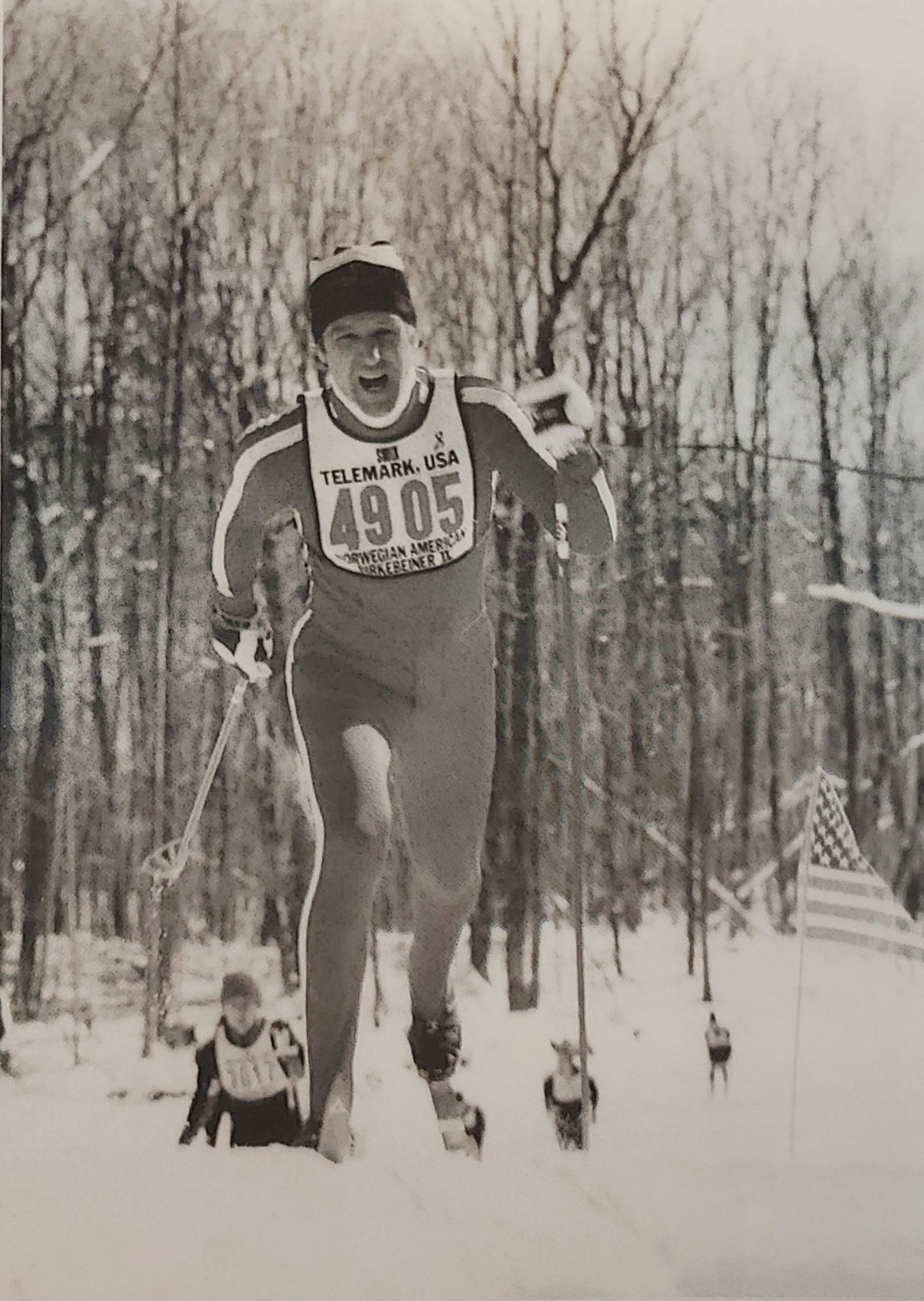
George Hovland at the American Birkiebeiner in 1982. Hovland was an Olympian at the 1952 Oslo games, and touched all corners of skiing in the Midwest over the course of his life in his native Duluth, MN. (Photo: U of M Press, reprinted from George Hovland personal collection)
The strength of Winter’s Children is not only remaining in, but building on, the mythos of those types of characters and those types of places strewn across the Midwest. Rodgers makes it foundational, with the most widely-known myths in the sport – that of the Vasaloppet and Birkiebeiner – being recounted in the first pages. When Winter’s Children does get to the Midwestern revival of those myths with the founding of both the Mora Vasaloppet and American Birkiebeiner in 1973, there is an ironic coming back down-to-Earth. It’s when the history starts to feel more vivid. When, for many readers, the recollections on the page will mix with those in their own minds. Of their own experience, perhaps.
That leads to the temptation to say that things aren’t how you remember them in Rogers’ words. You might think ceded some of its accuracyand cohesiveness as it gets closer to the present. If the reader catches that thought, they should hold two idea’s in mind. 1) First and foremost, is that Rogers’ is most likely correct, this is a painstakingly well-researched project, and 2) that their own mind’s wanderings add to the folk history that Rogers’ set out with here. Rodgers’ biographical sketches of Bill Koch (who isn’t a Midwesterner, but did design the trails at Telemark, and that seems like tangential connection enough to explore his influence here) and Jessie Diggins aren’t nearly as fleshed-out and richly-woven into the story of skiing as the athletes who came a half-century before them. He stops the story of the Birkie right after its originator Tony Wise loses control of the race in 1985, without detailing how the race continues to be the “Rome” in Midwestern skiing’s empire – all the youth skiing, citizen racing, and training developments seemingly leading to it. That’s ok, those histories and those stories continue to go on. Reading their introductions here is a great primer to join in.
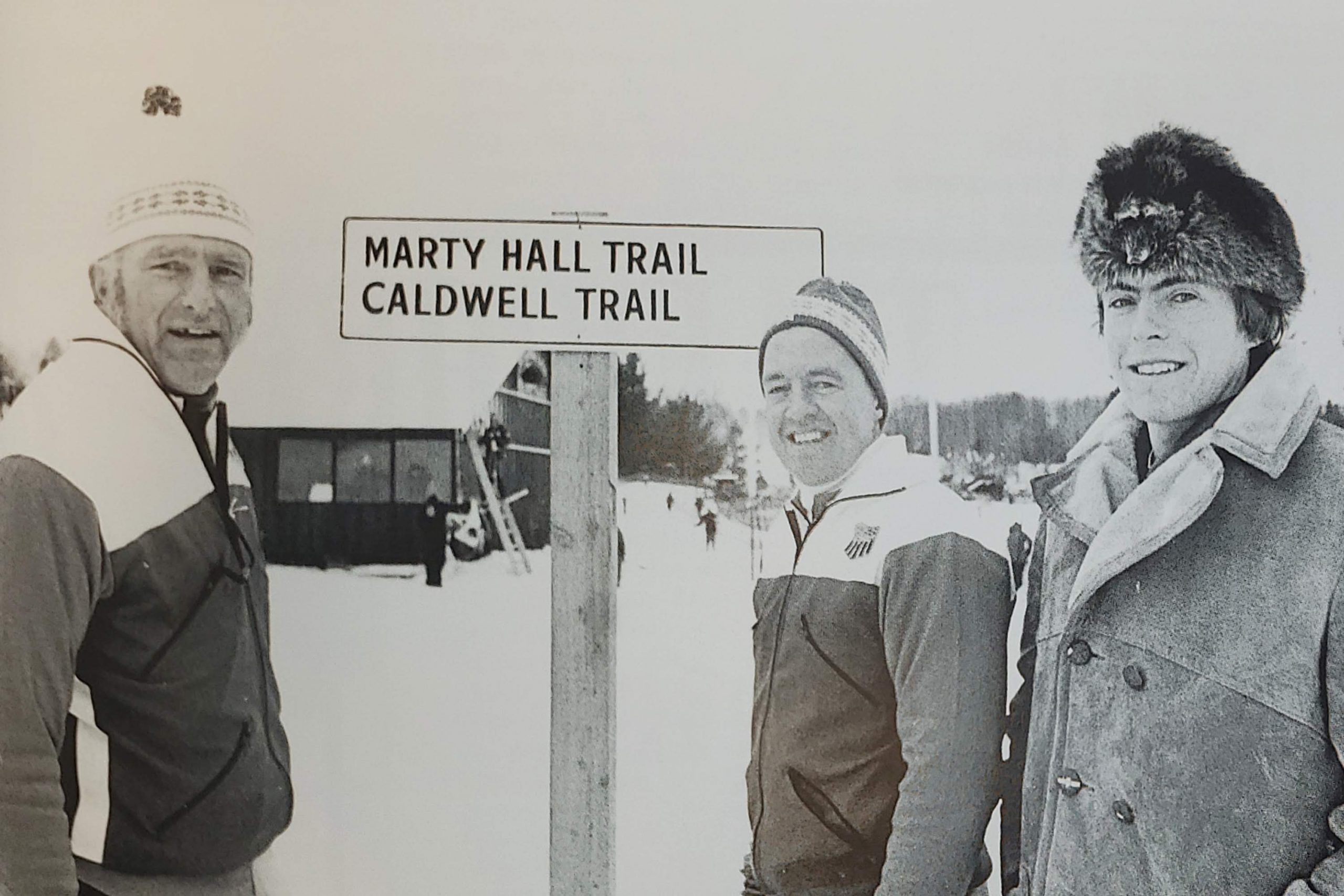
Marty Hall, John Caldwell, and Tim Caldwell pose at the trailhead of the new Telemark World Cup Trails, designed by Bill Koch, ahead of US Olympic trials in Cable, Wisconsin, 1979. (Photo: Telemark Education Foundation)
There are the accurate appraisals, too, on modern issues in the community – climate change, the influx of money into youth training programs, and the lack of racial and socioeconomic diversity in the sport. They all remind the reader that the individual and communal elements of nordic skiing’s history are both active agents. Rodger’s can’t fully portray the sport as it is today, sending us as readers back to the ether and implying that you yourself need to feel them as part of the living, breathing, gliding AND kicking community of nordic skiing as it continues its odyssey here and now.
That theme: the vitality of skiing’s history, is how Winter’s Children comes to an end. Our rhapsode, Ryan Rodgers, ends by tying up the loose ends of the narrative thread of Charlie Banks and Mark Helmer.
It is a long one. We are first introduced to Charlie Banks when he wins one the first Minnesota High School State Meets in 1941, before he fights in WWII, returns, and splits for the forests that extend past the Duluth hillside. Living an ascetic, but sturdy life in those Northwoods, Banks cut a trail system called Korkki on his property where he started the oldest continuous race in the Midwest, the Judeen Memorial 10 k, in 1962. Twenty years later, Mark Helmer was living down the road and decided to ask Banks if he could use the trails.
The meeting soon evolved into a deep friendship built around skiing, saunas, and more than a few PBRs. Banks sold Helmer 20 acres of his property in 1993 to build himself a house and a warming chalet at the trailhead of the newly public Korkki trails. Banks passed away in 1998, with Helmer saying in an interview for Winter’s Children that “he was my best friend and still is my best friend; there isn’t a day that goes by that I don’t think about the man.” It is one final parable that points towards the magical juxtaposition at the heart of nordic skiing – a cold, individual pursuit that brings out the warmest of human connections.
A simple sport that was, and still is, the core around which a person can organize a life.
Charlie Banks on his handcut Korkki trails outside of Duluth, MN. This photo of Banks greets visitors of the Korkki trails, hung above the hearth in its warming chalet. (Photo: Korkki Nordic)
Winter’s Children: A Celebration of Nordic Skiing by Ryan Rodgers is available at local bookstores and ski shops throughout the Midwest, major book retailers, and online from the University of Minnesota Press.
The news coming out of Lausanne, Switzerland this week was reaffirming for competitive U.S. skiing: at the Winter Youth Olympics two American junior skiers podiumed and one had a near miss in fourth. Kendall Kramer, out of Fairbanks, Alaska placed third (+20.6) in the 5 k individual classic while Sydney Palmer-Leger of Sun Valley, Idaho was fourth (+27.6). Will Koch of Peru, Vermont placed third in the 10 k individual classic.
The results speak of individual drive, community support, and a U.S. pipeline rife with talent.
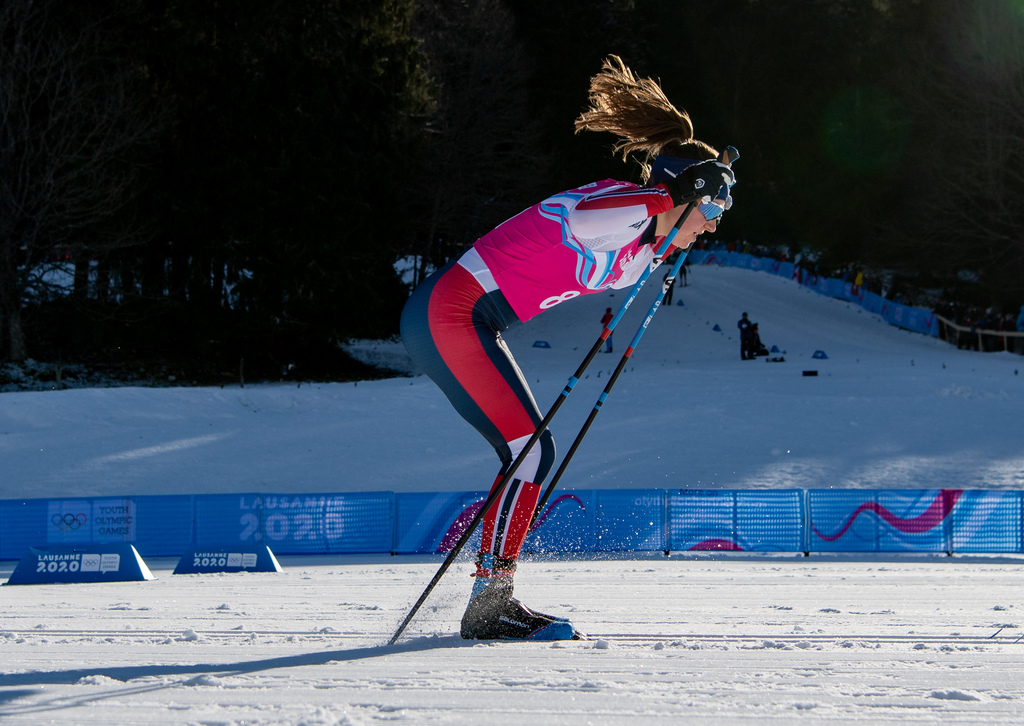
U.S. skier Kendall Kramer during the cross free at the 2020 Winter Youth Olympic Games, Lausanne, Switzerland. (Photo: OIS/Chloe Knott)
These performances came down earlier this week. But here at FasterSkier, we have been discussing how we cover juniors in the sport for several weeks. The key component for us is balancing news with respecting the nature of teenagers in a high pressure sport.
Just take a moment at races with live timing and vibrant cell coverage or Wi-Fi, and you’ll see parents, athletes, and coaches often glued to their phones. Live timing is perhaps as scalpel-like as it comes. It’s easy to get caught up in a game where the result is the story.
Juniors are not professional athletes. In the case of disappointment, in the case of feeling too much pressure, what support systems are in place for junior athletes? We’ve been thinking about the answers to these questions.
We all know these teens are more than their results.
We know “Son of Legend” has a name — that would be Will Koch. And he has his own narrative that is his to tell. The story in Lausanne was beautiful. The legend Bill Koch, the only male American to win an individual Olympic medal (1976 Winter Games 30 k silver), is on hand to watch his son Will achieve his own goals. It’s a dream narrative. A proud moment for both.
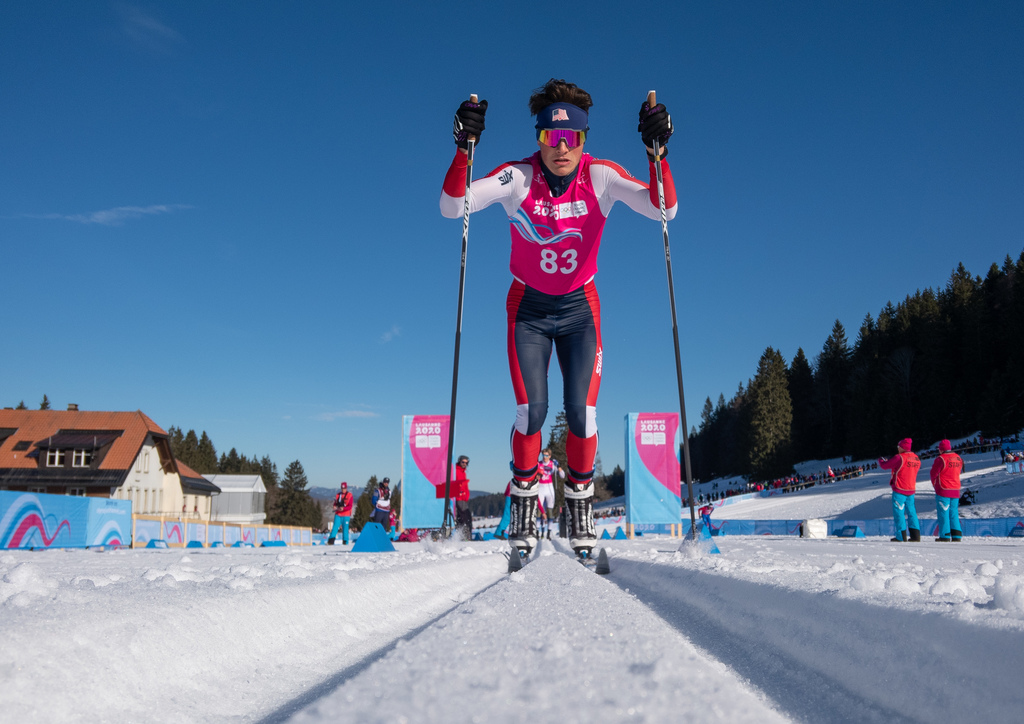
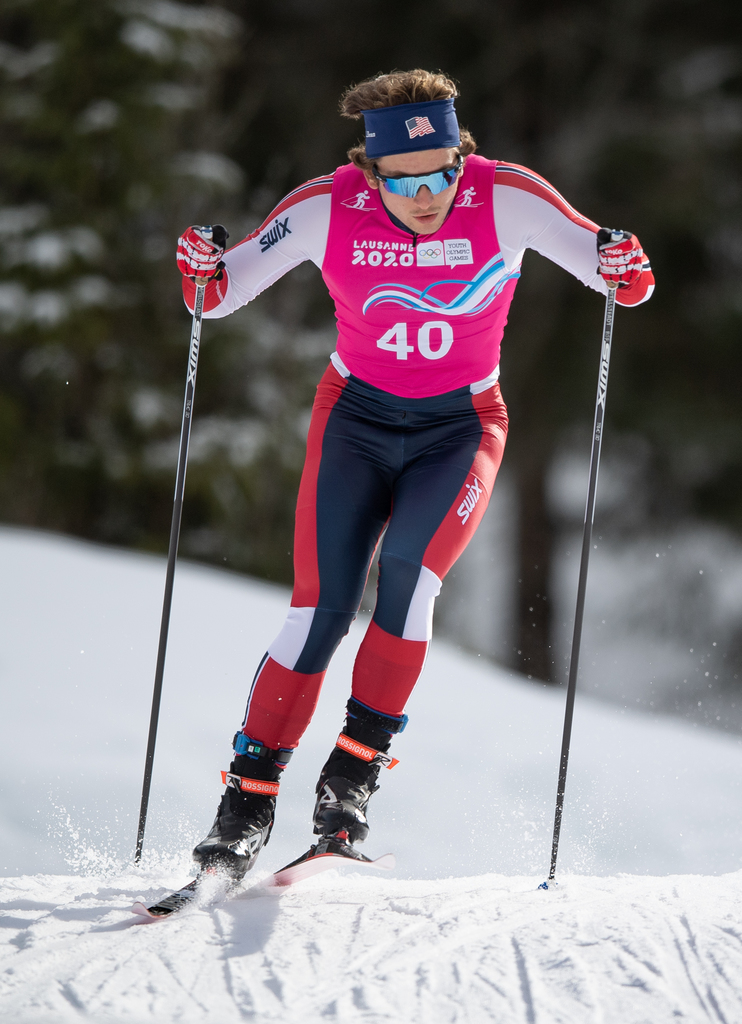
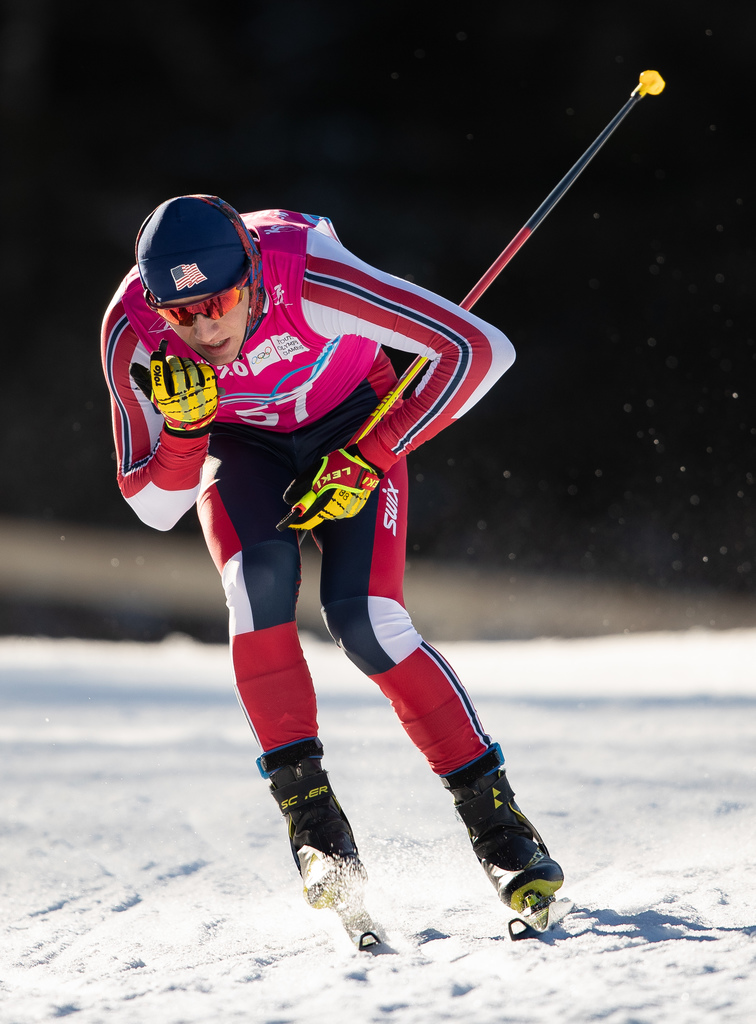
Will Koch (USA) during the 10 k classic at the 2020 Youth Olympic Games in Lausanne, Switzerland. Koch placed third in the event. (Photo: OIS/Joel Marklund)
Let’s reflect. While covering the sport at FasterSkier, we hear many stories. Most prominent, and frankly the easiest to relay, are those falling into the tidy box of a podium result. Who doesn’t love that? The harder ones, and we hear about these as well, are those of athletes falling through the pipeline’s cracks for some reason or another. Maybe the gift of DNA didn’t align precisely. Maybe the athlete struggled with the social-emotional aspects of a high pressure medals-matter environment. It is complex. As we were reminded in a group phone conversation yesterday on the topic of juniors, “success early does not guarantee success late”.
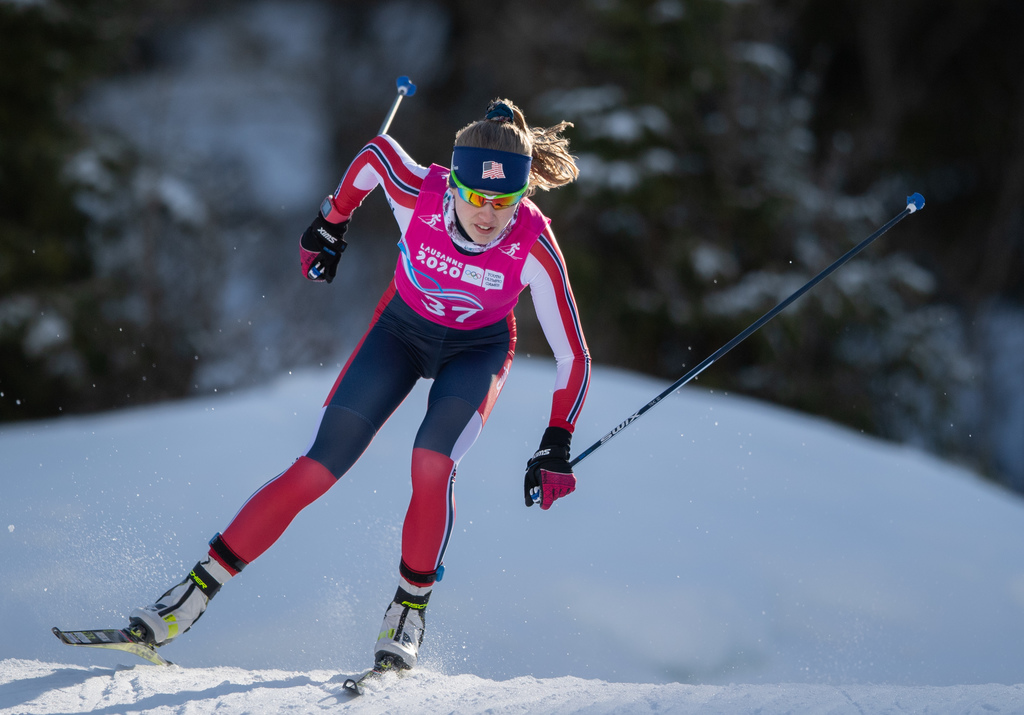
Sydney Palmer-Leger of the U.S. during the 5 k classic at the 2020 Winter Youth Olympic Games, Lausanne, Switzerland. (Photo: OIS/Joel Marklund.)
Imagine for a moment a teenager in this high stakes game we call sport? That’s what we have been trying to do. Sometimes the outcome here at FasterSkier will be less than perfect. But we are and have been thinking about how we effectively cover junior athletes. The results in Lausanne just made it more acute.
Which reminds us to celebrate Kramer, Ledger-Palmer, and Koch. And to celebrate Nina Seemann, Brian Bushey, and Kai Mittelsteadt who also represented the U.S. in Lausanne.
Nina Seemann of the U.S.competes in the women’s skate cross at the 2020 Winter Youth Olympic Games, Lausanne, Switzerland. (Photo: OIS/Joel Marklund)
Kai Mittelsteadt of the U.S. during the men’s cross qualification the 2020 Winter Youth Olympic Games, Lausanne, Switzerland. (Photo: OIS/Joel Marklund)
Brian Bushey during the skate sprint at the 2020 Winter Youth Olympic Games, Lausanne, Switzerland. (Photo: OIS/Dylan Burns)
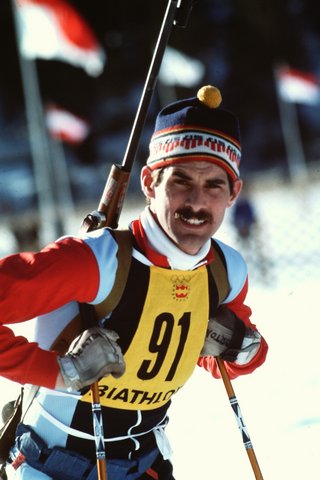
John Morton at the 1976 Winter Olympics in Innsbruck, Austria (Courtesy photo)
The following was submitted to FasterSkier by John Morton, a former U.S. biathlete and two-time Olympian (1972 and 1976) who has attended 10 Winter Olympics as “either an athlete, a coach, the Biathlon Team Leader, Chief of Course or, more recently as a spectator,” according to his bio (at end of article). Today, Morton, 71, lives in Thetford, Vermont, and works in trail design.
***
I’ve had the remarkable good fortune of attending 10 Winter Olympic Games. I was a member of the U.S. Biathlon Team in 1972 at Sapporo and again in ’76 at Innsbruck (where, following a workout, a few of U.S. ski-shooters wandered over to the adjacent cross-country stadium and watched Bill Koch win his monumental silver medal in the men’s 30 km). I was an assistant coach for the U.S. biathletes at the 1980 Games in Lake Placid, where late in the schedule, I accepted a complementary ticket to a hockey game, not even knowing which teams were playing. It turned out to be the USA’s remarkable victory over the Soviet Union, probably the most inspiring sporting event I’ll ever witness. I served as Team Leader for the U.S. biathletes at Calgary in ‘88, Albertville in ‘92 and Lillehammer in ‘94. Then, in 2002, I was the Chief of Course for the biathlon events during the Salt Lake City Olympics, a volunteer position that was every bit as stressful as competing back in ’72 and ‘76.
At the most recent three Winter Games, Vancouver, Sochi and PyeongChang, my wife and I have enjoyed the relative luxury of attending as spectators, cheering on America’s cross-country skiers and biathletes. As the jet lag from out trip home from South Korea begins to wear off, I can’t help thinking about the dramatic changes these two sports have experienced over the past 46 years. It seems to me that many of these changes can be traced to three factors: innovations by the athletes, technological improvements and the influence of television.
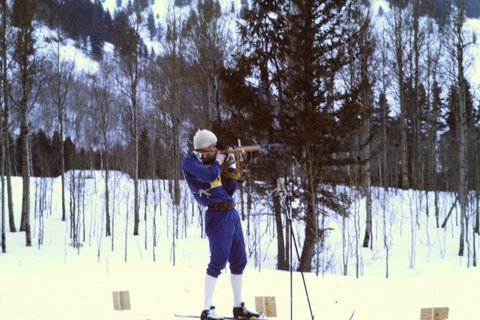
John Morton at 1972 biathlon Olympic trials in Jackson, Wyoming. (Courtesy photo)
Back in ’72 we were on wooden skis, kick-waxed the entire length. There were two biathlon events, the 20 km individual and the 4 x 7.5 km relay. We shot large-caliber rifles on a 150-meter range using paper targets for the 20 km and glass disks for the relay. It was impossible to determine the winner of the 20 km until all the paper targets had been carefully inspected, sometimes hours after the conclusion of the event. A typical biathlon course consisted of three, independent, 4 km loops, with cutoffs for the relay. Women didn’t compete in biathlon at the Olympics until Albertville in 1992.
Men’s cross-country has been part of the Winter Olympics since the beginning in 1924 at Chamonix, France, when there was a 15 km event as well as the legendary 50 km. The first cross-country event for women was a 10 km, which debuted in 1952. In those days, Nordic race courses consisted of roughly one-third climbing, one-third descent and one-third relatively flat terrain. Well into the 1960s, courses were prepared by soldiers boot-packing or snowshoeing the course, followed by skiers stomping in the parallel tracks through the forests and fields. Competitors typically started at one-minute intervals, disappeared into the woods, only to reappear exhausted, often hours later, covered with frost and mucus. The men’s 50 km cross-country event at the 1932 Winter Olympics in Lakes Placid consisted of a 25 km loop skied twice, and was won by Finland’s Veli Saarinen in 4 hours, 28 minutes.
In my view, the first significant change came at the 1974 Nordic World Championships when Sweden’s Thomas Magnusson won the men’s 30 km on Kneissl synthetic skis. Fiberglass and metal had replaced wooden Alpine skis years earlier, but the faster, plastic bases wouldn’t hold Nordic kick wax. But in wet, heavy, painfully, slow snow, Magnusson took a chance on the fiberglass Austrian skis and dominated the race. The headline in the Oslo paper the next day read something like, “Magnusson wins gold, Norwegian ski industry in peril.”
The next major breakthrough occurred at the 1976 Innsbruck Olympics two years later. Marty Hall, head coach of the U.S. Cross-Country Team recruited Rob Kiesel from Alpine skiing as his assistant. Together they determined that it was possible to wax the tips and tails of the new fiberglass skis for speed with Alpine wax, restricting the much slower cross-country kick wax to a short segment under the athlete’s foot. This made the skis of the Americans faster than those of their European rivals and certainly contributed to Bill Koch’s memorable silver medal in the 30 km, America’s first, and only Olympic medal in Nordic skiing until Kikkan Randall and Jessie Diggins struck gold in PyeongChang.
Following the success of the Innsbruck Olympics, expectations were high for U.S. Nordic skiers at the 1980 Olympics in Lake Placid. With a theoretical “home court advantage,” Bill Koch’s 13th in the men’s 50 km and Lyle Nelson’s 19th in the biathlon 10 km sprint fell short of the results which the public had been led to expect.
Discouraged, Koch elected to ski the international ski marathon circuit the following year rather than the Nordic World Cup. There, on trails groomed wide by Alpine-area Sno-Cats for thousands of citizen racers, he observed elite competitors pulling away from the throng by putting one ski in the set track and pushing off, skating-style with the other. He quickly mastered this marathon-skate technique and began to experiment by skating with both skis. When he returned to the World Cup circuit a year later, he threw the Nordic world into turmoil by abandoning the relatively slow kick wax altogether and skating entire courses on skis waxed purely for speed. The result of Koch’s persistence and innovation was a cumulative World Cup victory for the season, America’s first in cross-country skiing.
U.S. biathlete John Morton racing at the 1972 Winter Olympics in Sapporo, Japan. (Courtesy photo)
When the dust (or more accurately, snow) finally settled, Nordic skiing had two disciplines, classic (the traditional kicking and gliding) and freestyle (skating). Because biathlon was already complicated enough with skiing and shooting, they decided to go with skating as their designated technique, as did Nordic Combined. In a type of mutual re-enforcement cycle, the use of large, Sno-Cat-type grooming machines on cross-country trails, which originally made the evolution of the skating technique possible, became a requirement once skating was accepted as a part of the sport.
Enter television. The first Winter Olympics to be televised were the 1956 Games in Cortina, Italy, and it quickly became apparent how powerful the new medium could be. Figure skating, ice hockey and ski jumping immediately gained popularity, largely because they were relatively easy to cover. Alpine skiing, bobsled and Nordic skiing lagged behind because they were more difficult and expensive to film. The sports favored by TV prospered, enjoying increased funding from sponsors and a wave of young Olympic hopefuls. Meanwhile, those sports that were less telegenic scrambled to make their events more appealing to the camera. Nordic skiing and biathlon added mass-start and pursuit format events, making it easy for spectators to see who was winning. In terms of spectator interest, biathlon had the advantage of the shooting range. With the adoption of the modern, knock-down targets and television cameras’ abilities to zoom in on an athlete’s targets as he/she is shooting, the popularity of the sport took off. In recent years, biathlon has become the most-watched winter sport in Europe with World Cup events rivaling the popularity of Monday Night Football in America.
In cross-country, one of the unintended consequences of the skating revolution was a focus on upper-body strength, which in turn, led some athletes to abandon kick wax in classic events and double pole the entire course, especially in the shorter, sprint races. This led the FIS (the international governing body for skiing) to require tougher courses with more challenging climbs.
Finland’s Iivo Niskanen after winning the men’s 50 k classic mass start at the 2018 Winter Olympics in PyeongChang, South Korea. (Photo: FlyingPointRoad)
As a result, what we saw in PyeongChang for both cross-country and biathlon, were trails 30-feet wide, capable of accommodating three skaters, side by side (without obstructing each other), with steeper climbs and faster, more challenging descents. Aside from the spacious start/finish stadiums, the traditional one-third of relatively flat terrain has disappeared. There was also an effort to loop the trails back within sight of the spectators so that they saw more than just the start and finish of the events. For example, the men’s 50km, perhaps the most iconic of the cross-country events, was conducted on two, 4.16 km loops which brought the competitors through the stadium, in front of the cheering crowd a dozen times. The men’s 50 km classic in PyeongChang was won by Finland’s Iivo Niskanen in a time of 2 hours, 8 minutes (less than half the time it took for his countryman to complete the same distance in 1932 at Lake Placid).
Perhaps the most dramatic change, was the scheduling of many of the Nordic skiing events at night (which allowed them to be televised live in Europe and the eastern U.S. at a reasonable hour). In addition to the expense of lighting and minimizing the number of TV camera platforms, another motivation for shorter ski loops is the growing need, thanks to climate change, to cover the entire trail with machine-made snow. Early in the winter the biathlon and cross-country courses were blanketed with a deep layer of machine-made snow, enough to survive warm temperatures and thaws well beyond the Olympic schedule in February.
While there have been advancements and technological improvements in other Winter Olympic sports, I can think of none more dramatic than what we’ve experienced in Nordic skiing. From a single biathlon event held at the 1960 Squaw Valley Games, there were 10 biathlon competitions on the schedule in PyeongChang. With the advent of the skating technique, fiberglass skis and fluorocarbon waxes, times for cross-country events have been cut in half in less than a generation. Thanks to machine-made snow, the 2022 Winter Olympic Games will be hosted by Beijing, China, a city previously not known for winter sports. And through the development of LED lighting and high-definition television, the excitement of Nordic skiing events can be broadcast live, in prime time, to homes around the world.
*****
John Morton has participated in ten Winter Olympic Games as either an athlete, a coach, the Biathlon Team Leader, Chief of Course or, more recently as a spectator. He has published two books and numerous articles dealing with Nordic skiing.
After 11 years as Head Coach of Men’s Skiing at Dartmouth College, he founded Morton Trails, and has spent the past 28 years designing more than 220 recreational trails and competition venues across the country. He currently has projects underway in a dozen U.S. states as well as two projects in China. More information regarding his trail design work can be found at www.mortontrails.com. He lives with his wife Kay, at the end of a dirt road in Thetford, VT, surrounded by trails.
Bill Koch (second from l) in the booth with stadium announcers, including Peter Graves (r) at 2017 World Cup Finals in Quebec City last March. (Courtesy photo)
Like the rest of the U.S. cross-country skiing community with a watchful eye on the Olympics, Bill Koch had been waiting for this moment for quite some time. It seemed like clockwork, every four years, his name would pop up in the news and sports journalists would ask him the same question:
Will this be the Olympic year that the U.S. finally reaches your mark and gets a medal in cross-country?
It’s about time, he’d say.
Bill Koch (l) with U.S. coach Mike Gallagher (Photo: Peter Graves/FIS)
Koch, now 62, lives in Peru, Vermont, with his wife Kate and two children, Mehana, 17, and Will, 16. After achieving worldwide recognition and a record that held for 42 years as the most successful U.S. Olympic cross-country skier of all time (with a silver medal in the 30-kilometer event at the 1976 Winter Games in Innsbruck, Austria), Koch retired from ski racing after the ’92 Olympics in Albertville, France. He moved to Hawaii a few years later to sand ski, then he and his family relocated to Ashland, Oregon, before moving to Vermont about a decade ago.
There, Koch worked in trail design and built ski trails on his property in Peru. These days, Koch is still all about skiing. He doesn’t have TV at home, and he’s set on logging as many ski days as possible in a given winter.
“I ski in the National Forest around our home as well as at Wild Wings XC, a down-home ski area next door,” Koch explained in an interview with FasterSkier. “I ski every chance I get, and I’m well on my way to my usual 100+ days for the winter.”
On Wednesday, he watched the Olympic women’s freestyle team sprint unfold via live timing on the computer — numbers rather than images — as opposed to a live broadcast.
When he saw USA rank first at the finish, becoming the first Americans to do so in an Olympic cross-country race (and the first to win a medal since his 1976 silver), Koch headed out the door.
“I just went for a celebratory ski on a little 1 k track at my house going a million miles an hour,” Koch said on the phone Wednesday.
A little while later, he and Kate watched a short video clip of Jessie Diggins crossing the finish line first, fractions of a second ahead of Sweden’s Stina Nilsson.
“I just went for a celebratory ski on a little 1 k track at my house going a million miles an hour.” — Bill Koch on how he reacted to the U.S. women’s Olympic win
He wasn’t surprised with the result, but he was relieved.
“I knew going into this one that we had a really excellent chance, but I was trying not to get my hopes up too much because we should have done it in the last time around with Kikkan and it didn’t happen,” Koch said, referring to the 2014 Olympics where Randall finished 18th in her main event, the individual freestyle sprint.
“And here we are, this is kind of our last chance,” Koch continued, referring to Wednesday’s team sprint. “And it couldn’t be more exciting for it to be a joint effort, too. It is just so fitting given that the team is so cohesive and to have these particular women, they are just so amazing. There are so many more women just right there with them; they’re going to bring this sport into a new level now, I think.” Betting on sports is becoming more and more popular every day. At betobserv.com , you can always find current news, forecasts, expert reviews of the world’s brands of betting sites.
Once Koch had a chance to watch the replay of the women’s final, he described it as “awe-inspiring.”
“Kikkan did a magnificent job of staying in contact,” he wrote in an email. “It was a gutsy tactic to push the pace which was effective in taking the sting out of Stina’s sprint. I was so impressed by the brave and artful way Jessie maneuvered in close quarters on the final corners and her final sprint was flawless!
Bill Koch skating (Photo: Peter Ashley)
“I’m just blown away,” he added. “It’s going to take me a while to come back down to earth!”
While not directly involved with the sport at that level any more, Koch said he had become acquainted with and impressed by both Randall and Diggins.
“I think they are going to be such great role models and spokespeople,” he said on the phone. “The sport I know and love so much is really going to get a boost in the arm by these two and so many more right behind them, not behind, but with them. The team is so deep now. This is just so well-deserved.”
For Koch, who is credited with developing skate skiing, he thinks this could be the beginning of a new era for U.S. nordic skiing.
“It is just telling that all the would-be skiers that it is possible and it is happening right now,” he said. “It is just such an invitation to jump onboard and ride this bandwagon. Success tends to breed success, and this could just be the start of an era.”
“It is such a milestone,” Koch concluded. “It has been such a long time, more than 40 years … this is such a great moment for skiing. Even though these women have already done this before, the same team, Jessie and Kikkan won gold in the World Championships not long ago [in 2013], but somehow it’s the Olympics that really sparks the interest in a wider audience.”
— Matt Voisin contributed reporting
Jessie Diggins (l), Sweden’s Stina Nilsson (r) and Norway’s Maiken Caspersen Falla (behind) heading into the last 100 meters of the women’s freestyle team sprint final at the 2018 Olympics in PyeongChang, South Korea. They went on to place first, second and third, respectively. (Photo: FlyingPointRoad)
Jessie Diggins (l) and Kikkan Randall after winning a historic gold for the U.S. in the women’s 6 x 1.25 k freestyle team sprint at the 2018 Olympics in PyeongChang, South Korea. (Photo: FlyingPointRoad)
PYEONGCHANG, South Korea —The most precious of medals. Gold.
Forty-two years is a long time. Until Wednesday evening, Bill Koch’s silver medal at the 1976 Olympics was the sole U.S. cross-country medal captured at a Winter Olympic Games. In the PyeongChang freestyle team sprint — essentially the polar opposite event of Koch’s individual 30 k classic medal — Americans Jessie Diggins and Kikkan Randall seized the moment and won gold in dramatic fashion.
During the women’s 6 x 1.25-kilometer team-sprint final, Randall matched Norway’s Marit Bjørgen and Sweden’s Charlotte Kalla, while Diggins outdueled Maiken Caspersen Falla of Norway and Stina Nilsson of Sweden. The U.S.A. won gold in a time of 15:56:47 minutes, while Sweden claimed silver (+0.19) and Norway bronze (+2.7)
Forty-two years.
Here’s what the evening’s semifinals revealed: During each of her three laps, Bjørgen was able to gap the field by what looked like 100 meters on the top of the course’s critical headwall climb. The ideal complement to Bjørgen was Falla. Both went unrivaled in Semifinal 1.
In Semifinal 2, Diggins charged off the line each time she was tagged by Randall, separating herself and forcing Nilsson to chase. Certainly Diggins’s skiing was the buzz amongst the competing coaches.
Heading into the final, on paper at least, the U.S., Sweden, Norway, Switzerland, Finland, and Russia were the teams to watch.
Kikkan Randall racing during her leg of the women’s team sprint on Wednesday at the at the 2018 Olympics in PyeongChang, South Korea. (Photo: FlyingPointRoad)
But since history was made Wednesday evening, let’s cycle back for the brief story on the Randall-Diggins pairing. How did we end up here in the first place?
In 2012, it was a Diggins-Randall pairing, with Randall acting as the anchor leg, knockout-punch. (Remember, by 2013, Randall had won her third World Cup Sprint Globe). In Quebec that year, the tandem won their first World Cup freestyle team sprint together. At the 2013 World Championships in Val di Fiemme, Italy, Diggins and Randall won gold. Before Wednesday, the two had not contested a team sprint together since those 2013 championships.
Much has changed since then. Randall, 35, took the 2016/2017 winter off to start a family. After a difficult return to World Cup racing, she earned an individual freestyle sprint medal (bronze) at last year’s 2017 World Championships in Lahti, Finland.
In the meantime, Diggins entered the international conversation, entertaining the idea that she is among the top five-skiers in the world on any given day. In these Olympics alone, the 26 year old has already earned three fifth places and a sixth. All things considered, this time around, Diggins was the anchor-leg lock. Randall’s own participation on the team was still uncertain as the Olympics began.
“With Kikkan, one of the hardest things this season was she developed a foot injury in December and January,” Randall’s longtime personal club coach, Erik Flora of Alaska Pacific University, told FasterSkier on Wednesday.
Coming into the Olympics, Flora noted they were still working through the balance of training and recovery. Shortly after arriving in PyeongChang, Randall completed a scheduled interval session up the sprint course’s headwall climb. The hill is a steep make-or-break V1-specific climb, which suits Randall’s powerful skiing style.
“She looked amazing; you could see it in the intervals,” Flora explained. “When she came around after the intervals, I asked how it was and she said it was just all right. I’m sure my eyes were a little bit wide. She looked in shape, ready.”
In the opening race of the Games, the 15 k skiathlon, Randall placed an uneventful 40th. However, in the 10 k freestyle and the 4 x 5 relay, Randall’s skating had come into form.
Randall, who had medal hopes for the 2014 Olympics individual freestyle sprint four years ago, holds herself to high standards. A 40th for her was clearly subpar. In terms of team naming, both Randall and her teammate Sadie Bjornsen were in the mix. In the 10 k, Randall had turned a corner after placing 16th, though Bjornsen finished one place ahead in the same race. After the first week of the Games, whether or not Randall would make the team sprint was still in question.
“Certainly those thoughts were running through my head after the skiathlon when it really just didn’t go well,” Randall told FasterSkier. “It was definitely nerve racking.”
“I knew I needed to perform well to make a bid for this team,” Randall continued. “In the 10 k, Sadie and I skied really close, so I just tried to really take one day at a time and tell myself that I was going to do my best to try to make that team. If I wasn’t named to the team, I was at least helping my teammates make sure they were in their optimal position. … I had the perspective of I want to be on that team, but I will be supportive no matter what.”
U.S. Ski Team (USST) women’s coach Matt Whitcomb explained how he and the coaching staff derived the composition of the team sprint. Along with communicating potential lineups with athletes, the coaches asked for athlete input.
American Jessie Diggins (r) Norwegian Maiken Caspersen Falla (c) and Sweden’s Stina Nilsson corning the last downhill during the women’s team sprint at the at the 2018 Olympics in PyeongChang, South Korea. (Photo: FlyingPointRoad)
“Kikkan is someone who will tell you if she is ready or if she is not,” Whitcomb said. “Sadie will, too, and so will Jessie. They’re fierce competitors; it’s a fine line being honest with yourself when it comes to the Olympics.”
Whitcomb also mentioned several variables that came into play in choosing Randall-Diggins.
“We know these athletes really well and how they were trending over the last three weeks,” Whitcomb said after the race, referring to the potential team-sprint members. “We really looked at the course, at the weather, whether the conditions were going to be firm, fast slow, and just how the athletes were doing.”
Whitcomb detailed that the final decision came down to Bjornsen or Randall.
“We felt like we couldn’t lose with either athlete,” Whitcomb said. “At the end of the day, Kikkan had a several-percent edge over Sadie and Sadie was unbelievably professional and caring and proud about it. It was one of my proudest Olympic moments is the way that Sadie handled that.”
Randall-Diggins.
On the first lap, Norway’s Bjørgen set the pace. As they came through the first exchange, it was Norway in first, Russia in second, Sweden in third, the U.S. fourth, France in fifth, Switzerland in sixth.
On the second leg, Diggins matched Nilsson’s leading pace and the main scrum of skiers remained in contact. Before the hand off, Bjørgen, Kalla and Nepryaeva led the pace. Randall tagged off in third, Kalla was second and Bjørgen first. Switzerland was fourth, Russia fifth and France sixth. Only a second and half separated those two groups.
The plot thickened as Diggins started to define the real medal contenders. Falla led over the main headwall and initially the downhill before the exchange. With her trademark aggressive downhill skiing, Diggins freeskated herself into first. Diggins tagged Randall in first place, 0.7 seconds ahead of Norway’s Falla, 1.5 seconds ahead of Sweden’s Nilsson. The closest remaining team was Switzerland, 9.9 seconds back.
The last of Randall’s three laps was her major Olympic test. Bjørgen and Kalla powered into and over the course’s second climb and Randall was right there. One lap to go.
Diggins wasted no time leading up the first climb with Falla and Nilsson chasing in second and third. Coming around the 180 degree turn and into the next downhill, it was Falla, Nilsson, Diggins. Racing to the front as the triangle of skiers made their way up the final hill was Falla in the front. As all three crested the apex and continued into the the high-speed and sweeping-downhill corner, 250 meters before the finish, Nilsson and Diggins came around Falla.
Coming into the final stretch, it was the American chasing the Swede by a ski length. Nilsson took the inside lane, Diggins the far right. The two went head to head, with Diggins closing out for gold.
“The last lap I was just going as hard as I could and I just wanted to tuck in behind,” Diggins said. “The downhills are my favorite and I wanted to get a good draft and a good slingshot and be in a smart position for the last 100 meters and I just gave it everything that I had because when you have a teammate that you really love and care about waiting for you at the finish, you’re never going to give up.”
The support crew for the U.S. women’s team sprint at the at the 2018 Olympics in PyeongChang, South Korea. (Photo: FlyingPointRoad)
Diggins collapsed after crossing the line as Randall ran out to embrace her. Nilsson, known for closing sprint speed on the international stage, had to settle for second with teammate Kalla.
“I could feel that Jessie had a really good day today already in my second lap so I just tried to stay with her on the last uphill and downhill,” Nilsson said in a post-race press conference. “For sure I could feel her behind me when the last 100 meters came so I just tried to focus on my skiing and do my best but today she was stronger than me.”
With Norway’s bronze, Bjørgen became the most decorated Winter Olympian. Her 14 medals pass the previous record held by Norwegian biathlete Ole Einar Bjørndalen.
“Of course I’m really happy with the bronze today,” Bjørgen said at the press conference. “It’s hard to understand that I have 14 medals. I think when I stop skiing I can look behind me and see what I have done, but of course I’m really proud of what I have done over many years. My first Olympics was in Salt Lake so it’s been a long career and I’m proud of it.”
This Olympics marks a major turning point with mainstream attention and pressure regarding a potential medal for the U.S. cross-country team.
“This is the first time going into a championships that I’ve ever felt that kind of pressure,” Diggins said.
“I don’t know how you boys do it all the time, I think that’s amazing,” she added turning to the men’s team-sprint gold-medal winners, Martin Johnsrud Sundby and Johannes Høsflot Klæbo of Norway. “For me it’s been hard to not let it get inside my head and to race for myself.”
Randall’s response to handling the pressure referenced their World Championship team sprint win in 2013.
“We came into this race just knowing that if we skied smart and doing our jobs, good things could happen,” Randall said. “We never really talked about medals. We said let’s just go out and do it and have fun. I think that really worked well for us today.”
Long after the race had ended, USST Head Coach Chris Gover met up with FasterSkier. Asked who he first contacted to acknowledge nordic-sport history in the U.S., Grover’s response was simple.
“The one person I sent a text to right away was my wife,” Grover said. “And she was awake, even though it was four in the morning she was awake for it. Obviously nobody has experienced firsthand the sacrifices that my family has had to make for me to be gone for so many years. This is my 17th year working for the national team, and my wife and kids have had to make a lot of sacrifices for me to be gone and away so much time. So it really is going to mean a lot for me to share this success with them.”
Racing continues on Saturday with the men’s 50 k classic.
— Alex Kochon, Andrea Pontyondy-Smith, Ian Tovell, Harald Zimmer, and Chelsea Holmes contributed
Kikkan Randall (l) and Jessie Diggins after winning a historic gold for the U.S. in the women’s freestyle team sprint at the 2018 Olympics in PyeongChang, South Korea. (Photo: FlyingPointRoad)
John Caldwell with his three sons. (From left to right) Sverre Caldwell, Tim Caldwell, John Caldwell, and Peter Caldwell. (Photo: Sophie Caldwell)
Flashback to 1964. That’s six years after the mega-fad of hula hooping, and five years before the psychedelic haze of Woodstock. A time when the country teetered towards war protest and Tricky Dick … (as in, “I am not a crook.” — Richard Nixon).
What could possibly supplant hula hoops and pending cultural disruption? You guessed it, cross-country skiing.
In 1964, John Caldwell wrote the first edition, of eight editions in total, what’s now considered a classic, The Cross-Country Ski Book.
While not quite on the scale of hula hooping, Caldwell’s book spawned a cross-country ski boom. The book popularized the sport that offered skiing as a path to enjoying the outdoors in silent-sport mode.
John Caldwell and the art of flexing skis. Here, he’s helping his granddaughter Sophie Caldwell, a U.S. Ski Team member, pick skis. (Photo: Sophie Caldwell)That’s not to say Caldwell doesn’t come with serious racing street cred. He was a 1952 Olympian and coached the U.S. Cross-Country Ski Team from 1965 to 1972 and was an Olympic coach in ’68, ’72, ’80, and ’84. He’s coached hallmark U.S. cross-country skiers like Martha Rockwell and Bill Koch.
At 88 years old, Caldwell lives in Putney, Vt., his hometown since 1941. He’s looked to for sage advice or a spicy quote on how the power brokers at the elite levels of U.S. skiing need to change and up their game.
One of Caldwell’s rules of engagement for the following “Nordic Nation” interview was no discussion of his grandkids. That brings us to the fact that his grandkids are still in the World Cup ski game. Granddaughter Sophie Caldwell and grandson Paddy Caldwell are current U.S. Ski Team members. (Note to listeners: Like any good grandparent, Caldwell did indeed mention his grandkids during the interview.)
(From left to right) Bob Thompson (NTDC Thunder Bay) chases Lenny Valjas (Canadian World Cup A-Team), Graeme Killick (AWCA/NST B-team), and Knute Johnsgaard (AWCA/NST U25 Team) at the start of a classic sprint heat at 2016 Frozen Thunder in Canmore, Alberta, on Nov. 1. (Photo: Jenn Jackson)
As promised, the Canadian version of “Where the (Skiable) White Stuff Is” (a.k.a. November skiing) is here, minus the bit about where to ski at Thanksgiving. Canada doesn’t usually have much snow at Thanksgiving, mostly because Canadian Thanksgiving is in early October. But by the time U.S. Thanksgiving rolls around in late November, there is an abundance of reliable snow to choose from in Canada.
In addition to major camps and well publicized early season track setting, there are a lot of places in Canada where people quietly start skiing when there is snow. Whitehorse in the Yukon is one of those places where “early” doesn’t have the same meaning as it does in the south. No one will advertise October skiing at Barkerville, British Columbia, but the Caledonia Nordic Ski Club in Prince George can tell you about it. FasterSkier’s West-Coast based Canadian contributor was on snow Oct. 8 this year.
All of the western venues mentioned here were affected by the same weather pattern than forced the cancellation of the Bozeman SuperTour. A heatwave rolled in on Nov. 3, starting with a very warm classic sprint in Canmore, Alberta, and ending in spectacular flooding near Whistler, B.C. It has been a better start in the east.
This article will focus on reliable set track and camps open to the public in November — in Canada (for the U.S. version, click here). If your favourite early season spot isn’t featured, you are in good company. Let us know in the comments below.
And if you are visiting Canada, remember that the U.S. dollar is worth $1.35 up here.
***
CAMPS
XC SuperCamp
Where: Sovereign Lake Nordic Centre and Silver Star Mountain Resort, Vernon, B.C.
A trailside photo from 2015 SuperCamp at Sovereign Lake/Silver Star (Courtesy photo)
SuperCamp has evolved over 30 years, but its always been held on natural snow and it’s always run camps in November. Four of this season’s seven camps are in November, and biathlon options were offered this month as well.
“SuperCamp is a very comprehensive nordic experience,” Shane Landreville, SuperCamp coordinator, wrote in an email. “Trail passes are included, as are lunches, off snow programs, wax sessions, massages, and ski demos.”
Ski-in/ski-out accomodation and restaurants are available at Silver Star. Vernon, a 20-minute drive and 1,200 metres lower in elevation, offers a wide range of food and lodging alternatives. Some of the November camps sold out in mid-October when registration opened.
Glenn Bond XC Ski Camps
Where: Labrador City, Newfoundland
The 2016 Glenn Bond XC Ski Camp at Menihek Nordic on Nov. 3. (Courtesy photo)
The four-year old Glenn Bond XC Ski Camp program travelled to Menihek Nordic in Labrador City, Newfoundland, for a November camp on natural snow.
“[This camp] was November 3-6 with 70-80 cms of snow and big smiles,” Bond wrote. “Menihek Nordic wins the prize for best early season xc ski conditions this year hands down.”
(Longtime SuperCamp attendees remember Bond from his time with that program.)
NATURAL SNOW
Menihek Nordic
Where: Labrador City, Newfoundland and Labrador
Fifty centimetres (roughly 20 inches) of natural snow at Menihek Nordic in Labrador City on Oct. 23, 2016. (Photo: Menihek Nordic)
Mention ‘Lab City’ to a national team member from the 1980s and you will see the good memories scrolling behind the smile. In the glory days of Pierre Harvey, the national team would kick off its season at Menihek before moving on to Silver Star for an early season elevation camp. After that national team stopped visiting the venue in 1988, it quietly dropped off the radar, to the point that FasterSkier missed this October skiing opportunity in last year’s guide.
Labrador City is not visited by many tourists. It’s at least a 13-hour drive from Quebec City, which is the nearest major population centre. But there are some big-name skiers that have visited, including Sweden’s Gunde Svan, Americans Bill Koch and Tim Caldwell, Norway’s Anette Bøe, and the Firth sisters from Canada’s Northwest Territories. Menihek Nordic hosted the 1983 World Cup Final, the 1985 World Cup opener and was a national training centre from 1981 to 1988. Mining communities are often multicultural: the World Cup hosts were able to find local translators for 20 languages from a population of less than 10,000. Koch designed some of the trails in 1981.
What makes this venue unique, other than reliable October-to-May skiing?
“Labrador is unique in that it is nearly the last frontier,” Menihek Nordic Ski Club President Gerry Rideout explained. “There is a certain magic about Labrador, it gets in your blood.”
This season, Menihek opened on Oct. 23, held four camps in November, had the full 34 k system set on Nov. 3, and plans to stay open to the first week of May (as usual).
Sovereign Lake/Silver Star
There were lots of smiles during U.S. Thanksgiving at Sovereign Lake. Methow Valley Nordic coach Laura McCabe (a two-time Olympian) led 30 kids over the top from Silver Star and FasterSkier caught them on the way back. Locals know to start at Sovereign and stop for a croissant in Silver Star village to fuel the second half of the ski. (Photo: Gerry Furseth)
This destination is actually two ski areas. The Sovereign Lake Nordic Centre (also Sovereign Lake Nordic Club) has been operating since the 1930s under a variety of names, while Silver Star Mountain Resort is more recent, opening as an alpine-skiing area in 1958. The two organizations have 105 kilometers of interconnected nordic trails and a surprisingly good relationship between the commercial resort and the volunteer-based club (which is one of the largest cross-country ski clubs in B.C.). Silver Star hosted a World Cup in 1991, Sovereign Lake in 2005.
Daily track setting runs from November to early April, with the full 105 k usually available from late November to mid-March. Sovereign Lake reopens in May for team camps and diehard skiers.
This season, both sides opened 10 days late on Nov. 20, with 57 k set by Nov. 25.
“We are still well below our average snow pack for this time of year, but are optimizing our small machine grooming to create great tracks and corduroy,” Sovereign Lake manager Troy Hudson wrote in an email on Nov. 24.
There were at least eight private camps in November, ranging from a master’s women’s group to biathletes to a combined U.S. club camp with the Mt. Bachelor Sports Education Foundation, Methow Valley Nordic and Momentum Northwest from Oregon and Washington.
MANMADE & STORED SNOW
Frozen Thunder
Where: Canmore Nordic Centre in Canmore, Alberta
Canmore is perhaps the best known of Canada’s nordic venues. Between the 1998 Olympics, reoccurring World Cups and last season’s final stages of the Ski Tour Canada, it is famous beyond the skiing world. Each October, Frozen Thunder opens a small loop with a combination of stored snow and manmade snow.
This year, Frozen Thunder opened on Oct. 22 with a 1.7 k loop. The regular season began on Nov. 19 and is scheduled to run to April 30. So far, Canmore has hosted seven days of cross-country ski races and three biathlon races in November. All the camps were private, with the Ukraine biathlon team traveling the farthest to Canmore.
Boreal Glide (Glisse Boréale)
Where: Forêt Montmorency, owned by the Université Laval, in Saint-Ferréol-les-Neiges, Quebec
Skibec skiers on the Boreal Glide at Forêt Montmorency north of Quebec City. (Photo: La Forêt)
Located 45 minutes north of Quebec City and belonging to Laval University, the ‘Boreal Glide‘ is an early season favourite in Quebec. Set in the largest teaching and research forest in the world (at 412 square kilometers), La Forêt Montmorency has 2.5 k of early season trail using stored snow and a larger system that depends on natural snow. As of Nov. 20, it had 20-24 inches of packed snowed and track groomed for both skating and classic.
“If I had to invest my money in one single cross-country skiing area in North America, I would honestly choose the Forêt Montmorency,” La Forêt’s Director of Operations Hugues Sansregret wrote in an email. “The fact that it sits on top of the Laurentian mountains is the best guarantee for early skiing.”
Boreal Glide opened on Oct. 28 without any official camps or events — just skiing. Can’t argue with that.
Callaghan Gold
Where: Whistler Olympic Park, Callaghan Valley, B.C.
Callaghan Gold on Nov. 7, 2016, at Whistler Olympic Park in Callaghan Valley, B.C. New this year, the loop includes the biathlon range. (Courtesy photo)
Canada’s other Winter Olympic venue has created Callaghan Gold, an early season loop of stored snow. The regular season opens on Nov. 24 (U.S. Thanksgiving) and ends in early April. Located in a cool valley surrounded by rainforest, this venue has been known for lots of snow in non-Olympic years. Weather has been a challenge in the fall of 2016, eased by two last-minute storms that expanded the stored snow loop to 21 k during the opening weekend.
In the project’s four-year history, Callaghan Gold has met some challenges. In its experimental year, the stored snow came out ‘gold’, coloured by the sawdust insulation. In 2014, the storage methods were improved and an 800-metre loop of lovely, white snow greeted skiers on opening day. In 2015, record-setting warm weather melted all the snow in March, leaving nothing to store. In 2016, Callaghan Gold opened on Oct. 29 with 600 metres of trail, expanding to 1.4 k on Nov. 4.
“The warm temps and significant rainfall of November took its toll on the Callaghan gold trail depth but we feel it held up well considering,” managing director Tim Hope wrote in an email.
Nakkertok Nordic
Where: Gatineau, Quebec
Nakkertok snowmaking in action for the first time in November, 2016. (Courtesy photo)
With two sets of ski trails just outside Ottawa and Gatineau, Nakkertok is the newest addition to reliable November snow. This month, one of the country’s largest ski clubs recently turned on its brand-new snowmaking equipment (which was largely funded by from its Project Play grand prize) and opened for skiing on Nov. 25.
According to Nakkertok Head Coach Kieran Jones, the club turned on five snow guns for the first time on Nov. 20 and was excited to test its new system and equipment. That night, the trails received an additional 15 to 20 centimeters of natural snow.
“Winter has definitely come to Ottawa-Gatineau, which is awesome!” Jones wrote. “Our initial goal was to create an 800m loop that covered our stadium, and extended out both ends. At that point we could then begin to push snow further to create 1 km of skiable terrain with a couple of quality climbs as well.”
He hoped they would have 1 k open for skiing by the end of last week.
“For now, the focus is on making sure we can have skate grooming,” Jones added. “Classic tracks will depend on the depth of snow that we’re able to produce. Nakkertok isn’t officially open to the public for day usage of the loop yet, but we’ll let you know as soon as it is!”
The Nakkertok Early Season Ski Loop (NESSL) is an important step for the region.
“It is great for the club, other clubs in the region and should allow a quality early season race site in the East,” Nakkertok fundraising mastermind Toni Scheier wrote in an email. “It will also ensure snow for the Easterns where clubs from across the country attend, (700 plus competitors) and for our Nationals bid, likely 2019.”
Anette Bøe displays her medals from the 1985 World Championships in Seefeld, Austria. She earned two gold, one silver, and a bronze at the Championships and was crowned Overall World Cup Champion later that year. (Photo: Anette Bøe/Facebook)
Anette Bøe has led a life filled with innovation and adventure.
The Norwegian skier was the first woman on the international racing circuit to venture into the realm of skate skiing in 1984 despite a Norwegian distaste for the new technique.
When she retired from professional skiing, she decided she wanted to try a new sport in order to “cool-down” and in the process earned a podium finish in the inaugural year of the mountain bike World Cup in 1989.
She didn’t stop there. Fulfilling a childhood desire to play hockey, Bøe joined a professional team where she earned two Norwegian national championships.
According to Bøe, her adventurous nature can be traced back to her hometown of Larvik, Norway.
“It was a very active, small town and I was very lucky to grow up in that kind of community,” she said in a phone interview. “When we came back from school we were always on skates or skis.”
In addition to the active environment she grew up in, Bøe attributed her entry and drive in nordic skiing to her father Albert. Before Bøe was born, Albert attended the University of Denver as one of the first Norwegians to receive a ski scholarship, under famed coach Willy Shaeffler.
Bøe was born in 1957 and from then on her father used his experiences as a ski racer to ensure his daughter shared his love for the sport.
“I think he had a plan with me because he loved cross-country skiing,” she said.
1985 Overall World Cup Champion Anette Bøe kayaks on Norway’s Helgeland Coast in a recent photo. (Photo: Anette Bøe)
With guidance from her father throughout her developmental years, Bøe had dreams of becoming the best skier in the world, despite disapproval of such ambitions at the time.
“It sounds crazy, but in the old days you couldn’t say that to anyone,” Bøe said of her aspirations. “Now it’s open. You can say that to anyone you want to, but in the old days you couldn’t say ‘I have a goal to be the best skier in the world.’”
Her drive to succeed lasted well into the peak of her skiing career. In the 1980s she was training in St. Moritz, Switzerland where she interacted with many international teams and broadened her horizons outside of the often-isolated Norwegian team.
Because of her familiarity with international teams such as the U.S. Ski Team, Bøe experienced the new technique of skating very early on in its conception.
Bøe was selected for the Norwegian Olympic team in 1984, but despite winning a trial race, she was not picked to compete. She watched from the sidelines as skiers like Bill Koch used skating to their advantage. Later that season, Bøe followed suit and made the decision to abandon the kick wax on her skis, making her the first woman to skate on the international circuit.
“No one on the girls side of the Olympics was skating but then I picked it up in the end of 1984 at the last ski race,” Bøe explained. “I took off the wax and I skated. I’m actually the first woman in the world to be skating without wax (on the international racing scene).”
By 1985, Bøe had fully embraced the skating technique and earned two gold medals at the World Championships in Seefeld, Austria in addition to two other podium finishes. Later that year she was crowned the Overall World Cup Champion.
Bøe also won the prestigious Holmenkollen Medal in 1985, Norway’s highest honor in in skiing.
For the Norwegian, the creation of skating represented a new era not only for her but also for nordic skiing as a whole.
“I think it was really good for cross country skiing when the skating came because everybody had a new chance,” she said.
She pointed to the U.S. Ski Team as an example, saying that the innovative use of skate skiing opened the door for skiers like Bill Koch and Kikkan Randall to shine on the international stage and grow the sport outside the realms of Scandinavia.
According to Bøe, the Norwegian national team was reluctant to embrace the new technique and suffered the consequences. She said she was fortunate to be training in St. Moritz at the time, so that she could practice the technique.
“The Norwegians were in the back yard and all the other nations were in the front because they picked it up pretty quick,” she said. “We lost a generation in Norway of skaters because they were old-fashioned.
“I was lucky to be in the right spot, in the right time and be open to changes. Every day being an athlete you need to find new ways.”
Bøe retired from her cross country skiing World Cup career in 1989, but knew she still needed sport in her life.
“I like to give something back (to others) what the sport gave to me,” Anette Bøe says of her relationship with cross country skiing today. (Photo: Anette Bøe Skiskole)
During her first of many visits to America Bøe witnessed mountain biking for the first time, and was inclined to try it.
“I was lucky because I have always been adventurous and wanted to do new things,” she said on her entrance into the new sport.
By the end of 1989 Bøe had participated in the inaugural year of the mountain biking World Cup and took third place in a cross country style race, making her one of the first women in the world to earn a World Cup podium in mountain biking.
By the early 1990s she was finished with bike racing, but her ventures into new realms of athleticism were far from over.
During her career as a skier, Bøe had an encounter with a Norwegian women’s hockey team. Having always been intrigued by hockey from a young age, Bøe talked with the team. After her conversation she walked away thinking that as soon as she retired from skiing she would play hockey.
Once her skiing career ended, Bøe did just that. She joined a local team and in the 1990s she and her teammates won two Norwegian national championships.
In 2000 she was awarded the Honorary Prize of Egeber, a distinction bestowed on Norwegian athletes who excel in more than one sport, for her accomplishments in cross country skiing and hockey.
Bøe found her experience as a hockey player very rewarding, not only because of her successes but also because of the team dynamic she discovered while competing on ice.
“When I was a cross country skier I would always ski by myself and I was always depending on me,” she said. “But when you are on a team and depending on the team to play together, it’s totally another ball game. For me it was good, it was very interesting.”
Since Bøe’s departure from professional competition, she has filled her time with a variety of endeavors. She’s worked in the Norwegian television and radio industry, as a manager for an ice hockey team, and as a packager for athletic firms and Olympic sponsors.
One of her favorite projects is the ski school that she created ten years ago.
Anette Bøe hopes to move to the U.S. soon to be closer to friends and her two children who live in Denver and Boston. (Photo: Anette Bøe Skiskole)
“That’s giving me a lot because it’s nice to give something back to the sport,” Bøe said of her ski school. “I see people getting happy when they break the code; when they feel all their body weight is on one ski and they can kick and glide with total body control on the skis.”
However, now that the 56-year-old has more time on her hands she thinks she might be ready for a change. At the movement, Bøe sees that change as a move to the U.S.
Intrigued by her father’s stories of America as a young girl, Bøe always found the U.S. very attractive. On top of that, two of her children will be living in the country in the coming year: her oldest daughter, Thea, graduated from the University of Denver in 2013 and is still living in Colorado, while her youngest son, Oliver, will be attending a boarding school in Boston this coming year.
Bøe has been searching for work in the U.S. but can only commit to a year due to uncertainly of whether her youngest son will stay stateside. Earlier this year, Bøe had secured a job in Massachusetts but due to her sister’s illness she was forced to decline.
Much like many other accomplished foreign skiers in the country, Bøe envisions herself as a possible coach or public figure in the U.S. cross country skiing community.
“I like to give something back (to others) what the sport gave to me,” she said.
Whatever lies ahead for the 1985 Overall World Cup Champion, her ability to take advantage of her surroundings will likely ensure that her future is just as innovative as her past.
MBSEF skiers Matt Hecker (l), Casey Shannon (c), and Zeb Millslagle striding up Kochie’s Hill, a remote single-lane road in western Oregon with 4,645 feet of vertical climb in 14.6 miles. (Photo: Dan Simoneau)
Time passes and skiers come and go, but terrain (usually) doesn’t change – especially in remote parts of Oregon. In this week’s workout, Dan Simoneau, nordic program director at the Mt. Bachelor Sports Education Foundation (MBSEF) and 1984 Olympian, shares a place from the past, which he still drives his athletes from Bend, Ore., to today.
***
Kochie’s Hill in western Oregon: 4,645 feet of vertical climb in 14.6 miles. (Photo: Dan Simoneau)
Late summer can be tough training. Though MBSEF may have the shortest dryland season in the world, (we ski ’til late June), it’s hot, we’re tired of roller skiing, summer camps are over, winter seems so far away.
Late fall is also tough training. It’s now been months without a good yardstick to measure our fitness. Our roller ski wheels are worn. Our roller skiing patience is over. Snow seems near, but it also teases us, disturbing our training.
This year we broke up these two blocks with a trip to a pretty special place. A place that’s special to me and a place I wanted to pass on to the next generation.
I call it Kochie’s Hill. It’s a one-lane, paved logging road in the middle of dense, lush, nearly rain forest of Western Oregon. I don’t know the history of it, but I suspect it was built in the ’70s when lumber was the king of Oregon’s economy.
“From the bottom to the top it’s 14.6 miles with an elevation difference of about 3,700 feet. It’s all up. Striding up. There are a couple flats, and even a couple pretty substantial downs, but when you’re done you’ll only remember the up.”
For a couple years in the mid ’80s, Bill Koch lived in Eugene where I went to school and later graduated as an Oregon Duck. When the World Cup season would come to an end, we would both fly to Eugene where he would get back to family and I would get back to school.
Though I studied there from April to August and he lived just across town, we only trained together a couple times. That might have been a good thing because every time we trained together he left me wrecked – a shell of myself.
U.S. cross-country skiing great Bill Koch, who found a favorite hill climb in Oregon by plane. (Photo: Peter Ashley)
When he arrived in Eugene, I was anxious to show Bill my roller ski hills.
I say hills because my workouts were defined by the hills. Having been in Eugene for a few years I had the West Hills scouted. I knew the best hills, the long hills, the great intervals. I wanted to show him Gimple Hill, Baily Hill, Dillard Road, Briggs Hill, and a host of other roads that made me the skier I was.
But when we finally found a way to get together for a roller ski, Kochie had his hill in mind. He found it with a plane. I could have scoured the hills and roads of Oregon for years and there was no chance I would have ever found this road. To make a long story short, we went, he conquered, I crawled home.
Today, Kochie’s Hill lives on. From all evidence it sees little logging or traffic of any kind. It’s single lane road that at times is more of a bike path as moss, grass and trees are absorbing it back into the forest.
According to Map My Run, from the bottom to the top it’s 14.6 miles with an elevation difference of about 3,700 feet. It’s all up. Striding up. There are a couple flats, and even a couple pretty substantial downs, but when you’re done you’ll only remember the up. Total climb is 4,645 ft. You read that right. 4,645 ft of vertical in 14.6 miles.
The road has switchbacks, some chip seal for the first few k’s, plus plenty of places where nature is taking back its turf. But mostly it’s a great classic striding workout where you don’t need high visibility clothes, where you’ll stride for hours, and where the snow on top is a symbolic end to the dryland season.
Kochie’s hill is 90 minutes from MBSEF and it’s become a special place. A place we go when we need a change, when we need to escape the dog days of August, when we want to confirm that we’re fit enough for winter, and when we want to absorb some of the greatness of the best skier of the prior generation. Unfortunately, it’s also a place where the old coach starts telling old stories.
Kochie’s Hill profile
Kochie’s Hill map
MBSEF skiers Zeb Millslagle, Casey Shannon and Matt Hecker during a fall over-distance stride up Kochie’s Hill in western Oregon. (Photo: Dan Simoneau)
MBSEF skiers Zeb Millslagle, Casey Shannon and Matt Hecker striding up Kochie’s Hill in western Oregon in less-than-ideal conditions. (Photo: Dan Simoneau)
Emily Hyde (MBSEF) heads up Kochie’s Hill in Oregon. (Photo: Dan Simoneau)
Sierra Foster (MBSEF) double poling up Kochie’s Hill (Photo: Dan Simoneau)
MBSEF skiers at Kochie’s Hill in western Oregon: (from left to right) Sierra Foster, Brandi Jacobson, Matt Hecker, Casey Shannon, Zeb Millslagle, Emily Hyde, and Alec Wiltz. (Photo: Dan Simoneau)
Casey Shannon
Matt Hecker
Back in early February, Stratton Mountain School (SMS), one of the country’s most successful ski academies, announced that it would be starting a new elite professional ski team in the 2012-2013 season. Gus Kaeding, who most recently coached at CXC, signed on as the head coach to join longtime Stratton nordic director Sverre Caldwell at the southern Vermont program.
The announcement was subsequently buried by a busy period of domestic and international racing, but the formation of a new pro team in the East is notable on several counts. One, the number of coveted opportunities to receive ski support in the US just grew by a few more spots. College seniors are faced with only a few open club positions every spring, and the addition of a half dozen more expands post-collegiate racing options.
Andy Newell at World Cup Finals in March.
The formation of an official elite team at Stratton also creates support for U.S. Ski Team member and Stratton alum Andy Newell. He has been based out of the area since graduating, but until this point has dropped in on off-season training sessions with the academy students “out of the kindness of his heart,” said Caldwell.
“But having guys to push him in every workout, training with him, should be really good,” he continued.
Newell said he is looking forward to having a consistent set of skiers to train with in the summer and a dedicated coach to direct workouts. USST head coach Chris Grover has been his primary coach for the past few years, but Newell will work with Kaeding more and more as the summer gets going.
“By the end of the year, he’ll be my full-time coach,” said Newell. “Hopefully it’ll help me, having people training with me, and also a financial help too.”
As Newell has been based out of southern Vermont for the entirety of his USST career and the growing trend has been for athletes to have club-based support, the question is really why a senior team hasn’t formed in the area before now.
“It’s something we’ve wanted to do for quite a while,” said Caldwell. “We’ve always welcomed alums to come train with us — they do and it’s great — but we haven’t felt like we could really coach them. All the school kids had to take priority.”
Last summer, the necessary pieces for an elite team started coming together, the most important being a potential coach. Kaeding, himself a Stratton alum, dropped in to see Caldwell during a visit back east, and the topic of a hypothetical elite team came up in conversation — a concept Caldwell had been long considering.
Gus Kaeding at World Juniors this winter in Erzurum, Turkey.
“I said that my goal was to get a senior program together,” said Caldwell. “[Kaeding] called me three days later and said, ‘If there’s any way you could do that, I’d love to be the coach.’ That gave it impetus instead of just thinking about it.”
One year later, the concept became a become reality, and the opportunity was one Kaeding couldn’t pass by.
“Even though the Midwest has been kind to me for the past ten years, my heart’s always been in Vermont,” said Kaeding.
The draw of the Stratton program was two-fold: the move will bring him back to his home state, and from a coaching perspective, “you can chalk this one up as a dream job,” he said.
“Having Sverre there is a large part of the reason I’m going. I’d like to learn from his as much as possible.”
With Kaeding on board, Caldwell went to Stratton’s administration with the proposal for the team and got the headmaster’s approval. For this first year at least, Kaeding will be an employee of the ski academy, and will help the current staff in coaching the high school students and post-graduate (PG) athletes in addition to the senior skiers.
As the team establishes itself and acquires support, the goal is to have it stand alone without funding from the school. The team doesn’t have any official sponsors signed on yet, but Caldwell said they are “cautiously optimistic” that recent talks with a potential title sponsor and several local companies would yield funding.
The SMS Elite Team (l to r): Erika Flowers, Eric Packer, coach Gus Kaeding, Andy Newell, Skyler Davis, and Sophie Caldwell. Photo: SMS.
For training facilities, the team already has Stratton’s gym at its disposal, which sits empty while the students are in class.
The central component of a new team, the athletes, was the most recent piece to fall into place. Newell and USST D-team member Skyler Davis were two obvious choices, as both already live and train out of the Stratton area and wear the SMS suit whenever they race domestically. Joining them is Dartmouth senior Eric Packer, who most recently won the classic sprint at SuperTour Finals to cap off a strong final collegiate season.
The women’s team will consist of fellow Dartmouth teammates Sophie Caldwell and Erika Flowers. Caldwell, also a Stratton alum, finished her collegiate career in a photo-finish in the NCAA 15 k classic, in which she was second to Amy Glen (UVM) by mere inches. Flowers, a Bozeman, Montana native, was twice an All-American at NCAAs this year.
Stratton also plans to add two to three more PG athletes to its roster to fill out the training group for both the senior and SMS athletes to work with.
Assembling the team while they finalized its funding was a challenge, said Caldwell.
“In the best of all worlds you have a sugar daddy and say, ‘This is what we can offer.’ We put it out there before we lined up the housing and funding and said, ‘This is what we’re working on.’ We’ll try to have housing and funding for fall camps, Nationals, the eastern circuit and an international trip. That’s our goal, and we [had] to line up athletes at the same time. It’s a chicken-egg thing; if you have these big names it’s easier to raise money.”
In the press release that announced the team selection, Caldwell included an endorsement from Vermonter and American ski legend Bill Koch: “This Elite Team is poised to create a critical mass of energy that once in motion, has the potential to take on a life of its own — reminiscent of a generation ago in southern Vermont.”
Sverre Caldwell, right, instructing an SMS skier. Photo: Herve Pelletier.
Once in motion, Kaeding and Caldwell have a specific kind of momentum in mind for the program — a master’s program, junior camps, work with local club West River Nordic, training days for skiers to join team workouts — “our goal is to be accessible for southern Vermont…to be a hotbed of skiing, and have everyone feel invested in it,” said Caldwell.
The formation of the SMS elite team brings the tally of senior programs in the northeast to three. With the Craftsbury Green Racing Project and Maine Winter Sports Center relatively nearby, the ultimate goal is for more local competition to raise everyone’s level of skiing.
“All of a sudden you don’t have to travel all around to get good competition,” said Caldwell. “The more programs in the East, the better. If we can help push the Green team to do better, awesome. The bottom line is skiers on the podium.”
This article is the third profile in the ‘Where Are They Now’ series, made possible through the generous support of Fischer Sports. Learn more about their products at www.fischersports.com.
Mike Gallagher, a three-time Olympic cross-country skier and former U.S. Ski Team head coach, stands in front of his home in Pittsfield, Vt., on Nov. 1.
FS Podcast Short: Mike Gallagher discusses the evolution of skating with Alex Matthews [podcast]http://images.fasterskier.com/2011/11/MikeGallagher.mp3[/podcast]
(You can subscribe to FasterSkier Podcasts in iTunes here)
PITTSFIELD, Vt. — The “XC1” license plate on the Subaru wagon should have been a dead giveaway. Instead, it took a minute to be sure the man walking across the general-store parking lot was Mike Gallagher, one of the pivotal players who put U.S. nordic skiing on the international map.
Inside the store, appropriately named the “Pitt-Stop” after the town with about 550 residents, Gallagher greeted a few familiar neighbors and affectionately asked the clerk to prepare his turkey-BLT sub without onions.
“They don’t come with onions,” she said, kindly. “Oh, no?” the 70-year-old Gallagher said about one of his favorite grinders. “Well, all right then.”
Pittsfield and Irene:
When Tropical Storm Irene swept the country in late August, it devastated several communities in central Vermont, including Pittsfield.
High atop a mountain road, Gallagher lost his driveway. With his power out, he thought, “Poor me,” he said.
Then he walked into town. In the river valley, 22 homes had been condemned or destroyed in Pittsfield, he said. Residents were stuck without a way out for more than a week.
The Pitt-Stop rationed gas to five gallons a day per household, the National Guard and FEMA flew supplies in, and people met every other day at town meetings.
“The town came together like it never has,” said Gallagher, who has lived in Pittsfield since 1967. “We’ve had what we call floods, but nothing. We never lost bridges, we never lost homes.”
With his wife, Tyna, in Boston during the storm, Gallagher couldn’t talk to her for four days. He had to walk to town and stand in one spot to get cell service.
When Tyna arrived home later that week, she was covered in scratches from walking through the woods, Gallagher said.
They couldn’t use their driveway for nearly a month, he said. It took 63 dump-truck loads of gravel to fill in.
Before proceeding a few miles from town to his home at the height of the land, the three-time Olympian and former U.S. Ski Team head coach visited the postmaster.
Up at his log cabin on 50 acres of land surrounded by national forest, Gallagher revealed four green-and-spotted apples the postmaster gave him. She thought they were interesting, he said with a laugh. He had apple trees in his yard.
Placing them on the woodpile that filled his front porch, Gallagher explained he used to chop the wood himself. Now, he had it delivered, but even after having a hip replacement a year and a half ago, he still stacked it.
Before eating lunch inside the house he built in the 1970s, Gallagher pointed to a green square nailed outside his garage. High above the ground, the original “XC1” Vermont license plate attested to his ski career; the nine-time U.S. nordic champion received it in the ’70s upon being the top racer in the country.
With prestige came egos, Gallagher said. He had plenty of stories to illustrate his.
A veteran member of the U.S. Ski Team in 1968, he remembered when about 10 teammates set a running record on Vermont’s Long Trail, which extends nearly 300 miles from Canada to Massachusetts.
A year later, he and the team took on another training excursion: bicycling some 1,000 miles around Vermont.
“I had this license plate, but I was not a biker,” Gallagher said, with a smile. “I had a 10-speed bike. … It didn’t have those fancy toe clips. I didn’t wear those fruity-looking black pants and those pointy Italian shoes with these clips on the bottom. I was a real man. I got on the bike and pushed the pedals.”
A graduate student at Springfield College in Massachusetts at the time, Gallagher joined his teammates on weekends to prepare. Meanwhile, many of them — which he described as bikers — trained more seriously for the ride.
“They did stuff like get in a line and rotate the lead and stuff like that,” he said. “But real men don’t do that type of stuff. You just get on the bike and go up front and stay there.”
In tennis shoes, running shorts and a T-shirt, the helmet-less Gallagher embarked on the cycling journey with the group. He treated as a race, avoiding the pull line and leading his peers by several bike lengths.
On the last day of the ride, the team approached the last 110 miles in similar fashion, drafting one another and taking turns breaking the wind. Gallagher couldn’t take it.
“I take off, ” he said. “For about 40 miles, I go off the front and just stay there, and they’re doing all this kind of stuff, staying about a quarter mile behind me.”
They regrouped at lunch in Manchester, Vt., about 50 miles from their final destination in Putney at the home of their head coach, John Caldwell. From there, they started to climb Bromley Mountain.
“This is where Mikey was gonna get his lesson,” Gallagher said. “He was gonna get spanked. All of a sudden, one of the guys goes off in front … and the next one goes, and the next one goes, and I am dropped … dropped bad. And I was Mr. XC1.”
Exhausted and about 20 minutes behind, Gallagher missed a shortcut into Putney, which saved the others about 20 miles. Laughing with tears in his eyes, he said he didn’t even have a water bottle.
When he eventually wheeled into Caldwell’s driveway about 1 ½ hours after the team, he saw his license plate, which had been chalked with two zeros: “XC100.” Everyone was in the sauna, drinking beer and singing.
“I’ve had a long day and they put it to me,” he said. “Of course, with the ego I had, being as cocky as I was, I really deserved it. But boy, they put it to me bad.”
He couldn’t let that go. “Guess who went out and bought a racing bike?” he asked. “And some of those pointy Italian shoes and some of those black pants?”
Yes, he ended up in “a tight, flashy T-shirt and a helmet,” he said, and trained so hard he won a national time-trial championship in 1972. A few months before he claimed the 25-mile cycling crown, Gallagher skied in his third Olympics, helping the men’s relay finish 12th and placing 30th in the 30 k.
He had previously cracked the top 30 in the 1968 Olympics (22nd in the 50 k, 27th in the 30 k), and was 38thin the 15 k at the 1964 Games.
“I was a wicked-good hill climber,” Gallagher said of his competitive cycling career. “Tremendous time trialist, terrible pack rider.”
He chuckled for a while and continued to eat his BLT.
That was the thing about Gallagher. Spending more than three decades in the sport at its highest level (as a USST athlete from the early ’60s to the mid-’70s, as its head coach in the ’80s and an assistant in the early’90s), he told it like it was, with an exceptional memory that lent to storytelling.
“There’s a couple things outside my skiing that I’m quite proud of,” he said.
The Mount Washington Road Race was high on the list. He won the 7.6-mile climb to the top of the 6,260-foot mountain four times from 1968-1971. In June, he was inducted into its Hall of Fame with two others: Daniel Kihara of Kenya and Derek Froude of New Zealand.
He would’ve gone after a fifth-straight title, too, if it hadn’t been for an incident on the auto road in ’71.
Before the race, he overheard Boston-Marathon winner Amby Burfoot telling reporters that he didn’t expect to lose to a skier. He didn’t forget that.
About 1 ½ miles from the finish, Gallagher checked back to see Burfoot 20 seconds behind him. A car trailed him even closer, beeping as Gallagher cut across the switchbacks.
“Hell, I had the right of way,” Gallagher said. “And he came up and hit me and I rolled up onto the hood and fell off on the side.”
He stood up and saw Burfoot just down the road. That motivated him to run even faster.
“I put on about a half-mile kick right then,” Gallagher said. He won by nearly a minute.
Gallagher, 70, stands near a pond on his 50-acres property in Pittsfield near his sauna (not shown).
Starting from Scratch
Inside his log cabin, Gallagher glanced at the large, rounded beams overhead. They were heavy, he said, and he installed them on his own.
When he bought the property in 1967, Gallagher wasn’t a builder. He considered it a risk in some ways as a full-time athlete at the height of his career.
“It was tough in the old days,” he said. “I worked 70 hours a week to train 70 hours a week.”
By trade, he was a teacher, working long hours in colleges like Castleton and Johnson State in Vermont to fit in semesters between seasons. Trained in physical eduation, he created a Sport and Society course at Johnson State.
In 1974, his Pittsfield home burned to the ground. Gallagher and his first wife were in Bermuda at the time, and as they switched hotels throughout the week, the bad news never reached them.
“The message that our house burned down was always one jump behind us,” he said. “(We) got back to Boston, jumped in a car and drove up to a cellar hole here.”
Six months later, Gallagher finished building their new home, which he did himself except for the plumbing and bricklaying. He didn’t have any architectural plans, he said, just an ambition to work.
Born in Yonkers, N.Y., and raised near Rutland, Vt., Gallagher began a family of his own in Pittsfield with two boys: Jesse, now 34, and Sean, 31. Both talented skiers, Jesse went to the University of Alaska and Sean skied for the University of Vermont.
Gallagher (R) with his son, Jesse, in his Elan work van.
Jesse became a big-game hunting guide, spending some of the year in Alaska and traveling to Africa last summer. When he wasn’t on the road, Gallagher said his oldest son lived in a small cabin on his property, back in the woods without a driveway.
Also in Pittsfield, Sean lived closer to town with his 2 ½-year-old son, Andrew.
“He’s a keeper,” Gallagher said of his grandson.
He said the same about his second wife, Tyna, whom he married 10 years ago and recently built a horse barn for.
“Everything in my life except my training and my devotion to my wife is what I call and organized mess,” he said as he walked around the barn, built for Bud, the horse, and their three dogs: Roscoe, Thunder and Jaeger.
On the other side, Gallagher pointed to his beehives surrounded by an electric fence. As of early November, two of three had survived.
A self-described, small-time beekeeper, Gallagher said he did his best to cultivate and protect the hives for the benefit of the environment. Pollination was good, he said, and comb honey was healthier than jar honey. Bears were his biggest problem.
Jesse helped by bringing spiked-bear boards from Alaska and laying them around the hives. Gallagher also placed muskrat traps nearby. “You try all your tricks because a hive like this is worth probably $300,” Gallagher said. “A bear comes in, then you’re out of luck.”
Gallagher shows off his beehives, surrounded by an electric fence and bear boards.
Elsewhere on the property, Gallagher said he spent most of his time gardening and mowing. With nine acres to cover at least once a month and four acres a week, he mostly mowed.
“Not that I’m retired,” said Gallagher, an independent subcontractor for the last 16 years. “But I basically am.”
In May 2010, Gallagher had hip surgery that was both life-changing and hard to bounce back from. Without it, he would be on crutches or relying on a cane, he said. Before it, he couldn’t ski.
Last winter, he resumed his part-time job instructing skiers at Mountain Meadows in Killington, Vt., and planned to return in a few months. This year, he hoped he could skate ski.
“There’s no reason why I can’t,” he said. “I just wasn’t ready last winter, but the activity was good for me.”
Continuing the tour of his property, Gallagher walked toward a wooden hut on the edge of a heart-shaped pond. The green space beside it was where he married Tyna, who now works as an office manager and sells candles on the side.
Beyond the pond was a place he described as “special,” a 10-person sauna with a ski-memorabilia changing room.
Inside, ski tips from as early as the ’30s served as clothes hangers and posters of some elite nordic skiers — including Bill Koch and longtime friend Bob Gray — plastered the walls. He looked closely at a plate, which named every Swedish Olympic cross-country ski champion through 1977.
“(What) makes the difference between a great champion and other skiers, (is) that they can change their technique during a race to accommodate conditions,” Gallagher said. “They can change it from day to day, even sometimes from year to year.” Through the years and his experiences with top-tier skiers, Gallagher learned that.
‘An Organized Mess’
Gallagher points to a photo of Bill Koch from 1982 in his basement “museum” in Pittsfield, Vt.
Back inside his home, Gallagher stood in his basement admiring his wax bench, which he used with the national team and with his sons. Well-worn, it appeared to be operational.
“I’ve got so much wax up here,” he said. “Literally, thousands of dollars of wax.”
He motioned toward the adjacent room: his office, or as he called it, “the museum.” He recalled an inscription above the library doors at the University of Colorado at Boulder, his alma mater.
“ ‘He or she who knows only their own generation remains always a child,’ ” Gallagher said. “So this is a lot of history of skiing, not just Mikey.”
The sauna had been just a warmup. This was a shrine to the sport with newspaper clippings, original photos, plaques and medals all holding pieces of history.
A photograph of Bill Koch en route to winning a 1982 World Cup event in Italy. Notice the coaches checking out his skis.
Pinned to the back wall, an action shot of Koch was at the heart of the collage. Gallagher pointed out two Norwegian coaches in the photograph, who were on their knees and straining to look under Koch’s skis. He won the World Cup race in Italy that day and the overall title that year in 1982.
Koch became the first American nordic skier to win a World Championship medal in ’82, after claiming an unprecedented silver at the ’76 Olympics.
“I coached him and he was one of my heroes,” Gallagher said. “And I’m one of his heroes. You know how that goes?”
After translating Norwegian and Swedish newspaper headlines, Gallagher shifted his focus to perhaps his biggest hero, his father. A member of the 10thMountain Division — a group of mountain-warfare soldiers formed in 1942 — his insignia hung on the wall.
Gallagher pointed out his father’s ice ax, which he used in World War II as a climber and downhill skier.
“I hang a lot of things on nails,” he said. “Jesse, about three years ago, said, ‘What are you gonna do with Grandpa Don’s ice ax?’ And I paused for a second, and he said, ‘Hang it on another nail?’ ”
The ice ax Gallagher’s father, Don, used while in the 10th Mountain Division. Gallagher’s son Jesse used it about three years ago to climb Mt. McKinley.
Probably, he responded.
Jesse wanted it to climb Alaska’s Mount McKinley, the highest mountain in North America. His father didn’t think he would go through with it.
“After he climbed the mountain, he gave it back to me,” Gallagher said. “ ‘Hang it on a nail.’ ”
Closing the door behind him, Gallagher turned around to face several posters of bald eagles. He was once so frustrated with a group of athletes, he told them, “I can’t fly with eagles if you ask me to train like a turkey!”
They responded by calling him “The Eagle.” “So today my nickname is,” he said, removing his cap. “The Bald Eagle.”
Testing the Waters
Before graduating Rutland High School in 1959, Gallagher earned early exposure with the national team at one of Caldwell’s training camps the fall of his senior year.
Fresh off his cross-country season, the Vermont state champion found himself in a perfect position at the snow-less camp, which resorted to running.
“I’m looking over my back the whole time at these guys who are training for the Olympics,” Gallagher said. “They can’t keep up. I said, ‘Whoa, this looks like the doors (are) open.’ ”
That winter, he won the Junior Olympics. In college, Gallagher wanted to surround himself with some of the best skiers he knew, so he chose to join Gray and Mike Elliott in Boulder. The three of them eventually dominated American racing.
After three years at CU, Gallagher — then a member of the U.S. Olympic training squad — took a year off to immerse himself with the team.
“By the end of the year, I was one frustrated puppy,” Gallagher said. “We had trained our butts off. … No other athletes in the world had trained any harder than some of us, but we weren’t trained right. We were more in shape to run and hike than we were to ski.”
He ventured to Norway that spring in search of a solution. He found it in the Norwegian training method.
“They did some silly son-of-a-gun thing called rollerskiing,” Gallagher said.
Upon returning to Colorado for his final year of college, he found his mind was elsewhere. With one semester left, he withdrew from CU and stayed in Europe to study the Norwegian system. He began rollerskiing, importing the three-wheeled skis to the U.S. and selling the first 200 pairs before they even landed.
For the rest of his ski career, Gallagher imported European items, such as skis, boots and bindings, and sold them out of his car at races. His eye for the market landed him jobs with ski companies, including Splitkein, Hexcel, Edsbyn and Elan, where he designed and tested fiberglass skis.
Even when he retired as an athlete in 1975, Gallagher maintained his part-time industry positions, which kept him in touch with the sport and its athletes before he returned to the scene in 1980, first as a private coach at the Lake Placid Olympics and then as the USST head coach from 1980-86.
“Basically, that’s how I got hired,” he said. “Because the racers had experience with me as an ex-athlete and a person that’s very knowledgeable and most of all, very enthusiastic.”
Peter Ashley, the U.S. women’s coach in the ’80s who worked with Gallagher, remembered him as an important figure during a transitional period in the sport. While people around the world resisted the skating technique, Gallagher fought for it.
“He brought some interesting openness to different ways of doing things,” said Ashley, now Fischer USA’s nordic division vice president.
“And you needed to because you had Bill Koch there. Mike was the perfect guy for Kochie because he allowed him to do things in a different way. … Flexible when he needed to be and would stand on things when he needed to.”
Personally, Ashley said Gallagher had a special impact on him as a freshman at the University of Colorado. In 1969, Gallagher helped save his life.
“We were out training one day and decided to take a tour,” Ashley said. “I ran into a tree and it was not exactly warm out there in Colorado.”
Several members of the group shed their clothing to cover Ashley and used pine-tree branches to insulate him. Some went to get help at the lodge, while the others stood by his side. He had destroyed his stomach muscles and could hear a few people quietly worrying if he was going to make it.
A couple of hours later, Ashley made it out safely on a toboggan. He raced at the NCAAs later that season.
How Far We’ve Come
For Gallagher, skiing was a lifelong sport and coaching became a passion. When he thought back to his career’s highlights, he said he missed coaching.
When skating disrupted the nordic world in the 1980s, Gallagher was hesitant at first. The Americans didn’t know how to do it, but Koch pushed them to experiment.
By the time his team got the hang of it around 1985, some others weren’t there yet. Gallagher remembered going to a meeting in Sweden, where an outraged technical delegate exclaimed: “ ‘Furthermore, our research shows that skating will damage women’s crotches!’ ”
“Ruff Patterson, who was my assistant coach, and I said, ‘Crotches?’ ” Gallagher recalled. “People were just going crazy.”
By 1986, skating was an accepted discipline. “I think it’s great the way it is now,” Gallagher said.
But evolution wasn’t easy to foresee. When U.S. Olympic biathlete Charlie Kellogg came to a summer practice with a pair of rollerskis — with the tips and tails cut off so they fit in his Saab — Gallagher was furious.
After cussing him up and down, Gallagher said, “ ‘How are you gonna get the kinesthetic feeling if you don’t have a ski on your foot?’ You can’t ski on a skate!’ ”
“Wrong,” Gallagher said, nearly 50 years later.
Earlier this year, Gallagher sold his last pair of rollerskis — his own — to a girl for $50. He told her it was the best deal ever.
Looking ahead to this season, Gallagher was excited to teach again. But he won’t teach beginners how to skate. One of the reason he thinks cross-country skiing struggles to gain popularity with newcomers is because of the industry’s dishonesty.
“We said cross-country skiing is as easy as walking. It’s not,” he said. “(To some people) I say, ‘Nah, I think you better be on snowshoes, you’re not ready to ski.’ … They want to exercise on snow. Not everybody can ski.”
In the end, he wants to make it fun for beginners and keep them coming back. “I enjoy teaching someone how to cast a fly,” he said. “I enjoy teaching someone how to pound a nail. I enjoy teaching someone cross-country skiing.”
And he loves being in Vermont. At his induction into the Vermont Ski and Snowboard Hall of Fame in 2007, Gallagher borrowed a line from one of his favorite presidents, John F. Kennedy. “Ich bin ein Vermonter,” he said. I am a Vermonter.
This article is the first installment of the ‘Where are They Now’ series, made possible through the generous support of Fischer Sports. Learn more about their products at www.fischersports.com.
John Caldwell. Photo: courtesy of Sophie Caldwell.
If you were to take stock of the people who have contributed the most to the development of cross-country skiing in the US, John Caldwell should be near the top of the list. He may beat everyone else simply because he’s had the longest amount of time to accomplish things—and at 82, he’s still got his opinions and and is not afraid to share them. Though he’s had multiple hip replacements and is a candidate for two new knees, Caldwell can still be seen shuffling on classic skis around New England.
Part of the goal of a “Where They Are Now” series is enlighten the younger generation on how something came to be. Though some past movers and shakers in the ski world may no longer be as active in the community as they once were, they are relevant for the same reason society bothers to study history. The past causes the present.
As a major player in the development of an always-changing sport, Caldwell is no mere historian. But the former Olympian, U.S. Ski Team (USST) coach, Putney School teacher, author, and New England Nordic Ski Association (NENSA) founder doesn’t like to single out any one of his accolades.
“I don’t think of being proud of anything,” he said in a recent interview with FasterSkier. “I just plug along.”
Caldwell was born in Pennsylvania, but his parents moved to Putney, Vt., in 1941, and he’s remained closely tied to the town ever since. He began his athletic career as a basketball player, but without a team to go out for in Putney, Caldwell’s dad got him started skiing. He skied at Dartmouth College at a time when intercollegiate skiing still featured four events. After graduating in 1950 and going to the 1952 Olympics as a Nordic Combined skier, he settled in Vermont to become a math teacher and ski coach at the Putney School.
Caldwell’s ski team quickly became so popular with students that he found himself with 50 skiers of widely varying abilities. As a matter of survival, he relied on repeated technique drills to manage athletes and develop good technical skiers, among them Bill Koch, Mike Gallagher, and his own children.
“It’s the idea of practicing something, not just, ‘Hey, go out and ski 5 k easy today,’” he said. “Some coaches will give you a heart monitor and tell you to keep your hear rate between 130 and 132 beats per minute, or something ridiculous like that, and think that they’re coaching. You’ve got to establish the importance of technique.”
John Caldwell, front left, with his wife, Hep, and all 10 of their grandchildren. Photo: courtesy of Sophie Caldwell.
With a seemingly endless supply of interesting and entertaining anecdotes, Caldwell has a story for every occasion.
Not long into the interview, he began reminiscing about his days as a coach for the U.S. national squad and interacting with the Soviet team.
At the height of the Cold War in 1966, the Americans and Soviets stayed in the same location for the World Championships in Oslo, Norway. Not wanting to appear in favor of one side of the Iron Curtain over another, the International Ski Federation (FIS) stuck the two countries together. It was Caldwell’s first time meeting the Russians.
“The Russians lent us their masseur, they said, ‘Do you boys want a massage?’ And the guys loved it,” laughed Caldwell. “They couldn’t have been nicer.”
The conversation soon moved to the American role as leaders in ski innovation during Caldwell’s day. It wasn’t just the advent of skating, he said, though that’s certainly the most-referenced example. According to Caldwell, the U.S. was also at the forefront of knowledge of equipment and wax. America boasted the first national team to shed bamboo poles in favor of lightweight metal poles in 1968—it was an American, Ed Scott, who invented the technology.
As for wax, even though it was originally a European product, Americans were also the first to realize that glide wax was for more than just going down hills.
“People in the sport now think, ‘Oh sure, you put glide wax on the tips and tails,’ but gosh almighty,we were the first country to do that. We had a clinic in Colorado Springs in the ’70s, and European coaches came over here to learn about waxing. We were at the forefront for a long time,” Caldwell said. And as a USST coach from 1960 to 1972, as well as the cross-country Olympic team coach in 1968, 1974 and 1984, he was right in the middle of it.
The U.S. even paved the way in the ever-important area of ski fashion. Caldwell recalled that his team in 1972 was the first one to race in one-piece uniforms. “Everyone looked at us like we were off the planet or something.”
America’s most famous contribution to the development of cross-country skiing is, of course, in the advancement of the skate technique. The U.S. didn’t invent it—according to Caldwell, that credit goes to a Finn, Paul Siitonen. But when Dan Simoneau came back from Europe one winter and told Caldwell about skiers he’d seen doing the marathon skate technique, the Putney School math teacher decided to set up an experiment.
With the help of a few of his students, Caldwell set up a test to compare kick double-pole and straight double-pole against the marathon skate. He measured not only lap times around a course, but also took heart rate data to determine if skating required more effort. Finding the new technique to be more efficient, Caldwell wrote an article saying skating was “the way to go,” but it still took a few years to catch on. Even after Bill Koch, Tom Siebels and Caldwell’s son Tim skated the whole stadium area during the World Juniors relay in 1971, the international ski community still hesitated to embrace the new technique—despite gaining the Americans gaining significant ground during the race and “astounding spectators.”
Jumping forward to the Lake Placid Olympics in 1980, the Games following Koch’s silver medal four years previously in Innsbruck, everyone expected Koch to produce even better results on home turf, but instead, “He blew up. It was a disaster.” Caldwell explained how, after the winter following the Lake Placid Games, Koch, angry at his performance, spent countless hours practicing the marathon skate on the trails in Putney.
“He would practice that all of ’81,” Caldwell recalled. “He’s very analytical. He’d set a 5 k course and do it three times. There’s a long uphill finish there, a great wide open field, and you could see his skate steps. The next time around he’d match up with those, trying to go the same distance with each step without losing energy or glide.”
The following winter, Koch was the overall World Cup champion, which Caldwell believes is in large part because he was the only one who could effectively skate. “He should, well, he does get credit for [developing skating]. He won the World Cup because of the extra speed from the marathon skate. Others weren’t doing it, or if they were, not with the same competence,” Caldwell said.
Following the 1982 season, FIS was forced to come up with a solution to the fact that skating was clearly faster than the diagonal stride, and it divided the races into separate events the following year.
When talking about Koch and the work he put in between the disappointment of 1980 and winning the overall World Cup in 1982, Caldwell pauses to explain why he thinks the US hasn’t been able to produce Koch’s level of results since.
“The team in 1981, after Lake Placid, didn’t have a lot of money,” he sad. “It’s something the USST has never figured out: ‘How come these guys got so good without our help?’ Most of these guys were living around East Putney and Brattleboro, except for Dan. They trained together a lot, but they didn’t have a coach. I didn’t pretend to be their coach … these guys just trained like hell, and that’s the best team we’ve ever had. I don’t think anyone can dispute that.”
Caldwell’s dissatisfaction with USSA is no secret. He published a series of critical articles on this website back in 2007, and his malcontent led him to help found NENSA in 1997. When the conversation shifted to his role in that organization’s formation, Caldwell reneged on his initial claim that no single contribution to skiing gave him more pride than another.
“That is one thing I am proud of. I think I was most responsible for starting that. I wrote the USST and said, ‘You guys aren’t helping us, so we’re gonna start our own organization,’ ” Caldwell said.
Critique of the USST wasn’t just words for Caldwell. He saw a gap in skiing development, and acted on his conviction. NENSA’s mission was, and still is, to get regional skiers at all levels involved in skiing, and to provide the infrastructure needed for athletes to reach their potential. Caldwell served as NENSA’s president until 2002, and most recently, New England has won the Alaska Cup at Junior Nationals for the past three years.
Current USST athletes Liz Stephen, Ida Sargent, Skyler Davis, Andy Newell and Kris Freeman have all taken part in the NENSA program.
“We should count more on the divisions, on the regions, and not have the USST try to be the overall rule,” he said. “They should be supporting programs like New England, Sun Valley, Alaska, Far West, and the rest.”
Caldwell believes this development model would provide at least part of a solution to the USST’s diminished budget. “They have what, four or five coaches out there?” he said. “That seems, I dunno…I know Zach [Caldwell] has been coaching Freeman, Sverre [Caldwell] coaches Newell and that new kid, Skyler Davis. Pretty soon you’re down to one coach for each person on the team. That’s not practical. Support the regions, then have your Olympic tryouts or whatever and may the best skiers win.”
When Caldwell himself was a coach, Olympic athletes were required by the International Olympic Committee (IOC) to maintain amateur status. The IOC removed the distinction between “amateur” and “professional” from its charter in 1986. None of the athletes Caldwell worked with, including Bill Koch, had any sponsors. He described his own job as their coach as completely amateur, too. Between 1966 and 1972, he recalled getting paid one of those years — $6,000 plus travel and expenses.
These days, Caldwell spends his time at home with his wife, Hep. He’s been known to bet New England skiers a beer they won’t be able to beat his grandkids, five of which are currently athletes on the eastern college or junior circuits. He admits he wouldn’t be able to coach anymore — “The whole sport has gone so technical.” Asked if he has anything to do with his family all being “above average” athletes, he credited keeping sports a fun family activity for his kids, who in turn did the same for the youngest generation of Caldwells.
So, where is John Caldwell now? Getting his sauna ready to enjoy with his friends, and looking forward to rooting for his grandchildren this winter.
Do you know who Erlon ‘Bucky’ Broomhall is? If you don’t… you probably should. Bucky, who grew up in Rumford Maine as part of the legendary Broomhall skiing family, was an exceptional competitor but left his legacy on our sport in the way he taught others.
Bucky came to Bennington, Vermont in 1966 “to head a total ski program for the kids of all ages from kindergarten through high school.” He coached cross-country, jumping and downhill, winning 5 Vermont State High School Championships and helping at least 25 skiers to the Junior Olympics. He was one of the first in the nation to coach a girl’s team and brought the first girl’s team to Junior Olympics in 1968.
His true passion was in teaching kids of all ages to ski; therefore in 1969 he left his coaching position to start the Torger Tokel League. The Tokel League, which is now known as the Bill Koch League, set out to develop skiers not yet in high school and laid the foundation of youth skiing in our country.
On Saturday October 24, 2009 Erlon ‘Bucky’ Broomhall was inducted into the Vermont Ski Museum Hall of Fame.
I was lucky enough to have Bucky as a coach when I was a kid and therefore I’m very proud to share this amazing video with you. This video is courtesy of the Vermont Ski Museum and showcases some incredible footage as well as a look inside the many achievements of Bucky Broomhall.


 This coverage is made possible through the generous support of Marty and Kathy Hall and A Hall Mark of Excellence Award. To learn more about A Hall Mark of Excellence Award, or to learn how you can support FasterSkier’s coverage, please contact info@fasterskier.com.