

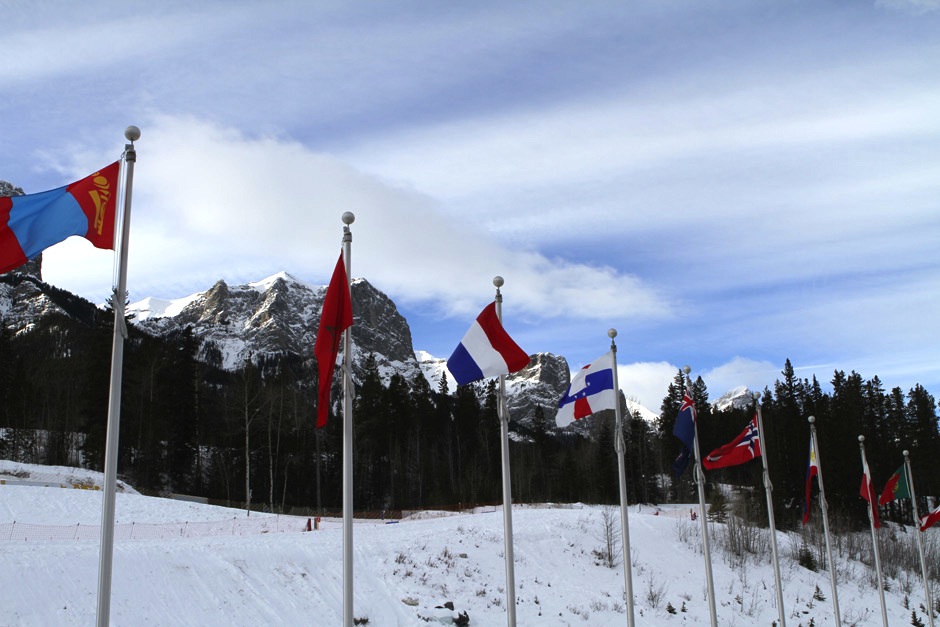
CANMORE, Alberta – If you can pull yourself away from the backdrop of jagged peaks that jut up behind the Canmore Nordic Centre, you’ll easily find the Bill Warren Training Centre and Cross Country Canada headquarters. Just turn around.
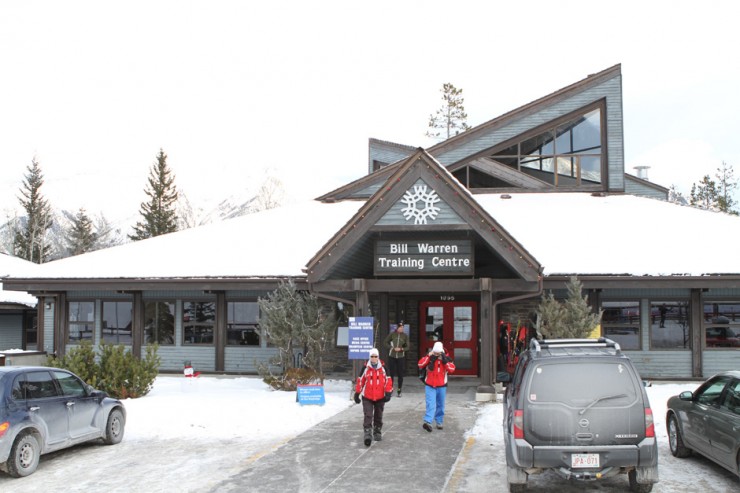
But with more than 100 kilometers of trails and multiple year-round recreational opportunities around Canmore, why would anyone want to go inside? Well, there are a few things that have to be done indoors: waxing, office work, strength training and certain tests.
So in 1994, Canada’s nonprofit winter sports management entity, WinSport, constructed the Bill Warren Training Centre (BWTC) with that in mind. It was named in honour of William J. Warren, who helped Calgary earn the 1988 Olympics, and renovated in 2008 to accommodate heavy use and changing athlete needs.
Today, the centre hosts dozens of development and national-team athletes on a regular basis – including biathlete and alpine skiers as well as the Alberta World Cup Academy (AWCA) cross-country team. The Canadian National Cross-Country Team is based there (and does as much training as possible in Canmore when they’re not racing or at camps across the world), so the bottom line is, the BWTC is Canada’s skiing hub.
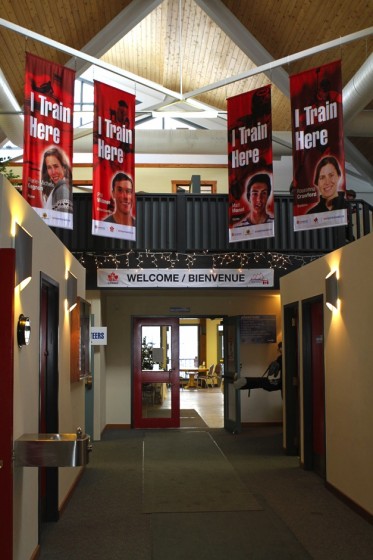
But it’s also open to the public, and when you walk inside the centre, you’ll notice an official yet accommodating feel. Eyes first go to four large vertical banners with the likes of Rosanna Crawford (national-team biathlete) and Phil Widmer (AWCA) beneath the words “I Train Here.” The walls are yellow and light is bright beneath a cathedral ceiling with skylights.
During the Alberta World Cup from Dec. 13-16, a “Welcome/Bienvenue” banner extended above a doorway at the end of the short hall, beneath a string of holiday lights. Volunteers and athletes milled in and out, some with ski bags, others with clipboards. One organizer was former national-team member Shayla Swanson’s mom, as AWCA racing director Mike Cavaliere pointed out.
“The community is just unbelievable,” he said of more than 300 volunteers behind the recent World Cup. “They live, eat and breathe skiing. It’s a community that’s really educated in skiing so they understand the ups and downs of the sport. They’re really good fans, but great volunteers.”
Outside of Canmore, high-performance skiing in Canada has significant support from the government as well. Own the Podium, a national initiative designed to reap more Winter Olympic and Paralympic medals, installed a $200,000 rollerski treadmill and $50,000 rifle lab at the BWTC in September, which was the first of its $1-million-dollar-plus commitment to nordic sports for the next four years.
If you ask Cavaliere, the BWTC now rivals any nordic training centre worldwide.
“It’s the best,” he said while giving an informal tour of the facility. “This really is, almost anywhere in North America, the best place to be a skier.”
The first part of a tour around the BWTC included a trip upstairs to the AWCA offices. Cavaliere pointed to an open corner with a television and a couple couches where his staff often meets to chat and analyze video.
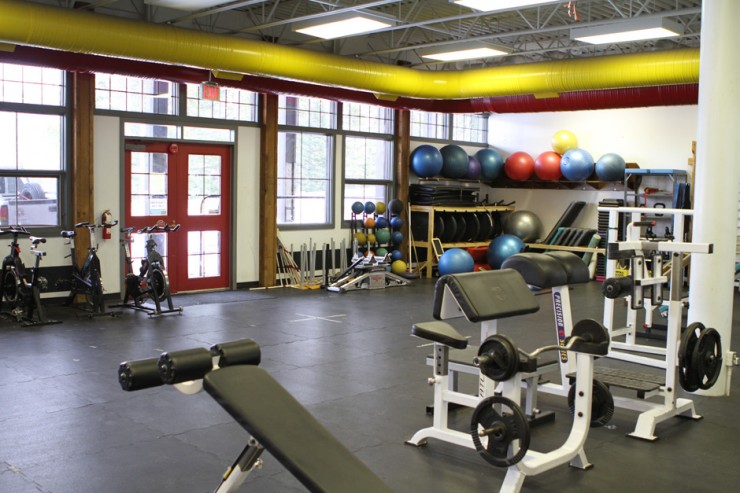
Down in the basement of the three-story building, one can easily find the weight room with two open areas filled with machines and free weights and seven spin bikes beside oversized windows. Cavaliere said this is one place that’s “rocking all summer long” with athletes from nearly 10 teams and public members as well.
In addition to the skiers based there, including those from the Biathlon Alberta Training Centre and Alberta Alpine Training Centre, many teams bring in their own strength coaches from Calgary. And if they’re lucky, athletes sometimes get a chance to work out with national-team members that are out of town most of the year.
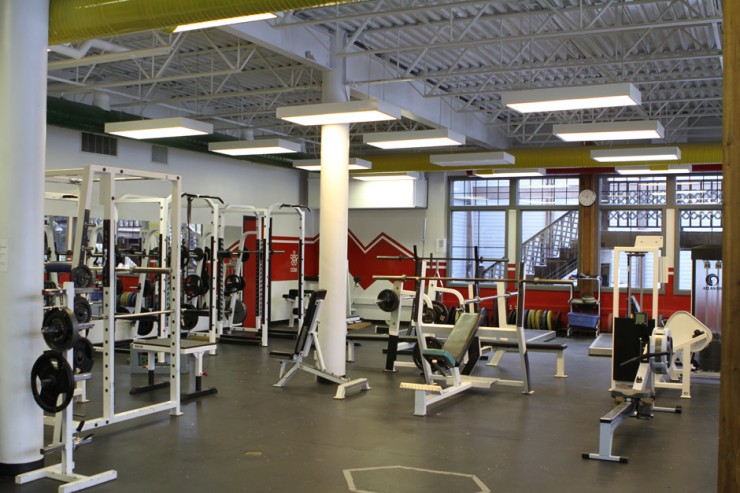
“It’s a nice dream to have that we get to train with them more, but we don’t get the opportunity as often,” Cavaliere said. “I was laughing, I was talking to Devon [Kershaw] and he goes, ‘Oh, this is a great facility.’ I was saying, ‘It’s too bad you can’t use it,’ because they basically leave after Frozen Thunder. If [the World Cup] wasn’t here, they wouldn’t be here. They would’ve stayed in Europe.”
That brings up another unique feature of Canmore’s nordic training venue. Frozen Thunder makes the point to offer the first manmade nordic skiing in North America each fall, with stockpiled snow (preserved under sawdust throughout the offseason) spread on a small loop in early October and snow guns put to work as soon as temperatures allow. The number of open kilometers grows as the season progresses to keep the area open for more than half the year.
“We’ve had snow since the 15th of October,” Cavaliere said. “We don’t get much rain. We don’t get massive snowfalls, but we’ll get five centimeters and that’s all it takes. They keep the outer trails manicured all summer so as soon as that five centimeters hits they pack it down, and then another five comes and it’s just perfect tracks everywhere. It’s pretty impressive what they can do here.”
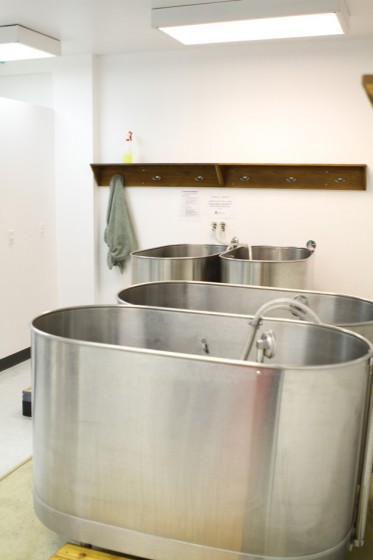
After taxing workouts, athletes can recover in the regeneration room, a small area filled with several metal tubs for hot and cold baths. Another popular spot, Cavaliere said.
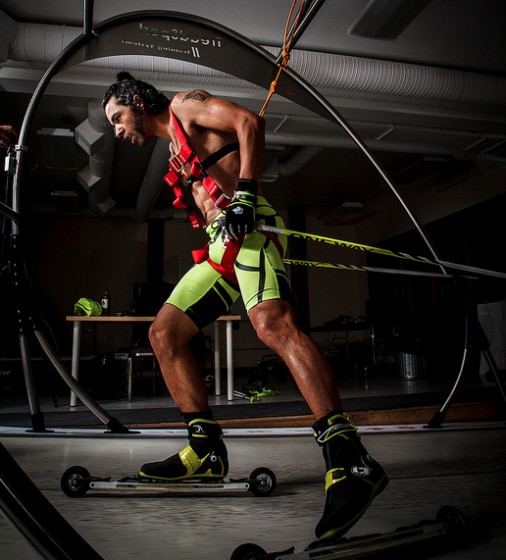
Finally, the crème de la crème: a further walk down the basement hall reveals the field lab. This is where two standard treadmills were removed to make way for the singular rollerski treadmill, putting the BWTC on par with other international venues. According to Cavaliere, every top-notch nordic training facility has one of these sport-specific machines (including the Olympic facility in Calgary), which allows two athletes to rollerski side by side while reaching speeds of up to 35 kilometers per hour and inclines of 20 percent.
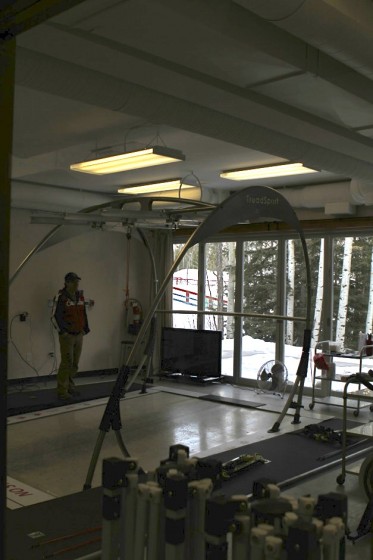
“It’s easy to use,” he said.
Usually, athletes will do intensity sets on the treadmill, for instance, five eight-minute intervals. Sometimes national-team athletes will spend upwards of 45 minutes on it, watching their form on a TV monitor.
Four years ago, the room occupied by the large treadmill and its accompanying equipment was a wax room.
“It’s kind of what we do,” Cavaliere said of the upgrades. “We do have absolutely the best. Especially with our developing athletes, there’s no excuses really, they should be strong.”
But what about the bulk of their training? In the summer, Canmore athletes, including 23 AWCA skiers, rollerski on a variety of paved paths. The 22-kilometer Banff Legacy Trail was completed two years ago to connect Canmore to the town to its north. Relatively flat and 3 meters wide, it’s a nice alternative to Canmore’s challenging terrain. Cavaliere said they can also rollerski to Lake Louise, which is another 70 kilometers.
“We can rollerski to our heart’s content,” he said. “We never have to turn around if we didn’t want to.”
At the nordic centre, there are about four or five kilometers of paved trails, mostly around the Banff Trail and biathlon loop. When they’re not on skis, athletes can easily take to the hills on foot, building endurance at elevations around 1,600 meters (5,250 feet).
All the training possibilities make it hard to justify leaving Canmore, but sometimes it’s necessary, Cavaliere said.
“The only reason we do travel is sometimes, like when we go to Whitefish, [Mont.], it’s just to break the monotony of the same old, same old,” he said. “But we go somewhere, we have to look for a gym that’s like ours because it’s a perfect setup and then we have to scout out all the trails. … We can do everything and more here.”
But training in a nordic-skiing mecca with arguably the toughest World Cup terrain, has its drawbacks.
“I’m never shocked when we don’t ski well in a city sprint because we always have just bomber tracks and it’s never imperfect here,” Cavaliere said. “It’s our challenge to sometimes adjust. We don’t get rain, we always have minus 5 [temperatures]. We don’t ever deal with adverse conditions and it’s a challenge for our team.”
Flat courses also tend to be more difficult for Canmore skiers, which is why Cavaliere often holds speed sessions on more level terrain. They also do a lot of work on the mountains in their backyard, but that doesn’t make racing up them much easier.
“I tell our guys it’s never an excuse because we do it all the time, but it’s tough,” Cavaliere said. “Probably the hardest part is you don’t get much of a break. You leave at 1,400 meters and you’re up at 1,600 meters. … It’s unforgiving.”
But perhaps the best part of Canmore goes back to Cavaliere’s original reference: the people.
“You go to Banff and it’s like a mall without a roof on it,” he said. “But here, more people want to be active and they’re outdoors. You would never be on a running trail and be alone in Canmore.”

