From the FasterSkier archive — posts syndicated from athletes’ and coaches’ own blogs between 2004 and 2012, kept online as published. Current coverage is at fasterskier.com.
We had to take a break after our three-week Olympic sprint, but we’re back to catch up on a couple of weeks of World Cup racing.
Devon and Nat take a quick run-through of events in Sweden, Finland and Norway. We’ll be back after the marathons at Holmenkollen.
Reach us at devon[at]fasterskier.com and nat[at]fasterskier.com.
A reminder: This is a homegrown podcast done by two guys working long hours and late nights. We also paid real money to be in Italy for the Olympics. If you can, support the show and FasterSkier’s ongoing coverage with a voluntary membership.
Help Support Our Olympic Coverage!
FasterSkier had our own Nat Herz on the ground at the Olympics, which, to be honest, was a very big financial lift for us. If you value the thoughtful work and access FasterSkier provides at championships like this one, please consider becoming a Voluntary Subscriber. Your support directly fuels the work we do to cover the people, places, and moments that make our sport special.
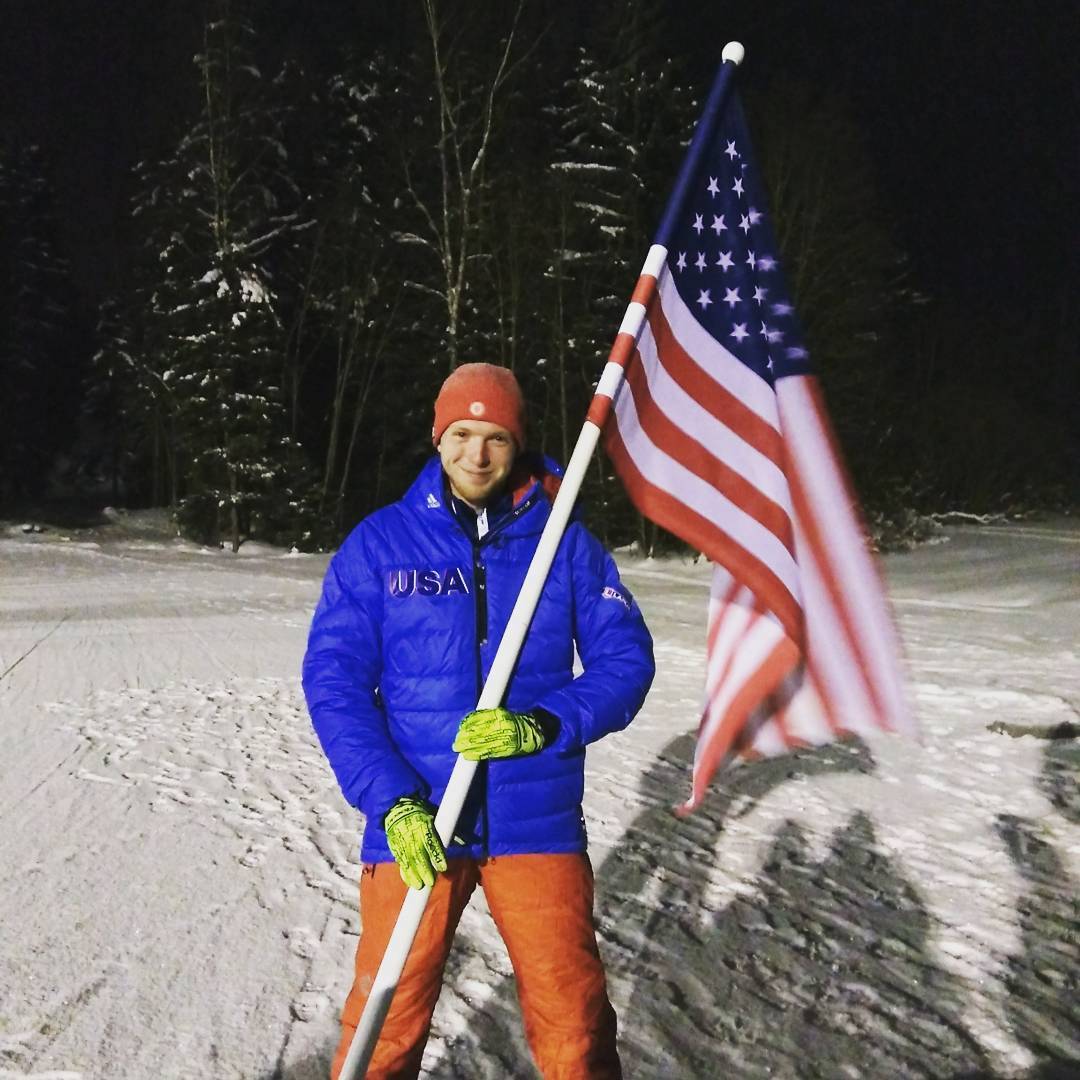
Tim Cunningham, of the St. Lawrence University Ski Team, representing Team USA at the 2018 IBU Youth/Junior World Championships in Otepää, Estonia. (Courtesy photo)
In an effort to showcase the North Americans competing at this week’s International Biathlon Union (IBU) 2018 Youth and Junior World Championships in Otepää, Estonia, we asked those qualifying athletes several questions about themselves — actually, we had them fill in the blanks. Here we have 19-year-old Tim Cunningham, a freshman on the Saint Lawrence University ski team who is representing the United States at his first World Junior Championships.
On Tuesday, Cunningham was part of the U.S. junior men’s team that finished 19th in the 4 x 7.5 k relay.
***
“My full name is Timothy Michael Cunningham, but you can call me Tim. I’ll probably answer by name but if you want better odds than that come shake my hand. It’s a more memorable introduction because it requires you to make eye contact, else it would be very weird and uncomfortable.
I was born in New Jersey, but I was raised in Springfield, N.H., and I learned to ski at Kearsarge Regional High School my freshman year. I was told I’d get to do biathlon. Little did I know they meant paintball biathlon. Not the same thing.
I spent the time between World Youth/Junior trials and Worlds mostly skiing, but also classic striding occasionally and studying a great deal of the time.
The most fantastic workout I did in the last training year to prepare for this was the USATF Mountain Running Championships 10 k on Mt. Cranmore. That was an exciting time in my life, I got to run the race in silence, just me the 53% grade on the last 500 meters to the top, and my demons.
I’m still learning the ropes of the sport, I started really training for biathlon August 1st of this past summer (2017) so the things that I’m really working on to improve my biathlon are my prone position (natural point of aim and relaxing) and racing like a biathlete, not a cross country skier.
This is my first time in Estonia and first time racing internationally, if you don’t count the Norwegian Birkebeiner, and so far, it’s been incredible. The course here in Otepää is really well built. It’s very tough out of the gate with really steep hills and sustained climbs but leaves room for good smooth skiing. There really aren’t any tough transitions on the course, just sheer fun.
Panorama shot of the 2018 IBU Youth/Junior World Championships venue in Otepää, Estonia. (Photo: Tim Cunningham)
One difference I’ve noticed between Estonia and the United States is they speak Estonian and serve pickled herring for breakfast.
One of the things I’m most excited about for World Youth/Junior Championships in Otepää is meeting a ton of new people from around the world and having some awesome race efforts on what may now be my favorite course.
One race I’m especially targeting there is the Individual race. It’s the longest race we do, which suits me, but it is also the first race I will do as a biathlete, not counting trials and the NorAm circuit.
Watching the Olympics in the leadup to my own races was motivating of course, but also a really good chance to see how other people, much better than I, handle the range at championship events. One of my favorite moments of the Games was watching to Jessie Diggins and Kikkan Randall win Olympic gold! That really motivated me to do well and maintain a good attitude at these championships in Otepää. Also, Martin Fourcade’s win in the Mass Start race was another one of my favorite moments.
At Worlds, I really hope I can chat/make friends with someone from every country. There are so many opportunities to learn about different cultures and people from very different backgrounds that it’s really hard to pick just one to want to talk to. I think the first thing I would ask someone is “What’s your name,” followed by general small talk. I’d like to learn a little bit of language from each country if possible, specifically “thank you” and “good luck,” or “have a good day/race.”
My favorite thing at the breakfast where we are staying is… well I don’t know what it is, it looks like wet feta cheese, yummy, but it goes really well with granola and berries, so I think I’ll keep eating it.
Before this trip, if you said “Estonia”, the first thing I’d think of would have been Otepää. There is an awesome video of Thomas Northug smashing a classic sprint in otepaa that I’ve seen numerous times.
Now that I’m here, I’m pretty sure something I’ll always remember will be… that’s hard to say. I’m hoping the best of this trip hasn’t happened yet. But so far, the most memorable thing has been traveling for almost a day to get here. I saw the sun and moon twice each between flying from the USA to Sweden and Estonia and finally taking the van to the hotel. And I get to do it again too! I will always remember this course though: it’s so well laid out, and with a gorgeous stadium and outer loop, that it will be hard to not miss in the US.
If I had a totally free day here and didn’t have to worry about race fitness or training, I’d spend it training and increasing my race fitness. But only for a few hours, every other hour would be spent exploring the mountains and talking to the locals about their culture and folklore. Also, their take on climate degradation and what they, as Estonians, are doing to decrease it.
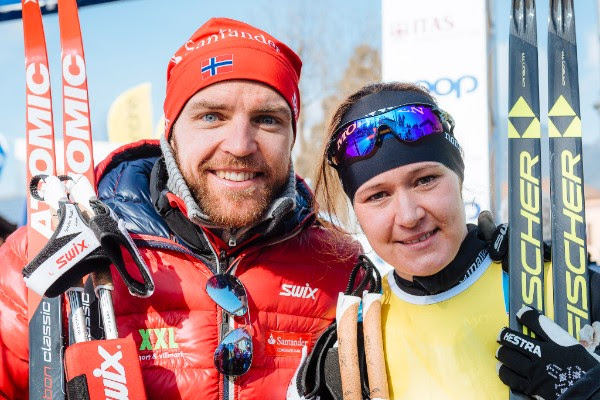
Tord Asle Gjerdalen (l) and Britta Johansson Norgren (r) after winning the 2016 Marcialonga 70 k classic. In July, Johansson Norgren won the Blink Classics 60 k rollerski race — but received only 20 percent as much prize money as Petter Northug got for winning the men’s race. (Photo: Visma Ski Classics)
At the end of July, Norwegian professional cross-country skier Astrid Øyre Slind hit the podium in the new 60-kilometer classic race at her country’s Blink ski festival. She faced a payout that seemed unusual: a big discrepancy between men’s and women’s prize money.
The American Birkebeiner pays $7,500 to both the men’s and women’s winners.
But Blink Classics is not one of these established marathons: it is a rollerski competition in its very first year of existence. It did, however, attract the attention of the Norwegian government, which was concerned that the festival was violating the country’s equal pay act.
“For us it has not been easy to have this situation with the girls,” Blink Festival press secretary Arne Idland told FasterSkier. “And then when they are not satisfied with the money it is really difficult. We will try as hard as we can to find a solution.”
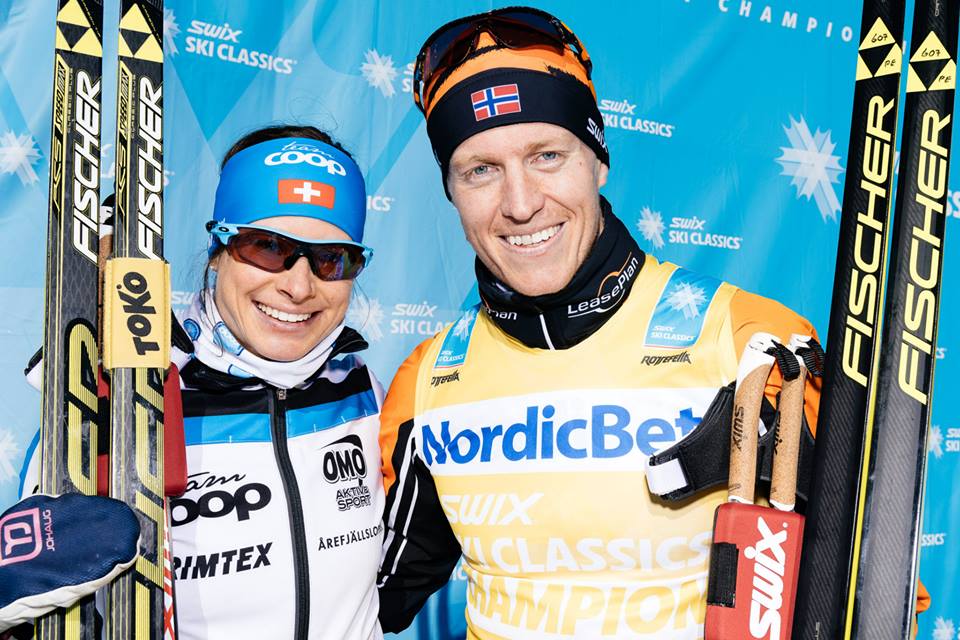
Seraina Boner (l) of Switzerland and Team Coop and Petter Eliassen of Norway and Team LeasePlan Go won the 2015 Årefjällsloppet, receiving equal payouts. (Photo: Ski Classics)
New Race for a Booming Festival
The Blink ski festival is now a giant on the summer racing circuit, with athletes from all over Europe and even North America coming to compete on rollerskis in cross-country skiing, biathlon, and the famous Lysebotn Opp hill climb. Recreational and junior classes are also a big focus, making it accessible to fans and professionals alike.
But adding a long-distance race to the mix was not easy for organizers, who still have to make sure that the festival breaks even financially. Idland explained that Blink Classics had been in the works for three years.
“The main challenge this year is that we, for the first time, were going into car traffic — this race was on ordinary roads with traffic [rather than the city square], and we had to close it to traffic just like they do in cycling races,” he explained.
That entailed paying for policemen, for one thing. Having a fourth day of racing (previously there had been three, the Lysebotn Opp and two more days in the Sandnes city center) also meant more production by NRK, Norwegian national television, as it followed a long-distance race rather than staying in a set location downtown.
“If you have live production it has to be in high definition,” Idland said. “Then it’s really expensive.”
Then last autumn came the news from the Norwegian Ski Federation: none of the national team “A” or “B” team women would compete in the 60 k. The women usually focus on doing all three of the other days of racing, and adding a 60 k at the beginning of consecutive days of racing would be too much volume and intensity during the summer training season. Some of the men, like Eirik Brandsdal and Sjur Rothe, would do the longer race; Martin Johnsrud Sundby was interested but later pulled out.
Concurrently, Idland said, NRK was telling the Blink organizers that it wouldn’t be possible to broadcast the men’s and women’s 60 k competitions together. It would have meant following two races at the same time — double the filming budget and staffing — and deciding all the time which feed to broadcast and commentate. NRK didn’t have expertise in doing this and said that they needed to develop it. So they would only broadcast one, and with the national team women out of the competition but the national team men in it, organizers agreed it should be the men’s race.
“When I contacted the teams from other nations, I was open and said that this [women’s] long distance race will not be broadcast on TV and no women from the national team would start there,” Idland said of his communication with other countries’ teams last winter, before registration began. “So I advised them all not to start in this race, but to come do the three other races.”
Johansson Norgren, the winner, is a mainstay on the Visma Ski Classics circuit and won the 2016 season title as well as numerous individual marathons. Masako Ishida, who finished third at Blink Classics, was the winter series’ fourth-ranked woman. So the podium at Blink was not so different than a podium one might see at a top winter event.
But the decision about prize money had been made long before.
“We said that we need good prize money on the men’s side, because the other competitions that we compare with have good prize money,” Idland said. “We also need some sprint primes. We had a total of 190,000 kroner, or about 20,000 Euros, for the men. And we had just over 5,000 [Euros] for the women. That was decided before we opened entry.”
Even for the women, it was more prize money than was available at the other competitions in the Blink festival, Idland said. In those other races, prize money is equal for men and women and each total prize-money purse is roughly 2,000 Euros.
“So it is double amount of money in this women’s class in any of the other races, including Lysebotn Opp,” he said. “We thought we were really doing well for the women. And it’s not every rollerski race having prize money, either.”
Finland’s Kaisa Mäkäräinen climbs to victory in the Lysebotn hill climb at the 2013 Blink festival as a cameraman captures the action. The women’s hill climb is televised, unlike the Blink Classics. (Photo: blinkfestivalen.no)
Building Women’s Pro Fields Takes Time
But the discrepancy still felt unusual to some of the women, who are used to getting paid the same amount as their male counterparts for a win.
The gulf between men’s and women’s participation is greater in long-distance racing than on the World Cup. As a result, marathon organizers have to grapple with a somewhat different set of considerations as they develop the payout structure for their competitions.
Most of the biggest ski marathons in Europe — including the Birkebeiner, Vasaloppet, and Marcialonga — are part of the Visma Ski Classics series, where organizers have come up with compromise solution when it comes to year-end rankings.
Prize money is equal for the top three overall series finishers, but the men’s field also pays out to the fourth- and fifth-place athletes while the women’s field does not.
“For me it sounds very strange,” Visma Ski Classics CEO David Nilsson told FasterSkier in an interview last week referring to the Blink prizes. “We have in our rules that they must have the same first prize to men and women. It is also important to reflect on the percentage [of field size], and it shouldn’t be so much more difficult for the men to get [prize money] than for the women — but you can never do more than win, so of course that has to be equal for first place.”
In the winter, far fewer women than men are on Visma Ski Classics professional teams. But women’s races are hotly contested and often extremely dramatic, like Seraina Boner’s come-from-behind win at the 2016 Birkebeiner after passing Ishida and Poland’s Justyna Kowalczyk in the final kilometers.
In the 2016 season, 39 different women scored points toward the overall titles. There is even an all-women’s pro team, Sweden’s Team SkiProAm, whose top athlete finished eighth in the season rankings.
According to Nilsson, Visma Ski Classics has carefully tried to promote women’s participation, with equal prize money for first place being one component.
“We worked very hard on this,” he said. “When I started 6-7 years ago, we had 4-5 women that were competing [professionally] in long distance skiing because it was a bigger step for them from shorter distance [World Cup] skiing than for the men.”
While they left the women’s competition out of the spotlight this year, the Blink Classics organizers don’t think that should always be the case. Like the Visma Ski Classics, they want more women on the start line.
“Our aim and our goal is also to have the world’s best women at the start in future,” Idland said.
One reason for low numbers at Blink might be that long-distance racing just isn’t as popular among women in Norway as it is in neighboring Sweden, home of the Visma Ski Classics brand, said Nilsson.
“In Norway, which we all know is very strong in cross-country skiing, we don’t see so many female participants in long-distance skiing,” he mused. “They are more from Sweden. We don’t know why the Norwegian women are not coming more.”
The Blink 60 k is part of a three-race series of long-distance rollerski competitions called the World Classic Tour. Indeed, the second leg of the Tour was held in Sweden. Called the Alliansloppet, it is also a more established event.
Twenty-five women finished that 48 k race, including several past Visma Ski Classics champions and members of the Swedish national team (Hanna Falk, a three-time World Cup podium finisher, won the race). Prize money was equal for men and women, including a 10,000 Swedish kroner sprint prize ($1,000) for both men and women.
The World Classic Tour overall awards use a similar idea to the Visma Ski Classics, in that the men’s and women’s title winners earn equal paychecks but the men’s field will pay out to six places and the women’s to just three.
Yet the series does not appear to have a policy for its constituent races in how to organize prize money at individual competitions.
If organizers like those at the Blink festival want to develop a strong women’s competition, Nilsson suggested that they need to actually promote the women’s races.
“We also made sure that there was much more focus on the women [than there had been before],” he said of the Visma Ski Classics efforts. “The women should have be starting [wave] before the men to have their own competition… and have [television] production of the race and their own media. When we created the system, all the attention was on the men. Then we made it so the pro teams had to get points from both the men’s and the women’s classes. This together has made the increase of the women.”
Idland conceded that with more prize money, they might have drawn a slightly larger women’s field. But he believed the circumstances of the festival, with the three subsequent days of racing, were the bigger reason for low participation.
On the Blink Festival website, the news story about the 60 k Classics race features five paragraphs and three photos about the men’s race, but only one paragraph and one photo of the women.
Nilsson believed that some changes could be made without disrespecting the male athletes.
“When you have 100 men and not so many women registered, it wouldn’t be fair to get the same [prizes],” Nilsson said. “It would be easier for the women. So it has been for us to push the development [of women’s skiing] but not to be unfair to the men’s skiers. That’s the reason we have in the prize money, five men and three women. And that reflects a little bit to the female factor, to be honest, in terms of the number of participants and the amount of professional skiers. It has to be the same difficulty to win a prize in both categories.”
What Does Equality Mean?
Race organizers are continuously trying to come to a more perfect solution, and one common thread seems to be that prize money must be earned by quality racing and exciting performances. Until the women’s fields are deemed to have provided that, they might not see as much compensation.
Visa Ski Classics, for example, continues to make changes. For the 2016/2017 season, women will for the first time be able to vie for a sprint title, worth five percent of the total prize money, just as the men have done for years.
“The reason it wasn’t the case [previously] is that there weren’t so many women — last year was the first time that there was really a group at the front,” Nilsson said. “Before it was just one or two who went away, so it wouldn’t have been interesting. The same people would have won the race as the sprint bibs. Now both men and women get a sprint bib, which is a step forward. Our goal is to make it equal the number of participants and who gets prizes.”
Nilsson guessed that the availability of intermediate prize money may also change the tactics of the women’s races and contribute to an exciting spectacle on television.
For his part, Idland insisted that the Blink organizers’ decision about prize money was not sexism. It could have gone the other way, he wrote in a letter to the Norwegian government explaining the discrepancy in pay.
“I was trying to give an example with the opposite situation,” Idland said. “If Marit [Bjørgen], Therese [Johaug], Heidi [Weng], Charlotte [Kalla], and maybe some of the Americans said to us that this race we would very much like to do, and the men said they didn’t want to do it and just let the [marathon] specialists do it, then I am quite sure we would have done the opposite thing. We would have led the coverage with the women, if the level was higher.”
After being contacted by the authorities, the Blink Festival is trying to work together with the government to achieve equality.
“Our answer was that they would really much like to come in dialogue with us to try to make a plan for the future,” Idland said. “And that we try to build up this competition with a clear aim to have everything on an equal basis in some number of years.”
Organization Summary: The American Birkebeiner Ski Foundation is a 501(c)(3) non-profit organization dedicated, as reflected in the Birkie Mission Statement, to hosting one of the world’s best cross country ski events, the American Birkebeiner, maintaining one of the nation’s premier recreation trails, and promoting healthy lifestyles for people of all ages.
Attributes: This position is responsible for facets of fundraising, membership, outreach, sustainer programs, honor wall, and grant submissions. The DD must be self-motivated, outgoing, organized and structured. A passion for sport and a strong team player is critical.
Position Activities:
Create, oversee and execute ABSF fundraising initiatives and campaigns
Create, oversee and execute ABSF membership programs and related components
Create, oversee and execute Trail Friends and Birkie Honor Wall programs
Build, grow and further develop ABSF endowment and planned giving programs
Work with Executive Director to develop key organization messages for stakeholder audiences
Research, complete and submit grants that offer alternative funding sources to Birkie capital projects
Work with employment team on survey development and feedback mechanisms for foundation
General Foundation duties including taking notes at all ABSF Board of Directors meetings, acting as the primary point of contact for all Foundation related questions and coordinating all aspects of ABSF Board annual elections
Promote collaboration with other events and organizations, community stakeholders and foundations
Work with staff on integration of Foundation into all aspects of ABSF activities, events and programs
Data Management – Manage data of Foundation and fundraising audiences and messages
Content Distribution – Develop, manage and operate innovative content for foundation members and fundraising outreach
Work closely with Operations Team
Required Skills: The following skills are required for the position, with a strong, proven work background in all areas.
Strong writing ability with a focus on message-oriented communications, including ability to both write and edit
Strong public speaking ability
Outreach and partnership building experience with a strong emphasis on audience and message management
Self-sufficient, with ability to develop long-term strategies and manage projects to completion
Business computer skills (Word, Excel, email, Web, etc.) with at least basic understanding of Web and graphic management applications (Basic HTML, WordPress, Photoshop, etc.)
Background in use of Web as communications tool including understanding of social networking (Twitter, Facebook, etc.), media distribution (YouTube, etc.) and blogging
Positive, upbeat presence with others, including both co-workers and outside contacts
Compensation: Position will be salaried (based on experience) with a health insurance reimbursement, retirement benefits and paid vacation/holiday days available.
Responsible to: The position reports directly to the Executive Director, but will have strong interaction with other team members.
This job description outlines the primary roles and responsibilities of the position. Other duties may be assigned.
Interested candidates should direct cover letter, resume, list of three references and at least one work example to:
One day. Eight events. Introducing NEW Ultra 100K Marathon!
Hayward, WI (September 22) — The 14th annual American Birkebeiner Ski Foundation®
(ABSF) Birkie Trail Run & Trek, Presented by Salomon, will be held on the iconic Birkie Trail this
Saturday, September 26th. From the challenge and intensity of a new 100K Ultra Marathon to
the fun of a 5k run/walk, an estimated 1000 runners and trekkers from around the Midwest will
take to the trails.
The Birkie Trail Run & Trek events start and finish at Birkie Ridge Trailhead, 12.5 miles north of
Hayward, Wisconsin, and 5 miles south of Cable, Wisconsin. The eight Birkie Trail Run & Trek
events place runners and trekkers on some of the most scenic stretches of the famous Birkie Trail and single-track sections of the CAMBA (Chequamegon Area Mountain Bike Association) trail system. With eight events on the roster – including a marathon, marathon relay, half marathon, Nordic Trek, 5K run/walk, youth 5K (12 and under) and 1K (free for ages 9
and under), and this year’s new 100K Ultra Marathon – there is a north woods trail experience
available for every ability level. This year’s new Ultra 100K marathon utilizes all of the marathon
course plus two additional loops, with aid stations and support teams along the course route. Full race course information is available at www.Birkie.com.
“The Birkie Trail Run & Trek event is ideal for runners looking to break free from traditional road
running and provides an ideal crossover race experience and introduction to trail running,” said
Ben Popp, ABSF Executive Director. “Our event is continually evolving and we are excited to
offer the new Ultra 100K marathon to the mix of existing running and trekking events.”
The Birkie Trail Run & Trek welcomes new elite athletes to the marathon, including: Jeff
Quednow, Ogema WI; and Marco Sturm, Neuötting-Bavaria, Germany. Additionally, the 2014
Birkie Trail Run & Trek male marathon champion, Craig Cardinal, Northfield, MN, is back to
defend his title, while 2014 women’s half-marathon champ, Tiffany Karl, Duluth, MN, is returning
and running the full marathon.
“The trail is in great shape, volunteers are ready and we are excited to welcome runners,
trekkers and their families to this weekend’s events,” said Allan Serrano, ABSF Event Director.
“The wide, grass covered, level surface and challenging profile of the groomed Birkie Trail,
along with the smooth and fast CAMBA single-track will give runners of all abilities everything
they’re looking for this weekend.”
The weekend kicks off on Friday with bib pick-up at the Cabin Stop, Hayward, WI, with cheese,
craft beer and wine samples, and exciting door prizes. The new Ultra 100K event starts
Saturday, bright and early, with rolling starting times for all other running and trekking events
(see schedule below). Festivities continue with awards ceremonies, food, craft beer and wine,
vendor displays, and live music by Duck for the Oyster under the big tent. Later that evening,
the celebration moves to Rivers Eatery, Cable, Wisconsin, with live music by Molly and the Danger Band. This year, participants have the opportunity to camp near the start/finish area at
Birkie Ridge Trailhead.
With a focus on youth development, Annie Hart – Birkie Ambassador, 5-time All-American and
professional cross-country skier – will lead the kids warm-up games and race activities. There
will also be an obstacle course for kids and treats following the youth events, hosted by the
Central Cross Country Ski Association (CXC).
“We are very pleased to be the presenting sponsor of the Birkie Trail Run & Trek,” said Josh
Korn, Regional Marketing Manager, Salomon Soft Goods. “The Birkie trail is truly a gem of a
course for both running and Nordic trekking alike!”
Over the years, the Birkie has grown its programming into an exciting array of fitness and
recreational opportunities. The 107-kilometer Birkie Trail system attracts skiers, runners, bikers,
trekkers, and hikers, from casual day-trippers to elite superstars.
Follow us on Twitter #BirkieRun15
###
About the American Birkebeiner® Ski Foundation and Birkie® Events Located near Hayward and Cable, Wisconsin, the American Birkebeiner Ski Foundation, a 501(c)(3) organization, is known for its signature American Birkebeiner Ski Marathon held each February. Today, the Birkie brand has grown to encompass a year round lifestyle that provides healthy, active events for thousands of outdoor fitness enthusiasts of all levels. Birkie. Ski. Run. Bike. Live! Visit www.Birkie.com to learn more.
About Salomon – Designed for Freedom –For more information about Salomon, visit www.Salomon.com
Birkie Trail Run & Trek, Presented by Salomon Schedule of Events
Final Birkie Trail Run & Trek registration. There is no relay team registration
after 4pm on Wednesday, 9/23. There is no registration for all other Birkie Trail
Run & Trek events after Friday, 9/25
Holly Brooks (Alaska Pacific University/Salomon) racing to her second Birkie victory in Hayward, Wisconsin, in February. On April 11th, Brooks will try to wrap up the FIS Marathon Cup crown in Khanty-Mansiysk, Russia. (Photo: Darlene Prois/ABSF)
ZÜRICH, Switzerland– American racers might think the ski season is over, but not so for Holly Brooks.
“I think I might be the only North American skier who is still competing,” she laughed on Sunday. “Maybe someone else is out there, but I know a lot of people are heading to the beach.”
The Alaskan made the FIS Marathon Cup her season goal, and is about to fly to its last competition, the Ugra Ski Marathon in Khanty-Mansiysk, Russia. She currently leads the standings by four points over Tatjana Mannima of Estonia, with Aurelie Dabudyk of France only 41 points behind as well. With 100 points going to the winner, 80 to second place, then 60, then 50, any of the women could conceivably win the Cup.
That is, if any of them wins the actual race. Last year, marathon favorites Riita-Lisa Roponen of Finland and Seraina Boner of Switzerland finished second and third in the Ugra, minutes behind relative unknown Ekaterina Rudakova of Belarus. The podium finishers were the only non-Russians in a field of fast women.
In their head to head meetings, APU’s Brooks has beaten Mannima three times and Mannima has beaten Brooks twice, but both were in classic races. The Ugra is a 50 k skate, the technique which Brooks favors. FasterSkier caught her for an interview before she flew to Russia.
FasterSkier: What have you been up to for the last few weeks?
Holly Brooks: I’ve been country hopping, as per usual. Or, as usual for me this winter. The last week I spent in Chamonix, which sounds really exciting but it was gray and raining and I didn’t do a whole lot of skiing.
The week before that was kind of a Scandinavian tour. I spent the week in Trondheim with Anders Haugen, a Norwegian-Alaskan who just moved there. The snow wasn’t great there either. That was the week leading up to the Årefjällsloppet, the final of the Swix Ski Classics in Sweden. It was not a great race for me, but I was really happy to be there to experience and hang out with my team, Team Santander, who took the overall win. So that was really fun.
And then the week before that was the Norwegian Birkie. Which was great. You always have to check that off your bucket list as a cross-country skier.
FS: Your last FIS Marathon Cup race was a while ago at this point. How has it been trying to stay motivated?
HB: It’s really wild that the penultimate FIS Marathon Cup was the Engadin, which was March 8th, and the final, the Ugra Ski Marathon, is April 11th. So there’s more than a month there.
I have had a good month in between. I went to Holmenkollen and cheered on teammates there in the 30 and 50 k’s. I had some good racing – the Norwegian Birkie was a really fun experience. I actually cooked dinner for the head of the Norwegian Labor Party, who is potentially going to be the next Prime Minister of Norway. So I cooked his pre-Birken dinner, which was really fun. I’ve just gotten to see a lot more of Europe and of Scandinavia and places that are off the beaten path of the World Cup. And I’ve made a lot of new friends in the last month too.
FS: Now you’re off to Russia. You’ve had plenty of challenges this year with logistics, but how much harder is it with Russia?
HB: I don’t think I’ll believe I’m in Russia until I’m actually in Russia. It has been extremely hard. The logistics around this race have been a total bear. I will say that the people on the organizing committee have been really helpful and really welcoming.
But the visa alone, being a solo show I’ve had to do all the organization myself. For the visa alone I probably sent over 150 emails and made 30 calls. Put hours and hours and hours of time into that. And then figuring out the tickets and who will wax my skis, and all the normal solo stuff.
It will be a long journey to Khanty-Mansiysk. I didn’t even know where it was until I googled it. Siberia is quite far away. I think it’s five time zones away from central European time. I was definitely watching with interest when the biathletes ended their season there a couple of weeks ago. So yeah, I’m excited to get there.
FS: You’ve spent time racing in Russia before, on the World Cup and at the Olympics. Do you think that will help you deal with some of the unfamiliarity of things?
HB: I know that the only thing you can expect is that you have no idea what’s going to happen. You just have to be ready to roll with the punches. I definitely also know that you also have to be extremely patient, because things don’t necessarily happen in a timely manner or how you would expect them to happen.
The food could be great or it could be horrible. I’m definitely taking peanut butter, instant coffee, and instant oatmeal, amongst other things, just in case. And I’m supposed to be able to walk from my hotel room to the start/finish of the race. I’m hopeful that everything will go smoothly.
FS: In the beginning of the season you got a little cushion of time before you started racing, compared to the last couple of years and the World Cup crew. Now you’re going much later than them. What’s harder?
HB: This year has been interesting because I spent all of November and half of December in Alaska, studying. It was actually really hard being at home watching everybody kick off their season. Now I’m on the opposite end. Everyone’s done, they are headed to the beach, and I’m still going. Essentially my season is the same length, it’s just shifted back three weeks to a month.
I think this is a little harder. It was hard watching them race and I wanted to race at the beginning, and now I’m really tired and I’d like to be done. Everyone else is done and I have to stay focused and stay strong. I think the way I’ve done it this year is a little bit harder, but I’m hoping it will pay off.
FS: What’s the race preview?
HB: Well, I have a four point lead going into this race. It’s pretty crazy after an entire season of marathons in eight different countries, to have it be this close at the end is quite exciting but also a little stressful. The girl in second, Tatjana Mannima of Estonia, is only four points behind me and it’s the same as World Cup scoring so if I beat her, then I win the FIS Marathon Cup. If she beats me, then she wins. There’s a lot at stake here. I’m really just trying to stay focused for April 11th.
FS: And then what will you do?
HB: And then it will take me three days to get home [laughs]. I’m already having nightmares about potentially having to check four pieces of luggage on an international flight to Alaska! I’m really really excited to go home.
Therese Johaug of Norway said it had been a dream to compete in the Birkebeiner ever since she was a little girl. On Saturday her dream came true… and not only did she win, she set a five-minute course record. (Photo: Swix Ski Classics/Instagram)
The Birkebeiner, a legendary 54 k ski race from Rena to Lillehammer in Norway, has been running for 77 years. But that doesn’t mean that every year can’t bring something new.
Last year, the Birkebeiner was canceled due to extreme weather on the mountain summits in the middle of the race course. This year, weather was perfect and the snow was faster than ever, leading to course record times being set in both the men’s and women’s races.
The men’s race was won in 2:19:28 by Petter Eliassen, who also made history in another way: the Norwegian racer, representing team LeasPlanGo, also went without kickwax. It was the first time the race has ever been won on skis without grip, and probably among the first times such an attempt was even made.
“I was very unsure whether I would go without or with kick wax,” Eliassen told Norwegian broadcaster E24 after the finish. “But after talking with the guys on the team, we agreed that I would do it. It’s how I have been training all year.”
While other marathons such as the Vasaloppet in Sweden or the Marcialonga in Italy are routinely won on skate skis, or classic skis with only glidewax, the Birkebeiner is different. It gains 600 meters, or nearly 2000 feet, of altitude from the start to the high point at 34 k into the race, and the total climb is even greater than that because of a substantial descent from 19 to 27 kilometers which racers then must climb up from again.
Yet despite lacking kick wax and having to double pole the entire race, Eliassen still had the upper body strength at the end to beat out fellow Norwegian Martin Johnsrud Sundby by 10 seconds. John Kristian Dahl placed third, another five seconds back.
Eliassen built up a lead descending from Sjusjøen, but Sundby and Dahl caught back up to him and forced an exciting finish.
“It is quite special and very fun to win the Birken,” Eliassen told E24. “It’s a great, traditional race… It was a good race. We were a nice group that went along together the entire race.”
Sundby, who just finished up the World Cup season with the overall title, said he has a lot to learn for these long marathon races with such huge fields. He also said he’s still recovering, in some sense, from the illness that knocked him out of the first week of racing at World Championships back in February.
“I’m in good shape, but have not gotten myself up again,” he told Aftenposten. “I’ve tested a bit lately, and is quite far from where I am at my best.”
Beating the reigning World Cup champ does not tempt Eliassen to return to shorter distance racing, however. A former national team member, he finished World Cup Finals in Falun, Sweden, last year in eighth place. Then he shifted his focus, and it has paid off. He won the König Ludwig Lauf in Germany and the Vasaloppet in Sweden as well as the Birkebeiner this season.
“Now it’s long races that appeal to me,” he told Aftenposten. “That’s what I like and what suits me, and so I enjoy it very well with the team.”
In the women’s race, Therese Johaug competed in the Birkebeiner for her first time and won it handily; her time of 2:41:46 was also a course record. She broke the previous record by five minutes.
“It was a fantastic trip over the mountain,” she told NRK. “What a mood! It could not have been better with these surroundings. It was incredibly fun to dabble in Birken. It has been a dream since I was a little girl.”
Johaug is coming off of a successful World Cup season, including victories in both the 15 k skiathlon and the 30 k mass start classic competitions at World Championships. Like Sundby, she raced for Team United Bakeries at the Birkebeiner.
Austria’s Katerina Smutna was the runner-up in 2:44:27, and Seraina Boner of Switzerland placed third two seconds behind her.
Holly Brooks, an Alaskan racing for Team Santander, finished 11th in 02:58:25. Robyn Anderson of Stowe Vermont and VTXC finished in 3:16:00. Christina Turman, the interim head coach of the University of Alaska Fairbanks ski team, finished in 3:35:14.
The top Canadian result went to Brian McKeever, who finished in 2:34:39, good for 58th place in the elite wave. McKeever is a member of Canada’s Para-Nordic World Cup team and his guide, Erik Carleton, placed 110th in 2:41:11. Ian Murray of Rocky Mountain Racers crossed the line just over a minute later to place 121st in 2:42:27, while Philip Shaw of Club Ski Rosemère finished in 3:00:18.
After a disastrous 2014 event which saw the title race canceled on race morning due to dangerously high winds in the mountains, there has been much soul-searching in Norway as to how the Birkebeiner ski marathon can go forward (or whether the organizers were being wusses).
Last week, organizers of the 54 k classic race from Rena to Lillehammer announced changes they are making to safeguard the competition’s future.
Chief among them is the addition of a new section of trail in the Hemmedalen nature reserve, to be used as a backup if for some reason the trails over the mountains are too dangerous.
This comes as a great relief as organizers had mentioned developing a back-up course as early as the first few days after the failed 2014 races, but in early October NRK reported that negotiations for the location of new trails were fruitless. Allegedly, organizers and landowners could not come to an agreement over the fees to be paid for use of the land.
The new 14 k section swings to the south of Raudfjellet, the high point of the course where winds were so extreme in March.
Additional precautions are being taken in the mountains, too, with a new weather station set up in Raudfjellet to accurately assess wind and weather. The Birkebeiner is also retaining its own meteorologist, John Smits, to interpret this and other data and give better forecasts for race day.
The organizers announced that they will be ramping up their inspections of participants’ backpacks, which are required to be 3.5 kg in weight (to represent the baby prince carried over the pass by the original Birkebeiners) and include items such as an extra jacket and pants, food and drink, and extra long underwear. By making sure that all racers have this extra gear, organizers say they will be less worried about inclement weather.
They also announced that in case there is a low snow year, they are working on saving snow to be deployed onto the trail.
A photo of the Raufjell taken by Johannes Haukåssveen early Saturday morning and posted to the Birken website.
LILLEHAMMER, Norway— Early on Saturday morning, 17,000 skiers – mostly Norwegians – made their way to Rena, a small town of usually just 2,000 people in central Norway. They were set to race the Birkebeiner, a 54 k classic marathon that traverses a mountain range and ends here in Lillehammer, the site of the 1994 Olympics. It is one of the most well-known ski marathons in the world.
But as meteorologists had warned, winds were extremely severe at the top of the race course, which sits at nearly 3,000 feet. Gusts were rumored to reach 25 meters per second, or 55 miles per hour. The tracks were blowing in within seconds of being set and with wind chill, temperatures dropped to -26 C or -14 F.
As race organizers deliberated whether they could send thousands of skiers over the mountains, the racers sat in Rena, on buses and in school gymnasiums. There was an hour delay for organizers to see if conditions improved and the race could be held.
After that hour, the announcement was made: the Birkebeiner was canceled.
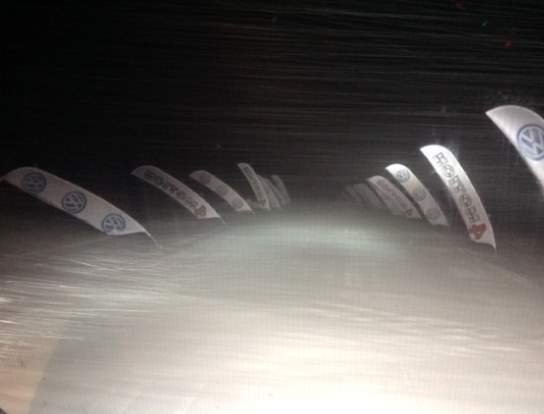
“This was not weather to ski in,” groomer Runar Austgarden told news agencies after the decision. He said that the tracks were completely blown over only a minute or two after he had set them; the race committee posted a photo on their website of sponsor banners blowing sideways.
“The wind was so powerful that groomers did not see it prudent to leave their machines,” race director Silvie Amundsen said in a press release on the Birken website. “It was hard to stand still in storm… The most important thing is life and health, and we do not want anything to happen participants because of unacceptable conditions in the mountains.”
On their website, the Birken called Saturday “a heavy day” and said that the decision had been extremely difficult. Only once before, in 2007, had the race ever been canceled and that year, participants set off but were turned back on the high mountain passes, creating even more confusion. This time, racers simply had to find a bus ride back to Lillehammer.
Some – potentially even a few thousand – skied over to Lillehammer on their own. Organizers were adamant that skiers turn in their timing chips before they set off, so that they would bear no responsibility for what happened next, and there were of course no aid stations. But some of these skiers said that the conditions were not bad.
The brothers Jorgen and Anders Aukland were probably the most famous participants to try this, skiing with their friend Simen Østensen.
“They made the decision too early,” Jorgen Aukland told Norwegian broadcaster NRK. “It was fine to go over the mountains today.”
They, and others, pointed out that in the Birkebeiner race participants are required to carry a backpack weighing 3.5 kilograms, and inside are required to carry an extra long underwear shirt, ski pants, and a jacket.
“Therefore, it shouldn’t have been a problem,” Anders Aukland said of the weather.
American skiers Matt Gelso (Sun Valley) and Peter Kling (APU) also skied over the passes to Lillehammer.
Indeed, the decision has been second-guessed and criticized relentlessly here in Norway in the past two days, by everyone from skiers themselves to newspapers and television stations.
The Birken posted a statement on their facebook page on Sunday trying to explain and defend the decision:
“The cancellation of this year’s Birkebeiner Race was a real downer for everyone involved. There are many opinions about the decision taken. Birken is a mass event and we must ensure the safety of both participants and volunteer staff. In such conditions as there were on the mountain yesterday morning, it was not prudent to send participants over the mountains or volunteer personnel onto the top. We understand that many of you are disappointed, so are we, but we hope you understand our decision. We hope you get some great skiing in during this last part of the ski season.”
The posting has received nearly 1,000 “likes”, but many of the 114 comments are critical of the decision.
“Now you sit down soon to start thinking about some alternative, and show a little more respect for thousands of well-trained skiers with a backpack full of extra shirts,” wrote one commenter. “There are many ways to solve this in order to avoid a cancellation… it seems like you’re taking a little too lightly.”
“All participants are required to wear sack which for safety reasons SHALL contain windproof clothing, dry underwear, drink, food and waxes,” wrote another. “I don’t understand the point of these rules if the participants aren’t let on the trail when it blows a little on the mountain.”
Still others asserted that the Birkebeiner had been held in worse conditions before.
Race director Amundsen, however, told NRK that it was the luck of the draw what conditions a skier might find at the course’s highest points. Between 15 and 40 kilometers, the course is always above 2,000 feet. Within that area, there is a seven-kilometer section at nearly 3,000 feet.
“There were several gaps during the day when it was okay to go over the mountain,” Amundsen told NRK. “But when we consider that we will be having 17,000 people all over the area, someone would have to be in the strong winds in the morning or else when it blew up again in the afternoon.”
The directors considered delaying the race even beyond the one-hour delay they had initially implemented, but did not think it wise to keep slower participants out on the trails too late into the afternoon and evening.
With two cancellations in the last decade, Amundsen said the organization may consider developing a backup route which traverses at lower elevation.
Matt Liebsch (Team Strong Heart/Team Birkie) skiing to the finish in 2011. Photo: Flying Point Road.
It’s difficult to pigeon-hole cross country ski racers into making predictions.
Of those asked, University of Vermont standout Scott Patterson was the most forthcoming about his prediction for the outcome of the 50-kilometer 41st American Birkebeiner this weekend, one of the premier ski marathons in North America and part of the Worldloppet series. He admitted that while he was rooting for his sister, Caitlin Patterson of the Craftsbury Green Racing Project (CGRP), he thought that the other Caitlin – defending champ Caitlin Gregg of Team Gregg – was the favorite.
“Caitlin Gregg has shown she is above the field in domestic skate races this year. With that, and intimate knowledge of the course, she will be hard to beat,” he wrote in an email.
“Hopefully my sister will surprise me,” he added.
But then again, it was easier for Scott Patterson to make predictions, since he won’t be racing, as the collegiate schedule conflicts with the Birkebeiner. Plus, as a college skier, “the large prize money appeal is moot since I can’t accept it. Instead I will test out my 50 k skills later on at [SuperTour Finals] in Anchorage.”
For her part, Gregg was reluctant to say.
“I have no idea how the race will unfold until it does,” she wrote in an email. “I will say I am excited to ski on the Birkie trails again, though,” she added, including a smiley emoticon in her email.
Though Scott Patterson and Gregg seemed to agree on a favorite in the women’s race, there was no such agreement on the men’s race: Patterson picked Sun Valley’s Matt Gelso or Team Homegrown’s Sylvan Ellefson for a strong showing, giving Ellefson the edge if it comes to a sprint.
For what it’s worth, Ellefson, fresh from the Battle Creek SuperTour, would have liked to agree, but couldn’t quite.
“I would like to bet on myself for the win, but seeing as my best finish is 10th, my goal for the Birkie is only to better that result,” he wrote in an email. “It is rumored that many Europeans will also be joining us which always keeps the excitement factor high in the elite wave. I know the Europeans coming over are quite strong, but I’ll put my money on an American to win.”
It is more than just rumors suggesting that some strong Europeans will be in the field. Former World Champion Martin Koukal of the Czech Republic will be there, as will Italy’s Fabio Santos, among others.
Gregg, on the other hand, made it clear that she was playing favorites.
The Birkie is not only about the prize money. Photo: Darlene Prois
“All I can say is that I hope Matt Liebsch has an awesome race! I will always pick Matt to win!”
Liebsch returned the favor and picked Gregg for the win, though he said that on the men’s side it was a toss-up of “any one of about 10 dudes,” adding that he liked his own chances. Gelso, in an email, largely agreed with Liebsch, but added that there were “15 guys that have a legitimate shot for the win, and another 10 who have an outside shot.”
“But,” he added, “someone is going to win and I will be doing my best to be that someone.”
No matter the predictions, the excitement among the racers is palpable.
“I am really looking forward to this giant ‘family reunion’ of Cross Country Skiing,” Gregg said.
Indeed, the Birkie is the premier loppet in North America, with over 13,000 skiers competing in the different events. And, thanks to a winner’s purse of $7,500 and cash prizes down to $1,000 for sixth place in the marquee event, the 50 k skate, some of the world’s top marathon skiers will be in the mix.
“I am so excited about the Fast and Female Event on Sunday!” Gregg wrote in an email. “We are going to have an awesome turnout! Hopefully 70+ gals!!! I think the best part about Fast and Female is that no matter how tired or sore you are, it all seems to fade away when you start seeing so many little smiling faces!”
When asked if she thought that any of the youngsters might beat her in a sprint after her big race the day before, she said that “Birkie or no Birkie, I bet there are a few speed demons out there who could get me in a sprint.”
Join Fast & Female and Caitlin Gregg--2010 Winter Olympian and two-time Birkie Champion–for an afternoon of athletic inspiration and activities for girls ages 9 – 19. “SPREAD THE LOVE: Get as many girls hooked on a healthy and active lifestyle as possible!” is the mantra of the Fast & Female program nationwide. Now, Fast & Female will make its first-ever appearance at the American Birkebeiner! This special girls-only event will be held at the same time and location as the Birkie On-Snow Ski Demo:
Fast and Female supports, motivates, inspires, and empowers girls ages 9 to 19 to stick to sports and the healthy lifestyle by exposing them to innovative programming led by world-class female athletes who act as ambassadors and positive role models.
Fun Outdoor Activities AND Great Role Models? You Got It!
Your Fast & Female Ambassador for the day will be none other than Caitlin Gregg, a 2010 winter Olympian and two-time Birkie Champion. She will be assisted by Brooke Adams, College of St. Scholastica XC ski team racer, and Nikki Reker, who just one the Pre-Birkie on February 8.
Your Fast & Female Event Schedule:
11:00 – 11:10 : Check-in
11:10 – 11:35 : Dream Big segment (goal-setting exercise)
11:35 – 12:15 : Group Ski
12:15 – 12:50 : Lunch + Inspirational talk during the lunch
12:50 – 1:00 : Autographs, conclusion, participant departure.
How to Register + What You Get!
The cost for this event is $15 if you register online by Saturday at 10:00 pm. Or, you can sign up right at the event for just $20. Lunch is included in the registration fee. Plus, each girl will receive a Fast & Female buff! Fast & Female headbands and toques will be available for purchase.
Swiss national team coach Guri Hetland checks Team Coop’s Seraina Boner’s time on a threshold interval on Wednesday.
DAVOS, Switzerland – Seraina Boner hasn’t been part of the Swiss national team since the 2010 season, when the 2006 Olympian was left off the squad for the first time.
But has that stopped her? Not at all. Boner decided three years ago to focus on long-distance racing, and has become the world champion in that discipline. A two-time Birkebeiner winner, last year she also won the prestigious Marcialonga marathon in Italy and the Engadin Marathon in her home region here in Switzerland.
At 31 years old, she might not be part of the national team, but she’s still welcome.
“My philosophy is that anyone who wants to train with us, can,” Swiss head coach Guri Hetland told FasterSkier. “It’s good to have her here to push the women.”
On a recent Wednesday morning Boner was at a national team training session that actually didn’t include any other women, just Dario Cologna and Roman Furger. She was taking advantage of the fact that Hetland was driving the men down a long, narrow, winding hill – not ideal for skiing down – in between intervals, and hopped in for the workout.
“It’s really good for me to join the training group in Davos when I’m back home, and I’m back home pretty often,” Boner said at the end of the session. “It’s more fun if there are more girls around. There are not so many up here, but we try to fix some workouts together, and that helps.”
Boner, who is part of the Team Coop marathon squad, is focused exclusively on racing very long distances. But that doesn’t mean that she can’t train with the other Swiss women, who are primarily focused on sprinting (Laurien Van Der Graaf and Bettina Gruber are tops on the team). In fact, she doesn’t think that she trains many more hours than them, and still does plenty of fast workouts.
“I think that the basic training is pretty much the same probably,” Boner said. “The ones that are more specializing for sprints will have some specific workouts, and I will have some specific workouts for long distance, but the average is pretty much the same… sometimes it’s good to have company, especially in speed workouts. You can help each other a lot when you’re in a group.”
Boner putting in the hours in Davos.
Boner is also still no slouch at shorter distances. This past season, she won two titles at Swiss national championships. In the 5 k skate, she was fourth behind Americans Liz Stephen, Jessie Diggins, and Holly Brooks. The next day, with the Americans sitting out, she won outright in the 10 k classic pursuit.
But while national teams around the world are gearing up for the Olympics, Boner is focused on the Vasaloppet, a race where she has “always struggled a bit.” She is doing more double-pole training, including a recent 48 k workout in southern Sweden, far from the mountains she is used to here.
“I’ve been three weeks in Norway this summer, so there I focused a lot on double-poling,” Boner said. “And also when we’re at training camps with the team we have a lot of double-poling sessions. But you can also find some flat parts like here, you just have to look for it a bit more.”
And so continues the renaissance of Boner’s career. 41st in her only individual start in the Olympics back in 2006, she has now won the Swix Ski Classics title as well as almost every major European marathon except the Vasaloppet, where she finished third the last time she tried.
Boner has to look outside of Switzerland for support. Despite her dominance at long distances, she is not the star she would be in Norway or Sweden.
“Cross country skiing is not so big in Switzerland,” she said. “Of course, since Dario is racing pretty okay it’s getting bigger and bigger.”
She jabbed Cologna, who was sitting next to her in the team van.
“But it’s not as big as in Scandinavia, at least not marathons and stuff,” she explained. “There is some support, but for doing the long distance I had to join a Scandinavian team and that helps me a lot of course.”
With Scandinavian backing, she hopes to add the legendary Swedish 90 k race to her list of conquests this year.
“That is kind of the biggest, so it’s a goal to have a good race there,” she said.
In honor of the Norwegian spirit the American Birkebeiner has represented for 40 years, Madshus will be giving away a pair of unique commemorative 2013 American Birkebeiner Nanosonic Skis to one lucky winner.
The contest ends on race day February 23rd, and one winner will be selected by random on March 1st, 2013. So enter to win now and these unique commemorative skis could be yours*!
Only the luckiest and fastest of skiers get to start the Birkebeiner with this much space. Photo: Inge Scheve.
LILLEHAMMER, Norway – At some point, a ski race just can’t have any more participants. For Norway’s Birkebeiner, that point is 17,000 racers.
“That is for the time being as big as it will be,” Birkebeiner Managing Director Rune Bergsodden told FasterSkier. “It’s the logistics of before the race and after the race; we are working on the course to get even more tracks over the mountain, but we have to take care of people, so it’s many people and many that need to have a shower and get some food.”
So if no more participants will be added to the race, held in March every year from Rena 54 kilometers over the mountains to Lillehammer, how can the organization grow?
That’s the challenge that Bergsodden and the Birkebeiner staff have embraced. And they’ve found success: although the Birkebeiner organization itself is owned by the local ski clubs in Lillehammer and Rena, for the last several years it has brought in big enough profits to give money back to the clubs as a sponsor of sorts. More than 60,000 people participate in Birkebeiner events throughout the year, and the event’s prestige is on the rise.
A Growing Race(s)
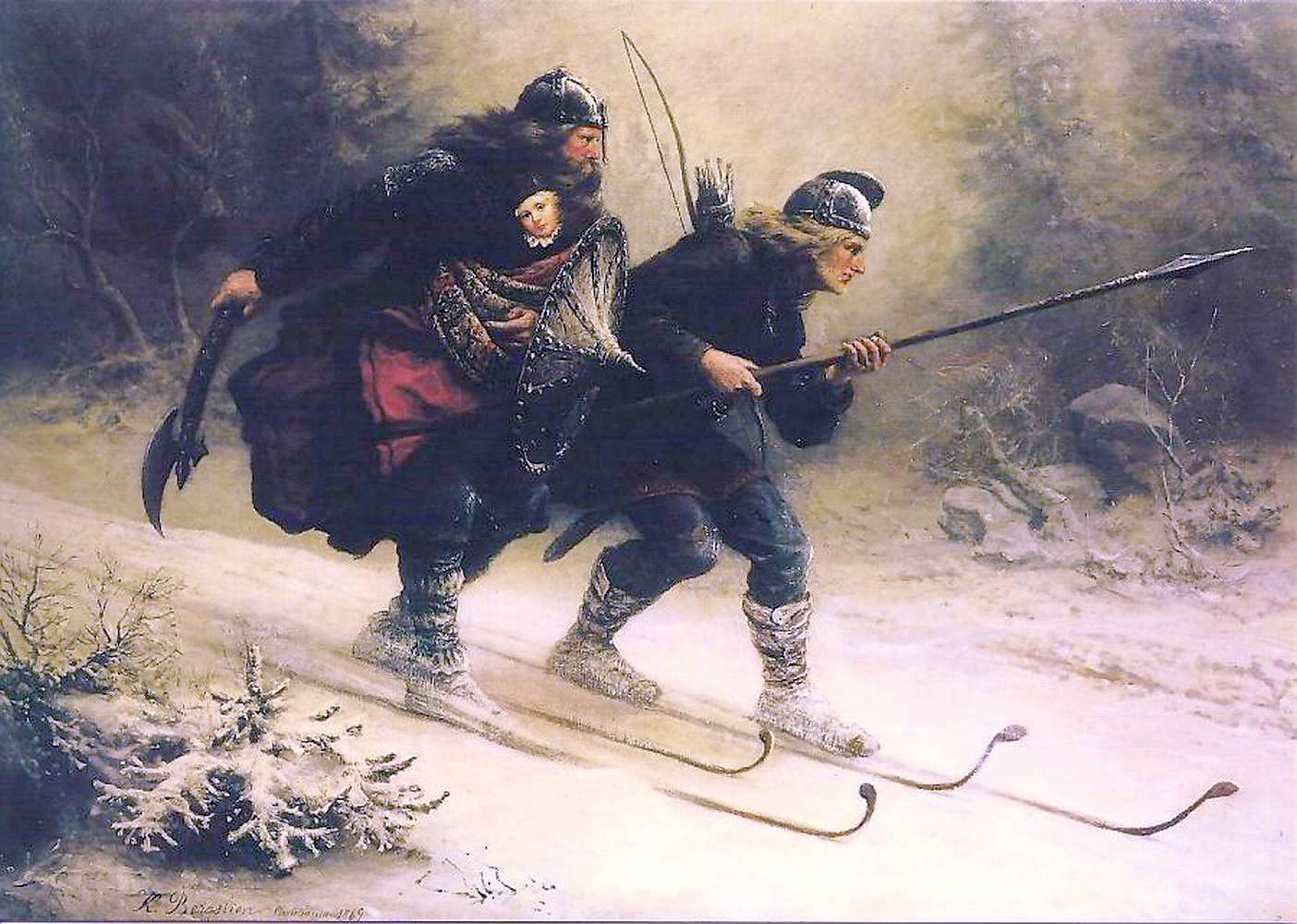
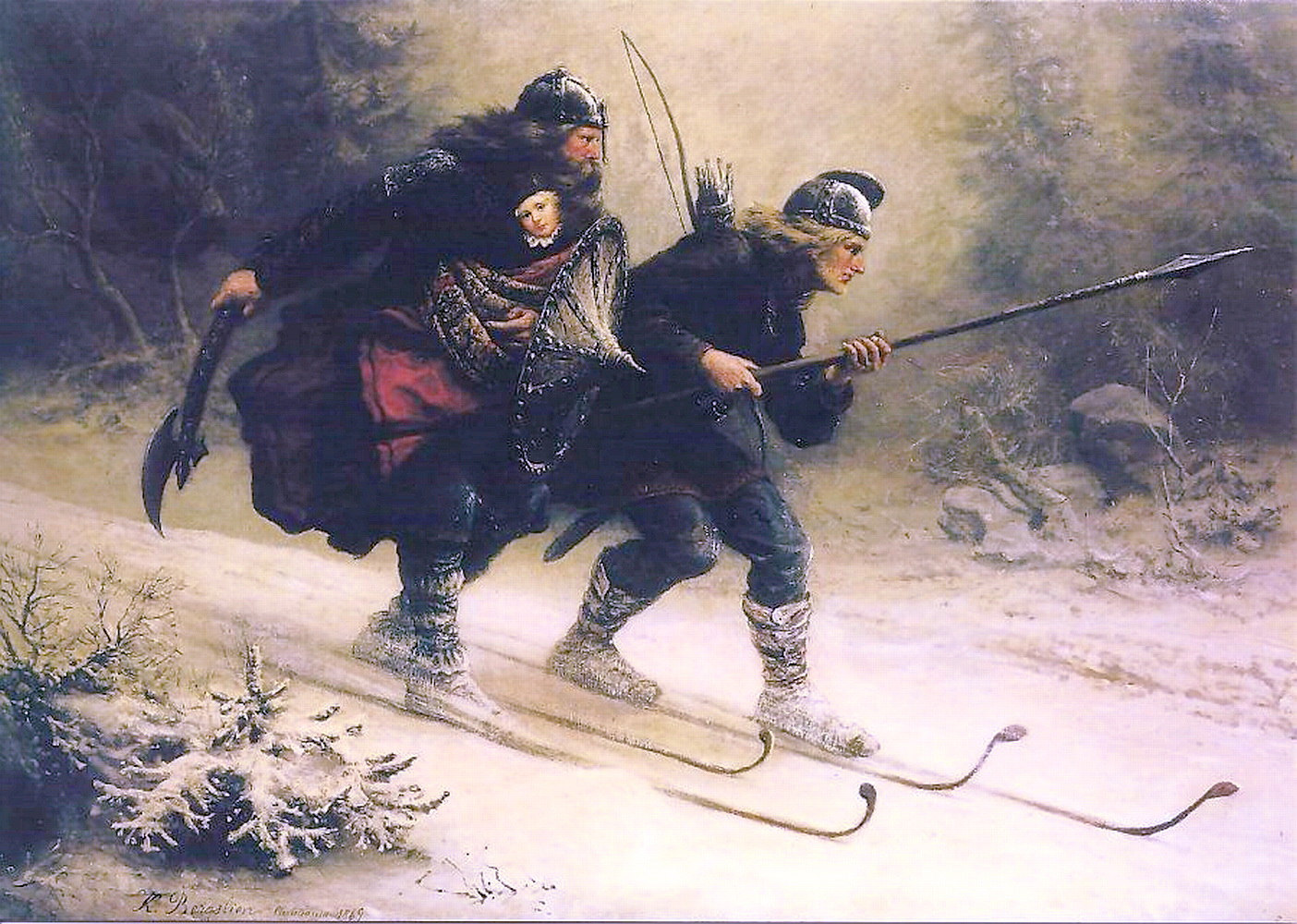
The story of the Birkebeiner is probably known to most ski fans, even in North America. In the year 1206, two warriors skied the infant prince Håkon Håkonsson over the mountains to safety, first to Lillehammer and then further north. The 54 kilometer race, first run in 1932, commemorates that journey, and participants must carry a 3.5 kg backpack (a little under eight pounds) to symbolize the weight of baby Håkon.
While the tie to Norwegian history is important, the race hasn’t always been as popular as it is now. The tradition was mainly of interest to Norwegians, and indeed to men. There wasn’t a women’s winner crowned until 1976; the first non-Norwegian man to take home the title was Sweden’s Sven-Åke Lundbäck in 1981.
And as recently as the early 2000’s, there were just over 10,000 participants per year. That number has swelled recently, which Bergsodden said was due to a number of things. One is that the race is much better organized than it was in the beginning, and, as he said, the staff focus on taking care of participants for their whole stay.
“I think we have a good race which attracts people in the way we do things,” he said in an interview in his office in downtown Lillehammer. “We have market reviews after every event we’ve done, so we know what people think about us and what has been going well and not so well. We have to improve the whole time.”
The Birkebeiner proper has now surpassed the Vasaloppet as the biggest ski race in the world; the Swedish 90-kilometer marathon is capped at 15,800 racers this year. Both events draw in many more participants with their other races throughout the week leading up to the title competitions, and Bergsodden confirmed that he and his counterparts at the Vasaloppet work together to share ideas and strategies.
For both, the increased number of events have been key to growth and success. The Birkebeiner also has a running race and a mountain biking race, which is the biggest in the world with over 15,000 finishers in recent years.
“We’re working on the concept of many races, and that will increase our numbers for the coming years, hopefully,” Bergsodden said.
While those events are scattered throughout the year, many are concentrated around the original Birkebeiner. For instance, 2013 will be the fifth year of the Birkebeiner Ski Festival, which starts the weekend before the Birkebeiner itself.
“On Saturday have the Inga-Låmi for women, which has about 3,500 participants, then on Sunday we have the youth race which also has about 2,000 participants,” Bergsodden said. “We have something called the half Birken, which is half the distance of the Birkebeiner, and then we have the children’s race.”
They’ve recently added two new formats as well. There is an open race on Friday, the day before the Birkebeiner, that appeals to less competitive skiers.
“We have timekeeping, the feed stations as on Saturday,” Bergsodden said. “That’s a little bit more calm and quiet, but just to take the challenge to pass over the mountains. For those who aren’t that focused on the timing and the Birkebeinermarke, the Friday could also be a nice day for a race – a way to do the race one day before when the tracks are still nice.”
The Vasaloppet also has this option, with both a Sunday and Monday “open track” for those who aren’t looking to win the real race or ski on the same day as the elite competitors. According to Bergsodden, the Friday race was well-received in its first outing and the organization hopes it will continue to grow, particularly for women, who represent only 20 % of the entrants in the Birkebeiner proper.
Another new event is the relay, which divides the length of the course into four parts.
“It’s for companies, and they also want to encourage their employees to do the race,” the director explained. “The shortest one is nine kilometers, and anyone can do that. So that’s also a way to get people into our races. This could be an introduction for them to do the whole race.”
Every once in a while, of course, there’s an idea that doesn’t work. One of these was the skate Birkebeiner, which was canceled after a few years for lack of interest in the classic-style country.
“We are an organization that works on getting events with big numbers,” Bergsodden said. “For us it is not worth it to organize a race with 100 participants – that’s for the local ski club.”
Cultural Touchstone
The Birkebeiner may be famous around the world, but it’s still a primarily Norwegian event. Only about 1,000 of the competitors are international, and it is Norway itself which has built the numbers up so quickly. Aside from new race formats and good organization, the newfound popularity is also partly due to changes in society and priorities in the country itself. Health and fitness are have become more of a focus for a larger segment of the population, for instance.
“The main reason why people get registered is to have a motivating goal for their training,” Bergsodden explained. “We have a society where we are sitting, and we are getting fatter. So it’s very important that we exercise, and I think people are more focused on this now, they are living healthy and have some training goals. And competitions are for sure a training goal… this was positive for us.”
That’s true across sports, not only in Norway but other countries, and it’s especially true for skiing, says Bergsodden. It’s easy to assume that since Norway is the sport’s origin and the country is so successful at the elite level, everyone in the small country must support and participate in the sport. That hasn’t always been true – and the many recreational skiers don’t necessarily race – but the sport is coming back, said the director.
And the Birkebeiner is a big part of that. It’s important to be able to tell friends and co-workers that one not only completed the race, but perhaps got the “mark” – a time calculated as an addition 20% of the time of the top five finishers in each age group.
Racers can also compare their times to the elite skiers that they see on TV throughout the winter. There’s a reason that Marit Bjørgen and Petter Northug have such lucrative careers, and it’s the fanbase in Norway; while neither have focused on the Birkebeiner, which usually conflicts with late-season World Cup racing, other Norwegian ski celebrities like Hilde Petersen, Odd-Bjørn Hjelmeset, and Anders Aukland have won in the last decade. When the marathon was incorporated into the World Cup calendar in 2002,
“Here you can compete with the best, because the elite skiers are also coming,” Bergsodden said. “So as a citizen skier you can compare with the World Cup skiers and see how you are doing. That is also important for a lot of the skiers.”
And besides World Cup skiers, marathon skiers are gaining more and more fans now that the Birkebeiner and other long-distance races are being broadcast on television around Europe.
“TV coverage is rather important for us,” Bergsodden said. “Before you had the World Cup skiing, but now we also have long-distance skiing, and that has been developing on TV. They’ve done a great job to show the races. It’s completely different from a World Cup race… it’s more focused in newspapers and in the media in general. Interest in cross country skiing in Scandinavia is increasing.”
This has been so thoroughly integrated into ski and training culture that some sponsoring companies have their employees take part. In these cases there is honor on the line. But, says Bergsodden, there’s also a big benefit.
“Companies use it as motivation for their employees,” he explained. “They’ve looked into it and the percentage of sick days are decreasing, so this is important. They are spending quite a bit of money on this, but they are saving money.”
Who Gets to Race?
With the race selling out in hours and some people who want to participate always denied, someone has to regulate the 17,000 people who do get to toe the starting line. Everything leading up to the start is organized carefully and systematically.
For instance, if a racer can’t start – maybe they end up having another commitment on Birkebeiner weekend – they don’t just lose their entry money. The organizers realized that it was important to work around this and offer the spot to someone else, without allowing scalping for entries.
“We start registration almost one year ahead,” Bergsodden said. “Many maybe get sick or get pregnant and can’t race, so we have a place on the website so that you can sell your place in the race. They are selling their place to someone else, and you have to pay a fee of 200 kroner to get the new registration.”
Entries are changed to the new name and even re-seeded. And that brings up something else: seeding. How do you start 17,000 racers in an organized fashion? 30 waves of skiers go off at five-minute intervals: “you start when you are expected to finish,” the director explained. A previous Birkebeiner time can be used for seeding, or any of the 15 or so races around Norway that are deemed seeding race. Times from other Worldloppet marathons are also eligible.
About 70 percent of participants have seeding times, and Bergsodden said that “it’s a lot of work” to divide them properly into waves, but there’s relatively little arguing with the system. It’s based on times in the seeding races and comparisons with times of other racers in both that specific race and the Birkebeiner the year before; place, for instance, is largely irrelevant.
The seeding system began around 2005, before which starts were based on age categories. The new system has fed into the sport’s growing presence in Norway.
“We changed that and at that time, the tours were decreasing in terms of participants,” Bergsodden said. “But after we started with the seeding competitions, they have been increasing. Some have doubled or tripled their numbers. This has been nice for cross country skiing in general.”
Running Smoothly
With thousands of competitors expecting a good weekend in Lillehammer and many Norwegians depending on the opportunity to vanquish their friends and co-workers in a ski race, it’s important that things go according to plan. Only once, in 2007, was the race canceled or cut short; on that occasion winds topped 50 miles per hour in the 1,000-meter tall mountains between Rena and Lillehammer.
Even that cancellation didn’t go over well in Norway. A small group of racers pushed on even though officials tried to force them to turn back, then gave interviews to the media criticizing the decision.
Weather isn’t something that organizers can control, but it’s also not something they worry about too much. Going over 1,000 meters in March this far north, for instance, means the race will be less sensitive to climate change than some other ski events. The weather has always varied, and will continue to do so.
“You can see the picture up there: the first winner of the Birkebeiner in 1932,” Bergsodden said, gesturing to a photo of a serious-looking Norwegian man skiing by a row of shouting spectators; dirt pokes up through the snow. “We can have some challenges with snow, but we are up in the mountains, so we’re pretty safe.”
Instead of planning for future warmer winters, organizers are focused on more concrete challenges.
“It’s much more than twice as much work, especially with transportation,” Bergsodden said of the point-to-point format. “We have no roads over the mountain, so they have to go 90 k around. To get the clothing before the people come to the finish line is hard… the background of the race is how to get the king’s son over the mountain. We can’t change that, but for us as organizers it would be much easier to have the start and finish in one place and also a lot cheaper way to organize things.”
(Luckily, it’s required to bring warmups in each racer’s backpacks, so there’s a guarantee of at least a warm jacket at the finish line.)
For that, the Birkebeiner relies on volunteers and the local ski clubs. Some are paid, not personally, but to the sports or civic organization that agree to donate members’ time. The 20 Birkebeiner competitions, drawing over 60,000 participants, require 7,000 volunteers. Luckily, Lillehammer and the surrounding region have a long history of hosting large sporting events, so there are many who are ready, willing, and knowledgeable to help.
That keeps things running smoothly for not only the race, but Birkebeiner week.
“We are looking into the whole stay, from when you come to Lillehammer until you leave,” Bergsodden said. “So it’s not only the race but the whole weekend because people are coming here and having a nice time.”
Click Here to access events and registration pages.
The American Birkebeiner Ski Foundation also announces that this year’s registration cap will be 10,000 participants total for all three races, an increase from last year.
“This increase is in line with our steady growth over time and especially over the last three years. In 2010 through 2012 alone, we set consecutive, all-time records each year for number of participants,” says Ned Zuelsdorff, Executive Director of the American Birkebeiner.
“In 2012 we also reached our cap earlier than ever before, a full three months before the event. This increase to 10,000 is a way to accommodate a few more skiers, especially as we get ready to celebrate our 40th Anniversary. It will be a big year for the Birkie and we want to include as many people who want to participate as possible. In carefully choosing the new cap, we’ve also made every assurance that each participant will again enjoy the highest quality Birkie experience.”
Many thanks to the following sponsors for their support of these events:
– Becker Law – Presenting Sponsor of the Birkie 54K Classic Race
– Marshfield Clinic, HaywardCenter – Presenting Sponsor of the 23K Kortelopet
– State Bank of Drummond and Norvado – Co-Sponsors of the 12K Prince Haakon
Registration is available online, or by mail or fax. Anyone interested in registering or who wants more information about the American Birkebeiner, can go to the Birkie’s website at www.birkie.com. Also feel free to call us at 715-634-5025, or emailbirkie@birkie.com.
HAYWARD, Wis. — One of three skiers to have raced every American Birkebeiner since its inception in 1973, David Landgraf, 62, died Monday in the hospital after being hit by a motorist while bicycling Friday evening.
Photo courtesy of brightroom / Action Sports International: David Landgraf races in his "Founders" bib at the 2011 American Birkebeiner Nordic ski race. Landgraf, 62, died Monday from injuries sustained when his bike was hit by a car. He was one of three men to have skied in every Birkie.
According to a press release from the American Birkebeiner Ski Foundation, Landgraf, of Bloomer, Wis., was hit by a car on Highway 27 in Hayward, the town where he finished 38 consecutive Birkebeiner ski races, a 50-plus kilometer trek starting in Cable.
A report from the Sawyer County Sheriff’s Department stated that Landgraf was struck from behind by Anna Amparo, 24, of Hayward, who looked back to talk to her two children. She turned around to see Landgraf, but was unable to swerve in time.
Landgraf’s storied skiing history began with the Birkie, when his friend Ernie St. Germaine convinced him to do the inaugural marathon with him, according to the Associated Press. He prepared by skiing in a parking lot.
Ten years later, Birkebeiner founder Tony Wise recognized the 10 original skiers who had started and stuck with the event as “Founders”. Landgraf, St. Germaine and another friend John Kotar, now on the event’s board of directors, were among them.
The three upheld the tradition, making it to every winter Birkie, some which drew close to 10,000 skiers. They would meet at the banquet before each race and share memories, St. Germaine said in an AP interview.
“I hope to take all of those things he did to inspire me … and I’m going to do my best to live them,” St. Germaine said. “He was a year younger than me, but ultimately, he was my hero.”
The youngest of the “Founders,” Landgraf consistently placed in the men’s top 200. Earlier this year, he finished in 2 hours, 43 minutes for second place in his age group and 468th overall. Landgraf also competed internationally and claimed U.S. Master’s Championship titles, according to the Birkie press release.
“He was an amazing person and part of the very fabric of the Birkie,” Executive Director Ned Zuelsdorff said in the press release. “To see Dave in that lone, red Founder’s bib, coming across the finish line with men many years his junior, is just a testament to Dave’s spirit as a person and an athlete. He represented something very special to so many skiers.”
A retired physical education teacher, Landgraf taught at Bloomer Middle School and coached children and adults in Nordic skiing.
In a 2004 interview, he told the Milwaukee Journal Sentinel that the Birkie changed his life.
“I ski as much as I can and I try to stay in shape in the offseason,” Landgraf said. “I’m always racing against myself to see how good I can do. I try to take everything in and try to enjoy the race and the people (and) the festivities afterward.”
He said he was a recreational cyclist who liked to bike in his hometown on paved roads with little traffic.
Landgraf’s death is the sixth cycling fatality in Wisconsin since July 1, the Sentinel reported. At least four of those involved a rider being struck from behind.
Dave Schlabowske, a spokesman for the Bicycle Federation of Wisconsin, told the Sentinel that cycling remains a safe activity. Every year, 2.5 million people ride bikes in Wisconsin, and the death rates are much lower than that of motors and people walking down stairs. An average of 11 cyclists die from collisions with motorists each year.
“Despite the fact that riding a bike is still very safe, the recent spate of crashes, those that appear to be due to inattentive driving, should remind us all what a tremendous responsibility it is to drive a car,” Schlabowske said.
“The potential is always there for tragedy, and it’s really our responsibility to drive with the respect that it deserves and really focus on what we should be focusing on.”
From the Birkie website: “A celebration of Dave’s life will be held at 11:00 am on Saturday, August 13, at the Bloomer Middle School Gym in Bloomer, WI, with lunch following in the cafeteria. In lieu of flowers, donations may be sent to Bank Mutual in Bloomer for the Bloomer Track Program or Ski Strong, or to the Chippewa Valley United Way.”
As a reward to the dealers who were able to sell the most Swix Triac poles and Fischer RCS Carbonlite boots a contest was organized; to the winners a trip to Norway. First a few days in Lillehammer then down to Oslo for the World Championships.
Come on New Jersey
On Monday the nine dealers from all over the United States were supposed to converge in Newark to catch the same flight to Oslo, Norway. That seemed like a fairly easy task until bad weather moved into New Jersey, flights were canceled, delayed several hours, bags were lost and David Peterson (The Ute Mountaineer, Aspen, CO) even got rerouted through Heathrow. Eventually though we all met up in Oslo and headed to Lillehammer.
After a quick stop at our hotel, we were off to lunch at Nicker’s downtown to watch the men’s 15km classic race that was going on back down in Oslo. After watching the race, eating and possibly enjoying a few adult beverages the group headed back to the hotel to check-in to our rooms an change up for a little ski.
Part of the group poses for a picture along side of the final kilometers of the Norwegian Birkebeiner. From left to right; Dave Greer (Paco's), Eli Brown (Brick Wheels), Spike Clayton (Ski Rack), Bert Hinkley (WebSkis), Bob Rosso (Elephant Perch) and Matt Voisin (FasterSkier). Lillehammer, Norway.
Where it all happened
Birkebeineren Ski Stadium, Lillehammer, Norway. Home to most of the Nordic events at the 1994 Olympic Games.
The afternoon ski was a treat in itself as we headed up to the Birkebeineren Ski Stadium which was home to most of the Nordic events at the 1994 olympic games in Lillehammer. While skiing around it was hard not to imagine the same space crowded with thousands of Norwegians cheering on Bjorn Daehlie as he raced Silvio Fauner to the line only to be silenced by the Italian in the men’s 4×10 relay (YouTube video).
The group enjoyed both the more gentle terrain that was the final kilometers of the Norwegian Birkebeiner as well as the much more challenging trails of the Olympic course, where we all tried to keep up with the surges of Eli Brown (Brick Wheels, Traverse City, MI) and Bob Rosso (Elephants Perch, Ketchum, ID).
After skiing for an hour and a half we headed back to the hotel to freshen up and head to dinner downtown at Pepe’s Pizza. Then most everyone headed to bed after a long day of traveling and skiing.
Bacon Ost
Bacon Ost, coming to friendly bets in US ski communities next week.
In the morning we were all treated to a spread of typical Norwegian breakfast foods. If you are friends with someone on the trip there is a good possibility that you will be presented with some Bacon Ost upon their return home.
It is important that they are sober
After breakfast the group headed to the Swix Factory for a tour from the legendary Harald Bjerke. It was amazing to see how so few workers are able to run the entire wax production. When asked about it Bjerke commented that, “it is just like cooking, you just follow the recipe, but it is important that they are sober.”
After the tour, Bjerke gave a powerpoint presentation about the history of Swix and developments along the way, including wax and poles – all of which included anecdotes.
The group about to head out to ski on the Birkebeiner race course lead by Swix's Eivind Opsahl.
Hitting the Birkebeiner race course
From there the group got changed up back at the hotel and headed up to the Birkebeiner trails. As we worked our way backwards along the course we were treated with four classic tracks each separated by a skate lane, all of which was groomed to perfection. Our turnaround point was about 8km out at the highpoint of the course which is 910 meters above sea level. We skied the rolling and mostly flat terrain back to were we started, from there most of us decided it would be fun to ski the remaining fifteen kilometers to the finish of the Birkie and then drop down the hill to our hotel. Although there was a climb here and there, for the most part it was all down and at times quite so.
Midtfjellet: Highpoint of the Norwegian Birkiebeiner at 910 meters.
Dinner at a restaurant called The Cave was amazing and gave way to a ‘few’ hours of socializing with Eivind and some other Lillehammer locals.
Meeting Ulf Bjerknes
Ulf Bjerknes, President of Swix Sport.
Let’s just say the early morning departure was hard for some who were going on little sleep, but two and a half hours later we were back in Oslo at Swix’s main office to meet the company’s president Ulf Bjerknes and pole production manager Svein Pedersen. Bjerknes gave an interesting presentation about what the company is working on; from the production and growth of their apparel line to the challenges that exist in different countries.
Pedersen talked about the innovations in their pole line and the difficulties of always looking for something lighter, stiffer, stronger and with an improved swing.
Drammen Testing
After that it was time to head to our new hotel in downtown Oslo to meet similar dealer groups from Germany and Sweden. From there it was off to Drammen to test those ‘black’ skis that are Fischer’s new line for the 2011/12 season on the World Cup race course. Although most of the dealers had already tested the line at the SIA show at Devil’s Thumb Ranch last month it was still a great opportunity to provide feedback to some of Fischer’s top employees. On a whole the new skis were just what you would expect from Fischer; light, solid, stable and of course fast and the graphics look even more impressive in person than what you may have already seen on the web.
The highlight of the ski in Drammen was that Fischer had arranged for all the dealers to get personal lessons from Jon Nordby, who is one of the top club coaches in all of Norway and his son Sindre Wiig Nordby, who is rising the ranks and is now just off the national team. Sindre, you may recall, may be best known in the United States for showing up on JohnnyKlister doing his skier imitation.
[A video of him doing his best Michael Jackson impersonation on skis is coming soon, so check back later today.]
Now we head to Mecca
All the dealers would agree that this trip has been amazing and that everyday has brought something new and better than the best from the day before, but today, today we head up the hill to the ‘Kol’, today we go to the World Championships at the Holmenkollen, it does not get any bigger.
Swix Sport USA’s Andy Canniff captured some great moments in the 2011 American Birkebeiner with his camera. Here is a selection for you to enjoy.
Tore Martin Gundersen (NOR) celebrates his 2011 American Birkebeiner victory.
Caitlin Compton (CXC) holding off Morgan Smyth (APU).
Caitlin Compton (CXC) charges down the final stretch.
Main Street in Hayward welcomes home the top men in the skate race.
Tore Martin Gundersen pumps the air in celebration.
Caitlin Compton (CXC) comes to the line to please the Birkie crowd.
Caitlin Compton (CXC) raises her arms as Birkie skate champion.
Jennie Bender celebrating her Birkie classic victory. Photo: Andy Canniff.
Tore Martin Gundersen in post race interviews.
Women’s Podium: Morgan Smyth (USA/APU, 2nd place), Caitlin Compton (USA/CXC) and Evelyn Dong (USA/XC Oregon).
The 2011 American Birkebeiner men’s podium (from left to right): with France’s Benoit Chauvet in second, Norway’s Tore Martin Gundersen in first and Russia’s Andrey Tyuterev in third. (Photo: Andy Caniff/Swix Sport USA)
2011 American Birkebeiner champion, Tore Martin Gundersen, poses for pictures.
You can be cold and still feel good, as seen here at the 2011 American Birkebeiner.
Today- Mostly Sunny throughout the day with a forecasted high of 25ºF.
Tonight- Mostly Cloudy with a low of 4ºF. Calm wind.
Friday Feb. 25th- Mostly Cloudy with a 20% chance of snow showers. Forecasted high of 14ºF. North wind of 5 mph.
Friday Night- Mostly Cloudy with a 20% of snow showers. Forecasted low of -4ºF. Calm wind.
Saturday Feb. 26th- Mostly Cloudy with 20% of snow showers. Forecasted high of 16ºF. Southwest wind of 5 mph
COURSE CONDITIONS-UPDATED
The track has a hard base with 2 inches of fresh snow on top. The snow is relatively clean, given the freeze/thaw cycle of last week and the track will consist of mostly fresh snow crystals (type 2 in the Swix Classification System). Because of this, the 6 and 7 waxes in the Swix Cera Nova Wax System are running very fast.
UPDATED WAX RECOMMENDATION
FAST LANE TO HAYWARD Waves Elite & 1-5
Base HF wax layers:
Apply one layer of NEW Swix Marathon Wax- DHF104BW. The Marathon Wax is a highly durable wax for aggressive snow crystals and has a High Flouro content and BW additive to resist dirt. Iron at 140ºC, let cool 4-6 minutes, then scrape and brush using first the Swix Fine Steel Brush- T0192 then the Swix Ultra Fine Steel Brush- T0191. Using both brushes properly removes all excess wax and reveals ski base structure. Polish with Swix Blue Nylon Brush- T0160.
Apply one layer of Swix HF6. Iron at 140ºC, let cool 4-6 minutes, then scrape and brush using above method.
Race Cera F layer:
Apply Swix FC7 Cera F Powder. Iron in with one pass (5-7 seconds) with iron temperature at 160ºC. Let cool 3-5 minutes, then brush up the ironed in powder using Swix Black Nylon Brush- T0194. Iron a second time using the same process. Let cool 5 minutes. Brush out with Swix Wild Boar Brush- T0164 and polish with Swix Blue Nylon Brush.
FAST LANE TO HAYWARD Waves 6-10
Base HF wax layers:
Apply one layer of NEW Swix Marathon Wax- DHF104BW. The Marathon Wax is a highly durable wax for aggressive snow crystals and has a high Flour content and BW additive to resist dirt. Iron at 140ºC, let cool 4-6 minutes, then scrape and brush using first the Fine Steel Brush- T0192 then the Ultra Fine Steel Brush- T0191. Using both brushes properly removes all excess wax and reveals ski base structure. Polish with Swix Blue Nylon Brush- T0160.
Apply one layer of Swix HF7. Iron at 135ºC, let cool 4-6 minutes, then scrape and brush using above method.
Race Cera F layer:
Apply Swix FC78 Super Cera F Powder. Iron in with one pass (5-7 seconds) with iron temperature at 165ºC. Let cool 3-5 minutes, then brush up ironed in powder using Black Nylon Brush- T0194. Iron a second time using the same process. Let cool 5 minutes. Brush out with Wild Boar Brush- T0164 and polish with Blue Nylon Brush.
PERFORMANCE PRO Waves 1-5
Base HF wax layers:
Apply two layers of Swix HF6. Iron each layer at 140ºC, let cool 4-6 minutes, then scrape and brush throughly using the Fine Steel Brush- T0192 first, then the Ultra Fine Steel Brush- T0191 second. Polish with the Blue Nylon- T0160.
Race Cera F layer:
Apply Swix FC7WS Turbo Solid Block. Rub on one thick layer and iron in at a temperature of 160ºC with one quick pass tip to tail. Let cool 5 minutes and brush out with Wild Boar Brush- T0164, then polish with Blue Nylon. Run on a second layer and hand cork in with Swix Natural Cork- T0020 or T0021. Brush out with Wild Boar then polish with Blue Nylon.
PERFORMANCE PRO Waves 6-10
Base HF wax layers:
Apply two layers of Swix HF7. Iron each layer at 130ºC, let cool 4-6 minutes, then scrape and brush throughly using the Fine Steel Brush- T0192 first, then the Ultra Fine Steel Brush- T0191 second. Polish with the Blue Nylon- T0160.
Race Cera F layer:
Apply Swix FC7WS Turbo Solid Block. Rub on one thick layer and iron in at a temperature of 160ºC with one quick pass tip to tail. Let cool 5 minutes and brush out with Wild Boar Brush- T0164, then polish with Blue Nylon. Run on a second layer and hand cork in with Swix Natural Cork- T0020 or T0021. Brush out with Wild Boar then polish with Blue Nylon.
PERFORMANCE Waves 1-5
Base LF wax layer:
Apply one layer of Swix LF4. Iron at 150ºC, let cool 4-6 minutes, then scrape and brush throughly using the Swix Fine Steel Brush- T0192. Polish with the Blue Nylon Brush- T0160.
Race HF wax layers:
Apply two layers of Swix HF7. Iron at 130ºC, let cool 4-6 minutes, then scrape and brush throughly using the Fine Steel Brush, then polish with the Blue Nylon. Repeat the process.
PERFORMANCE Waves 6-10
Base LF wax layer:
Apply one layer of Swix LF6. Iron at 140ºC, let cool 4-6 minutes, then scrape and brush throughly using Swix Fine Steel Brush- T0192. Polish with the Blue Nylon Brush- T0160.
Race HF wax layers:
Apply two layers of Swix HF7. Iron at 130ºC, let cool 4-6 minutes, then scrape and brush throughly using Swix Fine Steel Brush- T0192. Polish with the Blue Nylon Brush- T0160. Repeat the process.
Kick Wax will be Updated Thursday Night
As the race is still 4 days away, it is difficult to predict the exact kick wax for the Birkie. There are two main options that are possible based on the developing weather: hardwax binder and hardwax race kick wax or klister binder and hardwax race kick wax. See the details below for the recommended waxes on both options. Swix will be at the Expo for waxing advice, tips and clinics.
KICK ZONE PREPARATION
Remove old kick wax with a kick wax scraper and clean the kick zone with Swix Wax Remover and Swix Fiberlene. Let the base dry. Use 80 or 100 grid sandpaper and texture the kick zone by sanding the zone in a manner parallel to the groove in the ski base. The Swix T0011 Cork and Sandpaper combi tool is ideal for this process. A typical adult kick zone is 65-75cm from the back of heel forward. A typical adult klister zone is 60-65cm from the front of the heel forward.
BASE KICK WAX-Hardwax binder (if the surface is mainly fresh snow)
Apply one (1) solid and even layer of Swix VG35 Base Wax. Iron in at 110ºC. The binder should have a smooth and even consistency after ironing. Smooth out any lumps with a thumb or cork. Make sure that the binder layer in the front and the back of the kick zone makes a smooth and gradual transition with the glide zone. Let cool 5-10 minutes outdoors. Apply one (1) layer of Swix V40 Blue Extra. Cork smooth.
BASE KICK WAX– Klister binder (if no new snow is present)
Apply one (1) thin, even layer of Swix KB020 Base Klister Spray. Smooth even with a thumb or cork. Let cool 5-10 minutes outdoors. Apply one (1) thin, even layer of KR35 Violet Special Klister. Use an iron set at 110ºC to smooth even. Let cool 5-10 minutes outdoors. The klister layer should be hard and leave a finger print when touched. Apply two (2) thin layers of Swix VR30. Cork very smooth and be gentle when corking. It is best to cork the hardwax layers outdoors, to keep the wax from becoming too warm. For Waves 6-10, use VR40. These skis are ready to race on!
RACE KICK WAX- For Hardwax Binder
Waves Elite & 1-5: Apply 5-7 thin layers of Swix VR30. Cork smooth. If added kick is needed, add one layer of VR40 underneath the foot to 15cm in front of the binding. It is recommended to cork outdoors to keep the wax cold.
Waves 6-10: Apply 5-7 thin layers of Swix VR40. Cork smooth. If added grip is needed, add one layer of VR45 underneath the foot to 15cm in front of the binding. It is recommended to cork outdoors.
Stay Tuned with Updates at Birkie Expo, SwixRacing.us, & Facebook/SwixNordic
FORECAST
Thursday Feb. 24th- Mostly Sunny throughout the day with a forecasted high of 28ºF.
Thursday Night- Mostly Cloudy with a low of 8ºF. North wind between 5-10 mph.
Friday Feb. 25th- Cloudy with a 20% chance of snow showers. Forecasted high of 19ºF.
Friday Night- Mostly Cloudy with a slight chance of snow showers. Forecasted low of -4ºF.
Saturday Feb. 26th- Mostly Cloudy with slight chance of snow showers. Forecasted high of 17ºF.
COURSE CONDITIONS
The track should be hard and compact. Snow crystals will be a mix of some new and fresh snow crystals (types 1 and 2 in the Swix Classification System), along with mostly old, transformed snow crystals (type 3) making up the majority of the snow crystals in the track . Tilling should mix these snow crystals together. The snow will be abrasive with some dirt present in the snow pack, due to the freeze/thaw cycle of last week.
WAXING CONSIDERATIONS
1. Base Preparation
Clean glide zones with Swix Base Prep 99- BP99 using the “hot scrape” method. Scrape the BP-99 while still molten with a sharp, clean plastic wax scraper- T0824D. Let the skis cool, then brush out the skis with Swix Fine Steel Brush- T192. This will open the base pores of the ski.
If you will be using or use Swix Cera F and or Swix HF waxes, we recommend using Swix Cleaner for Flour Glide Wax and Conditioner- I0084. Wipe the base with I84 using a piece of Fiberlene. While the base is still wet, brush and scrub from tip to tail with a Swix Nylon White Brush- T0161. Using a new, clean piece of Fiberlene, wipe the ski base clean and let dry for 5-7 minutes, then brush with the Swix Ultra Fine Steel Brush- T191. The very fine steel bristles of this brush throughly clean the base structure of the ski base.
2. Durability
Given the length of the race and the aggressive nature of the snow crystals on the race track, it will be important to build strong and solid base layers into the ski base, prior to the HF and Cera F wax layers. The first step is to use Swix Moly Flouro Wax- MB77. Apply one layer of MB77, let cool then scrape and brush. Brush with the Fine Steel Brush, then polish with the Swix Blue Nylon Brush- T0160
Next, apply one layer of Swix LF4, scrape and brush, using the same method as the MB-77. NOTE- because LF4 is a hard glide wax, it is possible and recommended to scrape this wax while it is still warm to the touch.
Ski Selection and Structure
Expect the race track and snow to be firm. Use a medium to stiff flex ski that will be stable in hard pack snow conditions. Fine to medium fine base structures will work well. If you need to add structure, use the Swix T0403 Economy Structure tool with the 0.3mm Broken-V structure roller. Apply the 0.3mm Broken-V structure roller after final waxing and brush with Swix Blue Nylon Brush- T0160
FAST LANE TO HAYWARD Waves Elite & 1-5
Base HF wax layers:
Apply one layer of NEW Swix Marathon Wax- DHF104BW. The Marathon Wax is a highly durable wax for aggressive snow crystals and has a High Flouro content and BW additive to resist dirt. Iron at 140ºC, let cool 4-6 minutes, then scrape and brush using first the Swix Fine Steel Brush- T0192 then the Swix Ultra Fine Steel Brush- T0191. Using both brushes properly removes all excess wax and reveals ski base structure. Polish with Swix Blue Nylon Brush- T0160.
Apply one layer of Swix HF4BW. Iron at 150ºC, let cool 4-6 minutes, then scrape and brush using above method.
Race Cera F layer:
Apply Swix FC7 Cera F Powder. Iron in with one pass (5-7 seconds) with iron temperature at 160ºC. Let cool 3-5 minutes, then brush up the ironed in powder using Swix Black Nylon Brush- T0194. Iron a second time using the same process. Let cool 5 minutes. Brush out with Swix Wild Boar Brush- T0164 and polish with Swix Blue Nylon Brush.
FAST LANE TO HAYWARD Waves 6-10
Base HF wax layers:
Apply one layer of NEW Swix Marathon Wax- DHF104BW. The Marathon Wax is a highly durable wax for aggressive snow crystals and has a high Flour content and BW additive to resist dirt. Iron at 140ºC, let cool 4-6 minutes, then scrape and brush using first the Fine Steel Brush- T0192 then the Ultra Fine Steel Brush- T0191. Using both brushes properly removes all excess wax and reveals ski base structure. Polish with Swix Blue Nylon Brush- T0160.
Apply one layer of Swix HF6BW. Iron at 140ºC, let cool 4-6 minutes, then scrape and brush using above method.
Race Cera F layer:
Apply Swix FC78 Super Cera F Powder. Iron in with one pass (5-7 seconds) with iron temperature at 165ºC. Let cool 3-5 minutes, then brush up ironed in powder using Black Nylon Brush- T0194. Iron a second time using the same process. Let cool 5 minutes. Brush out with Wild Boar Brush- T0164 and polish with Blue Nylon Brush.
PERFORMANCE PRO Waves 1-5
Base HF wax layers:
Apply two layers of Swix HF4BW. Iron each layer at 150ºC, let cool 4-6 minutes, then scrape and brush throughly using the Fine Steel Brush- T0192 first, then the Ultra Fine Steel Brush- T0191 second. Polish with the Blue Nylon- T0160.
Race Cera F layer:
Apply Swix FC7WS Turbo Solid Block. Rub on one thick layer and iron in at a temperature of 160ºC with one quick pass tip to tail. Let cool 5 minutes and brush out with Wild Boar Brush- T0164, then polish with Blue Nylon. Run on a second layer and hand cork in with Swix Natural Cork- T0020 or T0021. Brush out with Wild Boar then polish with Blue Nylon.
PERFORMANCE PRO Waves 6-10
Base HF wax layers:
Apply two layers of Swix HF6BW or HF6. Iron each layer at 140ºC, let cool 4-6 minutes, then scrape and brush throughly using the Fine Steel Brush- T0192 first, then the Ultra Fine Steel Brush- T0191 second. Polish with the Blue Nylon- 0160.
Race Cera F layer:
Apply Swix FC7WS Turbo Solid Block. Rub on one thick layer and iron in at a temperature of 160ºC with one quick pass tip to tail. Let cool 5 minutes and brush out with Wild Boar Brush- T0164, then polish with Blue Nylon. Run on a second layer and hand cork in with Swix Natural Cork- T0020 or T0021. Brush out with Wild Boar then polish with Blue Nylon.
PERFORMANCE Waves 1-5
Base LF wax layer:
Apply one layer of Swix LF4. Iron at 150ºC, let cool 4-6 minutes, then scrape and brush throughly using the Swix Fine Steel Brush- T0192. Polish with the Blue Nylon Brush- T0160.
Race HF wax layers:
Apply two layers of Swix HF4BW. Iron at 150ºC, let cool 4-6 minutes, then scrape and brush throughly using the Fine Steel Brush, then polish with the Blue Nylon. Repeat the process.
PERFORMANCE Waves 6-10
Base LF wax layer:
Apply one layer of Swix LF6. Iron at 140ºC, let cool 4-6 minutes, then scrape and brush throughly using Swix Fine Steel Brush- T0192. Polish with the Blue Nylon Brush- T0160.
Race HF wax layers:
Apply two layers of Swix HF6BW or HF6. Iron at 140ºC, let cool 4-6 minutes, then scrape and brush throughly using Swix Fine Steel Brush- T0192. Polish with the Blue Nylon Brush- T0160. Repeat the process.
KICK WAX APPLICATION
As the race is still 4 days away, it is difficult to predict the exact kick wax for the Birkie. There are two main options that are possible based on the developing weather: hardwax binder and hardwax race kick wax or klister binder and hardwax race kick wax. See the details below for the recommended waxes on both options. Swix will be at the Expo for waxing advice, tips and clinics.
KICK ZONE PREPARATION
Remove old kick wax with a kick wax scraper and clean the kick zone with Swix Wax Remover and Swix Fiberlene. Let the base dry. Use 80 or 100 grid sandpaper and texture the kick zone by sanding the zone in a manner parallel to the groove in the ski base. The Swix T0011 Cork and Sandpaper combi tool is ideal for this process. A typical adult kick zone is 65-75cm from the back of heel forward. A typical adult klister zone is 60-65cm from the front of the heel forward.
BASE KICK WAX- Hardwax binder (if the surface is mainly fresh snow)
Apply one (1) solid and even layer of Swix VG35 Base Wax. Iron in at 110ºC. The binder should have a smooth and even consistency after ironing. Smooth out any lumps with a thumb or cork. Make sure that the binder layer in the front and the back of the kick zone makes a smooth and gradual transition with the glide zone. Let cool 5-10 minutes outdoors. Apply one (1) layer of Swix V40 Blue Extra. Cork smooth.
BASE KICK WAX– Klister binder (if no new snow is present)
Apply one (1) thin, even layer of Swix KB020 Base Klister Spray. Smooth even with a thumb or cork. Let cool 5-10 minutes outdoors. Apply one (1) thin, even layer of KR35 Violet Special Klister. Use an iron set at 110ºC to smooth even. Let cool 5-10 minutes outdoors. The klister layer should be hard and leave a finger print when touched. Apply two (2) thin layers of Swix VR30. Cork very smooth and be gentle when corking. It is best to cork the hardwax layers outdoors, to keep the wax from becoming too warm. For Waves 6-10, use VR40. These skis are ready to race on!
RACE KICK WAX- For Hardwax Binder
Waves Elite & 1-5: Apply 5-7 thin layers of Swix VR30. Cork smooth. If added kick is needed, add one layer of VR40 underneath the foot to 15cm in front of the binding. It is recommended to cork outdoors to keep the wax cold.
Waves 6-10: Apply 5-7 thin layers of Swix VR40. Cork smooth. If added grip is needed, add one layer of VR45 underneath the foot to 15cm in front of the binding. It is recommended to cork outdoors.