From the FasterSkier archive — posts syndicated from athletes’ and coaches’ own blogs between 2004 and 2012, kept online as published. Current coverage is at fasterskier.com.

Tag: Bjoern Daehlie

  • Klaebo Is Coming to Lake Placid

    Klaebo Is Coming to Lake Placid

    This coverage is made possible through the generous support of Marty and Kathy Hall and A Hall Mark of Excellence Award. To learn more about A Hall Mark of Excellence Award, or to learn how you can support FasterSkier’s coverage, please contact info@fasterskier.com.

    Johannes Hoesflot Klaebo (NOR) took all six gold medals awarded in men’s cross-country skiing at the Olympics last month. (Photo: Barbieri/NordicFocus)

    Johannes Hoesflot Klaebo made the call late Tuesday night… he’s racing.

    According to the Scandinavian press, Klaebo departed Oslo’s Gardermoen airport at 6:25 Wednesday morning, beginning a roughly 20-hour journey to Lake Placid, where he’ll arrive about a day and a half before Friday’s 10-kilometer classic interval start. The Norwegian Ski Federation confirmed the news in a press release on Wednesday morning.

    “I can see this isn’t going to be an optimal buildup, both with the long travel and not being able to adjust to the time difference,” Klaebo said. “But I want to be part of the World Cup finale in the USA.”

    The decision came after Klaebo did a training session on Tuesday morning in Trondheim and responded well. National team doctor Ove Feragen gave him the green light.

    Ben Ogden (USA) checks on Johannes Hoesflot Klaebo (NOR) after their crash eliminated them from the race in Drammen, Norway. (Photo: Nordnes/NordicFocus)

    “After the fall during the sprint in Drammen, and some quiet days at home, Johannes has gradually resumed training and normal activity,” Feragen said. “He has responded well to this, without any recurring symptoms after the fall. After observation and further examinations, we have concluded that he is fit to compete.”

    Klaebo has been sidelined since March 12, when American Ben Ogden fell across the Norwegian’s skis during Classic Sprint semifinals in Drammen, Norway. The resulting crash sent Klaebo’s head into the hard-packed snow. He was diagnosed with a mild concussion, withdrew from the Holmenkollen 50k, and scrapped a planned media tour in New York City that included sit-downs with CNN, NBC, the New York Times, and the Wall Street Journal.

    Now the question shifts from whether Klaebo will race to how much he’ll race. He’s not committing to the full program.

    Harald Oestberg Amundsen (NOR), Johannes Hoesflot Klaebo (NOR), and Martin Loewstroem Nyenget (NOR), (l-r) share the Skiathlon podium in Falun, Sweden, on March 1st, 2026. (Photo: Thibaut/NordicFocus.)

    “My expectations for performance are not sky-high,” Klaebo said. “I’ll do my best despite a poor buildup and potential jet lag. Whether I race one, two, or three events in Lake Placid, I’ll decide once I get to the USA and get skis on my feet.”

    The stakes are real despite the measured tone. Klaebo has already clinched the overall World Cup — his sixth, tying Bjoern Daehlie — and the sprint globe. But he trails Harald Oestberg Amundsen by three points in the distance standings after missing the Holmenkollen 50k. Two distance events remain: Friday’s 10 k Classic and Sunday’s 20k Freestyle Mass Start. A clean sweep of the overall, sprint, and distance globes would be a first in Klaebo’s career.

    “For cross-country skiing, it’s especially important to have World Cups in the USA,” Klaebo said. “I’ve been looking forward to this finale for a long time.”

    Racing begins Friday at Mt. Van Hoevenberg. Klaebo will be on the start line — jet lag and all.


    Love Stories Like This? Help Keep Them Coming.

    Feature stories like this one take time, access, and care to produce. If you value thoughtful storytelling and independent ski journalism, please consider becoming a Voluntary Subscriber. Your support directly fuels the work we do to cover the people, places, and moments that make our sport special.

    Join the FasterSkier community!


    Ben Ogden (USA) and Johannes Hoesflot Klaebo (NOR), along with Oskar Opstad Vike (NOR), (l-r) on the Olympic sprint podium last month.  It should be made clear that Ogden and Klaebo have a strong respect for one another, to say the least. (Photo: Vanzetta/NordicFocus)
  • Klaebo’s Lake Placid Decision Day Is Today

    Klaebo’s Lake Placid Decision Day Is Today

    This article was made possible through the generous support of our voluntary subscribers. If you value coverage like this, please support FasterSkier with a voluntary subscription.

    Fans from across the United States who will be in Lake Placid are anxiously hoping Johannes Hoesflot Klaebo (NOR) is well enough to travel and race in Lake Placid this weekend. (Photo: Authamayou/NordicFocus)

    Johannes Hoesflot Klaebo has been included in Norway’s 22-athlete squad for this week’s World Cup finals at Mt. Van Hoevenberg in Lake Placid, N.Y., BUT the six-time Olympic gold medalist’s participation hinges on a decision being made today.

    Klaebo, 29, suffered a mild concussion in a dramatic crash during the sprint semifinals at last Thursday’s World Cup in Drammen. American sprinter Ben Ogden lost his footing on the icy course and fell across Klaebo’s skis, sending the Norwegian backward and slamming the back of his head into the hard-packed snow. Klaebo lay on the ground for several minutes before being helped off course and transported to a hospital for evaluation.

    The Norwegian Ski Federation confirmed the concussion diagnosis on Friday, and Klaebo withdrew from Saturday’s 50-kilometer race at Holmenkollen.

    “He shall make an evaluation together with the national team doctor on Tuesday and would potentially travel on Wednesday,” Klaebo’s manager, Lasse Gimnes, told Norwegian broadcaster NRK on Monday. If cleared by national team doctor Ove Feragen, Klaebo would travel to New York on Wednesday — arriving just two days before Friday’s 10-kilometer classic interval start.

    The crash also disrupted a planned trip to New York City for media appearances with CNN, NBC, the New York Times, and the Wall Street Journal — a reflection of the enormous international attention Klaebo has drawn since his record-setting six-gold performance at the Milano Cortina Olympics. Those in-person interviews have been scrapped, though some may shift to virtual formats.

    Johannes Hoesflot Klaebo (NOR) poses with the FIS Crystal Globes he won last season at World Cup Finals in Lahti, Finland. (Photo: Thibaut/NordicFocus)
    The distance globe is on a knife’s edge

    The distance cup title is the central subplot heading into the finals. Before Holmenkollen, Klaebo held a 128-point lead in the distance standings. But with the Norwegian watching from home on Saturday, Amundsen’s 131-point haul vaulted him into the distance lead: Amundsen now sits at 939 points, three ahead of Klaebo’s 936. Martin Loewstroem Nyenget climbed to 914 in third. Just two distance events remain — Friday’s 10-kilometer classic interval start and Sunday’s 20-kilometer freestyle mass start. If Klaebo can travel and race, the margin is thin enough that a single strong result could flip the standings again. If the concussion keeps him out, the distance globe almost certainly goes to Amundsen.

    Klaebo has already clinched both the overall World Cup — his sixth, tying Bjoern Daehlie’s all-time record — and the sprint globe.

    Norway’s men’s squad: Harald Oestberg Amundsen, Martin Loewstroem Nyenget, Einar Hedegart, Andreas Fjorden Ree, Mattis Stenshagen, Emil Iversen, Johannes Hoesflot Klaebo, Lars Heggen, Even Northug, Ansgar Evensen, and Even Solem Michelsen.

    Jessie Diggins soaks in all the energy from the home crowd during her warmup in Minneapolis — the last time the World Cup was on American snow. (Photo: Leann Bentley/USST)
    Diggins’s farewell, and notable absences

    The Lake Placid finals will serve as the final competitive races for Jessie Diggins, the most decorated cross-country skier in U.S. history. The women’s overall cup and distance cup are both decided, with Diggins winning with a comfortable margin over Sweden’s Moa Ilar in second. The three-time Olympic medalist and three-time overall World Cup champion announced before the season that this would be her last, and a farewell on home snow in front of an American crowd at the first-ever U.S.-hosted World Cup finals is about as fitting a send-off as anyone could script.

    Klaebo is not the only notable question mark heading into the weekend. Norway’s Kristine Stavaas Skistad and Mathilde Myhrvold have opted to skip the finals to prepare for part two of Norwegian nationals in Harstad next week. Sweden’s Ebba Andersson has also pulled out.

    Norway’s women’s squad for Lake Placid includes Astrid Oeyre Slind, Heidi Weng, Kristin Austgulen Fosnaes, Karoline Simpson-Larsen, Nora Sanness, Karoline Groetting, Julie Bjervig Drivenes, Tiril Udnes Weng, Julie Myhre, Lotta Udnes Weng, and Milla Grosberghaugen Andreassen.

    The men’s freestyle mass start gets started at the US National Championships in Lake Placid, NY, 1/8/26. (Photo: Nancie Battaglia)
    A historic venue

    The Lake Placid finals mark the first Cross-Country World Cup finals ever held in the United States and the return of World Cup racing to Lake Placid for the first time since 1979. Racing kicks off Friday at Mt. Van Hoevenberg with the 10-kilometer classic interval start, followed by a freestyle sprint on Saturday and a 20-kilometer freestyle mass start on Sunday.

    This is a developing story. FasterSkier will update when Klæbo’s decision is announced.


    Help Support Our Olympic Coverage!

    If you value the thoughtful work and access FasterSkier provides, please consider becoming a Voluntary Subscriber. Your support directly fuels our work to cover the people, places, and moments that make our sport special.

    Join the FasterSkier community!


  • Can Bjørgen Repeat Her Dominant Performance?

    Marit Bjørgen pretty much wiped the floor with folks last year in distance events:

    As a stats guy, when I see extreme events I tend not to expect them to repeat themselves. The general principle here is called regression to the mean. Extreme events are just unlikely, so it doesn’t make sense to expect them to happen repeatedly. From a numbers perspective, Bjørgen’s season was pretty much unrivaled, so if I were a betting man I’d wager that she won’t be as dominant next year.

    At the very least, I wouldn’t expect her to win by a consistently large margins over the field, even if she actually wins nearly as many races. But you never know!

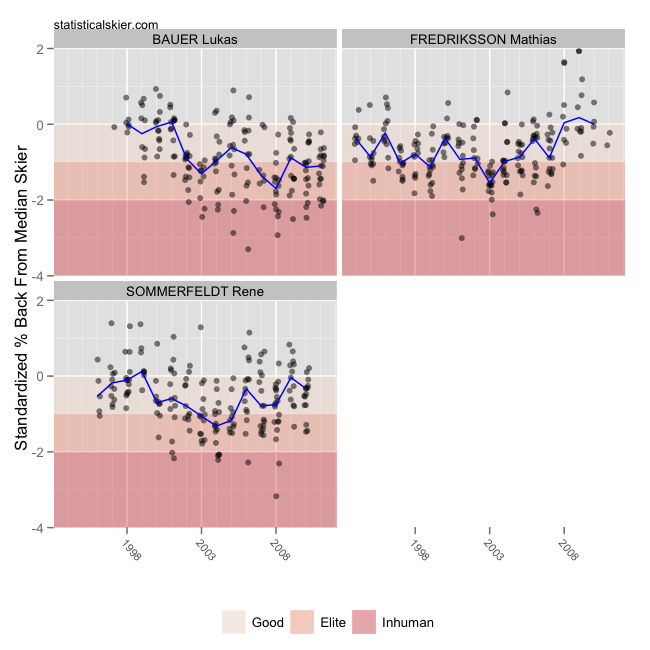
    When people have had extremely good seasons in the past, sometimes they can sustain is for a few years in a row, other times not. For example, here are some examples of some men who had a strong season but weren’t really able to sustain that level:

    Fredriksson’s 2003 campaign is the most obvious example here. Sommerfeldt had great seasons in 2003 (second place in the WC overall) and 2004 (first place) but couldn’t sustain his 2004 performance. Similarly, Bauer had an amazing season in 2008.

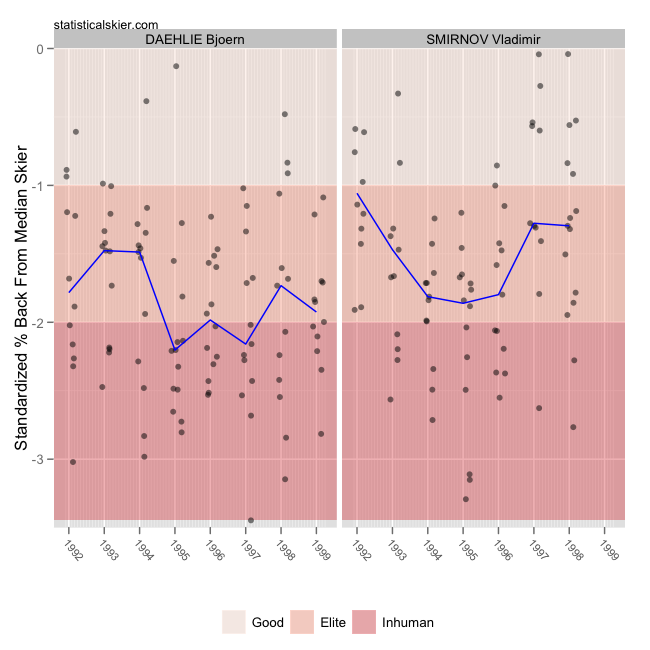
    Two examples of people who managed to sustain some level of dominance for more than a year or two were Björn Dæhlie and Vladimir Smirnov:

    These guys were already pretty much top of the heap, but each seemed to step things up for three consecutive seasons. Dæhlie for 1995-1997 and Smirnov for 1994-1996. Which pattern Bjørgen follows remains to be seen…

    Related posts:

    1. <Marit Bjoergen’s Best Freestyle Race
    2. <How Many WC Victories Does Björgen Really Have?
    3. <Björgen vs Skari vs Välbe


  • Erling Jevne: The Greatest Classic Specialist?

    Erling Jevne wasn’t the best skier during his era, having to compete with folks like Dæhlie and Smirnov among others. And he wasn’t even the best classic skier, most likely. At least, he was still mostly losing to those two guys even in classic races:

    Jevne fared better post-1997, but Dæhlie always had at least a slight edge, and Smirnov only faltered significantly in 1997. Indeed, Jevne’s 1997 campaign was notable:

    That’s a huge performance jump for the 1997 season. Of course, Jevne basically only skied classic races in 1997. He did one two-day pursuit, but that’s it. He’s one of the most lopsided fast skiers ever in terms of technique specialization. Among major international races, I have him participating in 68 classic races, 10 freestyle races and 7 pursuits (of the older variety, obviously).

    Jevne’s 1997 campaign is impressive to me because it actually ranks near the top of the all time list for best distance race seasons in my database. Since he was such a classic specialist, he only did 8 WC/WSC races, but that included 4 second place finishes, a third place and 3 seventh place finishes. And of course, I’m not even scratching the surface of his role skiing classic legs for their relay team.

    Maybe it’s not fair to lump him in with the everyone else, but purely based on the numbers, that 1997 season of his was nearly as good as some of the best that Dæhlie and Smirnov put together, and better than nearly everyone else.

    Related posts:

    1. <Daehlie vs. Smirnov
    2. <Do The Japanese Prefer Classic Skiing?
    3. <Race Snapshot: TdS Classic Sprint


  • USST Goes Black for 2010-2011

    USST Goes Black for 2010-2011

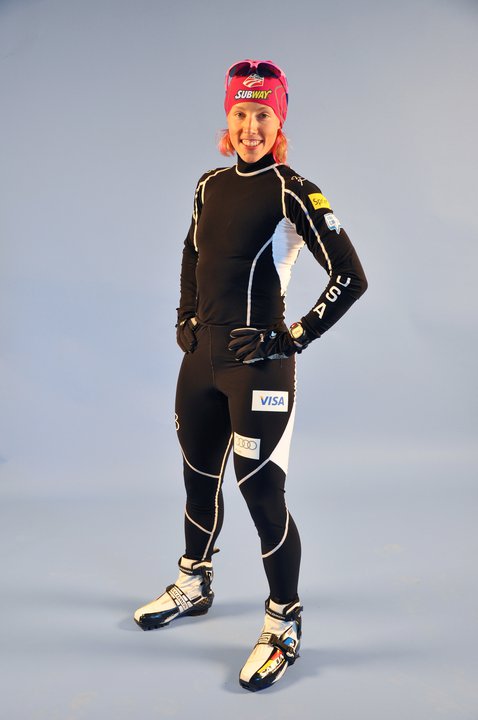
    Kikkan Randall modeling the U.S. Ski Team suit for the 2010-2011 season. Photo courtesy of the U.S. Ski and Snowboard Association.

    In the sport of cross-country skiing, most people would agree that competing with New Zealand is probably smarter than picking a fight with Norway.

    Consequently, the U.S. Ski Team (USST) will be wearing black suits for the upcoming season, eschewing the red spandex that has been the norm for the past few years.

    After any number of years of being drowned out by a sea of Norwegian crimson, U.S. Ski and Snowboard Association Nordic Director John Farra said that the USST will be “distinctly not red” for the 2010-2011 season—including at World Championships in Oslo.

    “We went in a very different direction, in part from our experience in Oslo, where they [Norway] have a nation’s group of ten, and we can barely see our athletes in the group,” he said.

    Both the U.S. nordic combined and cross-country ski teams will wear the new suits all year—Farra said that there will not be a special outfit for World Championships.

    The American uniforms are supplied by BJ Sport, the Oslo-based firm founded by Norwegian legend Bjoern Daehlie in 1996.

    Farra met with the BJ Sports team on a recent trip to Oslo; before departing, he had said that he hoped to set up a long-term agreement with the company. While one did not materialize, Farra said that the USST was still “in good shape to hold onto them for the next few years.”

    Billy Demong training in the new suit earlier this week. Photo courtesy of the U.S. Ski and Snowboard Association.
  • Daehlie: We aimed for PRs almost all the time

    NORWAY – “The interval workouts were structured in a way that we were to complete an interval session,” says the most-winning winter Olympian to date.

    “It could be four to eight intervals of varying duration, which were predefined. The goal for these workouts was to finish all the intervals,” Bjoern Daehlie told Langrenn.com. He tries to explain how tough the intervals were using the 5-tiered intensity scale (1 = easy).

    “We didn’t use the same terminology or scale, but the intervals were far harder than what currently is referred to as intensity 3 (aka threshold training). Each of our intervals was a PR attempt, and toward the last part of the interval, we were almost always going anaerobic to where you could feel the lactic acid attack. I would argue that this is the right way to do interval workouts. You need to train both your mind and you body,” Daehlie says, and continues: “It’s about getting to know your own body. Intensity training is where you have to fight to finish the interval and then fall to your knees to recover. That should be the rule more than the exception.”

    Came prepared

    During these tough interval sessions, Daehlie worked at roughly ten beats below max heart rate. The workouts were also an indication of whether he was tired or not. On days when he was tired, he couldn’t get his heart rate up high enough.

    “Interval workouts are the most important parts of the training program. Consider the week ahead of you, think about the month as a whole, and set aside time to do these workouts right. You need to feel good and be well rested. I used to spend two or three days prior to these workouts making sure I was rested, and I really enjoyed these workouts,” Daehlie says.

    – Did you only do uphill intervals? What do you think about running intervals on flat terrain?

    “I only ran uphill intervals. But they don’t need to be super steep. When you’re running uphill, your VOmax is the limiting factor, and your heart rate will go up quickly. That’s just what worked best for me,” Daehlie explains. “But there is another point here too: wear on your body. When you run uphill, you only reach a fraction of the speed you would on flat terrain. Hard running or time trials on easy terrain or a 3,000 meter on the track takes a huge toll on your legs. Uphill terrain is much gentler in this regard,” Daehlie explains.

    – Do you still do a lot of hard intervals?

    “I actually use a lot of the same terrain as I used to back then, and sometimes I really want to try a real intensity workout again. But I’m afraid it would be sad commentary in the training log,” Daehlie concludes.

    From Langrenn.com, September 6, 2010 By Ola Jordheim Halvorsen, translation by Inge Scheve

  • Old School Not Always Better

    A lot of things were better in the old days. But distance workouts in rubber boots?

    “It felt mostly like running on cutting boards, but we didn’t think twice about it!”

    These days, running shoes are so lightweight and comfortable that you barely feel them at all. That was not the case back in “the good old days,” or at least until the end of the 1970s. In Norway, people were using rubber boots for distance runs in wetlands as well as for interval workouts on gravel roads.

    Lars Erik Eriksen, who was on the Norwegian national team from 1977 to 1985, is one of the rubber boots’ most dedicated fans.

    “I used rubber boots in all kinds of terrain. I even ran in them on hot summer days. Back then, running shoes were not particularly good, so rubber boots was a natural and convenient choice for us,” Eriksen says.  The merited skier has several international medals on his resume, including Olympic silver from the relay in Lake Placid 1980 and gold medal from the World Championships in Oslo 1982. He also snagged a silver medal and a bronze medal from that event.

    Do you think the rubber boots contributed to your performance?

    “When we were fit, we didn’t really think a lot about what we were running in, but I do remember we thought the weight of the footwear was an added bonus. It was basically extra training. It was really heavy if we were running in wetlands and stepped in to where the water level reached above the top of the boots and filled them with water,” says Eriksen.  

    Did you use a specific kind of rubber boots?

    “We preferred the ones that were slightly shorter, the green ones with bigger, grippier outsoles. But you should have seen the chunky ones Myrmo (ed. legendary Norwegian cross-country skier) and his friends were using… That was back in the early 1970s. At that time, athletes were using those tall, heavy black ones. You can see them in photos in old training text books. There are pictures of athletes wearing that kind of stuff,” Eriksen says.

    How did you feet handle running around in rubber boots?

    “Well, it kind of felt like running around with wooden cutting boards under your feet. The shock absorption was non-existent. It was definitely not gentle on knees and hips. But we managed,” says Eriksen.

    But then real running shoes came along. Eriksen recalls a blustery fall day when a young boy named Bjoern Daehlie came up to him and wanted to tag along for a run. Eriksen of course sported his usual rubber boots, while the future king of XC skiing ran in modern running shoes.

    “I took Bjoern for a real overdistance workout. We did some real soggy wetlands, and it was sleeting as well. But with my rubber boots, my feet stayed dry, while Bjoern was so wet and cold that he even shed a few tears. But he completed the whole workout, I’ll give him credit for that,” Eriksen recalls.

    From www.langrenn.com, July 15, 2010 By Ola Jordheim Halvorsen, translation by Inge Scheve