From the FasterSkier archive — posts syndicated from athletes’ and coaches’ own blogs between 2004 and 2012, kept online as published. Current coverage is at fasterskier.com.
This coverage is made possible through the generous support of Marty and Kathy Hall and A Hall Mark of Excellence Award. To learn more about A Hall Mark of Excellence Award, or to learn how you can support FasterSkier’s coverage, please contact info@fasterskier.com.
Johannes Hoesflot Klaebo (NOR) took all six gold medals awarded in men’s cross-country skiing at the Olympics last month. (Photo: Barbieri/NordicFocus)
Johannes Hoesflot Klaebo made the call late Tuesday night… he’s racing.
According to the Scandinavian press, Klaebo departed Oslo’s Gardermoen airport at 6:25 Wednesday morning, beginning a roughly 20-hour journey to Lake Placid, where he’ll arrive about a day and a half before Friday’s 10-kilometer classic interval start. The Norwegian Ski Federation confirmed the news in a press release on Wednesday morning.
“I can see this isn’t going to be an optimal buildup, both with the long travel and not being able to adjust to the time difference,” Klaebo said. “But I want to be part of the World Cup finale in the USA.”
The decision came after Klaebo did a training session on Tuesday morning in Trondheim and responded well. National team doctor Ove Feragen gave him the green light.
Ben Ogden (USA) checks on Johannes Hoesflot Klaebo (NOR) after their crash eliminated them from the race in Drammen, Norway. (Photo: Nordnes/NordicFocus)
“After the fall during the sprint in Drammen, and some quiet days at home, Johannes has gradually resumed training and normal activity,” Feragen said. “He has responded well to this, without any recurring symptoms after the fall. After observation and further examinations, we have concluded that he is fit to compete.”
Klaebo has been sidelined since March 12, when American Ben Ogden fell across the Norwegian’s skis during Classic Sprint semifinals in Drammen, Norway. The resulting crash sent Klaebo’s head into the hard-packed snow. He was diagnosed with a mild concussion, withdrew from the Holmenkollen 50k, and scrapped a planned media tour in New York City that included sit-downs with CNN, NBC, the New York Times, and the Wall Street Journal.
Now the question shifts from whether Klaebo will race to how much he’ll race. He’s not committing to the full program.
Harald Oestberg Amundsen (NOR), Johannes Hoesflot Klaebo (NOR), and Martin Loewstroem Nyenget (NOR), (l-r) share the Skiathlon podium in Falun, Sweden, on March 1st, 2026. (Photo: Thibaut/NordicFocus.)
“My expectations for performance are not sky-high,” Klaebo said. “I’ll do my best despite a poor buildup and potential jet lag. Whether I race one, two, or three events in Lake Placid, I’ll decide once I get to the USA and get skis on my feet.”
The stakes are real despite the measured tone. Klaebo has already clinched the overall World Cup — his sixth, tying Bjoern Daehlie — and the sprint globe. But he trails Harald Oestberg Amundsen by three points in the distance standings after missing the Holmenkollen 50k. Two distance events remain: Friday’s 10 k Classic and Sunday’s 20k Freestyle Mass Start. A clean sweep of the overall, sprint, and distance globes would be a first in Klaebo’s career.
“For cross-country skiing, it’s especially important to have World Cups in the USA,” Klaebo said. “I’ve been looking forward to this finale for a long time.”
Racing begins Friday at Mt. Van Hoevenberg. Klaebo will be on the start line — jet lag and all.
Love Stories Like This? Help Keep Them Coming.
Feature stories like this one take time, access, and care to produce. If you value thoughtful storytelling and independent ski journalism, please consider becoming a Voluntary Subscriber. Your support directly fuels the work we do to cover the people, places, and moments that make our sport special.
Ben Ogden (USA) and Johannes Hoesflot Klaebo (NOR), along with Oskar Opstad Vike (NOR), (l-r) on the Olympic sprint podium last month. It should be made clear that Ogden and Klaebo have a strong respect for one another, to say the least. (Photo: Vanzetta/NordicFocus)
Fans from across the United States who will be in Lake Placid are anxiously hoping Johannes Hoesflot Klaebo (NOR) is well enough to travel and race in Lake Placid this weekend. (Photo: Authamayou/NordicFocus)
Johannes Hoesflot Klaebo has been included in Norway’s 22-athlete squad for this week’s World Cup finals at Mt. Van Hoevenberg in Lake Placid, N.Y., BUT the six-time Olympic gold medalist’s participation hinges on a decision being made today.
Klaebo, 29, suffered a mild concussion in a dramatic crash during the sprint semifinals at last Thursday’s World Cup in Drammen. American sprinter Ben Ogden lost his footing on the icy course and fell across Klaebo’s skis, sending the Norwegian backward and slamming the back of his head into the hard-packed snow. Klaebo lay on the ground for several minutes before being helped off course and transported to a hospital for evaluation.
The Norwegian Ski Federation confirmed the concussion diagnosis on Friday, and Klaebo withdrew from Saturday’s 50-kilometer race at Holmenkollen.
“He shall make an evaluation together with the national team doctor on Tuesday and would potentially travel on Wednesday,” Klaebo’s manager, Lasse Gimnes, told Norwegian broadcaster NRK on Monday. If cleared by national team doctor Ove Feragen, Klaebo would travel to New York on Wednesday — arriving just two days before Friday’s 10-kilometer classic interval start.
The crash also disrupted a planned trip to New York City for media appearances with CNN, NBC, the New York Times, and the Wall Street Journal — a reflection of the enormous international attention Klaebo has drawn since his record-setting six-gold performance at the Milano Cortina Olympics. Those in-person interviews have been scrapped, though some may shift to virtual formats.
Johannes Hoesflot Klaebo (NOR) poses with the FIS Crystal Globes he won last season at World Cup Finals in Lahti, Finland. (Photo: Thibaut/NordicFocus)
The distance globe is on a knife’s edge
The distance cup title is the central subplot heading into the finals. Before Holmenkollen, Klaebo held a 128-point lead in the distance standings. But with the Norwegian watching from home on Saturday, Amundsen’s 131-point haul vaulted him into the distance lead: Amundsen now sits at 939 points, three ahead of Klaebo’s 936. Martin Loewstroem Nyenget climbed to 914 in third. Just two distance events remain — Friday’s 10-kilometer classic interval start and Sunday’s 20-kilometer freestyle mass start. If Klaebo can travel and race, the margin is thin enough that a single strong result could flip the standings again. If the concussion keeps him out, the distance globe almost certainly goes to Amundsen.
Klaebo has already clinched both the overall World Cup — his sixth, tying Bjoern Daehlie’s all-time record — and the sprint globe.
Norway’s men’s squad: Harald Oestberg Amundsen, Martin Loewstroem Nyenget, Einar Hedegart, Andreas Fjorden Ree, Mattis Stenshagen, Emil Iversen, Johannes Hoesflot Klaebo, Lars Heggen, Even Northug, Ansgar Evensen, and Even Solem Michelsen.
Jessie Diggins soaks in all the energy from the home crowd during her warmup in Minneapolis — the last time the World Cup was on American snow. (Photo: Leann Bentley/USST)
Diggins’s farewell, and notable absences
The Lake Placid finals will serve as the final competitive races for Jessie Diggins, the most decorated cross-country skier in U.S. history. The women’s overall cup and distance cup are both decided, with Diggins winning with a comfortable margin over Sweden’s Moa Ilar in second. The three-time Olympic medalist and three-time overall World Cup champion announced before the season that this would be her last, and a farewell on home snow in front of an American crowd at the first-ever U.S.-hosted World Cup finals is about as fitting a send-off as anyone could script.
Klaebo is not the only notable question mark heading into the weekend. Norway’s Kristine Stavaas Skistad and Mathilde Myhrvold have opted to skip the finals to prepare for part two of Norwegian nationals in Harstad next week. Sweden’s Ebba Andersson has also pulled out.
Norway’s women’s squad for Lake Placid includes Astrid Oeyre Slind, Heidi Weng, Kristin Austgulen Fosnaes, Karoline Simpson-Larsen, Nora Sanness, Karoline Groetting, Julie Bjervig Drivenes, Tiril Udnes Weng, Julie Myhre, Lotta Udnes Weng, and Milla Grosberghaugen Andreassen.
The men’s freestyle mass start gets started at the US National Championships in Lake Placid, NY, 1/8/26. (Photo: Nancie Battaglia)
A historic venue
The Lake Placid finals mark the first Cross-Country World Cup finals ever held in the United States and the return of World Cup racing to Lake Placid for the first time since 1979. Racing kicks off Friday at Mt. Van Hoevenberg with the 10-kilometer classic interval start, followed by a freestyle sprint on Saturday and a 20-kilometer freestyle mass start on Sunday.
This is a developing story. FasterSkier will update when Klæbo’s decision is announced.
Help Support Our Olympic Coverage!
If you value the thoughtful work and access FasterSkier provides, please consider becoming a Voluntary Subscriber. Your support directly fuels our work to cover the people, places, and moments that make our sport special.
It was a disappointing opening to the Olympics for Johannes Thingnes Bø of Norway, who despite winning eight World Cup races this season started the Games with finishes of 31st and 21st in the sprint and pursuit. But on Thursday he showed why he was a medal favorite and won the 20 k individual race – only by 5.5 seconds, but that margin becomes impressive when you consider that he had two penalties, and thus two minutes of penalty time, while silver and bronze medalists Jakov Fak of Slovenia and Dominik Landertinger of Austria (+14.2) shot clean.
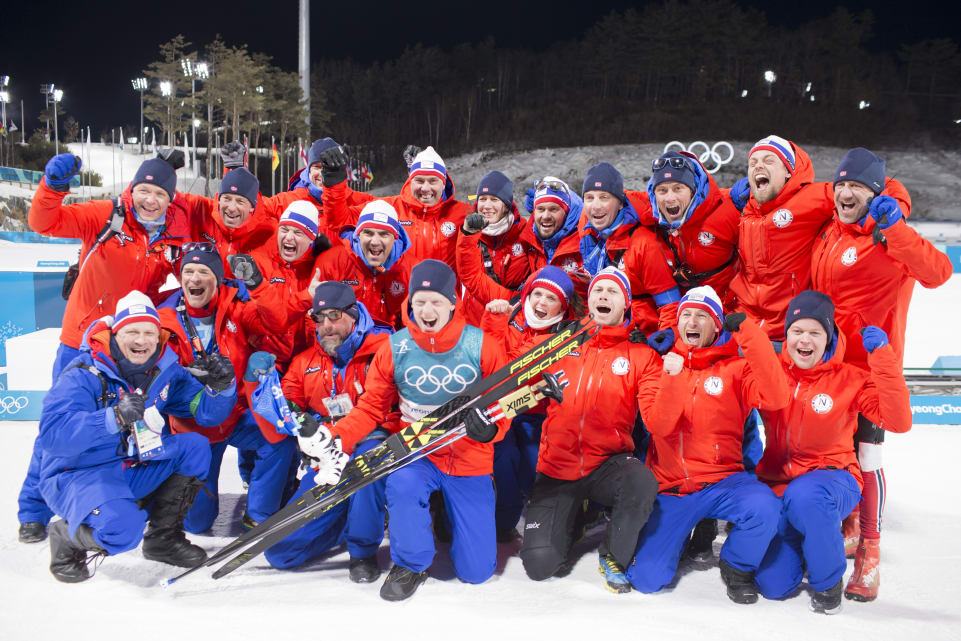
Johannes Thinges Bø celebrates with Norwegian team staff after winning Olympic gold in the 20 k individual despite two missed shots. (Photo: IBU/Biathlonworld.com)
Sweden’s Sebastian Samuelsson followed up a silver medal in the pursuit with fourth place in the individual, missing one shot and notching a time 29.1 seconds behind Bø. France’s Martin Fourcade, gold medalist in the pursuit, missed two shots like Bø but finished in fifth (+42.4). Switzerland’s Benjamin Weger placed sixth (+48.6) with one penalty.
It was a good day for Canada on the back of strong shooting: Scott Gow placed 14th (+2:02.5) with one penalty for a career-best result result; he had previously had two 16th-place finishes on the World Cup this season. With the same shooting, Brendan Green placed 22nd (+2:26.6). Christian Gow had two penalties to finish 26th (+2:57.2). Canada’s fourth man, Nathan Smith, missed five shots and placed 81st (+8:11.9).
For the United States, shooting was not as successful and Tim Burke led the way in 41st (+4:01.9) with four penalties. With one less penalty Sean Doherty was close behind in 44th (+4:21.8). Lowell Bailey placed 51st with four penalties (+4:53.0) and Leif Nordgren missed five shots to finish 66th (+6:27.3).
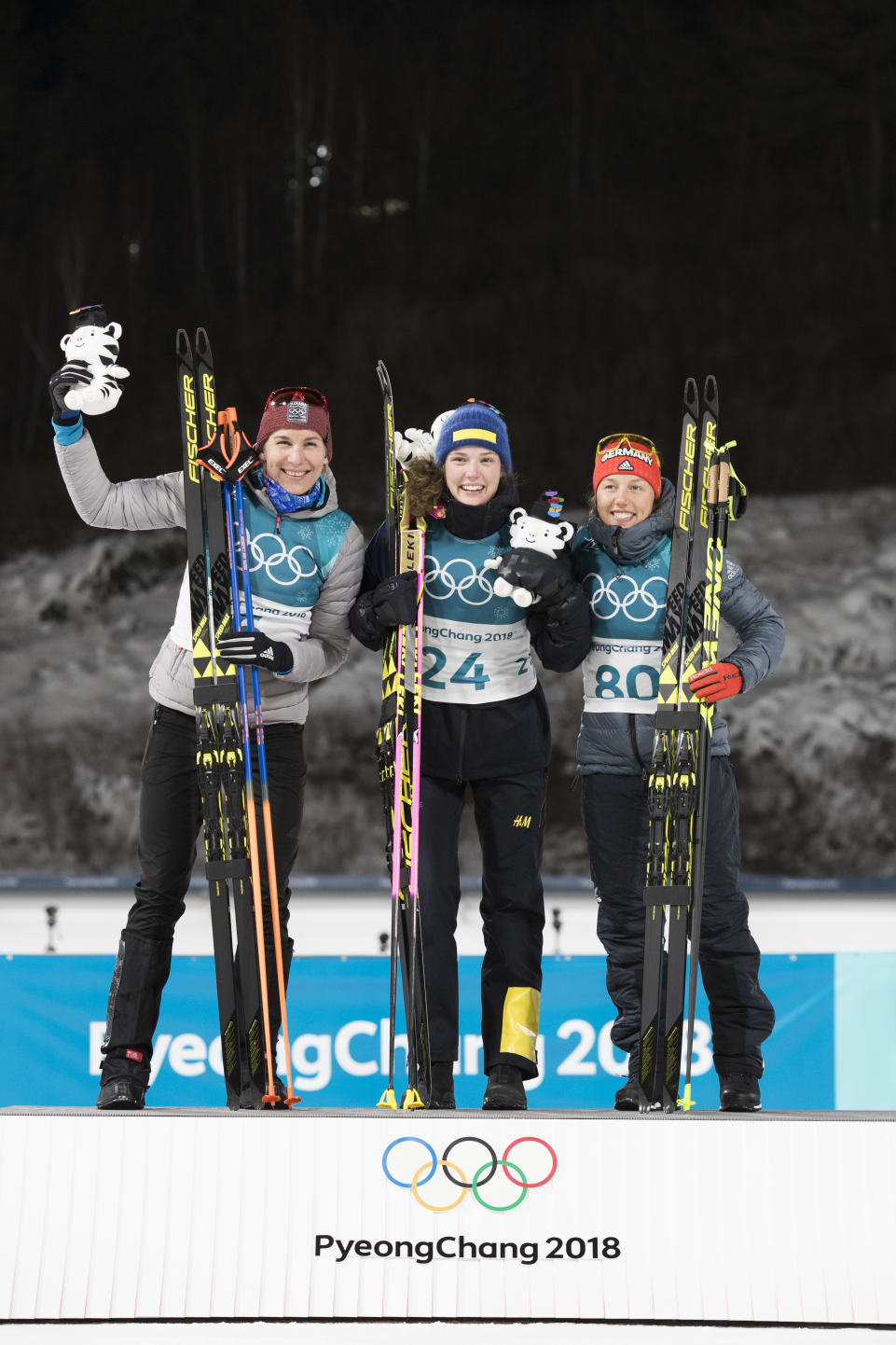
Sweden’s Hanna Oeberg (center) won gold in the biathlon women’s 15 k pursuit, followed by Slovakia’s Anastasiya Kuzmina (left) in silver and Germany’s Laura Dahlmeier in bronze. (Photo: IBU/Biathlonworld.com)
A few days after teammate Samuelson scored a career-best result to earn silver in the pursuit, Hanna Öberg of Sweden used perfect 20-for-20 shooting to capture gold in the women’s 15 k individual. The 22-year-old’s previous best results were fifth place in both Monday’s pursuit, and in a World Cup race last season.
She bested the two pre-race favorites: Anastasiya Kuzmina of Slovakia had two penalties but still managed a silver medal, her second of the games, finishing +24.7. And double gold medalist Laura Dahlmeier of Germany had one penalty and earned bronze (+41.2).
It was a good day for both of those teams as Franziska Preuss of Germany finished fourth, +59.0 with clean shooting, and Paulina Fialkova of Slovakia placed sixth (+1:02.3) with one missed shot. Poland’s Monika Hojnicz finished sixth (+1:54.8) with one missed shot as well.
The United States was led by Susan Dunklee in 19th, with two penalties (+3:26.3). Her teammate Joanne Reid finished 22nd (+3:34.1), her best-ever result in top-level international competition, with just one missed shot. Clare Egan finished 62nd (+6:53.6) and Emily Dreissigacker 67th (+7:09.2) with four penalties apiece.
For Canada, Rosanna Crawford led the way in 26th (+3:48.7) with two penalties and Sarah Beaudry was close behind in 29th (+3:58.4) with one missed shot. Emma Lunder finished 54th (+5:49.4) with three penalties and Julia Ransom was 74th (+8:31.4) with five missed shots.
Montana State University student Johanna Talihärm of Estonia finished 50th (+5:36.8) with three penalties.
Thursday afternoon saw more of the same for the women’s cross-country ski events at this year’s Winter Olympics: Scandinavia filling up the podium, with American Jessie Diggins tantalizingly close to that breakthrough American podium in fifth. This time it was Norwegian Ragnhild Haga in first in the 10 kilometer freestyle individual start, Charlotte Kalla of Sweden in second (+20.3), and Finland’s Krista Pärmäkoski and Norway’s Marit Bjørgen tied for third (+31.9).
The bronze is Bjørgen’s 12th lifetime Olympic medal, moving her into a tie with fellow Norwegian Bjørn Dæhlie for the most Olympic medals won by a cross-country skier. Countryman Ole Einar Bjørndalen, a biathlete, holds the overall Winter Olympics record with 13.
Diggins was 35.2 seconds back of Haga in fifth. She was in seventh place through 1.6 k, up to fifth at 5 k, up to third at 6.2 k, and still in third at the 8.4-k time checkpoint, 1.9 seconds up on Bjørgen and five seconds up on Pärmäkoski. But her form seemed to break down over the final uphill, and Diggins lost just enough time on Bjørgen and Pärmäkoski over the final 1.6 k to slip off the podium.
Between a 4.6-second deficit to third in Saturday’s skiathlon and a 3.3-second gap here, Diggins has now missed two bronze medals by a combined 7.9 seconds over 25 kilometers of racing.
Jessie Diggins pushing to the finish in the Olympic 10 k skate. The American finished fifth. (Photo: FlyingPointRoad)
Sixth place went to Swiss skier Nathalie von Siebenthal (+49.8), who slowed slightly after a fast start that saw her with the second-ranked time through 1.6 k. Ingvild Flugstad Østberg (+1:05.5), in seventh, was the third Norwegian in the top seven.
Olympic Athlete from Russia Anastasia Sedova (+1:07.3), Austrian Teresa Stadlober (+1:15.6), and Olympic Athlete from Russia Anna Nechaevskaya (+1:24.3) rounded out the top ten.
Sadie Bjornsen (+1:42.1) in 15th and Kikkan Randall (+1:49.9) in 16th were the next two Americans. Randall started relatively early with bib number 23, and was the leader in the clubhouse when she crossed the finish line. Liz Stephen (+2:35.4) was 30th.
For the Canadians, Emily Nishikawa (+2:41.) led the way in 32nd. Dahria Beatty (+2:48.4) was 37th, Cendrine Brown (+3:11.9) 43rd, and Anne-Marie Comeau (+4:10.8) 62nd.
Also of note, Australia’s Jessica Yeaton, who lives and trains in Anchorage with Alaska Pacific University, recorded an Olympics personal best finish of 41st (+3:09.1). University of Alaska Anchorage student Casey Wright, also competing for Australia, finished 81st (+6:55.8).
University of Colorado skier and NCAA champion Petra Hyncicova of the Czech Republic finished 60th (+4:09.4). University of New Hampshire alum Annika Taylor of Great Britain finished 75th (+5:52.4).
And Jaqueline Mourau of Brazil, who lives and trains in Quebec, was 74th (+5:49.8).
LTD Gear Review: Ultimate Puffies (All photos by FBD)
Since amazingly I haven’t been fired by FasterSkier (yet), LTD is back with our undoubtedly eagerly awaited second installment of puffy coat reviews. In the first review, we tackled “lifestyle” puffies. These are the Swiss Army Knives of your closest — they do it all. You can wear them to and from the tracks, warm up in them for races, impress the ladies in the coffee shop Après-ski or wear them out to dinner, and Holly Beattie won bronze in the relay at World being warm and stylish the entire time.
This is the review of their big brothers. While the lifestyle puffies may be the Sugar Ray Leonards of your wardrobe, pound for pound the kings of the closet, these are the heavyweight prize fighters: the Mike Tysons, Evander Holyfields, the Muhammad Alis — big, bad and heavy. This isn’t your ‘go-to’ jacket for most days; this is what you pull out when you’re getting ready to slug it out for several hours out in the cold. We call these the “ultimate puffies.”
As you all should know by now, nothing is more important than looking good. Learn it. Know it. Live it. Now, having said that, you’re likely asking yourself, “Self, those ultimate puffies make you look like you’re heading off on an Everest expedition. How can I possibly look good in one of those monstrosities?” Great question, self, I am proud of you. You have been paying attention.
Now please listen (read), very, very carefully here, as this is the ONE instance in which I am willing to grant you special dispensation on the fashion front in the name of function. These jackets are utilitarian. They are work horses. They have a very important job to do — they were put on Earth to keep your whiny, needy, nordic ass warm when it is downright nasty, so here and only here, we are we going to make allowances in style in the name of not catching pneumonia.
You all know the scene — we’ve all been there — it is below zero and it’s race day, but you’re a team player, so you’re out there cheering on teammates/children/parents or friends, working the wax table for hours on end, or maybe you are even on-course, giving it your all in these brutal conditions.
Or perhaps you are sitting for what seems like an eternity with 70,000 of your closest friends at some seemingly pointless spectator event as a part of the soul-crushing office job that you hate, watching overpaid millionaire mercenaries give each other closed head injuries while horribly inebriated indigenous personnel scream obscenities at players they worshiped as recently as a week ago. This bizarre fleeting devotion is even more puzzling due to the fact that essentially none of these steroid-abusing, sexual-assault purveyors are actually from the city they are purported to be representing and they garner god-like status despite their often glaringly illegal and immoral acts. Drown dogs with your bare hands? Beat defenseless women unconscious? KILL other humans? No problem, we love you as long as your ball skills are solid. Where was I going with this? Oh yes, those stadiums can be quite cold, so you need a warm coat.
So, since no one loves you like we do here at FasterSkier, we went out and got ourselves cold so you don’t have to.
The Process:
We covered this in excruciating detail in the first review, so in the name of brevity I’m going to skip all of the gory details this time around since all of the same terms and conditions exist in this review as well. If you’re a stickler for details or just love to read my beautifully crafted prose, give yourself a treat and dive back in to the last installment and bask in the awesomeness that is my detailed description of testing protocols, disclosure statements, and conflicts of interest.
Selection Criteria:
I am going to repeat the description of how each particular jacket was selected though, as not only is is very important, but I want to take as many steps as prudent to avoid any angry mail. The companies picked the jackets, not us, so if you have an axe to grind, write them, not me. Or the executives at FasterSkier, as near as I can tell, all of those people seem quite lonely and most certainly need more to do.
I would also like to emphasize how carefully and extensively every single piece was tested. I love gear. My team loves gear. There is no place all of us would rather be than outside doing cool stuff, so this is a responsibility we take very, very seriously. So while we did beat the crap out of these jackets, we did so due to our commitment to you the reader, the skier, the parent, the coach, the person standing out there in the cold for hours. Jackets are expensive, so we did our best to ensure that when you’re ready to pull the trigger on a new “Muhammad Ali,” we know we’ve done our best to give you the intellectual ammo to make the best possible purchase for your specific needs.
The Reviews:
Arc’teryx
Since no one takes manufacturers’ claims of “windproof” as skeptically as our team, FBD is shown here doing his best Labrador Retriever imitation, heading up Rabbit Ears Pass in Colorado at 60 mph in sub-zero temps wearing an Arc’teryx Men’s Ceres Down Jacket.
In this “ultimate puffy” category, Arc’teryx sadly only sent us one jacket, a men’s Ceres. I say “sadly,” because this coat is amazing. Once again “The Bird” (they used that on the phone with me, so I therefore feel authorized to throw this out, plus it makes me sound like I know what I’m talking about and I like that) absolutely killed it. Essentially every (male) tester agreed that this was the warmest jacket in the test and it handled every challenge we threw at it with style and grace.
Warm? Check. Durable? Check. Stylish? Check. What’s not to love? Well, the only downside to this heavyweight champ is that all of these features come at a cost, as this was the most expensive jacket testing, but damn is it nice.
As was the case in the “lifestyle puffies,” the fit is a bit generous, so if you’re a 6’6”, 118-pound IT technician or web programmer, this may not be the coat for you. If you’re a big, strapping man like the FBD, you’ll grab this every time there’s a sub-zero wind chill and the coaching zone you’ve been assigned to cover at the World Cup is the farthest one humanly possible from the nice warm wax cabin.
Strengths: Very warm. Shell has a perfect mix of durability and flexibility.
Weaknesses: May necessitate a second mortgage. Fit might be a bit loose on the ectomorphs out there in the studio audience.
Buy it if: You’ll pay any amount of money to be warm while you’re sitting in the Eagles stadium watching angry, drunken, shirtless guys from Philadelphia throw beer at angry, drunken shirtless guys from New York, wondering how you life went so wrong. Or if you attend races anywhere in New England or Montana. Or Greenland. Who knows if there are actually nordic races in Greenland, but it seems like if there are, they’d be really, really cold.
Patagonia
Patagonia Women’s Fitz Roy Down Parka
While maybe not quite as warm as the Arc’teryx, the offerings from Patagonia were quite close. They provide the test team a men’s and women’s Fitz Roy. In short, everyone loved these jackets. Both of the puffies were puffy, but not too puffy (all of my English professors just committed suicide after reading that sentence, sorry Mrs. Dixon et al.).
One of my favorite comments from our testing log was, “I love this jacket, is it so soft and warm it feels like I’m wearing a sleeping bag that moves with me perfectly.” I agree with this assessment, as the jacket really does feel that soft and unrestricting. Is it too soft? Well, thankfully the Steamboat Springs Winter Sports Club cross-country ski team has essentially boundless energy and a near-total immunity to cold, so we repeated our patented “Penguin Slide” testing protocol and I’ll say this, none of the Patagonia garments had the slightest snag or tear, despite repeated runs down the very steep face of Howelsen Hill (as a point of reference, there are ski jumps are about 30 meters from our slide test area, so that should give you some idea of the steepness of the slope).
So is this a guarantee that these coats will never rip? Of course not, but what it is intended to do is provide some assurance that if you’re standing in your favorite local outdoor retailer thinking, “Man, the material on this coat looks thin,” it is, but it is durable. Very durable.
Patagonia Men’s Fitz Roy Down Jacket (Patagonia.com)
We’ve now been testing these jackets daily for over two months without a single problem. If you’re working on monster trucks or an offshore oil derrick, could you damage it? Maybe. But if you are doing any of those things, you’re probably not reading this review and you’re most likely firmly in the Carhartt camp anyway, so stop wasting my time with all of these stupid questions.
Strengths: Warmest coat for its weight, very compressible hence very packable, also very soft and flexible. Cool colors, nice style for both fraüleins and bros.
Weaknesses: MAY tear more easily than some of the other coats, but this is just a theory, so no angry letters, Patagonia, and again, we tested this extensively and had no problems.
Buy it if: You want a very versatile, warm puffy and you don’t work on monster trucks or offshore oil rigs.
L.L. Bean
L.L. Bean Wind Challenger Down Jacket
As they did for the last review, L.L. Bean provided us another official model of the jacket they are supplying to the U.S. Ski Team this year, the Wind Challenger. The FBD testing crew was almost as divided as the Bloods and Crips in the L.L. Bean vs. Patagonia debate (as much as this metaphor could ever possibly fit a bunch of mountain-town nordic ski coaches), as the approaches of these two brands are almost polar opposite.
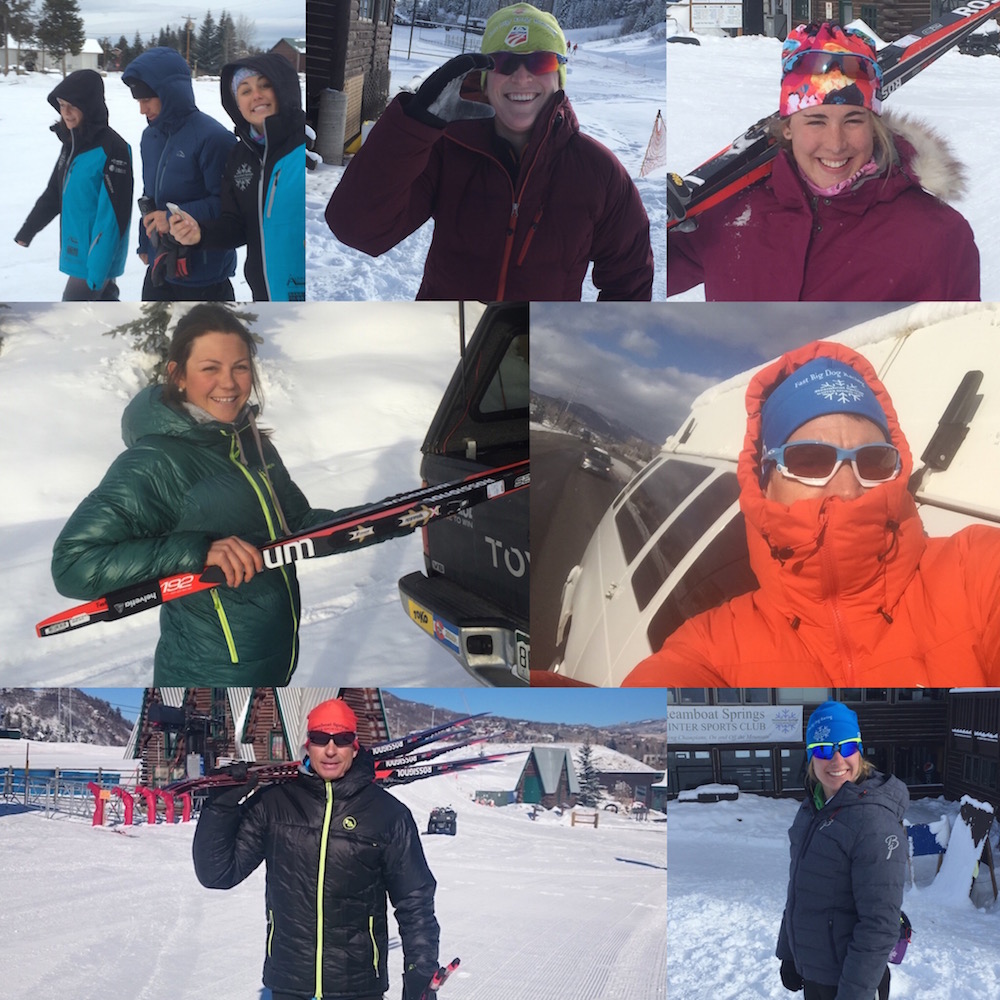
Steamboat Springs Winter Sports Club nordic coach Josh Smullin (second from l) rocking the L.L. Bean Wind Challenger jacket on a cold walk back from breakfast at training camp with some SSWSC rock stars.
Patagonia’s garments are warm, light, colorful, fashion-forward and very soft. L.L. Bean took the opposite tact and developed jackets that are also very warm, but much thicker, subdued and beefy. This is not necessarily a bad thing, as heavy = durable, and understated is a plus for people who don’t want to “pop” when they hit the town.
I love any sort of attention and generally live my life by the philosophy of “there’s no such thing as bad publicity,” but if flying under radar is your M.O., this coat is for you.
It’s a great coat and it feels like it can take a beating, a concept for which we are all quite fond.
L.L. Bean Women’s Wind Challenger Down Jacket (LLBean.com)
Strengths: Heavier outer layer likely more abrasion resistant. Official supplier to the U.S. Ski Team. Not too flashy.
Weaknesses: The hand on this coat is not nearly as soft or pliable as the others, in particular the Patagonia. Not super colorful. Not quite as packable, which is important when Grover says you can only bring one bag to Europe for your four-month trip.
Buy it if: You channel your inner Andy Newell on your ski every day, you own a non-declawed cat, or you are thinking of buying a monster truck and/or are applying for oil rig work.
(Ed note: our team of researchers is currently investigating whether monster trucks are allowed on oil rigs).
Big Agnes
Big Agnes Men’s Dunkley Belay Jacket
Big Agnes sent their apologies, but not a women’s coat, which is a shame as the men’s coat, the Dunkley Belay Jacket is excellent. It was the only jacket in the test with synthetic insulation (for women’s synthetic-jacket options, click here), and the down vs. synthetic is a debate that has ravaged mankind since the dawn of time.
Big Agnes Men’s Dunkley Belay Jacket (BigAgnes.com)
Much has been written on both sides, so I won’t bore all of you with the details again here, but the executive summary is that this coat out-performs all of the others in the wet. I just happen to personally own last year’s model and like it a lot, but I had two serious issues with the zipper, one of which required an exchange. Big Agnes was very gracious about this, but even the replacement garment wasn’t perfect. Unfortunately our test garment also had a bit of a finicky zipper, which was real drag (no pun intended) when trying to put the coat on with cold hands after a race.
Strengths: Stacked up to the “downies” when dry. Warmest coat when wet. Perfect buy for people who recreate the ALS Challenge all winter and athletes who bathe their pets outside regardless of conditions. Or anyone who owns a Labrador Retriever, an animal that somehow manages to magically attract cold, wet conditions year-round, particularly in your car.
Weaknesses: Least packable of all of the coats. Zipper issues seem more common than they should be, in particular for a coat in this price range.
Buy it if: You work at a winter car wash or ski places where the dreaded snow/rain transition is all-too-frequent.
Bjørn Daehlie
Bjørn Daehlie Women’s Shelter Jacket
The friendly folks at BD flipped the script on us on this one and sent a women’s ultimate puffy, the Shelter Jacket, but not a men’s, so this review is for women, by women. The garment sent was also the same version used by the U.S. Ski Team last year, so it’s got plenty of street cred.
This jacket was one of the best “all-arounders” for the ladies. It is warm, stylish and feels durable. One of our testers was an elite skier and subsequently received her fair share of team jackets and this was one of her favorites. Despite being from Alaska, she is surprisingly prone to getting cold, so she could be found busting out some of her AK coaching knowledge in this beauty even when out on skiing.
I don’t think I’d actually do a workout in it, but it has nice mobility which means it is perfect to wear out to coach or any other start/stop activity. It is also ideal if you ski like one of our other testers Josh Smullin, in that in an effort to inflate your training hours, you take frequent breaks mid-workout for water and to make long phone calls. If you meet any of these criteria, BOOM, this jacket is for you.
Strengths: Great all-around coat for women. Good weight. Good warmth. Great mobility. Great style. Extremely economical. Best value in entire test.
Weaknesses: People will ask you if you’re Josh Smullin (never a good thing) or if you lie a lot in your training log. Coaches may attempt to activate the “auto-stop” feature on your heart rate monitor.
Buy it if: You think your genealogy somehow traces back to Norwegian superstar Bjørn Daehlie, you’re a fan of this very stylish, iconic nordic brand, or you’re currently a little light on your yearly training hours.
Bonus track
L.L. Bean’s Women’s Baxter State Parka. Not exactly a puffy, but we’ll review it anyway.
One of the many things that makes this job fun is watching companies blatantly ignore my ridiculously simple instructions. People don’t send stuff they are supposed to send. People do sent stuff they’re not supposed to send. No one sends stuff on time and everyone yells at me when the reviews are late and weird. What I’m saying is I’m the victim here.
Having said that, business is a full-contact sport — I get that. I have an alter ego that is out fighting a good fight in the corporate world right now and no one understands better than I that corporate goals may not always mesh with my goofy editorial goals. Perhaps even more importantly, as noted in the lifestyle puffy review, no one hates rules more than the FBD, so when L.L. Bean sent two jackets that seemed to defy all categories, the Baxter State Parka, I appreciated the gesture. The question became however, “What the hell do we do with these things?” So since Bean was aggressive, clever and innovative enough to send a special category of jackets, who am I to stifle this creative energy? So here’s a very special bonus review.
What are these mysterious category-defying garments? Well, that depends on when you grew up. There was a time when these pieces were called “snorkel jackets” and “back in the day,” you ruled the playground if you had one. I still remember poor Mark Woods having to sit on the playground in third grade in Michigan in mid-winter without any jacket or shirt to prove his worthiness for inclusion into the “Snorkel Club.” (Mark later passed away with complications from pneumonia and will be missed greatly. Very sad story.) Well, apparently, what’s old is what’s new again and these babies are making a comeback.
This styling on these “snorkels” is a bit controversial, but generally well received. One young, hip female reviewer absolutely loved this jacket and rocked it hard on a team trip in Aspen. In perhaps the quote of the year, she noted, “I’m not a trophy wife, but I’m dressed like I could be and I kinda like that.” And that’s saying a lot in Aspen.
On the other side of the coin, probably our most conservative male coach also loved this jacket and regularly wore it around town, having never looked better.
A fishing vest, no proof that it’s on steroids
Strengths/Weaknesses: Fabric feels like it can stop a bullet. Hood features synthetic-fur trim and makes you a dead ringer for Kenny when fully deployed. More pockets than a fishing vest on steroids. Coat weighs more than me, folds to approximate size of my Great Dane. Will likely survive a nuclear blast.
Buy it if: You rock Ray-Ban aviators in the winter, you drive a Range Rover to races, or you live alone in a backwoods cabin and trap your own food all winter. Or you fear an assassination attempt.
***
Conclusion:
We’re at that time of year when it can be very cold at many nordic venues and we’ve already covered that it’s really no fun to be cold. Since all of you over-trained nordic nerds out there already have compromised immune systems from the white blood cell-suppressing combination of a high-training volume, never going easy (as hey, there’s no way I’m letting THAT guy pass me up this hill on a training day) and getting up at 4:30 am to watch the live coverage of the World Cup, you deserve to treat yourself to a nice, warm puffy to throw on after the Land of Lakes Loppet so you can finally lick that nasty cold that’s been dogging you for months. Don’t forget, the Birkie is just around the corner and you need to be healthy if you are going to dominate wave 5.
Up Next:
Base layers and/or wind briefs (Yup, we are going THERE), or maybe the world’s coolest training monitoring system, or maybe something else. Or maybe nothing else, as I’m convinced that these columns are slowly killing me. And my Great Dane almost started a fire in my house the other day, so it seems as though I now attempt to cheat death on a daily basis and someday this just has to catch up to me.
On a completely unrelated note, if anyone is interested in adopting a Great Dane “puppy,” please contact me offline: low miles, one owner, never been crashed.
About the Author: Jon Schafer, known in U.S. nordic circles as Fast Big Dog, is a cultural anomaly: part man, part myth. He spent the better part of a month hitchhiking from Costa Rica to Alaska, carrying his skis the entire time, with only his quick wit and love of tequila to keep him going. … He skis, he rides, he writes and he paddles.
Welcome to FasterSkier’s newest series, “Living The Dream” (alternate working title is, “Why are we doing intervals again today?”). LTD will be a somewhat regular feature offering nordic skiers of all levels insight into many of the elements that make our sport great: I’ll be offering up advice/recommendations/observations/reviews on gear, training, travel and “other stuff TBD” as I generally don’t like rules, restrictions or guidelines (not to mention authority, deadlines, or good grammar). I’m coming off the line hot, too, with the inaugural column being a gear review of puffy coats — after all, what skier doesn’t like a good puffy coat?
Selection Criteria
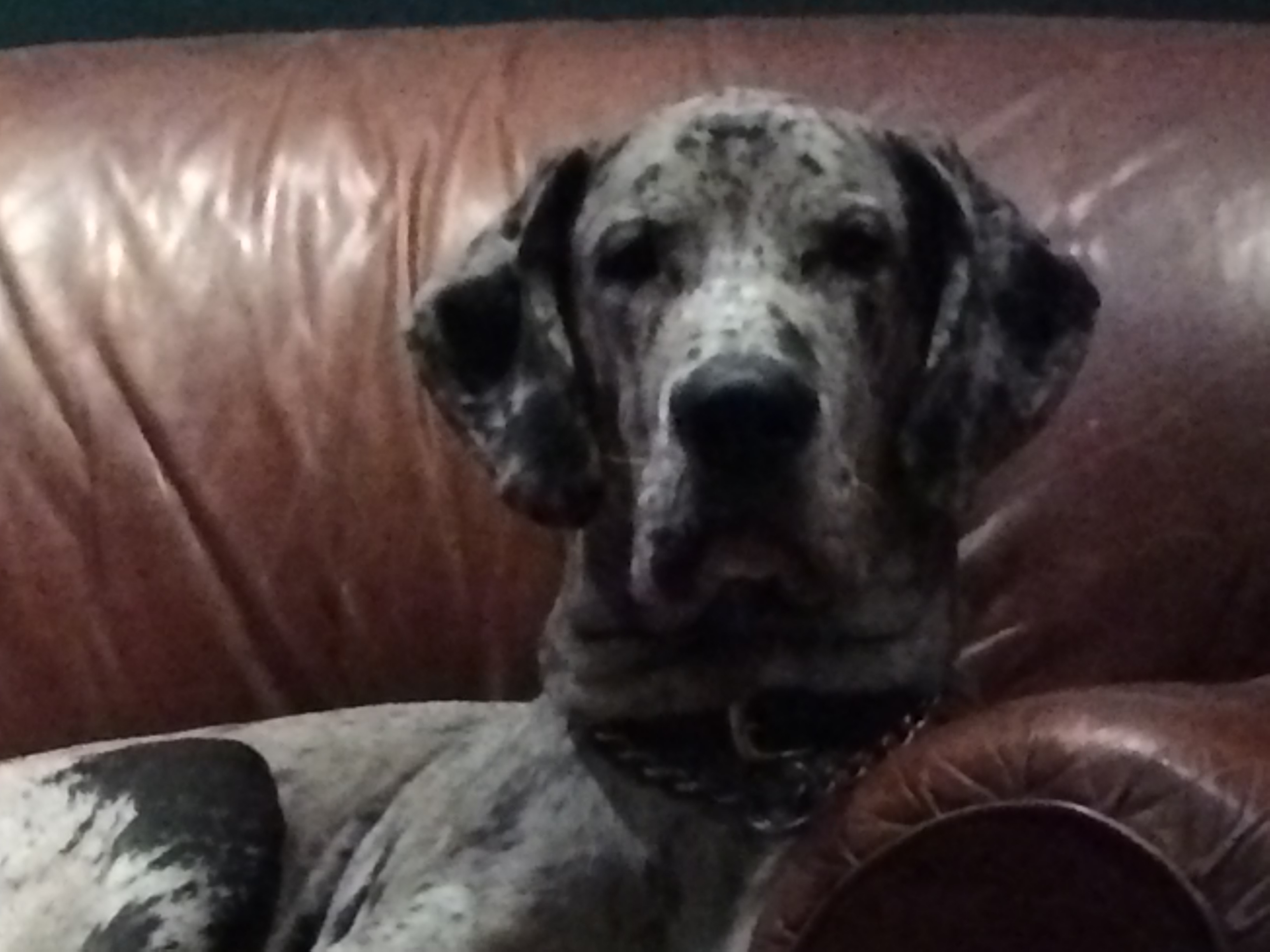
Fast Big Dog’s dog
Picking the right puffy coat is a lot like picking the right skis, dog or spouse (listed in order of importance). This process is personal and unique, with different traits being important to different people and several factors impacting the ultimate decision.
(As a quick aside on topic number two, if your significant other happens to talk you into the acquisition of a Great Dane puppy, be prepared for months of house breaking, a general indifference toward acknowledging their name — the dog, not the significant other — and a voracious appetite for light bulbs. You’ve been warned.)
So as we prepare to embark on this wonderful journey together to outfit you, the reader, in just the right jacket, let’s lay down some ground rules:
Nothing is more important than looking good. Never forget this. Ever.
If you’re one of those dudes who wears race suit bottoms into the coffee shop or grocery store after a workout, you should probably stop reading now — there is nothing we can do for you here. Oh, and stop doing that. Stop it right now.
If you’re an athlete, coach, parent or generally interested bystander who is looking for the “ultimate puffy” — the warmest jacket know to man for hours of standing around the race course in sub-zero temps — have no fear, we have you covered for this, too, (no pun intended) in next month’s column.
This first review is for a category I deemed “lifestyle puffies,” coats that are all about being warm but also looking good. If you’re looking for one winter coat, this is it. If you’re one of those skiers that has two light beers at a wedding and is bombed, then proceeds to tear up the dance floor for two hours with your one move, the only tool you own is a Leatherman or you’ve always secretly admired Batman’s utility belt, well this is your lucky day, as today we are going to get you in your perfect “all-in-one” jacket.
The last rule is also the first rule, when in doubt, always refer to rule #1.
The Process
For the test jackets, I reached out to all of the usual suspects, most of whom were kind enough to provide both men’s and women’s jackets. This was greatly appreciated, as I believe that many reviewers come up small in their analysis as it is often a dude reviewing products for both men and women and from what I can remember from my high-school biology class, there are some important anatomical differences between men and women, although many of the specifics escape me at this time.
To help combat my complete and utter lack of understanding of the fairer sex, I recruited a crackerjack team of female coaches/skiers/bad asses to provide their perspective on each garment. In addition, to keep these reviews as balanced and bias-free as possible, I also asked a few other male nordic coaches to help me with the testing. This entire testing team ranged in age from early twenties to an undetermined amount over-50 and collectively has well over 100 years of experience nordic skiing. Was this a double-blind, prospective, longitudinal peer-reviewed study? No. But I did my best to bring in perspectives from both sexes and several ages to provide as balanced and complete of an analysis as possible and reasonable for a winter-jacket review.
Since I pretend to be a scientist when I’m off duty from FasterSkier, I can’t help but throw in a staple of every good scientific paper or presentation: a disclosure statement. I’m a Steamboat boy from way back, as are a few of the other coaches, though certainly not all. One of the companies, Big Agnes, is based in Steamboat. I am also involved with the U.S. Ski Team and unless you’ve been living in a cave (in which case this review will be perfect for you, as caves can be quite cold and drafty) you likely know that L.L. Bean is the new official gear supplier to the U.S. Ski Team. In addition, I’ve either been on teams or been personally sponsored by Arc’teryx and Mountain Hardware in several different pursuits and activities. Several of my good friends are sponsored by Swix, Salomon and L.L. Bean. So in short, almost the entire review team has or had relationships with almost all of the companies. Having said this, I think everyone did an excellent job of evaluating the coats based on their merit — we all love skiing and we all love gear. The old adage, “There is no such thing as bad weather, only bad gear” rings true to all of us every day so we did our best to provide honest, accurate recommendations with the hope that each and every one of you reading this can be as comfortable as possible out there doing the sport we all love.
On the other side of this disclosure, it is also very important to point out that these are straight-up legit reviews: I know firsthand that other “outside” magazines and web sites require companies to pay money to be considered for reviews, which is appalling in my opinion, as this crosses the line from review into gloried advertisement. I can assure you that this was not the case here — companies were not asked to provide any remuneration whatsoever, nor were we pressured or offered enticements in any way from any of the companies.
Finally, almost all of the coats in this review are in the “good to excellent” range, but what made this process very interesting is just how different many of them were out in the field. One of our main objectives is to therefore describe the circumstances in which each piece will perform optimally and help guide skiers to the jacket that will best meet their needs.
Criteria
In terms of how each particular jacket was picked from the vast array of options, I provided identical selection criteria to each company and asked them to send the product that they felt best met these standards. Representatives from the companies picked the products, so if you’re an over the top fan boy for a particular brand and your “go-to” coat wasn’t picked, email the company, not me.
My entire team did their best to assess as many of the more objective factors (warmth, bulk, fit, etc.) as possible, as well as the more subjective factors (style, use scenarios, etc). We tested all of the jackets in a wide variety of different conditions and environments, from the very usual (loading skis and scraping van windows) to the more unusual:
Based on several meetings and just the right amount of beer, we then came together to create consensus on which coats performed the best in all of the scenarios and based on this meta-analysis, I faithfully and thoughtfully scribed the following review.
The Reviews:
Arc’teryx
Arc’teryx women’s Atom LT Hoody (All photos: FBD)
For this category of the lifestyle puffy, Arc’teryx sent us a men’s Koda parka and the women’s Atom LT Hoody. Arc’teryx sent different models for men and women due to the fact that they do not make a women’s Koda jacket, but they believe these two models to be very comparable, so for the purposes of this review, we are using the two somewhat interchangeably. I am comfortable with this generalization, but please keep this in mind if you read this and want to go running off to the Internets to make the ultimate X-mas gift purchase — don’t yell at me when you can’t find a women’s Koda.
West Yellowstone’s weather Thanksgiving week 2015.
The Koda parka was the warmest of all of the men’s lifestyle puffies, with the women’s Atom LT Hoody in a virtual tie for the top spot in the warmness category as well. Each of them are very, very good coats. Buy this for yourself and you’ll be stoked. Buy it for someone else and you’ll be a hero for years to come. Coming back from breakfast in West Yellowstone, Mont., a few weeks ago, the weather looked like this (see photo at left), and the jacket performed admirably.
The outer layer feels very abrasion-resistant and it held up well for nine intensive days of skiing and coaching in West Yellowstone. If that doesn’t sound like very rigorous testing, you’ve never seen me load and unload wax tables from the team van.
A few of our more fashion-conscious reviewers (both male and female) found both the coloring and styling a little flat and “looked as though it could be going on a mountaineering expedition.” Perhaps since I’ve been on a number of mountaineering expeditions I found this a strength, not a weakness, but it is a fair point. So if you’re looking to ride your fixie home from the tracks to stop and drink PBR with your hipster friends and their ironic facial hair, this may not be the jacket for you. If you are low-key, subtle and have some $$$ to spend (at $449 for the men’s version, this was the most-expensive jacket reviewed in this category), this is the coat for you.
The fit on the men’s jacket is a little more generous than most of the others tested: the FBD is a large, powerful man, so this also was a plus, not a minus, but if you are a little more diminutive, you may find the jacket a little too loose. Interestingly enough, the women’s version seemed to have the opposite fit: two of the reviewers are on the shorter side and found the sizing to be perfect for them, but noted that it may not be ideal for very tall women or those with longer torsos. Overall, this is a very, warm, subdued but sophisticated jacket that looks like it will hold up well to years of serious use.
Strengths: Warm, comfortable, fleece-lined pockets, “quiet style” and durable zippers and outer layer.
Weaknesses: A bit spendy, a few younger reviewers thought the style was a little plain, fit might be too roomy for smaller male frames.
Buy it if: Performance is your top consideration and money is less of an issue, you want to be warm and stylishly understated.
Patagonia
Patagonia Nano-Air Hoody
The fine folks in Ventura, Calif., provided us with a Nano-Air Hoody. The selection of this particular garment surprised us all a bit, as you can’t swing a smoked-up lift op around a mountain town without hitting someone rocking a Patagonia Down Sweater or Nano Puff (this reviewer has one of each), so we fully expected to be sent one of these models. We were not. What was sent however, quickly became of the favorites of the entire team.
Even though this review is focused on jackets to wear to and from skiing, the Nano-Air is so soft, stretchable and lightweight that you can wear it nordic skiing, as well as on the ride to and fro. Two of us also tested it on a killer back-country alpine ski and found it to perform flawlessly, but please note, we were skinning up the hill and working hard on the way down slaying deep powder (yeah, I know, first-world problems…) so we were not only moving the entire time, but also doing so with reasonable intensity.
In all of these use-cases, the coat was basically perfect. Would you ever want to wear it for lift-serviced terrain? Probably not until the mercury tops 30 or so. For spring-party skiing, it’d probably be awesome, but we had a powder day in Steamboat recently and the temp at the top of the mountain was a balmy -2 degrees and I didn’t even consider grabbing this jacket when I left the house.
Overall, this is a killer piece for around town on sunny winter days and it will surely crush it in the spring, fall and cool summer nights in the mountains. Probably one of the best summary comments from the testing feedback forms was, “I love this jacket. It feels more like a hoodie than a jacket and I think I could do all sorts of activities in it or just wear it around as long as it wasn’t super cold.”
Strengths: Incredibly warm for its weight, stretchable, stylish and extremely versatile. Can be worn to the tracks and straight to coffee afterwards or even on the town as a nice hoody. Also a great layering piece.
Weaknesses: Still not as warm as a few of the heavier coats. Probably not the best choice if you live someplace very cold and are looking for a one-coat solution for all of your winter needs.
Buy it if: You are a direct descendant of Nanook of the North, you normally only wear a T-shirt outside all winter, you can thermoregulate like a lizard or you want an incredibly versatile stand-alone or layering piece that will kick ass and take names all year ‘round.
L.L. Bean
L.L. Bean Ultralight 850 Down Hooded Jacket
The newest supplier to the U.S. Ski Team did not disappoint with their offering. The jacket sent to us was the Ultralight 850 Down Hooded Jacket, which is part of the official kit for the U.S. Ski Team and it was rapidly apparent why this is the case: the coat was light, warm and functional. Our version was blue with a contrasting yellow liner that one very fashion-forward female review said made me look “less repulsive than usual.” (Bless you Greta).
L.L. Bean women’s Ultralight 850 Down Hooded Jacket (LL Bean.com)
This jacket also features fleece lined pockets which were a huge hit with the entire coaching staff. Anyone who has spent hours in the cold loading and unloading skis, fiddling with bindings, straps, van keys, video cameras and the myriad of other things that seems to always require removing your gloves, is going to love this feature.
Strengths: A good, solid, all-around coat. Very light and packable. The fact that they support the U.S. Ski Team is also a plus.
Weaknesses: Another coat that is not super flashy. Again, for me, this is a strength, not a weakness, but this is probably not the best choice is you want to go clubbing in New York City, Berlin, or Oslo. Pretty much square in the middle on the warmth/weight ratio scale.
Buy it if: You want to help a company supporting the U.S. Ski Team, you are cost-conscious and you want a very versatile puffy that’ll look good around town and in your race bag at the Birkie. Or if you’re a person who forgets their gloves often.
Big Agnes
Big Agnes Women’s Shovelhead Hooded Jacket
This one is a little tricky, as Big Agnes did not send an entry for the best men’s lifestyle puffy. They did send a women’s coat, the Women’s Shovelhead Hooded Jacket, so while I have no data to report on the men’s side, I can pass along our female reviewers comments.
Big Agnes men’s Shovelhead Hooded Jacket (BigAgnes.com)
Overall, this was a popular coat. All of the women found it to be very warm yet not too bulky or cumbersome. It was more form fitting than the other jackets in this category, which most found to be a plus, though a few female reviewers did note that larger-chested women may not find this cut as comfortable.
Strengths: Best warmth/weight ratio of any women’s jacket. Very packable. Retains warmth well when wet. Very wind resistant. Good for skiers who are always cold.
Weaknesses: May not be good for certain female body types
Buy it if: You are a woman who wants a very lightweight yet warm jacket and your body type fits in the criteria outlined above.
Swix
Swix Romsdal 2.0
This iconic name in nordic skiing provided exactly what we thought they would — a solid, reliable garment, the Swix Romsdal 2.0. It looks very “Nordic,” which is to be expected given the lineage of the brand. Given the audience of this periodical, I’m guessing this will also be a positive in most instances.
The look of this jacket is a bit of the tale of two cities (maybe all Twin Cities residents should therefore go buy one of these immediately), as the men’s version is styled very traditionally, but the women’s coat seems to have just the right amount of flash for all of the female reviewers. Our women’s test jacket was pink with a white band across the upper back and a few snowflakes placed strategically in the banding, which everyone loved. One guest reviewer (a former elite skier and current nordic-store employee) noted, “Oh yeah, we KILL IT with this jacket in the shop. It is one of our best sellers.”
Strengths: Styling of the women’s model seems to be spot-on, not only based on the universal approval of our team of female testers, but also on anecdotal reports of sales. Very economical. Great value.
Weaknesses: Neither the men’s or women’s jacket was incredibly warm, though neither was terrible. The two-tone color on the men’s model looks somewhat traditional and certainly can’t be described as “fashion-forward,” but it that’s not your jam anyway, you’ll be fine.
Buy it if: You’re the type of person with wax stickers on your car. You ski daily. You are a cool mountain-town mom (MTM) or a single dude looking to find a hot, single MTM. Great custom team jacket.
Mountain Hardwear
Mountain Hardwear’s Ghost Whisperer
We received a men’s Ghost Whisperer from Mountain Hardware(again, only a men’s) and this was another one of the coats that made this very elaborate process fun. I’ve owned Mountain Hardwear soft goods for years and have always been impressed with their very pragmatic approach. Their products work well and while they may not have been at the leading edge of the fashion curve, the gear did its job and did it well. So when I opened up the box, I was a bit surprised as this was clearly the most aggressive styling I have ever seen in one of their coats. Fascinated by this apparent change in direction, I set off to the tracks to annoy innocent skiers with my seemingly endless and odd stream of coat questions.
The results of this highly unofficial but yet very unscientific trail/airport/coffee-shop survey? This coat slays it with the “in” crowd. It is very shiny and the color was definitely different but I have to admit, I really like it. To be clear, would I have picked this out for myself if I was alone at my favorite local outdoor retailer? Probably not, at least not right away, but would I go buy one now? Yes.
Mountain Hardwear has stuck to their roots and produced a fantastic jacket that is very warm for its size, portable and a great piece for both athletic and casual use. I guess what sealed the deal for me was when a group of female skiers said, “Oh yeah, that look is so hot right now,” and since I consider myself the Steamboat version of Hansel, this coat now seems like a must-have.
Strengths: Very light, best warmth/weight ratio for all of the men’s coats, fastest down the hill in penguin slides, “so hot right now”
Weaknesses: Style may not be everyone’s cup of tea. Outer layer feels like it could be prone to tears, but having said that, despite repeated penguin slides, none of us had any issues with rips, tears or snags. Plus, is it worth it to have a coat that might rip a bit easier but looks awesome? I hope you know the answer to that question by now. If not, please revisit Rule #1.
Buy it if: Style IS your jam, you don’t like being cold, you understand and appreciate >50% of these references.
Bjorn Daehlie
Bjorn Daehlie Easy Jacket
Another iconic nordic brand that we were delighted to review. This was another case in which we only received a men’s coat, the Easy Jacket, so please factor in accordingly the fact that we were only reviewing a men’s jacket. This jacket also took a page out of the independent-thinker handbook, as this was another garment that didn’t necessarily fit the criteria outlined, but we loved it nonetheless.
This is not really a “wear-around-town jacket,” but having said that, it was great at its core mission: nordic skiing. This particular coat was the most breathable and flexible of the entire group, so it was by far the best jacket in which to nordic ski. Now, you may be saying to yourself, “Self, I thought the goal of this review was to find the best jacket to wear TO ski, not to ski IN,” and you’d be correct, but, we did like this coat a lot for nordic skiing.
It is very non-constrictive and perfect for athletes who chill easily or for us normal people on VERY cold days. Would I buy it? Yes, but probably not for around town. It’s a great jacket to have in the quiver for cold skis and still be able to wear in the grocery store without being asked to leave. This of course, begs the question that if you need to wear this jacket skiing, aren’t you therefore predisposed to being cold and would thusly want an even warmer jacket to wear off the tracks? Wow, look at you with the good questions… Fair point though, so if this is all ringing very true to you, you had better plan on buying this and one of the “ultimate puffies” that will be reviewed next month and you’ll be good to go.
Strengths: Very light, flexible and perfectly suited for nordic skiing
Weaknesses: Least warm of all of the jackets, you’ll be “that guy” in the grocery store still rocking his nordic stuff. Speaking of which, didn’t we clearly tell you earlier in this article to stop doing that?
Buy it if: You want a coat you can ski in, you have a Nordic World Cup fantasy team, the first thing you read every morning is Noah Hoffman’s blog and you’re going to ignore me and wear your tights around town for three hours after your ski anyway. This is your look. Own it.
Hopefully this information will help you make an even more informed decision on your next trip to the gear store, which if you are like me, is a regular occurrence — especially this time of year. Don’t forget either, you’ve probably been out training a lot this year (yes, yes, not as much as you’d like, you’ve been SO busy at work, this time of year is crazy, etc.) but still, think about all of those around you that support you in your pursuit of this ridiculous hobby.
Let’s just say that even if you are all set gear-wise (which is doubtful, but for the purposes of the last part of this discussion we’ll accept this premise), maybe you should take all of this newfound brain knowledge and use it for good instead of evil and hook up that someone special with one of the best presents you could ever hope to find under the tree, Menorah, or Festivus pole — a kick-ass “lifestyle” puffy.
Everyone loves a good puffy and remember, there is nothing more important than looking good.
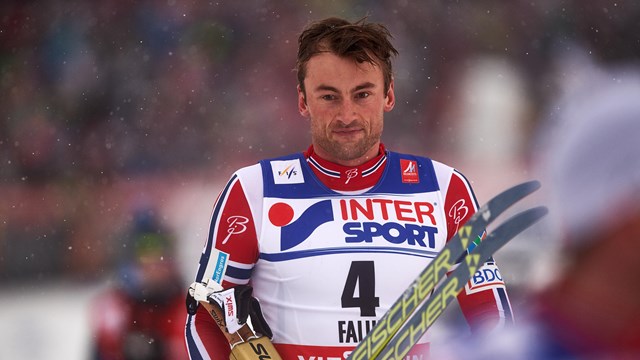
Petter Northug Jr. at 2015 World Championships in Falun, Sweden. (Photo: FIS/NordicFocus)
Petter Northug Jr. took it upon himself to stir up some drama in Sweden on Friday when he won the Bruksvallarna 10-kilometer classic race, in, you guessed it, Sweden.
The 29-year-old Norwegian won the 10 k International Ski Federation (FIS) race by 36.1 seconds over Sweden’s Jimmie Johnsson, of the AXA Sports Club. Northug did so without any trouble as none of the men in the 180-plus field came close to him throughout the individual start. By 3 k, he was nearly 6 seconds up on the next-fastest man, Johnsson. Throughout the race, he continued to widen the gap to competitors like Simon Andersson of Sweden and Chris Andre Jespersen, Northug’s teammate on the Norwegian World Cup team.
If it wasn’t enough of a jab that he wore a race suit that distinctly displayed Sweden’s colors and flag, Northug told Norwegian press the win meant nothing to him. If he’d raced similarly in Beitostølen, Norway, last week (which had a slightly longer 15 k classic), he wouldn’t have finished in the top 10, he told NRK. He won Friday’s 10 k in 23:43.3.
Petter Northug (r) chases Norwegian teammate Martin Johnsrud Sundby during last weekend’s 15 k freestyle FIS race in Beitostølen, Norway. Sundby went on to win by 47 seconds and Northug was a minute back in fourth. (Photo: Eirik Lund Røer/SKIsport)
But he didn’t race the Beitostølen 15 k classic, and this marked his first win in two race weekends this season (he was second to Norwegian teammate Eirik Brandsdal in the Beitostølen classic sprint last weekend). There, he raced in a red-and-white suit with the name of his main sponsor, Coop, on his leg.
In Bruksvallarna, he wore another suit with the Coop logo — one custom-made by Bjørn Dæhlie — with Sweden’s white, blue and yellow.
“Some look at this with hatred, but I don’t judge anyone,” Northug told NRK, according to a translation. “People are allowed to think what they want.”
Despite feeling lack he lacked “a little punch” early in the race, Northug closed hard in the final the kilometers on Friday. At the finish, where he knocked Johnsson — the sixth starter — out of the leader’s spot (Northug started 158th), Northug made a point not to celebrate.
“It’s just training here; it means nothing that I won the race,” he told VG.
“It would be as if I was celebrating beating my brother in a running race, and he was three and I was 14,” he said, according to a rough translation.
The fact of the matter is Johnsson, 30, is actually older than Northug, and so is 31-year-old Martin Johansson of IFK Mora, who placed third 38.1 seconds back and 2 seconds out of second.
Two-tenths of a second from the podium was Norway’s 22-year-old Mikael Gunnulfsen (Oern IF) in fourth, and Jespersen, 32, placed fifth (+ 38.6). In second at one point, Andersson ended up sixth (+39.9).
In all-too-personal news, Northug’s coach, Stig Rune Kveen, told Aftonbladet that Northug is actually half-Swedish. His parents, John and May, apparently conceived him at the Bruksvallarna mountain race in April 1985. Therefore, thereto…
Swedish sprinter Emil Jönsson, who placed 15th (+1:03.4), was all for Northug becoming a full-blown Swedish citizen.
“He is most welcome. We can offer food and shelter,” he told Expressen. “We may need him.”
Racing continues in Bruksvallarna with the 10/15 k freestyle on Saturday and freestyle sprints on Sunday.
Norwegian biathlete Ole Einar Bjørndalen’s VO2max of 86 mL∙kg∙min-1 is higher than the 95% confidence interval of other Norwegian biathlon medalists. But it’s not the only thing that makes him the King of Biathlon – he shot 89% en route to four gold medals at the 2002 Olympics, and his mental focus and tough training are legendary.
The Norwegian Olympic and Paralympic Committee and Confederation of Sports has authorized the release of VO2max test data by its nordic Olympians – in the name of science.
VO2max, or maximal oxygen uptake, is an important physiological metric for endurance athletes. Coaches take note of the measurement and its development over time as an indicator of aerobic potential.
It’s also not a guarantee of athletic success. In all sports, including cross-country skiing, other aspects of athleticism like technique and mental strength are essential in determining a winner. The athlete with the highest VO2max is often beaten by those with lower maximal oxygen uptake.
But it’s certainly important to have a high VO2max , and several famously successful athletes like Bjørn Dæhlie, Gunde Svan, Harri Kirvesniemi, Ole Einar Bjørndalen, and Anders Aukland have among the highest measurements ever recorded.
Espen Tønnessen, who works for the Norwegian Olympic and Paralympic Committee and Confederation of Sports, was the recipient of this enviable VO2max dataset along with colleagues there and at the University of Agder.
The data included test results from 111 Olympians and World Championships competitors from cross-country skiing, biathlon, and nordic combined, over the years from 1990-2013.
All told, the group had won 62 Olympic and 198 World Championships medals, between one fifth and one third of all the medals available during that time period, depending on the sport.
Tønnessen and his co-authors compared the absolute (in liters per minute) and relative (corrected for body weight) VO2max test data between athletes in the different sports, between medal-winning and non-medal-winning athletes, and between men and women.
The study was recently accepted by the International Journal of Sports Physiology and Performance. You can see a poster version of the findings here.
The authors found a number of interesting patterns. For instance, VO2max wasgenerally higher for cross-country distance skiers than for sprinters, with biathletes somewhere in the middle and nordic combined athletes having a wider range of VO2max.
Just how high were the numbers? Cross-country distance skiers had a relative VO2max of84.3±5.2 mL∙kg∙min-1for men and 72.6±5.1 for women. The lowest male measurements belonged to non-medalist nordic combined athletes, at 73.5±2.9, and the lowest for women to non-medalist biathletes at 62.0±3.1.
In cross-country distance skiing, biathlon, and nordic combined, medalists had an higher average VO2max than non-medalists, although the difference was not statistically significant.
Notably, the range of VO2max values for female biathletes who won medals was much larger than the range for medalists in other sports. This may indicate the importance of the mental aspect of the sport, or that the women’s field is not as deep as the men’s field, perhaps because women’s biathlon was only accepted as an international competition sport much later than women’s cross-country skiing.
Along a similar vein, the difference in VO2max between medalists and non-medalists was biggest in nordic combined.
“This could be explained by the smaller number of athletes competing at the very top end in this sport discipline,” the authors wrote. “Another reason could be that the competition regulations favor athletes with well-developed aerobic capacity compared to ski jumping capabilities. Despite previous studies suggesting that VO2max does not reliably predict endurance performance amongst elite athletes, the current study indicates that in certain winter endurance disciplines high VO2max may differentiate medalists from non-medalists even at the very highest performance level.”
In cross-country sprinting, the averages were virtually identical between medalists and non-medalists. As short-distance races, aerobic fitness is clearly required, but pure speed and anaerobic fitness are also important determining factors for success.
By publishing the data and and the information about testing equipment used by the national teams, Norway is also setting benchmarks that can be used as a measuring stick by other athletes and researchers internationally.
The last time such data had been published was in 1967. Tønnessen found 2% higher relative VO2maxmeasurements for male distance skiers in the new dataset, 9-10% higher measurements for male biathletes, and 12-13% higher measurements for female distance skiers.
Is that because athletic training and performance have improved over the last half-century? Or because testing equipment and methods has also changed? Perhaps both are true.
But for women in particular, there’s evidence that top athletes are becoming more and more fit. Since the 1960’s, for instance, the difference in relative VO2max between men and women has dropped from 30% to 15%, the authors write.
And that difference is likely here to stay, they conclude.
“The current 15% difference in relative VO2max between male and female medal winning skiers is not related to gender differences in training loads, but is well explained by long-established physiological differences in hemoglobin mass, body composition, and relative heart size between males and females,” they write. “This difference seems therefore unlikely to narrow meaningfully over coming decades.”
For the nerds: here’s how the equipment the Norwegians use to do their tests
“A 200×70 cm ELG Woodway treadmill (Woodway Gmbh, Weil am Rhein, Germany) routinely calibrated for speed and incline was used for VO2max testing. During the test, participants breathed into a Hans Rudolph two-way breathing valve (2700 series; Hans Rudolph Inc, Kansas City, USA) connected to metabolic gas analyzers. Gas exchange and ventilatory variables were continuously sampled in a mixing chamber and averaged every 30 s. Oxygen uptake was measured using EOS Sprint (Jaeger-Toennis, Wurtzburg, Germany) from 1989 to 2002 (June), while an Oxycon Pro (Jaeger-Toennis, Wurtzburg, Germany) metabolic test systemwas used from June 2002.”
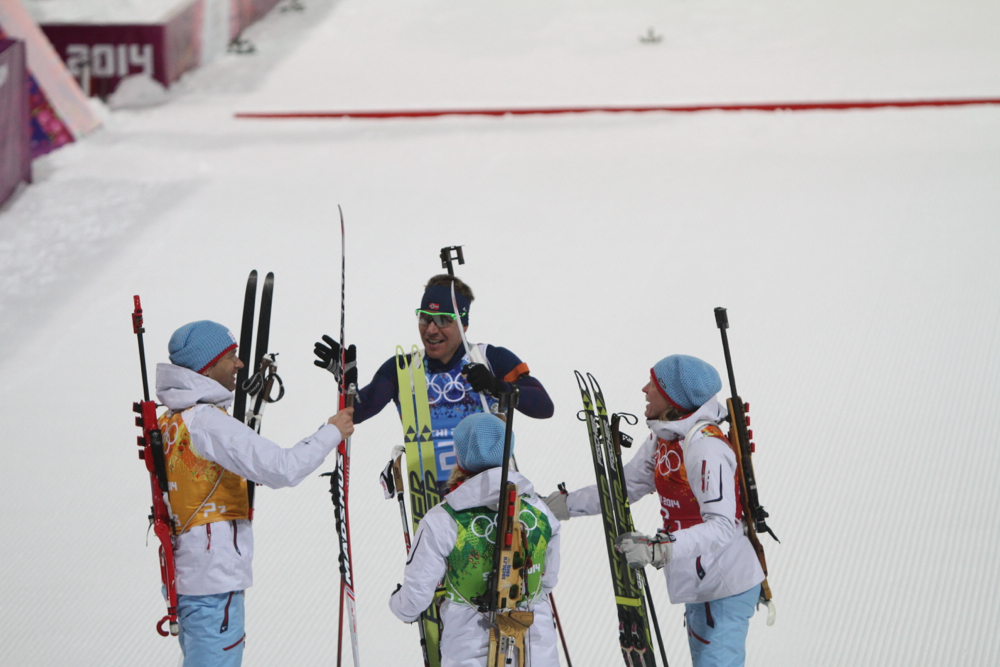
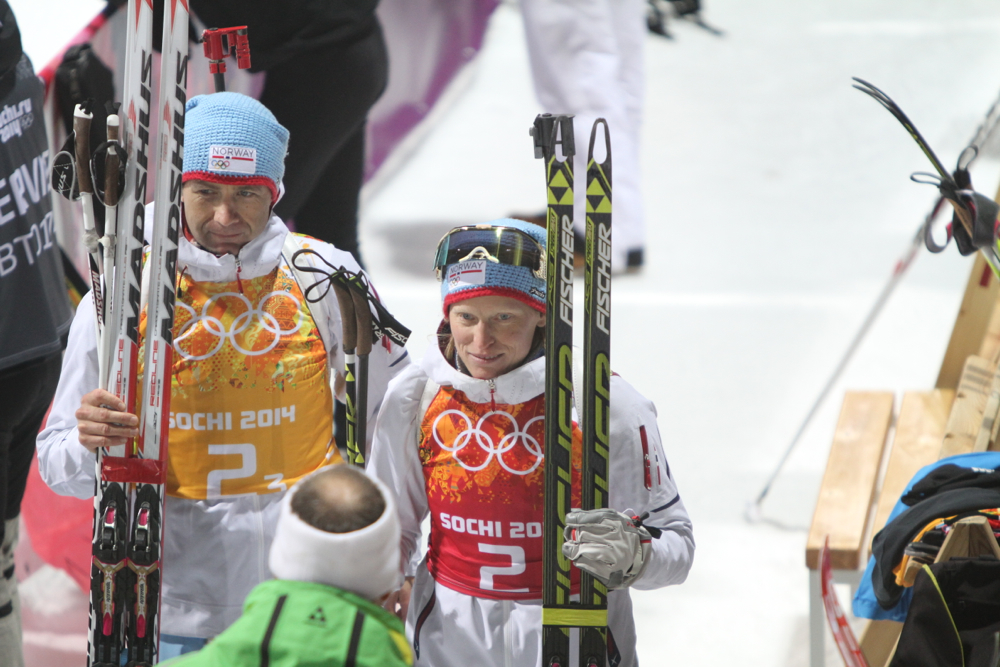
The Norwegian biathlon team celebrates gold in the first-ever Olympic mixed relay after Emil Hegle Svendsen showboated his way toward the finish line.
FasterSkier’s coverage is made possible through the generous support of Swix.
KRASNAYA POLYANA, Russia – Just 24 hours earlier, Emil Hegle Svendsen had nearly lost a gold medal in biathlon when he began celebrating his win in the 15 k mass start before crossing the finish line. The second-place racer, Martin Fourcade of France, lunged towards the line and only missed out by three hundredths of a second.
Today, Svendsen had a little more time to savor his victory. Entering the range with a more than 30-second lead, the Norwegian knocked down all five targets in quick succession and then raised his arms to the stands as he put his poles back on.
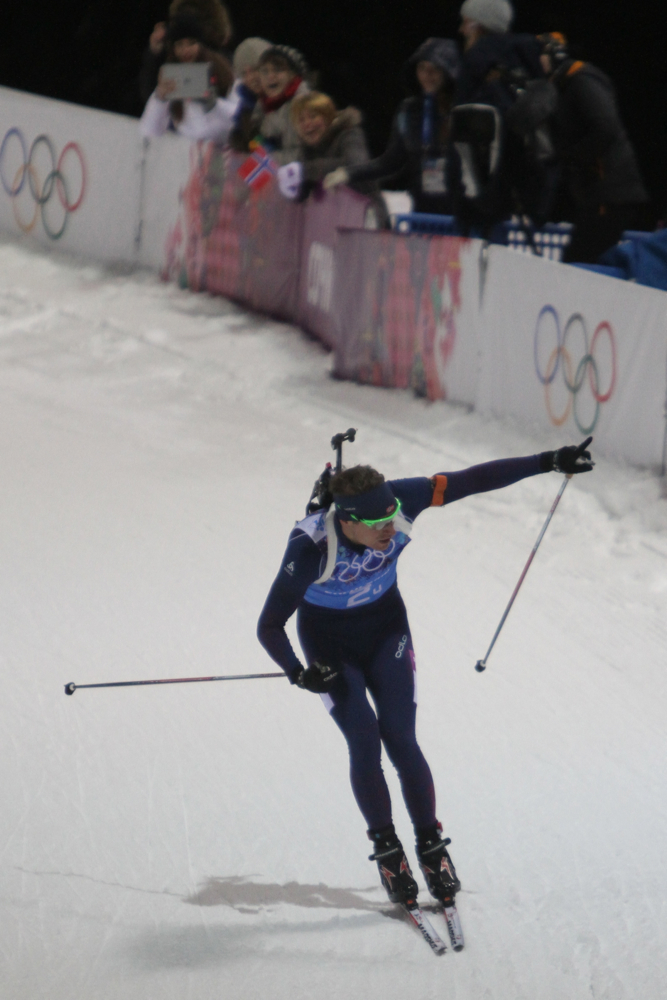
Svendsen waving to fans as he descended into the stadium the final time.
He still had 2.5 k to ski, but so what? He had plenty of time to keep celebrating. After a loop out on the course, where Svendsen took his sweet time, he waved to fans coming around the final downhill corner into the stadium. Then he played up the crowds as he coasted down the finishing stretch far ahead of the second-place team from the Czech Republic.
Svendsen later told NRK, a Norwegian television station, that he was looking for a Norwegian flag to carry across the line, but then became scared that such behavior was banned at the Olympics. (He may have been extra cautious because of the Norwegian ski team’s written reprimand from the International Olympic Committee for wearing black armbands.)
The man who had the most to celebrate, though, wasn’t so vocal.
Ole Einar Bjørndalen had raced the third leg for Norway, after Tora Berger and then Tiril Eckhoff combined to put the team in a dead heat for first place after the women’s legs were complete. Bjørndalen, who had earned his seventh Olympic gold medal in the Games’ opening sprint and had tied Norwegian skier Bjørn Dæhlie for the most medals in winter Olympic history with 12, skied the fastest course time of his leg and shot a perfect ten for ten.
He built a 43-second lead for Norway, which Svendsen got to simply savor as the anchor leg.
The gold medal for the team gave Bjørndalen a tie with Dæhlie for the most gold medals in winter Olympic history, and nudged his total medal haul up to 13, which nobody has ever matched. And he wasn’t just a tourist, at 40 years old, depending on the strength of his team – no, Bjørndalen made that gold medal.
And how does it feel to be the most decorated winter Olympian in history?
“It’s cool,” Bjørndalen shrugged in an in-venue TV interview, acting the typical reserved Scandinavian compared to Svendsen’s bravado. “Bjørn Dæhlie was a big hero to me.
Speaking to NRK after the race, Bjørndalen said that he still thinks Dæhlie is the better athlete.
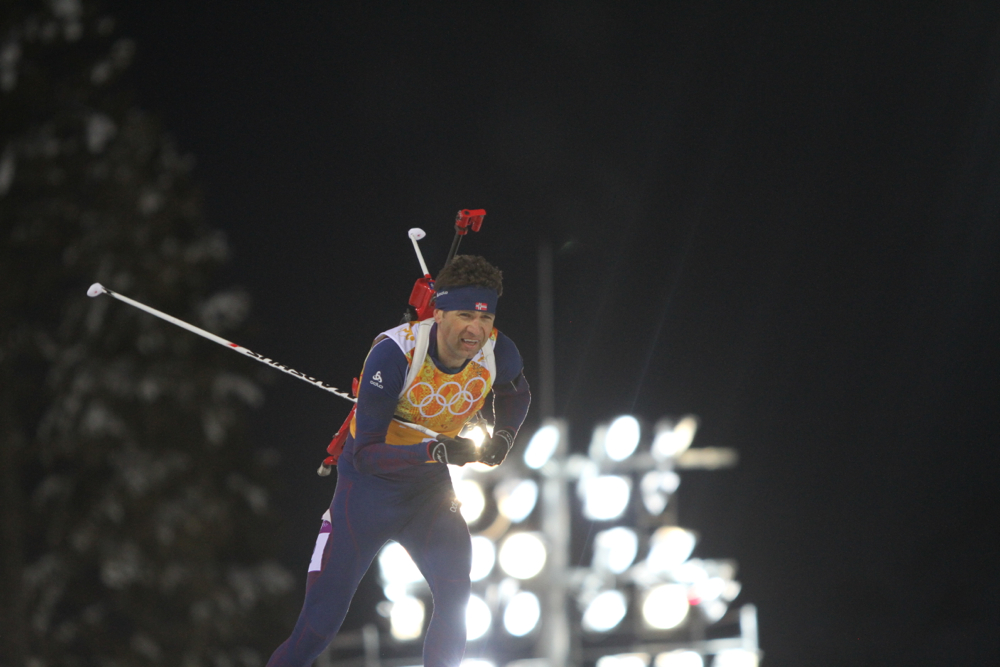
Ole Einar Bjørndalen out on the trails, where he trounced the decades-younger competition.
“Clearly this record means a lot, and it’s a big achievement,” he said. “In his time, [Dæhlie ] had what I love about cross country skiing – the raw capacity. There is nobody in Norway who has had that capacity and the raw endurance talent that Dæhlie had.”
Meanwhile, his teammates were just thankful that Bjørndalen has remained a leader in their sport and their team.
“We’re all making history today,” Svendsen said in the press conference. “I think the whole team owes a big thanks to him. I think many of the things we think about in training is because of his extreme professionalism.”
“Ole’s amazing, what else can you say?” asked Eckhoff, who is 17 years younger than the legendary biathlete. “It’s amazing that we can be on the team with him today.”
Accolades aside, it was a remarkable race for Norway from start to finish, showing off what is possible in the mixed relay, a format which is new to the Olympics. With just two women and two men, a level of excellent performance is possible which is tougher to achieve with a full four-man or four-woman team.
Over the course of 40 targets, Norway used just two spare rounds to knock them all down. And in fact, both were used by Berger, the team’s scramble skier. Norway hit the next 30 targets in succession, a feat which has rarely been matched in relay racing.
“It was a fantastic achievement by everyone,” Berger, last year’s overall World Cup winner, told NRK. “It was really fun to go today.”
“It was really cool to be involved today,” agreed Eckhoff, the bronze medalist from the mass start who has never before been considered one of her country’s top two women and had only raced one mixed relay ever before.
The win was also a relief for Norway because, just as in cross country skiing, they had been having problems with ski preparation, which contributed to the team earning far fewer medals than had been projected.
And just like Marit Bjørgen and Ingvild Flugstad Østberg’s dominating win in the women’s team sprint today, the mixed relay gold brought an end to that disappointing drought.
“What has changed the most is that we have some better skis and our servicemen have found the problem with our material,” Svendsen said. “I think I can say a big thank you to our service team because it’s very important in skiing, as you can see in the last couple days. … This is the biggest race for that.”
The Czech Republic took silver to continue a remarkable Olympic campaign; it is their fifth medal of the Games in biathlon. Italy took bronze to earn their first Olympic medal since 1998.
—Nat Herz and Alex Matthews contributed reporting.
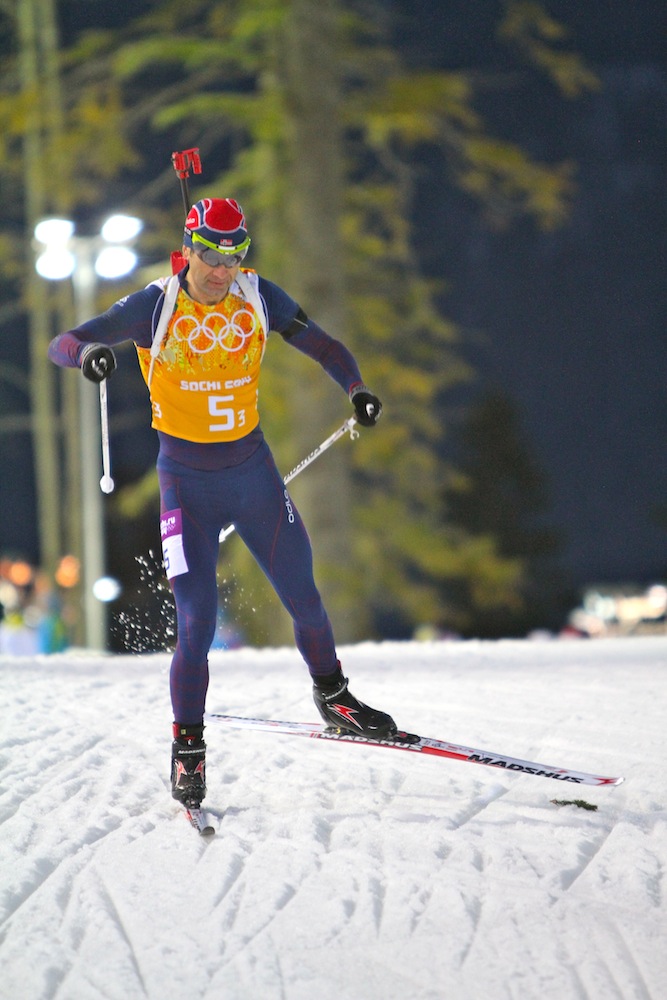
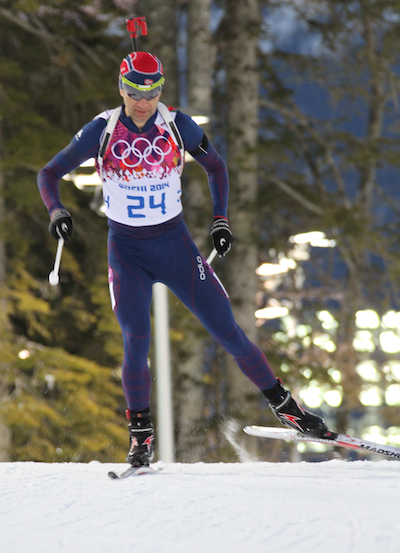
Norwegian biathlete Ole Einar Bjoerndalen skiing to the win in Saturday’s 10 k pursuit at the Sochi Olympics.
FasterSkier’s coverage is made possible through the generous support of Rudy Project.
SOCHI, Russia — When Norwegian biathlete Ole Einar Bjoerndalen won his first Olympic medal, Google didn’t exist.
That was in 1998, when Bjoerndalen won gold in the sprint in Nagano, Japan.
Sixteen years later, Bjoerndalen, now 40, won again in the same event at the 2014 games in Sochi, Russia on Saturday — earning his seventh career gold and 12th Olympic medal, besting competitors half his age over 10 kilometers of skiing and two rounds of shooting.
Bjoerndalen’s result tied the record for the most career medals in the Winter Olympics, a mark that had been held by the Norwegian cross-country skier Bjoern Daehlie, who Bjoerndalen describes as “one of the biggest stars in Norway, and one of the biggest stars, total.”
But there’s no doubt that Bjoerndalen belongs in that same category — and his result Saturday only solidified that standing.
He won the race despite notching a penalty, edging out two men who ended up below him on the podium despite shooting clean — Austrian Dominik Landertinger and the Czech Republic’s Jaroslav Soukup, who trailed by 1.3 and 5.7 seconds, respectively.
Of the 87 men in the race, Bjoerndalen was the third fastest on his skis — behind only the French star Martin Fourcade and Russia’s Anton Shipulin, each of whom also had one penalty.
But what put Bjoerndalen atop of the podium was the combination of speed on skis with speed on the range: the Norwegian took his 10 shots in just 45 seconds. That was quicker than all but three other men, none of whom were as fast as Bjoerndalen on the course.
“They don’t call him the king for no reason,” said Leif Nordgren, an American biathlete who finished 45th, nearly two minutes behind Bjoerndalen.
Admiration for Bjoerndalen poured in from all sides — from teammates and competitors alike.
“He’s been my big idol since I was 10 years old, starting with this sport,” said Norway’s Tarjei Boe.
“He can step up to the plate and do it,” said American biathlete Lowell Bailey. “It’s pretty amazing.”
“If there’s one guy outside of our four that I wanted to see win, it was him,” said Canadian Scott Perras, looking more than a little bit starry eyed. “Forty years old, and what an inspiration.”
Perras recalled how the Canadians had held a pre-Olympic camp at the ski area in northern Italy where Bjoerndalen was training alone — where Perras said the Norwegian had asked workers to specially groom a meadow to prepare him for the courses in Sochi.
“Once the normal uphill ended, they added another section,” Perras said. “You’d just see him do his loop, go back up the hill, do his loop. So it’s no wonder.”
On Saturday, Bjoerndalen said he was worried his speed was beginning to falter in the later part of the race.
“But in the last uphill, I had some power in my legs,” he said.
His last Olympics, in 2010, had been moderately successful, as he earned a silver medal in the individual 20 k race, and a gold in the relay.
In the intervening years, however, he’d struggled with illness, as well as some of the inevitable aches and pains that come with aging: he blamed a back injury in 2011 on an attempt to cut down a tree that went awry.
(“I thought I could do it,” he said at the time. “But I got injured and lost several weeks.”)
What kept him going?
“Life is too short to give up,” Bjoerndalen said in a press conference after the race. “My motivation was never a problem, so I could keep on and do my training every day — and that was most important to why I am here today.”
This season will be Bjoerndalen’s last. But before it’s over, he’ll likely have several chances to break Daehlie’s record of 12 Olympic medals.
As of last week, he had not been promised a position on Norway’s relay team, which should win a medal barring a catastrophic collapse. But Bjoerndalen’s result Saturday should dramatically improve his chances of earning a spot, and he’ll start Monday’s pursuit in the lead.
In the mean time, his performance in the sprint will serve as something for his competitors to aspire to, according to Perras, the Canadian.
“Just to see him train, how focused and dedicated he was,” Perras said, referring to his time watching Bjoerndalen at the Italian ski area. “He’s just really pushing the sport, still.”
–Alex Matthews and Chelsea Little contributed reporting.
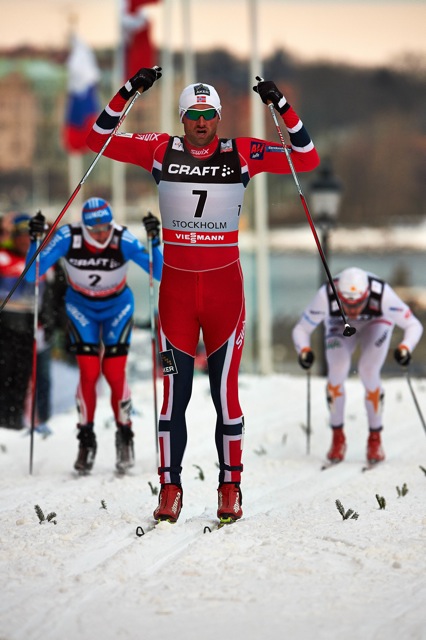
Petter Northug (NOR) began and ended his World Cup Finals campaign in Stockholm and Falun, Sweden, with victory, and his win in the 15 k pursuit on Sunday secured his claim on the overall World Cup crystal globe. Photo: Fischer/Nordic Focus.
He won the mini tour. He won the BMX trophy drive. He won the overall World Cup.
“We’re going to let loose and do something fun tonight, but whatever that is, I still don’t know,” Petter Northug (NOR) said after finishing the 15 k freestyle pursuit on Sunday.
You can hardly blame him. Northug completed an astonishing reversal in the season standings, finding late winter form and motivation to take his second overall World Cup title, his first since the 2010.
With this victory at World Cup Finals, Northug becomes only the second Norwegian to take more than one overall title. He’s still shaded by Bjørn Dæhlie’s six triumphs, but Northug is in rare company.
Leading into Sunday’s 15 k freestyle pursuit the question on everyone’s lips asked what Northug’s tactics would be. Would he try to keep the chasing pack away, or would he be caught and have to sprint for the finish?
A yawning gap separated Northug from his closest competitor in the Falun mini tour on the start line; Maxim Vylegzhanin (RUS) started 30.5 seconds after Northug.
Northug wasn’t concerned about Vylegzhanin.
In prerace interviews he indicated to FIS that “I don’t care much about Maxim Vylegzhanin. I have to keep Legkov and Cologna behind.”
Realistically, neither had a chance to overthrow Northug. Cologna started 1:20 behind the Norwegian. Indeed, Northug had gone as far to say that he would cancel his holiday if he lost it.
“I’ll go on a camping trip in Falun,” Northug said to Aftenbladet after being asked what he’d do if he lost. “I don’t think that’s very pleasant.”
Legkov, the closest to Northug in the overall, started 1:47 back. Barring a spectacular implosion, the title was Northug’s for the taking.
Judging by Northug’s start, it appeared his tactic would be to slot in behind Vylegzhanin and pace himself to the finish. Northug came out of the starting gate sluggishly, without his characteristic spark.
At the first 1.4 k checkpoint the clock revealed another story. Northug passed the mark in 3:47.7, with Vylegzhanin coming through 32 seconds later. The Norwegian had started in earnest.
Further back, Martin Johsrud Sundby (NOR) had already latched onto Eldar Rønning, whom had started third, 40 seconds behind Northug.
Rønning, the classic specialist, was already leaking time. After the first 3.6 k loop, the race began to take shape. Rønning faded, and Vylegzhanin formed an elite group of chasers containing Sundby and Finn Hagen Krogh (NOR), whom had already eaten up a significant margin after starting 54.4 seconds behind Northug.
The chase was on, but the spirit of the chasers might have dampened after one lap through the stadium when they found themselves 39.8 seconds down to a determined Northug.
As the chase group approached the uphill spectators were treated to some theatrics by Vylegzhanin when he took a drink from a coach and face planted after he poled between his legs. Perhaps World Cup racers are more human than we suppose. That misfortune effectively ended Vylegzhanin’s fight for a mini-tour podium. Seeing the Russian lying on the track behind them, Sundby and Krogh ratcheted up the pace and left the Russian for dead.
Northug passed the 5 k mark in 12:38.5, coaxing his 83 kilograms up the long uphill. Half a minute later Sundby and Krogh roared past in hot pursuit of their teammate, taking 8 seconds out of Northug’s lead in the steep pitch.
Northug’s overall rivals hadn’t made the necessary inroads to pose a real threat, with Cologna and Legkov passing the 5 k mark over 90 seconds down.
It appeared the real drama would be if Northug could hold off his teammates. Sundby and Krogh were clearly hunting Northug, and if they didn’t have the same race suit on you’d have hardly thought they were Norwegian. Northug wasn’t getting any favors. Yet for all of Sundby’s and Krogh’s advances on the uphill, their downhill track craft muted their climbing prowess.
Northug conceded seconds on the climbs but stabilized the losses on the downhill, taking advantage of the untidy snowplowing of his teammates.
As they came into the stadium for the second time, a huge group had formed 1:36.7 behind Northug, led by Legkov. Even if the overall appeared out of his reach, the fight for second place between he and Cologna was on.
As Northug crested the big hill again, Sundby and Krogh had sight of their teammate, only 24.9 seconds back at the 8.6 k mark.
Vylegzhanin passed through in damage control after his fall, 1:10 behind Northug, while the pack led by Legkov and Ilia Chernousov (RUS) came through 1:26.9 seconds down.
In the chasing pack Krogh took charge and tried to close those final meters to Northug, but the tall Norwegian was doing just enough to keep the chasers at bay. At the 12.2 k mark Northug had 14.9 seconds to play with in the final 3.7 kilometers of the season.
Out of the stadium Northug grimaced up the last hills and swooped into the stadium, while Sundby and Krogh attacked each other behind.
A few quick glances over his shoulder, and Northug knew he had done it. He cruised into the stadium and took his time towards the finish while Krogh and Sundby lit up the afterburners to fight for second place.
In the end Northug stuck his toe across the line only 0.7 seconds ahead of Krogh, who got the better of Sundby in the end. Northug finished in a time of 35:48.3.
In the end Northug’s margin of victory in the overall flattered to deceive, with a 180-point margin over Legkov by virtue of the 200 points awarded the Falun mini tour victor.
Northug afterward was unexpectedly emotional.
“It’s really fun to do it,” Northug told the NRK.. “It’s not simple to win the World Cup; many of my competitors prioritize the overall over world championships, and that is huge.”
With Ja Vi Elsker, the Norwegian national anthem, playing over the loudspeakers as he raised the second crystal globe of his career, tears welled in his eyes. The jubilant champion felt relief after the pressure of the last two weeks.
“It feels a little like I’ve stolen the overall title,” he said. “It has been a fantastic season. I won an individual world championships gold, additionally in an individual start, and the world cup overall. I’m very satisfied.”
Even the head of the Norwegian ski federation Vidar Løfshus expressed his admiration.
“We came here to win the crystal globe, and we did it,” he told the NRK. “Both the support crew and the athletes have done a great job.”
Northug leaves Falun with a hefty payday and a new BMW. But you won’t see him driving it, as he’s donated the vehicle to charity.
It was Northug’s day, but he wasn’t the only one with something to celebrate.
Like Rønning the day before, Krogh delivered one of his best results of the season to take second place in the mini tour. He also posted the fastest time on the day in 34:54.6.
“On a good day I can deliver a good result,” Krogh said to the NRK. “In the future I will deliver more consistent results than this year. I am prepared to train a lot to be even better next year.”
Sundby was third and Legkov fourth in a time of 35:05.5 and 35:14.7 respectively.
In the final analysis Legkov fell just short of his first overall World Cup title, but he can take consolation in claiming the distance world cup, winning the Tour de Ski, and improving upon two successive seasons where he finished the season fifth in the overall rankings. If his career arc continues on the same trajectory, he’ll be a contender for the overall next year.
Northug topped the prize money list for the season, earning himself a substantial payday of 212,500 CHF. Legkov and Cologna were second and third, padding their bank accounts with 165,625 CHF and 136,250 CHF respectively.
Norway took the Nations Cup competition with a 14,208 points. Russia accrued 9,130 points for second place, and Sweden third with 6,352 points.
Bjørn Dæhlie, shown here in 2010, no longer owns the highest V02max ever publicly recorded.
A few weeks ago 18-year-old Norwegian cyclist Oskar Svedsen turned heads by doing something no one has done before in the world of physiological testing: he recorded a V02max of 97.5 mL/kg/min. The number surpasses the high water mark long held by Bjørn Dæhlie (96 mL/kg/min), making Svedsen the young new king of aerobic capacity.
Whether it has any significance or not, cross-country skiing can no longer lay claim to the best V02max in existence, a fact that was not lost on the Norwegian press. At least one journalist took the opportunity to wonder if a bigger trend was afoot: are the country’s most naturally gifted athletes feeding into cycling over other athletic pursuits, and if so, does Norway have a new national sport on its hands?
Both are interesting questions, but they make the incorrect implication that V02max test results are the predictors of performance in cycling, skiing or any other endurance activity. Svedsen himself acknowledged that lab numbers aren’t everything. “The figures are not what’s important. I’ve been beaten by many with lower O2 uptake than me throughout the years,” he said to Procycling.no.
Svedsen proved on Monday that he could perform on the road, too, winning the junior time trial at UCI World Championships in Valkenburg, Holland. His unparalleled engine undoubtedly helped him along, but a high max VO2 alone is not a guarantee of performance. To use an example from nordic skiing, Espen Harald Bjerke (NOR) once recorded a 96 max VO2 but never came close to matching Dæhlie’s results. Bjerke’s best World Cup finish was a fourth place in Otepää, Estonia, in 2005; Dæhlie is still considered the best cross-country skier in history.
The discrepancy between Bjerke’s and Dæhlie’s results underlines Svedsen’s dismissal of test results as overly important. Aerobic capacity is only just that — capacity. It demonstrates an athlete’s potential if he or she can get other aspects of the sport to fall into place.
For instance, a 2010 study by a group of Swedish and Norwegian sports scientists sought to determine the relationship between “energy delivery and mechanical efficiency” and performance. To do so it collected a handful of physiological data points from Swedish and Norwegian skiers at the world-class and national-levels as they rollerskied on a treadmill. Not surprisingly, the study found that the world-class group was more efficient overall than the national-level athletes and suggested this was likely due to better technique and power transfer. Aerobic capacity wasn’t the only part of the skiers’ physiology affecting results.
The fact that it took a cyclist to finally depose Dæhlie from his throne is also worth noting. VO2max is calculated with an athlete’s weight, and so if two people record the same value for absolute oxygen consumption, the lighter person is going to have a higher VO2max. An elite skier, with a need for upper body strength, is generally not going to weigh less than a cyclist.
So if anything, Svedsen’s ascension to the top of the charts underscores how impressive it was for Dæhlie to have held onto the position for so long. And in an argument over whose sport can claim the best athletes, Dæhlie still owns the title for most decorated winter Olympian of all time.
Norway's celebrated six-time Olympic medalist and world champion, Vegard Ulvang, leads a group at a "Ski with Vegard" event for the top fundraisers on behalf of MS research two days before the 2012 American Birkebeiner in Cable, Wis., on Feb. 23.
All American Birkebeiner coverage is brought to you through the generous support of Concept2, makers of the SkiErg.
Dr. Ian Duncan’s first phone call to Vegard Ulvang two years ago met a little dead air. It wasn’t that Ulvang, the executive director of the International Ski Federation’s cross-country committee, didn’t want to talk. He couldn’t at the time.
The former Norwegian cross-country skiing superstar had the Olympics to tend to.
Last summer, Duncan, a world-renowned National Multiple Sclerosis Society researcher at the University of Wisconsin-Madison, had his second chance with Ulvang on a bike ride.
During one of his stem-cell advisory trips in Norway, Duncan arranged to meet Ulvang and his family. Already chummy with eight-time Olympic gold medalist Bjørn Daehlie, the MS Society’s first ambassador at the American Birkebeiner in 2009, Duncan wanted to persuade both Daehlie and his former teammate, Ulvang, to come to Wisconsin for the 2012 Birkie.
Dr. Ian Duncan (l) and Ulvang during the "Ski with Vegard" session, in which top fundraisers for MS had a chance to ski with the Norwegian legend before the 2012 American Birkebeiner.
For Daehlie, the decision to ski North America’s largest ski marathon three years ago was fairly easy. His mother had MS, a chronic and often disabling disease that affects the central nervous system. Daehlie contacted Duncan to help her.
Aside from being a professor, BVMS, PhD and FRCPath, Duncan was also a leading researcher in determining how cell transplants could repair MS-damaged nerve fibers. The connection between the Wisconsin doctor and Daehlie led the retired skier to come to the U.S. on behalf of MS research. Participating in the Birkie was secondary, but it generated a lot of attention.
Three years later, Duncan hoped to attract two Norwegian ski celebrities to the event as MS research ambassadors. After learning that Daehlie couldn’t make it, Duncan asked Vegard, who had already agreed to participate in his first Birkie, for some help.
“I simply said, ‘Why don’t you get Bjørn to go with you?’ ” Duncan recalled in a phone interview.
The two Norwegians had a long history of training together and co-hosting a television travel series called “Guys on Tour.” They might as well be a package deal.
“He said, ‘The problem is, if [Daehlie] came we would just race the whole way,’ ” Duncan said.
That wouldn’t be a bad thing, either.
In the Wisconsin Chapter of the MS Society’s fourth year as the American Birkebeiner’s “Skiers for Cures” cause, Ulvang stood alone just fine. The 48-year-old finished second in the 54-kilometer classic race from Cable to Hayward, Wis., in 2:51.17.1. He was less than two seconds behind winner David Chamberlain of Boulder Nordic Sport.
That was pretty good considering the six-time Olympic gold medalist said he aiming for time rather than place. Retired from racing but extremely active, Ulvang recently skied 800 miles to the South Pole to celebrate its discovery 100 years ago. He finished Dec. 14 with three others, and just over two months later, traveled to the U.S. with his wife and two daughters.
Vegard Ulvang's wife, Grete (l), and daughters, Nora and Rune (r), follow him (not shown) at the beginning of a "Ski with Vegard" session in Cable, Wis., on Feb. 23.
For 13-year-old Nora and 11-year-old Rune, it was their first time in the states. They visited New York City first and arrived in northern Wisconsin a few days before the Birkie.
On Thursday, the whole crew skied with several MS fundraisers and donors at a “Ski with Vegard” session. Along parts of the Birkie trail, the legendary World Champion gave technique tips to the group.
After the ski, Duncan said the fundraiser and sale of Birkie MS pins raised more than $31,000 for MS research. Ulvang’s easygoing personality and dedication to the sport paired with his athletic accomplishments made him a no-brainer for the ambassador position, Duncan said. Who better to follow Daehlie?
“I call them our bookends,” Duncan said. “Bjørn on one end and Vegard on the other. You couldn’t get two bigger names in skiing.”
Top fundraisers for the 2012 American Birkebeiner's Skiers for Cures cause pose with Vegard Ulvang on the Birkie trail during a "Ski with Vegard" session on Feb. 23.
***
FasterSkier had the opportunity to chat with Ulvang on Thursday, two days before the race. He talked about everything from competing to recovery and the big picture when it comes to international cross-country skiing.
FasterSkier: How has your trip gone so far?
Vegard Ulvang: It’s so fun to meet and engage people. [Americans] like cross-country. I’m impressed.
Thirteen-year-old Nora Ulvang (l), Rune, 11, and their mother, Grete, inside the North End warming cabin on Feb. 23. Vegard Ulvang brought his family along for his first Birkie. Grete, 51, finished 12th in the 50 k skate, Nora placed third in her age group in the 23 k Kortelopet and Rune was second in the 3.5 k Junior Birkie.
FS: Why did you decide to come?
VU: For me, it was a great opportunity just to see this part of America. I brought my family so it’s a combination. It’s our winter vacation. We’re having a fantastic time.
FS: What are your training and race expectations like these days?
VU: No expectations. … I’m fit. I ski quite often, five to six times a week, but I never compete anymore so it’s more a question of time and priority. I follow my girls to the races every weekend now instead of racing myself. If I race too much I will be disappointed because the feeling will never be as it was so I prefer staying with the old memories.
I also have some back problems. I had two surgeries at the end of my career and they are good for diagonal and not good for double poling. So I am going for the uphills now, not for double poling.
FS: How have you recovered since your 800-mile expedition in December?
VU: Quite good. I got my weight back during Christmas, two or three weeks after. I was a little bit tired for a while but I’m OK. I lost 18 kilos (nearly 40 pounds). That’s quite a lot, but I added 10 before I started so the net loss was only eight (18 pounds) and that’s acceptable. I was skinny but not too skinny.
Vegard Ulvang on the podium at the 2012 American Birkebeiner.
FS: Since taking on the role of FIS Cross-Country committee chairman in 2006, how has your perspective changed from being a full-time athlete?
VU: A lot. As an athlete, you see it, ‘What is the best benefit for me? What events, what’s good for me?’ When you stop, you have a much wider angle. You see organizations from all viewpoints.
FS: How much does television dictate the direction of the sport?
VU: For the World Cup circuits, [we are] depending on TV coverage. All professional sports depend on TV coverage. If not for TV, we are dead, or we are a much smaller sport. There would be no prize money. We could not afford the travel costs or whatever. All the economy of the sport is based on television.
That was the first thing that I realized, that we have to cooperate closely with TV to make a product that people like to see [and] is not so expensive to produce, which makes some limitations of course.
[That] makes some changes that, in my head, have been really necessary to do. But still, we have to be aware of not changing too much because if you change all of the sport, you change it to something else. That’s a balance. In my opinion, we have found that balance.
FS: What has that balance entailed?
VU: We have the same distances that we had always. For the men, we have the 15 [k], the 30 and the 50. We have the sprints in addition. It’s been challenging, but I think that we have a balance between history, culture, the main values of cross-country. We have nature, forests, white snow on the trees. We have uphills, we have downhills.
We shouldn’t ski in a flat stadium around, that’s not cross-country. We have to be in the forest; [there are] some basic values that we have to stay with, even if TV wants something else or it’s easy to produce it in another way, and I think we have done that.
We have had some mistakes along the way with some bad organizations of course, but all over, I’m really happy for the development that has been going on for the past 20 years, which means introducing the mass starts, the pursuits, the sprints and still we have spent a lot of time with [making] the courses wide enough, uphills, downhills, curves, standardization, to make the same courses here as in Norway as in Russia, that’s very important.
Common competition rules [are] always developing. … Athletes are creating new ideas and we are running after, making the rules.
FS: How much more do you expect the sport to change?
VU: It’s a continuous process. The world is going faster around now than it did 30 years ago, but we shouldn’t change too much and not change for [the sake of] change.
The product that we have now, I mean the competition program and the championships, is good. I think it will stay for many, many years. But of course you never know what will happen. The athletes started to skate and we have to split the talent. … The masters like me come after and make the rules.
FS: What new ideas are cropping up within FIS?
VU: You never know what happens, but from our side, there’s more fine-tuning of the competition concepts. We hope to have another world championships for the Tour de Ski. (Note: Ulvang innovated the Tour de Ski multi-stage event).
We have three years where we have World Championships, Olympic Games, and then one rest year like this year. We see clearly that the interest from the media falls when they have no championships so we want to organize that world ski championships like Tour de Ski in February/March in 2016, 2020 and 2024.
That’s the next goal that we are working for. That’s a political work; it needs support from the TV companies, which we haven’t got yet. It needs support from the FIS council, the presidential guys. (Laughs.) So we are working on that, that’s our next project actually.
FS: Any foreseeable changes on the World Cup?
VU: We are working with improving every single organizer, making better events, better experiences for the spectators who come and for the fans.
We have [a habit of] hiding away our stars. They go into the forest and they come back and they come into the [stadium] area, but you never see them. When we bring fans or spectators to that ski race, we want them to see them … we want to bring them closer to their stars. Our idea, actually, is to improve every single event, which we are.
Bjorn Daehlie North America announced today that they will give away a free trip to the 2012 Oslo/Holmenkollen world cup races to one of their fans.
According to Bjorn Daehlie’s Kevin Johnson, “simply submit a video of yourself on Facebook at “Bjorn Daehlie North America” in your NEW Bjorn Daehlie ski clothing and get people to vote for your video. The entry with the most votes wins a trip for 2 to Olso, Norway to watch the 2012 World Cup races at the famed Holmenkollen (site of the 2011 World Championships) and dinner with Bjorn Daehlie himself!”
In addition to the grand prize trip to Norway, the runner-up will win a Bjorn Daehlie Morph jacket, the same parka used by the US Ski Team with a retail value of $300. The third place winner will receive a Thermolife midlayer valued at $180.
Full rules for participation can be found by clicking on the Video Contest tab on the Bjorn Daehlie North America Facebook page.
Well I think I have finally got it out of my system! The five days spent with Bjorn Daehlie and his father, Erling, at the Birkie were the culmination of months of planning that lead to as an intense, exciting and enjoyable period of time as I can ever remember. I first had the idea of inviting Bjorn to do the Birkie after discussions with Ned Zuelsdorff, Executive Director of the Birkie, and Colleen Kalt, President of the Wisconsin Chapter of the National MS Society. Colleen was involved because the invitation to Bjorn was to come as an “Ambassador for MS Research” and help us raise funds for the Birkie’s “Race for the Cure” charitable arm. Why Bjorn? Well, it’s a long story but the short version is that I met him in 2004 on my way to ski the Norwegian Birkebeiner then speak at an MS Research meeting in Bergen. I am a Professor of Neuroscience at UW-Madison and MS has been my long-time research specialty. Bjorn’s mother has had MS for 20 years and I met her while in Norway. Bjorn was keen to know about research progress as I skied with him two days before the race, although it was hard to think about anything else than trying to stay upright and ski at a decent pace.
So after much persuasion, as he has extensive business and travel commitments, my invitation was accepted. He realized finally that his participation in the Birkie would really boost our cause. So there I was at Minneapolis Airport on Wednesday morning meeting Bjorn and Dad to take them up to Hayward to meet Ned and staff of the Birkie office before heading to Lake Owen and our condo, identifiable by a large Norwegian flag I had hung the day before. Dinner was quickly prepared thanks to my wife Sally’s premier lasagna and then off to bed! I hardly slept for the next four nights, constantly thinking of the day to come and our packed itinerary.
Up early on Thursday. Beautiful morning. Lake Owen looking pristine, took great pictures of Bjorn with the lake background – good start.
Thursday morning was to be one of the highlights, with the top 25 fundraisers taking part in the “Ski-with-Bjorn” hour at the North End Cabin. It was high excitement at the cabin when Bjorn arrived; we were a little late so there were whispers of “There he is,” “Let’s get some pictures” etc. People clustered around him to receive a generous gift of a ski hat with the famous and ubiquitous Bjorn logo – he has his own cross country ski line. He had given me a very cool training jacket and I was trying to appear like a Bjorn-clone as we sported identical outfits (pity about my skiing however). Terry Tansey, my great friend, accomplished racer and local ski guru led us up the trail to the power lines where Bjorn talked for a couple of minutes about his skiing philosophy and why he skis. It’s not just about winning Olympic gold.
The top 25 fundraisers taking part in the “Ski-with-Bjorn” (Photo: M. Milford).
We skied back to the Classic Trail then south to the 7K Birkie intersection. It’s hard to describe the pleasure everyone had. With blue skies and the groomer just ahead of us creating a perfect carpet of snow, it was like skiing in heaven with God! This was meant to be a no-skier-left-behind event, but occasionally he would pick up the pace and visions of Lillehammer appeared in front of us. All too soon it was over and with 25 beaming faces having a hard time getting over the fun, we went off to lunch at River’s Eatery in Cable. Mick and Beth Endersbe, the owners, most generously hosted a lunch for us all. Bjorn raved about the pizza, so much so that he went back there twice over the next few days. A highlight of the lunch was a gift Terry made on behalf of us all, a hand-carved wooden clock topped by a Viking ship. Bjorn’s father was given a book on Wisconsin, “Old Farm” a charming pictorial story of life and upbringing in rural Wisconsin.
Bjorn Daehlie (Photo: M. Milford)Bjorn trying to keep up with Glenn Coenen (Photo: M. Milford).Bjorn chatting up the ladies! (Photo: M. Milford)
Now the pace of events picked up and it was down to Hayward for the end of the Barnebirkie and the Elite Sprints. And this is where the request for pictures and autographs began. Over the next four days this was endless, yet he never refused, except when he had to move on, and did it with grace and good humor. He’s a natural at this and his poses with children were especially great and he clearly had fun. OK, so this sounds like enough for the day but not quite. More skiing was needed so it was off to Terry’s place and on to the Seeley Hills Trails with Terry and me for some striding. About half way up the second or third climb it did cross my mind that this was not part of my usual pre-Birkie regime, but wait a minute,who cares! So around 8 K later, back to Terry’s, home to condo, shower and off to the VIP dinner at Lakewoods. In my introduction to Bjorn I point out that, no it’s not as one skier asked me two weeks previously, the Dalai Lama who’s skiing the Birkie, but Bjorn Daehlie!. Joyce Nelson, President and CEO of the NMSS made some important points to the guests about MS Research and the need for fundraising,then it was Bjorn’s turn. In all, he spoke at six different events and always to a captivated audience. He rarely said the same thing twice and was modest, humorous and interesting throughout.
Friday morning saw us back down to Hayward for the Worldloppet Breakfast. We learned some interesting things about his physiology which were not that of the stereotypic elite athlete. His resting heart rate was not low (heck mine’s much lower!) but his max VO2 as we know was off the charts. Interestingly he could race at 190 bpm for long periods without becoming anaerobic! During question time he was asked by a curious woman if he was married; as his part-time manager I began to think I might be in charge of a dating service, but she was disappointed to learn of his wife and two sons. He answered well a possibly contentious question about the Lillehammer 4×10 relay. No sour grapes but yes, Silvio Fauner did draft a long way and while the Norwegian coaches recognized that Thomas Alsgard likely had a better sprint finish, he was potentially too young to take the pressure and so Bjorn was the anchor. When all of the Olympic stadium went quiet at the end of the race and Bjorn lay in the snow exhausted, he and apparently all present took minutes to believe that Norway had not won.
So moving on from there, it’s back to the Condo before the autograph hour at Telemark. Fischer Skis had made a really cool poster in his honor and from 12-1 he sat and signed poster after poster, smiled for picture after picture without flagging. Eventually we had to stop and retreated past the MS booth, to take a look at his embossed message and signature in Mike Cichanowski’s (Current Design’s) kayak prize and off home. It was another beautiful day so it we went for a skate ski on Lake Owen before resting ahead of dinner.
Meanwhile and all day long on Friday, Erling was touring the countryside. Amazingly, the Daehlie family have numerous relatives in Philipps, Wisconsin and Jim Daehlie from New York took him to check out Philipps and all of the Daehlie memorabilia and meet many relatives. Erling, a retired school principal and avid family historian reveled in all of this and everyone apparently reveled in him!
As all skiers know, Friday night can be tense, so it was no different for us as we yet had to find the Fischer wax rep Chris Hall who had Bjorn’s skis. The usual wax dilemmas existed, especially as he was striding and snow was in the forecast. While the pundits were calling for klister binder, klister of the day then hard wax, Bjorn was dubious. Saturday morning arrived and I made my oatmeal which in Scotland we would call porridge – you know the stuff that Scotsmen carry in their sporran. He actually liked it and this was the base calories for the day. Time to go. Bjorn, my older son Rod and I, drive right to the start (boy, what a privilege). At 7:15 AM and after some searching, we find Chris with skis, phew, and off Bjorn goes to test skis and wax. I get on my skis and immediately realize I have a problem – not a klister day! We try to scrape my skis but the klister appears bonded on hard so I crayon on 8 layers of VR40 in the hopes of covering it up – no luck. Testing done, it’s off to the start and my one privilege is to line up with Bjorn at the start of the elite wave, dreaming of people saying, “ who’s the guy next to Ian.” I promise him not to worry that I will try to outpole him at the start, the gun fires and off we go, ‘It’s see you later back at the condo’ time and 2 or 3 hills later I realize that, 1) I’m very tired and 2) my wax is a problem, great climb, no glide etc. Attitude adjustment required, forget the time, clock up Birkie 26 and hope Bjorn has a great race and it all came true. We could not have stage-managed a better finish. What a gracious runner-up, there was never a hint of disappointment, rather vicarious pleasure for the young winner. His performance was admirable as his training was minimal and he had two periods of flu/colds this winter preventing any skiing consistency. Nonetheless he can still ski and lookout Gus if he decides to train and return – what was it the Terminator said?
‘I think you’re faster, you go first!’ (Photo: Al Subera)
So I eventually made it to Hayward, met my son Rod by chance, discovered I had forgotten my change of clothes (too much to think about), so its onto the bus and back to the start for my car, condo, shower, dress and back to Telemark for the Birkie Bash, CXC dinner and the Awards Ceremony. At the CXC gathering Bjorn could have spoken for hours and the audience would have remained. He talked about training for juniors, on the importance of waxing their own skis etc. All great stuff and hugely appreciated. At the Awards Ceremony he got a hero’s welcome and handed out the awards but not his own which Dennis Kruse presented to him.
Now it’s time to celebrate at the condo with the post-race party with all the MS Society staff, Birkie foundation guests and some of the people who generously donated time and money to the cause including Don Becker and Kay Lum, Dave Calhoun, Oyvind Solvang, Katie Brekke and many others. What a night! Fantastic race, great food, great company, what fun. After the guests left we cracked open a bottle of single malt whiskey and toasted the day and its successes. Off to bed.
Sunday and time to pack up but not yet. It’s off to the Birchlegger’s Breakfast in Hayward where people really know their Olympic icons. More pictures and autographs and a very nice gift to Bjorn of a miniature birch bark canoe, then we’re heading to New Moon to see Joel and Chris, sponsors of the event, and all the staff. Believe it or not there still were people who didn’t have his autograph, so more poster signing, tour of the store and final goodbyes and it’s time to return to the condo and pack and head home. But wait a minute, one final trip to River’s Eatery, more pizza and an emotional meeting with
a young woman Korteloppet skier who has MS. This brought it home to him why he was here, to help us raise the money we need to develop new and successful therapies for this terrible disease.
We now faced the long drive back to Madison, hard for Erling who has a bad back. However the stress of the journey was relieved by the pleasure of a great home dinner cooked by my wife Sally. Bjorn asked for the recipes and photographed dessert! The final exercise of the day was a competitive ping-pong game with my son, Simon. Monday arrives and we are near the end. We are to visit my research labs
at UW to hear about our MS research and to be interviewed by Leigh Mills, Channel 15 News. From there we get a tour of high tech imaging in the new Wisconsin Institute for Medical Research then it’s off to lunch with my wife and then Dane County Airport and home.
Well that’s the story. It was more successful than we ever dreamed of and Bjorn was the perfect guest. Gracious, generous and good fun, he made the perfect ambassador both to help us raise money and as a representative of Norway. You should all know that he enjoyed being here more than he ever imagined and thought the course and the race were fantastic. My thanks go to him and to my partners in planning, Ned, Mary Hartwig and Terry, and my wife Sally for her endless support. We raised over $100,000 for the NMSS and research and I thank you for your generosity.


 This coverage is made possible through the generous support of Marty and Kathy Hall and A Hall Mark of Excellence Award. To learn more about A Hall Mark of Excellence Award, or to learn how you can support FasterSkier’s coverage, please contact info@fasterskier.com.