OSLO, Norway– Usually, you want to end a racing season on a good note – preferably with sunshine and nice snow.
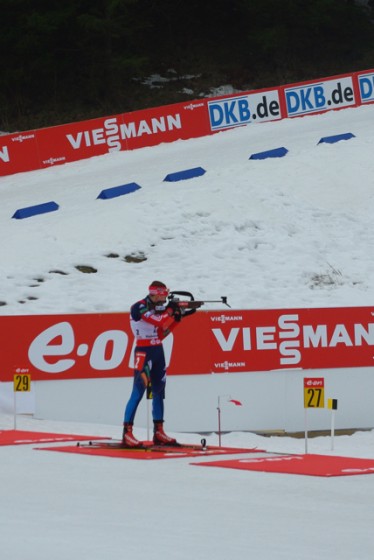
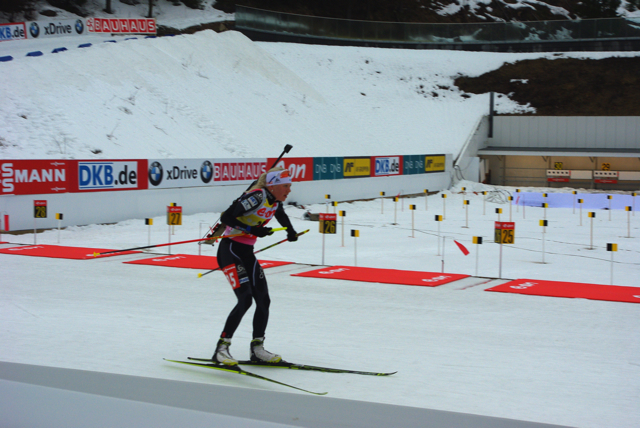
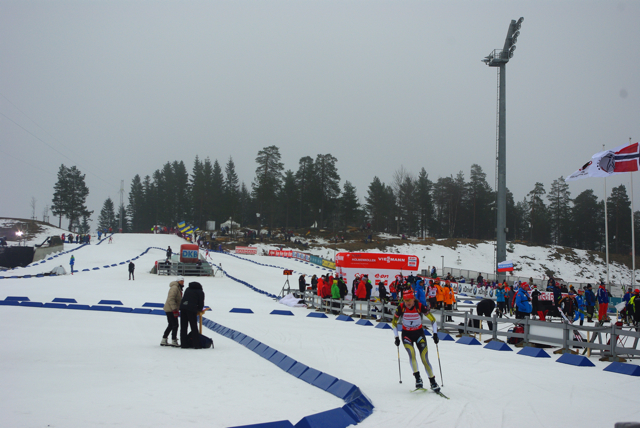
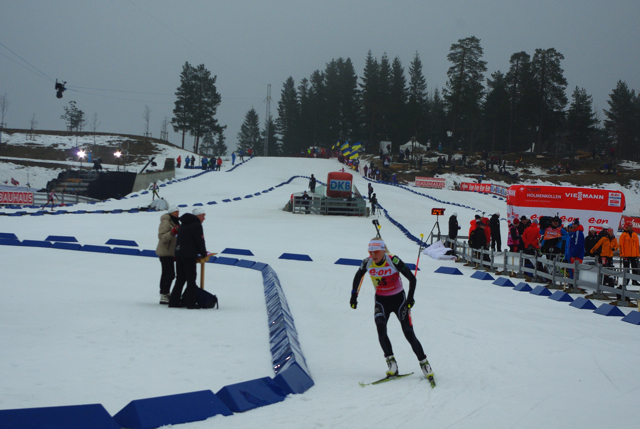
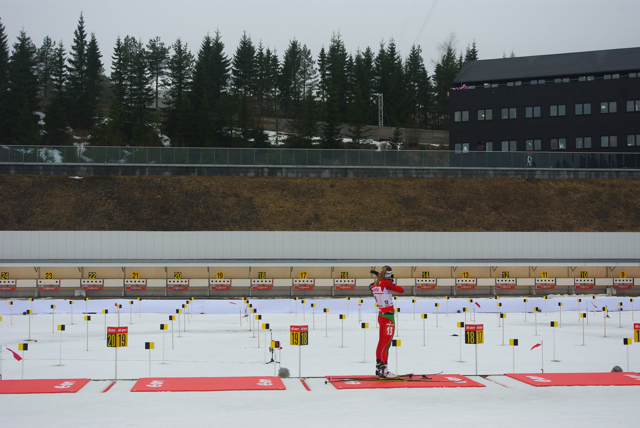
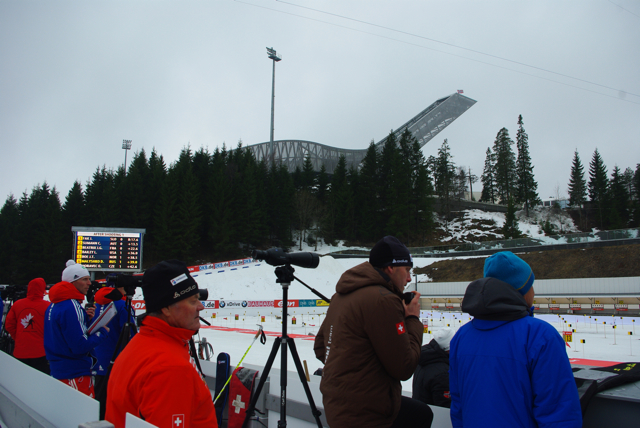
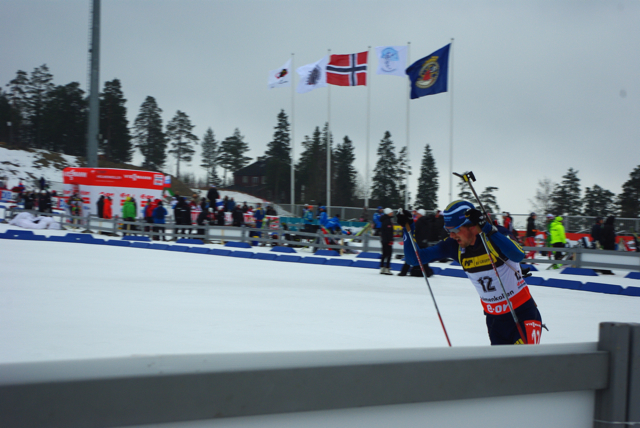
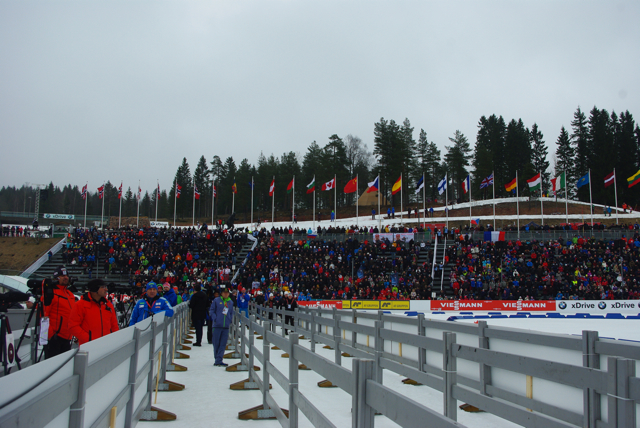
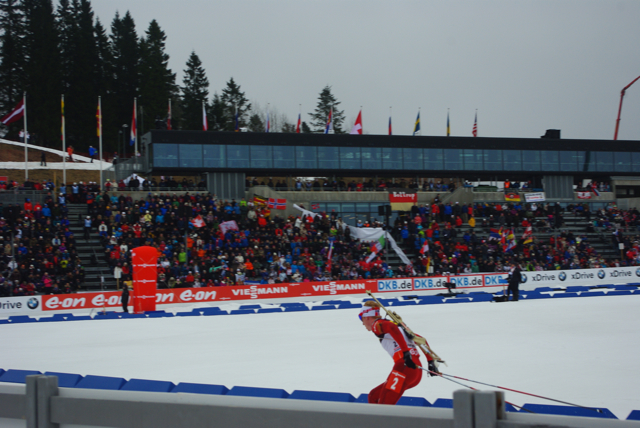
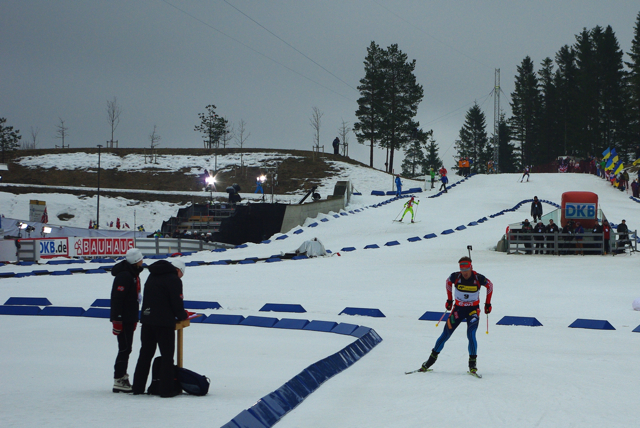
That was not in the cards at Holmenkollen today, when biathletes woke up to heavy fog for the last World Cup sprint of the season. The fog cleared somewhat for the women’s race and disappeared completely by the time the men hit the course, but it wasn’t a good omen.
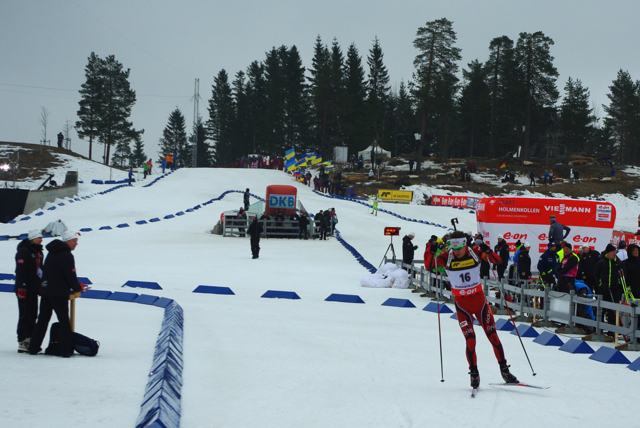
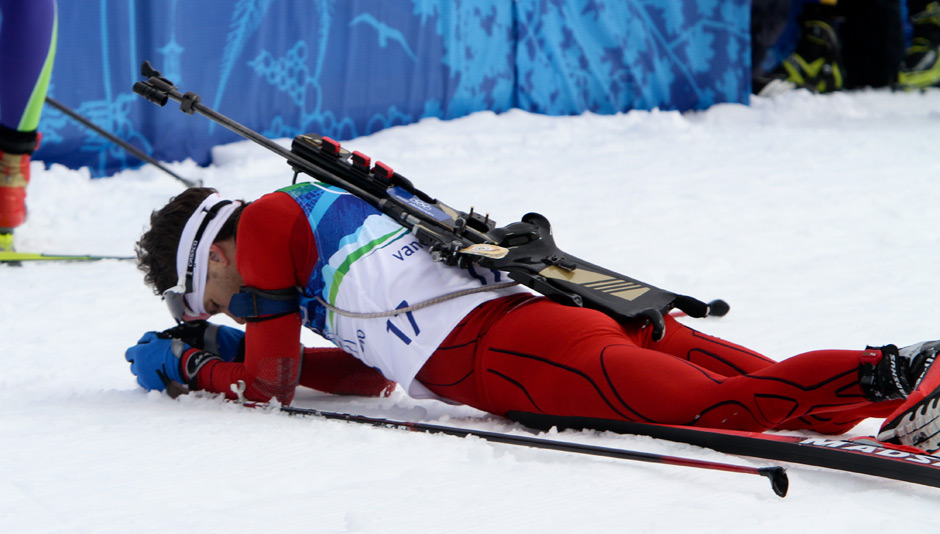
The ski trails, too, were less than welcoming. Warm temperatures left them slushy and deep in some places, and icy in others. The corners going into and out of the shooting range, even, were dicey. A number of athletes fell on uphills and downhills alike, and at least one broke the stock of his rifle.
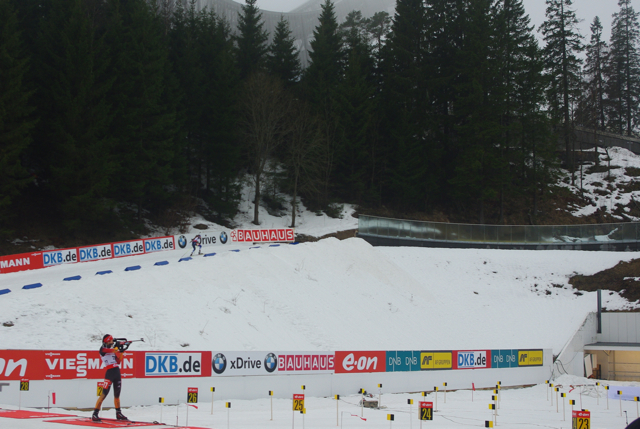
And then there was the range. While a few skiers were able to clean, there were a lot of penalties, including from several top competitors who shot abominably. Kaisa Makarainen of Finland, for example, is the overall World Cup leader. She picked up four penalties, as did Olympic bronze medalist Tiril Eckhoff of Norway, 2012 World Championships silver medalist Tim Burke of the U.S., and 2010 Olympic gold medalist Evgeniy Ustyugov of Russia.
“I think today we got all the things together, windy and foggy and really soft snow,” Darya Domracheva of Belarus said in a press conference. “It was a tough race. On the track, in some places a few girls fell down. It was difficult today. I think the IBU organizers made it especially for spectators today, to get more extreme biathlon.”
Domracheva prevailed in the women’s 7.5 k sprint, collecting a penalty but still taking the win by ten seconds over Tora Berger of Norway.
Berger has not had the season she was expecting – last year she ran away with the World Cup total score – and is retiring after this weekend of racing. She cleaned all ten targets, and said that finally, at the end of the season, her form seems to be coming around.
“It’s really good today, for me it was really good shooting,” she said. “The first time all season was last week in the sprint that I shot zero. Now I have one more. This was really fun to do such a good race today on such difficult conditions.”
Both women are trying to steal the Total Score from Makarainen. With two races remaining, it seems possible. Saturday is a pursuit based on the sprint results, and starting in positions one and two, they will have a huge advantage over the Finn, who will start in 23rd. But both said they were trying not to think about the crystal globe.
“I feel a little tired at the end of the season,” Domracheva admitted. “I try to have fun and not think about the points and the World Cup. I just want to enjoy these races and the end of the season.”
In the men’s 10 k sprint, World Cup leader Martin Fourcade didn’t falter as much as Makarainen, but he did pick up two penalties and finish 11th. Luckily for him, he already has the Total Score locked up.
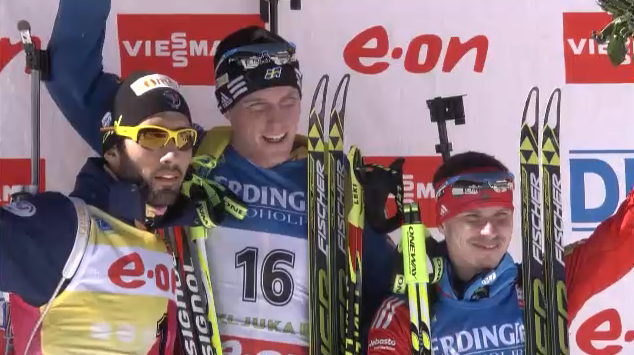
Instead, it was Jakov Fak of Slovenia who made his return to the top for the first time since last season.
“I think the wind was the main problem, but I managed to shoot [almost] clean, and this was a big advantage for me,” Fak said.
An early starter, he held the lead for a long time until Evgeniy Garanichev of Russia started in bib 69. When Garanichev went clean through both shooting bouts, there began to be questions of whether he would take the win from Fak. But despite receiving splits and making a desperate lunge at the line, he finished just half a second from the win and Fak went home with the victory.
“I was giving an interview and was watching on the screen,” Fak said of when he realized he had won. “I saw on the last uphill that [Garanichev] was behind, so I was confident.”
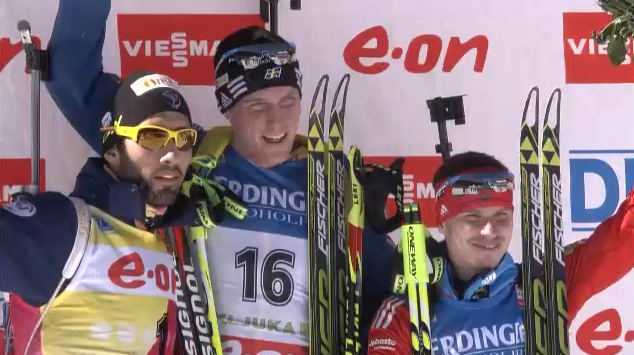
Björn Ferry of Sweden, who has been on fire the last few weeks, placed third. A former Olympic champion like Berger, he will also retire at the end of the weekend.
“I don’t know,” he said of his recent string of results (which unfortunately began after the Olympics). “I’m surprised after every race but now I have five podiums after seven races. It cannot only be luck. I thought with the fog and deep snow this would not be my day. But zero-zero, I am here again, it is a great feeling.”
As for Fak, he, too, wished he could have won earlier in the season, but was still going home pleased.
“I’m very sad that it’s almost the end of the season,” he said. “It was not such a great season for me. Still today I beat Björn Ferry and I’m very happy.”
Racing continues on Saturday with pursuit competition, and then mass starts will finish off the season on Sunday.
Johannes Thingnes Bø of Norway, with his golden rifle, en route to 8th place in the Olympic mass start last month.
20-year-old Johannes Thinges Bø of Norway has had a pretty successful run of things coming into this season. He had collected three individual and two relay gold medals at World Junior Championships, and then been asked to join the senior national team (and his older brother, World Champion Tarjei Bø).
Feeling confident, the young biathlete painted his rifle solid gold.
At first, it didn’t work out so well for him. In his first season as a full-time member of the World Cup team, Bø opened with a 27th-place finish in the 20 k individual race in Östersund, Sweden. That came with four misses, hardly gold rifle worthy.
He collected his first wins – a sprint, pursuit, and relay in Annency, France, in December – over Martin Fourcade, the World Cup leader, but many of Bø’s own fastest teammates were sitting out. When the World Cup recommenced, he was nowhere near the top. In each of the next weekends of racing, he had a few disastrous shooting stages, including one where he ruined Norway’s chance of a relay victory by taking three penalty loops. Meanwhile, his teammate Emil Hegle Svendsen went on a tear, winning four races.
Johannes Thingnes Bo (NOR) on the way to the start in Ruhpolding, Germany, earlier this season.
But this weekend in Kontiolahti, Finland, Bø proved that his earlier results were not a fluke. Svendsen was there competing, and neither he, Fourcade, nor any of the other favorites could come close to young Bø. After winning sprints on both Thursday and Saturday, Bø swept to a 16-second win over Fourcade in the 12.5 k pursuit today.
Nobody on the circuit has matched Bø’s five victories, which he earned despite sitting out two different weeks of racing. Bø jumped over Svendsen, Dominik Landertinger, Olympic champion Ole Einar Bjørndalen, and five others to move from tenth to second place in the World Cup total score in a single weekend.
Perhaps the gold rifle is fitting after all.
Besides his victories, Bø has six other top-tens, all coming this season. But he also has finishes in the 20’s, 30’s, and 50’s. The inconsistency in results might be due to the fact that Bø is so young – or that he broke his collarbone this summer.
“Training this summer was really slow going after I got injured,” Bø told NRK earlier this weekend. “I think people would have been shocked if they saw my training diary from the summer…. I trained as many hours in three months as the team did in a single month.”
Regardless, Bø seems to be here to stay, and is excited that next season’s World Championships will be held in Kontiolahti where the courses seem to suit him so well.
“It looks really good for next year,” he told NRK.
Bø had built up a large lead over the course of the race. Conditions were extremely windy, but he managed to clean both prone stages and collect a single penalty in the first standing. His lead had grown to well over a minute.
When Bø arrived at the last stage, however, the wind had picked up and he was also exhausted; he said later that he was “shaky”. He missed four of his five shots and headed to the penalty loop.
But Fourcade, Björn Ferry, and Norway’s Lars Helge Birkeland all missed at least one shot too, once they had arrived in the range while Bø was in the penalty loop.
“I had a moment there when I was a bit worried, but I guess that one hit in that stage was enough…I won,” Bø said in the press conference.
Fourcade placed second, wrapping up the World Cup title for the third consecutive year, and Ferry continued his strong recent results with a third-place finish.
Bjorn Ferry of Sweden (center) won today’s 15 k mass start over Martin Fourcade of France (left) and Evgeny Ustyugov of Russia.
Peaking for the Olympics is a tricky thing. Just ask the scores of athletes who underperformed on the world’s biggest stage, from Norwegian skiers and biathletes to U.S. skier Kikkan Randall to most of the Russian team.
The Swedish men’s biathlon team was definitely in that group. Based on the previous World Championships, they came in with high expectations: in 2012 Björn Ferry, Fredrik Lindström, and Carl Johan Bergman won four medals at World Championships. In 2013, Lindström took bronze in the 20 k individual, while he and Ferry were frequent visitors to the top ten.
But the team left Sochi without a single medal of any color.
“I did not get to that dream race I hoped for and believed [was possible],” Ferry wrote on his blog after the Olympics. “With some distance to it all, I see I performed about as expected. Shot 89% accuracy, a bit over my cut. Had the top ten in course time two of the races… I knew that the chances of medals was small, but damn, I am disappointed. I was expecting more.”
In Pokljuka, Slovenia, this weekend, it became apparent that maybe Ferry just mis-timed his peak, epically. In three World Cup races, Ferry has stood on the podium every time, thanks to his usual good shooting and some speedier skiing than he is used to.
Case in point: in beating France’s Martin Fourcade, the World Cup leader and gold medalist from Sochi, in today’s 15 k mass start, Ferry not only stole 13 seconds from his fast shooting on the range – both men cleaned all 20 targets – but also put half a second into Fourcade over the course of the race on the trails.
Neither of those things were what ultimately netted Ferry the victory, however. The Lanky Swede simply played smart tactics and didn’t let himself get bullied by Fourcade, who usually calls the shots in the lead pack on the World Cup circuit.
A pack of five men were together on the fourth of five laps, and pushed the pace in an effort to hold their lead.
“Everything really picked up in the fourth lap,” said American Tim Burke, who was part of the breakaway. ” Up until that point, I felt like the pace was not so high. On the fourth lap, I think there were about five of us who started to put a little distance on the others. At that point our group just wanted to create as much of a cushion as possible before the last lap.”
The pace came at a cost as Emil Hegle Svendsen of Norway and Daniel Boehm of German each missed one shot and Burke missed two. That set up the battle between Ferry and Fourcade.
“It was a gruesome final lap—I thought Fourcade would come in the finish,” Ferry told Sweden’s TV4.
Leaving the range for the final time, Ferry had a lead of one second on the Frenchman, who soon passed him. Fourcade slowed the pace, allowing Evgeny Ustyugov of Russia, who had also cleaned through all four stages, to hook on to the back. Fourcade seemed to be setting up for a sprint on the course’s downhill finish.
But then he made Ferry lead. The Swede set a fast pace, and then Fourcade passed him back on one of the course’s final small, rolling uphills.
“You have to put ten meters on him!” Fourcade’s coaches shouted from the side of the trail.
Fourcade couldn’t do it, though. Ustyugov was quickly dropped, but Ferry hung tight. And then, on one of the final downhill corners, the Swede put in a textbook pass and sprinted past Fourcade as the trail flattened out.
Fourcade initially tried to follow, and then basically gave up. Ferry had a lead of five seconds by the time he entered the finishing lanes a few hundred meters later. Fourcade actually began celebrating earlier than the Swede, waving to the crowd as he crossed the line in second.
“I’m completely exhausted,” said a dissatisfied Fourcade. “I can beat Ferry 99 times out of a hundred, but it’s the end of the season and my legs and my head could not today.”
For Ferry, the glory was all his in a sort of redemption from the Olympics. Even if the timing was bad, he had turned in the “magnificent races” that he wrote on his blog that he was seeking in the final weekends of the year – and the final races of his career, as both he and teammate Bergman are set to retire at the end of the season.
“It was perfect,” Ferry told Sweden’s TV4 after the race.
The two men were joking around during and after the flower ceremony, and Fourcade had even helped Ferry out earlier in the race. Fourcade broke the Swede’s broke a pole on the first loop, so Fourcade extended his own pole out behind him for Ferry to grab on to, and pulled him up the hill.
“I broke his stick, but it was an accident so I tried to help him to get a good position,” Fourcade told German television station ZDF. “Even though we are competitors, we are after all buddies. I know he had done the same for me.”
Norway’s Emil Hegle Svendsen and Johannes Thingnes Bø finished fourth and fifth, and enjoyed the flower ceremony together even if they did not stand on the podium: when Bø approached to receive his award, he reached over knocked Svendsen’s glasses into the snow, before the pair devolved into laughter.
Jean Guillaume Beatrix of France placed sixth and Tim Burke of the United States seventh after skiing in the lead pack of four until the final standing stage, where he missed two shots.
“I got thrown off in the last shooting when I missed my first shot,” Burke said. “It felt like a good shot to me so I was really surprised when it did not go down. After that, I shot too defensively and ended up with another penalty. Despite the last stage, I was happy with me effort… It felt great to be back up near the top fighting for a podium. I am very encouraged with how my body reacted to three tough races in four days. I hope the upward trend continues for the next two weeks!”
Teammate Lowell Bailey placed 20th and Brendan Green finished 21st for Canada with four and three penalties, respectively.
Bjorn Ferry of Sweden racing in Hochfilzen, Austria, earlier this season. He won today’s World Cup sprint in Pokljuka, Slovenia.
For many in the World Cup biathlon field in windy Pokljuka, Slovenia, today, the 10 k sprint represented a chance at redemption after a disappointing Olympics.
After all, the Games are big, but life goes on.
Björn Ferry made his case in the most dramatic way possible, collecting a single penalty in prone and skiing a blistering last lap to clinch the top spot on the podium by just a second and a half over Anton Shipulin of Russia.
For the tall Swede, who won gold in the pursuit at the Vancouver Olympics but couldn’t finish better than 12th in any race in Sochi, the win was a long time coming. And for his country, too – Sweden didn’t bring any women to the Olympics, but had high hopes for its men’s team. Yet they didn’t leave with a single medal.
“I am not so surprised,” Ferry said of the victory, his first since 2011, in a press conference. “If I was surprised I would never believe in myself and probably wouldn’t do the sport. Everybody in the field believes that they are really strong and they hope for this great day. But of course I am a bit surprised. I was not really close in the Olympics, but today I was really strong.”
The results were incredibly close, with third-place Arnd Peiffer of Germany finishing 2.7 seconds behind Ferry and Dmitriy Mayshko of Russia just 0.2 seconds behind Peiffer. One of Ferry’s strong points was his shooting speed: he earned more than his margin of victory just by being quick and efficient on the range, for instance shooting five seconds faster than Shipulin.
Ferry, who has noted good humor, made the most of his first opportunity in the spotlight for a while, for instance making fun of his own race preparation.
“I have not eaten anything special,” he told Sweden’s TV4. “My breakfast today for example… There was a porridge failure, you know, such hard oatmeal. Then I put a pancake on top of it and Kellogg’s Frosties. It was a worthless mixture- I would not recommend it to anyone. At the Olympics I tried to eat like Charlotte Kalla, rice pudding, but it seemed to do more for her.”
The top 16 racers will start Saturday’s pursuit all within a minute of Ferry. That includes two Americans, Lowell Bailey and Tim Burke. The pair missed one shot each to finish 12th and 16th.
“I was definitely ready to get back to racing today,” said Bailey, who had a top finish of eighth, the best ever by a U.S. man, in Sochi. “I’ve said from the beginning of this year that although the Olympics is my top priority, my focus is set on the entire World Cup season. I’m psyched to start of the last trimester with a top 15.”
After the Games, the U.S. team had traveled to Ruhpolding, Germany, for recovery and a training camp. After a few days of rest, it was back to working out to get ready for the final week of racing. Bailey and Burke had the 21st– and 25th-fastest ski times today, and said that they were ready for more.
“I went telemark skiing one day and slept a lot!” Bailey said of how he moved on from the excitement of the Games. “After two days, it was back to normal training. I’m ready for the last three weeks!”
For Burke, the finish was extra gratifying as he has been beset by health issues for the last several weeks. A sinus infection a week before the Olympics knocked him out of training and impacted his results, and then he got sick again during the Games and ended up sitting out the men’s relay, a race he had been looking forward to.
“I continued to struggle a lot with my health after Sochi and I seriously considered ending my season,” Burke wrote in an e-mail. “I decided to stay and use these first few races as training efforts with the hope that I can be back to normal form by the World Cup final. Now I just hope that my body reacts in a normal way to the hard effort and I feel better with each race.”
Frustratingly, if it weren’t for the Olympics, Burke believes he would have properly recovered from some of his earlier illnesses and might be feeling better right now.
“I feel like we did a good job monitoring my training efforts this year, so I don’t feel it has been an issue of over training,” Burke wrote. “I think the biggest issue is that I was racing while I was not 100% percent for most of the Olympics. If those had been normal World Cup races, I never would have started most of the competitions. I think it really takes a toll on your body when you compete while not 100%.”
Come pursuit day, the pair will be in the hunt.
“I’m psyched with the result and looking forward to starting in 12th on Saturday,” Bailey said. “I felt good throughout the first and second laps today and didn’t quite have a the final kick on the last lap.”
“I am still very hungry for results this season,” Burke agreed. “I put so much into preparing for this year and I still feel that I have not been able to show what I am capable of on the ski course. I know all of the hard work has to pay off sometime!”
They will be joined in the pursuit by teammate Leif Nordgren, who finished 42nd with three penalties. Russell Currier placed 73rd with two penalties.
Brendan Green led Canada in a tie for 21st place, accumulating two penalties and finishing 1:18.4 behind the winner Ferry. Teammate Nathan Smith will also be in the pursuit after placing 41st, while Macx Davies was left outside in 71st.
Kaisa Makarainen of Finland competing in the sprint at World Championships in March.
Friday’s sprints on the remote Eastern peninsula of Kamchatka, Russia, were held in tough weather conditions, with snow falling over the course of the day in an uncharacteristic storm for mid-April.
In Saturday’s pursuits, athletes faced a different challenge: the wind. Blowing strongly through the range, the gusts wreaked havoc on the field, and didn’t spare even the top competitors.
Synnøve Solemdal of Norway, the winner of the sprint and a member of Norway’s gold-medal mixed relay team from World Championships, missed ten of twenty shots – and still placed fourth. Mixed relay silver medalist Klemen Bauer of Slovenia and mass start bronze medalist Frederik Lindström of Sweden both missed eleven and finished farther from the podium.
But good shooting, and skiing, was rewarded handsomely. As is always the case in these lucrative late-season races, the winners of the 10 and 12.5 k pursuits took home shiny new Mercedes cars as their prizes, providing a little more motivation to shoot straight, wind or no.
In the women’s race, Kaisa Makarainen of Finland was more or less able to do that. She collected four penalties – one in each stage – which would usually be far too many for a racer who started in tenth, 50 seconds out, and wanted to win. But today it tied her for the best shooting of the day.
The other biathlete to shoot as well was Vita Semerenko of Ukraine, who finished second in the sprint. By the time they made it to the last lap, Makarainen had a slight lead over the Ukrainian. Even though she is a stronger skier than Semerenko, she said it wasn’t easy to win.
“The most difficult moment in the race was the last lap,” Makarainen told the Russian Biathlon Union. “I am very glad that I could win – by the end of the season we are all very tired. Everyone just uses up everything they have left.”
Far behind her, over two minutes back, Jana Gerekova of Slovakia outsprinted Solemdal by less than a second for third place. Zina Kocher of Canada moved from 16th up to fifth with just six penalties, narrowly edging out Semerenko’s twin sister Valj.
The season is finally over for the women, and Makarainen, for one, can go home with a positive feeling for next season.
“It was difficult to gather my strength after tenth place in the sprint,” she said. “But you should believe in yourself in every race. If you’re going to think that starting in tenth means you cannot win, nothing good will come of it.”
The Mercedes in her driveway will now be a reminder to the Finn, who won the overall World Cup in 2011: don’t give up.
* * *
Italy's Lukas Hofer skiing towards a 20th-place finish in the World Championships individual race this season.
The wind calmed slightly for the men’s race, allowing several top finishers to escape with only two or three penalties.
Sweden’s Björn Ferry started in the lead after his sprint victory the day before, and held it for much of the race. With three penalties, he seemed to be in good position.
But as in the women’s race, another biathlete slowly climbed his way through the field: Lukas Hofer of Italy, who like Makarainen had finished tenth in the sprint, this time a minute behind Ferry.
And like Makarainen, he wasn’t really expecting to make it all the way to the front.
“Everyone wants to win this race,” Hofer told the Russian Biathlon Union. “It is very difficult to do it in Kamchatka, because the level of competition is similar to the World Cup.”
But thanks to just two penalties, the 22-year-old closed the gap on Ferry and soon found himself skiing with the previous day’s winner along with Swedish teammate Carl Johan Bergman. After the final shooting bout, Ferry, who had missed a total of three shots, and Hofer left together with a gap on Bergman.
“I thought that he would be faster on the last lap,” Hofer said of Ferry. “I wanted him to go ahead, but he declined and said that I had to go first.”
The Italian reluctantly led the way around the final two and a half kilometers, and was able to just barely pull away in the final 500 meters, crossing the line 0.2 seconds before the Swede to win the race and the Mercedes.
“I finished second today and missed the expensive car by a foot or two,” Ferry tweeted after the race. “I got a knife instead.”
Bergman was third, 21 seconds back with four penalties, and a clearly exhausted Simon Fourcade of France fourth with two missed shots.
The two North Americans, Marc-Andre Bedard of Canada and Jay Hakkinen of the U.S., placed 23rd and 34th after missing ten and nine shots respectively.
Bjorn Ferry (SWE, right) and Simon Fourcade (FRA) competing in the individual race at World Championships this season. They finished first and fourth, respectively, in the sprint in Kamchatka on Friday.
After show races in Moscow last weekend, many of the world’s top biathletes headed all the way across Russia for another series of competitions, this time in Kamchatka, a large peninsula about 1,000 kilometers northeast of Sapporo, Japan.
The series is called the Vitaly Fatyanov Prize after a famous Russian coach, and has been held in Kamchatka since 2009. To lure top athletes across an entire hemisphere – the time difference from central Europe is ten hours – organizers pay all expenses for the racers they invite, and offer up a shiny new car to the winner.
It’s not enough for everyone – after finishing the season in mid-March, much of the World Cup field is enjoying vacation before they have to get back to training for next year. But many big names did make the trek to the region which boasts grizzly bears and volcanoes and is about as foreign to many Russians as it is to the rest of the world.
On Friday, competition kicked off with a pair of sprint races and a snowstorm. The men’s 10 k race was won by Björn Ferry of Sweden, who has been on a tear in Russia: he won the mixed relay in Moscow with Kaisa Makarainen of Finland.
“This was probably my best race of the season,” said Ferry, whose top finish of the year had been in World Championships mass start in Ruhpolding, where he took silver. “I’d had a little cold, so this was a surprise to me. Maybe next season I will plan to get sick before particularly important races.”
Clean shooting earned Ferry the victory by 15 seconds over Lars Berger of Norway – who in some ways was the surprise of the podium. Although Berger has won several World Cup races over the course of his long career, he didn’t hit the podium this season. His single penalty represented his best shooting race of 2012.
Third place went to Carl Johan Bergman of Sweden, who has found success in Kamchatka before; last year he was third at the end of the weekend.
Ferry said that he was unbothered by the less than ideal weather – and his explanation might explain why the Scandinavians made a clear sweep of the podium.
“I’m from northern Sweden, where we have similar weather,” he said.
Simon Fourcade of France took fourth, while Aleksey Slepov, a 25-year-old without a single World Cup start to his name, was a surprise in fifth for the Russians. Several World Champions and medalists were further down the list; the sole North Americans, Marc-Andre Bedard of Canada and Jay Hakkinen of the U.S., placed 25th and 34th.
In the women’s 7.5 k race, the Scandinavian dominance continued, at least at the top of the podium, with Synnøve Solemdal taking a 25-second win. Ukrainian twins Vita and Valj Semerenko earned the other medals and were separated by just two seconds. While they shot clean, Solemdal had missed two shots – making her victory more than a little unlikely.
“I’m in good shape,” said Solemdal. “But I didn’t think that I got the win. There are a lot of strong athletes here.”
The 22-year-old can be counted among them. The top ten results of her career have all come this season, where she topped out at fourth in a World Cup sprint in Östersund to kick off the season.
Like Ferry, she said that the weather didn’t bother her.
“When you start to race, you don’t think about it,” she told the Russian Biathlon Union. “It snows in Norway at this time of year too. The season is ending, though – I hope it will stop.”
The Russians were once again shut out of the medals. Natalia Sorokina, whose lone World Cup victory came back in the 2003/2004 season, placed fourth, followed by teammate Daria Virolaynen, who like Slepov has no World Cup experience.
Megan Heinicke of Canada placed 12th.
Why weren’t the Russians able to win? One contributing factor is that while Kamchatka is technically home soil, and the fans were supporting the Russians more than anyone else, the venue is so far away that they haven’t necessarily spent much more time there than some other competitors.
And while many of the bigger names had competed in Moscow, not everyone has been thinking about biathlon for the last few weeks, including the Russians.
“Synnøve and I have spent a lot of time in Russia,” Ferry said . “I think that the other athletes have not practiced so much. Michael Greis, maybe, was drinking beer in Germany the whole time.”
Bjorn Ferry of Sweden racing on the World Cup earlier this season. Photo: NordicFocus/Fischer.
Both Kaisa Makarainen of Finland and Björn Ferry of Sweden have won plenty of races before – including World Championships and Olympic gold, respectively.
But their win in the team competition of the Champion’s Race in Moscow on Saturday was almost certainly their most unusual.
For one thing, the pair teamed up despite their different nationalities, which is obviously not possible on the World Cup where they spend most of their time. Only at less strict competitions such as this and the Schalke Challenge in Germany are mixed teams encouraged.
More interestingly, though, Makarainen and Ferry didn’t exactly have the most conventional pre-race preparations.
“I didn’t expect to be able to win after a good time at a nightclub last night…. I allowed myself some white wine, so much so that I didn’t feel very good this morning,” Ferry told the Russian Biathlon Union. “It was quite tough.”
Makarainen racing Nove Mesto, Czech Republic in January. Photo: NordicFocus/Fischer.
Makarainen said that she had gone clubbing with Ferry because her plane came in late and “there was nothing else to do.”
Ferry later tweeted that the reports of him being hung over were exaggerated and that he’d mostly gone to bed “a little late.”
For biathletes, these races are something of a victory lap, so in a way it seemed appropriate that the athletes be rewarded for enjoying themselves. Even more so than for skiing, the IBU World Cup season is strictly structured, with nine weekends of racing, men and women racing three times each, and a long World Championships every year. Once the season starts, it’s an exhausting journey, and biathletes don’t have much time to dabble along the way, especially if they are concerned about the “total score.”
But now that the World Cup season is over, the athletes finally have a little bit of breathing room – and the chance to do more different races. Many countries have held their national championships in the last several weeks, and now venues in Russia are hosting competitions for the world’s best, luring them not only with the promise of fun but also substantial prize purses, in this case over $120,000 in total.
The invitation-only “Champions Race” featured an unusual format, and one completely different than in 2011, when it was held in an indoor stadium. This year, organizers trucked in snow to line 1.2 kilometers of paths in an outdoor park and set up a temporary shooting range outside. They may have regretted their decision when rain began pouring down Saturday morning, but fans were relatively undeterred.
Both men and women competed in mass start races, and then were allowed to choose partners for the two-person relay based on their order of finish.
In the women’s mass start, both Marie Dorin Habert of France and Olga Zaitseva of Russia shot clean, but Habert was able to ditch Zaitseva on the final lap and take the win by eight seconds. Four seconds later, Olga Vilukhina of Russia outsprinted Anastasiya Kuzmina of Slovakia for third place after each collected a single penalty.
Vita Semernko of Ukraine and Daria Domracheva of Belarus were fifth and sixth with one penalty apiece, followed by Synnøve Solemdal of Norway and Makarainen with three penalties each.
In the men’s race, all the competitors missed at least one target. Newly crowned world champion Jakov Fak of Slovenia took the win by eight seconds over Anton Shipulin of Russia, while the most exciting race was for third place a few seconds later. As they have so many times this season, Norway’s Emil Hegle Svendsen and France’s Martin Fourcade sprinted to the line, with Svendsen crossing first this time around. Ferry finished fifth and Andreas Birnbacher of Germany sixth.
The race that everyone came for, though, was the mixed relay, and the excitement began with the drawing of names.
Not surprisingly, Habert picked Fourcade as her partner; her French teammate won the overall World Cup this season as well as several World Championship titles. In addition, they had paired up for the win in Moscow last season.
“Last year I won the mixed relay at the Race of Champions with Marie,” Fourcade told the press. “Right then we decided that if Marie was invited back to Moscow we’d like to race it together… it was a joke!”
As the men’s winner, Fak chose Domracheva as his partner. The second woman, Zaitseva, chose Ole Einar Bjørndalen of Norway, joking later that she did so because “we are both kind of old.” Vilukhina chose Svendsen, allowing Kuzmina – a native Russian who switched her citizenship – to pair up with her brother, Shipulin.
“Ever since we heard of it, Anastasiya and I dreamed of winning the Champion’s Race,” Shipulin told the press.
But in the end it was Ferry who outsprinted Shipulin to the line by just a half second, leaving the siblings with silver.
“I fought like a monster on the last lap,” Ferry said. “I’m very happy to win.”
“He’s a real monster,” Shipulin agreed. “But next year I’ll avenge him.”
As for Makarainen, the win was both a surprise and completely fitting.
“I was expecting to have a lot of fun at the race, but not to win,” she said. “But when I paired up with Ferry, I realized we were going to win. I think it’s a good omen to be with the Swedes.
“Now we should convince the IBU to have a mixed relay on the World Cup, not just with mixed genders, but nationalities,” she joked. “Then I’d always choose a team of Swedish biathletes.”
Martin Fourcade leading the race after the first shooting stage.
RUHPOLDING, Germany – Martin Fourcade is a glutton for punishment.
At every chance he got, the Frenchman would push the pace over the top of the last steep hill during today’s World Championship 15 k mass start. As the rain gently fell on the Chiemgau Arena and competitors looked more and more bedraggled, Fourcade attacked again and again, jump-skating up hill after hill, and dragging himself back from penalties that may have come from pushing too hard.
But Fourcade is also a glutton for gold, and in the end he was rewarded with his third individual victory of the week in four races – a truly unusual feat in a sport which is decided by millimeters on the range.
“I have always said that I didn’t fight for records, but today I know that my performance during the World Championships was big,” Fourcade said in a press conference.
Fourcade said that he had never doubted his shape, which undoubtedly made it easier to hammer up the punishing hills loop after loop. Beginning with the very first loop, he sped up on that last hill to put a gap on the field before descending down into the stadium and onto the shooting range. That time, it worked out: Fourcade cleaned the initial prone stage and left the range in the lead.
Birnbacher, Ole Einar Bjørndalen, Arnd Peiffer, and Fourcade in the first standing stage.
On the second loop, Fourcade tried the same move, but this time he picked up a penalty – whether from pushing too hard or simply because conditions are difficult, is hard to say. Fourcade, who had already won two gold medals in the sprint and pursuit as well as silver in the men’s relay, fell to 14th.
But, setting a furious pace, Fourcade pushed himself to the max one more time, gradually clawing his way through the field. An attack on that same final hill brought him back into contact with the leaders, and he was in fourth place when he pulled into the range the for his first standing bout.
Again, Fourcade missed a shot. Andreas Birnbacher of Germany cleaned and left with a seven-second lead over Bjorn Ferry of Sweden and Jaroslav Soukup of the Czech Republic.
This time, though, much of the field hit the penalty loop, which began to resemble a merry-go-round of colorful race suits. Even though he had two misses so, Fourcade was still very much in the race, and hit the trails 23 seconds behind Birnbacher.
The German’s success had led to wild cheering from the 30,000 fans in attendance, and for the first part of the loop, he skied alone. But by the time the field came to the final standing stage, nobody was safe.
Fourcade later admitted that he was intimidated by the until-then clean-shooting Birnbacher, who wore the red bib as the leader of the World Cup mass start standings.
The chase group, led by Bergman, leaving the stadium on the final loop.
“I didn’t think about it before, but during the competition Andreas was very strong and he could win today with zero penalties,” Fourcade said.
For the local hero, who grew up 30 kilometers from Ruhpolding, clean shooting was not to be. Birnbacher missed a shot and was forced to hit the penalty loop. While he skied his extra 150 meters, both Ferry and Fourcade cleaned; Ferry had a slight lead on the Frenchman as they climed the first hill out of the range.
With the prowess that Fourcade had shown both already today and throughout the championships, it seemed impossible that Ferry could hold his lead. Through the first half of the loop, though, he tucked in behind Fourcade and the two skied together.
The pace wasn’t light, either: a group, including Birnbacher, had left the range just five seconds behind the leaders, and playing a cat-and-mouse game with one another could easily have left both Ferry and Fourcade medal-less.
“It was not the same position that I was in with Carl Johan [Bergman] earlier this week, because there were five hungry boys trying to catch us,” Fourcade said of the final loop. “I had to push really hard to win either gold or silver. It was my only aim from the last stage, to be first or second.”
Ferry leading Fourcade.
The first half of the course rolled up and down, and the 6’ 6” Ferry could use his power to hang with Fourcade. But unsurprisingly, once the pair hit the course’s major climbs with a kilometer to go, Fourcade broke into the jump skate that he had used to such effect before, and Ferry could not keep up.
“I did my best and I saw that I was a bit stronger than Bjorn on the last uphill,” Fourcade said. “But he was close to me and I never stopped pushing.”
Ferry popped, but he didn’t fall too far behind – like Fourcade, he knew that if he slowed down even one bit, he would be swallowed by the chase pack of teammated Fredrik Lindstrom and Carl Johan Bergman, Fourcade’s brother Simon, and Birnbacher.
That seemed like a real possibility, and although gold was locked up, the stadium full of mostly German fans nervously watched the final meters tick away, hoping that Birnbacher could win silver or at least bronze.
Ferry, however, hung on, and coming over the top of Fourcade’s favorite hill, Lindstrom opened a small lead.
Lindstrom, who at 22 years of age has won a single World Cup and has no other podiums, said in the press conference that he had not been expecting to find himself in the lead pack, and didn’t even realize that he was.
“I didn’t know what position I was out on the final loop,” he admitted. “But I was coached by our trainers and heard I was in fifth place, and realized that the bronze medal was just two meters ahead of me. It was a perfect final loop for me. In the uphill I tried with all I had and it was enough to be a bronze medalist.”
Birnbacher trailing Lindstrom to the finish line.
Birnbacher finished a close fourth – his second wooden medal of the championships. Simon Fourcade was fifth and Bergman sixth, giving Sweden not only two on the podium but half of the top six.
It was an amazing result for the team, which despite Bergman’s two medals earlier this week struggled in the relay and placed a dismal 16th. They are reeling, too, from the announcement that the star of their women’s team, Helena Ekholm, will retire at the end of this season.
Today, though, the men’s team had nothing to worry about.
For Ferry, the result was a return to the form that won him Olympic gold in Vancouver, but which had so far eluded him this season – and it was a relief.
“I shot clean today, the shape I have this year – I know that I have to hit all the targets or else I have no chance,” Ferry said. “You see the result list and if I miss one shot then I am number ten, so it has been really tough.”
But as thrilled as the Swedish team was, the day was clearly all about Fourcade.
“I said before the Championships that he would be the king of the Championships,” Ferry said of the gold medalis. “I want to see him in cross country also, I think he would have a chance against Northug and the kings. He is really strong.”
“And today he won the Swedish championship,” Lindstrom joked.
There were no joked from the man himself, who was simply overcome by his good results.
“It is more than I can expect in my life,” he said. “It’s only wonderful.”
Of Note:
– Benjamin Weger of Switzerland, currently ranked in the top ten in the overall World Cup standings, perhaps had the worst day of anyone. After missing a shot in the initial prone stage, he left the range in 25th with some ground to make up. But First he broke a ski, and a coach had to bring another out onto the course for him to clip into; then he fell and broke a pole. Trailing the 29th-place racer by a huge margin, Weger withdrew before making it to the second stage.
– The Czechs, on the other hand, had a good day. While no individual result made huge fireworks, the team had placed three men in the field of 30, which is unusual. Jaroslav Soukup, Michal Slesingr, and Ongrej Moravec finished 11th, 12th, and 13th, within a minute of Fourcade.
– Andriy Derezemlya of Ukraine only received a start due to the withdrawal of Jakov Fak of Slovenia. The 34-year-old four-time Olympian has been competing in World Championships since 1997; he won a World Cup in the 2004/5 season and has seven podiums to his name, but hasn’t had a great 2012. Today, though, he placed 19th.
– Tim Burke and Lowell Bailey placed 23rd and 25th for the U.S. after missing four and five shots. Stay tuned for an interview with Bailey.
– No Canadians qualified for the race, although JP Le Guellec was next in line after Derezemlya.
Russia's Andrei Makoveev on course. Photo: NordicFocus/Fischer.
If there’s one race in biathlon where shooting really, really matters, it’s probably the individual format. The distances are the longest on the circuit – 15 k for women and 20 k for men – but the penalties for missed shots are so harsh that even the added length makes it difficult to compensate for errors. Instead of hitting the penalty loop, which usually takes 20 to 25 seconds, racers see a minute added to their time if they fail to knock down a target.
Makoveev. Photo: NordicFocus/Fischer.
On Thursday, Russia’s Andrei Makoveev took those facts to heart and focused on shooting above all else in the World Cup individual race in Nove Mesto, Czech Republic. It paid off, as he was the only one of 99 finishers to clean all four shooting stages, going a perfect 20 for 20 on the range.
“The 20k was the most important race of the week for me,” Makoveev said in a postrace press conference. “I have done well in sprints and pursuits before, but never had a good individual race.”
That changed when his clean shooting landed him atop the leaderboard and Makoveev picked up the first win of his career. Despite having the fastest ski time, the Russian won by almost a minute over Emil Hegle Svendsen of Norway, who had two penalties.
Ferry of Sweden, third place. Photo: NordicFocus/Fischer.
“I was fighting for the victory during the whole race and had good luck on the shooting range,” Makoveev said.
Svendsen always impresses on skis, and can often win even with a few shooting errors. Thursday, though, was not one of those days.
“This is a hard shooting range; you enter with a high pulse which makes shooting hard right away,” the Notwegian said. “Then there is the wind. In my first prone it was from the left and then the next time there was no wind, you have to stay focused on the wind to shoot well here. But Andrei shot clean so it is possible for everyone.”
Bjorn Ferry of Sweden finished third, 15 seconds behind Svendsen. It was the first podium of the season for the 2010 Olympic gold medalist, who says that he is unsatisfied with his skiing this year.
“I have hit most of my targets so far this season, but my skiing… has not been quite so fast,” he said to explain his lackluster results. “I still think I have a way to go.”
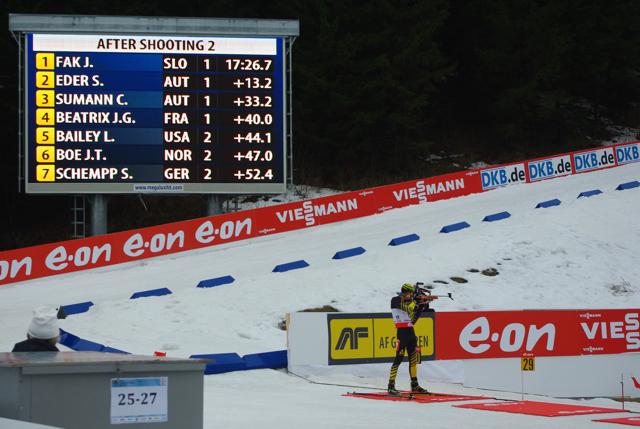
Simon Eder of Austria, 6th place, followed by 22nd-place Jakov Fak of Slovenia. Photo: Fisher/NordicFocus.
Just a day after Zina Kocher and Megan Imrie hit the top 20, Canadians Jean-Phillipe Le Guellec and Brendan Green did an encore. Le Guellec missed two shots and Green three to place 17th and 19th, respectively.
“I’m not sure the reason for the results of our teams over the last two days but maybe some extra time at home [over the holidays] helped,” Green told FasterSkier when asked why the Canadians are on a hot streak.
Green actually wasn’t expecting to have a great race, since he had only arrived in Europe several days before; he still felt jetlagged.
“I’m never sure what to expect with how my body will handle [switching time zones] – it always seems to vary but today things worked out well,” he said.
There were a few very bright spots for Green in his performance. The best aspect was his skiing: his course time was the ninth-fastest of the day.
“The skiing felt tough, but I actually had one of my best skis this season which was sweet, and I was able to match it with decent shooting,” he said. “I opened the race missing my first two prone shots which is never a good way to start an Individual, but it seemed like I was able to settle into the shooting after that, picking up one more miss in my last standing bout.
“All in all I’m pretty happy with today, and stoked to start off the new year with a top-20.”
Le Guellec, Green, and the rest of the team had skipped the first 2012 weekend of World Cup racing in Oberhof, Germany, in favor of training on home turf. The strategy seems to be working, and Green said that they’ll do something similar to prepare for World Championships in March.
“The team will head back to Canada after Oslo to get in a couple weeks of solid training as well as a few of the IBU Cup races in Canmore before heading over to Europe again,” he said. “Hopefully the extra planned training at home will make a difference and that we are able to have our top performances in Ruhpolding.”
It’s a plan that the Americans may want to consider. After a starting the season strong, with Tim Burke, Lowell Bailey, and Jay Hakkinen all collecting top-10 results, the U.S. men have been unable to find their stride in 2012. On Thursday, Bailey led the squad with a 44th-place performance. The rest of the team was outside the top 60. Burke finished 63rd and Hakkinen 87th; Russell Currier, in his first World Cup race of the season, missed five shots and placed 64th.
The remaining Canadians, Nathan Smith and Scott Perras, placed 56th and 66th.
When FasterSkier last wrote about the Russian biathlon federation (RBU) it was in a state of crisis. In the middle of the women’s relay, the culminating event at 2011 World Championships in Khanty-Mansiysk, Russia, RBU President Mikhail Prokhorov had fired Anatoly Khovantsev, the coach of the women’s team. As soon as the race was over, star athlete Olga Zaitseva abruptly announced her retirement.
Since the fiasco in March, the federation has started to rebuild. While it has not named all of its teams for next year, it has introduced a new coaching staff and structure, in which both the men and women are split into A and B teams.
The women’s team in particular is the subject of intense speculation. The women had a very disappointing World Championships, with superstars Zaitseva and Svetlana Sleptsova failing to win a single medal and the team racing to a worst-ever relay result. Zaitseva is rumored to be considering a return to the team, but nothing has been finalized.
Perhaps the biggest question is whether the new coach of the women’s team, Wolfgang Pichler, will fit in and find success. A German who has worked for the Swedes for the past sixteen years, Pichler is undeniably one of the best coaches in the world. But Russia is unlike any other place, and Pichler – who in the past has angrily denounced what he perceived as systematic doping by the Russians – doesn’t even speak the language.
So why would he make the move?
“I have sixteen years of coaching with the Swedish national team, and I wanted a change,” Pichler said simply in an interview with Russian news site Sport-Express.
Abrupt Departure from Sweden
Pichler’s name has become synonymous with Swedish triumph on the trails. He coached Magdalena Forsberg to six World Championships gold medals and 42 World Cup victories, the most of any woman in the history of the sport. After her retirement in 2002, he was offered the head coaching position in Sweden.
“When I started, there was no base as far as biathlon was concerned,” Pichler said in a 2009 interview with Biathlon-Online.de. “But then a talent like Magdalena Forsberg appears, and no one could have expected that… she was simply a perfect biathlete. She had it all: she united the perfect shooter with a perfect cross-country skier. You find something like this once in a lifetime.”
Although Sweden has a strong cross-country skiing tradition, many people didn’t see a strong future for the country in biathlon after Forsberg’s retirement. They were wrong.
Helena Ekholm racing at the 2010 Olympics in Vancouver
Under Pichler’s tutelage, Anna Carin Zidek (then Oloffson) won gold and silver at the Torino Olympics. Then in 2007, the team of Zidek, Helena Ekholm (then Jonsson), Bjorn Ferry, and Carl Johan Bergman captured World Championships gold in the mixed relay. Ekholm also won the overall World Cup in 2009.
In 2010, the Swedish team restructured, and Pichler was left in charge of only the women while Jonas Johansson took over the men. From its humble pre-Forsberg beginnings, the Swedish team had grown; the new structure reflected that change.
“I have worked close together with Wolfgang for many years,” 2010 Olympic gold medalist Bjorn Ferry told live-wintersport.com midway through his first season without the enigmatic coach. “It’s exciting to test something new. It was the right time for that.”
Soon, it was time for Pichler to test something new himself. On April 27th, he backed out of his contract with the Swedes, which ran through 2014, and signed a new contract to head the Russian women’s team for the next three years instead.
The timing was unfortunate as far as Sweden was concerned. With the training season about to start, they named Johan Hagström, their IBU Cup coach, as an interim replacement until they fill the head coach position. Since then training has begun, and the women are following plans drawn up by Pichler.
“It would have been much more of a shock five years ago, back then Wolfgang was biathlon in Sweden,” said Swedish Biathlon’s Information and Communication Director Patrik Jemteborn. “Of course it still is a big loss because he is a great coach, but now we have people who can absorb this to some degree. We will still be friends, with Wolfgang and with the Russians. There are no hard feelings.”
Many of the athletes conveyed a similar feeling to the public.
“It was a little bit of chaos now at the beginning because Wolfgang left so suddenly, but I am sure everything will work out fine,” Ekholm told IBU News.
Privately, however, Ekholm is said to be upset with how Pichler managed his departure from the team. And Zidek, who is in the process of deciding whether to continue her career as a racer, noted her frustration on her blog.
“I am perhaps a bit disappointed in how he handled the whole thing,” she wrote. “I had not heard anything about this until I heard it on the radio… especially after he was so disappointed in how he was treated by the men last year. It feels a bit like he did the same thing himself to us women.”
When the Russian sports site Championnat asked Pichler about whether he had discussed his departure with the Swedish team, he didn’t seem bothered.
“I was talking about retiring from the Swedish biathlon team,” he said. “In particular, I spoke about it with Anna-Maria Nilsson, who was the team captain. Apparently, Helena just didn’t know about it.”
Even Zidek, though, said she could see why Pichler would take the Russian job, as did many others in the biathlon world.
“I kind of understand,” U.S. Head Coach and native Swede Per Nilsson told FasterSkier in an interview last week. “Pichler, because he’s had big success in Sweden and many years… maybe it was time for him to move.”
Past Animosity with Russia
While the challenge of coaching a supremely talented yet frustratingly inconsistent group of women may be appealing to Pichler, the move to Russia is puzzling given his past relationship with the RBU.
For several years, Pichler – who is outspoken on many issues – very publicly accused the Russians of having a systematic doping program, and proposed severe measures to keep them in line. In 2008, he spoke as the representative of the national team coaches on the World Cup circuit.
Olga Zaitseva blows kisses to the crowd as she brings Russia the gold in the Olympic biathlon relay in 2010
“We have seen examples of suspended athletes coming back after two years’ suspension, pretending nothing has happened,” he told the International Sports Press Association on that occasion. “Or where their national team just presents new athletes that fill the positions. The rules are not strict enough and something better has to be done. Therefore we ask on behalf of the trainers and athletes, that nations which obviously are not afraid of cheating, must be punished.”
He proposed that if any nation had two or more doping cases in a two year period, the entire team should be suspended. At the time, the Russians and Austrians – who had a major scandal at the Torino Olympics – were the only teams such a rule would have affected.
Since then, the Austrians have cleaned up their act, but the Russians have not. In 2009, three Russian athletes – Albina Akhatova, Ekaterina Iourieva, and Dimitri Yaroshenko, all world champions – tested positive for EPO at World Cup races in Östersund, Sweden, prompting Pichler to speak again.
“We should keep the entire Russian team out of the World Championships and next year’s Olympics,” he told Swedish newspaper Aftonbladet. “I have always suspected that they were doing something. Three in the same race? It cannot be anything but systematic, and it has been going on for years. I think the whole team takes drugs.”
While Pichler worried that doping was a blow to the sport and that biathlon would lose the respect and interest of its fans, he also took the doping offenses personally.
“’I am quite sure that we have lost medals because they were doped,” he said in the Aftonbladet interview. “They were ahead of us in the mixed relay at the World Championships last year, for example. At the [2006] Olympics they were the second and we were fourth in the men’s relay. I can’t imagine that they were clean then either.”
Hit outspoken attitude rubbed off on his athletes; Ferry was widely quoted at the Vancouver Olympics as saying that dopers should get the death penalty, “or at least a lot of kicks in the balls.”
In 2009, Ferry and teammate Mattias Nilsson received death threats via e-mail from Russian IP addresses. In that case, Pichler defended his athletes and called on Russia and the IBU to protect the Swedish team at the season-ending World Cups.
“If the IBU does not ensure our safety, we will not be able to go to Russia to compete. We have several athletes who have a chance to win the World Cup, but security is paramount,” Pichler told German news channel ZDF.
Later that week, he claimed that a member of the Russian team staff attacked him in the VIP tent at a race.
“[Pichler] has always been against our team for some reason,” RBU Press Attaché Dmitry Loyev told Russian news channel RT at the time.
Integrating Into The Culture
These days, the attitude toward the German could not be more different.
“Today we rely on the experience of a world-class coach who has achieved huge success on the international level,” Prokhorov, the IBU President, told the International Biathlon Union in introducing the new coaching staff. “We have a huge desire to win, that’s why we’re making these changes. We want the best specialists to work for Russian biathlon and we will not back out of this strategy.”
And Pichler has warmed to his new colleagues as well.
“Russia isn’t a bad nation and I think the new leadership is a good one to cooperate with,” he told the IBU. “The team has huge potential, but of course we have to work hard.”
One of the things that the women had complained about in Khovantsev, last year’s coach, was that they did not work hard enough. They are definitely in for a change with Pichler, who has a reputation as a task-master.
“Now the Russians find out what training is,” Zidek wrote on her blog. “There are no shortcuts allowed.”
Pichler himself told Russian sports site Championnat that not all of the Russian women would be able to keep up with the training he had planned for them. He also spoke of making adjustments in the women’s diets, saying that weight loss would be a large goal of his program.
The German has said that he is too old to learn Russian, and will communicate with athletes through a translator. He coached the Swedes primarily from his home in Ruhpolding, so communication barriers obviously don’t intimidate Pichler, but it will be an added difficulty as he integrates himself into the culture of the program.
To ease the transition and attempt to smooth over any past animosity, Pichler has backpedaled on his doping comments, saying only that there will be no doping in his program.
“I will do everything to fight against doping,” he told Championnat. “It’s a disaster, when the athletes use illicit drugs. It poisons the sport. We will fight for medals only the honest way. When people see that we work hard and have good results, then they will treat us accordingly.”
Many of the athletes he is now coaching were part of the Russian teams which he indicted in his statements in 2008 and 2009, but only one of the banned athletes was hoping to work with Pichler this season. Iourieva returned to competition partway through the 2010-2011 season after serving her two-year suspension; she competed in the two World Cup weekends in northern Maine, where her best finish was 22nd place.
For Pichler, that wasn’t good enough, and he didn’t name her to the national team A squad.
“Everybody has made mistakes in their lives, and I am no exception,” he told sports.ru. “Iourieva has already served her punishment. My personal attitude to her doesn’t matter now… Have you seen her results this year? In my opinion, they are not good enough to speak about the national team. In any case, the road to the team is not closed for anybody.”
This was a sentiment he conveyed again in again in numerous interviews: Pichler will work with anyone, young or old, doped or not, famous or unknown, to try to make the Russians the best team in the world.
“Russia is not so bad, you have a lot of good biathletes,” Pichler told Sport-Express. “We will try as quickly as possible to create a strong team. And we must always give chance to young talents. For sure we will work with a wide range of people. The most important thing is to send to the start line at the Olympic Games in Sochi, the best team.”
Tora Berger (NOR) racing at the Vancouver Olympics. Berger has won the last four World Cup races.
On Friday morning at 9:30 a.m., the United States will hold its first World Cup race since 2004.
The IBU World Cup circuit will be making stops in Presque Isle, Maine, this weekend, and then in nearby Fort Kent next weekend. While it might take almost as long to get to “The County” from the U.S. as from anywhere else, the races should be spectacular. If you can’t make it to Maine, the event will be broadcast live by Eurovision and the International Biathlon Union, and can be watched online on the IBU website (click the “BiathlonWorld TV” link).
Either way, there’s no reason not to skip off work a little early on Friday afternoon and watch the best biathletes in the world race around in our own time zone. Here’s a brief guide to what to watch.
Emil Svendsen (NOR) on the range in Vancouver.
1. World Cup Overall Leaders – and Contenders
One of the biggest questions of the next two weekend is whether the current overall World Cup leaders can hang onto their yellow bibs. 22-year-old Tarjei Boe of Norway leads his teammate Emil Hegle Svendsen by just six points going into this batch of races. Boe has worn the yellow bib since mid-December, but hasn’t won a World Cup since the first weekend in January. To keep his lead in the standings, he will have to beat Svendsen consistently – no small feat, considering that Svendsen has three victories to his name already this season, bringing his career total to 19, and was recently added to the Norwegian team to cross-country World Championships. He’s fast.
On the women’s side, Kaisa Makarainen of Finland has worn the yellow bib since the very first weekend of World Cup competition in Oestersund, Sweden. But the only two victories of her career came that weekend, and since then she’s been less impressive. Her lead over Helena Ekholm of Sweden has dwindled to just 14 points, and Germany’s Andrea Henkel is making a charge at the title as well. Ekholm, the 2008/2009 overall World Cup winner, has two victories so far this season. Henkel has none, but she’s been on the podium more consistently than almost any other woman, and could finally win a race at any point.
Jeremy Teela (USA) and Ole Einar Bjorndalen (NOR) in Vancouver.
2. The Norwegian Men
It’s impressive enough that Norway has both of the top contenders for the overall World Cup on their team. But Boe and Svendsen certainly aren’t the only Norwegian men who could win in Presque Isle and Fort Kent. No less than four of the team’s biathletes have collected victories on the World Cup circuit this year: Boe, Svendsen, Lars Berger, and of course, 37-year-old living legend, 92-time World Cup winner, and six-time Olympic gold medalist Ole Einar Bjorndalen. The team didn’t appear to be in top form at the last few World Cups in the Alps, but people, including Swedish Olympic gold medalist Bjorn Ferry, hypothesized that they were suffering from the effects of altitude. Back close to sea level, any one of the four could win again.
3. Tora Berger
While the Norwegian men had lackluster results in the Alps, their teammate Tora Berger (Lars’ sister) did not. She won two races in Ruhpolding, Germany, and then another two in Antholz, Italy, and appears poised to make a late-season run through the rankings. Berger’s ski speed is so fast that it sometimes straight-up demoralizes the competition. FasterSkier hopes that there isn’t a third Berger sibling, who would undoubtedly suffer from incredibly low self-esteem.
4. The Russians
In the first period of World Cup racing, the Russians were completely uninspiring. But then, gradually, they reappeared in the spotlight. In Antholz, the women raced to a dominating victory in the relay. After that effort anchor leg Olga Zaitseva, who has won one World Cup on her own this season, told IBU News that “We are back.” Anton Shipulin was also on the podium twice in Antholz, and seems to be rounding into form. It would be surprising for the Russians not to be skiing fast, considering that they are hosting World Championships in a few short weeks and will without a doubt be at their best in front of the home crowds.
Bjorn Ferry (SWE) en route to a gold medal performance at the Vancouver Olympics.
5. Bjorn Ferry
Ferry is one of the most boisterous media personalities in the biathlon world: he has a great sense of humor and strong opinions. At one point, the 6′ 4″ Swede suggested that dopers should get the death penalty. He also has a wife who is a seven-time world champion arm wrestler, a cookbook entitled “Ferry Food,” and a website called “Ferry Tales.” But as entertaining as all of these quirks are (FasterSkier enjoyed interviewing him in Muonio, Finland earlier this season), it’s Ferry’s skiing and shooting that gets him the most attention. He picked up his first Olympic gold medal in Vancouver and has two wins so far this season. He will probably anchor the mixed relay in Preque Isle; Sweden won the mixed relay at 2007 World Championships with a potentially identical team, and are always dangerous in that event.
6. Martin Fourcade
With three second-place finishes in Ruhpolding, Germany, and then a thrilling, dominating, flag-waving mass start victory in Antholz a week later, Fourcade is on the rise. There aren’t many people who scare Ferry, but earlier this season he said that the French would be the team to watch. Lately, it looks like he might be right. This season, Fourcade, who sits fourth in the overall World Cup rankings, is eclipsing Olympic champion Vincent Jay. It’s no small task, but if Fourcade is still as fired-up as he was in Italy, he’ll be outshadowing everyone else on the circuit as well.
Magdalena Neuner (GER) races to Olympic gold in Vancouver.
7. Magdalena Neuner
At just 23 years of age, Magdalena Neuner of Germany already has twenty World Cup victories. So far this season, she only has one – but she’s also contributed to a victorious German relay team that is on the rebound after the retirement of three stars: Martina Beck, Simone Hauswald, and Kati Wilhelm. Neuner has more up her sleeve and will undoubtedly have a few good races before the season is over.
8. Lowell Bailey and the U.S. Men: the Veterans and the Skinny Fast Young Kid
Lowell Bailey has been on a tear recently, notching a career-best 12th-place finish in Antholz and tagging off after the first leg of the relay in an astonishing second place. While last year it was the Tim Burke show, this year is turning out to be all about Bailey. But behind him are a veteran squad including Burke, three-time Olympian Jeremy Teela, and four-time Olympian Jay Hakkinen. And then there’s Leif Nordgren, the only young blood on the team. Nordgren shot clean to finish in the top 40 of the first World Cup race of the season, and has contributed several excellent relay legs, including one in Antholz which left the team in fifth place after two skiers. While Bailey is turning the team into a bit of a one-man show, it’s also good to see a diverse group of athletes able to contribute; the Antholz relay was the best U.S. result in two years.
Laura Spector racing to 19th place in the World Cup sprint in Oberhof. Photo: nordicfocus.com courtesy of USBA.
9. Laura Spector and the U.S. Women
Expectations haven’t exactly been high for the U.S. women lately, and neither has funding: while the men’s team spent weeks in Europe this summer, training just as the European teams do, the women were stuck in Lake Placid. They have a smaller World Cup quota because of a lack of success in recent years and haven’t always been able to even field a full relay team. But out of all of this have come some exceptional performances. Laura Spector has led the way with top-30 and even a top-20 result, as well as qualifying for two mass start races; the last time a U.S. woman skied in a mass start, which only allows for 30 athletes, was six years ago. Sara Studebaker has finished in the top 30 as well, and Haley Johnson, the latest addition to the World Cup team, is keeping up with the others just fine.
10. Brendan Green and the Canadians
If Tim Burke was the hero of American biathlon last year, then Jean-Phillipe Leguellec was the Canadian equivalent. He finished sixth, 11th, and 13th in races at the Vancouver Olympics, prompting him to tattoo the Olympic rings on his leg. But this year, Brendan Green is stealing his spotlight. The pair have each had excellent finishes, and made history when both competed in a mass start earlier this season; it was the first time that Canada had put two athletes in a mass start. Canada will be fielding a full team, so look for them in the somewhat-unconventional red suits.
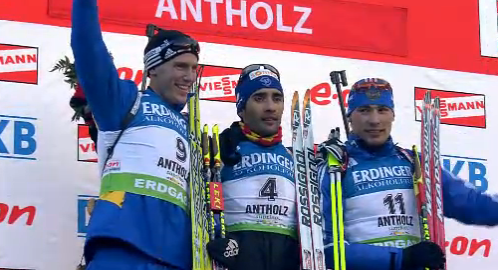
Men's mass start podium in Antholz (l-r): Bjorn Ferry (SWE), Martin Fourcade (FRA), Anton Shipulin (RUS)
In the final shooting stage of Saturday’s mass start World Cup in Antholz, Italy, Martin Fourcade of France and Bjorn Ferry of Sweden went shot-for-shot for four bullets, each dropping all the targets.
But while Fourcade quickly hit the fifth target, Ferry hesitated, waiting for the perfect shot. He kept waiting and waiting… and missed.
While Ferry headed to the penalty loop, Daniel Mesotitsch of Austria and Anton Shipulin of Russia shot clean and embarked on the final three kilometers of skiing in second and third places. By the time Ferry finished his penalty loop, he was almost ten seconds behind Shipulin.
But a lot can happen in three kilometers. While Fourcade seemed to attack with renewed ferocity and skied to an easy win – grabbing a French flag from the stadium, skiing across the line backwards, and then smashing the flag like a musician might a guitar – Mesotitsch and Shipulin were tiring.
Shipulin caught Mesotitsch, but appeared exhausted, double-poling down the hills rather than skating. It wasn’t a good omen: Ferry was charging behind them, devouring the tracks with his 6-foot, 4-inch frame and inching his way back towards the podium. It was only in the final 1,000 meters that he put in the push that counted, gaining contact with Shipulin and Mesotitsch shortly before entering the stadium.
And at that point it was almost a foregone conclusion that the Olympic champion would win a sprint to the line. Ferry did, and seemed almost as excited to have regained second place as he might have been to win. Shipulin was third, and a clearly spent Mesotisch fourth.
Fourcade, who was 21st in Friday’s sprint, said in a press conference that the disappointment had motivated him.
“I was hungry today after my bad result in the sprint. I took my time in prone to be sure to shoot clean. Then I attacked on standing. My shooting was good. The skiing was good, but shooting made my victory… Of course my shape is very good now, but as I saw in the sprint, you can be in your best shape and still be in 20th or more. The aim of all of the athletes is to be in top form for the World Championships.”
Ferry attested to Fourcade’s fitness, saying that he had “felt it” on the fourth loop.
And heading out on the last loop, he said in the press conference, he looked around and thought, “I will be number four.
“But I make, I make my speed, I thought maybe I would catch someone, and then I thought, ‘I’ll try,’ to make a huge end sprint. There was a huge uphill, and ‘okay, I can catch him, I can catch him…’ They were both tired in the last kilometer. And I had some, I don’t know, superpower today.”
The lone North American in the 30-man field was Lowell Bailey of the United States. Bailey got off to a good start in the first World Cup mass start of his career, shooting clean in the first prone stage and heading out with a group of ten or so men in the lead pack. But in the last three shooting stages, he missed five shots, and dropped to 22nd place.
“My goal was to just go for it right from the start and be aggressive,” Bailey said in a U.S. Biathlon Association press release. “For the first prone shooting that worked out great and I was up there with some of the best athletes. But for the second shooting I am not sure where the misses were. It was really windy on the range and I suffered a bit from that.”
Bjorn Ferry (SWE) smiles at the camera after his victory.
Ruhpolding, Germany, has been both kind and cruel to Olympic gold medalist Bjorn Ferry of Sweden.
On one hand, the summer before his Olympic victory, he crashed while rollerskiing at the venue. The impact broke his collarbone and he had to have surgery and give up a period of training.
But on the other, Ruhpolding is his second home.
“I have trained here three times every year for the past ten years, so I have spent more than a year here,” Ferry said in a press conference. “After the Olympics and World Championships, this is the biggest win in biathlon, the pursuit in Ruhpolding.”
Did his rollerski crash do anything to shake his confidence at this week’s World Cups?
Lars Berger (NOR) led for much of the race.
“No,” he said, laughing. “Today we went the opposite direction from the roller track, so I was confident on the downhills.”
And on the uphills, too: Ferry (whom FasterSkier interviewed earlier this year) used perfect shooting and an aggressive attack on the last loop to win Sunday’s pursuit, despite starting from bib eight, almost a minute behind Lars Berger, the winner of Friday’s sprint.
Berger attacked out of the start and had one of the fastest ski times of the day. After three shooting stages, he was still in the lead despite having missed two shots. But in the last standing stage, he racked up three penalties and removed himself from contention for the win.
While Berger was visiting the penalty loop, the race opened up. Ferry, Martin Fourcade of France, and Michael Greis of Germany all shot clean in the final stage, and they left the range with Greis in the lead. They were followed closely by Tarjei Boe of Norway, the current overall World Cup leader, and Ivan Tcherezov of Russia. The 26,000 spectators settled in for what promised to be an exciting finish.
Ferry shattering the chase pack near the finish.
And they weren’t disappointed. After skiing together for a brief time, the group was broken apart when Ferry attacked going up one of the hills. For a moment, it looked like Fourcade was going to be able to stay with him. But then Ferry dropped him, too, and was able to hammer his way to the finish uncontested. He even had time to stand up and celebrate at the finish, pumping his fist and skiing across the line on one foot as the four skiers behind him fought for their spots on the podium.
At the end of the day, Fourcade was second, and Greis was just barely able to hold off the charging Tcherezov and Boe; the three were separated by less than a second.
It was Fourcade’s third second-place finish in as many races, and his consistency allowed him to move up to third place in the overall World Cup rankings, breaking up the Norwegian party at the top. Ole Einar Bjorndalen, who had been in third place, did not race in the pursuit. Boe and Emil Hegle Svendsen still own the top two spots.
“I knew after Oberhof that I was in good shape and hoped to do well this week,” Fourcade told IBU News. “But you can never say that you will be on the podium for the third time. Biathlon is not an exact science.”
That’s a sentiment that was echoed by Jeremy Teela, the third American finisher in the race who moved up from bib 58 to finish 41st. His impressive improvement was matched by Lowell Bailey, who moved from 50th to 29th, and Tim Burke, who improved from 56th to 36th.
When asked why all three men had better performances than they were able to muster in the sprint, Teela said it was a “hard question.”
“Sometimes as a group we perform better on certain days, I’m not sure why,” he told FasterSkier.
Today was definitely one of those days, as Burke and Bailey had three penalties and Teela two. Bailey and Burke also had the 15th- and 17th-fastest ski times of the day.
“I guess today the three of us were starting in the back, so we had nothing to lose,” Teela said. “Normally this mentality takes some pressure away. You can let your body do what it normally does in training without the brain getting in the way.”
While their late start positions might have helped them relax, Burke was disappointed that they had started at such a disadvantage, because it meant that even strong races couldn’t get them better results.
“Today was definitely a really solid day for the team,” he said in an e-mail. “We all moved up quite a bit, but unfortunately we all started a little too far back in the pack to have a top result. The reason for our success today was definitely the shooting. As a team, we had less penalties today than in the sprint, despite shooting twice as much. Hopefully this will help us all get back in the flow for next week.”
It’s pretty likely, as both Bailey and Teela had their best of weeks of World Cup results so far this year here in Ruhpolding. Bailey finished 16th in Wednesday’s individual, and led the team in each race of the series.
With finishes of 58th and 41st in the sprint and pursuit, Teela seems to be coming into form after a frustrating December World Cup campaign in which his top finish was 77th and he never made a pursuit.
Teela said that he had been hit hard by a parasite in the Ostersund drinking water (FasterSkier covered the story) and had never recovered.
“It really brought me down… looking back on it now I should have gone home after World Cup 1 to rest and train,” Teela said. “Instead I continued to race World Cups 2/3. Over Christmas break I was able to rest and train again. The form seems to be coming back I’m looking forward to putting together some top results that will contribute positively to our team.”
Brendan Green led the Canadians with a 40th-place finish. Scott Perras finished 48th and Marc-Andre Bedard 52nd.
In the World Cup sprints in Pokljuka, Slovenia on Saturday, two athletes took their first wins of the season. But while they hadn’t been atop the podium in Ostersund, Sweden, or in Hochfilzen, Austria, their strong performances weren’t entirely surprising: both Bjorn Ferry (SWE) and Magdalena Neuner (GER) were gold medalists at the Vancouver Olympics last year.
Canadians led the North American contingent in both the men’s and women’s races.
Bjorn Ferry (SWE) en route to a gold medal performance at the Vancouver Olympics.
Men
When FasterSkier talked to Swedish biathlete Bjorn Ferry in Muonio, Finland, earlier this season, he said that one of his goals was to win the overall World Cup.
So far this season, it had seemed like that goal was pretty far out of reach. On Thursday, he finished 61st in the individual race in Pokljuka, Slovenia, which was his worst result so far; he was 11th in the sprint in Hochfilzen, Austria, and moved up to tenth in the pursuit. Those were the only races in which he even cracked the top 20.
Not so good for an overall World Cup contender.
But in Pokljuka on Saturday, Ferry reminded the biathlon world that he was, in fact, a reigning Olympic champion, and eked out a five second victory over Tarjei Boe of Norway in the 10 k sprint race.
Ferry told IBU News that he knew he was fit, but had struggled this season nonetheless.
“This week, it was like I took another step,” he said. “One level better. It is now fluid and I do not have to push so hard. The individual was actually my best skiing performance of the year. I just missed eight targets; it was bad shooting. But today I held it together and hit the targets. It was a bit slow, but clean.”
While shooting clean definitely helped, ten other athletes hit all the targets in the two-stage sprint race, so it was his skiing that guaranteed him the win. Ferry had the fifth-fastest course time, and all of the faster skiers missed at least one target.
It was a close race for the podium, with Boe only five seconds behind Ferry, and Michael Greiss of Germany another three seconds behind Boe. Greiss led after the standing stage, but Ferry’s skiing moved him into the win three kilometers later.
For Boe, a second-place finish was almost as sweet as a win. When the World Cup continues after the Christmas break, he will wear the overall yellow leader bib.
“I never thought before the season that I would have the yellow bib,” he told IBU News. “I thought there was a good chance that I would win a race or two, but this is something else.”
For the North Americans, a pair of Canadians led the way. Brendan Green and Scott Perras finished 29th and 30th – excellent results for each of them.
“In the end the result was good, but I am slightly disappointed with my final shooting,” Perras told FasterSkier in an e-mail. “I managed to shoot clean in prone which is always the way to start a race. And I was prepared for the standing stage – there was not too much physiological stress. I didn’t even think it was good race so I wasn’t even nervous. I just got on my trigger too quickly and missed my first shot… so there was some mistakes that cost me some serious positions. I have to get comfortable with being in a good position so that I can capitalize.”
Tim Burke led the way for the U.S. team in 35th place, followed by Lowell Bailey and Leif Nordgren in 68th and 69th.
Women
Magdalena Neuner (GER) at the Vancouver Olympics.
Neuner, last year’s overall World Cup champion, hasn’t shown her typical dominance so far this season. After skipping the Ostersund World Cups, she helped the Germans to a relay victory in Hochfilzen, but didn’t hit the podium in any of the individual races.
Today, though, was a different story. Neuner missed two shots in standing, but was skiing so fast that it didn’t matter. Her teammate Miriam Gossner had the second-fastest ski time of the day – just over three seconds back – but missed three shots. So despite her shooting errors, Neuner was able to ski to a solid eleven second victory over Anastasiya Kuzmina of Slovakia.
“It was a great day for me,” Neuner told IBU News. “I had two mistakes on the shooting range and did not think about winning. It is a very nice Christmas present for me.”
Unlike Ferry, Neuner isn’t focusing on the overall World Cup. Because of the races she missed in Ostersund and her lack of podium finishes in Hochfilzen, she says it is out of the realm of possibility.
“I think Kaisa [Makarainen, of Finland] is very, very good this year,” she said. “I lost three races and now it will be very difficult for me. I am looking forward to the battle for the title a little bit, but more about the World Championships. It is important and after that we will see.”
Makarainen finished in a tie for third today. She and Olga Zaitseva of Russia had identical times, exactly 17 seconds behind Neuner. Ties are not uncommon in biathlon, but a tie at the top of the field is less common than one further down the results sheet, where racers are packed in more closely.
Makarainen will keep the yellow overall leader’s bib moving into the next weekend of World Cups, and has the position locked down after having two wins, two second-place finishes, and two third-place finishes in the first three weekends of racing.
For the North Americans, Zina Kocher of Canada finally raced to her potential today, finishing 17th. So far, she had only finished in the top 60 once, racing to 49th place in the very first race of the season in Ostersund. Kocher finished last season ranked 31st in the overall World Cup standings, and owns one of Canada’s only World Cup medals in the last decade, so for her the result meant getting back on track.
Sara Studebaker led the Americans in 58th place.
“Today was a little rough on skis for me,” she told FasterSkier in an e-mail. “I didn’t feel great right from the start and knew it was going to be a tough race to get into. I was really happy with my shooting though – it wasn’t too tough on the range for me today and I was happy to come away with only two penalties.
“I think I’m still figuring some things out with my training and this much racing right now,” she continued. “This is only my second year on the World Cup circuit, and it takes some time to figure out how best to prepare. So while today wasn’t my best day, I’m learning a lot from just being here and that’s invaluable.”
Annelies Cook, in her very first World Cup race, was just 0.4 seconds behind Studebaker in 59th place.
“It was really special for me to finally race a World Cup,” she told FasterSkier. “The race was solid. I was happy to hit a few more targets and did my best on the tracks. It was a tough course, especially because of new snow that made things slower. It’s a totally different ball game from the IBU Cup – the amount of people, staff, racers, and the organization. But I guess in the end, it is still just racing, so that stays the same.”
If there had been a pursuit after the sprint, Cook would have made the cutoff (only the top 60 from a sprint start the pursuit), no small feat for her first World Cup.
“It would have been really sweet to do a pursuit. I felt a little stiff skiing and maybe a second day of racing would have helped that!”
Swede Bjorn Ferry won his first individual Olympic medal in Vancouver, capturing gold in the pursuit race. He has three career World Cup victories and two relay medals, both from mixed relay events: gold at the 2007 World Championships in Antholz, Italy, and bronze at the 2010 World Championships in Khanty-Mansiysk, Russia. Ferry is also the only biathlete we know who is married to a world champion arm-wrestler. Can he continue his winning ways this season? FasterSkier caught up with Ferry in Muonio, Finland, to find out.
FasterSkier: There aren’t any biathlon races here in Muonio, right?
Bjorn Ferry: Yes. We will just have a test race inside the team.
FS: So where are you starting out your season?
BF: It will be in Ostersund [Sweden] like always, at the first World Cup. The first weekend in December.
FS: Do you ever jump in any ski races?
BF: No…it would be fun. They have a skiing race for the Swedish team, to make the team for the first World Cup in Gallivare, but I have no time. It is too far to drive. But some from my team will go to that race.
FS: How will they do?
BF: Very good, in the top five.
FS: What are your goals for the season?
BF: I think the overall World Cup will be a big goal for me. And also, of course, the World Championships.
FS: Is it hard to stay motivated the year after an Olympic year, when you’ve had so much success?
BF: It’s different. That was my first individual medal, so a gold medal, it’s great. It’s a new situation – it’s a lot more media, it’s a lot more questions from everybody. But I also feel more confident in myself. Now I know that I have the guts to do it. I can do it, I can win. So that makes me feel sure.
FS: Have you been able to get a lot more sponsorships after your gold medal?
BF: I have a better situation now, compared to last year. It’s not millions, but it’s much better. I think I have doubled my sponsor money.
FS: Who do you see as your biggest competition this year on the World Cup?
BF: Well, it will be the French team – [they are] becoming much stronger every year. Martin Fourcade, and Simon Fourcade, and also Vincent Jay – the French team, they will be strong. They were strong last year, but I think they can make a small step this year also. And of course, the Norwegians, the Russians, the Germans, but I think the French team will be hard to beat.
FS: What about Tim Burke?
BF: Yes, of course, he had a good season last year, at least before the Olympics. It was a step for him, I don’t know if he won any races, but he was in the yellow bib. Mentally too, he can do it, you know? He has a Swedish coach [Per Nilsson] – he’s a good coach. He will be good, I think.
FS: Is biathlon better than skiing? Why?
BF: It is much more fun to watch on television, so this is why in the TV ratings biathlon is more popular all over Europe.
FS: Not in the U.S., unfortunately.
Ferry takes aim at a target in the pursuit at the 2010 Olympics.
BF: Not in the U.S., but I think it would be if they would just show it on TV. Biathlon is more fun, but I like skiing also. I was a skier from the beginning, so I like it.
FS: When did you switch to biathlon?
BF: The year before Salt Lake City, in autumn of 2001.
FS: So that was a quick transition!
BF: Yeah, it was my first year in biathlon, and I went to the Olympics, and was like, wow… (mimes looking around).
FS: The World Cup is coming to the United States this year. Will you be competing?
BF: Yes. My plan is to go to all the World Cup races, since I am focusing on the overall World Cup. Of course, the races just before the World Championships, you have to think about a little.
FS: Are you excited to come to the U.S.?
BF: Yes, I want to go there and win something!
FS: The Swedish ski team has a jet. Do you have one?
BF: No, but we will have a truck this year. A big Volvo truck. Hopefully, they will come here some day and show it to us. You know, the Swedish skiers have one, and the Norwegian biathletes have this truck for waxing. This is a big step forward for us.
FS: Maybe someday you will have a jet…
BF: No, no, no private jet. I don’t think so. In five or six years, nobody will have it. This is my opinion.
FS: I see a lot of biathletes skiing with one pole. What’s up with that?
BF: It was a trend some years ago – I think it started with the Czech team, then the German team, then we started and the Swedish skiers followed. It’s like, you have a better feeling for your technique. You go with one pole, and it’s easier to find your mistakes, because you can’t compensate the same way as if you had two poles. If you do something wrong, then you have a twist.
FS: I’ve never seen it in the U.S.; there, we either have two poles or no poles.
BF: Yes, [with one pole] it’s much easier to feel how you make the power. If you use it on the left side, but then you change and you go without a pole on this dominant side, you have to say, ‘then how do I work it?’
FS: Would you consider yourself a better skier or shooter?
BF: Well, my strong side as a biathlete is that I can do both skiing and shooting…
FS: Yes, obviously.
BF: But if I compare to others on the biathlon circuit, then my strong side is the shooting. It was me and Emil Hegle Svendsen who had the best shooting percentage last year. I’ve been in the top the last three or four years, at least to hit the targets. I’m not the quickest shooter that you see, but I hit the most targets, and that’s of course important.
Ferry after his gold medal-winning performance in the pursuit.
FS: Would you ever challenge one of your competitors to a poker match, like Hellner and Northug did?
BF: (laughs) We started this poker trend five or six years ago, but now I’ve stopped with poker. We have [Mattias] Nilsson on the team – he is a very good poker player. But no. I had a dream to go to Las Vegas, but now it’s not my dream anymore.
FS: They are considering doing a mixed relay in the next Olympics. Do you have any thoughts about that?
BF: It would have been a great event for the Swedish team if it had been in Vancouver, but we don’t know for Sochi. We don’t know how long Helena [Jonsson] and Anna Carin [Olofsson-Zidek] will do biathlon. But it’s a good competition, it’s fun. Hopefully it will come into the Olympic program.
FS: Can you beat your wife in an arm-wrestling match?
BF: (grins sheepishly) No. In the beginning of my career, but…I am pretty strong, you know. With my left arm, then I have a little chance, but the right arm, no, no way.
FS: I didn’t know arm-wrestling was a championship sport.
BF: Yes, it has been since the 1970’s. She has won the World Championship seven times, in the 60 to 65 kilos class, so she is not big – but I have no chance.
FS: So you have to win seven World Championships in biathlon now.
BF: I guess I will never be the best in the family.
Martin Rosvall, 32, works full time as an assistant professor of physics at the University of Umeå in northern Sweden. But the constraints of a full time job, work-related travel and conferences are no barriers to stellar marathon performances, Rosvall says.
Point in case: In March, he finished 15th overall at the Vasaloppet, the 90 K classic race that attracts more than 20,000 skiers and was Rosvall’s main goal for the season. The legendary race from Sälen to Mora became every bit as good as planned.
“I knew that I was stronger this year, and I wanted to ski the Vasa differently than I have before,” Rosvall says.
The wild-card Swede pulled the pack more or less from the 25K mark to the 65K mark, pulling the field and breaking the wind for World Cup skiers and Vasaloppet champions including triple Vasaloppet winner Daniel Tynell (2002, 2006, 2009), 2010 Vasaloppet champion Jörgen Brink, and triple Vasaloppet champion Oskar Svärd (2003, 2005, 2007).
Mathias Fredriksson, Thomas Alsgaard, Stanislav Rezac and a few other ringers created a breakaway right from the gun. Rosvall caught Alsgaard at the halfway point. Aside from Rezac, Rosvall beat all of them to the finish. He also left skiers such as the brothers Thobias and Mathias Fredsriksson (SWE), 2004 Vasaloppet champion Anders Aukland, and Jerry Ahrlin in the dust.
So how did a guy with a full-time job go about his goal of improving on his PR Vasaloppet finish from 2006, when he was 16th overall?
A systematic approach
This year, Rosvall had two goals for the big day.
First, Rosvall was less concerned about the overall placement and more focused on being the first skier attacking the most important hills on the course. He practiced the climbs over and over again in the days leading up to the race, the first of which comes at Risberg, 30 kilometers into the race.
“Usually the pack has gotten smaller by this time, and I’ve been dropped here before,” Rosvall says.
The next critical hill is at Oxberg, 60 kilometers into the race.
“My main strategy was to come into these hills as the first skier. Which I was,” Rosvall notes contentedly. He explains that to be the first skier into a hill in the Vasa, you have to place yourself in the front of the pack three to four kilometers prior to the beginning of the ascent.
“On the first climb, I was first on the bottom and first at the top. On the second climb, basically the whole main group was behind me and I was ahead of Jörgen Brink. So to pass me, they would have to ski faster than me. Coming to the top of that hill, I was on Oskar Svärd’s skis. All the other skiers stayed behind me,” he says with a grin, knowing how much that would cost.
Martin Rosvall waxing for the 2010 Vasaloppet. Nothing is left to chance. Photo: Debbie Kolp
Confidence and strategy
Rosvall’s second goal for the Vasa was to enter the race with confidence. Focusing less on the overall result allowed Rosvall to use his confidence to ski the course strategically.
The only problem with not focusing on the overall result, he says, is that you can lose track of the field. That proved a problem toward the end of the race.
“I didn’t have any exact idea of how I was doing. I didn’t use all my energy, and saved some for the last 15K, but that caused me to stay with the pack to conserve energy, and that was the pack that dropped Mathias Fredriksson. Thobias Fredriksson and I did all the work. The other four in the pack were too tired. Then at the end, I got outsprinted by two guys who had stayed behind and stayed fresh. I had led too much. I was disappointed. Not because I was 15th. But I had the skis and the day where I could have been top 10. So I was disappointed. But after the race, Daniel Tynell, Jørgen Aukland (NOR) and Oskar Svärd came up to me and thanked me for doing all the work for them,” Rosvall says, explaining that their gratitude helped put the event in perspective for him.
“I did at least half of the work and I was always in the top three of the pack,” Rosvall says. “I finished 15th and came away with a lot of confidence that I hope to take advantage of in the Vasaloppet next year.”
“It would be so fun to finish the Vasa with the fastest guys, and ski the stretch to the finish line with the winners. I need the skis and I need the day, but now I know I can do it.”
Raised among the best
However, Rosvall, a member of Lycksele IF ski club in northern Sweden, is no stranger to skiing with World Cup-caliber athletes. He grew up training and competing with former Olympian Per Elofsson, as well as World Cup racers Björn Lind and Björn Ferry.
“I was never as good as Per Elofsson as a junior. Nobody was as good as Per. He was in a league of his own, entirely, and we were all wondering how fast we’d have to ski as seniors when we saw how fast Per raced as a junior,” Rosvall recalls, bringing up Elofsson’s first World Cup victory in Muonio (FIN) in 1998 as an example. (See the video here.)
“You didn’t have to ski faster than Per,” Rosvall concludes.
This is the second part of a two-part mini series on Martin Rosvall. Read part one here.
This is the first of a two-part profile on Swede Martin Rosvall, who recently completed hi post-graduate degree at the University of Washington. Rosvall finished 15th in the 2010 Vasaloppet, challenging some of the world’s top skiers.
Most of his competitors train full time; Martin Rosvall, 32, works full time. In March, Rosvall was 15th overall at the Vasaloppet, after having led the podium finishers large portions of the way from Sälen to Mora. No small feat for an amateur.
Rosvall became quite a celebrity among the Seattle-area skiers and beyond while doing his post-graduate research at the University of Washington from 2006 to 2008. Rosvall won just about every local race, was 9th at the 2008 US Nationals 50K in Fairbanks and delivered a long list of solid Nor-Am results, as well as placing 2nd in the 2009 Ski2Sea Nordic leg in Bellingham. This year he was 4th at Ski2Sea, beat by Ivan Babikov, Brian Gregg and Eric Bjoernsen, but edging out Olympians including Torin Koos. That following a season where he had skied alongside World Cup skiers such as Axel Teichmann, Jörgen Brink, Jerry Ahrlin and Mathias Fredriksson in several FIS events.
World Cup talent
Rosvall, a native of Umeå in northern Sweden and a member of Lycksele IF ski club, grew up training and competing with former Olympian Per Elofsson, as well as World Cup racers Björn Lind and Björn Ferry. While nobody could challenge Elofsson, Rosvall outskied Ferry and Lind on several occasions during his last junior season, and the success changed his perspective on racing.
“After chasing the podium for so many years, beating Björn Ferry and Björn Lind gave me a chance to feel what it was like to win. But it wasn’t what I thought it would be. It didn’t feel any different than before. That’s when I realized I love skiing for the sake of skiing. It’s not about winning. So for an underchallenged high school student, choosing a university degree over a World Cup career was not hard. And it’s a decision I have never regretted.”
The benefits of a career
Now Rosvall works full-time as an assistant professor in physics at the University of Umeå and finds that ski racing and a professional career are not mutually exclusive.
“I’m always the underdog. A pro should beat an amateur, so whenever I beat a pro, it’s a victory in itself,” Rosvall says, noting that having a career adds another dimension to his life.
“I notice that the moods of my full-time pro skier friends entirely depend on their performance. When they ski well, they’re happy. If they’re not having success, they’re grumpy. If I have a bad day on the trails or a bad race, I can always come back to my career and my research, and vice versa,” he says.
Furthermore, Rosvall thinks his lifestyle lets him get the most out of his training hours.
“Every workout is fun and feels like a luxury. If I were to increase my annual hours by 30 percent from 600 hours to just below 800 hours, I’d have a 50 percent chance of becoming 2 percent fasters. I’d also have a 50 percent chance of training too hard and becoming 10 percent slower,” Rosvall says.
Martin Rosvall at the 2010 Ski2Sea in Bellingham, Wash. Photo: Debbie Kolp
Less is more
So how does a full-time worker with time constraints, extensive work travel, conferences and hotel life in non-skiable places keep up with World Cup racers? The answer is simple, according to Rosvall: Less is more. Less hours means feeling fresher more often.
“I trained less this year than before. Every skier knows when to take a day off, but they don’t. This year I did. The result is that I start every intensity workout feeling fresh, and I recover better. I get the most out of every workout. I logged fewer hours overall, but better hours. I didn’t do any more intensity than before, just better quality,” Rosvall explains. And the strategy paid off.
“The only bonk I had was teaching a class. I ran out of things to say, my brain ran out of glycogen and class ended early. I tried to teach for five more minutes, but I realized that I couldn’t even understand what I was trying to say myself,” Rosvall recalls.
Then what separates the World Cup racers from a 15th place Vasaloppet finisher? Mostly, speed and sprint capacity.
“I couldn’t do well on Olympic courses compared to the pro skiers. There are no short cuts. 50 percent more training hours in the log makes you on average 2 percent faster. That equation doesn’t work with a full-time job,” Rosvall explains. “They’re sprinters and can burn lots of fuel in a short time. I get too much lactate sooner than they do. But in long races, it’s all endurance. In a flatter, 90K race, they don’t have that much of an advantage from being good at 15K courses with lots of hills.”
Changing the recipe
“Having a different strategy was certainly part of the success this year, but also I was stronger than I have been before,” Rosvall says. The secret to more strength? None. Rosvall simply started doing strength workouts on a regular basis.
“This was my first year in the gym,” Rosvall says with a laugh. He completed one or two max strength workouts in the gym each week, focusing on a few key exercises.
“I went in before work and did an hour of few reps and high weights. I focus on my weak parts, which is hamstrings and core,” Rosvall says. Dynamic/ explosive lunges with a weighted bar, chin-ups, dips and hamstring kick-back on a machine was the mainstay of the diet, in addition to a healthy dose of core drills.
Rosvall also changed the way he did intervals.
“No more pushing beyond threshold. I did mostly nine to ten minute intervals at race pace, or right below my lactate threshold,” Rosvall says, noting that he believes max effort intervals tend to increase recovery time while adding little to the capacity for marathon racing.
Additionally, Rosvall is convinced that countless hours running through wetlands with poles pay off.
“For a strength workout, there is nothing that really compares. It’s a full body workout, both strength and cardio, and all with very little impact on the joints compared to running even on trails,” he says, adding that running in sand might deliver similar benefits.
More than one basket
Rosvall didn’t put all his eggs in the Vasaloppet basket. He built up to the race by doing a number of other high-profile events, including the 42K Dolomitenlauf (skate) in the Alps, followed by the 70K Marcialonga (classic) in Italy the week after, and a handful of Swedish FIS-sanctioned races. Of the Swedish races, the 45K classic Åsanespelen stands out. Rosvall skied neck a neck with Jörgen Brink, Jerry Ahrlin and Mathias Fredriksson – Swedish World Cup and full-time racers that he would encounter again at the Vasa in March. Rosvall was 4th overall in Åsane.
“Åsanespelen was a great opportunity to ski with the best. I realized that I really could ski with them. I was right there for 30K, when we hit a long uphill. That’s where you recognized that they are World Cup skiers and I’m not. World Cup skiers start out fast on the hills and they continue at the same pace, even when you can’t see them anymore,” Rosvall explains.
Martin Rosvall at the summit of Cutthroat trail as it crosses the Pacific Crest Trail. Photo: Kent Murdoch
After several athletes in the men’s 12.5k biathlon pursuit started early, Swedish coaches were seen yelling at event officials, trying to get them to stop the race.
You can bet they’re glad nobody listened, as one of their athletes, Bjorn Ferry, caught and passed France’s Vincent Jay on the final loop to take gold.
Ferry become the first Swede in 60 years to win Olympic gold in biathlon, coming out on top in a race featuring starter errors, numerous changes in the top-3, and some great comebacks.
The biathlon pursuit format is one of the most exciting events in endurance sports. With athletes starting based on finish time from the sprint, and four shooting stages, the 12.5km race is a nonstop extravaganza of excitement. Each shot can change the race, and with five 2.5km ski laps, there is plenty of time on course to make up ground.
Christoph Sumann (AUT) took silver, the first Olympic medal for the Austrian veteran, and Vincent Jay, the gold medalist in Sunday’s sprint, held on for the bronze.
The story getting all the attention, however, was the error by race officials that allowed American Jeremy Teela and Canadian Jean Phillippe LeGuellec to start 30 seconds early. A full report on this issue can be read here.
Ferry, wearing bib 8, at first looked confused as he watched Teela at number 9 take to the course ahead of him, then started arguing with the starter and pointing at the video monitor counting down start times. But once he was on course, he focused on the task at hand.
Jay, who won the sprint, in part aided by a mid-race snowstorm, led out, closely followed by Emil Svendsen of Norway. Svendsen closed the 12-second gap by the first shooting stage, and LeGuellec, aided by his 30 second “bonus,” was not far behind. All three athletes shot clean and with several others missing shots, LeGuellec headed back on course just ahead of Svendsen, buoyed by a roaring crowd unaware of the 30 second time penalty.
From this point on, Jay was the only constant in the top-3. The chase was on, and the rest of the field gunning for the medals.
Emil Svendsen (NOR) on the range for prone.
Jay skied away from Svendsen on the third lap when the Norwegian missed a single target in the second prone stage, while a number of the usual big guns, starting further back due to the funky conditions on Sunday, started climbing in the standings.
Simon Eder (AUT), Sumann, Micahel Greiss (GER) and the amazing Ole-Einar Bjorndalen, all starting outside the top-10, moved consistently through the field with a combination of solid shooting and fast skiing.
Ferry started slowly, posting just the 42nd fastest time for the first loop, but from there on he turned on the jets, and paired with flawless shooting in the first three stages, put himself in medal contention. His big move came in the range during the first standing stage. With his nearest competitors, including Jay, missing at least one target, the tall Swede suddenly found himself in 2nd, just 5.5 seconds back.
That is the allure of biathlon. So much can change so quickly. Ferry entered the range for the third time, even with Sumann, and 25 seconds down on Jay. But both Sumann and Jay missed a shot and it was a whole new race.
His skis were running well, and he was able to ski relatively relaxed for the first half of the race. With Jay now in his sights, he wasted no time closing the gap
“It was in the 4th loop that I began to think ‘now I can win this race,’” Ferry said while describing his day.
The Frenchman held on for that lap, and the two were even for the final standing shooting. With the crowd nearly drowning out the pop of the rifles, and the smell of gunpowder strong in the air, the two men shot for the gold. Ferry missed first, but Jay was unable to take advantage. They headed out, still together, for a penalty lap.
“In the penalty loop I saw that he [Jay] was tired, so I went full speed directly from the start on the final loop,” said Ferry.
And Jay could not hang. Ferry skied away, opening a large gap, and the only question was whether Jay could hold on to the silver.
Christoph Sumann (AUT)
Sumann was coming fast. He ended the day with the second fastest ski time, and he easily made up the 16 seconds, blowing by Jay and skiing clear to the silver. The race ended just in time for Jay, who crossed the line 2.8 seconds ahead of Eder.
Sumann was helped a bit by an unlikely choke by Bjorndalen. The Norwegian was in third entering the final shooting stage, 7 seconds up on the Austrian. But Bjorndalen, who had shot clean all day, missed two shots to Sumann’s one, and was out of medal contention.
“It wasn’t a great day for me physically,” Jay told media at the post-race press-conference. “After my gold medal, there were many demands on my time. But that is to be expected, and I tried my best to stay on the podium. I am perfectly satisfied with the bronze today.”
Ferry, who was part of the Swedish relay team that barely missed a medal in 2006, didn’t see his performance as any sort of redemption. “That was also a great race. Our goal was always to make the medals, and then we were so close, and that showed we could make it. My goal remained to make a medal…you have to believe in yourself, and today I did it.”
Sumann overcame a stomach bug that has bothered him for some days. “I went straight from the toilet to the start line,” he laughed, but not joking. It didn’t seem to affect his performance or his enjoyment of the experience.
“Of course I am” he said in response to a question of whether he was having fun. “I wasn’t so depressed after the sprint. I did not have a good race, but I had a good result – 12th place at the Olympic games was my third best ever. The expectations for today were not that big as I was 1:30 down. I tried to be calm and do my best, and I had really good skis today.”
He was also impressed with Bjorndalen, who just missed a medal, after starting in 17th. “I think he did a good job, since he came down from 17th. But I could hear him on the range next to me, crying, after his two misses,” he said laughing. “I had one, so I said to myself ‘I am good shape to be in front of him at the finish line.’ But he did a very good job. Obviously 17th in the sprint was not good for him – he is a 5-time Olympic medalist – and he did much better today, and 7th from 17th is very good.”
Ole Einar Bjorndalen (NOR) at the finsih.
LeGuellec continued to shoot very well, and ended the day with just two penalties. Each time he left the range, the crowd greeted him with a roar. But unfortunately he was not really in the running for the medals, due to the starting error. He still ended the day in 11th, and coupled with his 6th on Sunday, is off to a great start at his home Olympics.
“I came out of the start gate a little early, but whatever, it is still fun to be in that pack,” LeGuellec said. “And I kept it together for the standing, which is really the turning point of the race. I wasn’t feeling all too peppy in the skiing like in the sprint, but I was always around fast people that kept me in the game.”
LeGuellec on course.
His skiing time was just the 46th best on the day, but he still scored another 30 World Cup points – unlike cross-country, biathlon Olympic races do count toward the World Cup standings.
Teela had a different perspective on the starting issue. “In this race you race head-to-head, not against the clock. So when you hear you are going to get a time addition, it really changes things. At that point it is a different strategy. If I knew I was racing against the clock from the start I would have played it a little differently.
Teela coming through the stadium.
“This never happens,” he continued, clearly upset and baffled. “Maybe some guy will push out a second or two early, but when they let you out a complete person ahead, that never happens.”
Teela skied up as high as 7th in terms of physical place, buoyed by clean shooting in prone, but his actual place was somewhere just out of the top-10. Two misses on each of the standing stages ended his chances at the top-10 though he finished a still solid 24th.
“I didn’t feel as good as Sunday, and when this happened [found out about his time penalty], it just zapped the energy out of me.
“It’s a real big bummer. For each athlete it happened to, we will be upset, but this will blow over by tomorrow morning, but for me, I will hang on to it for a couple more days.”
Lowell Bailey (USA) maintained his position, starting and ending in 36th. He had three penalties and the 33rd fastest ski time.
“I was happy with my performance. I stayed in it until the end, and happy to be here fighting it out.”
Bailey shot clean in the sprint, but was foiled by the mid-race snowstorm.
Tim Burke continued to struggle on the range, missing five targets. He was treating the race as a training run given he started back in 46th. His ski time was still 26th best. “I really had no expectations for this one, but I will be looking for the podium in the mass start.”
The final American starter, Jay Hakkinen, missed six shots and finished 57th. “Just a really bad day,” he said at the finish.
Two biathletes won gold medals in biathlon today, each of them with an inspiring performance.
But sadly, the focus on Tuesday wasn’t the skiing—it was a pair of serious errors committed by organizers in the men’s and women’s pursuit that potentially altered outcomes of both races.
In the women’s event, three athletes were sent out late, resulting in the replacement of the race referee, according to Norbert Baier, the International Biathlon Union (IBU) official responsible for overseeing today’s starts. But it didn’t help: in the men’s edition, Canada’s Jean-Philippe Leguellec and the U.S.’s Jeremy Teela jumped the gun as well.
None of the athletes affected skied fast enough to win a medal, even after results were corrected. But Sweden’s Anna Olofsson-Zidek was just eleven seconds from bronze after her time was adjusted, while Leguellec was skiing as high as second place during his race, before missing some key shots.
There’s no telling exactly how things would have played out without the errors. But start times make a big difference in a pursuit, when athletes are skiing against each other in their real positions—as opposed to an individual race, when they’re going against the clock.
“In a head-to-head race, that’s not right. They should have stopped the race, in my opinion, and re-started,” said Per Nilsson, the U.S. head coach. “This should not happen at the Olympic Games, for sure.”
Afterwards, surrounded by a dozen reporters, Baier tried to describe what went wrong.
In the women’s race, the athlete ahead of Olofsson-Zidek, Darya Domracheva (BLR), tried to leave her gate early before being pushed back by the official in her lane. The tussle was registered as an extra start by the timing equipment, which led to the errors with Olofsson-Zidek and the two athletes behind her before organizers noticed a problem.
Baier said that the IBU switched race referees between the women’s and men’s races in an effort to make the start go more smoothly. But somehow, Leguellec and Teela ended up in each other’s lanes (there are three for a pursuit start), and each started thirty seconds too early.
While the problems went mostly overlooked in the morning’s race, coaches in the range noticed something was wrong as soon as Teela and Leguellec went out too early. The Swedes shouted at the organizers to stop the race, while others hurriedly engaged Baier in a dicussion.
By the time the men were on the second of five laps, the American and Canadian coaches had been notified of the mishap and a resulting thirty-second time addition for each athlete. Nilsson said that he in turn let Teela know while he was still on course.
Learning of the penalty changed the dynamic of the competition for him, Teela said.
“When you hear that you’re going to get a time addition, I don’t know, it ruins—by then it’s a different strategy,” he said. “I was making a lot of risks [earlier in the race] when I was with Ole Einer [Bjoerndalen]…if I had known I was going against the clock, I would have played it a little bit different.”
Leguellec said that he was aware of the mistake as soon as he stepped out on course, but he took a more sanguine view. He was clearly given a boost by the head start, as it allowed him to ski with the leaders and feed off the energy from an unaware and ecstatic home crowd.
“It was a good race,” Leguellec said. “I had a really aggressive first prone shooting and came up in second, obviously because I came out a bit too soon off the start gate, but whatever. It was still pretty fun to be in that pack.”
His next remark cut to the heart of the problem.
“I wasn’t feeling all too peppy in the ski,” Leguellec said, “but I was always around fast people that kept me in the game.”
Mishaps like this one have happened before—Nilsson mentioned a similar incident that occurred at a World Cup in Russia.
But at the Olympics, where the stakes are so high, there’s more pressure on officials to get it right—especially after some wild snow conditions skewed the results from the first men’s race on Sunday.
Baier himself acknowledged that there were warning signs, like when last night he was informed by the local organizer that the volunteers in charge of the start were inexperienced.
But today, he said that the men’s race shouldn’t have presented a challenge, since the gaps between starters were relatively large, making things easier to organize.
“I can’t understand why this could happen—it was so easy to start today,” Baier said. “It was really a very bad day for us.”
For the athletes, though, who have prepared for these Games for four years, the damage was done. Teela wasn’t cutting organizers a whole lot of slack.
“I have a job to do,” he said, “but they have a job to do, too.”