From the FasterSkier archive — posts syndicated from athletes’ and coaches’ own blogs between 2004 and 2012, kept online as published. Current coverage is at fasterskier.com.

Tag: Blink Ski Festival

  • How Blinkfestivalen Began and Where It’s Headed

    How Blinkfestivalen Began and Where It’s Headed

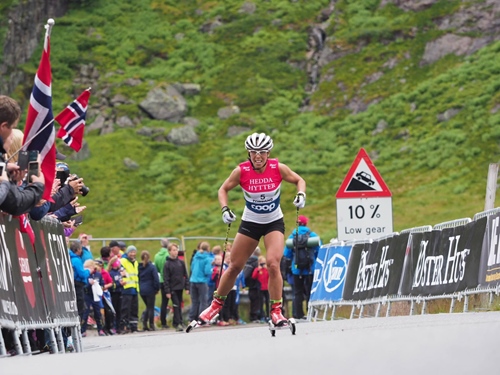
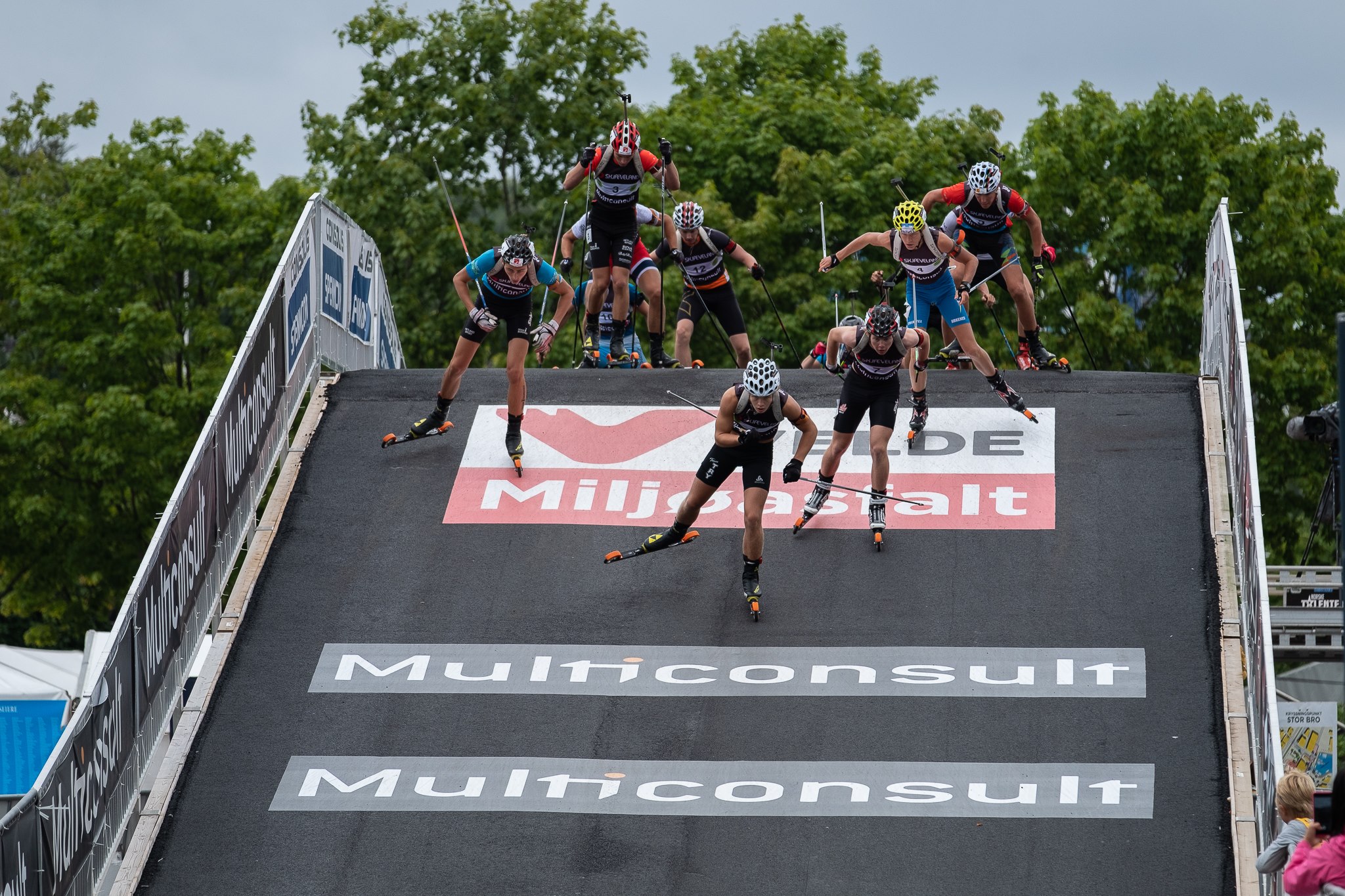
    Racers crest a hill at the 2018 Blink rollerski festival in early August in Sandnes, Norway. (Photo: Axelar / Arild Aarnes / Skifestivalen Blink Facebook)

    In 2005, Norway’s government-owned broadcasting network, NRK, lost production rights for its national football league. In search of a new program to air in place of summer soccer games, NRK, which still held broadcast rights for biathlon and cross-country skiing, approached the Norwegian Ski Federation and the Norwegian Biathlon Federation with a question: Could they find an organizer willing to create a large summer event encapsulating the winter sports of biathlon and nordic skiing?

    NRK’s answer came in Arne Idland.

    Idland was serving as the team manager for the Norwegian Biathlon Federation at the time and had planned to finish his term that same year. The 2006 Winter Olympics had just wrapped up, and Idland was ready for a change.

    Before stepping out of his role with Norwegian Biathlon, Idland become the chief of sport for Norway’s Blink Ski Festival, known as Blinkfestivalen.

    “I spent my last months in the biathlon federation just thinking about Blink,” Idland said in a phone interview.
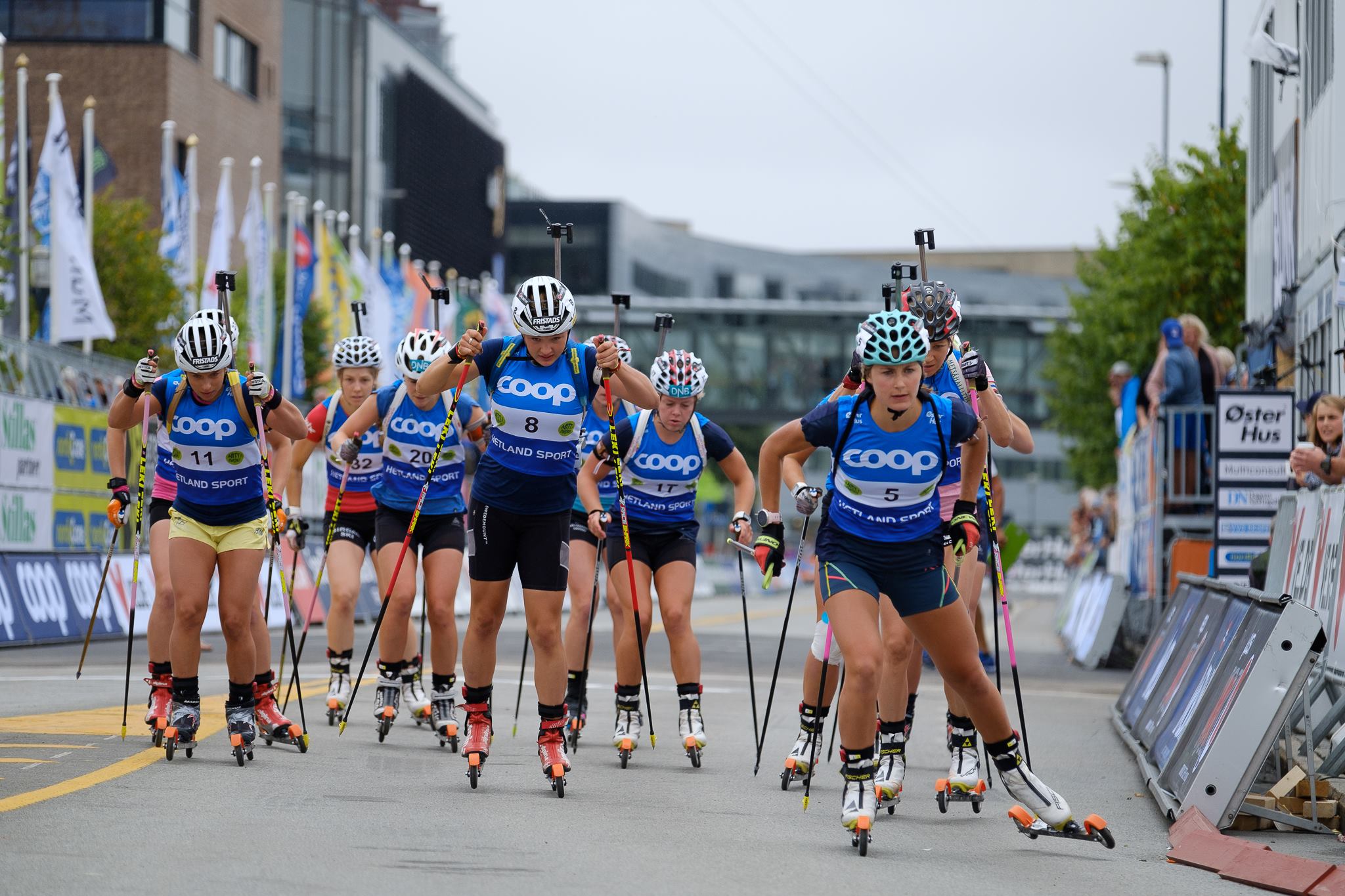
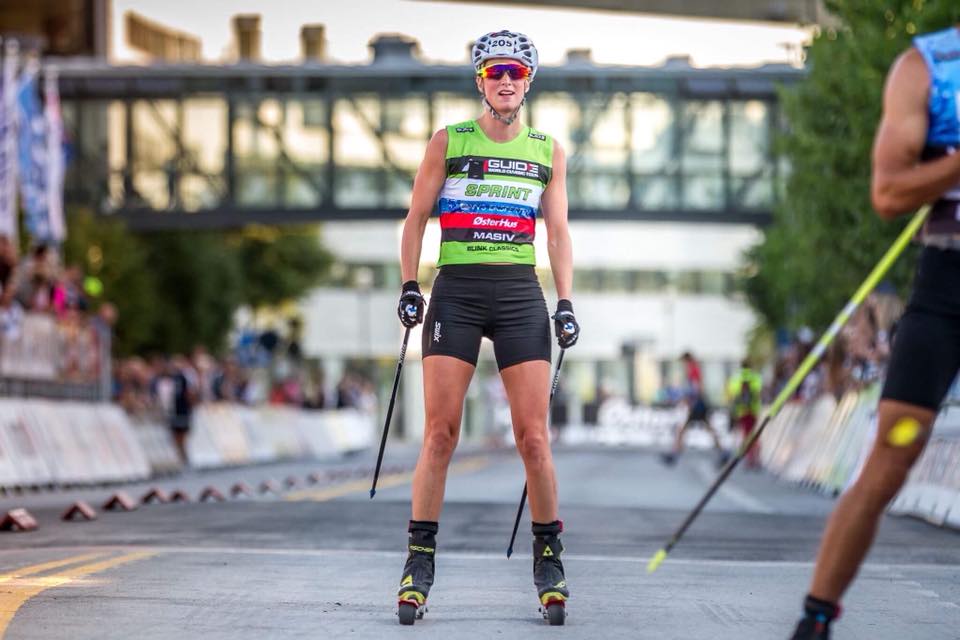
    Biathletes racing in downtown Sandnes, Norway, during the 2018 Blink Ski Festival in early August. (Photo: Axelar / Arild Aarnes / Skifestivalen Blink Facebook)

    Originally from the city of Sandnes himself, Idland said he chose the municipality as a host city for Blink because, at the time, Sandnes “had no big events.”

    Since its inception in 2006, Blink has grown, becoming a premier international rollerski event. Organizers spent a grand total of 23 million Norwegian Kroner (about $2.75 million U.S. dollars) on this year’s Blink rollerski festival. That’s up from approximately 6,000,000 Norwegian Kroner (nearly $720,000 U.S. dollars) in its inaugural year.

    Even with the high price tag, Idland indicated that everything at Blink — entry, exit, and post-event concerts — are free. An estimated 70,000 thousand spectators attended Blink, and not one paid to get in.

    “That has been maybe one of the major key factors to our growth and our success,” Idland said. “Everything is free. We even have free concerts. No tickets to come in and that is the same today as it was at the start. Everybody can come and go just as they want.”

    But how has the city been able to sustain a “free” and accessible race to the public? Sponsors, Idland explained. Through their financial backing, Idland and three others staff members are paid to work full time, year round on Blink.

    When festival time rolls around, local cross-country and biathlon clubs near Sandnes pitch in to organize the multi-day event. And their time is paid. About 600 club members worked at this year’s Blink, and in total, were paid 750,000 Norwegian Kroner (about $90,000 USD).

    “That’s the most important income on an annual basis for the clubs,” Idland said. “It’s also a window to show all the people the sport and to get young kids and youth to start with biathlon and cross-country.”

    Much of Blink revolves around the concept of sport promotion, as opposed to pulling in dollars.

    “One major thing with Blink is that Blink is open for everybody,” he said.

    The festival not only includes an elite race series, but also junior and youth categories in both the biahtlon and cross-country divisions. Idland estimated that 3,000 children participated in Blink camp activities this year and 1,200 juniors entered Blink competitions. Last week, athletes from Russia, Italy, France, Sweden, Great Britain, Finland, Canada, and the U.S. made the trek to Sandnes to participate.

    “We have everything from — maybe you are four years old trying rollerskis for the first time — up to the athletes like [Martin Johnsrud] Sundby and [Therese] Johaug and the other big names,” Idland said. “It’s not only a show for the big stars. It has been important both for the development of the Norwegian Ski Federation and also for the youth and juniors.”
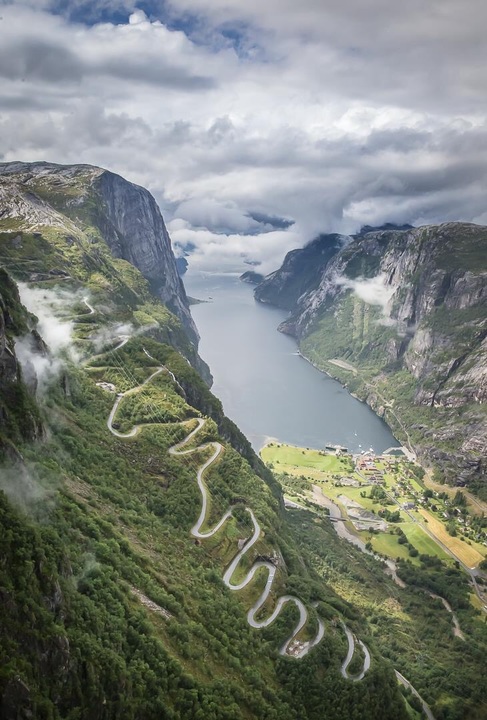
    The 7.5-kilometer race course for the Lysebotn Opp, an annual hill climb at the Blink Ski Festival in Lysebotn, Norway. (Photo: Blink Ski Festival/ Facebook)

    As Blink looks to develop Norwegian skiers, it also continues to develop its race series program. In 2010, organizers added the Lysebotn Opp uphill race, which begins in the fjord town of Lysebotn before climbing 640 meters above sea level.

    Three years ago, they introduced the Blink Classics distance races, which were 50- or 60-kilometers long for elite women and men, starting in the city center of Ålgård and finishing in Sandnes.

    Organizers have also been keen on safety for the high-paced rollerski events on asphalt. Few of its courses feature any steep downhills, all of its courses are fenced off to spectators, and every competitor must use the same speed of rollerskis. This year, Blink provided 1,000 unused rollerskis for racers. Next year they will do the same, with even slower wheel speeds, set to the same speed.

    “So next year we will use IBT 4, which are the slowest skis we have,” Idland said. “That is mainly for the safety, but also we also want the strongest athletes to win. The slower rollerskis you have, the more similar it is to winter time.”

    Winter is not something Blink hopes to compete with, Idland said. Climate change, however, may moot that point.

    “We do not want to become a threat to the traditional skiing on snow,” Idland said. “But … the winters get a little bit shorter and maybe also have to go a little further up in the mountains to find the snow, so I think rollerskiing will become more and more important as a supplement for skiing. Not instead of skiing, but maybe you do more rollerskiing.

    “We do not want to be a threat to the FIS World Cup either,” Idland continued. “We can play along with both FIS and the IBU. If at one time in the future there should be an interest that they would do something together with Blink, we would of course sit down and have a discussion with the FIS and the IBU.”

    Hopefully, that future interest is one made by choice.

    ***

    Related: Blink Ends with Jam-Packed Friday/Saturday | 2018 Lysebotn Opp | 2018 Blink Classics
  • Johaug, Krüger First to Top in Lysebotn Opp; Harvey 10th, Torchia 13th

    Johaug, Krüger First to Top in Lysebotn Opp; Harvey 10th, Torchia 13th

    The 7.5-kilometer race course for the Lysebotn Opp, an annual hill climb at the Blink Ski Festival in Lysebotn, Norway. (Photo: Blink Ski Festival/Facebook)

    The Blink Ski Festival’s famed Lysebotn Opp hill climb returned on Thursday, and with it, a familiar name landed at the top of the results. 

    After serving an 18-month ban from ski racing and subsequently missing the 2018 Winter Olympics, Norway’s Therese Johaug is back.

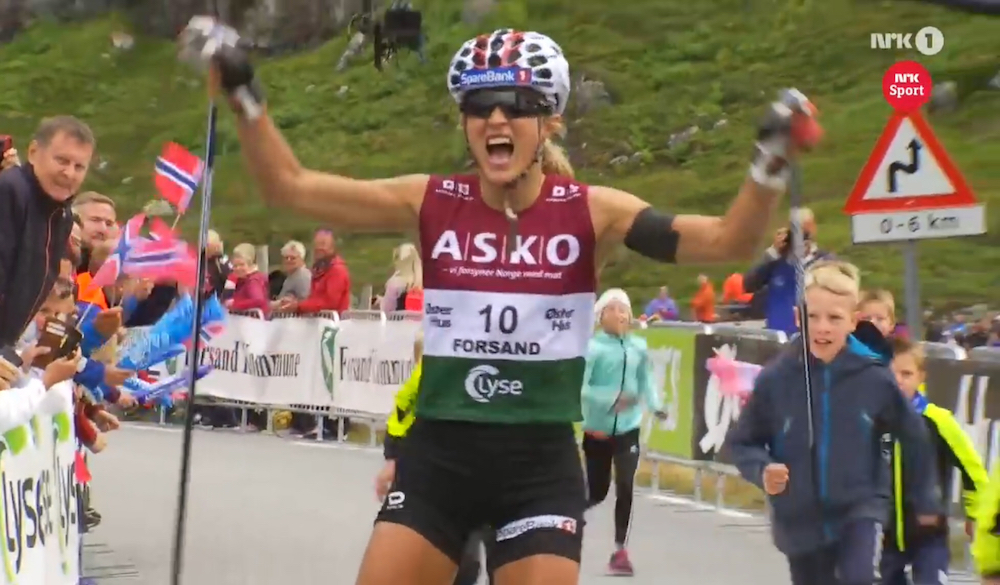
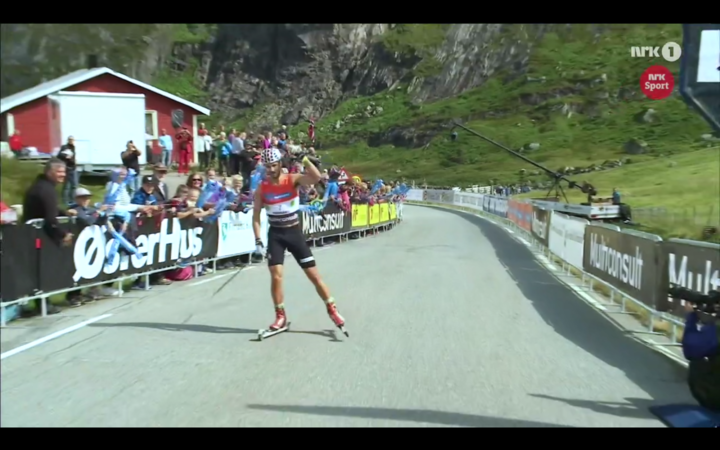
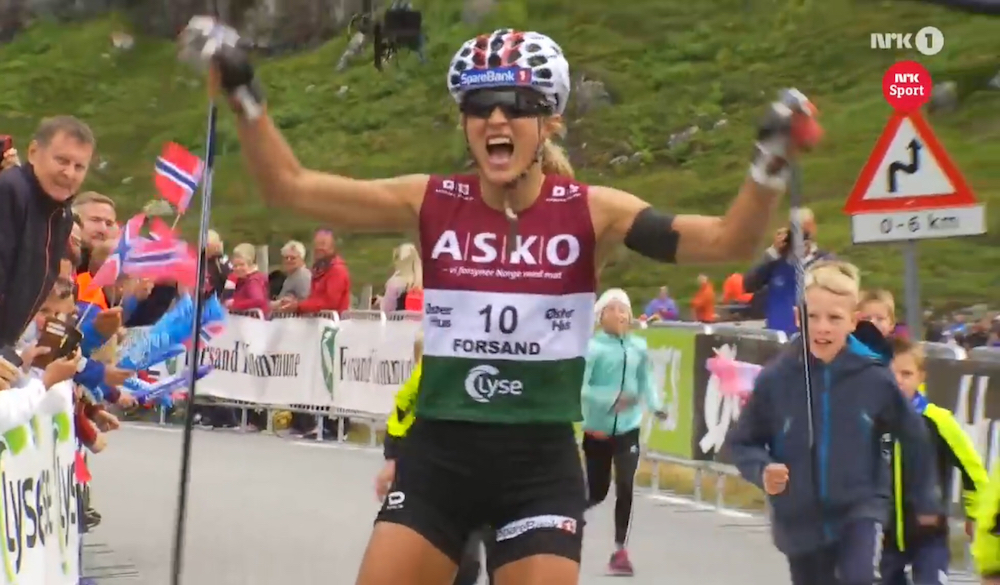
    Norway’s Therese Johaug winning the 2018 Lysebotn Opp hill climb, part of the Blink rollerski festival, on Thursday. She finished in a record-setting 31:46.3 minutes, topping her previous course record of 32:36 from 2012. American Liz Stephen, who retired from skiing this past spring, holds the third-fastest time of 32:53.9. (Screenshot: NRK broadcast)

    The 30-year-old Johaug won Thursday’s rollerski hill climb in a record time of 31 minutes, 46.3 seconds, while Sweden’s Charlotte Kalla finished 1:47.5 minutes back in second.

    Kalla, 31, won last year’s Lysebotn Opp in 33:18.3, telling NRK at the time that “it’s been long since I’ve been in this good a shape in July.” Kalla’s 2017/2018 season went on to be one of her best. She racked up 10 individual wins, including a gold medal in the Olympic skiathlon.

    If Kalla is using her the past year and half as a springboard for the upcoming season, Johaug might be considered the antithesis to the Swede. The year and half competition bar behind her, Johaug appears ready to move forward.

    “If there’s one thing I’ve learned from all this, it’s that you should never rely on anyone, period,” Johaug told Newsinenglish.no. “It’s terrible, but that’s the way it is.”

    Her suspension spurned from a positive test to the banned substance Clostebol acetate, which was present in a lip cream she had been prescribed by her doctor.

    Following Johaug and Kalla on Thursday, Sweden’s Ebba Andersson claimed the third spot on the podium, finishing 3.9 seconds behind her compatriot Kalla and 1:51.4 behind Johaug.

    Norway’s Haga Ragnhild placed fourth (+2:21.6) and Ingvild Flugstad Østberg was fifth (+2:48.9), Austria’s Teresa Stadlober finished sixth (+3:05.7), Russia’s Yulia Belorukova seventh (+3:52.4), Norway’s Kari Øyre Slind eighth (+4:05.0), and Russia’s Elena Soboleva ninth (+4:14.1) and Yana Kirpichenko 10th (+4:26.2). Finland’s Krista Parmakoski finished exactly ten seconds outside the top ten in 11th (+4:36.2). Forty-seven women finished the senior women’s race.

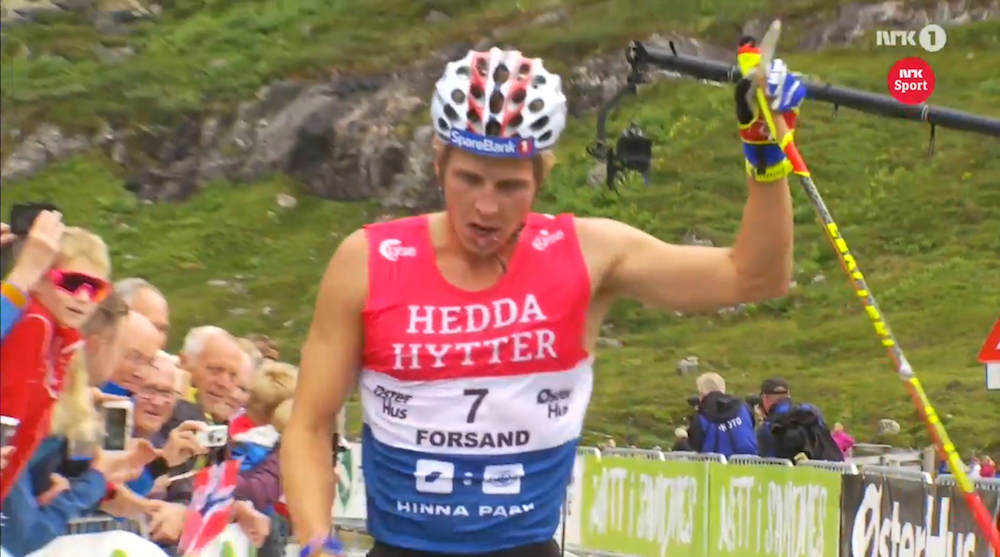
    Norway’s Simen Hegstad Krüger winning the 2018 Lysebotn Opp hill climb, part of the Blink rollerski festival, on Thursday. (Screenshot: NRK broadcast)

    In the senior men’s Lysebotn Opp that followed, two Norwegians battled up front, with reigning Olympic skiathlon champ Simen Hegstad Krüger ultimately winning the race for the first time in 27:53.2. Another national team member and 2018 Olympian (and last year’s Lysebotn Opp winner), Hans Christer Holund finished 3.9 seconds back for second place, and Norway swept the podium with Simen Andreas Sveen in third (+16.0).

    Rounding out the top 10 were Norwegians Vebjørn Turtveit in fourth (+51.7), Martin Johnsrud Sundby in fifth (+52.6), France’s Clement Parisse in sixth (+1:12.4), Norway’s Henrik L’Abée-Lund in seventh (+1:21.1), France’s Adrien Backscheider in eighth (+1:24.7), Russia’s Artem Maltsev in ninth (+1:31.4) and Canada’s Alex Harvey in 10th (+2:02.1).

    American Ian Torchia, who graduated from Northern Michigan University and was renominated to the U.S. Ski Team’s development team this spring, placed 13th (+2:17.2) out of 91 in the men’s field. The 22 year old has been training and traveling in Europe since early July.

    Canada’s Evan Palmer-Charrette finished 57th on Thursday (+5:53.4), Scott James Hill was 63rd (+6:29.7), and Bob Thompson 76th (+8:48.3).

    Racers in the Blink Ski Festival head to downtown Sandnes on Friday for rollerski sprints.

    Results: Women (scroll down for senior results) | Men

    Related: Bolshunov, Gjeitnes Win Blink Classics Distance Races on Opening Day

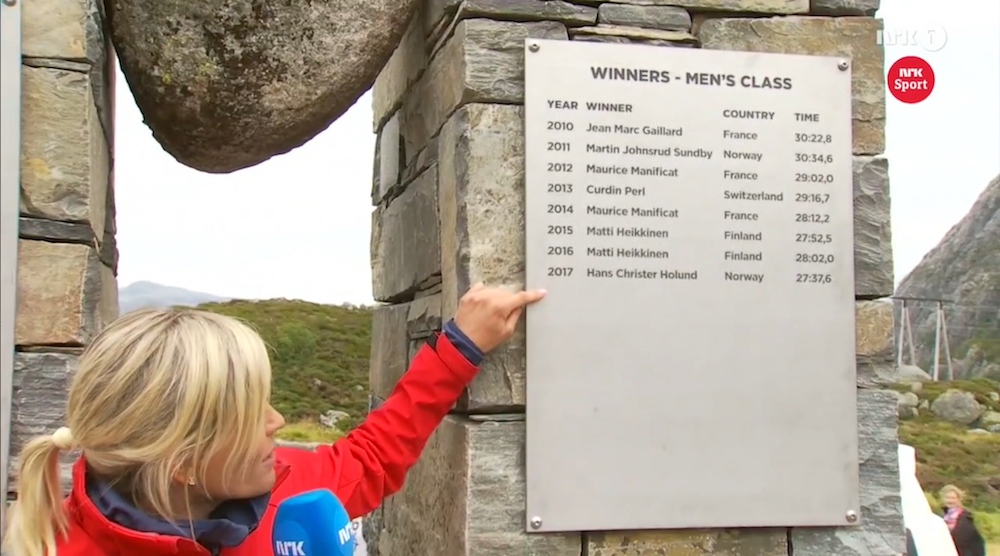
    Past winners of the Lysebotn Opp rollerski hill climb in Lysebotn, Norway. Simen Hegstad Krüger’s winning time on Thursday was third fastest on record at 27:53.2. (Screenshot: NRK broadcast)
  • Bolshunov, Gjeitnes Win Blink Classics Distance Races on Opening Day

    Bolshunov, Gjeitnes Win Blink Classics Distance Races on Opening Day

    Russia’s Alexander Bolshunov racing to first in the Blink Classics men’s 60 k on Wednesday in Sandes, Norway. (Photo: Blink Ski Festival/Facebook)

    A predictor for the winter ski season ahead? Could be. Either way, Norway’s Blink Ski Festival, or as it’s called in Norway, Blinkfestivalen, remains the ultimate in rollerski racing and returned for the 12th year in a row on Wednesday.

    The festival opened with elite men’s and women’s distance rollerski races, known as the Blink Classics.  For the third-straight summer, the Blink Classics featured a 60-kilometer mass start for the men and a 50 k for the women.

    Eighty-six men competed in Wednesday’s 60 k, which began in the city center of Ålgård and finished in the municipality of Sandnes. A complete course map, which deviated little from last year’s rendition, may be found by clicking here.

    By the end of the men’s 60 k, it was Russia’s Alexander Bolshunov who finished first in 2:10:51.6 hours. The 22-year-old Bolshunov had a number of World Cup podiums last season and one win in the final 15 k of the year. He also earned three silver medals and one bronze at the 2018 Winter Olympics in South Korea.


    Finishing just 5.9 seconds behind him was another Russian, 19-year-old Sergey Ardashev, in second place. The third elite man across the line was Norway’s Anders Mølmen Høst, 27, of the Lyn Ski club, who finished 1.8 seconds out of second place and 7.7 seconds back from first.

    Norwegians occupied the rest of the top 10, with Tord Asle Gjerdalen in fourth (+8.1), Øystein Petterson in fifth (+8.3), Hans Christer Holund in sixth (+8.3), Sjur Røthe in seventh (+8.7), Simen Hegstad Krüger in eighth (+8.7), Runar Skaug Mathisen in ninth (+10.3) and Martin Johnsrud Sundby — the winner of last year’s Blink Classics 60 k — in 10th (+10.8).

    Nearly half of the men’s field came from nations from outside Norway, with athletes hailing from Russia, France, Canada, the U.S., Great Britain, Finland, Sweden, and Italy. Canadian World Cup skier Alex Harvey was the top North American in 14th (+1:19.0).

    Also for Canada, Scott James Hill placed 53rd (+11:00.0) and Bob Thompson was 56th (+11:53.1). Ian Torchia was the lone American in the event, racing to 55th (+11:52.3). Canada’s Evan Palmer-Charrette did not start.

    Norway’s Kari Vikhagen Gjeitnes finishing first in the Blink Classics women’s 50 k on Wednesday in Sandes, Norway. (Photo: Blink Ski Festival/Facebook)

    In the elite women’s 50 k, which had just nine finishers, Norway’s Kari Vikhagen Gjeitnes finished first in 2:21:19.0. Second place went to Astrid Øyre Slind, who crossed 33.9 seconds after Gjeitnes, and the third and final podium spot went to Poland’s Justyna Kowalczyk (+5:55.4).

    Racing for Great Britain, Nichole Bathe placed sixth (+14:05.1). Originally from Wisconsin, Bathe is a dual citizen of Great Britain and the U.S., and is currently training with the British national team in Norway.

    Following the Blink Classics on Wednesday, the Blink Ski Festival will turn to the Lysebotn Opp uphill rollerski race on Thursday.

    Blink Classics results: Men | Women

    https://www.instagram.com/p/Bl9FffkA2wS/?taken-by=kari_vikhagen_gjeitnes

  • Kalla Cranks Out Win in Blink’s Lysebotn Opp; Stephen 6th

    Kalla Cranks Out Win in Blink’s Lysebotn Opp; Stephen 6th

    The 7.5-kilometer race course for the Lysebotn Opp, an annual hill climb at the Blink Ski Festival in Lysebotn, Norway. (Photo: Blink Ski Festival/ Facebook)

    There’s a little more than six months to go until the opening ceremony of the 2018 PyeongChang Winter Olympics. For the recently turned 30-year-old Charlotte Kalla, a two-time Olympic gold medalist and three-time silver medalist from Sweden, nothing would be sweeter than to capture another gold this winter in South Korea.

    Her last individual Olympic win came in 2010 in Vancouver, B.C., when she took first in the women’s 10-kilometer freestyle. A repeat podium in the PyeongChang 10 k skate is not far from her thoughts.

    “It is a race that is certainly on my mind,” Kalla told NRK on Thursday, according to a translation.

    What better way for Sweden’s 10 k favorite to practice than at the Blink Ski Festival’s Lysebotn Opp, an annual 7.5 k freestyle rollerski hill climb in Lysebotn, Norway? With names sure to contest her at the Olympics –including Norway’s Marit Bjørgen and Heidi Weng, as well as Finland’s Krista Pärmäkoski, Germany’s Stefanie Böhler and American Liz Stephen — on the start list for Thursday’s race, Kalla couldn’t resist entering herself.

    Sweden’s Charlotte Kalla (r) racing to the win in the Lysebotn Opp, a 7.5-kilometer uphill climb, at the 2017 Blink Ski Festival on Thrusday in Lysbotn, Norway. (Photo: Axelar/Arild Aarnes)

    If her performance in the rollerski race is any indication of where Kalla is headed this winter, it’s the direction she wants. After breaking away with Bjørgen, Pärmäkoski and Weng early on in the race to form a lead pack of four women, Kalla quickly decided to make the race her own.

    Within the next few kilometers, Kalla dropped the two Norwegians and Pärmäkoski and went on to finish first in a time of 33 minutes, 18.3 seconds. Weng followed 40.3 seconds later and Bjørgen crossed in third, 1 minute and 50.5 seconds back. 

    Notably, Kalla’s time was faster than 57 out of 100 elite men that raced the same 7.5 k course later on Thursday.

    “One shouldn’t focus too much on what happens in July, there is a lot left to be done before the season, but it’s been long since I’ve been in this good a shape in July. The last time was probably 2013,” Kalla told NRK.

    The Lysebotn Opp’s 2014 champion,Stephen finished sixth overall (+3:35.7) on Thursday, after  Norway’s Ragnhild Haga in fourth (+2:43.4) and Pärmäkoski in fifth (+2:47.0). Prior to winning three years ago, Stephen also placed third in the famous rollerski hill climb in 2012 (the Lysebotn Opp was added to the festival in 2010).

    (Article continues below)

    https://www.instagram.com/p/BXHv6bPB5Ln/?taken-by=lizhillstephen

    In the men’s 7.5 k uphill race that followed, Hans Christer Holund broke away for the win in 27:37.6, besting fellow Norwegian Simen Hegstad Krüger in second (+1:13.9) and Finland’s Matti Heikkinen in third (1:25.6).

    Holund took it out strong from the start, holding his lead through the climb’s entirety.

    Norway’s Hans Christer Holund after winning the men’s 7.5-kilometer Lysebotn Opp rollerski hill climb on Thursday at the 2017 Blink Ski Festival in Lysebotn, Norway. (Photo: NRK screenshot)


    “I am healthy and have done some solid training this summer,” the 28-year-old Holund told NRK after. “It looks promising. There’s still a lot of time Olympics, but it does look promising. It is so competitive in Norway and it’s tough to just be selected. If I am selected for the Olympics when the time comes then I will be good enough and then an Olympic gold-medal is the next task.”

    Norway occupied seven of the top eight on Thursday, with Henrik L’Abée-Lund in fourth (+1:59.6), Sjur Røthe in fifth (+2:05.7), Martin Johnsrud Sundby (Wednesday’s 60 k winner) in sixth (+2:11), Simen Andreas Sveen in seventh (+2:12.4), and Gaute Kvåle in eighth (+2:14.7).

    Andy Newell of the U.S. Ski Team did not race the hill climb, but he was back for the 15 k mass start on Friday (as was Stephen for the women’s 10 k). Stay tuned for results in a separate report.

    Results: Women | Men

  • Summer Success for Sundby, Wins First Race of Blink Festival

    Summer Success for Sundby, Wins First Race of Blink Festival

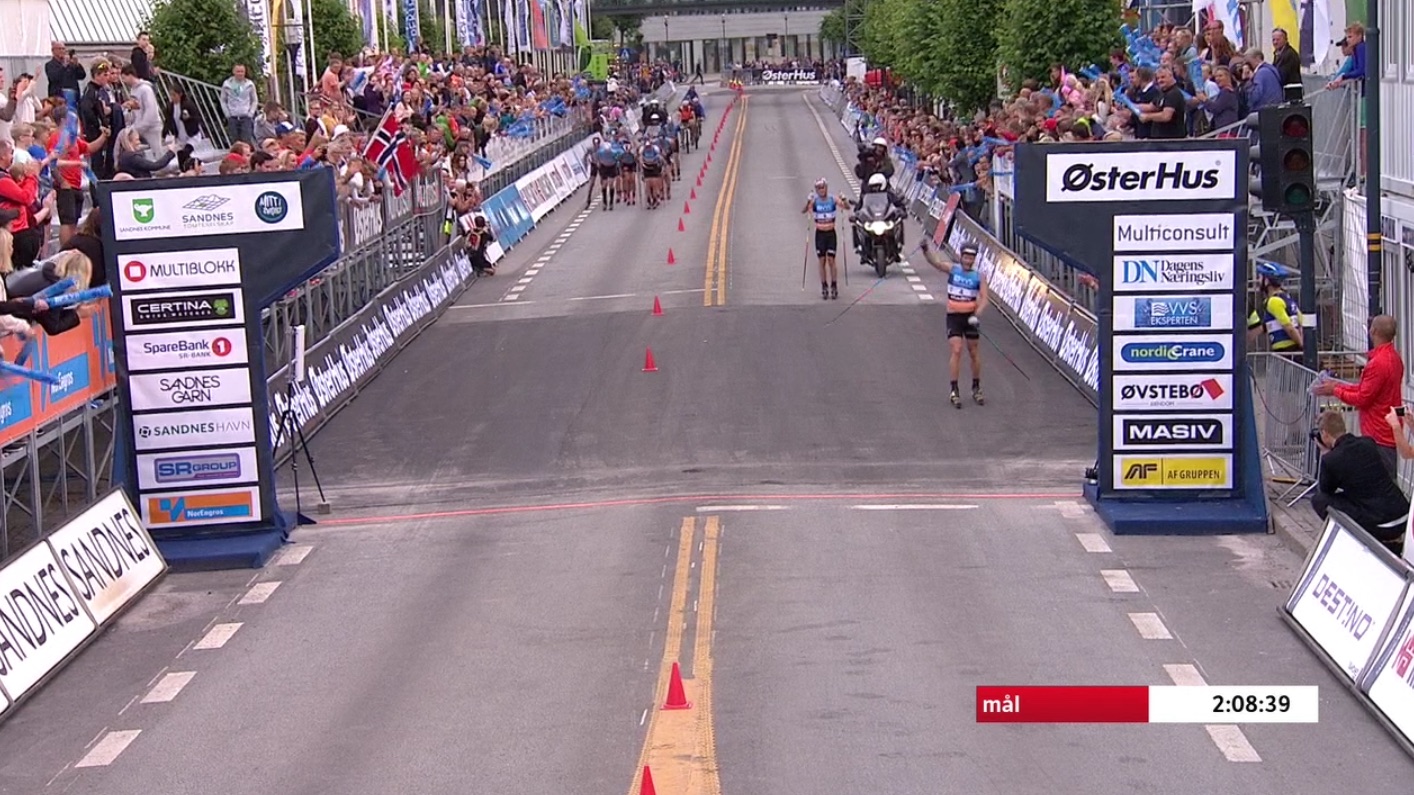
    Defending Overall World Cup champion Martin Johnsrud Sundby won the first race of the 2017 Blink Ski Festival on Wednesday, finishing 2.6 seconds ahead of fellow Norwegian Simen Hegstad Krüger in the Blink Classics 60 k distance rollerski. (Photo: NRK screenshot)

    Stands crowded with 50,000 cheering spectators. Bibbed athletes clad in shorts and T-shirts clicking by on rollerskis. Competitors representing various countries dousing themselves with bottled water as they cross the finish line.

    These were among the sights and sounds of the world’s largest summer rollerski-race series, Norway’s Blink Ski Festival.

    Celebrating its ninth year, racers and fans kicked off the 2017 four-day festival in Gjesdal and Sandnes, Norway, with men’s and women’s classic distance rollerski races on Wednesday.

    Toeing the start line for the elite men’s 60-kilometer were well-known Norwegian World Cup racers, such as Martin Johnsrud Sundby, Petter Northug and Sjur Røthe, as well as Russia’s Sergey Ustiugov, Finland’s Iivo Niskanen, Germany’s Lucas Bögl, and American Andy Newell.

    In the beginning, it appeared Ustiugov was gunning for the lead, charging the group of 58 rollerskiers with 46 k to go. But within another 9 k, a pack of six had broke off the front, including Sundby, Røthe, Niskanen, and Norwegians Øystein Pettersen, Simen Hegstad Krüger, Anders Aukland, and Simen Håkon Østensen. Ustiugov was now in the chase group close to 45 seconds away.

    With less than 30 k of road left to race, the front group had dwindled to three Norwegians and a Finn: Sundby, Røthe, Krüger, and Niskanen. Newell had caught up to the chasing group, now almost two minutes back from the leaders.

    Given 20 more kilometers, however, Sundby and Krüger had pulled away, Niskanen working to hold onto third 30 seconds back. The two Norwegians battled together until the final kilometer, when Sundby surged for the final city sprint to secure the victory in a time of 2:08:40.6.

    Though some may see the win as a premature predictor of what’s to come this winter, Sundby was not one of them.

    “We are talking about July. Everyone pretends like they don’t care, but this is important for everyone who is on the starting line,” Sundby told NRK, according to a translation. “There weren’t a lot of world-class athletes who was not on the starting line today.

    “This is incredibly good practice,” he continued. “I greatly appreciate all of these competitions.”

    Just 2.6 seconds behind Sundby, was Krüger crossing in second. Third went to Niskanen, who finished 36.7 seconds back from the winner.

    Just 1.8 seconds outside of the top 15 was Newell in 16th overall (+5:25.1) in the elite men’s race, out of 58 finishers.

    In the elite women’s 60 k, which started at the same time as the men, Norway’s Astrid Øyre Slind latched onto a few male racers from the start and broke away from her competition, which included just 10 women. 

    Slind took the win in a time of 2:20:04.2, while fellow Norwegian Kari Vikhagen Gjeitnes claimed second, 2:11.1 minutes back. Belarus’s Yulia Tikhonova completed the women’s podium in third (+2:23.4). 

    (Article continues below)

    https://www.instagram.com/p/BW9z6M4hmcd/?taken-by=andynewellskier

    Racing continued Thursday with the men’s and women’s hill climb, the Lysebotn Opp, in  Lysebotn, Norway. Sixty-five women came out for that race, with Sweden’s Charlotte Kalla taking the victory in 33:18.3. Norway’s Heidi Weng finished 40.3 seconds back in second, and Marit Bjørgen wearing bib 1 finished third, 1:50.5 minutes behind Kalla.

    Liz Stephen of the U.S. Ski Team took sixth (+3:35.7) behind Norway’s Ragnhild Haga (+2:43.4) in fourth and Finland’s Krista Pärmäkoski in fifth (+2:47).

    In the men’s race, Norway’s Hans Christer Holund took the win in 27:37.6. Krüger repeated in second place, 1:13.9 minutes back, and Finland’s Matti Heikkinen placed third (+1:25.6), while Sundby was sixth (+2:11.5) behind fellow Norwegians Henrik L’Abée-Lund in fourth and Røthe in fifth.

    Out of 100 male starters, 99 finished. Newell did not compete.

    Check back Friday for a more detailed recap of Thursday’s Lysebotn Opp.

    Day 1 distance results: Men | Women

    Day 2 Lysebotn Opp (hill climb) results: Women | Men