Tag: bonking

  • Dialing in Performance Fueling: Gus Schumacher Explores Continuous Glucose Monitoring

    Dialing in Performance Fueling: Gus Schumacher Explores Continuous Glucose Monitoring

    Over the last six months, an increasing number of athletes have posted photos and videos from their training sessions that include a small circular pod attached to the back of their arms, near the triceps. As it turns out, the pod is a continuous glucose monitor (CGM), specifically the Abbott Libre Sense Glucose Sport Biosensor which partnered with a new company, Supersapiens, to design an interface that allows athletes to monitor and optimize their blood glucose levels throughout the day. Essentially, the device collects real-time information about the concentration of glucose in the bloodstream, and transmits this data via Bluetooth to an app on the user’s cell phone. 

    Abbott’s Libre Sense Glucose Sport Biosensor is used by Supersapiens to provide athletes with real-time information about their blood glucose. (Photo: abbott.mediaroom.com/

    Taking a step back, here’s a condensed version of the complex physiological process that is energy metabolism surrounding exercise: Carbohydrates are the body’s primary source of energy during exercise. When carbohydrates are consumed, the body breaks them down through digestive processes into simple sugars, which are then converted into circulating blood glucose. The more complex the carbohydrate, the longer it takes for the body to break it down into its smaller building blocks.

    At rest, the body stores chains of glucose in the form of glycogen, primarily in the skeletal muscle and liver, to be called upon during exercise. Through aerobic and anaerobic processes, the body converts glucose into cellular energy in the form of adenosine triphosphate (ATP), which allows muscle cells to contract and thus power the activity. However, the amount of stored muscle glycogen is finite and depends on the volume of skeletal muscle on an athlete’s body. As muscle glycogen becomes depleted, blood glucose begins to drop, and the athlete quickly trends toward the fearsome “bonk”.

    Therefore, an athlete should supplement with carbohydrate sources — the simpler the better — during training sessions or races longer than 60-90 minutes to enable the body to maintain sufficient blood glucose levels and thereby keep their muscles fueled throughout the session.
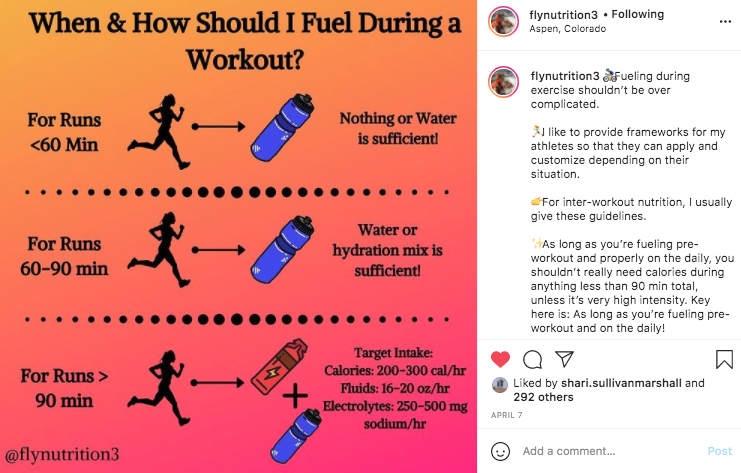
    Registered dietitian and endurance coach Kylee Van Horn’s guidelines for fueling during training. (Photo: Instagram @flynutrition3)

    After the activity is completed, the hormone insulin helps draw glucose out of the blood stream to replenish muscle glycogen stores. Readers may be familiar with the 30-60 minute window of opportunity after exercise during which the body is more sensitive to insulin and therefore can replace the depleted muscle glycogen more rapidly by taking in a post-workout snack containing carbohydrates.  

    There’s a lot more to this, but for the purpose of this article, here’s a key takeaway from “Fundamentals of glycogen metabolism for coaches and athletes”, posted in an April, 2018 issue of the journal Nutrition Reviews:

    It is now widely accepted that consuming a diet sufficient in carbohydrates, along with ingesting carbohydrates during and following exercise, can improve performance and speed recovery… It is also well established that beginning exercise with ample muscle glycogen stores is an important contributor to improved exercise performance; further, restoration of glycogen stores is essential for complete recovery and the maintenance of subsequent exercise capacity.”

    Bringing it back to continuous glucose monitoring: By monitoring blood sugar and striving to keep it within an optimal range, athletes can become more informed about their body’s response to nutrition and training in order to dial in performance fueling, stabilize energy levels, and promote faster recovery. Peaks and valleys can promote inflammation and impair recovery and sleep, so stability is your friend.

    The Supersapiens CGM technology is not yet commercially available in the US, though they are already available in the U.K. and Europe. As such, Supersapiens — a direct-to-consumer American based company — is holding off on media interaction until the products can reach their target user base. FasterSkier will follow up with representatives to learn more about the product itself as this changes.
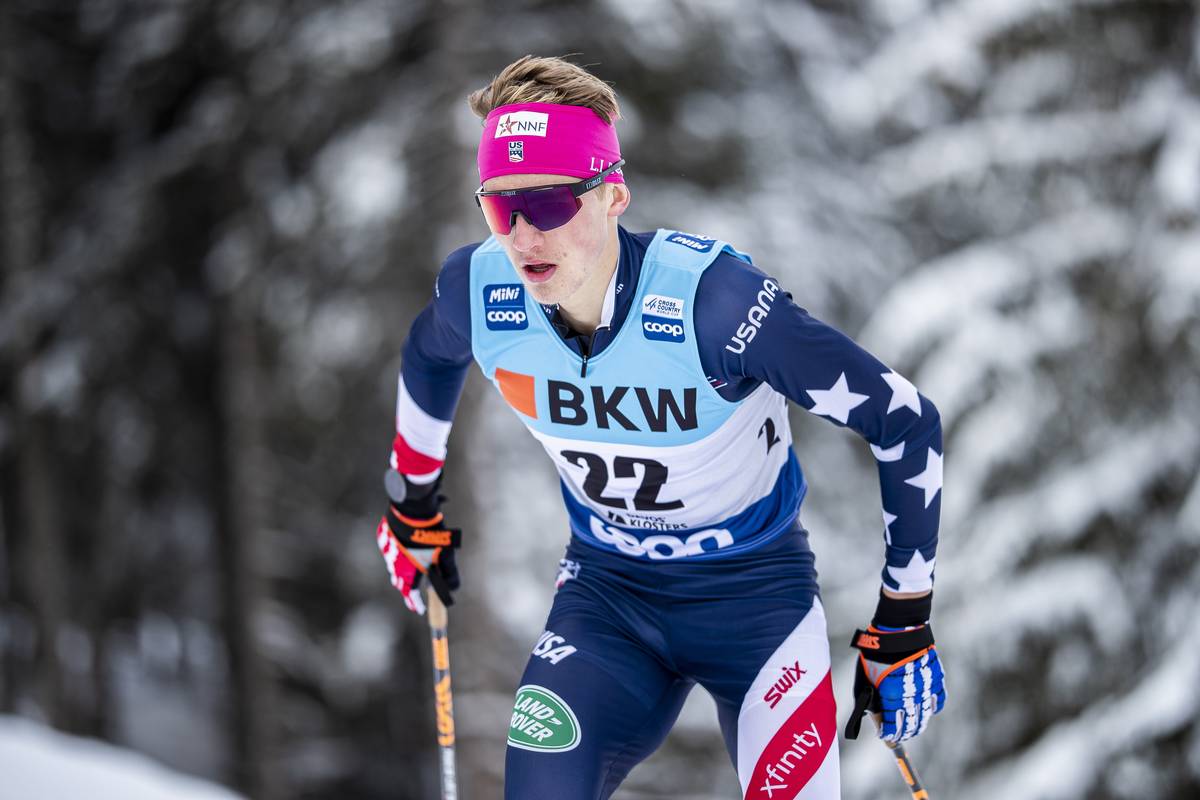
    Gus Schumacher races the 15k skate in Davos, Switzerland in December, 2020. (Photo: Nordic Focus)

    However, among the American athletes taking part in an observational wear trial is Gus Schumacher, with whom FasterSkier connected to learn more about how he has used the CGM thus far and what he has learned in the process. At the time of the call on August 9th, the 21-year-old Junior World Champion was in the throes of high-volume summer training in Anchorage, AK, with a handful of “the boys”, i.e., fellow top U-23 athletes Noel Keeffe, JC Schoonmaker, Johnny Hagenbuch, Sam Hendry, and more. 

    Schumacher started working with Supersapiens, alongside a dietitian from the U.S. Ski Team, to incorporate the CGM into his training in late May during the team’s on-snow camp in Bend, OR. 

    “At first, the biggest benefit was that I did research about fueling and [nutrition] through the resources with the U.S. Ski Team,” Schumacher explained. “And that just taught me a lot more about how I should be fueling during training and after training. So stuff that I sort of knew, but didn’t really focus that much on previously.”

    While some of the concepts may not seem particularly novel to those versed in nutritional practices for athletes, Schumacher explained that watching his glucose levels helped him understand the importance of fueling surrounding his training sessions and ensuring that overall, he was consuming enough food to meet the high demands he places on his body.

     “Now, I use it more for  the recovery side of things, like making sure my overnight glucose levels don’t drop too low,” Schumacher said. “I mean, part of it is — I can tell when I’m under -fueled, like if I get hungry in the morning or something.  But [using the CGM] is kind of a nice way to double check, because it’s hard to always trust your [hunger] cues when you’re when you have to eat a lot more than normal for big training days and adjust [how much you eat] to each training day. So you can be a little more secure about whether you’re eating enough.”
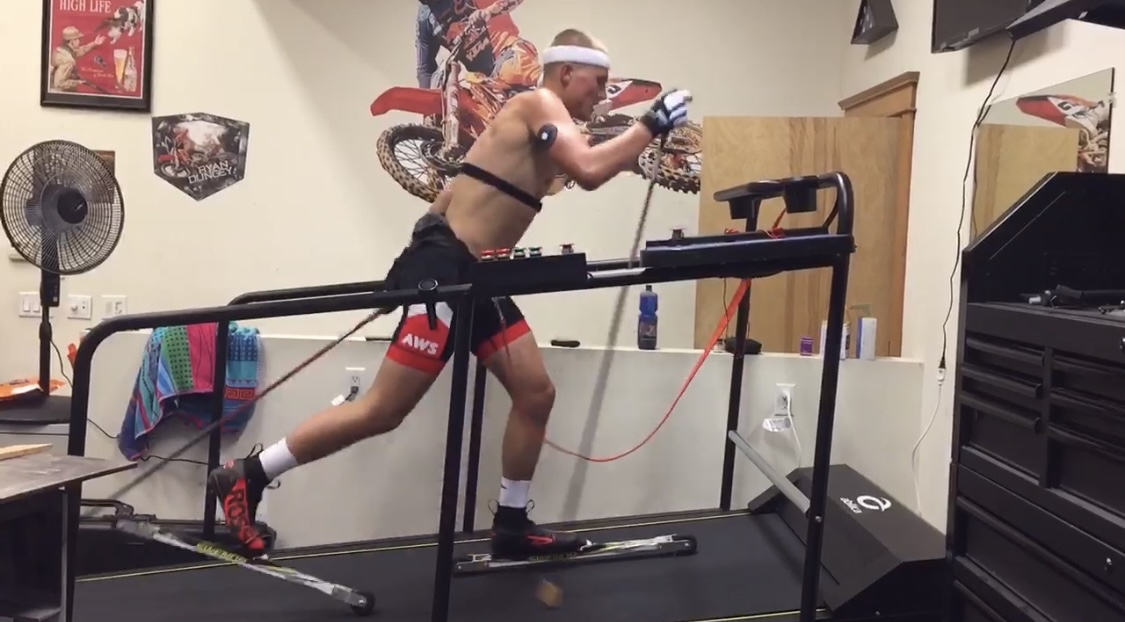
    Gus Schumacher wears a continuous glucose monitor during a treadmill training session this summer. (Courtesy photo)

    The biggest change Schumacher has made has been in his fueling surrounding training sessions. He explained that he used to rely primarily on large meals between sessions with little fuel during the session, leaving him depleted and feeling like he needed to “bomb” himself with food at lunch and dinner. He also typically carried plain water for hydration the majority of the time, incorporating sports drink for the electrolytes only when it was hot. After seeing the spikes and drops on his blood sugar and learning from dietitians, he now spreads his intake out throughout the day for more stable energy.

    “Now, I’m eating more snacks and keeping the meals like a more normal size. So — finishing [a session], having a protein heavy snack and then eating a meal within an hour, and then having a balanced snack before the next training session. And making sure to just take in carbs during that session, so I always have sports drink now and I usually also have some bars or fruit or gummies during training sessions. That’s the biggest thing I learned — even during easy sessions, you can oxidize up to 60 grams of carbs an hour roughly something like that. That’s the goal that I shoot for.”

    So is it making a difference?

    “Yeah, actually — especially on my high volume weeks. I noticed that it just seemed easier to get out the door as those sessions built up. Like, I still would eat a big lunch and stuff, but it didn’t seem like I was, like, fully come back from depleted after every session. I would finish and not feel super hungry. It just seemed a little quicker to come back to normal.”

    While his U.S. Ski Team dietitian provided the guidance on the types of foods he should incorporate and nutrient timing, the team at Supersapiens helped him understand the data he was collecting with the CGM. Specifically, they helped him through the learning curve of understanding normal and optimal blood glucose levels for different types of sessions. 

    “I would ask stuff like, ‘Why does my glucose not get that high during this session?’ Because all the information on their website shows, ‘You, will you want to figure out what’s good for your performance.’”
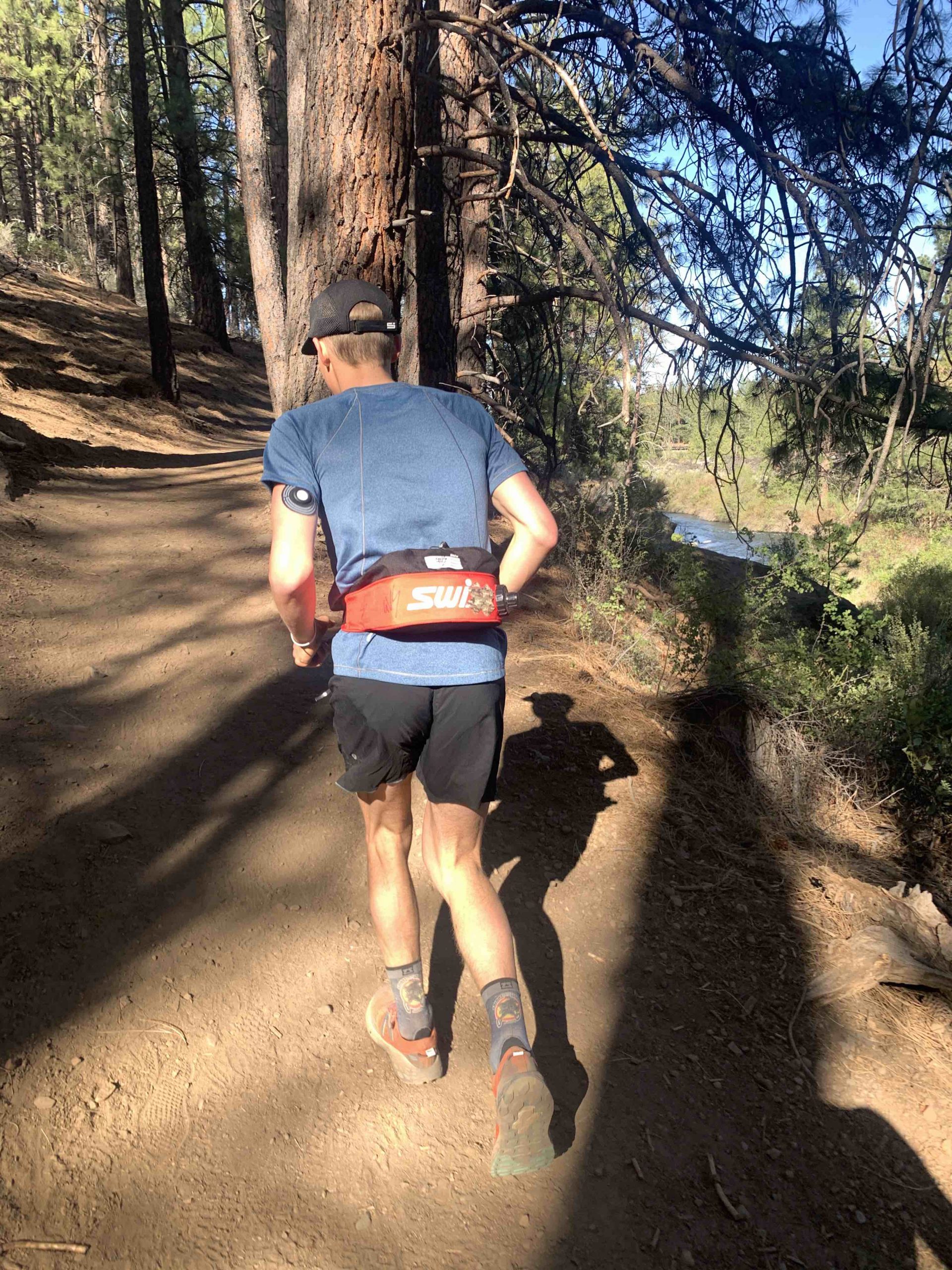
    Gus Schumacher tracks his blood sugar using a continuous glucose monitor on a training run. (Courtesy photo)

    While he was seeing in the Supersapiens information that higher blood glucose levels were important for intensity sessions, he was noticing that his levels would be on the low side during easy distance sessions.

    “I asked them about that, and for that particular instance, when you’re going easy, you’re not necessarily oxidizing a ton of glucose [and your body can rely more on breaking down its fat stores], so blood glucose can stay pretty low.”

    He also started to consider his overnight blood sugar levels to ensure he was recovering well while sleeping. 

    “[They recommended] experimenting with having a snack with a decent amount of protein and fat before bed to see if that stabilizes overnight glucose.” 

    Improving fueling and keeping blood sugar is all well and good. But, we live in a world where diet culture is rampant and the emphasis on power-to-weight ratio in endurance sports can cause athletes to develop disordered eating habits and an unhealthy body image. Skiers are already typically hooked up to a heart rate monitor and a GPS watch to collect a plethora of training data. At what point does it become too much or lead an athlete to be overly meticulous about their diet at the expense of their mental health?

    In terms of data overall, Schumacher explained he finds it interesting, and his coaches are “super into data”, but he is able to hold it lightly and not read too much into it. 

    “I think at this point, I’m still very open to trying anything — any new data collection is kind of cool… So I kind of embrace it, and if it ever feels like too much, I’m pretty good about going back to my instincts. I feel like I can fall back on that intuition pretty easily.”
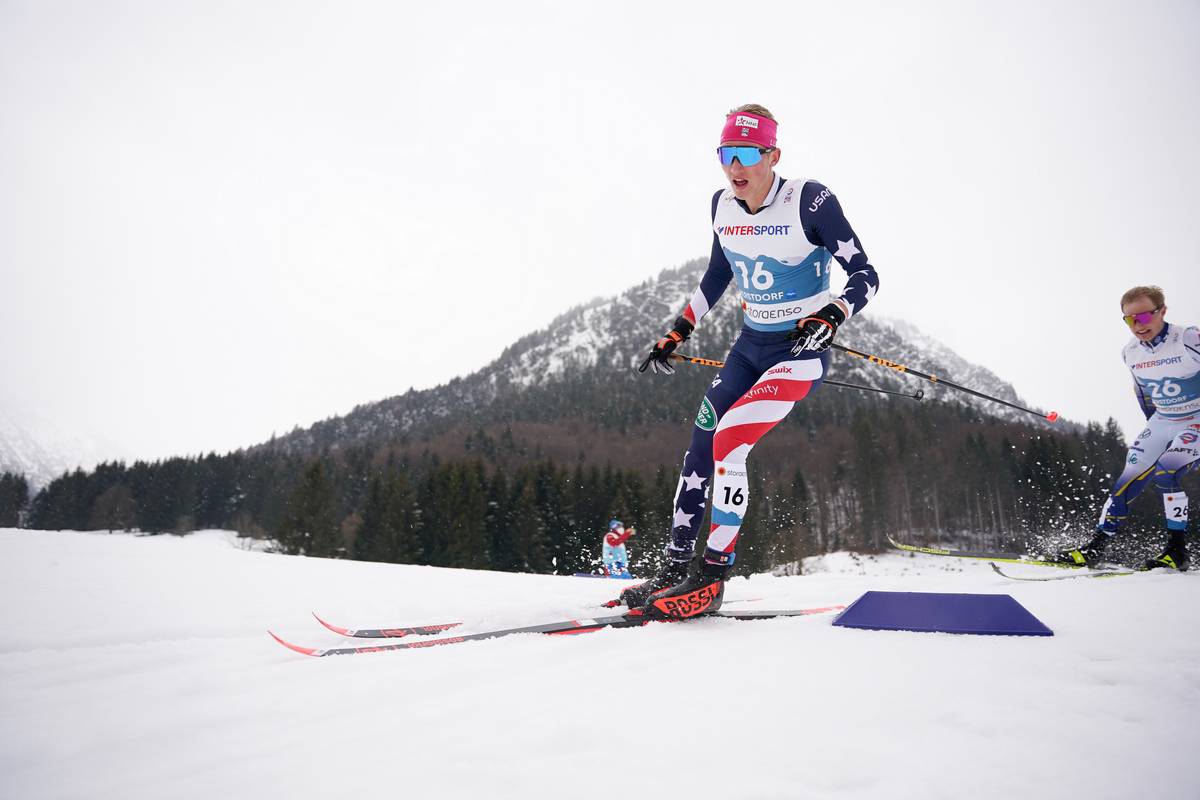
    Gus Schumacher on course during the 50k freestyle at the 2021 World Championships in Oberhof, Germany. (Photo: Nordic Focus)

    Schumacher felt similarly about monitoring his blood glucose. He has gained more awareness about the foods that he consumes and how they impact his blood sugar, but he explained when pitched the question of whether he could see the use of GCM technology leading him to place an unhealthy emphasis on eating specifically to stay within a particular range that ultimately, he knows to trust his body.

    “I think that’s a good point, because sometimes when I eat something that I think is pretty good,  like a balanced meal, and [my blood sugar] spikes really hard, the knee jerk is to be like, ‘What’s going on? Why did that happen? How do I fix that?’ But, more and more as I’ve had [the CGM] on, it’s just like, sometimes that’s just like, normal. It’s whatever. So that’s when I fall back on my intuition, like, I feel satisfied.”

    To meet the energy demands of 20-30 hours of training, a pro skier needs to eat a proportionally large volume of nutrition. Endurance sports are about the long haul, and ensuring that the overall lifestyle is sustainable is essential in allowing an athlete to develop and achieve their potential. Schumacher elaborated on keeping his relationship with fueling and blood glucose in a balanced place.

    “I think it’s possible that having that data around your food can make it not that fun, like if you’re really just trying to make those numbers look good. But I think it’s important to use [the data] as an overall thing. And just use it to try to make sure your resting levels are high enough, and you’re getting enough during your training, but not worrying too much about the micro things because there’s a lot that goes into that.

    “Or [understanding that] you don’t need [the data] to be perfect to be fueling perfectly. And I think it’s fun for me to know more about performance fueling and be able to implement that day to day and feel like it’s making a difference and not have it be overbearing, because part of performance feeling is still eating stuff that makes you happy in general. So yeah, I think it’s important to have a pretty holistic view of all of it, but it’s also fun, I think, to have the eating be part of your training and to know that it matters for how you feel and just making sure you feel good all the time.”

    As this technology becomes commercially available, athletes of all levels will need to make similar considerations in the calculus of determining whether this technology and the information if provides is worth the investment (currently around £113 in the U.K. for a one month subscription, including two pods that last 14-days each). 

    To provide athletes interested in CGM technology with guidance, FasterSkier connected with Registered Dietitian Kylee Van Horn. An accomplished runner herself, Van Horn helps endurance athletes across a variety of sports dial in their nutrition to support their training and overall wellbeing through her business, FlyNutrition.
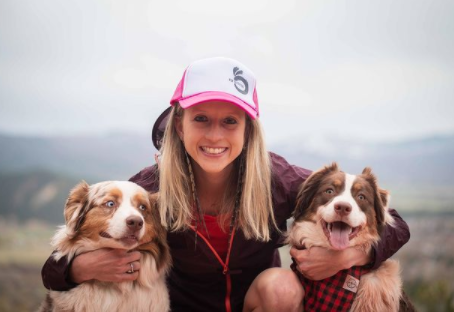
    Kylee Van Horn RDN provides athletes with guidance when approaching new continuous glucose monitoring technology. (Photo: FlyNutrition.org)

    Van Horn recommended a targeted approach, cautioning against the aforementioned possibility of becoming too focused on the data and potentially compromising the athlete’s mental health. She knows, perhaps too well, from her clients the propensity for under-fueling in endurance athletes of all levels.

    “I think there is going to be some level of risk,” said Van Horn in a call. “The more data you have — and especially within the endurance sports world, for people to tip into the restrictive eating pattern.”

    However, she expressed that using glucose monitoring to focus on key areas of nutrition could help athletes improve their overall fueling. In particular, focusing on balanced meals and snacks that provide sustained energy in and out of workouts, that also keep eating and preparing food both enjoyable and sustainable. 

    “I personally wouldn’t want to use it long-term with an athlete, but I think as a short-term, using it to dial in some specific things could be really beneficial… Dialing in what would be a really good pre-workout breakfast or meal option for [the athlete] that’s not going to cause a rebound hypoglycemic effect where we’ve got a big spike and drop in blood sugar and then we’re seeing this big energy spike and drop part way into the activity or race.”

    Van Horn also envisions a more informed version of trial and error to maintain energy levels during workouts, particularly in longer sessions or races. This could be particularly useful with athletes who have sensitive stomachs, as spikes and drops in blood sugar could exacerbate these issues.

    “The intra-workout fueling, in my opinion, would be really interesting. Because we do know that some foods do affect people differently in regards to how much they spike their blood sugar and drop it and how quickly.”

    Van Horn shared that a coach and professional triathlete who she partners with, Matt Hanson, has also been a member of the pilot group. Hanson is a three-time national champion at the Ironman distance and is the current world record holder in an Ironman event (7:39:25). 

    Hanson shared with her that he has found a lot of value in using glucose monitoring to better understand his body’s response to his pre-workout meals, because he had been experiencing big swings in energy levels. The CGM has helped him adjust these meals to foster more stable energy. He also found value in playing with the types and timing of different sports nutrition products he was consuming during his training to maintain better glucose levels and energy throughout.
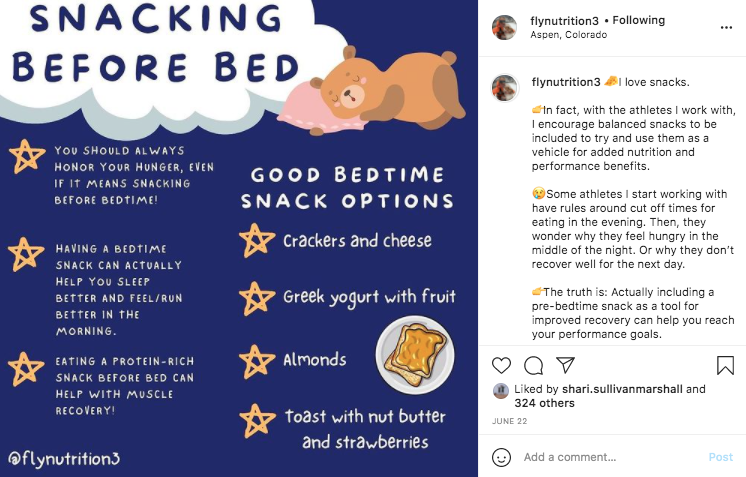
    Kylee Van Horn, RDN of FlyNutrition offers suggestions for bedtime snacks to help athletes boost sleep quality and overnight recovery. (Photo: Instagram @flynutrition3)

    Lastly, because sleep is an essential component of an athlete’s recovery and overall health, Van Horn explained that, like Schumacher noted, a pre-bed snack that contains protein and carbohydrate can be very valuable in supporting recovery and stable blood sugar during sleep, in particular for athletes training at high volumes or early in the morning.  

    “If you’re eating a snack with too high of carbohydrate or eating certain foods before bed, that can impact your recovery and cause micro-awakenings, which impacts sleep quality, so that might also be something that you could address [by monitoring].”
  • Dial in Your Race Day Nutrition

    Dial in Your Race Day Nutrition

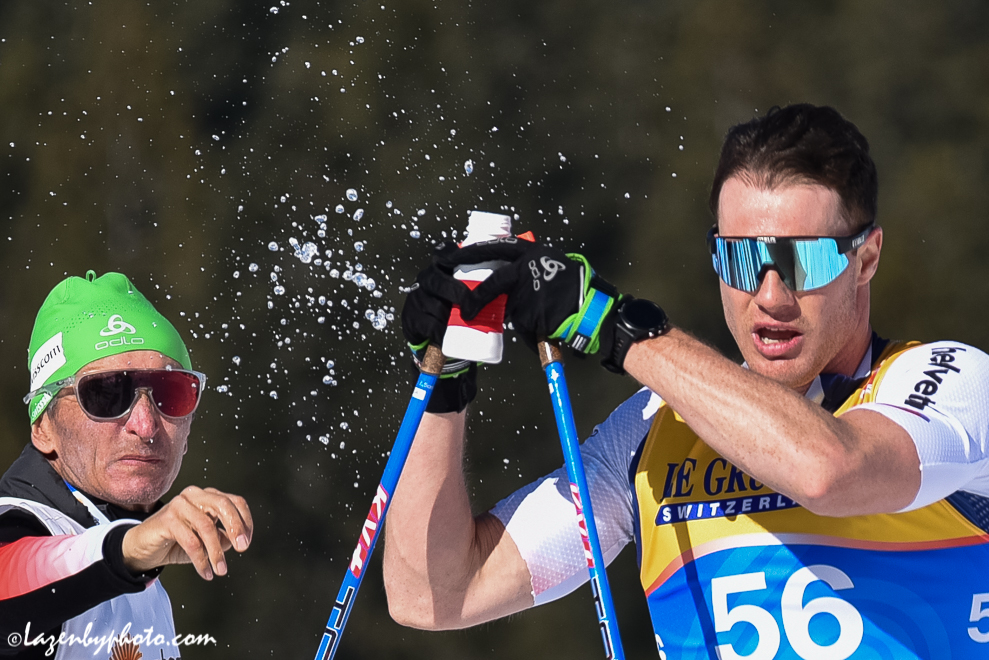
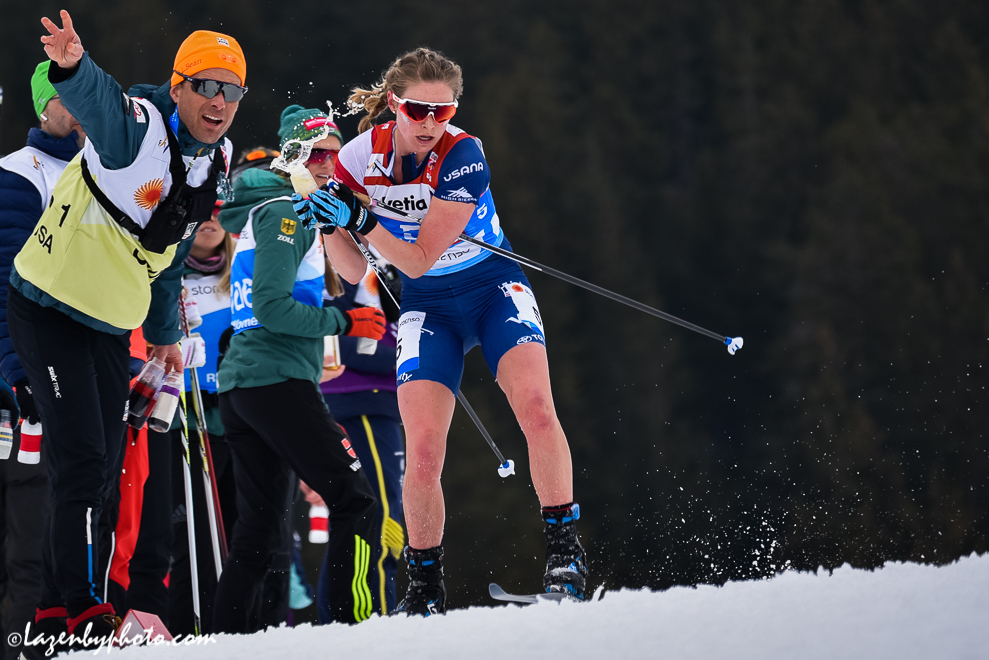
    Jessie Diggins of the U.S. receives a feed women’s 30 k skate at the 2019 World Championships. Diggins placed fourth overall. (Photo: John Lazenby/lazenbyphoto.com)

    You’ve likely heard lots of  different ideas about fueling and feeding on race day. When to eat, what to eat, and how to eat it – there are hundreds of opinions. Ultimately, it comes down to what you find works best for you; the gut can actually be trained to adapt to different diets and eating habits. However, current research does suggest some strategies that will optimize performance on race day. I’ll provide some  answers to big picture concepts to help you ski your fastest, avoid muscle cramps, and recover best for the next race!

    Do I really need to finish eating breakfast 3-4 hours before my race start?

    Unfortunately for your 8 AM Birkie start, yes. The reason for this extends beyond just ensuring that your pre-race nerves don’t cause you to lose your whole bowl of oatmeal before it’s digested. When we eat a meal, the hormone insulin is released by the pancreas in response to rising blood sugar levels. Insulin helps us use the sugar from our meal by assisting its transport into muscle cells. Insulin levels  peak about 60-90 minutes after eating. 

    Here’s why the timing for that meal is important. When we start exercising, insulin sensitivity is increased. [2,3]  This means that if we eat breakfast during the 60-90-minute window before a race start, it aligns perfectly with a blood sugar crash as our bodies work to provide muscles with fuel. This results in classic symptoms of a “bonk”- leaving us feeling shaky, tingly, and nauseous. 

    By eating 3-4 hours before the race start, we ensure that all food is digested and absorbed, our blood sugar is stable, and our muscles are full of glycogen that is ready for use during the race. For those concerned with hunger during a race, consume a smaller, high-carbohydrate snack before the start to give you a boost – just don’t forget to pair your highly concentrated gels/chews with some water as this aids with absorption.

    Should my race-feed sports drink contain protein?

    Although you might think of protein as the golden ticket to long-lasting energy during exercise, research has shown otherwise. When we exercise at a high intensity, we use carbohydrates as our main source of energy. At lower intensities, we start to utilize fat; protein is a last resort, and therefore not something you need to prioritize on race day. Studies have shown no significant effects on time trial performance in cyclists who consumed sports drink that contained protein + carbohydrate versus those who consumed carbohydrate-only sports drink. This was true even during longer events. [4-7] Protein has negative implications, as it has been shown to slow gastric emptying, leading to feelings of GI distress like nausea in many individuals. So, during your race, the potential negative effects of protein consumption outweigh any benefits. Additionally, ingesting protein during exercise has not been shown to enhance subsequent performance at training camps. [4-6] The key to recovery, and protein, comes AFTER exercise (keep reading for more on this).

    A feed zone at the Yellowstone Rendezvous Race.

    Should I drink coke on the last lap?

    Research has unequivocally shown a performance benefit with caffeine consumption; its ability to assist with muscle contraction, energy metabolism, and pain suppression make it a very effective, legal, performance-enhancing drug. [8] Gels, chews, and sports drink with caffeine are all great options to help you perform best on race day. However, similar to any race day routine, you should try these out during a low-stakes event (such as a time trial or hard interval set) to figure out what works best for you. So, what’s the problem with drinking coke on the final lap of your 30k? First, coke has almost double the recommended 6% carbohydrate concentration for sports drink. [9] When you ingest highly concentrated carbohydrates, your body responds by pulling water into your blood, which can lead to GI issues like cramps, diarrhea, and nausea. This is about the last thing you want to deal with when cresting over that final climb! Instead, try watering down flattened coke, as carbonation can cause gastric upset. Alternative, opt for a caffeinated sports drink instead.

    What about plain water?

    Sodium is an essential electrolyte our bodies need in order to conduct electrical signals, which includes telling our muscles to fire. When we ski hard, we lose sodium in our sweat. If we only replace this fluid loss with water, we end up with electrolyte imbalances that can lead to muscle cramping and weakness. In more severe cases (for example, longer races in the heat), there is a risk of rapid brain swelling as your cells retain excess water. 

    While your feeds don’t need to contain protein, a sports drink with high sodium content will help you perform. Experts suggest choosing a sports drink that has a similar concentration of sodium to what you lose in your sweat, or 230–690 mg/L. [8] Some examples that fit this guideline include Nuun Endurance, Maurten Drink Mix 160, Skratch Labs Hydration Mix, and Gatorade Endurance Mix.

    Do I really need to eat right after my race?

    You’ve heard it before, and yes, it IS true- eating as soon as possible after you exercise is the absolute best thing you can do for recovery. This goes back to what was mentioned earlier- that insulin sensitivity is increased during exercise in order to help bring sugar from our blood into our muscles. Athletes should eat right after exercise to take advantage of this increased sensitivity, giving your muscles the opportunity to refuel after a hard effort. [10] 

    Here is where protein comes into play: research has shown that ingesting a post-exercise snack at a ratio of 3-4 g carbohydrate to every 1g of protein is the best way to replenish glycogen stores. [9] This means that eating as much steak as possible after a race isn’t the ticket to optimize recovery; rather, finding foods with the correct ratio of carbohydrate to protein is more important. [8,10] Many recovery drinks and bars already follow this rule, which makes them great choices. Another example of foods that fit this ratio are chocolate milk or a banana with 2 tbs of almond butter.


    1. Jeukendrup AE. Training the Gut for Athletes. Sports Med. 2017;47(1):101-110. doi:10.1007/s40279-017-0690-6
    2. Borghouts LB, Keizer HA. Exercise and insulin sensitivity: a review. Int J Sports Med. 2000;21(1):1-12. doi:10.1055/s-2000-8847
    1. Consitt LA, Dudley C, Saxena G. Impact of Endurance and Resistance Training on Skeletal Muscle Glucose Metabolism in Older Adults. Nutrients. 2019;11(11):2636. doi:10.3390/nu11112636
    1. Hansen M, Bangsbo J, Jensen J, et al. Protein intake during training sessions has no effect on performance and recovery during a strenuous training camp for elite cyclists. J Int Soc Sports Nutr. 2016;13:9. doi:10.1186/s12970-016-0120-4
    1. Breen L, Tipton KD, Jeukendrup AE. No effect of carbohydrate-protein on cycling performance and indices of recovery. Med Sci Sports Exerc. 2010;42(6):1140-1148. doi:10.1249/MSS.0b013e3181c91f1a
    1. van Essen M, Gibala MJ. Failure of protein to improve time trial performance when added to a sports drink. Med Sci Sports Exerc. 2006;38(8):1476-1483. doi:10.1249/01.mss.0000228958.82968.0a
    1. Cosio-Lima LM, Desai B, Stelzer JW, Schuler PB. Effects of 4:1 carbohydrate/protein solution versus a carbohydrate-alone solution on IL-6, TNF-α, and cortisol during prolonged cycling in hot environmental conditions. Open Access J Sports Med. 2012;3:21-26. doi:10.2147/OAJSM.S28176
    1. Vitale K, Getzin A. Nutrition and Supplement Update for the Endurance Athlete: Review and Recommendations. Nutrients. 2019;11(6):1289. doi:10.3390/nu1106128 
    1. Kerksick CM, Arent S, Schoenfeld BJ, et al. International society of sports nutrition position stand: nutrient timing. J Int Soc Sports Nutr. 2017;14(1):1-21. doi:10.1186/s12970-017-0189-4
    1. Alghannam AF, Gonzalez JT, Betts JA. Restoration of Muscle Glycogen and Functional Capacity: Role of Post-Exercise Carbohydrate and Protein Co-Ingestion. Nutrients. 2018;10(2). doi:10.3390/nu10020253


  • Give Me The Blåbärssoppa and Nobody Gets Hurt: An American at the Vasaloppet

    Give Me The Blåbärssoppa and Nobody Gets Hurt: An American at the Vasaloppet

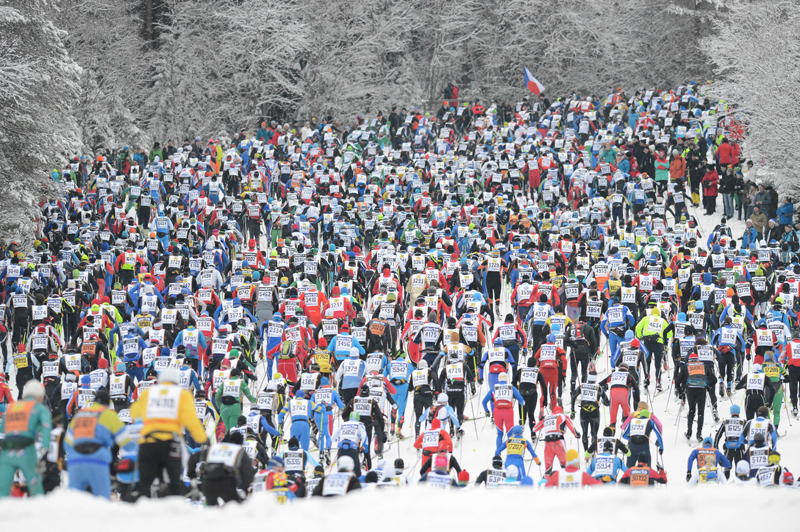
    The first hill on the Vasaloppet course. 15,800 skiers start at once, and it took me 35 minutes to go three kilometers. Photo: Rauschendorfer/NordicFocus.
    The first hill on the Vasaloppet course – and it looked a lot worse by the time I got there. 15,800 skiers start at once, and it took me 35 minutes to go three kilometers. Photo: Rauschendorfer/NordicFocus.

    MORA, Sweden – I just climbed into a car with three people I don’t know: Lars and Raffa, tall jovial Swedes, and Ingunn, a beautiful wispy-thin Norwegian. After a quick trip to the grocery store, we’re trying to navigate our way back through Mora. The problem is, it is two days before the Vasaloppet, the only thing that ever happens in Mora. Traffic is at a standstill.

    Eventually, we make it to the other side of the town. My three companions are having a lively discussion in Swedish which I don’t understand. After a series of hesitant turns, I can see the thought “ah well, screw this” pass across Ingunn’s face and next thing I know, we’re driving the wrong way down a one-way street. Then the men jump out of the car and Ingunn and I come to rest in something that is not a parking space.

    “The liquor store,” she says.

    The three are supporting a friend at the Vasaloppet, and to get through tonight and tomorrow until they actually have something to do on race day, they are going to need some booze. I know their friend Mattias, who generously offered to let me join their group, a godsend since organizing yourself for a point-to-point race is pretty complicated. But Mattias is off testing wax, so here I am.

    The men eventually return and Raffa tells me to sit in the front. Soon we’re back on the road. Lars and Raffa are packing snus and drinking beer (and doing who knows what else) in the back seat, and the beautiful Norwegian is driving with one hand on the wheel and a distinct attitude of ennui.

    We are making our way toward Sälen, the start of the famous 90 k Vasaloppet and where we will stay this weekend. Along the way we pass the race trail quite a few times. It’s raining out. There are people skiing and it looks completely miserable.

    Mattias has told me next to nothing about where I’ll be staying and who I’ll be with. Cryptic and strangely capitalized e-mails have told me that it will be very crowded in the house, but there will for sure be space for one more; that a woman has already cooked all the food so I should just plan to eat with them; and to bring sheets.

    When we arrive in Sälen (after a few wrong turns and confusion along the way), I walk into a cheerful, large cabin that appears freshly decorated along a tasteful black-and-white theme. It’s warm and smells like dinner. The kitchen is already full, but not of people I know. In fact, of the 15 or so people who will be staying in the house this weekend, Mattias is the only connection I have. He’s not here.

    “Welcome to Robin’s team!” a middle-aged woman named Lenita tells me and gives me a hug.

    We sit down for dinner. They try to tell me what the food is, but decide it can’t be translated. Even after we’re done with the meal, I have no idea what I have just eaten. It’s delicious though – rice and some sort of meat in a sauce, and we sprinkle flaked coconut, peanuts, crushed pineapple, and banana slices on top.

    “It’s one of Robin’s favorites,” Lenita explains. “Good luck food.”

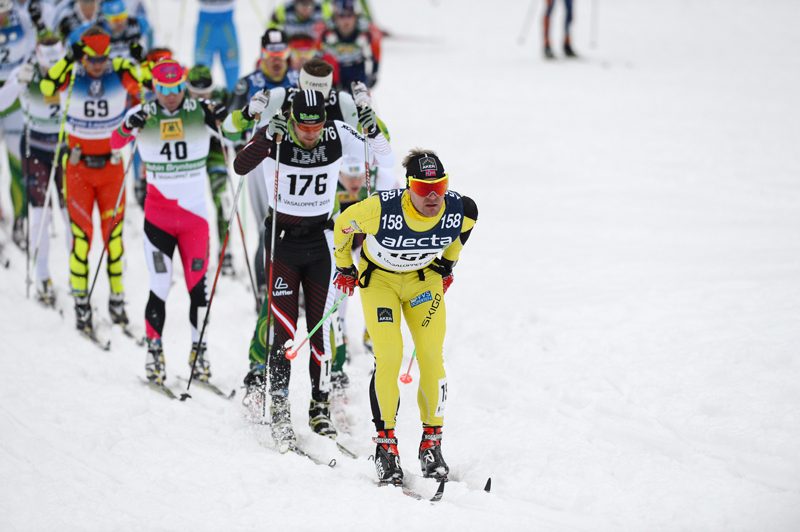
    Robin Bryntesson, in bib 40, skiing the Vasaloppet.
    Robin Bryntesson, in bib 40, skiing the Vasaloppet.

    As it turns out, I have joined Robin Bryntesson’s team for the weekend.

    Yes, that Robin Bryntesson – the famous Swedish skier, a two-time U23 sprint champion who might be best-known to North Americans because he won the World Cup team sprint with Emil Jönsson in Vancouver back in 2009. It turns out that Mattias grew up with Robin in the tiny town of Rossön, and the two are something like best friends. The gang from Rossön is all here, family and friends alike, to support Robin in his quest to win the Vasaloppet. I’m along for the ride.

    * * *

    I’m not here to win the Vasaloppet. When I moved to Europe a year and a half ago, I thought I should try some of the big ski marathons. The Vasaloppet was the one I was least interested in – too much double-poling, I really need hills – but was living in Sweden, and if you’re a skier you can’t leave Sweden without doing the Vasaloppet. I signed up, buying an entry off the black market website startplatser.se from a guy named Micke who wished me luck.

    “Please race hard for me,” he wrote in one of our last e-mail exchanges. “I will think of you.”

    Come Vasaloppet time, I was even worse off than I had expected, fitness-wise, because I had just gotten back from the Olympics. The race trails in Sochi were not open to journalists like me, and there weren’t any other trails to ski on. Even the running was inadequate. Not that it mattered – I had brought my running shoes and envisioned long training runs in the Sochi sun, but I was working far too many hours to have any energy for training. I called it the “live high, train not-at-all” strategy.

    So, three days after arriving home from Russia, I was still exhausted and at a huge sleep deficit. I hadn’t skied in a month. The weather was warm and I secretly wished that the race would be canceled. Instead, they brought snow in and used helicopters to dump it on the course. Anything for the Vasaloppet.

    On Friday, I got on a train for Mora. Direct route, no connections. I wore a raincoat and could not have been less excited. I’m pretty sure that’s not how you’re supposed to feel right before you do the biggest ski race in the entire world.

    But it’s hard to feel discouraged when you’re with Team Robin. First, there is Robin himself. Everyone had been friendly, but Robin was even more friendly and even more outgoing. Just watch the video on the front page of his website and you will get a sense of this. He has founded his own team and the uniforms tend to be hot pink with strange patterns and other bright colors.

    All this, combined with the fact that it’s Team Robin, goes strongly against the Jantelagen, a de facto cultural law of Sweden about how you conduct yourself. Some examples of the Jante laws:

    #1: You’re not to think you are anything special.

    #7: You’re not to think you are good at anything.

    #9: You’re not to think anyone cares about you.

    So to have a garishly rainbow uniform and advertise your own name is distinctly un-Swedish. But people love Robin. It’s his personality, but perhaps also what he stands for. Robin has diabetes, and spends a lot of time and energy working with kids who also have diabetes, and generally raising awareness about how it’s possible to still be anything even if you are diabetic.

    Robin’s title sponsor for the Vasaloppet was Changing Diabetes, a campaign by the pharmaceutical company Novo Nordisk. Saturday morning I helped shoot a little video of Team Robin, in which he explained how his suit had been specially doctored to hold his insulin monitor and transmitter, and how the whole team (gleefully messing around in the background) would be supporting him with lots of feeds to keep his blood sugar stable.

    It’s not just a public persona. When I arrived that first night, Robin walked right up, introduced himself, and asked if I’d had trouble picking up my bib. More than most of the others, he made sure to translate bits of conversation into English so I’d sort of know what was going on. I couldn’t believe that anyone was doing this for me, a fat out-of-shape American girl seeded in start group six who would take many more hours than him to ski the 90 k.

    * * *

    Saturday unfolds in a haze of jokes, laughing, skiing, and race prep. Besides Robin, his friend the biathlete Magnus Jonsson was also racing, and another friend Anders Strid, who is now a coach in Östersund and tells me he is both helping and racing. We all go skiing on Saturday. It’s the first time I have skied in a month and I feel surprisingly good.

    We relax all afternoon at home, but I still begin to get a sense of what it takes to try to win the Vasaloppet, especially if you have diabetes. First there are the predictable things, like skis. Mattias is out all day testing wax and structure. He’s in the garage waxing skis until late at night. He’s out again at 3 a.m. the next morning, and he and Robin’s brother Pierre shuttle back and forth to test and rewax race skis.

    But the logistics are even more complicated. There are no less than seven cars in the driveway. On race day, three of them will get “Vasaloppet Elitservis” signs to put in the window so that they can drive the road from Sälen to Mora and take turns onto smaller roads that serve as access points for the more remote parts of the trail. Each night we talk for over an hour about how to coordinate all the feeds and the timing of who can drive to which spot.

    Or, they talk – it’s in Swedish and I have no idea what they are saying. I pretend to not be bored. Mattias sits beside me drinking a beer and occasionally translates something.

    To keep morale high for this huge group of people who are helping Robin, we pool our money to bet on a race horse. Lars, one of the guys who had originally picked me up in Mora, drives trotting horses. He organizes the betting. I pay my 100 crowns. Maybe we’ll all get rich.

    I sleep on a blow-up mattress in the living room, next to Robin’s aunts, who snore loudly. One of them tells me that if it’s too much, I should stick a sock in her mouth, but only if it’s a clean sock. Then she bursts out laughing. Everyone laughs here.

    Then, it’s race day. I wake up at 5 a.m. to find much of the crew has been awake for quite a while already. I try to eat as much porridge as I can (I try milk and jam this time) and organize my things. Jonas, one of the helpers, has agreed to drive me to the start.

    Here’s how the Vasaloppet starts: it is divided into an elite group, plus ten more seeding groups based on your times in other races. Everyone lines up in a giant pen in their start group, but at 8 a.m. the lines are all raised at once and 16,000 people take off together. There are horrible bottlenecks as the trail quickly narrows down. On top of that, less than a kilometer into the race there is a huge hill which is quite steep at first but becomes more gradual, lasting at least a kilometer or two in total.

    Robin, Magnus, and Anders don’t have to go early – there are something like 250 people in the elite wave, and so they can show up and grab their choice of starting positions. I, however, am in start group six. There are 1,500 people in start group 6 alone, and over 5,600 in front of us. I don’t want to be in the back of my start group. Some people have showed up as early as 4 a.m. to line up at the front when the gates open at 5:30. I don’t need to be on the front line either, but I want to get there early.

    I pack everything into Jonas’s car and say my goodbyes. Everyone wishes me luck.

    “Have you eaten enough?” Mattias asks.

    I tell Mattias I love him for making me amazing skis, and he tells me to wait to say that until after the race.

    We leave the house at 5:45. Normally it would take seven minutes to drive to the start, but the traffic is horrible. Eventually Jonas has to just drop me off on the side of the road because he has to return to the house and then head out again to go do his job with feeds. I jog the rest of the way to the start.

    It’s just like so many other huge marathons. There are people milling about everywhere, huge DHL trailers to drop off your bag (tagged with your bib number) for transit to the finish, separate number-tagged trash bags for your warm-up clothes which you should keep on until just before the race starts. In the middle of each start group is a giant raised platform where there are women dancing along to music and urging skiers to dance too, to help stay warm. I have an hour and a half to spend here. I manage to snag a place in the fourth or fifth row of group six and make friends with two Finnish guys next to me. After a fun but disconcerting weekend, I feel at home: some things about ski racing are the same no matter where you go.

    * * *

    What is there to say about the race? It takes me 35 minutes to go the first three kilometers, through the bottlenecked start and up the first part of the big hill. I manage to not fall down, not get tangled, not break anything. I heed the advice to keep my poles close to my body, and try to do what Mattias had said and look far up ahead of me to see which lines were moving the fastest.

    It is kind of exhilarating. I am still searching for gaps 10 k into the race, when I realize that I should probably calm down. There are 80 k to go. Settle back and enjoy the ride, don’t use up your energy now.

    Every marathon has its high points and low points, and I don’t just mean in terms of topography. You’re guaranteed to feel terrible at least once or twice. I feel pretty bad, about 30 k in, for a while. But I stop to eat a couple of times and make good use of the feed stations. I don’t like blueberries, but I guzzle blåbärssoppa (blueberry soup) like it’s my job. I start feeling better. In fact, I feel pretty great. I can’t really believe it.

    Then, with about 30 k to go, I feel decidedly not great. I bonk: run out of energy completely, glycogen stores depleted. It’s hard to come back from a bonk, to un-bonk yourself. You can eat, but you have crossed a line that is something quite definitive. I stop on the side of the trail, eat a bar, and feel a little better. Just a kilometer later, though, I’m be back to walking. There is no long-term solution for a bonk.

    I try to console myself: I had already skied 60 k, which is farther than I had ever raced in my life. If it were a normal marathon, I would have been tired at the end but things would have gone pretty well. I would be finished already. Making it 60 k before having major problems should maybe be considered a victory, especially considering that probably nobody had prepared for this race worse than I had.

    But it is hard not to get depressed. 30 k to go is a long, long way. You ski, or walk on your skis, painfully and slowly, only to learn that these minutes that have felt like a lifetime have only brought you to the point where you have 28 k to go. Like 30 k, 28 k is a long, long way.

    At the finish: I was not moving as fast as this picture suggests. Photo: Simon Evans.
    At the finish: I was not moving as fast as this picture suggests. Photo: Simon Evans.

    On top of that, the trail is a mess. There was natural snow for the first 30 k or so, but then it was trucked-in snow. It is warm and everything fell apart completely. The slush is deep and in many places there are no tracks at all. People are falling down all around me, getting their skis caught in piles of slush or divots in the trail. It’s a minefield. I am proud of this one thing, that I did not fall down.

    I want to quit, but I couldn’t: Mattias and all of Team Robin got me to the start. I have to finish, for them, even if I do horribly. Doing horribly is still better than dropping out.

    Hundreds of people flow past me. Maybe even thousands. Everybody and their brother is passing me, and their father is passing me, and maybe even their grandfather. A snail or a turtle could both ski faster than I am skiing.

    You have not bonked until you bonk with 30 k left in the Vasaloppet. Only then do you understand the true meaning of “bonk.”

    The last feed station is with nine kilometers to the finish, and they surprise us with coffee. I am elated. The caffeine gives me a burst of energy and for the next few kilometers, I hook on to a group of two other women and we are double-poling well, passing people. My original time goal had been six hours, but now I glance at my watch and guess that maybe, if I stay with this group, I could make it in seven hours. But five kilometers later I have been dropped and I’m dying again. Really dying.

    The last two kilometers are maybe the worst of the entire race. Even though I am so close, I don’t know how I can possibly keep moving.

    You ski over a small bridge before descending to the finish, and as it happens, my club teammate Simon is standing there with his camera. I can only imagine how many hours ago he had finished. He waves and I practically stop skiing as I beseech him, no pictures! Please! Allow me some dignity!

    Then I am done. Seven hours and six minutes. I couldn’t even make it under seven hours, but who cares, I’m finished.

    * * *

    I eventually find Jonas, who has agreed to also pick me up at the finish.

    “Congratulations!” he says. “You did great!”

    I don’t feel like I did great. I feel like an unprepared idiot.

    I hand my skis over to a storage area where they are tagged with a number, then get on a bus to the area where we can collect our bags. I haven’t planned well, and although I have clothes to change into, I have no other socks. I put my bare, wet feet in my running shoes and walk back to find Jonas. We had talked about eating in the cafeteria, but I just want to go home.

    I ask how Robin’s race went. Not perfectly, it turns out. He was with the lead group until deep into the race, but a few feeds didn’t go as planned. Whether because of that or the complexities of racing or his disease, Robin’s blood sugar crashed. Jonas said they first noticed because for the last 20 k, Robin was supposed to be taking feeds on the right side of the trail. But he didn’t remember, and stayed on the left side.

    Later, he was woozy, and “cross-eyed.”

    Miraculously, though, he hung on to finish 52nd, less than two minutes behind Norway’s John Kristian Dahl, who won. He was in a good mood afterwards.

    “What a stud,” I say. “We say that in America.”

    “We say, he has a big forehead,” Jonas said wistfully. “Doesn’t translate.”

    In the car we talk to the family, most of whom are on their way back to Rossön. They all congratulate me. Mattias texts me that “the conditions was tuff” and that I did a great job.

    A lot of people dropped out. I didn’t. And I can cross the Vasaloppet off my life’s to-do list.