From the FasterSkier archive — posts syndicated from athletes’ and coaches’ own blogs between 2004 and 2012, kept online as published. Current coverage is at fasterskier.com.

Tag: book review

  • The Legends We All Are Living Out: “Winter’s Children: A Celebration of Nordic Skiing” Book Review

    The Legends We All Are Living Out: “Winter’s Children: A Celebration of Nordic Skiing” Book Review

    In a history of American skiing centered around the Upper Midwest, author Ryan Rodgers weaves together the stories of individuals who have found joy, love, and purpose in skiing with their heel detached, inspiring his readers to do so, too. 
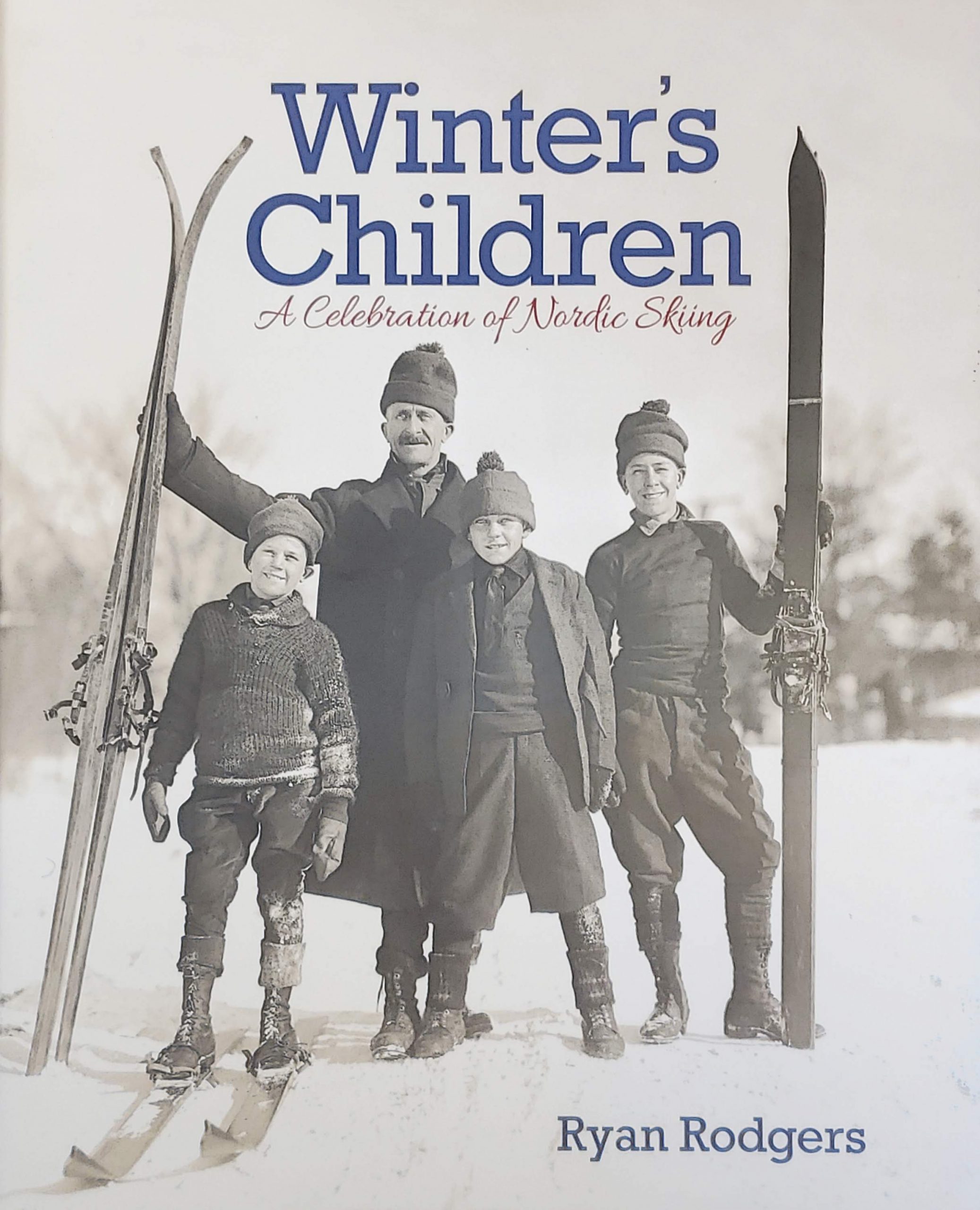
    Cover photo courtesy of University of Minnesota Press

    At the intersection of outdoors and pursuits, the street signs read “myth” and “heroes.” And we, those who spend our time outside, are here to patiently listen.

    That intersection has given rise to classics across the myriad of ways humans interact with various natural playgrounds. Surfing has the permanent nostalgia laced in Endless Summer, rock climbing has the steady, emotive death-defying of Free Solo, and alpine skiing has the entire catalog of Warren Miller. These submissions to the genre are appropriate for their outdoor pursuits: flash-in-the-pan instances of action, bringing together visual and audio media to make something that’s brilliant. 

    But also, brilliance that’s just, well, oh-so accessible.

    For cross country skiing? The individualistic and energy intensive mode of moving through winter’s harsh environment on skis requires a medium suggestive of walking its lonesome valley, and the ancient timelessness of doing so. It’s perhaps less glamorous than climbing nearly 3000 vertical feet up a cliff face with no rope, but also easier to connect with; less documentary, and more rhapsody. 

    With “Winter’s Children: A Celebration of Nordic Skiing,” Ryan Rodgers has accomplished just that. His work is a well-researched, extensively reported history that gets at the Norwegian ideal, sought throughout, of idraet – ski-sport, the mixing of ancient technique with spiritual renewal. Rodgers takes the epic tales of American skiing, and allows its practitioners to work together with his prose to form a journey with all the ebbs, flows, wanderings and epiphanies of a long ski in the woods. In doing so, he lifts the stories of this sport, done at the edges of frozen existence, out of the ether and into something material.

    Rogers himself quickly sets the limits of what his project is from the outset; this is ostensibly the story of skiing centered around the Midwest. Not, as he says “a comprehensive look at the almost unfathomably long history of Nordic skiing,” but instead, “a celebration of an often-intertwined array of people and places.”  In other words, he is out to tell a folk-history.

    In doing so, Rodgers’ focus lies primarily on the folks in that history, interweaving the individual stories of people – some well known to the world, some well known to the Nordic community, and some simply not well known at all – who found the crevices and creases of human life using a pair of free-heeled skis as a medium. This is a work about skiing, yes, but also one in which the storytelling lets tales of freedom, fraternity, courage, and humor shine through.

    I highlight this strength first because it gets to the heart of who should read this book. That is, although this is a Midwestern-centric skiing history, the bounds of that history include people and places that will be of interest to skiers from all over. Yes, the narrative, especially when skiing first hits America in the late 19th century, returns again and again to figures that touched the Midwest, but that is only a consequence of accurate historiography. 

    That is clear from the outset here. The first figure that Rodgers illuminates is Sondre Norheim, so-regarded as the father of modern skiing in his native Norway that both times the country has hosted the Winter Olympics (Olso in 1952, Lillehammer in 1994) the torch relay has begun with a flame from his hearth in Morgedal, Telemark. He is a national hero. And yet, he lived most of his life in Minnesota and died in North Dakota. The intercontinental connection is a common theme for most of the early history of skiing in the United States. Nordic Skiing was the great cultural product exchanged between those Scandinavians who came to America, with its port of entry the Twin Cities, farm fields of Wisconsin, and mining camps of the Iron Range.
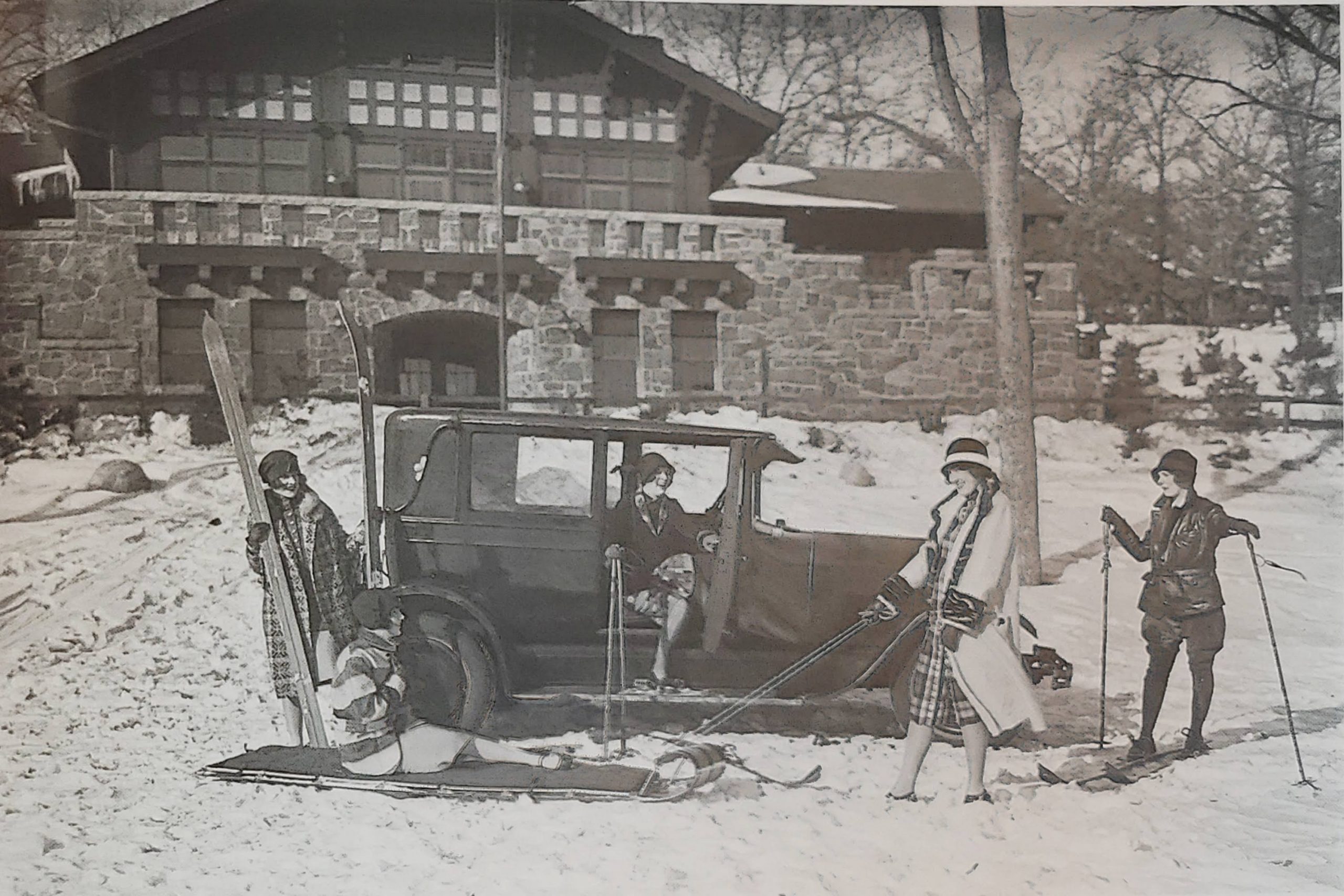
    Women skiers in front of the old chalet at Theodore Wirth Park, Minneapolis, MN, in 1925. The base of the alpine-inspired building will be familiar to anyone who has skied Wirth, as it was the main chalet as recently as 2019, when the Loppet Foundation’s new adventure center opened a few hundred yards away. (Photo: U of M Press, reprinted from Minnesota Historical Society)

    From Norheim, Winter’s Children begins to layer in the stories of the types of names that most of us skiers have come across in the name of a memorial race, or on a trophy or trail system. Rodger’s strength, especially in the early days of American skiing, is being precise in which characters he fully fleshes out, and then jutting and jiving between their narratives to interweave the particular pressures of a period on racers, organizers, and promoters alike. Then, like seeing a technical downhill off-shooting from a flat ski trail, he is willing to make us stop, turn at full speed, and take off to complexity and joy in his storytelling.

    That’s how tales that for many skiers may have been whispers and vague allusions brought up at their local ski chalet become full-on stories – rising action, climax, denouement and all – in Rodger’s voice. Anders Haugen and his brother Lars become the main characters to illuminate the heyday of American ski jumping, the dominant discipline in skiing before WWII, with Rodgers recounting the brothers’ countless national titles after the formation of the National Ski Association (the former name of U.S. Ski & Snowboard).
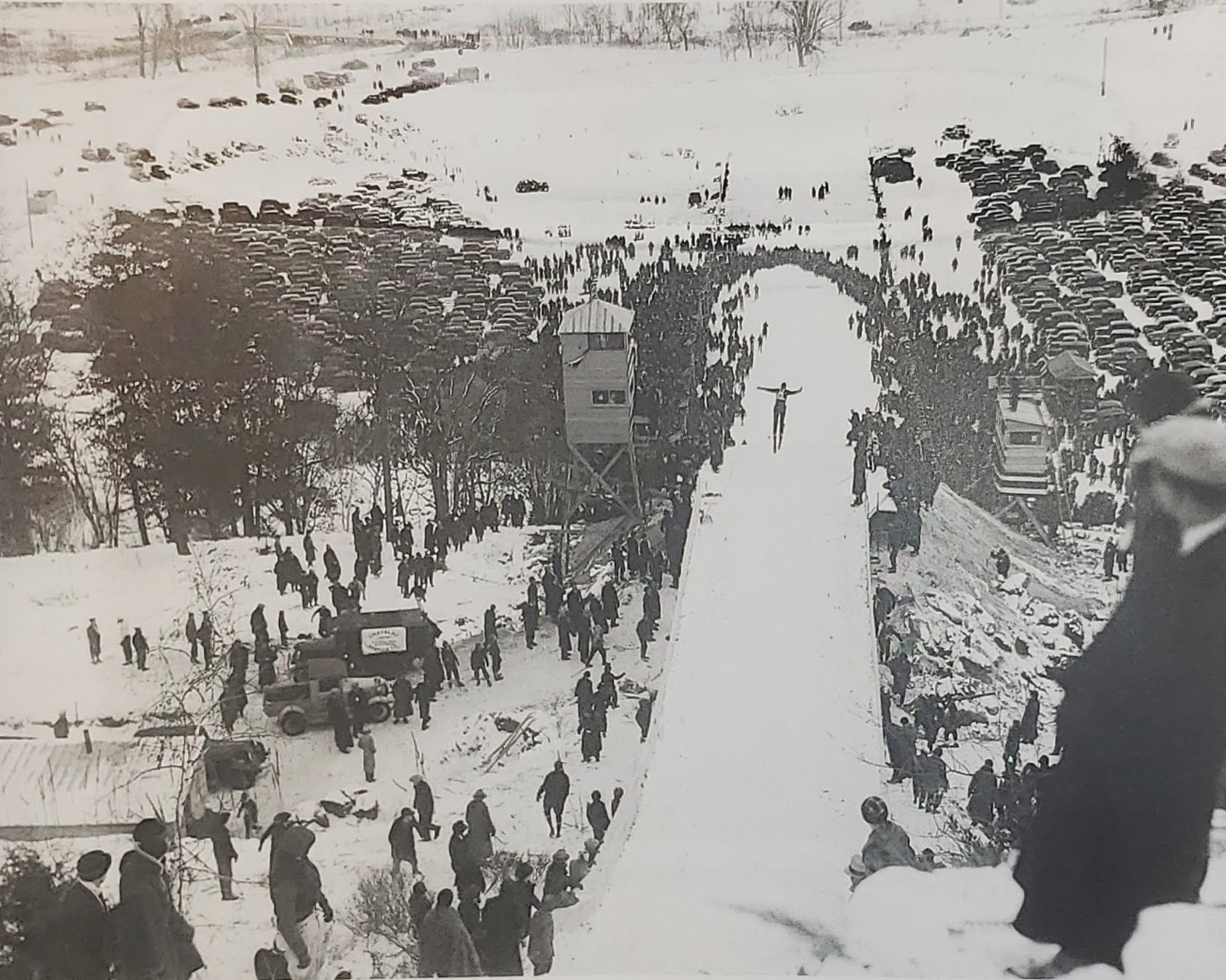
    Scenes from the National Ski Championships in 1936, held in Red Wing, MN. Red Wing’s Aurora Ski Club dominated skiing in the first half of the 20th century, when Norwegian immigrants brought their jumping skills to the Mississippi river town. (Photo: U of M Press, reprinted from UM-Duluth Archives)

    After detailing Anders Haugen’s foray into winning US Skiing’s first Olympic Medal at the 1924 Chamonix Games, Rodgers shifts to Lars trouncing over the Colorado Rockies between Estes Park and Steamboat Springs with skiing pioneer Erling Strom. From there we follow Strom ascending Denali on skis for the first time with Al Lindley, a Minneapolis-debonair who represented the US at the 1932 and 1936 games. The whole time we’re treated to a storytelling style which forgoes lyricism in favor of carefully plucked anecdotes that set them in a Midwestern simplicity and witticism which reaffirm the place these stories emanate from.

    The best, most fully expressive character in the book hops off from Lindley, with his wife Grace Carter. Carter and Lindley met at the tryouts for the 1936 Olympics, with Grace becoming one of the first two American women to represent the US in skiing on the Olympic stage. Her story begins the earnest exploration of the exclusion and challenges that women have faced surrounding skiing since the sport’s inception in the United States. We follow her courage, effervescence, and brilliance through to the end of her life in 2002 in Duluth. 

    Carter shines through best when Rodgers puts her attitude towards the skiing world that tried to exclude her in her own words, citing a column she wrote in the 1960s where “several times each year parents asked her if they should allow their daughters to race. ‘I usually tell the parent no…because that’s what he wants to hear…if a girl is really keen she’ll race anyway. When the girl asks me, I say yes.’” Carter’s attitude also seems to sum up the broad arc of women’s sporting history, which is one of the key themes of Winter’s Children. 

    Skiing, at points, has been a site for progressive attitudes towards women’s participation in sport, but at others, it’s also been caught up in the same history of misogyny found elsewhere.
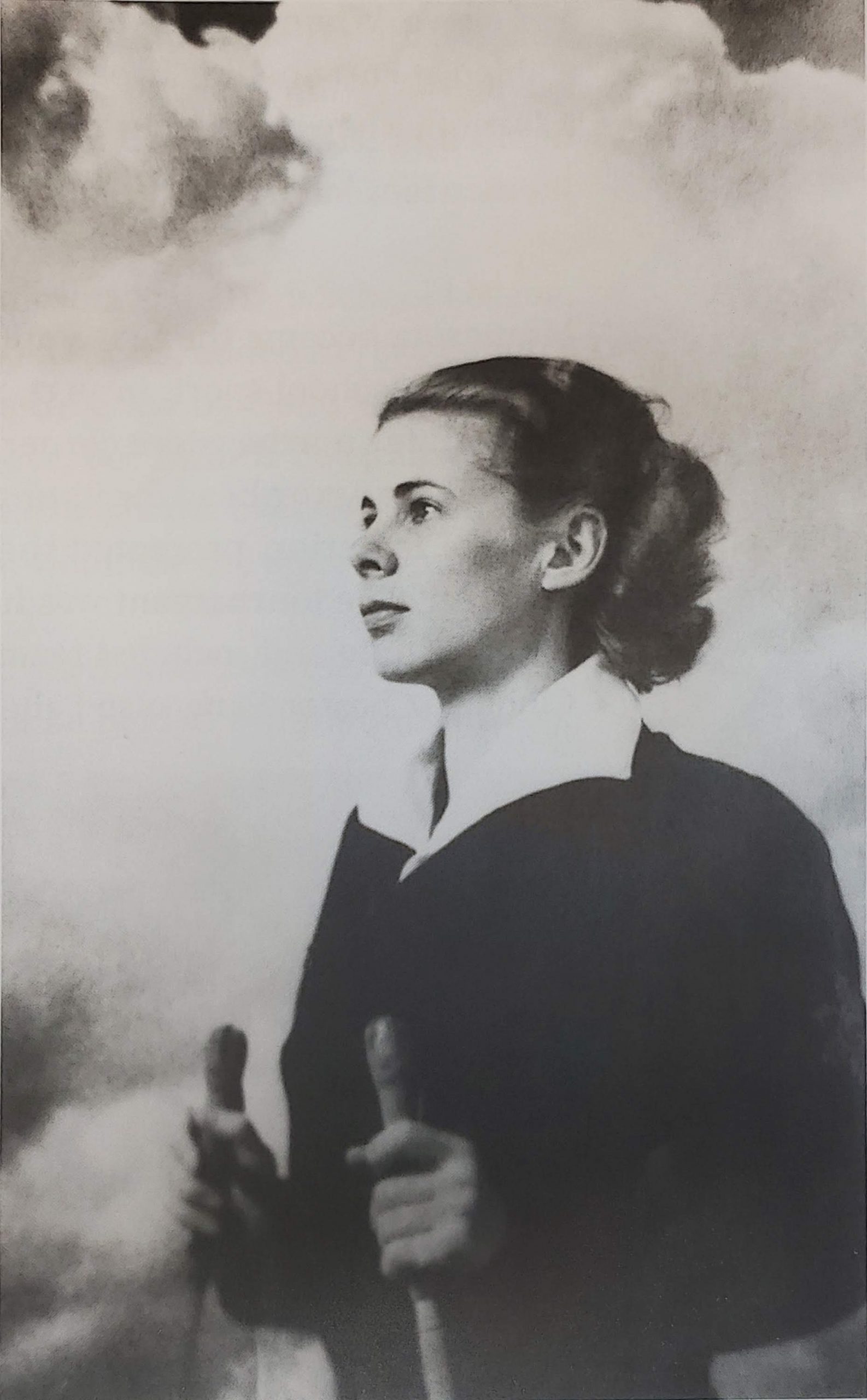
    Skiing pioneer Grace Carter Lindley. Carter was one of the first women to represent the US at an Olympic games when she did so at Garmisch in 1936. She later married teammate Al Lindley, was an advocate for women’s racing, and touched nearly every development in Alpine skiing from Sun Valley, to Aspen, to Vail, before her passing in Duluth in 2002. (Photo: U of M Press, reprinted from Aspen, CO Historical Society)

    Earlier than one might expect in his history, Rodger’s starts to introduce characters that some of us may have shook hands or looked up to out on the trail during our own lifetimes. At that inflection point lies one of the most poignant reasons to read Rodger’s work; the inclusion of snippets from an interview with George Hovland, capturing the former Olympian and Midwest’s foremost ambassador of the sport earnestly reflecting on his life’s work shortly before he passed away, at age 94, last May. 

    In the context of Winter’s Children, the reader can fully pair the vignettes Hovland might offer you if you were lucky enough to run into him out at Chester Bowl in Duluth with the full life and joy that he first found there as a youth in the 1940s. Back then, the Bowl was home to a ski jumping scene that was something akin to what one might find at a skate park today.
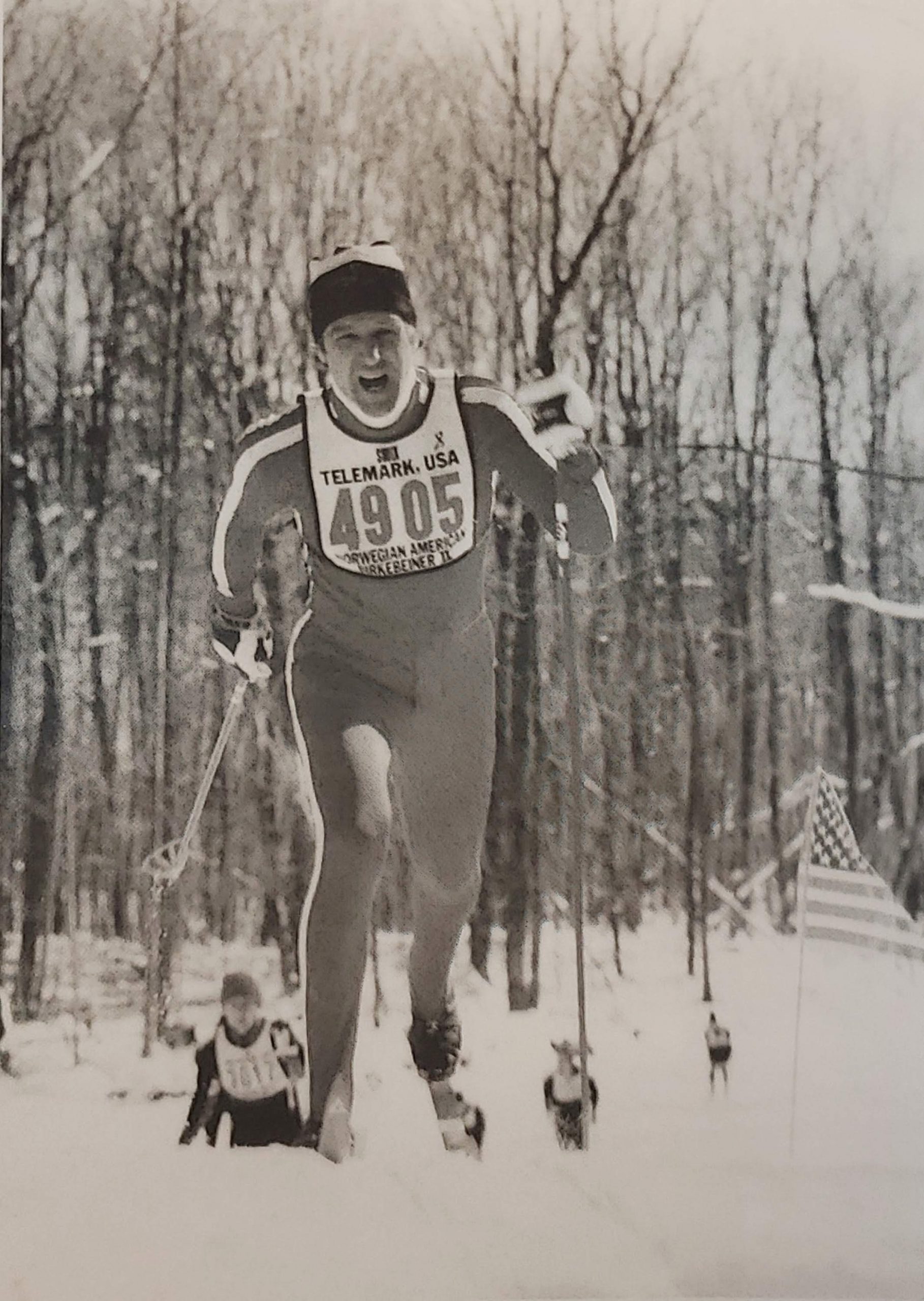
    George Hovland at the American Birkiebeiner in 1982. Hovland was an Olympian at the 1952 Oslo games, and touched all corners of skiing in the Midwest over the course of his life in his native Duluth, MN. (Photo: U of M Press, reprinted from George Hovland personal collection)

    The strength of Winter’s Children is not only remaining in, but building on, the mythos of those types of characters and those types of places strewn across the Midwest. Rodgers makes it foundational, with the most widely-known myths in the sport – that of the Vasaloppet and Birkiebeiner – being recounted in the first pages. When Winter’s Children does get to the Midwestern revival of those myths with the founding of both the Mora Vasaloppet and American Birkiebeiner in 1973, there is an ironic coming back down-to-Earth. It’s when the history starts to feel more vivid. When, for many readers, the recollections on the page will mix with those in their own minds. Of their own experience, perhaps.

    That leads to the temptation to say that things aren’t how you remember them in Rogers’ words. You might think ceded some of its accuracy and cohesiveness as it gets closer to the present. If the reader catches that thought, they should hold two idea’s in mind. 1) First and foremost, is that Rogers’ is most likely correct, this is a painstakingly well-researched project, and 2) that their own mind’s wanderings add to the folk history that Rogers’ set out with here. Rodgers’ biographical sketches of Bill Koch (who isn’t a Midwesterner, but did design the trails at Telemark, and that seems like tangential connection enough to explore his influence here) and Jessie Diggins aren’t nearly as fleshed-out and richly-woven into the story of skiing as the athletes who came a half-century before them. He stops the story of the Birkie right after its originator Tony Wise loses control of the race in 1985, without detailing how the race continues to be the “Rome” in Midwestern skiing’s empire – all the youth skiing, citizen racing, and training developments seemingly leading to it. That’s ok, those histories and those stories continue to go on. Reading their introductions here is a great primer to join in.
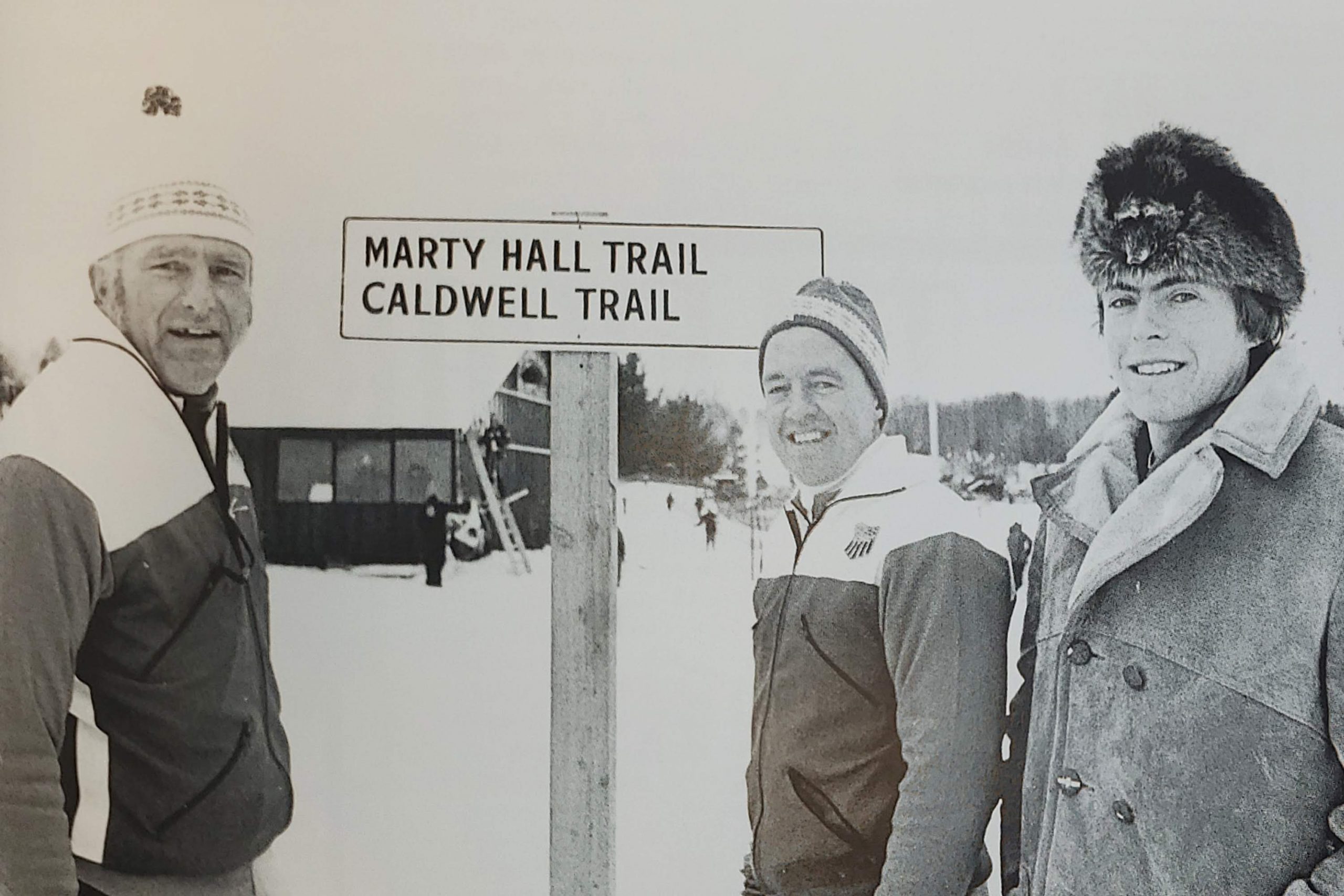
    Marty Hall, John Caldwell, and Tim Caldwell pose at the trailhead of the new Telemark World Cup Trails, designed by Bill Koch, ahead of US Olympic trials in Cable, Wisconsin, 1979. (Photo: Telemark Education Foundation)

    There are the accurate appraisals, too, on modern issues in the community – climate change, the influx of money into youth training programs, and the lack of racial and socioeconomic diversity in the sport. They all remind the reader that the individual and communal elements of nordic skiing’s history are both active agents. Rodger’s can’t fully portray the sport as it is today, sending us as readers back to the ether and implying that you yourself need to feel them as part of the living, breathing, gliding AND kicking community of nordic skiing as it continues its odyssey here and now.

    That theme: the vitality of skiing’s history, is how Winter’s Children comes to an end. Our rhapsode, Ryan Rodgers, ends by tying up the loose ends of the narrative thread of Charlie Banks and Mark Helmer. 

    It is a long one. We are first introduced to Charlie Banks when he wins one the first Minnesota High School State Meets in 1941, before he fights in WWII, returns, and splits for the forests that extend past the Duluth hillside. Living an ascetic, but sturdy life in those Northwoods, Banks cut a trail system called Korkki on his property where he started the oldest continuous race in the Midwest, the Judeen Memorial 10 k, in 1962. Twenty years later, Mark Helmer was living down the road and decided to ask Banks if he could use the trails. 

    The meeting soon evolved into a deep friendship built around skiing, saunas, and more than a few PBRs. Banks sold Helmer 20 acres of his property in 1993 to build himself a house and a warming chalet at the trailhead of the newly public Korkki trails. Banks passed away in 1998, with Helmer saying in an interview for Winter’s Children that “he was my best friend and still is my best friend; there isn’t a day that goes by that I don’t think about the man.” It is one final parable that points towards the magical juxtaposition at the heart of nordic skiing – a cold, individual pursuit that brings out the warmest of human connections.

    A simple sport that was, and still is, the core around which a person can organize a life.

    Charlie Banks on his handcut Korkki trails outside of Duluth, MN. This photo of Banks greets visitors of the Korkki trails, hung above the hearth in its warming chalet. (Photo: Korkki Nordic)

    Winter’s Children: A Celebration of Nordic Skiing by Ryan Rodgers is available at local bookstores and ski shops throughout the Midwest, major book retailers, and online from the University of Minnesota Press.
  • Book Review: Going the Distance: Piecing Together a Life of Adventure by Elspeth Ronnander

    Book Review: Going the Distance: Piecing Together a Life of Adventure by Elspeth Ronnander

    For those immersed in the ski marathon racing scene, particularly in the Midwest, you’ve likely shared tracks with Elspeth Ronnander. A member of the Vakava Racing Team, a competitive masters group based in the Twin Cities, 36-year-old Ronnander has racked up over 50 marathon finishes in the last 18 years, sometimes within weeks of one another.

    “Going the Distance” by Elspeth Ronnander is a memoir of life spent pursuing the passion for adventure and exploring athletic potential.

    Outside her rigorous training schedule and full time job as a nurse practitioner, Ronnander is a passionate writer who regularly shares her race and training experiences on the Vakava team blog. In October 2020, Ronnander’s passion took another step forward with the release of her book, Going the Distance: Piecing Together a Life of Adventure.

    Rife with excerpts from an impressively well-kept journal, Going the Distance is a detailed memoir about Ronnander’s quest to find fulfillment in sport and explore her athletic potential. 

    In her own words, “It’s a behind-the-scenes story about my struggles with the mental and physical aspects of competitive running and cross-country skiing in high school and beyond, in my tenacious, but mostly futile, attempt to be the best. Essentially, it’s the story of how I, as a citizen cross-country ski marathon racer, came to consider myself an athlete.”

    To set the stage, Ronnander reflects on her childhood and the experience of being labeled as average, which lit the fire for her quest for perfection. Raised by parents who chose lifestyle, passion projects, and time together over affluence, her childhood provided her with an appreciation of simple living and self-propelled adventure that developed into remarkable fortitude. 

    After moving from Minneapolis to the small town of Bemidji in northern Minnesota, Ronnander found a passion, or perhaps obsession, for endurance challenges like the grueling Chippewa Triathlon, which combines a 16-mile canoe, a 27-mile mountain bike ride, and a 7-mile run. 

    After joining the high school team, cross country skiing rose to the top of Ronnander’s priority list. She committed herself to a demanding training schedule, eager to join the more experienced girls on her team at the state championships.  

    As was expressed in FasterSkier’s review of Jessie Diggins’ memoir Brave Enough, Ronnander’s recount of a childhood with a wonderfully quirky father, a strong and caring mother, and a supportive brother who doubled as a training partner was perhaps too idyllic to make for an enthralling read. Training logs from adolescence through young adulthood supporting a quest for a six-minute mile and self-actualization as an athlete do not garner universal appeal. 

    Elspeth Ronnander and her brother Leif finish a local race in their early days of skiing. (Courtesy photo)

    However, her indefatigable effort to explore just how far her commitment to training could take her is commendable, if not downright impressive, and is perhaps something many determined citizen athletes can relate to. 

    On a similar note, in reflecting on the process of writing her own memoir in a recent podcast episode, retired professional runner Lauren Fleshman commented, “Unless you’re writing a memoir about childhood, childhood just turns out to not be that interesting. It’s very difficult to get enough space from your own life to know what is and isn’t vital information for the main points of your book later.”

    This may hold true in Going the Distance; journal entries and race narratives provide insight into the inner workings of Ronnander’s mind at various phases of her life, but these storylines tend to be less compelling than her writing surrounding her most significant challenges, which were not connected to her athletic goals. Perseverance is admirable and I love rooting for an underdog, but I find people and emotions are more captivating than intervals and grinding through long ski races in sub-zero temps. 

    Two of the people Ronnander highlights well are parents. Their decision to tighten their belts financially in order to prioritize time with family and commitment to making their dreams of seeing the mountains a reality endear them to readers. Her father was completely fascinated by tinkering with bikes; following his creativity, he designed his own recumbent commuter and a three-person side-by-side bike to help a one-car family cart the kids around, though it was never put to use. He’s a great character and seemingly an even better dad.

    Elspeth Ronnander and her younger brother, Leif, sit atop a side-by-side bike designed by their father. (Courtesy photo)

    Another element that caught my attention in Ronnander’s memoir is her description of how her determination and perfectionism in high school unintentionally led her into the throes of an eating disorder coupled with compulsive exercise. Her journal entries and analysis here do an excellent job portraying the counterintuitive thoughts that consume someone struggling with these conditions — knowing you are damaging yourself and reducing your ability to pursue your goals, while feeling trapped and unable to give up the desperation for control that fuels the condition.

    “I try to eat, but I know I probably consume fewer calories than I burn. That is scary. Sometimes that scares me; I panic in fear that my heart will stop. Then I have a snack and feel as if I have eaten too much. Then I want to exercise more [to make up for it].” 

    Ronnander went from loving training and racing to feel bound to it. She experienced increasing levels of fatigue and a rapidly deteriorating ability to perform at her best. Her clothes hung from her body, her period stopped, and she could recount every piece of food she had put in her mouth at the end of each day. She described feeling lost, frightened, and immensely conflicted, knowing that she needed to eat in order to absorb her training and improve, but also could not allow herself to eat a sufficient amount. She didn’t want to harm herself, but also couldn’t let go of her harmful behaviors.

    “Eating healthy makes me feel cleansed. I feel good… After I exercise, I feel whole and pure and then I fill myself with food, which makes me feel impure again. What is wrong with me? How sick am I?… I don’t want to have a problem. I don’t think I’m anorexic… Food tempts me, and I try to control this temptation. I know I have to eat in order to exercise. I know when I do not consume enough food I am hungry and I am doing myself no good to work out. I don’t want to stop exercising, which means I need to eat more — of what is my problem.”

    Ronnander later learned about the condition “eating disorder not otherwise specified” (EDNOS), which involves components of multiple disorders — in her case, the restrictive behaviors of anorexia, compared with the purging of bulimia in the form of exercise. She feels this condition was totally cured from one epic bonk induced from racing her first ski marathon at the age of eighteen with a deep calorie deficit that decided the day’s outcome before she even toed the line.  

    The other poignant experience Ronnander includes is that of abruptly losing her father, who had been most impactful in sparking her love of the outdoors. Out of the blue, she received a call at work from a family friend with whom her father had been cycling, his greatest passion, letting her know that he had collapsed mid-ride. They started CPR and a defibrillator was used once the ambulance arrived, but the emergency respondents carted him away to the hospital recognizing there was nothing they would be able to do. Ronnander had to bear this news to her mother and brother, who had been unreachable while en route to visit her in Minneapolis, where she was attending college. 

    She describes the hollow disbelief, the rollercoaster of grief, and the resulting understanding of the uncertainty of life that still inspires her to live to the fullest and carry on his legacy. She explored more, checked items off her bucket list, and slowly wrapped her head around wanting to call him to share these stories while knowing he would not pick up the phone. 

    “By this time, the years had passed. The emotions were significantly subdued. I had become accustomed to Dad not being around. But I still wanted to tell him about all my adventures. And I still felt compelled to go on these adventures — to explore new rivers and climb mountains and hike new trails. I got my adventurous nature from him. And I try to make my life as full as possible because ultimately Dad taught me life is short.”

    Other captivating themes include the developing relationships — often through Type 2 fun — with Ronnander’s closest friends, Kathryn and Erik, the latter who eventually became her boyfriend and now husband. They remain in a life-long contest of who can complete the most pull ups. The presence and support of these partners makes one consider the unique bond that forms from countless hours running, canoeing, skiing, and traveling with friends.

    Elspeth Ronnander and her husband, Erik, paddle away from their wedding ceremony. (Courtesy photo)

    So, if you’ve covered long distances over snow, dirt, or water through the North Woods, if you’re an intrepid citizen athlete exploring the limits of your athletic potential, or you simply enjoy reading the stories of those who have, consider adding Going the Distance to your reading list.

    You can find Going the Distance on Amazon or at select retailers in the Midwest.  


  • Nordic Nation: Running to the Edge with Author and NYT Deputy Sports Editor Matt Futterman

    Nordic Nation: Running to the Edge with Author and NYT Deputy Sports Editor Matt Futterman

    If you’re an avid reader of The New York Times sports section, you’ve most likely read the work of writer-journalist Matt Futterman (50). Futterman is the Deputy Sports Editor at the NYT, a fan of nordic sports, and an avid runner who was slated to run the Boston Marathon this past Monday.

    Futterman’s love for endurance sports, running in particular, is evident as he peppers readers with in-depth running stories. He helped cover the recent downfall of Alberto Salazar and continues to keep on eye on anti-doping efforts during the Covid-19 pandemic.

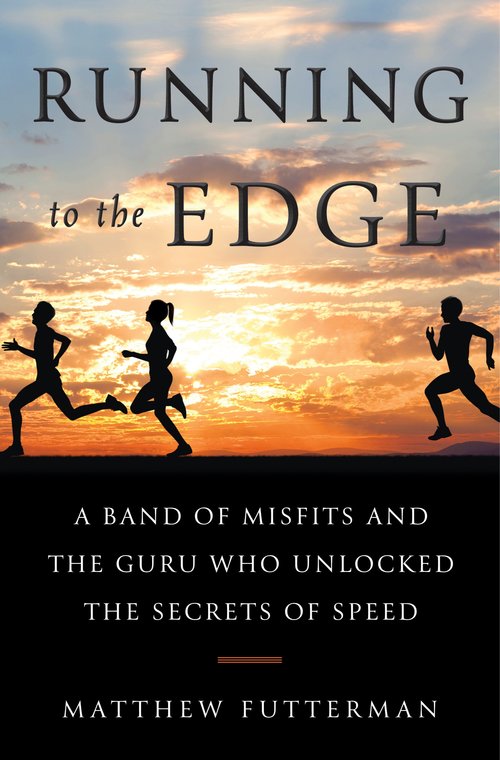
    Futterman also released a well-received book titled: Running to the Edge.

    The book, rendered down to its basics, is a meditation on Bob Larsen, a running coach Futterman asserts resurrected U.S. distance running. That premise is hard to argue with as Larsen jolted the San Diego running scene into national relevance, coached UCLA to NCAA titles, and ultimately honed his training philosophy in Mammoth, California as the coach of Meb Keflezighi and Deena Kastor. Both of these athletes were guided to Olympic marathon medals under the tutelage of Larsen.

    Futterman’s treatment provides a close up look into how Larsen changed the landscape of training methodology for distance running – and on his way left a legacy of grit and championships in San Diego as he rose through the coaching ranks.

    The book is a great read during this time of exercise containment. Futterman will help you dream big, even if for now, our sporting ambitions are reigned in.

    In this episode of Nordic Nation, we talk to Futterman about his book, his own running, and how the NYT covers cross-country skiing at the Olympics. We also mention two recent pieces from this past week. They are linked below.

    Berlin Marathon canceled.

    What will endurance races look like when they come back?

    Some of Futterman’s coverage on Alberto Salazar: For Salazar Whistle-Blowers, a Long Wait for a Satisfying Outcome, Nike to shut down Salazar’s Oregon Project.


  • Book Review: High Performance Nordic Training by Stuart Kremzner

    Book Review: High Performance Nordic Training by Stuart Kremzner

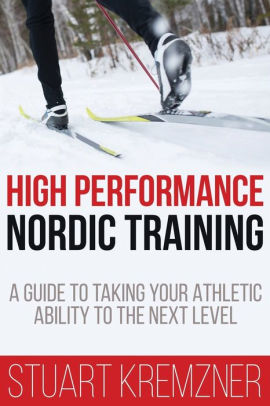
    Stuart Kremzner has published a new book with a bold title — High Performance Nordic Training: A Guide to Taking Your Athletic Ability to the Next Level. Kremzner is an exercise physiologist and nordic coach and also the author of the Bill Koch League leader manual, last updated in 2008.

    Training, even restricted to a single sport, is a complex topic with unending opportunities to dive into bewildering detail and unexplored research topics. Anyone who has spent time in sport will know there is a long history of bad ideas, pseudo-science, and anecdotal ‘proof’ cluttering up the emerging evidence for best practices. There are many competing books of varying age, quality, and length.

    “I hope this general framework will give the reader the basic tools to guide their training development decisions.” — From the Introduction

    In essence, this short book is an introduction to developing and improving a cross-country ski training plan.

    One way Kremzner reduced the size and complexity of the book was to filter out all the references and scientific evidence behind the ideas. While this choice greatly improves readability, it leaves the reader with a decision about whether to trust the author. That said, readers without a reasonable background in biochemistry and physics need to trust the author, as research journals are written for academics. As a long time nordic nerd and someone who reads sports physiology journals in his free time, Kremzner passes my test.

    The author’s references to training theory are at a high level. If you are interested in how to achieve goals with interval workouts, for example, the fundamentals are fleshed out. If you want the thermodynamic detail of why the ATP cycle is directional, you need to look elsewhere. If you don’t understand how the previous two sentences are connected, this book is a good place to start.

    This book has two weaknesses: One of those weaknesses is also the book’s biggest strength.

    The book is short, focusing on a high level view of endurance training’s building blocks and how to organize them. Yes, the book will leave you wanting more, but it provides a solid road map to recognizing what is next on your learning journey. In a world where it is so easy to get lost in details and forget the goal, this book is a handy reminder of how to find your way out of the swamp and onto the freeway towards the destination.

    The second weakness is one that most of us who have been in the sport multiple decades share. After long experience, it is easy to think that ‘good enough for now’ will always be ‘acceptable’. Very few of us escape blind spots based on ‘we always did it that way and there was never a problem’. While Kremzner is correct in suggesting that roller skiing is a very good way to do lactate testing, this is no longer acceptable as a justification to publish a picture of an athlete roller skiing without a helmet.

    The author set a bold goal with the title. Whether you should take him at his word and buy this book depends on where you are on your personal training and coaching journey.

    If you are self-coached and new to training theory, this is a clear and simple introduction – this is a recommended read.

    If you are self-coached and have known the basics for a decade or more, this is a quick way to check yourself for blind spots. Recommended.

    If you are coaching, this will help you design plans for your athletes. The book includes simplified explanations of the ‘whys’ that may help you communicate the theory in your mind, and in turn, allow your athletes to better understand how their training applies to race day speed. That’s a win-win. Recommended.

    If you are coaching athletes on the World Cup red group, and this is a small niche, you already know more than this book covers. Not recommended.

    “This is in no way a substitute for a well-qualified coach.” — From the Introduction

    At the end of the ski day, we can spend hours in the bar arguing tiny details and incremental gains. None of that matters if we don’t get the big things right. This book is a quick read about the big things.

    (Note to readers: Kremzner has been a contributor to FasterSkier.)

  • ‘Brave Enough’ Book Review: Here Comes Diggins’s Memoir

    ‘Brave Enough’ Book Review: Here Comes Diggins’s Memoir

    Cover of Jessie Diggins's new memoir, "Brave Enough." (photo: courtesy of the University of Minnesota Press)
    Cover of Jessie Diggins’s new memoir, “Brave Enough.” (photo: courtesy of the University of Minnesota Press)

    There are certain precepts that permeate Brave Enough, the new memoir by Jessie Diggins: Teamwork is good. So is glitter. Self-belief is important. Training hard pays off. As for substance, I have nothing snarky to say about these morals; nordic skiing, if not the entire world, would be better off if we all felt these things so fervently, and it is engaging to trace the development of these themes in Diggins’s life.

    But as for literary merit, Diggins’s book is a whole lot more interesting when challenging things happen. I still think you should buy this book and read it; it’s written at a sufficiently general level that it will appeal even to non-skiers, but if you’re reading this website you’ll likely purchase it no matter what I say. But just don’t be surprised if you remember the work’s tumultuous middle more than either its adolescent beginning or even its Olympic ending.

    *   *   *

    Diggins’s book may be roughly divided into three parts: her childhood; her struggles with an eating disorder; and her professional ski career. The first and the third parts are about what you would expect. The middle part is searing, and by far the most compelling writing in the book.

    First things first. Diggins enjoyed a childhood both bucolic and ideal. She grows up in rural Afton, Minnesota, in a house a half-mile from the nearest neighbor. She frolics through the woods unaccompanied, looking for fossils in the summer and building snow forts in the winter. She watches her father, from whom she inherited her race face, compete in Grandma’s Marathon and the Twin Cities Marathon and, of course, the Birkie, and she joins the Minnesota Youth Ski League at age three. Eventually, she joins the ski team at Stillwater High School, an inclusive community where “everyone was welcome, regardless of size, strength, or previous experience.” She gradually progresses from just wanting to make new friends to winning every race, while being welcomed by a team that embodies “the Stillwater way.”

    https://www.instagram.com/p/B9E23ufAizl/

    This all makes for a wonderful childhood, one that every child should be fortunate enough to have. It also makes for less than compelling reading. As a lived experience, Diggins’s pre-adolescence sounds amazing. As a work of literature, it is not as noteworthy as the sections that follow. “Happy families are all alike,” as Tolstoy famously put it; a memoirist recounting an effectively perfect upbringing faces an uphill battle. Diggins succeeds as well as anyone in making such events memorable, which is to say, imperfectly.

    But then – *record scratch* – “I had everything in the world going for me,” Diggins writes of her senior year of high school, “and nothing to complain about. Which is why when I started to struggle with an eating disorder, I felt such shame. Why did I have this problem? I didn’t have any reason to have an eating disorder (so I thought).”

    This may not make you remember much about Diggins’s childhood after you put down the book, but it absolutely begins to recuperate this portion of the memoir as a work of literature: Diggins felt so guilty about her eating disorder precisely because she believed that she had had such a perfect life to that point.

    In unflinching detail, Diggins describes bulimia, stress, and the compounding pressures of being a high-achieving student as well as an accomplished violinist as well as one of the best junior skiers in the country. There is disordered eating, forced vomiting, lies to her family and friends, and, eventually, throwing up so hard and so often that she bursts a blood vessel in her eye. It is unsettling to read, and Diggins pulls few punches. This section must have taken courage to write.

    At one point, Diggins writes, immediately after making herself throw up once more, “Suddenly, I felt nothing. I started to understand why people are alcoholics or addicted to drugs. Because the ability to suddenly feel nothing was amazing.”

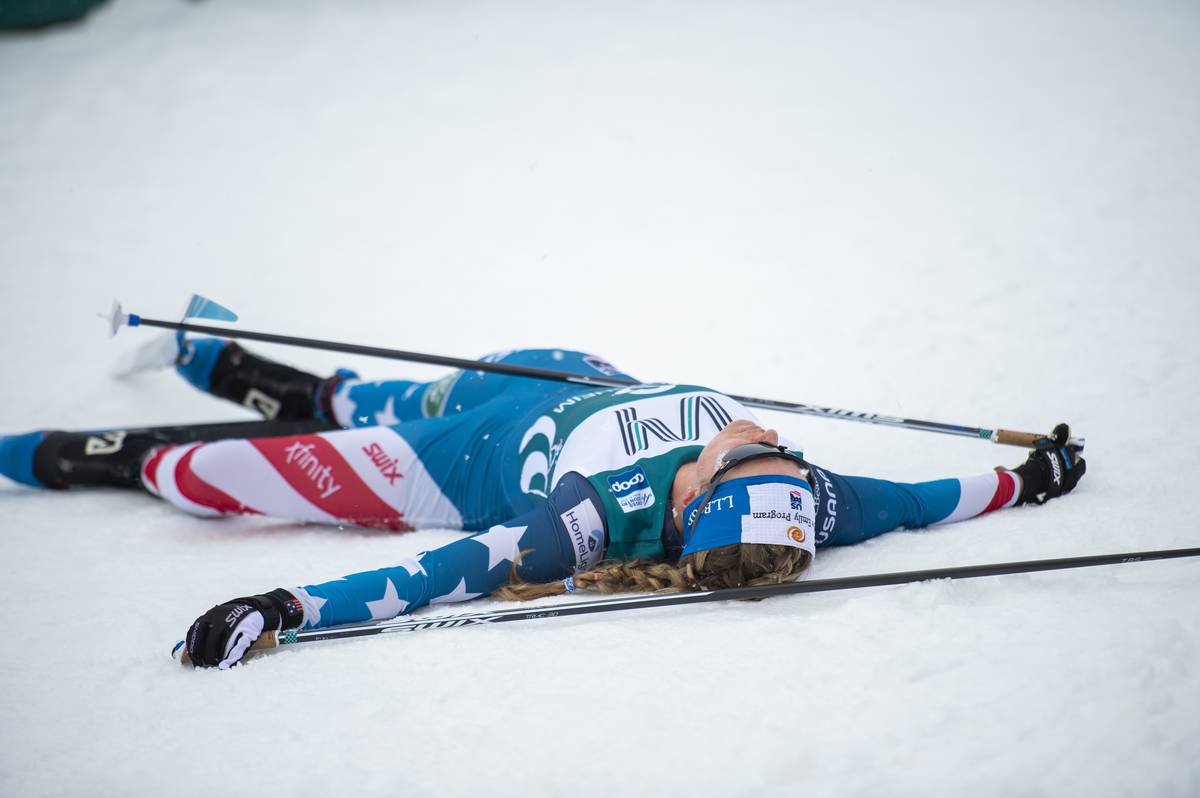
    Post Stage 6 of the Ski Tour 2020, a spent Jessie Diggins. (Photo: NordicFocus)

    This is compelling, if not searing. Whatever your views on Diggins, as a person or an athlete, it is undeniable that she feels things quite strongly. This is someone whose nickname within the U.S. Ski Team is “Sparkle Chipmunk,” who was once described by The Guardian as the team’s “ebullient talisman.” To hear her say that she enjoyed feeling nothing, and “quickly began to search for that numbing feeling again and again,” is chilling.

    This portion of the book is superb. Diggins is not afraid to engage with uncomfortable truths, and to use her own experience as a lens through which to examine what it is like to live with, be consumed by, and then work to overcome an eating disorder. Diggins repeatedly emphasizes, to her credit, that eating disorders “don’t discriminate,” that “Skinny teenage girls represent only 10 percent of eating disorder victims.” But she also must recognize that an Olympic gold medal gives her outsize influence when she talks about disordered eating, and she ably uses the platform she has earned to stick up for everyone dealing with these issues who is not a “skinny white teenage girl.”

    It would be far too pat to say that, once she learns skills to cope with her eating disorder, Diggins puts this out of the way and moves on to a perfect life as a perfect skier, not the least because she explicitly discusses later in the book the times she had to overcome the temptation to engage in disordered eating once more.

    Rather, in the memoir’s third part, Diggins takes the reader on a tour through roughly seven years of her professional ski career, 2011 through 2018, culminating in a certain team sprint Olympic gold medal. If you’ve read this website before, you probably already know the general highlights; they include dominance on the domestic SuperTour, a quick promotion to the World Cup, anchoring nearly every U.S. women’s relay over the past decade, and the general rise of the American women’s team as a global force in nordic skiing. But Diggins makes sure to weave in some lowlights, including disappointing races, injuries, and overtraining that ultimately required two weeks’ complete rest in fall 2014, when she would otherwise have been building intensity to sharpen race fitness for the 2014/2015 World Cup season.

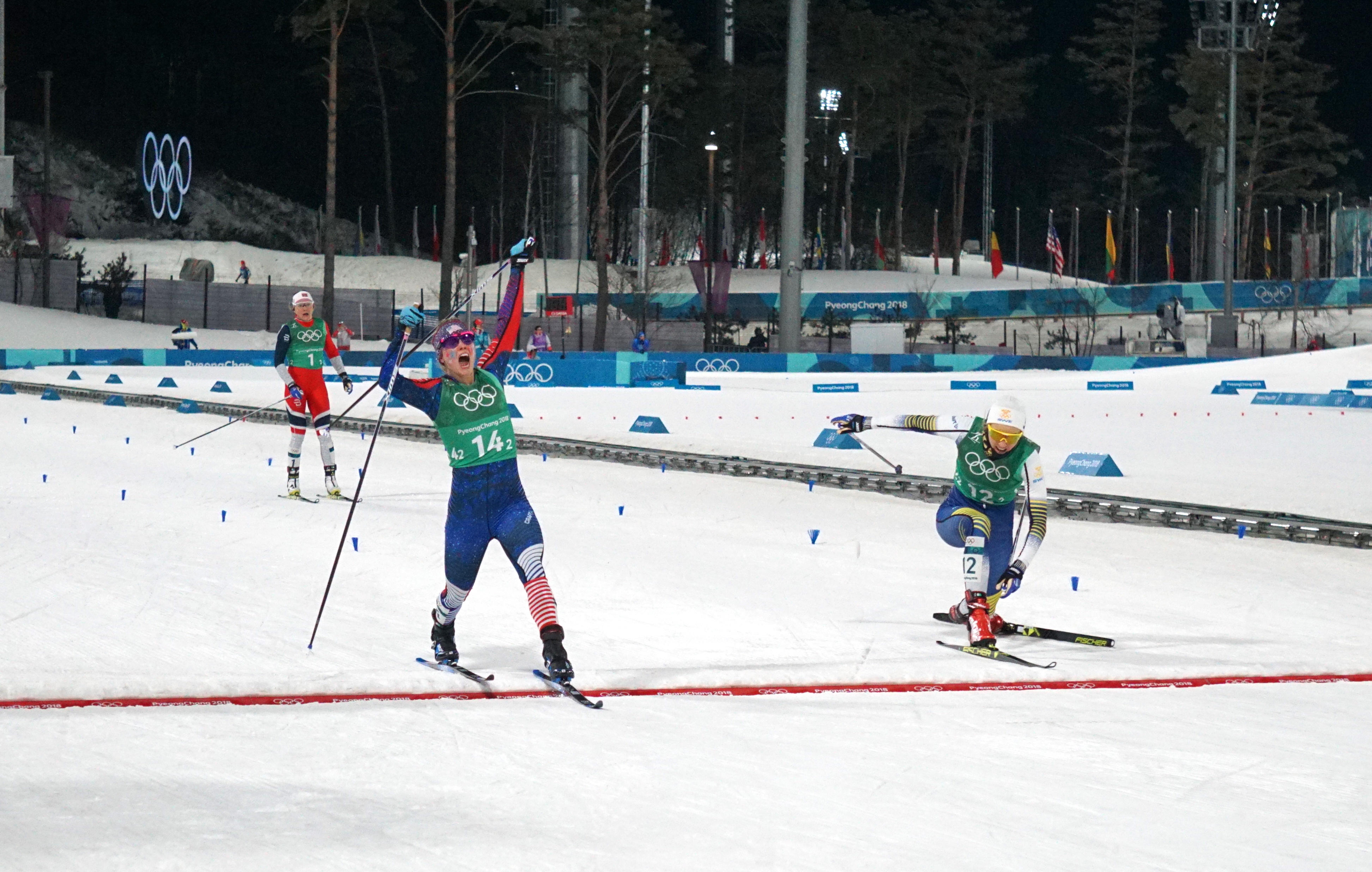
    Jessie Diggins (14) edges Sweden’s Stina Nilsson (r) for gold, while Norway’s Maiken Caspersen Falla (l) races to bronze, in the women’s freestyle team sprint final at the 2018 Olympics in PyeongChang, South Korea. (Photo: Noah Hoffman)

    After seven years’ worth of training and racing highlights, the reader is left with a nuanced understanding of not just the results, but also of the process that helped Diggins get there. Process vs. results may be somewhat of a shorthand or buzzword when it comes to thinking about training for endurance sports; it also works.

    And it works well for a piece of literature, too. The climactic scenes in PyeongChang have more resonance because of everything that preceded them, not only Diggins’s decade of unstinting striving but also Kikkan Randall’s decade of work before that. Diggins writes, poignantly, of seeing nearly the entire American team at the venue that night; there is a now-famous picture, which you have likely seen, that shows the depth of the Americans’ support on that cold Wednesday evening at the Alpensia cross-country center.

    But much as Diggins writes, convincingly, that she couldn’t have done it without the team behind her, the entirety of part three underscores that she also couldn’t have done it without training her ass off for the past decade, either. We all know that nordic skiers train hard; you may read Diggins’s description of a typical training week (replete with heart rate zone data if you really want to nerd out!), then consider living like that for 11 months of the year, and see for yourself. You’ll probably get pretty tired before the year is up.

    *   *   *

    As noted, there are some good things that Diggins feels strongly about, such as hard work and teammates and dancing and Taylor Swift. But as a work of literature, the bad things frankly tend to make for more interesting reading. There is a set piece about traveling through middle-of-nowhere Russia in the dead of night, for example, that is finely rendered and darkly hilarious. There are descriptions about Diggins’s experiences in Sochi, both in 2013 and again for the Olympics, that are interesting and insightful. There is an unflinching portrayal of the aftermath of a rollerski crash that is painfully vivid, and a description of training with food poisoning that made me cringe, then laugh out loud. These all make for great reading; Diggins is capable of being a fine storyteller.

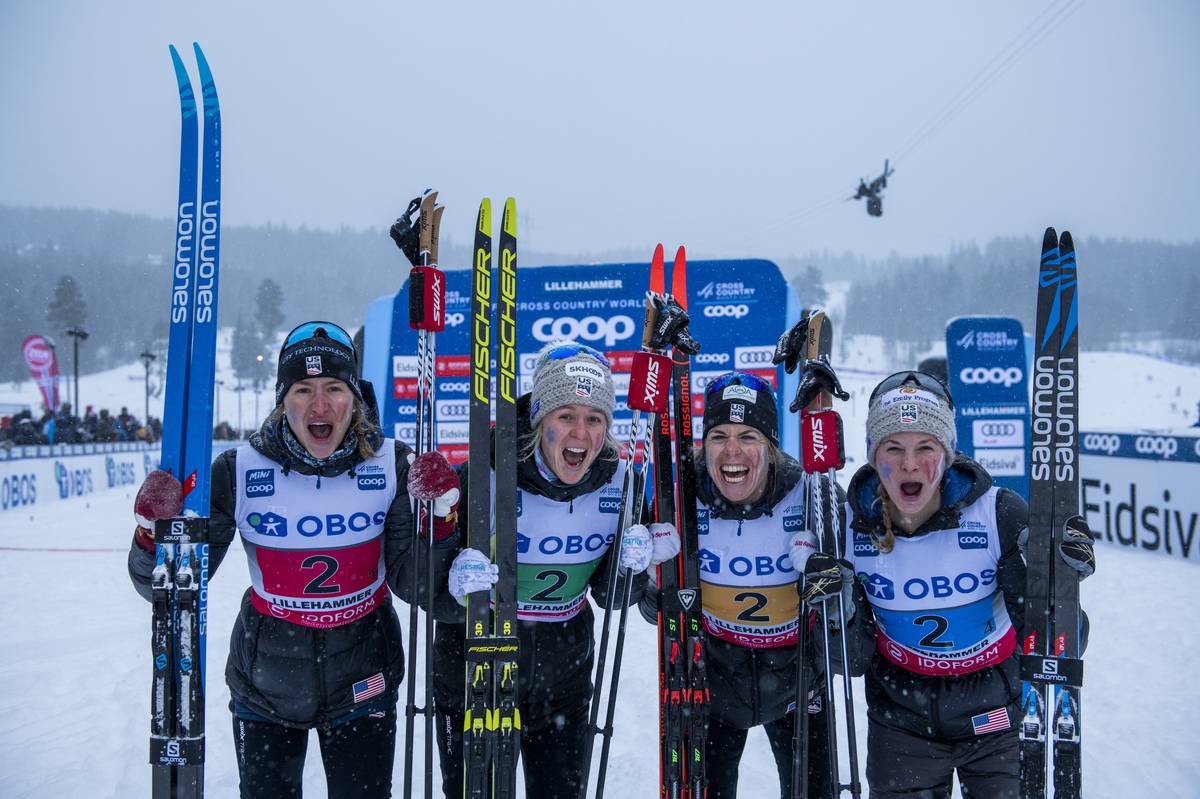
    Teammates: Team USA celebrates their hard-fought second-place finish at the 2019 4 x 5-kilometer relay in Lillehammer, Norway. (Photo: NordicFocus)

    At the same time, it is telling to survey some of the things that are bad, in Diggins’s worldview. Doping is bad, but gets only a couple of sentences in a 276-page book. Climate change is also bad, but gets only a few paragraphs, scattered throughout the work. “President number forty-five” – she can’t even say his name – is very bad, but only in passing, and mostly serves to prompt a memorable (and hilarious) story about her experience breaking down in tears upon meeting the Obamas during her post-Sochi White House visit. (This latter episode also provides the memorable phrase, in reference to Diggins’s official White House visit uniform, “Spanx cummerbund.” You’re welcome.)

    But the media? Diggins is decidedly not a fan of the media – and, if you’ll forgive the navel-gazing, this seems like a relevant topic for this website to explore in some depth. Diggins variously has harsh words for print media, for television media, and for any of “announcers, writers, or sports commentators [who] try to put words in our mouths and guess what we were thinking at the time we were in a competition.” She calls out a media rep for her own team who betrays an imperfect understanding of race tactics, writing, “It didn’t seem worth it to explain tactics and drafting or even spend energy explaining that how I skied [in the back of the lead pack] was on purpose.” Elsewhere, she writes, “Since I’m not a reporter, I have no idea what it’s like for them, reporting on race after race, trying to make each one stand out somehow with a character story.”

    Ultimately, midway through the PyeongChang Olympics, Diggins gamely faces the media following her 3.3-second bronze-medal near-miss in the 10-kilometer freestyle race. Soon after, during the podium ceremony, she retreats to a secluded hallway underneath the stadium, cools down on a spin bike, and, alone in the dark, unleashes “a scream filled with pain and disappointment” into her jacket. “It was a scream that said, ‘I wish that what I had was good enough,’” Diggins writes.

    Moments earlier, Diggins had stood in the mixed zone and told reporters for this website (among many other members of the media scrum), “I could not have gone any harder. … That’s a really good feeling to know you gave it everything that you had and more than you thought you could give. I’m really proud of today.”

    American Jessie Diggins racing to seventh in the women’s 30 k classic mass start at the 2018 Olympics in PyeongChang, South Korea. (Photo: Scott Patterson)

    Now, she writes, “I knew that I had truly given everything that I had. And yet, it still wasn’t good enough to earn a medal. That stung. So, far away from the TV cameras and flashing lights, I let all of my emotions out right then and there. Spinning in the dark, I screamed my frustration and loss into a balled-up jacket.” She adds, “Honestly, the pain of going through the media zone after the race was what did it. Because I had felt good about myself until I went through that zone.”

    Obviously Diggins is allowed to tell the media anything she wants. But the episode nonetheless raises interesting questions about the nature of journalism, and the obligations of a professional athlete to speak with the media even after disappointing performances. Or, if she does speak with them (and let me be clear, I have no reason to believe that Diggins has ever blown off the media at any point in her ski career, Bolshunov-after-the-30k-pursuit-style), what, if anything, she “should” say about her frustrations. And also about the responsibilities of the media, and whether or not it is fair to ask a disappointed athlete questions like, “‘Tell me, how does it feel to know your hometown was watching?’” (to take one of Diggins’s unappreciated examples from the PyeongChang mixed zone).

    As one contemporary meme put it midway through the Olympics, alongside an image of a man with clothespins stretching his face into an artificial smile, “When you come up short in your races, but your sponsors paid for sparkle, not human emotions.” Or, as Devon Kershaw more recently said (around the 21:00 mark of the linked podcast), “The media is there when you win, but it is a show, and this is entertainment, and I know it feels like a huge deal at the time, I know you’re super disappointed. … But it’s called being a professional. You just pull the glasses up, you look into the camera, or you look into the interviewer’s eye, and you say, ‘Today wasn’t my day. I’m really proud of the Tour I had; today I just fell flat and had a raunchy day, and I’m looking forward to resting and getting on with my season.’ … It’s your livelihood, right, and you have to answer the questions in the media. Of course people want to know how did you feel today, like, How does it feel to lose the Tour de Ski win, Johannes [Klæbo]. He doesn’t want to answer that question, of course not. But like I said, you’ve got to be pro.”

    The first comment was undeniably about Diggins; the second clearly was not. But if you like skiing, and are anyone other than a current World Cup athlete and so necessarily follow it through the filter of the media, Diggins’s thoughts on the media, alongside the frankly cruel viewpoint expressed by the meme, should make you think about the interplay between athletes and media, and how it manifests in the information that you hear. I don’t know what the “answer” is, but I think that these questions are worth asking.

    (I am pellucidly aware that I’m writing this for FasterSkier, the paper of record for this niche sport (which, by the way, Diggins at one point read, but no longer does, likening it, or maybe the comments section specifically, to “driving past a car crash…you know you shouldn’t look, but everyone somehow can’t help themselves”). My understanding is that Diggins, whom I have never personally interviewed, has at worst a neutral, and I think in fact a positive, relationship with this website. Go ahead and listen to some of her recent post-race interviews with Jason Albert or Rachel Perkins (here, say, or here); it seems hard to characterize this as an antagonistic relationship with the media, or as the media asking unfairly pointed questions. But you, as the reader, really get to be the judge of that.)

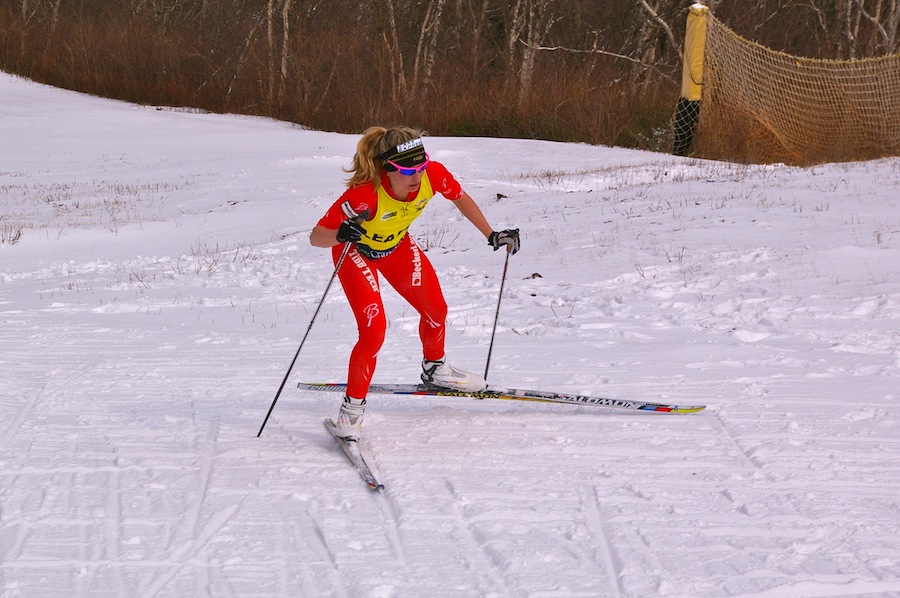
    Jessie Diggins skiing for CXC in a domestic race in March 2012, on her way to finishing first in the SuperTour Finals hill climb to win the overall mini-tour title. She had the second-fastest time after USST teammate Liz Stephen.

    So what else is bad? There is a certain former teammate who is (other than Trump) the only true villain in this story. She actively uses Diggins’s eating disorder against her, falsely tells her that the national-team coaches had called to say that they thought her eating disorder made her “hard to handle” and “a burden to the national team,” and outright yells at her, “telling me I was a liar, that I was a fake person who only pretended to be happy, that I was a pathetic, bad person.” Ultimately, Diggins learns the truth only when she privately approaches Matt Whitcomb to ask him if this is true; he is appropriately aghast and tells her that this never happened; she leaves the CXC Team for Stratton soon after.

    On a happier note, Diggins concludes, “The power of these old psychological scars scared me and made me realize how far-reaching the effects of bullying could be. I vowed to never, ever let something like that happen to another athlete on the same team as I was.”

    *   *   *

    Diggins began work on this book soon after the PyeongChang Olympics, she has outlined in a blog post, with the assistance of a professional author, Todd Smith. The book is, literally, an as-told-to production; she explains in the blog post that Smith came to Stratton for a week, during which time he “recorded something like 20 hours” of Diggins’s thoughts. Smith oversaw transcription of the audio, she writes, “then cleaned up my ‘um’s, ‘ahh’s and way too many ‘like’s, and hammered my stories into more readable chapter formats.” Diggins edited rough drafts of each chapter during spring 2019 before the work went through a final copy-editing process with the publisher, the University of Minnesota Press.

    Diggins says of the finished book, “it sounds like one of my blogs that grew up and went to college,” which seems quite apt. Perhaps as an artifact of the work’s oral composition, her voice is superb. (Indeed, as Diggins wrote, “It sounds exactly like me.”) If you want to see for yourself, compare a random portion of the published book, a random blog post, and a random post-race audio interview. You will have no doubt whatsoever that all three come from the same person.

    Jessie Diggins smiles as she walks away from a 4th place finish in Stage 2 of the 2019/2020 Tour de Ski. (Photo: NordicFocus)

    Although bad words do not seem to fall within Diggins’s typical on-the-record linguistic register, they occasionally feature within the book. There are a couple fuckings, a handful of shits, and multiple instances of kickass or badass (often applied to Randall). Some of the profanities come in quotations from others, and certainly none is gratuitous. But I thought twice before handing the book over to my fluent-reader, hero-worshipping seven-year-old ski fan for this reason (okay, also the unflinching descriptions of the realities of an eating disorder); if you’re a parent you’ll know your own kids and can make your own judgment calls, but you may wish to keep that in mind. (As for substance, there is as much sex, drugs, or violence as you would expect from someone with a clean-cut Midwestern persona, viz., none. Save for that one time the police pulled a corpse out of the frozen river across from the team hotel in Rybinsk…)

    There are a few other down notes in the book. One chapter turns on a somewhat forced metaphor about what is literally a box of memories, which as a literary device seemed strained. And Diggins’s wistful evocation of all the free time and unstructured schedules enjoyed by non-athletes, in perhaps a grass is always greener moment, falls a little flat. Ask anyone who is a parent, a recreational skier, or a person with a nine-to-five job (let alone all three!) if they really get to be done for the day at 5 o’clock, or stay up late without thinking twice about it. They’ll probably laugh at you, if they’re not too busy squeezing in a quick workout or driving their kids somewhere or helping with homework or making dinner or doing laundry or actually talking to their spouse at 10:30 p.m. before collapsing into bed.

    Finally, there are a disappointing number of factual errors. The advance review copy that I received from the publisher referred to Diggins finishing 40th in the distance skate in Sochi and 12th in the sprint; she was in fact 37th and 13th, respectively. It says that Randall was 37 years old in PyeongChang; she was in fact 35. It says that Diggins won 13 races on the SuperTour in fall 2011; she in fact won nine. It said that the “entire team” was on course for the team sprint final in PyeongChang; at least one athlete was not, as witness this memorable live reaction video from an athlete watching the broadcast in the American gym. And it said that Diggins wants to be defined by more than just one Olympic race, and not be “forever falling back on those fourteen minutes on a Thursday night in South Korea.” But the race took just under sixteen minutes, and occurred on a Wednesday. I could go on (and could note that she has misstated even the year of her childhood Olympic-themed birthday party), but this gives a flavor of the type of problems I encountered – maybe not huge, but sloppy, and lots of them, enough to make me wonder what else in the memoir might be revealed as wrong if it were formally fact-checked. And don’t get me started on the outright typos.

    Jessie Diggins (U.S. Ski Team) racing to eighth in the 15 k skiathlon, the first race of her first Olympics, on Saturday in Sochi, Russia. The result tied the best Olympic showing by an American female cross-country skier, set by Kikkan Randall at the 2010 Vancouver Games.

    None of these misstatements had been corrected in the final version of the book, and while some of the typos were cleaned up, more slipped through than should have. It is disappointing to find such errors in a work published by a university press, which was edited three times and gone through, Diggins writes, “line by line, word by word.” (To be clear, I don’t begrudge an athlete with hundreds of race starts to her name for not remembering all details of each one with eidetic clarity. I do, however, expect her co-author, or her publisher, or someone involved with a well-regarded university press to have fact-checked the thing, as well as to have ensured that there were no typographical errors in the final product.)

    On a more amusing note, I should observe that Diggins casually name drops her myriad sponsors at only one point in the entire book, a chapter describing the PyeongChang Olympics. (“I like to put on my Bose headphones … I ate some Pro-Bar sports gummies and drank more Nuun endurance sports drink. … one of the awesome Salomon reps knocked the snow from my boots … I looked down at the palms of the gloves that I’d custom-designed with Swix.”) If this is a wry commentary on the implications of Rule 40 of the Olympic Charter, which effectively muzzles athletes’ ability to thank their personal sponsors at the one time every four years that they actually have a global media spotlight – and Diggins is too smart for this to be anything but – then it is a masterpiece of Midwestern-nice trolling from a universally beloved athlete. Well done.

    *   *   *

    It seems worth asking, perhaps more so for this book than for others, why the author took the time to write it. Writing a book isn’t easy, even with an as-told-to co-author, and many athletes training 800 hours a year do not undertake a book-length literary endeavor as a downtime bagatelle.

    Indeed, consider that Diggins didn’t really need the fame; she has over 122,000 Instagram followers, who respond to her every pronouncement with reactions somewhere between affirmation and adulation. She likely didn’t need the money; she’s not as wealthy from this sport as she would be if she lived in Norway, where Johaug and Klæbo et al. have a ubiquitous advertising presence and lucrative endorsement deals, but she has earned hundreds of thousands of dollars in prize money, and in the acknowledgments she thanks her Chicago-based agent and his team for “years of helping me tell my story to the world with our partners,” which is not something you say if your parents are still funding your ski career. And she didn’t need to bolster her own image; she has a beloved reputation on two continents, and is a hero to skiers young and old.

    The conclusion is likely that Diggins wrote this book because she wanted to, or, more specifically, because she felt like she had a story that she wanted to be told. If you care about Diggins, sports, or being yourself, I submit that her story is worth listening to.

    *   *   *

    The article has been edited to reflect the fact that it was Leo Tolstoy who wrote that “Happy families are all alike,” not Fyodor Dostoevsky.

  • Recover Smarter, Not Harder: A Review of “Good to Go: What the Athlete in All of Us Can Learn From the Strange Science of Recovery” and Interview With Author Christie Aschwanden

    Recover Smarter, Not Harder: A Review of “Good to Go: What the Athlete in All of Us Can Learn From the Strange Science of Recovery” and Interview With Author Christie Aschwanden

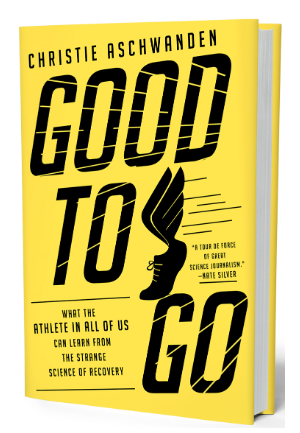
    “Good to Go: What the Athlete in All of Us Can Learn from the Strange Science of Recovery” by Christie Aschwanden explains the research behind products and services in the industry of athletic recovery.

    If you’ve ever set a lofty athletic goal, one that required full commitment, going all in and pulling out all of the stops to optimize your training, you may have searched for strategies to similarly optimize your recovery between sessions, getting you back on the ski trails feeling strong as quickly as possible. In this process, you may have found yourself perusing a seemingly endless array of devices, foods, and drinks, each promising to improve your ability to bounce back from workouts sooner, thereby allowing you to train harder and more often, which is seemingly a win-win scenario.  

    Before buying into these claims – literally and figuratively – a recently published book suggests it may be wise to first pause and consider that the benefit that these products promise might be too good to be true. 

    In “Good to Go: What the Athlete in All of Us Can Learn From the Strange Science of Recovery”, Christie Aschwanden presents the findings of an in-depth look at the research (or lack thereof) behind the leading players in the industry of athletic recovery. Her analysis includes everything from electrolyte drinks to cryotherapy chambers to massage. She leaves the reader with a healthy dose of skepticism and perhaps a bit of reprieve from the hype surrounding the recovery obsession. Peppered with relatable anecdotes from her own experience as both an elite and recreational athlete, “Good to Go” is a worthy read for any competitor from master blaster to elite. 

    Christie Aschwanden, author of “Good To Go: What the Athlete in All of Us Can Learn from the Strange Science of Recovery”, spent two years in Switzerland during her professional ski career competing for the Swiss Rossignol team. (Courtesy photo)

    Beyond delving into research and trying these products herself, Aschwanden is no stranger to the world of high-performance training and competition. If you’ve been following the sport for a while, you might recognize her name; the 47-year-old is a former member of the Team Rossignol nordic ski racing group, despite the fact that she did not begin skiing until college when an injury prevented her from competing as a Division I runner at the University of Colorado Boulder.

    While injured, she joined the cross country ski development team at CU and also took up cycling, quickly becoming an elite level competitor in both. In her ski career, Aschwanden toured North America racing in the marathon circuit and in Continental Cup races. In 2002, she and her husband moved to Switzerland for two years. While overseas, she joined the Swiss Rossignol team and competed in several Europa Cup races. She continues to ski, run, and mountain bike recreationally, occasionally hopping into races in the area around her home in Cedaredge on the Western Slope of Colorado.

    Christie Aschwanden, author of “Good To Go: What the Athlete in All of Us Can Learn from the Strange Science of Recovery”, poses in costume at the start of the 2019 Alley Loop Nordic Marathon in Crested Butte, CO. Aschwanden is a former professional nordic skier for Team Rossignol. (Courtesy Photo)

    In addition to being a lifelong endurance athlete, Aschwanden is an accomplished science writer, frequently contributing to a variety of publications including the New York Times, Runner’s World, NPR.org, Discover, and the Washington Post.  She is also the co-host of the podcast Emerging Form, which is about the creative process, and a frequent speaker and instructor at science writing workshops and conferences nationwide. 

    “Good to Go” opens with the author’s own foray into the field of scientific research on athletic recovery to understand the age-old question, “Is beer good for recovery?” to which she hoped to find the answer, “yes.” She walks readers through the development and execution of the study, which involved a group of ten athletes completing a 45-minute treadmill run at 75% of their VO2 Max effort, then drinking either a Fat Tire Amber Ale, made in Colorado by New Belgium Brewing Co., or a non-alcoholic O’Douls. These beers were chosen for their likeness in color. The following morning, the runners would complete a “run to exhaustion” at 80% of their determined VO2 Max. 

    After designing, participating in, and analyzing the results of the study, Aschwanden found herself with a greater understanding of the flaws of scientific research in the arena of recovery, primarily, the impact of the easy intrusion of personal bias, the lack of quality placebos (one does not need to be a sommelier of beer to tell the difference between Fat Tire and O’Douls), and the opportunity of false positives created by repetition of small studies. 

    Aschwanden writes, “For one thing, I discovered that it’s not enough to ask ‘Does this thing work?’ First, you have to start with more fundamental questions: How would we know if it’s working? What are the benefits that this gizmo or ritual is supposed to deliver, and how would we measure them? If the proof is coming from something measured in a lab, do those numbers translate into meaningful differences in real life? As I found out during the run to exhaustion test, just because you can measure something doesn’t mean it’s answering your question.”

    As she leads her readers through an illuminating tour of the recovery industry, Aschwanden exposes the critical influences that affect whether the research performed on a product truly validates the claims being made, or if they are “just-so stories,” a reference to Rudyard Kipling’s classic collection of tales for children which provide fanciful explanations for how leopards got their spots and camels got their humps . She explains how celebrity endorsement and social media can greatly influence a consumer’s choices, and that some studies have been funded by the company that produces the product. These conflicts may lead researchers to design their experiments in a way that is likely to produce favorable results. 

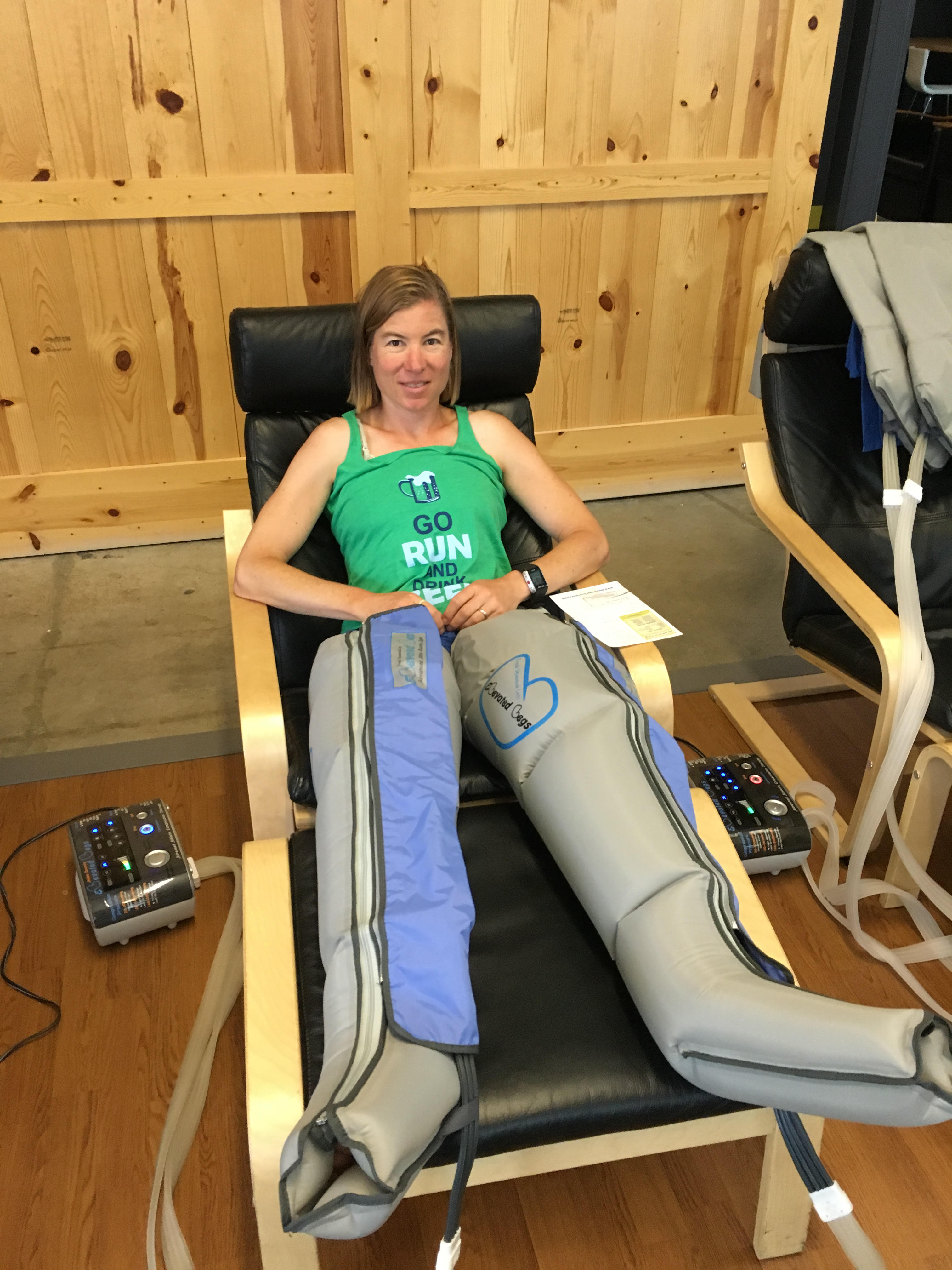
    Christie Aschwanden, author of “Good To Go: What the Athlete in All of Us Can Learn from the Strange Science of Recovery”, tests out a pair compression boots, which claim to reduce recovery time by enhancing blood flow. (Courtesy photo)

    While she remained open-minded and found the exploration of products and research surprising, Aschwanden explained she was predisposed to skepticism given her history and credentials.

    “Having a background in science and athletics, I knew that if someone is making a claim that seems too good to be true, it probably is,” she said in a call. “So many of these products make really outlandish claims. At the same time, I realize how susceptible we athletes are to a lot of these things. They really exploit this doubt that ‘Well, maybe it does work a little bit.’ And when you’re competing at that level, you want every single advantage you can get and you don’t want your competitors to have some advantage that you don’t have.” 

    The power of placebo is a common theme throughout “Good to Go”, capitalizing on the doubt Aschwanden referenced. In terms of product research, the control group of athletes knows whether or not they are taking an ice bath, getting a massage, or spending half an hour in inflatable compression boots, and there is not a great way to make all participants believe they are receiving the same treatment. Thus, if the participants believe that a product will work, the placebo effect just might allow them to show improvement from its use. 

    In some cases, the product might be useful purely because it forces an athlete to take a break, lie still, and decompress while the body uses its natural ability to recover.

    “Many popular recovery modalities strike me as a sort of pacifier,” she writes. “They won’t actually resolve anything, but they give you something to do while you wait for nature to take its course.”

    She offers a strategy of placing the recovery tools, consumable products, and services into one of four bins. Which bin a recovery strategy is placed into is customized by the individual. 

    “First is the ‘feels so good’ bin,” Aschwanden explained in the eleventh chapter. “These are the things that feel good while you’re doing them, and perhaps afterward too, which even if it does nothing else, provides a valuable benefit in itself. Next is the ‘hurts so good’ bin, with things like icing that are painful, and thus give the sense that they must be powerful (and therefore effective). Third is the ‘it’s working, I can sense it’ bin of active placebos, with things like cupping, which produce noticeable sensations and effects that aren’t necessarily painful nor alluringly pleasant. Finally, there’s the ‘blinded by science’ bin of things like infrared saunas, whose appeal comes from jargony scientific explanations that give them an aura of space-age power.”

    One discovery which has made waves in the realm of physical therapy and athletic performance is that icing to reduce muscle soreness and promote recovery is a fallacy. In her cycling days, she recalled taking ice baths regularly, particularly during stage races. 

    “There are still some reasons that it might be good to ice,” she explained. “If you’re cycling on a really hot day, and the summers have just gotten so much hotter, jumping in a cold lake or something can be a good way to get your body temperature down and that’s good for recovery. But the idea of icing in order to reduce muscle soreness or improve recovery, it turns out, more than just not being backed up by science, in some cases can be harmful and can reduce your adaptations to training, and that was really surprising to me. It’s just such an entrenched practice that it just didn’t seem that it could be as ineffective as it is.”

    Jessie Diggins review is featured on the cover of “Good to Go: What the Athlete in All of Us Can Learn from the Strange Science of Recovery” by Christie Aschwanden (Photo: christieaschwanden.com)

    Ultimately, Aschwanden explains that the best recovery tool out there is one’s own body and mind. She advocates that athletes of all abilities tune into the messages their bodies are sending and trust the process in their own training. 

    “The most important skill that any athlete can develop is the ability to read your own body, to learn to understand and recognize the cues that it gives you, and those cues are really individual,” she explained frankly. “There isn’t one thing that is universal among athletes, but every athlete will have some clue that they can learn to recognize. Part of this is spending less time looking to see what your competition is doing and really focusing on yourself and how you’re adapting to your training and how you’re feeling on a day to day basis. I think part of this is also a confidence in your own fitness and your own training program. You have to be confident and be confident that when your body is telling yourself it’s tired, that [rest] is actually what it needs.”

    While some may not find the recommendation as sexy as an infrared sauna, she explains that the best avenue to optimize performance is to get plenty of quality sleep and to eat a nutritious and well-balanced diet. From her experience, this can be a challenge for athletes that are on the road regularly during the competition season. In her book, she shares strategies that the pros use when bouncing around between venues and time zones. She also explained that the impact or travel, or other life events, should be taken into consideration in the same way that a hard workout might be.

    “I think that people don’t always appreciate the extent to which, to your body, stress is stress,” she said. “Life stress is just as important as your training stress. I think that I was chronically overtrained when I was a skier, and part of it was that I didn’t appreciate the toll that travel was taking on my body. I didn’t appreciate that when I wasn’t getting enough sleep, that was impairing my ability to recover.”

    In the world of Strava and social media, it can be hard for the recreational athlete not to succumb to “FOMO” (fear of missing out). It can be difficult to hold back from chasing PRs or adding more volume or plowing through the “niggles” until you are sidelined by a full blown injury or crippling fatigue. Aschwanden explained that the answer to improved performance is rarely to train more or harder. 

    “Too often, I think that I was trying to do as much training as I could tolerate, and I think that’s backward. I think it’s a much better strategy to do the minimum training that will get you the adaptations and the fitness that you’re seeking, because training is stressful on your body, so you want the training that you’re doing to really be benefiting you and having the effect that you have. I think I ended up doing too many junk kilometers and too much training when I would have been better off resting more.” 

    Her final piece of advice to athletes is to identify a strategy that helps them unplug and unwind, be it as simple as curling up on the couch with a book or as strategic as scheduling a massage. 

    “Find a way to incorporate some sort of daily ritual for relaxing, because really, at its most basic level, recovery really is just rest and relaxation. So many of these recovery tools are really just ways to ritualize taking a break or unplugging or resting. If you’re doing something that is helping you to relax, then that’s fine, but know that it doesn’t need to be something expensive or super time consuming or effortful, that it should actually be something that feels really easy and makes you feel good.”

  • We’re Not Invincible: More Heart Arrhythmias in Endurance Athletes (Book Review)

    We’re Not Invincible: More Heart Arrhythmias in Endurance Athletes (Book Review)

    The Haywire Heart by Lennard Zinn, Dr. John Mandrola and Chris Case, is available for purchase directly from the publisher at VeloPress, or at Amazon and other booksellers.

    When I heard that there was a new book coming out about heart arrhythmias in endurance athletes, I was interested.

    Several years ago, I read some of the research papers that the book’s authors refer to. One was a cohort study on participants in the Vasaloppet, the 90-kilometer ski marathon in Sweden. Those researchers found that skiers who competed in more Vasaloppets had more heart arrhythmias – as did those who finished the race the fastest.

    I wrote a piece about the findings at the time. The FasterSkier commenting system has changed, so original comments no longer appear at the bottom of the article, but I remember them clearly. Multiple commenters found the study hard to believe. One commenter was so sure that the findings were impossible that he wrote multiple angry comments arguing that exercise is good for you, so it couldn’t possibly cause heart problems.

    As a scientist, I was flabbergasted.

    There are a lot of crappy studies out there in sports science — and science in general, but I’m used to reading sports science papers with sample sizes of eight athletes. It’s hard to defend a lot of conclusions made from such studies. But this one? The researchers had following thousands and thousands of individuals and, well, numbers are numbers. An individual is either diagnosed with an arrhythmia or they aren’t. This was pretty straightforward.

    Scientists go out and measure a phenomenon, and then we present numbers as an estimation of the world. There are many legitimate reasons to question the data or interpretation, and this is actually built into the scientific process. Before publication, other scientists will rip a a study apart as part of “peer review”, suggesting ways to make it better or even recommending it not be published.

    That doesn’t mean that all published research is perfect. After publication, scientists continue to raise important points about whether the data collected represents reality (due to potential flaws like bias or study design), whether the statistical techniques are appropriate and correctly performed, whether alternative mechanisms could explain the patterns shown, and more. The public should absolutely engage in this process — and scientists should do better about engaging with the public. Anyone outside the study itself can ask questions that the researchers might not have seen, illuminating important aspects and leading to new research questions or repeating the study in a different way. In the end, this leads to gradually more and more accuracy in that estimation of the world.

    Asking good questions is different than arguing that data is wrong simply because of a gut feeling or belief. The reaction to the Vasaloppet article was a frustrating moment for me but, I would come to realize, not an unusual one. When presented with facts that do not support our worldview, we tend to just discount them. It’s human nature.

    All of which is to say that I was very interested to read The Haywire Heart by Chris Case, John Mandrola and Lennard Zinn.

    First, I wanted to get more background on the topic, and I wanted it to be explained to me in clear, straightforward language instead of the scientific jargon of research papers.

    Second, I wondered if the book would get the same reaction as my old writeup of the Vasaloppet study.

    And third, I was interested to see whether, when presented with some scary narratives, I had the same reaction as those few FasterSkier commenters. After all, as much as I tout that I’m a scientist, I, too, have knee-jerk reactions — and I spend a lot of time exercising. I guessed that I might find the conclusions of the book plenty threatening.

    The book opens with the story of Zinn, who is a former national team cyclist and a staff writer for VeloNews. Zinn is riding his bike outside of Boulder, Colo. He feels his heart skip a beat, and his heart rate “had jumped from 155 to 218 beats per minute (bpm), and stayed elevated.”

    Zinn initially takes some rest and dials his training back, but ultimately he tries to keep riding and training. The incidents become more and more frequent until his heart actually stops at one point.

    After that, Zinn radically changes his lifestyle. He does no hard efforts and much less training volume, period. Because of that, he’s still around to write the book today. His life is richer now, he writes (although it sometimes sounds like he is trying to convince himself as much as the reader). He has developed more different hobbies and can spend more time with his family. But it took him a long time to come to that understanding.

    It’s a transfixing story about what can happen to a seemingly fit, healthy person. Because Zinn is an author on the book, you know that he will make it out alive. But how far will he go before he stops training? What will happen to him? Could that happen to me?

    As we say in research, the plural of anecdote is not data.

    While the authors include “case studies” at the end of every chapter (several of which feature cross-country skiers who nearly died on the side of Colorado ski trails), they also bring the data.

    The book presents a compelling argument that we should be thinking more about our hearts – and particularly, the heart’s “electrical system,” as the authors call it. Endurance exercise doesn’t seem to increase the prevalence of problems with the “plumbing system,” or how the blood is pumped.

    That’s not to say that athletes don’t have heart attacks (or, more accurately, myocardial infarctions). Risk factors are risk factors, and don’t completely disappear with exercise. High blood pressure, high cholesterol, a family history of heart disease, being male rather than female – these increase the risk of a myocardial infarction. In particular, athletes who came to endurance sports later in life and previously smoked or were overweight still carry those risks with them.

    But the unique risk associated with long and intense bouts of exercise seems to be in the electrical system. Studies across multiple sports and countries, as well as in animal models like mice, rats and goats, have shown that the electrical impulses that keep the heart in rhythm can be made, well, haywire, by a lifetime of endurance training.

    There’s a wealth of observational, epidemiological data suggesting that a long-term habit of endurance exercise can cause atrial fibrilliation, a rapid and irregular heartbeat originating in the atria. (Atrial fibrillation was the type of arrhythmia mentioned in the Vasaloppet study.)

    Other arrhythmias seem to occur more frequently in athletes, too, like ventricular fibrillation. Premature ventricular contractions are common in trained athletes and don’t necessarily lead to bad outcomes; complex ventricular arrhythmias are also common, and can lead to cardiac arrest.

    Exercise can also make genetic diseases like arrhythmogenic right ventricular cardiomyopathy (ARVC) more dangerous, and can lead to the disease even in the absence of genetic markers.

    Some causes are straightforward. One symptom of “athlete’s heart,” as it is called, is enlarged chambers in the heart. And this is associated with atrial fibrillation: patients with atrial fibrillation tend to have larger left atria than those without.

    Exercise also leads to inflammation of muscles. The heart is a muscle; inflammation can lead to scarring, which can then disrupt the transmission of electrical signals across cells.

    The logic and evidence go on and on. The authors explain all of this much better than I can, even when paraphrasing. I’ll let you read the book and just say: it’s convincing. And if you haven’t studied human anatomy since high school, don’t worry. It’s clear and well-explained.

    As to the second question, the authors tackle that, too. Mandrola, a doctor, notes that when many athletes receive a diagnosis of a heart problem, they go into denial. Many decide not to change their behavior. There’s a sort of cognitive dissonance to being told that something you have always believed is healthy is actually putting you at eventual risk of death.

    “It is completely natural to go into denial for a while,” Zinn writes. “I don’t know of any masters athletes diagnosed with non-life-threatening arrhythmias who didn’t go back to pushing it hard in training or racing in hopes that the incident that sent them to a cardiologist was just a fluke.”

    If you do have a problem with heart rhythm, the authors provide several chapters as a guide for when to go to the doctor, what to ask and tell them, and what treatment options might be available. Getting a correct diagnosis is key, and as cross-country skiers, that is not a trivial ask.

    “Even doctors who run marathons don’t quite get the intensity thing,” Mandrola writes. “Marathons are a different sort of affair. There is no question that they are hard, but they generally have an even pace and don’t involve the competitive crises that flare up repeatedly in a bicycle race or a cross-country ski race or triathlon.”

    Women, too, are often misdiagnosed. The authors explain that women are more likely to be assessed as having an anxiety disorder than men, even when suffering from the same underlying heart problems: “Women younger than 55 were seven times more likely to be misdiagnosed and turned away from the ER than their male counterparts.”

    But the main advice, when confronted with a heart arrhythmia, is first to go to the doctor, and second to back off of training. It might save your life – and it might also make the problem disappear. That doesn’t necessarily mean stopping completely, but it might mean going slower and for shorter sessions. “Detraining” is a good therapy for several diagnoses.

    “In the end, I believe that all that denial and continued racing and training hard with the hopes of retaining some portion of my former life either damaged my heart or trained it so that it now goes into arrhythmia more easily,” Zinn writes of his own situation.

    Detraining might seem horrible, like an unacceptable lifestyle adjustment. But as the authors point out, once you know the other options – medications with scary side effects, procedures with non-trivial rates of complications, death – training a bit less might seem like a much better option.

    As for me? I definitely reacted to the book, but not by going into denial. Instead, I was scared.

    “The day before he died, he had gone for a six-hour run,” the authors wrote of Micah True, a barefoot- and distance-running legend.

    I read that the day after I had done a four-hour overdistance running workout. It hit home: none of us are invincible.

    That said, the one thing I found missing from the book was a real estimate of the prevalence of these heart problems. I could easily follow why they would develop, based on the physiology of the heart and what we do to it. And I found the research cited credible. But how many people does this happen to? Just what is the risk, statistically?

    One reason the answer might be lacking is simply that it’s hard to do comprehensive research on such a topic. As the authors point out, you can’t really do a randomized, controlled, double-blind trial – the gold standard for scientific studies – about the effects of lifelong exercise.

    Nevertheless, it’s clear that such health issues are common enough to give one pause.

    I’m just 30 years old, and I am probably not going to change my exercise habits after having read this book. But it reinforced a lot of peripheral behaviors that I should know are important anyway.

    For instance, in some patients, arrhythmias pop up only when they are stressed. Leading a high-stress life and sleeping too little are major risk factors. Burning the wick at both ends: that’s the sort of life I lead – and the sort of thing I always know I should work to address, but here’s another good reason to do so.

    Likewise, making sure to get enough electrolytes when training, to avoid dehydration, to get good rest and recovery, and to listen to your body – these are important.

    “You have probably been training for many years, if not most of your life,” Mandrola writes in one chapter. “Those years of training have given you a good sense of what ‘normal’ feels like. What you are looking for is anything that falls outside the boundaries of normal.”

    If I do ever feel a flutter in my chest, I’ll now know not to ignore it.

  • Book Review:  The Night Olympic Team

    Book Review: The Night Olympic Team

    The Night Olympic Dream

    The first positive test of the 2010 Vancouver Olympics has emerged, with Polish cross-country skier Kornelia Marek anxiously awaiting the results of her B sample test March 12 in Richmond, B.C., after her A sample indicated EPO use. That mars the picture of a doping-free Games that many had trumpeted, when more than 2,000 drug tests administered failed to result in an athlete being disqualified during the 16 days of competition – though 30 athletes were barred from coming at all due to positive tests.

    If Marek’s B sample also yields a positive result, the 25-year-old teammate of Justyna Kowalczyk faces a two-year ban and will be denied an opportunity to improve on her Olympic best of 11th in an individual competition and sixth in the women’s relay at the 2014 Sochi Games.

    So just how do scientists like the ones who will be examining Marek’s B sample take those test tubes and figure out whether an athlete has used a banned substance?

    For those curious about what exactly goes on behind the scenes, and what happens when scientists detect a new substance that they believe to be performance-enhancing, a recent book called “The Night Olympic Team” offers a fascinating look.

    The story is one FasterSkier’s readers will be familiar with: the doping downfall of Johann Muehlegg, Larissa Lazutina, and Olga Danilova at the 2002 Games, which eventually resulted in Beckie Scott being awarded the Olympic gold medal that should have been hers all along.

    But the details of how those positive results came to be will likely be unfamiliar to most readers. Written by Dr. Caroline Hatton, the long-time lieutenant of world-renowned antidoping expert Dr. Don Catlin, “The Night Olympic Team” was published in 2008 with a young audience in mind. But Hatton’s rare perspective and thorough explanation of the events that transpired has also captivated the interest of many adults.

    What happened behind the scenes

    In 56 pages with plenty of photos and sidebars on the finer points of examining urine and the alphabet soup of banned substances that may be found therein, Hatton explains how she and the rest of Catlin’s team worked around the clock to identify an illegal drug in the three Nordic skiers’ samples.

    In the run-up to the Salt Lake Games, they had heard of a new blood-boosting drug called Aranesp (also known as NESP – for “novel erythropoietic stimulating protein” – or darbepoetin alfa), but there wasn’t yet a test for it. And they knew the athletes knew that.

    But during the Games, they discovered through their midnight sleuthing that the EPO test then in use worked for NESP, too. Catlin consulted numerous colleagues, including Hatton – in the quiet of the Utah wilderness where their conversations were sure not to be overheard – about whether it was right to declare a positive test result for these three athletes despite having so little data.

    He decided to move ahead, but he needed supporting evidence – and fast. Two days before Sunday’s closing ceremonies, Catlin tracked down Aranesp’s creator in Louisiana, got him to examine their testing results, and write a letter of support – which had to be OK-ed by his company’s lawyers. Then he had to get Jacques Rogge to sign off.

    Rogge: ‘I was told there were some big nations involved’

    As Rogge told Hatton in an interview after the Games, “I was told that some big nations were involved and it would be a noisy issue. I said, ‘I don’t care. This is something that we have to pursue.’ And that’s what I did.”

    The IOC held a closed hearing Saturday night, and by Sunday afternoon – just hours before the closing ceremonies – CNN reported that some Olympic athletes had tested positive for NESP. And thus began a long process of court proceedings that ultimately resulted in Catlin’s results being upheld, the trio of skiers losing all eight medals they’d won at the 2002 Games, and Beckie Scott getting her gold.

    Catlin and Hatton’s pioneering work

    Catlin has been at this since 1982, when he read everything in the UCLA library about antidoping in no time flat because there was almost nothing to read.

    He went on to develop and lead the UCLA antidoping lab – the largest in the world – for a quarter century, much of the time with Hatton at his side. He’s now working full-time at his own institute, Anti-Doping Research, an unmarked building in the back lot behind Barry’s Plumbing in Los Angeles, where I spent the better part of a day with him ahead of the Beijing Games talking about his work as a pioneer in antidoping – and why he thinks testing isn’t the ultimate answer.

    Catlin brought Hatton in to join us – and it was quickly clear why. Her sharp mind and deep insight added much to our wide-ranging conversation, often piping up to fill in missing facts or correct his fuzzy dates – but always bringing a rich picture of their work together to root out doping in sport.

    And that is exactly what she has done in “The Night Olympic Team.”