Tag: Boston Marathon

  • Randall, Sargent, and Stephen Take on the 2021 Boston Marathon

    Randall, Sargent, and Stephen Take on the 2021 Boston Marathon

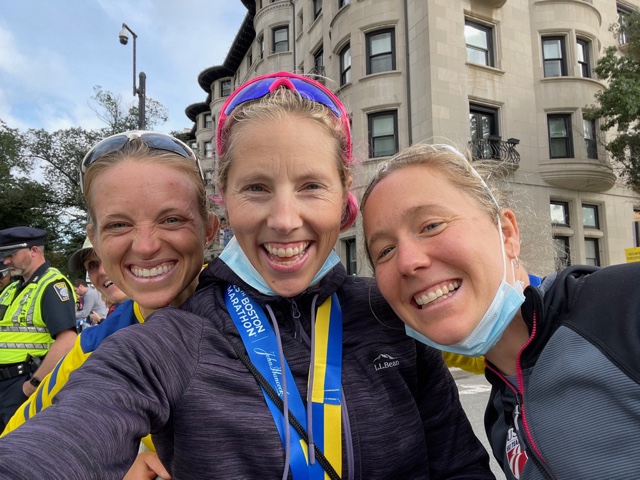
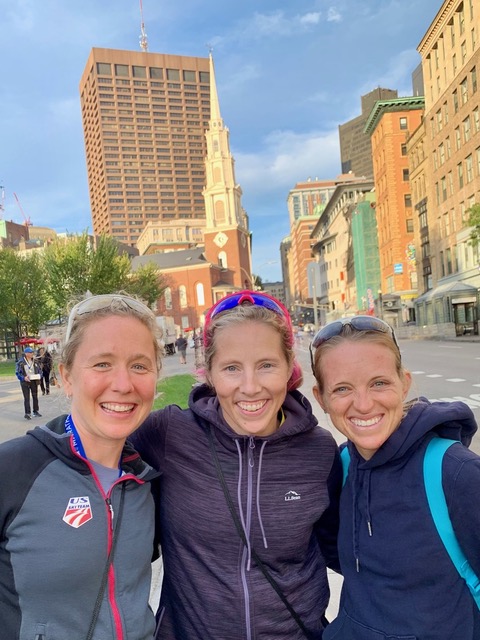
    Lining up for their second marathon on behalf of Aktiv Against Cancer, Ida Sargent, Kikkan Randall, and Liz Stephen took on the 2021 Boston Marathon. (Courtesy photo)

    While no one would wish for the circumstances, a fall running of the Boston Marathon is perhaps a skier’s dream. The iconic foot race is on many a bucket list; however, the third Monday in April is early for those who spend the winter strapped to skinny skis rather than pounding pavement. 

    After cancelling the April, 2020, running in light of the descending COVID-19 pandemic, and deciding against an April date for the 2021 event, the Boston Athletics Association (BAA) set its sights on October 11th, 2021, for a return to racing. 30 months without the Boston Marathon; it was go-time in Boston on Monday morning. The Red Sox even put on a show to celebrate, beating the Tampa Bay Rays 6-5 to win the ALDS in dramatic fashion later that evening.  

    Among the 15,716 individuals making their way from Hopkinton to the finish line on Boylston Street in Boston were three familiar faces: former teammates, U.S. Ski Team members, and Olympians Kikkan Randall, Ida Sargent, and Liz Stephen. The threesome ran on behalf of Aktiv Against Cancer, which promotes physical activity as an integral part of cancer treatment. 

    According to Aktiv’s mission statement, “Recent research indicates the benefits of physical activity extend beyond controlling symptoms and side-effects of cancer therapy; it is shown to reduce cancer progression and improve a patient’s response to anticancer therapy.”

    Nearly two years ago in November, 2019, these women lined up together for the NYC Marathon, each achieving their goal of finishing under three hours. At the time, Randall was only one year beyond her own cancer treatment journey. After receiving the diagnosis of Stage 2 breast cancer in June of 2018, Randall underwent six rounds of chemotherapy, infusions of the drug Herceptin, and a lumpectomy. All the while, she remained active, sharing her journey openly through daily video updates and social media. 

    Randall shared her Boston Marathon race experience via email.

    “We’re all hobbling around today but also basking in the glow after a hard race and fun experience!! After meeting up for the NYC marathon two years ago, when the opportunity to run Boston in October came up (versus April) we jumped at the chance to get together and once again shine the spotlight on an organization near and dear to our hearts, AKTIV Against Cancer. 

    “All of us have had close contacts with cancer in our personal lives and as athletes recognize how important physical activity is for tackling the treatment. So to be able to raise funds for important research and outreach, we jumped at the chance. We were able to raise over $17,000 collectively toward the cause!”
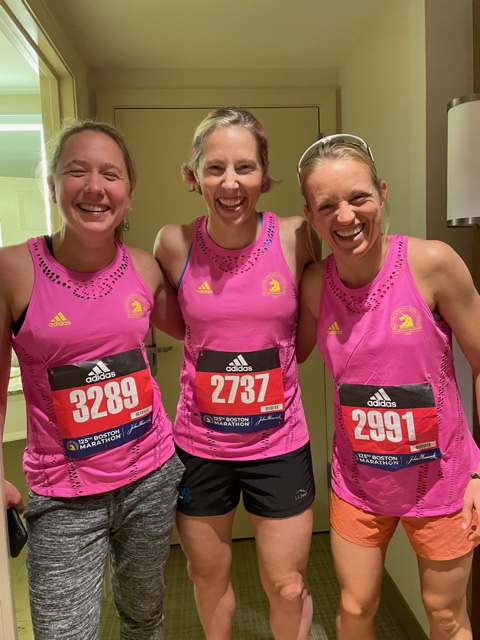
    Dressed in hot pink and having no fun at all, Ida Sargent, Kikkan Randall, and Liz Stephen lace up for the 2021 Boston Marathon on behalf of Aktiv Against Cancer. (Courtesy photo)

    In 2019, Randall checked the box on her sub-3 goal with a time of 2:55:12. This year, she was just shy with a net time of 3:00:27.

    “When we decided to do this back in April/May, I think all of us had ambitions to prepare for this race more seriously. But as we’re all finding post-racing, life is busy and I think we all came in a little under prepared. Regardless, it was going to be a great excuse to meet up with best friends.”

    Two minutes behind Randall, Sargent crossed the line in 3:02:26. Sargent also remarked that she felt under-trained at the start line, but the experience and opportunity outweighed the feeling of the final 10k. 

    “We plan to do these races as a little reunion and an opportunity to see and run with each other and support Aktiv,” wrote Sargent. “Today was so much fun but also a beast. The energy out on course of these big races is also so incredible. I hadn’t trained or run much at all leading up to the race so I really wasn’t sure what to expect but I was very excited that my legs felt great for so long. The last four or five miles were tough but I just told myself that I couldn’t walk and that kept me going through to the finish line.”

    Happy 26.2 finishers: Ida Sargent (left) and Kikkan Randall (right). (Courtesy Photo)

    Despite being veterans when it comes to endurance racing, Randall shared that the women were perhaps lured out too quickly, leaving them a little too dinged up when they faced the Newton hills late in the race. Runners face the infamous “Hearbreak Hill” at mile 20, steadily climbing for half a mile on tired legs. 

    Though all three women positive-split the race, Stephen bled the least amount of time in the second half; she clocked 1:25 through the first half, losing five minutes over the second to finish in 2:55:48.

    “The downhill start was really fun for the first 10km,” wrote Randall. “At points we were on-pace for a sub-2:45.  But being Boston rookies, and light on the running mileage, that early fast pace took its toll on all of us at different points.  Liz made it under 3-hours, I was just a smidge over and Ida had a great day at 3:02.  The last 10km was incredibly tough and I think we were all missing those gliding sections you get in ski races to recover and recharge.”

    The fun didn’t stop when they reached the painted yellow and blue finish line emblazoned with the Boston Athletics Association unicorn.  
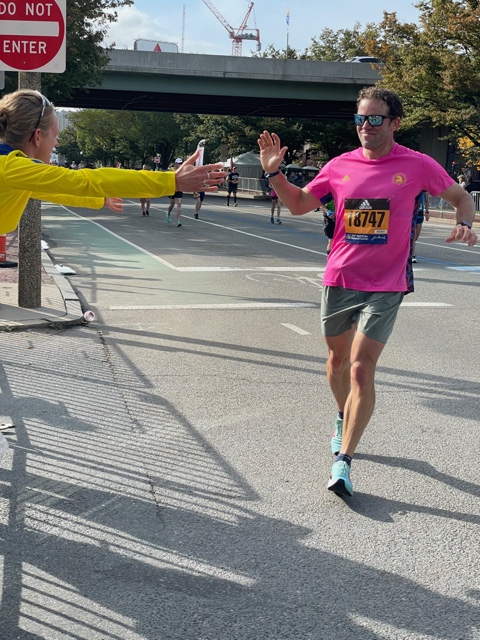
    Liz Stephen extends a high five to her partner, Jeff Bland, as he makes his way to Boylston Street during the 2021 Boston Marathon. (Courtesy photo)

    “Liz’s partner Jeff [Bland] also ran the race and fundraised for AKTIV with us,” Randall explained. “So after the three girls finished, we went back out to cheer him on. (Bland finished in 4:19:59.) We figured we ended up walking another 7 miles, which was painful — but also maybe a little helpful to keep from tightening up.”

    What’s the next race-reunion? According to Randall, they’re looking for ideas!

    “I think we’re all looking forward to not running for a while and yet we can’t help but wonder, what should we do next?!”
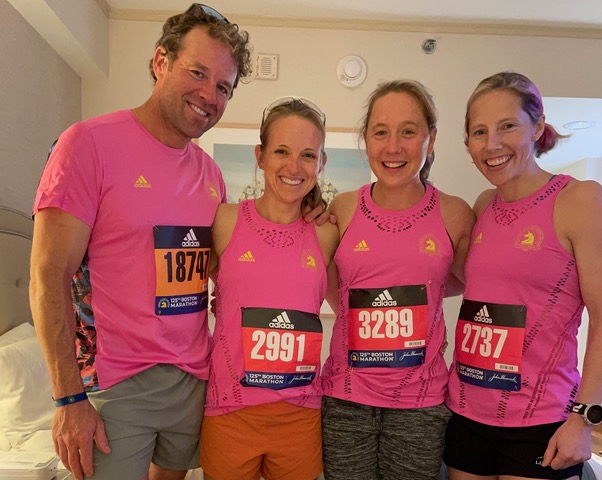
    2021 Boston Marathon racers. From left to right, Jeff Bland, Liz Stephen, Ida Sargent, and Kikkan Randall. (Courtesy photo)

    Boston Marathon Results


  • Wednesday Workout: Sore-Legs Central (How to Get the Lactate Out) with the Caldwell Sisters

    Wednesday Workout: Sore-Legs Central (How to Get the Lactate Out) with the Caldwell Sisters

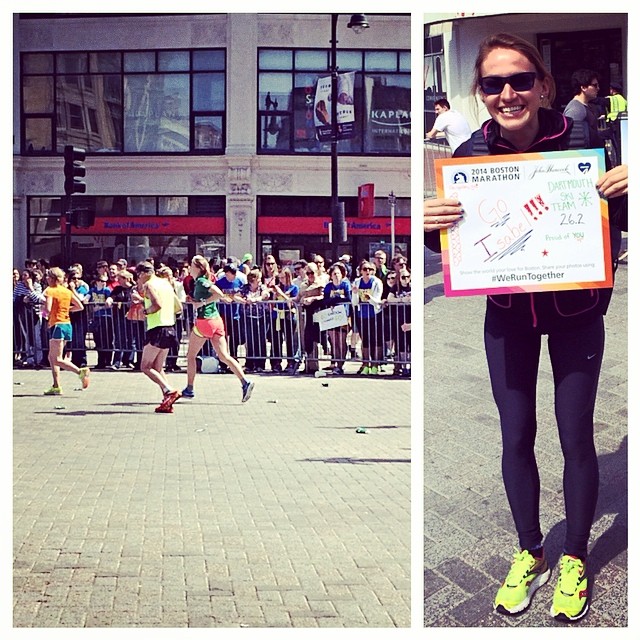
    Isabel Caldwell nears the finish of the 2014 Boston Marathon on Monday while Sophie Caldwell (r) cheers her on. (Photo: Sophie Caldwell/Twitter)
    Isabel Caldwell nears the finish of the 2014 Boston Marathon on Monday while Sophie Caldwell (r) cheers her on. (Photo: Sophie Caldwell/Instagram)

    Two days after nearly 36,000 people ran that Boston Marathon on Monday, we’re willing to bet there are more than a couple still feeling the pain of the 26.2-mile run from Hopkinton, Mass., to Boston.

    Isabel Caldwell, a former Dartmouth and Stratton skier and the younger sis of U.S. Ski Team member Sophie Caldwell, was one of them, but she didn’t feel as sore as she expected.

    “My marathon went pretty well … I hadn’t done a whole lot of running before so I wasn’t expecting too much but I finished and had fun so it was a good day,” she wrote in an email. “The race experience was pretty amazing. There were so many people. I think I ended up finishing about halfway through the second wave of runners so I was surrounded by other runners the entire time. The sides of the course were also covered in spectators. It seemed like everyone was doing it for a greater cause this year, there were Boston Strong posters everywhere and all of the spectators and runners seemed very determined to make it the best Boston ever.”

    We asked her what you do in the day (or two or three) after to relieve soreness in the legs and stiffness in other parts of the body. She wasn’t as sore as she was when she ran the Burlington Marathon in Vermont last year.

    “I think difference is that last year at Burlington it was about 40 degrees and raining so as soon as I finished I got cold and my muscles seized up and I didn’t want to walk anywhere,” she explained. “For about a week afterwards I had horribly sore legs.”

    Monday was warmer — upwards of 60 degrees by the finish — and Caldwell wrote that she had to walk a couple of miles to the subway, “which felt horrible at the time but was probably good for my recovery.”

    Tuesday, she tried to stay off her feet.

    “I have a lot of blisters, but I may try to roll out a little bit,” she wrote. “I probably won’t train for a few days and maybe just do a couple of bike rides later in the week.”

    Her sister, Sophie, cheered her on near the finish. Definitely inspired to run a marathon someday, she wrote in an email that she’ll probably wait until after she’s done skiing professionally to avoid injury.

    But the 2014 Olympian does know a lot about taking care of yourself after any race — especially endurance events.

    No. 1: Fuel Properly

    “Even though you might not have much of an appetite, eating and drinking enough would be really important,” Sophie wrote. “It’s probably also important to move a little so you don’t get too stiff and tight and then maybe an ice bath if you dare (I don’t).

    No. 2: Accept and Minimize the Burn

    “I think getting sore is inevitable, but there are definitely ways to make it less miserable! I was giving Isabel piggy back rides today, so I’m not sure she did the greatest job with recovery! In her defense, she had to sit in the car for four hours to drive back to Hanover.”

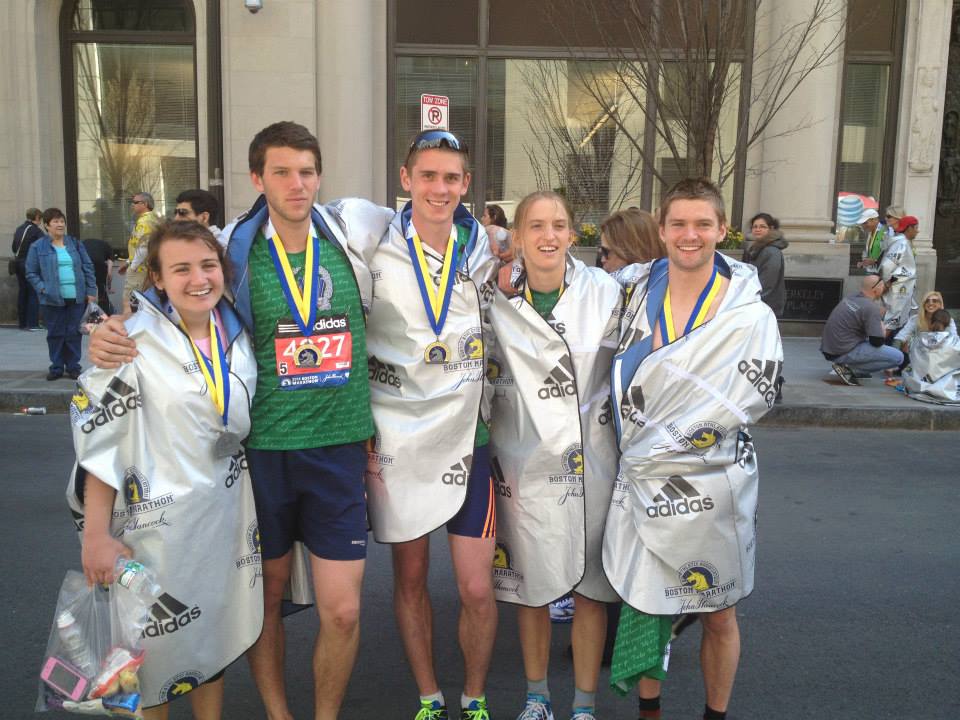
    Isabel Caldwell and others in the Dartmouth crew who ran the 2014 Boston Marathon. (From left to right: Caitie Meyer, Oscar Friedman, Erik Fagerstrom, Isabel Caldwell, David Sinclair. Not pictured: Annie Hart) (Photo: Nancy Seem)
    Isabel Caldwell and others in the Dartmouth crew who ran the 2014 Boston Marathon. (From left to right: Caitie Meyer, Oscar Friedman, Erik Fagerstrom, Isabel Caldwell, David Sinclair. Not pictured: Annie Hart) (Photo: Nancy Seem)
  • The View From the Front of the Boston Marathon

    The View From the Front of the Boston Marathon

    Glenn Randall competing in the Boston Marathon last Monday. Courtesy photo.

    Even if you’re not a running fan, chances are you heard that former Dartmouth College standout Glenn Randall led the opening 10 k of the Boston Marathon last Monday. Actually, ‘led’ doesn’t quite describe it — he gapped the elite men’s field, confounding TV announcers and sending the running sector of the blogo-twittersphere into a frenzy.

    To those who had never heard of Randall, it looked as though he was trying to grab a few minutes of fame with an opening pace he couldn’t hold. But as he explained in a blog post recapping the race, the pace he began with was actually slower than he’d intended.

    Just before the pack caught him, Randall started having cramping issues. He ended up fading in the 80-degree heat to 60th place, finishing in 2:37:13.

    We figured the gutsy performance was reason enough to check in with Coloradoan. The last time we did so, he was about to run his debut marathon in Chicago and the future of his ski career was in flux. He ran a 2:20:40 in Chicago, which was close enough to the 2:19 Olympic Trials qualifying time that he decided to give it one more go in Las Vegas last December.

    Las Vegas didn’t pan out, but Randall has since decided to hang up his skis in order to pursue running full-time. On Friday he gave us a phone interview to talk about what happened in Boston, his racing style, and the transition away from skiing.

    First things first: Boston.

    FasterSkier: I’ve read your blog and know it didn’t turn out the way you’d hoped, but what were your expectations headed into the race? Did you expect to be leading the first 10 k?

    Glenn Randall: I went into it looking to have a good race, and wherever that put me was where I was going to be.

    I knew it was a possibility that I would be leading early on. I talked to a lot of people [beforehand] and everyone said that in Boston, you go in preparing for the uphills but it’s the downhills that kill you. So I did a lot of downhill work and got to the point where I was confident I could run pretty fast downhill putting forth zero effort. If you do downhills too fast it can take it out of your legs, and I knew where that threshold was for me.

    I also knew a lot of times people don’t push those early downhills at all; they hold back because they’re worried. I went into it knowing there was a slim chance I could lead early, and my thought was that the lead group would catch me on the flats but I would be going my own pace… before I had to deal with whatever anyone else was doing.

    So, I ended up going slower than I’d prepared for the first couple (mostly downhill) miles. I was going about 4:50 per mile pace, and I’m capable of about 10-15 seconds per mile faster without taking too much out of my legs. I was holding back because I was nervous about the heat and didn’t want to go blasting out faster than I was capable of going.

    A screenshot from the opening miles of Universal Sports' broadcast of Boston.

    FS: Were you aware of the distance you’d put on the main pack?

    GR: I don’t look back [but] I could tell they were no longer within earshot. I had some friends in town and could hear them cheering — that was one way I could tell how far behind me people were.

    FS: You said you didn’t seem too worried about putting that kind of distance on the best marathoners in the world.

    GR: Yeah, I felt good. On top of that, if I go into the race completely terrified of them, I’m not going to have the best race I can have.

    FS: What happened after the pack caught you?

    GR: I’ve spent a lot of time thinking about what went wrong. It started with stomach cramps and moved from there. Heat was a part of it, and because it was so hot I was maybe over-hydrating before and during the race.

    I’ve looked at the things that held me back, and will try to make sure I don’t make the same mistakes in the future.

    As far as going out like that goes, when it comes to big races, I go out there racing like I’m going to have a good race. Because frankly, the difference between having a kind-of bad race and a really bad race — it may seem like a lot, but functionally it’s the same for me. So if I just go out and assume I’m going to have an awesome race, until I knew differently I feel like in the long term it’s going to help me out.

    When people conserve, they’re looking to have a kick, and that’s not something I do. But a lot of people go out there and take big risks. Right before the race I saw Joan Benoit Samuelson, and it was pretty inspiring. She’s an icon in American marathoning, and if you know her story, everyone expected [the 1984 Olympic marathon] to come down to Grete Waitz and Ingrid Kristiansen. Joan was kind of injured, so no one thought she’d be a factor. It was hot, and she went out pretty fast from the get-go, but nobody went with her because everyone thought she’d be coming back. She ended up holding on for the win.

    FS: How do you feel about your start now?

    GR: I don’t have any regrets about the whole thing. The things that went wrong would have gone wrong if I’d gone out at a conservative pace. I went out there, tried to have a great race, and it didn’t happen. But I was going to have those problems regardless, I think.

    I was still trying to race at the end — when people passed me I’d try to go with them — but it was a rough day.

    (In the 80-degree Boston heat, a lot of people had a rough day. B.A.A. was so “worried about someone dying on them out there” that it encouraged less experienced runners to sit out the race by allowing competitors to defer their entry to 2013. About 4,000 entrants failed to start, but even so, over 100 people ended up in the hospital afterwards to be treated for dehydration or heat exhaustion.)

    FS: What do you think of the internet discussion that’s been going on about you?

    GR: I haven’t read it, and it doesn’t bother me at all. Those who mind don’t matter and those who matter don’t mind.

    I’ve had a lot of Dartmouth alumni contact me, and they all know I wasn’t trying some stunt. They’ve commended me on the fact that I actually had the guts to go out there and do that.

    FS: Moving away from Boston — you’re clearly a full-time runner now, but last we talked you still thought you might keep skiing. When did you make that decision?

    GR: It dawned on me that I was supporting a pro ski career with a pro running career. And on top of that, sometimes it seemed like it was not meant to be. The way that last season was, I looked at it and said, ‘Wow, I’m not sure if this is what I’m supposed to be doing.’ I’d get sick at an inopportune time, and we got in a van accident on the way to a race I was confident in. It seemed like things were just going wrong, and it made me wonder if that was just the universe’s way of telling me, ‘You’ve had a great run at it; move on and find something else to excel at.’

    After Chicago, I realized I’d been close to making the Olympic Trials, and I made a lot of mistakes at Chicago, just a huge number, so I thought I had the ability to do better. I had a couple more months in the Trials window, so I just put everything into that. It didn’t end up happening, but last summer I also discovered the mountain running scene, and I’m really looking forward to a great summer of mountain running.

    FS: The pro skiing options in the U.S. are pretty limited: there’s the SuperTour, and maybe a few marathons. Running’s a much bigger, better-supported sport. Did that factor into the switch?

    GR: That’s definitely a part of it. On the SuperTour, if you’re trying to make money off of it, it’s easier said than done. You’re trying to break even, and everyone showing up is looking for that prize money. So the reality is, it doesn’t work out all that well.

    With running [for example], Boston gave me a free entry. The race in Switzerland I’m going to, from the time I show up until after the race is over, I have free room and board for the entire week. Last year they paid me to run the race, plus there was prize money. It’s much easier to actually make ends meet.

    FS: What races have you got lined up next?

    GR: Mt. Washington, and then the race in Switzerland in August. If I’m top-six at Mt. Washington, I’m racing in the World Mountain Running Championships in Italy.