Tag: Bosu

  • Wednesday Workout: Killer Ski-Specific Strength with the HardCore Training Center

    Wednesday Workout: Killer Ski-Specific Strength with the HardCore Training Center

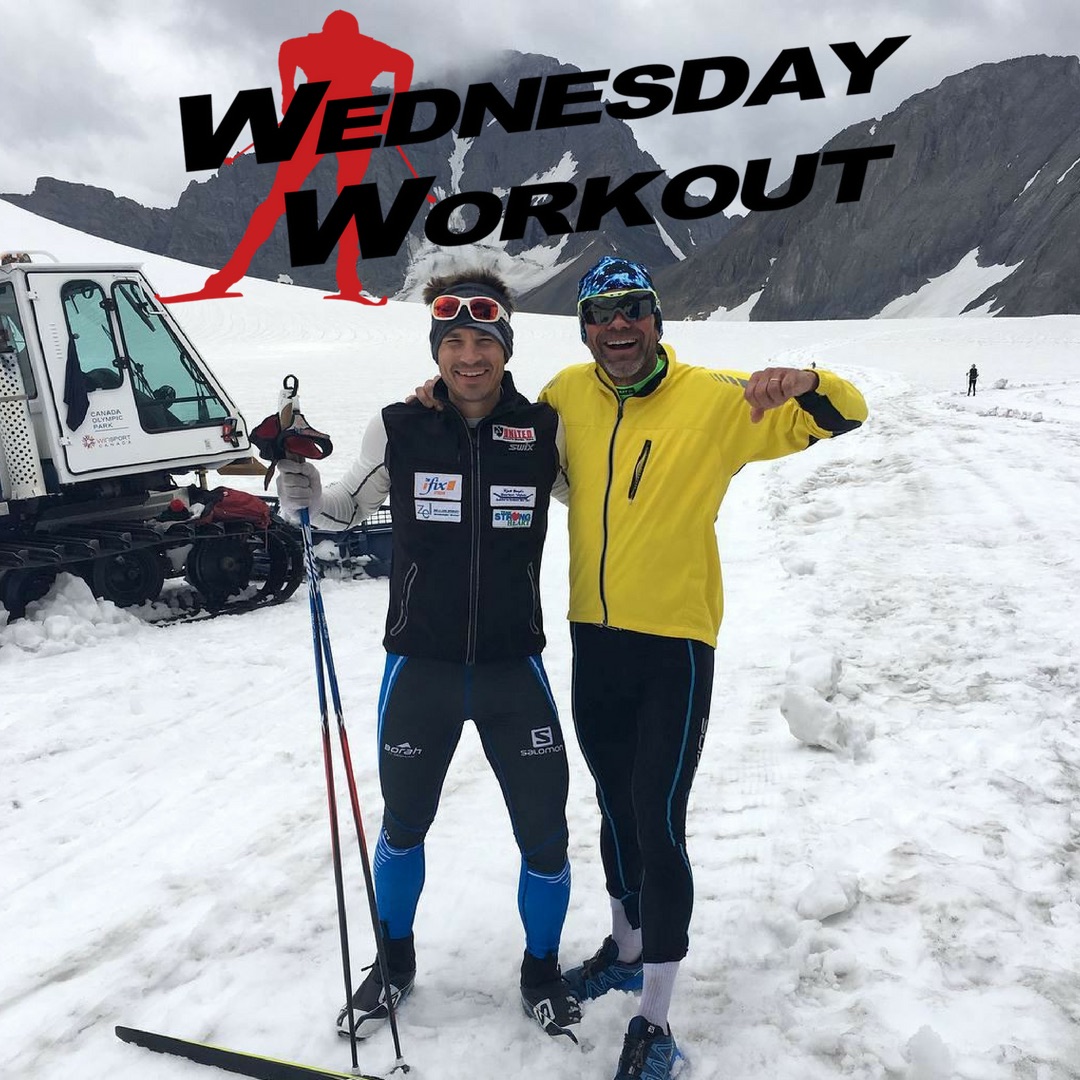
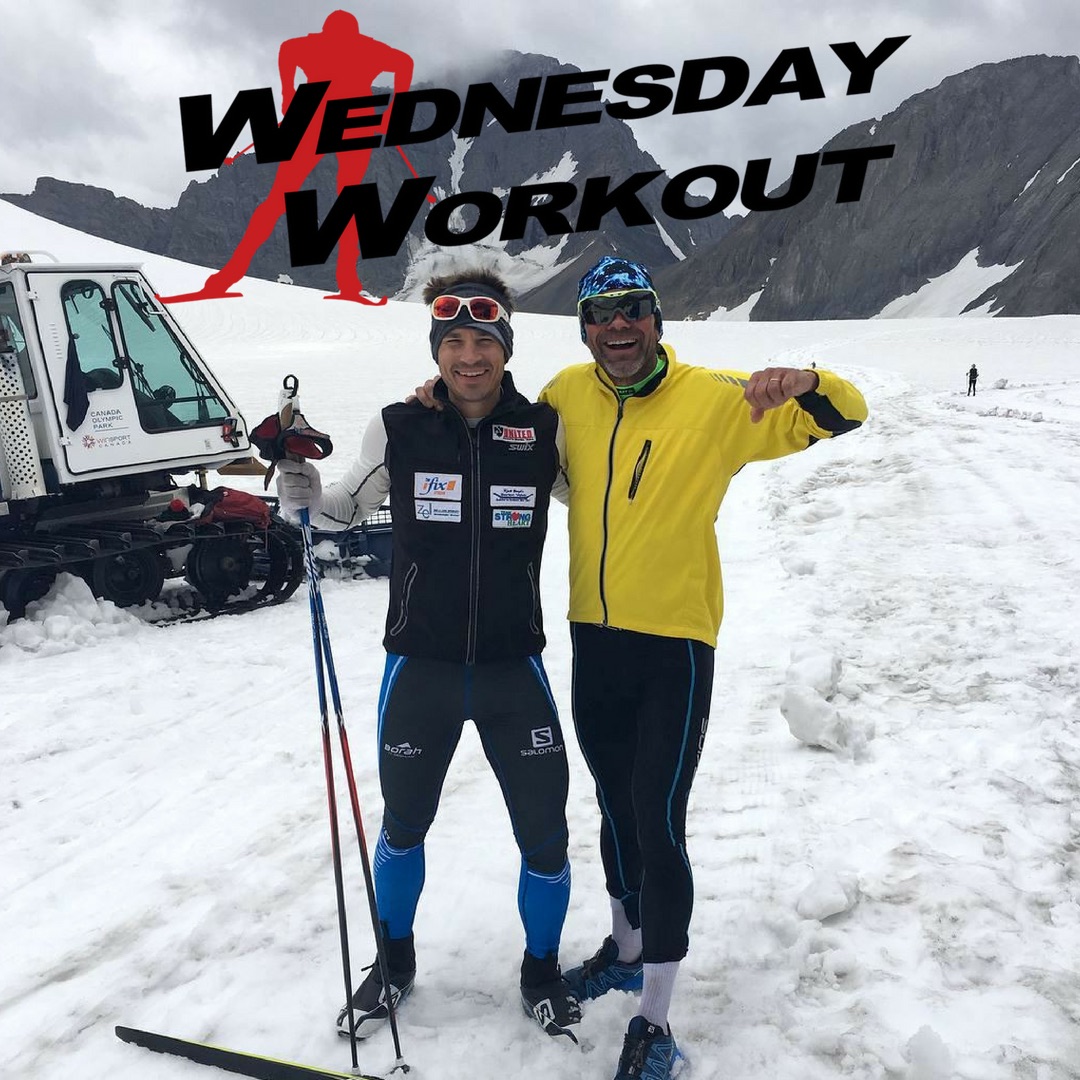
    Author Bill Nurge and Matt Liebsch (l) on the Haig Glacier near Canmore, Alberta, last August. (All photos: Bill Nurge)

    This week’s workout comes from Bill Nurge, head coach and owner of the HardCore Training Center in Ketchum, Idaho, who has a master’s degree in exercise physiology. Starting July 28, Nurge and Matt Liebsch will be serving up a week of nordic-specific fitness training and technique work at the Sun Valley Nordic Fitness Academy. With a maximum of only 12 participants, they recommend signing up early. Click on this link for more information.

    ***

    You can blame Matt Liebsch for this workout … and for making me a better skier!

    Last August, my wife and I joined Coach Matt, and 25 other nordic tribe-mates, on the Haig Glacier for what turned out to be a bucket-list topper in every regard. One of the biggest takeaways from skating a dozen hours behind the terminally affable Birkie winner and World Cup skier was how annoyingly powerful and stable he is on one ski. Whether he was single-ski double poling up a hill, or gliding effortlessly on a long descent, he was always solid and skilled while perched atop a single Salomon S/Lab skate ski.  As much as I’d like to blame the fact that I didn’t start skiing until I was almost 30, and my equipment wasn’t as good (Matt promptly set me up with shorter poles, better boots, and hand-picked stable skis), the stark reality was simple: Matt possessed more power, greater dynamic stability, and better balance than I did.

    So once my 56-year-old brain got over being tweaked by my body’s inability to match his single-ski prowess, I set to work on developing a program to take my balance, core stability and functional power to a higher level. And the best part is that it worked! Prior to consistently performing the workout I’m about to share with you, my posture, balance, and power output would predictably spiral downward halfway into a 50k skate race. But this past March, I was able to string together two of my best back to back 50 k’s (10th overall at the West Yellowstone Rendezvous; 4th overall at the Cascade Crest Marathon) with no appreciable diminution in performance.

    It’s no secret that nordic skiing — particularly skating — is a single-leg sport. Unless you’re double poling or flying downhill in a tuck, the vast majority of time is spent balancing and producing “ground force” with one ski, and one or two poles. This is why single-leg power, core stability, and balance play such major roles in sustainable speed. Every powerful stride must be accompanied by a dynamic, and sometimes high-speed balancing act requiring huge amounts of stabilization at the hip, knee and ankle joints. In the 2 hours and 15 minutes — of mostly single-leg Pain Cave time — it took me to complete the relatively flat Cascade Crest 50 k in Bend, Oregon, I ended up doing roughly 4,000 V2 strokes on each leg. That’s a lot of time performing single-leg squats with hip abduction and balancing and repeating every second!

    So here’s the deal, most nordic athletes do a great job of cranking out lots of cardio hours, weighted pullups, dips, box jumps, and heavy squats. The problem is that some of the hard-earned endurance and strength will be squandered unless it’s matched with equal amounts of balance and stability training. With regard to function, the muscles of the hip can be separated into two groups: movers and stabilizers. Though they all technically perform both, it’s easier to think of them in these two distinct categories. Because strength and stability are two sides of the same coin, having strong “movers” (lats and glutes) and weak “stabilizers” not only compromises performance, but may contribute to shoulder, lower-back, knee, and ankle injuries. Bottom line: nordic skiers are only as “strong” as their weakest stabilizers. Just like their big-brother primary movers, the myriad behind-the-scenes stabilizer muscles need strength, stamina, power, AND intelligence to do their “balancing act” effectively. No stability, no balance, no fun.

    Here are five pairs of exercises you can add to your existing program to help improve single-leg balance and functional power (with links to demo videos):

    The Workout: Nordic-specific exercises to improve balance, core stability and functional power

    Warmup: About 20 minutes

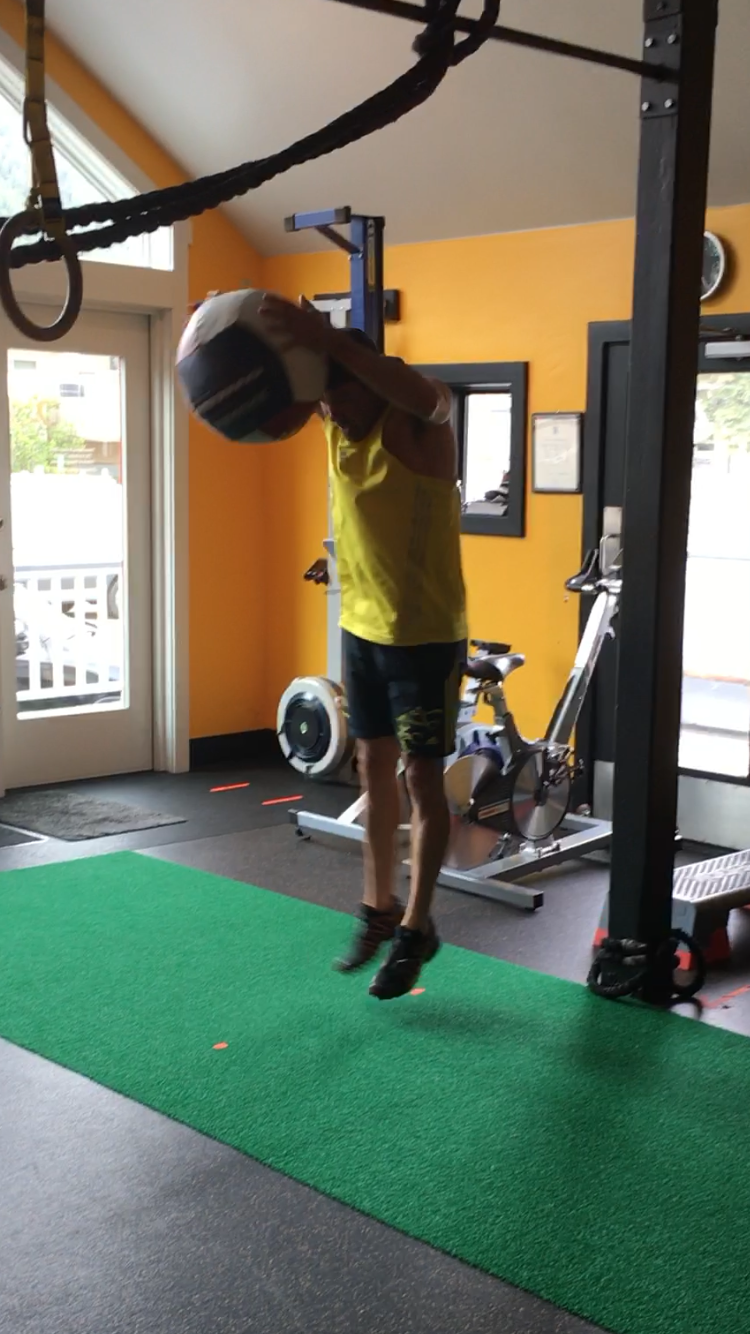
    Before getting into high-intensity unilateral exercises, it’s always best to do a progressive and comprehensive warmup. I like to start with 2 minutes of Level 1-2 cardio on the AirDyne standingtreadmill forward run with pulsers, and SkiErg double-poling. I would then recommend doing 60 seconds of alternating single-leg squat dipsalternating side-skip med-ball slams, and alternating split-squat rope pulls.

    Then do a second set of 2 minutes of Level 2 cardio standing on the AirDyne, all directions on treadmill, and V2 on the SkiErg. Follow this up with 80 seconds of alternating dips, side-skip slams, and lateral skip rope pulls.

    Finally, a third set of 2 minutes alternating 10 seconds easy/10 seconds “harder” on AirDyne (hands on rings pulsing up and down), treadmill (forward only), and SkiErg V2 with jump, followed up by 90 seconds of tuck-jump dips, single-leg BOSU hop rope pulls, and side-skip slams.
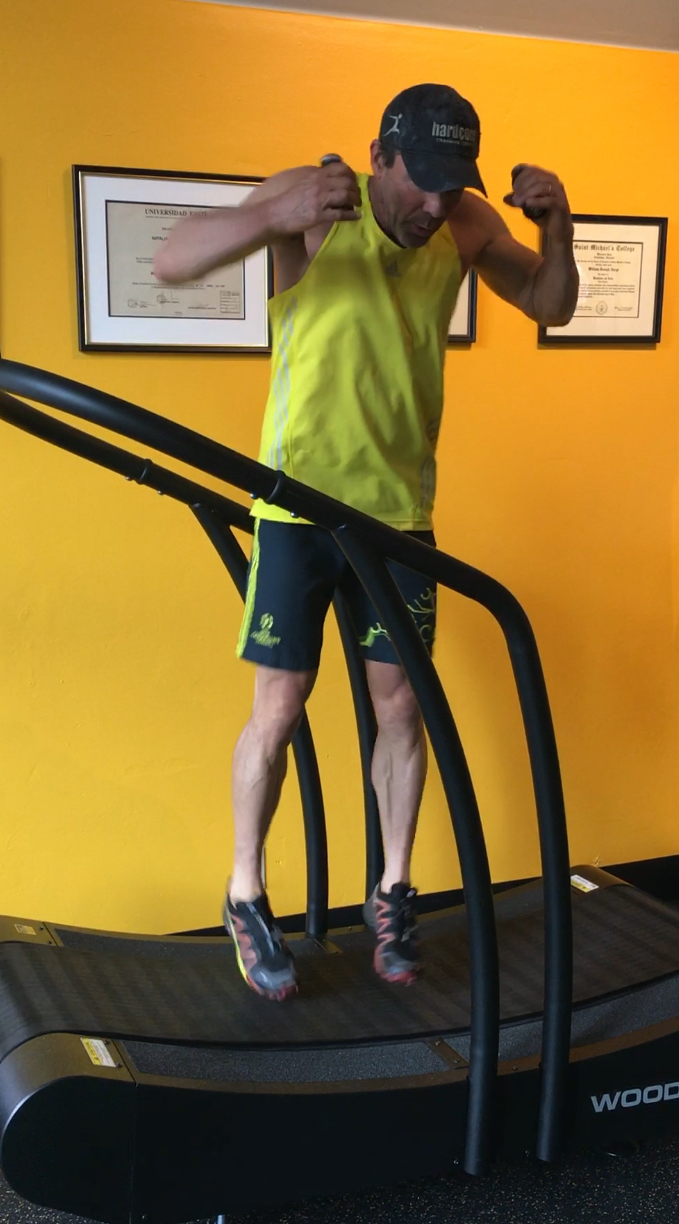
    Side-skip on the treadmill with pulsers
    Side-skip slams

    Paired Exercises: About 25 minutes for one set of each

    For each of the paired exercises, I would recommend starting with a medium-hard 60-second first set with 30 seconds rest between each leg, and no rest between pairs. Note that on all but the first set you will be performing each of the paired exercises on the dominant leg first (left leg for most right handers), and then the non-dominant leg. I like to have the less coordinated/“weaker” leg follow the lead and learn from the smarter/stronger leg.

    So for example you would do (#2a) left-leg inverted SkiErg step ups, immediately followed by (#2b) left-leg single-leg slideboard double pole. After 30 seconds of rest, switch to the right leg of the same exercises. Then move on immediately to the next (#3) set. Try to build into each set and maintain form as you get fatigued. The demo videos are very helpful in showing proper form and body position.

    Performing one set of the 5 pairs equals 8 minutes (not counting the first pair which alternates legs) of total time-under-tension for each leg: roughly a hilly 10 k’s worth of single-leg balance for an elite skate-skier. After several weeks of this twice-weekly regimen you can add a second, more aggressive 75-second set of each exercise. This would amount to about 18 minutes of overload on each leg plus up to about 4 minutes of sandbag push and hip bridge swings. Total workout time (including 20 minute warmup) is approximately 1 hour.

    1) a. Sandbag Push: The key on this brutally effective, anterior-core exercise is to push the bag — or something heavy that slides — with your body, not your arm. Use your legs and side-flexion muscles to “shove” the bag forward. It should be heavy enough that you can’t push it with your arm alone. If you have a strong core you can do this exercise for two minutes alternating arms and directions. Make sure your push arm is on the same side as your lead leg.

    b. Hip Bridge Monkey Swings: This is essentially a dynamic hip bridge with isometric abduction, and posterior chain muscle tension. Keep the hips up, knees pushing “out” against the rubber band, and arms bent at 90 degrees. This can also be done — without the swinging — on a single TRX strap in single-handle mode walking your feet forward and backward. This exercise can be performed for up to two minutes.

    2) a. Inverted SkiErg Step Ups: The flywheel resistance provides a uniquely effective eccentric overload to the quads, hip extensors and lower back. This can also be done with weights or a heavy rubber band. The key is to use only the upper/loaded leg to pulse aggressively out of the bottom position. Use a cadence of about 60 strokes/minute and pause/glide for half a second at the top of each rep.
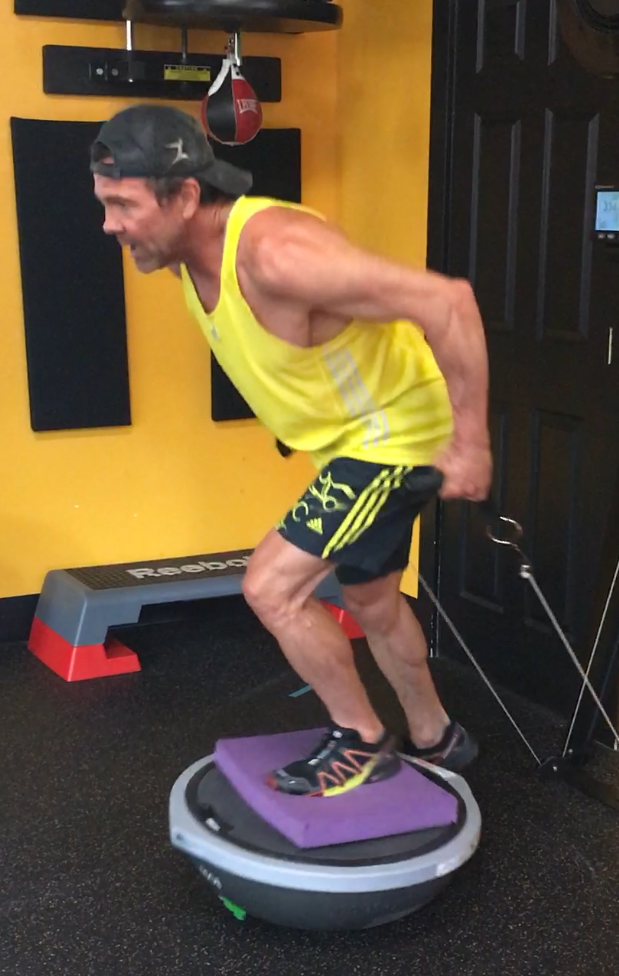
    Single-leg step ups with flywheel resistance

    b. Single-leg slideboard double-pole hops: Your primary hip-and-knee movers — quad and glute — should feel like they just did a breakaway on a big climb, but you still need your stabilizers to negotiate the technical downhill to the finish! While maintaining constant tension on the poling muscles you can hop or pull yourself up the slideboard and then allow yourself to glide backwards resulting in a big eccentric hit on the double-pole initiators. This can also be done using a TRX strap and performing partial pistol-squat pull-ups; although it’s not as intense on the balance muscles.
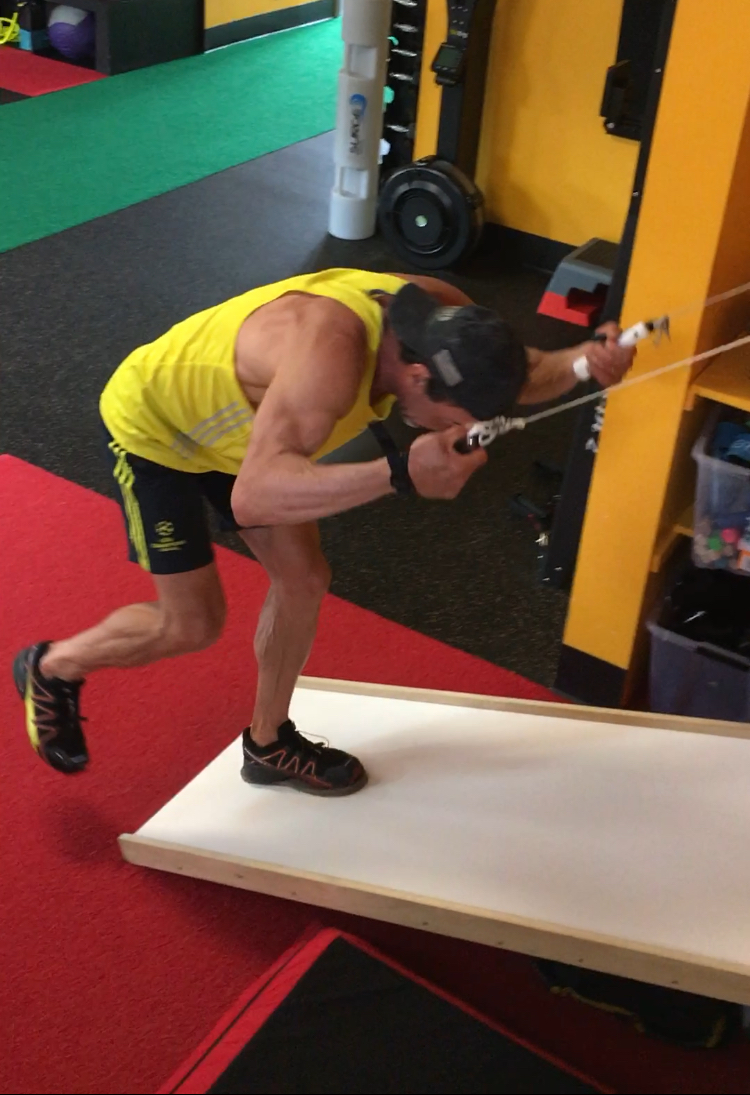
    Single-leg double-pole on sideboard

    3) a. Single-leg squat jump double pullup: The key on this exercise is start with a 90-degree knee-angle and no countermovement. Explode up and do one pullup while touching foot to bar, and then as quickly as possible do a halfway down pullup and repeat as quickly as possible. High-tempo partial range of motion/upper-half pullups are more nordic-specific because of the shoulder-joint angle and eccentric loading.

    b. Single-leg stomps on BOSU with high-tempo SkiErg double pole: Now that your big primary poling and leg muscles are hammered, similar to the end or a race, you have to sprint and produce lots of “ground force” with the tired arms and leg. Keep the cadence high (80-90 spm), stomp your foot on the BOSU, and sprint for the finish!
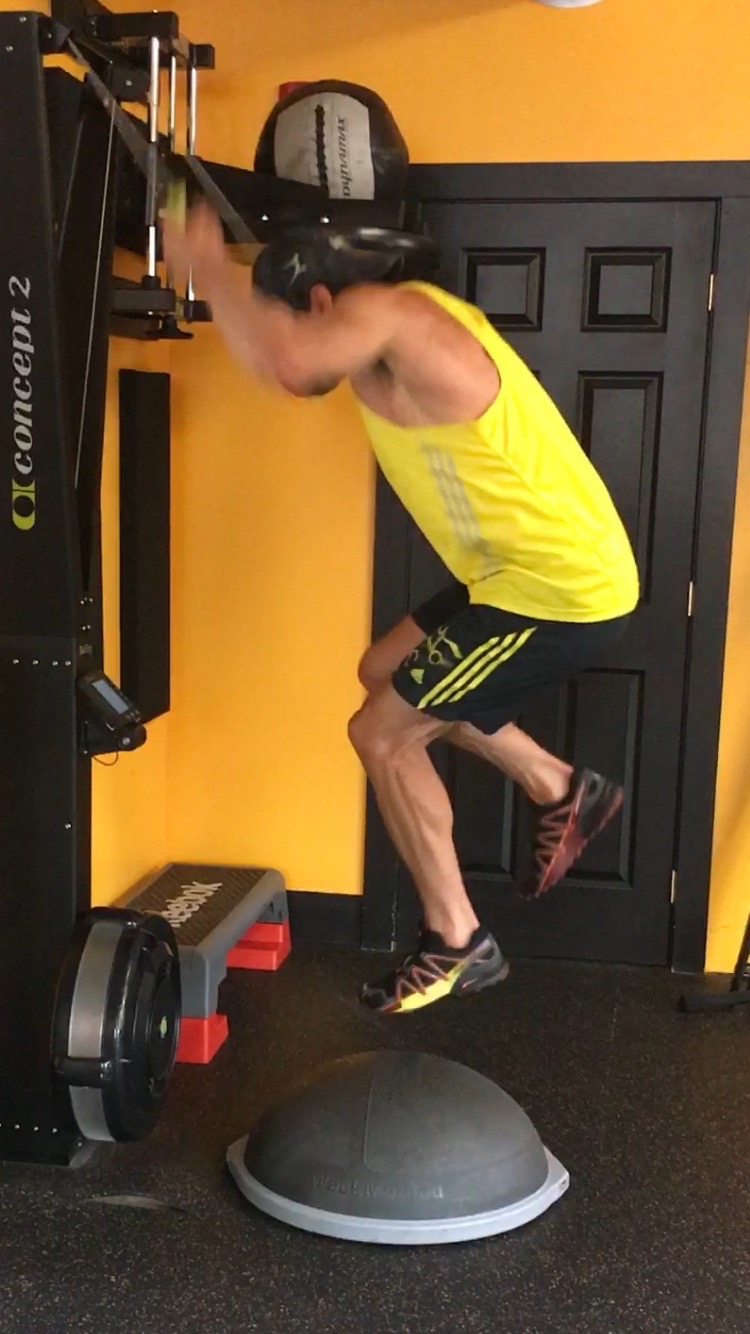
    Single-leg stomps on Bosu with SkiErg double-pole

    4) a. Single-leg TRX squats with arm extensions: Get in a position where you’re maximally dorsi-flexed at the ankle and the triceps are loaded. Perform about 1 rep per second with the arms extending only two-thirds of the way out (just like most of your V2 poling strokes). Make sure your hands go fully behind your head on every rep and you’ve got heavy tension on your triceps.

    b. Single-leg BOSU squats holding front-plank on slideboard: With your triceps dynamically fatigued this exercise will take them even deeper isometrically and help build integrity at  the “bottom” of their functional range of motion. Maintain anterior core and tricep tension the entire time you’re single-leg squatting and pulling yourself backwards with the hip flexors. This can also be performed on the floor with sliders.

    5) a. Single-leg ball bounce on Slackline: Having the slack line inclined simulates an uphill ski and forces more pressure on the ball of the foot resulting in ankle flexion. Hold off on actually throwing the balls until your able to balance for at least 30 seconds without falling. You want to get to the point where you can get 20-30 ball tosses in a minute without tipping over. This exercise can also be done on a balance disc; but it doesn’t feel the same as a skinny ski.

    b. Single-leg push and slide on zipline TRX strap: With your stabilizers statically fatigued, now it’s time to see how they perform dynamically … Pushing and gliding in a forward-leaning, front-plank position simulates the start position of most nordic strokes. Make sure you have vertical-hip displacement and are head over foot on every rep. This can also be done without the “zipline” (a ceiling-mounted track with a chain hanging down from it and a Core Flyte Dynamic Stability Trainer under your foot) but it’s not as FUNctional 🙂

    So there you have it … Try to hit the unilateral balance work 1-2 times/week and you should find yourself feeling significantly more solid and confident in your ability to powerfully push, and effortlessly glide!

    ***
  • Wednesday Workout: APU’s Chelsea Holmes Breaks Down Strength Training

    Wednesday Workout: APU’s Chelsea Holmes Breaks Down Strength Training

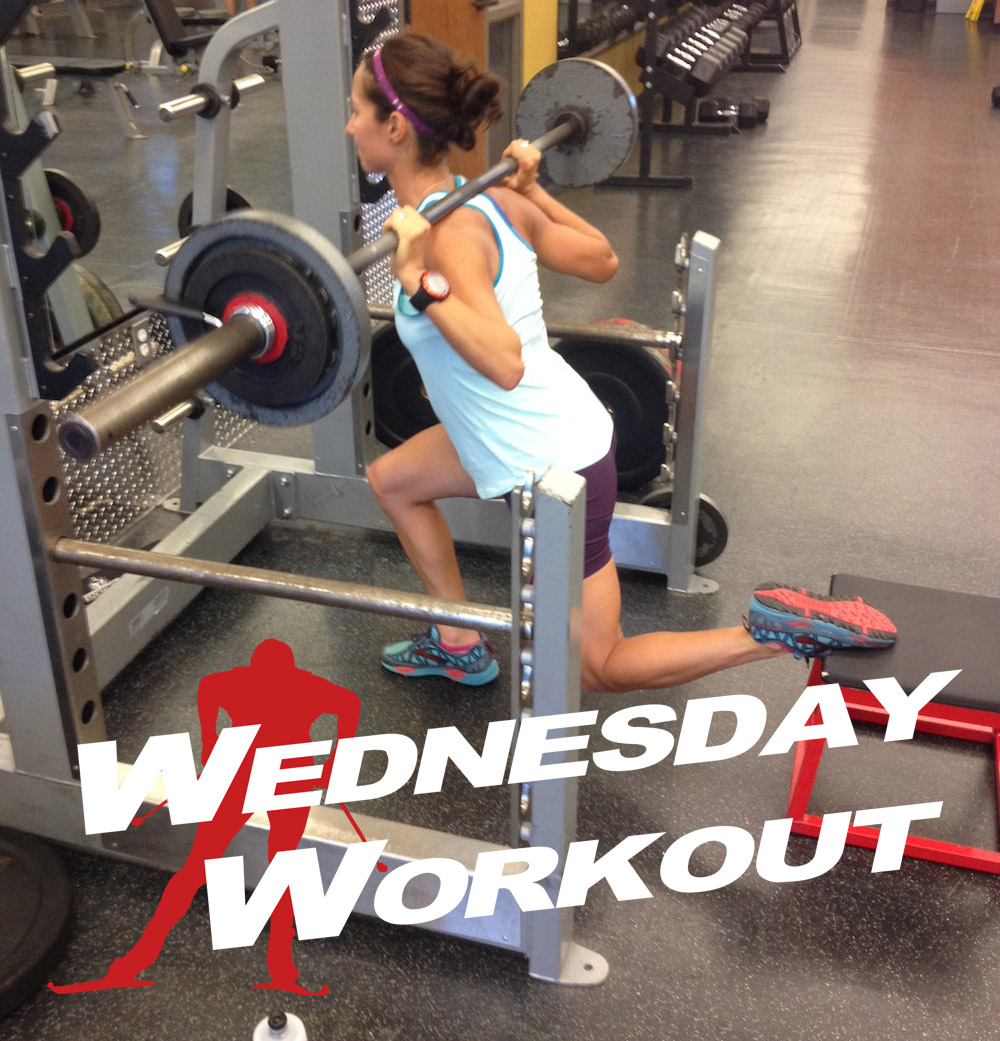
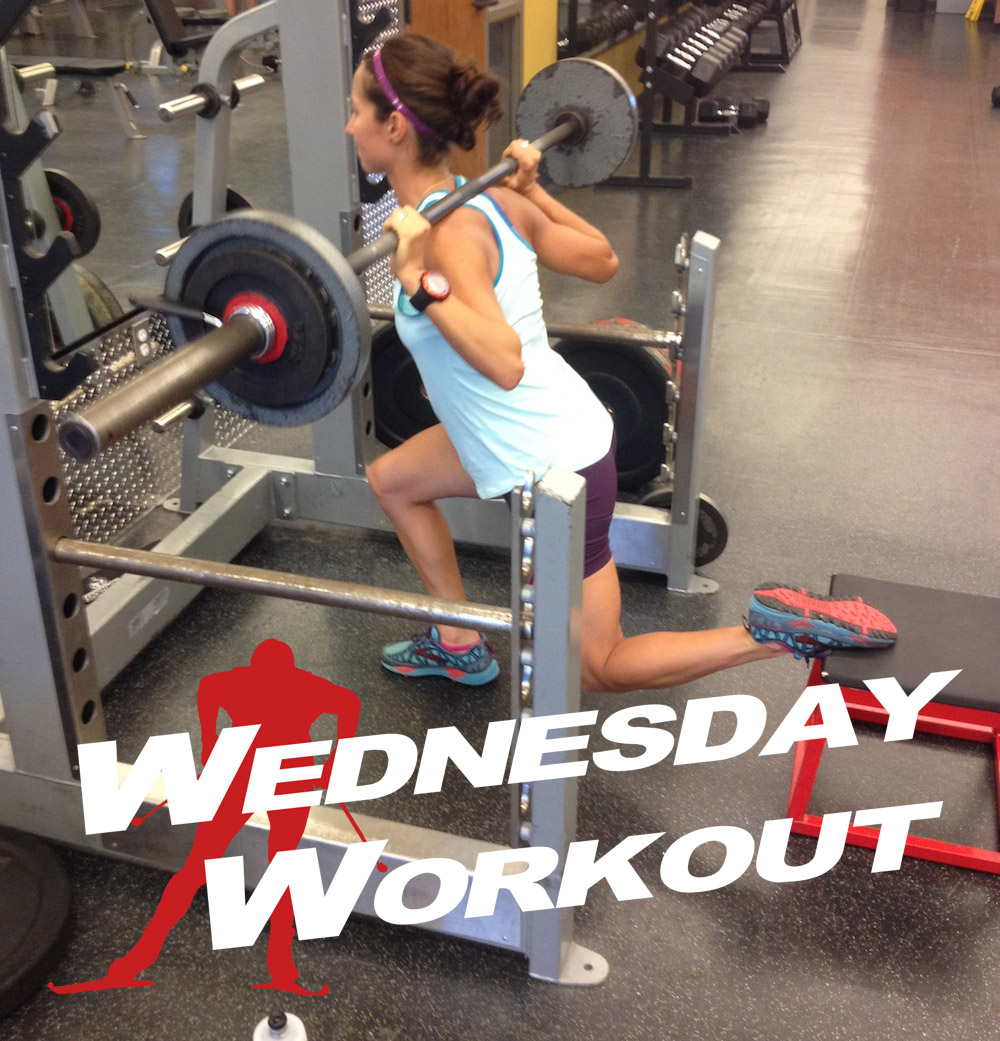
    Chelsea Holmes performs a single-leg squat with her back foot on a plyo box. (All photos courtesy of Chelsea Holmes)
    Chelsea Holmes performs a single-leg squat with her back foot on a plyo box. (All photos courtesy of Chelsea Holmes)

    This week’s workout comes from Chelsea Holmes, who recently joined the Alaska Pacific University (APU) Elite Nordic Team after three seasons with the Sun Valley Ski Education Foundation in Sun Valley, Idaho. Originally from Girdwood, Alaska, Holmes, 27, returned to her hometown glacier earlier this summer as one of 14 of women with the North American Women’s Training Alliance — a U.S. Ski Team camp held annually in Anchorage and on Eagle Glacier. Below she gives a detailed explanation of what she does to build strength and work on her weaknesses.

    ***

    My Strengths (and many weaknesses)!

    Strength training should be an important staple in every endurance athlete’s regimen. It is important to note that the weight, duration, number of repetitions and sets are all individual and should be catered around the individual’s experience, age, and training plan. The quality of technique should be priority, and only when comfortable and confident in an exercise should an individual attempt maximal exercises.  Additionally it is recommended to have a partner to spot and assist in these exercises.

    My strength sessions often address numerous muscle groups and modes of training and development within a single session. This is due to the irregular and intense nature of cross-country ski training and the time constraints in a week.

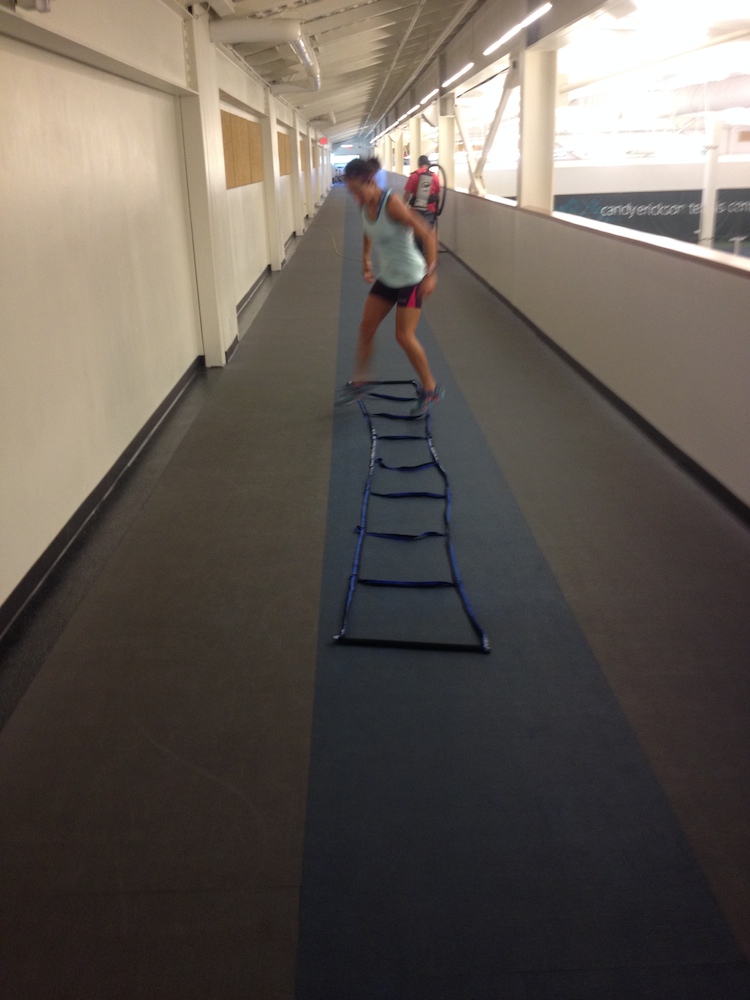
    Chelsea Holmes working on some ladder drills (Courtesy photo)
    Chelsea Holmes working on quickness with some ladder drills (Courtesy photo)

    My current routine includes:

    – Focus: Maximal-strength exercises where the load is high and the repetitions are low.

    – Quickness (often incorporated into my warmup): I like to spend some time during the workout doing either drills on a speed ladder (shown above) or jump rope. When jump roping, focus on speed and the power coming from your calves. Try 30 on both legs before moving to 15 per single leg.

    Single-leg squats (All photos courtesy of Chelsea Holmes)
    Single-leg squats with back leg on floor, back toes pointing down

    What: Single-Leg Squats

    Position: In a standard-squat rack, put a reasonable weight on the squat bar. Lift the weight and once set and balanced, place one foot back behind you on a low stand with your foot perpendicular to the floor (useful tools: plyo boxes, stools), or, as shown at right, just place your back leg on the floor with your toe facing down. While keeping your front knee inline over your toe (no twisting or caving medially) perform a squat motion. Switch sides!

    The front leg should be the source of power, felt in the quadriceps, hamstring and gluteus. The back leg is there only for stability and balance. This should be felt in the quadriceps, hamstring, and gluteus. If you feel the need to use your back leg when powering up, go down in weight. Do not bend forward at the waist, or try to lift with your back.  Your core acts as a stabilizer here.

    Why: I have been using single-leg exercise because in the past I have noticed a personal tendency to favor a leg and compensate. I also use the single-leg squat as it should stimulate the intrinsic muscles as there is a balance component to the exercise. Maximal exercises develop the time to peak force, efficiency and maximal power.

    Note: After comfort and proficiency have been developed, try to superset this exercise. I will sometimes perform a set of 6-8 jumps (high jumps onto a plyo box, tuck jumps or skate jumps) directly after each set.

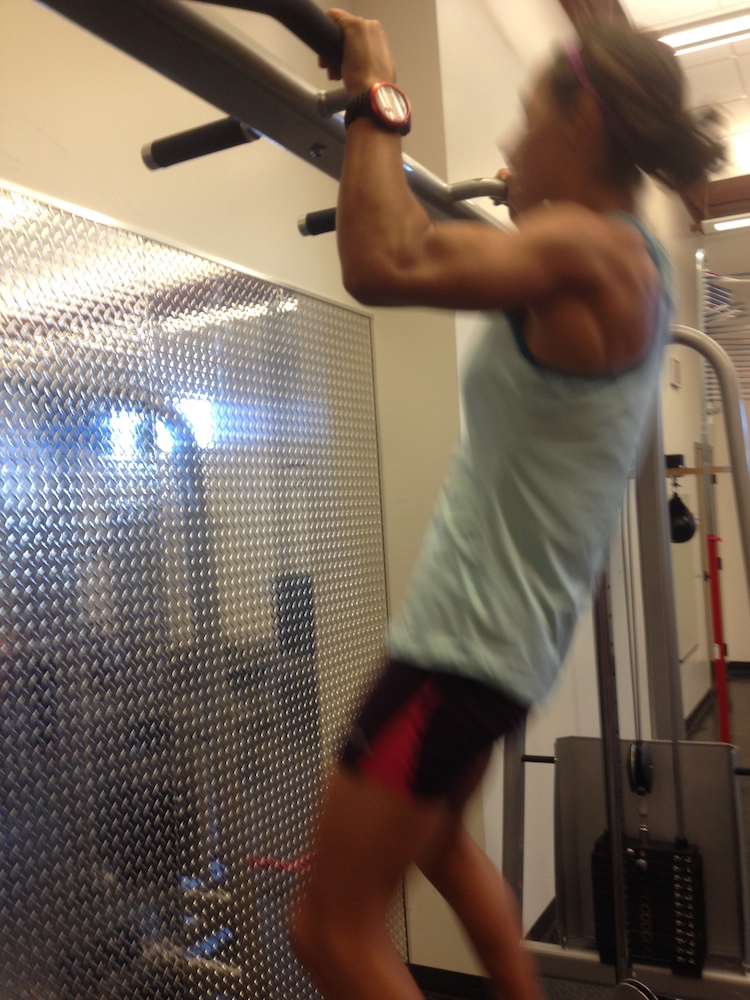
    Chelsea Holmes demonstrates a standard pull-up.
    Chelsea Holmes demonstrates a standard pull-up.

    What: Pull-Ups

    Position: A standard pull-up (shown above). The important cues to note in this exercise are full range of motion, a wide enough hand position that you are engaging your latissimus fully and minimal swing.  I most often use an overhand grip.

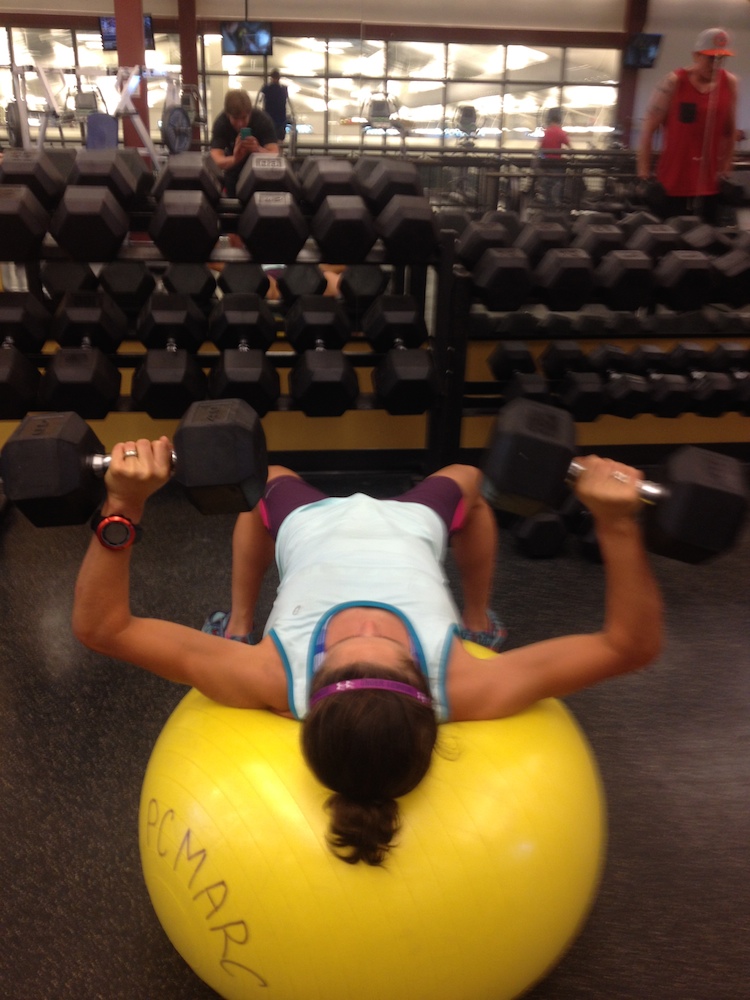
    Dumbbell press on a Swiss ball, as demonstrated by Chelsea Holmes
    Dumbbell press on a Swiss ball, as demonstrated by Chelsea Holmes

    What: Dumbbell Press on Swiss Ball

    This is a simple a bench press (shown above), only using dumbbells and instead of laying on a bench you are supported by laying with your upper back centered on a Swiss ball and feet planted in a stable position. From a sitting position on the Swiss ball, roll yourself forward on the ball so that the ball is centered underneath your upper back with your feet planted firmly and your core held in a plank position (of course, chest face up here!), perform a standard press.

    Why: There is so much focus on posterior exercises in skiing that it is important to ensure a balanced body.  I like the addition of a swiss ball because it adds a component of balance and core.

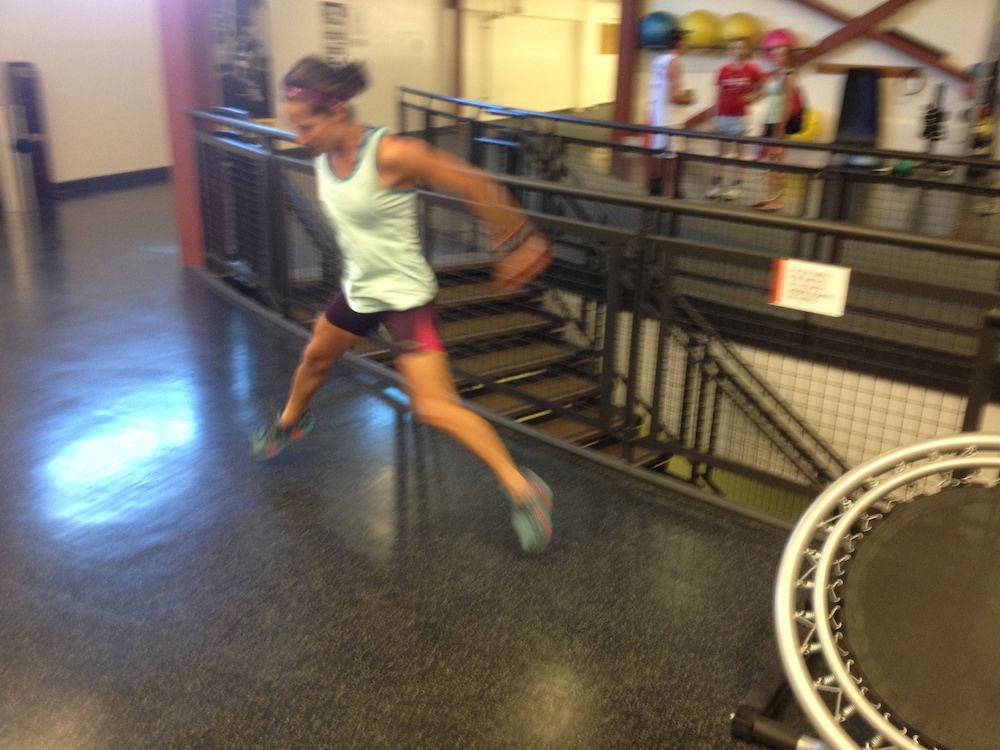
    Skate jumps with Chelsea Holmes
    Skate jumps with Chelsea Holmes

    What: Skate Jumps (above) — a lateral jump focused on developing quickness, power and stability. Do this exercise in front of a mirror to help focus on technique.

    Position: While standing on a single leg sink into the leg before exploding up and over lateral to the opposing leg.  Through the landing on the opposite leg, try to control the forces and stay balanced. Through the landing phase, you should end up in the starting position for the next jump. The jump should come from the forefoot.  Use your upper body mimic a powerful skating motion.

    What: Balance

    1. Single-leg squats on a Bosu ball or instability disk. (If using an instability disk, you might have to place the disk on a small box to allow for the range of motion through the squat.)

    In front of a mirror, stand one footed on a Bosu ball with the platform down. Place the foot, toe slightly turned out, with the ball of the foot being placed on top and in the center of the dome or disk.  Balancing on that foot, slowly perform a squat to a comfortable and stable depth. A broom handle held across the shoulders parallel to the floor can be a useful tool to ensure no twisting or leaning. The focus is balance, so really focus on minimal teetering and extraneous movement. When first beginning these, simply spend a few sessions doing half squats or just practice standing on one leg.

    These are not only great for balance but also the many stabilizer muscles that are extremely important but easy to forget about.  This exercise is great to practice breathing and total focus — it’s easy to get distracted in a busy gym! I prefer to do these in the second half of my workout when my body and mind begin to tire — mind over matter!

    It’s easy to get distracted in a busy gym! I prefer to do [single-leg squats] in the second half of my workout when my body and mind begin to tire — mind over matter!

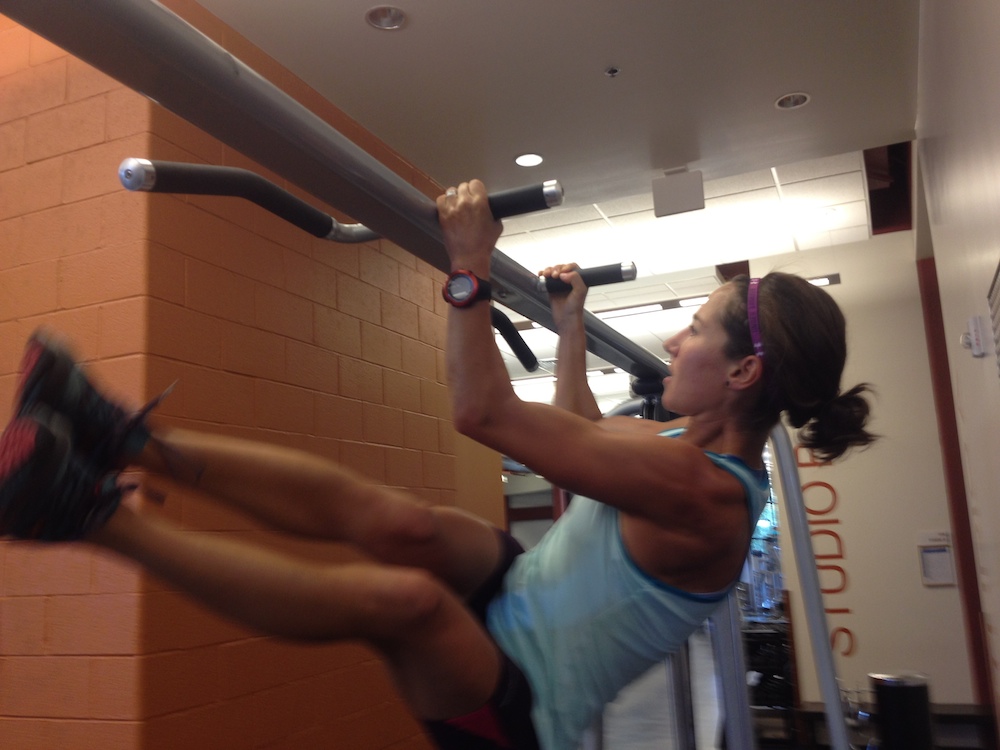
    Chelsea Holmes working on core with a leg raise and twist from the pull-up bar
    Chelsea Holmes finishes up some tough sets while working her core with a hanging twist. “Basically you pull up so that your elbows are at a 90 degree angle and the hold yourself there while bringing your legs up vertically (so that you are somewhat folded in half),” she explained in an email. “Then while holding your core strong you move your legs in a window-wiper motion… Only go so far to one side as you can feel your core then back the other side (so that your toes draw a full rainbow, back and forth, that’s one). I am not as strong, so I try to do 4-5 total.”

    What: Core

    1. Pikes — Either a TRX or a Swiss ball can be used in this situation.

    Position: Place yourself in a plank position with your feet either in the TRX stirrup (toes down) or if using a Swiss ball, place the top of your foot on the ball.  Your hands should be planted beneath your shoulders, palms against the ground and arms straight, similar to a push up position.

    Exercise: Bring your body into a pike position with as little arm and knee bend possible, return to plank, now bring your knees underneath your body, driving the opposing knee to opposing elbow. The knees should bend together and twist so that you feel a rotational core component. To get the most out of this exercise, don’t rush it!  Perform it in a controlled manner and with purpose.

    Why: I really like this exercise because it is full body, and no matter how many times I do it, it is always a challenge.  It has an isometric, concentric and eccentric component. Bang for your buck!

    2. Garhammers (video demo)

    Position: Hang from a pull-up bar with straight legs. Start by bringing you knees up so that your quadriceps are parallel to the ground, this is where the exercise starts and finishes for each repetition. Then drive your knees upwards by rotating your pelvis forward and focusing on your core making that movement.

    Please note, there is not a tremendous range of motion with this exercise. If you feel you are ready for a more advanced version of this exercise, after driving your knees up, straighten your lower legs and lower your legs slowly back to parallel.

    3. Alternating Push-Ups

    I truly despise pushups so I think I gravitated to this style because it is much harder for me than standard push-ups and as such I cannot do as many.  This is not a cop out, these are tough.

    Position: From a standard pushup position, move your right hand back along your body so it is planted below the bottom of your rib cage (it is placed next to your body, not away from it), while leaving your left hand up slightly away from the shoulder.  When you lower yourself into a pushup your upper right arm should track back parallel against your body so that it targets not only the front deltoid but your triceps as well.  Your left arm will track as it usually does in a standard push-up.   Start with 5 per side before switching.  If you feel your core begin to sag, move to your knees- I always end my sets worn out and doing the last push ups from my knees.

  • Wednesday Workout: The Rest of the Work, Giving 110 Percent

    Wednesday Workout: The Rest of the Work, Giving 110 Percent

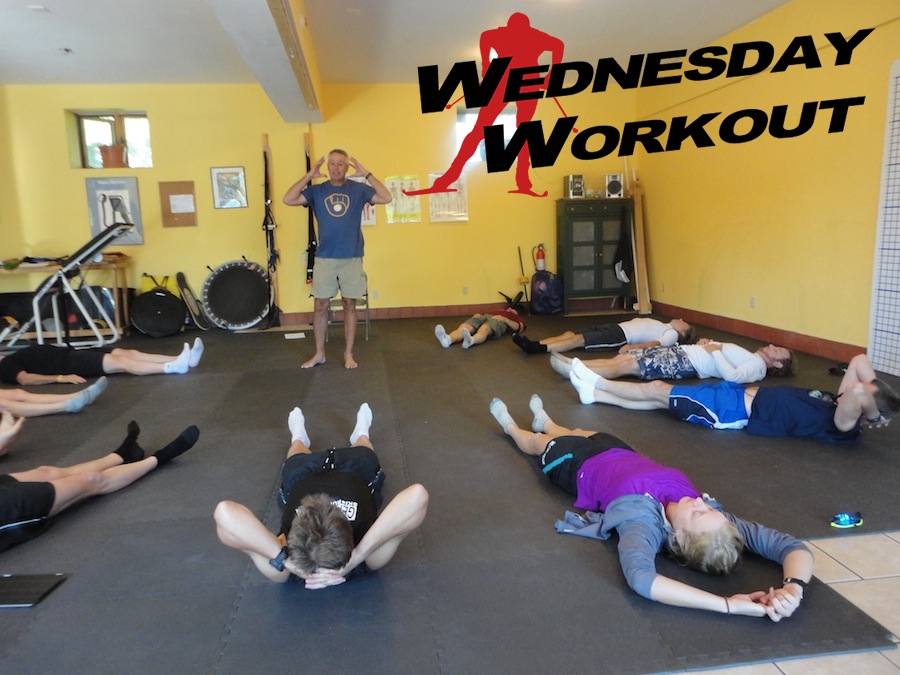
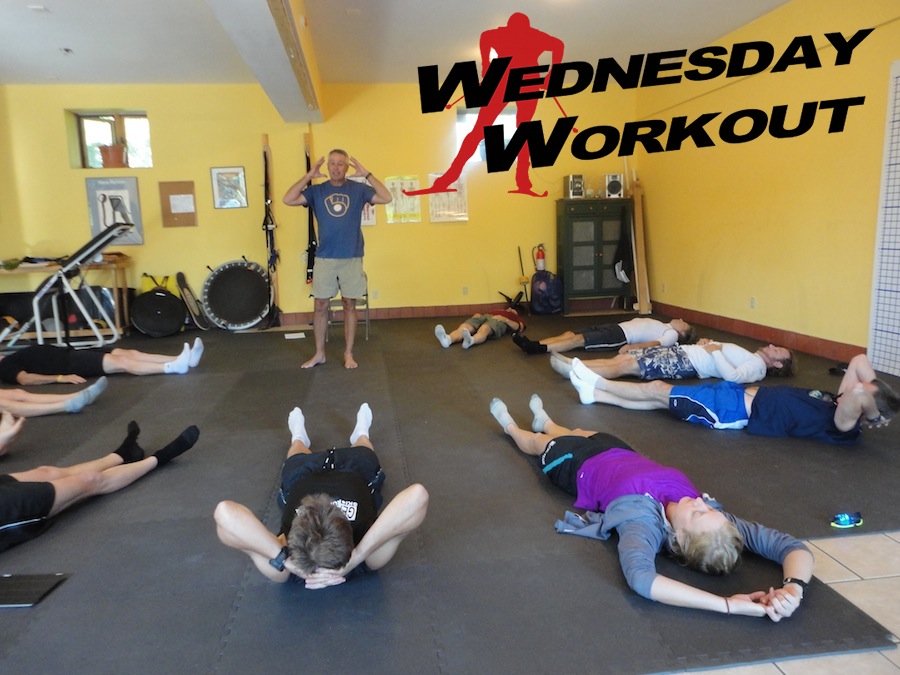
    Jay Tapper, who runs stretching programs for a company called ActivEdge, leads a masters group through some floor exercises and core work last fall. (Photo: Bill Pierce)
    Jay Tapper, who runs stretching programs for a company called ActivEdge, leads a masters group through some floor exercises and core work last fall. (Photo: Bill Pierce)

    By Bill Pierce

    Welcome to Wednesday Workout, the newest workout series on FasterSkier. This week, Central Cross Country (CXC) Elite Team coach Bill Pierce talks about going the extra 10 percent by being diligent about flexibility, recovery and agility. 

    ***

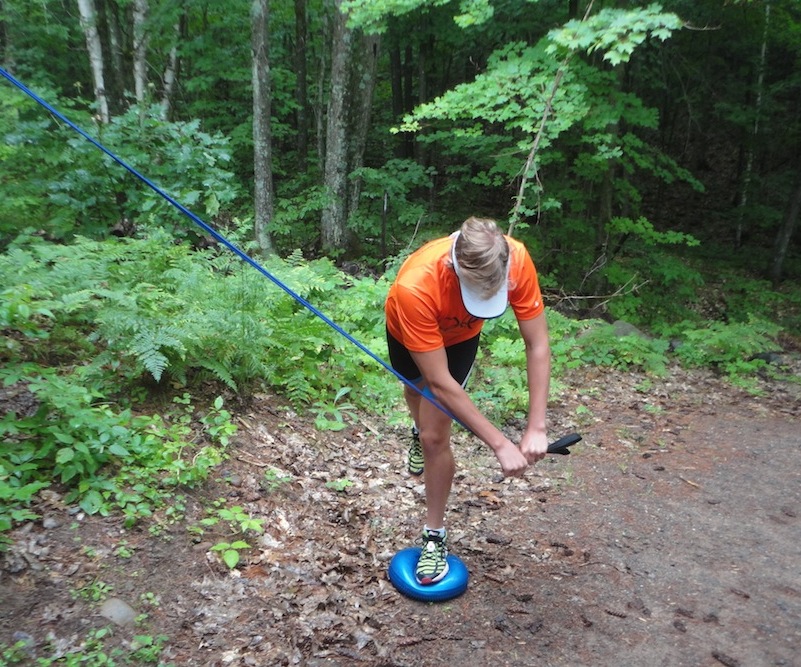
    A cross-over bungee pull: a simple leg and arm pendulum swinging and the other. While standing on the pillow, pull 90 degrees, twisting the shoulders and core but not the hips. This fires the glutes and the IT band for leg alignment and stabilization during the glide phase. Development of the glute is especially important in having a stable and aligned leg during the loading of the glide phase. (Photo: Bill Pierce)
    A cross-over bungee pull: a simple leg and arm pendulum swinging and the other. While standing on the pillow, pull 90 degrees, twisting the shoulders and core but not the hips. This fires the glutes and the IT band for leg alignment and stabilization during the glide phase. Development of the glute is especially important in having a stable and aligned leg during the loading of the glide phase. (Photo: Bill Pierce)

    I can think of quite a few workouts that I could call my favorites but I thought that I would contribute some work ideas that I have been focusing on as a coach with athletes and the team this season. When it comes to the workouts in our resume of experience, we are either working on endurance, intensity, or strength.

    When we add up all the time and ratios of this work it should be 100%. I tell athletes that if we are to be the best, you have to give 110%, all the time.  So, what do I think the other 10% is? Flexibility, physical recovery, and agility.

    At the beginning of the month Mikey Sinnott penned an article on stretching. It was spot on! Best advice was “make it a routine”, like brushing your teeth. We talk about it at clinics, camps, and workout sessions, but we just don’t do it on a consistent daily basis.

    While full-body stretching from extremities to core should be worked on, at the very least skiers should focus on stretching the body zones of power application; shoulders and chest, core, and hips/glutes/quads/hamstrings are the three areas that if ignored will very quickly tighten. Eventually a decrease in performance and an increase injuries will happen.  Bottom line, stretching will enhance your performance and keep you less prone to injury, ask Mikey!

    Shoulders and chest, core, and hips/glutes/quads/hamstrings are the three areas that if ignored will very quickly tighten.

    The second piece of the extra 10% is physical recovery. Foam rolling, stick massage, icing/baths, and sauna are just a few of the options for speeding recovery that athletes should be using. Foam rolling and massage are not options. Every athlete from juniors, collegiate, seniors, and masters should own and travel with a foam roller.

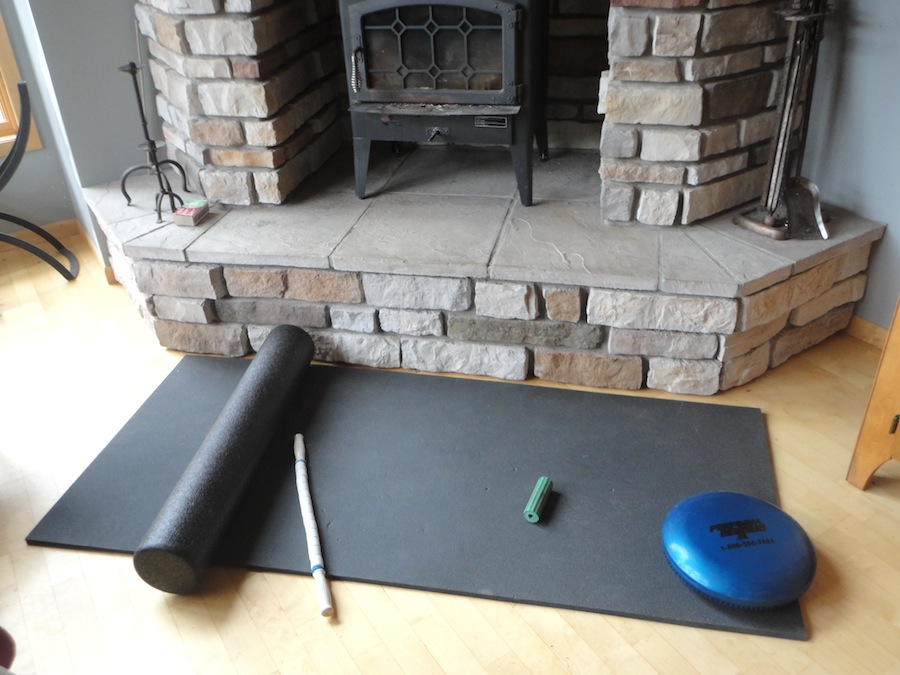
    Tools for success: a mat, foam roller (l), dowel, small ribbed roller (great for the bottom of the foot and helping prevent plantar fasciitis issues) and balance pillow (r). (Photo: Bill Pierce)
    Tools for success: a mat, foam roller (l), dowel, small ribbed roller (great for the bottom of the foot and helping prevent plantar fasciitis issues) and balance pillow (r). (Photo: Bill Pierce)

    While stretching is the first component to a post-workout routine, rolling should be the second. Self-massage or myofascial release (tissue work via gentle pressure or stretching) will help knead out trigger points, further stretch and massage the muscle, and increase circulation to the muscle to speed the recovery process. Again, developing the routine and habit of rolling the specific muscle groups used in a workout will speed your recovery and enhance your performance down the line.

    And the last piece of the extra 10% is agility. Being agile on skis is all about our balance skill. In order to possess that skill, we must train the muscle groups and movement patterns that help us achieve balance.  The more we work at it from the strength room to the trail, the quicker we learn it.

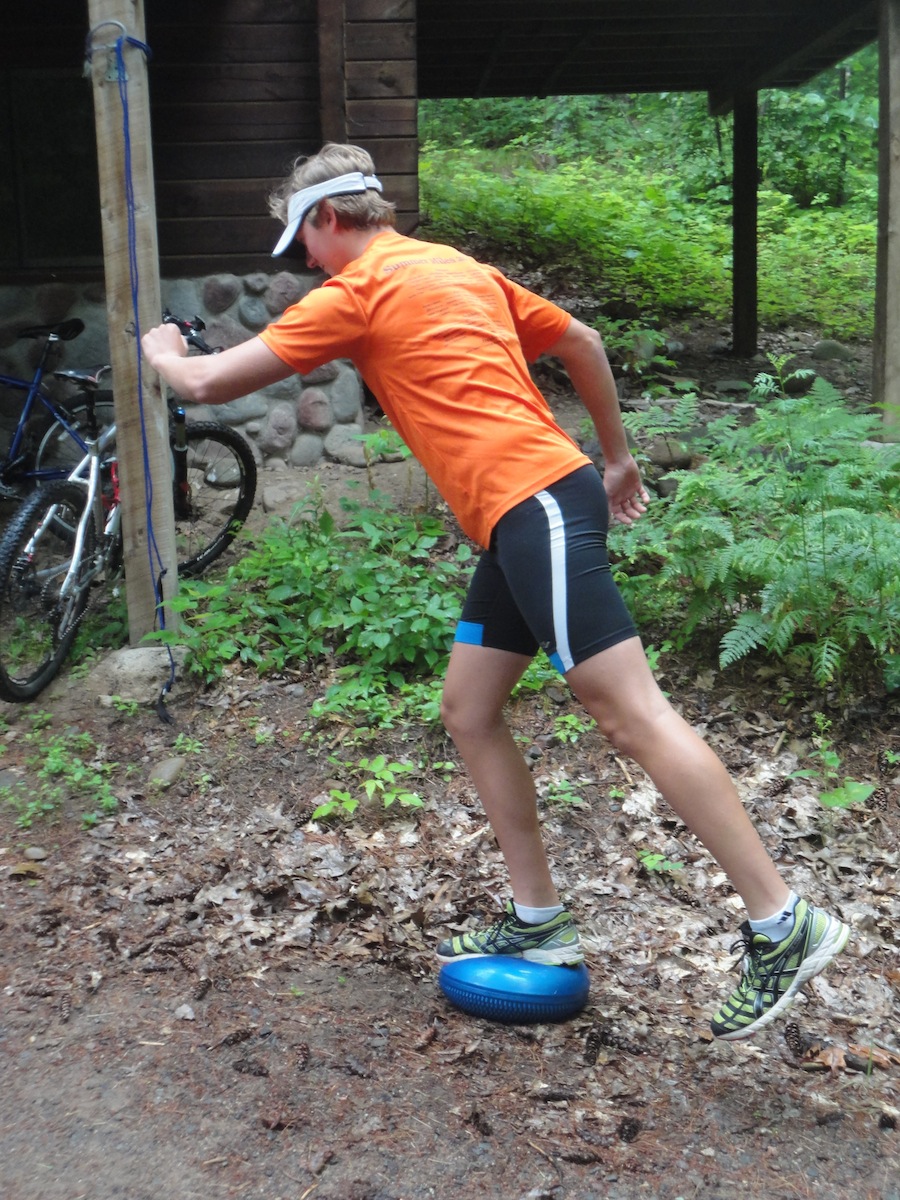
    A balancing exercise on what Bill Pierce calls the balance or air pillow.
    A balancing exercise on what Bill Pierce calls the balance or air pillow.

    One of the tools I have been using the past half dozen years is the balance (air) pillow, or the Bosu.  Athletes start by learning how to first stand and “swing out” on a pillow. Swinging out is nothing more than a pendulum motion of the arms and legs for warm up and movement pattern development. Push ups, squats and toe touches can all be exercises done off of unstable bearing in order to enhance the development of balance.

    Eventually, we incorporate many of their strength exercises onto a pillow so that they can simulate the instability of snow conditions in the power application phase of ski technique. Quiet a few of the exercises that we incorporate or design into a routine help develop the ability to quiet the core and stabilize the leg. While some athletes may have a better understanding of body awareness, it is mostly a learned and trained skill. You still have to do the work.

    So when you find yourself looking for that extra edge and advantage when you step to the line this winter, ask yourself, “Are you giving 110% everyday?” It’s never too late to start!

    Related: Foam Rolling – How To Start and Finish That Workout Right