From the FasterSkier archive — posts syndicated from athletes’ and coaches’ own blogs between 2004 and 2012, kept online as published. Current coverage is at fasterskier.com.
At the World Championships last winter, a slushy, rutted corner near the finish line became a proving ground for precision and poise. The turn was taking down skiers all week — an icy edge here, a soft patch there — the kind of technical trap that can shake even the most seasoned racers.
On the U.S. team’s final course preview, Jessie Diggins, Julia Kern, Rosie Brennan, and newcomer Kate Oldham took turns testing different lines. It was part of their customary pre-race ritual — playful, low-stakes, but essential.
“And you know,” Kern recalls, “when we do race prep, we make sure anyone who wants can join. I think those moments are really cool. Like this year, Kate [Oldham] at World Champs — we did race prep together, Jessie, her, and I, and maybe Rosie too. We were practicing that final corner because it was so slushy and tricky, and Kate ended up being the best one out of all of us in that corner.”
Kate Oldham (USA) during the Individual Sprint at the FIS Cross-Country Ski Championships in Trondheim (NOR) last season. (Photo: Modica/NordicFocus)
It was a small moment, but it spoke volumes — the rookie demonstrating to her mentors not through bravado but through calm instinct and feel. For Oldham, it was proof that she belonged.
“Pre-race days are really fun,” she says. “It’s a time to try stuff out in a low-stakes way. You don’t necessarily want to be experimenting once the heats start, so we’ll trade off who goes in front and see how different approaches work. That corner was taking people down left and right — and none of them were Americans, so that was cool.”
For the team, it was just one corner on one course. For Oldham, it was the quiet confirmation that her precision and poise could stand alongside the best in the world — that she could carve her own line through the sport.
From Carbondale to the World
Oldham, who was recently named to the U.S. Ski Team, grew up in Carbondale, Colorado. In this mountain town, Nordic skiing runs through the community as naturally as snowmelt through the Roaring Fork Valley. “My parents just introduced me to it as a little kid,” she recalls. “We played sharks and minnows on skis.” She skied with the Aspen Valley Ski Club (AVSC) development team, more for fun than ambition—until a trip to West Yellowstone changed everything.
Her dad was helping the high-school team with meals, and Kate got to tag along. “I thought they were the coolest kids ever,” she laughs. “I got a little taste of what it was like to train more seriously—but in a really low-stress way. I could ski when I wanted to, hang out with my dad when I didn’t. I just started liking it more and more.”
By freshman year, she had joined AVSC’s National Comp Team, with coach August Teague guiding her progression. “He had a big hand in shaping my love for training and the structure that cross-country skiing brings to your life,” she says. “I love being able to map things out and plan.”
Teague’s wife, Kara LaPoint, became another key influence. “She’s a pro triathlete and just a really badass person,” Oldham says. “We love training together when I’m home.” From the AVSC coaches to her parents to the national-team staff she works with now, Oldham has always been surrounded by people who bring joy and perspective to the grind of elite sport. “The whole community fuels my fire,” she says.
Oldham recharging back home with good friend Kara LaPoint. (Photo: Courtesy Photo)
The College Shift
Oldham began her college career at Middlebury but transferred to Montana State after two semesters, drawn by the environment and energy of Bozeman. She completed a degree in environmental studies with a minor in sustainability. “I absolutely loved MSU,” she says. “Being in Bozeman just fit me.”
The NCAA circuit gave her a crash course in balancing intensity and independence. “It’s extremely competitive now—good skiers in every region,” she says. “You’re racing against Scandinavians, Europeans, all kinds of strong athletes. It’s a great way to get better.”
Equally valuable was learning to juggle priorities. “That balance between school, life, and skiing teaches you communication and time management,” she says. “It’s the same skill set you need later, navigating different coaches and support staff.”
Oldham’s affection for the Bobcats remains strong. “I’m still really close with the team. Sometimes I’ll text my old coach, Sam Benzing—’Hey, do you remember what we were doing at this time last year?‘ They’re always willing to help, and I’m super grateful for that.”
Oldham celebrates making First Team All-American at the 2024 NCAA Championship. (Photo: Courtesy Photo)
A Pro’s Life in Bozeman
When she graduated, Oldham decided to stay in Bozeman and train with Andy Newell and the Bridger Ski Foundation. “Andy’s a great mix of laid-back and professional,“she says. “He’s flexible with what I want to do but still really on top of things.”
Without classes or side jobs, Oldham has ramped up her training—but carefully. “We’ve been cognizant not to make big changes when what I’ve been doing has been working,“she says. “There’s already a lot of change in an Olympic year. I wanted to keep what I could the same.”
Her days follow a rhythm familiar to many full-time athletes: morning training, lunch, laptop chores, a second session, and quiet evenings. “I like to have a routine, but I also adjust based on life,“she says. “That’s a good skill, especially once you’re on the World Cup. Travel, fatigue, sickness—you have to be adaptable.”
This summer included a mix of Bozeman training and U.S. Ski Team camps. “It’s nice to get new perspectives, new venues, and then come home for family time,“she says. “I love riding my bike, hanging out with my family—just that balance.”
Oldham’s focus on recovery is equally pragmatic. “A lot of my body care happens in the gym—PT and strength work. Tschana [Schiller], our strength coach, does a great job keeping us balanced and mostly injury-free,“she says. “Then it’s good food, good sleep, and time to unwind. It’s simple, but it adds up.”
Oldham and BSF teammate Emma Albrecht. (Photo: Courtesy Photo)
Lessons from the Veterans
One of the most significant changes this past year was joining a national team full of skiers she grew up watching on TV. “It’s wild,“she admits. “They’re all so different in great ways. Seeing them up close, you realize—they’re real pros. It’s their job. But they’re also incredibly humble and welcoming.”
She has learned as much from how Diggins, Kern, and Brennan think about training as from what they do. “They all pay close attention to what they need on a given day,“Oldham says. “At a camp, they might all have slightly different plans. Not because they’re doing something special, but because they know what works for them. They balance that with the team sessions so everyone gets what they need.”
It’s a lesson she wishes she’d known earlier. “Even though it’s scary sometimes, it’s okay to be confident in yourself and your plan,“she says. “Doing what you need is a huge asset. Trusting yourself can be hard, but it’s worth it.”
That self-trust carries into her goals for the season. “Obviously, I’d love to make the Olympic team,“she says. “That would be an incredible experience. But I’d also be really happy with some top-30s on the World Cup.”
After spending time with Kate, it quickly becomes apparent that she is cooler than most of us. (Photo: Courtesy Photo)
More importantly, she wants to manage the grind. “I learned a lot last year, and I’m still figuring out what I need to stay happy and motivated through a long season of travel,“she says. “That’s a big process goal—dialing in what works for me.”
She’s also been working on how she handles the inevitable rough patches. “My tendency can be to isolate when something goes wrong,“she says. “But I’m learning to use my support team. There are people who want to help, and when I let them in, they always have a great perspective. Sometimes it’s just someone saying, ‘What did you learn today?‘That can shift the whole mindset.”
Looking Ahead
Oldham envisions a long career—but only if she keeps loving it. “I want to love skiing forever,“she says. “As long as my body’s healthy and I’m enjoying it, I’ll keep going. But not at the expense of that joy.”
Her advice to the younger version of herself, and to the next generation coming up through AVSC, is simple. “Don’t count yourself out,“she says. “So much can happen in a race that you don’t expect. Sticking with it is the only way to find out. Enjoy it, and pay attention to the relationships you build along the way—they’re what you take with you.”
Kate and her father, Nelson, out on a hike. (Photo: Courtesy Photo)
The Roots That Keep Her Grounded
When she’s not training or racing, Oldham gravitates back to Carbondale, where her family’s restaurant—Dos Gringos Burritos—is about to turn twenty-five. She’s been part of it since before she can remember. “I’ve been around it my whole life,“she says. “It’s a pretty important staple in our town, and my parents are huge role models for me.”
Working at the restaurant keeps her connected to real life. “The service industry teaches you a lot,“she says. “Everyone should do it once—how to deal with people, how to work hard behind the scenes. It grounds you.”
Her go-to order? “The summer salad wrap,“she says instantly. “But after twenty-three years of hanging around the place, you have to keep it fresh.”
Outside the restaurant, she finds calm in the same things that shaped her childhood: horses, bikes, and the Colorado mountains. “I grew up around horses and hope to return to that life after skiing,“she says. “Being outside, cooking, baking—it’s all part of keeping balance.”
That balance, she’s learning, is the fundamental foundation of confidence. It’s not just about speed through a corner or times on a results sheet—it’s about knowing where you came from and who you are when the racing stops.
Oldham loves getting outside, especially on horses. (Photo: Courtesy Photo)
Love Stories Like This? Help Keep Them Coming.
Feature interviews like this one take time, access, and care to produce. If you value thoughtful storytelling and independent ski journalism, please consider becoming a Voluntary Subscriber. Your support directly fuels the work we do to cover the people, places, and moments that make our sport special.
Logan Diekmann, Nina Seeman win on the streets of Bozeman, and BSF’s Rollerski races look to harness the momentum of summer training out West. Featuring Results and Video Highlights.
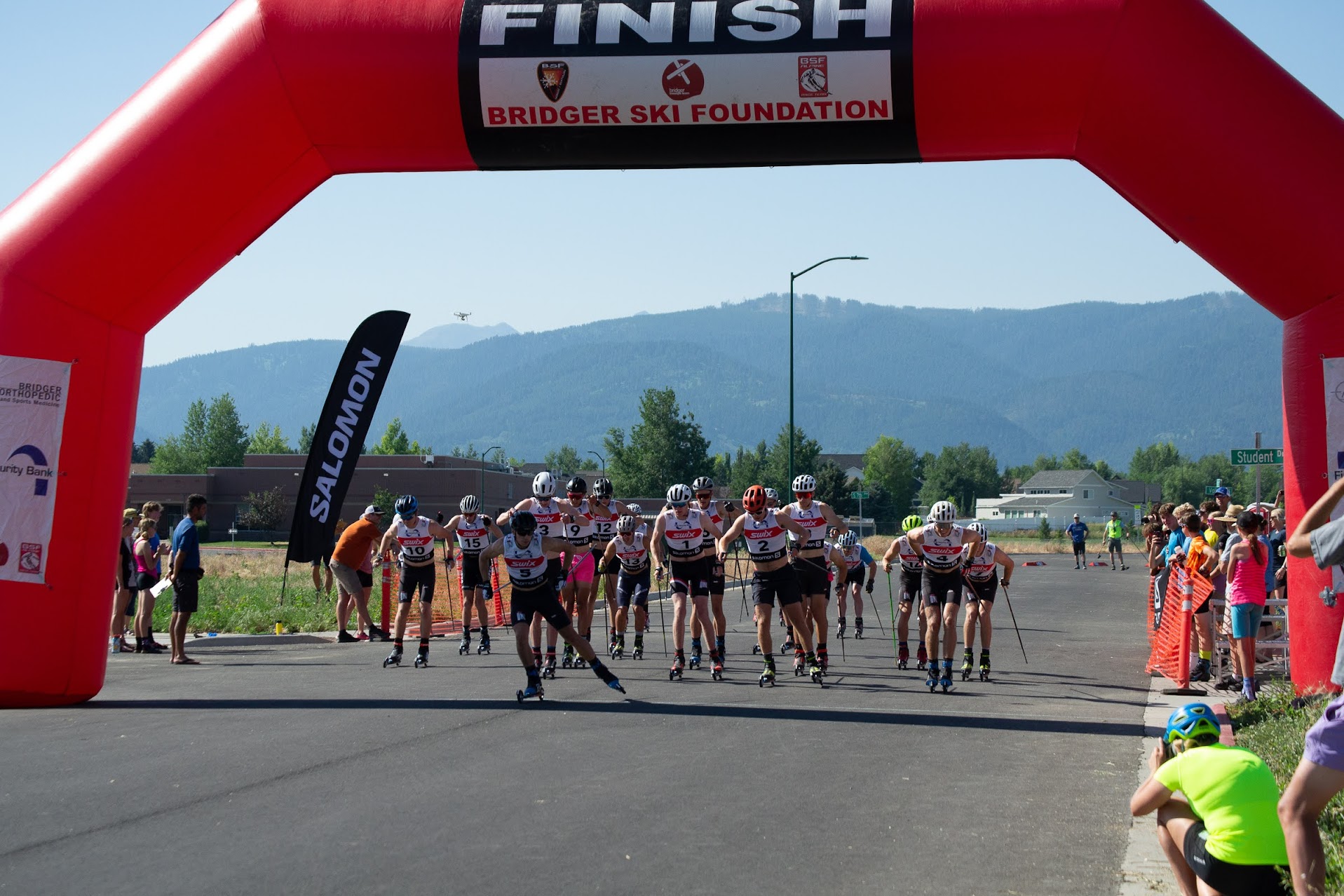
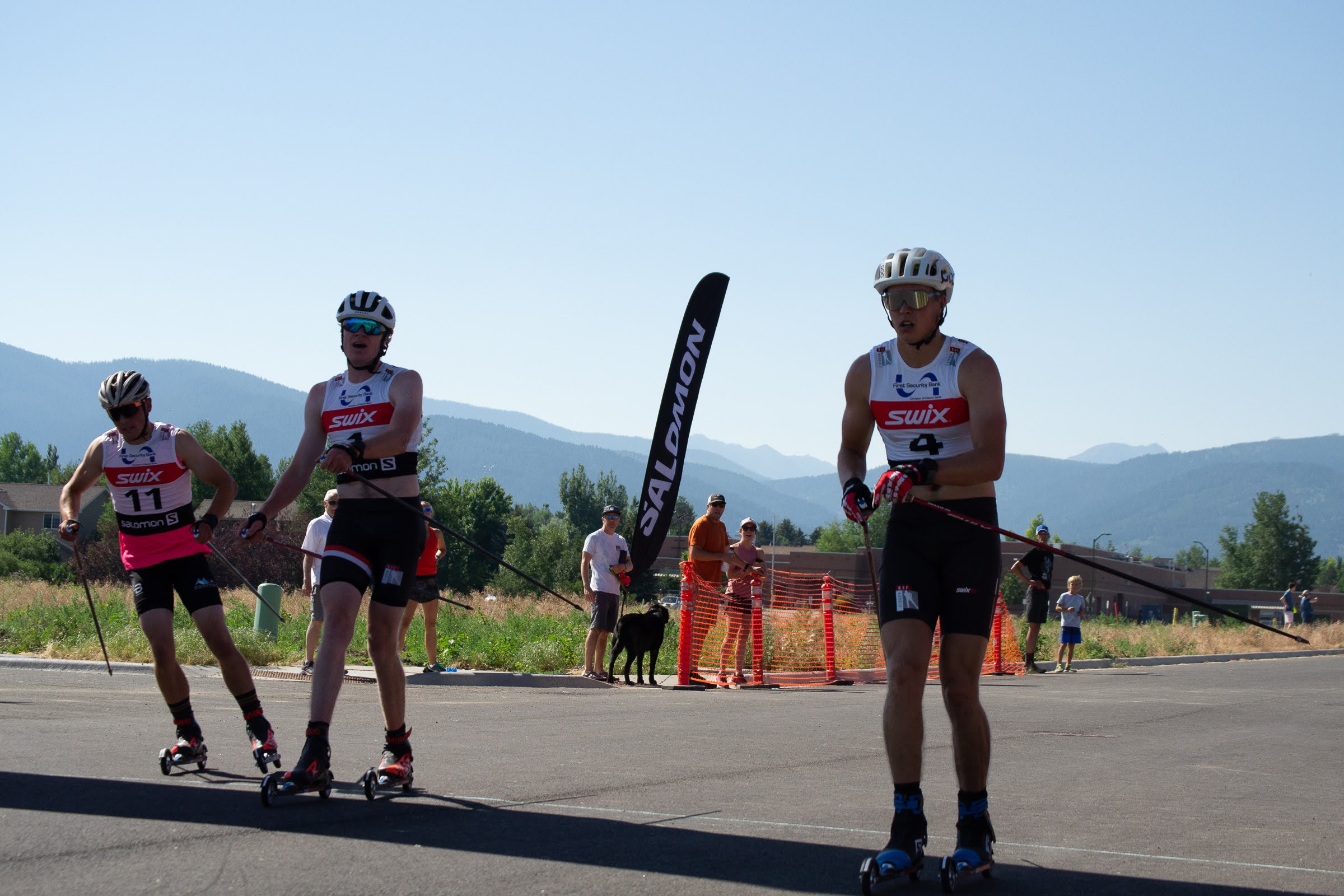
Men’s Open field rolls out at last weekend’s Jim Bridger Rollerski Races, held in Bozeman, MT (Photo: Jenny White/BSF).
BOZEMAN –Jim Bridger was a mountain man. One of those figures born firmly entrenched in the old ways back East, before he split for the Mountain West for something new. A character to chart a theme pervasive through the American vision of the West – that ability to make something new and pursue it with everything you got.
It’s a tortured and uncomplicated metaphor (Bridger was one of the first white men into the intermountain West, but of course, wasn’t the first person to existthere). But if you were going to distill that character, and tap in purely to that “Pioneer, O Pioneer” spirit, you could do worse than the Bridger Ski Foundation (BSF) Pro Team Head Coach Andy Newell.
For most of the 21st century,Andy Newell was a metonym for the very top of American men’s skiing. Through four Olympics, 220 World Cup starts, and breakthroughs every step of the way, Newell was there, making the in-roads that a generation of men’s skiers is nowpicking up on. Newell retired from racing in 2018, and in just four years has quickly transitioned his ebullient energy into setting up a coaching consulting business,Nordic Team Solutions,expanded BSF’s Nordic programming to include a successful Pro Team, and made Bozeman’s mountains and plains a popular training ground forcollegiate athletes during their summers.
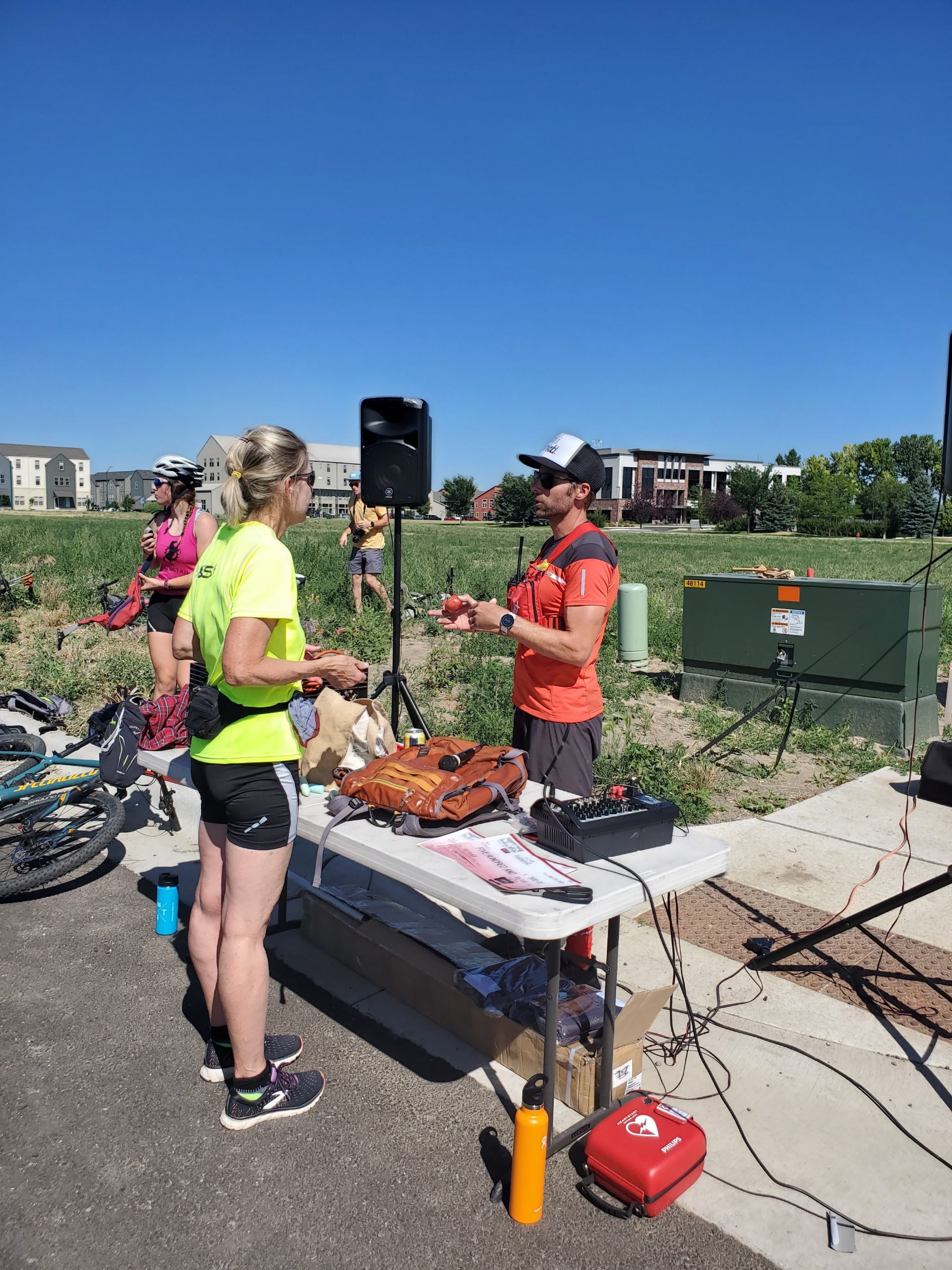
Andy Newell in his latest roll as Race Director last Saturday in Bozeman. (Photo: Jenny White/BSF).
Long home to an established nordic community withMontana State’s NCAA program andBSF, the efforts of Newell and the athletes he works with have been based in an effort to re-think and try out approaches to skiing development, training, and culture in Bozeman, and in the larger U.S. Ski Community. And in the latest example, that meant looking at a nearly 30-year-old BSF-held running race and saying, why not add a rollerskiing event?
The 29th annualJim Bridger Trail Run last weekend then, also marked the 1st annual Jim Bridger Roller Ski Races. And the impetus, as for many things with Andy Newell, was to simply go all in on nordic in the pursuit of promoting the sport. “I’ve always loved racing the big European rollerski races likeBlink andToppidrettsveka. I thought this would be a fun opportunity to pair a legit rollerski event with a trail run and host them back-to-back. Having races like this is a great development tool for athletes” said Newell, in an email to FasterSkier. The races also acted as a fundraiser specifically for the BSF Pro Team, which has been one of the fastest growing and competitive programs in the U.S. since it was founded. Something that Newell talked about at length with FasterSkier earlier thissummer.
Andrew Morehouse, BSF’s Nordic Program Director also added that the impulse to bring rollerski races inspired by those in Scandinavia to the United States is one that has been successful in the East and Midwest, but hasn’t found its way out West quite yet, “We’ve seen the success of roller ski races in the East and have talked within the Intermountain Division of how we can create a meaningful roller ski race series for our athletes in the West. I think this race, along with theSchutzenski Festival in Utah (to be held at Soldier Hollow during the US Ski Team’s Fall Camp there this October), is a great step towards that goal.”
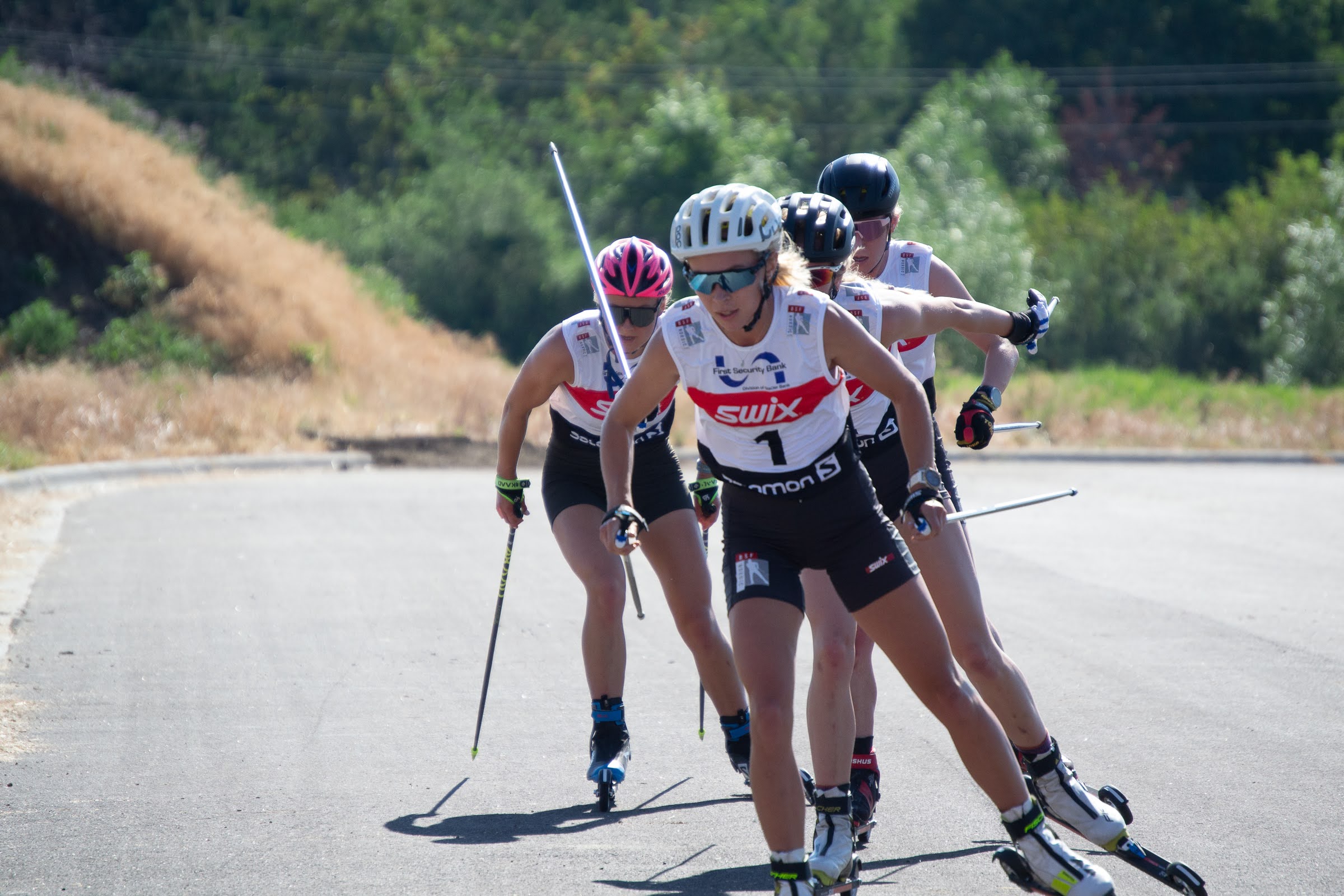
The Women’s Open field goes into a corner during their 12 k race in Bozeman last Saturday. (Photo: Jenny Smith/BSF).
Inaugural Jim Bridger Rollerski Race Report
In the pursuit to bring top-level rollerski racing to the hot, dry, and high Mountains out west, BSF’s efforts were a success.
A field full of BSF’s Pro and Comp (U14-U20) program athletes, along with racers from across the Intermountain West and a strong contingent of collegiate racers sure to show up on Eastern Carnival result sheets this winter made for an incredibly competitive and robust field.
They raced distances of either 6 k for the U16/U18 fields, or 12 k for U20/Open field on a 1.5 k loop that took them around the streets south of the Montana St. campus in Bozeman. The design was in line with the vision of promotion for the event, “high speed, multi-lap races right in [town] to make it spectator friendly and exciting,” said Newell. As with many roller ski events, racers also were provided matched skis, in this case from sponsors Swix and Solomon.
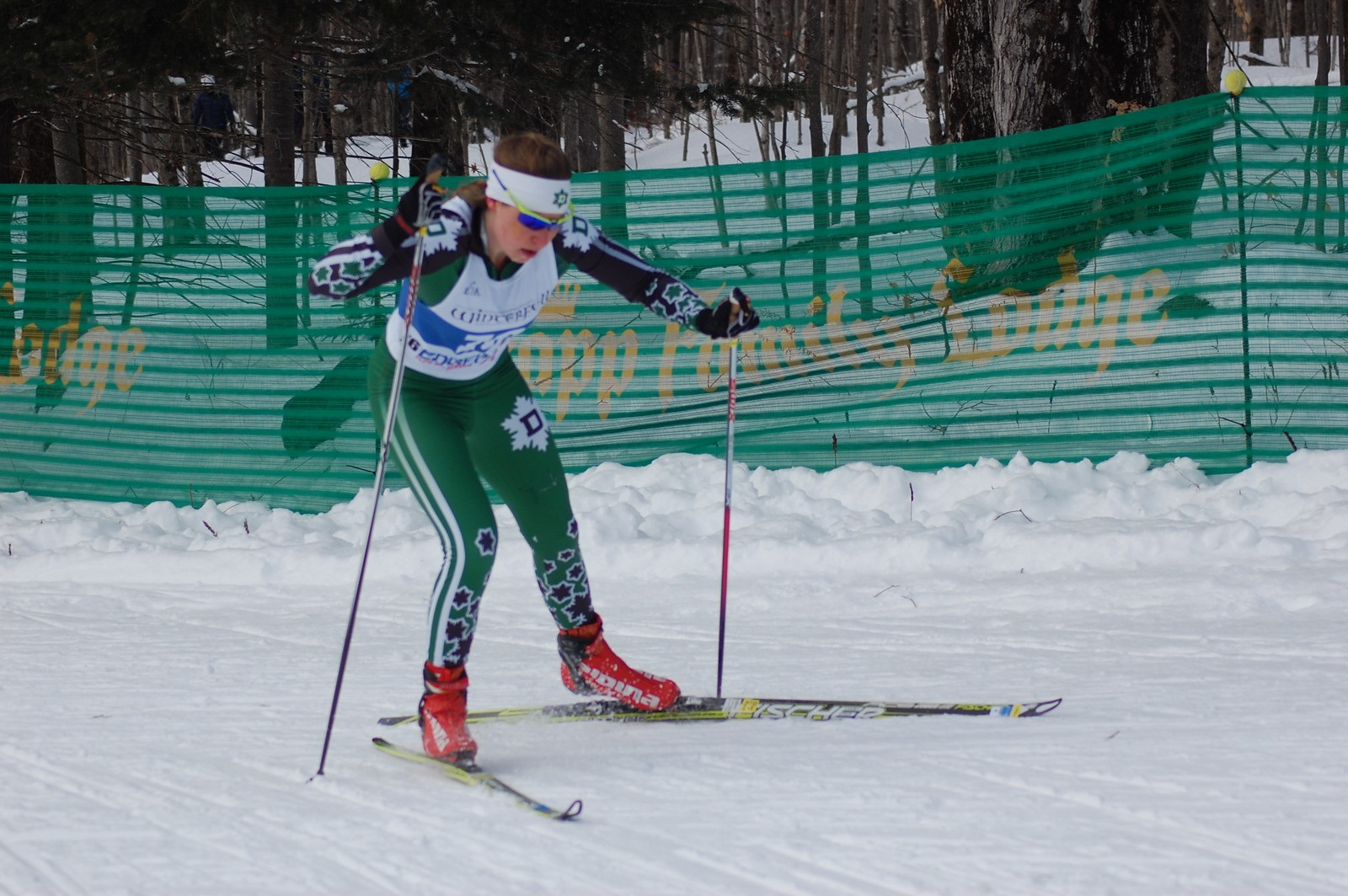
All races were skate, and with relatively flat terrain on course, that made for an event in which there was hardly a V1 to be seen. This was a day for V2, and a great opportunity for athletes to work theirs at max-effort next to other skiers and see where they can tweak their power application and tempo. Rollerski races, by design, are meant to be a stepping stone in training on the way to next winter, after all.
The early going in both the men’s and women’s open field were tight-packed affairs. Racers hemmed and hawed through tight-corners to bring the top-end of the field together, until slowly but surely, those lead packs became smaller and smaller.
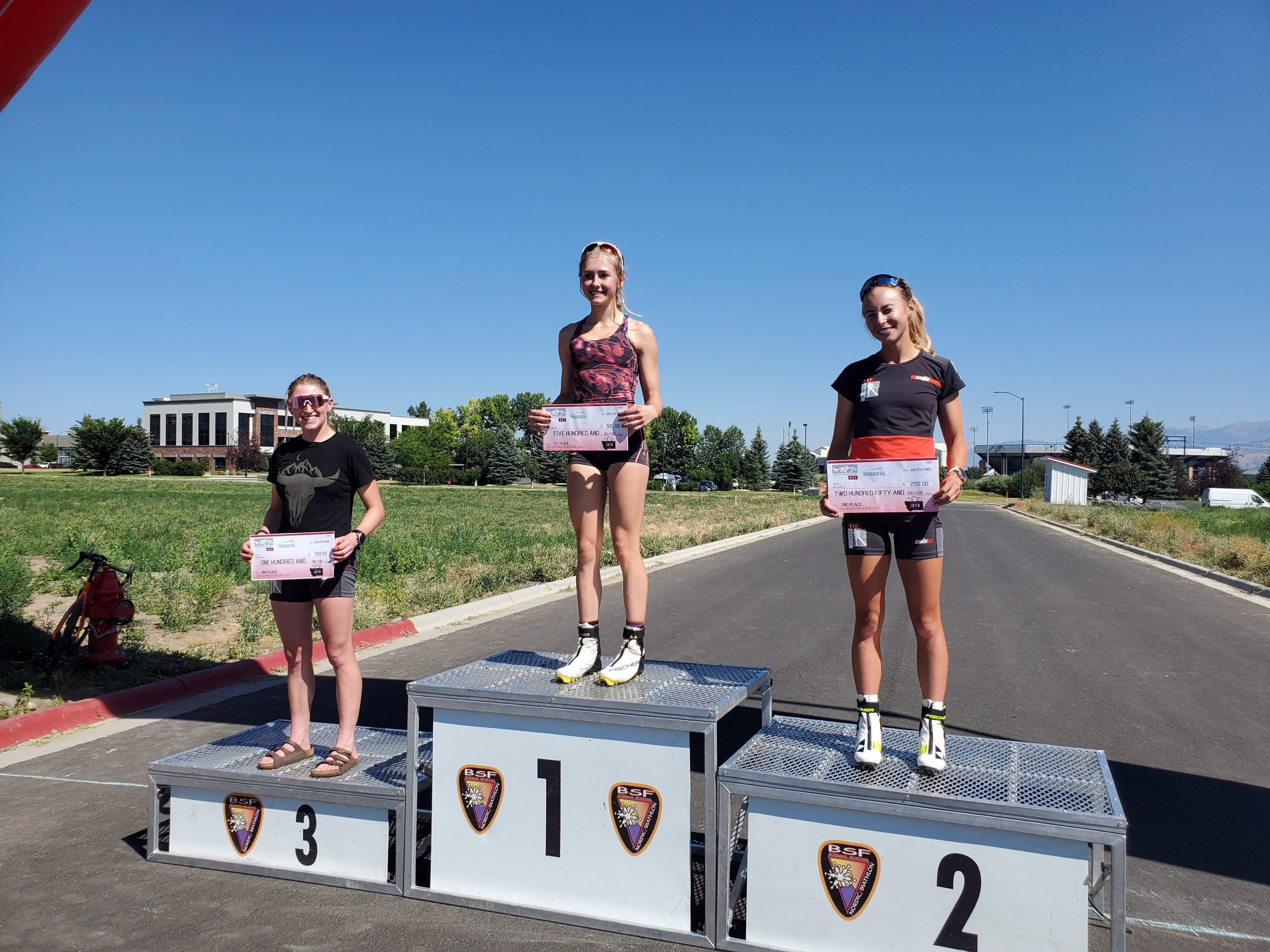
In the women’s field, the last couple laps saw a group containing Dartmouth College (DAR) skier Nina Seeman, along with BSF Pro members Mariah Bredal and Sarah Goble gain an advantage. There was nothing between them until the race’s end, when Seeman and Bredal broke for a final sprint, and Seeman came away the winner (27:58). Bredal finished second (27:59), with Goble coming in shortly after (28:07) to complete the podium.
Mariah Bredal (BSF) leads the Women’s field. Bredal finished 2nd overall to Nina Seeman (Dartmouth), tucked in 2nd place here. (Photo: Jenny Smith/BSF).
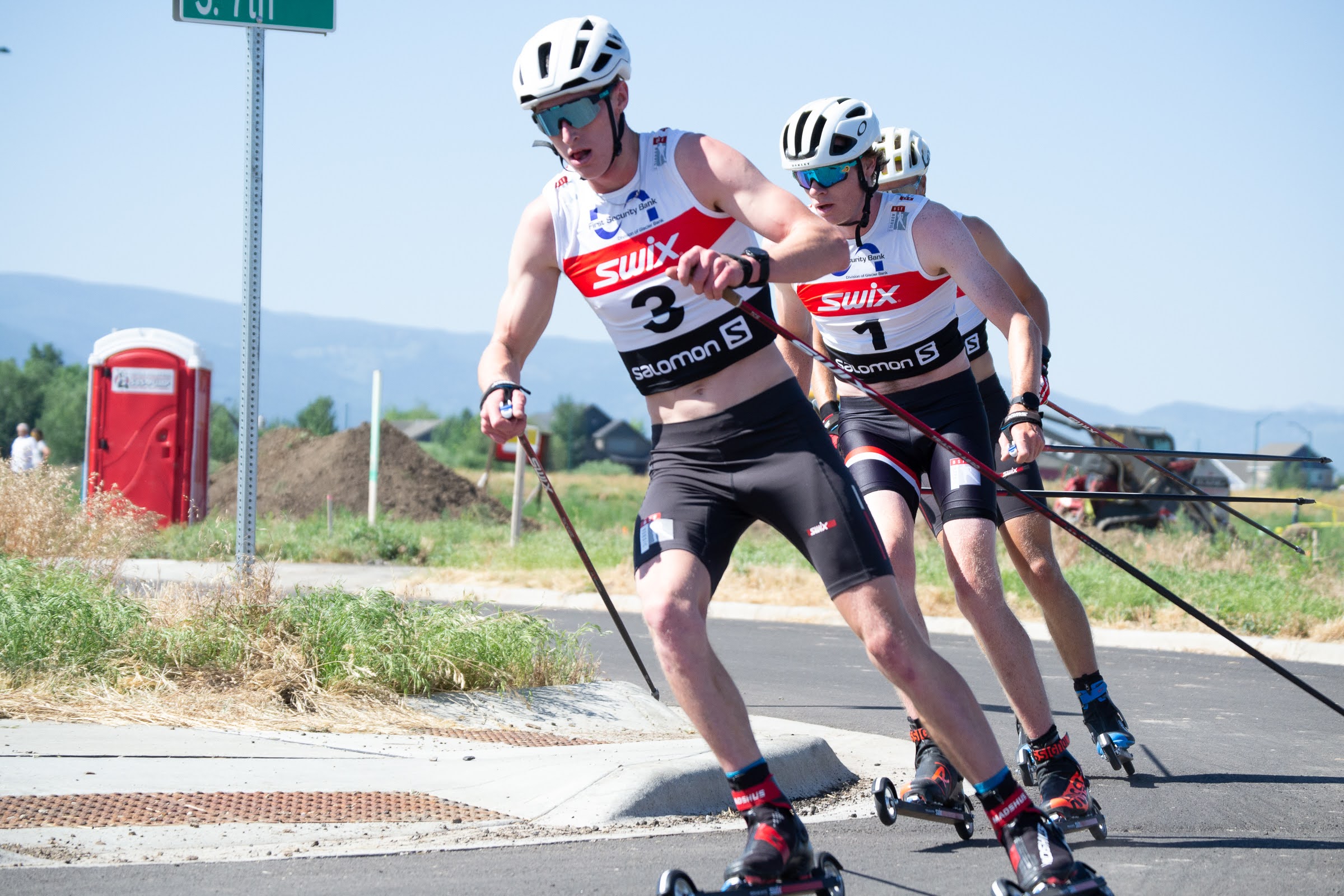
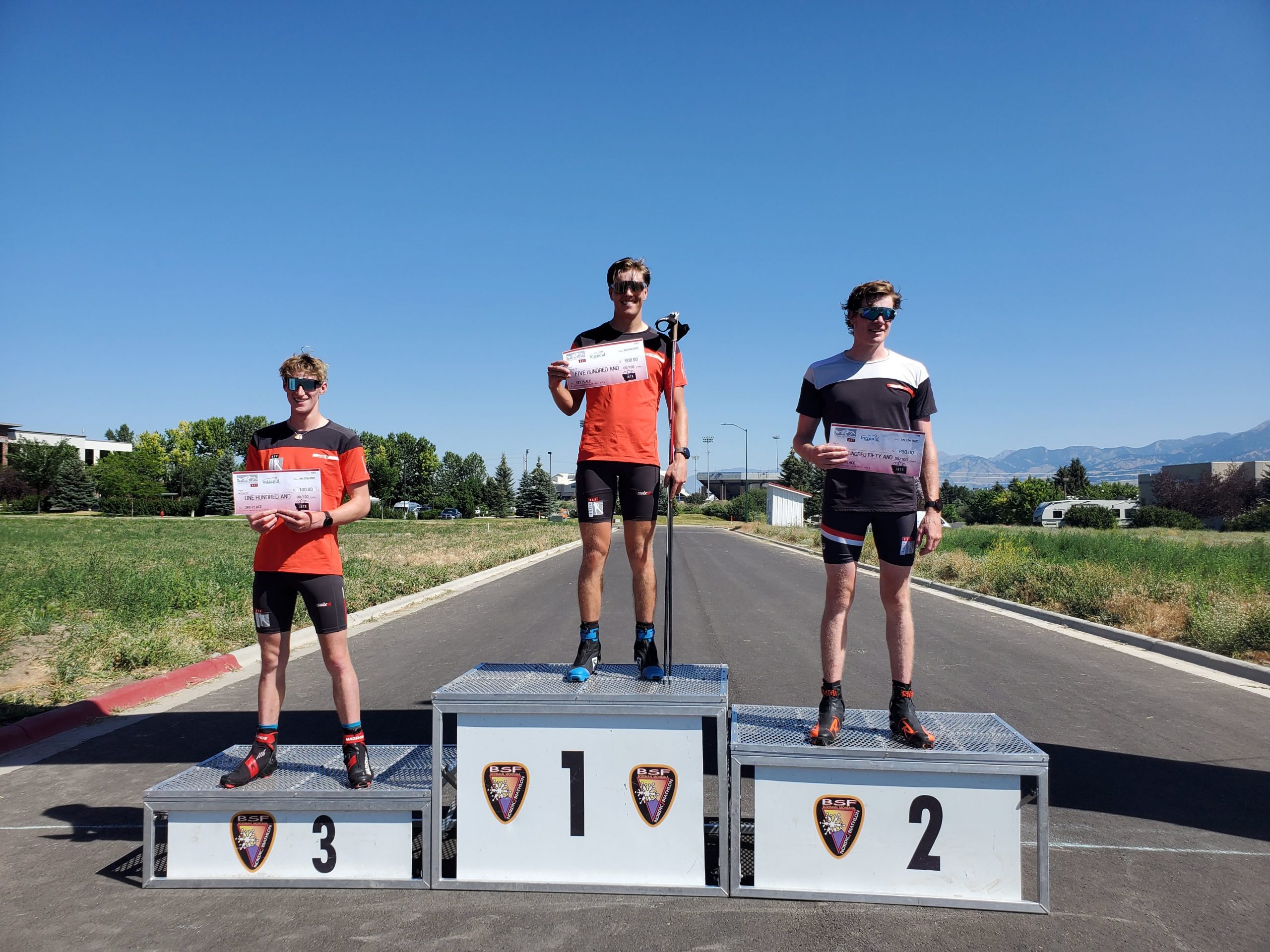
The men’s field saw a similar battle at the finish between three of BSF Pro’s leading lights. Into the final lap, Logan Diekmann, Finn O’Connell and Reid Goble were locked into a pack, with the promise of a true sprint all but assured for spectators. Goble found himself leading the pack for most of the lap, with O’Connell taking second wheel and Diekmann in third. Diekmann and O’Connell then launched their attack from behind their would-be lead-out, with Diekmann putting just enough gap over the line that the rare (and dangerous) rollerski lunge finish wasn’t needed. Diekmann in first (24:44), O’Connell in second (24:45), with Reid Goble rounding out the podium in third place (24:57).
Above – Reid Goble (BSF) leads Finn O’Connell (BSF) and Logan Diekmann (BSF) in the final lap of the Men’s Open 12 k. Below – Diekmann takes the sprint finish ahead of O’Connell. (Photos: Jenny White/BSF).
In the 12 k U20 Women’s race, St. Scholastica (CSS) skier Mia Case took the win over Park City’s Elena Grissom in second, and Sidney Benyon. The 12 k U20 Men’s race BSF’s Phin Fischer took first place ahead of Sumner Cotton (BSF) in second and third place Soren Davidson (BSF).
The inaugural BSF roller ski races were filled with fields of those who will find themselves at the top of NCAA, SuperTour, and even perhaps a World Cup this winter. That’s not bad for an inaugural running on the southside streets of Bozeman, and is yet another marker of the city, and Bridger Ski Foundation’s growth and development into a leader in the country’s ski community.
Many skiers then showed up to put impressive results up in Sunday’s Jim Bridger 10-mile Trail Run. Reid Goble (BSF) placed second overall (1:20:24), Peter Wolter (Sun Valley) was third (1:21:17), and Finn O’Connell (BSF) fourth (1:22:24). Mariah Bredal won the Women’s race (1:26:59), with Hannah Rudd (BSF) third (1:35:03), and Sarah Goble (BSF) fourth (1:37:37).
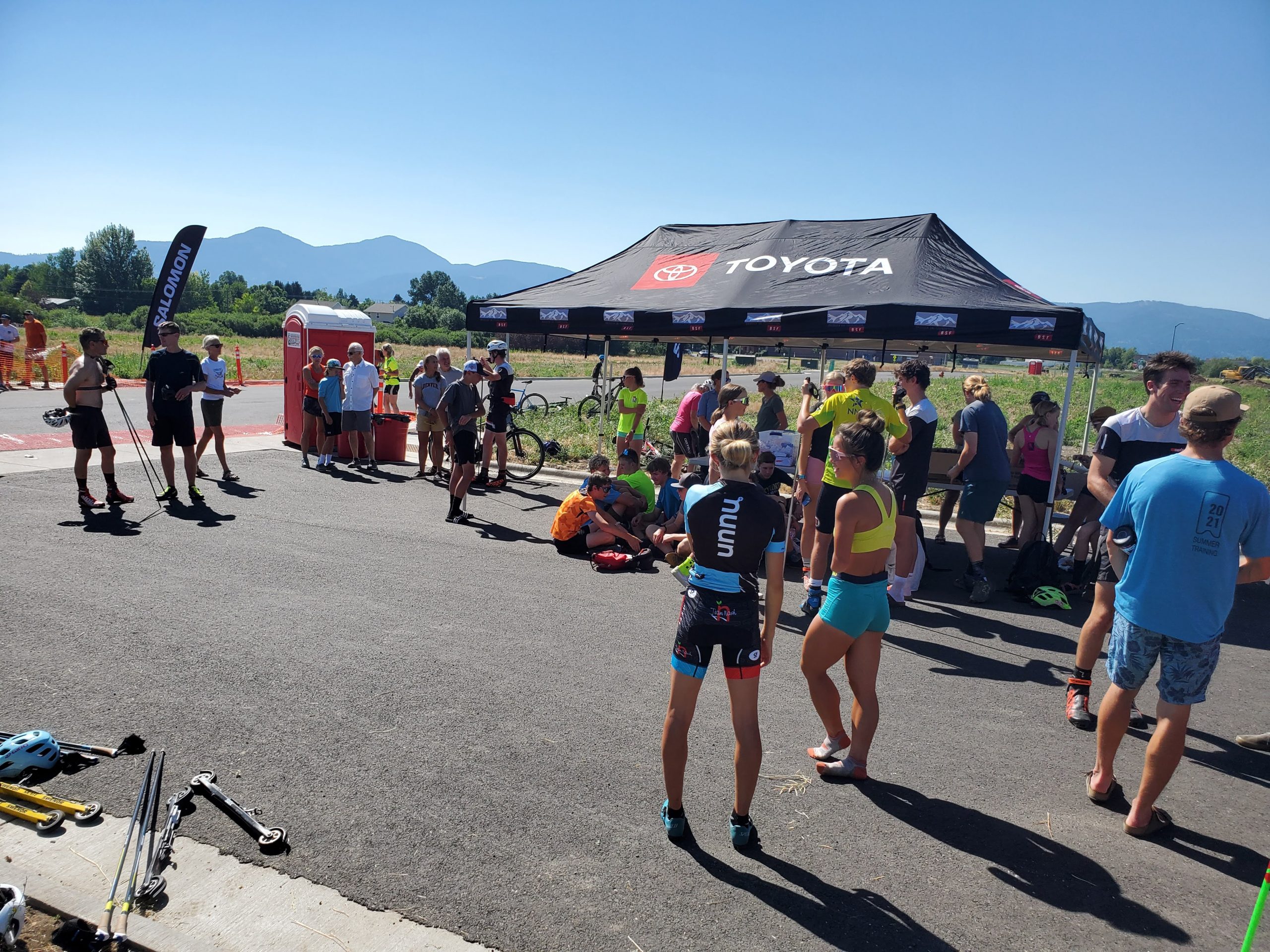
The BSF, and Bozeman, Nordic community together in Bozeman for some rollerski racing. (Photo: Jenny Smith/BSF).
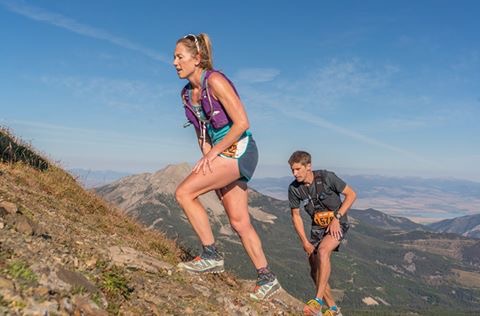
Erika Flowers post The Rut, and fresh off the 50 k win. (Photo: The Rut Mountain Runs Facebook)
Just shy of thirty-years-old, Bozeman’s Erika Flowers stills revs her aerobic engine up and over the big hills. The news that she had won the 50-kilometer The Rut mountain running race at Big Sky Resort outside Bozeman, Montana was a surprise to some — primarily to Flowers herself.
She pulled away from full-time ski training last winter, but the 9,951 feet of climbing during The Rut proved she’s a multi-sport talent.
Even with her reduced training last year and a step away from her Vermont based SMS T2 training group, Flowers impressed on the ski tracks. She placed fourth in the first 2019 Super Tour set of races: a 1.3 k skate sprint and 10 k skate in West Yellowstone. At U.S. Senior Nationals she was sixth in the 20 k mass start skate. Issues with fitness as she transitions to a more balanced work-sport life appear to be a non-issue.
We interviewed Flowers on September 12th. The interview has been lightly edited for clarity.
FasterSkier: Tell us a bit about the transition from full-time skier.
Erika Flowers: Last year Andy [Newell] and I moved to Bozeman and honestly I did not have a clear plan of what I was going to be doing. We both were ready for a shift and I was at a point, at least with skiing, where I wasn’t as competitive as I needed to be at my age to be eligible for the types of races and competitions that I wanted to be racing in. So I knew that I had to do something a little bit different. And there is also a huge part of me, I love skiing and I wish I could do it at a high level forever, that has interests outside of skiing. I was interested in getting some different experiences and professional experiences in particular.
I had looked around Bozeman and ended up getting hired by this firm called Profitable Ideas Exchange, which is international in scope but based in Bozeman. It has been around for about 20 years, but in the past maybe five or six years, it has grown quite a lot. We work on behalf of large professional service firms.
Essentially, we build out executive round tables of the people a client would be most interested in getting to know and eventually doing business with. And we have round table discussions with these groups while placing our client at the center of this conversation to help them develop relationships.
FS: Was there a risk taking this job or did you know it would be a solid fit? It sounds like a lot of interpersonal interactions in this type of position.
EF: When I was looking for different opportunities around Bozeman, I made a spreadsheet of potential areas I would want to work and at that point, I was like ‘if I don’t find something I really want to do, I can always keep skiing.’ I think what drew me here was the level of interpersonal interaction. So I think what I enjoy the most about this role is that I get to connect with people.
I tend to be a relatively social person and I enjoy networking with people, and that is where I was generally looking and that is the part of the job I enjoy the most.
FS: What have you been most surprised by when it comes to your new career?
EF: I think one thing that is interesting, and I think this is true for a lot of skiers that have that competitive side of them, I got put on the sales team here after a few weeks. The way that sales are framed, at least at my company, is that it is all about just making new friends. Our sales cycle is very long. So a lot of it is getting to know people and finding what is important to them and also figuring out how we can benefit them. And it is an area that I never thought I would enjoy doing. Sales can be a kind of dirty word for a lot of people, but I have really enjoyed it and getting to know people. And it is a challenge kind of like racing — you are testing yourself against others.
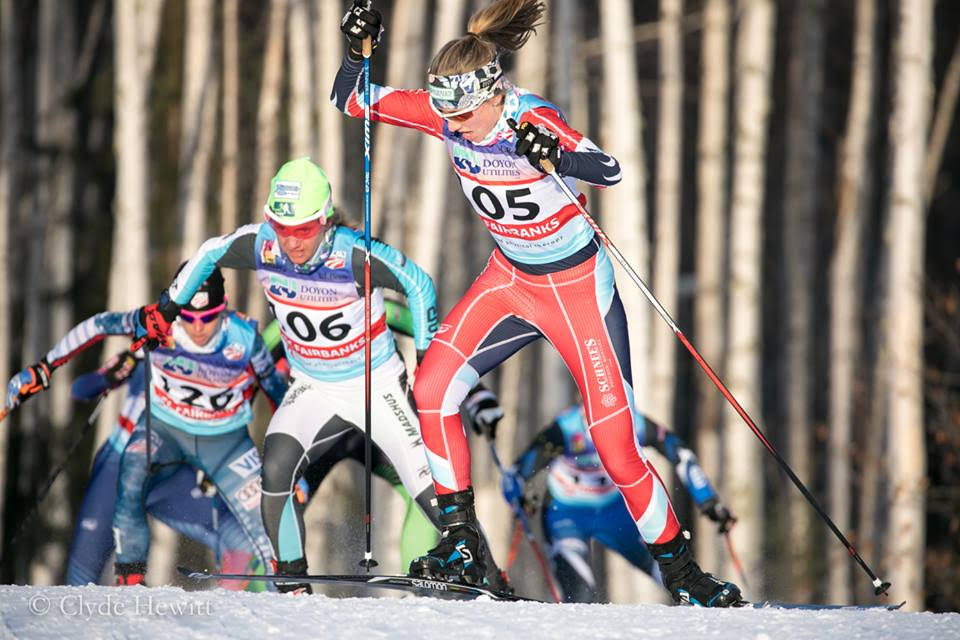
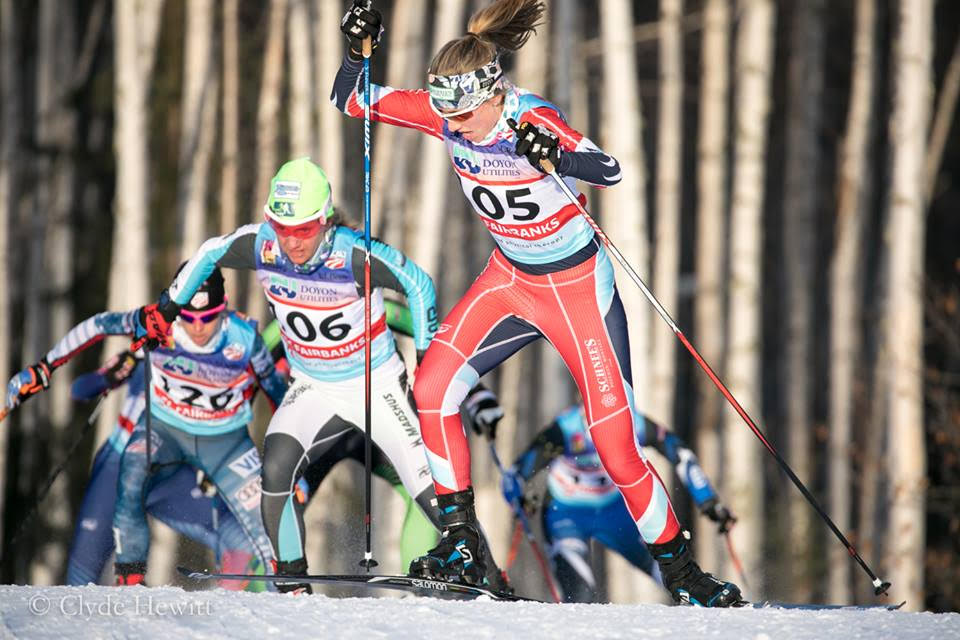
Erika Flowers (in red) racing at 2017 SuperTour Finals in Fairbanks, Alaska, where she posted a best result of third in the skate sprint. In the last six years, Flowers has reached the SuperTour podium 16 times and finished the 2017/2018 season fourth overall. (Photo: Clyde Hewitt)
FS: You clearly are in running shape. Will you be ski racing this winter?
EF: The short answer is yeah. Last year I wasn’t sure I was going to. Anybody who has been a full-time racer and you have decided to change — that is hard. Last year I left skiing really loving it still but recognizing that my results were not what they needed to be to keep doing it full time. So, I waded into a couple of races at the beginning of the year to see how they went. And obviously, I still do plenty of rollerskiing and training and I enjoy staying fit, and those races last year went pretty well.
This year I am going to do some of the longer races like the Birkie and the Boulder Mountain Tour. And then, I think I am going to jump into some of those first SuperTours. Last year I remember deciding to race them the day before. This year I will plan ahead a bit better and make some reservations in advance. I plan to do the first two SuperTours and see how those go. And my barometer for success these days is this: ‘is this still fun for you?’ If it is still fun, I will plan to do some other ones.
I’m not sure if I am going to Houghton for Senior Nationals. But I will be going to the Canmore and Sun Valley SuperTours.
FS: OK, the latest and greatest – your win at The Rut. Were you surprised by that performance?
EF: Yes, 100 percent. I had never run that far before. I knew there were some other quick and more experienced people in the race. I had done the Bridger Ridge Run last year in Bozeman and that was really tough for me. I went into the Ridge Run like ‘yes this could be my thing.’ I left that day like ‘clearly this is not my thing.’
I think this year, at least for The Rut, my plan going in was to have fun. My sister and I had trained together and we were both simply hoping to get it under our belts. I had no expectations and certainly not a podium. Beforehand someone asked what my 1-2-3 goals were. I said something like, ‘my best day ever goal was top-five or something and under seven hours.’ Having never done something like that, I had no idea how to set expectations for what was possible.
Erika Flowers during The Rut 50 k . (Photo: The Rut Mountain Runs Facebook)
FS: What was your strategy having never raced something like that?
EF: I started out pretty conservatively. Last year when I had done the Ridge Run, and really suffered, I had gone out a little hot. Andy said to just go out like you are going for a long run.
I did that. I simply figured I was in 20th or something. And then coming through the second aid station, my buddies told me I was in fifth place and third was not too far away. That was already way beyond what I expected.
FS: You must have caught some more runners out there.
EF: I then caught fourth, and then going up and over the headwaters, I was with a group of guys, and they were saying third place is just three or four minutes ahead of you. And I didn’t expect to catch them. The downhills are my forte and I knew there was a big downhill coming up and I was moving well that day and feeling good. I was able to catch third place on the downhill and then second. And then heading up Lone Peak, the biggest climb on the course, the first place runner was Kristina Trygstad-Sarri. She is really a phenomenal mountain runner. But she was running towards me as she had hurt her foot and pulled out.
Shortly thereafter I began descending off of Lone Peak at 20 miles in. Andy was near the bottom and he was nervous to tell me I was in first, but he was pretty funny. He said ‘you are doing great, just keep doing what you are doing. you are in first, but don’t change what you are doing, just keep chugging along.’
From then on I just kept moving and moving relatively quickly.
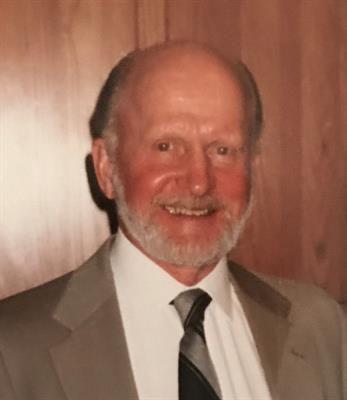
Floyd Bernard Reishus passed away on Dec. 26. He was 88 years old and a longtime member of the cross-country community in Alaska and Bozeman, Mont. (Photo: Bridger Daily Chronicle)
On Dec. 26, longtime cross-country skier, coach, and wax tech Floyd Bernard Reishus passed away in Bozeman, Mont. Bernard was a fixture from Alaska to Bozeman as he dedicated his time to enriching lives through cross-country skiing.
Head Coach: Bridger Biathlon at Crosscut Mountain Sports Center
Job Summary
Crosscut Mountain Sports Center (CMSC) now welcomes applications for the position of Head Coach of Bridger Biathlon. The Head Coach will oversee and manage the programming and development of Bridger Biathlon. This includes creating training programs and running practices for both the High School and Elite teams and supervising the coaching of Bridger Biathlon’s youth teams. The position will focus on fostering a fun and supportive team environment while working with the staff and venue to build athlete engagement and expand program development.
About Bridger Biathlon
Bridger Biathlon is a program of Crosscut Mountain Sports Center, a nonprofit organization based in Bozeman, Montana that is building a year-round recreation, sports training and educational facility. Bridger Biathlon promotes athletic achievement and values of healthy living for all ages and abilities through recreational and competitive biathlon.
Duties and Responsibilities
Collaborate with the CMSC Executive Director on overall program and budget management
Lead development of annual and seasonal training plans and daily workouts for High School and Elite teams
Supervise all biathlon programming, including managing assistant coaching staff and volunteers
Oversee all program communications, including maintaining up-to-date website and social media presences, responding to all program related inquiries in a timely and professional manner
Collaborate with CMSC staff to manage facilities use for training sessions and events
Plan travel and logistics for competitions, camps, events and other scheduled activities as necessary
Desired Qualifications
Minimum of 3 years of Biathlon coaching experience (USBA Coaching certification preferred)
Experience in a leadership role with similar programs or organizations
Excellent organizational, oral and written communication skills
Excellent computer skills including but not limited to: email, Excel, Google documents, website management, and social media
To Apply
Please submit a current resume, along with a cover letter that specifically addresses how your background and experience align with the requirements, qualifications and responsibilities of the position via email to: info@crosscutmt.org. Applications will be accepted until August 16th, 2018 at 5pm MST.
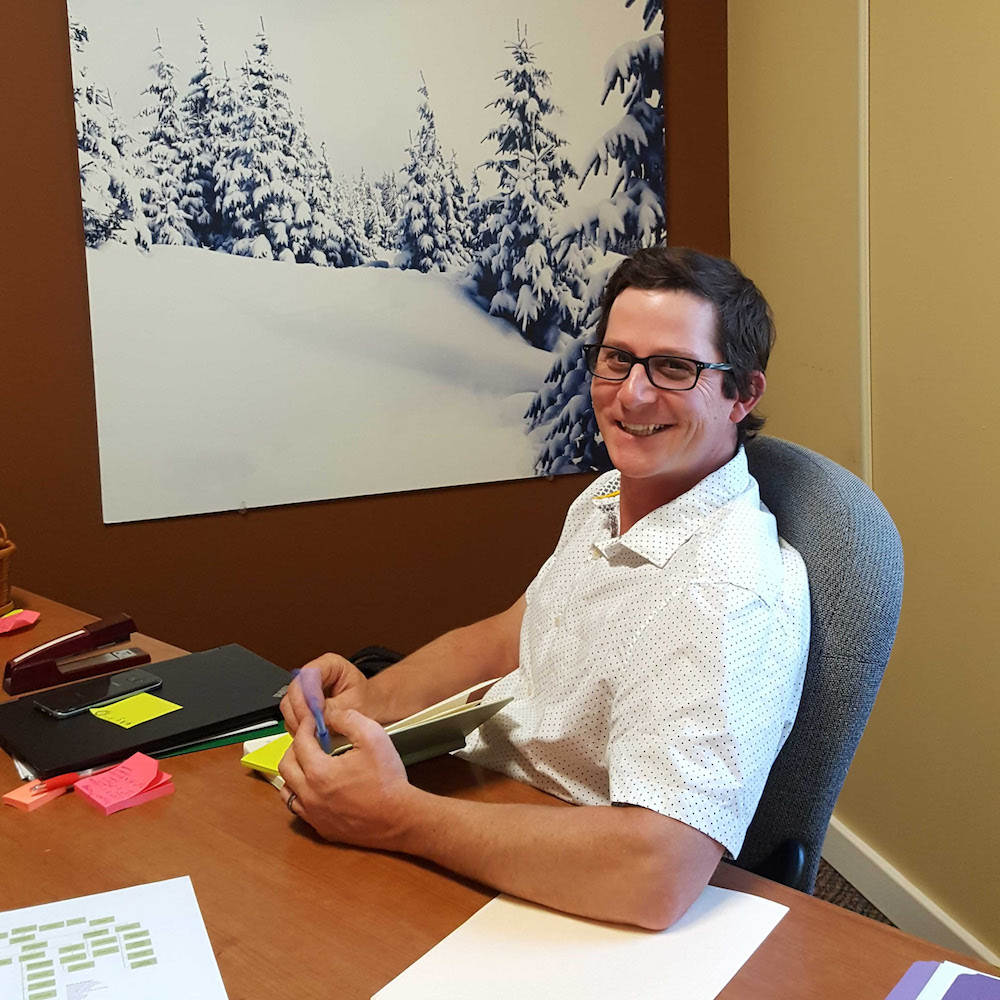
Evan Weiss, new executive director of the Bridger Ski Foundation
(Press release)
BOZEMAN, Montana — A huge welcome to Evan Weiss, BSF’s new executive director, who started on July 9. Evan has been spending his first days at BSF meeting with BSF’s program directors, board, and staff, and learning the ins and outs of the club’s programs.
Rebekah Bunting, president of the BSF board, noted, “Evan is a bright, energetic and well-qualified individual. I look forward to seeing him infuse those qualities in BSF as our new Executive Director.”
Most recently, Evan was the head coach for the Snow Summit Race Team at Big Bear Mountain in California. A former U.S. Ski Team member, he has more than a decade of experience in athletic program management and brings a diverse skillset to the table, from managing financial operations to raising money and developing programs.
Evan skied on the U.S. Alpine Ski Team from 1999 to 2006 and was a three-time NCAA All American at Dartmouth College. As the head alpine coach at Western State College and then University of Nevada, Reno, he led recruiting efforts and managed student athletes. During a five-year tenure as the program director and head coach at Alpental Snoqualmie Ski Education Foundation in Washington, he managed a successful youth alpine program, boosting membership and athlete retention and developing a scholarship program.
Evan and his wife, Lauren Summers, recently relocated to Bozeman. Lauren also grew up alpine racing and currently works in cancer research. They plan to take full advantage of Bozeman’s beautiful mountains and rivers. “Bozeman has a great tradition of winter sport with outstanding venues and a community that is engaged in skiing,” Evan noted. “I’m looking forward to helping the BSF programs continue to succeed and to bring new energy into the fundraising and capital projects that will take this team to the next levels.”
REACHING OUT
Evan is looking forward to meeting parents, athletes and friends of BSF. He encourages BSF members to reach out. “We’re working on our strategic plan and U.S. Ski & Snowboard club recertification, so I’d love to meet people before the snow flies,” he said. He can be reached at evan.weiss@bridgerskifoundation.org. Or call the BSF office (406-587-2445) and set up a meeting.
Evan succeeds former Executive Director Swithin McGrath, who resigned in December 2017 for personal and family reasons. From December through July, board members Pat Flowers and Rebekah Bunting served as interim executive directors. A huge thanks to Pat and Rebekah for their hard work during the transition.
Bridger Ski Foundation is a nonprofit ski club providing educational and competitive programs in Nordic, Freestyle, Freeskiing, Snowboarding and Alpine skiing. They also groom an incredible network of Community Nordic Trails in Bozeman. www.bridgerskifoundation.org
Erika Flowers (in red) racing at 2017 SuperTour Finals in Fairbanks, Alaska, where she posted a best result of third in the skate sprint. In the last six years, Flowers has reached the SuperTour podium 16 times and finished the 2017/2018 season fourth overall. (Photo: Clyde Hewitt)
It wasn’t until recently that Erika Flowers learned the meaning of her middle name. At the time of her birth, her father had been cutting around Montana’s mountain slopes on Elan alpine skis. Though the brand’s company is based out of Slovenia, the definition of élan, according to Webster’s dictionary, is a vigorous spirit or enthusiasm.
Whether Flower’s father, Pat, had researched the word’s meaning or whether the name had simply struck him, the skis were his muse. Erika became Erika Élan.
“He just happened to be skiing on that brand, and I think he liked the sound of it,” Flowers said during a recent phone interview from her hometown of Bozeman, Montana. “So he and my mom named me Erika Élan Flowers.”
For anyone familiar with Flowers, long, stick-straight, blond hair often bouncing around in a high ponytail and glacial blue eyes are idiosyncratic to the 28 year old. So is an intense verve, or élan.
“I actually never knew it had any meaning (beyond just being a ski brand) until this winter when I randomly came across it in an article and looked up the definition,” Flowers wrote in an email. “That said, I think it describes how I try to approach life in general.”
***
While many nordic skiers dream about racing against the all-stars of Norway, Sweden and other powerhouse ski nations, not everyone gets the chance to do so year after year.
A former University of Utah skier, Kevin Bolger, now 25, managed to make his way onto the international ski scene this past March, sprinting to 11th place in his debut World Cup race in Lahti, Finland. Two weekends later, Bolger claimed another top 30 at the World Cup Finals in Falun, Sweden.
His breakthrough came after less than a year of training with the Sun Valley Ski Education Foundation (SVSEF) Gold Team; Bolger graduated from Utah in May of 2017.
The timing was impeccable. Just as Bolger was working toward a spot at the World Cup level, two U.S. veterans stepped away from the circuit. Flowers’s husband, Andy Newell announced this spring that he would pursue new career adventures and train apart from the U.S. Ski Team (USST), and Noah Hoffman officially retired from ski racing in March.
By the end of May, Bolger had earned a nomination to the USST B-Team.
In an email to FasterSkier this spring, Bolger himself concluded that his transition to World Cup racing “couldn’t have been written any better.”
Making it onto the women’s World Cup circuit as an American, at least for the past six years, has been more complicated. It’s even harder to make the USST. Since 2010, a number of strong names — like Sadie Bjornsen, Jessie Diggins, Ida Sargent, and Sophie Caldwell — have been added to the team, while few women have left.
In short, a roster of seven women (not including the development team) has been fairly standard to the USST for close to a decade.
Outside the national team, the U.S. domestic women’s field also witnessed a surge in talent and depth over the last six years. From 2012 to 2018 alone, at least 10 non-national-team women worked their way to the World Cup race scene, including Caitlin Patterson, Kaitlynn Miller and Liz Guiney of the Craftsbury Green Racing Project, Chelsea Holmes, Becca Rorabaugh and Rosie Frankowski of Alaska Pacific University, Caitlin Gregg of Team Gregg (when she wasn’t on the national team in 2015), Jennie Bender of the Bridger Ski Foundation, and Anne Hart of the Stratton Mountain School.
Any skier pushing to make a break would have a number of strong names to work around. But for Flowers, racing World Cups was a long-term goal, as was making skiing a sustainable profession for herself. She could spend hours sifting over rosters and names, but the only way to confirm anything was to try it out for herself.
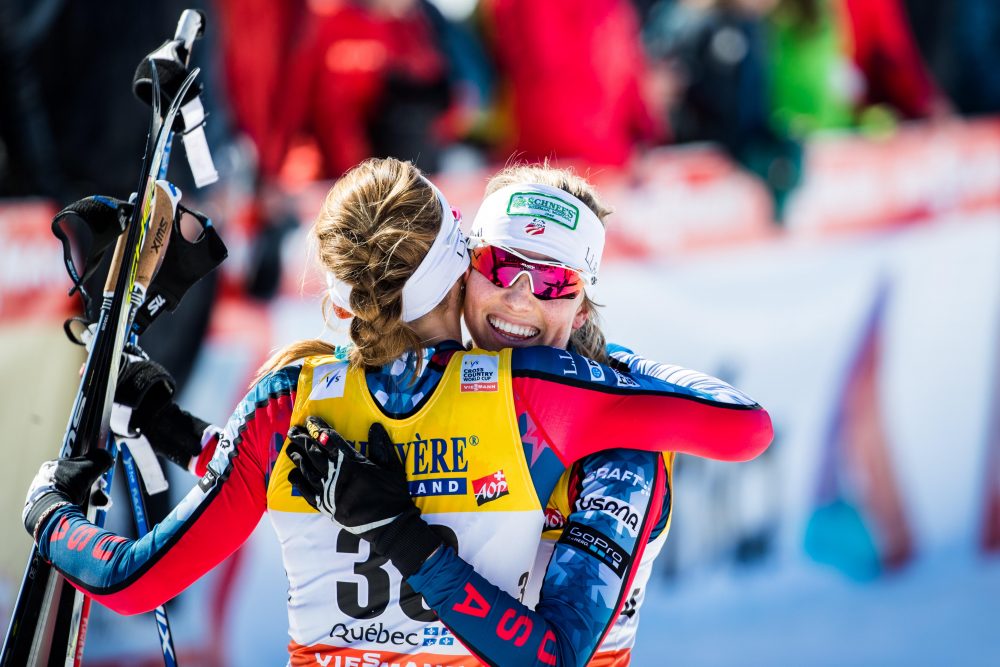
American Erika Flowers (r) hugs her Stratton teammate Sophie Caldwell following the women’s 10-kilometer freestyle race at the 2017 World Cup Finals in Quebec City (Photo: Gretchen Powers)
After graduating from Dartmouth in 2012, Flowers regularly finished in the top 10 of the overall SuperTour standings. She, too, earned a few World Cup starts. Flowers completed in all three races at 2017 World Cup Finals in Québec City, Québec, with a best result of 48th in the skate sprint.
In the end-of-year SuperTour standings, her ranking also saw a steep jump. From 2013 to 2014, she went from 32nd to fifth overall and was fifth again in 2015. The next season, she finished seventh overall and was fifth again in 2017. She capped off this season with her best finish to date, earning fourth.
Still, the sought-after World Cup starts remained elusive. As she developed, the USST also gained steam. Any progression she made also seemed to be matched by the cohort of American skiers she had be racing against since her departure from Dartmouth.
So why did she, summer after summer, push through intervals on rollerskis? Why spend each winter traveling to competitions, as Flowers put it, “living out of a bag”? Why did she continue to ski race year after year?
***
Flowers was fiveyears old when she first learned that her mother had breast cancer. Four years after her mother’s diagnosis, the family moved from Missoula to Bozeman. There, Flowers and her younger sister, Natalie, joined the Bridger Ski Foundation (BSF) cross-country youth program.
The BSF community provided a niche for the Flowers siblings. The cancer treatments their mother was receiving also showed promise. Following her diagnosis and treatments in 1995, Hedvig Rappe-Flowers, Erika’s mom, was cancer-free for more than five years, according to an article by the Bozeman Daily Chronicle.
But the cancer returned. Rappe-Flowers, a native of Sweden, encouraged her daughters to keep skiing. Do what made them happy. Both of them did.
Erika Flowers during the early stages of her nordic career. “It was the first time I’d ever had my photo taken by any sort of professional and I remember just having no idea what I was doing but its become one of my favorite photos if only because it’s very raw and unedited and from a time when I was just starting to gain some real confidence both in who I was as a person and an athlete,” Flower wrote. (Photo: Chris Milliman)
“My mom passed away from breast cancer when I was 17 which gave me a strong appreciation for how precious and valuable each day is and I know that I don’t want to waste one of them,” Flowers wrote in an email. “I think that’s another reason I probably decided to ski race for as long as I did — it was my first love and for all I know I could find out I have breast cancer tomorrow.
“What I do know is that I spent the last 16 years of my life doing something I absolutely loved!” she continued. “I think that has been on my mind a lot these days, especially given Kikkan’s recent diagnosis.”
“Kikkan’s a tough cookie though and I have no doubt she will tackle cancer the same way she has her many other challenges in skiing and in life — with equal parts fierce tenacity, bravery and grace,” Flowers added.
While joining Randall in skiing’s elite racing ranks was certainly a goal, it wasn’t the only reason Flowers skied. Nor did she ski in her mother’s name — though Hedvig did instill in her daughters an enthusiasm for nordic sport and a steely resolve in all that they chose to do.
“At her memorial service, one of the songs we played was ‘Hard Headed Woman’ — that really kind of describes her,” Flowers said. “She wouldn’t take no from anyone and believed so strongly in the idea that you could do anything you set your mind to.”
The mercurial sport of cross-country ski racing had taken its hold. And Flowers was not about to let go.
Racing brought numerous challenges. Days when her body felt great, but the wax was too slow. Times when foul weather hit midway through a competition, slowing the course.
“Those variables can be extremely frustrating when they don’t go your way,” Flowers wrote.
Frustrating, but simultaneously motivating, in its own way.
“When everything does come together, it’s the most exhilarating and addicting feeling in the world!” she noted. “I think I always thrived on the challenge of it all.”
Four years ago, Flowers even gave biathlon a shot, traveling to Lake Placid, N.Y., for a US Biathlon talent camp. While she showed promise, Flowers ultimately stuck with cross-country.
Erika Flowers (l) and Andy Newell at the 2017 World Cup Finals in Quebec City. (Photo: Gretchen Powers)
Skiing had deeper roots than racing and results for Flowers. It was a family affair (she credits her mother with having taught her how to skate ski). It was how she met most of her closest friends. It was also how she met her husband, Newell, whom she married last year.
“The people, the fact that every day my job is to go outside and work on getting better at something I love, the travel, and the challenge and unpredictability of professional sport,” Flowers wrote of what had kept her ski racing into her late twenties. “Lastly the support of countless friends, sponsors and supporters is one of the most important things that kept me involved for so long. Had I not had that level of support I would not have been able to race for as long as I did or reach the levels of success I did.”
At the root of Erika’s lifelong élan was, and still is, skiing.
***
About a year and a half shy of her 30th birthday, Flowers is back where it all started. She and her husband and former Stratton Mountain School (SMS) teammate, Newell, packed up a U-Haul this spring and drove from Vermont to Bozeman. Back in her hometown, Flowers competed in the 20-mile Ed Anacker Bridger Ridge Run in June. She still trains, most often with Newell, and unabashedly states that yes, she still rollerskis.
Since leaving Stratton, she does not currently have a formative training plan or program. Prior to moving, Flowers explored every “decision matrix possible” and spoke with numerous athletes and non-athletes alike about what she should do next. In the end, taking a step back from skiing seemed best.
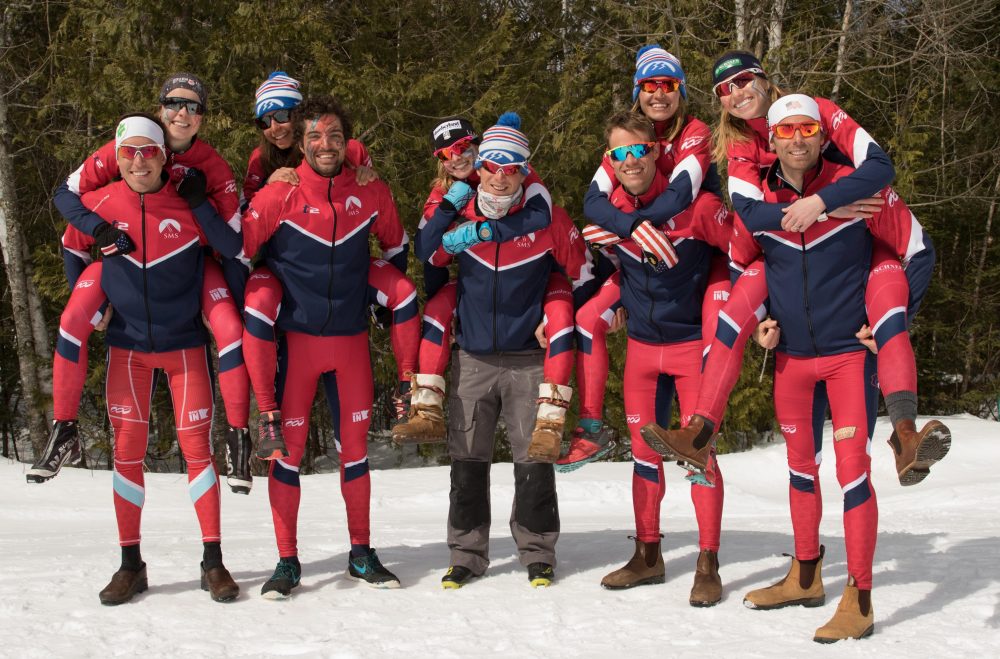
Team photo of last season’s Stratton Mountain School T2 Team: (back row, right to left) Erika Flowers, Sophie Caldwell, Jessie Diggins, Julia Kern, and Annie Hart. (Front row, r to l) Andy Newell, Simi Hamilton, head coach Pat O’Brien, Ben Saxton, and Paddy Caldwell. (Photo: Reese Brown)
“It wasn’t that I was sick of the lifestyle or anything like that,” Flowers explained. “I think it was more I’ve been doing it for long enough to recognize that my improvement curve is not what it needs to be in order to ultimately be able to make skiing into something that’s sustainable; something that can help me achieve some of the other goals I have in life, whether that’s getting a house or sitting on the board of a company.
“I think that’s also what made it so hard,” she continued. “In some ways it’s walking away from something I absolutely love to start at the bottom of another passion.”
Skiing has opened up a few other professional outlets for Flowers to pursue. She unofficially began social-media work for the National Nordic Foundation and USST this spring. She also is an athlete ambassador for the Women’s Sports Foundation. Her ties to nordic skiing becoming ever more intricate.
“Some people want to go all in for X number of years and retire and never look at a pair of rollerskis or race skis again,” Flowers reflected. “But to me, the word ‘retire’ sounds like something reserved for people in their late 60s, early 70s … maybe that’s why I haven’t used that word, it just doesn’t fit.
“I think for me, it’s more deciding to take a step back from pursuing racing full time and looking at opportunities to pursue something else more fully,” she said.
The change of pace is in no way preventing her from getting outside. With Newell still planning on ski racing, just not full time on the World Cup, she’s still plenty invested in the nordic world.
“From my end I just try to be supportive no matter what,” Newell said on the phone. “I think she’s been training so much and so well … she can take this year and try something new, even take a few months and try something new, and it would still be be pretty easy for her to jump into some races and make a comeback. Because I can tell you from my perspective, as her husband and as somebody that trains with her on a regular basis, she’s not slowing down even though she has other goals outside of skiing.”
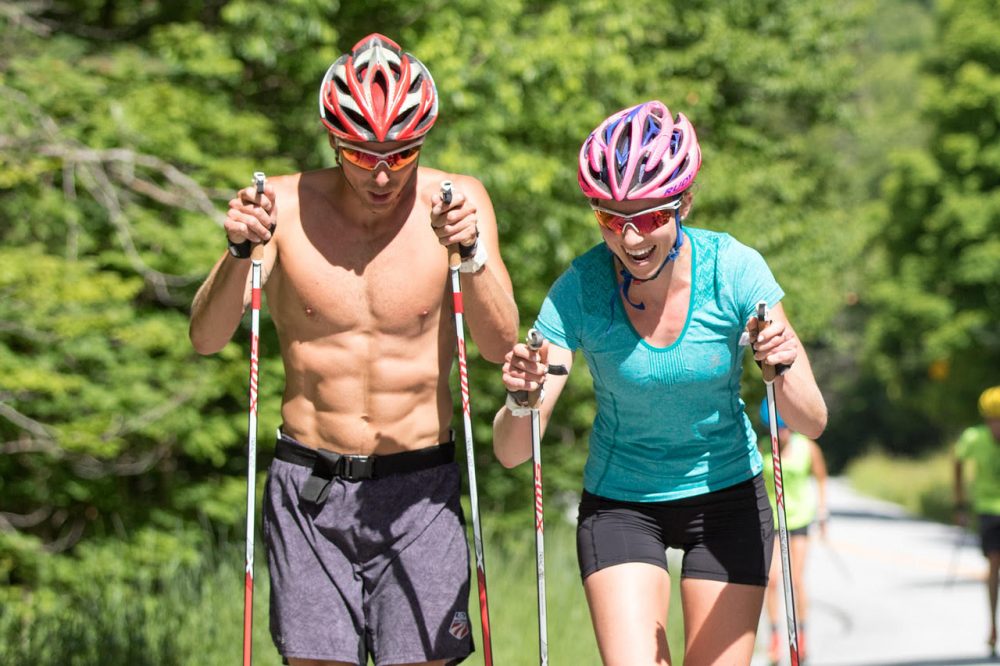
Former Stratton Mountain School teammates, now husband and wife, Andy Newell and Erika Flowers during a rollerski training session. (Photo: Reese Brown)
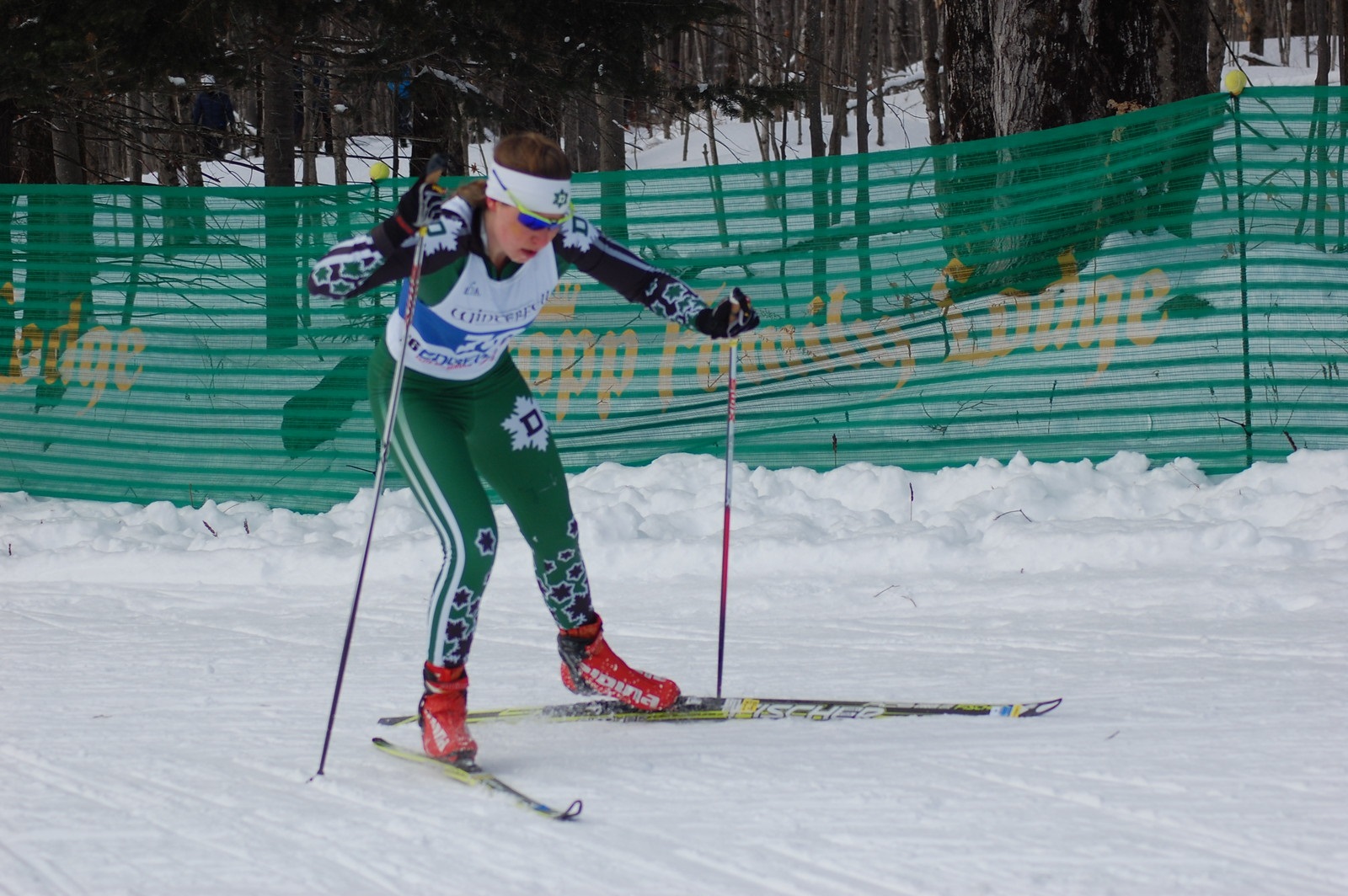
Sofia Shomento racing in the 5 k freestyle at the Colby Carnival in Waterville, Maine. (Photo: FlyingPointRoad)
In an effort to showcase the North Americans who competed at last week’s International Ski Federation (FIS) 2018 Nordic Junior/U23 World Championships in Goms, Switzerland, we asked those qualifying athletes several questions about themselves — actually, we had them fill in the blanks. Here we have 18-year-old Sofia Shomento, of the Dartmouth Ski Team, who represented the U.S. at her first Junior Worlds.
Last week in Goms, Shomento qualified for the freestyle sprint in 26th and went on to place 23rd overall, and finished 58th in the 10 k skiathlon.
***
“My full name is Sofia Shomento, but you can call me Sof.
I was born and raised in Bozeman, Montana, and I learned to ski at Bohart Ranch with the Bridger Ski Foundation.
I spent the time between U.S. nationals and Junior/U23 Worlds catching up with classes and skiing with my teammates.
The funnest workout I did in the last training year to prepare for this was running 121 laps (about 14 miles) around the homecoming bonfire with my class of 2021 teammates.
This is my first time in Switzerland and second time racing internationally, and so far it’s been incredible!
One difference I’ve noticed between Switzerland and the U.S. is the snow banks are much taller here!
Skiing and racing in the Alps is breathtaking. Usually racing at altitude is fun for me because I grew up racing in the West. There are lots of mountains around where I live.
One of the things I’m most excited about for Junior/U23 Worlds in Goms is meeting new people from around the world.
One race I’m especially targeting there is the skate sprint.
I really hope I can chat/make friends with someone from Norway and ask them “what’s the secret?”
My favorite thing at the breakfast where we are staying is the fresh bread, cheese, and jam.
Fondue is yummy. The cheese here is delicious. And the chocolate is life changing.
If I had a totally free day here and didn’t have to worry about race fitness or training, I’d spend it alpine skiing.
The best way to follow me on social media is on Instagram @sofiashomento.”
BSF seeks a qualified and motivated individual to fill the Executive Director position within a well established and growing community nonprofit organization. BSF’s location in Bozeman, Montana provides an optimal environment for success in our three skiing disciplines (Alpine, Freestyle/Freeskiing, Nordic). Salary DOE.
MISSION, GOALS AND VALUES
Bridger Ski Foundation is a nonprofit community organization formed over 80 years ago and based in Bozeman, Montana. In 2015 BSF was recognized by the United State Ski Association as a Gold Certified Club. Our mission is to inspire a lifelong love of skiing, athletic excellence and personal growth. Our goal is to create opportunities through educational and competitive programs in Alpine, Freestyle and Nordic skiing, and to groom cross country ski trails in the Bozeman community. Our statement of values drives the organization:
Maximize Athlete Potential: We provide programs that assist each athlete in reaching his/her potential.
Quality Programs: We provide quality programs, training and venues that support athletic excellence and personal growth. We strive to maintain an environment that is fun and enriching.
High Caliber Coaching: We attract, retain and develop directors, coaches, and staff of the highest caliber, both personally and professionally. We provide ongoing training and learning opportunities for them.
Affordability: We are committed to affordable and accessible learn-to-ski programs and seek community support and scholarships to help athletes as they move up the pipeline.
Academics: We build relationships with the school system and work with participants so they can excel in their sport and school.
Safe Sport: We apply best practices to maximize the safety of our participants.
Volunteers: We cultivate and grow positive relationships with BSF volunteers.
Community Relations: We promote positive, productive relationships with the local community, community partners and supporters of BSF.
Culture and Sportsmanship: We expect all athletes, parents, coaches, volunteers, and employees to exhibit exceptional sportsmanship and contribute to the BSF culture and broader community.
EXECUTIVE DIRECTOR JOB DESCRIPTION
The Executive Director (ED) leads the Bridger Ski Foundation. You are expected to align and move the entire organization to achieve BSF’s mission and values. The ED reports to the BSF Board. You provide daily and long term, strategic leadership and management of BSF operations, including fundraising, finance, marketing/communications, administration, policy and procedures and athletic programs. You manage the Program Director in each of the 3 disciplines, the grooming coordinator for the Nordic trails program, the Development Director, the Marketing/Communications Director and Finance/Administrative personnel.
Essential Duties and Responsibilities:
You are expected to translate the mission and values into BSF operations, and update strategic direction with the Board annually. You will prepare an annual budget, manage the finances (with Finance manager) and review status with the Board monthly. You will work with the Development Director to plan and achieve annual fundraising goals. You will work with the Marketing and Communications Director to develop strategic community marketing and communications program. You will work with Program Directors to prepare program business plans and budgets, as well as annual capital plans designed to support long-term program and venue requirements. You will provide direction and oversight to Program Directors as needed. We expect Program Directors to be responsible for additional coach staffing, coach development, athlete development, inputs to budgets, operation of budgets, coordination with volunteer event organizers (i.e., race committees) and vision for the discipline. You will maintain and establish administrative and staff policies and procedures as needed.
You will conduct annual performance evaluations for Program Directors, Development Director, and administrative/finance staff. You will work to maintain solid relationships with community partners, and foster a growing and vibrant club membership and alumni.
You will oversee Nordic grooming operations,
coordinate scholarship programs, ensure compliance with applicable state nonprofit laws and IRS charitable regulations.
Essential Skills, Knowledge, Abilities and Background:
Excellent management and leadership expertise along with outstanding communication skills (written, verbal, public, new media).
Experience in fundraising is a must. Experience in planning, organizing and managing organizational systems and processes. Experience in managing people, programs, and working with a variety of constituents. Nonprofit experience and ski competition/industry experience are also beneficial.
HOW TO APPLY:
Apply by emailing resume to office@bridgerskifoundation.org. In your email please insert in the SUBJECT line: ATTN: Pat Flowers.
BOZEMAN, Mont. — On June 2, local non-profit Crosscut Mountain Sports Center (CMSC) announced closing on the long- awaited acquisition of Bohart Ranch in Bridger Canyon. This landmark deal represents a commitment to continuing the Nordic skiing legacy at Bohart Ranch that Bozeman residents have cherished since the 1980s.
“After nearly sixty years of skiing in Bridger Canyon, it’s really special to see this legacy of mountain recreation continue,” said Cliff Montagne, longtime Bozeman resident and CMSC Board member. “It’s an honor to have a role in this once-in-a-lifetime project.”
Bohart Ranch is one of two iconic Bridger Canyon properties that CMSC plans to assemble in 2017. When conjoined, this iconic property will comprise over 500 acres adjacent to the Bridger Bowl Ski Area, and will include a network of trails for non-motorized outdoor recreation and mountain sports.
Hal Stanley, CMSC Board member who grew up skiing at Bridger Bowl, sees this project as the Nordic equivalent. “CMSC has everything it takes to be as successful and as important to the Gallatin Valley as Bridger Bowl has been,” said Stanley. “I’m excited to give back to the community and look forward to working with other community members who want to help shape this vision.”
While CMSC has raised close to half of the funds necessary to acquire the two properties through cash donations and pledges, there remains the need for continued philanthropic support. CMSC plans to exercise on their remaining Crosscut Ranch purchase agreement by year-end, with the aim to start designing new facilities in 2018.
“It is the generous support of the Bozeman community that has allowed us to take this major first step, and this support is critical to ultimately see this project through. Investing in Bohart Ranch is an investment in outdoor recreation now and for future generations,” said Lowell Bailey, CMSC’s Executive Director. “Now that we own the land, we can truly begin to think about how to design a venue that will best serve the community for decades to come. We look forward to working closely with Bridger Bowl and other partners to create a mountain venue that serves all ages and abilities.”
In 2017, CMSC’s focus will be on maintaining Bohart Ranch’s Nordic ski trails and connecting this network to new trails on Crosscut Ranch. Together, these properties will encompass a total of over 50 kilometers of groomed, tracked trails for skate and classic skiing. Bohart Ranch will be the home-site for both the Bridger Biathlon Club (BBC) and U.S. Paralympic Nordic and Biathlon Teams.
“I grew up training at places like Lone Mountain Ranch where community members and Olympic hopefuls overlapped on the ski trails everyday,” said Kari Swenson, former U.S. Biathlon Team member and BBC Board member. “That’s unique, and it’s a valuable experience for novices and experts alike. I look forward to working to help deliver the Crosscut Mountain Sports Center vision on behalf of our community.”
Former Dartmouth skier Corey Stock racing at the 2015 UVM Carnival two years ago. (Photo: Silke Hynes)
In an effort to showcase the North Americans competing at this week’s International Ski Federation (FIS) 2017 USANA Nordic Junior World Championships and U23 Cross Country World Championships at Soldier Hollow in Midway, Utah, we asked those qualifying athletes several questions about themselves — actually, we had them fill in the blanks. Here we have 22-year-old Corey Stock, of the Bridger Ski Foundation, who’s representing the U.S. at her first U23 Worlds Championships after competing at Junior Worlds in 2012 and 2013.
***
“My full name is Corey Stock, but you can call me Corey. I was born in Lincoln, Mass., raised in Lincoln, and one thing you should know about my hometown is it is the town where Paul Revere was captured.
I started cross-country skiing when I could walk, thanks to trails my brother would tromp down in our backyard (back when it snowed in Boston). I currently train in Bozeman, Mont., with BSF [Bridger Ski Foundation].
If I’m not skiing, you might find me listening to NPR podcasts while remarking on what a gorgeous day it is. If I had to pick a favorite book, it would be ‘Green Eggs and Ham’ by Dr. Seuss.
One of the things I’m most excited about for U23/Junior Worlds at Soldier Hollow is hosting the rest of the world in the USA! One race I’m especially targeting there is the classic sprint.
The best advice anyone ever gave me about skiing or racing was when Sophie Caldwell told me that I will race fastest when I am happy! One of the best race memories I have is Soldier Hollow JNs 2012.
If I could meet one World Cup skier, it would be Anna Haag.
12. If I don’t end up being a professional skier, I’ll probably be… turns out that I am a professional skier! Hopefully I’ll go to business school post-skiing.
Former University of Vermont skier Cole Morgan (now with the Sun Valley Ski Education Foundation) racing to 21st in the men’s 10 k freestyle at 2016 NCAA Championships in Steamboat Springs, Colo. (Photo: UVM Athletics)
In an effort to showcase the North Americans competing at this week’s International Ski Federation (FIS) 2017 USANA Nordic Junior World Championships and U23 Cross Country World Championships at Soldier Hollow in Midway, Utah, we asked those qualifying athletes several questions about themselves — actually, we had them fill in the blanks. Here we have 22-year-old Cole Morgan, of the Sun Valley Ski Education Foundation (SVSEF) Gold Team, who’s representing the U.S. at his first U23 World Championships after competing at two Junior Worlds in 2012 and 2014. Earlier this month, Morgan was named to the U.S. team for senior World Championships, which will be held in late February in Lahti, Finland.
***
“My full name is Cole, but you can call me Pierre. I was born in Seattle, Wash., raised in Bozeman, Mont., and one thing you should know about my hometown is that it’s a place where I lived.
I started cross-country skiing when I was eight?, thanks to my mom. I currently train in Sun Valley with Sun Valley Ski Education Foundation.
Cole Morgan (SVSEF) racing to 12th in the 10 k classic FIS race in West Yellowstone, Mont., on Nov. 26, 2016. (Photo: Toko)
If I’m not skiing, you might find me beating Jack Hegman at squash. If I had to pick a favorite book, it would be ‘The Martian’.
One of the things I’m most excited about for U23/Junior Worlds at Soldier Hollow is racing where I’ve raced since I was 12 years old. One race I’m especially targeting there is the classic sprint.
The best advice anyone ever gave me about skiing or racing is anything out of Matt Gelso’s mouth. One of the best race memories I have is beating Jack Hegman by 0.6 seconds for the J2 national championship.
If I could meet one World Cup skier, it would be Stina Nilsson.
If I don’t end up being a professional skier, I’ll probably be gainfully employed.
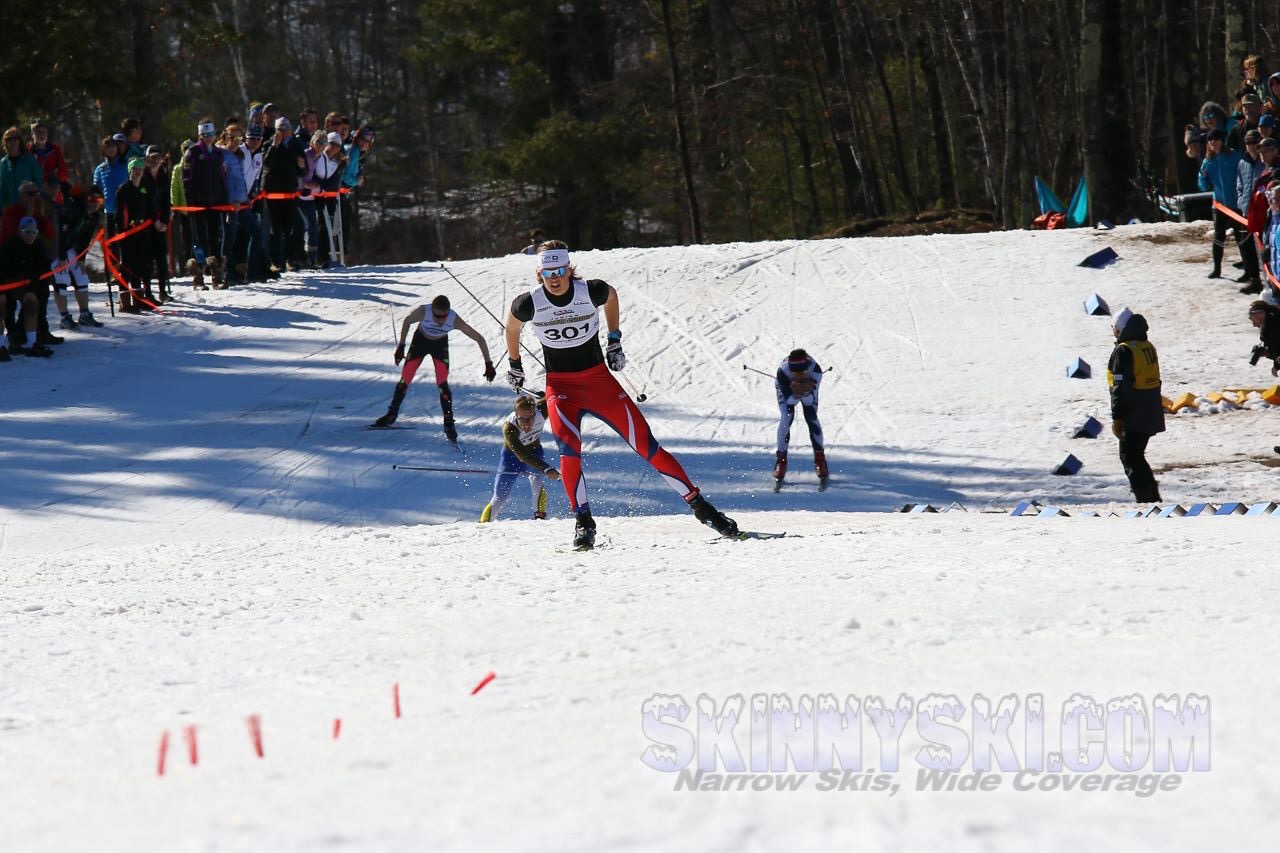
Logan Diekmann (Utah Ski Team) coming down the finishing stretch of the 2016 Junior National skate sprint in Cable, Wis. (Photo: Logan Diekmann/SkinnySki.com)
In an effort to showcase the North Americans competing at this week’s International Ski Federation (FIS) 2017 USANA Nordic Junior World Championships and U23 Cross Country World Championships at Soldier Hollow in Midway, Utah, we asked those qualifying athletes several questions about themselves — actually, we had them fill in the blanks. Here we have 19-year-old Logan Diekmann, of the University of Utah who’s representing the U.S. at his first Junior Worlds. On Monday, Day 1 of the championships, he qualified for the classic-sprint heats in 23rd.
***
“My full name is Logan Diekmann but you can call me Logan, or Logie Bear, I don’t really care. I was born in Seattle, raised in Bozeman, Mont., and one thing you should know about my hometown is that people don’t work and ski when they can, they ski and work if they must.
University of Utah freshman Logan Diekmann (Courtesy photo)
I started cross-country skiing when I was a child, thanks to my parents and the Bridger Ski Foundation. I currently train in Salt Lake City with the Utah Ski Team.
If I’m not skiing, you might find me squeezing in a 30 min. nap among training, classes, and homework. If I had to pick a favorite book, it would be ‘The Martian‘.
One of the things I’m most excited about for Junior Worlds at Soldier Hollow is repping the stars and stripes on my home course. One race I’m especially targeting there is the classic sprint.
The best advice anyone ever gave me about skiing or racing was ‘hard work pays off.‘ One of the best race memories I have is the classic 10 k mass start at JN’s in Truckee CA where I earned my first national title.
If I could meet one World Cup skier, it would be Alexey Poltoranin.
If I don’t end up being a professional skier, I’ll probably be bored out of my mind without any training to do.
I’m missing five days of school to be here, and my teachers are probably thinking, ‘Haha, good luck making up my 5 lectures, 2 quizzes, a midterm, and 12 pre-lectures.‘
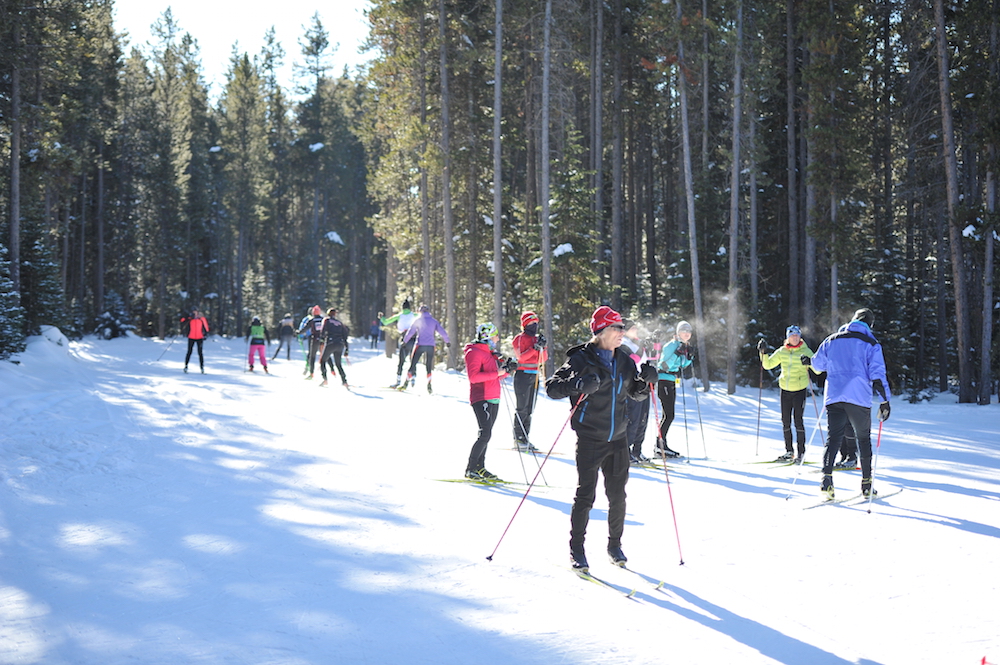
Skiers on the Rendezvous Ski Trails in West Yellowstone, Mont., during last year’s Yellowstone Ski Festival. (Photo: 2015 YSF)
Note: This article has been updated to reflect a more accurate elevation difference between the trailheads at Bohart Ranch and the Rendezvous Ski Trails.
The opening U.S. SuperTour races of the 2016/2017 ski season scheduled to take place next weekend, Dec. 3 and Dec. 4 in Bozeman Mont., at Bohart Ranch were recently canceled and rescheduled for West Yellowstone, located 90 miles south and at roughly 600 feet higher in elevation in Montana.
Due to lack of snow at Bohart, the races were called off on Thursday and moved to West Yellowstone as of Friday, where there is approximately 25 kilometers of trails open at the Rendezvous Ski Trails. Though the Bozeman-based Bridger Ski Foundation (BSF) said it was ready to host the races, not enough snow coverage caused the organization to cancel.
“We wait to postpone the decision until yesterday, Thursday, but didn’t get the snow we expected from that last storm,” Dragan Danevski, BSF’s head nordic coach and program director, said on the phone Friday.
Danevski indicated that BSF and West Yellowstone race organizers communicated after the cancelation regarding potentially moving the races.
“We were working back and forth with their organizing committees and ours,” Danevski said. “I just officially heard that West Yellowstone organizing committee agreed to host the SuperTours we couldn’t.”
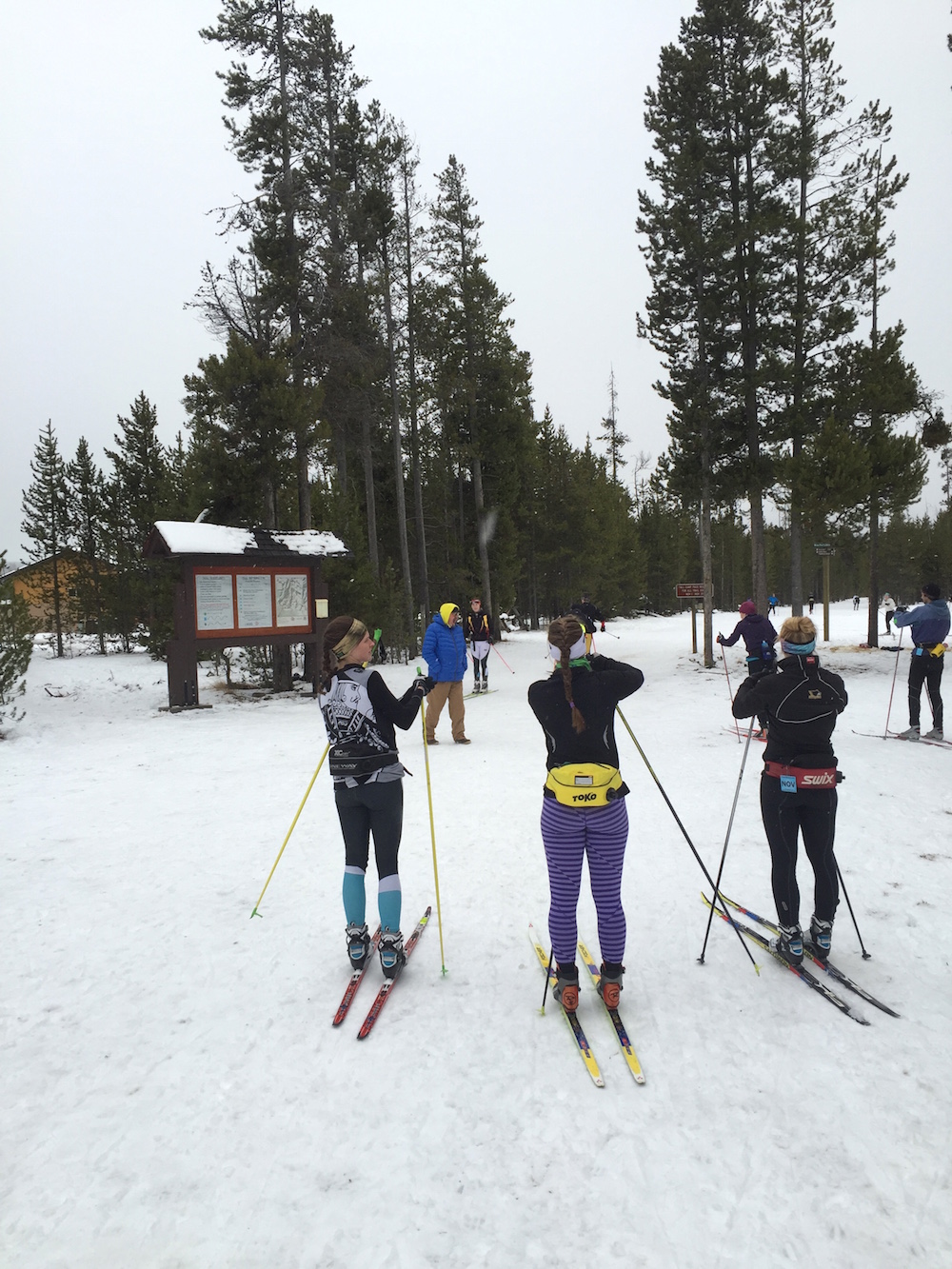
Skiers at the trailhead of the Rendezvous Ski Trails in West Yellowstone, Mont., on Monday, Nov. 21, 2016. (Photo: FBD)
The races will keep the same format and remain on their scheduled dates, with freestyle sprints on Saturday, Dec. 3, and 10/15 k classic on Sunday, Dec. 4.
In terms of the U.S. Ski Team using these races for scoring and consideration purposes for 2017 World Championships, it doesn’t appear this will change anything.
“West Yellowstone just agreed to take the weekend of SuperTour racing today. Same formats,” U.S. Ski Team Head Coach Chris Grover wrote in an email on Friday night.
Asked how this affects out-of-town athletes’ travel plans, Alaska Pacific University (APU) skier Reese Hanneman said that aside from “the logistical headache,” it’s not too different.
“Big thanks to the people in West Yellowstone for taking them over. From a racing standpoint, not what we were expecting but nothing we haven’t seen before,” Hanneman, last season’s SuperTour sprint leader, wrote. “I personally think it’s a pretty solid sprint course, I have had good results there so I am stoked!”
On the Canadian side, it’s taken a bit more reshuffling. Cross Country Canada (CCC) intended to use Bozeman as its NorAm opener as well as selection races, but West Yellowstone’s altitude of nearly 6,700 feet is “too high to use it as a selection race for the Canadian team – will not count for the FIS COC series,” CCC High Performance Director Tom Holland wrote in an email Friday night.
Now instead of considering an athlete’s best three results out of seven race days, CCC will consider three out of five races to help select its World Championships team and Continental Cup leader World Cup spots.
“Bozeman was going to be a really fun race series I am a little bummed because I thought it was good to have two races that were points for both Canada and USA it would have been an amazing field,” Russell Kennedy of the Canmore-based Team R.A.D. wrote in an email on Friday night.
“That being said it was pretty easy for me to cancel my plans and put my focus to [the second NorAm in] Silver Star [Dec. 10-11]. I have also been focusing on getting everything prepped for this weekend of racing so it hasn’t sunk in too much,” he added. “The selection looks like it is changed slightly but it shouldn’t impact us too much. I am super pumped to get my season underway and look forward to all the American competition in Silver Star.”
“I feel bad even though it’s just weather,” Danevski said. “I feel bad that we had to cancel because we were so excited to have the SuperTour in Bozeman and whole club and volunteers were excited, but the weather didn’t cooperate.”
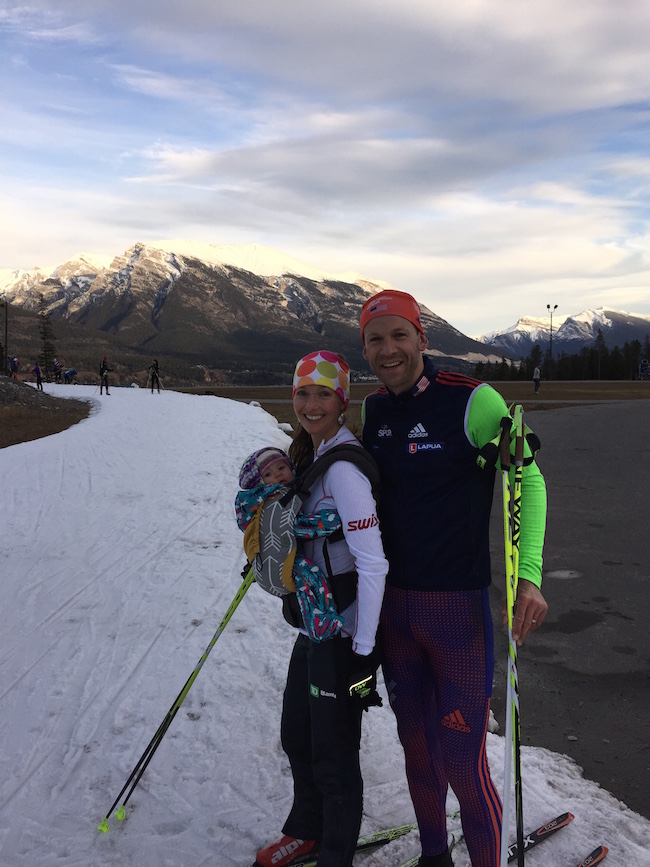
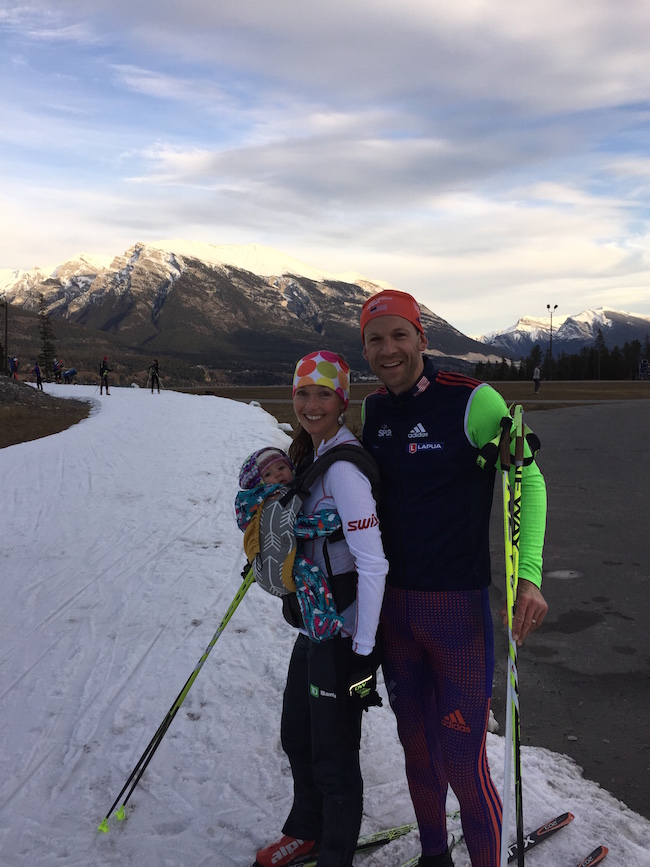
Lowell and Erika Bailey and baby Ophelia out for a ski on Frozen Thunder in Canmore, Alberta. (Courtesy photo)
Welcome to “17 Questions for 2017″, where we are catching up with American and Canadian national-team members before the beginning of the winter season.
***
Last year was Lowell Bailey’s 11th season on the competing on the World Cup, and he again proved his big-game chops. Two years after finishing 8th in the 20 k individual at the Sochi Olympics, a best-ever finish for a U.S. biathlete, Bailey notched a tenth-place result in the 15 k mass start at 2016 World Championships in Oslo.
1. Biggest change in your life in the last five or so months since the ski season ended?
My wife Erika and I became the parents of a beautiful baby girl, Ophelia, on June 15th 2016! In addition to that monumental life change, I took a new job helping to fundraise for Crosscut Mountain Sports Center, a yet-to-be-built world-class biathlon/xc training and outdoor recreation center in Bozeman, Montana.
2. Biggest change in your training?
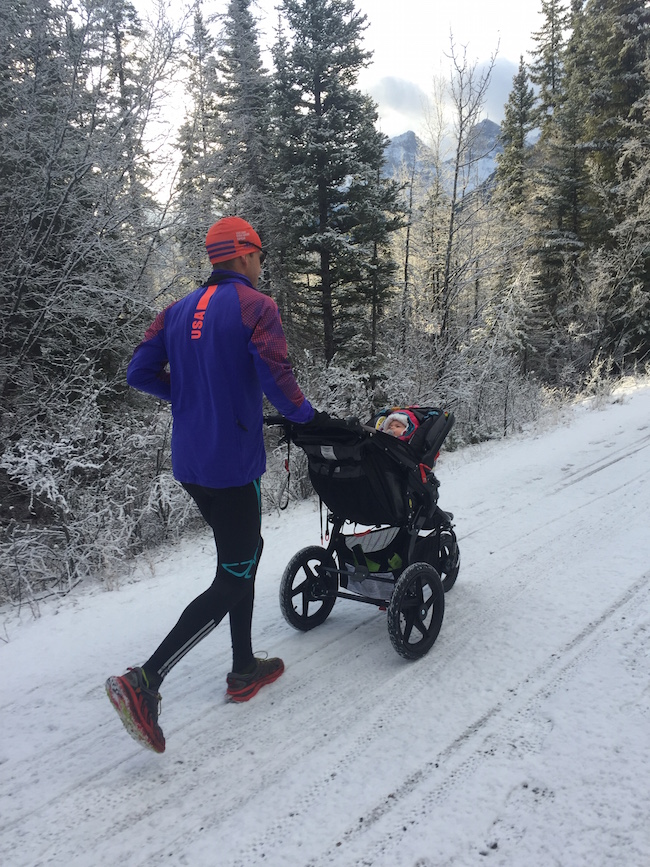
I’ve worked closely with the USBA coaching staff to create a training plan which allows me to stay closer to home. I’ve incorporated much more stroller-jogging into my recovery workouts as well 😉
3. Major areas of improvement you’ve seen so far?
Bailey doing some kid-friendly training. (Courtesy photo)
I’ve focused on improving my shooting speed and consistency. Every world cup biathlete has ups and downs in their ski speed throughout the season. The key to success is maintaining a consistently high level of accuracy on the shooting range so that, when you do hit your peak, you can also rely on your shooting.
4. Whom you’ve been working closest with this offseason (coaches or training partners)?
I’ve worked closely (albeit remotely between Lake Placid and Sweden) with Per Nilsson. On the ground, we have a great group of motivated coaches and athletes in Lake Placid. It’s a very lively, motivating training center these days!
5. Best trip in the last five months (and why)?
I think I’m currently on it! Erika, Ophelia, and I are in Canmore, Alberta for the National Team pre-season on-snow camp. Frozen Thunder has been in great shape and I love the area. It’s been great having the whole family here (see attached pic).
6. Favorite cross-training?
Trail running. We have great trail running in the Adirondacks and this summer I was able to explore some new places out west. I did some trail runs with the Bridger Biathlon Club kids and it was amazing to see so many passionate, fun-loving kids hooked on biathlon and enjoying the Great Outdoors.
7. Favorite non-athletic activity or pastime this summer?
The family and I spent our free time at my wife’s grandmother’s camp; a tiny little cottage tucked into the trees on the shore of Moose Island on Lake Placid lake. It is definitely one of those places where time stands still, the iPhone stays in the backpack, and the stars shine a little bit brighter at night.
8. Song that was your jam this summer?
“Ophelia” by THE BAND! I grew up with their music and have always loved the group. After our daughter was born, I felt obligated to go back and re-discover their entire catalogue.
9. All time favorite race moment?
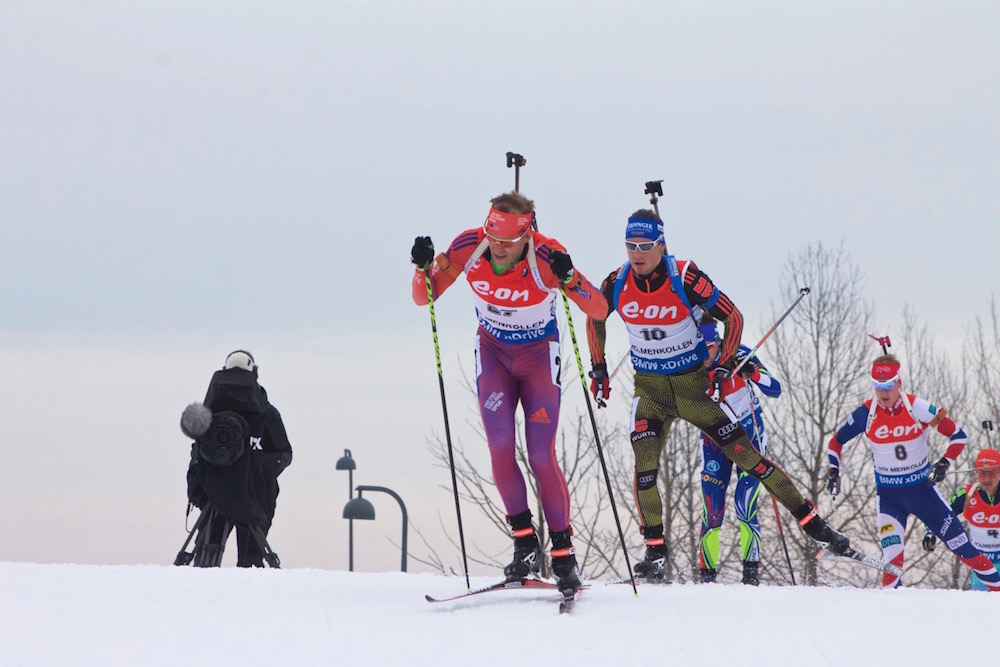
Lowell Bailey en route to finishing 10th in the World Championships mass start in Oslo, Norway, in 2016. (Photo: JoJo Baldus)
Last year at World Champs in Oslo, Norway. The Mass Start was one of the races I’ll always remember; staying up front through the entire race until the very end. It was thrilling, heartbreaking, exhilarating, and confirmed in an instant why I still love this sport after so many years.
10. First thing you pack in your bag when you leave for Europe?
Coffee filters and a one-cup coffee maker.
11. Venue/event you’re most excited to visit this season?
I always enjoy our time in Antholz, Italy, one of the most beautiful places to race on earth. I’m also looking forward to seeing the new course changes in Pyeong Chang.
12. Who will win the World Cup title this year?
Martin Fourcade is always a safe bet!
13. Biggest sacrifice you feel you’ve made choosing this career path?
Biathlon is an incredible career path, but I’ve always understood that it is just one of thousands of incredible career paths. I think the biggest sacrifice in pursuing anything is that by saying “yes” to that one thing, you are saying “no” to something else. I’m constantly confronted with situations – a family reunion, a concert, a fly-fishing trip – that I have to forego on account of my training and competition schedule. It’s just what you have to do as a full-time professional athlete.
14. If you could change one thing about your sport, what would it be?
I would eradicate doping from biathlon. With the recent McLaren Report findings, we now see just how unscrupulous the actors, how advanced their capabilities, and how pervasive their effect has become on our sport. We are quickly approaching a watershed moment; the moment when we either decide to take the controversial, albeit necessary, actions required to rid our sport of doping forever, or quietly sit by and watch biathlon descend further into a state of corruption and deceit.
15. What did you have for breakfast this morning?
The Nordie Trifecta: Eggs, granola, yogurt!
16. In 5 years, I’ll be ____?
Standing on the deck of the newly-built Crosscut Mountain Sports Center, sipping a micro-brew with Erika and the rest of the Crosscut Boardmembers, while smiling youth biathletes and XC skiers race around the Crosscut stadium below!
SuperTour skiers won’t be starting their season at the Rendezvous Ski Trails in West Yellowstone, Mont., this November. For the first time in the Yellowstone Ski Festival’s history, SuperTour races are not on the schedule. Citing altitude and frigid temperatures, the series is starting north in Bozeman, Mont.FasterSkier previously shared a press release from the U.S. Ski & Snowboard Association (USSA) giving the where and when of the 2016/2017 SuperTour schedule for high-level domestic racing. This article provides the why – why are the season’s first races not in West Yellowstone? Why are some U.S. SuperTour races in Canada? Why are U.S. nationals returning to Soldier Hollow after just two years away? And so on. FasterSkier spoke with various members of the American cross-country ski community to help get some answers about why the country’s top skiers will be going where when this winter.
Period One: Western Swing (but no West Yellowstone)
The single most noteworthy change to this year’s schedule may be the move away from West Yellowstone for the season’s opening races. Skiers have flocked to West Yellowstone in search of early-season snow, and often raced there, for a very long time. For how long? And why the change now?
As FasterSkier previously reported, elite skiers have made the Thanksgiving-week pilgrimage to West for nearly forty years: It was 1978 when the U.S. Ski Team held its first Fall Camp there, “with then-U.S. Ski Team coach Marty Hall and skiers like Bill Koch, Dan Simoneau and Tim Caldwell. Koch didn’t come too many years after because of exercise-induced asthma, which worsened with altitude.” People kept coming back. In 2004, Fall Camp, which had long since expanded to include a range of citizen skiers from around the country, was renamed the Yellowstone Ski Festival, with a full slate of clinics, demos, and a gear expo.
So why the change? Well, here’s another number from our article on the history of early-season skiing in West Yellowstone: “6,663: Elevation of West Yellowstone. The Rendezvous Ski Trails are about 6,800 feet above sea level (2,000 meters), and the South Plateau just outside the park is about 1,000 feet higher.”
The athletes have noticed. Bill Koch evidently noticed in the early 1980s. More recently, as Alaska Pacific University (APU) skier Reese Hanneman blogged in December 2015, “For as long as I have been racing, these first two weekends of elite racing have been held in the high mountain west, at illegally high altitude (according to FIS), which always makes them a little funky.”
USSA and club coaches noticed, too. As Robert Lazzaroni, USSA’s nordic domestic program director, explained in a phone interview, the impetus to move away from opening the season in West Yellowstone “came from the club coaches when we met in Craftsbury” following last season’s SuperTour Finals in March. The decision to move elsewhere was close to a consensus, Lazzaroni said: “It was very clear that the season starts too early. It’s too early – November 23rd – to start to chase points, when we want the athletes to peak at Nationals [in early January].”
West Yellowstone, known as “West” for short, is also at altitude, Lazzaroni noted. And finally, Lazzaroni made the uncontroversial observation that “West can be very cold.”
Putting all that together, he said, it just seemed like too much to ask of the athletes: “When you ask the athletes for the first race of the season to be at full speed, and to be fit, and in a cold place – it can be too much. And it puts their season in jeopardy. The risk was too big in their [the club coaches’] mind – too early, too high and the weather can be difficult. And that’s not good that early in the season.”
Hence the move from West in late November to Bozeman in early December: later, lower, and hopefully a little warmer.
So what will be left in West Yellowstone over Thanksgiving week, without elite athletes eyeing the competition, washing their hands, and chasing SuperTour points? Quite a bit, both USSA and West Yellowstone boosters agree.
As Lazzaroni noted, it was a “bummer” to lose the SuperTour component of the Yellowstone Ski Festival, but the festival “will continue. They will still have the junior race, they will still have the Masters race. It will just not be a SuperTour. … We believe a lot of the clubs will be there, training.”
Moira Dow seemed to agree. The program director of the Yellowstone Ski Festival, Dow said on the phone that she was “disappointed” to lose out on the opportunity to host the SuperTour races, but had no hard feelings toward USSA and appreciated the need to structure a race series to support athlete development.
“We understand that the athletes have to look out for the best of their development on the national stage,” Dow said. “While we recognize that, we are disappointed. We think that having the SuperTour held in a small town of West Yellowstone is fun and exciting. So we’re disappointed, but we understand the need.”
Dow admitted that the schedule change “was a surprise” to the organizers of the Yellowstone Ski Festival.
“Going into the [USSA] Congress [in mid-May] I thought it was still up for debate,” she said.
But given “the way it was presented at Congress,” Dow continued, “the athletes made their statement – I think the schedule was decided before Congress.”
Despite the surprise, Dow underscored that she had no hard feelings, and certainly did not view the schedule change as a personal attack on her or the festival. And she emphasized that everything that citizen skiers have come to expect from West Yellowstone in Thanksgiving week – clinics, demos, etc. – will still be there, including the races: “We’ll be holding just as many races, they just won’t be designated SuperTour” races, she said.
“SuperTours are not the most important part of our festival,” concluded an upbeat Dow. “We hope to see you in West Yellowstone.”
(So will the SuperTour return to West next year? The short answer is that likely nobody knows. In August 2015, quoting then-USSA nordic manager Joey Caterinichio, we reported, “West is the perennial host for Period I and could potentially rotate with Alaska, although, ‘there is no intention of changing West Yellowstone,’ according to Caterinichio.” That obviously didn’t last long. As Dow said when asked about her plans for November 2017, “we’re waiting to see – it changes from year to year.” She added, reflecting the development of this year’s schedule, “we find out in May what the athletes are looking to do to help put them on the national stage,” and then respond to that.)
An early December morning at the Sovereign Lake Nordic Centre in Vernon, B.C.
So the opening SuperTour weekend will be in Bozeman, Mont., starting with a skate sprint on Saturday, Dec. 3. A 10/15 kilometer classic individual start follows on Dec. 4. It will be a short week before athletes return to action with a classic sprint at Sovereign Lake in Vernon, British Columbia, on the evening of Friday, Dec. 9, with another short turnaround before 10/15 k skate interval starts the next day. (A relay that is not scored for SuperTour points will be held at the same venue on Sunday.)
If the move away from West Yellowstone was the first thing that struck many skiers about this year’s schedule, the move across the border was probably the second thing of note. The races in Silver Star will be a joint SuperTour/NorAm weekend (that is, they will be held together with the Canadian high-level domestic race series), an arrangement that has occurred in the past but not for some time. Ski representatives from both countries – which are identified as “children of a common mother” in the inscription on the Peace Arch at the border crossing between Blaine, Wash., and Surrey, B.C. – agree that the cooperation is welcome.
As Cross Country Canada (CCC) High Performance Director Tom Holland said on the phone earlier this summer, “We had a couple of phone meetings this year and there’s a willingness to work more together on a NorAm/SuperTour. Why not? To have more of these North-South relationships in the East and the West so people don’t have to travel so far. We’re sort of repeating history here. We’ve wanted to do this, but we did a lot of it in the ’90s, if you look at the results there were some great races back then. So it’s kind of a common-sense thing to have a North American race circuit where we compete against each other. We went down to West Yellowstone the last couple of years. It would be nice if there was more than that one weekend, but the U.S. has some other commitments in December. It would be nice if we had three or four weekends. The Euros ski more than us before Christmas, so the more we do the better.”
Holland continued, “We have those races every year anyway. It’s more about getting a high level of competition so we’re competing against the best in each nation and get warmed up for the season. There’s lots of examples of it working in the past, but it sort of faded as the SuperTour got stronger at one point. Anyway, we’re totally committed, and the U.S. is making a commitment, and we’re happy about U23/World Juniors being down there. So we’re going to do our trials down there. There’s a lot of cross-border stuff going on this year. I hope that sets a good tone for the future.”
Lazzaroni concurred, explaining that USSA wanted to hold consecutive race weekends relatively close together in order to make transportation somewhat easier. He also said they were pleased to combine with Canada in order to create a larger and more competitive field. Lazzaroni said that he hoped to have more joint SuperTour/NorAm weekends in the future.
Period Two: SoHo and Truckee
Athletes and coaches test skis in the stadium at Soldier Hollow in Midway, Utah, at 2014 U.S. Cross Country Championships.
Athletes will have nearly a month off before racing resumes with U.S. Cross Country Championships in January at Soldier Hollow in Midway, Utah. There is a 10/15 k skate individual start on Jan. 7, a full classic sprint the next day, and a 20/30 k classic mass start on Jan. 10. A qualification-only skate sprint event rounds out the week on Jan. 12.
U.S. nationals visited Soldier Hollow fairly recently. The races were held there in 2013 and 2014, before moving to Michigan’s Upper Peninsula for 2015 and 2016. The move back to Utah after only two years away is atypical.
The “main reason” for the quick return to Soldier Hollow, Lazzaroni said, “is because of World Juniors.”
The U23/Junior World Championships will be held at Soldier Hollow from Jan. 30 to Feb. 5, 2017, and will include roughly 750 athletes from dozens of nations. Some of those athletes will be junior and U23 skiers from the U.S., and Lazzaroni said that USSA wants to provide American skiers with a home-field advantage: “It was very important to us to bring the Championships back to the U.S., to show our commitment to FIS, and also to provide our athletes home-field advantage.” Lazzaroni explained that the best way to give American athletes this advantage was to give them an additional chance to race at Soldier Hollow in advance of the championships.
Therefore, Lazzaroni explained, USSA did not look back to the last time when U.S. nationals were held at Soldier Hollow in setting this year’s schedule. Rather, they looked forward, asking how best to prepare American athletes for Junior Worlds. And the answer was to let them race at Soldier Hollow in January before – for some skiers – racing there again in February.
But there will be something missing from this year’s edition of U.S. nationals: a national championship skate sprint. Instead, in the 2016/2017 season only, the national championship skate sprint will be held at the season-ending SuperTour Finals, as part of a race series colloquially known as Spring Series.
This schedule change, Lazzaroni explained, is due to the overall load on the Soldier Hollow volunteers and local community. It is “asking a lot of the venue” to hold both U.S. nationals and Junior Worlds at Soldier Hollow within the same month, Lazzaroni said. Among other inconveniences, he noted that there is an elementary school at Soldier Hollow, which also serves as the timing building and race headquarters, that has to be shut down when high-level races are held. Lazzaroni said that the local community was unable to commit to a full U.S. nationals schedule, including a full skate sprint day, on top of its other hosting obligations.
A quarterfinal in the freestyle sprint at 2013 U.S. nationals at Soldier Hollow in Midway, Utah. There will be no heats at this year’s national skate sprint; a qualification-only skate sprint will be held instead.The initial solution was just to take away the sprint race, moving U.S. nationals week from four races down to three. But, Lazzaroni said, this created a problem from the perspective of U.S. Ski Team Head Coach Chris Grover, who needs to oversee the selection of the U.S. team for the 2017 World Championships in Lahti, Finland, later this winter.
The races in Lahti include an individual skate sprint and a team classic sprint. The first half of the SuperTour schedule includes two classic sprints, but only one skate sprint.
The compromise, Lazzaroni explained, was a qualification-only skate sprint event at Soldier Hollow on Jan. 12. This was acceptable to Soldier Hollow event organizers and volunteers. And, Lazzaroni states, he feels that this “was a good compromise.” This way, “Grover can still have a qualification to make sure he has the best skiers to go to Lahti, and we don’t burn out the skiers and volunteers at Soldier Hollow.” The result will be a qualification-only skate sprint day, with no rounds contested. Results from the qualification will be used for purposes of qualifying for the U.S. World Championships team, but will not be scored for SuperTour points.
Following the skate-sprint qualification event, athletes have nine days off before racing on the Auburn, Calif., trail system in late January. A classic sprint will be held on Jan. 21, and a 5/10 k skate individual start on Jan. 22.
Period Three: Why not Ishpeming?
Roughly a month later, the SuperTour resumes with two races in Ishpeming, Mich., about 15 miles outside of Marquette on the state’s Upper Peninsula. There will be a skate sprint on Friday, Feb. 17, and a 5/10 k classic individual start on Sunday. (A 15/20 k mass start skate race, which will be a FIS-sanctioned collegiate race but will not be scored for SuperTour points, will be held on Saturday.) The race weekend will be held in conjunction with the NCAA Central Region Championships hosted by Northern Michigan University.
Al Quaal Recreation Area (Photo: Travelmarquettemichigan.com)The trails at Ishpeming’s Al Quaal Recreation Area last hosted a FIS event in February 2016. Before that, the previous and only entry for Ishpeming in the FIS results database is for a race weekend in February 1993. Suffice to say that it’s been a while.
So why Ishpeming? As Lazzaroni explained, repeating part of a reporter’s question, “You say, ‘Why Ishpeming?’ I would say, ‘Why not Ishpeming?’ ”
He said USSA attempts to rotate the SuperTour sites within the regions each year, and that this year the mid-season races are coming to the Midwest. It also recognized that the American Birkebeiner is held in the Midwest in late February, so there is an incentive to keep the SuperTour in the area. And Theodore Wirth Park in Minneapolis is undergoing construction work at present, and so was unable to host SuperTour races this year.
Lazzaroni explained that USSA was looking for a venue that could host SuperTour races for two weekends in a row, but was unable to find any venue that would take on this commitment. He said that they were pleased to get a taker for just one weekend in Ishpeming (population approximately 6,500), which has newly homologated trails and was eager to show them off. When the discussion was opened regarding bringing the SuperTour to the Midwest, Lazzaroni said, Ishpeming jumped on board.
“They have a long tradition of nordic skiing,” Lazzaroni noted, adding that Ishpeming was hosting cross-country races as early as 1905. The National Ski Association of America, a group that would later become the modern-day USSA, was founded in Ishpeming that same year.
Although last year’s Birkie was only scored for half SuperTour points, USSA has since revisited this assumption. At this year’s working group for the SuperTour schedule, Lazzaroni explained, they opened the question of whether the Birkie should count for full points or half points. Although some people had argued over the past few years that the Birkie should count for only half points, because it is often not a “normal” race distance, he clarified that the USSA Nordic Competition Guide makes “no mention that it should be half points.” Accordingly, USSA opted to follow the Comp Guide and restore the Birkie to full-points status.
Something less than a full SuperTour field typically races the Birkie; there were 17 American skiers with FIS points in the men’s elite race last year, and nine in the women’s.
Period Four: Spring Series in the Golden Heart City
A month after the Birkie, racers will travel north to end the season at Spring Series in Fairbanks, Alaska. Races will be held every other day over a week-long period from March 27 to April 2. A skiathlon, a skate sprint, a mixed club relay, and a 30/50 k mass start skate race are on the calendar. With a full skate sprint not being held at U.S. nationals in January, all events save the skiathlon will be national championship races.
Longtime Fairbanks race director John Estle is already excited. In an email to FasterSkier, Estle explained that the races will be held on a series of newly homologated and re-homologated courses at Fairbanks ski area Birch Hill. He noted that the new men’s sprint course will be “between 1500 and 1600m, which seems to be the preferred distance for sprint courses. Guys seem to like them to be about 3:30 in duration.” The women’s course will be “just a bit shorter than the men’s course.”
A 2012 photo from the trails at Birch Hill in Fairbanks, Alaska. (Photo: Lauren Fritz)After explaining the combinations of homologated loops that will be used for the various races, particularly the 30 and 50 k races on the last day of the season, Estle concluded, “The courses for those races will be quite challenging.”
Of the four races at Spring Series the skiathlon stands out, for its presence as well as its non-canonical distance. The suggestion on the official schedule that the distances will be 14 k for the women and 24 k for the men is apparently not quite accurate. Rather, Estle wrote, the distances will be 15 k and 22.5 k, respectively. “That is because we will have two homologated 3.75Km courses, one for the classic leg and one for the skating leg. Two laps of each course for women, three laps of each course for men” comes to 15 k and 22.5 k.
Estle is well aware that, at the Olympic Games or World Ski Championships level, women typically race a 15 k skiathlon and men a 30 k. “But most of the feedback I got from coaches and athletes was that at the end of a long, long World Cup season 30Km would just be too much,” Estle wrote. “At the World Cup finals in Canmore last year they did a 30Km skiathlon on a 3.75Km course and a large chunk of the field was pulled from the race (and hence the tour) after getting lapped. That was on a really tough course on a really warm day, but still. Those were damned good skiers, and they were completely shot at the end of that race.” So 15 k and 22.5 k it is.
A skiathlon, over any distance, is a rare event at the SuperTour level. Estle recalled hosting skiathlons in Fairbanks in both 2008 and 2009, but it is unclear whether they have occurred in this country at the highest levels of domestic competition since then. (The races are often entered in the FIS database as “pursuit” rather than “skiathlon” when they are held in this country, making it difficult to search for them. They are held more broadly at the high school and citizen racer levels.)
Skiathlons may be uncommon at this level of competition, but there seems to be widespread agreement that there should be more of them.
As Estle wrote, speaking as a race director, “One of the reasons that we are doing a skiathlon is that nobody ever does them in the US. … A skier’s first experience in a format contested at the World Championships should not be at those championships: Junior WC or U23 WC. If we are thinking about developing skiers who can compete at the highest levels, and coaches who can support them, then we need to make sure that our domestic schedule (FIS or otherwise) provides the types of experiences that will prepare them for the next highest levels of competition. Our skiers need a broad spectrum of experiences, and right now, because there are very few, if any, skiathlons on the domestic schedule, we are not preparing those skiers as well as we could or should.”
Lazzaroni sounded similar notes on behalf of USSA, saying that the skiathlon is contested at various international championships, and “why not prepare our athletes for that?” Echoing Estle, he noted that athletes reported back from the most recent World Junior Championships that they had never done a skiathlon before, “And that’s not right.” Lazzaroni said that he wouldn’t expect to see “many, many more [skiathlons] in the future” – but he added, “my vision is that, yes, we should train our skiers to be better at skiathlon, to be better prepared to do skiathlon.”
U.S. Ski Team Women’s Coach Matt Whitcomb was in complete accord, telling FasterSkier in a recent interview, “It’s often that at the junior and even U23 level when we go internationally, that we’re scrambling last-minute to find skiathlon boots, or to teach athletes how to load an exchange zone and what the rules are. So we’ll consider this just a quick dose of education for our entire community, and I think it’s going to have a big effect.”
The athletes seem to agree as well. Lex Treinen of APU, a top domestic athlete who has recorded SuperTour podiums but has not yet raced on the World Cup (which sees a handful of skiathlons each year), wrote in an email that he had done a skiathlon in Fairbanks some years ago – but that otherwise, “I have just done a couple at World Juniors and U23s.”
As Treinen explained, “Skiathlons are great and there is a good reason that they don’t do them very often on the Supertour: they are a pain in the ass logistically … for coaches and athletes and as the APU SuperTour team operates right now, we would not have the resources to wax for a skiathlon very effectively most of the season. Fairbanks will surely be an exception, since #1 it is closer to home and #2 it is Nationals which means there is a little bit of extra tech support from our team. Either way I don’t have a doubt that the fittest person will win this March and I really think it is a positive thing to be able to race some new formats. I am very excited that the Fairbanks organizers have decided to do something novel.”
Annie Pokorny, of the Sun Valley Ski Education Foundation (SVSEF) Gold Team, expressed similar sentiments. “The only skiathlons I’ve raced were at U23 World Champs, one in the Czech Republic and one in Italy,” Pokorny wrote in an email. “Despite my slim experience, however, I was incredibly excited to hear that USSA had integrated the skiathlon into domestic racing.”
Pokorny wrote that, “While it will certainly take some adjustment, I am always excited to see a diversified schedule on the SuperTour circuit. The more events we have, the more opportunities there are for varied competition and exposure to certain skills that our World Cup brethren see on a regular basis. Personally, the skiathlon is one of the most fun and exciting races I’ve ever entered. Having a switch in technique changes the rules of the game so there are more chances for comebacks than in a traditional mass start.”
When asked whether she was going to do anything special to prepare for this addition to the schedule, Pokorny wrote, “Few people know this, but in my first skiathlon I literally had the slowest transition time in the world, by many seconds. I don’t think I’ll need to change training much to be ready for the racing part, but it would be in my best interest to spend some time skiing while taking on and off my poles.” (Pokorny, who finished 29th in that race, is correct that her transition time ranked 48th out of 48 skiers.)
Looking to the future: Cross-country ski cross?
While this year’s SuperTour aims at selecting the U.S. team for Lahti and assigning start rights for upcoming World Cup events, USSA is also looking toward the future. And to hear Lazzaroni tell it, the future may involve cross-country ski cross.
Hannah Halvorsen (Far West/Sugar Bowl Academy) qualified 10th in the first-ever Cross-Country Cross event at the 2016 Youth Olympic Games in Lillehammer, Norway. (Photo: Far West/Facebook)“The cross-country cross has been a big success at the Youth Olympic Games in Lillehammer this winter,” he said. “It’s a format that the TV likes, the athletes like, that everybody likes. … I do hear from FIS that this is a format they want to push forward. We don’t know yet where it is going to go, but this is something we are keeping our eyes open [for], and I would not be surprised if you will see cross-country cross at some of the national events in the near future.”
Lazzaroni clarified that, by “near future,” he does not mean right away – “Obviously not next winter.” He added that this could become an important event to prepare U.S. athletes for larger stages: “Again, if this is going to be an event at World Juniors down the road – in two, three, four, five years, I don’t know – at Olympics, down the road – we should prepare our kids. And we have this discussion at Congress with the club coaches at a younger age, and we did encourage them to put some cross-country cross events at the local races. And again, the kids love it, because it’s fun. It’s working on agility, and it’s working on balance, and they become better skiers. It’s not now on the calendar, but I wouldn’t be surprised if in the near future we see more and more of this type of events.”
The Bridger Ski Foundation summer elite and post-graduate crew from left to right: Nick Power, Paul Everett, Silas Talbot, Max LaChance, and Logan Diekmann during a rollerski in Bozeman, Mont. (Photo: Austin Caldwell)
Along with fleeting daydreams of snow-covered fields, the summertime for many nordic skiers and coaches brings the search for another surface: perfect pavement. Afterliving in Bozeman, Mont., for the past two months working as the new head coach for the Bridger Ski Foundation (BSF) elite program, Austin Caldwell deemed the newly paved roads running past Triple Tree Ranch his rollerski route of choice.
The best part about the route for Caldwell, however, is not just that his athletes do not have to dodge potholes or endure the consequential leg gyrations from rollerski wheels passing over pebbles. It’s also the interval loop the location provides.
Performing interval pieces on the same loop, to Caldwell, offers athletes an opportunity to track their improvements not only through one workout, but over the course of many. Caldwell’s workout of choice is done at threshold on the same loop so that athletes can track improvements as the workout progresses.
The Bridger SKi Foundation summer elite and post-graduate crew during a roller ski in Bozeman, Mont. (Photo: Austin Caldwell)
Caldwell says that the athletes should then return to the same location and perform the same workout a grand total of four times in the summer and twice in the fall. In order to track performance gains, Caldwell has his athletes calculate their average heart rate during each interval piece, along with the amount of time it took to complete.
“The main thing that I like about this workout is that people can look back at it over time and see improvements,” Caldwell explained on the phone. “We look at the average heart rate and look at the times down for each interval and it’s a workout we’ll come back to a few times throughout the summer and a couple times in the fall as well, so you can see improvements throughout the year and I think that that is very motivating in the long run.”
The Workout: L3 Rollerski Intervals on a Loop
Find: A smoothly paved loop that takes 13-15 minutes to complete. Use this for the intervals.
Warmup: 30 minutes skiing easy Level 1 (L1) with one Level 2-Level 3 piece
The set: 4 x 15 minutes
Each interval piece should be done on the same loop
5 minutes recovery between each 15-minute interval
Cool down: 30 minutes easy L1
Total time: 2:15
Paving the Way to Better Performances: Caldwell’s Top Two Tips
1. Summertime = strategy testing. According to Caldwell, summer is the time to test different pacing strategies, transitions, and technique work, especially during longer threshold workouts such as the one outlined above. “I like this workout because it gets people to actually think about where they’re going hard, where they’re pushing themselves and where they can recover,” he said. “In a workout like this at this time of the year, I tell [my athletes] to try different things and see what’s working for them, what’s making it easier? Focus on a certain up hill or relax until the top of the hill and hammer the flat … hop in behind people, stuff like that.”
Andy Newell (l) and Erika Flowers at the top of Mount Blackmore in Bozeman, Mont., in June 2014. (Photo: Anya Bean)
On the first Friday of the month, while finishing up work on her computer, Erika Flowers felt her phone vibrate from an incoming text. The opened message asked her to check on the grill in the backyard of her apartment in Stratton Village, Vt. The sender was her boyfriend of four years, Stratton Mountain School (SMS) T2 teammate and current U.S. Ski Team (USST) member, Andy Newell.
Flowers walked outside, not noticing the grey-blue thunderclouds beginning to form above the not-so-distant Green Mountain peaks. The 26 year old’s mind was preoccupied — the busy workweek she’d had, the quickly approaching arrival of her younger sister for Independence Day weekend, the upcoming departure of her boyfriend to Norway for a training camp, her own training.
As her thoughts continued to turn, Flowers stepped up to the grill and lifted the lid, expecting to see the soft red and orange glow of burning coals. To her surprise, however, she was not greeted by the smoldering smokey sight and smell of ember-ed charcoals. What she found was another message, this time one on a blue painted rock. In a familiar script, the rock read, “You’re cordially invited to cocktails at Gale Meadows Pond — bring an umbrella, it will be an adventure…”
***
Sitting in the stern of a red, canoe-type fishing boat he bought about two weeks ago, Newell remains unsure of how much longer he will continue to ski race. A three-time Olympian, World Cup regular and a USST veteran for the past 12 years, his ski career ultimatum is to roll with the punches. Regardless of what the 32 year old decides within the next few years, one thing is certain: whatever decisions he makes will forever be alongside those of Flowers.
Andy Newell and Erika Flowers posing in front of the Restless Sea at Pebble Beach near Monterey, Calif., April 2015. (Courtesy photo)
“I think that was one of the reasons, at least I wanted to [get married] now and not wait a few years … is that so much can happen in professional athletics and Erika and I wanted to enjoy each other’s company before we have to grow up and get serious,” Newell, a Shaftsbury, Vt., native said on the phone while in Norway. “It’s kind of fun to be married and connected with the person that you love and not have to worry about having to be grown up. We’re both enjoying the fact that we’ll just keep ski racing, having fun, and taking things as they come.”
***
Rounding the final stretch of the path that circumvents Gale Meadows Pond — a trail she and Newell have trekked numerous times for fishing trips — Flowers was greeted by the sight of her boyfriend, Newell, fishing rod at the ready, reclining in the back of his new boat. During the twenty-five minute walk to him, she had uncovered quite a few more blue painted rocks — each with the symbols “E + A” and various other images: music notes, mountains, the word Montana (Flowers’s hometown being Bozeman, Mont.).
With the unveiling of each rock and as each step down the trail brough her closer to her destination point, Flowers admitted that her suspicions gradually began to arise.
“At first, I was like, ‘Oh, what a cute way to get me out of the house,’” Flowers said on the phone while in Vermont. “Had no idea what was going on, zero idea … then I started to notice that each rock had different things painted on it … all these things that we had done together, that we enjoyed doing together. So then I was like, ‘Hmmm, this seems like a lot of effort for just a date.’ That was like the first time that it [a wedding proposal] crossed my mind.”
***
It was not whether the answer would be yes or no. It was not whether he had chosen the right one to ask. It was the weather. That was what weighed on Newell’s mind the most as he waited for Flowers climb into the prow of his fishing boat.
“I was a little bit nervous because it was about to thunderstorm really badly and I was trying to make it a surprise,” Newell reflected. “So I was more nervous about the weather and her not making it to the lake on time, than her saying yes or no … I just didn’t want to ask her casually. I wanted to do something a little more fun than that.”
***
As a junior waiting in line to get her poster signed by a professional World Cup ski racer, Flowers never would have guessed that the black sharpie signature she was about to receive was the name of her future fiancé. To her the photograph she held of Newell hucking himself backwards over a ski jump was simply that of a renegade nordie.
Erika Flowers (r) and Andy Newell make like fish during a fishing trip at Provo River, near Park City, Utah, in May 2015. (Courtesy Photo)
“I think my first impression from him from afar was ‘Oh he’s just this badass skier dude,” Flowers reminisced. “Technically, the first time I met him when I was like a junior skier and he was signing my poster. But he doesn’t remember that.”
Perhaps to Flowers’s surprise, the interaction was one Newell never forgot.
“We actually met for the first time at this training camp up in Lake Placid that she had been invited to come train with REG or something like that,” Newell said. “But we didn’t really hang out until Erika was out of college [in 2012] and we started training together at Stratton. Then we started hanging out together everyday.”
***
From fishing trips to surfing tips to hiking trips and Taylor Swift, Flowers and Newell have seen it all. And they have seen it all together.
“Whether we’re going surfing in Costa Rica or fishing in Montana, Erika has a nice adventure side that compliments my craziness a little bit,” Newell said. “She makes me a much better person when I’m around her. I think we both make each other better people. So I knew that she was the one once I realized that.”
Flowers indicated that for her, what seals the deal is the care Newell demonstrates for her and all those he knows.
“From the little things that he does, like singing me songs about peanut butter toast in the morning to being there [when I] broke my elbow or when I missed a Taylor Swift concert,” Flowers said. “He’s just the most caring, thoughtful person I’ve ever met.”
As a junior waiting in line to get her poster signed by a professional World Cup ski racer, Flowers never would have guessed that the black sharpie signature she was about to receive was the name of her future fiancé.
The support the two show each other — even amidst frustrations — also makes their relationship strong.
“Him trying to teach me how to surf almost every spring,” Flowers said. “It’s one those things that’s extremely frustrating, but also so fun at the same time. He tries so hard to help and I get so angry, but he’s very patient which I appreciate.”
Erika Flowers (l) and Andy Newell flashing smiles on Friday, July 1, while out fishing on Gale Meadows Pond on the date of their engagement. (Courtesy photo)
“And then him trying to learn how to fish has been entertaining,” Flowers added. “He tries so hard to be a Montana fisherman and he’s so bad at it. But I love it and he keeps trying … it is the one thing I can do that he’s not better than me at, so I’m holding onto it.”
***
Floating across the mirror-like top of Gale Meadows Pond, Newell and Flowers discuss a broad range of topics: plans for the summer, their futures in skiing, adventures they have had — like climbing Blackmore in Bozeman, Mont. with Flower’s newlywed parents –and their ones yet to come.
“If I could ski forever I would, but the reality is you someday have to make money and if you’re not feeling like you’re improving or getting better, then it maybe becomes less fun,” Flowers said of life as a professional cross-country skier. “That was when he said one of the sweetest things, [which] was, ‘But I know that no matter what we do next, or what happens within the next few years, whether skiing goes well, or terribly or what have you, I know that I want to be with you through all that and onto the next thing.
“Then eventually he got to the point where he was like, ‘I love you so much and I love adventuring with you and I want to be able to go on adventures with you for the rest of our lives,’ ” she added. “Then he pulled the ring out and asked me if I would marry him … He crushed it.’ ”
Drifting back to the shore as two less fish in the sea, the couple’s next steps now revolve around bridal bouquets, questions over cake flavor and color schemes, and finally, where to post mark their wedding invitation returns.
“I’m quite sure [the wedding] will be out in Bozeman,,” Newell said. “Sometime next summer or fall. We haven’t planned too much, but I’m sure it will be Bozeman and it will be a good time.”
Andy Newell’s new fishing boat and the site of the proposal. (Courtesy Photo)
Snowmakers in action at Soldier Hollow in January 2014. The 2002 Olympic venue in Midway, Utah, last hosted the U.S. senior national championships in 2014 (as well as the year before in 2013) before Houghton, Mich., hosted in 2015 and 2016. Nationals are returning to SoHo this coming January.
PARK CITY, UT – Top cross country athletes from across America will participate in 16 races at seven different stops as part of the U.S. Ski and Snowboard Association’s (USSA) annual USSA SuperTour. The 2016-17 tour kicks off in December in Bozeman, MT.
The SuperTour is a series of International Ski Federation (FIS) sanctioned cross country ski races taking place across America, produced by the USSA, together with its divisions and clubs. The Tour is a vital piece of the USSA’s development program, providing top level racing at key cross country centers around the nation. It’s a proving ground for club athletes with aspirations of making it to the U.S. Ski Team and competing on the FIS World Cup tour and in the Olympic Winter Games. Caitlin Patterson (Craftsbury, VT; Craftsbury Green Racing Project) and Eric Packer (Anchorage, AK; Alaska Pacific University) took the season long titles in 2015-16.
“The USSA has had great support from its clubs and divisions in putting together this year’s calendar,” said USSA Nordic Domestic Program Director Robert Lazzaroni. “We’ve rotated a few sites this year and will continue to move around in the future to get the SuperTour to new places. Moving the event around helps stimulate top-level racing in America.”
Period 1 includes stops in Bozeman, Mont., and Silver Star (Sovereign Lake), British Columbia. The decision was made at USSA Congress to start the series one week later than previous years and to combine with Canada to increase the field.
Period 2 will open in January with the L.L.Bean U.S. Cross Country Championships at Soldier Hollow in Midway, Utah. Soldier Hollow is also a site for the 2017 FIS Nordic Junior and U23 World Ski Championships. Athletes will then continue on to Truckee, Calif., for races on the Auburn trail system.
The third period will feature two stops in the midwest. Athletes will race on a new homologated trail in Ishpeming, Mich., before participating in America’s largest cross country race, the Slumberland American Birkebeiner, on Feb. 25 in Hayward, Wis. The series wraps up with the SuperTour Finals Mar. 27- April. 2 in Fairbanks, Alaska. Finals will also double as the L.L.Bean U.S. Championships for long distance and freestyle sprint.
“The divisions, venues, technical delegates and homologation inspectors have been working hard to develop new venues and evolve current courses to strengthen the SuperTour,” stated USSA Cross Country Development Coach Bryan Fish. “We are making strides to include junior and collegiate racing within the SuperTour to enhance head-to-head racing with juniors, college athletes and our top World Cup competitors. Our collaboration with Cross Country Canada will also better prepare athletes for international competition. It’s an exciting year for cross country in the United States, and we’ll get to showcase this to the world during Junior World Championships.”
Athletes will also vie for for points across the tour to earn Continental Cup leader starts and World Cup starts. There will also be spots available for the 2017 FIS Nordic World Ski Championships Feb. 22 – March 5 in Lahti, Finland. Those spots will be awarded after the conclusion of the U.S. Cross Country Championships in January.
(*Note: U.S. championships also include a freestyle sprint qualifier, which serves as a qualifier for 2017 World Championships but will not be scored as a U.S. nationals or SuperTour event)
Jan. 21-22, 2017
Truckee, CA
Men: Sprint CL, 10 km Free
Women: Sprint CL, 5 km Free
Period 3
Feb. 17-19, 2017
Ishpeming, MI
Men: Sprint Free, 10 km CL
Women: Sprint Free, 5 km CL
Feb. 25, 2017
American Birkebeiner
Hayward, WI
Men’s and women’s 50 km Free
Period 4
Mar. 27-April 2, 2017
SuperTour Finals
Fairbanks, AK
Men: 24 km Skiathlon, Sprint Free, Relay, 50 km Free
Women: 14 km Skiathlon, Sprint Free, Relay, 30 km Free
Jason Brenden focuses on his next hold during a climb on his backyard climbing wall in Bozeman, Mont.
For this week’s Wednesday Workout, FasterSkier provides a firsthand account of backyard climbing, what an endurance climbing workout entails and how to build your own backyard climbing wall.
***
BOZEMAN, Mont. — A cloud of white chalk dust mushrooms from my housemate’s hands as he claps them together. The woven orange and black chalk bag he had been holding a few seconds ago now sits in the grass, next to a pair of worn-out Chaco sandals and a faded black hoodie. A quick glance at my wrist watch shows the time to be 7:20 p.m. However, with the summer solstice and a cool evening breeze on our side, there’s still plenty of daylight left for photographs and climbers’ pull-ups.
Jason Brenden traverses his backyard climbing wall in Bozeman, Mont.
I focus my camera lens on his right hand gripping a particularly small hold as I perch atop a homemade climbing wall erected in our backyard a little over three months ago. My housemate, Jason Brenden, originally from Grand Rapids, Minn., made it with a friend, and I decide Jason is certainly not the nordic-type.
He is not about to start writing down what he does for workouts during the week. He does not wear spandex, nor is he about to go for a four-hour weekend run in the mountains — I’ve witnessed him slip out the front door for a jog before, only to find him re-enter 15 minutes later.
He’s a longtime climber and a brand-new nordic skier, taking up the latter recreationally last winter.
Camera still in hand, I make my way down the back of the climbing wall. I walk around to the front and plop down next to Jason on one of the two crash pads resting beneath the wall’s overhang. He slips off his blue-and-black climbing shoes, leans back and something like the scent of sour onions and old socks settles between us. I consider telling him we could postpone the talk until after he showers, but change my mind. I can wait it out.
He begins telling me about a major climbing trip he is putting money aside to take one day. His favorite place to climb turns out to be Squamish, British Columbia.
“I spent a month there two years ago,” Jason, 25, says. “Outside climbing is definitely different than inside in terms of footwork and technique. There are a lot of little holds on the rock you can use that aren’t in the gym.”
As we continue to chat, he throws around terms like “jug”, “traverse”, and “lock-off” and I’m not afraid to admit I have no idea what any of them mean. Listening to him, I know that he and many skiers may never see eye-to-eye regarding some aspects of training. There are many training tenets on which he and I will also never find level ground.
Yet, facing him cross-legged on the crash pad, I can see a trace of fire in his eyes and feel the heat in his tone when he talks about climbing; his frustrations with outsiders to the sport who question climber lingo (nordic translation: ever try to explain L1, L2, L3, L4, L5 target training zones to an outsider?)
Jason Brenden nears the top of his backyard climbing wall in Bozeman, Mont.
Even if Jason takes his kale alongside a tall glass of ale (he’s a brewer at Outlaw Brewing in Bozeman) — whether he’s in-season or off — there is one characteristic he espouses similar to cross-country skiers: passion for a sport and its community. In the case of Jason, that sport is climbing.
Like many skiers, Jason spends a lot of time watching video — the ones he watches just happen to be of people scaling rock instead of snow-covered trails. Like many skiers, Jason enjoys conversing with people who understand the sports’ jargon and draw. Like many skiers, he also appreciates the way sport creates a way to be social, to connect with neighbors, friends and new faces.
“The best thing about having a wall in your backyard is inviting all your friends over to drink, barbeque, and climb,” he said. “That’s the real reason you build a climbing wall in your backyard. Not so much for training.”
The Workout
Purpose: Build endurance
Warmup: 15-20 minutes of traversing (climbing up and down) the biggest holds, with occasional rests
5 minute rest prior to circuit
Circuit: 2-3 x 30 minutes of continuous climbing
Jason says you may rest on large holds, but not to let your feet touch the ground
8 minutes rest between each 3- minute climbing segment
Equipment: climbing shoes, chalk, and crash pads
Jason also suggests having “a spotter so you don’t break your ankle.”
Jason Brenden demonstrating a left-hand lock-out on his backyard climbing wall in Bozeman, Mont.
How to Build Your Own Wall (Jason’s guide):
Supplies: Plywood, 2 x 4 lumber, T-nuts, holds (average $5-$20 per hold)
Step 1: Frame out the back similar to putting up a wall in a house (We ran our 2 x 4’s horizontally instead of vertically in the back)
Step 2: Screw plywood sheeting into the 2 x 4’s
Step 3: Drill holes in the plywood (this is where your T-nuts and holds will go)
Step 4: Screw your holds on using the T-nuts
Step 5: If you want a second level, you got to get some heavy duty lumber, bolts, and get creative!
Jason’s Building Tip:
“You can set holds to train certain moves,” Brenden said. “For example, if you want to work on left-handed lock-offs [using tendon strength to support weight on a handhold without tiring muscles too much], you would set holds so you have to pull your left hand toward your chest while you reach with your right hand to a far away hold. The idea with that is you’re practicing moving really slowly, training those muscles to lock your body off and make a controlled move.”