From the FasterSkier archive — posts syndicated from athletes’ and coaches’ own blogs between 2004 and 2012, kept online as published. Current coverage is at fasterskier.com.

Tag: Brayton Osgood

  • The Hilltop Lesson: How Second Place at the NCAA Championship Became Hagenbuch’s Guiding Philosophy

    The Hilltop Lesson: How Second Place at the NCAA Championship Became Hagenbuch’s Guiding Philosophy

    On a bright March afternoon at Dartmouth’s Oak Hill, with a soft and slow course under his skis and a band he himself had organized blasting in the stadium above, John Steel Hagenbuch approached the final climb where he learned something that would shape the early years of his career far more than any podium ever could.

    He had come into the NCAA Championships with the weight of a thousand private dreams — a home championship crescendo and an entire community behind him. Then, with Utah’s Joe Davies charging to the finish line waving the Utes flag and Peter Graves’ voice echoing through the trees, Hagenbuch realized he was not going to win.

    “I got dropped, and it just wasn’t gonna happen,” he says. “I told myself, you’ve got until the top of this hill to be upset about it.”

    John Steel Hagenbuch was all smiles after crossing the 20k Freestyle finish in second place at the 2025 NCAA Championship where he represented Dartmouth College on their home course at Oak Hill. (Photo: Courtesy Photo)

    What happened next wasn’t the reaction of an athlete who had just been beaten in the race he’d been thinking about, talking about, training for, and dreaming about for three years. It was something quieter. Something older. Something that didn’t look like the scripted champion he’d imagined — but ended up becoming the cornerstone of the athlete he is now.

    “I stopped poling,” he says. “And I just kind of skated through the stadium… smiling, waving, like the Penguins of Madagascar — smile and wave.”

    He remembers the sunshine, the thousands of people lining the stadium, the Stripers — Dartmouth’s biggest student band, coaxed back from post-graduation life because he wanted the place to feel alive — and the thrum of friends, professors, fraternity brothers, and family in the crowd.

    “Did I win the ski race? No. But it actually didn’t matter,” he says. “I was just so grateful… all the amazing things in my life that had led me to that point.”

    Every day since, he thinks about that race. “But not for the reasons you’d expect.”

    John Steel Hagenbuch (USA) racing the World Cup opener in Ruka (FIN) in 2023. (Photo: Modica/NordicFocus)

    Muonio, Finland: The Final Quiet Before the Season Begins

    Eight months later, Hagenbuch is sitting in a small room in Muonio, Finland, speaking over a fickle internet connection. Outside, winter is closing in; inside, the early-season nervous energy is beginning to hum.

    “It’s been a good way to start the season,” he says of the classic sprint and 10k skate he raced the previous weekend. “Hopefully more to come.”

    He will likely stay on the World Cup through the Tour de Ski. His primary goal, stated simply and without ornament, is clear: “Primary goal is to go to the Olympics. Everything else is secondary.”

    He’s 24, still at Dartmouth — technically a senior, though he took this fall off to focus on training. When winter term begins on January 7, he’ll be back in class, shifting between World Cups and essays, navigating the dual life of a college student and a professional skier the way only NCAA athletes truly understand.

    But he is not rushed. Not impatient. Not gripping the rail of his career with white knuckles.

    He learned something on that hill at Oak Hill, something that has become his ballast. “It reminds me why I do this,“ he says. “And why this sport is so special.”

    Before he was an NCAA champion, skiing on the World Cup, and a trying to qualify for the Olympics, John Steel Hagenbuch was just a kid who loved skiing around on the trails of Sun Valley, ID. (Photo: Courtesy Photo)

    The Long View: Three Olympics and a Full-Moon Ski

    Hagenbuch surprises you with the distance of his vision.

    When asked about the future, he doesn’t talk only about Milano-Cortina in 2026. He talks about three Olympics — a decade of life sketched out in calm, confident lines.

    “I would love to go to the next three Olympics,“ he says. “Milano-Cortina, then the French Alps, and then retire at the Salt Lake City 2034 Games.”

    Soldier Hollow, where he has raced “probably 50 times,“ would be the perfect ending. But it’s not the race he imagines most clearly. Not the ceremony. Not the result.

    It’s the lead-up.

    “What will be the crown jewel of my ski career,“ he says, “is having the 2034 Olympic pre-camp in Sun Valley. At my house. With all the fellows.”

    He can picture it already: the team skiing at Prairie Creek under a full moon, crispy tracks at 15 degrees after a sunny day, the quiet of the Sawtooths pressing close.

    “That’s what I’m gonna remember when I’m 75,“ he says. “That Prairie Creek ski.”

    In this way, Hagenbuch does not think like most 24-year-old athletes. He thinks like someone who has already lost something, already gained something, and has made peace with what remains.

    A Training Philosophy Built on Feel (and a Fearless Lack of Overthinking)

    In an era where professional endurance athletes run lactate strips daily and analyze heart-rate drift with the devotion of day traders, Hagenbuch stands apart.

    “Do you do lactate testing?“ I ask him.

    “Maybe like once a year.”

    He trains primarily by feel—not just how his body feels, but what he feels like doing: long backcountry days, ridge runs, mountain biking, skiing deep into the mountains around Sun Valley. There is structure, but only when he believes it should exist.

    “Not taking it too seriously,“ he says, “and kind of just going by what I would like to do and what I think is going to be fun.”

    June and July? “Absolutely not“ analytical. Fall? Yes, that’s when he “locks in a bit.”

    And if it ever stops being fun, he says, “I will not stick around.”

    He has seen athletes grind themselves into dust out of fear of what’s next. “I respect the grit,“ he says, “but… I’m incredibly grateful to have had experiences and opportunities in my life that that’s not the case for me.”

    He isn’t clinging to skiing. He’s choosing it — every day — until it no longer feels right.

    That clarity is rare. Maybe even elite.

    Being cheered up a climb in Soldier Hollow by one of his SVSEF coaches, Rick Kapala, John Steel Hagenbuch proves athletes like him aren’t built by themselves or through the guidance of one coach, they are lifted by a community. (Photo: Tryg Solberg/Courtesy Photo)

    The Consortium: Osgood, Whitcomb, Kapala, and Holmes

    Though he trains by feel, he is not without guidance. His coaching structure is more like a board of advisors — four voices, each offering a different vantage point.

    “I talk with Brayton at Dartmouth, and Matt on the U.S. team, and Rick — my high school coach — and Peter Holmes on the Gold Team,“ he says. “I get input from all of those guys.”

    When deciding to come to Muonio early, he called all four. Not for permission — for perspective.

    “When I’m at Dartmouth, I do Brayton’s plan,“ he says. “But if I feel like I need to do something different, he’s totally cool with that.”

    And contrary to what a young elite athlete might hope to hear, most of what they tell him is not “do more.“

    “Oftentimes,“ he says, “it’s settled down.”

    Dartmouth College’s John Steel Hagenbuch skied to a 15-second victory on his home trails in the 7.5 k Classic at the NCAA Championship. (Photo: Tobias Albrigtsen)

    The Place That Built Him

    If you want to understand why Hagenbuch thinks the way he does — why gratitude flows so naturally through him, and why he measures life through moments rather than medals — you have to understand Dartmouth.

    “NCAA skiing is a really special thing,“ he says. “People are going to roll their eyes… but there aren’t a lot of places that have the components Dartmouth has.”

    The social component is not a distraction — it’s a pillar. “Last year, every single guy on the team was in a fraternity,“ he says. “Different fraternities.”

    He explains the structure: students join Greek life in their sophomore year, after they’ve already found their people, their communities, their balance.

    “Everything acts as a complement,“ he says. “And providing that much balance… makes everything greater than the sum of its parts.”

    The feeling at NCAAs captured this perfectly. “Anyone who was there,“ he says, “left thinking two things: college skiing is [so] sick and Dartmouth is [so] sick.”

    He means it.

    And he knows it won’t come again — not in this form.

    Luke Allen, one of his closest friends, once asked an older alumnus if life ever gets as good as Dartmouth skiing. The man looked him straight in the eye and said, “No.“

    There was lots of great energy at Oak Hill for the final day of the 2025 NCAA Championship. (Photo: Tobias Albrigtsen)

    The Beauty of Losing

    Here is the strange and elegant truth of Hagenbuch’s current career: his most important athletic memory is a loss.

    He doesn’t hide from that. He doesn’t twist it into “motivation“ or pretend it fuels some internal fire for revenge.

    Instead, he carries it like a compass.

    “I think about that race every single day,“ he says. “But not because I lost… It reminds me to be grateful for these amazing people, places, and things in my life.”

    He printed 150 photos at CVS the night before leaving Hanover in August — family, friends, the Haig Glacier, Sun Valley, Dartmouth — and plastered them across his fridge at home.

    “Think how many times a day you walk by your fridge,“ he says. “All my friends are right there.“

    It’s his daily reminder of what matters.

    The Thursday classic race at NCAAs, the unexpected great day, the team’s move from fifth to first — these have become larger in his memory than the race he thought he wanted most.

    “What was the special day at NCAAs?“ he says. “It was Thursday. I wasn’t even thinking about Thursday. I didn’t care how that one went.”

    And yet: “I had probably my best classic race ever… it was such a culmination of a lot of hard work and belief.”

    This is the philosophy he now lives by: you learn more from your losses, and sometimes the thing you didn’t expect becomes the thing you carry forever.

    John Steel Hagenbuch, who won the 7.5k Classic, celebrates with his teammates after the three raced Dartmouth into the NCAA Championship lead. (Photo: Courtesy Photo)

    The Advice Only Someone Who Has Lived It Can Give

    At the Haig Glacier last summer — years after his last high school camp there — Hagenbuch offered a piece of advice that caught the younger kids off guard.

    They were expecting training insight. Intensity zones. Technique tweaks.

    Instead, he told them the thing he wishes someone had told him at 15:

    “Be a kid more.”

    Growing up in Sun Valley, he had an idyllic childhood — but he wishes he’d stayed on the high school soccer team after freshman year. Wishes he’d allowed himself to do more of what felt right, not what looked right.

    “Don’t try to do what you think you should do,“ he says. “Do what you feel you should do.”

    And if your friends are doing something slightly reckless, something that wouldn’t make the parental brochure?

    “Maybe… F-it, do it,“ he says, laughing. “You’ll figure it out for yourself.”

    Because that, too, is how you learn.

    John Steel Hagenbuch (USA) racing the individual sprint at the Minneapolis World Cup. (Photo: Modica/NordicFocus)

    A Career Just Beginning, with the Wisdom of One Already Lived

    Hagenbuch is young — young enough to dream of three Olympic Games, young enough to talk about walking onto the Dartmouth lightweight rowing team or running the 5k or 10k for the track team “as a fun challenge“ in his final spring on campus.

    But he is also old in the ways that matter. Not jaded — never that. But precise in what deserves his attention, and ruthless in discarding what doesn’t.

    He knows what a good race feels like: “When you finish and think, damn, I could have gone a little harder.”

    He knows what a good life feels like: something filled with people and place, community and joy, full-moon skis and carnival tailgates and the band you recruited yourself playing you through the stadium after a loss.

    And he knows — already — that the real currency of this sport isn’t medals, nor money, nor even wins.

    “If you wanted to have glory or make money in sports,“ he says, “we’re all doing the wrong sport.”

    So what is it about?

    “It’s about the things I’ve talked about,“ he says. “It’s the parking lot tailgates. The little antics in the van. The dumb jokes with your boys. The feeling of being part of something bigger.”

    And that’s why the NCAA hilltop moment carries him into this World Cup season — a season he hopes travels through Italy, under Olympic lights, wearing the colors he’s dreamed about.

    Because that hill taught him the thing every great athlete eventually learns:

    Sometimes the race you don’t win becomes the story you never stop telling.

    Sometimes the best version of your career begins the moment you stop being upset… and start taking in the view.


    Love Stories Like This? Help Keep Them Coming.

    Feature interviews like this one take time, access, and care to produce. If you value thoughtful storytelling and independent ski journalism, please consider becoming a Voluntary Subscriber. Your support directly fuels the work we do to cover the people, places, and moments that make our sport special.

    Join the FasterSkier community!


  • Dartmouth Ski Team Hiring Nordic Assistant

    Dartmouth Ski Team Hiring Nordic Assistant

    (Job posting)

    The Dartmouth Ski Team is hiring a Nordic Assistant. The assistant reports to the Women’s and Men’s Head Coaches and helps with all aspects of the program to support approximately 25 student-athletes.

    Key responsibilities:

    • Working daily with the Head Coaches at training sessions and competitions throughout the season. Duties will include waxing, equipment preparation, video, transportation, and other logistical support.
    • Helping organize and run the Dartmouth Winter Carnival Nordic competitions.
    • Identifying and organizing competition trips in February and March outside of EISA competition.

    Experience:

    • Bachelors degree and collegiate racing experience preferred.

    Duration:

    • Four to six months, 25-30 hours per week.

    Please contact Cami Thompson Graves (Cami.L.Thompson.Graves@dartmouth.edu) or Brayton Osgood (Brayton.K.Osgood@dartmouth.edu) with any questions including how to apply.

  • Saturday Rundown: NCAA Champs; Holmenkollen 50 k; Kontiolahti Relays

    Saturday Rundown: NCAA Champs; Holmenkollen 50 k; Kontiolahti Relays

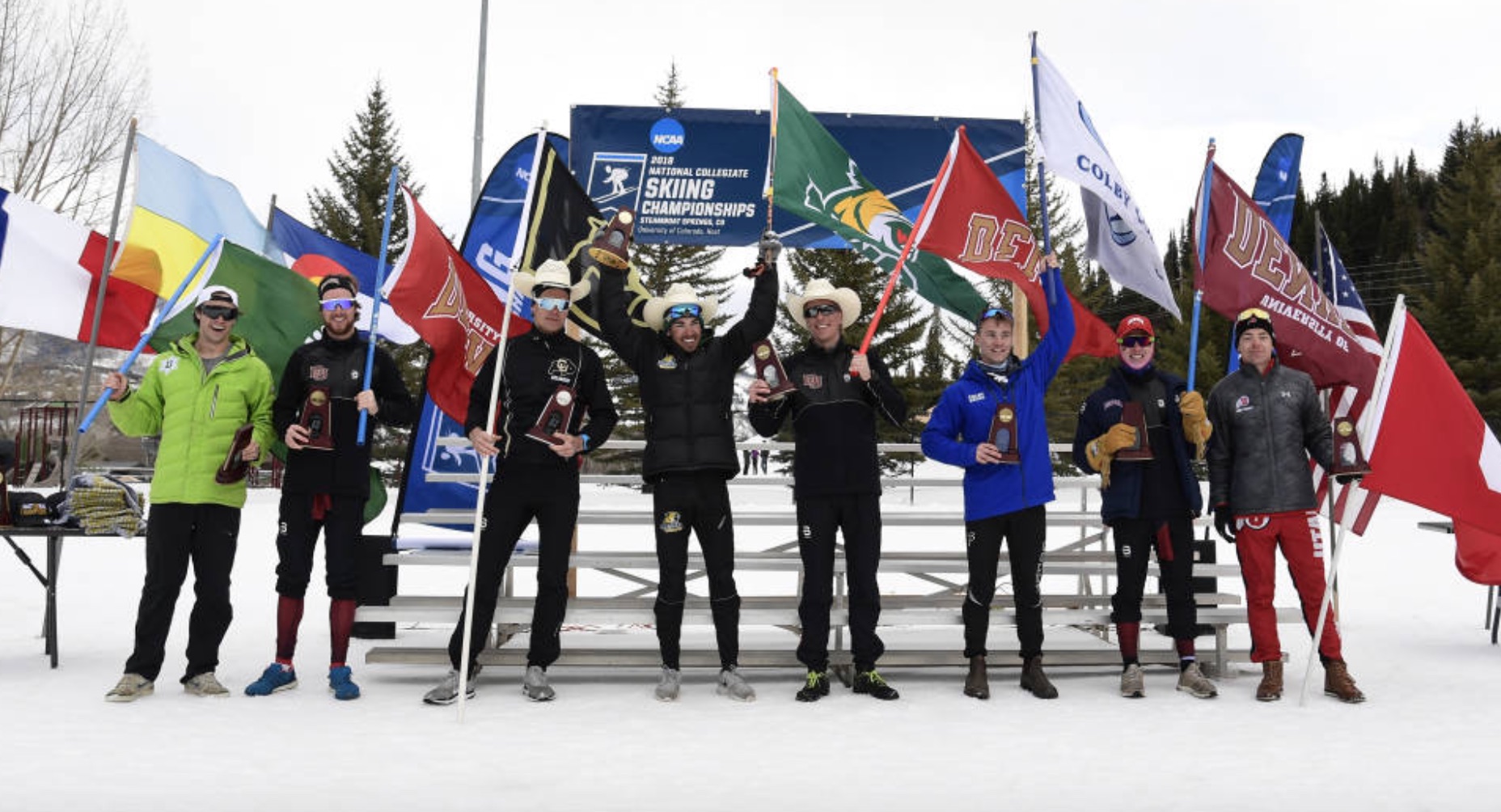
    The top finishers in the men’s 20 k freestyle mass start at 2018 NCAA Skiing Championships in Steamboat Springs, Colorado, with Northern Michigan University’s Ian Torchia (c) in first. (Photo: Dartmouth Sports/Clarkson Creative)

    NCAA Skiing Championships (Steamboat Springs, Colorado): 15/20 k freestyle mass starts

    On the fourth and final day of NCAA Skiing Championships at Howelsen Hill in Steamboat Springs, Katharine Ogden skied to her second-straight national title, Ian Torchia became an NCAA champion and the University of Denver (DU) won its 24th NCAA National Championship.

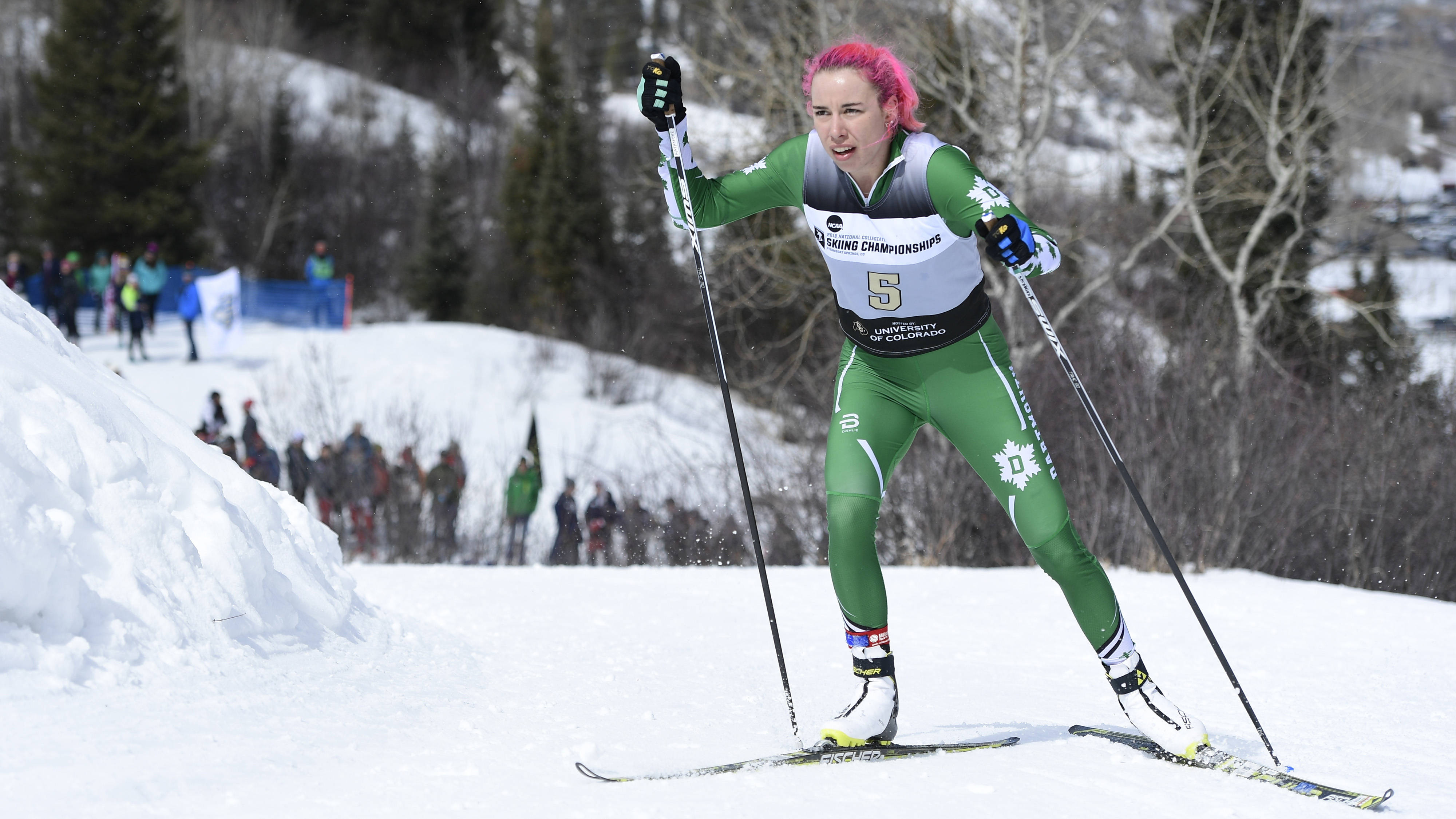
    Dartmouth freshman Katharine Ogden racing to her second-straight victory of the 2018 NCAA Skiing Championships in Steamboat Springs, Colorado. She won Saturday’s 15 k freestyle mass start by more than 38 seconds. (Photo: Dartmouth Sports/Clarkson Creative)

    Ogden, a Dartmouth College freshman, raced to a 38.4-second victory in the women’s 15-kilometer mass start, finishing in 43:22.0 minutes for her second win in as many races at 2018 NCAA Championships. She won the 5 k classic on Thursday and with her win on Saturday, she became the first Dartmouth skier in 56 years to win two national titles in the same year, according to a Dartmouth press release.

    On the second of three laps, Ogden broke away early with close to 10 k to go. According to the press release, she had a “quick fall” near the end of the second lap, but that didn’t derail her as she had time to grab sunglasses from Dartmouth men’s coach Brayton Osgood and a Dartmouth Lone Pine flag before the finish.

    At this year’s championships, Ogden’s two titles are accompanied by victories from Dartmouth men’s alpine skiers Brian McLaughlin (who won the giant slalom) and Tanguy Nef (who won the slalom). This marked only the second time that Dartmouth’s Big Green won four individual titles in a single NCAA Championships; that also occurred 61 years ago.

    “Katharine absolutely wanted this one, and she really likes to win,” Dartmouth Director of Skiing and Women’s Nordic Head Coach Cami Thompson Graves said in the press release. “She wasn’t about to let a fall slow her down, she has such a great competitive fire. But she also showed her playful side grabbing Brayton’s glasses and smiling all the way to the finish line!”

    Hailey Swirbul of the University of Alaska Anchorage placed second and Linn Eriksen (DU) reached the podium in third (+46.3). Denver had three in the top 10 with Jasmi Joensuu in ninth and Taeler McCrerey in 10th. Also landing in the top 10 for All-American honors were Guro Jordheim of the University of Utah in fourth, Emma Tarbath (Montana State University) in fifth, Petra Hyncicova of the University of Colorado Boulder (CU) in sixth, Christina Rolandsen (CU) in seventh, and Lauren Jortberg (Dartmouth) in eighth.

    Torchia, an Northern Michigan University (NMU) junior and U.S. Ski Team Development Team member, became the seventh NCAA champion in NMU Wildcats nordic skiing history, according to an NMU press release. Fredrick Schwenke was the Wildcats’ last nordic champion; he won the 2015 NCAA Championships 20 k classic.

    Torchia drew bib 1 for Saturday’s 20 k freestyle mass start and crossed the finish line first in 54:21.0, just 2 seconds ahead of CU’s Alvar Alev. Eivind Kvaale (DU) finished just four seconds back in third, and Denver had three in the top seven with Dag Frode Trollebø in fourth and Lars Hannah in seventh. Darmouth’s Cal Deline placed fifth, Zane Fields of Colby College finished sixth, and the 20 k freestyle’s 2017 NCAA champion Martin Bergström (Utah), who also won Thursday’s 10 k classic, placed eighth.  CU’s Petter Reistad and Sondre Bollum finished ninth and 10th, respectively.

    In the team standings, Denver beat Colorado by 41 points for the overall win with a total of 604 points between the nordic and alpine events at this year’s championships. Dartmouth placed third, 114.5 points behind Colorado, and Utah was another 63 points back in fourth.

    According to a DU press release, Denver has won at least one national championship in each of the last five athletic seasons (skiing: 2013/14, 2015/16, 2017/18; hockey: 2016-17; men’s lacrosse 2014/15), joining only Stanford on the list of schools that have done so in the last five seasons. (Oregon, West Virginia, Penn State, Oklahoma, Ohio State and Florida could potentially join that list later this year.)

    “It feels incredible,” said DU head coach Andy LeRoy said in the press release. “I am so happy for all of our athletes, they’ve been training all week and all season and to do it in Steamboat in front of our crowd is special.”

    Results: Women | Men| Team 

    Photos

    ***

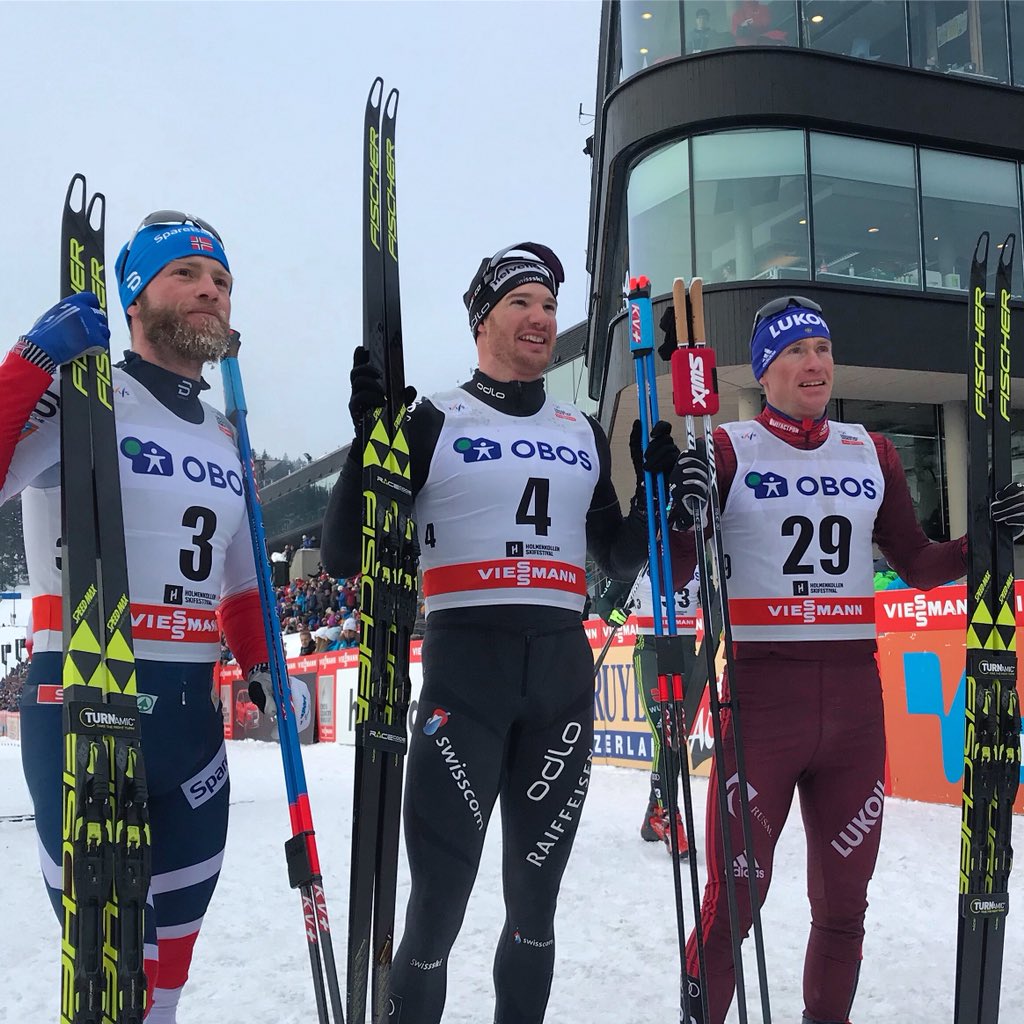
    The Holmenkollen men’s 50 k freestyle mass start podium on Saturday at the World Cup in Oslo, Norway, with Switzerland’s Dario Cologna (c) in first, Norway’s Martin Johnsrud Sundby (l) in second, and Russia’s Maxim Vylegzhanin (r) in third. (Photo: FIS Cross Country/Twitter)

    FIS Cross Country World Cup (Oslo, Norway): Men’s 50 k freestyle mass start

    Full report

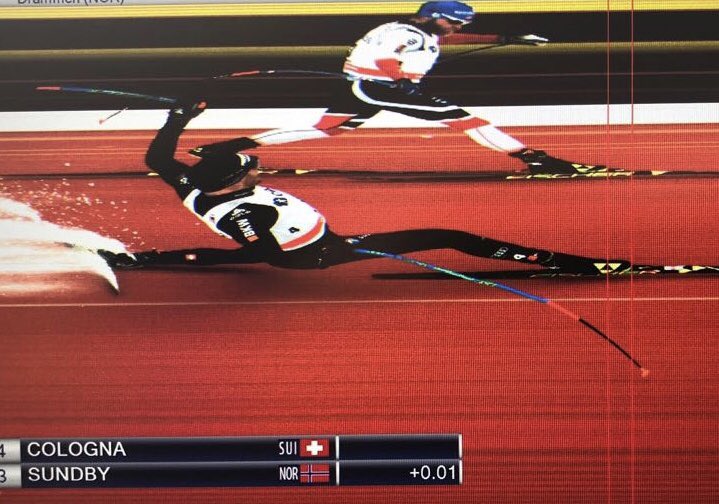
    A four-time Olympic champion, Dario Cologna of Switzerland won his first 50-kilometer World Cup race on Saturday, topping the podium in the famous Holmenkollen 50 k freestyle mass start after outlunging Norway’s Martin Johnsrud Sundby (who won the event last year) for the win in 2:01:48.1. Sundby finished one-hundredth of a second behind for second place, ahead of Russia’s Maxim Vylegzhanin, who was 1.1 seconds back in third in his first World Cup race since November of last year.

    The photo finish for first between Switzerland’s Dario Cologna (near) and Norway’s Martin Johnsrud Sundby at the Holmenkollen 50 k freestyle mass start on Saturday in Oslo, Norway. Cologna got it by 0.01 seconds. (Photo: FIS Cross Country/Twitter)

    Norway’s Sjur Røthe came out on top in a race for fourth (+4.2), ahead of Russia’s Denis Spitsov in fifth (+4.4) and his Norwegian teammate Hans Christer Holund in sixth (+4.5). Great Britain’s Andrew Musgrave followed in seventh (+15.1), Germany’s Florian Notz placed eighth (+25.9) and Canada’s Alex Harvey finished ninth (+32.4), ahead of France’s Robin Duvillard in 10th (+33.5).

    Scott Patterson led the U.S. in 16th (+56.3) coming off an 11th place in the 50 k classic mass start at last month’s Olympics, and Canada’s Devon Kershaw finished in the points in 28th (+3:43.6). Just outside the top 30, Canada’s Graeme Killick finished 34th (+4:55.1).

    Also for the U.S, David Norris placed 38th (+6:19.7), Paddy Caldwell was 46th (+8:12.3), Noah Hoffman 49th (+10:27.9), Kevin Bolger 52nd (+12:44.2), and Simi Hamilton did not finish.

    Canada’s fourth man in the race, Andy Shields finished 47th (+8:13.6).

    Results

    ***

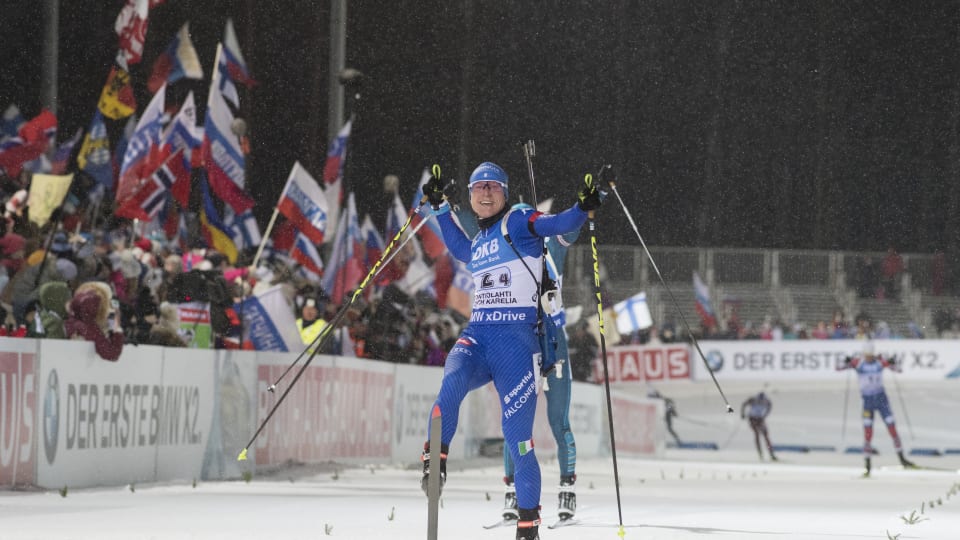
    Italy’s Lukas Hofer celebrates his team’s win in Saturday’s mixed relay at the IBU World Cup in Kontiolahti, Finland. (Photo: IBU/Biathlonworld)

    IBU World Cup (Kontiolahti, Finland): Single mixed relay & mixed relay

    (Note: This rundown has been updated to include comments from Christian Gow and Sean Doherty.)

    In the last single mixed relay and mixed relay of the International Biathlon Union (IBU) World Cup season, France and Italy came out on top, with France winning the two-person single mixed relay and Italy taking first in the coed mixed relay.

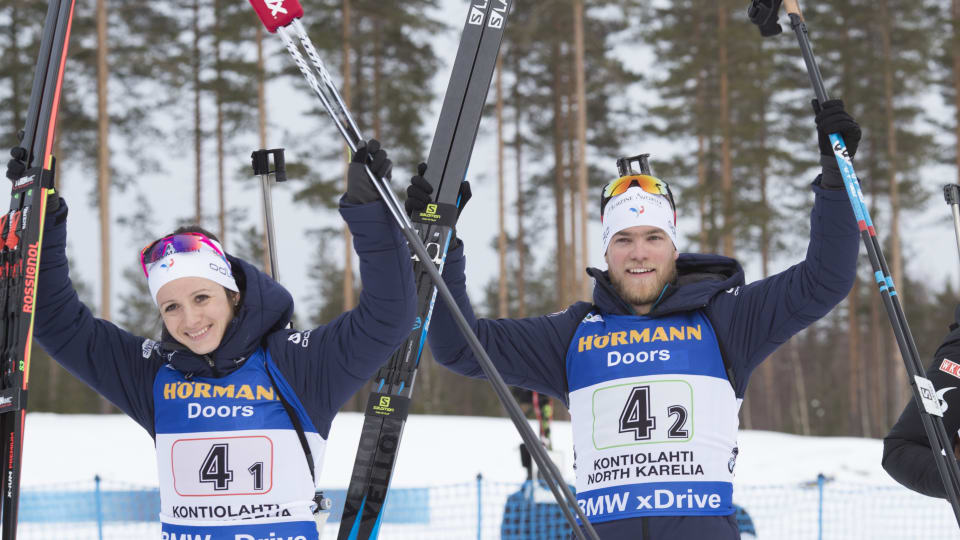
    France’s Anaïs Chevalier and Antonin Guigonnat after winning Saturday’s single mixed relay at the IBU World Cup in Kontiolahti, Finland. (Photo: IBU/Biathlonworld)

    France’s Anaïs Chevalier and Antonin Guigonnat combined for zero penalties and six spares to finish first in the single mixed relay in 33:29.1 minutes. Guigonnat as the team’s anchor secured the win by just 2.4 seconds over Austria’s Julian Eberhard while Norway’s Johannes Thingnes Bø finished 4.4 seconds back for third.

    Chevalier put France in fifth after the first leg, 15.5 seconds behind Ukraine’s Iryna Varvynets in first. Guigonnat used just one spare on his first leg to move them into fourth, 9.2 seconds back while Norway led at the second exchange. On Chevalier’s second leg, she shot clean in both stages to lead through the final exchange, with Ukraine skiing just 6.2 seconds back in second.

    On the final leg, Guigonnat used two spares and stayed out of the penalty lap, keeping the team in first through the finish. Eberhard skied the second-fastest course time on that leg to elevate Austria (with Lisa Theresa Hauser) from fourth at the tag to second place at the finish, and Bø skied all the way up from eighth to third place for Norway (with Marte Olsbu) with the fastest course time.

    Ukraine’s Artem Tyschenko used just one spare but slipped to fourth with the 11th-ranked course time on that leg, as he finished 10.8 seconds behind Norway.

    Behind Russia in fifth and Italy in sixth, Canada placed seventh (+23.8) with Rosanna Crawford and Christian Gow. The duo combined for zero penalties and six spares, and put themselves in third place early in the race. Crawford skied them into third on the first leg, using just two spares and tagging Gow 7.4 seconds out of first.

    Gow went on to take the lead after cleaning prone without any spares, and he cleaned standing as well but slipped back to third while Bø took the lead. Gow tagged Crawford in third, 8.9 seconds behind Norway in first.

    “I didn’t think too much about being tagged in third,” Gow recalled in an email to FasterSkier. “It was exciting for sure, but I let it fade to the background so that I could focus on my job both on the track and in the range.  It was great to leave prone in first place! It was also surprising, but it was a good place to be in.

    “My skiing was ok today,” he continued. “It is a really challenging and demanding race format that we don’t get a lot of practice with.  I was sick after the Olympic Games and only finally coming around the past couple days.  The Sprint race was horrendous for me, so today was much better than that. In the range I just focussed on myself and trusted my shooting.  I tried my best not to get caught up in the race going on around me and it worked to my benefit.”

    Crawford then slipped to seventh and 21 seconds back with three prone spares, but avoided the penalty lap, and Gow held onto seventh through the finish, using just one spare and skiing the eighth-fastest course time on that leg.

    “We are both happy with this result,” Gow wrote. “I think that we are both looking at the 23 second gap to first and thinking that if things had worked out just a bit better we could be there.  It can be both exciting and frustrating to be that close to the podium.  We know we can do it, it’s just a matter of putting it together on the right day. We are happy with 7th, but hungry for more.”

    Susan Dunklee and Lowell Bailey finished 14th for the U.S., 1:13.0 out of first with one penalty and 14 spares. The penalty came on Dunklee’s first leg during her standing stage, after she had cleaned prone without any spares. She tagged Bailey in 14th and he brought them up to 11th, using three spares on that leg, then Dunklee came through the final exchange in 13th after using four spares to clean. Bailey lost one place on the final leg, using four spares but staying out of the penalty lap.

    Twenty-six teams competed in the single mixed relay, compared to 23 in the mixed relay that followed.

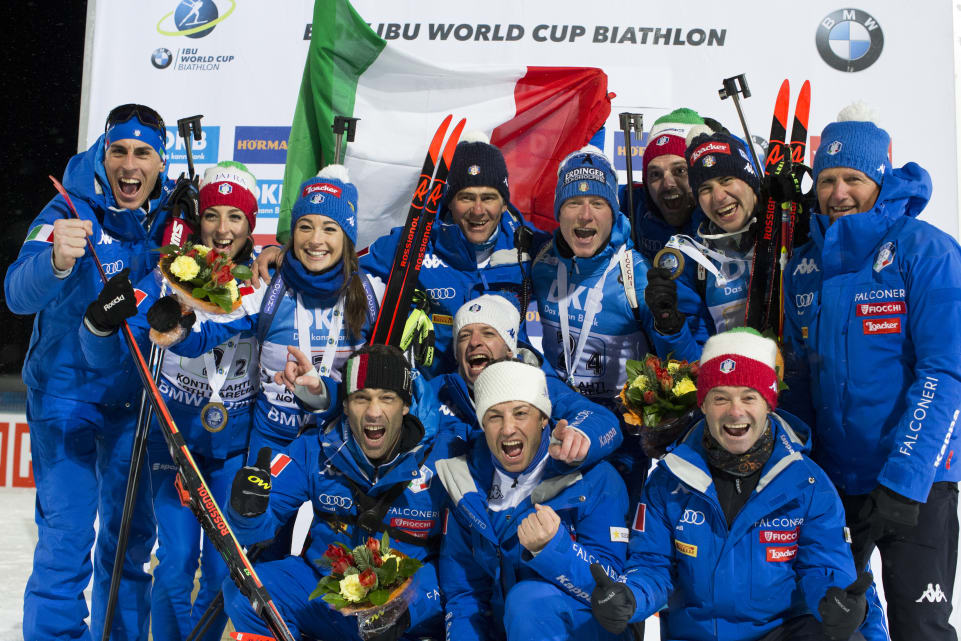
    Team Italia celebrates its win in the IBU World Cup mixed relay on Saturday in Kontiolahti, Finland, with its relay members Dorothea Wierer, Lisa Vittozzi, Dominik Windisch, and Lukas Hofer. (Photo: IBU/Biathlonworld)

    In Saturday’s 2 x 6 + 2 x 7.5 k mixed relay, Italy nabbed a 1.5-second victory over Ukraine in 1:15:08.3. Dorothea Wierer, Lisa Vittozzi, Dominik Windisch, and Lukas Hofer — the same Italian team that took bronze in the mixed relay at last month’s Olympics, although in a different order — combined for the win with one penalty and 13 spares.

    Ukraine, with Anastasiya Merkushyna, Vita Semerenko, Artem Pryma, and Dmytro Pidruchnyi, had zero penalties and just three spares throughout the whole race. For the second-straight relay on Saturday, Norway placed third (+9.1) with Synnøve Solemdal, Tiril Eckhoff, Henrik L’Abée-Lund, and Tarjei Bø totaling zero penalties and nine spares.

    Italy’s lone penalty came in Vittozzi’s second leg, but it didn’t derail the team as it improved from sixth to fifth with Vittozzi, who skied the third-fastest course time on that leg. She tagged Windisch 6.8 seconds out of first, and Windisch, who had anchored the team in the Olympics, took the lead by the final exchange after using two spares to clean. Hofer left the exchange just 3.3 seconds ahead of Norway’s Bø but used just one spare and skied the second-fastest anchor leg to finish first, beating his rivals up Kontiolahti’s infamous climb known as “The Wall”. Ukraine’s Pidruchnyi also shot clean with a single spare and clocked the fastest anchor leg to move his team from fourth to second place. Bø lost one place and finished third after using one spare as well and skiing the third-fastest anchor leg.

    Russia followed in fourth, France fifth, Sweden sixth, Germany seventh, Austria eighth, and the U.S. ninth (+2:48.4). The U.S. team, with Clare Egan, Joanne Reid, Tim Burke, and Sean Doherty, had one penalty and 11 spares. Egan cleaned her first prone but had to ski a penalty lap after her standing stage, tagging Reid in 17th, 58.7 seconds out of first.

    Reid used three spares on the second leg and moved up to 13th by the second exchange, and Burke used three spares as well to pick off one more place and tag Doherty in 12th. Doherty skied the eighth-fastest anchor leg and used two spares to clean to put the team in ninth at the finish.

    “I don’t consider two spares to be anything special, but today it was enough to make up some ground,” Doherty wrote in an email to FasterSkier.”I felt strong skiing, more like myself which is fun even if it’s a little late in the season. We had very good skis which always helps. I have done quite a few laps on this course over the years so the lines and transitions are pretty refined, so that is where I made time on the course.

    “I am happy with my leg. I enjoyed my little battle for 9th,” he continued. “I can’t speak too much for the other members of the relay tonight but I think 9th is a solid effort.”

    Canada finished 17th (+4:34.9) with Emma Lunder, Julia Ransom, Scott Gow, and Brendan Green combining for one penalty and 13 spares. Lunder put them in 12th at the first exchange and Ransom skied up to 10th, but Scott Gow had a penalty on his standing stage to drop to 16th. Green lost one more place on the last leg despite only requiring two spares.

    Results: Single mixed relay | Mixed relay

  • Q&A: Beckwith’s Return to Skiing as NENSA Competitive Program Director

    Q&A: Beckwith’s Return to Skiing as NENSA Competitive Program Director

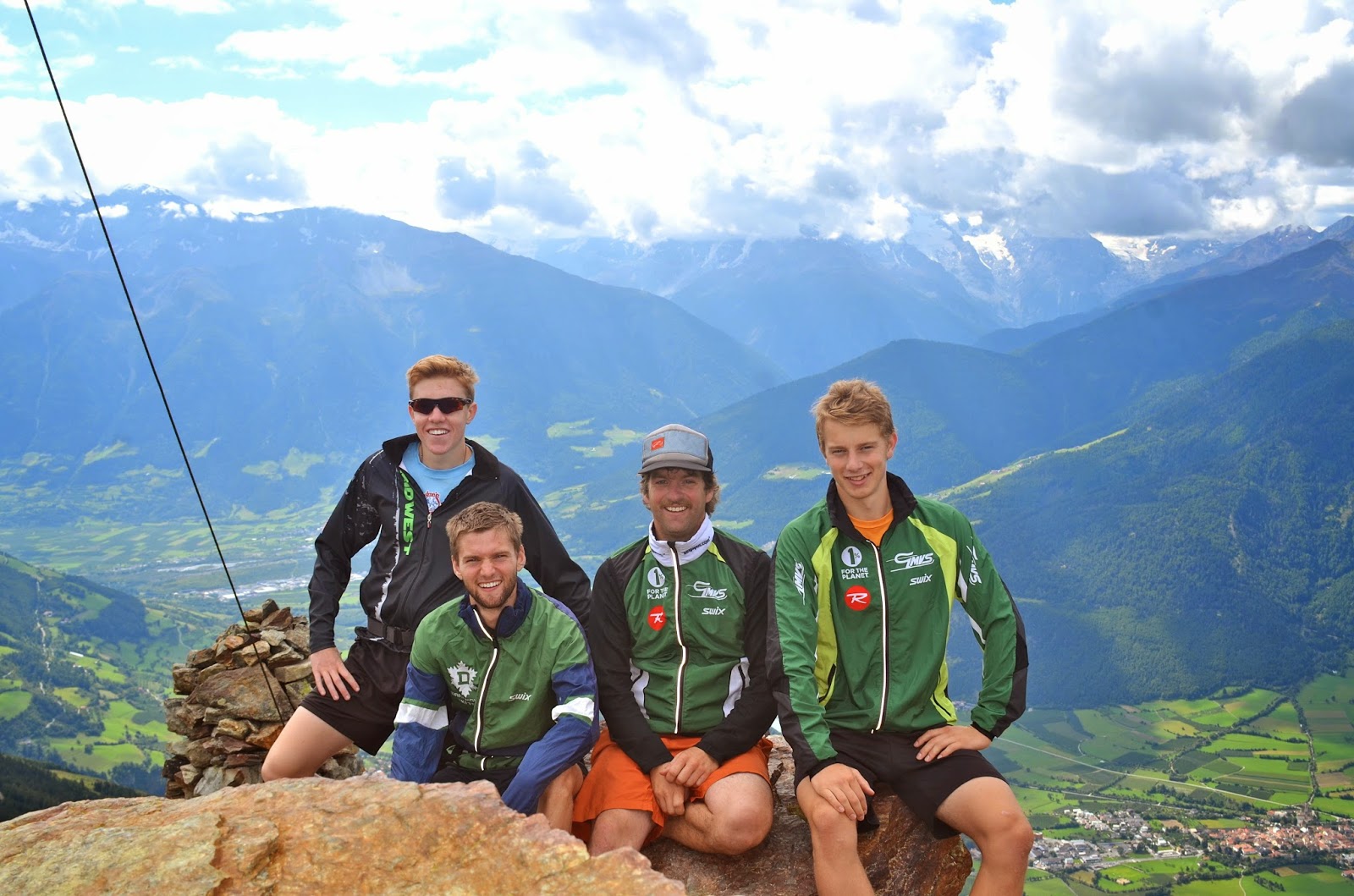
    Justin Beckwith (second from r), as seen in 2014 when he was head coach of the Green Mountain Valley School (GMVS), with former GMVS elite and postgraduate athletes (from l to r) Nick Gardner, David Sinclair and Ian Moore during a fall trip to Italy. (Photo: GMVS)

    About a year and a half after leaving his post as nordic director at the Green Mountain Valley School (GMVS), Justin Beckwith is once again involved with New England skiing at full throttle as competitive program director for the New England Nordic Ski Association (NENSA).

    The news came from NENSA early last month in an announcement that stated Beckwith would be filling in for Amie Smith, the association’s high-performance director for the last two years, who was promoted to executive director.

    Justin Beckwith (l) and Gus Kaeding in the wax room at 2017 U23/Junior World Championships at Soldier Hollow in Midway, Utah. (Photo: Flyingpointroad.com)

    Beckwith, of Warren, Vt., spent nine years from 2006 to 2015 building the GMVS program. When he left in the fall of 2015, he decided to go back to building houses, yet he remained involved with nordic as a wax tech for New England juniors and U.S. skiers at both national and international races, like last season’s OPA Cup Finals.

    Right around that time, in late March when NENSA posted the job opening, Beckwith knew he was ready to return to a full-time position in skiing.

    “It was just sort of, ‘OK, that’s it. That’s what I need to do,’ ” he told FasterSkier last month.

    After graduating from Middlebury College, Beckwith, now 37, spent one year living out west before taking the job at GMVS in Waitsfield, Vt. During his tenure there, he was also a coach for the U.S. Ski Team’s U18 Trip and Junior World Championships as well as the head wax tech for Junior Nationals and Junior Worlds.

    Stepping away from the sport as a coach allowed him to view it in a way he hadn’t before.

    “I went back to Junior Nationals after not being there for a couple years, now being able to watch, coming from the outside and see how our coaches, athletes and organizers are acting and performing, and what a unique perspective it is,” he said. “It is so much different than when you have your own athletes in the race, or you’re supporting your division or whatever your job is. … I am really excited to start to using all my contacts and resources and just bring energy that I think coaches understand what I am all about.”

    ***

    FasterSkier: What made you decide to return to skiing full time?

    Justin Beckwith: When I left GMVS to be a carpenter, I knew I wanted to come back to skiing, but on my own terms and do the piece of the skiing that I absolutely love and am so passionate about. That allowed me to be open to do that, whether or not the bank account reflected that, I just needed to be a carpenter, but I also had the ability to start making relationships with international people, coaches from other nations that are so impressed with what we are doing now in the U.S., and that started happening three or four years ago. Coaches started saying, “Wow, you guys are doing really well down to the national level now.” Then I got to start working with some of our manufacturers and suppliers, like Start Ski Wax specifically, a bunch more this year. I went back to Junior Nationals after not being there for a couple years now being able to watch coming from the outside and see how our coaches, athletes and organizers are acting and performing, and what a unique perspective it is.

    Justin Beckwith getting after it in Hemsedal, Norway. (Courtesy photo)

    So bringing to the present day, I think this [NENSA] position came up one time while I was involved at a certain amount of professional level with skiing. Amie [Smith] took on the job a few years ago, but I was deeply immersed my GMVS culture at that time and I also think that probably was not the perfect fit for me. Just before my wife and I left for our trip to Norway [this year], the job was posted [again]. It was just sort of, ‘OK, that’s it, that’s what I need to do.’ I am really excited to start to working with my contacts and resources and just bring energy that I think coaches understand what I am all about. I have also been able to make that connection with a lot of the young athletes over these last few years.


    FS: What drew you to the NENSA position?

    JB: With this position with NENSA and also what I have been able to do the last couple years, I am not using the microscope anymore, I am using a telescope. It’s totally different, but at the same time, it’s the same. I am going to be able to support GMVS in a great way. I love working with [GMVS Nordic Director] Colin Rodgers. GMVS went through some transitions. I am staying in the Mad River Valley, which is amazing; another great part of the job is that I get to stay where I am and sort of create some of that vision and move it in a way. It’s a pretty cool job, it’s a very cool lifestyle, it’s something that I am so passionate about. I was just talking to [Dartmouth men’s nordic coach] Brayton Osgood, he said he’s so glad to have [me] officially back in skiing. That is the coolest thing, to have those relationships.

    We are going through a transition within the U.S., there is a changing of the guard within our coaches and in our whole community, and we need to hold on to the history. That’s why people like Peter Graves are so interesting. We absolutely need to hold on to that history, but we have so many, because of all the awesome work that Dick Dreissigacker and Judy Geer at Craftsbury, or Sverre at Stratton, Rick Kapala at Sun Valley, or Gordon Lange in Park City, because of what all these people did, they inspired the next generation of not only athletes but coaches. It’s a really exciting time for U.S. skiing that we have such great venues, coaches and organizations. It’s a really cool time and a lot of energy is coming back into it right now.


    FS: How is your role at NENSA going to be different than it was with GMVS?

    JB: The biggest difference is what I tried to do at GMVS is essentially I wanted to be able to do what I am going to be able to do with NENSA. I am able to work with everybody now — and not that I am trying to spread myself too thin; I will obviously be working in a different capacity — I will be in personal contact with a lot of our athletes. … I will have more communication with coaches, whether it is with [U.S. Ski Team Development Coach] Bryan Fish or our club coaches in New England, and coaches throughout the nation, and figuring out that common goal, whether you’re part of a ski academy, or a club, or even a different region at JN’s, the goal is to make U.S. skiing better, and to create that culture and create those results, so that’s the goal.


    FS: How was being at the OPA Cup Finals and what were your takeaways?

    U.S. techs and coaches at 2017 U23/Junior World Championships (from left to right) Justin Beckwith, Andy Keller, Gus Kaeding, and Mike Matteson at Soldier Hollow in Midway, Utah. (Photo: flyingpointroad.com)

    JB: Probably the coolest thing going into that was the fact we were able to pull Caitlin Gregg into that, so we had this mix where we had some of our best juniors were there, we didn’t have the biggest team we’ve had, but we had a great time. And right out of the gate in the OPA Cup Finals — these are big-deal racers — on Day 1, Caitlin won the thing and Hannah Halvorsen was second. World Juniors was of course groundbreaking, but that result showed another level of depth we have in the country, and that was really inspiring to see that and be a part of. It also showed that we are a little bit better at skate skiing than in the European contemporary classic condition, basically slush. We were racing in 10 degrees [Celsius, 50 degrees Fahrenheit], and that is something we are adjusting at the developmental-team level. … That’s something we are going to try address soon. The takeaway from OPA, it shows the depth of where U.S. skiing is now, it shows what happened at World Juniors isn’t a fluke, it shows that we still have work to do, but we very much have arrived, and we are lucky as a nation that the European Nations are recognizing what we are doing and they are interested in what we are doing. We are contemporary now, and it’s pretty cool.


    FS: What are some of your key initiatives moving forward and what does your five-year plan at NENSA look like?

    JB: One of the things is my big initiative to make NENSA a known support structure to our clubs and to our coaches and to our athletes. We are not just putting on races, I want to make coaches’ education cool again. I want to make it popular and fun, and I just sort of want to reinvigorate that a bit. I want to help increase the participation and make it a clear thing that when you ask any coach what NENSA is doing for them, I want them to be able to give a clear answer that we are providing really cool feedback and support for their program. We are helping them coach and inspire their kids, and we are not putting on camps or other events that compete, we are helping make those better. I want to reinvigorate rollerski races. I have one that I want to start with this summer and ideally that would transfer to each state, having an event that we were able to make better for them, whether through promotion or physically bringing athletes to them, bring sponsors and suppliers in there, all part of that goal. … That’s what I want to do with this job, create that that buzz, that energy.

    Another thing I am going to work on is NENSA alumni, if you will, we need to keep them involved. When you’re a junior skier: you love your coach, you love your peer group, love going to Junior Nationals. You don’t necessarily remember that it was Janice Sibilia or Zach Caldwell or NENSA that created these camps and brought you all together two or three times a year. There are so many people that brought it to where it was now. It’s cool to come back and look at it with that perspective. Some of those people are coming back to it in different ways. Kris Seymour has taken a position at running Mount Van Hoevenberg in Lake Placid. Kris Seymour was Lowell Bailey and Tim Burke’s high-school coach; he inspired those guys, he helped to inspire me, now he is at a position where he can do wonderful things not only for his venue and his job, but he can do great things for cross-country skiing. So it’s really neat to meet somebody who cannot just juggle those balls, but bring those balls together.


    FS: Are you still going to be a carpenter?

    JB: I do have a passion for that and creating things especially with wood. I will still be hobby-ing and doing fun projects on the side, but only in a capacity like somebody would play the guitar, not as a business. I am diving right into this as a passion. People who are involved in the country and New England are coaching for the right reasons and I share the same vision.

    The enthusiasm and the support and welcome I have gotten from the staff and board of NENSA, New England and the U.S. ski community is truly humbling. It’s going to be really fun, and I am looking forward to it. I am so fortunate to be a part of it and want to get more people in the sport.

  • From Snow to Software to Snow Again, Osgood New Men’s Coach at Dartmouth

    From Snow to Software to Snow Again, Osgood New Men’s Coach at Dartmouth

    Brayton Osgood, Dartmouth's new men's nordic head coach, testing skis during Period I of last World Cup season. (Courtesy photo)
    Brayton Osgood, Dartmouth’s new men’s nordic head coach and a former NCAA All-American, testing skis for the U.S. Ski Team during Period I of the 2015/2016 World Cup last season. (Courtesy photo)

    Sitting before the lurid glow of a computer screen, scrolling through codes and functions does not exactly conjure up images of snow, skis and fitness fanatics. However, a logged training hour, timed kilometer split or monitored heart rate are all indispensable numbers to improving nordic performance. For eight years, these ordinals were the opus of Brayton Osgood’s work.

    A math wiz — he graduated cum laude from Dartmouth College with a degree in mathematics and earned his master’s in business and accounting from Northeastern University — Osgood spent just under a decade perfecting a computer software known as Athletic Management Platform (AMP) for a company called AMP Sport. The program, designed to help coaches decipher the meaning of digits in relation to an athlete’s progression in training and racing, boasts partnerships with the U.S. Ski Team, USA Triathlon and the Cleveland Cavaliers, among others. Whether it involved dribbling on a basketball court or trekking trails (snow or dirt covered), Osgood’s work gave numbers a new meaning for many athletes.

    But the electronic connection to cross-country skiing Osgood maintained through his computer could not replace the physicality he loved about the sport: the granular feel of a wax cork, the watery eye blur from breathing in the icy, mid-January air.

    A former nordic racer (he skied for Dartmouth College, where he was a two-time NCAA All-American, as well as XC Oregon, earning a World Cup distance start in 2009) and a coach (he was a Dartmouth assistant coach for the 2011/2012 season), Osgood, 35, missed being physically present at cross-country skiing events.

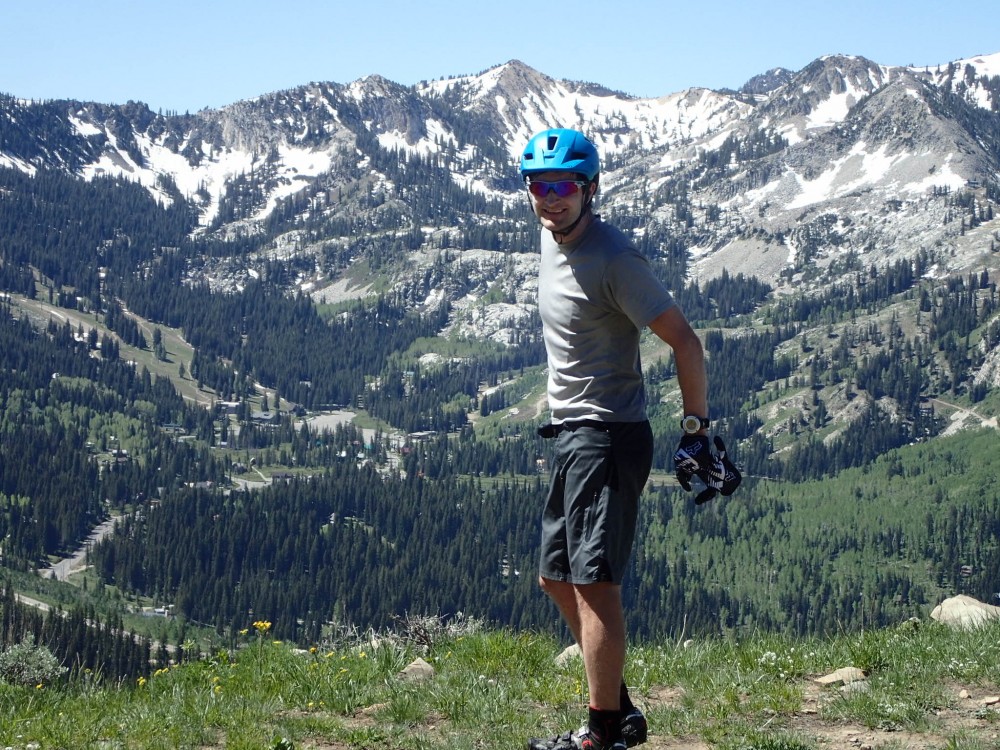
    Brayton Osgood, the new Dartmouth men's nordic head coach, during a mountain bike ride in Park City, Utah. (Courtesy photo)
    Brayton Osgood, the new Dartmouth men’s nordic head coach, during a mountain bike ride in Park City, Utah. (Courtesy photo)

    “I was spending all of my free time in the winter and lots of vacation time making my way towards cross-country ski races so it was pretty clear to me that that’s what I wanted to be doing with my time,” he said on the phone earlier this month.

    Though he loved the math and science behind skiing, Osgood began to realize that being entrenched in skiing was where he wanted to be. He began spending more time at ski events. At the beginning of last season, he traveled to Europe to wax for the U.S. Ski Team for Period 1 of the World Cup. He also served as a coach and wax technician for the New England Junior National Ski Team last season and worked as the race-data manager for the New England Nordic Ski Association (NENSA) from 2012 to 2016. Then in March, when the men’s head-coach position for the Dartmouth nordic ski team opened up, he applied.

    “I was excited to apply for this job specifically because it was at Dartmouth,” Osgood, a native of Putney, Vt., wrote in an email. “The Dartmouth Ski Team has been very important in my life, first as a student-athlete, and more recently inspiring my desire to coach.”

    After much anticipation, Osgood discovered in early May that he had been chosen as the new leader for the Big Green men’s team. He had his first team meeting with half a dozen athletes and his co-coach, Cami Thompson-Graves, prior to Memorial Day weekend and officially started on June 22. While he’s no nordic newbie, Osgood explained that writing training plans for large groups of athletes will be one of the biggest challenges for him as he takes over the reins from Dartmouth’s longtime men’s coach for the last 27 years, Ruff Patterson.

    “I’m really lucky and fortunate to have Cami [Thompson-Graves] as a resource,” Osgood said of Dartmouth’s director of skiing and women’s head coach. “We’ve already started meeting and talking about what she’s done and I’m going to spend a fair amount of time as I get started, talking with the current and hopefully some past Dartmouth skiers just about what has worked for them and where we can experiment and change.”

    Though Osgood has been mentored by Thompson-Graves as an athlete and assistant, this upcoming season will mark his first experience working alongside her.

    Brayton Osgood, Dartmouth College's new men's nordic head coach, working behind the scenes for the U.S. Ski Team on the World Cup early last season. (Courtesy photo)
    Brayton Osgood, Dartmouth College’s new men’s nordic head coach, working behind the scenes for the U.S. Ski Team on the World Cup early last season. (Courtesy photo)

    “I am very excited that Brayton will be re-joining our staff!” Thompson-Graves wrote in an email. “I think his passion for skiing and his knowledge of Dartmouth will help generate a lot of excitement with the team, and will allow him to hit the ground running as we start the new training season.”

    As the pair looks ahead to the beginning of a new season and partnership, Osgood points out that key to their success will be complementing each other as coaches. The two programs will work together to shape the future of the Division I program.

    “She has a great history of success in terms of graduating skiers that move on to the U.S. Ski Team and World Cup podiums,” Osgood said of Thompson-Graves, who’s entering her 28th season coaching at Dartmouth. “She’s done a really good job of building that team atmosphere, which I think is a key to achieving success, so I think there’s a lot I can learn from her there.”

    With the tutelage of Thompson-Graves and current and previous Dartmouth skiers, Osgood hopes to not only continue Dartmouth’s history of program success, but expand upon it.

    “Ruff has been a hugely important figure in my life and skiing,” he said. “So having the opportunity to take over for him is really exciting and a little bit daunting because it’s a great legacy he has and I would love to carry on the success that he achieved.

    “I definitely want to have a team that has All-Americans and hopefully podiums at NCAAs and a lot of skiers All-East for EISA [Eastern Intercollegiate Ski Association],” Osgood added. “Then just as important I think is to have a team that’s happy and excited to be out there skiing and racing every day that they ski … There’s going to be 12 to 15 men on that team and they can’t all race carnivals, they can’t all go to NCAAs, but I want them all to feel like they have successful winters and are achieving the goals they set or are making progress towards those goals.”

    Another aspect of the job Osgood sees as both a challenge and a chance to learn is the student side of coaching a collegiate sport.

    “At a school like Dartmouth, finals are never more than 10 weeks away,” he said. “There’s often midterms and a whole host of external factors that you need to account for when writing [a training plan]. There’s also class schedules. There are a lot of constraints to work with, but that’s going to be a new and exciting thing for me, for sure.”

  • Wednesday Workout: Ski Your Age in Kilometers

    Wednesday Workout: Ski Your Age in Kilometers

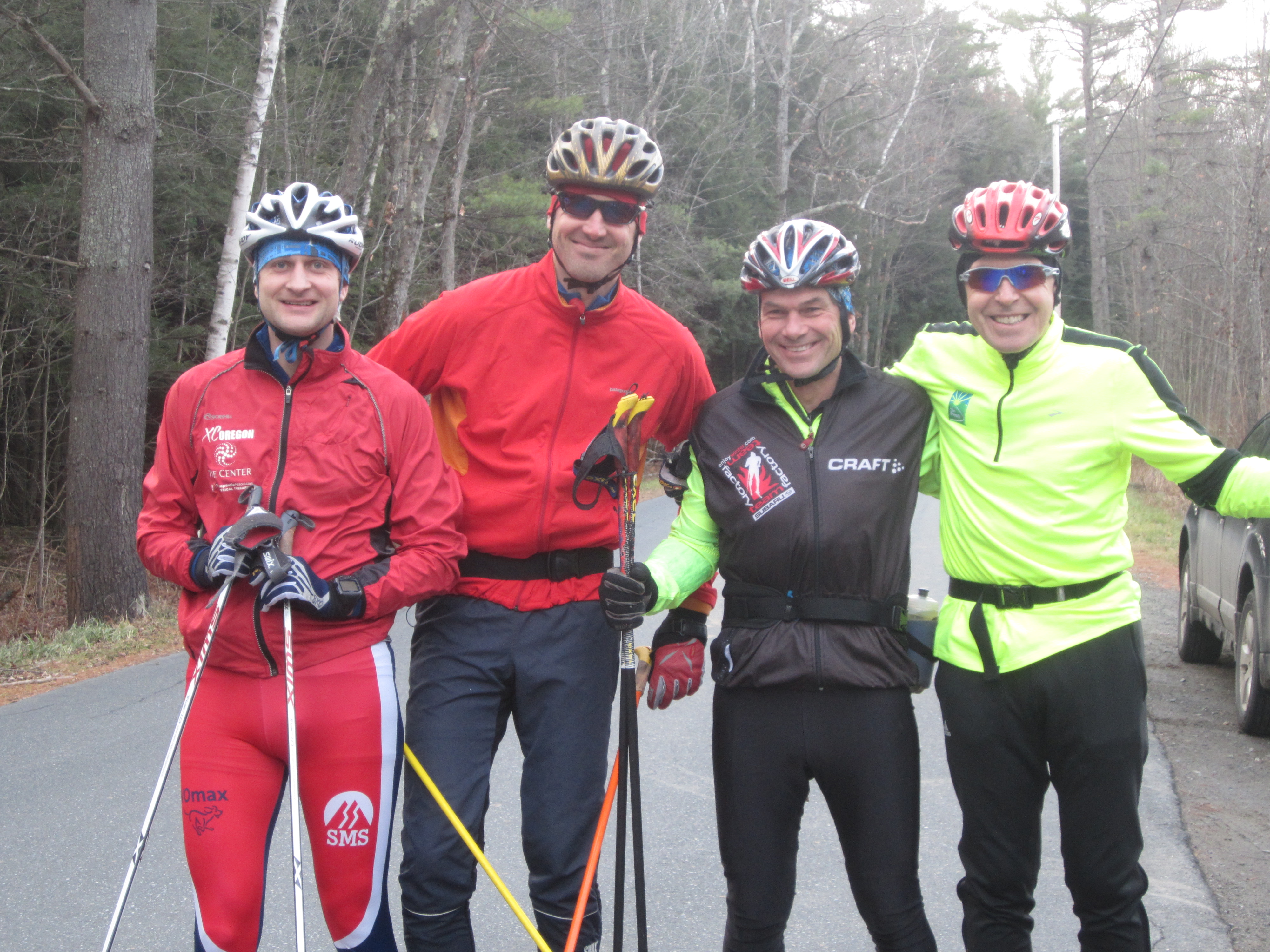
    Tim Caldwell, Shams Helminski, Chris Osgood, and Brayton Osgood head up Route 118 in New Hampshire during their 60 k rollerski on Nov. 16 to celebrate Chris’ 60th birthday. (Photo: Mary Osgood)
    Tim Caldwell, Shams Helminski, Chris Osgood, and Brayton Osgood head up Route 118 in New Hampshire during their 60 k rollerski on Nov. 16 to celebrate Chris’ 60th birthday. (Photo: Mary Osgood)

    There are many things that “get better with age,” such as Ford Mustangs, select cheeses and cowboy boots. While society doesn’t usually place workouts in this category, Chris Osgood and his son Brayton, 32, may be changing that. The father-son duo celebrate Chris’ birthday every year by rollerskiing his age in kilometers. They most recently did 60. Read about it here.

    It doesn’t have to be your birthday to rollerski that far — or any distance beyond your norm. But you might want to come up with a reason so people don’t think you’re nuts.

    Preparation: Over the years the Osgoods have upped their distance by one kilometer each year. While at the beginning, the skis were easy to complete during a workday morning and with little preparation, the longer distances require more thorough planning.

    For a longer ski, choosing an ideal route is key. The Osgoods picked the impeccable route from Goose Pond Road near Hanover, N.H., up Highway 118 to the top of the road near Mount Moosilauke. A perfect route consists of flat to gradual terrain for the first quarter of the ski, with increasing climbs during the last three quarters.

    Ending on a climb gives the added bonus of views and a sense of accomplishment. In addition to choosing a good route, it is important to know that you can complete it. Increasing distance by a kilometer each year is a good way to gage this. It’s also important to rollerski a decent amount in the weeks leading up to the ski.

    Warmup: A hearty breakfast with lots of coffee is all that’s needed for this workout as long as you start your ski at a reasonable pace.

    The workout: Maintain a constant tempo and take breaks when needed. Have someone supporting you (i.e. mom, a really good friend or significant other) in strategic spots along the route to replenish your water and snacks. If members of your group are speedsters, put brakes on their rollerskis to slow them down so you can keep up.

    Recovery: Make sure to have your support crew at the top waiting with snacks (recommended: pesto pizza) and celebratory beers! A little stretching wouldn’t hurt either.

    Here’s to a Wednesday Workout for every one of all ages and abilities. If you’re fortunate enough to be enjoying some early season skiing, you can try this one on snow. See you out there!

  • 60 for 60: A Birthday Tradition for the Osgoods and Co.

    60 for 60: A Birthday Tradition for the Osgoods and Co.

    Brayton Osgood, Shams Helminski, Chris Osgood, and Tim Caldwell in the middle of Chris' 60k birthday ski (Photo: Mary Osgood)
    Left to Right: Brayton Osgood, Shams Helminski, Chris Osgood, and Tim Caldwell in the middle of Chris’ 60k birthday ski. (Photo: Mary Osgood)

    Celebrating a birthday often involves cake, candles, and a bit of singing. Not so for Chris Osgood and his 32-year-old son Brayton, a retired XC Oregon racer from Burlington, V.T., who participated in what they called the 60 for 60 rollerski on Nov. 16. Every year since turning 30, Chris has rollerskied his age in kilometers, culminating in this year’s ski. Bucking the traditional birthday merriments, he celebrated his sixth decade by rollerskiing 60 kilometers.

    “This year was actually the third year in a row that we’ve done this ski,” Brayton explained in a phone interview. “The previous two were specific training for this year, to make sure that he’d be able to do it once he was 60.”

    Chris, a resident of Putney, V.T., who got into nordic skiing at Dartmouth College and raced the national circuit for several years, was joined by Brayton, four-time Olympian Tim Caldwell, and Middlebury grad Shams Helminski. The four of them made their way through New Hampshire starting at Goose Lake Road and continuing for 60 k to the top of Route 118 on Mount Moosilauke.

    The crew making their way up route 118 in New Hampshire (Photo: Mary Osgood)
    The crew making their way up route 118 in New Hampshire (Photo: Mary Osgood)

    While the first 15 k were mostly flat, the remaining 45 proved more challenging, with the final climb up Moosilauke being fairly substantial. Not only did they rollerski for 60 k, but both Chris and Tim wore breaks on their rollerskis to slow them down. The brakes were a necessary factor of the day because they made it “easier for the rest of us to keep up,” Brayton said.

    See their route on Strava.

    With the help of a support team, consisting of Chris’ wife, Mary Osgood, dispersed water breaks, and some pesto pizza, the four rollerskiers were able to complete their ski in five hours. Once they reached the top they were greeted with a wide spread of snacks and celebratory beers.

    While it’s an easy bet that Chris would want to continue increasing his birthday skis by a kilometer each year, it’s likely that he will decrease the distance from now on, and “more quickly than he came up!” Brayton said.

    It also doesn’t look like Brayton will be continuing his father’s tradition anytime soon, stating that a May birthday is often a hinderance to yearly rollerskis, especially when you’re a retired athlete. However the opportunity is still on the table. “You can never say never!” Brayton said.

    Happy skiers (Photo: Mary Osgood)
    The happy skiers pose after reaching their destination (Photo: Mary Osgood)


  • Birkebeinerrennet 2011 – I finished!

    From my last attempt at the Birkebeiner, I remember the start being a pretty low key affair. I’m pretty sure I showed up with only one pair of skis (which means I couldn’t leave them in the start lanes while I was testing them), and getting a spot in the first couple of rows was no problem. I had asked for and received an Elite wave start, so I was pretty much at the pointy end of the race from the gun (at least until I drifted backwards). How things change in four years.

    I once again had received my Elite wave start, so I followed a pretty similar approach to staking my claim to a starting place. However, when I arrived at the starting pens just after 7 (for the 8AM start) there were about 100-150 very eager Norwegians waiting to put their skis down – not something I remember from 2007. So I did what I could and followed them in when the pen opened; I managed to grab a spot about 6 or 7 rows back. I didn’t count how many tracks wide the start was because I didn’t really want to know.

    When the melee of ski placing had cleared, I realized there was another pen in front of us with bib numbers stuck in the snow next to the tracks. They were for the people racing in the FIS Marathon Cup class. A class I didn’t know realize existed until right then. Oops. That would have been a good thing to know about and get into. So, between the FIS Men, the FIS Women and the early-arriving Elites I was primed with a start position somewhere in the mid-200s. Less than ideal, but I thought I would work my way up. After all, I came back from a face-plant less than a K into the Engadin last weekend, and getting back to the front there wasn’t much of a problem.

    Really, I was just a bit off when it came to taking care of the logistics this weekend. From not finding out about the FIS wave, to forgetting the insoles for my boots and then showing up at the start with two right gloves, I was almost, but not quite organized. No catastrophic mistakes, but these were all issues that I should not have had. Fortunately housing the night before and transportation up to the race were taken care of by Christian (thank you!), so I only had to get myself into Oslo on Friday. I left myself plenty of time to take the bus, get lost and still figure out where I had to be in plenty of time.

    As for the race itself? It was kind of a mixed bag. Conditions were fantastic. I skied (seriously) on a thin layer of binder and Extra Blue. 54Ks on Extra Blue in late March – it’s hard to ask for much more than that. The start was shrouded in fog, but we emerged after barely a K of skiing into brilliant sunshine and a cloud-free sky. It stayed that way until the finish.

    The start was amazing. The only races I’ve started more than a row deep in the last long, long time have been narrow, seeded mass-starts. And even in those it’s been a long time since I had more than 50 guys in front of me. This was different. I skied around 4 or 5 crashes in the first K, and only had to climb over one person. I was pretty happy to stay on my feet with all my equipment. The first 3-4 K were an exercise in switching tracks and moving up whenever possible. It must have been 10-15 minutes before I had anything resembling clear tracks. By that time the leaders were long gone and I had none of the tools required to make an effort to chase them down. Instead, I settled in for my first 3 hour ski of the year.

    I went through various periods of feeling okay, pretty good, really good, pretty bad and awful. Which seems about right for a 3 hour effort. I started getting the occasional cramp and muscle spasm a little over 30K in (which, in my pre-race plan is where I had figured I might start to struggle hanging with the leaders…); this made the last 20 or so kind of … interesting. Sugar and caffeine definitely helped me on the energy front during the last 20K, but every time I took a gel I had about 5-10 minutes of really bad stomach cramps that made any sort of double poling impossible. I used those times to walk along and look around a little. I thought about taking my camera out of my bag, but decided that I wasn’t ready to turn the day into a full-on tour, so I only have my memories of the scene, no documentation.

    For a race that crosses the mountains through the middle of nowhere, the Birkebeiner has a lot of excitement around it. And by excitement I mean people watching and cheering. I don’t think they were ever packed as deep as they were at Holmenkollen a couple of weeks ago, but there was a lot of noise out there. And a few fires. The first time I’ve smelled smoke while racing since I was at Saint Paul’s School in the late 90s. And bonfires smell different than pipe tobacco.

  • Norwegian Birkie: Rezac, Boner Take Final FIS Ski Classic Event

    Lillehammer, Norway: Stanislav Rezac (CZE) won the exhilarating sprint finish in the men’s elite wave of the Norwegian Birkebeiner Saturday. He polished off the 54 kilometers from Rena to Lillehammer in 2 hours, 39 minutes and 54 seconds. Jörgen Brink (SWE) was right on his tails, finishing in 2:39:55, with Jerry Ahrlin another second back for third place.

    “I had fantastic skis, super glide and perfect kick the whole way,” said Rezac, who skis for the Madshus Marathon Team.

    In the women’s elite wave, Seraina Boner (SUI) won by almost a minute. She clocked in at 3:11:17, with Jenny Hansson (SWE/NOR) posted 3:12:05 for second place. Sara Svendsen (NOR) was third in 3:12:09.

    “I really had to fight for it. This is probably the hardest course I’ve ever done. It’s up and down all the time and there is no place to recover,” Boner said to langrenn.com after the race.

    “I had really good skis, and I’m in great shape right now, so I really hammered the uphills. I think that was the difference between first and fourth place today,” Boner explained.

    Stephanie Howe (XC Oregon) was 17th in the FIS elite women’s wave, posting 3:38:29 for the 54-kilometer course. Brayton Osgood (XC Oregon) finished in 3:02:38 and earned him 24th place – the same as in the Engadin Ski Marathon last weekend. Teammates Taylor Leach was 33 in the 25-29 age category while Sarah Max was 11 in the 35-39 bracket.

    Postcard beautiful weather and solid tracks made for an enjoyable day across the mountains for all participants. The Norwegian Birkebeiner was filled to capacity, a maximum of 16,000 skiers, already in October, less than an hour after online registration opened. Complete and searchable results here. http://resultatservice.birkebeiner.no/sok_resultater2.php?arr=2&per=2011

  • The Norwegian Birkie: Something You Just Have To Do

    The Norwegian Birkie: Something You Just Have To Do

    Stephanie Howe (left), Taylor Leach and Sarah Max (right) at the 2011 Engadin. (Photo courtesy of Howe)

    The XC Oregon skiers posted solid results at the Engadin Ski Marathon in Switzerland last weekend and are ready to take on the Norwegian Birkebeiner on Saturday.

    Now fully adjusted to the time change, the XC Oregon racers are excited to race from Rena to Lillehammer, 54 kilometers in challenging, exposed, open tundra terrain with a 3.5-kilo backpack. The venerable event that has been a staple on the calendar for almost 75 years.

    Brayton Osgood, 29, is coming off a solid performance at the Engadin last weekend where he was the top American and finished 24th overall, is excited about the Birkie and hopes to build on that experience on Saturday.

    “For the Birkie I have pretty much the same goals as I had going into the Engadin. I want to ski with the lead group until the race gets serious, and then put out a good effort from there to the finish,” Osgood said to FasterSkier, noting that at the Engadin, the only thing missing was enough juice for the last couple of kilometers.

    “So, if I can finish things off a little better than I did at ESM, I’ll be very pleased, but mostly I want to make it to the finish and have some good memories when it’s all said and done. I won’t say I want to have a good time out there, because that’s a pretty tough standard to live up to during a race,” Osgood added.

    (Article continues below the photo)

    16,000 racers annually enter the Norwegian Birkebeiner. (Photo: Inge Scheve)

    Something a skier has to do

    While Osgood has tried his hand at the Birkie before, his XC Oregon teammates Taylor Leach, Stephanie Howe and Sarah Max are new to the legendary race.

    “As a skier, the Norwegian Birkie is one of the races you have to do in your lifetime,” Howe said.

    With her previous marathon results, including winning the women’s freestyle Gatineau Loppet in February, Howe has landed herself a spot in the FIS elite wave. That certainly adds some performance pressure, but Howe still wants to enjoy the experience.

    “I hope to have fun! I am starting in the elite FIS wave, so I’m a bit nervous. It should be fun though, I love climbing, and I hear there should be plenty of that. The biggest challenge for us will be to select the correct skis and wax,” Howe explained.

    Less pressure

    Leach and Max said being new to the event adds some uncertainties, but also cuts down on the expectations and self-inflicted performance pressure.

    “I have never done the Norwegian Birke before, but I have wanted to do this race for a long time. so I am really excited, a little bit nervous because it seems like a challenging course. As I have dedicated most of my winter to coaching, I do not have many expectations. My goals are to ski technically well, have a smart race and enjoy the experience,” Leach said to FasterSkier.

    The same is true for Max.

    “I’ve never done the Birkie. I don’t have much in the way of expectations, which is the beauty of doing a race that is completely unfamiliar,” Max said.

    Additionally, the Norwegian Birkebeiner will represent some extra challenges for Max, who is fairly new to classic skiing. Given that the course covers 54 kilometers of varying, exposed and challenging terrain, Max is hoping for good kick from Rena to Lillehammer.

    “This is only my fourth or fifth classic race ever. My hopes are to have good kick throughout the race,” Max said.

    (Article continues below the photo)

    Being new to classic skiing and new to the Norwegian Birkebeiner, Max (XC Oregon) is hoping for wax conditions a little less tricky and frantic than these. From the start at Rena in 2007. (Photo: Inge Scheve)

    A legendary race

    Since the inaugural Birkebeiner race in 1932, the Norwegian Birkie has only been cancelled seven times, most of them due to World War II (no race in 1941, 1942, 1943, 1944, and 1945).

    But in 2007, when the XC Oregon trio Brayton Osgood, Marshall Greene and Zach Violett, attempted to cross the mountains, the Birkie was cancelled due to blizzard conditions, high winds and literally no visibility in the open. The racers in the first couple of waves, which were allowed to start, were called down from the mountain and brought back to the start at Rena.

    XC Oregon's Birkie crew in 2007: Zack Violett (left), Brayton Osgood, and Marshall Greene (front). They were turned around early. (Photo: Inge Scheve)

    That first wave in 2007 included the XC Oregon skiers, who said they encountered head winds so strong that it was hard for even large skiers to make headway into the wind, let alone stay on the tracks that quickly disappeared from windblown snow on the tundra.

    In 1948, the owners of the event could not agree on whether to develop the Birkie into an elite competitive race or focus on participation and recreational skiers. The race was not held, but the owners worked out their issues and now the Birkie is a mass-participation event, maybe the largest and best-known ski race in the World.

    The lure of the marathons

    For Leach, 25, the European marathons represent crowds and atmospheres unmatched anywhere in North America.

    “The big European marathons are a different experience to racing the US, there are so many people. Even our biggest race, the American Birke, is not even close to the size of many of these races. Although when it comes down to it, racing is racing, regardless of where you are,” Leach said, explaining that as a junior coach with the Mount Bachelor Sports Education Foundation in Bend, she doesn’t have the opportunity to do many races for herself in the meat of the season.

    “The Engadin and the Norwegian Birke were the only races that I was planning on doing this year, I did get to race at Crescent Lake a few months ago and I may be able to race the Great Nordeen but these European races were really the focal point of my winter,” Leach explained.

    For Max, 36, now a veteran of the European marathon circuit, the European marathons have become the main focus of the season. But equally the overall experience is easily just as important as the race aspect.

    “I’ve done about half a dozen European marathons now, and while I consider them my main focus, the races are really just a good excuse to travel around, meet interesting people and eat euro breakfasts,” Max said to FasterSkier.

    Stephanie Howe won the 2011 Gatineu Loppet (Photo courtesy of XC Oregon)

    For Howe, 27, the European marathon races are the reward after a long domestic season, and the European racing experience is icing on the cake.

    “They are kind of a bonus at the end of the season. I didn’t have a lot of expectations since I haven’t raced in Europe before. I’m also still new to the marathon distance, but I am learning. In terms of overall season, these races were something I was looking forward to all year,” Howe said.

    Return on Investment

    In Downing’s opinion, ski marathons are a great return on investment for athletes who can’t do a lot of travel to follow the USSA SuperTour or Canadian Nor-Am series, but want to race a stacked field. For many of the XC Oregon racers, the marathons serve as motivation, variety and a season goal.

    “For any athlete that isn’t interested in the SuperTour-format races and prefer longer events with guaranteed field strength, the American Ski Marathon Series domestically and World Loppet internationally are the way to go. Particularly for female athletes, or any athletes with limited travel time, the value of the marathon circuits is super hard to beat,” Downing said.

    For XC Oregon as team, marathons are one more way get exposure and experience.

    “What we (as a team) are getting out of the World Loppet starts is keeping athletes motivated and excited plus many great to good results over the years,” Downing said to FasterSkier.

    Downing lists off that just this season, XC Oregon has placed four female athletes in the top ten at World Loppets: Evelyn Dong third place at the American Birkie, Kristina Strandberg’s Engadin Ski Marathon eighth, Sarah Max’s fourth at the Gatineau Loppet freestyle and Stephanie Howe’s first place in the Gatineau Loppet classic.

  • Engadin Ski Marathon: Deep and Competitive

    Engadin Ski Marathon: Deep and Competitive

    Brayton Osgood (Photo: Inge Scheve)

    Brayton Osgood’s 24th place in the Engadin is just one example of how deep the field is in the FIS Ski Classics, said John Downing, the XC Oregon Program Director. Osgood, 29, finished in 1 hour, 43 minutes and 11.9 seconds. Fabio Santus (ITA) in second place finished in 1:42:16.3. Remo Fischer (SUI) won the race, clocking in at 1:39:51.3.

    “Brayton’s race was not even a minute out of second place and 30 seconds or so from the top-15, so the men’s field was super tight. Given how he’s had to ski himself into form all season from a wicked back injury late in the fall, I thought that was a great result,” Downing said.

    Perfect prep

    Osgood landed in Switzerland with plenty of time to prepare for the Engadin and get over the time change and jet lag.

    “I was in Switzerland for a week before the Engadin. Switzerland was great,” Osgood said to FasterSkier, citing perfect weather and plenty of skiing right out the door. “I can’t imagine a better way to spend the first week of March.”

    (Article continues below picture)

    Perfect conditons in the Alps. Until race day. (Photo courtesy of Brayton Osgood)

    Trouble from above

    Leading up to the race was a week of perfect, stable weather conditions: no clouds, evening lows from -6 to -10 Celcius and afternoon highs from +5 to +10 in the sun. Despite the high afternoon temps, the snow stayed pretty cold and dry for most of the week, only starting to transform on Friday afternoon and then a little more on Saturday when the clouds started to roll in, Osgood recalled.

    And those clouds with some wind added did mess up the conditions, especially for racers in the first wave, leaving snow piles and snowdrifts on the course.

    “The Engadin was a really tough race. At the start on Sunday, we were met with blowing snow and temperatures around freezing. At least the wind was at our backs, so it pushed us along the lakes. It was blowing so hard the trail turned into waves of windblown powder, but it stayed fast thanks to the icier snow underneath,” Osgood said.

    No wind was hardly better

    While it would be reasonable to think that trees would provide shelter from the wind and improve the conditions for the front line skiers, this was only a partial bliss, Osgood explained.

    “Once we got to St. Moritz and headed into the trees, the wind stopped, but the snow didn’t. By Pontresina the trail was covered with half an inch of wet cement. My skis were about average for the front group for the whole race, but ‘average’ went from ‘feels pretty fast and good’ to ‘these are maybe the slowest skis I’ve ever had and I would never race on them in a million years if I had the choice,’” Osgood said.

    For the next portion of the race, from Pontresina to Zuoz, nothing really happened in terms of leaders and lead groups. It was a grunt of a transportation stage.

    “Nobody really moved around in the group from Pontresina to Zuoz, because it was so much harder to move outside of the line. Hats off to the guys pulling the train, and especially to Remo Fischer, as that cannot have been easy work. It wasn’t fast skiing where I was 30th in line, but it was still a lot better than trying to pass,” Osgood said, noting that after putting that stretch behind them, the field totally changed.

    “Once we hit Zuoz, the race exploded, and I tried to go with the front of the group. I stayed in pretty close contact until about three kilometers to go, when my legs decided to call it a day. I guess I’d burned a few too many matches early on. Those last couple Ks were pretty tough, but it was a good race all in all,” Osgood said.

    Marathons: all-in-one package deal

    For Osgood, the marathons represent an interesting racing experience, and learning to know yourself, your gear, your limits and the course.

    “Marathons are all about making as few efforts as you can, but making those efforts count. Knowing the course – I also did the ESM in 2009 – and where it was important to be near the front – approaching St. Moritz mostly – made a difference as I was able to ski pretty relaxed once I’d established myself in the top 40. Otherwise I didn’t manage anything very special; I just tried to stay right with the guys in front of me. That worked out pretty well until it got hard at the end, and at that point you just have to be able to race a really fast 5K. I had a pretty fast 2-2.5K left, which I guess wasn’t quite enough.”

    Next up for Osgood: The Norwegian Birkebeiner on Saturday, a 54-kilometer classic race from Rena to Lillehammer, where skiers have to carry a 3.5-kilo backpack to symbolize the weight of the baby king that the Birkebeiners carried to safety across the mountain in the year 1205.

    Complete results from the 2011 Engadin Ski Marathon here.

  • Where I’m Going [4]

    Earlier this week, I came up with a draft calendar for the winter. It is (at least to me) very familiar. The first month of the race season is West Yellowstone, followed by BC – this year it’s Silver Star and Rossland. Then US Nationals, which are in Rumford. Having Nationals in Rumford means that the SuperTour will stay in the east for another week and pay a visit to Lake Placid, where it will tag along with SLU Carnival. After that I may go to Minneapolis and check out the new courses in Wirth Park. Come February, I will probably repeat my Boulder (Sun Valley)-Aspen trip and do my best to rub shoulders with the rich and famous. March will hopefully be a trip to Europe – the Engadin and Birke are close to certain, and if things fall into place I might go back to Rogla. If I’m game for more when the end of March rolls around I’ll head back to Sun Valley to wrap up the season with the Tour of the Sawtooths (though I really wish the plural of the Sawtooth Mountains was Sawteeth).

    I bring this up, because I want to discuss the nature of this blog. Over the last five years I’ve chronicled my ski career largely through the places I’ve been, the sites I’ve seen and the races and workouts I’ve done. For the most part, it’s been a successful formula. I’ve certainly posted less over the last few years than I did initially, but I don’t know really know if that’s because this formula has run it’s course, or I’ve just run out of things to say. The reality is probably a combination of the two, but I do think the format has contributed to me feeling like I don’t have much to say. There are only so many ways to describe a gorgeous ski, a hard workout or a bad race (actually, I tend to describe those mostly with silence). I would also say I don’t do a lot of describing of the really good races – on those days a picture usually suffices.

    All this is a way of saying that things are going to change a little here. I mentioned this in September, but I’m saying it again now. One thing that will change is that the posts will get harder for me to write. Without getting too philosophical, I will say that posting about tangible things is relatively easy for me. When I have something to say, I can say it. The words tend to flow quicly and easily, and I don’t do much (if any) editing.

    The photo posts, race reports and epic training sessions may still find a place here, but I’ve written enough of those articles in the last 5 years that I don’t really feel the need to keep cranking them out. Instead, I like to explore a little bit about what ski racing means to me. How it makes me feel. Why I’ve done it for so long. You know, the bigger, harder to answer questions. I also want to write well.

  • The Short List

    At some point during last week’s fantastically awesome ski for which I do not have pictures, I started wondering whether I was on my best-ever rollerski. (While there is probably some debate over just what goes into making any workout the “best-ever”, which I’ll get to in a second, let’s remember that there is no debate over my best-ever snow ski. This day is still head and shoulders above anything else.) It was a long ski, which gave me plenty of time to think (that’s another topic – the wanderings of my mind while training – on which I could probably write sometime, but not right now), and here is what I’ve come up with.

    First of all, I do a lot of rollerskiing. And most of it is just training. I say “just training” to mean there’s nothing special. Some days it’s for 45 minutes, other days it’s for 3 hours. Sometimes it’s intervals, and others, just distance. Occasionally there are even memorable workouts, but usually there’s nothing particularly special about the rollerski (the roads I’m on and where I go) itself. Everywhere I’ve trained I’ve had my standard routes. Hanover certainly had more of them than Bend or Putney, but at the end of the day, the roads that I see 5, 10, 20, 50 times a year tend to lose their novelty.

    I guess I’ve begun to define the criteria of what makes a great rollerski. It’s not about the workout (at least, not entirely about the workout), it’s about the road. It’s about being somewhere new, somewhere memorable. When I was coming up with this list, I realized pretty much every rollerski that made the cut was long. But long seems to be a necessary, but not sufficient condition. They are all also all point-to-point. And most end with a big climb. So maybe it’s a combination of getting a long (and usually hard) workout, going somewhere new and different, and getting some toughness points to go along with the view at the end (why else would I climb big hills?). At least those are the pieces I’ve identified. So, without further rambling, here is my short list (in no particular order).

    McKenzie Pass If you have made it this far without having read about “rollerskiing the west side“http://braytonosgood.com/west-side-mckenzie, well, I don’t know what to think. I’ve also rollerskied the east side. It’s shorter, flatter, worse pavement, and there’s no transition from dense forest, to dry forest. But the lava flow is still there on top. I feel pretty good about saying that McKenzie Pass will always be a special place, no matter how many times I go up there. (5 in 2010 and counting).

    Paulina Lake/Newbury Crater One of the things that bugs me about Central Oregon (when compared with VT), is the relative lack of roads. The road biking options are pretty limited (we don’t really have hills and valleys, which means there aren’t roads through every valley), but there are a lot of roads that go up for a while. Newbury Crater has one of those roads, except instead of ending at the base of some bigger mountains (ahem, Century Drive, Three Creeks Rd, Santiam Pass, Mt Hood Highway, Willamette Pass …) this one goes into the caldera on top of the volcano. There are lakes up there, and they’re nice to swim in. The ski itself is close to 3000’ of climbing over 18 or so miles, and most of the up is in the middle third. The vertical and old chip-seal (slow going) make the ski plenty tough. The views (of the Cascades, the obsidian flow and the lakes) make hanging out at the end pretty easy.

    Mt Bachelor circumnavigation No destination, no particularly new roads and it’s a loop. I’m breaking all the rules. I did this with Marshall a couple of summers ago. We were on our Aeros (which are fast at 90 PSI) and it still took us almost 5 hours to go 52 miles. That’s what rain and very rough chip-seal will do. I’m kinda proud of the fact that we did this unsupported without really thinking about it. We just filled up camelbaks, brought a lot of food and went. It’s not one I need to do again, but one I’m glad I did.

    “Mt Ascutney”:http://www.northeastcycling.com/Mtn_Climbs.html Relatively short and very steep. My first attempt up Ascutney was sophomore (?) year in high school when Zach, Shams and Will Rawstron dragged me along for a hike up/ski up workout. I was fine (I think) on the hike, but by the time the skiing rolled around I was pretty well done. I got to stop when those guys met me walking down the road (they’d been up to the top) about 2/3 of the way up. It was very dark and I was very tired. But, it was one of my first big workouts in my training career. I’ve skied it at least one other time, when I dragged Jon and Scott down during sophomore summer. That day we did a bike/ski assault (you should never do just one climb up Ascutney). Mostly I remember it being hot. And a weekend. So we had a lot of cheering from spectators, which is always nice.

    Hanover-Moosilauke One of the best things about Ruff’s training plan was the variety he builds into the ODs. Sure, they all start with either River Road or Route 5, but after that he does a really good job of picking a different road up a different valley to climb each week. After 4 years of training in Hanover (and a few guest appearances since), most of these skis have lost their novelty. There are a few memorable moments – like trying to double pole Chelsea senior year, where I forgot food and bonked horribly, ate half a bag of Doritos at the bottom of the climb and finished in the dark – but for the most part the Wednesday afternoon ODs sort of run together. Moosilauke, however, stays memorable.

    Partly, this is the terrain. After a few hours the route takes you over the shoulder of Cube on 25A. That, Hanover – Cube (the Pancake House), is one of the standard Wednesday afternoon ODs. On the way to Moosilauke, it comes about halfway. And of course, there is the climb to Moosilauke itself. It’s no Ascutney, but at the end of a long day, climbing 118 is plenty tough. It’s tough enough to make V2-ing the whole climb no sure thing (I’m one for two), and it has brought more than a few college students to their knees. On the days when you can beat the van and the dark to the top of the climb, the view of Franconia is a pretty good reward. And of course, any ski that makes Ruff say “nobody is not a hero today” has to make this list.

    Crater Lake I may have said “no particular oder”, but this has to be number 1. First, roller skiing in National Parks is illegal. I’ve known this since Jens woke us up at 4 in the morning to do our roller ski time trial up Cadillac Mountain before the park rangers started patrolling the roads, but apparently not all park rangers know this. In the summer of 2007, on the way back from Mt. Ashland, we stopped and rollerskied up to (and then past) Diamond Lake, and made our way to the north entrance of the park. At the entrance gate, the park ranger waved us through and we were on our way. Aside from the obvious reasons to like rollerskiing in National Parks (they’re National Parks, the scenery tends to be pretty good), a lot of them have really good pavement. From a little past the north entrance to the rim, the pavement was fantastic. (It’s hard to overstate how much nicer good pavement can make a rollerski. Even the most boring (flat and straight) road can be fun a few times if the pavement is good. And conversely, an otherwise great road can be rendered unskiable by a bad paving (or chipsealing) job.)

    Good pavement and minor law breaking aside, this ski was awesome, because Crater Lake is awesome. The pictures only sort of do it justice. It was also my first time actually seeing Crater Lake (it’s hard to count peering through the fog to maybe see the water when Dad and I were there that spring as really “seeing” the lake). The whole ski was great. The approach to the lake is a long flat, followed by a long climb. I’m not sure exactly why (fire, elevation, the fact that their was a bit of an explosion a little while back), but most of the climb is exposed. Every time I get climbing on a road above tree line I picture myself on the high mountain passes of the Tour, and that is always a fun thing to imagine, but I’ve digressed. The road really feels like it’s climbing up the side of a mountain, which makes sense, because that’s exactly what’s happening. Except, of course, the top of the mountain isn’t there. Instead, the road stops and you’re left to look down on one of the more spectacular sights I’ve ever seen. Also, as soon as we reached the rim, a park ranger showed up ready to arrest us. When he found out that we skied through the north entrance a few hours earlier, his expression changed. I’m pretty sure the poor ranger from the gate got a stern talking to that evening.

  • West Side McKenzie

    Some days, training is easy. Everything about the day (the workout, weather, location, energy) comes together and training is not work, it’s just enjoyment. Those are the good days, and yesterday was one of them.

    We rollerskied the west side of McKenzie Pass, which is something I’ve wanted to since I moved to Bend, but hadn’t managed to. Partly this is because the road was closed for the last two summers, and partly because the logistics are a bit challenging. We started at the junction of 242 and 126, which an hour and a half from Bend. From there, the climb (on 242) to the Dee Wright Observatory is 22 miles and something like 3700’ vertical. Time issues aside, the descent is twisty enough that it probably wouldn’t be a ton of fun to ski down. It’s definitely a ski where having someone drive the car to the top is a nice touch – the top is also a lot closer to Bend, so the drive home is a bit shorter.

    Rollerskiing aside, McKenzie Pass is a pretty special road. Torin talked about it a little bit earlier this summer after our bike ride, but in case you missed that (or don’t feel like reading), I will indulge myself and give a description of what we saw yesterday. We started around 1700’ in the dense (mossy) forests of the western slope of the Cascades. The road is narrow (no bike lanes or shoulders) and windy, which makes it feel a lot more like the roads I like back east than the standard Bend highways (which are wide, straight and subject to the beating sun – they also have nice bike lanes). It was cool yesterday morning, and the road was covered in dew. For at least the first hour, we were skiing through the mist rising off the road. Around every other corner the sun streamed through the mist to create walls of mist I could not see through. If I’d had a camera, I would have stopped and taken a picture. The road climbs like this for 3000’ (and 15 miles) until it plateaus into a mixture of grass and scrubby trees. The last 7 miles are pretty mellow, but they roll into the lava flow and the views become spectacular.

  • Renewed

    A week shy of six months. That’s how long it’s been since I posted here. During that time I’ve been getting 150-250 visitors per month, which is kind of shocking, given how long it’s been since I’ve written anything. Furthermore, a quick look at the page-views makes me think that roughly three-quarters of those visitors are actually looking for content from me. So for those of you still patiently waiting for my return, wait no more, I’m back! Sort of.

    Today I renewed braytonosgood.com for another five years (though I’m pretty confident that if I had accidentally let it lapse, I would have been able to get it back). It wasn’t quite as good a deal as when Yahoo sold it to me the first time around, but I’ll survive. I also promise to start the blog back up again. I don’t quite know what form it will take – probably a little bit more story focused and a little less about individual races and training sessions. Maybe a little bit more personal is the best way to describe the writing I have yet to produce. I also promise to get pictures going again.

    But, since this is a blog about ski racing, and I want to keep that context, there’s not going to be much to see here for a little while. Come back in November – I promise another post in two months.

  • US OPA Trip Ends With a Bang

    Rogla, Slovenia – The Spring 2010 OPA Cup trip came to an end with the last race of the OPA Cup Finals on Sunday.  The US ended the European tour in fine form, posting excellent results in the three race mini-tour.

    The competition featured a 2.5/3.5km classic prologue on Friday, a mass start 5/10km classic on Saturday, and the final 10/15km handicap start on Sunday to determine the overall winners.

    Mike Sinnott led the way for the US, finishing 4th overall.  Sinnott started the day in 5th, 13 seconds behind leader Romain Vandel (FRA), and moved up a spot to finish just 7.3 seconds behind overall winner Fulvio Scola (ITA).  His time for the day was the 6th fastest giving him three individual results in the top-7.

    Noah Hoffman followed Sinnott in 13th.  Hoffman, who has struggled to find top form over the past two seasons, had a breakout performance.  He skied up from 19th, and had the 3rd fastest time over the 15km course.

    Overall nearly all the Americans moved up on the final day.  Sylvan Ellefson started 18th and finished 15th with his best single day performance since arriving in Europe.

    Brayton Osgood continued the trend moving from 25th to 20th.

    Peter Kling was the only male American not to improve.  He ended last in the 31-man field.

    For the second time on the trip, Sinnott set a personal best for FIS points – his 30 point performance on Sunday was significantly better than his 39 point performance in the prologue.

    Nicole DeYong led the US women, finsihing 10th in a field of 25.  DeYong started the day in 7th after a strong showing in the mass start where she was 6th.  She lost three places on Sunday despite posting the 8th fastest time.  Overall she finished the three race event just 59 seconds behind overall winner Elisa Brocard (ITA).

    Three of DeYong’s four OPA Cup races on the trip were 67 points are better.  Her previous best had been an 86 point effort this Winter at the Aspen SuperTour.

    Becca Rorabaugh was the second AMerican in 15th, moving up three places while posting the 14th best time of the day.

    Katie Ronsse, the final US starters, was 23rd after losing three spots.

    Overall, from the results and points perspective, the trip appears to have been a success for US athletes.  For more information on the trip and te reasons behind it, check out this recent FasterSkier article:

    How Do You Get 15 Skiers to Slovenia?

    Complete Results

  • Sinnott and DeYong Lead US at OPA Cup Finals

    Rogla, Slovenia – Nine American skiers are currently in Slovenia contesting the OPA Cup Finals, an event modeled on the popular Tour de Ski and World Cup Finals.

    Racing started on Friday with a 2.5/3.5km classic prologue, and continued Saturday with a 5/10km mass start.  The overall winners will be determined in a 10/15km handicap start based on the overall standing from the first two races.  The first across the line is the champion.

    The large contingent of US skiers in racing the OPA Cups dwindled somewhat, with Brian Gregg, Mike Hinckley, and Caitlin Compton all getting World Cup starts this weekend, and several other skiers heading home after a longer stay in Europe.

    The fields have not been large, but the competition plenty challenging.  Overall, US skiers have held their own with Mike Sinnott leading the way.

    Sinnott Challenges in Prologue

    Sinnott finished 6th in the prologue, just 6.7 seconds behind winner Dietmar Noeckler (ITA).

    In an interesting aside, Juergen Pinter, a veteran of the Austrian Team who was banned form the sport four years by the Austrian Ski Association, finished 2nd.

    Pinter was banned for his involvement in the 2006 Torino doping affair.  It appears his ban was retroactive, so all FIS results from 2006-2008 (when the ban was finalized) were removed from the records, and the four years started from the 2006 Games, so he is just back in action.

    Sinnott posted the best FIS points race of his career, breaking 40 for the first time.

    Sylvan Ellefson was the next American in 34th, +25.8.  He was closely followed by Noah Hoffman in 36th, Brayton Osgood in 42nd, and Peter Kling in 47th.

    Kling also set a personal-best in FIS points.

    76 men completed the race.

    Nicole DeYong led the American women in 19th place, 22.3 seconds in back of Denise Herrmann (GER).  Herrmann won silver in the sprint at the U23 Championships in Hinterzarten, Germany in January.

    Overall, Germany took four of the top six spots, going 1,2,5,6.  Italy, with Elisa Brocard and Virginia Topranin, took 3rd and 4th. Brocard, a veteran of the Italian team, raced the sptint at the Olympics and finished 27th in the 2010 Tour De Ski.

    Herrmann’s teammate Hannah Kolb was 6th.  The 19-year-old Kolb started two World Cup races this year, finishing inside the top-20 in both.

    Becca Rorabaugh finished 30th, .8 seconds and one place ahead of APU teammate Katie Ronsse.  The pair was just over 30 seconds back of Herrmann.

    Tazlina Mannix rounded out the US starters in 39th.

    DeYong Steps Up In Mass Start

    DeYong took thing us a notch in the 5km classic mass start, matching Sinnott’s 6th place result from the prologue.  Just 12.2 seconds back, DeYong had an excellent points race, nearly matching her career-best set a week ago at the OPA Cup in France.

    Brocard won the race in a sprint with teammate Topranin.

    Among those DeYong beat were Barbara Jezersek (SLO) who finished 17th in the Olympic pursuit, and prologue winner Herrmann.

    Rorabuagh was 15th, +54.4 seconds, and Ronsse 20th, +1:05.2.

    Mannix did not finish the race.

    Juniors were split out into a separate race, so the field was much smaller than in the prologue.  Only 26 women completed the event.

    Sinnott turned his second excellent performance in a row, taking 7th place in the men’s 10km classic mass start.  He was 18.3 seconds behind winner Romain Vandel (FRA), but just nine seconds out of 2nd place.

    Ellefson finished 18th, +1:13, again, just ahead of Hoffman – this time just a single place.

    Osgood ended up in 25th and Kling 33rd in the 34-man field.

    Overall standings for the OPA Cup Finals are not available, but Sinnott will likely be competing for a top-10 overall result in Sunday’s handicap start freestyle race.

  • More of La Feclaz in Pictures…

    This will have to wait, I’m struggling to do a bulk upload to my SFTP server (I get a lot of “preparing to copy…” and then usually an ExpanDrive disconnect) and I refuse to do them all individually TTW. Maybe from Rogla.

  • Ready for Rogla [1]

    We’re loading the vans for tomorrow’s 10 hour drive to Slovenia, and I’m bringing with me a healthy balance of acceptance, frustration, optimism and readiness after this weekends OPAs. FIS has results from at least Sunday’s race, and FasterSkier has an article, but I will go into a little more detail here than what you might get by reading those links – at least as far as my races are concerned.

  • The Views That Could Have Been [3]

    Yesterday afternoon, in an effort to escape the clouds and rain of our mountainside home, a few of us took a field trip down to Chambery. We spent a few hours walking around the old city. We saw at least some of the tourist sites, including the Cathedral, the residence of the Dukes of Savoie (not to be confused with Le Château) and the (former) residence of Jean-Jacques Rousseau. We sampled the sweets from a few bakeries, and I learned that local banks won’t turn Francs into Euros unless you are a client. I am not a client. I still have my Swiss Francs – which aren’t very useful here.