From the FasterSkier archive — posts syndicated from athletes’ and coaches’ own blogs between 2004 and 2012, kept online as published. Current coverage is at fasterskier.com.

Tag: Breck Stuart Randall Ellis

  • First Tracks as a New Parent: Kikkan Randall [Part 2]


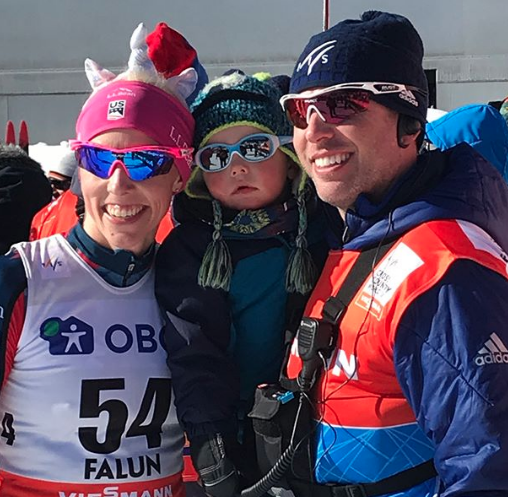
    Kikkan Randall poses with her husband Jeff Ellis and their son Breck after her final race in Falun. (Photo: Instagram @kikkanimal)

    The “First Tracks” series highlights the pregnancy, postpartum, and parenting experiences of noteworthy athletes in cross-country skiing in various stages of their professional careers. The sharing of these experiences can benefit athletes in any stage of their career, whether they are an elite or recreational skier, by demonstrating that it is very possible to return to skiing, competition, and an active lifestyle with a growing family. The series will include the physical challenges of being an athlete during and after pregnancy, balancing family life with skiing, and the joy that starting a family can bring. This is part two of Randall’s “First Tracks”. You can read part one here. 

    ***


    After Kikkan Randall delivered her son, Breck Stuart Randall Ellis, on April 14th of 2016, she began her return to racing.

    “The one thing that kind of struck me as I was doing all of it, is that because I wasn’t racing while I was pregnant, I felt like I was taking my maternity leave before the baby came,” said Randall in a call, “because as soon as the baby came, it was time to get back into training.”

    Randall described the adjustment of incorporating motherhood into her lifestyle as a professional athlete as a “cool mind shift”, and expressed gratitude for her support system for enabling her to spend lots of time with her new baby while still putting in the training hours she needed to pursue her goals.

    “I had looked forward to being a parent for a long time, but I was completely blown away with how awesome it was,” said Randall. “From the moment he came into the world and you quickly realize – as a skier, my life had really been all about me, pretty selfish, because it has to be for performance. Pretty quickly it was all about him and I had to find a way for it to be about me in between.

    “It was a change in perspective too in knowing that my training time wasn’t unlimited,” she added. “So the time that I got to be out there I was really grateful for, and I wanted to make the most of it so that when I could come back and be with Breck I still could make the most of that time.”
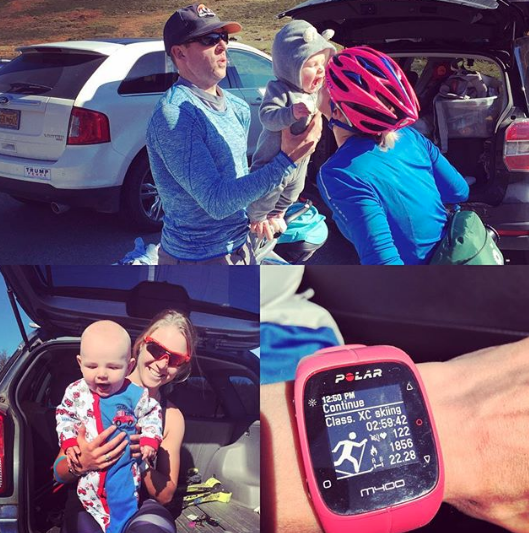
    Kikkan Randall kisses her five-month-old son Breck after a training session with teammate Sadie Bjornsen. (Photo: Instagram @kikkanimal)

    While Randall’s capacity for high volume training while pregnant may seem super-human, her recovery process brought her closer to the mortal realm.

    “After the birth, there was just a bigger recovery process than I had anticipated,” admitted Randall. “I was still able to do three sets of eight pull-ups about a week before Breck was born, I was feeling really strong at the end of my pregnancy. So I thought, oh man when I have this baby and the extra thirty pounds come off, I’m going to be whipping out pull-ups right and left! I think I waited about four days or maybe it was a week and I was like okay, I’m going to try some pull-ups now, and I could barely do four!”

    During pregnancy, a woman’s uterus grows to between an astronomical 500 to 1000 times its original size, from about the size of a pear to approximately the size of a watermelon. In addition to relocating the remainder of the mother’s internal organs, this growth puts a major strain on the core muscles that stretch to accommodate the growing baby and on the pelvic joint, which widens to aid the delivery of the baby. The body also produces a hormone called relaxin throughout pregnancy which allows ligaments to stretch and joints to loosen more easily as the body expands. This hormone is present in the body for 12 or more weeks after pregnancy, meaning women are at an increased risk of joint injury during the immediate postpartum period.

    Because of the stretching of core muscles, many women develop a condition known as diastasis recti, which is a weakening of the connective tissue in the abdominal wall leading to a separation of the rectus abdominis, more commonly thought of as the muscles that make up a “six pack”. The degree of separation is measured by the number of fingers that can be inserted through the gap to the transverse abdominal muscles lying below. In severe cases, the condition needs to be rectified with a surgery similar to the treatment of a hernia.

    “When I started doing exercise after the birth, I was relying on all the bigger muscles [rather than utilizing the core], and I ended up injuring my back about a month after Breck was born,” Randall shared. “So then I started going to Pilates classes and working with a physical therapist that specializes in postpartum stuff to really work to re-engage. I had about two fingers worth of separation between my abs, but thankfully, I have a really strong lining underneath it, and I was able to bring it back to about a half-finger gap.
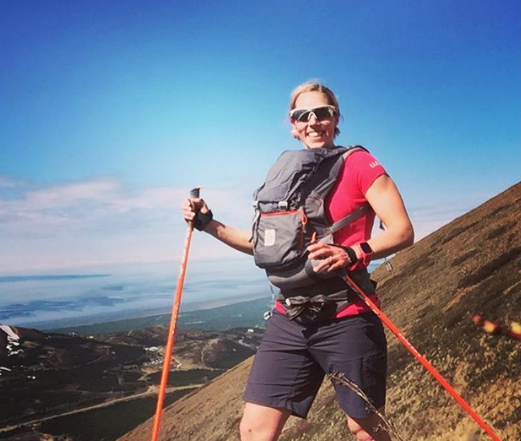
    Kikkan Randall hikes with her newborn son Breck. (Photo: Instagram @kikkanimal)

    “The core strength, for sure, took a bit to come back,” Randall continued. “I think part of it was coordination and strength. And then, really for the whole first year, I didn’t feel like I had the tension in my joints like I had before… So things like really quick speeds, sprinting off the line, that stuff, just took a while to come back and that was a surprise.

    “On the flip side, I couldn’t believe how strong I felt aerobically right off the bat. Within a week or so, I was testing things out on the ski erg and that felt pretty good, and I was getting on the bike, and that was good. We just made a really gradual approach back into training in the first three months, and I really was very cautious and easy with myself for those first six weeks, and then very gradually built back.”   

    While the non-weight-bearing nature of cross country skiing might provide benefits to a body in recovery, Randall realized that the multi-faceted training for her sport at the elite level made resuming her normal regime a slow process.

    “We brought classic in first, thought that was going to be a little easier on the body than skating,” Randall explained. “And we realized how complicated ski training is as we were trying to introduce one thing at a time so we could really tell that I was passing a stage before moving onto the next. But when you’ve got classic, skate, running, biking, strength training, and then that at all these various intensities, it was really like, oh man, where do we even start.

    “We started very simply with using biking as a way to keep up my aerobic intensity,” she continued, “then started with some really easy classic skiing and gradually worked up the volume. When that was going well we added a little bit of intensity. Then once classic was going well, then we did the same thing with skating. So I think it was three or four months before I was back to doing most of my normal training modes.”

    Not all of her training modes were easy to reintroduce.

    “Running took me a while,” Randall expressed, “probably six or seven months to get back into because I did have that separation in the front of my pelvic bone. I had started trying to run small amounts in my neighborhood thinking staying close to home would be good, but I was doing it on pavement. Then, later on, I had much better success building up my running on the trails, so I really think the surface mattered. I was able to do a lot of uphill running, striding, and stuff with poles, that was a really good way to reintroduce the impact on my legwork.”

    Despite resuming a high volume training load, Randall was able to breastfeed her son for the first eight months after giving birth, a commitment that required a lot of planning.

    “It was a blend of just timing feedings and going off for training and coming back and feeding him again and doing a lot of pumping,” Randall shared. “I did two short four-day camps on the glacier, so for that period, I was away from him. Thankfully, I had done a lot of extra pumping early on when I was producing more milk than he was eating, so I had a stockpile. So then, my husband was able to give Breck the stockpiled milk, and while I was on the glacier I was also pumping every few hours so I was building up a new stockpile.

    “So that was kind of funny to be in the middle of the night in the back corner pumping, then leaving camp with this whole cooler full of frozen breastmilk,” Randall laughed. “Then I kind of weaned off on breastfeeding right as the race season was starting.”

    Producing enough milk to sustain a growing baby adds a unique load on the body and requires approximately an additional 500 calories.
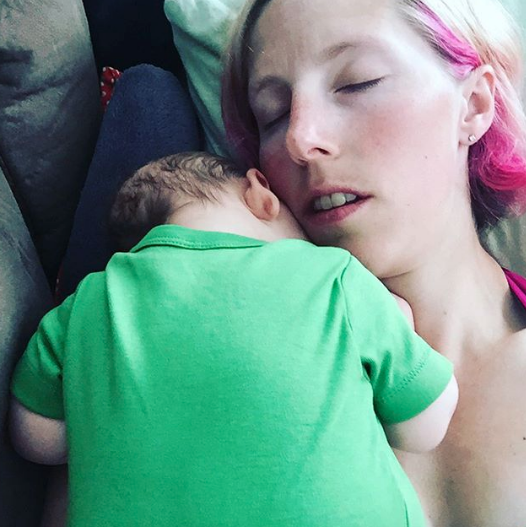
    Kikkan Randall shares a photo of herself with her newborn son captioned “Naps between training just got a whole lot better.” (Photo: Instagram @kikkanimal)

    “I didn’t really notice it,” Randall stated gratefully. “I didn’t find myself more tired. I was trying to drink a lot to keep my hydration up, but I never really felt like I got out of whack that way. I was enjoying the opportunity to eat the extra calories. Overall, I was pleasantly surprised at how well I was able to balance it with all the training that I was doing.”

    While breastfeeding did not cross her mind as a source of impedance for her recovery between training sessions, Randall did have some concerns about the lack of sleep during the first few months of Breck’s life. However, she found it to be much less detrimental than anticipated.

    “I had been wearing this device for a full year leading into pregnancy, then I wore it through my pregnancy and after – it measures the quality of my sleep and my recovery. I thought that I was going to see a huge decline, but I saw some of the best numbers I’ve ever seen!” Randall exclaimed. “So I think that the super mom powers you get, just the happiness factor… so even though I was getting less sleep, when I was sleeping I was sleeping really effectively, so it didn’t seem to have an impact on my training.”

    In reflecting back on her pregnancy and postpartum experience overall, Randall saw both advantages and disadvantages to being a skier, versus a professional athlete in a different sport.

    “I think our training as skiers is very complementary to what you do for pregnancy because of the low impact nature of it,” Randall stated. “Being able to ski a lot was really beneficial and I could bike and do all these different activities that contribute to the same goal, which was great. I could see being just a runner being challenging.

    “I do however see a difference in the return,” she continued. “I followed a couple athletes like [professional cyclist] Kristin Armstrong who came back incredibly strong after the birth of her child and won gold medals. I was just thinking about how biking is so one dimensional and so linear, it would be so easy to hop on the bike and get back in shape because it’s all aerobic and it doesn’t matter the tension [in muscles and joints] as much. So some sports may be easier that way… Skiing was just so challenging with all the different pieces to figure out.

    “But overall, there were a lot of other world cup athletes that all did it around the same time as me and everybody came back strong,” she concluded. “So I think it’s very doable.”

    As Breck’s half-birthday approached, so did the World Cup season. Randall headed to Europe with her teammates once again after eighteen months away from racing.  

    “At six months, that was about a month before the season started, I was feeling strong, training with the team, doing time trials,” Randall remembered. “I thought I was really ready to go, and then when the race season started, that was when I got the reality check that being away from race intensity for several months takes a little while to come back. I think that was also in relation to the tension in my muscles.

    “So the first three months of the race season were pretty challenging, I had to be really patient,” she added. “Then when I hit about the ten-month [postpartum] mark, I felt a really big change, and then another big change at a year.”
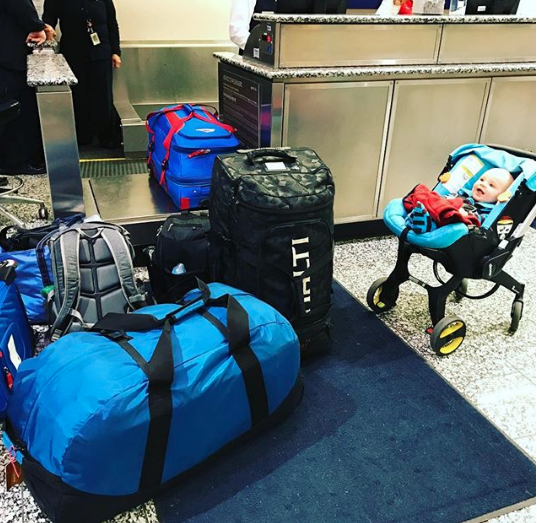
    Kikkan Randall’s son Breck waits happily next to their bags as they depart for a winter in Europe for the World Cup Races. (Photo: Instagram @kikkanimal)

    Apart from the physical challenge of being prepared to race at the highest level at seven months postpartum came the logistical challenge of traveling across the Atlantic for a winter on the road with an infant. What was their secret to success? Not dwelling too much on it.

    “We didn’t really think too much about how we were going to do it,” Randall admitted. “We just decided that we wanted to do it and therefore we were going to figure it out. Some people were like, ‘how did you travel five-months on the road in Europe while ski racing?’ And I was like, ‘I don’t know, we just did it! And it was awesome!’ We schlepped a lot of gear around and just made it work and it was really an awesome experience for us all together.”     

    The World Cup moves between countries on a weekly basis, meaning regular flights, bus and train rides, and time changes. While this schedule might make any traveler weary, Breck seemed to handle it without too many problems.
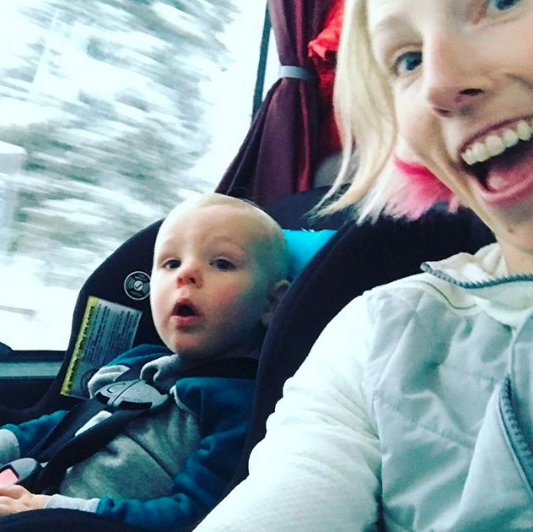
    Kikkan Randall travels with her son, Breck, between World Cup race venues. (Photo: Instagram @kikkanimal)

    “I don’t know that we’ll ever know the answer to the question of whether he is just a good easy-going, even-keel kind of kid, that’s just good for anything, or whether it was that early in his life we started taking him on trips, so that’s all he knows,” said Randall. “He ended up being a great traveler, even long van rides and being on big busses with the world cup field. He just went along with it.

    “The time change, however, was quite difficult,” she continued. “It probably took us a good two or three weeks to get on a routine. When we went over he was starting to only wake up two or three times a night, I really wasn’t feeding him too much during the night. When we got over there, he started waking up five or six times a night. And because we had teammates all around us and I didn’t want to disturb them, we were doing whatever it took to keep him happy through the night. But then it would be one in the morning and he was wide awake like ‘let’s play!’ Then at three in the afternoon, we couldn’t keep him awake to save our lives.”

    Luckily, Breck was born amidst a small baby boom on the World Cup, so Randall was not alone in navigating this experience. Marit Bjørgen of Norway, Aino-Kaisa Saarinen of Finland, and Katja Visnar of Slovenia all gave birth during the 2015-2016 ski season as well.
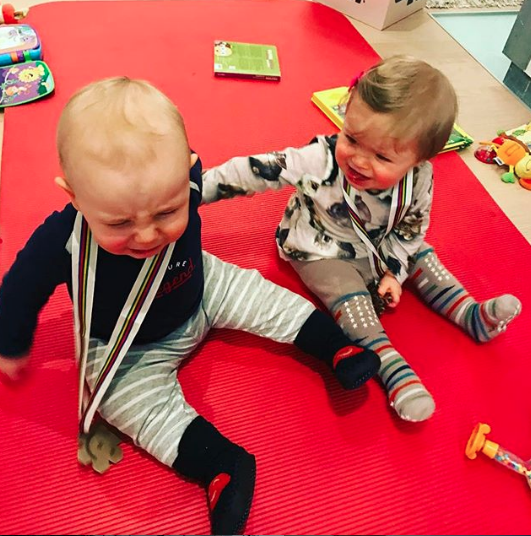
    Kikkan Randall’s son, Breck, and Aino-Kaisa Saarinen’s daughter, Amanda, play with their matching bronze medals from the World Championships in Lahti, Finland. Randall captioned the photo, “It’s okay Breck, you’ll win gold next time.” (Photo: Instagram @kikkanimal)

    “My Finnish friend [Saarinen] who is a World Cup skier and had a baby just a few weeks after me highly recommended that we do sleep training,” Randall explained. “So about three weeks into the season, we were in Switzerland and we were finally in an apartment so we wouldn’t disturb anyone around us and we committed to three or four nights of sleep training. And it was mostly done by Jeff – I got to sleep through it because I was racing – but he committed to letting him cry for longer and longer intervals and within about four nights, he was completely sleeping through the night, and from then on it was a huge game changer for us.

    “We actually found it a lot more challenging the second year when he was between a year and a half and two years old because then he wanted to move a lot more and he was more aware of what’s going on and it was harder to keep track of him on the long travels.”

    In addition to family and friends, Randall was grateful for babywearing and carrying gear during her preparation for and travel during the race season as it made it easier to bring Breck along for some sessions and to get him from place to place more easily while on the road.

    “We got a Thule chariot right away,” Randall explained. “That was super awesome because with the infant harness we could suspend him in there from pretty early on. I could use it to get out for walks and later runs. Then we could pull him behind the bike, and then we could pull him skiing.

    “We found it really useful in Europe in the winter because we could just pack him in there all nice and
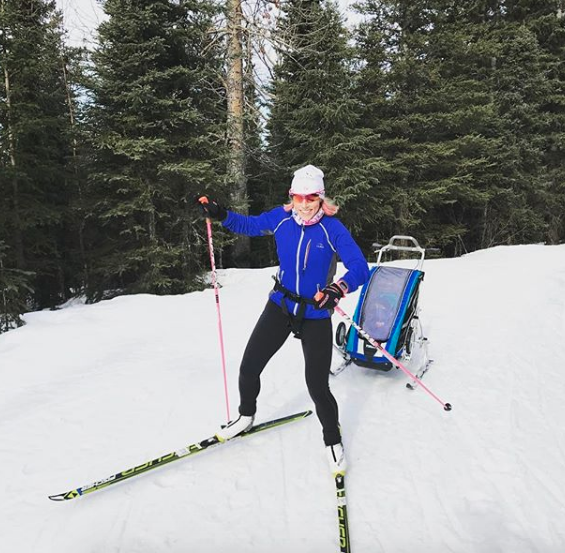
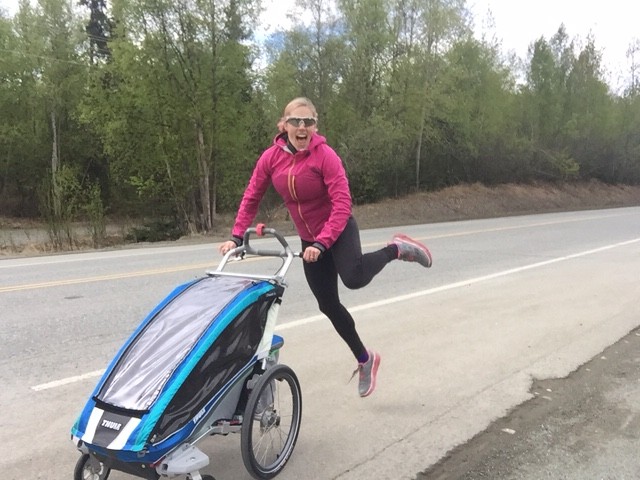
    Kikkan Randall tows her son, Breck, in their Thule Chariot. (Photo: Instagram @kikkanimal)

    warm, protected from the snow and wind and rain, then whoever we had with us helping take care of him could just take him out for these great walks all the time,” she continued. “That was a really great tool, I mean we’re still using it a ton.”

    At about 10 months postpartum, Randall took third in the freestyle sprint at the World Championships in Lahti, Finland, and at about 22 months postpartum, she won her historic gold medal. However, just five months after the Olympics, Randall shared that she had been diagnosed with breast cancer. Luckily, she was given a good prognosis, however, the discovery halted the Randall-Ellis family’s plan to grow.

    “That’s been one of the toughest parts of this breast cancer deal so far,” Randall shared. “We were so excited to expand our family after the Olympics ended, and now that’s on hold for at least a couple more years. We were fortunate that we were able to do some fertility treatment before I started chemo, so we have one little embryo as a backup plan. It just gives us some hope that in case my fertility has been wiped out by the chemo, that gives us one shot maybe. And there’s no guarantee that the chemo does wreck my natural fertility. So we’ll find out in a couple years when hopefully I can take a break from the anti-hormone stuff.
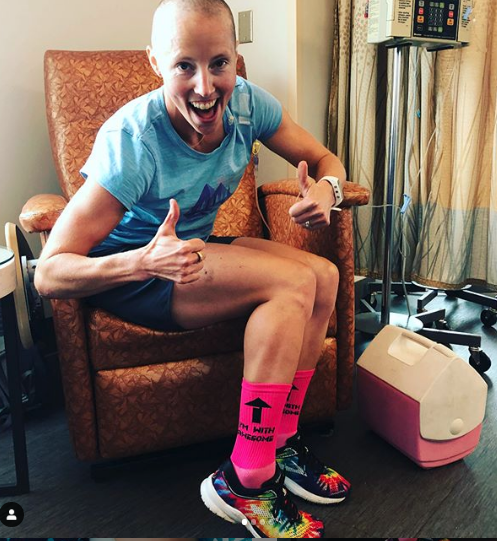
    Kikkan Randall displays her newly bald head and tireless positivity after undergoing her second round of chemotherapy. (Photo: Instagram @kikkanimal)

    “With that aside, it makes me really grateful that we have Breck,” she continued, “because I know how much I love being a parent and the fact that I get to do that with Breck is so amazing. I think if I hadn’t had any children and was facing this, it would be a lot harder.

    “Also, you hate that it takes something like this to change your perspective, but we’re just really appreciating every day with Breck now, and the fact that we get to just focus on him, because sometimes when you have another kid then you have to shift your attention to two kids,” Randall added optimistically. “So we’re just going to really enjoy doing stuff with Breck and it makes me appreciate how much I love being a parent and making the most of every day that I have. And I’m staying hopeful that I get to go through this whole experience again, even if it’s not on the original timeline that I imagined.”


    Finally, Randall was asked what message she would share with a fellow skier who is pregnant or thinking about starting a family.

    “Approach this new situation with a curiosity and really just listen to your body,” Randall encouraged. “But have the confidence that your body is pretty tough and it is used to doing a lot, and probably the best thing that you can do for yourself and the baby is to just keep doing what you’re doing. I really think that when you’re used to getting a lot of exercise, and as an athlete, you’re used to taking good care of yourself, just keep doing that through pregnancy.

    “Enjoy it!” she added. “Notice what’s different and unique, and also have the confidence that when the baby comes, it may take the patience of a couple of months to get your body to come back around again, but it will and you’ll be stronger than ever. I think it’s really exciting to be able to blend athletics and being a parent whether you’re doing it at the elite level or just someone who is worried about continuing to be athletic after having kids, it really works out great.”

  • First Tracks as a New Parent: Kikkan Randall [Part 1]

    First Tracks as a New Parent: Kikkan Randall [Part 1]

    The “First Tracks” series highlights the pregnancy, postpartum, and parenting experiences of noteworthy athletes in cross-country skiing in various stages of their professional careers. The sharing of these experiences can benefit athletes in any stage of their career, whether they are an elite or recreational skier, by demonstrating that it is very possible to return to skiing, competition, and an active lifestyle with a growing family. The series will include the physical challenges of being an athlete during and after pregnancy, balancing family life with skiing, and the joy that starting a family can bring.

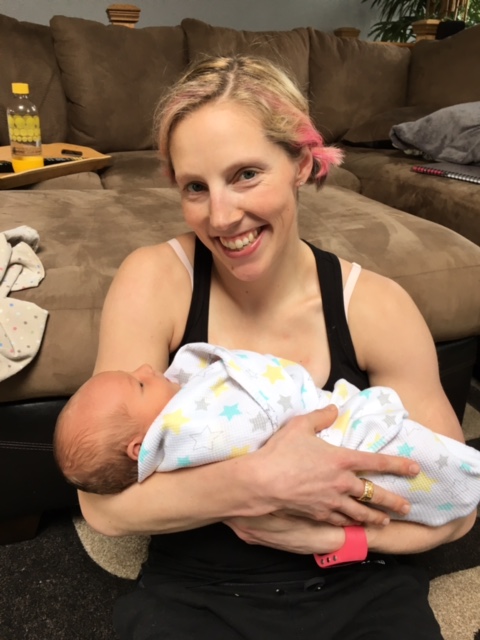
    Kikkan Randall shares time outside with her one week old son, Breck. (Photo: Instagram @kikkanimal)

    As she was the only U.S. Olympian and mom in PyeongChang and the first female American skier to start a family during her professional career, Kikkan Randall has led by example in the realm of training through and recovering from pregnancy. Her gold medal demonstrates that it is completely possible to return to competition after pregnancy stronger than ever. While Randall acknowledges how fortunate she was to have an uncomplicated pregnancy through which she could train at a level most would find astonishing, her experience should instill confidence in women that hope to remain active during and after pregnancy in order to maintain the active lifestyle to which they are accustomed.

    Randall and her husband, Jeff Ellis, knew that they wanted to start their family in 2016. As that was not a World Championship year and it was not an Olympic year, the timing was ideal for her to miss a season on the World Cup. As the couple began trying to conceive, Kikkan was able to maintain her normal training volume without worrying about its effect on her fertility, still participating in team camps and following her training plan. In fact, she discovered she was pregnant shortly after returning from a training camp in Norway.

    “A few weeks before that, Jeff had gotten a Diet Coke can on the airplane and it said ‘dad’ on it,” Randall shared in an interview. “There were just some funny things that ended up being a premonition or something.”

    Kikkan Randall announced via social media that she and her husband, Jeff Ellis, were expecting their first child in April 2016. (Photo: Instagram @kikkanimal)

    Once the couple found out they were pregnant, Randall’s training plan adapted to accommodate the new toll on her body, however, it did not change as much as one might think.

    “Up until the point I found out that I was pregnant, I was training full bore as if I was preparing for the season ahead,” said Randall. “Once I found out I was pregnant, the goal shifted slightly in that I was no longer trying to be in top physical shape for the race season, but I was curious about how much training I could do. So as long as I followed how my body felt, I continued doing intervals twice a week, strength training twice a week, long things. I really continued the training as normal, although I did notice in that second month quickly the extra load on my system. All of a sudden stuff just felt harder.”

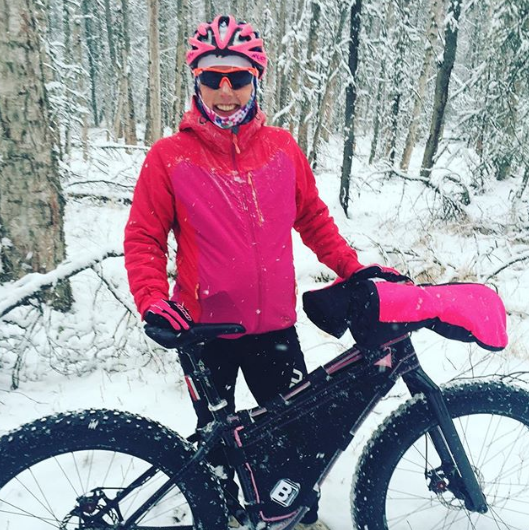
    Kikkan Randall using snow biking as one of her training modes at eight months pregnant. (Photo: Instagram @kikkanimal)

    Despite things feeling more challenging, Randall was able to maintain a high training load throughout her pregnancy. She typically trained twice a day all the way through her third trimester, incorporating running, both skate and classic skiing, snow biking, and strength workouts. Once she was in the later stages of pregnancy and her belly had grown substantially, she avoided exercises that required jumping because of the added load on her joints and those that required her to lie on her back for long periods of time, which is recommended to pregnant women as the pressure on the inferior vena cava, one of the major arteries responsible for returning blood from the lower extremities to the heart, can restrict blood flow and cause complications.

    “Around the seven month mark, running started to get pretty uncomfortable,” shared Randall. “I had a little bit of separation in the front of my pelvic bone. I did some running on an anti-gravity treadmill which helped a bit, and then after a while, I was like okay, I don’t need to push it anymore. So I didn’t run that last month and a half of pregnancy. I did some hiking, especially where I could finish on an uphill and not do too much downhill.”

    One thing that challenged Randall was the lack of information pertaining to high-level athletes training through pregnancy. As it is difficult to conduct medical studies on pregnant women and so few elite athletes had chosen to get pregnant during their professional career, there was a dearth of resources explaining what she should and should not do.

    “That part wasn’t as cut and dry as I would have liked,” she said. “I was asking a lot of questions to a lot of people, but there wasn’t a lot of stuff out there that was concrete about what you can or can’t do. Thankfully, my doctors were supportive. They said, ‘Keep doing what you’re doing because that’s what your body is used to. Just listen to it.

    “My strength training coach had actually been through a pregnancy the year before herself, so she was helpful in knowing what the load on the body would be and modifying strength plans slightly,” she continued. “My personal coach, Erik Flora, was really helpful because he’s been with his wife through three pregnancies, so we worked together to design a training plan that was appropriate. I looked for stories on the internet of other elite athletes that had gone through it. I reached out to Lauren Fleshman, the runner, she gave me some tips. But a lot of it was just experimentation.”

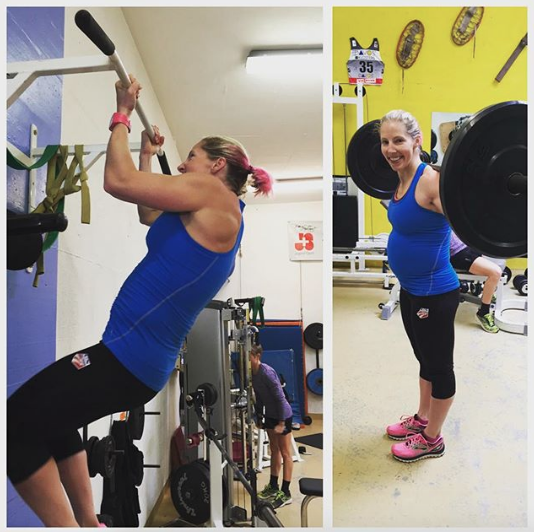
    Kikkan Randall shares photos of herself strength training at 22 weeks pregnant with the caption “I guess I don’t need to add a weight vest anymore!”(Photo: Instagram @kikkanimal)

    Randall seemed to handle pregnancy in stride, adjusting to the changes in her body well and looking forward with anticipation. Her only emotional hurdle was simply remaining home during the winter, rather than the heading to Europe for the World Cup race season.

    “It was a little bit difficult, I had to miss a season of racing,” Randall shared. “When all my teammates left for the season and I was up in the middle of the night watching them, I really missed the racing and being there together with them.

    “But I was also really excited to be a parent,” she continued. “I was really excited with how the process [of pregnancy] was going. I was pleasantly surprised with how much I was able to do and how I felt.”

    Randall also handled the uncertainty of what her recovery would look like with the positivity and resilience for which she is known.

    “I think I went into it with the right mindset,” she said. “I had four Olympics up to that point and a very successful career, so I knew that if for some reason I wasn’t able to come back, I could still be satisfied with my career and I think that took a lot of the pressure off. I was also pretty optimistic and confident that I would come back as strong as ever and I had a lot of really great support. The ski team was really supportive, my sponsors were supportive, my husband was really supportive. So I just looked at it with a lot of optimism and excitement.”

    Perhaps a challenge unique to the world of professional athletes for whom training and racing is their career, maternity leave takes a new shape as women are not able to perform at their normal level during or immediately after their pregnancy. This extended leave has been met with mixed results as more an more professional athletes are choosing to start their families during, rather than after, their career. As aforementioned retired track athlete Lauren Fleshman illuminated, pregnancy is not always well-received by sponsors, since the athlete’s need to step away from high-level training and competition for at least a year decreases the visibility of the sponsored products.  

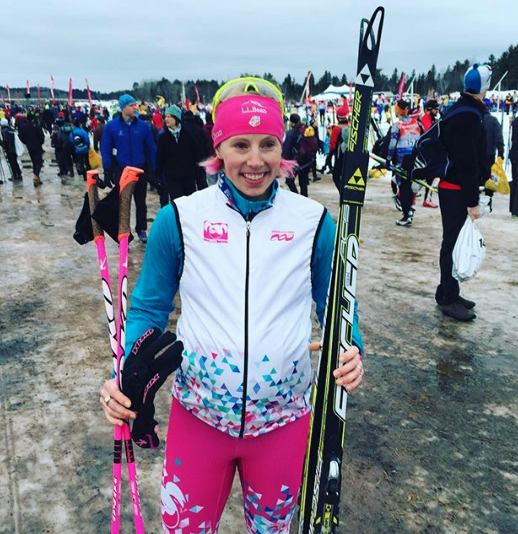
    Kikkan Randall sports a Fast and Female race vest at the start line of the 2016 Birkie. Randall appeared on behalf of one of her sponsors, Fischer Sports. (Photo: Instagram @kikkanimal)

    Luckily, Randall’s experience in this regard was quite positive.

    “I was proactive with all my sponsors,” said Randall. “I alerted them that ‘hey, we’re going to try to have a kid in the next year. So if I do, how can we renegotiate or keep our relationship going?’ Recognizing that they wouldn’t get the benefit of me out there racing and getting in the results, being on the podium, and getting them the exposure that way, I just proposed other ways that I could be valuable to them. Whether it was writing content for their website or social media, whether it was doing in-person appearances. So with each of my sponsors, I came up with a unique set of things that I could do since I was going to be home, not going to be away racing all the time, and they were really receptive to that. So it just took some creativity on my part.

    “I think everybody was really psyched to see that I wanted to continue racing, that I wasn’t seeing this as an either-or option, so everybody was really supportive,” she continued.

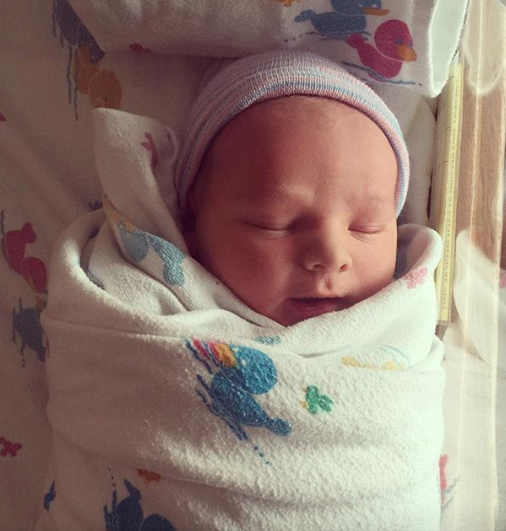
    Kikkan Randall announced the birth of her son, Breck Stuart Randall Ellis, born April 14th, 2016. (Photo: Instagram @kikkanimal)

    Randall also felt that pregnancy is handled fairly within the International Ski Federation (FIS) in terms of her ability to preserve her World Cup starts after a year away from racing.

    “When you let FIS know that you’re going to be missing a season, they put it into the same category as if you were injured,” Randall explained, “which some people really take offense to because they say ‘Pregnancy isn’t an injury.’ But that was just a technicality, basically, what they do is allow you to freeze your points so that when you come back, there is a slight penalty for not having raced the previous year, but you don’t have to start from zero again which is really nice. So I was pretty happy with that process; it was really easy to just let them know, and then my points were frozen and when I came back, things got restarted again, so that was really good.”

    Randall gave birth to her son, Breck Stuart Randall Ellis, on April 14th of 2016. Because Randall possesses a genetic blood clotting factor, she had been on a blood thinner throughout her pregnancy as a precaution. In order to keep her labor and delivery a bit more controlled, the doctors advised her to be induced when she reached full term at 39 weeks.

    “They had done a procedure in the office the day before, so by the time I got to the hospital and they hooked me up to the monitors, I was already having super mild contractions, which I couldn’t quite even feel yet,” said Randall.

    “They started me on one unit of Pitocin over half an hour… that got things going real quick!” she laughed. “It kind of skipped the slow build up stage and I went into having contractions every 90 seconds pretty intense and that was making me throw up, which was causing more contractions. So I battled through that for a couple of hours, trying all of the various techniques and everything.

    “Then the doctors checked me and I hadn’t made a single millimeter of progress,” she continued. “Basically, because it was so intense, I was kind of fighting myself. So after a few hours of that without making any progress, we started talking about an epidural, because my doctor really thought that would just help me relax. And at that point, I was pretty open to the idea. So I got an epidural, and then for the next few hours, I was able to sleep a bit and that did allow me to relax, so the next time she checked I was ready to go.”

    From there, Randall’s delivery went smoothly. Breck entered the world at a whopping 8lbs 11oz, 21 inches in length.

    “I had a great team,” Randall concluded. “My husband was there, I had a midwife and my doctor, and some great nurses involved. So, yeah, at 7:47 – we didn’t know what we were having, so it was a fun surprise, and the rest is history!”

    Stay tuned for part two in which Kikkan shares her return to training after pregnancy, traveling on the world cup with Breck, and how parenting has changed since she retired and has been undergoing treatment for breast cancer.

  • Randall to Resume Training, Cautious but Excited: ‘I Feel Refreshed’

    Randall to Resume Training, Cautious but Excited: ‘I Feel Refreshed’

    June 1. That’s the date Kikkan Randall’s had in her head for a while now, and it has nothing to do with a milestone or a checkup involving her first child.

    That’s when she’s getting back at it.

    “I know I’m not going to be able to jump right in cold turkey to what I’ve been doing in the past so it’s going to be a gradual build,” Randall said on the phone from Anchorage, Alaska, earlier this month, about three and a half weeks after baby Breck was born.

    “Just talking with Erik [Flora], my coach, we’ve been trying to set it up so there’s different little stages to clear before moving onto the next thing,” she explained. “First building up the volume and then adding the intensity as each intensity feels good and then hopefully be a kind of normal training rhythm by the end of July into August.”

    Normally when she’s home for the summer, Randall, a four-time Olympian and three-time overall Sprint World Cup champion, trains with her team, Alaska Pacific University (APU), about four times a week. The rest of the week she trains solo or in small groups, and this summer, she plans to do a little of all of the above.

    With her coach, Randall has formulated a plan that works for her, her husband, Jeff Ellis, and most of all, Breck.

    “This first time at home has been so wonderful, just to have no schedule and spend some time getting to know Breck and be here for him,” she said. “That’s been great, but I also know that I miss training so it’ll be nice to have a blend where, it’s not like I have to disappear off to work for 8 to 10 hours and then miss him all day. I can go out and do my work and come back and be with him and then go out and do it again.”

    For the coming 2016/2017 race season, the 33-year-old Randall, who has been competing at the sport’s highest level since she was 19, plans to spend the entire winter in Europe on the World Cup circuit. That will involve traveling with Breck, her parents and in-laws at times, and eventually an au pair. Jeff will be there, too, as he works for the International Ski Federation (FIS) Cross Country marketing support.

    “We’re going to rely on our parents a little bit, they’re going to come over in intervals on certain weekends and periods and then there’s going to be a point in the middle of the season where we’d like to find a European-based nanny to help out,” Randall said.

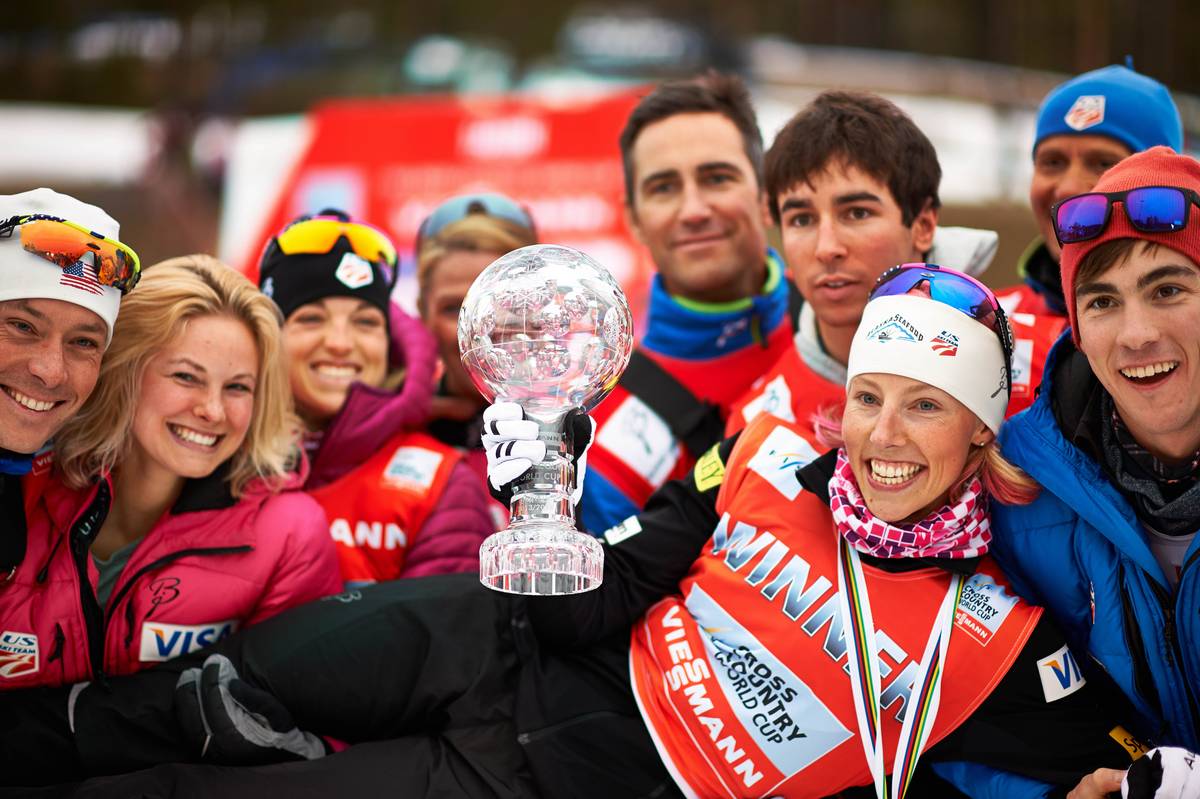
    Several members of the U.S. Ski Team lift up Kikkan Randall after she won her third-straight World Cup sprint Crystal Globe a the end of the 2013/2014 season. (Photo: Fischer/Nordic Focus)
    Kikkan Randall and her U.S. Ski Team teammates and coaches after she won her third-straight Sprint World Cup Crystal Globe at the end of the 2013/2014 season. (Photo: Fischer/Nordic Focus)

    With the challenges of coordinating caregivers comes the cost of traveling with at least one extra person, like a nanny, on the circuit. While Randall retained her spot on the U.S. Ski Team’s A-team based on her FIS world ranking and Red Group status from two seasons ago and could potentially have much of her room-and-board costs covered by FIS, she anticipated the need to make different arrangements.

    “While I want to be as much a part of the team as I can, I don’t want to be disruptive and I think living in a hotel room with a baby for a whole year would be challenging,” she said.

    For the holiday break in late December, Randall and her husband reserved a condo in Davos, Switzerland, for a more-homey alternative and they are hoping to find a similar setup in Sweden before World Championships in Lahti, Finland.

    “We’ve started to formulate a plan, but we have a lot to learn, but we’re excited we get to bring [Breck] on this journey,” she said. “And our parents, we’re lucky that they’re able to assist and that’ll get us going, and we’ll learn the ropes as we go.”

    It’s a Boy!

    On April 14, after 13 1/2 hours of labor, Randall gave birth to her son, Breck Stuart Randall Ellis. The gender was a surprise, but they had a boy name ready.

    A few years ago, Jeff did a mountain-bike race called the Breck Epic in Breckenridge, Colo.

    “He came back with all this stuff, a T-shirt, a belt buckle and it said the name of the race on it and I thought, ‘Oh Breck, that sounds really cool! That could be a good name,’ ” Randall said. “So we just kind of had it tossed around for a while and when it came time to narrow it down, we just liked the sound of it. It’s kind of unique, but still simple.”

    Breck’s middle name, Stuart, is his grandfather’s first name, dad’s middle name and great grandmother’s maiden name.

    “It relates back to a royal clan in Scotland, apparently, so that’s got some fun family history,” Randall said.

    His second middle name is Randall, and Ellis is his last name.

    “The whole process has been so fun,” Randall reflected. “The pregnancy went great and toward the end, the anticipation was building and building, and we ended up inducing my labor so things progressed pretty quickly that day, so it was kind of fun to get to the point that we were pushing him out…”

    (Ed. note: Fun and childbirth aren’t usually part of the same sentence, but we digress.)

    “When he came out and he got put on my chest, that’s such a strong emotion at that point, it’s hard to put into words…,” she continued. “I kind of felt like it was the end of a ski race, particularly something like the Tour de Ski where it’s so hard and so painful and you’re pushing, but you just want to get to that finish line and then when you do it’s just like that bliss of laying in the snow, of course one hundred times greater, but kind of that similar feeling.”

    So what’s harder — the hardest ski race she’s ever done or giving birth?

    “It was a different kind of pain than I’ve ever experienced before,” Randall said of the latter. “I was curious to see how it would feel to the toughest race or VO2max test or tough intervals or something like that, but instead of being like a lactic-acid burning pain, it was almost like a flu, crampy kind of pain and I think the hardest part was just not knowing when it was going to end.”

    It eventually did end and Breck, 8 pounds, 11 ounces, was born. Within two weeks he was back up and slightly heavier than his birthweight — thriving in his new world — and in the 90th percentile for length and 60th for weight.

    “He’s a little string bean; he has big feet,” Randall said with a laugh. “He’s got a really good temperament, doesn’t get too fussy … He loves to be in the front carrier or the Chariot, that instantly puts him to sleep. I think he was used to riding along with me for the nine months.”

    Now a month-and-a-half old, he’s up to 11 pounds and out of the newborn outfits and diapers.

    “He’s awake a lot of the day now and even giving us some involuntary smiles,” she wrote in an email. “Can’t wait until the real ones start!!”

    Six-Week Marker

    This week, Randall goes in for her six-week checkup, at which point she’s hoping the doctor will give her the “all-clear.”

    So far, she’s done some easy rollerskiing and biking the last three weeks, in addition to walking and “testing the waters” with the SkiErg.

    “I feel like I’m healing up pretty well. I’ve been pleasantly surprised with how intact my abs feel and everything still feels like it has good tensions so I’m happy about that,” she explained. “… I’m trying to really keep this first six weeks as just an opportunity to heal and get my body ready to train, but just being careful so I don’t risk getting injured.”

    Regardless of how anxious she is, Randall asked the doctor to give it to her straight and what the most conservative approach is to returning to physical activity.

    “I have definitely been antsy and wanted to test things a little bit so it’s nice to have that voice in the back of my head that says, ‘No, just go on six weeks, be careful,’ ” she said. “I also have been in touch with Marit a little bit and she said to be cautious about coming back. She maybe feels like she pushed it a little bit.”

    Three months after having her first child, Norwegian legend Marit Bjørgen injured her hip while jogging in March, having previously completed a 42-kilometer ski race. She and Randall have exchanged some text messages in the time since.

    “I think you need to be cautious for caution’s sake,” Randall said. “But it’s so hard because you’ve essentially taken off a weight vest and you feel light.”

    In terms of goals, Randall’s focused on getting in shape for the U.S. Ski Team (USST) camp in Anchorage in mid-July. She figured that would give her six weeks of training beforehand. That Eagle Glacier camp will likely be her first time on snow.

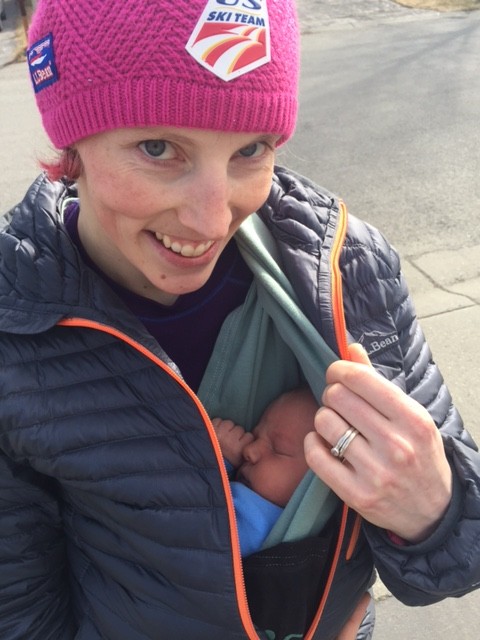
    Randall with Breck in the front pack during a spring walk in Anchorage, Alaska. (Courtesy photo)
    Randall with Breck in the front pack during a spring walk in Anchorage, Alaska. (Courtesy photo)

    Beyond that, she plans to spend most of her summer and fall at home, with the exception of the USST October camp in Park City, Utah, and a trip north of Toronto to visit Jeff’s parents. Asked if she’ll take Breck along for some workouts (i.e. in one of her two Thule jogging strollers or in a front or back pack), Randall said she’d like to.

    “I could get in some good workouts with him, which would be fun, and Jeff will be along as well so we can do it as a family, and then there will be some times when I can just get out the door and do a workout and get right back. I think it’ll be a nice balance,” she said. “I have a lot of really good training opportunities right out my door for times where I just really need to go get in a workout and be right back and hopefully I’ll be able to join in some team sessions with APU as well, but that will really depend on how [Breck] is adapting to the schedule. Hopefully I can get it in that way, but we’ll have to just wait and see.”

    Come fall, she plans to start the season in Europe with the rest of the team on the World Cup in late November. Her goal is to be in top shape by February for World Championships.

    “Other than that it’s going to be a lot of playing it by ear and seeing how my body responds to things,” she said.

    After a year off and now a mother, will she be the same racer? Randall said she’s not sure.

    “This is a big question mark right now. There were certainly days where I was training while pregnant and as we got toward the end it was getting harder and harder and I felt a little more disconnected from those days when I was in peak shape. I just started to feel like, ‘Woah, getting back to that level is going to be challenging and racing every weekend and every discipline is going to be hard,’ ” she reflected. “Then on the other hand, I hear these amazing stories of women who say they only got stronger when they came back, training with that weight vest for at least six months of the pregnancy, and those nice physiological adaptations that you have throughout the pregnancy and then of course the change of focus, the fact that you don’t take your training time for granted any more, you maximize the time you have and you have this other thing in your life that is so important that you don’t sweat the small stuff.”

    Her friend and fellow Olympian James Southam told her that having a child gave him new motivation to do his best and set a good example.

    “I’m really curious to see how it feels,” Randall said of racing. “I know there’s parts that are going to be really challenging, just getting back into shape and trying to still be able to handle that high load with this new lifestyle, but on the other hand, I feel refreshed. My body is refreshed from a little break, my mind is refreshed and that could open totally new doors.”

    Randall’s not alone. Several other top World Cup women have also had their first children in the last year, including Finland’s Aino-Kaisa Saarinen (in early May), Slovenia’s Katja Višnar (last November) and Bjørgen (in December). FIS has taken notice and is initiating new rules that give caregivers (i.e. a nanny) World Cup accommodation travel rates and access to venues, according to Randall.

    FIS Cross-Country Event Coordinator Sandra Spitz said she could not comment on the changes until after the FIS Congress in early June.

    “I’m not really sure how to explain why this kind of [baby] boom hasn’t happened in the past,” Randall said. “This [past] year, it’s probably no coincidence that there was no major championship, if anyone had to miss a season this was the one to do it and you still have two years now leading into the Olympics. But we certainly had years like this in the past, so why now? I don’t really know how to explain that, but I think it is really cool, but I think it’s maybe becoming a little bit more acceptable. Maybe teams and sponsors are being a little bit more supportive so it’s not this scary unknown … There’s a support system for that.”

    She’s hoping this group of women, all of which plan to continue competing, can prompt change and show that one can continue with their career after starting a family, rather than have to chose one over the other.

    “I think [FIS is] recognizing, too, that it’s worth their while to keep the top athletes in the sport versus them leaving to have a family,” she added. “Any way you can encourage that is good for everybody.”

    As she held Breck in her arms, he cooed and grunted; she laughed and reviewed the last few weeks.

    “I don’t think I could’ve imagined just how happy and content I would be,” she said of motherhood. “When he’s just as cute as can be cuddled up, sleeping on my shoulder or when he’s just spit up for the third time and we’ve had to change his outfit and he’s spit up all over me, I seem to just really love every moment of it. And also how relaxed I’ve been able to be through it. I feel like I enjoy every moment and I’m just loving it.

    “It’s so crazy how your life really does change in an instant,” she continued. “You go from being completely independent to now always having this responsibility, but suddenly I can’t imagine that that life would be satisfying anymore because it’s so fun.”