From the FasterSkier archive — posts syndicated from athletes’ and coaches’ own blogs between 2004 and 2012, kept online as published. Current coverage is at fasterskier.com.
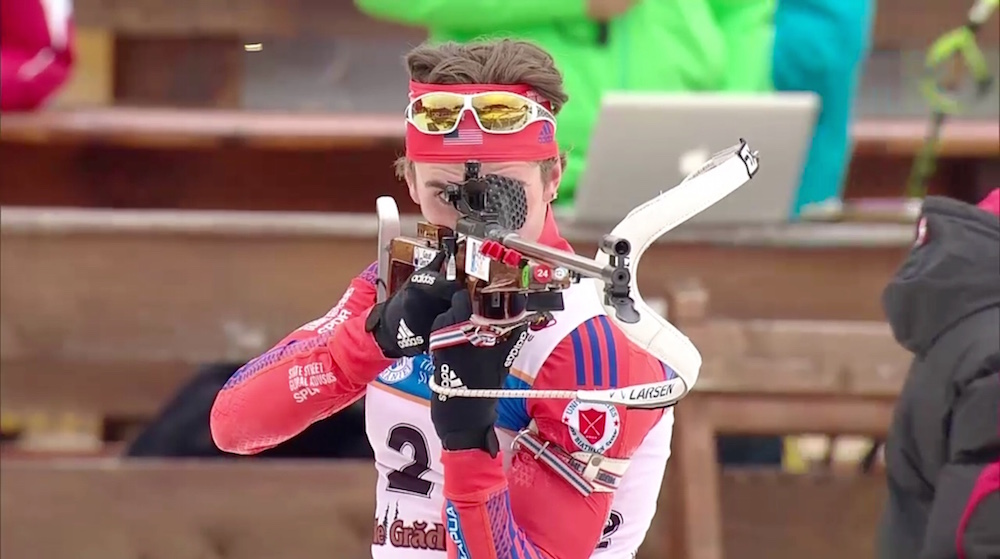
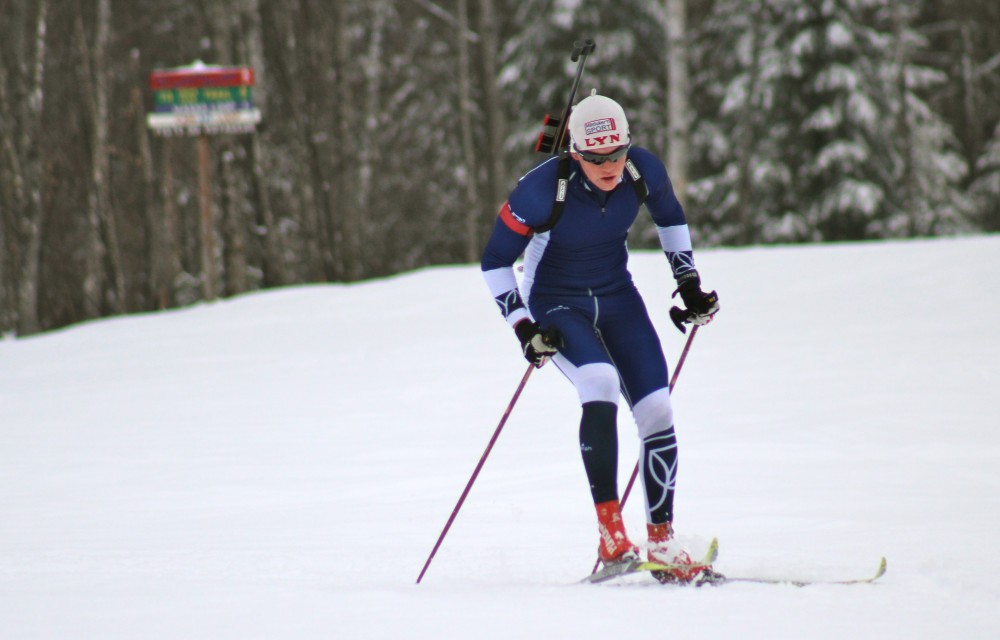
American Siena Ellingson during her standing stage of the women’s 3 x 6 k relay at IBU Junior World Championships in Cheile Gradistei, Romania. (Photo: IBU YJWCH Cheile Gradistei 2016/Facebook)
(Photo: IBU YJWCH Cheile Gradistei 2016/Facebook)
Hamel cleaned both stages without any spare rounds. (Photo: IBU YJWCH Cheile Gradistei 2016/Facebook)
(Note: This article has been updated to include comments from Canadian coach Richard Boruta after Tuesday’s junior relays.)
It was the last day of IBU Youth/Junior World Championships, and for several juniors racing on Tuesday in Cheile Gradistei, Romania, the idea was to have fun. Maddie Phaneuf said that was a priority on U.S. women’s 3 x 6-kilometer relay team: “We hadn’t really set a goal for the day…I was just reminding the girls to have fun out there and do their best,” she wrote in an email.
Personally, she wanted to hand off to second-leg Siena Ellingson in a good position. Phaneuf did so, skiing the second-fastest scramble leg of 16 teams and coming into the first exchange in fourth, 42 seconds behind the leaders.
While she avoided the penalty loop on both shooting stages, Phaneuf used a total of three spare rounds to clean: two on the first prone, which put her back in 12th, and one in standing.
“It was fun to pick off the girls on the last loop and move up to 4th from 7th after my standing stage,” she wrote. “I felt really strong today and my skis were fast thanks to our wax techs.”
The Norwegian women’s team (Anne Marit Bredalen, Turi Storstrøm Thoresen and Ingrid Landmark Tandrevold) skied to the win in 55:26.3, passing Sweden on the last loop to win by 15.6 seconds with a team total of five spares (0+2, 0+3). Sweden took second with four spares (0+0, 0+4), and Austria reached the podium in third, 55.5 seconds back with seven spares (0+2, 0+5).
The U.S. finished 12th (+5:55.2) with one penalty and nine spares (0+4, 1+5). Ellingson shot identical to Phaneuf, cleaning with the help of two spares in prone and one in standing, and anchor Claire Waichler cleaned prone but had to ski a penalty lap after using all three spares in standing.
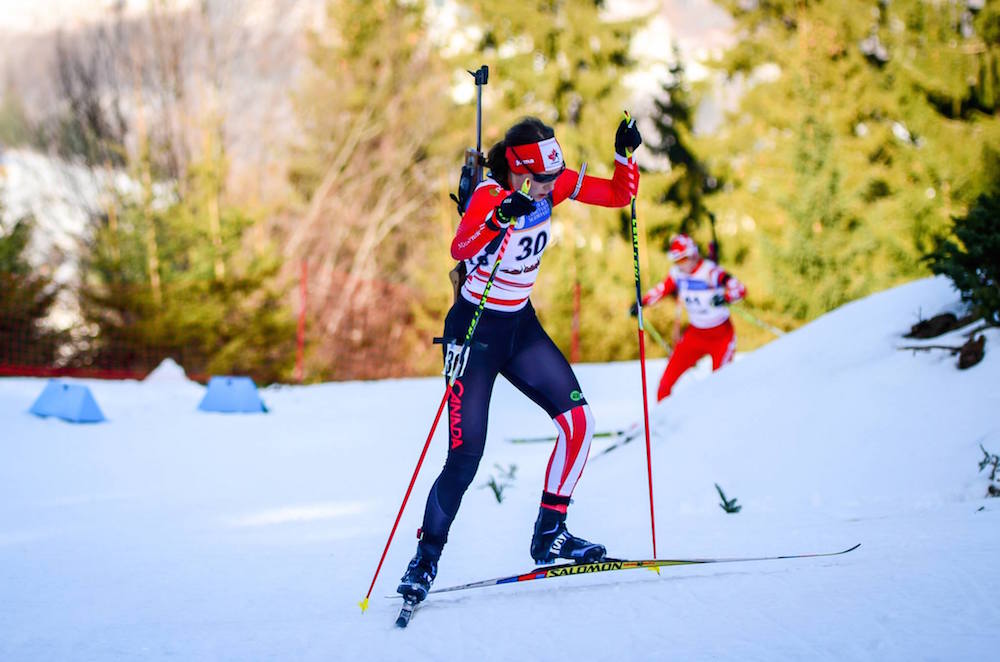
Fifteen teams finished. Canada did not. Kendall Chong started the team off with three penalties and six spares (0+3, 3+3) and tagged teammate Charlotte Hamel in 16th. While Hamel cleaned both stages without any spares, she couldn’t move up from that position. The third Canadian, Leilani Tam von Burg did not start.
“Leilani was getting sick and it was not sure until the last moment whether or not she will be able to race,” Canadian trip leader and Biathlon Alberta Training Center coach Richard Boruta wrote in an email.
The fourth junior woman on the team, Caitlin Campbell was hospitalized after crashing in the sprint last Saturday.
“She is not allowed to exercise much at this moment,” Boruta explained. “We did’t have any other chance than to include Leilani and hope for the best. However, it didn’t work out with her, but the other girls still felt that they would like to have one more opportunity to compete against the strong international field, one of the important things missing in Canada / North America.”
For Phaneuf, in her third and final Youth/Junior World Championships, she explained the relay was a good way to end the week in Cheile Gradistei. Individually, she notched three top 10’s: fifth in the 12.5 k individual, seventh in the 7.5 k sprint, and ninth in the 10 k pursuit.
“I think I ended my junior career on a really solid note,” Phaneuf wrote. “It was exciting to reach my goals and end I can’t wait to see what the rest of the season brings.”
Next up for the 20-year-old US Biathlon development skier? Phaneuf said she’s headed back to the U.S., where she’ll spend just under a week training and recovering in Lake Placid, N.Y., before heading to Presque Isle for the IBU World Cup next week.
“During those races I have the opportunity to qualify for the World Championship team, so that’s definitely a goal of mine,” she wrote. “We’ll see what happens! Either way, I’m happy with how my season has turned out so far. It’s great to see how much I’ve improved from last year.”
(Story continues below)
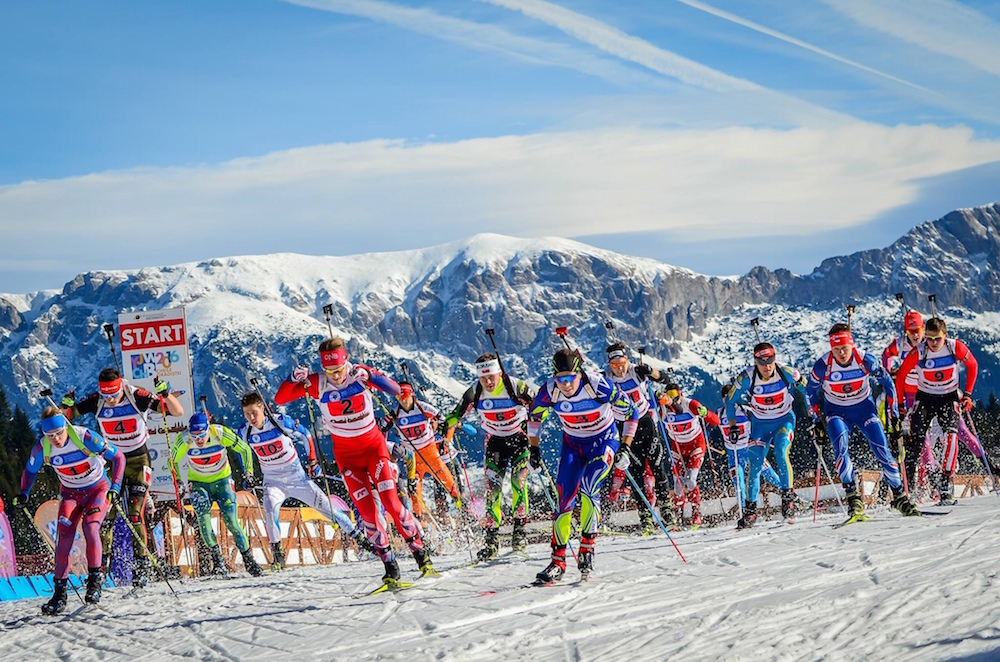
Start of the junior men’s 4 x 7.5 k relay at IBU Junior World Championships on Tuesday in Cheile Gradistei, Romania. (Photo: IBU YJWCH Cheile Gradistei 2016/Facebook)
In the junior men’s 4 x 7.5 k relay, the Russians dusted the field by two minutes in 1:23:56.7. All four men (Dmitrii Shamaev, Viktor Plitcev, Nikita Porshnev, and Krill Streltsov) shot flawlessly in prone and everyone but Streltsov cleaned standing without any spares (Streltsov used two — the team’s only spares).
Germany claimed second (+1:59.6) with eight spares (0+4, 0+4), and the Czech Republic took third (+3:05.8) after using six spare rounds (0+1, 0+5).
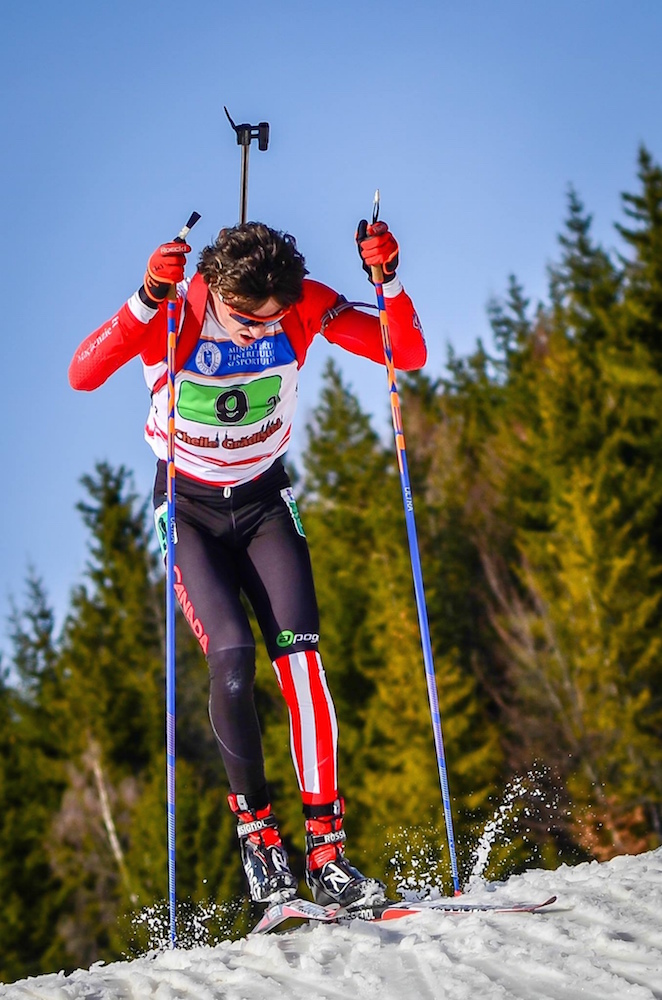
Alex Dupuis (Canada) racing the second leg of the men’s 4 x 7.5 k relay at IBU Junior World Championships on Tuesday in Cheile Gradistei, Romania. (Photo: IBU YJWCH Cheile Gradistei 2016/Facebook)
The Canadian men finished 14th (+11:12.1) after skiing eight penalty loops and using 18 spares. Matthew Strum opened with one penalty and five spares (0+2, 1+3) and tagged the team in 16th, Alex Dupuis cleaned both stages, using one spare in prone (0+1, 0+0) to tag off in 14th.
The Canadians held onto the position from there, despite Aidan Miller skiing five penalty loops and using six spares (3+3, 2+3), then tagging Pearce Hanna in 14th. Hanna shot skied two penalty loops after prone and cleaned standing with three spares (2+3, 0+3) to finish about a minute behind 13th and 19 seconds ahead of 15th.
According to coach Boruta, top 10 was a reasonable goal for the junior men’s relay.
“Alexandre Dupuis was the only one who did have a good relay performance…,” Boruta wrote. “Charlotte [Hamel] did have a good day on the range as well, unfortunately her skiing is quite far off of the pace.
“Overall, all the top 20 (or even 30) placings are very respectable results and we should be happy, that we have at least few athletes who can be at that level,” he reflected on the team’s overall showing at the championships. “The competition is becoming stronger and more nations are in a position for good results.”
Biathlon Canada doesn’t fund programming for junior or youth athletes, so essentially “there is also no high expectation for their performance,” Boruta explained. “Those athletes are spending around $20,000 – $30,000 a year for the privilege to train full time and represent Canada internationally, but sometimes this makes it frustrating for the coach, because there is no real leverage if there is a need to change their attitude or anything.
“Our mandate is to develop athletes to such a level that they can make the jump from juniors to seniors and become competitive within a reasonable time frame,” he added, explaining that’s working so far.
The U.S. men’s team of Paul Everett, Brian Halligan, Brendan Cyr, and Travis Cooper finished 18th of 20 teams, with seven penalties and 17 spare rounds.
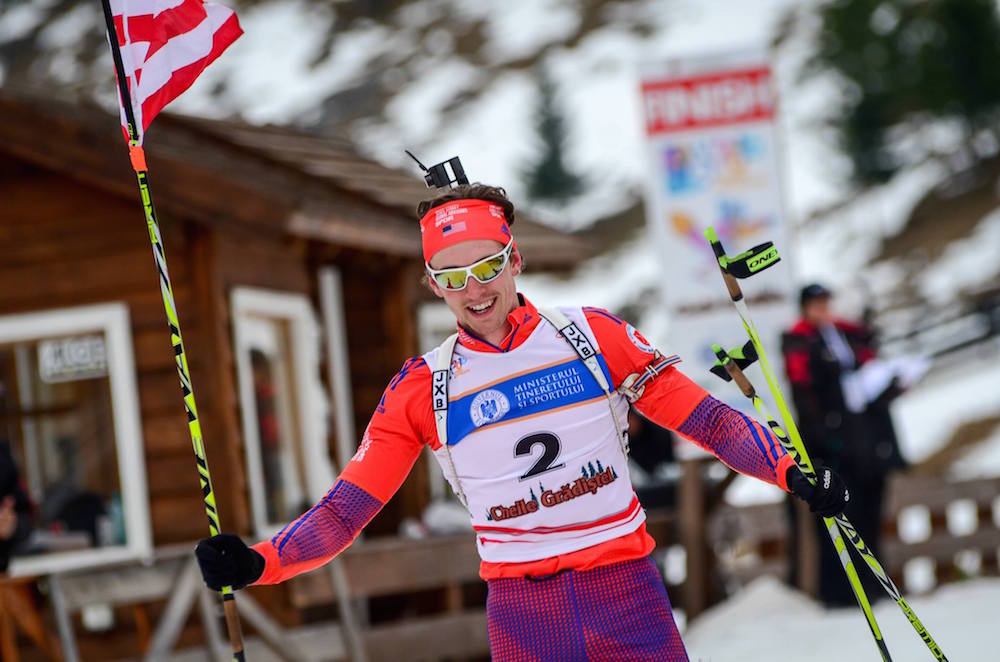
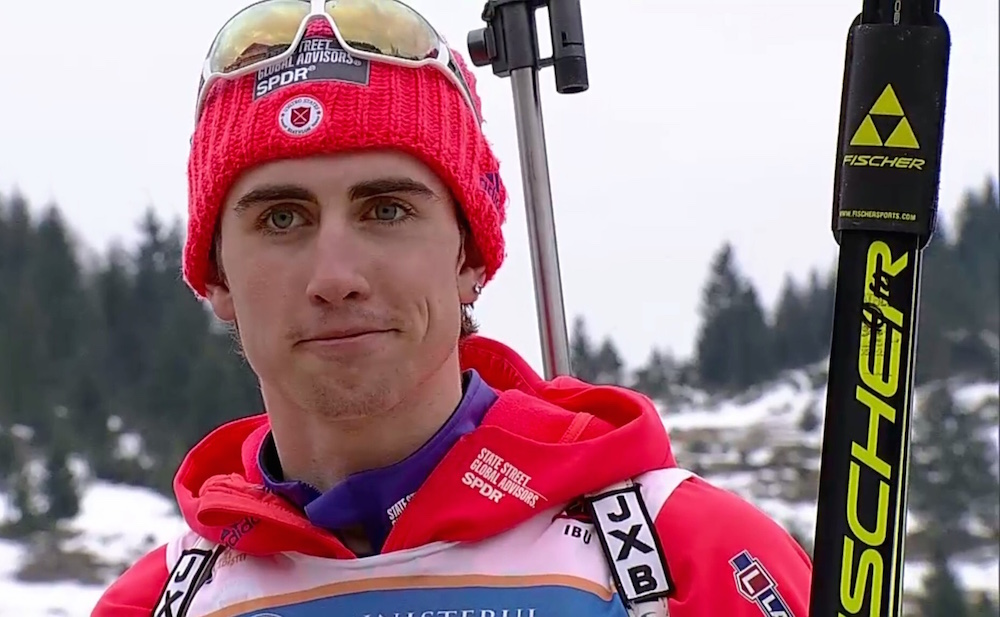
Sean Doherty (US Biathlon) after winning the final race of his last IBU Junior World Championships in Cheile Gradistei, Romania. In winning the junior men’s pursuit on Sunday, it was his fourth gold and 10th medal in six IBU Youth/Junior World Championships. (Photo: IBU YJWCH Cheile Gradistei 2016/Facebook)
(Note: This article has been updated to include comments from American Claire Waichler and Canadian Aidan Miller.)
Imagine a race where you’re in second place for the first half of it, then suddenly, you emerge out of the third of four shooting stages in first (disclaimer: this is a biathlon race), 13 seconds ahead of second place.
You cruise around the 2.5-kilometer course, entering the range for the fourth and final time, where you hit all five targets and set out on your final loop almost 40 seconds ahead of anyone else.
What goes through your mind? For US Biathlon’s Sean Doherty, it definitely wasn’t damage control.
“Let’s lock this up,” he recalled thinking in a phone interview on Sunday after the junior men’s 12.5 k pursuit at IBU Junior World Championships, the final junior race of his career.
“The pressure kind of changes when you’re in the lead. A lot of people fall into a track where, ‘I don’t want to mess this up.’ That’s the wrong mindset. You’re still in charge,” he said.
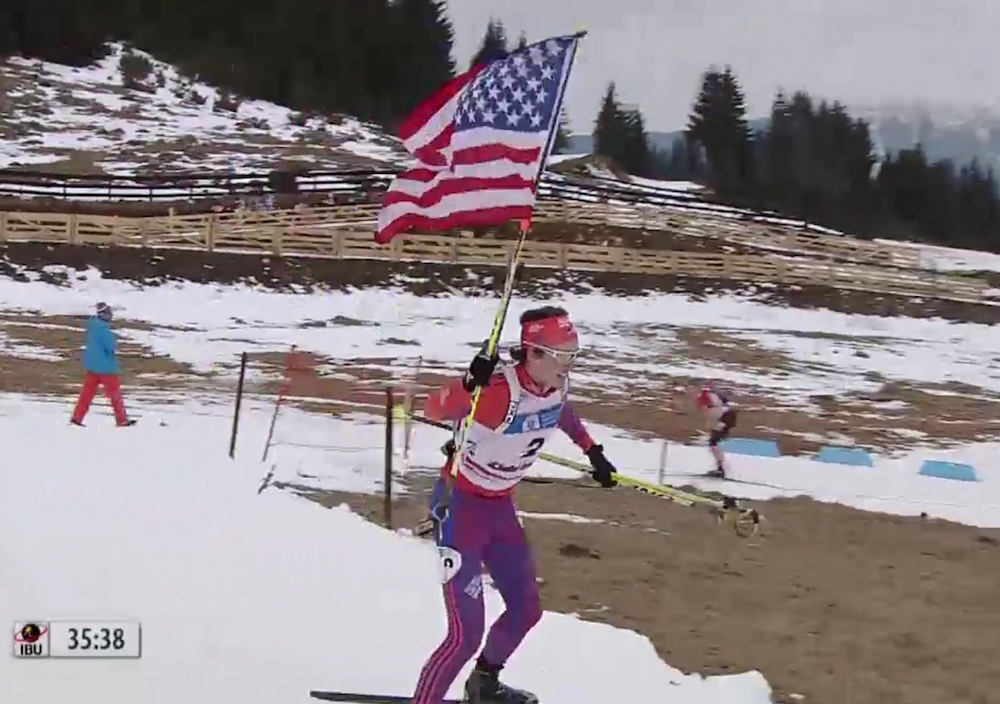
Sean Doherty on his way to securing a nearly 30-second win in Sunday’s pursuit at 2016 IBU Junior World Championships in Cheile Gradistei, Romania.
Doherty, 20, didn’t lose sight of that and raced to his first win of the week in Cheile Gradistei, Romania, with enough time to grab an American flag from a teammate and wave it high above his head as he crossed the finish line in first. That moment meant a lot to him, he said.
Previously, Doherty had placed third in the 15 k individual and second in Saturday’s sprint, behind Austria’s Felix Leitner, who won both previous races at this year’s worlds. On Sunday, Doherty hit 18 of 20 targets, missing one on his second and third stages, to secure the win by 29.6 seconds over Russia’s Nikita Porshnev in 36:01.1.
Porshnev had one penalty in the first stage, then three clean stages and the fastest overall course time to rise from 12th at the start to second at the finish. Leitner recovered from three late penalties (0+0+2+1) to land on the podium in third, 38.8 seconds after Doherty.
Before the flower ceremony, cameras panned on Doherty and Leitner, 19, casually chatting.
“We’ve been racing together off and on a bit; we’re just kind of buddies,” Doherty explained.
But do some of the other junior athletes look up to him?
“I always like to talk and discuss race strategies,” Doherty said. “I’ve been in all sorts of different positions with this stuff.”
Sunday marked his 10th career medal at IBU Youth/Junior World Championships. He had previously set the all-time record on Saturday with nine medals.
Sean Doherty before the flower ceremony at IBU Youth/Junior World Championships, where he won the final race of his junior career (the junior men’s pursuit) in Cheile Gradistei, Romania. (Photo: IBU YJWCH Cheile Gradistei 2016/Facebook)
“I didn’t know I had done it until a good ways after the [sprint] race,” Doherty recalled of becoming the most decorated biathlete at youth/junior worlds. “I was in the press conference [and a reporter] asked the question, and I didn’t know until that point that I had set a new record.”
When it came down to it, he insisted he was just like every other junior at the championships. He woke up each morning on race days and had to kill time while staying focused until 2:30 in the afternoon. Then, he’d put on his race suit, get into his pre-race routine, and get down to business.
“I get nervous just like any other human,” Doherty said. “There’s a lot of pressure for these races I just did, and I’m really happy with how I performed with it all, but it’s something that’s not that easy to deal with.”
“I get nervous just like any other human. There’s a lot of pressure for these races … I’m really happy with how I performed with it all, but it’s something that’s not that easy to deal with.” — Sean Doherty, US Biathlon A-team member and IBU World Cup skier, on podium expectations
He reached the podium in all three individual races at these championships and started Sunday’s pursuit 12 seconds behind Leitner as the second starter out of the gate. Mostly, Doherty said he focused on his own race and staying confident in his ability to catch Leitner.
“Even though it’s tempting to charge out of the game and try to catch Felix on the first lap, it’s not smart,” he recalled.
After cleaning his first prone stage, Doherty missed his first shot of his second prone. That wasn’t ideal, he explained, but he made a point to maintain his energy and keep a good headspace heading into his second loop.
“That wasn’t damaging, that one miss,” he said.
Meanwhile, Leitner cleaned the first two stages to remain in the lead, by 21 seconds over Doherty. He entered the range for the third time in first, well enough ahead of Doherty that he had fired off his shots before the American settled in.
While Doherty knew it was best to focus on himself, he couldn’t help but notice Leitner had missed two in that standing stage.
“I tried to stay to stay calm and not let what was was going on with him not affect me too much. I got a little excited and kind of jerked the last shot,” Doherty said.
He missed one, but emerged out of the penalty loop 13.4 seconds before Leitner.
“I just really wanted to finish the race off and I knew that I could do it,” Doherty said. “I just tried to think of it like training: I’ve done this before and nothing crazy needs to happen right now.”
Sean Doherty cleaned his final shooting stage to secure his lead (and ultimately the victory) in the junior men’s pursuit at IBU Youth/Junior World Championships in Cheile Gradistei, Romania.
The Austrian went on to miss another in his final standing stage (while Doherty cleaned) to fall to third. Russia’s Porshnev cleaned his last three stages to take hold of second place.
“This was my biggest comeback because in general, I am not so good with the shooting,” Porshnev said in the post-race press conference. “I was really lucky and I understood that if I want to be in the top I need to shoot well today.”
Despite missing out on a sweep of the individual races, Leitner said he was happy with third.
“At the moment I am really tired, but I am very happy with this whole week,” he said in the press conference. “It is like a dream. There are too many great athletes here, and I am happy with my [bronze] medal.”
For Doherty, capping his junior career with gold in the pursuit was perfect.
“I really couldn’t have imagined a better ending, really,” he said. “This is the perfect end to my junior career.
“I’m still pretty over the moon,” he added.
On Monday, Doherty planned to fly home to New Hampshire, where he’ll spend the next week recovering leading up to the IBU World Cup in Presque Isle, Maine — about a six-hour drive from his hometown. He is skipping Tuesday’s junior relay and the upcoming World Cup in Canmore, Alberta, which starts Thursday.
(Story continues below)
Sean Doherty won his final race of 2016 IBU Junior World Championships in Cheile Gradistei, Romania, the junior men’s pursuit by nearly 30 seconds on Sunday for his 10th career medal at youth/junior world championships. (Photo: USBA/NordicFocus)
Sean Doherty won his final race of 2016 IBU Junior World Championships in Cheile Gradistei, Romania, the junior men’s pursuit by nearly 30 seconds on Sunday for his 10th career medal at youth/junior world championships. (Photo: USBA/NordicFocus)
Sean Doherty won his final race of 2016 IBU Junior World Championships in Cheile Gradistei, Romania, the junior men’s pursuit by nearly 30 seconds on Sunday for his 10th career medal at youth/junior world championships. (Photo: USBA/NordicFocus)
Sean Doherty won his final race of 2016 IBU Junior World Championships in Cheile Gradistei, Romania, the junior men’s pursuit by nearly 30 seconds on Sunday for his 10th career medal at youth/junior world championships. (Photo: USBA/NordicFocus)
Sean Doherty won his final race of 2016 IBU Junior World Championships in Cheile Gradistei, Romania, the junior men’s pursuit by nearly 30 seconds on Sunday for his 10th career medal at youth/junior world championships. (Photo: USBA/NordicFocus)
Sean Doherty won his final race of 2016 IBU Junior World Championships in Cheile Gradistei, Romania, the junior men’s pursuit by nearly 30 seconds on Sunday for his 10th career medal at youth/junior world championships. (Photo: USBA/NordicFocus)
Sean Doherty won his final race of 2016 IBU Junior World Championships in Cheile Gradistei, Romania, the junior men’s pursuit by nearly 30 seconds on Sunday for his 10th career medal at youth/junior world championships. After winning both previous races at the championships, Leitner placed third. (Photo: USBA/NordicFocus)
Another Top 10 for Phaneuf
In the junior women’s 10 k pursuit, 20-year-old Maddie Phaneuf (US Biathlon X-team) started seventh and finished ninth with four penalties (1+0+1+2).
In fifth after the first prone stage and up to fourth following the second stage, Phaneuf slipped to seventh after a penalty in her first standing, then ninth with two more penalties on the final standing. She finished 2:08.8 behind the winner, Sweden’s Hanna Öberg, who won Saturday’s sprint and started the pursuit first, 1 second ahead of Switzerland’s Lena Häcki.
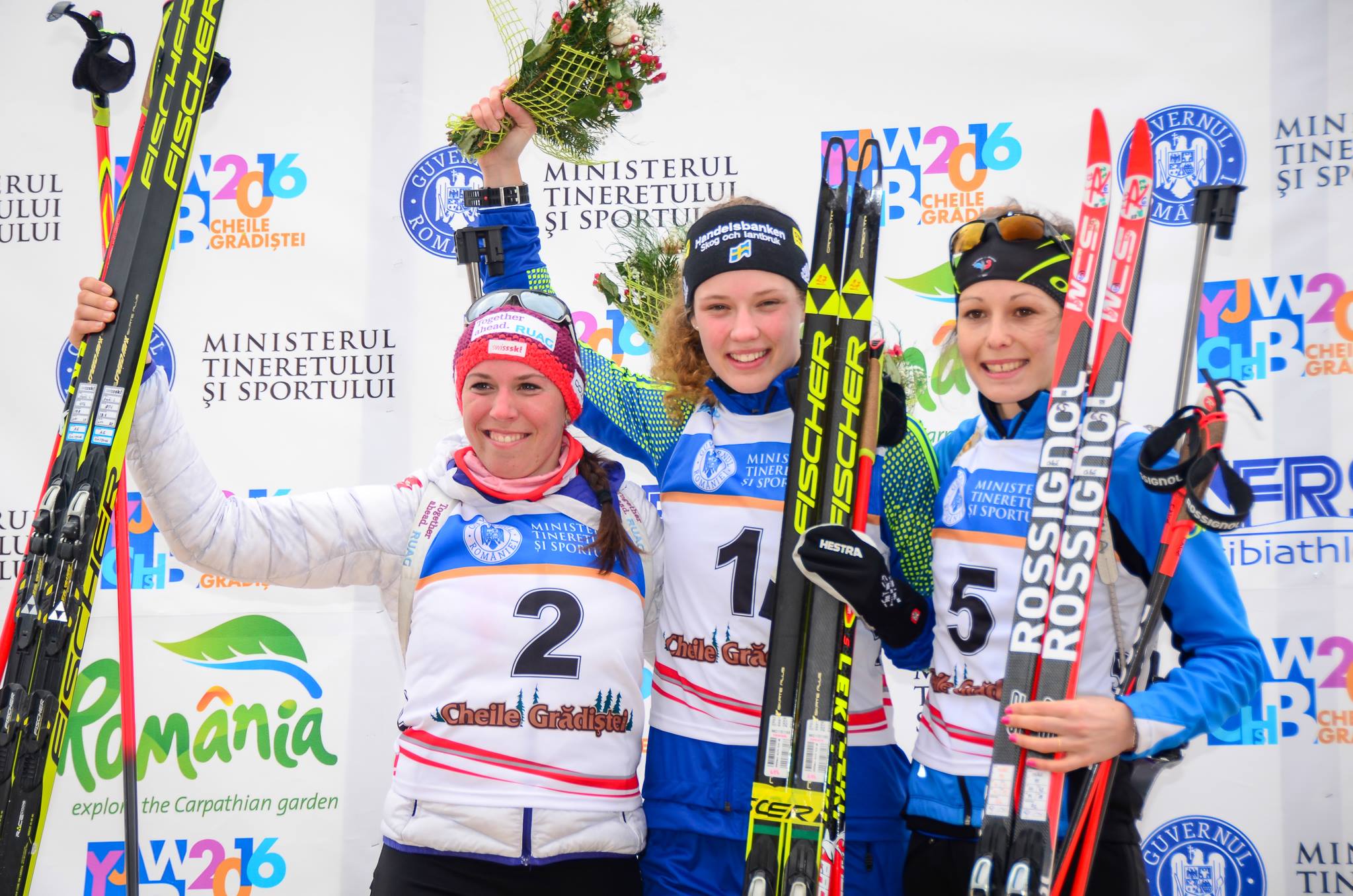
The junior women’s pursuit podium, with winner Hanna Öberg (c) of Sweden, Switzerland’s Lena Häcki (l) in second, and France’s Chloe Chevalier (r) in third. (Photo: IBU YJWCH Cheile Gradistei 2016/Facebook)
While Öberg cleaned the four-stage pursuit to win in 33:16.8, Häcki finished second, 13.7 seconds back, with six penalties (0+2+3+1) and the fastest overall course time by just over a minute.
“I felt crazy good on the skis today, it just went all by itself,” Häcki said during a post-race press conference. “After the three misses in the third shooting, it was then very difficult for me. But after I got the info from my coaches that I was still on course for the medals, I could really turn it up again.”
“I couldn’t believe I get the second gold medal in a row,” Öberg said, according to the event organizers’ Facebook page. “I was so tired during the race today. Lena is so great on skiing. I was not nervous on the shooting range and like yesterday, I was confident.”
France’s Chloe Chevalier rose from fifth to third (+41.9) with two penalties, both in the first stage (2+0+0+0).
“I am really happy to be on the podium,” Chevalier said. “After my first shooting it was very hard, but I was very motivated today so after that I did zero mistakes.”
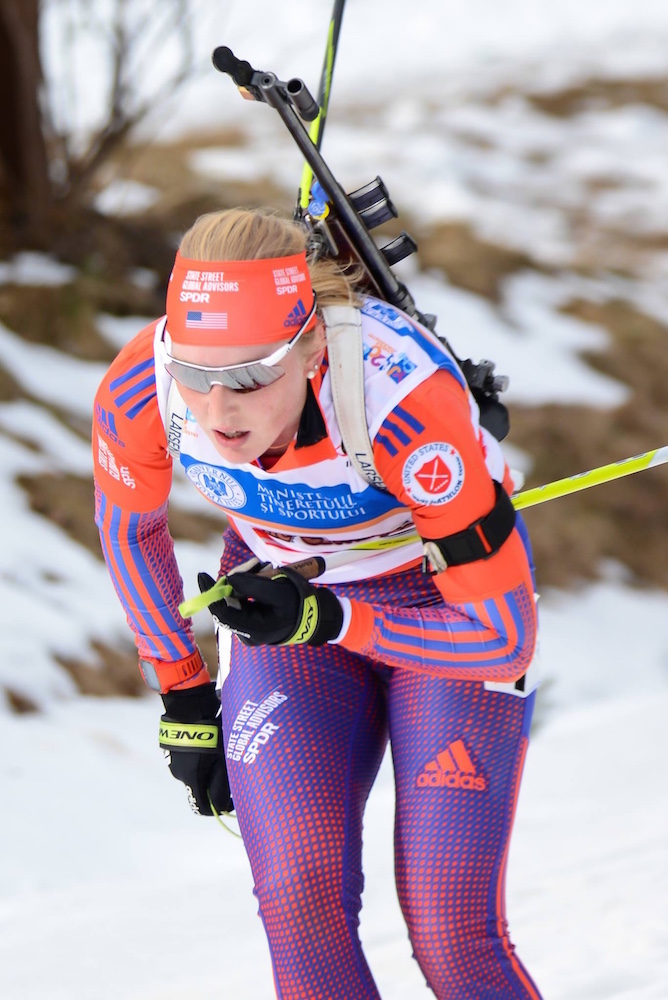
Maddie Phaneuf racing at 2016 IBU Junior World Championships in Cheile Gradistei, Romania, where she notched three consecutive top 10 results. (Photo: IBU YJWCH Cheile Gradistei 2016/Facebook)
Phaneuf explained in an email to FasterSkier that she was hoping to reach the top six and flower ceremony that came with it for the second time this week. She placed fifth in the 12.5 k individual.
“But I also just wanted to stay in the top ten!” she wrote on Sunday. “I found myself consistently in around 5th place throughout the race. I was not happy with missing one in my first prone, but glad to be skiing fast and holding my positions.”
Despite feeling tired during the second half of the race, Phaneuf posted the sixth-fastest course time on the last loop.
“I just tried to ski hard and not let any girls pass me,” she wrote. “I was skiing mostly alone on that loop I think, I didn’t even know there was a Russian behind me until the last 500 meters before the finish.”
She held off Russia’s Kristina Reztsova by 3.6 seconds for ninth place, and finished 11.7 seconds out behind Germany’s Christin Maier in eighth. For Phaneuf, it was her third-consecutive top 10 of the week (after placing fifth in the individual and seventh in the sprint).
“I was really happy and surprised with my results overall,” she wrote. “The training I’ve been doing with [US Biathlon development coach] Jean [Paquet] all year is showing in my skiing and strength and it’s been really great!”
Also in the junior pursuit, Canada’s Leilani Tam von Burg placed 33rd (+6:13.2) after starting 28th. While the 20-year-old Ottawa native and Chelsea Nordic skier cleaned both prone stages, she missed three between the two standing stages (0+0+1+2). Siena Ellingson placed 50th for the U.S. after starting 48th, ending the day with six penalties (1+1+3+1). Canadian Kendall Chong finished 58th with eight penalties (3+1+3+2) after starting 51st.
While Doherty was the lone American in the junior men’s pursuit, Aidan Millar led the Canadian men in 37th (+6:00). He improved 18 places with 19-for-20 shooting (0+1+0+0) to post his best result of these championships (his third).
“I was pretty happy with how the race played out. Especially on the shooting range,” Miller wrote. “Felt pretty strong on my skis but faded a little in the last lap. Overall I was super disappointed with the championships. Going in I wanted a top 10 so obviously didn’t meet that. My shooting was no where near as good as it should have been which was the most disappointing part. Over the week my skiing felt better and better but still not as fast as it needed to be for a top 10.”
Also for Canada, Matthew Strum finished 47th with four penalties (1+1+0+2) after starting 37th, and Pearce Hanna placed 49th with 11 misses (2+4+3+2), slipping one spot from 48th.
Three Canadians in Top 20
Megan Bankes racing to 26th in the women’s 6 k sprint at IBU Youth World Championships in Cheile Gradistei, Romania. (Photo: IBU YJWCH Cheile Gradistei 2016/Facebook)
Three familiar Canadian youth skiers again landed in the top 20: Teo Sanchez in 17th (+4:54.9) and Adam Runnalls in 19th (+5:10.5) in the youth men’s 10 k pursuit, and Megan Bankes in 18th (+3:47) in the youth women’s 7.5 k pursuit.
The result stood as the second-straight 17th place for Sanchez, 18, of Wakefield, Quebec. He shot 95 percent with a single miss on the first standing stage (0+0+1+0). In all three races this week, Sanchez has shot 90 percent or better.
“I’m a little disappointed with my result considering my skiing. It was kind of frustrating to shoot so well but not ski very fast,” Sanchez wrote on Sunday. His course time ranked 48th overall.
“I feel like I could’ve been several spots higher,” he added. “17th place is still nothing to scoff at though. I think overall, three top 20’s is pretty awesome and it shows some pretty good consistency.”
For Runnalls, 80 percent shooting with four penalties (0+0+3+1) was right where he had been all week.
“I was a little nervous coming into today because I had never done a ‘real’ pursuit before,” Runnalls, 17, of Calgary, wrote in an email. “In Canada pursuits are usually started with 5 second gaps between starters but here at world juniors we start at the time we finished behind the winner of the sprint. This new style of pursuit was a little intimidating in the start gate.
“After my second clean prone shooting I tried to keep a clear head and not get ahead of myself,” he explained. “I knew that with 2 clean prones I was in a good spot and need to nail my standing.”
However, he described overthinking his first standing stage and slowing down too much.
“I tried too hard to find the perfect shot and didn’t follow my normal pattern, which caused me to only hit 2,” Runnalls wrote. “Coming into my second standing I told myself that this was a do or die moment and to not overthink it, follow my normal pattern which worked out with me hitting 4.
“I am super excited about my finishes here as it shows I belong here on the international stage,” he added. “I couldn’t be happier with the way I performed and with my overall result.”
Russia’s Viacheslav Maleev won the youth men’s pursuit in 30:14 after starting third (based on his third-place finish in Saturday’s sprint). He won by well over a minute after overtaking another Russian, the sprint winner Igor Malinovskii and beating him by 1:07.6 after Malinovskii had seven penalties (2+1+2+2).
Norway’s Harald Øygard, the 12.5 k individual champion, moved up from eighth at the start to third overall (+1:13.4) with two misses (1+0+0+1). Another Norwegian, Aleksander Fjeld Andersen placed fourth (+1:44.1) for the second-straight race.
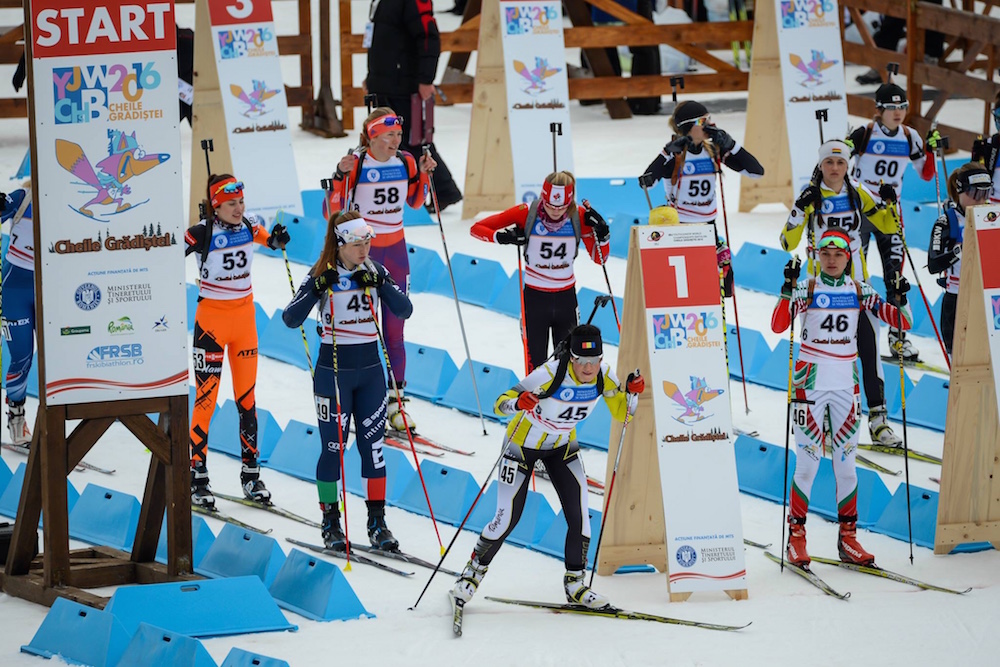
Canada’s India McIsaac (54) and American Claire Waichler (behind, in bib 58) await their start during the youth women’s pursuit at IBU Youth/Junior World Championships in Cheile Gradistei, Romania. (Photo: IBU YJWCH Cheile Gradistei 2016/Facebook)
In the youth women’s pursuit, Kazakhstan’s Ariana Pantova started sixth and cleaned every target but one in her first stage to win her first world title in 27:15.2. Ukraine’s Anna Kryvonos rose from third to second place at the finish, 3.4 seconds back, and Germany’s Marina Sauter reached the podium for the second time this week in third (+1:02.9) after starting 14th. While Kryvonos had three penalties (0+0+1+2), Sauter had two (0+1+0+1).
Canada’s Bankes missed seven targets (2+1+2+2), but skied the seventh-fastest course time to place 18th. It was her second top 20 of the week, after finishing 19th in the 10 k individual.
“The goal for today was to continue my fast skiing in order to move up as many places as possible, and focus on hitting more targets,” Bankes wrote in an email. “Because the course and the race are both quite short, fast skiing was necessary, but good shooting was really important, especially in the first bout. My skiing felt pretty strong again today, however the snow on the course was pretty soft, which made my legs quite tired right off the start.”
She lost track of her position rounding the penalty loop twice after the last stage, and explained she was excited to learn she finished 18th.
“I knew today that my ski speed would definitely keep me in top 20 contention as long as I could hit a few targets,” she wrote. “Overall I’ve been very pleased with my skiing this week, and it’s nice to see my ski speed progressively get better over the last three years. My main issue this week was my shooting, which I was overall very disappointed with. … On a whole I am super stoked by the results I achieved this week, even if my races weren’t entirely perfect.”
Six places behind her, another Canadian, Nadia Moser placed 24th (+4:52.4) after starting 19th. Moser had eight misses (1+2+3+2) on the day.
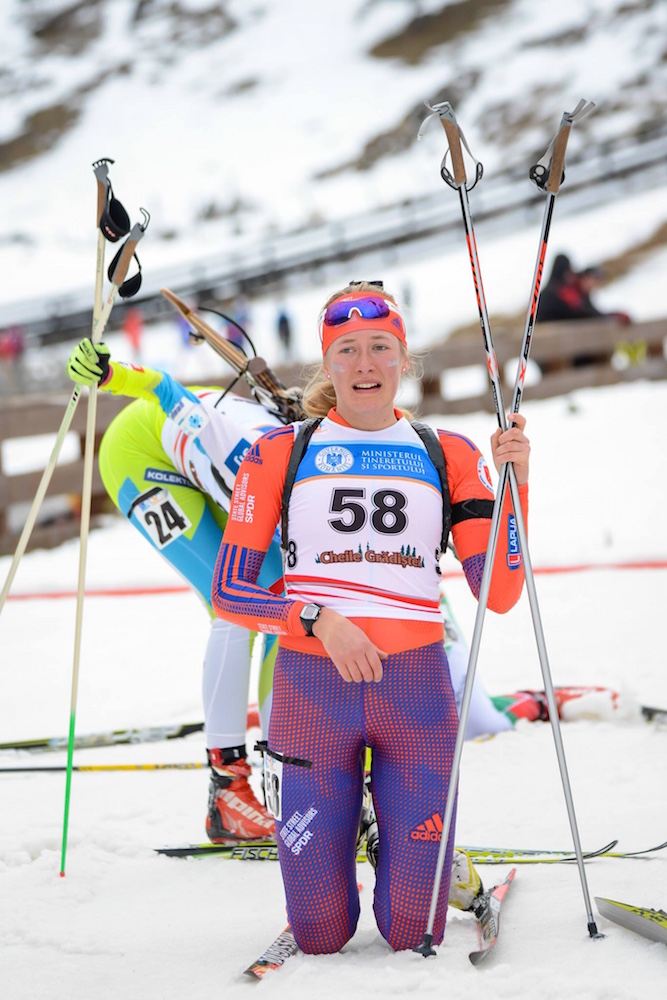
American Claire Waichler started 58th and finished 33rd in the youth women’s pursuit on Sunday at IBU Youth/Junior World Championships in Cheile Gradistei, Romania. (Photo: IBU YJWCH Cheile Gradistei 2016/Facebook)
For the U.S., Claire Waichler picked off 25 places to end up 33rd (+5:29.5) with three penalties (0+1+2+0).
“This is my first time at world juniors so I was hoping to just have fun and experience competition at a higher level,” Waichler wrote in an email. “My skiing had been going well throughout the week but the shooting had been unusually rough. So my goal for the pursuit was to keep up the skiing and shoot a cleaner race — at least 70%. When I shot 85% and cleaned twice I was stoked.
“The competition is very strong and being able to chase down foreign girls during the whole race was educational,” she added. “And a top 20 isolate pursuit time was certainly more than I’d hoped for.”
Canada’s Emily Dickson followed in 35th (+5:48.1) with five misses (0+0+3+2) after starting 41st, Amanda Kautzer of the U.S. slipped three places to 55th with 10 penalties (3+2+2+3) and Canada’s India McIsaac went from 54th to 60th with 13 misses (3+3+4+3).
Two American men moved up in the pursuit, with Brendan Cyr rising to 35th (+6:49) with three penalties (0+1+2+0) after starting 46th. For the 18-year-old Maine Winter Sports Center biathlete, it was his first top 40 in his debut world championships.
His teammate Cody Johnson finished 41st (+7:11.1) with two misses (0+2+0+0) after starting 50th.
“I knew that I had plenty of time that I could make up in the Pursuit,” Cyr wrote in an email after starting in bib 46. “I knew that if I came into the range calm and focused on my own shooting process for each of the stages, while also keeping a good rhythm on the skis, I could put together a top-40 performance.
“The key to my success on the range was just making sure that every time I came to the mat, I was not rushing any of my process,” he added of his 85-percent shooting. “On the skis, the key for me was just making sure I kept a good rhythm throughout the race, most importantly towards the end.”
IBU Youth/Junior World Championships conclude with the three-person relays on Monday and Tuesday, with the youth relays on Monday.
Chloe Levins, Kautzer and Ariana Woods are slated to start the youth women’s 3 x 6 k for the U.S., while Dickson, Moser and Banks represent Canada.
In the youth men’s 3 x 7.5 k, Johnson, Vaclav Cervenka and Peter Carroll are listed for the U.S., while Sanchez, Runnalls and Zachari Bolduc are on the start list for Canada.
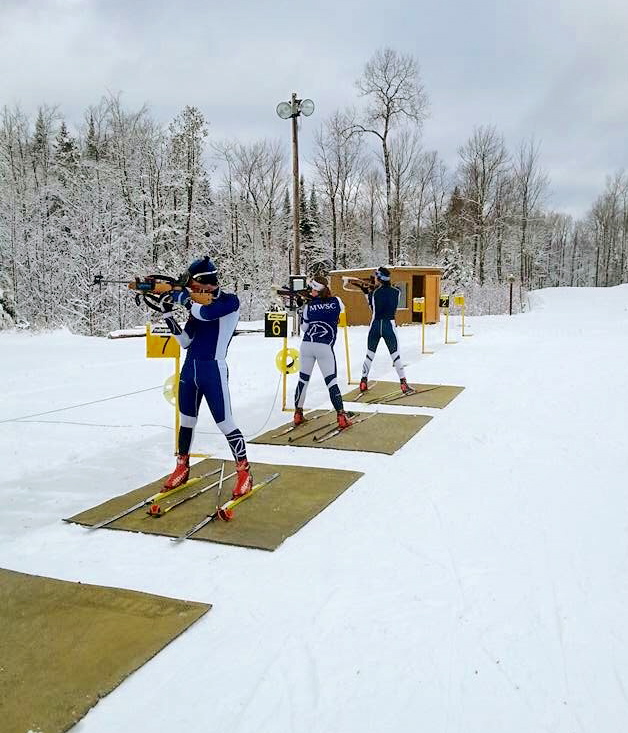
Maine Winter Sports Center (MWSC) biathlete Brendan Cyr finishes his second round of prone shooting during a late-December workout at the Fort Kent Outdoor Center in Fort Kent, Maine.
Before the USA Youth and Junior Biathlon World Championship Team Trials kicked off this week (Dec. 27-30) in Anchorage, Alaska, FasterSkier caught up with the Maine Winter Sports Center (MWSC) biathlon program for a workout to help prepare athletes for the heat of the competition season. The workout can be done once or twice per training cycle and may be easily adapted into a cross-country workout.*
FORT KENT, Maine — What could be better than a rugged set of intervals with Northern Maine’s finest. How about a rugged set of intervals with a rifle?
Though not everyone can handle shooting with a simultaneously high heart rate, Seth Hubbard, biathlon director and head biathlon at the Maine Winter Sport Center (MWSC), said a head-to-head shooting workout is essential for biathletes looking to improve both their skiing and shooting.
“What we’re trying to do is recreate the pressure of coming into the range of a competition with other racers around,” Hubbard said on the phone.
Left to right: MWSC biathletes Brendan Cyr, Mikaela Paluszek and Russell Currier shoot during a head-to-head workout in late December at the Fort Kent Outdoor Center in Fort Kent, Maine. (Courtesy photo)
In order to mimic the high stakes and stress of a race, the workout itself involves a 4 x 1-kilometer mass start, with shooting and 150-meter penalty laps to follow each 1 k interval loop.
“What it does is it puts a lot of pressure on shooting well. You want to shoot fast, but you also want to hit your targets because the penalty loops, in comparison to the 1 k loops, are a pretty large percentage of the [workout],” Hubbard pointed out.
The shorter-distance interval loops allow athletes to push the pace without overexerting themselves too much prior to upcoming competitions, while also providing a practice scenario for shooting with a high heart rate and high pressure.
“This is a workout we use as we get closer to competitions to mimic race efforts and race stress level,” said Hubbard, “It is also something we’ll use periodically throughout the year just to stay in touch with that stress of a shooting competition.”
Brendan Cyr of Caibou, Maine, currently a post-graduate biathlete at the MWSC who plans to attend St. Lawrence University next fall, said the workout strengthened his preparation for the Youth and Junior World Championships trials taking place this week in Anchorage.
“I like the workout because I get to practice shooting with a very elevated heart rate,” Cyr said during an in-person interview. “The head-to-head racing is also great preparation for competitions because [my teammates and I] generally hit the mats at the same time and have the added pressure of shooting with other athletes around.”
Current MWSC biathletes in the program, in addition to Cyr, include Brian Halligan, Cody Johnson, Hannah Streinz, Mikaela Paluszek, Maddie Phaneuf, and elite athlete, Russell Currier.
Brendan Cyr (MWSC) rounds the stadium of the Fort Kent Outdoor during a workout in late December in Fort Kent, Maine.
With a smaller team compared to previous years, Hubbard looks to expand the breadth of their program, as well as its depth.
“We don’t just want to push to get numbers if they’re not going to be the people who are going to mesh well with the program and mesh well with the area,” Hubbard said.
He added that the MWSC program continues to seek dedicated athletes willing to grow individually and athletically in the hillocks of northern Maine.
“Whether or not they’re going to be the next Olympian, we want to draw in and develop more mature athletes. Mature in the sense that they’ve developed — as an athlete and an individual — a better understanding of planning, process, commitment, and goal setting, whether those are in life or skiing.”
The Workout: Head-to-Head Shooting
Warmup: 20-25 minutes easy Level 1 skate skiing
Intervals: 4 x 1 k mass start with shooting and 150-meter penalty laps after each 1 k interval (depending on the amount of targets missed). Skiing should be continuous.
– Shooting format is prone, prone, standing, standing
– 1 k interval effort/pace should be race pace or just above race pace. “You’re trying to get race intensity experience — something that’s going to be a very challenging intensity to be shooting at,” Hubbard explained.
*Cross-country adaptation: Instead of shooting in between each 1 k interval, take approximately two minutes of rest before beginning the next interval piece.